Former Secretary of Health Ministry Janaka Chandragupta, who was arrested by the CID over the controversial human Immunoglobulin import issue, has been remanded until 27 December by the Maligakanda Magistrate’s Court.
Mr. Chandragupta was arrested by the Criminal Investigations Department (CID) after he had arrived at the CID this morning (18) to record a statement regarding the controversial substandard Human Immunoglobulin import issue.
On Thursday (Dec. 14), the Maligakanda Magistrate Lochani Abeywickrama had declared that the court finds the actions of the former Secretary of the Ministry of Health with regard to the process of purchasing the batch of ‘substandard’ human intravenous immunoglobulin (IVIG), as suspicious.
Therefore, the Magistrate also ordered that all responsible parties must be arrested and produced before the court irrespective of their positions, for the administration of justice over the providing of substandard medicine to the public.
The CID had recorded a statement from the former Health Secretary regarding the matter on two previous occasions.
The Acting Inspector General of Police (IGP) Deshabandu Tennakoon has instructed to take necessary measures to inspect and remove all activities that could be harmful to children within 500 metres of schools, before the start of the new school term in February 2024.
There is a discourse within the society regarding certain things within and surrounding the schools that are unsuitable for children. Yesterday I ordered the high-ranking police officers across Sri Lanka to remove all places that sell, distribute or propagate activities harmful for schoolchildren, which are located within a 500-metre radius of all schools”, Tennakoon said.
When the next school term commences in February following the term holidays, I will not allow any such operations to continue in this country”, he said speaking during an event.
He further highlighted that strict action will be taken against such activities and establishments.
The Acting IGP also stated that measures will be taken to remove all the things that unfavorably affect the school environment, by using the powers of Sri Lanka Police.
The Sri Lanka Navy has held 14 Indian fishermen along with an Indian trawler for poaching in Sri Lankan waters off the Kovilan Lighthouse, Kareinagar last night (17).
The Northern Naval Command had deployed its Fast Attack Craft to chase away a cluster of Indian poaching trawlers, after having spotted they were engaging in illegal fishing in Sri Lankan waters.
In this operation, naval personnel held the Indian poaching trawler with 14 Indian fishermen, as it continued to remain in island waters off the Kovilan Lighthouse, the navy said.
The apprehended Indian fishermen and the poaching trawler were brought to the Kankasanthurai harbour and they will be handed over to the Mailadi Fisheries Inspector for onward legal action.
Thus far in the year 2023, the Navy has held 35 Indian poaching trawlers and apprehended 240 Indian fishermen for their poaching activities in island waters. Following arrest, they have been handed over to authorities for onward legal action.
The Buddhist concept of Dukkha” describes the true nature of all existence. It has a profound philosophical meaning. The term dukka has been commonly misunderstood and misused. The word dukkha means not suffering. Suffering can be found in the pathogenic paradigm. Suffering involves somatic, mental, social, and spiritual forms of distress and causing psychopathological alterations. Suffering is a subjective experience that can involve physical, emotional, or mental pain. These types of suffering can be mitigated via therapeutic or socio-economic interventions.
Dukkha is more than subjective suffering and a vast conscious experience and words cannot fully or accurately describe it. It goes beyond the pathogenic paradigm disintegrating the internal sense of coherence.
The Buddhist concept of dukkha is not suffering, despair, anguish, misery wretchedness, or disheartenment. It is not total pessimism either. Dukkha is a multidimensional concept and a complex construct that has no precise linguistic meaning. It is a vast universal experience connected to the universal consciousness based on the reality of human life. Dukkha exemplifies the true human condition.
The mundane understanding of suffering is related to the bearing of pain, inconvenience, and distress that is connected with hopelessness. According to the Buddha, the word suffering has a deep existential meaning. It is a universal explanation of the true human condition.
Many Western Psychologists misinterpreted the word Dukkha” or universal suffering, and they viewed it as an agonizing human condition. This was due to the mistranslation done by the French Philosopher Anatole France in the late century. Anatole France translated the word Dukkha” into French as souffrance” and then into English as suffering. Ever since many Western scholars grasped the concept of Dukkha” incorrectly. Therefore, many thought Dukkha symbolized the dark side of human existence filled with pessimism and despair.
Dukkha narrates about the veracity and the accurate nature of existence. Existence has three major characteristics: impermanence, un-satisfactoriness aka dukka, and absence of a self. These are interconnected and interdependent.
Some view Impermanence as the philosophical problem of change. It is the absence of permanence and continuity. Impermanence denies the unchanging transmigrating human soul. The universe is incredibly vast and complex and constantly changing. It is not a permanent entity. The universe has normal matter, ‘dark matter’, and ‘dark energy’ which all constantly change. Nothing is permanent in an ever-changing universe. There is no physical or mental object which is permanent. The Greek Philosopher Heraclitus once stated: “No man ever steps in the same river twice.” The world is constantly changing. Human change on the personal level as well as on the collective level.
The phenomenal world is transitory. According to Buddhism matter is impermanent, feeling is impermanent perception is impermanent, determinants are impermanent consciousness is impermanent. When a person tries to resist the impermanent world without understanding its true nature, dukkha arises. He does not want things to be changed. But things around him change constantly. He can never go back to the same exact moment or experience again. The person is aging. He cannot stay forever young. It creates immense distress in the person. This distress is part of dukkha. The person wants an internal life for himself and his loved ones. But death is inevitable. No one cannot escape death. Fear of death and dying process is associated with dukka.
The world is filled with illusions. The person takes many imagined mental concepts as real. The mental-physical ego-self is a mere deception. Although we perceive the self as a distinct conscious entity there is an illusion of self. The brain creates self-identity with perceptual illusions via neural activations. The brain takes experiences, thoughts, and behaviors into a narrative to create a mythical sense of self. According to some Neurologists, the brain is a narrative-creating machine. The reality is a subjective experience. Self is not a single unified entity, but a bundle of sensations, perceptions, and thoughts lumped together. All physical and mental existence is not metaphysically real. There is no permanent mental-physical self. Self consists of the moment-to-moment flow of consciousness. When a person is trapped in this illusion dukkha arises.
The mundane understanding of dukka is suffering, related to bearing pain, inconvenience, and distress that is connected with hopelessness. Dukka is not mundane suffering or general unhappiness, uneasiness severe mental pain, or mental agony. If Dukkha is suffering, then suffering is impermanent. It’s not everlasting or perpetual. Suffering is a subjective experience. The word dukkha has a deep spiritual, existential, and dialectical meaning. Dukkha does not symbolize the dark side of human existence filled with dread and misery. Instead, it highlights the authentic nature of all existence. Dukkha is associated with the impermanent nature of self.
Dukkha is not a pessimistic or nihilistic concept. Dukkha represents an array of emotions from happiness to despair. Dukkha refers to a state of existential confusion and fixation on deceptiveness and deviating from the reality of existence. Dukkha is an inability to understand the true nature of existence. It is the tension, conflict, friction, resistance, and change caused by circumstances of life. The illusion of self causes dukkha. It’s an existential and spiritual crisis that every man confronts, and some find the universe irrational and meaningless. Dukkha is the conflict between a rational man and an irrational universe. Dukka is a form of absurdism that men face. It is the struggle to find meaning in a meaningless world. Dukkha is about the universal un-satisfactoriness of life. Dukkha is intertwined with the whole existence.
A worldly person experiences two types of suffering; one is mundane suffering due to low socio-economic deplorable living conditions and health-related issues. These types of suffering can be fixed through worldly interventions. The second kind of suffering which is called Dukkha suffering is more than mundane day-to-day suffering. It cannot be fixed via worldly interventions.
Is human life being full of unbearable suffering? I have spoken with the former Gulag prisoners of the Soviet Union, Holocaust survivors, and the POWs who underwent unbearable and tortuous suffering. However, most of them concurred that despite their suffering there were happy and content moments in their lives while under bondage. Despite their suffering, they had moments of inner contentment. This may be an innate survival mechanism that humans achieve through evolution.
Mr. Smaith lived a productive life of 84 years. He had a happy childhood, a good education, and a fruitful adult life with a respectable profession. He was happily married. He was a delighted man for most of the time. He disregarded some of the life stresses, negativity, and disappointment and had a positive outlook on his life. He died at the age of 84 in his sleep without any old age suffering. Although Mr. Smith is a fictitious character, we know many people who had similar lives as Mr. Smith. Did they ever complain life is full of suffering?
Suffering can be external. A chronically depressed person might suffer due to his erroneous worldview, his negative life philosophy, and his detrimental perceptions. A person from a war-torn region might suffer due to geo-political reasons. The internal suffering could be due to disruption of brain chemistry. Think about a person suffering from drug-resistant depression with altered brain chemistry. He is experiencing prolonged suffering.
Some people are not aware of their suffering. For instance, patients with Alzheimer’s disease are in an intriguing condition, yet these patients are not aware of their worldly suffering.
In the past people suffered as a result of various diseases such as smallpox, polio, measles, mumps, and rubella. With the progress of medical science, this suffering has been eradicated. Therefore, we don’t see suffering due to these infectious diseases. However cellular aging (the cell biology of aging) is a universal factor that is associated with pain and discomfort. There is a suffering from the consequences of old age. due to bodily decline and physical/mental deterioration, there is suffering.
Suffering is a personal matter as well as a collective matter. Universal suffering covers a wide range of human experiences, and it has physical, psychological, social, and existential dimensions. These universal characteristics are common to every human. As a result, these universal characteristics bring a conscious awareness of the self’s vulnerability. They feel that life no longer makes sense. This awareness is Dukkha.
Dukkha is not clinical depression, mundane suffering, alienation, or tiredness of life that is associated with suicidal intentions. These conditions can be treated with anti-depressants and psychotherapy. But Dukkha cannot be treated with anti-depressants. Dukkha is a profound and strong awareness of life’s universal maladies.
Some Buddhist texts state that birth is suffering. Here it does not refer to normal childbirth. Childbirth is often a happy occasion for parents. In the Buddhist context, birth refers to the birth of the ego. The birth of ego and fixation leads to universal suffering. Following ego fixation, the person is mentally preoccupied with fixed belief. He has grasped a false sense of self. When his beliefs are changed or challenged, his false sense of self is compromised, and he is experiencing discomfort and anxiety. This leads to dukkha.
Aging is suffering. However, modern scientific technology especially gene therapy decelerates the aging process. Sometimes within the next 100 to 200 years, medical science will develop anti-aging treatments and humans will be able to live 250 to 300 years. Even that will not resolve Dukkha. Because aging and demise are inevitable and finally people would experience universal suffering.
Sickness is suffering. But the medical science has found treatment for many diseases. Perhaps within another 200- 300 years’ time, humankind might eradicate 95% of infectious and non-communicable diseases including cancer. Then sickness wouldn’t be viewed as a factor that brings human suffering.
Indeed, death is suffering. The medical science can prolong the human life span. Bio-printing technology can replace skin and other internal organs and rejuvenate the human body. Although these measures would give a long life death is unavoidable. Therefore, death will be a part of human existence. Dukkha is associated with death anxiety.
A lack of meaning in life can result in dukkha. Although people have every comfort and many materialistic things, often they are hit by meaninglessness in life. They do not have a clear sense of purpose. According to Viktor Frankl, without meaning, people fill the void with hedonistic pleasures, power, materialism, hatred, boredom, or neurotic obsessions and compulsions. A lack of meaning in life would bring dukkha.
Dukkha is not about pessimism or cynicism. Dukkha is connected with true human nature. Dukkha is not an enigma without an answer. The Buddha described the comprehensive nature of Dukka and its cessation.
This proposal also includes a programme of physical heritage reparation. Among other things it includes mainly three items; they are,
a) Forest
The restoration and rehabilitation of the destructions done to the forest, land and water resources of the central hill country, as a top national priority as it forms the foundation of the entire life system and the civilization of this Island nation. It is estimated that over 600 000 acres of prime forest had been removed for coffee and tea plantations
b) Land
It Is estimated that 1.3 million acres of land owned by the native people, Buddhist temples and Devalas had been illegally taken over by force by the colonial government under draconian legislations like Land Encroachment Ord No 12 of 1840, Temple Land Ordinance 1853 and Wasteland Ord 1897.
c)Rivers
In the process 103 perennial rivers, watering the lowlands around the hill country were made to dry up due to deforestation of the main watersheds in the central hills. Deforestation also led to heavy soil erosion and loss of bio diversity due to land degradation, landslides (in the hill Country) and other calamities like recurrent downstream floods and river siltation causing heavy losses to people and property in the lowlands.
Therefore, protecting the central watersheds above 3500 ft MSL is the most fundamental and crucial factor not only for future development but also in deciding the fate of the entire life system and the future civilization in this country.
In view of this despicable backdrop of failed governance with regard the Kandyan areas for 75 years as stated above, I seek the approval of the Cabinet of Ministers to this historic proposal to do justice by a great people who had sacrificed everything they had under the sun, including their own dear lives, to defend the motherland against the enemy over a period of 443 years, for us and the generations unborn.
As for me, as the son of late Philip Gunawardhana, honestly I deem it my bounden duty and unavoidable responsibility too, though already too belated, to rectify the historical injustices inflicted upon these great Kandyan people, at the first opportunity I got in my life, as the Prime minister of a government of the people, by the people and for the people, to fulfil a nations’ noble duty by them at least now.
Therefore, Cabinet approval is sought for the creation of the
1) Kandyan Areas Rehabilitation, Development and Protection Ministry under the Prime Minister as stated under the KPC Report of 1951.
2) The Kandyan Areas Rehabilitation, Development and Protection Authority of Sri Lanka to be in charge of the implementation of the objectives mentioned in Annex 1V and all matters incidental to those objectives
3. To transfer the present Sri Lanka Hadabima Adhikaariya and the Kandudarata Urumaya Surakiime saha Savibala Ganviimei Adhikaariya with all their assets to the Kandyan Areas Rehabilitation, Development and Protection Ministry
4) to enlist the services of an expert on employment and income generation as given under item 3 above in order to make this national mission a full success.
5)To implement all the functions listed in Annexes 11, 1V and V
Dinesh Chandra Rupasinghe Gunawardena.
Prime minister of the Republic of the Democratic Socialist Republic Sri Lanka
Date………..
Annex 11
The next area of rehabilitation and reparation is heritage destruction. Usually, who write on heritage include only the cultural side. But to me it means two things, that is both cultural and physical as they are always interlinked, inter related and inter dependent. Therefore, in any programme of heritage rehabilitation and development it is important to take both these aspects in to consideration, if the desired results of rehabilitation and development are to be achieved. This is specially so in the context of our country. (Pl: see annex 11 for details)
Usually, literature on heritage of any nation implies only the cultural side like language, religion, arts and crafts, architectural and religious monuments like buildings, statues, temple and dagabas and paintings and frescoers songs and literature, food and drinks, dresses, customs, rituals and traditions indigenous technology, administrative and legal system, the economic system. their dress and habits, human attitudes like patriotism and bravery and other nuances of human behavior.
But they don’t include the physical or natural assets like the nature of the land and its physiography, soil, its rivers and other water bodies like irrigation tanks and canals, biodiversity in fauna and flora the development and conservation of which sometimes become even more important for the survival of life and man’s survival on earth than the protection of some of the cultural heritages. In this case the best example in our context is the central hill country of Sri Lanka. Geographically it is like a human heart both in its formation and function. It is located almost right at the center of the Island, sloping down towards the coastal plain right round. All the rivers in the country starts there and flow down in all direction watering the rest of the country providing the water needed to sustain life in the country. If these rivers stop flowing one day, the curtain will fall on the entire life system in this country. Continuous river flow depends primarily on the physical stability of the central hill country. The stability of the hill country mainly depends on its forest cover. The physical stability of the central hill country determines and dictate the survival of the entire life system in this country. To this extent the central hill country plays the role of a heart of the living being” that is Sri Lanka. Therefore, just like the man dies when the heart stops the Being” Lanka also, will die, the day the physical stability of the central hill country is gone. Therefore, the crucial need to protect the physical stability of the Central hill country at all cost. This lesson has t be taught to each child from his kindergarten days and every man and woman in this country should add here to this concept as a religion.
This was done during the days of the Sinhala Kings by banning all settlements and clearings on land above 3500 ft above sea level. The only exceptions were Kotmale, Welimanda and Mandaram Nuwara. All forests above that level were declared Thahanchi kele strictly prohibited forest even to enter, by Royal decree. Therefore, if you want to stop the extinction of entire life system in the whole Island leading to disappearance of civilization as well, we have to take the following steps very early.
1)Declaring all forests and lands above 5000 ft msl in the Island as strictly protected and conserved forest
2) Limit large scale tea cultivation to land above 3500 ft above sea level. They should be managed by large scale Boards either State or private, but all settlements should be banned within it confining to tea factories and offices only.
3)All settlements in the hill country should be confined to land below 3500 ft
4) land between 1000 ft and 3500 ft should be used for settlement of small holder farm families on 2 ½ acre farm lots of mixed farms. It is suggested that the landless Kandyan villagers and the displaced estate Tamils of this country who are citizens presently occupying on land between 3500-5000 to be settled on these lands as mixed village expansion settlements. That will put an end to mono Tamil settlements in the central hill country and will end Indianization of the heartland of this Island and expected to divorce all connections with India and get fully integrated to the native society just as it happened in the past. This settlement will also provide the labour required for the tea plantations between 3500-5000 ft.
This arrangement will guarantee the much-needed physical stability of the central hill country that will in turn guarantee the survival of the entire life system in the whole Island.
(However, the Nuwara Eliya Town may be exempted from this rule. But all other hill country towns like Hatton, Talavakele and Bogawanthalawa etc should be necessarily relocated in suitable places within the 1000-3500 belt. Those who refuse to adjust to this new situation and wants to remain Indian has no alternative but to get back to India or ask UK to provide lands for them to settle down to continue as British citizens as they had been so before 1948. Because you cannot allow two nations, one Sinhalese and another Indian’ to operate right at the center of their land of the Sinhala nation
Once this arrangement is complete then again, the paradise on earth in Sri Lanka often eulogized by many a western traveler in the medieval times will definitely reappear again on this land.
Annex 111
Although a Commission called the Kandyan Peasantry Commission was appointed in 1949 by the then Government to look in to the problems of Kandyan people on representations made by people like A. Ratnayaka, the MP for Dumbara and the Minister of Home Affairs at the time, its objectives were limited To inquire in to the socio-economic conditions of the Kandyan people and make recommendation to ameliorate them” only.
Although this Commission had done an excellent job by producing a comprehensive Report on the socio-economic conditions of these people at the time, I think The Kandyan Peasantry Commission” also has missed the wood for the trees. The Commission has failed to look at the problems of the victims and their territory in a broader perspective of some vital areas like,
a) rectifying the historical injustices done to the natives by the invaders, by illicitly taking over their land by force under draconian land grabbing laws.
b) murdering thousands of freedom fighters, by killing some of them, savagely, violating all accepted civilized norms, executing some of them even without proper trials and banishing some of the national leaders like Ahelepola to distant countries beyond the seas to places like, Mauritius and leaving them to die as prisoners of war and criminals in unknown lands, for the noble act of defending their motherland against the invaders.
c)It also had not made any reference to the illegal, immoral and unethical Royal proclamation No 21 of Nov 1818 made by Brownrigg and the crimes committed under its cover, which unilaterally abrogated the Kandyan Convention of March 2 even before its ink was dry and the repressive military rule carried out by the invader thereafter, as pre0arranged.
d)There is also no reference to continuing their governance under exploitation, repression and oppression, undemocratically under their Royal Proclamations ever since 1818 almost up to 1948, denying all civilized and accepted principles of natural justice to the citizens of the Kandyan Kingdom.
e) There is also no mention about the untold destruction and devastations and loss done to this country, its rich natural and physical resources, social and economic assets, age old customs and traditions and above all to Buddhism the fountain of our culture, by them.
f) There is also no reference anywhere for the need to restore what was destroyed by colonial vandalism and the need to claim compensation and to demand an apology from the oppressors for the wrongs they had done and left.
g) But the Commission supported the continuation of their tea plantations all over the hill country as a foreign exchange earner without realizing the irreparable damage it has already done and continuous to do, for the physical stability of the central highlands without realizing the environmental damage its doe to his Island nation.
h) no mention about the 12.5 million Indian labour gang that was already pausing a major demographic, political, economic and social problem to the country even by that time, not to mention perceiving future problems. I do not know as to how the KPC was planning to solve landlessness among Kandyan peasants (which they had identifies as a major problem among them) when 12.5 million Indians were occupying their ancestral land, illegally taken over by the British by force.
i) a) There is also no reference to the crying needs to restore the physical stability of the central hill country that was there in the days of the Sinhala Kings, that was functioning as the virtual heart of the body Sri Lanka.
What is even worse is The KPC Report which made extensive recommendations to ameliorate the socio-economic conditions of the Kandyan peasants was also never implemented as recommended and left justice denied to them up to date.
Annex 1V
The objecives of the Kandyan Areas Rehabilitation, Development and Protection Authority of Sri Lanka (Udarata Punaruththaana, Sanvardhana saha Surakiime Adhikaariya).
(The Kandyan Areas Rehabilitation, Development and Protection Authority of Sri Lanka)
1 Completion of Rehabilitation of land and people by implementing the projects identified in the KPC Report to uplift the social and economic standards of people living within the Central, Uva and the Sabaragamuwa provinces and the Div. Sec Divisions අර කියපු වගා කරන යාලුවාට මේ දෙන්ඩ Contact information of the other provinces as decided by the Board through other government line departments relevant to the subjects.
2.Implementing an aggressive and sustainable rural economic and social development through agricultural, small industrial and tourist development programme geared to employment and income generation in liaison with government departments and private organizations and individuals.
2 Implementing a Settlement Development programme in the mid country (1000—3500) by the Authority on 2 ½ acre small holder diversified farm lots. Under this scheme it is envisaged to settle 250,000 families in the 3 provinces within 5 years
3 Funding development projects initiated by other government departments. Here each line dept is expected to identify their own projects and submit them for funds. We provide funds after project evaluation and monitor implementation to guarantee successful completion of the said projects in time.
4.Implementing other development project identified by public agencies or individuals within the project area through the subject departments and monitoring their successful completion in time.
5) Taking action to restore the lost Physical Stability of the Central Hill Country (The Geographical Heartland- HADABIMA) of Sri Lanka on which depends the survival of the entire life system and the civilization of this country.
6) Initiating action to rectify the historical injustices done by the British to the Kandyan Sinhalese from 1815-1948 and more particularly in the 1818 and 1848 Freedom Struggles.
7)Taking action to implement a comprehensive development plan to solve the problems of landlessness, unemployment, underemployment, acute poverty and other socio- economic problems of the people living in these areas.
8) Taking action to attend to their social and infrastructure needs like roads, domestic water needs, irrigation, health, education, cultural needs marketing and administration
9) 14) Taking action to put an end to ethnic discrimination and create a socio-culturally and politically homogeneous, integrated and inward-looking Sri Lankan society in the central Sri Lanka.
10.Initiating action to demand reparation and compensation from the British Government for the destruction and devastation done to millions of acres of our land, forest, water resources and from the British government.
11 Initiating a global movement to seek compensation for centuries of land theft, genocide and cultural imperialism, large scale violation of human rights by Britain for native Sinhalese as well as Indian estate labour during the period 1797-1948.
12) Taking action to claim compensation for a) displaced native Sinhalese, their land taken over by force under draconian land grabbing laws such as the Encroachment upon Crown Land Ordinance No 12 of 1840. Temple Lands Ordinance of 1853 and Waste Land Ord of 1897 and loss of life b) compensation for the Indian indentured labour who had been subjected to exploitation from 1830s to 1948 and ill- treatment by low wages and despicable living conditions as British citizens and leaving them behind as a destitute and a stateless lot and C) the catastrophic political and economic problems willfully left behind by the British for the government of Sri Lanka.
13) Taking action to seek redress and compensation from the British Government for the native Kandyan Sinhalese as well as the laborers of Indian origin for violation of their human rights by the British colonial Government from 1815-1948.
14) Taking action to seek compensation for the destruction done by the colonial rulers to the forest, rivers, water, land and biodiversity and the havoc done to downstream areas by flood due to largescale deforestation on the highlands.
15. Taking action to return the land confiscated by the British to their original owners
The Project area covers 1/3 the area of th3 Island also 1/3 the population of the country.
That also means 1/3 the voters of the country So obviously the government that implement this programe will firstly, go down in history as the only Government that has addressed the problems of the forgotten Kandyan people and that did justice by them at last. As such the people of this area will decide as to who should govern the country in future.
Annex V
Head Office of the Ministry and the Adhikaariya Office
It is proposed that the Head office of this Ministry and the Authority should be located in Kandy being the central place of the mandated area considering the ease of delivery of services to people from an operational angle and easy access to the people on the other hand.
Staff of the Ministry and the Authority
The Secretary of the Ministry who will have authority over all activities of the Ministry and the Authority will also function as the Director General who will coordinate the work of the 3 Divisions of the Authority stated below.
Staff of the Ministry and the Authority will be kept at a bare minimum at the beginning
Board of Directors
It will be headed by the Permanent Secretary of the Ministry of KRDP who shall be an officer of Cabinet Secretary rank (SLAS)
The Ministry and the Secretariat will function from Kandy once the Cabinet paper is approved
Implementation of this programme (other than the settlement Development Programe vide item 2 above) in all three provinces will be carried out through the district administration and other government departments where the GAA/District Secs, Divisional Secs and Graama Sevaa Niladharis will act as the coordinating officers of the activities of the Authority in their respective divisions. The services of field officers of the line ministries and departments at field level will be coordinated by the Divisional Sec and Grama Seva Niladharries
(All legislative enactments Statutes enacted exclusively for the estate Tamil community of Indian origin only stands repealed. Ministries and all statutory organization including the Ministry for Hill Country Village and Infrastructure Development (with a ten-year special development Project with UNDP funds obtained as loans exclusively to develop the Tamil settlements on the hills), and the Upcountry new Village Development Authority etc should be abolished. All funds allocated to these institutions will be transferred to the New KARDA. This enactment will operate as the sole legal Authority that deals with settlement of people living in the Kandyan provinces in future. The funds lying in banks and all assets belonging to them will also be transferred to the Fund of the KRDP Authority immediately
Special Advisory Committee
Prof Gerald Peiris (Emeritus-Geography)
Prof C.M Madduma bandaara
Mr. Senaka Weraratna
Dr. Garvin Karunaratna and any other as decided by the Minister in charge of the Ministry.
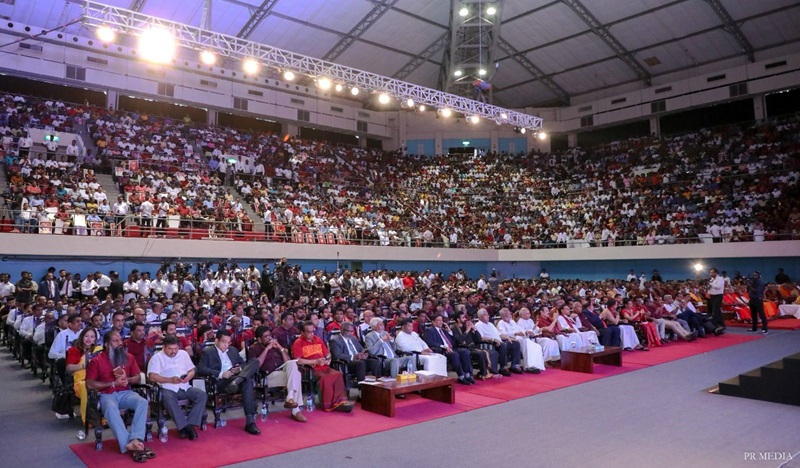
General Sir John Kotelawala Defence University’s Faculty of Defence & Strategic Studies (FDSS) and the Centre for Strategic Assessment (CSA) hosted the Signature Seminar addressing the issues of Responding to Disinformation and Building Disinformation Resilience with the gracious presence of Minister of Foreign Affairs Hon. M.U.M. Ali Sabry PC MP as the Chief Guest on December 14.
This consequential event was committed to expounding upon the intricate challenges posed by disinformation within the contemporary global landscape, with a specific focus on devising strategies to bolster resilience against this dynamically evolving threat.
The conference was structured into three distinct sessions, each delineated by the overarching themes of “Strategic & International Relations,” “Political Economic & Legal,” and “Social Engineering & Operational Challenges.” Nine distinguished speakers, comprising both international and Sri Lankan authorities, actively contributed their insights and ideas throughout the entirety of the conference. The foreign experts engaged in the discussion sharing insights from their respective national experiences while drawing some parallels with Sri Lanka. The experts represented France, India, and Malaysia, contributing valuable perspectives to the discussions.
Vice Chancellor of KDU Rear Admiral HGU Dammika Kumara, delivered the welcome address and subsequently, Hon. Ali Sabry addressed the audience underscoring the paramount significance of tackling disinformation within the realm of Strategic and International Relations.
The Foreign Secretary, Aruni Wijewardena delivered an address to the audience, emphasizing the paramount importance of fostering disinformation resilience and she extended her appreciation to KDU for its pivotal role in leading this noteworthy effort.
The first session, under the moderation of Director CSA Dr. Harinda Vidanage, delved into the nuances of Strategic and International Relations. Editor In Chief of Stratnewsglobal.in, Nitin A Gokhale, Additional Secretary/Multilateral Affairs, MFA U.L.M. Jauhar, and Norashikin Sahol Hamid from the National Defence University of Malaysia imparted their insightful perspectives.
The second session commenced with an introduction by the moderator, setting the stage for compelling presentations by Additional Solicitor General Nerin Pulle, Actg. DG Data Protection Authority Waruna Dhanapala and Senior Vice President Global Alliances and Partnerships, John Keels Dileep Mudadeniya.
The culminating session focused on intricate subjects of social engineering and operational challenges featured presentations by Coordinator in Charge of Healthcare Donor Activities and Diplomatic Affairs, Ministry of Health Dr. Anver Hamdani, Head of Unit for Analysis and Strategic Communication / French Ministry of Foreign Affairs Charles Thepaut and Business Consultant on Digital Transformation Isura Silva.
The subsequent participants’ discussion served as a platform for diverse viewpoints on the political, economic and legal dimensions of mitigating disinformation.
The Signature Seminar on Responding to Disinformation and Building Disinformation Resilience is the first ever combined effort of the stakeholders and proved to be a beacon of erudition.
The event convened distinguished dignitaries, experts, scholars and professionals to collectively address the complexities of disinformation, fostering a holistic comprehension of the challenges and opportunities within the contemporary information landscape.
The special police operations that commenced this morning (17) across the island have resulted in the arrest of 83 suspects thus far, Minister of Public Security Tiran Alles said.
The Minister stated that this includes 45 suspects who had been wanted in connection with narcotics-related offences.
Sri Lanka Police commenced a special operation from today in order to eradicate drugs trafficking and the underworld in the country.
Over 100kg of Kerala cannabis seized in Ja-Ela
The Police Special Task Force (STF) has recovered more than 100 kilograms of Kerala cannabis during a special raid carried out at a house in the Ja-Ela area.
The raid has been carried out based on a tip-off received by the police.
The street value of the stock of Kerala cannabis is estimated to be around Rs. 20 million, according to police.
Police said that further investigations are underway regarding the incident.
Meanwhile, the police have also arrested a 38-year-old woman, along with over 68 kilograms of Kerala cannabis at a house in the Bharathipuram area of Kilinochchi.
In a separate raid, a 53-year-old woman who had sold intoxicating pills to schoolchildren has been taken into police custody along with 1,310 intoxicating pills in the Colombo 14 area.
Police have arrested a person while in possession of 35 kilograms of ‘Hashish’ during a special operation carried out in the Wattala area today (17).
The street value of the seized narcotics is estimated to be around Rs. 20 million, according to Police.
42 arrested with various narcotics in joint raid at Kolonnawa
A total of 42 individuals have been arrested while in possession of various narcotics including heroin, ‘Ice’ (Crystal Methamphetamine) and Cannabis during a joint raid conducted by the Police, Special Task Force (STF) and Sri Lanka Army at the ‘Sanhinda Sevana’ flats in Kolonnawa.
The raid has been carried out on the orders of Acting IGP Deshabandu Tennakoon, Ada Derana reporter said.
A total of 156 police officers including the officers of Western Province-South Crimes Unit, 154 personnel of the Sri Lanka Army and 16 officers of Police STF had joined the special raid, which was conducted early this morning (17).
Meanwhile, the police have also used drones and police K-9 units for the operation, according to Ada Derana reporter.
During this raid, the security personnel have searched 625 individualsfrom 165 houses at the ‘Sanhinda Sevana’ flats, the police said.
Of the 42 arrested individuals, 25 were arrested on suspicion while narcotics were found in the possession of the other 17 suspects, according to police.
Moreover, police have also taken custody of several sharp weapons including swords during the raid.
Ambalangoda, Dec. 16 (Daily Mirror)- Steps will be taken to confiscate all property and wealth earned illegally through drug smuggling and underworld activities within the next three months, Acting IGP Deshabandu Tennakkon said today.
He made this remark at an event held in Ambalangoda today.
He said underworld activities are rampant in the Western and Southern Provinces which amounts to 7 percent.
The Acting IGP said some 1,091 individuals have been identified as being engaged in underworld activities and that information on 790 among them have been gathered by now.
He said CCTV cameras have been fixed at the counters of the exit terminals at the airport to prevent them from fleeing the country with forged passports.
The Acting IGP further said that some 70,000 individuals with open warrants are at large in the country and that their whereabouts are unknown.
lpitiya, Dec 16 (Daily Mirror) – Public Security Minister Tiran Alles said that a special operation targeting drug-related activities and the underworld is set to commence tomorrow.
Minister Alles has directed Police to take stringent measures against individuals engaged in drug smuggling and underworld operations.
The Minister made these directives during a community police committee meeting in the Elpitiya Division held this morning.
A group of senior officers, including Acting Inspector General of Police Deshabandu Tennakoon attended the meeting.
Minister Alles urged the public to actively support the police force in their efforts to combat drug-related crimes and underworld activities.
“I have given the police until June 30 only. By June 30, there should be a complete change in the drug and underworld activities in this country,” he said.
Colombo, Dec 17 (Daily Mirror) – Minister of Housing and Urban Development Prasanna Ranatunga has ordered a probe into unauthorized lending of housing loans in his Ministry from 2015 to 2019.
“Unauthorized lending has been done mostly in the Hambantota District,” the statement said.
An official statement from the Ministry said funds allocated for certain housing schemes under the Udagama project have been transferred to several other housing schemes.
Meanwhile, the Ministry is to start work on the construction of 98,000 houses which has been halted halfway. It has been found that work on 2,150 Udgamas has been stopped during the regime of 2015.
Meanwhile, work on 2,795 houses has been fully completed after the SLPP government came into power but work on the other houses could not be completed due to the Covid-19 pandemic.
Colombo, December 17: Earlier this week, the Sri Lankan cabinet decided to investigate the execution of a young Ceylonese entrepreneur Duenuge Edward Henry Pedris 108 years ago by the British for a crime he did not commit.
Pedris was sent to death by a firing squad for attempted murder.” The shots that he fired in self-defence into a mob that was converging on his shop in Pettah, had only injured a policeman. No one was killed.
Pedris, then only 27, was executed by an army firing squad in Welikade prison on July 7, 1915. The unconscionable execution was part of the widespread repression the British rulers resorted to in order to control the Buddhist-Muslim riots which they suspected were part of a sinister scheme to overthrow them.
Pedris was executed primarily to set an example to those among the newly-emerging Sinhalese-Buddhist elite who had developed a sense of cultural and religious nationalism with a political undertone. However, contrary to the expectation of the British, Pedris’ brutal execution did not frighten the emerging Ceylonese political elite but only spurred them on.
Independent Ceylon remembered the young martyr by naming places after him and issuing a postage stamp in his honor. But the indefensibility of the British decision to execute him was not fully gone into and publicised. This lacuna will now be filled by a three-member cabinet-appointed investigating committee chaired by Anil Gunarathna, a retired Supreme Court Judge.
Pedris as Captain of the Colombo Town Guard
Shooting and Riots
Pedris was from one of the richest families in Ceylon. And like his class, was by no means anti-British. In fact, he was a member of the Colombo ‘Town Guard’, a force raised by the government to help the police in emergencies.
The Sinhala-Muslim riots had started in Kandy at the end of May 1915, and had spread to Colombo. It wreaked havoc in Pettah, the town’s main market. On 1 June, when Pedris was at his shop on Main Street Pettah, a Muslim mob, incensed by the destruction of their shops, was seen advancing towards his shop. Pedris came out, whipped out a gun and fired six shots into the crowd. One of the bullets hit police constable Seneviratne in the head. Seneviratne survived, but the charge of attempted murder was slapped on Pedris.
The police raided his house and seized a cache of arms and ammunition. He was produced before a Court Martial, and sentenced to death. The sentence, grossly out of proportion to the crime, was handed down despite contradictory evidence about the time at which the shooting took place. Further, the trial was held under Martial Law even though the shooting had taken place before Martial Law was imposed.
Appeals for clemency to the Governor Sir Robert Chalmers from the highest personages in Ceylon fell on deaf ears. Chalmers and the Inspector General of Police, Herbert Layard Dowbiggin, wanted to make Pedris’ swift execution a lesson for the other ‘ringleaders’ of the ‘anti-British’ movement such as D.S. Senanayake, F.R.Senanayake, D.B.Jayatilaka, Dr.W.A.de Silva and Dr. C.A. Hewavitharana. Like Pedris, these members of the emerging Ceylonese elite were striving to foster a new cultural nationalism based on Sinhala-Buddhist ideals. They were among 86 leading lights of the anti-drink ‘Temperance Movement’ who were imprisoned in Welikade for ‘waging war against the King’ and abetting the riots against ‘His Majesty’s Moorish (Muslim) subjects.’
Execution
On the day of the execution, at 7.30 a.m., the man in charge, Additional District Judge Arthur Charles Allnut, an Oxford University graduate and a member of the Ceylon Civil Service, lined up the 86 Sinhala-Buddhist notables in the verandah outside L-Hall in Welikade Prison, so that they could watch Pedris walk to his death.
According to Jayasena Dahanayaka, author of Deshabandhu F.R. Senanayake (Vijitha Yapa, 2011), Pedris, dressed in his Town Guard uniform, marched with his head held high and chest forward. At the site of the execution, behind the jail, Pedris was made to sit on a chair. He had just one request to make: he wanted to be shot, not by Christian or European soldiers, but by Asians. Allnut agreed and ordered the men of the 28th Battalion of the Punjab Regiment, which had been brought from India to help quell the riots, to carry out the sentence. Pedris faced the Punjabis fearlessly, rejecting a blindfold offered to him.
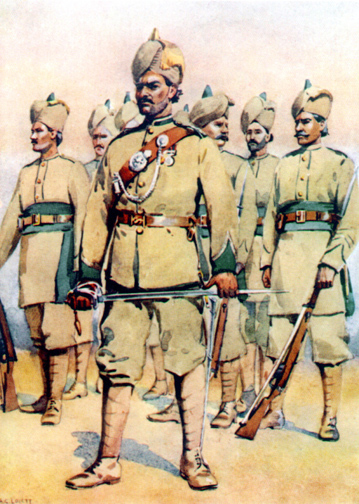
Punjabi troops deployed in Ceylon
Sharp at 8 a.m. gunshots rang, signalling the end of the young man. Twenty minutes later, Allnut arrived at L-Hall with a posse of prison staff carrying the blood splattered chair on which Pedris had died. Showing the chair to the Ceylonese leaders lined up there, Allnut declared: Any person who commits an act of treason against the government by forming organizations like the so-called Anti-liquor Movement, will have to die facing such a fate as this.”
An infuriated F.R.Senanayake shot back : Are you such a cowardly and timid nation to shoot one of our young men and bring the chair splashed with his blood? Aren’t you ashamed to parade the results of your foolish and stupid act to us when we are sorrowing at the demise of one of our people? Each drop of blood of this young man Pedris, who I treat as one of my own, should be considered as sacrificed in the name of the nation. If the stream of blood wetting that chair is counted in drops of blood, the British will definitely have to pay compensation.”
The killing of Pedris and the liberal use of the charge of treason in dealing with rioters and suspected instigators made the British very unpopular among the politically conscious sections of Ceylon. Even the British lawyer, Eardley Norton, dubbed this tendency as ‘Treasonitis’, a new disease afflicting Colonial Establishments all over the world.
Edmund Hewavitharana, brother of Buddhist revivalist Don David Hewavitharana (who later became Anagarika Dharmapala) was sentenced to ‘penal servitude’ for inciting a mob to attack ‘Chrystal Palace’ a huge Muslim emporium on Keyzer Street, Pettah. Constable Senanayake was sentenced to death for extorting money and jewellery from a Muslim businessman.
Punishments out of proportion to the crime, such as these, eventually turned the leaders of the social reformist ‘Temperance Movement’ into national political leaders demanding self-rule, albeit in a non-violent, gradualist and constitutional ways. Their efforts culminated in the British withdrawing from Ceylon and D.S. Senanayake becoming independent Ceylon’s first Prime Minister in 1948.
Reasons for excesses
There were several reasons why the British used excessive force to quell the riots. The basic reason was a lack of understanding of what was happening in the socio-cultural, political and economic life of the Ceylonese.
A.C.Dep, the author of Ceylon Police and Sinhala-Muslim Riots of1915, says that the relationship between the British rulers and the people of Ceylon had been as distant in 1915 as it was during the Matale rebellion in 1848 and the Uva uprising in 1818. Very few of the British administrators knew the local languages and customs, though, ironically, the Governor of Ceylon in 1915 was Sir Robert Chalmers, a well-known scholar in Buddhism with academic papers to his credit.
But Chalmers was a bad administrator. Sir Ponnambalam Ramanathan, who had taken up the cause of the Buddhists and was also close to Chalmers, tried to meet him and persuade him to see the riots in the right perspective, but Chalmers would not see him. Some of Chalmers’ paranoia could be explained by the fact that he had just lost two sons in World War I which was then raging in Europe.
The Inspector General of Police, Herbet Layard Dowbiggin, also showed lack of understanding despite the fact that he came from a family with a long connection with Ceylon. His father was Rev. R.T. Dowbiggin, was a Sinhala scholar who had translated the bible into Sinhala, and taught Christianity to none other than Anagarika Dharmapala, the Sinhala-Buddhist nationalist.
Dowbiggin was a hardworking officer, but he tended to be untrusting in his approach and impetuous in action. The then Army commander Brig. Gen. H.H.L.Malcolm was of the same kind.
According to A.C.Dep, the Governor did not bother to find out from the newly emerging elite, including the Mudaliyars and Muhandirams appointed by them, what was meant by the Sinhala-Buddhist National Movement and National Day,” whether it had any political content. The new elite had also made no attempts to engage the government. They passively looked on as the riots spread, giving the British the impression that they were the behind the scenes instigators.
Governor Sir Robert Chalmers
Crucial Letter
Chalmers and Dowbiggin went by a letter written by a nephew of Ven. Hikkaduwa Sumangala Thera in 1914, which happened to fall into their hands.
The letter said: Advantage should be taken of the present opportunity to obtain our freedom from the manifold hardships we have to put up with at the hands of the heathen and coast Moorman and the Moors of Ceylon, as our object in view can be obtained as the English are at present hampered owing to the war, and because the opposing enemy will render us assistance. That the century of the British occupation of Kandy will be completed on the 2nd of March, 1915, it is the object of our association to take steps to cause rebellion in all the provinces and take possession of Kandy on that day itself.”
Army’s Induction
Since the Ceylon Police were understaffed (According to police historian A.C. Dep, there were only 2600 men in the force and these had to man 132 police stations across the island), troops had to be requisitioned from India. About 300 Indian troops of the 28th Battalion of the Punjab Regiment led by Lt.Col. Chichester were inducted.
With the imposition of Martial Law on 2 June, the police, army and volunteer corps especially the planters’ brigade, went berserk. Shoot at sight orders were issued. Miscarriage of justice took place on large scale.
Although, historically that is the stark truth, we all should be ashamed that nothing had been done to rectify the historical injustices done to our own heroic ancestors in the former Kandyan Kingdom, by the colonial invaders for 443 years by any government that took over the reins of government of this country in 1948, even though 75 years have lapsed, since the invaders have left the shores of the country.
Kandyan Peasantry Commission 1949
Although a Commission called the Kandyan Peasantry Commission was appointed in 1949 by the then Government in an attempt to look in to the problems of Kandyan people (calling them peasants- a social group never existed in this country since the advent of Buddhism in 307 BC), its objectives were limited, To inquire in to the socio-economic conditions of the Kandyan people and make recommendation to ameliorate them” This in my opinion was only a very superficial scratching of a deep rooted national problem manifested by Western colonial plunderers over a long period of nearly 500 years (1505-1948) of brutal and savages colonial destructions of one of the greatest millennia old Eastern civilization.
The KPC never addressed the basic issues of a nation robbed of its natural wealth such as millions of acres of land, its pristine forests and making hundreds of perennial rivers dry and a nation pauperized and culturally poorer due to ruthless colonial exploitations and depredation. The restoration of their lost birth rights and the heritage starting from 1815 up to 1948 was not given any attention. Firstly, by returning their ancestral land to their original owners, the right to restore the premier forests cover destroyed by the invaders on the prime watershed in order to restore the lost physical stability of the nation’s Heartland that led to acute soil erosion and land degradation, and the depletion of water resources and the loss of bio diversity in the geographical heartland of the country. The demographic complication of the presence of a foreign labour force of nearly 1.2 million Indian labour right at the center of the country that would bring about internal demographic, political and socio-economic problems and future geopolitical problems that threatens the political stability of the Island a nation and finally, the reparation of the lost rights of the native Sinhala people, the sons of the land who owned it for millennia
It may be that both the politicians and policy makers of the time had been debarred from looking in to other critical problems like, touching the tea plantations, the issue of the Indian labour and the crimes committed by the British on native Sinhalese, including their war crimes, genocide and murder, their draconian land policies that made thousands of native Sinhalese landless.
To that extent the KPC Report is also an incomplete public record that has failed to do justice by the Kandyan and their land.
What is worse was that even the extensive recommendations made in the KPC Report which made to ameliorate the socio-economic conditions of the Kandyan peasants, were never implemented as recommended and left justice denied to them up to date.
For example even the first and the only 6 Year Plan 1953/54-1959/60 prepared under the findings of the KPC Report 1951 still remains unimplemented fully, due to non-provision of funds and absence of necessary institutional arrangements and more specifically due to objections by some of the so-called low county Sinhala politicians like M.D.H Jayawardha, the then Finance Minister who raised his objections against special treatment for a particular area and a particular group and refused to give allocations. This evinces how the black white rulers have treated their own ancestors of the Kandyan areas, who had died on behalf of them.
The chronic apathy on the part of the Kandyan present day politicians (from 1948 to date) on the other hand who should have fought the battle on behalf of their own people is even worse. The disinterest on the part of all Sinhala politicians in the Parliament, who have no feeling for their country or for their own people who had fought and died to protect this country for them, who were and who are more interested in estate Tamil votes and their own narrow party politics than the destiny of the country and their own Sinhala voters whose ancestors had died in thousands in battle under extremely deplorable and pathetic condition as Davy had mentioned above, to protected this country, for them to do politics today and enjoy the lavish privileges of political life are responsible for this unfortunate situation. (See Annex 111 for details)
Two other eyewashes.
Meanwhile two other political” eyewashes to deceive the Kandyans, were also made in recent times by the same genre of politicians who were never committed to rehabilitate the Kandyan areas.
The first was the formation of the Udarata Development Authority under Act no 26 of 2005. This was closed down on Jan 1st 2014 by Minister Basil Rajapaksa to from his own pet project Divineguma.
The second attempt was made in 2017 to form an Authority called a Statutory Board for the protection of Kandyan Heritage. Those who sponsored this were also never concerned about the rehabilitation or the welfare of the people. This Authority has no final Cabinet approval or an Act passed by the Parliament up to date. But it continues to operate rather illegally in the Kandy town in a rented-out building paying a monthly rental of Rs 1.2 million spending millions of public funds, looking after their own benefits.
A Nations Indebtedness to Kandyans
The whole nation is eternally indebted to the Kandyans who sacrificed their lives for 443 years on behalf of the Motherland and its people which enabled us to have a country to live today.
This sums up the 75 years of an appalling and tragic story of how the successive governments since 1948 have treated the brave and patriotic sons of the soil who had fought and died in battle in thousands to liberate this country, from three western colonial enemies for, four centuries and forty-three years.
Therefore, the crying need and the timeliness for formulating, and implementing a comprehensive rehabilitation and development Programme, for the Kandyan areas to uplift these forgotten, neglected and betrayed sons of the soil whose ancestors have protected this land by paying with their lives in thousands for us to live today in our beloved motherland and to do justice to these neglected people at least now, though belated.
It is on behalf of these patriotic freedom fighters who died on our behalf for 443 years and their victimized and destitute decedents who are landless, poverty stricken and therefore helpless, today, I am making this request for their rehabilitation, reparation and upliftment in order to do justice by a patriotic generation of people.
Needless to say, the whole nation is eternally indebted to the Kandyans who sacrificed their lives on behalf of the Motherland and the posterity.
At the same time there is also a legitimate and moral need to rectify the historical injustices done to the country and the people as a whole.
First, by the colonial invaders, more specifically by the British by way of reparation and an open apology for the destruction and devastations done to this country and its people.
Second, by our own politicians who succeeded the colonial rulers in 1948 for the criminal negligence committed by them on their own people who protected a country for 443 years for us to live up to date.
The area proposed to be taken up for rehabilitation and development under this Authority covers 1/3 the total area of the Island also with a beneficiary population of 1/3 the total population of the country.
Proposed Political and Administrative mechanism to implement this programme.
1. A proposal to establish
A powerful Ministry of Kandyan Rehabilitation, Development and Protection under the Head of the State as proposed by the Kandayan Peasantry Commission Report of 1951
2. A Kandyan Areas Rehabilitation, Development and Protection Authority of Sri Lanka under the above Ministry as the Agency in charge of carrying out the activities of the Master plan
The mandate of the Kandyan area Rehabilitation, Development and Protection Authority are as follows.
1.First,
To complete the recommendations made for rehabilitation under the Rehabilitation and the Development programme given in the first six-year plan made under the Report of the KPC 1951.
2.Second, to complete the other recommendations of the KPC Report 1951.
3.Third, to carry out a comprehensive socio-economic development programme through an intensive and sustainable agricultural livestock, small and medium industries and tourist development program geared to employment and income generation within the rural sector on 1/3 the total area of the Island with a view to raising the standard of living of nearly 7 million people there by rescuing them from abject poverty and discrimination.
4.Fourth,
To implement a comprehensive infra structure development programme like roads, irrigation facilities (anicuts, village tanks and canals ect) hospitals and Ayurvedic centers, schools, multipurpose cooperatives with banking facilities, Agrarian service centers, marketing facilities, and postal facilities etc throughout the project area.
(See Annex 1V for details.)
5.Fifth,
To implement a Settlement Development programme to settle 250,000 families within the areas between 1000-3500ft msl in the above three Provinces and in the selected Divisional Secretary Divisions mentioned in para 2 to solve critical socio-economic problems prevailing in these areas such as landlessness, unemployment and abject poverty rampant and acute. This settlement and development package is based on the NADSA Development model implemented in the Districts of Kandy and Kegalla (1985-1991) that was extended to Monaragala, Badulla, Rathnapura, Nuwaraeliya from the year 1992, after its resurrection with a 12.5 m us$ WFP package obtained by me as its then Executive Director under the new name HADABIMA Authority of Sri Lanka)
The original NADSA project (National Agricultural Diversification and Settlement Authority was confined to Kandy and Kegalla Districts, was a UNDP project started in 1978 August with the three-fold objectives of
1 Watershed Protection (management)
2 Settlement Development and
3 Agricultural Diversification
In addition to these objectives the new proposal is also geared to employment and income generation within the rural sector. leading to overall socio-economic development in the country.
6.Sixth,
To initiate a program of returning the lands of native leaders confiscated by the British to their legitimate inheritors. (See Annex 1V 12)
8. Seventh
This will be followed by a call for reparation, compensation and apology from the British government both for natives and Indian estate labour who had been exploited to the rim under most inhuman treatment. (See Annex 1V 10&11)
9 And finally,
To engage in any other activity the Authority deems appropriate to meet the lost rights and grievances of these great people and improve the standards of life of the permanent residents of the selected Divisional Secretaries Areas.
‘Before you study the economics, study the economists!’
e-Con e-News 10-16 December 2023
One objective of the USA’s ‘colour revolution’ in Sri Lanka aka ‘Aragalaya’ has been achieved – mission accomplished! The Sri Lankan & Indian Navies are now operating under USA-England’s Combined Maritime Force (CMF). Midst lots of blabber about ‘nonalignment’ and ‘strategic neutrality’ etc, we are about to end up embroiled in white military (naval) attacks on the Western IOR (Indian Ocean Region), already stalked by the US Central Command. This could immediately mean fighting against Ansarullah (which BBCysts call Houthi) of Yemen, against Eritrea, Ethiopia and Somalia, and potentially against Hezbollah, Iran, Syria, and even Palestinian Liberation Movements. They aim to use us as cats’ paws to claw at our neighbors.
So, what was the media headlining while this Anglo-US takeover was being effected? Readers can check our past ee NewsIndexes to verify this: The media was jabbering about Chinese ‘spy’ ships, about protracted kerfuffle between the headline-grabbing Minister of Justice and the National Aquatic Resources Research & Development Agency (NARA) over control of the mapping of the country’s ocean floor, about Tamil Nādu’s incessant poaching, and about the rare interceptions of their dangerous drugs and fake medicines (which are yet flooding the country), etc. How we can intercept contraband when allied to the main drug dealers of the world (of English Opium Wars & US Golden Triangles, anyone?) remains a mystery? It was also pointed out this week that the international (read: English) media ‘without hesitation categorizes all Chinese research vessels as spy ships’.
The CMF is commanded by a US Navy Vice Admiral, who also serves as Commander, US Naval Forces Central Command (Navcent) and US Navy 5th Fleet (stalking the Persian Gulf, Red Sea & Arabian Sea). All 4 commands are based at US Naval Support Activity (NSA) in colonized Bahrain. CMF’s Deputy Commander is an English Royal Navy Commodore who recently visited Sri Lanka, again rather hush-hushedly.
So, what’s going on? Wasn’t SWRD Bandaranaike murdered for also kicking the English navy out of Trincomalee & Katunayake? So, is this the end of ‘flag & anthem’ independence… of ‘briefcase independence’? (see ee Random Notes, US Navy)
*
• He likes to play the baba: this University of Colombo Professor S Abeyratne. ee used to mock him as Reductio Ad Abeyratne, for his ability to condense any and all trivia into the utopian talking points demanded by the white embassies: rule of law, corruption, free trade, etc. He writes a weekly column in the President’s family rag The Sunday Times. ‘Endless bribes & commissions from top to bottom’ are required to do business in Sri Lanka, he wails this week, saying villagers impudently ask, ‘What do I get? – Mata Monavadha Lebenne?’ when private businesses are set up in their communities – in this case on Temple Lands!
He’s such a baba, but then so are the rest of these 5th-column economists. They rather attack Sinhala (nay, all Black peoples & countries) as somehow genetically corrupt. Someone should ask Mistuh Abeyratne why the English embassies (England, South Africa, Canada, Australia, New Zealand) in Sri Lanka call their chief agents, High Commissioners. Is it cos they take the highest commissions? Monavadha Oonta Lebenne? – What do they get? This he can’t & won’t, and is simply not allowed to, say.
The USA speaks its own variable English, and calls their siccarios, Envoys (from the French for ‘on the way’, perhaps to invade!). The English & their settler colonies as well as kalusuddha colonies (India, etc) are more honest – if we choose to explore or rather excavate their English – an English never taught in our obese & flatulent English departments. These – D’Oyly’s great-grand-spawn – have never heard of England’s industrial revolution, nor of their de-industrialization of our world. This ee continues examining the metasizing of imperialist ‘supranational’ institutions under the guise of ‘aid’ and ‘development’. Premier among them is the Crown Agents Office in Sri Lanka set up way back in 1833:
*
‘The Office of the Crown Agents (OCA)
was the English empire’s middleman:
if colonial governments needed to buy something,
they set it up. Under the Secretary of State for the Colonies,
it then managed colonial investments and the supply
of all non-locally made goods, as well as supervising
construction projects & paying colonial officers’ salaries & pensions’
(ee Focus)
*
• This ee charts the evolution of the OCA into England’s Commonwealth Development Corporation, originally called the Colonial Development Corporation, to use exports from colonies to pay off the vast US loans that funded their 20th century world wars. The term ‘development’ was a cunning corporate 1950s advertising strategy led by Unilever in Africa to justify the continued dominance of companies closely linked to the English empire. Think of all the government ministries who sport the title ‘development’ now, think of the names of NGOs & banks (eg, World Bank’s real name, IBRD). This ee unearths the origins of imperialism’s fake aid business in England’s Crown Agent Office (OCA); the US World Bank’s International Finance Corporation (IFC), which under the guise of ‘poverty reduction’, is behind several so-called ‘commercial banks’ in Sri Lanka; the USA’s Millennium Challenge Corporation (MCC), which makes electricity expensive for people yet diverts it inexpensively to tourist hotels, the UN’s ‘Sustainable Development Goals’ which talk of ending ‘poverty everywhere’ and providing ‘quality education for all’ but insists on teaming up with big businesses (aka IMF).
*
• This ee looks at the close corporate links with NGOs and continues our charting of the corporate coup d’etat to overthrow ‘independent’ governments. In Sri Lanka, this attack is led by Unilever, one of the largest corporations in the world, who not only has captured our home market, but also controls our media. ee therefore examines the colonial origins of Unilever and the devastation it has left in its path; and also looks at the setup of an international legal system to control and plunder the resources of the world, and overthrow governments that challenge corporate domination. This involves, the ‘nefarious alliance’ between so-called NGOs like Care USA, Save the Children, Oxfam etc & corporations (Unilever also claims to be an NGO!). They all seek to promote profit over justice, weakening labor laws and eviscerating workers’ protections & rights. To enforce this predatory behavior, MNCs have created a global Supreme Court (ICSID) and are raising & funding private mercenary militias (death squads) to crush labor movements, and intimidate & murder activists. Welcome to the age of perpetual war and full spectrum dominance: Gaza is meant to show us their ways…
*
‘Hotels, catering to foreigntourists,
bask in the luxury of subsidised electricity,
paying a mere Rs28/unit, while ordinary households
over 181 units monthly face a peak-time tariff of Rs106/unit’
The concern with Pathirana’s critique is that he naively absolves the IMF of culpability by suggesting that the IMF demanded direct taxes. IMF staff, however, know full well that in order to meet their ambitious fiscal targets in short order, indirect taxes are the easiest to collect for governments. Taxing the rich would require stringent capital controls & a strong government which IMF-supported policies have happily eroded over the past decades.
Education is surely an essential, but education for what? More arts & humanities graduates to bloat government bureaucracy? More lawyers, doctors, nurses & technical workers to immigrate to the white West? In a way, funding road & infrastructure is more productive as it at least provides livelihoods for rural workers.
It is true that taxes are low & tax holidays are excessive in Sri Lanka. But anyone who calls themselves Marxist has to ask why this is the case. It cannot just be due to the unique meanness of the Sri Lankan ruling class. It is a reflection of very low levels of productivity, requiring tax cuts to maintain profits.
High interest payments are specifically due to the high exposure to private debt. Sections of this pseudo-Left jumped on the anti-China debt-trap narrative and helped manufacture consent for further exposure to private debt in 2015. Unlike Chinese debt, there are no records or corresponding assets of the way higher private-US-vulture-bank ISB debt has been used!
The purpose of state-led industrialization is not just to correct market failures, but to actually build the home market, which would ensure further industrial advance, particularly in the countryside
Finally, Pathirana refers to so-called ‘independent trade unions’. ‘Who are they ‘independent’ of? Are they those that met with US & EU ambassadors & their agents in the lead-up to the 2015 Yahapalana mess and/or during 2018’s so-called ‘coup’, or during the Aragalaya, which delivered us to the IMF? Are they just independent of mass political parties, and therefore of the people? Does their leadership reflect the social character of the membership? Do they derive their funding from members, or from foreign NGOs & CIA-backed ‘unions’ like the AFL-CIO? Do they represent the productive workers of the countryside? Or are they simply a small urban enclave representing the interests of government bureaucracy & the neocolonial service sector?
Recall that some of these so-called independent unions were linked to certain sectarian fellow-travelers in various ‘international’ unions, all, if not mostly, based in Europe or the US. Most of whom supported the US & EU & English wars on Iraq, Syria, Libya, Palestine, etc.
*
• ee also reproduces the criticisms by the Nicholas father-&-son tag team, of the new Central Bank Act (CBA). They point out it is Washington (metonym for the powerful US state) who demanded that the IMF release funds only after passage of the new Act. The old Central Bank Act of 1950, also being a US Federal Reserve creation, has now outlived its purpose. The Nicholases also record that another NATO-faithful economist & WG columnist WA Wijewardena recalls that the current governor of the Central Bank, Nandalal Weerasinghe, a former IMF stipendiary, stenographed this US demand for a new CBA, much earlier on, during the 2015 US-misbegotten Yahapalana regime, while working under Governor – now criminal fugitive – Arjuna Mahendran.
At this moment when the new pro-NATO President of Argentina, as a candidate wielded a chainsaw to indicate his anarcho-corporatist intentions for their Central Bank, the next government should not just amend the new CBA, but abolish the existing US-sculpted Central Bank, which SBD de Silva pointed out, has always opposed the independence of the country, from day one. They should establish a new People’s Bank to directly finance heavy industry and put the current Governor on public trial – along with his old boss Mahendran hiding out in rule-of-law Singapore, who CNN easily located & interviewed when the US dislodged the last President Gotabhaya Rajapakse!
*
• And speaking of Argentina, well known for its animal husbandry, wool, etc, this ee Focus continues sharing the Communist Party of Sri Lanka’s Alternate Program: this week examining Livestock & Dairy. Until JR Jayawardena’s post-1977 ‘open economic’ policies promoting imports, local milk production could fulfil 80% of Sri Lanka’s milk consumption needs. Now Sri Lanka produces only 45% of the demand for milk & related products. So, in a country where parents consider providing milk and milk-related products to their children as a mandatory obligation, what is to be done?
We should point to a curious lacuna, though. The failure to address what SBD de Silva called Staple Base Dynamism (SBD!) This refers to the practice allowed in the settler colonial countries, where primary staples were developed through dynamic rural industrial processes: milk to yoghurt to cheese, etc; wheat to flour to bread and desserts, and industrial chemicals, etc. Nonetheless, ee is pleased to continue our coverage of the CPSL’s program, of matters rarely well-detailed in other party programs (see ee Focus).
*
Contents:
*
A1. Reader Comments –
• ee Fires up • MAS’ Israeli & South African Directors • CPSL Program is Cool • Colombo’s Eco Ice Waste • Kissinger the Only War Criminal?
*
A2. Quotes of the Week –
• IPKF Follies • SJB’s Ranil-run Economics • LNT Mendis & CPSL • White Riots & Cuban Protests • Liberals are the Real Face of US Imperialism • Boeing’s Bedded Presidential Candidates • Israel’s Radiation Wall • Hollywood Avoids Napoleon’s Real Rise & Fall • Napoleon & Proletariat • Fake Optimistic US Indicators
*
A3. Random Notes –
• Sri Lanka & India under US Navy • JVP Goes NutFlix • IMF’s Austerity Budget Means • Was Kissinger or Obama Worse? • Lanka-Japan Friendship • Bureau Veritas’ Tech Imports • Sim’s Chemical Imports
*
B. ee Focus –
• B1. Taxing the Impoverished to Reward the Rentiers – Budget 2024: Dhanusha Pathirana
• B2. A future government should significantly amend the Central Bank Act – Part I: The Nicholases
• B3. Colonial History of Aiding Unilever & NGOs under Cover of Development
• B4. Livestock & Dairy & Idirimagen Idiriyata: Alternate Program of Communist Party of Sri Lanka, Pt10
*
C. Building Blocks –
• Guaranteed Rice Price for Industrialization • Creation of a Home Market for Industry • Japan’s Limits on Industrial Exports • Smallholding & Science • Extraordinary Culture of Machine Tools • Making Central Banks Independent of the People? • On State-owned Enterprises & Privatization
*
D. News Index
____________
A1. Reader Comments
ee thanks Readers who send articles of interest. Please excerpt or summarize what is important about any news sent, or your comments, and place any e-link at the end. Email: econenews@gmail.com
*
• ‘I get fired up with all sorts of good ideas after reading through ee. But there needs to be more continuity with the themes.’
*
• ‘There are no Sinhala directors on the MAS Board. However, they have an Israeli Jew and a White South African. Maybe that’s what they mean by diversity, inclusivity & equality – DIE!’
*
• ‘It’s cool that ee is reproducing the Communist Party’s alternate program. Last week, I learned lots about Sri Lanka’s rivers, that I never knew before.’
*
• ‘Colombo has a new ice rink called Eco Ice. Where do these people live? Perhaps it’s export-substitution. You don’t have to travel to subarctic Canada or Sweden to experience deep freeze. But at what cost? How cynical to call it ‘eco’? Especially when the country may experience furthers power cuts after the US escalates wars in West Asia.’
*
• ‘Why has the capitalist press found Kissinger a war criminal only after his death? When he was calling the shots, all were with him.’ (see ee Quotes & Random Notes)
*
____________________
A2. Quotes of the Week_
*
• ‘In the final analysis, [India’s] highly professional foreign service officers carry out their briefs from headquarters, keeping aside their personal reservations, if any. As Counsellor in our embassy in Bonn (West Germany), my ambassador DS Kamtekar summoned me one afternoon to give me a cable which had just arrived from Delhi regarding the decision to deploy the IPKF to Sri Lanka. Kamtekar, an extraordinarily cerebral mind, asked me with a twinkle in his eye what I thought of the GoI decision, since I had only recently completed my 3-year assignment in Colombo as 1st Secretary (Political). I told the ambassador in brutal frankness that the decision was a monumental folly, as Sri Lankans were sure to close ranks against us & evict us eventually. Nonetheless, we did a fine job and briefed German officials exactly on lines Delhi wanted. That is the wonder that was India.’
– Bhadrakumar (ee Sovereignty, Diplomatic blow to India as Biden turns down invite)
*
• SJB’s Ranil-run Policies – ‘The SJB economic platform represents policy continuity with Ranil, not change. The Harsha-Eran economic model has 5 pillars which make it morphologically Ranilian: 1) Renewed access (through an IMF rubber-stamp) to the foreign money markets, ie, a return to the original addiction. 2) A castrated Central Bank incapable of state intervention to offset external shocks, ie, do a Mahathir. 3) Unilateral rewriting of the Social Contract in favour of foreign & local big capital, by scrapping labour & land reform laws. 4) Unfettered, maximum – not optimum – privatisation & foreignisation of the economy, deleting the state & cooperative sectors. 5) Retention of the 2017 foreign exchange law which facilitates outflow and loss to the country of hard currency earnings.
Weighed-down by the albatross of Harsha’s Economic Blueprint, Sajith is handicapped in 2024 in his ability to compete with the JVP-NPP by losing the liability of a UNP profile as Ranasinghe Premadasa so easily did in 1988.’ – Dayan Jayatilleka (ee Economists, Sajith-Ranil equation, Opposition Alliance, Tamil Question & Foreign Policy)
*
• ‘LNT Mendis was a Marxist until his death. Of the old traditional school. As a young undergraduate at University College, Colombo, in 1940, he became a founder member of the-then Ceylon Communist Party headed by SA Wickremasinghe. He always worked for the state. He abhorred the very thought of ever working for the private sector. Starting as an elections officer, he went through being Assistant Commissioner of Agrarian Services at the time Phillip Gunawardene’s Paddy Lands Act was operating at its zenith, to serving the Ceylon Petroleum Corporation (being one of the pioneers with Sam Silva, James Lanerolle & former Auditor-General Wijesuriya in 1961), to heading the Oils & Fats Corporation and the Building Materials Corporation that he set up under the Ministry of Housing & Construction with Pieter Keuneman as minister in the mid-1970s. He prematurely retired as Senior Asst Secretary of his Ministry.’ – Susirith Mendis (from FB)
*
• ‘Given how the facts are communicated, a paradox arises: if the incidents occur in Europe or the USA, they are riots; if they happen in Cuba, we are dealing with a civic protest against the regime”. If the demonstrators are European or US citizens, they are rioters or violent criminals, to whom the law must be rigorously applied; if they are Cubans, they are activists, fighters for democracy” etc.’ – ee Media, Double standards & new protest linguistics
*
• ‘Contrast Kissinger to the ideological maniacs of ‘US democracy & human rights’ in power today who are responsible for far more carnage, death and destruction than him. I recommend anyone take a trip to DC. You may think that the face of US imperialism is some ruthless, cold-hearted pragmatist – but it’s the opposite. It’s ‘bleeding heart’ liberals willing to spill the blood of children to pursue their idealistic fantasies.
I reject this ‘universal celebration’ not because I think Kissinger is defensible. To be clear, he is a criminal with blood on his hands. I reject the ‘universal celebration’ where John Fetterman advisors, Biden campaign staff, ‘democratic socialists,’ liberal UkroNazi-NAFO supporters, ‘anarchists’ and young idealistic liberal interns for the US State Dept & other vermin – join alongside self -proclaimed ‘Communists’ & ‘anti-imperialists’ to hold hands, sing together, feel good about themselves, and throw a party together.
This is just sanitized Hollywood Leftism that is completely inauthentic and distracts from the fact that imperialism’s most aggressive champions are in fact maniacal ideologists like themselves, not cold-hearted realists.
It reminds one of the ‘humanitarians’ in the state dept who – while concretely fully supporting ‘Israel’ – engage in ‘humanitarian’ platitudes as a fake attempt to show sympathy to Gaza (while ‘condemning Hamas’). This actually helps imperialism by giving it a mask of principled ideological consistency.
In reality, the bloodshed of Gaza proves the irredeemability of the US ‘rules based’ world order!’ – ee Sovereignty, Not Sorry for Ruining the Fun
*
• ‘In general, I don’t think we want capitalism & democracy to share the same bed anymore. It’s time for a clean divorce. Let companies be companies but I don’t like the crony capitalism. This dates back a long time in both parties.
And I think that we need to end the lobbying, and I personally believe that if you have been working in the Government, you should not lobby that Government for 10 years. If you have been a government-elected official, doing deals with companies, be they Boeing or be they pharmaceutical companies, you should not join the board of that company for 10 years after.
The former chair of the FDA, the Commissioner of the FDA, ended up on the board of Pfizer. Nikki Haley did deals for Boeing and ends up on the board of Boeing. I don’t care if it is a Republican or Democrat, we need some basic principles that end the corruption in Government. That’s how we got the health insurance exemptions. That’s how we got the pharmaceutical liability exemptions. We need to end the corruption.’ – Vivek Ramaswamy, ee Industry, ‘Mr. Trump Says He is Very Proud of Operation Warp Speed: Should He Be?’
*
• ‘The neutron bomb was invented in 1958 by Samuel Cohen of the Livermore Laboratory of California and then RAND. In 1984 he proposed that Israel construct a neutron radiation wall around the country. ‘What I am suggesting is the construction of a border barrier whose most effective component is an extremely intense field of nuclear radiation (produced by the operation of underground nuclear reactors), sharply confined to the barrier zone, which practically guarantees the death of anyone attempting to breach the barrier. Establishing such a nuclear wall” at the borders of a threatened country can make virtually impossible any successful penetration by ground forces – as well as a preemptive ground attack by the threatened country’.’ – ee Sovereignty, New Evidence that Israel is Using a New Uranium Weapon – Make that the Neutron Bomb
*
• ‘The Hollywood movie has no real explanation of why Napoleon rose to the top in the French revolution, why he won his battles and why he lost the war in the end… France may have occupied Europe, but England had the colonies of the USA, Canada, Africa, India, & Asia behind it. England, based on its international trade, could mobilize more economic resources, raw materials and labour than France. In a prolonged war, England could survive longer and better than France.’
‘The workers who dug the canals, raised the triumphal arches and manned the factories were not allowed to go on strike, or to form unions to bargain for better working conditions or higher pay. However, Napoleon’s government saw to it that wages should keep abreast of prices, that bakers & butchers & manufacturers were under state price regulation, and that – especially in Paris – the necessaries of life should be supplied. Until the last years of Napoleon’s rule, wages rose faster than prices and the proletariat shared (modestly) in the general prosperity, proud of Napoleon’s victories. There was no unemployment, so no political revolt. ‘Nobody is interested in overthrowing a government in which all the deserving are employed,’ said the great man.’ – Roberts (ee Economists, Napoleon’s War Economy)
*
• ‘The economic indicators that the optimists and mainstream economics single out to judge the health of a capitalist economy are mainly ‘lagging’ indicators. They look at employment, consumer spending, GDP and prices. But Marxist theory tells us that what drives capitalist economies first is profits; then profits as invested in productive investment (this raises productivity of labour & output, not invested in fictitious capital like stocks & bonds); and only then does investment & production growth feed down to employment, wages & consumer spending. And when we look at these forward looking indictors of the US economy, it is not so rosy.’ – Roberts (ee Economists, Goldilocks & the last mile)
*
____________________
A3. Random Notes (‘Seeing Number in Chaos’) _
*
• Sri Lanka & India under US Navy – In July 2022 the Indian Navy quietly joined the USA’s Combined Maritime Force (CMF) based in colonized Bahrain. It didn’t get much media in India, for it was ‘buried 12 paragraphs deep in the joint statement issued at the end of the India-US 2+2 dialogue in Nov 2023’, in a 3-line paragraph that says less than what it means: ‘The Ministers welcomed India’s full membership of the multinational Combined Maritime Forces (CMF) headquartered in Bahrain.’ The apparent hush-hush is due to: ‘A Shift in Policy as India Joins Multinational Force Not Led by UN’ (see ee Sovereignty).
On 2 Oct 2023, English Deputy Commander Combined Maritime Forces (CMF), Commodore (Royal Navy) Philip Edward Dennis, based in colonized Bahrain, called on SL Navy Commander Vice Admiral Priyantha Perera in Colombo. Deputy Chief of Staff & Director General Operations, Rear Admiral Pradeep Rathnayake, Naval Assistant to the Commander of the Navy & Chief Hydrographer of the SL Navy Hydrographic Service, Commodore Kosala Warnakulasooriya, Defence Advisor at the English High Commission in Colombo, Colonel Darren Woods, et al, were also reported present.
Midst media diversion about battles between Minister of Justice Wijedasa Rajapakse and the National Aquatic Resources Research & Development Agency (NARA), the US Army Pacific Deputy Commander entered Sri Lanka ‘unheralded’, reported ee (18 Nov 2023). US Envoy Yatathvijitha Koreavay Julie Chung twitted on Nov 16 that she ‘welcomed Major General Christopher Smith, Deputy Commanding General of the US Army Pacific to explore ways to enhance our US-SL security partnership… ensuring a secure Indo-Pacific region. ee also noted that India & USA were moving ‘to grab Oceanic Surveys around Sri Lanka’.
On 20 November 2023, Sri Lanka joined the USA’s Combined Maritime Forces in West Asia as its 39th Member. ‘We are excited to have Sri Lanka as part of CMF,’ said Vice Adm Brad Cooper, CMF commander, calling it a ‘growing international naval coalition in the Middle East, which protects some of the world’s most important waterways. The naval partnership upholds the international rules-based order (except in Palestine etc) by supporting security & stability across 3.2mn sq.mi of water encompassing some of the world’s most important shipping lanes.’
On 4 December, the Indian Navy marked its Navy Day, which commemorates India’s attack on Karachi harbour during the 1971 War under ‘Operation Trident’. India’s navy is also gearing up to host its largest multilateral exercise Exercise Milan in Feb 2024, with over 50 countries, ‘to assist countries in the Indian Ocean Region (IOR) as the first responder & Preferred Security Partner. The Indian Navy conducts 17 multilateral and 20 bilateral exercises annually. The last edition of Milan was held off Visakhapatnam with over 40 countries.
Apparently, India’s Mobile Training Teams (MTT) have undertaken Operational Sea Checks of ships from ‘2 friendly countries’ – Sri Lanka & South Africa at Gokanna (aka Cheena Varaaya aka Trincomalee) & Cape Town. INS Nireekshak also conducted mix gas diving training for Sri Lankan Navy personnel in Trincomalee, in 2022-23.
Indian Navy Survey Ships have also conducted several hydrological surveys in Sri Lanka, Tanzania, Maldives, and Mauritius, as well as joint Exclusive Economic Zone (EEZ) surveillance, as ‘requested’ by Indian Ocean littoral states such as Maldives, Seychelles, and Mauritius. And these are not spy ships, apparently.
*
• ‘See the venue AKD has chosen to showcase his ‘knowledge’ of the music industry, of global supermarkets and Netflix: Uda Dumbara, a sleepy mountainous area inhabited by impoverished paddy, vegetable & highland cultivators!
AKD should be taught about the speech given by China’s Premier Zhou Enlai at a forum on literary & artistic creations & screenplay writing in 1961. Zhou delineated physical & intellectual production and discussed class struggle & united front, to whom art & literature serve, development laws, heritage, creation & leadership in art & literature.
Before uttering unscientific nonsense AKD should learn the ideas expressed by Marx, Engels and Lenin on art & literature, and Chairman Mao’s treatises on art & literature which have a profound relevance to countries in the East.
Has AKD written any theoretical essay? If the JVP claims that it is a Marxist party, what extraordinary profound knowledge of Marx do they have, of the ability to apply Marxism-Leninism to the economic and political situation of Sri Lanka? Is it able to unite Marxist parties and circles into a single unit giving it political leadership? It is an affront to Lenin if we try to describe what Lenin did before the Great October.
What ideological struggle do AKD & JVP/NPP wage against the SLPP, UNP, SJB & other splinter groups, except calling all of them horas? Is he criticizing their political & economic programs? What work have they done to unite Marxist groups & circles when it is not banned, at a time of enjoying democratic rights without any police persecution?
What change – if the JVP is not using the term ‘Revolution’ – is the JVP going to bring about? Is it a bourgeois-democratic revolution as Lenin put forward in his Two Tactics of Social Democracy in the Democratic Revolution or A Phase of New Democracy as expounded by Mao? Both leaders said the Proletariat – Working Class – Communist Party must be the leader. Is the JVP or NPP such a party becoming the leader of the bourgeois democratic or new democratic revolution?
Giving an interview to the Sunday Times, AKD had stated that his party’s aim will be a ‘Pohosath Janathawak – Pohosath Ratak’ (Rich People – Rich Country). All are hackneyed phrases (like ‘engine of economic growth’), nothing new in what he says; we have heard all this from all people who sought a mandate from people since Independence. These so-called engines are like the different types of locomotives the Ceylon Government Railways (CGR) has imported from its inception, which still cannot provide an efficient and effective service to commuters! What kind of ‘economic democracy’ AKD imagines, we do not know.
How is AKD going to make people ‘rich’ is the biggest question. ‘Rich’ in what? They are ‘rich’ in rhetoric. In words, not deeds. It seems that AKD is thinking that statecraft – with apologies to Mao – is ‘a dinner party or writing an essay or painting a picture or doing embroidery’.
If the JVP/NPP assumes that they will come to power very soon, in preparation to hold power we advise them to read and understand Lenin’s essays Impending Catastrophe & How to Combat It and One of the Fundamental Questions of Revolution (Collected Works – Vol25).’ – ee Politics, Janus-faced JVP: False Conceptions & the Harini Amarasuriya Factor
*
• Analyzing Sri Lanka’s 2024 Annual Budget – ‘Over the last 7 or 8 months our economic policymaking has been almost on autopilot – we have just been following the IMF benchmarks and what there is in the World Bank Country Partnership Framework. These are 4-year term agreements and programs and the government really doesn’t seem to be thinking about how to get either the people or the economy out of this crisis except through this IMF path, and austerity is very much a part of it. And by austerity, I mean that there is very little government expenditure for people and programs, and even investment for that matter. Along with that, their vision is one of serving commercial interests – about what is best for business, what is best for the private sector and more importantly over the last 4.5 decades not just in Sri Lanka all over the world, Finance Capital has been dominant, big finance, the banking sector and as we all know Sri Lanka defaulted on its debt last year and much of that debt is owed to powerful bondholders, hedge funds, western pension funds, insurance companies who buy Sri Lanka’s debt, and this budget is focused on repaying them their debt and then creating a climate in Sri Lanka where those who might be interested in taking forward commercial interests are given all sorts of goodies.’ – ee Economists, Analyzing Sri Lanka’s 2024 Annual Budget with Ahilan Kadirgamar
*
• Was Kissinger or Obama Worse? – ‘What is notable in the current moment, in the moralizing obituary circuit, is the framing that Kissinger was somehow uniquely evil & murderous – a moral cancer on the US body politic – and that he personally shifted US policy in this direction.
The Wickedest Man Alive – This ‘exceptional war criminal’ framing is especially promoted by the Imperial Liberal Press, in particular the Overton window gatekeepers such as The Nation, DemocracyNow!, NY Times, and Washington Post.
These sources draw liberally from the Bishop of Bombast, Christopher Hitchens, who described Kissinger as a ‘one-man rolling crime wave’, and his actions as ‘the wickedest thing ever done in American political history’, a moral crisis and stain on US politics. But is this characterization correct?
Kissinger had his fingerprints all over Vietnam, Cambodia, Laos, East Timor, Chile, Argentina, Bangladesh, Cyprus, implementing or greenlighting horrific, genocidal-politicidal atrocities. But these actions were not sui generis nor were they uniquely Kissingerian. They had already been templated, foreshadowed, & rehearsed for by previous US policies, long before the realpolitiking Kissinger had laid his felonious fingers on the reins of foreign policy. Korea (1948-53), Indonesia (1965-66) and the Philippines (1899-1902) are some key exemplars.
Gaza Covered with Snow – In the case of Korea, 20% of the population were killed, according to General Curtis LeMay, who designed and conducted the bombing campaign. What had been done tactically to individual cities – Dresden, Tokyo, Hiroshima – was concretized as continuous strategy for Korea: 635,000 tons of bombs, more than the entire Pacific bombing campaign, dropped in endless sorties of high explosives, cluster bombs & napalm over an entire country.
To get a contemporary image of this, take the worst bombing of Northern Gaza – already unimaginable and unthinkable in its sheer, atrocious barbarity – imagine, eg, the devastation of the Jabaliya refugee camp – and then double the intensity of that bombing, and then magnify the theater of bombing 800-fold. Add in endless napalm and time-delayed cluster bombs – to kill anyone who tried to rescue survivors – then you have a small sense of what Korea went through. Then add snow: Korea borders Siberia, and temperatures can drop to -25 degrees Celsius. If you were bombed and somehow survived the shredding of your flesh by cluster bomb shrapnel, or its incineration by napalm, there’s a good chance you would die from exposure to cold under an open sky, as the US rolled out massive air strikes in the month of November, 73 years ago. And still, if you survived all this, and had dug yourself into subterranean shelter, you could have been drowned later when irrigation and hydroelectric dams were attacked, and entire valleys inundated with flooding, while subjected to threats of biological & chemical weapons.’ – see ee Sovereignty, Question the Narrative that Villainizes Henry Kissinger: Correcting the memory of the obsequious butler of US empire
*
• Lanka-Japan Friendship Society new office bearers: ‘Exco for 2023/24: Patron Hideaki Mizukoshi, Ambassador for Japan, Vice Patrons: Merrick Gooneratne/Immediate past President, Sumana Liyanage, Deepal Gunaratne, Mikinaga Hotta, President: MD (Tony) Saldin, VPs: A Anandagoda, Jayaraja Chandrasekera, Gaminda Haegoda, Neomal Perera, Sunitha Wijepala, General Secretary: Samadara Mampitiye, Asst Gen Secretary: Diloshini Nesakumar, General Treasurer: M Thiyagaraja, Asst Gen Treasurer: R Kadirgamar Rajah, Executive Committee: Nemantha Abeysinghe, Dhammika Attygale, Vijaya Corea, PHP de Silva, Mahendra de Vaz, DARM Nishanthi Galhena, WI Gunawardena, Jannath Ismail, Upali Jayawardena, Brigadier Samantha Jayasundara, Captain Ganesh Mendis, Sarojini Nagendran, Rohan Pallewatte, Shanil Perera, SN Raghavan, Shelly Thenuwara, Manoranjan Wijebahu, Himani Wijemanne.’ (see ee Sovereignty)
*
• Bureau Veritas of France exports to Sri Lanka: ‘Calibration of calipers, external micrometers, circular sample cutters, steel rulers, dial gauges, thickness gauges, crock meters, balances, weights, glassware, piston operated pipettes, refractometers, hydrometers, pH meters, thermometers, cold refrigerated storages, ovens, incubators, water baths, furnaces and RPM of rotors, among many others.’ – ee Industry, Bureau Veritas provides high-precision calibration services for diverse industry sectors
*
• Serving large MNCs for 22 years – Sim Lanka Ltd has partner companies Cable Solutions, Aluflex Lanka, Prime Packaging, and Quality Floors. Sri Lanka Export Development Board assisted its products for the multinational electronics industry. Its newest alliance is with Control Print, India, a coding and marking solutions provider. Sim operates in 4 key sectors: electronic manufacturing, printing & packaging, industrial oil regeneration services, and industrial automation. Partners offer solutions for cables and harness applications for white goods, industrial, automotive & aerospace industries, industrial plastics and biodegradable products for paints, lubricants & dairy industries, aluminium foil lids, sealants & heat transfer labeling (HTL) for applications covering dairy, pharmaceutical, tea & industrial sectors, and flooring solutions, such as laser leveled, polished concrete and heavy-duty PU and epoxy flooring. Sim Lanka has strategic alliances with global brands such as Weller, Murr Elektronik, Simco-Ion, Huby, Distrelec, Kleentek, Ferrocare Machines, Sure Print, Giantlok & Oilmax. The company embraces women’s empowerment, diversity & inclusion, carbon neutral operations, children’s education & nutrition. – ee Industry, Sim Lanka
Ibrahim Khalil Ahasan – independent columnist and freelance journalist based in Dhaka, Bangladesh.
Deliberations at COP 28, the 28th UN Climate Summit in Dubai, have focused on several strategies for reducing greenhouse gas (GHG) emissions in the atmosphere to slow down climate change and global warming. To identify methods to fund non-carbon and renewable energy, participants (governments, financial institutions, and investors from the private sector) have been debating several solutions, such as carbon taxation, emission trading, and lowering the large amounts of subsidies given to the fossil fuel industry. According to experts, the world has to spend billions of dollars a year on renewable energy to transition to a “low carbon economy.” To raise the money required to address the climate catastrophe, IMF Managing Director Christian Georgieva recommended imposing “an implicit price on carbon emissions” during the COP 28 summit. According to her, initiatives aimed at increasing the cost of carbon emissions would hasten the global decarbonization of economic activity. Advocating for a swift phase-out of fossil fuels, more extreme viewpoints propose limiting global warming to 1.5 degrees Celsius by the end of this century. There is, however, no denying the need of rapidly adapt to renewable energy sources, drastically increasing funding for the research (and usage) of renewable energy, and gradually ceasing to utilize fossil fuels.
Bangladesh and other nations face several obstacles as they transition from fossil fuels to renewable energy. Bangladesh is now a nation that depends on energy imports. The importation of coal, LNG, and liquid petroleum is necessary to maintain the nation’s economic operations. The country’s energy balance has seen a considerable strain from domestic energy sources, namely natural gas. But solar energy—that is, solar-powered irrigation systems, solar-powered rooftop and land systems—is becoming more and more common. Due to significant technical developments in wind turbine efficiency improvement, there are encouraging signs that the nation’s offshore and coastal regions may see the development of wind energy-based power. However, the price of electricity produced by renewable energy sources like solar and wind is still rather expensive, at over Taka 12 per unit. Furthermore, a restriction on their proportion in the national grid is necessary due to the intermittent nature of solar and wind energy. For the same reason, maintaining and expanding a sizable fossil fuel-based capacity backup is necessary to ensure grid stability.
Experts believe that by increasing energy efficiency and adopting energy-saving practices, Bangladesh may drastically (up to 30%) lower its energy consumption. Bangladesh does not have the topographical or geotechnical advantages necessary to capture significant amounts of hydroelectricity, but it may benefit from its neighbours’ hydroelectric power potential via a regional system. Furthermore, the bordering nations’ developing “green hydrogen” technology may make it possible for the local energy sectors to convert from LNG to liquid hydrogen (import and usage). The capacity of the renewable energy basket may be significantly increased by improved and efficient battery technology. Bangladesh might thereby enter the race to phase out fossil fuels. Almost twice as much (around Taka 22–25 per unit) may be obtained from renewable energy sources with battery backup for solar and wind power as from the current, sporadic, and small-scale use of grid-connected solar power. The large differences in energy production and distribution costs that the steady and diverse range of renewable sources may provide cannot be sustained by government subsidies.
Bangladesh has already entered the age of producing nuclear electricity. There is increasing global agreement that nuclear energy is a non-carbon source. Even though developing nuclear power and securely using it requires significant upfront costs, ongoing costs are still quite inexpensive. Bangladesh may thus increase its nuclear energy capacity in order to get more dependable baseload electricity.
The technologies that are now and in the near future accessible provide means of gradually replacing fossil fuels with non-carbon and renewable energy-based economies. However, the global community’s climate funding and technology support are necessary for the solutions to be both socially and economically acceptable. Bangladesh and other low-income industrialised nations shouldn’t be forced to transition to a non-carbon (net zero) economy on the same timelines. Furthermore, the international community should give Bangladesh, the country most affected by climate change, a high priority in receiving many financial resources for both adaptation and mitigation.
UN climate conferences have repeatedly discussed achieving net zero by 2050, 60% reductions in GHG emissions by 2035, and 43% reductions in GHG emissions (compared to 2019) by 2030. However, these discussions will not produce significant outcomes unless the international community swiftly and effectively provides technology sharing and funding to developing nations such as Bangladesh.
Colombo, Dec 15 (Daily Mirror) – Former President Mahinda Rajapaksa who was reappointed leader of Sri Lanka Podujana Peramuna (SLPP) at its convention today said his party would become the most formidable political force at the next presidential elections.
Addressing the convention convened at a challenging time, the former President referred to the achievements of his government during the 2005/2014 period under two consecutive terms including the end of the war and infrastructure projects such as the Hambantota port. He said the per capita income improved from US $ 1200 to US $ 3,819 during his time and the middle class expanded.
Still some people resorted to mudslinging. When we built the expressway, some people harped on it saying it was meant for transportation of Ambul Thiyal for my consumption,” he said.
He said there was an era when the country was engulfed by the fear of terrorist attacks and parents used to travel separately from each other to avoid both getting killed in a bomb blast.
Youths who have no wartime experience have been misled today by some political forces acting according to the interests of foreign elements inimical to the country’s interests,” he said.
SLPP founder Basil Rajapaksa who addressed the gathering said people were struck by fear for life on two occasions – the war and Covid-19 – and the governments led by his party openly ended both.
We are proud about it,” he said.
In an obvious response to reports about planned attacks on SLPPers who attended the event on their way back from Colombo, he said security measures had been taken, and asked participants to exercise extra caution to avoid any mistake on their part.
When you cross the road, you have to make sure that you use only Zebra crossings. Social media teams with vested interests are alert on our movements to find any mistake to be blown up political ends,” he said.
While asking his supporters to be patient, he said others should not consider it as cowardice.
One should not consider our patience as cowardice. When a stone is thrown at a dog, it will bark and run away. But, when a stone is pelted at a lion, it will turn back and explore who did it,” he said.
Diyathalawa, Dec. 16 (Daily Mirror)- Emphasizing the monumental responsibility borne by the security forces in protecting the sovereignty of the country, President Ranil Wickremesinghe said that no external interference or restrictions should be tolerated.
President Wickremesinghe, serving as the Chief Guest at the Parade of Cadet Officers during the ceremony of Colours Re-Awarding and Commissioning Parade of the Sri Lanka Military Academy, Diyatalawa this morning (16), highlighted the security forces’ role in safeguarding both the people’s sovereignty and the distinctive identity of Sri Lanka.
He emphasized that any attempt to act independently based on racism or religion would pose a threat to the Sri Lankan identity, the President’s Media Division (PMD) said.
In his address, President Wickremesinghe expressed his admiration for the Sri Lankan Army, acknowledging its talent and proud history. He underscored the collective responsibility of all individuals joining the army to uphold its esteemed legacy.
Addressing the officers and women present, the President urged them to provide fearless leadership to those under their command. Emphasizing that true leadership emerges during challenging times, he encouraged everyone to dedicate themselves to fulfilling their responsibilities for the betterment of the country.
The President reaffirmed Sri Lanka’s status as a sovereign state, emphasizing the nation’s history of independence since 1948. He underscored that the sovereignty of the country belongs to its people, with governments elected through popular vote. The President emphasized the foundational importance of the Sri Lankan identity, urging all citizens, irrespective of ethnicity Sinhala, Tamil and Muslim, to work collectively to safeguard and preserve the national identity.
Referring to economic matters, President Wickremesinghe stressed the need for increased economic growth in the country. He drew attention to the consequences of a collapsing economy, noting its impact on the overall vitality of the nation. The President emphasized the importance of social progress alongside economic advancement, highlighting the need for equal treatment of all citizens. He called upon each group within society to play a role in protecting this framework, extending the responsibility from the President downwards.
The President emphasized the profound responsibility of the army in safeguarding the sovereignty of the country. He asserted that this duty should remain unquestionable and impervious to any attempts to restrict or compromise it. Simultaneously, the President underscored the importance of protecting the people’s sovereignty and preserving the unique identity of Sri Lanka. He warned against any actions or attempts to fracture the national identity based on racism or religion, emphasizing the potential harm such endeavours could inflict on the essence of Sri Lanka.
Ambalangoda, Dec. 16 (Daily Mirror)- Steps will be taken to confiscate all property and wealth earned illegally through drug smuggling and underworld activities within the next three months, Acting IGP Deshabandu Tennakkon said today.
He made this remark at an event held in Ambalangoda today.
He said underworld activities are rampant in the Western and Southern Provinces which amounts to 7 percent.
The Acting IGP said some 1,091 individuals have been identified as being engaged in underworld activities and that information on 790 among them have been gathered by now.
He said CCTV cameras have been fixed at the counters of the exit terminals at the airport to prevent them from fleeing the country with forged passports.
The Acting IGP further said that some 70,000 individuals with open warrants are at large in the country and that their whereabouts are unknown.
Minister of Public Security Tiran Alles has urged the public to corporate with the Police in its efforts to tackle all underworld and drug-related activities.
Speaking at an event in Ambalangoda on Saturday (16 Dec.), the Minister asserted that he will not sway from his goal to eradicate all underworld activities in Sri Lanka.
He also mentioned that island-wide operations would be carried out starting Sunday (17 Dec.) to combat organized crimes and drug peddling.
We are implementing these operations very strictly. Regardless of what any high-profile personnel says, I will not allow for drug-dealers to be safeguarded. I have given the police only until 30 June. By 30 June, there should be a complete change in respect of drugs and underworld activities in this country”, Minister Alles charged.
Speaking further, the Minister also noted that his goal will not be wavered by potential attacks via social media. If they think that they can stop us by doing such things, that won’t happen”, he assured.
Sri Lanka is trying to attract Arab visitors by promoting the travels of the famed 14th-century explorer Ibn Battuta, Colombo’s envoy to Riyadh said on Saturday.
The famed Moroccan explorer’s ship arrived in the northwestern port of Puttalam from the Maldives in September 1344. At that time, Puttalam was under the rule of the king of Jaffna, who received him with honors.
He spent a few days there, entertaining the king who, as he recalled in his Travels,” understood Persian and was interested in his voyages and stories about the rulers of Africa, the Middle East and South Asia whom he had met since starting his journeys in 1325.
Ibn Battuta then went on a pilgrimage to Adam’s Peak, a 2,243-meter tall conical sacred mountain located in central Sri Lanka, which is venerated by Muslims as the site of the footprint of the first man and prophet, and is a UNESCO World Heritage Site.
The king gave him a palanquin and sent men to accompany him.
From Adam’s Peak, he took a southern route to Dondra, a southern coastal town, which was a rich temple port town complex. It was destroyed by the Portuguese in the 16th century.
From Dondra, Ibn Battuta went to Galle and Colombo, and from there, he went back to Puttalam and sailed to the coast of Tamil Nadu.
Sri Lanka, whose economy is highly dependent on tourism, is now hoping to attract visitors from Arab countries by evoking the memory of his travels.
It’s important to refresh the memories of this historic visit and project it among the Arabs,” P.M. Amza, ambassador of Sri Lanka to Saudi Arabia, told Arab News.
Ibn Battuta is a celebrated traveler … We believe such a celebrated traveler’s connection with Sri Lanka will be of definite attraction to the tourism sector of Sri Lanka.”
Earlier this week, the embassy in Riyadh inaugurated the Ibn Battuta Trail as part of the Sri Lankan Foreign Affairs Ministry’s economic diplomacy program in the Kingdom.
The trail package follows the footsteps of the famed traveler to Adam’s Peak with highlights including cultural attractions, wildlife, nature, adventure activities, and cuisine.
Amza was hopeful that it would contribute to increasing arrivals of Saudi travelers, which have dropped since the COVID-19 pandemic.
We used to attract over 35,000 Saudi tourists to Sri Lanka annually before 2019 and it has significantly dropped since 2019,” he said.
Now there is a renewed interest, and we would like them to explore Sri Lanka’s beauty, beaches, waterfalls, rich culture, hospitality, nature and adventure.”
Sri Lanka’s economy grew by 1.6% in the quarter from July to September, official data showed on Friday, as the country claws its way back from its worst financial crisis in more than seven decades following a record fall in foreign exchange reserves.
The expansion was the first since the end of 2021, with the upturn driven by a lower base, moderating inflation, a strengthening currency and lower interest rates, Sri Lanka’s Census and Statistics Department said in a statement.
Sri Lanka’s agriculture sector grew 3% from a year earlier, with an increase of 0.3% in industrial output, while services grew by 1.3%, the department said.
Helped by a $2.9 billion IMF bailout in March, Sri Lanka’s economy began a painful path towards growth. It locked down a second tranche of $337 million this week, although the IMF has warned the island is not yet out of the woods.
Sri Lanka’s economy is expected to contract by 3.6% this year, the IMF says, after shrinking 7.8% in 2022.
Full-year growth will return next year, with the Sri Lankan economy projected to grow 1.8%, but challenging reforms lie ahead, such as higher taxes, reforms to loss-making state enterprises and a complete restructuring of its foreign debt.
The Central Bank of Sri Lanka has slashed interest rates by 650 bps since June to boost growth, in parallel with inflation shrinking to 3.4% in November from a high of 70% last September.
The country’s Gross Domestic Product (GDP) at constant prices rose to Rs. 2,946.1 billion in Q3 2023, marking an increase from Rs. 2,900.6 billion in the same period in 2022. The year-on-year GDP growth rate for this quarter is reported as a positive 1.6%, showcasing a positive trend in economic performance.
At current prices, Sri Lanka’s GDP for Q3 2023 reached Rs. 6,906.8 billion, reflecting a 4.9% positive change from the previous year. The three major economic activities; agricultural, industrial, and services sectors; contributed 7.8%, 28.1%, and 57.5%, respectively, to the GDP at current prices during this period.
The DCS highlighted the favorable changes in uncertainties in foreign exchange, a positive economic outlook, and reduced interest rates as contributing factors to the economic expansion in Q3 2023. Notably, the tourism sector showed positive impacts, with service exports, accommodation, food, and beverage services recording notable growth.
While the economy has rebounded, challenges remain. Sri Lanka is projected to experience a contraction of 3.6% in 2023, following a 7.8% shrinkage in 2022. The International Monetary Fund (IMF) has emphasized the need for challenging reforms, including higher taxes, restructuring loss-making state enterprises, and addressing foreign debt issues.
Despite these challenges, the recent growth indicates a positive trajectory, driven by factors such as a lower base, moderating inflation, a strengthening currency, and lower interest rates. The country’s economic recovery is further supported by the recent USD 2.9 billion IMF bailout, signaling a step towards stabilizing the economy amid ongoing challenges
This document is expected to serve as the blue print of a Master plan for the rehabilitation, Development and Protection of the Kandyan areas as defined in this paper below and its people, located right at the center of this Island (The Geographical heartland HADABIMA” of this Island) and it is designed to usher in a new chapter in the development story of this Island nation, with special attention on the Kandyan areas.
The Kandyan areas (more fully described in annex 1) referred to in this essay were the most affected firstly, due to political and economic isolation from the outside world for 319 years (1505 to 1815) due Portuguese, Dutch and British occupation of the coastal belt with intermittent attacks and secondly, direct and accelerated repression, oppression, destruction and exploitation by the British UNTIL 1948. It is also the worst affected part in the country’s physical, economic, social and cultural spheres during the 133-year period of direct British colonial Administration (1815-1948) in this country. The two darkest black marks in the history of British occupation were the 1817-18 Uva Wellassa rebellion and the 1848 Matale rebellion. These two have gone down in history as the most horrendous and inhuman black marks in British colonial rule in this country. What is even more despicable was that these areas were also the most neglected, discriminated and denationalized region by all governments since 1948-up to date with no regard for a great people who defended this country for 443 years, against the military might and the atrocities of three foreign invaders namely, the Portuguese, Dutch and the British to protect the motherland for posterity at great expense.
The Master Plan
This master plan of development is designed to rectify all these historical injustices inflicted upon the natives of these regions and usher in a new and vibrant development era in the Kandyan Areas.
The Proposal referred to in this document covers mainly the Central and Uva Provinces referred to in the Kandyan Peasantry Commission Report of 1951, that were the main theaters of the freedom struggles waged by the patriotic Kandyan Sinhalese of the then Kandyan Kingdom in 1818 and 1848, against the oppression and genocide by British invaders. However, the area of implementation of the proposed development plan extends to a wider area covering all other Divisional Secretary Areas in the districts adjoining the central hill country in other provinces as well, recommended by the proposed Authority or requests made by the public so that it will cover some parts of Sabaragamuwa, Southern, NWP and even the Eastern province in the Ampare District, as they all were within the affected Kandyan areas, where in the people were also victims of colonial rule suffering the same colonial victimization. Initially it will be implemented within the project area and broaden the spillover benefits of this project to a wider segment of deserving citizens in the country covering almost 1/3 the area of the whole Island as it gathers momentum.
The oppressive and exploitive rule of the British for 133 years (1815-1948), constitutes one of the worst criminal records of British colonial administration in the world, as John Davy has once said.
I quote,
John Davy commenting in the aftermath of the 1818 observes that The history of British rule in Sri Lanka after 1818 rebellion cannot be related without shame. None of the members of the leading families in the Kandyan families in the Kandyan country have survived. Small-pox and privations have destroyed those spared by the gun and the sword”. (John Davy Scholar, Army surgeon and physician in attendance on Brownrigg during 1817-1819.)
Their criminal records of oppression and suppression and extra judicial murder and genocide committed during the 1848 Matale rebellion, by Torrington were even worse and were more savages according to extant historical records.
Kandyan areas
The Kandyan Kingdom (Kandaudarata) at the time of annexation to the United Kingdom of Great Britain and Ireland in 1815 was that part of the country covering nearly 90 % of the Island of Sri Lanka/ Sinhale, bordered by a narrow maritime belt that was under the Portuguese, Dutch and the British consecutively, for 310 years from 1505 to 1815. This Kingdom was found by King Wimaladharmasuriya in 1594 with Sekadagala as its capital and continued as an independent country until it was ceded to the English by a convention between the United Kingdom of Great Britain and Sinhale on 2nd March 1815.
It was also the legitimate successor to the Lankadhiipa /Sinhale Kingdom found in 543 BC and the last link of that great Sinhala Buddhist Kingdom that protected its sovereignty and independence for 2358 years until it was ceded to the British crown in 1815 by deception and intrigue on the part of the British led by a cunning British Civil Servant called John D’Oyly who was supposed to be the best spy in the British empire, due to disunity and lack of farsightedness among the native leaders.
Had the Kandyans also not resisted and not fought against the invaders, during this 310-year period definitely, the Sinhala nation too would have got extinct, just like what happened to the native N&S Americans, Australians and New Zealanders due colonial invasions by the Western invaders. It was those patriotic and brave Kandyans, (a term coined by a British naval Captain Robert Percival in 1805 to call those who lived on the hilly center of the country) who protected the motherland for posterity.
It was these Sinhala patriotic people called Kandyans who fought fearlessly and died in the battles against three invaders to protect the heartland of the motherland and sacrificed everything they had, including their lives in tens of thousands on behalf of all those who lived even in the maritime belt of this land during the colonial rule.
Therefore, the present-day generation not only Sinhalese living all over the country but also all others including Tamils and Muslim as one unified nation with no distinction as Kandyan or low country Sinhalese even though their ancestors had taken the side of the British as they were helpless before the invaders mighty gunpower owes the greatest debt to the brave and patriotic Kandyans, the sons of Lanka who sacrificed everything they had cherished and jealously guarded for 2 ½ millennia including their land, system of government, legal system, religion, culture, traditions and customs and personal belongings including their loved ones, wives and children and finally, their own life to protect this land for us to live today. Therefore, it is the bounden duty of not only the Sinhalese living all over the world but even all other communities such as Tamils and Muslims who have made this country their home, to join hands with the government to solve the socio-economic problems of the people in these areas and also to agitate for reparation for the crimes done to a country and a nation with a rich culture by the British colonial rulers, who built an Empire where the sun never set as they boast, with riches plundered and robbed from countries like ours.
A brutal tragedy is being played out on an epic scale between Israel and Gaza. Though the scale is truly epic, it still constitutes but a sub plot in the cosmic drama of a hegemon’s fall, to describe which Milton’s description on another epochal fall is apt:
From morn till noon he fell,
From noon to Dewey eve.”
This is a particularly poignant moment for the US because at least two of its stellar proteges are at risk. Israel Prime Minister Benjamin Netanyahu is riding a tiger. Should he dismount, he will be devoured – so he must continue pounding a hapless people.
The other protégé, Volodymyr Zelensky is running around, cap in hand: Please Sir, may I have some more.”
The genocidal war continues but US would not like to be seen to have pressed for a ceasefire without terminating Hamas. The absurdity of this war will dawn on Tel Aviv and Washington when the guns fall silent, because Hamas will still be there possibly more rejuvenated.
In Elia Kazan’s Viva Zapata, named after the Emiliano Zapata who led a peasant revolt against a corrupt Mexican landlord, the army surround the hero (played by Marlon Brando) and pump a hail of bullets in him to make absolutely certain in their state of funk that Emiliano is dead. In a symbolic last shot Kazan focuses his camera on Emiliano’s trusted white stallion dancing in the hills. The Idea of Zapata will ride on.
Netanyahu and his fearsome right wing make rational debate impossible. US displeasure matters not a jot to them because Israel, by their lights, is not protected by the US. It is protected by books of the Old Testament contained in the Torah.
This reminds me of a huge distortion in the Idea of Israel that has always puzzled me. The projection of the conflict in Israel in Muslim-Judaic terms is patently false.
In Andalusia, Spain, Jewish philosophers like Maimonides who complied the Mishneh Torah, were much celebrated during the long Muslim rule. During the Reconquista” when Muslims and Jews were hounded out by the Inquisition, Jews found refuge in Morocco, where the Royal Palace to this day invites representative form the world Jewry for an annual jamboree. I interviewed the second most powerful man in the Kingdom, Andre Azoulay, a Jew, principal adviser to the King.
This explained photographs of King Hasan V on the walls of many Sephardic Jews in Jerusalem. This is only one of the social habits which separates Sephardics from the Ashkenazi Jews who migrated from Europe and Russia. They control most of the levers of state power. Prime Minister Menachem Begin was leader of Irgun the avowedly Israeli terrorist organization responsible for blowing up the British headquarters at Jerusalem’s King David hotel killing 96 British subjects in 1946.
This digressive flourish simply to provide perspective. And now that president Biden is unequivocal that Israeli bombing of Gaza is indiscriminate” I suspect he has gone as far as he can. But will the Minister of Defence, Yoar Gallant and Minister for Internal Security Ben Gvir take note? Their support base flaunts Biblical guarantees to neutralize most US advice which moderates hardline Bibi” Netanyahu’s position.
Very often Washington has to look over its shoulders at the all powerful Israel lobby before outlining serious policy options on Israel. John Mearsheimer and Stephen Walt’s classic The Israel Lobby” is strewn with nuggets on the Lobby’s extraordinary influence. An American participant at Camp David in 2000 told the authors: Far too often, we functioned as Israel’s lawyers.”
It is established beyond the shadow of a doubt that on matter relating to Israel, the Lobby can trump any policy. Remember how Barack Obama’s opposition to a Netanyahu visit was thwarted: the Israeli Prime Minister sailed over the president’s head and addressed a joint session of Congress.
Biden’s words of caution to minimize civilian deaths have been largely ignored during the current Israeli brutalities. In this operation as in previous ones, Israel derives its impurity largely from the Lobby’s capacity to manipulate the US establishment.
Secretary of State Anthony Blinken’s signal to Netanyahu two weeks ago was clear: you must complete the operation of destroying” Hamas within limited time. Civilian deaths on this scale are leading to a collapse of support worldwide. The ground situation shows Dresden like destruction, but there is no evidence of Hamas having been destroyed.
To the contrary, the Chief Commander of Iran’s Islamic Revolutionary Guards Corps, Major General Hossein Salami says Israel are in a quagmire” because Palestinian youth” are adopting new methods. So far 180 of their 1,600 tanks have been destroyed.” The number of dead Israeli soldiers is in three digits.
This is a do or die situation for Israel as well as its patron, the US. Vladimir Putin, whose nose the West was determined to rub in the dust ever since the Special Operations” began in Ukraine on 24th February, 2022, looked none the worse after nearly two years of military operations, even as he visited Saudi Arabia and UAE and received Iran’s President Raisi in Moscow. Meanwhile a high powered EU delegation, European Council President, Charles Michael and European Commission President, Ursula Von der Leyen trooped in to meet President Xi Jinping and implored him to use his influence in Moscow to end the conflict in Ukraine.
Just when Ukraine and Gaza were both looking unmanageable, Nicolas Maduro has opened up a front claiming 61,000 km oil and gas rich disputed Essequibo enclave on the border with former British colony, Guyana.
Venezuela is right under the US’s nose. Moreover, just a year ago Washington had produced from its hat one Guan Guaido as its preferred President. The country is oil rich, you see. The eager beaver initiative was abandoned because it was so patently childish. Now Maduro’s move has invited a tepid response from Secretary of State Blinken. He turned up in Guyana but said not a word about the disputes. President Trump’s Secretary of State Rex Tillerson once famously thundered. The Monroe doctrine is still alive.” Really? #
There’s definitely a growing concern, a growing nervousness at the indiscriminate nature of the bombing of Gaza by the IDF.” A tipping point” is approaching where the West will stop supporting Israel because of the “dire” situation in Gaza, says Huff’s Post, Kevin Schofield, as the UK foreign secretary slaps a travel ban on “extremist” Israeli settlers.