New Delhi had objected to a Chinese energy project in the location, instead offering a grant for the initiative
The initiative is the third India-backed energy project coming up in Sri Lanka’s north and east. The National Thermal Power Corporation is spearheading a solar venture in the eastern Sampur town, while the Adani Group is setting up renewable energy projects in Mannar and Pooneryn in the north | Photo Credit: ANI
Three years after objecting to a Chinese energy project in northern Sri Lanka, barely 50 km off Tamil Nadu’s coast, India is set to implement a hybrid power project in three islands off the Jaffna peninsula with a $11-million grant.
Sri Lanka Sustainable Energy Authority, the Government of Sri Lanka, and Indian company U-Solar Clean Energy Solutions on Friday signed the contract for building Hybrid Renewable Energy Systems” in Delft or Neduntheevu, Nainativu and Analaitivu islands off Jaffna peninsula in the island’s north.
The project, which is aimed at addressing energy needs of the people of the three islands, is being executed through grant assistance from Government of India. The hybrid project combines various forms of energy including both solar and wind, towards optimising capacities,” a press release from the Indian High Commission in Colombo said.
In a post on social media platform ‘X’ thanking the Government of India, Sri Lanka’s Power and Energy Minister Kanchana Wijesekara said: The project with 530 kw Wind power, 1,700 kw Solar power, 2,400 kwh Battery power and 2,500 kw of stand by diesel power system will be constructed at the 3 Islands by U-SOLAR.” The Bangalore-based company was chosen through a competitive bidding process conducted by the Sri Lankan government for Indian firms, officials said.
The initiative is the third India-backed energy project coming up in Sri Lanka’s north and east. The National Thermal Power Corporation is spearheading a solar venture in the eastern Sampur town, while the Adani Group is setting up renewable energy projects in Mannar and Pooneryn in the north.
India’s offer
The Sri Lankan Cabinet first cleared Sinosoar-Etechwin Joint Venture in China, to execute renewable energy projects in the three islands. The company was chosen through a competitive bid backed by the Asian Development Bank. Concerned by the prospect of a Chinese project very close to India’s southern coastline, India offered to implement the same project with a grant instead of a loan, and Sri Lanka took it up.
A Memorandum of Understanding (MoU) was signed in March 2022, during External Affairs Minister S. Jaishankar’s visit to Sri Lanka. China’s displeasure at the turn of events is no secret. The Chinese Ambassador in Colombo voiced rare criticism of Sri Lankan authorities for suspending the original projects for unknown reasons” and sending out the wrong message” to potential investors.
Meanwhile, Sino Solar Hybrid Technology, whose energy project was suspended in Sri Lanka, in December 2021, signed a deal to implement a similar project in the Maldives.
Sri Lanka awards solar and wind power projects to Indian company, signaling strategic shift amid concerns over Chinese influence. India boosts bilateral energy partnership
Sri Lanka on Friday awarded the construction of three solar and wind hybrid power generation facilities to an Indian company after cancelling a tender won by a Chinese firm. This decision follows the temporary shelving of the project, initially financed by an Asian Development Bank (ADB) loan, two years ago.
This came amid strategic competition for major infrastructure projects in the island nation, which is currently emerging from its worst economic crisis since independence. Beijing, which is also Sri Lanka’s single largest bilateral creditor, accounted for around 10 percent of the island nation’s $46 billion foreign debt at the time of a government default at the peak of the crisis in 2022.
India’s assistance for the energy deal underscored the significance New Delhi attached to bilateral energy partnership”, the Indian embassy said in a statement. India: a committed partner! HC @santjha & Hon.State Minister Indika Anuruddha witnessed contract signing of the Hybrid Renewable Energy Project in Nainativu, Analaitivu & Delft islands, off Jaffna. This grant project by India addresses energy needs of the people of the 3 islands,” the Indian mission in Sri Lanka said in a post on X.
The project will consist of work to construct 530 kw of wind power, 1,700 kw of solar power, 2,400 kWh of battery power and a 2,500 kw diesel power system for Delft, Analativu and Nainativu islets, Sri Lanka’s Energy Minister Kanchana Wijesekara said in a statement. Sri Lanka’s energy ministry said Friday that the project had been revived and was now fully funded by an $11 million Indian government grant. It added that renewables firm U-Solar from India’s tech hub of Bengaluru had been awarded the building contract.
The Indian envoy in Colombo Santosh Jha was present at the ceremony. The Sri Lanka Sustainable Energy Authority, the Government of India and the U Solar Clean Energy Systems, a Bengaluru-based company signed the agreement. India’s assistance to the project for the people of the three islands, which are not connected to the national grid, underscores the significance attached by GOI to bilateral energy partnership as well as the human-centric nature of development partnership, officials said.
Several landmark initiatives such as the power grid connectivity, multi-product two-way oil pipeline are currently under discussion between India and Sri Lanka in the energy sphere, according to a report in NewsFirst.lk, a Sri Lankan news portal. India’s overall development partnership portfolio stands at USD 5 billion with almost USD 600 million being in grants alone, it said.
The Finance Ministry on Thursday (Feb.29) unveiled the Government Action Plan, which was prepared based on the Governance Diagnostic Assessment (GDA) furnished by the International Monetary Fund (IMF).
Taking to his X handle (formerly Twitter), Finance State Minister Shehan Semasinghe said this action plan further demonstrates the Sri Lankan government’s commitment to building a sustainable economy and good governance in the country.
The IMF had prepared the governance diagnostic report at the request of Sri Lanka, and the publication was deemed imperative for the authorities to adopt their own action plan to implement the recommendations in the assessment, beyond the priority commitments under the EFF arrangement.
Sri Lanka is the first country in Asia to have undergone the IMF Governance Diagnostic exercise.
The IMF earlier lauded the timely publication of the GDA, highlighting that it was a commendable first step towards addressing deep-rooted corruption weaknesses.
The Buddhist lobby set out to re-establish Buddhism in the Northeast when the Eelam war ended in 2009. They were helped in this task by the army. The Buddhist lobby started off by setting up Buddha statues. Buddha-images were planted triumphantly in Tamil areas of re-conquest” lamented Tamil Separatist Movement. By 2012 the number of Buddhist statues from Omanthai to Yālpāṇam had increased to 29.
A Buddha statue came up in Sambaltheevu in Trincomalee with police protection. Construction work started on the Buddha statue at Mahindaramaya, Valaichchenai In 2019. The 60-foot statue will be the tallest in Batticaloa said chief priest, Ven. Katugastota (Kaddukasthodda) Mahindalangara.
Buddha statues were placed in sensitive locations. One statue was in front of Thirukoneswaram Hindu temple in Trincomalee and another was at Thiruketheeswaram temple in Mannar.A large Buddha statue has been built near Yālpāṇam harbor making it clearly visible to the vessels, complained Tamil Separatist Movement.
The military has built Buddha statues within or in close proximity to Hindu temples at Vavuniya, Kilinochchi, and Point Pedro, complained Aadalayan Centre. A 67 foot Buddha statue is coming up in front of the Nainai Nagabhooshani Amman Hindu temple, at Nainativu.
The Buddhist lobby then went on to build temples in the northeast, regardless of opposition from the Tamil Separatists. They started with Kankesanturai in the north (Tissa vihara) then Mullaitivu, Trincomalee, Batticaloa. A Vihara has come up in front of the hot water springs in Kinniya.
In 2016 Tamil Separatist Movement stated that new viharas were coming up at Omanthai, Semmadu, Kanakarayankulam, Kilinochchi, Mankulam, Paranthan and Pooneryn. Nine Viharas are coming up in Mullaitivu district alone. In Kokkilai which is in Mullaitivu district, a Buddha vihara is coming up with army support .There is a Buddhist site at Muḷḷivāykkāl as well.
Northern Province Governor Reginold Cooray replied in 2016 that there are only 13 Buddhist temples in the entire Northern Province. There is nothing wrong in constructing Buddhist temples.
These newly constructed Buddhist sites are becoming places of devotion, lamented the Tamil Separatist Movement. Many tourists stop at these key junctions and make donations. Pilgrim resorts have started to appear. Then Sinhala settlements come up near these resorts, complained the Tamil Separatist Movement. One example is the Madhu Road Housing Scheme that came after the vihara and pilgrim resort were built.
Tamil Separatist Movement complained that Buddhist places of worship have been built in strategic places in the north. There is a temple at Navatkuli. Navatkuli is a strategically a very important location. Two important Jaffna roads, A32 and A9 intersect at Navatkuli. These two roads are the only land route between the Jaffna Peninsula and the rest of the island. A Buddhist temple at this location would help the Buddhists control access to Jaffna.
Similarly Maṅkuḷam is the main junction between Vavuṉiyā and Kilinochchi towns. Mankulam junction and Kaṉakārayaṉkuḷam junction connect roads from all four directions. They are the key business locations in Kilinochchi district.
There is a newly built large Buddhist stūpa on the A9 road, near Maṅkuḷam junction. It is designed as a proper Buddhist monastery” with the aim of bringing monks to reside there. A plan for expansion is visible. The building of a large stūpa at this key commercial junction not only has a religio-military dimension, but also a commercial aspect.
A sapling of the Śrī Mahā Bodhi has been planted on a 20 feet-high mound at Kanakārayaṉkuḷam on the A9 road. The place is guarded around the clock by four soldiers who live in a nearby military barrack. A soldier also operates as a tourist guide at this site and gives the history of Śrī Mahā Bodhi and how the sapling was brought here after the military victory over the LTTE. There are plans to arrange for Buddhist monks to reside at the site. Devotees who pass through the A9 route daily in their thousands donate generously to the site. The site is continuously expanding.
Jude Fernando (2013) [1] speaks of the malāsanayas which have been set up all over the north .The term Malasanaya refers to the stand for flowers placed before a Buddha statue, but in this case, Malasanaya probably means a small outdoor shrine.
The end of the Eelam war led to a rapid growth in malāsanayas in the north. New Buddhist malāsanayas can be found in Mullaitivu district, and in Mallāvi, Vaṭakau and Tarmapuram in Kiḷinocci district, said Jude. In the Eastern Province there is a new Buddhist malāsanaya near the hot water wells in Kiṇṇiyā.
Malāsana have been built on the intersecting junctions of roads. There was one at Parantan junction, which connects the A9 road to two other directions.. They are frequently visited by Buddhists who travel on the A9 road as tourists going to the Northern Province.
There were malasanayas in police stations, in public places, and military camps as well. Some are located inside the camps but could be seen from the road. A good number are located in between the main road and the barbed-wire fence of the camp.
There were 12 clearly visible Buddhist sites of worship within 129km, along the main A9m road from Ōmantai to Yālpāṇam. there are five such places Within 33.8 km on the road from Yālpāṇam to Paruttittuṟai there were at least 20 such sites from Matavācci to Maṉṉār visible from the road. These figures came from a random count done by a team of Tamils and Siṃhalas as part of a Human Rights training programme in 2010.
The Buddhist lobby is reaching out beyond Jaffna as well. .Vediyarasan Fort on the island of Delft was declared an ancient Buddhist site by the Archaeological Department of Sri Lanka. The construction of a Buddhist shrine on the island of Katchatheevu, a notable place of pilgrimage for Tamil Catholics, has raised fears around the possibility of Sinhala colonization, said Tamil Guardian.
Tamil Separatist Movement has charged that Buddhist temples are built on Hindu temple lands. In Kōkkiḷāi in Mullaitīvu district, a Hindu temple (Piḷḷayār kōvil) which was damaged during the war has been demolished and replaced by a Buddhist shrine.
The entire district of Maṉṉar though populated by Tamils has been brought under the archaeological province of Anurādhapura. A section of Thirukeetheswaram temple (Mannar) has been taken over for a shrine for Buddhists. The District Secretariat in Mannar had granted rights to a monk to build within the precincts of a Hindu temple, but the trustees of the Hindu temple managed to get the Buddhist temple stopped.
In the Eastern Province the animosity towards Buddhism is leading to confrontations. There is now an open tussle between the Buddhists and non Buddhists in Eastern Province. Neither side is prepared to give in. Kurundi is one example.
Buddhists are determined that the Eastern Province must maintain its position as a Buddhist province. They are setting up new Buddhist temples and enlarging the existing ones. A new building for Sri Pantharma temple in Vellaveli (Batticaloa) was provided by the army in 2015. The commemorative plaque was entirely in Sinhala, complained Tamilnet.
The Eastern Province Development Committee found at its meeting of August 2023 that land had been given to places of worship in the Trincomalee District without any formal procedures. Arisimale temple had got 100 acres. The 365 acres requested by the Tiriyaya temple was reduced to 265 acres, by a Parliamentary Select Committee. 27 perches of land has been requested for Boralukanda Rajamaha Vihara. It was decided to re-survey and settle the issue.
In 2023, it was reported that the President intended to appoint a committee to determine whether Kurundi and Tiriyaya had historically owned 2,000 and 3,000 (sic) acres of land respectively. President wanted to know how these two Viharas could own more land than Maha vihara in Anuradhapura. The committee must show historical evidence about the land once owned by the Kurundi and Tiriyaya Viharas. This did not go down well. A cartoon in Island newspaper of 18.6.23 made fun of the Presidents observations on Maha vihara.
The Buddhist lobby has taken an interest in Trikoneswaram temple in Trincomalee. R.Sampanthan had written to President Ranil Wickremesinghe on 14 September, 2022 saying I am informed that meetings have been held in Trincomalee regarding Thirukoneshwaram and certain decisions are to be taken.
A proposal has been made that a new route be opened to the Buddha statue and from there to Thirukoneshwaram kovil. This is not necessary. It can result in persons encroaching and occupying land on the route. This will result in the sanctity and piety of the two sites getting diminished. I kindly request that the opening of this new route be stopped. This will only result in evil being done. DBS Jeyaraj said in November 2022 that this controversial move seem to have been put on hold.
Some years ago some traders from Ratnapura were brought and installed on the route to Koneshwaram, continued Sampanthan. Meat and Fish were cooked there. A decision was taken that these persons be shifted from this area but not been implemented. He also complained that some persons claiming to be Archeological officials have visited this area
Sampanthan then recalled that In August 1968, a group of prominent Hindus representing several Hindu organizations wrote to Prime Minister Dudley Sanganayake and the Hindu Minister in the Government M. Tiruchelvam regarding the Koneshwaram Temple. They requested that the Fort Fredrick precincts be declared a sacred area on account of the historic Koneshwaram Temple being located within.
The appointment of the committee on ‘Declaration of Fort Fredrick of Trincomalee, a Sacred Area’ was gazetted on 27 August 1968. Three days later on 30 August the Ven. Mangalle Dharmakirti and Sri Dambagasare Sumedhankara Nayaka Thera of Tammankaduwe lodged a protest with Prime Minister Senanayake.
According to Minister Tiruchelvam’s former Private Secretary Ram Balasubramaniam, the Buddhist monk claimed that an ancient place of Buddhist worship” would get into the hands of those who are neither Sinhalese nor Buddhists” because of the committee being appointed to declare Koneshwaram a sacred area. A widespread agitation was threatened if the project was not shelved immediately. Dudley Senanayake vehemently denied that Fort Fredrick was going to be declared a Hindu sacred area. He emphasized that Fort Fredrick was under the Defence Ministry.
In May 2023 there was a test of strength, between The Tamil Separatist Movement and the Buddhist lobby. This time, for once, the Buddhist lobby won. In May 2023 the Buddhist lobby had arranged for 50 Thai monks to arrive by boat to Trincomalee, and conduct a ceremony near the Bo Gas Hatara temple, to celebrate the arrival of the Siam Nikaya upasampada in 1753. Derana news of 14.5.2023 reported on what happened next.
The delegation arrived and got as far as Jaya Sumanaramaya by foot. They were prevented from proceeding any further by students of University of Jaffna who had set up an attalaya blocking their route. They had stayed the previous night there. These students said that the Buddhist lobby must stop their procession immediately; otherwise they will gather all the undergrads of Northeastern University as well and demonstrate.
The Sangha then went to the Trincomalee clock tower. Camera showed a row of monks seated looking formidable. They did not sit there for long. They pushed through the army barriers using poles and reached Bo Gas Hatara. The Tamil students who were there departed and the ceremony was held.
This is the place where the new upasampada started” said the chief priest, standing before the gate of St Mary’s Convent. TNA must understand that there is a loyal, patriotic, Buddhist community of monks and laymen here.
Derana news also reported that Sampanthan had said in Parliament, that there was a sacred kovil near Bo Gas Hatara and this is why they were objecting. Homeland Democratic Party” had written to India, USA and Thailand to stop this ceremony. (Continued)
[1] As at 2013, Dr. Jude Lal Fernando (Jūd Lāl Pranāndu) was a post-doctoral research fellow and lecturer in Buddhist-Christian dialogue at the Irish School of Ecumenics, Trinity College Dublin. He has written on Expansion of Siṃhala Buddhism into the Tamil Region: Religio-Military Dimensions of Post-War Lanka”. He has collected documentary pictures of the Sinhalisation of the Tamil area in Īlam’s North-East region after the defeat of the LTTE . the quotations that follow are taken from: Buddhism among Tamils in Tamilakam and Īlam Part 3 Extension and Conclusions Editor-in Chief: Peter Schalk https://www.diva-portal.org/smash/get/diva2:604163/FULLTEXT06.pdf
Buddhist lobby made it a point to celebrate Wesak in the Northern Province. Wesak celebrations were organized in Jaffna in 2005. Religious activities were at Naga Vihara and Kadurugoda temple. Large crowds had thronged to Jaffna for Wesak to view the celebration. There were lanterns and dansala at the Alfred Duraiyappah stadium.
Jaffna celebrated Wesak in 2009 too. The celebration lasted for three days. Wesak lanterns were lit along the main trunk roads. Wesak was celebrated at Lumbini Vihara, Kilinochchi.
The most celebrated moment of Buddhist rituals and festivals in the post-war” Tamil region was the government sponsored celebration of Vēsak in May 2011 said Tamil Separatist Movement.
N 2011 there were no Buddhists in the North except the occupying army, Jude Fernando observed. But, the whole of North, from Vavuniya to Jaffna along the A-9 road, was full of colorful Vesak decorations, huge lanterns and flying Buddhist flags as if the people of the North are Buddhists. A number of Vesak dansal had been set up in several places. All this was done by the occupying Sri Lanka Armed Forces and Police as a sign of subjugation of the Tamils by the Sinhalese Buddhists, Jude said.
In 2014, Wesak celebrations were organized by the Jaffna Buddhist Society” with the assistance of the army. This too attracted large crowds. There was a special Wesak zone with a giant pandal and a dansela run by the army. The Wesak zone attracted over 100,000 on first day. Bhakthi Gee were sung by soldiers, students of Jaffna schools and the students of the Manipay Nandarama Tamil Buddhist Dhamma School.
Wesak celebrations organized by the Jaffna Security Force Headquarters in 2018 were very popular, judging from the crowd turnout. The Wesak Dansela catered to over 15,000 people each day. The Wesak pandals attracted large crowds.
Previously, if a person from Jaffna needed to witness the Wesak celebrations, they would have to travel either to Anuradhapura or Colombo, but now with the Wesak celebrations being held in the North, the Northern people too could enjoy this festival,” said viewers. Both the young and old come for the Wesak celebrations. They enjoy seeing the lanterns and pandals and it also gives them an understanding of the Buddhist culture, they said. Tamil politicians, however, objected to the Wesak celebrations.
The Buddhist lobby is now in a position to initiate a string of Buddhist pilgrimages to the north and east. In the past the Buddhists only went to Nagadipa, now there is Sapumalgaskada and Kurundi, in Mullaitivu, Boralukanda and Tiriyaya in Trincomalee.
It is now time to transfer worship of Nagadipa from Nainativu island to the Jaffna peninsula. Jaffna was the original Nagadipa. Therefore Jaffna must now be recognized as Nagadipa, and made a part of the Solosmastana pilgrimage.
The Buddhist lobby must also consider propagating Buddhism in the north and east. There is no rush to obtain converts. The Buddhist philosophy must be available to any Tamil who wishes to learn about Buddhism. That will be sufficient, in my view.
At a talk I attended in 2019, It was suggested, that Tamil should be taught in the Pirivenas, so that they can teach Buddhism to Tamil speakers. The present objection to temples is because there is a distrust of Buddhist temples in Jaffna, said one analyst. Ethnic discord may not have arisen if in the 30s and 40s monks learnt Tamil and preached the Buddha’s words in the North and East, said another. It may be better to sponsor Buddhism in the north east without enforcing Sinhala colonization, said a third commentator. The presence of more Buddhists may have diffused the situation and prevented a war. So it should be Buddhistization and not Sinhalisation, he said.
There was a short period in Jaffna when in 1962 a small group of Tamil speakers converted to Ambedkar-Buddhism and later re-converted to Hinduism. There was a short-lived conversion to Buddhism in villages such as Caṅkāṉai, Kāṅkēcanturai, Puttūr and Karaveṭṭi in the mid-1960s said AJV Chandrakanthan.
The Maviddapuram Temple entry crisis and the growing political and social discriminations that were meted out to the minority Tamils, culminated in the declaration by a group of minority leaders, their families and children of their desire to convert to Buddhism. This led to the formation of The All Ceylon Tamil Buddhist Association (Akila Ilaṅkai Tamilar Pauttac Caṅkam) in 1962. [1]
They jointly ventured into the task of establishing Tamil Buddhist schools to respond to the need for education of minority Tamil children and to facilitate the religious needs of the newly converted Tamil Buddhist children. Four schools were established in four villages in the Paruttittuṟai district. These are: Puthoor Panchaseela Vidyalaya, Atchuvely Shree Vipasi Vidyalaya, Karaveddy, Kanpolla ShreeNaratha (Kanpollai) and Alvaii Somage Vidyalaya
these schools gradually became Tamil schools for all Tamil children in the area and the short lived Buddhist religion eventually lost its fire and fervour. In retrospect, conversion to Buddhism was seen only as an abortive short cut to sharp and swift social emancipation. By climbing the ladder of Buddhism the minority Tamils hoped for social egalitarianism which they thought was enshrined as a fundamental Buddhist religious principle. Thus, those who opted to climb this ladder were soon disillusioned as their expectation was unattainable.
The Tamils knew that this conversion will wither away and die in a matter of months. As expected it did. Critics observed that this activity received no support from the Buddhist public. What form of sustainability did the Sinhala Buddhist officialdom provide for the new converts? did they ever provide a system that would enable the continuity of their newly founded mission, t Asked critics. ( continued)
[1] The following were the office-bearers of this Association: President: Taviṭ Mārimutu Vairamuttu, J.P. Joint Secretaries: K. Kanagaliṅkam, V. Mārkkaṇṭu Vice-Presidents: N. Ciṉṉattampi, M. Poṉṉuturai, S. Kiruśnacāmi Treasurer: S. Iyāturai Buddhism among Tamils in Tamilakam and Īlam Part 3 Extension and Conclusions Editor-in Chief: Peter Schalk https://www.diva-portal.org/smash/get/diva2:604163/FULLTEXT06.pdf p 171
The Pathfinder Indian Ocean Security Conference Phase III was held in Colombo. President Ranil Wickremesinghe was the chief guest with Julie Chung, U.S. Ambassador to Sri Lanka Hayashi Makoto, Japanese Deputy Assistant Minister for Southeast and Southwest Asian Affairs, and Milinda Moragoda founder of Pathfinder Foundation. The distinguished speakers were joined by other heads of diplomatic missions, regional experts, and think tank leaders to provide insights into the complex topics for discussion at the conference.
The Pathfinder Foundation, in consultation with its International Advisory Group, has curated a program to stimulate discussions and propose actionable recommendations.
Ambassador (Retd.) Bernard Goonetilleke, Chairman PF and Ambassador (Retd.) Shivshankar Menon, former Indian Foreign Secretary and National Security Advisor, the co-chairmanship of the conference explores critical themes affecting the Indian Ocean community, including the Indo-Pacific strategy and its regional implications, recognition of the importance of underwater domain awareness within security and economic dimensions, the pressing problems of climate change, maritime disaster management, and promoting a blue-green economy. The Pathfinder Indian Ocean Security Conference live streaming is available on the Pathfinder web and FB page.
By Sarath Wijesinghe President’s Counsel (LL.M (UCL London)), former Ambassador to UAE and Israel, former Chairman of the Consumer Affairs Authority, President of the Lanka Ambassador’s Forum – United Kingdom, Solicitor in England and Wales
Legal education is paramount in Sri Lanka, where there is a legal profession comprising 20,000 lawyers and academics in universities. Despite this, legal education remains minimal due to a lack of facilities and promotional activities. In contrast, other countries give legal education more prominence.
Legal education in Sri Lanka is based on the constitution and the legal framework of the country, which is mainly based on Roman-Dutch law, with influences from Sri Lanka and South Africa. Other legal systems, such as Kandyan law and maritime law, also play a role. Legal education is generally conducted in English in the higher courts, while other courts use Tamil and Sinhala, but records in the highest courts are maintained in English. There is a debate over whether the case records of the highest courts should be in Sinhala, especially for controversial matters decided by governors.
Dr. Jayatissa De Costa’s book, “Laws of Sri Lanka,” is an excellent reference for students, academics, and the public, even though law is not taught to them. Under the Chapter of 1933, advocates and proctors can be admitted, a practice dating back to 1874. The entire admission process for legal education is in the hands of the Law College, headed by the Honorable Chief Justice, which is a point of interest for academics and professionals.
There is ample time to educate lawyers academically. Currently, the lawyers admitted are also officers of the Supreme Court, following the amalgamation of two professions advocates and proctors by the administration of law introduced by Hon. Felix Dias Bandaranaike. This reform was initiated with high hopes for the commoner to address law’s delays, but unfortunately, it did not fully materialize.
The Law College exams are difficult, and there are other qualifications available, such as a Bachelor of Laws degree (LLB) from Sri Lanka or abroad. Institutions involved in teaching include the Law College, Colombo University, Open University, Peradeniya University, Jaffna University, General Sir John Kotelawala University etc., which conduct law degrees accepted by the Law College. The Law College also recognizes degrees from other universities, but its exams are excessively tough for entry into the legal profession. However, they maintain certain standards, ensuring that those who pass the exams are well-qualified.
Another famous book for legal education is by LJM Cooray in 1975 on legal education, with the rest of the information available on the internet. The bodies responsible for legal education are the Law College and other law faculties, which maintain certain standards. Legal education in Sri Lanka was initially influenced by British rule, starting with the Charter of Justice, where advocates were enrolled, and the administration of justice and law fused the two professions, a practice that continues today.
Law is not taught in schools and institutions aimed at the commoner, which is a societal need. Civics was taught in schools, but this is no longer the case, which is a concern for academics and concerned citizens given the current situation in the country regarding law and order. The Ambassadors’ Forum is planning to compile the 12th volume of its Foreign Policy Perspectives series on Law and Order to discuss this issue, in addition to the volumes compiled on many important topics such as agriculture, peace, and reconciliation, which are academic, practical, and aimed at professionals and academics in society.
The legal profession is seen as a partnership of judges, lawyers, academics, etc., who are educated and competent, but there is a need for a proper training institute for judges and for judges who understand life and judicial temperament. Some judges in minor courts need a lot of training. There are concerns about the standards for lawyers, which is true for standards of education, language proficiency, etc. The Bar Association of Sri Lanka (BASL) and the Law College must take notice of these issues.
The Law College is an independent body, and the principal has authority and responsibility. Academics and lawyers have concerns about the way the principal is trying to do the job without assistance from legal professionals. It is time for the principal to address this matter. This also contributes to the rise of criminal activities due to a lack of knowledge and provisions by the respective parties on the rule of law.
Legal education is a complex study on the development of professional identity and studies. Sri Lanka has leading visionaries and world-renowned judges and professionals, such as Justice Weeramantry, who is held in the highest esteem worldwide. The profession must take notice of these figures and use them as examples.
Therefore, as the Bar Association of Sri Lanka is completing 50 years of existence, it is time to look back, learn from mistakes, and take steps for the future to ensure that Sri Lanka’s legal system is not second to any in the world, including the UK, from which the system was imported. It is time for the judiciary, Bar Association, academics, and professionals to come together in one forum for their benefit and the benefit of citizens at large, especially now when the legal profession is at a low ebb. In the recent past, we were at a reasonably good level, so at this juncture, legal professionals, academics, and the judiciary must resolve to make things right, using this anniversary as a platform.
It is evident that a recent claim is being made by some that the Buddha was born, attained enlightenment, delivered his teaching and passed away in Sri Lanka.
However, evidence seems to strongly indicate that the Buddha was born outside Sri Lanka (most probably in Lumbini in the country known today as Nepal) and that the events of attainment of enlightenment, delivery of the teaching and passing away took place in the northern part of the country known today as India.
Evidence in India
Of the much evidence that support this, two pieces that pertain to India are as follows.
1. It is known that names of places, such as Kuru, Videha and Kosala and of rivers, such as Yamuna and Ganges, found in ancient Indian literature, including the Mahabharata, are found in the Buddha’s discourses (e.g. Kosala samyutta and Udana 5.5).
2. The four classes (Brahmins, downwards) in the caste system in India are indicated in relevant discourses of the Buddha (e.g. Digha Nikaya 27).
Apart from these two pieces of evidence, there is much other evidence (including the availability in India of many Buddhist stupas, sculptures and relics) to support that the aforesaid events took place in India.
However, these two pieces of evidence alone seem sufficient to establish that these events took place in India.
Evidence in Sri Lanka
Additionally, there is much evidence that pertain to Sri Lanka that dispel the claim that the events, referred to above, took place in Sri Lanka.
Two pieces of such evidence are as follows.
1. The ancient chronicles of Sri Lanka, including the Mahawamsa, do not state that these events took place in Sri Lanka.
2(1). None of the many Kings and other heads of state or any others in the past 2500 years and more had indicated that these events took place in Sri Lanka.
(2). This failure on their part is indeed very strange if they had in fact taken place in Sri Lanka!
These two pieces of evidence alone seem to be sufficient to dispel this claim.
***
Yet, in spite of the contrary evidence in both India and Sri Lanka, there seem to be those who adhere to this claim.
Possible Consequences
Two of the possible consequences of promoting this claim would be:
1. The division of buddhists in Sri Lanka, resulting in a general weakening of their position in the country, and
2. The devaluation of the many ancient sources of the history of Sri Lanka, including the Mahawansa.
It may be appreciated that the devaluation of these sources would effectively mean the devaluation of the country as a whole, as they are an intrinsic part of it.
***
Thus, it seems necessary that a prudent and effective response be made by concerned citizens and authorities regarding the recent claim, taking into account evidence in both India and Sri Lanka and the indicated possible consequences.
The Tamil Separatist Movement angrily noted that a process of BUDDHISIZATION and SINHALISATION started in the north and east from the year 2009. Buddhist temples were being constructed in places where no Buddhists reside and outside Sinhala Buddhist people” were being settled in Tamil villages, the Tamil Separatist Movement complained.
The Tamil Separatist Movement vehemently objected to what it calls the Buddhistization” of the north and east. It does not object to Christianization, Islamisation or Hinduisation”, only to Buddhistization”. There is a deep fear of Buddhistization.
The word Buddhistization” has not been used before, as far as I know, either internationally or locally. Buddhistization” should mean conversion to Buddhism, but in this case, it means the construction of Buddha statues and Buddhist temples, with resident bhikkhus and hordes of worshippers arriving thereafter.
The Buddhist temples that have started to sprout in the northeast are of two kinds, brand new temples and restored ancient temples, now got ready for modern worship.
Jude Fernando elaborates on this. He says Buddhistization” includes several strategies. They are: i) the construction of Buddha statues ii) new Buddhist temples in the north and east, iii) the settlement of monks at these temples, iv) organization of Buddhist rituals and festivals v) geo-strategic locations selected for new Buddhist sites vi) renovation of ancient Buddhist sites. Vii) Declaration of ancient Buddhist sites as part of the ancient Sinhala Buddhist civilization.
Sinhala colonies, Buddhist temples, and Buddha statues are being aggressively constructed with military sponsorship with the sole purpose of Sinhala Buddhistization of the North-eastern Tamil homeland, said Tamil Peoples Council in 2016. Buddhist temples are being constructed in places where no Buddhists reside People in the north are worried and suspicious that Sinhalas from outside would invade Tamil villages.
The military’s construction of Buddhist viharas in traditionally Tamil areas with no Buddhist population is a preliminary step to the Sinhala-Buddhist colonization of these areas and a re-assertion of Sinhala Buddhist dominance, said Adaalayam Centre for Policy Research, Jaffna in 2017.
Tamil Separatist Movement fears that it may not be able to stop this Buddhistization, single-handed. They have written to the UK, Canada, and India asking for help. The National Council of Canadian Tamils submitted to the government of Canada in July 2021. They stated inter alia, that the Tamils in the northeast of Sri Lanka are facing state-sponsored colonization, Sinhalization, and Buddhistization:
Buddhist monks with the assistance of police and security forces are trying to replace the Tamil people’s places of worship with Buddhist temples. Religious institutions like Kovils, mosques, and churches are under threat of destruction or forced relocation to make room for Buddhist shrines for the new Sinhala settlers, the National Council of Canadian Tamils said.
There were many objections to the construction of new Buddhist temples, Buddha statues, and shrines in Northern Province. There have been many demands for the removal of these Buddhist statues.
A 67-foot Buddha statue is coming up in front of the Nainai Nagabhooshani Amman Hindu temple, complained the Tamil Separatist Movement. A Buddha statue has come up in Sambaltheevu (Trincomalee) with police protection.
In some areas, such as Vavuniya, Kilinochchi, and Point Pedro, the military has built Buddha statues within or near Hindu temples. Buddha statues have come up in front of the 2500-year-old Thirukoneswara Hindu temple in Trincomalee and the Thiruketheeswaram temple in Mannar.
The Tamil Separatist Movement complained loudly that Buddhist temples were being built where there were no Buddhists. Buddha viharas are coming up in Omanthai, Semmadu, Kanakarayankulam, Kilinochchi, Mankulam, Paranthan, and Pooneryn.
Tamil Separatist Movement made special mention of Mullaitivu. Nine Buddha Viharas are being built in the Mullaitivu district alone, according to the Tamil Separatist Movement. These Buddhist viharas were constructed after the armed conflict ended.
Mullaitivu District has witnessed the military’s construction of Buddhist structures on both state and private Tamil lands. In Kokkali, (Mullaitivu district), a Buddha Vihara is coming up with army support despite a claim to the land by a local Tamil. Security forces arrested this Tamil landowner in 2015 for protesting against the military land grab, said Adaalayam Centre.
Mullaitivu was important because Mullaitivu was both north and east. It was where the Northern Province met the Eastern Province. Mullaitivu has forcefully opposed the construction of Buddhist structures in the area, Adaalayam said.
Tamil Separatist Movement took aggressive action against temples in Jaffna, Mullaitivu, Vavuniya, and Trincomalee. These have been described earlier in this series. Here is another event.
A protest was carried out at the Wesak celebration of Tissa Vihara at Kankesanturai on May 6. 2023. A video clip showed Tamil leaders, including MPs such as Sumanthiran arriving at the spot by car, looking very concerned. A small group of Tamil residents were seated on the roadway a little away from the temple entrance, holding placards and calling our slogans. They were there till nighttime. One slogan was ape ahasa apita one. Ape idama apita one”. This means that the Tamil Separatist Movement is now claiming, ownership not only of the land but also the sky above.
Tamil Separatist Movement has used many strategies to halt the advance of Buddhistization. One is to argue that there is no historical basis for saying that the northeast is Sinhala and Buddhist. International Crisis Group issued a report in 2008 that documented how arbitrary the process of claiming ancient Siṃhala Buddhist heritage is. This report, which I have not seen, would have tried to show that there is no historical basis for an ancient Sinhala-Buddhist heritage in the north and east.
Tamil Separatist Movement has also put forward the outrageous claim that the ancient Buddhist ruins in the north and east are not genuine ruins. They are false. The ancient Buddhist artifacts were planted there by modern Buddhists.
Tamil Separatist Movement speaks of a detailed well-researched report compiled by the Minority Rights Group International in 2011, which has revealed using eye-witness accounts of those living in Trincomalee that such artifacts were planted by unknown persons. They say people came at night, on motorcycles, with sacks full of items which they planted in the area. It was done by state officials., they said. [1]
Rajiva Wijesinha in his book Triumph and Disaster: the Rajapaksa Years says that he had been told that Ellawela Medhananda had brought artifacts from elsewhere and dumped them in sites he wanted taken over.
These statements are absurd. They can be made only by persons who know nothing about the matter. The evidence for a Sinhala-Buddhist civilization in the north and east is fixed, immovable items as well as heavy items that cannot be easily transported. The first category includes cave inscriptions, visible stupa mounds, flights of steps cut into rock, and rock-cut ponds. The second category includes Buddha statues, pillars, guard stones, and moonstones.
Tamil Separatist Movement has also gone to the opposite extreme and has stated that these Buddhist ruins are Tamil Buddhist ruins not Sinhala Buddhist ruins. Tamil Buddhists were living in the north in ancient times, they said.
A critic responded to this utterance. There is nothing to link ‘Tamil’ to ‘Buddhist’ in the evidence except the fact that these artifacts have been unearthed from areas where Tamils now form the majority. It is like saying that the discovery of a Nestorian cross is evidence of Christians in Anuradhapura. Or saying that there were white people who held Mayan beliefs because some Mayan artifacts have been unearthed in some spot in the Andes where whites now reside.
What is interesting about the statement, continued the critic, is the fact that the TNA has finally understood that it has to back rhetoric with fact. The long years of Eelam posturing were bereft of any reference to ‘Tamil Buddhists’ except Peter Schalk, whose efforts were largely ignored by the Christians in the Tamil Separatist Movement.
This Tamil Buddhist argument has been crushed by other critics too. If indeed there had been Tamil Buddhists in Eelam then the Tamil Separatist Movement would not have destroyed the Buddhist ruins. They would have looked after them and displayed them as evidence, critics said.
The desperate Tamil Separatist Movement also fell on another strategy. Tamil Separatist Movement challenged the orientation of the Department of Archaeology. They argued that Sri Lanka had a Tamil Hindu tradition as well as a Sinhala-Buddhist one and the Department of Archaeology should look at both.
In April 2023, M.A. Sumanthiran speaking in Parliament pointed to the Archaeology Department’s logo and told the House: What does this logo have? It has a dagoba and a dharma chakra. It is like the Ministry of Buddha Sasana. Why does the Department of Archaeology have a logo of one religion? That shows what this Department is protecting, and what it is determined to destroy.”
This got publicity. In June 2023 Lanka Lead News said, ,පුරාවිද්යාදෙපාර්තමේන්තුවසඳහාහඳුන්වාදුන්දාගැබසහිතලාංඡනයඉවත්කිරීමට, වීඩියෝවක්මේදිනවලසමාජමාධ්යවලවේගයෙන්සැරිසරනවා.
Tamil Separatist Movement protested at Luppukulam Junction, Trincomalee in September 2023 objecting to the Buddhist temple that was going to be built there. One protestor held a placard that asked whether the Archaeology Department was only for Buddhist archaeology.
The answer is, that there is no evidence that Hinduism ever took root in Sri Lanka. There are no ancient Hindu temples in the north and east, only Buddhist ones, and there were no Hindu Kovils in the Udarata kingdom either. The Esala Perahera in Kandy consisted initially of Devala Peraheras. The Dalada Perahera was added on later. The Pillaiyar Kovil near the Police station was built in the 20th century during British rule. (Continued)
Colombo, February 28: Sri Lankan President Ranil Wickremesinghe has said that Sri Lanka does not want to get involved in great power rivalry in the Indian Ocean Region. He was giving the keynote speech at the Pathfinder Indian Ocean Security Conference – Phase III, here on Wednesday.
Wickremesinghe traced the growth of the Indian Ocean’s importance since the days of decolonization, explained how the countries of the region fashioned plans to meet the emerging issues and challenges and what new challenges they face in the fast changing geopolitical scenario of today.
ADVERTISEMENT
He noted that events around Sri Lanka had made it an important geopolitical entity. But such importance has created the possibility of its becoming a theatre of conflicts between big powers. He made it clear that Sri Lanka would not want to become a theatre of great power competition or rivalry in the region.
Wickremesinghe said that India’s independence in 1947 was brought about by the difficulties that Britain was facing in holding on to the Indian Empire. A few months before the British left India, India’s leader Nehru organized an Asian Relations Conference in New Delhi to discuss issues arising from decolonization.
According to information available on the New Delhi conference, the topics discussed at the ARC were: National movements for freedom; Racial Problems; Inter-Asian Migration; Transition from Colonial to National Economy; Agricultural Reconstruction and Industrial Development; Labour Problems and Social Services; Cultural Problems; Status of Women and Women’s Movement.
Significantly, Defence and Security questions” were not discussed.
The next step in collective deliberations was the Colombo Conference in 1954, Wickremesinghe said. This was between Ceylon, India, Pakistan, Burma and Indonesia.
Reports of the time said that the Indo-China question, colonialism and Communism were discussed. But there were clashes between Ceylon’s pro-West stand and India’s tolerance of the Communist bloc. A compromise was effected and number of expressions of hope” about Asian unity were made.
At the insistence of Indonesia, the Bandung conference took place in 1955. This was the next landmark, Wickremesinghe said.
The issues at the Bandung conference were broader such as Human Rights, the UN charter, respect for the sovereignty and territorial integrity of all nations; recognition of the equality of all nations large and small; abstention from intervention or interference in the internal affairs of another country were discussed.
In order to address the anxieties of the West and the Soviet Bloc, Nehru affirmed that the Bandung conference was not opposed in any way to America or the Soviet Union or any other power or group of powers.”
The Non Aligned Movement came as the next logical step. The canvas was expanded to cover the entire Afro-Asian region.
However, in the last five years, various other developments had taken place, complicating the geopolitical situation in Asia. The inexorable rise of China, the resurrection of the China-Taiwan conflict, China’s expansion as a global economic power through its Belt and Road Initiative, the debt crisis, were new factors shaping the region, Wickremesinghe pointed out.
West Asia emerged as a factor with the rise of Saudi Arabia, Dubai and Iran as independent players. New alliances are being struck with Iran and Saudi Arabia burying the hatchet thanks to China’s mediation, he noted.
Even as China became a factor in West Asia, India entered the fray in that region with connectivity schemes involving Iran.
New groupings like BRICS have come up breaking old barriers. But at the same time new problems are coming up in the region, such as a resurgent Somalian piracy and Houthi attacks on shipping in the Red Sea, Wickremesinghe said.
The Bay of Bengal is also set to be an area of contention with China seeking a route to reach it from its mainland through Myanmar.
The former National Security Advisor of India, Shivshankar Menon, said that relations between States in the Indian Ocean region are victims of geopolitical rivalry, made worse by the rise of authoritarian leaders who make compromises harder to arrive at.
Menon also noted that the world does not have a settled order. What we have is an uncertain space between orders, he said. This has given scope of countries to balance opportunities. A notable feature of the situation is that the UN has become ineffective. Global powers will have to work with other powers and take their interests into account.
The US Ambassador Julie Chung said that Sri Lanka occupies a critical place in the Indo-Pacific and can play a key role in ensuring that global supply chains are not disrupted. That is why the US has given US$ 533 million dollars to support the development of a deep-water container terminal in the Port of Colombo, that will provide critical infrastructure for the South Asian region.
To see that Sri Lanka maintains its sovereignty, the US has donated three Coast Guard Cutters and a fourth is on the way, Chung said. She suggested that Sri Lanka realise its centrality in the Indo-Pacific region and take a leadership role in it. However, she spoke approvingly of Sri Lanka’s wish to join the China-led Regional Comprehensive Economic Partnership (RCEP).
Dr.Liu Zongyi, Senior Fellow and Director, Centre for South Asia Studies, China, denounced the concept of the Indo-Pacific as a destructive” concept which is mainly aimed at stemming China’s growth and spoiling its relations with other countries.
He faulted India for joining QUAD, an association with the goal of opposing China in the Indo-Pacific region. But advised countries in India’s neighbourhood to have good relations with India while cultivating good relations with China. He cited the case of Prime Minister Sheikh Hasina of Bangladesh who has been maintaining good relations with both India and China.
Hayashi Makoto, Deputy Director General/Deputy Assistant Minister Southeast and Southwest Asian Affairs Department, Ministry of Foreign Affairs Japan, explained Japan’s contribution to the origin and growth of the concept of the Indo-Pacific.
Ambassador Bernard Goonetilleke, Chairman of the Pathfinder Foundation, Si Lanka, in his introductory remarks, talked on Maritime Domain Awareness, the need to develop capabilities to safeguard the Exclusive Economic Zones and the importance of finding out what lies in the seabed as these have security implications.
US Ambassador Julie Chung was very busy welcoming Liz Allen, US Under Secretary for Public Diplomacy and Public Affairs, (on February 17), Afreen Akter, US Deputy Assistant Secretary of State for South and Central Asian Affairs (Feb. 21), Lindsey Ford, US Deputy Assistant Secretary of Defense for South and South East Asia (Feb. 22) and Richard Verma, Senior American diplomat, Deputy Secretary of State for Management and Resources (Feb.23). Elizabeth Marie Allen was the first Under Secretary for Public Diplomacy to visit Sri Lanka.
1. Public Diplomacy”
Public Diplomacy”, is an euphemism for espionage, information gathering, psychological warfare, propaganda. Public diplomacy refers to reaching out to targeted sectors of foreign publics using persuasion or soft power”, as opposed to hard power”, coercion; Information and CommunicationTechnologies (ICT), digital infrastucture, scholarships and educational exchanges, establishing and maintaining personal contacts and alliances, diplomatic networks, advocating democracy, freedom, human rights and many more cultural interventions are regarded as weapons of advocacy”.
Julie Chung’s daily meetings with Sri Lankan civil soceity , media, business leaders, young leaders (in Julie’s words changemakers”), digital creators, women, minority groups, marginalized people, alumni of US universities,Business English students and her photo opportunities with them are a few examples for public diplomacy. Young people, mostly nobodies were brought to the table of high politics. Top priority is given to public diplomacy now, which is distinct from working through formal diplomatic channels, improving tools of ideological warfare”. Max Kampelman, a Cold War diplomat and Counsellor of the US State Department under Reagan wrote: We need eloquent, effective, pro-American, pro-democratic spokespeople and organized groups of champions”. Greater social inclusion”, coalition building” are Chung’s beautiful words.
Covincing foreign audiences and garnering support for military campaigns, discrediting other powers (for example China’s Road and Belt Initiative, Chinese Debt Trap”, Chinese spy ships”), pressurizing foreign leaders, encouraging people to revolt against their leaders aiming regime change are some other activities connected to public diplomacy.
Readers are invited to refer to my book Galle Face Protest: Systems Change or Anarchy? (2003), to understand how US public diplomacy” worked prior to and during the so-called Arab Spring” in Egypt (Genesis of Arab Spring”and Drawing Parallels With the Galle Face Protest”). What happened at the Galle Face was a repetition of events in Egypt and other Arabic countries. The article US Footprints at the Galle Face Protest Site” gives a detailed account of US interventions.
Julie Chung and Liz Allen
2. Liz Allen
According to Chung’s X message posted on 17 february 2024, Liz Allen met with government and media representatives, business, civil soceity and climate change (a new type leaders; do they change climate?) leaders, digital content creators (a glorified term for gossipers, rumour-mongers, rabble – rousers), NextGen leaders. Reason: to discuss US – Sri Lanka partnership, safeguarding Sri Lanka’s information and media space. Liz Allen’s visit and the timing of her visit are important. She visited Sri Lanka at a time the debate on Online Safety Bill was still in the agenda of local and foreign NGOs and American tech companies and all Sri Lankan major political parties were getting ready for an election. This is the time of forging new alliances and breaking existing ones. If one party is going ahead of other contenders a strategy to checkmate it should be offered.
On 18 February Chung and Liz Allen met with local journalists, alumni of US USG programme (study abroad programme) and discussed the vital role of media in promoting accountability and transparency ensuring the public has information to make informed decisions”. A robust media and social media space are essential components of any healthy democracy”. So says Chung. What type of information they prefer to disseminate and what are the informed decisions?
On the same day both of them met with US Embassy supported initiative for online influencers, of young content providers” (they are Ideal Hell Creators and Digital Turtles Creators) which fosters open space for freedom of expression and thriving democracy”. Who are these online influencers”? Whom do they influence and for what purpose? What is the open space for freedom of expression”? Do these ladies think that Sri Lanka is under a military regime which has suppressed freedom of expression? In 2022 Digital Turtles Ltd. launched Creator Incubator for content creators; online workshops were conducted in English, Sinhala and Tamil; a grant in US dollars were given to selected creators. Thus US has created a digital army” that can be mobilized at any time for any event.
On 19 February Liz Allen addressed the SLPI Press Club, emphasising the importance of press freedom as a cornerstone of a strong democracy and acknowledging their vital work to keep Sri Lankan citizens informed. In our increasingly digital world press freedom and the free flow of information require perfect freedom. Tech companies agree that a growing economy relies on that freedom too” (Julie’s X message). Do these Americans think that there is no press freedom in Sri Lanka, no free flow of information?
Their aim is cultivating and pollinating here a set of young journalists who write to English dailies and weeklies and so-called digital creators, Youtubers, mobile journalists and mobilize them for the campaign they map out. We saw this during the Galle Face protest. For the forthcoming elections the regime changers need more of them. This is the reason for the influx of distinguished US visitors.
Their efforts bring instant results: we reproduce a post of a nobody whom Liz Allen had praised: Much appreciation for your dedication and thoughtful and uninterrupted service to the Tamil community (our emphasis). We are very proud of you. May god bless you and your family”. It’s a proud moment for me and (name withheld)…. creations (a digital creator in Jaffna), that Elizabeth Allen the United State’s Under Secretary of Public Diplomacy and Public Affairs has quoted my name and (name withheld) creations at a creators’ gathering in Colombo”. Liz Allen was able to mention names of nobodies and their name boards”! How smart she was?
3. Afreen Akter
On February 21 Chung had to welcome US Deputy Assistant Secretary of State for South and Central Asian Affairs Afreen Akter. She was in Sri Lanka between May 13-16, 2023. In his meeting with Akter the State Minister for Defense in 2023 had told her that Sri Lanka military will be right-sized gradually, afterwards it will be set up for the classic role” responding to steps taken concerning defence reforms. We did not know what this amateur State Minister meant by right-size” and classic role”.
This time she met with government officials, civil soceity representatives, parliamentarins and think tanks”.Why Akhter visiting Sri Lanka at this time? We should not forget that Imran Khanis using social media to try and thwart US fixing the elections in Pakistan and Akhter the US Deputy Assistant Secretary of State for South and Central Asian Affairs that includes Pakistan.
4.Lindsey W. Ford
On 22 February, Julie Chung’s high visitor” was US Deputy Assistant Secretary of Defense for South and South East Asia, Lindsey W. Ford. Her area of responsibility includes bilateral relations with India and all other South Asian countries. She discussed US defense cooperation programme and Sri Lanka’s important role in the Indian Ocean Region”.
Akter’s and her visit coincides with Pakistan’s controversial elections. Imran Khan and his party allege that the national elections held on February 8, were rigged, candidates backed by Khan’s party won the most number of seats. It is no secret that Western powers are behind the alliance of Khan’s rival parties allowing it to form the next government.
5. Richard Rahul Verma
Next comes Richard Rahul Verma, Deputy Secretary of State for Management and Resources on February 23. His visit represents the positive momentum in our US-Sri Lanka friendship as key partners in the Indo-Pacific”, messaged Chung. Their intentions are clear, that they want to make Sri Lanka a partner in their Indo-Pacific” war games. Funny names! Who amalgamated the Indian Ocean with the Pacific Ocean? We thought that the east of the Indian Ocean was bounded by the beaches of Western Australia!
Verma also had discussions with representaives of civil soceity, economic leaders” and Minister of Foreign Affairs. He stressed the vital need to protect human rights and fundamental freedoms including freedom of expression” and explored opportunities to deepen defense and maritime cooperation between US and Sri Lanka”, apparently all these bigwigs warn against Online Safety Bill.
On board SLNS Vijayabahu, one of the three former US Coast Guard cutters he said a fourth cutter would be transferred soon. Why? To increase Sri Lanka’s capability to patrol its Exclusive Economic Zone, monitor its search and rescue area and provide additional security for ships that transit the sea lane of Indian Ocean; Sri Lanka playing the role of the kangani at the command of US Sea Lord.
Verma discussed with Ranil Wickremasinghe, Sri Lanka’s economic recovery and progress of its IMF Programme” including economic and governance reforms aimed at putting Sri Lanka on the path of sustainable economic growth.” We saw in the TV, RW like a subdued school boy presenting his report card to Verma. RW outlined the progress of the dedt restructuring , key economic reforms measures, agricultural modernisation programme. Important part of this discussion was Verma thanking RW for the assistance in the on-going naval operations in the Red Sea, Operation Prosperity Guardian”.
Finally Julie Chung interviewing Verma on 26 February asks us to listen to Verma’s thoughts on Sri Lanka’s role in the Indo-Pacific and the importance of diverse voices in democracy”. Chung begins her interview saying, Sri Lanka at the heart of Indo-Pacific, gem in the region” . They all are trying to bleed this heart” and grab the gem”!
This week’s e-Con e-News (February 24) reported as its headline, US Sends Nordstream Bomber to Sri Lanka”. According to it, Verma a member of President’s Intelligence Advisory Board (PIAB), came to Sri Lanka with unnamed senior officials from the White House National Security Council. PIAD planned the 26 September 2022 US bombing of the Nordstream pipeline.
PIAB provides advice to US President concerning the quality and adequacy of intellegence collection, analysis and estimates of counter intelligence and other intelligence activities. PIAB through its Intelligence Oversight Board (IOB) also advices the President on the legality of foreign intellegence activities.
Verma was appointed to PIAB by Biden in May 2022. Do our digital turtles” , digital frogs”, digital fireflies” and others invited by Chung know whom they are meeting and what work they do in the US and what work they have in Sri Lanka?
Why this influx of high ranking US officials? Because India invited Anura Kumara of NPP to counter RW’s moves is a very simplistic suggestion.
6. New Developments
Some Pohottuwa dissidents including a rollling stone” Professor joining Sajith, Anura Kumara receiving an audience from Indian political and business leaders, campaigning by Lansa Group, reemergence of CBK and Sirisena’s manipulations (recently he was invited to US), Champika Ranawaka’s United Republic Front” meeting RW and Sajith and presenting a document, United Step for the Country”, IUSF meeting JVP, FSP, the breakaway group of JVP alleging China Harbour Engineering Company (CHEC) obtaining sand from the Port City, another group of Pohottuwa dissidents including another Professor rallying around Roshan Ranasinghe, dividing ex-servicemen on party lines, imminent merger of SJB with RW are not isolated incidents, all orchestrated by hidden hands. These hidden hands will choose the right man at the right time.
7. Silence of Anura Kumara
We remember, Dudley Senanayake’s Government in 1965, establishing Ceylon Hotels Corporation and Hotels School to revitalise tourist industry. Several star-class hotels were opened in the seaside resorts including Bentota, Hikkaduwa, Ahungalla, Hendala. Nandasiri Wijeweera the then JVP leader created a spectre, thathotels in the seaside are being constructed for the use of CIA and MI 5; at any time British and American soldiers can land to these seaside hotels and be used as military bases.
With all these top US officials visiting Sri Lanka we don’t hear any comment from NPP or Anura Kumara although they organise public rallies at every corner of the Island waxing eloquence about their dream government. Already they have appointed their Cabinet of Ministers!
Now slogans such as, Adhirajyawadayata Vinasaya – Janathawata Vimukthiya” (Death to imperialism – Liberation to the masses); Dhanawadayata Vinasaya – Samajawadayata Jayagrahanaya” (Death to capitalism – Victory to Socialism); Anthima adhirajyawadiya anthima dhanapathiyagebadawelin ella marana thuru janathawata vimukthiyak netha,” (until (we) hang the last imperialist by the intestines of the last capitalist there is no liberation to the masses), has no place in the JVP’s political armoury”.
JR Jayawardena released Wijeweera and other JVPers imprisoned by the Criminal Justice Commission (CJC).Wijeweera true to his murky politics started a campaign to vilify the Old Left and SLFP after his release. A series of meetings were conducted with the theme,Gamanaka Avasanaya” (End of the Journey), borrowing the title of a documentary produced on SWRD’s funeral.
At a subsequent Left May Day Rally, a funny slogan chanted reverberates still:
(loosely translated as Wijeweera is a good boy; he’s not a difficult boy; he is a good boy, who does not make any trouble to the UNP government).
The history of wheel of JVP had turned several rounds and now it is the phase of Anura Kumara. Very soon the disillusioned men and women who come to listen to NPP rhetorics and watch antics of its hotheads will chant:
Anura Kumar(a) honda lamaya – Modi –Chung ta honda lamaya”.
‘In acknowledging the role played by the Organization for the Prohibition of Chemical Weapons (OPCW) in advancing global peace and security, we are proud to announce that Sri Lanka’s initiative to introduce a new Act and an online Chemical Monitoring and Regulatory System (CM&RS) dedicated to overseeing security-related chemicals’.
Defence Secretary General Kamal Gunaratne made these remarks while taking the stage as the Chief Guest of the Inauguration Ceremony of the OPCW Expert Workshop organized with the collaboration of National Authority for Implementation of the Chemical Weapons Convention (NACWC), Sri Lanka at the Cinnamon Grand Hotel, Colombo today (Feb 27).
The workshop focusing on Developing Indicative Guidelines on Know Your Customer (KYC) and Due Diligence Best Practices for the Chemical Supply Chain” is to be conducted from February 27 to March 01 with expert participants from the USA, United Kingdom, Germany, Canada, Brazil, Mexico, China, India, Kenya, Nigeria and Sri Lanka.
The OPCW serves as the executive organization for the Chemical Weapons Convention (CWC), commonly referred to as the international treaty prohibiting the development, production, stockpiling, and use of chemical weapons, along with their systematic elimination. The CWC represents a global agreement designed to eliminate specific categories of weapons in a verifiable fashion, concentrating primarily on national initiatives and indirectly addressing the potential threat of chemical terrorism.
To fulfil its commitments under the CWC, Sri Lanka established the NACWC to serve as the national focal point for effective communication with the OPCW and other state parties. Sri Lanka signed the Chemical Weapons Convention (CWC) on 14th January 1993 and ratified on 19th August 1994. The CWC Act no.58 of 2007 for the implementation of the convention within Sri Lanka was passed by Parliament and it was amended as CWC Amended Act No. 1 of 2019.
Additional Secretary (Defence Services) to the Ministry of Defence Mr. Jayantha Edirisinghe, the Director of the NACWC and the Director General Engineering of Sri Lanka Navy Rear Admiral Ravi Ranasinghe, Senior Consultant in CBRNE Safety & Security Dr. Rohan P. Perera and the OPCW Senior Programme Officer Mr. Taoen Kim were the distinguished members at the Inauguration Ceremony Workshop.
Hazrat Mirza Masroor Ahmad, Head of the Worldwide Ahmadiyya Muslim (may Allah be his Helper), conducted the concluding session from the Masroor Hall, Islamabad, UK, for the Annual Convention (Jalsa Salana ) Ghana 2024 on last Saturday.
With the grace of Allah, the Ahmadiyya Muslim Community in Ghana has been holding its Annual Convention (Jalsa Salana) over the past 3 days, and it has now reached its concluding session. This year’s Convention has a special significance as it is being held on the occasion of the centenary of the establishment of the Ghana Ahmadiyya Community .”
The blessed seed planted a century ago in Ghana attesting to the truth of Hazrat Mirza Ghulam Ahmad of Qadian – the Promised Messiah, peace be on him, has flourished and borne countless fruits. The Ahmadiyya Muslim Community is now well-known in every part of Ghana. Every Ghanaian recognises the Ahmadiyya Community and holds it in high regard.
Ahmadiyya Khalifa said:
Where the Jamaat of Ghana is furthering the cause of Islam through preaching ( tabligh), it has also established schools, colleges, hospitals and other vital services, which has long been a means of outstanding service to the people of your nation.” As we move forward, we should also focus on our responsibilities.”, His Holiness added.
It must not be that having reached this milestone, you now sit back and relax; rather, as Ghanian Jamaat enters its second centenary, it is the duty of every Ahmadi to strive earnestly to ensure its continued progress and prosperity.
You must endeavour to convey the message of Islam to every single person of the country, seek to win the hearts and minds of your people through love and compassion. Inform your compatriots, that in this era, in servitude to the Holy Prophet Muhammad (pbuh) the Messiah and Mahdi who was destined to come has arrived in person of Hazrat Mirza Ghulam Ahmad of Qadian.”
His Holiness explained that only by associating ourselves with the Promised Messiah, peace be on him, can we in this era truly understand the teachings of Islam. Only by attaching ourselves to him can we comprehend the rights of Allah and the rights of His creation. Only then can we do justice to these twin principles that lie at the heart of Islamic teachings. Only then can we become the grantors of peace in the world at every level of society. Only then can humanity bring an end to the incessant warfare and disorder that are increasingly plaguing the modern world.
Ahmadiyya Khalifa said that geopolitical conflicts are escalating and hatreds are becoming deeply entrenched both within nations and at the global level. As Ahamdis, we believe that only through the teachings of the Holy Quran, can the hostilities and conflicts destroying the world’s peace and security can be transformed into bonds of mutual love and unity. His Holiness said, So, as Ahmadi Muslims, never forget who you are and what you represent.”
Hazrat Amirul Momineenaa added, that people may ask what distinguishes you from other individuals. They will question whether you yourself reflect those teachings that you call others to accept.
Ahmadiyya Head said, said it is our great fortune that the Promised Messiahhas illuminated the path of the code of conduct in the form of the Conditions ofBai‘at (Oath of Allegiance) We can only progress if we follow these conditions.
Today I wish to present the essence of Islamic teachings by reminding you all of the conditions of the Oath of Allegiance (bai‘at ) which, as I have said must always remain the means of governing all elements of our life.”
If we can achieve this, we will not only safeguard our own future, but save others as well, and they will come under the protective spiritual shade of the Holy Prophet Muhammad (pbuh).
The first condition of bai‘at requires Ahmadis to abstain from shirk. The Founder of the Ahmadiyya Community – Promised Messiahexplains that idols are not only those made of gold, copper, or silver; rather, any entity that is given such reverence that it is only due to God, is an idol. Tawhid (Oneness of God) requires a firm conviction that God Almighty is beholden to no one and is All-Powerful and the Supreme Being.
The second condition of bai‘at requires Ahmadis to keep away from falsehood, cruelty, adultery, dishonesty, disorder, rebellion and every kind of evil.
The Promised Messiahfurther instructed us to avoid all paths that carry even the slightest risk of becoming involved in adultery. It is a very dangerous sin and it takes a person far away from Allah the Almighty.
The Promised Messiahsaid that a person who is unable to marry should curb his urges through other means, for example, by fasting or doing extraneous exercise.
The Promised Messiahsaid:
The prayer of the wicked tyrant is not accepted because he is unmindful of Allah, and thus Allah cares not for him. If a son is unmindful of his obligations to his father, the father does not care about him, because of his disobedience. Why should Allah care for such people?”
The Promised Messiahadvised Ahmadis that, They should perform the five daily prayers regularly, should not utter falsehood and should not hurt anyone by their tongues. They should be guilty of no vice and should not let even a thought of any mischief, wrong, disorderliness, or turmoil pass through their minds.”
The Promised Messiah also instructed his followers to stay away from every form of rebellion against the government. Moreover, they should keep away from all forms of carnal passions and illicit things
Ahmadiyya Khalifa said, In today’s world, new means and technology are constantly developing that are pulling people away from morality and pushing them towards vulgarity and depravity.” For example, the internet, television and media are all proving the gateways to vice and corrupting the old and the young. So, every Ahmadi must recite istighfar (seeking forgiveness ).
The Promised Messiah said:
So all ye people who count yourselves as members of my Jamaat, in heaven you shall be counted members of my following only when you truly begin to advance on the paths of righteousness. Offer your five daily obligatory prayers with such concentration and awe of mind as though you were seeing God in front of you. Observe the days of fasting for the sake of God in full sincerity. All among you who are liable for Zakat should never fail to discharge this important obligation.”
The Promised Messiahalso emphasised invoking blessings on the Holy Prophet Muhammad (PBUH).
Ahmadiyya Khalifa said that another attribute an Ahmadi must inculcate is to praise and show gratitude to Allah the Almighty in all circumstances.
Ahmadiyya Khalifa said that the Promised Messiahinstructed us not to inflict injury on any of Allah’s creatures. We should not cause harm with our hands or words to anyone.
Ahmadiyya Head said:
All of you participating in the Convention should sincerely pray for an end to oppression and injustice and for true peace to prevail in the world.”
As Ahmadi Muslims, we must not permit any type of innovation or corruption of our religion and consider the Holy Quran as our guiding light. Only then can we claim to be true Ahmadi religio, Ahmadiyya Khalifa added.
Ahmadiyya Head said:
Now and before concluding, I also wish to remind you that the Promised Messiah has taken a solemn pledge from us in our bai‘at (Oath of Allegiance ) that, after accepting of Ahmadiyyat, we will remain entirely obedient to him purely for the sake of Allah and will hold our bond of love with him higher than any worldly relationship.
Ahmadiyya Head ssid:
I say to all of you that now is that time to come forward and pledge with absolute determination and resoluteness that you will forever seek to bring about all the pure changes required to fulfil the conditions of the oath you have taken with the Promised Messiahas.” If you do so, you will be a means of conveying the message of Islam to the corners of the world. May it be that by following the teachings of the Islam, you become the people to bring about a moral revolution in the world.
Ahmadiyya Head prayed:
May the world come to look towards Ghana and the African nations as the beacons of justice, truth and morality based, insha-Allah.”
Imagine for a moment that I told you Congress was suddenly teetering at the edge of passing a $95-billion bill to give many more Americans reasonable health care. No, it really doesn’t sound likely, does it? Okay, then, how about Congress teetering at the edge of passing just such a bill to further arm Ukraine, Israel, and Taiwan with American weaponry of all sorts? Oh wait, it may be to arm those countries further, but it’s also to fund the giant all-American arms-makers, those key components of the military-industrial-congressional complex, since money for weaponry meant for Ukraine, Israel, and Taiwan will actually go directly to them, as TomDispatch regular and Pentagon expert William Hartung explains today.
Oh, and just imagine for a moment that, should those arms companies get such near-record funding anytime soon, some of that money — count on it — will be poured into endless cost overruns and distinctly dysfunctional weapons systems. You want an example? Take Boeing, which should be considered the poster child for such a reality right now. If you’ve been watching the nightly news, I’m sure you’ve noticed those Boeing 737 Max 9 commercial jets that were discovered to be missing door bolts after a door plug from one of them fell 16,000 feet into an Oregon backyard.
Colombo, Feb 27 (Daily Mirror) – Speaker Mahinda Yapa Abeywardena is reported to have used his decisive vote as the chairman of the Constitutional Council (CC) to affirm the appointment of Mr. Deshabandu Tennakoon as the Inspector General of Police (IGP) permanently.
The other eight members of the CC were divided in a tie on the appointment. An informed source said four members voted for the appointment and two others against . Besides, two others abstained but their decisions were challenged. It was argued that any member should vote for or against rather than abstaining .
Also , abstentions in this instance were considered as votes cast against the appointment. Therefore the members were divided in a tie resulting in the Speaker using his vote in favour of the appointment .
The CC is a ten member body . Seven of them are from Parliament and three others from civil society . The Speaker , the Prime Minister and the Opposition Leader are its members by virtue of their office . Besides , there are three other MPs nominated by the President, the Prime Minister and the Opposition Leader . The tenth member representing the minor parties has not yet been appointed .
Colombo, Feb 27 (Daily Mirror) – In the wake of reports that President Ranil Wickremesinghe ordering an immediate investigation into the circular asking overstaying Russian and Ukrainian tourists to leave within 14 days, the Russian Embassy in Colombo said it awaits the results of the probe directed by the President.
Asserting that there is no official information as of now, an embassy spokesman said it is an internal affair of Sri Lanka and Russia, unlike other countries, will not interfere in them.
In the meantime, the embassy, in one of its press releases issued earlier, said it requests all its citizens staying in Sri Lanka for tourism or residing permanently to strictly follow Sri Lankan laws and customs.
Earlier, the circular was issued by the Department of Immigration and Emigration saying that Ukrainian and Russian nations living in Sri Lanka for a long term should leave within 14 days.
The circular said that Ukrainians and Russians who were affected by the stoppage of flights to their home countries after the outbreak of the Russia-Ukraine war were allowed to remain in Sri Lanka since February 28, 2022, a full two years, based on free visa extensions and without the imposition of penalties for expired tourist visas.
However, the President ordered to revoke it. He also ordered a probe into it. Sri Lanka currently depends on Russia as one of its source markets for tourism. There are direct flights operating from Russia bringing in tourists.

 ශ්රී ලංකාව සතිපොළක් මට්ටමටම අද පත්කර ඇති බවත්, මේ රට උරුමයක්, ඉතිහාසයක් හා අයිතියක් ඇති රටක් මිස සතිපොළක් නොවන බවත් මහාචාර්ය ලලිතසිරි ගුණරුවන් මහතා පවසයි.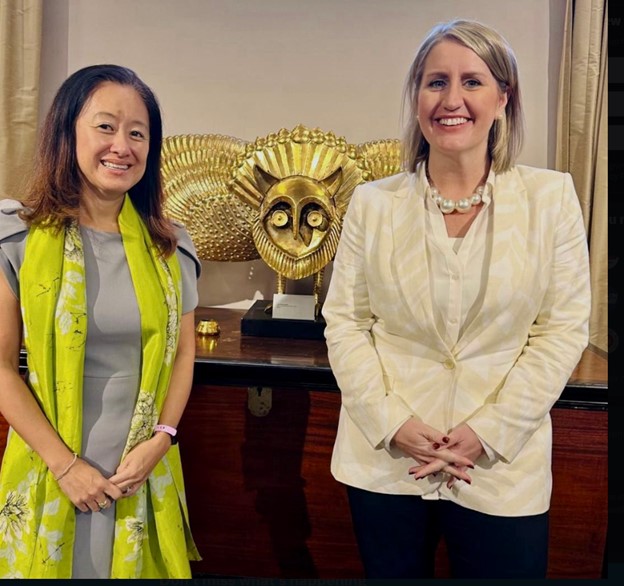
 Colombo, Feb 27 (Daily Mirror) – Speaker Mahinda Yapa Abeywardena is reported to have used his decisive vote as the chairman of the Constitutional Council (CC) to affirm the appointment of Mr. Deshabandu Tennakoon as the Inspector General of Police (IGP) permanently.