The Decision Review System (DRS), a technology-based aid used in cricket, was conceived by Senaka Weeraratna in 1997. Initially known as the Umpire Decision Review System (UDRS), DRS combines television replays, ball-tracking technology, microphones, and infra-red imaging to assist match officials with decision making. It comprises both Umpire Reviews and Player Reviews, and was first introduced in Test matches in 2008, ODIs in January 2011, and in a Twenty20 International in October 2017.
A Game-Changer in Cricket
The International Cricket Council (ICC) initially made the use of DRS mandatory for all international matches. However, this was later revised to optional, requiring consent from both teams. Over the years, the rules and protocols for DRS, including LBW decisions and the number of unsuccessful reviews, have been updated and amended. The ICC continues to refine the system and its implementation.
The Impact of DRS in Recent Matches
One of the most recent instances of DRS in action was during the third T20I series match between Team India and Afghanistan. Indian batsman Rinku Singh was saved from dismissal by an inside edge detected by UltraEdge, a component of the DRS. The DRS decision sparked controversy and highlighted the system’s significance in the sport.
DRS Amidst the Pandemic
The COVID-19 pandemic brought about several logistical challenges in the cricketing world. To adapt, the ICC temporarily suspended the requirement for neutral match officials and increased the number of unsuccessful reviews per Test innings. The introduction of the ‘Umpire’s Call’ concept was another significant change, which aimed to honour the on-field umpire’s original decision in close situations.
DRS – A Boon or Bane?
Despite the debates and controversies surrounding DRS, it has generally been well-received. It has undeniably brought a level of technological sophistication to the sport, enhancing decision-making accuracy. The evolution of DRS is a testament to cricket’s adaptability and willingness to embrace change in the pursuit of fairness and improvement.
In the realm of national security, knowledge is not merely power; it is the bedrock upon which our safety and freedom vest.” Defence Secretary General Kamal Gunaratne expressed his views as the Chief Guest of the launching ceremony of ‘Defence Review-2023’ held at the Institute of National Security Studies (INSS) in Battaramulla today (Jan 19).
Overlooking Director General and Acting Director (Research) of INSS, Colonel Nalin Herath warmly received the Chief Guest of the Day, Defence Secretary Gen. Gunaratne, on his arrival at the venue and also delivered the welcome address at the outset of the programme.
Defence Review is a double-blind, peer-reviewed annual publication of scholarly articles. The aim of this international journal is to provide a research platform on defence and security studies with a priority to enhance the understanding of national, regional and international security and geopolitics.
Defence Review was initially launched in 2017 and this marks the sixth volume, which comprises four papers addressing several key thematic areas related to national security.
The paper on “Defending National Security: Uniting against Corruption and Bribery with Whistle-blower Empowerment” was written by Ms. Charani Patabendige, who is also the Secretary to the editorial board of INSS. The paper on “Future of Information-Technology-Enabled Systems in the Military Forces and their Impacts on National Security: A Case Study of the Sri Lanka Air Force” was written by Wing Commander Gayan Kahandawalaarachchi (Retd) and DSSV Sooriyaarachchi. The third paper, “Socioeconomic Factors for Sustainable Peace and National Security in Sri Lanka: A Comprehensive Analysis,” was written by Indeewari Galagama. The final and fourth paper was titled “The Geopolitical Importance of Sri Lanka as a Maritime Gateway in the Indian Ocean Region (IOR): Impacts and Implications” and was written by Supasani Ariyawardana.
The audience comprised the distinguished editorial board, Professor Chaminda Padmakumara, Rear Admiral Sisira Jayakody (Retd) and Professor Chandra Embuldeniya. Members of the peer review board Air Vice Marshal Dilshan Wasage (Retd), Deputy Inspector General UK Marambage, Mrs. Chamindry Saparamadu, Lt Colonel M A D S Mutugala and Lieutenant Colonel Thushara Kathriarachchi (Retd).
UN High Commissioner for Human Rights Volker Türk urges the Sri Lankan government to review the ongoing Yukthiya” [Justice] operation
Colombo:Sri Lanka has pledged to sustain its anti-drug operation — in which some 40,000 people have been arrested over the last month — despite serious concern expressed by the UN and international rights groups.
They can issue statements, but I will not stop this operation,” Sri Lanka’s Public Security Minister Tiran Alles told a media conference in Colombo on Thursday. Rather than issuing general statements”, the UN must come up with specific incidents, he said, amid growing concern over rapid arrests and detention, particularly of youth.
The Minister’s remarks came days after UN High Commissioner for Human Rights Volker Türk urged the Sri Lankan government to review the ongoing Yukthiya” [Justice] operation, while expressing concern over authorities opting for a heavily security-based response” to the country’s drugs problem, instead of public health policies grounded in human rights.”
During and after these operations, people are reported to have been subjected to a number of violations, including unauthorised searches, arbitrary arrests and detention, ill-treatment, torture, and strip searches in public,” the High Commissioner’s office said in a statement last week. Lawyers acting for those detained have alleged that they have faced intimidation from police officers, it said.
Justifying the government’s move, Alles said law enforcement agencies were mainly going after the distribution network, while intelligence agencies and the Navy were monitoring those engaged in the import of drugs. For the moment, we are not going after drug users,” he said, however adding that some users, too, were at times arrested in the special operation. Authorities have so far seized drugs worth LKR 4.7 billion, he said.
Source of drugs
On the source of the drug consignments entering Sri Lanka, Acting Inspector General of Police Deshabandu Tennakoon, who was also present at the media conference, said Pakistan, Afghanistan and Myanmar were the three main countries from where the drug consignments originated . Ice” or methamphetamine often came from cottage industries in south India, he added.
Contrary to prevalent claims that Sri Lanka is a transit hubs for narcotics, the Sri Lankan officials said much of the drugs coming into Sri Lanka was for consumption. There are over 1 lakh drug users in the island, and the aim of the special operation was to bring down both supply of drugs and the demand for it within the country, according to Shakya Nanayakkara, Chairman of the National Dangerous Drugs Control Board.
Of the nearly 40,000 individuals arrested since the operation commenced in December, about 5,000 remain in custody while the rest had been released on bail, officials said.
Last week, Sri Lanka’s Human Rights Commission said it received several complaints of torture, cruel, inhuman or degrading treatment, and arbitrary arrests and detention” in connection with the anti-drug operation.
Further, 33 international organisations, including rights watchdog Amnesty International, have urged the Sri Lankan government to stop the abusive” anti-drug operation that, they said, was leading to leading to significant human rights violations”.
A punitive and militarised approach to drug control contravenes recognised international human rights standards and guidelines, is ineffective to protect individual and public health, and ultimately fails to make communities safer,” they noted in a joint statement.
(Meera Srinivasan is The Hindu correspondent in Colombo)
The National Investigation Agency (NIA) on Friday filed a supplementary chargesheet against four accused in a 2021 case relating to human trafficking of 39 Sri Lankan nationals into India on the false pretext of taking them to Canada.
Mohamed Imran Khan alias Imran, who was arrested by the NIA recently, has been charge-sheeted under various sections of IPC relating to trafficking, confinement, and conspiracy, along with absconders Seeni Aabul Khan, Mohamed Ibrahim alias Ahmed and Pudumadam Imran alias Hajiyar aka Imrankhan, before the NIA Special Court, Bengaluru.
The accused were allegedly involved in trafficking of 39 Sri Lankan nationalists to Mangaluru via Tamil Nadu by falsely promising them that they were being taken to Canada. The victims were confined in various lodges across Mangaluru and were initially arrested by Karnataka Police, as accomplices along with the accused persons, NIA said in a press release.
NIA had launched investigations after taking over the case on July 13, 2021, and found 39 to be the victims of a human trafficking racket. The agency had filed the original chargesheet in the case on October 5, 2021, against six accused persons who were involved in the trafficking, while the victims were freed and sent back home, NIA claimed.
NIA investigations revealed that Mohammed Imran Khan, in conspiracy with Pudhumadam Imran and his friends Seeni Aabul Khan and Mohamed Ibrahim, received the Sri Lankan nationals in mid-sea, and brought them to Bengaluru and further to Mangaluru. NIA said that further investigations showed that the entire initial conspiracy was planned by Pudumadam Imran along with one Eesan, a Sri Lankan national, who is one of the absconding accused in the case.
The accused had collected vast sums of money from the victims, and also subsequently from their families. Efforts to arrest the remaining accused persons are continuing, NIA said.
Colombo, Jan 19 (Daily Mirror) – Leader of the Opposition Sajith Premadasa informed a group of IMF officials that the Extended Fund Facility (EFF) agreement which their organization has signed with the Sri Lankan government has to be amended and a Samagi Jana Balawegaya (SJB) government will do so in the future.
Premadasa made this remark when he met a group of IMF officials who are currently visiting Sri Lanka. The team includes Senior Mission Chief Peter Breuer, IMF Resident Representative Ms. Sarwat Javan and local economist Manavee Abeywickrama.
Sajith Premadasa informed the visiting IMF team that the Sri Lankan people have been heavily affected by the huge tax burden which has been imposed on them by the Sri Lankan government. He therefore stressed the need for the amendment of the EFF agreement and added that a future SJB government will definitely go for such an amendment,” a statement from the Opposition Leader’s office said.
Meanwhile SJB MP S.M. Marikar, who referred to a meeting which the IMF team has had with the National People’s Power (NPP) leaders, questioned as to why the latter has kept silent about this meeting.
According to the information we have received, NPP Leader Anura Kumara Dissanayake has not participated in this meeting. Therefore, people of this country need to know as to why Dissanayake was absent during this meeting and the details on the discussions which other NPP leaders had with the IMF team,” Marikar said.
Colombo, Jan 19 (Daily Mirror) – The National People’s Power (NPP) was not expecting to legalize prostitution and that it would only amend some laws which inconvenience those who were forced to prostitution due to economic hardships, NPP MP Harini Amarasuriya said today.
She told the Daily Mirror that the main focus of the NPP was to revive the economy of the country as economic hardships had forced women into prostitution.
The MP said women who were forced to prostitution had to face numerous hardships due to some laws and that the NPP would amend such laws to minimize such situations and to protect the rights of the women.
She said sex workers who were subjected to exploitation were further harassed due to some laws.
Referring to media reports on a claim made by NPP member Samanmalee Gunasinghe over legalizing prostitution, Amarasuriya said legalizing prostitution is only a popular topic and that media had only highlighted a part of her speech adding that her complete comment carries the correct idea.
Although Sri Lanka’s macro economy is gradually stabilizing, the country’s economic recovery process is still in the ‘infancy level’ and has yet to reach the broader population, says Peter Breuer, the Senior Mission Chief of the International Monetary Fund (IMF) to Sri Lanka.
Mr. Breuer has also expressed that property tax will help Sri Lanka to take the quantum leap to achieve the IMF programme’s goals.
A group of officials from the IMF arrived in Sri Lanka on 11 January to engage in discussions for a period of one week, while studying the process of economic reforms carried out within the country, following the IMF’s approval of the first review under the Extended Fund Facility (EFF) arrangement for Sri Lanka.
During a discussion with President Ranil Wickremesinghe, the IMF delegation congratulated the country on completing the first review under its program and highlighted the positive outset of the program, recognizing the challenging reforms undertaken by Sri Lanka and their significant impact on the domestic population.
The International Monetary Fund (IMF) says it is critical for Sri Lanka to swiftly complete the final agreements with the official creditors and reach a resolution with the external private creditors.
IMF mission team, led by Senior Mission Chief Peter Breuer, was in Sri Lanka from January 11-19 to discuss recent macroeconomic developments and progress in implementing economic and financial policies under the EFF arrangement.
Issuing a statement to convey its preliminary findings observed during the visit, the delegation says the economic reform program implemented by the Sri Lankan authorities is now yielding the first signs of recovery with positive real GDP growth in the third quarter of 2023, low inflation, increased revenue collection, and a build-up of external reserves.
Commending the commendable progress made by putting debt on a path towards sustainability, the IMF mission team highlighted that execution of the domestic debt restructuring was an important milestone.
However, swift completion of final agreements with official creditors and reaching a resolution with external private creditors remain critical, the statement underscored.
According to the delegation, progress in meeting key commitments under the IMF-supported program is set to be formally assessed in the context of the second review of the EFF arrangement alongside the forthcoming 2024 Article IV consultation assessing Sri Lanka’s economic health.
Attached below is the full statement issued by the IMF mission team:
The economic reform program implemented by the Sri Lankan authorities is yielding the first signs of recovery. Real GDP recorded positive growth of 1.6 percent year-on-year in the third quarter of 2023, the first expansion in six consecutive quarters. Shortages of essentials have eased, and inflation remains contained. Gross international reserves increased by USD 2.5 billion during 2023, and preliminary data point to improved fiscal revenue collections during the fourth quarter of 2023. However, challenges remain as these improvements need to translate into improved living conditions for Sri Lanka’s people.
In this context, sustaining the reform momentum and ensuring timely implementation of all program commitments are critical to rebuilding confidence and putting the recovery on a firm footing that will benefit all people. Swift progress towards the introduction of a progressive property tax is key to ensuring fair burden sharing while sustaining the revenue-based consolidation. Tax policy measures need to be accompanied by strengthening tax administration, removing tax exemptions, and actively eliminating tax evasion to make the reforms more sustainable and to further build confidence among creditors to support Sri Lanka’s efforts to regain debt sustainability.
Building on the Central Bank of Sri Lanka’s success in taming inflation, future monetary policy decisions should remain prudent with a focus on keeping inflation expectations well anchored. Against continued uncertainty, it remains important to continue rebuilding external buffers through strong reserve accumulation. Protecting the poor and the vulnerable through improved targeting and better coverage of cash transfers remains critical.
To safeguard the stability of the financial sector and bolster its capacity to support economic growth, the authorities need to urgently finalize amendments to the Banking Act in line with their commitment under the IMF-supported program, implement the bank recapitalization plan and strengthen the financial supervision and crisis management framework.
Following the publication of the IMF Governance Diagnostic report, it is now imperative for the authorities to adopt their own action plan for implementing the recommendations in the report beyond the priority commitments under the EFF arrangement. At the same time, ensuring an enabling environment for governance and transparency reforms to take place is key to bolstering public confidence and facilitating implementation of these important efforts.
The authorities have made commendable progress with putting debt on a path towards sustainability. The execution of the domestic debt restructuring was an important milestone. A swift completion of final agreements with official creditors and reaching a resolution with external private creditors remain critical. Progress in meeting key commitments under the IMF-supported program will be formally assessed in the context of the second review of the EFF arrangement alongside the forthcoming 2024 Article IV consultation assessing Sri Lanka’s economic health.
The IMF team held meetings with President and Finance Minister Ranil Wickremesinghe, Central Bank of Sri Lanka (CBSL) Governor Dr. P. Nandalal Weerasinghe, Speaker Mr. Mahinda Yapa Abeywardana, Minister Mr. Kanchana Wijesekera, Minister Mr. Wijeyadasa Rajapakshe,State Minister Mr. Shehan Semasinghe, Secretary to the Treasury Mr. K M Mahinda Siriwardana, Governor of Northern Province Mrs. P.S.M.Charles, Governor of Eastern Province Senthil Thondaman, and other senior government and CBSL officials. The IMF team also met with Parliamentarians, representatives from the private sector, civil society organizations, and development partners.
We would like to thank the authorities for the excellent collaboration during the mission, including during the mission’s visit to the Northern and Eastern provinces. This visit enriched the mission team’s understanding of the challenges as well as the potential of Sri Lanka. We reaffirm our commitment to support Sri Lanka for a full economic recovery from the crisis.”
The medical officers and nurses of the oncology unit of the Karapitiya Teaching Hospital, together with the patients and residents of the area staged a demonstration on Friday (Jan.19), seeking justice for the senior oncologist arrested over an alleged assault.
Dr. S.C.R. Perera, 61, was arrested for purportedly assaulting a female junior staff member during a contentious situation that had ensued on Wednesday morning. He was accused of assaulting the said staff member during a heated argument between him and the other junior staffers after he slammed them for disrupting hospital services by going on a token strike the day before.
The hospital’s authorities had brought the situation under control, however, a female junior staff member got herself admitted to the Karapitiya Teaching Hospital, claiming an assault by the senior oncologist who was subsequently arrested and remanded until January 22 on the orders of the Galle magistrate.
The protesting doctors, nurses, patients and area residents said the law should be enforced against the junior staff members who assaulted the senior oncologist as well.
Development projects are set to commence in February, following the finalization of agreements related to the debt restructuring and ongoing discussions with foreign creditors of Sri Lanka, according to Dr. Bandula Gunawardena, the Minister of Transport, Highways, and Mass Media.
During a media briefing at the Presidential Media Centre on Friday (Jan.19), the minister highlighted that Rs. 150 million has been allocated to the District Development Committees under the relevant chairmen for road development. Additionally, Rs. 50 million has been earmarked through the Ministry of Rural Affairs for the development of small roads.
Gunawardena further addressed the financial landscape, emphasizing the need for careful consideration of income and expenditure in the challenging year ahead.
In 2022, the government’s total tax revenue amounted to Rs. 1,751 billion, with 72% (Rs. 1265 billion) allocated to government employee salaries, pensions, and Rs. 506 billion spent on Samurdhi allowance and support for the less privileged. The minister highlighted the challenge of balancing expenses, including interest payments on loans (Rs. 1,065 billion) and capital expenditure (Rs. 715 billion).
He reported the earnings of various government departments, such as the Inland Revenue Department (Rs. 1,550 billion), Customs Department (Rs. 922 billion), Excise Department (Rs. 169 billion), and Motor Vehicle Commissioner Department (Rs. 20 billion). Despite an increase in income from the public and various strategies in 2023 (Rs. 3,201 billion), expenses outpaced revenue, resulting in a deficit.
In 2023, the government spent Rs. 2,160 billion on subsidies, Rs. 2,263 billion on interest payments, and a total of Rs. 4,394 billion to run the government, while its income for the year was Rs. 3,201 billion. The government borrowed extensively, with Rs. 10,091 billion borrowed domestically through Treasury Bills and Treasury Bonds.
Looking ahead to 2024, development schemes are slated to begin in February after the restructuring of debt and finalizing agreements with creditors. Notably, a USD 60 million loan from the World Bank and financial assistance from the Samurdi Fund will be utilized for road repairs.
Despite financial challenges, significant allocations have been made for the Chairmen of District Development Committees, with Rs. 150 million for road development and an additional Rs. 50 million for the development of small roads. The restructuring of foreign debt has reached its final stages, paving the way for the resumption of paused development projects.
Colombo, January 19, 2024 – An International Monetary Fund (IMF) mission led by Peter Breuer visited Sri Lanka from January 11 to 19, 2024, to assess recent macroeconomic developments and progress in implementing economic and financial policies under the Extended Fund Facility (EFF) arrangement. At the conclusion of the mission, Peter Breuer issued a statement highlighting positive signs in Sri Lanka’s economic reform program. Here are the key points from the statement:
Economic Recovery Signs: Real GDP recorded a positive growth of 1.6 percent year-on-year in the third quarter of 2023, marking the first expansion in six consecutive quarters. Shortages of essentials have eased, and inflation remains contained.
Improved Fiscal Revenue and Reserves: Gross international reserves increased by USD 2.5 billion during 2023, and preliminary data point to improved fiscal revenue collections during the fourth quarter of 2023.
Challenges and Reform Momentum: While acknowledging the improvements, challenges remain, and sustaining the reform momentum is crucial to rebuilding confidence and ensuring the recovery benefits all citizens.
Progress on Debt Sustainability: Commendable progress has been made in putting debt on a path toward sustainability, including the execution of domestic debt restructuring. Swift completion of final agreements with official creditors and resolution with external private creditors is deemed critical.
Fiscal Consolidation and Tax Policy Measures: Urgent progress towards introducing a progressive property tax is emphasized for fair burden-sharing and sustaining revenue-based consolidation. Tax policy measures should be accompanied by strengthening tax administration, removing tax exemptions, and actively eliminating tax evasion.
Monetary Policy and External Buffers: Future monetary policy decisions should remain prudent to anchor inflation expectations. Rebuilding external buffers through strong reserve accumulation is crucial.
Financial Sector Stability: Urgent finalization of amendments to the Banking Act, implementation of the bank recapitalization plan, and strengthening the financial supervision and crisis management framework are highlighted for financial sector stability.
Governance and Transparency Reforms: Adoption of an action plan for implementing recommendations in the IMF Governance Diagnostic report is imperative. An enabling environment for governance and transparency reforms is considered key to bolstering public confidence.
Assessment and Support: Progress in meeting key commitments under the IMF-supported program will be formally assessed in the context of the second review of the EFF arrangement alongside the forthcoming 2024 Article IV consultation assessing Sri Lanka’s economic health.
The IMF team expressed gratitude for the collaboration with the Sri Lankan authorities during the mission and reaffirmed their commitment to supporting Sri Lanka for a full economic recovery from the crisis.
The statement reflects a nuanced evaluation of Sri Lanka’s economic landscape and emphasizes the importance of continued reforms to ensure sustained recovery and address the challenges ahead.
The full text of the statement issued by Peter Breuer is given below;
The economic reform program implemented by the Sri Lankan authorities is yielding the first signs of recovery. Real GDP recorded a positive growth of 1.6 percent year-on-year in the third quarter of 2023, the first expansion in six consecutive quarters. Shortages of essentials have eased, and inflation remains contained. Gross international reserves increased by USD 2.5 billion during 2023, and preliminary data point to improved fiscal revenue collections during the fourth quarter of 2023. However, challenges remain as these improvements need to translate into improved living conditions for Sri Lanka’s people.
In this context, sustaining the reform momentum and ensuring timely implementation of all program commitments are critical to rebuilding confidence and putting the recovery on a firm footing that will benefit all people. Swift progress towards the introduction of a progressive property tax is key to ensuring fair burden sharing while sustaining revenue-based consolidation. Tax policy measures need to be accompanied by strengthening tax administration, removing tax exemptions, and actively eliminating tax evasion to make the reforms more sustainable and to further build confidence among creditors to support Sri Lanka’s efforts to regain debt sustainability.
Building on the Central Bank of Sri Lanka’s success in taming inflation, future monetary policy decisions should remain prudent with a focus on keeping inflation expectations well anchored. Against continued uncertainty, it remains important to continue rebuilding external buffers through strong reserve accumulation. Protecting the poor and the vulnerable through improved targeting and better coverage of cash transfers remains critical.
To safeguard the stability of the financial sector and bolster its capacity to support economic growth, the authorities need to urgently finalize amendments to the Banking Act in line with their commitment under the IMF-supported program, implement the bank recapitalization plan, and strengthen the financial supervision and crisis management framework.
Following the publication of the IMF Governance Diagnostic Report, it is now imperative for the authorities to adopt their own action plan for implementing the recommendations in the report beyond the priority commitments under the EFF arrangement. At the same time, ensuring an enabling environment for governance and transparency reforms to take place is key to bolstering public confidence and facilitating the implementation of these important efforts.
The authorities have made commendable progress with putting debt on a path towards sustainability. The execution of the domestic debt restructuring was an important milestone. A swift completion of final agreements with official creditors and reaching a resolution with external private creditors remain critical. Progress in meeting key commitments under the IMF-supported program will be formally assessed in the context of the second review of the EFF arrangement alongside the forthcoming 2024 Article IV consultation assessing Sri Lanka’s economic health.
The IMF team held meetings with President and Finance Minister Ranil Wickremesinghe, Central Bank of Sri Lanka (CBSL) Governor Dr. P. Nandalal Weerasinghe, Speaker Mr. Mahinda Yapa Abeywardana, Minister Mr. Kanchana Wijesekera, Minister Mr. Wijeyadasa Rajapakse, State Minister Mr. Shehan Semasinghe, Secretary to the Treasury Mr. K M Mahinda Siriwardana, Governor of Northern Province Mrs. P.S.M.Charles, Governor of Eastern Province Senthil Thondaman, and other senior government and CBSL officials. The IMF team also met with Parliamentarians, representatives from the private sector, civil society organizations, and development partners.
We would like to thank the authorities for the excellent collaboration during the mission, including during the mission’s visit to the Northern and Eastern provinces. This visit enriched the mission team’s understanding of the challenges as well as the potential of Sri Lanka. We reaffirm our commitment to support Sri Lanka for a full economic recovery from the crisis.
Colombo, January 19, 2024 – The Senior Oncologist at Karapitiya Teaching Hospital, who was recently arrested for an alleged assault, has decided to retire voluntarily. His letter of retirement has been submitted to the Ministry of Health, according to the Government Medical Officers Association (GMOA).
The decision to retire comes in the wake of a contentious incident at the hospital, where Dr. Perera was accused of assaulting a junior staff member during a heated argument. The dispute arose after Dr. Perera criticized junior staff for disrupting hospital services with a token strike.
In a press conference, the GMOA and Specialist Doctors expressed dissatisfaction with the police’s handling of the case, noting that no action was taken regarding a previous complaint filed by Dr. Perera. The medical professionals also voiced displeasure at authorities acting only on the second complaint filed by the junior staff member.
The GMOA warned of a strict trade union action if proper measures are not taken at the institutional level and by the police against the oncology ward staff for participating in the health strike and the alleged assault on Dr. Perera
President Ranil Wickremesinghe commended President Yoweri Museveni for assuming leadership at the 19th Non-Aligned Movement (NAM) Summit in Kampala, Uganda.
He highlighted the current global challenges, including the humanitarian crisis in Gaza, the shift in the post-Cold War order, and emerging multipolar dynamics.
President Wickremesinghe emphasized the need for NAM to reinvent itself, transforming into the largest bloc representing the Global South.
Proposing the recognition of Palestine and addressing various geopolitical, economic, and technological issues, he called for a united NAM with updated objectives to build a multipolar world.
The President urged for a dynamic bloc capable of shaping the new global order, emphasizing that the future lies in their hands.
He also expressed gratitude to President Museveni and Uganda for hosting the summit.
>Minister of Foreign Affairs, Mr. Ali Sabry PC, Minister of State Mr. Chamara Sampath Dasanayake, Members of Parliament Mr. Kings Nelson, Mr. Nimal Piyatissa, Mr. Kumarasiri Ratnayake, Mr. Udayakantha Gunathilake, President’s Secretary Mr. Saman Ekanayake, President’s Senior Adviser on Climate Change Mr. Ruwan Wijewardene were also present on this occasion.
Following is the full speech delivered by President Ranil Wickremesinghe; Let me begin by congratulating you President Yoweri Museveni of Uganda for taking over the helm of the Non Aligned Movement at this 19th Summit. Your leadership is even more timely as Uganda assumes this role at a critical moment of collective awareness among countries of the global South. This is the first NAM Summit following the onset of the pandemic, the debt crisis, climate catastrophe, new global competition, and the ensuing multiple implications for the world, in particular, for the Global South.
As we meet today, a humanitarian crisis is unfolding in the Gaza Strip and beyond. For over 3 months immense suffering and losses have been endured by the Palestinian civilian population, endangering regional security and stability. Until now, the NAM was largely silent. How can we remain silent when the Gaza is destroyed? People denied humanitarian aid and a vast majority of the dead are innocent civilians. Silence implies consent. It is encouraging that this 19th Summit has given the highest priority to this crisis in Gaza and the inalienable rights of the people of Palestine to self- determination and the realisation of an independent and sovereign state of Palestine. We must congratulate South Africa for the bold stand it has taken in regard to Gaza. The international community has already called for an immediate humanitarian ceasefire and a release of hostages.
There cannot be a two state solution based on one state – Israel. No resolution is possible without a state of Palestine. Therefore, in line with multiple UN Resolutions, and the Declaration of this Summit, the international community must recognise the West Bank, Gaza and East Jerusalem as territories coming within the State of Palestine and in addition there should be no change in the ethnic composition of Gaza. Sri Lanka also proposes that the State of Palestine be established within 5 years and no more.
We are now witnessing the end of the post cold war order and the coming into being of the evolving multipolar world. On the geopolitical front, we are witnessing a resurgence of latent and open conflicts involving former and aspiring major powers. In Europe the transatlantic military alliance has been strengthened, past arms control agreements have collapsed, military expenditure has reached historically unprecedented levels and nuclear weapons are once again the subject of apparently serious policy discussion. Outer space and the oceans have become potential theatres of conflict and geo-strategic competition including in our vicinity in the Indian and Pacific Oceans.
Free trade and economic integration is being reversed by policy driven rise of trade protectionism due to strategic competition among major powers. Furthermore, this being extended further with the concepts of de-coupling and de-risking. A unilateral declaration of a new trade order and the setting aside of multilateralism by the West of the WTO. The weaponising of the Dollar. New challenges of economic and the debt crisis, climate justice, food and energy security. Digital and technological divides and advanced WMD arsenals have aggravated existing inequalities between the developing states of the NAM and the developed world.
The theme of this Summit “Deepening Cooperation for Shared Global Affluence” reflects the need to address the inequities between our two worlds. Furthermore, experience shows us that, to succeed we need a strong and a united NAM that contributes to a better world for all. To do so, we have to reinvent ourselves.
Our membership today is no longer a grouping of weak states. We must recognise that as a result of the rapid progress and economic advancement of some of Asian, African and Latin American states. A majority of the 10 leading economies of 2050 will belong to this movement. We see among us, rising aspirants for leadership status in global affairs. They must be prepared to give leadership. Furthermore, there is a vital role we must play as geostrategic rivalries in political, economic, technological and military terms becomes more pronounced among former and new contenders for Major Power status.
Therefore, the NAM must reinvent itself under your Chairmanship. Assume a new role in a multipolar world – to transform itself as the largest bloc representing the Global South. We must also recast our objectives. While upholding the Bandung Principles in the evolving multipolar world we need to
– oppose the spread of big power rivalry including the coercion of uncommitted states,
– build a multipolar world which incorporates the political, economic, social and climate change mitigation aspirations of the Global South.
Let us transform ourselves from this loose movement to become a dynamic bloc of the Global South and its friends. Let us establish an effective permanent operational structure which is equipped to address the contemporary challenges facing the Global South. An organisation which is capable of shaping the new order.
Our future lies in our hands.
We can make it or break it. Let us make it work.
Let me conclude by thanking you Mr President and the Government of Uganda for the excellent arrangements for hosting this important 19th Summit of the Non Aligned Movement
Recently, Dr. Wasantha Bandara declared that Sri Lanka was fast on its way to becoming the 29th State of India on the lines of what happened to Sikkim. Obviously, many may be unaware of what happened to Sikkim & how it was annexed to be worried as to how Sri Lanka can be compared to it. However, the resemblances are certainly alarming. Sri Lanka’s leaders who are already not in the pocket of the bully-neighbor must take serious note.
The Himalayan kingdom of Sikkim became a protectorate of India in 1950 (India – Sikkim Peace Treaty”) & was then constitutionally absorbed as the 22nd State of India on 15 May 1975 using espionage by Indian secret service agents. The plan to annex Sikkim to India was planned & kept secret. Therefore, Sri Lanka should always tread with caution as Sri Lanka is also under the Indian radar in particular was a Himalayan” declaration suddenly coming to light!
Sikkim’s history dates back to the 17th century & ruled by a Buddhist-priest King Chogyal – Thondup Namgyal
Sikkim like Sri Lanka was not under British India but governed separately. Like Sri Lanka, Sikkim was of strategic importance to Colonial Britain. Sri Lanka was a monarchy until 1815, Sikkim was a monarch until 1967.
King Chogyal wanted to declare Sikkim an independent country like Bhutan & nullify the 1960 Treaty with India which made Sikkim a procreate of India.
The pro-Indian sentiments in Sikkim mirrored those shared in parts of Sri Lanka’s North & East & commercial capital Colombo and was used to peddle Indian interference.
The task of making Sikkim a state of India was given to India’s intelligence agency then headed by R N Kao. It took just over 2 years (Dec1972-May1975) to create the democracy” demands against Sikkim monarchy & result in annexation of Sikkim to India. Ironically, Indian PM Indira Gandhi was instrumental in the outcome of Sikkim. Kao together with P N Banerjee who was a key player in the Bangladesh covert operation meticulously planned out Sikkim’s fate.
demand for Democracy” by the people was nothing but Indian foreign intel hiring political parties, politicians, youth & individuals to join in a mass protest against the monarchy. It is said that the Sikkim National Congress was also funded by India.
The template of all externally funded agendas is to build momentum against the ruling party by funded political parties, politicians, people who are in the public and others who can be tapped & raise it to a level where the public backs them aligned to the outcome that the funding party desires. In Sri Lanka, we have seen this on several occasions. The proof that it is a funded campaign (after creating the background scenario for the protest), can be seen when the individuals or groups who came out in protest giving numerous reasons are not to be seen when a similar situation naturally arises. This is how one can differentiate between a naturally emerged protest & a funded one. A funded one will have all the main players suddenly disappear & they are gagged on referring to their role.
Every mass protest it is noteworthy is linked to the involvement of foreign intel & Sri Lanka’s was no different. Code names were created & given to agitation leaders. The agitators” were tasked to bring the agitation” to a point that the King would beg” India for help. Part of the agitation” was to chant that the King was finished & to step down. Do these chants echo agitation” chants in Sri Lanka! We have to wonder if the agitation” in 1983 that brought LTTE out into the open & the agitations” in 1980s that led to Indian Peace Keepers in Sri Lanka mirrored what was designed in Sikkim! All of these agitators” were paid handsomely for their role. Eventually, Sikkim agitations led to clashes, arson & resulted in police firing & deaths. The Indian plan was going to perfection & a draft was prepared by India for the Sikkim King to sign, no different to the 1987 Indo-Lanka Accord.
As per the India drafted solution” administration of Sikkim was to fall under Indian government & Sikkim Commissioner of Police would be under the Indian Army. No sooner all was agreed, miraculously the agitation stopped. Don’t these scenarios look coincidental with Sri Lanka’s recent aragala” protests. India appointed an Indian Foreign service official as Chief Executive of Sikkim. Indian PM Indira Gandhi’s orders were to have Sikkim under complete Indian control. Part of the Indian intelligence plan was to ensure that at least 70% of candidates in Sikkim’s parliament was under Indian control. One wonders how many are under Indian control in Sri Lanka’s Parliament. The control” was to ensure legislative Bills and enactments were India-friendly. Now we know whenever any hands go up in Parliament – the reason why! With elections forthcoming in Sri Lanka, can we expect similar agitations!
India’s favored candidate won elections in 1974 with a landslide victory – as was expected. As expected he prepared a new act (Government of Sikkim Act) & it was passed also as expected. Indian-controlled Sikkim assembly members were happy to pass any resolution so long as they could enjoy power – sounds too familiar! The Indian intel wanted no bloodshed & also wanted to remove any security/soldiers loyal to the King. Thus, it was decided to disarm the Sikkim guards in 1975 after another funded agitation to disarm them. What funds” can do! The Indians had even planned asylum for the King. Coincidentally Brig (later Lt. Gen) Depinder Singh was deployed both in Sikkim & Sri Lanka. While the Indian Army disarmed Sikkim guards, the IPKF that landed in Sri Lanka not only did not disarm the LTTE but ended up trying to create a new army to function under Indian stooge Perumal who was made the Chief Minister of merged North-East Province.
Sikkim before & after Indian occupation
Sikkim joined Kashmir, Bhutan & Nepal to remain sovereign from India when British granted independence to India in 1947. However, Sikkim had to agree to pay taxes to India, while India was to manage its foreign policy, communications & protect its borders. These assimilations” became part of an official Treaty in 1950 & eventually led to Sikkim becoming the 22nd State of India. Similar assimilations” taking place in Sri Lanka should connect to foreseeing the final outcome. The number of pacts being signed with India in secret by Sri Lanka’s leaders should definitely be cause for concern. No politician can be allowed to barter Sri Lanka’s sovereignty for their political survival.
Sri Lanka must take note of how India usurped Sikkim’s political movement to undermine Sikkim’s sovereignty. Indian intel organized-protests even led to the resignation of Sikkim PM.
This led to Sikkim being forced to sign a new agreement with India in 1973 – no different to Sri Lanka being forced to sign the Indo-Lanka Pact in 1987. The Agreement with Sikkim meant that India would be in charge of peace in Sikkim, Sikkim bureaucracy would be overseen by an Indian official, any conflicts will be resolved by Indian Central Government. Do any of these agreements” resemble what is unfolding for Sri Lanka? India is copying West’s delivering democracy to its neighbors including Sri Lanka! India even introduced a law into Sikkim’s parliament which mandated an Indian representative. It is said that the Bill was passed using coercion and bribery & MPs against were jailed. India even decided the type of foreign journalists that would cover news in Sikkim. When public protested, the Indian installed police took action. This was how a pro-Indian PM came to power in 1974 in Sikkim. What should also be a concern in Sri Lanka is the manner India began to cripple Sikkim’s national movements & most infiltrated with pro-Indian nationalists”.
It was a year later in 1975 that the Indian army marched into Sikkim, attacked the kings army & disarmed them, took over Sikkim borders, & made the Sikkim king prisoner & held a referendum. Not surprisingly, this referendum was rigged & monarchy was dissolved with Sikkim assimilated to India. Sri Lanka be cautious of sham referendums which resulted in Sikkim’s annexation to India in 1975. Foreign journalists did not cover the referendum & the Indian journalists who criticized it, lost their jobs. Maldives aware of the dots of Indian aid/investments/institutions/internal interferences, was wise enough to elect a leader whose election campaign was quit India”.
When India abrogated the special status accorded under section 370 of the Indian constitution to Jammu Kashmir in 2019, pro-Buddhist Sikkim which also enjoys special status under 371F, feared it may lose the special protection given. Noteworthy, is the pains India takes over ownership” of Buddhism. Sikkim values its spiritual democracy’ which was headed by a Buddhist king. However, traditional Sikkims are concerned that since 1975 annexation with India 99% of those in power are non-Buddhists. This is a concern for Sinhala Buddhists in Sri Lanka in the manner Buddhist archaeological sites are being systematically attacked across the island in particular North & East & being replaced with Hindu idols. These incidents can be manipulated at any time to create the necessary tensions to tweak into an external plan. The understanding of the context behind the motives is what Sri Lanka’s leaders & policy advisors need to be aware of. In Sikkim, christian evangelism is targeting poorer Buddhists. Sikkims entire demography has changed. The place of Buddhism is at stake in less than 50 years! Out of Sikkim’s 32 seats in Parliament, 12 are reserved for 2 indigenous groups who are Buddhists. There is a Sangha seat” reserved for a registered Buddhist thero. All this will end if India abrogates the section 371F. The concern is no different to the manner Article 9 and other Buddhist elements are being systematically attacked & targeted in Sri Lanka.
Sikkim has its heritage but how its heritage is to be practiced or maintained is decided by India. These are the factors that Sri Lanka must be concerned about too.
Defence Secretary General Kamal Gunaratne graced the closing ceremony of the 96th National Boxing Championship as the Chief Guest at the MAS Arena of Royal College Colombo, yesterday (Jan 17).
Notably, Umayanga Mihiran of Sri Lanka Police was recognized as the Most Outstanding Boxer of the year 2023. The Sri Lanka Army Boxing Club with a haul of 23 gold medals received accolades as the most successful club of 2023 at the 96th National Boxing Championship held last evening.
The event saw outstanding players being honoured with trophies and accolades from the Defence Secretary and the President of the Boxing Association of Sri Lanka (BASL) Dian Gomes. Several senior Sri Lanka Army and Air Force officers also joined the Defence Secretary on this occasion.
Performance in the National Boxing Championship plays a pivotal role in forming a national boxing pool, paving the way for international tournaments in 2024.
BASL in collaboration with the National Selection Committee, conducts the national championship to select the players for the Summer Olympics and also targets the 1st and 2nd World Qualifying Tournaments for 2024.
The participation of nearly 150 boxers from 20 clubs, including representatives from the Sri Lanka Army, Navy, Air Force and Police underscored the significance of the championship tournament which was worked out for five (5) days from January 13 to 17.
Colombo, January 18: Media reports suggest that Sri Lanka may go in for Russian help to set up a nuclear power plant to supplement the current energy mix. The Russian State-owned nuclear energy company Rosatom appears to be the front runner among international companies that have shown interest in investing in Sri Lanka in this sector. Russia has reportedly agreed to send a delegation from Rosatom to Sri Lanka to discuss its proposal.
A perusal of material on the subject by even Western experts would show that Russia is a leader in this field and that, for several good reasons. Kacper Szulecki and Indra Overland, say in their paper in Nature Energy (Volume 8, pages 413–421- 2023) that Russia’s portfolio of foreign orders in the field of nuclear energy, including reactor construction, fuel provision and other services, spans 54 countries. The deals are collectively worth more than US$139 billion over a ten year period.
ADVERTISEMENT
A huge helpful factor is that, nuclear energy has not been covered by Western sanctions, so far.
Rosatom is heir to the Soviet Ministry of Atomic Energy, which was established in the aftermath of the Chernobyl nuclear accident. Reorganized as a State corporation in 2007, Rosatom is fully owned by the Russian state, and the president of the Russian Federation determines the company’s objectives.
Since its inception, Rosatom has become increasingly active in the international nuclear power market and has become a leading provider of key services. As many as ten reactor units were started between 2007 and 2017. And between 2009 and 2018, the company accounted for 23 of the 31 orders placed and about a half of the units under construction worldwide, Szulecki and Overland say.
Through its subsidiary TVEL Fuel Company, Rosatom also provides fuel supplies, controlling 38% of world’s uranium conversion and 46% of uranium enrichment capacity. It also undertakes decommissioning and waste disposal.
Between 2000 and 2015, Russia was the supplier in around half of all international agreements on nuclear power plant construction, reactor and fuel supply, decommissioning or waste between. Russia’s main nuclear power competitors—China, France, Japan, Korea and the United States—accounted for another 40%, combined, Kacpar Szulecki and Overland, point out.
The 2011 Fukushima accident, which created fears of nuclear plant disasters, did not have an impact on Rosatom. Also, the company’s operations were not impacted by sanctions against Russia over its occupation of Crimea and the eastern part of Donbas in 2014.
On Stop Nuclear Shop
Rosatom’s main advantage lies in its capacity to be a ‘one stop nuclear shop’ for all needs, the only supplier providing an ‘all-inclusive package’, the authors of the paper say.
The package comprises reactor construction know-how, training, support related to safety, non-proliferation regime requirements and flexible financing options, including government-sourced credit lines. The company is also uniquely able to offload spent nuclear fuel from overseas customers.”
While details of contractual agreements vary from case to case, the developer takes care of the entire process until the plant is ready to use and can be handed over to local (Russian-trained) nuclear experts to operate. For that reason, nuclear energy can be considered by countries for which it was previously unattainable, especially in the Middle East, sub-Saharan Africa and South America,” the authors say.
Rosatom is also able to make special offers to strategically important partners, such as Turkiye.
It was for Turkiyes’ ’s Akkuyu plant that Rosatom first proposed the innovative business model dubbed Build–Own–Operate (BOO), under which the Russian company retains majority ownership of the plant and a guaranteed price on electricity sales, and bears all the financial, construction and operational risks,” the authors point out.
Given its comparative advantages as a nuclear supplier, Russia is running a global campaign for nuclear energy that might be called nuclear diplomacy” in which Rosatom and Russian government institutions such as the Ministry of Foreign Affairs work in tandem. This gives Rosatom great political clout and reach.
At the time Russia invaded Ukraine, Rosatom boasted as many as 73 different projects in 29 countries, though at various stages of implementation. Russian companies had bilateral agreements or memoranda of understanding (MoUs) with 13 countries for services or for joint development of nuclear energy.
Rosatom’s projects and involvement have varied in ambition and cost. India’s Tarapur nuclear power plant (NPP) was valued at US$700 million; and Iran’s Bushehr-1 at US$850 million. A gargantuan project in South Africa was valued at US$76 billion.Those in Egypt and Turkey were valued at US$ 30 billion and US$ 20 billion respectively.
Thirteen countries have a variety of research-oriented agreements with Russian nuclear service providers. Altogether, Russia’s nuclear energy diplomacy has been formalized in 54 countries
Szulecki and Overland however point out that Rosatom has not been a success story all the way. Rosatom has not been able to deliver all the projects that it had agreed to, let alone expand further. Potential foreign policy influence by Russia was felt in Finland and Hungary. Some deals went through a rough patch due to a lack of flexibility in the implimentation.
At the time Russia invaded Ukraine, Rosatom boasted as many as 73 different projects in 29 countries, though at various stages of implementation. Russian companies had bilateral agreements or memoranda of understanding (MoUs) with 13 countries for services or for joint development of nuclear energy.
Rosatom’s projects and involvement have varied in ambition and cost. India’s Tarapur nuclear power plant (NPP) was valued at US$700 million; and Iran’s Bushehr-1 at US$850 million. A gargantuan project in South Africa was valued at US$76 billion.Those in Egypt and Turkey were valued at US$ 30 billion and US$ 20 billion respectively.
Thirteen countries have a variety of research-oriented agreements with Russian nuclear service providers. Altogether, Russia’s nuclear energy diplomacy has been formalized in 54 countries.
The Warts
However, Szulecki and Overland point out that looking into the details of these agreements (particularly the Nuclear Power Plant construction projects) one would find warts.
Many of the projects have been stuck at the planning stage for several years or are merely visions laid out in non-committal MoUs. Competing offers might ultimately be chosen over those from Rosatom. For instance, the expansion of the Dukovany plant in Czechia saw calls from opposition parties and the Czech secret service to exclude both Chinese and Russian companies from the tender, citing security concerns, Rosatom was explicitly excluded in 2021 following news of Russian intelligence involvement in a 2014 explosion at a Czech ammunition depot,” the authors recall.
And because of the Soviet aggression in Ukraine, Bulgaria signed a new 10-year agreement with Westinghouse of the US to provide fuel for its existing reactors, New York Times reported recently. Poland is about to construct its first nuclear power plant, which will feature three Westinghouse reactors. Slovakia and even Hungary, Russia’s closest ally in the European Union, have also reached out to alternative fuel suppliers, the paper added
We see a lot of genuine movement,” the NYT quoted Tarik Choho, president of nuclear fuel unit at Westinghouse. He added that the Ukraine war accelerated Europe’s search for new suppliers. Even Hungary wants to diversify.”
William Freebairn, senior managing editor for nuclear energy at S&P Commodity Insights, told the paper: Within days of the invasion,” he said, just about every country that operated a Russian reactor started looking for alternate supply.”
Well Endowed
But even with disruptions of this sort, Russia struts on the world’s nuclear energy stage like a colossus. This is because of several reasons, one of which is that it has the relevant natural resources.
Russia is among the five countries with the world’s largest uranium resources. It is estimated to have about 486,000 tons of uranium, the equivalent of 8 percent of global supply, Radio Free Europe says.
However, uranium mining is just one piece of the nuclear process. Raw uranium is not suitable as fuel for nuclear plants. It needs to be refined into uranium concentrate, converted into gas, and then enriched. And this is where Russia excels.
In 2020, there were just four conversion plants operating commercially — in Canada, China, France, and Russia. In this, Russia was the largest player, with almost 40% of the total uranium conversion infrastructure in the world. It therefore produced the largest share of uranium in gaseous form (called uranium hexafluoride).
The same goes for uranium enrichment, the next step in the nuclear cycle. According to 2018 data that capacity was spread among a handful of key players, with Russia once again responsible for the largest share — about 46%.
Therefore, Russia is a significant supplier of both uranium and uranium enrichment services. According to the latest available data, the European Union purchased about 20% of its natural uranium and 26% of its enrichment services from Russia in 2020. The United States imported about 14% of its uranium and 28% of all enrichment services from Russia in 2021.
Colombo, Jan. 18 (Daily Mirror)- A group of IMF representatives including head of operations for Sri Lanka, Peter Breuer met representatives of the National People’s Power (NPP) at the JVP head office today.
Ms. Sarvath Jahan, the resident representative of the IMF, Ms. Manavee Abeywickrama (IMF staff) and Peter Brewer, participated in representing the IMF in this discussion.
NPP MP Dr. Harini Amarasuriya, Sunil Hadunnetthi representing the NPP Economic Council, Professor Anil Jayantha, Economic Analyst Dr. Harshana Suriyapperuma and National Executive Member of the NPP Muditha Nanayakkara participated representing the NPP.
Sri Lankans are concerned their lives ‘may be threatened’ and help will not be readily available in an emergency as the country does not have a mission in Yemen
Colombo’s move to join the US operation signals its attempt at a ‘balancing act’ rather than a change in support for the Palestinian cause, one analyst says
Isuru Alagiyawanna, 32, arrived in Yemen just six months ago in search of a better life away from the debilitating economic crisis of his native Sri Lanka. But as Colombo plans to join the US-led operations against Yemen’s Houthi rebels, he fears being caught in the crossfire”.
Early this month, Sri Lankan President Ranil Wickremesinghe announced that the country had decided to send a navy vessel to join the multinational Operation Prosperity Guardian, aimed at securing commercial shipping lanes in the Red Sea against Houthi attacks.
Following the escalation of the Israel-Gaza conflict, the Houthis, which control the Yemeni capital Sanaa and the northwestern regions bordering the Red Sea, in November launched attacks on Israel-linked” vessels sailing through the shipping lanes, which normally see hundreds of billions worth of cargo pass through them each year.
The bulk carrier Gibraltar Eagle is seen off Kristiansand, Norway, in June 2023. Houthi rebels fired a missile striking the US-owned ship on Monday. Photo: AP
Close to 30 vessels sailing through the Red Sea have been targeted since the Houthi attacks began. Last week, the United States and its allies began retaliating by launching air and sea strikes.
Sri Lankans like Alagiyawanna, who work in Houthi-controlled areas of Yemen, fear their safety will be at risk once the Sri Lankan vessel joins the coalition’s efforts.
If word gets around among the locals that Sri Lanka is sending a ship to join the US forces to fight against the Houthis, there will be repercussions. When we go out to stores and mix with the local people, if word gets around that I am a Sri Lankan [it may lead to] issues,” he told This Week in Asia.
Alagiyawanna, who works for a shipping company, said life and people were peaceful” before the Red Sea conflict. But he was worried that, in the absence of a Sri Lankan mission in Yemen, there would be no immediate help available in an emergency.
We need an exit visa to leave Sanaa, and it takes about twelve hours to reach Aden”, he said, referring to the area controlled by the government of Yemen. The [civil conflict within the country] has destroyed [the] main routes, so detours have to be taken when travelling. There are lots of military checkpoints, and baggage was checked multiple times along the route.”
EVERY MONDAY
The most pressing stories and in-depth analysis from the Asia region, sent to you each week.
By submitting, you consent to receiving marketing emails from SCMP. If you don’t want these, tick here
US-led coalition strikes Iran-backed Houthi fighters in Yemen
Abdul Munhim, another Sri Lankan working in Hodeida, a Houthi-controlled port city facing the Red Sea, echoed Alagiyawanna’s thoughts.
If [Sri Lanka] sends a ship, our lives may be threatened here. People here know we are from Sri Lanka,” said Munhim, 25.
Munhim lives and works at a shipping company close to the Red Sea port that was under US attack.
Last week there were two or three bombs. At night I heard a huge noise,” he told This Week in Asia. Some ships are still at berth. The cargo operations are ongoing. But containers are not making port calls.”
Munhim said he was aware of six more Sri Lankans in Hodeida, although he had no contact with them.
A tribal supporter of Yemen’s Houthis holds his traditional dagger, or jambiya, during a protest against recent US-led strikes on Houthi targets, near Sanaa, Yemen, on January 14. Photo: Reuters
According to Niluka Kadurugamuwa, director general of public diplomacy at the Sri Lankan ministry of foreign affairs, Sri Lanka has no mission in Yemen but the embassy in Oman is concurrently affiliated with Yemen and the Sri Lankan ambassador to Oman is monitoring the situation.
If the necessity arises, then they will assist the Sri Lankans in that situation,” he told This Week in Asia. The ministry was not able to immediately confirm the number of Sri Lankans in Yemen.
Meanwhile, navy spokesman Captain Gayan Wickramasuriya said they were prepared to send one ship at the moment, but it was not confirmed when it would join the US operation. The costs would depend on the specific ship to be deployed, he said, but only day-to-day operational costs of the ship will be incurred, no additional costs would be involved”.
Sri Lankan civil rights activists hold placards in solidarity with the Palestinian people, during a protest at the Independence Square in Colombo, Sri Lanka, on January 10. Photo: EPA-EFE
Changing foreign policy?
Historically, Sri Lanka has sided with the Palestinian cause and the people of Gaza, but since Colombo decided to join the US mission against the Houthis, some believe it signals a change in the country’s stance on the wider Israel-Gaza war.
But Uditha Devapriya, chief analyst at Factum, a Sri Lanka-based foreign policy think tank, does not think so.
Fundamentally, Sri Lanka’s support for Palestinians has not changed. But its foreign policy has wavered over these little issues. The government clearly wants us to think that it sees the Red Sea operation as distinct and separate from its support for the Palestinian cause,” he said.
According to Devapriya, Colombo’s bilateral ties with Israel wavered over time with each political regime due to economic or defence reasons.
At the United Nations’ December vote for a ceasefire in Gaza, Colombo voted in favour of Palestinian interests.
The country, however, remains the only Asia-Pacific nation to physically send a vessel to join the US operation.
Even though on the surface this signals a shift in Sri Lanka’s foreign policy, it actually, in my opinion, [shows] the unpredictable nature of Sri Lanka’s foreign policy,” Devapriya said, adding that the country was attempting a balancing act”.
The deployment of the vessel alone might not affect the Sri Lankans in Yemen but, coupled with the country’s decision to send thousands of Sri Lankan workers to Israel, this could have a wider impact on Sri Lankan employees in the Middle East, he added.CONVERSATIONS (6)
Dimuthu Attanayake is an independent journalist and a researcher from Sri Lanka, covering business, tech, social issues, and environment. She was one of the 12 international journalists shortlisted for Thomson Foundation’s Young Journalist Award in 2018. Previously, she worked as a big data researcher for LIRNEasia, and has also served as a Business Adviser for an Australian aid programme.
Colombo, Jan 18 (Daily Mirror) – The passenger ferry service between India’s Nagapattinam and Kankesanthurai in Jaffna will be initiated this week, Controller General of Immigration and Emigration I.S.H.J. Ilukpitiya said.
Addressing the media, he said that so far, the initial programmes required to initiate the service have been completed, and immigration officers have already been deployed at the KKS port.
However, the official launch of the ferry service was held on October 2023, as the ‘Cheriyapani’ passenger ferry docked at Kankesanthurai port while resuming the ferry service between the two countries after a 40-year hiatus.
The inaugural voyage of the ‘Cheriyapani’ passenger ferry was commemorated with a plaque exchange.
The ‘Cheriyapani’ is a high-speed vessel owned by the Shipping Corporation of India (SCI), measuring 35 metres in length and 9.6 metres in beam, with a capacity to accommodate 150 passengers.
The journey from Nagapattinam to Kankesanthurai port takes approximately four hours and is priced at Sri Lankan Rupees 26,750 for a one-way trip and SL Rs. 53,500 for a round trip.
Kampala, Jan 18 (Daily Mirror) – President Ranil Wickremesinghe who arrived in Kampala , Uganda was greeted with gun salute upon arrival at the Entebbe airport.
Uganda’s Minister of Foreign Affairs, Oreyem Okello along with Foreign Secretary Aruni Wijewardene, and Sri Lanka’s Ambassador to Kenya Dr Kana Kananathan welcomed the guest. The reception, characterized by a red carpet and a state welcome, showcased the strong diplomatic ties between Sri Lanka and Uganda.
The mammoth gun salute not only symbolized the significance of the visit but also underlined the mutual respect and collaboration between the two nations. the warm reception was evident to fostering deeper relations between Sri Lanka and Uganda.
Ranil Wickremesinghe is set to participate in the upcoming Non-Aligned Movement (NAM) Summit in Kampala, Uganda. This significant gathering will bring together leaders from across the globe, with President Museveni of Uganda hosting the event.
President Joins Global Leaders, Including President Museveni, for NAM Summit in is set to participate in the upcoming Non-Aligned Movement (NAM) Summit in Kampala, Uganda. This significant gathering will bring together leaders from across the globe, with President Museveni of Uganda hosting the event.
President Wickremesinghe will join a diverse group of leaders, reflecting the inclusive nature of NAM, to address shared challenges and explore avenues for strengthened collaboration. The summit provides a platform for leaders to engage in open dialogue, promoting diplomatic solutions to global issues and reinforcing the NAM’s commitment to peaceful coexistence.
As the leaders gather in Kampala, anticipation is high for constructive discussions that will shape the future trajectory of the Non-Aligned Movement. The summit serves as a testament to the enduring relevance and resilience of NAM principles in navigating the complexities of the contemporary world.
President Wickremesinghe will join a diverse group of leaders, reflecting the inclusive nature of NAM, to address shared challenges and explore avenues for strengthened collaboration. The summit provides a platform for leaders to engage in open dialogue, promoting diplomatic solutions to global issues and reinforcing the NAM’s commitment to peaceful coexistence.
As the leaders gather in Kampala, anticipation is high for constructive discussions that will shape the future trajectory of the Non-Aligned Movement. The summit serves as a testament to the enduring relevance and resilience of NAM principles in navigating the complexities of the contemporary world.
In a bid to curb traffic violations, Sri Lanka Police has decided to trace traffic offenders in Colombo using the surveillance camera system in the island’s commercial capital.
Speaking to the media this morning, Acting Inspector-General of Police (IGP) Deshabandu Tennakoon said this initiative would be implemented starting next Monday (Jan.22).
Accordingly, the traffic fine sheet and the respective CCTV footage will be sent to the police station closest to the registered owner of the vehicle involved, the Acting IGP explained.
The decision was taken after observing that a substantial number of traffic rule violations had gone unnoticed by the police officers on duty where surveillance cameras are set up in Colombo, Tennakoon added.
The Annual Meeting of the World Economic Forum for the year 2024 is held from January 15 – 19 in Davos, Switzerland, under the theme ‘Rebuilding Trust’. It aims to restore collective agency, and reinforce the fundamental principles of transparency, consistency, and accountability among leaders.
Judging from events unfolding in various parts of the world, including the annihilation of the Palestinians in Gaza, the ever-widening income and wealth disparity between the rich and the poor, the hunger and malnutrition that millions of very ordinary people experience, the millions of the forcibly displaced persons and refugees without a home or any hope, the value of international events such as the World Economic Forum is questionable. Rebuilding trust, restoration of collective agency, and reinforcement of the fundamental principle of transparency, consistency and accountability among leaders assumes all these principles were there at some stage or the other, and have since been lost, and now, they need to be restored. There is however a big question mark whether these noble ideals were ever there in the first place.
In this context, it is pertinent to consider two factors that are relevant for leaders at this Forum, viz, increase in income disparity and the status of forcibly displaced persons and refugees.
Rich getting richer and poorer getting poorer.
On the eve of the World Economic Forum in Davos, the anti-poverty charity organisation Oxfam has said that the world’s richest five men have more than doubled their fortunes since 2020, sounding the alarm about unchecked corporate power as business elites hold their high-profile annual gathering in Davos, Switzerland. The five men are said to be worth a combined $869bn after growing their fortunes at a rate of $14m per hour during the past four years, Oxfam said in its report Inequality Inc.”, released on Monday. (https://www.aljazeera.com/economy/2024/1/15/five-richest-men-doubled-fortunes-after-2020-oxfam-says-as-davos-opens). Oxfam goes on to say that despite the growth in the fortunes of the five, 5 billion people have gotten poorer over the same period and that billionaires are today $3.3 trillion richer than they were in 2020, while a billionaire leads 7 out of 10 of the world’s biggest companies. If current trends continue, the world will have its first trillionaire within a decade, but poverty will not be eradicated for another 229 years.
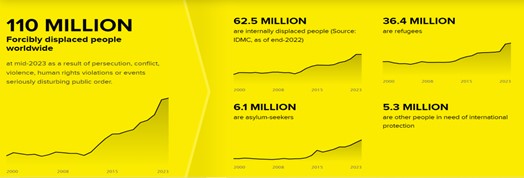
The 110 million people are listed as forcibly displaced people. So displaced on account of unrest in countries, war situations often precipitated by external elements that are after the natural resources of affected countries. Drug trafficking also causes civil unrest and displacement of people as rival gang clashes often impact on the populations in such countries. The UNODC says that the illicit drug trade is a USD 32 billion industry global illicit trade involving the cultivation, manufacture, distribution and sale of substances which are subject to drug prohibition laws is estimated to be a $32 billion industry. The recently launched UNODC campaign on transnational organized crime highlights that drug trafficking continues to be the most lucrative form of business for criminals worldwide. Drug trafficking flows have global dimensions linking regions and continents, sometimes with dramatic consequences for the countries they affect (UNODC – https://www.unodc.org/southasia/frontpage/2012/August/drug-trafficking-a-business-affecting-communities-globally.html”
While critiquing this forum or any other international forum is probably a waste of time considering the futility of such an effort, a discussion maybe of some benefit for Sri Lankans if the status of these principles are examined from a local, Sri Lankan context. It will be interesting to make an assessment of what Sri Lankan leaders have been demonstrating vis a vis the ideals and objectives of the World Economic Forum, namely, rebuilding trust, restoration of collective agency, whatever that means, reinforcing the fundamental principles of transparency, consistency and accountability. The overriding litmus test for Sri Lankan political leaders would be whether they considered the country more important than their political fortunes when the worst economic crisis hit Sri Lanka and how they reacted to that perilous situation. At a time when collective agency (working together) would have been the objective, political parties and their leaders chose the opposite and rattled their individual sabres. Readers and voters could and should make the judgement on the worth and value of the political leaders if even at such a disastrous situation for the country, they chose themselves rather than the country.
The widely and generally held view of most if not all Sri Lankans, is likely to be that some are more equal than others in the country, the law of the land is not applied uniformly and equitably, law enforcement is selective and dependent on who one knows, there is rampant corruption at all levels, accountability is just word in a dictionary, that there is a widespread view that large amounts of funds have been siphoned off the country and no attempt has ever been made to investigate such alleged siphoning by some at the highest levels in the country. Sri Lankans no doubt will also agree that the disparity between the haves and have nots has increased and more people are without at least two square meals a day and that malnutrition levels amongst children have increased dramatically. This is a sad indictment for a country that boasts of a history and culture of more than 2600 years.
Some may argue that this situation is not unique to Sri Lanka and it is a worldwide phenomenon brought about by the COVID pandemic and the international economic crisis that followed. Few probably are willing to admit that the moral and social degradation experienced is a consequence of bad governance and management by successive governments. Given this argument, one wonders what on earth and why on earth world leaders are meeting every year to restore some governance principles they do not respect, practice, or wish to practice in their own countries.
Beside blaming everyone else but themselves, Sri Lankans have also been quick to pin the entire blame on politicians for the situation the country is facing. They have not realised they have been equally complicit for this situation, as they have voted in politicians who have promised the most attractive short term quick fixes, rather than giving any thought to the longer-term damage they could do to the country. The substance of promises has generally not been debated and has not been the criteria to vote in or vote out politicians and political parties.
Substance over politics- The realities
The debt situation of the country
Sri Lanka’s debt to GDP ratio is said to be 119% in an economy (GDP) reported to be worth 89 billion (USD). This is the estimated wealth of the country. Foreign reserves reportedly are USD 4 billion but this includes some borrowings as well. The foreign debt component of the total debt is said to be approximately 55 billion (USD). As admitted by the President himself on several occasions, and by many economic experts, Sri Lanka is still not out of the trough of bankruptcy, and the future is still uncertain. Even if the country is sold for USD 89 Billion, it will still leave a debt more than USD 18 Billion. Who will then pay this debt?
The future depends on economic reforms and the sustainability of reforms, and economic growth. This requires an acceptance of some economic realities, and strategies that are needed to address such realities. These strategies are not only economic strategies but also key governance imperatives like transparency, accountability and critically, adherence to the law of the land, and enforcement of the law of the land without fear or favour. The cancer of corruption that pervades the entire society, and which is the tool used to prevent the very critical governance imperatives being achieved will ensure that the society’s decline of moral and ethical values and growth of inequities and injustices will continue and flourish. Such situations eventually lead to anti-democratic, violent uprisings.
In general, one could say that Sri Lankan politicians are very good critics, and some are able to articulate criticisms in language that finds ready empathy amongst the people. Solutions are generally not offered, but when they are, they are offered as motherhood statements and promises.
Specific solutions to address problems are rarely offered as such solutions could be bitter pills for audiences to swallow in times of economic pandemics although Sri Lanka is now in an economic and social pandemic, and hard to swallow solutions are needed to lift the country out of it.
Sri Lankans need to be told the truth by all political parties. Their credibility will hinge on this. Solutions to address this truth might be different, but they need to be based on the true situation the country is in. What is the true situation? It is that the country is in debt to the hilt, its current GDP growth would not allow it to repay the debts, and if they are not honoured, the country will not be able to borrow any more even for development work, let alone for consumption.
The country needs income in foreign currency, and in rupees. Foreign loan repayments and funds for imports require foreign currency, and local loan repayments and domestic payments like salaries require Sri Lankan rupees.
So basically, Sri Lanka must export more and import less to build its foreign currency reserves. This is easily said than done, and what people need to know is how this is to be done and what specific measures will be taken by aspirants to high political office. Similarly, to generate more rupees, not by printing them, and building its rupee reserves, Sri Lanka will have to raise more revenue and reduce local expenditure. Again, specifics and not general statements are needed as some revenue measures and expenditure reduction measures will be unpopular, but necessary.
Lack of confidence in taxation and expenditure management
While tax hikes, both income tax and VAT, have had a devastating effect on some segments of the society, even such segments may have understood the inevitability of these revenue raising measures, if they had the confidence that tax hikes were equitable and everyone in the country, especially those with high earnings were also paying their share of taxes. Lingering doubts exist whether some professionals, businessmen and women are doing this, and that they have the power and influence to ensure either they pay very little or do not pay at all.
Regarding expenditure management, politicians themselves do not set a good example as they appear to be enjoying degrees of lavishness at the expense of the State. Fleets of expensive motor vehicles are a give away sign that the State spends a considerable sum of funds for politicians who the people do not believe are doing a worthwhile service for the country. Continuing with loss making State enterprises is another area that consumes a huge amount of State funds. While the current government has embarked on a process to address this issue, the SOEs continue to bleed the scarce resources of the country.
IMF and the reality of the power and influence of the Western nations
The reality is that Sri Lanka’s major trading partner countries for exports are United States, United Kingdom, India, Germany, and Italy and for imports they were China, India, Malaysia, and Singapore, and of all these, the USA, Japan, China, Germany, France, UK, Italy, India, Russia and Brazil hold more than 50 % of the voting power in the IMF. Considering the influence these countries have in the IMF, Sri Lanka has to adopt appropriate strategies to grow its economy. While genuine reasons may exist to criticise IMF policies, the influence of the IMF cannot be discounted as a key requisite for the economic development of the country for the reasons given above and for the fact that the country would not have introduced some degree of the required financial discipline had it not been for the IMF. Criticism of the IMF without coming up with a viable alternative will not be a constrictive approach.
Economic realities in major powers
With the exception of India, the economic outlook in the two big engines of the world, China and the USA does not look very promising. It is anticipated that the flow on effects of a downturn in the USA and China will have far reaching effects in many Western nations. Whether aspirants for the highest office in Sri Lanka have given this potential economic outlook due consideration and whether they have specific measures to address it is uncertain as the country has not heard from these aspirants as yet. Rather than leaving the task of economic predictions to individual political parties, it may be a task that should be assigned to the Central Bank of the country so that an independent opinion would be available for the public. It should provide an opportunity for the public to assess the substance of economic policies of individual political parties based on the long term economic outlook predicted by the Central Bank.
Playing to the gallery without any specific solutions
As mentioned at the beginning, criticising an incumbent government is an easy task, especially in circumstances of serious economic hardships. Symbolic, short-term solutions is not the answer as what is needed are long term structural changes to put the economic house in order. As Einstein said, if the same thing is done again and again expecting different results, it is madness. Whether one likes it or not, and whoever is and has been responsible for the current situation, the reality is the country’s serious debt situation, low GDP growth rate and unaffordable expenditure over the country’s income. A long-term plan, at least of 10 years duration is needed from all political leaders and political parties as to how they will address the current realities succinctly outlined above. Details and not motherhood statements and glib remarks are needed. The media is also to blame for giving headline space for reactive statements from political leaders but not pressurising them to present specific solutions. The electorate should consider such plans and their practicality and workability before they decide to cast their vote. The test is how the country is going to live within its means, and if it wishes to spend more to have a better lifestyle for its citizens, it needs to increase its own means and not borrow more to do it.
Drawing crowds at political meetings is not a test of any party’s capability to govern seriously and in a responsible manner. Their capability will be assessed based on their telling the public the truth about the country’s economic situation, and what structural changes they will introduce to chart the country in a different and productive direction.
They also need to spell out how they will rebuild trust, restore collective agency, and reinforce the fundamental principles of transparency, consistency, and accountability. All these are at a low abyss and the public should make it known to political leaders that they will be considering substance and not politics when they vote in the future. If the public continues the same way and vote in politics and not substance, Einstein will be proven right.
Our monetary economists of today have decided that printing money is to be stopped till the end of the year. The new Central Bank Act of 2023 is said to forbid money printing. Some foremost economists and the Central Bank of Sri Lanka are of the opinion that printing money causes inflation and should not be done.
I lived in Sri Lanka till 1973 and worked in senior Administrative Service positions from 1955 to 1973- some 17 years handling arduous development tasks all done with locally printed Rupees. In 1970, as a Deputy Director of the Small Industries Department, I actually handled foreign currency disbursement to all small industrialists in the country. Thus I speak with firm authority, through sheer experience -not research knowledge picked up from the internet or research, following ideas of elite professors or guided by utterances from foreign monetary institutions
I can make a firm statement that all that while from 1948, when we became a sovereign country to the end of 1977, when we bowed to the IMF, the entire economy of the country was run with printed money. There is no two words about this statement. In detail- all officers working in the private as well as the public sector, all work in all government departments- constructing major irrigation tanks, running the entire administrative network to achieve self sufficiency in paddy(rice)- all that was done with locally printed currency. I happened to have served as a kingpin- first as an Assistant Commissioner of Marketing -buying and selling vegetables, fruits and paddy, in charge of the vegetable and fruit purchasing unit at Tripoli Market Colombo, covering activities in entire Sri Lanka for a full year and later, in charge of the largest rice mills, later as Senior Assistant Commissioner of Agrarian Services in charge of handling agricultural extension- granting loans and issuing fertilizer for farmers, building irrigation tanks large godowns and all that was done with locally printed money. As the Government Agent at Matara in 1971 to 1973 the entire work of all the departments in the District was done with locally printed money. In short all development programmes upto 1977 was entirely done with local Rupees.
Printed Currency was handled with the greatest care. For instance when I served as the Additional Government Agent at Kegalla in 1968 and 1969 the Rural Development Department received a small allocation- around two hundred thousand rupees to be spent on rural infrastructure projects. Every district did also get a similar amount and it so happened that many districts could not spend that fully and the unspent money had to be returned to the Department of Rural Development. I saw to it that the full allocation to my District was spent and went further. The Director of Rural Development Mr Ratnavira was a close friend of mine and I got him to find the unspent allocation of other Districts. On the last day for the closure of accounts I would turn up at his office in Colombo at nine in the morning, and get issued a cheque- being the amount of unspent money in many other districts. I would dash back to Kegalla and enter that cheque into my books and also write out cheques paying Rural Development Societies for rural work in my district for work to get done within weeks. and would hold the cheques in my safe for a month and issue them when the work was complete. We were that careful in handling rupees.
Look at the Annual Reports of the Central Banks of Sri Lanka for early years and you will find the statistics of the amount of currency notes that were printed in each year.
We were extremely careful in spending. Any new posts were created only after the Treasury agreed to bear the cost of that post. The Treasury controlled every cent that was spent.
The Treasury was in firm control and the Rupee was actually a guarded property that was taken care of. There were no Rupee guzzling endless commissions and increasing employees.
The entire country was run with locally printed money. There is no two words about it.
Now we come to the foreign funds that came in and how that was collected very carefully and used. I hold experience in this too.
As a DeputyDirector of Small Industries I was in charge of small industries in the private sector. The Department of Small Industries received an allocation of foreign currency and I was in charge of allocating foreign exchange to private industries. Every private industrialist in the country if they requited any machinery or any item from abroad for their manufacture had to come to our department and request an allocation. They were requested to state what item they want from abroad and what they would do with it. I had a staff of over twenty inspectors well versed in industries. . The Inspectors would submit their report to me after an inspection and I would n make an allocation for the industrialist to import small machinery or import a particular item that was required for what they made. I was extremely strict, but would ensure that every applicant received a fair allocation. At times I would inspect the industries.
We were very strict. I would quote an actual instance. Once the Ministry summoned me and told me that an industrialist was found with machinery recently imported without Ministry knowledge and wanted me to find out whether the Small Industries Department had authorized that import. I checked our documents for a few years and found that an Assistant Director had authorised it. When I questioned that officer he said that the Minister for Industries Mr W.Dahanayale had summoned him and instructed him to grant an allocation to a company and he carried out that instruction. I recorded the statement of Mr Dahanayake who said that he had never given such an instruction. That Assistant Director was given an immediate dismissal.
Over to my work in Bangladesh as the Commonwealth Fund Advisor to the Ministry of Labour and Manpower. Bangladesh, a country like ours, three times our size, it was entirely run with local Taka that was printed. In fact I was instructed by the Hon Minister for Labour and Manpower to design and establish a Youth Self Employment Programme which I did establish and train members of the elite Bangladesh Civil Service to continue it and they did continue it to today. It is today without any par the largest and most successful employment creation programme the world has known which has guided over three million youths to employment. That entire programme was created with locally printed currency- not a single dollar was used. As a Consultant I was in touch with other Departments too and all work everywhere was done with the local currency. There is no two words about that.
I have happened to travel widely and I have visited Mexico, Canada, Thailand, India, Bangladesh, Vietnam, Cambodia, Nepal, Turkey, Myanmar and in all these countries I travelled everywhere, by car and found all activities done with locally printed currencies. All local shops and hotel charges are all done in local currency. When one books into a hotel, once a foreign passport is submitted they insist on payment in dollars or pounds sterling.
Now one comes as to how foreign exchange that came into the country was handled before we adopted neoliberal economics at the end of 1977. .
Any foreign currency that came into the country- being accepted at a bank from tourists or brought into the country through exports was carefully collected by the Central Bank and thereafter the Central Bank would make allocations to the various Departments for the purchase of machinery or for essential imports. Every car importing agent was given a small allocation. In 1957 when I purchased a new Peugeot, I had to wait two months. Earlier when a relative of mine purchased an Austin in about 1952, he had to buy a new car off a person who had paid and had it reserved and was waiting for the import. That happened during the days when our Government constructed the Gal Oya Development Project building the largest tank, three times the size of Prakrama Samudra and builtt up a number of industries all done by Morrisor Knudson, the American firm that constructed the famous Hoover Dam, all paid by foreign funds we held. We were that careful even when we had dollars.
Our country was extremely careful – there were no private currency dealers and every one including tourists had to go to a bank. In my travels in countries like India, Nepal, Thailand etc. I have always had to go to banks to cash dollars or pounds . Our Governments throughout were also extremely careful in allocating foreign funds. If anyone wanted to go even on a pilgrimage to Buddhgaya one had to make an application to the Central Bank and get an allocation, That was the task of the Controller of Exchange of the Central Bank. No one was given foreign exchange for travel abroad or for foreign studies. In about 1958, Sri Lanka allocated foreign exchange for Sunetra and Chandrika Bandaranaike for foreign study. I had the opportunity to question the Prime Minister Mr Dudley Senanayake why he did allow this. He replied that that happened to be the only request made to him by an earlier Prime Minister and he felt like giving it. When I marched abroad for studies in 1973 I was not given a single penny.
In short the entire administration and all development expenses, everything was done with locally printed money. All our all our foreign expenses were met with the foreign funds that were carefully collected.
Thus the theory that some monetary economists of ours hold that Printing Money causes inflation and should not be done is sheer nonsense. Our new Central Bank Act I am told forbids printing currency. The mandarins in the Central Bank as well as everyone in Parliament are unaware that we ran the entire country with printed rupees.
Today, every country is being run with printed money. The idea of printed money causing inflation is nonsense.
If anyone is of the opinion that Printing Money should not be done it is geared to making our country to raise foreign loans for all local expenses and become further indebted. This is a definite statement that I make.
Garvin Karunaratne,
former GA Matara and also the Commonwealth Fund Advisor to the Government of Bangladesh 1982-1984.

 මිනිස් පරිභෝජනයට නුසුදුසු සහල් තොගයක් මුදා හැරීමට පාරිභෝගික අධිකාරියේ අධ්යක්ෂක මණ්ඩලය අනුමැතිය දීමේ සූදානමක් ඇති බවත්, මහා පරිමාණ සුදුලූණු වංචාව සිදුකල සමාගම විසින් මෙම සහල් ආනයනය කර ඇති බවත් පාරිභෝගික අයිතීන් සුරැකීමේ ජාතික ව්යාපාරය පවසයි.

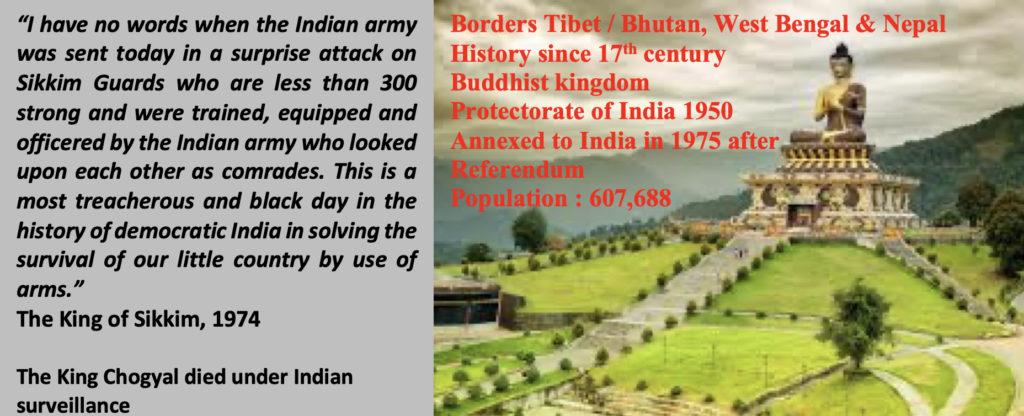
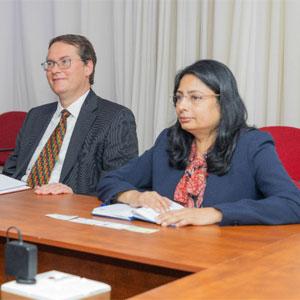 Colombo, Jan. 18 (Daily Mirror)- A group of IMF representatives including head of operations for Sri Lanka, Peter Breuer met representatives of the National People’s Power (NPP) at the JVP head office today.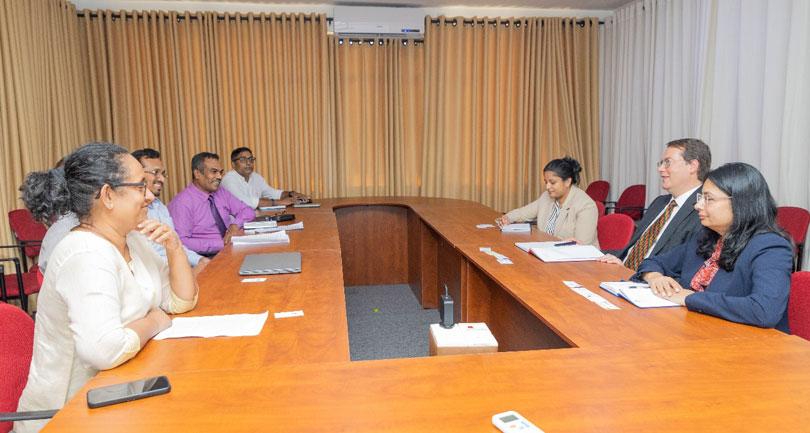
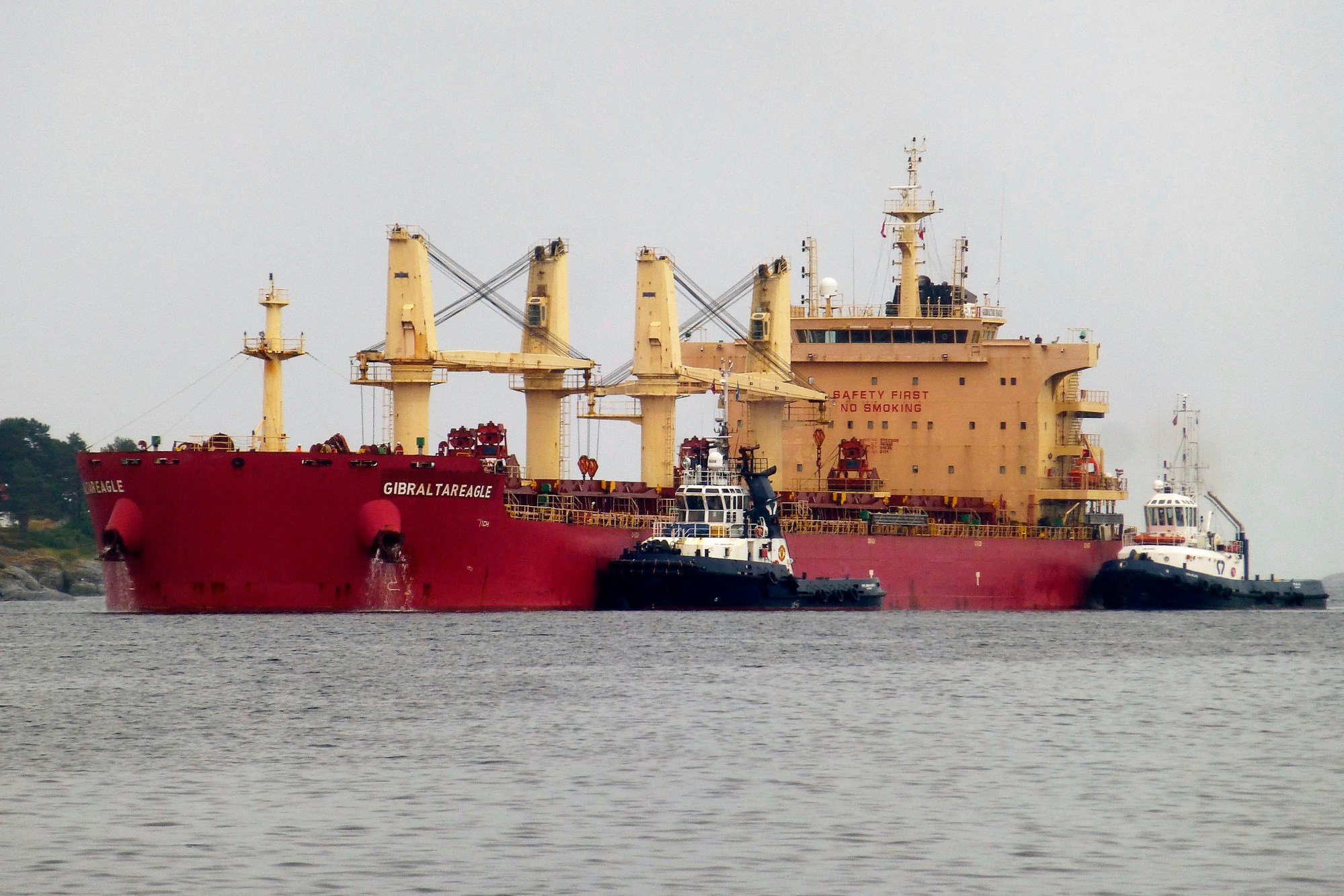
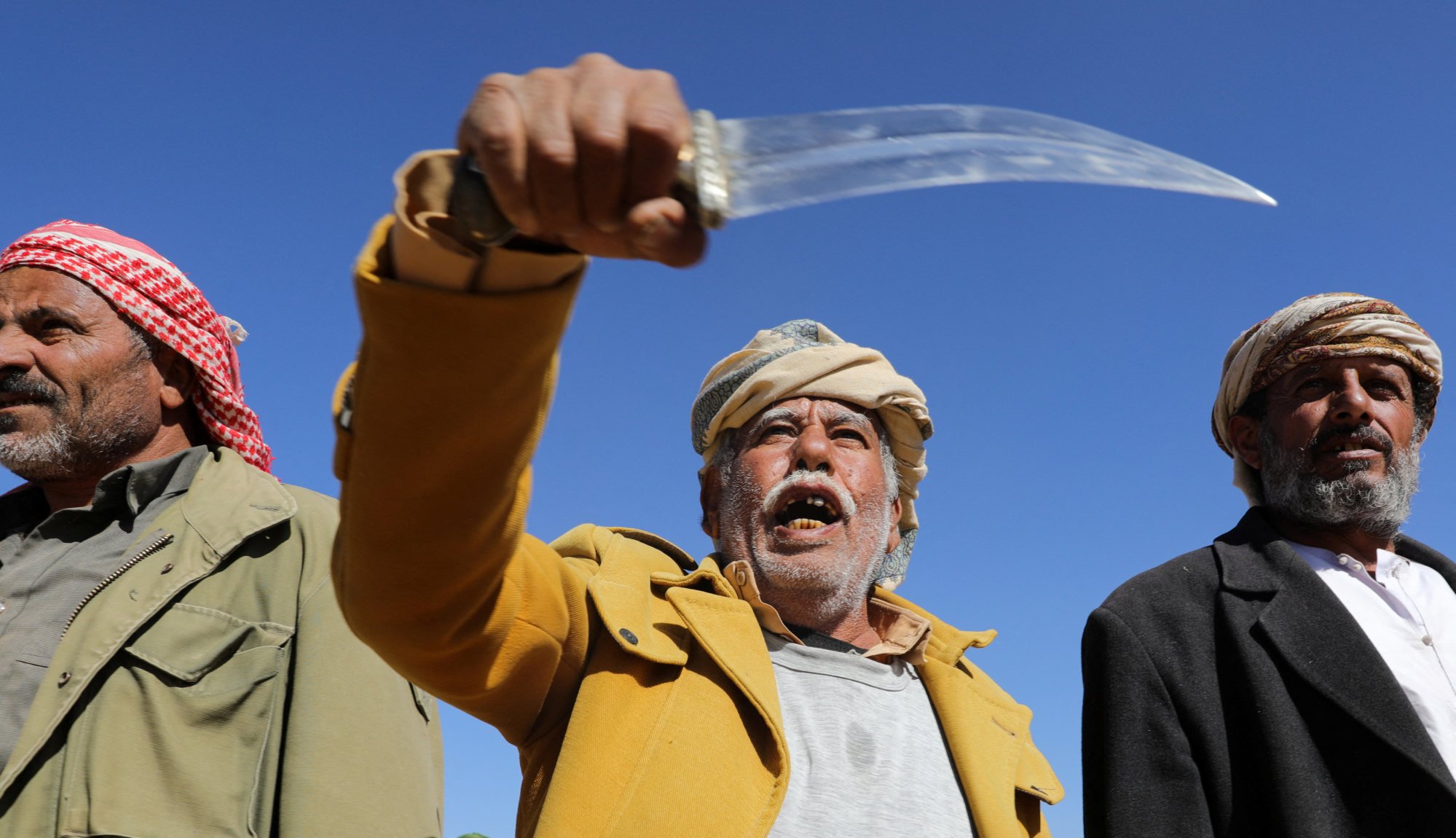
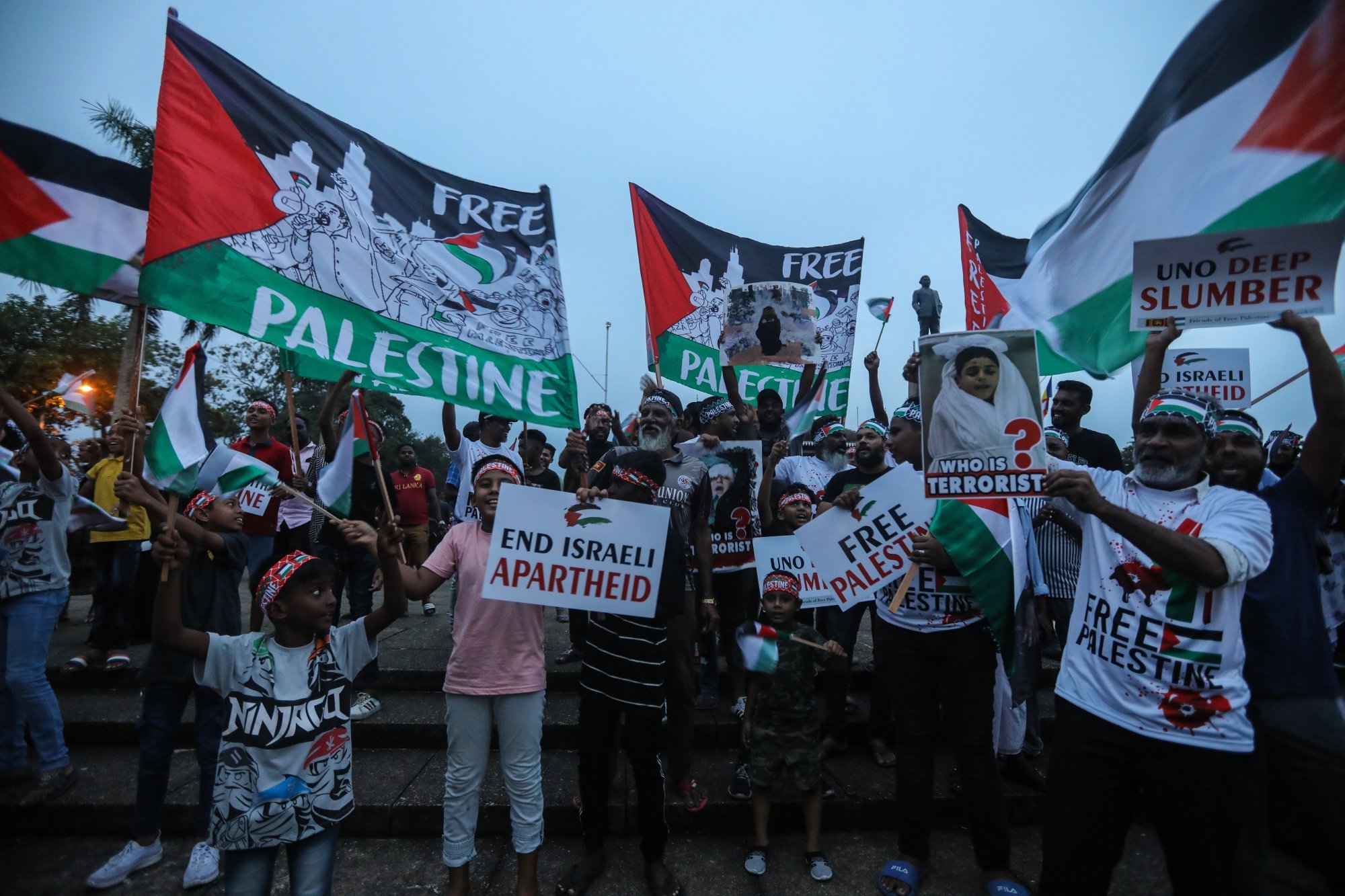

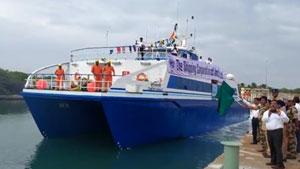 Colombo, Jan 18 (Daily Mirror) – The passenger ferry service between India’s Nagapattinam and Kankesanthurai in Jaffna will be initiated this week, Controller General of Immigration and Emigration I.S.H.J. Ilukpitiya said.
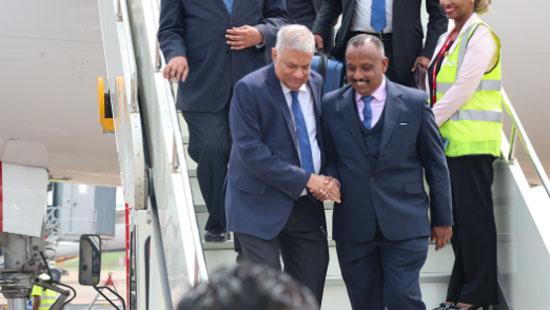 Kampala, Jan 18 (Daily Mirror) – President Ranil Wickremesinghe who arrived in Kampala , Uganda was greeted with gun salute upon arrival at the Entebbe airport.