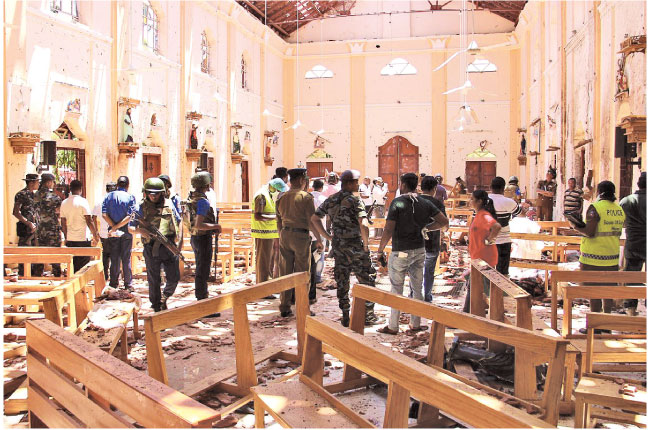
The Sri Lankan Parliament should decide on the nature of the probe into the allegations by the recent Channel 4 video on the Easter Sunday attacks, Minister of Justice Wijeyadasa Rajapaksha said today.
President Ranil Wickremesinghe proposed an international probe on the Easter Sunday attacks as soon as he was sworn in as the President of Sri Lanka last year. However, he had not received any favourable response from any party on this matter. Therefore, it is up to Parliament to decide on the nature of the probe,” the Minister who made a statement in Parliament said.
I predicted an extremist attack in Sri Lanka 29 weeks before the Easter Sunday attacks and I was heavily criticised by the Ministers and MPs of the government whom I belong to. The entire nation became a victim of the Easter Sunday attacks as a result of negligence,” he added.
The Minister then referred to a remark by TNA MP Shanakiyan Rasamanikkam who played an audio clip in the House on Thursday whilst alleging that there has been a manipulation of justice in releasing TMVP Leader Sivanesathurai Chandrakanthan who was in prison. Rasamanikam claimed that the clip was given to him by Asath Mawlana whom Channel 4 identified as their whistle-blower.
MP Rasamanikkam seems to have more clips and information given to him by Mowlana. If so, he should produce them to the CID,” Minister Rajapaksha also stressed. (Yohan Perera and Ajith Sirwardana)
Health Minister Keheliya Rambukwella has reportedly given approval for the commencement of operations of three private medical universities.
Speaking in this regard at a media briefing held in Kandy today (10 Sep.), Rambukwella stated that the relevant universities have already commenced operations.
Commenting on the recent controversies surrounding the provision of medial degrees at private universities, the Minister stated there are many children who are eligible to study medicine, but we have only 11 universities in our country, which is insufficient”.
Moreover, he emphasised on the global recognition medical degrees obtained from Sri Lankan universities hold, further explaining that the island nation should capitalize on this opportunity and produce more such students.
Instead of hindering this global recognition medical degrees from Sri Lanka receive, we need to maintain the same standards at both private and state universities. If we are able to produce outstanding students who would be of service to the world, we need to implement a system that would work parallel with this goal”, he said in this regard.
President Ranil Wickremesinghe has decided to appoint a committee, chaired by a retired Supreme Court judge, to investigate the allegations made by the UK’s Channel 4 regarding the Easter Sunday bombings.
The President’s Media Division said that the government plans to establish a Parliamentary Select Committee to investigate the allegations made by a former Attorney General, who claims that there is a mastermind behind the Easter attack.
President Wickremesinghe has emphasized that once the two investigations into the Easter attacks are concluded, the reports from the Parliamentary Select Committee and the Presidential Commission on the Easter bomb attack will be presented to parliament before any final decisions are made.
The reports pertaining to the two investigations into the Easter Sunday terror attacks in 2019 will be presented to the parliament before any final decisions are made, President Ranil Wickremesinghe said.
Accordingly, upon completion of the two investigations into the series of bombings, the reports from the Parliamentary Select Committee and the Presidential Commission of Inquiry will be presented to parliament before any final decisions are made, the President’s Media Division (PMD) reported.
Meanwhile, the Head of State has decided to appoint a committee chaired by a retired Supreme Court judge to inquire into the recent allegations made by UK’s Channel 4 in their recent exposé on the Easter Sunday bombings.
The PMD further noted that the government also intends to appoint a Parliamentary Select Committee to investigate the allegation levelled by a former Attorney General, claiming that there is a mastermind behind the attacks.
Easter Sunday murders took place on 21 April 2019. 269 innocent people died & over 500 were left injured. Immediately following the attacks at least 6 countries came forward to assist Sri Lanka in investigations. Their foreign intel agencies arrived to help carry out investigations. The FBI, Australian Federal Police, UK’s Scotland Yard, New Zealand police, Danish Police Dutch Police, Japan police & Interpol. More than 23,000 charges have been filed against the suspects & 1215 witnesses have been called to testify. Those ignorantly calling for “international investigations” are either clueless that numerous foreign intel agencies landed to help investigations & have already concluded their reports & have concluded that the culprits were ISIS. Therefore, if Cardinal or anyone else wishes to believe anything to the contrary, they must write to these intel agencies and challenge their findings & produce counter evidence instead of paying an agency that airs paid documentaries & witnesses willing to say anyting to gain asylum.
INTERPOL even congratuatled former President Sirisena in August 2019
INTERPOL Secretary General Jurgen Stock praised steps taken by President Sirisena, the Minister of Defense, Sri Lanka Police, Intel services to apprehend the criminals responsible for Easter Sunday & presented President Sirisena an INTERPOL Medal at the President’s Office. In 2023, former President Sirisena had to pay Rs.100m compensation to the victims of Easter Sunday.
In May 2021, America’s FBI confirmed Maulavi Mohamed Naufer as mastermind of Sri Lanka’s 2019 Easter Sunday bombings claimed then Minister of Public Security Sarath Weerasekera in Parliament.
In September 2022 – Interim President Ranil sought assistance of Scotland Yard to review reports on the Easter Sunday to look into hidden hands in the killings.
The Australian Federal Police sent over 20 officers to Sri Lanka after the Easter Sunday bombings in what was said to be one of the largest overseas deployments. These officers included intelligence officers, technical specialists, forensic teams. AFP Deputy Commissioner National Security Leanne Close said during the course of their investigation the Sri Lankan National Police acquired about 70TB of data, the equivalent of hundreds of millions of photos.
“(We used) some of our technical expertise in how we uncover data, work with calls, who’s made calls to whom, looking at some of the financial transactions, linking people of interest who may have been integral to the conspiracy around the bomb-making and subsequently, and ultimately, the actual actions on the day,” Ms Close told The Australian.
When Sri Lankan lawyers, officers of the Court do not have access to police investigations except when police files reports of investigations in Courts, how can foreign police personnel look into files with police?
The legality of international investigators in local investigations emerged. Under Sri Lankan law it was illegal as foreign personnel are not accountable & not subject to the jurisdiction of Sri Lankan Courts. One of the reasons for the draft Counter Terrorism Act to be opposed was the provision for foreign interventions in local criminal investigations.
In May 2021, the FBI confirmed Maulavi Naufer as mastermind of Easter bombings.
https://www.state.gov/reports/country-reports-on-terrorism-2019/sri-lanka/ The US Country Report on Terrorism in Sri Lanka 2019 states “ISIS-inspired terrorists conducted a series of suicide attacks against churches and hotels across Sri Lanka on Easter Day, resulting in hundreds of casualties. Then ISIS leader Abu Bakr al-Baghdadi publicly praised the attacks”
On 8 January 2021, FBI charged 3 Sri Lankans with conspiring to provide material support to ISIS.
“The men were part of a group of ISIS supporters which called itself “ISIS in Sri Lanka.” That group is responsible for the 2019 Easter attacks in the South Asian nation of Sri Lanka, which killed 268 people, including five U.S. citizens”
“Two days after the attacks, ISIS claimed credit for the terrorist acts, attributing the murders to “Islamic State fighters.” In late April 2019, the then-leader of ISIS praised the attackers for what he called a retaliation against “the West” for defeating ISIS the prior month in Baghuz, Syria”
“ISIS’s Easter attacks in Sri Lanka killed 268 people, including five Americans, many while they worshiped,” said Assistant Attorney General for National Security John C. Demers. “Today, we charge these defendants with bearing their share of the responsibility for these deaths.”
The three defendants named in the criminal complaint, all of whom pledged allegiance to ISIS, are:
Mohamed Naufar, the “second emir” for the group of ISIS supporters that called itself “ISIS in Sri Lanka,” who allegedly led the group’s propaganda efforts, recruited others to join ISIS, and led a series of multi-day military-type trainings;
Mohamed Anwar Mohamed Riskan, who allegedly helped manufacture the IEDs used in the Easter Attacks; and
Ahamed Milhan Hayathu Moahmed, who allegedly executed a police officer in order to obtain the officer’s firearm, shot a suspected informant, and scouted a location for a separate terrorist attack.
So what is Cardinal & the Church upto in annually changing their slogans from international conspiracy, to political conspiracy, to great plot to grand plot. Clearly, international investigations have been done and reports already issued. If the Cardinal has anything else to produce he must present these as facts and not as bogus asylum seekers attempting breaking news through paid documentaries. Before that Cardinal must first present FBI and other intel reports as false.
The Sri Lankan Govt should not be foolish to dance to Cardinals tantrums and also realize that international intel agencies were present they were given or took vital evidence and they compiled their reports. If these reports do not fit into the version Cardinal wants to believe, too bad, he has to come up with facts not fiction.
The Sri Lankan Parliament should decide on the nature of the probe into the allegations by the recent Channel 4 video on the Easter Sunday attacks, Minister of Justice Wijeyadasa Rajapaksha said today.
President Ranil Wickremesinghe proposed an international probe on the Easter Sunday attacks as soon as he was sworn in as the President of Sri Lanka last year. However, he had not received any favourable response from any party on this matter. Therefore, it is up to Parliament to decide on the nature of the probe,” the Minister who made a statement in Parliament said.
I predicted an extremist attack in Sri Lanka 29 weeks before the Easter Sunday attacks and I was heavily criticised by the Ministers and MPs of the government whom I belong to. The entire nation became a victim of the Easter Sunday attacks as a result of negligence,” he added.
The Minister then referred to a remark by TNA MP Shanakiyan Rasamanikkam who played an audio clip in the House on Thursday whilst alleging that there has been a manipulation of justice in releasing TMVP Leader Sivanesathurai Chandrakanthan who was in prison. Rasamanikam claimed that the clip was given to him by Asath Mawlana whom Channel 4 identified as their whistle-blower.
MP Rasamanikkam seems to have more clips and information given to him by Mowlana. If so, he should produce them to the CID,” Minister Rajapaksha also stressed. (Yohan Perera and Ajith Sirwardana)
Not only is Cardinal Malcolm Ranjith the opening batsman in the C4 documentary, he has also decided to be the night watchman having prepared a 3 page letter in English and even going the mile to translate it into Sinhala. The letter is dated 6thSeptember. Channel 4 program was aired on 5th September 2023 at 1105p.m (SL time 0335a.m.) which means he already had the letter prepared before it was aired). That, he was the first to appear on the program also proves the recording would have been done days in advance.
The Cardinal expresses “our” gratitude to the C4 implying that not only he but the entire Church is grateful to C4.
The Cardinal’s gratitude to C4 is for focusing attention to a ‘great plot’ associated with Easter Sunday.
The Cardinal claims to ‘yearn continuously for “Truth” and justice through a clear and transparent investigation’ and thanks C4 for its ‘project of inquiry’.
Does this mean that the findings of C4 establishes the truth, that Cardinal wants to hear? No reports can be framed to satisfy the version that Cardinal & the Church wants to hear.
What are the ‘facts’ spoken in the C4 program?
Has C4 established that Maj. Gen. Suresh Salley was in Sri Lanka in February 2018, that he visited a coconut estate in Puttalam, that he spoke to Hamsa, that he called a TMVP operative on 21 April 2019? Have those making the allegations got proof to present when Gen. Salley through his lawyers have confirmed he was overseas in 2018 & at the time of the Easter Sunday attacks, while his call records, and records of Hamsa & others can also prove the truth.
C4 has not presented any of these facts except Hamsa making statements.
Is there a need for another Parliamentary Select Committee when all that is required is the immigration confirmation from Malaysia & Sri Lanka as well as call logs of both Salley & Hamsa & even the TMVP operative Hamsa has yet to name?
In establishing these real facts – the entire basis of this C4 program falls flat & the argument attempted to be presented as a ‘grand plot’ comes to naught. If so, Cardinal & his bandwagon must stop politicizing the issue as they have not been able to provide any evidence beyond the phrase ‘grand plot’ to prove such a grand plot existed over & above the plan to attack churches & hotels.
How can Cardinal claim no positive action, when the Supreme Court not only ordered former President Sirisena to pay compensation of Rs.100m but he actually made the payment. The present President is also to make similar payment upon the conclusion of his tenure as President.
The Cardinal has given 4 points
He wants a “free, impartial, just, transparent, broad based investigation’into Channel 4 revealed. The ‘grand plot’ behind the Easter Sunday is based on the evidence given by Hamsa claiming that Gen. Suresh Salley came to a coconut estate in Puttalam in Feb2018 & discussed the plot with Zaharan & Co. In establishing whether Suresh Salley was in Sri Lanka or not, that he came to the coconut estate or not and his call logs will DISMISS Hamsa’s story as well as Cardinal’s “grand plot” theory.
Investigation via an independent international investigation team – this is not required because asking Malaysian authorities to confirm if Suresh Salley left Malaysia in 2018 February will confirm or refute Hamsa’s story and end the grand plot conspiracy theory. This can be reaffirmed by Sri Lanka’s Foreign Ministry as well.
Cardinal is demanding who should comprise the investigation team, in particular he is asking that the team who were transferred to be included. Is this not a strange request. Cardinal is not the President or head of the Police to be dictating how an investigation should be held. Also we do not know for what reasons these officials were transferred. However, we are curious to know why the Cardinal wants a select group of officials to investigate!
Why should a Government believe Channel 4 that simply airs privately produced programs and is not bothered to verify the content before airing them? As per the letter sent by the lawyers of Gen. Suresh, it was categorically told to the C4 producers that Gen. Suresh was not in Sri Lanka on the date/month C4 star witness alleged and was also not in Sri Lanka during the Easter Sunday attacks. If C4 has aired the program without ascertaining these basic facts by checking with immigration/phone records etc then the onus is on C4 & Cardinal & Hamsa to prove that Gen. Suresh was in Sri Lanka – without that proof presented in the program, the story does not hold any water. The grand plot comes to nothing if Cardinal & C4 cannot prove that Gen. Suresh was in Sri Lanka or that he placed calls to Hamsa.
It is understandable that Cardinal may be a wee bit worried over former SIS head Nilantha Jayawardena’s testimony to the Presidential Commission as he claimed nearly 15,000 people would have known about the Easter Sunday attacks before they took place. This leaves the floor open to even wonder if the Church also knew and raises suspicions as to why no mass was held in St Anthony’s Church while no Church representatives were at the site on the day of the killings as well as why Mass was not cancelled to prevent worshippers entering the churches as by that time the names of the targets were made known by the Indian intel.
Listen to former defense secretary Hemasiri Fernando? How many who also knew thought like him and did nothing – do they also not shoulder complicity for negligence? https://www.youtube.com/watch?v=xPLopoYWJS8
No amount of “grand plot” mumbo jumbo theories can forgive the conscience of those who knew, who would have been informed just as a Ministers father told his son not to attend Church. More than those who planned & committed the crime, are those who knew about it but did nothing to prevent people getting killed. Therefore, the Church & Cardinal must first answer this one question – were they one of the 15,000 who knew about the attacks before the attacks. A separate investigation should look into this 15,000 who knew and saved their own skin & sacrificed 269 innocents. Shame on all of them.
Also, how much of state funds have been spent on Easter Sunday commissions simply because the Cardinal & Co are going on and on about a “grand plot” they present a notion that only Easter Sunday victims are the only victims in Sri Lanka – why have the murders by LTTE over 30 years gone uninvestigated, why has TNA links to LTTE not been investigated? Why has Church links to LTTE not been investigated? Would Church be open to such investigations? How many thousands died over 30 years because of LTTE as a result of the covert and overt help given by entities pretending to be paragons of virtue today. Do they have a moral right to be calling for any investigations?
Where are the documentaries about LTTE attacks on Sacred Sri Maha Bodhi temple, Dalada Maligawa, Kattankudy mosque, the Central Bank etc? Why doesn’t the Cardinal call for investigations into these LTTE crimes, why only those that are advantageous to the Church only?
In a June 2012 piece headlined Praying at the Church of St. Drone,” I wrote, Be assured of one thing: whichever candidate you choose at the polls in November, you aren’t just electing a president of the United States; you are also electing an assassin-in-chief.” At that time, President Barack Obama was overseeing what came to be known as terror Tuesday” weekly meetings in the White House Situation Room with more than 100 national security types, some by secure video teleconference,” gathering to discuss global assassination targets in America’s never-ending war on terror.
Unlike once upon a time, however, the assassins” to be dispatched were no longer human, but unmanned aerial aircraft,” or drones. And they struck across significant parts of the planet, sometimes killing al-Qaeda figures, but all too often, civilians and even children. Drone operators were, in fact, allowed to kill based on nothing more than what was called patterns of suspicious behavior” and their planes were roughly thirty times more likely to result in a civilian fatality than an airstrike by a manned aircraft.”
As I wrote then:
In the [New York] Times telling, the organization of robotic killing had become the administration’s idée fixe, a kind of cult of death within the Oval Office, with those involved in it being so many religious devotees. Of course, thought about another way, that ‘terror Tuesday’ scene might not be from a monastery or a church synod, but from a Mafia council directly out of a Mario Puzo novel, with the president as the Godfather, designating ‘hits’ in a rough-and-tumble world.
How far we’ve come in just two presidencies! Assassination as a way of life has been institutionalized in the Oval Office, thoroughly normalized, and is now being offered to the rest of us as a reasonable solution to American global problems and an issue on which to run a presidential campaign.”
Yes, foreign assassination attempts were hardly unknown in previous American history, but they were usually left tothe CIA and there was nothing machine-like about them. In this century, it’s been different indeed, whether the targets were unknown figures considered suspicious (from an automated distance) or, as in the case of Donald Trump, whose administration upped such strikes, all too well known, as with the drone assassination of Major General Qassem Suleimani, the leader of Iran’s elite Quds Force, on his arrival at Baghdad International Airport on a visit to Iraq.
As Maha Hilal, author of Innocent Until Proven Muslim: Islamophobia, the War on Terror, and the Muslim Experience Since 9/11, reports today, President Biden has, after a fashion, reined in the Trumpian version of drone assassination, but he, like the three presidents before him, still remains America’s assassin-in-chief. With that in mind, consider what such a world looks like to those potentially on the other side of a drone’s missiles. Tom
22 Years of Drone Warfare and No End in Sight
Biden’s Rules on Drone Warfare Mask Continued Violent Islamophobia
I no longer love blue skies. In fact, I now prefer gray skies. The drones do not fly when the skies are gray.”
That’s what a young Pakistani boy named Zubair told members of Congress at a hearing on drones in October 2013. That hearing was during the Obama years at a time when the government had barely even acknowledged that an American drone warfare program existed.
Two years earlier, however, a Muslim cleric, Anwar Al-Awlaki and his 16-year-old son Abdulrahman, both American citizens, were killed by U.S. drone strikes in Yemen just weeks apart. Asked to comment on Abdulrahman’s killing, Obama campaign senior adviser Robert Gibbs said: I would suggest that you should have a far more responsible father if they are truly concerned about the well-being of their children. I don’t think becoming an al-Qaeda jihadist terrorist is the best way to go about doing your business.”
Those are two of all too many grim tales of the brutality with which the United States has carried out its drone warfare program. Post-9/11 reiterations by the government of the danger we now live in (because the U.S. was attacked), have made the collective responsibility of Muslims and the callous dismissal of their deaths a regular occurrence.
In 2023, this country’s drone warfare program has entered its third decade with no end in sight. Despite the fact that the 22nd anniversary of 9/11 is approaching, policymakers have demonstrated no evidence of reflecting on the failures of drone warfare and how to stop it. Instead, the focus continues to be on simply shifting drone policy in minor ways within an ongoing violent system.
The Inherent Dehumanization of Drone Warfare
In February 2013, White House Press Secretary Jay Carney justified drone strikes as a key tool of American foreign policy this way:
We have acknowledged, the United States, that sometimes we use remotely piloted aircraft to conduct targeted strikes against specific al-Qaeda terrorists in order to prevent attacks on the United States and to save American lives. We conduct those strikes because they are necessary to mitigate ongoing actual threats, to stop plots, prevent future attacks, and, again, save American lives… The U.S. government takes great care in deciding to pursue an al-Qaeda terrorist, to ensure precision and to avoid loss of innocent life.”
More aggressively endorsing the use of such drones, Georgetown Professor Daniel Byman, who has held government positions, emphasized the necessity of such warfare to protect American lives. Drones,” he wrote, have done their job remarkably well… And they have done so at little financial cost, at no risk to U.S. forces, and with fewer civilian casualties than many alternative methods would have caused.”
In reality, however, Washington’s war on terror has inflicted disproportionate violence on communities across the globe, while using this form of asymmetrical warfare to further expand the space between the value placed on American lives and those of Muslims. As the rhetoric on drone warfare suggests, the value of life and the need to protect it are, as far as Washington is concerned, reserved for Americans and their allies.
Since the war on terror was launched, the London-based watchdog group Airwars has estimated that American air strikes have killed at least 22,679 civilians and possibly up to 48,308 of them. Such killings have been carried out for the most part by desensitized killers, who have been primed towards the dehumanization of the targets of those murderous machines. In the words of criticSaleh Sharief, The detached nature of drone warfare has anonymized and dehumanized the enemy, greatly diminishing the necessary psychological barriers of killing.”
In his book On Killing: The Psychological Cost of Learning to Kill in War and Society, retired Army Lieutenant Colonel Dave Grossman focuses on the mechanical distancing” of modern warfare, thanks to the sterile Nintendo-game unreality of killing through a TV screen, a thermal sight, a sniper sight, or some other kind of mechanical bugger that permits the killer to deny the humanity of his victim.” Scholar Grégoire Chamayou describes this phenomenon in even starker terms. Thanks to the distance between the drone operator and the victim, One is never spattered by the adversary’s blood. No doubt the absence of any physical soiling corresponds to less of a sense of moral soiling… Above all, it ensures that the operator will never see his victim seeing him doing what he does to him.”
Needless to say, drone technology has rendered those in distant lands so much more disposable in the name of American national security. This is because such long-range techno-targeting has created a profound level of dehumanization that, ironically enough, has only made the repeated act of long-distance killing, of (not to mince words) slaughter, remarkably banal.
In these years of the war on terror, the legalities of drone warfare coupled with the way its technology capitalizes on an unfortunate aspect of human psychology has made the dehumanization of Muslims (and so violence against them) that much easier to carry out. It’s made their drone killing so much more of a given because it’s taken for granted that Muslims in target sites” or conflict zones must be terrorists whose removal should be beyond questioning — even after a posthumous determination of their civilian status.
Responsibility, Not Accountability
At a 2016 press conference, President Barack Obama finally responded to a question about the increasing numbers of drone strikes by admitting: There’s no doubt that civilians were killed that shouldn’t have been.” Then he added, In situations of war, you know, we have to take responsibility when we’re not acting appropriately.”
Rare as such admissions of responsibility” have been, however, they remain quite different from accountability. In Obama’s case, all that was offered to the survivors among those who shouldn’t have been” killed in such drone strikes was an utterly minimal acknowledgment that it was even happening.
While the use of drones in the war on terror began under President George W. Bush, it escalated dramatically under Obama. Then, in the Trump years, it rose yet again. Halfway through Trump’s presidency, drone strikes had already exceeded the total number in the Obama era. Though the use of drones in Joe Biden’s first year in office was lower than Trump’s, what has remained consistent is the lack of the slightest accountability for the slaughter of civilians.
In 2021, as the U.S. was withdrawing chaotically from its 20-year Afghan War disaster, its military surveilled a white car driving around Kabul, believed it to be carrying explosives, and launched its final drone strike of that conflict, slaughtering 10 Afghans. Two weeks later, after reporting by the New York Times revealed what really happened, the Pentagon finally admitted that only civilians had been killed, seven of them children (but penalized no one).
Defense Secretary Lloyd Austin later apologized to the families of those killed and offered compensation — one of the few times American officials had even bothered to acknowledge wrongdoing in Afghanistan in the last 20 years. True to form, however, the government’s pledge to compensate the impacted families has gone unfulfilled, a grim reminder that in none of those years has there been any semblance of justice for civilian survivors of such drone strikes.
A few weeks ago, thanks to a Freedom of Information Act request, the Biden administration was forced to release a redacted version of a presidential policy memorandum, signed in October 2022, that detailed the administration’s latest approach to drone warfare globally. At least some details about it were known prior to its release, however, thanks to an anonymous senior administration official.
The Washington Post editorial board, among others, celebrated the memo, arguing that the restrictions in place are smart rules of engagement” and a significant improvement over the Trump years when it comes to limiting civilian damage from drones. In reality, however, Biden’s memo is likely to do little to stem future drone warfare nightmares. In essence, the memo represents a return to Obama-era rules, including the supposed need to have near-certainty” that the target of a drone strike is a terrorist and near-certainty” that non-combatants won’t be injured or killed. The memo also includes other criteria that (at least theoretically) must be met before an individual is targeted, including an assessment that capture is not feasible.
In the case of Anwar Al-Awlaki, while the U.S. claimed his capture wasn’t possible, members of his family disputed this. In a Democracy Now interview, Al-Awlaki’s uncle Saleh bin Fareed stated, I am sure I could have handed him over — me and my family — but they never, ever asked us to do that.” Needless to say, the lack of transparency has made it impossible to know if such standards are being met before a strike takes place and, worse yet, there’s no method of accountability if they aren’t.
That Biden administration memo does ban signature strikes that target individuals whose identities are unknown based on behavior suggesting they might be involved in terrorist activity. Still, we shouldn’t mistake a modestly better policy for a truly legal, moral, and ethical one, especially since the drone strike mistakes” of the past haven’t led to any genuinely meaningful overhauls of the program.
Minimizing Civilian Deaths?
On September 20, 2001, nine days after the 9/11 attacks, President George W. Bush delivered a speech to a joint session of Congress in which he first used the phrase war on terror,” while announcing a domestic and global campaign to be fought without borders or time constraints. Previewing what, years later, would become known as this country’s forever wars,” he advised Americans that they should not expect one battle, but a lengthy campaign unlike any other we have ever seen. It may include dramatic strikes visible on TV and covert operations secret even in success.”
Cameroonian political theorist Achille Mbembe’s theory of necropolitics — that is, the politics of death – catches the essence of the war on terror Bush launched as a way of life (and death) — the capacity to define who matters and who does not, who is disposable and who is not.” With the invasion of Afghanistan and the designation of entire largely Muslim parts of the planet as the enemy, the Bush administration began a war” in which Muslim deaths were necessary for the protection and preservation of American ones. This set a precedent for the value of Muslim life when the act of killing them could be equated with the security of Americans and the protection of the homeland.”
Twenty-two years later, drones continue to be instruments of civilian slaughter and the language deployed by successive administrations to describe such slaughter has served to sanitize that fact. Whether it’s the use of target” or collateral damage,” both minimize the reality that human beings are being murdered. Taken together with a larger war-on-terror narrative in which Muslims have been strikingly demonized and criminalized, the result has been the production of killable bodies whose deaths elicit neither guilt, remorse, nor accountability.
In his 2014 State of the Union address, President Obama explained why he put prudent limits” on drone warfare, pointing out that Americans will not be safer if people abroad believe we strike within their countries without regard for the consequence.” And how right he was.
As yet, however, there have been zero consequences for the air-strike deaths of tens of thousands of civilians globally and, as Obama’s statement suggests, the only real concern this caused American officials was the fear that too many such killings might, in the end, harm Americans.
Grieving Muslim Lives
In Sana’a, Yemen, a wall with graffiti art shows a U.S. drone under which someone has written in blood-red paint, Why did you kill my family?” in English and Arabic. The relentless American drone campaign has indeed left all too many civilians in Muslim-majority countries asking the same question. The only answer offered in Washington over all these years is that such killings were unavoidable collateral damage.
But imagine, for a moment, what Americans might do if their family members were regularly being killed by drones because another government claimed near certainty” that they were terrorists? You know the answer, of course, given the response to the 9/11 attacks: this country would undoubtedly launch a catastrophic war of epic proportions with no conceivable end in sight. In contrast, Muslims targeted by American drones have been left to pick up the all-too-literal pieces of their loved ones, while risking the possibility of also being killed in a double- or triple-tap strike — a level of violence that should never be justified.
We should all reject a war on terror committed to the disposability of Muslims because no one (including Muslims) should have to mourn the killing of civilians the U.S. has targeted for far too long. Muslim lives have inherent value and their deaths are worth grieving, mourning, and above all valuing. Drone warfare will never change that fact.
More than 40 years after the mysterious shooting down of an Italian plane that carried 81 passengers, former two-time premier Giuliano Amato claims France was behind it
A former Italian head of government has accused France and the United States of being responsible for the deaths of 81 aircraft passengers in a mysterious crash more than 40 years ago, in a failed assassination attempt on former Libyan President Muammar Gaddafi.
On the evening of 27 June 1980, the Itavia flight 870, with 81 people on board, crashed near the island of Ustica (north of Sicily), resulting in the deaths of passengers and crew members. The incident is one of Italy’s worst air disasters in history.
In an explosive interview published on Saturday by the newspaper La Repubblica, former Prime Minister Giuliano Amato said he supported the claim that France, with the assistance of Washington, sought to eliminate Libyan leader Gaddafi, believing he was on board the targeted aircraft. The passenger plane was shot down by a missile fired by a French fighter jet, Amato alleged.
The most credible version is that of the responsibility of the French air force, with the complicity of the Americans,” he said, adding that it was done with the intention of ‘taking out Gaddafi’.”
The French government has yet to respond to the claims, but Paris and Washington have consistently denied any involvement in the tragedy.
According to Amato, the national secretary of the Italian Socialist party at the time, Bettino Craxi, who was known to be close to Colonel Gaddafi, had heard” of a danger to him if he entered Italian airspace and had warned him.
On Saturday, Craxi’s son wrote on the platform X, formerly known as Twitter, that his father had indeed warned Gaddafi but in 1986”, which was six years after the catastrophe, he specified.
In 2003, Gaddafi accused the US of attempting to assassinate him at that time.
Amato requested French President Emmanuel Macron to cleanse the shame that weighs on France”, either by demonstrating that this thesis is unfounded or, if confirmed, by offering the most sincere apologies to Italy and the victims’ families”.
A criminal trial against several high-ranking Italian military officials, suspected of concealing information in this case, concluded in 2007 with their acquittal by the Court of Cassation.
Italian Prime Minister Giorgia Meloni has called on Amato to provide concrete evidence to support his accusations.
I ask Prime Minister Amato, in addition to his deductions, to let us know if he possesses any elements that could challenge the conclusions of the judiciary and parliament and make them available to the government,” she said.
Let us get to the bottom of this drama without engaging in any more sensational entertainment. The latest Channel 4 video opened with Cardinal Malcolm Ranjith talking about someone “above” Zaharan and Hamsa claiming to have met Maj. Gen. Suresh Salley in February 2018 & alleging discussing a plot to commit Easter Sunday.
If Channel 4 at the end of the video included that Maj. Gen. Suresh Salley was not in Sri Lanka, with what media ethics did Channel 4 proceed to air the documentary, even if it was paid by someone else? The Cardinal & their whistleblowers stand exposed the moment the truth comes to light. To ascertain the truth only a few simple steps are needed why is their no calls by them to adopt these procedures? Stop watching all the videos and sensational theories to simply seek answers to below questions.
Channel 4 star witness Hamsa alleges Maj. Gen. Suresh Salley came to a coconut estate in February 2018. Maj. Gen. Suresh Salley has written to C4 through his lawyers to say he was overseas on a diplomatic assignment since 2016 – confirming he was not in Sri Lanka in February 2018.
How do we check if Gen. Salley was in Sri Lanka in February 2018?
Check with Malaysian immigration to confirm Gen. Salley was in Malaysia & did not leave Malaysia in February 2018 or any period that year.
Check with Sri Lankan immigration to confirm Gen. Salley did not arrive from Malaysia in February 2018.
Check with Sri Lanka’s Foreign Ministry and obtain official letter from them as to Gen. Salley’s appointment as a diplomat & that he had not travelled officially or personally to Sri Lanka in February 2018 (even to travel personally leave has to be applied for & approval obtained from the Foreign Ministry)
Check airline passenger lists from Malaysia to Sri Lanka on that particular day to see if Gen. Salley travelled to Sri Lanka.
Hamsa alleges that he arranged Gen. Salley to meet Zaharan & team in a coconut estate in Puttalam. Presuming Gen. Salley was not in Sri Lanka as per the above data, the next step is to prove if Hamsa went to Puttalam
Can Hamsa prove where this coconut estate is (address) who does it belong to and that he went to this site on the day that he is alleging. The owner of the estate should also be able to verify.
If Hamsa is unable to prove above, then one of his key arguments falls flat.
Hamsa also alleges that Gen. Salley placed a call to a TMVP operative to travel to the Taj Hotel & pick up the phone of ‘someone’ (we presume it is the suicide bomber)
With advances in technology, Hamsa’s allegation of a call by Gen. Salley on Easter Sunday can also be easily proved.
Take call logs of Gen.Salley on 21st April 2019 to see if he made such a call at the time that Hamsa alleges.
If Gen. Salley was in Malaysia – it would be easy to obtain call logs from an international line
Check call logs of Hamsa on Easter Sunday 21 April 2019 as well as his whereabouts. How did Hamsa know what Gen. Salley told a TMVP operative, if Gen. Salley was in Malaysia?
Was Hamsa with the TMVP operative when the call came?
Who is this TMVP operative, where was he located on 21 April 2019 and check his call records too to see if he received a call from Gen. Salley.
Revealing Gen. Salley’s whereabouts in 2018 & 2019 as well as his phone records
Revealing Hamsa’s whereabouts in 2018 & 2019 as well as his phone records will seal the truth and negate all the allegations made by Hamsa, C4 & the Cardinal.
The Cardinal & his coterie of NGOs & spokespersons, Channel 4, the star witnesses even Geneva will all have to prepare their apologies to not only Maj. Gen. Suresh Salley but to the General Public for intentionally fabricating stories and attempting to fool the people of Sri Lanka.
This essay looks at Tamil colonization of Sinhala lands during British rule. (1815-1948).From the time they took control of the Udarata kingdom, the British wanted to bring the Sinhala population to heel, especially after the rebellions of 1818 and 1848.
They decided to replace the Sinhalese with Tamils from South India. This was a deliberate policy and carried out relentlessly, throughout the period of British rule. It was easy to move Tamils from Tamilnadu to Sri Lanka .Tamilnadu and Sri Lanka were both under the British.
The British policy of settling Tamils in Sinhala lands was not confined to the coastal north and east. Tamil settlers were brought inland into the ‘tank country’ as well. In 1857 the GA for Minneriya suggested colonizing Minneriya with people from south India. In 1867 the GA, Trincomalee said he wanted to start a Tamil colony at Kantale.
In 1886, it was reported that Tamils from Jaffna were coming into luppaikadavai, in Mannar district to make it a ‘flourishing Jaffnese tobacco growing colony’ (SP 8 of 1886 p 11) it was also hoped, said Denham in 1911, that settlers from Jaffna would come to the Vanni, using the railway and that large extents of paddy land under irrigation would be taken up by colonists from Jaffna.
Kalawewa colonization scheme was started in 1893. The colonists were exclusively Tamils. The GA was told to give preference to Tamils from the Jaffna peninsula. 14 families arrived from Jaffna, followed by another set later. They returned home as soon as possible. (SP 4 of 1893)
Government Agent R.W. Ievers complained that these settlers had never seen a forest before and that they wanted everything done for them. GA Ievers had to get the land cleared for them, employing Sinhala villagers. The settlers sowed some short term crops but soon returned to their villages in Jaffna. Ievers lamented that he had spent much state funds on these short lived settlers.
In 1886 Parker had pointed out that labor for restoring the NorthernProvince tanks would have to be got from South India or Jaffna. (SP 49, 1886) .The GA, Eastern Province reported in 1900 that ‘on this side of the. Island we can get no responsible Sinhalese worker for the salary we can offer’. (AR, Eastern Province 1900. p F12) This means that Tamils continued to come in as cheap labor as well
But the earlier settlers were no longer poor. From the 1880s Jaffna Tamils had gone in large numbers, to Malaya to work as clerks, supervisors and so on. Malaya was also under British rule and when the British administration there needed middle level workers, they got them from Jaffna.
Tambapillai Adigar in his report on Jaffna district said in 1911 that Tamils working elsewhere in Ceylon, also in Burma and especially in Malaysia, remitted money to Ceylon. Several lakhs of rupees are annually remitted to Jaffna by them. There is not a village in Jaffna which has not benefited by the employment of its persons abroad. As a result land has gone up in price in Jaffna too, he added.
Tamils were therefore able to buy out Sinhala landowners in the north. In 1886, irrigation engineer, Henry Parker, reported that the Sinhala villagers around Pavatkulam tank, Vavuniya were too poor to purchase the irrigable land which will soon become available but the GA had said that he was confident that purchasers will come from Jaffna. (SP 11 of 1886 p 7).
Regarding Mamaduwa tank, Vavuniya, Parker said, I know for a fact that some of the Tamil money lenders of the neighborhood are disposed to buying up much, if not all, of the reclaimed land over the heads of the Sinhalese settlers, if the lands are offered for sale. Parker hoped that that won’t happen. So did the Sinhalese. They had objected to Tamil settlers being brought in (Sp 8, 1886 p 8 and SP 46 of 1886) p 2)
In the 20th century too, the British rulers continued to colonize the island with Tamils from India .British Governor Henry McCallum informed the Tamil leaders in Jaffna peninsula at a meeting in 1911 that he had reserved the Tank Country and the East for the people of Jaffna. He would bring immigrants from south India, if the Tamils in Jaffna did not comply.
Ponnambalam Ramanathan had told the Governor at this same meeting in 1911 that Jaffna people had colonized the land up to Anuradhapura and wanted the government to open up the railways so that more Tamils could come south. (
Denham observed in 1911 that Jaffnese do not emigrate as pioneer cultivators and settlers but for jobs as educated persons. They are not interested in working to open up the country where they have to work for at least two years before they got a return.
Shantha Hennayake, whose doctoral thesis was on Tamil ethnonationalism in Sri Lanka” (1991), noted that in 1920 the Tamil population was at a high level and the Sinhala population was at a low level in the northern part of the island.
In Vavuniya, in 1921 of the four DRO divisions, Vavuniya south had a Sinhala majority but this is the smallest of the four divisions, said Hennayake. In Mannar, in 1921, there is not a single Village Headman/Grama sevaka area where the Sinhala were in a majority. Manner was mainly Tamils and Muslims, and in the southern part of the district, the concentration of Muslims was very high. Only three VH areas in Mannar district had a Sinhala population even above 10%. They were Talaimannar, Pesalai and Musali division. This pattern continued for the next 50 years. The VH/GS areas of the northern part of Mannar was overwhelmingly Tamil, with some Muslim concentrations, said Hennayake.
Hennayake said that in 1921, Anuradhapura district was largely Sinhala. All the AGA divisions of Anuradhapura have reported a Sinhala majority since the census started in 1871. Tamils were concentrated in Anuradhapura, Kekirawa and a few rural areas. Anuradhapura town has always had a relatively large Tamil population, they were largely engaged in business and related activities, said Hennayake. (Shantha Hennayake. Island 4.5.2009 p 10 )
There was some limited resistance from the Sinhala villagers. GA, Northern Province reported in 1873 that some of the Vanni pattus had several villages occupied by the Sinhalese who had migrated from Anuradhapura. When requested, Sinhalese headmen were appointed. ( AR 1873)
In 1886 Parker says that around 1876, some enterprising Sinhalese villagers settled at Chemamadu, but abandoned the settlement after four years.
Trincomalee and Batticaloa Districts of the Eastern Province, were a part of the Udarata kingdom during Dutch rule. Dutch governor Ryckloff van Goens stated in his Memoir of 26th December 1663 that ” The country between the river Waluwe and Trinquenemale is entirely inhabited by the [Udarata King’s ] people and therefore I have never been able to visit this district”.
The Eastern province came under British rule in 1815. The British colonized the districts of Trincomalee and Batticaloa with immigrants from Jaffna and south India. Roads were developed up and down the coast, linking Jaffna, Trincomalee and Batticaloa. In 1901 cultivators were brought into the Trincomalee district from Jaffna for tobacco cultivation. ( AR, Trincomalee 1901 p F17)
The British rulers blocked out land in the Eastern province and sold them. The main buyers of these lands were the Tamils. .(Administration Reports. 1868) . Tamil settlers also bought up the holdings of the Sinhala villagers. The Sinhala villages have been bought out by Tamils who now own all the paddy lands of some villages, said GA Trincomalee in 1898. ( GA, Trincomalee AR 1898 p F 16-17.)
The British restored irrigation works in the Eastern Province and gave the land that would be irrigated to Tamil colonists. The administration Report for 1867 of the AGA Trincomalee District states that ” I should like to form a large Jaffna colony and if liberal terms are offered, might succeed in the Kantalai tank area. ( AR 1867 P 106)
The Government Agent Jaffna was not successful in his attempt to send people to Gantalawa tank to colonize it, But AGA Trincomalee said in 1868 I have every reason to believe that we may set up a Tamil settlement there, with settlers from Tamilnadu, to cultivate the lands fed by this splendid tank .( Report of AGA Trincomalee 1868)
In Batticaloa the colonial British government spent 76,000 pounds on repairs to the ancient wewas and rendered 23,000 acres of forest land irrigable for rice cultivation. 500 acres were leased to a newly formed Tamil enterprise called the Jaffna – Batticaloa Agricultural Company. The plan to lease the entire 23,000 acres to this enterprise was frustrated when the company failed, said Gamini Iriyagolle.
Tamils therefore have acquired land in the east by the straightforward purchase of land allotments from the British rulers and also by buying out the Sinhala settlers who were there. By 1933 the Sinhalese villagers and their tanks in the Eastern Province had died out. ( AGA Diary for Trincomalee for 18.3.1933)
The diary of the AGA, Trincomalee, for July-August 1933 recorded that the migrant Sinhala fishermen, who came. Into Trincomalee, had had a conflict with the Tamil fisherman re use of the beach. The British GA had given the decision against the Sinhala fishermen. The Sinhala fishermen had appealed to the Fisheries department in Colombo. AGA refers to the continuous succession of interviews, the longest was with a Mr. Subramaniam ‘who is still advocating the cause of Tamil fishermen’ as he was writing in his diary.
A reader wrote to the “Island’ newspaper, saying that he can find Tamils and Muslims who can trace their ancestry to the North and Eastern province, but that he cannot find any Sinhalese who can do so.
Emil Van der Poorten (b.1939) said I have spent all my holidays since I was a child in Kuchchaveli area, where a maternal uncle was living. His Sinhala wife was to my recollection the only Sinhala speaker for miles around. Even the fishermen who came from Negombo spoke a mixture of Sinhala and Tamil. As an adult I was familiar with the east coast between Verugal and Batticaloa, Panchchankerni area in particular. There were very few Sinhalese there either.
Emil Van der Poorten says ‘there was never a significant concentration of Sinhala speakers in this part of the country.’ It is a gross misrepresentation of fact to rewrite history and settle Sinhalese in what was originally Tamil and Muslim country. (Sunday Leader.1.3.2009 p 15) continued)
The Tamils in Trincomalee District rose, from 30% of the population in 1871 to a peak of 60% in 1901. Trincomalee had become an urban center by 1879. Census reports indicate that from 1870 to 1900 Jaffna was the foremost source of migrants into Trincomalee town. The town itself was largely inhabited by Tamils, while the harbor area held both Tamils and Muslims. By 1899, the major population in Trincomalee were ‘residents of Jaffna and Batticaloa’ (AR Eastern Province 1899)
The Government Agent, Trincomalee pointed out in 1898 that it seems almost incredible that a visitor may spend a year in any part of Ceylon without ever seeing a Sinhalese man and yet this might happen to a visitor in Trincomalee. It seems incredible that there should be any town in Ceylon where you could not find thirty men speaking the national language, Sinhalese, yet this is true of Trincomalee.” (AR 1898 p F16)
However, from the 1920sthe population of Tamils in Trincomalee started declining. To 52.2 in 1921, 46.6% in 1931 and 33.8% in 1981. One reason for this would be the emergence of Trincomalee as a ‘ major commercial centre especially due to the utilization of the harbor during World War II in the 1940s .This brought many non Tamils into Trincomalee
In the early part of the 20th century Tamils and Muslims became dominant in the east. It was quite the reverse for the Sinhalese in the eastern Province, said analysts. Report on Forest Administration of Ceylon by F.D’A Vincent (Sessional paper XL11 of 1882) spoke of “the gradual spread of the Tamils down the coasts, especially the eastern coast. Where ever the Tamil or the Mahommedan comes to settle, the Sinhalese is driven back to the forest, where he earns a precarious existence by chena cultivation and by hunting.”
Caught by their traditional occupation rice cultivation and reluctant to move from their traditional Purana villages, the Eastern province Sinhalese of the late 19 century and early 20th century, simply wilted, said GH Peiris. The government records of the period show the retreat of these ‘purana’ villages, the depopulation through famines, epidemics, drought and finally, cultural assimilation by other ethnic groups.
It was found that while the Tamil and Muslim populations were thriving, Sinhala villages were dying out said S. O Kanajaratam, in his Monograph on the Batticaloa District, 1921.
The depopulation of Sinhalese from the east coast was widely reported by the administrators and officials working there, said Hennayake. AGA Trincomalee, 1867 and GA Nuwarakalawiya, 1870 reported a decrease in villages. The village land had gone to the Crown. In 1870 the Crown got, in this way, 65 villages. This depopulation was followed by the simultaneous infiltration of Tamils and Muslims from their enclaves along the eastern coast and also from Jaffna, said Hennayake.
The population around Kantale tank (Gantale) had been Sinhala In 1833 but the Sinhalese had disappeared by 1855. They had been replaced by Tamil settlers, noted Gamini Iriyagolle. A report by three British engineers submitted in 1855 states that a Malabar (i.e. Tamil) population had superseded the Sinhalese at Gantale. The hydraulic tradition relating to the Yoda Ela from Minneriya which was known to the Sinhalese, who were there in 1833 was totally unknown to these Malabars.
In 1921, S.O. Canagaretnam said with reference to Batticaloa District,’ one of the saddest features of the District is the decay of the Sinhalese population in the west and south of the Batticaloa District. At one time there were flourishing and populous Sinhalese villages, as evidenced by the ruins and remains dotted about this part of the country. Now most of the Sinhalese villages that are left are little better than names.” The Batticaloa District had very old stone inscriptions, such as the Nuweragala inscription dated 4 BC found in Bintenne, he observed.
The GA Trincomalee district C.M.Lushington was deeply concerned in 1898 about the fate of the Sinhalese villagers under his administration. .Lushington said Kaddukulam pattu was inhabited by Sinhalese villagers of Kandyan descent, and the community was rapidly dying out or becoming effaced. The._ villagers only need a little help to restore their village tanks. The villagers were willing to pay the cost in installments. (AR 1898) Kaddukulam Pattu had 15 Tamil and Muslims. Villages and 9 Sinhalese villages in 1867.
The most important assistance which can, and ought to, be rendered to these villagers would be the restoration of their village tanks. This would render them independent of the Tamils, and make them less likely to abandon their villages or to sell their lands to Tamils emphasized Lushington. (Administration Report on Trincomalee District for 1898 p. F18).[1]
In his dispatches, which I have read at the National Archives, Colombo, Lushington appealed over and over again for help in this matter. He said these Sinhala villages are dying simply because of the lack of water. All they needed was a little help to repair their tanks.” The government ignored this plea.
In 1901 Lushington notes that the Sinhala villages were steadily getting depopulated. ( AR 1901 p F17).In 1902 the annoyed and disappointed Lushington pointed out that while the appeals of the Kaddukullam pattu villagers were ignored, the government had pampered the villages in the Batticaloa district where just one tank had 8 sluices. ( AR 1902 p F17) Batticaloa had the greatest concentration of Tamils in the eastern province.
Therefore one reason for depopulation of Sinhalese villages in Eastern Provinces, was due to deliberate neglect by the British authorities. The Sinhala population in the Eastern province was allowed to die out.
Another way in which the Eastern province became Tamil was through Tamilisation. The Kaddukulam villagers are rapidly becoming Tamilized, which is a great pity., said GA Lushington (1898). They intermarry with Tamils, and many of them speak Tamil as well as they speak Sinhalese. The Government schoolmaster is Tamil, and only that language is taught in the only school.
The Sinhalese have even given up their patronymics and have adopted the Tamil custom of prefixing the father’s name instead of the usual patronymic, and even the names of the villagers are assuming a Tamil dress. This is perhaps not to be wondered at when the interpreters of the court and the Kachcheri, the petition-drawers, and all through whom the villagers have access to government officials can speak nothing but Tamil.[2] I must say I regard this as a great misfortune. I should like to see a strong Sinhalese headman acquainted with English appointed as Chief Headman of the district, and I should like to see the Tamil school abolished, concluded Lushington.[3]
P.A.T Gunasinghe said that that Tamil penetration was on the average only 8 to 16 miles into the interior, both on the East coast and also the West.’ G.H. Peiris, researching into the ethnic demography of the East coast, in the 19th and 20 the centuries, found that even in 1920, almost all the Tamil settlements were confined to a coastal strip barely extending 10 miles into the interior.
Tamil settlements of the 19th century were along the coastline. In Trincomalee district, the ancient Sinhalese villages continued in the interior jungles while old settlements like Kumburupitiya, (Kumburupitiya), Puhul Motai, (Pulmudai), and Giribandu (Tiriyaya) were taken over by Jaffna Tamils and Muslims., said DGB de Silva.
The 1981 census data indicates that even in 1981, the Tamil settlements in the East coast, hug the coastline, in small, separate fragments, interspersed with Sinhala and Muslim settlements. The interior is uniformly dominated by Sinhala settlements.
GH Pieris, researching into the ethnic demography of the East coast, in the 19th and 20th centuries, found that in Trincomalee districts, there were Sinhala settlements scattered in the interior. There were numerous abandoned village tanks in the uninhabited tracts, which bore Sinhala names ( Continued)
[1] Administration Report on Trincomalee District for 1898 p. F18 Lushington.
[2] Administration Report on Trincomalee District for 1898 p. F18 Lushington.
[3] Administration Report on Trincomalee District for 1898 p. F18 Lushington.
Labour and Foreign Employment Minister Manusha Nanayakkara said that a cultural centre will be provided to the Sri Lankans of African origin (Kaffirs) living in the Sirambiadi area of Puttalam. He said this will help this community to focus international attention on their culture. The Minister noted this after meeting the Kaffir community in Sirambiadi. He visited the area for research regarding this community. Minister Nanayakkara further said that this proposed cultural centre will also help in getting the active contribution of this population group to develop tourism. “It will help boost their living standards and income earning opportunities and will also be a platform to showcase their unique culture,” he said. The Minister engaged in a lengthy discussion with the elders of the community regarding their history, employment conditions and cultural aspects. The Minister also paid attention to the activities of the youth in the community.
It seems rather high handed and irresponsible for Former Supreme Court Judge and MP CV Wigneshwaran of no mean repute as a trouble maker relative to Sinhala Tamil matters to make what appears to be a latent threat to the Government of Sri Lanka based on the full implementation of the 13th Amendment and needs to be confronted relative to the high handed and authoritative nature of a statement he has made as there seems to be an inciting nature to it beyond being an idle threat.
There seems to be an angry public lobby against this statement, questioning “Just who the hell is he to make such contentious remarks? ” and in all probabilities need to be warned to refrain from such public statements against the Government as he seems to have forgotten the capacity in which he has been entrusted with and the office he has been appointed to and appears to have been a little (to put it mildly) carried away.
It seems questionable that in what capacity and what motivation does Tamil Makkal Thesiya Kutani (TMTK) leader C.V. Wigneswaran, MP, have to warn the Government of Sri Lanka not to create an environment that may lead to the re-deployment of the Indian Army here.The Jaffna District MP issued the warning at a media briefing held in Jaffna recently.Has he stepped out of line relative to his responsibilities and is he trying to create unforeseen problems in hinting at the Indian Government’s readiness to send in armed forces which were once sent back with tails between their legs or is this wishful thinking on his part?
Declaring that the outcome of the ongoing efforts to settle the North-East problem on the basis of the 13th Amendment to the Constitution could be dangerous, the retired Supreme Court Judge warned that India could redeploy its forces here in case of fresh troubles in the region.Something he needs to be confronted about with perhaps a severe admonition to watch his rhetoric and stay away from matters he is in no capacity to comment on as the matter is being dealt with fully by the Administration of Sri Lanka with the full knowledge of the Indian Government where Wigneshwaran’s incisive sounding statement is a mere embarrassment to India.
The former Northern Province Governor was referring to the deployment of Indian forces (July 1987-March 1990) in terms of the Indo-Lanka Accord signed on July 29, 1987 under the instigation of New Delhi almost like a veiled threat. Pointing out the activities of other external powers here, the MP said that ” in case India sent its Army here, it wouldn’t be easy to send them back” another of his high handed statements that could easily disrupt and possibly destroy the good rapport which presently exists between then two countries.
While acknowledging that there was no likelihood of a repetition of July 1983 type violence Wigneswaran expressed fears of destructive incidents in case the government tried to devolve powers in terms of the 13th Amendment to the Constitution which is a mere figment of his imagination nonetheless and not for him to comment on sans the credentials for such. Sri Lanka enacted 13th Amendment in late 1988 where to all intents and purposes this should suffice towards the resolution of what it means for Sri Lanka as harmony between the Majority and Minority where there seems to be no question about the disparity that could throw into imbalance what would be the outcome. The Constitution and the Laws of the Land must prevail not the frustrations of ‘ flybyniters’ !
In December last year the Governor of the Central Bank appealed to exporters to repatriate export proceeds in full within the stipulated period. He does not want to bring in regulations to force them to do this on the argument that will deter foreign investment. A think tank of Peradeniya University has pointed out that with an expected annualised export income of $ 16.3 billion in 2022 ($ 13.3 billion in merchandise exports and $ 3 billion in services exports) the country is being deprived of a staggering $ 6.8 billion in 2022 alone. But the Governor CBSL continues to be lenient on rogue exporters.
In an interview with the Aruna News Paper in December 2022, Dr. Wijeyadasa Rajapakshe, Minister of Justice has said inter alia that අපනයන ව්යාපාරිකයෝ බොහෝ ගණනක් මේ රටේ සල්ලි ඉතාමත් භයානක ලෙස පිටරට රඳවාගෙන එහෙ ව්යාපාර කරනවා කියලා. අපේ මිනිස්සු දුක්විඳලා ලේ දහඩිය හෙළලා හම්බකරගත්ත දේපළ පිටරට යවලා පවුල් කීපයක් දෙතුන්දෙනෙක්ගේ සුඛ විහරණය වෙනුවෙන් ඒ සල්ලි එහෙ පාර්ක් කරගෙන ඉන්නවා.සංඛ්යා ලේඛන ඇතුව ඉදිරිපත් කළේ ඩොලර් මිලියන පනස්තුනකට වැඩි ප්රමාණයක් වංචනිකව රඳවා තබා ගැනීම නිසා තමයි අපේ රටේ විදේශ විනිමය අර්බුදය ආවේ. මුළු විදේශ ණය ගත්තත් ඩොලර් බිලියන පනස්දෙකයිනෙ තියෙන්නෙ. ඊට වැඩි මුදලක් මේ අවුරුදු දොළහෙ රඳවා ගෙන තියෙනවා ඒ අය. මේ අපිට සොයාගත හැකි මුදල පමණයි. නමුත් මගේ තක්සේරුව ඊට වැඩිය දෙගුණයක්. අපේ රටේ අපනයන නීති ඉතාමත් ලිහිල් කර තිබුණා. ඒ වගේම කියන්න ඕන මහ බැංකුව කියන එක අර පිටකොටුවෙ දුම්කොළ කඩයක් තරමටවත් පාලනයක් තිබුණ තැනක් නෙමෙයි.
This scam was a focus of the debate in Parliament on 23.8.23 where Dr. Wijeyadasa Rajapakshe, Minister of Justice repeated that according to a Global Integrity Report d during the last 22 years export proceed that should have been repatriated back to the country but not sent back was USD 53.5 billion. He said that in 2017 a new Exchange Control Act was enacted where penalties on violations of the provisions of the ACT were reduced and some removed. He suggested that the Ministry of Finance should bring in a new Act or amend the present Act.
The Central Bank and the Ministry of Finance have been evasive on why no action is being taken to ensure that this vast sum which is more than the total amount of our foreign debt of 36 billion USD. The State Minister of Finance merely stated that the Central Bank Governor has given an assurance that the funds that should be brought back to Sri Lanka will be brought back. He added that the government can look into later what happened in the past but what is important now is to stabilize the economy.
It is unlikely that the present Exchange Control Act will be replaced soon. Neither will the export proceeds deposited abroad be brought back. The real reason why it will not happen is with the covenant the government has agreed with the IMF. These conditions are in the Attachment I. to the Letter of Intent dated March 6,2023 signed by both President Wickremesinghe and the Governor of the Central Bank Nandalal Weerasinghe in the Memorandum of Economic and Financial Policies. AT Page 98 of the IMF Staff Report 23/116, it is stipulated at Article 21:
21. We will phase out the administrative measures imposed to support the balance of payments, including those introduced on an emergency basis, once conditions allow. These measures include import restrictions, exchange restrictions, multiple currency practices (MCPs), and capital flow management (CFM) measures.
While the mentioned import restrictions, exchange restrictions, MCPs and CFMs could help mitigate FX shortages in the near term, we believe they should not be a substitute for the comprehensive policy package and ongoing macroeconomic adjustment. We are committed to phasing these measures out as the balance of payments stabilizes. To this end, by June 2023, we will prepare a plan for the phased removal of these measures during the program period as we make progress with achieving macroeconomic stability, particularly with respect to the exchange rate, debt sustainability, and financial stability, improved market access.
Reference foot note 36 the main CFM measures introduced or tightened in 2020-2022 and currently in force include: (i) a repatriation requirement for exports of goods and services; (ii) a surrender requirement for exporters on proceeds from exports of goods; (iii) a surrender requirement for banks on purchases of export proceeds; (iv) a surrender requirement for banks on purchases of inward worker remittances; (v) suspension of outward remittances on capital transactions; (vi) restrictions on purchases of Sri Lankan ISBs by local bank”.
It is incomprehensible why the IMF forced these conditions on the Sri Lanka Government and why the government agreed to them. One can understand the embarrassment in accepting these iniquitous and pro racketeer conditions and the reluctance to reveal them. Was it because if even a part of these funds were repatriated there was no role for the IMF in Sri Lanka? And was the government wanted the IMF in the country to drive it back to neo liberal policies?
These deposits held abroad are earned with the sweat of our workers and with the scarce import finance released by the State in foreign currency. A government with a backbone would have made the non-repatriation of export proceeds in full within a specified period a criminal offence and used the measures adopted by Felix Dias in the case of innocuous foreign exchange violations when leading businessmen were held in custody in Paget Road. Now the agreement with the IMF prevents any action taken for the recovery of these funds. It is a mystery why before declaring the country bankrupt in April 2022 no attempt was made to recover at least part of these funds. This conduct of the government has encouraged conspiracy theories.
That 51.3 billion USD loot is only on export proceeds not repatriated. This is swindle is more transparent. In December last year I wrote on Facebook (22.12.2023) that Global Financial Integrity’s 2021 report had found Sri Lanka’s importers and exporters are using bogus customs declarations to illegally move billions of US dollars out of the country.
I mentioned that the extent of this swindle amounted to US$ 36.833 from 2009 to 2017. The plunder had increased from $ 2.650 in 2009 to 5.026 in 2017. If an average of $ 5 billion was spirited away during the next 4 years amounting to another $20 billion, the total loss from 2009 to 2021 would be $ 50.833 billion. This is almost equal to the total foreign debt of the country. This is the fraud which takes place day by day at the Customs by misinvoicing with collusion from customs officials.
MP Champika Ranawaka who had done a study on the issue revealed in the Parliament on 23.8.2023 that the loss on misinvoicing is around 20 percent. On this basis on the total value of trade from 2018 to 2022 (5Years) of 156 billion USD -estimated loss for the 5 years at 20% is equal to 31 billion USD or an average loss of 6 billion dollars each year. This is more than the sum of dollar earnings expected from both tourism and foreign employment repatriation in the next few years.
Misinvoicing takes place through 4 main forms. They are.
Import Under-Invoicing
Export Over-Invoicing –
Import Over-Invoicing-(the highest leakage of dollars takes place through this subterfuge)
Trade misinvoicing is done with the connivance of customs officials. The Government must carry out at least random checks of these transactions and the assets of the officials involved. Here again misinvoicing should be made a criminal offense subject to heavy penalties.
Vichara
Note.
Global Financial Integrity (GFI) is a Washington, DC-based think tank focused on illicit financial flows, corruption, illicit trade and money laundering. Through high-caliber analyses, fact-based advocacy to promote beneficial ownership and a cloud-based database to curtail trade fraud, GFI aims to address the harms inflicted by trade misinvoicing, transnational crime, tax evasion and kleptocracy. By working with partners to increase transparency in the global financial system and promote trade integrity.
Former President Gotabaya Rajapaksa on Thursday (Sept. 07) vehemently denied the allegations made against him in British television network Channel 4’s new ‘Dispatches’ documentary on the 2019 Easter Sunday bombings in Sri Lanka.
In a media release, Rajapaksa said this video is mostly an anti-Rajapaksa tirade aimed at blackening the Rajapaksa legacy from 2005 onwards and is a tissue of lies just like the previous films broadcast by the same Channel.”
The statement comes a day after the British television network aired its investigative film titled ‘Sri Lanka’s Easter Bombings’ on the 2019 terror attacks that targeted several churches and luxury hotels in Sri Lanka, leaving more than 260 people dead and hundreds of others wounded.
The Channel 4 exposé made serious yet straightforward allegations against senior governmental officials, claiming that they were complicit in hatching a plan to create insecurity in the country in a bid to pave the way for Gotabaya Rajapaksa to win the 2019 presidential election.
The former head of state said it is ‘absurd’ to claim that a group of Islamic extremists carried out suicide attacks in order to make him President.
He categorically rejected the allegations made by one of the high-placed whistleblowers interviewed by Channel 4, who said he had brokered a meeting between the members of Islamic extremist group Zahran Hashim-led National Thowheed Jamaath and then-army intelligence chief Major General Suresh Sallay in January 2018 prior to the carnage.
The whistleblower, Hanzeer Azad Maulana was once a spokesman for the LTTE’s breakaway group Tamil Makkal Viduthalai Pullikal (TMVP) led by current State Minister of Rural Road Development Sivanesathurai Chandrakanthan alias Pillayan.
Maulana, who has now sought political asylum in Switzerland, has reportedly presented his testimony to the United Nations Human Rights Council (UNHRC) and has also been interviewed by European intelligence agencies.
Maulana told Channel 4 that he witnessed the supposed meeting between the suicide bombers and a top Sri Lankan intelligence officer prior to the Easter Sunday attacks.
However, Sallay has told Chanel 4 that he had been removed from the position of Director of Military Intelligence and was serving in Malaysia as Minister-Counsellor from 2016 to December 2018 and that he had not been in Sri Lanka at the time the supposed clandestine meeting took place.
Rajapaksa, in his media release, emphasized that he had no contact with Sallay until he was elected president in 2019 after leaving his position as Defence Secretary in 2015. Despite the British television channel describing Sallay as one of his close aides, Rajapaksa denied the claim outright.
Read former President Gotabaya Rajapaksa’s full statement below:
The central allegation made in the latest film on Sri Lanka broadcast by Channel 4 is that the Easter Sunday suicide bombings of 21 April 2019 carried out by Islamic extremists had been deliberately facilitated in order to create the conditions to get me elected to power in November 2019.
This charge hinges on claims made by one Hanzeer Azad Maulana, an applicant for political asylum in Europe, that he had introduced Maj. General Suresh Sallay (who is best known for his past role as the Director of Military Intelligence) to the principal suicide bomber Zaharan and his brother Zainee Moulavi in February 2018.
Maj. Gen. Sallay has been described as one of my loyalists. However, he is a career military officer who has served under many Presidents and all military officers are loyal to the State and not to private individuals. I too was a former army officer, and like him, I too served under different governments. After leaving the position of Defence Secretary in 2015 and until I was elected President, Maj Gen Sallay and I had no contact at all.
Maj Gen Sallay had informed Chanel 4 that he had been removed from the position of Director of Military Intelligence and was serving in Malaysia as Minister-Counsellor from 2016 to December 2018 and that he had not been in Sri Lanka at the time this meeting is said to have taken place.
Furthermore, from January to November 2019 he was in India following the National Defence College course and during this entire period from 2016 to 2019, he was not operative within the defence or security structure of Sri Lanka. After Maj. Gen. Sallay was removed from Military Intelligence in 2016, he never served in that organisation again. It was only after I became President that he rejoined the intelligence apparatus as the head of the State Intelligence Service from December 2019 onwards. Hence this story about Maj Gen Sallay meeting the suicide bombers in February 2018 is clearly a fabrication.
In order to bolster their claim that Military Intelligence was in league with the suicide bombers, the film alleges that when the police started investigating the Vavunativu incident of 30 November 2018 where two policemen were killed and their weapons stolen and the discovery of explosives at the Wanathawilluwa safe house on 16 January 2019, the Military Intelligence had sabotaged the police investigations. All Sri Lankans are aware that the government of 2015-2019 persecuted the intelligence services and particularly the Military Intelligence and that that quite a few of its members spent months and years in remand and in police custody during that period. Hence any claim that the Military Intelligence could sabotage police work during the 2015 – 2019 government, is plain nonsense.
The Presidential Commission of Inquiry into the Easter Sunday bombings has stated quite clearly that signs of a Muslim extremist build-up were ignored by the government of 2015-2019. They stated that the revelation made by the then Justice Minister Wijeyadasa Rajapakshe on 18 November 2016 that 32 Sri Lankans had gone to Syria and joined the ISIS terrorist group and that foreign Islamic preachers were coming to Sri Lanka to propagate extremist teachings had been ignored. The Easter Sunday suicide bombers had held training camps from 23 to 25 March 2018 at a guest house in Lewella and more gatherings had been held in April and May 2018 at a guest house in Nuwara Eliya all of which had been reported to the police but had not been investigated.
Rilwan, the brother of Zaharan Hashim was seriously injured whilst experimenting with explosives in Kattankudy in the early hours of 27 August 2018. Apart from the Vavunativu and Wanathawilluwa incidents referred to earlier, there had been the vandalizing of Buddha statues in Mawanella in late December 2018 as well. As the Presidential Commission observed, the proper investigation of any one of these early incidents would have led to the early apprehension of the terrorists and the prevention of the suicide bombings. It was the police and not Military Intelligence that was in charge of these investigations. Apart from the fact that I was not in power during this entire period, like many members of the intelligence services and armed forces, I too was going from one police unit to another and from one courthouse to another from 2015 till I became President in November 2019 as a result of relentless government persecution.
One of the allegations made against me and my government in this latest film is that after becoming President, I ‘sabotaged’ the investigation by transferring officers carrying out the investigation. I assume that this is a reference to the former director of the CID Shani Abeysekera. Leaked telephone recordings had revealed that he had conspired with a politician to influence the outcome of an ongoing criminal case in the High Court, and he could not be kept in a position of responsibility in the CID under any circumstances by any government. The police officers attached to the Presidential Commission to investigate the Easter Sunday attacks were not transferred after I came into power. In any case, there was a gap of nearly seven months between the Easter Sunday attacks and my coming into power, and investigations should have been carried out during that period. SSP Abeysekera was also one of those responsible for the negligence between 2016 and 2019 mentioned in the Presidential Commission’s report.
Chanel 4 states that when the report of the Presidential Commission to investigate the Easter Sunday Attacks published its report, that I refused to make it public. That is an outright lie. Everyone in Sri Lanka knows that it has even been tabled in Parliament. Last year, when some people started linking me to the Easter Sunday bombings, I instructed Ambassador Mahinda Samarasinghe in Washington to explore the possibility of obtaining FBI/CIA assistance in investigations into the Easter Sunday bombings. On 7 April 2022, Christopher A. Landberg of the Bureau of Counterterrorism, U.S. Department of State wrote to Ambassador Samarasinghe stating the following:
Thank you for raising with us Sri Lanka’s request for an independent investigation into the Easter Sunday attacks… In the immediate aftermath of the attacks, and continuing to the present day, the U.S. government provided assistance in the investigation and prosecution of those responsible – to the point that the Department of Justice filed a criminal complaint in January 2021 against those deemed responsible for the deaths of U.S. citizens. In light of that, even as we stand ready to continue providing support to your government, it would not make sense for the United States to conduct an additional investigation into the attacks…In terms of our cooperation on this case, I would like to highlight that the U.S. Federal Bureau of Investigation (FBI) has worked closely with Sri Lankan law enforcement, and in the week after the attack, deployed approximately 33 personnel to Colombo to assist Sri Lanka’s Criminal Investigation Department with all aspects of their investigation. These efforts included evidence collection, witness and victim interviews, and exploitation of digital devices…”
In this letter, Landberg also stated that if any additional requests were made by the Sri Lankan Attorney General they would be able to provide support from the two U.S. prosecutors, who were on the ground in Colombo at that time in April 2022. Earlier on 8 January 2021, the US Department of Justice had issued a media release stating among other things, that:
…three Sri Lankan citizens have been charged with terrorism offenses including conspiring to provide material support to a designated foreign terrorist organization (ISIS)… The men were part of a group of ISIS supporters which called itself ‘ISIS in Sri Lanka’. That group is responsible for the 2019 Easter attacks in the South Asian nation of Sri Lanka, which killed 268 people including five U.S. citizens, and injured over 500 others… Two days after the attacks. ISIS claimed credit for the terrorist acts, attributing the murders to Islamic State fighters.”… The criminal case filed on Dec. 11, 2020, in the U.S. District Court in Los Angeles is the result of a nearly two-year investigation by the FBI, which assisted Sri Lankan authorities in the wake of the suicide bombings that targeted Christian churches and luxury hotels frequented by Westerners.”
This latest film by Chanel 4 is mostly an anti-Rajapaksa tirade aimed at blackening the Rajapaksa legacy from 2005 onwards and is a tissue of lies just like the previous films broadcast by the same Channel. To claim that a group of Islamic extremists launched suicide attacks in order to make me President, is absurd. Despite the politically motivated accusations being made against me by certain individuals, I have personally done everything possible to help the Roman Catholic community when I held government office. After the war ended, I helped in the restoration and reconstruction of the Madhu Church and the Church in Mullikulam. I also helped facilitate the arrangements to invite His Holiness the Pope to Sri Lanka and I headed the committee formed by the then government to organize the visit. I also played a key role in the construction of the Benedict XVI Catholic Institution of Higher Education in Bolawalana. I worked very closely with His Eminence the Cardinal during that period.
Minister of Justice, Prison Affairs & Constitutional Reforms Dr. Wijeyadasa Rajapakshe has asserted that the government stands ready to conduct an international investigation into the 2019 Easter Sunday terror attacks.
Despite his emphasis that the relevant investigation would be an international probe and not a domestic one, the Minister opined skepticism pertaining to ‘Channel 4’s’ recent exposé on the Easter bombings, claiming that diaspora groups were often seen publishing such controversial videos against Sri Lanka ahead of the annual sessions of the United Nations Human Rights Conference (UNHRC).
Dr. Rajapakshe made these remarks during a media conference held at the ministry’s premises this afternoon (07 Sep.) to brief the public on the new Anti-Corruption Act.
Accordingly, the Minister accused the British television channel of being a ‘pro-diaspora’ institution. Despite these claims, however, he assured that a comprehensive investigation would be carried out into the claims made in the documentary.
Speaking further, the Minister of Justice stated that when he, during a parliamentary speech, warned the public of such possibilities and that the ISIS was recruiting Sri Lankan youth for training programmes, his words fell on deaf ears.
I made a statement in parliament related to the matter 29 months before the Easter attacks….I was accused of trying to create disharmony and trying to turn the country into a pool of blood… But 29 months later, everyone’s eyes were opened to the truth”, the Minister said in this regard.
Speaking with regards to UK’s ‘Channel 4’s’ most recent and heavily controversial exposé on the series of bombings that shook Sri Lanka on 21 April 2019, Minister Rajapakshe accused the British TV channel of working with diasporas, further claiming that the institution was not one that sought justice for the victims of the attack.
President Ranil Wickremesinghe is set to depart for Cuba to address the G77+China Leaders’ Summit next week. This summit, themed Current Development Challenges: Role of Science, Technology and Innovation,” is scheduled for September 15 and 16, 2023, in Havana, Cuba.
President Wickremesinghe’s participation in the summit comes as a result of an official invitation from Cuban President Miguel Diaz-Canel. Alongside the summit, there are plans for bilateral discussions between President Wickremesinghe and the Cuban President to further strengthen the cooperation between Sri Lanka and Cuba.
The G77+China Leaders’ Summit represents the largest intergovernmental coalition of 134 developing nations, as recognized by the United Nations. It serves as a platform for Southern countries to voice and promote their shared economic interests while enhancing their collaborative negotiating capabilities.
This conference offers an opportunity to address contemporary challenges in the realms of science, technology and innovation, exploring cooperative solutions, particularly through inter-Southern collaboration.
The leaders of these nations are expected to adopt the ‘Havana Declaration’ during the summit, which will outline guidelines for reforms and new approaches to enhance cooperation among Southern countries in the fields of science, technology and innovation.
Ms. Aruni Wijewardena, Secretary of the Ministry of Foreign Affairs, along with a delegation of senior officials from the Ministry of Foreign Affairs, will also accompany the President for this significant conference.
The Central Bank of Sri Lanka (CBSL) has told the Sectoral Oversight Committee (SOC) on International Relations that it is economically important for Sri Lanka to work with BRICS countries.
Attending the SOC meeting chaired by MP Namal Rajapaksa on Tuesday (05), the Central Bank officials have pointed out that 41% of the world’s population lives, and 24% of the world’s gross domestic product (GDP) and 16% of world trade activities are carried out in the BRICS countries, the Parliamentary Communications Department said.
The Central Bank officials further mentioned that 10.3% of Sri Lanka’s exports and 47.3% of imports in the year 2022 were from BRICS countries and that for these reasons, it is economically important to work with BRICS countries.
Accordingly, the Committee Chair has recommended that a special discussion be held with the CBSL and the Ministry of Finance under the initiative of the Ministry of Foreign Affairs to inquire about the social, economic and political benefits that can be obtained through working with the BRICS countries and submit a report to the Committee.
Moreover, the Chair also instructed the relevant officials to pay attention to the recruitment of foreign students, including Sri Lankan students who are studying abroad, as volunteers for the vacancies of employees in foreign embassies, it added.
Members of the Sectoral Oversight Committee Prof. G. L. Peiris, Akila Ellawala, Madhura Withanage, officials of the Ministry of Foreign Affairs and a group of officials representing the Central Bank participated in the meeting. MP Chandima Weerakkody was in attendance with the permission of the Chair of the Committee, according to the Parliamentary Communications Department.
President Ranil Wickremesinghe emphasized that by drawing inspiration from the success of the Biyagama Free Trade Zone, a comprehensive strategy for modern commercial industrialization will be implemented throughout the country.
This initiative aims to propel the nation towards rapid development within the next 15-20 years, he said, participating in in the centenary celebration ceremony of Al Mubarak Central College on Wednesday afternoon (06 Sep.).
The President highlighted that the once-underdeveloped Biyagama area has made remarkable progress, largely attributed to the establishment of the trade zone. His vision extends to transforming Sri Lanka into an attractive investment destination, thus creating a wealth of fresh opportunities for global investors.
President Ranil also pointed out that several locations, including Bingiriya, Iranavila, Hambantota, Kandy, Trincomalee and the Northern Province, have already been identified for the establishment of industrial zones. The President affirmed the government’s commitment to expedite this process, transforming these areas into thriving commercial cities.
Furthermore, President Wickremesinghe underscored the dedication of elected representatives to bring investment prospects to their respective districts while refuting the notion that industrial zones were unsuitable for Sri Lanka, citing the success of the Biyagama investment zone as the best in South Asia. He emphasized that replicating such industrialization models in every province would alleviate economic pressures.
President Wickremesinghe also emphasized the government’s dual focus on strengthening the country’s economy through the creation of new investment zones and generating employment opportunities for the youth.
During his visit to Malwana Al Mubarak Central College, President Ranil Wickremesinghe received a warm welcome from the students. To commemorate the college’s centenary, a commemorative stamp was issued and the foundation stone for a new three-story building was laid by the President. This historic visit marked the first time a sitting President visited Al Mubarak Central College, Malwana.
President Ranil Wickremesinghe left a commemorative note in the special guest book, inaugurating the college’s centenary memorial. He also awarded gifts and certificates to students who demonstrated outstanding skills at the college.
While addressing the gathering, President Wickremesinghe further expressed his gratitude for being invited to the centenary celebration of Malwana Al Mubarak College.
He fondly remembered the school’s evolution from its early days as Walgama College to its present status as Malwana College. He acknowledged his role in supporting the school’s development and highlighted the importance of education in the Malwana community.
President Wickremesinghe shared the community’s aspiration to provide quality education for their children, noting the significant progress Malwana College has achieved over the years. He also recalled his promise to create employment opportunities in the area when he first visited Malwana in 1977.
Upon entering this region and initiating educational initiatives, the President also made a promise to provide employment opportunities to the local community.
Recognizing the need for industrial development in the area, Former President J.R. Jayawardena expressed his desire to establish the Katunayake Free Trade Zone and create a second free zone. The residents of this province provided invaluable support when I embarked on my political journey, particularly after President J.R. Jayawardene entrusted me with the Biyagama constituency.
The land required to establish this free trade zone was available only in this region. The coconut groves that eventually became the Biyagama Free Trade Zone originally belonged to the Muslims of Malwane. Remarkably, these individuals generously offered their land for this purpose, for which we arranged fair compensation. Concurrently, the Malwana area has experienced remarkable progress.
Despite scepticism from some quarters that Sri Lanka was ill-suited for industrial endeavours, we forged ahead with our vision. Simultaneously, the infrastructure of this province underwent substantial development. Notably, the Kaduwela-Biyagama bridge and highways were constructed. Approximately five years ago, significant improvements began to take place in this area.
Today, the Biyagama Trade Zone is acclaimed as the premier trading zone in South Asia. If the Katunayake and Biyagama trade zones were to merge, they would be unrivalled. Building upon the success of the Katunayake free trade zone, I also initiated the Seethawaka free trade zone to further promote industrialization. We launched Kaduwela factories, with Biyagama at its core, attracting foreign investments that have transformed the landscape.
As I stand here today, I am reminded of a time when ‘Bellakapapu’ junction had only two shops, but now it boasts numerous thriving businesses and substantial infrastructure development, including impressive buildings.
In the present day, our region boasts a diverse range of factories, including a milk powder factory, a Coca-Cola factory, and even a beer factory. These industrial facilities have become significant sources of income for the local community. Today, the region is thriving, with no signs of economic distress. The remarkable development we see today is not limited to this area alone but extends to neighbouring regions like Kadawata, where transformation is evident from Kiribathgoda to Dalugama, turning Sapugaskanda into a bustling hub. The residents of Makola take pride in the prosperity they now enjoy, a situation vastly different from the past.
I recall a time when the tire corporation faced closure due to financial losses. However, we resolved to revitalize and develop it, despite facing substantial opposition and negative campaigns against my efforts.
Today, not only do we manufacture tires for local consumption, but we also export them. Numerous other factories have sprung up, further fuelling the growth of Biyagama and Kelaniya, now recognized as expansive commercial and industrial estates.
An industrial park of the magnitude of Biyagama is unparalleled elsewhere in Sri Lanka. We aspire to expand upon this success and foster new developments in the area. Additionally, plans are underway to establish a new hospital at the ‘Bellakapapu’ junction.
In these trying times when our nation’s economy has faced challenges, we have attracted significant foreign investments to aid in its recovery. Ambitious plans are in motion to establish trade zones in numerous locations akin to Biyagama.
Members of Parliament have been entrusted with the task of seeking investors and promoting the development of their respective regions. These initiatives must be diligently pursued.
Had trade zones like Biyagama and Katunayake been replicated throughout Sri Lanka, we would have been better equipped to navigate our current economic difficulties. Drawing inspiration from the example set by Biyagama, we are fervently advancing large-scale industrialization, with the aim of transforming Biyagama, Kelaniya, Kadawata and other areas into thriving modern commercial economies.
Suitable areas for development have already been identified in Bingiriya, Iranavila, Hambantota, Kandy, Trincomalee and the Northern Province. By extending similar facilities to these regions, we aspire to catalyse rapid development across the entire island within the next 15-20 years.
Our commitment to these plans is unwavering as we endeavour to bolster our nation’s economic foundation. Generating revenue is imperative to manage our debts effectively. Through these concerted efforts, we are working tirelessly to emulate the progress achieved by countries like Vietnam, Thailand and Malaysia.
The Minister of State for Education, Aravinda Kumar also delivered remarks during the ceremony. In addition to the President, State Ministers Prasanna Ranaweera and Kader Mastan were in attendance, alongside the Principal of Al Mubarak Central College, Mr. S.H.M. Naim, staff, past and present students and other officials graced the occasion with their presence.
On Easter Sunday 21 April 2019 – 8 bombs went off in churches & hotels in Colombo & Batticoloa. Why churches – who decided ? Why Batticoloa, why 3 particular hotels & why have 2 bombers target 1 hotel? 269 innocent people died, for whose objective? Why a jihadi attack, when LTTE had been killing for decades. How come the attackers were from well to do homes? Did political interference prevent action against jihadi groups emerging since 2016? If so, who were the politicians and why? With ISIS declaring a caliphate in Asia which included Sri Lanka, why were the units overshadowing extremist groups disbanded? Who gave the orders?
It was only after the attacks that prior warnings had been given came to be known. These warnings had been given by Indian intel & questions why they were ignored as well as returns to the question of why units shadowing extremist groups were disbanded after regime change in 2015? The warnings had even named Zahran Hashim & indicated churches would be targets. Zahran’s public speeches openly supported Islamic State (not GR) Intel was also at the site in Kattankudy & could read the nature of the speeches.
No conspiracy theory can eliminate the inaction by the government in power who had been handed intel on likely attacks with names, venues & dates.
Anyone pointing fingers cannot forget this fact.
The other fact that those attempting to blame others cannot forget is that the Islamic State featured the attacks on their Amaq news agency and referred to the suicide bombers as Islamic State fighters” followed by a video pledging allegiance to ISIS leaderAbu Bakr al-Baghdaadi. On 29 April the Islamic State released a video of their leader claiming the Easter attacks to be revenge for the March 2019 defeat in Baghuz (Syria) Two facts that are important as ISIS was eyeing South Asia as its next Caliphate aligned with US’s pivot to Asia.
Those who claim the Easter Attacks were engineered to bring GR to power must negate the above facts.
The next fact is that a sudden haul of swords were discovered – how did these get imported and why were over 1400 swords kept ready?
By May 7, over 50 people had been arrested by the CID amongst whom was Mohamed Naufer who was said to succeed Zaharan.
The radicalization soon led to violence & is a first indication of what was to come.
10 March 2017 – Zaharan & Co came with swords, rods and petrol bombs against Sufis. This was how a warrant for Zaharan’s arrest was made.
In March 2018, Zahran called for the killing of non-Muslims in Sri Lanka. The video of this is said to have been handed to police.
30 Nov 2018, 2 police officers were killed in Vavunathivu, a town near Batticoloa – one officer was stabbed 25 times in the chest & head & then shot dead. The other too was stabbed & shot dead.
26 Dec 2018 – 2 youths on motorcycles damaged a few Buddha statues in Mawanella (2 brothers) Zaharan had indoctrinated them. 13 more youths were arrested, one of these tipped the police about the stash of weapons & explosives in a coconut estate in Wanathawilluwa.
17 Jan 2019 – police arrested 4 suspects at the estate possessing 100kg of explosives and ammunition. One of the arrested was Zaharan’s driver M. Shariff Adam Lebbe who admitted to killing the 2 police officers in Nov 2018. Law enforcement returned to the estate to find more weapons.
All of the above showcase indoctrination & ties to the Islamic State. This is further established by the video release by ISIS via its official website.
Indian intel have also been investigating ISIS and foreign fighters & support base in Kerala & Tamil Nadu and on 2 Sept 2018 Indian intel raided some sites. They also discovered links between Coimbatore & Zahran Hashim. Speeches by Zahran & phone records were also discovered. Who was influencing whom is not known but that Zahran was very much involved in ISIS ideology was clear. How far that ideology aims to put a Buddhist as President is left to the common sense of the reader.
The conspiracy theorists should also wonder at the manner indoctrination is taking place even on western climes – the Dehiwela bomber Jameel Mohamed was a post-graduate student in Australia & returned to Sri Lanka in 2013. Reuters reported another Sri Lanka software engineer 24 year old Aadhil Ameez who was being monitored by Indian intel. It was a concern to a lot of Muslims that indoctrination of Muslims were being done overseas and not in Sri Lanka & this is a factor that concerns a lot of Sri Lankan Muslims.
Zaharan’s driver Adam Lebbe gave authorities another tip. 26 April 2019 – police raided a house in Sammanthurai in Ampara & recovered a drone, bomb-making materials, suicide vests & Islamic State flag & same clothing as those wearing in the video.
Adam Lebbe may also like to verify details being spewed by C4’s star witness Hamsa Maulana.
Those promoting a different version may also like to explain the manner that Zahran’s family ended up shooting at police resulting in their deaths. Islamic State claimed this raid resulted in 17 police officers getting killed though in reality no police officers died except for Rilwan & other family members of Zahran.
Whatever the mockumentary & its star witness may aspire to claim there are some facts that cannot be ignored
Warnings were given by India linking Zahran to Islamic State & giving targets of a suicide attack – the government in power did not take action (was the govt in power told not to take action by the candidate planning to run for President, as bizarre as it sounds this is what C4 is trying to drill into the minds of the naïve)
Islamic State official website admits the attack was by their fighters & hails them
Zaharan & NTJ’s extremism was known but units shadowing them were disbanded – was this done by the candidate planning to come to power or by officials who were not even in the country & serving in any military role?
Cabinet Minister & Govt spokesman Rajitha Senaratne confirmed rumors that a suicide attack on places of Christian worship & tourist areas were shared by foreign intel
By February 2018 – it was clear from the LG Poll results that the sitting government had lost the people’s mandate & was likely to be defeated at the next election (explains why the present president passed the pillow to current opposition leader to contest in 2020)
The IRA tactic was to inform where they would target & cause public mayhem out of fear. The LTTE attacked without announcement, taking all by surprise. The authorities had no means to protect or prevent victim deaths. The ISIS targets were made known weeks in advance including names of the suicide members. If actions were not taken, it is the responsibility of those who had the powers to take orders, who were informed but did not give orders. This is why the Courts have declared that both President Sirisena & then PM RanilW had to pay compensation of Rs.100m each. 2 Presidential Commission reports & 1 Parliamentary Committee Report gives details of events that unfolded.
Anyone claiming economic asylum must first be able to with evidence refute what is in the Commission reports. No Mockumentary can come up with sensational & irresponsible journalism and use the podium of social media and propaganda to fool the masses who have no time to read the pages in the Commission reports.
The general public must not allow paid films to create disharmony. Obviously this channel is infamous for its ties to the LTTE bandwagon, its directors are regular attendees to their events. This is an attempt by the LTTE, to use Islamic terrorists to kill Catholics and blame it on Buddhists and all the communities must understand this web of deceit and not allow those with agendas to divide people any more than they have.
The British Prime Minister must rope in on the channel trying to promote economic asylum seekers by creating political issues.