The provincial government of Ontario passed a bill (Bill 104) implying that a genocide of Tamils occurred in Sri Lanka, and introduced a Tamil genocide education week” (TGEW) into the school system [1]. This implicit Genocidal Tag” on Sri Lanka will discourage many entrepreneurs from investing in Sri Lanka, at a time of its dire need.
The bill is part of a continuation of long-standing militancy of the Tamil Diaspora in Canada against Sri Lanka. This Diaspora massively supported the military struggle of the Liberation Tigers of Tamil Eelam (LTTE) in Sri Lanka [2], even though the LTTE had been designated as ‘terrorist’ by many countries including Canada.
Other Sri Lankans resident in Canada, those outside the activism of the Tamil diaspora, those whose mother language is Sinhalese, and Sri Lankan-Muslims immigrants felt that the TGEW was injurious to them, diminished their dignity and rights as citizens of Canada, or dual citizens of Canada and Sri Lanka. Their children were becoming targets of name-calling and bulling even before the Genocide education week”. They felt that a provincial government had stigmatised them as members of a genocidal nation”. Consequently, they mounted a legal challenge to Bill 104, currently before the courts [3].
The Sri Lankans have changed their governments many times over during the separatist wars that took the toll of some three decades. The current government is not even the government that led the thrust against the LTTE. Unfortunately, the Tamil-speaking people under the LTTE had no voice; even minimal dissent was not possible until the elimination of the LTTE, in May 2009. Even after the demise of the LTTE, any dissent continues to be suppressed, as demonstrated by the forced resignation of a distinguished Tamil Anglican prelate who dared to criticise in 2015 the brutal past of the LTTE in Sri Lanka and oppose separatism [4]. The Bishop said that he was constantly threatened by Tamil Diaspora groups living elsewhere in the world”.
So, while the LTTE killings of its own people [5, 6] and its continued push for separatism are ignored, the Canadian provincial legislature has implicitly condemned Sri Lanka for a genocide” of Tamils, although no competent authority has recognised such a genocide. The UN Human-rights commissioner, Al-Zeid Hussein had ruled out a genocide in Sri Lanka, as stated in September 2014 [7].
The good name of the current Sri Lankan government, and its capacity to attract foreign investments have been compromised by the TGEW act. Its reputation as a country with very high social indices where democracy has been practiced since the 1930s has been injured by the enactment of the TGEW by the Ontario legislature. While politicians stand discredited for various reasons of corruption and mismanagement, as is the case even with Lanka’s south-Asian neighbours, even the private sector of the country is held to ransom by an injurious act of a Canadian province.
And yet, Sri Lanka and its diplomatic mission seem to consider that it cannot even appear to intervene” in the politics of the host nation (Canada), especially at the provincial level. Such action is left to the host nation. For instance, if a Canadian group were to desecrate the Sri Lankan flag, the local Canadian Police and the RCMP are expected to act, even without a Sri Lankan complaint.
Given the grave injury to Sri Lanka’s reputation and its capacity to attract investors caused by the implicit Genocide Tag” contained within the TGEW, with no mechanism for Sri Lanka to defend itself within Canadian soil, the Canadian Ministry of Justice is obliged to step in. The concepts of international obligations discussed here argue for it. Canada’s Attorney General should provide representation for the Sri Lankan government at its courts. Alternatively, Canada should formally inform the Lankan government that Sri Lanka could present itself at the courts as an interested party, although that would be openly avoiding its obligations.
If Canada fails to follow the pitch and substance of the Vienna convention, the concepts of diplomatic protection, and the need to protect international obligations in the face of regionalism, then Sri Lanka should present its plaint to the United Nations and other international legal bodies.
Canadian obligation to intervene, or at least allow Sri Lanka to protect itself.
We consider three concepts in international relations to clarify issues.
The concept of ‘diplomatic
protection’.
The expression ‘diplomatic protection’ if used in its formal sense, as defined by the International Law Commission in its draft articles [8,9,10] implies the following.
The invocation by a State, through diplomatic action or other peaceful means, of the responsibility of another State for an injury caused by an internationally wrongful act to a natural or legal person that is a national of the former State with a view to the implementation of such responsibility”.
A triter meaning, namely the informal assistance given by diplomatic missions and consular posts to their nationals” should not be confused with the formal sense of the expression, that we wish to pursue here.
In the present case, Sri Lanka can invoke the responsibility of Canada in regard to the injury caused to its nationals, dual citizens as well as to itself by the enactment of TGEW.
The Challenge of regionalism on international law and accepted international conventions”.
There has been much discussion [11,12] of the challenges of regionalism to global obligations, universality of right to justice, etc. In contrast, the erosion of the powers of a sovereign state due to the actions of a province or state tend to be considered an internal matter to be dealt with by the sovereign state.
However, the conflict between the center and separatist tendencies in Quebec have generated a hesitancy in Canada to enforce its hand, and avoid engagement, leading to an accentuation of centrifugal forces, e.g., with Alberta moving against harmful” federalist legislation like gun control. Within such a backdrop, stresses caused by the TGEW to the federal government are of little concern to the Feds. On the other hand, unlike federal-provincial concerns, its impact on Sri Lanka makes it an inter-nation injury similar to de Gaulle’s vive Quebec Libre”. This is especially hurtful to Sri Lanka because the Genocide Tag also hit it just when its foreign debt became unbearable due to the pandemic, the Ukraine war, and misdirected agro-economic policies [13].
Canada’s obligations under the Vienna convention.
The article 3 (b) of the Vienna convention on diplomatic relations asserts the right of a diplomatic mission to Protect in the receiving State the interests of the sending State and of its nationals, within the limits permitted by international law”. Nevertheless, diplomatic missions work with through the host government. So, it is the Canadian federal government, through its ministries, the Attorney General, etc., who has the obligation to uphold the tenets of the Vienna Agreement in dealing with the injury to Sri Lanka’s interests.
Conclusion.
The publicly available facts regarding the proceedings of the legal challenge to the TGEW act show that the Canadian government has ignored its obligations and taken the easy way out” by ignoring the actions of the Ontario legislature.
Lord Naseby who concluded a study of the alleged Genocide using classified UK diplomatic dispatches came to the defence of Sri Lanka [15]. The Sri Lankan Government needs to increase its pressure on Canada and remind Canada of its obligations, not only by making representations to the Canadian High Commissioner in Colombo, but also by submissions to the UN, the International Courts of Justice and similar fora. Sri Lanka must act, not just to put the record right, but also to kick-start its collapsed economy. Foreign investors would hesitate to inject capital into the economy of a nation accused of genocide.
[2] Report of the MacKenzie Institute, Ottawa (1995); Funding Terror: The Liberation Tigers of Tamil Eelam and their Criminal Activities in Canada and the Western World – The Mackenzie Institute
[3] The legal challenge to the enacted Bill 104; Superior Court hears constitutional challenge to Ontario’s Bill 104 | Law Times (lawtimesnews.com)
[6] Anandasangaree, V., Statement of the General Secretary of the TULF at its annual general meeting regarding LTTE killings of its own cadre at the last stages of the war, Dec. (2008).
[11] Starke, J. G., Regionalism as a Problem o£ International Law”. Law and Politics in the World Community, edited by George A. Lipsky, Berkeley: University of California Press, (1953), pp. 114-126. https://doi.org/10.1525/9780520349568-00
[12] Van Staden, Alfred, and Hans Vollaard, ‘The Erosion of State Sovereignty: Towards a Post-territorial World ?’, in Gerard Kreijen and others (eds.), State, Sovereignty, and International Governance (Oxford, 2002; online edn, Oxford Academic, 22 Mar. (2012), https://doi.org/10.1093/acprof:oso/9780199245383.003.0006, accessed 26 Feb. 2023.
The Cabinet approved signing the international conventions relating to generate electricity using nuclear power as it was a reliable, low-carbon baseload source of electricity to complement renewable energy sources in the future, Sri Lanka Atomic Energy Board (SLARB) Chairman Professor S.R.D. Rosa said.
He told the Daily Mirror that the country is supposed to have either off-shore or on– shore Small Modular Reactors (SMRs) that have a power capacity of up to 100 MW per unit. Upon signing the conventions, the project will qualify to reach a Memorandum of Understanding (MoU) as the next step. With the use of nuclear power generators, the country would be able to minimize the use of fossil fuels.
“The government has sought to implement the project in collaboration with the Russian government. The required technology will be provided by them, and they had also agreed to take back the nuclear waste.
The Russian government has the technology to reprocess the nuclear waste,” the Prof. Rosa said.
A feasibility study has been conducted to identify suitable land for establishing a nuclear power plant, however, the first priority would be given to the barge-mounted power plant. Electricity is vital for society’s functioning, and the steady production of nuclear electricity will help us avoid shortages and outages. Sri Lanka is seeking to increase and diversify its power production capacity. The government is looking at nuclear power as a reliable and low carbon option for its energy mix as it aims to achieve carbon neutrality in the power sector by 2050. (Chaturanga Pradeep Samarawickrama)
Even though the trade unions with certain political agendas had called for a massive trade union action, they were not successful, Director General of Trade Unions to President Samana Rathnapriya said.
Practically, no trade union action had taken place during the day in any private or government-related sector, he said.
https://youtu.be/XAja3AxzARM
However, a number of professional trade unions from the essential services sector, including power, petroleum, water, ports, teachers, university lecturers, and banks, assured yesterday that they will engage in a countrywide one-day strike today.
Rathnapriya told the media that the health sector and the education sector were functioning as usual.
The postal services were also as usual. There has been no trade union action, but they have launched a demonstration. The Ceylon Petroleum Corporation (CPC) had launched a work-to-rule campaign, but not a trade union action. The Ceylon Electricity Board (CEB) had provided a continuous power supply, and repairs were done after breakdowns. A trade union meeting was held in the CEB headquarters by a few members applying for sick leave. The Sri Lanka Transport Board (SLTB), private buses, and trains continued to operate normally. No trade union action was launched in the ports, but they had launched a trade union action to slow down their work.
However, a trade union was organized to some extent in the banishing sector, Rathnapriya added. (Chaturanga Pradeep Samarawickrama)
The Court of Appeal of Sri Lanka has ruled that the provisions of the Right to Information (RTI) Act are relevant to parliamentarians as well and that they are legally bound to declare their assets and liabilities.
This ruling was delivered by an Appeals Court judge bench consisting of Sampath Abeykoon and P. Kumaran Ratnam, upholding a decree by the RTI Commission that had directed the Secretary General of Parliament to publicize a list of parliamentarians who have submitted declarations on their assets and liabilities.
Stressing the fact that lawmakers are representatives appointed by the members of the public, Appeals Court Judge Sampath Abeykoon mentioned that the provisions of the RTI Act are applicable to them as well.
The Appeals Court ruling notes that parliamentarians are legally bound to declare their assets and liabilities, as they are maintained by the public.
Judge Abeykoon explained that failing to abide by this is an unlawful act, punishable by a prison sentence not exceeding one year, or a fine no less than Rs. 1,000, or both.
On June 21, 2021, journalist Chamara Sampath, directing a letter to the Secretary General of Parliament, had sought a list of parliamentarians who have declared their assets and liabilities.
He later filed a complaint with the RTI Commission after the Secretary General of Parliament rejected his request.
After probing the matter, the RTI Commission had ordered the Information Officer of Parliament to provide the information requested by the said journalist.
However, the Secretary General of Parliament filed a petition before the Appeals Court, challenging the RTI Commission’s order.
Following a lengthy trial, the Appeals Court judge bench ruled that the particulars mentioned on the petition are baseless.
Accordingly, the judge bench, backing the order given by the RTI Commission on February 02, 2021, dismissed the petition put forward by the Secretary General of Parliament.
A decision has been taken during a special Cabinet meeting held today (March 01) to permit state institutions, ministries, departments and statuary boards to open accounts at private banks, if trade union actions are hindering the opening of letters of credit to import medicines and other essential goods, says the Cabinet Spokesperson, Minister Bandula Gunawardene.
During the meeting, the ministers have pointed out to the President that as a result of the state bank staff resorting to trade union actions, the continuation of public services may become problematic.
They have also highlighted that it will affect the lives of the people, if a situation emerges, where it is not possible to issue letters of credit on time, especially for the most essential services such as purchasing fuel, gas and medicines.
Accordingly, drawing attention towards this situation, the Cabinet of Ministers has proposed to permit public institutions to open and maintain accounts at private banks to be useful in case of an emergency.
Thus, the President has instructed to grant approval for the matter with prior approval of the Ministry of Finance, Minister Bandula Gunawardena said.
Premier Li Keqiang told the head of the International Monetary Fund that China is open to participating in multilateral efforts to help heavily indebted nations in a constructive manner,” China Central Television reported.
China is willing to take part in resolving relevant countries’ debt issues,” Li said in a phone call Wednesday with IMF Managing Director Kristalina Georgieva, according to CCTV. China maintains that all sides should take joint action and share equitable burden,” he said.
China, a major lender to debt-laden countries such as Sri Lanka and Pakistan, is mired in disputes with multilateral banks over which parties should take the lead in restructuring sovereign debt.
The IMF is considering approving a Sri Lanka bailout without the formal assurance of debt-restructuring support from Beijing, Bloomberg News reported last month.
The Chinese government, which accounts for about 52% of the bankrupt nation’s bilateral debt, has offered term extensions via state-owned policy lender Export-Import Bank.
Georgieva told Li that the IMF wants to strengthen coordination and cooperation with China to handle the debt crisis in developing countries, CCTV reported.
China says it will continue to support relevant countries and international financial institutions to jointly play a positive role in helping Sri Lanka navigate the situation, ease its debt burden and achieve sustainable development.
Chinese Foreign Ministry spokesperson Mao Ning made this remark in response to a question raised during a regular press conference held on Tuesday (Feb 28) whether China is willing to make any adjustment to fall in line with the assurances required to finalize Sri Lanka’s IMF bailout package or if there are other steps that have been taken to overcome Chinese concerns on the island’s recast and the overall debt restructuring landscape.
Speaking further, the spokesperson reiterated that the Export-Import Bank of China has provided a financing support document to the Ministry of Finance, Economic Stabilization & National Policies of Sri Lanka, reassuring that the Bank plans to provide an extension on the debt service due in 2022 and 2023 to help relieve the island’s short-term debt repayment pressure.
The Bank also noted that it will support Sri Lanka in its loan application to the IMF and continuously call on commercial creditors (including the International Sovereign Bondholders) to provide debt treatment in an equally comparable manner, and encourage multilateral creditors to do their utmost to make corresponding contributions.”
Mao said what China did first is based on its existing policy and position on debt issues. At the same time, as a special arrangement, it also reflects the traditional friendship between China and Sri Lanka.”
She underscored that China’s action fully demonstrates its sincerity and efforts to support Sri Lanka in achieving debt sustainability.
China will continue to support relevant financial institutions in actively working out the debt treatment. We will work with relevant countries and international financial institutions to jointly play a positive role in helping Sri Lanka navigate the situation, ease its debt burden and achieve sustainable development.”
Police have taken custody of all files in the office of the Chairman of the Public Utilities Commission of Sri Lanka (PUCSL) which was unsealed after 13 days.
The unsealing of the office, which was sealed off by the Kollupitiya Police on February 16 based on a court order issued by the Colombo Fort Magistrate, was carried out in the presence of Janaka Ratnayake, the Chairman of the PUCSL.
The Colombo Fort Magistrate had issued this order following the Kollupitiya Police reporting facts to the Courts that the police had received a complaint alleging that a group of people from the Kollupitiya area were preparing to come and destroy important documents within the office in question.
At the time, PUCSL chairman Janaka Ratnayake was overseas and it was reported that the relevant office will only be re-opened after his return to Sri Lanka.
Accordingly, although the chairman was back in Sri Lanka and had arrived at his office yesterday (Feb. 28), the police had not taken steps to remove the seals of the office, whereas the office was unsealed in front of him.
Later, the documents and files of the office have been subjected to a complete inspection by the SOCCO officers and the officers of the Technology Department of Kollupitiya Police.
They had also taken custody of the documents and files following the inspection.
Pediatrician Manouri Senanayake researched into child hood and child care in ancient Lanka for her book titled Pediatrics and child care in Sri Lanka” (2007). She found that the ancient literature yielded some information about childhood in ancient Sri Lanka. Literary works emphasis the mother’s affection for her child. Childhood in ancient Sri Lanka was perhaps far safer and more secure than in many contemporary societies, she said.
Manouri found several other historical references. .Food and herbs to assist conception were given in the Sarartha Sangrahaya written by king Buddhadasa. This was therapy for sub-fertility. Sinhala Tupavamsa records that Dutugemunu issued a royal command to supply all pregnant women with special provision of salt and pepper”. Manouri suggests that this was one of earliest records of a state welfare scheme for pregnant women. Dola duka is mentioned in the Mahavamsa with reference to Vihara Maha Devi when expecting Dutugemunu.
Midwifery received royal recognition; Mahavamsa described how King Buddhadasa attended on an expectant mother of Chandala caste. Pandukabhaya and Upatissa I built maternity centers, (timbirige). A rock inscription described a private citizen called Senalenakarna funding a timbirige.’
An outstandingly beautiful wood carving at Embekke Devale shows a woman breast feeding a baby. Tupavamsa describes how to choose a suitable wet nurse. She must not be short, skinny, too fair or too dark in complexion.
The girl child was not resented, it was welcomed. Manouri points out that Kassapa V and Aggabodhi I have named monuments after their daughters. Also a princess of royal birth was selected to conduct many of the coronation rituals. This compulsory presence of a royal maiden at coronation ceremonies shows the high position young girls were held in, concluded Manouri.
The College of Surgeons of Sri Lanka celebrated its 50th anniversary by publishing, History of Surgical services in Sri Lanka from the earliest times to 2021.”This work has three chapters on surgery in ancient Sri Lanka.
The first is ‘Surgical anecdotes from the Culawamsa’. This chapter starts with king Buddhadasa. King Buddhadasa has practiced operative surgery. According to the Mahavamsa he had treated a snake that had a tumor in its belly. King slit open the belly of the snake, took out the tumor, applied medicine to the wound and cured the snake.
Buddhadasa is also credited with impossible operations, said the College of Surgeons. Buddhadasa had performed an operation for correction of a mal position of a foetus. He had split the cranium of a patient and removed a toad who had grown inside it, then reconstructed the bisected cranium. Surgeons did not think these operations were likely.
The chapter then drew attention to Parakramabahu I who it appears, knew medicine, a fact which is rarely mentioned in accounts of this king. Mahavamsa says Parakramabahu I had done a ‘ward round’ surrounded by physicians. He had checked on the medicine given to patients, instructed on mistakes made and by his own hand skillfully showed the use of instruments.
When Parakramabahu sent a military expedition to Burma, he also sent physicians and nurses. Different kinds of medicine were preserved in cow horns for healing of venomous wounds caused by poisoned arrows. Iron pincers were used to extract arrowheads. He also sent remedies for curing disease caused by infected water in swamps, concluded the Mahavamsa.
The second essay written by archaeologist Leelananda Prematilleke and surgeon Arjuna Aluwihare is on Alahana Pirivena, Polonnaruwa. This essay adds to the information already known about ancient hospitals. Alahana was more elaborate than the hospital ruins found in Anuradhapura, said the authors. It was well landscaped, with medicinal trees. The hospital was cordoned off with a wall. Building was designed for maximum ventilation and free circulation of air within it. This was achieved by two open courts and windows.
At Alahana they found medicine grinders and a micro balance. The micro balance indicated that strong medicines had been used. Medicine troughs were also found. The writers had much to say on the medicine troughs. These unique granite medicine bath tubs standing on a granite base have not been found in any other ancient civilization, they said. They had human shaped hollows.
The granite is carved to repeat the shape of the head, expand at shoulder and slightly tapering at the place where the hands end, thereby showing the perfect proportions of the human body. There is much scientific merit in this design as the patient could be immersed in it with the minimum amount of fluid. These troughs were intended for immersion therapy.
But the most important find at Alahana were the surgical instruments unearthed there. They include probes, forceps, scissors, scalpels and lances. Probes were of different sizes. Forceps were made out of bronze or iron with a small percentage of steel. Forceps with short, strong jaws were found, perhaps for arrow head removal. Fine jawed forceps were not found.
The third chapter in the book was on Surgery and surgical training in ancient Sri Lanka”. For the first time ever, scattered references available in the ancient literature on operative surgery were gathered together and placed on record.
One statement on surgical training was found. In Visuddhimagga, Buddhagosa had made an observation on how surgeons were trained. Pupils are trained in the use of the scalpel by learning to make an incision on a lotus leaf placed in a dish of water, he said. They must make the incision without cutting the leaf in two or pushing the leaf into the water.
Several books on the art of healing have been written, observed the College of Surgeons. Bessajja Manjusa written in 13th century refers to surgical topics such as fistula, carbuncle, bladder stone, fractures, goiter and surgical treatment for intestinal obstruction.
Kankavitarani referred to 8 kinds of surgical operations and provides a list of instruments for each type. They are use in excision, rubbing and scarificaiton, in opening blood vessels and flesh, in incision and drainage of body fluid, in removing, scaling and probing. There was mention of small drilling needles and needles used in puncturing,. There was also mention of scissors, thorn removers and an ax like instrument used for splitting.
Sararta sangrahaya carried diagrams of instruments available at the time for specific procedures. Yogarnavaya and Prayoga –ratnavaliya referred to almost 20 surgical instruments.
Historical Manuscripts Commission, 1933 found dozens of medical manuscripts in personal collections and temples. Purana vihara Pelmadulla had a manuscript dealing with surgical operations copied in Sinhala in 1862 .( concluded)
No country in the world has been able to move from low- to middle- and high-income status without undergoing the process of industrialization. STIGLITZ. (Nobel Laureate & former chief economist of the World Bank)
At independence Sri Lanka (Ceylon) had a stable democracy, a sound economy, and an efficient public service. Our external assets were equal to 100 percent of annual import value. Ceylon was second only to Japan in almost all social indicators and above South Korea at as late as the mid-sixties. Per capita income of Singapore was just a little bit higher than that of Sri Lanka at the time. It is now over USD 64,000 whereas ours is only USD 3845. The oft repeated question is why Sri Lanka with better physical resources failed to advance like Singapore or the Far Eastern economic miracle states.
At that time Ceylon was a dualistic economy with a well-organized and profitable plantation sector and a rural sector dependent on subsistence agriculture. The plantation sector consisting mainly of the three commodities of tea, rubber and coconut provided the bulk of gainful employment and export earnings. Rice which was the main produce of the subsistence sector was not adequate to meet the requirements of the island and large quantities of rice had to be imported. In this background there was pressure for both expansion of rice production to achieve food self-sufficiency and industrialization to provide employment.
Industrialization could have transformed the economy to be more productive and generated more skilled employment and stimulated economic growth. It could have also engendered technological advances and innovation. Overall industrialization would have vastly improved living standards.
Through innovation, specialization, and wealth creation industrialization would have shifted population from farms and villages to manufacturing centers. This would have developed more urban centers with better living facilities and services like education and health. Industrialization could have resulted in value addition to agricultural products and helped in the diversification of agriculture.
The neglect of industrialization by our policy makers despite having the experience of a number of basic industries like ceramics, paper, plywood, leather and glass established during the days of World War II was inexcusable. This was due to the politicization of economic decisions which continued for the last seventy-five years of independence. The curse of the original sin continues to plague the development of the country. A land with a potential economic miracle and a paradise has been made into a miserable failed nation. Leaders who achieved political independence of the county also made the county economically dependent in continuity.
POLITICS OF INDUSTRIALIZATION
The State Council of Ceylon resolved in1944 to launch a State Project of Industrialization in Ceylon. In the same year there was the – Industrial Corporation Bill. The concept of socialist industrialization was keenly advocated by the Marxist parties which believed that full employment could be achieved only through industrialization. In the same year J.R. Jayawardene (JR) moved a motion in the State Council for the preparation of a complete plan for industrialization. There was a firm bipartisan consensus on industrialization with a different emphasis on ownership. D.S. Senanayake (DS) was a prime mover of the plan for industrialization. This was also the time that the social activist Anagarika Dharmapala was exhorting the nation to industrialize.
At the general election of 1947 the UNP fell short of a majority and had to form a government in coalition with the All Ceylon Tamil Congress. The success of the left parties at the 1947 election alarmed DS who was an astute politician. He was aware that the Left could build a mass base with industrialization. DS had a staunch commitment to the development of agriculture through colonization. He also had the motive to create a pool of peasant farmers who would be a strong base for the UNP. The project had both a nationalistic and political flavor and was vigorously pursued in the face of criticism from the left parties. But for the political bias, DS could have steered a two-pronged strategy for the development of the country leading to food security and full employment through industrialization. We had the funds*, physical and human resources, and the infrastructure to venture into manufacture. But politics prevailed and we missed the most important opportunity for an early start of a manufacture-based economy with export orientation. *IBRD report 1951 (In its dollar accounts Ceylon has showm a consistent surplus over thepast decadee. During 1940-1949 the accumulated net dollar trade earnings amountedto more than $250 millionf the greater part of w4hich represented a net conatribution to the central dollar reserves of the Sterling Area. In 1950 the currentdollar surplus was in the order of $60 million)
DS denied SWRD Bandaranayake (SWRD), who was at the time the leader of the House, his due place, and maneuvered to get his son Dudley Senanyake to succeed him as Prime Minister. This resulted in SWRD creating a new party resulting in both positive and negative consequences. The split created divisive politics based on ideology and ethnicity. This was the dawn of the era of chauvinistic and emotional politics.
This maneuver also kept JR, the best brain in the party, out in the cold. If JR succeeded DS, he who believed in planned industrialization could have introduced industries with modern technology with the help of the Japanese who were under obligation to him for his open support to Japan, at the war reparation conference at San Francisco in 1951,where he rejected reparations and quoted the Buddhist precept Nahi verena verani.”
With the Korean Boom in 1949 Sri Lanka had a trade surplus and the plantation sector was strong and bringing in sufficient foreign exchange. This background may have made the policy makers of the time complacent on the performance of the economy and other than a few import substitution industries, industrialization on a larger scale was not contemplated
Dudley S (1952) who inherited the leadership was a perfect gentleman but a weak leader. He followed the policies of DS giving priority to agriculture. He resigned in the face of a civil disobedience campaign (Hartal) organized by left parties. With his resignation, Sir John the strong man in the UNP became the Prime Minister. Sir John took over the leadership at a moment of history in politics in Sri Lanka when there was a tempest of opposition to the policies of the UNP. It also coincided with a socio-cultural groundswell spurred by the Buddhist Commission Report. The flamboyant style of Sir John was not helpful in resisting the forces against the UNP.
The MEP led by SWRD swept into power in 1956 on a wave of religious and cultural renaissance. But SWRD also believed in planning and development based on nationalism and state ownership. He established a Planning Secretariat which formulated a 10 year plan in consultation with renowned development economists such as Gunnar Myrdal, Joan Robinson, Kenneth Galbraith and Nicholas Kaldor. It is reported that Myrdal recommended the invitation of foreign investors on a Build Operate and Transfer basis. The period of foreign operation was to be limited to 20 years. (The Prima investment during the time of JR was on this basis). The ascent of SWRD was supported by the Pancha Bala Vegaya led by leading Buddhist clergy some of whom acted as kingmakers. The assassination of SWRD by the same kingmakers terminated the planned development in the country. The proposals and the 10-year plan of SWRD were not implemented by subsequent governments. If we had FDI on a BOT basis we would have had access to both markets and technology which would have had a spread effect. In1957 Industrial Corporation Act No 40 was enacted. The industries established under this Act were for import substitution which to some extent relieved the pressure on the trade balance.
On the assassination of SWRD, Philp Gunawardhane, the most dynamic and experienced minister in the MEP government was denied the Prime Minister’s position. That prevented the continuation of the 10-year plan.
During the regime of Mrs. Sirimavo Bandaranayake between 1960 to 1965 she followed in the footsteps of her husband SWRD. She reveled in international relations and supported the Non-Aligned Movement. Mrs Bandaranaike became a founding member of the Movement along with great world leaders like Nehru, Tito, Sukarno, Nasser and Nkrumah.
During this time certain industries were confined to the State sector which hampered private sector led industrialization. Sri Lanka introduced a dual rate of foreign currency was introduced in order to reflect the real value of LKR.
As the Central Bank annual report of 1964 reveals the focus was to ”continue and even intensify efforts to step up the production of her staple exports.” CBSL considered that in the long run Ceylon could also add to her export earnings through the sale abroad of industrial products. Indeed, the establishment of export capacity in the industrial sector is, in view of domestic market limitations, a necessary condition for both large scale industrialisation in Ceylon and for a long-term solution of her external payments problem.” However, CBSL envisaged constraints such as Industrial exports on a large scale might also be dependent on arrangements for regional co-operation in Asia which would help to improve access to regional markets. Moreover, the successful establishment of large scale industrial capacity in Ceylon would itself involve increased imports of machinery, equipment and raw materials.”
It is noted that as far back as 1964 there was the realization that SL should resort to industrial exports to generate foreign exchange to increase imports, but the approach was lukewarm and there was no policy at political level to implement an export-oriented industrialization program.
Duringthe time of the return of the UNP government under Dudley from 1965 to 1970 there was again an emphasis on Agriculture. This too was on paddy farming where the green revolution of the introduction of hybrid varieties of rice like H4 increased paddy yields significantly. But not much impact was made in areas like horticulture and floriculture where countries like Thailand have made them high foreign exchange earners.
The coalition government of 1970-1977 had high expectations of development with the participation of the intellectuals of the left. But it was plagued with serious constraints such as the JVP insurgency of 1971, a marked decline in the terms of trade, increase of the price of oil from an index of 147 in 1972 to 826 in 1975 (1969=100), a global financial crisis and a severe drought affecting food production. Above all these there was the ideological difference between the two coalition partners which finally led to the breakup of the coalition. 1970 -77 government was more firefighting than concentrating on long term development.
The 1977 JR regime opened the economy and established new institutions like GCEC and EDB for investment and export development (which had their origins in the previous regime) but went too far in introduceing a wide-ranging package of neoliberal policies. The government removed all import controls and opened the floodgates to imports. These free-market policies destroyed many nascent domestic and import substituting industries and also had a severe adverse effect on domestic agriculture. The import liberalization diverted most of human and financial resources into import related activities. Although the government was keen to encourage exports the sector was starved of finance which went to meet the incessant demand for import and construction activities that carried minimal risk. The Banks were more than happy to finance these activities which involved lower risk. Import finance was recoverable in a short time. Finance for investments exports and investments in export projects carried interest rates as high as 25 percent. The 1977-regime went into a frenzy of unwarranted and unplanned privatization of state enterprises. This was contrary to the successful development model of Singapore, which adhered to the basic principles of a free market economy, but never shied away from state planning or state ownership where deemed important. The worst damage made by the open economy of 1977 was to introduce consumerism to an import dependent society. JR regime is responsible for serious blunders in both domestic and foreign policies.
The JR regime did not focus on economic restructuring other than dismantling existing institutions like the Marketing Department and the Paddy Marketing Board which were the connecting links between the producers and consumers of food products. The adverse impact of this policy is felt even today. Unlike Sri Lanka, in 1979, the Singapore Government started a program of economic restructuring. This was achieved by modifying education policies, expanding technology and computer education, offering financial incentives to industrial enterprises and launching a productivity campaign‚. Sri Lanka Government had no innovative policies. Even today the education system in SL is not producing the 19manpower to fit the needs of skills and knowledge for now and the future.
The American Business-Higher Education Forum said in 2005 about USA that Increased global competition, lackluster performance in mathematics and science education, and a lack of national focus on renewing its science and technology infrastructure have created a new economic and technological vulnerability as serious as any military or terrorist threat.” This is more relevant to Sri Lanka which depended on production and export of commodities. A comparison of price movement of Sri Lanka’s main commodity export and major imports demonstrates the sad plight of commodity producers.
” In 1963 the price of crude oil was $ 1.63 per barrel and tea was $ 0.93 per kg. By 2022 price of crude oil was $ 90 per barrel and that of tea was $ 3.99.” Thus, crude oil prices have increased 55-fold and tea less than 5-fold. The only salvation for Sri Lanka is to escape this perverse situation was industrialization. *https://thedocs.worldbank.org/en/doc/386771467756369668-0050022016/render/CMOHistoricalDataMonthly.pdf
During the regime of President Premadasa (1978-1989) the stress was on poverty alleviation and housing and rural employment. With a view to provide rural employment he compelled garment manufacturers to open 200 new factories in rural areas. The Project had been conceived without the identification of the real needs of the sector. An urgent requirement was for the industry to go up market which required investment in modern equipment and technology. The factories that were able to do that have survived and prospered. From the point of grasping opportunities, the energy and the funds directed at the 200 garment factories could have been used far better in encouraging and supporting a few business leaders and entrepreneurs to venture into high technology industries. Most of the big garment factories were owned by large business houses which could have been given this option. This was the successful strategy adopted by Asian Tigers like South Korea where the  Chaebols were supported by the government to go into high-tech industries. A note on this project is at:
Under the government of Prime Minister Ranil Wickremesinghe (2001), his magnum opus was Regaining Sri Lanka” with emphasis on poverty alleviation. The challenge of the adverse balance of trade and export led development was not even mentioned under the Regaining project.
President Chandrika Bandaranayake (1994) claimed that her economic strategy was market driven but geared to achieve human development and prosperity at the grass roots level. Her policy was to channel development efforts and resources to domestic capacity builders at the village level who are the pillars of the national economy. Her Government’s stated policy was free market economy with a human face”designed to give access to the benefits of development to all sections of the population.This again was a populist policy evading the real problem of the widening trade gap and mounting of debt. There was no policy on industrialization, only privatization of existing SOEs some of which were making substantial profits. Her surrender of the BOT based Prima project back to Singapore has impaired the food security of the country.
The next regime of Mahinda Rajapaksa (2005) came out with an elaborate and ambitious pollical manifesto called the Mahinda Chinthanaya with the objective to transform Sri Lanka into a strategically important economic centre of Asia. The thrust was to develop the country as a Naval, Aviation, Commercial, Energy and Knowledge hub. Closing the trade gap and industrialization did not come into the picture. MR concentrated on developing the infrastructure. The supreme contribution of MR was the ending of the separatist war which is estimated to have cost the country 200 billion dollars and throttled the development of the country for 30 long years.
The Yahapalanaya government of Maithripala and Ranil were bent on penalizing leaders of previous regimes. The Maithripala political manifesto promised to achieve for the country ten times the development that occurred during the past six years only by preventing mega corruption that existed in the country. There was no serious attention on industrialization and on long term issues like the trade balance and debt. Attention was on amending the Constitution to transfer powers from the President to the Prime Minister. That government was involved in major scams like the Central Bank bond issue. In the latter stages the rivalry between the President led to divert focus from serious economic issues. Finally, the Easter bomb blast put back the country by many years.
The government of President Gotabaya Rajapaksa presented a comprehensive manifesto titled Vistas of Prosperity and Splendour” which included focus for the first time on development of technology and physical resources. Gotabhaya (GR) government started with an abundance of good will and expectations. Within a few months of the new government the Corvid 19 pandemic battered the country and the full attention of the government had to be diverted to the management of the pandemic. When the country was coming out of the health crisis the President on the hair-brained advice of dubious experts made a serious blunder in rushing an overnight conversion of agriculture into organic cultivation and banning chemical fertilizer which generated intense reaction from the farmer community. The financial wizards of the Central Bank and the Treasury totally mismanaged the foreign exchange scarcity and the President was ill advised on the financial crisis and did not take timely action at least to soften the impact.
In early March this year the government resorted to devaluation which has not helped in the solution to the problem and resulted in price escalation, high rates of interest and galloping inflation in essential commodities and their scarcity. Cost of living has become unbearable to the vast majority of the people who finally has said enough is enough.
One of the grave mistakes of all governments was the neglect of the chronic problem of the trade gap and not increasing industrial exports. Export oriented industrialization would also have generated productive employment. Educated employment was a recurring problem for which all governments had the facile solution of absorbing them to already over staffed public service and SOEs which made the public service a burden on the government. Over staffing of public enterprises made them loss making white elephants.
While political leadership was blind to the critical problem of the adverse balance of trade they made poor decisions which affected the development of the economy. A turning point was the decision taken by the first Prime minister DS to focus on paddy cultivation in the dry zone to the exclusion of industrial development. This was in spite of DS ardently supporting In the State Council in 1944 to launch a State Project of Industrialization in Ceylon and the Industrial Corporation Bill.
Whereas in South Korea President Park directed the leading business houses to venture into high tech industries, president Premadasa forced leading business houses in Sri Lanka to invest in low tech garments industry in rural areas to generate employment. While South Korea through industrialization developed into a leading high tech industrial powerhouse in the world, Sri Lanka continues to excel as a superior tailoring shop.
Even in the 1977 regime the GCEC was more keen to fill up the Zone rather than attracting technology. The result was GCEC became a haven for apparel quota seekers.
In 1983 the Black July resulted in Sri Lanka losing high tech investment of Motorola which went to Indonesia. When Samsung showed interest in investing in Sri Lanka authorities did no show much interest and perhaps solicited outrageous kickbacks. Samsung went to Vietnam and now their investment in Vietnam has exceeded 17 billion US dollars mainly in high-tech industries. Samsung Electronics launched a $220 million research and development center in Hanoi in 2022 planning to make Vietnam the company’s key global strategic base. In 2022 Samsung was the new crown holder with a massive 6,248 patents while IBM came in second with 4,389 with Apple and Intel trailing.
There was another huge, missed opportunity when a 65 strong investment team from Japan visited Sri Lanka in July 83 and saw first-hand the mayhem of the Black July and went back never to return.
Rather than export led industrial development and aim at a healthy balance of trade and payments and provide productive employment, all governments resorted to devaluation and prolific borrowing as the remedy. The outcome of many devaluations and IMF prescriptions has been negative as far as the trade balance is concerned. The LKR which was 8.83 in 1976 declined 15.56 to a US dollar after the 1977 devaluation and slumped to 100 per $ in 2005 and was 135 to a $ in 2015 and today it is frozen at 365 per one USD. We continue to chase the dollar without focusing on the real problem of balance of trade and balance of payments mainly due to our lack of a range of competitive industrial exports.
At independence Sri Lanka (Ceylon) had a stable democracy, a sound economy, and an efficient public service. Our external assets were equal to 100 percent of annual import value. Ceylon was second only to Japan in almost all social indicators and above South Korea at as late as the mid-sixties. Per capita income of Singapore was just a little bit higher than that of Sri Lanka at the time. It is now over USD 64,000 whereas ours is only USD 3845. The oft repeated question is why Sri Lanka with better physical resources failed to advance like Singapore. The explanation is that we failed to industrialize. Even in the preferred activity of agriculture we concentrated on high-cost low value paddy cultivation and still not self-sufficient in food. We do not have the land for extensive cultivation to reduce costs and employ technology. Sri Lanka neglected horticulture and integrated farming for value addition. The result is we have not moved away very much from subsistence agriculture dependent on subsidized inputs.
Industrialization does not fall from heaven. There are many prerequisites which have to be satisfied. There is a strong need for state intervention to move out of handicrafts and cottage industries and venture into more productive and technologically advanced industries. The foremost condition is a radical change in the education system. In Sri Lanka in spite of the far-reaching Kannangara reforms the system has not progressed very far at modernization. In fact, the government has even ignored the stress on English medium an vocational education which were key elements of the Kannangara proposal. The net result is that the present system continues to produce students who are bereft of knowledge and skills required for the present and future needs of national development. One of the first initiatives of the high performing economies of East Asia was a change in their traditional schemes of education to a system to serve the needs of skills and knowledge of an industrial society.
Taiwan is a good example to follow the extent of such change. Taiwan is an Island smaller than Sri Lanka with a similar population. In the past It was a predominantly an agricultural economy like that of Sri Lanka. Today it is a high tech powerhouse leading the world in a number of high tech industries. The Taiwan Semiconductor Manufacturing Co which is the largest chip manufacturing company in the world had a revenue of US$ 57 billion in 2021. Taiwan has a per capita income of 36, 000 dollars. At the beginning of the 1980s, Taiwan increased the ratio for senior vocational schools and general high school to 7:3. By 2012 there were 155 senior vocational schools, 14 junior colleges, and 77 universities/colleges of science & technology, totaling 246. It is the change in the education system that catered to the skills in the labor force that drove the economy of this small island. Taiwan was able to attract FDI in high technology because of this skilled labor force. It is the high priority given to STEM education in Taiwan the Far East which made it idustrialize and modernize. The same changes in their education systems were adopted by the other high performing economies of the Far East.
It is not only in the Far Eastern economies that vocational training has played a key role in productive employment creation and industrialization. In Germany, the consummate model in the West of high technology and efficiency, has adopted a dual system of vocational and general system of education. The dual system of Germany offers qualifications in a broad spectrum of professions and flexibly adapts to the changing needs of the labour market. The dual system integrates work-based and school-based learning to prepare apprentices for a successful transition to full-time employment.
Far back as in 1944, the Kannangara education reforms proposed practical schools (vocational) but this aspect of reform has not been implemented seriously. Our education system must be revamped if we are to progress in technology and expand into high valued exports and create productive employment. In our higher education we adopted the Oxbridge model propelled by Ivor Jennings while India opted for Institutes of Technology model (IIT) driven by the Indian Leaders. IIT model is MIT and not that of Harvard. We have to break away from a model which was suitable for an already industrialized modern society. Higher Education is not a subject that could be left alone to academics nor to the University Grants Commission.
R&D
Countries which have succeeded in rapid industrialization with high technology have invested heavily on R&D. Here again the small island of Taiwan initiated and supported its R&D which was instrumental in ‘jump-starting the nation’s rise as a technological powerhouse by conducting research, aiding the private sector with R&D and exploring new technologies.’ The contribution of only one of the R&D institutes, the Industrial Technology Research Institute is demonstrated in the fact it has won a total of 44 highly prestigious R&D 100 Awards over the past 13 years and received seven Edison Awards since 2017, in addition to being named a Clarivate Top 100 Global Innovator.
We also have had a number of research institutes from product wise research on major commodities like on tea, rubber, rice and coconut and subject wise research like in agriculture, fisheries for many years. There is also a well-established research institute, which was earlier known as CISIR. These institutes have carried out basic research. Our research on rice has contributed immensely to the success of our rice cultivation. But in the area of industrial research and Fundamental Research we do not have any great success stories of international recognition or of groundbreaking commercial application. The most recent institution of Nano Technology has been an exceptional success in research but lacked state or venture capital support in commercializing their innovations. Due to that we lost the Nano Urea technology to India. It must be mentioned that there have been exceptional contributions from a few individual entrepreneurs on singular innovations. But they do not add up to change the technological milieu of a nation.
Both Taiwan and South Korea spend more than most countries in the World on R&D as a percentage of their GDP. South Korea doubled its R&D expenditure from little over 2% in 1996 to 4% of the GDP whereas Japan increased it from 2.5 % to only 3% during the same period. But the R&D expenditure of Germany and USA stagnated at around 2% to less than 3% of their GDP during the same period.
Another evidence of innovation is the number of new patents submitted by a country. In the number of Patent applications in 2023 South Korea with 206,780 applications features after China, USA and Japan. It is noteworthy that the average ownership of invention patents in China reached 7.5 per 10,000 people. The average number of patent applications in Sri Lanka during 1980 to 12020 wasod was 121 patent applications with a maximum of 356 patent applications in 2019. The latest value from 2020 is 353 patent applications.
We have not created the climate conducive to innovation but spends most of its resources on welfare.
SYSTEMS AND INCENTIVES
South Korea up to well into the 1960s represented a backward, desolate economy based on subsistence agriculture with all the difficulties facing a typical developing country today. It had a per capita income of less than that of Ceylon. But with the rapid development effort launched by President Park Chung-hee in 1961 the country has achieved a miracle of achieving by 2021 of a per capita income of 42500 USD whereas Sri Lanka has vacillated around 4000 USD. And then came Gen. Park Chung-hee, became the president in 1961 through a military coup. While serving in the Japanese army he had imbibed the spirit of Bushido and wanted his country to become a developed country. Park coaxed, wheedled, intimidated, manipulated and outright threatened the companies for cooperation. But the president also offered incentives — government and foreign loans, relaxed regulations and tax cuts.
Though political agencies in the early Park regime were dominated by the military, economic agencies generally were not. Rather, under Park the status of economics experts in the Korean government rose considerably. One of Park’s first acts was to elevate the status of economic planning in Korea, placing civilian experts in charge of it. In 1961 he created the Economic Planning Board (EPB), whose head was made deputy prime minister. In spite of the political title and high level of this position, Park insisted that it be filled by a person with superb technical qualifications rather than a political figure or a high-ranking member of the military.
In 1962, the EPB introduced the first of what was to become a series of five-year plans for Korea’s development. State-owned banks were created to help implement the government’s development plans, and laws were passed to force private banks effectively also to become agents of their implementation. Over the next years, the Korean government became, in the words of former EPB member and Deputy Prime Minister SaKong Il, an entrepreneur-manager” (SaKong 1993, 27). During the first and second five-year plans, the government itself was involved in industrial undertakings. In the 1960s, more than one-third of government expenditures were for investment, and public investment accounted for close to a third of all fixed capital formation. Thus, between 1963 and 1977, public enterprises in Korea grew at an annual rate of 10 percent and the share of these enterprises in GDP grew from slightly over 6 percent in 1963 to more than 9 percent in 1980. https://www.piie.com/publications/chapters_preview/341/2iie3373.pdf
The present government appear to depend on political authorities in the form of a National Council to develop national plans whereas President Park adopted systems change in elevating the status of economic planning in Korea and placing civilian experts in charge of it. He also he created the the Economic Planning Board (EPB) and made its head the deputy prime minister. Park insisted that it be filled by a person with superb technical qualifications rather than a political figure or a high-ranking member of the military. While he created new state banks to support development, we privatized the only bank the NDB which had been established specifically for this purpose. While most of our governments resorted to privatize existing SOEs South Korea invested in public enterprises which were valued at more than 9% of the GDP in 1980.
FINANCE
In South Korea special state banks were established to finance industries and the export firms were given financial incentives on their performance. They were also given import permits to import their raw materials as well as items not allowed to be imported. Sri Lanka state had established the National Development Bank for the purpose of promotion of industrial, agricultural, commercial and other development of the economy of Sri Lanka having regard inter alia to the development of the rural sector. One of the objectives of the NDB was to undertake development projects, including pilot projects, in order to achieve the purposes of the Bank. Unfortunately, the NDB acted like any other commercial bank and was finally privatized by CBK who was on a selling spree. It is no more national but continues to call itself national. The country needs a special venture capital facility backed by the state.
The EDB had a venture capital facility where the EDB could participate in the equity of private sector projects of pioneering nature. This service was curtailed due to the cess money due to the EDB was retained illegally by the Treasury. The facility was abandoned in a change of policy by a new Chairman.
The most important factor supporting the astounding success of the export oriented industrial development effort of the countries in the Far East, particularly in South Korea and Taiwan was the unwavering political commitment of the highest political levels of the country and a truly national endeavor of the state and the private sector to achieve the desired objectives. Sri Lanka too had from 1979 an institutional arrangement in the Export Development Council of Ministers chaired by the President of the country and and the Export Development Board consisting of highest levels of State authorities and the private secrtor concerned with the subject. Unfortunately, the sad tradition in the country of radical changes in policies with change of governments and even with Ministers resulted in not invoking the Council of Ministers for 25 years and the EDB becoming a haven for retired state and private sector personnel who were short of vision and commitment. A good example of this is the creation of an Apex body at Cabinet level for supervising the National Export Strategy of the Yahapalana government when there was a legally established Export Development Council of Ministers. There were also Ministers in charge of the subject who were more liberal than neo liberal who discontinued performance incentives to exporters eve before the cutoff date prescribed by WTO. One should learn from the incentive schemes introduced by India for Champion’ industries. We refuse to learn.
It is a game of playing politics with economics which has been the bane of the country.
By Engr. Kanthar Balanathan DipEE (UK), GradCert (RelEng-Monash), DipBus&Adm (Finance-Massey), C.Eng., MIEE, Former Director of Power Engineering Solutions Pty Ltd, Consulting Electrical Engineers
Solar System
It is assumed and recorded that the solar system formed into its current outline about 4.5 billion years ago. It is presumed that the earth and the other planets are whirling and rotating in a vacuum with no resistance.
An inertial frame of reference is where Newton’s law holds. If no external force is acting on a body; either it will stay at rest or remain in uniform motion. Planet earth’s motion is in a vacuum with no resistance. Hence it remains in uniform motion with interplanetary gravitational forces until disturbances occur. Earth is in motion; however, it is under a dynamic equilibrium exerted by the interplanetary planets in the Solar system’s multi-directional gravitational pull.
Quote Ref: At the equator, the circumference of the Earth is 40,070 kilometres the speed is 1670 kilometres/hour.
In 1912, German scientist Alfred Wegener proposed a theory he called continental drift. According to Wegener’s theory, Earth’s continents once formed a single, giant landmass, which he called Pangaea. Over millions of years, Pangaea slowly broke apart, eventually forming the continents they are today.
Recent news comes with surprise and with limited substantial proof that the earth’s inner core may have stopped moving or may be moving in the opposite direction. From a scientific view people who mastered science can presume the dynamics of the earth’s structure. If the inner core stops or changes direction the frictional forces may cause the earth’s outer core-mantle to move to create, maybe earthquakes and pole shifts. Quote: The stopping of the Earth’s Inner Core is a phenomenon that occurs in 100 years. As it is discovered that the Earth’s core is separated by molten lava forming the outer core. This enables it to move in the opposite direction of the surface.
Earth travels at 107,000 km per hour around the sun.
This phenomenon makes us believe that the Pangaea theory/proof is true and that the continents did drift or may be currently drifting away.
Majority of the humans do not understand Astrophysics and the theory about Earth and the Universe. They still believe in Astrology which was a statistical estimate believed in the early days and believed now. It may be near correct estimates as far as Thirukkanitham” is concerned. However, no Astrologer can predict the state of the planets and their characteristics. Only science and research and practical tests can confirm the status.
With the pitiless acute risks that humans live on this planet earth, can we estimate the severe number of miscalculations, misconstrues, misapprehends, and errors humans are making?
Quote: World War I, also known as the Great War, began in 1914 after the assassination of Archduke Franz Ferdinand of Austria. His murder catapulted into a war across Europe that lasted until 1918.
This is a personal vendetta that caused millions of people to die.
Quote: World War II; On September 1, 1939, Hitler invaded Poland from the west; two days later, France and Britain declared war on Germany, beginning World War II. On September 17, Soviet troops invaded Poland from the east.
The cause for this war is the inherent megalomaniac madness of an individual and his group for power and glory which is Adolf Hitler murdering and torturing millions of Jews.
Both wars did not consider the humans/people, however, took the glory and satisfaction of the individuals.
Science
In the third world, humans have little understanding of science, Physics & Astrophysics etc. In the Western world, humans have a substantial understanding of Science and Physics. In the third world, humans place full faith in the unseen God and build temples wasting their resources, instead of agrarian and scientific development and education. For example, how many people believe that the earth has a wobble inflicting weather change? How many humans believe in the dynamics of the planet Earth? How many people understand the concept of the earth’s magnetic field? If I state that the earth is a DC dynamo which is the cause for the generation of the earth’s magnetic field, would they believe it? Where does the earth get its priming magnetic field? Yes, the western world will agree.
Humans breed and feed animals for their food chain. Herbivores have their plant food that grows naturally. Carnivores in the animal kingdom, find their food and humans protect the prey for the carnivores. There is no difference between humans and animals in some sense in the third world. In some countries, humans behave and live like animals with low perception.
With all knowledge in hand, most humans behave like animals in the jungle. Countries like (i) Russia, (ii) China, (iii) Sri Lanka, Brazil, and the third world do not know science, sociology, Cohesive living etc.
Three types of social and political science prevail Capitalism, Socialism, and Humanism.
Do humans believe in humanism and practice humanism? Most people in countries do not practice Humanism”. They practice differential behavioural living. Humanism is practised mostly in the USA, Europe, and Canada to a value of 70%. In the UK and Australia Humanism may be practised about 90%.
Quote Ref: What is the golden rule of humanism? The Golden Rule can be expressed positively: ‘Treat others as you would like to be treated yourself. ‘
Can we believe that any kind of ISM” prevail in Russia and North Korea? NOOPS. Only dictatorial communism prevails in the two states.
Power
If we address individuals like (i) Hitler and (ii) Putin: Both are the same character and have the same perceptual level qualities. In the case of Putin, it’s aggression and ambition to conquer Ukraine. Ukraine is a small country and Russia has no reason to declare war on Ukraine.
What is the reason for Russia to invade and declare war against the small country: Ukraine? Does Russia want to trigger a third world war to show its muscle? The root cause for triggering a world war is someone’s megalomaniac attitude and narrow mentality with smaller cavity resources in a small brain.
Maybe the reason the recent earthquakes may have been caused by the disturbances in the inner core and the mantle.
What will Russia do if a bigger earthquake hits Russia? Does Russia understand what Humanism mean? Well – Live and Let live”. Can Russia control the dynamics of the earth’s core, mantle, and earthquakes? If they cannot then Russians are FOOLS, not understanding Astrophysics and General Physics and Einstein’s theory of (general & special Relativity). Everything lies within the boundary of Humanism.
Politicians, if they take power into their hands, and do not follow the three arms of governance in a country, then the country will go down to bankruptcy on a linear scale within a period.
Wealth
In the early days Kings declare Emperorship and invade other smaller countries to rob wealth. In the current ERA, rowdy and rough people enter politics and engage in bribery and Corruption to accrue wealth so that they can use it for the next election. Politicians are not interested in governing, except show and exercise power. An example is the current Sri Lankan (SL) republic that had gone bankrupt. People in SL have shown little interest in patriotism and exercise austerity measures and change their life and living patterns to suit the economical measure. No political party has grasped the gravity of the situation, except moved to the road in the name of the protest march. Some socialistic and communist approached political parties are quite adamant to dissolve the government. Some foolish parties are adamant to conduct local government elections. These parties have no understanding of the cost and the availability of funds to have elections. Can the world trust these people and whether they can run good governance? The Rajapaksas caused the economic downfall.
How will the world assess the politicians in SL?
The current president Ranil Wickramasinghe (RW) is trying his utmost effort to recuperate the economy, however, his opponents are trying to destabilise and emasculate RW and the GOSL
The Governor and the staff of the Central Bank are making maximum effort to stabilise the transient mode of cash flow and balances caused by the previous government under Gotabaya Rajapaksa. People and politicians have little understanding of inflation, and interest rates except for stealing money for their coffers.
This is a typical example of third-world politics, macro, and microeconomics.
No one has shown interest in mounting agricultural development. People want EGGS for their meals. Don’t they know that they can have chicken farms and supply them to hotels and homes? They want to take boats for illegal entry to other nations.
It is the fault of the developed nations for allowing illegal entry as they are also short of unskilled workers.
Sri Lankans would like to work as unskilled workers doing cleaning and washing in European nations than engage in agrarian services in their own country because of the parity of status of the monetary value. They do not show patriotism for their nation.
Social Disintegration
In their own country, people have classified citizens into caste systems, regionalism, class and religious systems, Sri Lankan Tamils have a mindset of only Attorneys can be politicians. People have no understanding that governance shall have multi-disciplinary portfolios with expertise in different fields. In the third world, politicians think that they are gods and that every person should listen and act to what they order. Fools can mismanage the governance, which is what occurred in SL for the last 75 years except for the period earlier than RW’s period. The caste system was introduced by the invading Indo-Aryans to claim superiority over the indigenous people in India. Within the Sinhala race, they have a system of Low Country” Sinhalese and Upcountry Sinhalese” which classifies their differences. Before Vijaya invaded SL from India in 5 BC, the inhabitants were (i) Nagas (ii) Veddas, and (iii) The Yakkas in the South. Today these people are assimilated with the Portuguese, Dutch and British and have formed a melting pot. Still the low-country, upcountry and caste system have not disappeared.
A Tamil politician tried to donate and break 2,000 coconuts, to Lord Murugan at Nallur temple wishing Hilary Clinton should win the USA election. The distance between Washington and Jaffna is 8,766 miles, i.e., approximately 14610 km. What type of foolish politicians are in SL?
One foolish army personnel placed a Buddha statue in the North and said that Buddha came in his dreams and asked him to place the statue at that place. Such fools live in SL. No wonder why SL is bankrupt.
Ethnic animosity has risen to a maximum between the Sinhalese and Tamils for which both parties are to be blamed.
Tamils also have a foolish idiotic claim that Tamils lived in a mythical continent called Lemuria in the Indian Ocean about 50,000 BCE to which no scientific proof is available.
Quote: Another form of social disintegration is that approximately 130 politicians have been nominated for only nine seats in the Valvettiturai Urban Council. Does this indicate unity and social integration? Only about ninety MPs have studied up to year ten at school. This indicates the talent and reliability of the Sri Lankan parliament.
The focus of the politicians is to promote their party and not address the needs of the people.
That’s third-world politics.
What is required is to govern with perception and knowledge and a planned economy with the optimum required assets and development and superior knowledge with educated superior people. Educated people are the assets of the governing body. Research into every aspect of capital progress is a must.
**IMF is an organisation created to help countries that need financial help. IMF is not for countries that were governed by Crooks, bribes, and corrupt politicians. IMF should warn countries that were subjected to Corrupt Political Leaders.
Commader of the Pakistan Navy Admiral Muhammad Amjad Khan Niazi called on Prime Minister Dinesh Gunawardena at the Temple Trees on February 27.
During the discussions, the Prime Minister thanked Pakistan for the support extended to Sri Lanka during the armed conflict as well as at the international forums. He also emphasized on enhancing maritime regional cooperation between Sri Lanka and Pakistan, alongside exploring opportunities for the further expansion of maritime activities between the two nations.
The Prime Minister briefed him on Sri Lanka’s interest in maritime peace and security, being a maritime hub located in close proximity to international sea lanes. Pakistani Navy Commander said his country extends fullest support to Sri Lanka’s policy on maritime security and peace.
The Navy Commander, referring to the strong relationship between the Armed Forces of the two countries said his country would continue extend training opportunities to the armed forces of Sri Lanka.
Secretary to the Prime Minister, Anura Dissanayake, Additional Secretary Harsha Wijewardane, Pakistani Defence Attache, Major General Umar Farooq Bukri, Admiral Muhammad Amjad Khan of Pakistan Navy and Rear Admiral N M J D Nissanka of Sri Lanka Navy were present on this occasion.
‘Alone we can do very little; Together we can do so much’. These words of the American writer Helen Keller are remarkably appropriate in the context of electricity for South Asian countries. Despite the huge potential, very little cooperation between countries in the region has been realized on electricity. Bangladesh, Bhutan, India and Nepal are known as BBIN countries. The socio-economic characteristics of these countries are very similar. Again, if desired, these countries can complement each other in the power sector.
BBIN countries have different patterns of electricity generation and demand. As a result, countries can utilize this potential to produce and supply electricity at the lowest cost among themselves. In this, the power shortage that is seen in each season in each country can be solved. The use of renewable energy will also increase. Indian Energy Exchange has come up with such a proposal.
Again, in February 2021, India approved cross-border electricity trade. As a result, BBIN countries can now increase power exchange and cooperation among themselves.
India could use the Green Energy Corridor to increase hydropower imports from Nepal and Bhutan to attain the renewable energy target of 2030.
Cross-border electricity trade already exists at bilateral levels. For example, Bangladesh, Bhutan and Nepal have bilateral cooperation models with India. Bangladesh also signed a Memorandum of Understanding for hydropower import from Nepal, using transmission lines from India. Since Bangladesh, Bhutan, India and Nepal have variations in the availability of energy resources and demand patterns, exploiting the untapped potential of greater cooperation can help them generate the least-cost electricity, address seasonal energy scarcity and advance the promotion of renewable energy.
These four countries have great similarities in terms of socio-economics. However, the electricity production and consumption patterns of these countries are different. For example, fossil fuel is the main method of electricity generation in Bangladesh. A total of 23 thousand 482 megawatts of electricity comes from here. On the other hand, less than 3 percent of electricity is generated from renewable energy. Besides, 1160 MW electricity is imported from India. It is estimated that the electricity demand in Bangladesh will reach 60,000 megawatts in 2041.
In 2022, Bhutan’s ‘installed power’ capacity was 2,335 MW. 99 percent of Bhutan’s national grid comes from its hydroelectric projects. In 2021, Bhutan generated 11,059 gigawatt-hours of electricity and exported most of it, or about 74 percent, to India. Again this Bhutan has to import electricity during the dry season. Because then the hydropower project was stopped due to lack of water. Bhutan’s Department of Hydropower Systems forecasts that the country’s electricity demand will increase fivefold in 2030 compared to 2022. As a result, Bhutan will have to increase its power generation capacity at a large rate in the coming years.
On the other hand, India could collectively generate 409 GW of electricity till November 2022. The country’s power generation still depends on fossil fuels like Bangladesh. But the country is now increasingly dependent on other renewable energies, including hydropower. The country produces more than 166 GW of electricity in this way. Renewable energy and hydropower provide about 41 percent of India’s electricity grid. India aims to generate 500 GW of electricity from renewable sources by 2030.
Nepal can generate 2 thousand 191 MW electricity. The country is 96.2 percent dependent on hydropower. Besides, there are 3.7 percent thermal power plants. Like Bhutan, Nepal also suffers from power shortages in winter. Because, at this time the speed of water decreases. The country will need 19 thousand 151 megawatts of electricity in 2040. Which is 8.5 times more than their current capacity.
Energy demand in the BBIN region varies from country to country. For example, December, January and February in Bhutan have high electricity demand. But this demand decreases from June to September. Electricity demand is high in Nepal from January to February. On the other hand, Bangladesh’s electricity demand is lowest at this time of the year. The peak demand in Bangladesh is from April to June. And between November and February the electricity demand drops significantly. Some regions of India have high electricity demand from January to March or October to December.
For example, India is considering Nepalese and Bangladesh proposals to allow Kathmandu to sell electricity to Dhaka via Indian territory and Indian infrastructure which would deepen sub-regional cooperation in a big way. Officials say a meeting between Nepali and Indian officials led by energy secretaries of the countries will finalize the matter. The meeting is scheduled to be held in the third week of February in New Delhi.
India offers the opportunity to interconnect the Bangladesh, Bhutan, and Nepal electricity supply industries. The possibility of using Indian power infrastructure for electricity trade between Nepal and Bangladesh is another facet of India’s neighborhood engagement. These bonds of support, trade and economic opportunities should bind the countries, with India as a critical player. Acting in unison would be in the enlightened self-interest of each country in South Asia. This approach makes India a reliable partner. The power trade between Nepal and Bangladesh also reflects the active role of a silent organization BBIN. Nepal will gain from the sale, and Bangladesh will benefit from access to electricity.
Besides opening the opportunity for bilateral trade between Nepal and Bangladesh, a new opportunity for sub-regional energy trade among BBIN countries is also emerging, with India itself pushing for it. For this, transmission line connectivity alone will not be enough. There is a need for harmonized rules and regulations among the participating963.- countries and there should be a multilateral agreement on details including the wheeling charge of electricity among the participating countries. It is hoped that Nepal and Bangladesh will widen collaboration in the power sector and include partner nations to solve the energy interdependency in South Asia.
That is, these four countries can meet each other’s electricity needs at different times of the year. Nepal can generate up to 40 GW of hydropower if it wants. But they are using only 5 percent of their potential. Bhutan has a potential of 23 GW from hydropower but they are only able to use 10 percent of it. Bangladesh’s problem is about adding renewable energy to the grid. Bangladesh can expand its renewable energy path by investing in Nepal and Bhutan.
The economy of Bangladesh is gradually improving. As a result of the increase in the country’s GDP, the per capita income has increased and the standard of living is improving as compared to before. Although the economic momentum has been somewhat hampered in the past few years due to the corona pandemic and the war in Ukraine, we hope to overcome these obstacles soon.
Development of garment industry and increase in expatriate income are playing a major role in the economic development of Bangladesh. Bangladesh’s garment exports in 2020 were around Tk 333,500 crores, which is 7.56 percent of the GDP of that period. In 2021, the total income received by expatriates in Bangladesh was about Tk 2 lakh 33 thousand 200 crores, which is 5.28 percent of the GDP. In 2022, the amount of expatriate income in the country was Tk 222,600 crore, which is 4.55 percent of the GDP. In 2021, Bangladesh was the seventh largest expatriate income earner in the world. Bangladesh receives maximum expatriate income from countries like Saudi Arabia, United Arab Emirates and America, Kuwait, United Kingdom etc. In the fiscal year 2019-2020, Bangladesh received repatriation income of Tk 42,451 crore, Tk 26,200 crore and Tk 25,476 crore respectively from Saudi Arabia, United Arab Emirates and America. According to a survey, 17.39 percent of the total expatriate income received in Bangladesh is spent on land purchase, 33.45 percent is used for investment and 13.74 percent is saved.
The number of Bangladeshi diasporas in different countries of the world is about 13 million. According to 2020 data, about 25,000 expatriates live in Saudi Arabia, 1.2 million in the United Arab Emirates, and about 1 million in the United Kingdom. In the months of October, November and December 2022, the highest expatriate income of Tk 10,250 crore came from America and about Tk 9,650 crore came from Saudi Arabia. A large amount of expatriate income has come from America as a result of relations with relatives of Bangladeshi expatriates in America. Skilled and unskilled workers are going to different countries of the world from Bangladesh. About 5 crore people of Bangladesh are directly or indirectly benefiting from expatriate income. In 2019, about 7 lakh workers from the country went to different countries of the world. In 2021, its number was about 540 thousand. About 75 percent of migrant workers belong to the unskilled class. More than 90 percent of the workers who went abroad in these two years went to Saudi Arabia and Oman. Most of the unskilled workers going abroad are residents of Comilla and Bahmanbaria districts.
Analyzing various information and data, it can be seen that most of the Bangladeshi expatriates staying in various countries of the Middle East including Saudi Arabia, Oman, United Arab Emirates and Malaysia belong to the unskilled labor class. Their hard-earned money is mainly spent on household expenses. Our rural economy is flourishing with the money they send. For example, It was surprised to see that 15-20 years ago there was not much to mention in the markets in various districts in Bangladesh, now AC, fridge, mobile phone sets etc. are being sold in that market. Various types of luxury products including foreign cosmetics are being sold in large sweet shops, confectioneries etc. The image of rural economy is changing due to remittances sent through expatriates. The demand for luxury goods is also increasing and the standard of living is increasing.
There are a large number of Bangladeshis in the United States, United Kingdom, European countries. Expatriates who are financially able to invest heavily in the country live in these countries. Many Bangladeshis living in England, America, etc., who have been staying in those countries for a long time, have already sold their properties in Bangladesh or are showing interest in selling them. As a result, Bangladesh’s relationship with their next generation will gradually decrease and this may lead to a decrease in expatriate income in the country. Bangladeshi expatriates who are employed and engaged in other work are more interested in buying property in England than buying property in the country. Job seekers are losing interest in investing money in the country due to lack of trusted people, bureaucratic complications, recent events etc. On the other hand, many businesses minded people are showing interest in investing in Bangladesh as a fast-growing economy. For example, Rose View Hotel in Sylhet city, Grand Sylhet Hotel, The Palace Resort located in Bahubal in Habiganj, Baraka Power Limited Company in Sylhet, various resorts, shopping malls, various hospitals, etc., have a lot of investment by expatriates in England. In order to strengthen the economy of Bangladesh, various steps should be taken to increase investment and to increase the image of the country by making the rich people staying in America and England interested in entertainment in the country.
It is absolutely necessary to motivate the expatriates in investing by taking up various business ventures of potential entrepreneurs staying in the country. It will increase the relationship between expatriates and the next generation of expatriates with the country. Proper utilization of remittances through expatriates should be ensured. Unnecessary and excessive expenditure needs to be curtailed. Expatriate asset maintenance and oversight issues, lack of trusted individuals and reluctance to take business risks are major issues. Investment sectors need to be identified to increase expatriate investment. Many expatriates of the current generation do not get much encouragement from relatives and acquaintances when they want to come to the country. Expatriates have contributed a lot in various welfare and religious activities.
Diaspora is one of the driving forces of our economy. Identifying the problems of expatriates and eliminating them requires proper planning and proper implementation. Thanks to the expats. Because, the hard-earned money sent by them is strengthening the society, city-centered economy, village-centered economy. Not only sending money, but your well-thought-out opinion and guidance is absolutely necessary for our spiritual-economic-social development.
Santhan is the only Lankan national among the four to have expressed his wish to return to the country. A top official in the Trichy district collector’s office said a review of Santhan’s papers are pending.
Nalini Sriharan (PTI
Close to four months after the six convicts in the Rajiv Gandhi assassination case were released on the Supreme Court’s orders, the four foreign nationals among them continue to spend their days in a special prison camp in Trichy, with no movement on their return to Sri Lanka or any other country of their choice.
Of the seven individuals whose convictions in the Rajiv Gandhi assassination case were upheld by the Supreme Court in 1999, A G Perarivalan was released in May last year while Nalini, T Suthendraraja alias Santhan, V Sriharan alias Murugan, Robert Payas, Jayakumar, and Ravichandran alias Ravi were freed on November 11 last year. While the others walked free, the four Sri Lankan nationals – Nalini’s husband Sriharan alias Murugan, Santhan, Robert Payas and Jayakumar – were sent to the special camp pending a decision by the government on their exit from the country.
Multiple sources in Chennai and Trichy said their departure is being delayed as the Tamil Nadu government has been dragging its feet on paper work from their side. A source in the Sri Lankan High Commission said that while there are no requests pending from the Indian side for the issuance of passports or temporary travel documents for three of them – Murugan, Payas and Jayakumar.
Santhan is the only Lankan national among the four to have expressed his wish to return to the country. A top official in the Trichy district collector’s office said a review of Santhan’s papers are pending.
Murugan, Payas and Jayakumar have immediate relatives in European countries and are seeking to be with them.
Payas is considering options to go to Switzerland, where his mother and sister live, or to the Netherlands, where his son lives. However, two letters he sent to Chief Minister M K Stalin seeking help to leave India have elicited no response. Official sources confirmed that Payas’s letter to the Central government, the Tamil Nadu CM and the Redcross remain unanswered.
Jayakumar’s brother lives in Germany and his nephew (sister’s son) lives in Switzerland. Though his wife and son are Indian citizens and live in Chennai, he prefers to go to a foreign country for a permanent closure of his past,” said an official.
ADVERTISEMENT
Murugan is also waiting for his papers to be cleared before flying to a foreign country, likely London, where his daughter lives. His wife, Nalini, an Indian citizen, who was released along with him, often visits him at the Trichy camp. Murugan, an official said, has a pending case registered against him at Vellore prison.
Payas’s counsel R Prabhu said that at the camp, the four released convicts are being kept with many other convicts and undertrial prisoners because there is lack of clarity on the part of the government in dealing such cases.
While releasing them, the Supreme Court had noted that they had spent over three decades in jail and that their conduct was satisfactory. Unfortunately, their movement is restricted. Considering their undisputed reformed status, they should be allowed to live with dignity,” Prabhu said.
The announcement came days ahead of a mass protest announced by worker unions against the steep rise in taxes and living costs
Sri Lankan President Ranil Wickremesinghe has declared public transport services essential”, in a move that outlaws strike action by those working in the sector. The announcement came days ahead of a mass protest announced by worker unions against the steep rise in taxes and living costs.
The President used his executive powers to invoke an essential services” order declaring public transports, delivery of food or drink, or coal, oil, fuel, the maintenance of facilities for transport by road, rail or air… airports, ports and railway lines, as essential services with immediate effect,” his office said in a statement.
Dozens of worker unions from Sri Lanka’s transport, public health and banking sectors, were preparing to go on a strike on Wednesday, after the government doubled income taxes and increased electricity tariff by three times, as part of measures to qualify for a $2.9 million support package from the International Monetary Fund (IMF). Following its default last year, Sri Lanka has been counting on the IMF to rescue its battered economy.
While President Wickremesinghe recently said his government has completed 15 tasks set out by the fund, the loan is contingent on financing assurances from Sri Lanka’s top bilateral creditors. China, Japan and India are the island nation’s top three bilateral lenders. India and the Paris Club, of which Japan is a member, have already sent their written assurances to the IMF.
Public anger
Meanwhile, Wickremesinghe is also facing increasing public anger over the recent postponement of local body elections. Scheduled for March 9 originally, the polls have now been postponed, owing to the lack of funds”, and authorities are expected to announce a new date later this week.
Opposition parties have condemned the move, accusing the President of stifling democracy. The opposition’s attack on the government further escalated after a member of the JVP-led opposition alliance died from injuries sustained in a huge protest held in Colombo on Sunday, demanding elections. Police fired tear gas and water cannons on protesters, injuring many and provoking sharp criticism from rights defenders and others opposition parties, including the NPP’s chief rival Samagi Jana Balawegaya (SJB or United People’s Force).
In a rare message supporting the NPP’s right to protest, Leader of Opposition and the SJB Sajith Premadasa said in a tweet on Sunday: No leader or party has ever been right all the time, it’s why we need to tolerate dissenting voices within a democracy. Today #NPP protestors were tear gassed and many sustained many serious injuries. The government’s message is loud and clear to the public, ‘shut up and sit down’,” ending with the phrase Wickremesinghe recently used in parliament to silence critics on the other side of the aisle.
Sri Lanka’s Human Rights Commission sought a swift report from the police on its use of force on Sunday, while rights watchdog Amnesty International said in a statement: It is worrying that even after months of widespread protests in the country, the Sri Lankan police needs to be constantly reminded of their duty to facilitate the right to freedom of peaceful assembly and exercise restraint in the use of force while policing assemblies.”
Teenage pregnancy is lower in Sri Lanka than in other countries in South Asia, but it varies with varying socioeconomic conditions within the island
In Sri Lanka, teenage pregnancy is lower than it is in most other developing countries, including South Asian countries. But there are noticeable differences within the island, depending on socio-economic factors, says Kumari Thoradeniya of the Department of Sociology, University of Peradeniya.
In her paper published in Modern Sri Lanka Studies, Vol. XII, No. 01, 2021, Thoradeniya begins by saying that teenage pregnancies can be seen in every country in the world. According to a WHO study dated 2020, globally and annually, there were about 16 million girls between the ages of 15 to 19 who became mothers. Among those who were below 15 years of age, there were about a million who became mothers every year. But the majority of these teenage mothers were from developing countries. According to UNICEF, in 2008, one out of five children born was born to a teenage mother and 80% of these were from developing countries.
According to data published by the Change Care Foundation in 2019, among countries with the highest teenage pregnancies were: Niger (20.3%) Mali (17.5%), and Angola (16.6%). Others having above 10% were Mozambique, Guinea, Chad, Malawi, Congo, Madagascar and Uganda.
The figures for South Asia were lower, perhaps because of better socio-economic conditions. According to the World Population Prospects for 2019, Afghanistan had the highest percentage of teenage pregnancies (12%). The figures for other countries were: Bangladesh 8.2%, India 7.9%, Nepal 6.0%, Pakistan 4.4%, Sri Lanka 4.4%, and Maldives 0.7%. The figure for Bhutan was not available.
Countries with the lowest teenage pregnancies in 2018 were: South Korea (0.1%), Denmark (0.3%), Singapore (0.3%), Switzerland (0.3%), Netherlands (0.3%), Japan (0.4%) and Norway (0.4%).
Thoradeniya says that studies in Sri Lanka showed that there was district-wise variation in the incidence of teenage pregnancy with the poorer and socially backward districts showing a higher incidence.
A comparison of district-wise figures between 2000 and 2018 shows the phenomenon’s relation to socio-economic factors. The figures also show a decline in the incidence of teenage pregnancy, which again is related to socio-economic development.
Here are the figures comparing 2000 with 2018: Colombo (5.2% in 2000 to 3.1% in 2018); Gampaha (8.3% to 3.7%); Kalutara (9.0% to 3.5%); Kandy (5.7% to 3.5%); Matale (7.8% to 3.9%); Nuwar Eliya (6.6% to 4.5%); Galle (8.3% to 4.4%); Hambantota (9.4% to 4.1%); Jaffna (5.9% to 3.7%); Kilinochchi (8.3% to 5.3%); Mannar (6.7% to 4.7%); Vavuniya (7.7% to 4.6%); Mullaitivu (9.6% to 6.9%); Batticaloa (12.2% to 7.8%); Ampara (8.9% to 3.8%); Trincomalee (12.6% to 9.3%); Kurunegala ( 8.8% to 3.5%); Chilaw (14.5% to 6.8%); Anuradhapura (11.3% to 4.9%); Polonnaruwa ( 10.9% to 3.8%); Badulla (7.7% to 5.0%); Monaragala (9.8% to 4.3%); Kegalle (6.2% to 3.5%); Ratnapura (10.5% to 4.2%).
However, Thoradeniya cautions that the table only shows the number of teenage mothers registered with the Family Health Bureau and adds that the Bureau itself believes that there may be more teenage mothers than what is officially reported. The second point se makes is that although there is a decrease in the number of teenage mothers in Sri Lanka in general, some districts show that the percentages are still high.
The highest number of teenage mothers reported are from the districts of Trincomalee, Batticaloa and Mullaitivu, while the lowest numbers are reported from Colombo, Kandy and Kalutara districts. It is clear from these that there is a relative decrease in the number of teenage mothers in the districts where educational and other facilities are available than in the other districts, Thoradeniya points out.
She refers to research done by sociologists at the Kandy General Hospital on 182 teenage mothers which says that 79% of them were from low-income and 21% from lower-middle-class families. No teenage mothers were from middle-class and upper-class families. One reason for this could be that middle-class or upper-class children are more likely to access private hospitals rather than government hospitals. However, the point to be noted is that the majority of those teenage mothers in Kandy General Hospital were from broken families and families with lots of problems such as violence, single parent, and divorced parents.”
In most developed countries teenage pregnancies are considered a health risk rather than a social or economic issue. Therefore, research is focused on finding health solutions. But in developing countries, teenage pregnancies are more connected with social, cultural and economic issues in addition to health risks, Thoradeniya says.
Social factors such as sexual violence, extreme poverty, the impact of the war, lack of social opportunities could be identified as the main factors associated with teenage pregnancies in Sri Lanka. Other factors are a patriarchal culture, despondency over poverty, social pressure and misuse of the social media.
Sexual harassment, rape, violence against girls, the impact of war etc., may be reasons for teenage pregnancy in developing countries, and hence, more research needs to be done in connecting the problem of teenage pregnancies with these broader issues,” Thoradeniya says.
She quotes a 2020 study that points out that Sri Lanka has the highest number of teenage mothers in war-affected areas. One of the reasons for this was that parents there married off their daughters at a tender age to prevent them from being recruited as child soldiers or as helpers on the battleground. War and poverty meant a loss of social opportunity in terms of education and employment.
A large number of mothers go abroad as domestic workers when the children are young. Parents get divorced and remarry. This results in parental negligence that may result in children becoming insecure and exposed to teenage pregnancies.
Be that as it may, the declining number of teenage mothers can be pointed out as a positive development in Sri Lanka, Thoradeniya says.
However, she recommends strong action against gender-based violence. Expansion of educational opportunities, eradication of poverty and restoration of social systems devastated by the effects of the long-drawn civil war are other recommendations, Thoradeniya makes. She also urges the health sector to initiate sex education and family counselling. And development agencies should educate parents on alternative income schemes to dispel despondency and misconceptions about available opportunities to make a living.
P. K. Balachandran
P. K. Balachandran is a senior Indian journalist working in Sri Lanka for local and international media and has been writing on South Asian issues for the past 21 years.
The Court of Appeal today issued a writ of certiorari quashing the charges against former Finance Minister Ravi Karunanayake in connection with two cases filed in Colombo High Court over Central Bank bond issuance.
Court of Appeal two-judge-bench comprising Justices Sobhitha Rajakaruna and Dhammika Ganepola made this order consequent to the writ petitions filed by former Finance Minister Ravi Karunanayake challenging the Attorney General’s decision to file indictment over Central Bank bond issuance.
In his petition, former Minister was challenging the decision made by the Attorney General to indict him at the Colombo High Court in connection with the second Central Bank bond issue took place in March 29, 2016 and March 31.
Karunanayake had named the Attorney General, the Registrar of Colombo High Court, the Member of the Commission of Inquiry and several others as respondents in the petition.
The petitioner states the report of the Commission of Inquiry has alleged that he chaired a meeting held at the Ministry of Finance on 28th March 2016 attended by representatives of three State Banks and other officials.
Karunanayake states that although he was a Minister of Finance, neither the Central Bank of Sri Lanka nor the State Banks came under his purview. He said the Central Bank of Sri Lanka was at that time a subject gazetted under then Prime Minister Ranil Wickremesinghe and three State Banks were gazetted as a subject under the Ministry of State Enterprises under Kabir Hashim.
The petitioner said he could neither give legally binding instructions to the three State Banks nor provide legally binding assurances on behalf of the Central Bank of Sri Lanka as alleged in the conclusions of the Commission of Inquiry. Karunanayake said the Commission of Inquiry has failed to consider the legal position. He further said the decision made by the Commission of Inquiry to the effect that the Petitioner issued instructions” to State Banks and assurances” on behalf of the Central Bank of Sri Lanka at the alleged meeting held on 28th March 2016 are abuse of powers.
He further said the decision made by the Attorney General to indict him or exhibit information against him on the basis that he issued instructions” to State Banks and assurances” on behalf of the Central Bank of Sri Lanka at the alleged meeting held on 28th March 2016 is ultra vires. Karunanayake further said this is the only remedy available to him to seek judicial review of the exercise of statutory discretion by the Attorney General to indict him.
President’s Counsel Faisz Musthapha, Razick Zarook PC, Shavindra Fernando PC, Counsel Faisza Musthapha Markar, Zainab Markar Hasheem, Keerthi Tillekaratne, Riad Ameen, Zamzam Ismail and Rumesh Perera instructed by Dilini Gamage and Sanjeewa Kaluarachchi appeared for former Minister Ravi Karunanayake. Additional Solicitor General Priyantha Nawana PC appeared for the Attorney General. (Lakmal Sooriyagoda)
Earnings from merchandise exports declined by 11.3% to USD 978 in January 2023, as opposed to those recorded in January 2022.
Meanwhile, the deficit in the merchandise trade account narrowed to USD 410 million in January 2023 from USD 857 million recorded in January 2022, the Central Bank of Sri Lanka (CBSL) reported.
However, the merchandise trade deficit in January 2023 widened, compared to the deficit of USD 358 million recorded in December 2022.
The major contributory factors for the Year On Year (Y-o-Y) change in the trade deficit in January 2023 were the gems, diamonds and jewellery sector, tea, plastics and articles thereof, cereals and milling industry related products, building material, base metals, textiles and textile articles and machinery and equipment.
While gems, diamonds and jewellery and tea scetors contributed towards an increase in exports, all other sectors mentioned contributed to the decline in imports.
Attached below is the relevant press release issued by CBSL.
Sri Lanka Police have refuted recent claims that the Criminal Investigation Department (CID) has commenced a probe into an alleged assassination attempt on the President.
Police stated that earlier today (28 Feb.), the website of a renowned radio station posted an article about the CID launching an investigation into a conspiracy to assassinate President Ranil Wickremesinghe, based on information they had received in this regard.
Issuing a statement on the matter, however, the Police confirmed that no such information has been received by the CID, and, accordingly, that no probes are underway.
The relevant article claimed that a group affiliated to a local political party had conspired the assassination while overseas, and that an attempt against the President’s life would be made within the next two weeks
The chairpersons of the People’s Bank and the Bank of Ceylon (BOC) both emphasized that their respective banks are ready to serve their customers tomorrow (March 01), the President’s Media Division (PMD) says.
They expressed their confidence that it is the responsibility of all public servants to support the government’s program to build the country’s economy, and that bank employees will do the same.
These issues were revealed at a meeting held at the Presidential Secretariat today (Feb 28) regarding matters in the banking industry.
The discussion was attended by the heads of state banks and trade union representatives, as well as the Senior Advisor to the President on National Security and Chief of the President’s Staff, Sagala Ratnayake, and the President’s Secretary, Saman Ekanayake.
There was extensive discussion about how to keep the banking operations running so that government programs are not disrupted and customers are not inconvenienced.
Mr. Sagala Ratnayake pointed out that it is not a good situation for the country to send the message to the international community that the banking system is inactive at a time when the government has taken extensive measures to create financial stability in the country.
Although it is a common tradition to issue circulars containing arrangements such as handing over the keys on the day of the strike, handing over the keys to safes containing gold, etc., when bank employees take union action, this has not occurred in relation to the joint bank union action scheduled to take place tomorrow. This was revealed during the discussion.
Accordingly, the Chairmen and the main management of the Banks agreed that the steps will be taken soon.
Ronald Perera, Chairman of the Bank of Ceylon, added that the banking system’s support is required for the government’s economic development program, and he urges all bank employees not to neglect their responsibilities to the country.
Sujeewa Rajapaksa, Chairman of the People’s Bank, stated that steps have been taken and are currently being discussed to address issues with current tax collection.
He also stated that it is everyone’s responsibility to help improve the country’s future by cooperating with understanding at this time when the entire country is experiencing economic difficulties.
Commenting further Chairman of the Bank of Ceylon Ronald C. Perera said: This country is now in a very difficult economic situation. In this situation, several trade unions have announced a strike tomorrow. As Chairman of the Bank of Ceylon, I request that our employees return to work tomorrow because the Bank of Ceylon provides excellent service to its customers. If the bank is closed for even one day, the entire country will suffer greatly.
Furthermore, trade unions demand that the government should make decisions on tax collection and tax rate reductions. As a result, we have discussed this matter with the government. These issues, we believe, will be resolved in the near future. I strongly urge the employees to report for duty on behalf of the bank and its customers.”
People’s Bank Chairman Sujeewa Rajapaksa further said: Several trade unions have organized a strike for tomorrow. As Chairman of the People’s Bank, I request that you report to work as People’s Bank employees. People’s Bank makes a significant contribution to the economy of this country. We serve a large number of people and customers, as well as economic operators. As a result, we ask that you report to duty as usual and complete the necessary tasks to keep the service running. At this time, we ask that you refrain from acting in a way that will harm the government, country, or economy.
President’s Economic Senior Advisor Dr R H S Samaratunga and Director General of Trade Unions Saman Rathnapriya were also present at the discussion.”
For many years it was the propaganda of the Victors full of hate speech directed towards the losers i.e., Axis powers, Germany and Japan, and demonizing one of them i.e.Japanese, as cannibals and savages that characterized the WW2 narrative.
The people of Asia no longer accept the Western sponsored narratives as Gospel truths. There is increasing resistance to propaganda masquerading as historical fact.
The Society for Dissemination of Historical Fact based in Japan is a striking illustration of such resistance.
People of former European colonies are demanding accountability for rapacious colonialism.
Unfortunately, the conversation in Asia having international impact is basically an echo of conversations that are manufactured and manipulated in the West.
It is being corrected however slowly. The most dramatic correction is the recent elevation of Netaji Subash Chandra Bose to the No. 1 position in India’s narrative on how freedom was won. The highly revered Mahatma Gandhi has been demoted to the No. 2 rank.
While the West glorifies their military commanders as national heroes their admiration for Asian and Africans is limited more or less to the likes of Gandhi, Mandela and Martin Luther King of the non – violent creed. These are people who have never won a single battle on the battlefield.
If non – violence is the right way to settle conflict, why that is not promoted to douse the fire raging in Ukraine and Russia remains a mystery. Those who wanted a ceasefire and return to the negotiating table during the 30 year civil war in Sri Lanka are the very countries
that are now pouring fuel to the raging fires in Eastern Europe, at the expense of innocent lives of both countries.
Acknowledging Japan
Japan helped Subash Chandra Bose and his Indian National Army(INA) to attack British military bases and occupation of India.
The battles for India’s independence fought by INA with the support of the Japanese 15th Army at Kohima and Imphal is part of the National Story of India today. Though the combined liberation forces comprising Japanese soldiers and INA lost to superior enemy forces in numbers and military equipment, the ramification of the daring war efforts led eventually to the grant of independence beginning with India and later other South Asian countries like Burma and Ceylon.
Indian Children learn the valour of their Netaji at their mothers knee.
But that is another story.
Japan was the only non-European country that defeated imperial western countries in battle in the sea, land and air. That itself was inspiring for those who could only stand and watch in dismay their nations being conquered and occupied for centuries by Western imperial nations.
Japan awakened the enslaved people of Asia and Africa and bewildered them with daring military exploits.
That is the true legacy of the Japanese during WW2 in respect of which expression of gratitude is long overdue from Asian countries that benefited unmistakably from the former’s efforts.
VIEWSA River for Jaffna and the concept of Jana SabhaC. Wijeyawickrema, LL.B., Ph.D. After reading the essay by Rama Somasuderam on the issue of fresh water supply to Jaffna, [Jaffna Saltwater Scheme Posted on February 25th, 2023 Researched and written by Mr. Rama Somasunderam retired State Secretary of the Ministry of Transport (1990) and retired Additional Secretary of the Ministry of Mahaweli (SLAS). This was called the Jaffna Peninsula Lagoon Scheme which is located at Elephant Pass which is located 30 miles Southeast of Jaffna], I thought of resurrecting an essay printed in Lankaweb for the benefit of our readers. ==================
Did an e-mail stop the completion of the River for Jaffna project? Posted on December 21st, 2013
C. Wijeyawickrema, LL.B., Ph.D.
Introduction
If NPCM Wigneswaran and TNA members want to help Jaffna farmers there is an unusual book that they should read. The principal author of this book of collection of essays, Community based water conservation and development: two contrasting examples from Sri Lanka and from Russia” (OPRO Printers, Moratuwa, Sri Lanka, September 2013) is the well-known engineer D.L.O. Mendis (DLOM). With names and dates, he alleges that the River for Jaffna project (RfJ) was derailed half-way from its completion by two or three non-engineers holding high-level positions in GOSL, just by exchanging a few e-mails between them! Despite this arbitrary act, a technical committee which had the task of prioritizing the water resource development projects to be undertaken in the island listed River for Jaffna as the new number one priority. Therefore, instead of promoting Tamil separatism by way of planting maaveerar trees or using the word genocide, Wigneswaran can help Jaffna people by getting the RfJ project resurrected ASAP. DLOM’s book gives all the information he needs to request, if necessary, funding help from David Cameron, Manmohan Singh or the Canadian one, via MahindaR.
Cows and engineers
DLOM’s book reminded me two engineering episodes that I could never forget. One was about the Mahaveli Authority engineers. They had a hard time figuring out why cows and buffaloes did not use the bridges that they built for the animals to cross the irrigation canals so that the canal bunds do not get damaged. The bridges were at the identified cattle crossings. When this cow issue came to the attention of a new Director General (and who told me this story), who was a people-oriented manager, and a believer in the value of community knowledge,” he asked the field engineers to arrange a joint meeting with the area farmers.
At this high-powered meeting farmers were listening to technical, cost-benefit kind of discussion going on between head office staff and the field engineers. After witnessing this drama patiently, an elderly farmer finally got up and said cows do not like the bridges because under the hot sun concrete bridges are like burning hot coal. Cows simply did not want to get their hooves burnt. Before the meeting turns into another technical discussion, the farmer also volunteered to offer a solution: He said, You make adjustment to cover the surface of the bridge with a thick layer of soil.” The DG told me that after this meeting one engineer was talking about applying for a patent, and he asked him if so, make it a joint one with the farmer. The other was a personal experience of visiting an abandoned working class housing scheme at Nuwara Eliya, built on a hill top by civil engineers of the then Cement Corporation because cement was available in plenty. They were all concrete structures, ice cold for most months of the year and were not habitable even for wild dogs. How engineers lost the ability to use commonsense or to benefit from the social capital” available in plenty with village farmers can be due at least partly to the concrete not soil-based education they have received in an ex-colony of the West. From arts graduates who joined CCS (now CAS) to medical or engineering students have received an education based on the humiliation theory, ‘natives and native systems were primitive and needs modernization or Europeanization.’ This Eurocentric thinking (Europe is superior) created a perpetual class of black whites, not just in Ceylon but all over the colonial and ex-colonial world.
Black-whites are not, they become.
Mendis in his book does not use the phrase black-whites, but the message in the book is that at least in the field that he is an expert, in irrigation, hydraulic engineering has prevailed, ignoring the native (ancient?) concept of eco-villages. Thus, Jungle clearing is the first budget item in irrigation projects, and no space for soil restoration. It is amazing that in a dog-eating-dog world of white R2P and Geneva Human Rights, very few knows that (ancient) paddy farmer in Sri Lanka kept a small plot of the paddy field reserved exclusively for birds. The delicate ancient water conservation systems (Irrigation canal systems) became objects to be cleared (destroyed) for the construction of modern concrete reservoirs, big and bigger. Using historical evidence Mendis demonstrates that Sri Lanka should go back to its ancient eco-systems approach of using water for human benefit.
He compares the eco village idea that became popular with the Ringing Cedar Series by the Russian, Vladimir Mergre (p.5) to home gardens found in the Jaffna peninsula and the dry zone of Sri Lanka. In 1857 the colonial secretary Emerson Tennent compared these Jaffna gardens with the market gardens of Fulham and Chelsea in London (p. 9). With mostly stupid politicians of all colors paying lip services to sustainable development, the destruction of the environment and eradication of past heritage is continuing, and Mendis’ book should be required reading for teachers of universities on the need to empower students with a balanced knowledge that everything European is not great (black-white mind set), and in the case of the story of water, Sri Lanka has had an admirable record.
Fool of bricks
The black-white mentality is pervasive from the president of the country to the GSN (grama sevaka niladharee). Generations of Sri Lankan people grew up under the humiliation paradigm of European colonialism. For them, the colonial master came to modernize, the primitive people in the island. They created an inferiority complex by humiliating natives. Everything that came from Europe was good, and a class of people received training in Christian boarding schools in Colombo, Jaffna, and Kandy for example, on European habits and history. Ever since successive generations, even those who go to universities in the Sinhala medium, ended up as victims of this humiliated mind-set, becoming black whites by default. It is a process of survival that traps them in” black-whites are not; they become.”
This Eurocentric thinking is more visible today than in the past as more economic freedom and more development” is supposed to be taking place today. It is for development” that field officers of the archeology department give permits to dynamite granite rocks sites with ancient ruins. It is because of modernization that younger medical graduates think native Vedamahattya (Ayurvedic physician) is of no good, until they get older and seek his help as the western system, they practiced cannot help them any longer. When LSSP Marxists in the 1940s called King Dutugemunu was a fool of bricks (for building the Ruvanveli Maha Saaya), was it due to stupidity, ignorance, or extremist political ideology? The irony is that white civil servants in Ceylon discovered, protected, and valued ancient Sri Lankan ruins, whereas irrigation engineers and politicians in Sri Lanka after 1948 continued to destroy this heritage for short-term personal gain, placing the future generations at risk.
Black-white irrigation blunders
Mendis points out several irrigation blunders” made in the past.
(1) One is the wrong location of the Uda Walave Reservoir. Rather than submerging all the ancient small tanks”, the reservoir should have been located further upstream at a new site to command the systems of small tanks. This suggestion made in 1967 when the Uda Walawe headworks being constructed (1965-68) was ignored and the country is paying dearly for it by way of unmet water needs (p. 131).
(2) Similarly, the Lunugamvehera was selected (Lower Kirindi Oya Reservoir) without investigating the alternative site, Huratgamuwa site because of a political desire to rush through during 1978-86 (p. 124). By leveling off and submerging small tanks both Uda Walwe and Lunugamvehera projects led to ecological imbalances and mal development (example: droughts in the Hambantota Area) (p. 192).
These projects were all components of the Southern Area (water resource development) Plan, based on hydraulic engineering perspective, while DLO Mendis had proposed a plan based on ecosystems perspective (p. 161, 168-9).
(3) The latest mistake, according to DLOM is the Implementation of the Moragahakande reservoir and the NCP Canal Project (p. 161). Like the two previous projects, this one was also undertaken without considering the alternatives. Because NCP canal is a ridge channel (running along the central dividing ridge in the north-central part of the island) unlike the contour channels used by ancient irrigation canals such as the Jayaganga, DLOM thinks this will create an east-west water use conflict in the near future.
Tragedy of the commons
Politicians acting in haste or in an arbitrary manner created untold damage to the people of Sri Lanka and yet there is no learning from the past mistakes. This is called a new kind of tragedy of the commons, because it is an abuse of public property by a temporary group of politicians in power at a given time. For example, When the Gal Oya project was in preparation the late Dr. S. A. Wickremasinghe suggested vehemently not to build one large downstream reservoir (known later as the Senanayaka Samudraya) but to construct many upstream small reservoirs so that a better fit with the ecological and societal concerns could be achieved. The tax-paying public of Sri Lanka has suffered so much because for known or unknown reasons politicians and engineers ignored his appeal, which now looks as nothing but commonsense advice.
May be JR Jayawardena was also involved in that decision as a minister. But a second disaster was made by JRJ when he implemented the Mahaveli Project, and when it became an accelerated one. Both the environment and the people had to suffer unnecessarily for this mega-techno experiment, and it was hurried for whose benefit? We only know that Mahaveli petrol had a green color added to try to prevent pilfering it. Mahaveli project is an insult to all those Sinhala kings who contributed to a water tank-based civilization in Sri Lanka. No one knows, to what extent, the Mahaveli blunder is responsible directly and or indirectly for increased landslides, microclimate changes, soil erosion and kidney failure disease in the dry zone of the island. The weight of the huge Victoria reservoir on a limestone-covered bed rock must have some repercussion.
Paradigm failure
D.L.O Mendis now in his seventies is one of the engineers who did not become a victim of the black-whitening process. This is why he could escape from becoming a victim of the hydraulic engineering paradigm followed by engineers in developing the 1959 water resources development plan (p. 152). In 1956 R. L. Brohier presented a four-stage model of the development of ancient irrigation system in Sri Lanka (1. Rainwater tanks, 2. Small village tanks, 3. Large reservoirs, each submerging a number of small tanks, and 4. augmentation of a large reservoir by diversion from a river (p. 131). Brohier based his hypothesis on the increasing size of storage reservoirs, without any reference to the invention of the sluice. This made his model erroneous (p. 145).
In the 1980s a new paradigm replacing Brohier’s was presented by Mendis” a seven-stage hypothesis on the evolution and development of water and soil conservation ecosystems (irrigation systems) in ancient Sri Lanka (1. Rain fed agriculture, 2. Seasonal or temporary river diversion and inundation irrigation, 3. permanent river diversion and channel irrigation, 4. Development of weirs and spillways on irrigation channels, 5. invention of the sluice with its access tower (sorowwa and bisokotuwa). 6. Construction of storage reservoirs equipped with sluices, and 7. Damming a perennial river (p. 145))
The concept of Vetiya
Why so many abandoned small tanks (Brohier’s stage 3) were an enigma for irrigation engineers until the engineer P.A.G. Paranagama, around 1990, discovered by accident in the Mau Ara basin (Walawe left bank) that these were not bunds of abandoned small tanks, but examples of Vetiyas, a small earth bund, essentially a water conservation device built to raise the water table (p. 147). Each vetiya raised runoff in the Ara or Oya above the valley bottom and into the permeable reddish brown earth soils of the valley sides, before deflecting it around the vetiya so that it could drain back to the valley bottom and down to the next vetiya in the chain (p. 197). In South India, a small tank is called a yeri or eri, and the term includes the vetiya. The result of this system was that farmers had their Dry Zone Forests Gardens” like the Market Gardens” (home gardens) in Jaffna. In Jaffna the water table was raised by lift irrigation using groundwater whereas in the Dry Zone it was by gravity fed rainwater using the Vetiya.
River for Jaffna
The concept of River for Jaffna is therefore nothing but using the Vetiya idea kind of water conservation method to raise the groundwater level in the Jaffna Peninsula. If some modern environmentalist” is worried about its environmental impact, the only adverse impact will be the need to change from fishing in brackish water lagoon to fishing in a freshwater lagoon. It is like tobacco farmers are offered subsidy to change over to onion or chilly cultivation! Transition from brackish water to freshwater lakes will take time giving room for fishermen to adjust to the change.
The River for Jaffna does not mean creating a new river, overland concrete canal or a huge pipeline. The idea of converting several lagoons is the Jaffna peninsula into freshwater lakes is at least a century old. At present there are over 100,000 water wells in Jaffna and the top part of these wells hold fresh water. If well water is pumped out excessively then salt water underneath comes out and spoils cultivation. So, the purpose of RfJ is to saturate the groundwater with fresh water lagoons and thus keep the salt water down. This can one day help in protecting these wells from the adverse effects of a possible sea-level rise due to global warming. The RfJ is simply a plan to augment the freshwater groundwater supply in the Jaffna peninsula by a erecting a few barrages so that the water coming from the Kanakarayan Aru and three smaller streams to the Elephant Pass Lagoon is taken to the Vadamarachchi Lagoon through Muliyan Link Channel. The project consists of five barrages, one bund and a link channel.
While RfJ is half completed and it is evaluated as the number one priority by a recent expert committee, a different more costly project is being promoted by the National Water Supply and Drainage Board with an ADB loan. This new project plans to take water from the Iranamadu tank to the city of Jaffna. This new project has the following components (i) Improvement of Irainamadu Head Works including high lift irrigation (ii) provision of water supply and sanitation in Jaffna Peninsula (iii) Sewerage and (iv) Construction of Assistant General Manager office building, OIC office and Quarters. Readers can compare the work involved under the new project with the work to be done under the RfJ project.
Water supply and sanitation in Jaffna project
Component 1: Improvement of Iranaimadu Headwork including high lift irrigation.
Component 2: Water Supply
Construction of intake at Iranaimadu
Construction of Treatment Plant at Palai (35,000m3/day)
Supply and laying of treated transmission mains (44km)
Supply and laying of distribution mains (284km)
Construction of 17 nos of Elevated towers and 4 nos of Underground reservoirs.
Component 3: Sewerage
Construction of sewerage net work
Construction of Sewerage treatment plant at Kallundai
Component 4: Capacity Building – Construction of Assistant General Manager office building, OIC office and Quarters
Work need to be done to complete RfJ Scheme
Step 1: Recondition Thondamanaru Barrage
Refurbish the existing Thondamanaru Barrage (where the northern end of Vadamarachchi lagoon joins the sea) and improve the discharge gates to allow for discharge of flood water. This will make Vadamarachchi a freshwater lagoon. The existing barrage is no longer watertight and allows sea water to enter the lagoon.
Step 2: Recondition Ariyalai Barrage
Provide a spillway and gates at the southern end of Upparu Lagoon where it connects to the sea, near Ariyalai to make Upparu a freshwater lagoon. Provide a link channel between Vadamarachchi and Upparu lagoons so that fresh water from Elephant Pass lagoon can be supplied to Upparu lagoon. The spillway and gates were constructed, but the gates are no longer watertight and sea water enters Upparu lagoon.
Step 3: Complete Mulliyan Link Channel
Excavate a 12-metre wide, 4 km long channel, called the Mulliyan Link Channel, from the northern side of the Elephant Pass lagoon to convey fresh water from the Elephant Pass lagoon to the southern end of the Vadamarachchi lagoon, including regulatory gates to control the flow. Unfortunately, only about 80% of this was completed when funds ran out.
Step 4: Complete Spill cum Causeway at Chundikulam
Build a bund at the eastern end of Elephant Pass lagoon at Chundikulam to prevent fresh water going to the sea at that end and a spillway to discharge excess flood water to the sea. This work was completed, and Elephant Pass lagoon became a freshwater lagoon for a few years but unfortunately the bund was breached by subsequent heavy floods, thus allowing sea water access since then.
Conclusion
When RfJ could deliver to people of Jaffna Eco villages, GOSL is trying a massive project with ADB loans. Most people think such large projects have generated a class of commission-based officers and politicians. Sri Lanka has an evil triangle: politician, officer, and NGO. It began maybe thirty years ago, but it is in worse shape now in 2013. This triangle of black-whites is not interested in Small Is Beautiful, Eco Villages, Sustainable Development, global warming, landslide or soil erosion. Mega projects aimed at modernization” whether it was agriculture or irrigation has failed to deliver all over the world. As Mendis points out in his book Sri Lankan dry zone and Jaffna limestone region gave home gardens to people for thousands of years without kidney failures.
The Eco village of the Russian Anastasia is nothing but the living Trinity of the Sri Lankan heritage. The village, the water tank and the temple (mosque/church) were an ecological unit that was in harmony with nature and with society. At a time when a debate is going on whether the need of the people is devolution of powers to politicians in the provinces or the empowerment of people at the village (GSN) level, Mendis’ book shows that eco villages are what we had and what we need. President MR who is now in trouble for acting like a Sinhala Vessantara by accepting 13-A, still has time to consider how the Jana Sabha concept, that he himself promoted some time back with a Director General of Jana Sabha, could be implemented at GSN level with units demarcated based on ecology-geography-hydrology.
A non-political Jana Sabha system where people decide how to run their daily affairs is the only way to prevent genocide talks by Wigneswaran, to have a handle on crime and corruption rampant in the country and to prevent Sri Lanka divided into two warring units. I think Mendis is in a position to write a book linking the Eco Village concept with the GSN level empowerment of people living in eco villages as he is perhaps the only irrigation engineer who saw the link between water conservation and politics.
14 Responses to Did an e-mail stop the completion of the River for Jaffna project?”
One major issue in SL is how we design and build houses and multi story buildings… Whole model is based on concrete and even the interior walls are concrete.. This is a bad and expensive model and concrete is quite expensive and unnecessary since almost every country now use contrete only for the foundations.. In US and Australia we have brick-veneer design and it is quite cheap and fast to deploy… If termite is a issue then we can use brick-steel model and this is much cheaper than concrete and also structure can be erected within few days.. My brother got state of the art alloy fabrication plant in Sri Lanka and I have asked about the metal structure vs concrete costing… He said metal one is quite cheaper than concrete model and metal model can fast deploy and in future it is easier to change any internal walls since structural parts are look after by skeleton like design… My brother also a UK qualified engineer and designed the first north sea oil platform for Philips Petroleum and highly respected in that field… He told me that there is a cement mafia in SL and architect are not properly qualified for modern building design and whole system is corrupt to make money using concrete. These are sad facts and when I told him to push for these designs in SL, he said sadly he does not have time… which is true. Time to get Uni guys to get these modern designs into public domain so that we save so much money.
Sirih, Could you please ask your brother to contact me via Lankaweb. Currently I am involved in a 1000 unit high rise housing project in an ASEAN country and we are in search of new technologies like this. There is another 6000 unit project in the pipeline and we should be able to deploy this technology if there is proven record.
This is where DLOM and the Lankan Engineers behave without wisdom. Intelligence is not wisdom. Wisdom is the knowing of reality before the reality kills you. This is a rare ocation that proves politicians sometimes have better wisdom than bookworms.
RFJ project is an excellent project to be resurrected not ASAP but SASN ( Soon After Sinhalization of North).
I am an Engineer too. I too was working under MDB ( In Sinhala it was called M.S.M Maha Salli Mankollya) Kalawewa Right Bank development in the thick jungle, sleeping on camp beds in wooden huts. There, like army soldiers, we followed the seniors, respected them to find out later most of them are involved in Maha Salli Mangkollya.
Sirih said Whole model is based on concrete and even the interior walls are concrete” !!!
I agree with you completely! Who in his right mind would build interior non-load bearing partition walls out of solid concrete? The cost would indeed be prohibitive!
As you point out, the foundations are usually built from reinforced concrete. But, the structural load bearing frame of a building may be built either using bolted or welded steel I-beams of various sizes, or from steel-reinforced concrete pillars and beams, or an appropriate combination of these to minimize cost. For the floors, relatively thin steel-reinforced floor panels, or honeycomb extruded metal panels, supported on the structural framework, can be used. In Sri Lanka, steel I-beam construction is reserved for large commercial buildings, to minimize the dead load due to reinforced concrete.
The rest of the non-load bearing exterior walls, and interior partition walls, can be built using a SANDWICH construction approach that uses sheet rock panels mounted on an inexpensive framework built from galvanized sheet steel, or inexpensive wood, structural members.
In colder countries, the hollow space within the sandwich wall construction is filled with thermal fiberglass blankets or with pumped-in foam thermal insulation. Interior thermal wall insulation is not used in Sri Lanka, but this could change in the future as energy costs rise, and people demand more comfortable buildings with dust-free actively cooled environments. I remember how keeping our old-style breeze-cooled open verandah homes free of dust was a continuous battle in Sri Lanka.
Recently my family built a large 4-storey building in a suburb of Colombo using this approach to structural design, at a much lower overall cost than the all-concrete method you are rightly criticizing. I am now working with architects to design and build a multistory residence-cum-office building with zero-net-energy use, minimal net water use and net-waste generation, with highly energy efficient natural cooling and dust control built-in, at a fraction of the cost of the approaches currently being used in Sri Lanka. A major problem, of course, is getting the necessary local government permits for these novel approaches.
Alloy, Siri, What is the new technology” ? Brick veneer constuction is not new. It is even older than concrete. Sirih’s brother is talking about use of steel as the structure rather than concrete. There is a lot of pros and cons for both steel and concrete. If steel is cheaper and faster, then why Singapore still use concrete even with the problem of lack of unskilled labour ? For structures up to about 40 stories, concrte is cheaper, but I agree that partition walls should be light weight or steel stud walls. In highrise construction you have to think about fire protection too. This is an old argument still being debated. However, I agree, current Lankan Architects are like frogs in wells. Alloy, this is just one of my fields of specilisation. I know you stated you worked at SEC and the time frame indicates you are few years senior to me.
Friends, Lets not get distracted. River to Jaffna is a dissater. That is the topic. Not building industry. I don’t know why Wijay Ayya give the weapon to Bijjesvaran.
Nanda said But I disagree because brick venneer is a waste of bricks as a structural material.”
True, but I didn’t advocate using ordinary bricks AS A STRUCTURAL MATERIAL, which would be both heavy and structurally weak along the cement bonds holding the bricks together … very weak in tension/bending!
However, thin large and lightweight brick veneer panels are now available to give the look of brick construction to buildings constructed with steel or concrete frames. They are bonded on top of the sheet rock panels for cosmetic/decorative purposes.
There are now even nicer looking decorative synthetic materials available as large sheets in Sri Lanka for giving a fabulous polished granite/marble look to the exteriors of building that would look positively ugly without them.
Thin large and lightweight brick veneer panels are available in the USA; I don’t know about Sri Lanka, I can find out for you from my contacts in SL. Yes, these panels look like laid brick, with simulated cement seams.
The granite/marble look exterior panels are available in Sri Lanka; we have used them on our own building.
No action into Karannagoda committee recommendation yet
Police, Defence Ministry say matter in President’s hands
The Police stated yesterday (27) that the Criminal Investigation Department (CID) is yet to commence investigations into former Army Commander and incumbent Chief of Defence Staff (CDS) Gen. Shavendra Silva as recommended by the committee led by former Navy Commander Admiral of the Fleet Wasantha Karannagoda, which was appointed to look into any lapses by the State Intelligence, the Police, and the armed forces during the mass anti-Government protests and violent incidents across the island on 9 and 10 May 2022.
The committee has recommended a CID probe into Gen. Silva for his failure to take the required measures to prevent the violence incited and the burning of the houses of Parliamentarians on the aforesaid dates.
Speaking to The Daily Morning, Police Media Spokesman, Senior Superintendent of Police, and Attorney Nihal Thalduwa said yesterday that the CID had not commenced any investigation into this matter so far.
The committee’s report should come to the CID. It has been submitted to President Ranil Wickremesinghe and after it is studied by him, it will be communicated to the Police or to Inspector General of Police (IGP) Chandana D. Wickramaratne if necessary. After that, we need to consider.”
Ministry of Defence Media Spokesman, Lieutenant Colonel Nalin Herath told The Daily Morning yesterday: No action or inquiry would be launched at the moment. There are some legal procedures to be followed. Now, the report has been submitted to President Wickremesinghe, after which it would be forwarded to the Attorney General’s Department. Likewise, some sequences should be followed, with the final outcome to be decided by the President.”
According to the said report, Gen. Silva, in his capacity as the CDS, had failed to communicate the orders issued by the Secretary to the Defence Ministry to the relevant officials in order to prevent the violence that had occurred.
In June 2022, former President Gotabaya Rajapaksa appointed a three-member committee, composed of Marshal of the Air Force Roshan Gunathilake and former Army Commander Gen. R.M. Daya Ratnayake, and chaired by Karannagoda.
The Karannagoda committee was appointed after 34 MPs belonging to the ruling Sri Lanka Podujana Peramuna (SLPP), including Dr. Bandula Gunwardana, Shehan Semasinghe, Prasanna Ranatunga, Janaka Bandara Tennakoon, and Gamini Lokuge filed a petition against IGP Wickramaratne, Gen. Silva, the Defence Secretary, the Senior Deputy Inspector General of Police in charge of the Western Province Deshabandu Tennakoon and 13 others, seeking an order that the torching of their residencies be investigated, and to inquire into any lapses that may have taken place from the relevant officials.
Feb 27 (Bernama) – Sri Lanka’s tea production is expected to fully recover next year after last year’s drop, the country’s Environment Minister Naseer Ahamed said.
The tea industry, a key foreign exchange earner, saw its output decline by 16 per cent to 251.5 million kilogrammes in 2022.
The production has dropped because of the fertilizer issue. It will recover by next year,” Naseer told Bernama in New Delhi.
He was in India to attend an environment summit organised by the Energy and Resources Institute, a not-for-profit organisation.
The previous Sri Lankan government of Gotabaya Rajapaksa had banned the use of agrochemicals such as fertilizers, pesticides and herbicides in its organic” agriculture experiment in April 2021.
It led to a significant drop in crop yields, forcing the government to revoke the move in November that year.
Fuel, food and fertilizers were among the key essential goods that were in short supply as Sri Lanka was hit by its worst economic crisis in 2022.
Naseer said the fertilizer issue is now permanently resolved” as the country is again using agrochemicals.
He said tea production will definitely” reach its normal levels next year.
Sri Lanka earned about US$1.3 billion from 250.19 million kg tea exports last year, according to the Tea Exporters Association.
The country also aims to grow its tea export competitiveness and earnings.
We will have more value-added products. In another two years, the value of exports will be much more,” Naseer said.
Colombo, February 26: Although the total government external debt amounts to US$ 35.052 billion as at end of September 2022, only bilateral debt is considered for the debt restructuring process to release the IMF Extended Fund Facility,
The bilateral creditors including China, India, Japan and Paris club member countries have expressed their willingness to restructure their debt amounting to US$10.814 billion, sources said.
The Finance Ministry along with the Central Bank have briefed those creditors on the country’s overall debt situation, the status of the economy and the process of debt restructuring along with its modalities enabling them to extend their assurance to the IMF.
Accordingly, financing assurances from bilateral creditors are required only for their debt as a pre-requisite to the IMFs 4-year economic program for Sri Lanka and to unlock the US$ 2.9 billion loan, a senior Finance Ministry official, familiar with the procedure, told the Business Times.
Sri Lanka is confident of gaining assurances from bilateral creditors for their debt restructuring to obtain International Monetary Fund (IMF) board approval towards unlocking the US$ 2.9 billion bailout package ahead of the IMF/World Bank spring meetings in Washington in mid-April, Finance Ministry sources said
Multilateral and Commercial Debt
Multilateral debt of US$ 9.499 billion and commercial debt of US$ 14.74 billion amounting to US$ 24.239 billion will be dealt with separately, following different debt treatment procedures and this matter has no relevance for the ongoing debt restructuring process.
When asked about the US$ 12.55 billion involved in International Sovereign Bond (ISB) issuance, the source noted that this was categorized as commercial debt’ and most of ISB’s maturity periods will fall on 2024, 2025, 2026, 2027, 2028 and 2029. Each and every ISB has different dates of maturity and varied interest rates.
The only issue at hand is the repayment of US$ 1.25 billion ISB on April 18 this year.
The government is servicing other multilateral loans including from the World Bank and ADB amounting to US$ 9.499 billion.
The Government-guaranteed debt and borrowings of the Central Bank are also a part of Sri Lanka’s total public debt.
However, Newin.Asia adds: However, at the G20 Finance Ministers’ meeting in Bengaluru, China is said to have asked the multilateral lenders to take haircuts if China is asked to take a haircut.
China has so far offered to give Sri Lanka only a two-year moratorium for repayments due to the Chinese EXIMBANK for the years 2022 and 2023. But the IMF has rejected this.

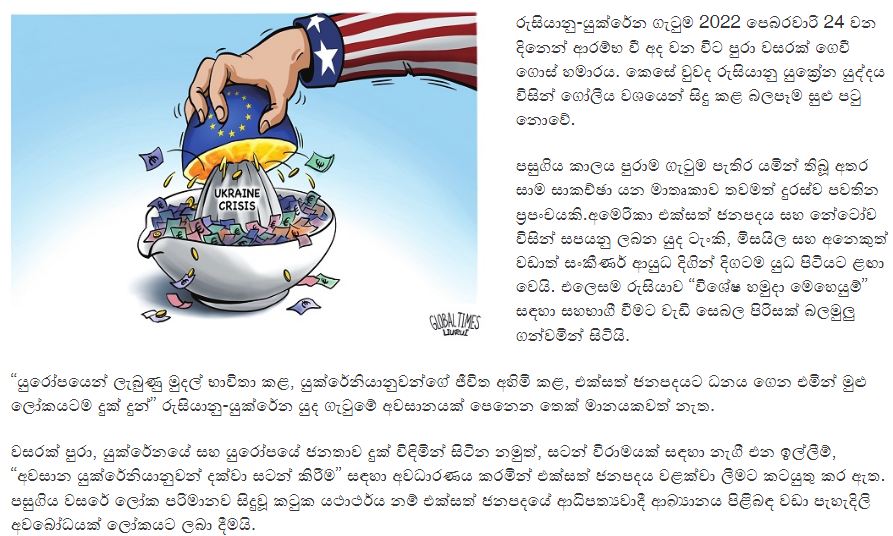
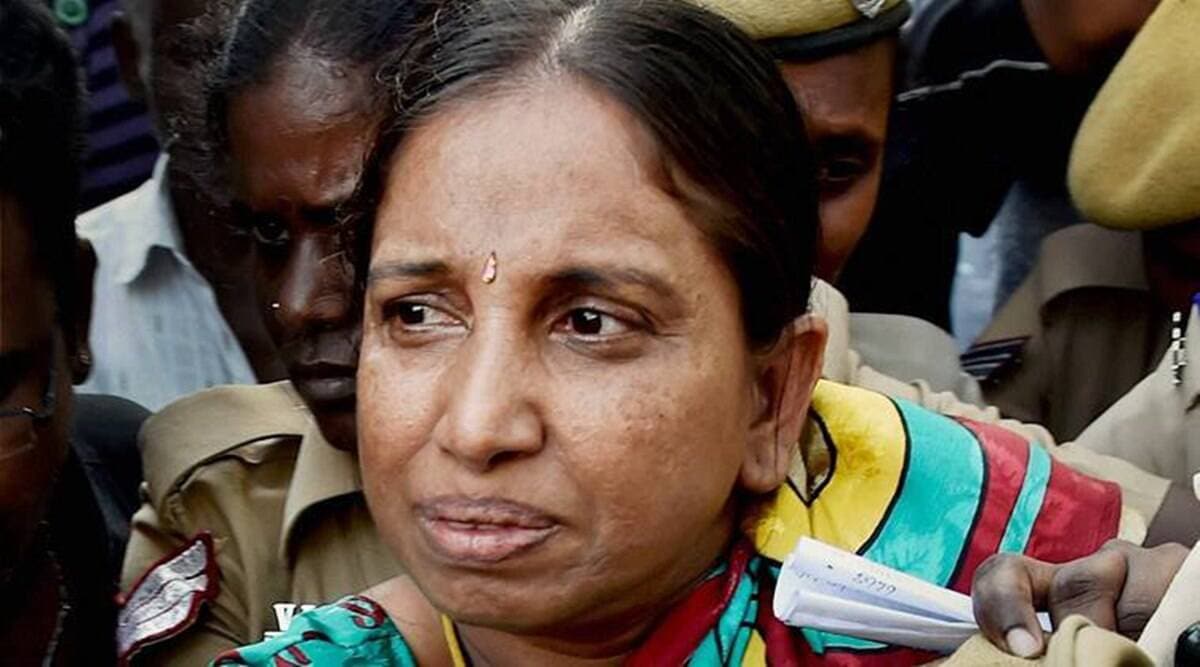 Nalini Sriharan (PTI