She emphasised that a collaboration among creditors is important to ensure transparency and equality in treatment of all creditors in the debt restructuring discussions.
The high-level meeting took place on the sidelines of the International Monetary Fund (IMF)- World Bank (WB) Spring Meetings here on Thursday. (Photo source: Twitter/@FinMinIndia)
Finance minister Nirmala Sitharaman attended a high-level meeting on Sri Lankan debt issues and expressed India’s commitment to support Colombo in dealing with its current economic crisis. She emphasised that a collaboration among creditors is important to ensure transparency and equality in treatment of all creditors in the debt restructuring discussions.
The high-level meeting took place on the sidelines of the International Monetary Fund (IMF)- World Bank (WB) Spring Meetings here on Thursday. Japan Finance Minister Suzuki Shunichi, Sri Lanka State Finance Minister Shehan Semasinghe and Emmanuel Moulin, Director General of the Treasury, France were present in the meeting. Sri Lanka President Ranil Wickremesinghe participated virtually, an official statement said.
The purpose of the event was to demonstrate the multilateral cooperation regarding the debt restructuring process among the creditors, together with Sri Lanka, it said. In the event, the ministers announced the launch of the debt restructuring negotiation process on Sri Lanka under the three Co-Chairs: India, Japan, and France, to lead coordinated debt restructuring of Sri Lanka, it said.
Sri Lanka was hit by an unprecedented financial crisis in 2022, the worst since its independence from Britain in 1948, due to a severe paucity of foreign exchange reserves, sparking political turmoil in the country which led to the ouster of the all-powerful Rajapaksa family.
The IMF in September last year approved Sri Lanka a UD 2.9-billion bailout package over 4 years pending Sri Lanka’s ability to restructure its debt with creditors — both bilateral and sovereign bondholders. With assurances from creditors, the USD 2.9 billion facilities could get the IMF board approval in March.
The reason these stones float is that they have small pipe-like holes in them.
These stones are kept at the Panchmukhi Hanuman temple near Rameswaram Letchumanan Theertham and at the Rajakaliamman temple.
Rameswaram in Tamil Nadu is one of the holiest places for Hindus and is included in the pilgrimage known as Char Dham. Rameswaram, which is on Pamban island, is especially associated with the epic Ramayana as it is believed that Lord Rama built a bridge from here to Sri Lanka to rescue his wife Sita from Ravana. One of the biggest attractions in the town is the two floating stones in two temples in the area.
Ramanathapuram district is home to a large number of rare species living in the waters of the Gulf of Mannar. Coral reefs are abundant in the sea. These coral reefs are scattered here and there on Rameswaram island which is surrounded by the sea, so it is said that they play an important role in preventing major damage during natural calamities. These miraculous floating stones are part of the flora and fauna here. These stones floating in the water are a type of coral known as pipe coral.
The reason these stones float is that they have small pipe-like holes in them. Currently, these stones are kept in two temples for the devotees to see. One is at the Panchmukhi Hanuman temple near Rameswaram Letchumanan Theertham and the other is at the Rajakaliamman temple opposite the storm-damaged old railway station in Dhanushkodi. Devotees who come here can visit these two temples and see the floating stones.
Since these stones do not sink in water, it is believed that Lord Rama used these very stones to build the Ram Setu, which he crossed along with the Vanar Sena to reach Lanka.
The two stones in the temples of Rameswaram are not allowed to be touched by tourists or taken out of the temple premises as there have been instances in the past where people tried to sell off these stones illegally.
Members can now bid Skywards Miles for an exclusive opportunity to visit the home of Dilmah and explore the lush tea plantations in Sri Lanka.
Dubai, UAE: 14 April 2023 – Emirates Skywards, the award-winning loyalty programme of Emirates and flydubai, has partnered with Dilmah Tea to offer members an exciting opportunity to experience the lush tea plantations in Sri Lanka. Starting from today, members can bid Miles with Skywards Exclusives for a chance to win a stay at the Tea Maker’s Private Retreat. The once in a lifetime opportunity includes a tea-making masterclass, a unique culinary experience inspired by tea, food pairing experiences with tea and a visit to explore the tea fields.
Ring in International Tea Day in the heart of a tea plantation
Starting from 200,000 Miles, Emirates Skywards members can bid and win an all-expenses paid trip to Sri Lanka, including:
2 round trip Business Class tickets on Emirates from Dubai to Colombo.
A 3-night stay for 2 guests at Hilton Colombo.
A 3-night visit to tea plantations at Ceylon Tea Trails,A Relais & Châteaux property which consists of five restored historic tea planter residences in the Ceylon tea region.
A master class with Dilhan C Fernando, the son of the founder and CEO of Dilmah, to enjoy an educational session on how to taste tea and brew the perfect cup.
A special food pairing with tea-inspired gastronomy with the Dilmah family.
A 7-course tea-inspired dinner Camellia Epicurean” where tea is used as an ingredient for all the dishes.
The package also includes transportation to and from the airport, meals at the all-day dining restaurant at Hilton Colombo, and all meals and beverages at the Ceylon Tea Trails. Travel dates will be from 18 May until 24May 2023. What better way to celebrate International Tea Day on 21 May than by being at the heart of a tea plantation!
More than 31 years of partnership with Dilmah Tea
Emirates and Dilmah Tea have enjoyed a successful partnership for more than three decades, brewing the finest teas on-board and in Emirates’ airport lounges worldwide. The airline continues to take the Dilmah brand name to 140 destinations across six continents through its extensive network.
Each year, the airline brews 33 million cups of Dilmah tea for its customers from a specially curated tea menu available in all classes. More than 10 different varieties of tea are available on-board, including popular choices like Dilmah Ceylon Black Tea, Moroccan Mint, and Breakfast Tea.
Premium passengers can also savour the aromatic flavours of Emirates Signature tea blend made exclusively for the airline by Dilmah and served only in First Class. Inspired by flavours of the UAE – the exquisite tea has rich aromatic notes of rose, almond and ginger.
Live in the moment with Skywards Exclusives
Emirates Skywards continues to offer more than 30 million members worldwide unmatched rewards in the air and on-ground.
Skywards Exclusives is a distinctive airline loyalty programme initiative that provides access to exclusive experiences from Emirates’ expansive sponsorship portfolio. Members can bid and redeem Miles for some of the world’s most prestigious sporting and cultural events, including exciting events featuring Real Madrid, AC Milan, Dubai World Cup, SL Benfica, Emirates FA Cup, and other sports such as golf, tennis, and cricket.
Sri Lanka Malay Association (SLMA) expressed its gratitude to Prime Minister Dinesh Gunawardena for re-naming Slave Island as Kompanna Veediya, in English. The name Kompanna Veediya used in Sinhala and Tamil while it was called Slave Island in English and the Prime Minister took steps to change it also to Kompanna Veediya.
SLMA President Rizwan Badoordeen and General Secretary Iqram Cuttilan called on Prime Minister today at the Temple Trees and briefed him on the social and cultural activities conducted by the Association.
The Prime Minister congratulated the SLMA which celebrates its 100th anniversary. Mr Badoordeen said the Sri Lanka Malay Cricket Club which was set up before the SLMA, has commemorates its 150th anniversary this year.
The Prime Minister mentioned with gratitude about the Malay members who served in the armed forces during the fight against terrorism and made ultimate sacrifice. He said the Malay community has set a valuable example for the minorities to emulate by totally integrating into the Sri Lankan society.
He also thanked the SLMA for carrying out social services for the benefit of low-income families in all the communities.
(Sarath Wijesinghe President’s Counsel (LLM International Law (UCL)), former Ambassador to UAE and Israel, President Ambassador’s Forum, Former Chairman of The Consumer Affairs Authority, Solicitor England and Wales and former Secretary General Bar Association of Sri Lanka (LLM (UCL), assisted by Suchithra Withanage (LLM (UK) (LLM (UK|Reading) LLB (Hons) (UK)) The Season of Celebration and Consumerism As the festive season draws nigh, the citizens of Sri Lanka yet again take to the streets and vibrant communal hubs in order to exercise their power of purchase and get involved in merrymaking. As consumers, they would, in theory, be entitled to a wide and meticulously drafted set of rights and statutory safeguards pertaining to their purchases. As one of the most powerful forces in the world, the consumer is expected to be entitled to a certain standard of commerce and life. However, the unfortunate reality of Sri Lankan consumerism is that a stereotype of chaotic disorganisation has been perpetuated over the years by an amalgam of negligence and unawareness of legal rights that are available to the public as potential users of goods and services made available in exchange for consideration by any trader or manufacturer (as per s75 of the Consumer Affairs Authority Act 2003). Due to the existing state of affairs where the consumer is non-conversant with their legal rights and contemporary knowledge of consumerism, they have become an easy demographic to prey upon by unprincipled traders and exploiters of the social system. Adding to the mix the rise of crime, gangs and pickpockets in the public streets and transport services, the state of consumerism in Sri Lanka is in pressing need for modernisation as well as optimisation. As the protector of the rights of its citizens, it is the responsibility of the State to provide an adequate and holistic system of regulatory protection which would shield the latter from unfair and/or unscrupulous trade practices which would be hazardous to their lives, property and their right of access to goods. Moreover, the State must ensure that a comprehensive process of legal redress is made readily available to its citizens who have been rendered victims of such unfair trade practices, as was elucidated in s7 of the Act. Regulators such as the Consumer Affairs Authority (CAA), the Ministry of Trade, and Local Authorities face various hardships in their duties due to being pressed for time and an overload of political turmoil anchoring down the current state of affairs, but they are by no means unequipped to do as the required facilities and funding are provided for by the government. A Quest for a Kaleidoscopic Perspective The famous maxim, ‘the consumer is king’ comes to mind when contemplating the status quo of consumerism in general. Alas, the practicality of the notion has faded into obscurity over the decades in Sri Lanka due to the medley of disorganisation and chaos that follows in the all-too-familiar bedlam which ensues each year during the high points of our traditional festivities. The consumers must be educated on their rights and obligations so that they possess the acumen to demand and examine receipts, check standards, read directions fluently on hire/purchase agreements etc. In light of the World Consumer day (15th of March), the World Consumer Federation has initiated a worldwide agitation in order for the legitimate share for consumers to be claimed. The sentiment bears weight, particularly in retrospect of late US President John F. Kennedy’s statement in 1962, “Consumers, by definition, include us all. They are the largest economic group in the economy, affecting and affected by almost every public and private economic decision.” In more developed parts of the world, consumer rights are a nigh sacrosanct concept where the ‘unfairness’ of trade practices are subject to strict restrictions by governments and are augmented by the lobbying efforts of powerful organisations to maintain quality, standards, costs and the right to return goods, as well as the maintenance of standards by traders and manufacturers. Our own country however, contains an unfortunate abundance of adulterated and poisonous food chains, as well as a diverse variety of other genres of substandard goods available for consumption of citizens which are not subject to restrictive conditions. Our citizens face an unfortunate state where performing their traditional and familial obligations during the Sinhalese and Tamil New Year period has become an uphill battle. Hitherto, there is no adequate control dynamic in place to control and regulate the quality and price of items available to consumers which are expected to be monitored by the main regulator, the Consumer Affairs Authority. The Consumer Affairs Authority has been established in lieu of the Fair Trading Consumer Act No. 1 of 1987, as well as the Price Control Act No. 1 of 1987 for the promotion of effective competition and legal protection of the consumer. As a blend of UK, Australian as other Western modelled concepts, it aims to establish a primary regulator to standardise and supervise trade under s9 of the Act. With wide-ranging powers to undertake research, issue directions, restrict selling above the established market prices, determine industry standards, conduct inquiries into consumer complaints, enter agreements, deal with offences such as refusal to sell/hoarding of goods, investigate publications and preventing misleading or deceptive practices etc., the Authority is well placed to ensure an all-encompassing dynamic of consumer protection in Sri Lanka. Nevertheless, due to the abolition of the price control as per the Price Control Act, the new status quo was introduced where the onus was placed upon traders to exhibit the price mark and maintain standards of consumables (s29). Thus, it has fallen to the consumer to judge the efficacy of the enforcement mechanism in the preservation of the aforesaid standards, a task that ought not, necessarily, rest upon their shoulders due to a prevalent lack of awareness and expertise in such materialistic endeavours. The question of whether the CAA is a competent organisation capable of upholding the sanctity of the legal regulation of consumerism which it was created to protect, or a mere paper tiger thus falls to the consumer himself to decide based upon the efficacy and vigour of its performance. Mistaking Cause for Cure? The Sri Lankan Dilemma in Perspective Tragically, the rapidly rising and increasingly unbearable cost of living is not a concept that requires any further explanation to any Sri Lankan citizen. The cost of living is generally a relative phrase, dependent upon the conditions, environments and jurisdiction in question. It is a consistently rare occurrence for prices of consumer articles to recede in value, even though the basic income of citizens has seen gradual increments over time, albeit arguably at a snail’s-pace. The price of bread, for instance, is not an established static but through necessity, the consumer has acclimatised to the price fluctuations over the years. In Western countries, a significant portion of one’s income is allocated towards accommodation, whereas items such as food are much more affordable. On the other hand, Sri Lankan citizens toil and languish under arguably superfluous adversities in life as the basic income of the average citizen can be considered insufficient. Nevertheless, the discussion may arise that through astute and careful consumer practices, it is possible to beat the cost of living provided that the prices of items such as mobile phones, tuition and vanity based extravagances are restricted. In a nutshell, one must familiarise oneself with the essentials of (1) when to buy, (2) where to buy, (3) how to buy and (4) what to buy. In England, an apple which is available for purchase at Selfridges, one of the most expensive department store chains in the UK, can be bought at the street market for mere fraction of the cost. Likewise, in Sri Lanka, street markers are plentiful and consumables purchased there can be carefully stored and used. While being the most economically viable option for consumers, such a commercial dynamic will promote local small businesses and budding entrepreneurship which Sri Lanka is in dire need of, particularly in light of the recent economic crisis which even as of writing, continues to hold the country in thrall. Consumers make the persistent blunder of prioritising unhealthy and largely commercialised food chains containing unhealthy ingredients and unwholesome soda drinks which unwittingly invites a plethora of long term health conditions and serious comorbidities, thereby increasing the financial strain on themselves as well as the public healthcare systems of the country. Consumers must therefore exercise diligence and prudence in selecting the most practical and viable options for consumables when exercising their rights of purchase. Due to the unawareness/inability/reluctance on part of traders and industrialists themselves who are an essential component of society and the economy at large, the confidence of the citizens in the economic system of the country has deteriorated as well. The regulations established by the Consumer Affairs Act are quite comprehensive in terms of setting out implied and express terms of merchantable quality standards, but the fact that sellers are bound by both written and unwritten rules, regulations, conventions and norms which are little/not known to them as well as consumers and even regulators, paints a bleak picture for the future of consumerism in Sri Lanka. ‘SeriVanija’ is a Jataka story in which a just trader identified a gold bowl and paid the equitable price for it, despite the poverty-stricken citizen seller not being aware of it himself, whereas an errant trader who rejected it under malicious pretenses died of a stroke from hearing of the transaction that he unwittingly missed out upon. the former should be the shining example which ought to guide the flow of commerce in Sri Lanka, but has little effect in the current social and commercial climate. The availability of modern shopping via the internet and the availability of smart phones to access massive online marketplaces on the go such as Ebay, Alibaba, Amazon etc., which are seeing a correlation in growth with the recent decline of public trust in domestic traders, is of significant importance. This is due to the resulting exacerbation of cash flows out of the country in a nation crippled by debt and financial distress. 40% of UK shopping is online, which according to them, is safe trading and consumerism with included checks and balances with the involvement of the Department of Trade and Commerce whereas the CAA, its Sri Lankan counterpart, is now relatively inert, ineffective and inefficient at times. Catalysing a Change in the Status-Quo It must also be said that it is a civic duty of all citizens to contribute to the noble task of the CAA in identifying problematic commercial practices. The CAA is expected to be available to entertain complaints of citizens via phone, internet and a constant presence throughout the country, a service which encompasses both goods and services. In many other nations, this system is quite evolved and the citizens are so well versed with the process that traders are under the control of the common consumer and therefore perform to satisfactory standards. The media is an integral component of nurturing this paradigm of productivity as well. The example of the UK scandal of the Cola company drawing water from the River Thames to use in production springs to mind, where it was the media which uncovered the matter. The Bopal case of India is another well-known example where the media came forward to educate multinational companies on the subject of unfair trade. The CAA of Sri Lanka is also expected to organise a consumer federation with the intent of providing assistance to the consumer. The argument can be made that it is the duty of the NGOs within the country to take up the mantle and catalyse progress the area rather than be dependent on human rights conditions on Sri Lanka to reach expected standards in parallel to them. The time is also ripe for citizens to work hard and achieve a greater semblance of order within the chaos, in order to combat the rising tide of living costs and nurture a careful and systematic exemplification of organised, self-sufficient society. Finally, the rapid escalation of illegal activities during the festive season must be addressed. It is against the law to perform bogus sales and maliciously overprice goods and services in order to take undue advantage of the needs of citizens during festivities. While consumers do not have the right to demand price reductions from service providers, they are quite entitled to the right to purchase quality goods which adhere to established health and safety standards. The ‘1919’ service, CAA and the Board of Standards for quality and price of consumer items must stand ready to receive legitimate complaints by citizens and provide systematic and adequate resolutions to their concerns. The way forward involves a symbiotic dynamic of development between the rights of the citizens, the constructive involvement of the media and the responsibility of the state in order to ensure the availability of quality items at a reasonable price for consumption. The United Nations too has given a high level of recognition to the right to satisfaction and ensuring fundamental needs, safety, information, the opportunity to be heard, redress, consumer education and a healthy environment to be facilitated and provided to the citizen by the State. The Government must separate the CAA to exist as an independent body led by a non-political qualified person with a legal background appointed by the constitutional council preferably with a legal background. A joint exercise must be spearheaded as a matter of statutory duty by the CAA, which is the primary regulator, in order to organise traders, manufacturers, industrialists and citizens as integral cogs in a well-oiled machine in order to achieve the desired paradigm of a competitive and friendly social environment where the costs of living can be beaten and where quality, as well as healthy consumer items can become the norm rather than the exception. The consumer must be vigilant and intelligent, the trader should be fair and reasonable, and the State must uphold the sacrosanct duty of cultivating a standard of life for its citizens/consumers that has the potential to be the envy of the world. We pray and wish the consumer success and prosperity during the festive season! Writer can be reached on 0094777880166|0094766280166 |sarath7@hotmailco.uk | sarathdw28@gm
South Asian countries—including India, Pakistan, Nepal, Bangladesh, and Sri Lanka—are known for their rich and vibrant cultures. As a second-generation South Indian American, I owe many positive aspects of my identity to my culture. Yet I also at times struggle to fit in with my community, a disconnect that was most noticeable during my adolescence.
As a clinical psychology doctoral student, I’ve realized that I’m not alone in my experiences. As a budding practitioner who thinks about minoritized adolescents and their mental health, I wonder about community values that South Asian American teenagers struggle with the most—namely, family image and personal accomplishments.
In my conceptualization and clinical experiences with the community, elitism—the feeling or attitude of being superior to others—seems to be one of the driving forces of how individuals, families, and community members treat one another. Two common factors of this elitism are family status and colorism, which can be distressing and harmful to South Asian American children growing up in the U.S.
Source: PT Images/Shutterstock
I worry about how these iterations of elitism play out for adolescents who don’t fit the mold they’re expected to emulate. What’s more, how do these teens and their families get treated by others who do have the wealth or skin color that they don’t have? How does elitism impact their development?
One explanation could be that South Asian communities tend to be stringently hierarchal, which can create harsh judgments and overall disparities within them. This can be seen in India, where the caste to which a family or individual belongs dictates their profession, spouse, and many other parts of their social lives (Sahgal et al., 2021). Beyond caste, other characteristics that may elevate one’s status within society or family circles involve education, wealth, and skin color.
These considerations and historical policies likely contribute to the makeup of South Asian communities in the U.S. For example, the Hart Celler Immigration and Nationality Act in 1965 preferred highly educated professionals—such as scientists, engineers, and doctors—seeking to immigrate to America (Sharma et al., 2020). While these highly educated immigrants were still vulnerable to stressors associated with immigration experiences, their professional, socioeconomic status, and earning potential gave them an advantage.
Yet they likely already had access to education and connections. Therefore, the leg-up given to them by the U.S. government only served to mirror the dynamics back home, giving these individuals an advantage over South Asians who did not have the same opportunities both in South Asia and in the U.S.
How Elitism Plays Out
Though elitism likely occurs in other communities, I argue that elitism in South Asian communities manifests in unique and nuanced ways.
From a family systems perspective, research has found that South Asian adolescents undergo significant acculturative stress when adjusting to conflicting family structures and roles, racism, and discrimination, presenting a barrier when seeking support (Tummla-Narra et al., 2016). This, combined with the fact that South Asians tend to view certain families and individuals as having high status,” or being superior in some way, may lead low status” families to experience added disparities and feel inferior, marginalized, and devalued in their relationships within their respective communities. The resulting isolation can have damaging effects, as these groups may be the only source of connection to the families’ home countries.
Adolescents whose families face this type of subjugation may be excluded from festivities or by other South Asian American adolescents, who may follow their parents’ lead when deciding with whom to associate. Typically, this behavior is based on the child’s family standing in the community and how associating with a particular person may maintain, elevate, or harm their image.
article continues after advertisement
In their research, Masood and colleagues attest to how community hierarchies affect South Asian American mental health (2009). They discuss Dusgin’s (2001) term of duty-based” morals and how this can evoke inner conflict, thus contributing to the idea of status anxiety(2009).
Consequently, children may work hard to sustain a false image for the sake of making their families proud or maintaining their family image at the expense of their own well-being. This ultimately increases their risk of suffering from poor self-esteem about existing as people of color, while silently facing issues at home (where the child may be told to keep these issues in the family”).
Perhaps more troubling, when a teenager does not fit into the mold expected of them, guilt and shame are often used by parents with the intention of bettering” their child. What commonly occurs instead, however, is the erosion of the child’s sense of self-worth and humanity. Other effects include increased isolation, intense mistrust of peers, and a stunted ability to express their authentic selves.
It’s important to note that parents usually do not intend for their children to experience this. Instead, parents typically instill these pressures with the aim of improving the child’s future. Parents may project repressed shame and insecurity, which can look like parents trying to reinforce the child’s behavior to avoid what the parents experienced as children themselves. While it may be difficult for the child to understand the origins of their parent’s expectations, such dynamics may originate from parents being wounded by their own oppression, such as surviving poverty, gender-based violence, and other forms of discrimination.
Elitism can trickle down from parents to children. This can look like parents advising their children to stay away from a child that deviates from the norms and expectations of the culture and community. A typical example is when a child is pressured to be the model child and views their peers as less than” based on their parents’ ideas of who is considered the perfect child. The perceived model child may feel pressure to maintain perfection—an ultimately unachievable goal because the perfect” South Asian child doesn’t exist.
Colorism and Elitism
Colorism is a complex phenomenon rooted in colonialism, leading to grave consequences for members of racial and ethnic groups. According to Banks, Colorism is a race-like phenomenon based on a person’s immutable characteristic—skin tone—coupled with the belief that certain skin tones, usually light skin, are preferable to dark skin” (2015).
article continues after advertisement
My hypothesis is that this mistreatment happens because there is a perception that whiteness” elevates beauty and, ultimately, someone’s status in the community. While South Asian people may not overtly state that they have prejudices against darker-skinned people, the difference in how lighter-skinned South Asian Americans are treated compared to darker-skinned South Asian Americans is well-documented. Adults and children alike may behave more kindly towards a child with a lighter complexion—an experience that can profoundly impact a child with darker skin.
Granted, having lighter skin can lead to negative consequences, too, such as being overtly sexualized by others. However, it must be acknowledged that the social benefits of lighter skin typically outweigh the costs, and darker-skinned children may even share the same negative experiences, often without respite. Further, darker-skinned South Asian teenagers in America and their home countries are more likely to be encouraged to use harmful skin-lightening products and experience open ridicule and prejudiced attitudes from relatives, peers, and community members alike.
This phenomenon illustrates how generations of imperialism are reinforced across social systems, where Eurocentric beauty standards lead to a sense of inflated superiority for lighter-skinned South Asian teens and adults, who may not notice or acknowledge how their darker-skinned peers are treated. Darker-skinned girls, in particular, may not be sought after for friendships in ways that lighter-skinned girls are.
In families where there are grandchildren who are diverse in skin tone, lighter-skinned grandchildren may receive more affection and attention than their darker-skinned cousins or siblings. Such treatment can shatter a child’s sense of self, and the child may internalize the message that the way they get treated by people is conditional and based on superficial attributes such as skin color.
Conclusion
Elitism is just one factor that warrants further examination, consideration, and conversation in the South Asian community. Several factors not mentioned here also foster elitist attitudes in South Asian American communities. I choose here to focus on family status, family dynamics, and colorism, not just because they are multi-layered but because many adolescents may experience them quite frequently. In covering this topic, I hope to shed a light on the several complex obstacles that South Asian American teenagers navigate.
Finance Ministers of the three creditor countries will hold a press briefing on the margins of the annual Spring meetings of the World Bank and the IMF in Washington.
Union Finance Minister Nirmala Sitharaman with Gita Gopinath, Deputy Managing Director of the International Monetary Fund, during a meeting on the sidelines of the World Bank-IMF Spring meetings 2023, in Washington D.C, USA. Photo: Twitter/@FinMinIndia via PTI
Union Finance Minister Nirmala Sitharaman will join her French and Japanese counterparts on April 13 to announce Sri Lanka’s debt restructuring negotiations process, the IMF has announced.
The Finance Ministers of the three creditor countries will hold a press briefing on the margins of the annual Spring meetings of the World Bank and the International Monetary Fund (IMF) in Washington.
Japan, India, and France on Thursday will hold a press briefing on the margins of the Spring meetings to announce the launch of the debt restructuring negotiations process on Sri Lanka,” the IMF said on April 11, quoting a Japanese Finance Ministry statement.
The International Monetary Fund’s Executive Board approved a 48-month extended arrangement under its Extended Fund Facility (EFF) with an amount of SDR 2.286 billion (about $3 billion) to Sri Lanka following financing assurances from the creditors.
Sri Lanka, which drew its first tranche of the $3 billion bailout programme, has already met an instalment to pay back an Indian line of credit which the island nation obtained early last year just before announcing the debt default.
Mr. Wickremesinghe, also the island nation’s Finance Minister, who spearheaded the IMF negotiations, specially mentioned the contributions made by Ms. Sitharaman to assist his government with the IMF for the bailout.
The IMF bailout, the 17th in Sri Lanka’s history, was approved following prolonged discussions over Colombo’s unsustainable debt.
Sri Lanka was hit by an unprecedented financial crisis in 2022, the worst since its independence from Britain in 1948, due to a severe paucity of foreign exchange reserves, sparking a major political and humanitarian crisis in the island nation.
Japan, India and France are scheduled to hold a press briefing on Thursday (13 April) to announce the launch of the debt restructuring negotiation process on Sri Lanka.
International Monetary Fund (IMF) communicated this quoting the Japanese Finance Ministry.
Accordingly, the finance ministers of the three creditor countries – Shunichi Suzuki, Bruno Le Maire and Nirmala Sitharaman – will join the said press briefing planned to be held on the margins of the Spring Meetings of the IMF and the World Bank Group in Washington DC.
The three creditor countries have been working closely for a coordinated debt restructuring process for the island nation.
President Ranil Wickremesinghe and Finance State Minister Shehan Semasinghe are expected to join the live streaming of the press briefing.
In addition, the IMF, World Bank and other international organizations as well as the private sector will participate in the debt restructuring discussions.
The IMF had made Sri Lanka’s debt restructuring a prerequisite for granting the USD 2.9 billion bailout. Its Executive Board approved a 48-month extended arrangement under its Extended Fund Facility (EFF) with an amount of SDR 2.286 billion (about USD 3 billion) to Sri Lanka following financing assurances from the creditors.
Sri Lanka, which drew its first tranche of the USD 3 billion bailout programme, has already met an instalment to pay back an Indian line of credit which the island nation obtained early last year just before announcing the debt default.
The IMF bailout, the 17th in Sri Lanka’s history, was approved following prolonged discussions over Colombo’s unsustainable debt.
Sri Lanka was hit by an unprecedented financial crisis in 2022, the worst since its independence from Britain in 1948, due to a severe paucity of foreign exchange reserves, sparking a major political and humanitarian crisis in the island nation.
The Ambassador of Sri Lanka to Indonesia, Admiral Prof. Jayanath Colombage paid a courtesy call on Minister of Manpower of the Republic of Indonesia Ida Fauziyah on Tuesday.
While expressing concerns about the current economic challenges faced by the Sri Lankan government, Minister Fauziyah agreed to exchange information on employment opportunities between the two countries.
She mentioned four national priorities of the Indonesian government in strengthening the manpower sector, notably, enhancing the national economic stability, improving the quality and competence of human resources, strengthening infrastructure facilities and strengthening political and legal framework to secure the manpower sector.
Highlighting the decrease of unemployment rate in Indonesia in 2022 compared to 2020 and 2021, the minister expressed willingness to share best practices in the employment sector with the Sri Lankan government.
Ambassador Colombage stated that there is a huge demand in foreign countries for expatriate workers, but the supply of experienced workers from Sri Lanka is very low compared to the demand.
He also mentioned that the Sri Lankan government has introduced a new scheme for public servants which enable them to work abroad. He also informed of the preferred job sectors of Sri Lankan employees and sought employment opportunities for Sri Lankans in Indonesia.
The minister instructed Secretary General of the Ministry Prof. Anwar Sanusi to work closely with the Sri Lanka Embassy in this regard.
Sri Lanka Navy has initiated expanding the Kankesanthurai harbour, with a view to accommodate more traffic and provide better infrastructure in support of the passenger ferry service between Sri Lanka and India.
The government of Sri Lanka launched the ferry service project between the port of Kankesanthurai, Sri Lanka and Pondicherry, India to provide a more affordable and convenient mode of transportation.
Sri Lanka Navy, on the directives of the navy commander Vice Admiral Priyantha Perera, actively supported the expansion of the Kankesanthurai harbour facility by providing its manpower and expertise, in response to a request made by the Ministry of Ports, Shipping & Aviation.
Accordingly, the project got underway on 01 February, with skilled manpower and industrial expertise enabled by the navy.
Thus, the Sri Lanka Navy has undertaken the construction of a passenger terminal for immigration and customs clearance of people who intend to use this passenger ferry service. Required materials for the construction work are provided by the Sri Lanka Ports Authority (SLPA).
At present, a group of 60 naval personnel are engaged in the construction of a 1,000 square meter passenger terminal, under the supervision of naval civil engineering officers.
The construction work of the passenger terminal will be completed soon and thereupon the facility will be handed over to the SLPA for its operational purposes.
The passenger ferry service project is part of a larger effort to strengthen longstanding ties between India and Sri Lanka, with a focus on improving tourism.
The contribution of the navy towards the prompt implementation of the project will not only help save the public money but also allows the public to enjoy the expected benefits of this project in due course.
Last month, the Ports, Shipping & Aviation expressed hopes of commencing the operations of the ferry service on 29 April.
Ferry owners are planning to charge USD 50 per passenger for a one-way trip while allowing a passenger to carry baggage weighing 100kg. Only daytime operations will be in effect during the first stage.
A ferry is expected to carry 150 passengers at a time and will take around 4 hours to travel from Karaikal Port in Pondicherry to Kankesanthurai.
Sri Lanka Ports Authority has provided a financial facility of Rs. 144 million for the total constructions that are carried out by the Sri Lanka Navy.
The details of the conditionalities of the IMF Extended Fund Facility (EFF) are now accessible on the IMF website Web: http://www.imf.org. A few comments from a layman’s point of view are as follows. Reference to IMF program covers government ownership as well.
The objective of the IMF intervention aims to restore macroeconomic stability and debt sustainability, mitigate the economic impact on the poor and vulnerable, safeguard financial sector stability, and strengthen governance and medium-term growth potential.
It is noted that IMF has not deviated very much from their standard prescriptions except that they have shielded themselves from the accusation that they have no sympathy for the poor by making mitigating the economic impact on them as one of the objectives. Although strengthening the medium growth potential is an objective it is not given much prominence in the implementation.
The acceptable proposals which should have been implemented long time back by any Sri Lankan government are the following.
Progressive tax reforms: At 7.3 percent in 2021, Sri Lanka’s tax revenue to GDP ratio was among the lowest in the world. The program aims to raise the ratio to at least 14 percent by 2026. The proposal to increase revenue from income tax from Rs 302 billion in 2021 to over 1000 billion in 2024 onwards is over ambitions and may meet with resistance.
Proposed reforms in tax administration are welcome specially the proposal to establish a systematic third-party information sharing with the revenue authorities. It is conceded that there are many tax dodgers outside the present tax base and steps should be taken to spread the tax net. One effective measure would be to publish on a Divisional website the names of the taxpayers. This would facilitate information from the public if supported by a reward system to provide information on tax dodgers. Other measures of tax reforms are opportune. The IMF program has recognized that the ongoing economic crisis has adversely affected poor households and the the poverty rate is estimated to have doubled and inequalities have widened over the past two years. Under the IMF program it is proposed to address these challenges by raising the Social Safety Nets spending and improving the coverage and targeting of the SSN.
IMF program has resulted in the introduction of automatic fuel and electricity pricing mechanisms on a cost recovery basis which were overdue. The mechanism has no transparency as costs have not been defined. Costs resulting from poor management, profligacy and corruption are not acceptable. For example, the Minister in charge stated in Parliament that there are 4000 MW of renewable energy projects where Energy Permits have been given but the CEB has still not granted Power Purchase approval. He also mentioned that the average cost of renewable energy is 16.90 per unit, whereas the cost of energy from thermal plants is over Rs 60. IMF should have ensured the mobilization of this ready to generate 4000 MW before implementing a pricing mechanism based on heavy use of fossil fuel at high cost.
One of the most providential IMF proposals is the Anti-corruption legislation, harmonized with the United Nations Convention against Corruption (UNCAC), The proposed legislation aims to strengthen the asset declaration system, with coverage of all officials and public access to the declarations. It also creates a new anti- corruption independent commission with strengthened investigative power.
The present CIABOC prosecutions most times failed on technical grounds which should be avoided in the new legislation. All governments including the Yahapalana regime had an inherent aversion to follow the UNCAC. They were happy with the ineffective CIABOC. No official or employee should be exempt from Asset declaration and the information should be made available to any interested party without restrictions other than those applicable to fundamental rights.
Printing money was an escape maneuver resorted to by all governments. It is encouraging that IMF has ensured that monetary policy will maintain price stability through tight monetary stance and discontinuing monetary financing.
One of the problematic proposals of the IMF is that on SOE reforms. SOEs were introduced to meet a felt need and a marker failure. But later on Sri Lanka SOEs became the profitable havens of political henchmen of Ministers. They provided employment for minister’s constituents and in many cases such employment was a source of finance. Ministers intervened in commercial decisions of the SOEs.
What is important in SOEs is not the ownership but the management. Singapore has shown a better way of SOE management with Temasek. But our politicians would not have given up their hold on SOEs to a different mode of management.
The IMF proposal is using financial jargon as comprehensive strategy to restructure the balance sheets” which could include preparing for a sale, buyout, merger, change in overall goals, or transfer of ownership.”
But neither the IMF nor the govt in its memorandum of understanding which is merely a rehash of the IMF staff proposals have mentioned the sale of profit-making entities like the SLT or the Insurance Corporation. This addition creates doubts of the intention of selling profit making entities. This could end up in unsavory deals which is against the interest of the country. The IMF proposal to restructure the balance sheets is confined to the CPC, CEB, the Road Development Authority, and SriLankan Airlines. Other proposals of prompt publication of audited financial statements for all 52 major SOEs; and prohibition of new FX borrowing by non- financial SOEs and clarifying the mandates of key SOEs through Statements of Corporate Intentons are sound proposals. IMF should have stipulated strict conditions for selecting SOE board members as poor management is the main reason for SOE failure.
What could be done is to create a new management cadre for SOE governing Boards and senior managers. Such a cadre with professional staff parallel to the special class of the SLAS would give strength and independence to SOE management. SOEs should be removed from the grasp of Ministers and brought under one or several holding companies on the model of Temasek of Singapore.
The IMF proposal to strengthen Sri Lanka’s governance and anti-corruption framework is most welcome. But IMF has avoided even reference to non-repatriation of export proceeds by exporters estimated to be around 50 billion US dollars and loss of revenue by Trade Misinvoicing. The extent of this swindle is estimated at US$ 36.833 from 2009 to 2017 and around 50 billion dollars by 2020. Instead of taking action to recover the arrears of repatriation of export proceeds IMF has regularized the retention of export proceeds and given an assurance that during the program period, government will not:
(i) introduce or intensify exchange restrictions or MCPs; (ii) impose or intensify import restrictions for balance of payments purposes; or (iii) conclude any bilateral payment agreements inconsistent with Article VIII (continuous performance criteria). Are writing off 50 billion US dollars to get 2.9 billion dollars?
(Main CFM measures introduced or tightened in 2020-2022 and currently in force include: (i) a repatriation requirement for exports of goods and services; (ii) a surrender requirement for exporters on proceeds from exports of goods; (iii) a surrender requirement for banks on purchases of export proceeds; (iv) a surrender requirement for banks on purchases of inward worker remittances; (v) suspension of outward remittances on capital transactions; (vi) restrictions on purchases of Sri Lankan ISBs by local banks; (vii) restrictions on outward transfers of funds for emigrants. )
One wonders on the reaction of the Minster of Justice who was threatening to change the Exchange Control Act to ensure full repatriation of export proceeds.
IMF governance diagnostic mission has started to assess Sri Lanka’s governance and anti-corruption framework. But it is mentioned that this will not cover corruption at institutional or individual level. This is looking at the forest but not the trees.
When it comes to trade and investment, IFM has revealed its true colors in their intention of implementing later in the program an agenda of structural reforms designed to allow Sri Lanka to reach its full potential which involves trade liberalization, which IMF claims is critical for attracting investment and boosting productivity growth. In this regard, IMF proposes to revisit the 5-year plan for rationalizing remaining para-tariffs developed under the 2016-20 EFF arrangement, aimed at removing an important impediment for foreign investment. IMF is for the implementation of a single window for trade and will pursue further trade reforms with technical assistance from development partners.
The single window proposal has been repeated ad infinitum, but subject ministries insist on holding on to their powers which are source of power and illicit income. In the 1980s there was the Foreign Investment Approval Committee which dealt with all foreign investments outside the GCEC. (Now BOI). This Committee which functioned under the Ministry of Finance acted as a one stop shop. Delays jn approval by subject ministries were dealt with persuasion and threats of exposing the delay at the Exporters’ Forum or reporting to the cabinet. It was a non-bureaucratic collegiate decision-making process which did not tolerate delays or lame excuses. Another proposal which could expedite approvals is to assign a local consultant who is familiar with the approval process to every prospective investor to help him to go through the maze.
IMF also proposes to introduce by 2025 Property, Wealth, and Wealth Transfer Taxes. These taxes were there in the past and were removed for good reasons. It would be useful to examine these reasons before implementing them. Recently India has abolished them on the ground that they impose a compliance burden on the taxpayers as well as administrative burden on the department. Perhaps more revenue can be collected from arrears of tax pyments.
Without giving any examples the IMF makes an unsupported statement that Sri Lanka’s highly protective trade regime has hindered import competition, export diversification, as well as the entry and establishment of foreign firms. This broad statement picks on para tariffs on which IMF requires the authorities to develop a concrete medium-term plan to rationalize them. To claim that some innocuous para tariff has hindered import competition, export diversification, as well as the entry and establishment of foreign firms is specious and unprofessional.
· Student of HungryBrain becomes child prodigy before reaching 2 years
Hitansh Singh, whose one-of-a-kind talent has finally brought him to the spotlight where he belongs, is proof that age is just a number. This boy from Lucknow, Uttar Pradesh, entered his name into the India Book of Records for having created 100 paintings at the age of 1 year and 11 months. Hitansh was recognissed as the “Super Talented Kid” on November 11, 2021 (he was 11 months old then) by the International Book of Records’ “World Records of Excellence” for correctly identifying a variety of flashcards. Thanks to being groomed at HungryBrain, a Mumbai-based company offering brain development solutions for newborns, infants and toddlers, Hitansh was able to accomplish so much at such a young age.
Skilling those below 3 years is a massive challenge and HungryBrain’s uniquely self-developed set of programs ensure that a kid’s grasping power and analytical thought-processes are way ahead of others their age. Ranging from New born to 24 months, HungryBrain has a unique program or course for each kid that includes Early Brain Stimulation Program, Thinking Stimulation Program, HungryBrain Math program, Country Flags Flashcards Program, Lifeskill Development Program as also an Early Reading Program. Also on offer are a Sensory Stimulation Set for Newborn Baby and Courses for parents like ‘Yes Parenting’ and ‘Raising a smart child.’
Scores of children in India and around the world who HungryBrain has trained as toddlers and preschoolers have gone on to be honored by the Kalam Book of Records, the India Book of Records, Asia’s Book of Records, and the World Book of Records for their extraordinary gifts in observation and artistic expression. Thousands of parents and their children worldwide have significantly benefited from HungryBrain’s programs and courses.
Ms Hemali Gada, CEO and founder of HungryBrain, “Our USP is sensory stimulation for newborns, early thinking stimulation for infants, and life skill development for toddlers. We have been leaders in early brain stimulation for over 20 years and have assisted lakhs of parents in witnessing their children’s developmental milestones.” Hemali is proud of the fact that the original group of HungryBrain children are now 8 years old and are significantly ahead of and different from their peers. Their childhood exposure to early learning allowed them to stand out for their qualities.
Research has shown that early Brain development is most robust during the first three years of life and that planned stimulation can help a baby reach its developmental milestones by benefiting its motor skills faster in its first few months and years.
HungryBrain’s courses and programs are highly popular among educated, new-age parents as they are not just about sensory stimulation through flash cards, flags, pictures or puzzles but are scientifically devised to make a kid understand better and faster. Adds Hemali, Our next goal is to have one million preschoolers reading and doing math problems independently by the time they turn three.
Hemali is a Think Buzan’ Licensed Instructor (TLI) as well as a renowned ‘Mind Map’ Trainer and was trained by Tony Buzan himself, inventor of the world-renowned Mind Map technology. For further info call on +918879757537/36 or email to support@hungrybrain.in or log onto www.hungrybrain.in
Erina Haque, Researcher, Human rights activist, and freelance columnist.
Gun violence has once again afflicted USA in Louisville, Kentucky. On Monday morning, a gunman killed at least five people and injured nine more at Old National Bank in downtown Louisville, Kentucky. The gunman was identified later as Connor Sturgeon, an employee at Old National Bank, according to interim Louisville Metro Police Chief Jacquelyn Gwinn. He was killed by police after a shootout with authorities. There have been at least 146 mass shootings, including the attack at a school in Nashville, where three children and three adults were killed, and the mass shooting in Kentucky on Monday.
Gun Violence and Mass Shooting
Gun violence is a contemporary global human rights issue. Anyone can be affected by firearm violence worldwide, but the rising trend of gun-related injuries in several states is alarming in the USA. The country is witnessing a surge in gun violence as the gun purchase rate has reached its highest level in 2020 and 2021. Last year, the mass shootings decreased compared to previous years, but it is rising horribly in 2023. Even the number of U.S. kids dying by gunfire keeps rising.
In the last three years, there have been more than 600 mass shootings, almost two a day on average. While the US does not have a single definition for mass shootings,” the Gun Violence Archive defines a mass shooting as an incident in which four or more people are injured or killed. More than 500 people die every day because of violence committed with firearms. It is not only having lasting impacts on victims and their families but also deteriorating the overall human rights situation in the country.
Numerous observers claim that the US government’s unilateral activities have brought up new humanitarian problems worldwide. The US government is prioritizing gun ownership over fundamental human rights. This issue is a highly political one, pitting gun control advocates against people who are fiercely protective of their right to bear arms. Despite the vast number of guns in circulation and the sheer number of people killed by guns each year, there is a shocking lack of federal regulations that could save thousands. The governmental bodies in the United States are ignoring the connection between gun violence and the violation of human rights, resulting in more casualties every year.
Why does gun violence in the US need to be stopped?
Among wealthier and developed countries, the USA is an outlier regarding firearm violence. The US government seems to have allowed gun violence to become a human rights crisis. Comprehensive access to firearms and loose regulations lead to more than 39,000 men, women, and children being killed with guns each year in the USA. Due to the gun culture, the USA has topped in civilian firearms owing in the top. It now has 120 guns per 100 population, even higher than Yemen, a country currently in one of the worst civil wars of recent times.
An estimated 2,000 people are injured by gunshots daily, and at least 2 million people live with firearm injuries around the globe. Among them, the United States has a far greater rate of gun violence than other nations, mainly developed nations. Millions of people suffer the severe and long-term psychological effects of gun violence on individuals, families, and their wider community. While focusing a lot on data, statistics, and ranking, we often forget the tragic stories behind each number. Each life matters, and everyone has a different story.
Gun violence is not stopping just by killing a person or mass shooting; instead, it is becoming a vicious cycle where the growing number of gun violence creates insecurity in peoples’ minds, which result in buying new guns to ensure their safety. The ever-increasing gun suicide rate also reveals the vulnerability inside the country. The availability of guns and other factors contribute to the increasing rate of gun violence.
Given that the right to life is an essential human right, whether the US can effectively curb gun violence should be an important yardstick for the international community to measure its human rights. The US authorities should work more on improving the security situation by taking effective gun control measures before the situation gets out of hand. Besides, they should also establish a victim support mechanism to help the survivors and victims’ families to overcome the grief of losing their loved ones.
Way forward:
US President Joe Biden said that gun violence must be tackled, but repeated shootings indicate that the problem is only worsening. Effectively implemented gun regulation and violence prevention projects can stop the carnage. As a first step, states should recognize firearm violence as a threat to people’s human rights, particularly their rights to life, physical integrity and security of person, and health. For this, strict legislation and enforcement are required. The US administration should concentrate on fixing the situation in its own country first rather than offering counsel or advice to others.
The USA must maximize the protection of human rights, creating the safest possible environment for most people, especially those at the most significant risk. If a state does not exercise adequate control over the possession and use of firearms in the face of persistent gun violence, it could breach its obligations under international human rights law. It is yet to make a very progressive decision regarding stricter laws. So, the US should focus on its domestic condition while promoting the same policy in its human rights and foreign policy.
If the Vesak festival diminishes in its importance, it will be a dark era like Amavaka–Venerable Elle Gunawamsa Thera
The Prime Minister held a discussion on holding next month’s Vesak festival at Temple Trees on 10.04.2023 with the participation of venerable Theras representing Colombo Shasanarakshaka Bala Mandala and officials from Buddhist associations and government institutions.
The Prime Minister in his speech said;
This discussion is being held as a program to guide our young generation to celebrate Vesak meaningfully. We are approaching a time when the missionary movement of propagating Buddhism can be directed to a new transformation. It is necessary to join hands together and work in achieving that goal.
Our great kings and ancestors have contributed to make the Vesak festival a success. Arrangements have already been started to celebrate the Vesak festival in the temples in Colombo. Government institutions and private institutions should support the temples in preparing a suitable environment for organizing these meritorious deeds.
The Venerable Thera in-charge of Colombo Shasanarakshaka Bala Mandala is present here today. Venerable Elle Gunawamsa Thera, who provides religious leadership to Bauddhaloka area, managed to resolve all the hindrances in celebrating Vesak in previous years through negotiation. Even today Vesak is celebrated amid many obstacles. But let us determine to lead the country towards this massive transformation in the face of those obstacles”.
Venerable Elle Gunawamsa Thera explained,
Our Vesak festival has a long history dated back to the reign of King Devanam Piyatissa. Later, each and every king of Anuradhapura era has celebrated the Vesak festival. They celebrated Vesak and were crowned at the end. That is how it is mentioned in our history. However, today the importance of Vesak festival has diminished. We also celebrated Buddhist festivals such as Vesak, Poson, Esala and Nikini. These festivals mean togetherness, harmony and everyone’s commitment to work. Only Vesak and Poson are left from the history of Buddhist celebrations at present.
If the Vesak festival diminishes in its importance, it will also be like Atawaka and Amavaka the darkest days of the month. Vesak is celebrated with colourful decorations. That decoration should be illuminated. When Vesak is approaching, it is not good that laymen and clergy alike to issue announcements asking them to give priority to Buddhist principles. Due to the Vesak festival, many electrical technicians, musicians, craftsmen, painters and actors have been discovered. Many leading actors and singers of this country have come forward through Vesak plays and singing events including Bhakthi Geetha. The origin of many artistes and dramatists are also the same. It is the duty of the government and the Buddhist people to protect this festival.
National unity can be created through this. Vesak decorations can be done with the involvement of people who follow any other religion in the country. They can come and eat at our Dan -salas. I appreciate the Prime Minister’s endeavor to protect this festival. Making Vesak lanterns is another good deed practiced during Vesak. No one commits sin while making a Vesak lantern. Everyone in the house spends an hour or two without resorting to sin. It is also an event to showcase different opinions and creativity.
Government intervention is needed to protect Vesak festival. Tourists from foreign countries like Thailand, Myanmar and Cambodia visit to this country to witness Vesak celebrations. They are surprised to see our Dan-salas. It’s not just about giving away. We live with an amazing cultural history where even a beast is not allowed to go hungry”.
Venerable Theras representing Colombo Shasanarakshaka Bala Mandala, State Minister Dr. Suren Raghawan, Yadamini Gunawardena MP, Prime Minister’s Secretary Anura Dissanayake, Ministry Secretaries, Colombo District Secretary K. G. Wijesiri, Municipal Commissioner Bhadrani Jayawardena, Divisional Secretaries representing Colombo District, Inspector General of Police C.D. Wickramaratne and many representatives from Buddhist organizations and Tri-Forces participated in the discussion.
The preliminary draft of the report of the National Committee on Delimitation of Divisions for Local Government bodies was handed over to Prime Minister Dinesh Gunawardena today (11.04.2023).
Demarcation of constituencies based on geographical size and population have been listed in the preliminary draft and the said draft is to be forwarded to District Secretaries and political party secretaries shortly.
Religious leaders and various organizations have already submitted proposals to be included in this report. Committee Chairman Mr. Mahinda Deshapriya stated that the proposals being received for inclusion in the report will be considered until April 30th since the time until then is granted to prepare the final report.
The Secretary of the Ministry of Public Administration,Home Affairs, Provincial Councils and Local Government K. D. N. Ranjith Ashoka, members of the committee, Jayalath Ravi Dissanayake , W.M.M.R. Adhikari , K. Thavalingam and I.A. Hameed and Legal Officer Gayani Premathilaka were also present on this occasion.
Gov’t to consider sending 100,000 toque macaques to China per request
matter under discussion with DWC, Agri Ministry
Committee to be appointed to study matter after Cabinet approval
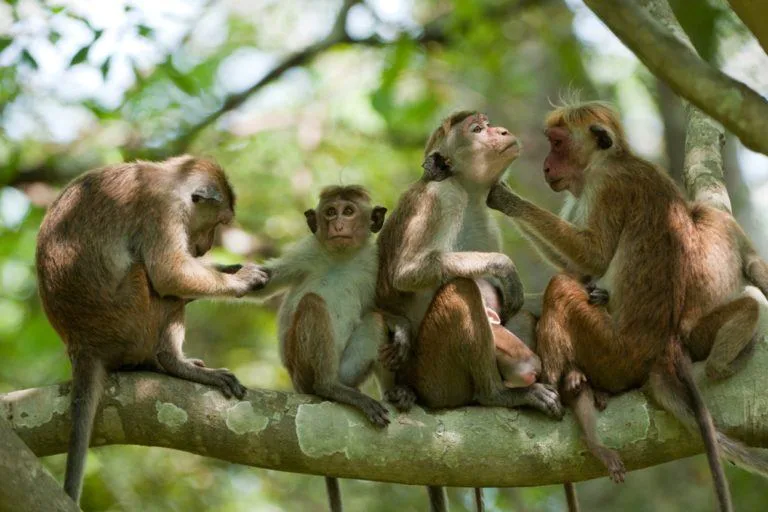
Authorities of the Department of Wildlife Conservation (DWC) and the Ministry of Agriculture are currently discussing the provision of 100,000 toque macaques (a reddish brown coloured Old World monkey endemic to Sri Lanka and known as the ‘rilawa’) to China, considering a request made by the latter to the same effect.
Speaking to The Daily Morning, the Media Director of the Ministry, Dharma Wanninayake said that a group of Chinese representatives has submitted a request to the Ministry to provide Sri Lankan toque macaques to zoological gardens in China. He said that a special meeting was held at the Ministry yesterday (11) to discuss the possibility of providing 100,000 toque macaques to China under the first phase of the programme. The meeting was attended by officials from the DWC, the Zoological Gardens Department, and the Attorney General’s Department.
During the meeting, Agriculture Minister Mahinda Amaraweera said that steps should be taken to appoint a committee consisting of officials from the relevant institutions to study the legal situation regarding the matter. He said that a proposal would be presented to the Cabinet of Ministers seeking approval for the appointment of the said committee.
The Ministry has meanwhile stated that the toque macaque population of the country is close to three million at present. A survey conducted by the Hector Kobbekaduwa Agricultural Training and Research Institute has confirmed that the highest intensity or severity of crop damage has been reported due to toque macaques. According to surveys conducted in 250 agricultural development areas, toque macaques have caused complete damages to crops in 110 areas, severe damages in 235 areas and partial damages in 155 areas.
The toque macaque is listed as endangered by the International Union for the Conservation of Nature due to habitat destruction and hunting, and also for the pet trade. Much of the original forested habitat of the toque macaque has been lost, between 1956 and 1993. Plantations and deforestation have been the main drivers of habitat loss.
The revival of the LTTE has been on the radar of the investigation agencies for long. The National Investigation Agency (NIA) recently seized a huge cache of cash, gold bars, digital devices, drugs and documents, along with other incriminating material during the raids and searches conducted at Chennai.
In a release the NIA said that the raids were conducted at residential and business premises of eight suspects in an Indo-Sri-Lankan illegal drugs and arms trade racket aimed at reviving the LTTE. The agency had initiated the investigations into the case in July 2022.
During the raids the NIA arrested one person, taking the total number of arrests to 14, with 13 being arrested in the month of December last year. Raids were conducted in 21 locations in Tamil Nadu following the registration of the case.
Investigations into the case have shown that the proceeds of drugs and arms trade in Sri Lanka were received in India through Hawala agents, including one Shahid Ali of Chennai. It was further found that the Hawala transactions to obtain the process of Drugs and Arms trade were done through hotels and businesses based in Mannadi, Chennai, the NIA release also Sid.
The latest seizure included Rs. 68 Lakhs Indian currency and 1000 Singapore Dollars, 09 Gold Biscuits (total 300 gram) from the shop of Shahid Ali. The NIA has also recovered Rs. 12 Lakhs in Indian currency from the Hotel – Orange Palace at Chennai.
The suspected arrested following yesterday’s searches was identified as Ayyappan Nandhu. He has been found to be managing the drug trade on behalf of Muhammed Asmin, a Sri Lankan refugee and a drug trafficker who had conspired with other accused to revive LTTE through drugs and arms trade, the NIA also said.
Sources tell OneIndia that the LTTE has been trying to revive itself.Some former operatives based in Europe were trying to withdraw money and use it to revive the outfit.
The source also added that in the past couple of years, these former operatives had funded webinars to speak about the importance of reviving the outfit. They have been targeting people in the rural areas and they have also roped in several NGOs to arrange such events. The probe also revealed that the money that has been lying in the accounts went into several crores of Rupees. While this amount remained untouched for long, attempts are now being made to withdraw the same, the source cited above said.
All this came to light following the arrest of a Sri Lankan national, Letchumanan Mary Franciska (50) from the Chennai Airport. The police said that the arrest was made as she was holding a fake Indian passport. She had entered India in December on a tourist visa in 2019, which was valid for one year. She stayed back in India citing the COVID-19 outbreak.
She then got herself an Indian passport using an LPG connection. She was however arrested when she tried to fly into Bengaluru, following which the case was transferred to the NIA. The NIA is currently probing the larger conspiracy into the case.
Sri Lanka has been struck by a catastrophic economic and humanitarian crisis sparked by years of mismanagement and the raging pandemic.
The World Bank has assured crisis-struck Sri Lanka of continued support to stabilise the island nation’s economy and enhance its economic recovery, State Finance Minister Shehan Semasinghe has said.
State Finance Minister Shehan Semasinghe, who is in Washington to attend the 2023 Spring Meetings of the World Bank Group and the International Monetary Fund, said that the global lender extended its support to Sri Lanka, the Colombopage news portal reported on April 11, 2023.
Mr. Semasinghe, along with Central Bank Governor P. Nandalal Weerasinghe and Secretary to the Treasury K. M. Mahinda Siriwardana, met the Managing Director of Operations of the World Bank, Anna Bjerde, on Monday.
According to the report, the Minister said the discussion focused on how Sri Lanka’s reform agenda will support its economic recovery.
After the discussion, Mr. Semasinge took to Facebook and said, Great to note the continued support of the World Bank to strengthen the social safety nets and economic stabilisation.” Good meeting with State Minister of Finance @ShehanSema, @CBSL Governor P. Nandalal Weerasinghe and Secretary to the Treasury K. M. Mahinda Siriwardana to discuss how we can support #SriLanka as it implements economic stabilisation, steps up social protection and revives growth,” Bjerde tweeted.
Mr. Semasinghe said he also interacted with the World Bank team that specialised in the social safety net interventions, cash transfer programmes and developing effective delivery systems, the NewsFirst news portal said.
According to the report, the state minister also held discussions with the Executive Director of IMF, Dr Krishnamurthy Subramanian on Monday regarding the island nation’s ambitious reform agenda and its commitment to completing the IMF programme.
Sri Lanka has been struck by a catastrophic economic and humanitarian crisis sparked by years of mismanagement and the raging pandemic.
The Sri Lankan government in May last year declared a debt default on over USD 51 billion in foreign loans — a first in the country’s history.
The debt-struck country received USD 333 million dollars, the first tranche of the USD 3 billion IMF bailout programme last month to overcome its economic crisis and catalyse financial support from other development partners.
The IMF bailout, the 17th in Sri Lanka’s history, was approved following prolonged discussions held up over Colombo’s unsustainable debt.
The role of colonialism in determining global politics has come in for overdue analysis in recent years. Post colonialism studies the manner in which societies, governments and peoples of previously colonised regions across the globe experience international relations. It was during the era of ‘new imperialism’ of the late 19th century that Britain acquired its substantial Indian Ocean Regional holdings. The legacy of an empire still influences the current British diplomacy. The manner of the United Kingdom’s relations with its former island colonies such as Mauritius, Seychelles, Sri Lanka, the Maldives and Réunion differs a great deal from one island to another.
Global powers from outside the region also have an interest in maintaining the ocean’s security. Trade play a significant diplomatic role, permitting the UK to extend its soft power to the five Indian Ocean islands with which it does business. . The evolving geopolitical landscape of the IOR ( Indian Ocean Region) has driven these island states to form closer links with the Commonwealth.
The concept of soft power is more effective and efficient in contemporary global politics. It is a power that attracts and convinces in contrast to coercion to alter and influence the preferences of other people and nations. In this regard, the paper provides an analysis of the politics of identity maintenance in a former colonial power in Indian Ocean Region.
Two Centuries of British –Sri Lanka Relations
After the Kandyan war of 1815, Ceylon became a crown colony and was ruled by Britain until 1948. Marked by a shared British colonial heritage across many areas the bilateral relations formed between Sri Lanka and Britain span over more than two centuries. The Donoughmore Commission made far-reaching recommendations to Sri Lanka in the late 1920s .The Soulbury Constitution replaced the Donoughmore Commission granting Sri Lanka dominion status and later full Independence in 1948. During the British era, the structure of Sri Lanka’s agricultural sector had changed under colonisation. Each cultivation in Sri Lanka has a distinctive notable story .Sri Lanka’s tea exports bring US$ 1.3 billion a year while the tea industry provides direct employment to over one million persons. In addition, the island nation has made almost US$ (United States dollar ) 900 million annually by exporting rubber products. Tea and Rubber were prominent plantation crops introduced to the country by the British. Over the decades, since independence in 1948, Sri Lanka’s relationship with Britain has stood the test of time. Britain enjoyed a very close economic relationship with Sri Lanka in the early eighties. Since independence, Her Majesty Queen Elizabeth II visited Sri Lanka on two occasions; in 1953 and 1981. A milestone that further strengthened bilateral ties between the two countries was the landmark visit to Sri Lanka in November 2013 by King Charles III (then the Prince of Wales) and Prime Minister David Cameron. Britain has become one of the top trading partners of Sri Lanka with over 200 UK companies operating on the island and having a two-way turnover reaching £1.3 billion (Department for International Trade, 2022). Great Britain and Sri Lanka should look to target future investments in new growth areas.
British influence in The Maldives
The status of the Maldives as a British protectorate was officially recorded in an 1887 agreement in which the sultan accepted British influence. Since becoming a protectorate, the British were involved in the domestic affairs of the Maldives and had to be consulted on matters of succession to the throne. The first written constitution was adopted on December 22, 1932. During the Second World War, in 1941 Britain established military bases on Gan island and Addu atoll. From the 1950s, the political history of the Maldives was mainly influenced by the British military presence on the islands. The British were stationed in Dhoonidhoo near Malé and in Haa Alif Kelaa. After 77 years as a British protectorate, the Maldives gained independence from the British on July 26, 1965. As a nation, the Maldivians fondly remember Her Majesty’s visit on 13 March 1972. In 2022, total trade in goods and services (exports plus imports) between the UK and Maldives was £381 million while total UK imports from Maldives amounted to £ ( British pound) 248 million, an increase of 93.8% from 2021.
British Diplomacy : Mauritius and Seychelles Islands
Mauritius was a Crown colony off the Southeast coast of Africa. As a former French colonial empire, the British possession of the island was by the Treaty of Paris in 1814. One of the most important acts was the abolition of slavery on 1 February 1835. The Mauritian island was under British rule for 158 years before it gained independence in 1968. In March 1972, Her Majesty Queen Elizabeth II visited Mauritius. . In 2022, total trade in goods and services (exports plus imports) between the UK and Mauritius was £760 million. (Department for International Trade, 2022).
In 1814, Seychelles came under British rule when France formally withdrew its claim. The island became a Crown Colony in 1903. In the 19th century Seychelles was ruled by Great Britain according to the 1814 treaty of Paris. In 1970, Seychelles implemented a new constitution and later became an independent republic in 1976 with Queen Elizabeth II represented at the independence ceremony.
Seychelles has a mixed culture representing French and African cultures. Seychelles remained neutral in foreign affairs. In 1984 Seychelles linked up with Mauritius and Madagascar in the Indian Ocean Commission (IOC). Seychelles is the UK’s 132nd largest trading partner (Department for International Trade, 2022).
The French Réunion
In 1665, the French East India Company established a port Réunion which remained a French colony until 1946. Following the fall of the House of Bourbon in France in 1793, Until 1946 the island was ruled as a French colony, except for a five-year period from 1810 when it was snatched by the British. Réunion, an overseas department and region of France is an island in the Indian Ocean. It is governed by French law under Article 73 of the Constitution of France.
British, French Diplomatic Footprint
Both Indian Ocean Regional powers such as Britain and France have an interest in maintaining their presence in the heart of the Indian Ocean particularly with former island colonies such as Mauritius, Seychelles, Sri Lanka, the Maldives and Réunion. The soft power of the United Kingdom, France and the Commonwealth certainly act as a unifying force within five Indian Ocean islands.
About the author:
Dr. Srimal Fernando received his PhD in International Affairs. He was the recipient of the prestigious O.P. Jindal Doctoral Fellowship and SAU Scholarship under the SAARC umbrella. As a Lecturer, he focuses on the comparative politics of Small Island Developing States (SIDS). Dr. Fernando is a specialist in International Relations and an adviser on New Regional Diplomacy. He has received accolades such as the 2018/2019 ‘Best Journalist of the Year’ in South Africa, (GCA) Media Award for 2016 and the Indian Council of World Affairs (ICWA) accolade. He is the author of ‘Politics, Economics and Connectivity: In Search of the South Asian Union’.
We have a difficult question before us. On either side of us are two emerging superpowers, already in the top five of the strongest economies in the world. The problem is that these two nations do not see eye to eye on a number of issues. It is helpful to note though, their differences have not stopped them from engaging with each other with the most important aspect of a bilateral relationship – trade.
China is India’s biggest trading partner. This has remained consistent despite the skirmishes over boarders, war of words or India banding with other nations in an open bid to thwart China’s emergence. In fact, China is the biggest trading partner of all these nations that are opposed to China’s rise.
This brings forth an important criteria in successful bilateral relations. That is, regardless of every other issue, strong countries do not allow other concerns to affect trade ties. A strong country’s decision to remain friends with another depends on a number of factors, as to whom that country maintains friendly relations with and if those relations are mutual. However, these egotistic differences are independent of the trade engaged.
Even in instances, when trade sanctions or similar barriers against another country is contemplated, it is done with a sharp eye on the impact such a move would have on own economic interests. The US’ repeated failed attempts to dilute its dependency from China’s manufacturing industry is a case in point.
Why Neutral Policy Fails?
This fixation on trade is unfortunately missing from our foreign policy. Our concerns lie in a different dimension. We are more focused on staying friends with all without antagonising any. We fear that antagonising any power could lead to destabilisation in the country politically, economically and/or in terms of security.
However, as our own experiences also would attest, bilateral relations do not work in this order. As noted above, countries want to have relations with nations that maintain bilateral relations with mutual partners with shared goals.
This insistence that friendship is only possible if relations are only with other countries with mutually agreeable partnerships divides the world into distinct camps. This has been the reality since the early 1900s.
For instance, the US and China mended fences in the late 1960s after Chinese relations with Russia soured over differences in security, ideology and development. Likewise, India’s and China’s disagreements over shared boarders are historic. Nevertheless, India’s main issue in contemporary history with China is not so much the boarder issues but China’s close partnership with India’s nemesis – Pakistan.
India’s issue with Sri Lanka too is with the partners Sri Lanka chooses to keep. In the 1980s, India used their influence over Sri Lankan Tamil youth in the North and East as leverage to put pressure on Sri Lanka’s friendship. The present issue India has with Sri Lanka is our partnership with China. However, if China falls out with Pakistan, would India make peace with the friendship between Sri Lanka and China? If only foreign relations were that simple.
Relations between the US and China began to slide long before China and Russia began to see eye-to-eye again in 2022. Until the 2008 global recession, the US was very comfortable with China. In 2005, the US recognised China as a responsible stakeholder” and applauded China’s influence over countries the US did not as North Korea, Sudan and Iran. China used her clout to bring these countries to the table of global recognition.
However, the US felt the first pangs of anxiety when China increased her defence budget by 18 per cent in 2007. Matters did not improve when China surpassed Japan to become the US’ largest debt holder in 2008. This economic imbalance is the US’ real contention with China. Everything else, from China’s alleged human rights violations, espionage, piracy of intellectual property and concern for Hong Kong’s and Taiwan’s autonomy stems from this concern.
This brief snapshot of history challenges our misconception that the US’ foreign policy vis-à-vis Sri Lanka is dictated by Sri Lanka’s partnership with China. The US had been using the carrot and stick tactics with Sri Lanka as far back as 2002.
With the world growing smaller as technology advances, the demand to choose a camp becomes increasingly aggressive. As such, Sri Lanka too has been under tremendous pressure to choose a side.
Sri Lanka’s attempt by (then) President Mahinda Rajapaksa to engage with whichever country most willing to make direct investments for the sole purpose of strengthening Sri Lanka’s economy failed during his second term. The response Sri Lanka got from major global players was a regime change, during which the country’s political setup was totally perverted.
Can Sri Lanka Afford to Choose a Camp?
However, these camps are virtual and not built in concrete. This is the hardcore fact that Sri Lanka should not overlook. As China’s experience with US relations showcases, joining a camp alone is insufficient to keep good relations. If the ‘pecking order’ is disturbed, the days in the camp can get numbered very fast.
This is a valuable lesson for those who believe that Sri Lanka need to be in India’s orbit. India will only tolerate Sri Lanka if Sri Lanka stays subservient to India in terms of military and economic strength.
In that sense, we have much to learn from India’s foreign policy. India is determined not to return to the days of British forced occupancy and allow another nation to decide for India the nature of foreign relations India may entertain. Therefore, employing clever manoeuvres, India has become an important but unpredictable partner in global affairs.
While allowing the US to woo India, our neighbour has stayed faithful to Russia. India today holds the deciding vote as to who would win the race to supremacy – the US or China. Hence the reason for the US to build two security partnerships – QUAD and AUKUS to reinforce the geopolitical position in the Asia-Pacific region.
The former partnership works closely with India and allows other smaller nations to piggyback on it. The latter however is an exclusive partnership the US has with the UK and Australia. The US has categorically denied any other nation, including France, into this partnership.
Reviving Sri Lanka’s Most Successful Foreign Policy
Many believe Sirima Bandaranaike’s 1970s government had the best foreign policy. It did not. It was a policy that in the name of nationalism-stoked foolishness. We alienated the West and damaged our economy.
The best foreign policy we had was during 2006-9. We worked with all nations towards a common goal, which was to eradicate terrorism. Instead of confining ourselves to our traditional bilateral partners, we expanded our world to include the Middle East as well.
In this endeavour, we did not envelop ourselves with blanket policies as nonaligned or neutral. We worked with individual nations, one on one. This gave us the space to address unique concerns of each party and for a proper dialogue without interruptions from others.
It is unfortunate that once the common goal, eradicating terrorism, was accomplished, this foreign policy was not maintained. Given the numerous variables that dictate how countries view each other and the speed with which these parameters change, foreign policy must also be flexible. Foreign relations are very much akin to moving tectonic plates. If not managed astutely, earthquakes and tsunamis are to be expected.
The North Atlantic Treaty Organization (NATO), comprising countries from Europe and North America, has informally sought a partnership with India, in an effort to contain Russia and China.
Apart from 32 full members, NATO has 40 partners around the world in Asia, Africa, South America and Oceania. Though India is a strategic partner of the US, receiving equipment and intelligence from Washington, NATO does not consider India a Non-NATO ally”.
However, both the US and NATO see India as a bulwark against authoritarian China and Russia and want it to be a major Non-NATO ally eventually.
This wish was verbalised by the US Ambassador to NATO, Julianne Smith, earlier in April, while speaking on strengthening relations with South Asia and the Indo-Pacific. She stated that though there were no plans to expand NATO to be a broader global military alliance, it does seek different kinds of partnerships with countries outside it.
Such partnerships envisage political engagement, inter-operability of the armed forces and equipment standardisation.
On India, specifically, Ambassador Smith said membership was not being opened to anyone in the Indo-Pacific or Asia-Pacific region. But paving the way for a partnership with India, she said: We both at NATO and United States, welcome what India has been able to do for the people of Ukraine. We are very grateful for the humanitarian assistance that India has been able to provide which is critical right now and those needs are only growing. Certainly, appreciate calls coming from India for some sort of immediate end to the war in Ukraine. That’s important. And we have been in constant communication with India about what more we can do together to hold Russia accountable, and we have done that and worked with India, spoken with India several times since Russia started this war inside Ukraine.”
She acknowledged that the US and India did not always share exactly the same policy approaches, but the two countries did share a commitment to upholding the rules-based order and ensuring that the key principles particularly as they relate to sovereignty and territorial integrity, those principles are respected.
Smith pointed out that NATO had been turning its attention to India as seen in references to the Asia-Pacific and the Indo-Pacific regions in its strategic documents.
The reason for this shift is, obviously, the mounting challenge posed by a rising China. India’s troubled border with China and its claims over the Indian State of Arunachal Pradesh make it a suitable candidate for recruitment to the NATO’s stable. Since 2017, China has been renaming dozens of places in that State which China says is South Tibet”. China is also saying that the Indian Ocean” is not Indian”.
Now the question whether India should have a partnership with NATO arises. There are arguments for and against it, put forward by Indian strategic thinkers. The entrenched view is that any close tie-up with NATO could end up in India’s becoming a part of the global War on Terror” with all its commitments – commitments India cannot undertake.
On the other hand, Dr. C. Raja Mohan, writing in the Journal of the Institute of South Asian Studies, National University, Singapore, in July 2022, says that while India has not formally welcomed NATO’s growing outreach to the Indo-Pacific, it should have no reason to shun it.
Any additional pressure on China from Europe and NATO cannot but serve India’s interest in balancing Beijing,” he posits.
And yet, NATO is still taboo in New Delhi. The view in Delhi appears to be that any close relationship with a military grouping goes against India’s traditional non-aligned” status that had given it much elbow room in foreign affairs as well as international respectability. Joining NATO even peripherally will go against India’s time-tested policy of not going in for military alliances. And NATO is essentially a military alliance.
For example, in 1970-71, Prime Minister Indira Gandhi had politely told her Soviet allies that India could not accept their offer of a military alliance ahead of the Bangladesh war. Instead, she got them to sign a Treaty of Friendship. India managed to get arms from the Soviets to fight that war without signing a military pact as such.
The present Modi-Jaishankar duo in New Delhi has put India on the path of multi-alignment” that is driven by national interest” rather than by predetermined relationships. Thanks to this policy, New Delhi has bought oil at a 30 per cent discount and S-400 batteries from Russia, defying US sanctions.
Dr. M.A. Muqtedar Khan, Professor of International Relations at the University of Delaware, warns that if India develops a very close relationship with NATO, it will join Taiwan to be a frontline State in any Sino-American war. Given India’s dislike for stationing foreign troops on its soil, India will have to fight China with its own men (though with arms given by the US and NATO).
Dr. Khan also said if India became a critical partner of NATO, which unlike the Quad is an explicitly military alliance, it will thoroughly alienate traditional friend Russia, which has locked horns with Ukraine over the latter’s bid to join NATO. It will be stab in the back for Russia which has been selling oil to India at a concessional rate.
Khan added that Sino-Indian relations, already fragile over the border issue, will be further exacerbated. And if China and Pakistan were to collude, India may have to face a two-front war on the Eastern and Western fronts with deleterious consequences for its bid to become an economic power. Further, India will have to bear the consequences of becoming a client State of the US (like Pakistan) and losing its hard-won independence.
Dr. C. Raja Mohan, on the other hand, takes a positive view of a tie-up with NATO. An India-NATO dialogue would simply mean having regular contact with a military alliance, most of whose members are well-established partners of India,” he writes in the Indian Express.
India has military exchanges with many members of NATO — including the US, Britain, and France — in bilateral and mini-lateral formats. Why, then, is a collective engagement with NATO problematic? If Delhi does military exercises with two countries with which it has serious security problems — China and Pakistan — under the rubric of the Shanghai Cooperation Organisation (SCO), why should talking to NATO be anathema?” he queries.
He points out that Prime Minister Narendra Modi is bringing about a change in the outlook vis-à-vis Europe. Joining the Franco-German Alliance for Multilateralism in 2019 and the Rafale deal with France are examples. Modi has been invited by France to attend Bastille Day. Modi’s first summit with Nordic nations in 2018 was recognition that Europe is not a monolith, but a continent of sub-regions.
NATO is riven with factionalism. Türkiye, one of its earliest members, has been a continuous problem for NATO with President Erdogan striving to follow an independent foreign policy. He had not been seeing eye to eye with the rest of NATO on human rights and the Kurdish rebellion in his country. Türkiye had opposed the entry of Sweden and Finland into NATO. Türkiye got sanctioned by the US for ordering S-400 from Russia and was punished for financing terrorism by the Financial Action Task Force (FATF). But despite differences, Türkiye has not quit NATO, nor has there been a call from other NATO members to sack it. It still houses US bases.
India could follow the Türkiye example of being in NATO in some ways and for some reasons, and yet have an independent foreign policy, some say.
What India will do eventually is not clear. But India would certainly think it through very carefully so that it changes its policies even as it sticks to its core values such as national independence, sovereignty and dignity. Its primarily goal is to pursue its national interest and not be a lackey of some other power.
Dr. Khan rules out India joining NATO, but for limited purposes (for say, technical modernisation and intelligence gathering and sharing) it could have arrangements with NATO, he said.
Approximately, 2,074 registered trade unions are in Sri Lanka, of which 54.5 per cent are in the public sector, 27.5 per cent in public corporations and 18 per cent in the private sector. The number of members covered by the trade unions amounts to 9.5 per cent of the total workforce of Sri Lanka.
The Sri Lankan Constitution grants a fundamental right for every person to join a trade union, while the Trade Union Ordinance permits any seven people to form such an organisation.
As per International Labour Organization (ILO)on trade unions; Article 1[1] For the purpose of the application of this Law, the following terms and expressions shall have the meanings assigned against each: Trade Unions: An organisation that is established as per the articles of this law by a number of workers in a specific organisation, specific sector or specific activity.
Illegal trade union actions
Trade union actions highly affect the economy of any country. Therefore, some unfair trade union actions are prohibited by Law. Labour Laws of Sri Lanka have cited some situations where trade union actions are illegal. Some of those are mentioned below; According to Section 32 of the Industrial Disputes Act, it is illegal to commence, continue, or participate in, or do any act in furtherance of, any strike in connection with any industrial disputes in any essential industry which is declared by the Minister of Labour without giving prior notice of at least 21 days before the commencement of the strike. According to section 40 of the Industrial Disputes Act, it is a punishable offence to commence, continue and participate in or to any act in furtherance of a lock-out or strike in any industry after an industrial dispute has been referred for the settlement to an Industrial Court or settlement by Arbitration.
It is a punishable offence to challenge any award given by such Court or Arbitrator or to change or cancel or alter the terms in a collective agreement or any strike in breach of a collective agreement. Also, according to Section 40 of the Industrial disputes act, it is a punishable offence to commence, continue, participate in, or do any act in furtherance of a strike while pending a settlement by an Industrial Court or by an Arbitrator in breach of a collective agreement. Amerasinghe (2009) emphasised that the Courts upheld the right to strike in the private sector of Sri Lanka only subject to the restrictions in the Industrial Disputes Act.
Trade Unions as political actors
Modern trade unions act in two arenas: the State and politics on the one hand, and the labour market and collective bargaining on the other. The relative importance of their economic and political activities differs between countries and world regions, as well as historically and between types of unions. So do the way and the extent to which union action in the two arenas is coordinated. Most unions no longer claimed a right or reserved the option to overthrow the Government of the State through a political strike. In this, they paid tribute to the superior legitimacy of free elections, as compared to the ‘direct action’ of the organised working class. Today, more or less explicit constitutional law makes it illegal for unions in most liberal democracies to call a strike in order to put pressure on the elected Parliament, and most trade unions have accepted this as legitimate. In return, liberal democratic States allow unions within the limits of usually complex legal rules to strike in the context of disputes with employers and in pursuit of collective agreements on wages and working conditions.
As political actors within the constitutional framework of liberal democracy trade unions can use various channels of influence. The most important of these are still unions’ traditional relations with political parties. In all democratic countries unions are in some form of alliance with a major political party.
Unions in the political process
Trade unions may achieve political influence by converting ‘industrial’ into political power. Political exchange of this sort occurs where centralised unions command strong bargaining power; where the outcomes of collective bargaining are decisive for macroeconomic performance, in particular with respect to monetary stability and employment; and where the political survival of the government depends on such performance. Also, unions may insert themselves in the political process through privileged links with an allied political party, which may enable them to achieve their industrial objectives more effectively and efficiently through political instead of industrial means.
With the dawn of the millennium, most State-owned enterprises (SOEs) and private sector organisations inherited modern employee welfare activities and modern human resource development concepts. The whole process of recruitment, training, remuneration, promotion and transfers are all done to a written code of ethics. If any queries or ‘bubble out’occurred, they were solved in the best possible ways without affecting the employees, therefore employees begin to think thata union is not needed.
The last nail in the coffin was the politicisation of the trade unions. All the political parties started unions. This resulted in a split among the employees. The noble concepts of the unions are blown away and they have been cited as the places to sell political propaganda.
However, the truth is that even though is lost, still the need for the union does exist, as the employees need backup against any false charge and for disciplinary actions. Still, the unions are for the employees to protect them from injustice, for high payee taxes, salary hikes to match the cost of living and for rights like pensions and provident funds.
Disruption and Sabotage of essential services
But, It is imperative to see trade unions in Sri Lanka over a period of time have taken citizens as a shield and for ransom to fulfil their political agenda. They have put the citizens in discomfort in the form of disruption and sabotage of essential services like health, water, electricity, food, etc. Further, trade unions have created disruptions against restructuring SOEs without considering the macro benefits Sri Lanka could have for the future generation.
Disruptions in the essential supply of fuel, electricity and water will no doubt have a direct impact on the day-to-day functions of industries and the livelihood of citizens. Further, this will give a negative signal to foreign investors and tourists who are already in the country and who intend to visit Sri Lanka as an unsafe place to spend their stay and money. These are aspects which we cannot compromise when we are in an economic crisis.
It is by and large a major threat toNational Security, whichhas a Militarydimension and a Non-Militarydimension. Therefore, considering the seriousness of essentials needed for citizens, the Non-military dimensional componentis considered as health, food, energy, communication security etc., The government is solely responsible for its citizens to ensure an uninterrupted supply by any means. Therefore,the government will have to use its full potential in exercising the law andorder to ensure a smooth supply of essentials in order to keep the country alive.
Conclusion
Countering threats on Citizens, National security, whether it is military or non-military should be the sole responsibility of the government to take prompt action. This applies to successive governments, too. Further, Human rights activists should support what is right always, keeping in mind the larger picture for the benefit of Citizens in Sri Lanka.
Prof.Rasheen Bappu, Anthropologist with security studies insights and Intelligence data scientist expressed his views in a forum
The Election Commission says, for the second time, it is compelled to postpone the 2023 Local Government polls, scheduled to be held on April 25.
In a special media release published today (April 11), Commissioner-General of Elections Saman Sri Ratnayake said the decision was reached due to reasons beyond the control of the election body and the inadequacy of funds to go ahead with the preparations for the Local Government polls.
Thereby, the Returning Officers, after seeking the consultation of the election body, are expected to decide on a date for the polls, based either on the availability of funds or the court order pertaining to the matter.
Ratnayake, in the press release, assured that the Election Commission would continue to take all necessary measures, as it has done thus far, to hold the Local Government polls at the earliest possible.
Following the 2018 Local Government polls, which saw the Sri Lanka Podujana Peramuna (SLPP) securing a majority of the seats, the next election was originally scheduled to be held last year.
However, the local elections were deferred indefinitely due to the exacerbated economic situation and the political instability in the country, while the term of office of local government bodies was extended for a period of one year.
Eventually, the election was planned to be held on March 09, and the Printing Department and the Election Commission made repeated requests from the Treasury, seeking funds to prepare for the Local Govt polls. However, printing of ballot papers stalled without sufficient funds.
Accordingly, the election was put off to April 25 only to be deferred once again.
Against this backdrop, the Supreme Court, on March 03, issued an interim order, preventing the Treasury Secretary Mahinda Siriwardana from withholding budgetary allocations made for the Local Govt election.
Later, several government MPs including Premnath C. Dolawatte alleged that the Supreme Court’s interim order on the Local Government elections is a breach of parliamentary privileges. However, the move attracted widespread criticism, with many deeming it an attempt to postpone the election on the part of the government.
Meanwhile, the term of office of 340 out of the 341 local government bodies, which was extended by one year, expired at midnight on March 19.
After the tenure of the local government bodies expires, the authority of 29 municipal councils will be transferred to the municipal commissioners, while the authority of the 36 municipal councils and the 275 local councils is transferred to the secretaries of relevant institutions.
Sri Lanka Minister of Foreign Affairs, Ali Sabry says he does not agree with certain points included in the proposed Anti-Terrorism Bill.
Speaking during TV Derana’s 360°” programme last night (April 10), he emphasized that all members of the government are of the common opinion that the bill needs to be amended.
There are some things in general that I cannot agree with. I mentioned them in the Cabinet.”
The first thing is that I don’t agree with allowing a DIG to issue detention orders. It cannot be allowed. Either it should be vested with the Minister or at least that power should stay with the Defense Secretary”, he said.
When the definition is considered…giving a broad definition to this is very dangerous. It can be misused.”
Minister Sabry pointed out that they are all of the opinion that this should be implemented as a law which can be used as a line of demarcation and only on instances of terrorism, but not to be used as a generally accepted law.
In response to a question whether Sri Lanka has granted permission for China to establish a radar base in the Southern Province, as reported by certain sections of foreign media, the Minister claimed that no such request has been made from the Ministry of Foreign Affairs so far, and that therefore, any such approval has not been granted to China by the ministry.
Meanwhile, responding to another question as to under which provisions the IMF programme is going to be tabled in the parliament for a vote, he mentioned that parliament is the representation of the public in a representative democracy, due to which their consent will be sought.
Then in the parliament, the people’s representatives can present their consent whether they like the programme or not, and if they are against it they need to present any alternatives.
Commenting further, he also spoke on whether he will join President Wickremesinghe for his future political career.
I’m not usually the one to leave the camp. But I don’t see anyone else for the leadership at the moment [except President Wickremesinghe]”.
I have not worked with him. I have continuously worked against him. Now I am working with him for the first time. While working with him, I see that we had a wrong understanding about him…”
The senior Mission Chief of the International Monetary Fund has stressed that Sri Lanka needs to achieve inclusive growth and stability. The concept of inclusive situation is a vital aspect of Sri Lanka as the culture of the country has not promoted the concept of inclusive conditions for various concerns of development such as education, health and many other areas. Inclusive condition is widely used by Europe concerning various matters such as education, health and other services. (Inclusive growth is economic growth that is distributed fairly across society and creates opportunities for all. )
The culture and practices of Sri Lanka don’t give priority to the inclusive concept, which associates with values in society. Religious developments in Sri Lanka are concerned with the concept of values, which is a limited quality of human life that should be promoted to achieve equity in growth. Left politicians were talking about creating an equal society and religious preaching excluded the promotion of values activating in society despite preaching that has not been practically achieved instead of sending ideas to air.
The International Monetary Fund has focused on and directed the inclusive growth concept to policymakers in Sri Lanka and the economic stability in the country could not be achieved disregarding inclusive growth which means the areas were neglected by policymakers such as disabled people, poor people without support, people under the poverty line cannot disregard but they must include to development activities. If the policymakers of Sri Lanka consider inclusive growth it would be the best achievement.
Genetically modified (GM) foods, also known as genetically engineered (GE) foods, are foods produced from organisms that have had their genetic material (DNA) altered in a way that does not occur naturally through mating or natural recombination. This genetic modification is achieved by introducing new or altered genes into the organism’s DNA using various techniques, including biolistics, electroporation, and Agrobacterium-mediated transformation.
The purpose of genetically modifying foods is to enhance their nutritional value, improve their resistance to pests and diseases, and increase their tolerance to environmental stress. For example, some GM crops have been engineered to produce higher yields, be more resistant to herbicides or insects, or have a longer shelf life.
The safety of genetically modified foods has been a topic of debate and controversy. Some people are concerned that genetic modifications could have unknown health effects, or that they could have unintended ecological consequences if the modified organisms were to escape into the environment. However, the consensus among scientific organizations such as the World Health Organization and the American Medical Association is that GM foods are safe for human consumption and that they have the potential to provide significant benefits to both agriculture and public health.
Genetically modified (GM) foods have the potential to provide several benefits, including:
1. Increased crop yields: GM crops are often engineered to be more resistant to pests, diseases, and environmental stress, which can lead to higher crop yields.
2. Reduced use of pesticides: GM crops can be engineered to produce their pesticides, which can reduce the need for farmers to apply chemical pesticides.
3. Enhanced nutritional value: GM crops can be engineered to contain higher levels of essential nutrients, such as vitamins and minerals, which can help improve the nutritional content of food.
4. Improved food safety: GM crops can be engineered to be more resistant to pathogens and toxins, which can reduce the risk of foodborne illnesses.
5. Reduced food waste: GM crops can be engineered to have a longer shelf life, which can help reduce food waste and improve access to fresh produce in areas with limited refrigeration.
6. Environmental benefits: Some GM crops are engineered to require fewer resources, such as water and fertilizer, which can help reduce the environmental impact of agriculture.
Overall, GM foods have the potential to improve food security, reduce poverty, and enhance public health, particularly in developing countries where access to nutritious food is limited.
The long-term effects of consuming genetically modified (GM) foods are still being studied, and there is some uncertainty about their potential risks.
Some potential concerns include:
1. Allergies: Genetic modifications could introduce new proteins into food that may cause allergic reactions in some people.
2. Antibiotic resistance: Some GM crops are engineered to be resistant to antibiotics, which could contribute to the development of antibiotic-resistant bacteria.
3. Environmental impact: There is a risk that GM crops could escape into the environment and potentially disrupt ecosystems or harm non-target species.
4. Gene transfer: There is a possibility that genetic material from GM foods could be transferred to other organisms, either through cross-breeding or other means, with unknown consequences.
5. Unknown long-term effects: Since GM foods are a relatively new technology, there is still much to learn about their long-term effects on human health and the environment.
It is important to note, however, that the vast majority of scientific research conducted to date suggests that GM foods are safe for human consumption and do not pose significant risks to the environment.
The World Health Organization, the American Medical Association, and other scientific organizations have stated that GM foods are safe for human consumption and that they have the potential to provide significant benefits to agriculture and public health.
Nonetheless, it is critical to continue studying and monitoring the long-term effects of GM foods, as well as ensuring that they are developed and regulated responsibly and transparently.

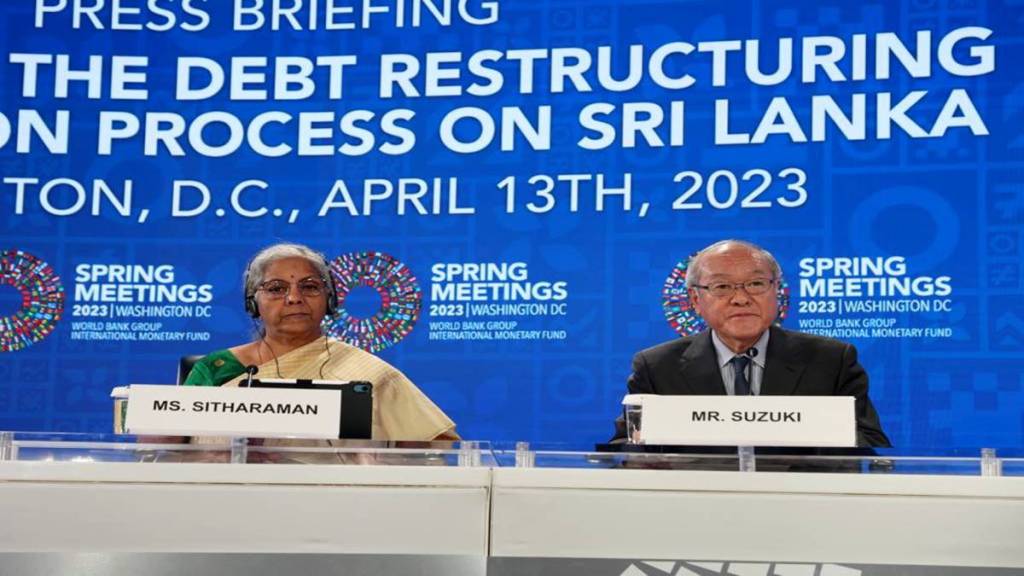 The high-level meeting took place on the sidelines of the International Monetary Fund (IMF)- World Bank (WB) Spring Meetings here on Thursday. (Photo source: Twitter/@FinMinIndia)