President Ranil Wickremesinghe has emphasised that the only way a change of government can be brought about is through a Parliamentary election.
Accordingly, he noted that a Parliamentary election is the only way through which change can be implemented, emphasising that taking to the streets is not an option for the Parliament.
Speaking at the Passing Out Parade of Air Force cadets and other officers held at the Trincomalee Air Force Base this morning (03 March), the Head of State highlighted that a nation can become anarchic due to an economic collapse, and thereby urged everyone to prioritise safeguarding both the economy and the constitution of the country.
Commander-in-Chief of the Armed Forces, President Ranil Wickremesinghe, who arrived at Trincomalee Air Force Base, was received with air force honours.
Meanwhile, 40 Officer Cadets including three females were commissioned as Officers of the Sri Lanka Air Force by the Chief Guest, and received their ceremonial swords, which symbolizes their status as Commissioned Officers.
Thereafter, flying brevets were pinned on 13 pilot officers and 07 trophies were awarded for special achievements.
Two Officer Cadets who have shown exceptional performance were awarded the Sword of Eagle for the best student of General Duties Pilot Branch and the Sword of honour for the overall best student among all branches.
The President also posed for a group photograph with the newly commissioned officers and senior officers.
The Sri Lanka Air Force Band rendered a special performance and the parachute display adding colour to the event.
Attached below is an excerpt of the speech delivered by the President at the event:
“In order to move forward as a united and prosperous country, all individuals regardless of their ethnicity, religion, or cultural background must work together. Whether Sinhalese, Tamil, Muslim, Burgher, Buddhist, Catholic, Hindu or Muslim, it is essential that all citizens come together to work towards the greater good of the nation. Only by working together can we build a stronger, more prosperous future for our country and its people.
The legitimacy of Sri Lanka’s government is established by the executive, legislature, and judiciary. The judiciary plays a crucial role in upholding and enforcing the laws enacted by the legislature. All three institutions are focused on safeguarding Sri Lanka’s constitution and ensuring that the country functions in accordance with its laws and regulations.
It is the responsibility of every citizen to help protect these institutions, which are essential to the proper functioning of the government and the preservation of Sri Lanka’s democracy. Without these institutions, there can be no assurance that the country will remain stable and secure.
It is important to note that any changes to the government must be made through the proper channels, such as a parliamentary election. The streets are not an option for the parliament, and any attempt to subvert the established process would be a violation of Sri Lanka’s constitution and the rule of law.
I am deeply grateful to the armed forces for their role in protecting the Parliament last June. As we have seen in other countries, when a parliament is not safeguarded, chaos and anarchy can quickly ensue. Similarly, a country without a strong economy is also at risk of devolving into chaos.
It is therefore the responsibility of all of us to work together to protect both the constitution and the economy of our country. In recent days, I have met with various organizations to discuss strategies for boosting the economy, and I am confident that our efforts will yield positive results in the near future.
By protecting our country and upholding its constitution, we can ensure that our democracy remains strong and vibrant”.
Lt Col Anil Amarasekera. (Rtd.) Co-President National Joint Committee
01st March 2023.
His Excellency, President Ranil Wickremasinghe,
The Presidential Secretariat, Colombo 1.
Your Excellency,
You have made a public statement that you intend to fully implement the Thirteenth Amendment to the Constitution. The National Joint Committee (NJC) intends to caution you against implementing such a decision which would amount to opening a Pandora’s Box. The Ven.Mahanayake Theros too have in a joint statement requested you not to do so.
The Indo Lanka accord signed on 27th July 1987 that was forced on Sri Lanka by India through gunboat diplomacy is illegal according to articles 51 and 52 of the Vienna Convention on the law of Treaties. India also failed to implement some of the provisions therein such as disarming the terrorists and as such the Indo Lanka Accord can be considered as repudiated. Therefore do you consider the 13th Amendment enacted on 14th November 1987 in accordance with the Indo Lanka Accord to have any validity?
When the 13th Amendment was challenged in the Supreme Court, while Chief Justice Sharvananda, Justice E.A.D Athukorale, Justice Percy Colin-Thome and Justice H.D. Thambiah in their determination said that a referendum was not necessary for its enactment, Justice R.S.Wanasundara, Justice O.S.M Seneviratne, Justice L.H.De Alwis and Justice H.A.G de Silva in their determination said that this Amendment cannot be enacted sans a referendum. Though Justice Parinda Ranasinghe in a separate verdict conceptually agreed with the Chief Justice Sharvananda, he dissented on article 154G (2) (b) and (3) (b) which he said should be approved at a referendum. He refused to suggest any amendment to the said articles 154G (2) (b) and (3) (b). The subsequent amendment made to the said articles at the committee stage was not subjected to the scrutiny of the Supreme Court. Therefore putting together Justice Parinda Ranasinghe’s verdict with that of Chief Justice Sharvananda can be interpreted as incorrect and if so the 13th Amendment has been enacted sans the approval of the Supreme Court that makes it controversial if not illegal.
The ruling given by Chief Justice Sharvananda that the Provincial Council bill be passed after the 13th Amendment became law was also ignored by the then government which took a vote on the Provincial Council bill two days before the 13th Amendment received the speaker’s certification on 14th November 1987. Therefore the Provincial Council bill too has been enacted illegally.
On or about 1995 the Chandrika Kumaratunga Government introduced the devolution proposals that was commonly known as the Package. It was to campaign against the package and to educate the masses regarding the danger of devolving political and administrative power from the centre to the periphery that the NJC was established by Retired Supreme Court Judge Mr. R.S. Wanasundera. The NJC also established the Sinhala Commission to inquire into the grievances of the Sinhala majority. Two reports were published by the Sinhala Commission to educate the international community in this regard.
The NJC advocated the view that political and administrative power should be decentralised from the centre to the periphery but should never be devolved. Many organizations including political parties such as the UNP and the JVP joined with the NJC and when these devolution proposals were tabled in the National State Assembly on 8th of August 2000 all approach roads to the parliament was blocked by protesting masses and President Chandrika Kumaratunga had to use helicopters to fly her MP’S to parliament. It was Mr. Mahinda Rajapaksa who walked from the parliament to the Batheramulla junction to inform the people that the devolution proposals had been postponed indefinitely and for the protesting people to disperse which they did peacefully.
The English meaning of decentralization and devolution of power seem very similar when looked at superficially. However the important fact that needs to be realized when it comes to the governing power of a country is that decentralization amounts to the transfer of that power from the central government to a local authority be it a region, a province or a district while devolution is on the other hand the removal of central government power and handing that power over to a region, a province or a district. Therefore decentralized power if misused by a region, a province or a district could be recalled by the central government while devolved power cannot be recalled by the central government if misused by a region, a province or a district. Taking into consideration the difficulty or virtual impossibility for a central government to recall devolved power to a region, a province or a district let us consider the possible repercussions of such an eventuality in this country with several simple examples.
Firstly let us consider irrigation which is the life blood of the farming community in the northern and eastern provinces. Once this subject is devolved to a province, if the provincial administration fails to maintain the reservoirs (Wewas) and irrigation canals in the Sinhala villages, there is nothing the central government can do to help the Sinhala cultivators in distress. The only alternative left for them would be to leave those villages in the northern and eastern provinces and migrate to some other province.
Secondly let us consider the subject of health. Once this subject is devolved to a province, if the provincial administration fails to provide adequate funds to maintain the rural hospital buildings serving the Sinhala community or fails to provide adequate doctors, nurses and other staff or even medical supplies to rural hospitals in their area, the Sinhala villagers will have no other alternative left other than to leave the province and to migrate to some other province where these facilities are available.
Thirdly let us consider the subject of education. Once this subject is devolved to a province, if the provincial administration fails to appoint the teachers needed to schools in Sinhala villages and also does not allocate adequate funds to maintain and repair school buildings in the Sinhala villages, there is nothing that the central government can do in this regard. The Sinhala population will therefore leave the province and migrate to some other province where good education facilities are available for their children.
These are only three simple examples that I have provided to bring to your attention the danger of devolving power to the provinces. However the situation would be the same with regard to distribution of electricity, repair of roads, purchase of agricultural produce and many other such subjects, if there is devolution of power to a province where the Sinhala population is a minority. Therefore while devolution will only hasten the division of the country by creating administrative avenues to encourage the migration of the Sinhala population from the northern and eastern provinces of the country to other provinces, decentralization of power will not encourage such action as these powers can be withdrawn by the central government if found to be misused by any provincial council.
Mr. C.V.Wigneswaran M.P said recently that the full implementation of the 13Th Amendment is good but that he will not look back until a federal constitution is promulgated. He is trying to apply Samuel James Veluppillai Chelvanayakam’s policy of ‘little now more later’ with an intention to first federate a unitary state through the full implementation of the 13th amendment. The federated state will subsequently be divided to establish Eelam, which is the final objective of the separatists. If Wigneswaran and likeminded separatists succeed to achieve during peace what they failed to achieve through three decades of war, all the sweat, blood, tears and toil expended by the security forces sometimes even by sacrificing their very life and limb to defeat the separatists would have been in vain.
This ‘little now more later’ policy has been applied with great success by racist Tamil politicians since independence. They first succeeded in making Tamil a language of the minority community an official language in par with Sinhala which is the language of the majority community in this country. Tamil incidentally is not an official language even in India where the majority of the Tamil population live in this world. Through the enactment of the controversial 13th Amendment the racist Tamil politicians succeeded in devolving much of political and administrative power to the northern and eastern provinces that can be utilised to create an exodus of the minority Sinhala population from these two provinces as pointed out previously in this letter.
Through the enactment of the 16th Amendment these racist Tamil politicians succeeded in making Tamil the language of administration in the northern and eastern provinces for the maintenance of public records and transactions of all business by public institutions. The majority Sinhala population not being racists had little or no objection while such discriminatory legislation was enacted for political expediency but can the Sinhala majority continue to allow this ‘little now more later’ policy to continue?
Therefore in the interest of the Sinhala minority that is living in the northern and eastern provinces, the NJC kindly request you to promulgate a new Constitution for which the majority of the people in this country gave a mandate both at the last presidential and general elections so that the people living in any part of this country are not discriminated based on their ethnic, caste or religious identity.
Why a constitution needs a country may be a complex and broad question, but it involves many points to consider. The answer to this question would be analytical that should cogitate various points relating to modern democratic aspects which concern with rights and responsibilities of citizens. It invites views and discusses many points without relegating to lower quality people without values.
In a country like Sri Lanka which consists of small populations, land area and limited assets, resources may not need to consider complex points of view but, constitutional lawyers and experts may present an ocean of various reasons or views favouring having a constitution. John Doily in his publication wrote about the sketch of the constitution of the Kandyan Kingdom of Sri Lanka and broadly explained the nature of the constitution of Sri Lanka when the British rulers took over the country. The views in the books were collected from the field when he was working in Sri Lanka.
In the beginning, John D’Oyly explained the nature of the state in Sri Lanka, “the power of the King is supreme and absolute. The minister advises, but cannot control his will….” The other significant point is the authority of the King is exercised through many officers of the state, which means in history the power of the state was not divided into provinces the power entire country was exercised by the officers of the country appointed by the King. Provincial authorities like Wanniyar were officers like village headmen or village service officers in current Sri Lanka. Some people interpret that Wanniyar was a provincial king but in terms of John Doily’s book it is not true and the details could find in the book of John O’Doily.
When it refers to experts in political theory, we cannot ignore the views of Harold Laski and the author of the originally written constitution of Sri Lanka, Sir Ivor Jennings. In general view, a constitution indicates that it needs to determine the power distribution of the country, explain the nature of the state and many points as indicated by Doily. The uniting people of the country would give equal rights to all citizens of the country and ascertain the rights of people. It also needs to note that while a constitution is directing the rule, despite constitutional rules many countries encountered revolutions and destroyed the constitutions.
Sri Lanka gained a constitution as the result of the implementation of Saulsbury reforms in 1947 and the majority of people in the country gave consent to the content of the constitution by the general election in 1947. After the political changes in 1956, many experts critically evaluated the contents of the constitution and the election held in 1970 gave the required authority of the parliament to either change the constitution or to introduce a new constitution. In addition, a revolutionary political group of Janata Vimukthi Peramuna pushed for political reforms through a bloodletting revolution and a new constitution in a democratic way came into effect in 1972. After introducing the second written constitution in Sri Lanka the constitution and related activities politized and without a real solution, the concept of constitution and related activities seems a dogma continuing without a clear solution and neighbouring powerful countries use this situation for political advantages rather the than honestly helping to poor communities in Sri Lanka
The 1972 constitution was abolished by the government elected in 1977 which introduced a new constitution allowing free investments and an economic system in 1978. The constitutional issues became the rights of citizens who suffer people of a grave issue that goes beyond Sri Lanka. 12% of the Tamil population was unhappy about the contents of the constitution which has defined the country as a unitary state and the Tamil population originated from the links of South Indian Tamils being associated with a conflict demanding for the country to a federal status from the unitary system. Sri Lanka had been managed as a unitary state before the era of King Anawas, at that time there was no country called India. This idea was expressed by Indian historians and the political manuring promoted India to influence on this issue India wanted to introduce the 13th Amendment to the constitution allowing the country to convert as a federal state. What was the secret agenda behind the reform could not determine and less than 12 per cent of the population stuck implementing this reform.
Converting Sri Lanka which is a small country to a federal administration would be a Boeotian decision and it is a major reason to increase government spending and increasing inflation. The Indian concern was to control the possible repercussion resulting from Tamil unrest. Sri Lanka is not a country viable for a constitutionally federal state, and the contents of the 13th amendment might support disuniting people current Sri Lanka needs sophisticated economic strategies to attract investment and the management of investment to increase the general productivity of the country. The rule of God is to allow land to use by everyone without limiting the humans of the country. May common assets such as water, lands, education and all other assets should not be limited to selected groups and the assets created by God must be available to every citizen of the country despite racial and religious limits.
The 13th amendment is just a piece of paper, sometime, it could be used to make toilet paper in the country when critically considering the contents of the 13th amendment. Every person born in Sri Lanka has the right to enjoy the benefits of land and languages. Since the colonial era, the major disadvantage that has been encountered by people of the country could be considered as the division of rights of people without differentiation on the races and religious beliefs. Colonialists used differences to their advantage and ethnic issues were the major point. Forcing or insisting on fully implementing the 13th amendment by an outside force is not acceptable and Sri Lanka’s people should have the right to implement or not the 13th amendment.
In the meantime, the majority Sinhala community also seems to fuel to fire widening ethnic and religious gaps. Sinhala community should wisely act and should not use the 13th amendment for political purposes.
It was announced that our country is to go for nuclear energy with the help of Russia according to a news item on Sirasa this evening.. As a country we always start late. Color TV was one. But then we do it in style. Radio Ceylon that captured the hearts of Indians was one.
We must thank Russian Prez Putin for that. This was a long felt need Patali and them have been planning for a long time. However this does not mean that as a nation we are anti-west. We are more western oriented than most countries in the region. And we want peace in the world as most Russians do as seen in the comments to the video given below. Mr. Putin here is singing for an American delegation here, I believe.
The term ‘cloud’ in cyber space refers to a server farm in large box type buildings constructed in remote areas in the US or cold Western countries like UK, Iceland, Norway etc. Sometimes they immersed the servers in water to dissipate the heat they generate or send water through the servers to keep them under optimum temperature . The people who once lived harsh lives in those countries now do so comfortably by circulating that hot water to keep their dwellings warm thus saving electricity and generating revenue by ‘taxing’ the cloud companies and also doing highly skilled high-tech jobs. But ultimately who get taxed?. It is us who keep our many useless photo of many mega-bytes (or eight times that of bits) and other ‘data’ in the form of bits in those servers for ever. Finer the image more the number of bits required to define a pixel or a dot that makes up the image on our device.
How many of us know what those innovative companies like Nvidia (a name coined from Latin to give a twist to NV or envy) process and keep those images in their ware?. They have billions of tiny units called capacitors stacked in their graphics processing units (GPUs) that will send back the pictures to us at the press of a button!. Each capacitor retain a charge (or 1 bit) or no charge (ie. 0 bit). So a sequence of 0s and 1s are used to define a picture or our data. But these capacitors have a problem; the electrical charge slowly leaks there by heating up the processor and to retain that data the system has to pump electricity or energy continuously. So we have to burn more and more fossil fuels thereby causing environment pollution and perhaps catastrophic consequences like floods, droughts etc. The Norwegian girl Greta Thunberg who makes a huge din everywhere these days does not know that her country is one of the problem creators. In fact the US or the west does not mind as they benefit from this technology.
Perhaps a body like UN should intervene to stop this madness. They should have a panel like the one they had to formulate the law of the sea to either regulate how much data each country is entitled to keep in servers or to find a new method to store 0s and 1s and retrieve them instantaneously, in order to save the humanity. At the moment 18-20% of world’s energy is used for this purpose it seems. And it is these Nordic countries hosting these server farms that benefit to the detriment of others.
As late singer Don William sang us say “Send down the cloud (thunder) and send down the rain”
The Temple of the Tooth –Relic which was built near the Palace of King Parakramabahu VI in the kingdom of Kotte, had been ruined due to foreign invasions, relocation of the Relics and thus the administration to Kandy. Reconstruction of the Temple of the Tooth Relic Kotte has been commenced with the patronage of Kotte Raja Maha Viharadhipati Ven. Aluthnuwara Anuruddha Thera. Prime Minister Dinesh Gunawardena visited Kotte Rajamaha Vihara today (02) to observe the plans of the Temple of the Sacred Tooth Relic to be estorted. Yadamini Gunawardena MP, Isura Devapriya former Chief Minister of Western Province, Upali Kodikara and Salochana Gamage former municipamo council members and a large gathering including Urban Council members were present on this occasion.
Government officials in Sri Lanka said they will work with Russia to bring nuclear power to the country as part of its effort to increase the supply of electricity for the island nation.
Professor S.R.D. Rosa, chairman of the Sri Lanka Atomic Energy Board, told local media the country is looking at offshore and onshore installation of small modular reactors, or floating nuclear installations, that would have generation capacity of 100 MW per unit. The Daily Mirror newspaper on March 1 reported that Rosa said, The government has sought to implement the project in collaboration with the Russian government. The required technology will be provided by them, and they had also agreed to take back the nuclear waste. The Russian government has the technology to reprocess the nuclear waste.”
Bandula Gunawardana, a Sri Lanka Cabinet spokesperson and minister, said the country wants to diversify its power supply and considers nuclear a low-carbon option. Officials in 2021 made a pledge for Sri Lanka to achieve carbon neutrality by 2050. The island receives most of its electricity from hydropower, followed by the burning of coal and fuel oil.
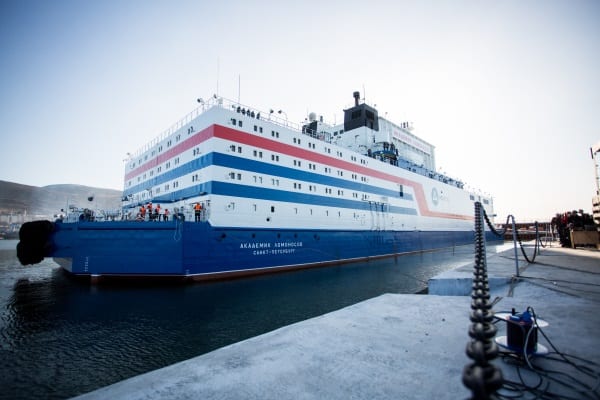
Russia has said it could provide the island of Sri Lanka with nuclear power. The technology could include a floating nuclear power plant. The Akademic Lomonosov, pictured here, is a pioneering floating nuclear facility that was fully commissioned in the Pevek, Chukotka region in the Russian Far East in May 2020. The plant includes coastal infrastructure and a floating power unit equipped with two KLT-40S reactors of 35 MWe each. Courtesy: Rosatom
Sri Lankan officials last year submitted a self-evaluation report to the International Atomic Energy Agency (IAEA), asking for approval to establish an independent nuclear regulatory body and also develop training programs for nuclear power personnel.
Russia is active in its support for nuclear power in Asia. It is notably building the two-reactor, 2.4-GW Rooppur Nuclear Power Plant, the first nuclear power facility in Bangladesh, which is expected to enter commercial operation next year. The Rooppur plant will feature VVER-1200 reactors from Rosatom, the Russian state-owned nuclear power group.
Levan Dzhagaryan, Russia’s new ambassador to Sri Lanka, last month met with members of the Sri Lanka Atomic Energy Board to discuss Russia’s support for nuclear power on the island. The talks included a meeting with Kanchana Wijesekera, Sri Lanka’s minister of Power and Energy. Dzhagaryan told local media that Russia is ready to support construction of two 55-MW nuclear power stations.
To begin with, it could be two plants, then four plants, and finally six plants. This suggestion was critical from several perspectives. First and foremost, this would save oil and coal. Second, because there will be no coal, it will be environmentally friendly, and the ecology will be safe and secure. It is also less expensive,” said Dzhagaryan in an interview with Ceylon Today.
Dzhagaryan previously was Russia’s ambassador to Iran and oversaw completion of that country’s first commercial reactor at Bushehr in 2011.
—Darrell Proctor is a senior associate editor for POWER (@POWERmagazine).
President Ranil Wickremesinghe has announced that a foundation is presently being established to advance Sri Lanka’s economy to a global level over the next five years by implementing green economic policies.
The President made this statement while attending the ceremony held today (02 March) for the opening of Volta Auto Tec Engineering Private Limited, Minneriya.
As a solution to the current fuel crisis in the country, when there is a need for electric motorcycles and three wheelers, Volta Auto Tec Engineering Private Limited has facilitated the purchase of assembled tractors, electric motorcycles and three-wheelers from today onwards.
At present, Volta Auto Tec Engineering Private Limited has established a collaborative production partnership with India, and has reported receiving orders from countries such as Vietnam.
During his visit to the factory, the President inquired about the assembly process of bicycles, electric motorcycles, and tricycles from the officials. A representative from a local farmers’ organization also presented a souvenir to the President marking this occasion.
Speaking further, President Ranil Wickremesinghe said:
I am delighted to have come to see the talents of the Volta Auto Tec Engineering Private Limited. The government is looking into ways of supporting this initiative. We should appreciate this step taken to create a green economy. All should work to shift the country’s economy to a green economy by implementing such projects. Now, the countries of the world are moving towards a green economy.”
As Sri Lanka, we should also embark on that journey. Sri Lanka has the potential to achieve many advantages by moving towards a green economy in the next five years. In this regard, the country needs such investors and businessmen who stand up on their own. Therefore, I congratulate Mr. Jagath Makavita on this initiative.”
Minister of Sports Roshan Ranasinghe, Minister of Power and Energy Kanchana Wijesekera, State Ministers Dilum Amunugama, Siripala Gamlath, Premitha Bandara Tennakoon, Presidential Senior Adviser on National Security and Chief of Presidential Staff Sagala Ratnayake, former Minister Ravi Karunanayake, former Member of Parliament Chandrasiri Sooriyaarachchi, Chairman of Volta Auto Tec Engineering Private Limited Jagath Makavita and others were present on this occasion.
The International Monetary Fund (IMF) Mission to Sri Lanka has stated that the new tax reforms in Sri Lanka helps meet the objective of correcting the imbalance of tax revenue and expenditure.
Accordingly, they stated that the new tax rate schedule for the personal income tax helps meet this objective, adding that these new reforms will also help regain the confidence of creditors.
World Bank Vice President for South Asia, Martin Raiser has reaffirmed the World Bank’s continued support to help navigate Sri Lanka’s navigate economic challenges, implement critical reforms, and chart a path towards a resilient and inclusive recovery.
During his four-day visit to the island nation, which concluded on 28 February, Raiser met with President and Minister of Finance Ranil Wickremesinghe, Secretary of the Treasury, Governor of the Central Bank, senior government officials, development partners, and key opinion leaders including members of Sri Lanka’s political opposition, thinks tanks, civil society organizations and academia.
The people of Sri Lanka have been deeply affected by the macro and debt crisis affecting the country. The depth of the crisis has made it clear that Sri Lanka needs a new development model, but this requires greater confidence in and understanding of the government’s reforms”, said Martin Raiser.
Improved communication and consistent implementation of the reform and adjustment program is urgent, as is faster international debt relief and financial support to ensure people don’t lose patience and the opportunity for a change isn’t lost.”
During the visit, Raiser discussed progress on reforms to transform economic governance in Sri Lanka through strengthened institutional and fiscal oversight and better debt management.
He also stressed that greater transparency, improved governance, support for job creation, as well as better targeted protection for the poorest are critical to garner and sustain public support for reforms.
Raiser also visited North Central and Northwestern Provinces to observe first-hand World Bank-funded projects in the health and agriculture sectors, and to engage with a broad range of stakeholders on Sri Lanka’s development needs.
The World Bank was among the first to respond to Sri Lanka’s economic crisis, with the Bank’s emergency response having repurposed $325 million from existing projects to protect the poor and vulnerable from the worst impacts of the crisis.
In December, the Bank approved Sri Lanka’s request to access concessional financing from the International Development Association (IDA).
This type of financing, offered at low interest rates, will enable the country to implement its government-led reform program to stabilize the economy and protect the livelihoods of millions of people facing poverty and hunger”, a statement issued by the World Bank read.
The World Bank Group has started preparing a new Country Partnership Framework for the next four years (2023-2026) with a focus on private sector led job creation, inclusion, preservation and strengthening of human and natural capital, improved governance, and a shift towards a greener growth path”.
Borrowing costs hovering at two-decade highs to quell Asia’s fastest inflation rates will be in focus in Pakistan and Sri Lanka, as the crisis-gripped economies review monetary policy settings in decisions seen as key to winning multilateral bailout funds.
The two monetary authorities are likely to take different tracks as price pressures have somewhat eased in Sri Lanka after peaking at nearly 70%, while still on the boil in Pakistan where the central bank advanced the meeting by two weeks to March 2.
State Bank of Pakistan will on Thursday probably increase the target rate by 200 basis points to 19%, according to 28 of 38 economists surveyed by Bloomberg, with the rest expecting even higher increases ranging from 250- to 300-basis points. SBP doesn’t provide a set time for the announcement.
On Friday, the Central Bank of Sri Lanka will probably keep the standing lending facility rate at 15.5% for a fifth straight meeting, according to all eight economists in a Bloomberg survey ahead of the decision at 4:30 p.m. in Colombo. The nation’s benchmark rate is at the highest since 2001, according to central bank data.
The International Monetary Fund’s bailout — $2.9 billion for Sri Lanka and $6.5 billion for Pakistan — if approved will unlock more funding, boost foreign-currency reserves that right now can pay for less than a month of imports, and arrest a deepening turmoil.
But the loans have strings attached, such as ensuring sustainable revenue and enabling market-determined exchange rates that have led to a spate of energy price increases, tax hikes and depreciation in currencies — all of which tend to spur inflation.
Consumer prices in Colombo cooled to 50.6% in February from a year earlier. In Pakistan, price gains quickened to 31.55%, the most since the 1960’s, according to central bank data.
Both Pakistan and Sri Lanka are well behind the inflation curve,” according to Hasnain Malik, a strategist at Tellimer in Dubai. More rate increases and more fiscal cuts are ahead, which means further pain for the economy is in store.”
Bailout programs of the two countries have been pending for months, and in the case of Pakistan, for years.
Pakistan secured a $1.1 billion IMF loan in August, which was part of a $6.5 billion package approved in 2019. Disagreements over spending plans after last year’s devastating floods and government’s failure to meet loan conditions stalled the program. Reviving the bailout became crucial as the nation teetered on the brink of a default.
What Bloomberg Economics Says…
Pakistan is at serious risk of default. The International Monetary Fund has been dragging its feet on aid for months. And even if the IMF finally comes through, the debt won’t be sustainable unless creditors agree to large write-downs. China, Pakistan’s largest external lender, might have to accept a haircut of as much as $8 billion, by our calculations. That is high unlikely – and shows just how dire the situation is.
An IMF review last month ended without a deal for Pakistan. The government on Tuesday insisted that IMF’s loan review is progressing well and a staff-level agreement can be clinched in the next few days.”
In the case of Sri Lanka, an IMF staff-level pact for a $2.9 billion loan program was secured at the start of September, with the board originally anticipated to approve the funds by the end of 2022. Authorities have since adjusted expectations to within this quarter.
The main reason for the delay is the absence of a formal assurance from China, also Sri Lanka’s biggest bilateral creditor, that it would support a debt restructuring for the bankrupt island nation.
While crippling supply shortages in Sri Lanka have eased, foreign currency reserves have been inching up and inflation slowing, Sri Lanka needs the IMF bailout to get more funding and turn the corner.
Just getting into a program is not enough,” said Dhananath Fernando, the head of a Colombo-based economic think tank Advocata Institute. Sri Lanka can also fall back like Pakistan. It has to bring long term stability and do the reforms.
Spot rupee traded at Rs.356.75 – 357.75 yesterday – Deal with IFC, rising prospects for IMF relief and eased forex conversion rules reinvigorate sentiments – Inflows from remittances and tourism sector revival also add a fillip – Currency dealers observe forex supply outstripping demand as of late – Sri Lanka returning to economic normalcy after a year of turmoil when rupee was let go
Sri Lankan rupee appreciated yesterday on improved sentiments over the current and future foreign exchange conditions in the domestic market after the announcement that International Finance Corporation (IFC) is willing to provide US$ 400 million worth of swap facility for three commercial banks to support essential imports.
The spot rupee appreciated to Rs.356.75 – 357.75 against the US dollar, yesterday.
The telegraphic transfer rates quoted by commercial banks in Colombo also eased yesterday, as both buying and selling prices of US dollars stood at Rs.358.36 and Rs.367.93, respectively.
The market also remains upbeat over the prospects of getting the International Monetary Fund (IMF) to unfreeze its US$ 2.9 billion relief package as early as next month with or without adequate financing assurances from China whose assurances fell short of what the multilateral lender sought.
In a further positive development, the Central Bank relaxed the mandatory foreign exchange conversion requirement applicable to banks to 15 percent from 25 percent, effective from Monday, in a reflection of improved foreign currency liquidity conditions in the domestic market.
According to treasury department of banks, this has the potential to release between an additional 30 to 40 million US dollars further enhancing liquidity in the market.
Sri Lanka was seen looking past its dire foreign currency liquidity conditions from around the third quarter last year as the Central Bank ramped up its net purchases bucking more than a year-long trend of being a net seller.
In December last year, the Central Bank bought US$ 103.78 million on net basis before increasing to US$ 211.15 million in January, signalling a gradual improvement in foreign currency liquidity conditions.
A currency dealer said that they get more supply nowadays for dollars than the demand. Sri Lanka crushed demand and thereby imports last year teaching the principles of frugality and contentment for the masses who for decades relied on foreign made goods, as the country ran out of foreign currency.
Meanwhile, the inflows from worker remittances and tourism also reached record highs in January after more than a year long weakness in both sources.
Sri Lanka’s rupee lost nearly 80 percent in 2022 against the US dollar after the Central Bank let go the currency on March 7 without an anchor when the country ran out of foreign currency reserves which set off a series of crises in the country.
After months, Sri Lanka is seeing some semblance of economic normalcy with prices, yields, rates and foreign exchange conditions easing.
Chinese Premier Li Keqiang told the head of the International Monetary Fund that China is open to participating in multilateral efforts to help heavily indebted nations in a constructive manner.
China is willing to take part in resolving relevant countries debt issues, Li said in a phone call with IMF Managing Director Kristalina Georgieva.
China maintains that all sides should take joint action and share equitable burden,” he said.
China, a major lender to debt-laden countries such as Sri Lanka and Pakistan, is mired in disputes with multilateral banks over which parties should take the lead in restructuring sovereign debt.
The IMF is considering approving a Sri Lanka bailout without the formal assurance of debt-restructuring support from Beijing.
The Chinese government, which accounts for about 52% of the nation’s bilateral debt, has offered term extensions via state-owned policy lender Export-Import Bank.
Georgieva told Li that the IMF wants to strengthen coordination and cooperation with China to handle the debt crisis in developing countries.
Tourist arrivals for the second month in succession went pass the 100,000 market with February recording 107,639 arrivals. The January arrival figure was 102,545.
This was 96,507 in February 2022 showing an increase of over 11% as against the second month of previous year.
For the third successive month Russia became the top source market for Sri Lanka accounting for 29,084 arrivals showing an increase of 27% as against February 2022.
India followed with 13,714 arrivals which also was an increase of 13%as against the previous year February.
Thin third and fourth source markets for Sri Lanka tourism were United Kingdom 8,575 and Germany 7,930 both showing around 7.5% increase against previous February.
The first group of Chinese tourists to Sri Lanka this year arrived in the island last night, resuming the arrival of Chinese tourists after the covid pandemic.
We have heard from reliable foreign sources and the Minister of Justice, Wijedasa Raajpakse that there is either a sum of dollars 32 billion or 52 billion dollars which is legally due to Sri Lankaas export earnings held in overseas accounts of Sri Lankan exporters.While the country is heading from bad to worse and the people are told to tighten their belts, the policy makers act dumb and deaf to exhort that they must wait until the IMF decides to ‘donate ‘ dollars 2,9 billion.
We have visited the IMF on a number of occasions but we are yet again in a very tight spot and await them to alleviate our ills.
If the policy makers are keen to adopt IMF stipulations and get their funds as the only possible remedy let them pursue their goal, BUT, why cannot the policy makers negotiate with the exporters who hold Sri Lanka’s export earnings to remit the funds at least in installments of 10 billion dollars at a given time from March onwards. Can the Nation hear a response from the Government as the countryis being pushed to uncharted waters while our dues are deposited in foreign banks ?
The provincial government of Ontario passed a bill (Bill 104) implying that a genocide of Tamils occurred in Sri Lanka, and introduced a Tamil genocide education week” (TGEW) into the school system [1]. This implicit Genocidal Tag” on Sri Lanka will discourage many entrepreneurs from investing in Sri Lanka, at a time of its dire need.
The bill is part of a continuation of long-standing militancy of the Tamil Diaspora in Canada against Sri Lanka. This Diaspora massively supported the military struggle of the Liberation Tigers of Tamil Eelam (LTTE) in Sri Lanka [2], even though the LTTE had been designated as ‘terrorist’ by many countries including Canada.
Other Sri Lankans resident in Canada, those outside the activism of the Tamil diaspora, those whose mother language is Sinhalese, and Sri Lankan-Muslims immigrants felt that the TGEW was injurious to them, diminished their dignity and rights as citizens of Canada, or dual citizens of Canada and Sri Lanka. Their children were becoming targets of name-calling and bulling even before the Genocide education week”. They felt that a provincial government had stigmatised them as members of a genocidal nation”. Consequently, they mounted a legal challenge to Bill 104, currently before the courts [3].
The Sri Lankans have changed their governments many times over during the separatist wars that took the toll of some three decades. The current government is not even the government that led the thrust against the LTTE. Unfortunately, the Tamil-speaking people under the LTTE had no voice; even minimal dissent was not possible until the elimination of the LTTE, in May 2009. Even after the demise of the LTTE, any dissent continues to be suppressed, as demonstrated by the forced resignation of a distinguished Tamil Anglican prelate who dared to criticise in 2015 the brutal past of the LTTE in Sri Lanka and oppose separatism [4]. The Bishop said that he was constantly threatened by Tamil Diaspora groups living elsewhere in the world”.
So, while the LTTE killings of its own people [5, 6] and its continued push for separatism are ignored, the Canadian provincial legislature has implicitly condemned Sri Lanka for a genocide” of Tamils, although no competent authority has recognised such a genocide. The UN Human-rights commissioner, Al-Zeid Hussein had ruled out a genocide in Sri Lanka, as stated in September 2014 [7].
The good name of the current Sri Lankan government, and its capacity to attract foreign investments have been compromised by the TGEW act. Its reputation as a country with very high social indices where democracy has been practiced since the 1930s has been injured by the enactment of the TGEW by the Ontario legislature. While politicians stand discredited for various reasons of corruption and mismanagement, as is the case even with Lanka’s south-Asian neighbours, even the private sector of the country is held to ransom by an injurious act of a Canadian province.
And yet, Sri Lanka and its diplomatic mission seem to consider that it cannot even appear to intervene” in the politics of the host nation (Canada), especially at the provincial level. Such action is left to the host nation. For instance, if a Canadian group were to desecrate the Sri Lankan flag, the local Canadian Police and the RCMP are expected to act, even without a Sri Lankan complaint.
Given the grave injury to Sri Lanka’s reputation and its capacity to attract investors caused by the implicit Genocide Tag” contained within the TGEW, with no mechanism for Sri Lanka to defend itself within Canadian soil, the Canadian Ministry of Justice is obliged to step in. The concepts of international obligations discussed here argue for it. Canada’s Attorney General should provide representation for the Sri Lankan government at its courts. Alternatively, Canada should formally inform the Lankan government that Sri Lanka could present itself at the courts as an interested party, although that would be openly avoiding its obligations.
If Canada fails to follow the pitch and substance of the Vienna convention, the concepts of diplomatic protection, and the need to protect international obligations in the face of regionalism, then Sri Lanka should present its plaint to the United Nations and other international legal bodies.
Canadian obligation to intervene, or at least allow Sri Lanka to protect itself.
We consider three concepts in international relations to clarify issues.
The concept of ‘diplomatic
protection’.
The expression ‘diplomatic protection’ if used in its formal sense, as defined by the International Law Commission in its draft articles [8,9,10] implies the following.
The invocation by a State, through diplomatic action or other peaceful means, of the responsibility of another State for an injury caused by an internationally wrongful act to a natural or legal person that is a national of the former State with a view to the implementation of such responsibility”.
A triter meaning, namely the informal assistance given by diplomatic missions and consular posts to their nationals” should not be confused with the formal sense of the expression, that we wish to pursue here.
In the present case, Sri Lanka can invoke the responsibility of Canada in regard to the injury caused to its nationals, dual citizens as well as to itself by the enactment of TGEW.
The Challenge of regionalism on international law and accepted international conventions”.
There has been much discussion [11,12] of the challenges of regionalism to global obligations, universality of right to justice, etc. In contrast, the erosion of the powers of a sovereign state due to the actions of a province or state tend to be considered an internal matter to be dealt with by the sovereign state.
However, the conflict between the center and separatist tendencies in Quebec have generated a hesitancy in Canada to enforce its hand, and avoid engagement, leading to an accentuation of centrifugal forces, e.g., with Alberta moving against harmful” federalist legislation like gun control. Within such a backdrop, stresses caused by the TGEW to the federal government are of little concern to the Feds. On the other hand, unlike federal-provincial concerns, its impact on Sri Lanka makes it an inter-nation injury similar to de Gaulle’s vive Quebec Libre”. This is especially hurtful to Sri Lanka because the Genocide Tag also hit it just when its foreign debt became unbearable due to the pandemic, the Ukraine war, and misdirected agro-economic policies [13].
Canada’s obligations under the Vienna convention.
The article 3 (b) of the Vienna convention on diplomatic relations asserts the right of a diplomatic mission to Protect in the receiving State the interests of the sending State and of its nationals, within the limits permitted by international law”. Nevertheless, diplomatic missions work with through the host government. So, it is the Canadian federal government, through its ministries, the Attorney General, etc., who has the obligation to uphold the tenets of the Vienna Agreement in dealing with the injury to Sri Lanka’s interests.
Conclusion.
The publicly available facts regarding the proceedings of the legal challenge to the TGEW act show that the Canadian government has ignored its obligations and taken the easy way out” by ignoring the actions of the Ontario legislature.
Lord Naseby who concluded a study of the alleged Genocide using classified UK diplomatic dispatches came to the defence of Sri Lanka [15]. The Sri Lankan Government needs to increase its pressure on Canada and remind Canada of its obligations, not only by making representations to the Canadian High Commissioner in Colombo, but also by submissions to the UN, the International Courts of Justice and similar fora. Sri Lanka must act, not just to put the record right, but also to kick-start its collapsed economy. Foreign investors would hesitate to inject capital into the economy of a nation accused of genocide.
[2] Report of the MacKenzie Institute, Ottawa (1995); Funding Terror: The Liberation Tigers of Tamil Eelam and their Criminal Activities in Canada and the Western World – The Mackenzie Institute
[3] The legal challenge to the enacted Bill 104; Superior Court hears constitutional challenge to Ontario’s Bill 104 | Law Times (lawtimesnews.com)
[6] Anandasangaree, V., Statement of the General Secretary of the TULF at its annual general meeting regarding LTTE killings of its own cadre at the last stages of the war, Dec. (2008).
[11] Starke, J. G., Regionalism as a Problem o£ International Law”. Law and Politics in the World Community, edited by George A. Lipsky, Berkeley: University of California Press, (1953), pp. 114-126. https://doi.org/10.1525/9780520349568-00
[12] Van Staden, Alfred, and Hans Vollaard, ‘The Erosion of State Sovereignty: Towards a Post-territorial World ?’, in Gerard Kreijen and others (eds.), State, Sovereignty, and International Governance (Oxford, 2002; online edn, Oxford Academic, 22 Mar. (2012), https://doi.org/10.1093/acprof:oso/9780199245383.003.0006, accessed 26 Feb. 2023.
The Cabinet approved signing the international conventions relating to generate electricity using nuclear power as it was a reliable, low-carbon baseload source of electricity to complement renewable energy sources in the future, Sri Lanka Atomic Energy Board (SLARB) Chairman Professor S.R.D. Rosa said.
He told the Daily Mirror that the country is supposed to have either off-shore or on– shore Small Modular Reactors (SMRs) that have a power capacity of up to 100 MW per unit. Upon signing the conventions, the project will qualify to reach a Memorandum of Understanding (MoU) as the next step. With the use of nuclear power generators, the country would be able to minimize the use of fossil fuels.
“The government has sought to implement the project in collaboration with the Russian government. The required technology will be provided by them, and they had also agreed to take back the nuclear waste.
The Russian government has the technology to reprocess the nuclear waste,” the Prof. Rosa said.
A feasibility study has been conducted to identify suitable land for establishing a nuclear power plant, however, the first priority would be given to the barge-mounted power plant. Electricity is vital for society’s functioning, and the steady production of nuclear electricity will help us avoid shortages and outages. Sri Lanka is seeking to increase and diversify its power production capacity. The government is looking at nuclear power as a reliable and low carbon option for its energy mix as it aims to achieve carbon neutrality in the power sector by 2050. (Chaturanga Pradeep Samarawickrama)
Even though the trade unions with certain political agendas had called for a massive trade union action, they were not successful, Director General of Trade Unions to President Samana Rathnapriya said.
Practically, no trade union action had taken place during the day in any private or government-related sector, he said.
https://youtu.be/XAja3AxzARM
However, a number of professional trade unions from the essential services sector, including power, petroleum, water, ports, teachers, university lecturers, and banks, assured yesterday that they will engage in a countrywide one-day strike today.
Rathnapriya told the media that the health sector and the education sector were functioning as usual.
The postal services were also as usual. There has been no trade union action, but they have launched a demonstration. The Ceylon Petroleum Corporation (CPC) had launched a work-to-rule campaign, but not a trade union action. The Ceylon Electricity Board (CEB) had provided a continuous power supply, and repairs were done after breakdowns. A trade union meeting was held in the CEB headquarters by a few members applying for sick leave. The Sri Lanka Transport Board (SLTB), private buses, and trains continued to operate normally. No trade union action was launched in the ports, but they had launched a trade union action to slow down their work.
However, a trade union was organized to some extent in the banishing sector, Rathnapriya added. (Chaturanga Pradeep Samarawickrama)
The Court of Appeal of Sri Lanka has ruled that the provisions of the Right to Information (RTI) Act are relevant to parliamentarians as well and that they are legally bound to declare their assets and liabilities.
This ruling was delivered by an Appeals Court judge bench consisting of Sampath Abeykoon and P. Kumaran Ratnam, upholding a decree by the RTI Commission that had directed the Secretary General of Parliament to publicize a list of parliamentarians who have submitted declarations on their assets and liabilities.
Stressing the fact that lawmakers are representatives appointed by the members of the public, Appeals Court Judge Sampath Abeykoon mentioned that the provisions of the RTI Act are applicable to them as well.
The Appeals Court ruling notes that parliamentarians are legally bound to declare their assets and liabilities, as they are maintained by the public.
Judge Abeykoon explained that failing to abide by this is an unlawful act, punishable by a prison sentence not exceeding one year, or a fine no less than Rs. 1,000, or both.
On June 21, 2021, journalist Chamara Sampath, directing a letter to the Secretary General of Parliament, had sought a list of parliamentarians who have declared their assets and liabilities.
He later filed a complaint with the RTI Commission after the Secretary General of Parliament rejected his request.
After probing the matter, the RTI Commission had ordered the Information Officer of Parliament to provide the information requested by the said journalist.
However, the Secretary General of Parliament filed a petition before the Appeals Court, challenging the RTI Commission’s order.
Following a lengthy trial, the Appeals Court judge bench ruled that the particulars mentioned on the petition are baseless.
Accordingly, the judge bench, backing the order given by the RTI Commission on February 02, 2021, dismissed the petition put forward by the Secretary General of Parliament.
A decision has been taken during a special Cabinet meeting held today (March 01) to permit state institutions, ministries, departments and statuary boards to open accounts at private banks, if trade union actions are hindering the opening of letters of credit to import medicines and other essential goods, says the Cabinet Spokesperson, Minister Bandula Gunawardene.
During the meeting, the ministers have pointed out to the President that as a result of the state bank staff resorting to trade union actions, the continuation of public services may become problematic.
They have also highlighted that it will affect the lives of the people, if a situation emerges, where it is not possible to issue letters of credit on time, especially for the most essential services such as purchasing fuel, gas and medicines.
Accordingly, drawing attention towards this situation, the Cabinet of Ministers has proposed to permit public institutions to open and maintain accounts at private banks to be useful in case of an emergency.
Thus, the President has instructed to grant approval for the matter with prior approval of the Ministry of Finance, Minister Bandula Gunawardena said.
Premier Li Keqiang told the head of the International Monetary Fund that China is open to participating in multilateral efforts to help heavily indebted nations in a constructive manner,” China Central Television reported.
China is willing to take part in resolving relevant countries’ debt issues,” Li said in a phone call Wednesday with IMF Managing Director Kristalina Georgieva, according to CCTV. China maintains that all sides should take joint action and share equitable burden,” he said.
China, a major lender to debt-laden countries such as Sri Lanka and Pakistan, is mired in disputes with multilateral banks over which parties should take the lead in restructuring sovereign debt.
The IMF is considering approving a Sri Lanka bailout without the formal assurance of debt-restructuring support from Beijing, Bloomberg News reported last month.
The Chinese government, which accounts for about 52% of the bankrupt nation’s bilateral debt, has offered term extensions via state-owned policy lender Export-Import Bank.
Georgieva told Li that the IMF wants to strengthen coordination and cooperation with China to handle the debt crisis in developing countries, CCTV reported.
China says it will continue to support relevant countries and international financial institutions to jointly play a positive role in helping Sri Lanka navigate the situation, ease its debt burden and achieve sustainable development.
Chinese Foreign Ministry spokesperson Mao Ning made this remark in response to a question raised during a regular press conference held on Tuesday (Feb 28) whether China is willing to make any adjustment to fall in line with the assurances required to finalize Sri Lanka’s IMF bailout package or if there are other steps that have been taken to overcome Chinese concerns on the island’s recast and the overall debt restructuring landscape.
Speaking further, the spokesperson reiterated that the Export-Import Bank of China has provided a financing support document to the Ministry of Finance, Economic Stabilization & National Policies of Sri Lanka, reassuring that the Bank plans to provide an extension on the debt service due in 2022 and 2023 to help relieve the island’s short-term debt repayment pressure.
The Bank also noted that it will support Sri Lanka in its loan application to the IMF and continuously call on commercial creditors (including the International Sovereign Bondholders) to provide debt treatment in an equally comparable manner, and encourage multilateral creditors to do their utmost to make corresponding contributions.”
Mao said what China did first is based on its existing policy and position on debt issues. At the same time, as a special arrangement, it also reflects the traditional friendship between China and Sri Lanka.”
She underscored that China’s action fully demonstrates its sincerity and efforts to support Sri Lanka in achieving debt sustainability.
China will continue to support relevant financial institutions in actively working out the debt treatment. We will work with relevant countries and international financial institutions to jointly play a positive role in helping Sri Lanka navigate the situation, ease its debt burden and achieve sustainable development.”
Police have taken custody of all files in the office of the Chairman of the Public Utilities Commission of Sri Lanka (PUCSL) which was unsealed after 13 days.
The unsealing of the office, which was sealed off by the Kollupitiya Police on February 16 based on a court order issued by the Colombo Fort Magistrate, was carried out in the presence of Janaka Ratnayake, the Chairman of the PUCSL.
The Colombo Fort Magistrate had issued this order following the Kollupitiya Police reporting facts to the Courts that the police had received a complaint alleging that a group of people from the Kollupitiya area were preparing to come and destroy important documents within the office in question.
At the time, PUCSL chairman Janaka Ratnayake was overseas and it was reported that the relevant office will only be re-opened after his return to Sri Lanka.
Accordingly, although the chairman was back in Sri Lanka and had arrived at his office yesterday (Feb. 28), the police had not taken steps to remove the seals of the office, whereas the office was unsealed in front of him.
Later, the documents and files of the office have been subjected to a complete inspection by the SOCCO officers and the officers of the Technology Department of Kollupitiya Police.
They had also taken custody of the documents and files following the inspection.
Pediatrician Manouri Senanayake researched into child hood and child care in ancient Lanka for her book titled Pediatrics and child care in Sri Lanka” (2007). She found that the ancient literature yielded some information about childhood in ancient Sri Lanka. Literary works emphasis the mother’s affection for her child. Childhood in ancient Sri Lanka was perhaps far safer and more secure than in many contemporary societies, she said.
Manouri found several other historical references. .Food and herbs to assist conception were given in the Sarartha Sangrahaya written by king Buddhadasa. This was therapy for sub-fertility. Sinhala Tupavamsa records that Dutugemunu issued a royal command to supply all pregnant women with special provision of salt and pepper”. Manouri suggests that this was one of earliest records of a state welfare scheme for pregnant women. Dola duka is mentioned in the Mahavamsa with reference to Vihara Maha Devi when expecting Dutugemunu.
Midwifery received royal recognition; Mahavamsa described how King Buddhadasa attended on an expectant mother of Chandala caste. Pandukabhaya and Upatissa I built maternity centers, (timbirige). A rock inscription described a private citizen called Senalenakarna funding a timbirige.’
An outstandingly beautiful wood carving at Embekke Devale shows a woman breast feeding a baby. Tupavamsa describes how to choose a suitable wet nurse. She must not be short, skinny, too fair or too dark in complexion.
The girl child was not resented, it was welcomed. Manouri points out that Kassapa V and Aggabodhi I have named monuments after their daughters. Also a princess of royal birth was selected to conduct many of the coronation rituals. This compulsory presence of a royal maiden at coronation ceremonies shows the high position young girls were held in, concluded Manouri.
The College of Surgeons of Sri Lanka celebrated its 50th anniversary by publishing, History of Surgical services in Sri Lanka from the earliest times to 2021.”This work has three chapters on surgery in ancient Sri Lanka.
The first is ‘Surgical anecdotes from the Culawamsa’. This chapter starts with king Buddhadasa. King Buddhadasa has practiced operative surgery. According to the Mahavamsa he had treated a snake that had a tumor in its belly. King slit open the belly of the snake, took out the tumor, applied medicine to the wound and cured the snake.
Buddhadasa is also credited with impossible operations, said the College of Surgeons. Buddhadasa had performed an operation for correction of a mal position of a foetus. He had split the cranium of a patient and removed a toad who had grown inside it, then reconstructed the bisected cranium. Surgeons did not think these operations were likely.
The chapter then drew attention to Parakramabahu I who it appears, knew medicine, a fact which is rarely mentioned in accounts of this king. Mahavamsa says Parakramabahu I had done a ‘ward round’ surrounded by physicians. He had checked on the medicine given to patients, instructed on mistakes made and by his own hand skillfully showed the use of instruments.
When Parakramabahu sent a military expedition to Burma, he also sent physicians and nurses. Different kinds of medicine were preserved in cow horns for healing of venomous wounds caused by poisoned arrows. Iron pincers were used to extract arrowheads. He also sent remedies for curing disease caused by infected water in swamps, concluded the Mahavamsa.
The second essay written by archaeologist Leelananda Prematilleke and surgeon Arjuna Aluwihare is on Alahana Pirivena, Polonnaruwa. This essay adds to the information already known about ancient hospitals. Alahana was more elaborate than the hospital ruins found in Anuradhapura, said the authors. It was well landscaped, with medicinal trees. The hospital was cordoned off with a wall. Building was designed for maximum ventilation and free circulation of air within it. This was achieved by two open courts and windows.
At Alahana they found medicine grinders and a micro balance. The micro balance indicated that strong medicines had been used. Medicine troughs were also found. The writers had much to say on the medicine troughs. These unique granite medicine bath tubs standing on a granite base have not been found in any other ancient civilization, they said. They had human shaped hollows.
The granite is carved to repeat the shape of the head, expand at shoulder and slightly tapering at the place where the hands end, thereby showing the perfect proportions of the human body. There is much scientific merit in this design as the patient could be immersed in it with the minimum amount of fluid. These troughs were intended for immersion therapy.
But the most important find at Alahana were the surgical instruments unearthed there. They include probes, forceps, scissors, scalpels and lances. Probes were of different sizes. Forceps were made out of bronze or iron with a small percentage of steel. Forceps with short, strong jaws were found, perhaps for arrow head removal. Fine jawed forceps were not found.
The third chapter in the book was on Surgery and surgical training in ancient Sri Lanka”. For the first time ever, scattered references available in the ancient literature on operative surgery were gathered together and placed on record.
One statement on surgical training was found. In Visuddhimagga, Buddhagosa had made an observation on how surgeons were trained. Pupils are trained in the use of the scalpel by learning to make an incision on a lotus leaf placed in a dish of water, he said. They must make the incision without cutting the leaf in two or pushing the leaf into the water.
Several books on the art of healing have been written, observed the College of Surgeons. Bessajja Manjusa written in 13th century refers to surgical topics such as fistula, carbuncle, bladder stone, fractures, goiter and surgical treatment for intestinal obstruction.
Kankavitarani referred to 8 kinds of surgical operations and provides a list of instruments for each type. They are use in excision, rubbing and scarificaiton, in opening blood vessels and flesh, in incision and drainage of body fluid, in removing, scaling and probing. There was mention of small drilling needles and needles used in puncturing,. There was also mention of scissors, thorn removers and an ax like instrument used for splitting.
Sararta sangrahaya carried diagrams of instruments available at the time for specific procedures. Yogarnavaya and Prayoga –ratnavaliya referred to almost 20 surgical instruments.
Historical Manuscripts Commission, 1933 found dozens of medical manuscripts in personal collections and temples. Purana vihara Pelmadulla had a manuscript dealing with surgical operations copied in Sinhala in 1862 .( concluded)
No country in the world has been able to move from low- to middle- and high-income status without undergoing the process of industrialization. STIGLITZ. (Nobel Laureate & former chief economist of the World Bank)
At independence Sri Lanka (Ceylon) had a stable democracy, a sound economy, and an efficient public service. Our external assets were equal to 100 percent of annual import value. Ceylon was second only to Japan in almost all social indicators and above South Korea at as late as the mid-sixties. Per capita income of Singapore was just a little bit higher than that of Sri Lanka at the time. It is now over USD 64,000 whereas ours is only USD 3845. The oft repeated question is why Sri Lanka with better physical resources failed to advance like Singapore or the Far Eastern economic miracle states.
At that time Ceylon was a dualistic economy with a well-organized and profitable plantation sector and a rural sector dependent on subsistence agriculture. The plantation sector consisting mainly of the three commodities of tea, rubber and coconut provided the bulk of gainful employment and export earnings. Rice which was the main produce of the subsistence sector was not adequate to meet the requirements of the island and large quantities of rice had to be imported. In this background there was pressure for both expansion of rice production to achieve food self-sufficiency and industrialization to provide employment.
Industrialization could have transformed the economy to be more productive and generated more skilled employment and stimulated economic growth. It could have also engendered technological advances and innovation. Overall industrialization would have vastly improved living standards.
Through innovation, specialization, and wealth creation industrialization would have shifted population from farms and villages to manufacturing centers. This would have developed more urban centers with better living facilities and services like education and health. Industrialization could have resulted in value addition to agricultural products and helped in the diversification of agriculture.
The neglect of industrialization by our policy makers despite having the experience of a number of basic industries like ceramics, paper, plywood, leather and glass established during the days of World War II was inexcusable. This was due to the politicization of economic decisions which continued for the last seventy-five years of independence. The curse of the original sin continues to plague the development of the country. A land with a potential economic miracle and a paradise has been made into a miserable failed nation. Leaders who achieved political independence of the county also made the county economically dependent in continuity.
POLITICS OF INDUSTRIALIZATION
The State Council of Ceylon resolved in1944 to launch a State Project of Industrialization in Ceylon. In the same year there was the – Industrial Corporation Bill. The concept of socialist industrialization was keenly advocated by the Marxist parties which believed that full employment could be achieved only through industrialization. In the same year J.R. Jayawardene (JR) moved a motion in the State Council for the preparation of a complete plan for industrialization. There was a firm bipartisan consensus on industrialization with a different emphasis on ownership. D.S. Senanayake (DS) was a prime mover of the plan for industrialization. This was also the time that the social activist Anagarika Dharmapala was exhorting the nation to industrialize.
At the general election of 1947 the UNP fell short of a majority and had to form a government in coalition with the All Ceylon Tamil Congress. The success of the left parties at the 1947 election alarmed DS who was an astute politician. He was aware that the Left could build a mass base with industrialization. DS had a staunch commitment to the development of agriculture through colonization. He also had the motive to create a pool of peasant farmers who would be a strong base for the UNP. The project had both a nationalistic and political flavor and was vigorously pursued in the face of criticism from the left parties. But for the political bias, DS could have steered a two-pronged strategy for the development of the country leading to food security and full employment through industrialization. We had the funds*, physical and human resources, and the infrastructure to venture into manufacture. But politics prevailed and we missed the most important opportunity for an early start of a manufacture-based economy with export orientation. *IBRD report 1951 (In its dollar accounts Ceylon has showm a consistent surplus over thepast decadee. During 1940-1949 the accumulated net dollar trade earnings amountedto more than $250 millionf the greater part of w4hich represented a net conatribution to the central dollar reserves of the Sterling Area. In 1950 the currentdollar surplus was in the order of $60 million)
DS denied SWRD Bandaranayake (SWRD), who was at the time the leader of the House, his due place, and maneuvered to get his son Dudley Senanyake to succeed him as Prime Minister. This resulted in SWRD creating a new party resulting in both positive and negative consequences. The split created divisive politics based on ideology and ethnicity. This was the dawn of the era of chauvinistic and emotional politics.
This maneuver also kept JR, the best brain in the party, out in the cold. If JR succeeded DS, he who believed in planned industrialization could have introduced industries with modern technology with the help of the Japanese who were under obligation to him for his open support to Japan, at the war reparation conference at San Francisco in 1951,where he rejected reparations and quoted the Buddhist precept Nahi verena verani.”
With the Korean Boom in 1949 Sri Lanka had a trade surplus and the plantation sector was strong and bringing in sufficient foreign exchange. This background may have made the policy makers of the time complacent on the performance of the economy and other than a few import substitution industries, industrialization on a larger scale was not contemplated
Dudley S (1952) who inherited the leadership was a perfect gentleman but a weak leader. He followed the policies of DS giving priority to agriculture. He resigned in the face of a civil disobedience campaign (Hartal) organized by left parties. With his resignation, Sir John the strong man in the UNP became the Prime Minister. Sir John took over the leadership at a moment of history in politics in Sri Lanka when there was a tempest of opposition to the policies of the UNP. It also coincided with a socio-cultural groundswell spurred by the Buddhist Commission Report. The flamboyant style of Sir John was not helpful in resisting the forces against the UNP.
The MEP led by SWRD swept into power in 1956 on a wave of religious and cultural renaissance. But SWRD also believed in planning and development based on nationalism and state ownership. He established a Planning Secretariat which formulated a 10 year plan in consultation with renowned development economists such as Gunnar Myrdal, Joan Robinson, Kenneth Galbraith and Nicholas Kaldor. It is reported that Myrdal recommended the invitation of foreign investors on a Build Operate and Transfer basis. The period of foreign operation was to be limited to 20 years. (The Prima investment during the time of JR was on this basis). The ascent of SWRD was supported by the Pancha Bala Vegaya led by leading Buddhist clergy some of whom acted as kingmakers. The assassination of SWRD by the same kingmakers terminated the planned development in the country. The proposals and the 10-year plan of SWRD were not implemented by subsequent governments. If we had FDI on a BOT basis we would have had access to both markets and technology which would have had a spread effect. In1957 Industrial Corporation Act No 40 was enacted. The industries established under this Act were for import substitution which to some extent relieved the pressure on the trade balance.
On the assassination of SWRD, Philp Gunawardhane, the most dynamic and experienced minister in the MEP government was denied the Prime Minister’s position. That prevented the continuation of the 10-year plan.
During the regime of Mrs. Sirimavo Bandaranayake between 1960 to 1965 she followed in the footsteps of her husband SWRD. She reveled in international relations and supported the Non-Aligned Movement. Mrs Bandaranaike became a founding member of the Movement along with great world leaders like Nehru, Tito, Sukarno, Nasser and Nkrumah.
During this time certain industries were confined to the State sector which hampered private sector led industrialization. Sri Lanka introduced a dual rate of foreign currency was introduced in order to reflect the real value of LKR.
As the Central Bank annual report of 1964 reveals the focus was to ”continue and even intensify efforts to step up the production of her staple exports.” CBSL considered that in the long run Ceylon could also add to her export earnings through the sale abroad of industrial products. Indeed, the establishment of export capacity in the industrial sector is, in view of domestic market limitations, a necessary condition for both large scale industrialisation in Ceylon and for a long-term solution of her external payments problem.” However, CBSL envisaged constraints such as Industrial exports on a large scale might also be dependent on arrangements for regional co-operation in Asia which would help to improve access to regional markets. Moreover, the successful establishment of large scale industrial capacity in Ceylon would itself involve increased imports of machinery, equipment and raw materials.”
It is noted that as far back as 1964 there was the realization that SL should resort to industrial exports to generate foreign exchange to increase imports, but the approach was lukewarm and there was no policy at political level to implement an export-oriented industrialization program.
Duringthe time of the return of the UNP government under Dudley from 1965 to 1970 there was again an emphasis on Agriculture. This too was on paddy farming where the green revolution of the introduction of hybrid varieties of rice like H4 increased paddy yields significantly. But not much impact was made in areas like horticulture and floriculture where countries like Thailand have made them high foreign exchange earners.
The coalition government of 1970-1977 had high expectations of development with the participation of the intellectuals of the left. But it was plagued with serious constraints such as the JVP insurgency of 1971, a marked decline in the terms of trade, increase of the price of oil from an index of 147 in 1972 to 826 in 1975 (1969=100), a global financial crisis and a severe drought affecting food production. Above all these there was the ideological difference between the two coalition partners which finally led to the breakup of the coalition. 1970 -77 government was more firefighting than concentrating on long term development.
The 1977 JR regime opened the economy and established new institutions like GCEC and EDB for investment and export development (which had their origins in the previous regime) but went too far in introduceing a wide-ranging package of neoliberal policies. The government removed all import controls and opened the floodgates to imports. These free-market policies destroyed many nascent domestic and import substituting industries and also had a severe adverse effect on domestic agriculture. The import liberalization diverted most of human and financial resources into import related activities. Although the government was keen to encourage exports the sector was starved of finance which went to meet the incessant demand for import and construction activities that carried minimal risk. The Banks were more than happy to finance these activities which involved lower risk. Import finance was recoverable in a short time. Finance for investments exports and investments in export projects carried interest rates as high as 25 percent. The 1977-regime went into a frenzy of unwarranted and unplanned privatization of state enterprises. This was contrary to the successful development model of Singapore, which adhered to the basic principles of a free market economy, but never shied away from state planning or state ownership where deemed important. The worst damage made by the open economy of 1977 was to introduce consumerism to an import dependent society. JR regime is responsible for serious blunders in both domestic and foreign policies.
The JR regime did not focus on economic restructuring other than dismantling existing institutions like the Marketing Department and the Paddy Marketing Board which were the connecting links between the producers and consumers of food products. The adverse impact of this policy is felt even today. Unlike Sri Lanka, in 1979, the Singapore Government started a program of economic restructuring. This was achieved by modifying education policies, expanding technology and computer education, offering financial incentives to industrial enterprises and launching a productivity campaign‚. Sri Lanka Government had no innovative policies. Even today the education system in SL is not producing the 19manpower to fit the needs of skills and knowledge for now and the future.
The American Business-Higher Education Forum said in 2005 about USA that Increased global competition, lackluster performance in mathematics and science education, and a lack of national focus on renewing its science and technology infrastructure have created a new economic and technological vulnerability as serious as any military or terrorist threat.” This is more relevant to Sri Lanka which depended on production and export of commodities. A comparison of price movement of Sri Lanka’s main commodity export and major imports demonstrates the sad plight of commodity producers.
” In 1963 the price of crude oil was $ 1.63 per barrel and tea was $ 0.93 per kg. By 2022 price of crude oil was $ 90 per barrel and that of tea was $ 3.99.” Thus, crude oil prices have increased 55-fold and tea less than 5-fold. The only salvation for Sri Lanka is to escape this perverse situation was industrialization. *https://thedocs.worldbank.org/en/doc/386771467756369668-0050022016/render/CMOHistoricalDataMonthly.pdf
During the regime of President Premadasa (1978-1989) the stress was on poverty alleviation and housing and rural employment. With a view to provide rural employment he compelled garment manufacturers to open 200 new factories in rural areas. The Project had been conceived without the identification of the real needs of the sector. An urgent requirement was for the industry to go up market which required investment in modern equipment and technology. The factories that were able to do that have survived and prospered. From the point of grasping opportunities, the energy and the funds directed at the 200 garment factories could have been used far better in encouraging and supporting a few business leaders and entrepreneurs to venture into high technology industries. Most of the big garment factories were owned by large business houses which could have been given this option. This was the successful strategy adopted by Asian Tigers like South Korea where the  Chaebols were supported by the government to go into high-tech industries. A note on this project is at:
Under the government of Prime Minister Ranil Wickremesinghe (2001), his magnum opus was Regaining Sri Lanka” with emphasis on poverty alleviation. The challenge of the adverse balance of trade and export led development was not even mentioned under the Regaining project.
President Chandrika Bandaranayake (1994) claimed that her economic strategy was market driven but geared to achieve human development and prosperity at the grass roots level. Her policy was to channel development efforts and resources to domestic capacity builders at the village level who are the pillars of the national economy. Her Government’s stated policy was free market economy with a human face”designed to give access to the benefits of development to all sections of the population.This again was a populist policy evading the real problem of the widening trade gap and mounting of debt. There was no policy on industrialization, only privatization of existing SOEs some of which were making substantial profits. Her surrender of the BOT based Prima project back to Singapore has impaired the food security of the country.
The next regime of Mahinda Rajapaksa (2005) came out with an elaborate and ambitious pollical manifesto called the Mahinda Chinthanaya with the objective to transform Sri Lanka into a strategically important economic centre of Asia. The thrust was to develop the country as a Naval, Aviation, Commercial, Energy and Knowledge hub. Closing the trade gap and industrialization did not come into the picture. MR concentrated on developing the infrastructure. The supreme contribution of MR was the ending of the separatist war which is estimated to have cost the country 200 billion dollars and throttled the development of the country for 30 long years.
The Yahapalanaya government of Maithripala and Ranil were bent on penalizing leaders of previous regimes. The Maithripala political manifesto promised to achieve for the country ten times the development that occurred during the past six years only by preventing mega corruption that existed in the country. There was no serious attention on industrialization and on long term issues like the trade balance and debt. Attention was on amending the Constitution to transfer powers from the President to the Prime Minister. That government was involved in major scams like the Central Bank bond issue. In the latter stages the rivalry between the President led to divert focus from serious economic issues. Finally, the Easter bomb blast put back the country by many years.
The government of President Gotabaya Rajapaksa presented a comprehensive manifesto titled Vistas of Prosperity and Splendour” which included focus for the first time on development of technology and physical resources. Gotabhaya (GR) government started with an abundance of good will and expectations. Within a few months of the new government the Corvid 19 pandemic battered the country and the full attention of the government had to be diverted to the management of the pandemic. When the country was coming out of the health crisis the President on the hair-brained advice of dubious experts made a serious blunder in rushing an overnight conversion of agriculture into organic cultivation and banning chemical fertilizer which generated intense reaction from the farmer community. The financial wizards of the Central Bank and the Treasury totally mismanaged the foreign exchange scarcity and the President was ill advised on the financial crisis and did not take timely action at least to soften the impact.
In early March this year the government resorted to devaluation which has not helped in the solution to the problem and resulted in price escalation, high rates of interest and galloping inflation in essential commodities and their scarcity. Cost of living has become unbearable to the vast majority of the people who finally has said enough is enough.
One of the grave mistakes of all governments was the neglect of the chronic problem of the trade gap and not increasing industrial exports. Export oriented industrialization would also have generated productive employment. Educated employment was a recurring problem for which all governments had the facile solution of absorbing them to already over staffed public service and SOEs which made the public service a burden on the government. Over staffing of public enterprises made them loss making white elephants.
While political leadership was blind to the critical problem of the adverse balance of trade they made poor decisions which affected the development of the economy. A turning point was the decision taken by the first Prime minister DS to focus on paddy cultivation in the dry zone to the exclusion of industrial development. This was in spite of DS ardently supporting In the State Council in 1944 to launch a State Project of Industrialization in Ceylon and the Industrial Corporation Bill.
Whereas in South Korea President Park directed the leading business houses to venture into high tech industries, president Premadasa forced leading business houses in Sri Lanka to invest in low tech garments industry in rural areas to generate employment. While South Korea through industrialization developed into a leading high tech industrial powerhouse in the world, Sri Lanka continues to excel as a superior tailoring shop.
Even in the 1977 regime the GCEC was more keen to fill up the Zone rather than attracting technology. The result was GCEC became a haven for apparel quota seekers.
In 1983 the Black July resulted in Sri Lanka losing high tech investment of Motorola which went to Indonesia. When Samsung showed interest in investing in Sri Lanka authorities did no show much interest and perhaps solicited outrageous kickbacks. Samsung went to Vietnam and now their investment in Vietnam has exceeded 17 billion US dollars mainly in high-tech industries. Samsung Electronics launched a $220 million research and development center in Hanoi in 2022 planning to make Vietnam the company’s key global strategic base. In 2022 Samsung was the new crown holder with a massive 6,248 patents while IBM came in second with 4,389 with Apple and Intel trailing.
There was another huge, missed opportunity when a 65 strong investment team from Japan visited Sri Lanka in July 83 and saw first-hand the mayhem of the Black July and went back never to return.
Rather than export led industrial development and aim at a healthy balance of trade and payments and provide productive employment, all governments resorted to devaluation and prolific borrowing as the remedy. The outcome of many devaluations and IMF prescriptions has been negative as far as the trade balance is concerned. The LKR which was 8.83 in 1976 declined 15.56 to a US dollar after the 1977 devaluation and slumped to 100 per $ in 2005 and was 135 to a $ in 2015 and today it is frozen at 365 per one USD. We continue to chase the dollar without focusing on the real problem of balance of trade and balance of payments mainly due to our lack of a range of competitive industrial exports.
At independence Sri Lanka (Ceylon) had a stable democracy, a sound economy, and an efficient public service. Our external assets were equal to 100 percent of annual import value. Ceylon was second only to Japan in almost all social indicators and above South Korea at as late as the mid-sixties. Per capita income of Singapore was just a little bit higher than that of Sri Lanka at the time. It is now over USD 64,000 whereas ours is only USD 3845. The oft repeated question is why Sri Lanka with better physical resources failed to advance like Singapore. The explanation is that we failed to industrialize. Even in the preferred activity of agriculture we concentrated on high-cost low value paddy cultivation and still not self-sufficient in food. We do not have the land for extensive cultivation to reduce costs and employ technology. Sri Lanka neglected horticulture and integrated farming for value addition. The result is we have not moved away very much from subsistence agriculture dependent on subsidized inputs.
Industrialization does not fall from heaven. There are many prerequisites which have to be satisfied. There is a strong need for state intervention to move out of handicrafts and cottage industries and venture into more productive and technologically advanced industries. The foremost condition is a radical change in the education system. In Sri Lanka in spite of the far-reaching Kannangara reforms the system has not progressed very far at modernization. In fact, the government has even ignored the stress on English medium an vocational education which were key elements of the Kannangara proposal. The net result is that the present system continues to produce students who are bereft of knowledge and skills required for the present and future needs of national development. One of the first initiatives of the high performing economies of East Asia was a change in their traditional schemes of education to a system to serve the needs of skills and knowledge of an industrial society.
Taiwan is a good example to follow the extent of such change. Taiwan is an Island smaller than Sri Lanka with a similar population. In the past It was a predominantly an agricultural economy like that of Sri Lanka. Today it is a high tech powerhouse leading the world in a number of high tech industries. The Taiwan Semiconductor Manufacturing Co which is the largest chip manufacturing company in the world had a revenue of US$ 57 billion in 2021. Taiwan has a per capita income of 36, 000 dollars. At the beginning of the 1980s, Taiwan increased the ratio for senior vocational schools and general high school to 7:3. By 2012 there were 155 senior vocational schools, 14 junior colleges, and 77 universities/colleges of science & technology, totaling 246. It is the change in the education system that catered to the skills in the labor force that drove the economy of this small island. Taiwan was able to attract FDI in high technology because of this skilled labor force. It is the high priority given to STEM education in Taiwan the Far East which made it idustrialize and modernize. The same changes in their education systems were adopted by the other high performing economies of the Far East.
It is not only in the Far Eastern economies that vocational training has played a key role in productive employment creation and industrialization. In Germany, the consummate model in the West of high technology and efficiency, has adopted a dual system of vocational and general system of education. The dual system of Germany offers qualifications in a broad spectrum of professions and flexibly adapts to the changing needs of the labour market. The dual system integrates work-based and school-based learning to prepare apprentices for a successful transition to full-time employment.
Far back as in 1944, the Kannangara education reforms proposed practical schools (vocational) but this aspect of reform has not been implemented seriously. Our education system must be revamped if we are to progress in technology and expand into high valued exports and create productive employment. In our higher education we adopted the Oxbridge model propelled by Ivor Jennings while India opted for Institutes of Technology model (IIT) driven by the Indian Leaders. IIT model is MIT and not that of Harvard. We have to break away from a model which was suitable for an already industrialized modern society. Higher Education is not a subject that could be left alone to academics nor to the University Grants Commission.
R&D
Countries which have succeeded in rapid industrialization with high technology have invested heavily on R&D. Here again the small island of Taiwan initiated and supported its R&D which was instrumental in ‘jump-starting the nation’s rise as a technological powerhouse by conducting research, aiding the private sector with R&D and exploring new technologies.’ The contribution of only one of the R&D institutes, the Industrial Technology Research Institute is demonstrated in the fact it has won a total of 44 highly prestigious R&D 100 Awards over the past 13 years and received seven Edison Awards since 2017, in addition to being named a Clarivate Top 100 Global Innovator.
We also have had a number of research institutes from product wise research on major commodities like on tea, rubber, rice and coconut and subject wise research like in agriculture, fisheries for many years. There is also a well-established research institute, which was earlier known as CISIR. These institutes have carried out basic research. Our research on rice has contributed immensely to the success of our rice cultivation. But in the area of industrial research and Fundamental Research we do not have any great success stories of international recognition or of groundbreaking commercial application. The most recent institution of Nano Technology has been an exceptional success in research but lacked state or venture capital support in commercializing their innovations. Due to that we lost the Nano Urea technology to India. It must be mentioned that there have been exceptional contributions from a few individual entrepreneurs on singular innovations. But they do not add up to change the technological milieu of a nation.
Both Taiwan and South Korea spend more than most countries in the World on R&D as a percentage of their GDP. South Korea doubled its R&D expenditure from little over 2% in 1996 to 4% of the GDP whereas Japan increased it from 2.5 % to only 3% during the same period. But the R&D expenditure of Germany and USA stagnated at around 2% to less than 3% of their GDP during the same period.
Another evidence of innovation is the number of new patents submitted by a country. In the number of Patent applications in 2023 South Korea with 206,780 applications features after China, USA and Japan. It is noteworthy that the average ownership of invention patents in China reached 7.5 per 10,000 people. The average number of patent applications in Sri Lanka during 1980 to 12020 wasod was 121 patent applications with a maximum of 356 patent applications in 2019. The latest value from 2020 is 353 patent applications.
We have not created the climate conducive to innovation but spends most of its resources on welfare.
SYSTEMS AND INCENTIVES
South Korea up to well into the 1960s represented a backward, desolate economy based on subsistence agriculture with all the difficulties facing a typical developing country today. It had a per capita income of less than that of Ceylon. But with the rapid development effort launched by President Park Chung-hee in 1961 the country has achieved a miracle of achieving by 2021 of a per capita income of 42500 USD whereas Sri Lanka has vacillated around 4000 USD. And then came Gen. Park Chung-hee, became the president in 1961 through a military coup. While serving in the Japanese army he had imbibed the spirit of Bushido and wanted his country to become a developed country. Park coaxed, wheedled, intimidated, manipulated and outright threatened the companies for cooperation. But the president also offered incentives — government and foreign loans, relaxed regulations and tax cuts.
Though political agencies in the early Park regime were dominated by the military, economic agencies generally were not. Rather, under Park the status of economics experts in the Korean government rose considerably. One of Park’s first acts was to elevate the status of economic planning in Korea, placing civilian experts in charge of it. In 1961 he created the Economic Planning Board (EPB), whose head was made deputy prime minister. In spite of the political title and high level of this position, Park insisted that it be filled by a person with superb technical qualifications rather than a political figure or a high-ranking member of the military.
In 1962, the EPB introduced the first of what was to become a series of five-year plans for Korea’s development. State-owned banks were created to help implement the government’s development plans, and laws were passed to force private banks effectively also to become agents of their implementation. Over the next years, the Korean government became, in the words of former EPB member and Deputy Prime Minister SaKong Il, an entrepreneur-manager” (SaKong 1993, 27). During the first and second five-year plans, the government itself was involved in industrial undertakings. In the 1960s, more than one-third of government expenditures were for investment, and public investment accounted for close to a third of all fixed capital formation. Thus, between 1963 and 1977, public enterprises in Korea grew at an annual rate of 10 percent and the share of these enterprises in GDP grew from slightly over 6 percent in 1963 to more than 9 percent in 1980. https://www.piie.com/publications/chapters_preview/341/2iie3373.pdf
The present government appear to depend on political authorities in the form of a National Council to develop national plans whereas President Park adopted systems change in elevating the status of economic planning in Korea and placing civilian experts in charge of it. He also he created the the Economic Planning Board (EPB) and made its head the deputy prime minister. Park insisted that it be filled by a person with superb technical qualifications rather than a political figure or a high-ranking member of the military. While he created new state banks to support development, we privatized the only bank the NDB which had been established specifically for this purpose. While most of our governments resorted to privatize existing SOEs South Korea invested in public enterprises which were valued at more than 9% of the GDP in 1980.
FINANCE
In South Korea special state banks were established to finance industries and the export firms were given financial incentives on their performance. They were also given import permits to import their raw materials as well as items not allowed to be imported. Sri Lanka state had established the National Development Bank for the purpose of promotion of industrial, agricultural, commercial and other development of the economy of Sri Lanka having regard inter alia to the development of the rural sector. One of the objectives of the NDB was to undertake development projects, including pilot projects, in order to achieve the purposes of the Bank. Unfortunately, the NDB acted like any other commercial bank and was finally privatized by CBK who was on a selling spree. It is no more national but continues to call itself national. The country needs a special venture capital facility backed by the state.
The EDB had a venture capital facility where the EDB could participate in the equity of private sector projects of pioneering nature. This service was curtailed due to the cess money due to the EDB was retained illegally by the Treasury. The facility was abandoned in a change of policy by a new Chairman.
The most important factor supporting the astounding success of the export oriented industrial development effort of the countries in the Far East, particularly in South Korea and Taiwan was the unwavering political commitment of the highest political levels of the country and a truly national endeavor of the state and the private sector to achieve the desired objectives. Sri Lanka too had from 1979 an institutional arrangement in the Export Development Council of Ministers chaired by the President of the country and and the Export Development Board consisting of highest levels of State authorities and the private secrtor concerned with the subject. Unfortunately, the sad tradition in the country of radical changes in policies with change of governments and even with Ministers resulted in not invoking the Council of Ministers for 25 years and the EDB becoming a haven for retired state and private sector personnel who were short of vision and commitment. A good example of this is the creation of an Apex body at Cabinet level for supervising the National Export Strategy of the Yahapalana government when there was a legally established Export Development Council of Ministers. There were also Ministers in charge of the subject who were more liberal than neo liberal who discontinued performance incentives to exporters eve before the cutoff date prescribed by WTO. One should learn from the incentive schemes introduced by India for Champion’ industries. We refuse to learn.
It is a game of playing politics with economics which has been the bane of the country.
By Engr. Kanthar Balanathan DipEE (UK), GradCert (RelEng-Monash), DipBus&Adm (Finance-Massey), C.Eng., MIEE, Former Director of Power Engineering Solutions Pty Ltd, Consulting Electrical Engineers
Solar System
It is assumed and recorded that the solar system formed into its current outline about 4.5 billion years ago. It is presumed that the earth and the other planets are whirling and rotating in a vacuum with no resistance.
An inertial frame of reference is where Newton’s law holds. If no external force is acting on a body; either it will stay at rest or remain in uniform motion. Planet earth’s motion is in a vacuum with no resistance. Hence it remains in uniform motion with interplanetary gravitational forces until disturbances occur. Earth is in motion; however, it is under a dynamic equilibrium exerted by the interplanetary planets in the Solar system’s multi-directional gravitational pull.
Quote Ref: At the equator, the circumference of the Earth is 40,070 kilometres the speed is 1670 kilometres/hour.
In 1912, German scientist Alfred Wegener proposed a theory he called continental drift. According to Wegener’s theory, Earth’s continents once formed a single, giant landmass, which he called Pangaea. Over millions of years, Pangaea slowly broke apart, eventually forming the continents they are today.
Recent news comes with surprise and with limited substantial proof that the earth’s inner core may have stopped moving or may be moving in the opposite direction. From a scientific view people who mastered science can presume the dynamics of the earth’s structure. If the inner core stops or changes direction the frictional forces may cause the earth’s outer core-mantle to move to create, maybe earthquakes and pole shifts. Quote: The stopping of the Earth’s Inner Core is a phenomenon that occurs in 100 years. As it is discovered that the Earth’s core is separated by molten lava forming the outer core. This enables it to move in the opposite direction of the surface.
Earth travels at 107,000 km per hour around the sun.
This phenomenon makes us believe that the Pangaea theory/proof is true and that the continents did drift or may be currently drifting away.
Majority of the humans do not understand Astrophysics and the theory about Earth and the Universe. They still believe in Astrology which was a statistical estimate believed in the early days and believed now. It may be near correct estimates as far as Thirukkanitham” is concerned. However, no Astrologer can predict the state of the planets and their characteristics. Only science and research and practical tests can confirm the status.
With the pitiless acute risks that humans live on this planet earth, can we estimate the severe number of miscalculations, misconstrues, misapprehends, and errors humans are making?
Quote: World War I, also known as the Great War, began in 1914 after the assassination of Archduke Franz Ferdinand of Austria. His murder catapulted into a war across Europe that lasted until 1918.
This is a personal vendetta that caused millions of people to die.
Quote: World War II; On September 1, 1939, Hitler invaded Poland from the west; two days later, France and Britain declared war on Germany, beginning World War II. On September 17, Soviet troops invaded Poland from the east.
The cause for this war is the inherent megalomaniac madness of an individual and his group for power and glory which is Adolf Hitler murdering and torturing millions of Jews.
Both wars did not consider the humans/people, however, took the glory and satisfaction of the individuals.
Science
In the third world, humans have little understanding of science, Physics & Astrophysics etc. In the Western world, humans have a substantial understanding of Science and Physics. In the third world, humans place full faith in the unseen God and build temples wasting their resources, instead of agrarian and scientific development and education. For example, how many people believe that the earth has a wobble inflicting weather change? How many humans believe in the dynamics of the planet Earth? How many people understand the concept of the earth’s magnetic field? If I state that the earth is a DC dynamo which is the cause for the generation of the earth’s magnetic field, would they believe it? Where does the earth get its priming magnetic field? Yes, the western world will agree.
Humans breed and feed animals for their food chain. Herbivores have their plant food that grows naturally. Carnivores in the animal kingdom, find their food and humans protect the prey for the carnivores. There is no difference between humans and animals in some sense in the third world. In some countries, humans behave and live like animals with low perception.
With all knowledge in hand, most humans behave like animals in the jungle. Countries like (i) Russia, (ii) China, (iii) Sri Lanka, Brazil, and the third world do not know science, sociology, Cohesive living etc.
Three types of social and political science prevail Capitalism, Socialism, and Humanism.
Do humans believe in humanism and practice humanism? Most people in countries do not practice Humanism”. They practice differential behavioural living. Humanism is practised mostly in the USA, Europe, and Canada to a value of 70%. In the UK and Australia Humanism may be practised about 90%.
Quote Ref: What is the golden rule of humanism? The Golden Rule can be expressed positively: ‘Treat others as you would like to be treated yourself. ‘
Can we believe that any kind of ISM” prevail in Russia and North Korea? NOOPS. Only dictatorial communism prevails in the two states.
Power
If we address individuals like (i) Hitler and (ii) Putin: Both are the same character and have the same perceptual level qualities. In the case of Putin, it’s aggression and ambition to conquer Ukraine. Ukraine is a small country and Russia has no reason to declare war on Ukraine.
What is the reason for Russia to invade and declare war against the small country: Ukraine? Does Russia want to trigger a third world war to show its muscle? The root cause for triggering a world war is someone’s megalomaniac attitude and narrow mentality with smaller cavity resources in a small brain.
Maybe the reason the recent earthquakes may have been caused by the disturbances in the inner core and the mantle.
What will Russia do if a bigger earthquake hits Russia? Does Russia understand what Humanism mean? Well – Live and Let live”. Can Russia control the dynamics of the earth’s core, mantle, and earthquakes? If they cannot then Russians are FOOLS, not understanding Astrophysics and General Physics and Einstein’s theory of (general & special Relativity). Everything lies within the boundary of Humanism.
Politicians, if they take power into their hands, and do not follow the three arms of governance in a country, then the country will go down to bankruptcy on a linear scale within a period.
Wealth
In the early days Kings declare Emperorship and invade other smaller countries to rob wealth. In the current ERA, rowdy and rough people enter politics and engage in bribery and Corruption to accrue wealth so that they can use it for the next election. Politicians are not interested in governing, except show and exercise power. An example is the current Sri Lankan (SL) republic that had gone bankrupt. People in SL have shown little interest in patriotism and exercise austerity measures and change their life and living patterns to suit the economical measure. No political party has grasped the gravity of the situation, except moved to the road in the name of the protest march. Some socialistic and communist approached political parties are quite adamant to dissolve the government. Some foolish parties are adamant to conduct local government elections. These parties have no understanding of the cost and the availability of funds to have elections. Can the world trust these people and whether they can run good governance? The Rajapaksas caused the economic downfall.
How will the world assess the politicians in SL?
The current president Ranil Wickramasinghe (RW) is trying his utmost effort to recuperate the economy, however, his opponents are trying to destabilise and emasculate RW and the GOSL
The Governor and the staff of the Central Bank are making maximum effort to stabilise the transient mode of cash flow and balances caused by the previous government under Gotabaya Rajapaksa. People and politicians have little understanding of inflation, and interest rates except for stealing money for their coffers.
This is a typical example of third-world politics, macro, and microeconomics.
No one has shown interest in mounting agricultural development. People want EGGS for their meals. Don’t they know that they can have chicken farms and supply them to hotels and homes? They want to take boats for illegal entry to other nations.
It is the fault of the developed nations for allowing illegal entry as they are also short of unskilled workers.
Sri Lankans would like to work as unskilled workers doing cleaning and washing in European nations than engage in agrarian services in their own country because of the parity of status of the monetary value. They do not show patriotism for their nation.
Social Disintegration
In their own country, people have classified citizens into caste systems, regionalism, class and religious systems, Sri Lankan Tamils have a mindset of only Attorneys can be politicians. People have no understanding that governance shall have multi-disciplinary portfolios with expertise in different fields. In the third world, politicians think that they are gods and that every person should listen and act to what they order. Fools can mismanage the governance, which is what occurred in SL for the last 75 years except for the period earlier than RW’s period. The caste system was introduced by the invading Indo-Aryans to claim superiority over the indigenous people in India. Within the Sinhala race, they have a system of Low Country” Sinhalese and Upcountry Sinhalese” which classifies their differences. Before Vijaya invaded SL from India in 5 BC, the inhabitants were (i) Nagas (ii) Veddas, and (iii) The Yakkas in the South. Today these people are assimilated with the Portuguese, Dutch and British and have formed a melting pot. Still the low-country, upcountry and caste system have not disappeared.
A Tamil politician tried to donate and break 2,000 coconuts, to Lord Murugan at Nallur temple wishing Hilary Clinton should win the USA election. The distance between Washington and Jaffna is 8,766 miles, i.e., approximately 14610 km. What type of foolish politicians are in SL?
One foolish army personnel placed a Buddha statue in the North and said that Buddha came in his dreams and asked him to place the statue at that place. Such fools live in SL. No wonder why SL is bankrupt.
Ethnic animosity has risen to a maximum between the Sinhalese and Tamils for which both parties are to be blamed.
Tamils also have a foolish idiotic claim that Tamils lived in a mythical continent called Lemuria in the Indian Ocean about 50,000 BCE to which no scientific proof is available.
Quote: Another form of social disintegration is that approximately 130 politicians have been nominated for only nine seats in the Valvettiturai Urban Council. Does this indicate unity and social integration? Only about ninety MPs have studied up to year ten at school. This indicates the talent and reliability of the Sri Lankan parliament.
The focus of the politicians is to promote their party and not address the needs of the people.
That’s third-world politics.
What is required is to govern with perception and knowledge and a planned economy with the optimum required assets and development and superior knowledge with educated superior people. Educated people are the assets of the governing body. Research into every aspect of capital progress is a must.
**IMF is an organisation created to help countries that need financial help. IMF is not for countries that were governed by Crooks, bribes, and corrupt politicians. IMF should warn countries that were subjected to Corrupt Political Leaders.