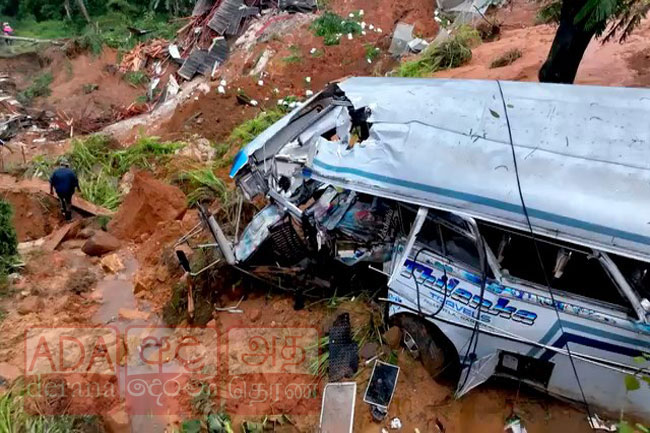
Colombo, Dec. 3 (Daily Mirror) – Opposition Leader Sajith Premadasa said that the Samagi Jana Balawegaya (SJB) will take strict disciplinary action against members of the Kandy Municipal Council who reportedly obstructed relief efforts by volunteers in the district.
Speaking on behalf of the party, Premadasa apologised to residents affected by the councillors’ actions. On behalf of the SJB, I sincerely apologise to those who may have been hurt by the bad behaviour and unwarranted actions of those Municipal Councillors,” he said.
The incident occurred at a relief collection centre set up by volunteers to assist residents impacted by severe flooding and landslides in Kandy. Some opposition councillors allegedly attempted to block the operation, prompting public criticism.
The @sjbsrilanka will take strict disciplinary action against those members of the Kandy Municipal Council who objected and obstructed the provision of relief by Soome and his team of volunteers. On behalf of the SJB, I sincerely apologise to those who may have been hurt by the… pic.twitter.com/cH8gO03qUw
Former President and United National Party (UNP) Leader Ranil Wickremesinghe stated today (3) that the country’s Constitution stands violated and accused the Janatha Vimukthi Peramuna (JVP) of running the country from their Pelawatta office.
Speaking at a meeting with party leaders and representatives, he claimed that the President’s and Prime Minister’s offices are not operational centres.
He demanded that all party leaders must unite to ensure the power operating from the Pelawatta office transfers back to Parliament.
Wickremesinghe pointed out that the main reason the current disaster escalated is the Government’s failure to abide by the Constitution and disaster protocols.
Lack of Preparedness and Political Interference:
· Plan Non-Implementation: While workshops and seminars were held in 2025 to educate state institutions on the 2023-2030 National Disaster Management Plan, the provisions of the Disaster Management Act were not implemented on Thursday, 27 November.
· Holiday Declared: Declaring Friday, 28 November, a holiday rendered all departments, divisions, and officers assigned tasks under the disaster plan inactive.
· Aid Politicisation: Aid distribution stood politicised, circumventing Parliament, the Cabinet, and the Disaster Management Centre (DMC), while a parallel disaster relief fund was established.
· Lack of Strategy: No strategy exists to confront the disaster, nor are there plans for rehabilitation and restoration.
Given the government’s lack of experience, Wickremesinghe called for the immediate appointment of two new Parliamentary bodies:
· Oversight Committee: Parliament needs to appoint an Oversight Committee on Disaster Management and Reconstruction, chaired by an experienced MP (such as Kabir Hashim). It should include equal numbers of experienced MPs from the government and opposition, and appoint an economic unit to assess the short- and long-term economic consequences of the disaster.
· Select Committee (PSC): A Parliamentary Select Committee must be immediately appointed, chaired by an opposition MP with equal members from government and opposition, to report on the lapses in disaster management pertaining to 28 November. This committee must submit its final report within six months.
Wickremesinghe gave a grim economic forecast, stating the damage and reconstruction costs will exceed 15% of GDP in the medium term. He also noted that the IMF agreement primary surplus target stands reduced from 2.3% to 2%.
· Foreign Aid: Assistance from the US, UK, and the EU for rebuilding efforts may not materialise, with the US already having declined to provide aid for reconstruction.
· Long-Term Loans: Sri Lanka, along with Indonesia, Thailand, and Malaysia, are four countries affected by this weather pattern. Discussions for long-term loans at concessional rates must begin with development banks such as ADB, AIIB, JBIC, and KOICA. India’s assistance should be sought for railway reconstruction.
The former President concluded by reiterating his core political charge:
“The Constitution is violated today. This is the main reason this catastrophe happened. The JVP Political Bureau in Pelawatta is exercising state power today. There are no operational centres in the Presidential and Prime Ministerial offices. The JVP headquarters in Pelawatta became the office, and the President went to the Ministry of Defence. Party leaders must be summoned and decide to ensure that power transfers back to Parliament from Pelawatta.”
Comments Off on Ex-President Ranil Wickremesinghe claims constitution violated
The application period for the 10th phase of the interest-free student loan scheme has been extended until December 15, according to the Ministry of Education, Higher Education and Vocational Education.
Previously, the application period was only from November 01, 2025 to November 30, 2025.
However, the Ministry has stated that the deadline has been extended due to the prevailing disaster situation in Sri Lanka.
It is further stated that this decision was made after considering requests from students who appeared for the G.C.E. Advanced Level examination in 2022, 2023, or 2024 as their first or second attempt, as well as those who appeared for the A/L examination again in 2025.
The death toll due to the adverse weather conditions experienced in the country in the past few days caused by Cyclone Ditwah has increased to 479 as of 4:00 p.m. today (03), the Disaster Management Center (DMC) has confirmed.
The DMC also reported that at least 350 individuals still remain missing as search and relief operations continue across multiple districts.
Comments Off on Sri Lanka’s death toll due to Cyclone Ditwah climbs to 479
In this deeply candid and philosophical talk, Kishore Mahbubani confronts the most uncomfortable truth in geopolitics: The West’s struggle with China is not only about power — it’s about psychology, race, and history. For the first time in 200 years, a non-Western, non-white civilization is rising to global leadership. And beneath the rhetoric of rules-based order” and democracy vs autocracy,” Mahbubani reveals the hidden anxiety shaping Western policy — the fear of losing cultural primacy.
In this talk, you’ll learn: 🧠 Why America’s rivalry with China feels more emotional than strategic ⚔️ How the Yellow Peril” myth still echoes in 21st-century geopolitics 📚 Why the West struggles to accept that modernity is no longer exclusively Western 🌐 How China’s rise represents a fusion, not a clash, of civilizations 🤝 Why the future depends on making the world safe for diversity,” not uniformity Mahbubani draws from personal experience, colonial memory, and global history to ask the defining question of our century: Can the West accept equality — not just in power, but in civilization? His answer is hopeful: the world is big enough for both America and China, for Western democracy and Eastern meritocracy. But only if we dismantle the Unspoken Barrier — the belief that modernity must wear a Western face.
Comments Off on The First ‘Non-White’ Superpower: The Unspoken Barrier
As Sri Lankan-Canadians we are devastated by the natural disaster in Sri Lanka that has caused death and destruction – which is unprecedented in the history of Sri Lanka. Heavy torrential rain, hurricane winds caused by a deadly cyclone named “Ditwah” has played havoc resulting in widespread devastation across the country, causing death, displacing thousands, destroying homes and properties, and leaving a large number of families without access to food, medicine, and clean water. The scale of this disaster is unimaginable and will take months, if not years to recover the livelihood of its people. Not to mention its severe effects on the economy, and the society due to serious damages to schools, hospitals, farms, and other vital services and infrastructure including electricity, communications, roads, etc.
In other words, Sri Lanka will need massive amounts of aid and support from the international community, for its people to recover their enormous losses in their lives, which are completely destroyed. We are thankful that its neighbours like India, Pakistan, and other countries such as Australia, the United States, etc., have come forward to help in its hour of need.
Therefore, as Canadians of Sri Lankan origin living in this great country, we kindly appeal to the Canadian Government and its aid agencies to help our motherland, and our people in the hour of their desperate needs. The entire island from east to west and from north to south has been hit by this vicious cyclone, damaging the country beyond belief. No part of the country has been spared. Every region is a disaster area unfortunately. https://www.youtube.com/watch?v=E9u-5QuTuh8
As you already know, Canada is home to one of the largest Sri Lankan Diaspora communities outside of Sri Lanka. Therefore, every one of us in the Sri Lankan Diaspora community – be they Sinhalese, Tamil, Muslim, Malay or Burgher, are deeply affected by this massive disaster. When a natural disaster hits a country it does not discriminate among ethnic, religious, or social status of its citizens. The fury of nature is felt equally by all the citizens causing misery and mayhem for everyone.
Therefore, we kindly appeal to the Canadian government to help Sri Lanka as much as possible so that her citizens can regain their livelihood and normalcy, they once had before this disaster. There are many ways Canada can help, especially financially which will go a long way enabling Sri Lanka to provide essential items immediately, such as food, medicine, hospital equipment, etc. There are no words to describe the misery and pain the entire country is feeling right now, as they have been already trying to cope with the economic disaster that nearly bankrupted the country a few years ago.
As a result, not only Sri Lankan-Canadians, but Sri Lankans everywhere will be extremely grateful if Canada, a country well-known for its generosity and compassion around the world – will take the lead and help Sri Lanka and its people to recover from this devastating natural disaster.
Your generous support, and prompt response to this urgent matter will be greatly appreciated by all Sri Lankans.
Thank you.
Sincerely,
D. Jaliya Wickremarachchi
President
Sri Lanka Canada Association of Markham
(SLCAM)
Comments Off on AN URGENT APPEAL TO THE RIGHT HONORABLE PRIME MINISTER MR. MARK CARNEY
Sri Lanka stands at a crossroads. At a time when hundreds of our own people have died, thousands are displaced, and entire villages lie in ruins from catastrophic floods and landslides, the Government’s decision to declare a Sri Lankan Day” is not only insensitive — it is profoundly dangerous for the cultural and historical integrity of this nation.
A National Identity cannot be manufactured overnight
For over 2,500 years, this island’s civilizational foundation was built by the Sinhala Buddhist heritage — a heritage that shaped the language, the law, the temple, the tank, and the village.
This is not a political claim.”
It is recorded in the Mahavamsa, Deepavamsa, Pujavaliya, Attanagaluvamsa, and dozens of inscriptions and it has been openly acknowledged by colonial rulers for centuries.
To erase this historical truth under the guise of creating a new uniform identity” is an attempt to uproot the very pillars that hold this country together. The aim is to sever people from their roots, indoctrinating their minds with a new ideology packaged as modern and progressive.” This is precisely what the new global education curriculum seeks to do — using funding and conditional aid to pressure national governments into adopting content that reshapes cultural thinking from childhood upward.
Working hand-in-hand with this agenda are powerful media-driven campaigns that promote the idea that history has no value, heritage is irrelevant, rituals are pointless, and customs are outdated. These narratives extend to dismissing respect for elders and undermining the role of religion in society. The end result is a culture that over-glorifies individualism — not to empower people, but to isolate them, weakening community bonds and making individuals easier targets for exploitation and influence.
Attacks on cultural, historical and religious Identity are not new
History has repeatedly shown attempts to suppress or diminish Buddhist heritage:
Ancient temples destroyed or converted during South Indian invasions and colonial rule
Buddhist land and monuments seized under colonial Portuguese, Dutch, British administrations
Post-independence neglect of archaeological sites
Attempts to discourage Buddhist rituals in national ceremonies
Recurrent obstruction of archaeological preservation in the North and East
Organized campaigns to rewrite history and present the island as plural from inception,” ignoring Sri Lanka’s documented civilizational origin
Varied attempts to re-write the Constitution primarily to remove Article 9 and provisions that tie the Sinhala Buddhist heritage to the present.
Even today, there are coordinated efforts to sideline Buddhist cultural symbols — such as omitting the Jaya Mangala Gatha from parliamentary openings or discouraging traditional blessings in state events. These actions are symbolic but extremely telling: remove the rituals, remove the identity.
The danger of replacing history with a pseudo identity
Every ethnicity and religion on this island must be respected.
But respect does not mean replacing one’s heritage with an artificial, politically engineered new identity.”
Sri Lankans do not need an official celebration” to be united.
Unity comes from justice, fairness, and respect for each group’s traditions—not from forced rebranding.
Settler communities and the attempt to redraw the country
The colonial rulers in particular the British brought several groups as plantation labour and service communities, with intention of permanently altering Sri Lanka’s demography and political boundaries.
Today, some actors use colonial settlement patterns as justification to carve out new ethnic regions or claim ancient Buddhist sites as shared land” without historical basis.
This is fragmentation under the guise of political correctness.
Even the world is rejecting the multiculturalism model
Political correctness and forced multiculturalism have destroyed nations” —
Leaders who publicly declared multiculturalism a failure
Germany — Angela Merkel (former Chancellor of Germany)
This multicultural approach has failed, utterly failed.”
(Speech in Potsdam, 2010)
Merkel acknowledged that Germany’s attempt to build a society with separate cultural enclaves living side by side did not work.”
UK — David Cameron (former Prime Minister)
State multiculturalism has failed.”
(Munich Security Conference, 2011)
Cameron warned that forced multiculturalism created segregated communities and encouraged extremism by eroding national cohesion.
France — Nicolas Sarkozy (former President)
Multiculturalism is a failure. We have been too concerned with the identity of the person coming and not enough with the identity of the country receiving them.” (Television interview, 2011)
Sarkozy noted that immigrant groups in France were living in parallel societies detached from French values.
European Union Leaders
EU Commissioner Viviane Reding
We have been naive. Europe has clearly underestimated the challenge of migration.” (2015)
She acknowledged that political correctness prevented honest discussions about integration problems.
Examples where forced multiculturalism backfired
United Kingdom
Creation of parallel communitieswith minimal integration.
2011 and 2020 street riots partly linked to cultural segregation.
Grooming gang” scandals where political correctness prevented authorities from acting for years.
France
Major suburban ghettos (banlieues) where French law is secondary to local community rules.
Riots in 2005, 2017, and 2023 connected to failed integration models.
Regular complaints by French mayors that the Republic no longer exists in certain areas.”
Germany
Rising ethnic-based enclaves where German language and norms are not followed.
Migrant-related tensions after the 2015 refugee wave.
Police unions warning that political correctness stopped early intervention.
Scholars & Thinkers Warning About Political Correctness
Samuel Huntington (Harvard University)
Author of The Clash of Civilizations:
Without core values, a society disintegrates.”
He warned that weakening national identity leads to internal fragmentation.
Douglas Murray
Author of The Strange Death of Europe:
Europe committed suicide by rejecting its own culture and pretending all cultures are equal.”
Across Europe, its own leaders admit that political correctness and forced multiculturalism have not created unity — they have created division, cultural ghettos, social conflict, and a loss of national identity.
These are not emotional statements — they are official acknowledgements.
Why is Sri Lanka rushing to adopt a failed foreign ideology precisely when those who invented it are abandoning it?
True Racism must be called out
Racism is not acknowledging heritage or demanding its preservation or flagging dangers to the nation’s history, heritage & sacred/archaeological sites.
Racism is when:
A group claims another ethnicity cannot enter” a certain area
Signboards are placed only in one languageto claim territorial ownership
Constitutional language rights are ignored
A community demands exclusive administrative control over historical multi-religious regions
These actions fracture unity — not historical truth.
In such an environment what good is spending Rs.300m on a Sri Lankan Day”.
Who are we fooling?
Pakistan after the 2010 floods which displaced millions cancelled Pakistan Independence Day.
India following the 2018 floods in Kerala, cancelled its Onam festival and funds were redirected towards relief, rescue & rehabilitation.
Qatar cancelled its national day following the 2016 humanitarian crisis.
Entire world cancelled New Year festivities after the 2004 Tsunami.
These examples highlight the manner nations choose mourning, relief & recovery not celebration when disasters strike. It’s a moral judgement and decision. It signals solidarity with victims & prioritization for relief over celebrations. No one can trivialize the suffering with going ahead with a celebration that is not even an annual event.
Sri Lanka’s disaster warrants a similar response. The Rs.300million allocated for the Sri Lanka Day” must be redirected for relief. It is the moral responsibility of a government that honors victims not throw parades.
A Country in mourning cannot celebrate
Right now, Sri Lanka is not in a state to celebrate anything.
Hundreds have died.
Families have lost parents, children, homes, memories, livestock, documents, livelihoods.
Entire communities are sleeping in camps with only the clothes on their backs.
Kids have lost schoolbooks, uniforms, and the safety of a home.
Elderly people have no medicine.
Women have lost jewellery and savings kept for decades.
Farmers have lost harvests.
Daily-wage workers have lost their ability to work.
What families held dear was swept away or collapsed before their very eyes.
How can a nation declare a Day of Celebration” when its own people are trying to survive?
Funds must go to Rebuilding — not Ceremonies
All state funds allocated for this new Sri Lankan Day” must be reallocated directly to:
Rebuilding damaged homes
Providing emergency cash grants
Restoring livelihoods
Replacing lost school materials
Providing safe sanitation and medical support
Supporting the elderly, disabled, widows, and orphaned children
Every family must receive an amount proportional to their documented loss.
This is not charity — it is the duty of the State.
A Final Reflection
A nation is not built by celebrations.
A nation is built by truth, compassion, and heritage.
Sri Lanka must stand on its real history — not on artificially created slogans. Sri Lanka must protect its real people — not host celebrations while survivors mourn. Sri Lanka must honour its civilizational roots — not erase them for political experiments.
Unity is not created by forgetting history. Unity is created by respecting it.
This is the message the country must hear now — loudly, clearly, and without fear.
If a government insists on celebrating while its people are grieving, the public can only conclude that the government has divorced itself from the people.
When a government pushes forward with an unwanted new event in the midst of tragedy, people will inevitably see it as a leadership more concerned with image than with citizens’ suffering. This will seal proof that the celebration is only to raise the image of the government with no concern for the citizens.
No new national event” should be forced on a grieving nation – its only an attempt to distract, rebrand & rewrite history at the worst possible moment.
If the government cannot pause to respect national tragedy, people will question whether such a government still shares the same heartbeat as the nation.
Forcing a celebration that has no cultural relevance, no historical roots, and no public demand tells the country that unity is being staged—not built.
If leaders refuse to realign with the nation’s sorrow, people will conclude that the government’s priorities lie elsewhere—far from the ground reality.
Comments Off on Why declaring a “Sri Lankan Day” now Is wrong — A Nation cannot celebrate while Its people are grieving
Forget Bush’s National Missile Shield. The best military defense is a Russian winter. It got the better of King Charles XII of Sweden, sent Napoleon packing, and eventually shooed Hitler away. A few years after that, though, it was the Germans that were favored by the weather gods—for weeks, Patton’s Third Army was stuck near the edge of Germany, plagued by rain that kept American tanks and trucks and soldiers in place. The general’s solution? A prayer to those gods:
Almighty and most merciful Father, we humbly beseech Thee, of Thy great goodness, to restrain these immoderate rains with which we have had to contend. Grant us fair weather for Battle. Graciously hearken to us as soldiers who call upon Thee that, armed with Thy power, we may advance from victory to victory, and crush the oppression and wickedness of our enemies and establish Thy justice among men and nations.1
Patton was certainly not the first military leader to beseech His Great Goodness for favorable conditions. When Hannibal invaded Italy in 217 BC, he waited for the marshes to freeze so his mounted troops could pour in. In 1776, the harsh winter helped George Washington’s army, letting it move quickly across the frozen Delaware River. And in 1941, the Japanese essentially hid their aircraft carriers moving toward Pearl Harbor in a large Pacific storm.
But, to paraphrase Mark Twain, everybody prayed about the weather, but nobody did anything about it. That changed in 1946, when General Electric scientists Vincent Schaefer and Irving Langmuir created an artificial cloud by introducing dry ice into a freezer, and then developed a technique for cloud seeding,” still used today.
By the late 1950s, people began to think about our new ability to alter the weather in military terms. The Cold War was kicking into high gear, and the US intelligence community became aware that the Soviets were experimenting with cloud seeding and other kinds of weather control, such as cloud dissipation. In 1957, Henry Houghton, chair of MIT’s meteorology department, noted, I shudder to think of the consequences of a prior Russian discovery of a feasible method for weather control.”2 That same year, a Presidential Advisory Committee on Weather Control noted (with perfect deadpan sensationalism) that, weather modification could become a more important weapon than the atom bomb.”3 The weather race, though never as fierce or as public as the space race or the arms race, was on. (The Soviets really were working on weather, with the hopes of, among other things, warming its vast northern regions and removing the ice in the Arctic Sea.)
That any new technology that could be used as a weapon would be used as a weapon now seems obvious—a kind of first principle of warfare—but it is a relatively recent idea, a product of the total war” strategy of the two world wars, where tactics and weaponry became increasingly more destructive. And there was historical precedent for offensive uses of the environment. During the Franco-Dutch War of 1672–1678, for example, the Dutch breached the dikes around Amsterdam, flooding part of the low-lying country and putting the French on the defensive. (The Dutch won.)
With the political and military stage set, the US got to work on figuring out how to alter the weather, and what to do with that knowledge. Much of the work seems to have been done at the Navy’s China Lake weapons research center. Between 1949 and 1978,” the base’s in-house newspaper, The Rocketeer, reported, China Lake developed concepts, techniques, and hardware that were successfully used in hurricane abatement, fog control, and drought relief.”4
Drought relief” is an interesting way to put it. China Lake’s research caught the eye of the CIA in the early 1960s, which saw the potential of weather control in the rapidly expanding conflict in Vietnam. The CIA’s first use of the Navy’s technology was crowd dispersal. The Diem regime was having all that trouble with the Buddhists,” an agent told Seymour Hersh in 1972. They would just stand around during demonstrations when the police threw tear gas at them, but we noticed that when the rains came they wouldn’t stay on. The agency got an Air America Beechcraft and had it rigged up with silver iodide. There was another demonstration and we seeded the area. It rained.”5
In 1966, the idea of raining on Vietnam became the top-secret Project Popeye, which ran for some seven years and included more than 2,600 cloud-seeding flights over Vietnam and Laos. The objective was simple: Make rain that would make or keep the Ho Chi Minh Trail—a main supply route for the North Vietnamese—so muddy that it was unusable. (Why Popeye”? The artificially created rain was apparently called Olive Oil.”)
The story of the top-secret project—flown by the Air Force but controlled by the CIA and the White House—was broken in 1971 in Jack Anderson’s national newspaper column, then, to greater fanfare, in July 1972, with Hersh’s front-page story in the New York Times. And while there were no rules at the time about weather modification—or any environmental warfare, for that matter—the Nixon administration was not happy with Hersh’s revelations. The White House and the State Department declined comment, and one unnamed official said, This is one of those things where no one is going to say anything.”6 (People said even less about CIA weather modification in Cuba. During 1969 and 1970, planes from China Lake seeded clouds that rained over non-agricultural regions of Cuba, leaving at least some of the country’s sugar cane fields dry.)
The eventual response was an international treaty, the Convention on the Prohibition of Military or Any Other Hostile Use of Environmental Modification Techniques, or ENMOD, which entered into force in 1978. The main tenet of the treaty, which stands today, is this: Each State Party to this Convention undertakes not to engage in military or any other hostile use of environmental modification techniques having widespread, long-lasting or severe effects as the means of destruction, damage or injury to any other State Party.”7
Weather control activities seem to have quieted down after ENMOD, but fortunately for the US military, the treaty has a loophole big enough to drive a truck through: It prohibits only action with widespread, long-lasting or severe effects.” When Air Force intelligence analysts turned their thoughts to the weather in the mid-1990s, they made up their own definition of these limits: widespread means affecting more than several hundred kilometers; long-lasting means for a period of months; and severe involves serious or significant disruption or harm to human life, natural or economic resources, or other assets.”8 Which is to say that, except for the human life part, most military applications, which tend to be short-term and localized, are allowed. These analysts’ conclusions are contained in an extraordinary report, published in 1996, called Weather as a Force Multiplier: Owning the Weather in 2025.” If the US intelligence community did ignore the weather for a while, Owning the Weather” certainly made up for it. Envisioning a world where technology has made control over the local weather phenomena much more precise—and where a global network of sensors has greatly increased available atmospheric data—the writers declare that in three decades time, US aerospace forces can ‘own the weather,’” and shape the battlespace in ways never before possible.”9
While Owning the Weather” relies primarily on extensions of existing weather modification techniques, the authors strike more boldly into the future with speculation about nanotechnology-based artificial weather.” A cloud, or several clouds, of microscopic computer particles,” they note, all communicating with each other and with a larger control system could provide tremendous capability. Interconnected, atmospherically buoyant, and having navigation capability in three dimensions, such clouds could be designed to have a wide range of properties.”10
At times, the Air Force report reads like a declaration to violate the ENMOD agreement. The authors even note that the only reason they don’t discuss more serious weather control—made-to-order weather, large-scale climate modification, control of storms, etc.—is that it won’t be technically feasible by 2025. Such applications would have been included in this report as potential military options,” they note, despite their controversial and potentially malevolent nature and their inconsistency with standing UN agreements to which the US is a signatory.”11
Why is the United States so interested in the weather that it would violate international treaty? The answer may lie more in the psyche of the government than in specific tactical advantages. The US military has long been used to having a stacked deck. The US Navy once owned the seas; later, the Air Force had the run of the skies. For a while, our sole possession of the atomic and hydrogen bombs gave us the ultimate” weapon. Dominion over the atmosphere might be the next ultimate” weapon, proof not only of military invincibility but perhaps, finally, of Divine Right.
To see a page from UN Resolution 3264 (1974) which prohibits military interference with the environment, see here.
Msgr. James H. O’Neill, The True Story of the Patton Prayer,” The Review of the News, 6 October 1971, available at http://members.aol.com/PattonsGHQ/prayer.html [link defunct—Eds.].
United States House of Representatives Committee on Interstate and Foreign Commerce, Subcommittee on Health and Science, Weather Modification Research: Hearings Before the Subcommittee on Health and Science. Eighty-fifth Congress, Second Session, 18-19 March 1958 (Washington, DC: US Government Printing Office, 1958), p. 55, as quoted in Nayef H. Samhat, A Genealogy of Climate Change,” Online Journal of Peace and Conflict Resolution, vol. 1, no. 4 (November 1998), at http://members.aol.com/ peacejnl/1_4samhat.htm [link defunct—Eds.].
M.S. Venkataramani, To Own The Weather,” Frontline (Chennai, India), 16–29 January 1999, www.frontlineonline.com/ fl1602/16020790.htm [link defunct—Eds.].
China Lake Weapons Digest: 50 Years of Providing the Fleet with the Tools of the Trade,” The Rocketeer, 4 November 1993. Reprinted at www.nawcwpns.navy.mil/~bronkhor/ clmf/weapdig.html [link defunct—Eds.].
Convention on the Prohibition of Military or Any Other Hostile Use of Environmental Modification Techniques,” 1108 U.N.T.S. 151, entered into force on 5 October 1978. Available at www.un-documents.net/enmod.htm.
In The Cult of the Goddess Pattini (1984), Gananath Obeyesekere analyzes the historical, sociological, and psychological aspects of the Pattini cult in Sri Lanka, examining the goddess’s syncretic nature and challenging conventional interpretations of South Asian religion.
Obeyesekere mentions that his study of the Cult of the Goddess Pattini was his inaugural field research, a project guided by Lyn Ludowyk. He emphasizes that this exploration of Pattini has influenced the entirety of his anthropological career. In his view, Obeyesekere portrays him as an Anthropological Don Quixote.
Obeyesekere explores the psychological dimensions of the goddess’s myths and associated rituals. He highlights the syncretic dimensions of the cult, its relation to sociocultural change and Sanskritization, and the gender dynamics within the Pattini myth.
The worship of Goddess Pattini holds significant historical importance in Sri Lanka, as it reflects centuries of cultural exchange, religious syncretism, and the enduring nature of folk beliefs. The worship has been deeply integrated into the Sinhala Buddhist and Tamil Hindu traditions; the cult offers a window into the island’s complex religious and social history.
Folk Religion
The veneration of Goddess Pattini (or Kannaki Amman) is considered a significant part of folk religion that involves numerous folk rituals and ceremonies. Folk cult has been established on the grounds of actualized and modified motives (Souček & Karásek, 2022). People are attracted to fork religions primarily to fulfill deep psychological and social needs. During times of transition or crisis, people seek a sense of purpose or direction in life. Moreover, it offers emotional support, community belonging and a feeling of security, helping individuals cope with anxiety and ongoing life stresses.
The Cult of the Goddess Pattini is largely syncretic and community-based, focused on immediate, worldly concerns, and operates outside the formal, scriptural-based doctrines of Theravada Buddhism. The integration of indigenous beliefs is evident in Pattni worship, which emphasizes the fulfillment of earthly desires. This cult is characterized by its poetic verses and folk dramas, showcasing a vibrant oral tradition.
The Origin
The origins of Pattini worship are rooted in South India. Her worship originates from the central character, Kannagi, of the Tamil epic Cilappatikāram (The Tale of an Ankle), but her story and cult have evolved differently among Sinhalese and Tamil traditions in Sri Lanka.
King Gajabahu of Sri Lanka, who reigned from 171 to 193 AD, played a fundamental role in the introduction of the Pattini Puja to the island. He established a temple dedicated to the Goddess Pattini and conducted daily rituals in her honour, thereby embedding her worship into the cultural fabric of Sri Lankan society.
Historical evidence indicates that the formalization of Pattini Puja in Sri Lanka occurred between the fifth and the sixteenth centuries. The Sinhala text Poojavaliya, thought to have been composed in the 13th century, references King Gajabahu and highlights the royal support for the worship of Pattini.
Notable figures such as King Mayadunne of Sitawaka (the founder and ruler of the Sitawaka Kingdom from 1521 to 1581), King Rajasinghe of Sitawaka (reigned 1581–1593), and King Wimaladharma Suriya I (king of Kandy from 1592 to 1604) are recognized for their patronage, which significantly contributed to the proliferation of this faith throughout the region.
The worship of Goddess Pattini in Sri Lanka is commonly associated with King Gajabahu I, who allegedly promoted the cult during his reign in the 2nd century CE. However, this narrative is challenged by scholar Gananath Obeyesekere. He posits that the story might be a constructed myth meant to account for the cult’s presence in Sri Lanka, emphasizing that it actually has its roots in South India.
Obeyesekere interprets the supposed “Gajabahu synchronism” as a metaphorical representation of the historical settlement and cultural impact of South Indians in certain regions of Sri Lanka. He argues that the Pattini cult was likely brought to Sri Lanka by colonists from Kerala after the 10th century, suggesting a timeline that contrasts with the traditional belief in a 2nd-century origin. In sum, while the legend ties Goddess Pattini’s worship to King Gajabahu I, Obeyesekere views this as a myth rather than a factual account. He believes this narrative emerged for socio-political reasons long after the time of the king. His assertion about the cult’s true origins in South India and the later introduction into Sri Lanka aligns with a revised understanding of the historical context.
The Gender Dynamics
The Pattini myth presents a complex interplay of gender dynamics that reflects the cultural and societal norms of the time. Central to the narrative is the figure of Pattini, who embodies both feminine virtues and assertive agency, challenging traditional gender roles. Her story often highlights themes of sacrifice, loyalty, and the struggle for justice, positioning her as a powerful female archetype within a patriarchal framework. The myth explores the tension between male authority and female empowerment. The cult is a model of female power, and it challenges traditional patriarchal norms.
The Female Archetype
Obeyesekere identifies a complex and multifaceted female archetype in the cult of the Goddess Pattini. The female archetype of the Pattini cult is complex and dynamic, embodying a spectrum of female power that spans from the ideal, chaste wife and mother to a fierce, avenging deity with immense, destructive power. Although there is no direct, historically or anthropologically proven link between the specific Mother Goddess figurines found in the Mohenjo-Daro (Indus Valley) civilization and the South Indian/Sri Lankan Pattini cult, scholarly research points to a connection in the broader, continuous tradition of mother goddess worship in the Indian subcontinent, suggesting a shared archetypeor underlying cultural reverence for the divine feminine.
Religious Syncretism
The Pattini cult is a classic example of religious syncretism, where a Hindu goddess was incorporated into the Theravada Buddhist pantheon in Sri Lanka. It’s an indicator that highlights how religious traditions can merge and coexist in Sri Lankan society. The historical evolution of religious syncretism in the Pattini cult can be traced through a process of initial introduction, political integration, and gradual, organic blending with local beliefs over centuries in Sri Lanka.
Sri Lankan Buddhists embrace the worship of Goddess Pattini through a process of syncretism, which blends indigenous folk beliefs and South Indian Hindu traditions with their practice of Theravada Buddhism. This practice is not seen as contradictory to their Buddhist faith but rather as a complementary way to address immediate, worldly concerns that the core Buddhist doctrine does not focus on.
Hindu-Buddhist Synergism in Sri Lankan Pattini Worship
Samarakoon and Herapathdeniya (2021) describe Hindu-Buddhist synergism in Sri Lankan Pattini worship as a notable cultural phenomenon involving the integration of a Hindu deity into a local Buddhist framework. Originally South Indian Hindu goddess (Kannaki) was seamlessly incorporated and transformed into a prominent Sinhalese Buddhist deity Pattini. This shared devotion acts as a significant cultural and social bridge between the two major ethnic groups in Sri Lanka. Transformation into a Bodhisattva: In the Buddhist context, the goddess is not merely a lesser deity but is elevated to the status of a Bodhisattva, a being aspiring to attain Buddhahood. This integration allows her worship to fit within the Theravada Buddhist worldview, which does not typically prioritize female deities at a supreme level. Both communities share similar beliefs about the goddess’s powers, particularly her ability to grant fertility, health, and protection from infectious diseases. Ranganath (2015). discusses the cultural adaptation of Pattini cult and its Hindu-Buddhist synergism.
Cultural Significance
Pattini worship holds a central and complex place within the culture of Sri Lanka. Revered as a symbol of justice, fertility, and healing, Pattini’s veneration transcends religious divides, attracting both Sinhala Buddhists and Tamil Hindus to her cult. This shared devotion illustrates a rich cultural heritage that endures despite the differing religious beliefs of these communities. Obeyesekere emphasizes that shared devotion and similar ritual practices act as a cultural and social bridge between these two ethnic groups. Moreover, Pattini worship illustrates how communities navigate their cultural identities through the lens of spirituality. According to de Alwis (2018), Pattini worship indicates cultural resilience in Sri Lanka.
The Psychological Role of Pattini Worship
According to Obeyesekere, the cult and its associated rituals serve as a mechanism for externalizing and addressing deep-seated individual psychological anxieties, particularly related to women’s status, sexuality, and reproduction, within a culturally sanctioned framework. Obeyesekere provided a psychoanalytic and syncretic analysis of Pattini worship in Sri Lanka and South India. He explored how religious myth and ritual provide socially sanctioned ways of expressing unconscious conflicts and anxieties, and how this practice both incorporates and transforms different religious traditions.
By employing psychoanalytic theory, Obeyesekere examines the unconscious motivations that drive individuals to seek solace and meaning in Pattini’s worship, suggesting that her veneration serves as a mechanism for coping with existential anxieties and societal pressures. Furthermore, his syncretic approach highlights the blending of various religious traditions and cultural influences that shape Pattini worship, illustrating how this practice not only preserves ancient beliefs but also adapts to contemporary contexts.
Psychologically, the cult offers insights into the collective consciousness of the Sri Lankan people, revealing how rituals and narratives surrounding Pattini provide a framework for understanding concepts of fertility, health, and protection. The veneration of Pattini not only reinforces community bonds but also serves as a coping mechanism for individuals facing life’s uncertainties, thereby highlighting the cult’s dual role as both a spiritual and social institution. Weerakkody (2022) indicates psychological catharsis and therapeutic benefit for participants and the community by allowing for emotional release, acting as group therapy through shared social behaviour.
Psycho-trauma and Healing
Obeyesekere considered the Pattini cult to be a medical system, as its rituals focus on the treatment, management, and prevention of diseases. Pattini worship provides a powerful framework for psycho-trauma healing through catharsis, community support, symbolic expression of conflict, and narrative therapy, transforming private anxieties into public, shared experiences. Covid time.” ResearchGate. According to Jayasena (2021) the Pattini cult in Sri Lanka served as a vital source of spiritual support and a traditional healing system during the COVID-19 pandemic.
A victim of psycho-trauma can heal themselves through a process that transforms private suffering into a communal, culturally validated experience. Piyarathne (2021) indicates that the Pattini worshipping cult in Sri Lanka exemplifies how indigenous cultural practices serve as an effective community-based mechanism for disaster preparedness and survival. The collective nature of the worship transforms individual trauma into a shared social experience.
References
de Alwis, M. (2018). “The incorporation and transformation of a ‘Hindu’ goddess: the worship of Kannaki-Pattini in Sri Lanka.” The South Asianist, 6(1), 150–180.
Jayasena, N. (2021). “Pattini Cult in Sri Lanka and how it worked in Covid time. ResearchGate.
Obeyesekere, G. (1981). In The Cult of the Goddess Pattini.University of Chicago Press.
Piyarathne, A. (2021). The Pattini worshiping cult and indigenous approach to negotiating natural disasters in Sri Lanka. OURS.
Ranganath, G. I. Y. (2015). “An Exploratory Study of the Cult of Pattini in South Indian and Sri Lanka Societies based on Silappadikaram and Panthis Kolmura.” International Conference on the Humanities 2015.
Samarakoon, P. S. M., & Herapathdeniya, S. K. M. K. (2021). “The Pattini Cult: A review on the beliefs on a female deity venerated by people in Sri Lanka and the Hindu-Buddhist synergism in Sri Lanka.” World Wide Journal of Multidisciplinary Research and Development, 7(3), 75-77.
Souček I, Karásek M. The Wedding with a Stolen Goddess: The Ethnography of a Cult in Rural Tamil Nadu. J Relig Health. 2022 Jun;61(3):2500-2513. doi: 10.1007/s10943-020-01010-x. PMID: 32221757.
Weerakkody, I.S (2022). The Lament of Goddess Pattini and its Therapeutic aspect with Reference to the Mara- Ipaddaweema (Killing and Resurrecting). International Research Journal of Social Sciences ISSN 2319–3565 Vol. 11(3), 36-46.
Comments Off on Psychological and Anthropological Analysis of the Pattini Cult’s Role in Sri Lankan Culture
The All-Ceylon Buddhist Congress (ACBC) was the first institution in post-independence Sri Lanka to investigate colonial-era crimes and their impact
, culminating in the 1956 publication of the Buddhist Commission Report. This report, popularly known as the Buddhist Commission Report (or in its abridged English version, The Betrayal of Buddhism), detailed the historical injustices faced by the Buddhist community under centuries of colonial rule and in the post-independence era, including the neglect of Buddhism under colonial rule, and was a significant event in Sri Lankan political and cultural history.
Investigation and report: In 1954, the ACBC established a Buddhist Committee of Inquiry to examine the status of Buddhism on the island. The committee’s findings were published in February 1956 in a report that became popularly known as the Buddhist Commission Report.
Findings: The report argued that centuries of European colonialism under the Portuguese, Dutch and the British had privileged Christianity, leading to the decline of Buddhism. It also criticized post-independence governments for not rectifying the damage done and pointed to the disproportionate Christian control over educational institutions.
Recommendations: Key recommendations included the establishment of a Buddhist Sasana Council with the power to support and foster Buddhism and the withdrawal of government grants to Christian schools.
The report’s findings had a significant impact on the country’s political landscape, particularly the 1956 general election, and led to major social and educational reforms in Sri Lanka. The government of the time had previously declined to appoint a state commission to investigate these grievances, citing constitutional constraints, prompting the ACBC to conduct its own independent investigation.
Impact: Furthermore the report had a significant impact on Sri Lanka’s political, cultural, and social history, and some of its recommendations influenced later government policies.
Comments Off on All Ceylon Buddhist Congress was the first institution in post – independence Sri Lanka to investigate colonial – era crimes and their impact
‘Before you study the economics, study the economists!’
e-Con e-News 23-29 November 2025
The US military has been given unrestricted access to all Sri Lankan ports, including Hambantota port, & airports through an Acquisition & Cross-Servicing Agreement (ACSA). The Sri Lankan government is supposed to have secretly signed ACSA (7 pages) in 2007, for 10 years. The USA subsequently provided satellite intelligence that facilitated the Sri Lanka government’s defeat of the LTTE.
To ensure theACSA would be secretly re-signed in 2017, with 10-times more concessions (83 pages), the USA engineered & funded that awkward coalition of the Yahapalanaya, mashing together a rump SLFP, UNP & JVP in 2015. Yet they were unable to force the then-President to sign the SOFA (Status of Forces Agreement), which would have allowed US boots on Sri Lankan soil, nor finalize the MCC (Millennium Challenge Corporation) to enable deeper economic penetration (see ee Random Notes). They were also unable to prevent the election of Gotabhaya Rajapakse, though they soon engineered scarcities and an economic crisis, funding and fomenting a faux putsch, enabling his removal (but not his hanging) which ended up sending the country into the scaly arms of the IMF for a 17th time. ‘Regime change’ indeed, yet the colonial import-export plantation fraud that has ruled the country for almost 200 years, was retained.
ACSA is due to be extended again in 2027. The USA is plotting, to ensure another ACSA extension; watch the political, military & economic moves they have been making.
*
The NPP government has sought to ‘calm’ investors about its capacity to scale the 2028 post-IMF ‘debt-repayment cliff’. ‘There is a little bit of an unwanted fear,’ Deputy Industry & Entrepreneurship Development Minister Chathuranga Abeysinghe told an online forum last week organised by England’s Tellimer (‘an emerging markets investment banking boutique’) and Softlogic Stockbrokers. The USA will make any easing of their IMF terms for the heavy repayments to Wall Street, contingent on whether the Sri Lankan government extends the ACSA agreement and signs the SOFA (Status of Forces Agreement). Can they make Sri Lanka jump off that cliff?!
*
‘Was signing [the Montana] agreement a political condition
for the reduction in tariffs? Is this MoU a precursor
to signing a SOFA with the USA? Will Sri Lanka’s
military, naval & air force infrastructure facilities,
as well as Sri Lanka’s ports & airports, be placed at
the disposal of the US war machine? Is Sri Lanka
to be a pawn in US military aggression in Asia?’
– CPSL
*
With the USA ready to launch yet another war, in the Americas this time, instead of resolving its own drastic problems, the NPP has not answered the Communist Party of Sri Lanka’s questions: if the recent ‘hasty’ defence partnership between the Montana National Guard, US Coast Guard District 13, and the Sri Lanka Armed Forces under the US Department of War’s State Partnership Program (SPP) entailed any military agreement for boots on the ground? & where exactly on the seabed will the boots of those unnamed experts from the USA’s National Oceanic & Atmospheric Administration (NOAA) of the US Department of Commerce and the US Navy’s Meteorology & Oceanography Command (NMOC) who recently entered the country, dive off & land on?
*
The recent terrorist attacks in both Pakistan & India, were coordinated by the US through its agents in both countries. They are said to be preludes to sabotaging the upcoming tête-à-tête between Indian PM N Modi & Russian President V Putin in December. The incendiary comments by Japan’s government leaders to inflame China is being prompted by the USA, despite their blather about promoting peace. The aim is to divide what many see as an emerging – logical though winding & protracted – attempt at uniting the world against fascism.
*
Capitalism is seeking to revive itself again through another world war – the Nobel Economics Prize was handed over to those who theorize ‘disruption’ (Hint! Hint!) to restore capitalism, and the Nobel peace Prizes to those who promote chaos & confrontation. ee continues Roy Singham’s arithmetic of ‘Who Really Defeated Fascism’, during what the whites call World War 2 (1939-45), which actually began much earlier in Asia and Africa, and witnessed the mass slaughter of 85 million human beings! While Hollywood & BBC, in movies & documentaries, like Bridge over River Kwai and Dunkirk only recall the suffering of whites, Singham calculates the real toll, including SE Asia & Africa (where WW2 actually began in 1935, when Italy invaded Ethiopia) – nearly 1 million Africans fought in that war, only to be returned to colonial servitude after. England, rather than taking on the Nazis outright, had first sought to preserve its colonial possessions, while the US manoeuvred to profit from the war, arming Japanese imperialists & the Nazis. It was the USSR & China, Asians & Africans, that took the brunt of the racialized genocides, forced-labour systems, & famines. Singham offers a forensic, meticulous recounting, never accounted before (see ee Focus).
*
‘50-80% of Sudan’s overall gold production was
being still smuggled in 2022 – mainly to the UAE –
rather than officially exported’
(see ee Sovereignty, Sudan needs peace)
The horrific role played by the Emirates in the Sudan, backed by the usual suspects (US, England, Israel, EU), requires deeper examination. ee Focus concludes Joseph Garang’s essay on ‘The Southern Sudan’. Written over 50 years ago, Garang is no longer alive, but his study still contextualizes today’s news by providing the historical and political underpinnings to the meddling that has taken place after that country’s ‘independence’ from England & Egypt in 1956. A decade later, not a single representative in their parliament was a ‘peasant’ in a country 90% populated by cultivators. So-called leaders preferred to strike deals to divide the country, rather than unite with progressive forces north & south. Published in The African Communist in 1969, the essay helps sensitize us to the present upheaval in the Sudan (just across the pond from us), and the part played by England’s racialized colonialism (all too familiar to us). One of Sudan’s foremost progressive theoreticians & member of the Sudanese Communist Party, Garang was executed in 1971 by the then Sudanese government.
*
Though criminally ignored by the English media, learning about Sudan remains very important for us. Several colonial governors and officials in Ceylon first practised their terroristic arts in Africa (and Sudan in particular). SBD de Silva, to whom this blog is dedicated, stands out as an original researcher who dared examine imperialism’s practices in Africa, and the lessons and the insights African history offered as precedent to and concomitant with, Europe’s and newer Anglo-American invasions of Sri Lanka.
*
With Sri Lanka experiencing heavy floods this week, we recall: Just like Karl Marx in his final years, SBD de Silva in his sunset moments studied more closely the nature of Sri Lanka’s ancient villages & agriculture, based on the disciplined organization of the irrigation system. SBD recorded the colonial destruction of the irrigation system to undermine the old society, and impose the plantation system (and the failure of the English & post-1948 attempts to revive the old system of waterways). The English bestowed upon us the most impoverished peasantry in Asia. SBD de Silva noted the need for monetization and commercialization – hitherto prevented – of the peasantry, as the basis for a rural home market This was vital to reviving and advancing rural industrialization in coordination with the traditional cycles of rural agriculture.
*
Comparing and contrasting countries, side by side, in southern Africa, settler-colonial and non-settler, was the subject of last week’s excerpt from Chapter 4 of SBD de Silva’s classic, The Political Economy of Underdevelopment. He examined their investment patterns, the nature of their productions, and the settlers’ determined reliance on a home market (vs the constant whining for exports & foreign investment in non-settler colonies like ours). The last excerpt specifically noted the significance of a white settler working-class presence that hot-housed modern industrial growth.
This ee Focus continues the Chapter, this time looking at the nature of settler economies in northern Africa. Algeria had more than a million Europeans, Morocco 600,000 Europeans; and Tunisia nearly a quarter of a million, yet holding ‘aloof’ from Europe (while segregated from the native Africans whom they impoverished). Commercialized settler Maghrebin agriculture accessed modernized techniques and a national market, generating both a European bourgeoisie & a large wage proletariat. Urbanization & transportation, rail & shipping, stimulated industrial growth, with manufacturing providing another source of dynamism.
As an example of his exacting scholarship, SBD offers 2 complex exceptions to his settler-nonsettler dichotomy – the Belgian Congo (where the entry of Europeans was officially regulated), & (in the next ee) Indochina. Though they were not specifically settler colonies, ‘they became more industrially advanced than could normally be expected’. In the mineral-rich Congo, he examined the industrialization promoted by Katanga’s Flemish settlers, where, for example, the impurities from copper refining led to other valuable metal industries and chemicals.
*
Every November the Northeast Monsoon strikes. The media, which is supposed to know better about our climate, act surprised. This year rains & winds have struck us with a distinctive fury, leaving death, destruction and despair in its wake. Some turn this annual occurrence into a conspiracy. Some blame it on the gods. Others seeking to prevent industrialization in Sri Lanka at all costs, claim ‘global-warming’ is caused by industrialization. Still others blame it on our primordial wickedness, original sin, etc. The present rulers will blame it on past administrations. Past rulers blame it on the present rulers. Foreign armies step in offering to rescue us.
Harnessing these freak furies, into growing green gold to feed ourselves and modern attempts to transform this silver lightning to energize our future, remain just idle talk.
Many countries revere and celebrate the changes in their seasons; a truly national media would prepare and fortify people against what the tilting of the Earth against the rotation of the Sun in the northern hemisphere portends for a country centred in the turbulent Tropic of Cancer.
The colonial practices of destroying the irrigation systems to undermine the solidarity of ancient villages, in order to quell resistance; the sabotaging the plans to hydroelectrify the economy – have all prevented the liberation of the country through modern industrialization. The images of the flooding of the former state-owned textile plant in Thulhiriya, that was turned over to foreign interests, provide further evidence of the inability of such privatized interests to look beyond their profits, while passionately preventing a planned economy and society.
*
‘The same blind eagerness for plunder
that in the one case exhausted the soil,
had, in the other, torn up by the roots
the living force of the nation…’
– Karl Marx, Capital
*
The misuse and wastage of the country’s natural resources is paralleled by the exploitation of workers. Th media promote the day-in day-out whining by such employers as the Planters’ Association. They claim their sectors are on the verge of dying out due to unreasonable labor demands, which are supposedly preventing foreign direct investments (FDI). A simple visit to a lineroom would disabuse anyone except the delusional, of their claims to modernity or gender equity, and other virtues that their media press releases constantly signal and broadcast. While there are hourly headlines about ‘gang’ violence, and much talk of democratic rights, there is little ongoing media reportage on how employers treat people at work.
Workplace safety is the topic of Commercial & Industrial Workers’ Union President, Swasthika Arulingam’s interview by the Daily Morning. She declares, most factory workers or blue-collar workers don’t even have the right to sick leave. Workers are being increasingly pushed to prioritize reaching targets over protecting their own health & safety. With salary structures tied directly to productivity, workers are forced to ignore basic safety measures so as to earn a living wage. The corporate & IMF buzzword about ‘flexibility’ is just an excuse to remove remaining protections. The Employers’ Federations also constantly complain labour laws favor workers, but in reality they do not. Technical education is vital and should be encouraged from an early age. Arulingam opposes the ‘push towards getting younger people, even children of 16 years, into the workforce, and to introduce part-time work for children’.
*
SBD de Silva’s work exposes, the historical and determined opposition by merchants and moneylenders to oppose and sabotage – on behalf of their multinational masters – the modern industrialization of our countries. While trade unions are primarily self-defense organizations for workers, trying to climb up an escalator constantly going down, the labor movement should also make demands for modern industrialization, that would provide the economic basis for fulfilling their demands. Economists, too (paid to offer elixirs, which amount to being temporary panadols leading to suicidal polydols) avoid the fundamental necessity for modern industry. Their usual and daily panaceas are privatization, exports, FDI, balance of payments, etc etc ad nauseam. Their daily media demands: Public-Private Partnerships (PPP)! MSMEs! Energy transition! Decarbonization! Blended finance! Carbon-credit markets!Digitalization. Fiscalconsolidation. Flexibility. Sustainability! etc, etc. On and on… Who hasn’t seen or heard these words, and who can explain to us what they actually mean?
ee reproduces South Africa’s Gillian Schutte’s eloquent takedown of all the media fluff, in her expose of the recent G20 meeting in South Africa (see ee Focus). Schutte describes the role of influencers full of sound & fury signifying nothing, appearing like they are hip & heavy but saying zero. The ‘core function’ of the G20 is ‘the consolidation of a global financial architecture that secures Western industrial & geopolitical interests.’
*
ee’s News Compendium has gathered & gleaned over 7 years of these mountains of corporate PR garbage, which repeats certain tropes over & over again, ad nauseam. Most news is diversionary, fog-heavy, full of aspirations, anodynes, replete with infinitives, about what corporation or governments aim ‘to’ do but never do. The media brims with ‘informercials’, with promises that never see the real light of day or night. ee will continue to highlight the more valuable ‘news’ that come across our screens. But most of what is published for mass consumption, as news, is highly processed, like canned food, toxic and inedible. Most of it is produced by corporate Public Relations (PR) agencies & their employees, past & present. Politicians and economists, especially those names that appear almost daily and weekly in the news, are sponsored by foreign, mainly imperialist (called ‘Western’) governments and their corporations. The corporate media always talking about corruption, is corruption itself!
*
The entire purpose of ee serializing Gustavus Myers’ 1917 History of Tammany Hall is to show how the daily media’s babble about corruption, cannot expose their sponsors, or the private ownership of political and economic structures, which is, itself, a deadlier form of corruption. The recent Tammany chapters show how, for over a century, the exposure of corruption in the capitalist media is used to tame those who threaten, in some way, the controllers of the capitalist system, especially those moving in on their monopoly.
The recent US war on Russia via the Ukraine shows how imperialists, with their media barking alongside, has weaponized charges of corruption to target governments & officials they don’t like.
*
‘Under Obama, the US insisted on creating a second,
completely separate legal vertical in Ukraine focused
solely corruption. The National Anti-Corruption Bureau
investigates cases of corruption especially of officials
in higher position. The Specialized Anti-Corruption
Prosecutor Office assembled cases to go to court.
The High Anti-Corruption Court of Ukraine is judging over them.
The vertical was designed to be independent of the Ukrainian
government & state. A special Civil Oversight Council – not the
parliament – is nominally in control of it. But the effective control
was always with the US embassy in Kiev through the various
anti-corruption NGOs & media it was financing in Ukraine.’
– Moon of Alabama
The real corruption is capitalism: the private appropriation of the workers’ surplus. Here is Myers’ ongoing tale of over 100 years ago, when monopoly capitalism was in its infancy, about the USA’s largest metropolis, home to Wall Street (whose bond vigilantes now hold Sri Lanka hostage). Here is a New York – Manhattan being the home of the largest publishers in the English world – that is constantly issuing sermons to the world, of how bad their enemies are, and how pure they are, why, even electing so-called socialist mavericks (minus a political machinery) as Mayors, etc.
*
The USA has pardoned a drug-dealing former President in Honduras, who was an agent of the USA, while falsely accusing the President of Venezuela of drug-dealing in order to grab its abundant resources.
The US Embassy in Colombo recently celebrated the 250th birthday of the US Marine Corps. Instead of promoting their macabre celebrations, a real media would have educated them that this is the US Marine’s 220th anniversary. The Marines go back to 1805, and their protection of the first US purchases of opium from Smyrna in Turkey to China via the Mediterranean and the Atlantic. This lucrative drug dealing led to the first US attacks on North African and Ottoman ships, labeling the North Africans as ‘Barbary pirates’ for demanding the US pay tariffs when crossing their seas.
A Second Barbary War soon followed in 1815, when the US navy attacked Algiers, forcing a treaty to ban ‘piracy,’ ie, to stop attacks on US ships carrying opium. After attacking Algeria, the US ended taxes to Ottoman navies, although some European nations continued annual taxes. The US Marine Corps adopted the line ‘To the shores of Tripoli’ to open the ‘Marine Hymn’. Marines’ uniforms’ leather high collar was to protect against cutlass slashes, hence nickname Leatherneck for marines. The US traders soon became ‘consignment agents’ in Canton for ‘country’ ships carrying Bengal and Malwa opium from India. 1820s: US & English were shipping 100s of chests of Turkish opium to Southeast Asia & China. The US should invade itself. – Oh wait! It’s already planning that too!
Govt. shrugs concerns of debt serviceability, come 2028
Sri Lanka’s foreign currency debt repayment per annum from 2028 onwards is estimated at between US$ 3.25 billion to US$ 3.5 billion the most, should the current level of debt remain unchanged.
Speaking at a media briefing, the Central Bank said Sri Lanka has to pay only up to US$ 2.75 billion through 2027 for settling foreign currency debt before the full debt repayments on sovereign bonds kick in from 2028.
According to the Finance Ministry, Sri Lanka has repaid US$ 1,674 million for debt servicing in 2024 and for 2025 it amounts to US$ 2,435 million, of which US$ 1,948 million for the first eight months has already been paid by September 30.
Only another US$ 487 million is set to be paid in the final three months.
The foreign debt service payments are estimated at US$ 3,259 million for 2028, up only US$ 824 million from 2025.Sri Lanka is expected to earn US$ 8.0 billion from tourism trade in 2030, which the Sri Lanka Tourism Hotel Association too endorsed subject to the industry doing more towards the target. Certain groups are spreading an unfounded opinion that an inability to pay foreign debt may arise in 2028”, the President and Finance Minister, Anura Kumara Dissanayake said.
We believe that the people of this country will not accept such false propaganda”, he added.
Sri Lanka lost nearly US$ 10.0 billion from tourism trade during 2020 and 2021 due to pandemic induced restrictions.The Central Bank last week said the government is set to receive around US$ 750 million in December 2025 from multiple multilateral sources, including US$ 347 million from the International Monetary Fund.
Comments Off on Sri Lanka’s annual debt repayments estimated at US$ 3.5bn
The Sri Lanka Air Force reported that the pilot of the Air Force helicopter that met with a mishap in the Wennappuwa area succumbed to his injuries.
The Bell 212 type helicopter crashed this afternoon (30) in an area between Lunuwila and Wennappuwa while engaged in a disaster relief operation.
The five occupants aboard the helicopter at the time of the incident were swiftly rescued and hospitalised, where the pilot of the helicopter died, according to the Air Force.
Comments Off on Pilot of Air Force helicopter that crashed in Wennappuwa dies
The Disaster Management Centre (DMC) released the latest statistics regarding the loss of life and affected people due to the severe weather conditions across the country as of 6:00 PM today (30).
According to the report, the Centre officially announced that 334 people died and 370 people are missing at this time.
In addition, a large number of families are affected by this catastrophic situation, with the number of affected families totaling 309,607.
The DMC also stated that the number of affected individuals is 1,118,929.
Comments Off on Ditwah death toll jumps to 334, atleast 370 missing
Sri Lanka has produced several highly influential Buddhist figures, but the most renowned for their lasting missionary legacy are
Arahant Mahinda (and his sister Sanghamittā Therī) in ancient times, and Anagarika Dharmapala in the modern era.
Arahant Mahinda and Sanghamittā Therī (Ancient Era)
Arahant Mahinda, the son of the Indian Emperor Ashoka, is the pivotal figure who introduced Buddhism to Sri Lanka in the 3rd century BCE.
Key Accomplishment: He converted King Devanampiya Tissa and the royal household, leading to the widespread adoption of Buddhism as the national religion of the Sinhalese people. This event is considered the foundation of the Buddha Sasana (the Buddha’s message and monastic order) on the island. Article 9 of Sri Lanka’s modern Constitution is mandated to protect and foster the Buddha Sasana as a fundamental obligation of the State, a practice that has prevailed in Sri Lanka since the time of King Devanampiya Tissa (Third Century BC)
Lasting Legacy:
Established the Sangha: Mahinda established the first community of monks (Bhikkhu Sangha) in Sri Lanka. The first Sinhalese monk was the nephew of King Devanampiyatissa, namely Arittha Thera.
Established the Bhikkhuni Order: His sister, Sanghamittā Therī, arrived later with a sapling of the sacred Bodhi Tree under which the Buddha attained enlightenment, and established the order of nuns (Bhikkhuni Sangha).
Cultural & Architectural Impact: Their arrival spurred a wave of stupa (pagoda) and monastery construction, including the Thuparama, which became major centers of worship and the cradle of an unique Sinhala Buddhist civilization and culture that persists to this day.
Literary Preservation: The Buddhist scriptures (Tipitaka) were first committed to writing in Sri Lanka during the first century BCE, a monumental effort that preserved the Theravada canon for the world.
Anagarika Dharmapala (Modern Era)
In the late 19th and early 20th centuries, Anagarika Dharmapala was a key figure in the global Buddhist revival movement.
Key Accomplishment: He was a pioneer in teaching the Dhamma in Asia, North America, and Europe, becoming the first global Buddhist Missionary. He was a leading voice against colonial suppression of Buddhism and played a crucial role in re-establishing a Buddhist identity in Sri Lanka and India. He lived from 1864 to 1933. He is remembered for his missionary work in three continents and his pioneering role in the Sri Lankan independence movement,
Lasting Legacy:
Maha Bodhi Society: He founded the Maha Bodhi Society in 1891 to revive Buddhism in India and regain Buddhist control of ancient shrines like Bodh Gaya and Sarnath. This organization continues its work today.
Pioneered Western Missions: Dharmapala was instrumental in founding the London Buddhist Vihara in 1926, which helped introduce Theravada Buddhism to the West.
“Protestant Buddhism” & Social Reform: He promoted a modern, lay-oriented form of Buddhism focused on ethics, self-reliance, and social consciousness, which deeply influenced Sri Lankan society and nationalism.
Other notable modern missionaries include Narada Maha Thera, Balangoda Ananda Maitreya Thero, and Asoka Weeraratna, who further propagated the Dhamma in many countries, including Europe and the United States, through teaching, writing, and establishing viharas and meditation centers.
Narada Maha Thera, born Sumanapala Perera was a Theravada Buddhist monk, scholar, translator, educator and Buddhist missionary who was for many years the Superior of Vajiraramaya in Colombo, Sri Lanka. He was a popular figure in his native country, Sri Lanka, and beyond. Wikipedia ( https://en.wikipedia.org/wiki/Narada_Maha_Thera)
Balangoda Ananda Maitreya Thero: A respected monk of the 20th century, he was a master of Buddhist meditation and known for reviving both samatha and vipassana meditation techniques. He also served as President of the Amarapura Sangha Sabha and was influential in propagating Buddhism both in Sri Lanka and abroad.
Asoka Weeraratna: A follower of Anagarika Dharmapala and widely renowned as the ‘Deveni Dharmapala’ (second Anagarika), he founded the German Dharmaduta Society (1952), Berlin Buddhist Vihara in Germany (1957) which is housed in Das Buddhistische Haus ( founded by Dr. Paul Dahlke in 1924) and the Mitirigala Nissarana Vanaya (1967) a highly respected forest hermitage in Sri Lanka to promote deep meditation for monks and lay people alike.
Courtesy: AI Overview
see also
Buddhist Studies: Profiles of Theravadin Buddhists – BuddhaNet
Drawing on my lifelong effort to promote holistic, people-centred heritage discourse, Heritage Journalism is essential because it translates complex cultural knowledge into accessible public narratives, empowers communities, and ensures that heritage remains a living, shared resource in a rapidly changing world. At the same time, the media should serve as a critical watchdog—exposing human, environmental, and institutional threats, questioning inadequate legal frameworks, highlighting emerging opportunities towards sustainable development of the society, and amplifying the voices of communities whose engagement is vital for the safeguarding and present and future relevance of heritage.” Dr. Gamini Wijesuriya (PhD), Director of Conservation, Department of Archaeology (1993-2000), Special Adviser to the Director-General of ICCROM, Rome, Italy (2018-2023); Special Adviser to the Director of WHITRAP Shanghai, China.
Rich heritage, current threats, misinformation, and the urgency of responsible media Sri Lanka is blessed with an exceptional inheritance of natural and cultural heritage – ancient city centres, monasteries, stupas, kovils, churches, mosques to name a few, dense forests, rivers, and fauna and flora rich landscapes all form part of this living tapestry. This is not merely the legacy of a past civilisation; it is the heartbeat of a nation’s identity. Yet, despite this richness and its potential role in national development, Sri Lanka lacks a fully articulated national policy and a strong legal system dedicated to protecting and preserving these irreplaceable assets. Today, we face mounting threats on multiple fronts. The daily reporting of brutal elephant killings, the relentless destruction of forests, and the loss of wildlife have become distressingly commonplace. Alongside this environmental crisis, we hear too often of the destruction of historical and archaeological sites — places that should anchor our collective memory not be sacrificed in the name of short term gain. Worse still, the rise of misinformation and the politicisation of heritage pose a far more insidious danger. In recent years, social media platforms have not simply spread news; they have fanned the flames of division. False narratives, half-truths, and racially charged commentary devalue our heritage and show mistrust among communities. In this context, the role of the media must be far more than passive reportage: it must become a bulwark against cultural erosion. Journalism has a profound responsibility to defend heritage — not as a cultural luxury, but as a moral duty. Journalists must act as watchdogs, educators, and advocates. Heritage journalism must emerge not only as a profession, but as a vital force against neglect, distortion, and exploitation. This is no longer optional; it is urgent.
Heritage under threat: Contemporary incidents
The Trincomalee temple Incident One of the most alarming flashpoints in recent memory is the incident in Trincomalee, where a Buddhist temple came under threat. Reports described how Buddhist monks were physically and verbally abused, while a torrent of hatred circulated on social media targeting not just individuals, but the very sanctity of Buddhist heritage in the region. This was not an accident: the tension was elevated, politicised, and deeply racialised. Politicians weighed in loudly. Figures such as Shanakiyan Ragul Rajaputhiran Rasamanickam made public remarks dismissing the temple, racist comments and claming it was a new construction — despite clear records showing the temple was founded in 1951. Within hours, political rhetoric merged with communal prejudice, and the media narrative pivoted dangerously away from heritage protection and toward identity conflict. In this moment, media failed in its most basic responsibility: to report with context, to fact-check aggressively, and to correct misinformation. Instead, many outlets amplified inflammatory statements. The absence of courageous, heritage‑centred journalism allowed partisan actors to dominate the story, deepen divisions, and transform a site of faith into a battleground of identity.
The Kurundi controversy In Mullaitivu District lies Kurundi (also known as Kurundavashoka monastery), an ancient Buddhist monastery that bears deep historical, religious and cultural importance. Yet the narrative around it has been repeatedly twisted. What should be recognised as an archaeological gem has become a locus of racially charged unjust accusations. Rather than being preserved and celebrated, Kurundi has seen political unrest, misinformation campaigns, and horrifying social media mockery. A particularly troubling aspect is how its very protection has become framed in political terms: local voices highlight that calls for conservation have been dismissed or ridiculed under the guise of provoking racial tension.” Instead of acknowledging this site’s value, some media commentary has reduced it to a caricature of nationalist conflict. Unfortunate outcome had been some of the excavated monuments are left unconserved for years, losing a vital part of our heritage. These controversies are symptomatic of a deeper illness — a society that is willing to weaponise heritage. When a national monument becomes a proxy for political leverage, heritage is forced to lose its role as a unifier and becomes a tool of division.
The broken role of mainstream media These incidents illustrate grave systemic failure in Sri Lankan media. The mainstream press — newspapers, television, radio — has rarely risen to the occasion to defend heritage with moral clarity. Reports of damage or threats to heritage sites may appear, but more often they are distorted, sensationalised, superficial or limited to a one off news item. Newspapers run sensational headlines rather than analyse underlying power dynamics. Television covers protests, but rarely digs into land titles, archaeological claims, or the responsibilities of state institutions including their limitations and inefficiencies. This is precisely why heritage journalism must become a profession, not a side note. We need reporters and editors who understand that heritage is not entertainment — it is national legacy and assigning it serious media weight is a matter of cultural survival.
What is heritage journalism? Heritage journalism is the practice of reporting on cultural and natural heritage in a way that educates, advocates, and holds power to account. It focuses on tangibles (historic architecture, archaeological discoveries) and intangibles (rituals, languages, practices), and also the threats – looting, environmental destruction, unauthorised construction, and political interference.
Its purpose is threefold: 1. Educator : to bring to public awareness the richness, values of heritage, and threats as well as opportunities. 2. Watchdog : to expose neglect and the misuse of heritage. 3. Policy influencer: to shape discourse, advocate for stronger legal protection, and push for sustainable management.
Globally, heritage journalism has proven impactful. In conflict zones such as Iraq and Syria, media coverage of looted artefacts and destroyed monuments sparked international outrage and contributed to the adoption of stringent heritage protection laws. Reports pressured governments, international organisations, and heritage agencies to act. In each case, journalists served as the bridge between buried pasts and the present world demanding accountability. For Sri Lanka, heritage journalism must fulfil the same roles — but with added urgency, because our heritage is not only physically vulnerable but politically contested.
The state of heritage journalism in Sri Lanka Despite its critical role, heritage journalism in Sri Lanka is weak, fragmented, and often complicit in distortion.
Sensationalism and misrepresentation Far too often, heritage stories are packaged as sensational spectacles — lost temples discovered,” controversial excavations,” ancient relics revealed.” While these headlines grab eyeballs, they reduce heritage to click bait and erase nuance. False or exaggerated historical claims are circulated for ratings, overshadowing serious scholarship and reducing heritage to a performance rather than a public trust.
Pseudoarchaeology: A national challenge Sri Lankan media often fails to challenge myths rooted in pseudoarchaeology: claims that the Buddha was born in Sri Lanka, speculative theories about Ravana’s kingdoms, and other narratives lacking credible academic underpinnings. These are not harmless legends — they are sometimes promoted in a politically motivated way, reshaping public memory and distorting history. Without critical media scrutiny, such myths flourish unchecked. They pose a serious risk: they can mislead the public, encourage ethnic tension, and justify political agendas under the banner of heritage.”
Neglect of natural heritage Beyond stones and relics, Sri Lanka’s natural world — its forests, rivers, wildlife — is part of its heritage. Yet media coverage rarely treats nature as part of our heritage. Reports tend to frame wildlife as a nuisance or a threat, particularly in human–animal conflict stories, instead of reflecting on how ecosystems are interwoven with spiritual and historical landscapes. This omission is profound: protecting nature is as vital to preserving heritage as protecting temples.
The social media vacuum When mainstream media fails, social media steps in — but often without the safeguards of journalistic ethics. Platforms allow rapid spread of myths, misinformation, and deliberate distortion. Meanwhile, professional heritage journalists who can contest these falsehoods are few. The result is that narratives about heritage are increasingly shaped by desire, ideology, and misperception, rather than fact, scholarship, and responsibility.
Archaeology, identity, and politics in Sri Lanka Heritage in Sri Lanka is not just academic — it is deeply politicalArchaeology has become a battlefield of identity. Some exploit ancient sites to assert nationalist claims; others interpret archaeological findings through the lens of ethnic rivalry. When heritage becomes a tool for political leverage, the risk is not only to physical monuments but to social cohesion.
Weak legal and institutional frameworks and enforcement Legally, Sri Lanka has protections for antiquities. But in practice, enforcement is inconsistent. Delays, lack of capacity, bureaucratic inertia, and sometimes overt political interference undermine the law’s effectiveness. Archaeologists and heritage professionals often face pressure when they challenge powerful interests.
Responsibilities of archaeologists/ heritage professionals Archaeologists/ Heritage professionals bear a sacred duty: to protect heritage with integrity, resist political corruption, and engage local communities. They must present evidence-based interpretations, not bow to political narratives. When operating in contested regions, archaeologists/ heritage professionals should act transparently and inclusively — viewing heritage not as a trophy, but as a shared inheritance.
How to strengthen heritage journalism in Sri Lanka To transform heritage journalism into a powerful force for preservation, we must act deliberately. Here are concrete steps:
1. Training for journalists Establish formal education and training programmes that combine journalism with archaeology, anthropology, and heritage studies. Institutions such as the Department of Archaeology, the Central Cultural Fund, and the Sri Lanka Press Institute (SLPI) should organise continuous professional development, workshops, and seminars. 2. Collaboration between media and heritage experts Encourage partnerships between journalists, heritage specialists (archaeologists, historians, conservationists), and local community leaders. Create a national advisory panel on heritage reporting to provide expert input, fact checking, and context. Obtain and integrate heritage specialists’ views in disseminating news and views published in media 3. Ethical guidelines for heritage reporting
Media houses should adopt a Heritage Code of Ethics” that emphasises: truth, context, respect, and responsibility. Journalists must avoid sensationalism, challenge pseudo-narratives, and present multiple perspectives — especially when covering contested sites. 4. Investigative heritage journalism develop investigative units or beats within newsrooms that focus exclusively on heritage issues: land disputes, illegal constructions, site degradation, encroachment, and failure of heritage policies. Use data journalism and archival research to expose how heritage is being threatened, misused or ignored. 5. Public engagement and awareness Produce features, documentaries, and community stories that connect ordinary citizens to heritage: festivals, architecture, oral traditions, endangered sites. Run public campaigns (in print, radio, online) to educate people about the value and vulnerability of heritage. 6. Learning from global models Study successful heritage journalism in other countries — how media exposed looting, influenced law making, and mobilised restoration. Adapt these practices to the Sri Lankan context: culturally sensitive, legally informed, and socially relevant. 7. Media as guardian of cultural rights Journalists must see themselves not only as reporters but as defenders of cultural rights. In contested areas, media should advocate for inclusive preservation: heritage must not become a tool of exclusion. Heritage journalism as a national imperative Sri Lanka’s heritage is too precious to be ignored, neglected, or manipulated. The threats we face — environmental destruction, political appropriation, social fragmentation — demand more than superficial coverage. We need heritage journalism as a serious, professional field. We need reporters, editors, and media houses willing to fight for historical truth, cultural dignity, and shared memory. Heritage journalism is not a side-line in Sri Lankan media; it must be central. It must defend sites like Kurundi and Trincomalee not just for their stones, but for their history, their communities, their meaning. It must challenge myths, resist distortion, and demand accountability. If the media fails, heritage will continue to be lost — physically, morally, and spiritually. But if the media rises to the challenge, we have a chance: to protect our past, to heal our divisions, and to build a more inclusive, informed future. This is not simply about preserving old buildings. It is about preserving who Sri Lanka is — and who we want to become. Heritage journalism is our line of defence. Let us take it with courage, with conviction, and with conscience.
Special thanks to Dr. Gamini Wijesuriya for his guidance.journalism HERITAGE