Sri Lanka is making progress with debt restructuring, must repay $28 billion in foreign debt by 2027

January 25th, 2023

Courtesy Fox News

India has extended $4.4 billion in official credit to Sri Lanka

Debt-stricken Sri Lanka’s Central Bank chief said Wednesday that the country is making good progress in talks with its creditors to obtain financial assurances for debt restructuring, an important step toward finalizing an International Monetary Fund rescue plan.

Sri Lanka is bankrupt and has suspended repayment of its $51 billion foreign debt, of which $28 billion must be repaid by 2027.

It has reached a preliminary agreement with the IMF for a $2.9 billion rescue package over four years. Its completion hinges on assurances on debt restructuring from creditors that include China, India and the Paris Club, a grouping of major creditor nations.

India announced last week that it has given its assurance to the IMF to facilitate the bailout plan. India has extended $4.4 billion in official credit to Sri Lanka, excluding other forms of lending.

SRI LANKA PRESIDENT FLEES COUNTRY, PROTESTERS STORM PRIME MINISTER’S OFFICE AS STATE OF EMERGENCY IS DECLARED

“Other bilateral creditors, Paris Club, China and small bilateral creditors are in the process of issuing financial assurances,” Sri Lankan Central Bank Governor Nandalal Weerasinghe said.

The “process is making very good progress,” Weerasinghe told reporters at his office, saying the country hopes to receive “the necessary financial assurances from all our creditors in a very short period.”

Sri Lanka borrowed heavily from China over the past decade for infrastructure projects that include a seaport, airport and a city being built on reclaimed land. The projects failed to earn enough revenue to pay for the loans, a factor in Sri Lanka’s economic woes.

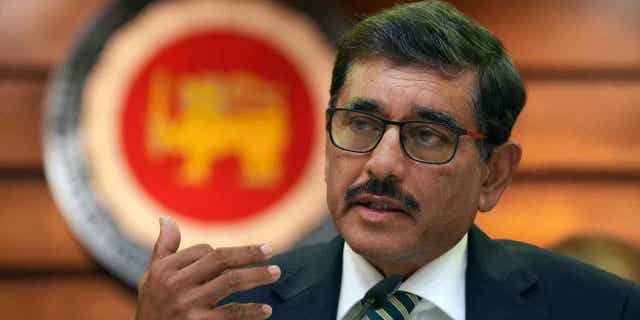
The governor of Sri Lankan Central Bank Nandalal Weerasinghe speaks during a media briefing in Colombo, Sri Lanka, on Apr. 8, 2022. Sri Lanka’s Central Bank chief said on Jan. 25, 2023, that the country is making good progress in talks regarding debt restructuring.

The governor of Sri Lankan Central Bank Nandalal Weerasinghe speaks during a media briefing in Colombo, Sri Lanka, on Apr. 8, 2022. Sri Lanka’s Central Bank chief said on Jan. 25, 2023, that the country is making good progress in talks regarding debt restructuring. (AP Photo/Eranga Jayawardena, File)

China accounts for about 10% of Sri Lanka’s loans after Japan and the Asian Development Bank. However, its assent for restructuring its loans is crucial.

Sri Lanka’s economic crisis and resultant shortages of food, medicine, fuel and cooking gas sparked riots last year, forcing the president to flee the country and later resign.

Sri Lanka has since shown some signs of progress, with shortages reduced and day-to-day functions restored. However, daily power cuts continue due to fuel shortages and the government is struggling to find money to pay government employees’ salaries and conduct other administrative functions.

මං වගේ කසඩ මහාරචාරියෙකුට මේ පඩිය ඉහටත් උඩින්.. බද්ද දෙගුණයක් කලත් කමක් නෑ..- නිර්මාල් දේවසිරි

January 25th, 2023

උපුටා ගැන්ම ලංකා සී නිව්ස්

මං වගේ කසඩ මහාරචාරියෙකුට මේ පඩිය ඉහටත් උඩින්.. බද්ද දෙගුණයක් කලත් කමක් නෑ..- නිර්මාල් දේවසිරි

රජය විසින් මෙම ජනවාරි මාසයේ සිට අය කිරීම ආරම්භ කර ඇති නව ආදායම් බද්ද සම්බන්ධයෙන් විශ්වවිද්‍යාල ආචාර්යවරුන්ගේ සංගමයේ හිටපු සභාපති නිර්මාල් දේවසිරි මහතා අදහස් පල කරයි.

තම මාසික වැටුප් සටහනක්ද සහිතව ඔහු විසින් සමාජ ජාල ගිණුමේ තබා ඇති සටහන මෙසේය.

බදු පිළිබද මගේ මතය!!!
=============
මේ තියෙන්නෙ ගිය මාසෙ මට ගෙදර ගෙනියන්න ලැබුණු වැටුප. මේක මටනං ඉහටත් උඩිං. ලබන මාසෙ මෙකෙන් 75000ක් විතර අඩු වෙයි. ඒත් මට ෂේප් වෙන්න පුළුවන්. බදු ප්‍රශ්නෙ ගැන මාත් එක්ක පැටලෙන්න එන Upali Kohomban එක පාරක් මගෙන් ඇහුව ණය ගන්නෙ නැතුව ජීවත් වෙන හැටි කියන්න කියල. මට බැංකු ණය නැති නිසා රුපියල් ලක්ෂ එකහමාරකින් විතර ජීවත් වෙන්න පුළුවන්. අම්මයි තාත්තයි නැති වුන දාට ඒක ලක්ෂෙ දක්වා අඩු කරන්නත් පුළුවන්. ප්‍රශ්නෙ තියෙන්නෙ මං වගේ කසඩ ලොතරැයි මාහාචාරියෙකුට එහෙම වුනාට නියම මහාචාර්යවරු ඊට වඩා වැටුප් බලාපොරොත්තු වෙනව. ඒ අයට ඉන්න හොද ගෙයක් අවශ්‍යයි. ටිකක් හොදට අදින්න පළදින්න ඕනෙ. ළමයින්ට යන වියදම වැඩියි. ටිකක් මධ්‍යම පංතික මට්ටමට ජීවත් වෙන්න ඕනෙ. දැන් සාමාන්‍යෙයන් කාර් එකක් තියාගෙන හොද ගෙයක් හදාගෙන ළමයි තුන්දෙනෙක් එක්ක සාමාන්‍ය මධ්‍යම පංතික ජීවිතයක් ගෙවන්න මාසෙකට රුපියල් ලක්ෂ තුන හතරක්වත් ඕනෙ.

අනිත් එක මට හම්බවෙන පඩිය හම්බවෙන්න මහාචාර්ය වෙනකල් ඉන්න ඕනෙ. මම මහාචාර්ය වුනේ වයස 53දි විතර වුනත් දක්ෂයෙකුට 40න් විතර මහාචාර්ය වෙන්න පුළුවන් බව ඇත්ත. නමුත් අනිත් අයගෙ පඩිය මීට අඩුයි.

මේ නිසා උද්ධමනය වැඩි වීමත් එක්ක මේ බදු හරහා පඩිය අඩු වුනහම එවැනි මධ්‍යම පංතික ජීවිතයක් ගත කරන්න අමාරු වෙනව. එතකොට විශ්වවිද්‍යාල ආචාර්යවරු නං එක්කෝ ආණ්ඩුවට කඩේ ගිහින් තනතුරක් අරගන්න ඕනෙ. එහෙම නැත්නං ඔය එක්ස්ටර්නල් ඩිග්රි, පෝස්ට් ග්‍රැජුවෙට් ප්‍රෝග්‍රෑම් වගේ බොරු වැඩ වලින් ගාණක් කපා ගන්න ඕනෙ. එහෙම නැත්නං එන්ජීඕ එකක් අල්ලගෙන කීයක් හරි ලැබෙන කන්සල්ටන්සි එකක් වගේ දෙයක් කරන්න ඕනෙ. ඒත් ඒවට හැමොටම චාන්ස් නැහැ.

ඒ නිසා ඒ අය කළ යුත්තේ රටින් පිටවීම. මං වගේ අයට රටින් පිට ගියා කියල මේ ලැබෙන පඩිය වගේ පඩියක් ගන්න ජොබ් එකක් ගන්න හිතන්නවත් බැහැ. ඒ නිසා මං නං මේ බදු ප්‍රමාණය දෙගුණ කළත් මේ රස්සාවෙන් මළාට අයින් වෙන්නෙ නැහැ. නමුත් දැන් විශ්වවිද්‍යාලවල ඉන්න සැලකිය යුතු පිරිසකට පිටරට විශ්වවිද්‍යාලෙක මොකක් හරි හොයාගන්න පුළුවන්. ඒ අය දැනටම යනව. ඒක මං හිතන්නෙ හොද තත්වයක්.

ලංකාවට ඇත්ත වශයෙන්ම විශ්වවිද්‍යාල අවශ්‍ය නැහැ. අවශ්‍ය වුනත් මෙච්චර ගාණක් අවශ්‍ය නැහැ. ඒ නිසා මේ තියන ඒව වහල දාන්න බැරිනං මේවගෙ කොලිටි තවත් අඩුවෙලා ඒවට තියෙන සමාජ පිළිගැනීම තවත් අඩු වෙලා යන එක හොදයි. රාජ්‍ය විශ්වවිද්‍යාල වෙනුවට පුද්ගලික විශ්වවිද්‍යාල ඇති වීම ආර්ථික වශයෙන් ඵලදායී යි. මොකද එතකොට ඉන්දියාවෙන් චීනෙන් වගේ රටවලින් සිසුන් ගෙන්නගෙන බිස්නස් මට්ටමින් විශ්වවිද්‍යාල පවත්වාගෙන යාමට පුළුවන්. දැන් රාජ්‍ය විශ්වවිද්‍යාල වලට සමාජ ඉල්ලුමක් තියෙන්නෙ පහළ සමාජ පංතීන්වල තිබෙන ඉහළ යාමේ උන්නතිකාමය නිසා. ඒ අය සදහා වෘත්තීය පුහුණු ආයතන ඇති කොට ඒ සමාජ ඉල්ලුම පාලනය කරන්න පුළුවන්.

මම විශ්වවිද්‍යාල ආචාර්ය සංගමයක සාමාජිකයෙක් ලෙස සාමූහිකව මේ බදු ප්‍රතිපත්තිය විවේචනය කළත් පුද්ගලිකව මේකට කැමතියි. මං ප්‍රසිද්ධ සභාවල සමූහයේ මතය නියෝජනය කළත් මේක තමයි මගේ පුද්ගලික මතය.

මේ බදු ගැසීමට පක්ෂ කෙලෙස් නැසූ අල්පේච්ඡ ජීවිත ගත කරන උපාසක උපාසිකාවන් වගේ නෙවෙයි විශ්වවිද්‍යාලවල වැඩකරන බහුතරය. ඒ අය මේ පරිබෝජනවාදී සමාජයේ ගොදුරු වෙලා තියෙන්නෙ. ඒ නිසා ඒ අය හැකි ඉක්මනින් පිටරට රැකියා සොයාගැනීමට උත්සාහ කිරීම මේ රටට විශාල සේවයත්.

Requesting for prompt approval for electricity tariff increase – PUCSL tells National Council

January 25th, 2023

Courtesy Adaderana

Members of the Public Utilities Commission of Sri Lanka (PUCSL) stated before the National Council that they unanimously agreed to send documents to the Attorney General requesting for advice regarding the possibility of increasing the electricity charges retrospectively and requesting for prompt approval for the increase in the electricity charges. 

Accordingly, the members of the commission said that they hope to forward the relevant documents to the Attorney General today (25).

The proposal to raise electricity charges were discussed accordingly when the National Council met in Parliament on January 24, under the chairmanship of the Speaker Mahinda Yapa Abeywardana along with the participation of Prime Minister Dinesh Gunawardena.

Addressing the Council meeting, the Minister of Power and Energy Kanchana Wijesekera mentioned that the electricity charges were revised in 2014 to apply retrospectively. The Minister stated that he can provide the documents to the commission if necessary. He also requested to get the opinion of the Attorney General in this regard as soon as possible.

The officials of the Electricity Board pointed out that the operating costs of the Ceylon Electricity Board (CEB) have reached an unsustainable level.

Ministers Naseer Ahmed, Kanchana Wijesekera, Tiran Alas, State Ministers Indika Anuruddha, D. V. Chanaka, Members of Parliament Sagara Kariyawasam were present at the Council meeting held.

Chief of Staff and Deputy Secretary General of Parliament Ms. Kushani Rohanadeera was also present at the Council meeting held. The members of the Public Utilities Commission, the Ministry of Power and Energy and the Ceylon Electricity Board were also present before the National Council.

Constitutional Council to call for applications for Independent Commissions

January 25th, 2023

Courtesy Adaderana

The Constitutional Council met for the first time today (25 Jan.), and has decided to call for applications from those interested and qualified to be appointed as members of the Independent Commissions.

Accordingly, a newspaper advertisement will be published in this regard, after which two weeks will be given from the date of advertisement to furnish all related applications, the Communication Department of the Sri Lanka Parliament confirmed, adding that more details about the application process will be notified through the newspaper advertisement.

The advertisement is due to be published, calling for new members to the Election Commission, Delimitation Commission, National Police Commission, Audit Service Commission, Human Rights Commission, National Procurement Commission, Finance Commission and Bribery Commission after the Constitutional Council gives the go-ahead to the recommendations made by the President for the positions of chairpersons and members of several independent commissions.

While the meeting also focused on the future activities of the Council along with the mandate of the Constitutional Council stipulated in the Constitution and the other laws, the Constitutional Council unanimously agreed to discharge duties and functions of the Council in an independent, accountable and transparent manner.

The meeting was presided by Council Chairman, Speaker Mahinda Yapa Abeywardena, with newly-appointed members Dr. Pratap Ramanujam, Dr. (Mrs) Dilkushi Anula Wijesundere, Dr. (Mrs) Weligama Vidana Arachchige Dinesha Samararatne also present, along with Prime Minister Dinesh Gunawardena, Opposition Leader Sajith Premadasa, Minister Nimal Siripala de Silva, MP Sagara Kariyawasam, Secretary General of Parliament Dhammika Dasanayake and Chief of Staff and Deputy Secretary General Kushani Rohanadeera.

Ouster of Presidents in Sri Lanka & now Peru – Will Sri Lanka ever learn lessons?

January 24th, 2023

Shenali D Waduge

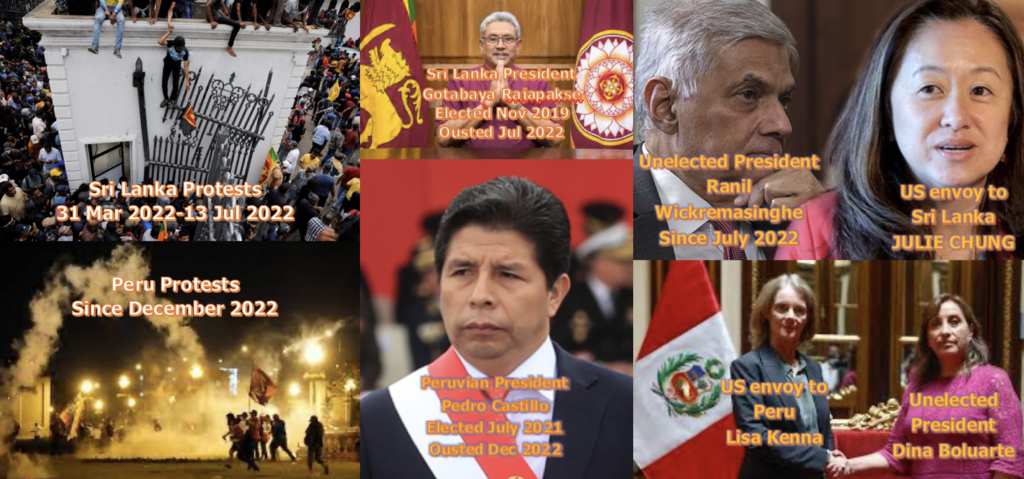
Ben Norton’s Geopolitical Economy Report reveals some interesting facts. The US-backed coup on 7 December 2022  against President Pedro Castillo (immediately after the ousting of Sri Lanka’s President via a well-funded protest) The Peruvian President has been imprisoned for 18 months without trial & due process. Massive protests are a hallmark in both Sri Lanka & Peru. The US-back coup regime went on to kill 50 protestors & the country has been in chaos since December 2022 but the US Govt is strongly supporting the coup.  The ouster was primarily to prevent the elected President from negating neoliberal policies & his ouster was instigated by CIA veteran US ambassador to Peru Lisa Kenna. Peru became the 2nd victim of geopolitical resource grab after Bolivia became victim in 2019 ousting Eva Morales to grab its lithium.

Peru is home to mineral resources as well as gas reserves which are reasons that lure US & multinationals to Peru.  It was no surprise that US would lead actions to oust any national leader.

Thus on 6 December 2022, a day before the coup the US ambassador had met with the Peruvian Defense Minister to advise that the military disobey orders of the Peruvian President. Did the US envoy to Sri Lanka do the same? We know she was at the forefront of the aragalaya, meeting every important person who were part & parcel of the aragalaya.

After overthrowing the elected Peruvian President, the US envoy met the Peruvian Minister of Mining & Energy to discuss ‘investments” on 18 Jan 2023. Not surprisingly, the Peruvian Energy Minister issued a statement of how Peru was going to move forward with US assistance.

Did a similar scenario take place in Sri Lanka?

Like the US ambassador to Sri Lanka who is regularly visiting not only government ministers, the opposition, public officials, private sector, civil society & even individuals who have a hold on society, US envoy to Peru was also meeting top officials including unelected President Dina Boluarte & her ministers. It is interesting to know whether the US envoy to Sri Lanka proposed to place the current President or did she have another person in mind to take over! If so, how or why did US plans change?

The puzzling aspect of the Sri Lankan Presidents overthrow was that inspite of embracing US lobbies going so far as to accept proposals from US-backed entities & appointing pro-US individuals to key roles, why would the US consider an unceremonious removal of the sitting Sri Lankan President, going so far as to even chase him out of the country.  He even stopped the Chinese vaccine & brought in Pfizer vaccines which even India had refused.

The Peruvian elected leader was eventually arrested & imprisoned. The Peruvian people are protesting for the release of their president while Sri Lanka’s citizens are baffled why the sitting President resigned, fled the nation without even addressing the nation.

Sri Lanka is home to natural resources in addition to being strategically placed geographically

Peru’s natural reserves include copper, gold, zinc, silver, lead, iron & natural gas. Both nations are thus susceptible to more than it can chew & has lacked leaders who have been able to understand geopolitics & distinguish the dynamics & political will matched with political cunning needed to balance the covert & overt onslaughts.

Peru relies heavily on its mining sector. The world’s largest transnational mining corporations have invested in Peru (BHP, Rio Tinto & Glencore) Canada, Brazil, Switzerland, Britain, US, Japan & Australia are also involved in mining in Peru. Most of the local mining companies in Peru are owned by foreign corporates no different to the manner foreigners are using locals as fronts in Sri Lanka. The name of the game is the competition to grab natural resources. Sadly, Sri Lanka’s leaders & even the educated do not understand the importance of the assets that we have and all are more than ready to hand over these treasures to foreigners & strike a deal where they function as the local front. Sadly, this lack of sincerity & integrity is one of the primary reasons that Sri Lanka has no leaders & have very few trustworthy academics/intellectuals or policy advisors.

Peru is the world’s 2nd largest copper producer attracting renewable energy players. When Goldman Sachs in 2022 declared that copper was the new oil it gave a clue as to what Peru was in store for.

Europe even began importing LNG from Peru in 2022 without Russia. Peru’s LNG exports are overseen by foreign companies like Shell.

However, when President Castillo declared we want our natural resources to directly benefit the people” it spelt his fate.

He condemned foreign companies for pillaging” Peru & proposed to renegotiate contracts to ensure 70% of all proceeds from mining went to the State to fund social programs.

we want our natural resources to directly benefit the people”

we are rescuing the resources of the country for all Peruvians”.

This was not what foreign governments or multinationals had in mind & wanted to hear. They determined he had to go.

Another noteworthy feature was the ‘agrarian reform’ declared by the Peruvian President echoing the fertilizer fiasco by Sri Lanka’s president. We have to wonder whether these themes had been intentionally introduced with the outcome in mind. They look good themes at the surface level but the real purpose is often hidden by those introducing the theme.

Sri Lanka’s ousted President did not make similar utterances like the Peruvian President, but his manifesto moved along the same lines. Unlike Castillo, the Sri Lankan President did not periodically appeal to the people & share with them his vision. Where did the President of Sri Lanka go wrong?

The similarities in Peru & Sri Lanka was the right-wing opposition being hellbent on destabilizing & removing Presidents of both nations. Corruption in the judiciary was also a factor shared by both nations. As we can see part of the destabilizing process was to violate & disobey law & order rendering the police & armed forces helpless.

Ousting Peru’s President meant return to neoliberal economic model drafted by the Washington Consensus giving priority to foreign corporates – is this not what has taken place in Sri Lanka as well. Can the party that promoted Sri Lanka’s President to power be happy to continue what they promised not to do?

Like Sri Lanka’s President, the Peruvian President came to power on the vote of rural communities, the only difference is that while the protests in Sri Lanka were organized & supported by the educated, professional groups & business community” Peru’s protests have come demanding the release of the arrested former President, demands to hold new elections & replace the constitution that was formed by US-backed former dictator Alberto Fujimori.

In Sri Lanka, even members of the aragalay are slowly beginning to understand that many of them had been used” & their ego prevents them from admitting so & there is little point in saying we told you so” -the damage has been done. Many of the supporters in the opposition were part & parcel o f that ouster & they are now vying for key places in the local government elections. This spells dangers as they have all been compromised to foreign agenda & have been used to destabilize Sri Lanka.

Shenali D Waduge

Economic Situation, T-Bond, and Treasury Bill Sales in Sri Lanka

January 24th, 2023

By Engr. Kanthar Balanathan DipEE (UK), GradCert (RelEng-Monash),DipBus&Adm(Finance-Massey), C.Eng., MIEE, Former Director of Power Engineering Solutions Pty Ltd, Consulting Electrical Engineers

General

Residents and diaspora should be aware of the economic situation and development in Sri Lanka. We cannot just sit and close our eyes (like the cock-eyed chicken) assuming that the Sri Lankan administration is doing well in the financial system management. The difference between the third world and the developed world is that the third world’s economic deceleration is must faster than that of the developed world. As SL is our mother country, wherever we are, we have a responsibility to make our observations, comments, and suggestions for changes. Politicians do not own SL. They are there to serve the people.

E.g., India that matter has improved very much and very rapidly in the economic environment, purely because it invested in agriculture, science, and technology and currently leading in digital technology. The Brahmins have shown their colour in intelligence and knowledge and the capacity to acquire such advanced technical knowledge.

The country has no racial violence or discrimination. Intelligence people have been given the proper place in society. The shortfall of the Tamil Nadu state is that they claim of Dravidian” origin. Humans shall assess in terms of reality, not assumptions. Every political party in Tamil Nadu has the word Dravida” mingled in their party name. Similarly in Sri Lanka, the Tamils have the word Tamil” associated in the political party name.

This drives for the conclusion that the Tamils do not consider Economics and Finance” for development and survival.

Therefore, India is a well-known intellectual country.

The country is so large and to manage its finances, and administration, it is divided into financially manageable states and given adequate powers for development. However, SL being a small poor nation, first, has not got the economic and financial wealth, and power to operate several states and Councils. This is the pure and only reason for not being a federal state administration. If so, the British would have given autonomous state power in 1948. We, the Tamils should understand this and build the nation and the N&E with wealth, then request power. Tamils have eager to show that they are politicians and ministers. During the PCs period every politician like garlanding and presenting for photographs and publishing the photos. What did they achieve? NOTHING.

The day Srimavo signed contracts with China for Cement kiln bricks and BMICH which exhibited close ties with China, problems gave birth in SL. After all she is a well-known unqualified IDIOT. Today under the Rajapaksas, SL went down, and Pakistan, although has nuclear capability, focussed on Kashmir and India, and not their sustainability, was driven down to poverty because of rivalry on both sides. (Afghanistan + India).

Today with the current president (RW) who has a revolutionary mind in economics can boost up the finance and elevate Sri Lankan economy. Within a short period, the president + the Central Bank (CB) have shown credibility and we can see the improvement in the economy. Although as the foolish people, who do not want to work, and expect everything free, and do not understand economics and finances in society. People shall understand this concept.

Analysis

Today the inflation rate stands at 65%.

Nominal interest rate = (real risk-free interest + Inflation + default risk premium + liquidity premium + maturity risk premium)

Inflation impacts on interest rate and commodity prices. If the Bank prints money, the country will have too many notes, however, less products. The price shoots up because of too many buyers with liquid cash. This is where supply and demand come into play.

The country should maintain its productivity to keep the prices low. This is exactly what’s happening in SL today. GOSL should generate revenue for its local expenses and salaries. This where taxes play an important part. Every citizen shall oblige the country by paying its dues to the government. For example: Several politicians did not pay their water bills and electricity bills for donkeys’ years. How do they expect the business to pay salaries and meet its development/augmentation of plant and equipment costs.

Although System demand studies may have been conducted by the appropriate business/industries, they may not be able to augment the plants due to lack of funds.

Treasury (CB)

How do government get its money if taxes are not paid?

What is the difference between T-bills and Treasury bonds?

  • Bonds are generally for 30 years.
  • Notes between 1-10 years at 3.5%.
  • Bills are between 6 months to one year.

CB is trading the following on the 18th of January 2023.

Quote: Excerpt from CB Web page: https://www.cbsl.gov.lk/

Rs. 95,000 million (Rs 95 Billon) Treasury bills are to be issued through an auction on 18th January 2023.  The details of Treasury bill issues are as follows. 

      Maturity Period                           91 Days     182 Days                  364 Days              Total
       ISIN*                                  LKA09123D219LKA18223G219     LKA36424A198              
     Amount Offered (Rs. Mn.)           55,000 20,000                      20,000               95,000
Date of Auction:18th January 2023 
Date of Settlement20th January 2023 
Date of Issue:20th January 2023
Closing date and time of bid submission:Wednesday 18th January 2023, at 11.00 a.m.
Minimum amount of a bid:Rupees five million (Rs. 5,000,000/-) and multiples of Rupees one million (Rs. 1,000,000/-) there onwards.

It is assumed that this money is required by GOSL for its local expenses. May be to pay salaries. It is hoped that the GOSL/CB would have completed (i) a preliminary study on this project as to how they propose to use this fund (ii) how they will generate to pay back the bond money. Governments should not go and buy money in the market without doing a proper study. If so, this government would be assumed as operating in a jungle.

Citizens who have internet facilities should visit the following web page and check frequently to acquire more knowledge and or public awareness. https://www.cbsl.gov.lk/

Governments shall operate with openness and transparency.

HUMAN RIGHTS Part 6

January 24th, 2023

KAMALIKA PIERIS

Human Rights have taken root in Sri Lanka and are peddled by Human Rights devotees with great enthusiasm and little critical inquiry. When I suggested that a mentally retarded girl, who had been successfully integrated into the community, should be sterilized, I received the reply ‘but that is a Right. ’

Human Rights have been used for various purposes in Sri Lanka, some of which are totally unrelated to the well being of Sri Lanka .The media reported in 2014 that Human Rights activists have gone to the Supreme Court to stop the government from sending back Afghan, Iranian and Pakistani refugees.

But Human Rights have also been used in Sri Lanka   for political purposes. Human Rights were used to help the Eelam war. The government complained that when they arrested persons involved in the Eelam war,   Human Rights defenders and their organizations intervened and got them released.

Human Rights was used to ‘punish’ the war winning army. In 2019, Human Rights Commission of Sri Lanka has taken upon itself the task of vetting security personnel for United Nation’s Peace Keeping Missions. In doing so, the Human Rights Commission of Sri Lanka had exceeded its mandate.

There were complaints to the President about the problems created by Human Rights Council in this matter by delaying clearance. Since 2004, Sri Lanka had been sending troops on UN missions and at present a large contingent from Sri Lanka is serving in different parts of the world. Our forces are in high demand due to their discipline and valor, said the President. Sri Lanka will be at a loss when there is an undue delay in deploying Sri Lanka officers to UN missions, and it will not only have a negative impact on the economy but also damage the trust and faith the UN had placed on Sri Lanka. 

Human Rights defenders have intervened in police work. The Police force is responsible for the maintenance of law and order and is empowered to carry out arrests of criminals. But on several occasions police prosecutions have been obstructed by Human Rights defenders, on the grounds that they are infringing on Human Rights, said Tassie Seneviratne, former Senior Superintendent of Police. This deterred effective police action. Police are confronted with diverse interpretations of their actions under Human Rights law, he said. Arrests considered a violation in Fundamental rights, is accepted when the same case is entered under criminal law.

In October 2015 students engaged in the protest march organized by the Inter Student Collective for the Protection of Higher National Diploma in Accountancy were brutally attacked by the police. The students were on their way to the University Grants Commission to ask that the HNDA be given degree status.

Human Rights Commission of Sri Lanka (HRCSL) inquired into the incident and had recommended that the police pay compensation to the students injured in the incident. HRCSL recommended that a female student injured in the incident be paid Rs. 25,000 as compensation and eight other students who were also injured be paid Rs. 15,000 each. HRCSL said that those who gave orders for the police to act in the manner they did on the day of the protest should also be held accountable and action taken against them.

But the police did not accept this. They took Human Rights Commission to courts, challenging the charge that the Police must pay compensation. I am unable to find out what happened thereafter in this landmark case.

Human Rights   devotees in Sri Lanka have used Human Rights   in ways which violate the main principle of Human Rights, which is the value of ordinary human lives. Human Rights devotees agreed that drug addiction was bad and it is important to curb drug trafficking, but declared that policies for controlling drug trafficking must adhere to Human Rights standards.

Lawyers protested over the deaths of three criminals, Tinkering Lasantha, Makandure Madush and Uru Juwa who had died in Police custody.  In 2020, Bar Association drew attention to the fact that that Samarasinghe Arachchige Madush Lakshitha alias Makandure Madush was killed in what the police claimed a shootout between them and the underworld at Applewatte Housing scheme in Oct 2020.

Madush is accused of numerous crimes, including the killing of other underworld figures, such as ‘Kos Malli’ and ‘Samayan’ and an attempt at killing Police Narcotics Bureau’s Neomal Rangajeewa. While in prison, Madush had had got Southern Provincial Council Member Danny Hiththetiya killed through an accomplice. He had carried out a number of armed robberies as well. His main activity was smuggling drugs from Iran and Afghanistan by sea to Sri Lanka, Bangladesh and the Maldives.

However, lawyers representing the underworld figures wrote to the Bar Association of Sri Lanka asking the Association to condemn the death and to take up the matter with the authorities.The Committee for Protecting Rights of Prisoners called upon the Human Rights Commission to hold an impartial inquiry into Madush’s death.   It said that that the killing of persons arrested by the Police and prisoners had been going on in Sri Lanka for many years.

Other underworld figures    who were in prison thought the same would happen to them. Janith Madhusanka alias Podi Lassie , a notorious underworld drug kingpin, filed a writ petition in the Court of Appeal, seeking an order from the court to provide him with adequate protection. He was detained in the Boossa High Security prison over several criminal offences.

 Podi Lassie claimed to have received threats to his life and has requested the Court to order prison officials to take measures to ensure his personal safety. They are duty bound to ensure the safety of inmates who are held in prison custody. Court of Appeal decided to issue notices on the respondents, including the Boossa Prison Superintendent, the Chief Jailor of the Boossa prison, the Prison Commissioner General and the Attorney General.

H. L. Lasantha alias Tinkering Lasantha was killed while in police custody n 2021. He was involved in multiple criminal activities. Tinkering Lasantha’s lawyer had notified the Bar Association that .he has information that his client who had been arrested by Kalutara police will be killed in custody by the police under the pretext of it happening during a shoot-out whilst being taken to show weapons. The lawyer pointed out that Tinkering hadn’t been produced before a magistrate either.

Bar Association had promptly informed IGP, Human Rights Commission, and the Consortium of Humanitarian Agencies (CHA). However, on 26th November  Tinkering Lasantha had been shot dead while being taken to recover hidden weapons.

Dinithi Melan alias Uru Juwa   was arrested by the Nawagamuwa Police on May 2021. Uru Juwa’ had been wanted in connection with at least four killings, about 20 cases of  ransom  and other offences, including arson, committed between 2015 and 2019 in  the Nawagamuwa and Hanwella Police Divisions. ‘ Lawyers questioned the circumstances in which Uru Juwa died of gunshot injuries on the following day.

The death of persons taken into custody by the police cannot be justified under any circumstances, said lawyers. Responsibility for these killings must lie not only with the persons who carried out the killings but also all those who command them and those who failed to ensure the safety and security of the suspect. The BASL calls upon the IGP to explain his failure to protect the suspect who was in police custody.

Human Rights are now getting extended to animals too. Animals are increasingly recognized as non-human persons” with feelings. In 2022 Basel-Stadt canton in Switzerland voted on whether primates, (apes, chimpanzees, monkeys) should enjoy some of the same basic fundamental rights as humans do. The vote will decide whether to give primates the right to life and the right to “mental and physical integrity”. The animal right group Sentience said primates are highly intelligent and maintain an active social life. They feel pain, grief and compassion.

Switzerland’s Supreme Court  allowed the vote.. The proposal would not extend fundamental rights to all animals, only to primates and it would only apply to cantons and municipalities in Switzerland not to  private persons. This will mark the first time worldwide that people can vote on fundamental rights for non-humans, said the media.

In 2017, The Indian Supreme Court directed Indian States to sterilize every stray dog, allowing only irretrievably ill or rabid dogs to be destroyed. Sterilization is the answer for dog population control not killing, said Delhi High Court, observing that there is no law prohibiting street dog feeding and stating that those who do so show compassion to all living creatures. It  directed India’s Animal Welfare Board to earmark appropriate sites  to establish stray dog feeding stations and ordered the police to protect those feeding street dogs. However, animal lovers observed that when sterilized and vaccinated dogs are removed to shelters, others neither sterilized nor vaccinated take over. Vaccinated dogs living in groups create herd immunity” preventing other dogs coming into their territory.

In Sri Lanka  there is an  emphasis on protecting stray dogs. A  stray  doggie’s right to life was now  getting protected. It is no longer a ‘dog’s life’.  There was a complaint some years ago that stray dogs living in the Peradeniya Gardens and dogs   living in the Kandy Hospital compound had been removed. Dog lovers said that    the occupancy rights of these dogs had been violated. It was argued that these dogs had a sort of prescriptive right to be in these two places. They did not however provide any useful service to either institution.

In 2017, there was a similar protest regarding the dogs at University of Sri Jayewardenepura. The university stands on a large property which does not have a wall surrounding it. As a result, dogs of the neighboring areas enter and move about in it freely, some even living there, said    Sathva Mithra, an NGO.

However, thanks to caring students these dogs have not been allowed to run wild, be disease ridden, and multiply their numbers freely. Succeeding batches of students have taken on themselves the task of caring for these dogs, not only providing them with food but also vaccinating them regularly against rabies, and sterilizing/neutering them, thereby preventing reproduction. They have been getting the support of their parents and even some of the teaching staff for this compassionate task, continued Sathva Mithra,

In fact, a recently retired Vice Chancellor too, had while in office, contributed food for these animals on a few occasions which was a great inspiration to the students. So much love the students had for these for these humble, friendly animals that each one of them was given names to which they promptly respond. With so much loving care and attention, these dogs have always been human-friendly and moved about the university peacefully without harming anyone.   

Sathva Mithra complained that without any prior warning to the students, the Acting VC on the advice of the VC decided to send out all the dogs from the university premises,  caring nothing about the tragic fate that will befall the animals by such hasty unplanned removal and the anguish it would cause the concerned students. It is a pity the VC lacked the humility to discuss with his students this issue of the dogs said the NGO.

Innocent dogs, lovingly cared for by students, were handed over to cruel unethical pest control people for disposal in some other place, or even their destruction. No sooner the students learned of this removal of the dogs, they informed the police and asked the pest control people to return them concluded Sathva Mithra.

The Collective of Citizens Organizations also joined in. it accused Sri Jayewardenepura University administration of hiring a private pets control firm to remove at least 30 dogs ahead of a free sterilization project. They suspected that the dogs had been buried after being made unconscious. The private company admitted receiving a payment amounting to Rs 350,000 for the operation. The NGO wanted to know whether University administration could spend taxpayer’s money to get rid of dogs.

Vice Chancellor of the University of Sri Jayewardenepura  said stray dogs had become a nuisance  on university premises. There were more than 130 stray dogs living inside the university premises and they were a threat to students, academic and non academic staff members. They had bitten 18 students and non academic staff members during the last two months. Following repeated requests made by the students, teachers, non-academic staff members and welfare organizations, the university administration had decided to remove the stray dogs from the campus premises. The university administration had outsourced the task to a private company but some parties with vested interests had spread rumors that the animals were being killed. He said those groups had done nothing for the dogs.

To conclude, Human Rights” does not appear to be concerned about the average citizen’s right to safety and the good life. Human Rights show an utter indifference to pressing social issues such as poverty, social mobility, economic development. Roald Dahl’s  Big Friendly Giant observed Human beans is killing each other. Human beans is the only animal that is killing their own.’ Human Rights does nothing to stop this either.  (Concluded)

The gift and yoke of bastardy

January 24th, 2023

Malinda Seneviratne

Towards the end of the last millennium with some  countries worrying about glitches associated with Y2K or the year 2000, a magazine, maybe ‘Time’ or ‘Newsweek,’ asked world renowned people a simple question along the following lines: ‘what would make the world a better place in the next millennium?’  Maybe it was ‘next century,’ I can’t really remember. What I remember is the only response that struck me when reading through what scientists, artists, writers, statesmen and stateswomen, sports stars etc. had to say.  

‘The only idea that could save us is for women to run the affairs of the world.’  

That’s Gabriel Garcia Marquez, who in his biography ‘Living to tell the tale,’ writes at length about the women in his household, grandmother, grand aunts, mother, aunts, cousins and others, the things they did and did not do, the assertions and dismissals, idiosyncrasies and convictions, based on which he concludes, ‘they (women) are the ones who maintain the world while we men throw it into disarray with our historic brutality.’

Not just brutality, though. A fascination with the grand, the monumental, the ‘all-encompassing.’ They are gamblers, wagering on the ‘all’ and typically obtaining the ‘nothing,’ with women typically having to suffer the consequences of poor investment.  Women would no doubt add to this list.

But we are talking of ‘running the affairs of the world’ here. And reflecting on this, almost a quarter century later, I remembered a book my wife told me about around the time she was a postgraduate student: ‘The fish don’t complain about the water: Gender transformation, power and resistance among women in Sri Lanka,’ by Carla Risseeuw published in 1988. Couldn’t get my hands on it but my search did yield her ‘Gender, Kinship and State Formation: Case of Sri Lanka under Colonial Rule,’ an article published in the Economic and Political Weekly in 1992 which does cover the material my wife and I discussed.

While there is evidence that the position of women, strong from the 5th Century BC to the 4th Century AD, had declined through the middle ages, Risseeuw contends that the traditional forms of family and marriage were largely independent of religion and the state or, if you will, administrative concerns.

It was the British who messed things up, she argues. Between 1795 and 1947, the British systematically brought the traditional forms of family and marriage under state control. An acting district judge named Berwick foresaw in 1869 that changes envisaged would lead to increased violence as well as women and children becoming even more insecure. He said that neither the uncertainty of paternity (in the existing system) nor women owning land and property were related to instability in the unions between men and women. He called the new laws ‘a bitter gift of bastardy.’

It was all about access to land, not just for the British but local ‘elites.’ All men, by the way. It was not about some moral indignation regarding relations between men and women, but a fundamental inability to understand the complex culture of inheritance (matrilineal and protective of women) and moreover a need to wrest control of property. The marriage and divorce legislation in effect complemented the draconian Waste Land Act (1840) and other ordinances that followed (1841 to 1907).

The British not only ensured the considerable downgrading of the status of women in marital unions but also enabled men to take control of property. In the new social and economic order women were paid less than the (underpaid) local workers. They were forced into an entrenched in certain employment categories, further concretising the gender-based division of labor.

Risseeuw summarises thus: ‘Both sexes were confronted with immensely harder work conditions. There were advantageous opportunities for a minority, which was predominantly but not exclusively male, with a tendency for males to take over female domains if they became lucrative. Thus slowly women found themselves in the least beneficial sectors of paid labour and trade.’

[By the way, those Kolombians and Kolombian Wannabes who lament that the British ‘left’ (they did not, as even a cursory consideration of political economy would show or, simply, an acknowledgement of the fact that the US Ambassador operates as though she’s some colonial Viceroy) would navel-gaze if they read Risseeau, never mind looking around and reflecting on what the British gave and took].

Despite all this, in conditions of violence, humiliation and insecurity that were largely non-existent before Dutch and the British hordes imposed their religions, their morality and their laws to facilitate plunder, women still ‘maintained’ their respective worlds. Then and now. In this island and in other lands where such impositions were similarly executed or were home-grown as the case may be.

Now it can be argued that it is not prudent to extrapolate from household to community or beyond, to country and a global order, even though the affairs of the world, especially things economic, is exactly that. The word economy is derived after all from the Greek words ‘oikos (house)’ and ‘nemein (manage),’ But more than all this, considering the historic disarray that male arrogance, ignorance and unforgivable brutality has caused, it almost seems silly not to consider very seriously the proposition articulated by Marquez.

We can blame the invaders. Sure. They plundered. They perpetrated genocide. They did their best to erase culture. They drenched our lands with blood. They burnt libraries. They razed temples and kovils to the ground to build churches. They enslaved bodies and minds. They put in place systems that could ensure continued extraction of value that fed their economies and people.

We have not corrected all that. Men, in particular, have continued to exploit laws and institutional arrangements the invaders put in place to further strengthen inequalities and obtain advantages.

We are in a social, economic, political and environment crisis that cannot be fully blamed on others. A key part of it is patriarchy manifested in multiple ways in the society we live in, the institutions we swear by and do nothing to rehabilitate, and the ridiculous laws we uphold. There’s a yoke of bastardy we have yet to unburden ourselves from. Indeed, we swear by it and leave it out of discussions on system change. Our daughters pay the price. Our sons too. 

[‘The Morning Inspection’ is the title of a column I wrote for the Daily News from 2009 to 2011, one article a day, Monday through Saturday. This is a new series. Links to previous articles in this new series are given below] 

Chera, Chola, Pandya: Using Archaeological Evidence to Identify the Tamil Kingdoms of Early Historic South India

January 24th, 2023

Abstract

For the southern Indian states of Kerala and Tamil Nadu, the most important documentary source for information on early South lndian culture is a body of prose poetry known as the Sangam anthology. These indigenous texts date to the first few centuries A.D. and comprise the earliest extant examples of Tamil literature. Not surprisingly, this is also the period to which can be traced the first indications of the concept of a “Tamil” identity in South India. Archaeologically, the Tamil Sangam era corresponds roughly to the late Iron Age-Early Historic period (c. 300 B.C. to A.D. 300), which represents a key stage in the development of South Indian material culture. Prevailing analyses of early Tamil society have relied heavily on the historical texts, often at the expense of critically examining the material culture from Kerala and Tamil Nadu. This study examines the relationship between South Indian archaeology and history and argues that any framework for interpreting early Tamil identity must acknowledge the important qualitative differences in the ways that texts and arti£1cts construct and reflect ethnic identity, and that archaeologists and historians must analyze their respective data sets within the larger social, political, and economic practices of early Tamilakam. KEYWORDS: South Asia, South India, Tamilakam, Kerala, Tamil Nadu, history and archaeology, cultural-ethnic identity.

Despite the amount of archaeological research that has been carried out in South India, our understanding of the South Indian protohistoric period is still, in many ways, in its infancy. It is only recently that scholars have begun to move away from traditional culture-historical approaches and to draw on the archaeological data to answer specific questions about the processes and conditions surrounding emerging social complexity. Like many other regions of the world that possess a literary tradition, South Asia’s past has been largely built on a foundation of epigraphic and textual evidence (e.g., Kulke and Rothermund 1986; Sastri 1966); one could argue that, for the time period spanning the transition from prehistory to history, it has been South Asia’s documentary record that has chiefly determined current interpretations of its early history. In the same way, the onset of written records in South India made it possible to move away from the tendency to treat the entire peninsular region as a whole and to isolate smaller regions whose texts indicated distinct historical trajectories. In the southern portion of the peninsula—the region that corresponds roughly to the present-day states of Kerala and Tamil Nadu—the existence of a large documentary corpus, both indigenous and foreign, and the occurrence of inscribed coins and cave inscriptions, have given rise to the idea of a separate ethnic and linguistic region known as ‘‘Tamilakam’’ (Fig. 1).

By contrast, the role of archaeology in the consideration of early Tamil identity has been more or less secondary. The common tendency is for South Indian historians to appropriate the archaeological data as a source of correlates for information gleaned from the texts (e.g., Champakalakshmi 1996; Gurukkal 1989; Thapar 1992)—in other words, to use the material record to search out ‘‘known’’ historical patterns, events, or places (Morrison and Lycett 1997 : 216). Archaeologists are equally culpable; it has become customary for South Indian archaeologists to label sites and objects in Kerala and Tamil Nadu as ‘‘Tamil,’’ without considering whether signifiers exist in the material record that substantiate ….

(PDF) Chera, Chola, Pandya: Using Archaeological Evidence to Identify the Tamil Kingdoms of Early Historic South India (researchgate.net)

U.S. Government takes U-turn on Cholesterol

January 24th, 2023

By Dr Tilak S. Fernando, January 24, 2023

Some years ago, the writer interviewed Dr Mass R. Usuf, President of the National Association of Homoeopaths and Affiliates (NAHA). At the start of the interview, Dr Usuf said the word Cholrestrol could attribute to giant pharmaceutical companies engineering medical conspiracies and indoctrinating the medical fraternity, which trickles down to ignorant and gullible people.

He stated that Cholesterol is a vital component and body-friendly soft waxy substance found among the lipids (fats) in the bloodstream. Cholesterol is crucial in supporting the human body and forming cell membranes. Certain hormones require it to perform various physiological functions. He posed the question: How could it then be evil as humans cannot survive without Cholesterol?” Lowering Cholesterol by intake of statins makes one vulnerable to disease and early death!”

Formation of Cholesterol

The liver produces circa 85% of the Cholesterol, with 15% coming in an extraneous form through food. Saturated fat elevates cholesterol levels in the blood. Animal sources like red meat, seafood and whole milk dairy products contain saturated fat, whereas fruits, vegetables, and grains are free from it. Cholesterol is a precursor to all of the steroid hormones. Without Cholesterol, estrogen, testosterone, cortisone, and other vital hormones cannot be made.

It is erroneous to say that an excess of LDL (wrongly labelled as the ‘bad’ cholesterol) in the blood contributes to a gradual build-up of deposits (plaques) in the walls of the arteries in the heart – a condition called atherosclerosis – which clogs arteries leading to coronary occlusion.

The HDL Cholesterol takes Cholesterol from the cells in the body to the liver, where it is metabolised and disposed of as a waste product. It thus acts as a scavenger and retards coronary obstruction. It has, therefore, earned the alias ‘Good’ Cholesterol

Myth

For decades people were led to believe by the pharmaceutical industry that high LDL Cholesterol levels in the circulatory system contributed to heart disease leading to myocardial infarction (heart attack)

When a coronary artery is occluded by plaque, it does not allow easy passage to a blood clot (thrombus), resulting in an impeded flow—deprived of oxygenated blood precipitates a myocardial infarction.

In truth, however, plaques are not a result of high LDL levels in the blood. There are various other factors responsible for plaque build-up. Nevertheless, the pharmaceutical industry has driven fear into the hearts of the masses about the threat posed by the ‘bad’ LDL Cholesterol to sell dangerous statins

The U.S. Government is ultimately poised to withdraw longstanding warnings about Cholesterol, according to an article in  ‘The Washington Post’. According to the Press report, pharma companies extracted USD 2 trillion from consumers for anti-cholesterol through statins. The Washington Post article says: What a shame on medical research fraud and authorities. Their incompetency cost USD 2 trillion to people who were fit and healthy. The U.S. Government has done a ‘U-turn” on its warnings to people to stay away from high-cholesterol foods to avoid heart disease and clogged arteries.”   Eggs, butter, full-fat dairy products, nuts, coconut oil and meat have now been classified as safe” and officially removed from the ‘nutrients of concern list’.

If a person’s constitution requires 2,000 mg of Cholesterol daily, so be it! That’s what his/her body needs for metabolism. In the same way, if another may need only 750 mg, so be it! It depends on each one’s constitution. So, how can someone dictate to the nature within a human being by way of impersonal, computerised printouts that place human health risks within artificial pre-determined parameters?

According to Dr George V. Mann, M.D. (Associate Director of the Framingham study for the incidence and prevalence of cardiovascular disease (CVD)}, the risk factors of saturated fats and Cholesterol in the diet are not the cause of coronary heart disease! That myth is the greatest deception of the century, perhaps of any century.” Cholesterol is the most significant medical scam of all time. It has now become evident that most people with heart attacks have normal cholesterol levels.

Statins have been used for around 20 years and are fast becoming as common as aspirin! They reduce total and LDL Cholesterol levels and slightly increase HDL. Statins slow down cholesterol production and enhance the liver’s ability to remove the LDL cholesterol already in circulation. Various companies have been marketing their statins under different names, such as Atorvastatin, Simvastatin, Lovastatin, and Rosuvastatin, to name a few. These are not drugs a human being should take.

Consuming ‘statins damages the liver and provokes strokes and heart attacks. Statins excite cancer cells to produce cancerous tumours, cause damaging muscular disorders, produce muscle pains, accelerate ageing and many other physical conditions. Annually twenty-two million deaths are attributed to the intake of anti-cholesterol tablets (statins). It is a variety!

tilakfernando@gmail.com

Canada Human Rights Violations – Pot calling the Kettle Black!

January 24th, 2023

Sarath Bulathsinghala

Canada is following up on Ban ki-Moon’s Darusman’s Report a clandestine report purportedly made for the eyes of the former UN Secretary of General of the UN – Moon only, but later surreptitiously leaked to the public and now used as a major document to castigate the Sri Lankan government and her past leaders for wartime human rights violations. Any war is a human rights violation. There are no two words about it. Then war becomes the final arbiter when diplomacy and talks fail! This is what happened in Sri Lanka.

Then countries such as Canada are in no position to point fingers at others when they themselves have violated the rights of children and their parents – the lowest of lowest crimes against humanity. It is clear that Canada is a country that has engaged in the past and is now actively participating in crimes against humanity as well as genocide by themselves and by being party to others engaged in such barbarity!

How did Canada violate human rights? Significant human rights issues included credible reports of unlawful or arbitrary killings; crimes involving violence against indigenous women and girls; and crimes involving violence or threats targeting Black, Asian, Jewish, and Muslim minorities.

Are there any world organizations who will hold Canada responsible for their Human Rights violations or impose some sort of sanctions against organizations and personnel connected with these crimes against humanity?

Canada is a diverse, multi-cultural democracy that enjoys a global reputation as a defender of human rights and a strong record on core civil and political rights protections guaranteed by the Canadian Charter of Rights and Freedoms. Despite these efforts, Canada continues to struggle to address longstanding human rights challenges, including wide-ranging abuses against Indigenous peoples, the continued confinement of immigration detainees in jails, and a prison law that does not rule out prolonged solitary confinement.

Canada also grapples with serious human rights issues relating to the overseas operations of Canadian extractive companies, and persistent exports of military equipment to countries with a record of human rights violations.

Indigenous children Between May and the end of the year, the remains of more than 1,381 Indigenous children buried at six former residential schools were located. The Canadian government established the schools, and churches administered them. The authorities failed to fully implement and share a public timeline for the 94 calls to action of the Truth and Reconciliation Commission of Canada or to implement the 142 calls for action from the Public Inquiry Commission on relations between Indigenous peoples and public services in Quebec.

In September, the Federal Court upheld the Canadian Human Rights Tribunal ruling ordering Ottawa to pay Can$40,000 (approximately US$32,000) to each of the approximately 50,000 First Nations children forcibly separated from their families. At the end of the year, the parties reached an agreement-in-principle whereby Can$20 billion (approximately US$15.7 billion) will be paid in compensation to First Nations children who were removed from their homes and approximately Can$20 billion over five years will be spent on long-term reform of the First Nations Child and Family Services program.

These measures can never bring back – childhood lost to children nor the pain caused to parents and indigenous communities in Canada. This is just eye-wash!

https://www.hrw.org/world-report/2020/country-chapters/canada

https://www.amnesty.org/en/location/americas/north-america/canada/report-canada/

Canada has continued to meddle in the affairs of Sri Lanka while being a gross violator of so-called Human Rights themselves! Their aid to Sri Lanka has always come with 'strings attached'.They began their partisan approach to race relations in Sri Lanka beginning Maduru Oya -Mahaweli works.

This country with a strong Catholic – Tamil bias has consistently worked towards the dismemberment/balkanization of Sri Lanka, a country that is only a fourth the size of the United Kingdom!  They and others of their ilk desire the dismember of Sri Lanka into fiefdoms – a part for racist monoethnic Tamils, a part for the Catholic Church and many more for Muslims all over the country!

It is not difficult to see that the long term objective is for the dismemberment and balkanization of India. For this Sri Lanka should remain divided, unstable and disunited. This is the objective of the recent Maidan II carried out with Regime Change Queen – Victoria Nuland in attendance in Sri Lanka. Sri Lanka is to be just the stepping stone for the balkanization of India. In this respect, Canada is working in lockstep

පොලිස් බලතල නොදී ජනාධිපතිවරයකුට උතුරට යා නොහැකි නම් පොලිස් බලතල දුන් පසු කුමක් වේවිද? – අරුන් සිද්ධාර්ථන් අසයි (වීඩියෝ)

January 24th, 2023

Lanka Lead News

ජනාධිපතිවරයා පසුගිය දා උතුරේ කළ සංචාරයේදී එක්තරා දෙමළ පිරිසක් විසින් ශ්‍රී ලංකා පොලිසියේ නිලධාරීන් මඩ වතුරෙන් නහවමින් සිදු කළ අමානුෂික විරෝධතාව තමන් දැඩි ලෙස හෙළාදකින බව යාපනයේ සිවිල් සංවිධාන කැදවුම්කරු අරුන් සිද්ධාර්ථන් සදහන් කරයි.

මෙම ක්‍රියාව සිදුකළේ සමස්ත උතුරේ ජනතාව නොවන බවත්, විවිධ දේශපාලන කණ්ඩායම්වල නියෝජිතයන් හා අතුරුදන් වූවන්ගේ ඥාතීන් ලෙස පවසන දේශපාලකයන්ගේ අතකොළු බවට පත්වූ පිරිසක් මෙම ක්‍රියාව සිදු කළ බවත් ඔහු පවසයි.

මෙය ඔවුන් විසින් සිදුකළේ ව්‍යාපාරික වුවමනාවකින් බවද, එයින් යැපෙන කණ්ඩායම් මේ සිදුවීම පිටුපස සිටින බවද ඔහු හෙළි කරයි.

පොලිස් බලතල නොදී ජනාධිපතිවරයකුට උතුරට යාමට නොහැකි නම් පොලිස් බලතල දුන් පසුව දකුණේ කිසිවෙකුටත් උතුරට යාමට නොහැකි වන බවයි අරුන් සිද්ධාර්ථන් පෙන්වා දෙන්නේ.

https://www.facebook.com/plugins/video.php?height=476&href=https%3A%2F%2Fwww.facebook.com%2Fjaffnacivilsocietycentre%2Fvideos%2F878916016568062%2F&show_text=false&width=401&t=0

China Gives Immediate Relief To Debt-Ridden Sri Lanka – Analysis

January 24th, 2023

By P. K. Balachandran Courtesy Eurasia News

China’s EXIM Bank says in a letter to Sri Lanka that the latter need not pay back the principal and interest due on EXIM bank’s US$ 2.8 billion loan that were due in 2022 and 2023.   

Reuters reported on Tuesday that the Export-Import Bank of China has told Sri Lanka, through a letter, that it is going to provide an extension on the debt service due in 2022 and 2023 as an immediate contingency measure based on Sri Lanka’s request.” 

At the end of 2020, China’s EXIM bank had loaned Sri Lanka US$ 2.83 billion which is 3.5% of the island’s debt, according to an IMF report released in March last year.

According to Reuters, which had seen a copy of the letter, the EXIM bank said: You will not have to repay the principal and interest due of the bank’s loans during the above-mentioned period.”  

Meanwhile, we would like to expedite the negotiation process with your side regarding medium and long-term debt treatment in this window period,” it added.

The bank will support Sri Lanka in your application for the IMF Extended Fund Facility (EFF) to help relieve the liquidity strain,” the letter further said.

Sri Lanka owed Chinese lenders $7.4 billion, or nearly a fifth of its public external debt, by the end of last year, calculations by the China Africa Research Initiative showed, according to Reuters.

India’s Offer

Earlier, India had written to the IMF saying that it would give Sri Lanka financial assurances and debt relief on the condition that Sri Lanka abides by the IMF’s conditions. It also made it clear that other creditors should chip in equitably.

The IMF has set tough debt sustainability goals for Sri Lanka for the latter to receive the IMF’s Extended Funding Facility (EFF) and get its creditors to restructure their debts. On April 12, 2022, Sri Lanka declared that it was defaulting, when it’s overall loan external burden was US$ 50 billion.   

It is understood that the IMF’s expectations from Sri Lanka in regard to the restructuring of its debts are: (1) reduction of the ratio of public debt to GDP to below 95% by 2032; (2) bringing the annual gross financing needs to below 13% of GDP on an average between 2027-2032; (3) scaling down the annual foreign currency debt service to below 4. 5 % of GDP every year between 2027-2032; (4) closing its external financing gap.

India has promised to continuing its talks with the Sri Lankan government along with the Paris Club (of creditors) on a medium-to-long term debt management through maturity extension and interest rate reduction or any other financial means that would provide financing or debt relief. 

The financing or debt relief provided by the Export-Import Bank of India will be consistent with restoring debt sustainability under the IMF-supported program, India has said. According to one calculation, Sri Lanka owes US$ 1 billion to India.

Sri Lanka’s Job

Sri Lanka will have to seek equitable debt treatments from all commercial creditors and other official bilateral creditors, as well as adequate financing contributions from the multilateral development banks. India will support Sri Lanka’s efforts in this direction. India will keep having in-depth discussions with the Sri Lankan authorities, the IMF and the Paris Club of creditors.  

Other Creditors

Given the Indian and Chinese moves, Japan is expected to follow suit as India and Japan are allies vis-a-vis Sri Lanka. The United States comes into the picture because most of Sri Lanka’s private creditors are from the US. These private creditors own almost 40% of Sri Lanka’s external debt stock, mostly in the form of international sovereign bonds.

The private creditors also get higher interest rates on the basis of risk in lending to Sri Lanka. They receive more than 50% of external debt repayments, according to economists.

These private lenders pose a problem because they are generally averse to restructuring their debt. One US lender went to court immediately after Sri Lanka defaulted in April 2022. But still, there is optimism that an equitable and acceptable solution will be found to satisfy all creditors.

P. K. Balachandran

P. K. Balachandran is a senior Indian journalist working in Sri Lanka for local and international media and has been writing on South Asian issues for the past 21 years.

CB assures interest rates can be relaxed after IMF bailout

January 24th, 2023

Courtesy The Daily Mirror

The Central Bank has said that the interest rates can be relaxed once again with a cash infusion via the Extended Fund Facility (EFF) from International Monetary Fund (IMF).

The Central Bank officials told this at the Committee on Public Finance (COPF) which met at the Parliament Complex chaired by Committee on Public Finance Chairman Dr. Harsha De Silva yesterday, the Communications Department of Parliament said.

Commenting on the adverse effects of market contraction due to the stifling interest rates, the Central Bank said that those measures have been taken to limit growth in order to prevent the need for greater foreign exchange given the dwindling amount currently in the country. 

They have reiterated that with a cash infusion via the Extended Fund Facility (EFF) from IMF, interest rates can once again be relaxed, and the market will once again have an opportunity to expand. 

When the question of alternatives to an IMF bailout were reached, the CB stressed that no other international financing/funding institute is willing to partner with Sri Lanka on its debt management unless they see an IMF partnership materialize first. With the ostensible debt treatment measures that an IMF program accompanies, it reassures international agencies of Sri Lanka’s credibility to once more partner with the country for future ventures including debt management. This is why the CB stresses that it is imperative for Sri Lanka to lock in the bailout.

The Chairman of the Committee reiterated the Committee’s commitment to providing bipartisan support to the reforms put forward by the International Monetary Fund (IMF).

Dr. De Silva stressed that the aim of the committee regardless of allegiances will be to stand by the reforms promulgated by the IMF and being executed by the Central Bank (CB).  This comes in the wake of a Central Bank confirmation that they are confident of having an actual IMF first tranche disbursement within the 1st Quarter of 2023.

CoPF queried the severe social implications of such steep mechanisms to adhere to IMF conditions. The CB responded by confirming that the IMF are wary about the social impact to vulnerable communities and has invoked certain safeguards such as expenditure ceilings to negate those effects. (Ajith Siriwardana and Yohan Perera)

Sri Lanka hopes to complete debt restructuring in six months, says CBSL governor

January 24th, 2023

Courtesy Hiru News

Sri Lanka is committed to meeting all its debt repayments and is hoping to complete debt restructuring negotiations in the next six months, the country’s central bank chief P. Nandalal Weerasinghe said on Tuesday.

“There has been good progress this month with India already pledging financing assurances. We expect assurances from China and Japan soon,” Weerasinghe said at an event titled “Economic Outlook 2023”.

The island nation of 22 million people has grappled with challenges during the past year ranging from a shortage of foreign currency to runaway inflation and a steep recession – the worst such crisis since independence from Britain in 1948.

Sri Lanka is racing to secure a $2.9 billion bailout from the International Monetary Fund (IMF) but requires the backing of both China and India, its biggest bilateral creditors, to reach a final agreement with the global lender.

India last week told the IMF that it strongly supports Sri Lanka’s debt restructuring plan.

“Once the IMF program is unlocked then we will start specific debt restructuring negotiations with both commercial and bilateral lenders,” the head of the apex bank said.

“We hope to complete this process in six months. The biggest uncertainty is the timeframe for the debt restructuring. It is only after debt sustainability is assured can Sri Lanka return to a sustainable growth path,” he added.

Weerasinghe added that good progress has been made in negotiations with the Paris Club creditor nations and other creditors.

On the domestic front, talks with local banks to reduce rates were ongoing but the restructuring of domestic debt remains an uncertainty, he said.

On a separate note, Weerasinghe said Sri Lanka’s inflation would reduce at a faster pace in 2023 and expects it to reach single digits by end of 2023.

The central bank is aiming to bring down interest rates in line with inflation expectations and the process would be fast-tracked once the IMF programme is unlocked, he added.

Sri Lanka’s National Consumer Price Index (NCPI) (LKNCPI=ECI) eased year-on-year to 59.2% in December, after a 65% rise in November, data on Monday showed.

Public Utilities Commission of Sri Lanka PUCSL members call for probe

January 24th, 2023

Courtesy The Daily Mirror

Two members of Public Utilities Commission of Sri Lanka ( PUCSL) including Deputy Chairman Udeni Wickremesinghe and Member of the Commission Professor Mohan Samaranayake had requested the Ministry of Finance and the defence authorities to probe the incident of alleged storming of civil activists into the PUCSL office on St. Anthony’s Road, Kollupitiya last Sunday (22)

The two members have lodged a complaint with the police. The duo had alleged that they were threatened by the group who claimed to be civil activists.

The group had also questioned the recent decisions made by PUCSL.

They have called for a probe to find out as to how the group who stormed in knew that they were at the office at the time. (Yohan Perera)

Major Ajith Prasanna gets 4 years RI for contempt of court

January 24th, 2023

Courtesy The Daily Mirror

Retired Major Ajith Prasanna was today sentenced to four years rigorous imprisonment by Supreme Court in connection with a contempt of court

The Supreme Court further imposed a fine of Rs. 300,000 for the charges.

Even some ministers involved in conspiracy to evict GR: Sagara Kariyawasam

January 24th, 2023

Courtesy The Daily Mirror

There was a conspiracy hatched to evict former President Gotabaya Rajapaksa, where even some of the ministers at that time, got involved, SLPP General Secretary Sagara Kariyawasam said today.

He told a news conference that people have now realised it clearly and that they will take proper action against such individuals in the future.

He said however, Gotabaya Rajapaksa was reluctant to admit that there was a conspiracy against him. “That is why he had to leave,” he said.

“There was a conspiracy to evict Gotabaya Rajapaksa as the President. Even some ministers were behind that conspiracy. There was a severe fuel shortage at that time. Even we could not obtain fuel. We are still importing the same amount of fuel that we imported at that time. But, we don’t see any shortage now,” he said.(Ajith Siriwardana)

Egg imports: Pakistan rebuts Sri Lankan official’s statement on bird flu

January 24th, 2023

Courtesy Adaderana

The High Commission of Pakistan in Colombo has rebutted a statement made by the Director-General of the Animal Production & Health Department that no eggs can be imported from India or Pakistan due to the outbreak of bird flu.

In a letter addressed to the Sri Lankan Foreign Affairs Ministry, the high commission informed that the authorities in Pakistan, refuting the statement made by Hemali Kothalawala, have clarified that there has been no outbreak of bird flu and that Pakistan has been free from HPAI (H5N1) since 2008.

In addition, Pakistan is regularly exporting poultry and poultry products to a number of countries including the United Arab Emirates, the Kingdom of Saudi Arabia and Hong Kong, the letter noted.

The Pakistani High Commission went on to request the Sri Lankan Foreign Affairs Ministry to update the relevant authorities in Sri Lanka on the situation, along with the request to retract the statement based on unsubstantiated claims which could potentially have an adverse impact on Pakistan’s exports and public perception in Sri Lanka.

Moreover, Sri Lankan importers are encouraged to explore Pakistan as a keen supplier of international quality of poultry products.

Human Rights Commission of Sri Lanka summons Chairman of the Public Utilities Commission of Sri Lanka and Power & Energy Secretary

January 24th, 2023

Courtesy Adaderana

The Human Rights Commission of Sri Lanka (HRCSL) has summoned the Secretary to the Ministry of Power and Energy, and the Chairman of the Public Utilities Commission of Sri Lanka (PUCSL) for an inquiry as to why they failed to prevent the implementation of power cuts during the ongoing 2022 G.C.E. Advanced Level Examination. 

Accordingly, the inquiry is scheduled to take place at 10:30 a.m. tomorrow (25 Jan.), at the HRCSL premises. 

Although the pair were notified of the relevant inquiry yesterday (23 Jan.), the HRCSL have raised concerns over the fact that neither party has yet responded. 

The PUCSL recently requested the Ceylon Electricity Board (CEB) to refrain from imposing power cuts after 07.00 p.m. during the ongoing 2022 GCE Advanced Level Examination, based on requests made by various parties including the Department of Examinations. 

Later that day, however, the CEB noted that power cuts will have to be imposed even during the period in which the exam will be held, owing to the high costs incurred for the generation of electricity, and the lack of funds in this regard.

China’s EXIM bank offers Sri Lanka debt extension – report

January 24th, 2023

Courtesy Adaderana

(Reuters) – The Export-Import Bank of China has offered Sri Lanka a two-year moratorium on its debt and said it will support the country’s efforts to secure a $2.9 billion loan from the International Monetary Fund, according to a letter reviewed by Reuters.

India wrote to the IMF earlier this month, saying it would commit to supporting Sri Lanka with financing and debt relief, but the island nation also needs the backing of China in order to reach a final agreement with the global lender.

Regional rivals China and India are the biggest bilateral lenders to Sri Lanka, a country of 22 million people that is facing its worst economic crisis in seven decades.

According to the letter, the Export-Import Bank of China said it was going to provide an extension on the debt service due in 2022 and 2023 as an immediate contingency measure based on Sri Lanka’s request.

At the end of 2020, China EXIM bank had loaned Sri Lanka $2.83 billion which is 3.5% of the island’s debt, according to an IMF report released in March last year.

…you will not have to repay the principal and interest due of the bank’s loans during the above-mentioned period,” the letter said.

Meanwhile, we would like to expedite the negotiation process with your side regarding medium and long-term debt treatment in this window period.”

Sri Lanka owed Chinese lenders $7.4 billion, or nearly a fifth of its public external debt, by the end of last year, calculations by the China Africa Research Initiative showed.

The bank will support Sri Lanka in your application for the IMF Extended Fund Facility (EFF) to help relieve the liquidity strain,” the letter said.

Sri Lanka’s foreign and finance ministries did not immediately respond to questions from Reuters.

Sri Lanka’s central bank chief P. Nandalal Weerasinghe said on Tuesday that the country hoped for assurances from China and Japan, another major bilateral lender, soon and complete debt restructuring in six months.

Source: Reuters

–Agencies 

The Comilla Programme of Rural Development shows how we can develop our economy.

January 23rd, 2023

By Garvin Karunaratne

The Comilla Programme of Rural Development was implemented in Bangladesh from 1960 to 1969 by a tri cornered effort of the Government of Bangladesh, The Agency for International Development of the United States of America and the Ford Foundation. The Agency for International Development of the US Government handed over the task to Michigan State University and a few major professors of Michigan State University were resident in Comilla throughout this nine years.

The Government of Bangladesh selected a senior civil servant, Dr Akhter Hameed Khan to be the Director of the Programme, established an Academy where there were specialists in agriculture, livestock and rural development to direct the programme involving the future of every family within the area.

This Comilla Programme involved the development of agriculture and livestock with small industries being established in an area of 107 sq miles and a population of some 150,00. It was a pilot project to find the easiest and best method of enabling economic development and therein lies its importance to all Third World countries. and the land was developed through deep tube wells. It was easily the most successful major development programme the last century has known.

It achieved the task of developing agriculture and livestock to the maximum by getting the people organized into a process of developmental action through cooperatives where the full membership met every week, when Akhter Hammed Khan and professors from Michigan State University looked into their difficulties and organized action to surmount the problems. It was this unending effort over eight years or more that enabled the achievement- of doubling the yield of paddy, the staple crop, the development of cattle breeding, establishing a creamery that churned milk into cheese and butter and the establishment of industries. The cooperative took charge of building up every person in the area and thus a situation of full employment was achieved.

It involved a process of developing an administrative framework where all development departments like agriculture, livestock, industries etc. were housed together at the divisional level, which enabled development to be achieved. Instead of Government village level employees like overseers handling extension, each cooperative selected a model farmer who was trained at the divisional level. These model farmers ended as trained farmers and it was easier for them to convince the people than outside extension overseers.

Cooperatives was the people’s institution which enabled the people to meet, discuss their difficulties and cooperate, and take action to enable the increasing of their incomes. Everyone was found employment and it ended up making the Kotwali Thana an area of 107 sq miles and a population of over 170,000 becoming prosperous. As a result the Kotwali Thana is an area of full employment and prosperity in a country full of poverty.

The Comilla experiment was so successful that it was adopted in other sections of Bangladesh.

Sri Lankan extension in paddy farming and agriculture suffered a major set back in the late Seventies when the World Bank imposed the Training & Visit System which specified that agricultural workers were forbidden to use peoples organizations like cultivation committees and cooperatives. Instead the workers and officials in agriculture were to contact the farmers direct. This contacting farmers direct is suitable for countries where there were farmers with large extents and not suitable for peasant farming where an agricultural officer has a few thousand farmers to contact. (Yodakandiya has 13,000 farmers) ,

The Third World countries followed the Training & Visit System because if you followed it a foreign aid package was provided towards the salaries of local officers and servicing costs. This package also has a grace period of 10 years. This made Governments readily accept this package. In any Third World country where the number of farmers is in thousands , peoples organizations like cooperatives and cultivation committees etc have to be used in contacting farmers. These organizations give the opportunity for farmers to cooperate and work together. Cultivation Committees were disbanded with the abolition of the Paddy Lands Act and cooperatives died down as few farmers used them. This marked the death knell of agricultural extension in Sri lanka .(A Critique of the Training & Visit System of Agricultural Extension in Administering Rural Development in the Third World, University Press Dhaka, 1983)

Further, President Premadasa in one of his unguarded moments promoted all Agricultural Extension Overseers to become Grama Niladharis in 1992 and since then there is no qualified and trained agricultural extension worker at the village level. The closest trained and qualified agricultural officer is the Agricultural Instructor at the divisional level. He has around 13,000 farmers in Yodakandiya and 3,500 farmers in Ranorawa. In short the agricultural extension work was totally crippled.

The Cooperatives if developed and made vibrant can step into this vacuum in agricultural extension. Hon Philip Gunawardena when he was the Minister of Agriculture in 1956-1959 built up farmers organizations like Cultivation Committees and Multipurpose Cooperatives to offer the nexus for the farmers to participate and enable cultivation to be done in an organized manner.

Thus the Comilla Programme method of bringing about agricultural and economic development perhaps offers a solution to the Sri Lanka economic meltdown today. The ideas of Hon Minister Philip Gunawardena too comes to the forefront. It is the only method that is available.

Muhammed Asafuddowlah, once Director of the Comilla Programme states:

The Comilla Approach showed results yet unmatched in terms of application of non formal techniques in imparting lessons of management, discipline and increased income. The pristine quality of this system is its comprehensiveness and is its conceptual integration….. The greatest testimony of the viability of its viability of a concept is its result. In that analysis, the Comilla Approach has no peer.”(Introduction to The Works of Akhter Hammed Khan)

Light at the end of the tunnel

January 23rd, 2023

Sugath Kulatunga

The year of the Rabbit has brought Sri Lanka the good news of the two-year moratorium proposed by China on debt repayment. This should be acceptable to all creditors and Sri Lanka. We cannot expect haircuts or of debt cancelation in the present global economic downturn. If SL can achieve the levels of foreign exchange earnings of 7.1 billion US$ from foreign employment in 2018 and Tourist income of 4.3 billion US$ in 2018 and maintain a trade balance deficit of less than US$ 6 to 8 billion US $, and with a modest FDI of 1 billion dollars and an increase in IT/BPO income to 2 billion US$, SL could get a total annual foreign exchange return of 13.4 billion US$. A modest 10 to 12 percent increase of this will make it 15 billion US$. If the trade deficit of 6 to 8 is deducted from this amount there will still be a surplus of 7 billion US$. Even if the net of services and primary income of .5 billion US$ is discounted SL should have an annual balance of 6.5 billion US$. This is a back of an envelope calculation. But the overall picture will not be too different from this. If the government can make an honest effort to get back at least the current amount of foreign exchange kept back abroad by exporters which is estimated at around 3 to 4 billion US $, we need not go begging for funds. Honesty of the authorities is in serious doubt.
This is not a solution to the massive domestic debt which must be resolved before specially the state banks go bust. The huge bad debts of political henchman must be recovered with rapid pareto execution. Hyperinflation has to be controlled, cost of living reduced and a business-friendly climate reintroduced. More than anything else discipline has to be established in both governance and society. There should be no complacency.
But there is no need to sell off the family silver. What is required in State Owned Enterprises (SOEs) is to institute sound management systems. What is revealed is that the Secretary of the Ministry, who is the Chief Accounting Officer is not doing his job of evaluating performance and preventing corruption in the SOEs.

Sugath Kulatunga

An Appeal to the Tamil Politicians, Tamil Diaspora Organisations,And Tamils in Sri Lanka, in the name of Humanity.

January 23rd, 2023

By Engr. Kanthar Balanathan DipEE (UK), GradCert (RelEng-Monash), DipBus&Adm (Finance-Massey), C.Eng., MIEE, Former Director of Power Engineering Solutions Pty Ltd, Consulting Electrical Engineers

This is a document of appeal to the Tamil Politicians, Tamil Diaspora Organisations, and Terrorist groups articulating that they are liberation groups, and Tamils who are domiciled in Sri Lanka to give up their demand for separation as the country has been facing economic recession and collapse due to the uprising and terrorist activities of the several Tamil groups.

The country had a thirty-seven-year war to which SL had to spend millions of dollars to procure weapons to defend the country. It is the responsibility of SL to defend her country and the boarders. The terrorists in SL are those who started the civil war like satyagraha and organise the terrorist groups to fight the war. Well, here the main foundation is the hatred of the Tamil race against the Sinhala race. History will tell who the Tamils are and where they came from. Today the Tamils have dispersed radially and propagate that they left because of the atrocities of the Sinhalese, which is not exactly 100% true. It’s the wealth greediness of the Tamils made them to leave SL.

Analysis

Statistics states that the total population in SL is 23,044,123 as per July 2022 census. Sinhalese is 84.9%, SL Tamils 11.2 %, Moors 9.2%, Indian Tamils 4.2%, Others 0.5%.

Educated Tamil people shall think and decide whether the 11.2 % of the people need another state country called Tamil Eelam. Or even a state or Provincial Council for the North. Since independence in 1948, the country was driven down to poverty due to insurrection and wars. In 1970 people in SL had to exercise austerity measures as the economy went to recession. Foreign exchange was stopped for travellers and education. People were asked to plant vegetables in their backyard. We Tamils have a peculiar culture where the dowry system kills the economy of the country. Tamils hoard treasure in gold which is not circulated. I have reported before that Tamils have occupied government jobs. SriLankans enjoyed everything free given through the government coupons. Everyone wanted government jobs with pensions. Particularly Tamils are in the practice of hoarding wealth in gold. Money was not circulated among the country. One of the causes is the dowry system among the Tamil races.

Considering South America, the country was occupied by the Red Indians of different tribes. Today, the entire continent is occupied by Portuguese, Spanish, Dutch, Italians, Germans etc. The Incars etc are not enjoying the fruits of the Country and speak the language and they are quite happy. Another example is USA and Canada. The two continents were occupied by Red Indians. Today the Indians are happy calling themselves American and Canadians. These are two great continents. Sri Lanka is an island quite small, and the Tamils and Sinhalese have exploited the land of the Veddas, Nagas and the Yakkas, however, fighting among themselves like fool’s and idiots for power. The country has been driven to economic recession because of the bribery and corruption of the Rajapaksas and in general the entire politicians. None of the politicians are honest.

If Tamils call themselves clever and intelligent, then why should they prolong the demand without analysing and understanding the situation and economic position of the country. Tamil politicians are total idiots saturated in their mind with power hunger and avidity.

Tamils can educate their children in the South; however, the Sinhalese have no way of educating their children in the N&E. Why not have Sinhalese stream in the N&E colleges for students whose parents work in the N&E. If Tamils oppose to this, then they should be stamped as Racists and oppressive and discriminatory  race. Why cannot Sinhala people come and live in Karaitivu (Karainagar)? If Tamils can live in Fiji, Brazil, then it’s a question I would like to ask the Tamil politicians: Who are you all? Pure racists. In a democratic perspective view, it is considered that its pure racism and utter autocratic attitude.

The country has no economic independence, no natural resources, and people do not work for productivity but practice, bribery and corruption and want to have and enjoy everything. With no brains and have no aptitude to think about the economic condition of the country, what the coolies want is absolute power for wealth. How will power generate wealth unless they kill their own people.

Can the country afford to have nine/ten PCs? What do we need the PCs for? With the current political system and the economic environment, the country should abolish the Provincial Council system and operate with one government and local government only. Pure reason is the country has no money/wealth to enjoy luxurious governing system.

People are fighting for POWER. Do they understand how they will exercise power if the country has no wealth. Government is providing everything free to its people: Education, Hospital facilities, Law & Order, pensions etc. What more do they want? The Local government elections should not have been finalised if the Councils are functioning okay. The foolish politicians wanted to check their popularity through the LG elections at the expense of the citizens survival.

Please

  1. Please give up the demand for separation, autonomy, PCs, and missing persons. The missing persons are terrorist who joined the LTTE. Prabakaran is a fool.
  2. Have the Tamils got any natural resources. Can they generate wealth locally?
  3. With autonomy they must beg the Centre for funds to operate their administration.
  4. Firstly, the Centre is struggling to pay salaries and wages, operate railways, buses etc.
  5. How will you maintain health services?
  6. Do you think that the current generation children will ever come to SL? Jaffna. They are now intermarrying other races.
  7. How long do you think Tamils will fly into Nallur, and Sannathi? The current children do not even go to the temples in their domiciled countries.
  8. Cohesive living in SL is highly recommended.
  9. People shall exercise austerity measures. They should have vegetable planted in their backyards. Why not every household have a chicken coop in their backyard? Only cowards and FOOLS shout that the country has no EGGS. How did we all mange cooking in the fifties in villages. Have a small birthday celebration, small puberty celebration, etc.
  10. Please do not garland politicians.
  11. It’s a disgrace for politicians to accept garlanding and presents when their citizens are suffering. Disgrace and a laughing matter.

DO THE TAMILS, TAMIL TERRORIST POLITICIANS, AND POLITICIANS WANT GOSL CB TO SELL BONDS, BILLS, NOTES IN THE ORDER OF BILLIONS OF Rs TO RUN THE PROVINCIAL COUNCILS?

Let the people in SL use their brain to run the country effectively and efficiently.

Sri Lanka SHOULD NOT give Land & Police powers or implement the 13a

January 23rd, 2023

Shenali D Waduge

With Indian ferry service, Indian flights direct to Palaly & a history of illegal immigrants from India. In particular when India is the virtual defacto chief minister & governor of the North & controls essentials, even dictates the Sri Lankan govt to supply Jaffna unhindered supply of electricity and fuel. Well-funded campaigns that scare the govt into giving land to people who may not even be holding deeds to the lands they now occupy. These campaigns have ousted the Sri Lankan troops from the Jaffna High Security zone. If the political bigwigs and their pundit advisors cannot fit the dots to imagine a future scenario where the armed forces and camps are removed, there is little point in appointing any of them to governance.

It is important to at all times keep at the back of one’s head that the Indo Lanka Accord has no legitimacy not only because it was signed under duress, but it is legally questionable on account of India not fulfilling any of its objectives which makes the document null & void.

The Indo Lanka Accord assured to disarm LTTE within 72 hours.

With what logic was police & land powers given to the provinces, when the issue was only about disarming the LTTE? What had land to do with the issue? For whose benefit is land & police being devolved? Is it the Tamil people, Tamil politicians or India?

Has the Govt surveyed the North & East & taken stock of what India controls in these areas?

  • Economic strongholds
  • Shipping & imports from India direct to North/East
  • Education
  • Cultural
  • Investments – what are the direct & indirect businesses that operate with Indians
  • Indians working in the North/East
  • Indian NGOs/
  • Indian Intel

Has the Govt thought of what is likely to happen when land & police powers is given to an area that is virtually under control of India? Will this land not be further leased, transferred, mortgaged, donated or acquired & even be annexed?

What right does a government that is only a custodian to hand over land?

The land does not belong to any government to relinquish even under foreign pressure.

Tamil politicians – LTTE – TNA & India are not out to do any good to the Tamil people, all they want is to get hold of Crown Land and determine who they will hand over land to based on what personal benefits they get for this exchange. Police powers entitles a sort of private army inducted to take orders from them & function to their orders.

Given the inroads India has made into the North which the Govt should take good stock of, it is a dangerous scenario to implement 13a and devolve land & police powers. The IGP will be appointed by the Chief Minister not the President of Sri Lanka. The IGP & Police will be Tamils or Tamil speaking police & with no Sinhalese in the North, no Sinhalese can apply to join the police force, but outside of North East police must give quotas to Tamils to join Police. What hypocrisy prevails.

The moment the Central Govt loses control over these areas, the Govt loses right to rule over the areas. This constitutes a violation of fundamental rights as people will lose freedom of movement granted by Article 12. Freedom to live is also violated. People outside North & East will not be allowed to enter the North & East in their own country.

The Central Govt will lose right to defend its territorial waters, & there is likelihood that illegal immigrants will flood from South India to Sri Lanka’s North & East to settle. There may even be a situation where Sri Lankan Tamils may get pushed south, to eventually create a North/East occupied by Indian Tamils. Have Tamils thought of this scenario?

Have people wondered why there are calls to remerge N & E – could it be aligned to the demands for full implementation of 13a with land & police powers divulges which will lead to a possible secession of the 2 provinces & coming under either Indian control or western control? To prevent Western control, India is doing its best to quickly wrap all of the resources & important areas – road, rail, harbors, ports, airports, investments under its wing to prevent the West & its alliances controlling them. So we will see a major effort steered by Church & India to take hold of the North & East. The competition has now begun.

India that got Sri Lanka to sign Indo-Lanka Accord under duress, pressured the then Govt to pass the Provincial Council system via 13thamendment, merged the NE, included provision for land & police powers & is strategically & incrementally taking over all areas of polity & resource in the North is now using the economic crisis to simply stand by” and get Sri Lanka to do a 1815 – handover of the NE to India. All of the clauses in the 13th amendment were as a result of arm-twisting by India. It is a pity that even govts that had 2/3 majority failed to annul this key amendment to protect Sri Lanka.

Everyone has forgotten that every solution” was never meant as a solution but a means to advance other people’s agenda. Indo-Lanka Accord did not disarm LTTE or stop LTTE terror or even solve the non-existent ethnic” problem. Those who use ethnic problem” do so only to advance their agendas or enjoy a means of livelihood (jobs in NGOs/civil society etc)

The military ended the terrorist problem. The politicians failed to end the political separatist problem In fact politicians are making the political separatism worse by their dilly dallying.

In a world where the largess of the LTTE kitty enables even foreign politicians into the LTTE pocket, should we be surprised if local politicians & other decision makers are also inside their pockets?

Only a handful of people function with integrity – all others are easily coerced by funds” and silenced or lured to take decisions disadvantageous to the sovereignty & unitary nature of Sri Lanka.

Sri Lanka and India can never be compared. India’s system is suited for its size. India’s system cannot be plugged into Sri Lanka. 1.4billion people in India to a mere 21million people in Sri Lanka. Most of India’s states are bigger than Sri Lanka.

The present President is only an interim President, completing the term of Gotabaya Rajapakse, therefore the policies that the people voted for continues to apply. The current President who had no electoral mandate to even sit in Parliament cannot bring his own whims & wishes as he is only a President by default & not by an election.

Politicians cannot be thinking of their personal political visions or ideology when it comes to taking decisions on behalf of the country & its people. They have no right to be deciding to carve out any part of the island or hand over any part of the island even on lease if it endangers the nation, its resources, its assets & its people.

Shenali D Waduge

HUMAN RIGHTS Part 5

January 23rd, 2023

KAMALIKA PIERIS

The UN Human Rights declaration has evoked a range of attitudes from uncritical admiration to utter contempt. Admirers of Human Rights praise them extravagantly. Human Rights are the inalienable fundamental rights which a person is entitled to simply because he/she is a human being. They are universal in the sense of being applicable to everyone, everywhere. They are egalitarian as they apply equally to everyone and they are inalienable as they cannot be given away, said loyal Human Rights defenders.

Human Rights are rights that apply to everyone because they are human, explained Human Rights defenders. They are based on the notion of a shared humanity, not on the citizenship of a particular country. Human rights are interrelated and indivisible. No one right is more important than another and no one right can be claimed as a reason for violating another, they said.

Human rights are legal rights. They are legal entitlements and the state has a legal obligation to protect Human Rights. There must be remedies where there are violations of human rights, a human right without an effective remedy is not a right at all,   announced Human Rights defenders.

They pointed out that  Human rights are part of international law as well. International law was earlier limited to activities between states. Once Human Rights came in, international law  was extended to cover not only   state to state relations, but also  relations between the individual and the stat. This was  earlier considered the private domain of the sovereign state. Today, International law provides remedies for rights violations said Human Rights defenders, happily.

However, there was no universal applause for universal Human Rights” . The UN Declaration implies absolute human rights set in a perfect society. But life it not like that analysts said. Human Rights started as a Judeo Christian view. The Christian doctrine has shaped the human rights law, therefore it is not universal.  Further, the UN Declaration tends to be legal in its wording, individualist in emphasis and lacked a community perspective, critics concluded. Human Rights need to link with democracy, social justice as well as the market because economic progress is important, especially for developing countries.

Human Rights continued to garner criticism. Some  critics were contemptuous. We are now witnessing the birth of an age which knew all about its rights but had forgotten its responsibilities, they said. Human Rights is the new religion. It is adopted by those who do not have any other religion, they added.

Others were skeptical. ‘There’s a new thing been started called Human Rights’ . I was reading about it in the news paper. It means that people have got a right to have what they need, ‘said William Brown, the fictional schoolboy created by Richmal Crompton.[1] 

There is open opposition. UN High Commissioner for Human Rights  Zeid bin Ra’ad al-Husseinsaid at the opening of the 32 session of UN Human Rights  Council in 2016,  that a  growing number of countries are refusing to cooperate with the UN on Human Rights .

Thanks to the criticism, the west has now started to look more critically at the  Human Rights agenda. In 2008, London School of Economics started a Human Rights futures project. This project seeks to explore and analyze the future direction of human rights in the UK and elsewhere. Analysts in Asia also said the time has come to reevaluate the Declaration and covenants of the UN in the light of the cultures of other countries, particularly those of Asia and Africa.

Everybody wants rights for themselves, but not for the others, moaned Human Rights devotees. People turn to rights only when they are in trouble.   That is not enough, they said. They want a ‘rights based approach’.  But in such an approach, you move from spontaneous assistance to legal rights, warned critics.

Human Rights should be careful in its use of the law, they said. Human Rights should never become a subject which is rooted so deeply in the law that the only correct Human Rights actions are those  decided by this or that document  or by this or that  judgments in the law courts. An over emphasis on law in Human Rights will drain the subject of life, energy, and ethics. Already, rights law has been interpreted in law courts in a manner removed from its original intent.

Human Rights has its negative side. Human Rights creates much friction. By placing the individual at the centre of the universe it drives a wedge between individual members of society. It detracts from the community and social bonds of solidarity that play a central role in many traditional societies.

Human Rights is today used as a political tool, observed many critics. The UN Declaration has become a useful tool for political manipulation. It was used by activists who wished to destablise sovereign states. Samantha Power, head of USAID spent her early years hopping onto different lily pads in the human rights pond, said TIME.

 It is not easy to administer Human Rights .Human Rights supporters assume that all human conduct come under Human Rights. They forget that the range of human rights given in the UN Declaration is vast   and a common yardstick does not exist with which to measure violations of Human Rights all over the world.

Also, Human Rights defenders assume superiority. They seem to think that they are the only people truly concerned about man. That is not so. Human Rights supplies an important perspective but it is not the only thing.

Human Rights does not have the same following in Asia, as in the west. Asia saw Human Rights as a western implant. Human Rights attitudes are ideas developed in the west and then thrust on Asia. Asians consider this interference to Asia’s sovereignty. Traditional society also had elaborate system of duties, concepts of justice and human dignity, said Asia.

Asia has a different approach to Human Rights, said analysts. Asian states said that people function within societies, and the individual must be seen as a member of a wider social group. Asian values do not regard freedom to be important in the same way as it is regarded in the west.

Asian is more concerned with order and discipline than freedom. Many civil and politic rights given in UN Covenants are not considered to be relevant or suitable for Asia either.  Asia feels that development needs must be addressed first before civil and political rights can be tackled.  (Continued)


 [1] Richmal CromptonWilliam catches his trains” in Wlliam the  Lawless.”’

Sri Lanka’s Road to Independence

January 23rd, 2023

Senaka Weeraratna

Sri Lanka gained independence in 1948 mainly on the back of Japan’s resounding military victories during the Second World War and the Indian independence struggle.

The importance of the overthrow of Western colonial powers in Asia by freedom fighters supported by Japan should not be underestimated. If the intervention of Japan had not taken place beginning with the bombing of Pearl Harbour on December 07, 1941, then the occupation of almost the whole of Asia by Western powers would have continued for decades upon decades.

In 1939 the end of Western Colonialism was not in sight. Nobody talked of giving freedom to the people in European colonies. They were second-class citizens in their own countries. The entry of Japan into WW2 in late 1941, led to the beginning of the end of European colonies in Asia and Africa. This is starkly clear in historical terms, and it cannot be ignored.

Ceylon Independence Movement

In Sri Lanka, there was no threat of a physical nature from the local people toward British occupation. The Ceylon Independence Movement was an unashamedly passive movement confined to the exchange of letters. Several of the leaders had knighthoods and were proud of their British titles. They were basically Empire loyalists. They never saw fit to join hands with the broader Asia-wide independence movement or seek help from Japan to end foreign occupation of Ceylon. The fighting Sinhalese spirit displayed in 1818 and 1848 calling for the ending of foreign occupation of Ceylon had evaporated. Not a single bullet was fired after the Matale rebellion (1848). People were resigned to their fate. They were very weak, dispirited, and incapable of giving ultimatums to the British to vacate the country. No civil disobedience movements. No ‘Quit Ceylon’ movements. Our leaders did not seek ‘Purna Swaraj’(Total freedom). Only dominion status unlike, say, Burma which demanded and obtained Republic status on the day of the grant of independence. Full political freedom was gained only in 1972 with the declaration of Sri Lanka as a Republic and the drawing of a National Constitution by our own people unlike the Soulbury Constitution drawn by foreigners with their interests and their acolytes in mind in 1947. There were no ‘Push’ factors in the Ceylon Independence Movement unlike in the Indian independence struggle, which was the real fulcrum that led to Ceylon gaining independence.  

Netaji Subash Chandra Bose

In India, the British were forced out of the country as there was a likelihood of a large-scale Indian Mutiny in 1946 bigger than the one in 1857 and inspired by the memory of Netaji Subash Chandra Bose and his Indian National Army (INA).  This dimension finally convinced the Labour Govt. of Clement Atlee to quit India. This was the ‘Push’ factor.

If India did not gain independence on August 15, 1947, neither Burma nor Ceylon would have been granted independence on January 04, 1948, or February 04, 1948, respectively. When Britain lost the jewel in its Crown i.e., India, it decided to vacate South Asia altogether.

We need to revisit the distorted narrative of how Sri Lanka achieved independence and considering both the internal and external factors, revise it. To be truly independent our minds and our institutions must be decolonized.

There must be unity among Asian countries in claiming compensation from Western colonial powers which ravaged Third World nations including Sri Lanka (then Ceylon).

The biggest proponents of Human Rights today at the UN and UNHRC platforms are the very same countries that had decimated ancient civilizations in the two Americas (Aztec, Inca, Mayan, and other Native American – the so-called Red Indian), Australia (40,000-year-old Aboriginal civilization), Africa, Middle East, and Asia, within the last 500 years. There is mounting evidence of these crimes.

The West has been able to get away with these genocidal crimes because the cry for redress has been weak particularly in Asia whereas in contrast Africa and the Caribbean are far ahead.

Office of Reparations

The Caribbean countries have set up Government machinery for this purpose. In India so far, the demands for restitution have been confined to pure rhetoric. The legal dimension is missing in the demand for reparations in India. In Sri Lanka, we are going in the opposite direction such as celebrating our country’s destruction at the hands of foreigners. The British Tea Planters are now being projected as the new heroes without any reference to the plunder of the lands of the Kandyan Sinhalese by unjust ‘grab land’ laws (Wastelands Ordinance 1841), and who were made destitute without any compensation paid to them. The Kandyan Peasantry Commission Report gives a good account of the injustice meted out to the Kandyan Sinhalese peasantry by the British Raj.

The Indentured Labour (now increasingly referred to as ‘reinvented slaves’) who were brought down from the Malabar Coast of India in their thousands suffered heavily from malnourishment, lack of medical care, poor pay, harsh treatment, etc. The English and Scottish tea planters were brutal and merciless to both humans and animals, especially wild elephants, which they hunted down as a game for pure pleasure. About 10,000 wild elephants were killed by professional big game hunters like Samuel Baker acting in tandem with the new European settlers to clear the dense forests for tea cultivation. This is the forgotten holocaust of elephants.

International Inquiry into Colonial Crimes 

These negative aspects are all conspicuously missing in the new narrative being constructed by interested parties including the local media to project colonial rule as benign and in turn convey the message that the local Sinhalese are unfit to govern themselves. The storyline that is emerging from the social media exchanges is that the Sinhala Buddhists are the villains of our history, and whatever good has been done on this land was due to foreign influence faithfully carried out by those who had embraced the religions of the West and transferred their allegiance from the local sovereign to the foreign sovereign.

The 75th Anniversary of Sri Lanka’s independence in 2023 will be an appropriate time to reexamine the harm caused to this land and its people during the Euro – Christian era of colonial rule (1505 – 1948) and demand an apology, restitution, and reparations.

The former Indian diplomat Shashi Tharoor and several others are now making their voices heard in the international arena. Sri Lanka must not hesitate to join hands with them and the whole of Asia must unite to call for compensation and apology. An international inquiry on colonial crimes all over the world must precede such demands. International Conferences must be held on this issue. This Chapter cannot be closed until there is repentance and reparations. It should not be confined to only the return of stolen artifacts blatantly displayed without remorse in European Museums.

Demanding accountability – a sign of coming of age

Sri Lanka will come of age only when we ask for accountability from those who have oppressed our people during the colonial era. The time for finger-pointing in the reverse direction has come. Naming and shaming countries on false pretenses should not be allowed to be a monopoly of a few Western countries at the UNHRC and other international fora, who think that they have been mandated by providence to perform that role. Defiance in the face of aggression in the past and present by the oppressed must be admired and encouraged. We need to create a pantheon of heroes not only from India but all over Asia who defied the West for the freedom of their people. Decolonization of the mind is the next step forward in Asia’s path to true liberation.

The holding of a public seminar alongside the celebration of the 75th anniversary of Sri Lanka’s independence on the subject of ‘Who won freedom for Sri Lanka’ is appropriate. The foreign-funded NGO sector must not be allowed to dominate this subject and rewrite the historical narrative to suit their sinister agenda.

Conclusion

There is a huge void in the information flow today among the current generation with respect to colonial crimes in British-occupied Ceylon (1796 – 1948).

There is a need to examine the deployment of genocidal warfare including a scorched earth policy and mass murder of innocent civilians during the freedom struggles of 1818 and 1848. Furthermore, collect evidence recorded in official inquiries of the use of Lidice-type operations’ in crushing the Matale rebellion (1848). These were the first two major wars for independence from British colonial domination. Investigate whether the colonial rulers were engaged in a deliberate policy of retardation of development of the Kandyan Provinces, especially in Uva, where there was great loss of life following the destruction of irrigation works and the decimation of cattle that combined to impoverish the people and depopulate the area.

British injustice was felt mostly in the enactment of wasteland laws. Kandyan peasants were made landless. They were reduced to a landless state by the takeover of their lands for the plantation industry (initially coffee, then tea) under a series of wasteland laws commencing with the Crown Lands (Encroachments) Ordinance, No. 12 of 1840.

Kandyan chena which traditionally had no documentary proof of ownership was taken over for plantation agriculture. This is demonstrated by the names of estates with older names ending with hena or chena crop names. This affected the food security of the people. Evidence of starvation sometimes resulting in death is revealed in the writings of authors such as Le Merseur. The British systematically transferred the wealth of the Kandyan region into their own coffers.

An accountability process for these colonial crimes is warranted through an apology, catharsis, and adequate reparations. An Apology must be particularly directed to the descendants of the Sinhala Buddhist Kandyan people who were singled out as victims of colonial brutalities. These are the descendants of a highly oppressed group of people who were also deprived of their inheritance by the colonial rulers planting thousands of indentured Indian labour of Malabar descent in their traditional homelands without their consent. 19th-century British official documents reveal how the freedom struggles against British colonial rule were suppressed in a most brutal, genocidal manner in one of the darkest pages of European colonial history.

DEMANDS

1)     The Government of Sri Lanka must demand from all three colonial powers i.e., Portugal, Netherlands, and Britain:

a) Accountability for crimes committed against both humans and non – humans e.g., the holocaust of elephants in the upcountry, including seeking

a)    Apology and Repentance

b)    Atonement and Remorse

c)     Catharsis

d)     Reparation

e)     Restitutio in Integrum (in Latin this means ‘Restoration’)  

b) Inquire into Colonial Crimes committed by the three Colonial Rulers including Genocidal crimes and wholesale destruction of Buddhist Temples and illegal seizure and occupation of Buddhist Temple lands, and the building of Christian Churches on top of destroyed Temple sites (see the ‘Temporal and Spiritual Conquest of Ceylon’ by Father Fernao de Queyroz), and the prohibition of the practice of Buddhism.

c) Establish a museum dedicated to remembering the freedom struggles of the people of Sri Lanka against Colonial Rule (1505 – 1948)

d) Research and rewrite the narrative surrounding gaining independence taking into consideration both the internal and external factors

e) Plan a celebration that gives due place to all those who fought against all three Euro – Christian powers that ruled Ceylon in an unjust way

f) Convene an International Conference on Colonialism jointly with former European colonies

g) Consider changing the format of the celebration to exhibit more the historical, cultural, scientific, and Ayurvedic medicines and medical achievements in improving the quality of life, and the creative abilities and contributions of our people in our 2, 500-year history including the names of our freedom fighters i.e., the brave Kings and Queens who fought and protected this land from foreign invasions, and help build the pre-colonial and admirable Buddhist Civilization of Sri Lanka.

Senaka Weeraratna

What is Xenophobia ?

January 23rd, 2023

Sasanka De Silva Pannipitiya.

Xenophobia is a fear or hatred of foreigners, people from different cultures, or strangers.

It can manifest as prejudice, discrimination, or hostility towards individuals or groups perceived to be foreign or different.

Xenophobia can also manifest in the form of political policies or actions that discriminate against or exclude certain groups of people based on their perceived foreignness.

Some signs of xenophobia may include:

1.     Prejudice or discriminatory attitudes towards people from different cultural or ethnic backgrounds.

2.     Hostility or aggression towards foreigners or immigrants.

3.     Belief in the superiority of one’s own culture or ethnicity over others.

4.     Fear or mistrust of people from different backgrounds, often based on stereotypes or misinformation.

5.     Expressing or supporting discriminatory policies or actions, such as laws or policies that restrict immigration or discriminate against certain groups of people.

6.     Refusing to interact or engage with people from different backgrounds, or actively avoiding places or situations where they may be present.

7.     Using hateful or offensive language or slurs to describe or refer to people from different backgrounds.

It’s important to note that these signs can manifest in different ways and at different levels of severity and can be exhibited by individuals, groups or even societies.

Here are a few steps that may help protect yourself from xenophobic attacks:

1.     Educate yourself: Learn about different cultures and the experiences of people from different backgrounds. This can help dispel stereotypes and misinformation that may contribute to xenophobia.

2.     Stand up against hate: Speak out against xenophobic or discriminatory language and behaviour when you see it.

3.     Seek support: Connect with others who may have similar experiences or who share your values of tolerance and acceptance. This can help you feel less alone and more empowered.

4.     Be aware of your surroundings: Be aware of your surroundings and the potential for hate-motivated violence.

5.     Stay safe: If you feel you are in danger, trust your instincts and leave the area.

6.     Report any incidents of xenophobia: Report any incidents of xenophobia to the authorities.

7.     Practice self-care: Take care of your emotional and physical well-being and seek help if you need it.

It’s important to remember that these steps may not prevent every attack, but they can help you feel more prepared and empowered to protect yourself and stand up against xenophobia.

Several actions can be taken to reduce xenophobic behaviours:

1.     Education: Educating people about different cultures and the experiences of people from different backgrounds can help dispel stereotypes and misinformation that may contribute to xenophobia.

2.     Encourage cultural exchange: Encourage people to interact with and learn from people from different backgrounds through programs and events that promote cultural exchange.

3.     Promote diversity and inclusion: Encourage workplaces, schools, and other organizations to promote diversity and inclusion, and to take active steps to combat discrimination and prejudice.

4.     Media and entertainment: Encourage media and entertainment companies to create and promote content that presents a diverse and inclusive representation of people from different backgrounds.

5.     Hold leaders accountable: Hold leaders and political figures accountable for promoting xenophobic rhetoric or policies and encourage them to adopt more inclusive and tolerant positions.

6.     Encourage activism: Encourage individuals and groups to speak out against xenophobia and to act against discrimination and prejudice.

7.     Support organizations that combat xenophobia: Support organizations that work to combat xenophobia and promote tolerance and acceptance of people from different backgrounds.

It’s important to remember that the actions must be a consistent and ongoing effort, and that progress may be slow, but it is possible to reduce xenophobic behaviours through education, awareness, and collective action.

A mini-election in Sri Lanka is around the corner and this trump card will be used by some political parties to gain more votes for them.

So, be aware.

Sasanka De Silva
Pannipitiya.

Why can’t the Sinhalese demand separate provincial councils too?

January 23rd, 2023

Shenali D Waduge

The Indo-Lanka Accord signed under duress in July 1987 with even Prabakaran held virtual hostage in Delhi until Rajiv Gandhi returned from Colombo to New Delhi, does not mention a word about 13a or devolution. All that the Indo-Lanka Accord mentions is one election for the merged North East province to be held no later than December 1988. This means the Accord only created 1 merged North East Province for an interim period, which required a referendum to be held in 1988 in the East, asking if they wished to remain merged or not. There was no reference to other provinces or elections in those provinces at all. We continue to claim that only a minority among Tamils wish to separate Sri Lanka & a minority of the majority are also promoting the same. The Majority of both Tamils & Sinhalese wish to live amongst each other as they have over centuries. Nevertheless, if Tamils can ask a separate province for themselves, why can’t Sinhalese ask for same? What if all of the 9 provinces became micro independent provinces?

The present President has openly claimed to wish to give full autonomy to the North & this would entail forsaking his powers over the Governors that he currently appoints. It would also mean that he may have to obtain visa to visit the North & be at the mercy of the North to provide his security. What a come down for any President to forsake his rule & be at the mercy of Northern Chief Minister as well as Chief Ministers of different provinces if other provinces equally demand the same demands that the North is demanding.

No province is more important than the other. If one province is getting special privileges, the other provinces should be entitled to the same privileges. The law of equality must apply.

Imagine 9 independent provinces with 2 provinces under Tamil rule & the rest ruled by Sinhalese.

Of course this also means the end of Parliamentary & Executive system currently prevalent in Sri Lanka. It means the hegemony of the Politicians who are responsible for the majority of ills in Sri Lanka is also over. They have played with fire since independence, dividing people to sustain their existence & the situation has been made worse by external players inducting local parties & individuals to stage multiple divisive programs across Sri Lanka.

The hegemony of the politicians would end but it would also mean bigger problems where mini conflicts will arise for ownership of the lands’resources & these are areas that need to be considered NOT TO ALLOW division of any part of Sri Lanka & for everyone to realize the importance of maintaining a unitary Sri Lanka.

People must look at all the possible scenarios that may occur & realize that no part of Sri Lanka should be allowed to separate, if it is allowed, then may as well separate the rest of the provinces too. The question is posed for everyone to understand the futility of the Tamil quest which is likely to lead to many more problems than solutions.

This is food for thought for the President the Parliament & even the Judiciary who are giving false hopes to the Tamils & creating more problems – if the Northern province seeks a separate provincial council, which is just another province among the other 8 provinces in Sri Lanka (a provincial system that was created by the British since 1833) why shouldn’t other provinces equally demand a separate & independent provincial council too.

If the President / Parliament / India / West & even UN are happy to give a separate province in the North – they cannot object to similar separate provinces across the 8 other provinces too.

Shenali D Waduge

‘’PANDOR’S BOX ON EGGS’’

January 23rd, 2023

Sarath Wijesinghe (President’s Counsel former Ambassador to UAE and Israel former Chairman Consumer Affairs Authority)

Consumer his power and the unfortunate plight today

Consumer is not aware of his strength and power within as in the other parts of the world where they are a powerful force as an organized group. Today egg issue has been the tip of the iceberg to open out the Pandora’s Box on eggs as an eye opener to the consumer of the way he is cheated/treated and misdirected by the regulator (CAA), the trader, and the industrialist in every way. Unfortunately the consumer in Sri Lanka is not properly organized and without any leadership against the exploitation by the trader, industrialist and the governance in addition to the economic downturn and the unbearable depreciation of the rupee due to mismanagement of the governance in power before. Treatment to the consumer (considered to be the citizen as every citizen is a consumer) is unfair and shabby compelled to go through the hardships, for exorbitant prices of consumer articles they are not responsible for. Citizen deserve legally and morally consumer items of essential items of quality and of required standard as guaranteed by the constitution various kinds of freedoms and legal protections legally and as a policy. Consumer’s plight is miserable in that he is compelled to purchase the consumer items for the price nominated by the trader at his will in the free economy. In the United Kingdom this egg issue would have been taken over by ‘’WHICH’’ – the main pressure group followed by many on behalf of the helpless consumer awaiting for the mercy of unknown for his legitimate rights to live guaranteed even by the United Nation guidelines on consumer at large. As the consumer day on 15th march is nearing this is a timely topic for the consumer groups in Sri Lanka (If any) and other interested groups to take over activism.

Prize of Eggs the talk of the town

Prize of Eggs is the talk of the town in Sri Lanka today being as a consumer item for the daily meal  affordable for the consumer as a part of the meal which is sky rocketing with no control by the regulator and the governance expected to monitor. There are reports the Consumer Affairs Authority has determined the maximum prise of eggs by section 18 of the Consumer Affairs Authority Act no 9 of 2003 for rs 43 and 44 in the market with no specifications or standards mentioned as required by the act in the interest of the consumer, they say is the king and powerful to bring down governments. But again there are conflicting press reports and social media campaigns that eggs are not available for the price determined which is absolutely true. Then what is the use of the maximum price if it cannot be implemented by CAA that requires bullions to maintain to maintain the staff and branches countrywide. Now that the price control concept is done away with abolition of the control of prices act (chapter173) by act no 9 of 2003 the process of implementing is still difficult of the price implementing the Gazetteer notification. This matter was discussed at the COPE committee of the Parliament chaired by Hon ‘’Ranjith Bandara’’ who interrogated the parties and proposed that the outdate act not changed since 2003 to be amended or a new act proposed that will cater the new challenges and demands in the digital stage with international digital platforms active in Sri Lanka used by Sri Lankan consumers. Consumer Affairs Authority too was summoned and given a timeframe to come up with suggesting as the issue is imminent and about to burst. Yet no one has still has emerged with a solution temporary or permanent on eggs and others connected as a tip of the iceberg as situation on prices, quality, quantity, availability, are uncontrolled with the economic crisis and the shortages of consumer items mainly on essential food items for the poor. CPOE chairman inquired from CAA whether there is a research unit and mechanism to compute the prizes of eggs and other consumer items as it is a requirement as duties and functions of the Consumer affairs Authority. 8 (f) carry out investigations/9 undertake studies/12 determine standards/20 investigate into/18/19/20 research are provisions on research available probably not utilized in a proper way.

Egg Mafia

There are allegations of monopoly of egg mafia based on cartels monopolising the trade and production over the ordinary egg producers struggling to rise in the trade. Egg mafia they say consists of four companies head by a rich group with political and financial backgrounds as business leaders. 50% SMEs are struggling to have their share of 300,000 full production and the main four groups are using various methods and tactics to disturb the movement of products by influencing the governance to import products in the guise of bringing down the prizes to disturb the movement of the market. Fortunately  this episode have become an eye opener to the governance and the market leaders for a new thinking considering all other areas and circumstances in the field of consumerism as a whole. As a result the law makers have new plans and thinking for new ways of production and marketing to cater the producers and the consumer as well during the time of crisis.

Keep pace with the modern trends and changes

World is changing fast and consumerism world over is developing at the same pace with modern digital platforms invading the world with online trade and e-business Sri Lanka has become an active member due to the computer literacy of the citizen which is high and mobile penetration of 110% with mobile phones in every household younger generation has changed the outlook of the social fabric with demands and expectations with increased use of bank cards, online and international transactions with EBay Emerson and many platforms by educated young has shown the need for changes to keep pace on  law, practice and general consumerism that has still not  initiated or touched by the regulator CAA nor the Governance, which is a sorry affair. It is time the governance, Ministry of Trade, Industries, and other relevant institutions to come to terms to keep pace with changes before collapse for want of changes. It is an irony that the governance has even not though of any changes for changes on the consumer law, consumer affairs authority, trade law, competition law  company law IT and other areas that needs drastic changes.

The responsibilities of the regulator (CAA) for the consumer and societies at large

It is the policy of the government of Sri Lanka to provide for the better protection of the consumer through the regulation of trade and prices of gods and services and to protect traders and manufactures against unfair trade practices and restrict trade practices. This is very interesting and important. It is the primary duty of the governance to protect the consumer by regulations and also to protect the trader and manufacturer as well in the process is a balancing process on trade promotions rather than a consumer protecting as in the UK or India where there is special and strong legislation to protect the consumer. Therefore it is timey is Sri Lanka too to difference ate this carefully as in the UK system we had before that was abolished by act no 9 0f 2003 when the abolished legislation is still growing in UK successfully with modern changes blended with Europe Law.

Way forward on the Egg issue in Sri Lanka

There is no easy way out unless the main legislation is completely changed by introducing a new act as suggested by the previous chairman of CAA who appear to have drafted a new act meeting the new demands changes and modern aspirations with modern challenges. Until such time it is important to appoint a strong academic /professional team for the immediate challenges/needs and change of the CAA act completely as a matter of urgency.  Until it is done it will be a non-starter and issues/problems will continue. But as a temporary measure it is a good idea to revisit the CAA as a temporary measure to meet the modern demands and challenges on modern digital and online developments the CAA is still not conversant with and not looked into. At the same time the attitude and thinking of the CAA staff is to be considered to meet the modern challenges which are hard to achieve without innovative approaches based on practical approaches that are practices in other jurisdictions successfully. We are also made to understand that the draft of a new consumer act is already drafted by a previous Chairman still not made use of with necessary modifications to suit the modern challenges based on the digital age and the new developments. It is time to start new fresh keeping pace with modern trends. Sarathdw28@gmail.com Reading materials by the author Lanka Web 12/4/21 digitalization and modernization Colombo Telegraph 2/1/23   Price Control and regulatory powers.

Sarath Wijesinghe President’s Counsel


Copyright © 2026 LankaWeb.com. All Rights Reserved. Powered by Wordpress