Ethical values and moral traditions could vary from place to place as social norms and traditions change with the change of region. Things morally acceptable in US might not be socially acceptable in China or Russia. For example leering or staring a woman is a serious crime in US but in India such actions are treated as routine matters” and in Afghanistan the culprits involved in such ‘routine matters’ have to face beheading. In the Western countries, we see that morality is considered the center of gravity and axis around which the whole system revolves; and this is the basic ingredient of all their success and all their achievements. Be it President Bill Clinton or anyone else; people in the West never forgive any kind of moral misconduct. They consider negation of ethical values as well as denial of moral traditions, the first step to deterioration process of any society. That is the reason that they never compromise on ethical values and moral traditions.
You all must be remembering George Floyd, a black man who was brutally killed by a police officer in the last week of May 2020 in Minneapolis, United States. This brutality was strongly condemned by the whole nation. The moral values of the American people did not let them stand with a murderer though he was a white man. After that murder of a black man, the streets of Minneapolis thronged with thousands of protesters who were raising slogans in favour of the murdered black man and demanding strict action against the culprit. It was no doubt the public pressure that the Minneapolis government agreed to pay $27 million to settle a wrongful death lawsuit brought by Floyd’s family on March 12, 2021. Moreover the police officer Chauvin was sentenced to 22.5 years in prison on June 25, 2021.
Same moral values you would find followed by Jacinda Ardern, the Prime Minister of New Zealand and her people when in two consecutive mass shootings on two mosques in Christchurch more than 50 people were killed and 40 injured. The horrible incident occurred on 15th March 2019. Jacinda, in spite of being a Christian, not only condemned this cruelty but also stood with the Muslim community. She did all her best to trace the culprit and to send him behind the bars. The whole nation also accompanied her in this journey to justice and impartiality. This all could have been possible only because a set-pattern of ethical values and moral traditions is always there to be followed by everyone from US to New Zealand.
Unfortunately the situation of human rights, justice and impartiality is not very much praise-worthy and appreciating in the Third World countries particularly in the South Asian countries like India and Afghanistan. Recently the news of Afghanistan government’s putting ban on higher education of females in Afghanistan has mentally tortured not only the international world but specifically the Muslim world also. How could the followers of a religion which again and again emphasizes the need of education for all men and women, create hurdles for those yearning for education; it is no doubt a very valid question. Though the international peace-makers and care-takers of human-rights are trying all their best to unstiffen the situation but it is not easy to waive-off the instant mental impact of such policies. It is the same type of impact which the people of Gujarat had to face in 2002 after the well planned massacre of the Muslims by the BJP hooligans under the ‘kind’ leadership of Mr. Modi, the present Prime Minister of India. More painful is the fact that this year (2022) in the month of June, the Supreme Court of India handed over a clean chit to Mr. Modi who was then the Chief Minister of Gujarat. The National Human Rights Commission (NHRC) of India, had filed a petition for seeking an independent probe into the 2002 Gujarat riots cases, unfortunately that petition was also ‘flatly’ turned down. By showering blessings on the BJP and Mr. Modi, the Supreme Court of India intentionally ignored the bitter fact that Mr. Modi had been banned till 2014 from entering countries such as the United States because of his direct involvement in the Gujarat massacre as the Chief Minister of Gujarat. The bitter fact of the matter is that not only the Indian Muslims but almost all minorities are living in an inferno of human rights violations in India.
Apoorvanad, a well-known analyst on minority affairs, is a professor at the Delhi University of India. Recently the Wire published his article with the title ‘The Escalating Attacks on Christians’. The writer says, The insistence of India being secular does not change the reality for the violated Christians. Their houses have been broken if not demolished, their belongings looted or destroyed and they have been driven out of their habitats. They have been turned into internally displaced people pleading for relief. They want to return to what was and continues to be their homes.” The BJP government is struggling for reshaping India as a ‘Minorities Free” country. Recently ‘The Maulana Azad National Fellowship’ given to minority students for higher education has been discontinued by the government. The Muslim community has expressed serious reservations on this act of the BJP government. All this unfairness rather injustice is only because of negation of ethical values and moral traditions. Where gone the morality orated in the holy Gita and sacred Rig Veda; where gone the lesson of humanity preached by the gods and goddesses; someday, someone will have to answer these questions.
Sufian Siddique Independent researcher and freelance columnist, Dhaka
Newly appointed Ambassador of China to Bangladesh Yao Wen arrived in Dhaka on Wednesday evening (December 28).
He will replace outgoing Chinese Ambassador to Bangladesh Li Jiming as the 16th ambassador of China to Bangladesh.
Chinese embassy in Dhaka said Yao expressed his great pleasure to come to Bangladesh, the Pearl of the Bay of Bengal, to serve as 16th Ambassador of China to Bangladesh.
Yao thanked and paid a tribute to Bangladeshi friends from all walks of life for their kind help and stern support for the betterment of China-Bangladesh relations.
The newly appointed ambassador said under the strategic guidance of Chinese President Xi Jinping and Bangladesh Prime Minister Sheikh Hasina, the China-Bangladesh Strategic Partnership of Cooperation has been developing fast and steadily.
We keep enhancing mutual political trust, proactively synergize development strategies, promote cooperation in all fields, understand and support each other on core interests and major concerns, and jointly uphold international justice and true multilateralism,” said the envoy.
Acknowledging that China has embarked on a new journey toward a modern socialist country in all respects while Bangladesh is striving with no effort spared for the splendid dream of ”Sonar Bangla” by following the country’s Vision 2041 perspective plan, the envoy said their common goals would definitely bring about more powerful dynamics, more vigorous vitality, and an even brighter future for the bilateral relations.
Yao said he is ready to work with friends from all walks of life to steadily implement the important consensus reached by the leaders of the two countries, continuously explore new growth areas and write a new chapter for the Bangladesh-China Strategic Cooperative Partnership.
Yao expressed his great pleasure to come to Bangladesh, the Pearl of the Bay of Bengal, to serve as 16th Ambassador of China to Bangladesh. As an important country in South Asia and a rapidly emerging economy, Bangladesh is playing an irreplaceable role in regional and international affairs. Yao thanked and paid a tribute to Bangladeshi friends from all walks of life for kind help and stern support to the betterment of China-Bangladesh relations.
Yao said that under the strategic guidance of Chinese President Xi Jinping and Bangladeshi Prime Minister Sheikh Hasina, the China-Bangladesh Strategic Partnership of Cooperation has been developing fast and steadily. We keep enhancing mutual political trust, proactively synergize development strategies, promote cooperation in all fields, understand and support each other on core interests and major concerns, and jointly uphold international justice and true multilateralism.
Acknowledging that China has embarked on a new journey toward a modern socialist country in all respects while Bangladesh is striving with no effort spared for the splendid dream of Sonar Bangla” by following the country’s Vision 2041 perspective plan, our common goals would definitely bring about more powerful dynamics, more vigorous vitality, and an even brighter future for our bilateral relations. Yao said that he is ready to work with friends from all walks of life to steadily implement the important consensus reached by the leaders of the two countries, continuously explore new growth areas and write a new chapter for China-Bangladesh Strategic Cooperative Partnership.
Yao said that as the new Ambassador of China to Bangladesh, he would like to keep in extensive contacts with all Bangladeshi friends, familiarize himself with and respond to expectations of local people towards China-Bangladesh relations, continuously explore new growth points, and let the bilateral relations better benefit the people and the community at large. All happiness in life are results of unswerving efforts. For a promising tomorrow of China-Bangladesh relations, let’s trail the blaze, lead the way, and strive for the best.
Arriving at the Dhaka Hazrat Shahjalal International Airport, Ambassador Yao Wen received warm hospitality from protocol official of the Ministry of Foreign Affairs of Bangladesh, major leaders of the Chinese Embassy and other Embassy staffs as well as Chinese and Bangladeshi journalists.
China and Bangladesh have had diplomatic relations since 1976, five years after Bangladesh gained its independence. Since then, the two nations have built a Closer Comprehensive Partnership of Cooperation” based on the values of equality, friendliness, and mutual benefit. Following that, both countries exchanged high-level meetings and visits, and they stepped up communication between their governments, legislatures, political parties, militaries, and non-governmental organizations. They enhanced channels for bilateral collaboration, such as diplomatic consultations, and joint economic and trade committees, and fostered communication and cooperation at the government-to-people level. Chinese ambassadors to Bangladesh have historically taken the lead in helping to establish this link. In this course, Li Jiming’s contributions to strengthening Bangladesh-China bilateral relations are commendable and worthy of recognition.
It is important to note that Bangladesh was the first nation in South Asia to join the Belt and Road Initiative (BRI) and sign the relevant MoU. BRI has made a lot of progress during the last three years. Payra Power Plant, Karnaphuli Tunnel, 8th Bangladesh-China Friendship Bridge, Dasherkandi Sewerage Treatment Plant, and Bangladesh-China Friendship Exhibition Center are a few examples.
For 12 years in a row, China has been Bangladesh’s top trading partner. During the last three years, some major advancements have been made. China increased its investment in Bangladesh by almost triple in 2021, to $1.26 billion. Bangladesh is now enjoying duty-free access to 99 percent of products in Chinese market. Li Jiming predicts that the trade volume between the two countries will exceed $28 billion this year. It would be a historic record high in Bangladesh-China bilateral trade.
The future of China-Bangladesh friendship is highly correlated with the educational cooperation and exchanges between the two countries. Praising Ambassador Li for his significant contribution to advancing China-Bangladesh relations in the area of educational exchanges, Dr. Dipu Moni, Bangladesh’s Minister of Education, said the country has made significant development in this area in the last three years. She also lauded China for its support of Bangladeshi students studying there during the Covid-19 pandemic and for facilitating students stranded in Bangladesh returning to China to complete their higher studies.
Expectations from the New ambassador
In order to give the bilateral ties a positive direction and establish a strong rapport with Bangladesh, Ambassador Li Jiming accomplished an outstanding job. Bangladesh has enough reasons to thank Li Jiming. Bangladesh does, however, also anticipate that the momentum of the Bangladesh-China relationship would continue thriving further in the days to come. The incoming Chinese ambassador in Dhaka is expected to comprehend Bangladesh from his own perspective.
The outing Chinese ambassador expressed optimism that the Rohingyas will begin to return home by the next year. The new envoy can play an instrumental role to find a sustainable and dignified solution that will work for both the host and Rohingya communities. It is important to note that more than 1.2 million Rohingya have been generously hosted by Bangladesh. A country with 166 million people that is already overpopulated has been greatly impacted socioeconomically by these refugees. The Centre for Policy Dialogue estimates that it will cost about $7 billion to accommodate and support the Rohingyas in Bangladesh for the first five years before repatriation.
The new envoy has numerous opportunities to improve current bilateral ties. In 2026, Bangladesh is expected to leave the Least Developed Country (LDC) category. Bangladesh’s access to various LDC-specific preferential treatments and facilities will be restricted as a result, which will negatively affect its exports to European and North American markets, particularly those of RMG. The new ambassador could support Bangladesh in this area by offering technical assistance in formulating policies and export-development strategies that would enable Bangladeshi products to enter the Chinese market to meet its post-graduation hurdles.
Bangladesh expects increased FDI from China to help the economy of the nation. Chinese direct investment in Bangladesh has increased by 300 percent, and through the Belt and Road Initiative, China has pledged to invest more than $40 billion in joint ventures and infrastructure projects. These investments will greatly assist the Bangladeshi government by energizing economic activity, generating employment, boosting assets, and improving people’s quality of life through the development of infrastructure. The incoming Chinese ambassador must be aware of Bangladesh’s development priorities and work closely with that nation.
Advanced studies and enhanced cooperation are required in order to advance the Global Development Initiative (GDI), zero-tariff treatment to 99 percent of Bangladeshi exports to China, Bangladesh-China FTA, the taka-renminbi currency swap, promotion of the MoU on the Special Assistance Plan for Disaster Prevention and Mitigation and common development of Bangladesh-China economy. The new envoy can play a crucial role in these areas.
Along with upholding international diplomatic standards, the ambassador is also expected to expedite ties in the fields of technology, renewable energy, and educational scholarships. There are certain areas where the relationship between the two nations needs to be improved, including trade trips, cultural exchanges, and people-to-people connections. Without a doubt, the incoming envoy’s friendly efforts will have a significant impact on whether all of these goals are realized. Bangladesh, therefore, expects China to send a seasoned and competent diplomat who will elevate” the two nations’ relationship to a new height”.
‘The growing Indian role in Sri Lanka is accelerated by the US-controlled IMF deliberately delaying much needed assistance’, observed National Freedom Front (NFF) MP Wimal Weerawansa in June 2022. The PM (then: Ranil Wickremasinghe) was also ‘delaying getting fuel from Russia’. Weerawansa suspected the Quad and the West would use their ‘Right to Protect’ policy to launch ‘international’ military operations against Sri Lanka, (ee 18 June 2022, IMF Delays Dollars to Fuel the Flames).
• 6 months hence, it is the end of 2022, and IMF stalling continues. They keep beating about the tea bush. They are threatening the collapse of local banks and pension funds. The stalling enables the US, India, Japan and EU to make studied inroads into the polity and economy. Meanwhile, a supine capitalist media has amplified their blaming of China for the deliberate dawdling by the IMF (see Random Notes, IMF Aiming for SL’s Pension Funds).
• Back in early 2020, as the pandemic struck, ee called for the Sri Lanka government to initiate a system of planning, production and distribution to ensure food and military security. ee pointed to certain ’emergencies’ in Sri Lanka: such as when the colonial English assured wages for workers and prices for cultivators, wishing to buy goodwill, while fearing invasion from Japan (ee 15 February 2020).
ee also recorded how US President D Trump invoked their powerful Defense Production Act (ee 21 March 2020), while Spain declared a state of emergency, mobilized their military, and nationalized all private hospitals & all healthcare providers.
No such ‘defense production’ or ‘nationalizing’ talk is allowed in Sri Lanka. Only the selling of national assets. So, despite the ‘landslide’ election of an at-least nominally nationalist government in 2019, foreign merchants, moneylenders and their media – anti-social media – have continued to rule. Their unchecked power has led to a struggle (aragalaya) not against these bankers and merchants, but to a hijacked and paralyzed administration.
• The ongoing standoff in Kosovo, with the NATO-EU-backed Albanian warlord demand to remove all Serb imagery from public buildings previews the playbook closer to home, deadlined for the 75th anniversary of independence (see Random Notes).
The push for an election to legitimize the IMF’s toxic therapies at the point of a brutal economic shakedown, manipulates petit-bourgeois anarchy and lumpen nihilism to impose the US and India’s writ, politically economically and militarily.
When the USA was 75 years old in 1851, it was on the verge of indulging in a major blood-slaughter on US soil. One more war to determine its future as a united and modern industrial economy. It was still trying to shake off its cotton plantations as a colony of England’s textile mills. It was a war finally decided by a large general strike of workers on those very southern plantations…
• The Central Bank of Sri Lanka has always been against the independence of the country, said SBD de Silva (to whom this blog is dedicated). Now the Central Bank wishes to be independent of the country. This week, the Central Bank Governor N Weerasinghe declared that only dollar-earning businesses will survive. He was then hailed by another of The Island‘s (newspaper’s) numerous anglomaniacs as ‘one genuine public servant and most important person to the economy of the country approved of by almost all’. Overmuch praise doth damn!
This is the governor whose first order was to declare one of the best-endowed nations in the world, rich in sweat and soil, as bankrupt. Not only that. After over 500 years of continued invasion and plunder – our interrogators have never come here to save souls and teach elocution – it is somehow we who owe the invaders. What accounting, what mathematics, what numeracy? And since the numbers are not forthcoming from our ‘chartered ‘accountants, and we only have words for almost free – what literacy is this?
Our illiteracy is the failure to fathom the field before us. The whites always preferred to hand over so-called power to a trained well-schooled (tanned) minority, with artistic airs and elocuted wit, who have no idea about what an independent nation requires: a modern industrial economy.
Speaking of governing central banks, the last Central Bank Governor of Afghanistan, before he had to book a seat on one of those overloaded US flights from Kabul, allowed the US to grab its entire reserves. Perhaps the ticket out was the reward. Now the US is giving Afghanistan lectures on their expertise of feminism, while promoting good-old terrorism from Tajikistan
Steps will be taken in 2023 to reduce key interest rates in Sri Lanka, said Governor of Central Bank of Sri Lanka (CBSL) Nandalal Weerasinghe on Sunday.
Weerasinghe told media that inflation is also expected to fall in 2023.
He said that Sri Lanka’s inflation rate eased to 57.2 percent in December from 61 percent in November, noting that this reflected that the policies they have taken from April 2022 were successful.
High interest rates have kept inflation down but the rates will be reduced as the economy stabilizes, he said.— Xinhua
Sri Lanka Economic Crisis: Sri Lanka was hit by an unprecedented financial crisis in 2022 due to a severe paucity in foreign exchange reserves.
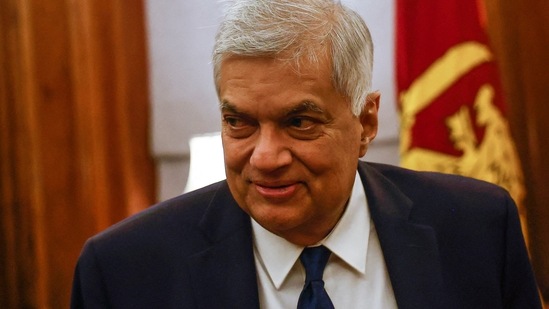
Sri Lanka Economic Crisis: Sri Lanka’s President Ranil Wickremesinghe is seen.(Reuters)
Sri Lanka President Ranil Wickremesinghe on Sunday said 2023 will be a critical year” for the cash-strapped country, as his regime desperately scrambles to inject much-needed impetus to galvanise the beleaguered economy.
Sri Lanka was hit by an unprecedented financial crisis in 2022 due to a severe paucity in foreign exchange reserves that also sparked political turmoil in the island nation that led to the ouster of the all-powerful Rajapaksa family.
We are looking at the New Year 2023 after having undergone the bleakest of times, immense hardships, as well as the uncertainties and hopelessness of the last year,” Wickremesinghe said in his New Year’s message, as Sri Lanka turns 75 as an independent nation later this year.
I understand the great burdens that are placed on all of us and the setbacks that a majority of us have suffered due to the country’s abject economic collapse,” he said.
From April to July, chaos reigned supreme on Sri Lanka, with miles-long queues forming at fuel stations and irate residents coming out in thousands blocking roads with empty cooking gas cylinders.
The Sri Lankan government in May last year declared a debt default on over USD 51 billion in the foreign loan – a first in the country’s history.
Indeed, 2023 will be a critical year in which we plan to turn around the economy. 2023 is also the 75th year of independence from the British Empire,” he noted.
National Day, also known as Independence Day is celebrated on February 4 to commemorate the country’s political independence from British rule in 1948.
The resignations by President Gotabaya Rajapaksa in July and his elder brother Prime Minister Mahinda Rajapaksa in May 2022 amid massive anti-government protests subsided with the formation of a government led by their ally Wickremesinghe, who is now tasked with stabilising the economy and restoring the financial health of the economy, already hit badly by the pandemic.
We must boldly implement the proposed social, economic and political reforms to build a prosperous and productive Sri Lanka in the coming decade,” Wickremesinghe explained.
While explaining the roadmap ahead, the President assured that the worst in the country’s financial crisis may be over.
Yet I believe that we have already gone through the worst of these times,” he noted.
Wickremesinghe,73, thanked the citizens for their patience and courage as the government took the critical steps to stabilise the economy.
In August last year, Wickremesinghe said Sri Lanka’s economic woes would last for another year and it will have to think outside the box and look at new sectors such as logistics and nuclear energy to revive the bankrupt economy.
The President also lamented that Sri Lanka was trailing behind some of the other countries that attained independence from Great Britain around the same time.
Looking back, it is obvious that we have not done as well as other ex-colonies. This is why the youth of our country are calling for a system change – especially at this juncture. This cannot be ignored,” he added.
Last year, Sri Lanka and the IMF agreed on a staff-level agreement to release USD 2.9 billion over 4 years.
But the much-anticipated IMF bailout will have to wait as the country pursues talks with creditors to meet the global lender’s condition for the facility.
President Wickremesinghe recently said that India and Sri Lanka held “successful” talks on debt restructuring and the country will also begin discussions with China, as it tries to get assurances from major bilateral creditors to close the crucial deal with the IMF.
(AFP)Sri Lanka on Thursday welcomed the first Russian travellers aboard a new flight service that was launched after the bankrupt nation urged Moscow to help revive its beleaguered economy by sending tourists.
Russia was Sri Lanka’s biggest source of visitors at the start of the year but arrivals nearly ceased after the invasion of Ukraine and as the Indian Ocean island weathered its worst-ever economic crisis.A commercial dispute also saw direct flights between the two countries suspended for months, prompting then-president Gotabaya Rajapaksa to ask his counterpart Vladimir Putin to resolve the impasse.Thursday’s flight by Russian carrier Red Wings, carrying 398 passengers, was the first of a new biweekly direct service between Moscow and the southern port town of Hambantota.
The start of flights to Sri Lanka is a new milestone… a remarkable event for Red Wings, passengers and our countries,” the airline’s general director Evgeny Solodilin said in a statement.
The route complements existing flights between Moscow and Colombo by Russian national carrier Aeroflot, which resumed in October after a four-month suspension.
Aeroflot stopped its flights in June after a court ordered its Airbus A330 seized over a commercial dispute with an Irish company.The aircraft was released after government intervention but the incident led to a diplomatic spat that was only resolved after Rajapaksa called Putin to ask for the flights to be resumed.
Sri Lanka has maintained friendly ties with Russia despite Moscow’s pariah status since the invasion of Ukraine.It has also purchased discounted Russian oil, ignoring embargoes imposed by the United States and European Union.
Months of blackouts, rampant inflation and critical food and fuel shortages made life a misery for Sri Lanka’s 22 million people earlier this year.The government defaulted on its $46 billion foreign debt in April and is working to secure an International Monetary Fund bailout.
Rajapaksa resigned in July after fleeing the country when a huge crowd of protesters, incensed by the economic collapse and its resulting hardships, stormed his official residence.His successor has scrambled to repair Sri Lanka’s balance sheet by raising taxes and attempting to kickstart the hard-hit tourism industry — a key source of critically needed foreign currency.
ECONOMYNEXT –Sri Lanka is expecting companies from Japan, India, Japan, and New Fortress Energy of the US to jointly come up with a proposal to supply a liquified natural gas terminal, Power and Energy Minister Kanchana Wijesekera said.Sri Lanka is building two LNG-capable 300MW-sized combined cycle power plants but has no terminal to unload the fuel.
Minister Wijesekera claimed that a combined cycle known as Yugadanavi was already capable of running on LNG. Another 300MW plant known as Sobadanavi would be available from November 2023.
But the problem is the CEB unions and other went to court regarding the LNG supply. Without the supply and infrastructure,” Minister Wijesekera said.
So, we will execute a plan fast in January for infrastructure and supply of LNG.”
The CEB had earlier floated a tender for a build-operate-own floating storage re-gasification unit (FSRU) which will be financed by throughput charges and LNG will be supplied separately by competitive tenders like coal and fuel is supplied now.However the tender was not proceeded through after a controversial unsolicited deal with US based New Fortress Energy was made public.
The tender for the terminal had not been given,” Minister Wijesekera said. Before that there are two proposals. In 2017 a tripartite agreement between India, Japan and Sri Lanka had been signed.
In addition, there is another agreement with a company called New Fortress Energy. So we are looking to see what can be implemented most practically. Next steps will be taken accordingly.
I think those companies are talking among themselves to operate jointly as far as I know.
We will have to do this with all the companies after all those discussions are over.”
New Fortress and at least two other proposals had involved controversial take-or-pay energy deals involving compelling the CEB to buy LNG from the terminal owner or pay penalties had been opposed by unions.
It is still at discussion level,” Minister Wijesekera said when asked whether another take-or-pay deal was in the offing.
There is no firm decision yet. When there is a firm decision we will inform you.”
One cannot become a leader either by driving buses or by setting fire to buses, SJB MP Field Marshal Sarath Fonseka said.
He told this to reporters after an event today. “Driving buses is not a qualification to become a leader.
“He (Sajith) must be getting some satisfaction by donating a bus and driving it. One cannot become leaders by driving buses or setting fire to buses,” he said.
“Those things go with political culture of the country. My personal opinion is that this political culture should be changed,” he said.
President Ranil Wickremesinghe said 2023 will be a critical year in which Sri Lanka was planning to turn around the economy.
“We must boldly implement the proposed social, economic and political reforms to build a prosperous and productive Sri Lanka in the coming decade,” he said in his New Year message.
The full messege
We are looking at the New Year 2023 after having undergone the bleakest of times, immense hardships, as well as the uncertainties and hopelessness of the last year.
I understand the great burdens that are placed on all of us and the setbacks that a majority of us have suffered due to the country’s abject economic collapse.
Yet I believe that we have already gone through the worst of these times.
I sincerely appreciate all of you who are committed to our country first and I thank you for your patience and courage as we took the critical, initial steps to stabilise the economy.
Indeed, 2023 will be a critical year in which we plan to turn around the economy.
2023 is also the 75th year of independence from the British Empire.
Looking back, it is obvious that we have not done as well as other ex-colonies. This is why the youth of our country are calling for a system change – especially at this juncture. This cannot be ignored.
Therefore, we must boldly implement the proposed social, economic and political reforms to build a prosperous and productive Sri Lanka in the coming decade.
While the press was distracted with the chilling killing of Mr. Dinesh Shaffter, scion of a respected and powerful business family; ultra-nationalist ex-President of Sri Lanka and erstwhile US citizen, Gotabaya Rajapakse, slunk back into the United States via Dubai on an Emirates Airlines Flight from Colombo in the third week of December 2022.
Gotabaya Rajapakse had done his time and could now return home to the US: During the Aragalaya protests that hit global headlines earlier that year, President Gotabaya was an embarrassment and not welcome in his second homeland the US, or in many other countries. Thus the once powerful President and former war-winning Defense Secretary became a homeless gypsy for a couple of months in the Empire at large and a sad spectacle. He was taught a lesson for past arrogance and henceforth would abide by Uncle Sam, and go quietly into the night.
President Gota is on record stating that he always meant to retire in the US where his son works for the government. What he did for the Empire during his second coming as Sri Lanka’s Head Honcho, was for the most part on track but not quite fast enough, perhaps due to some of those consultations with Gnanakka in Anuradhapura framed by the Ruwanveli Seya!
Thus, Gotabaya was out-maneuvered by another US ‘Force’ backed hybrid project — the Aragalaya or so-called peoples protest’ that enabled sufficient distraction for the Sri Lanka’s first ever Debt Default in April 2022. This was followed by the unseating of the President and installation of ‘Force’ favourite, Ranil Wickramasinghe, a.k.a Ranil Rajapakse, who had authorized the Central Bank of Sri Lanka (CBSL), Bondscam in 2015. The New Force backed President whose ascent was enabled through and despite the protests was appointed in a constitutional coup in order to carry out debt restructuring with the IMF and Colonial Club de Paris following Sri Lanka’s first ever sovereign debt default in April 2022.
Gotabaya had initially delayed going to the Washington twins, the International Monetary Fund (IMF), and World Bank (WB) for ‘help’ to pay mounting International Sovereign Bond Debt, but was eventually guided by his brother and fellow US citizen, then Finance Minister of Sri Lanka, Basil Rajapakse, to deliver the desperately needed Staged Default for Washington’s progress into the strategic island as Cold War hotted up in the Indian Ocean. The Third brother, Prime Minister and Sinophile, Mahinda Rajapaksa was trumped by his Diasporic siblings and their American ambitions.
The Timeline for Full Spectrum Dominance in 2022: Virtual Reality in the Post/Colony
By now all sides of the equation are remote controlled to greater or lesser extent: This is termed Full Spectrum Dominance (FSD), Over the Horizon operations. The CIA/ NED/ USAID stage managed and funded sequence of events and dramatic timeline of 2022 with the Aragalaya chaos strategy, enabled the Washington Consensus and Colonial Club de Paris to enter and tighten their grip on Strategic Sri Lanka’s Economic, trade and National security policy and maritime zone, including Submarine Undersea Data Cables (UDC), despite the best intentions of many good citizens, genuinely fed up of the political corruption who hit the roads protesting in those heady days of Sri Lanka’s ‘Arab Spring’.
All this was done to target China whose alternative STATE-LED Capitalist development model and Belt and Road (BRI), project for global connectivity and trade are seen as an existential threat to Western hegemony and the nuclear sub War Machine (NATO-AUKUS). Meanwhile, India moving to assert itself as a ‘global power’ in this long predicted ‘Asian 21st Century”, remains the Wild Card, juggling China, Russia and the US.
The US has signaled it would confront China in the maritime domain and hence invented the Indo-Pacific” and AUKUS for nuclear Submarines some years ago. Enter, Sri Lanka at the center of the Indian Ocean as a key player, where there was a copious plastic spill by a mysterious ship MV Pearl from Dubai to Singapore that sank outside the Colombo port in 2021. Thus, USAID this week lunched a 5 year Deep Dive, Plastic cleanup operation of the Seas of Sri Lanka![i]
The million-rupee question at this time is: will the two Asian Giants who are not members of the Colonial Club de Paris that represent the bond traders responsible for Sri Lanka’s Default, and significant bi-lateral creditors of Sri Lanka, work together to ensure that the county does not become an Economic Proxy War site, like Ukraine is in the US-led NATO proxy war against Russia? Or even Afghanistan or Haiti.
Its geopolitical ‘wheels within wheels” and ‘turtles all the way down’ in the virtual reality of the post/colony where Full Spectrum Dominance (FSD) and Over the Horizon (OTH), operations are the name of the cyber-war game! Advantage US, as English is the dominant language of the Internet and social media where Psy Ops take center stage. FSD includes massive Psychological Operations through datafication, Artificial Intelligence (AI) generated shades of virtual reality and Disinformation, with contradictory Big Data, models, algorithms and indices, designed to cause Cognitive Dissonance, anxiety and fear by gaming the corporate and social media narrative in a Post-Truth Risk Society permanently wired to small screens– from cell-phones to laptops.
Meanwhile the real data and evidence, like the forensic audit reports of the 2015 Bondscam remain beyond the reach of citizens, just like certain key chapters in the investigation into the Islamic State (IS) claimed Easter Sunday 2019 attacks that were redacted and embargoed.
Exogenous Economic Shocks and Gotabaya’s Policy Train wreck:
How does South Asia’s richest and only upper Middle Income Country with the best human development and social indicators (HDI), in the region, become a debt-trapped train wreck in just four years? Was it pumped and dumped, and if so, by whom?
A series of cascading. staged hybrid war-style Exogenous Economic Shocks (EES), and the Gotabaya Rajapakse regime’s policy mistakes are legendary. These include two years of militarized economically devastating and unnecessary Covid-19 lockdowns albeit on the instructions and advice of the World Health Organization, which consolidated the path to Debt trap and the ISB Debt Default.
The Covid lockdown saw the Greatest transfer of wealth in Human History, with many countries in the Global South go into near debt Default. Sri Lanka is by no means an outlier when it comes to induced sovereign bond debt traps. The Covid-19 lockdowns and mass militarized injection/vaccination campaign of the population, in line with the Great Reset Global Governance agenda of the Global 1 percent, debilitated institutions, advanced Digital Colonialism, and enabled a pandemic of corruption and Disaster Capitalism.
Covid lockdowns were more egregious than the tax cut that followed the previous Exogenous Economic Shock—the mysterious ISIS-claimed Easter Sunday hybrid-war style attacks of 2019 on the tourist economy—whose masterminds are yet unknown. Those tax cuts were to boost a slumping economy at a time when the World Bank had upgraded Sri Lanka to MIC thus preventing access to concessionary borrowings, and forcing recourse to private market borrowing at predatory interest rates in the wake of an Exogenous Economic Shock, or IS terrorism. Subsequently, the CIA had notified Minster Harin Fernando that the mastermind of the IS claimed attacks was an internet bot called Sonic-Sonic” or was it moronic-moronic”? This was duly announced in Parliament after the CIA had removed materials evidence from the crime scene- the Suicide Bombers phones.
The other policy blunder was the Organic Fertilizer fiasco due to UN Climate Catastrophe narratives and Green Transition advice. In a midnight deal, Gota sold the Yugadanavi Power Plant to a US outfit, New Fortress company, for a clean green and ultra-expensive LNG transition, also jeopardizing Sri Lanka’s Energy security.
Various UN agencies did their part to assist the policy train-wreck towards Debt bondage, with Covid and Climate catastrophe stories. So too Blue-Green bonds have been promoted by the UNDP in IMF PC debt restructuring talks, alongside purchase of expensive green tech. vehicles, solar panels and wind energy projects etc. for which land and marine areas are being appropriated. This would kill two birds with one stone- increase the profit margins at both ends for BlackRock, the holder of the largest chunk of Sri Lanka’s ISBs, via partner Adani– to be gifted key coastal areas for green energy projects in Mannar and Poonerryn, while indigenous communities, fishers and farmers are denied access to their traditional lands, fishing grounds in the name of corporate funded environmental conservation.
The UNDP Green Transition chorus has compelled small countries with incompetent leaders to bear the costs of ‘Loss and Damage’ caused by the Industrialized West although islands like Lanka have not caused climate change and need not rush to get expensive green technology especially after the Covid-19 Lockdowns. This has given rise to concerns about climate colonialism and climate hypocrisy.
President Gota’s Green Masterplan for policy train wreck was also crafted with the advice of his Viathmaga SB Diaspora buddies. The organic fertilizer debacle enabled various corporate-funded UN agencies all in the Humanitarian Disaster Capitalism industry to claim that Sri Lanka, a fertile and lush tropic country on major trade routes would soon face a Famine! Thus UNICEF, FAO, WFP and other agencies could raise funds for various humanitarian activities in the island, where people were primed with handouts for the IMF’s magnanimous Digital Cash Transfer project for the Global Reset. But protesting Sri Lankan citizens do not want to be subjects of IMF handouts. Rather they seek Debt Justice and Climate Justice and a flat playing field to do their own thing! There was massive local currency depreciation after the ex-ante and ex-poste the Staged Default, instantly beggaring the county and triggering a spiral of inflation.
Epilogue: Semiotics of a Crime: It’s the Bonds, Stupid!
The Semiotics of the guillotine style killing of Mr. Shaffter left in his own car in broad daylight at the Colombo General Cemetery (Kannatte), after driving down roads packed with CCTV cameras, indicates a crime staged by perpetrators assured of immunity and impunity. It was a crime designed to send a chilling message to those who may seek the truth about various local and global bond trades and financial crimes that led to Debt Default, or dare speak truth to power.
Dinesh Schaffter was a primary material witness at the Presidential Commission that investigated the 2015 Central Bank bond scams, alleged to have been authorized by then Prime Minister and current President Ranil Wickramasinghe a.k.a Ranil Rajapakse, also to fund his party’s election campaign. The court case is on-going at this time. Mr. Shaffter whose company had placed bids at the time had inside knowledge.
At this time there are calls for transparency and information disclosure on local and international bond trades, Forensic Audit Reports, national asset valuations, and the identities of the bond holders. The IMF and Colonial Club de Paris which represents private creditors and bond holders, principle among them BlackRock, are pushing for a quick Debt restructuring deal for the Creditors at this time along with, a Firesale of strategic assets (lands, marine areas, energy, transport and telecom infrastructure), along with USD 1 billion worth of blu-green Bonds or DFNS. Protestors have called for a moratorium and ban on borrowing from private capital markets give the Odious nature of the Debt.
Sri Lanka is losing its energy, economic and trade policy sovereignty and independence on the eve of 75th year also amid increasingly, totalizing climate and pandemic) disaster narratives, promoted by various UN agencies. So too, the Right to Self-Determination of Peoples, National Policy autonomy and State Sovereignty — Founding Principles of the United Nations System have been turned on their head as various UN agencies funded by big corporations (big Pharma and Green tech), promote their products, Neocolonialism and SuperImperialism.
Finally, the not insignificant good news is that strategic Sri Lanka may well benefit from the current cycle of climate change, given the El Nino Southern Oscillation (ENSO). Many climate change models and empirical reality (rather than Virtual Realty) indicate that the island blessed with two annual monsoons will get more rain and hence have more arable land and clean, green hydro-electric energy in years to come although sea level rise may be cause for concern.
Welcome to 2023 and (virtual) reality in the Post-truth age!
The Russians have decided there is no way to negotiate an end to this. No one will negotiate in good faith; therefore we must crush the enemy. And that’s what’s coming.” Colonel Douglas MacGregor (9:35 minute)
Strictly speaking, we haven’t started anything yet.” Vladimir Putin
The war in Ukraine is not going to end in a negotiated settlement. The Russians have already made it clear that they don’t trust the United States, so they’re not going to waste their time in a pointless gabfest. What the Russians are going to do is pursue the only option that is available to them: They are going to obliterate the Ukrainian Army, reduce a large part of the country to rubble, and force the political leadership to comply with their security demands. It’s a bloody and wasteful course of action, but there’s really no other option. Putin is not going to allow NATO to place its hostile army and missile sites on Russia’s border. He’s going to defend his country as best as he can by proactively eliminating emerging threats in Ukraine. This is why Putin has called up an additional 300,000 reservists to serve in Ukraine; because the Russians are committed to defeating the Ukrainian army and bringing the war to a swift end. Here’s a brief recap from Colonel Douglas MacGregor:
Landmark days, like the 1st of January and, more importantly for us in Sri Lanka, the Aluth Avurudda in the month of Bak (that’s April), are about renewal, discarding of hang-ups and errors, and a fresh page. We are now done with 2015. The year 2016 is ours to inhabit, revel in and decorate. It is ours to mess up too.
Landmark days, like today, are made of kiribath, some decorations, greeting cards and everyone wishing everyone else makes for good cheer. That’s all nice but in the end is but thin cover that other imperatives dissolve and pretty fast too.
The year that left us or which we left, like all years, was yet another endorsement of the ata lo dahama. Individuals, collectives and institutions were all subjected to the perennial vicissitudes; profit-loss, joy-sorry, praise-blame, and fame- obscurity. It is unlikely that things will be any different in 2016, except for the shape and wrapping these things arrive in.
Still, it is as good a moment as any to take stock, jot down some home-truths and make a few recommendations.
TO THE POLITICIAN:‘You are required to represent those who voted for you and not those who funded your campaign or are ready to give you commissions for favours wrought from power-abuse. Those among you who are in government do not own this country, her resources, heritage, labour-power and culture, but are only temporary custodians. Those in the opposition are required to point out flaw, offer constructive criticism and alternatives and mobilize people towards correction. Your internal squabbles are boring. All of you would do well to reflect now and then on your mortality.
TO THE PUBLIC SERVANT:‘Your salaries are paid by the people and not the politician, even if the largesse” of the latter can impact, positively or negatively, your spending capacity and job-frill. You may not be getting the salary you deserve but you are required to produce value equivalent to what you do get. We understand that you probably have a family to look after, but urge you to take the long view, Sansaric if you will or, if you believe in a hereafter of divine make, then recommend reflection on Judgment Day. In short, we suggest that conscience” is of greater worth than the urge to maximize benefit. Politicians come and go but the public remain. We salute those of you who do your job, unmoved by brickbats and bouquets, carrying the deadweight that is the incompetence, arrogance and theft-intent of your colleagues. We hope they become more responsible. In any event, we are watching them. They too are mortal.’
TO THE PROFESSIONALS: You are doing a thankless job and we appreciate. We deplore, however, those of you who prey on the miseries, impoverishment and ignorance of those who seek your professional help. There are those among you who deserve the tag ‘itu deviya’ but there are also others who are like Shylock and worse, like Antonio and Portia extracting far worse than a pound of flesh in the name of ‘justice’ or necessary service. We journalists belong to the same tribe called ‘Professionals’. We are conscious of our mortality.’
TO THE BUSINESS COMMUNITY: ‘We do understand and appreciate the role you play in providing goods and services. We do understand that profit is an important driver. We are not unaware that in all sectors you operate, there are those among you who engage in white collar crime, who are aware of and are not shy about slipping through legal and other loopholes and are willing and able to grease palms when convenient. We know you have things to sell and know that not all things you sell are necessary and not all things do what they claim to be. We applaud your enterprising spirit, but implore you to act like the responsible corporate citizen you claim to be in your annual reports. You are mortal and moreover, will not take your bucks to the hereafter.
TO THE BIKKHU, THE AYER, THE MAULAVI, THE PASTOR ETC: ‘With all due respect, live the word you speak, administer to the non-material needs of your respective flocks, take inspiration from the lives of your teachers and be worthy of respect and veneration. All this, not on account of the garb you wear or the temple you reside in but the fact of embodying to the best of ability or your karmic endowment, the word you speak.
TO THE PEOPLE OF THIS NATION:‘This country is yours and if it is flawed in leader and institution that is partly reflection of your inadequacies, including apathy, lack of courage and sloth. This country is yours in both its making and breaking, its slippages and renewal. Spit on it and you spit on yourself. It is yours to make fragrant, yours to defile. This nation is yours. This nation is you.
Let 2016 be a year where we take concrete steps towards becoming a society based on community (including workplace) accountability, all united to protect our lands, airs and seas, and most importantly, the sweat of our labor!
*’This is a appropriately changed version of ‘The Nation’ editorial, January 1, 2011
We are a few hours away from the year 2013. The world has not ended and the signs are it will not. Strangely, the end of the world sometime in late December was the most looked forward to event of the entire year, beating by a fair margin the Olympics, the US Presidential Election and the T-20 World Cup. Well, it looks like Doom’s Day prophets have called it a day. For now.
A calendar year is ending and a new year beckons. It’s naturally a moment to look back and look ahead, to think about the what-have-we-done and also the what-should-we-do. If the whole world’s-end hoopla taught us anything, it must be that we are collectively ignorant. We just don’t have the ability to predict. And if anyone is to be blamed it is ourselves.
Now it is not the case that the world has been spared natural disasters. Earthquakes, cyclones, tsunamis, droughts, floods, famine, epidemics and such are not unknown to the world. Our ancestors saw and suffered. They also knew war. . And the wars they fought, won and lost, were nothing like the conflagrations the world has known in the past century. What they didn’t have then was ‘development’.
There was a time when we had seasons: when we knew when it would rain, for how long, in what quantity and where. We knew about inter-monsoonal rains. Again, our ancestors knew enough about rainfall and where the rain would fall and where it would not. So they planned for drought. They built sophisticated irrigation systems. They knew enough about ecology to be circumspect in how they engaged with the natural world, especially since they were equipped with technological know-how capable of causing much destruction to ecosystems.
‘Development’ changed all that. ‘Modernity’ changed all that. ‘Modernism’ and ‘Develomentalism’ changed all that. Capitalism and Communism in their various articulations changed all that. These things spawned hordes of profit collectors and do-gooders (some naïve, some now) who wanted to modernize and develop societies that were deemed to be archaic and underdeveloped.
Things that worked were called ‘traditional’ or ‘crude’. Values and customs that built civilizations and sustained societies were tagged ‘heathen’. Those who did not require salvation were sought to be ‘saved’. And when it became clear that ‘the good life’ comes at a cost (environmental degradation to the point of ecosystem collapse and frenzied competition for resources resulting in wars), the do-gooders, so-called, said ‘people need to have choices’. They should, in other words, be able to choose between 10 brands of footwear, each brand offering a range of choices for the ‘sophisticated’ consumer. The consumer, at the end of the day, is much like his or her less needy ancestors, endowed with just two feet.
But everything we see, hear, taste, touch and smell come with three tags: loba (greed), dosha (envy/hatred) and moha (delusion/ignorance). They come with an invite: ‘Come, embrace and embrace tight!’ Delusion is a pernicious operative for it persuades us to destroy all that we have in the belief that this is a necessary condition for obtaining what we don’t have and didn’t need but have come to believe we must have in order to secure meaning in our lives. We throw away what we have (traditional knowledge, climate-specific seeds, ethics of giving and sharing etc) to obtain membership in a throw-away society; so that we can be called ‘developed’ and ‘modern’, where the tag-giver deliberately leaves out the obvious suffix, ‘fools’.
The world did not end as predicted, but there are many worlds that are ending or rather are being ‘ended’. That process should be stopped. We have ‘developed’ for quite some time now and have very little to brag about. Perhaps it is time to undo certain things. Perhaps it is time to un-develop.
Union minister Jitendra Singh’s statement in Parliament on the Ram Setu kicked off a political storm, with the Congress’ Chhattisgarh Chief Minister Bhupesh Baghel saying last Saturday that the Bharatiya Janata Party must apologise for misleading” the nation on the issue.
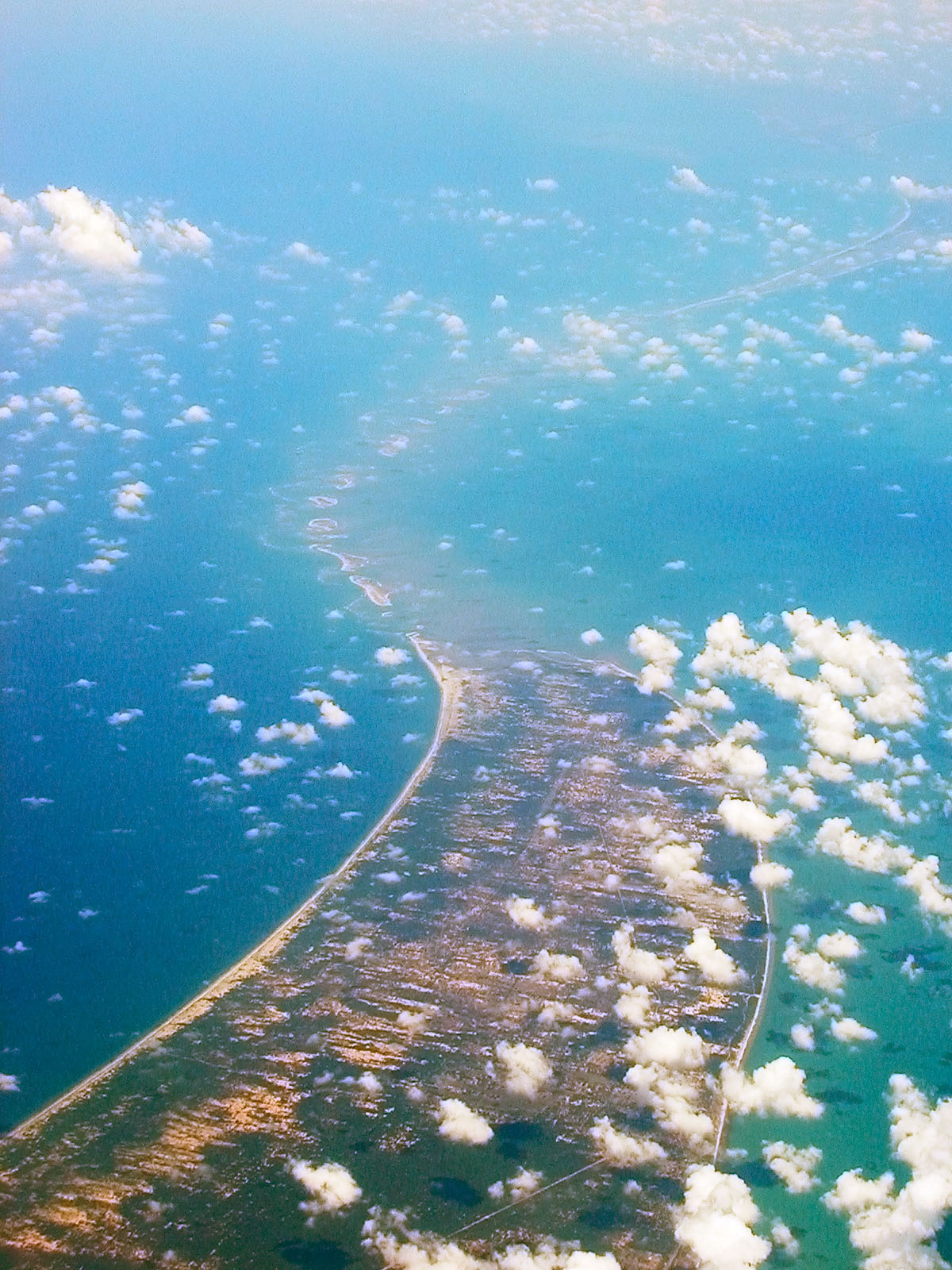
Ram Setu or Adam’s Bridge is a chain of limestone shoals between Rameswaram island off India’s south-eastern coast and the Mannar island off Sri Lanka’s north-western coast. Popular Hindu belief attributes its construction to the god Ram, according to events in the epic Ramayana.
Replying to questions on whether the existence of the Ram Setu can be proven through satellite imagery, Singh had stated on Thursday that such images cannot provide direct information about the origin and age of this structure (Ram Setu)”.
This latest back and forth adds to a long-standing political contentions between the BJP and the Congress over the nature of the Ram Setu’s existence – whether it is natural or human-made – triggered in the mid-2000s by the proposed Sethusamudram Shipping Canal Project. This canal would damage the formation which, the BJP claims, carries cultural and historical significance for many Indians.
What are the BJP and Congress arguing?
In Parliament, Earth Sciences Minister, Jitendra Singh explained there were limitations in exploring the Ram Setu through satellite imaging. Referring to the Ramayana, he said its history dates back to about more than 18,000 years and that bridge, if you go by the history, was about 56 kilometres long”.
Singh added: To some extent through space technology, we have been able to discover pieces and islands, some kind of limestone shoals, which of course can’t be accurately said to be remnants of parts of a bridge. But they have certain amount of continuity in location through which some surmises can be drawn.”
In response, Baghel attacked the BJP government saying, When the same thing [was] said during Congress rule, BJP called us anti-Ram. Now this Ram bhakt says in Parliament that they do not have strong proof (of Ram Setu).”
Citing a news report, former Madhya Pradesh chief minister and Congress leader Kamal Nath also said the Modi government had admitted that no solid evidence has been found for the [Ram Setu’s] existence”.
He further accused the BJP of hurting religious sentiments: This statement by the BJP government is an attack on the faith of crores of people of Hindu society. Lord Ram is the centre of the faith of the people.”
The BJP hit back at the Congress. The party’s Member of Parliament Rajyavardhan Singh Rathore and Manoj Tiwari said the Congress was twisting” the government’s statements – suggesting that the minister had not drawn any such conclusion.
Aerial view of the Ram Setu. Credit: CC-by-SA PlaneMad/Wikimedia
How did Ram Setu first emerge as a political debate?
This political debate on the Ram Setu is not new. The topic first became contentious when the Congress-led United Progressive Alliance government pushed forward the Sethusamudram project in 2005. The plan was first conceived of by the British in the 19th century and underwent several iterations with regards to the alignment, including one by the BJP-led National Democratic Alliance government in 1999.
The project would require dredging the seabed to create an 83-km-long deep-water shipping canal connecting the Palk Bay and the Gulf of Mannar situated between India and Sri Lanka. The water in the area is shallow, hindering navigation by large ships. The proposed canal would provide ships a continuously navigable marine route around the Indian peninsula as an alternative to having to go around Sri Lanka. This, the project’s proponents suggest, would cut travel time and boost economic growth.
What makes the matter contentious is that the canal’s alignment, as approved by the Congress government, cut across the Ram Setu.
This led the BJP and various Hindu organisations to oppose the project as the dredging would damage the the bridge.
Hindutva opposition
The BJP and other right-wing organisations have cited Hindu beliefs about the Rama Setu to oppose the project. They cite the Ramayana, the ancient epic, as mentioning that the Ram Setu was built by Lord Rama and his vanar sena” orarmy of monkeys. This bridge, according to the epic, was used by them to cross over into Lanka to rescue his wife Sita. Because of this, the BJP and other organisations say that the Ram Setu must not be damaged.
Representative image of UPA chairperson Sonia Gandhi (centre), then Indian prime minister Manmohan Singh (right) and BJP leader Lal Krishna Advani. Credit: STR/AFP Photo
On the other hand, in 2007 during the United Progressive Alliance government, the Archaeological Survey of India, which reports to the Culture Ministry, had filed an affidavit before the Supreme Court stating that Ram was a mythical character and that the Ramayana had no historical basis. Therefore, the government agency said there was no historical or scientific evidence to establish the Ram Setu is a human-made bridge. However, the affidavit was later withdrawn by the Congress government following protests by the BJP.
In 2018, the BJP-led Union government submitted before the Supreme Court that it will not touch the Ram Setu and would find an alternate alignment for the canal. But the project remains stayed as the matter is pending before the Supreme Court.
Some politicians, such as BJP leader and former Union minister Subramanian Swamy, have sought a national heritage monument status for the Ram Setu to ensure it is not compromised, even as the project remains in cold storage.
… thank you for making Scroll.in the digital-only news organisation with the widest reach in India.
We request you to support our award-winning journalism by making a financial contribution towards the Scroll Ground Reporting Fund. The fund will ensure we can continue to ask the questions that need to be asked, investigate what needs to be uncovered, document what must not go unrecorded.
Dr Sudath Gunasekara(SLAS) Former Secretary to Prime Minister Mrs Sirimavao Bandaranayaka
Gentlemen what have you done to the Kandyan Sinhala people,for 75 years since 1948, who protected this country for you and all of us, for 443 years from foreign enemies (1815-1948), other than closing down the only organization they had at least ‘to seek protection from an unexpected rain’ as the famous Sinhala adage goes The Department of Kandyan Peasantry Rehabilitation” on 1st Jan 2014. by the then Podu Jana Peramuna government by Basil Rajapaksha, the then Minister in charge of the subject.?
I pause this question to you in the backdrop of a news item that the present government has already taken action to improve upcountry plantation workers lives amid Indian push” under the directions of the President, unilaterally taken, based on wrong information and Indian lobbying.
I hold it as a Buddhist that improving the lives of any one in this country, from a humanitarian point of view is indeed commendable and definitely gracious. But if it is done at the expense of the native Sinhala people, the founders of civilization on this land, then such traitorous action should be condemned outright and fourth with, without any regard as to who has taken it. Improving the lives of people means many things. Basically, it can be land, shelter, food, water supply, clothing, medicine, education and employment.
In this essay I would like to confine to the two basic needs of land and shelter which usually go together. This land now being handed over to Indian Tamils who were brought here by the British after 1839 and on which houses are built with Indian funds was owned by either the crown of the Sinhale Kingdom or by our ancestors. Therefore, this land was ours and even today it is our life. Therefore, we vehemently protest and strongly oppose any steps taken by any government giving it to any foreigner. When it comes to these Tamils one can say, no!no! they are also citizens of this country. Yes, they are. But they are not the sons of this soil. I maintain that they are only political citizens. As they have been given citizenship by one politician at his own will (JR in under JR/Rajiv Accord of 29 July 1987)) due to pressure from India and due to political compulsion created by the greed for their vote. This land, the land of the Sinhala nation from the beginning of history must be first made available to their pre-emptive native owners. It should not be given to any foreign country as it was once done on 2nd March 1815.But at present this land once supposed to have been given back to the natives in 1948 is again given to Indian Estate labour only, thereby creating mono Tamil settlements all over the hill country. When the pole cat is thrown out of the door the skunk crawls in through the window, as Americans say. This process will create a ring of mono Tamil settlements right round the central hills extending to all areas where Tamil people live such as Kegalla, Ratnapura, Galla, interior Matara, Monaragala, Bibila, Passara Badulla, Kandy, Matale and even Kurunegala.
The resulting demographic changes will definitely lead to far reaching geopolitical changes followed by unpredictable consequences to the Sinhala nation in the near future. The district representation and the preferential voting system will make it worse as minority ethnic groups always vote for their candidates only. If this trend continues without taking precautionary measures immediately, the day this country becoming the 29th State of India is not that far. Once the 29th State is created the new Lankanadu and Thamilnadu will join hands and declare the Eelam which Pirapaaharan failed to realize for 30 years. With that the 1963, Jawaharlal Nehru, declaration on secessionism in India will also come to an end
The next step is declaring whole of India as the EELAM as forecasted by the EELAM theorists. It is this Eelaamist strategy every politician in India including Jayaprakash Naraayan has to realize at least now, before they try to exert their policeman influence and interfere with the internal politics of this country.
Once this is done the curtain will fall on the 2500-year-old Lanka and the Sinhala Buddhist civilization on this planet. This in short is what I predict will happen one day, if this ongoing Tamil settlement programme in the hill country is not arrested in time.
The only way to avoid this disaster
It was the native Sivhela (who later became Sinhala) people who defended this country against South Indian invasions from Ram-Ravana’s times in the yore and more recently from three ruthless colonial invaders namely Portuguese, Dutch and the English for 443 years. But attempting to solve the problems of the Indian labour with no concern for the plight of the Bhumiputhras is like trying to improve the lives of a neighbor’s family, without first have a look at his own kitchen and see that his own wife and children are not starving. I cannot think of a better advice than this I could give to the governments messing up with these short-sighted political agendas with utter disregard to one’s own country and the nation.
We, the patriotic Sinhala people of the Kanda Udarata lodge our strongest protest against this decision of giving special treatment to Tamils of Indian origin purely for petty political consideration, for which they will never be grateful as amply proved by all past experience, without paying any attention to first, rectifying the historical injustices done to the natives by colonial invaders by forcibly grabbing their ancestral land and forcing them to flee to the eastern jungles to save their lives followed by brutal and horrendous crimes against them for decades. The 1818 historic Uva uprising and the 1848 Matale rebellion by the Kandyan populous against the British rule were the best evidence where the native Sinhalese displayed their burning patriotism and gallantry against the repressor to save the motherland. Torrington in 1848 got down a large number of sepoys to quell the native freedom fighters in the Matale rebellion.
In fact, coming on to the present-day Tamil problem on the hills, actually speaking all these South Indian laborers should have been repatriated to India or taken to England at the time of British leaving this country in 1948. as all of them were legally British citizens at that time. As such this is another crime committed by the colonial British against Sri Lanka and the Sinhala nation for which they alone are directly responsible. Therefore, the government of this country should demand the British government first to repatriate these Indian labourers or take them to UK.
It is a big tragedy that our politicians of the day have not realized that danger at that time, whereas, all other countries like Burma, Mauritius, Tanganyika and Malaysia issued an ultimatum to all Indians to leave those counties. But Sri Lanka never did it and they are the people to whom the Government is now planning to hand over the ‘Geographical Heartland of Sri Lanka” THE HADABIMA (as I have named it) making a free pathway for India to walkover and to convert this Island to be the 29th State of India with no effort and replace British colonialism with Indian expansionism. Indian imperialism will definitely be worse than the British because they will do everything to compensate for their failures starting from the Ramaayana days.
It is in this backdrop I declare shame on those politicians who betray the Motherland and millions of sons of the soil who descend from the patriotic Brave Kandyan Sinhala freedom fighters”, who fought against three colonial invaders, Portuguese, Dutch and the English for 443 years and died in tens of thousands and sacrificed everything they had including their own mother earth and the right to live, to protected this Island for us to live today.
Not all present-day Indian Labour in Sri Lanka have a 200-year-old domicile history in this country as the Cabinet paper says.
The first batch of Indian laborers comprising 2,719 persons from what is now known as Tamil Nadu, came in 1839. By 1910, this number had ballooned to 409, 914 to work on Coffee and Tea plantations opened up by the British on lands that belong to the native Sinhalese forcibly acquired by the British invaders through draconian laws. As such to say these estate labourers have a 200-year history is wrong. I wonder who gave this wrong information to the cabinet, that by February 2023, it will be 200 years since the arrival of the first generations of the Up-Country Tamil community to Sri Lanka. In fact not all the present day Tamils living in these areas are descendants of the early immigrants as most of them have left the country from time to time.
To say that they have enormously contributed to the economy of this country is also absolute false.
The South Indian brought as indentured labour worked for their British masters right through out as slave coolies for very low wages and helped them to enrich the British coffers. Whatever these coolies had saved they transferred all that to South India annually in the form of Sterling Pounds and gold every year in their routine annual trips to their mother land. (For details see Tennakon Wimalananda (Dravida Munnethra Kasagam Vyaparaya haa Sinhahalayagei Anagathaya) So, it is very clear that it was Briton and India who had benefitted and not Sri Lanka from their labour. Therefore, to say that they have been contributing to the national economy of this country for 200 years is a blatant lie.
Their biggest contribution they made was to the British economy to enrich their coffers and to build their Empire and the rest was sent to India. As such they have contributed only to British and Indian economy. On the other hand, as far as this country is concerned, they were a big liability to the country’s economy right from the beginning as all their food requirements were also imported using money generated in this country. They were also heavily subsidized by the government on food, medicine, and all other facilities at the expense of the country’s economy. This also had a negative effect on the country’s economy. Importing wheat flour and rice in large scale to feed these laborers in a big way was a sad legacy we have inherited from that time. This again badly affected the domestic paddy production and local economy. Besides, Sinhala people also became accustomed to and became dependent on cheap imported rice and flour for the first time in history of this country. In this context I would like to ask the question from any one as to what positive contribution these people have done to this country’s economy or development.
What is worse is none of them has a love for this country. Though they earn their daily bread here, they all ways worship mother India, their gods and their politicians. Thus, they were and are 100 % Indians for all intent and purposes. As a school going small boy (12-15), I have seen even the barber saloon in the small town was always decorated with massive photographs of Indian politicians like Gandhi, Nehru, Subhas Chandra Bose and Indian Gods like Saraswathi, Ganesh and Hanuman. Thus, not only those who lived on the plantation areas but even those who lived in the townlets and cities lived mentally in India, although physically they were here and also earned their bread on Sri Lankan soil.” Even though they have got Sri Lanka citizenship on paper, thanks to our unpatriotic and vote-centric politicians, they still continue to be Indians for all intents and purposes for generations. The fact that Fifty percent of the man days lost to strikes were from the plantation industry proves the love they have towards this country. My personal experience tells me that these Indian Tamils who live here are, metaphorically, a set of people who pray long life to the ocean after having drunk water from the well. (ලිඳෙන්වතුරබීලාමුහුදටආවඩනමිනිසුකොටසක්)
My question to our crazy unpatriotic politicians who cry for the rights of the estate labour Tamils of Indian origin and approves urgent Cabinet papers based on false information is, what have you people done on earth to restore the birth rights of the Sons of the Kandyan Sinhalese whose ancestors have fought, died or got killed in tens of thousands and sacrificed all their rights including their mother land and the right to live during 344 years, starting from 1505, other than closing down the only organization ”The Kandyan Peasantry Commissioners Department”(even though it was also teethless and powerless) they had at least to protect their heads against an unexpected rain, on 1st Jan 2014. By Basil Rajapaksha of the Podu Jana Peramuna government. This is nothing but blatant betrayal of the motherland and the sons of the soil for which they will be never be forgiven. Shame on you who betray the motherland and the nation for a petty consideration of a vote, stained with blood of murdering a nation
I have no objection for improving the lives of upcountry plantation workers or any other segment of the society. Because that is one of the major social obligations of a state in any given country especially so in Sri Lanka being a Buddhist country. But why this Indian push’ on one particular group living in a specific geographical area in this country, as the news item says, unless they have some ulterior motive behind it. Is the hill country, where these Tamils of Indian live is already an area belonging to India, is a moot question.
The most important and the basic issue in opening up of large-scale settlements in the Hill country.
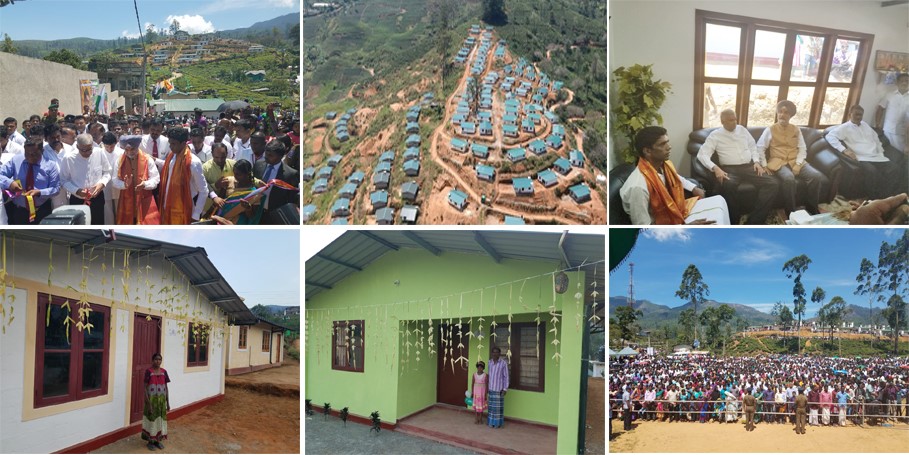
I would like to open this argument, for the need to protect the central hill country, and against its destruction caused by bad land utilization practices and by opening up of large scale settlements, as it is going on now, haphazardly conceived, on steep hilltops and slopes ( as shown by the following settlement recently opened up in Bogavanthalaava) that entail road construction and site clearings for community services like health centers, schools, temples, marketing centers and playgrounds etc (for narrow political expediency) that cause further destruction, with the opening passage of my paper, I wrote some time back under the caption The Central Hill Country: The ‘Hadabima’ (Heartland) of Sri Lanka A New Geographical Interpretation”
(Posted on December 2nd, 2017 Lankaweb.)
I pause the question to every man, woman and child in Sri Lanka as to what will happen to you, if your heart stops. Obviously, the answer is you will die. Similarly, one day, if the rivers that have their sources in the hill country, cease to flow, the curtain will fall on the survival of the entire life system in the Island together with its civilization due to lack of water, arising from deforestation, land degradation and bad land use practices on the central hills”
It is in this logical perspective that we should try to understand the critical importance of protecting the central hill country as the country’s geographical heartland” (HADABIMA) with the same care and caution that we take to protect our own hearts.)
The Central hill country of Sri Lanka provides the only source for all 103 rivers in the country. These rivers that flow down to the sea throughout the year in all directions keep the entire life system in the country alive. If these rivers cease to flow due to deforestation and bad land utilization practices followed by soil erosion and land degradation in the upper water sheds, one day, the rivers will cease to flow. The day they cease to flow the entire life system and the civilization of the whole Island will also cease to exist. Thus, the physical stability of the central hill country determines and dictates the fate of the entire life system and the civilization of this country.
The perennial flow of these rivers depends on the physical stability of the upper watersheds, even if it rains throughout the year. When it comes to settlements on the hill country lands, the most important and the basic issue is the need to protect the physical stability of the region as the survival of the entire life system and the civilization of this country wholly depend on its physical stability. It is the major and perhaps the only source of the entire water needs of the country. Besides this basic issue, there are some other critical issues like its geo strategic importance in relation to the security of the State, as it has been aptly proved throughout history of this Island nation and also other broader geopolitical considerations as well, that has to be seriously taken in to account before we jump in to taking decisions regarding any large-scale settlement scheme or any other sporadic settlements on this hilly terrain.
1 The first consideration is maintaining the physical stability of the central hills. Any activity on these hills must never jeopardize and destroy the physical stability of the central hill country above 1000 ft msl The geographical Heartland” of this Island nation that determines and dictate the survival of the entire life system in the Island and its civilization as it provides the main source of water and the biggest natural reservoir for the water needs of the whole country. We also have to remember that it also constitutes the main and the only water shed that provides the source for all the 103 three rivers that supply water to the whole country.
2 Geostrategic considerations
Other than the crucial importance of this part on the Island in relation to the Islands physical sustainability there is another extremely critical issue related to its geostrategic value in the islands geopolitical map of this part of the Island as it had been proved throughout history for which reason it must be kept completely free from any outside interference of any sort or any foreign settlements.
3 Geopolitical implications
A solid mono Tamil settlement right at the center of the Island with strong Indian control will have serious geopolitical implications ensuing due to major demographic changes. Therefore, such mono Tami settlements should never be allowed to exist as the degree of vulnerability of even a unilateral declaration of an independent state cannot be ruled out particularly in view of the current Tamil agitation for a separate Tamil state in the North and the east.
Now that all estate Tamils have been given Sri Lanka Citizenship the only way to circumvent this disaster is to establish mixed settlement in this part of the country to avoid such threats.
4. Harmonious ethnic reconciliation and total integration.
It is as a lasting solution to all these 3 issues in mind that I propose the following land use pattern to be adopted for the central highland of Sri Lanka in general, to overcome any future calamity.
This programme will also entail removal of all settlements on land above 3500 ft
The resulting new mixed settlements are finally expected to be integrated socially and culturally. That will also put an end to Indian interference in the central hill country of Sri Lanka at least.
Under this programme it is proposed that,
1 Declare all land above 5000 strictly protected and conserved forest (thanchi kele as it was during the ancient times)
2 All lands between 3500-5000 be confined to largescale tea plantations. Buildings within this area should be limited to only factories and allied staff quarters.
3 1000- 3500 mixed settlements of S&T on 2 ½ acre mixed farms of the HADABIMA model; Agriculture &livestock. This ring right around the hill country will provide the labour required for the tea plantations between 3500-5000as well.
In these settlements there will be complete social integration without any Indian interference, as it is done today. The integrated Tamils are not expected to be Indian Tamils any more, (if they want, they could be called Ceylon Tamils as an ethnic group, but not as a nation) where all will be equal and ultimately, they are expected to be another vibrant segment of the Sinhala society like the community inhabiting the SW coastal sector in the Island, who are said to be immigrants from South India during the early and mid-Kandyan Kingdom period.
Those who refuse to accept this settlement model should go back to their motherland South India. Either they should integrate with the native Sinhalese or go back to India. No one can live here as Indian or any other country’s citizen) They also have another option. That is, they can demand British citizenships as they were also British citizens when British left this Island in 1948.Because this had been the motherland of the Sinhala people at least for the past 2500 years. It is only in this country that each ethnic group assumes to be identified as a separate nation. In all other nation states like UK, America Russia India or Australia for example or any other you have only one nation. It is only in this country one finds this human joke. I attribute this situation to none other than the country’s politicians who have been running this country since 1948. Without a vision or a mission.
A separate state
In the event we fail to adopt this system, the Indian estate Tamils will eventually claim a separate State and in all probability, they will form a federation with the Tamils in the East and North. In fact, there had been a plan to open up a highway from Nuwara Eliya to Batticaloa during the Thondaman’s time. (Senior). The way how things are going on ultimately the Central Hill Country captured by the British in 1815 will be re captured by the plantation Tamils of Indian origin in no time, India will declare this Island the 29th State of India as Jayaprakash Narayan recently opined. Finally, it will be worse than the British occupation. And eventually the Sinhala nation will disappear from the surface of this planet.
It is in view of this imminent danger, that I propose all Sinhala politicians to support the above proposal unanimously to protect not only the Heartland of the Island but also the life system and the civilization of the whole country.
The singing of the national anthem in Tamil has led to two opposite reactions, for and against. There is also a conciliatory approach which said the Tamil version, could be sung in Tamil, in Tamil majority population area but when it comes to state and national functions it must be sung in Sinhala.
Others were less tolerant. A national anthem is a symbol of the identity of a nation, it is a symbol of unity. The Sinhala national anthem is composed with due regard to the auspicious nature of the words. Today the north is all Tamil, and they have with all impunity sung the national anthem in Tamil, they complained.
Why can’t the Tamils learn to sing the national anthem in Sinhala? If they are able to learn other languages in the countries they live in now, why can’t they learn Sinhala? They do not ask that the national anthem of the countries they now live in be translated to Tamil so they can sing it with fervor and loyalty, Sinhala supporters said angrily.
The legal angle was explored. Ladduwahetty said that the Constitution only provided for the Sinhala version of the anthem. Article 7 of the constitution makes it clear that the national anthem cannot deviate from the words and music given in the schedule and the words in the schedule are in Sinhala. Article 7 is an entrenched provision which cannot be amended, repealed or tampered with. President Sirisena has permitted the national anthem to be sung in Sinhala and Tamil in 2016. Is this a violation of the constitution Ladduwahetty asked.
The singing of the national anthem in Tamil in 2016 was challenged in Supreme Court as a violation of the Constitution. Shortly after the National Anthem was sung in Tamil on 4 February 2016, a legal challenge was mounted against the move. A Fundamental Rights petition was filed in the Supreme Court. After considering submissions by all parties concerned, a three-judge bench in November 2016 refused to grant leave to provide with the petition, reported Jeyaraj.
Centre for Policy Alternatives (CPA) filed an intervenient petition in the case. A communiqué issued by the CPA stated as follows: Sanjeewa Sudath Perera and two others filed a petition dated 26 February 2016 in the Supreme Court challenging the decision to sing the national anthem in Tamil at the official Independence Day celebrations in 2016. The petitioners argued that singing the Anthem in Tamil was contradictory to Articles 7 and 12 of the Constitution which relate to the National Anthem and rights to equality and non-discrimination respectively.
On 4 March 2016, CPA and its Executive Director Dr. Paikiasothy Saravanamuttu filed an intervention petition which argued that singing the National Anthem in Tamil was constitutional. The petition first referenced Articles 18 and 19 of the Constitution which state that Sinhala and Tamil are Official and National Languages of Sri Lanka. Furthermore, unlike subordinate legislation such as acts of Parliament, the Constitution contains no provision which stipulates that the Sinhala text shall prevail over the Tamil. As such, the words and music of the National Anthem in the Tamil language are constitutionally recognised by Article 7 read with the Third Schedule of the Tamil version of the Constitution.
The intervention petition further referenced Article 12 of the Constitution claiming that a declaration that the National Anthem be sung only in Sinhalese would be a direct violation of Article 12 which in turn would be a violation of the fundamental rights of Tamil-speaking citizens. The CPA also supported two additional intervention petitions that supported the constitutionality of singing the National Anthem in Tamil.
The Supreme Court took up the case on 18 November 2016, discussing whether the petitioners made a strong enough case for considering the petition in court. During discussions, the DSG referenced Articles 18 and 19 of the Constitution recognising both Sinhala and Tamil as official and national languages and that the singing of the anthem in Tamil was not in violation of the Constitution. The Court therefore decided that the petitioners had not disclosed a case to be considered and subsequently their case was dismissed.” concluded Centre for Policy Alternatives .
Canada had four languages ,English, French, Inuit and a bilingual version where the middle verse is in French, beginning and end is in English. South Africa has five official languages, Xhosa, Zulu, Sesotho, Afrikaans and English. The national anthem had four stanzas. First stanza is in Xhosa and Zulu, two lines each, next stanza in Sesotho, third in Afrikaner, fourth in ‘English,
Those against the Tamil version dismissed these examples. They stated that now Sri Lanka had joined South Africa, Canada, Switzerland, New Zealand and Fiji as a country having two national anthems. Sri Lanka need not take the new nations such as Canada, New Zealand and South Africa as examples. They were countries which had ethnic issues which were in some cases, still simmering.
Instead those opposing the Tamil anthem turned to Singapore and India. In Singapore, though Mandarin is the majority language, national anthem is in Malay. In India the national anthem is sung in only one language . It is a patriotic song written in Sanskritised Bengali by Tagore , adopted as the national anthem. It is not even in the official language , Hindi. But all Indians sing it regardless of whether they understand it or not. India stipulated that all schools in India have to start the day with the national anthem.
Those supporting the Tamil version stated that there is nothing in the constitution against the anthem being accurately translated in word and spirit and set to the same music and sung in Tamil. Tamil is an official language. The Anthem has been translated and sung in Tamil soon after it was adopted by the government [ in the 1950s]
Independence Day celebrations in 2020 saw the National Anthem being sung in Sinhala only. Tamil was excluded. The Tamil Separatist Movement ran to the UNHRC. The United Nations High Commissioner for Human Rights Michelle Bachelet mentioned it in her 17-page report to the United Nations Human Rights Council (UNHRC) in2021.
Ethnic and religious minority communities are left behind and excluded in Sri Lanka Bachelet said. Among instances noted by the UN Human Rights Chief in this regard was the exclusion of the National Anthem in Tamil. The report stated: The Government declined to include the National Anthem in the Tamil language on national occasions, such as the Independence Day celebrations, on 4 February 2020, despite the preceding years’ practice of singing it in two languages as a significant gesture towards reconciliation.” Such an approach has serious negative implications for reconciliation, peace building and religious tolerance, and carries the seeds of future violence and conflict, Bachelet concluded.
The Tamil Separatist Movement uses emotional arguments to support its case for a Tamil version of the national anthem. Here is a selection:
A National anthem is meant to unite and that doesn’t mean singing it in one language in a multi language society where diversity is recognized and accommodated in the constitution.
The Sinhala only national anthem was designed to divide rather than unite, to widen the psychological gulf the majority and the minorities and drive home the lesson that minorities are not so welcome interlopers in a Sinhala country.
There is greater chance of inculcating a sense of Lankan patriotism in Tamil/Muslim children when they are allowed to sing the national anthem in their own language rather than parrot it in a language they barely understand. Tamil could understand the meaning instantly when they sing it in Tamil.
People who insist that Tamils speaking people should be forced to sing our national anthem in Sinhala. This is to demonstrate their superiority to the numerically weaker Tamils. Nationalists want to ram the Sinhala national anthem down the throat of our Tamils speaking brethren. They are showing tribalism.
Tamils cannot think of themselves as Sri Lanka when the national anthem is in a language that they cannot understand said one supporter. He suggest including aTamil verse in the national anthem. It will also help chauvinistic Sinhalese to remember that there are people other than the Sinhalese living in this country.
If we truly believe that we are the children of one mother we must provide the opportune for the Tamil speaking people to sing our national anthem in theirmother tongue.’ said one supporter, forgetting that children of one mother will not be speaking in two different languages.
We must voluntarily learn the national anthem in each other’s language, so we can all sing it together.
Listening to the singing of the national anthem in either or both language is indeed a moving experience. It is most moving when it is sung in our mother tongue or both languages.
What the opponents of singing it in Tamil advocates is to force Tamils to recite it and even mispronounce words without understanding it. Or worse, compose a song for themselves with different sentiments. ( Concluded)
President Ranil Wickremesinghe has called all parties to get together and solve what he calls the ‘ethnic-problem’ that has remained ‘unresolved’ for decades. Meanwhile, parties that claim to represent ‘Tamil interests’ have put forward a set of demands: a) stop ‘land grabs in the Northern and Eastern Provinces by armed forces the state institutions while releasing all lands so acquired earlier by them in those two provinces, b) hold provincial council elections forthwith after implementing all provisions in the Constitutions and other laws in respect of power devolution, and c) implement power devolution under a federal framework through a new Constitution are the three demands.
Any private lands acquired by the state for military purposes should be returned to original owners provided that doing so does not compromise strategic interests. It is hard to imagine that there are ‘strategic interests’ that are vital that such an exercise should be ruled out. Using state lands for state-purposes is of course another matter.
State operations may one day be carried out entirely in virtual space. Maybe state institutions would one day be moved to floating facilities in the sea or in the sky. Until then, they need land and there’s no logic in demanding that they should be located in or out of a particular province. Calling it ‘land grab’ is downright silly. The use of the term ‘land grab’ is interesting. A Freudian slip, in fact, considering the entire discourse of Tamil nationalism, sorry, chauvinism.
Holding provincial council elections, on the face of it, is a legitimate demand. However, it is strange that these very parties have been conspicuously silent about elections not being held for years! It’s almost as if they’ve never been serious about devolution of power. More importantly is the fact that provincial council were set up illegally via a constitutional amendment forced on Sri Lanka by India in a do-it-or-else manner following the infamous dhal-drop by that country’s Air Force.
The third demand is fine: power devolution under a federal framework through a new constitution. Anyone (including Tamil chauvinists who were vociferous approvers of terrorism and terrorists) has the right to demand anything. Whether such demands can be met is another matter. They can and should be considered. That’s what one expects from a functioning democracy. There should be mechanisms for this and if such don’t exist then they need to be put in place.
There’s a problem though. Why federalism? Why devolution? On what basis? Grievances, did someone say? What grievances? And, if such do exist, what logic dictates ‘devolution’ as the one and only way of resolving them? Well, Tamil chauvinists are pretty thin on all this. History is not on their side. Archaeology is not on their side. Demography is not on their side. Geography is not on their side. And even economics is not on their side.
There are serious problems with Tamil nationalism and nationalists. Substantiation is not their thing. Ask them to do so and they twiddle their thumbs. Talk history and they dodge. Talk about demography and they pretend people and land don’t go together. Talk solutions and they start shifting goalposts. Talk economics and the logic or otherwise of devolution (the Western Province has close to 75% of the country’s GDP and if we played devolution-logic to the letter we would see the continued relative impoverishment of certain districts and provinces) and they will talk about human rights violations. Talk about human rights violations and they act as though it all happened in 2009 and that the LTTE was a band of angels. Insist and they mutter ‘Darusman Report.’ Ask a few pointed questions about veracity of claim and they rant and rave about something else in the manner of artful dodgers.
Thus, when they demand devolution under a federal framework they are talking absolute rubbish. Not too long ago, i.e. in November 2019, the people of this country voted at a presidential election. The winner and the candidate who came second together polled 94% of the vote. Both pledged to uphold the unitary character of the state. The Tamil National Alliance supported one of these candidates, Sajith Premadasa. So what talk of federalism? If they were so principled, shouldn’t those in the TNA and other ‘Tamil’ parties have disassociated themselves from any individual or party that did not espouse their cause or at least claim that they will consider a ‘federal’ constitution?
The Tamil National Question. That’s what they like to call it. Question. That’s the key word here. Tamil chauvinists do have a problem, a question. They really don’t care about ground realities. They don’t care about history. They don’t care about demography. Yes, we need to say these things again and again, simply because the biggest question about Tamil Nationalism is this: ‘why is the word ‘substantiation’ not in their vocabulary?’ Why cannot they come out with the true dimensions of grievances and explain how ‘devolution’ and/or ‘federalism’ resolves these? Why do they talk of ‘unity’ when that word is not ‘constitutionable’ and why do they fail to acknowledge that close to 100% of the voting population was not interested in federalism? All these are questions. All questions that Tamil nationalists must answer but will respond with the kind of navel-gazing that they’ve indulged in for decades which of course did nothing in improving the well being of anyone, including Tamil people in this country.
That’s the ‘Tamil Question’ then — simply a misnomer, a proposition of a racist and a land-grabber. So when Wickremesinghe wants all parties to come together to resolve the ethnic-conflict, he should first get them to agree on the truth about this ‘ethnic conflict,’ which includes the lie that has been the political foundation of racist, chauvinistic, land-grabbing Tamil politicians and parties for decades. As for the demands of ‘Tamil’ parties, the time has come to politely tell them, ‘how about an audit of history or histories claimed, how about talking demography and geography, how about discussing voter behaviour and how about dumping the 13th Amendment because it was forced on Sri Lanka by the neighbourhood thug?
Yes, more than one question. Easily answered. All of them. And, in answering, something could happen to the so-called Tamil Question — a problem of chauvinistic Tamils which can be easily resolved if the chauvinistic Tamils closed shop. Shouldn’t have taken decades. Need not take the five weeks left until the 75th Independence Day celebrations. Five seconds should do.
By Dr Tilak S Fernando – Ceylon Today on 29 December 2022
This article is based on our forefathers, excellent engineers and artisans with exceptional skills. How many of our present generation is conversant with Sri Lanka engineers’ activities in the bygone years who have amazed the whole world?
During the remarkable Parakramabahu reign, the construction of the tallest buildings commenced. King Mahasen also did the most significant structures. The world’s first hospital was constructed during BC 367- 437 during King Pandukabhaya’s reign. No wonder foreigners became dumbstruck when these were built between the second and fourth centuries using metal veins.
Sri Lankan ancestors created Palaces following the ancient masterpieces of Ramayana during the Ravana epoch. During the Gampola era, Sri Lankan forefathers produced the world’s first pair of spectacles, a unique design known as ‘ Diyatrippu.’ Wood carving craft came up during the Ravana epoch. According to Ramayana, Sri Lankan ancestors designed aeroplanes during the Kingdom of Ravana. ‘Dandumonara’ was a typical example before the Wright brothers invented the plane in 1903.
Sigiriya is today well known as one of the world’s wonders. The history of Sigiriya goes back to King Kasyapa’s epoch. The King built a Palace on an ancient rock, and today it has become the most historical place in Sri Lanka. It is popular because of the ‘Lion’s entrance’, the verses written on stone, the mirror wall, and old pictures drawn on rocks are preserved to date. The top of the rock has been converted into an ancient Palace. Numerous water sprinklers spread through pipes in the waterpark attract visitors. Usually, these sprinklers operate during the rainy season.
Steel Industry
In ancient Sri Lanka, steel technology was widespread. Artisans made high-quality steel by melting iron and using up to 70-degree wind power and the heat-suction method. 4th, ‘Buwaneka Bahu King’, who captured the Gampola Kingdom, suddenly went blind. When the King could not see anymore, an ancestor of the Royal family (Gunasoma) invented a pair of ‘Dithareppu’ spectacles for the King. It took only nine days for Gunasoma to manufacture Dithareppuspectacles. These spectacles had a cooling effect on the eyes, and anyone who used those ‘specs’ would not suffer from cataracts, It was said. ‘Reading glasses’, in general, became popular in the 16th century in Europe.
Sri Lankan forefathers were versatile in many ways. They were involved with ‘thunder’ technology too. They invented a unit named ‘Wajra Chungbatta’ to protect the Gem at the peak of the historical Stupa at Ruwanweli Seya. Jetawanaramaya and Abayagiriya followed next. Sri Lankan irrigation was usually done at the base of waterfalls. Sri Lankan forefathers took pride in art management and developed a colossal technical civilisation.
Mahaweli Excavation.
When foreign engineers built the Mahaweli project recently using modern and up-to-date satellite technology for excavation, they experienced a technical setback in constructing a dam in Maduru Oya. Suddenly, they came across a dam built during the Anuradhapura epoch. At the opening ceremony of the Maduru Oya waterway, foreign engineers paid the highest tribute to Sri Lankan forefathers, who had created a barrier many centuries ago. They wondered how Sri Lankan ancestors managed to create a dam using their (ancestors’) ancient techniques! Foreign engineers were naturally flabbergasted when they saw Sri Lankan forefathers creations.
Ancestral engineers created gigantic reservoirs such as the ‘Maha Parakramabahu Samudra’. Moreover, when King Parakramabahu built this reservoir, he urged his subjects ‘not waste a single drop of water that falls out of the skies but make use of every drop rather than allowing it to flow into the ocean”. Our forefathers created the most superior water management systems in 1155. During this period, there were 4,000 waterways, and irrigation technology became a vital feature to befit the dry zone as new development.
Sri Lankan engineers – built Yoda Wewa as a supreme technological design. They designed a unique structure to prevent water overflow from lakes named the ‘Bisokotuwa’. No country has a gradient of one inch to a mile for drainage.
They built the world’s first multi-storey building at ‘Lowamahapaya’ during the King Dutugamunu era, which was an abode for Buddhist monks and consisted of nine levels. It had a length of 400 ft and a width of forty stone pillars. On the first floor, it contained 1,600 stone pillars. Its roof was made out of copper sheets.
Sri Lankan ancient engineers constructed the first hospital in the world in Mihintale, Anuradhapura and Medagiriya. Jetawanaramaya dagoba was built with burnt bricks to a height of 120 metres, which is regarded as the highest stupa globally.
The majority decision
The majority of the people believe that the advancement of the world took place in the West! Nevertheless, Sri Lanka had a much more advanced civilisation when the western civilisation was in the ‘crawling’ stages. Many folks keep admiring and flattering the West because they cannot realise what a great nation Sri Lanka has been! Suppose Sri Lankans wish to pave the way for the future generation as an independent, self-sufficient and advanced nation; Lankan should have the fortitude to realise how Sri Lanka was conquered by every foreign power and plundered all Sri Lanka’s assets.
Our forefathers created craftsmanship in both Wood and Stone. The unique design that remains so far is ‘Sandakadapahana’ amongst the present generation. Sri Lankan forefathers had travelled by air and also communicated with the Universe! Today the Universe has become the vogue among folks, especially with astrologers and future predictors. There are so many holy men and women today who seem to communicate with the Universe. They do come out with the fact that the Universe has been furious with humans for years because the present generation pays no heed to nature!
Every reader of this column will be able to fathom the talent Sri Lankan forefathers possessed just by looking at or visualising the ruins of the Anuradhapura and Polonnaruwa era and gazing at the gigantic stupas. It is hard to know how our forefathers got the symmetricity of buildings and massive constructions such as stupas. Wonder whether they had unique equipment to measure!
Colombo, Dec 30 (EFE).- Sri Lanka stepped up its fight against dengue on Friday as the country recorded its highest number of infections since 2019, following a fresh outbreak in recent weeks.
Health officials recorded over 75,000 dengue cases this year, more than double the number of infections from last year, when around 34,000 people caught the disease.
An average of 200 to 300 cases were recorded each day in the past four weeks, prompting a two-day intensive drive to control the outbreak.
The authorities asked the people to destroy mosquito breeding areas found in their homes, workplaces, and public spaces.
Schools across the island were asked to check their premises and remove breeding spots before the new term began on Jan. 2.
As this situation continues to develop, we are facing a huge risk of a large number of dengue cases being reported across the country,” the health ministry said in a statement on Thursday.
In 2020, the country registered 31,000 cases.
Experts attribute fewer cases in the last two years to Covid-19 restrictions during which schools were closed.
The reduction in numbers was seen in many other dengue-endemic countries because the Covid restrictions actually reduced dengue transmission,” the head of the global dengue program Neelika Malavige told EFE.
Many children (in schools) are bitten by dengue-infected mosquitoes (and it) did not happen during COVID years because schools were closed,” Malavige said.
The progressive end of the restrictions coincided with unexpected monsoon rains that lashed the country this year, prompting a new wave of dengue infections.
Sri Lanka experiences two dengue seasons – April-July and November-February.
It coincides with the rainy season. This is the pattern observed for many years. So, we are seeing the same this year,” Malavige said.
So, we do have a big dengue issue in Sri Lanka, which is similar to what is seen in many dengue-endemic countries.”
For this reason, the alterations in the rainfall cycle caused by climate change aggravate the problem, promoting outbreaks of the disease out of season, as happened in 2022.
Experts say climate change is aggravating the dengue spread in many countries.
In a video message last week, WHO Director-General Tedros Adhanom Ghebreyesus said climate change fuels the spread of antimicrobial resistance and infectious diseases like cholera, malaria, and dengue.
With the increase in environmental temperatures, the vector densities in dengue-endemic countries increase, and also the mosquitoes expand into new geographical locations,” Malavige said.
Increased temperatures also increase vector competence for transmission. So, climate change is likely to make things worse.”
The spike in infections is straining Sri Lanka’s below-par health system.
The National Investigation Agency of India arrested a member of terrorist organisation Islamic State (IS) who was in touch with the mastermind of Easter bombings in Sri Lanka Zahran Hashim, for his links with suspects in October 23 blast in Tamil Nadu.
Prof. Ashu Marasinghe, former advisor to President Ranil Wickremesinghe has sent a letter of demand claiming Rs.500 million and one billion rupees as damages from former Parliamentarian Hirunika Premachandra and Adarsha Karandana respectively for allegedly making a defamatory statement regarding him during a press conference held on December 23.
This letter of demand has been sent through Attorney-at-law Malin Rajapaksa urging both Hirunika and Adarsha to pay a sum of Rs.1.5 billion as damages within 14 days. It has warned that legal action will be instituted if the money is not paid within two weeks.
A video recording of Prof. Ashu Marasinghe allegedly showing him sexually abusing a dog had gone viral after it was released by SJB former Parliamentarian Hirunika Premachandra to the media.
Attorney-at-law Malin Rajapaksa said he was instructed by his client that statements made to the media were absolutely false and was a distortion of the truth.
Minister Kanchana Wijesekera insists on a CEB tariff hike in January of about 60% to 65%. Already there has been a steep increase of the electricity tariff and the proposed increase above the present increase will heap more burdens on the consumer who is finding it difficult to make ends meet. One cannot object to a level of tariff which covers the actual cost. But CEB should share with the public the breakdown of the cost. That cost should not exclude the cost of inaction, corruption and mismanagement of the CEB. It cannot disregard the cost of cancelling the Sampur project which was a joint venture with the Government of India and was in the final stage of being implemented. The loss on the delay in activating the Kerawalapitiya plant and the scam on the New Fortress deal should not be discounted.
More importantly the cost breakdown cannot disregard the delay in entering into power purchase agreements or not approving renewable energy projects with a capacity of a total 4080 MW, which includes hydro power project with a capacity of 580 MW not approved for 6 years, wind energy projects of 769 MW, solar power generation projects of 2538 MW and biomass projects of 196 MW. This has been done when mini hydro energy costs Rs 4.97 per unit and renewable energy only 16.90 per unit of electricity whereas a unit of electricity generated with fossil fuels costs over Rs 60 per unit.” (Speech of Minister Kanchana Wijesekera at Column 436 of the Hansard of June 9, 2022)
CEB claims that we have exhausted the prospects for more major hydroelectric projects. One wonders whether they have examined the potential in run of the river projects. There are run of the river projects in operation in many countries in Asia. USA is a leader in ROR projects with projects like Chief Joseph dam with 2620 MW and Dalles dam with 1878 MW. World Bank Group support for Hydro electric projects between 2003–2008 was 48% for ROR rojects. https://documents1.worldbank.org/curated/en/846331468333065380/pdf/490170NWP0Box31directionshydro
The delay in approving renewable power generation projects had been due to a provision in the Renewable Energy law that projects must be selected through a tender procedure. The question is why this provision was not amended from July 2013 when the Attorney General pointed out the constraint.
It seems that there were others than the Diesel mafia who benefitted from shutting out renewable energy projects.
In fixing the subsidized tariff of Rs 8 for consumption below 30 the alternate cost of kerosine oil lamps should have been taken into account which is Rs 365 per liter.
At least 18 children have died after consuming a syrup manufactured by Indian drugmaker Marion Biotech Pvt Ltd, Uzbekistan’s Ministry of Health says.
The ministry said 18 of 21 children who took the Doc-1 Max syrup while suffering from an acute respiratory disease died after consuming it. It is marketed on the company’s website as a treatment for cold and flu symptoms.
A batch of the syrup contained ethylene glycol, which the ministry said is a toxic substance. The syrup was imported into Uzbekistan by Quramax Medical LLC, the ministry said in its statement released on Tuesday.
It also said the syrup was given to children at home without a doctor’s prescription, either by their parents or on the advice of pharmacists, and at doses that exceeded the standard dose for children.
It was not immediately clear whether all or any of the children had consumed the suspect batch or had consumed more than the standard dose, or both.
Indian health ministry officials said they were aware of the report from Uzbekistan but declined to comment, according to a report by India’s Hindu newspaper.
India on Tuesday launched inspections of some drug factories across the country to ensure high quality standards, the Reuters news agency reported.
The Uzbek fatalities follow similar ones in The Gambia, where the deaths of at least 70 children have been blamed on cough and cold syrups made by New Delhi-based Maiden Pharmaceuticals Ltd. Both India’s government and the company have denied the medicines were at fault.
India is known as the ”pharmacy of the world”, and its pharmaceutical exports have more than doubled over the past decade to $24.5bn in the past fiscal year.
The Uzbek health ministry said it had dismissed seven employees for negligence for not analysing the deaths in a timely manner and not taking necessary measures. It said it had taken disciplinary measures against some specialists”, without specifying what role the specialists had.
It is also withdrawing the Doc-1 Max tablets and syrups from all pharmacies.
Chairman of Beliatta Pradeshiya Sabha, Siril Munasinghe and his elder brother, who were arrested and produced before the courts for allegedly stealing several lengths of GI pipes worth nearly Rs. 250,000, have been remanded in custody.
At least 11 GI pipes which were intended for a community water project had been stolen last night (Dec.28) and the Chairman of the Pradeshiya Sabha and his brother were accused and arrested by the Beliatta police this morning (Dec.29), following a complaint regarding the incident.
Accordingly, Tangalle Magistrate’s Court ordered the two suspects to be remanded until January 03, 2023.
Former president of the students’ union of Peradeniya University has been arrested over the assault on Prof. Athula Senaratne.
The arrest was made by the Criminal Investigations Department (CID) today.
On December 22, Peradeniya Magistrate’s Court recently an order calling for the immediate arrest of Withanage.
Meanwhile, the studentship of the current president of Peradeniya University’s students’ union Chamod Sathsara and the former president of the students’ union Anuradha Withanage was temporarily cancelled on Tuesday (Dec. 27).
On December 11, Prof. Senaratne was assaulted by a group of students near his official residence and was hospitalised due to injuries.
It was revealed that the altercation had taken place due to an argument a few students had had with the Professor, stating that his son’s car had collided with a parked motorcycle. Subsequently, a group of nearly 300 students had attacked Prof. Senaratne, while also damaging his residence.
Twelve other students who were arrested over the assault have been further remanded until January 04, 2023, after being presented in an identification parade before the court on December 22.