107th Birth Anniversary of Asoka Weeraratna – A Commemorative Talk by Dr. Thilanka K. Dahanayake on “Shashthreeya Sangrahaya Program on YouTube

December 11th, 2025

Senaka Weeraratna

Today i.e., December 12, 2025 marks the 1O7th Birth Anniversary of Asoka Weeraratna (founder of the German Dharmaduta Society, Berlin Vihara in Germany and the Mitirigala Nissarana Vanaya) later known as Ven. Mitirigala Dhammanisanthi Thero. Asoka Weeraratna was born on December 12, 1918. He died on July 2, 1999 at the age of 80 years.

On the occasion of his 106th Birth Anniversary in 2024 a Commemorative Talk was delivered  by Dr Thilanka K.  Dahanayake ( grandson of former Prime Minister W. Dahanayake), currently lecturer at the Faculty of Medicine, University of Sri Jayewardenepura, on the “Shashthreeya Sangrahaya Program . This Radio Program was moderated by Dr. Nalaka Jayasena.

For more details on Asoka Weeraratna 

see 

Do not become discouraged and give up, and do not rest satisfied with partial achievements”. 

Asoka Weeraratna’s favourite Saying

https://asokaweeraratna.org/home.htm

ASOKA WEERARATNA AND MAHINDA COLLEGE – NOSTALGIC MEMORIES

by W.   P A N D I T A R A T N E

Ven. Omalpe Sobitha Maha Thero delivers sermon at Asoka Weeraratna Birth Centenary

https://www.trekmentor.org/watch/yt/8Nd8s6uC-l0

බුදු සරණයි මල්ලි කියලා අර්චුනා ත්‍රී වීල් එකේ ගමන් යයි

December 11th, 2025

Ancient Sinhalese Kings were natural warriors and had a warrior spirit but not the modern day Sinhalese leaders who lack a mindset of defiance and resistance to unfair demands

December 10th, 2025

Source:  AI Overview

Historical accounts of ancient Sinhalese Kings describe a mindset defined by persistent defiance against external rule, characterized by a refusal to submit to foreign powers even during periods of occupation. In contrast, contemporary leadership analysis suggests that modern Sri Lankan professional and political structures often emphasize paternalistic authority, where subordinates are expected not to challenge leaders even if they are perceived as wrong, a shift from the historical “warrior” model of active resistance. 

The Ancient Warrior Mindset: Defiance and Resistance

Ancient Sinhalese monarchs functioned as the rallying point for the population, maintaining a state of continuous resistance against invaders. 

  • Unwavering Determination: For over two millennia, no foreign dynasty was allowed to take deep root; when coastal areas were captured, Sinhalese Kings moved to internal regions (such as the central mountains) to establish bridgeheads for resistance.
  • Strategic Withdrawal and Guerrilla Warfare: The Kingdom of Kandy defied European empires, namely the Portuguese, Dutch and the British for 225 years using hit-and-run tactics, scorched-earth policies, and mountain fortresses.
  • Historical Examples:
    • King Dutugamunu: United the island by defeating foreign invaders.
    • King Vijayabahu I: Expelled the Cholas and united Lanka in 1070 AD.
    • King Vimaladharmasuriya I: Successfully retreated to Wellassa after the Portuguese occupied his capital in Senkadagala in Mahanuwara, later surrounding and annihilating the retreating occupation forces at Danture in 1594.
  • Moral Responsibility (Dharmaraja): Kings were expected to rule according to Dharma, acting as protectors of the subjects and the faith, which intertwined political authority with ethical responsibility. 

Historically, the Sinhalese maintained a robust martial tradition characterized by successful defense against foreign invasions and the development of indigenous combat systems

. While modern life has largely moved away from regular military duty, traditional martial arts like Angampora have seen a recent resurgence among the younger generation after being suppressed for decades. 

Ancestral Warrior Heritage

The perception of the Sinhalese as natural warriors is rooted in centuries of historical defense and offensive military operations:

  • Warrior Kings: Notable monarchs such as Dutugamunu, Vijayabahu I, and Parakramabahu the Great are celebrated for uniting the country, defeating invaders, and even launching overseas expeditions.
  • Martial Systems: Angampora, a traditional Sinhalese martial art combining hand-to-hand combat (angam) with indigenous weaponry (illangam), was central to ancient Sinhalese defense.
  • Militia Structure: In ancient times, the Sinhalese army was primarily composed of peasant militias who were primarily farmers but were raised to serve the king as needed.
  • Resistance to Colonialism: Regional Sinhalese forces, particularly in the Kandyan Kingdom, used guerrilla warfare to keep European powers at bay for nearly two centuries until 1815. 

Sri Lanka is the only country in Asia that was never conquered by foreigners but had to capitulate eventually due to betrayal and treachery by greedy Chieftains who, metaphorically speaking,’stabbed’ the legitimate King of Kandy ( Sri Wickrema Rajasinghe) in the back in 1815. This is the Sinhalese version of the assasinaton of the Roman Fuhrer Julius Caesar who was stabbed to death by his closest friends in his inner circle.

“Et tu, Brute?” means “And you, Brutus?” or “Even you, Brutus?” is a famous quote from William Shakespeare’s play Julius Caesar. It is spoken by Julius Caesar as he is being assassinated, expressing profound shock and betrayal at seeing his friend Brutus among the attackers. The phrase is now used to express dismay at a betrayal by a supposed friend. Ehelepola Disawe and Ekneliagoda Disawe are the local versions of Brutus in the Sri Lankan drama of treachery to topple a King. Incidentally King Don Juan Dharmapala of the Kingdom of Kotte and Ehelepola Dissave, a Chieftain in the Kingdom of Kandy, stand out as the vilest characters in the two millennia history of Sri Lanka. 

Modern Evolution and Suppression

The martial nature of the Sinhalese underwent significant changes during and after the colonial period:

  • British Suppression: In 1821, British colonial rulers banned Angampora, fearing it posed a threat to their occupation. To survive, the art was practiced in secrecy or incorporated into traditional dances.
  • Societal Shift: As the British integrated locals into their own defense forces, the traditional model of a peasant-warrior militia transitioned into formal regiments.
  • Contemporary Context: In modern society, the focus has shifted toward education, agriculture, and civic life. However, the modern Sri Lankan military claims this historical lineage, particularly following the defeat of the LTTE in 2009. 

Modern Resurgence of Martial Tradition

Despite historical decline, modern Sinhalese interest in ancestral martial arts is growing:

  • Younger Generation Exposure: Angampora is becoming popular again among modern youth, who are gaining exposure to the traditional art through research and modern masters.
  • Conservation Efforts: Modern research compares original Angampora with current practices to preserve its philosophical emphasis on personal growth, cultural heritage and warrior spirit.  

Source:  AI Overview

https://share.google/aimode/15LFfedIUrjtCVRVP

NDB Bank Partners with the Women’s Blind Organisation to Empower Visually Impaired Women through International White Cane Day 2025

December 10th, 2025

National Development Bank PLC

National Development Bank PLC (NDB Bank) has partnered with the Women’s Blind Organisation of Sri Lanka in support of the International White Cane Day 2025, an event dedicated to recognising and empowering visually impaired women across the country.

The Women’s Blind Organisation, which has long been a pillar of support for visually impaired women in Sri Lanka, continues to work tirelessly toward ensuring that this community has access to essential resources, opportunities for self-employment, and educational assistance for their children. The International White Cane Day celebration, held in October 2025, serves as a symbolic and practical effort to uplift the lives of these women while promoting greater awareness and understanding of their challenges and strengths.

Through its partnership with this initiative, NDB Bank aims to contribute meaningfully to the empowerment of visually impaired women, helping them gain confidence, economic independence, and recognition within society. The event highlights the importance of inclusion and the right to equal participation, aligning closely with NDB’s broader purpose of empowering lives and enabling progress through opportunity and compassion.

Commenting on the Bank’s support for the initiative, Kelum Edirisinghe, Director/CEO of NDB stated, At NDB, we strongly believe that empowerment must extend to every corner of society, especially to those who are often overlooked. Partnering with the Women’s Blind Organisation for International White Cane Day allows us to support an inspiring cause that celebrates strength, resilience, and independence. We are proud to stand with these women as they continue to break barriers and redefine what it means to thrive.”

As one of Sri Lanka’s leading financial institutions, NDB Bank continues to integrate social responsibility into its operations, emphasising sustainable community development through education, entrepreneurship, and inclusion.

By joining hands with the Women’s Blind Organisation, NDB reaffirms its belief that empowerment knows no boundaries, and that every individual, regardless of circumstance, deserves the opportunity to live with dignity, purpose, and hope.

Sri Lanka: Cyclone Ditwah’s devastating effect shows how vulnerability has been engineered

December 10th, 2025

Ravindra Jayaratne, The Conversation

Flood infrastructure has not improved much in half a century due to poor urban planning.

Sri Lanka: Cyclone Ditwah’s devastating effect shows how vulnerability has been engineered
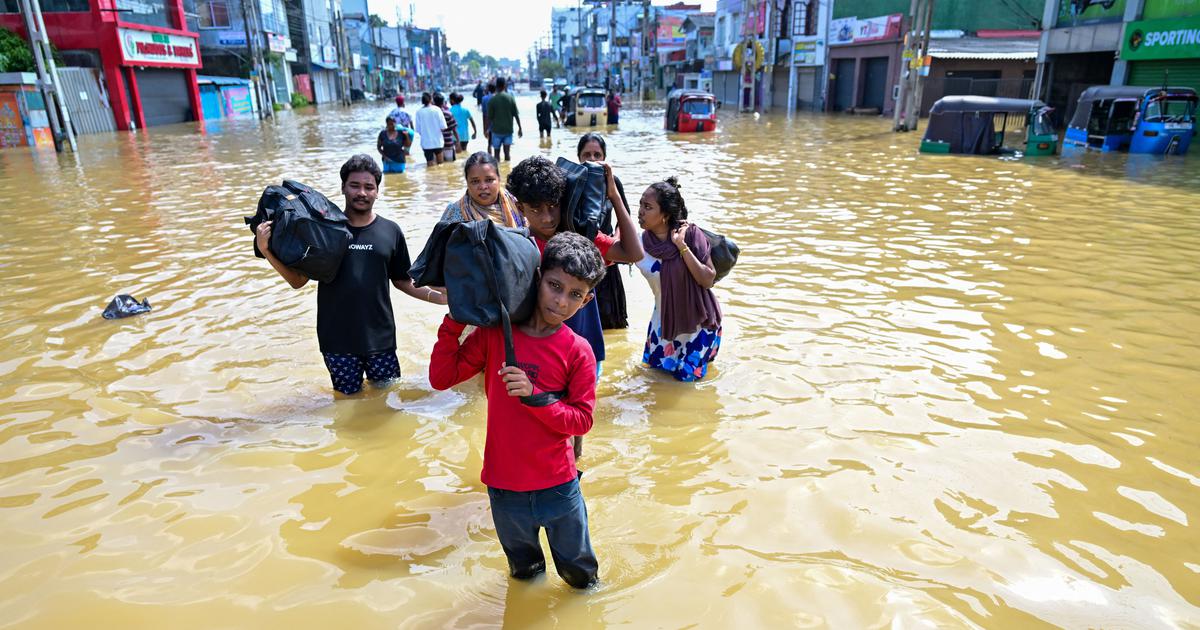
People walk through a flooded street after heavy rainfall in Wellampitiya on the outskirts of Colombo on November 30. AFP

When Cyclone Ditwah made landfall on November 28 2025, Sri Lanka experienced one of its deadliest environmental disasters in modern history.

President Anura Kumara Dissanayake declared it the largest and most challenging natural disaster in our history”. Torrential rains triggered widespread floods and landslides, leading to more than 350 confirmed deaths, hundreds missing and over 1.4 million people affected nationwide.

Major road and rail systems were cut off, hydropower stations and water treatment plants failed, and thousands of families were forced into emergency shelters. Reservoirs overflowed, riverbanks collapsed and communities near the Mahaweli, Kelani, Malwathu Oya and Mundeni Aru river basins were inundated within hours.

These were not random failures. They were systemic. Many of the regions that flooded were vulnerable areas adjacent to coastal lagoons and low-lying river plains. Cyclone Ditwah was not an anomaly. It exposed the underlying fragilities of Sri Lanka’s existing flood-management and drainage infrastructure.

This follows on from the devastating tropical cyclone in 1978 and the Boxing Day 2004 tsunami disaster. Fifty years ago, flood infrastructure was not in a good state. Significant improvements haven’t been made since then, mainly due to poor urban planning.

Between 2018 and 2022, I worked with a global team of coastal engineers, social scientists and policy makers from academia and government organisations in the UK, Australia and Sri Lanka. Our research project focused on producing a new generation of compound flood hazard maps, based on computer modelling that considers all the storm surge components (surge, tide and sea level rise) and the rainfall effect.

I led the hydrological modelling efforts for Sri Lanka – focusing on how tropical-cyclone rainfall and storm surge combine to generate destructive flooding patterns for three vulnerable cities: Batticaloa, Mullaitivu and Mannar.

The team worked with Sri Lanka’s Coast Conservation and Coastal Resource Management Department to address a critical question: How do storm surges from tropical cyclones interact with rainfall to produce extreme inland and coastal floods?

Through analysis of historic cyclone tracks, we showed that Sri Lanka lies at the convergence of multiple storm pathways in the Bay of Bengal. This is why the country repeatedly suffers not only from rainfall-driven inundation but also from saltwater intrusion driven deep inland through lagoons and estuaries.

My team and I developed the hydrologic model for Batticaloa, using the Mundeni Aru river basin as a pilot case. We combined rainfall data, digital terrain maps (that indicate trees, buildings, roads and bare land) and river-flow simulations to identify the most vulnerable communities depending on the topography. Low-lying settlements adjacent to the Batticaloa and Valachchenai lagoons were particularly vulnerable to tropical cyclone-induced flooding.

Similar modelling work was proposed for Mullaitivu and Mannar, both historic cyclone-landfall regions. However, Covid-19 disrupted much of the planned in-country engagement, in-depth modelling and translation of findings into policy tools, creating a serious lag between scientific insights and what planning authorities are currently referencing.

Ditwah’s aftermath – breached embankments, power failures, displaced families, submerged neighbourhoods – corresponds almost exactly to the worst-case compound-flood scenarios shown by our data. These are not purely meteorological phenomena. They depend on the flow of water and land-based infrastructure.

Drainage networks still rely on outdated historical rainfall records. Coastal defences are built for storm surges of previous decades. Urban development continues to occupy natural flood buffers such as wetlands and lagoon edges. Vulnerability has become physically engineered into the landscape.

Proactive planning

Working with government agencies including the Coast Conservation and Coastal Resource Management Department, the Met Office and the Disaster Management Centre, Sri Lanka can proactively integrate compound-flood science into planning and disaster risk-reduction strategies.

This includes producing updated flood maps that capture rainfall, river flow, storm surge and sea-level-rise dynamics. Hydrological models can be translated into operational tools for national and municipal planning authorities.

Drainage and river-management systems (such as seasonal removal of sand and debris) can be redesigned with the future (not historical) rainfall intensities in mind. Improving early-warning systems involves incorporating multiple hazards and long-range scenario modelling can be embedded into disaster-preparedness and land-use planning.

These measures enable policymakers, engineers and local administrations to make evidence-based decisions that reflect accelerating climate-driven risks rather than obsolete assumptions.

Cyclone Ditwah should mark a turning point. With the right integration of science, planning and governance, disasters of this magnitude need not become inevitable hallmarks of Sri Lanka’s future. And by aligning infrastructure and policy with the real hydrological dynamics of our changing climate, governments can better protect people, environment and economy from the storms yet to come.

Ravindra Jayaratne is Reader in Coastal Engineering, University of East London.

Sri Lanka secures USD-30m World Bank loan for grid upgrade, renewables

December 10th, 2025

Courtesy RenewablesNow

Sri Lanka has secured a USD-30-million loan from the International Development Association (IDA) of the World Bank to support the upgrade of the national grid and enable the adoption of more renewable energy.

Sri Lanka secures USD-30m World Bank loan for grid upgrade, renewables
Author: Gerry Machen. License: Creative Commons, Attribution-NoDerivs 2.0 Generic.

The agreement, signed in early December by Treasury Secretary Harshana Suriyapperuma and World Bank Division Director David Sislen, forms the first phase of a USD-60-million programme for the Secure, Affordable, and Sustainable Energy for Sri Lanka Project.

The initiative will address technical constraints that currently limit the grid capacity and will support the government’s target of generating 70% of its electricity from renewables by 2030. It will be complemented by a planned World Bank payment guarantee facility designed to mobilise private capital for new renewable energy projects.

The loan is expected to be directed to the Ceylon Electricity Board. The electricity company will also lead the project, in coordination with the relevant authorities, including the ministry of energy.

In October, the government of Sri Lanka also secured USD 52 million from the Asian Infrastructure Investment Bank (AIIB) to strengthen its power infrastructure and support renewables growth.

Sri Lanka Cyclone: Tens of thousands of children in temporary shelters need mental health support – Save the Children

December 10th, 2025

Courtesy Reliefweb

COLOMBO, 8 December 2025 – Tens of thousands of children are spending a second week in emergency shelters and in need of mental health support after Cyclone Ditwah tore through Sri Lanka, bringing the worst flooding and landslides in decades, Save the Children said.

At least 86,000 homes were damaged in the landslides and floods triggered by Cyclone Ditwah on 28 November. More than 630 people were killed, and nearly 70,000 are still living in temporary shelters, including schools [1].

Hundreds of schools, particularly in the heavily impacted Central and Uva provinces, have also been extensively damaged by floods and landslides, and all schools across Sri Lanka have delayed reopening after a break for a week.

A school in Colombo is now home for hundreds of families who were forced to flee from their flooded homes. At the peak of the floods, 800 people, including more than 260 children, packed into classrooms. Wooden school desks have been pushed together into makeshift beds for those most in need, such as pregnant and breastfeeding women, but most children are sleeping on mats on the concrete floor.

Best friends Rashmi* and Shoba* are living in the school hall. There’s no privacy for the 17-year-old girls who are both preparing for their exams and love reading, especially Sherlock Holmes novels.

Rashmi* said:

It’s so noisy here. It’s hot and crowded, so difficult to sleep – it’s so different from home.

The water came so fast in the middle of the night that we only had time to grab a few clothes. I’ve lost all my schoolbooks and was only able to save a few notes.”

Save the Children, and partner organisation CCH (Centre for Children’s Happiness), have started providing mental health and psychosocial support (MHPSS) for children and adolescents at the school, using TeamUp, an evidence-based methodology consisting of structured play and movement-based activities provided by trained facilitators.

Through TeamUp, owned by Save the Children and War Child, children can reduce stress, start to feel safe, learn to deal with their emotions and build resilience through play with their peers. The series of sessions brings much needed structure and routine by supporting their emotional wellbeing in the aftermath of Cyclone Ditwah. The non-verbal group activities also give trained staff the opportunity to identify and refer children who need more specialised support [2].

Rashmi* said:

[TeamUp] changed how I was feeling. Before I was thinking about my flooded home, but it took away those thoughts. I also got to know the other children here and make new friends.”

About 60 children joined the first TeamUp session which included activities with specific goals, such as dealing with anger or stress and interacting with peers.

Mayuran Thirunavukkarasu, Centre for Children’s Happiness, said:

Children are afraid – there is so much uncertainty about what will happen next. Their emotional security was lost [in the floods]. They have lost everything that makes them feel safe and is important to them, like their schoolbooks and clothes.

This is the worst disaster that many of them have experienced, so they have big feelings that they don’t have sufficient skills to deal with.”

Save the Children in Sri Lanka is working through partners to enable a locally led response to Cyclone Ditwah, including providing psychosocial support and play activities for children through TeamUp in child-friendly spaces in places where people have been displaced by the floods and landslides, and providing house cleaning kits.

Julian Chellappah, Country Director, Save the Children Sri Lanka said:

Mental health support for children in an emergency is not a nice to have, it’s a must have. Children are under immense stress in Sri Lanka, and if they do not get the urgent psychosocial support they need, their symptoms can worsen and become long-term.

Experiencing distress is a completely normal reaction to extreme, abnormal circumstances, like the floods and landslides triggered by Cyclone Ditwah.

Children often find it hard to make sense of crisis – it’s vital that mental health and psychosocial support is a priority to help them cope with the challenges now, and in the weeks and months ahead.”

Save the Children has been working in Sri Lanka since 1974, contributing to both humanitarian and development needs across the country, on thematic areas of education, child protection, health and nutrition, vocational skills development, and child rights governance.

References:

[1]https://www.dmc.gov.lk/images/dmcreports/Situation_Report_at_0600hrs_on_2025__1765241453.pdf

[2] More information on TeamUp at https://www.savethechildren.nl/sites/nl/files/2023-11/scnl-TeamUp-digiflyer.pdf

CCH (Centre for Children’s Happiness) is an independent and impartial, nonprofit organisation investing in protective, peaceful, positive childhood and environment for children and young people in Sri Lanka. Https://cch-srilanka.org/

Multimedia content available here: https://www.contenthubsavethechildren.org/Package/2O4C2SN6K8AJ

Unauthorised filling of Muthurajawela led to floods in Gampaha town: Cardinal

December 10th, 2025

Courtesy The Daily Mirror

Colombo, Dec. 10 (Daily Mirror) – Unauthorised filling of the Muthurajawela wetlands and pollution led to the flooding of Gampaha town during the  recent floods, Archbishop of Colombo Cardinal Malcolm Ranjith said today. 

Cardinal Ranjith, who spoke during a service held at St. Joseph’s Church Grandpass in remembrance of the disaster victims, urged the government to stop unauthorised filling of the Muthurajawela wetlands. 

“We have never seen Gampaha town going under water in the past. The town went under water this time as a result of the unauthorised filling of the Muthrajawela,” he said.

Russia’s first aircraft carrying 35 tons of humanitarian aid arrives in Sri Lanka

December 10th, 2025

Courtesy Adaderana

Russia has dispatched a consignment of 35 metric tons of humanitarian aid to Sri Lanka following the impact of Cyclone Ditwah. 

The shipment arrived this afternoon (10) at Bandaranaike International Airport (BIA) in Katunayake on a special cargo flight.

The consignment includes a mobile power station, vegetable oil, sugar, rice, and tents.

The Ilyushin IL-76—Russia’s largest cargo aircraft—transported the aid and landed at BIA at 1:10 p.m. today, said Ada Derana reporter.

Russian Ambassador to Sri Lanka, Levan Dzhagaryan; Minister of Ports and Civil Aviation, Anura Karunathilaka; Deputy Minister of Defense, Retired Major General Aruna Jayasekara; and Chairman of Airports and Aviation Services Limited, Air Vice Marshal Harsha Abeywickrama, along with several other officials, were present at the airport to receive the humanitarian consignment.

අනුර අයියේ ….. ඇයි මෙහෙම ? ප්‍රේමකීර්තිගේ පුතාගෙන් චෝදනාවක්

December 10th, 2025

Dark Room

Attention: His Excellency Anura Kumara Dissanayake – Kotmale Dam – Gate Opening – HasMahaweli Authority made a mistake or not? Is there something wrong in the system

December 9th, 2025

Bandula Kendaragama


Page 1 of 31 ——— For further details, Contact Bandula Kendaragama on WhatsApp +61403204066
Attention: His Excellency Anura Kumara Dissanayake – Kotmale Dam – Gate Opening – Has Mahaweli Authority made a mistake or not? Is there something wrong in the system Your Excellency,

Could you please pass this information to His Excellency the President Anura Kumara Dissanayake.

I was attached to the CECB and worked in the construction of the dam from 1980 to 1985. I am a dam safety engineer with 48-years’ experience (and worked in 12 Countries). A copy of my CV is attached for your kind perusal. As I understand, the Dam Safety Emergency Management Plan (DSEMP) of the Kotmale Dam is very brief, the inundation plan is very small, not adequate to identify the villages likely to be inundated.

As soon as the decision was made to open the gates, the Mahaweli Authority and Disaster Management Centre should have notified the people in the potential inundation area Nowadays, almost all people are using Mobile Phones.

Therefore, the Govt should make an order to notify the people living in potential inundation areas to provide their Mobile numbers to the Disaster Management Centre. Then, the DMC should create a database of names and mobile numbers of all people living and working in the potential inundation areas. Then, the Disaster Management Centre can send SMSs (text and voice messages) to all people living in the potential inundation areas within minutes. In addition, in my view, social media SHOULD be used to disseminate this message.

This procedure is applicable to all emergency situations such as evacuation of population centres such as townships, hospitals, schools etc.,

If anyone needs more information on evacuation plans, please contact me on +61403204066. Your faithfully,

https://acrobat.adobe.com/link/spaces/urn%3Aaaid%3Asc%3AEU%3A714342fc-ee94-4d0a-8ecc-8182365c32c8/assets/urn%3Aaaid%3Asc%3AEU%3A20b3464d-c3f3-5f5c-ab69-4accbcf4d1e2

Sri Lanka and the Global Climate Emergency: The Lessons of Cyclone Ditwah

December 9th, 2025

Dr. Asoka Bandarage  Courtesy: IPS NEWS

Tropical Cyclone Ditwah, which made landfall in Sri Lanka on 28 November 2025, is considered the country’s worst natural disaster since the deadly 2004 tsunami. It intensified the northeast monsoon, bringing torrential rainfall, massive flooding, and 215 severe landslides across seven districts. The cyclone left a trail of destruction, killing nearly 500 people, displacing over a million, destroying homes, roads, and railway lines, and disabling critical infrastructure including 4,000 transmission towers. Total economic losses are estimated at USD 6–7 billion—exceeding the country’s foreign reserves.

The Sri Lankan Armed Forces have led the relief efforts, aided by international partners including India and Pakistan. A Sri Lanka Air Force helicopter crashed in Wennappuwa, killing the pilot and injuring four others, while five Sri Lanka Navy personnel died in Chundikkulam in the north while widening waterways to mitigate flooding. The bravery and sacrifice of the Sri Lankan Armed Forces during this disaster—as in past disasters—continue to be held in high esteem by grateful Sri Lankans.

The Sri Lankan government, however, is facing intense criticism for its handling of Cyclone Ditwah, including failure to heed early warnings available since November 12, a slow and poorly coordinated response, and inadequate communication with the public. Systemic issues—underinvestment in disaster management, failure to activate protocols, bureaucratic neglect, and a lack of coordination among state institutions—are also blamed for avoidable deaths and destruction.

The causes of climate disasters such as Cyclone Ditwah go far beyond disaster preparedness. Faulty policymaking, mismanagement, and decades of unregulated economic development have eroded the island’s natural defenses. As climate scientist Dr. Thasun Amarasinghe notes:
Sri Lankan wetlands—the nation’s most effective natural flood-control mechanism—have been bulldozed, filled, encroached upon, and sold. Many of these developments were approved despite warnings from environmental scientists, hydrologists, and even state institutions.”

Sri Lanka’s current vulnerabilities also stem from historical deforestation and plantation agriculture associated with colonial-era export development. Forest cover declined from 82% in 1881 to 70% in 1900, and to 54–50% by 1948, when British rule ended. It fell further to 44% in 1954 and to 16.5% by 2019.

Deforestation contributes an estimated 10–12% of global greenhouse gas emissions. Beyond removing a vital carbon sink, it damages water resources, increases runoff and erosion, and heightens flood and landslide risk. Soil-depleting monocrop agriculture further undermines traditional multi-crop systems that regenerate soil fertility, organic matter, and biodiversity.

In Sri Lanka’s Central Highlands, which were battered by Cyclone Ditwah, deforestation and unregulated construction had destabilized mountain slopes. Although high-risk zones prone to floods and landslides had long been identified, residents were not relocated, and construction and urbanization continued unchecked.

Sri Lanka was the first country in Asia to adopt neoliberal economic policies. With the Open Economy” reforms of 1977, a capitalist ideology equating human well-being with quantitative growth and material consumption became widespread. Development efforts were rushed, poorly supervised, and frequently approved without proper environmental assessment.

Privatization and corporate deregulation weakened state oversight. The recent economic crisis and shrinking budgets further eroded environmental and social protections, including the maintenance of drainage networks, reservoirs, and early-warning systems. These forces have converged to make Sri Lanka a victim of a dual climate threat: gradual environmental collapse and sudden-onset disasters.

Sri Lanka: A Climate Victim

Sri Lanka’s carbon emissions remain relatively small but are rising. The impact of climate change on the island, however, is immense. Annual mean air temperature has increased significantly in recent decades (by 0.016 °C annually between 1961 and 1990). Sea-level rise has caused severe coastal erosion—0.30–0.35 meters per year—affecting nearly 55% of the shoreline. The 2004 tsunami demonstrated the extreme vulnerability of low-lying coastal plains to rising seas.

The Cyclone Ditwah catastrophe was neither wholly new nor surprising. In 2015, the Geneva-based Internal Displacement Monitoring Centre (IDMC) identified Sri Lanka as the South Asian country with the highest relative risk of disaster-related displacement: For every million inhabitants, 15,000 are at risk of being displaced every year.”

IDMC also noted that in 2017 the country experienced seven disaster events—mainly floods and landslides—resulting in 135,000 new displacements and that  Sri Lanka is also at risk for slow-onset impacts such as soil degradation, saltwater intrusion, water scarcity, and crop failure”.

Sri Lanka ranked sixth among countries most affected by extreme weather events in 2018 (Germanwatch) and second in 2019 (Global Climate Risk Index). Given these warnings, Cyclone Ditwah should not have been a surprise. Scientists have repeatedly cautioned that warmer oceans fuel stronger cyclones and warmer air holds more moisture, leading to extreme rainfall. As the Ceylon Today editorial of December 1, 2025 also observed:
…our monsoons are no longer predictable. Cyclones form faster, hit harder, and linger longer. Rainfall becomes erratic, intense, and destructive. This is not a coincidence; it is a pattern.”

Without urgent action, even more extreme weather events will threaten Sri Lanka’s habitability and physical survival.

A Global Crisis

Extreme weather events—droughts, wildfires, cyclones, and floods—are becoming the global norm. Up to 1.2 billion people could become climate refugees” by 2050. Global warming is disrupting weather patterns, destabilizing ecosystems, and posing severe risks to life on Earth. Indonesia and Thailand were struck by the rare and devastating Tropical Cyclone Senyar in late November 2025, occurring simultaneously with Cyclone Ditwah’s landfall in Sri Lanka.

More than 75% of global greenhouse gas emissions—and nearly 90% of carbon emissions—come from burning coal, oil, and gas, which supply about 80% of the world’s energy. Countries in the Global South, like Sri Lanka, which contribute least to greenhouse gas emissions, are among the most vulnerable to climate devastation. Yet wealthy nations and multilateral institutions, including the World Bank, continue to subsidize fossil fuel exploration and production. Global climate policymaking—including COP 30 in Belém, Brazil, in 2025—has been criticized as ineffectual and dominated by fossil fuel interests.

If the climate is not stabilized, long-term planetary forces beyond human control may be unleashed. Technology and markets are not inherently the problem; rather, the issue lies in the intentions guiding them. The techno-market worldview, which promotes the belief that well-being increases through limitless growth and consumption, has contributed to severe economic inequality and more frequent extreme weather events. The climate crisis, in turn, reflects a profound mismatch between the exponential expansion of a profit-driven global economy and the far slower evolution of human consciousness needed to uphold morality, compassion, generosity and wisdom.

Sri Lanka’s 2025–26 budget, adopted on November 14, 2025—just as Cyclone Ditwah loomed—promised subsidized land and electricity for companies establishing AI data centers in the country. President Anura Kumara Dissanayake told Parliament: Don’t come questioning us on why we are giving land this cheap; we have to make these sacrifices.”
Yet Sri Lanka is a highly water-stressed nation, and a growing body of international research shows that AI data centers consume massive amounts of water and electricity, contributing significantly to greenhouse gas emissions.

The failure of the narrow, competitive techno-market approach underscores the need for an ecological and collective framework capable of addressing the deeper roots of this existential crisis—both for Sri Lanka and the world.

Ecological and Human Protection

Ecological consciousness demands recognition that humanity is part of the Earth, not separate from it. Policies to address climate change must be grounded in this understanding, rather than in worldviews that prize infinite growth and technological dominance. Nature has primacy over human-created systems: the natural world does not depend on humanity, while humanity cannot survive without soil, water, air, sunlight, and the Earth’s essential life-support systems.

Although a climate victim today, Sri Lanka is also home to an ancient ecological civilization dating back to the arrival of the Buddhist monk Mahinda Thera in the 3rd century BCE. Upon meeting King Devanampiyatissa, who was out hunting in Mihintale, Mahinda Thera delivered one of the earliest recorded teachings on ecological interdependence and the duty of rulers to protect nature:

O great King, the birds of the air and the beasts of the forest have as much right to live and move about in any part of this land as thou. The land belongs to the people and all living beings; thou art only its guardian.”

A stone inscription at Mihintale records that the king forbade the killing of animals and the destruction of trees. The Mihintale Wildlife Sanctuary is believed to be the world’s first.

Sri Lanka’s ancient dry-zone irrigation system—maintained over more than a millennium—stands as a marvel of sustainable development. Its network of interconnected reservoirs, canals, and sluices captured monsoon waters, irrigated fields, controlled floods, and even served as a defensive barrier. Floods occurred, but historical records show no disasters comparable in scale, severity, or frequency to those of today. Ancient rulers, including the legendary reservoir-builder King Parākramabāhu, and generations of rice farmers managed their environment with remarkable discipline and ecological wisdom.

The primacy of nature became especially evident when widespread power outages and the collapse of communication networks during Cyclone Ditwah forced people to rely on one another for survival. The disaster ignited spontaneous acts of compassion and solidarity across all communities—men and women, rich and poor, Buddhists, Christians, Muslims, and Hindus. Local and international efforts mobilized to rescue, shelter, feed, and emotionally support those affected. These actions demonstrated a profound human instinct for care and cooperation, often filling vacuums left by formal emergency systems.

Yet spontaneous solidarity alone is insufficient. Sri Lanka urgently needs policies on sustainable development, environmental protection, and climate resilience. These include strict, science-based regulation of construction; protection of forests and wetlands; proper maintenance of reservoirs; and climate-resilient infrastructure. Schools should teach environmental literacy that builds unity and solidarity, rather than controversial and divisive curriculum changes like the planned removal of history and introduction of contested modules on gender and sexuality.

If the IMF and international creditors—especially BlackRock, Sri Lanka’s largest sovereign bondholder, valued at USD 13 trillion—are genuinely concerned about the country’s suffering, could they not cancel at least some of Sri Lanka’s sovereign debt and support its rebuilding efforts?  Addressing the climate emergency and the broader existential crisis facing Sri Lanka and the world ultimately requires an evolution in human consciousness guided by morality, compassion, generosity and wisdom.

Dr Asoka Bandarage is the author of Colonialism in Sri Lanka:  The Political Economy of the Kandyan Highlands, 1833-1886 (Mouton) Women, Population and Global Crisis: A Politico-Economic Analysis (Zed Books), The Separatist Conflict in Sri Lanka: Terrorism, Ethnicity, Political Economy, ( Routledge), Sustainability and Well-Being: The Middle Path to Environment, Society and the Economy (Palgrave MacMillan) Crisis in Sri Lanka and the World: Colonial and Neoliberal Origins, Ecological and Collective Alternatives (De Gruyter) and numerous other publications. She serves on the ​Advisory Boards of the Interfaith Moral Action on Climate​ and Critical Asian Studies.


.

Maha Jana Handa at Nugegoda, Cyclone Ditwa disaster, and  contenders positioning for power in post-NPP Sri Lanka – I

December 9th, 2025

By Rohana R. Wasala

The Joint Opposition rally dubbed the ‘Maha Jana Handa’ (Vox Populi/ Voice of the People) held at the Ananda Samarakoon Open Air Theatre, Nugegoda on November 21, 2025 has suddenly acquired an increasing potential to be remembered as a significant turning point in post-civil conflict Sri Lankan politics, in the wake of the meteorological catastrophe caused by the calamitous Ditwa cyclonic storm that devastated the whole island from north to south and east to west on an unprecedented scale. But the strength of this  prospect depends on the collective coordinated success of the future public awareness raising rallies against the incumbent Janatha Vimukthi Peramuna (JVP)-led Jathika Janabalavegaya or the National People’s Power (NPP) government promised by the participating opposition parties. They are set to expose what they perceive as the government’s utterly inexperienced and unexpectedly authoritarian stand on certain vitally important issues including the country’s national security and independence, political and economic stability, and the Lankan state’s unitary status. The government is also alleged to be moving towards establishing a form of old-fashioned single party Marxist dictatorship in place of the firmly established system of governance based on parliamentary democracy that the adventitious ‘Aragalaya’ protest of 2022 almost toppled, but that the timely intervention of some patriotic elements, though themselves still having to disclose some skeletons in the closet,  saved.   

The minefield of policy making that the government must negotiate is strewn with issues including, among others: the seven or so recent  agreements or MOUs (?) secretly signed with India; the unresolved controversy over the allegedly illegal clearance of some 323 containers (with unknown goods) from the harbour; the Prime Minister’s arbitrary,apparently  ill-considered and hasty education reforms without proper parliamentary discussion; the proposed culturally sensitive lgbtqia+…..legislation non-issue (it is a non-issue for Sri Lanka, given its dominant culture); the digital cards problem; the so-called IMF debt trap; dealing with the unfair, virtually unilateral UNHRC resolutions against Sri Lanka; the inexplicably submissive surrender of the control of the profit-making Colombo Dockyard PLC, Sri Lanka’s pioneer ship building and ship repairing centre which is one of Sri its key national assets to India; some government MPs’ eyebrow raising personal assets declarations, and the government’s attention-seeking theatrical handling of anti-narcotic and anti-corruption operations. The opposition politicians relentlessly criticise the ruling JVP/NPP’s failure to come out clean on these matters. But they themselves are not likely to be at an easy wicket if challenged to reveal their own positions regarding the above-mentioned issues.    

 In addition to those problems, the much more formidable challenge of unsolicited foreign-power interference in Sri Lanka’s internal affairs, in the guise of friendly intervention, remains an unavoidable circumstance that we are required to survive in the geostrategically sensitive region where our homeland is located. Having  been active right from the departure of the British colonialists in 1948, the foreign interference menace intensified after the successful ending of armed separatist terrorism in 2009. Such external interferences are locally assisted by latent domestic communal disharmony as well as real political factionalism, both of which are  normal in any democratic country. 

The war-winning president, Mahinda Rajapaksa, leader of the the Sri Lanka Freedom Party (SLFP)-led United People’s Freedom Alliance (UPFA), was made to suffer a largely unexpected electoral defeat in 2015 through a foreign-engineered regime change operation, that tacitly favoured his key rival, Ranil Wickremasinghe, who was then leading Sri Lanka’s Grand Old Party the generally pro-West and rightist United National Party (UNP) founded in September 1946. Mahinda Rajapaksa was betrayed by his most trusted lieutenant Maithripala Sirisena, said to have been co-opted as a muppet into that grand scheme, who later proved that he was not malleable enough for the role.

The SLFP, a more middle of the way socialist-leaning rival political party,  was formed in September 1951 (that is, five years after the birth of the UNP)  and was elected to power in 1956, ending a near decade under the rather West-friendly latter party. It was deemed to be a ‘revolution’ that started an era of ‘transition’ (from elitist to common citizen rule). From nominal independence in 1948, governing power has to date alternated between these two parties or alliances led by them, except for the last electoral year, 2024. Though incumbent executive president, Anura Kumara Dissanayake, may be said to have made history in this sense, the fact remains that he was barely able to scrape just 43% of the popular vote as the head of a newly formed, Janatha Vimukthi Peramuna (JVP)-led, alliance called the Jathika Janabalavegaya or the National People’s Power (NPP). Anura Kumara Dissanayake was installed in office as executive president in September 2024. But his less than convincing electoral approval triggered a massive victory for the NPP at the parliamentary election that followed in November, giving him a parliament with 159 members, which is unprecedented in Sri Lanka’s electoral history. 

In my opinion, there are two main reasons for this outcome. One is that the average Sri Lankan voters trust democracy. Since the president elect is accepted as having won the favour of the majority of the pan-Sri Lankan electorate, the general public choose to forget about their personal party affiliations and tend to vote for the parliamentary candidates from the party of the elected president. This is particularly true of the majority Sinhalese Buddhist community represented by the two mainstream, non-communal national parties, the UNP and the SLFP.  The brittle foundation of that victory is not likely to sustain a strong enough administration that is capable of introducing the nebulous ‘system change’ that they have promised in their manifesto, while it is becoming clear that the general performance of the government seems to be falling far short of the real public expectations, which are not identical with the unconscionable demands made by the few separatist elements among the peaceful Tamil diaspora in the West to whom the JVP/NPP alliance seems to owe its significantly qualified electoral success in 2024. 

  The Maha Jana Handa reminded me of the long Janabalaya Protest March from Kandy to Colombo where it ended in a mass rally on September 5, 2018. That hugely successful event was organized by the youth wing of the SLPP led by Namal Rajapaksa, who was an Opposition MP during the Yahapalanaya. He has played the same role just as efficiently on the most recent occasion, too. At the end of his address during the Maha Jana Handa, he declared his determination to bring down the malfunctioning JVP/NPP government at the earliest instance possible. Probably, he missed Ranil’s protege Harin Fernando’s speech that came earlier. This was because Namal Rajapaksa joined the rally midway. Harin Fernando had brought a message from his mentor Ranil Wickremasinghe to be read out to the rally audience. But he said he didn’t want to do so after all, saying that it was not suitable for that moment. Anyway, during his speech, Harin Fernando said emphatically that the era of heir-apparents or crown princes was gone for good. People knew that he was alluding to Sajith Premadasa and Namal Rajapaksa (sons of former presidents hopeful of succeeding Anura Kumara Dissanayake). Harin was seen biting his tongue or sticking it out a little as he was preparing to leave the stage at the end of his address. Was he regretting what he had just said or was he cocking a snook at what, he was sure, was Namal’s ambition that would be revealed in his speech, the rally having been organised by the Pohottuwa or the SLPP that he leads? 

To be continued

What Sri Lanka’s landslides & cyclones teach — A Buddhist view

December 9th, 2025

Shenali D Waduge

Sri Lanka is in shock. Never before in our history has all 25 districts been affected at once. We are in national mourning. The resilience of our people has been unwavering. 

As a nation we have endured 17 South Indian invasions, 3 colonial illegal occupations. 2 armed insurgencies, 3 decades of LTTE terror, a single incident of Islamic terror, a devastating tsunami in 2004 covid, violent regime change and now cyclone Ditwah. Our strength to withstand and rise is guided by the Dhamma, a civilization that was built on compassion, wisdom and balance with nature. That spiritual resilience is within us. This is our cultural inheritance that shields us during times of suffering. This spirit carries the nation forward. Our resilience is not new, it is ancestral. Buddhas’s values have guided us over 2500 years – this spiritual foundation is the target. To break the spiritual foundation is the aim for a nation broken of its foundation is a nation easy to prey on. This is what we must contemplate on. As a Buddhist majority nation, where the foundation of society & life is based on Buddhist principles, there is a lesson for every citizen. There is much to introspect.

The Buddha taught that everything in this world arises from causes.

When we cut the forests, loosen the soil, build on steep slopes, and ignore the advice of nature, the earth simply responds to the causes we have created.

Those who enabled illegal construction — whether through bribes, negligence, or silence — must reflect deeply on the suffering caused and their role in it. 

1. Nature follows Causes and Conditions  

In Buddhism, nothing happens without causes.
A landslide is not bad luck.” A cyclone is not punishment.”
They arise from interdependent causes:

·      Deforestation

·      Greed-driven land misuse

·      Building on dangerous slopes

·      Ignoring environmental balance

·      Extreme weather patterns intensified by human actions

What is our Lesson:

If we disturb nature out of greed or ignorance, nature responds according to the causes created.

From understanding causes, we then turn to our duties as individuals and leaders

2. Human Duty (Kamma of Responsibility), Not Blame

The Buddha taught that wise action reduces suffering.
In the Cakkavatti Sīhanāda Sutta, rulers and communities are advised to:

·      Protect the vulnerable

·      Ensure right livelihood

·      Care for land, forests, water

·      Maintain social and environmental harmony

This is why all rulers must be dharmishta. 

Lesson:
When we neglect our duties—to the land, to forests, to each other—suffering arises.
When we fulfill them, harmony returns.

We have the answer.

3. Respect for the Environment is Respect for Life

In many Jātaka stories, animals, forests, and mountains are treated as living systems.

Our ancient Sihale kings did just that.

Teach children to respect the environment


Protect the Environment.

Environment Protects all Beings.

Examples:

·      Ruru Jātaka: compassion toward beings in danger from floods

·      Nigrodha Jātaka: importance of trees and forest life

·      Sasa Jātaka: selflessness during natural hardship

The Ruru Jātaka 482 (The Deer King Story) – Lesson for Disaster Preparedness

Buddha was born as a compassionate deer who saved a drowning man after a sudden flood. Later, the man betrays the deer by revealing his location to the king, hoping for a reward. But when the king finally meets the Deer King, he is moved by the deer’s compassion and vows to protect the forest.

What does this teach us?

1.    Nature can change suddenly.
Just like the sudden flood in the story, landslides and cyclones can occur without warning.

2.    Compassion must guide action.
The Deer King risked his life to save another.
Communities must help one another in times of disaster.

3.    Protecting the environment protects us.
The king understood that the forest was precious and promised to safeguard it.
Reforestation and environmental care reduce future disasters. 

The solution going forward.

4.    Wisdom over greed.
The man’s betrayal caused suffering for himself.
Greed-driven decisions — illegal logging, unsafe construction — lead to disaster.

5.    Safety comes from right action (Kusala Kamma).
Planning, respecting nature, and listening to warnings ensure long-term protection.

How this Jātaka applies to Sri Lanka today

·      Restore the forests that stabilize hills.

·      Ensure honest, compassionate leadership.

·      Teach children environmental respect.

·      Build only in safe, geologically approved lands.

·      Support neighbours generously during emergencies.

Just as the Deer King won protection for the forest,
Sri Lanka must make strong decisions today in keeping with our culture and not based on foreign templates.
Sri Lanka must protect her people tomorrow.

Lesson:
Destroying forests destroys the protection that nature gives us.

Landslides remind us that cutting trees is cutting our own safety.

How many hotels, villas have been built illegally with municipality permission based on bribes

Though spoken thousands of years ago, the Jātaka wisdom fits our modern crises exactly, reminding us that environmental harmony was a Buddha-era teaching

4.Impermanence (Anicca) — Everything can change in an instant – Nothing is permanent

Cyclones and landslides show that conditions can collapse suddenly.

Nothing can be taken for granted.

No one can be taken for granted too.


The Buddha repeatedly reminded disciples:

·      Mountains can crumble

·      Rivers can overflow

·      Life changes in a moment

Lesson:
We should live mindfully, prepared, and with humility.
We must build not only houses, but resilience. Many Sri Lankans have this and have shown this by their good deeds.

When leaders or citizens believe they can overpower nature, they forget the reality of Anicca.

5. Compassion (Karunā) in Times of Suffering

When disaster strikes, the Buddhist response is immediate compassion:

·      Share food – even when they do not have to feed themselves.

·      Help the displaced – even when their dwellings are falling apart

·      Offer safety to children and elderly – even when they too are vulnerable

·      Support families who have lost homes

This aligns with the Metta Sutta:
May all beings be safe. May all beings be protected.”

Lesson:
Disasters test a nation’s collective compassion.
Our humanity becomes our greatest strength.

6. Wise use of Resources (Appamāda – Diligence)

The Buddha called carelessness the doorway to suffering.


Building unsafe homes, ignoring warnings, or allowing illegal land use is a form of societal carelessness. Politicians and public servants have much to be held responsible for. Their conscience should prick them.

Lesson:
Appamāda means being diligent:

·      Planning safe housing

·      Replanting trees

·      Enforcing laws without corruption

·      Preparing evacuation plans

·      Educating communities

Diligence prevents suffering before it arises.

7. Unity during difficulty

In disasters, divisions of race, religion, politics disappear.

We saw this in practice.

Even our foreign tourist friends joined in the rescue operations.
People help each other simply because they are human.

This reflects the Buddha’s teaching of  — unity, cooperation, and collective strength.

Lesson:
Sri Lanka must rediscover unity not only during suffering, but before suffering emerges.

This unity must translate into policy, preparedness, and a shared commitment to protect all communities equally.

What should we learn?

The landslide teaches us:

·      Do not disturb the earth beyond safe limits.

·      Restore forests that protect our slopes.

·      Live with environmental mindfulness.

The cyclone teaches us:

·      Nature is powerful and constantly changing.

·      Preparedness, humility, and compassion are necessary.

Both teach Sri Lanka:

·      Greed creates danger; wisdom creates safety.

·      Protecting nature is protecting ourselves.

·      Duties, not demands, keep a society safe.

·      Compassion must rise immediately in times of hardship.

The recent landslides and cyclones remind us of a timeless truth taught by the Buddha:
When causes are unwise, the results bring suffering.

When causes are wise, the results bring safety.”

From the Cakkavatti Sīhanāda Sutta, rulers are called to uphold five duties:

1.    Protect the vulnerable — the poor, farmers, mothers, children, and the elderly.

2.    Preserve the natural environment — forests, rivers, mountains, and wildlife.

3.    Ensure righteous livelihoods — preventing illegal logging, unsafe construction, and corruption.

4.    Act with compassion — respond quickly, with fairness and without discrimination.

5.    Be vigilant (Appamāda) — because carelessness leads to the downfall of nations.

The landslide & cyclones are signals that our balance with nature has weakened.

It is now in the hands of the leaders to 

·      Reforest the hills – tea plantations were what the colonials enforced. How wise has this been for the environment. 

·      Enforce land-use laws without fear or favor.

·      Relocate families from red zones with dignity & support – land belongs to no one but the soil.

·      Build homes according to geotechnical wisdom not political pressure or palming hands

·      Restore the rivers & watersheds that sustain life – our ancient kings thought & acted wisely.

A leader’s greatness is measured not by speeches or ceremonies, but by how many lives are protected.

Leaders must act decisively. Buddha’s Dasa Raja Dhamma reminds rulers that their duty is not merely administration but protection of life, justice and the environment. 

Decisions regarding reforestation, relocation, land-use must be taken without political gain or foreign influence. Good governance is not optional it is a sacred obligation.

The Buddhist Leadership Framework

The Buddha taught that a ruler must embody the Dasa Raja Dhamma — the Ten Duties of a Righteous Leader:

1.    Dana – generosity

2.    Sila – morality

3.    Pariccaga – self-sacrifice

4.    Ajjava – honesty

5.    Maddava – gentleness

6.    Tapa – self-discipline

7.    Akkodha – non-anger

8.    Avihimsa – non-violence

9.    Khanti – patience

10. Avirodhana – upholding justice & harmony

These ten qualities are not ornamental teachings from a distant past; they are practical, real-time obligations for rulers, especially in moments like this. 

When leaders embody them, a nation is protected; when they abandon them, a nation collapses.

And the Buddha highlighted the Five Qualities of Enlightened Leadership:
Sīla (ethical conduct), 

Dāna (giving), 

Pariccaga (renunciation), 

Paññā (wisdom), 

Avihisā (non-harm).

These qualities are not philosophical ideals — they are actionable duties.
Sri Lanka’s leaders must now embody them.

Natural calamities are not merely weather events —
they are reminders that when rulers abandon their duties and citizens forget their responsibilities, the balance between humans and nature breaks.

If leaders ignore this warning, disaster capitalism will exploit the suffering, and Sri Lanka will enter a cycle of irreversible decline — environmental, social, and moral.

A combination of these qualities and principles will put leaders back on track & safeguard the nation from further and future natural national calamities.

No leader can escape the ancient texts and teachings. Leaders have national responsibilities. Human life, nature’s sustenance must be placed above all political considerations before disaster capitalism leaders to new sets of irreversible calamities. Calamities which will have more adverse outcomes.

Today—not next month, not after inquiries—leaders must make the decisions that protect human life, stabilize our environment, and restore Sri Lanka’s long-lost ecological balance.

Good governance is not optional.


For a Buddhist nation, it is an obligation.


Leaders are custodians of the land, the people, the animals, and the future generations.

Conscience must be placed above convenience.
Wisdom above politics.
Protection of life above all else.

Sri Lanka has always risen from hardship through compassion and wisdom.
With right action today, we can transform this suffering into the foundation of a safer, wiser, and spiritually stronger nation — for all living beings.

Shenali D Waduge

Discussion on 2025 Climate-Related Natural Disaster (Cyclone Ditwah) and Mental Health Outcomes

December 9th, 2025

Dr Ruwan M Jayatunge M.D.

Facilitators 

Dr. Upali Peiris -Consultant Psychiatrist
Dr. Ruwan M Jayatunge – Medical Doctor / Clinical Psychologist
Dr. Priya – General Practitioner

Date: 11th of December 2025, Thursday
Time 8.30 pm

Link; https://meet.jit.si/moderated/974a3405ecd97ef132153456f7d2e23e8a0a6311d1976d4227808f5f198ccfba

සමනලී ෆොන්සේකගේ ***ට ගිණි ඇවිලුණිද…

December 9th, 2025

උදය ප්‍රභාත් පතිරණගේ  උපුටාගැනීම-උපුටාගැණීම මුහුනුපොත

නොම්ලේවත් කවුරුවත් යූස් කරන්නේ නැති ඒවා…

ශ්‍රී ලංකාව සිංහල බෞද්ධ රාජ්‍යක් නොව, එය සර්ව ආගමික රාජ්‍යක්. එහි ඉතිහාසයේ සිංහලයාට වඩා වැඩි ඉතිහාසයක් දමිළයන්ට ඇත, යන්න තේමා කරගෙන, මාළිමා ආණ්ඩුව ” ශ්‍රී ලංකන් ඩේ ” එකක් දෙසැම්බර් 12 සිදු කරන්න, කෝටි 300 ක් අය – වැයෙන් වෙන් කරනවා.

නමුත් ස්වභාදහම එයට අවනත නොවන නිසාත්, ලංකාවේ ජනතාවගේ දැඩි විරෝධය මධ්‍යයේ, අනුර කුමාර දිසානායක ඇතුළු බෞද්ධ විරෝධි බලවේගයන්ට එය අකුළා ගන්න සිදුවෙනවා.

🔘මෙහිදි ශ්‍රී ලංකන් ඩේ හි ප්‍රධාන සංවිධායිකාව වන්නේ, සමනලී ෆොන්සේකා. ඔව් අර ලංකාවේ කුණු ප්‍රශ්නයට, ලංකාවේ සොළොස්මස්ථානයන්ගෙන් එකක් වන ජේතවනාරාමයේ කුණු පුරවන්න ඕන කියලා කීව කෙනා තමයි ……………………….

ඔව්. එයාලට බුදු දහම ගැන ලොකු ඇරියස් එකක් එදා සිටම තිබුනා. නමුත් මෙවර සිංහල බෞද්ධයන්ගෙන් ආ විරෝධය නිසා, සමනලීට ශ්‍රී ලංකන් ඩේ එකට, වෙන්කරපු කෝටි 300 න් 30 කට විතර විදින්න තිබුන චාන්ස් එක නැති වෙනවා. ඒ වගේද ප්‍රංශය ඇතුළු විදෙස් රටවල NGO වලින් ලැබෙන ඩොලර් මිලියන් ගණන, ඒ සියල්ල සමනලීට මෙමගින් නැතිවෙනවා.

එනිසා ඇය ඉතාම නීච පහත් ලෙස, ගෞතම බුදුන්ගේ සිද්ධාර්ථ අවධිය අල්ලලා කවි පංතියක්, මහා සංඝරත්නයට අපහාස වන පරිද්දෙන් රචනා කරලා පලකර තිබෙනවා. නමුත් ඇය දැකලා නෑ. ගංගාරාමය නවම් පෙරහැර නතර කරලා ලක්ෂ 300 ක් රජයට දුන්න එක. ඒ වගේම ගම්වල තියෙන වෙහෙර විහාර මේ කාලයේ නිරායාසයෙන්ම අපදා සහන මධ්‍යස්ථාන වු ආකාරය. විපතට පත් අයට සංඝරත්නය එලෙස පිහිට වෙද්දිත්, සමනලි ෆොන්සේකා කැත විදිහට තිසරණයට අපහාස කරලා තිබෙනවා.

සිද්ධාර්ථ රාග, දේවේශ, මෝහ නැති කරලා, බුද්ධත්වයට සැපැමිනියා. එහිදි ඇති වු බුද්ධිය හරහා රාග දේවේශ මෝහ නැති කරන්න අවශ්‍ය මාර්ගය වු චතුරාර්‍ය සත්‍ය අවබෝධ කරගන්නවා. එවැනි උත්තමයෙක්ට තමා සමනලී ෆොන්සේකා අපහාස කරන්නේ. ඒ වගේම බුදුන් වහන්සේ අවබෝධ කරගත්, මග ගිය සංඝරත්නයටත් අපහාස කරනවා.

වීතරාගී, වීතමෝහි, වීතදෝසි උත්තමයෙක්ට අපහාස කරාම, දිට්ඨධම්ම වේදණියවම පරිසන් දෙනවා. දැනටමත් සමනලීට පරිසන් දීලා තියෙන්නේ. එය බලාගන්න පුළුවන්, ඕනම මොහොමත ඇයගේ ලේ චෙක් කරලා. එනිසා ඇය ගැන ඊට වඩා දේවල් කියන්න යන්නේ නෑ.

◼️NGO වල සල්ලිවලට “සිද්ධාර්ථ ආත්මාර්ථකාමියෙක් ” කියලා පොත් ලියපු හිනිදුම සුනිල් සෙනවි, අද ආගමික හා බෞද්ධ කටයුතු ඇමති, ඔහු කතෝලිකයෙක්.

◼️ගෝඨා ගොබ්බයා, ගෝඨගේ අයියා ගොබ්බයා කියලා, අරගලයෙදි පාරේ නටපු “මුනිර් මුෆ්ෆර් බෞද්ධ නියෝජ්‍ය ඇමති.

◼️දළදා මාළිගාවට බෝම්බ ගහන්න, චීවරයේ ආයුධ හංගන් ගියපු මාතලේ ගමගෙදර දිසානායක සංස්කෘතික ඇමති.

බුද්ධ සාසන අමාත්‍යංශය ඉවත් කරලා, එය ආගමික අමාත්‍යාංශයට දානවා. වසර 2600 ක ඉතිහාසයේ බුද්ධ සාසනයට සැළකිල්ලක් නැතිවු එකම වසර මෙයයි. අතීතයේ රජවරැ බුද්ධාගම ආරක්ෂා කරේ. අක්කර දහස් ගණන් නින්දගම් දීලා. අද දීපුවත් බලෙන් අල්ලා ගන්නවා.

මොවුන් සැළසුම් සහගතවම 2026 පාසල් පෙළපොත්වලින් සිංහල බෞද්ධ ඉතිහාසය ඉවත් කරලා, සිංහල දමිළ ඉතිහාසයක් ඇතුල් කරලා තියෙන්නේ.

දළදා ⁣දැක්මක් කරන්නම් වාලේ සිදුකරලා, දළදා වහන්සේට අපහාස කරා.

ස්වාමින් වහන්සේලාගේ හිසට කුඩවලින් පහර දීලා, තට්ට පැළුවා. මාරයටවත් වසගයට ගන්න බැරි වු විතරාගී බුදුන් වහන්සේව, උන්වහන්සේගේ උද්දේසික ධාතු වු පිළිම වහන්සේව අත්අඩංගුවට ගත්තා කියලා, ආනන්ද වඩිවේල් විසින් පාර්ලිමේන්තුවෙදි පවසනවා.

ලොව්තුරා සම්බුදු පියාණන් වහන්සේට කරන අපහාස සක්වල කෝටියකට බලපානවා කියලා මොවුන් දන්නේ නෑ. එනිසයි මේ විපත් ලංකාවට ඇති වෙලා තියෙන්නේ. මෙවැනි පාපතරයින් පිරිසකට බලය දුන් ජනතාවටත්, ඒ ගැන ඇස් කන් පියන් සිටපු ජනතාවටත්, තමන්ගේ කර්මාණුකූල කර්මයන්ට ලක් වු පිරිසත් මෙමගින් විදවනවා.

අපිත් විදනවනවා. එනම් මෙවැනි කාලයක, කාල විපත්තියට අපිත් ලක්වෙන නිසා.

පිං සිද්ධ වෙයි. අපිව ඕන නම් මරලා දාන්න. එහෙත් සාරා සංඛ්‍යෙ කල්ප ලක්ෂයක් පෙරැම් පුරලා, අහසේ තරැවලට වඩා නෙත් දන් දීලා, මුහුදේ ජලයට වඩා ලේ දන් දීපු, බෝධි සත්වයන්ට හා බුද්ධත්වයට පත්වු ගෞතමයන්ට අපහාස කරන්න එපා. ඔයාලා අටමහා නිරයේ දුක් විදින කාලය කියන්න බෑ. මිත්‍යා දෘෂ්ඨිකත්වයට කාලයක් නැති

නිසා.

එනිසා මෙය කියවන අයත් සමනලි ෆොනිසේකා නොහොත් චිච්චිමානවිකාවියට අනුකම්පා කරන්න. ඇය ගැන දන්න අය දන්නවා. ඇය මේ වන විටත් ගෙවන විකෘති ජීවිතය ගැන.

ලංකාවේ සියළුම වෙහෙර විහාරවල, සුළිකුණාටුවෙන් මිය ගිය ආත්මවලට පිං දුන්නා නේද. එම ආත්මයන්ම ඉදිරියෙදි මේ ආණ්ඩුවේ වැරදි නිවරදි කරයි, අනුර කුමාර දිසානායක නිසා, සියළුම ලාංකියන් කාල විපත්තියකට ලක්වෙලා ඉන්නේ. එබැවින් කාටවත් බනින්න දෙස් තියන්න එපා. විශ්වයට සුදු කිරණ මුදාහරින්න මෛත්‍රීය වඩමු.

නමුත් සිදුවන දේ ගැන සම්මා සතියෙන්, හා දෘෂ්ඨියෙන් ඉන්න.

උදය ප්‍රභාත් පතිරණගේ ……………………………………………. උපුටාගැනීම-

කොත්මලේ ජ්‍යේෂ්ඨ ඉංජිනේරුවන් ඉවත් කර ජවිපෙට හිතවත් ආධුනික ඉංජිනේරුවන් පත් කරලා…

December 9th, 2025

උපුටා ගැන්ම ලංකා සී නිව්ස්

පසුගිය දින කිහිපය තුළ මෙරටට බලපෑ දරුණු සුළි කුණාටු තත්ත්වය සහ ආපදා කළමනාකරණය සම්බන්ධයෙන් අදහස් දැක්වූ හිටපු පාර්ලිමේන්තු මන්ත්‍රී නිමල් පියතිස්ස මහතා සඳහන් කළේ, වත්මන් ආණ්ඩුව මෙවැනි දරුණු අනතුරු පිළිබඳ අනතුරු ඇඟවීම් නොතකා හරිමින් ආපදාව සිදුවීමට ඉඩ දුන් බවයි.

මහජන නියෝජිතයෙකු ලෙස නුවරඑළිය දිස්ත්‍රික්කයේ වසර 20කට අධික අත්දැකීම් ඇති තමන් මේ තත්ත්වය දකින බව පියතිස්ස මහතා පැවසීය. පසුගිය දින කිහිපය තුළ ඇද හැළුණු ධාරාණික වර්ෂා පතනය හේතුවෙන් ජලාශ පිටාර ගැලීම සහ නාය යෑම් වලින් මුළු රටම පීඩාවට පත් වූ බවත්, විශේෂයෙන්ම කඳුකර ප්‍රදේශ ඉතා බරපතල ඛේදවාචකයකට මුහුණ දුන් බවත් ඔහු පෙන්වා දුන්නේය. මේ ආපදාවෙන් මානව සම්පත මෙන්ම දේපළ විශාල වශයෙන් අහිමි වීම හේතුවෙන් ජන ජීවිතය සම්පූර්ණයෙන්ම ඉතා බරපතල ලෙස අස්ථාවර වී අරාජික වූ බවද ඔහු වැඩිදුරටත් සඳහන් කළේය.

ඕනෑම ආණ්ඩුවක් මෙවැනි අනතුරු ඇඟවීම් කරන විට ඊට මුහුණ දීම සඳහා වැඩපිළිවෙළක් සකස් කරන බව පියතිස්ස මහතා සිහිපත් කළේය. කාලගුණ දෙපාර්තමේන්තුව විශේෂ අනාවැකි නිකුත් කළ බවත්, ජාත්‍යන්තර කාලගුණ දෙපාර්තමේන්තු, BBC රූපවාහිනිය, ඉන්දියානු කාලගුණ දෙපාර්තමේන්තු වැනි විවිධ මාධ්‍ය ආයතන මඟින් වේලාසනින් මේ පිළිබඳව අනතුරු ඇඟවීම් කළ බවත් ඔහු පැහැදිලි කළේය.

කොත්මලේ ජාලාශය භාරව සිටි ජ්‍යෙෂ්ඨ ඉංජිනේරරවරුන් තුන්දෙනෙකු ඉවත් කර ජනතා විමුක්ති පෙරමුණට හිතවත් ආධුනික ඉංජිනේරුන් ඊට පත් කර තිබූ බවටත් තොරතුරු ඇතැයිද ඒ මහතා එහිදී සඳහන් කළේය.

කාලගුණ අනතුරු ඇඟවීම් වේලාසන කර තිබේදී ජලාශය ඉහළම මට්ටමට එන තෙක් බලා සිටියා හැර ක්‍රමානුකූලව ජලාශයේ ජලය අඩු කිරීමේ ක්‍රියාවලියකට ඔවුන් යොමු නොවූ බවටද හෙතෙම චෝදනා කළේය.

මෙහිදී 2005 අංක 13 දරන ආපදා කළමනාකරණ පනත ශක්තිමත් පනතක් බවත්, එවැනි තත්ත්වයක් වාර්තා වූ විට ආපදා තත්ත්වය ප්‍රකාශයට පත් කිරීමේ බලය ජනාධිපතිවරයාට පැවරී ඇති බවත් ඔහු අවධාරණය කළේය.

මෑත ඉතිහාසයේ අත්දැකීම් උපුටා දක්වමින් පියතිස්ස මහතා කියා සිටියේ, ගෝඨාභය රාජපක්ෂ ජනාධිපතිවරයාගේ ආණ්ඩුව පැවති සමයේදී මෙවැනි වාර්තා කිරීමක් ලැබුණු විට ආණ්ඩුව ක්ෂණිකව ආපදා කළමනාකරණ කමිටුව කැඳවා අදාළ සැලැස්ම සකස් කළ බවයි.

එවකට වාරිමාර්ග ඇමති චමල් රාජපක්ෂ මහතා එම සැලැස්ම සකස් කර, සුළි කුණාටුව පැමිණීමට පෙර පාර්ලිමේන්තුවේදී ප්‍රකාශයක් කරමින්, පැහැදිලි කළ බවද ඔහු සිහිපත් කළේය. එම සැලැස්ම යටතේ ජලාශවල ජල ධාරිතාවය අඩු කිරීම සහ අවතැන් වන අය පිළිබඳව වැඩපිළිවෙළ සකස් කර තිබුණි.

නමුත්, වත්මන් ආණ්ඩුව මෙවැනි අත්දැකීම් තිබියදීත්, මිලිමීටර් 400ක හෝ 500ක වැනි වැසි ධාරිතාවක් සහිත දරුණු සුළි කුණාටුවක් එන බවට අනතුර අඟවා තිබියදීත්, ඒ බව දැන දැනම, ඒ පිළිබඳව කිසිවක් නොතකා, මේ ආපදාව වීමට ඉඩහැරියා. ආපදා කළමනාකරණ පනත යටතේ සැලැස්ම සකස් කිරීමේ පූර්ණ බලතල කමිටුවට හිමිවන අතර, 2030 දක්වාම එම පනතේ බලය ප්‍රකාරව වැඩ කිරීමට හැකියාව තිබෙන බවද මන්ත්‍රීවරයා ප්‍රකාශ කළේය.

Cyclone impact sparks fresh calls in Sri Lanka to recast IMF deal

December 9th, 2025

By Meera Srinivasan Courtesy The Hindu

The programme’s crushing austerity measures make recovery harder, contend activists

Updated – December 09, 2025 at 07:16 PM

As Sri Lanka reels from Cyclone Ditwah’s devastation, calls to revisit the ongoing International Monetary Fund (IMF) programme, which critics say imposes punishing austerity, are growing louder.

At least 638 people died — 191 remain missing — and millions were affected by torrential rains, unprecedented flooding, and multiple landslides that battered Sri Lanka late November. The climate disaster, one of the worst the country has witnessed, has dealt a sharp blow to the country’s tentative recovery, three years after it declared bankruptcy amid a financial meltdown.

Last week, Opposition Leader Sajith Premadasa urged the Anura Kumara Dissanayake government to renegotiate the IMF deal in the wake of the climate catastrophe, calling for immediate talks with the Fund to suspend or amend conditions that aggravate the people’s hardships.

A UNDP study in 2022–23 found that the crushing economic crisis in 2022 had left over half of the island’s population multidimensionally vulnerable”. Although Sri Lanka has since achieved relative fiscal stability, the condition of the country’s poor — hit hardest by IMF-prescribed spending cuts — has worsened amid stagnant wages, high living costs, and a visibly strained public education and health system they rely on.

In the wake of the recent natural disaster, over 70 civil society groups and activists across Sri Lanka have called for renegotiation of the IMF deal, debt, and climate justice. While a majority of people are reeling under austerity measures, including regressive tax hikes, subsidy cuts, and inadequate social security measures, the Government of Sri Lanka has become a prisoner of the ongoing Extended Fund Facility programme of the IMF,” said their statement, issued on December 8, 2025. The IMF controlling government spending not only restricts the ability of the government to respond to the ongoing humanitarian crisis, but severely impedes investment in infrastructure, recuperating livelihoods, and adapting to further climate change impacts,” they contended, demanding an urgent revision” of Sri Lanka’s debt restructuring agreement, a massive” debt reduction, a halt on subsidy removals, and an immediate standstill on current and future debt servicing for the country’s recovery.

In 2026, the government must service debt totaling over $2 billion, while it tries to lift the country out of the deluge, whose full impact is yet to be ascertained. Some development experts have observed that recovery might prove harder than after the Indian Ocean tsunami of 2004.

Recognising the challenge, President Dissanayake told Newsweek magazine in an interview published on December 8, 2025: Initial estimates indicate that the damage may well be beyond any natural disaster that our island has endured. So we will have to service debt while simultaneously rebuilding from climate disasters. This is why debt sustainability frameworks for climate-vulnerable countries must change.”

Impossible to stay aligned

Weighing in on Sri Lanka’s predicament, former President of the Maldives Mohamed Nasheed recently noted that the climate calamity makes it impossible” for Sri Lanka to stay aligned with the IMF programme. When Sri Lanka faced its financial crisis in 2022, the IMF approved a four-year Extended Fund Facility after months of negotiation. Yet the Debt Sustainability Analysis (DSA) failed to account for climate shocks,” he said in a post on the social media platform X, as the cyclone’s impact began unfolding.

Not just Sri Lanka, but several climate-vulnerable, debt-distressed countries are in a similar plight. The Climate Vulnerable Forum — an international alliance of over 70 highly climate-vulnerable countries — has long called for reforming the DSA to properly value resilience investments and natural capital, and for a reformed G20 Common Framework that includes automatic debt standstills in response to climate shocks, said Mr. Nasheed, who is also the Secretary-General of the Forum.

However, there are no signs yet that the Sri Lankan government may veer away from the IMF programme. In fact, the government has sought a $200 million Rapid Financing Instrument from the Fund. An IMF spokesman confirmed that Sri Lanka’s request for emergency financing will take precedence over the scheduled fifth review of the ongoing Extended Fund Facility (EFF), which will be deferred to early next year.

Meanwhile, activists have demanded that the government urgently prioritise equitable relief, focusing on economically and socially marginalised communities most affected by the disaster. The highest [number of] casualties were reported from Badulla, Kandy, Kegalle, Matale, and Nuwara Eliya districts — areas especially prone to landslides and home to already marginalised and vulnerable working-class tea plantation workers,” the Feminist Collective for Economic Justice, a network of feminist activists across Sri Lanka, said in a statement. Demanding universal social protection schemes that can efficiently and meaningfully provide a cushion,” the Collective called for urgent negotiations with the IMF and other creditors to cancel debt repayment and reverse austerity policies in this crisis context.”

UN allocates $4.5 Mn to support Sri Lanka’s cyclone response

December 9th, 2025

Courtesy The Daily Mirror

Colombo, Dec 9 (Daily Mirror) – The United Nations has allocated US$4.5 million (LKR 1.38 billion) from the Central Emergency Response Fund (CERF) to strengthen Sri Lanka’s response to Cyclone Ditwah, which made landfall on November 28.

The funding will enable the UN to rapidly scale up emergency assistance, including food distribution, shelter support, and water, sanitation, and hygiene services for communities most severely affected by the floods and landslides.

Communities across Sri Lanka continue to grapple with widespread impacts, with thousands of families still displaced due to extensive damage to homes and infrastructure. Latest assessments indicate that the cyclone’s effects are broader and more severe than initially understood, leaving many in urgent need of sustained support to recover fully.

This funding comes at a critical moment for Sri Lanka,” said Marc-André Franche, United Nations Resident Coordinator in Sri Lanka. Cyclone Ditwah has upended lives across the country, and many families are still struggling to meet their basic daily needs. The UN was quick to provide support with urgent relief items and equipment. We are working closely with the Government, civil society partners, and the humanitarian community to ensure a coordinated response guided by evidence and priority needs. This emergency funding will help us reach those most severely affected with the support they urgently need.”

The UN’s global emergency fund, CERF, provides rapid funding to humanitarian responders to support life-saving activities in the initial stages of sudden-onset cris

Sri Lanka Cyclone: Tens of thousands of children in temporary shelters need mental health support – Save the Children

December 9th, 2025

Save the Children

Children impacted by floods take part in mental health and psychosocial activities

9 Dec 2025 sri lanka

At least 86,000 homes were damaged in the landslides and floods triggered by Cyclone Ditwah on 28 November. More than 630 people were killed, and nearly 70,000 are still living in temporary shelters, including schools. Save the Children, and partner organisation CCH (Centre for Children’s Happiness), have started providing mental health and psychosocial support (MHPSS) for children and adolescents using TeamUp, an evidence-based methodology consisting of structured play and movement-based activities provided by trained facilitators.

COLOMBO, 8 December 2025 – Tens of thousands of children are spending a second week in emergency shelters and in need of mental health support after Cyclone Ditwah tore through Sri Lanka, bringing the worst flooding and landslides in decades, Save the Children said.

At least 86,000 homes were damaged in the landslides and floods triggered by Cyclone Ditwah on 28 November. More than 630 people were killed, and nearly 70,000 are still living in temporary shelters, including schools [1].

Hundreds of schools, particularly in the heavily impacted Central and Uva provinces, have also been extensively damaged by floods and landslides, and all schools across Sri Lanka have delayed reopening after a break for a week.

A school in Colombo is now home for hundreds of families who were forced to flee from their flooded homes. At the peak of the floods, 800 people, including more than 260 children, packed  into classrooms. Wooden school desks have been pushed together into makeshift beds for those most in need, such as pregnant and breastfeeding women, but most children are sleeping on mats on the concrete floor.

Best friends Rashmi* and Shoba* are living in the school hall. There’s no privacy for the 17-year-old girls who are both preparing for their exams and love reading, especially Sherlock Holmes novels.  

Rashmi* said:

It’s so noisy here. It’s hot and crowded, so difficult to sleep – it’s so different from home.

The water came so fast in the middle of the night that we only had time to grab a few clothes. I’ve lost all my schoolbooks and was only able to save a few notes.”

Save the Children, and partner organisation CCH (Centre for Children’s Happiness), have started providing mental health and psychosocial support (MHPSS) for children and adolescents at the school, using TeamUp, an evidence-based methodology consisting of structured play and movement-based activities provided by trained facilitators.

Through TeamUp, owned by Save the Children and War Child, children can reduce stress, start to feel safe, learn to deal with their emotions and build resilience through play with their peers. The series of sessions brings much needed structure and routine by supporting their emotional wellbeing in the aftermath of Cyclone Ditwah. The non-verbal group activities also give trained staff the opportunity to identify and refer children who need more specialised support [2].

Rashmi* said:

[TeamUp] changed how I was feeling. Before I was thinking about my flooded home, but it took away those thoughts. I also got to know the other children here and make new friends.”

About 60 children joined the first TeamUp session which included activities with specific goals, such as dealing with anger or stress and interacting with peers.

Mayuran Thirunavukkarasu, Centre for Children’s Happiness, said:

Children are afraid – there is so much uncertainty about what will happen next. Their emotional security was lost [in the floods]. They have lost everything that makes them feel safe and is important to them, like their schoolbooks and clothes.

This is the worst disaster that many of them have experienced, so they have big feelings that they don’t have sufficient skills to deal with.”

Save the Children in Sri Lanka is working through partners to enable a locally led response to Cyclone Ditwah, including providing psychosocial support and play activities for children through TeamUp in child-friendly spaces in places where people have been displaced by the floods and landslides, and providing house cleaning kits.

Julian Chellappah, Country Director, Save the Children Sri Lanka said:

Mental health support for children in an emergency is not a nice to have, it’s a must have. Children are under immense stress in Sri Lanka, and if they do not get the urgent psychosocial support they need, their symptoms can worsen and become long-term.

Experiencing distress is a completely normal reaction to extreme, abnormal circumstances, like the floods and landslides triggered by Cyclone Ditwah.

Children often find it hard to make sense of crisis – it’s vital that mental health and psychosocial support is a priority to help them cope with the challenges now, and in the weeks and months ahead.”

Save the Children has been working in Sri Lanka since 1974, contributing to both humanitarian and development needs across the country, on thematic areas of education, child protection, health and nutrition, vocational skills development, and child rights governance.

References:

[1]https://www.dmc.gov.lk/images/dmcreports/Situation_Report_at_0600hrs_on_2025__1765241453.pdf

[2] More information on TeamUp at https://www.savethechildren.nl/sites/nl/files/2023-11/scnl-teamup-digiflyer.pdf

CCH (Centre for Children’s Happiness) is an independent and impartial, nonprofit organisation investing in protective, peaceful, positive childhood and environment for children and young people in Sri Lanka. Https://cch-srilanka.org/

UAE sends eighth aid plane to help Sri Lankan communities hit by floods

December 9th, 2025

Courtesy The National

An aid plane from the UAE arrived in Sri Lanka with crucial supplies on Tuesday. Wam

Latest humanitarian flight carries 1,080 food parcels


December 09, 2025


The UAE has sent an eighth plane of crucial aid and supplies to support communities in Sri Lanka hit by fatal floods and landslides.

The eighth aid plane from the Emirates arrived on Tuesday in the capital Colombo, laden with 1,080 food parcels as part of a continuing support campaign from the UAE.

This brings the total UAE assistance delivered to Sri Lankans hit by the devastation to more than 116 tonnes of relief items, including food, shelter materials and logistical support, reported state news agency Wam.

The UAE government’s humanitarian operation – which was directed by President Sheikh Mohamed – has been backed by an outpouring of community support.

Sri Lankans in the Emirates, some of whom had travelled home during the Eid Al Etihad holiday, have formed volunteer groups to send food and clothes to remote areas in desperate need.

The infrastructure damage is huge. Only a quarter of Sri Lanka’s 1,593km railway network is usable. Across the country, 483 dams, 1,936 canals and 55,000 hectares of farmland have been destroyed. The government estimates the damage runs into billions of dollars.

The disaster is part of catastrophic flooding that has killed more than 1,500 people across Sri Lanka, Indonesia, Malaysia and Thailand.

Will Sri Lanka ever learn?

December 9th, 2025

Courtesy Daily Mirror

It is now evident that the Meteorology Department had forecast intense rainfall well in advance

The era of global warming, no country is immune from extreme climate events such as cyclones, floods, or heatwaves. Yet nations with stronger disaster-preparedness systems consistently mitigate damage and reduce death tolls. The global lesson is clear: countries must learn from past catastrophes and adapt their response mechanisms accordingly.

Japan stands out as a textbook example. After the magnitude 7.3 quake that struck the Hanshin region of Kobe and Osaka, as well as the Awaji Island area, on January 17, 1995—killing 6,434 people, severely injuring 10,683, and damaging or destroying more than 639,000 homes—Japan fundamentally altered the way it prepares for and responds to disasters. The reforms that followed paved the way for more robust responses to subsequent calamities, including the March 11, 2011 Great East Japan Earthquake and tsunami, and the Noto Peninsula quake on New Year’s Day 2024. New laws, improved regulations, and strengthened institutions ensured that hard-learned lessons translated into better protection for citizens.

Sri Lanka, too, has endured its own share of devastating natural disasters, with the 2004 tsunami standing as the worst in terms of loss of life. Floods remain the most frequent hazard, repeatedly battering communities across the island. To its credit, the country has shown remarkable resilience, often bouncing back faster than expected. The establishment of the Disaster Management Centre (DMC) and the enactment of relevant legal frameworks were steps in the right direction.

However, the recent weather-induced calamity exposed a critical question: is Sri Lanka truly prepared for such events, and does it possess the tools necessary for effective response?

It is now evident that the Meteorology Department had forecast intense rainfall well in advance. As predicted, torrential downpours continued for hours, if not days, unleashing deadly floods and landslides that claimed nearly 500 lives. The scale of destruction raises uncomfortable but necessary questions about preparedness. If such heavy rainfall was anticipated, the government should have been equipped to conduct proper impact assessments and activate preventive measures. Anticipating massive inflows of water, irrigation reservoirs should have been lowered to create buffer capacity—an essential step in managing water volumes and reducing the risk of downstream flooding. Likewise, in hazard-prone areas, people should have been evacuated early. Advanced warnings only save lives when they translate into timely action on the ground.

Forecasting is meaningful only if its implications are properly understood and acted upon.  In the era of climate change, it is now an obligation by the government. If authorities expected heavy inflows of water, irrigation reservoirs across the island should have been pre-emptively lowered to create buffer space. Had such pre-emptive water management been implemented, downstream communities could have been better protected from flooding.

Similarly, hazard-prone areas—particularly  upcountry areas vulnerable to landslides—should have been flagged for immediate evacuation. Sri Lanka has years of data identifying landslide-prone regions. This raises a deeper issue: Is Sri Lanka’s disaster-preparedness model sufficiently proactive? Our system still leans heavily toward post-disaster response—rescue, relief, and reconstruction. What is required is a decisive shift toward prevention and risk reduction. This includes strengthening early-warning dissemination, improving community awareness, maintaining infrastructure, and conducting regular mock drills.

On Wednesday, the opposition legislators took the government to task over its alleged failure in advance warning. Failure on the part of the government agencies in dissemination of information resulted in the loss of lives, alleged Opposition MP Anuradha Jayaratne.  It is important to appoint a parliamentary select committee under the chair of an experienced MP to study all these allegations.  Such a committee should be mandated to make recommendations for the future.  It is also better to look at international experience in this case.  For example, Japan’s resilience is not the result of technology alone. It is the result of a culture of preparedness—where the public, officials, emergency workers, and institutions are aligned in understanding risk. Sri Lanka must foster a similar culture. People must know how to respond when warnings are issued. Local authorities must have clear protocols for evacuation, resource mobilisation, and coordination with national agencies. Political leaders must understand that disaster preparedness is not a seasonal activity; it is a continuous investment. Sri Lanka should be a natural -disaster conscious nation.

As climate change accelerates, Sri Lanka will face more intense weather events. Floods will be more frequent. Landslides will occur in new areas. Sea-level rise will make coastal communities more vulnerable. In this reality, outdated methods of disaster management are no longer adequate.

‘Your Thought’ is a space, a right of the readers to support or contradict and discuss the issues highlighted in the editorial and other articles in the editorial and op-ed pages. Designed as the reader’s editorial; our readers can send in their writings, with a word count not exceeding 200, to ‘Your Thought’, Daily Mirror Political Features Desk, No 8, Hunupitiya Cross Road, Colombo 2 or email to dmreadersthought@gmail.com

Landslide evacuation warning issued to several areas in four districts extended

December 9th, 2025

Courtesy Adaderana

The ‘Level-3’ (Red) landslide evacuation warning issued to multiple areas in four districts has been extended.

Accordingly, the National Building and Research Organisation (NBRO) landslide warning will be in effect till 04:00 p.m. tomorrow (10).

Districts and Divisional Secretariat Divisions (DSDs) that have been issued the Level 3 (Red) landslide warnings, advising people to evacuate, are as follows:

Kandy District: Pathahewaheta, Pathadumbara, Harispattuwa, Doluwa, Thumpane, Poojapitiya, Udunuwara, Gangawata Korale, Akurana, Minipe, Udapalatha, Hatharaliyadda, Kundasale, Panwila, Medadumbara, Udadumbara, Deltota, Pasbage Korale, Yatinuwara and Ganga Ihala Korale DSDs and surrounding areas

Kegalle District: Bulathkohupitiya, Mawanella, Aranayaka, Galigamuwa, Warakapola, Yatiyanthota and Rambukkana DSDs and surrounding areas

Kurunegala District: Rideegama, Mawathagama and Mallawapitiya DSDs and surrounding areas

Matale District: Rattota, Wilgamuwa, Laggala Pallegama, Ambanganga Korale, Ukuwela, Matale, Naula, Pallepola and Yatawatta DSDs and surrounding areas

Office trains from Rambukkana, Polgahawela and Kurunegala to resume tomorrow

December 9th, 2025

Courtesy Adaderana

The Department of Railways has announced that starting tomorrow (10), several office trains on the main line will resume operations.

Due to recent adverse weather conditions, a culvert near the Bujjomuwa railway station between Ambepussa and Alawwa was damaged due to the overflowing Ma Oya river. As a result, a cavity of about 45 feet had formed beneath the railway track.

Subsequently, train operations on the main line were disrupted, and train services on the main, northern, and eastern railway lines came to a halt.

Therefore, train operations were limited to the section between Colombo Fort and Ambepussa.

The Railway Department stated that with the support of volunteer teams and the Sri Lanka Army, the obstructions on the Bujjomuwa section between Ambepussa and Alawwa were cleared, and the railway track was restored today.

Accordingly, the Railway Department has planned to operate office trains tomorrow morning from Rambukkana, Polgahawela and Kurunegala as follows:

UNDP enumerates Ditwah’s dark achievement

December 9th, 2025

Courtesy Hiru News

The United Nations Development Programme termed Cyclone Ditwah one of the worst flooding disasters in decades after new geospatial analysis revealed floodwaters submerged 20% of Sri Lanka’s landmass, more than 1.1 million hectares.

The report confirms that 2.3 million people reside in the inundated zones, with women accounting for more than half of the exposed population.

Data indicates that 60% of those exposed live in the densely populated Colombo and Gampaha districts, placing immense pressure on essential services.

The situation remains critical because over half the affected households already faced instability, high debt, and poverty before the storm struck on November 28.

UNDP Resident Representative Azusa Kubota warned that Sri Lanka cannot shoulder more debt to cover reconstruction costs following its recent economic crisis.

She urged international partners to provide affordable financing to prevent the nation from falling off a “debt cliff” while trying to rebuild.

The physical toll includes nearly 720,000 buildings—one in every twelve across the island—now sitting in flood zones.

Infrastructure damage remains extensive, with 16,000 kilometres of roads and nearly 500 bridges affected, while the central highlands suffered around 1,200 landslides, which isolated remote communities.

Concerns for food security are mounting after waters covered 530,000 hectares of rice paddy.

Devanand Ramiah from the UNDP Crisis Bureau noted how fast these compounding crises unfold, emphasising that recovery will prove slow and costly where high flooding overlaps with existing economic fragility.

The UN and national authorities are calling for scaled-up early recovery support to restore transport links and assist the most vulnerable demographics, including the elderly and children.

” ආණ්ඩුවට සල්ලි දෙන්නට ඇය හදිස්සි වුණේ ඇයි ? ” 😎🥸😉පැලවත්තේ පිං කැටේ හොලවන්නේවත් නැද්ද ?

December 9th, 2025

SepalAmarasinghe

අපේ රටේ ජනාධිපතිවරයාගේ බුද්ධිමට්ටමේ තරම.. මෙහෙම කරන්නේ හිතලමද ?

December 9th, 2025

RCV Media Network

Putin Has Last Laugh As Zelensky Silences Million Ukrainians; Russian Crackdown Ignites Firestorm

December 9th, 2025

බන්ඩාරනායක අරමුදල මගින් ආපදාවෙන් විපතට පත්වූ ජනතාවට සහන සැලසීම සදහා රු. මිලියන 250 ක් ආධාර ලෙස ලබාදී ඇත. බන්ඩාරනායක අරමුදල කාගේද?

December 9th, 2025

උපුටාගැණීම මුහුනුපොත

ඔබ නොදත් BMICH අරමුදල..(දත්ත, තොරතුරු , ව්ශ්ලේශන අවශ්‍යබව කියන්නේ මේ නිසාවෙනි..අනුර පොරක් වී ඇත්තේ ඔවුන්ගේ බොරු වපුරන ජඩ මාධ්‍ය බලකාය නිසා මෙන්ම ඒ බොරු එලෙසින් ව්ශ්වාස කරන අනුගාමික් ලබ්දිකයන් සහ ඒවා බෙදාහරින Distributorsලා නිසාවෙනි.

බන්ඩාරනායක අරමුදල කාගේද? ඔබ පුදුම කරන 👉බන්ඩාරනායක අරමුදල මගින් ආපදාවෙන් විපතට පත්වූ ජනතාවට සහන සැලසීම සදහා රු. මිලියන 250 ක් ආධාර ලෙස ලබාදී ඇත.

📌බන්ඩාරනායක අරමුදල යනු කුමක්ද ?

👉එය පුද්ගලයකු හෝ පවුලක් සතු අරමුදලක් නොවේ.

👉එස් ඩබ් ආර් ඩී බන්ඩාරනායක ජාතික අනුස්මරණ අරමුදල යනු 1975 අංක දෙක පනත මගින් ස්ථාපිත රාජ්‍ය අරමුදලක් වෙයි.

😏මෙම අරමුදලේ කොපමණ වත්කම් තිබේද ?

👉මෙම අරමුදලේ රැ පියල් මිලියන 40, 000 ක් (රැ පියල් මිලියන හතලිස් දහසක මුල්‍ය වත්කම් ඇත)

👉ඒ සා විශාල ධනස්කන්දයක් මේ අරමුදල සතුවන්නේ කෙසේද?

👉බන්ඩාරනායක ජාත්‍යන්තර අනුස්මරණ ශාලාවේ ( BMICH)ආදායම් මෙම අරමුදලට බැර වෙයි.

සමහර වර්ෂ වල BMICH ආයතනයේ වාර්ෂික ආදායම් රැ පියල් මිලියන 4000 ඉක්මවා තිබේ.

📌BMIH පාලනාධිකාරිය

👉සභාපති ලෙස ශ්‍රී ලංකාවේ ජනාධිපති නිළ වශයෙන් පත්වෙයි

👉විපක්ෂ නායක

👉අගවිනිසුරැ

👉විගණකාධිපති

👉බන්ඩාරනායක පවුලේ එක් අයෙකු හෝ දෙදෙනකු

📌මෙලෙස බන්ඩාරනායක සම්මන්ත්‍රණ ශාලාවේ ආදායම් බැර වෙන බන්ඩාරනායක අරමුදලේ පාලනාධිකාරිය පහත දැක්වේ

👉ජනාධිපති

👉විපක්ෂනායක

👉විගණකාධිපති

👉බන්ඩාරනායක පවුලේ කිහිප දෙනකු

📌එසේ නම් බන්ඩාරනායක අරමුදල යනු සම්පුර්ණ රජයේ අරමුදලක් වෙයි.

👉එම අරමුදලේ මුදල් වියදමක් ලෙස කරන්නේ නම් ඊට එහි අධක්ෂ මණ්ඩල අනුමැතිය අවශ්‍ය වෙයි.

👉එසේ නම් මෙම ආපදා ප්‍රධානය ජනාධිපති , විපක්ෂනායක , ඇතුළු එහි අධ්‍යක්ෂක මණ්ඩලයේ තීරණයක් වෙයි.

👉බන්ඩාරනායක සම්මන්ත්‍රණ ශාලාවේ ඉදිකිරීම් 1973 වසරේ නිමවෙන අතර 1974 වසරේ සිට එහි ආදායම් ඉපයීම ආරම්භ වෙනවා.

👉එහි ආදායම බැරකිරීම සදහා 1975 වසරේ මෙම අරමුදලේ පිහිටුවනු ලබනවා.

👉😏😏වත්මන් රජය වසර 75 ක් දේශපාලනයට ශාප කරන නමුත් රජය සතු බන්ඩාරනායක අරමුදලේ මුදල් චන්ද්‍රිකා බණ්ඩාරනායක අතින් අගමැතිනිය වෙත ප්‍රදානය කර එය බන්ඩාරනායක පවුලේ ආධාරයක් ලෙස හුවා දැක්වෙන්නට ඉඩ හැර ඇතිබව පෙනීයනවා.

👉බන්ඩාරනායක ලා වික්‍රමසිංහ ලා වගේම වත්මන් රජයක් එකම දේශපාලන කදවුරක් වන බවටත් පවතින විශ්වාසය ඇත්තක්ද?

👉මෑතකදී පාර්ලිමේන්තුව මගින් පනතක් සම්මත කර හිටපු ජනාධිපති වරැන්ට නිව් නිවාස අහිමි කල මුත් ඉන් ඉවත්කර ඇත්තේ 😔😔😔මහින්ද රාජපක්ෂ පමණි.

චන්ද්‍රිකා සිරිසේන ඇතුලු ඉතිරි අය තවම එම වරප්‍රසාද අත්විදින බව පැවසෙනවා.ඒ අනුවද මෙම කණ්ඩායම් තනි කදවුරක් බවට විශ්වාස කල හැකියි.

මනෝජ් විජේසේකර සටහනක්….

Atten His Excellency Anura Kumara Dissanayake – Kothmale Dam – Gate Opening – Has Mahaweli Authority made a mistake or not ? Is there something wrong in the system

December 8th, 2025

Bandula Kendaragama Dam Safety Consultant in Melbourne

Could you please pass this information to His Excellency the President Anura Kumara Dissanayake.

Attention: His Excellency Anura Kumara Dissanayake – Kotmale Dam – Gate Opening – Has Mahaweli Authority made a mistake or not?

Is there something wrong in the system

Your Excellency, I was attached to the CECB and worked in the construction of the dam from 1980 to 1985. I am a dam safety engineer with 48-years’ experience (and worked in 12 Countries).

A copy of my CV is attached for your kind perusal. As I understand, the Dam Safety Emergency Management Plan (DSEMP) of the Kotmale Dam is very brief, the inundation plan is very small, not adequate to identify the villages likely to be inundated.

As soon as the decision was made to open the gates, the Mahaweli Authority and Disaster Management Centre should have notified the people in the potential inundation area Nowadays, almost all people are using Mobile Phones. Therefore, the Govt should make an order to notify the people living in potential inundation areas to provide their Mobile numbers to the Disaster Management Centre.

Then, the DMC should create a database of names and mobile numbers of all people living and working in the potential inundation areas. Then, the Disaster Management Centre can s

end SMSs (text and voice messages) to all people living in the potential inundation areas within minutes. In addition, in my view, social media SHOULD be used to disseminate this message. If anyone needs more information on evacuation plans, please contact me on +61403204066. Your faithfully,

Your faithfully,

Bandula Kendaragama

Dam Safety Consultant

Chief Technical Principal, Bandula International Dam Safety Consultants (BIDSCO)

Member of the Technical Committee on Seismic Aspects of Dams, International Commission of Large Dams based in France

Monday, 08 December 2025 in Melbourne


Copyright © 2026 LankaWeb.com. All Rights Reserved. Powered by Wordpress