Expatriate remittances up 16 percent to USD 325 million – number of overseas job departures exceeds 200,000 in 2022

September 11th, 2022

Manusha Media

 Labour and Foreign Employment Minister Manusha Nanayakkara said that the foreign exchange sent by expatriate workers to Sri Lanka has increased by 16.4 percent in August compared to July this year, and the number of workers who have registered with the Sri Lanka Bureau of Foreign Employment (SLBFE) to leave for foreign jobs this year has exceeded 200,000.

According to the minister, the amount of foreign labour remittances which was US$ 279 million in July has increased by USD 46 million to USD 325 million by the month of August.

 The minister said that he would like to express his gratitude to every expatriate worker who has sent money through the banking system legally, and that all Sri Lankans need the support of expatriate workers at this time, with the country facing a foreign exchange shortage.

 Meanwhile, during this year, the number of workers registered with the Sri Lanka Bureau of Foreign Employment (SLBFE) to leave for foreign employment has exceeded 200,000.

This year there was a target of sending 300,000 workers for foreign jobs and the target has been increased to 330,000 due to high demand, both on the part of job seekers and the labour receiving countries.

Reply to “How a Separate State in the Northern and the Eastern Provinces of Sri Lanka will be beset with poverty and destitution”

September 11th, 2022

Dilrook Kannangara

Having read an interesting article by Garvin Karunaratne prompted me to write this to bring to attention real issues of today that were disregarded in it. In short, if a separate state or states are declared in the northern and eastern provinces, they will be rich and developed countries in a generation thanks to the sheer investment potential of their sponsors abroad!

Agriculture is Not the Engine of Growth Today

The article focused only on agricultural produce. However, agriculture is not the engine of modern economic growth which is based on industry, services, IT, AI, financial markets, mining, defence and shipping. It is true the two provinces seriously lag behind in these but not the rest of the world. Sri Lanka tried extremely hard to bring these investments into the two provinces but failed. None of this can be done by the government. They must be made by private and corporate investors. This will be discussed later.

On the subject of agriculture, the two provinces still do not have developed ports for international trade. If they were independent nations, they will have ports that engage in international trade. Their produce can be exported for dollars. Earnings will be far more lucrative than selling them for Sri Lankan rupees. Similarly, they can directly import from foreign nations with massive savings in import duties and VAT charged by the Sri Lankan government (which may go to their own governments), savings in intermediary costs and transport costs. Once again, a better deal for the people in the north and the east.

Investments

The biggest challenge of all developing nations is investments. Despite various attempts, Sri Lanka failed to attract investments in modern industries.

If the two provinces turn into one or two independent nations, Tamil Diaspora, Tamil Nadu and the Organisation of Islamic Countries (OIC) will generously invest billions of dollars annually and turn them into the next economic miracle.

The total dollar earning of the Tamil Diaspora is higher than the total earnings of Sri Lankans converted to dollars! This is due to the fact that the Sri Lankan Tamil Diaspora lives in some of the richest nations on earth and their sheer number. Also, Sri Lanka’s currency has steadily lost its value. This means, Tamil Diaspora has billions of dollars to invest. However, they are unwilling to play by the rules of what they call Sinhala” governments. They are also totally unwilling to invest in the island if their investments benefit Sinhala people. If a separate nation is created for Tamils, their blood relatives in the Diaspora will invest billions of dollars in new industries.

Tamil Nadu is the second largest Indian state economy. They too will invest in billions in a separate Tamil nation in the island which will be indirectly ruled by Tamil Nadu influence in terms of policy, taxation, defence matters, governance, border security (or lack of it), fishing rights, etc. This is not possible at the moment as the Sri Lankan government makes all these decisions.

If Muslims get their own nation to run on Islamic laws, most importantly in compliance with Sharia principles, ultra-rich Islamic nations will help the Islamic republic with billions of dollars of investments, heavily discounted fuel and gas, preferential export status and many other benefits. At the moment this is not possible as not the entire legal and economic system of Sri Lanka is Sharia compliant.

The Islamic nation in the east will be the next Dubai or Maldives (the richest South Asian nation today in terms of per capita income).

Choice of Government Investments

In addition to business investments, there is government investment.

Until now, the Sri Lankan government decided on the choice of government investment in the north and the east. People in these areas were never consulted. For instance, defence expenditure the government spends in the north and the east is close to a billion dollars annually! People in these two provinces would prefer that money to comes to them instead. That cannot be done without allowing them a separate nation as the moment the military is weakened in the two provinces violent separatism will begin.

Sri Lankan government has also invested heavily in building houses for the displaced, roads, etc. in the north and the east. However, if the two provinces were independent, they would not have invested so much in these. Instead, they would have invested in income-generating and export-oriented activities. From the earnings, they would have built houses, etc.

The governments in separate states in the north and the east will have an extremely attractive and new financing source – their Diaspora and sponsors abroad. They would raise bonds with ultra-low interest rates with a term of over 25 years which will be sold to the Tamil Diaspora, Tamil Nadu, etc. For them it is a low price to pay for a nation of their own. Israel does this very successfully. This will be a cheap financing source the Sri Lankan government will never have.

Cultural and Spiritual Resurgence

At the moment all Tamil cultural works are imported from India. Sri Lanka produces next to no Tamil cultural works. This will totally change when a separate nation/s is/are created in the north and the east for Tamils (and for Muslims too). Locally produced original Tamil artworks will reach a starving global Tamil audience. The same goes for Tamil, mostly Hindu, spiritual activities too. Instead of importing from India, the Tamil nation within the island will be an exporter of these.

Implications for the Rest of the Island

Implications for the rest of the island depends on the arrangement. Resources and opportunities in the rest of the island may be divided among a smaller number of people than now which will make them richer. However, this depends on the arrangements.

At the moment a disproportionately larger tax revenue is earned from the seven provinces outside the north and the east and the two provinces consume a disproportionately larger government spend in education, defence, healthcare, administration, sea patrol, border control, narcotics control, etc. This will be saved which can be invested in the seven provinces. Imports, especially legal and illegal gold imports, fuel imports (travel and transport between the north and Colombo consumes a significant amount of fuel), foreign currency spent on foreign education, etc. can be saved. These savings will run into billions of dollars each year.

Provincial councils can be discontinued as only Tamils ever wanted them, saving dozens of million dollars each year and reducing layers of governance and associated waste and corruption.

Caution

However, this does not mean a division of the island as demanded by Tamil voters in the north and the east and their political parties throughout the island is the solution. It is not. Over 50% of total Tamils and over 60% of total Muslims live outside the north and the east. The north and the east make up a massive 28% of the island. Therefore, allowing independence to the north and east is inequitable and unfair by the people in the seven provinces. An equitable arrangement must be made for a fair exchange before division (if at all).

However, the northern and eastern areas will certainly not suffer poverty and destitution if they become one or more separate nations.

ලොව ප්‍රථම සිංහල සංවිධානය ආරම්භ කල ගාමිණී ‘දිවයින’ට කතා කරයි

September 11th, 2022

උපුටා ගැන්ම දිවයින

එංගලන්තයෙන් දුටුගැමුණු කෙනෙක් ඇවිත්….
සිංහල බල මණ්ඩලය ආරම්භ කරලා කොළඹ සිට

අනුරාධපුරය හරහා නුවරට රථ පෙළපාලියක් ගියා…
ලෝකය පුරා රටවල කොටි සාමාජිකයන් යුද පුහුණුව ලබන බව

ප්‍රථම වරට මෙරටට දැනුම් දුන්නේ මමයි…

අදටත් ඒ හඬ ගාම්භීරය. සිංහල ජන දුක හමුවේ දැනුදු ඒ හදවත කම්පනයට පත් වේ. හිරු නොබසින අධිරාජ්‍යයේ සැපවත් ජීවිතයක් ගත කිරීමට අවස්ථාව තිබියදී, ඔහු මෙරට හුදෙකලා ජීවිතයක් ගත කරනුයේ දුක්විඳින සිංහල ජනතාවට සරණක් වීමටය. හේ අන් කිසිවෙක් නොව ඉතිහාසයේ ප්‍රථම වරට එංගලන්තයේ ‘සිංහල සංවිධානය’ සහ මෙරට ‘සිංහල බල මණ්ඩලය’ ගොඩනැගූ ගාමිණී කීර්තිචන්ද්‍ර ය. අද ඔහු වියපත්ය. වයස අවුරුදු අසූපහකි. එහෙත් ඔහු සමාජයට සේවය කිරීමේදී භද්‍ර යෞවනයෙක් වැනිය. පසුගිය දිනෙක සුන්දර හැන්දෑවක ඒ සොඳුරු මිනිසා සමග සුහද පිළිසඳරක නිරතවීමට මට අවස්ථාව උදා විය. හෝරා දෙකකට වැඩි කතාබහේදී දුක දිනා ජීවිතය ජයගත් ආකාරයත්, නිදා සිටි සිංහල ජාතිය අවදි කළ ආකාරයත් හේ කෙටියෙන් විස්තර කළේය. දැන් අපි ඔහුගේ හඬින්ම ඒ කතාව ඔබට කියන්නෙමු.

මම ඉපදිලා තියෙන්නෙ 1939 පෙබරවාරි මාසෙ 14 වැනිදා. උපන් ගම මොරටුව. ජීවත් වුණේ වැල්ලවත්තේ. අපේ පවුලේ සහෝදර, සහෝදරියෝ දහතුන්දෙනයි. ගැහැනු දරුවො හයදෙනයි. පිරිමි දරුවො හත්දෙනයි. සහෝදර, සහෝදරියන් තුන්දෙනෙක් පුංචි සන්දියේම මිය ගියා. මම තමයි පවුලේ වැඩිමලා. මගේ තාත්තා මෝටර් රථ කාර්මිකයෙක්. තාත්තා වැඩ කළේ තලවකැලේ ගරාජ් එකක. මාසෙකට වතාවක් ගෙදර ආවේ. අපිව රැක බලා ගන්නවා හැර අම්මට රස්සාවක් කරන්න වෙලාවක් තිබුණේ නෑ…

ඒ කාලේ අපි බොහොම දුප්පත්. වැල්ලවත්තේ ජීවත් වුණේ ගෙවල් පේළියක. එක කාමරයයි, පුංචි ඉස්තෝප්පුවයි. කුස්සිය මඩුවක්. පවුලේ සේරටම නිදාගන්න කාමරය ඉඩ මදි. ඒ වගේම තාත්තා ගරාජ්වල වැඩ කරලා ගන්න පඩිය අපේ පවුල නඩත්තු කරන්න ප්‍රමාණවත් වුණේ නෑ. සමහර දවස්වල රෑට අපිට කන්න නෑ. තියෙන හාල්වලින් කැඳ හදලා අපිට දීලා අම්මා වතුර බීලා නිදාගත්තා. අම්මගේ එකම අභිප්‍රාය වෙලා තිබුණේ තාත්තා එවන සල්ලි පරිස්සම් කරගෙන අපිට හොඳට උගන්වන්න. නංගිලා, මල්ලිලා සේරම හොඳ පාසල්වලට ඇතුළත් කරගත්තා. මම අධ්‍යාපනය හැදැරුවේ බම්බලපිටිය ශාන්ත පීතර් විද්‍යාලයේ. නංගිලා ඉගෙන ගත්තෙ විශාඛා විද්‍යාලයේ.

ලොව ප්‍රථම සිංහල සංවිධානය ආරම්භ කල ගාමිණී 'දිවයින'ට කතා කරයි

‘අපේ තාත්ත, අම්ම අපිට ඉගැන්නුවේ නෑ. මාව ඉස්කෝලෙ යැව්වා නම් අද මම උසස් තැනක ඉන්නවා. මට වෙච්ච දේ ඔයලාට වෙන්න දෙන්නෙ නෑ…’ අපෙ අම්මා මන්තරයක් ජප කරනවා වගේ නිතර එහෙම කියමින් අපිට උගන්වන්න පුදුම විදිහට උනන්දු කළා. ඒ වගේම අපේ අම්මා හැමදාම උදේ පාන්දර හතරට අවදි වෙලා අපි සේරම අවදි කරලා එළඟි තෙල් පහනක් පත්තු කර අල්මාරිය උඩින් තියලා වඳිනවා. උදේ පහ වෙනකොට මම යාළුවො කිහිපදෙනෙක් එක්ක වෙරළට ගිහින් ගල්කිස්සෙ වෙරළට දුවලා මුහුදෙන් නානවා. එන ගමන් රෝයල් බේකරියට ගිහින් පරණ පාන් අරගන්නවා. නංගිලා, මල්ලිලා, කෑමට ඉස්කෝලෙට අරගෙන ගියේ පරණ පාන්. සමහර දවස්වලට ඉස්කෝලෙ ගිහින් එනකොට නංගිලා අඬනවා. පරණ පාන් කනකොට ළමයි ඔච්චම් කරලා. ඒත් මට කවුරුවත් අනං මනං කියන්න ආවේ නෑ. පුංචි කාලේ ඉඳලා මම හිටියේ චණ්ඩි පාට් එකෙන්. කවුරුහරි කඩප්පුලි කතාවක් කිව්වොත් ඒ මොහොතේම ගහනවා. හරිම මුරණ්ඩුයි. දඩබ්බරයි. මගේ නැති බැරිකම් වහ ගත්තෙ ගණන්කාරකමෙන්. ඒ වගේම මම ඉස්කෝලෙ නොකරපු ක්‍රීඩාවක් නෑ. හොඳ ක්‍රිකට. නංගිලා, මල්ලිලත් ක්‍රීඩා කළා. ඒත් අපි සේරම හොඳට ඉගෙන ගත්තා…

මම ඉගෙන ගත්තෙ ඉංග්‍රීසි මාධ්‍යයෙන්. ගණිත අංශයෙන් උසස් පෙළ ඉහළින්ම සමත් වුණා. නංගිලා, මල්ලිලා විශ්වවිද්‍යාලවලට තේරුණා. මම විශ්වවිද්‍යාලයට ගියේ නෑ. ක්‍රීඩා කරලා තිබුණු නිසා පිටකොටුවේ වෝකරේන් සන්ස් ආයතනයේ රැකියාවට ගියා. කොන්ත්‍රාත් සමාගමක්. එංගලන්ත කොම්පැණියක්. දක්‍ෂතාවයට වඩා මම උනන්දුවෙන් වැඩ කරගෙන ගියා. ඒ වගේම ආයතනයේ ප්‍රධාන එංගලන්ත ජාතිකයන් දෙතුන් දෙනාම අපිත් එක්ක රගර් සෙල්ලම් කළා. ටික කාලයක් යනකොට හොඳ යාළුවො බවට පත් වුණා. ඒ සමඟ දේශීය කොන්ත්‍රාත් සමාගම් කිහිපයක්ම ආරම්භ වුණා. ඒ සමාගම් අඩුවට ටෙන්ඩර් ගන්නකොට අපේ සමාගමට වැඩ නැතිව ගියා. අන්තිමේ අපේ ආයතනයේ කළමනාකාරිත්ව කොම්පැණිය වහලා එංගලන්තයට යන්න තීරණය කළා…

ගාමිණිත් අපිත් එක්ක එංගලන්තයට යන්න එනවද? ආයතනයේ ප්‍රධාන සුදු ජාතිකයා මගෙන් ඇහුවා…

‘හරි මම ලෑස්ති…’ හිතන, පතන කිසිම දෙයක් නෑ… ඒ මොහොතේම කැමති වුණා.

කොම්පැණිය වහලා සති දෙකක් විතර යනකොට මම එංගලන්තයට ගියා. ප්‍රථම වරට රටින් ගියේ 1959 වර්ෂයේදී. එංගලන්තයේ වෝකරේන් සන්ස් ප්‍රධාන ආයතනයේ රැකියාව කරන අතරේ වැඩිදුර ඉගෙන ගත්තා. ඒ අතරේ මගේ නෝනා මුණගැහුණා. ඇයත් ශ්‍රී ලාංකික කාන්තාවක්. 1973 අවුරුද්දෙ අපි විවාහ වුණා. මගේ බිරිඳ ගාල්ල දිස්ත්‍රික් පාර්ලිමේන්තු මන්ත්‍රී ඒ. පී. ද සොයිසාගේ වැඩිමහල් දියණිය. පිලිප් ගුණවර්ධනට පුටුවෙන් ගැහුවේ මගේ මාමණ්ඩි. ඒත් මාමණ්ඩි දේශපාලනය කළාට දියණියවත්, මමවත් දේශපාලනයට සම්බන්ධ වුණේ නෑ. දක්‍ෂතාවය, උගත්කම නිසා එංගලන්තයේ ප්‍රසිද්ධ ආයතන කිහිපයක ඉහළ රැකියා කළා. ටෙක්ස් එකෝ ඉන්ධන පිරවුම්හලේ කළමනාකරු විදිහට වැඩ කරන කාළේ මගේ පරිපාලනය දැකලා වෙනත් ඉන්ධන පිරවුම්හලක් කරගෙන යන්න සම්පූර්ණයෙන්ම මට භාර දුන්නා. මම දෙකේම වැඩ කරගෙන යනකොට ටෙක්ස් එකෝ කොම්පැණියෙන් දැනගෙන එකක් තෝරගන්න කියලා මට කිව්වා. එදාම මම ටෙක්ස් එකෝ ආයතනයෙන් ඉවත් වෙලා මගේ ආයතනය දියුණු කරන්න උපරිම කාලය වැය කළා. ඒ කාලයේ එංගලන්තයට ගිහින් වීසා නැතිව හිටිය ශ්‍රී ලාංකිකයන් හැම කෙනෙකුටම වගේ ජොබ් දුන්නෙ මමයි. 1976 අවුරුද්ද වෙනකොට අපේ රට බෙදන්න යනවා කියලා මට ආරංචි වුණා. ලෝකෙ විවිධ රටවල එල්.ටී.ටී.ඊ. සාමාජිකයන්ට යුද පුහුණුව ලබාදෙන බවට ලිඛිත සාක්‍ෂි සමඟ මට තොරතුරු ලැබුණා. ඒ තොරතුරු ලබාදුන්නෙ අපේ ඉන්ධන පිරවුම්හලේ වැඩ කරපු ලංකාවේ දෙමළ තරුණයෙක්. සෙල්වරාජා. එවකට එංගලන්තයේ එල්.ටී.ටී.ඊ. හිතවාදියෙක්.

ලොව ප්‍රථම සිංහල සංවිධානය ආරම්භ කල ගාමිණී 'දිවයින'ට කතා කරයි

‘තරුණයො විදිහට ජාතිය වෙනුවෙන් පණ දෙන්න වුණත් සූදානම් වෙන්න ඕනෑ. ඔයලාගේ සංවිධානයේ රැස්වීමකට යන්න ඕන නම් මට කියන්න, නිවාඩු දෙන්නම්…’ කියලා මම ඒ කොල්ලව මුරුංගා අත්තෙ තියලා සියලු තොරතුරු ලබාගත්තා. ඒ තොරතුරු ජේ. ආර්. ජයවර්ධනට ලබා දුන්නා. ජේ. ආර්. ඒ තොරතුරු ගැන සොයා බලනවා වෙනුවට මම මොනවද කරන්නෙ කියලා සොයාබලන්න එස්. පී. මර්වින් ප්‍රනාන්දුව එංගලන්තයට එවලා තිබුණා. නීතිවිරෝධී කිසිම දෙයක් මම කළේ නෑ. උගත්කමෙන්, දක්‍ෂතාවයෙන්, කැපවීමෙන් හම්බ කළා. මා ගැන තොරතුරු සොයාගෙන පැමිණි අයටත් ඉඳුම් හිටුම් පහසුකම් ලබා දුන්නෙ මමයි…

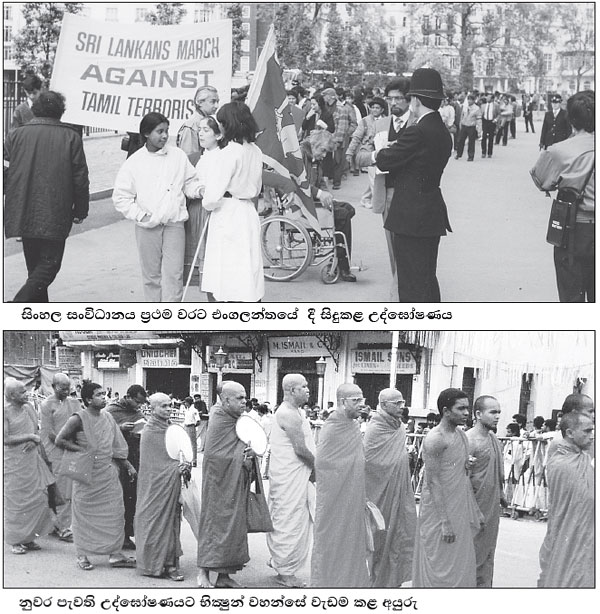
ඒ කාලේ සිංහල යාළුවන්ට වඩා මට හිටියේ දෙමළ, ලංසි ජාතික හිතවතුන්. ශාන්ත පීතර විද්‍යාලයේ අපේ පන්තියේ වැඩිපුර ඉගෙන ගත්තෙ දෙමළ සහ ලංසි ළමයි. පාසලෙන් විසිරිලා ගියත් අපේ යාළුකම් ඈත් වුණේ නෑ. ඒත් දෙමළ ජාතිකයන් රට බෙදීමට සූදානම් වෙනකොට ලංකාවේ දෙමළ යාළුවන්ට කතා කරලා ‘බෙදන්න යන රටක හිතවත්කම් පවත්වන්න බෑ… සියලු ජාතීන් එක ධජයක් යටතේ ජීවත් වෙන්න කැමති දවසක මම ඔයලාට කතා කරන්නම්…’ සියලුම දෙමළ හිතවතුන්ට එහෙම දැනුම් දීලා මම එංගලන්තයේ සිංහල සංවිධානයක් ගොඩනැගුවා. එම සංවිධානය ආරම්භ කළේ 1976 වර්ෂයේදී. එතකොට මගේ ලොකු දුවට වයස අවුරුදු දෙකයි. ප්‍රථම රැස්වීම පැවැත්වුවේ බැලැන් බාත් ශාලාවේ. ඒ රැස්වීමට සිංහල මිනිස්සු හැත්තෑ ගාණක් විතර සහභාගි වෙලා හිටියා. ඊට පස්සෙ පෙළපාලි ගියා. ශ්‍රී ලංකා තානාපති කාර්යාලය ඉදිරිපිට උද්ඝෝෂණ කළා. ඒත් එල්.ටී.ටී.ඊ. සංවිධානයේ ගොඩනැඟීම ගැන අපේ රටේ වගේම ලෝකයේ ජීවත්වන බොහෝ සිංහල ජාතිකයන්ට හරිහැටි අවබෝධයක් තිබුණේ නෑ. ඒ නිසාම මම ජාතිවාදය පතුරුවනවා කියලා සමහර මිනිස්සු විවේචනය කළා. සිංහල සංවිධානය ආරම්භ කරලා ලංකාවේ බෙදුම්වාදයට එරෙහිව එංගලන්තයේ ක්‍රියාත්මක වෙනකොට මා ගැන තොරතුරු රැස්කරන්න සේපාල ආටිගල එංගලන්තයට ආවා.

‘පුතා… ඔයාගේ වැඩසටහන ඉතාම හොඳයි. අපිත් උදව් කරන්නම්…’ අරවා දෙන්නම්… මේවා දෙන්නම් කියලා එංගලන්තයෙන් පිටත් වුණා. ඒත් කිසිම දෙයක් දුන්නෙ නෑ. එතකොටත් දෙමළ බෙදුම්වාදී සංවිධානයක් හිස ඔසවන්න යනවා කියලා ලංකාවේ මිනිස්සුන්ට අවබෝධයක් තිබුණේ නෑ. ඒ වෙනකොට එංගලන්තයේ දෙමළ මිනිස්සු එළිපිටම ක්‍රියාත්මක වෙමින් සිටියා. ලන්ඩන් විහාරයේ නායක හාමුදුරුවෝ හම්මළුවේ සද්ධාතිස්ස හාමුදුරුවොත් දෙමළ ක්‍රියාකාරකම්වලට තදින්ම විරුද්ධ වුණා. උන්වහන්සේ එංගලන්තයට වැඩම කරලා තිබුණේ 1939 වර්ෂයේදී. ලෝකය පුරා බෞද්ධ ආගම ව්‍යාප්ත කිරීමට උන්වහන්සේ විශාල සේවයක් කරගෙන ගියා.

ඔය කාලේ එංගලන්තයේ ජීවත්වන ශ්‍රී ලාංකිකයන්, එරටට තානාපතිවරයෙක් ඉල්ලා මෙරට ජනාධිපති ජේ. ආර්. ජයවර්ධනට ලිඛිතව දැනුම් දීලා තිබුණා. ප්‍රේමදාස අගමැතිවරයාගේ සූදානම තිබුණේ දෙමළ ජාතික මූර්තිව එංගලන්ත තානාපති විදිහට පත් කරන්න. දෙමළ බෙදුම්වාදී සංවිධාන හිස ඔසවන පසුබිමක දෙමළ ජාතිකයෙක් එංගලන්ත තානාපති විදිහට පත්වීම සුදුසු නෑ. ඒ නිසා ඒකට විරුද්ධ වෙලා අපි පෙත්සමක් අත්සන් කර ජනාධිපති ජේ. ආර්. ට යොමු කළා. අන්තිමේ මූර්තිව තානාපති විදිහට පත් කර, අපි යවපු පෙත්සමේ කොපියක් දීලා එංගලන්තයට එවලා තිබුණා. ඊට ටික දවසකට පස්සෙ 1978 අවුරුද්දේ එංගලන්තයේ සර්වජන ඡන්ද ප්‍රදර්ශනය පැවැත්වුණා. එම උත්සවයට ජනාධිපති ජේ. ආර්. ජයවර්ධන, අගමැති ප්‍රේමදාස ඇතුළු රාජ්‍ය නිලධාරීන් විශාල පිරිසක් එංගලන්තයට පැමිණ සිටියා. ඒ අවස්ථාවේදී ප්‍රේමදාස අගමැති නතර වෙලා හිටිය හෝටලයට මට එන්න කියලා දැනුම් දුන්නා. මම ගිහින් එතුමා සමඟ පැය තුනක් සාකච්ඡා කළා. ‘ගාමිණී… මූර්තිව තානාපති කළේ අපි නෙමෙයි. හමීට්. එයා තමයි මේ සේරම අවුල් කරන්නෙ… මීට පස්සෙ අපි මූර්ති එක්ක නෙමෙයි වැඩ කරන්නෙ, ගාමිණී කීර්තිචන්ද්‍ර එක්ක…’ එවකට විදේශ කටයුතු ඇමැති විදිහට හිටියෙ හමීට්. සියලු වැරැදි හමීට් පිට පටවලා ‘ගාමිණී කවදද සිංහලයො අපිට උදව් කරන්නෙ…’ කියලා ප්‍රේමදාස මගෙන් ඇහුවා. ඒ වචනයට එම උත්සවය සාර්ථක කරගන්න සිංහල බෞද්ධ සංවිධානයේ සාමාජිකයො උපරිමයෙන් වැඩ කළා. සර්වජන ඡන්ද ප්‍රදර්ශනය විවෘත කරන්න පැමිණියේ එංගලන්ත මහ රැජින. එල්.ටී.ටී.ඊ. හිතවාදීන් උද්ඝෝෂණ කරලා, දොරවල් කඩලා ලොකු ආරවුලක් ඇති කළා. දෙමළ කෝලාහළ මැද ජනාධිපති, අගමැති ඇතුළු අපේ දේශපාලන නායකයන්ව ආරක්‍ෂා කරගෙන ප්‍රදර්ශනය සාර්ථකව පැවැත්වීමට අපි ලොකු වැඩ කොටසක් කළා. ප්‍රදර්ශනය අවසාන වෙලා ජනාධිපති ජේ. ආර්. ලංකාවට පිටත් වෙන්න සූදානම් වෙලා මට එන්න කියලා විශේෂයෙන් ස්තුති කළා. ඊට ටික දවසකට පස්සෙ මම සිංහල සංවිධානය රැස් කරලා ‘එංගලන්තයේ ක්‍රියාත්මක වෙලා ඵලක් නෑ. ලංකාවට යන්න ඕනෑ…’ කියලා අපේ සාමාජිකයන් දැනුවත් කළා. ඊට පසුව මම 1980 අවුරුද්දෙ ලංකාවට ඇවිත් වරකගොඩ සීලරතන පණ්ඩිත හාමුදුරුවෝ, මාදුළුවේ සෝභිත හාමුදුරුවෝ, මඩිහේ පක්‍ද්ක්‍දාසීහ හාමුදුරුවෝ දැනුවත් කරලා උන්වහන්සේලා ප්‍රධාන කොටගෙන මෙරට ස්වාමීන්වහන්සේ විශාල නමක් සම්බන්ධ කරගෙන ‘සිංහල බල මණ්ඩලය’ ආරම්භ කළා. ප්‍රථම රැස්වීම පැවැත්වුවේ පිටකොටුවේ බී.ටී.එස්. ශාලාවේ. දැනුම් දීමකින් තොරව එම රැස්වීමට බෙංගමුවේ නාලක හිමි ඇතුළු භික්‍ෂූන් වහන්සේ විශාල පිරිසක් වැඩම කළා. රැස්වීම අවසාන වෙලා බෙංගමුවේ නාලක හාමුදුරුවෝ පන්සලට එන්න කියලා මට විශේෂ ආරාධනාවක් කළා.

ඒ විදිහට තමයි කොටි බෙදුම්වාදයට එරෙහිව මෙරට ප්‍රථම සිංහල සංවිධානය ආරම්භ වුණේ. ලෝකය පුරා කොටි සාමාජිකයන් ආයුධ පුහුණුව ලබන බව මෙරට ජනතාවට ප්‍රථම වරට දැනුම් දුන්නෙ සිංහල බල මණ්ඩලයෙන්. ප්‍රථම රැස්වීම පවත්වලා දිනක් ගෙවෙන්න පෙර මගේ මාමණ්ඩි ඒ. පී. ද සොයිසා ශ්‍රී ලංකා නිදහස් පක්‍ෂයෙන් ඉවත් කරලා තිබුණා. ඒත් අපිව නතර කරන්න බැරි වුණා. ප්‍රථම රැස්වීමේදී මම කරපු කතාව අහගෙන ඉඳලා එරමිටිපොළ හාමුදුරුවො, කොටුගොඩ ධම්මානන්ද හාමුදුරුවන්ට දුරකථනයෙන් කතා කර ‘එංගලන්තයේ ඉඳලා දුටුගැමුණු කෙනෙක් ඇවිත් ඉන්නවා. ජාතියට ලොකු හයියක්…’ කියලා තිබුණා. ඒ වගේම මම ජාතියට ශක්තියක් වුණා…

1982 අවුරුද්දෙ දී කොළඹ ඉඳලා අනුරාධපුරය හරහා නුවරට රිය පෙරහැරක් සංවිධානය කළා. වාහන තුන්සියක් විතර ගියා. සියලු වියදම් දැරුවේ මමයි. ලංකාවේ සියලුම නායක හිමියන් ඒ පෙරහැරේ වැඩම කළා. පාර දිගට වෙළෙඳසැල්වල එක ලෑල්ලයි ඇරලා තිබුණේ කොළඹ ඉඳලා නුවරට යනකම් මග දිගට තොරණ් ගහලා අපිව පිළිගත්තේ. නුවර වයි. එම්. බී. ශාලාවේ පැවැති රැස්වීමේදී ගැටඹේ විහාරයේ නායක හිමි, ලබුදුවේ සිරිධම්ම නායක හාමුදුරුවො ජනාධිපති ජේ. ආර් ට, අගමැති ප්‍රේමදාසට රිදෙන්න දේශනයක් කරගෙන යනකොට ශාලාවේ විදුලිය කැපුවා. බෞද්ධ සම්මේලනය කුඩු වෙන්න පහර දුන්නා. ඊට පහුවෙනිදාම ගැටඹේ විහාරයට කම්බි ගැහුවා. මට අපේ ගෙදරින් එළියට බහින්න බැරි විදිහට පොලිස් නිලධාරීන් යෙදෙව්වා. හතරවෙනි තට්ටුවට අරගෙන ගිහින් ප්‍රශ්න කළා. ප්‍රේමදාස අගමැති, ලංකාව පුරා ව්‍යාපාරිකයන් රැස් කරලා අපේ සංවිධානයට උදව් කරන්න එපා කියලා තර්ජනය කරලා තිබුණා. සිංහල බල මණ්ඩලයේ රැස්වීම් පවත්වන්න කිසිම තැනක් දුන්නෙ නෑ. එදා ජේ. ආර්. – ප්‍රේමදාස කළේ සිංහලයගේ අතපය බැඳලා දෙමළ මිනිසුන්ට ගහන්න ඉඩ හැරීම. අවසානයේ 1983 කළු ජූලියට දවස් දෙකකට පෙර මාව රටින් පිටුවහල් කළා. නැවත මම ලංකාවට ආවේ 1994 අවුරුද්දෙ ප්‍රේමදාස ජනාධිපතිවරයා නැති වුණාට පස්සෙ…

අවුරුදු දහයක් ලංකාවට ආවේ නෑ කියලා මම වැඩ නොකර හිටියේ නෑ. එංගලන්තයට ගිය දවසෙ ඉඳලා ලංකාවටම තමයි කළේ. ඒ වගේම ගමනායකත් එක්කත් කතා කළා. සියලු දේශපාලන නායකයන් එක්ක ගනුදෙනු කළා. ඒත් කිසිම දේශපාලන පක්‍ෂයකට වැඩ කළේ නෑ. මගේ එකම සිහිනය වුණේ ජාතියට වැඩ කිරීම. ශාසනයේ උන්නතියට වැඩ කිරීම. පුංචි කාලේ අපි විඳපු දුක තවත් ළමයෙක්ට විඳින්න නොදෙන්න කටයුතු කිරීම. ඒ වෙනුවෙන් වසර ගණනාවක් තිස්සෙ ඉඳලා කළ හැකි උපරිමයෙන් වැඩ කරගෙන යනවා. අදටත් මම ඉතුරු කරපු දෙයක් නෑ. අතේ තියෙන සතෙත් නැති, බැරි මිනිසුන් වෙනුවෙන් වියදම් කරනවා. 1979 සිංහල බල මණ්ඩලය පිහිටුවීමේ උත්සව සභාව අමතලා කීවේත් ‘මම වියදම් කරනවා හාමුදුරුවො වැඩ කරන්න…’ සිංහලේ අවදි කරන්න එදත් වියදම් කළේ මම විතරයි. අදටත් මම මේ රටේ දුප්පත් මිනිසුන් වෙනුවෙන් වියදම් කරනවා. මැරෙනකම් ඒ සද්කාරය කරනවා. දෙයක් කරන්න හිතුවොත් ඒ කටයුත්තට අවශ්‍ය ප්‍රතිපාදන මට ලැබෙනවා. මගේ දරුවො හතරදෙනාම කසාද බැඳලා තියෙන්නෙ එංගලන්ත ජාතිකයන්. ඒත් බුද්ධාගමයි. සිංහලකමයි ගහයි පොත්තයි, පන්සල නැති නම් අපිත් නැති බව මගේ දරුවොත් අවබෝධ කරගෙන ඉන්නවා. ඒ අයත් සෑම මොහොතකම නැති, බැරි මිනිසුන්ට උදව් උපකාර කරන්න කැප වෙනව. ඒ වගේම එදා වගේම අදටත් මේ රටේ දේශපාලනඥයෝ කිසිම කෙනෙක්ට රට වෙනුවෙන් වැඩ කරන්න දෙන්නෙ නෑ…” දීර්ඝ කාලයක් හදවතේ තුරුලු කරගෙන සිටි මතක පොත නැවත වසා දමා හේ දිගු සුසුමක් පිට කළේය.

ලෝකය පුරා කොටි හඬ පරයමින් සිංහල හඬ අවදි කළ ගාමිණී කීර්තිචන්ද්‍ර ගැන දන්නෝ දනිති. නොදන්නෝ බොහෝය. ඒ ඔහුගේ ජාතික මෙහෙවරට හඬබෙර නොවැදුණු නිසාය. අදටත් මෙරට ඈත, එපිට දුෂ්කර ගම්මානවල දුක්විඳින සිංහල ජනතාව වෙනුවෙන් කරන මෙහෙවර ගැන ප්‍රසිද්ධ කරනවාට ඔහු අකමැතිය. ඒ ඔහු දේශපාලනඥයෙක් නොවන නිසාය. ජනතා ප්‍රසාදයෙන් ඔහුට ඵලක් නොවන නිසාය. ඔහුගේ එකම අභිප්‍රාය සිංහල ජාතියට ජීවයක්දීම පමණි.

තරංග රත්නවීර

Chinese loans allow developing countries to avoid IMF-imposed structural reform

September 11th, 2022

Courtesy Morning Star

CHINESE loans to countries facing financial ruin in recent years, including Sri Lanka, Argentina and Pakistan, mean that Beijing is increasingly seen as an alternative to the International Monetary Fund, an analysis published in the Financial Times has found.

China’s Belt and Road Initiative had already led to it eclipsing the World Bank as the biggest funder of public works in other countries, but the emergency loans threaten to further undermine Western financial dominance of the global South because China does not attach the usual conditions applied by the IMF, such as cuts to public spending, according to AidData, a research facility at the US William and Mary University.

Beijing has tried to keep these countries afloat by providing emergency loan after emergency loan without asking its borrowers to restore economic policy discipline or pursue debt relief through a co-ordinated restructuring process with all major creditors,” AidData executive director Bradley Parks told the newspaper.

The United States has accused China of trapping” poorer countries in debt to itself as a means of increasing its political influence.

Chinese authorities say that they have written off billions of dollars of debt and that the accusation is fuelled by resentment over the existence of an alternative source of funding for developing countries that does not force them to open up their economies to foreign exploitation through selling off public services and natural resources or opening their markets to transnationals.

Instead of colonialism, China provides solidarity between developing countries. Chinese-financed physical infrastructure projects have become attractive to many developing countries’ governments as an attractive alternative to the US-dominated World Bank,” Jiangxi University of Finance and Economics fellow Mohammad Saiyedul Islam has argued.

No objection from CB chief to tabling IMF deal:SpeakerNEWS

September 11th, 2022

Courtesy The Island

ECONOMYNEXT –Sri Lanka’s central bank chief has informed the speaker of parliament that he has no objections to presenting the country’s agreement with the International Monetary Fund (IMF) though doing so is a decision up to the minister of finance.Speaker Mahinda Yapa Abeywardena informed parliament Friday September 09 morning that Central Bank Governor Nandalal Weerasinghe had communicated this to him in a discussion the two had held on the matter.

He said he has no objections about presenting it, and he is prepared to present the report anytime, but it is a decision that ultimately rests with the minister of finance. The reason for this is that there are certain sensitive proposals including those with regard to taxation that cannot be revealed beforehand.

He asked me to take it up with [President and Finance Minister Ranil Wickremesinghe] and then reach a decision,” said Abeywardena.

The speaker was responding to Chief Opposition Whip Lakshman Kiriella who had reiterated a request by the main opposition the Samagi Jana Balawegaya (SJB) to table Sri Lanka’s agreement with the IMF in parliament.

The government’s agreement with the IMF must be on our tables in parliament. How else can we discuss it? We must have something on the table,” said Kiriella.

[IMF-recommended reforms] cannot be carried out without the support of the parliament and the people of the country, as you know,” he added.However, the central bank governor had previously said that Sri Lanka had no practice of revealing IMF programmes to parliament early and tax changes can only be revealed to the parliament at the time of implementation.

Kiriella further said: No one can say that [the agreement] contains things that cannot be revealed to parliament. People will oppose any reforms that they feel are being carried out in secrecy.”

SJB MP Hesha Withanage requested that provisions in the agreement that can be revealed should be presented to parliament.

With the exception of the contents that cannot be publicised, the rest must be presented. This is a non issue. We as the opposition has no intention of using this against the government. I ask you to intervene to ensure transparency, or else there will be more allegations that both sides in parliament are teaming up and making deals.”

Speaker Abeywardena responded that he would bring the matter to the attention of the finance minister.Meanwhile, Leader of the House and Education Minister Susil Premajayantha said: There is no such agreement yet. Only an understanding. A final agreement will only be reached upon IMF board approval.”

President says he will give Parliament 6 months to agree on electoral reforms

September 11th, 2022

Courtesy Adaderana

President Ranil Wickremesinghe said that he is focusing on an export oriented, very competitive market economy for Sri Lanka as the country has the opportunity of supplying South Asia, Southeast and east Asia.

Our focus is on competitiveness and export markets. That’s what we are working on looking at the industry for technology and modernizing agriculture. If you look at the region by 2050 from Saudi to Indonesia there will be an addition of 500 million mouths to feed at high income level.”

He said this during the meeting with the visiting Administrator of the United States Agency for International Development (USAID), Samantha Power who is currently in Sri Lanka on a two-day official visit.

President Wickremesinghe said that the wheels have been set in motion to make Sri Lanka a prosperous nation by 2048 as we reach the centenary of our independence.

He noted that Sri Lanka is an aging population and automation and semi automation is one way out for Sri Lanka. He also noted that a 25-year program has been planned from 2023, adding that Sri Lanka will need the assistance of USAID for its 25-year program to go ahead.

He also noted that as far as democracy is concerned, the 22nd Amendment is before parliament. We are waiting for the parliament to pass it. In administrations, we have brought out the first cabinet manual in Sri Lanka. Hence, that will have to go before the cabinet and we’ll establish procedures for the whole of the cabinet. The oversight committees are back again and we’ll be looking forward to support from the USA.”

The President also said that increased economic committees from Public Finance, committee on Public Accounts, committee on Public Enterprise to include the Ways and Means Committee, committee on Banking and Finance because the banking sector is relatively weak and the Committee on State Enterprise Restructuring, they will start a parliamentary budget office and for the first time, legislative research service in Parliament.

We are also bringing in the new anti-terrorist legislation. I’m going to call the parliament to say once and for all that they must agree on electoral reform. This has been going on. The parties are arguing among themselves. I give them six months. If they don’t, I’ll have a referendum and ask the country which system they want. The political parties can’t be putting this off forever. They have to bite the bullet at some stage. So, if they are not willing, I have not told them yet. They’ll I will go for a referendum on the major reforms,” he said.

The President also said that former Speaker Karu Jayasooriya and Victor Ivan have come up with the concept of People’s Councils at grassroots level. We are giving them support, whatever finance they require. And officials at grassroots level have been asked to promote the concepts. So, it will be done not by us. And that’s a request, even with the Galle Face Green that the people at Village level must be allowed to express their views. So, there will be 14,000 people’s councils in the 14,000 basic units.” 

He also added that discussions have been held with the Tamils regarding the PTA detentions. We’ve agreed on a formula that will set off against the judgment, the period in detention, since they have all had more than ten years, no judgment will be more than ten years. It will be out. Except for the few who had bombed the Temple of the Tooth Relic and the assassination one or two other Parliamentarians.” 

The President also noted that he intends to bring in some of the associate degree here, which can be an employment-oriented degree with two years rather than go for the bachelor’s degrees for fall. 

So, help in having your associated degrees that are in community colleges would certainly be welcomed by Sri Lanka.” 

President Wickremesinghe also noted that there’s much that can be done towards agricultural modernization of the ongoing projects. 

He thanked Ms Power for the $ 40 million for the farmers, which will certainly be a big help as the country is about to launch a food security and nutrition initiative which will go down to the 14,000 basic administrative units in the country. And we are making use of all the officials, plus the private sector and others to push to ensure that we are self-sufficient in rice and many other food stuff. We have a good Maha season cultivation, that’s the main season. Then the economy gets stabilized and if you go to the next smaller season, also in 2023, that will help us certainly in a big way.” 

He also highlighted the novel concept of including youth representation in committees, where the ideas of the youth will receive due focus. In addition to the members of Parliament, there will be five youth representatives, people under 35 who will be there. They have the right to ask questions through the chairman and they cannot contribute to the main report. But we are giving them addendum so they can say whatever they want on the report. Thereafter it will be in print. This is the first time it’s happening in the world and we have to select the five members. We have what’s called a youth parliament that will legislate for that and bring it under the law.”

The President also highlighted the anti-corruption laws which have to be brought in, which were just approved, and the women’s caucus has been requested to prepare the Women’s Equality and Empowerment Bill. That’s the first one, I think. The first one for the region. A private member bill has come to decriminalize homosexuality. And I said the government will not oppose it. We are for it, but you have to get the support of individual members. It’s a matter of their private conscience,” he added. 

Meanwhile, the President also touched on the topic of the Easter Sunday terror attack investigations and said that the Scotland yard has been asked to come in, review the reports and come to a final conclusion on this whole issue to determine if there was a hidden hand behind the bombing. 

He also mentioned that land issues and how much land can be released. The missing persons, he said would also be accelerated. 

Reconstruction plans will be also be reviewed and accelerated, the President said, adding that the Northern Plan development plan is also on the cards. With renewable energy, the north will become big economic center followed by the Trincomalee development scheme. So with renewable energy and Trincomalee development we have a big opportunity there.” The President also said that he intends on bringing in the new anti-terrorist legislation. He also said that he plans to call the parliament to say once and for all that they must agree on electoral reform. 

Meanwhile, the visiting administrator of the United States Agency for International Development (USAID), Samantha Power said she conveys on behalf of President Biden that the US stands with Sri Lanka.

We certainly are here to come together with you and to help take advantage of this rare window of opportunity. Also, for you to be able to make the kinds of changes that have been proposed for so long.” 

She also highlighted Sri Lanka’s vibrant private sector and said measures should be taken to unleash the potential of the private sector. You have such an incredible private sector, such entrepreneurship. But the government, over so many years has largely stood in the way of unlocking that potential instead of fueling it. Mangala used to say, as you know, government has no business running business. And you know what was done in the telecom sector? If that could be done in other sectors in an expeditious and transparent way, to unlock the potential of your people, it would be incredible.” 

She said that the political reform agenda and the economic agenda go hand in hand which they have already seen this in the United States in trying to engage the business community to look at Sri Lanka now and to see the opportunities that exist here.

Ms. Power assured assistance of $60 million in new assistance. But compared to the challenges you face, that is very, very small and very modest. But we want to use our convening power to be catalytic as best we can, at the international financial institutions, with the private sector, with other countries that themselves are looking anew at Sri Lanka and thinking where to go.” 

Samantha Power, Administrator, U.S. Agency for International Development (USAID), Julie Chung, United States Ambassador to Sri Lanka, Sonali Korde, USAID Deputy Chief of Staff, Änjali Kaur, USAID Deputy Assistant Administrator for the Bureau of Asia, Gabriel Grau, USAID Sri Lanka Mission Director, Anamika Chakravorty, Political Officer, U.S. Embassy, State Minister of Foreign Affairs Tharaka Balasooriya, Chief of staff Mr. Sagala Rathnayake, President Secretary Mr. Saman Ekanayake, Foreign Ministry Secretary Ms. Anuni Wijewardhana, Finance Ministry Secretary Mr. Mahinda Siriwardhana and Advisor Dr. R.H.S. Samarathunga participated in the meeting.

Source: PMD

Sri Lanka crowned Asian Netball Champions

September 11th, 2022

Courtesy Adaderana

Sri Lanka beat Singapore to win the Asian Netball Championship and also qualify for the 2023 World Cup.

Sri Lanka defeated Singapore 63 – 53 at the finals on Sunday (11) to become six-time Asian Netball Champions.

Singapore were forced to settle for second at the Asian Netball Championship for a second straight edition after falling to Sri Lanka.

In a rematch of the 2018 final, three-time winners Singapore looked set to end their eight-year trophy drought as they came out firing from the start.

But defending champions Sri Lanka rallied in the next period to outscore Singapore 14-11 but the hosts held on for the 30-27 win at the half-time buzzer.

The third quarter was the turning point as the visitors tightened their defence, forcing errors from Singapore and limiting their attackers to just eight goals. 

With Sri Lanka’s 2.06m veteran Tharjini Sivalingam lighting up in the circle with a game-high 19 goals, they levelled matters before stealing the lead and the 46-38 win.

In a tense final quarter, both teams brought their A game with Sri Lanka’s shooters putting in scoring 17 goals to Singapore’s 15. But the gap proved far too big for Singapore as Sri Lanka prevailed 63-53 to win their sixth Asian Championship trophy.

Both teams have qualified for the 2023 World Cup in Cape Town, South Africa.

Malaysia finished third out of 11 teams after beating Hong Kong 54-42 in the play-off. The Philippines won the Plate division while India won the lowest-tier Bowl title.

The biennial event returned for the first time since 2018 after the 2020 edition in South Korea was cancelled because of the pandemic.

Sri Lanka had beaten Hong Kong 67-43 in the semi-final yesterday to reach their sixth straight ANC final.

Sri Lanka coach Hyacinth Wijesinghe said the win gave the players and country something to celebrate amid the nation’s economic crisis.

She noted that the team has not had a smooth build-up to the ANC as they were unable to go on an exposure tour before a major tournament for the first time and sometimes had to train in the dark when the power supply at their facility was disrupted.

She said: Whatever the disturbance, I was trying my best to keep on going. I must salute the girls, they really did their best and I think the country will be very happy.”

Meanwhile President Ranil Wickremesinghe has congratulated the unbeaten Sri Lankan Netball team who were crowned Asian Netball Champions after having defeating Singapore.

–With Agencies Inputs

Sri Lanka beat Pakistan to clinch sixth Asia Cup title

September 11th, 2022

Courtesy Adaderana

Sri Lanka produced a dominant performance to defeat Pakistan by 23 runs in the 2022 Asia Cup final on Sunday. 

Bhanuka Rajapaksa (71*) and Wanindu Hasaranga (3/27) were the stars of the night for Sri Lanka as they lifted a sixth continental title in Dubai. 

Being invited to bat, the Sri Lankans posted a strong score of 170/6 in 20 overs and Pakistan, despite a strong 71-run partnership for the third wicket, gave the momentum away in the final few overs as they were bowled out on 147 in a massive batting collapse.

After asking Sri Lanka to bat first, Pakistan made a blistering start as Naseem Shah dismissed the in-form Kusal Mendis in the first over of the match, but Rajapaksa, along with Dhananjaya de Silva (28) and Wanindu Hasaranga (36) made efficient contributions to take the Lankans to a strong score in Dubai.

For Pakistan, captain Babar Azam failed again as he was dismissed on 5 off 6 balls, and even as Mohammad Rizwan (55) forged a 71-run stand with Iftikhar Ahmed (32), the men in green failed to build on the same as no player from positions 5-11 barring Haris Rauf (13) could cross double figures.

Hasaranga shined with the ball too, as he picked three wickets while conceding 27 runs in his four overs; however, Pramod Madushan, who had made his T20I debut in only Sri Lanka’s previous game against the same opponents in the Asia Cup, took four wickets including that of Babar Azam to become the leading wicket-taker in the Lankan lineup.

This was Sri Lanka’s sixth continental title, inching closer to India, the most successful team in the Asia Cup with 7 titles to their name. Additionally, this is Sri Lanka’s first Asia Cup title in the T20 format.

–Agencies

How to calculate the proper doses of vitamin D and calcifediol (as a ratio of body weight):  

September 10th, 2022

Robin

Rapidly Increasing Serum 25(OH)D Boosts the Immune System against Infections-“Sepsis and COVID-19”  

Dear Vitamin D Researchers, Medical Professionals and/or Advocates:  

QuestionWhy should doctors or the public notice vitamin D researchers if immunologists are unaware of 25-hydroxyvitamin D’s importance to the immune system?  

I can only do a fraction of what I would like to regarding highlighting the best research and bringing it to the attention of others who need to read it, including every immunologist I know of.   https://vitamindstopscovid.info/00-evi/  

Much of this material is covered by the following article, which I will link to from the above page:  

Rapidly Increasing Serum 25(OH)D Boosts the Immune System against Infections—Sepsis & COVID-19   

Sunil J. Wimalawansa, Nutrients 2022-07-21: full- https://www.mdpi.com/2072-6643/14/14/2997/htm  

[https://www.mdpi.com/2072-6643/14/14/2997]  

I am updating my charts (https://vitamindstopscovid.info/00-evi/#charts) to be compatible with above-revised recommendations for vitamin D3 daily supplemental intake quantities as ratios of body weight.   

I based these charts and the submission on his earlier recommendations to the FLCCC, now cited in some of their protocols:   

https://covid19criticalcare.com/covid-19-protocols/

      (https://covid19criticalcare.com/covid-19-protocols/i-prevent-covid-protection-protocol/) Also updated now.  

Dr Wimalawansa’s recent article highlights the need for at least 50 ng/mL circulating 25-hydroxyvitamin D for immune system health, with higher levels for those suffering from inflammatory auto-immune disorders.   

It makes a crucial distinction between the hormonal function of circulating 1,25-dihydroxyvitamin D, for regulating calcium-phosphate-bone metabolism and the immune system’s need for 50 ng/mL circulating 25(OH)D.  The latter is not acting as a hormone. Immune cells are not affected by the very low, and generally stable, level of circulating 1-,25-dihydroxyvitamin D.

Intracrine signaling is within individual cells. Paracrine signaling is to nearby cells, typically of a different type.  These systems are crucial to the ability of many types of immune cell to respond to their circumstances.  The details have only been elucidated in detail for a subset of immune cell types by Martin Hewison et al. (macrophages and dendritic cells) and Chauss et al. (Th1 lymphocytes remaining stuck in their pro-inflammatory startup program due to lack of 259OH)D).   

However, since most or all immune cells are known to alter their gene expression according to VDR activation, it is reasonable to assume that most such cell types are involved in vitamin D based intracrine and/or paracrine signaling. 
For all non-immune-system, cell types which are also known to alter gene expression according to VDR activation – other than those involved in calcium-phosphate-bone metabolism – these also depend on vitamin D based intracrine and/or paracrine signaling to respond to each cell’s changing circumstances.  

There is a critical need for vitamin D researchers to explain this properly, especially to immunologists, since immunologists seem to have no knowledge of or interest in vitamin D.   I have two recent, highly regarded immunology texts here – 1500s full of all sorts or details and intriguing research: Janeways 9th and Abbas 10th.  Neither mention vitamin D in their indexes.  


At present, the best explanations of vitamin D-based intracrine and paracrine signaling systems, and of why “vitamin D” is not a hormone I know of are:  

https://vitamindstopscovid.info/02-intracrine/  (cites Reinhold Vieth 2004 Why Vitamin D” is not a hormone, and not a synonym for  1,25-dihydroxy-vitamin D, its analogs or deltanoids.)  

https://vitamindstopscovid.info/00-evi/#02-compounds

While Dr Wimalawansa’s article also draws the crucial distinction between these signaling systems and hormonal signaling. He highlighted the time it takes (months) to attain proper 25(OH)D with suitable quantities of supplemental vitamin D3 and how inadequate this is for clinical emergencies.  He discusses bolus vitamin D3 (~~ 4 days to raise 25(OH)D levels over 50 ng/mL) and, most importantly, the use of 0.014 mg per kg bodyweight (1mg for 55 to 85 kg) calcifediol to raise these levels safely over 50 ng/mL in 4 hours or so.  

https://www.linkedin.com/posts/sunilwimalawansa_ivermectin-for-covid-19-real-time-analysis-activity-6829805643533287424-8Wuv

Simplified Protocol for Using Vitamin D, Calcifediol, & Ivermectin:    

https://www.linkedin.com/posts/sunilwimalawansa_simplified-protocol-for-using-vitamin-d-activity-6834224355317207040-yIEv

100 or so such tablets can be made into an easy-to-drink suspension by adding a small amount of xanthan gum and water. See the end of:  https://nutritionmatters.substack.com/p/calcifediol-to-boost-25-hydroxyvitamin


COVID-19 is not the most dramatic example of harm and death due to inadequate vitamin D3 intake.  Sepsis is arguably worse since it kills 11 million people a year and would only rarely occur or kill people if everyone had 50 ng/mL 25(OH)D: Global Burden of Disease project: https://www.thelancet.com/journals/lancet/article/PIIS0140-6736(19)32989-7/   

Boosting innate immunity with vitamin D could help reduce complications and deaths from COVID-19: recent advances (video).   

https://www.linkedin.com/posts/sunilwimalawansa_reduction-of-complications-of-covid-19-with-activity-6759684685204455424-w-Bw

For children:  

Multisystem Inflammatory Syndrome (MIS) and Kawasaki-like syndrome & COVID-19:
https://www.linkedin.com/posts/sunilwimalawansa_multisystem-inflammatory-syndrome-mis-activity-6815294839769436160-99qJ     

Finally, years of evidence show that flu vaccines do not reduce hospitalisation or death due to influenza or influenza-like illnesses, at least directly in those too are vaccinated.  See Anderson et al. 2020 and other research cited at: https://nutritionmatters.substack.com/p/influenza-vaccines-do-not-reduce .  

  Best regards  

    Robin (rw@firstpr.com.au)  

Sri Lanka to allocate land for International Football stadium

September 10th, 2022

Courtesy NewsIn.Asia

Colombo, Sept 9 (NewsWire) – Minister of Tourism Harin Fernando has held discussions with the President of the Qatar Football Association Sheik Hamad Bin Khalifa Bin Ahmed Al-Thani on building an International Football Stadium in Sri Lanka.

Minister Fernando said the meeting with the Qatar Football Association President focused on promoting sports tourism.

A fruitful discussion had been held regarding helping Sri Lanka, especially with sports tourism, he revealed, in a message on Twitter.

The Minister further said the matter of providing a plot of land to build an international football stadium in Sri Lanka had also been discussed. 

රෝ සංවිධානයේ බළලා මිලින්ද මොරගොඩගේ කටින් එළියට පනී

September 10th, 2022

Lanka Lead News

ඉන්දියාවේ ශ්‍රී ලංකා තානාපති මිලින්ද මොරගොඩ මහතා විසින් ශ්‍රී ලංකාවේ ආර්ථිකය ඉන්දියාවේ ආර්ථිකය සමඟ ඒකාබද්ධ කල යුතු බවට ඉල්ලීමක් ඉදිරිපත් කළ බව ද daily mirror පුවත්පත වාර්තා කරයි.

ඒ පිළිබඳව අදහස් දක්වන දේශපාලන විචාරකයන් සඳහන් කරන්නේ ඉංදියාවේ උපායමාර්ගික උවමනාව මිලින්ද මොරගොඩ කටින් එලියට දැමීම ඉන්දියානු ඔත්තු සේවා සමත් වී ඇති බව ය.

ඔවුන්ට අනුව ශ්‍රී ලංකාව මුහුණදෙන ආර්ථික අර්බුදය යොදා යොදාගනිමින් මූල්‍ය ඒකාබද්ධ කරණය හෙවත් ඉන්දියානු රුපියල ලංකාවේ භාවිතා කිරීම, රේගු, සහ බදු ඒකාබද්ධ කරන මෙන් ම බලශක්ති, නාවික, ගුවන් සේවා ඒකාබද්ධ කරණය කිරීම මගින් ශ්‍රී ලංකාව අර්ධ යටත් විජිතයක් බවට පත් කිරීමේ උපාය මාර්ගයක් ඉන්දියාව විසින් දියත් කර ඇත.

FacebookTwitterWhatsAppMessenger

Prez has final say in making IMF agreement available to MPs

September 10th, 2022

By Saman Indrajith Courtesy The Island

It was up to the Minister of Finance Ranil Wickremesinghe to decide whether to present the government’s agreement with the IMF to Parliament, Speaker Mahinda Yapa Abeywardena said yesterday.Earlier, Chief Opposition Whip, Lakshman Kiriella, said that at the next business of the committee meeting, he was planning to ask for a debate on the agreement the government had entered into with the IMF.

We need a copy of the agreement. This will help the debate. These reforms need the support of the Opposition, and the people, to be successful. You know there is no point in hiding this and we would like to support the government to carryout the agreement. We understand the state of the economy. You need to show us this agreement before the debate. We must have something on the table. We must know what the government wants to do,” Kiriella said.

In response, Speaker Abeywardena said that he had a discussion with the Governor of the Central Bank about this and the Governor had said he had no objection of presenting the agreement to the Parliament.

He is ready to give us the agreement but its up to the Finance Minister to take a final decision. There are tax sensitive proposals in the agreement and apparently these can’t be discussed in public. The Governor asked me to talk to the Minister of Finance,” he said.Kiriella replied that the Parliament has finance power and if the government tries to implement the agreement, in secret, people will oppose.

We are left clueless about the state of the economy. Apparently, a few months ago, our usable reserves were down to 20 million US Dollars. Did you know of this as the Speaker? We didn’t know. At least you should know,” he said.The Speaker said he will speak to the Minister of Finance about this.

Major tea export company in SL has been evading taxes: Govt. MP reveals

September 10th, 2022

Courtesy The Daily Mirror

A major tea export company in Sri Lanka has been evading taxes worth US dollars 300 million every year, a government MP told Parliament yesterday.

MP Mahindananda Aluthgamage who made this disclosure in Parliament added that none of the companies who run supermarket chains does not pay a single cent as taxes.

“There is also a popular clothing store which has 48 outlets islandwide that also does not pay a single cent and a major apparel company which earns Rs 700 million annually but evades paying taxes.

Coming up with another staggering disclosure, he said a certain senior officer who earns Rs 1.4 million in a state bank and his taxes are paid by the bank itself.

“A total amount or 3 billion could be earned as taxes if the Inland Revenue

Department is properly regulated,” he said.

Also, he proposed opening up fresh tax files for all 225 MPs so that those who evade paying taxes could be found out.  (Yohan Perera and Ajith Siriwardana)

Facilities for state ministers brought under public expenditure management.

September 10th, 2022

Courtesy Adaderana

The President’s Media Division (PMD) says the facilities provided to state ministers have been brought under the management of public expenditure.

Accordingly, President Ranil Wickremesinghe has emphasized that all authorities should make every effort to utilize public funds spent by the government in a frugal and efficient manner, taking into account the severe economic difficulties that the government has to face in the current economic and social climate of the country.

The Secretary to the President, Saman Ekanayake has given instructions to all secretaries of the ministries on Friday (Sep 09) to make special arrangements for the management of public expenditure.

The President’s Secretary has issued the following instructions to all ministerial secretaries informing that the state ministers appointed by the President with effect from Thursday (Sep 08) should act according to those terms while carrying out their duties:

• A separate expenditure head is not allocated for state ministries. Secretaries will not be appointed for those government ministries and the most senior additional secretary should be employed among the additional secretaries of those ministries to facilitate the work of the state ministers under each scope.

• The ministry to which the relevant state ministers have been appointed should meet the staffing requirements from the currently approved staff. Requests for creation of new posts should not be submitted to the Department of Management Services.

• For operating the offices, facilities should be provided within the office premises where the relevant cabinet ministry is currently operating.

• Only the private secretary of the support staff of the state ministers is entitled to an official vehicle, and the overtime and composite allowances of the private secretary’s official driver should be handled in accordance with the circulars issued by the Ministry of Public Administration, Home Affairs, Provincial Councils and Local Government.

• Only 02 common vehicles should be reserved for other officers of the support staff. Other vehicles in the vehicle pool of the ministry should not be used for the needs of the said officials.

• Management Assistant, Development Officer, Office Assistant and Driver are to be selected only from among the permanent civil servants. Those drivers can receive monthly overtime allowance subject to a maximum of 150 hours and their monthly composite allowance entitlement is subject to a maximum of 08 days..

• The communication allowance shall be provided to the private secretary, coordination secretary, press secretary and public relations officer subject to the approved maximum limit, and the communication allowance shall include data usage, international telephone charges, monthly fixed charges, taxes and other charges.

• The support staff should not be provided with mobile phones at government expense.

Accordingly, this order has been issued revising the provisions mentioned in the letters from time to time by the President’s Secretary on the instructions of the President under CA/01/17/01 and the letters issued on May 14, 2010 under the title of Public Expenditure Management.

Legal action against misleading, false statements on coal procurement

September 10th, 2022

Courtesy Adaderana

Minister of Power & Energy Kanchana Wijesekera has held a discussion with the officials of Lanka Coal Company and the supplier who was awarded the coal term tender.

The coal procurement for the Lakvijaya Power Station in Norochcholai was taken up for discussion at this meeting.

Due to various misleading statements that were circulated on the procurement process, the supplier has decided to suspend performing the contract awarded to them until legal clearances were given, Minister Wijesekera said further.

At the meeting, it was decided to take legal action against misleading and false statements by certain individuals and the companies engaged in misleading the public for political and financial reasons and placing the power generation at risk.

Contingency plans were also discussed to procure the coal requirements for next season if the awarded suppliers are not able to supply the requirements, Minister Wijesekera added.

USD 40 million to help farmers – USAID Administrator Samantha Power

September 10th, 2022

Courtesy Hiru News

USAID Administrator Samantha Power announces an additional USD 40 million to Sri Lanka to help farmers purchase fertilizer and other vital agricultural inputs

How a Separate State in the Northern and the Eastern Provinces of Sri Lanka will be besetted with poverty and destitution

September 9th, 2022

By Garvin Karunaratne, formerly of the SLAS

The Northern and Eastern Provinces of Sri Lanka happen to be interlocked into the rest of Sri Lanka economically and cannot sustain itself if separated.

This fact is well illustrated in the working of government departments that deal with development.

My life in the Administrative Service began in the Marketing Department in 1955. It was called the Department for the Development of Agricultural Marketing. It dealt with the marketing of agricultural produce and in the Fifties when I joined as an Assistant Commissioner, the Department implemented the Guaranteed Price Scheme for Cereals etc. including paddy etc., the Vegetable and Fruit Marketing Scheme, the Cannery, Rice Milling, Fertilizer Distribution and Granting loans for agricultural purposes to cooperatives, among other functions.

I have worked in the Southern Province, Anuradhapura and Trincomalee, one year in charge of the Vegetable and Fruit Marketing Scheme in charge of the entire island, and also worked for short spells in Jaffna and Batticaloa. Working at Anuradhapura, when the Assistant Commissioner at Batticaloa went on leave I covered his area.

Let me deal with real happenings instead of a learned discourse. The ideas are firm and this paper contains real facts.

When I covered the Southern Province based at Ambalantota, one of my tasks was to clear some ten wagons of paddy that came to Matara and another ten wagons of paddy that came to Boosa(Galle) daily for at least four months each year. The paddy came from China Bay in the Trincomalee District and from Batticaloa. This was a major task and if I failed to clear the ten wagons every day, there would be a pile up and demurrage charges had to be paid. The paddy had to be brought into our Stores at Boossa and Matara, issued to rice millers. This was the excess paddy that was produced in the Districts of Trincomalee and Batticaloa.

When I covered Trincomalle from Anuradhapura I had to send off ten or more wagon loads of paddy to all places in the South, to Boosa, Matara, Kandy, etc from China Bay. The Railway was asked by me to provide the maximum number of wagons they can find and all were despatched with paddy to Colombo and the South. These two Districts produced an enormous amount of paddy. . The population of the island was more in Colombo and the South and that was where the paddy found its way- turned into rice, issued to the people on a ration scheme.

In short without the consumers in the rest of the island, there will be no market for the paddy produced in the Eastern Province. The closest neighbour is India which also produces an excess of paddy and the price of rice in India is always lower than in Sri Lanka.

Take Red Onions. Red Onions were produced in the Jaffna peninsula and during the three harvesting months our Assistant Commissioner in Jaffna had his hands full visiting cooperatives that purchased red onions, ensuring that the cooperatives had sufficient funds, accepting the red onions from the cooperatives to our departmental stores, storing- rather drying the red onions, ensuring quality, packing into bags and despatching red onions by railway wagons to all other parts of the island. This happened for some three months every year and it was the duty of the Assistant Commissioners in charge of the other Districts to clear and sell to dealers.

When I covered the Southern Province in 1958 and 1959, three wagon loads of red onions were daily received at Boosa and had to be cleared, by my staff at Galle, brought to our stores and sold wholesale to dealers in the Southern Province and also sold at our departmental retail outlets. Once I had a major problem with the member of parliament at Galle Mr. Dahanayake. He had sent a telegram to the Ministry that there were no red onions in Galle. It was the red onion season and I had ensured that there were ample stocks both in our retail shop as well as in the wholesale outlet at Galle. I was informed of Mr Dahanayakes complaint by telegram. There were no mobile phones those days in 1958. I drove from Ambalantota to Galle as quick as my peugeot 203 took me. It was a life or death problem- a bad name on my career. I visited private shops as well as our stores and red onions were being sold- there was no shortage whatsoever. I then went to the residence of Mr Dahanayake and as he was not in I waited at his residence till night. He came at about ten in the night and inquired why I was there. I told him of his complaint to the Ministry and added that there was no shortage ever of red onions in Galle. One felllow, one of my supporters came and told me and to satisfy him I sent a telegram to the Ministry.” I replied; There was never a shortage of red onions in Galle and the Ministry is concerned. It will be a bad name on my administration. ” To satisfy that man I had to send that telegram.”. I told him that the Ministry would punish me if there was a shortage to which he replied that he will inform the Minister that there never was a shortage and that he had sent the telegram to keep in the good books of one of his supporters. That was all and I reported the matter to the commissioner in Colombo and the matter ended there. This shows how red onions were sold all over the island and the importance attached to the sale of red onions. .

Again when I was in charge of Tripoli the head quarters of the vegetable marketing scheme at Maradana, every day for some four months of the year there were at least five wagon loads of red onions from Jaffna and my task was to ensure that the onions were sold somehow at our fifty small shops in Colombo, wholesale to dealers and when there was yet red onions unsold there were van sales till late at night selling somehow.

So was it in other distrcts like Kandy and if not for the rest of the island the red onions will not find a market and the farmers in Jaffna will face poverty and destitution.

Take Paper. The PaperMill at Valachenai produced around half the paper requirements of Sri lanka and everyday paper products were sent by wagon to Colombo. If not for sales out of the Eastern Province there would be no sales for the paper produced in Valachenai near Batticaloa. Further the straw in Batticaloa was insufficient and straw was taken by lorry from Hingurakgoda and Polonnaruwa. In short Valachenai had to obtain straw from the Polonnaruwa District.

Take Tourism. The beaches in Trincomalle, Nilaveli, Pasikuda and Arugam Bay are marvels and tourists have to come from the rest of the island to enable the people in these areas to find employment. I have never met any locals from the Northern and Eastern Provinces in these hotels where I regularly visit when in Sri lanka. It is a few foreign tourists and people from Colombo and the South that patronize them. In short tourism will be a non runner if the North and East were a separate state.

In 1970 I worked as the Deputy Director of Small Industries. My duties included the development of small industries and ensuring that all small industries in the private sector got allocations of foreign exchange to enable them to import items that were essential for their manufactures. The amounts approved by me for industrialists was for products to be sold in the entire island, It depended on the machinery, inspected by me or one of my inspectors. Though the private entrepreneurs were sited in various districts, the places where the manufactures had to be sold was in Colombo and the South where the people live. The market for manufactures was out of the Eastern and Northern Provinces. Almost all the cement produced in Kankasanturai was sent by wagon to the rest of the island. In short any industrialist in Jaffna or Trincomalle will have to invariably sell the products in the rest of the island

Take Fisheries. The catch of fish in the Trincomalee area is enormous and has to be sold in Colombo or turned into dry fish and most of the dry fish in Colombo comes from the Trincomalee and Mannar areas.

Now let me tell briefly how we administrators managed the entire island before the advent of the LTTE. I have worked in the Department of Agrarian Services handling loans to cooperatives for agricultural purposes and for issue of fertilizer to cooperatives in 1962. I was in charge and cooperatives had to come to me from all parts of the island with their applications for loans to farmers and also to obtain fertilizer. It was my staff that processed the papers and the loans were issued and the fertilizer was issued under my signature. There was never any complaint and every cooperative was treated alike. I selected cooperatives at random and visited them inspecting their books and inquiring from farmers, to ensure that loans and fertilizer were made available in time and this included cooperatives in the East and North Provinces. Always, I was alone but cordially greeted by people. Some of my closest friends even today happen to be Tamils.

At St Peter’s College I was a non runner in Latin and it was a Tamil gentleman, a neighbour who daily helped me in my Latin homework. We lived in amity and amity is what is needed today.

Confrontations commenced with President Jayawardena and his leasing out land in Trincomalee to an American company which was resented by the Prime Minister of India, Indhira Gandhi who invited Prabahakaran, trained them in methods of warfare, equipped them with more advanced weapons than what the Sri lankan Army had and unleashed terror on Sri Lanka. Before that there were small problems but the problems commenced with President Jayawardena’s rule.

What all above facts point out is that Sri lanka is one integral whole and if any segment is split up the entire country would suffer. The population in the Northern and Eastern Provinces will suffer from the lack of employment and incomes if the rest of the island is not there to sell their produce.

Sri lanka is an integrated whole and its future lies in remaining an integral country.

Garvin Karunaratne, former G.A.Matara

9/9/2022

 SYSTEMS CHANGE

September 9th, 2022

Sugath Kulatunga

Many parties try to read a systems change factor  which was not there into Gota Go home cry. Aragalaya focused only on  the single objective to send Gota home. The core of the Aragalaya consisted of an urban and semi urban subculture of long haired persons of unconventional appearance who reject conventional values. They were more the Ranil’s Bracelet wearing and jean clad generation of veteran youth. The fact that the battle cry was the anglicized Gota Go Home was zeroed on this subculture rather than the youth in general. It may have been more effective if the slogan was Gota Gedara Pala.

 The significant participation of the JVP elements had no effect on the ideological stance of the Aragalaya. Religious groups and minority elements which joined later were there to fish in muddied waters. Bar Associations support was an enigma which perhaps was political. The intellectuals and artistes marked their presence only for future reference. None of these peripheral groups added to the one and only cry of get rid of Gota. They never had any notion of what next. These and the main Aragalaya did not have even a clue on systems change.

A turning point in the people’s protests came with the violent demonstrations on 31 March in Mirihana close to the residence of the President. It was under these circumstances that on 3rd April 2022, all 26 cabinet ministers except the PM resigned en masse.

The Galle Face Aragalaya demanding Gota Go Home started on April 9 almost a week after the resignation of the cabinet The Galle Face Aragalaya demanding Gota Go Home started on April 9 almost a week after the resignation of the cabinet and cannot take credit for that change.

Aragalaya would have secured wider support from the community if it addressed the critical national issues which need urgent change of systems. A few of the major issues which need attention are defined below in brief.

  • Power Sharing: The country has been burdened with a power sharing system imposed by India, which nobody wanted. It has become a massive white elephant and continues to be a security threat and encourages separatism. Power sharing should be on the principle of subsidiarity where it is shared with the lowest level in the administration which can manage it. In Sri Lanka it is at the district level. This is a vital systems change which needs attention for political stability and better governance .
  • Balance of Trade: The root cause of scarcities, queues and deprivations is the lack of dollars to import these essentials. The country has been import dependent rather than export oriented. Since independence SL has neglected export dependent growth as the path of economic development and covered the yawning trade gap with borrowings. Most IMF interventions in the past have concentrated on import liberalization. The past system of meeting a balance of payments through borrowings must be replaced with a system where this is achieved through a balance of trade with exports matching imports. The system must prioritize export development. This is a primacy for a change in the present system which encourages imports and discourages local production.
  •  Youth participation in governance: The energy and enthusiasm of youth have turned into destructive militancy due mainly to the absence of a power sharing by youth at the center and a place in the governance system. This has been a problem affecting the women of the country as well, who are today a majority in the population. A major system change must be introduced to resolve this situation and make people’s sovereignty more meaningful by creating a second chamber in the Parliament for youth with equal participation for males and females.
  • Productive Employment: World today is driven by science and technology. Most countries have adopted education policies which prioritize their systems of education to meet the demands of science and technology which cover STEM education and vocational training. Although vocational training was a recommendation in the Kannangara proposals as far back as 1944 this aspect received scant attention.

 Taiwan is an Island smaller than Sri Lanka with a similar population. It was a predominantly an agricultural economy. Today it is a high tech powerhouse leading the world in a number of high tech industries. It has a per capita income of 36, 000 dollars. At the beginning of the 1980s, Taiwan increased the ratio for senior vocational schools and general high school to 7:3. By 2012 there were 155 senior vocational schools, 14 junior colleges, and 77 universities/colleges of science & technology, totaling 246. It is the education system that has sustained the significant development of this small nation. Our education system must be revamped if we are to progress in technology and expand into high valued exports and create productive employment. It cannot be left to the University Grants Commission or the FUTA.

  • Presidential system: The existing Presidential system is a hybridized jumble of  a presidential system and a parliamentary system. The cabinet is formed with members of the legislature violating the principle of separation of powers. With a large number of members of Parliament serving in the cabinet it makes the legislature a rubber stamp of the cabinet. Minsters who should be confined to make law become involved in the implementation of the law. The Cabinet is formed not with the best talent in the country, but of members of Parliament selected on their political strength. In the US system the Cabinet is a technocracy consisting of members tested for their ability and aptitude. The legislature (Congress)controls the finances and uses its authority to ensure that the laws they passed are being enforced the way they were intended to be. The oversight responsibilities of the Congress apply to the federal bureaucracy as well as to elected and appointed officials. US system is better as it maintains a strict separation of powers and the cabinet consists of professionals.
  • Right of Referendum: This is a powerful tool in many democracies to ensure the government keeps in touch with the pulse of the people. Referendum is as expensive to hold as a general election. In this context a Referendum has been invoked in the country only once and that too for the wrong purpose of extending the life of the Parliament.

    In our democracy the people can use the power of franchise in selecting a government only once in 5 years unless the Parliament is dissolved earlier. In between elections the voice of the people is muted. This makes people to resort to demonstrations and Aragalayas. The government also takes decisions on conjecture. A typical guesstimate decision was the overnight ban on chemical fertilizer.  It was done with good intentions on the advice of a small coterie of pseudo experts, not anticipating an adverse response from the farmers. What the country needs is a mechanism to consult the people and for the people to show their response at an intermediate level between the Parliament and the grassroot constituency, which the people themselves can make it operative

Fortunately, we have such a representative constituency at the grassroots where a new constituency of around 8000 elected members of Pradeshiya Sabha and local authorities could be introduced. While the government can invoke a referendum at the will of the President or on a simple majority of the Parliament expressed in a secret ballot, the people could also demand a referendum to express their will with a simple majority of the new constituency registered in a secret ballot.

  • Venture Capital: Government of Sri Lanka had established the National Development Bank for the purpose of promotion of industrial, agricultural, commercial and other development of the economy of Sri Lanka having regard inter alia to the development of the rural sector. One of the objectives of the NDB was to undertake development projects, including pilot projects, in order to achieve the purposes of the Bank. Unfortunately, the NDB acted like any other commercial bank and was finally privatized by CBK who was on a selling spree. It is no more national but continues to call itself national.

       In view of the absence of any other financial institution to provide funds for innovative investments with risk, the EDB Act provided for investments in selected export projects. A special Division was created in the EDB to evaluate projects and participate as a Venture Capital provider in innovative pioneering projects. Through this facility a number of pioneering projects were established. But a subsequent Board of Management not only abandoned the concept of venture capital but disbanded the EDB division with its trained staff.

   The absence of a venture capital facility led to the sale to India the patent rights of the nano urea project of the Sri Lanka Institute of Nanotechnology (SLINTEC). This is a serious lacuna in the Banking system which must be filled.

  • State Owned Enterprises: Efficient management is the key to success of any enterprise in the public sector or in the private sector. A good management is able to set up new organizations and introduce even an untested system effectively. A good example is the CTB where with nationalization a brand-new system had to be set up to operate a massive island wide organization. This was successfully accomplished by a handful of administrators seconded from the civil service. Until the CTB became the job bank of politicians it was run efficiently providing an essential service and making a profit. There are small SOEs which can be merged. There are others which only act as middlemen or conduits. They can be eliminated. Some others have become irrelevant as the original objectives of the enterprise have ceased to be valid.

Counting a chairman and a managing director for each SOE, the estimated 573 SOEs would consist of over 1100 personnel at the management level. At present these individuals are picked on an ad hoc basis where political loyalty becomes the dominant criterion. Most of these cronies have no long-term interest in the success of the enterprise and are only keen to please the minister and would stoop to corrupt practices.

With over 550 SOEs there is a dire need for a special permanent cadre of around 1000 top managers to run these entities. This number exceeds the cadre in SLAS Special Class and Class 1 which at present is around 700. This cadre should be professionals seconded from the national management cadres or selected out of present holders. Both officers on secondment and in service personal should be absorbed through an examination and interview by an independent Corporation Service Commission. They should be placed in 2 or 3 grades and given a high-level training in business management. Their salaries should not exceed the salaries of the parallel SLAS grades but should be entitled to profit sharing. The posting of individuals into specific posts should be based on the needs of the job description of each post. This is a major system change that demands attention.

  • Welfare Handouts: Welfare handouts like Samurdi should be better targeted. Instead of the monthly dole granting a lump sum to start off a productive operation should be considered.
  • Feasibility studies: Small and Medium Industries sector is considered the engine of economic development. There are many concessions accorded to this sector like low interest loans. At present the Banks confine themselves to only the evaluation and approval of SME projects. They do not play a role in the identification of projects and developing project profiles and feasibility studies to make them available to prospective investors. This is the policy followed by established development banks in India such as the National Bank for Agriculture and Rural Development. (NABARD). It is also the practice of Small and Medium Enterprise Development Authority (SMEDA) of Pakistan. (www.smeda.org.pk) The participation of the Banks in project identification and development would also result in channeling scares resources into priority sectors of development and would contribute to the reduction of project failure.

    The EDB with its provision for venture capital could restart the Projects Division to carry out prefeasibility studies in export-oriented projects.

   It is also time that SL focus less on country promotion of FDI and promote investments in identified projects where at least prefeasibility studies are available.

Above are a few areas where systems change is essential and the Aragalaya and supporters had not even a clue.

Rajapaksas to regroup through new Lanka political alliance

September 9th, 2022

Courtesy The Telegrapgh (India)

‘We will form a new political alliance under the leadership of Mahinda Rajapaksa’

Sri Lanka’s politically under siege Rajapaksa family would return to dominate once again by forming a new alliance, Namal Rajapaksa, the son of the former president and prime minister Mahinda Rajapaksa, said on Friday.

“We will form a new political alliance under the leadership of Mahinda Rajapaksa,” he told a political gathering of the ruling Sri Lanka Podujana Peramuna (SLPP) in the southwestern province of the crisis-hit country.

The SLPP has been at the receiving end of public anger when the island plunged deep into the current economic crisis, leading to street protests in late March, blaming the government for its incompetence.

A continuous public protest which lasted over three months saw the ouster of Gotabaya Rajapaksa, the then president.

Namal Rajapaksa said Gotabaya Rajapaksa’s inability to crack down on the protests, which he claimed had turned violent, was the reason for the ousted President’s downfall.

The Rajapaksa family had dominated Sri Lanka’s political scene for nearly two decades before all the brothers were forced to quit following unprecedented anti-government protests.

Namal’s father Mahinda resigned on May 9 when his supporters physically attacked the protest site, followed by bloody violence that left many dead.

A backlash thereafter saw over 70 SLPP parliamentarians suffering arson attacks on their private properties throughout the country in addition to one of them being killed in a mob attack.

The SLPP since May has suffered defections with nearly 50 of their coalition members quitting the party to form other alliances.

The protest movement forced the fleeing of Gotabaya Rajapaksa from the country while Basil Rajapaksa, the former finance minister and Namal’s uncle, was stopped at the airport early in July from leaving the country by the protest activists.

However, Basil Rajapaksa departed to the US on Friday after the court allowed him to travel overseas, officials said.

Sri Lanka to receive financial assistance of USD 203 million from ADB, JFPR

September 9th, 2022

Courtesy Adaderana

The government of Sri Lanka today (Sep 09) signed an agreement for financial assistance of USD 203 million from the Asian Development Bank (ADB) and the Japan Fund for Prosperous and Resilient Asia and the Pacific (JFPR) to implement the Food Security and Livelihood Recovery Emergency Assistance Project.

In a press release, the Department of External Resources said, Sri Lanka is planning to borrow USD 200 million from the ADB to finance the implementation of the said project which is expected to ensure access to food and protect the livelihoods of the poor and vulnerable, especially women and children.

The loan of USD 200 million will be provided from ADB’s Ordinary Capital Resources.

In addition, the JFPR will provide a grant of USD 03 million through ADB to finance the project activities. The total project cost is estimated as USD 203.36 million, out of which USD 0.36 million has been agreed to be borne by the Sri Lankan government.

The project will also upgrade information technology systems and digital tools for the Samurdhi program and agriculture and agrarian development to enhance cash grant beneficiary selection, verification, monitoring, and communication, and improve financial, advisory, and other services for low-income families and farmers.

The project is scheduled to be completed by February 29, 2024.

The relevant loan agreement for the Food Security and Livelihood Recovery Emergency Assistance Project, amounting to USD 200 million and the Grant Agreement amounting to USD 3 million were signed by Secretary to the Ministry of Finance, Economic Stabilization and National Policies Mahinda Siriwardana and Mr. Chen Chen, Country Director, ADB Resident Mission today, on behalf of the Sri Lankan government and ADB respectively.

President directs to immediately revise circulars impeding development

September 9th, 2022

Courtesy Adaderana

President Ranil Wickremesinghe has advised officials to revise the circulars immediately if it impedes the implementation of development projects, the President’s Media Division (PMD) says.

The President chaired a discussion at the President’s Office today (09) to examine the progress of several development projects in the country based on Indian investment cooperation, and advised the officials at this meeting.

Deputy High Commissioner, Vinod K. Jacob also attended the meeting. The President instructed the ministry secretaries and government officials to take steps to resolve the obstacles that have arisen in the progress of several projects in Sri Lanka under Indian investments.

President Wickremesinghe explained the need to correct the provisions contained in the circulars issued periodically by previous governments if they hinder development.

President’s Chief of Staff and Senior Advisor on National Security Sagala Ratnayake, Secretary of the Ministry of Power and Energy Mr. Mapa Pathirana and other ministry secretaries and government officials attended the discussion.

No agreement signed so far, only an EFF – Susil

September 8th, 2022

Courtesy The Daily News

Govt reached only an understanding with IMF

Leader of the House Susil Premajayantha yesterday said in Parliament that the government and the International Monetary Fund (IMF) Staff had only reached an understanding and not signed an agreement.

He was responding to a question by NPP and JVP leader Anura Kumara Dissanayake under Standing Order 27(2). Raising the question MP Dissanayake asked the government to table the IMF staff level agreement in Parliament since the public should be aware about the agreement signed with the IMF. The Sri Lankan economy has been facing one of its worst ever economic crises and the country’s economy is likely to shrink more than 8 percent in 2022 and the inflation has exceeded 60 percent. The budget deficit10 percent. The government revenue-to-GDP has declined to 8 per cent. Under this situation, the country cannot move forward. So the government is confident that an IMF-supported programme would restore the country’s economy,”the Minister said.

The Minister said the agreement reached with the IMF staff had not been published on previous occasions and that has been the practice and it would be published after it was approved by the IMF executive board.

Minister Premajayantha further said the government came to an agreement on extended loan with the IMF for four years.

Accordingly, it has been proposed to increase the primary account of the government from minus 4 to 2.5 from the Gross Domestic Product, to increase the state revenue to 15 percent from the GDP by 2026.It has also been proposed to restructure loss-making State entities, to strengthen the financial sector and eliminate fraud and corruption. The agreement will be presented to the Cabinet and Parliament after it is approved by the IMF executive board. But no agreement has been reached so far with the IMF,” he said.

State Ministers will draw only their MP’s salaries – Minister

September 8th, 2022

Courtesy The Daily News

Chief Government Whip and Urban Development and Housing Minister Prasanna Ranatunga said yesterday that newly appointed State Ministers will enjoy no privileges and therefore, they will not be a burden to the country.

Earlier only 20 Ministers were appointed and it became more difficult to maintain lots of institutions coming under Ministries with that scale.

For example, I have been assigned 35 institutions under my Ministry and it’s hard for me to work and supervise those institutions alone. But now we can assign new State Ministers to oversee those institutions. Then the status of those institutions can be improved. That is why new State Ministers were appointed today,” he said yesterday.

Accordingly, they will receive only the average salary of a Member of Parliament. Therefore, they will not be a big burden to the government. But,during the previous government, there were 88 State Ministers in addition to the Cabinet of Ministers. These 88 State Ministers were given all the privileges enjoyed by the Cabinet Ministers. In addition, a group of eight monitory members were appointed and provided Rs.600,000 per month as a salary in addition to the MP’s privileges,” he added

MEP revolution of 1956 and its custodians today

September 8th, 2022

Courtesy The Daily News

Prime Minister Dinesh Gunawardena engaged in religious observances at the sacred Katharagama Kiri Vehera.

Prime Minister Dinesh Gunawardena engaged in religious observances at the sacred Katharagama Kiri Vehera.

In the year the 66th anniversary of the political and social revolution ushered in by the historic victory of the Mahajana Eksath Peramuna (MEP) Government in 1956 is commemorated, some of the alliance partners have disintegrated and some new parties of fragmented groups have emerged. In this sad state of affairs where the main party of the MEP alliance, the Sri Lanka Freedom Party (SLFP) is fragmented into groups and scattered all over the political divide, one salient factor is the torch-bearer of the alliance, the MEP succeeded in holding the traditional adhishtana pooja and sathyakriya to bless the country and the people for the 28th consequent year at the sacred Katharagama Kiri Vehera earlier this week.

The 56’ anniversary is an occasion to recall the transformations brought about by the 1956 socio-political revolution and the achievements of the Government formed after the landslide victory of MEP in February 1956 General Elections. The S.W.R.D. Bandaranaike-led Government, in which the leader of former Viplavakari Sama Samaja Party (VLSSP) Philip Gunawardena played a major role, has been labeled by impartial commentators as the first Government to implement people-friendly policies. The main thrust of the 1956 victory was the result of the people’s power generated by the ‘Pancha Maha Balavegaya’ that comprised Sangha, Veda, Guru, Govi and Kamkaru, the five main segments of the society formed as a political force to topple the then West-inclined Government. The 1956 MEP Government represented the 2500 old religious and cultural heritage of Sri Lanka and brought in a cultural revolution in which indigenous values of the society were given the deserving recognition and the rightful share in governance.

The flag-bearer of the 1956 victory, the SLFP, is fragmented today and two offshoots announced establishment of new parties – one led by stalwarts Prof. G. L. Peiris and Dullas Alahapperuma and the other by former party leader Chandrika Bandaranaike Kumaratunga and Kumara Welgama–sadly, on the occasion of the SLFP anniversary last week.

Addressing the MEP cadres gathered at the adhishtana pooja and sathyakriya, party leader and Prime Minister Dinesh Gunawardena gave a solemn pledge to protect the unitary state, sovereignty and territorial integrity of the country, which was safeguarded by our forefathers for several centuries.

The pledge delivered by the Prime Minister to the vast gathering further promised to safeguard the Buddhism, the teachings of the Buddha and the Mahasangha as it was protected by the ancestors for over 2500 years and to protect environment, flora and fauna, forest and water resources and to make the country self-sufficient. They also pledged to protect the women and children, provide skills to the youth to strengthen them to reach their rightful place.

He said that the challenge for the Government would be to solve the current economic problems practically, going beyond the textbook theories. The leader of the MEP said that the opinion of the party is that a guarantee should be provided to the low-income groups in the country regarding the provision of essential food items. He stated that an operation consisting of good management principles was essential to solve the problems faced by other communities.

Prime Minister Dinesh Gunawardena said the MEP expected the process of drafting a new constitution and the Party was committed to protecting the mandate given to the Government by the people. He said that the MEP expected all those who were committed to the people’s mandate to give priority to the same. The Prime Minister stated his policy of participatory democracy in which more powers will be devolved to the Parliament and Local Government bodies by establishing a mixed system of elections of representatives in a constitutional amendment.

He said that directing the unemployed school leavers to practical vocational careers would be an additional challenge and that practical measures should be adopted moving away from traditional theories. He stressed that all efforts should be made to empower these youth as they are the future of the country and that the Pradeshiya Sabhas should also be utilized for this purpose. He said that in order to rebuild the economy, meet the rural demand and increase production from the local level upwards there is a need to work pragmatically with commitment and determination.

Speaking at the Adhishtana Poojawa and Satyakriya Ven. Kobawaka Dhamminda Thera, the incumbent of the Kiriwehera Rajamaha Vihara, stated that Prime Minister Dinesh Gunawardena has done a great service to the country for a long time, especially as the Leader of Mahajana Eksath Peramuna.

I pray that you, as the second citizen of the country, will have the strength to build this country as the most suitable person to hold the position of Prime Minister and we highly appreciate your decision to accept this great burden at this difficult time with the commitment and determination to uplift the country,” he said.

Ven. Kapugama Saranatissa Thera, Kataragama Abhinavaramadhipati who delivered a sermon at the adishtanapooja, said, The special quality we have seen from Dinesh Gunawardena is the sacrifice he makes by supporting the existing Government and the country whenever there is a disaster in the country and the people irrespective of the fact he is in the ruling party or in the Opposition. It is because of his love for the nation and the people that he makes such sacrifices for the sake of the country, regardless of race, religion and party.”

I think this quality came to him from his father Philip Gunawardena. Philip Gunawardena made great sacrifices for the nation and for the freedom of this country. Gunawardena’s generation is such a generation. At a time when this country is in a great disaster and no one is coming forward to take over the country, you came forward and took over a fire that was lit from all four corners,” he said.

Those who were present included, Ven. Omare Kassapa Thera, Anunayaka of Sri Rohana Parshwa of Shyamopali Maha Nikaya, Ven. Heelle Gnananda Thera Incumbent of the Vadasitikanda Rajamaha Vihara, Ven. Murutthettuve Ananda Thera Incumbent of Narahenpita Abhayarama, Ven. Kotahene Narada Thera Incumbent of Kotte Naga Vihara, Ven. KokawalaKosala Thera Incumbent of Sankhapala Raja MahaViharaya, Ven. Thangalle Gotama Thera, Ven. Malewana Dharmavijaya Thera, Ven. Madawalathanne Jinarathane Thera, Ven. Wagegoda Sheelananda Thera.

The other dignitaries including MEP General Secretary Tissa Yapa Jayawardena, Vice President Member of Parliament Sisira Jayakodi, Deputy Secretary Member of Parliament Yadamini Gunawardena, Minister Nimal Siripala de Silva, Deputy Speaker Ajith Rajapakshe, Members of Parliament Chamal Rajapaksa, Wimalaweera Dissanayake, Vijitha Berugoda, Shashindra Rajapaksa, Anupa Pasqual, Chamara Sampath and Rohana Dissanayake were present on this occasion.

Alarm bell for the President and all politicians in good faith, in the name of the motherland!

September 8th, 2022

Dr Sudath Gunasekara. Mhanuwara 8th Sept. 2022.

After all a cabinet by perception is a small cupboard or a small private room and necessarily one cannot call a container a cabinet. Therefore usually, a Cabinet of Ministries has to be small What is more is you can’t have another set of independent ministers from the Cabinet Minsters called State Ministers as we have in this country.

Usually, cabinet ministers are listed in a scientific manner to cover the entire field of governance putting the inter-related functions together to achieve the best coordination and to avoid inter-ministerial conflicts and ensure economy (For eg: Land and Irrigation, Trade and Commerce and Agriculture and Food.)

The present State Ministers are a mismatch and an anachronism 

First of all

Ministers in a Cabinet form of government are usually classified as Cabinet Ministers. Although there are different practices in different countries. In some countries ministers are called Secretaries of State (USA). In UK there are no Junior, Deputy or State ministers. They are called Parliamentary Secretaries. A Parliamentary, Private Secretary (PPS) is a Member of Parliament (MP) in the United Kingdom who acts as an unpaid assistant to a minister or shadow minister). On the other hand in Sri Lanka the practice was to call, those who are not Cabinet Ministers Junior or Deputy Ministers, implying that they are junior or Deputies to the Cabinet Ministers working under the direction of their Cabinet Ministers. Conceptually the Deputies are appointed to assist the Minister and also to act for them whenever the cabinet minister, is not available due to absence from the country or due to ill-health or some other reason. But they enjoy more or less the same privileges of Ministers.

In Sri Lanka the term state minister was first used by J.R.in 1977 to accommodate his chum Ananda Tissa de Alvis in the Cabinet as the number of Cabinet Ministers fixed by law and tradition. Was fixed. Although he was called State Minister in that Government, he enjoyed the powers of a cabinet minister.

The 1987 Constitution, with its frequent and successive amendments became less and less democratic. What is more is   finally it got converted in to a constitution of the politicians, by the politicians and for the politicians. His successors used and misused it more than often to suit their whims and fancies to meet their convenience. The worst practices were found during the Gotabhaya regime.  Where he appointed his favorite young men and women with no experience to counter most cabinet ministers who were Mahinda’s nominees. He gave more prominence to State Ministers than some cabinet ministers. His state minister didn’t care for a hoot for his cabinet ministers either. Finally, they messed up the governance in the country, paving the way for him to flee the country looking for exile in a foreign country.

 Since under the Constitution it is the cabinet minister who is responsible for the ministry or ministries that come under him. The position given as state minister therefore, is only a decoration for them to enjoy enormous privileges like enhanced salaries, official vehicles and other emoluments for no work done. It is a first-class invention by our shroud politicians to rob the public money. This is why I strongly oppose the appointment of state ministers.

Looking at the way how the Sate Ministers are appointed it appears that President Wickramasinha is also following the same disastrous path in spite of our repeated advice for him to limit the Cabinet to 17 and not to appoint a single state minister in view of the prevailing public displeasure in the government and the appalling economic situation in the country, that call for the highest frugality in governments expenditure.

As a last compromise I would like to suggest that the President appoints only 17 Deputy ministers or 22 the most (3 additional for you and 2 for the Pm as both have a large number of subjects that will be impossible to handle effectively and efficiently by 1 Deputy, under the compulsion to increase efficiency and the speed of the delivery of services to the people.

I have repeatedly pointed out to him (See Lankaweb 29.8. 2022 and 8.9. 2022) the need to limit the cabinet ministers to 17 (for which I also have given a detailed list of functions for each Minister as well.

The way he is going, I think he might appoint even 30 cabinet ministers and 40 state ministers, taking cover under the Constitutions. Mr. President constitution, though it is called the supreme law of the country please remember that Constitutions are made for the people and people are not made for the Constitutions. After all, even the JRJ Constitution says Sovereignty is in the people and it is inalienable’

So, we are the people and you are not. It is the people who elect the President of the country and the Members of Parliament to perform the Executive and legislative functions on behalf the people.

Therefore, I request you to please read my above two letters before you proceed any further and desist from appointing any more ministers whether they are cabinet or otherwise to bleed the nation and bring misery to 22.1 million people in this country who will curse you. I am not pleading you to do so, but I am commanding you, on behalf of the 22.1 million with whom the sovereignty in this Republic of Sri Lanka lies.

 I am afraid whether you are also treading the same disastrous path your predecessor took.

Cabinet Ministers

            Name   Portfolio

1. The Hon. Ranil Wickramasinga President   Minister of Defense

Minister of Finance, Economic Stabilization

and National Policies

Minister of Technology

Minister of Women, Child Affairs

and Social Empowerment

Minister of Investment Promotion

2.          Hon. Dinesh Chandra Rupasingha Gunawardena, M.P.(Hon. Prime Minister)          Minister of Public Administration, Home Affairs,

Provincial Councils and Local Government

3.          Hon. Nimal Siripala de Silva, M.P.       Minister of Ports, Shipping

and Aviation

4.         Hon. Douglas Devananda, M.P.          Minister of Fisheries

5.         Hon. Achchige Don Susil

Premajayanth, M.P.    Minister of Education

6.         Hon. Bandula Gunawardena, M.P.     Minister of Transport and Highways

Minister of Mass Media

7.         Hon. Keheliya Rambukwella, M.P.      Minister of Health

Minister of Water Supply

8.         Hon. Amaraweera Mahinda, M.P.      Minister of Agriculture

Minister of Wildlife and Forest

Resources Conservation

9.         Hon. Wijayadasa Rajapaksha, M.P.    Minister of Justice, Prison Affairs

and Constitutional Reforms

10.       Hon. Nalaka Jude Hareen Fernando, M.P.      Minister of Tourism and Lands

11.       Hon. Ramesh Pathirana, M.P.             Minister of Plantation Industries

Minister of Industries

12.       Hon. Prasanna Ranatunga, M.P.         Minister of Urban Development

and Housing

13.       Hon. M.U.M. Ali Sabri, M.P.    Minister of Foreign Affairs

14.       Hon. Vidura Wikramanayaka, M.P.    Minister of Buddhasasana, Religious

and Cultural Affairs

15.       Hon. Kanchana Wijesekera, M.P.       Minister of Power and Energy

16.       Hon. Ahamed Zenulabdeen Naseer, M.P.      Minister of Environment

17.       Hon. Anuruddha Ranasinghe Arachchige

Roshan, M.P.                                                Minister of Sports and Youth Affairs

Minister of Irrigation

18.       Hon. Maligaspe Koralege Nalin

Manusha Nanayakkara, M.P. Minister of Labour and Foreign Employment

19.       Hon. Tiran Alles, M.P. Minister of Public Security

20.       Hon. Kachchakaduge Nalin Ruwanjiwa

State Ministers

Jagath Pushpakumara – State Minister Foreign Employment

Ranjith Siyambalapitiya – State Minister of Finance

Lasantha Alagiyawanna – State Minister of Transport

Dilum Amunugama – State Minister of Investment Promotion

Kanaka Herath – State Minister of Technology

Janaka Wakkumbura – State Minister of Provincial Councils, and Local Government

Shehan Semasinghe – State Minister of Finance

Mohan Priyadarshana De Silva – State Minister of Agriculture

Thenuka Vidanagamage – State Minister of Urban Development and Housing*

Pramitha Bandara Tennakoon – State Minister of Security

Rohana Dissanayake – State Minister of Sports and Youth Affairs

Arundhika Fernando – State Minister of Urban Development and Housing*

Vijitha Berugoda – State Minister of Piriven Education

Lohan Ratwatte – State Minister of Plantation Industries

Tharaka Balasuriya – State Minister of External Affairs

Sanath Nishantha- State Minister of Water Supply

Indika Anurudhdha – State Minister of Power and Energy

Siripala Gamlath – State Minister of Highways

Shantha Bandara – State Minister of Media

Anuradha Jayaratne  – State Minister of Justice and Prisons Affairs

S. Viyalendran – State Minister of Trade

Sisira Jayakody – State Minister of Indegenious Medicine

Piyal Nishantha De Silva – State Minister of Fisheries

Prasanna Ranaweera – State Minister of  Small and Medium Scale Industries Development

D. V. Chanaka – State Minister of Wildlife and Forest Conservation

D. B. Herath – State Minister of Livestock Development

Shasheendra Rajapaksa – State Minister of Irrigation

Dr. Seetha Arambepola – State Minister of Health

Cader Masthan – State Minister of Rural Affairs

Ashoka Priyantha – State Minister of Home Affairs

Aravind Kumar – State Minister of Education

Geetha Kumarasinghe – State Minister of Women and Child Affairs

Sivanesathurai Santhirakanthan – State Minister of Rural Roads Development

Dr. Suren Raghavan – State Minister of Higher Education

Diana Gamage – State Minister of Tourism

Chamara Sampath Dassanayake – State Minister of Primary Industries

37.Anura Paquel – State Minister of Social Empowerment.

Few comments on this list.

There are two State Minister of Urban Development and Housing in the above list.

No state ministers are appointed to Land, Industries Foreign Affairs, Cultural Affairs Labour, Ports trade Commerce, Environment, Public Administration and Trade and Commerce. The allocation of functions to State ministries is chaotic and clumsy

They are also not assigned to cabinet ministries

The fact these state ministers have to be provided with Ministry Office, security, buildings, Ministry Secretaries with support staff, official vehicles, drivers and fuel, official bungalow s in Colombo with all other facilities it is going to cost the government additional expenditure amounting to billions of rupees, just to maintain these ministers for no service or work done to the country.

It becomes far more serious and rather criminal to spend such enormous amount specially at a time like this where the nation is going on the rim.  Therefore, it is not late even now for both parties, the President on the one hand and the ministers on the other to rethink over this whole issue and voluntarily resigned from these posts limiting the cabinet to 17.and embark on a far more patriotic programme to rescue the country and the nation out of the difficult times we are going through as nation. with no cost to the people.

I wish wisdom will dawn upon our politicians! at least now, before all of us get sunk in to the bottom of the Indian Ocean, never to return again.

Watch “PM Modi unveils statue of Netaji Subhas Chandra Bose at India Gate” on YouTube

September 8th, 2022

Senaka Weeraratna 

Watch “PM Modi unveils statue of Netaji Subhas Chandra Bose at India Gate” on

The narrative on WW2 is being rewritten in India. The unveiling of a huge sculptured statue of the Liberator of India, Netaji Subash Chandra Bose by the Prime Minister of India Narendra Modi, is a water shed moment for not only India but for all of Asia that were subject to occupation by the Western powers.

Subash Chandra Bose was an ally of  both Adolf Hitler and Hideki Tojo. Hitler provided the Submarine for Bose to travel from Germany to Japan. It is an epic story that must be taught in  schools.

Had Subash Chandra Bose not crossed from one continent to another in one of the most daring episodes of WW2, the History of India and in turn the History of Asia may have ended differently. 

The support that Japan gave to India in WW2 is still an unsung story. While Gandhi and Nehru embraced the colonial masters and believed their fake promises of granting independence to India, Subash Chandra Bose placed his trust on the Japanese who unflinchingly pledged freedom to all of Asia with the rallying cry ‘Asia for Asians’. 

Once India gives leadership to changing the WW2 narrative attributing due credit to Japan, nothing can prevent the former leaders of Japan like Hideki Tojo and other Japanese Generals, who were convicted in the so called ‘Tokyo Trials’ 

by the Allies meeting out Victor’s Justice, from emerging as Great Heroes.

The outstanding Indian Judge Radhabinod Pal was the star of the show trial that goes as the International Military Trial for the Far East. 

Radhabinod Pal was the only dissenting Judge in a panel of Judges that in the words of a highly reputed American Jurist acted like a high profile ‘ Lynch Mob ‘. 

Today, Narendra Modi is giving a level of leadership that no other Indian leader has done since grant of independence to India in 1947. Moral cowardice stalks leaders of Asia. That is the defining line.

Shame on them. The thought provoking Book ‘ Can Asians Think’ by Kishore Mahbubani hits the nail on the head.

 Hideki Tojo’s catch cry ‘Asia for Asians’ rallied the enslaved people of Asia to fight for freedom from Western colonial domination of Asian territory. The Japanese sponsored Conference of Asian Nations held in Tokyo in November 1943 was a ground breaking event. Netaji Subash Chandra Bose then wearing the mantle of the Head of the Provisional Govt. of India based in Andaman Islands delivered a historic speech at this Conference when he referred to Japan as the ‘ Light of Asia’, and thanked Japan for taking on the challenge of liberating Asia from Western Imperialism. He further said that Asians will never get a chance like this for another one hundred years if fellow Asians do not back Japan to prosecute the war till victory is achieved. 

‘Europe for Europeans’ and ‘Asia for Asians’ made wonderful sense and gave meaning to the freedom struggle 

during WW2 and thereafter.

A new dawn is arising in Asia and the center of gravity of world power is shifting from the West to the East.

Thank you, Narendra Modi, for acting like a catalyst in this unstoppable shift of power. The days of hypocrisy and double standards in the international arena will soon be over. 

Senaka Weeraratna 

When Sri Lanka Banned Synthetic Fertilizers, the Country Imploded

September 7th, 2022

  Courtesy reason

Green activists have some good points. But the pursuit of a chemical-free world hurts vulnerable people the most.

Climate change protest

(Stossel TV)

Starvation. Poverty. People struggling to buy medicine and fuel.

Disaster happened after one government fell under the influence of the world’s environmental extremists.

Many “experts” say pure nature is best. United Nations officials now tell politicians that the climate “crisis” demands countries make all sorts of sacrifices, like cutting nitrogen waste.

Much of that waste comes from synthetic fertilizer, so activists applauded when Sri Lanka’s government decided to become the first country to really take their advice. Sri Lanka banned all synthetic fertilizers.

Oops.

Suddenly, the same farms produced much less food. Food prices rose 80 percent.

One result: riots. As my new video shows, thousands swarmed the president’s mansion. Some had a cookout on his lawn.

The president resigned and fled the country.

It turns out that we need chemical fertilizers.

Environmental writer Michael Shellenberger says if countries listened to today’s green activists, there would be mass starvation.

“We could only support two to three billion people on earth if we just relied on natural fertilizers like manure….There’s eight billion people.”

“Why can’t we just make more organic manure?” I ask.

“It takes twice as much land to produce all the cows that you need to get the manure,” he explains. “Synthetic fertilizers are a friend to saving nature because they reduce how much land we need.”

Now the environmental purists make excuses for Sri Lanka.

Mother Jones said it’s “ridiculous to single out [the fertilizer ban] as the ‘underlying’ cause, as Shellenberger did.” Others say that Sri Lanka just needed time to adjust to organic farming.

“You might be able to become poorer over five or 10 years, rather than over six months,” replies Shellenberger. “But the result will be the same.”

I push back. “There were other causes of the problems: higher oil prices, COVID, other stuff happened.”

“But those same problems affected other countries where the economies did not collapse,” he replies. “What made the difference in Sri Lanka was its fertilizer ban.”

We are right to worry about chemical fertilizer. Not only is the nitrous oxide it emits a greenhouse gas, but when nitrogen runs off into waterways, it can kill fish.

“Absolutely. We should be concerned,” says Shellenberger. “But that’s best dealt with through a gradual process of farmers getting better at applying the fertilizer.”

Farmers are already doing that. Fertilizer is expensive, so farmers have an incentive not to waste it.

“We know you can significantly reduce pollution while producing the same amount of food,” Shellenberger points out. In the Netherlands, “They reduced fertilizer pollution by 70 percent.”

But that still wasn’t enough for environmental zealots in the Dutch government. They want to force farmers to cut nitrogen emissions by another half, even though they admit that will force 11,000 farms to shut down.

“[This green extremism] is out of control,” says Shellenberger. “You would think that Sri Lanka would be a wake-up call. But we haven’t seen any slowdown.”

Fortunately, most countries don’t yet embrace the zealot’s most destructive ideas, like banning synthetic fertilizer or the Green New Deal’s demand for 100 percent renewable energy.

But many countries closed nuclear plants.

And President Joe Biden killed pipelines, stopped a long-planned sale of offshore oil rights, and imposed a moratorium on new oil and gas leases on public lands.

This is a war on affordable energy.

“We’re in the worst energy crisis in 50 years,” says Shellenberger. “Yet governments are trying to make energy more scarce and expensive. It’s totally insane. There’s no other word for it.”

The pursuit of a chemical-free world is insane. Modern technologies like synthetic fertilizer make people’s lives better. They especially make poor people’s lives better. Banning them brings disaster.

The hardcore environmental left got its way in Sri Lanka. Let’s hope they don’t destroy more countries.

Homelessness and Mental Health: Psycho-social Factors Relating to Homelessness in Canada

September 7th, 2022

Ruwan M Jayatunge M.D

Housing is a basic human right and it has strong links with economic, social, and cultural aspects of human life.  Housing is essential for human survival with dignity. The housing allows people to have privacy, family life, assembly, and association.  An adequate shelter is a base for human relationships, the free development of the individual, and the playing of an active role in the social and cultural life of the community (Springer, 2000).

The human right to housing has been universally identified by the United Nations (UN). Article 25 of the Universal Declaration of Human Rights which was adopted and proclaimed by the General Assembly of the United Nations in 1948   recognizes the right to housing as a part of the right to an adequate standard of living. According to Article 25   everyone has the right to a standard of living adequate for the health and well-being of him or herself and of family, including food, clothing, housing and medical care and necessary social services, and the right to security in the event of unemployment, sickness, disability, widowhood, old age or other lack of livelihood in circumstances beyond his control.

Housing has become a global problem and there are millions of people living without adequate housing today.  In Canada, housing trends and conditions changed over the past few decades and economically and socially disadvantaged layers of the Canadian society are experiencing the harsh reality of homelessness.

Canada is one of the few countries in the world without a national housing strategy (United Nations, 2009). Surveys and statistics over the past three decades have repeatedly shown that the number of homeless people in Canada has been steadily increasing. The problem of homelessness in Canada has grown in complexity in recent years creating a massive social problem. In 2006 the United Nations Committee on Economic, Social and Cultural Rights   (UNCESCR) urged the Canadian government to address homelessness and inadequate housing as a national emergency.

In the Federation of Canadian Municipalities the Big City Mayors’ Caucus (BCMC) in 1998 declared homelessness in Canada a national disaster” . The United Nations Special Rapporteur on adequate housing Mr. Miloon Kothari described the situation in Canada as a national crisis” (Mental Health Commission of Canada, Annual Report 2008-2009).

The historical roots of homelessness in Canada are strongly linked to urbanization and deinstitutionalization. Homelessness continues to be a serious public health problem in North America and it could be viewed as one of the aftermaths of unplanned de-institutionalization. The problems associated with homelessness had been identified since 1960s. Addressing the Ontario Association of Housing Authorities in 1965, former Canadian Prime Minister Lester Pearson emphasized the necessity of providing affordable housing for low-income groups. Over the years homelessness and the crisis in Canada has become a huge social problem spreading to major cities.

Many researchers agree that homelessness is a dynamic process that is characterized by continuous change. Furthermore,  Peressini & McDonald (2000) view homelessness, not as a finite or static process but fluid and dynamic one characterized by multiple transitions role exits, and role entries.

Homelessness is a multi-dimensional problem and a rapidly growing social malady that contributes to creating a precarious subculture of homeless. Although some view homelessness as a reflection of the organization and distribution of society’s resources, homelessness is often the result of multiple circumstances. Homeless people are an economically and socially disadvantaged group trapped in a vicious cycle. The homeless population experience significant adversity in their lives. Their psychosocial well-being is intensely compromised.  As Anucha (2005) elaborates homelessness has become a major social and political problem in North America over the past two decades. 

The definitions of homelessness

There are several definitions that describe the social condition which is known as homelessness.  In global terms, homelessness has a huge variation from street or shanty town dwellers in developing countries, to those in sub-optimal housing conditions in Western countries (Williams, 2010). Casavant (1999) argues that the definition of homelessness is at the center of some major policy considerations.

The United Nations declared 1987 as the International year of Shelter for the homeless and introduced two definitions of homelessness. According to the United Nations, absolute homelessness” describes the condition of people without physical shelter who sleep outdoors in vehicles, abandoned buildings or other places not intended for human habitation. Relative homelessness” describes the condition of those who have a physical shelter, but one that does not meet basic standards of health and safety. It is alternately defined as a condition and social category of people without a regular house or dwelling because they cannot afford or are otherwise unable to maintain regular, safe and adequate housing or fixed, the regular and adequate nighttime residence ” (United Nations).

In 2004, the United Nations, Department of Economic and Social Affairs, defined a homeless household thus.

Homeless households are those households without a shelter that would fall within the scope of living quarters. They carry their few possessions with them, sleeping in the streets, in doorways or on piers, or in another space, on a more or less random basis” ( United Nations Demographic Yearbook Review,2004).

The legal definition of homelessness varies from country to country. Some research agencies define homelessness considering regional socio-economical parameters. The Canadian Homelessness Research Network gives the Canadian Definition of Homelessness as follows.

Homelessness describes the situation of an individual or family without stable permanent, appropriate housing or the immediate prospect means and ability to acquire it. It is the result of systemic or societal barriers, a lack of affordable and appropriate housing, the individual /household’s financial, mental, cognitive, behavioral, or physical, challenges, and/or racism and discrimination. Most people do not choose to be homeless, and the experience is, generally negative, unpleasant, stressful and distressing” (Canadian Homelessness Research Network, 2012).

In addition, there are provincial definitions of homelessness. For example in Alberta- the City of Calgary Community and Neighborhood Services defines the homeless as those who do not have a permanent residence to which they can return whenever they so choose”

Despite various definitions and elucidations many experts believe that most of the definitions do not capture the factual nature of homelessness. Some homeless individuals who do not meet the legal definition of homelessness often live temporarily with relatives, friends, neighbors, or strangers. Although this population is inadequately housed they do not seek housing support services and do not show up in statistics.

Housing as a Social Determinant of Health 

Housing has been identified as a strong social determinant of health. Many studies concur that there is a direct inter-relationship between health, and housing.  According to the World Health Organization (WHO) improvements in mental health and, general health are achieved when housing environments are improved and vice versa (WHO, 1986).

As described by the WHO the social determinants of health are the conditions in which people are born, grow, live, work and age, including the health system. These circumstances are shaped by the distribution of money, power and resources at global, national and local levels. The social determinants of health are mostly responsible for health inequities – the unfair and avoidable differences in health status seen within and between countries.

Social determinants of health are the economic and social conditions that have a strong impact on mental and physical health. The WHO defines health as a state of complete physical mental and social well-being and not merely the absence of disease or infaermity. Concepts of mental health include subjective well-being perceived selfeficasy  , autonomy, competence, intergenerational dependence and recognition of the ability to realize one’s intellectual and emotional potential. It has also been defined as a state of well-being whereby individuals recognize their abilities to cope with the normal stresses of life work productively and fruitfully and make a contribution to their communities. Mental health is about enhancing the competencies of individuals and communities and enabling, them to achieve their self-determined goals (WHO, 2003).

Housing is not only a basic human right but also a health promoter. The epidemiological findings suggest strong associations between housing conditions and health effects (Bonnefoy, 2007). The socio-economic conditions in which people live have a dramatic impact on their health, functionality, and wellbeing. Evans et al. (2003) have shown that a review of 27 studies suggests that overall housing quality is positively correlated with psychological well-being.

One of the primary functions of housing is to provide shelter from outside aggression. Beyond that function, however, a dwelling is defined as a holding space, a physical and psychological envelope within which intimacy will appear and develop and where each and every individual will find an opportunity to be himself or herself. Thus, what was just a house will become a home. The integrity of body and mind are dependent upon this possibility of living in intimacy (Bonnefoy 2007).

Research has examined the specific health effects of housing conditions. Stable housing in safe and supportive neighborhoods enhances psychosocial well-being. Poor housing conditions and overcrowding could impact physical and mental health (Bryant, 2008). Under these situations, people face difficulties regarding privacy, personal hygiene, sanitation, rest, and recuperation. Representing the spatial point of reference for each individual the home also has a broad influence on the psychosocial and mental well-being by providing the basis for place attachment and identity as well as the last refuge from daily life (Bonnefoy, 2007).

According to the housing statistics in Canada, a large number of people live in deplorable housing conditions or face the dilemma of homelessness. Research has shown that Canada has one of the most private-sector dominated market-based housing systems of any western, industrialized nation (Freeman, Holmans & Whitehead, 1996).  It also has the smallest social housing sector among western nations with the, exception of the United States (Hulchanski, 2002). People are compelled to spend a large percentage of a household’s income on rent and it prevents families from healthy eating investment in education and recreational activities. These adverse housing situations have affected vulnerable populations at an extreme level.

Homelessness: Risk Factors

There are a number of risk factors associated with homelessness. A combination of economic, physical, psychological, and social factors contribute to homelessness. Main (1988) views homelessness as an interaction between individual characteristics and social factors. Homelessness is a problem, particularly for vulnerable groups such as low-income families, victims of violence, people with mental ailments, addictions, and new immigrants. Generally, households that spend more than 50% of the total, income on housing costs are considered at risk of homelessness.

Susser,  Moore & Link  (1993)  indicate that adverse childhood experiences play a crucial role in the risk of homelessness. Analyzing a Toronto-based study Novac  (2007) specifies that adverse childhood experiences especially childhood abuse could be a  risk factor for homelessness. Numerous research studies support the strong links between adverse childhood experiences and adult homelessness. Herman et al. (1997) found that lack of care and physical or sexual abuse from a parent during childhood sharply increased the likelihood of subsequent homelessness.

Structural causes such as poverty, unemployment, and inadequate supply of affordable housing have been identified as powerful risk factors for homelessness and the current recession in Canada has created an economically disadvantaged situation for risk groups.

Furthermore, fiscal, social and public policy and legislation   (taxation policy and expenditure on public and community housing, health, care, education and vocational training) have strong links with homelessness. The economic decline, decrease in the employment rate and cuts in welfare benefits have driven thousands of families and children into poverty. The socioeconomic consequences following these circumstances will remain in society for long years.

The risk of homelessness could be collective as well as individual.  A large body of research indicates that psychiatric ailments are the dominant risk factor for adult homelessness. Severe mental disorders such as psychotic illnesses are a risk factor, rather than a consequence of homelessness (Herrman & Neil,1996).

Addictions can also be a risk factor for homelessness for some people. People with addictions may experience limited housing, employment, and income options. Many research studies indicate that rates of substance use are disproportionately high among the homeless population. For example, Grinman et al. (2010) found that the prevalence of drug use was found to be very high among homeless individuals in Toronto compared to rates previously reported for the general population.

The new immigrants face a great risk of finding affordable housing in Canada. Many experience housing problems upon their arrival to Canada.  Preston et al. (2009) describe the results of a pilot study that was conducted in the York Region indicating that homelessness is a real risk for immigrant families living in suburbs such as the York Region. Many immigrant families living in other regions and cities in Canada face similar problems.

Various studies have confirmed that new immigrants and refugees in Canada are at-risk for homelessness. The reports indicate that increasing numbers of new immigrants and refugees are using shelter and other social services. Although there are many significant differences between immigrants and refugees (refugees escape from an armed conflict or political persecution and do not choose to become refugees, but the migrants choose to leave and settle in a country of their choice) both groups face numerous challenges and obstacles when they come to Canada.

Among the challenges language barriers, lack of recognition of foreign work experience and academic credentials and discrimination play a critical role.  These hindrances have a significant impact on housing.  In a study on housing discrimination in Canada Novac et al. ( 2002)  indicated that racial discrimination constitutes a significant barrier to integration for immigrants in Toronto and surrounding areas.

Hannat (2004) found that about 20% of immigrant households are struggling with core housing needs and that this rate rises to 39% for recent, immigrants which is more than double that of non-immigrants.

Despite being more highly educated and skilled than previous cohorts today’s newcomers have not fared as well as their predecessors in terms of employment and earnings. They are more likely to live in poverty and depend on social services. Their settlement is undermined by a web of interconnected legal and policy barriers that hamper their access to employment and vital services. The poor outcomes experienced by many recent newcomers are reflected in their housing situations. According to 2001 census data, 36% of recent immigrant households were living in unacceptable housing conditions (called core housing need” ) as defined by Canada Mortgage, and Housing Corporation compared to 13.7% for non-immigrant households (Wayland, 2007).

Canada Homeless Statistics

Homelessness is particularly problematic to measure when there is no clearly defined and universally accepted definition. There are many difficulties to enumerate homelessness in Canada due to practical problems. Many surveyors find it difficult to interview or conduct a census among a group of people who have no fixed addresses and who are also apprehensive to interact with others. Stephen W. Hwang, Associate Professor- Department of Medicine, University of Toronto (personal communication, 2013) points out that there are accurate statistics for a number of cities in Canada that have done censuses of homeless people.  However, these counts are done using different methods and are not done in every city. Therefore it is not possible to add them up to get an estimate.

The headcount of people defined as homeless remains the commonest approach to measurement. Homeless people constitute a rare and elusive population, but additionally counting the numbers of homeless is made more difficult as a result of the absence of agreed definitions across times and places of what constitutes homelessness (Williams, 2010).

Although accurate statistics on the homeless population are hard to collect some government agencies and Non-governmental organizations have gathered data on homeless people dwelling in various major Canadian cities. Statistics Canada estimates that more than 10,000 people in Canada are homeless on any given night (Statistics Canada, 2001). Some experts believe that Canada’s true homeless population ranges between 200,000 and 300,000 (National Housing and, Homeless Network, 2007). Scott (2007) estimates that the homeless population in Canada varied between 150,000 to 300,000. According to the State of Homelessness in Canada: 2013 report nearly 200,000 Canadians experience homelessness each year, with as many as 1.3 million experiencing homelessness in the last five years (Gaetz, et al., 2013).

Statistics reveal that the homeless population in Canada is increasing annually in larger numbers. Homelessness is sweeping across major cities in Canada. Homelessness has reached unprecedented levels in Vancouver. According to the Mental Health Commission of Canada, the homeless population in Vancouver grew by 235% from 1994 to 2006 (Mental Health Commission of Canada – Annual Report 2008-2009). In addition, this report revealed that almost a third of Canada’s homeless are youths aged 16-24.

The total number of homeless people found in the Metro Vancouver region was 2,650 in 2011 (Metro Vancouver Homeless Count, 2011). This count included people found homeless in the Metro Vancouver region and staying in emergency shelters and accessing other human services. The actual number could even be significantly higher.

According to the 2001 census the city of Toronto had 2.6 million residents.  Reports on Toronto Shelter Support and Housing in 2006 more than 30,000 women, men and children seek refuge in the city’s homeless shelters annually. According to Statistics Canada (2001 Census), there were 150,000 households paying more than half their income on shelter and on the brink of homelessness.  The 2004 Toronto Report Card on Homelessness reports an estimated 32,000 persons in the GTA are homeless.  The Toronto Homeless Memorial (located outside the downtown Church of the Holy Trinity next to the Eaton Centre) recorded 34 deaths of people without homes in 2012.

2011 statistics from The Alliance to End Homelessness Ottawa indicate that in Ottawa, 7,299 individuals accessed shelters. This figure included 3223 men, 1,087 women, 401 youth, and 841 families. (The Alliance to End Homelessness Ottawa, 2012).

The social service agencies of Winnipeg report that there is a marked increase in homeless people in Winnipeg. The City of Winnipeg is made up of approximately 633,451 people.  It is estimated that there are about 135,000 people at risk of becoming homeless. The City of Winnipeg has the largest Aboriginal identity population of all Canadian cities and there are disproportionately high numbers of Aboriginal people represented in Winnipeg’s homeless population. While 8.4% of the population of Winnipeg identified themselves as Aboriginal in 2001, estimates suggest that 60 – 70 % of the homeless population in Winnipeg was Aboriginal (The University of Winnipeg-Homeless Facts, Homelessness in Winnipeg).

In 2011, the city of Montreal had a population of 1,649,519 people (Statistics Canada. 2012).  Many social service agencies in Montreal report that there are a large number of people in the city with no fixed address. According to the Réseau d’aide aux personnes seules et itinérantes de Montréal (RAPSIM) the homelessness problem in Montreal amounts to 25,000 to 30,000 people.

The statistics of the 2012 Edmonton Homeless Count that was organized by Homeward Trust under the direction of the Homeless Count Committee found 2,174 homeless individuals in Edmonton. 46% of those counted were observed to be of Aboriginal Ethnicity (Edmonton, Homeless Count, 2012).

According to Calgary’s last homeless count in May 2006, 3,436 men women, and children were counted as homeless a 32 percent increase over the last count. The numbers have been increasing an average of 35 percent every two years since 1994. If this trend holds the City of Calgary estimates that there will be more than 15,000 people homeless on any given night in Calgary by 2016 (Calgary’s, 10 Year Plan to, End Homelessness).

The Saskatoon Housing and Homelessness Plan (2011-2014) indicate that the housing prices have risen in Saskatoon and affordability has decreased. Between 2007 and 2008, Saskatoon’s housing prices increased by 51.7%, the largest increase in the country. These economic changes affected a large number of people with low incomes. In Saskatoon, there are indications that homeless individuals tend not to occupy the types of visible public areas as is the case in municipalities such as Vancouver and Toronto. Saskatoon does not have the public transit infrastructure (e.g. subway or light rail transit) found in larger municipalities where homeless individuals might stay to shelter from the elements. Thus it is expected that fewer individuals are outdoors relative to some of the larger Canadian cities (The Saskatoon Housing and Homelessness Plan 2011-2014).

The 2008 Homeless Count estimated that 260 people (228 adults and 32 children) in Saskatoon were homeless. (The Saskatoon Housing and Homelessness Plan 2011-2014).

In 2012 the Halifax Report Card on Homelessness indicates the number of homeless people has risen sharply.  The number of individuals who stayed in a shelter increased 14.8 percent from 2009 to 2011(Halifax Report Card on Homelessness, 2012).

Family Homelessness

According to Statistics Canada (2008), in 2006 approximately 3.4 million Canadians (10.5%) were living in low-income households. In cities across Canada, there are a growing number of families with children who face the dismal problem of homelessness. Social service agencies have identified numerous reasons for family homelessness and problems such as growing poverty, unemployment, lack of affordable housing, lack of welfare programs, breakdown in family support structures, family violence, addiction issues etc. play a critical role. Some view family homelessness as a consequence of poor economic conditions and insufficient social welfare support rather than personal deficits.

Many agencies define a homeless family as a family with at least one parent or a legal, guardian and one or more children under the age of 18. Family homelessness is spreading throughout Canadian society following systemic and structural issues and individual family circumstances. Family homelessness has become an acute but understudied problem in major cities in Canada.

Becoming homeless is an overwhelming experience for families. It disarrays family functioning, and family life and is an extremely traumatic episode for the family members. Bassuk et al. (1996) indicate that majority of homeless families are headed by single-parent females and homeless mothers experienced more residential instability than housed mothers. When families become homeless, children are at great risk. It has a long-lasting damaging impact on children. These negative life experiences disrupt their emotional well-being, education, and development. Moreover, these deprived childhood experiences could affect their adulthood. DiBiase et al. (1995) found that homeless preschoolers have lower self-concepts and display more deviant behaviors on the Child Behavior Checklist than housed preschoolers of the same socioeconomic status.

 Youth Homelessness 

Homeless young people have been defined as those between 12 and 24 years of age who have spent at least one night on the streets, in a public place (e.g., parks, under highway overpasses, abandoned buildings), or in a shelter (Thompson, Safyer & Pollio, 2001). Youth homelessness has become one of the acute social problems in Canada and some agencies estimate that a large number of youth live in the streets, in shelters, with friends, and in various other places that are not suitable for human habitation.

On most occasions, these youth did not select to live on the streets and many unavoidable circumstances forced them to become homeless. Among these circumstances, poverty, family breakups, physical and emotional abuse, unemployment, substance abuse, and mental health issues have a significant influence. In certain instances, sexual orientation played a contributing factor to youth homelessness. Van Leeuwen and colleagues (2006) argue that earlier LGB sexual identity development is risk factor for homelessness among LGB youths and believe that LGB youths compose 15% ”…” 36% of homeless youths.

Homeless youth are a psychologically and physically vulnerable group. Their psychosocial health is severely compromised by adverse life experiences on the streets. Their basic problems are associated with a need for personal shelter, hot meals, warmth, personal hygiene and safety. Being on the streets their overall wellbeing and identity are deeply damaged.  Corliss et al. (2011) hypothesize that youth homelessness is linked with numerous threats such as violence, substance use, and mental health problems.

While living on the streets these youth are unable to relax, rest, and be with one’s self, unable to enjoy nature, silence cannot have privacy. They are unable to form meaningful human relationships and unable to achieve social and vocational skill development. These young individuals struggle with their self-identities since they have no permanent mailing address, no place to keep their possessions safe, and no home to return to. They are constantly moving and have no sense of attachment to one place. The streets become their universe. Homeless youth could become victims of street violence, tendency to get sexually abused, could become victims of forced prostitution, and sometimes be compelled to engage in the sex trade to avoid starvation. They are constantly targeted by the police and other law enforcement authorities.  Homeless youths are vulnerable to victimization, including robbery, rape, and assault (Hoyt et al., 1999).

Various reports indicate that homeless youth engage in high-risk behaviors such as using intravenous drugs, needle sharing, living with strangers, and survival sex. Rice et al. (2001) indicate that adolescents who report sexual activity and sexual risk-taking are more likely to report homelessness experiences. These high-risk behaviors make them vulnerable to sexually transmitted infections (STI), Hepatitis C virus (HCV) and the human immunodeficiency virus (HIV).

Homelessness is a key risk factor for injection initiation among street-involved youth (Feng et al., 2012).  Often these youth share needles. Miller and colleagues (2009) suggest that most new hepatitis C virus (HCV) infections in North America are linked to injection drug use.  According to Roy et al. (1998)   substance use is more prevalent, among street youth than it is in the general youth population. Street youth have various drug habits and they abuse a wider variety of substances such as marijuana, methamphetamines, crack cocaine etc. Tompsett and colleagues (2013) indicate that adolescents who experience homelessness are at higher risk for abusing substances and for being exposed to substance-using peers.

Streets youth have severe hygiene problems following inadequate or infrequent hygiene practices. Many individuals suffer from oral infections, skin infections and scalp infections such as head louse (Pediculus humanus capitis). Street-involved youth often have nutrition-related health problems. In addition, extreme weather conditions -severe cold in winters and heat waves in summers can deteriorate their overall health.

Deterioration of physical health, substance abuse, adverse life experiences, life stresses could cause hopelessness and despair among the street youth and they are at heightened risk for suicidal ideation and suicide attempts.   Hadland et al. (2012) indicate that Street youth represent a marginalized population marked by early mortality and an elevated risk for suicide.  A considerably higher rate of suicide exists among youth who are street-involved or homeless than among the general youth population (Frederick, Kirst & Erickson, 2012).

Street youth are often treated as social misfits and very high discrimination is imposed on them. Most civilized citizens do not want to interact with them and many employers do not wish to hire them. They become trapped and unable to free themselves from the streets even when they get support from social service agencies. The bad experiences that they undergo at the streets often hound them and they have already lost their sense of trust. They do not have faith in the justice system, law enforcement, and even social service agencies.  These social victims need effective psychosocial care to successfully integrate into society.

Homelessness among  Aboriginal People 

The Aboriginal people of Canada as defined by the Constitution Act 1982 comprise the Indian, Inuit and Metis peoples of Canada.   They may be members of a Band or First Nation and/or Registered or Treaty (i.e., registered under the Indian Act of Canada with proven descent from a First Nation that signed a treaty). There are approximately 630 First Nations governments or Bands across Canada (Aboriginal Affairs and Northern Development Canada).

According to the Department of Human Resources and Skills Development Canada, homeless counts over the years have shown that aboriginal people are over-represented in the homeless population. The 2005 statistics confirm that  62% of homeless people in Winnipeg were Aboriginal. These statistics further indicate homelessness among aboriginal people in various cities. Based on data  46% in Saskatoon (2008), 15% in Calgary (2008), 66% in Prince George (2010), 38% in Edmonton (2010), 24% in Metro Vancouver (2011) ( Human Resources and Skills Development Canada). The Mayor’s Task Force on Homelessness suggests that Aboriginal people comprise 15% of the homeless population in Toronto (MTFH, 1999; 66).

Homelessness among the aboriginal people in Canada is more distinctive than in other populations. It has to be discussed with the historical and socio-political circumstances.   Aboriginal people in Canada have been negatively impacted by assimilatory policies and government acts. The Indian Acts in 1876 and 1951 allowed the Federal Government to control most aspects of aboriginal life. These legislations interfered with their traditions, culture, language, and livelihoods. The years of oppression and institutionalized discrimination against the aboriginal people lead to the disintegration of their emotional, mental, and spiritual well-being. Until the 1960s, Aboriginal people in Canada were not considered citizens, but were treated as wards of the state and had similar legal rights as children (Wente, 2000).  The echoes of social and political subjugation still affect the aboriginal community.

A large number of the homeless aboriginal population belongs to the lost generation ”…” the victims of residential schools.  The residential schools were opened in 1880 by the Canadian government and administered by churches. The main aim of these residential school systems was to indoctrinate aboriginal children into Euro-Canadian culture and assimilate them into mainstream Canadian society. The residential school system conducted an assimilationist policy that lasted until the early 1980s (Wente,2000). As Miller (1996) points out aboriginal children in these residential schools were often denied the right to go home and were not allowed to have interactions with their biological parents.

Jamieson (1978) emphasizes that those in residential schools frequently experienced physical, sexual, mental, and emotional abuse. According to Morrisette (1994) the residential schools have left a permanent mark on survivors. These collective traumas may be closely linked to adverse social issues including homelessness among the aboriginal people in Canada. Wente, (2000) indicates that psycho ”…” political -social factors have created what is known as residential school syndrome and have impacts on homelessness (Wente, 2000).

There are multiple factors that contribute to Aboriginal homelessness. Aboriginal people experience homelessness following psychosocial and socio-economic reasons. Urban migration from reserves to urban centers following economic reasons aggravated aboriginal homelessness.  In the 1950s with the beginning of a shift in the location of the Aboriginal population from reserve to urban, following the general population and subsequently many Aboriginal people became a visible presence on the streets of Canadian cities (Wente, 2000).

Helin (2002) has shown that historical policies and practices of assimilation had deeply damaged the aboriginal individuals, families, and communities. As a result of collective trauma, people have lost their trust in governments and housing and social service agencies. Therefore many homeless aboriginal individuals are reluctant to seek help. The cultural loss of residential schools leaves many people feeling disconnected from their community and culture, as well as the shame of being Aboriginal.  (Wente, 2000).

Aboriginal people who experience homelessness are a socially disadvantaged group. Often they rely on informal support from family and friends rather than official services and many homeless aboriginal people do not come under government statistics.  Research has shown that Aboriginal people experience higher levels of poverty, poorer physical and mental health, lower educational attainment and higher unemployment than non-Aboriginal Canadians (Wente, 2000). Culturally appropriate long-term effective measures would be needed to resolve homelessness among aboriginal people.

Homelessness: Impact on Physical Health 

Homelessness has a damaging impact on physical health. There are many conditions that negatively affect the physical health of homeless people. They face chronic malnutrition and are often exposed to environmental hazards in cold winters and in hot summers. In addition, poor hygiene conditions that have been associated with homelessness deteriorate their health.

A high prevalence of various skin infections in the homeless population has been documented. Various infectious and noninfectious skin conditions have been described among the homeless, with trauma, superficial fungal infections, and foot problems being the most prevalent ( Stratigos & Katsambas ,2003). They suffer from various foot problems from callouses to cellulitis. Wrenn (1991) indicate that foot problems are a major cause of illness and may represent up to 20% of the medical complaints of homeless people.

Homeless people are found to be with poor oral health. Gelberg and colleagues (1988) elaborate that persons who are homeless have more grossly decayed and missing teeth than the general population and even the impoverished population living in residences.

Hwang (2001) points out that homeless people are at increased risk of dying prematurely and suffer from a wide range of health problems including seizures, chronic obstructive pulmonary disease, musculoskeletal disorders, tuberculosis, and skin and foot problems. The incidence of active TB among homeless people in Toronto is 71 per 100 000 and this rate is about 10 times the average Ontario rate (Yuan et al., 1997). Cheung & Hwang (2004) point out that Homeless woman 18″”…”44 years of age were 10 times more likely to die than women in the general population of Toronto.

Homeless people are susceptible to Human immunodeficiency virus (HIV) and Hepatitis C. Unsafe practices such as survival sex and needle sharing may have aggravated the condition. 

Lee and colleagues (2000) indicate that homeless people are one of the most vulnerable with regard to HIV transmission.  Hepatitis C rates among homeless people in Toronto are 29 times higher than in the Canadian population (Remis et al., 1998).

Research had found that homeless individuals poorly manage chronic health conditions such as Diabetes Mellitus, Hypertension and other systemic ailments. Sometimes their physical health could be severely compromised by violent physical attacks or by unintentional injuries such as road traffic accidents. As indicated by Roy et al. (2004) homeless people have higher mortality rates than the general population.

Hwang (2001) indicates that homeless people have high levels of morbidity and mortality and may experience significant barriers to accessing health care. The health issues of the homeless population are not being addressed adequately. Many homeless individuals face various restrictions and discrimination in accessing health services. Khandor and colleagues (2001) did a study in downtown Toronto between November 2006 and February 2007   and found that the existing health system was not adequately addressing the health care needs of homeless people in Toronto.

Compared to the general population homeless people are at a severe disadvantage, particularly in health.  Frankish, Hwang & Quantz   (2005) note that homeless people have poorer health than the general population and often experience a disproportionate burden of acute and chronic health issues including concurrent mental health and, substance use disorders.  It has been noticed that the average life expectancy of a homeless person in Canada is 39 years, half the national average (Grenier, 1996).

Homeless people experience a wide range of physical health problems. These physical illnesses could affect their mental health and overall psychosocial well-being.

Mental  Illnesses Relating to Homelessness 

According to the WHO Mental Health refers to a broad array of activities directly or indirectly related to mental well-being and it is defined as a state of complete physical, mental and social well-being, and not merely the absence of disease (WHO). Mental health has been identified as one of the key factors that help to maintain stable housing. Local and international studies show that Psychiatric disorders are one of the strongest and most consistent risk factors for homelessness.

A large body of research had shown the distinct relationship between homelessness and mental illnesses. Furthermore, the researches indicate that people who are homeless are more likely to experience mental illnesses than the general population (Hwang, 2001). Therefore mental illness and homelessness have bidirectional connections.

There are a number of symptoms such as paranoia, anxiety, depression, delusions, hallucinations and disordered thoughts associated with mental ailments. These detrimental symptoms drastically affect a person’s cognition and functionality. People with severe mental illnesses sometimes lack the knowledge, skills and attitudes to maintain housing. Therefore mental illness could increase a person’s vulnerability to homelessness. According to the Mental Health Commission of Canada, an estimated 25 % to 50% of homeless people have a mental illness (Mental Health Commission of Canada, Annual Report 2008-2009).

Mental illnesses among the homeless population often remain undiagnosed and untreated. Bassuk and colleagues (1984) clinically interviewed seventy-eight homeless men, women, and children staying at an emergency shelter and found that the majority of them had severe psychological illnesses that largely remained untreated. Approximately 91% were given primary psychiatric diagnoses and one-third had been hospitalized for psychiatric care. Unfortunately, many homeless individuals have no way to receive appropriate treatment and they could suffer lengthy periods and sometimes for life. The results of the 1997 Toronto study of 300 shelter users indicate that two-thirds of respondents reported a lifetime diagnosis of mental illness (Goering et al., 2002).  Moreover, in 1999 Mayor’s Homelessness Action Task Force survey reported that between 30% and 35% of homeless people and 75% of homeless single women in Toronto have a mental illness (MHATF, 1999).

Adverse Childhood Experiences and Adult Homelessness

Many experts believe that childhood psychological trauma especially physical and emotional abuse could be a risk factor for the development of psychological problems as an adult and also a    risk factor for adult homelessness. The potential long-term sequelae of child maltreatment include increased risks of the development of mental health disorders (Buckingham & Daniolos, 2013). Furthermore, Schilling et al. (2007) argue that very strong association between childhood adversity and depressive symptoms, antisocial behavior, and drug use during the early transition to adulthood.

Adverse childhood experiences such as physical abuse, sexual abuse, parental mental illness, loss of a parent, parental separation, witnessing domestic violence, etc. could have a negative impact on adult life. Social and material disadvantage experienced in childhood continues to have long-range adverse effects on behavior, perception, and worldview. Adverse childhood experiences have been found to be associated with poor physical and poor mental health, impaired functioning, and increased substance abuse in the general adult population (Lu et al., 2008).

Researchers indicate a relationship between childhood trauma, social problems, housing instability and poor adult health outcomes. Some express the view that homelessness constitutes a long-term consequence of childhood trauma. Herman et al. (1997) argue that adverse childhood experiences are powerful risk factors for adult homelessness.

A strong and graded association between childhood trauma and subsequent residential instability and engagement in high-risk behaviors has been identified. Zlotnick and colleagues (2004) specify that studies have noted high prevalence rates of adverse childhood experiences and adulthood substance abuse among homeless adults. Moreover, Torchalla et al. (2012) describe a Vancouver-based study that explored self-reports of five childhood maltreatment (CM) subtypes and their associations with current suicide risk in a sample of 500 homeless persons. The researchers found mental disorders and the female sex were independently associated with suicide risk.

According to Dr. Graham Pluck -Honorary Research Fellow Academic Clinical Psychiatry Department of Neuroscience University of Sheffield (personal communication, 2013) childhood trauma has long-lasting consequences for homeless people; it is probably the single most important factor leading to their later life problems.

Schizophrenia and Risk of Homelessness

Schizophrenia is a chronic severe debilitating mental illness. There are a large number of homeless individuals suffering from Schizophrenia. A considerable number of the victims do not receive appropriate effective treatment and a large portion remain undiagnosed.

Schizophrenia is characterized by positive symptoms (delusions, hallucinations, thought disorder, disorganized behavior) negative symptoms (amotivation, lack of emotional responsiveness, poor self-care), and cognitive symptoms (problems associated with executive functioning memory and attention deficits). These symptoms profoundly affect the functionality of the homeless victims, distancing them from support services.

In Statistics Canada’s 2002 Mental Health and Well” being Survey, less than 1 percent of adults in the general population reported having been professionally diagnosed with schizophrenia (Public Health Agency of Canada, 2006). Folsom & Jeste (2002) note that Schizophrenia is much more prevalent among homeless persons than in the population at large.   A Vancouver, British Columbia, study reported that 24 of 124 shelter users had a mental health problem; of these, 7 identified their mental, health problem as schizophrenia (Acorn, 1993).

Schizophrenia has been identified as one of the leading risk factors for long-term homelessness. The illness directly affects self-care and social relationships impacting employment and housing.

Individuals with schizophrenia have a tendency to avoid people following social anxiety and go into social withdrawal. These individuals could leave their families and live in isolation.  Often they become social drifters. They live on the streets and disconnect from relatives and friends. When they do not receive appropriate medication and social support their schizophrenic symptoms could aggravate further. Delusions and hallucinations that they experience push them further into isolation. As a negative coping method some abuse alcohol or illegal drugs and these practices further deteriorate their mental health. Sometimes these psychotic symptoms make them aggressive and frequently they get arrested by the police. Although the police interventions help them to get hospitalized, hospitalization itself may not completely answer the issues relating to homelessness. Upon their discharge from the hospital, most of the victims end up again on the streets.

Patients diagnosed with schizophrenia and with a concurrent disorder are at more risk of becoming homeless. Olfson et al. (1999) state that in patients with schizophrenia, the risk of becoming homeless after hospital discharge was increased for those who had a comorbid drug use disorder increased psychiatric symptoms, or poor global functioning. Alcohol and substance abuse are high among homeless individuals affected by schizophrenia.  Koegel and Burnam (1988) found that the rate of schizophrenia was nine times as high in homeless alcohol-dependent persons.

Bipolar Affective Disorder

Bipolar Affective Disorder also known as Manic Depression is a medical diagnosis characterized by wide mood alterations, with periods of both depression and mania. A person experiencing depression or mania may have intense mood swings and changes in thinking and behavior (Canadian Mental Health Association). Bipolar disorder is associated with significant functional and social impairments. The World Health Organization has ranked bipolar disorder among the top 10 conditions associated with quality-adjusted life-year decrements in the Global Burden of Disease report (Lopez et al., 1998).

Bipolar Affective Disorder is a severe relapsing mental illness and it could deleteriously impact overall function, especially impeding personal relationships. People affected by Bipolar Affective Disorder experience high residential instability (McCarthy et al., 2007). The intermittent manic and depressive episodes often lead to medication non-adherence, substance abuse, and risky behaviors. There are numerous social consequences associated with Bipolar Affective Disorder including a tendency to become homeless. Copeland and colleagues (2009) found incarceration and homelessness were strongly and bi-directionally associated among veterans with bipolar disorder.

Persons with bipolar disorder often require intensive pharmacological and psychosocial treatment (Bauer et al., 2002). Discontinuation of treatment especially mood stabilizers could lead to relapses. Persons with bipolar disorder exhibit unique symptoms that can worsen public health outcomes, including homelessness and incarceration (Solomon et al., 1999). In addition, Kilbourne et al.(2005) believe that some risk factors for homelessness occur disproportionately in persons with bipolar disorder.

Homelessness has serious disadvantages for patients diagnosed with Bipolar Affective Disorder. Loss of a stable home can interfere with treatment retention (Siegel et al., 2006). Once they become homeless they do not adhere to treatment and ongoing stress factors could worsen the symptoms. While living on the streets many begin to abuse alcohol and other illicit street drugs. These factors further deteriorate mental health factors causing severe functional disabilities. Patients with comorbid bipolar and substance use disorders are at particularly high risk for a host of negative consequences (Gaudiano et al., 2011).

For individuals with Bipolar Affective Disorder, the negative street experience may have damaging effects.  During the manic phase, he or she could experience impulsiveness, increased libido, and hostility all of which can lead to risk-taking behavior.  However, in contrast during a depressive phase, the individual’s mental state can lead them to commit acts of self-harm and to a more serious extent even suicide. The evidence suggests that the risk of violence is greater in bipolar disorder than in schizophrenia (Volavka , 2013).

The lifetime prevalence of bipolar spectrum disorders has been found to be between 2.6% and 5% (Angst, 1998). For those who do not receive adequate medication and psychosocial rehabilitation, the illness could be lifelong. Therefore homeless individuals with Bipolar Affective Disorder are at serious risk.

Substance Abuse and Homelessness

The Diagnostic and Statistical Manual of Mental Disorders (DSM) defines substance abuse as a pattern of maladaptive substance use that is associated with recurrent and significant adverse consequences. According to Susser et al. (1993), substance abuse increases the risk of homelessness.

A significant number of researches indicate that homeless people have higher rates of substance use than people who are in stable housing. For example, Baumohl et al. (1991) point out that homeless people have much higher rates of substance use than the general population.

Alcohol and substance abuse is associated with negative social outcomes. The individuals diagnosed with alcohol and substance abuse have a social history of unstable relationships, family conflicts, and loss of jobs, and these circumstances could eventually lead to homelessness. Sometimes homelessness itself is a precipitating stress factor to indulge in alcohol and drug abuse.  Research suggests that there are bidirectional processes underlying the link between drug use and homelessness such that the presence of one may predispose an individual to the other (Johnson, 1997).  Des Jarlais et al. (2007) argue that chronic homelessness, sub-standard housing, and housing instability are all associated with more drug and alcohol use including injection risk behaviors.

Alcohol abuse is prevalent among the homeless population. Alcohol use disorders are widespread with lifetime prevalence rates of about 60% among homeless men.  Problems with alcohol are 6″”…”7 times more prevalent among homeless people than in the general population (Hwang, 2001). Fischer & Breakey  (1987) believe that 30% to 40% of homeless people have alcohol-related problems. These problems include alcohol-related liver disease, alcohol-induced blackouts, depression and anxiety-related symptoms, street violence, accidents, etc.

Milburn (1989) points out that   10% to 20% of homeless have problems with other drugs. There are a number of street drugs including cocaine, marijuana, heroin, methamphetamine, etc. used by homeless people in Canada.  According to Hwang (2001) Cocaine (especially crack) and marijuana is the illicit drugs that are most often used by the Canadian homeless population. Often these drugs are used by intravenous injections. The use of drugs by injection represents a major health hazard and injection drug has been identified as a leading cause of HIV and Hepatitis C.

The prevalence of mental health problems and addictions among homeless people is significantly higher than in the general population. An estimated 25 to 50% of homeless people have a mental illness and up to 70% of those with a severe mental illness also abuse substances (Mental Health Commission of Canada  Annual Report 2008-2009). According to the Centre for Addiction and Mental Health ( 2006) Studies estimate that approximately 30% of people diagnosed with a mental, health issue will also have a substance use issue at some point in their lives.

Sometimes alcohol and drug abuse are complicated by concurrent conditions. According to the research homeless individuals are found with a combination of mental health and substance use issues. Concurrent disorders have been found as one of the high-risk factors for homelessness. Courtenay-Quirk and colleagues (2008) rightly argue that mental illness and substance-use disorders generally are associated with an increased risk of homelessness.  Tessler & Dennis (1989) indicate that approximately 10% to 20% of homeless persons are dually diagnosed with severe mental illness and alcohol or other drug problems.

Although alcohol and substance abuse is a pathological condition many homeless individuals with alcohol and substance abuse issues face discrimination, harassment and systemic barriers.  Many shelters do not admit anyone who is under the influence of alcohol or drugs. Therefore the victims often are left to fend for themselves and they are reluctant to seek the support that is being offered by the humanitarian agencies. In order to provide a quality service, these obstacles ought to be addressed.

Depressive Disorder  and Homelessness

The World Health Organization (WHO)  defined depression as a common condition  presenting with a depressed mood, loss of interest/pleasure, feelings of guilt/self-worth, disturbed sleep/appetite, decreased energy, and  poor concentration (WHO, 2009). Depression is a major comorbidity among the homeless population.  High levels of depressive symptoms are prevalent among the homeless individuals who lack social support and other essential services.   Individuals who are episodically homeless or who are homeless for the first time appear to experience higher rates of depression than the chronically homeless (Goering et al., 2002).

van Beljouw et al. (2010) indicate that low levels of social support predict escalated depressive symptoms in patients with baseline depressive or anxiety disorders. According to the research homeless adults are 2 to 4 times more likely to be depressed than adults who are not homeless (Wong & Piliavin, 2001).

Homeless individuals have numerous reasons for elevated rates of depression. Rohde et al. (2001) argue that increased levels of adverse life events (physical as well as psychological), lower levels of social support, poor health and limited access to health care, increased substance abuse, and fewer financial resources could have a negative impact on psychosocial health causing depression.

Homeless individuals have a wide range of physical health problems. These health problems impact their psychological well-being.  La Gory et al. (1990) strongly argue that homeless adults with chronic health problems may be at greater risk for depression. Depressive symptoms have strong links with alcohol and substance abuse, especially among homeless youth. Christiani et al. (2008) indicate that substance use among homeless young adults is frequently mediated by poor coping skills and depression. Younger persons, the chronically homeless, the street-based homeless, the sick, and the less educated are also more likely to experience depression (La Gory, Ritchey & Mullis, 1990).

Depression-related symptoms could cause disturbing behavior among homeless people. Nyamathi et al. (1998) point out that emotional distress is associated with higher rates of risk-taking behavior in the homeless. Nock & Kessler (2006) indicate that mood disorders and especially major depression have emerged as key predictors of suicidality.

PTSD and Homelessness

Posttraumatic Stress Disorder (PTSD) is an anxiety disorder characterized by reliving a psychologically traumatic situation long after any physical danger involved has passed through flashbacks and nightmares (Canadian Mental Health Association).  International studies indicate high prevalence rates of post-traumatic stress disorder within homeless populations (Taylor & Sharpe, 2008).

Becoming homeless is a traumatic experience, also to live on the streets and frequently facing violence and life-threatening events increases stress and anxiety. Unfortunately, violence has become a frequent occurrence and a negative experience that most homeless people encounter.  Homeless people are usually concentrated in the worst neighborhoods that have limited opportunities and high rates of crime and violence (Aidala & Sumartojo, 2007).

Homelessness and trauma go hand-in-hand. Sometimes a sudden traumatic event could trigger homelessness. Homeless individuals are victims of prolonged repeated trauma and homeless experience has a cumulative negative impact on psychosocial health.

Research and surveys concur that street youth have been affected by PTSD.  Bender (2010) and colleagues postulate that homeless youth experience disproportionately high rates of trauma and posttraumatic stress disorder. Family violence has been identified as one of the leading factors for youth to become homeless. These victims were subjected to physical and psychological abuse within the family circle and these negative circumstances force them to move to the streets.

PTSD can be developed among youth with past overwhelming experiences of violence. In addition rape and incest have a damaging effect on women who are forced to leave their homes.  A considerable number of women who became homeless following sexual violence suffer from Rape Trauma Syndrome.   Molnar et al. (1998) state that physical and sexual abuses prior to leaving home are relatively common stressors or traumatic events identified by the homeless, particularly among females.

Streets offer no salvage to the homeless and they frequently experience violent assaults. Hwang (2001) indicates the results of a Toronto-based survey in which the researchers found that 40% of homeless individuals had been assaulted and 21% of homeless women had been raped in the previous year.  Many homeless people had succumbed to street-related violence in Canada over the years.  Hwang   (2001) points out that homeless men are about 9 times more likely to be murdered than their counterparts in the general population.

Homelessness PTSD and drug abuse sometimes are closely interwoven. To cope with PTSD symptoms victims abuse alcohol or street drugs. Coffey et al. (2002) are of the view that trauma-related cues could trigger substance cravings in people with PTSD. Research suggests that homeless youth have a tendency toward using coping styles and strategies that work to distance them from a stressor rather than actively attempting to solve it. For example in Kitchener-Waterloo Ontario a study found that street youth were more likely to engage in substance use and self-harm as a means of coping: non-homeless youth were more likely to cope by talking to someone they trusted or through productive problem-solving (Ayerst, 1999).

A number of PTSD symptoms affect the victims to be socially isolated and emotional numbing, flashbacks, mistrust, fear feelings, avoidance, etc. distance homeless individuals from supportive housing workers. Hence homeless individuals with PTSD are less likely to seek support services.

Traumatic Brain Injury  and Homelessness

Traumatic brain injury (TBI) is an acquired disability. According to the current research, Traumatic Brain Injury has a profound impact on homelessness. Waldmann (2004) argues that Traumatic brain injury may be common in the homeless population.

Head injuries could cause cognitive and behavioral changes among the victims. The victims often have impulsiveness, irritability, low frustration threshold, temper outbursts, mood fluctuations, impaired planning, impaired problem solving, lack of initiative, socially inappropriate behaviors, social skills deficits, and other symptoms that directly affect their psychosocial health.  A number of case studies reveal that as a result of cognitive and personality changes following head injuries many victims have ended up on the streets. Contrariwise homeless people could receive head injuries while living on the streets.  Homeless people experience high rates of injury of all types and are frequently victims of assault (Kushel et al., 2003).

Traumatic Brain Injury is a known risk factor for homelessness (Herman et al., 1997).   Based on Toronto’s shelter system study Hwang and colleagues (2008) found that prior traumatic brain injury is very common among homeless people and a history of traumatic brain injury was more common among homeless men than among homeless women. The studies elsewhere have shown comparable results. For instance, in a study of 80 consecutive entrants to a men’s shelter in London England, 46% of entrants had a lifetime history of head injury severe enough to cause unconsciousness Bremner et al., (1996).  A study of 90 homeless men at a shelter in Milwaukee Wisconsin found that 80% of participants had possible cognitive impairment and 48% had a history of traumatic brain injury involving loss of consciousness (Solliday-McRoy et al., 2004).

Hwang et al. (2009) believe that difficult behavioral patterns of homeless individuals could be connected with unrecognized consequences of traumatic brain injury. These unrecognized consequences of traumatic brain injury may include cognitive impairment, attention deficits, disinhibition, impulsivity, and emotional lability.

Commenting on traumatic brain injuries in the homeless population from (a Toronto-based study), Hwang and colleagues (2009) found a history of traumatic brain injury was associated with adverse health outcomes among homeless people.  Poor health outcomes included seizures, mental health problems, drug abuse problems, and poorer physical health status.

Rates of traumatic brain injury are much higher among the homeless population than in the general population and sustaining a traumatic brain injury may be a risk factor for homelessness (Oddy et al., 2012).

Self-Harm and Suicide Among the Homeless People

Self-injurious behavior (SIB) and Suicidal behaviors including suicide ideation, plan, and attempts are prevalent among homeless people.  In Canada, suicide occurs at a rate of 11.3 per 100,000 of the general population; the rates are higher for men (20.7 per 100,000) than for women (3.7 per 100,000) (WHO, 2009b).  Nonetheless, rates of suicides among the homeless population are higher than in the general population.  People in the homeless shelter population with a history of a psychiatric disorder constitute a high-risk group regarding elevated suicide and unintentional injury mortality (Feodor Nilsson et al., 2013).  Although the homeless population has been considered a high-risk group Desai et al. (2003) point out that the homeless population has not been extensively studied with regard to suicide risk.

There are major reasons associated with suicide risk among homeless people.  Many homeless individuals were victims of childhood trauma, family instability, foster care, family history of psychiatric illness, and criminal justice involvement (Desai et al., 2000).  Research suggests that childhood trauma and adverse early life experience have a negative impact on adult life.  van der Kolk et al. (1991) suggest that childhood abuse can lead to a variety of negative health outcomes and behaviors, such as substance abuse, suicidal behaviors, and depressive disorders. Furthermore,  Dube and colleagues (2003) acceptably argue that a powerful graded relationship exists between adverse childhood experiences and the risk of attempted suicide throughout the life span.

Numerous studies coincide with high rates of mental illness and substance abuse among homeless people. Rosenheck  &Koegel (1993) indicate that there are high rates of mental illness and substance abuse disorder prevailing among the homeless population and these factors are strongly associated with increased suicide risk.

Homeless people encounter barriers and hindrances when they try to obtain medical care.  It is obvious that the main barrier to good health among the homeless is their lack of adequate, safe, accessible, and affordable housing that is linked to employability, community support, personal health care, and access to health services.  Homelessness renders access to general health care services difficult or impossible (Chenier, 1999).  Restricted access to health care and health inequalities have created a mortal outcome among homeless people. Rosenheck & Lam (1997) hypnotize that reduced access to health care among homeless people may result in failure to identify and manage suicidal symptoms.

Homeless youth are a population at high risk for suicidal behavior (Kidd, 2006). These youth have undergone abusive, neglectful, and unstable family histories and encountered victimization on the streets. In addition, high rates of physical and mental illness have been reported among street youth.  Homeless youth have high rates of self-harm, and attempted and completed suicides than the general youth population (Yoder, Hoyt, & Whitbeck, 1998).

Self-injurious behavior (SIB) is common among homeless youth.  Self-injurious behavior can be defined as any type of direct bodily harm or disfigurement that is deliberately inflicted on oneself that is not considered to be socially acceptable (Simeon & Favazza ,2001). Self-inflicted injuries include burning oneself, drug and alcohol overdoses, punching /kicking walls or other objects, embedding objects in the skin, head banging, swallowing objects, etc. Desai et al. (2003) indicate that youth, substance abuse, and psychiatric symptoms were all significantly associated with suicide attempts. Kidd (2006) argues that disempowerment, perception of no control over their circumstances, social isolation, low self-esteem, and the feeling of being trapped increases the risk of suicide among street youth.

Case Studies

1)                  Mr. RX is a descendant of First Nations. His father was abusing alcohol and his mother died when Mr. RX was very young. The family was affected by severe poverty and sometimes Mr. RX and his brother went to bed on an empty stomach. His grandmother came for his refuge and looked after them providing every comfort within her capacity. He was profoundly attached to the grandmother.  Mr. RX was emotionally shattered when he lost his grandmother at the age of eight and up to date, this overwhelming experience troubles him. After the grandmother’s death, he was looked after by a relative. During this time a number of times he was sexually abused by an uncle. Mr. RX could not continue his school education regularly and remained a semi-literate person. When he became an adult he did odd survival jobs to survive. He left his native place and came to Toronto looking for new job opportunities. He could not find regular employment and most of the time he was unemployed. He became a couch surfer in Toronto and eventually ended up on the streets.  During this period Mr. RX became severely addicted to alcohol. Once he passed out and was admitted to the emergency. He was treated at the hospital for several weeks and upon his discharge, Mr. RX was referred to a human service agency. The agency closely worked with Mr. RX and they were able to send him to transitional housing and later to supportive housing. Today Mr. RX is functional and manages himself. He has reduced harmful usage of alcohol to a significant extent and is collaboratively working with his mental health workers.

2)                   Mr. BXX was severely troubled by witnessing family violence as a toddler. His father physically abused his mother and in one of the events, she was brutally assaulted and had a miscarriage.  He saw his mother lying on the floor covered with blood. This image was deposited in his mind for decades. When Mr. BXX became a teenager he realized that he had a different sexual orientation and feared revealing it to his family and friends.  He began to experiment with drugs and wanted to leave his home. At the age of 17, Mr. BXX experienced auditory hallucinations, passivity feelings, and delusions. He was referred to a Psychiatrist and diagnosed as having Schizophrenia. He was prescribed medication.  Mr. BXX left home and lived with multiple partners. After one and a half years he discontinued his medications and had a major relapse. He was hospitalized and treated with antipsychotics. After his discharge, Mr. BXX lived with his brother, and when he had arguments with the brother he used to sleep under bridges or abandoned buildings.  He was homeless in and out. The psychiatric outreach helped Mr. BXX to work with a supportive agency where he was able to find affordable housing with his ODSP. The agency offered psychiatric rehabilitation and today Mr. BXX is housed and on monthly medication which keeps his schizophrenic symptoms at bay. He is functional and planning to start an income-generating project.

3)                   Mr. LX was diagnosed with Acute Transient Psychotic Disorder at the age of 16 and treated with antipsychotics by his Psychiatrist. Following the treatment, he became symptom-free and continued his studies.  He completed his higher education and worked as an Engineer. Later he migrated to Canada and worked in a factory. While working in the factory he felt that he was underemployed and found it difficult to adapt to the new environment and to the new culture. During this time he experienced a relationship problem with his girlfriend and became depressed. He left his job and stayed with some of his relatives. It was a highly stressful period for Mr. LX and he became more and more socially isolated and disregarded self-care. His behavior became bizarre and he was forced to leave his relative’s apartment. Mr. LX started spending time on the streets. After many months his family made strenuous attempts to locate Mr. LX and with the help of a volunteer and found that he was attending a meals program at the Salvation Army in Hamilton. His family members tried to get him out of the streets but each time they went near him Mr. LX refused to communicate with his family.

4)                  Mr. FX experienced physical and psychological abuse under foster care and left home as a teenager. He used to stay with friends and strangers in various places. While spending time with street gangs Mr. FX started abusing cannabis and cocaine. He was exposed to numerous violent events.  Several times he was severely assaulted by the drug dealers and on one such occasion, he sustained a head injury and was admitted to the hospital. Once he witnessed the death of a friend following an overdose.  Mr. FX suffered from intrusions, flashbacks, and nightmares. There were marked features of affect deregulation, emotional numbing, and intense rage in him. His social service workers found it difficult to establish a rapport and trust in the early stages of the therapeutic relationship. He had fear and distrust for strangers and even for the human service workers who genuinely wanted to help him. With tireless and prolonged efforts his workers were able to establish trust and rapport. Today Mr. FX is out of the streets and lives in a supportive housing scheme.

5)                  Mrs. TXX and her family migrated to Canada from the South East Asian region seeking economic opportunities. The family had numerous issues while adapting to a new culture in Canada. The family had financial problems and although her husband made frantic efforts to find a job his attempts failed. After many months Mrs. TXX found a survival job but her wages were hardly enough to support the family. Frustration and family tension surged and the husband became abusive and violent. He frequently physically abused Mrs. TXX and following an unbearable situation she decided to move to a shelter with her five-year-old daughter. The family was broken up and Mrs. TXX became homeless. Without any option, she went to a women’s shelter.

6)                  Mr. CXX was a homeless man who lived on the streets for long years until he found support and housing. Although he lives in supportive housing still he is troubled by the reminiscences of past trauma.  He is fearful of strangers and unable to connect with new friends. He likes to live in isolation and only connects with his housing worker once or twice a week for very brief sessions.  Mr. CXX has difficulty in concentrating and often forgets things. He has a number of somatic complaints including fatigability and chest discomforts.  He has OCD type of checking behavior and frequently checks the locks on doors. He has unexplainable fear that someone might break into his house and harm him. Mr. CXX”s housing worker is taking fruitful efforts to eliminate anxiety-related symptoms that hinder his functionality.

Combating  Social Stigma and Discrimination

Homeless people undergo intense stigma and discrimination that destructively affect their psycho-social health. There are a vast collection of myths and assumptions held by society about homeless people. The general notion includes homeless people who are lazy, do not like to work, often indulge in alcohol and drugs, and commit a crime. Sometimes the mainstream media reinforce such ideas. These harmful false messages often work against the homeless population.

Stigma and discrimination frequently work against homeless victims in all aspects of their lives. The victim’s experience (individual and systemic) negative attitudes (prejudice) and negative behavior (discrimination) against them.  Stigma is often internalized by the victims.  According to Goffman (1963, 3) stigma is an attribute that is deeply discrediting that reduces someone from a whole and usual person to a tainted, discounted one. Describing the injurious nature of stigma   Goffman (1963, 42) states that a stigma does more than identify a person in the way a social role does; it handicaps a person in a way that forces him to face unwitting acceptance of himself by individuals who are prejudiced against persons of the kind he can be revealed to be.

Major misconceptions about homeless people lead to discrimination against them.  Hewstone et al. (2002) describe discrimination as intolerant behavior to those who are perceived to be different, including harassment that stems from bias and emotional responses such as fear and hate.  Stigma and discrimination create an immense barrier between the victims and support services. Hence the victims have less trust in the support services and often live on their own. Kidd (2007) states that the perception of discrimination based upon negative stereotypes is related to feelings of worthlessness, loneliness, and social alienation, and suicidal thoughts.

There are a number of mental health implications due to the social stigma experienced by the homeless. Alcohol and substance abuse self-harm and suicides have close links with stigma and discrimination imposed on homeless people.  Kidd (2007) found that homeless youths’ experience of stigma played a major role in their mental health status and level of suicide risk.

Social stigma and discrimination are hindering factors that obstruct personal growth.  It is essential to eliminate such negative features. Educating the general public about the myths associated with homeless people is important. Active measures should be implemented to confront discrimination and challenge negative stereotypes.

Psychosocial Rehabilitation  of the Homeless Individuals

Homelessness is not a disease nor a personal weakness.  Homelessness arises as a result of complex psychosocial reasons. Homelessness has multiple faces and multiple etiological factors.  Homeless individuals are unambiguous victims who need support and empathy.

The social condition which is known as homelessness extinguishes imperative social skills that are essential to maintaining housing. Therefore providing supportive housing for homeless individuals may not be adequate. People who experience the social malady of homelessness need Psychosocial Rehabilitation to enhance and reestablish their skills to maintain housing.

Rehabilitation is an ecological approach that aims at long-term recovery and maximum self-sufficiency. In 1996 the World Health Organization came out with a consensus statement on psychosocial rehabilitation. The WHO defined psychosocial rehabilitation as a process that facilitates individuals who are impaired, disabled, or handicapped by a mental disorder to reach an optimal level of independent functioning in the community (WHO, 1996).  Warren (2002) is of the view that addressing the broader emotional, social, and economic needs of survivors is a critical aspect of the rehabilitation process. Support survivors in becoming reintegrated into all aspects of community life including education, employment, recreation, and social and political activities. Research suggests that subsidized housing combined with mental health services may be an effective intervention for successfully placing individuals who have a mental illness and a history of homelessness into community housing (O’Connell et al.,2008).

To offer psychosocial rehabilitation to homeless individuals it is essential to connect with the clients and establish rapport trust and strengthen the therapeutic relationship. The therapeutic relationship that is offered by the housing worker is a growth promotional factor for the client. Many victims have physical and psychological ailments that they received prior to becoming homeless and during the time of homelessness. A large percentage had undergone re-traumatization. During the process of psycho-social rehabilitation, efforts should be geared to minimize re-traumatization.

Homeless victims have fragile mental and physical health. Appropriate long-term treatment should be provided without systemic barriers. Drake et al. (1997) highlight the importance of integrating treatment for mental illness, and substance dependence for the clients while providing housing interventions. The goal of a harm reduction approach is to decrease some of the negative impacts associated with drugs and alcohol the person continues to use. Many experts have recommended harm reduction methods to address the vicious cycle of mental illness, substance use, and homelessness. For instance, Hass (2001) emphasizes the successful outcome that was achieved in a harm-reduction initiative for a group of homeless people in Ottawa. Podymow and colleagues (2006)   are of the view that managed alcohol programs for homeless people with chronic alcoholism can stabilize alcohol intake and significantly decrease hospital emergency visits and police encounters.

Recovery has prime importance in the psychosocial rehabilitation process. Recovery is a journey of healing and transformation. It helps the homeless individual to move away from the streets and live in a home where he can have a meaningful life.  Anthony et al. (2012) define recovery as a deeply unique process of changing one’s attitudes, values, feelings, goals, skills, and or roles. Culture plays a key role in the recovery process. Culture plays an important role in recovery as a source of strength and enrichment for the person and the services.

The adverse events that instigate homelessness and the life experience of homelessness itself have an opposing impact on social skills.  Strengthening social skills is essential as a part of psychosocial rehabilitation. Social skills play an important part in maintaining housing. In addition, strategies should be incorporated to increase community integration and independence.

Skill development, vocational training, and income generation help to provide financial stability for homeless people. Economic empowerment gives a sense of security and self-pride to these underserved populations. Providing cost-effective supportive housing is essential to maintaining productive lives and psychosocial stability.

Discussion

In Canada, over the years homeless people have increased in large numbers. The causes of homelessness are complex and multifactorial. Psychosocial reasons have been identified as one of the primary causes of homelessness. A large number of researches have examined the mental health factors associated with homelessness. According to the Mental Health Commission of Canada, nearly 25 % to 50% of homeless people have a mental illness (Mental Health Commission of Canada- Annual Report 2008-2009).

Housing is an important determinant of psychosocial health. A growing body of research indicates the bidirectional link between mental illnesses and the maintenance of housing.  Studies also indicate that people with mental health problems who have experienced homelessness can maintain housing with recovery-oriented support. People with major mental illnesses maintain housing with support services.   Approximately 60% of people with schizophrenia live with their families (Seeman, 1998). Lauriello et al. (1999) indicate that less than 20% of people with schizophrenia are employed in the competitive marketplace.

Mental functioning is fundamentally interconnected with physical and social functioning and health outcomes.  Health promotion is the process of enabling people to gain increasing control over their health and improve it (WHO, 1986). The empirical data has shown that psychosocial rehabilitation helps homeless victims to reintegrate into society as productive members.   Research suggests that housing combined with mental health services is an effective intervention for helping homeless persons with psychiatric disorders, addictive disorders, or both to access and maintain community housing (Hurlburt, 1996).  A broad range of mental health care and social support help to maintain housing and avoid homelessness. 

Research and data have also shown that mental illnesses are not totally prevailing among the homeless populations.  There are a large number of homeless victims without any kind of mental illness or addiction issues. Many of them have survived years on the streets without basic life necessities. Hence these individuals have so-called street smartness” with extreme survival skills. These unconventional social skills could be used to rehabilitate the victims.

Homeless people experience discrimination. Society tends to view homeless people as lazy and often indulge in drugs and alcohol. According to  Anucha (2005) theoretical explanations that frame homelessness as an individual deficit see it as arising from the personal circumstances or the fault’ of those who are homeless as in the case of mental illness and addiction which make such individuals unwilling to work. The high prevalence of psychiatric disorders among the homeless generally reinforces such a position.  There is a growing tendency to the criminalization of homelessness. The Criminal Code of Canada (s.175) forbids loitering in public places. Sometimes homeless victims end up in jail.   Homelessness and incarceration appear to increase the risk of each other (Greenberg & Rosenheck, 2008). There are clear causal and consequential links between homelessness, poverty, discrimination, and poor public health outcomes (Lynch, 2004).

Homelessness is not an individual’s problem. It is a politically sensitive social problem.  Homeless victims often come from disadvantaged minority communities and they are over-represented in the homeless population. Aboriginal people of Canada have a number of socio-economic disadvantages including housing. According to the statistics, youth and family homelessness increased by a considerable percentage in the past few years. Recent immigrants are at risk of becoming homeless.  In a study on housing discrimination in Canada Novac and colleagues (2002) concluded that racial discrimination constitutes a significant barrier to integration, for immigrants in Toronto and surrounding areas. Social awareness, advocacy programs,   strengthens anti-discrimination bodies, and legislation would be needed to address these problems.

Poverty has a profound impact on mental health and housing. Statistics Canada reveals that in   1998, 16.9 percent of Canadians were living below the low-income cut-off. A greater proportion of single individuals and senior citizens are likely to be living below the poverty line. (Statistics Canada, 2000). The welfare reforms and public expenditure cutbacks have impacted the homeless population receiving help. Murphy (1999) describes the decline in welfare support and disintegration of progressive social welfare policies as causing social problems including homelessness. Income assistance for low-income families keeps thousands of families away from becoming homeless.

There are a number of support services and agencies (Government and NGOs) that work with the homeless population. Millions of dollars are spent on numerous programs annually. Regrettably, a large number of homeless victims do not get adequate support services. Often the money doesn’t reach the homeless. One of the Ottawa-based studies found that 15% of adults living on the street reported receiving no social support (Farrell, 2001). The funds should be used prolifically to support the victims.  Social service agencies have to be more effective and train skillful human service agents to combat the social malady of homelessness.

Medical problems are common among homeless people and often they do not receive primary health care. Inflexible health care models have prevented homeless victims from receiving appropriate medical care. This has been identified as a systemic barrier. The majority of homeless people suffer from systemic ailments respiratory infections and illnesses related to hygiene and personal care. Effective street outreach services should be implemented to provide basic medical care for the homeless.

Homeless persons and families face difficulties finding emergency shelters. To avoid lengthy procedures and documentation a large number of victims decide to live on the streets.  Increased availability and easy access to emergency accommodation are highly essential. Organizing day programs providing meals for street-dwelling individuals help to connect with them and subsequently assists them to transfer to temporary housing. Providing social skills training and vocational training help homeless people establish independent living.  The provision of affordable social housing would be a satisfactory permanent solution for homelessness.

Homelessness is influenced by structural, personal, and political factors. Political grandstanding is essentially required to help to end homelessness. To address the crisis of homelessness and inadequate housing in Canada, Bill C-400 has been presented before Parliament. The debate will begin in 2013 to discuss the legislative process. Bill C-400 urges the improvement of housing services under a human rights framework. These legislations should promote effective welfare support for the homeless victims because quality safe and affordable housing is a basic human right.

Conclusion

Homelessness has become a prominent problem in Canada creating a huge public health crisis. Over the years this problem was not addressed adequately and it has grown into a social and political problem. Many reasons have been identified as factors contributing to homelessness. Growing poverty, social inequalities, unemployment, and mental health contribute as key factors.

Although housing is a basic human right, housing inequalities have violated human rights to a greater degree. Housing has important health concerns.  Housing is a strong social determinant of health. Research concurs homeless people experience a wider range of physical and psychological health reacted problems.  Homeless people have a much higher mortality rate.

Canadian homeless statistics vary and there are many practical issues to enumerate homelessness in Canada. Despite the enumerating difficulties many major cities in Canada have, their annual homeless counts. These statistics indicate that the homeless populations grow in major   Canadian cities.  According to recent data on family and youth, homelessness is on the rise.

There are major psychiatric illnesses found among the homeless population. In addition, mental illness is one of the risk factors for homelessness. Homelessness and mental illness have a bidirectional connection. Psychiatric symptoms aggravate the functionality of the homeless victims and distance them from support services.  A considerable percentage of homeless individuals indulge in alcohol and street drugs as a negative stress coping method. Data indicate that suicide and self-harm rates are very high among homeless victims.

Homelessness is associated with stigma and discrimination. Judgmental negative views of homeless victims affect their psychosocial well-being. Supportive housing helps the victims to move away from the streets. These victims need long-term psychosocial rehabilitation to reintegrate them into society as productive members.

Acknowledgments

Professor James Alcock, Ph.D., C.Psych. Department of Psychology Glendon College, York University  Canada

 References

Personal communications

1)                  Professor Stephen W. Hwang – Department of Medicine, University of Toronto

2)                  Professor Malcolm Williams -Director Cardiff University School of Social Sciences

3)                  Professor Graham Pluck. Lecturer, Chuo University Tokyo / Honorary Fellow University of Sheffield, UK

 Acorn, S. (1993). Mental and physical health of homeless persons who use emergency shelters in Vancouver. Hospital & Community Psychiatry, 44(9), 854″ , 857.

Aidala, A.A., Sumartojo, E. (2007).Why housing? AIDS & Behavior, Supplement.  ;2:1″”…”6.

Alberta Health Services: Demographic Information of Diverse Populations Healthy Diverse Populations). Retrieved on March 6, 2013, from

http://homeless.samhsa.gov/ResourceFiles/taqiwohn.pdf

American Psychiatric Association. Diagnostic and Statistical Manual of Mental Disorders, 4th ed. American Psychiatric Press, 1994, Washington DC.

Angst, J. (1998).The emerging epidemiology of hypomania and bipolar II disorder. J Aff Disord. 50:143″”…”151.

Anthony, W.A., Cohen, M.R., Farkas, M.D., Gagne, C. (2002). Psychiatric Rehabilitation, 2nd edition. Boston, MA: Boston University, Center for Psychiatric Rehabilitation.

Anucha, U. (2005). Conceptualizing Homeless Exits and Returns: The Case for a, Multidimensional Response to Episodic Homelessness. Critical Social Work 6, no. 1, [online journal], www.criticalsocialwork.ca

Ayerst, S.L. (1999). Depression and Stress in Street Youth,” Adolescence 34, 135 : pp. 567″”…”575.

Bassuk, E.L., Rubin, L., Lauriat, A. (1984). Is homelessness a mental health problem. Am J Psychiatry 141: 1546″”…”1550.

Bassuk, E.L., Weinreb, L.F., Buckner, J.C., Browne, A., Salomon, A., Bassuk, S.S. (1996).The characteristics and needs of sheltered homeless and low-income housed mothers. JAMA.   Aug 28;276(8):640″”…”646.

Bauer, M., Unutzer, J., Pincus ,H.A., Lawson, W.B. (2002).Bipolar disorder. Mental Health Services Research.;4:225″”…”229.

Baumohl, J., Huebner, R. (1991). Alcohol and other drug problems among the homeless: Research, practice and future directions. Housing Policy Debate, 2(3), 837-866.

Bender, K., Ferguson, K., Thompson, S.J., Komlo, C., Pollio, D. (2010). Factors associated with trauma and posttraumatic stress disorder among homeless youth in three U.S. cities:  The importance of transience. Journal of Traumatic Stress, 23(1), 161-168.

Bonnefoy, X. (2007). Inadequate housing and health: an overview” , International Journal of Environment and Pollution, 30(3/4): 411-29.

Bonner, A.B. (2005).Social Exclusion and the Way, Out: An Individual and Community Perspective on Social Dysfunction. Chichester, United Kingdom, Wiley.

Bremner ,A.J., Duke, P.J., Nelson, H.E. (1996). Cognitive function and duration of rooflessness in entrants to a hostel for homeless men. Br J Psychol ;169:434-9.

Bryant, T. (2008). Housing and health: More than bricks and mortar. In, D. Raphael (Ed.). Social Determinants of Health: Canadian Perspectives, (pp. 235-249). Toronto: Canadian Scholars’ Press.

Buckingham, E.T., Daniolos, P. (2013).Longitudinal outcomes for victims of child abuse . Curr Psychiatry Rep.  Feb;15(2):342.

Calgary’s 10 Year Plan to End Homelessness.  Retrieved on April 15 , 2013, from http://www.caledoninst.org/Special%20Projects/CG-COP/Docs/Calgary’s_10_Year_Plan.pdf

Casavant, L (1999). Definition of Homelessness.  Retrieved on  March 3 , 2013, fromhttp://publications.gc.ca/Collection-R/LoPBdP/modules/prb99-1-homelessness/definition-e.htm

Canadian Homelessness Research. Retrieved on  March 23,  2013, from

Networkhttp://www.homelesshub.ca/ResourceFiles/06122012CHRNhomelessdefinition.pdf

Canadian Homelessness Research Network (2012) Canadian Definition of Homelessness. Retrieved on  March 26,  2013, from

Homeless Hub: www.homelesshub.ca/CHRNhomelessdefinition/

Canadian Mental Health Association. Retrieved on  April 5,  2013, from

http://durham.cmha.ca/mental_health/bipolar-affective-disorder/#.UVHAwhdJ5Hk

Centre for Addiction and Mental Health. 2006. What are concurrent disorders? Available at: www.camh.net.

Chenier, N.M. (1999). Health and Homelessness. Retrieved on  March 20,  2013, from http://publications.gc.ca/collections/Collection-R/LoPBdP/modules/prb99-1-homelessness/health-e.htm

Cheung, A.M., Hwang, S.W. (2004). Risk of death among homeless women: a cohort study and review of the literature. CMAJ  ;170:1243-47.

Christiani, A., Hudson, H., Nyamathi, A., Mutere, M., & Sweat, J. (2008). Attitudes of  homeless and drug-using youth regarding barriers and facilitators in delivery of quality and culturally sensitive health care. Journal of Child and Adolescent Psychiatric  Nursing, 21, 154-163.

Coffey, S., Saladin, M., Drobes, D., Brady, K., Dansky, B., Kilpatrick, D. ( 2002).Trauma and substance cue reactivity in individuals with comorbid posttraumatic stress disorder and cocaine or alcohol dependence. Drug and Alcohol Dependence. ;65:115″”…”127.

Corliss, H.L., Goodenow, C.S,. Nichols, L., Austin, S.B. (2011). High burden of homelessness among sexual-minority adolescents: findings from a representative Massachusetts high school sample. American Journal of Public Health, 101(9): 1683-9.

Courtenay-Quirk, C., Pals ,S.L., Kidder, D.P, Henny, K,. Emshoff, J.G. (2008).Factors associated with incarceration history among HIV-positive persons experiencing homelessness or imminent risk of homelessness. J Community Health  ;33(6):434″”…”443.

Demographic Information of Diverse Populations Healthy Diverse Populations Alberta Health Services- Calgary Health Region. Retrieved on March 12, 2013, from  http://www.calgaryhealthregion.ca/programs/diversity/demographics/demographics_of_div_pop.pdf

Des Jarlais, D.C., Braine, N., Friedmann, P. (2007). Unstable housing as a factor for increased injection risk behavior at U.S. syringe exchange programs. AIDS & Behavior.(2):78″”…”84.

DiBiase, R., Waddell, S. (1995). Some eƒÆ’‚¯¬ƒ¢-¡‚¬ects of homelessness on the psychological, functioning of preschoolers’, Journal of Abnormal Child Psychology 23, pp. 783″”…”, 792.

Desai, R. A., Liu-Mares, W., Dausey, D. J., & Rosenheck, R. A. (2003). Suicidal ideation and suicide attempts  in a sample of homeless people with mental illness. The Journal of Nervous and Mental Disease, 191(6),  365-371.

Drake, R., Yovetich, N., Bebout ,R., Harris ,M., McHugo, G. (1997). Integrated treatment for dually diagnosed homeless adults. J Nerv Ment Dis 185: 298″”…”305.

Dube, S.R., Felitti, V.J., Dong, M., Giles, W.H., Anda, R.F. (2003).Childhood abuse, household dysfunction, and the risk of attempted suicide throughout the life span: findings from the Adverse Childhood Experiences Study. Preventive Medicine.  ;37(3):268″”…”277.

Evans, G., Wells, N. and Moch, A. (2003), Housing and mental health: a review of the evidence and a methodological and conceptual critique” , Journal of Social Issues, 59(3): 475-500.

Family Homelessness: Causes and Solutions Edmonton, Homeless, Count. Retrieved on  April 3,  2013, from  http://www.homewardtrust.ca/images/resources/2013-01-22-11- 3FINAL%20%202012%20Homeless%20Count.pdfhttp://www.cmhc-schl.gc.ca/odpub/pdf/63221.pdf?fr=1283201777625

Farrell, S. J.,    Aubry,T.,     Reissing, E. (2001).  Street Needs Assessment: An Investigation of the, Characteristics and Service Needs of Persons Who Are Homeless and Not Currently Using, Emergency Shelters in Ottawa: University of Ottawa.

Feng, C., DeBeck, K., Kerr, T., Mathias, S., Montaner, J., Wood ,E. (2012). Homelessness independently predicts injection drug use initiation among street-involved youth in a Canadian setting. Journal of Adolescent Health,  Sep 24.

Feodor Nilsson, S., HjorthƒÆ’†’¸j, C.R., Erlangsen, A., Nordentoft, M. (2013). Eur J Public Health.  Mar 12.

Fischer,P. J.,  Breakey,W. J. (1987). Profile of the Baltimore homeless with alcohol problems. Alcohol Health Research World, 11 36-37.

Folsom, D., Jeste, D.V. (2002).Schizophrenia in homeless persons: A systematic review of the literature. Acta Psychiatrica Scandinavica 105: 404-413.

Frankish, C.J., Hwang ,S.W., Quantz, D. (2005).Homelessness and health, in Canada: research lessons and priorities. Can J Public Health.;96 Suppl 2:23″”…”29.

Frederick, T., Kirst, M,J., Erickson, P.G. (2012). Suicide attempts and suicidal ideation among street-involved youth in Toronto. Advances in Mental Health.  11(1).

Freeman, A.J.M. A.E., Holmans, A.,E ,  Whitehead, C.M.E.  (1996). Is the UK Different?, International Comparisons of Tenure Patterns.” London: Council of Mortgage Lenders, a, study carried out by the Property Research Unit of Cambridge University.

Gaetz,S., Donaldson,J.,  Richter,T., Gulliver, T. (2013). The State of Homelessness in Canada 2013. Retrieved on June  23,  2013, from

http://www.homelesshub.ca/ResourceFiles/SOHC2103.pdf

Gaudiano, B.A., Weinstock, L.M., Miller, I.W. (2011).Improving treatment adherence in patients with bipolar disorder and substance abuse: rationale and initial development of a novel psychosocial approach. J Psychiatr Pract.  Jan;17(1):5-20.

Gelberg, L.,Linn, L.S.,Rosenburg, D.J. (1988). Dental health of, homeless adults. Special Care in Dentistry 8(4):167″”…”172.

Goering, P., Tolomiczenko, G., Sheldon, T., Boydell, K., Wasylenki, D. (2002). Characteristics of persons who are homeless for the first time. Psychiatr Serv  ; 53 (11):, 1472-4.

Goffman, Erving. (1963). Stigma: Notes on the Management of Spoiled Identity. New York, New  York: Simon and Schuster, Inc.

Greenberg, G.A., Rosenheck, R.A. (2008). Jail incarceration, homelessness, and mental health: a national study. Psychiatr Serv ;59(2):170″”…”177

Grenier,P.(1996). Still Dying for a Home. Retrieved on  April 15,  2013, from

http://www.crisis.org.uk/data/files/publications/still%20dying%20for%20a%20home.pdf

Grinman, M.N., Chiu, S., Redelmeier, D.A., Levinson, W., Kiss, A., Tolomiczenko, G., Cowan, L., Hwang, S.W.(2010). Drug problems among homeless individuals in Toronto, Canada: Prevalence, drugs of choice, and relation to health status. BMC Public Health.  10:94.

Hadland, S.E., Marshall, B.D.L., Kerr, T., Qi, J., Montaner, J.S., Wood, E. (2012).Suicide and history of childhood trauma among street youth. Journal of Affective Disorders. 136(3): 377-380.

Hass, J. (2001). Harm-reduction initiative provides alcohol to Ottawa’s street       alcoholics. CMAJ  ;165(7):937.

Halifax Report Card  On Homelessness 2012 . Retrieved on  April 20,  2013, from

http://www.nshousingnetwork.org/HALIFAX_REPORT_CARD_2012.pdf

Hannat, A. (2004). Immigration/Diversity and Homelessness (Reality, Trends and Risks).Ottawa Ontario: Canadian Government National Secretariat on Homelessness.

Health Canada; Canadian Street Youth, and Substance Use: Findings from Enhanced Surveillance, of Canadian Street Youth, 1999″”…”2003. Retrieved on May 7, 2013, from

http://www.phac-aspc.gc.ca/sti-its-surv-epi/report07/pdf/csy07_e.pdf

Helin, S. (2002). An assets and gap review of existing services for the homeless. Prince Rupert, BC:, Prince Rupert Steering Committee on Aboriginal Homelessness.

Herman, D. B.,   Susser, E.S., Struening, E.L., Link, B.L. (1997). Adverse, childhood experiences: Are they risk factors for adult homelessness. American Journal of Public Health 87(2): 249-255.

Herrman, H.,   Neil, C. (1996). ‘Homelessness and mental health: lessons from Australia’, in. D. Bhugra, (ed.), Homelessness and Mental Health, Cambridge University Press, London, pp.244-264.

Hewstone, M., Rubin, M., Willis, H. (2002). Intergroup bias. Annu Rev Psychol   ;53:575-604.

Homeless Facts, Homelessness in Winnipeg. The University of Winnipeg. Retrieved on March 17, 2013, from  http://www.uwinnipeg.ca/index/news-homeless-facts).

How Toronto is Solving Family Homelessness. Retrieved on May 7, 2013, from http://www.toronto.ca/housing/pdf/family_homelessness.pdf

Hoyt, D.R., Ryan, K.D., Cauce, A.M. (1999).Personal victimization in a high-risk environment: homeless and runaway adolescents. J Res Crime Delinquency.  ;36:371″”…”392.

Hulchanski, J. D.  (2002). Housing Policy for Tomorrow’s Cities, Discussion Paper F27, Canadian Policy Research Networks (CPRN) . www.cprn.org

Human Resources and Skills Development Canada. Retrieved on March 27, 2013, from  ahttp://www.hrsdc.gc.ca/eng/homelessness/working_together/areas_focus/kdp/aboriginal_people/feeling_home.shtml

Hurlburt, M.S., Wood, P.A., Hough, R.L. (1996). Providing independent housing for the homeless mentally ill: a novel approach to evaluating long-term longitudinal housing patterns. Journal of Community Psychology 43:291″”‚ 310.

Hwang, S.W. (2001). Homelessness and Health,” Canadian Medical Association Journal 164, 2   pp. 229″”…”233.

Hwang, S.W., Colantonio, A., Chiu, S., Tolomiczenko G, Kiss A, Cowan L, Redelmeier DA, Levinson W. The effect of traumatic brain injury on the health of homeless people. CMAJ. 2008 Oct 7; 179(8):779-84.

Hwang, S. W., Colantonio, A., Chiu, S., Tolomiczenko, G., Kiss, A., Cowan, L., Redelmeier D. A., & Levinson, W. (2009). Traumatic brain injury in the homeless population: A Toronto study.  Retrieved on May 20, 2013, from

http://homeless.samhsa.gov/ResourceFiles/Documents/2.6%20Hwang%20et%20al.%20-%20Traumatic%20Brain%20Injury.pdf

Immigrants and Homelessness ”…” At Risk in Canada’s Outer Suburb: A Pilot Study in York Region.   Retrieved on March 22, 2013, from  http://www.ceris.metropolis.net/?p=1313

 Jamieson, K. (1978). Indian Women and the Law in Canada: Citizens Minus. Ottawa:, Advisory Council on the Status of Women.

Johnson, T.P., Freels, S.A., Parsons, J.A. (1997). Substance abuse and homelessness: social, selection or social adaptation. Addiction, 92:437″”…”445.

Khandor,E., Mason, K., Chambers, C., Rossiter, K., Cowan, L., Hwang, S.W. (2011).Access to primary health care among homeless adults in Toronto, Canada: Results from the Street Health survey. Open Medicine.  ;5(2):94-103.

Kidd, S. A. (2006). Factors precipitating suicidality among homeless youth: A quantitative followup. Youth andSociety, 37, 393″”…”422.

Kidd, S.A.  (2007). ‘Youth homelessness and social stigma’, Journal of Youth & Adolescence,v.36, pp.291-99.

Kilbourne,  A.M., Bauer, M.S., Pincus, H., Williford, W.O., Kirk, G.F., Beresford, T. (2005). Clinical, psychosocial, and treatment differences in minority patients with bipolar disorder. Bipolar Disord  ;7(1):89″”…”97.

Koegel,P.,   Burnam,M. A., (1988). Alcoholism among homeless adults in the inner city of Los Angeles. Archives of General Psychiatry, 45 1011-1018.

Kushel, M,B., Evans, J.L., Perry, S. (2003). No door to lock: victimization among homeless and marginally housed persons. Arch Intern Med  ;163:2492-9.

La Gory ,M., Ritchey, F.J., Mullis, J. (1990).Depression among the homeless. Journal of Health and Social Behavior.  ;31:87″”…”102.

 Lauriello, J., Bustillo, J., & Keith, S. J. (1999). A critical review of research on psychosocial treatment of schizophrenia. Biological Psychiatry, 46(10), 1409- 1417.

Lee, D., Ross, M.W., Mizwa, M., Scott, D.P. (2000). HIV risks in a homeless population. International Journal of STD & AIDS. ;11:509-515.

Lopez, A.D., Murray, C.C.(1998). The global burden of disease, 1990″”…”2020. Nat Med :4(11):1241″”…”1243.

Lu, W., Mueser, K.T., Rosenberg, S.D., Jankowski, M.K. (2008).Correlates of adverse childhood experiences among adults with severe mood disorders. Psychiatr Serv.  Sep;59(9):1018-26.

Lynch, P. (2004). Homelessness, poverty and discrimination: Improving public health by realising human rights. Deakin Law Review, 10, 233-259.

 Main, T.J. (1988). ‘What we know about the homeless’, Commentary, vol.85, pp.26-31.

 Mayor’s Homelessness Action Task Force (1999). Taking Responsibility for Homelessness. Toronto: City of Toronto.

McCarthy, J.F., Blow, F.C., Valenstein, M., Fischer, E.P., Owen, R.R., Barry, K.L, Hudson, T.J., Ignacio, R.V.(2007). Veterans Affairs Health System and mental health treatment retention among patients with serious mental illness: evaluating accessibility and availability barriers. Health Serv Res.;42(3 pt 1):1042″”…”1060.

Mental Health Commission of Canada, Annual Report 2008-2009. Retrieved on May29, 2013, from http://www.mentalhealthcommission.ca/SiteCollectionDocuments/Key_Documents/en/2009/MHCC%20Annual%20Report%20English%20(LR).pdf

Milburn,N. (1989). Drug abuse among the homeless. In J. Momeni (Ed.), Homeless in the United States (Vol. 2). Westport, CT: Greenwood Press.

 Miller, C.L., Kerr, T., Fischer, B., Zhang ,R., Wood, E.(2009). Methamphetamine injection independently predicts hepatitis C infection among street-involved youth in a Canadian setting. Journal of Adolescent Health,  ; 44(3): 302-304.

Miller, J.R. (1996) Shingwauk’s Vision: A History of Native Residential Schools. Toronto: University of Toronto Press.

Molnar, B.E., Shade, S.B., Kral, A.H., Booth, R.E., Watters, J.K.(1998). Suicidal Behavior and Sexual/Physical Abuse Among Street Youth,” , Child Abuse and Neglect 22, 3  pp. 213″”…”222.

Morrisette, P.J. (1994). The holocaust of First Nation people: Residual effects on

parenting and treatment implications. Contemporary Human Therapy, 16(5),

381″”…”392.

Murdie, R.A. (2008). Pathways to Housing: The Experiences of, Sponsored Refugees and Refugee Claimants in Accessing, Permanent Housing in Toronto.” Journal of International, Migration and Integration 9: 81-101.

Murphy,B. (1999).The Ugly Canadian: The Rise and Fall of a Caring Society. Winnipeg, MB: J. Gordon   Shillingford.

Nock, M.K., Kessler, R.C.(2006). Prevalence of and risk factors for suicide attempts versus suicide gestures: Analysis of the National Comorbidity Survey. J. Abnorm. Psychol.  ;115:616″”…”623.

Novac, S. J., Darden, D., Hulchanski, A., Seguin,  F., Berneche F. 2002. Housing, Discrimination in Canada: The State of Knowledge. Research Report, Canadian, Mortgage and Housing Corporation.

Novac, S. (2007). Family Violence and Homelessness Connections and. Dynamics. Toronto: Centre for Urban and Community Studies. Retrieved on June 5, 2013, from

http://www.urbancentre.utoronto.ca/pdfs/researchbulletins/CUCSRB40_Novac_FVHCD.pdf

 Nyamathi, A., Flaskerud, J., Keenan, C., Leake, B.. (1998). Effectiveness of a specialized vs. traditional AIDS education program attended by homeless and drug-addicted women alone or with supportive persons. AIDS Education and Prevention.  ;10:433″”…”446.

O’Connell MJ, Kasprow W, Rosenheck RA. (2008).Rates and risk factors for homelessness after successful housing in a sample of formerly homeless veterans. Psychiatr Serv. ; 59(3):268″”…”75.

 Oddy, M., Moir, J.F., Fortescue, D., Chadwick, S.(2012). The prevalence of traumatic brain injury in the homeless community in a UK city. Brain Inj.  26(9):1058-64.

 Olfson, M., Mechanic, D., Hansell, S.   (1999). Prediction of homelessness within three months of discharge among inpatients with schizophrenia. Psychiatr Serv 50:667″”…”673.

One Step Forward Results of the 2011 Metro Vancouver Homeless Count. Retrieved on June 16, 2013, from  http://www.metrovancouver.org/planning/homelessness/ResourcesPage/2011MetroVancouverHomelessCountFinalReport. pdf

Peressini, T.,   McDonald, L. (2000). Urban homelessness in Canada. In T. Bunting and P. Filion (Eds.) Canadian Cities in Transition. Oxford University Press.

Podymow, T., Turnbull, J., Coyle, D., (2006). Shelter-based managed alcohol administration to chronicallyhomeless people addicted to alcohol. CMAJ ;174(1):45-9.

Preston, V., Murdie, R., Wedlock,J., Kwak, M.J., D’Addario, S., Logan, J., Murnaghan, A,M., Agrawal,S (2009). At Risk in Canada’s Outer Suburbs: A Pilot Study of Immigrants and Homelessness in York Region. Retrieved on June 5, 2013, from

http://homeless.samhsa.gov/ResourceFiles/Documents/5_3_Preston_et_al__-_Immigrants_in_York_Region.pdf

Preventing Substance Use Problems Among Young People ”‚ A Compendium of Best Practices. Ottawa, ON: Health Canada. (2001). H39-580/2001E. Retrieved on March 5, 2013, from   www.hc-sc.gc.ca/ahc-asc/alt_formats/hecssesc/pdf/pubs/drugs-drogues/prevent/young-jeune_e.pdf.

  Public Health Agency of Canada (2006). The human face of mental health and mental, illness in Canada 2006. Ottawa: Minister of Public Works and Government, Services Canada.

 Remis, R., Hogg, R., Krahn ,M.D. (1998). Estimating the number of blood transfusion recipients infected by hepatitis C virus, in Canada, 1960-85 and 1990-92. Ottawa: Health Canada.

RƒÆ’†’©seau d’aide aux personnes seules et itinƒÆ’†’©rantes de MontrƒÆ’†’©al.  (RAPSIM)   Retrieved on March 17, 2013, from

http://www.rapsim.org/fr/default.aspx?sortcode=1.0

 Rice, E., Fulginiti, A., Winetrobe, H., Montoya, J., Kordic, Y.(2011). Sexuality and Homelessness in Los Angeles Public Schools. American Journal of Public Health, 102(2), 200-201.

Rohde, P., Noell, J., Ochs, L., Seeley, J.R. (2001).Depression, suicidal ideation and STD- related risk in homeless older adolescents. J Adolesc.  ;24:447″”…”460.

Roy, E., Lemire, N., Haley, N., Boivin, J.F., Frappier, J,Y., Claessens, C. (1998). Injection drug use among street youth: a, dynamic process. Can J Public Health :89:23″”…”25.

 Roy ,E., Haley, N., Leclerc, P., Sochanski, B., Boudreau, J., Boivin, J. (2004).Mortality in a cohort of street youth in Montreal. JAMA,  ;292(5):569″”…”574.

 Schilling, E.A., Aseltine, R.H. Jr., Gore, S.L. (2007). Adverse childhood experiences and mental health in young adults: A longitudinal survey. BMC Public Health, 7, 30.

Seeman, M. (1998). The Family and Schizophrenia, Human Medicine, 4(2) pp. 96-100.

Scott, S. (2007). All our sisters: Stories of homeless women in Canada. Peterborough,  ON: Broadview Press.

Shelter: Homelessness in a growth economy: Canada’s 21st century paradox, A Report for the Sheldon Chumir Foundation for Ethics in Leadership. Retrieved on March 23, 2013, from

http://www.chumirethicsfoundation.ca/files/pdf/SHELTER.pdf

 Siegel, C.E., Samuels, J., Tang, D.I., Berg, I., Jones, K., Hopper, K.(2006). Tenant outcomes in supported housing and community residences in New York City. Psychiatr Serv  ;57(7):982″”…”991.

Simeon, D., & Favazza, A. R. (2001). Self-injurious behaviours: phenomenology and assessment. In D. Simeon & E. Hollander (Eds.), Self-injurious behaviors: assessment and treatment (pp. 1-28). Washington, D.C.: American Psychiatric Publishing, Inc.

Solliday-McRoy C., Campbell, T.C., Melchert, T.P.(2004). Neuropsychological functioning of homeless men. J Nerv Ment Dis  ;192:471-8.

Solomon ,P., Draine, J.(1999).  Explaining lifetime criminal arrests among clients of a psychiatric probation and parole service. J Am Acad Psychiatry Law  ;27(2):239″”…”251.

Springer, S. (2000).Homelessness: a proposal for a global definition and, classification. Habitat Int.   24: 475-484.

Statistics Canada, 2001 Census: Analysis Series””‚ Collective Dwellings (Ottawa: Statistics, Canada, 2002), Statistics Canada catalogue no. 96F0030XIE2001004.

Statistics Canada (2001).  Households Paying More than 50% of Income on, Rent, 2001 Census.

Statistics Canada. (2008). Census trends for Census subdivisions (table). 2006 Census., Statistics Canada Catalogue no. 92-596-XWE. Ottawa.

Stratigos, A. J., Katsambas, A. D. (2003). Medical and cutaneous disorders associated with homelessness., Skinmed, 2, 168″”…”172.

Susser, E., Moore, R., Link, B. (1993). Risk factors for, homelessness. American Journal of Epidemiology 15:546″”…”556.

Taylor, K.M.,   Sharpe, L. (2008). Trauma and post-traumatic stress disorder among homeless adults in Sydney. Australian and New Zealand Journal of Psychiatry, 42(3): 206-213.

Tessler,R. C.,   Dennis,D. L. (1989). A synthesis of NIMH-funded research concerning persons who are homeless and mentally ill. Rockville, MD: National Institute of Mental Health, Division of Education and Service System Liaison.

Thompson ,S., Safyer, A.E., Pollio ,D.E. (2001).Examining differences and predictors of family reunification among subgroups of runaway youth using shelter services. Social Work Research. ;25(3):163″”…”172.

  Torchalla, I., Strehlau, V., Li ,K., Schuetz, C., Krausz ,M.(2012). The Association Between Childhood Maltreatment Subtypes and Current Suicide Risk Among Homeless Men and Women Child Maltreatment 17 (2), 132-143.

The Alliance to End Homelessness Ottawa). Retrieved on April 23, 2013, from

http://www.endhomelessnessottawa.ca/

The Toronto Report Card on Housing and Homelessness (2004).

The Saskatoon Housing and Homelessness Plan 2011-2014. (2011). Insightrix Research Inc.

Tompsett, C.J, Domoff ,S.E, Toro ,P.A. (2013). Peer Substance Use and Homelessness Predicting Substance Abuse from Adolescence Through Early Adulthood. Retrieved from http://www.ncbi.nlm.nih.gov/pubmed/23381568 (15/3/13)

United Nations Universal Declaration of, Human Rights 1948, United Nations (UN). Retrieved on  March 16, 2013, from

http://www.jus.uio.no/lm/un.universal.declaration.of.human.rights.1948/portrait.a4.pdf

United Nations Demographic Yearbook review (2004).  Retrieved on  March 16, 2013, from

http://unstats.un.org/unsd/demographic/products/dyb/techreport/hhChar.pdf

van Beljouw IM, Verhaak PF, Cuijpers P, van Marwijk HW, Penninx BW (2010). The course of untreated anxiety and depression, and determinants of poor one-year outcome: a one-year cohort study.  BMC Psychiatry.  Oct 20; 100:86.

van der Kolk, B.A., Perry, J.C., Herman, J.L. Childhood origins of self-destructive behavior. Am J Psychiat 1991;148:1665″”…”71.

Van Leeuwen, J.M., Boyle, S., Salomonsen-Sautel, S., Baker, D.N., Garcia ,J.T., Hoffman ,A.,

Hopfer, C.J. (2006). Lesbian, gay, and bisexual homeless youth: An eight-city public health perspective. Child Welfare.  ;85:151″”…”170.

Volavka, J.(2013).Violence in schizophrenia and bipolar disorder. Psychiatr Danub.   Mar;25(1):24-33.

Waldmann, C.A. (2004). Traumatic brain injury (TBI). The health of homeless persons: a manual of communicable disease and common problems in shelters and on the streets. Boston (MA): Boston Health Care for the Homeless Program and the National Health Care for the Homeless Council.

Warren, S.C. (2002). Rehabilitation Redefined. The Journal of ERW and Mine Action 6.3.

Wayland,  S.V. (2007). The Housing Needs of, Immigrants and Refugees in Canada.  Retrieved on  March 12, 2013, from

http://pathprogram.samhsa.gov/ResourceFiles/FinalReport_CHRAImmigrationHousing_June_2007.pdf

Wente, M. (2000). Urban aboriginal homelessness in Canada. Toronto: University of Toronto, Faculty of, Social Work.

Williams, M (2010) Can we measure homelessness? A critical evaluation of ‘ Capture””…”Recapture’ Methodological Innovations Online 5(2) 49-59.

World Health Organization (1986) Ottawa Charter on Health Promotion.  Geneva: World Health Organization.

WHO, Social determinants of health. Retrieved on  March 20, 2013, from

http://www.who.int/social_determinants/en/

WHO (2003). Investing in Mental Health. Retrieved on  March 20, 2013, from

Retried from  http://www.who.int/mental_health/en/investing_in_mnh_final.pdf

World Health Organization (2009b). Suicide Rates. World Health Organization.  Retrieved on  March 23, 2013, from

http://www.who.int/mental_health/prevention/suicide/suiciderates/en/

Wong, Y.L., Piliavin, I. (2001).Stressors, resources, and distress among homeless persons: A longitudinal analysis. Social Science & Medicine.  ;52:1029″”…”1042.

Wrenn, K. (1991).Immersion foot. A problem of the homeless in the 1990s. Arch Intern Med  ; 151: 785″”…”88.

Yoder, K.A., Hoyt, D.R, Whitbeck, L.B. (1998).Suicidal behavior among homeless and runaway adolescents. J Youth Adolesc.  ;27:753″”…”771.

Yuan, L., Simor, A.E., Louie, L., Pollock, S., Gould, R., Jamieson, F. (1997). Tuberculosis clusters among the homeless in Toronto, Canada. 37th Interscience Conference on Antimicrobial Agents and Chemotherapy (ICAAC);  Sept 28-Oct 1; Toronto.

Zlotnick, C., Tam, T.,   Robertson, M.J. (2004) Adverse Childhood Events, Substance Abuse and Measures of Affiliation. Addictive Behaviors 29(6), 1177-1181.

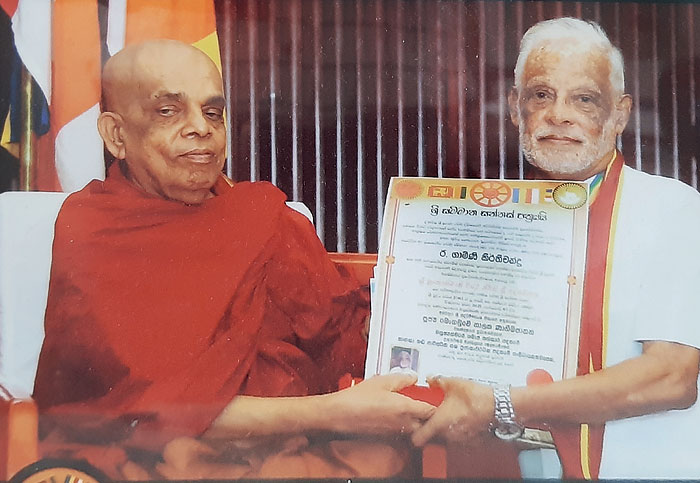
ජනාධිපති තුමනි මේ රටෙ අද තිබෙන වැදගත්ම ප්‍රශ්නය කිසිම වැඩකට නැති රාජ්‍ය ඇමතිවරුන් පත්කොට ජනතාවගේ හිස මත තවත් බර පැටවීමද?

September 7th, 2022

සුදත් ගුණසේකර මහනුවර. 7.9.2022

මා මේ සටහන තැබීමට අදහස් කලේ අද හෙටම ඔබ යළිත් රාජ්‍ය ඇමතිවරුන් පත් කිරීමට යන බව අද පුවත්පත්වලද පලවූ නිසාය.මා මිට පෙරද ඔබගේ ලේකම් වරයාගේ විද්‍යුත් තැපෑලට, මීට විරෝධය ප්‍රකාශකොටමේ ගැන සවිස්තරාත්මක් ලිපියක් එවා ඇත

ජනාධිපති තුමනි, 

දැනට සිටින 30 ක යෝධ  ඇමති මණ්ඩලයද. අද රටේ පවතින ආර්ථික තත්වය යටතේ ඉතා වැඩි බැවින්  එය ද 17 කට අඩුකළ යුතුයයි ජනතාව තරයේ කියා සිටියදී තවත් රාජ්‍ය ඇමති නමින් ඇමතීන් 30-40 පත් කිර්‍රිමෙන් ඔබ  ජනතාවගේ දැඩි අප්‍රසාදයට පත්වනු නොඅනුමානය. පොදුපෙරමුනේ මෙන්ම සෙසු පක්ෂවල සිටින කිසිදිනෙක නොසන්සිදෙන ඇමති දොළදුකින් දිවා රෑ පෙලෙන අය සැනසීමට ඔබ එසේ කරන බව අපි දනිමු.මන්ද ඔබේ ජනාධිපතිකම රැකගැනීමට අනිවාර්යෙන්ම එය ඔබ කළයුතු යයි  සිතන  නිසාය. එහෙත් එවැනි තීරණ ගැනීමෙන් නුදුරු අනාගතයේදී ඔබටත් ගොඨාභයට සිදුවූ දේටත් වඩා දරුණු ඉරණමකට මුහුණ දීමට සිදුවනු නියතය. මන්ද මේ අවස්ථාවේ මේ රටේ ජනතාවට  අව්ශ්‍ය ඇමතිවරුන් නොවෙන නිසාය.

ඔවුන්ට පළමුවම අව්ශ්‍ය කුස ගින්න නිවා ගැනිමටය. ඊ ලඟට එදිනෙදා ජීවිතය ගෙනයාමට නැතිවම බැරි අහස උසට  නැග ඇති ජීවන බර අඩුකරගැනීම සඳහා ඔවුන්ගේ ආදායමේ හැටියට දරාගත හැකි මිලකට එදිනෙදා අවශ්‍ය පාරිභෝගික ද්‍රව්‍ය ලබාගැනීමය. ලෙඩට බේත් ටික ලබාගැනිමටය.එසේම මුළුතැන්ගේ වැඩට දැන් නැතිවම බැරි ගෑස් ටික භූමිතෙල්, ධීවරයින්ට ඔවුන්ගේ ජීවිකාව කරගෙන යාමට අවශ්‍ය භුමිතෙල්,මිනිසුන්ට එදිනෙදා  ගමන් බිමන් යෑමට ඉන්ධන, කුඹුරේ සී සෑමට, අස්වනු නෙලා ගැනීමට අත්‍යාව්ශ්‍ය ඩීසල්, කුඹුරට පොහොර, තෙල් සහ ඔවුන්ගේ නිශ්පාදන වලට සාධාරන මිලක් ආදියය

රටේ තත්වය එසේ තිබියදී, පළැමුව ඒ දැවෙන ජනතා ප්‍රශ්න නොවිසඳා තව තවත් කිසිදු වැඩකට නැති රජයට බර මෙන්ම රටටද තවත් බරක් වන ඇමතිවරුන් වැඩිකිරීම දේශපාලන වෂයෙන් සිය දිවි නසා ගැනීමක් බව වසර 70 ගණනක් දේශපාලනය කල ඔබට නොතේරෙන්නේ ඇයිදැයි මට නම් නොතේරේ.ඇමතිවරුන් වැඩිකලාට ජනතාව්ගේ සහාය හෝ ප්‍රසාදය ඔබට  ලබෙන්නේ නැත,ඉන් සිදුවන්නේ ඒ ඇමතිවරුන් සියළුදෙනාම එක්ක රජයත් ඔබත් ජනතා විරෝධතා  සුනාමියකට හසුවී මූදුබත් වීම පමණි.

එබැවින් මේ අවස්ථාවේදි හෝ ප්‍රඥාවන්තව කටයුතු කොට මේ රටට හා ජාතියට ආදරයක් නැති ආත්මාර්ථකාමි දේශ පාලකයින් විසින් ඇදදමා ඇති අඝාධ්යෙන් රට හා ජාතිය ගොඩ ගැනීමට  ඔබ කටයුතු කළ යුතු යයි මම සිතමි. එසේ කළහොත් 2020 දී ඔබෙන් පලාගිය ජනතාව යලිත් ඔබ වටා එක් රොක් වනු ඇත.

 අප සද්භාවයෙන් කියන දේ නොසලකා ඔබ තවත් ඇමතින් ණඩයක් පත්කළොත් ඉන් අප්‍රසාදයට පත්වන්නේ ඔබය. එසේම ඉන් සිදුවන්නේ රට තව තවත් ආර්ථික හා සාමාජික වෂයෙන් අඝාධයටම  වැටීමය.

එම නිසා දැනටම රාජ්‍ය ඇමතිවරුන් වන අමාත්‍යමන්ඩල ඇමතිවරුන් 30 ක් සිටින නිසා රජයේ මුදල් කාබාසීනියා කරන තවත් රාජ්‍ය ඇමතිවරුන් 30ක ණඩයක් පත් නොකරණු මැනවි. ජනතා ප්‍රසාදය දිනාගැනීමට ඔබට අවශ්‍යනම් ඔබ කලයුත්තේ සිටින ඇමති මන්ඩ්ලයත් 17 කට අඩුකිරීමය ති මන්ඩ්ලයත් 17 කට අඩුකිරීමය

U.S. assures support for restructuring Sri Lanka debt

September 7th, 2022

Courtesy Adaderana

The United States Secretary of the Treasury, Janet Yellen, has informed that the U.S., as a creditor nation, will participate in restructuring Sri Lanka’s debt.

A press release issued by the President’s Media Division (PMD) read that the critical need for the full cooperation of all official creditors in debt negotiations and restructuring through timely participation and equal burden sharing have been outlined.

The US Treasury, welcoming President Ranil Wickremesinghe’s proposal for a coordination platform for Sri Lanka’s official bilateral creditors, has urged engagement in this regard.

Sharing the common goal with Sri Lanka of expediting financing assurances, the U.S. has expressed readiness to join other Paris Club members in this process, in keeping with its principles, the PMD said further.

Further the U.S. Treasury has pledged to continue to engage with their other government agencies, as well as the World Bank and Asian Development Bank, to assist the people of Sri Lanka.

It is recalled that the U.S. has supported the people of Sri Lanka inter alia through the provision of school nutrition for children, food vouchers for pregnant women and new mothers, and fertilizer & cash transfers for small and medium scale farmers to increase food production.

The U.S. Department of Treasury has welcomed the Sri Lankan government’s decision to seek IMF assistance through an Extended Fund Facility (EFF), and thereby the recently concluded staff level agreement.

These observations were conveyed by the US Secretary of the Treasury in a communication addressed to President Wickremesinghe, the PMD said further.


Copyright © 2026 LankaWeb.com. All Rights Reserved. Powered by Wordpress