Balkanization of Sri Lanka & Victor Ivan’s plan (part 1)

August 21st, 2022

C. Wijeyawickrema, LL.B., Ph.D.

(Note: Editor@ft.lk – This essay is an explanation regarding Victor Ivan’s guest column. If you are unable to print it in your newspaper, kindly forward it to him.)

Introduction

Victor Ivan’s guest column in the DailyFT (August 5, 2022), received an adverse reaction from Sepal Amarasinghe, a fellow traveler in the same bus, declaring that Victor has committed [political] suicide (by Victor’s recognition of Ranil’s destiny” instead of Ranil’s fate). According to Sepal, Ranil has a very short span of power. Unlike that kind of prognosis, an email that I saw, feared that Victor signals ‘terrible trouble’ for the Sinhala Buddhist heritage in the island. Victor says both Gotabhaya and Ranil ‘agreed’ to implement the program of action that he has prepared which means double jeopardy for the country.

Reading between the lines of Victor’s guest piece, one could guess that he hides more than what he reveals. Victor indicates a Judo-Christian flavored Marxist focus, tempered, or reinforced by the late Mangala Samaraweera’s Anti-Sinhala Buddhist agenda. In 1998, as one of Mrs. Chandrika’s Sudu Nelum (white lotus) ministers, Mangala was on record for wanting to throw the Sinhala Commission Report to the dustbin of history! This agenda, known also as the Anti-Mahavamsa mindset (project), had been a ghost of what the first British governor North wanted in1802; to delink the close affinity between the colony’s temples and villages.

In his many writings, Victor has approached Sri Lankan history from a caste suppression framework. His obsession with this theme was such that he even wrote a book titled පන්සලේ විප්ලවය (Revolt in the temple) in 2006, an immature description of නිකාය (sects) system amongst the Sanga fraternity.  

In this essay, I am trying to explain that the Middle Path doctrine in Buddhism provides a superior way of living in peace and happiness in this troubled world. Democracy, socialism, rule of law, human rights etc., slogans so dear to black-whites such as Victor, Dayan Jayatilaka, Jehan Perera and Kumar David, to name just a few, are concepts practiced by Sinhala Buddhists for thousands of years, until colonialism spoilt it since 1551, when the king of Kotte was forced to embrace Christianity.

In short, all the structural programs that Victor has proposed to Gotabhaya and Ranil to implement at Colombo level (central government) would end up in balkanizing Sri Lanka, unless people are empowered at local level (Jana Sabha) resurrecting Sri Lanka’s 2000-year-old social-economic-political Trinity (model) of ගම-වැව-දාගැබ (village, water reservoir, temple [church/mosque/kovil]). (Ref. diagram in A. T. Ariyaratne’s book, Power Pyramid and Dharma Chakraya (බල පිරමිඩය හා ධර්ම චක්‍රය), 1988, page 114). This kind of empowerment is what the country needs.  Lahiru Wijesekera of the Aragalaya, demands the same kind of consensual politics, people’s councils (මහජන කවුන්සිල්, not one giant council in Colombo) as its next step.

Instead, Ranil predicts a Lebanon-type crisis, if an all-party central government cannot be sooner formed (LankaCnews, 17/8/2022)! It looks like his strategy is to get a parliament rubber-stamping his own plans and not a national policy framework. The way politicians are handling matters now, there is a possibility of a country-wide protests and anarchy, and UN peace-keeping forces landing for an R2P operation led by American and Indian elements.

Can we eat history?

The history of a country is its past geography. During JRJ’s presidency he (or his PM) asked, ‘Can we eat history’.  Christian church leaders also raised this question occasionally in their Christmas messages. It is more politically loaded than the other stupid question, ‘Can we eat oxygen.’ History and geography were removed from school curriculum in the 1960s by Mrs. B’s education minister Badiuddeen. Mrs. Chandrika removed from grade 9 school textbooks, perhaps with Tara de Mel’s instigation, any reference to Anagarika Dharmapala’s service to the nation or about the patriotic poems by the Tibetan monk S. Mahinda.

The adverse impact of this unwise decision on the nation’s Sinhala Buddhist heritage is beyond comprehension. Thus, we now have souls (පංචස්කන්ධ) who do not know, who was King Dutugamunu or what are the four rivers flowing down radially from the Sri Pada mountains. This is why Samanali Fonseka once promoted a Facebook picture of dumping Meethotamulla garbage at the site of the Jethavanarama Stupa. She did not select the Madu Catholic shrine or a remote Jaffna Hindu kovil for this brilliant idea! I wonder if she is still an ardent fan of the Aragalaya, like Damitha Abeyratne. There is no doubt that the multiple leaders of the now dispersing Galle Face Aragalaya cannot pass the simple geography test above.

‘System change’ without balkanizing the country

Ten days after the beginning of Galle Face Aragalaya, I identified it on 19/4/22 as a plan aimed not at a system change but a regime change, by the same people who preached before 19/5/2009 that ‘this war was not winnable’ (රට කැබලි නොකර සිස්ටම් චේන්ජ් කිරීම – බුදු දහම හා ජන සභා සංකල්පය – 2022). It is now obvious that Aragalaya was nothing but a new face of the Anti-Mahavamsa project propagated via Facebook, Twitter, WhatsApp etc. The appeal made by TNA’s boy MP ShanakiyanR in the parliament for Colombo people to continue the struggle was just one hint of this hidden agenda. There is a world of difference between these bearded Aragala boys and the village boys who painted street walls and buildings with patriotic pictures and songs after the 2019 presidential election.

System change must be done systematically (evolution, not r-evolution)

JVP list MP Harini now admits that Aragalaya had no plan on what to do after getting rid of Gotabhaya. After all, JVP and the Peratugamis plus Anthare were behind it from the start. Now we know that the funding came from Tamil, Islam, Christian agencies abroad to create and sustain it. Ven. Omalpe Sobitha’s participation of an almsgiving and two of his bearded monks taking Vas (retreat of monks to temples during rainy season) at the site, while all kinds of nefarious acts including planting marijuana taking place, are examples of trying to give a shadow Buddhist twist to an otherwise international and local conspiracy which was nakedly anti-Sinhala Buddhist.

Ranil W (2022) and Abraham Lincoln (1861)

History and geography allow one to see the trees as well as the forest; for one to get a holistic picture of a given phenomenon, as if one is in a helicopter looking at the landscape pattern below. For example, those opposing ‘Ranil as President,’ do not know what had happened to Abraham Lincoln. He was for the slavery during his election campaign in 1861. But he was assassinated in 1865, for the sin of ending by war the inhuman system of slavery. Similar about turn was taken by Ariel Sharon after 2003, to withdraw Israeli settlements from Gaza which he aggressively promoted previously as a military leader. He used force to dismantle Jews housing and the settlers in turn tried to kill him, their new enemy.

The Path-Finder path (minus MCC Trojan horse)

If Victor’s program is like Milinda Moragoda’s plan on the economic front, such as reducing the public service employment from 1.5 million to 0.7, or selling failing state corporations, this is the best opportunity to do that by hiding behind the IMF dragon (by the way, IMF could not rescue any bankrupt country in the world. Refer books by ex-civil servant Garvin Karunaratna on this subject). But if his program has a hidden political agenda such as reinvention of the balkanization plan of Mrs. CBK (Neelan-GL package deals 1994-2000) or its ghost, the yahapalana draft of OrumitthaNadu in 2018 and pumping dollar oxygen for ISGA (October 2003) or P-TOMS (June 2005) tricks, allowed under the infamous CFA (2002), then it will be a life and death issue for the Sinhala Buddhists.

The Lichchavi Rule

With the changed, unexpected, and unusual political and socio-economic climate prevailing in Sri Lanka today, it is only a matter of genuine conviction that Ranil is needed to demonstrate to the Sinhala Buddhist people, who trusted Gotabhaya in 2019 as their non-politician midwife, to undertake a system change, to replace him now and become a true, enlightened Lichchavi ruler, unlike the days of the failed yahapalana episode. After all, the late Lakshman Kadiragamar was not a Buddhist, some thought he was a Tamil Obama, but monks visited his funeral to give පාංශකූල. This flexible attitude is based on Metta-Karuna-Muditha-Upekka (මෙත්තා-කරුණා-මුදිතා-උපේක්ඛා) qualities of a Buddhist. Unlike the Marxists in the 1940s to 1960s Ranil did not say King Dutugamunu was a fool of bricks for building the Ruwanweli Maha Saya. But Sinhala Buddhists who trusted the non-politician Gotabhaya as their midwife to deliver them justice that they lost in 1815 and cheated out since 1948, with his one country-one law project and the Jana Muula Sabha concept (ජන මූළ සභා) do not wish to think that they fell from frying pan to fire.

NM-Colvin-Leslie and Mrs. B

How a panchaskanda: පංචස්කන්ධ -an individual formed by five aggregates- (with Lobha: ලෝභ [greed sensual attachment]- Dvesha: ද්වේශ [aversion, hate]- Moha: මෝහ [delusion, confusion]), could shift gears from one mental construct (ideology?) to a totally opposite one especially, in the world of politics, has some known local examples. In 1958, Mrs. B was dead against her husband’s (Philip Gunawardena’s) Paddy Lands’ Act, but in 1972 she gave up thousands of acres of her inheritance under the Land Reforms Law sponsored by herself. It took NM & Co. 30 years (1935-1964) to give up their belief that religion is opium and visit the Dalada Maligava (DM) carrying lotus flower trays. On the other hand, S. L Gunasekara who was instrumental in forming the JHU, did not wish to make the traditional visit to DM because he was an atheist, which some considered a politically incorrect stand. The contrast here is what Ronnie de Mel or Rajitha Senaratne did in changing political parties, that could be identified as R-R Syndrome. On the other hand, in 1818, Kappettipola Disava, who was sent to suppress the rebellion sent back his weapons and joined the rebels. The British admired his behavior and took his brain for research, he became a national hero in Sinhala history.

Victor’s world

With his Judeo-Christian perspective on Sri Lankan history, it is important to try to read between the lines of Victor’s essay. Victor has been a friend of both the Christian church and Sarvodaya, but his many writings and talks do not give the impression that he understood the Sarvodaya philosophy. Victor’s many works anchor mostly with his caste discrimination thesis, but I have not seen, the destruction brought to Sri Lanka by a black-white ruling class hitting his analytical radar even once. He missed this history bus!  Such balanced, if not enlightened, outlook is possible only if one tries to see the history of Sri Lanka not as Portuguese, Dutch or English periods but as a story of the never-ending conflict between whites and black-whites on one side and the Buddhist temples on the other. For example, since the days governors North (1802) and Brownrigg (1815) it began as a campaign that Buddhism was a false religion, and only in 1873 after the Great Panadura Debate, this officially subtle and unofficially open attack was buried but not killed. Hence, we see organized (or simply badmouthing) multi-prone assault on the institution of Buddhist Sanga is in vogue even in 2022.

In Victor Ivan’s words (Daily FT, August 5, 2022) [Ranil] is now destined to be the person chosen by the history, not by the public, to play the role of opening the doors of the state for a program of structural reforms for a ‘profound change in the system.’  Victor knows what structural reforms are in store, because apparently Gotabhaya as well as Ranil accepted the reform plan submitted by him to both. And Victor was never a sympathizer of the plight of the Sinhala Buddhists treated like the proverbial kind-hearted women (හිත හොඳ ගෑණු හැමදාම pregnant) by the black-white Oh My God! Sinhala Buddhist politicians. Black-white Buddhists were never බුදු අම්මෝ Buddhists. The difference is when faced with fear of death what comes involuntarily out of one’s mouth.

Ranil’s plan or Victor’s plan?

A disturbing fact in this regard is that Victor’s plan has fingerprints of the late Mangala Samaraweera, a notorious soul of the Anti-Mahavamsa movement (AMM).  Victor was a supporter/adviser of Mrs. CBK, another ardent AMM activist, an association ended with him writing an infamous book called the Queen of Deceit.  Mrs. CBK and Rosy Senanayake are for the ending of the Sinhala Buddhist foundation in the island. After 1551, when Don Juan Dharmapala became the first and the last Christian king of Ceylon, it was Cardinal Malcolm Ranjith who rejected this political view in 2016/7 and recognized the shelter provided by the majority community for others to thrive.

Unlike Richard de Zoysa or Lasantha Wickramatunga who made fatal mistakes on their part, Victor, the investigative journalist, was shrewd enough to protect himself, for example, from the wrath of R Premadasa by getting behind the shadow of the British diplomat.  His assault on Buddhist monkhood was no different from what Ranjan Ramanayaka did during the yahapalana days. His book titled, the Revolt in the temple- පන්සලේ විප්ලවය (2006) was an extension of his caste thesis to the institution of Buddhist Sanga, culminating in trying to prove that Ven. Gangodavila Soma’s death in Russia (December 2003) was not a case of murder. His character assassination of the monk was so cruel that the monk was depicted as a person troubled with a secret love affair. Victor was neither a W. S. Karnaratne nor a K. N. Jayathilake, to undertake an in-depth analysis of Buddhism, Buddhist psychology or the institution of Sanga. Yet, in his book he was offering unsolicited advice on how best to reform and correct the ‘defects’ that he was able to ‘discover’ in the බුද්ධ ශාසනය. This book must be a contractual product, just like the Abusali family got a foreigner to write an Arab-Islamic version on the origin of the Kuragala temple ruins.

Victor Ivan in 1971 and 2022

When Victor was playing the role of Podi Athula (later the 7th accused), I was one of the 200 civilian officers utilized by the then government for the task of recording statements from JVP rebels, captured and surrendered. I was only 25 years old at that time and witnessed how all or most leaders of JVP avoided the battle fronts leaving the dedicated youth to fight and die. Some of these leaders such as Lionel Bopage and Jayadeva Uyangoda ended up enjoying thriving lifestyles. The point is that Ivan now tells that 1971 JVP insurrection was a stupid idea, whereas I saw it so even before 1971, when one or two village boys that I knew tried to convince me to come for the five classes.

Victor says Ranil has accepted his plan without any reservations. Therefore, knowing Victor’s past activities, it is nothing but reasonable to be cautious on what is in store for the country, especially for the Sinhala Buddhists. The chaotic and pathetic atmosphere now prevailing in the country, has given Ranil a golden opportunity to undertake major surgery to correct the sins of mismanagement by the black-white ruling class for 74 years. A system change means change of so many systems, major and minor. For example, the present sub systems of lawyers, doctors, university teachers, private tuition by government teachers, all must change. But under the guise of system change, the Sinhala Buddhist heritage of this island should not be ruined.  Such attempts were tried in the recent past.

Victor was a supporter of such attempts. His Judo-Christian and Marxist approach has always conflicted with the Middle Path and the Jathaka story-influenced way of Buddhist living. Victor is a member of the black-white club of Dayan Jayatilaka, PakiyasothyS, Nirmal Devasiri, Jehan Perera, Rajitha Senaratne, Jayadeva Uyangoda, Lal Wijenayaka, Ravi Karunanayaka, Jayampathy Wickremaratne, Marxists of all type, G. L. Peiris, DallusA, DilanP, SagaraK of pohottuwa, to name a few. Actually, all those knowingly or unknowingly supporting the 13th Amendment are black-whites of the Anti-Mahavamsa Movement.

Examples from the system change story in Sri Lanka is helpful in understanding what is in store for the system change talk now in everybody’s mouth,  hiding the real changes needed at the grassroot level and in individuals’ mind and behavior.

*1. From the Yakka-Naga (Ravana?)  Pandukabhaya system to the system introduced by Arahant Mahinda in the 3rd century BCE

*2. Colonial system (1802 à 1815 à 1832à

*3. From Colebrooke system to Donoughmore sub-system (communal/nominated to elected MP system) -1931-47

Between examples 3 and 4 happened something, which is relevant in 2022.

The Temperance Movement was a kind of protest against the colonial system. Anagarika Dharmapala revamped it and floated an island-wide campaign on how to escape from a colonial mindset. Following his suggestions and actions, Ven. Kalukondyave Pragnasekera Thero developed a Village Reconstruction and Crime Eradication program in the 1930s-40s. White and black-white rulers sabotaged it.

*4. Attempt made to change the system in 1956 (1959 SWRD killed, 1962 police-navy Christian coup); system adjustments tried again 1960-65

*5. JVP attempt to change the system by murder in 1971

*6. Doctrine of separation of powers changed to rule by political party in power (1972 republican constitution); Failed effort to introduce workers/people’s advisory committee system to governance system; District Development Councils strategy also failed

*7. Change from Westminster system to a Bahubootha system by JRJ in 1978; change to a free-market economy giving rise to an era of big fish-eating the small fish in all spheres of human living; privatization promoted against state enterprise; representative democracy destroyed with a new system of elections; presidents became prisoners to a single MP under a 112+1 formula

*8, Sinhala Buddhists fed up with black-white party system of corrupt politicians, elected in November 2019 a non-politician as their midwife (like in 1956) to overhaul the system, an experiment gone haywire

*9. Exploiting this chaotic situation two contrasting elements (1) JVP-Peratugamis and (2) the foreign-funded, Eelam/Sharia Colombo crowds and Facebook-Twitter generation, was able to get the farmers to Colombo to topple the SYSTEM. But it boomeranged. As in 2013-14 days MangalaS’ plan in 2019 worked, and at the end (also with a little bit of luck as SajithP and SarathF were blind) Ranil won. It appears that those who genuinely wanted a system change will not get a system change. Instead, they have to bite the bullet and live in a balkanized Sri Lanka. So much for the ethnic harmony and unity celebrated at the Galle Face Greens!

* 10. One last hope for genuine Aragala boys and girls is to agitate for a system of people’s councils by which balkanization attempts could be frustrated. The danger now is for few billion dollars ISGA and P-TOM ghosts could swallow the giant cabinet of ministers.

Buddhist Middle Path

Part 2 of this essay plans to discuss about the two troubled worlds of (1) Victor’s and (2) DayanJ’s, and the solution to those two the (3) Panchayathi (Jana Sabha) world. It is an educational piece for Victor to understand that a system change in a society cannot happen unless each individual is (directly or indirectly) linked with the concept of system change in his or her own life/living (after eating a candy put the wrapper in the shirt pocket not on the pavement!). Gandhi and Mao applied this human concept in two different ways. Our own Buddhist philosophy professor W. S. Karunaratna said this from JRJ’S election platforms in 1977: the need to have an external as well as an internal revolution. By 1947 Gandhi wanted to disperse the Congress Party and begin a rural reconstruction program. Nehru and Rajendra Prasad did not like it.

Mao also accepted Gandhi’s idea that a continuous spiritual transformation is needed to create a just society: to overcome dehumanization of urban bourgeois living and selfish mundane desires; get rid of material self-interest and practice self-sacrifice. To Gandhi self-sacrifice was an end itself and not a vehicle for other aims. For Mao the purpose of self-sacrifice was to serve the nation state and its people (HOMO FABER: Technology and Culture in India, China, and the West- from 1500 to the present day, C. A. Alvares, 1980, pp 195-199).

Gandhi’s 1947 plan was outside politics and government. But Mao’s method was based on rules of revolution and social change. Gandhi planned to start a new civil disobedience movement (against the elites of the kind like Nehru and Rajendra Prasad!), but he faced an untimely, tragic death

300 million people are still under abject poverty in India. Mao won, but as the National Geographic Special Issue, China: Inside the Dragon, May 2008 records, the rise of China one sees from outside is, from inside a tiger’s tail of unlimited growth copying the western model, harming its people. Thus, the Huang He River ends near the ocean as world’s deadliest mud canal filled with cancer causing chemicals and waste (pp. 147-168).

References:

සුද්දගෙ නීතිය අපිට එපා, 2022

රට කැබලි නොකර සිස්ටම් චේන්ජ් කිරීම (බුදු දහම හා ජන සභා සංකල්පය), 2022

ලංකාව: කළු සුද්දන්ගේ පාලන සමය, 1948-2019 (මන්ත්‍රී ප්‍රජා-තන්ත්‍ර [නාස් ලණු] වාදය, 2022

cwije77@outlook.com

The Extra Mile by – Dr. Gamini Goonetilleke FRCS

August 21st, 2022

Major (Dr) Ruwan M Jayatunge M.D. 

Sri Lanka was affected by a 30-year armed conflict and many combatants and civilians became casualties as a result of this gruesome war.  Many lives were lost and a large number of combatants and civilians lost their limbs due to anti-personal mines and many sustained gunshot injuries. The country had limited resources and the situation was critical.  The Sri Lankan armed forces had a small number of military surgeons who treated these soldiers in the Northern hospitals. However, the casualty numbers were mounting and the doctors were overwhelmed. During this difficult time, a handful of surgeons volunteered to go to the North and treat the wounded soldiers. Among them Dr. Gamini Goonetilleke –  Senior Consultant Surgeon was a prominent figure. Dr. Gamini Goonetilleke treated a large number of soldiers and war-affected civilians traveling to the Nothern peninsula even risking his life. He did a commendable service to the Nation. He saved a large number of lives. Moreover, Dr. Gamini Goonetilleke published his experiences in the war zone which is a priceless gift to the readers. He has documented his stories in a reader-friendly manner. 

The Extra Mile is a great reflection on war and humanity. 

Major (Dr) Ruwan M Jayatunge M.D. 

Madams in Public Service ?

August 21st, 2022

Sasanka De Silva Pannipitiya.

The Editor,

LankaWeb.

Dear Sir,

A few days ago I went to the department of Immigration and Emigration in Battaramulla to get an amendment to my passport.

It was so chaotic with thousands of people trying to gain access and with no proper arrangements to have any orderly entry.

If people are given online appointments within specified time slots, then why does it have to be so chaotic and disorganized?

The guards who man those entry points were of no help to anyone; as they live in their own aloof worlds.

After speaking to many in different uniforms, I finally found the right entry point and got access without much hassle.

When I reached the Acceptance counter, I was asked by the female staff who was manning the counter whether I had spoken to Madam first.

I wanted to enlighten her that there are no Madams in public service except public servants, but knowing well, that antagonizing a government servant means that you should be ready for a big and long battle, and I was not in the mood for that this morning.

Instead, I asked who “Seuvandi Mani” were you referring to, but unfortunately, she did not get the drift, so I had to join another queue to see this so-called Madam.

When my turn came up, I explained my requirement Assistant Controller and she points blankly said that they were unable to make amendments to the details on the Bio page.


When I questioned her the reason as to why it couldn’t be done, she looked at me scornfully and placed her signature on my application.

The due amount was paid, and within 90 minutes I got my passport back with the requested amendment stamped on it.

I am still unable to fathom as to why someone holding a high position in the public service behaves in such a manner.

My only explanation is that most Sri Lankans are very sadistic in nature, and they become more sadistic when they are in uniforms or have a certain level of authority.

I have already written separately to the Controller I & E requesting him to reeducate public servants under his purview on how to interact with the public in future.

This is being written for the public interest only.

Sasanka De Silva

Pannipitiya.

මම මේක දියුණු කළේ නැත්නම් මටත් යන්න වෙනවා -ජනපති

August 21st, 2022

Courtesy Adaderana

Leave if you can’t perform duties properly: President tells state workers

August 21st, 2022

Courtesy Adaderana

The public servants who do not perform their duties properly should leave the service immediately, President Ranil Wickremesinghe says.

Addressing the District Development Council in Anuradhapura today (Aug 21), the Head of State said his aim is to unite everyone for the future of the country.

Public sector officials and provincial representatives of Sri Lanka Podujana Peramuna (SLPP), United National Party (UNP) and Sri Lanka Freedom Party (SLFP) had joined the event to look into the development work of the district and to discuss future plans.

President Wickremesinghe said he extended an invitation not to request anyone to join the United National Party (UNP), but to join hands with him to rebuild the country without delay.

Stressing that the country needs a new political concept and decent political journey, the President stated that the old system of governance has been rejected by the people.

Public sector employees at grassroot level should be committed to work for the betterment of their Grama Niladhari Divisions and to fulfil the needs of the people, he emphasized.

Anuradhapura religious areas will be developed into a major tourist attraction, President Wickremesinghe said, adding that a committee representing all relevant stakeholders will soon be appointed for this purpose.

Price of kerosene increased by Rs. 253 per litre

August 21st, 2022

Courtesy Adaderana

The price of kerosene will be increased by Rs. 253.00 effective from midnight today (Aug 21), the Ceylon Petroleum Corporation (CPC) says.

Accordingly, the revised price of kerosene per litre will be raised from Rs. 87.00 to Rs. 340.00.

Police seek public assistance identify more suspects

August 21st, 2022

Courtesy Adaderana

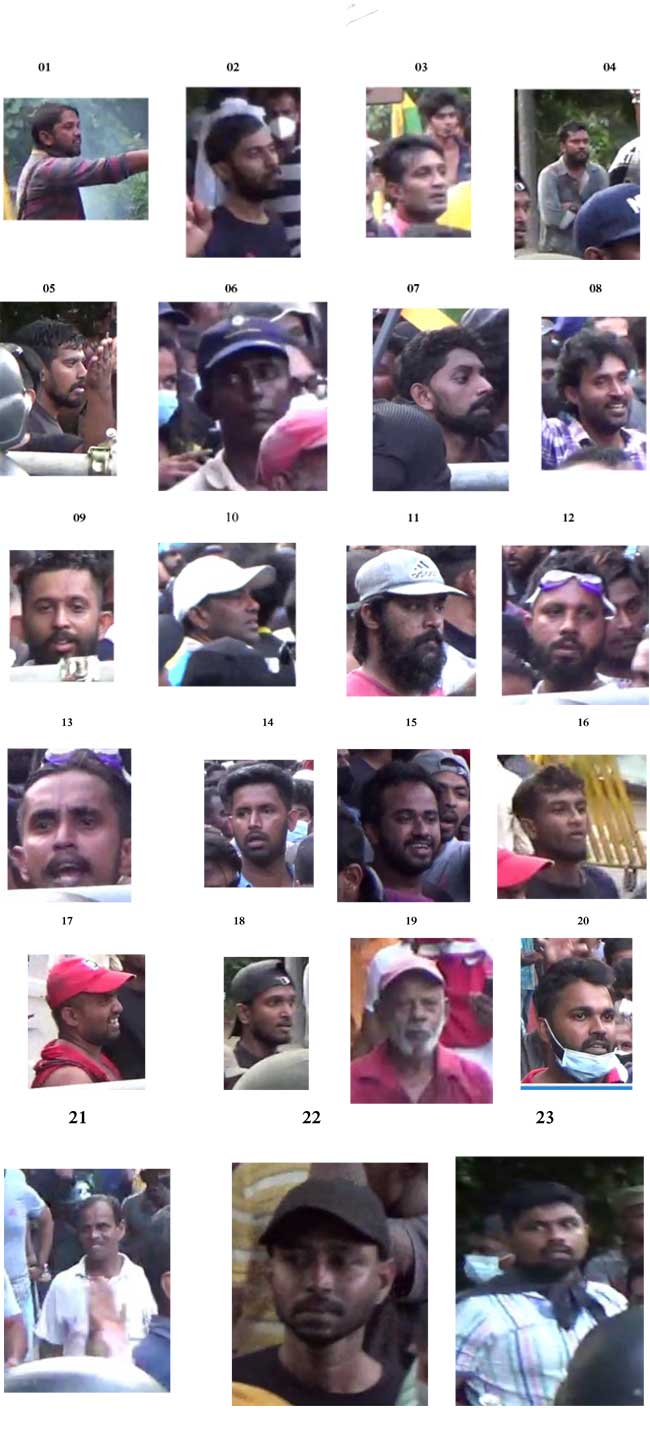
The police are seeking the assistance of the general public to identify several individuals who were involved in the recent unrest at the Polduwa Junction.

In a statement, the police media division said the Western Province (South) Crimes Division has initiated investigations into the tense situation reported at the Polduwa Junction on the 13th of July.

The police have released the images of 23 more suspects who were captured on video footage while engaging in protests and behaving in unruly manner.

More information on the suspects can be submitted to the following contact numbers:
0112 829 388
071 30 64 165
071 85 92 209

US Footprints at the Galle Face Protest Site

August 20th, 2022

By Sena Thoradeniya

M.P. Wimal Weerawansa participating in the debate on Emergency Regulations on 27 July said that CIA through USAID and NED (National Endowment for Democracy) have funded various Sri Lankan Non-Governmental Organisations aiming regime change and protesters were attempting to destroy the State with the aid of external forces. He disclosed the amount spent by NED in Sri Lanka from 2016 to 2020 and named some recipient organisations and the number of projects” funded by it. He further stated that the script of the present protest was written by foreign powers, how Youtubers were paid by their foreign masters and how the US Ambassador in Sri Lanka pressurised GR on a daily basis not to take any action against the protesters.  He tabled a document to support his arguments. Since we are aware that documents tabled are not included in the Hansard but kept in the Parliamentary library, we do not have access to the document he had tabled.

Against this backdrop it is worthwhile examining two insightful articles written by Ms. Shenali Waduge titled Regime Change Role of International Republican Institute (IRI) in Sri Lanka” and Who is NED and What its Role in Sri Lanka” respectively that appearedin LankaWeb recently.  Her revelations about International Republican Institute (IRI), National Democratic Institute (NDI) which were created by CIA in 1983 outsourcing its activities for the purpose of working with the  civil society” and National Endowment for Democracy (NED) all operational in Sri Lanka and how they operate in Asia, Africa, Latin America, Middle East and Eurasia are alarming. NED funds both NDI and IRI and a host of local NGOs in Sri Lanka. For this commentary we have used Shenali’s background information as a guideline.

IRI say that they are experts” in political processes, polling, technology and party building.  Encouraging women to participate in politics, promoting democracy and human rights, strengthening Sri Lanka’s democracy through responsive local government, empowering female councilors, election observations were some programmes conducted in Sri Lanka by IRI.

Sri Lanka gained universal suffrage in 1931 many years ahead of some developed countries in the West. Men and women without any discrimination used their ballot either to elect new rulers or retain the existing rulers.  In this context we do not think that a training for voters was necessary at the behest of foreign funded NGOs. Instead of finding solutions to eradicate election violence these Good Samaritans had formed organisations to monitor election violence! In Sri Lanka peaceful elections were conducted without any election monitoring and observations from the days of the Legislative Council, state Council and finally Parliament respectively. If there were malpractices and violence, political parties and individual candidates were responsible for those. It was the rulers who either postponed elections or held referendums retaining the same bunch of parliamentarians.

Many participants or trainees who participated in IRI funded pragrammes may have played some   role in mobilising the protesters at local, provincial and national levels, thus fulfilling the mission of the foreign masters and their local hirelings.

It is interesting to note that Generation Democracy” (GenDem) launched in Asia by IRI, provided training for a group of youth including youth from Sri Lanka in advanced technical training, leadership, branding, social media and Face Book for networking to build a new generation of leaders in Asia to engage in politics. #Uniting Youth was its hashtag.

Who were the Galle Face protest leaders or their handlers who received this training? It is well known that Galle Face Protesters were initially mobilised through social media platforms. A hashtag called #GoGotaHome was popularised making it the rallying call. Placards such as Gota you’ve messed with the wrong generation”, You’ve f***** with the wrong generation” displayed at Galle Face Green cannot be a spontaneous response to the grievances of the protesters. They have close affinity to Generation Democracy”, no doubt.  

In another training programme called Global Freedom”, young leaders” from some Asian countries were given a training in public speaking and digital communication. Public speaking and digital communication were two areas closely intertwined with Galle Face Protest. Who were the protest leaders or their handlers who had participated in Global Freedom” programme?

NED website played a major role in transmitting hundreds of videos about Galle Face protest all over the globe.

IRI’s Protest to Policy” programme dealt with people losing faith in institutions and archaic structures.” IRI partnered with Face Book for networking. How some protesters cried for system change” when GR was also calling for a system change? Under whose guidance the protesters called for a system change? Did they do it with a thorough understanding of what is meant by a system? Or knowing anything about System Theory”, a useful management tool to understand the workings of modern day organisations?

Gall Face Protesters did not have any faith in any institution, presidency, premiership or parliament. They considered these institutions as archaic”. That was the reason for them to demand removal of all 225 legislators. Their handlers were well aware that this was leading to political turmoil, instability and anarchy paving way for even a foreign military intervention.

 A Gay Pride March was organised in the North of Sri Lanka and in Colombo in 2021. On June 25, LGBTQ activists marched to Galle Face from the Temple Trees precincts. This may be one example for the inclusiveness preached by local and foreign NGOs.

Youth leaders in Sri Lanka were trained to use short documentaries to voice their views as an advocacy tool. In Digital Citizenship for Youth (#DC4Youth) programme, youth were trained to create their own documentaries.  Videos, short documentaries and the cinema at Galle Face played a significant role as propaganda tools and fostering the objectives of the protesters. On April 17 protesters digitally illuminated the front walls of the Presidential Secretariat. An expert told the writer that for a such laser projection one needs nearly 20-25 projectors. Who provided these projectors for tech savvy protesters? Advertising firms? Media moguls? Foreign embassies? Or the foreign media training outfits?

In Thailand it was only in 2020, 10 years after the crackdown of Red Shirts”, the remaining protesters were able to illuminate the walls of Bangkok downtown buildings using laser projections, displaying their message, Searching for the Truth”. How advanced our protesters were?   

Individuals as well as communication giants distributed data cards among the protesters. A free WIFI center provided Internet connections. Protesters who forcibly occupied nearby star class hotels had free WIFI too.  Doing so, an artificial class distinction was made between these occupiers” and hoi polloi at the protest grounds. It came to light that one person alone produced hundreds of Instagram. Who paid for this extravagant deed? Experts say that Instagram are used to evoke envy on other people. In this case it was MR, Basil and GR. Malicious BOTs were designed to mimic rulers and discredit them.  

Among the leading protesters there were top executives of digital strategy and digital marketeers attached to advertising, marketing and PR agencies linked to multinational advertising giants. Some of them also work as activists of NGOs having esoteric names and of election monitoring NGOs promoting themselves as public speakers” and socio-political analysts”.  

In almost all protest movements in Latin America, participation of indigenous people was a significant phenomenon.  In a project called Advancing Democracy for Indigenous Community (ADIC), Rathugala indigenous people were trained, not in modern methods in hunting and gathering, subsistence agriculture or socialisation and integration, but surprisingly in conflict resolution, peacebuilding and constitutional reforms!  What was sown was reaped by bringing indigenous people to the Galle Face protest site; KIrikoraha ritual of the Adivasi community was performed at the protest site. We do not know who transported these Adivasins to Galle Face, whether the ADIC or the kinsman of Adivasins who was in the forefront of the protest. But his mother says that the son had not set his foot in his village for years even to see her!

It is said that to oust President Jean-Bertrand Aristide, the first democratically elected President of Haiti in a coup d’état in 2004, armed militia was trained by IRI. Aristide fled the country.  In Sri Lanka there was no need for a militia because two political outfits were in attendance to do the work of a trained militia. On July 7 ,2021 Haitian President Jovenel Moise was assassinated after political unrest and calls for his resignation. On June 24, 2019 US Principal Assistant Secretary of State Julie Chung met with Moise. On February 25, 2021 Chung came to Sri Lanka as US Ambassador to Sri Lanka. On July 9, 2022 Sri Lankan President GR was ousted by popular protests.

Julie Chung after meeting with Anura Kumara Dissanayake just a few days before July 9 said (T) to me the JVP is a significant party. They have a growing presence. They resonate with the public during recent times. They are a growing political party and their ideas are accepted by the public.” No wonder AKD being adjudged as the most popular leader” in a survey conducted by the Centre for Policy Alternatives (CPA).  Not so long ago a JVP academic in Sinhala, introducing himself as a person having   American connections wrote an open letter to Julie Chung addressing her in her first name Julie. Ambassador Chung’s twitter messages regarding the Galle Face protest and protesters and how she had lamented after the crackdown on behalf of them are well known. 

 ROAR Global, with its branch organisations such as ROAR Media, ROAR Studios, ROAR Digital and Density Media is an online media organisation in Sri Lanka also funded by IREX (International Research & Exchange Board) and Google. (ROAR stands for Restore Our Alienated Rights}.  IREX was founded by Ford Foundation. It is funded by USAID, US State Department, Ford Foundation and Millennium Challenge Corporation. ROAR Media described as a South Asian multilingual media platform” has an English Editorial, Sinhala Editorial as well as a Tamil Editorial. Its Sinhala Editorial had succeeded in roping some well-known Sinhala feature writers who give it a heritage” colouring. It has glorified the Galle Face Protest as a peoples’ struggle that attempted to build a (better?) tomorrow with people who had gigantic power to chase out a President”.

 IREX works with partner organisations such as Centre for Investigative Reporting (CIR) and Hashtag Generation. It has a journalistic training programme in Sri Lanka called MEND (Media Empowerment for a Democratic Sri Lanka)supported by USAID. In 2021, it had conducted a programme called Catalyzing the Media’s Transformation”. MEND’s Media Development Partnership (MDP) had trained Sri Lankan journalists of almost all media institutes in Sri Lanka including that of state owned ANCL.

MEND had supported 2000 journalists and 20 media organisations in advocacy, mobile journalism and multimedia. The MDP had helped to propel Sri Lankan media into the digital age working with 17 mainstream media outfits, helping them to develop digital content, upgrade their online services and enhance revenue. Through MEND’s Media Corps Felloship Pragramme more than 260 young journalists were trained in mobile journalism. We know that many mobile journalists are attached to main media institutes.

 ROAR Mediaalso piloted mobile journalism in Sri Lanka, training mobile journalists through its Civic Action through Mobile Phones (CAMP). All these activities, especially mobile journalism played an active role in recent protest movements.  

On one occasion ROAR Media interviewed JVP’s National Organiser providing him with an opportunity to talk about revolutions”! What a nice spectacle!  Also featured was the Sinhala short story writer who portrayed Prince Rahula as Channa’s (Prince Siddhartha’s close ally) illegitimate son.

As a result of the above-mentioned overt operations, from the very beginning of the Galle Face Protest there was an army of well-trained digital campaigners;  no wonder print and electronic media in Sri Lanka becoming the mouthpiece of the protesters; TV anchors parroted what were uttered by the protesters donning them with peaceful” and non-partisan” garb, even after arson, storming of public institutions and vandalising  took place.

Role of ROAR’s Editor-in-chief (a female) was crucial during regime change protests.  Once she twittered How many deaths and how much needless, senseless destruction could have been prevented if Gota had stepped down on May 9? Instead Gota and Ranil dragged a bleeding nation to its knees”. How she twittered after torching of Ranil’s private residence was gruesome: (T)the price being paid for one man’s desire to gain and cling to power”.

It will be interesting to explore the role played by IREX’s Sri Lankan counterparts in the protests.

On May 25 almost two months after the first riots, ROAR Editor-in-chief with her team members (some wearing Ts with the face of a roaring lion; lion is a predator!) and some Youtubers was invited to meet Ambassador Chung to talk about social media trends in Sri Lanka.  After the meeting US Ambassador twittered. social media influencers, bloggers and other online commentators play a major role in sharing news and shaping public opinion. Great chat w/this Sri Lankan digital creators about fighting disinformation & promoting truthful reporting to keep SL’s citizens engaged”. Sharing news, shaping public opinion, fighting disinformation (whose?), keeping citizens engaged are key words m their manipulations.

It was reported many times that Ambassador Chung had prevented GR enforcing law and order when law and order was clearly breached by the forceful occupation of public institutions, claiming that protesting is a human right” of the protesters. Other Western diplomats openly urged the police not to obstruct peaceful protesters”, the day before mayhem took place.  

As highlighted by Shenali in her article, discussing NED activities globally in detail is a frightening experience. National Democratic Institute (NDI), International Republican Institute (IRI) are only two of its subsidiaries. NED is responsible for creating chaos, many colour revolutions”, disintegration of sovereign states, interfering in national elections by training how to vote, violent coups etc.

Surprisingly the foreign fund managers had not given a colour to Sri Lanka’s protests. But the predominant colour of the protesters was black. Several organisations mushroomed showing their fancy to black.

The list of countries that had suffered by NED’s interventions is too long to mention. Suffice to state that it happened all over the globe. Following are some activities conducted by NED all over the world: Funding pro-Us political parties including media, training and unifying opposition parties, insurrection training” and instigating riots, influencing social media for political campaigns and generating anti-government slogans, promoting hate campaigns under different themes, tasking NGOs and civil society to do these work, funding disruptive news, building networks of academics, professional groups, artists and writers, dig up corruption and abuse of power , labelling rulers as dictators and autocrats, organising protest marches and occupy” movements and providing campaign skills”. In Sri Lanka in general and at Galle Face in particular we saw all of these taking part simultaneously.

Recently even foreign bloggers found US fingerprints behind Sri Lankan unrest, accusing the NED and its local hirelings.

In Sri Lanka during the protest period NED produced pro-IMF and anti-China propaganda and comedy kits using local Youtubers.  Very recently IREX conducted a Workshop titled how to report in a crisis”.  

Recently,The Herald” published in Zimbabwe stated that US through USAID has channeled millions of dollars to various Civil Society Organisations (CSOs) spending on women and youth, planning demonstrations in the months preceding 2023 elections, recruiting protesters via social media as happened in Sri Lanka. The columnist warned that Zimbabwe is not Sri Lanka”!    

Cynics may ask whether all the protesters were trained by IRI or NED? The answer is simple. It is only sowing a seed. And that which thou sowest, thou sowest not that body that shall be, but bare grain, it may chance of wheat, or of some other grain.” (I Corinthians 15:36). Sowing can be done behind the scenes. One Change Agent (or in their parlance Change Maker) can train another few; and networking goes on.  One pied piper is well enough to lure the rats to the river! He can use his magical flute to lure the children also away from their homes, never to come back or never to be seen again.

Privatizing Sri Lanka ex-ante? IMF Bailing out BlackRock amid Adani Greenwash in Mannar and Pooneryn?

August 20th, 2022

Darini Rajasingham-Senanayake

Buenos Aires was rocked again last week by massive protests against austerity measures imposed by the International Monetary Fund (IMF). Structural reforms with austerity have resulted in soaring inflation, currency depreciation, poverty and inequality that is eroding Argentine society and economy, while enabling bail out of private lenders and vulture funds like BlackRock.

Argentina is now on its 21st IMF agreement! Sri Lanka negotiating a 17th IMF agreement at this time may be doing marginally bit better than Argentina, which is South American’s 3rd largest economy. However, the strategic Indian Ocean island perpetually in the cross-hairs of big power rivalry appears to be in the midst of asset stripping ex-ante IMF negotiations with International Sovereign Bond (ISB) debt holders, who caused the country to default for the first time in its history in April this year.

As a staff level agreement with the IMF is under discussion, Minister of Power and Energy, Kanchana Wijeratne gave BlackRock’s partner, Adani, provisional approvals and strategic lands for two wind power projects in sensitive ecosystems in Northern Sri Lanka, Mannar and Pooneryn, without Environmental Impact assessments being complete last week.

Wijesekera had decided to award the projects and lands to Adani following a meeting with officials of Ceylon Electricity Board and Sustainable Development Authority last Tuesday.[i]  The Minister added that Public private partnership agreements would be signed pertaining to 21 of the 46 projects that were delayed due to the CEB Act amendments. 26 Renewable proposals from expression of interests that was given Provisional Approvals would be also expedited with grid clearance and transmission plans, with other proposals evaluated within 30 days. [ii]

As the Central Bank of Sri Lanka (CBSL), engages in talks for a Staff Level Agreement with the lender of last resorts, Sri Lankan citizens may need to learn some lessons from Argentina, fast! Back in 2020, BlackRock had opposed a debt settlement deal with Argentina and lobbied other debt holders as the country grappled with soaring poverty and the Covid-19 pandemic.

Last week a global campaign by women’s groups asked UN Women to rescind an MOU with BlackRock for gender-lens funding due to its poor corporate responsibility track record.

IMF,  BlackRock and Lazard in Sri Lanka’s Default: Ex-Ante Asset Striping

BlackRock, the world’s largest asset and investment management company with over $10 trillion is the largest holder of Sri Lanka’s opaque ISB debt that caused the country’s Staged Default in April this year. ISBs amounts to almost fifty percent of Sri Lanka’s external debt.

In comparison to BlackRock’s trillions Sri Lanka’s external debt is a mere $ 26 billion.  Black Rock also got huge Covid Bailout funds from the US government to asset strip around the world during economically devastating global lockdowns in 2020, and is an investor in India’s Adani Group.

Ironically, the IMF which does not distinguish between illiquidity and insolvency has assessed Sri Lanka’s $26 billion external debt as unsustainable although the island is oil, gas and mineral rich and located at the Center of the Indian Ocean on the world’s busiest trade and undersea data cables, which if properly taxed would render the island super-rich!

An economic meltdown ex-ante and ex-post the Staged Default in April this year due to a purported lack of US dollars amid Corporate media narratives of famine and fear as part of a Psychological Operation along with people’s protest enabled the entry of the Washington Consensus (IMF and WB), into the strategic island that is perpetually in the cross-hairs of big power rivalry and Over the Horizon Operations (OTH), the more so as Cold War heats up in the Indian Ocean region.

While the IMF does not distinguish between a country’s illiquidity and insolvency, the valuation of strategic assets by Lazard et al. hired by the US-backed Ranil Rajapakse regime in Colombo may also raise troubling questions. Lazard, the US-based financial advisory and asset management firm, had visited Sri Lanka in back in February 2018 to discuss divestment.  As a privatization advisor, Lazard involves both an advisory services branch and asset management branch. On numerous occasions, Lazard has undervalued the price of a company, enabling the latter to purchase the stock at low prices and sell it for a considerable profit according to a report of the Amsterdam based Transnational Institute that notes:.[iii]

As with the Royal Mail, Lazard, Europe’s favourite privatisation advisor, played a key role in AENA’s under-evaluation before its IPO as it helped determine the IPO price. And comparable to what happened during the privatisation of UK’s Royal Mail, one of Lazard’s asset management branches, Lazard World Dividend & Income Fund, acquired AENA (Spain’s Airports company) shares at the IPO and sold them roughly a month later netting a 60% profit.58 By buying up and selling the AENA shares within such a short period of time, Lazard’s World Dividend & Income Fund deviated from its usual strategy. As the name suggests, the company usually focuses on long-term investments and profit generated by dividends.59 In the case of AENA however, Lazard‘s World Dividend & Income Fund were only too happy to drop their customary strategy when it yielded a 60% increase of their investment in just four weeks. Once again, Lazard took full advantage of its privileged position on both sides of the fence, as seller and buyer making a huge profit in the process.

The I.M.F. had long been accused of wielding a single blunt instrument— austerity in crises and forcing the poor to the bear, the costs of opaque and Odious debt accumulated by corrupt and incompetent leaders in developing countries, and passing it on to impoverished citizens, while ‘bailing out’ vulture funds, prominent among them BlackRock and the global 1 percent.

It would appear that Adani and BlackRock are targeting the strategic Indian Ocean island’s coastal lands, energy and telecom infrastructure at this time of IMF discussions on Sri Lanka’s debt and Staged Default and stand to benefit from the debt restructuring process– ex ante! Where does the corruption end?!

Adani and BlackRock Greenwash

Adani which partners with BlackRock, stands to benefit ex-ante IMF-CBSL-ISB talks from the Mannar and Poonaryn land deals for Green Wind Energy. But questions arise: Why the rush to costly green energy, without a proper energy transition plan in Sri Lanka, which has a minute carbon foot print at this time of global fuel price increases, and as a result of unplanned green energy policies (like the organic fertilizer disaster), is a question that many are asking?  Is this a sweetheart deal ex-ante IMF negotiations with ISB holders for BlackRock to tow the line?

These questions arise also given the poor environmental track record of both Adani and BlackRock, which elicited global protest campaigns against the latter’s funding of UNWOMEN. Adani and BlackRock were also the subject of a global protest campaign given the environmental impacts of the Carmichael Coal mine project in Australia on the Great Barrier Reef last year.

An IMF Firesale of assets in the strategic island would benefit opaque ISB holders of Sri Lanka’s Odious debt, with Sri Lankan Airline set to be privatized soon. The state-owned Yugadanavi Power plant was sold to a US company, New Fortress, last year. The Ceylon Electricity board is being fragmented and plans are afoot for sell off in parts, jeopardizing national energy security and so too the Petroleum Corporation.

However, rather than privatize energy assets, globally re-nationalization of energy infrastructure given soaring energy prices and commodities futures speculation is the trend globally, with France set to Nationalize its largest electric company, and the Singapore Parliament passing legislation last year conferring on the Energy Market Authority (EMA) more powers to secure Singapore’s electricity supply,

Adani had also sought to take over India’s Agriculture sector during the Covid panicdemic exercise, but two years of brave and sustained protests by India’s farmers (unlike Sri Lanka’s Aragalaya which fizzled out after a couple of months of protests that enabled a US backed Ranil Rajapakse Presidency), prevented the global corporate takeover of India’s farming and agriculture.

IMF in Argentina: lessons unlearned

Did the ‘lender of last resorts’ learn lessons in Argentina? The IMF’s rescue package’ in Argentina two decades ago imposed crippling cuts to government programs, sowing enduring bitterness. Ms. Georgieva, the fund’s managing director, claims that the lender of last resorts” learned lessons and has sharpened a focus on protecting countries from impossible debt burdens.

However, BlackRock, opposed a debt settlement deal with Argentina as the country grappled with soaring poverty and the pandemic in 2020 although.[iv] BlackRock CEO, Laurence D. Fink presents himself as the vanguard of a progressive form of capitalism in which profits are not everything and has been rebranding the corporate with while cultivating environmental and social protection causes.

But when Argentina defaulted in May 2020 on $66 billion worth of bonds, Mr. Fink’s faith in stakeholder capitalism” collided with traditional bottom line imperatives. Though poverty soared in Argentina as the pandemic worsened a punishing economic downturn, BlackRock opposed a settlement proposed by the government and rallied other creditors to reject it, while holding out for a marginally improved deal.

Meanwhile in another continent, following massive protests in Australia and globally the Adani and BlackRock seem to be busy Greenwashing themselves and presenting a Green Energy face in Sri Lanka. Thus Adani has been given provisional approvals for two wind power projects in strategic and sensitive ecosystems in Mannar and Pooneryn, without Environmental Impact assessments completed, by a Minister who should have resigned given the incompetence and corruption in the sector that brought the country to a standstill in June –July ex-ante and ex-post the Staged Default, ensuring a crisis that legitimated the IMF’s eroding Sri Lanka’s economic policy autonomy and sovereignty against its citizen’s interests.

UN WOMEN campaign: From Greenwash to Pinkwash

Adani and BlackRock are accused of environmental pollution globally, and BlackRock was recently called out in a global feminist campaign that focused on UNWOMEN’s MOU for partnership with BlackRock and taking funding form the investment giant.The campaign focused on the fad of Climate impact investment”, stating that: Civil society watchdog groups consistently identify BlackRock as among the worst performers on corporate accountability. Its climate and socially-destructive investments — particularly significant in impact because of the massive component they represent of BlackRock’s portfolio — have been called out by activists, including Indigenous leaders. Aware of the optics, BlackRock has attempted to ‘greenwash’ itself by acknowledging the seriousness of climate change – in a move that the New York Times has condemned as ‘climate hypocrisy’ that is intentionally misleading; worse than climate denial.

The recently-announced partnership with UN Women suggests that UN Women has been
recruited to BlackRock’s image-cleansing efforts – this time it is seeking to ‘pinkwash’ itself read a letter addressed to the head of UNWOMEN and signed by Hundreds of women’s organizations and individuals around the world. Thus they wrote:

 BlackRock funding UN Women gives it a veneer of feminist approval that it clearly does not merit. Given BlackRock’s phenomenal size and influence (reportedly managing ten trillion USD) in assets, it is not unreasonable to assert that this UN Women partnership also gives a feminist imprimateur to the version of neoliberal global capitalism that is condemned by the Secretary Generatl. This crisis-prone speculation-based capitalism, spawning grotesque income inequalities, has also been linked to misogynistic neo-populism and entrenched poverty for many women, particularly those from ethnic or racial minorities, marginalized sexualities, and female-headed household.

Importantly the Women’s organizations, academics and activists who signed the letter also noted: UN Women needs to rescind the partnership with BlackRock and set standards for its private sector partnerships.The same critique may be make of other UN agencies like the World Health Organization funded by Big Pharma and the Gates Foundations and UNDP funded by big oil companies like Shell to promote Debt for Nature Swaps (DFNS), need revised standards for private sectors partnerships.

The Privatization Industry: National Security Jeopardized?

The UN Secretary-General Antonio Guterres called out profiteering by private oil giants earlier this month and said was immoral” that the largest energy companies in the first quarter of the year made combined profits of close to $100 billion. He urged all governments to tax these excessive profits and use the funds to support the most vulnerable people through these difficult times.

The worst time to privatize strategic assets is in a global emergency and jeopardize national energy security as Cold War looms amid soaring oil and gas prices. Privatization is no panacea for cultivated state-sector corruption to under-mine government institutions as a pretext to privatization a la the Privatization Playbook.

A trend away from privatization towards re-nationalization of energy infrastructure is visible globally at this time as energy security of countries becomes paramount. Last November the Singapore Parliament passed a Bill to safeguard Singapore’s energy security and reliability in the long term.[v] The Bill provides the Energy Market Authority (EMA) with more powers to secure Singapore’s electricity supply, as the country transits to cleaner sources of energy to acquire, build, own and operate critical infrastructure, which reverses privatization.

The French government likewise said Wednesday that it plans to fully take over its largest electricity provider Electricity de France (EDF). The nationalization of EDF comes as the European Union feels the effects of its partial bans on Russian energy. Russia is the largest supplier of energy products to the EU, accounting for 62% of crude oil imports and 25% of natural gas imports to the bloc in 2021.[vi] Soft Re-nationalisation is also ongoing in Hungary.

However, Sri Lanka is self-destructing its energy security by unbundling energy infrastructure’ ex-ante IMF-ISB talks, despite evidence that privatization is not a solution for citizens, as private global energy companies have made massive profits while inflation soars and people starve due to high oil and gas prices.

The IMF does not recognize the difference between ‘illiquidity’ and ‘insolvency’, or the fact that location, location, location” matters in valuing assets, or the fact the island’s mineral-rich sea bed has UDC data cables that keep the global financial and economic system going, and if taxed would render the country super rich! Thus, Adani which is backed by BlackRock is poised to take over sensitive lands on Greenwash project in Sri Lanka while the IMF operation to divest the island of valuable lands, energy, telecom and transport infrastructure assets is on-going as part of a bailout of predatory vulture funds that prey on the citizens of the global south in collaboration with the Ranil-Rajapaksa regime in Colombo.

The current President was also responsible for the biggest financial fraud in the country– the Bondscam of 2015 at the CBSL. The largest share of the SL’s ISB  debt – nearly 70 percent – was accumulated during the 2015-2019 when Ranil Wickramasinghe was in power. He was brought back to power in a regime change operation less than three months ago to steer IMF negotiations and enable asset stripping.

Indeed, as Sri Lanka negotiates a Staff-level Agreement” with the IMF, it seems to be fully remote controlled from Washington DC with New Delhi as a junior partner. The country is already in structural adjustment mode and being readied for an IMF Firesale and asset stripping as part of a bailout” of US and EU-based International Sovereign Bond (ISB) holders.

However, given the Odious nature of the debt accumulated in deals between corrupt politicians and predatory ISB holders, academics and activists in Sri Lanka have called for outright Cancellation of ISB debt, and restructuring of only bi-lateral and multi-lateral debts. While it is claimed that investors holding emerging market bonds run the gamut from specialized funds with high tolerance for risk to conservative pension funds, the Funds should do due diligence and ensure that they are not party to Odious debt accumulation in poor countries in the Global South!

Adani List of the Carmichael Project

The Adani List page reveals BlackRocks massive financial interest in Adani and the companies involved in the Carmichael coal export project in Australia that resulted in massive environmental protests.  BlackRock has a huge stake in many of the companies that comprise the Adani List, which consists of the insurance, construction, engineering and infrastructure providers to the Adani Carmichael mine and rail project. Companies on the Adani List shows BlackRock holds a total of US$26.8 billion in companies that are providing services to the Carmichael project, including some very influential stakes in some companies.

BlackRock holds the following stakes in Adani List companies: [vii]

  • 7.25% of Aurizon, one of two companies that could potentially provide coal haulage services to Adani to get the coal from mine to port.
  • 7.74% of AIG, which was insuring Adani as recently as September 2019 and has not declared themselves out of the project.
  • 7.94% of Decmil, a construction company which has a $40m contract to design and construct three temporary camps along the Carmichael rail corridor.
  • 8.31% of Marsh, which is Adani’s broker and attempting to secure insurance for the Carmichael coal mine and rail project.
  • 4.93% of Oracle Corp, a software company providing the Aconex project management software for use on the Adani Carmichael coal project.
  • 8.22% of Siemens, which has agreed to provide essential signalling services for the Carmichael rail line.
  • 0.66% of the State Bank of India, which is still bankrolling Adani’s Australian activities, most notably the debt funded acquisition of the Abbot Point Coal Export Terminal, through which the Carmichael coal would be exported.
  • 0.9% of Telstra, a telecommunications company believed to be providing communications links for the Carmichael project.

BlackRock also owns 7.45% of SAP, which is also understood to be providing specialist communications services to the Adani Group but is not yet on the Adani List.


[i] http://www.colombopage.com/archive_22B/Aug17_1660714394CH.php


[iii] Sol Tambo Vila and Peters, M, the Privatization industry in Europe https://www.tni.org/files/publication-downloads/tni_privatising_industry_in_europe.pdf

[iv] In Argentina’s Debt Negotiations, a Kinder, Gentler Capitalism Faces a Test https://www.nytimes.com/2020/07/31/business/argentina-debt.html

[v] https://www.channelnewsasia.com/singapore/singapore-energy-security-electricity-supply-bill-passed-parliament-2285836

[vi] https://www.forbes.com/sites/dereksaul/2022/07/06/france-will-nationalize-countrys-largest-utility-company-amid-deepening-war-induced-energy-crisis/?sh=5063c81464fa

[vii] https://www.marketforces.org.au/blackrock-has-a-mountain-to-climb-if-it-wants-the-moral-high-ground-on-adani/

POHOTTU AS USA’ S PROXY Part 8Lc

August 20th, 2022

KAMALIKA PIERIS

There is systemic ragging in the universities of Sri Lanka. This ragging is not something generated from within the University. It is a political enterprise  directed from outside the University but executed by students within the University.  This fact is now in the open domain. University ragging is a political enterprise, announced Prof Sujeewa Amarasena, Vice Chancellor, University of Ruhuna in 2019.  They have been at this for the last two decades, he said.

There was general agreement with this allegation. This ragging is carried out by certain political parties active in the University said informants. Certain political groups are involved in ragging”, they said. The majority of undergraduates do not engage in this type of ragging.

Informants   also agree  that it is the JVP and FSP through IUSF, which is responsible for the inhuman ragging in the state universities. JVP took control of the Inter University Student Federation (IUSF) in 1976. Thereafter office bearers of the Students Union in most universities were usually from JVP. In 2012 Frontline Socialist Party (FSP), Peratugami, broke away from the JVP and took over control of the student politics in University,  including IUSF. Ragging greatly increased after FSP took control of student politics, said informants.

JVP and FSP were   able to move into the University without any difficulty because the University, from the beginning, was hospitable to political parties. The first political parties to take an interest in the University were the Marxist parties of the 1940s,   followed by the rest.   Political parties quickly established foot holds in the University. There are formally established branches of national political parties in universities, said the UGC in 2019. They have been there for a long time 

Today all 15 universities are controlled by a single political movement said Prof. Mohan de Silva, Chairman UGC when interviewed in 2019.They have created a strong movement within the university system. The political component is entrenched into this whole thing, he said.   More than the students’ involvement there are outside parties who give them instructions.  Even the leaders don’t have any control, concluded Mohan de Silva. He did not name the party.

Media stated in 2022, that undergraduates know very well if they speak against  certain minor two political parties (some time ago it was one small political party) they will be killed or they will be forced to commit suicide. This bitter situation has been in existence at all state universities in Sri Lanka from 1971 to now.   The political party was not named, but we were given a hint, it was a party which only had 3% support of the public, obviously the JVP and its breakaway Frontline Socialist Party.

Daily Mirror in its extensive coverage of the topic (see below) named JVP and FSP as the agencies responsible for ragging in the universities, Daily Mirror said it is a well known fact that it is the Student Union leaders who are in most cases affiliated to the JVP or its breakaway group, the FSP who are responsible for the prevalence of ragging in universities though they deny this.

Sujatha Gamage also did not hesitate to name the JVP as the party responsible for  ragging in University  One party in particular, namely, the JVP, has followed a systematic method to recruit and indoctrinate new batches of enthusiastic supporters and a hard core of activists every year  in the University, she said.  This assures the party of a continuous supply of new entrants. The Peratugami Party, a breakaway of the JVP, is also thought to be a force, but overall it seems to be a complex interplay of the two, Sujatha concluded.

Prof Sujeewa Amarasena stated when he appeared on “Talk with Chatura” in 2019 that university   ragging was done by the IUSF, led by JVP.  A person who had listened in on this programme wrote in,   What Amarasena says regarding IUSF and JVP politics inside university is absolutely true. They are a nuisance to normal student life in universities. (https://youtu.be/idUG1dI3n5g) .

Respondents to the UGC survey on Ragging, Sexual and Gender Based Violence (2018)  said it is  crucial to recognize that there is a link between student politics and university ragging. Respondents to the UGC survey said that JVP and the Frontline Party are always behind ragging”. Inter University Students Federation is just a ploy of the Frontline Party they said. 

Undergraduates  appearing on talk shows for television and   YouTube, openly named  FSP and IUSF   as responsible  for the ragging. All   undergraduate societies  in  a University   are controlled by  a very small political party,  stated an undergrad at a TV talk show in November 2018. There is ragging when  Peratugami is in control of  the Student Union. When Peratugami is not controlling the union there is no ragging,  they concluded.   

Daily Mirror essays on the subject of ragging in University include:

The NATO Alliance of Sri Lanka: No Action, Talk Only way to overcome an economic crisis

August 20th, 2022

By Raj Gonsalkorale

Insanity is doing the same thing repeatedly and expecting different results – Albert Einstein

Where are the protestors, the system has drowned them. Where is the system, it is where it has always been. Where are the people? they’re all back in the hole they have always been” – paraphrasing the lines taken from the traditional Cossack folk song “Koloda-Duda”, by Pete Seeger for his famous song Where have all the flowers gone”.

Pete Seeger was a legend in his own time. As the New York Times notes, this musician, songwriter and song collector-historian “helped spur the politically tinged folk music revival of the ’50s and ’60s. He spoke out against the Vietnam War and has remained an activist, notably on environmental issues.”

No one condones violence, and unruly, undignified behaviour. The original Aragalaya movement was the opposite of all this. It was a breath of fresh air, and for once, an embryonic discourse began about changing the system of governance. Unfortunately, it was hijacked by political opportunists who sensed there was a wave they could ride. They rode that wave and marched and occupied the Presidents house, the Prime Ministers house, the Prime Ministers office and burnt the acting Prime Ministers (now the President) private residence. A President and a Prime Minister were forced to resign. Some ministers resigned. Many who could not and still do not differentiate the original Aragalaya from the subsequent one, and many disgruntled members of the public cheered. They thought it was the dawn of a new era.

Systems are hard to change, and the hi jackers action has managed to restore the status quo, and the breath of fresh air has turned stale. Self-serving politics is back. Deck chairs may have changed, but the farce lives on.

Rightly, questions are being asked whether the Aragalaya was akin to a Soda bottle, and whether the system has subsumed the fizz. Opposition parties led by the SJB are trying to cross every T” and dot every I” and there is no agreement in sight as to the kind of interim governance model they would support. The JVP has decided to oppose any kind of all party governance system. Plenty of talk, but no action on the all-party governance front.

Since Ranil Wickremasinghe, Sri Lanka’s accidental President ascended the chair, political parties have been brawling and struggling like schoolboys, each group trying to outdo others. All eying the next election, whenever that is to be held, rather than being empathetic to the plight of the ordinary people of the country and the dire economic situation in the country. Motherhood statements clog the media and airways, and yet no party is yet to come up with some specific immediate, medium, and long-term strategies to overcome the dire situation in the country.

Availability of fuel, even on a rationed basis, and cooking gas, has sent the country to a state of complacency, not realizing that this situation can only last if there is foreign exchange to purchase fuel and gas. No political party has stated how they would find that vital influx of foreign exchange to the coffers. No political party has come up with specific proposals as to how Sri Lanka could make the situation last even if some foreign exchange is found in the immediate term.

No political party has come up with specific proposals as to how the country would find rupees to foot the salary bills of public sector and private sector workers and for health, education, and other essential services

No political party has come up with proposals as to how numerous commercial sectors like the construction sector and the tourist sector, major employers of workers, direct and indirect, and a major contributor to the economy of the country could be revived.

The list of things not done is endless. Yet, there is much talk.

The Presidents call for an all-party government, which all parties seemed to agree with in the past, has turned into many diversions. Some are supporting the concept, but not willing to join one. Some are on the fence and wondering what their future political fortunes would be, should they join such a government.

The ordinary folk of the country are very likely sick and tired of this farce.  They are concerned about their children’s schooling which has been disrupted for more than 2 years due to the Covid pandemic and the economic catastrophe. They are concerned about their jobs and how they will make ends meet if they lose their jobs. Those without jobs are struggling to find jobs as there are no jobs they can apply for. They are concerned about the high cost of living and spiraling prices of essentials, including medicines. To add to their frustration and sense of despondency, they are fearing what their next electricity and water bill would be considering the steep hikes in rates announced recently.

There is no light at the end of the tunnel for most such ordinary people of the country, while politicians argue about matters that affect them and their political future. They could have at least agreed on a common plan of action for the next 12 months, with some specific courses of action as to how foreign exchange is to be found for import of essentials, on measures as to how the country’s rupee income could be increased, and how the most affected citizens of the country could be compensated to relieve them at least of some pressure on their living expenses.

They could have agreed on some strategies to ensure how school children could continue their education in their schools. Transportation is a major issue for them as well as for those who use public transport for work or business as there are less buses on the roads and they are crowded to the brim as a result. It is no wonder the covid spread has increased.  Without making this a political issue, political parties could have agreed to provide more fuel for buses and reduce the minimum quantum of fuel for motor cars, and increased diesel imports and reduced petrol imports, as most buses run on diesel.

Train services too could be increased combining bus services to and from rail stations so that more people could make use of train services. A similar arrangement could have been done for distribution of goods using train and a lorry service. Food distribution would have benefited greatly if such an arrangement was in place. There are many measures that could be taken to bring relief to the hardest-hit segment of the population and to revive the economy for the benefit of all. Under normal circumstances, if there was no crisis, one would have expected the incumbent government to take such necessary measures. However, the situation is not normal, and the incumbent government is an accidental, interim one. This is where governance must be a shared responsibility as an interim measure until the time is right to hold elections and test the will of the people. The time is still not right for that to happen.

It would benefit the country and its ordinary citizens if all political parties could agree on a few fundamental courses of action and take partisan, self-serving politics out of some crucial areas of governance. Some possible strategies are noted below.

  1. Agree that a general election will be held say in 12-18 months
  2. Agree to form a governance council with the leader of each party being a member of such a council
  3. The governance council should agree on a governance plan for 12-18 months and the President and a cabinet of ministers, with a maximum of 15 ministers tasked to implement the plan and report to the governance council.
  4. Collectively agree to vacate a total of 5 national list parliamentary positions to allow the President to nominate 5 technocrats with a proven record in economics, finance, education, commerce and agriculture as national list MPs and thereafter as cabinet ministers.
  5. Agree to combine foreign policy with international trade policy and appoint one cabinet minister for the combined portfolio. Investment promotion, the BOI, the Port City Commission, the Export Development Board, among other relevant entities should be within this portfolio. It is strongly suggested that overseas consular activity should be outsourced to suitable private agencies and many of the overseas consular missions closed. Foreign Affairs should be about foreign policy, and Sri Lankan diplomatic missions should be located only in countries where the country could effectively project and promote a non-aligned foreign policy. High Commissioners and Ambassadors appointed should be persons who can promote such a policy and who can promote investments in Sri Lanka.
  6. Agree to have a Constitutional Council comprising of representatives from all political parties in and outside Parliament, representatives from the business sector, the academia, unions, women organisations, etc to seek views from the public, conduct discussions and present a blueprint for a new constitution.  
  7. Agree on a blueprint for the economic revival of the country and measures to attract, and conserve foreign exchange, and measures to increase rupee revenue.
  8. Agree on a donor consortium and a meeting of members of such a consortium to extend long term funding and/or credit facilities for essential imports such a petroleum, gas, medicines, food,
  9. Agree on a restructuring plan for entities like Sri Lankan Airlines, Petroleum Corporation. A Public/Private partnership model, complete privatization should be considered.
  10. Agree on appointing a nonpolitical expert committee to study and submit a plan of action to transform Sri Lanka to an export oriented, import substitution industrial economy, with self-sufficiency in food to ensure food security.

Politicians may not know it, and they may not wish to know it, but they must know that public confidence in them is at the bottom of the barrel like the economy of the country. They have an opportunity to take some concrete action now to restore even a modicum of confidence. If they do not do this, and the country’s situation gets worse, as many are predicting, the next Aragalaya will result in total anarchy. International vultures will descend on the country then and its sovereign status will become a just memory of the past.

“Out of 26 Christian nations in Europe, 24 do not even recognise Hinduism.”

August 20th, 2022

The Festival of Bharat

Out of 26 Christian nations in Europe, 24 do not even recognise Hinduism as a religion. They practise such overt discrimination at home, yet target India for ‘Christian persecution’: Pt. Satish K. Sharma

Official recognition of Buddhism in non-Buddhist countries

August 20th, 2022

Senaka Weeraratna Courtesy The Daily Mirror

This is an edited version of an address delivered by Senaka Weeraratna, Hony. Secretary of the German Dharmaduta Society, on September 28, 2016 in support of his resolution entitled ‘Recognition of Buddhism as an official religion in non – Buddhist countries’ at the First Plenary Session of the 28th General Conference of the World Fellowship of Buddhists (WFB) held in Seoul, South Korea from September 26 to 30, 2016.  

The WFB being the leading international Buddhist Organisation, was founded by a great visionary, Dr. G.P. Malalasekera, in 1950 in Colombo to unite all Buddhists despite glaring ideological differences among the various traditions, under the umbrella of ‘Fellowship’.  


There were 129 Buddhist delegates from 27 countries representing Asia, Europe and North America (including Hawaii) at this historic meeting which saw the founding of the WFB. It is now generally accepted that this meeting marked the first event in Buddhist history when Buddhists (laity and Sangha) of nearly all sects in the globe were duly represented.   


Among the notable figures present on this occasion was Dr. B.R. Ambedkar, the then Minister of Law and Chairman of the Drafting Committee of India’s Constitution (also known as the father of India’s Constitution and regarded by some as the ‘Modern Manu’. More importantly he was greatly instrumental in the revival of Buddhism in India in the modern era being the leader of India’s Dalits (so-called untouchables) who converted to Buddhism.  


Ambedkar’s advice to WFB
In the Book ‘Ambedkar and Buddhism’ by Sangarakshita (1986), an interesting account is given of his stance at the inaugural meeting of the WFB which took place at the Dalada Maligawa (Temple of the Tooth) in Kandy on May 25, 1950. Sangarakshita says as follows:

 
On 25 May, (1950) he ( Dr. B.R. Ambedkar) arrived in Colombo by air with his wife and Rajbhoj and the same day attended the inaugural meeting of the World Fellowship of Buddhists at the Temple of the Tooth in Kandy. Since he was not attending the meeting as a Delegate (for that would have implied that he considered himself a Buddhist), he declined to speak at the official session and, instead, addressed the delegates after they had adopted the resolution inaugurating the fellowship. There were people in India, he told them, who thought that the time had come when the effort might be made to revive Buddhism, and one of the objects of his visit was to observe Buddhist ceremonies and rituals, which the people of India had no means of witnessing.

  
Having thus explained the purpose of his visit, Ambedkar turned to the conference itself. He was not fully satisfied, he said, with the resolution that had been passed calling for a World Fellowship of Buddhists. What was wanted was a declaration on the part of all the Buddhist countries that they were determined not merely to have a Fellowship but that they would propagate the religion and make sacrifices for it. Whether the delegates realized it or not, what Ambedkar was really saying was that the Buddhist countries of Asia should be less inward-looking and more outward-looking. He himself was, as usual, sufficiently outward-looking.   


After the conclusion of the inaugural WFB conference, Dr. Ambedkar not only saw as much as he could of the ceremonies and rituals of Buddhism in Sri Lanka,but found time to address the Young Men’s Buddhist Association, Colombo, on ‘The Rise and Fall of Buddhism in India’. Buddhism had not totally disappeared from India, he asserted. Though its material form had disappeared, as a spiritual force it still existed in India and commanded respect, he said. Suitable evidence of acknowledgement of major Buddhist influence in Indian History, is the inclusion of the Asoka Chakra being a depiction of the Buddhist Dharmachakra which appears at the centre of the Flag of India. It also appears on a number of Edicts of Asoka most prominent among which is the Lion Capital of Ashoka.   


Dr. Ambedkar’s advice to the WFB was that it must not confine itself to mere ‘fellowship’ but instead WFB must be forthright and determined to make sacrifices in fostering (and protecting Buddhism), and have an impact on the unfolding major events in the world.   


Protection of Buddha Gaya
Today, there are threats even to the sanctity of the Maha Bodhi Temple at Buddha Gaya. It is subject to constant disturbance from sound amplifiers i.e. loudspeakers, installed at a nearby Mosque situated only 60 metres away from the Maha Bodhi Temple. The tranquillity and serenity that one associates with the most sacred place on earth for Buddhists i.e. place of enlightenment of the Buddha, is not possible due to management of the Temple not being under the control of Buddhists. It is tantamount to humiliation of Buddhists to be forced to listen as a captive audience to shrieking sounds in a foreign language amplified many times over in the most sacred site for Buddhists. The Govt. of India which has taken special steps to attract tourists from all over the world to visit important Buddhist sites in India must address this issue on an urgent and serious footing without any further delay. WFB must add its voice and urge the Govt. of India to act effectively to put a stop to highly amplified sounds of another Religion that disturbs the tranquillity and calm of the main Maha Bodhi Temple at Buddha Gaya.  


Official recognition of Buddhism in non-Buddhist majority countries
The resolution before this House is a call to the WFB to lobby the international community to extend official recognition to Buddhism in countries outside Asia.   


It is estimated that there are now altogether between 1 and 4 million Buddhists in Europe, the majority being in Germany, Italy, France and the United Kingdom. Despite a commitment to ‘multi-culturalism’ and ‘religious pluralism’ in Europe, the official recognition of Buddhism is confined only to two States i.e. Russia and Austria.    


In most Islamic countries in West Asia, the existence of Buddhism as a religion is denied because it does not subscribe to the belief in a creator God. This translates itself into denial of any form of freedom of worship, including access to places of worship for Buddhists in the Middle East despite over one million expatriate Buddhists working and living in these countries. In some Islamic countries, including Maldives, Buddhists are not allowed to enter these countries with books on Buddhism or any artefact that resembles affinity or respect for Buddhism, such as Buddhist statues. In some airports they are pulled out from the possession of the foreign visitor by customs officials and dashed to the ground. This is a clear violation of a fundamental human rights. The right to choose one’s religion and practise it. Many international bodies, including the UNHRC, are complicit tacitly in such human rights violations through conduct of omission and deafening silence.   


However, in contrast to the practice of countries in the Middle East, several Islamic majority countries in South East Asia i.e. Indonesia and Malaysia, and South Asia, such as Bangladesh have given official recognition to Buddhism and declared Vesak as a public holiday.   


Pakistan officially recognizes Buddhism and held the first ever Vesak Festival organized by the Government of Pakistan at Taxila commencing in year 2016.   


In Europe, so far only Russia and Austria, have granted official recognition to Buddhism, despite Buddhism being one of the oldest religions and accepted as a global religion by the UN which has allocated a special day in its annual calendar for celebration of Vesak (Buddha’s birth anniversary).   
The non-recognition of Buddhism as an official religion in Europe has led to discriminatory treatment such as categorizing Buddhists as being members of ‘sects’ and ‘cults’ among other things. The absence of State recognition to Buddhism in almost all European countries functions as an impediment to the proper practice and development of Buddhism in Europe.  


There are no public holidays for Buddhism or any other non-Christian religion in the public holiday calendar of European nations with Christian heritage. This is in stark contrast to the conduct of traditional Buddhist countries e.g. Sri Lanka, which has granted public holidays on days of religious significance to adherents of both Abrahamic and Eastern Dharmic religions.  


Even UK denies official recognition to Buddhism. It does not allow the construction of new Buddhist Temples. But allows Buddhists to occupy existing buildings and use them for their religious functions. This is also true of several other West European countries.  


What does official State recognition of Buddhism mean?
Official recognition would allow Buddhists certain rights such as access to the media, financial support, legal standing, and recognition equal to those of Christian Churches, and right to teach in a school. It would allow them the legal right to form voluntary societies as exclusive Buddhist societies with membership restricted only to Buddhists.  


However, despite restrictive laws, there is growing public acceptance and accommodation of Buddhism in several European countries including UK, France and Germany.  


No mechanism to protect and save Buddhist communities
If we look at the world today we see powerful and influential organizations like the ‘Organisation for Islamic Cooperation’ and ‘World Council of Christian Churches’ who would stand by and publicly support the cause of their co-religionists unequivocally. Leading Buddhist organizations must do likewise. We must evolve mechanisms to help protect and save Buddhist communities and Buddhist Nations in danger. The protection and preservation of Buddhism must be placed high on the WFB Agenda. This is because it is Buddhism more than any other religion that has lost more ground and space to other religions during the last 1000 years.   


The WFB must take leadership in association with the Governments of Buddhism-friendly countries and other Buddhist organizations and Buddhist communities, in lobbying for greater official recognition of Buddhism by nations outside Asia. Buddhists in these countries are entitled to equal rights similar to those enjoyed by the followers of the Abrahamic faiths.   


(The writer is an Attorney-at-Law holds a Bachelor of Laws degree (University of Sri Lanka), and Master of Laws (Monash University, Australia). He holds a Diploma and Master of Arts in Buddhist Studies obtained from the Post Graduate Institute of Pali and Buddhist Studies, University of Kelaniya.

IMF and WB’s assessment of ‘No crisis situation and major food shortage in Bangladesh

August 20th, 2022

Mehjabin Bhanu Rajshahi City Corporation in Bangladesh

According to the IMF, Bangladesh is not at risk of experiencing a crisis similar to the one that occurred in Sri Lanka. An IMF official said Bangladesh is not facing a crisis and its external position is “very different from several countries in the region”.

When describing Bangladesh’s present economic status to media during an online conference on Tuesday, Rahul Anand, division chief in the IMF’s Asia and Pacific Department, said that Bangladesh’s external position is “quite different from several nations in the region.”

According to him, Bangladesh’s external debt-to-GDP ratio, which is close to 14%, is moderately low, primarily concessional in form, and has a minimal risk of debt crisis.

Following his interview that was recently published in the London-based daily, Bangladeshi Finance Minister AHM Mustafa Kamal sent a response to the Financial Times. “Today, the reserves stand at US$40 billion US dollars, enough for more than five months’ import payments and beyond the risk threshold prescribed by the IMF,”.

After Sri Lanka’s economy collapsed, focus shifted to Bangladesh as the nation looked to prevent the financial crisis that broke out in the island nation. Concerns about the nation’s economic health arose as Dhaka sought the IMF for a bailout package and amid an increase in fuel costs. However, a senior executive from the Washington-based global lender dispelled such dire predictions.

The economist responded to allegations that Bangladesh’s $40 billion reserve was a sign of “impending catastrophe” by saying that “even though Bangladesh’s reserves have decreased, the stockpiles are still large enough to handle four to five months of potential imports.”

There were rumors that the government’s most recent record fuel price increase was a requirement imposed by the IMF. The IMF official, however, refuted the charges, stating that there was no connection between the fuel price increase to bring it into line with the market pricing and the support program sought by the IMF (by Dhaka). The external debt of Bangladesh is only about 14% of GDP, which is quite modest.

According to the media reports, Rahul Anand, division leader at the IMF’s Asia and Pacific Department, Bangladesh is not in a crisis and its external position is “quite different from numerous countries in the region.”

While the Sheikh Hasina government has set a target of more than $60 billion in export income for the following fiscal year, Bangladesh’s exports in the 2021–2022 fiscal year exceeded the $50 billion threshold (2022-23). The government was able to achieve a consistent increase in remittances worth $813 million in the first ten days of August thanks to the new opening of the Malaysian labor market and a number of other government initiatives. The number of remittances received through the banking system in July was $2.09 billion, the most in the previous 14 months.

Due to Sheikh Hasina’s astute leadership, the nation implemented a number of preventive steps in response to the surge in spot market LNG prices at the start of the ongoing conflict between Russia and Ukraine.

Among those measures were planned power outages in various regions of the nation, the suspension of a few development initiatives geared toward the future, and restrictions on government leaders’ overseas travel.

To compare RST money to an IMF bailout package sought by Pakistan or Sri Lanka is obviously to ignore the forest for the trees.

Nasrul Hamid, the nation’s junior minister for Power, Mineral, and Energy Resources, has already given the people of his country the assurance that the ongoing load shedding will end in September. He has also made further hints about implementing changes to oil prices in line with international markets. Importantly, despite the price increase, Bangladesh continues to provide its citizens with the most affordable options, and the increase in oil prices was intended to reduce a staggering subsidiary payment of more than BDT 8000 crore made by the government over the previous four months (February 2022—June 2022).

Bangladesh is thinking about importing crude oil from Russia as the price of gasoline in the country rises substantially. Masud Bin Momen, the foreign minister of Bangladesh, announced on Tuesday that a Russian expert delegation will soon arrive in Dhaka to discuss the problem of importing crude oil from that country.

According to the World Bank’s South Asia Food Security Update published on Thursday, there is no significant food shortage in Bangladesh. It is important to note that the government has implemented a number of initiatives to boost the nation’s output of both food grains and vegetables. Bangladesh wouldn’t experience a food crisis even if it was impossible to buy food from other nations owing to market volatility worldwide.

New rice varieties (BR-89) created by our experts will boost rice output by 50–60%. However, the reality is that because of the increase in the cost of diesel, seeds, fertilizer, and other inputs, the nation’s farmers are now finding it difficult to continue growing food grains and vegetables. Diesel, seeds, fertilizers, and other inputs are extremely important to farmers in order to nurture and grow their crops and vegetables. Their production costs will rise as a result of the increased cost of diesel, seeds, fertilizer, and other inputs.

However, the country’s aman paddy production has already been severely hampered by the drought-like conditions caused by a lack of rain. The majority of farmers in the nation rely on rainwater for the monsoon season’s aman paddy cultivation. The objective of aman agriculture in this season may potentially be hampered by the lack of rain.

The administration is committed to ensuring everyone has access to food. As a result, it must come up with strategies for increasing food production while providing farmers with unwavering support. Everyone should keep in mind that expanding the agricultural industry needs to continue to be a top focus.

To meet its demand, the nation has a sufficient supply of all types of fertilizers. 6.45 lakh tonnes of urea fertilizer, 3.94 lakh tonnes of TSP, 7.36 lakh tonnes of DAP, and 2.73 lakh tonnes of MOP are currently in stock. Fertilizer is currently in greater supply than it was during the same time last year. The farmers’ farm loan of Taka 2830.61 core was also distributed by the state-owned commercial banks.

To ensure the nation’s citizens have access to adequate food, the ministries of agriculture and food must exert all possible effort to commercialize and profit from agricultural activity.

The government needs to focus more on our farmers so that the rising costs of diesel, seeds, fertilizer, and other inputs won’t deter them from growing food crops like grains and vegetables. Not least of all, the government should take the required actions to provide farmers with cutting-edge equipment.

US envoy is confident about Lanka’s recovery but warns that the road to it is hard  

August 20th, 2022

By P.K.Balachandran Courtesy NewsIn.Asia

Colombo, August 20: The US Ambassador to Sri Lanka Julie Chung is confident that Sri Lanka will recover from its present political and economic troubles, but she cautions that it will have to ensure political stability and take hard decisions in consonance with the IMF’s stipulations to bring about the desired result.

Addressing the annual convocation of the Bandaranaike Centre for International Studies (BCIS) here on Saturday, Ambassador Chung warned that there is no magic wand to bring about change and that the Lankan government will have to take unpopular decisions.

Ambassador Chung gave the students some tips about how to look at issues facing them. In the process she subtly conveyed that that her recipe would be applicable to nations too.

She said that no problem will be difficult if it is tackled by all concerned together. It is easy to stop and hide from the problem. But that kind of approach will lead you nowhere. Take that one small step forward.”

In an apparent reference to a tendency to isolate oneself or one’s country from the rest of the world, Chung said that it is important to realize that the world and humanity everywhere are inter-connected and what happens around us or in one part of the world, affects all. World events are not a spectator sport” to be watched and not get involved, she said.        

She told the recipients of diplomas and certificates that they should  not shy away from change or fight change, but embrace it. The other key aspect of life and the human environment is communication. Bad communication could lead to misunderstandings. One should guard against disinformation and fake rhetoric. Before communicating anything the sources of the information must be checked to ascertain its veracity. Information is a moving target. One should not jump to conclusions about it but give it time to develop.

It is important to have convictions and convictions are about what one believes at the core of oneself. And one should stay true to oneself. In the modern world, convictions should be about equality, justice, democracy and non-discrimination. Discrimination may be dangerous,” Chung warned.  

The Ambassador spoke about the need to be positive. Say yes when you can. Say yes far more than you would say no.” And then be true to your word, she added.

Planning one’s moves is essential Chung said. Plans should be strategic in thinking but realistic in implementation,” she said. Referring to the Russian invasion of Ukraine she pointed out that the Russians had not been realistic and that is why their plans had gone awry. They got in but are unable to figure out how to get out of the sticky situation.

In an apparent reference to Sri Lanka’s ties with China, Chung said, without mentioning any party, that one should choose one’s alliances carefully. There could be mismatches whether in marital relations or any other relationships.

The Senior Director of the BCIS, Ambassador Sumith Nakandala, said that the BCIS had distinguished itself by not ceasing its academic activities during the pandemic. The virtual mode was used to continue its work.

One of the products of the pandemic was the realization of the need for global cooperation in every field of activity, Nakandala said. As far as Sri Lanka is concerned its present problems were triggered by the pandemic but they were in the making much before, due to long-standing political and economic mismanagement, he added.

The BCIS trains students for the Postgraduate Diploma, Higher Diploma, Diploma and Certificate in International Relations. It was founded in 1974 by Prime Minister Sirimavo Bandaranaike. It is the pioneering institution in the field of International Relations. It also offers Postgraduate programs in International Relations to graduates from recognized universities in Sri Lanka and abroad, besides carrying out research. In addition, an array of international languages are taught.

CID record statements from Dulanjalee Premadasa and Hirunika

August 20th, 2022

Courtesy The Daily Mirror

Dulanjalee Premadasa, the sister of Opposition Leader Sajith Premadasa and SJB Member Hirunika Premachandra today gave statements to the Criminal Investigations Department (CID) over ongoing investigations.

The CID summoned Dulanjalee Premadasa to record a statement over the investigation into the setting of fire to President Ranil Wickremesinghe’s private residence in Colombo.

Meanwhile, the CID also recorded over six hours long a statement from Hirunika Premachandra this morning as well. 

‘ගෝඨා නැවත රජ වෙනවා.. ඔහුගේ දෛවය වළගම්බා රජුට සමානයි…’- අධ්‍යාත්මවේදියෙක් අනාගතය කියයි…

August 20th, 2022

උපුටා ගැන්ම ලංකා සී නිව්ස්

හිටපු ජනාධිපති ගෝඨාභය රාජපක්ෂ මහතා රටේ ජනතාව විසින්ම නියත වශයෙන්ම මීලඟ රාජ්‍ය නායකයා ලෙස පත් කර ගන්නා බව ආධ්‍යාත්මික වේදී ඇහැලේපොළ රන්තිලකගෙ කමල් රෝහණ මහතා පවසයි.

ගෝඨාභය රාජපක්ෂ මහතාගේ දෛවය වළගම්බා රජුගේ දෛවයට සමාන බවද පවසන ඔහු මෙය විශ්ව ශක්තිය විසින් සිදුකරන දෙයක් බවත් කියා සිටියි.

අන්තර්ජාල නාලිකාවක සාකච්චාවකදී ඔහු මෙම අදහස් පල කර ඇත.

On China connection, Lanka minister says India understands its situation

August 20th, 2022

Courtesy The Indian Express

Indian authorities have expressed worries about the ship’s snooping capability.

Amid concerns over a visit by Chinese ship Yuan Wang 5 to his country, visiting Sri Lankan Tourism Minister Harin Fernando on Saturday said that he hoped it would not cause a major diplomatic row, as India understands” its situation.

Indian authorities have expressed worries about the ship’s snooping capability.

Sri Lanka is friends with everyone and I am sure India understands it,” Fernando said.

We have had a very good diplomatic relationship with India. I think they (India) understand the situation. We have lots of investment from the Chinese in Sri Lanka and they have also been quite understanding of our requirements…”

On a visit to Ahmedabad, Fernando said Sri Lanka is looking at Indian investments in ports and shipping, power and energy, leisure sector, wellness and aviation sectors.

Mystery as Tamil Tiger found dead at a Torquay hotel

August 20th, 2022

Courtesy DevonLive

By the side of his naked body was a glass of Coke which it later turned out contained cyanide

Twenty-five years ago Devon was gripped by the story of a mysterious death that was likened to an Agatha Christie novel, and remains unsolved to this day. A man, calling himself Mr Patel, was found dead in a room at the Grand Hotel on Torquay seafront, a place the Torquay-born thriller writer knew well.

By the side of his naked body was a glass of Coke which it later turned out contained the poison cyanide. He had booked in under what turned out to be a false name, and had given a false address in London as his home.

The man arrived at the landmark hotel in September 1997, after three days in a more modest establishment nearby, called Lee’s Hotel and Cantonese Restaurant. The mystery guest, in his mid-thirties, ordered room service and ate a meal of roast lamb, washed down with a glass of Frascati, an Italian white wine. His body was found by a chambermaid the next day, the 24th.

His black suit, white shirt and multi-coloured tie were neatly folded on his bed, and on the bedside table was £94.12 in cash and an empty wine glass. But when the authorities were called in and tried to identify him, the lines of inquiry carried out the investigators found a series of dead ends.

It was only due to a coincidence that a tantalising clue emerged. Two marks were seen on his shoulder, a sign that he was a member of the Tamil Tigers, a rebel group in Sri Lanka, an island state in the Indian Ocean. But why he ended up in the Devon seafront hotel where Agatha Christie spent her wedding night, and why he apparently ended his life there, has never been established.

When the body was removed to the mortuary, coroner’s officer Robin Little spotted the marks on Mr Patel’s shoulder. The then South Devon coroner Hamish Turner later recalled: We spent a year trying to find out who this chap was. We even photographed his face and sent that photo around the country hoping someone would recognise him, but had no luck. It was perhaps a grim thing to do – but we had nothing else to go on because he carried nothing to identify himself.”

It was a lucky coincidence that the local forensic pathologist, Dr Guyan Fernando, is from Sri Lanka. He was told of these marks in a chance conversation with Mr Little and was able to tell us that the dead man must be from his country because these marks were the tribal sign of the Tamil Tigers, a rebel group in Sri Lanka.”

The man known only as Mr Patel was laid to rest
The man known only as Mr Patel was laid to rest (Image: Western Morning News)

The cyanide was another clue that the dead man was a Tamil Tiger because, Mr Fernando said, they always carried a cyanide pill with them in case they were caught. Then there was a courteous note, penned by Mr Patel. It read: I am very sorry for what I have done here but this is the place I had to carry out the deed. To the chef, the food was magnificent – fit for the gods – for a final meal. Thank you.”

Mr Turner said: I could only remark at the inquest that his reference to this place might be because he had read some Agatha Christie story and knew of her connection with the Grand Hotel.”

This photograph of the man known only as Mr Patel was issued in an attempt to identify him
This photograph of the man known only as Mr Patel was issued in an attempt to identify him (Image: Devon & Cornwall Police)

The dead man’s clothing was examined for clues to his identity but there were no laundry tags or marks that might help. He had a rather nice Parker pen which might have suggested he was an educated man,” Mr Turner added, but despite months of investigation by the police we never discovered his real name or what he was doing in Torquay.”

It was, he added, the most baffling case of his career, and he could only now surmise that the dead man must have been running away from someone he feared, which was why he chose to end his life when he did. As to exactly why he died, and whether he was a devotee of Agatha Christie, I suppose we will never know.”

SL aims to welcome 1 million tourists this year; Harin Fernando

August 20th, 2022

Courtesy Adaderana

Tourism minister Harin Fernando who was in Ahmedabad to promote tourism in the island nation said that as things get back to normal after the recent political crisis in the island nation, the government aims to receive at least 10 lakh tourists this year, mostly from India.

Fernando, who was in Ahmedabad to promote tourism in the island nation, said religious and cultural tourism between Sri Lanka and India “will make a lot of sense”.

“There are a lot of commonalities we can find with India, and we think the next year will be mostly dedicated to India,” Fernando told reporters.

Sri Lanka has already logged five lakh tourists for the current year, and hopes to end the year with 10 lakh tourists, mostly from India, the minister said.

He further said 2018 was the best for the country when around 23 lakh tourists visited and generated a revenue of $4-5 billion for the country, he said.

“We have $900 million coming from the tourism sector (so far this year), and are hoping that by the end of the year we might reach about $2 billion,” Fernando said.

The country hopes to end this year with 10 lakh tourists and the next year with 15-20 lakh tourists, he said.

“Till now (this year), we have had 75,000 Indian tourists coming to Sri Lanka, followed by the United Kingdom (65,000). The first two-three months were good, and then we had a very dull period between April-June (due to political turmoil),” the minister said.

Things have again started to pick up and currently, the country has been receiving close to 2,000 tourists per day (as against the peak of 7,000 per day), he said.

“Sri Lanka, some would say, is a sort of India, we are a part of India…We are the pearl of the Indian Ocean, the value of Sri Lanka would be for Indians and we need to work that out with Indians,” Fernando said.

The island country is trying to work with a few ashrams in India to promote such tourism, he added.

“We are trying to bring in a big crowd at once about 2,000 pilgrims to Jaffna airport, and from there starting by road. We are looking at exploring these new avenues. We also have a lot of wellness, yoga, meditation and Ayurvedic medicines. There are a lot of values that India and Sri Lanka share,” the minister said.

Sri Lanka looks to India as its big brother who has always been supportive.

“We thank the Narendra Modi government, especially at this point where Sri Lanka had difficult times in the last couple of months,” the minister said.

In terms of currency exchange also Sri Lanka offers a better value for money, with one Indian rupee being equivalent to four Sri Lankan rupees, he said.

“Indians will have a better value for money while touring Sri Lanka rather than Indian destinations at this moment. Sri Lanka has a lot more to offer,” he said.

Unfortunately, travellers from Gujarat look more to Far East countries such as Malaysia, Singapore and Thailand as their preferred tourism destinations, Fernando said.

Sri Lankan cricketer Sanath Jayasuriya, who is the brand ambassador for Sri Lanka tourism, said his countrymen have realised that they need to come back to normal life.

“Sri Lankans want stability with the new government. People have seen this change with the fuel crisis and gas, and we do not have long queues anymore. That is what people need,” Jayasuriya said.

“We need people to visit Sri Lanka. Tourism is the main source of income for the country, which is now safe to travel. The message should go that you can travel to Sri Lanka. We are hospitable people. We want people to travel and visit Sri Lanka,” he said.(PTI)

Police seek public assistance to identify 50 suspects

August 20th, 2022

Courtesy Adaderana

The Colombo South Police Division is seeking public assistance to identify the 50 people who are charged with forcible entry to the Temple Trees in Colombo and damaging its properties on July 09.

Information can be submitted to the following telephone numbers:

011 242 1867
076 347 7342
1997 (hotline)

Hirunika records statement with CID

August 20th, 2022

Courtesy Adaderana

Former parliamentarian Hirunika Premachandra arrived at the Criminal Investigation Department (CID) at around 11.00 a.m. this morning to record a statement with regard to an ongoing probe.

Speaking to the media, Premachandra said she was not informed of the nature of the investigation.

She alleged that President Ranil Wickremesinghe is now attempting to arrest and interrogate those who were involved in the Aragalaya movement.

It was Ranil Wickremesinghe who reaped benefits from the mass protests and became the president of the country, Premachandra said further.

Ranil Rajapaksa” is more of a dictator than Rajapaksas ever were, Premachandra added.

IMF eyes creditor assurances as it prepares Sri Lanka visit

August 20th, 2022

Courtesy Adaderana

The International Monetary Fund said it will need adequate assurances” from Sri Lanka’s creditors for a new program as it prepares a visit to Colombo later this month.

The goal of the visit is to make progress on a staff-level agreement for an aid package in the near term,” to help the island nation weather a severe economic crisis, the IMF said on Friday.

Staff from the global lender will be in Colombo from August 24 to 31, the IMF said.

Because Sri Lanka’s public debt is assessed as unsustainable, approval by the IMF Executive Board of the Extended Fund Facility program would require adequate assurances by Sri Lanka’s creditors that debt sustainability will be restored,” the IMF said.

Reuters reported on Thursday that Sri Lanka will ask Japan to invite the Indian Ocean island’s main creditor nations, including China and India, to talks on bilateral debt restructuring.

The loan package being negotiated with the IMF is for between $2 billion and $3 billion according to President Ranil Wickremesinghe, who said he would present an interim budget in September focusing on fiscal consolidation measures agreed with the IMF.

The country of 22 million people is facing its most severe financial crisis since independence from Britain in 1948, resulting from the combined impact of the COVID-19 pandemic and economic mismanagement.

Ordinary Sri Lankans have been battling shortages for months amid crippling inflation and a devalued currency, stoking unprecedented mass protests. Thousands of people stormed the colonial-era presidential residence in Colombo, the commercial capital, in early July.

Sri Lanka’s total bilateral debt earlier this year was estimated at $6.2 billion as of the end of 2020 by the IMF. It also has $14 billion of international sovereign bond debt.

Political geographies: imagined and real

August 19th, 2022

Malinda Seneviratne


In his ‘The Ballad of East and West’ Rudyard Kipling put the issue of political geographies in a nutshell.

Oh, East is East, and West is West, and never the twain shall meet,
Till Earth and Sky stand presently at God’s great Judgment Seat


Literally, yes, where one ends the other starts and apart from that common boundary there can be no overlap. On the other hand, it all depends on who gets to draw the lines and how. Where does East begin? Can such a question prompt an unequivocal answer? For decades the Berlin Wall served as a proxy for an East-West boundary. It was a line that was essentially determined by political and ideological preferences. Strictly speaking any line from the North Pole to the South could separate East from West. Whichever way you want to slice the global cake, you could, theoretically, affirm Kipling’s thesis. Or at least its first part, above.

Well, the East did meet the West around the year 1990. Well, the West marched eastward, quite in violation of the verbal agreement between Gorbachev and Reagan — NATO expanded and is not done yet. No wonder Putin is peeved, but that’s another story.  What’s important is Kipling’s qualifier:

But there is neither East nor West, Border, nor Breed, nor Birth,
When two strong men stand face to face, though they come from the ends of the earth!


He alludes to interaction and even cross-fertilisation; thesis encountering antithesis and yielding synthesis. And this has nothing to do with geography but everything to do with political geographies which include the play of power in multiple territories including that of ideology. That cake can be cut many ways. We had, for example, a longitudinal slicing: North vs South best articulated by the liberation desire embedded in the geographical reimagining proposed by Ernesto Che Guevara, the Tricontinental. A SOUTHERN Tricontinental, really, with South Asia, Africa and South America closing ranks against a northern predator. A PROLETARIAN Southern Tricontinental, to be more accurate, for ideology and power associated with class obviously cut through this particularly imagined border.  

Geographies are always in flux, even those that yield professional work for cartographers. The maps of the United States and Europe have had to be redrawn many times over the past two centuries, India didn’t have a map until the European hordes arrived, Pakistan was territorially diminished, the sun set on the British Empire and so on.

Such transformations are relevant in a world of nations and nationalisms. And yet, we live in a clubbed world. Nations come together for reasons of expediency — common enemies, security-related imperatives, ideological agreement etc. We have blocs. The soviets, for example. NATO. G7. ASEAN. EU. SAARC. Not all things and interests are contained within boundaries; one cannot build walls around certain factors.

Sure there are clubs with open membership such as the UN, but then again even in such organizations and their satellite entities, other clubs with restrictions on membership operate as one and in opposition to the general membership. They are not flat, these seemingly all-encompassing bodies. Scratch the avowed egalitarian surface and you find tribalism and the continuous affirmation of power-truths. Example? UNHRC, the North America – EU bloc and pernicious browbeating of Sri Lanka. If you want to talk about overarching processes then interject the word ‘capital’ and the entire edifice starts to look like a circus.

But let’s get less abstract for now. Let’s pose some questions. Is Australia in the West or East, is it an island in the North or South? Is India in South Asia or is it for all intents and purposes the local bullyboy or the global bullyboy? Will India remain ideologically and politically in the laps of North America, Europe and all the sick-man nations therein well into the future? Will that recently-named country, relatively speaking, recognise it true potential need not stop at servitude in a century where the balance of power has shifted dramatically East (or West, depending on how you want your world map drawn) or to be precise away from North America and Europe? Is it only about territory? Isn’t there a possibility of one tyrannical bloc replacing another in these tectonic shifts of economic and political sway?

Roy Sawh, the eloquent Hyde Park orator spoke to the issue of mis-cartography decades ago:  ‘Hong Kong, so close to China and so far away from Britain is a British colony; Northern Ireland, so close to Southern Ireland is part of Britain; the Falkland Islands, so close to Argentina and so far away from Britain, is part of Britain; England, so close to Europe and so far away from America is another state of the United States.’

What’s valid for the world is valid for nations too. There are countries within countries, claims within claims and nations that await independence from tyrannies geographical and otherwise; nations that need to be emancipated from tyrannical temporalities and preferences dictated by notions of ‘the right now.’

In these nations reside nationalists who, strangely, have more things common with nationalists resident in other nations geographically far removed. If there are clubs and blocs for tyrants and if members-limited cartels exist to arm-twist, subjugate and extract, then there can be solidarities between peoples empowered by the resolve not to inhabit versions of their realities scripted by oppressors of all kinds.  

Sound optimistic and utopian? Perhaps. Shouldn’t stop nations and nationalists therein to cut through the deceit of description and the subterfuge of political cartographers. The ballad that describes the relevant heroics and unpacks political geographies, I’m sure, will not be written by a Kipling but someone with true epistemic privilege.

malindadocs@gmail.com
[Malinda Seneviratne is the Director/CEO of the Agrarian Research and Training Institute. These are his personal views.]

The Blessings & Impact of Ahmadiyya Convention United Kingdom.

August 19th, 2022

By A. Abdul Aziz – Chairman, Press & Media Desk – AMJSL.

((Given below is an excerpt of the Friday Sermon delivered by Hazrat Mirza Masroor Ahmad, Supreme Head of the world-wide Ahmadiyya Muslim Community in Islam, on 12 August 2022, at ‘Masjid Mubarak’, Islamabad, Tilford, U.K. gave a discourse on The Blessings & Impact of Ahmadiyya Convention recently (August 5 – 7) concluded in United Kingdom.

After reciting the first part of the Sermon,  His Holiness, Hazrat Mirza Masroor Ahmad (may Allah strengthen his hands) said that all praise belongs to Allah, as He enabled the Annual Ahmadiyya  Convention UK with many blessings witnessed over the three days.

His Holiness (may Allah strengthen his hands) thanked all of the volunteers who worked selflessly from beginning to end. Young or old, man or woman, everyone worked with great effort and diligently for the Convention to be success.

Ahmadiyya Khalifa (may Allah strengthen his hands) said that MTA did an excellent job with their coverage. This year, they built the entire studio themselves which helped save thousands of pounds. They were able to connect different countries around the world who could see each other, as everyone watched the Convention. His Holiness (may Allah strengthen his hands) thanked MTA for showing the world the unity of the Ahmadiyya Muslim Community.

Ahmadiyya Supreme Head (may Allah strengthen his hands) presented various incidents from around the world of those who were impacted by watching the Convention. Some of them were:

His Holiness (may Allah strengthen his hands) said that a non-Ahmadi Muslim from Burkina Faso watched the proceedings of the Convention and was moved to say that this is certainly the true Islam.

Another non-Ahmadi Muslim from Syria said that have watched the proceedings of  the Convention and the efforts made to spread the true message of Islam throughout the world, he would further study about Ahmadiyya Muslim Community.

A person originally from Guinea-Conakry expressed his appreciation for the speech delivered by Ahmadiyya Head on human rights.

Ahmadiyya Khalifa presented sentiments of a pastor from Zambia, who said that he initially thought that Islam usurped the rights of women. However, after listening to His Holiness’ address on the Convention on human rights, he realised that rather than Christianity, it is Islam which establishes and upholds women’s rights in the truest sense.

His Holinesssaid that a lady originally from Afghanistan said that she found great peace after hearing His Holiness and learning the manner in which Islam protects human rights.

Ahmadiyya Khalifa said that there were two friends from French Guyana who said that two days before the Convention they had been conversing about whether Islam has any teachings about human rights. They then joined the gathering to watch His Holiness’ address to the ladies, and were astonished to learn how  Islam upholds women’s rights.

Ahmadiyya Khalifa presented the sentiments of a new convert lady from Africa who said that after listening to His Holiness’ addresses, it is clear that we must not become Ahmadi only to convert others to Ahmadiyya Community, rather we must reform ourselves so that people in society may see the true image of Islam through our conduct, and we must focusing on aligning our words and actions. His Holinesscontinued that generally people perceive the African people to be uneducated, yet this lady from Africa has realised something which the learned of Europe have not been able to realise. Hence, this is a cause for reflection.

His Holinesssaid that a new convert from Kazakhstan said that words of Ahmadiyya Khalifa had a profound effect on him and his wife who sat together and watched all the Convention  proceedings.

His Holinesssaid that an Arab lady wrote that she was extremely grateful to learn that she follows a religion which protects and safeguards the rights of women to such a degree. She said that she feels pride in conveying these teachings of Islam to her friends………

His Holinesssaid that a new convert from Malaysia did not have enough money to pay for the internet to watch the proceedings of the U.K. Convention. Hence, he took some mangoes from a tree outside his house, sold them, and then with that money, he purchased enough internet data to be able to watch the proceedings.

His Holinesssaid that a man from Albania listened to the addresses by His Holinessat Convention and said that they were full of references from the Holy Qur’an and incidents from the life of the Holy ProphetMuhammad (peace and blessings of Allah be upon him)  Later, after going home, he called and said that he had ready the ten. conditions of bai’at (initiation) and decided to join the fold of Ahmadiyya Community.

Then Ahmadiyya Khalifa detailed how the Coverage of U.K. Convention reached Millions around the World

53 countries joined the Convention via video from around the world. BBC, ITV, Metro and other news outlets covered the event, while eight websites with a total reach of 20 million also published articles about the Convention. In the print media, 14 articles about the event were published, with readerships totalling 1.2 million. This historical event was covered in 32 TV programmes with viewerships of more than 12 million. UK Convention was mentioned in 33 different radio programmes with more than 1 million listeners. Various people posted on social media about the Jalsa with a reach of more than 12 million people.

His Holinesssaid that MTA (Muslim TV Ahmadiyya) posts videos and images reached more than 4 million people. MTA Africa reports that the U.K. Convention was shown on 20 TV channels in Africa, reaching 35 million people.

Ahmadiyya Supreme Head said that these were only a few examples which he presented. His Holiness prayed that the effects of Convention may remain everlasting.

Source: www.alislam.org

CB Governor: Lanka now in a position to pay for essentials

August 19th, 2022

Courtesy The Island

‘Inflation will not be as high as initially expected’

Inflation will not be as high as initially expected and there are signs of economy stabilising, Central Bank Governor Dr. Nandalal Weerasinghe says.Dr. Weerasinghe said that during the past few months a number of initiatives had been made to improve the economy and they were yielding the desired results.

During the last review, we thought the inflation would reach 70%. However, now we believe that the inflation will not be that high even with the electricity tariff hike,” he said.

Dr. Weerasinghe said that the severity of the shortage of foreign currency had lessened. The country was now in a position to import fuel, gas and medicines.

This has become possible because of the decisions we took. Imports have decreased. Export revenue has somewhat increased. Even without short-term loans we have been able to meet our basic needs. This is a positive development,” Dr. Weerasinghe said.The CB Governor said that inflation driven by demand had lessened because the expansion of loans had been curtailed.The supply side inflation too would drop with price and foreign exchange stabilisation.

Still the inflation is about 60% and that’s why we need to maintain the current high policy rates. Once the government adjusts the fiscal policy, tax, and presents the new budget, things will improve. I think you can also see this. We are seeing positives,” he said.

Dr. Weerasinghe also urged exporters to bring back the foreign exchange earnings, and that the Central Bank had taken steps to ensure that exporters abided by the CB regulations.

The irregularities due to open accounts, hawala and undial are being controlled and the black market premium is dropping. The foreign exchange liquidity in the banking sector has increased,” he said.

The Governor added that negotiations with the International Monetary Fund (IMF) had made good progress. An IMF delegation was expected to visit Sri Lanka by the end of August to reach a staff-level agreement.After Sri Lanka reached a staff-level agreement with the IMF, it had to start engaging with its creditors on debt restructuring.

Once we reach an agreement with the IMF the situation will improve further,” he added. (RK)

Veteran journalist Sugeeswara Senadhira appointed Lankan Prime Minister’s Media Advisor

August 19th, 2022

Courtesy NewsIn.Asia

Colombo, August 18 (newsin.asia): Veteran Sri Lankan journalist of audiovisual and print media, Sugeeswara P. Senadhira, has been appointed as Advisor (Media) to Prime Minister Dinesh Gunawardena.

Sugeeswara has the unique record of serving as International Media Director to three Presidents, Mahinda Rajapaksa, Maithripala Sirisena and Gotabaya Rajapaksa. He also served as Sri Lanka Consul in Norway and Minister Counsellor at the Sri Lanka High Commission in New Delhi and Sri Lanka Embassy in Paris.

A broadcaster-journalist, Sugeeswara started his media career at the External Services of All India Radio, New Delhi and later served at the Sunday Observer. He was Editor of The Independent, the Weekend Express and the first News Director of Sirasa, MTV/MBC Radio. He was also the Associate Director of the Regional Centre for Strategic Studies.

An old boy of Ananda College, Colombo, Senadhira is a Graduate of the University of Delhi and a Post Graduate Press Fellow of Wolfson College, University of Cambridge.

IMF Staff Statement on Sri Lanka

August 19th, 2022

IMF Communications Department

Washington, DC: IMF staff plans to visit Colombo during August 24-31 to continue discussions with the Sri Lankan authorities on economic and financial reforms and policies. The objective is to make progress towards reaching a staff-level agreement on a prospective IMF Extended Fund Facility (EFF) arrangement in the near term. Because Sri Lanka’s public debt is assessed as unsustainable, approval by the IMF Executive Board of the EFF program would require adequate assurances by Sri Lanka’s creditors that debt sustainability will be restored. IMF staff would also continue the engagement with other stakeholders during the visit. The team will be led by Mr. Peter Breuer and Mr. Masahiro Nozaki.

CB optimistic of wrapping up IMF staff-level deal towards end of this month.

August 19th, 2022

Courtesy The Daily Mirror

  • Says IMF mission due in Colombo towards end of this month to reach staff-level agreement
  • Stresses that no change in govt.’s position about not opting to restructure domestic debt 
  • Reiterates that domestic debt restructuring will have detrimental effects on banks and it will delay economic recovery process
  • Expects inflation to peak next month around 65%, lower than previous forecast of 70%, and then it will begin to ease 

By Nishel Fernando
The Central Bank (CB) is optimistic of wrapping up the much-anticipated staff-level agreement with the International Monetary Fund (IMF) for a bailout package during the upcoming staff team visit scheduled for end of this month.


An IMF mission is planning to visit Sri Lanka towards the end of this month with the intention of reaching the staff-level agreement on the policy package. Once we reach the staff-level agreement for the programme, we will have to start approaching our external creditors on debt restructuring along with our advisors,” CB Governor Dr. Nandalal Weerasinghe said.


He was speaking at the post monetary policy press briefing held at CB premises yesterday.


Addressing the growing fears of a possible restructuring of domestic debt fueled by President Ranil Wickremesinghe’s recent remarks, Dr. Weerasinghe stressed that the government’s stance remains unchanged on limiting the debt restructuring process to external debt as there’s no requirement to restructure domestic debt.


In my view, what the President said was that financial advisors Lazard is looking at different scenarios towards achieving debt sustainability over a period of ten years. However, the government’s position still remains limited to restructuring external debt,” he said.


However, he acknowledged that foreign creditors, in particular ISB holders, may question the treatment on domestic debt when the government approaches them. He cautioned that restructuring of domestic debt is detrimental to the banking sector and could weigh on economic recovery.


Our position is that if we were to restructure domestic debt, that will have serious implications on the financial sector including the banking sector. 


That will not help external creditors to recover whatever the relief that they are going to grant us. We will face recapitalisation of banks and numerous issues and that will not help economic recovery in the medium term. We want to minimise the impact on the domestic banking system in order to maintain the financial sector stability, so the economy can recover faster and external parties recover their liabilities sooner,”he elaborated.


Meanwhile, the CB expects the headline inflation to peak to around 65 percent or below that level in September.

Inflation is likely to peak somewhere in September and then it will be trending down. The latest projection is adjusted downwards when compared to our previous projections. There will still be a gradual increase because we have to factor in the increase in electricity prices. Earlier, we projected the inflation to peak to 70 percent, but we expect the headline inflation to peak to 65 percent or below that level,” he said.


Amid faster than anticipated easing of headline inflation coupled with the marked slowdown in private sector credit growth, the Monetary Board at its meeting held on Wednesday decided to maintain the Standing Deposit Facility Rate (SDFR) and the Standing Lending Facility Rate (SLFR) of the Central Bank at their current levels of 14.50 percent and 15.50 percent, respectively.


However, Dr. Weerasinghe outlined that the CB would mainly focus on curtailing the inflation despite high interest rates, which have hit the private sector credit growth. He emphasised that restoring price stability is critical for economic recovery despite high interest rates-led increased finance cost for businesses.


The high inflation is the main reason for high cost of production. That’s why we need to maintain the tight monetary policy to contain the inflation. Once inflation comes down, we can expect an improvement in the operating environment,” he added. 

90-day detention order issued on two including IUSF convenor

August 19th, 2022

Courtesy Adaderana

The Defence Ministry has issued detention orders on IUSF convenor Wasantha Mudalige and Hashan Gunathilake, who were arrested following a protest march in Colombo yesterday. 

Accordingly, the Defence Ministry has granted permission for them to be detained for 90 days and questioned by the police. 

Earlier today, sixteen individuals who were arrested following the protest at Union Place in Colombo on Thursday (Aug 18) were granted bail by the Colombo Additional Magistrate.

Meanwhile, police had said that detention orders will be sought on three arrestees namely the Inter University Students’ Federation (IUSF) convenor Wasantha Mudalige, Ven. Galwewa Siridhamma Thera and Hashantha Jawantha Gunathilake.

Police had stated that IUSF convenor Wasantha Mudalige was arrested as there is a pending arrest warrant against him.

The arrests were made after police used water cannons and tear gas to disperse protesting university students who were marching through Town Hall and towards Union Place despite police blockades.

The protest march had been organized by Inter University Students Federation (IUSF) against the incumbent government led by President Ranil Wickremesinghe.


Copyright © 2026 LankaWeb.com. All Rights Reserved. Powered by Wordpress