හිතන ක්‍රමය වෙනස් කර ආර්ථික දුක නැති කිරීම

March 22nd, 2022

ජයන්ත හේරත් 

ඉන්දියාවේ

ජනගහනය 1.5 බිලියන් ය.

ලඟදි අපට

බිලියන් 1 ක් දුන්නේය.

ඩොලර් ය.

අපේ හිතවතාය

friend in need ය.

friend indeed ය.

ඉන්දියාව ලොකු රටකි

අපි සිතිය යුත්තේ

ඉන්දියාව අපේ කියාය.

මනෝ පුබ්බන් ගමාය  

අපේ අසල්වාසියා අපේය.

අසල්වැසියාගේ

ඉඩම්

ධනය අපේය.

අපේ යටත් විජිතයක් කියා හිතීම හොඳ නැත.

ලෝක ගෝලය

දකුණු-උතුරු

කලාම

ඉන්දියාව යටින්ය

අපි උඩින්ය.

හිතන හැටිය.

අසල්වැසියා සමග

ගහ ගෙන

වැඩක් නැත.

අසල්වැසියාට

ප්‍රේම

කල යුතුය.

JR ට වැරදුනේ

එතනය.

මට

මගේ

advisor ගේ

අවවාද

මතක් වේ.

අපි කලයුත්තේ

හිතන හැටි

වෙනස් කිරීමය.

දුක් වේදනාවන් 

සුඛ වේදනා

ප්‍රීතිය

බවට පත් කර

සතුටින්

සිටීමේ කලාව

ප්‍රගුණ කල යුතුව  ඇත.

පිරිසිදු සිතින්

කථා කරන්න 

ක්‍රියා කරන්න

සතුට 

ඔබ 

සතුය.

හැම විටම

සිනහ වන්න. 

ඩොලර් බිලියන් 1

බිලියන් 1.5 ක ජනතාවට

ලොකු බරක් නොවේය.

එක ඉන්දියන් කාරයෙක්

ඩොලර් ශත 67 බැගින් ය.

1 බෙදීම 1.5 ය.

මහා ලොකු

කජ්ජක්

නොවේය.

හූණු බිජ්ජක්

තරම් වත් නැත.

ඉන්දියාව ධනවත්ය.

එච්චර ධනවත්

කියා අපේ

තාත්තා මුත්තා

කිත්ත කිරිකිත්ත වත්

දන්නේ නැත.

දැන සිටියේත් නැත.

හිඟන්නාට

ලැජ්ජාවක් නැත.

බයක් නැත.

නැතිවන්නට දෙයක් නැත.

ඉල්ලන්නේය.

ලැබෙන්නේය.

කිරි එරෙන්නේ අඬන  විටය.

බුදු හාමුදුරුවෝ

බුදු උනේ

කිරි

නැතුවය.

උන් වහන්සේට  ‘

මවු කිරිත් නැත.

පිටි කිරිත් නැත.

බුදු උනේය.

පිටි කිරි ළඟදී මතුවූ ලෙඩකි.

අනුගාමිකයින්ට කීවේ

හිඟමනේ යන්න.

හිඟන්න

ඉල්ලන්න

කියාය.

හැමෝම කරන්නේ හිඟන වැඩෙය.

කන්නේ

ඉල්ලන්ය 

අනාගමිනි. 

අපේ මිලියන් 20

රුපියල ගානේ

දුන්නොත්

හිඟන්නා

මිලියනෙයර් ය.

බැසිල් ට

ඉල්ලන්න තිබුනේ

බිලියන් 1.5ක් ය.

එක ඉන්දියානුවෙකු dolar  1 ය

කජ්ජක් නොවේය.

MicroSoft  CEO

සත්ය නදෙල්ල

ඉන්දියාවෙන් රට පැටවූ

ඇමෙරිකන්

ඉන්දියන්ය.

පඩිය Dolar මිලියන් ගනන්ය.

Networth එක $ 387 මිලියන් ය.

Google CEO

සුන්දර පිචෛ ද

අවුරුදු විසි ගණන් වල

ඉන්දියාවෙන් රට පැටවූ

ඇමෙරිකන්

ඉන්දියන්ය.

පඩිය Dolar මිලියන් ගනන්ය.

Net worth එක

ඩොලර් 600 මිලියන් ය.

අතේ

පිච්චිය

නැතිව සිටි මිනිසුන්ය.

අපි රට පැටවිය යුත්තේ

පුහුණු ශ්‍රමිකයන්ය.

බිලියන් දහස

ට්‍රිලියන් එකය.

ඇමෙරිකාව තම ආර්ථිකය බහින කොට

එය නගා සිටුවන්නට,

ඩොලර් ට්රිලියන් ගණන් අච්චු ගසා

සල්ලි පොම්ප කරන්නේය.

ලංකාව වාගේ රටක්

එහෙම කලොත්

පුප්පන්නේ ඇමරිකාවේ තින්ක් ටැංකිමය!

හා හා එහෙම කරන්න එපාය.

ඩබල් ස්ටෑන්ඩර්ඩ්ය.

දක්ශිනන්ශික

ආර්ථික විශේෂගවයෝ 

විපකෂයේ

ඉන්නකොට සල්ලි අච්චු ගැසීම ගැන

පුප්පයි

ගොරවයි

රවයි 

විරුද්ද වෙයි

උන් බලයට ආවමත් කරන්නේ ඒකමය.

ඇමෙරිකාව

ඒ සල්ලි වලින්

දුප්පත් රටවල ඉඩම් කුණු කොල්ලෙට ගනිමින්

එම් සී සී වැනි පහසුකම් සලසන්න

හරි ආසය.

ඒ වුනාට

ලංකාව හොල්ලන්න බැරිය

මෙතනමය

අරගෙන යන්න බැරිය.

Yuan එක

Dolar

replace කලවිට

අන්තිමට දිනන්නේ

ඇමෙරිකාවට

දිගටම ට්රිලියන් ගණන් නය දෙන

චීනයය.

ඇමෙරිකානු බදු ගෙවන්නන්ට පව්ය!

ණය දෙන්නෝ දිනන්නෝ ම නොවේ ය

ණය ගන්නෝ හැමදාම පරදින්නෝ නොවේ ය.

zelensky

comedian ය

යුද්දේ කරන්නේ

හිනා වෙවීය.

jacki – chun වගේය

විටෙක අඬයි

fight කරයි

හිනා වෙයි.

විටෙක හිනාවෙයි fight කරයි අඬයි.

විටෙක දුර්වල බව පෙන්නයි fight කරයි. අඬයි.

විටෙක ශක්තිය පෙන්නයි fight කරයි

ඔක්කොගෙන්ම ආධාර ඉල්ලයි fight කරයි

ඔක්කෝම ආධාර ගනියි fight කරයි

තමන්ගේ රටවැසියන් රටින් දුවයි හිනාවෙයි fight කරයි අඬයි. fight කරයි.

Ukraine ප්‍රශ්නය NATO  ප්‍රශ්නයකට transform  කර හිනාවෙයි.

Poland ඇද ගනියි නටයි හිනාවෙයි

ඇමෙරිකාවට තුරුළු වෙයි හිනාවෙයි

අනිත් උන්ට සතයක් වත් නොදී

උන්ගේ සල්ලි වලින් ගහයි.

fight කරන හැටි උගන්නයි.

WW තුන මතක් කර ලෝකය භය කර හිනාවෙයි.

comedian ලාගේ mind-set  එක analyze කර බැලීම වටීය.

මොනවා කලත්

යුක්‍රේනය

ඔතනමය

රුස්යාව

ලඟින්

හොල්ලන්න වත් බැරිය.

අනන්ත ආත්මයක් ඔතනමය.

Biden

ඩොලර් බිලියන් 1 ක්

අවි ආයුද දුන්නේය.

Trump හිටියා නම්

Russia – Ukraine

යුද්දයක් නැත.

ජාත්‍යන්තර කාන්තා දින සැමරුමක් හැටන්-අප්කට් හි දී.

March 22nd, 2022

-ප්‍රොටෙක්ට් සංගමය-

ජාත්‍යන්තර කාන්තා දිනයට සමගාමීව ප්‍රොටෙක්ට් සංගමය සහ ‘හා(ර්)ට් සංවිධානය එක්ව සංවිධානය කරන ලද කාන්තා දින සැමරුම් වැඩසටහනක් සහ පාගමනක් පසුගිය දා (20 දා) හැටන් අප්කට් ප්‍රදේශයේ දී පැවැත්විණි. පාගමන අප්කට්, බාග්‍රෝ ඇසෙම්බ්ලි ඔෆ් ගෝඩ් දේවස්ථානය අසලින් ආරම්භ වූ අතර එය හැටන් මස්කෙලිය මාර්ගය ඔස්සේ දිනේෂ් උත්සව ශාලාව වෙත පැමිණියේය. පාගමන සඳහා හාරසියයක පමණ පිරිසක් සහභාගි වී සිටියහ.

මෙම පාගමනට සහ කාන්තා දින සැමරුම් වැඩසටහන සඳහා ගෘහස්ථ ශ්‍රමිකයන්, කොළඹ සහ තදාසන්න ප්‍රදේශවල නිවාසවල නේවාසිකව සේවයෙහි නියුතු ගෘහස්ථ ශ්‍රමිකයන්ගේ පවුල්වල පිරිස්, සංක්‍රමණික ශ්‍රමිකයන්ගේ පවුල්වල සාමාජිකයන්, සාප්පු සංකීර්ණවල සේවයෙහි නියුතු අවිධිමත් අංශයේ කම්කරුවන් ඇතුළු අවිධිමත් අංශය නියෝජනය කරන කම්කරුවන් හා ඔවුන්ගේ පවුල්වල සාමාජිකයන් මෙන් ම පෙරපාසල් ගුරුවරියන් ද සහභාගි වී සිටියහ. ඊට අමතරව ප්‍රොටෙක්ට් සංගමයේ මව් ශාඛාවේත්, හැටන් සහ ලක්ෂපාන යන ශාඛාවල සාමාජිකයන් වන ගෘහස්ථ ශ්‍රමිකයන් පිරිසක් ද මෙම වැඩසටහන සඳහා සහභාගි වී සිටියේ ය.

මෙවර ජාත්‍යන්තර කාන්තා දිනයේ මූලික තේමාවන් දෙක වූ “පක්ෂග්‍රාහිත්වය බිඳ දමමු ! ” සහ ” තිරසාර හෙටක් සඳහා අද ස්ත්‍රී පුරුෂ සමාජභාවය වෙනුවෙන් නැගී සිටිමු ! ” යන තේමාවන් මුල් කොටගනිමින් මෙම වැඩසටහන පැවැත් වූ අතර, වතුකරයේ කාන්තාවන් මුහුණදෙන ගැටලු සහ මින් ඉදිරියට එම ගැටලුවලින් මිදීමට ඔවුන් විසින් ගත යුතු ක්‍රියා මාර්ග සහ ඒ සඳහා සංවිධානය වීමේ වැදගත්කම පිළිබඳ මෙහි දී සාච්ඡා කෙරුණි. ඒ අතරම සමස්තයක් ලෙස අවිධිමත් අංශය නියෝජනය කෙරෙන සියලු ම කම්කරුවන් සංවිධානය වීමේ වැදගත්කම මෙම වැඩසටනේ දී සාකච්ඡාවට බඳුන් විය.

මේ සඳහා හා(ර්)ට් සංවිධානයේ සභාපති එස්. පී මෝහන් මහතා, නීතීඥ හර්ෂන් කුමාර් මහතා, මස්කෙලිය පොලීසිය නියෝජනය කරමින් එහි පොලිස් නිලධාරිනී නිර්මලා මහත්මිය, රෙඩෝ සංවිධානයේ සභාපති පද්මිණී මහත්මිය, ග්‍රාම නිලධාරිනී ප්‍රදීපා මහත්මිය හා මලර් මහත්මියත්, ඒ.මෝහන් රාජ් හා සොගී උස්මාන් යන මහත්වරුන් හා විමෙන්ස් හෝප් සංවිධානය නියෝජනය කරමින් ලලිතා පත්මිනී මහත්මිය සහභාගි වී සිටියහ.

-ප්‍රොටෙක්ට් සංගමය-

උපදේශකවරු, විශේෂඥ කමිටු යෝජනාවෙන් පෙන්වන්නේ ජාතික ආර්ථික සභාවේ නිරුවතයි

March 22nd, 2022

හිටපු ආණ්ඩුකාර රජිත් කීර්ති තෙන්නකෝන් විධායක අධ්‍යක්ෂ/ශ්‍රී ලංකා මානව හිමිකම් කෙන්ද්‍රය

ලංකාවේ වැඩිම ආර්ථික විශේඥයින් හා මුල්‍ය විශේෂඥයින්ට බාහිරව ශ්‍රී ලංකා මහ බැංකුව හා මුදල් අමාත්‍යාංශයට පිටින් උපදේශකයින් හා නීති උපදේශකයින් පත් කිරීමට ‘ජාතික ආර්ථික සභාවේ යෝජනාව‘, කෘෂිකර්ම දෙපාර්තමේන්තුවේ නිලධාරීන්ගේ නිර්දේශ පසෙකලා අතුරලියේ රතන හිමි, වෛද්‍ය අනුරුද්ධ පාදෙනියගෙන් ‘කාබනික කෘෂිකර්මාන්තයට උපදෙස් ලබා ගැනීම‘ වැනි විනාශකාරී අවදානම් සහගත ක්‍රියාවකි.  

කෘෂිකර්ම දෙපාර්තමේන්තුවට පිටින් ව්‍යාපාරිකයින්, භික්ෂුන්, වෛද්‍යවරුන් දුන් උපදෙස් කෘෂිකර්මාන්තය විනාශ කර රට සාගතයකට ඇඳ දමා ඇත. මුදල් අමාත්‍යාංශය, මහ බැංකුවේ විශේඥයින්ට පිටින් උපදේශකයින් හා විශේෂඥ කමිටු හා නීති උපදේශකයින් ආර්ථික අර්බුදය තවදුරටත් වේගවත් කර මහා විනාශයකට පාර කපනු ඇතැයි ශ්‍රී ලංකා මානව හිමිකම් කේන්ද්‍රෙය් විධායක අධ්‍යක්ෂ හිටපු ආණ්ඩුකාර රජිත් කීර්ති තෙන්නකෝන් පවසයි.

ආර්ථික අර්බුදයට විසඳුම් සෙවීමේ ‘ජාතික ආර්ථික සභාවත්‘ එයට සහායවීමට පත් කළ උපදේශක කමිටුවත්  මාධ්‍ය සංදර්ශනයක් බව ජනාධිපති මාධ්‍ය ඒකකය මගින් නිකුත් කළ පුවත්පත් නිවේදනයෙන් තහවුරු වේ.

ජාත්‍යන්තර මුල්‍ය පහසුකම් යෝජනා කිරීම සඳහා තාක්ෂණික කමිටුවක් පිහිටුවීමට ‘උපදේශක කමිටුව‘ යෝජනා කර ඇත.  ලංකාවේ ඉහළම  වැටුප් ලබන, ඉහළම අධ්‍යාපන සුදුසුකම් සහිත වැඩිම ආර්ථික විශේෂඥයින්ගෙන් සමන්විත මානව සම්පත ඇති ආයතන ශ්‍රී ලංකා මහ බැංකුව සහ මහා භාණ්ඩාගාරය යි. ඔවුහු දේශීය හා ජාත්‍යන්තර අත්දැකීම්, අධ්‍යාපනය, යාවත්කාලීන දැනුම සහිත පිරිසකි.   මහ බැංකුවේ සහ භාණ්ඩාගාරයේ නිලධාරීන් ගේ ඒකාබද්ධ රැස්වීමක් යනු මෙරට ඉහළම තාක්ෂණික දැනුමේ එකතුවකි. 

අද ඇති ආර්ථික අර්බුදයට හේතුවී ඇත්තේ, මහ බැංකු අධිපතිවරයා සහ දේශපාලන නායකත්වය දේශීය විශේෂඥයින්ගේ දැනුම හා නිර්දේශ නොතකා හැරීමයි.  ජාත්‍යන්තර මුල්‍ය අරමුදල සමඟ ලංකා රජයේ ණය ප්‍රතිව්‍යුහගත කිරීමේ යාන්ත්‍රණයකට ජාත්‍යන්තර මැදිහත්කරුවන් හා නීති උපදේශකවරුන් ලබා ගැනීමේ අවශ්‍යතාවයක් පවතින නමුත්, පුවත්පත් නිවේදනයේ දැක්වෙන පරිදි ‘ජාත්‍යන්තර මූල්‍ය පහසුකම් යෝජනා කිරීමට‘ උපදේශකයින්, මහ බැංකුවේ නීති අංශයට පිටින් විශේෂඥ දැනුම අවශ්‍ය වන්නේ නැත.

ජනමාධ්‍ය ඉදිරියේ මහ බැංකුව විශේෂඥයින්ගේ දැනුම අවඥාවට ලක් කළ, පරිභව කළ සහ සමාජ මධ්‍ය යොදාගනිමින් ‘ස‘ බැන්නා විතරයි, මහ බැංකුව රෑ  ලයිට් දාගෙන වැඩ‘ යැයි උපහාස කළේ මේ ආර්ථික අර්බුදයේ නිර්මාතෘවරුන් ය.

මුදල් ඇමතිවරයාට සහාය වීමට විශේෂඥ කණ්ඩායම හඳුණා ගැනීම –  මුදල් අමාත්‍යාවරයාට මහා භාණ්ඩාගාරයේ පමණක් විශේෂඥ දෙපාර්තුමේන්තු 14 කට වැඩි සංඛ්‍යාවකි.  අමාත්‍යවරයාට විශේෂඥ  දැනුම සැපයීම සැකසූ යාන්ත්‍රණය ‘මුදල් අමාත්‍යාංශය‘ ය.  මුදල් අමාත්‍යාංශය හා අනුබද්ධ ආයතනයන් හි මාණ්ඩලික නිලධාරීන්ගේන් 72% ක් පශ්චාත් උපාධිධාරීන් වෙති. ආචාර්ය උපාධි හිමි 12 කට ආසන්න පිරිසක් ඒවායේ සේවය කරති.  ලංකාවේ ජ්‍යෙෂ්ඨතම පරිපාලන නිළධාරීන්, අධ්‍යක්ෂවරුන්, ඇතුළු පශ්චාත් උපාධිධාරීන් 120 කි.  භාණ්ඩාගාරයේ කටයුතු සම්බන්ධයෙන් දැනට පවතින යාන්ත්‍රණයෙන් පිට කණ්ඩායම් ස්ථාපනය කිරීමේ අවශ්‍යතාවයක් නොමැති අතර, අවශ්‍යවන්නේ දැනටමත් ස්ථාපත මානව සම්පත් හි විශේෂඥ දැනුම උපරිමයෙන් භාවිත කිරීම ය.  

තවද, මෙම යෝජනාව මගින් ‘ජාතික ආර්ථික සභාවත් එහි උපදේශකයිනුත්‘ මුදල් අමාත්‍යාංශයේ වත්මන් නිලධාරීන්ට විශේෂඥ හැකියාවක් නොමැති බව සෘජු හෝ වක්‍ර ආකාරයෙන් සන්නිවේදනය කරයි.  එසේ නම්, ජනාධිපතිවරයා සහ මුදල් අමාත්‍යාංශය මුලින්ම කළ යුත්තේ මුදල් අමාත්‍යාංශයේ නුසුදුසු පුද්ගලයින් එම තනතුරුවලින් ඉවත් කර, අද රාජ්‍ය සේවයේ සිටින සුදුසු පිරිසක් එම තනතුරු සඳහා පත් කර ගැනීම යි. 

රටේ මුල්‍ය අර්බුදයට විසඳුම් සෙවිය යුත්තේ, කුස්සි කැබිනට්ටුවක් වන් උපදේශකයින්ගේ කළු කඩයකින් නොව, විධිමත් ආයතන යාන්ත්‍රණයක් තුලය. 

පාර්ලිමේන්තුව සතු මූල්‍ය බලය පසෙක තිබිය දී, සර්ව පාක්ෂික සමුළුවක් වැනි නාමික මාධ්‍ය සංදර්ශනයකට ‘ජාතික ආර්ථික සභාව‘ ද ගමන් කරමින් සිටින බව පැහැදිලිය.  

ජාතික ආර්ථික සභාවත්, එහි උපදේශකවරුන් පමණක් නොව ජනාධිපති මාධ්‍ය ඒකකය ද, රාජ්‍ය මුල්‍ය සහ ආර්ථික විද්‍යාවේ පදනම පමණක් නොව  රාජ්‍ය පරිපාලනයේ සහ අමාත්‍යාංශ ව්‍යුහයත්, එහි තනතුරුධාරීන්ගේ කර්තව්‍ය හා වගකීම් ද වටහාගත යුතුව ඇත.    

රාජ්‍ය සේවයට පිටින්  කිසිදු නෛතික හෝ සමාජමය බැඳීමක්, වගකීමක් නොමැති ගජමිතුරන් පිරිසකට රටේ ආර්ථිකයේ ගමන්මඟ තීරණය කිරීමේ බලය හිමිවිය යුතු නැත.  එවැන්නි ගජමිතුරු ‘කුස්සි කැබිනට්ටුවක්‘ රටේ ආර්ථික පරිහාණිය වඩා වේගවත් කරනු ඇත්තේය.

හිටපු ආණ්ඩුකාර රජිත් කීර්ති තෙන්නකෝන් විධායක අධ්‍යක්ෂ/ශ්‍රී ලංකා මානව හිමිකම් කෙන්ද්‍රය 

Mahara Pradeshiya Sabha’s four storied multi-purpose building opens under the patronage of the Prime Minister

March 22nd, 2022

Prime Minister’s Media Unit

The four storied multipurpose building of the Mahara Pradeshiya Sabha was declared open by Prime Minister Mahinda Rajapaksa this morning (21).

This multi-purpose building constructed at a cost of Rs. 108 million consists of the Pradeshiya Sabha Head Office, Library, Ayurvedic Center and other Pradeshiya Sabha administrative units.

Mahara Neligama Sri Shailasannaramadhipathi Ven. Makure Piyananda Nayaka Thero and other members of the Maha Sangha graced the occasion.

Member of Parliament Sahan Pradeep Vithana, Chairperson of Mahara Pradeshiya Sabha A.A. Sudima Chandani, Deputy Chairman Ajantha Wickramaarachchi and Chairmen of Pradeshiya Sabhas, Mayors, Public Representatives and government officials were also present at the occasion.

Prime Minister is adorned the first flag to mark the 105th anniversary of Sri Lanka Girls Guide Movement

March 22nd, 2022

Prime Minister’s Media Unit

Nirmali Williams, Assistant Chief Commissioner of the Sri Lanka Girls Guide Movement adorned Prime Minister Mahinda Rajapakse the first flag at Temple Trees today (21) to mark the 105th anniversary of Sri Lanka Girls Guide Movement.

A book on the history of the Girl Scout Movement was also presented to the Prime Minister by Miss. Rukshani Aziz, Communications Commissioner, Sri Lanka Girl Scout Movement.

The Girls Guide Movement was started in 1910 under the leadership of Miss Olive Baden-Powell, the sister of Lord Robert Stevenson Smith Baden-Powell, the founder of the Scout Movement.

At present there are about 70,000 scouts in the country involved in the Sri Lanka Girls Guide Movement, including a group of scouts with special needs.

Secretary to the Prime Minister Anura Dissanayake, International Commissioner of Girls Guide Movement Nadeeka Gunasekara, Assistant Chief Commissioner of the Sri Lanka Girls Guide Movement Nirmali William and a group of girl guides representing different age groups participated in the event.

How Four Powerful Brothers Broke an Island Nation

March 22nd, 2022

The Rajapaksa clan may have defeated the Tamil rebellion, but they’ve lost control of Sri Lanka’s economy after two years of worsening crisis.

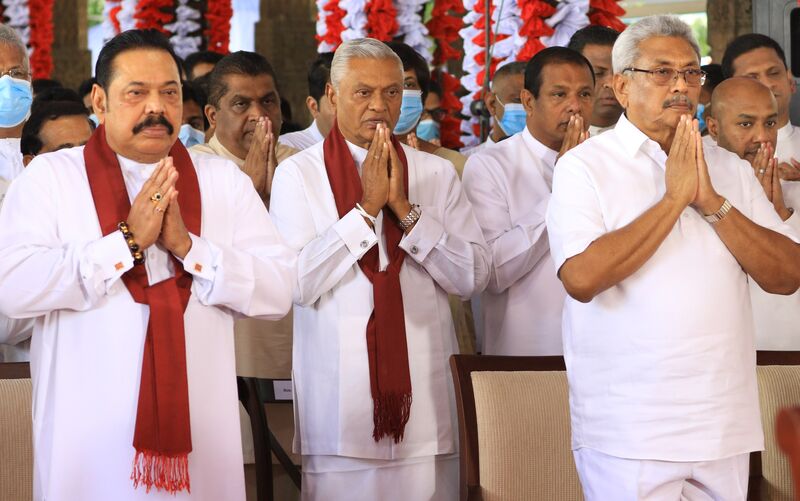
Mahinda, Chamal and Gotabaya Rajapaksa during a Cabinet swearing-in in August 2020.
Mahinda, Chamal and Gotabaya Rajapaksa during a Cabinet swearing-in in August 2020.Photographer: Tharaka Basnayaka/NurPhoto/Getty

Ruth Pollard is a columnist and editor with Bloomberg Opinion. Previously she was South and Southeast Asia Government team leader at Bloomberg News. She has reported from India and across the Middle East and focuses on foreign policy, defense and security. @rpollard+ Get alerts forRuth Pollard

In just over two years, Sri Lanka’s first family has presided over a series of crises mostly of its own making.

The island nation of 22 million people is facing its worst economic upheaval in a decade. From an ill-fated fertilizer ban that led to a dramatic fall in yields of crops like rice and tea, to its failure to deal with a foreign-currency crisis that’s now a humanitarian emergency, the government of President Gotabaya Rajapaksa is fast running out of solutions. Relying until now on help from its two major backers — India and China — and stubbornly refusing wider international aid, the country is on the verge of default. 

Protests roiled Colombo on Tuesday, with upwards of 10,000 opposition supporters gathering outside the president’s office to call for his resignation. Shortages of electricity, fuel, food and medicine are widespread and causing real pain for everyone from daily wage earners to operators trying to jumpstart the key tourism industry after two years of Covid interruptions and the 2019 Easter Sunday bombings that targeted churches and luxury hotels, killing nearly 270 people. Inflation has soared to 15% — the worst in Asia.

It’s hard to overstate the influence of the Rajapaksa clan in all this. Gotabaya, who won office in the November 2019 presidential elections, appointed his brother, Mahinda, as prime minister. If this pairing sounds familiar, it’s because it is. Mahinda first came to power in 2004, initially as prime minister and then as president. At the time, Gotabaya was defense secretary and was notorious for his role in the 2009 operation to end the civil war with Tamil rebels. Thousands died or disappeared amid allegations of torture, rape, extra-judicial killings and the abduction and assassination of Tamil separatists, journalists and opposition figures. Gotabaya denies all these allegations.More fromBloombergOpinionPeople Think Putin Is Losing. What If He’s Not?The SEC Will Regulate ClimateTheranos Show on Hulu Highlights Risk of Jury InfluencePutin May Finally Be Gearing Up for Cyber War

The Rajapaksas were out of power briefly from 2015, when Maithripala Sirisena and Ranil Wickremesinghe led the country, until Wickremesinghe was removed from his post in 2018, sparking a constitutional crisis. Their party won a landslide victory in the August 2020 general election, and quickly restored sweeping executive powers to the presidency that had been previously curbed. Another brother, Basil, was appointed finance minister in July 2021. He was already a controversial figure due to his American-Sri Lankan nationality — his entry into Parliament was only made possible when the government removed a constitutional provision barring dual citizens.

Their eldest brother, Chamal, is a Cabinet minister, while his son is a non-Cabinet minister. One of the prime minister’s sons is also in the Cabinet, another is his chief of staff, and a nephew is a member of Parliament. According to some estimates, about 75% of the budget is under the control of Rajapaksa ministers in government. It is dynastic politics at its purest.

But all the Rajapaksas in power haven’t been able to do what needed to be done to help Sri Lanka out of this mess.

Basil was in India March 16-17, where he secured a $1 billion credit line to help stave off the crisis, exacerbated by spikes in oil prices driven by Russia’s invasion of Ukraine. The war is also badly affecting the travel sector: About 30% of visitors so far this year were from Russia, Ukraine, Poland and Belarus, while Russia is also one of the biggest buyers of Sri Lankan tea, its main goods export.

Things are bad enough that the brothers’ resistance to seeking support from the International Monetary Fund is softening, Bloomberg News reported earlier this week. Sri Lankan officials began talks with the IMF on Monday and may present policy proposals by early next month. 

Authorities have recently allowed the rupee to weaken and borrowing costs to rise, in line with expectations of IMF conditions. But experts have criticized the sequencing of these moves. Debt restructuring was the first priority, said economist and executive director of the Colombo-based Verité Research, Nishan de Mel, told me. Increasing interest rates and depreciating the rupee should have come next.

The situation has snowballed because it was mismanaged for some time, de Mel said. What Sri Lankans are facing now is unprecedented, he said, and beyond anything experienced during the decades of civil war. Sri Lanka has about $2 billion of foreign-currency reserves against total debt repayment of as much as $7 billion for 2022, including a $1 billion dollar bond maturing in July. It has three months, maybe less, before a default, de Mel said.https://platform.twitter.com/embed/Tweet.html?dnt=true&embedId=twitter-widget-0&features=eyJ0ZndfZXhwZXJpbWVudHNfY29va2llX2V4cGlyYXRpb24iOnsiYnVja2V0IjoxMjA5NjAwLCJ2ZXJzaW9uIjpudWxsfSwidGZ3X2hvcml6b25fdHdlZXRfZW1iZWRfOTU1NSI6eyJidWNrZXQiOiJodGUiLCJ2ZXJzaW9uIjpudWxsfSwidGZ3X3NrZWxldG9uX2xvYWRpbmdfMTMzOTgiOnsiYnVja2V0IjoiY3RhIiwidmVyc2lvbiI6bnVsbH0sInRmd19zcGFjZV9jYXJkIjp7ImJ1Y2tldCI6Im9mZiIsInZlcnNpb24iOm51bGx9fQ%3D%3D&frame=false&hideCard=false&hideThread=false&id=1504353267848925186&lang=en&origin=https%3A%2F%2Fwww.bloomberg.com%2Fopinion%2Farticles%2F2022-03-17%2Fthe-rajapaksa-brothers-power-isn-t-enough-to-stop-sri-lanka-going-broke&sessionId=9a91789df09de7a4bd9ede3607a2cdb73117ef01&siteScreenName=bopinion&theme=light&widgetsVersion=2582c61%3A1645036219416&width=550px

There is now a growing demand for the government to clearly articulate some concrete solutions, said Dushni Weerakoon, executive director of the Institute of Policy Studies of Sri Lanka. There is no painless way out of this,” Weerakoon noted. The economic conditions will tighten before they get better.”

It all began with the government’s capital market borrowing back in 2007, she said. (Mahinda was president then.) That now accounts for 38% of the country’s foreign debt, while loans from China accounted for 10%. Given the severity of Sri Lanka’s plight, the initial reliance on government-to-government deals to finance the foreign exchange gap hasn’t been sufficient, she said. Approaching the IMF is now the best option, complemented by efforts to access financing from India and China. Sri Lanka has asked both Beijing and New Delhi to consider restructuring its debt repayments after India in January extended a $400 million swap line and deferred an Asian Clearing Union settlement of $500 million.

The country is also seeking to negotiate a new loan with China. The Hambantota port — part of China’s Belt and Road Initiative — is widely viewed as an example of what can go wrong with Beijing’s infrastructure drive. Sri Lanka borrowed heavily to build the port, couldn’t repay the loans, and then gave China a 99-year lease for debt relief.

Gotabaya is hardly the unifying figure Sri Lanka needs right now. However, with a two-thirds majority in Parliament and elections not due until 2024 and 2025, the opposition protests are unlikely to loosen the family’s grip on power. Opinion. Data. More Data.Get the most important Bloomberg Opinion pieces in one email.EmailSign UpBloomberg may send me offers and promotions.By submitting my information, I agree to the Privacy Policy and Terms of Service.

He addressed the nation Wednesday evening, vowing to work with the IMF to resolve the crisis and saying he was sensitive to the many sufferings the people have had to experience over the past two months.” But the clock is ticking and people are angry — and hungry. Any delay in an agreement with the IMF brings the country one step closer to a hard default. And that is a road no one wants Sri Lanka to travel. 

More From Bloomberg Opinion:

Sri Lanka current economic crisis is similar to 1970s: New York Times article from 1974

March 22nd, 2022

Courtesy NewsIn.Asia

Sri Lanka current economic crisis is similar to 1970s: New York Times article from 1974

March 22 – Sri Lanka’s current economic crisis is similar to that it faced in the 1970s, former Deputy Governor of the Central Bank of Sri Lanka W.A. Wijewardena has pointed out.

Wijewardena said Sri Lanka is facing shortages and queues similar to that what was reported in the 1970s.

Subscribe to our Telegram channel for the latest updates from around the world

He said during the 1970s the Government sought Chinese help to keep afloat and ship to mouth consumption.

Stating that the policy as today was to look inward rather than outward, Wijewardena questioned if Sri Lanka will not learn from past mistakes.

The former Deputy Governor of the Central Bank shared an article by the New York Times in 1974 that was published on Sri Lanka’s economic crisis at the time.

New York Times article on Sri Lanka in 1974:

For similar articles, join our Telegram channel for the latest updates. – click here

Escalating Fertilizer Prices and Subsidy Removal

March 22nd, 2022

by Dr Parakrama Waidyanatha Courtesy The Island

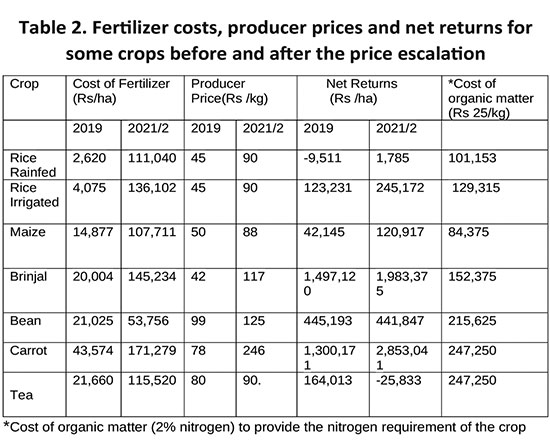
The Maha harvesting of rice is now nearing completion and the strong indications are that this season’s crop decline would be 40% to 50% due to lack of fertilizer. Concurrently, the yields of other crops too are dropping and the tea yields of 2022 could be the worst affected. According available information, whereas the 2021 producer price was only Rs90.33/kg green leaf, the cost of production was Rs94.05 and the corresponding values for 2020 were Rs92.15 and 68.18. On the other hand, increasing the purchase price of paddy to Rs 90 from about Rs 45 per kilogram, even at the prevailing high price of fertilizer, could theoretically double the net returns compared to previous years (Table 2). However all crops are yielding far less this year compared to previous years given the fertilizer scarcity and even when available, the prohibitive costs.

According to the 2021 Global Food Security rating, Sri Lanka has dropped down further from the previous position of 66th a few years ago to the 77th out of 113 countries. Of the food parameters, affordability, availability and quality, the worst decline is in the food availability index, as to be expected, with the current food shortages..

We have been hit by a ‘double whammy’. The decision to totally shift to organic farming or ‘green agriculture’, a term often proudly uttered by the Minister of Agriculture, and the total ban of chemical fertilizer imports without assessing the organic fertilizer availability. Of course the shift to ‘green agriculture’ is not for the love of ‘healthy food’, often uttered by many without knowing the scientific evidence, but because of the shortage of foreign exchange for chemical fertilizer imports. And as seen from the Table 2 below, organic fertilizer will be as costly as chemical at prevailing prices, and not all farmers have the raw material to produce their own organic matter requirements.

Escalating fertilizer prices

The key factors driving fertilizer prices up were a supply shortage in the global market and the growing costs of natural gas, which account for up to 80% of variable costs in producing nitrogenous fertilizers. Faced with the highly expensive energy resources, many European producers had to stop production as they couldn’t compete with counterparts in Russia, countries in the Persian Gulf and northern Africa. As a result, the global supply of fertilizer decreased which led to subsequent price increases. The impact of the Ukraine war is yet to be seen. The COVID epidemic, especially in the west as also the closure of some factories in the U.S due to the bad winter weather during 2021 also contributed to production shortages.

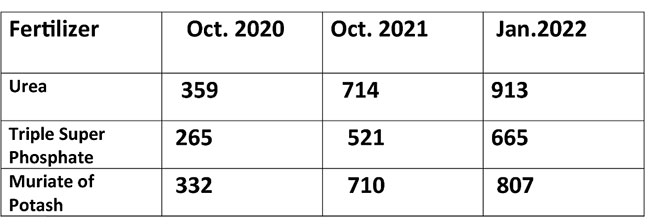
The unprecedented escalating of chemical fertilizer prices globally, as evident from the Table 1, will now make it difficult for the government to provide chemical fertilizer at heavily subsidized rates given the current foreign exchange crisis. In fact the government has, smartly lifted the ban on chemical fertilizer imports handing over the ‘baby’ to the private sector implying that if farmers want they can procure fertilizer at market prices. Then how can the President condone his faulty assertion that if he gives chemical fertilizer with one hand he will have to give the farmer a kidney with the other! Would private sector imported chemical fertilizer not cause the kidney disease? A recent report by the Health Secretary has stated that there is no evidence to implicate agrochemicals in the causation of the Rajarata kidney disease, a position that has been held by the majority of scientists but ignored by the President and the Agriculture Minister.

Table 1.Global Fertilizer Prices (USD/Mt)

The current global prices of not only ammonia and ammonia-based fertilizers(urea) but also of soluble phosphates and potash have increased by 250%.during the last 14 months!(Table 1). Increasing energy costs have also increased mining costs of potash and rock phosphate resulting in their comparable magnitude of increase as ammonium fertilizers. The forecast s that because of continuing supply chain constraints, in particular energy, the fertilizer prices will not come down in the near future.

The overall mean cost of chemical fertilizer at prevailing retail prices is about 24% of the total cost of production whereas it was only about 10% before the price escalation due essentially to subsidies and lower global fertilizer prices.

The data prior to fertilizer subsidy removal presented here are based on those published by the Department of Agriculture in 2019 as those for 2020 and 2021 are not yet available. The farm gate and retail prices of vegetables for 2021/2 were obtained from the Agrarian Research and Development Institute. The prevailing average retail fertilizer price of Rs 8,000 per 50 kg bag was used for 2021/2 calculations. In calculating the 2021/2 net returns which are hypothetical, it has been assumed that the yields were similar to those before the government’s banning of agrochemicals in April 2021. Clearly the farmers obtained much lower yields than before, but the hypothetical calculations were meant only to show that at prevailing farm gate prices, the farmers could have earned far more for many crops had they applied chemical fertilizers even at the current high retail prices. Of course the problem was that chemical fertilizer was not available until recently, and the high producer and retail prices were a result of low production.

Table 2. Fertilizer costs, producer prices and net returns for some crops before and after the price escalation

Fertilizer costs and producer prices

As evident from Table 2 data at the current farm gate (producer) prices, except for rainfed rice, tea and beans the hypothetical net returns have been much higher for the other crops in 2021/2 compared to 2019 because of substantial increase in farm gate (producer) prices consequent on the decrease in production due to fertilizer shortages and exorbitant costs apart from bad weather; and the corresponding increase in retail prices. The farm gate price of paddy increased by two fold with the government defining a paddy procurement price increase of 100%. By contrast, the mean farm gate tea price was 4% lower than the cost of production as pointed out above because of very high comparative increase in fertilizer price. Although the producer prices of brinjal, carrot and most other vegetables too increased several fold the farmers’, earnings were severely curtailed by low productivity due to unavailability of chemical fertilizer.

The writer has reservations regarding the maize yields and production costs as that is a crop cultivated in many parts of the dry and intermediate zones, especially Badulla and Moneragala with substantial returns. It may be because the Dept. of Agriculture’s return calculations are based on dry grain prices whereas a fair share of the crop is sold at comparatively high prices as tender corn cobs.

It should be noted that although, the government is vehemently promoting organic fertilizer under its so called ‘Green Agriculture’ program, except for rice and maize, it is more expensive to the producer than chemical fertilizer at prevailing prices (Table 2).

Judicious fertilizer use

Studies reveal that 60-70% of the applied nitrogenous fertilizer is lost through leaching, runoff and vaporization with most crops. Losses of some other nutrients too could be substantial though not as high as nitrogenous fertilizers. Farmers should be taught the principles of judicious fertilizer use through which substantial reduction in losses and costs could be saved. Little and often’ is one important principle in judicious fertilizer use.

It would appear that with judicious use, especially application based on soil nutrient levels and crop demand, the fertilizer costs could be substantially reduced. Although there is some effort to promote fertilizer use based on soil and foliar analysis to determine the exacting crop nutrient requirements, it is not adequately popular because of the high analytical costs. The government should strengthen the relevant services and make them available at reasonable costs to farmers. The consequent fertilizer savings could be substantial.

Fertilizer subsidy

The fertilizer subsidy policy has been changing, especially with change of governments. The Government in 2019 continued the policy introduced during the interim Government in 2018 to provide fertilizer at the concessionary prices of a 50 kg bag of any type of straight fertilizer at Rs. 1,000 and a 50 kg bag of mixed fertilizer to  Rs. 1,150.00 for crops other than paddy. The average subsidy borne by the Government on a 50 kg bag of paddy fertilizer then was around 86 percent of the market price.

A comprehensive study ( Ekanayake, H. K. J. 20060: Impact of fertilizer subsidy in paddy cultivation in Sri Lanka. Staff Studies; Central Bank of Sri Lanka, 36 (1 and 2): 73–92.) reveals that the fertilizer subsidy is not a key determinant of fertilizer usage in paddy cultivation. The study also found that there is a relatively higher correlation between fertilizer usage and paddy price than between fertilizer usage and fertilizer price. The author states that ‘the fertilizer subsidy could be withdrawn gradually over time. In its place, appropriate infrastructure and institutional facilities that are required to increase productivity in paddy cultivation and an effective mechanism for marketing the output that would result in favourable prices for paddy may be introduced for a more effective outcome’ The results of this study were also reported to be consistent with the findings of similar research in other countries.

Although the generally accepted view of economists is that governments should not indulge in business, would the above statement imply that if the Paddy Marketing Board is streamlined and effective, the paddy farmer can benefit substantially?

Further, a World Bank study(2013 ) entitled What is the Cost of a Bowl of Rice” points out that the increase in farmers’ net income is small relative to the fiscal cost of the fertilizer subsidy, and that the government spends between Rs1.4 to 2.4 per acre to increase farm income by only a rupee per acre.

In conclusion, as evident in Table 2, the cost of the subsidized fertilizer in 2019 was 10.6% of the total cost of production that in 2022 without subsidy is 17.1%. However, because of the doubling of purchase price of paddy as also the highly escalated producer prices of other arable crops consequent on corresponding escalation of retail prices due to supply shortages, the increased fertilizer prices or subsidies had little bearing on the producer margins which were substantially higher in 2021/2 In other words, in this situation the fertilizer subsidy has no overwhelming impact on the cost of production of arable crops, and the government’s decision to ban the chemical fertilizer subsidy could lead to farmers moving towards more remunerative crops from rice, especially in the Yala season, in the Dry Zone, when it is more practical. However, the high retail prices is a huge burden to the consumer.

As pointed out above the increased cost of production by 4% over the producer price is would be devastating to the tea industry. The exorbitant fertilizer costs is reducing tea productivity substantially and the government should put in place either a price support scheme for the producer or a fertilizer subsidy which should only be 1-2% of the tea export earnings.

Escalated fertilizer prices should make rain fed rice farming especially in the wet zone unprofitable as seen in Table 2, implying that these paddy fields should be diversified into more profitable crops. In any case wet zone contributes only an insignificant quantity of rice to the national supply.

Hypocrisy, false propaganda and war in Ukraine

March 22nd, 2022

Editorial Courtesy The Daily Mirror

Russia invaded Ukraine on February 24 this year and the war is entering its 26th day. Whilst one may sympathize with Russia’s anger at Ukraine and the Western countries led by the US for their attempts to expand NATO to Russia’s doorstep, and despite assurances that this would not take place by the NATO bloc, the invasion of one country by another cannot be condoned.


During its invasion of Ukraine, Russia has been accused of bombing civilian targets including hospitals, schools and apartment buildings. ‘Aljazeera’ on March 22, reported the confirmed civilian death toll in Ukraine was 691 and 1,143 wounded. The United Nations Human Rights Office said the actual toll would probably be considerably higher. While Ukrainian President Volodymyr Zelenskyy claimed 97 Ukrainian children have died since the invasion began.


The UN refugee agency announced around three million people have fled Ukraine, nearly half of them were children. Around 1.8 million are now in Poland and some 300,000 in Western Europe.
About 2,000 cars have left the besieged port city of Mariupol. Ukraine also accused Russia of blocking a convoy trying to take supplies to areas under attack, while the Red Cross said convoys of more than 100 buses ferrying civilians have left the besieged northeastern city of Sumy.


From the UK – the self-styled ‘mother of democracy’- to the US which believes it is the global policeman, Western countries have been quick not only to vociferously condemn Russia’s invasion of Ukraine, they have and also imposed unilateral sanctions on Russia and several personalities including Russian President Vladimir Putin.
While applauding the NATO countries for their concern regarding Russia’s invasion of Ukraine, we cannot, but wonder why these self-same countries have remained silent an inert in the face of Israeli forays into the State of Palestine since 1945.


To date, neither the US nor the Western ‘democracies’ have condemned Israel, for not only its invasion of Palestine, for its continued occupation of Palestine territories nor for its (Israel’s) imposition of policies of apartheid in its illegally occupied Palestinian territories.


To date, Israel occupies over 6,220 sq km of Palestinian territory. Israeli invasions have resulted in the creation of more than seven million Palestinian refugees scattered around the world. Amnesty International (AI) confirmed Israel applies apartheid policies on Palestinians living in lands illegally occupied by the state of Israel.
Yet, neither the US nor the West European NATO countries have subject Israel, its politicians or prime ministers to sanctions.


While the West and the US were rightfully quick to criticize the Russian bombing of Ukraine, we cannot, but remember that since 1945, the US has bombed Japan, Korea, Laos, Cambodia, Vietnam, Panama, Iraq, Serbia, Yugoslavia, Sudan, Afghanistan, Pakistan and Yemen. 
The countries mentioned do not form a complete list. but in all countries bombed by the US, the principal targets have been civilian ones.


In Japan, the US nuclear bombing the cities of Hiroshima and Nagasaki. Both were civilian targets and up to now, the US remains the only country in the world to have used nuclear weapons. Over 200,000 civilians were incinerated within minutes of the nuclear bombing of the cities. Even today, some of the victims of that bombing remain hospitalized. 


Yet, no talk of sanctions… worse the US has still not paid a single cent as compensation to the victims of its dastardly nuclear attacks. Equally bad, during its adventure in Vietnam the US used chemical weapons – defoliants and napalm – on civilian targets. No condemnation of the attacks, no imposition of sanctions on either the US its Presidents or those who make a profit from the war.


This however, is not to whitewash Russia for its invasion of Ukraine nor its bombing and shelling of civilian targets. But when the US levels its criticism of war crimes and crimes against humanity against a third country, it merely sounds like the ‘pot calling the kettle black.’ In another twist, the US and Western countries have imposed a blanket blockage on Russian news sites. Via the blockade, the US and the West have in fact imposed a form of news censorship, turning on its head the concept of media freedom.    


This is the reality of war. There are no just wars, civilians are going to get killed. Rockets, bombs, missiles have no means of discerning between civilians from combatants. Civilian casualties and principles of media freedom are always among the first victims in the event of war and wars feed off itself. 
An example… Ukraine President Zelenskyy’s acceptance that Ukraine will no longer seek NATO membership, and the US and West promising more war materials to that country. 

Four cardinal mistakes the president did not admit in his speech

March 22nd, 2022

Courtesy The Daily Mirror


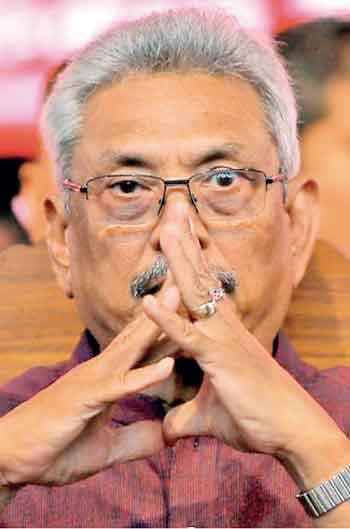
Last week President Gotabaya Rajapaksa addressed a nation in crisis. Instead of calming the masses, a good part of whose life is now spent in everyday queues, he managed to further enrage them. What could probably be the operating para of his speech was ‘this crisis was not created by me’. Our country is not the only country in the world affected by the prevailing crisis situation. The entire world is engulfed with various hardships,” he said. Fair enough, President Rajapaksa inherited an economy that was loaded with an unsustainable amount of foreign debt, much of which was obtained during the two-term presidency of his elder brother. While some of them were invested in useful infrastructure projects, Mahinda Rajapaksa misallocated a good deal of foreign loans on a dynastic enterprise-in development projects which had no immediate, perhaps, not even medium-term, economic viability.  Mahinda Rajapaksa misallocated a good deal of foreign loans on a dynastic enterprise-in development projects which had no immediate, perhaps, not even medium-term, economic viabilityBut, only Gotabaya Rajapaksa is responsible for mismanaging the latent economic crisis, which could have been handled with economic common sense. Instead, he turned it into a national disaster.  Without a series of flawed policies adopted by his administration, Sri Lanka would not have been in the throes of a crisis as acute as it is at present.  But, the president did not admit any of his blunders; they broke the back of this nation. Perhaps, his ego blinded him. Or he is simply ignorant and his advisors sycophantic.  Here are four cardinal mistakes he committed, and they turned an otherwise manageable foreign exchange crisis into an unprecedented national catastrophe.  1.His extensive tax concessions made the government bankrupt Mr Rajapaksa started on the wrong foot.  The government revenue in Sri Lanka as a percentage of the GDP is one of the lowest in the world – not just in comparison to peer lower Middle/Middle-Income nations but even compared to the least developed nations.  To address the lower government tax revenue, Rajapaksa’s predecessors, the Yahapalanaya, partly guided by the IMF, adopted a revenue-based fiscal consolidation programme. Tax revenue as a percentage gradually increased, from 2015 to 2019, when Rajapaksa was elected to power. The new president thought he knew better and cut VAT from 15% to 8% and abolished NBT, PAYE tax, etc. As a result, the government revenue in 2020 declined by 526 billion rupees. And the number of registered taxpayers in the country declined by 33.5 per cent, according to Verite Research, a think tank. In order to fill the shortfall, the government printed money, fuelling inflation. Public finances were weakened while the country was due to pay over US$  24 billion of foreign loans by 2024, which itself reveals the economic acumen of the president and his advisors.   2.The self-made disaster in the agricultural sector The president’s overnight ban on chemical fertiliser would be remembered as the dumbest, yet one of the most callous policy decisions in recent memory. It is more ludicrous if the real reason as he claims was to save public health (instead it seriously damaged Sri Lanka’s food security, Sri Lanka now ranks behind a number of South Asian peers in terms of food security). If the unsaid motive was to save limited foreign reserves, it reveals the misplaced priorities of his government. Fertiliser subsidy cost about US$ 250-300 million annually. In the meanwhile, his government continued to service international sovereign bonds, the last one of US$ 500 million that was paid in January effectively emptied the foreign reserve.  The ban on chemical fertiliser decimated the local agricultural sector, paddy harvest declined by two-thirds. The cost of the folly was, according to conservative estimates, is US$ 2 billion. It impoverished 1.8 million farmers, which account for every one in four of the Sri Lankan workforce. The new president thought he knew better and cut VAT from 15% to 8% and abolished NBT, PAYE tax, etc. As a result, the government revenue in 2020 declined by 526 billion rupees. And the number of registered taxpayers in the country declined by 33.5 per cent 3.Unsustainable Rupee peg and continuation of bond payments If there is a government that continued to pay its foreign lenders against a net negative foreign reserve, it is this one. The real motives may be much less sincere than lofty claims of non-existent creditworthiness, which is ranked below the junk by rating agencies. The government effectively drained  US$ 7.6 billion of foreign reserves of 2019 to pay for foreign lenders and to maintain an unsustainable peg of the Rupee. The peg resulted in a further squeeze of foreign remittance by the Sri Lankan workers abroad. Exporters parked their earnings in foreign banks. The President in his speech admitted that the workers’ remittance, which would have been US$ 2 billion under the peg would now increase to US$ 5 billion after the rupee was floated. However, the rupee was floated when the country ran out of hard currency, with the government having no effective instrument to manage the free fall of its value. While the rupee is traded at 275 for a dollar in banks, it is still traded for 300- 305 per dollar in the parallel markets. That might suggest further depreciation is on the way.  If the peg aggravated the shortage, now the free-falling rupee would make most essential items, ranging from milk powder to cooking gas beyond the reach of average folks. The promised Saubagyaya (prosperity) has been proved to be an unmitigated self-made disaster. 4.Self-isolation from the West Now when the government begs for short changes from Bangladesh, and pleads for oil on credit from Russia, at its hour of global infamy, one should know, that its friends are few and far between. This was not the case when it launched into power. The Japanese were funding a Colombo metro rail project, the Americans offered a US$ 480 million grant under the Millennium Challenge Cooperation. Gotabaya Rajapaksa’s administration suspended the Japanese project and shunned the Americans. It effectively self-distanced itself from the West and its allies. A common-sense foreign policy followed in the national interest would have made it possible for the country to seek help from a greater number of states at its hour of need. But, the Rajapaksa’s personal political calculations had always ranked above the national interest.  Those are only the most salient of blunders, which are directly instrumental in our flight. There is a separate long list, from the 20th Amendment to racist dog-whistling and to the compulsory cremation of Muslim Covid dead, that further discredited the nation. Connect the dots, and you will see why and how Sri Lanka ended up here, our daily ritualistic humiliation at queues and our daily struggle to make ends meet. 

“Amma, should I go with this stranger?”

March 22nd, 2022

Courtesy The Daily Mirror

Married too young, many girls get married by 18 despite societies’ advancements and that will cost the developing world trillions of dollars

Mama, why am I going with this strange man?
For your safety, my dear   
But Mama, he scares me, he’s hurt me, everywhere, I don’t feel safe   
Oh honey, it’s okay. It’s what all girls do.   
But-but…I love you, I love Papa, I don’t wanna leave you.   
It is your duty, child, we need the money. If you love us, go.   
So goes the poem by one Sam.

For thousands of young girls across Sri Lanka, their wedding is a far cry from happily ever after as parents marry off their daughters due to various reasons such as poverty, tradition and gender inequality. The debate on child marriages in Sri Lanka has been focused too much on Muslims. But, in reality, the evidence shows that the child marriage problem is not a Muslim or Sinhalese problem, but a national problem.   
At its core, child marriage is a violation of child protection and human rights. Whatever the reason, child marriage compromises a child’s development and severely limits her or his opportunities in life.   


Sujani from Kanugahawewa, Anuradhapura said she didn’t realize how big of a commitment she was making. I cried because I was too young to get married. I didn’t want to, I didn’t understand the meaning of marriage, I was filled with fear,” she continued. The numbers show that Sujani’s story is not far from reality. Each year, 15 million girls are married before the age of 18 around the world. That is one girl every two seconds.   

“Child marriages will cost developing countries trillions of dollars by 2030, says a new report published by the World Bank and the International Center for Research on Women (ICRW)”


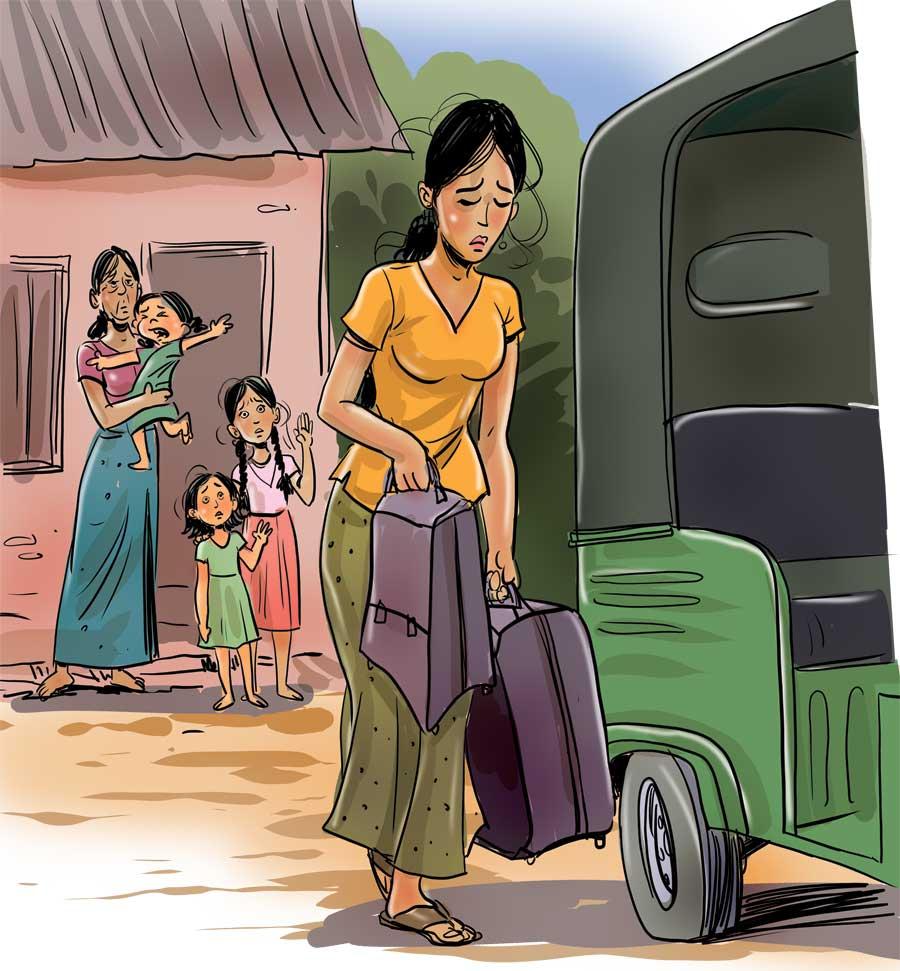
Sujani and her two younger sisters would go to bed hungry if they didn’t have a lucky day. When her parents separated when she was just nine years old, life got even harder for the family. It was up to Sujani’s mother to provide for herself and her three young daughters. Then, Sujani’s mother flew to Lebanon to work as a housemaid after sending her three daughters to their grandmother’s.   


Remittances of migrant workers including tens of thousands of women like Sujani’s mother, working as housemaids in the Middle East, have been the largest single source of foreign exchange inflow in Sri Lanka’s balance of payments (BOP) over the past decade. From 2001 to 2020, about 8% of Sri Lanka’s annual gross domestic product came from overseas citizens sending money home. Workers’ remittances constitute almost 100 per cent of the inflows to the secondary income account of the external current account.   

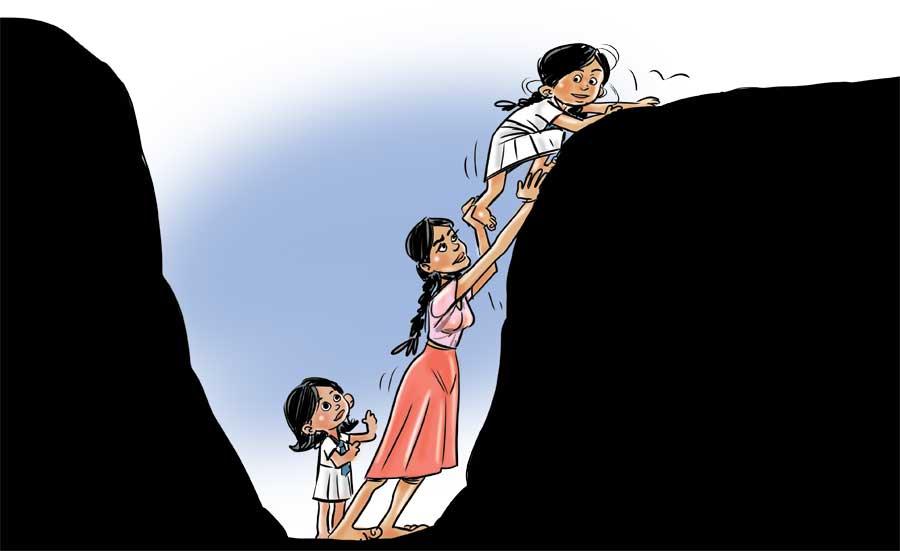
The absence of the mother, it is argued, leads to the neglect of children, resulting in school drop-outs, early marriages, and vulnerability to sexual abuse. Even though the Family Background Report (FBR) circular bans women with children less than five years of age from migrating for work, it does not cover women with teenage daughters

I was supposed to be in school at the time I got married,” Sujani, now 30, mother of two daughters, told Daily Mirror. I was 15-years-old when I got married. Sujani knew that her mother couldn’t afford to feed her, buy clothes for her, or pay her school fees, and she felt that if she refused to get married, she wouldn’t have anywhere else to go.   


The absence of the mother, it is argued, leads to the neglect of children, resulting in school drop-outs, early marriages, and vulnerability to sexual abuse. Even though the Family Background Report (FBR) circular bans women with children less than five years of age from migrating for work, it does not cover women with teenage daughters.   

“There is a shortage of Government data. The Government has to collect data and find the shortcomings based on which it will be possible to adopt and implement policies as well as to invest”


In her new role as a wife, Sujani stopped going to school, and instead took care of her husband. She and her husband struggled to earn enough to eat. But the greatest loss, for Sujani, was her freedom. When I was staying with my family I was free to do what I wanted to do. Now in the house, I was taken to, I wasn’t free. I was scared because he refused freedom for me to do anything, and only he decided what should be done.” 
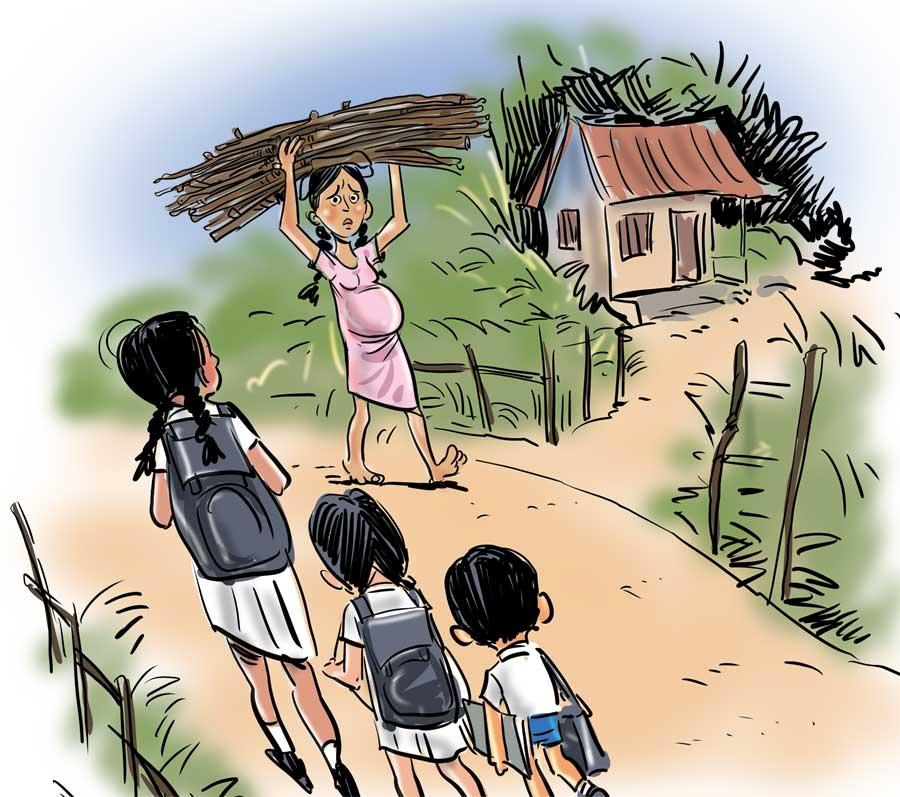
Instead of getting an education, Sujani spent her days sweeping, washing clothes, washing dishes, collecting firewood, and cooking. After three months, she realised she was pregnant.   


When I was pregnant I felt so much pain because I wasn’t ready to conceive at that age,” she said.   
Women in such situations are more likely to report no contraceptive use and are at a greater risk of unintended pregnancy and sexually transmitted infections including HIV and cervical cancer. Among Sri Lankan women aged 15–19 years, pregnancy-related death is the second leading cause of death. Physical immaturity for childbearing, combined with lack of power, information, and access to services, place them at a heightened risk of maternal morbidity and mortality.   

Evidence shows that the more education a girl receives, the less likely she is to marry as a child. Sujani said, but, I won’t let that happen to my daughters. My expectation for them is to educate them well and send them to higher levels in the ladder of life. If my daughters could get an education, their lives would be different from mine.”

At 16, far too young to know about childbirth, or how to take care of a baby, Sujani went into terrifying and painful labour. I did not know how to deliver a baby. I was just a child. And I wouldn’t like anyone who is 15 to go through what I have been through.”   
When asked about her childhood dreams, she said she knew she couldn’t have big dreams due to financial difficulties. When I looked at other kids of my age, I felt desperate and helpless. I knew without the support of my parents, I could not reach up the ladder. We may have committed sins to get a life like this.”   


Evidence shows that the more education a girl receives, the less likely she is to marry as a child. Sujani said, but, I won’t let that happen to my daughters. My expectation for them is to educate them well and send them to higher levels in the ladder of life. If my daughters could get an education, their lives would be different from mine.”   
Sujani lived in a clay house for nine years before she received funds to build a house from the Government Samurdhi programme. However, a wall of the house built from Samurdhi funds suddenly collapsed. That is when the Air Force officers came in and built her the house completely. She is grateful to them. Now we are living under a roof even on empty stomach without getting wet from the rain. With my two daughters, now we can close doors and sleep peacefully at night.”   

“The absence of the mother, it is argued, leads to the neglect of children, resulting in school drop-outs, early marriages, and vulnerability to sexual abuse. Even though the Family Background Report (FBR) circular bans women with children less than five years of age from migrating for work, it does not cover women with teenage daughters”


Daily Mirror studied the statistics maintained by the Registrar General’s Department. The data revealed that between 2005 and 2015, more than 105,000 births by mothers aged below 18 have been reported in the country. This number even included births by mothers who were as young as 13 at the time of giving birth.
However, there is a shortage of Government data. The Government has to collect data and find the shortcomings based on which it will be possible to adopt and implement policies as well as to invest. Apart from the Muslim Marriage and Divorce Act (MMDA) which is currently subject to reforms, there is no shortage of laws and policies in the country to eradicate child marriage. However, there is a lack of implementation.   


Meanwhile, a new report published by the World Bank and the International Center for Research on Women (ICRW) stated that child marriages will cost developing countries trillions of dollars by 2030.  In contrast, ending child marriage would have a largely positive effect on the educational attainment of girls and their children, contribute to women having fewer children and later in life, and increase women’s expected earnings and household welfare.   

Illustrations by Namal Amarasinghe

Proposed MRCC deal threat to SL security: Harin

March 22nd, 2022

Courtesy The Daily Mirror

Samagi Jana Balavegaya MP Harin Fernando said today that proposed Indian funded Maritime Rescue Coordination Center (MRCC) is to be set up inside the Sri Lanka Navy Headquarters will threaten Sri Lanka’s security.

He said at a media briefing that a sub-unit will be set up in Hambantota and seven other units will be positioned across the country.

The Cabinet has approved to establish an MRCC in Sri Lanka with a grant of US$6 million from India.

A Memorandum of Understanding (MoU) with the government of India and an agreement with Bharath Electronics of India to be signed for the establishment of MRCC.

Bharat Electronics Limited is a state-owned aerospace and defence electronics company in India, which primarily manufactures advanced electronic products for ground and aerospace applications.

Under the agreement, MP Fernando said that India will also provide three Dornier maritime surveillance aircraft to Sri Lanka, while the Sri Lanka Navy is to receive a 4,000 MT floating barge from India.

Sri Lankan sky has been sold to India under the pretext of the security system. We know that our sea and lands had already been given to China, ports were given to India and LNG projects in Sri Lanka to USA. Now they gave Sri Lankan sky also to India for two years,” he charged.

Mr.Fernando said the person who promised to uphold security in the island, has already sold the Sri Lanka Navy to India. 

The SJB parliamentarian said that Sri Lanka has signed three agreements with India including the MRCC. He alleged that Sri Lanka also given access to India to obtain biometrics data of Sri Lankans. (Darshana Sanjeewa Balasuriya)

REAL ISSUE OF ECONOMIC STAGNATION BETWEEN 2015-19-PLUS 2 YEARS OF COVID DISRUPTION, TAKING RESPONSIBILITY IS ALSO IN ORDER

March 21st, 2022

Economic News

ASK YOURSELVES HOW DID WE GET THERE?

*Forwarded as received*……….

Coomaraswamy is highly qualified & educated gentlemen but what happened to our economy during his time as The Governor of the Central Bank of Sri Lanka and with his IMF  compatriots.

Very interesting to check the numbers i have quoted below better you can verify that with your own independent sources before you believe my write up.

Here we go!

2015 January total forex reserve 8.3 billion USD

2019 November forex reserve’s drop to 7.1 billion  USD. This too was all made up by borrowing from capital markets not national savings. They cooked the books to give us false hope. Our reserves vanished when the whole world was doing so well & on top of it country borrowed over 5 trillion LKR worth of foreign debt’s.

Just imaging what could have happened to our country if there was a pandemic & a global commodity crisis and  global travel restrictions plus an economic war during this period.

In 2015-2019 world oil prices came down so much,  government was laughing as its spending on fuel imports would naturally comes down.

2015/16 global oil prices were below 40$bbl.

2017/18 it was below 60$bbl.

But we still lost over 5 billion  USD. ++++ reserves. Now that’s mind blowing. Please find out what happened.

Stock market collapsed from 7500+  in 2015 January & it hit 5000+  2019 by  November. Bravo well managed liberals  with IMF help.

During this same period of 2019 to 2015 guess what our GDP? It  just collapsed for reasons known to the IMF and the same gang.  They piled on more debt and pushed the burden of taxes onto all of us. Remember the debt tax and double digit VAT and lower payee thresholds and higher WHT on corporate debt etc etc

Funny enough Coomaraswamy  went out and borrowed USD 12.5 billion during his governments tenure.  Thanks to the same people like WA Wijewardena (who still praise the IMF and wants the rupee to free float again, isn’t this odd) foreign financed Advocata guiding them. The entire economy collapsed with them running it to the ground with bogus theories and even justifying free float floating the rupee. While  debt stock increased by LKR 1000 billion only in 2018. Oh, they also gave 100 Yr  lease  of the southern port or yes, the swimming pool, it was called debt swap, at its book Value of USD 1 billion. Now that’s should be seen as a  *joke* to all you financial experts. 

Oh yes,  this was the *debt trap* theory they flouted around among the ignorant liberals and got the country into more debt than 2014.

Coomaraswamy then had an epiphany and his liberal gang set in motion to free floated the rupee at the request of IMF only to turn around and intervene the free float using USD 5 billion of borrowed reserves. Then they bring more austerity by pushing interest rates beyond chocking point. Remember how those who now complained about low taxes, cried to simplify and cut taxes. *Now they want more taxes* what  a  joke.

Further more they  cooked the government books to show a *primary surplus* this is called financial shenanigans and IMF ignored it, as they kept 275 billion of expenses unpaid and got one off transfer from all state accounts. While dancing around about Prinary Surplus to the country oblivion to the truth. Don’t believe me, check the chamber of commerce or ministry of finance.

We had the so called country’s best brains and the even brilliant brains of IMF to manage the economy. But The CSE during the period  2015 to 2019 collapsed.  *Now tell me we had a global crisis*. But all the foreign Investors lost the Faith, Trust & Confidence with the CSE operations, and sold out while IMF was holding your hands, ask the question, why ?

God bless our country.

ERASING THE EELAM VICTORY Part 16 E PT 3B

March 21st, 2022

KAMALIKA PIERIS

Since LTTE was not a lawful army, the weapons had to be smuggled in by sea. LTTE smuggled in weapons, including heavy items,    and other equipment such as power generators, by carrying out mid sea transfers, 200 nautical miles off Sri Lanka. They used special semi submersible submarines, capable of carrying 10 tons of equipment. The goods were then transferred to small ships and subsequently into small fast boats.

In this manner, 130 mm and 152 mm artillery guns were    transported to Sri Lanka by ship and were unloaded mid sea onto barges and brought ashore. The Defence Ministry refused to believe this saying it was impossible; the items were too heavy, reported Kamal Gunaratne.   

An Indian fishing trawler, Sri Krishna, was moving a sizeable consignment of 120 mm heavy mortars, from a ship anchored on the high seas when .it was intercepted by Maldives coastguard and sunk in a confrontation in 2007. An embassy in Colombo is believed to have tried to help the vessel to escape.

The LTTE used Tamilnadu fishing boat fleets, both as cover and a means to smuggle in weapons to Sri Lanka.  They were used as a human shield as well. At one point there was a significant increase in the number of poaching Indian vessels.  To prevent the navy from obstructing the operation India persistently alleged that the Sri Lanka navy was targeting Tamilnadu fish poachers.

 In November 2007a large cluster of Indian trawlers moved almost 10 nautical miles close to LTTE held territory at Vettilaikerni. The navy detained 17 trawlers. President Rajapakse ordered them released after New Delhi intervened.

In 2009, when the war was drawing to a close, the authorities observed that new shipments of military hardware were continuing to reach the LTTE. LTTE had used surface to air missiles against army helicopters. These are new acquisitions, observed the military. A raid inVavuniya in 2009 yielded a stock of brand new grenades, which seemed to have come from a recent shipment.

The LTTE also resorted to trickery to obtain weapons. LTTE had acquired 32400 rounds of mortar bombs from Zimbabwe Defense Industries in 1997 by tricking the ZDI to loading the consignment to one of its vessels, pretending they represented the Sri Lanka government.

LTTE fighting power lay not in military strategy but in its artillery and explosives.  LTTE had at least 30   pieces of heavy artillery including 152 mm, 130mm 122 mm 85 mm and one 120mm mortar. They also had a range of anti aircraft weapons, such as surface to air missiles and mobile antiaircraft guns (peddle guns).

The army found nine mortar launchers of different calibres and improvised multi barrel rocket launchers. LTTE also had battle tanks, armored personnel carriers. LTTE had assault rifles, self loading rifles, light machine guns, sub- machine guns and rocket propelled grenades.

Raja Gooneratne had pointed out in a paper presented to the Board of the Open University that the LTTE had got water scooters, and he got a text message on his mobile threatening him. .some academics had objected to his giving the talk at all.   

Troops have unearthed huge caches of buried arms. A separate LTTE group was appointed to hide things, while another lot did the fighting. Large hauls of arms was   recovered from Mullaitivu, Vakarai, Vishvamadu, Wellamulliwaikal beach, Panichchankerni jungle and Alanchipotha. Forces also recovered over 11,000 T56 assault rifles, 25 artillery guns, main battle tanks and other sophisticated weaponry of the LTTE.

Arms cache was found in Alanchipotha, Welikanda. It was buried by fleeing LTTE cadres inside a sanctuary located 15 km away from Mahaweli River. Assault rifles, T 56, mortar bombs, mortar weapons, RPG bombs, pressure mines, drums, walkie  talkies chargers , walkie talkie parts, remote control device, anti aircraft ammunition, claymore mine and more.

Army recovered an arms cache in Kumana national park, detonators, outboard motor, oil cans, and outboard motor RPG rounds. Also found arms and weapons in Adampan, Alampil, Vishvamadu and Oddusudan areas.

A massive arms cache of sophisticated military hardware was found at Puthumathalan. It contained an improvised armour plated six wheel truck, earth moving backhoe, water scooter and anti aircraft guns.  Two of the guns were mounted on jeeps. One gun was booby trapped with a detonating cord connected to a several feet deep bunker laden with explosives. 

SLAF recovered t w caches of arms from Pudukuduirippu  with the assistance of LTTE cadres, they included ammunition, mortar bombs, mortar smoke bombs, air craft bombs, RPG bombs, hand grenades, fuses, mortars, pressure witches, pressure releases, instantiation fuses, explosives,  claymore mines, anti tank mines, smoke  bombs,  rocket bombs, gunpowder.

Ammunition was found in three kovils in Kayts and Kokkkadicholai. 175 artillery rounds were found buried at Kanagarayankulam.

These unending recoveries by the military indicate the magnitude of the LTTE operation. Each and every square km in Kilinochchi and Mullaitivu district had been turned into armouries. The total amount of weapons is unbelievable. Much still remains to be recovered. These could not have been only for Sri Lanka. 

LTTE also depended heavily on explosives, including improvised ones. STF unearthed large quantity of explosive in Iranamadu. Claymore mines and 87 other varieties of bombs and ammo. Caches of antipersonnel mines were also found. One contained 18,000–20,000 mines.. A cache of 1093 mines was found at Govipal Aru area in Ampara.   Troops found six boats laden with 996 kilos of explosives at Puthukkudiyiruppu,  1004 kilograms of C4 plastic explosives   at Mollikulam,  over 80 varieties of bombs at Iranamadu  and two other stocks of explosives, elsewhere, weighing 2500 kilos and   3900 kilos. 

LTTE also manufactured ammunition. They had set up factories to produce a range of these, including 60 mm, 81 mm, 120 mm and an indigenous Samadanam 2005 rocket.  LTTE also manufactured mines, such as claymore mines    creating their own variations. Troops found two LTTEmine manufacturing factories in Mullativu.  A bomb factory, as well as an explosives manufacturing and storage   facility in Puthumathalan. There were hundreds of lathe machines and many fuel dumps. If this manufacturing activity had continued longer, LTTE would have been able to obtain most of its ammunition locally. Pathmanathan had established a state-of-the-art boatyard in Thailand, which manufactured over a dozen different boats, including mini-submarines and suicide boats, said Wikipedia. (Continued)

ERASING THE EELAM VICTORY Part 16 E PT 3A

March 21st, 2022

KAMALIKA PIERIS

In the Eelam war, Sri Lanka faced  a brutal, well funded terrorist organizations with a vast range of  sophisticated weapons . These powerful weapons gave the LTTE the appearance of great military strength. A sophisticated, extremely secretive,  weapons procurement system had been set up abroad  and the LTTE had a continuous supply of powerful weapons.

Weapons procurement was in the hand of K Pathmanathan. KP set up base in Thailand in the 1980s. Thailand provided easy access to   the former war zones of    Cambodia and Burma with their surplus weaponry.  He procured modern hardware and paid for them through secret bank accounts.

 Pathmanathan was solely responsible for   the elaborate   arms procurement operations for the LTTE and payments of large sums of money for the weapons (ordnance). The LTTE was able to sustain a military campaign for so long only because Pathmanathan was able to procure its military requirements, observed analysts.

LTTE are able to navigate the arms bazaars of the world, observed analysts. Pathmanathan had a large network of contacts and links to the international illegal arms trade. He had an extensive list of illicit arms dealers,    Afghanistan, Soviet bloc, Yugoslavia, also Middle-East, Africa, and East-Asia including Singapore, Thailand, Malaysia.    In May, 2009 according to reports, he travelled to Kabul via Karachi to meet the Taliban government. There were many markets all over the world to buy weapons, KP said years later in interview.

KP had established a front company in Ukraine around 1994 and another in Dubai named Otherad cargo’ around 1998 for sending weapons shipments to the LTTE.The LTTE used Eritrean and North Korea end user certificates with both countries denying that they gave them. Also an end user certificate from a weapons manufacturer in China.

KP’s arms procurement operations were extremely secretive. Despite secrecy, some information has emerged on weapons purchasing.

MV Swene carrying 60 tons of C4 explosives consigned to M/S Carlton Trading Co. Ltd., 60/61, Delugh Commercial Area, Dhaka, Bangladesh and a consignment of detonators consigned to E G C T International Ltd., Rangoon, Burma had left port of Nikolaev on 19/8/94 and sighted past Istanbul on 25/08/94.  There had been no record of her voyage till she was reported leaving the Port of Lagos for the Port of Banjul in Gambia and intelligence indicated that in the intervening period of this north bound voyage she had off loaded the cargo to LTTE having entered the Indian Ocean.

The explosives had been purchased from Rubezhnoe Chemicals Plant “ZARYA” in Lugansk Region, Ukraine using end user certificate No: DP 816955 in the name of H.D. Hashin Noor Rahman. KP transferred US $ 50,000 from City bank account in Singapore in June 1994 to the Chemical Plant. (   Source: Aide memoire from Sri Lanka Foreign Ministry, June 2009)

Rohan Gunaratne said that LTTE have been procuring arms, aircraft explosives and other items from Australia for more than a decade. They were buying light aircraft from local manufacturers in Australia in the mid 1990s and in 2006 bought remote control device to detonate bombs in Sri Lanka .

The weapons bought by LTTE were shipped to Jaffna using a merchant shipping network known as the “Sea Pigeons”,   operated by KP from Thailand. The LTTE shipping fleet was started by KP and Captain David, a merchant Navy officer from Jaffna in 1984. ‘Arasu Maritime Private Ltd’ was one of their first ventures. Several firms were floated to make enquiries about military wares. ‘Captain David and Associates’ was one such firm.

It was not difficult to acquire ships at the time, KP said years later in an interview.  Anyone can open a shipping company. Anyone can operate ships.  It is a normal operation.  The companies were mainly based in Singapore and Malaysia. The support of Singapore-based Tamils was enlisted for this purpose. Dummy companies with offices in Bangladesh, Thailand, Malaysia, Singapore and Hong Kong were also set up. The ships were supposed to carry timber and grain.

An old Chinese vessel, ‘Sun-Hing,’ was purchased from a Mumbai based shipping magnate, name changed to ‘MV Cholan ’and registered in Panama in October 1984. ‘MV Cholan’ started off in 1985 with general cargo from Southeast Asia to Vishakhapatnam in India. It also carried powerful boat engines, communication equipment, machine guns, tinned food, packet food, camouflage uniform items, tents and raincoats.”

LTTE got permission in the 1980s, from Burma to establish a modest shipping concern based in the island of Twante located off the Irrawaddy delta. In 1990 they had a niche in Phuket in Thailand, as well. 

KP had also built a fleet of commercial boats, the only separatist group to be so equipped. In June 2000 Thai police had stumbled on a half built submersible in a Phuket shipyard.  The ship yard was owned by C.R. Lawrence a Jaffna born Tamil with a Norwegian passport. He had been arrested in an operation against oil smugglers. The authorities found instead of oil, sophisticated equipment meant for LTTE, such as radar and sonar.  They searched his shipyard and found the boat.  An American and a Thai had been co-owners of this yard.

The tourist operation of Lawrence was a cover up for smuggling arms via the Andaman Islands to the LTTE. He was convicted by Thai authorities but mysteriously disappeared from Thailand after an intervention by a woman posing as a representative of Amnesty International who had apparently got the Thai authorities to deport him to Norway.

By 2000, there were 11 well equipped ships, capable of transoceanic long distance sailing, for smuggling, said GH Peries.  LTTE owned 50 ships, managing a fleet of two dozen ships at any given times said Rohan Gunaratne in 2009. They were expensive craft, said analysts. They were used by the LTTE not only for transportation of arms and ammunition but also for human smuggling.

Rohan Gunaratne said that the LTTE shipping and procurement staffers were highly skilled. They are masters in clandestine and compartmentalized operations.  Merchant navy officers, sailors and engineers from Valvettiturai   and elsewhere in the north east of Sri Lanka, were available to the LTTE .Some of them had done training at the Lal Bahadur Shastri Nautical Engineering College in Mumbai. 

The government of Sri Lanka succeeded in sinking most if not all of the LTTE ships, both hired and owned by LTTE. Princess Christina had been taken over in foreign waters, in Dec 2009. It was seized by the Navy during a clandestine operation.

In spite of losing its eight floating arsenals, the LTTE still retained the capacity to acquire arms ammunition and equipment and move then across the Gulf of Mannar to its bases north of Mannar, noted Shamindra Ferdinando. India was used as the primary transition point. A chance detection made by Tamilnadu authorities in Oct 2007 exposed a secret Norwegian supply route from Norway to Vanni via Tamilnadu. (Continued)

ශ්‍රී ලංකා බාලදක්ෂිකා ව්‍යාපාරයට වසර 105ක් පිරීමේ කොඩි දිනයේ පළමු කොඩිය අග්‍රාමාත්‍යතුමාට පළඳවයි

March 21st, 2022

අග්‍රාමාත්‍ය මාධ්‍ය අංශය

ශ්‍රී ලංකාවේ බාලදක්ෂිකා ව්‍යාපාරයට වසර 105ක් පිරීම නිමිත්තෙන් ආරම්භ කළ කොඩි දිනයේ පළමු කොඩිය ශ්‍රී ලංකා බාලදක්ෂිකා ව්‍යාපාරයේ  සහකාර ප්‍රධාන කොමසාරිස් නිර්මලී විලියම් මහත්මිය අද (21) දින අරලියගහ මන්දිරයේ දී අග්‍රාමාත්‍ය මහින්ද රාජපක්ෂ මහතාට පැළඳවූවාය.

බාලදක්ෂිකා ව්‍යාපාරයේ ඉතිහාසය පිළිබඳ ලියැවුණු ග්‍රන්ථයක් ද  ශ්‍රී ලංකා බාලදක්ෂිකා ව්‍යාපාරයේ සන්නිවේදන කොමසාරිස් රුක්ෂානි අසීස් මෙනවිය විසින් මෙහි දී අග්‍රාමාත්‍යතුමා වෙත පිළිගන්වන ලදි.

බාලදක්ෂ ව්‍යාපාරයේ නිර්මාතෘ  රොබට් ස්ටීවන්සන් ස්මිත් බේඩ්න් පවෙල් සාමිවරයාගේ නැගණිය වූ ඔලිව් බේඩින් පවෙල් මෙනෙවිය ගේ මූලිකත්වය ඇතිව 1910 දී  බාලදක්ෂිකා ව්‍යාපාරය ආරම්භ විය. ශ්‍රී ලංකාවට එහි සාමාජිකත්වය හිමිවූයේ 1917 මාර්තු 21 වෙනිදාය.

ඒ එවකට මහනුවර උසස් බාලිකා විද්‍යාලයේ විදුහල්පතිනිය වූ සැන්සන් මෙනවියගේ උත්සාහයේ ප්‍රතිඵලයක් ලෙස ජෙනී කැල්වර්ලි මෙනවියගේ නායකත්වයෙනි.

මේ වන විට ශ්‍රී ලංකා බාලදක්ෂිකා ව්‍යාපාරය තුළ රටපුරා හැත්තෑදහසක පමණ බාලදක්ෂිකාවන් පිරිසක් සම්බන්ධව සිටින අතර විශේෂ අවශ්‍යතා සහිත බාලදක්ෂිකා කණ්ඩායමක් ද ඒ අතර වේ.

අග්‍රාමාත්‍ය ලේකම් අනුර දිසානායක, බාලදක්ෂිකා ව්‍යාපාරයේ ජාත්‍යන්තර කොමසාරිස් නදීකා ගුණසේකර, ශ්‍රී ලංකා බාලදක්ෂිකා ව්‍යාපාරයේ  සහකාර ප්‍රධාන කොමසාරිස් නිර්මලී විලියම් මහත්ම මහත්මීහු ඇතුළු විවිධ වයස් කණ්ඩායම් නියෝජනය කරමින් බාලදක්ෂිකාවන් පිරිසක් මෙම අවස්ථාවට සහභාගී වූහ.

ආර්ථික දුෂ්කරතා මඟ හරවා ගැනීමේ කෙටි මාර්ග

March 21st, 2022

ජයන්ත හේරත්

ප්රේමෙ

උදේම

breakfast

යන්නෙත්

ජිනිවාය.

දවල්ට

යන්නෙත්

Genewa ය.

රෑට

යන්නෙත්

Genewa ය.

සිහිනෙන්

යන්නෙත්

Genewa ය.

රංජං 

ගලවා ගන්නටය.

ගලවා ගත්

රංජං

කෙනෙක් නැත.

පහුගියදා

ලොකු රැස්වීමක්

තබා

ජනාධිපති කම

ඉල්ලුවේය. 

පක්ෂයේ

ආර්ථික විශේෂ්ගචයෝ

ඉල්ලන්නේත් 

ආණ්ඩුවය.

අවුරුදු 2-3 ට කලින් රට

කලේ

මේ ගොල්ලය.

අපට

ඕන කරන්නේ

ඊයේ කළයුතුව තිබුන දේ නොවේය

මාස 6 කට

අවුරුද්දකට කලින් 

කළයුතුව තිබුන දේ නොවේය

අද කල යුතු දේ ය.

මුන්ට ප්‍රශ්න වලට

විසඳුමක් නැත

ප්‍රශ්න දන්නෙත් නැත

විසඳන ක්‍රම

ප්ලෑන්

ඇත්තෙත් නැත.

JVP-NPP කාරයට වගේමය

කැප කරන්න

දුක් විඳින්න

ඉවසන්න

සිදුවේවිලු.

දෙගොල්ලටම

ප්‍රශ්න වලට

විසඳුම්  නැත

short term

විසඳුම් නැත

long term ඒ වත් නැත.

ප්‍රශ්න දන්නෙත් නැත

විසඳුම්

ප්ලෑන් ඇත්තෙත් නැත.

මේ වගේ

උන්දැලාට රට ගියොත්

රට වැසියනට

දෙවි පිහිටය.

අපේ හාමුදුරුවෝ

කෝටිපතියෙකි

උන්නැහේ

කරන්නේ

business management ය.

simple ය.

එයාට

credit card

ගොන්නක් ඇත.

සැදැහැවත් උපාසකලාත්

කීපයකුත් ඇත.

උපාසකලා

අම්මලා

ලබන ආත්මය සරු කරගන්නට

මේ ආත්මයේ

කරන්නේ

දාන ශීල භාවනාය.

උන්නැහැලාත් 

අත මිට

දිග හැර

දෙන්නේය.

යන්නේ

merry-go-round ය

එක card

එකකින්

තව එකකට ය.

ඉවසීමෙන්ය.

වට රවුමේය.

මාසයෙන් මාසයටය

චක්කරේ වගෙය.

අනන්තය

දක්වා යා හැක.

අනාගතේ

ලබන ආත්මේ

ඊළඟ ආත්මේ

එන්ඩ සල්ලි

අද

මේ ආත්මේ

වියදම් කරන්නේය.

අපේ

ආණ්ඩු වගේමය.

අසල්වැසි ආණ්ඩු

අපේ

මිත්‍රයෝ ව

සිටින තාක් කල්

අපිට චූං ය.

හත් මුතු පරම්පරාවටම

චූං ය.

නය

රෝල්

කල හැක.

බංගලි දේශයෙන්

අරන් චීනයට  දී

චීනයෙන් අරං

ඉන්දියාවට දී

ඉංදියාවෙන්  අරන්

තුර්කියට දී

තුර්කියෙන් අරන්

ජපානෙට දී

ජපානෙන් ටිකක් අරන්

ජර්මනියට දී

IMF එකෙන්

ඇමරිකාවට දී

තවත්

රටකට දී

අනන්ත

චක්‍රයේ

රවුමේ යාහැක.

Amid barrage of western sanctions against Russia, India to soon finalise alternate payment system

March 21st, 2022

 netionaldastak

Amid a barrage of western sanctions against Russia after it invaded Ukraine, India is in the process of setting up an alternative payments system by identifying a potential bank to keep its trade relations with Russia intact. A top interministerial committee examining the issue has said the government should prioritize edible oil and fertilizer imports from Russia, and the payments it owes to India, Hindustan Times reported.

l. The country also imports around 11-11.5 per cent of edible oil imports from the Russia-Ukraine region.

This inter-ministerial panel is examining the potential impact of the western sections against Russia, on India. Economic affairs secretary Ajay Seth is heading the committee that includes members of different ministries including consumer affairs, fertilizers, commerce, external affairs and petroleum.

The western sections against Russia are impacting the global economy; currencies of many nations, including India, have been de-valued. Rising oil prices, supply chain issues and increasing inflation have impacted the economy.

The government is of the view that a supply shortage of edible oil and fertilizers could give rise to food inflation and disrupt the farm sector in the country.

With regard to the bank partner, as per the news daily, talks are on with the State Bank of India and UCO Bank. With the shrinking oil market for Russia amid sanctions, India may also be in a better position to negotiate the prices of its share of Russian oil.

The government may likely initiate similar payment measures as were taken during the sanctioning of Iran by the US. At that time, the Kolkata-based UCO Bank had anchored a so-called Vostro account”.

Once finalised, Russia will deposit rubles in it, while India will deposit rupees. Then the national exchange rate will be determined pegging it to an international currency.

How the arrangement will work?

Though India does not buy anything outside the country with the rupee, and it’s the same with Russia’s ruble, the alternative payment system will help set up a bilateral system. After setting up a payment bank, Russia will buy goods from India with rupees and India will use the rubles it’ll get from Russia to pay for imports.

අග්‍රාමාත්‍යතුමා යාපනය විශේෂිත ආර්ථික මධ්‍යස්ථානය විවෘත කරයි

March 21st, 2022

අග්‍රාමාත්‍ය මාධ්‍ය අංශය

යාපනය මඩ්ඩුවිල්හි ඉදිකළ “යාපනය විශේෂිත ආර්ථික මධ්‍යස්ථානය” අග්‍රාමාත්‍ය මහින්ද රාජපක්ෂ මහතාගේ සුරතින් අද (20) පෙරවරුවේ විවෘත විය.

ගොවි ජනතාවට සිය නිෂ්පාදන සඳහා සාධාරණ මිලක් ලබා ගැනීම හා පාරිභෝගික ජනතාවට සහන මිලට එළවළු,පළතුරු මිලදී ගැනීමේ පහසුකම් සැලසීම සඳහා මෙම විශේෂිත ආර්ථික මධ්‍යස්ථානය ඉදිකර තිබේ.

රජය ඒ සඳහා වැය කර ඇති මුදල රුපියල් මිලියන 200කි. යාපනය මඩ්ඩුවිල් ප්‍රදේශයට  පැමිණි අග්‍රාමාත්‍යතුමා ප්‍රදේශයේ ජනතාව විසින් මහත් හරසරින් පිළිගත් අතර යාපනය විශේෂිත ආර්ථික මධ්‍යස්ථානය විවෘත කරමින් අග්‍රාමාත්‍යතුමා එහි සමරු ඵලකය නිරාවරණය කළේය.

කාබනික පොහොර නිෂ්පාදන, ප්‍රවර්ධන හා සැපයුම් නියාමන සහ වී හා ධාන්‍ය, කාබනික ආහාර, එළවළු, පලතුරු, මිරිස්,  ළූණු හා අර්තාපල් වගා ප්‍රවර්ධන, බීජ නිෂ්පාදන හා උසස් තාක්ෂණික කෘෂිකර්ම රාජ්‍ය අමාත්‍යාංශය යටතේ පිහිටවූ මෙම විශේෂිත ආර්ථික මධ්‍යස්ථානය සඳහා බදුල්ල ආර්ථික මධ්‍යස්ථානය හා යාපනය වෙළඳපොළෙන් අත්‍යවශ්‍ය එළවළු හා පළතුරු ලබා දීමට නියමිතය.

වෙළෙඳ කුටි විස්සකින් සමන්විත මෙම විශේෂිත ආර්ථික මධ්‍යස්ථානය විවෘත කිරීමෙන් පසු  අග්‍රාමාත්‍යතුමා, එහි වෙළෙඳ ප්‍රජාව සමඟ ද සුහඳ කතාබහක  නිරත විය.

යාපනය විශේෂිත ආර්ථික මධ්‍යස්ථානය විවෘත කරමින් අග්‍රාමාත්‍ය මහින්ද රාජපක්ෂ මහතා කළ සම්පූර්ණ කතාව මෙසේය.

යාපනයේ ජනතාව අමතන්න ලැබීම ගැන මම ඉතාම සතුටු වෙනවා. යාපනේ ගෙවුණ යුග තුනක් මම ඇස් දෙකින් දැකලා තියෙනවා.

මට මතකයි 1970 යුගයේ යාපනේ තිබුණ හැටි. ඒ කාලේ යාපනේ ජනතාවයි, කොළඹයි අතරේ ලොකු සම්බන්ධයක් තිබුණා. යාපනේ නගරේ සිංහල මුදලාලිලා හිටියා. කොළඹ විතරක් නෙවෙයි ලංකාවේ එහා කෙළවරේ මාතර මුදලාලිලා යාපනේ නගරේ බේකරි පවත්වාගෙන ගියා.

ඒ කාලේ මැතිනිය යාපනේ ආවහම යාපනේ ගොවියෝ මිරිස්වලින් පාවඩයක් වාගේ දාලා එතුමිය පිළිගත්තා. ඒත් එතුමිය ගොවියන්ට ගෞරව කරන නිසා ඒ මිරිස් අතුරපු මාගල් උඩින් ගියේ නෑ. තවත් වතාවක් මැතිනිය යාපනේ ආව වෙලාවේ යාපනේ කාන්තාවෝ එතුමියව පිළිගත්තේ ඉතා ඉහළින්.

මෙහේ හිටපු දෙමළ මන්ත්‍රීවරු ඒ කාලේ වැඩිපුර හිටියේ කොළඹ. ඒකනම් අදත් එහෙමයි. කෝච්චියෙන් තමයි යාපනේ කොළඹ ආවේ ගියේ.

කොළඹ වැඩ කරන රජයේ සේවකයෝ සිකුරාදා හවස කෝච්චියේ නැගලා එළිවෙන්න යාපනේට එනවා. ඒ එක යුගයක්. ඒ යුගයේ අපිටත් යාපනය මහ දුරක් නෙවෙයි. හරි සමීප බවක් දැනුනෙ.

ඒ යුගය එක පාරටම 1980 න් පස්සේ අතුරුදහන් වුණා. යාපනේට එන කෝච්චි පාර කැඩුවා. දකුණේ ඉඳන් උතුරටත් උතුරේ ඉඳන් දකුණටත් යන්න එන්න තිබුණු යාල් දේවිය නතර වුණා. යාල් දේවිය කියන්නේ උතුර දකුණ යා කළ සංස්කෘතික පාලමක් ලෙසයි මා දකින්නේ.

උතුරේ ජනතාවගේ නිදහස අහිමි වෙන්න  පටන් ගත්තා. උතුරේ ගොවියාට කුඹුරට යන්න බැරි වුණා. ධීවරයින්ට මුහුදු යන්න බැරි වුණා. උතුර බංකරයක් වුණා.

තමන්ට අයිති ඉඩමේ නිදහසේ ජීවත් වීමේ අයිතිය අහිමි වුණා. ගේ දොර කොයි මොහොතක හෝ අත් ඇරලා යන්න වෙයි කියන තත්ත්වය උදා වුණා.

උතුරේ ජනතාවට සරණාගතයො ලෙස තැන් තැන් වලට යන්න සිද්ද වුණා. මුල් කාලෙ ඉන්දියාවටත් ගියා.යුරෝපා රටවල්වලටත් ගියා. ජීවත් වෙන්න උපන් බිමක් තිබුණත් එහි නිදහසේ ජීවත් වෙන්න බැරි වුණ නිසා නන්නාදුනන පළාත්වල, රටවල්වල සරණාගතයින් ලෙස ජීවත් වෙන්න සිදු වුණා.

අවු. 30 ක් ඒ අඳුරු යුගය තිබුණා. උතුරේ ජනතාවගේ ජීවත් වීමේ අයිතියත් සංවර්ධනයත් ඒ අඳුරු යුගය උතුරේ ජනතාවට අහිමි කළා.  2019 මැයි 19 වෙනිදා ඒ අඳුරු යුගය අවසන් කරන්නට අපිට හැකි වුණා. එදායින් පස්සේ උතුරේ ජනතාවගේ අහිමි වූ ජීවිත හැර අන් සියල්ල ලබා දීමට අපි කටයුතු කළා.

යුද්දෙ ඉවර වෙනකොට අද උතුරේ දකින්න තියෙන කිසි දෙයක් දකින්න තිබුණේ නෑ. තිබුණේ වෙඩි වැදුණ ගොඩනැගිලි, කැඩුන පාරවල්, ගේදොර අහිමි ජනතාව. නමුත් අවුරුද්දක් දෙකක් ඇතුළත මේ සේරම යළි අපි ලබා දුන්නා. පාරවල් හැදුවා, වතුර දුන්නා, ලක්ෂ ගණනක් බිම් බෝම්බ ගැලෙව්වා. විදුලිය දුන්නේ විදුලි වේගයෙන් කීවොත් වඩා නිවැරදියි. පාසල්, රෝහල්, වසර දෙක තුනක් තුළ හැදුවා.

එදා කතාවක් තිබුණෙ උතුරේ ජනතාව කට ඇරියේ කන්නයි, දත් මදින්නයි විතරයි කියලා. අපි ඒ ජනතාවට නිදහස උදා කළා. වසර ගණනාවකට පස්සේ කෝච්චි පාර හැදුවා.

යාල්දේවියෙන් උතුර දකුණ යා කළා. උතුරේ ආයෙත් පළාත් සභාව පිහිටෙව්වා.

නමුත් ඒ යුගයට 2015 දී අතරමැද බාධාවක් ආවා. 2015 න් පස්සේ අපි කරගෙන ආව වැඩ නතර කළා. සංහිඳියාව කියලා ව්‍යාපෘතියක් ආවා.

අපි හදිසි නීති ඉවත් කරලා පිහිටවපු පළාත් සභාව යහ පාලනයෙන් විසිරෙව්වා. යහපාලන කාලේ එක පාරක්, එක විදුලි යෝජනා ක්‍රමයක් යාපනේට ලැබුණේ නෑ. රටටම ලැබුණෙත් නෑ.

අලුතින් එක විදුලි බලාගාරයක් හැදුවා නම් යාපනේ ජනතාවට අද කළුවරේ ඉන්න වෙන්නේ නෑ.

හැබැයි අර සංහිඳියාව කියන ව්‍යාපෘතියට බිලියන ගණනක් වියදම් කළා.

සාමය ගැන කියන සිංදුවකට බිලියන ගණනක් වියදම් කළා. යාපනේ ජනතාවට වතුර පයිප්පයක් දුන්නේ නෑ.

අපි කරගෙන ආ වැඩ 2015 දී නතර කළා. ඒක අපි ආයෙත් ආරම්භ කරන්න ඕනෑ. කොරෝනා වසංගතය නො එන්න අපි ඒ ගමන 2019 දී ආරම්භ කරලා. නැවත අපි 2019 දී මේ රට භාර ගත්තට පස්සේ යහපාලනයෙන් ආපස්සට ගිය රට ගොඩ නඟන්න සැලසුම් කළා.

ඒත් අනපේක්ෂිතව කොවිඩ් වසංගතය ආවා. ඒ වෙලාවෙ ජනතාව, වගකියන රජයක් හැටියට අපිට හිතුණේ අපේ ජනතාව ආරක්ෂා කර ගන්නයි. අපි ඒක කළා.

දකුණේ ජනතාව වාගේම උතුරේ ජනතාවත් වසංගතයෙන් ආරක්ෂා කර ගන්න අපිට පුළුවන් වුණා.

2015 න් පසුව නතර කළ තමුන්නාන්සේලාගේ පළාත්වල සංවර්ධන කටයුතු වගේම ජන ජීවිතය ගොඩනඟන කටයුතුත් අපි ආරම්භ කරන බව ප්‍රකාශ කරනවා. ඔබ සැමට සුභ අනාගතයක්! යැයි අග්‍රාමාත්‍යතුමා පැවසීය.

මෙම අවස්ථාවට පාර්ලිමේන්තු මන්ත්‍රී අංගජන් රාමනාදන්, බුද්ධශාසන, ආගමික හා සංස්කෘතික කටයුතු අමාත්‍යාංශයේ ලේකම් මහාචාර්ය කපිල ගුණවර්ධන, පළාත් ප්‍රධාන ලේකම් සමන් දර්ශන පාඩිකෝරාළ, යාපනය දිස්ත්‍රික් ලේකම් කනපතිපිල්ලේ මහේසන්, චාවකච්චේරිය ප්‍රාදේශිය ලේකම් එන්.ඌෂා මහත්ම මහත්මීහු ඇතුළු ප්‍රදේශවාසී ජනතාව එක්ව සිටියහ.

ERASING THE EELAM VICTORY Part 16 E PT 2

March 21st, 2022

KAMALIKA PIERIS

In 2007 Janes Intelligence Review issued a report on the LTTE, saying that the LTTE had created one of the most sophisticate insurgencies in the world, largely due to a complex global network of financial resources and weapons. It has a financial and procurement structure well organized and strategically positioned around the globe and a profit margin that would be the envy of any multinational corporation, Some USD 200 to 300 million a year. Critics observed that the Tamil Separatist Movement could not have generated such a complex venture on its own.

Al Jazeera said in 2008 LTTE’s financial infrastructure is among the most complex and most secret of any terrorist group. It has investments in stocks and money markets, real estate, restaurants and a large number of Asian grocery stores throughout the world. Its shipping operations carry legitimate goods and also engage in the smuggling of drugs, arms, gold, and has been charged with human trafficking to UK and parts of Europe, as well.

The LTTE is known to own and operate business enterprises in Europe, Canada and South East Asia, said Shanaka Jayasekera. Some businesses were legal,  others were not. Legal business ventures include real estate, supermarkets and petrol filling stations. Thamilini Restaurant in Zurich, Makkal Kadai Supermarket in Paris, Ashley Cash & Carry in Harrow, and Thamilini Cash &Carry in Southall are considered to be LTTE businesses. Funds also came in from LTTE fronts, which included charitable organizations.

It is well known that the main source of LTTE funds  come from illegal means such as human trafficking, credit card scams,  illegal passports, forged currency and  robbery, said analysts. These are criminal activities. Thompson observed that this criminal network was for Eelam, there was no indication that LTTE was in business for itself.

The speed with which Tamil organized crime network became established internationally in the 1980s and early 1990s was remarkable, said Thompson. This indicates once again that the Tamil Separatist Movement was assisted by the west, said critics.

‘Organized criminal activity in any western country requires a degree of cooperation with various other criminal societies. Criminal enterprises have always worked closely together.  LTTE criminal enterprises have cooperated with Bikers, Chinese Triads, Russian and Italian Mafias and a variety of other groups, said Thompson.

The ability of the LTTE international network to evade detection and maintain flow of funds reflects the sophistication and robust nature of the operation, commented Shanaka Jayasekera. LTTE had developed its own intelligence to get tipped off when a crackdown was planned by the authorities.

The LTTE used legitimate channels for donations from NGOs and INGOs. Non formal channels were used for other transactions. Funds were stored in secret bank accounts in Netherlands and UK which were controlled by the Castro network, said Shanaka Jayasekera in 2009.

The LTTE has developed the most sophisticated infrastructure for fundraising and money
transfer operations in comparison to any other terrorist group  said Shanaka in 2007The intent of the LTTE is to progress towards activities that can generate a stable income.

According to Shanaka, the main conduit for money transfer was the Sana Group. It had a Principal Controller and 08 trust-managers located in Europe, North America and South East Asia.No funds are held by the Controller. Funds were held by the trust managers. The Controller maintained records received from each trust-manager on the current availability of financial resources and the state of its assets.

The funds allocated for procurement were sent to designated trust-managers and held in safe locations. These transfers were done in several ways, bank transfers, human couriers and over invoicing import-export transactions. The trust-managers place the funds in multiple
forms of investment to avoid detection by regulatory authorities.

When the LTTE procurement needed money, the Controller   tells one of the managers to transfer money. The money was transferred to multiple locations in non-detectable blocks. The   persons dealing with procurement gather it all together, most often in a south East Asian country.

The best example of this process is the evidence emerging out of the FBI sting operation in Guam, said Shanaka. The LTTE sent a three-man team to Guam Island on 26 September 2006. After inspecting a consignment of weapons presented by undercover FBI agents, the team made an advance payment in Malaysia and transferred US $ 452,000 to a Baltimore bank account.

The LTTE also had another informal system. LTTE developed a robust informal remittance system referred to as the Undi” system (Hawala), said Shanaka. The Tamil Diaspora used this to transfer money to relatives in Sri Lanka living in areas without banks.

The Undi system is controlled by a small cartel of Tamil Jewellery shop owners in Switzerland and Canada. They use the money to facilitate the falsely-declared import of gold jewellery into Europe from the Gold Market in Singapore.  Jewellery shops owners in Switzerland provide a combined pool of funds to the LTTE for the purchase of gold jewellery from Singapore.

The LTTE Finance unit in Switzerland facilitates the money transfer using human couriers from Switzerland to Singapore. These couriers also carry money to LTTE holding accounts in South East Asia. The couriers return to Switzerland with receipts that have significantly overvalued the gold jewelry purchased in Singapore. In some cases craftsmanship value-addition has been five times the value of the gold component.

But the LTTE sometimes got caught in their criminal activities. Cambodian government sought the assistance of Interpol to track the head of LTTE procurement operation in Cambodia, Renni Lerin on charges of human smuggling.

Tamil Rehabilitation Organization was globally known as a LTTE organization. UNICEF had given it around US$ 800,000, before it stopped following adverse reports. German Technical Cooperation, GTZ also had an agreement with TRO which ended in 2006 after they received adverse reports about the organization.

In Switzerland, the Office of the Attorney General launched a vast sting operation in several Swiss cantons. Thirteen financiers accused of funneling more than   15 million Swiss francs, ($15.3 million) to LTTE were arrested in Switzerland in 2018. The accused were from Switzerland, Germany and Sri Lanka. They included the founder of World Tamil Coordinating Committee (WTCC), his deputy and the person in charge of finances.

LTTE  had, it is suspected collected the money by means of threats and by creating a regime of fear to induce them to make the payments. Around 80% of Tamils living in Switzerland had made payments. The Swiss funds were transported in cash by couriers to Singapore and Dubai.

Further, between 1999 and 2009, the WTCC, presumably, had created a complex fundraising structure which involved coaxing Tamil Diaspora to obtain loans from banks.   WTCC had also created fictitious companies in the name of borrowers and issued fake certificates.   (Continued)

කබ්රාල් ගේ සල්ලි අච්චු ගැහිල්ල ‘අති ධාවන උද්ධමනය‘ ට පාර කැපුවා මාර්තු 18 (සිකුරාදා) තවත් රු. ලක්ෂ 559,500 ක සල්ලි අච්චු ගහයි

March 21st, 2022

හිටපු ආණ්ඩුකාර රජිත් කීර්ති තෙන්නකෝන් විධායක අධ්‍යක්ෂ/ශ්‍රී ලංකා මානව හිමිකම් කේන්ද්‍රය 

ශ්‍රී ලංකාව දැනටමත් ‘අතිධාවන උද්ධමනය‘ ට මුහුණ දී ඇති බවත්, කිසිදු පාලනයකින් තොරව සල්ලි අච්චු ගැසීමට මහ බැංකුවත් කටයුතු කරන්නේ නම් එය ‘ජවන උද්ධමනයක්‘ බවට පත්වීම නොවැලැක්විය හැකි වනු ඇත.  

2022 පෙබරවාරි 28 සිට මාර්තු 18 දක්වා මහ බැංකුව විසින් රු. මිලියන 188,610 ක් අච්චු ගසා ඇත. එය සාමාන්‍යයෙන් සෑම දවසකටම රු. ලක්ෂ  9,9268 ක් බැගින් අච්චු ගැසීමකි.  

සල්ලි අච්චු ගැසීමේන් බඩු මිල වැඩි නොවන බවත්, අච්චු ගැසීම සාමාන්‍ය දෙයක් බවත් විටින් විට පුවත්පත් සාකච්ඡාවල දී පැවසූ අජිත් නිවාඩ් කබ්රාල් මහ බැංකු අධිපති ධූරයට පත් වීමෙන් පසුව රු. ලක්ෂ 4,156,100 ක් අච්චු ගසා ඇත.

පසුගිය සිකුරාදා (මාර්තු  18) අච්චු ගැසූ රු. ලක්ෂ 559,500 ක මුදලත් සමඟ වත්මන් රජය බලයට පත්වීමෙන් පසුව අද දක්වා (2020 ජනවාරි සිට 2022 මාර්තු 20 දක්වා) අච්චු ගසා ඇති මුළු මුදල රු. මිලියන දාසය ලක්ෂ විසි පන්දහස් දෙසිය හතලිහ (රු. මිලියන 1,625,240) කි. 1952 වසරේ සිට 2020 දක්වා වසර 62 ක් තුල රජය අච්චු ගැසූ  මුදල මෙන් 23 ගුණයක් වත්මන් රජය පසුගිය මාස 26 තුල අච්චු ගසා ඇත.

වත්මන් රජය බලයට පත්වීමෙන් පසුව කිරිපිටි මිල 110% කින් ද, ඉන්ධන  90% කින් ද, ආහාර මිල  20% සිට 50% දක්වාද ඉහළ ගොස් ඇත. දෙවන ලෝක යුද සමයේ ජර්මනියේ ඇතිවූ උද්ධමනයට සමාන ‘අතිධාවන උද්ධමනයක්‘ රටේ පවතී.    උද්ධමනය 20% ඉක්මවූ විට විධිමත් පාලනයකට නතු කර නොගන්නේ නම් එය 100%, 200% ඉක්මවන ‘ජවන උද්ධමනය‘ ක් බවට පත් වන බව ආර්ථික විද්‍යා මුලධර්මය කි.

අලුත් අවුරුද්දට ආහාර හා ඖෂධ ලබා ගැනීමට ඉන්දීය ණය ආධාර ලබා ගන්නා බවට මුදල් අමත්‍ය බැසිල් රාජපක්ෂ ප්‍රකාශ කරන නමුත්, මේ වනවිට අවුරුදු කන්නට නොව දරුවන්ට, වැඩිහිටියන්ට කුසගිනි නිවා ගැනීමට නොහැකි තත්වයක් මතුව ඇත.

රටේ ඉහළම ව්‍යාපාරික පැලැන්තියට බදු සහන සැලසීම භාණ්ඩාගාරය සිදී යාමට මුලිකම හේතුව විය. කිසිදු වටිනාකමක් නොමැති කඩදාසි මුදල් අච්චු ගැසීමට මහ බැංකුව අධිපති, භාණ්ඩාගාර ලේකම් ප්‍රමුඛ මුදල් මණ්ඩලයට සිදුව ඇත.

1980 දශකයේ ආජන්ටිනාව, බ්‍රසීලය ආදී රටවල දක්නට ලැබුණු ආකාරයේ ‘අතිධාවන උද්ධමනයකට‘ ලංකාව මේ වන විට පැමිණ ඇත.   ඉන්දුනීසියාව, සිම්බාබ්බේ රාජ්‍යයන් හි මුල්‍ය අර්බුදයේ මුලික ස්වරූපය ලංකාවේ මේ වන විට දනින්නට ඇත. 1971 -1977 සමයේ දකින්නට තිබූ පෝලිම් යුගයට වඩා බරපතල ආහාර හිඟයක් රටේ පවතී. වසර 13 කට පසු ලංකාවේ අඩුම තේ අස්වැන්න 2022 පෙබරවාරි වාර්තා විය. වසරටක ඩොලර් බිලියන 1.3 ක ආදායම් උපයන තේ කර්මාන්තය ද පොහොර හා වල් නාශක නොමැතිවීම හේතුවෙන් බිඳ වැටෙමින් ඇත. චීන අශුචි පොහොර, නැනෝ පොහොර ආදී වංචා දුෂණ අක්‍රමිකතා ද, තරඟකාරී විවෘත වෙළෙඳාමට පිටින් ගජමිතුරන්ගේ සීනි, පොල්තෙල්, සුදුළුණු, හාල් ආනයන ජාවාරම් ආහාර මිල ඉහළයාමට හේතුවකි.

විදේශ විනිමය සහ ඉන්ධන අර්බුදය මෙන් නොව රටේ රුපියල් අර්බුදය හිතුවක්කාරී ලෙස මුදල් අච්චු ගසමින් සිදු කළ වැරදි මුල්‍ය කලමනාකරණ ගැටළුවකි.

හිටපු ආණ්ඩුකාර රජිත් කීර්ති තෙන්නකෝන්

විධායක අධ්‍යක්ෂ/ශ්‍රී ලංකා මානව හිමිකම් කේන්ද්‍රය 

Bangladesh-Myanmar Trade and connectivity Prospects

March 21st, 2022

Jubeda Chowdhury Dhaka city

The good news for both Myanmar and Bangladesh is that Myanmar-Bangladesh’s trade ties are going to be normalized and strengthened day by day. For example, Myanmar has decided to import 3,000 tons of cement to Rakhine from Bangladesh after the State chamber of commerce and industry urged the center to grant permission for importing cement from the neighbouring country.

Basically, Bangladesh-Myanmar improved ties can ensure some common regional advantages for the whole region. Geographically, Myanmar is located in the eastern part of Bangladesh with a 271 km border. To its southeast, it is at least 150 km wide, due to its hilly terrain and dense forest cover. Strategically, Myanmar enjoys a distinct position between the two Asian giants, China and India. The same position applies to Bangladesh. Naturally, both Bangladesh and Myanmar enjoy important strategic positions in South Asia and Southeast Asia. Basically, Myanmar and Bangladesh both can be used as a gateway between South Asia and Southeast Asia.

Myanmar can use Bangladesh as a transportation route to reach the markets of Bhutan, Nepal, North East India easily.  Bangladesh and Myanmar share some regional common platforms such as the Bay of Bengal Initiative for Multi-Sectoral Technical and Economic Co-operation (BIMSTEC), an organization made up of Bangladesh, Bhutan, India, Myanmar, Nepal, Sri Lanka, and Thailand which seeks strategic and economic development. If Bangladesh and Myanmar improve their relations with each other, their dependence on China and India could be reduced and could increase trade with other countries in Southeast Asia and South Asia.

Bangladesh can be used as an important hub to connect ASEAN and SAARC. Myanmar too, as an ASEAN member, can access the SAARC free-trade bloc through Bangladesh if the Myanmar-Bangladesh ties can be improved.

In the case of bilateral relations, there were two issues that caused some annoyance between them. The first was the demarcation of the sea-boundary between them. It is a matter of satisfaction that the matter was settled peacefully by the 1982 International Tribunal of the Sea Convention in March 2012. As Myanmar and Bangladesh, both share the Bay of Bengal area and 271km long border, Myanmar and Bangladesh both can take part in tackling nontraditional security threats in the Bay of Bengal such as tackling piracy, illegal drug dealing, human trafficking, environmental degradation, countering terrorists in the region.

The second is on the Rohingya refugee issue. Between August and November 2017, it was reported that a military operation in Myanmar had forced more than 700,000 Rohingya to cross the border into neighboring Bangladesh. 2017 Rohingya crisis needs a fruitful sustainable solution between Myanmar and Bangladesh to bolster the trade ties. Definitely, Bangladesh and Myanmar should find a durable Closer Bangladesh-Myanmar ties have great economic potential – but the Rohingya issue must be resolved. Enhanced bilateral ties between Bangladesh and Myanmar could contribute to the growth of trade and investment relations with ASEAN and BIMSTEC countries.

There are other routes to bilateral cooperation. Myanmar is rich in natural resources such as tin, zinc, copper, tungsten, coal, marble, limestone, natural gas, hydropower, etc. Myanmar could thus be a major source of energy for Bangladesh to ensure its energy security.

Myanmar is also a major supplier of natural wood to the world. While it has traditionally eyed foreign investment in the oil and gas sector, the country has recently shifted its focus to attracting production-based investment. The country is well ahead in power generation following a good investment in hydropower generation. The tourism industry is also a promising sector of the country. Religious tourism can be a source of potential. There are many Buddhists Biharis in Bangladesh.

A number of important Buddhist archeological sites have already been uncovered in different parts of Bangladesh. Bangladesh is believed to be a rich repository of South Asian Buddhist heritage. In order to draw the world’s attention to the rich Buddhist heritage in Bangladesh, the Government organized an international event in collaboration with World Tourism Organization in October 2015.

There are a number of magnificent modern-era Buddhist temples in Bangladesh. The Golden Temple at a hilltop in the Bandarban district is probably the most charming Buddhist temple in Bangladesh. Gigantic Buddha status in Dhaka, Chittagong, and other parts of Bangladesh are special attractions for devotees and tourists. There are also a number of Buddhist learning centers and pilgrimage spots in Bangladesh.

This area of archaeological sites refers to Paharpur in Naogaon, Mahasthangarh in Bagura, Mainamati in Comilla, and Bikrampur in Dhaka district. Each of these sites has unique qualities as part of history. Some archaeological sites are important for both Hindu and Buddhist investigation because religious sculptures of each can be found. Thus, Myanmar and Bangladesh can exchange religious tourism.

Through the import of gas and electricity, Bangladesh can obtain its future energy security. The two countries can jointly explore oil and gas fields in the Bay of Bengal. Bangladesh can also contribute to the development of Myanmar’s infrastructure.

Despite huge trade potentials, Myanmar is not a large trading partner of Bangladesh. Total imports from Bangladesh to Myanmar in the fiscal year (FY) 2018-2019 amounted to US$90.91mn, while the export was US$25.11mn. Myanmar exports goods to Bangladesh through both maritime and land routes. Bilateral border trade is mainly conducted through the Sittwe and Maungdaw points of entry. Both countries can benefit from setting-up more border huts as Bangladesh-India benefits from those types of border huts.

The products traded between the two countries include bamboo, ginger, peanut, saltwater prawns and fish, dried plums, garlic, rice, mung beans, blankets, candy, plum jams, footwear, frozen foods, chemicals, leather, jute products, tobacco, plastics, wood, knitwear, and beverages.

The proposed construction of the Asian Highway, funded by the Asian Development Bank, can increase land connectivity between the two countries and increase trade in products such as fertilizers, plastics, cement, furniture, etc. Bangladesh is on the way to the completion of its railway project Dohazari-Cox’s Bazar railway line. The line will run from Dohazari in Chattogram to Cox’s Bazar (one of the most popular tourist destinations in the country).  This line can be extended to North East India, Nepal, and Bhutan. If this line can be extended to China-South East Asia via Bangladesh’s Ghundhum- Myanmar as part of the proposed Trans Asian Railway Network Asian Highway Network, the whole region can definitely benefit.  Myanmar should take such an initiative to join the Trans Asian Railroad. 

Myanmar, which at present does have sophisticated manufacturing, can import electronics and pharmaceutical products that are readily produced from Bangladesh and benefit from the technology transfer.

However, the two countries can also increase agricultural production through joint ventures. Apart from adopting joint investment projects, Bangladesh can increase imports of various agricultural products including pulses, spices, fish, and rice.  Enhanced bilateral ties between Bangladesh and Myanmar could contribute to the growth of trade and investment relations with ASEAN and BIMSTEC countries. This will create an opening to solve the Rohingya problem and stop militant activities.

Basically, the Rakhine region of Myanmar can be used as a trade hub between Bangladesh and Myanmar. The agro-products in Rakhine need a viable market. Bangladesh can be a big market for the goods that are produced in Rakhine. On the other hand, Bangladesh has vast and tremendous experience in garments and production of agricultural sectors. Myanmar can exchange Bangladeshi expertise to benefit. Myanmar’s products (Known as Burmese products are very popular in Bangladesh), Myanmar and Bangladesh can set up some border hats (border market) between Bangladesh and Myanmar to boost up the trade. India and Bangladesh are benefitting from such kinds of border hats at the border. Thus, strengthening people-to-people contact, bolstering public diplomacy between the two sides can mend the strained ties between two neighbors.

ERASING THE EELAM VICTORY Part 16 E PT 1

March 21st, 2022

KAMALIKA PIERIS

The LTTE evolved from a militant Tamil youth group, in the 1970s, to become ‘one of the most powerful terrorist groups in the world’. It challenged the territorial integrity and sovereignty of the Sri Lanka state, said admiring supporters of LTTE.

We are asked to believe that  a bunch of  village lads from Valvettiturai, who had never left Jaffna,  did not know English, were not highly educated  and had no military training, were able to launch a  military campaign against  the government of Sri Lanka  and hang on to it  for thirty years.

How was the LTTE able to survive as a fighting force for nearly 30 years, asked sceptics.  How was LTTE able to carry out a war against Sri Lanka for such a long period? How was it able to survive as a fighting force for so long?

In an Interview on Thulawa, in May 2009, the Army Commander was asked, how did the LTTE acquire the knowledge to run this war? Did foreign countries help?  The answer was, yes. This question came up regularly in television interviews.

The Eelam War was initiated by the west and funded by the west. LTTE was merely the front. It is generally thought that the western country responsible was the United States of America. The west was interested in Sri Lanka due to its strategic position in the Indian Ocean and the deep water Trincomalee harbor with its command of the Bay of Bengal.   The west saw Sri Lanka as a soft target.

The west had to hide the fact that it had initiated, nurtured and was funding the Eelam separatist war. LTTE was therefore presented as a powerful entity which, during the time of the war, also developed into an international business   power with tentacles worldwide. This mind boggling development was of course, a cover for western activity.

 LTTE had to show the public that it had its own sources of income to finance the war. The two enterprises presented to the public were Narcotics and Diaspora,   two unlikely sources which did not have the capacity to generate the huge funds needed for the protracted Eelam war.

There was a well developed narcotics trade in Jaffna long before the LTTE. It was initially, a small enterprise limited to Jaffna and Tamilnadu, handled by   Valvettiturai. Narcotics traffickers were among the very first Sri Lanka Tamil Diaspora to appear in Canada, said Thompson.

Once LTTE took over, a network of heroin traffickers appeared in Italy, Swaziland and elsewhere. There were about 200 Tamils in a Rome based narcotic distribution network spread over several Italian cities such as Milan and Naples, by 1984. 

By 1990s Burma had became the world’s largest source of opium and heroin in the Golden triangle .LTTE  got permission from Burma to establish a  modest shipping  concern based in the island of Twante located off the Irrawaddy delta.  LTTE also had a niche in Phuket in Thailand by 1990.

LTTE provided bulk delivery of heroin and cannabis from Asia to   user countries. LTTE transferred major shipments of heroin and opium from India, Myanmar, Pakistan, and Thailand. LTTE smuggled Mandrax from Gujarat and Maharashtra to South Africa.     LTTE was   linked to heroin distribution in Canada, France, Italy, Poland and Switzerland.  

The LTTE drug trade is many faceted and well organized, said the media. The LTTE has control of all levels in the business. The LTTE supporters provide the ‘mules’, the peddlers who distributed to the ‘street’. LTTE also had the capacity to launder the drug money. 

 LTTE was one of the very few drug smuggling syndicates that had its own fleet of ships.  It was also the only separatist group to be so equipped.

John Thompson observed that the LTTE did not initially have a Diaspora for support. They created one. The LTTE infiltrated    immigrants groups   through patronage and directed them towards LTTE objectives.

The LTTE is known to have a presence in over 44 countries.  Of these, the LTTE has established a structured presence in 12 countries which are considered to be the top-level contributing countries (TLCs) to the LTTE.  These 12 countries have a country representative, who receives instruction from Kilinochchi.  Each country had four units, Political, Finance, Procurement and Intelligence, each with its own head. The Finance unit is responsible for achieving the collection targets set by Kilinochchi for each country, said Shanaka Jayasekera.

Tamil immigrants were supported by LTTE when they arrived in Europe, Australia, North America, and particularly in Ontario in Canada. Immigrants were provided with services, job training, even babysitting services were provided by fronts controlled by LTTE. Their lives were thereafter controlled by the LTTE. They were exposed to Tamil newspapers, radio shows, and cultural events. Tamil learned to stay quiet and not make any fuss, said Thompson. Diaspora organizations that opposed LTTE were squashed.

LTTE milked the Tamil Diaspora as much as it could.  LTTE used everything from collection jars to sophisticated payment schemes to raise money from Tamils. This extortion was carried out by a net work of professional managers spread across a string of countries.

The Diaspora was asked to make a monthly contribution to the LTTE. Some were forced to contribute, others did so willingly.  Some Tamils abroad have a romantic notion of LTTE and Eelam, observed Rohan Gunaratne.

Towards the end of the Eelam war the LTTE carried this further. Tamil families in Europe were registered and assigned a unique PIN number referred to as the Tamil Eelam identity number.In Switzerland, each Tamil family has been issued with a three-page form carrying the heading LTTE in Switzerland”. The form had 30 questions relating to personal information including details of blood-relatives in Sri Lanka, income status, subscription to LTTE satellite television and contribution to homeland funds.

This data was to be kept in a data base in a Scandinavian country, to be sent on to Kilinochchi. LTTE intended to use this information to make assessments on contributions levels based income and lifestyle factors. The base rate under this system seems to be one unit of currency (one Euro in Europe) per person for each day out of Sri Lanka. Additional surcharge is applied depending on income levels, size of family and contributions towards periodic appeals.


In an article published in the French newspaper Le Figaro, on 2 December 2005, a French citizen of Tamil origin describes how the LTTE accessed all his personal details at the LTTE check
point in Sri Lanka with his PIN number and confiscated his French passport until his
family agreed to pay the outstanding contributions owed in France.


LTTE had community based Tamil radio stations and subscription satellite TV such as National Television of Tamil Eelam (NTT) and Tamil Television Network (TTN). It is estimated that TTN had 22,000 subscribers in Europe. Subscription satellite TV was a valuable medium for propaganda. It also provided Tamil entertainment with LTTE undertones. 

 Subscription satellite TV also generated substantial income in terms of subscription and advertising. In Europe, Tamil businessmen were required to maintain a specified advertising commitment with these channels. The   channels sent out monthly statements indicating the
specified advertising commitment. Excessive premiums were charged for such   advertisements.

One of the most profitable business ventures associated with LTTE fundraising was the retailing of   Pre-paid Phone Cards. LTTE generate substantial volumes of funds from retailing phone cards to the Tamil Diaspora.

The LTTE provided seed capital to set up several front companies registered as telecom retailers in Europe. The telecom retailers purchase bulk call-time to Asian destinations from gateway operators in Europe and retail the call-time using phone cards under multiple brand names. The Tamil spice shops and grocery shops are flooded with these phone cards eliminating all other cards, stated Shanaka.


LTTE was closely associated with the global distribution of Tamil movie DVDs in Europe and Canada. Tamil DVDs were distributed through Tamil grocery shops throughout Europe and Canada, through selected distributors. The main Tamil DVD distribution company Aynagaran International, is owned by K. Karunamoorthy, formerly of Inuvil in Jaffna, reported Shanaka in 2007.

LTTE raised money through events.   Tamil Youth Organization (TYO) played a lead role in event based fundraising and mobilizing Tamil youth for LTTE work. It had branches in 9 countries.The most lucrative event based fundraising was marathon radio shows

Money was also raised through cultural shows, sports events, food festivals, guest speaker events and commemoration of LTTE war victories. When the LTTE peace delegations toured Europe,  guest speaker events were held in many European cities. On 26 February 2006, the LTTE in Switzerland organized a dinner for the Tamil business community to meet LTTE leaders at Thamilini Restaurant in Zurich. Donations ranging up to SFR 20,000 were demanded from each businessman.

Hindu temples are owned and managed by private entrepreneurs.  LTTE saw that temple management was lucrative, and got hold of the Hindu temples used by the Diaspora.  There are several cases recorded in the UK, Canada and Australian where strong-arm tactics were used to gain control of temple management.

Human Right Watch report on LTTE fundraising in March 2006, describes the role of the LTTE in the management of Hindu temples. The report   refers to cases in Canada and Australia (Perth) in which the LTTE used violent methods to intimidate temple owners.

There was also the case of Rajasingham Jayadevan and Arumugam Kandiah Vivekananthan held captive by the LTTE in Kilinochchi and forced to hand over control of Eelapatheeswaran Aalayam Temple in London. The temple owners were released by the LTTE after the intervention of the UK government.

LTTE also made use of the Tamil gangs that developed in the immigration enclaves. Shanaka Jayasekera reported that Tamil gang violence in London escalated to alarming levels during the period 2001 to 2004. In a short period of two years 13 Tamil gang members were killed in violent and brutal attacks. The first attack took place in Roe Green Park, Kingsbury and followed by reprisal attacks in Lynton Park, Wembley. Thereafter attacks took place in Ilford, East
Ham, Tooting and Harrow. As recent as 2004, the Ari Ala gang attacked Tamil youth in
Wembley.

 The LTTE uses these gangs. It gives cross-border contract assignments in
which gang members from one country are tasked assignments in another country thereby
maintaining anonymity and avoid implicating local gangs, reported Shanaka.

Nalin de Silva pointed out that if anybody thinks that the LTTE buys all these arms from their kappan money then he/she does not know the funds involved in arms dealings.  These financial resources cannot in anyway meet the expensive business of running an outfit of that strength created with sophisticated weapons, agreed another analyst.  LTTE ‘s  2006 purchase of  Russia made SA-18 missiles to be use against the Sri Lanka air force jets was reported to be a staggering USD 900,000 – 937,000.

But the LTTE thought otherwise. Daily News reported in 2009, that according to a letter taken into custody from the World Tamil Movement, Canada, the LTTE had requested the Diaspora in Canada to raise 4.5 million Canadian dollars to buy anti aircraft missiles, cannon, artillery, speedboats and aircraft for the protracted insurgency in Sri Lanka. The letter had given the following figures, anti aircraft missiles one crore Rupees, speedboats five crore Rupees, aircraft 20 crore Rupees, helicopter 30 crore Rupees, so please speed up the fundraising.  (Continued)

China may give Sri Lanka US$2.5bn in loans, trade credits

March 21st, 2022

By Shihar Anees Courtesy NewsIn.Asia

China may give Sri Lanka US$2.5bn in loans, trade credits

Colombo, March 21 (EconomyNext): China is considering 2.5 billion US dollars in a loan and buyers credit to Sri Lanka Beijing’s Ambassador to Colombo Qi Zhenhong as the country is trying hard to repay foreign debt amid a forex crisis triggered by money printed to enforce low interest rates on top of tax cuts.

We are considering 2.5 billion – 1 billion dollar loan, 1.5 billion dollars buyers credit,” Ambassador Qi told reporters in Colombo.

A buyer’s credit is usually a loan given by Exim Bank of China to purchase goods and services from the People’s Republic and has been used to finance infrastructure in the island in the past.

Sri Lanka President Gotabaya Rajapaksa last year requested debt re-structuring from China as the country was downgraded by credit ratings agencies to CC and foreign reserves ran low as money was printed.

Sri Lanka and China have started close negotiations on bilateral relations,” Ambassador Qi told reporters responding to question on the request by President Rajapaksa to re-structure debt.

As a true friend we will support Sri Lanka. Sri Lanka has a reputation of paying its debts.”

China from around 2018 has given budget support loans to Sri Lanka to more than repay installments falling due.

China is also pushing Sri Lanka to resume talks on a free trade deal which is required to make investments work.

Sri Lanka has said it is expecting a new loan from China to repay debts falling due following President Rajapaksa’s request to re-schedule debt.

Ambassador Qi said Sri Lanka had requested 1.5 billion US dollar facility from China. China has also given a 1.5 billion US dollar equivalent Renminbi loan to the central bank which was drawn down to boost reserves.

Sri Lanka is also getting 500 million US dollar oil credit from India and another 1 billion US dollar loan was signed with India for food and medicine imports.

Multilateral lenders including the Asian Development Bank and World Bank halted budget support loans several years ago over the reluctance of the country to do growth generating reforms and only gives project loans.

The IMF has said Sri Lanka’s debt is unsustainable amid a forex crisis triggered by money printed to keep interest rates down. Sri Lanka has also sought International Monetary Fund support and has floated the rupee but economists have called for a rate hike to make the float work, end money printing and slow domestic credit.

බැසිල් ඊළම හදන සැලසුමක… ඉන්දුනීසියා පන්නයේ කුමන්ත‍්‍රණය ක‍්‍රියාත්මකයි.

March 21st, 2022

උපුටා ගැන්ම ලංකා සී නිව්ස්

‘දෙමළ ඊළම හදන පාර දිගේ ලංකාව අරගෙන යනවද කියලා ප්‍රශ්නය ගැටලුව අද අපිට මතුවෙලා තියෙනවා මිත්‍රවරුනි . ඉන්දුනීසියාවට කරපු දේමයි ලංකාවට කරන්න හදන්නේ ඒ ඇමරිකානු න්‍යාය පත්‍රය ක්‍රියාත්මක කරන අවලස්සන ඇමරිකානුවා බැසිල් රාජපක්ෂ යි කියලා අපි බය නැතුව ප්‍රකාශ කරනවා’ යයි හිටපු බලශක්ති ඇමති උදය ගම්මන්පිල මහතා පවසයි.javascript:window[“$iceContent”]

පිවිතුරු හෙළ උරුමය මහරගම ජන සභාව අමතමින් පක්ෂ නායක නීතිඥ උදය ගම්මන්පිල මහතා මෙම අදහස් පල කරන ලදී.javascript:window[“$iceContent”]

අපි පුංචි කාලේ වෙසක් එකට බලන්න යනවා අපාය. පුංචි කාලෙ අපිව බය කරන්න එක්කන් ගිහිල්ලා මෙන්න මෙහෙමයි අපායේ තියෙන්නෙ නරක වැඩ කළොත් අපායේ යන්න වෙනවා කියලා තමයි අපිට කිව්වේ . අපි මොකක්දෝ බරපතළ නරක වැඩක් කරල තියනවා . කවදද කරේ කියන එක මං මතක් කරන්න යන්නේ නෑ .ඒ නිසා අද අපිට අපේ ජීවිතය තුළ අපාය අත්විඳින්න සිද්ධ වෙලා තියනවා . මිත්‍රවරුනි අද අපේ ජනතාවට උදේ ඉඳන් රෑ වෙනකම් කාලය ගත කරන්න වෙලා තියෙන්නේ පෝලිම් වල . කිරිපිටි පෝලිමෙන් ඉන්ධන පෝලිමට ඉන්ධන පෝලිමෙන් ගෑස් පෝලිම ට එතනින් බෙහෙත් පෝලිමට දවස ගත කරලා ගෙදර එන විට ගෙදර විදුලිය නෑ .මේක නෙවෙයි නම් අපාය මොකක්ද අපාය කියලා අපිට අහන්න සිද්ධ වෙනවා .

අද තට්ටු නිවාස වල ඉන්න අයට විදුලිය ඉන්ධන විතරක් නෙමෙයි ජලයත් නෑ . ඒ විතරක් නෙමෙයි ඒ ගෙවල්වල දර ලිපේ උයන්න බෑ . භූමි තෙල් ටික නැත්නම් ගෑස් ටික නැත්තං විදුලිය නැත්තං අන් අයට පුළුවන් දර ටිකෙන් හරි උයාගන්න . අද බොහෝ අය කියනවා ඇත්තෝ නම් බොහෝ වෙලාවට බිස්කට් එකක් චීස් කෑල්ලක් එක්ක කනවා . උණු වතුර නැහැ තේකක් බොන්න . ඇල් වතුර තමයි බොන්න වෙන්නේ. දුප්පත් මහල් නිවාස වල ඉන්න අය ලුණු මිරිසුයි බිස්කටුයි කාල තමයි රාත්‍රී ආහාර වේල ආවරණය කර ගන්නේ . මොකද කඩවලත් ගෑස් නැති නිසා කෑම උයන්නේ නෑ .

අද මේ ජනතාව දුක් විඳින්නේ මුදල් ඇමතිගේ වරදින්

මොකක්ද මේ අපිට උනේ මිත්‍රවරුනේ. අද ජනතාව දුක් විඳින්නේ වසංගතයක් හින්ද නෙමෙයි. ඉතාම වගකීමෙන් කියන්නේ මේක සිතාමතා ඇති කරපු අවාසනාවන්ත තත්ත්වයක් . අද මේ ජනතාව දුක් විඳින්නේ මුදල් ඇමතිගේ වරදින් කියන එක මම ඉතාම වගකීමෙන් ප්‍රකාශ කරනවා . ඇයි මං එහෙම කියන්නේ. මේ අර්බුදය අපි බොහොම කලින් දැක්කා . 2020 ඔක්තෝම්බර් මාසේ 20දා අමාත්‍ය මණ්ඩලයේ දී අත්‍යවශ්‍ය නොවන භාණ්ඩ සීමා කරන්න අපි කතා කළා . දැන් ගිය අවුරුද්ද අරන් බැලුවොත් අපි ඩොලර් බිලියන 20.6 වියදම් කරල තියෙනවා ආනයනය කරන්න . ලංකා ඉතිහාසයේ ඉහළම ආනයන වියදමට වඩා ඩොලර් මිලියන 200යි අඩු . හැබැයි මේකෙන් අත්‍යවශ්‍ය වන ඖෂධ වෛද්‍ය උපකරණ ඛනිජ තෙල් නිෂ්පාදන ගෑස් ගල් අඟුරු කියන පහට වියදම් කරල තියෙන්නෙ ඩොලර් බිලියන 4.6යි. 20.6 න් 4.6යි. අත්‍යාවශ්‍ය නොවන භාණ්ඩ වලට බිලියන 6 ක් විතර වැය කරලා තියෙනවා .

මේවා සීමා කරන්න අපි අමාත්‍ය මණ්ඩලයේ කතා කරද්දී මුදල් ඇමතිතුමා කියනවා ඇපල් ගෙනාවේ නැත්නම් සංචාරක ව්‍යාපාරය කරන්න බැහැ . විහිලු කතා නේ මිත්‍රවරුනි. තමන්ගේ වතුවල අමු අමුවේ කඩා ගෙන ෆ්‍රෙෂ් පිට කන්න පුළුවන් ඇපල් ගෙඩි තියෙද්දී මාස හයක් විතර කුනු කරලා ලංකාවෙ තියෙන ඇපල් ගෙඩිය කාල යන්න ඕස්ට්‍රේලියාවේ ඉන්න සුද්දෙක් ගුවන් යානේ නැඟලා පැය 11ක් ගතකරලා ලංකාවට එනවද.

ඇපල් වෙනුවට ඒ අයට ගම්බිරිස් ටිකක් දුන්නොත් වරක මදුලට දාලා ඔවුන් මොනවද මේ කියලා අහලා අපේ රටට එවන්න බැරිද අහලා, වරක වලට වෙළඳපොළක් හැදෙනවා ඒ රටවල. ලුණු කුඩු මිරිස් ටිකක් දාලා අන්නාසි කෑල්ලක් එහෙම දුන්නොත් මොකද. එහෙම වුනොත් තමයි මේ රටේ නිෂ්පාදනය වැඩි වෙන්නේ. සංචාරකයා ලංකාවෙ ඉඳන් ඕස්ට්‍රේලියාවට ගියාම මොනවද එහෙ කරේ කියලා ඇහුවම ඇපල් කෑවා කිව්වොත් එහෙනම් ඒක මෙහෙ ඉඳන් කරන්න තිබ්බ නේ කියලා ඒ රටවප මිනිස්සු කියයි . හැබැයි වරක මදුල ගැන ගත්තොත් කටු කටු තියෙන ගෙඩියක් තියෙනව ඒ ගෙඩිය පලන්න ඕනේ ඊට පස්සේ ඇලෙන ඒව වගයක් තියෙනවා ඒවා අයින් කරන්න ඕනේ ඇටයක් තියෙනවා ඕක ගලවලා මදුල කන්න ඕනෙ. ගම්බිරිස් කුඩු ටිකක් දාලා කෑවම මාරයි කියලා පැහැදිලි කරන්න පුලුවන් සංචාරකයට මව් රටට ගියහම. අනිත් කට්ටිය කට ඇරන් අහන් ඉන්නවා අන්න සංචාරයෙන් අලුත් දෙයක් එයා ජීවිතයට එකතු කරගන්නවා.

මෙහෙම පරිප්පුවක්

මිත්‍රවරුනි ලයිස්තු අරන් බලන්න මෙච්චර ජලය තියෙන රටේ පානීය ජලය තියෙන බෝතල් පිටරටින් ගෙනල්ලා තියෙනවා. කුරහන් සාටකය තිබුනට කුරහන් ටිකත් පිටරටින් ගෙනල්ලා තියෙනවා . වත්ත පහළ දිය සීරාව නිකං වැවෙන කංකුන් ටිකත් පිටරටින් ගෙනල්ලා තියෙනවා . ඩොලර් මිලියන 400ක් වියදම් කරල තියෙන්නෙ පරිප්පු කන්න . මෙහෙම පරිප්පුවක් කන්න වෙයි කියලා එදා හිතුවා නම් මයිසූර් පරිප්පු කන එක නතර කරන්න තිබ්බ. හම්බන්තොට ගොවියෝ මුංඇට වවලා විකුණගන්න විදිහක් නෑ කියලා අමාත්‍ය මණ්ඩල තීරණයක් ගත්තා ප්‍රාදේශීය ලේකම්වරුන් දාලා මුං ඇට මිලදී ගන්න. බෙහෙත් වලට ඩොලර් මිලියන් අටසීයයි. මයිසූර් පරිප්පු කන්න ඩොලර් මිලියන 400 . මේ නිසා තමයි අපි ආණ්ඩුවට කිව්වේ ප්‍රමුඛතාවය හඳුනාගන්න අත්‍යවශ්‍ය භාණ්ඩ මිල දී ගන්න සීමිත විදේශ විනිමය ඉතිරි කර ගන්න අනවශ්‍ය දේවල් අපි සීමා කරමු කියලා . කළේ නෑ .ඒ වගේම අපි කිව්ව අත්‍යාවශ්‍ය භාණ්ඩ මිලදී ගැනීමේ වගකීම හැම බැංකුවටම එන්නෙ. ඩොලර්වලින් තුනෙන් එකක් අනිවාර්යෙන් මහබැංකුවට දෙන්න ඕනේ කියලා අත්‍යවශ්‍ය භාණ්ඩ ගේන වැඩේ මහ බැංකුවට බාරදෙමු එතකොට නැව් ගෙනල්ලා මහ මුහුද මැද රස්තියාදු වෙන්නෙ නෑ . කළේ නෑ .

ප්‍රාදේශීය ලේකම්වරුන් ගෙන්නනවා කොළඹට. කොහොම ඉන්ධනයක් වැය වෙනවද . වීඩියෝ තාක්ෂණය අද රැස්වීම් කියන්න පුළුවන් කොළඹට නිලධාරීන් ගෙනහල්ලා රැස්වීම් තියෙන එක තහනම් කරන්න චක්‍රලේඛයක් නිකුත් කරන්නේ කිව්වා . කළේ නෑ . රෑට වීදි පහන් ටික නිවලා දාන්න කිව්වා කළේ නෑ .මේ වගේ අපි යෝජනා ගණනාවක් ඉදිරිපත් කළා එකක්වත් කරන්න මුදල් ඇමතිතුමා ඉදිරිපත් වුණේ නෑ. අපි කිව්ව imf යන්න .දැන් නෙමෙයි කිව්වේ අවුරුදු එකහමාරකට කලින්. රුපියල පා කරන්න. අපි ආර්ථික විද්‍යාව යමක් තේරෙන නිසා කිව්වා මේ දේවල් කරන්න නැත්තං රට අපායක් බවට පත් වෙනවා කියලා .

ගිය අවුරුද්දේ ඔක්තෝම්බර් මාසේ ඉරිදා පත්තරවල තීරු ලිපිවල ගියා ප්‍රසන්න රණතුංග ඇමතිතුමා කිව්ව කියලා ඇමති මණ්ඩලයට ගියාම කියන බියකුරු කතා ඇහුවම රෑට නින්ද යන්නේ නෑ කියලා . මොකද මම පැහැදිලි කළා තෙල් නැති වෙනවා ගෑස් නැති වෙනවා එහෙම වුණොත් මුළු රටම නතර වෙනවා බෙහෙත් නැති උනොත් ලෙඩ්ඩු මිය යනවාමේ තත්ත්වය අපි වලක්ව ගත යුතුයි කියලා .

මිත්‍රවරුනේ එදා ඒ තීන්දු ගත්තා නම් අද කාටවත් ගෑස් පෝලිමේ මේ ඉන්න වෙන්නේ නෑ. ඉන්ධන පොලිමේ ඉන්න වෙන්නේ නෑ . අද වන විට පෝලිම්වල ඉඳලා අපේ වැඩිහිටියන් දෙදෙනෙක් මිය ගිහිල්ලා තියනවා . ඒ වගේම හෘද රෝග වලට බෙහෙත් නැතුව පිළිකා රෝගවලට බෙහෙත් නැතුව අපේ රටේ දෙමව්පියන් අද මිය යමින් තිබෙනවා. මේ සියලුම මරණවල වගකීම නිසි කලට නිසි තීන්දු නොගෙන මේ අර්බුදය ඇති වන තුරු බලා සිටිය මුදල් ඇමතිවරයා භාරගත යුතුයි කියලා අපි ඉතාම නිර්භයව ප්‍රකාශ කරලා සිටිනවා.

දැන් ඒ බෙහෙත් වැඩ කරන්නේ නෑ

මිත්‍රවරුනි දැන් මේ අර්බුදය ආවට පස්සෙ අපි මේ ආණ්ඩුව ඇතුළේ දිගුකලක් කියලා වැඩේ කරන්නැති උනහම එලියට ඇවිල්ල මාධ්‍ය වලට කියන්න ගත්තා . මම ජනවාරි මාසේ කිව්ව පැය 24 ම විදුලිය දීලා සීමිත ඩොලර් ටික සීමිත ජලය නාස්ති කර ගත්තොත් මාර්තු වෙනකොට පැය තුනකට වඩා විදුලිය කපන්න වෙනවා ඒ නිසා දැන් ඉදන්ම පැය එකහාමාර ගානෙ කපාගෙන ගියොත් ප්‍රශ්නයක් වෙන්නේ නෑ කියලා . ඇහුවේ නෑ දැන් පැය හතහමාර විදුලි කැපීම වලට අපිට ලක් වෙන්න සිද්ධ වුණා . අපි කිව්ව දේ අහන්න නැතුව අවසානයේ අපි තීරණය කළා කලයුතු දේ ලියලා කියමු කියලා ඒ අනුව තමයි මාර්තු දෙවැනි දා අපි සම්මන්ත්‍රණයක් තියලා අපේ යෝජනාවලිය ජනගත කරලා එතෙන්දි මමත් විමල් වීරවංශ ඇමතිතුමාත් මේ මුදල් ඇමතිතුමා සිතාමතා මේ රට අර්බුදයට යවපු ආකාරය පැහැදිලි කළා . අපි දෙන්නව ඇමති මණ්ඩලයෙන් එළියට දැම්මා . හැබැයි අපි කිව්ව යෝජනා සියල්ලම දැන් ක්‍රියාත්මක කරමින් තිබෙනවා. ලෙඩේ මතුවෙන කාලෙට බෙහෙත් පෙත්තේ හොඳ කරන්න පුළුවන් ලෙඩේ අයි සී යූ එකේ ඉදිද්දි දැන් පෙත්ත දීලා හරියන්නෑ . ඔන්න දුන්න කියන්න පෙත්ත දෙනවා . හැබැයි පෙත්ත ගහලා හොඳ කරන්න තිබ්බ අවුරුද්දකට කලින්. දැන් අයි සී යූ එකේ පණ අදිද්දී හුස්ම ගන්න කට ඇරියා ම පෙත්ත දාලා කියනවා ආ දැන් බෙහෙත් දුන්න කියලා . දැන් ඒ බෙහෙත් වැඩ කරන්නේ නෑ .

මුදල් ඇමති සිතාමතා මේ රට වට්ටන්නේ ඇයි ?

අපිට ප්‍රශ්නයක් එනවා. හත්දෙයියනේ මුදල් ඇමතිතුමාගේ අයියා නේ ජනාධිපති අනිත් අයිය නෙ අගමැති. ඇයි මුදල් ඇමතිතුමා සිතාමතා මේ රට වට්ටන්නෙ. තමන්ගේ අයියලා අමාරුවේ දාන්න මෙහෙම කටයුතු කරයිද. ආර්ථිකය වැට්ටීම පිටුපස ලොකු කතාවක් තියෙනවා මිත්‍රවරුනි .

පහුගිය කාලේ ඇමරිකාව ලංකාවේ සෝපා ගිවිසුම අත්සන් කරන්න හැදුවා . අපි පාරට බැහැලා එක නතර කළා . එම් සී සී ගිවිසුම අත්සන් කරන්න හැදුවා අපි ජනතාවත් එක්ක පාරට බැහැලා එක නතර කලා . මෑතකාලය නැගෙනහිර ජැටිය ඉන්දියාවට දෙන්න හදද්දි යුගදනවි ගිවිසුම හදද්දි මේ රටේ දේශප්‍රේමී ජනතාව පාරට බැහැලා ලක් අම්මව විකුණන්න එපයි කියලා මේ කුමන්ත්‍රණ නතර කළා . මේ රටේ ජනතාවට තාම හයිය තියෙනවා රට වෙනුවෙන් කෑ ගහන්න. හයිය නැති කරන්න ඕනේ . ආර්ථිකය කඩා වට්ටන්නෙ ඒ සඳහා. නිකමට හිතන්න බෙහෙත් නැත්තට නැති වෙනවා . අපේ ආදරණීය අම්මලා තාත්තාලා තමන්ට ඕන ලෙඩ වලට බෙහෙත් ටික ගන්න බැරුව පණ අදිමින් ඉන්නවා. බෙහෙත් ඉල්ලලා හඬා වැටෙමින් ඉන්නවා . ඒ වෙලාවේ බලවත් රටක් ඇවිල්ල කියනවා සිංහරාජ සියලුම ගස් ගස් කපන්න අපිට බාර දෙන්න අවුරුදු පහකට නොමිලේ බෙහෙත් ලබා දෙන්නම් කියලා .පරිසරවේදීන් විරුද්ධ වෙනවා මොකද වෙන්නේ පොලිසිය දාලා මර්දනය කරන්න ඕන්නෑ අර මිය ඇදෙන අම්මලාගේ තාත්තලාගේ දරුවෝ පොලු අරගෙන පරිසරවේදීන්ට ගහනවා අපේ අම්මගේ තාත්තගේ ජීවිතේ බේරගන්න ඉඩදෙන්න මේ බෙහෙත් ටික ආවේ නැත්තං ඒ අය මැරෙනවා කියලා . රටේ දැන් කිරිපිටි නෑ . තිරිගු පිටි නෑ . මේ සියල්ලම කෑමබීම අවසන් වෙලා ගිහිල්ලා අපි රෑට ගෙදර යද්දි දවස පුරාම කෑම කටක් කාගන්න නොලැබුණු අපේ දරුවෝ ගෙදර හඬා වැටෙමින් ඉන්නවනම් අපේ පපුව හෝස් ගාලා යන්නේ නැද්ද . ඒ අතර ඔන්න බලවත් රටක් ඇවිල්ල කියනවා ලංකාවේ වරායවල් ටික ඔක්කොම අපිට දුන්නොත් අවුරුදු පහක් අපි නොමිලේ කෑම කන්න දෙනවා කියලා ජාතිකවාදීන් විරුද්ධ වෙනවා. අද වෙනකොට අර බඩගින්නෙ හඬා වැටෙන දරුවන්ගේ අම්මල තාත්තල ටික පොලිසියෙන් එන්න ඕනේ නෑ හමුදාව එන්න ඕනේ නැහැ අර අම්මල තාත්තල ටික අපේ දරුවන්ට කන්න දෙයක් දෙන්න හදනකොට උඹලා මොකද විරුද්ධ වෙන්නෙ කියලා පාරට බහින්නේ නැද්ද. ඒ තත්ත්වය ලංකාවේ ඇති කරන්නයි සිතාමතා මුදල් ඇමැතිවරයා මේ රටේ ආර්ථිකය වට්ටමින් ඉන්නෙ මිත්‍රවරුනි.

ඇමරිකාවට ලොකු ප්‍රශ්නයක් තියෙනවා ලංකාවේ ජනතාවගේ ශක්තිය ගැන ඒ අයට බයයි. මේ සමස්ත ලෝකයම මං අවධාරණය කරනවා එම්සීසී ගිවිසුම අරන් ඇමරිකාව මොන රටට ගියේ ඒ හැම රටේම ගිවිසුම අත්සන් කරව ගත්තා . එම්සීසී අරන් ගිහිල්ලා ඇමරිකාව ආපහු හරවලා යවපු එකම රට මේ ශ්‍රී ලංකාව කියන එක අපි ආඩම්බරයෙන් ප්‍රකාශ කරනවා . ඒ ගැන ඒ අයට නෝක්කාඩුවක් තියෙනවා . ඒ නිසා මිත්‍රවරුනේ අද මේ රට වට්ටන්නෙ මේ ජනතාව දුර්වල කරලා කෑම වෙනුවෙන් බෙහෙත් වෙනුවෙන් ඕනෑම දෙයක් නොරටුන්ට පාවා දෙන මානසිකත්වය හදන්න .

ඉන්දුනීසියාවෙන් පාඩමක්

මේක අලුත් දෙයක් නෙවෙයි. මේ බටහිර ජාතීන් 1997 ඉන්දුනීසියාවේ කලේ ඕක. ඉන්දුනීසියාවේ කොටස් වෙලදපොලේ දැවැන්ත ආයෝජනයක් කලා sorrows කියන ඇමරිකානු ආයෝජකය එකපාරට මේ ඔක්කොම ඇමරිකාවට ගෙනියන්න එලියට ගත්ත. ඉන්දුනීසියාවේ ආර්ථිකය කඩාගෙන වැටුනා . ඒ වගේම ඩොලර් හිඟයක් ඇති වුණා . මේ වගේ ම ජනතාවට බෙහෙත් නැතිවුණා කන්න නැති වුණා බටහිර රටවල් උදව්වට ආවා පැකේජ් අරගෙන . කොන්දේසිය වුනේ වෙනම රටක් වෙනුවෙන් සටන් වදින නැගෙනහිර තිමෝරය වහාම නිදහස ලබාදිය යුතුය . වෙන්වී යාමට ඉඩ දිය යුතුය . වෙනම රටක් වෙනුවෙන් සටන් වදින අචේ ප්‍රාන්තය ට ස්වයං පාලනය ලබා දිය යුතුය . ඉන්දුනීසියාවේ ජනාධිපති සුහර්තෝ මම ජනාධිපතිධූරයේ ඉන්නකං මට මේක කරන්න බැහැ කිවුවා . වෙනදා රට වෙනුවෙන් පෙළපාලි ගිය එක රටක් කියලා පෙළපාලි ගිය ජනතාව නැගෙනහිර තිමෝරයට නිදහස දීලා අපිට කන්න දීපල්ලා කියලා පෙළපාලි යන්න පටන් ගත්තා . මට ඒ දේ කරන්න බැහැ කියලා සුහර්තෝ ජනාධිපතිතුමා ඉල්ලා අස්වුණා . ජනාධිපතිවරණයක් ආවා. බටහිර ඉල්ලීම් ඉටු කරන්න මං ලෑස්තියි කියල මේගාවතී සුකර්නෝ පුත්‍ර අපේක්ෂිකාව කිව්වා. මොකක්ද වුනේ අර දේශප්‍රේමි ජනතාව පෙළ සැදී ගිහිල්ලා මේගාවතී සුකර්නො පුත්‍රට ඡන්දෙ දීලා ඉන්දුනීසියාවේ ජනාධිපති ධූරයට ගෙනාව . අන්න දැන් නැගෙනහිර තිමෝරය කියලා අලූත් රටක් බිහි වෙලා .

මේ ගමන දෙමළ ඊළම හදන පාර දිගේ ලංකාව අරගෙන යනවද කියලා ප්‍රශ්නය ගැටලුව අද අපිට මතුවෙලා තියෙනවා මිත්‍රවරුනි . ඉන්දුනීසියාවට කරපු දේමයි ලංකාවට කරන්න හදන්නේ ඒ ඇමරිකානු න්‍යාය පත්‍රය ක්‍රියාත්මක කරන අවලස්සන ඇමරිකානුවා බැසිල් රාජපක්ෂ යි කියලා අපි බය නැතුව ප්‍රකාශ කරනවා . බැසිල් රාජපක්ෂයන් ට ඇමරිකාවේ තියෙනවා විමර්ශනයක් . එතුමාගේ විශ්‍රාම ජීවිතේ ගත කරන ඇමරිකාවේ සුවසේ විශ්‍රාම ජීවිතය ගත කරන්න නම් තමන්ගේ රට ඉල්ලන දේ කරන්න එතුමට සිද්ධවෙලා තියනවා. එතුමට අපිට දොස් කියන්න බෑ . එතුමා හොඳ දේශප්‍රේමියෙක් තමන්ගේ රටට හරි ආදරෙයි .එතුමාගේ රට ලංකාව නොවී ඇමරිකාව වුණ එකයි ප්‍රශ්නේ . එතුමා ඇමරිකාවට ආදරය තරමටම අපි අපේ ලංකාවට ආදරෙයි. එතුමාට මේ රටේ ඕන විනාසයක් කරලා බඩුමුට්ටු අකුලගෙන යන්න ඇමරිකාව තියෙනවා .හැබැයි අපිට තියෙන්නෙ මේ පුංචි ලංකාව විතරයි මිත්‍රවරුනි .

ආණ්ඩුව ඇතුළේ ආණ්ඩුවට එරෙහි සටන

විමල් වීරවංශ ඇමතිතුමාට දීලා තිබුණා කර්මාන්ත අමාත්‍යාංශය. හොඳම අමාත්‍යංශයක්. මට ලබා දුන්නා බලශක්ති අමාත්‍යංශය. ලංකාවේ වැඩිම පඩි ගෙවන ආයතන දෙක තිබ්බේ මගේ යටතේ .අපිටත් තිබුන දෙන දෙයක් කාලා වෙන දෙයක් බලාගෙන සැපට ජීවත් වෙන්න . හැබැයි ජනතාව අපිට ඡන්දෙ දුන්නෙ උඹලා සැප විඳ පල්ලා කියලා නෙමෙයි. රටට සෞභාග්‍යය ගේනවා කියලා අපි පොරොන්දු වෙච්ච නිසයි ජනතාව අපිට ඡන්දෙ දුන්නෙ . ඒ නිසා අපිට සිද්ධ වුණා ඇමතිකම අවදානමට දාලා අපි හදපු ආණ්ඩුව ඇතුළේ ආණ්ඩුවට එරෙහිව සටන් කරන්න. මේ ආණ්ඩුව අපේ. ජනාධිපතිතුමා අපේ අගමැතිතුමා අපේ .ජනාධිපතිතුමාත් අගමැතිතුමාත් අපි අදත් ආදරය කරනමේ රට බේරගත්ත වීරයෝ දෙන්නෙක් . හැබැයි ඒකයි කියලා අපි හදපු ආණ්ඩුවයි කියලා මේ ආණ්ඩුවට රටට විනාශයක් කරන්න තියලා අපිට බලන් ඉන්න බෑ. පිහිය රත්තරන් වුනත් ඇනගත්තොත් නම් මැරෙනවා පුතේ. ඒ නිසා අපිට සිද්ධ වෙනවා අපේ කෙනා උනත් රටට විනාශයක් කරනවා නම් එයට එරෙහිව හඬ නඟන්න.

වාසු විමල් උදය සර්ව පාක්ෂික සමුළුව වර්ජනය කලේ ඇයි ?

අද මිත්‍රවරුනේ ආණ්ඩුව කැඳවල තියෙනවා සර්වපාක්ෂික සමුළුවක්. අද පත්තරවල දාලා තියෙනවා වාසු විමල් උදය සර්වපාක්ෂික සමුළුව වර්ජනය කරයි කියලා . ඒ කාරණය පොඩ්ඩක් පැහැදිලි කරන්න ඕනේ . අපි පක්ෂ දහයක් තීන්දු ගන්නෙ එකට. අපේ පක්ෂ දහයේදී අපිට මේ සර්ව පාක්ෂික සමුළුව ට ලැබිච්ච ආරාධනාව ගැන කතා කළා. මිත්‍රවරුනේ සර්ව සර්වපාක්ෂික සමුළුව කතා පෙට්ටියක් නොවෙන්න නම් තවත් එක් ප්‍රදර්ශනයක් නොවෙන්න නම් මොකක්ද වෙන්න ඕනේ . අපි අර්බුදයක දැන් අපි අර්බුදය නිසා ආණ්ඩුවට ඉදිරිපත් කරලා තියෙනවා අර්බුදයෙන් ගොඩ යන්න දස වැදෑරුම් යෝජනාවලියක්. අපිද ඒක හදන්න ඕනේ. හදන්න ඕනේ ආණ්ඩුව. ආණ්ඩුවයි රටට කියන්න ඕන. ජනාධිපතිතුමා ජාතිය අමතල රටට කියන්න ඕන මෙන්න උත්තරේ. උත්තරේ ක්‍රියාත්මක කරන්න අපිට මෙච්චර කාලයක් ගත වෙනවා එතෙක් අපි ඉවසං ඉමු. අපි කැපකිරීම් කරනවා ඔබත් කැපකිරීම් කරන්න කියලා. මේ දක්වා ආණ්ඩුව ජනතාවට මේ අර්බුදයෙන් ගොඩ යන විදියක් කියල නෑ. ඒ විතරක් නොවෙයි මිත්‍රවරුනි පොහොට්ටුව පක්ෂ මධ්‍යම කාරක සභාව පහුගිය අවුරුදු දෙකට එකම සැරයක්වත් රැස්වෙලා නෑ. පොහොට්ටුවේ ඇතුල මුලින්ම සංවාදයක් ඇති වෙන්න ඕනේ අර්බුදයෙන් ගොඩයන්න කෙසේද කියලා එහෙම එකක් වෙලා නෑ . ඊළඟට සන්ධානයේ පක්ෂ නායකයන් කැඳවලා මෙන්න අපේ වැඩ පිළිවෙළ කියන්න ඔබේ අදහස් කියලා සන්ධාන නායකයන් ගෙන් අහන්න ඕන එහෙම වැඩපිළිවෙළක් ඉදිරිපත් වෙලා නෑ. ඊළඟට ඇමති මණ්ඩලයට දාලා ඇමති මණ්ඩලයේ අනුමැතිය අරන් ආණ්ඩුවේ නිල වැඩපිළිවෙළ බවට ඒක පත්කර ගන්න ඕනෙ. ඒක කලින් විපක්ෂයේ සෑම පක්ෂයකටම යවන්න ඕන. අන්න ඊට පස්සේ සර්වපාක්ෂික සමුළුවක් කැඳවලා අහන්න පුළුවන් මේක තමයි අපි කරන්න යන්නේ ඔබේ අදහස් දැන් ඔබ අධ්‍යනය කරලා ඇති ඔබේ අදහස මොකක්ද , මේ කොහොමද ඊට වඩා හොඳ දෙයක් තියෙනවාද කියලා ප්‍රශ්න කරන්න පුළුවන්. එහෙම නැතුව පක්ෂ නායකයෝ ටික එකට එකතු වෙලා කතා පවත්වල ගෙදර ගියාම මේ ප්‍රශ්නේ විසඳන්න බෑ. මේ සර්වපාක්ෂික සමුළුව ප්‍රෝඩාවක්. සර්වපාක්ෂික සමුළුව මේ රටේ ජනතාව තව වතාවක් රැවටීමක් . ඒ රැවටීමට අපට සම්මාදම් වෙන්න බෑ.

ආණ්ඩුව අවංකව මේ ප්‍රශ්නය විසඳීමේ උවමනාවෙන් සර්ව පාක්ෂික සමුළුවක් කැඳවනවා නම් මම කිව්ව පියවර ටික අරගෙනයි සර්ව පාක්ෂික සමුළුව කැඳවිය යුත්තේ. නමුත් එක පැත්තකින් සර්වපාක්ෂික සමුළුව කැඳවලා තියෙන්නේ අපිත් එක්ක මේ දිනවල සහයෝගයෙන් වැඩ කරන ශ්‍රී ලංකා නිදහස් පක්ෂයේ යෝජනාවට. ඒ නිසා අපේ සන්ධානය ඇතුලේ බිඳීමක් ඇති වෙන්නත් බෑ . සර්ව පාක්ෂික සමුළුව ඉල්ලපු ඒක හොඳයි. යෝජනාව නරක නෑ. ආණ්ඩුව කරන ක්‍රමවේදයේ වැරැද්ද තියෙන්නෙ. මේක කැඳවන්න කලින් කල යුතු දේවල් කරලා නෑ. එහෙනම් මිත්‍රවරුනි ඒ නිසා අපි තීරනය කලා අපේ පක්ෂ 10 ම නියෝජනය කරන්න පක්ෂ දෙකක විතරක් නායකයෝ යවන්න . ඒ අනුව පූජනීය අතුරලියේ රතන ස්වාමීන් වහන්සේත් මහාචාර්ය තිස්ස විතාරණ පමණක් පක්ෂ දහයම වෙනුවෙන් සර්ව සර්වපාක්ෂික සමුළුව සහභාගි වෙනවා.

මේ බොරු ප්‍රෝඩාවල් කරන්නැතුව මේ රට බිම වට්ටන්නෙ නැතුව සැබෑ වැඩපිළිවෙළක් දැනුවත් ආණ්ඩුව ඉදිරිපත් කළ යුතුයි. එහෙම ඉදිරිපත් නොකරන්නේ මේ රට සිතාමතාම වැට්ටවීමේ යටි අරමුණෙන් මුදල් ඇමැතිවරයා ක්‍රියාත්මක වන නිසා. ආන්ඩුවේ සැබෑ බලධාරියා ක්‍රියාත්මක වන නිසා . රටේ සැබෑ පාලකයා ක්‍රියාත්මක වන නිසා. ඒ නිසා තමයි අපි කිව්වේ එතුමාට අවලස්සන ඇමරිකානුවා කියලා. මං අහගෙන එස් එම් චන්ද්‍රසේන ඇමතිතුමා කියනවා මටනම් අවලස්සනයි කිව්වත් කමක් නෑ බැසිල් ඇමතිතුමා එහෙම අවලස්සන නෑනෙ කියලා. මෙතන මේ අවලස්සන පෙනුම නෙමෙයි ක්‍රියාවෙන්. අපිට පෙනුම ලස්සන ද අවලස්සන ද කියන එක අදාලම නෑ . හැබැයි අවලස්සන වැඩ කරමින් අපේ රට විනාශ කරන්න බැසිල් රාජපක්ෂ ඇමතිතුමාට නෙමෙයි අපේ අම්මා කළත් තාත්තා කලත් සහෝදරයෙක් කලත් අපි නං ඒකට විරුද්ධ වෙනවා විරුද්ධ වෙනවාමයි .

මිත්‍රවරුනි ද්‍රෝහියාගේ මව කියලා රුසියානු නව කතාවක් තියනවා. එය නවකතාවේදී තමන්ගේ රටට ද්‍රෝහී වන තමන්ගේ පුතාව අම්මා බෙල්ල කපල පුතාව මරලා මං මගේ රට වෙනුවෙන් කළ හැකි යුතුකම ඉටුකලා කියල කියනවා.අපේ කැළණිතිස්ස රජතුමා තමන්ගේ එකම දියණිය දේවි කුමරිය රට බේරගන්න මුහුදට බිලි කරනවා . එවන් ඉතිහාසයක් තියෙන අපි ආණ්ඩුවට කියන්නේ මේ රට වනසන තමන්ගේ සහෝදරයා ගෙන් රට බේරගන්න රාජපක්ෂවරුත් හරි නම් අප සමඟ එකතු විය යුතුයි කියල .

මේ අරගලය ගැන සමහරු කියනවා ජීවිත අවදානම් තියන අරගලයක් කියලා . අපි ජීවිත අවදානම් ඉතිහාසය පුරාම ගත්ත අය. අපි කොටි සංවිධානයත් එක්ක හැප්පුණා . යහපාලනයත් එක්ක හැප්පුනා. තවත් වතාවක් අපි ජීවිතය අවදානමට දාන්න ලෑස්තියි. අපේ රට රැක ගැනීම වෙනුවෙන් කළ හැකි කළ යුතු හැමදේම කරනවා කියන ප්‍රතිඥාව ලබාදෙමින් , රට මේ සතුරු බලවේග වලින් රැකගන්න අපිත් එක්ක එකතු වෙන්න කියලා මව්බිමේ සැබෑ දේශප්‍රේමීන්ට ආයාචනා කරනවා .

පිවිතුරු හෙළ උරුමය මධ්‍යමකාරකසභික මෙලෙමුරේ නන්දාරාම හිමි, ප්‍රධාන ලේකම් උපුල් විජේසේකර, මහජන නියෝජිත කටයුතු ලේකම් උපුල් කෝනාර, ප්‍රචාරක ලේකම් තුෂාර දිසානායක, ජාත්‍යන්තර කටයුතු පිළිබද ලේකම් රෝහණ තල්පාවෙල, තරුණ ලේකම් ඉරංග විද්වත්, කොළඹ දිසා සංවිධායක ශිරන්ත ජයලත් යන මහත්වරුන්ගේ ඇතුළු පිරිසක් මේ සදහා සහභාගී විය.

– media unit

Is President a Hostage of the Ugly American?

March 21st, 2022

By Shivanthi Ranasinghe Courtesy Ceylon Today

President Gotabaya Rajapaksa’s special address to the Nation on 16 March lacked luster, character and much needed answers. This is a curiosity in itself as he is an articulate man with the unique knack of explaining complex issues in simple terms that makes logical sense to the intellectual, the not so educated and all in-between. Both President and his advisors must make note of this speech that could not uphold the President’s image. Instead, this directly fed into the narrative propagated by the Vasu-Udaya-Wimal led rebel team that President is now a hostage of an ugly American. 

President’s speech writers would have had at least three days to work on this speech. It was a crucial speech, considering the country’s prevailing situation. Without understanding this responsibility, the speech was a sloppy piece with the extracts of previous speeches cut and pasted onto it. 

Who is responsible for our economic crisis?

In previous speeches, too, President had noted that the country’s economic crisis was not of his creation. At that time, all could agree with this assertion. No one can ignore the deliberate attempts of economic sabotage by the Yahapalana Government. 

It was during the Yahapalana Government’s tenure that the Central Bank bond scams took place. This immediately shot up the interest rates from single digits to double digits. By politicising foreign direct investments, especially the Chinese projects, we failed to attract any significant investment into the country. This directly affected the construction industry. 

Instead of turning strategic assets into profitable ventures, the Yahapalana Government sought to privatise it to foreign agents in the guise of debt to equity swap. This is how we lost the control of the Hambantota Port. 

When it became obvious the Yahapalana Government’s days were numbered, a binge on foreign loans took place. In the five years the Yahapalana Government was in power international sovereign bonds to the value of USD 12 billion were released. When the Yahapalana Government left office, nearly half a million lost their livelihoods and the growth rate fell from a robust 7.4 per cent to 2.1 per cent. 

However, after nearly two and half years of governing the country, this statement that this crisis was not created by President Gotabaya is neither relevant nor acceptable. A year ago, almost all of our few revenue avenues for FOREX were at a standstill. The country was virtually without an income. Our expenses to face the pandemic in the form of quarantine centres, medicines, testing kits, vaccines, relief packages and etcetera increased. Still, this Government faced this challenge with fortitude and success. Today, however, our traditional forex revenues are slowly but surely reviving. That credit of normalising life amidst a pandemic that had other countries locked up must go to the Gotabaya Administration. 

Yet, the burning question is not the amount of dollars we are earning or spending. Throughout the pandemic, despite the loss of our income but increase in expenses to face the pandemics, we continued to enjoy imported luxuries as the full range of food products and an endless list of other items. A number of new enterprises also popped up with only imported chocolates and confectioneries. 

Exporters exploitation

At the same time, however, we were struggling to raise funds for essential items as gas and fuel. Even secondary school term exams are currently affected for want of paper to print question papers. The real problem is not with the US dollars (USD) coming into the country, but lack of circulation charges the business community. It has been alleged that when the Government was fiercely protecting the Sri Lankan rupee (LKR), without letting it exceed beyond Rs 200-203 per USD, certain exporters began to hoard the USD. 

The usual practice of these exporters was to bring their earnings directly into the country. They would retain only the USD portion needed to import raw materials and convert the balance into LKR, which would be used to pay their salaries and other expenses. When the country entered this crisis of losing its income due to the pandemic, the present Government was faced with the enormous challenge of maintaining cost of living at reasonable levels whilst still serving the foreign debts that were maturing in quick succession. This compelled the administration to stabilise the LKR artificially. 

It appears that some of our exporters chose to shamelessly exploit this situation. Hence, instead of bringing in their income as they did, they began to do so at staggered stages with just enough to open Letters of Credit (LoC) for imports. Consequently, banks began to run out of their USD reserves. This severely affected all manufacturers who rely on imported raw materials. The banks did not have sufficient funds to open LoC for them. 

To sustain production lines, these entrepreneurs were forced to turn to those opportunistic exporters. They began to open LoCs for these hapless factory owners, but at exorbitant exchange rates, which sometimes exceeded Rs 270/USD, states the business community. This is of course paid in LKR. Even after paying their salaries and other expenses that are met in LKR, these selfish entrepreneurs thereby earn huge profit margins. 

According to the subject experts, this blooming black market could be easily stopped with two simple regulations. 

1. A company should be restricted to opening LoC that meets the objectives in their company Memorandum of Articles. 

2. All exporters should be compelled to show records of their earnings against the LoCs opened on behalf of them during the past 12 months. 

This would force those exploiters to bring in their earnings into the system as they always did, which then would circulate within the country. Then, the Government would have enough USD to prioritise imports into the country. 

Without these two regulations, the affected business community is not confident that just floating the LKR to the mercy of market currents alone would resolve the current crisis. They fear that by allowing the black market to thrive unabated, the USD still would not come into circulation within the country. Instead they worry that the USD rate they are now forced to pay off the grid in the black market would increase exponentially. 

Go-between bankers 

Corruption is breeding corruption observes the business community. Certain bank managers in both the private and State sector are now acting as go-betweens, finding the best prices the dollars are trading offline and offering it to desperate entrepreneurs at a fee of around Rs 3/USD. For them, this is fast becoming a very lucrative side income, allege the victimised business community. 

The recent report that the Government is unable to find USD 42 million to release a vessel docked in Colombo Port for the past six days justifies this claim by the business community. It carries 20,000 metric tons of diesel and jet fuel respectively. For each day, we delay releasing the vessel we must pay USD 19,000 as demurrage. Even though the Central Bank instructed the Ministry of Energy to obtain the necessary money from private banks, the banks too are without sufficient funds to give the Ministry. This further justified the business community’s assertion that floating the LKR alone would not resolve the issue. 

They are truly stumped as to the reluctance on the part of the Government to bring in these two regulations. Many suspect that some of the highest officials in the finance ministry must be also benefitting from this under the table transactions – just as those bank managers, alleged for taking a cut” for their ‘services’.  

Those with a political eye may interpret this reluctance as a deliberate attempt to sabotage the economy. After all, this phenomenon does nicely fit into the Vasu-Udaya-Wimal led rebel team’s accusations against the incumbent Finance Minister Basil Rajapaksa. 

The fact is that the Government is unable to raise this USD 42 million even after the LKR was allowed to float on its own accord. This move to allow the LKR to float is also highly questionable. Just two days before at a press conference held at the Central Bank, it was communicated to the media that the Central Bank’s view was that the LKR would continue to be protected. President Gotabaya, in his speech, should have explained the reasons that compelled the Government to change the Central Bank’s stance within just two days. 

False report

Failing to do so had already led to some unsavory speculations. This included the absolute false report the Central Bank Governor had been asked to step down. Finally, the Presidential Secretariat issued a statement denying such a pronouncement. 

This alone is insufficient when there is a graver charge that the Finance Minister is acting willfully against the interest of the country. According to an interview given by former Cabinet Minister Wimal Weerawansa, Governor Cabraal is in Basil Rajapaksa’s ‘negative’ list, meaning the Governor Cabraal is not working in the same ‘ugly American” agenda that is allegedly spearheaded by the Finance Minister. 

The manner and timing of the LKR’s floating too has been subjected to much criticism. As soon as the controls were taken off, the LKR almost spiraled out of control. It is currently at Rs 277/USD, but is feared to fall much more. It is speculated that the fall of the LKR might exceed even Rs 300/USD. 

One financial analyst equated the sudden release of the LKR to a rubber ball that has been forcefully held underwater. When the ball is released, it would shoot straight up, noted the analyst. That is exactly what is happening right now, he observes.  Instead, he feels the Government should have allowed the LKR to float much earlier, but in a more controlled fashion. 

Former Central Bank deputy Governor Dr WA Wijewardena too alleged that the timing of the LKR was unnecessarily delayed. He of course advocates that we seek the IMF’s assistance immediately. This was not Governor Cabraal’s stance. 

Speaking of the USD crisis in July 2021, Governor Cabraal (who was the then State Minister of Finance, Capital Markets and State Reforms) stated his reservations regarding the IMF assistance. We will find other alternatives rather than going to the IMF because the IMF requires us to follow conditions that are more related to our sovereignty than the economic conditions of the country.”

The whole objective of the President’s speech was to announce to the country his decision to work with the IMF. Again, the lack of explanations as to the change in stance feeds the Vasu-Udaya-Wimal led rebel team’s narration. 

Either way, the current economic woes can no longer be put only into the account of the Yahapalana Government or its predecessors. It is a moot point at this stage as to who created this mess. The more pressing question is how is this being managed. The present administration’s management is under fire. President’s failure to explain the real situation, including the 360 degree turn on decisions taken almost overnight, was a huge lacuna in his speech. 

Skirting around issues is not the President’s style. Therefore, it is a matter of intense curiosity that a man as meticulous and particular as President Gotabaya should have consented to deliver this speech that does not reflect his character. Without addressing these key issues that has directly led to the public’s harassment in the form of shortages of essentials, long queues and uncontrolled rising cost of living, simply noting that the President is aware and sensitive to the people’s suffering comes across as mere perfunctory statements. 

Malwathu and Asgiri Mahanayake Theras write 14-point letter to President

March 21st, 2022

Courtesy Adaderana

Malwathu and Asgiri Mahanayake Theras have presented a letter to President Gotabaya Rajapaksa highlighting the importance of convening an all-party conference of local and foreign scholars to formulate a plan for sustainable development, and 13 other issues.

The letter sent to the President was signed by Malwathu Mahanayake Most Ven. Thibbatuwawe Sri Sumangala Thera and Asgiri Mahanayake Most Ven. Warakagoda Gnanaratana Thera.

In the letter, the Mahanayake Theras pointed out the need to formulate a national policy to provide relief to the people affected by the economic crisis, the PMD reported.

The implementation of development projects based on a list of priorities identified to alleviate the foreign exchange crisis, the reduction of the cost of living and the creation of a local economic model are also among the proposals.

The Mahanayake Theras also emphasized the importance of providing relief to the production of essential food items, agriculture and the farming community, and enforcing the law against fraudulent traders who artificially create shortages of essential commodities.

The letter also proposes to increase foreign remittances through a transparent economic plan and the need to establish an exports-based economy.

The Mahanayake Theras also emphasized the importance of encouraging new investments, restructuring of public debt, providing relief to low-income earners, and formulating a sustainable plan to prevent waste, corruption and misuse of resources.

The Mahanayake Theras said President Gotabaya Rajapaksa receives the commendation of the citizens for his visionary work to ensure the security and sovereignty of the country, the PMD reports further.

The Mahanayake Theras emphasized the need for the full contribution and commitment of all Members of Parliament to develop the country economically in the face of adversity by putting the people first, regardless of party affiliation.

-PMD

Advisory committee submits 5 proposals to national economic council

March 21st, 2022

Courtesy Adaderana

The Advisory Committee appointed to assist the National Economic Council has presented five proposals that need to be implemented expeditiously, the President’s Media Division said.
 
The members of the Advisory Committee met President Gotabaya Rajapaksa and members of the National Economic Council for the first time this morning (21) and presented the set of proposals.

The President appointed a 16-member Advisory Committee on March 15 to assist the National Economic Council in finding solutions to the prevailing economic issues.

The proposals submitted by the committee are as follows:

1. Immediate appointment of a Technical Team consisting of officials representing the Central Bank and the Treasury to formulate programmes proposing international financial assistance.

2. Appointment of a financial advisor immediately and a legal advisor.

3. The Technical Team should immediately come up with a reform programme to propose international financial assistance.

4. Identify an expert team to assist the Finance Minister.

5. Focus on confidence-building measures after solving supply related issues.

The Advisory Committee further recommends that immediate and long-term measures be taken to stabilize and strengthen the economy.

Sri Lanka has to face the repercussions of the adverse impact on the economies of many countries around the world. The foreign exchange crisis is the main reason for this situation, it said. 

The Advisory Committee expressed confidence that the economic crisis can be solved in the short term by properly managing the challenges.

Prime Minister Mahinda Rajapaksa, Ministers Basil Rajapaksa, Bandula Gunawardana, Mahindananda Aluthgamage, Central Bank Governor Ajith Nivard Cabraal, Secretary to the President Gamini Senarath and members of the Advisory Committee were also present.

Sri Lanka requests $1 billion loan and $1.5 billion credit line from China

March 21st, 2022

Courtesy Adaderana

The Sri Lankan government has requested for a USD 1 billion loan and a USD 1.5 billion credit line from China, says the Chinese Ambassador in Colombo, Qi Zhenhong.

He added that the request is being considered by China.

The ambassador, Qi Zhenhong, told reporters in Colombo on Monday that China is considering a $1 billion loan and a $1.5 billion credit line to purchase goods from China, both of which would be new lines of financing. 

He had said earlier in the same briefing that Sri Lanka was seeking a $1.5 billion credit facility. He provided no details on when an agreement would be finalized and in what form.

meanwhile Sri Lanka’s Minister of Foreign Affairs, Prof. G.L Peiris had held discussions with the Ambassador of China in Sri Lanka, Mr. Zhenhong at the Ministry on 18 March.

During the meeting, a first day cover issued by the Chinese authorities to commemorate the 65th anniversary of the establishment of diplomatic relations between China and Sri Lanka and the 70th anniversary of the signing of the Rubber-Rice Pact between the two countries in 1952, was handed over to the Foreign Minister by the Chinese Ambassador.

Foreign Minister Peiris commended the support extended by the Government of China during the recently held 49th Human Rights Council.  Minister Peiris also recalled the support extended by China during previous Human Rights Councils and expressed confidence and hope that China would extend support when required in the future as well.

The foreign ministry said the discussions were also focused on the ongoing negotiations of the Sri Lanka- China Free Trade Agreement (FTA). Minister Peiris highlighted that the 7th round of FTA negotiations will soon commence with the support of the respective line agencies in Sri Lanka.

The Foreign Minister also stated that the President has appointed three committees to resolve the ongoing food, medicine and cement shortages.

Ambassador Qi while stating that China had signed over 26 FTAs, expressed that finalising the proposed FTA between Sri Lanka and China would immensely benefit the Sri Lankan local market and products. He also urged the Sri Lankan authorities to resume the 7th round of FTA negotiations at the earliest.

The Chinese Ambassador also thanked the Foreign Minister and expressed utmost satisfaction in the organising of a successful official visit for the State Councillor and Foreign Minister, Wang Yi, to Sri Lanka in late December 2021.  He also thanked the Government of Sri Lanka for issuing a commemorative coin on the occasion of the 100th anniversary of the founding of the Chinese Community Party.

Further, the Chinese Ambassador briefed the Foreign Minister on several welfare activities organised by the Embassy of China in Colombo for Buddhist Monks and Temples as well as providing 150 food parcels for needy people.

Both parties expressed great satisfaction over strong bilateral relations, including government to government contacts, people to people contacts as well as Party to Party contacts between the Chinese Communist Party and the Sri Lanka Podujana Peramuna.

State Minister for Regional Cooperation Tharaka Balasooriya, officials from the Ministry of Foreign Affairs and the Chinese Embassy, were also present during the meeting, the ministry said in a statement.

President calls special meeting of the ruling party

March 21st, 2022

Courtesy Adaderana

A special meeting of the ruling party is scheduled to be held tomorrow (22) under the patronage of President Gotabaya Rajapaksa.

The meeting is to be held at Temple Trees at around 6.00 pm tomorrow, government sources told Ada Derana.

All members of parliament (MPs) from the ruling party have reportedly been informed to attend the mandatory meeting.

It is reported that the discussion will focus on economic issues, including the dollar crisis in the country.

Prior to the special meeting to be held in the evening, the ruling party’s parliamentary group is scheduled to meet tomorrow morning under the leadership of Prime Minister Mahinda Rajapaksa.

The meeting will be held at the Parliament complex, according to government sources.


Copyright © 2026 LankaWeb.com. All Rights Reserved. Powered by Wordpress