District Farmers’ representatives on behalf of 1.1 million farmers across the island, have urged President Gotabaya Rajapaksa not to reverse the steps taken to use organic fertilizer, the President’s Media Division (PMD) said today.
The farmers’ representatives have highlighted that it was their absolute duty and responsibility to return to the traditional farming methods and provide the people with a non-toxic healthy diet. They added that citizenry will be grateful to the President for his decision to nourish a healthy next generation for Sri Lanka.
They have assured that all farmers in the country would support President Rajapaksa in overcoming the challenge of going for an agriculture based on organic fertilizer, as a team, for the benefit of all people in Sri Lanka just like the country once faced the challenge of concluding the war against terrorism, the PMD added.
Farmers’ representatives shared these views during a meeting with the District Farmers Representatives of Sri Lanka National Farmers’ Organisation held at the Presidential Secretariat this morning (July 01). According to the PMD, the organization comprises 1.1 million farmers, 17,000 farmers organizations and 563 Agrarian Service Centres.
The President has briefed the farmers’ representatives on the measures to be taken by the government to address the use of organic fertilizers.
He has pointed out that this was not a sudden decision and this initiative was launched to fulfil a promise made in his Vistas of Prosperity and Splendour” policy statement, as the presidential candidate.
The previous governments, on a number of occasions, had tried to convert into organic agriculture, however, the reasons for their failure would be studied and the new programme will be implemented rectifying those errors, the President said.
Some people try to point this out as a reverse journey, however, the use of organic fertilizers, which is a new trend in the entire world, would take the country on a new path of agrarian economy, he pointed out further.
Many who speak out against the programme are referring to prices of fruits and vegetables, which are produced using organic fertilizers. But they don’t pay attention to the farmers suffering from the use of chemical fertilizers.”
Cultivation has been largely paralyzed over the past five years, but the policy of the current government is to uplift the agricultural sector, the PMD added. The increase in the purchase price of paddy from Rs. 30 to Rs. 50 per kilogram is a step taken to encourage farmers. Later, farmers were able to sell their paddy at between Rs. 65 and Rs. 68 per kilo. The government has intervened to control the price of rice to protect consumers,” the press release read further.
The President has spoken of the government’s plans to create an environment where the farmers will be able to receive a sum of Rs. 80,000 million spent annually on the importation of chemical fertilizers, while protecting the future generations from non-communicable diseases.
The President stated that, in order to implement the programme continuously and successfully, the required amount of organic fertilizer including herbicides and pesticides will be made available to the farmers in the same manner the chemical fertilizers were provided. At the same time, local entrepreneurs and industrialists will be given the opportunity to produce the required fertilizer locally. The farmers can also produce the organic fertilizer they need. The government has made plans to provide the funds required for this purpose, the PMD went on to say.
The President has assured that the income earned by the farmers will not be reduced and if it does, the government would compensate so the farmer will not have to suffer.
During the meeting, Agriculture Minister Mahindananda Aluthgamage handed over the Farmers Insurance Scheme” to the President which was suspended during the previous government and will resume from today, according to the PMD.
The minister also revealed that the government is focusing on increasing the ‘farmer’s pension’. He guaranteed to take immediate steps to construct 105 new warehouses to store paddy, to provide financial assistance to Farmers’ Banks and to update the agricultural database expeditiously.
The President has also given the nod to increase the upper limit for contracts for farmers’ organisations from Rs. 2 million to Rs. 10 million for undertaking projects to rehabilitate tanks and canals. It was also decided to expand the scope for direct involvement of farmers when selling harvest at economic centres.
State Ministers Shasheendra Rajapaksa, Mohan de Silva, Dr. Seetha Arambepola, Secretary to the President P. B. Jayasundera and Government Officials including Secretaries to the Ministries have also attended the said meeting.
The Health Ministry says 642 more people have tested positive for COVID-19 today (July 01) increasing the daily count of positive cases to 1,815.
All new cases reported within the day have been associated with the New Year cluster, which recorded a total of 253,429 virus infections since mid-April this year.
The new development brings Sri Lanka’s confirmed coronavirus cases tally to 260,904.
According to official data, as many as 227,840 patients who were infected with the virus have regained health so far. Meanwhile, the death toll now stands at 3,120.
The OHCHR
Investigation on Sri Lanka” (OISL)
was an investigation initiated by the
office of the UN Commissioner of Human Rights. On 26th March 2014, the UNHRC by resolution
A/HRC/25/L.1/Rev.1 requested the OHCHR to undertake a comprehensive
investigation into serious violations and abuses of human rights and related
crimes allegedly committed in Sri Lanka during the period covered by the
Lessons Learnt and Reconciliation Commission.
The
investigating team consisted of Martti Ahtisaari, President of
Finland, Silvia Cartwright Governor-General of New Zealand and Asma
Jahangir, Chairman, Human Rights Commission of Pakistan. The team
started work in July 2014. The final report was released to the public on 16th
September 2015 and at the same time was filed officially with the UNHRC. High
Commissioner for Human Rights admitted that the OISL Report is ‘rather unique’ and
is the first of its kind by his Office in respect of any country.
Critics
pointed out that the OISL report is
based on a “desk review” of existing material including Government
publications, international and Sri Lankan NGO/civil society reports, the
reports of LLRC and other commissions etc., and above all, material considered
credible by the Darusman Panel which
included the evidence which will stay
hidden until 2031.
The Report
claimed to be a Human Rights investigation and not a criminal investigation,
but it said that criminal acts may have happened. The purpose of the OISL
report was to get a War Crimes Tribunal set up for Sri Lanka.
The OISL Report specifically asked that special
courts be set up to judge the war crimes of the Sri Lanka army .the Report also
wanted universal Jurisdiction. Names of
important military personnel and units have been mentioned in the Report in a
manner designed to incriminate and direct investigations. This puts these
persons at grave risk of being arrested in foreign countries and charged under
universal jurisdiction, said analysts.
The war
crimes listed in the OISL report are
indiscriminate shelling, shelling of hospitals, unlawful killings, arbitrary
arrests, denial of humanitarian assistance to civilians in the conflict zone,
enforced disappearance, torture, sexual and gender-based violence.
When
Yahapalana agreed to support Resolution 30/1 of the UNHRC the Federation of
National Organizations (FNO) became
alarmed. The Federation noted that the document used for the Resolution was the
OISL Report. They saw that UNHRC had
not subjected the OISL to a review or scrutiny.
In January
2017, Ven. Bengamuwe Nalaka Dr. Gunadasa
Amarasekara and Rear Admiral (Retd) Dr.
Sarath Weerasekara of the Federation of
National Organizations, supported by
Global Sri Lanka Forum, asked lawyer
Darshan Weerasekera to provide an evaluation of the OISL Report. The OISL has not been subjected to such an
assessment, they said. There was an urgent need for a thorough assessment and
analysis of the facts in the OISL Report.
Darshan
readily obliged and the report was ready in March 2017. It was titled A Factual Appraisal of the OISL Report: A
Rebuttal to the Allegations against the Armed Forces”. It was available
in both digital and printed form.
The purpose
of the OISL report is to make a case for war crimes against the State, said
Darshan. The OISL report suggested that the military leaders who oversaw the war
committed war crimes and crimes against humanity.
The standard
of proof accepted by the OISL team, which was
reasonable grounds to believe”, was the lowest threshold of proof recognized
in law. OISL should have set itself a higher standard of proof, said Darshan. Also,
the evidence in the OISL report is seriously flawed. It is characterized among
other things by contradictions, omissions, lies and half-truths. Its claims
could be easily contested and crushed.
In his report, Darshan Weerasekera looked at each
of the war crimes charges made in the OISL report and made the following
observations.
There is an
impression, Darshan said, in the outside world especially in the West that the
Government of Sri Lanka simply expelled all foreigners including foreign
correspondents from the conflict zone and then proceeded to carry out its
military operations. This impression is wrong.
Members of
the Western press were certainly not present in the conflict zone in large
numbers. But, members of the Indian press were present throughout, particularly
correspondents from
Frontline, the
respected Indian news magazine, and also from All India Radio/Doordarshan. From
international organizations, the ICRC was present inside the war zone until four days before the war ended. If
indiscriminate killings of civilians had been made, then these representatives
would have reported it.
B. Muralidar
Reddy, of Frontline, was part of a group of embedded‖ reporters who was
present in the battlefield right up to the end of the war on May 19, 2009. His
stay was facilitated by the Defence Ministry and the Sri Lanka army. No conditions
were made to him on how to report from the war zone.
Reddy said we were allowed unfettered and unhindered movement up to 400
meters from the zone, where pitched battles were fought between the military
and the remaining cadre and leaders of the LTTE. We had interference-free
access to the internet.
Reddy interviewed the last batch of 80,000 civilians to flee the
LTTE-occupied zone and found that the Tigers had decided on May 10 that they
had lost the war and that no purpose would be achieved by holding on to the
civilians.
On May 11, the Tigers seemed to have deserted their sentry-points,
dismantled their defense-lines, and destroyed everything they could. The exodus
of the last batch of civilians started on May 12/13 and perhaps by the night of
May 15 there were no civilians left in the 1.5 square-kilometer area the Tigers
were boxed into, continued Reddy.
ICRC decided on May 15 to
suspend humanitarian operations inside Tiger-held territory. This proved beyond
doubt that the overwhelming majority of civilians were out of the battle-zone
and that the military and the Tigers were engaged in a no-holds-barred fight.
The beaming faces of the commanders and troops spoke volumes, said Reddy.
Reddy spoke
with civilians who had just come out of the war-zone, civilians who wouldn‘t
have had time to reflect on or even digest the events they had experienced, or,
more important, to be coached by anyone as to what they ought to say to
reporters. Such spontaneous and
unvarnished testimony is generally considered the best and most credible form
of eye-witness testimony, and is recognized as such in courts of law.
There is not
the slightest indication in Reddy’s articles that he heard the civilians say
Government troops were carrying out massacres, or that he felt the need to ask
the civilians about it. There is no record anywhere in Reddy‘s reports of
people coming out of the battle-zone saying massacres of civilians were going
on.
Instead there
are published testimonials, where captured LTTE cadres say they were treated
kindly by SLA troops. On a number of occasions troops had saved wounded LTTE
cadres on the brink of death by treating them on the battlefield itself and
transporting them to safety behind Government lines.
Darshan next looked at the number of civilians killed. In November
2011, the Department of Census and Statistics of Sri Lanka completed a full
census of the Northern Province. The data is in their website. Roughly 8,000 persons died in the first five
months of 2009 as a result of the conflict, inclusive of LTTE combatants. Of
this 5,000 were LTTE combatants which leaves 3,000 civilian deaths.
There is
independent corroboration of the Census Department‘s numbers said Darshan. There
is a UN Country Report, completed in 2009, during the conflict itself, that gives
an estimate of the number of persons killed between August 2008-May 13 2009, as
7,721. That number is very close to the one generated by the Census Department.
There is also
a study by the American Association for the Advancement of Science of aerial
photographs of the conflict-zone at the very peak of the fighting. One purpose
of the study was to find out if there was evidence of a rapid expansion of
gravesites, or evidence of mass graves. The study found no expansion of
gravesites, and no evidence of mass graves.
The OISL team
had neglected to interview crucial witnesses who had first-hand knowledge
including documents as to exactly how much food and medicine was in the Vanni
at the relevant time. The team had made no attempt to interview the officials
who had participated in the CCHA meetings (Consultative Committee on
Humanitarian Assistance) that decided on supplies, as to whether the government
of Sri Lanka had deprived civilians in the conflict zone of food and medicines.
The Panel
could have had interviewed Ms. Sukumar,
S. B. Divaratne, officers responsible to sending the goods or Amin Awad, the
UNHCR representative in Sri Lanka and asked them directly how much food was
sent to the conflict zone during the time in question, whether or not there
were buffer-stocks available, and if so in what quantities. Instead the OISL
report stated that the GOSL followed a deliberate policy of depriving civilians
in the conflict-zone of humanitarian assistance. The charge is simply not true,
and the evidence exists to prove it.
Darshan also
pointed out that the OISL report made statements which showed that the Panel
itself had come to realize that the LTTE used hospitals for military purposes. (p
155).The OISL Panel had deliberately attempted to mislead the OHCHR on this
issue.
The Panel‘s
chief source of evidence for the charge of arbitrary arrest as well as for the
charge of sexual and gender-based violence is anonymous witnesses, whose
statements are not available to the public. They are kept secret.
The Paranagama Commission in its 1st Mandate has collected a vast database of complaints of disappearances. Its preliminary conclusions, with respect to the complaints, was that there was a large number of repeat complaints, and that a significant numbers of them were found to be living abroad, or in Sri Lanka under different names, concluded Darshan.
.A revised, updated version of the report by Darshan Weerasekera
was published by Sarasavi in 2020.
In
appreciation of Sir Iftikhar Ayaz’s Humanitarian service he has been awarded
the Queen’s medal for Humanitarian Service. This Medal was approved by Her
Majesty in 2020 especially for her Realms.
Sir
Iftikhar Ayaz has been dedicatedly serving Humanity for decades. He received
almost 40 awards.
Dr. Iftikhar Ayaz O.B.E (Officer
of the Excellent Order of the British Empire) has been awarded a K.B.E (Knight Commander of the
Excellent Order of the British Empire) in Her Majesty the Queen’s Birthday
Honours for his services to the South Pacific and humanity.
Sir Iftikhar Ayaz has
been the envoy of Tuvalu Islands since 1996 and has made valuable contributions
to the prestige, progress and development of Tuvalu in the international
domain.
Prior to his appointment
as the envoy of Tuvalu, Sir Iftikhar Ayaz served Tuvalu as a field expert of
the Commonwealth. He served as an advisor on education and was able to plan and
introduce an innovative program of education for the subsistence communities
which became very popular and effective to provide vocational and skill based
education to the Island communities. He later worked in the South Pacific
Region as a Consultant with UNDP and was designated as the South Pacific
delegate to UNESCO.
His innovative education
scheme known as EFL (Education for Life) was highly recognised by the
Commonwealth and he received an O.B.E (Officer of the Excellent Order of the
British Empire) in 1998.
Sir Iftikhar Ayaz has
been an ardent advocate of human rights and is associated with several regional
and international human rights organisations including the UNHRC. He has been a
member of the UN working group for the rights of minorities.
Sir Iftikhar Ayaz is also
the Chairman of the International Human Rights Committee and at present is
actively involved in working for the well-being and welfare of the displaced
refugees and asylum seekers.
Sir Iftikhar Ayaz is also
the Director of the World Media Forum and associated with a number of organisations
serving the cause of inter-faith solidarity, conflict resolution and peace. He
has addressed several peace Symposium including Sri Lanka and seminars related
to human rights and climate change.
As mentioned Sir Iftikhar
Ayaz is recipient of a number of awards from various Institutions and
Organizations including USA, Europe and Asia. He received the Alfred Noble
Medal, Ambassador of Peace, Ambassador of Knowledge, Man of the Year, Genius
Laureate for Human Development, Outstanding Professional Award, International
Peace Prize, Life Achievement Award and Diplomate of the Cambridge Blue Book.
Sir
Iftikhar Ayaz holds doctorates in Human Development and Education and a
Master’s degree in Linguistics.
Sir Iftikhar Ayaz has
also been awarded the World Freedom Medal and is an eminent member of the
Ahmadiyya Muslim Community in Islam.
The Presidential Commission to Investigate into Complaints regarding Missing Persons”
known as the Paranagama Commission, was appointed in August 2013. The scope of
the Commission’s mandate was expanded into a second mandate by Gazette
notification on 15 July 2014, to address the facts and circumstances
surrounding civilian loss of life and the question of the responsibility of any
individual, group or institution for violations of international law during the conflict
that ended in May 2009.
The Commission consisted of Maxwell P. Paranagama (Chairman), Manohari Ramanathan and Suranjana Vidyaratne, Director
General of Census and Statistics. There was a
Legal Advisory Council comprising a team of international legal and military experts,
with long years of experience in war crimes courts to assist the Commission. This team consisted
of Sir Desmond de Silva QC, Prof. David Crane, Sir Geoffrey Nice and Maj. Gen.
John Holmes. Obtaining the expert onion
of these legal luminaries and the military opinion of Maj Gen Homes was a
master stroke, observed Shamindra Ferdinando.
Sir Desmond
had worked in Human Rights and war crime issues in Sierra Leone, Belgrade and
Syria. Desmond de Silva had provided
the Paranagama Commission with a comprehensive analysis of the law of armed
conflict in relation to the allegations against Sri Lanka.
Prof. Crane was the Chief Prosecutor of the
Special Court for Sierra Leone and had spent 30 years working for the US
federal government. Sir Geoffrey was the deputy prosecutor to the International
Criminal Tribunal for the Former Yugoslavia (ICTY). Major General John Holmes
UK, former Commanding Officer of the SAS, provided an independent Military
Report on the conflict.
The Advisory Council was
also supported by other experts
such as Mr. Rodney Dixon, QC (UK/ South Africa), Professor Michael Newton (USA,
Vanderbilt University) who formerly served as the Senior Advisor to the United
States Ambassador-at-Large for War Crimes, Commander William Fenrick (Canada),
Professor Nina Jorgensen (Harvard, Chinese University of Hong Kong).
The opinions of the legal team were in Sri
Lanka’s favor. They took the bottom out of the case that the western powers, the Tamil
Separatist Movement, western funded NGOs and the largely western funded OHCHR
was trying to build up against Sri Lanka ,observed Shamindra Ferdinando. If the Holmes report had been tabled before
the UNHRC that alone could have turned things in Sri Lanka‘s favor.
The
Paranagama Commission report was specifically targeted by the UNHRC at its
September session, in Geneva in 2015. The legal
opinion of these experts were so damaging to the war crimes project against Sri
Lanka that the OHCHR recommended that the Paranagama Commission be abolished
all together, so that any report it puts out will have no validity. The Commission should be
disbanded and its cases transferred to a credible investigating body set up in
connection with the families of the disappeared, Geneva said.
There was a carefully orchestrated NGO campaign against Desmond de
Silva. 38 NGOs wrote to the President,
asking that Desmond be removed from his position of advisor. Instead, Desmond
de Silva was appointed as an advisor to Prime Minister, Ranil Wickremasinghe,
so that his hands were tied.
The pressure
tactics worked, said Shamindra. The Paranagama Commission gave in and tweaked
the findings to please the powers that be. The legal opinions of Desmond and
the rest were not included as annexures in the Paranagama report. Only the
military assessment of Maj Gen john Holmes was included. Had the annexures been
published that would have been a legal weapon against Eelam. But Island”
newspaper published the legal opinions in full and soon everybody knew what the team of
lawyers had said.
Despite the
additional time requested by the Commission to complete investigating
complaints received, the Commission was wound down. The Paranagama Commission
report and Udalagama commission report were tabled in Parliament along with the UNHRC report on alleged
human rights violations in Sri Lanka on 20.10.2015.
The value of the Paranagama Commission report is that for its 2nd
Mandate it has reviewed a great deal of material already in the public domain,
both primary and secondary. They include ‘Darusman Report’ (2011), the ‘LLRC
Report’ (2011), Petrie Report 2011), the Sooka Report (2014) ‘An Unfinished
War: Torture and Sexual Violence in Sri Lanka 2009—2014’, the Reports to
Congress by the US State Department (2009), reports by the International Crisis
Group, Amnesty International, the University Teachers for Human Rights
(Jaffna), Human Rights Watch, and many others.” It is unlikely that a more
comprehensive and authoritative examination of the last phase of the war has
been compiled thus far, observed Sanja Jayatilleke.
The
Paranagama report said that it aimed to analyze “the complex legal
standards applicable to military operations such as those that occurred in the
final phase of the Sri Lankan conflict and to apply them to the unique set of
factual circumstances that presented itself during the relevant time
period” “This exercise has not been adequately carried out in the
existing report of the UN Secretary General’s Panel of Experts (Darusman
Report)”.
Paranagama Commission
rejected the Darusman report. The Paranagama Commission also rejected the
suggestion that civilians were either targeted directly or indiscriminately by
the Sri Lanka Army as part of an alleged genocidal plan. Paranagama Commission
found that the principal reason for loss of life during the last phase of the
war was the hostage taking and use of
human shields.
Paranagama Commission
found that it was the LTTE that killed majority of Tamil civilians during the
last 12 hours of the final siege. The Commission is satisfied that a
large percentage of the LTTE cadres were killed and the vast majority of
the civilians, who had been held hostage, were saved. (Continued)
By P.K.Balachandran/Colombo Diary Courtesy NewsIn.Asia
Colombo, June 30 (Daily Mirror): While Sri Lanka’s connection with the Tamil country in South India is repeatedly mentioned in the island nation’s ancient chronicles, the Mahawamsa and the Deepawamsa, its connection with Kerala, which is also in South India, finds no mention in either.
Kerala appears for the first time only in the Chulawamsa, a sequel, in a 10 th.,Century AD context, points out Dr. Amaradasa Liyanagamage, in his work: Society, State and Religion in Pre-modern Sri Lanka (Social Scientists Association Colombo, 2008).
According to the Chulawamsa an un-named Pandyan King had landed in Sri Lanka as he was being relentlessly pursued by a Chola king. The Pandyan king sought military help from the Sinhalese ruler Dappula IV (924-935 AD). But since Dappula IV was in no position to help, the Pandyan king took refuge in Kerala.
Thereafter, the Keralas (or Malayalis as they are known now) began to figure in Sri Lankan history as mercenaries in the armies of Sinhalese kings along with other South Indians like Tamils and Kannaatas (presumably Kannadigas from present-day Karnataka). According to the Chulawamsa South Indian mercenaries were in Sinhalese armies from the reign of Ilanaga (34-44 AD) and Abayanaga (236-244 AD). These were the earliest Sri Lankan rulers to have captured their thrones with the help of South Indian mercenaries including those from Kerala, Dr.Liyanagamage comments.
South Indian mercenaries, including Keralas, were involved in campaigns to unite Sri Lanka. They were part of the army of Parakramabahu I (1153-1186 AD) during his campaign to unify Sri Lanka. It is stated that an official with the title Malayaraja was put in charge of Damila (Tamil) troops.
The useful contribution made by these mercenaries must have been the dominant factor in the continued recruitment of mercenaries such as the Keralas over the centuries by Sinhalese kings,” Dr.Liyanagamage notes.
The South Indian mercenaries, not being local rivals, were not seen as threats by Sinhalese kings. This was a major reason for their recruitment to the local armies. They were also seen as trustworthy guards. Dr.Liyanagamage points out that the Sacred Tooth relic (a symbol of royal legitimacy in Sri Lanka) was guarded by ‘Velakkara’ troops who were South Indian mercenaries. He states that if paid well and on time, these mercenaries were good soldiers. But if not paid on time they rebelled as they did when Mahinda V (982-1029 AD) reneged. The king had to flee leaving his domain to his Kerala troops.
The Kerala mercenaries became a force to be reckoned with in the second decade of the 13 Th.Century. But at this stage, they did not cover themselves with glory. Dr.Liyanagamage quotes the Chulawamsa to say that the Keralas were part of a 24,000 strong invading army of a tyrant called Magha from Kalinga (modern day Odisha) in Eastern India. This army, recruited by Magha from Kerala on his way to Sri Lanka, indulged in unbridled plunder and pillage in Rajarata, destroying even Cetias. When Magha seized Pulattinagara (Polonnaruwa) he handed over Sinhalese Buddhist properties to the Kerala soldiers. Dispossessed, the Sinhalese Buddhists fled to the southern parts of the island. The Chulavamsa describes Magha’s troops as Kerala Rakkhasa or Mara Yodha.
Magha’s 40 year reign (1215 to 1255) saw him consolidating himself by building forts in the North-West, Northern and the North-Eastern littoral. It was Parakramabahu II (1236-1270 AD) who ended Magha’s tyrannical rule.
Magha’s reign had spelt the ruin of Rajarata, its civilization, culture and economy which constituted an organic whole, asserts Dr.Liyanagamage. In a strongly worded comment he says: There is little doubt that among the various factors which led to the decline and collapse of the Rajarata civilization, Magha’s repressive regime backed by the massive Kerala army deserves to be underlined. The irrigation network, which was the basal pivot of the ancient Sinhalese civilization, had suffered immensely, evidently not due to wanton destruction but as a result of neglect and disrepair.”
The military-oriented regime of Magha was ill-suited to generate the atmosphere in which the massive hydraulic systems of Rajarata could function smoothly. With the exodus of Sinhalese nobility, defeated and confiscated of their wealth, Magha was deprived of the backbone of the bureaucracy which was so vital in the successful operation of the irrigation system.”
In Dr.Liyanagamage’s assessment, Magha dealt the ancient civilization of Rajarata the final and shattering blow from which it never recovered. And the jungle tide swept over the Northern plain which had been the cradle of the Sinhalese civilization for over a millennium.”
Be that as it may, with the Rajarata passing into the hands of Magha, Sinhalese kingdoms in South, Center and West Sri Lanka, came to prominence. Gampola-Senkadagala at the Center and Jayawardenapura Kotte near Colombo, rose over a period of 300 years.
With the center of Sinhalese authority moving from the Dry Zone to the Wet Zone, there was a significant change in the pattern of agriculture. Rain-fed agriculture replaced irrigated agriculture. There was also a change in the pattern of political authority. Centralization was possible when the land was flat, as in Rajarata. But the lay of the land in the West and Center being uneven was not conducive for centralization. This gave rise to the emergence of many centers of power, Dr.Liyanagamage explains. Principalities like Dambadeniya, Yapahuwa, Kurunegala, Kotte, Gampola and Senkadagala emerged. Political unity became difficult to achieve.
By the middle of the 13 th.Century, South Indian mercenaries had settled down in large numbers in the Northern peninsula, where the Tamil Ariyachakravartis had taken over. Traders from South India had settled down in Mahatittha (Mantai), Sukaratittha (Kayts), and Gokanna (Trincomalee). While the Sinhalese abandoned Rajarata to move South, the Damilas and Keralas moved northwards to Jaffna, Dr.Liyanagamage says.
By the 14 th.Century the Aryachakravartis had risen to great heights as a power. They began to invade the South. Historian Paranavitana mentions a king called Ariyan in Kotagama in Kegalle district. Gampola has evidence of an Ariyachakravati invasion at the time of Vikramabahu III (1357-1374). An inscription mentions a grant to Brahmanas by one Savulupati Martandam Perumalun Vahanse. The Alakeswarayuddhaya (16 th., Century) and the Rajavaliya (18 th.Century) mention dues collected by Ariyachakravartis from the Udarata (hill country) and the Pahatarata (low country).
Alakesvaras and Alagakonars
Subsequently, two trader (Vanika) families from Kerala, the Alagakonaras and Alakesvaras, began to play a dominant role in defending Sinhalese territories against the Northern Tamil invaders. The Alakesvaras had married into the Gampola Sinhalese royal family of Vikramabahu III (1357-1374). Three brothers of this family, Alagakomara, Arthanayaka, and Devamantrisvara, were ‘joint husbands’ of Princess Jayasiri, the sister of Vikaramabahu III.
By the middle of the 14 th., Century the Alakesvaras had reached the zenith of power. They organized military resistance against the Tamil invaders (Ariyachakravartis) from the North when they attacked by land and sea. Fighting had taken place in Colombo, Panadura and Matale.
Besides fighting for the Sinhalese kingdoms, the Alakesvaras and Alagakkonars fostered Buddhism and won the praise of Sinhalese Buddhists. The Alagakkonars laid the foundation for Parakaramabahu VI’s (1415-1467) successful campaign to subjugate the Jaffna kingdom ruled by Kanakasuriya Cinkaiariyan in 1453-54.
Dr.Liyanagamage regrets that not enough credit is given by modern Sri Lankan historians to the Alakesvaras. But for the contributions of the Alakesvaras, Parakramabahu VI’s task of defending the Sinhalese and subjugating the Northern ruler would have been more difficult if not impossible.”
Though in the middle of the 13th.Century, the Kerala troops of Magha were extremely destructive, in the middle of the 14 th, Century the Kerala family of Alakesvaras was helping the Sinhalese subdue the Tamils of the North though the latter too were of South Indian origin.
Colombo, June 30 (DailyMirror) – The medical experts have warned that the Indian variant known as Delta would be the dominant variant in the country in about ten weeks if proper measures were not taken at correct time.
State Minister Sudarshini Fernandopulle told media today that medical experts like Prof Neelika Malavige had emphasized that the Indian variant could be dominant in Sri Lanka in another ten weeks.
Thus, it is extremely important to strictly adhere to health guidelines and practices in order to prevent such a situation in the country,” the State Minister said.
She also stressed that the risk of COVID-19 had not yet disappeared though island-wide travel restrictions were lifted.
Sri Lanka is not yet out of the woods at all. People should not take the situation for granted. The virus is still active and the new variant could cause havoc if precautionary measures were not taken,” State Minister Fernandopulle added.
Meanwhile, she said a total of about 12 pregnant have succumbed to the COVID-19 virus so far.
THE DELTA variant will be the dominant variant in Sri Lanka in another 10 weeks if measures are not taken to curb the spread of the virus, a medical expert cautioned on Wednesday (29).
State minister Sudarshini Fernandopulle said, Medical expert Prof Neelika Malavige emphasised the Indian variant could be dominant in Sri Lanka in another ten weeks.
Thus, it is extremely important to strictly adhere to health guidelines and practices to prevent such a situation in the country.”
She stressed the risk of Covid-19 had not yet reduced.
People should not take the situation for granted. The virus is still active and the new variant could cause havoc if precautionary measures are not taken,” Fernandopulle added.
She said 12 pregnant women have succumbed to the Covid-19 virus so far.
Asanga Abeyagoonasekera, Indo-Asian News Service Courtesy The Gulf Today
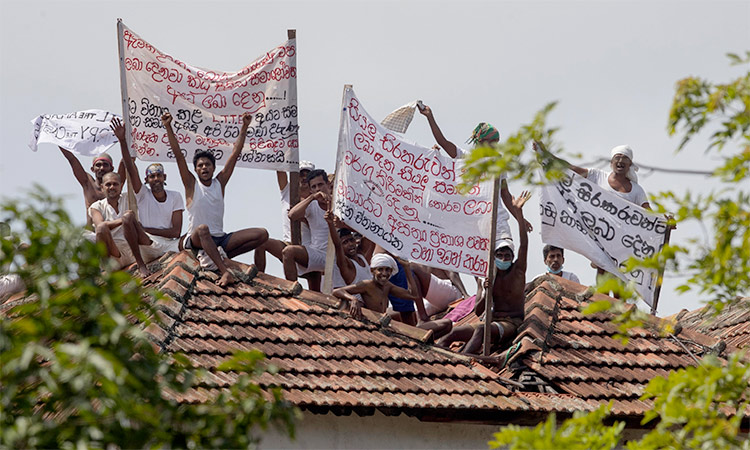
Death-row inmates of Sri Lanka’s Welikada prison protest holding banners from the roof of the prison in Colombo, Sri Lanka. File/ Associated Press
In stateless societies, the rule of law is usually suppressed. In such societies, people turn into unfree pawns as a result of worsening political conditions.
The arrival of anarchy to the island nation of Sri Lanka is due to a series of factors. It is mainly driven by the worsening domestic political environment, curtailment of democracy, weaponising and the exertion of undue influence on courts and Judiciary.
The recent political victimisation of neutral agencies is an attempt to rewrite rules by its politicians. In this backdrop the growing human rights conditions and arbitrary pardoning of criminals will weaken the rule of law. Such a dangerous tilt, away from democratic forms of governance will drag the nation towards an autocratic footing.
Democracies ‘can be dissolved in spectacular fashion like from a coup d’etat or a less dramatic but equally destructive manner’, argues Steven Levitz and Daniel Ziblatt in their book ‘How Democracies Die’. The slow and equally destructive death of democracy has arrived in Sri Lanka.
Sri Lankans were confined to their homes during the lockdown following the government’s ‘disciplinary project’, while the government was engaged in releasing a convict using a prison side door.
The pardoning of Duminda Silva, whose conviction the Supreme Court had upheld in 2018, undermines rule of law,” explains US Ambassador to Sri Lanka Alaina B Teplitz, referring to the Presidential pardon given to the former Member of Parliament and ally of President Gotabaya Rajapaksa. The former Justice Minister Thalatha Athukorala questions, Today, those found guilty of the most serious crimes in our law enjoy presidential protection while the judges and police officers who brought them to justice have targets on their backs.”
The Presidential pardon comes when the Sri Lankan government faces multiple challenges, especially weeks before the European Union (EU) has pinpointed the abuses of the Prevention of Terrorism Act (PTA) and growing human rights concerns in the country.
A warning to withdraw its GSP+ concession is already on the table. The Office of the UN High Commissioner for Human Rights (OHCHR) condemning the decision expressed concern that Presidential pardon of Duminda Silva, a former MP convicted of the murder of a fellow politician, is another example of selective, arbitrary granting of pardons that weakens rule of law and undermines accountability.”
Sri Lanka’s Bar association (BASL) questioned President Rajapaksa on the decision of the selection method and raised severe concerns on the administration’s position towards rule of law. The decision from the government was not an ad hoc decision. The release was carried out along with the release of several other PTA detainees. Why was such a decision taken especially at a time of significant external pressure?
Human Rights Concerns: In a lengthy televised address on June 25, days after the release of the former MP, Rajapaksa stated his progress in his development plan and continuous commitment to rule of law, not referring to the PTA nor the pardoning act. The new European Union Parliament adopting a resolution to withdraw the Generalised Scheme of Preferences (GSP+) is a clear warning to the Sri Lankan regime.
European Parliament adopted a resolution on June 10 calling for the repeal of Sri Lanka’s draconian Prevention of Terrorism Act (PTA).
Further, the resolution highlights Sri Lanka’s ‘alarming path towards the recurrence of grave human rights violations…accelerating militarisation of civilian governmental functions, the reversal of important constitutional safeguards, political obstruction of accountability, exclusionary rhetoric, intimidation of civil society, and the use of anti-terrorism laws’.
The regime has failed to address the human rights concerns adequately highlighted multiple times, and procrastination in its process is the reason for this action by EU Parliament. Earlier in March, the government rejected the UNHRC resolution, giving a clear signal of the government’s position of ‘no external interference’ towards the reconciliation process.
Ironically the real concern of many in the country is the absence of a reconciliation process. The departure from the internationally accepted process and continuous denial by the state on minority concerns is evident. The government has already lost its direction from a progressive path towards a more autocratic posture. The government’s denial and non-commitment will worsen the relationship with the EU and other western democracies.
GSP Benefits: Nearly 60 per cent of Sri Lankan exports benefit from preferential terms of trade from the EU’s GSP+ and US GSP schemes. The EU is Sri Lanka’s largest export market with 30 per cent of the total, while the US is the largest single export market at 27% of the total merchandise exports. Sri Lanka’s exports, including apparel, fisheries, ceramic, and rubber that uses the GSP concession, will be directly impacted. Sri Lanka has duty free access to 7, 200 products with the EU GSP+ Concession. It is estimated that the withdrawal of this concession would wipe out a significant chunk of foreign exchange earned through exports.
The present state of the economy with the pandemic has been a challenge to Sri Lankan exports ‘especially to the apparel industry’ admitted even by President Gotabaya in his recent address, and GSP withdrawal will add significant pressure to the Sri Lankan economy.
The government’s senior Ministers have ignored the GSP+ withdrawal warning saying that they are ready to move forward without the concession.
Democratic Stability: President Gotabaya’s regime has developed a norm towards weaponizing unfavourable outcomes towards their favour catering to the majoritarian Sinhalese Buddhist voter base. The outcome at the UNHRC resolution in Geneva in March, the EU GSP+ saying we can do without it or releasing a convicted parliamentary member for murder in the name of justice, is a move in the same direction. The political strategy of this administration is to cater to the majoritarian voter base by making claims of protecting the nation’s sovereignty from foreign interference. This narrow minded political strategy does not fit all cases when certain decisions have no relevance. The very act of convicting one regime and arbitrary pardoning from another regime is a sign of weakness, not a strength in the process. According to a senior political scientist in Sri Lanka, in the coming months, Sri Lanka’s judicial sector will undergo significant reforms along with continuous interference despite a promise to amend the constitution”.
When assessing Yale Professor Juan Linz’s work on ‘The Breakdown of Democratic Regimes’ and ‘How regimes paint a rather bleak picture of their ability to survive’, the Sri Lankan case provides ample evidence of the regimes domestic political behaviour to survive.
The public’s loss of trust in its democratic institutions is a visible characteristic that can have a long-term impact on the country’s stability. An essential ingredient according to Linz is ‘the belief in the legitimacy of democratic institutions as a factor increasing the likelihood of stability in a democracy’. The coming anarchy to the entire nation is in the breakdown of its democracy. This for sure will worsen economic conditions.
Buddhi Marambe, Senior Professor in the Department of Crop Science, Faculty of Agriculture, University of Peradeniya stated that it is not possible to get high yields from paddy and tea cultivations by applying only organic fertilizer.
Meanwhile, farmers in several parts of the country engaged in protests today (30) demanding the provision of fertilizer.
Meanwhile, farmers in several areas in the Kurunegala District, including Pannala and Kuliyapitiya, who have been cultivating using organic fertilizer, stated that they have obtained a successful harvest by using organic fertilizer for their crops.
The Epidemiology Unit of the Health Ministry reports that another 606 persons have tested positive for COVID-19 in Sri Lanka, moving the daily total of new cases to 1,786.
This brings the total number of confirmed cases of coronavirus reported in the country to 259,011.
As many as 225,952 recoveries and 3,077 deaths have been confirmed in Sri Lanka since the outbreak of the pandemic.
The Epidemiology Unit’s data showed that 29,606 active cases are currently under medical care.
The row between the authorities and the farmers over the ban on chemical fertilizer reminds us the Sinhala folktale Hathara Beeri Kathawa” in which a deaf man askes another deaf man a question to which the latter gives an answer which is nothing to do with the question. Here, farmers across the country demonstrate demanding fertilizer – chemical or organic – for their crops which have been severely affected by the government’s decision to ban import of chemical fertilizer, but the authorities deliver sermons on the effectiveness of organic fertilizer. Despite some experts having expressed their reservations on the efficacy of organic fertilizer in paddy, tea, and vegetable cultivations, farmers do not seem to insist on chemical fertilizer alone; they demand any fertilizer for their crops which they have made it clear during their demonstrations. However, State media and media supportive of the government are allocating a considerable segment of their news bulletins to educate the farmers on the effectiveness and advantages of organic fertilizer.
President Gotabaya Rajapaksa during his address to the nation on Friday said that he is determined to transform the current agriculture in the country into one based on organic fertilizer. He repeated it when he visited the Mahanayakes of the Malwatte and Asgiriya Chapters on Sunday. And now the issue has become political as the opposition parties too are joining the demonstrations or they are organizing the agitations in some areas. Sometimes this might turn the situation worse as there is a possibility of farmers being divided over the issue, despite them being economically affected. The sudden ban on chemical fertilizer import appears to have a drastic impact on the country’s food production which might be felt by the people in a few months, by way of shortage in rice and vegetables and a resultant price hike of them in the market.
Four views related to the current fertilizer debate seem to have floated among the people by interested parties. The government seems to be of the view that organic farming is flawless and the timing of the chemical fertilizer ban is also appropriate. Leaders of the government defend the move to stop the use of chemical fertilizer on the grounds of the negative consequences to human lives through pollution of lakes, canals and the groundwater while the impact on the health sector outweighs any benefits. On the other hand, farmers are desperate in finding fertilizer as they have already started cultivation and they are neither concerned nor aware of the efficacy or impact of organic fertilizer. They just need fertilizer, whether it is chemical or organic.
There are experts who argue that farming based only on organic fertilizer will affect the food security in the long run while there are others who are supportive of the government’s objective but have their reservations on the timing of the chemical fertilizer import ban. The first group contends that farmers are today cultivating hybrid varieties which depend on the use of chemical fertilizers and pesticides to sustain the output levels and with the ban on chemical fertilizer and pesticides Sri Lanka will have to spend foreign exchange for importing food items.
A committee appointed by the government also represents the second group. Plantations Minister Romesh Pathirana told our sister paper the Sunday Times last month that the experts committee tasked with overseeing the ban on chemical fertilizer imports has recommended to President Gotabaya Rajapaksa not to impose the ban on the tea and rubber sectors until sufficient quantities of organic fertilizer were available and to defer the withdrawal of the fertilizer subsidy until such time. The same paper quoted Dr. Hemakumara Nanayakkara, who holds a doctorate in organic fertilizer as saying that although the Government’s decision was in order, such policy decisions could not be implemented hurriedly and there should be a gradual process followed. It is clear that the ban on fertilizer imports has been implemented without a proper plan which is evident by the farmers’ agitations across the country. If they had been provided with whatever fertilizer they wouldn’t have wasted their time in carrying placards along the roads and across their paddy fields.
Agriculture Minister Mahindananda Aluthgamage said last month there is sufficient fertilizer for the current Yala season. And now he says traders have created a shortage by hoarding. A government cannot absolve itself by blaming traders, as it must be capable of managing the market. Claiming similarly that the rice mafia is hoarding rice, the government is planning to import 100,000 metric tons of rice. When an opposition MP questioned whether the rice that is to be imported was produced by the organic farmers, Aluthgamage said organic farming is not applicable to current Yala season. Then, why on earth the government banned imports of chemical fertilizer prematurely?
It is clear that there is an issue on the ground. It demands immediate action by the government in the light of the possible drastic drop in the local food production in the near future. This is evident by the country-wide farmers’ agitations which is not hallucination but real.
The Health Ministry says 389 more people have tested positive for COVID-19 today (June 29) increasing the daily count of positive cases to 1,709.
All new cases reported within the day have been associated with the New Year cluster, which recorded a total of 249,828 virus infections since mid-April this year.
The new development brings Sri Lanka’s confirmed coronavirus cases tally to 257,217.
According to official data, as many as 223,471 patients who were infected with the virus have regained health so far. Meanwhile, the death toll now stands at 3,030.
More than 30,000 active cases are currently under medical care at designated hospitals and treatment centres.
The Cabinet of Ministers approved the further extension of orders issued under the Foreign Exchange Act to control foreign exchange remittances outside the country.
Previously, orders were issued under Section 22 of the Foreign Exchange Act No. 12 of 2017 to suspend external remittances related to certain transactions, taking into account the possible negative impact on the country’s foreign reserves and foreign exchange market due to the Covid 19 epidemic.
The orders expire on July 1, 2021, and the Central Bank of Sri Lanka said the order should be further implemented to minimize potential risk in the foreign exchange market and maintain the stability of the financial system.
Accordingly, the Cabinet approved the proposal presented by Prime Minister in his capacity as the Minister of Finance to extend the orders issued under Section 22 of the Foreign Exchange Act No. 12 of 2017 imposing certain restrictions/prohibitions on foreign exchange remittances, for a period of further 06 months from 2nd July 2021.
A mix-and-match approach to COVID vaccines – using different brands of jab for first and second doses – gives good protection against the pandemic virus, a UK study has found.
The Com-Cov trial looked at the efficacy of either two doses of Pfizer, two of AstraZeneca, or one of them followed by the other.
All combinations worked well, priming the immune system.
This knowledge could offer flexibility for vaccine rollout, say experts.
The trial results also hint that people who have already received two doses of AstraZeneca vaccine could have a stronger immune response if they were given a different jab as a booster if recommended in the autumn.
The UK’s deputy chief medical officer, Prof Jonathan Van-Tam, said there was no reason to change the current successful same dose vaccine schedules in the UK, however, given vaccines were in good supply and saving lives.
But he says it might be something to look at in the future: Mixing doses could provide us with even greater flexibility for a booster programme, while also supporting countries who have further to go with their vaccine rollouts, and who may be experiencing supply difficulties.”
Some countries are already using mixed doses. Spain and Germany are offering the Pfizer or Moderna mRNA vaccines as a second dose to younger people who have already received a first dose of the AstraZeneca vaccine, following concerns about rare but serious blood clots, rather than about efficacy.
Two doses are important to give the fullest protection and teach the body to make antibodies and T cells to block and kill COVID.
The Com-Cov study, which looked at giving the doses four weeks apart in 850 volunteers aged 50 and above, found:
• AZ followed by Pfizer induced higher antibodies and T cell responses than Pfizer followed by AZ
• Both of these mixes induced higher antibodies than two doses of AZ
• The highest antibody response was seen after two doses of Pfizer, and the highest T cell response from AZ followed by Pfizer
Lead investigator Prof Matthew Snape, from the University of Oxford, said the findings did not undermine the UK policy of giving people the same jab twice: We already know that both standard schedules are very effective against severe disease and hospitalisations, including against the Delta variant when given at eight to 12 weeks apart.”
He said the new results showed mixed dose schedules were also effective, even though the interval of four weeks studied was shorter than the eight to 12-week schedule most commonly used in the UK.
This longer interval is known to result in a better immune response,” he added.
Mixed dose trial results for a 12-week jab interval will be available next month.
Autumn booster dose?
Meanwhile, another pre-print study, which also came out on Monday, suggests a third dose of AZ vaccine, given more than six months after the second, boosts the immune system.
But experts say it is too early to know if people will need a booster dose this year ahead of winter. It is unclear yet how much immunity might wane over time.
Prof Paul Hunter from the University of East Anglia said: The big question at present is whether or not we will be being offered booster vaccines in the autumn. With the evidence available from this and other sources, I suspect that will be likely for those most at risk from the virus, either due to age or being clinically vulnerable.”
He suggested people who have had a first course of AstraZeneca might be offered the Pfizer vaccine in as a booster rather than a repeat AstraZeneca, while people who had a Pfizer first course may not need an autumn booster, based on the evidence from the Com-Cov trial.
The War
crimes’ charge, with its wild claims of excessive deaths needed international
support. Therefore Eelamists pushed for ‘impartial’ reports on Eelam War IV
(2006-2009).The result was four reports which discussed the war crimes of Eelam
War IV.
They are
Report of
the Secretary-General’s Panel of Experts on Accountability in Sri Lanka (Darusman report), March 2011
the Commission of Inquiry on Lessons Learnt and Reconciliation, (LLRC report) November 2011
The Report on the second mandate of the Presidential Commission of Inquiry Into complaints of abductions
and disappearances (Paranagama
report) August 2015.
Report of the OHCHR Investigation on Sri Lanka (OISL report) September 2015.
LLRC REPORT.
The Commission of Inquiry on
Lessons Learnt and Reconciliation (LRRC) was appointed by PresidentMahinda Rajapaksa in May 2010.
The report was completed in November 2011, published in December 2011, and
tabled in Parliament.
The commission was asked to inquire and report on the following matters that may have
taken place during the period between 21st February 2002 and 19th May 2009,
namely;
The
facts and circumstances which led to the failure of the Ceasefire Agreement
operationalized on 21st February 2002 and the sequence of events that followed
thereafter up to the 19th of May 2009;
Whether any person, group or institution
directly or indirectly bear responsibility in this regard;
. The
lessons we would learn from those events and their attendant concerns, in order
to ensure that there will be no recurrence;
The methodology whereby restitution to pay
persons affected by those events or their dependants or their heirs, can be
effected;
The institutional, administrative and
legislative measures which need to be taken in order to prevent any recurrence
of such concerns in the future, and to promote further national unity and
reconciliation among communities and; to make any such other recommendations with
reference to any of the matters that have been inquired into under the terms of
the Warrant.”
These terms
of reference” call for comment. They imply that the Ceasefire Agreement, which
created an embryo Eelam, was acceptable.
Also that the Government of Sri Lanka was wrong in waging war and must
now pay reparation to the secessionists.
President Mahinda Rajapaksa should not have taken this position. As President of Sri Lanka, he is expected to
uphold the unity of the state.
The Eelam war
was a war of secession, between the
legitimate government of Sri Lanka and a bogus ethnic group, (‘Ceylon
Tamil’) occupying a critical parcel of
land (Trincomalee port, Pulmoddai sands, Mannar oil) and taking to arms with
the support of a foreign country. Such
civil wars, based on international power politics have taken place in many
countries. Eelam is part of this pattern.
Further, the
Tamil demand for secession was nothing
new and the Eelam war should not have come as a surprise. The call for Eelam
was made in the 1940s, soon after independence.
Tamil politicians created the Illankai Thamil Arasu Kadchi in 1949.”
Illankai Thamil Arasu Kadchi” (ITAK) means ‘Tamil State Party of Sri Lanka ‘.
Therefore in my view, the President should not have
appointed the LLRC. Not only were the terms of reference faulty, but they were
also too broad for one committee. The Commission did its best. It conducted
hearings and issued a report of 388 pages.
The report was heavily criticized by the Tamil Separatist Movement and
Sri Lanka does not seem to have acted
on it, either.
The
International Crisis Group was one of the many NGOs that were highly critical
of the LLRC report. The ICG is a
leading, hyper- active,
pro-Eelam NGO.
ICG said, The LLRC’s conclusions are
untenable for several reasons. First, it is obvious throughout the report that
it considered only the materials the government chose to place before it. There
was no independent assessment of the full scope of information in the
government’s possession – including all communications with the UN, ICRC and
sources in the conflict zone, as well as other evidence from government and
international sources, such as uncensored satellite images and footage from the
military’s unmanned drones. Similarly, the record before the LLRC is inadequate
to draw conclusions ruling out unlawful attacks when there are thousands of
witnesses who did not come forward, partly because of the lack of witness
protection, and when there is no indication that the LLRC had physical access
to the final war zone where most of the civilian casualties occurred. Those
areas have been off limits to everyone but the military since the end of
hostilities.” (end of quote)
DARUSMAN REPORT.
The second, report, Report of the Secretary-General’s Panel of Experts
on Accountability in Sri Lanka is known at the ‘Darusman report’ or ‘PoE report’. The panel consisted of Marzuki
Darusman, (Chairman) former Attorney General of Indonesia, Yasmin Sooka, High
court judge, South Africa and Steven R. Ratner, Professor of Law, University of
Michigan.
This Panel
was asked to advise the UN Secretary General on’ the modalities,
applicable international standards and comparative experience relevant to the fulfillment of the joint commitment to an
accountability process having regard to the nature and scope of the alleged
violations’. The Panel focused
on the period between September 2008 and May 2009 in the Eelam War IV as this
was the final military offensive.
The Panel was appointed by UN Secretary General Ban Ki-Moon in June 2010. The
Panel started investigation in September 2010 and the report appeared in September 2011. It is a voluminous report of nearly 200 pages, said analysts.
About 80 pages are appendices and the text is around 120 pages. The most
important section is p 20-51 where the Panel looks at allegations of war crimes
and human rights violations.
As soon
as he received the report, the Secretary General sent it on to the UN Human
Rights Council and the UN Office of the High Commissioner for Human Rights .
There, the report hit a snag. The report had not been authorized by the UNHRC or
any other UN body. UNHRC therefore
refused to recognize it as a UN document and
did not give it a UN document
number. The Darusman Report does not carry a UN document number.
Sri
Lanka had told the Secretary
General, well before he appointed the
Panel, that such a Panel could only be
appointed with the approval of either the UN Security Council, UN General
Assembly or the UN Human rights Council.Secretary
General took no notice.
There
is clearly a compelling motivation for the Secretary General of the UN to go to
such an extent in violating UN regulations, observed Neville Ladduwahetty. This step had been taken, perhaps with the
planned intent to serve the agenda of the member states on whose behalf the
Secretary General was acting. The
Secretary General is not going to take this step without some motivation.
Secretary
General initially said the Panel was set up only to advise him and that it was
not an investigative or even a fact finding body. However, the way the Panel
set about it, makes it clear that this was an investigation all right, said
Chandraprema. Allegations against the government are, that it killed civilians through wide spread
shelling, shelled hospitals and other
civilians objects, denied humanitarian
assistance and did not look after IDPs when the war ended.
The
main purpose of this Panel report was to legitimize the submissions made to the
Panel by interested parties, observed Ladduwahetty. This data would be the
groundwork for the next phase. That phase is unlikely to be through the
Security Council, because some of its
members will use the veto. So they will
probably go thought the Human Rights Council in Geneva, he concluded.
UN
Secretary General sent a copy of the Report to Sri Lanka.
The Government of Sri Lanka rejected
the report, saying it was fundamentally flawed. But the
Tamil Separatist Movement loved this report. It contained all the data and
utterances that the Tamil Separatist Movement needed.
The
Darusman Report became the basis of the ‘war crimes’ dances performed by the
Tamil Separatist Movement. Its contents have been quoted over and over again.
They were used in reports, declarations, statements and also in Channel Four
documentaries. The Darusman Report quickly became
part of the modus operandi of the Eelam project.
The Ambassador of
Switzerland to Sri Lanka Dominik Furgler called on Prime Minister Mahinda
Rajapaksa this morning at Temple Trees to hand over medical supplies donated by
the Government of Switzerland to Sri Lanka.
Commenting on the
Swiss relief provided to South Asian countries to help fight the pandemic,
including this donation to Sri Lanka, Swiss Foreign Minister Ignazio Cassis
earlier had said, We can only end this pandemic together – international
support is essential.”
Prime Minister
Rajapaksa thanked the People of Switzerland for the generous donation and
stressed the importance of continuing the already strong cooperation between
the two countries.
The humanitarian
assistance contained medical supplies amounting to more than US$ 4 million,
including oxygen concentrators, ventilators and Antigen test kits, among other
supplies, that would assist the Sri Lankan Government’s efforts in containing
the COVID-19 pandemic.
The two delegations
discussed the need to reactivate the Sri Lanka – Swiss Parliamentary Friendship
Association (SLSPFA) and conduct programs between parliamentary members of both
countries as has been successfully done in the past. Prime Minister Rajapaksa
handed over that responsibility to the current SLSPFA Convener MP Premanath C.
Dolawatta.
Ambassador Furgler
also expressed to Prime Minister Rajapaksa his Government’s interest in
assisting Sri Lanka enhance activities and services of the hospitality sector
as the world hopes to revitalize tourism in the near future.
By P.K.Balachandran/Ceylon Today Courtesy NewsIn.Asia
Colombo, June 28: Bangladesh, which has made a success of agriculture in the South Asian region, could be the model Sri Lanka should adopt for its fertilizer policy. To an appreciable extent Bangladesh has succeeded in regulating the use of chemical fertilizers while promoting the use of organic fertilizers. In other words, it has devised means to use both in a judicious manner to safeguard the environment while ensuring that agricultural production does not fall.
Despite having a huge population, Bangladesh has managed to overcome all odds to be among the world’s top 10 in 13 agricultural sectors. According to the US Department of Agriculture, in the 2019-20 fiscal year, Bangladesh produced 35.3 million tonnes of rice, the fourth highest production in the world. Bangladesh ranks third in vegetable production, producing 26.7 million tonnes annually. It is now sixth in potato production (965,000 tonnes per annum ). Bangladesh now ranks eighth in mango production producing 2.4 million tonnes a year.
Bangladesh has been making vigorous efforts to motivate farmers to use organic farming given the environmental and health hazards associated with chemical fertilizers and pesticides. But the Go Organic” movement has not really taken off.
A case study by Dr. Shaikh Tanveer Hossain on organic farming published in orgprints.org reveals that the availability of organic fertilizer has not kept pace with increases in farm area and farming intensity. This is because high yielding seeds, chemical fertilizers and pesticides are more easily available and farmers use credit to purchase these,” Dr.Hossain says.
Furthermore, landless and smallholder farmers depend on sharecropping, which forces them to maximize the short-term benefits accruing from using chemical fertilizers and pesticides, he adds.
Judicious Use of Chemical Fertilizers
Mahnaz Islam and Sabrin Beg in their paper Reducing Imbalanced Fertilizer Use Through ‘Rule-Of-Thumb’ Instructions in Bangladesh (www.povertyactionlab.org) say that chemical fertilizers are useful and benign when used judiciously. They contend that basic training on the quantity and timing of chemical fertilizer use has brought about a decline in chemical fertilizer use without losing out on yield.
In fact, yields have increased marginally, the authors point out.
Islam and Beg further say that these results are also due to the farmers’ decision to delay the application of fertilizers until later in the production process because returns on urea application were lower earlier in the planting cycle. Over use of fertilizers or using them at the wrong time could be disastrous, they point out.
Innovative technologies, which provide farmers with plot-specific information on when to apply nitrogen fertilizers, offer a simple solution to fertilizer overuse,” they say.
Urea, a nitrogen-based fertilizer, is the most used fertilizer in Bangladesh. Compared to other fertilizers, urea is particularly challenging to use, because the timing of the applications is crucial to respond to nitrogen deficiencies at critical times in the production process.”
Farmers can identify the crop’s nitrogen requirements by the color of its leaves.
In the controlled experiment conducted by the researchers, program farmers increased their rice yield by about 1.8 kilograms per forty square meters of land. For farmers with an average plot holding, this meant an increase in revenue of about US$ 22.30. Researchers interpret the increases in yields as evidence that overall productivity improved.”
A possible explanation could be that farmers shifted fertilizer application to a period in the planting cycle where applying fertilizer had a high return, which allowed them to use less fertilizer overall. The program was cost-effective when applied over two or more seasons.”
And assuming no change in yield, every US$ 1 spent on the intervention would generate a return of US$ 1.80 through urea savings over two seasons and US$ 2.80 over three seasons,” the authors point out.
Sri Lankan Scenario
As far as the Sri Lankan scenario is concerned, the government has stopped the import of chemical fertilizers citing health and environmental reasons as well as the severe foreign exchange shortage created by the on-going economic downturn.
The government has rejected experts’ pleas for a step by step” approach to the change-over or the adoption of a mixed chemical-organic fertilizer use policy. It has ignored the argument that an overnight change would be impossible to implement and that the change-over itself would hurt agriculture instead of fostering it.
Experts’ Case
The Sri Lanka Agricultural Economics Association (SLAEA) had warned that a complete switch–over will result in a 25% fall in paddy yield and the profitability of paddy farming will be reduced by 33%. Coconut yield will be down by 30%. But a mixed conventional-organic system will increase paddy profitability by 16%.
A complete switch–over at this juncture will see tea productivity going down by 35%, and tea export will decline from 279 million kg to 181 million kg.
In their paper on the world organic farming scene in the journal Review of Resource Economics (October 2018), Eva-Marie Meemken and Matin Qaim of Gottingen University, Germany have said that across all crops, the gap in the yield of organic agriculture ranges between 19 and 25%.
Organic fertilizers are found to be limited in nitrogen and phosphorus. The release of plant-available nitrogen from organic sources is slow and can often cannot keep up with the nitrogen demand during peak crop growth periods. Organic systems are also more susceptible to pest outbreaks because of the ban on the use of chemical pesticides.
Since chemical weedicide cannot be used in organic farming, weeding has to be done one manually. It is both labor-intensive and expensive.
Production costs in organic farming is higher. On an average, organic products are 50% more expensive than conventional products, the authors say. Therefore, the universal goal of giving the masses food security will not be achieved.
Organic Fertilizers Can Pollute
Sri Lankan soil scientist Dr.Warshi S. Dandeniya and her collaborator Serene Caucci, say in their paper: Composting in Sri Lanka: Policies, Practices, Challenges, and Emerging Concerns (www.link.springer.com) that organic fertilizers are not as clean and non-polluting as claimed. They could also pollute the soil.
They point out that organic fertilizers commonly called ‘compost’ could be carriers of potentially toxic trace elements. The progressive accumulation of toxic trace elements such as lead and cadmium in soils has been reported in several studies where there has been a long-term application of compost produced from Municipal Solid Waste (MSW). Poultry litter/manure is a source of antibiotic resistance determinants and, therefore, imposes a silent threat to environmental quality and health. And night soil (human faeces) could also get mixed up with organic fertilizer,” the scientists say.
Generally the application of compost technology has not been very successful in Asian cities because segregation of ‘waste-at-source’ is poor in these cities, the authors say. The raw garbage here is full of contaminants such as heavy metals, glass, inert materials, and plant and animal pathogens. Larger scale composting plants receive a large volume of mixed waste with contaminants, the authors point out.
Therefore, the choice cannot be between chemical fertilizers and organic fertilizers as both have advantages and disadvantages. The answer lies in a judicious use of both and also a measured and scientific use of chemical fertilizers to get the maximum yield out of minimal use.
The Health Ministry says 640 more people have tested positive for COVID-19 today (June 28) increasing the daily count of positive cases to 1,850.
Earlier this evening the ministry confirmed 1,210 more positive cases of novel coronavirus.
The new development brings Sri Lanka’s confirmed coronavirus cases tally to 255,508.
According to official data, as many as 221,249 patients who were infected with the virus have regained health so far. Meanwhile, the death toll now stands at 2,985.
More than 31,315 active cases are currently under medical care at designated hospitals and treatment centres.