Several countries which are pro-Eelam have prevented senior military officials of the Sri
Lanka army, from attending prestigious foreign courses and receiving
scholarships, citing unsubstantiated
war crimes accusations. Maj. Gen Jagath
Dias was not allowed to join an ICRC project in Australia. US refused to accommodate Maj. Gen. Sudantha
Ranasinghe, on a programme as he commanded the elite 53 Division. The 53
Division had killed LTTE leader Prabhakaran.
The International Truth and Justice Project (ITJP) created
dossiers of war crimes for the senior officers who led the final assault in
Eelam War IV. ITJP had dossiers on
Shavendra Silva, Kamal Gunaratne, Jagath Jayasuriya and Jagath Dias. Shavendra Silva’s dossier had information on
his four deputies in the 58 division as well.
Three retired
service commanders, Air Chief Marshal Roshan Goonetileke, Admiral Tisara
Samarasinghe and General Daya Ratnayake, called a special media briefing in
Colombo at the Sri Lanka Foundation Institute in February 2019, to bring to
public attention what they called a relentless campaign directed against some
individuals in the army.
General
Ratnayake said that they were seriously concerned about the ongoing operation
targeting the military. Since the change
of government, in January 2015, 67 army officers and 637 other rankers had been
investigated. The number of officers and other ranks (Army and Navy) arrested
during this period was placed at 15 and 35, respectively. Seven Army and Navy
personnel are currently in custody. One officer and one soldier have been
sentenced to death. He said it was not the policy of the army to deliberately
target civilians. The war winning military was being [unfairly] penalized.
These retired service commanders expressed
concern over the attempt to take wartime Navy Commander Admiral Wasantha
Karannagoda into custody regarding some wartime disappearances (2007-2008). They
praised the role played by Admiral Karannagoda during the conflict. Karannagoda
changed the naval strategy in place at the time and had also taken action to
destroy the floating LTTE arsenals on high seas.
Director of the State Intelligence Service (SIS) Maj. Gen. Suresh
Sallay has sent a Letter of Demand to Executive Director of the International
Truth and Justice Project (ITJP) Yasmin Sooka and the ITJP for making malicious
allegations against him. The letter of demand states that on or about June 01,
2020, Yasmin Sooka, in her capacity as the Executive Director of the ITJP
issued a press statement making various defamatory remarks against Major General
Sallay. The press statement was published on the ITJP Sri Lanka’s website.
The Letter of Demand says the defamatory implications have
resulted in parties with vested interests making attempts on the life of Maj.
Gen. Sallay. The Letter mentions the numerous
awards and achievements of Major General Sallay and the resultant tarnishing of
this reputation. He asks for Rs 1
million as damages. The Letter of Demand has also notified Sooka and the ITJP
to cease and desist from issuing further defamatory remarks if they continue to
do so, Sallay would take legal action, both Civil and or Criminal.
Lawyers
representing Maj. Gen. Suresh Sallay also handed over a letter to UN office in
Colombo complaining about a propaganda campaign carried out by Yasmin Sooka of
the ‘Truth and Justice’ Project against Sallay.
Major General
Chagi Gallege, then Director General, Infantry was refused a visa to visit his brother in
Australia, due to ‘war crimes.’ Australia has found fault with Gallage for
being in command of the 59 Division from May 7, 2009 to July 20, 2009 when it was engaged in the Vanni offensive. Australian
High Commission stated that troops under his command certainly committed war
crimes and crimes against humanity. There have never been specific allegations
against Maj. Gen. Gallege before. Gallege has now retired from service, but the
Australian ban remains.
The
Australian Department of Immigration and Border Protection has extensively
cited Report of the OHCHR (Office of the High Commissioner for Human Rights) on
Sri Lanka (OISL) to turn down Gallege’s visa..Australia has cited a statement
attributed to General Officer Commanding (GOC) 58 Division Maj. Gen. Shavendra
Silva that unmanned aerial vehicles (UAVs) real time footage had been made
available to ground commanders marking targets, to justify its decision. On the
basis of Maj. Gen. Silva’s statement, Australia has alleged that Maj. Gen.
Gallege had been aware of artillery strikes on third no fire zone.
.Australia has accused Maj. Gen. Gallege of planning, implementing
and supporting war crimes and crimes against humanity. Australia also held him
responsible as the serving officer for failing to prevent troops under his
command from committing war crimes.
Sources pointed out that the decision to accuse Maj. Gen. Gallege
of crimes against humanity meant that Australia believed that the Sri Lankan
army carried out systematic attacks against Tamil civilians. The High
Commission ignored the fact that none of the allegations had been proved in a
court of law or at least thoroughly examined, said critics.
Chagi Gallage was in the forefront of the war against the LTTE. He is
acknowledged widely as a very good soldier. He
is considered one of best strategists in the army. He discharged his duties on
the battlefield with distinction. He was
a simple and humble officer, who did not throw his weight about and
was liked by both officers and the ranks.
Gallage’s predicament did not receive the media attention it
deserved. Neither Parliament nor nationalist
groups took up the matter. An ungrateful Sri Lanka never bothered to make
representations on behalf of an officer who risked his life for his motherland
on countless occasions as a frontline infantry officer, said analysts. They
observed that while a legitimate army was being targeted for defeating the LTTE,
the LTTE had been given safe haven in many parts of the world. (Continued)
It is not only the government that defended the move, but also Jaffna-based fisher cooperatives.
Days after Tamil Nadu fishermen protested Sri Lanka’s efforts to build an artificial reef off Delft island, west of Jaffna peninsula, authorities defended the move aimed at enhancing fish breeding”.
Last week, Sri Lanka’s Department of Fisheries and Aquatic Resources, with the assistance of Navy, launched a project, dropping around 20 discarded buses into the sea off Delft, as was earlier done in other parts of the island nation, including the eastern Trincomalee district, officials said.
Many countries, including India, have in the past created artificial reefs to facilitate fish spawning. Old train carriages were used in the US, for instance,” Cabinet Minister for Fisheries Douglas Devananda, who represents Jaffna district in parliament, told The Hindu. The move was backed by research undertaken by Sri Lanka’s National Aquatic Resources Research and Development Agency (NARA), he said.
By objecting to an initiative in Sri Lanka’s territorial waters, Tamil Nadu fisher leaders have only exposed themselves as parties interested in fishing illegally in the Palk Strait,” he said, referring to the long-persisting Palk Bay fisheries conflict.
Persisting problem
Scores of Tamil fishermen living in the war-affected northern and eastern districts of Sri Lanka have, for over a decade now, been protesting Tamil Nadu fishermen’s use of destructive bottom trawlers along their coast, severely impacting the marine ecosystem and their post-war livelihoods. Despite ongoing bilateral discussions and several rounds of talks between fishermen of both countries, Tamil Nadu fishermen are yet to meet northern Sri Lankan fishermen’s consistent demand that they stop bottom-trawling in their seas. On the other hand, Tamil Nadu fishermen have accused the Sri Lankan Navy of attacking and killing fishermen — allegations that the Sri Lankan side denies.
Meanwhile, members of the All Mechanised Boat Fishermen Association, held a protest in Rameswaram last week, urging Sri Lanka to stop dropping iron scrap” into the sea, since would affect” marine ecology in the Palk Strait, and also damage” their own boats and nets.
In a tweet indicating Sri Lanka sees its recent initiative also as a deterrent to bottom-trawling, State Minister of Fisheries Kanchana Wijesekera said while the artificial reef would boost fish spawning, it will also act as a shield against bottom line trawling conducted illegally by the #Indian Fishermen”.
It is not only the government that defended the move, but also Jaffna-based fisher cooperatives. This initiative is aimed at helping our livelihoods by increasing fish production, and that is why we have welcomed it. We condemn certain sections of fisher leaders in Tamil Nadu opposing the move,” said Annalingam Annarasa, leader of the federation of fisher cooperative societies in Jaffna.
The statement put out by SLPP (Sri Lanka Podujana Peramuna) General Secretary Sagara Kariyawasam, critical of Energy Minister Udaya Gammanpila over the latest fuel price hike, laid bare once again factions and frictions in the government .
It is commonsense that the fuel price hikes cannot be enforced without sanction of the Finance Ministry. The subject ministry can make recommendations, but it is finally the collective decision of the government under usual circumstances. The recent spike of fuel prices to reflect increases in the world market is no exception to the rule. It, however, added to the woes of people who are already battered by the pandemic-related restrictions in pursuit of their livelihood activities. A public outcry is naturally expected against the fuel price revision, a move having ripple effects in various sectors of the economy.
“The Prime Minister is the leader of the SLPP. In reality, its political activities are operated by its National Organizer Basil Rajapaksa. Therefore, the story in the rumour mills is that Mr. Kariyawasam worked out this statement at the behest of Basil Rajapaksa”
The SLPP is the governing party. Therefore, it would have been privy to circumstances that led to the upward revision of fuel prices. Still, Sagara Kariyawasam released this statement trying to blame the price revision solely on Minister Gammanpila. The government came under severe criticism by the general public after the price hike which will result in the rise of cost of living at the end. Already, the prices of bakery products have gone up, and, so will be passenger transport fares. Mr. Kariyawasam, would have attempted to palm off the responsibility on one minister, absolving the government of it. The SLPP General Secretary, in his statement issued under the party’s letterhead said Minister Gammanpila’s approach only led to the government increasing the prices.
Nevertheless, facts are facts. It is the collective decision taken by the government through the cost of living committee chaired by President Gotabaya Rajapaksa and Prime Minister Mahinda Rajapaksa. As such, the Minister had the valid points to counter Mr. Kariyawasam’s statement. He did it with vigour at a press conference the very next day. Besides, he got a shot in the arm when the President’s Office also defended the fuel price revision. The President’s Media Division (PMD) issued a press statement justifying the decision. The PMD said a spike was warranted by the present local and global economic realities.
No matter what, the blame game amply displays internecine warfare within the government. The SLPP has been at loggerheads with its minor allies such as Minister Gammanpila’s Pivithuru Hela Urumaya (PHU) and Industry Minister Wimal Weerawansa’s party for some time. It turned out to be obvious particularly when the 20th Amendment to the Constitution was enacted last year. In some instances, the leaders like Minister Weerawansa became of the subject of vilification and slander by the SLPP legislators, particularly the newcomers, both in and outside Parliament. The latest incident on the fuel price is just an amplification of strife between the SLPP and its allies.
“Samagi Jana Balawegaya (SJB), the main opposition, has responded to the situation by opting to move a no confidence motion against Minister Gammanpila. For the SJB, as a force opposed to the ruling side, have reasons for such a step”
The alliance partners have now formed into a group to muster collective strength to respond to the SLPP. Eight such parties came out with a statement condemning Mr. Kariyawasam’s statement. The Prime Minister is the leader of the SLPP. In reality, its political activities are operated by its National Organizer Basil Rajapaksa. Therefore, the story in the rumour mills is that Mr. Kariyawasam worked out this statement at the behest of Basil Rajapaksa. Senior SLPPers such as Agriculture Minister Mahindananda Aluthgamage gave rise to such speculation. No one has yet denied such involvement of Mr. Basil Rajapaksa who is currently in the United States. Finally, the SLPP had to eat humble pie when it became established that Mr. Kariyawasam’s statement was unacceptable.
At a press conference on Tuesday, State Minister Arundika Fernando extended an apology to Minister Gammanpila. It looks like that Mr. Kariyawasam is isolated with no one for his defence in the case. Now, Samagi Jana Balawegaya (SJB), the main opposition, has responded to the situation by opting to move a no confidence motion against Minister Gammanpila. For the SJB, as a force opposed to the ruling side, have reasons for such a step. First, it can take the government to task both on the fuel price region during the debate on the no confidence motion once it is placed before Parliament. Likewise, the debate will afford the main opposition and others to mock at the government over its internal squabbling.
“The SLPP is the governing party. Therefore, it would have been privy to circumstances that led to the upward revision of fuel prices. Still, Sagara Kariyawasam released this statement trying to blame the price revision solely on Minister Gammanpila”
But, it is difficult to win the motion unseating the Minister from office since it is nowhere near the required majority. The opposition will raise tricky questions which the government will find it difficult to answer convincingly. The SJB legislators will sneer at the government benchers during the course of the debate, for sure. However, despite differences among its own ranks, the government is not placed to allow the no confidence motion against one of its own ministers being adopted by Parliament. As such, the government will forget all differences and act for the defeat of the motion if it is put to a vote in the House. In that sense, it will be a factor that unifies the otherwise different of voices of the government.
The concerns have been raised to such an extent over the contradictory figures on COVID-19 deaths and cases in the country that medical experts claim that to be a conspiracy.
Government Medical Officers Association (GMOA) President Dr. Anurudda Padeniya voiced against the controversy over COVID-19 figures.
I say with responsibility that there is a conspiracy behind it. Data are not released by the Epidemiology Unit. Three officials are also behind it,” Dr. Padeniya stressed.
The Epidemiology Unit has been entrusted with six responsibilities such as surveillance, outbreak control, vaccination, clinical managed coordination, operational research and monitoring and evaluation,” he said.
Dr. Padeniya expressed these views before President Gotabaya Rajapaksa at a recent COVID-19 Task Force meeting at the Presidential Secretariat.
Meanwhile, when asked of this, Director General of Health Services Dr. Asela Gunawardena said it was not possible to conclude that there is a conspiracy behind this but there had been some issues with the figures.
In addition, the Daily Mirror at an earlier occasion noticed that there was a considerable gap between the figures on COVID-19 in the Health Ministry and Epidemiology Unit websites.
However, when we later inquired about this from Deputy Director General of Health Services Dr. Hemantha Herath said the Epidemiology Unit would look into the matter as the issue had occurred from their side.
Subsequently, the figures were rectified.
In such a situation, Chief Epidemiologist Dr Sudath Samaraweera was transferred to the Dengue Control Unit as its Director.
One way of erasing the Eelam victory is by declaring that the
officers, who led the military campaigns, had committed war crimes. Critics observed that army officers who led
front line fighting formations in the Eelam war were relentlessly pursued on
the basis of unsubstantiated war crime allegations, not proved in a court of
law.
On 19 May
2009, the Sri Lankan military effectively concluded its 26-year operation
against the LTTE. The 58 Division of the Sri
Lankan Army led by Brig. Shavendra Silva, 59 Division led by Brig.
Prasanna de Silva and the 53 Division commanded by
Gen. Kamal Gunaratne, after having boxed in the remaining LTTE cadres into a
small area of territory near Nandikadal
lagoon. The battle for the last patch of LTTE held territory was led by
Brig. Shavendra Silva, one of the Gajaba Regiment veterans handpicked by Lt.
Gen. Fonseka for the Vanni offensive.
Shavendra
Silva commanded the celebrated formation that killed the most number of
terrorists, recovered the most number of weapons and brought the large parts of
western and eastern Vanni under government control, said Major General Chagi Gallege.
Shavendra
Silva refused to join the peacekeeping mission to Haiti, despite the financial
benefit that would result, as he thought he should remain on the battlefield at
the height of operations. The offer of Haiti was probably
made to remove this capable officer from the war campaign.
The 58 Division
was Sri Lanka’s most successful fighting Division. It was not only the best,
but the youngest Division which fought alongside eight other formations on the
Vanni front paving the way to the final battle.
The 58 Division, formerly known as the Task Force I, played a
significant role in eradicating the LTTE’s conventional fighting capability in
the Vanni region. It fought its way from
Mannar to Vellamullivaikkal -a distance of 201 kms. No other fighting formation
had even come close to challenging the 58 Division’s record, though the
battlefield success was due to the combined efforts of the armed forces, said
Shamindra Ferdinando.
The 58 Division’s biggest achievement was the unprecedented
operation at Anandapuram, where it killed over 600 LTTE cadres, including the
most experienced LTTE commanders. The operation conducted together with 53 Division,
helped hasten the collapse of the LTTE.
Shavendra
Silva who led the 58 division became the main target of those prosecuting war crimes.
Shavendra Silva was targeted as a ‘war criminal’ by the International Truth and
Justice Project, Sri Lanka (ITJP) administered by the Foundation for Human Rights, South Africa,
under the direction of Yasmin Sooka.
In 2017, Yasmin Sooka in her capacity as the Executive Director, ITJP
wrote to Coca Cola Company critiquing it for sponsoring Gajaba Supercross 2017
held at Saliyapura, Anuradhapura in August that year. The Gajaba Regiment was
responsible for war crimes and human rights violations over the past several
decades and Shavendra Silva was its Commander.
Sooka wanted to know why Coca Cola financed an event organized by this
notorious war criminal.
In 2019, ITJP
released a defamatory 137-page dossier on Shavendra Silva, (Shavendra Silva
chief of army staff, Sri Lanka .Dossier29 January 2019) containing data cobbled
together from media reports. It is not a document that will be taken seriously
in a court of law.
ITJP
however is very proud of the document. This Dossier presents the most detailed
body of evidence against any Sri Lankan military figure to date, said ITJP. It amalgamates photographs, contemporaneous
SMS and witness testimony, including from insiders, with linkage evidence in
the annexures, such as official Army releases which were deleted offline after
the War to hide the truth, as well as relying on the findings of past UN
investigative reports. It also presents
a legal analysis of the evidence gathered, knowing that a more detailed
examination would be needed to frame criminal charges.
There is a tremendous amount of
evidence in this dossier, meticulously collected by my team over many years,
said Sooka. This dossier is just a fraction of the information we hold. Many
successful cases at international tribunals and the International Criminal
Court had less to work with. There is now no excuse for this man to remain as
number two in the Sri Lanka Army: he must be suspended immediately and a criminal
investigation instituted, she said.
ITJP said Shavendra
Silva was arguably the most important frontline ground Commander in the 2008-9
War in Sri Lanka, in which war crimes were committed. There are reasonable
grounds to believe that Major General Shavendra Silva committed war crimes
either directly by ordering them or by failing to prevent his troops from
committing them.
Given the evidence set out in this
report and the findings by the OISL, Major General Shavendra Silva can and
should face charges of war crimes of rape, torture and outrages upon personal
dignity, as well as torture as a separate crime, committed by troops under his
effective command and control. There are reasonable grounds to believe that he
knew or had reasons to know about these crimes and even then failed to prevent
the crimes from occurring and punish those responsible, said ITJP.
Silva commanded a large number of
troops throughout the offensive in the north of the island he was instrumental
in the attacks on all the strategic towns and villages in 2009. He was also
personally present at the white flag surrender at the end of the War, when hundreds
of Tamils disappeared in Army custody and others, including women and children,
were subjected to summary execution, continued ITJP.
Shavendra
Silva’s troops fought in almost every major battle during this phase – in
Mannar, Pooneryn, Kilinochchi, Paranthan39, Tharmapuram, Vishwamadu,
Thevipuram, Puthukkudiyiruppu (PTK), Iranapalai, Ananthapuram, Pokkanai,
Putumattalan, Valayanmadam and finally Mullivaikkal. The UN report from 2015
also confirms the 58 Division’s presence in these locations.
Shavendra
Silva’s troops were instrumental in the attacks on all the strategic towns and
villages in 2009. He was also personally present at the surrenders at the end
of the War, at which point hundreds of Tamils disappeared in Army custody and
others, including women and children, were subjected to summary execution.
The ITJP
report also said the following:
Silva has never been held accountable for his role in crushing
the Janatha Vimukthi Peramuna uprising” in the late eighties.
An insider witness reported that Silva was the officer who ordered
attacks on Kilinochchi while there was still an international presence in the
town. These attacks resulted in civilian casualties and extensive damage to the
hospital and the UN compound
Based on the evidence set out in this report, the Sri Lanka Army
was responsible for shelling the Kilinochchi Hospital and the UN base in town
knowing that civilians were inside, which resulted in civilian casualties and
damage to the UN buildings and the hospital.
The evidence in this report confirms that troops under the
effective command of Major General Silva were involved in the military
operations in Pokkanai
The MOD Situation Reports provide further corroboration that the
58 Division was directly involved in the military operation in PTK – a small
town in the Vanni, spearheaded by Gajaba Regiment veteran Brig. Shavendra
Silva.”
The OISL found reasonable grounds to believe the 58 Division was
among units that repeatedly shelled Putumattalan Hospital
Similarly, as corroborated by the Sri Lanka Army MOD Situation
Reports, in late April 2009 the 58 Division was involved in the military
operation in Valayanmadam. The evidence gathered indicates that shelling, tanks
and cluster munitions coming from the Sri Lanka Army side were used in the
attack against Valayanmadam, including at the church
There are reasonable grounds to believe that Shavendra Silva’s
troops were involved in attacks against the hospital and the church in
Valayanmadam which resulted in the civilian casualties and damage to the church
and the hospital.
The presence of the 58 Division in Mullivaikkal and surroundings,
where daily intense bombardment by Sri Lanka Army artillery, the air force and
navy was reported, has been further corroborated by MOD Situation Reports
Several LTTE members were shot dead in the ‘White Flag Case’ where
they surrendered to his Division. Eye witnesses placed Silva on site and claim
he even shook hands with the LTTE political wing leaders who surrendered on 18
May 2009, only to be summarily executed shortly thereafter.
The evidence demonstrates that troops under the effective control
of Shavendra were present at the Wadduvakkal Bridge, where according to the
available evidence, hundreds of surrendering LTTE military and political
leaders and their families were subjected to summary execution and arbitrary
detention, as well as enforced disappearance.
Shavendra Silva is quoted as having said: Our aim was not to gain
ground but to have more kills.
In light of
the above, there are reasonable grounds to believe that the 58 Division under
the effective military command of Major General Shavendra Silva violated
international humanitarian law by failing to distinguish between civilians and
LTTE fighters as well as between civilian objects and military objectives said
the Dossier.
The Dossier concludes
by suggesting Sri Lanka should a) immediately suspend Shavendra Silva from
service pending investigation. b) The Attorney General of Sri Lanka should
immediately institute an investigation of the allegations of grave crimes made
against Shavendra Silva with a view to prosecuting him. c) UN Member States should either impose a
travel/visa ban on Shavendra Silva or move to arrest him under universal
jurisdiction if he enters their territory. He should not under any
circumstances be granted immunity d). The United Nations should cease all
peacekeeping deployment from Sri Lanka so long as its Army is overseen
Shavendra Silva, who is one of the world’s worst alleged war criminals
Instead, Shavendra Silva was appointed as Sri Lanka’s Deputy
Permanent Representative to UN, 2010-2015. Though the attempts at preventing
Silva’s appointment to the UN failed, a consolation of some sorts was achieved
when Silva was debarred from participating in meetings of the Special Advisory
Group related to UN peace keeping missions of which he was a member
representing the Asian group of countries said Global Tamil Forum.
The chairperson of the Group, Louise Frechette, a former UN Deputy
Secretary General, informed Silva that his participation in the Group was
‘inappropriate’ and advised him to keep away from all ‘deliberations’ of the
panel. A law suit
was filed against Silva by the relatives of Tamil victims in the District Court
of the Southern District of New York.
Silva returned
to Sri Lanka at the end of his term in
the UN and In January 2019 Silva was
promoted to Chief of Staff of the Sri Lankan Army. In August 2019 he was
appointed Commander of the Sri Lanka army.
The appointment was made because he was the senior most serving military
officer and there are no proven allegations of human rights violations against
him, the government explained. The appointment was one made by the Head of
State and the government will not tolerate criticism, Sri Lanka said. Any
criticism is unwarranted and unacceptable” .
But there was
a chorus of disapproval from several directions.
There was opposition from UN Secretary-General
Antonio Gueterres, United Nations High Commissioner for Human Rights. Michelle
Bachelet the European Union (EU), UN human rights
experts including Bernard Duhaime, and Tae-Ung Baik of the Working Group on Enforced or
Involuntary Disappearances, and High Commission of Canada in Sri Lanka. They
all said that Shavendra Silva should not have been given this appointment, given
the allegations of grave human rights and humanitarian law violations against
him.
Global Tamil Forum (GTF) urged UN Human Rights Council (UNHRC to
take action in respect of wartime General Officer Commanding 58 Division Maj.
Gen. Shavendra Silva receiving appointment as the Chief Staff of the Army.
Among all the Sri Lankan military officers implicated in war
crimes, Silva is perhaps the most well-known. In many ways, he symbolized war
crimes and committed by the Sri Lankan armed forces during the last stages of
the war, said the GTF. The Tamil National Alliance also protested.
The
International Truth and Justice Project (ITJP) has described Major General
Shavendra Silva’s appointment to the post of Army Chief as a move which
immensely” damages the country.The ITJP Executive Director Sooka also noted
that the appointment could affect US assistance to Sri Lanka, since the Leahy
Laws in the US, prohibits it to provide military assistance to foreign security
units which violate human rights with impunity”.
Major
General Silva of course is not alone in being promoted post-War –there is a
pattern of rewarding, honoring and promoting alleged perpetrators, deploying
them in prestigious UN jobs, as diplomats and in the former conflict areas to
administer the very people they defeated. This is a text book case of impunity,
ITJP said.
The United
States Embassy in Colombo said The United States is deeply concerned by the
appointment of Lt. General Shavendra Silva as Army Commander. The allegations
of gross human rights violations against him, documented by the United Nations
and other organizations, are serious and credible. This appointment undermines
Sri Lanka’s international reputation
US Ambassador to Sri Lanka, said It is only
an articulation of our concerns” and should not be seen as interference in
the affairs of another country or an attempt to dictate who should be appointed
to key positions. “The allegations
of gross human rights violations against Lt.Gen. Silva, documented by the
United Nations and other organizations are serious and credible,” she
noted.
In 2020, the USA showed its disapproval by prohibiting Silva and
his family from entering USA. The New York Times noted that this travel restriction was the first significant international
penalty to be imposed on a Sri Lankan official over atrocities committed during
Eelam War IV. Human Rights Watch welcomed the travel restriction and urged the
European Union and Britain to consider similar sanctions against Silva and
others accused of wartime violations.
Government of Sri Lanka, for once, did not take this lying down. Foreign
Ministry asked USA to review its
decision to impose travel restrictions on Shavendra and his immediate family.
Sri Lanka ambassador to US said imposing a travel ban on Lt. Gen.
Shavendra Silva based on allegations is regrettable and contrary to the
principles of natural justice ” Even members of his family who have not
been accused of any wrongdoing, have been subjected to a collective punishment
reminiscent of the practice in medieval Europe.” .
Just as much as the U.S. is proud of the men and women of their
armed forces, Sri Lanka is no different. We also have war heroes. Sri Lanka’s proud security forces completed
the task assigned to them by a democratically elected administration.
“Lt. Gen. Silva was
one of the senior military officials who contributed significantly to liberate
Sri Lanka from terrorism over a decade ago, and it is disappointing that a
foreign government should question the prerogative of a democratically elected
President to call upon persons of proven expertise to hold key positions on national
security related matters the Ministry said. Government of Sri Lanka said it will remain strongly engaged on this issue with the
United States to have it review its decision.
In 2021 the
International Truth and Justice Project (ITJP) said it had compiled a 50-page
dossier on General Shavendra Silva, which it has submitted to the Sanctions
Department of the UK’s Foreign, Commonwealth and Development Office. The
Submission argues why Silva, who is Sri Lanka’s current Army Commander, should
be designated under the United Kingdom’s Global Human Rights (GHR) Sanctions
Regime established on 6 July 2020. . The Submission also looks at Silva’s
alleged involvement in torture and sexual violence, including rape.
We have an extensive archive of evidence on
the final phase of the civil war in Sri Lanka, meticulously collected by
international prosecutors and lawyers. The testimony of victims and witnesses –
many now in the UK – was vital in informing this Submission, and making the
linkages to Shavendra Silva and those under his command,” said Yasmin Sooka.
UK
designation would be another significant step forward. 11 British
parliamentarians had wanted to know, in Parliament, why the UK government had
not applied sanctions against Sri Lankan military figures, including Shavendra
Silva, who was named six times in this context.
Shavendra
Silva denied all allegations of human rights violations. Everyone knows the truth about these allegations. I
will not personally respond to them. The Foreign Ministry will do so, he said.
Government of
Sri Lanka said, Sri Lanka has consistently refuted the credibility of the false
and unsubstantiated allegations leveled against Lieutenant General Shavendra
Silva, the present Commander of Sri Lanka Army and Actg. Chief of Defence Staff
(CDS).
Sri Lanka
considers that the continued arbitrary accusations made against Lt. Gen. Silva
in OHCHR Reports and elsewhere, are unacceptable and a violation of the
principles of natural justice. We also stress that there are no proven
allegations against individuals on war crimes or crimes against humanity in the
OISL report or in any subsequent official document. It is an injustice to
deprive any serving or retired officer of the Sri Lankan security forces of
their due rights. ( Continued)
It is
necessary to examine thoroughly the allegation that the government denied food
and medicine to the Tamil population in Vanni during Eelam war IV. This is a
lie, Sri Lanka never deprived the north of food and medicine, reported
Shamindra Ferdinando. Even during the Vanni offensive they received supplies.
Never in the
history of world has warfare had a government of any country provided food for
thirty long years to people living in a territory that was controlled by the
enemy, said Lt Col Anil Amarasekera.
As
a party to the conflict the Government of Sri Lanka was not obliged to supply
humanitarian aid in terms of food and supplies, though it did so, to areas
under the control of the LTTE. This would sustain the conflict and be counter
productive to the military objectives, observed Neville Ladduwahetty.
President Mahinda
Rajapaksa had set up a Consultative Committee on Humanitarian Assistance (CCHA)
in Oct 2006 to ensure essential supplies
to the Northern Province. This Committee
decided on supplies to the LTTE held area. The
CCHA consisted of government, diplomatic, NGO and INGO representatives. The
Committee was chaired by the Minister of Disaster Management and Human Rights.
President
Mahinda Rajapaksa had included the
following in CCHA: the US (Ambassador Robert Blake), EU (Ambassador
Julian Wilson), EU Representative (German Ambassador Jorgen Wert and UK High
Commissioner Dominic Chicot), Japan (Kiyoshi Araki), UN (Frederick Lyons and
Neil Buhner), UNHCR (Joanna Van Germen and Philippe Duhamel), UN Office for the
Coordination of Humanitarian Affairs (Valentine Gatzinski, Zola Dowell), WHO
(Dr. Agnostic Borra), WFP (Taft Dick, Mohamed Salaheen and Adhnan Khan),
Food and Agriculture Organization (Marc Bellemans), ILO (Tine Staermose),
Country Security Advisor, UN Department of Safety and Security (Chris du Toit),
European Community Humanitarian Office (David Verboom) and ICRC (Toon
Vandenhove and Paul Castella). In addition to foreign representatives, CCHA
accommodated Jeevan Thiagarajah and Firzan Hashim, both executive directors of the Consortium of Humanitarian
Agencies, to ensure local participation, reported Shamindra.
Gotabaya Rajapaksa, then Defence Secretary, said
that no one had complained about shortage of food and other essential items. There
were requests for zinc sheets, cement and iron.
CCHA minutes could confirm measures taken by the government to move
required supplies overland and by sea. These
minutes were available, verification could be made. The minutes
would also show that the UN and Western governments never complained about food
and medicine shortage. ICRC also had clear records of the food and medicine the
government sent in until the end of the war, noted Rajiva Wijesinha.
The Commissioner
General of Essential Services had continued throughout the conflict to provide
supplies in terms of the numbers agreed upon with the UN. A substantial amount
of food and other essential supplies had been shipped to Puthumathalan, from
February 10, 2009, to May 9, 2009, in accordance with a joint plan implemented
by Sri Lanka and the international community. In addition the government had
arranged to purchase vegetables from
farmers in the war area. Therefore there was more than enough food.
Supplies sent
by the government were in accordance with the amounts specified by the UN. The
Commissioner General of Essential Services had worked in accordance with these figures, while also
ensuring that extra medicines were sent. I have seen the medicines that were in
the hospitals. Doctors who worked there, including those in the LTTE hospitals,
told me they had adequate supplies including anesthetics, said Rajiva. When Rajiva visited the north later on he
found that there were stocks of unused medicine outside the hospitals.
There were deliberate obstructions to the supply of food. The
senior UN official who had taken effective measures to store sufficient food
stocks in the north was moved out and sent to Japan on a false pretext.
The Government was sending about 20 lorries each day with food, to
the war zone, said Rajiva. LTTE had fired at these food
convoys. LTTE also
attacked two government ships that had
taken food to Jaffna. Bags of rice sent
by the government were used by the LTTE to strengthen their bunkers in the NFZ, said Anil Amarasekera. After the war we
found unopened sacks of rice piled up, said Rajiva.
Channel 4 said that there had been a deliberate denial of food. It
showed David Milliband claiming that
only 60 tonnes of food was delivered to the war zone between April 1st and 27th,
2009. If so little food was sent in that
period, then everyone would have been dead, observed Rajiva.
The Channel Four statement is incorrect, said Rajiva. Over
1,000,000 kilograms of food went through the ICRC into the war zone in April,
2009. There is a letter from the Commissioner General of Essential Services to
the ICRC asking them to expedite delivery of the food he had got ready. That
letter mentions 1000 tonnes of food
delivered in April.
Also, buffer stocks had been put in place. It is precisely because
of this that so many of the displaced survived, and were able to make their way
to safety. I myself saw bags of rice that had been used to make bunkers, which
suggests that if there were shortages, it was not due to us, concluded Rajiva
Wijesinha. (Continued)
A criminal complaint has been filed with prosecutors over the death in March of a Sri Lankan woman who was being held at an immigration facility in Nagoya.
Masaki Hirata, a Nagoya City University scholar and supporter of Ratnayake Liyanage Wishma Sandamali, accused an unknown person of failing to provide appropriate medical services to the woman despite her deteriorating health, according to the complaint.
“As a citizen, I was heartbroken by the tragedy. I thought about what I could do to help and came up with lodging the complaint,” Hirata, an associate professor of international relations at the university, told a press conference on Friday.
Wishma, 33, died on March 6 after complaining of stomach pain and other symptoms from mid-January while being held at the Nagoya Regional Immigration Services Bureau in Aichi Prefecture.
The complaint also questioned the rejection of a support group’s request for the provisional release of Wishma so she could receive an intravenous infusion and other treatment.
Wishma, who came to Japan in 2017 on a student visa, was taken to the facility in Nagoya in August 2020 after it was found her visa had expired.
Critics have cited her death as evidence of the problems riddling Japan’s immigration and asylum system, particularly with regard to the indefinite detention of foreign nationals facing deportation.
Meanwhile, the Justice Ministry is yet to determine the cause of death and has turned down a request by Wishma’s family and supporters to release video footage showing her in the facility, citing security reasons.
Former Prime Minister Ranil Wickremesinghe said that under the leadership of the Communist Party, China had become the most powerful country in the world economy today and it was important for Sri Lanka to understand how the development of the future cyber age applies to Sri Lanka and how it progresses.
Mr.wickremesinghe made this remark during a speech via zoom, held to celebrate the centenary of the Communist Party of China (CPC).
It is important for all of us to think of the development of the Chinese Communist Party when attempting to transform a non-industrial agricultural country into an industrialised country.the Chinese Communist Party started all these activities by recognising the reality of world development,” Mr. Wickremesinghe said.
We should appreciate the leadership given to China by the Chinese Communist Party. Under the leadership of the Chinese Communist Party, China has become the most powerful country in the world economy today. It is important for us to understand how the development of the future cyber age applies to Sri Lanka and how it progresses.the Chinese Communist Party,as a world power, has a great responsibility to lead China and ensure world peace,” he also said.
Mr.wickremesinghe also said,we all remember the past today. Sri Lanka and China launched the War of Independence against the imperialists in 1919.At that time we in Sri Lanka started the Ceylon National Congress”. China launched a campaign called May 04”. It was through that movement that the Chinese Communist Party was formed in 1921.
As the Chinese Communist Party celebrates its 100th anniversary, I take this opportunity to congratulate them on behalf of myself and the United National Party.the Republic of China should be commended for its efforts to eradicate poverty within their borders.
President Deng Xiaoping was one of the leaders who led the Chinese Communist Party to make China a world power.at that time,based on the Chinese experience, socialism unique to China was created.
The Chinese Communist Party pursued to this basic goal based on three main aims, to double the GDP from 1983 to 1990, quadruple the GDP from 1980 to 2000, and to give the people of the country a globally mediumsized per capita income by 2020.
That journey was taken forward by President Jian Jemin and President Hu Jintao.today, under President Xi Jinping, development has begun to ensure the greatness of the Chinese nation and action has been taken to provide a green economy.
The Belt and Road Initiative, in particular, creates a new economic framework that connects Asia,africa and Europe.this is the first time in the world that such an economic framework is emerging in Asia.
With the Chinese Navy getting new port projects in Sri Lanka, a top Indian Navy officer said that it ‘could pose a threat’ to Indian interests in the region and there is a need to keep a close watch on such activities.
In an interview with ANI, Navy vice-chief vice-admiral G Ashok Kumar said the Indian Navy is very well prepared to secure the maritime boundaries of the country and there is no way anyone can surprise us.
“If you want to analyse whether it is a threat or not, it is a very difficult question. But the fact that when somebody is external to the region starts showing so much interest even though they might have rational reasons to do so as the majority of their energy sources pass through this region … Is it a logical thing for nations to do, yes? Could that pose a threat to us, it could. We just need to ensure that it is being closely watched,” he said on Friday, responding to a query on whether China’s getting hold of a new port in Sri Lanka could pose a threat to India.
Asked if the Indian Navy was keeping a close watch on such activities, he said, “Yes, on the entire region.”
The Chinese have been making inroads in Sri Lanka where they recently got a reclaimed port city near Colombo. Prior to that, they gained control over the Hambantota port which was built by them.
Responding to a query on whether the Chinese could surprise us through the sea route as they did along the northern waters last year, he said that after the 26/11 attack on Mumbai, India had taken a number of steps like installation of coastal security network and had enhanced surveillance capabilities.
“The chances of we getting surprised in the maritime domain to have reduced… we are much better prepared today than what we were a decade ago,” the vice-admiral said.
He said that the Indian Navy is a capability-driven force and more strength would be added to it in form of new assets in the near future.
President Gotabaya Rajapaksa has amended the functions, responsibilities and institutions coming under the purview of Industries Ministry and the Agriculture Ministry through a Gazette Extraordinary, effective from June 17.
The communiqué was published on Friday (June 18), amending the Gazette Extraordinary No. 2187/27 issued on August 09, 2020.
Thereby, Lanka Phosphate Company Ltd. which was previously under the purview of the Industries Ministry has been brought under the Agriculture Ministry.
As per the new gazette notification, the following institutions have been gazetted under the Industries Ministry:
1. Ceylon Industrial Development Board 2. Lanka Leyland Ltd. 3. Lanka Ashok Leyland Ltd. 4. National Paper Corporation Ltd. 5. Kahagolle Engineering Services Company Ltd. (KESCO) 6. Manthai Salt Ltd. 7. Elephant Pass Saltern 8. Centre of Excellence for Robotic Applications 9. Lanka Cement Ltd. 10. Sri Lanka Cement Corporation 11. Lanka Mineral Sands Company 12. Paranthan Chemicals Ltd. 13. Kahatagaha Graphite 14. Ceylon Ceramics Corporation (Brick and Tiles Division) 15. BCC (Pvt.) Limited 16. National Enterprise Development Authority
Meanwhile, the following four institutions were gazetted under the Agriculture Ministry:
1. Agriculture and Agrarian Insurance Board 2. Department of Agriculture 3. Janatha Estate Development Board 4. Lanka Phosphate Company Ltd.
The Epidemiology Unit of the Health Ministry reports that another 749 persons have tested positive for COVID-19 in Sri Lanka, moving the daily total of new cases to 2,169.
This brings the total number of confirmed cases of coronavirus reported in the country to 237,588.
As many as 199,393 recoveries and 2,534 deaths have been confirmed in Sri Lanka since the outbreak of the pandemic.
The Epidemiology Unit’s data showed that 35,709 active cases are currently under medical care.
According to the Genome sequencing results of the lions which tested COVID-19 positive at the Chennai Zoo, four samples have been identified as Delta” variants of the virus.
As per the World Health Organization(WHO), this variant showed higher transmissibility and reduced neutralisation(by antibodies). This variant is first said to have been detected in India in late 2020. Variants of the SARS-CoV-2(infection) have been emerging and circulating around the world throughout the COVID-19 pandemic.
In two batches, eleven samples from the Chennai zoo lions were sent for testing. The ICAR-National Institute of High-Security Animal Diseases (NIHSAD), Bhopal was sent four samples on May 24 and seven samples on May 29 and of the total samples, nine tested positive and it was reported on June 3 and the lions have been under treatment since then.
Genome sequencing of four of the samples was done at NIHSAD, Bhopal. Analysis of the sequences shows that all the four sequences belong to Pangolin lineage B.1.617.2 and are Delta variants as per WHO nomenclature” said the Director ICAR-NIHSAD. It was added that on May 11 2021, the WHO classified B.1.617.2 lineage as a variant of concern (VOC).
The Arignar Anna Zoological Park locally known as Vandalur Zoo housed 15 lions out of which two(lion and lioness) passed away due to COVID-19.
According to the deputy director of the Zoo, eight out of the thirteen lions are COVID-19 positive at present. While four of them are said to be completely safe, two are asymptomatic, and two are showing occasional lack of appetite owing to age.
Temperature checks, eating patterns and food data of 53 different animals are being monitored on a regular basis. Tigers did show appetite issues, but they were fine after we replaced beef with chicken. But even these tigers’ results returned negative. Rest all animals are okay” Naga Sathish Gidijala, IFS, Deputy Director, AAZP told Zee media.
While the mystery over how the captive big cats got infected with the deadly virus remains unsolved, experts and vets advising the Zoo suspect human-animal(man to single lion) transmission followed by animal-animal(lion to multiple lions) transmission.
Based on a discussion between experts, the transmission from man-animal seems to have happened, despite animal keepers and feeders having worn PPE suits and followed precautions.
On the possibility of animal-human transmission, they felt that it could not be ruled out. Citing existing information, they said that only know cases of animal-man transmission are said to be from bats.
Even in the case of pet dogs getting infected, the team feels that dogs got infected from humans and not vice versa. They feel that lion-lion transmission is likely, whereas there are no known cases of dog-dog transmission.
AAZP authorities have been providing treatment to the animals and following protocols in consultation with experts from Tamil Nadu Veterinary and Animal Sciences University (TANUVAS), Veterinarians of Hyderabad Zoo and Bronx Zoo.
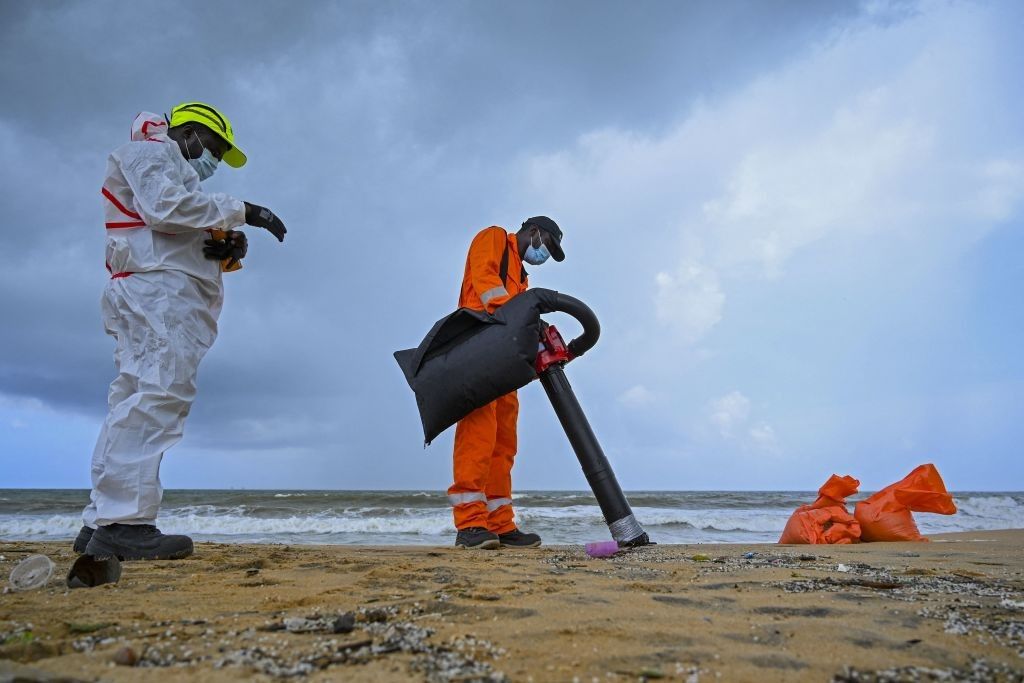
A team of technical experts of the European Union (EU) will be assisting the Sri Lankan government to assess the environmental damage caused by the fire-ravaged container ship that sank off Colombo, the Ministry of Foreign Affairs said on Friday (June 18).
According to a statement from the ministry, the EU/ECHO – the emergency arm of EU funding – through the United Nations Environment Programme (UNEP) supports three technical experts to help the government in this regard.
The experts include Stephane Le Floch – an expert on oil and hazardous and noxious substances (HNS) deployed to emergencies, HNS and marine litter expertise Camille La Croix and Luigi Alcaro who specialised in environmental impact assessment following oil and HNS spills also with previous deployment experience.
A meeting was organized by the Foreign Ministry to brief the experts on the current ground situation and the action taken by the relevant stakeholder agencies. The meeting was chaired by Director General, Ocean Affairs, Environment and Climate Change Hasanthi Urugodawatte Dissanayake together with UN Resident Coordinator in Sri Lanka Hanaa Singer-Hamdy.
The meeting commenced with an introduction to the disaster that occurred, setting the background for further elaboration and updates from the relevant stakeholder agency, with the relevant mandate.
The meeting paved the way to understand the mandates of the agencies in relation to environmental damages connected to the disaster and the role of the agencies and initial discussions on how the 03 experts could contribute to support the process with recommendations on future action to be taken by the key stakeholder agencies.
Participating stakeholder agencies included senior officials from the State Ministry of Urban Development, Coast Conservation, Waste Disposal and Community Cleanliness, Marine Environmental Protection Authority (MEPA), Sri Lanka Navy, Sri Lanka Coast Guard, National Aquatic Resources Research and Development Agency (NARA), Central Environmental Authority (CEA), Department of Wildlife Conservation (DWC), Merchant Shipping Secretariat, Sri Lanka Ports Authority (SLPA), Department of Fisheries and Aquatic Resources, Ministry of Environment, Justice Ministry, Attorney General’s Department, as well as UN Office in Colombo and Asian Development Bank, European Union and several experts from the team established by MEPA to assess the ecological damage caused by the disaster.
The experts would be working closely with MEPA and other government agencies such as NARA, Ministry of Environment, CEA and the DWC in coming days.
It was six months ago that American insurrection took place in Washington DC. January 6th 2021, will undoubtedly go down in history as the darkest day of American democracy. The world watched with horror as the most powerful beacon of democracy was coming apart by angry White mobs. They were politically and racially motivated, fuelled by their supreme leader Donald Trump and his Republican enablers. He had been shamelessly and cleverly manipulating his followers for four years with lies and conspiracies, like never seen before.
Many
pundits and commentators on mainstream and social media described how shocking
and horrifying these attacks on Capitol Hill were. It was the temple of the
American democracy, boasted as the epitome of the democracy since the inception
of democracy in Greece centuries ago.
America
had been telling the world how great its democracy, rule of law, and freedom
were. All the while they were turning a
blind eye to their own racism, social injustice, violence, and income inequality,
including lack of basic social services to millions of low-income Americans,
most of whom are Black, Latino, and Indigenous Americans.
Every
American administration in the past, be it Republican or Democrat, had been boasting
and preaching to the world – especially to developing countries like Sri Lanka –
to follow those American values they hold so dear to their hearts. They told us
in the developing world that we should follow the rule of law and democracy,
respect human rights, and treat minorities with respect and dignity. Yet, they
never follow their own rules in treating American minorities with respect and
dignity. Human Rights? America is the biggest violator of human
rights in the world. They have killed, maimed, and caused unprecedented human
miseries around the world, in the name of preserving their version of democracy,
rule of law, and freedom, by invading other nations.
Yet,
despite the rhetoric and hypocrisy, the rest of the world, including us in Sri Lanka,
believed America for decades for its version of democracy, rule of law,
innovations in science, technology, and their so-called exceptionalism – the
theory that they were inherently better than other nations.
Like
many in my generation, I clearly remember the day in July 1969 when the first man
landed on the moon, which was an unprecedented milestone in the history of the
mankind. As a teenager interested in
science and technology, I became a great admirer of America and what it had to
offer to the rest of the world. I was not alone in this respect. Millions of young
baby boomers around the globe admired USA for many reasons. Among them rock and roll music, cowboy
movies, luxury automobiles, open and vast landscape, not to mention the
Hollywood – a portal to the unique American culture and its glamorous lifestyles,
like no other. Like many teens at the time, I was in awe and mesmerized by this
glorified culture that was exposed to the world through its mainstream media.
We did not realize at the time that there was a dark side to its glory.
However,
after living nearly five decades in Canada, America’s friendly neighbour to the
north, I see now how we have been misled and lied to by this self-proclaimed
protector of the world. Not only to the world, but to a generation of its own
citizens, American governments (like many governments around the world) have
not been exactly honest. In my opinion, every US administration (Republican/Democrat
alike), had been misleading the American people for decades.
The
most obvious deception is how America fabricated facts to invade other nations.
There are many examples, such as the Vietnam and Iraq wars. These are some of the
most obvious wars that America got involved in to fulfil its own imperialist agenda.
For
example, in August 1964, the US claimed that one of their naval vessels was
attacked by the North Vietnamese (Communist) forces at Gulf of Tonkin, to
justify the invasion. It was admitted later by US naval officials that such an
incident never happened.
The
result of this lie was the massacre of thousands of innocent Vietnamese by the
American war machine, and loss of over 50,000 US soldiers, who were mislead by
their own government into thinking that they were fighting to save their
country from evil Communism.
There
was no other war that has created such social, cultural, and political upheaval
in America the way Vietnam War did. Yet America has never learned from its past
mistakes, perhaps due to their ongoing perception of American exceptionalism.
The
invasion of Iraq was another debacle that the US fabricated, accusing Sadam
Hussein to have weapons of mass destruction. This turned out to be one of America’s
biggest propaganda lies, causing wide-spread destruction and atrocities for
years to come. This also led to the destabilization of Middle East, giving rise
to Jihadist terrorism.
All
this destruction and mayhem was caused by America and its Western alliance in
the name of preserving democracy, rule of law, and the biggest lie of all is to
protect human rights, while killing thousands of innocent people in the process.
The biggest crime of all is that America has never been held accountable for
the war crimes committed in other countries. The United Nation Human Right
Commission (UNHRC), Human Right Watch (HRW), had failed to raise concerns
against these heinous war crimes. It clearly shows how biased, and who these organizations
are working for. It was obvious as none
of these human right crusaders uttered a word when an innocent Black man –
George Floyd, was murdered (lynched) by White police officers in public. If
that was not blatant violations of human rights, then I do not know what it is?
America
calls itself a moral leader and protector of freedom and rule of law, yet cozies
up to some of the worst dictatorships, such as the one in Saudi Arabia, as well
as other well-documented human right violators like Israel, Brazil, etc. There
is no end to American hypocrisy.
What
we have witnessed on the January 6th, 2021, could well be the
beginning of the end of a superpower, thanks to its own arrogance, ignorance,
and exceptionalism.
Confidence is an asset for any nation. But when a
nation perceives itself as above the law and convinced of invincibility or that
it cannot fail, then reality is likely to deliver a wakeup call – which came
for US on the 6th of January, at the Capitol Hill. Ancient Greece, Napoleonic France, imperial
Japan, and colonial Britain have demonstrated this sort of arrogance, and all with
disastrous results.
The
conspiracy theories (https://www.factcheck.org/2020/10/trumps-long-history-with-conspiracy-theories/),
and pathological lies of Donald Trump and his Republican enablers had managed
to convince almost 70% of the Republican voters that Trump would have won
landslide if the election was not rigged by the Democrats.
For
four years, Donald Trump conditioned his supporters to distrust democratic
institutions such as the government. At
every political rally, he drove his supporters into frenzy with lies and
conspiracy theories. Like those ancient
Viking and Anglo-Saxon warriors, they love to bang their chests chanting USA! USA! USA!” and carry the flag,
including the Confederation flag – a clear symbol of White Supremacy and
systemic racism. His supporters call themselves patriots, willing to die for
their cause. This cause is the preservation of White supremacy and White privilege.
Of
course, Donald Trump did not invent White Supremacy or racism. He just gave oxygen to those under currents that
were always there already. They never
went away. If they did, Black leaders
like Martin Luther King, John Lewis, Malcolm X, and their ancestors would not have
had to fight for civil rights for decades. The Black Lives Matter movement is the
result of ongoing injustice and systemic racism in America and its
institutions, including in the media.
To
understand what happened on the 6th of January, one must understand America’s
violent history, which led to the creation of the US constitution after the
civil war, nearly 245 years ago.
White
entitlement, racism, and slavery were the undeniable factors that shaped the
American political and cultural landscape for centuries. Times may have changed
but the American (White) mentality may have not. The brutal violence and racist
sentiment that led to the first civil war and subsequent insurrections were
clearly on display on the 6th of January, when a White mob attacked
Capitol Hill. In some ways it may be a precursor to what to expect in the future
if the US leaders and law makers ignore this reality. The White Supremacy in America is not a new
phenomenon. It has always been there.
In
1877, the southern Democrats passed the Jim Crow law to maintain White
Supremacy, segregating and denying civil rights to Black people. These policies
continued for generations and were worse in some southern states as late as the
1960s. https://onlinellm.usc.edu/a-brief-history-of-jim-crow-laws/
It
is a prime example of how White lawmakers embedded systemic racism to
marginalise Black people and other minorities to maintain White privilege and
entitlement intact for generations.
Unfortunately, many Black people are still treated like third class
citizens in their own country, especially by the law enforcement agencies and
many other institutions.
White
supremacy is not limited to America. It thrives in many European countries
including the United Kingdom, France, Germany, and in regions of Scandinavia,
and Eastern Europe. Even in countries perceived as progressive, like Canada and
Australia, there are some groups who still believe in White supremacy and Nazi ideology.
Despite
generations of injustice, systemic racism, and oppression, the history shows the
American Blacks have never stormed US institutions like Capitol Hill. Yet it was the most privileged, well-protected,
group of White Supremists who done the most damage to their own institution that
protected them for generations.
It
was often the Black community, with leaders like Martin Luther King Jr. and
John Lewis, who have upheld peaceful and non-violent principles to demand basic
civil rights. Perhaps it is time for the
White America and its leaders to learn and understand from Black community how
hard it has been in their life-long struggle in America. Perhaps it is also time for the rest of the
world to stop stereotyping Black people as violent, lazy, drug addicts, and
criminals – the ugly picture that America and its White media portrayed to the
world for generations.
We
are living in turbulent times, with a global pandemic like none we have
witnessed almost in a century. Last year (2020) the world’s most powerful
country was out of control in their handling of the pandemic. This is mostly due
to the ignorance and impotence of the former Trump administration, also due to the
American public’s distrust of authorities, and refusal to follow rules like
wearing a mask or follow social distancing. No country in the world has politicized COVID-19
the way America had done under Trump – making them the number one nation of COVID-19
deaths and cases so far. https://www.cnn.com/interactive/2020/health/coronavirus-maps-and-cases/ It was truly a tragedy and a shame,
especially for a country that used to lead the world in many areas, including
medical and health field.
The
rest of the world may be having serious doubts if the US can face its
challenges, unless the new administration manages to stop the proverbial bleeding
initiated by Trump four years ago. It will be a monumental task to unite a
country that is deeply divided racially, politically, and economically.
No
matter how painful it is, America must come to terms with the new reality of a
fragmented country. American leaders must stop misleading the people with their
political rhetoric and hollow slogans of American exceptionalism and past
glory. They must look inward to their own problems, rather than lecturing the
other nations and trying to police the world.
America
is not in a position to dictate its terms on democracy, rule of law and human
rights to other countries, especially when its own citizens are refusing to
obey those rules and values. It has lost its credibility and moral values. Then
again, America has a habit of interfering in other nations, ignoring all their
own problems that happen in their own backyard.
President
Biden, recognising the dire state of the Union, gave a passionate and emotional
speech at his inauguration (January 20, 2021), reminding Americans of the
uphill battle that America is facing. Biden’s
speech was a sombre reminder to all Americans that they cannot take democracy,
liberty, or freedom for granted, which White America (majority) had enjoyed for
generations. These values are under attack not from a foreign enemy, but rather
by made-in-America White terrorists. It was a rude awakening for America to see
their symbol of democracy – Capitol Hill- surrounded by heavily armed military,
more like what we have seen in Bagdad or Kabul. Ironically, those were the images the world
saw in Iraq, Libya, Afghanistan, etc., after the US military invaded and
destabilized these nations. Now, the chickens have come home to roost to remind
Americans that pain and mayhem that they had caused in those countries may
easily come back to haunt them. It remains to be seen how America will overcome
these self-inflicted wounds, which will have ramifications not only for US but
for the entire world.
America is not the dominant power it once was. There
are new and upcoming nations in the world. Once a powerhouse of economic,
military, technological, and industrial strength, the country now has a
formidable challenger. China will surpass US in these areas soon if it has not already.
America
and Europe led the world in the 20th century, as they have benefited
and prospered, especially US. All the
while the developing countries were struggling to survive the brutal European
colonialism, and the mess it had left behind. After the Second World War, the Western
nations led by US – dominated the world’s finances, industry, trade,
manufacturing, etc. They established global institutions like International
Monetary Fund (IMF), World Bank (WB), and the World Trade Organization (WTO),
which greatly benefited a limited number of countries and is used to control developing
and less developed nations. Thanks to these organizations and their pro-Western
policies, the West has prospered tremendously, especially US becoming the most
powerful nation on earth, economically and militarily. Global wars and conflicts have been extremely
profitable for the US economy, and its war machine.
At
the beginning of the 21st century, the shifting of economic power from
West to East had started, as China and India begun to develop their economies
rapidly. This is especially true of China, which has become an economic powerhouse.
With economic dominance comes the financial and military power. The West cannot afford to ignore or treat
China as an enemy, the way they had treated Soviet Union during the cold war.
The rise of China is a remarkable story itself, and the West did not expect
China will be their biggest rival economically and militarily in such a short
time. Today world’s economy, especially US, depends on China, as majority of
consumer, industrial and medical products are manufactured in China. While the
rest of the world is facing a negative growth in economy due to COVID-19, China
is the only country showing a significant growth of its GDP this year,
surpassing all the other major economies.
America
has a new President, who has made promises to be a healer of the deep divisions
of inequality and systemic racism. Nearly
half of the country https://www.cnn.com/election/2020/results/president
voted for Donald Trump, who literally set fire to American democracy, and its
institutions on his way out. Yet almost seventy percent of Republican voters still
believe in Trumpism, including many Republican law makers. Whether President
Biden can safely navigate the landmines laid by Trump and his supporters and bring
back the country to its normality, remains to be seen.
Part II: Lessons for
Sri Lanka
Like
USA, Sri Lanka has been a divided nation politically and socially for many
decades. Sri Lanka had its share of corrupted
leaders – be they Sinhalese, Tamil or Muslim – who were hypocrites, liars, and conspirators.
They have been misleading Sri Lankans for generations for their own benefits
and gains. We have seen how our
political and community leaders manipulate their own communities with lies and
conspiracies, fuelling racial and social disharmony. Such unscrupulous activities led to 35 years
of terrorism and a war, killing innocent Tamils, Sinhalese, and Muslims, while
sinking the country economically, socially, and politically.
Just
like the US must learn from its ugly past, Sri Lanka must also learn from its
past if the country is to move forward as a unified nation. It is always the politicians (not the
citizens) who exploit and create division and mayhem. There are many lessons Sri Lanka can learn
from America and its mistakes of racial, divisive, and entitlement politics.
Whether
we like it or not, a change of government in America will affect Sri Lanka in
one way or the other. The Biden administration will not be favourable towards Sri
Lanka when it comes to HRs and reconciliation efforts. There is no reason to
believe they will be any different this time around, especially at the UNHRC session
in Geneva. If anything, America will
continue to harass and bully developing nations like Sri Lanka with their
hypocrisy of HRs, democracy, freedom, etc, with the help of their biased
agencies like UNHRC, ICC, HRW, AI, and other NGOs.
The
underlined motive of America (and its Western alliance) towards Sri Lanka is
not necessarily democracy, HRs or rule of law, or the ethnic issues, but the
importance of strategic geo-political location of Sri Lanka in relation to
China – the nation considered to be the single biggest threat to Western
economy and security today. The US dominance of Indian and Pacific oceans is threatened
by the rising navel and military power of China. Whoever controls the Indian
Ocean will greatly benefit from having Sri Lanka on their side, since it is
only 10 nautical miles north of the world’s busiest navel traffic.
The rise of China and its close relationship with Sri Lanka is the main
reason why Sri Lanka has come under scrutiny of America and its allies. India has always been a political conundrum for
Sri Lanka due to its unwelcome political influence and proximity. For majority
of Sri Lankans, especially for Sinhalese, India is like an obnoxious and
annoying relative who is always poking fingers in their family affairs, mainly
due to historical, cultural, and religious bind between two countries.
Sri
Lanka should be careful not to depend on India for its economic, political, and
national problems. India has its own agenda
and own problems when dealing with Sri Lanka due to its domestic politics in
Tamil Nadu, and perceived threat to their security from emerging China, which is
gaining a wide foothold in India’s neighbours. Taking advantage of India’s insecurity,
America is exploiting it heavily to make India their proxy to counter China. America is no different than the defunct
British Empire which used divide and rule” tactics to destabilize and colonize
countries. America is following the same
path in a different manner using democracy, HRs, rule of law, as their weaponry
to control or destabilize countries like Sri Lanka. The shameless manner of the
former US ambassador to Sri Lanka, Alaina B. Teplitz interfered in domestic
issues is a classic example of how Western diplomats meddle in Sri Lanka well
beyond their diplomatic mandate.
The
Quadrilateral Security Dialogue (known as the Quad) is an example of how US is
trying to form a strategic partnership between the United States, Japan, Australia,
and India to counter the emerging economic and military power of China. QUAD is called an Asian NATO led by USA. Why the Quad Alliance Is
Ambiguous and Contradictory | Time
The
West exploits local divisions of ethnic and religious minorities, and internationalizes
those issues through their institutions like UNHRC, HRW, AI, and other Western
based NGOs and think tanks, to show that the West is concerned about the freedom
and human rights of global minorities. This is while turning a blind eye to systemic
racism, and oppression of minorities in America – such as Black people, Latinos,
and Native Americans, Indigenous communities in Canada and Australia, non-white
immigrants and Muslims in UK, and in the European Union. The list goes on, but
they conveniently turn a blind eye to their own biases and prejudices.
Yet
these hypocritical Western nations are eager to point fingers on developing
nations, such as Sri Lanka for eliminating terrorism and bringing peace and
stability, which benefited the war-ravaged North and East the most. Democracy,
freedom, equity, justice, and lasting peace are universal values shared by all of
humanity. The difference is that the West believes (arrogantly) that these values
belong only to them, and they can weaponize such values to crucify other nations
that do not buy into their hypocrisy.
Sri
Lanka should tread cautiously. Certainly,
Sri Lanka needs global markets, investors, and expertise to further develop its
economy, manufacturing, and infrastructure. Due to its strategic geo-political location,
Sri Lanka must be careful in identifying its allies and enemies. The most strategic
way to leverage geo-political importance is to be cautious about aligning with
India, USA, or China. Sri Lanka must not give ownership of its natural resources
or sell off national assets like harbours and airports. However, Sri Lanka desperately needs the
support of reliable partners like China – not only to develop the country but
to defend Sri Lanka at the international stage from hostile and bias
institutions like UNHRC. It might be a high
wire balancing act to stay non-aligned, especially when Sri Lanka is in significant
debt and its economy is perilous. But opportunities
exist if the current leaders are politically and diplomatically savvy to
understand that global politics is a chess game, which needs strategic, and out
of the box thinking. The late Prime Minister of Singapore, Lee Quan, understood
it early on. That is why Singapore is one of the countries with highest per/capita
income in the world today, equally admired by the East and the West.
Unfortunately,
we have yet to see such a visionary leadership that can guide Sri Lanka, to
move forward with unity, prosperity, respecting the will of the people. Almost 73 years after independence, Sri Lanka
is still struggling economically, socially, and politically. Many other countries in the region such as
Vietnam, South Korea, Taiwan, which have been ravaged by wars and other disasters
have moved on becoming economic miracles and social models that many countries
look up to.
Culture
of corruptions, ego-centric politics with entitlement, with little or no respect
for the law and order are the primary reasons why Sri Lanka has been unable to move
forward as a nation; making it dangerously vulnerable for the foreign, and
other undesirable forces to interfere in domestic, and international affairs of
the nation.
The
latest developments in Canada and USA should be a great concern for the present
regime in Sri Lanka. The passing of Ontario Bill-104 (Tamil Genocide and
Education Week Act –Bill
104, Tamil Genocide Education Week Act, 2021 – Legislative Assembly of Ontario
(ola.org))
sent shock waves among Sri Lankan communities around the world. Its
ramification on future generation of Sri-Lankan Canadians will be devastating
as every school in Ontario will have to teach every year (in May), about an
alleged genocide of Tamils in Sri Lanka.
The
other most disturbing development is the passing of a resolution by the US
Congress recognizing North and East of Sri Lanka as the traditional homeland of
Tamils. This is a recipe for disaster if not met head on by the Sri Lankan
government. H.
RES. 413
Both
these events are extremely damaging to Sri Lanka, and it might open a pandora’s
box as many pro-LTTE associations and their supporters in many countries will
be encouraged to bring numerous bills and resolutions against Sri Lanka,
especially after the passing of Ontario Bill-104.
Sri
Lanka may have won the terrorist war, but unfortunately it has failed the
propaganda war miserably after the war. As a result, well-organized,
well-funded, well-connected LTTE organizations in the West are ramping up their
propaganda war against Sri Lanka in the international arena with vengeance.
Ignoring
these critical and dangerous issues is not an option for Sri Lanka any longer.
There will be a domino effect of these in the Western countries where powerful
pro-LTTE Diaspora is lobbying relentlessly with the help of their supporters
(politicians) to make Sri Lanka a global pariah.
What
we are witnessing now is the results of 12 years (since the end of the war) of
negligence and inactions by the successive Sri Lankan governments to counter pro-LTTE
propaganda in the Western nations like Canada, UK, USA, and Australia where
pro-LTTE Tamil Diaspora lobbying is powerful and effective.
Sri
Lanka no longer can afford to ignore these highly critical issues, which will
not only affect the reputation of Sri Lanka severely, but more importantly its international
trade, tourism, etc. This will have a devastating effect on economy, which has
suffered badly already due to global pandemic.
Sri Lankan American Action Coalition. (SLAAC) a volunteer group functioning in USA
Bills & Resolutions
Forms of
Congressional Action
The work of Congress is initiated by the
introduction of a proposal in one of four principal forms: the bill, the joint
resolution, the concurrent resolution, and the simple resolution. Bills & Resolutions | house.gov
An H.
Res (or a simple resolution) only concerns “the rules, the operation, or
the opinion” of one chamber of Congress. There is no
“passage” only “adoption.” This means that it does not pass
forward to the senate for a vote as a bill and is not presented to the
President of the United States for signature.
An
extract from the United States House of Representatives is:
Simple Resolutions
A matter concerning the
operation of either the House of Representatives or Senate alone is initiated
by a simple resolution. A resolution affecting the House of Representatives is
designated H.Res.” followed by its number. They are not presented to the
President for action.
If there
is a next step in the process for H. Res 413, it would be
“adoption” by the House. But even so, that will be that the House is merely
expressing their opinion. Stakeholders
will use this adoption to push for action, but a simple resolution alone does
not have the power for further action.
Our
next steps to counter this action should be determined as follows: There are
stakeholders approaching Members of Congress seeking their support for H. Res
413. Members need to be further educated on the issue. In addition to
speaking with Members who already support the resolution, we should approach
other Members of Congress and introduce them to the issue from our perspective
because this involves a recognized terrorist entity.
See the
link below for more details in the Congressional Glossary of the US Library of
Congress.
Simple Resolution – Legislation
that relates to the operations of a single chamber or expresses the collective
opinion of that chamber on public policy issues. A simple resolution
originating in the House of Representatives is designated by the letters H.
Res.” followed by a number and simple resolutions introduced in the Senate as
S. Res.” followed by a number. For Example: H. Res. 10.
Another point to consider is that in counter arguments, it must
be pointed out to all members of the US Congress who can be influenced to
support the H. Res 413 that there is an explicit reference to LTTE” in the
document without expanding the acronym to read Liberation Tigers of Tamil
Elam.
In such expansion, it can be proven that the LTTE is on the list
of Foreign Terror Organizations (FTO) listed by the US State Department dated
October 8, 1997. The proof is available that
the Liberation Tigers of Tamil Eelam (LTTE), a known Foreign Terrorist
Organization recognized by the
U.S. Department of State at the link provided and the entry for LTTE that
appears in the list. It is also proscribed in the US and 31 other countries
having provided inspiration to Al Qaeda. This link provides other terrorist
organizations considered in the same category where LTTE has been included.
Simple resolutions are considered only by the body in which they
were introduced. Upon adoption, simple resolutions are attested to by the Clerk
of the House of Representatives or the Secretary of the Senate and are
published in the Congressional Record.
For
further clarification, please contact the Sri Lankan American Action Coalition.
(SLAAC) a volunteer group functioning in USA.
Email: excomm@srilankanamericans.com.
This is basic information for use by those who
defend Sri Lanka against the Simple Resolution H. Res 413 resolution presented with
misinformation and the need for counter
Sarath Wijesinghe President’s Counsel, former Ambassador to UAE and Israel, President Ambassador’s Forum, currently in UK
Pandemic war in the peak
Pandemic war is in the peak and there is no option but to win it sooner
or later depending on the world situation. President and the Government has
taken all possible endeavours using the political and personal goodwill with
the world leaders to find vaccine which is the need of the hour and the
response from the world leaders have been satisfactory in that japan China, and
USA. Japan has sent positive signs of assistance which is the main need of the
hour. Things are changing fast and the countries won are facing difficulties
again and the good news is Sri Lanka is now doing comparatively well. UK has
extend the controls till July 21st again. China has sent3.1 million
doses and 10.9 more to come in addition to pledges from many friendly nations. We won the first wave comfortably but there
are lessons to be learnt from the second and third. Today the death toll
according to media is dwindling gradually with hopes of reducing the number due
to the prevailing circumstances locally and worldwide keeping in mind we are
open to the world out of necessity. World is bound to go through the agony more
than expected when in UK the partial lock down is extended till July with
imposing further restrictions as in Sri
Lanka out of necessity. In Sri Lanka there should be no conflicting reports by
so called experts, with no central institution for figures, facts or authentic
information despite the advanced digitalization in the country with the system
intact according to the book. Good news that steps are being taken to
centralize the system soon and also the number is gradually decreasing from
four figures as USA 11882/412 deaths, India14380/4133 deaths, Brazil 88092/2504
showing a gradual reduction of the infected and death toll, but the situation
in Sri Lanka that won the first wave though not satisfactory and it is our duty
to look towards us carefully to find the solution which is necessary and
imminent. But the fact remains that the solution is within our scope and it is our
duty to go back to basics being careful not to permit the unseen, dangerous,
uncontrollable virus to visit us and live free in the system due to our
carelessness. The second and third waves gathering Information
on covid19 front is day by day getting worse with near 3000 suspected cases and
considerable deaths- the high ever death
toll which is ever increasing with no signs of diminishing. We do not make
vaccines in Sri Lanka and depending on the world for stocks based on good will,
international relations and availability when there appear to be a shortage of
vaccines worldwide. It is noted that it is time for us to initial stages by
making prompt orders with proper procumbent procedures based on expert advice
by scientist’s not administrative officers however senior they are. In order to
combat the enemy we must have a vision and a visionary in overall giving due
credit to the Army commander and the forces on the excellent performances jobs though
outside their ordinary preview. In Sri Lanka vaccine is given free to the
citizens when Pakistan has initiated to sell it to those who could afford is a
good move giving the opportunity for those who could afford to make matters
easier to the government struggling on economic hardships. It is a good idea
for Sri Lanka too to follow suit due to the economic downtowns and other
complications in finding the vaccines on time, due to our own making. It is
told that there is a vaccine shortage in the world due to fast spread of the
pandemic, and it is a good move that we have placed orders and got the
international community and Embassies to work on the task. Entire
world is going through the hardships with no signs of end in the near future
against the un controllable, unseen, virus freely on move worldwide with no
boarder or restrictions causing misery and deaths mostly the vulnerable groups
with 165,000,000 deaths to date which is sad worrying and unbearable to the
mankind. No permanent solution is found yet despite the miraculous advancement
of science extending towards the solar system. Some developed countries have
found a temporary measure inventing a vaccine to be administers in two stages
which is not a permanent cure, without ascertaining the side effects in the
long run. Some countries such as UK, Israel, and Seashells, have administered the
vaccine to a majority of the population that has retarded the fast spread as a
precautionary measure which again is temporary. Sorry state is some countries
vaccine full are worried on the new variants spreading including UK. Giant
neighbour India is in a pathetic way with highest number of cases and death
with shortages of beds and medicine countrywide patients crowded on payments
near hospitals with confirmed deaths of 353528, confirmed deaths 29089069 and
9256 new cases, with 2862 new cases in Sri Lanka with repel effects from Indian
infections by illegal border crossing through sea and exchange of trading
materials. There is news of development of new variants and new developments.
Do not worry – we are winning the battle in the near future and we must learn
to live with it and be ready for a leapfrog success story for a better world to
come. Therefore while finding permanent solutions we should plan out our future
in short and long term developments in the country with full details given
below.
Post Pandemic Situation
This a war to be won at any cost one day having gone through all the
hardships with the rest of the world, and it is the duty of a visionary leader
with a vision to be ready for the future challenges and emerge victorious as a unique nation. Village
students and villagers have proved adoptable by paying bills on what’s app and
village children climbing water tanks for WiFi with minimum facilities yet
compete the urban students and the community with the 110% mobile penetration
and computer centres in junctions many using international platforms to keep
pace with the modern developments. Working online has become handy and village
teachers conduct webinars learning the technical details from their children.
It is unfortunate that we are going through more and more disasters. But we are
a nation that went through a 30 year war the west claimed unwinnable cementing
the different ethnic groups as an exemplary nation. Please admit ship disaster
is manmade and our mistake; environmental destructions are manmade and our
mistakes, wrong food patterns are our own mistakes, Sri Lanka is a country
where a mango seed thrown will emerge as a fruit bearing mangoes and when
Israel started life 73 years ago no water at all and depending now on
desalination of sea water, selling water to neighbours as a leader in
agriculture advising the world powers. We are a nation missed the bus and
misdirected by the foreign hands transformed our agro based society living with
nature with 70% forest cover reduced to 18% or 29% as claimed to clear lands
for commercial crops and changing the food pattern to bread in place of rice
and importing poisoned milk powder
killing 5000 local cattle a day for meat
with no steps taken for self-sufficiency on food, milk, and other agro based
cultivations and products depending on poisons artificial fertilizer converting
the healthy nation sick. We must resolve ourselves to transform ourselves to be
a unique nation with a new vision with a visionary surrounded by a proper
dedicated and vibrant, leadership with genuine group around helping the
transformation of the entire system and compel the leaders to create and
acquire a vision to be self-sufficient an all respects learning form our
mistakes and other successful countries themselves going through the ordeal
together.
Contributions by the Sri Lankan Lawyers in UK (ASLLUK), Ambassadors
Forum in Sri Lanka and UK and international and Local Groups
ASLLUK made an official request to the Prime Minister of United Kingdom
for vaccine and sent substantial funds to be given to the poorest of the poor Sri
Lankans via Bar Association. UK has agreed to donate 100 million surplus jabs
to poor countries according to statement by the Prime Minister and we hope
other countries will follow suit provide our embassies and powerful Sri Lankan
Groups worldwide work hard. Ambassador’s Forum in Sri Lanka and abroad is in
the forefront and it is the duty of the Foreign Ministry and the Sri Lankan
Human Rights commission to follow suit as there are ample remaining unused
vaccines available in many countries. Currently the remedy is vaccine as proved
by UK by bringing down to zero in figures of ten thousand, when Sri Lanka was
zero deaths at the time we won the first wave. We are pleased to note that
Japan, USA, China, Australia, and other friends who themselves are victims have
agree to help Sri Lanka due to friendship and urge the Sri Lankan Embassies and
Sri Lankans worldwide to mobilize
themselves in the campaign as the main target if to find sufficient vaccines.
Ambassador’s Forum has published five books on international relations and
foreign policy as a guideline and directions to the nation, and the two books
on Geneva process and Port City will be inaugurated in UK probable at a
function headed by Lord Nasby who has done a yeoman service to Sri Lanka.
Keep Friendly Relations with the World
We cannot be in isolation in this new world closely interconnected with
a click of a button, and in fact we are not alone if we maintain our friendship
with the rest of the world who themselves are in grave danger. Other countries
are in worst situation does not mean we too should suffer, when we are a smart
educated nation with top Sri Lankans worldwide whose full services are not
utilized through the network of Ambassadors. Because other friends are powerful
strong and foresee matters before they are scientifically in battle when we
follow them not even going back to basics in the combat on Corona 19 which is
the easiest and a shortcut for victory- Keep
distance, be clean by washing hands and surfaces prune to virus, avoid
public places, stay home, no public functions, always conscious on the danger
and virus , follow and adhere to medical and other advice by the health workers
as has been done in China fought it following simple ways. It is the duty of
the Sri Lankans in Sri Lanka and world over to divert all efforts and attention
on the war on Covid 19 before everything as the priority today is the
eradication of the menace.
Foreign Policy and other Developments to continue until we win the war
Sri Lanka had a proud history on foreign policy as a onetime leader of
the non-align movement during the golden regime of Madam Bandaranaike remaining
of the non-alignment and neutral policy to date on the foreign policy based on
the motto ‘’friendly with all and angry with none’’ in addition to the previous
and subsequent conventions and treatises entered into. As the foreign policy is
interconnected and interwoven with economy – less strong countries need lot of
efforts to maintain the independence of foreign policy and conduct on economy
and international affairs as independence entities. It is agreed that economy
should be healthy despite pandemics and states endeavour to maintain economy
without the minimum damages to the economic balance of a nation while
maintaining the day to day life of the citizen. Sri Lankan economy is not in a
good shape even before the pandemic and the impact on economy has been enormous
with almost breakdown of economy. Partial lock downs and assistance to the
common man during the temporary blockades have almost paralysed the ailing
economy and the government is having second thoughts for a full lock downs as
in the UK. Sri Lankan Lanka Investment
forum organized by business leaders for two days, with the key address speech
by the Prime Minister to be a game changer on economic upheaval and as turning
point in the light of Sri Lanka’s
catastrophic growth at a faster momentum. It will be an investment destination
of perfect as an attractable country for investment form all around with no
unnecessary hindrance to the prospective investors. It is targeted to achieve
end disputed covid 19 pandemic fast spreading and brewing leaving the
responsibility to the community to contain it, with a well-disciplined well behaved
society to safeguard themselves while leapfrogging the country to be the best
business destination. In this process foreign policy and relations play a pivot
role, encouraging and gain confidence of word, not appointing High Commissioners
to India and Canada so long periods opening eyebrows of the international
community while disturbing the trends in diplomacy so important and vulnerable
in the diplomatic world. By organizing the Forum with 4000 participant, 1500 investors,
and 100speakers across 120 sessions in the height of the corona pandemic, Sri
Lanka is stepping into the modern virtual platform leapfrogging the modern jump
to the powerful leader exploiting the advantages of the geographical situation
by passing the corona 19 with determination to of over leader to live with. Main players were to be
the BOI Colombo Stock Exchange Colombo /chamber of /commerce Ft and Private Sector
companies who will be competent to know keep pace with the international trends
out of necessity and compulsion to run with. ‘Hambantota’ Port, Colombo Port city
Project with manufacturing plants, Export Processing Zones, will be set up
right round the country giving a life to the citizen mainly youth with 110%
mobile penetration with computer centre every junction with Wi-Fi transferring
young to innovation subjects training for the future which has direct bearing
on foreign policy maintaining the good will with other nations. No country can
live in isolation in the world closely knit and connected penetrating borders
with free access to the virus freely moving with various making difficult for
the countries to control the spread. There are draw backs such as withdrawal of
the GSP but it is our duty to continue undeterred expecting the governance to give
due place to competent dedicate and qualified and avoid family rule, leaving
friends to become billionaires, avoid clamping down on bribery corruption
nepotism and favouritism is all kinds and areas which are rampant today. It is
difficult time and it is time to make sacrifices brining done the extravagance
and wastage to the minimum which are expectations of the masses in return to
the sacrifices they make and hardships they undergo.
WHAT NEXT
‘’ONE IS ONE’S OWN REFUGE, WHAT ORHER REFUGE CAN THERE BE?? WITH SELF
WELL SUBDUED A MAN FINDS REFUGE SUCH A FEW CAN FOUND’’ ‘’Dhammapada’’ this is one of the verses
extracted from Dhdmmapada is a hand book on Buddhism on the way of life and to
be independent and to be self-reliance independent in every respect. Sri Lanka
have been self-sufficient with every village individually being self-sufficient
happy agro based society also self-sufficient in all trades. Sri Lanka is an
Island with fine climatic conditions and historically agro based with network
of rivers and manmade historical water distribution system for agriculture now
depending on every bit on imports indebted to the world is a trend that has to
be changed to be self-sufficient in all respects with a bitter learning process
form the corona pandemic to step toward prosperity and development. We have
a balanced foreign policy on the motto friendly with all and angry with none in
addition to maintain the same non alignment policy continuously, in addition to
the conventions and treatises we are bound to adhere to. It is necessary to
maintain the goodwill and international relations in order to help each other
as a friend in need when every country is in danger on the world crisis brewing
worldwide. As mentioned above it is time for us to be self-sufficient in all aspects
as an answer to the Covid19 crisis increasing rapidly. Moves to transform to
organic fertilizer, is to be implemented with the campaign for self-sufficient
in all respects. Good news is Sri Lankans; especially the young are adoptable
and fearless for changes and challenges and it is the timely challenge to make
use of the opportunity for the leapfrog developments towards the 21st
century in all areas of life with future plans based on introduction of modern
digitalization programs initiating frim schools. It is a war that has to be won
as Winston Churchill remarked ‘’ Never believe the war will be smooth and easy,
or that anyone who embarks strange voyages can measure the tides on hurricanes
he will encounter. In deed a nation that won the unwinnable war of thirty years
will definitely be able to win over the unseen virus spreading across borders
with a proper vision led by a visionary with the help of the nation facing the
challenge.
At the INSIGHT FORUM” organised by Our Hong Kong Foundation, eminent global thinker Professor Kishore Mahbubani called on the US to hit the pause button” on its geopolitical contest against China amidst the raging global pandemic.
Prof Mahbubani, who is a Distinguished Fellow at National University of Singapore’s Asia Research Institute, pointed out that the US trade war against China had hurt the American economy without solving the underlying economic concerns it was meant to resolve. Such policies have not raised America’s standing in the world, neither have they weakened China significantly nor led to the progressive isolation of China from most countries.
He said that the Biden administration should press the pause button” on the contest, especially when billions of people around the world are suffering from the massive economic recession caused by Covid-19. The only way to jumpstart the global economy is for the world’s two leading powers to work together.
The more infectious Delta variant accounts for almost all of the cases, says Public Health England.
There is some regional variation in infection rates, however, and some good news on vaccine efficacy.
North-west England had the highest proportion of people of any region in England likely to test positive for coronavirus in the week to June 12 – around one in 180.
Eastern England had the lowest estimate – around one in 2,480.
The trend is “uncertain” in Scotland and Northern Ireland, says the ONS, while in Wales the latest estimate is one in 1,500 people infected – down from one in 1,300 in the previous week – although first minister Mark Drakeford says a third wave of Covid is under way linked to the Delta variant.
According to latest data from PHE, a single dose of vaccine reduces a person’s chances of catching coronavirus and needing hospital treatment by about 75%, even with Delta circulating in the UK.
And among people who had received the recommended two doses, the chances of catching and being hospitalised by coronavirus was reduced by more than 90%.
Of 806 people infected with the Delta variant who ended up hospital in England between 1 February and 14 June 2021:
527 (65%) people were unvaccinated
135 (17%) were more than 21 days after their first dose of vaccine
84 (10%) were more than 14 days after their second dose
As of 14 June, there have been 73 deaths in England of people who were confirmed as having the Delta variant and who died within 28 days of a positive test, and of these:
34 (47%) were unvaccinated
10 (14%) were more than 21 days after their first dose of vaccine
26 (36%) were more than 14 days after their second dose
Infections highest in younger adults
The ONS data also gives the age ranges for people infected in England, based on household testing.
Rates are low and stable among adults over the age of 35 but are rising among younger adults and older teens.
Meanwhile, the latest R number for the UK is between 1.2 and 1.4. It means that, on average, every 10 people infected will infect between 12 and 14 other people.
Elsewhere in the UK, people aged 30 and over can get their vaccine in Scotland, although in some parts of Glasgow people aged 18 and over can get a first jab.
In Wales, people aged 18 and over can get the vaccine, with the Welsh government announcing that all adults had been offered a vaccine earlier this week.
In Northern Ireland, people aged 18 and over can book online or call 0300 200 7813.
Dr Jenny Harries, chief executive of the UK Health Security Agency said: “Cases are rising rapidly across the country and the Delta variant is now dominant. The increase is primarily in younger age groups, a large proportion of which were unvaccinated but are now being invited to receive the vaccine.
“It is encouraging to see that hospitalisations and deaths are not rising at the same rate but we will continue to monitor it closely. The vaccination programme and the care that we are all taking to follow the guidance are continuing to save lives.”
Sarah Crofts from the ONS said: “Given the recent announcements to delay the easing of lockdown restrictions, it’s critical that we are tracking infection rates over the next few weeks and analysing the impact of the Delta variant.”
By Patrick Wintour/The Guardian Courtesy NewsIn.Asia
London, May 5: The US faces an uphill task presenting itself as the chief guardian of global democracy, according to a new poll that shows the US is seen around the world as more of a threat to democracy than even Russia and China.
The poll finds support for democracy remains high even though citizens in democratic countries rate their governments’ handling of the Covid crisis less well than people in less democratic countries.
Inequality is seen as the biggest threat to global democracy, but in the US the power of big tech companies is also seen as a challenge.
The findings come in a poll commissioned by the Alliance of Democracies Foundation among 50,000 respondents in 53 countries.
The results will make stark reading for the G7 foreign ministers as they hold a final day of talks in London in which they have collectively assumed the role as bulwarks of democratic values determined to confront autocracy.
The survey was carried out by the Latana polling company between February and April, so a hangover effect of Donald Trump’s America first” foreign policy may linger in the findings. Overall the results show perceptions of the US starting to improve from last year.
Whereas in the spring of 2020 people in both more democratic and less democratic countries were equally satisfied with their government’s pandemic response (70%), a year later the approval ratings have dropped down to 65% in less democratic countries, but in more democratic countries the rating has fallen to 51%. In Europe the figure is 45%. Positive ratings reach 76% in Asia.
In perhaps the most startling finding, nearly half (44%) of respondents in the 53 countries surveyed are concerned that the US threatens democracy in their country; fear of Chinese influence is by contrast 38%, and fear of Russian influence is lowest at 28%. The findings may in part reflect views on US comparative power, but they show neither the US, nor the G7, can simply assume the mantle of defenders of democracy.
‘We no longer fear the tweet’: Biden brings US back to world stage in first 100 days
Since last year, the perception of US influence as a threat to democracy around the world has increased significantly, from a net opinion of +6 to a net opinion of +14. This increase is particularly high in Germany (+20) and China (+16).
The countries still overwhelmingly negative about US influence are Russia and China, followed by European democracies.
The study shows an attachment to democracy globally, with 81% of people around the world saying that it is important to have democracy in their country. Only a little more than half (53%) say their country is actually democratic today – even in democracies.
The single biggest cited threat to democracy is economic inequality (64%).
In almost every country surveyed save Saudi Arabia and Egypt limits to free speech are seen as less of a threat to democracy than inequality.
But half the people surveyed (48%) say the power of big tech companies, as opposed to the simple existence of social media, is a threat to democracy in their country. Among democracies, the US is the most concerned about big tech (62%), but wariness is growing in many countries compared with last year, reflected in broad support for greater regulation of social media.
Voters in Norway, Switzerland and Sweden are most confident their country is democratic, but so are the Chinese, where 71% agree that China has the right amount of democracy. In Russia only 33% think their country is democratic. Global support for Joe Biden’s plans to stage a Democracy Summit is high in every country save China and Russia.
The findings will also make disturbing reading for the eastern European democracies such as Hungary where only 31% of voters think their country is democratic – on a par with findings in Nigeria, Iran, Poland and Venezuela.
This poll shows that democracy is still alive in people’s hearts and minds. We now need to come out of the Covid-19 pandemic by delivering more democracy and freedom to people who want to see their countries become more democratic.
The positive support for an Alliance of Democracies, whether the UK’s D10 initiative or President Biden’s Summit for Democracy, shows that people want more cooperation to push back against the autocrats. Leaders should take note of these perceptions and act upon them.”
UK-based Oil Spill Response experts look for pollutants from the Singapore-registered container ship MV X-Press Pearl, which is sinking after burning for almost two weeks in the sea off Colombo Harbour, at Sarakkuwa beach, north of Sri Lanka’s capital Colombo on June 10, 2021. (Photo by ISHARA S. KODIKARA/AFP via Getty Images)
THE UK government will provide marine pollution expertise to help respond to the impact of burnt-out MV X-Press Pearl on the marine life and coastal habitats of Sri Lanka.
360p geselecteerd als afspeelkwaliteit×
At the request of Sri Lanka, the UK’s Centre for the Environment, Fisheries and Aquaculture Science (Cefas) announced on Friday (18) that it will provide expertise and analytical capacity to support plastic pollution monitoring, as well as environmental and socio-economic impact assessments.
Cefas is working to assist in the laboratory analysis of post-spill monitoring samples, particularly plastic pellets, and potential chemical contamination, according to a statement.
Following the initial response, Cefas will continue to collaborate with the emergency response teams in Sri Lanka to help build their expertise for future incidents and to protect biodiversity and safeguard livelihoods.
International environment minister Lord Goldsmith said, The X-Press Pearl vessel fire and the release of plastic pellets and chemicals along the Sri Lankan coast have already had devastating impacts, and it will likely cause long term harm to the environment, local fisheries and livelihoods.”
We are determined to play our part in supporting developing countries to protect and restore their coastal ecosystems with our £500 million blue planet fund launched at the G7 by the prime minister Boris Johnson.”
Cefas marine litter scientist, Dr Umberto Binetti, said, We are preparing a series of actions to provide support in monitoring the situation”.
The head of the National Zoological Gardens here said that they are in touch with India’s Central Zoo Authority to treat an 11-year-old lion named ‘Thor’ who has tested positive.PTI | , Colombo
Sri Lanka’s zoological gardens authorities have sought assistance from India after a lion tested positive for the coronavirus at a zoo here.
The head of the National Zoological Gardens here said that they are in touch with India’s Central Zoo Authority to treat an 11-year-old lion named ‘Thor’ who has tested positive.
“We are in regular touch with the Central Zoo Authority of India and following their instructions on taking preventive measures to prevent the staff and other animals in the zoo being infected. We continue to treat the lion while keeping him in isolation,” Director General Ishini Wickremesinghe said in a statement.
The lion was sent to the Colombo zoo from the Seoul city zoo in South Korea in 2013.
The lion had been experiencing respiratory difficulties, but an initial antigen test result was negative. After several other PCR tests, the lion was confirmed to be Covid-19 infected, she added.
President Gotabaya Rajapaksa said today inaccurate figures on Covid death toll reported on June 11 led to the extension of travel restrictions and stressed that it was vital to provide accurate and updated information to make correct decisions.
He said it was revealed through comprehensive investigations that only 15 deaths had occurred on June 11 whereas 101 deaths were reported that day.
He said travel restrictions,which were to be lifted on June 14, were extended till June 21 based on the information of 101 COVID deaths being reported on June 11.
The President said this at the meeting of the Special Committee on Covid Prevention at the Presidential Secretariat.
The President said the health officials and intelligence services conducted a comprehensive investigation into the reporting of 101 deaths in a single day and it was revealed that some deaths had occurred for a period of four months from February 6 to June 11 and some deaths had been reported twice.
A decision has been taken to lift the islandwide travel restrictions currently in effect at 4.00 a.m. on Monday (June 21), Army Commander General Shavendra Silva said.
However, the travel restrictions will be re-imposed at 10.00 p.m. on June 23 (Wednesday) and continue until 4.00 a.m. on June 25 (Friday).
He said that the restrictions on travel between provinces will remain in effect during the period when travel restrictions are eased and until further notice.
Meanwhile public gatherings, meetings and any events will also be prohibited during that period.
The Army Commander said that shops will be allowed to open under strict health guidelines.
The government sector employees are expected to continue to work from home while the private sector institutions are allowed to operate with a limited number of staff as required.