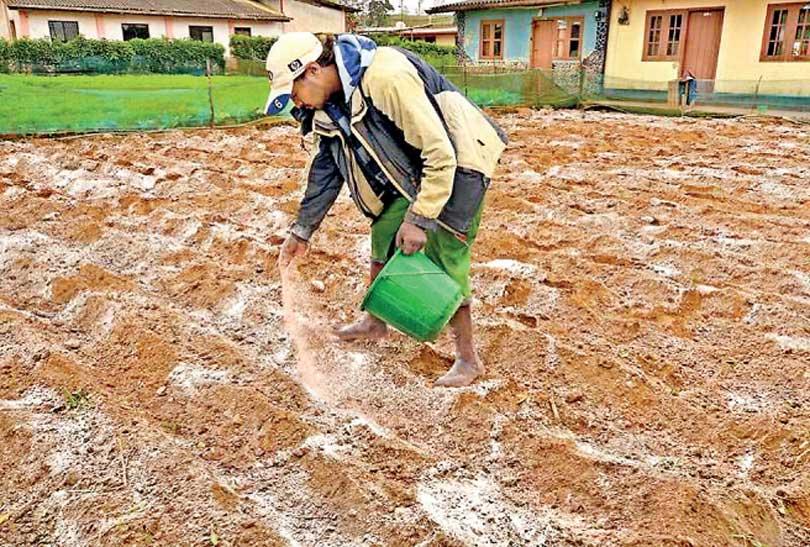
Ministry of Agriculture says the government will offer Rs.10,000 per hectare to each farmer who produces organic fertilizer.
The decision was reached at a meeting held at the Agriculture Ministry regarding the production and supply of organic fertilizer required for the upcoming Maha Season.
During the discussion, it was revealed that 500kg of organic fertilizer, 5kg of ammonium nutrient, 35kg of potassium and 10 litres of biofertilizer have been recommended per hectare.
The agriculture ministry said the government intends to fulfil the national requirement by coordinating all relevant institutions for the production of organic fertilizer in 1.6 million hectares as per the said recommendation.
Further, the quantity of organic fertilizer that can be produced by the beginning of September for the upcoming Maha season was also discussed at length.
The agriculture ministry says necessary measures have been taken to purchase quality organic fertilizer produced by various individuals and institutions, through the state sector fertilizer companies.
The meeting, chaired by Agriculture Minister Mahindananda Aluthgamage, was attended by State Minister Mohan de Silva, several ministerial secretaries, chairpersons and directors-general of public institutions and representatives of Sri Lanka Army as well as the Civil Security Force.
Gazette notifications have been published announcing that 59 local government members have vacated their posts as they have ceased to be members of the United National Party (UNP).
The declarations were issued by the returning officers of relevant Pradeshiya Sabha, urban councils and municipal councils.
These local government members who represented the UNP were elected to their posts in the 2018 Provincial Council elections, however, they had later endorsed the current main Opposition, Samagi Jana Balawegaya (SJB).
Thereby, the UNP had decided to suspend the party membership of these members. The ousted party members had petitioned against the move, however, the court refused to issue an injunction order against the UNP’s decision.
Among the party members dismissed from the UNP are the chairmen of Nawalapitiya, Tangalle and Weligama urban councils, according to the Gazette Extraordinary.
Over half of people in the EU think their government is run by a few private interests
The Global Corruption Barometer (GCB) – European Union released by Transparency International today reveals that almost two thirds of people in the EU think that government corruption is a problem in their country. The GCB, which surveyed more than 40,000 people in the bloc, asked about people’s views and experiences of corruption. The results highlight some worrying trends across the region.
Almost three in ten EU residents reported directly experiencing corruption, as they paid a bribe or used a personal connection to access public services. This is equivalent to more than 106 million people.
The survey reveals that health care, in particular, has been a corruption hotspot as governments struggled to manage the COVID-19 pandemic. Although just six per cent of people paid a bribe for health care, 29 per cent of EU residents relied on personal connections to get medical care. Furthermore, most people don’t think that their government has handled the pandemic in a transparent manner.
The EU is often seen as a bastion of integrity, but these findings show that countries across the region remain vulnerable to the insidious effects of corruption,” said Delia Ferreira Rubio, Chair of Transparency International. During a health crisis, using personal connections to access public services can be as damaging as paying bribes. Lives can be lost when connected people get a COVID-19 vaccine or medical treatment before those with more urgent needs. It’s crucial that governments across the EU redouble their efforts to ensure a fair and equitable recovery from the ongoing pandemic.”
The survey explored other areas related to corruption, such as the ties between business and politics, with over half of respondents thinking their government is run by a few private interests. Bankers and business executives are perceived as more corrupt than any public sector institution in half of the EU. Overall, more than five in 10 people believe that big companies often avoid paying taxes, and that bribes or connections are commonly used by businesses to secure contracts.
Almost a third of people think corruption is getting worse in their country, while almost half of them say their government is doing a bad job at tackling corruption. In addition, only 21 per cent of people think that corrupt officials face appropriate repercussions.
Sentiments that governments are not doing enough to combat corruption and the perception that corrupt officials are able to act with impunity negatively affect trust levels in both national governments and EU institutions. Less than half of people in the EU trust their national government. While the EU institutions fared better (at 56 per cent), the rate of trust remains relatively low.
These results should be a wake-up call for both national governments and the EU institutions. Corruption is undermining public trust and policy makers need to listen to the concerns of the public,” said Michiel van Hulten, Director of Transparency International EU. There are many immediate actions that can be taken to remedy these problems, such as increasing lobbying transparency both at the EU and national levels and tackling tax avoidance. And EU policies to protect whistleblowers and fight money laundering must be effectively and swiftly transposed into national law.”
Countries in the European Union (EU) are known for being wealthy, stable and democratic. However, this clean image is undermined by issues ranging from regional inequality and erosion of the rule of law to corruption problems.
Transparency International’s new Global Corruption Barometer – EU 2021 is one of the largest, most detailed surveys of people’s views and experiences of corruption across the bloc.
Find out what people across the EU think about corruption
Externally hosted content may include ads. These aren’t endorsed by or reflect Transparency International’s views.
We surveyed over 40,000 people in all 27 EU countries. The results reveal that almost a third of people think corruption is getting worse in their country. A further 44 per cent think it’s not getting any better.
Whether it’s perceptions of government corruption and impunity for wrongdoing, or the use of personal connections when accessing public services, the results challenge the EU’s image as a place of integrity. They also call for immediate and coordinated action against a growing problem.
CORRUPTION ON THE RISE, BY COUNTRY*
*Percentage of people who think corruption increased in the previous 12 months
Business and politics intertwined
People in the EU increasingly scrutinise the cosy relationship between business and government. When it is unclear what ties policymakers have to the business community, there is a risk that policies and regulations are made in favour of narrow private interests, rather than the common good.
We found that less than a third of people (30 per cent) think their government takes their views into account when making decisions.
Around half think that bribes or connections are commonly used by businesses to secure profitable government contracts and that big companies often avoid paying their taxes.
It is not surprising, then, that more than half of people in the EU think their government is run by private interests.
GOVERNMENT CONTROLLED BY PRIVATE INTERESTS, BY COUNTRY*
*Percentage of people who agree that the government is run by a few big interests looking out for themselves
Who’s seen as the most corrupt?
We found that almost two thirds of people in the EU think that government corruption is a problem in their country. This is made worse by widespread perceptions of impunity, with only 21 per cent of people believing that officials often face appropriate penalties for corruption.
Citizens are divided about which institutions have the biggest corruption problems. In half of EU countries, prime ministers and members of parliament are seen as the most corrupt. In the other half, it is business executives and bankers.
Yet trust in the police, local governments and the courts is high across the region. More than 60 per cent of EU residents reported trusting these institutions.
CORRUPTION BY INSTITUTION*
*Percentage of people who think most or all people in the following institutions are corrupt
How equal is access to public services?
While bribery rates remain low at seven per cent, we found that around three in ten people used a personal connection to access health care, education and other public services. This is equivalent to more than 106 million people across the bloc.
PERSONAL CONNECTION RATES BY COUNTRY*
*Percentage of public service users who used personal connections to get a service in the previous 12 months
Health care is a hotspot for corruption. This is of particular concern during the current COVID-19 pandemic, when citizens urgently need medical support and vaccinations. Although just 6 per cent of people paid a bribe for health care, 29 per cent of EU residents have used personal connections to receive medical attention.
During a health crisis, using personal connections to access public services can be as damaging as paying bribes. Lives can be lost when connected people get a COVID-19 vaccine or medical treatment before those with more urgent needs. It’s crucial that governments across the EU redouble their efforts to ensure a fair and equitable recovery from the ongoing pandemic.
Delia Ferreira RubioChair of Transparency InternationalTweet this
The Global Corruption Barometer – EU 2021 highlights data on sextortion, which is the abuse of power to obtain a sexual benefit or advantage. This often occurs in exchange for public services, like health care or education.
While 75 per cent of EU residents think that sextortion occurs at least occasionally, only seven per cent of people report either having experienced it directly or knowing someone who has.
Bulgaria, Croatia and Romania have the highest sextortion rates for people accessing public services.
A new survey by Transparency International has found that 29% of EU residents used well-connected friends or family to receive medical care during the pandemic. At least 6% of people paid bribes to access health care.
The survey said 26.4% of respondents believed that corruption in Germany had increased over the past year
The coronavirus pandemic has worsened corruption across the European Union, Transparency International said on Tuesday.
In its annual Global Corruption Barometer report for the EU, the anti-graft watchdog called health care a “hotspot for corruption,” adding that graft is of “particular concern during the current COVID-19 pandemic, when citizens urgently need medical support and vaccinations.”
Transparency International, headquartered in the German capital of Berlin, surveyed more than 40,000 people in the EU’s 27 member states between October and December 2020.
The survey found that 29% of the bloc’s residents have used personal connections such as well-connected friends or family to receive medical attention and 6% of people paid an outright bribe to receive health care.
Bribery rates in health care were highest in Romania (22%) and Bulgaria (19%), while relying on personal connections occured most often in the Czech Republic (54%) and Portugal (46%).
Volume 90% Watch video05:29
Explained: Why German politics isn’t so transparent
Governments using crisis for ‘profit’
Many respondents also believed that their governments weren’t handling the pandemic in a transparent way. In France, Poland and Spain, 60% of respondents or more said their governments acted in a non-transparent manner.
“Lives can be lost when connected people get a COVID-19 vaccine or medical treatment before those with more urgent needs,” the report warned.
“It’s crucial that governments across the EU redouble their efforts to ensure a fair and equitable recovery from the ongoing pandemic,” it added.
The survey singled out Hungary and Poland as countries using the pandemic as “an excuse to undermine democracy” by imposing measures that weaken democratic institutions.
Volume 90% Watch video02:59
Critics of Orban government fight to be heard in Hungary
Politicians saw the health crisis “as a chance to make a profit,” the watchdog said, citing lobbying scandals surrounding several German lawmakers.
EU distrust in government
Beyond the coronavirus pandemic, the survey found that a third of EU residents think corruption as a whole is worsening in their country, with almost half saying their government was doing a poor job at handling graft.
Respondents were particularly concerned about “cozy relationships” between governments and the private sector and tax cuts.
Growing perception of corruption in Germany
The survey found that in Germany, one in four people perceive that corruption is worsening.
Over a third consider corruption within the federal German government to be a problem.
The report found 79.1% of respondents have basic trust in the German government. Respondents also had a high level of trust in the police and judiciary.
However, 61.6% have the perception that the German government is largely controlled by a few large interest groups.
More than one in three suspected that all or most business leaders are involved in corruption, while 57.5% suspect that companies use money or connections to land public contracts.
“These are perceptual values,” said chairman of Transparency Germany Hartmut Bäumer. They therefore do not reflect the actual extent of corruption problems in Germany, he added.
Dr. A.K. Karunarathna, President/PUATA Dr. D.M.S.B. Dissanayaka Secretary/PUATA
PRESS RELEASE
The Peradeniya University Agriculture Teachers’
Association (PUATA) hereby express our grave concern and displeasure on the
baseless allegations made by Dr. Anuruddha Padeniya as a participant in the
Urumaya” programme televised live on 14th June 2021 by the Independent
Television Network (ITN). Dr. Padeniya’s comments, as a member representing the
medical profession in Sri Lanka and a trade union, was targeted at the
academics of the Faculty of Agriculture (FOA), University of Peradeniya (UOP),
and we, the members of PUATA, consider it as an effort to tarnish the good name
of the Faculty, which has been the pioneer in University Education in
Agriculture for over seven decades.
The PUATA also considers
Dr. Padeniya’s statements made at the said TV programme, linking the higher
degree obtained by the academia of the FOA at UoP and inferring the links to
Monsanto®, as a deliberate attempt made to gain cheap popularity on a currently
debated policy directive of the Government of Sri Lanka.
We are surprised to see
and listen to the presenter of the said programme stimulating Dr. Padeniya
further on to his whims and fancies. Moreover, Dr. Padeniya made false
representation regarding the agriculture sector in Sri Lanka in the same
programme misleading the viewers. We are puzzled and saddened to learn that
people like Dr. Padeniya, with extremely poor or no knowledge at all of
scientific agriculture, are at the decision making or advisory positions in the
Government of Sri Lanka in the field of agriculture.
We, the membership of
PUATA, representing the academia of the FOA at UOP, strongly object to the
statements made by Dr. Padeniya at the above programme referring to the
academia of the FOA at UOP. We will not tolerate such wilful efforts made by
Dr. Padeniya or any other individual or institutions/organization to bring this
premier higher educational institute to disrepute by making baseless
allegations at any cost.
We, with this, also
strongly urge the responsible media entities of the caliber of ITN not to
televise such programmes highlighting individuals with a significant lack of
intelligence and relevant scientific knowledge of the subject area under
discussion and common sense, providing false information to the policymakers
and the general public. Furthermore, we wish to reiterate that such undue
publicity extended to boost individuals’ image and spread unscientific views
may lead to policy actions resulting in irreversible negative impacts.
Dr. A.K. Karunarathna, President/PUATA Dr. D.M.S.B. Dissanayaka Secretary/PUATA
The Madras High Court, on Thursday, allowed Nalini Sriharan and her husband Murugan, convicts in the Rajiv Gandhi assassination case, to make video calls to Sri Lanka and London.
Nalini’s mother Padma had filed a petition before the Madras High Court, seeking permission to allow Nalini and Murugan to speak to their relatives living in Sri Lanka and London. Padma had sought permission for her daughter and her husband Sriharan alias Murugan to make video calls to her mother-in-law in Sri Lanka and sister-in-law in London for at least 10 minutes daily. The plea also said Murugan’s father died on April 27 and he was not permitted to join the final rites through a video call.
The Union government had objected saying allowing Nalini and Murugan to speak with their relatives living abroad would affect the investigation of the Multi Disciplinary Monitoring Agency (MDMA) probing the Rajiv Gandhi assassination case. The submission made by a senior police official said since the offence committed by life convicts had international ramification and given their overseas contacts with banned outfits, there was no guarantee that convicts would use this facility for personal, family affair only.
The petition was filed in the court as the life convicts or prisoners are not allowed to talk to people living abroad over phone as per the government order issued in 2011. Prisoners are allowed to make calls not exceeding 30 minutes per month, once in 10 days, to their relatives living within the country. The calls can be made only thrice in a month and 30 minutes is the time limit. However, it is not the fundamental right of the prisoners, argued the Tamil Nadu Prisons Department.
Earlier, the judges, who heard arguments from both sides, had adjourned the verdict without specifying a date.
On Thursday, the bench comprising of Justices N. Kirubakaran and V.M. Velumani passed the order allowing Nalini and Murugan to speak with relatives living abroad via WhatsApp video call.
Sri Lanka today confirmed that the highly-contagious Delta variant of Covid-19, first identified in India, has been detected from community samples obtained in Colombo.
This was revealed by the Director of the Department of Immunology and Molecular Medicine of the University of Sri Jayewardenepura Dr. Chandima Jeewandara.
He said the SARS-CoV-2 Delta variant, also known as lineage B.1.617.2, has been detected from 5 samples which were all obtained from Dematagoda in Colombo.
Dr. Jeewandara said this is the first time that the Indian variant has been detected from community samples in Sri Lanka.
A strain believed to be more transmissible or cause more serious disease, the variant was first identified in India, decimating the nation’s health care system.
The Delta variant had also quickly become the dominant strain in the United Kingdom.
Opposition Leader Sajith Premadasa has endorsed the idea of Sri Lanka joining the Build Back Better World (B3W) initiative – a new global infrastructure investment of USD 40 trillion undertaken by the G7 countries to challenge China’s Belt and Road Initiative (BRI).
In an exclusive interview with WION, the Opposition Leader said, Sri Lanka should benefit from such positive proposals which promote the country’s prosperity and development if obtaining such assistance improves Sri Lanka’s macroeconomic indicators such as employment, growth rate, balanced budgets and trade surplus.
Whatever economic, development and trade plans that are initiated and enunciated abroad, when Sri Lanka decides on embarking on a development voyage, we have to ensure that such development projects and programs promote efficiency and efficacious nature of such acts, the reduction of indebtedness and internal economic prosperity.”
He went on to say: Within the present context, where Sri Lanka is suffering economically, I think the infusion of capital investment, grant programs, loan programs that may be available from this initiative could be useful and utilized for the country’s development which would then promote Sri Lanka’s macroeconomic indicators which would lead to higher standard living and higher economic growth rates.”
Responding to a question if Sri Lanka is now headed towards bankruptcy, the Opposition Leader said, I would not like to think so, but when one examines the current trends and the economic trajectory, life does not look so rosy. It looks pretty alarming.”
He stressed that Sri Lanka needs to have more pragmatic, practical approach to economic management. I hope the relevant authorities have a change of course and try to think anew in a unique manner when it comes to economic management.”
When asked if Sri Lanka is sinking further into China’s grip, Premadasa said, We would never ever be keen on being subjugated to any other state or non-state actor.”
Sri Lanka does not prefer international interference whether it is from a political bloc or an individual nation state, the Opposition Leader said, adding, We sacredly protect our country’s political independence, territorial integrity, sovereignty and unitary character.”
Sri Lanka wants to stand up on its feet and Sri Lanka has the self-discipline, the capability and the strength to stand up on its feet, he stated further.
He said Sri Lanka has always strived to have very direct, productive, progressive and constructive relations with all countries. We are a non-aligned country. So, just as much as we value our relationship with India, we also value our relationship with China and the rest of the world. We would [always] like to have a productive relationship which is of mutual benefit. We see Sri Lanka’s internal national agenda being decided by external factors and as Sri Lankans we don’t like it.”
The Director General of Health Services has confirmed 51 more Covid-19 related deaths that occurred yesterday (16), according to the Government Information Department.
This pushes the official death toll due to the virus in Sri Lanka to 2,425.
According to the data released by the department, the 51 deaths confirmed today includes 20 females and 31 males.
Meanwhile 14 are between 30-59 years while the other 37 are aged 60 and above.
Minister of Energy Udaya Gammanpila has dismissed the contents of the no-confidence motion signed by the Samagi Jana Balawegaya (SJB) against him over the recent hike in fuel prices as baseless.
Addressing a press conference earlier today (June 17), the energy minister said it was a childish move by the main Opposition.
Fuel prices can be increased upon receiving the nod from the finance minister, he explained, adding that the approval of the Cabinet of Ministers is not required for such move. I must remind the Samagi Jana Balawegaya that I was appointed to the post of energy minister in August 2020, not in January 2020 as mentioned in their no-confidence motion. The parliamentarians who signed the motion have shown the country that they know nothing about the law,” Minister Gammanpila continued.
On Wednesday (June 16), several Members of Parliament representing the SJB signed a 10-point motion of no confidence against Energy Minister Udaya Gammanpila, citing the recent ‘arbitrary’ increase in fuel prices.
It alleged that the energy minister had proceeded to increase the fuel prices without the approval of the Cabinet of Ministers and thereby violated a pledge under the Constitution.
A fundamental rights petition has been filed at the Supreme Court seeking a ruling that the government’s decision to import 227 luxury vehicles for Members of Parliament violates the Constitution.
The petition was filed by former Janatha Vimukthi Peramuna (JVP) Western Provincial Councilor Mahinda Jayasinghe.
Thirty-one persons including Prime Minister Mahinda Rajapaksa, the staff of the Finance Ministry and its Secretary S. R. Attygalle, the Bank of Ceylon, Director General of Customs, Director General of Import and Export Control, and the Attorney General have been named respondents of the petition.
The petitioner states that the Cabinet has decided to import 227 luxury vehicles for Members of Parliament at a time when the Sri Lankan economy is in a severe recession due to the COVID epidemic.
The National Operation Centre for Prevention of COVID-19 Outbreak (NOCPCO) has not granted approval for the sale of liquor online.
Head of NOCPCO, Army Commander General Shavendra Silva confirmed this decision today (June 17).
The Ministry of Finance yesterday (June 16) gave approval to the recommendation made by the Department of Excise to allow the public to purchase liquor through online procedures.
However, this decision was met with objections from several parties including the Sri Lanka Medical Association (SLMA).
There was much speculation as to the number of
civilians killed in the last phase of the Eelam War IV, which ended in May
2009. In the absence of reliable statistics,
the Security Council and the Office of Secretary General had begun to
rely on reports from Human Rights Watch and other international NGOs during the
last phase of the war.
Persons who had some association with the war,
either as a UN worker or a journalist assigned to cover the war or some such
capacity put forward their estimates of civilians killed. The numbers they
provided ranged from 147,000 estimated by the journalist, Frances Harrison to 70,000 and 60,000. Finally the Eelamists
decided to settle on 40,000 as the figure for civilian deaths in the last phase
of the war. The Darusman Report quoted this figure. This became the accepted
number.
Eelamists
tried to find proof for these many deaths. They looked for satellite photographs that
indicated 40,000 bodies, but could not find any such satellite photos. 40,000 remained an arbitrary figure, with no
documents to support it.
The estimate of 40,000 civilian deaths at the
end of the war was howled down by anti-Eelamists. Criminal lawyers wanted to know where are
the bodies”. Any assertion that there were 40,000 deaths must be matched by
bodies, they said.
Others pointed out that it was impossible to
hide piles of skeletons or mountains of ashes derived from
40,000 bodies in an open area like Nandikadal, which was not heavily forested.
Also, if these bodies had indeed existed, then they would have been unearthed
by the teams involved in mine clearing operations in the North.
UN Crisis Operations Group (COG) based in Colombo,
had designed a rigorous methodology for collecting and verifying information on
civilian casualties, using multiple independent sources for each reported death
or injury, leading to a conservative list of civilian casualties. But as time went on, UN found it
increasingly difficult to obtain corroboration from the required three
independent sources.
The UN placed the number of dead and the
wounded, including LTTE combatants at 7,721 and 18,479, respectively. The
report dealt with the period August 2008 to May 13, 2009. The war ended a week
after the UN stopped collecting data. This UN report was not shown to the
government of Sri Lanka, but was given to the Darusman committee.
Lt. Col. Anton Gash was the Foreign and Commonwealth
Office defense attaché at the British Commission in Colombo during the closing
stages of Sri Lanka’s civil war.
Gash
estimated the number of deaths at 7,000 to 8,000.
The Foreign
and Commonwealth Office had told Lord
Naseby when he asked for the Gash dispatches that Lt. Col. Gash was the FCO’s
defense attaché at the British Commission in Colombo during the closing stages
of Sri Lanka’s civil war. Many of his dispatches contain information provided
directly to him by his contacts in the Sri Lankan government, the Sri Lankan
Army or other military sources. His reports indicate, he had access to reports
on troop movements, Sri Lankan military strategic thinking, and the movements
of the LTTE and assessments of casualty figures.
However, after
Gash’s departure, the UK discontinued having a resident Defence Advisor in
Colombo. Instead, New Delhi-based Defence Advisor looked after matters
pertaining to Sri Lanka, for nearly a
decade.
During the
46th session of the Geneva-based United Nations Human Rights Council (UNHRC). In March 2021, Sri Lanka belatedly, asked
UK for the wartime dispatches by Gash. UK
rejected the request, saying that such a disclosure would impede their
relations with Sri Lanka.
Responding
to Sri Lanka’s request, for the full disclosure of dispatches, the UK played
down the importance of Gash reports. Gash reports couldn’t be taken seriously,
UK said, as he merely reported irregular
information obtained from various parties at different times. The reports had
not been based on properly examined evidence and information. They lacked independent
confirmation.
Lord Naseby,
who took strong action on this matter some years ago, had continued his
interest in the matter. He had earlier estimated that the civilian deaths were
in the range of 7,000 to 8,000 deaths.
In 2020, Lord Naseby put forward another number. He stated, I have
spent 10 years looking at the reports by Gash, The University Teachers for
Human Rights Jaffna, the census and all other coverage I could find. The net
result is about 6,000 people killed, of which a quarter is Tamil Tigers.
Lt. Col. Anil Ameresekera stated that the
government conducted a very through Census after the end of the war using Tamil
enumerators and arrived at a figure of approximately 7000 deaths during the
last few months of the war. This figure included LTTE cadres killed as well as
the civilians killed by the LTTE (sic).
Not everybody was pleased about the reduced numbers. There is
nothing for Sri Lanka to crow about with regard to the figure of 5,000, as
against the figure of 40,000 in the Darusman report said Javid Yusuf. Five
thousand is a large enough figure to be concerned about. But the more important
point is to determine what happened to each and every civilian unaccounted for,
however big or small the numbers are. This can be done only after a proper
inquiry.
Are we seriously
saying that 7000 to 8000 is acceptable even though this number includes
combatants. The Gash report covers a
very small period of the 30 year war, what about the rest of the war, asked
Tony Witham. ( Continued)
Washington, June 16 (Agencies): US President Joe Biden has nominated foreign service woman diplomat Julie Chung to be the country’s next ambassador to Sri Lanka. Chung is of South Korean origin.
Currently serving as Acting Assistant Secretary of State for Western Hemisphere Affairs, 49-year-old Julie Jiyoon Chung, who was nominated on Tuesday, needs to be confirmed by the Senate before she can head to the island nation.
Fluent in Korean, Japanese, Spanish and Khmer, Seoul-born Chung was previously Director of the Office of Japanese Affairs at the State Department.
She has served as Deputy Chief of Mission at the US Embassy in Phnom Penh, Cambodia and Economic Counsellor at the US Embassy in Bangkok, Thailand.
Chung was also the Chief of Staff to the Transition Coordinator at the US Embassy in Baghdad, Iraq. She has also served at the US embassies in Colombia, Vietnam and Japan, and the US Consulate General in Guangzhou, China. She is a Pickering Fellow.
Chung earned her Bachelors of Arts degree from the University of California-San Diego and her masters degree from Columbia University’s School of International and Public Affairs.
She is a recipient of numerous awards, including the Secretary’s Distinguished Honour Award.
Biden announced a slate of ambassador nominations on Tuesday that included Morgan Stanley Vice Chairman Thomas Nides as the top diplomat to Israel and former Interior Secretary Ken Salazar as envoy to Mexico.
Biden is also nominating C.B. Sully” Sullenberger — the retired pilot who safely landed a US Airways plane in the Hudson River — as an ambassador to the Council of the International Civil Aviation Organization, the White House said Tuesday.
With the nine nominations, Biden has now announced his choices for 18 ambassadorial nominations, all of which must be confirmed by the Senate. Thirteen of the selections are career diplomats, including his picks of Julie Chung to Sri Lanka, Sharon Cromer to Gambia, Troy Fitrell to Guinea and Marc Ostfield to Paraguay.
Julianne Smith, who served as Biden’s acting national security adviser when he was vice president, will be tapped as the top U.S. diplomat to NATO.
A few leaders would throw a wrecking ball into a big chunk of the economic machinery, worse still when it is stumbling under the weight of a coronavirus pandemic and a full-blown foreign exchange crisis. Alas, that is exactly what President Gotabaya Rajapaksa is doing to the country’s agricultural sector through his misplaced fertilizer ban.
The agricultural sector employs one-fourth of the Sri Lankan workforce (Central Bank Data 2018), and is still the largest sector of employment in sheer numbers. It suffers from a staggering level of low productivity, contributing less than 7.5% of the GDP.
Sri Lanka Agricultural Economics Association (SAEA) warns that the average yields from paddy would drop by 25% if chemical fertilizers are fully replaced by organic fertilizers.
President Rajapaksa’s fertilizer ban, not just lacking scientific logic, but was also announced out of blue, would simply decimate the income of struggling farming communities, who have enough everyday hazards to struggle with from draughts, an army of crop-eating caterpillars to loan sharks and predatory intermediaries – and now a President.
His demagogic policy would wreak havoc in Sri Lanka’s cashcrops, which are already suffering from low efficiency and competition from other emerging markets. The recent protests by farmers are only a storm in a teacup. This policy would leave a trail of destruction.
Policy underpinned by hearsay
As for the scientific basis of President Rajapaksa’s fertilizer ban, the closest equivalent you could find is his own government’s policy of compulsory cremation of Covid-dead bodies. A policy, devoid of scientific logic, that was decried locally and internationally for its specific race-baiting properties.
The defenders of the fertilizer ban have argued it would save lives, for that matter, surmising that heavy fertilizer use had been the primary cause of the prevalence of Chronic Kidney Disease (CKD) in the North Central Province. This is based on the findings of an equally half-baked research of which findings at best are disputed, at worst imaginary (No wonder when the lead researcher claimed a godly intervention of the Natha Deviyo in his dreams informed the research hypothesis). That research cannot explain why the tea-growing Upcountry areas which are also dependent on fertilizer or the country’s paddy growing Deep down South do not exhibit a similar prevalence of CKD.
President Rajapaksa should not have implemented a policy based on guess-work. He should have commissioned a proper study into the causes of CKD, including a possible causal effect from heavy fertilizing, and incorporate good practices adopted by the lead nations against such hazards.
Economically unviable
When no country in the world does that – surely there are plenty of nations with superior agricultural technology and equally tight health regulations – there is a reason. It does not work!
In the first place, it would significantly reduce the yield. For Instance, Sri Lanka Agricultural Economics Association (SAEA) warns that the average yields from paddy would drop by 25% if chemical fertilizers are fully replaced by organic fertilizers. This would effectively reduce the profitability of paddy farming by 33% and rice consumption by 27%. (In contrast, applying organic fertilizer with the recommended dosages of chemical fertilizers would improve the profitability of farming by 16%).
Similarly, SAEA calculates the absence of chemical fertilizer would reduce the productivity of the Vegetative Propagated Tea (VPT) by 35 %. As a result, the export volume of tea would go down from 279 to 181 million kg, causing an income loss of Rs. 84 billion. These losses could further be aggravated due to the increased cost of labour to apply bulky organic fertilizers. Elsewhere, coconut yields would go down by 30% if chemical fertilizers and pesticides are not applied. In a recent article to Sunday Times, Peradeniya University Professor of Soil Fertility and Plant Nutrition, Saman Dharmakeerthi, debunked many myths that support the government’s fertilizer ban. He observed that the ‘results of rigorous meta-analyses of organic-conventional crop yield comparisons analyses indicate that across all crops, mean yield reductionin organic agriculture is in the magnitude of 19–25%.’ Nor can Sri Lanka produce enough organic fertilizer. The organic paddy cultivation alone would require nearly four million tons of compost at a very nominal rate of five tons per hectare. For tea plantations, it could be well over another three million tons. The country at best produces 2-3 million composts a year.
This is in addition to other maladies from deforestation to the introduction of new fungus to crop. The President should have listened to these saner voices.
Not the problem – Nor the Solution
The agriculture sector in Sri Lanka suffers from a myriad of maladies. It is low productivity is fostering a vicious cycle of intergenerational poverty. Though paddy yield has increased over time, it is still a fraction in international comparison (4,790 Kg per hectare against 6,830 Kg per hectare in Kenya or over 8,000 kg per hectare by high yielding countries such as Egypt and Australia.
Research cited by the Food and Agriculture Organization (FAO) finds that Sri Lanka can double the paddy yield with improved farm management. Worst still, given the smaller plots of lands, an average output of a Sri Lankan farmer is barely 1% of an Australian farmer. Also, the use of technology in agriculture is limited, not just by the farmers, but also by agri-businesses, according to the Central Bank Annual Report 2019.
Sri Lanka does not need to reinvent the wheel. The progress and survival of nations are tied to the emulation and improvisation of successful strategies of lead nations. There are lead nations such as Israel and Australia which have excelled in farming in inhospitable conditions, and deployed technology and developed high yielding crop varieties. Sri Lanka can learn from these success stories, emulate them, build its own local capacities and cooperate with lead nations to that end. Instead, President Gotabaya Rajapaksa has done this!
Govt. has created a needless crisis
Across the country, farmers are complaining about a shortage of fertilizer. Mass gathering due to rumours of fertilizer being distributed risk becoming super-spreaders of coronavirus. Tea smallholders who contribute 70% of production warn the Ceylon tea would be history if the crippling fertilizer ban persists.
The government had last month banned the import of fertilizer and turned away two shipments of fertilizer, triggering the fertilizer shortage. The loss of harvest would plunge hundreds of thousands of families who live on the fringes back into poverty. The government says it would compensate for the loss of income. However since President Rajapaksa does not bring that money from Medamulana, it would come from the public funds. That money could have better spent on the tablets and computers for the children of these communities so that they would be better equipped to leave the intergenerational poverty and underachievement. (As they leave for better-paying jobs, the farming plots get bigger).
Mao Zedong killed 30 million Chinese with his disastrous Great Leap Forward in 1958-60. Recently, Hugo Chavez of Venezuela de-industrialized his country, by waging war on the local industrialists who he suspected, probably rightly, were behind a failed coup against him. However, when the oil boom crashed, a few years later, Venezuelans, one of the richest nations in Latin America, were forced to eat from the bin or flee enmasse to neighbouring countries. Robert Mugabe of Zimbabwe took over white-owned farms and redistributed among his cronies, turning ‘Africa’s food basket’ into a basket case. All these countries have something in common: They lacked safeguards that stand against the irrationality and demagoguery of their leaders. Sri Lanka suffers from the same deficit. Thus the folly of this policy of a self-harming fertilizer ban would be known only when the damage was done.
The Epidemiology Unit of the Health Ministry reports that another 788 persons have tested positive for COVID-19 in Sri Lanka, moving the daily total of new cases to 2,419.
This brings the total number of confirmed cases of coronavirus reported in the country to 230,675.
As many as 194,145 recoveries and 2,315 deaths have been confirmed in Sri Lanka since the outbreak of the pandemic.
The Epidemiology Unit’s data showed that 34,215 active cases are currently under medical care.
ndia became the first country to partner with Sri Lanka in fulfilling the vision of President Gotabaya Rajapaksa, to ensure that 70% of Sri Lanka’s national power requirements are fulfilled by renewable energy sources by 2030, as reiterated during his address at the recently concluded Sri Lanka Investment Forum.
In this context, an agreement extending a USD 100 million Line of Credit (LOC) to Sri Lanka for projects in the Solar Energy Sector, signed between the Government of Sri Lanka and the Export-Import Bank of India, was exchanged by the High Commissioner of India to Sri Lanka Gopal Baglay and Secretary to the Treasury S.R. Attygalle, in the presence of President Gotabaya Rajapaksa, today (June 16).
This USD 100 million LOC will help finance various projects in the solar energy sector in Sri Lanka, including those announced during the Founding Conference of the International Solar Alliance (ISA) held in March 2018, such as rooftop solar photovoltaic systems for households and government buildings.
A total of 89 countries, including Sri Lanka, have signed the Framework Agreement of the ISA, which was jointly launched by the Prime Minister of India and the President of France, to bring together countries to promote the large-scale deployment of solar energy and overcome challenges related to technology, finance, and capacity.
President Gotabaya Rajapaksa and the High Commissioner of India discussed the striking similarity in the national objectives outlined by India and Sri Lanka in connection with solar energy.
Over the past 7 years, solar power generation in India has increased significantly to reach 34.6 GW in 2021 from about 2.6GW in March 2014. The National Solar Mission of India aims to increase it further to 100 GW and beyond, the High Commission of India in Sri Lanka stated, issuing a press release.
The shared vision of the two countries in the renewable energy sector reflects their common national priorities and convergence of approaches for sustainable development, the High Commission stated.
Strengthening collaboration in this vital sector will help enhance the two countries’ overall energy partnership and contribute towards the global efforts to tackle climate change and reduce emissions, the press release further read.
Arjuna Hettiarachchi, the chairman of the local shipping agency representing the ‘X-Press Pearl’ vessel, has been granted bail by the Colombo High Court.
Chairman of Sea Consortium Lanka (Pvt) Ltd, Mr Hettiarachchi was arrested by the Criminal Investigation Department (CID) today after surrendering through his attorneys.
He was subsequently produced before the Colombo High Court Judge Damith Thotawatta, who ordered that the defendant be released on a cash bond of Rs 100,000 and two personal bonds of Rs 1 million each.
Informing of bail conditions, the court ordered that one of the bail bond co-signers should not be a close relative of the accused.
The judge also barred Mr Hettiarachchi from leaving the country and ordered him to handover his passport to the court. He ordered to inform the controller of immigration and emigration as well as all airports and ports of this decision.
The judge further ordered the controller of immigration and emigration to refrain from issuing a new passport to the accused.
Hettiarachchi is charged under the Marine Pollution Protection Act.
Investigations carried out by the CID with regard to the ‘X-Press Pearl’ incident had recently revealed that the local agent had deleted several e-mails exchanged with the vessel’s captain that are vital to the investigations.
Accordingly, it had been determined that the local agency had acted with negligence with regard to the incident, the Police Spokesman DIG Ajith Rohana had said.
Following the arrest and subsequent release of the captain of the X-Press Pearl, Sri Lanka’s Attorney General yesterday advised police to also arrest the carrier’s agent in the country.
According to local press reports, Sri Lankan detectives visited the Sea Consortium Lanka offices, X-Press Feeders’ agency office in Colombo, and the home address of the agency’s MD and chairman, Arjuna Hettiarachchi, who is required to make a statement to the CID but failed to do so and has not been found.
Detectives have also recorded statements from medical examiners who conducted the autopsy on dead sea turtles and dolphins that washed up on Sri Lankan shores over the past three weeks,” according to Sri Lanka’s News First website. A police spokesperson said the death of the marine life would be investigated further when the results of the laboratory tests were available.