A serious issue has arisen in the Sports Ministry after tender procedures have been allegedly breached over the purchase of equipment for the Fitness Center (Gym) of the Department of Sports Development under the Ministry of Sports.
Both companies that submitted bids for this tender have deficiencies in the tender files and are preparing to purchase goods from the company that submitted the highest bids.
It has been further reported that the officials of the technical committee appointed for this purpose have also approved the purchase by the company which has submitted the highest bids.
One of the two companies has offered a price of Rs. 74 million while the other company has offered a price of Rs. 66 million.
Xi Jinping responds positively to direct appeal from his Brazzaville counterpart to renegotiate terms of US$2.4 billion loans
A renewed agreement with Chinese lenders will help the central African country unlock funding from the IMF
China has once again come to the rescue of the Republic of Congo, with President Xi Jinping agreeing to restructure the central African country’s US$2.4 billion worth of loans amid a debt crisis.
In a call with Xi on Monday, President Denis Sassou Nguesso asked China to restructure the loans, according to officials in Brazzaville. Finance Minister Rigobert Roger Andely told a media briefing Xi had approved the request and thanked him for this proposition”.
Andely said a team would be appointed with representatives from both sides to agree on the terms and conditions of the debt restructuring deal.
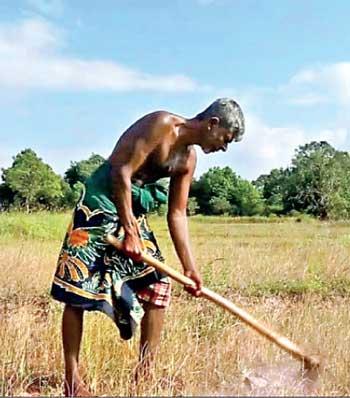
Dr Anurudha Padeniya, President of the GMOA in a LankaCNews presentation overwhelmed this writer with trepidation and fear. What is his mission in public fear-mongering?
The title of his talk (in Sinhala) was Agrochemical which is a mass-exterminator” kills ten times more than Corona”. He claims that while the Corona has killed 500 patients per year, the Rajarata Chronic Kidney Disease of Unknown etiology (CKDu) kills ten times more. Incidentally, the etiology of the kidney disease is now known, and the ‘u’ from the acronym, should be removed. He confidently claims that CKD is caused by agrochemicals. Regrettably, he appears to know neither the research nor the statistics on the subject.
No evidence that the kidney disease is caused by agrochemicals
First, let me present a quick profile of the key research findings.
International Consultation on CKDu in Sri Lanka (2017) concluded that there was NO EVIDENCE that agrochemicals caused CKDu.
Dr. Padeniya is still in 2013, when a WHO study tentatively stated that CkDu patients secreted more trace amounts of cadmium, arsenic and some pesticide residues in their urine, compared to reference limits. However, the Report, for some unknown reason, did not reveal, as shown from subsequent analysis of the raw data, that there were two to four times more subjects in the non-CKD control” area (Hambantota) with HIGHER cadmium, arsenic and pesticide levels than in the CKD area.
A dramatic study compared two adjacent villages in Girandurukotte, namely, Badulupura”, on high ground where the people exclusively drank water from dug wells and Sarabhumi in the plain where the people drank water from the river, reservoir or wells dug close to their homes. The Baduluprua people contracted the disease, which affecting virtually none from Sarabhumi. Analysis of the water in the wells in the Badulupura and Sarabhumi revealed that the Badulupura water was hard and heavily contaminated with fluoride, a highly nephrotoxic chemical, while being FREE OF AGROCHEMICALS.
Further evidence for a role for fluoride in the disease is that CKD patients also often have dental fluorosis.
Several independent research groups also have shown that high fluoride and magnesium contents in the hard water of the wells (fed by regolith aquifers) were the causative agents of CKD.
Further, the Medical Faculty, University of Peradeniya and the Institute of Fundamental studies, showed that rats fed with fluoride containing hard water contracted the disease, but not those fed with tap water. This was independently confirmed by Dr. Thammitiyagoda et al using well water from an endemic area (Ceylon Medical Journal 2018).
University of Tokyo studies on input water (2020) used in reverse-osmosis units in Ginnoruwa also confirmed the link to fluoride and magnesium, and the absence of agrochemicals in the water.
Meanwhile, Badulupura households were provided roof-top tanks for harvesting rainwater. Consequently, with the drinking of rain water, the incidence of CKDu in the village DECLINED over the years.
Now people in the CKDu affected areas are aware of the etiological agent and avoid drinking well water. With all this evidence deleting the ‘u’ from CKDu is justifiable’
Fertilizer and pesticide consumption
Displaying a copy of the Dinamina”, Dr Padeniya uncritically claimed that Sri Lanka is the world’s highest consumer of agrochemicals as reported in that paper. Regrettably, He has rushed to the microphone without checking authentic sources.
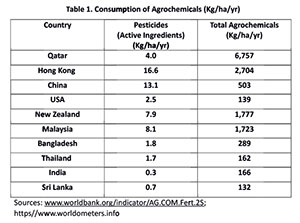
Table 1 gives the World Bank fertilizer and pesticide consumption figures of several countries which shows that Sri Lanka consumes the LEAST amount of agrochemicals in this part of the world, even below India. That is not all. As reported by the Department of Agriculture, from 2006, we have reduced the use of the most toxic, Class 1 and 2 pesticides by 98% and 29% respectively, and increased the least toxic ones of Class 3 and 4 by 91% and 41% respectively.
However, there is rampant overuse of agrochemicals resulting in the presence of phosphates and nitrogen in the runoff water. But, according to chemical analyses by Prof. Chandrajith et al., University of Peradeniya, no heavy metals above reference levels have been detected in the aquatic bodies, confirming the studies by University of Tokyo. So educating the farmers and misinformed gurus” like Dr. Padeniya is needed. I have, in my The Island article, May 19, 2021, already dealt with the need to educate the farmers for which strengthening the drastically run down agricultural extension service is a critical need.
Returning to old food habits and traditional varieties
The good doctor is recommending a return to old food habits and traditional rice varieties which, he claims, are more nutritious and healthy — another claim unsubstantiated by appropriate research.
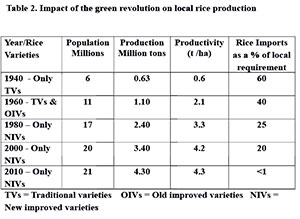
Together with Ven. Ratana and the ‘toxin-free agriculture’ group, during the Yahapalana regime, Dr. Padeniya claims planting traditional varieties (TVs) or rice which yield at best only 30-40% of that of the new improved varieties (NIVs); see Table 2. His claims that although low yielding, the TVs have high nutritious with health benefits. Sadly, he is not aware that, apart from very high yields some of the new varieties have much of those attributes. However, the staple food provides the calories, while the other nutrients are usually obtained from other foods.
If we go back to the TVs, as evident from Table 2, we need at least double the current extent of land under rice to feed the population. And where is the land? Norman Borlaug, Nobel Laureate and the Father of the Green Revolution, addressing the Nobel forum in 2000, reminded the environmentalists and other critics of the Green Revolution technologies, the likes of Dr Padeniya, that had the pre-green revolution of yields of the 1950s remained today the world would need three times more land to feed the population with far more disastrous environmental consequences than we have today with conventional farming.
Re-installing ‘sekkuvas’ in the villages for coconut oil production Another of Dr Padeni
ya’s half-baked recommendations is to make pure” coconut oil using sekkuwas” (stone mills worked by oxen), to stop palm oil consumption. Palm oil is the world’s number one vegetable oil with an over 40% global output; and over 50% inclusion in our food etc. It’s as safe as any other saturated fats, and many health benefits have been claimed for it. He is one of the key advisers to the government’s foolish move to ban palm oil and uproot existing oil palm cultivations. However, the palm oil import ban had to be lifted. No country has banned palm oil except Sri Lanka.
The ‘sekkuwa’ proposal is more pie in the sky” than going fully organic.” Besides, it carries the high risk of afflotoxin contamination. The villagers usually sun and air-dry the coconut kernel, thus inviting the fungus Aspergillus to produce afflotoxin. According to a Coconut Research Institute food expert, a ‘sekkuwa’ cannot be totally cleaned of bits of poonac, an ideal medium for Aspergillus growth.
Dr Padeniya often quotes the wise words of Hippocrates(460-370 BC), the father of medicine: ‘Let food be thy medicine and medicine be thy food’. And yet, Dr. Padeniya knows that even the best” food cannot save the world from viral epidemics. Did he not get his vaccine shots? Even if food were the only issue, the massive and increasing global population and the limited land and water, make conventional agriculture the only viable approach, while ever correcting its weaknesses. Organic farming experts like Adrian Mueller agree that its two percent output can never be increased to feed the world. It was abandoned in the 1850s when, even then, it failed to provide food to the increasing population globally.
Dr. Padeniya says we have been eating poison since 1950, but our life expectancy has steadily increased since then. It is far more appropriate in the current context of global agriculture for him to preach the wise words of the father of pharmacology, Bombastus Paracelsus, rather than those of Hippocrates: ‘ All substances are poisons, there is nothing which is not a poison. It is the dosage that differentiates poison and remedy’. The farmers need to judiciously use agrochemicals. Then the poison becomes remedy.
He would also do well to remember the wise words of Lord Buddha: ‘Speak only when you feel that your words are better than your silence.’
Health Minister Pavithra Wanniarachchi was quoted telling parliament, Sri Lanka reports 230,000 new kidney and cancer patients annually due to use of chemical fertiliser and pesticides. Breaking down that number she had said 6,000 kidney patients annually and 54 cancer patients succumb daily to their tragic ailments. She had also told parliament medical experts have confirmed that these were due to use of chemical fertiliser and pesticides. That same day, June 7, referring to the ban on chemical agri-inputs, President Gotabaya Rajapaksa had told a meeting of district development committee chiefs; there can be no turning back. He was quoted by media telling the participants, though there are protests and opposition, even with difficulty good things for the people have to be done.
Health Minister Wanniarachchi’s harangue was about justifying the total ban on chemical agri-inputs by President Gotabaya. She made a valiant effort to give new life to the overused and wasted slogan Food without poison”. Yet they have no clear source. Nor has any survey or research proved chemical fertiliser and pesticides are direct attributes for kidney ailments and cancer. What nevertheless needs attention is the President’s assurance, the total ban on all chemical agri-inputs will continue. All district development committees were asked to work on agriculture development with organic agri-inputs.
The debate unfortunately has been reduced to immediate substitution of chemical fertiliser with compost or organic fertiliser. There in fact is no attention paid to the ban on chemical pesticides and weedicides. Weeding in both large plantations and smallholdings is a major issue that cannot be managed by employing labour. Issues related to this sudden change of agri policy entails many more problems making this change more complex and complicated than mere substitution of one with another. Though not considered in any discussion forum collection, scavenging and disposal of solid waste all around the country by local government bodies called Municipal Solid Waste” (MSW) provide the basis for going totally organic.
‘The President had told a meeting of district development committee chiefs; there can be no turning back. He was quoted by media telling the participants, though there are protests and opposition, even with difficulty good things for the people have to be done”
Decision of the government to establish an organic fertiliser manufacturing centre in Anuradhapura was announced at the President’s meeting on June 7. Based on its success, that is to be replicated in all 29 Divisional Secretariat (DS) areas in the Anuradhapura and Polonnaruwa districts. The promise is to establish them before this year’s Maha Season, beginning September end through October.
These fast-track projects for mass scale compost production would require greater volumes of solid waste. It is common sense that solid waste volumes cannot be arbitrarily increased for want of bigger volumes of compost. Composting was introduced in Sri Lanka in late 1980’s with this city based free market economy promoting heavy consumption among a growing urban middle-class that led to increased volumes of solid waste, municipalities and urban councils had to regularly and constantly collect and dispose. Disposal of waste in open dumps in neighbouring areas created more issues with unbearable stench, insects, crows and birds, reptiles and stray dogs frequenting them in growing numbers and with residents protesting. Composting was thus thought of as a remedy, integrated into government policy of reducing import of chemical fertiliser. To cut short a detailed story of composting in Sri Lanka, the initial effort in promoting households develop compost fertiliser with their kitchen and household waste through distribution of bins first by the CEA and then with private partnerships served little purpose. Commercialising of compost manufacture was thereafter undertaken by local government bodies and small-scale businesses. Slow progress in market expansion over years with efforts made to improve and increases floriculture and organic fruits and vegetables creating a new profitable niche market in urban society, demand for compost as organic fertiliser increased. This gave space for few medium level businesses as well.
Within solid waste disposal and compost manufacturing, starter materials” are basically; (1) bio-degradable waste scavenged from MSW that include kitchen, household and garden waste, hospital, market and hotel waste (2) farm waste that include manure and poultry litter (3) crop residues and agricultural waste and then (4) slaughter-house waste.
Most numbers related to solid waste generation and compost in Sri Lanka are arbitrary. Different sources provide different projections. During the few years 2015 and aftersolid waste collected before scavenging for re-use and recycling was calculated at 4.8 billion MT per year at an average. It should also be said, far worse than most services, collecting, scavenging, transporting and disposing of waste in Sri Lanka is not efficient and has no set standards and methods. The total waste collected therefore is about 60% to 70% of the generated volume. Only about 60% to 80% of it is biodegradable. There is also a significant difference between the composition of solid waste generated in heavy urban areas and largely rural areas, with seasonal changes too.
Composting depends on none other than biodegradable waste in collected waste. In a co-authored research paper by two academics, one in Peradeniya University specialised in soil science and the other from the UN University in Dresden, Germany have inferred, Due to the push for recycling solid waste and a poor understanding of quality and safety concerns, many commercial-scale compost producers tend to use any biodegradable material that they can find conveniently in their composters. ….. Any biodegradable material could be composted. But if source materials and the composting process are not carefully regulated, whether the end product is going to meet the quality and safety standards cannot be guaranteed.” (Composting in Sri Lanka: Policies, Practices, Challenges and Emerging Concerns – Warshi S.Dandeniya and Serena Caucci).
“For whatever desperate reason, government’s intervention to turn the whole country organic by year end” would create an unattainable demand for compost”
In another research an observation is, In addition to hazardous and biomedical waste such as batteries, small electronic appliances, and hospital waste that could release potentially harmful organic and inorganic contaminants to the compost, non-biodegradable materials like plastics, textile, and polythene are also present in large volumes in MSW” (Arachchi, K. H. M. – Present status of solid waste management and challenges for change. Colombo: National Solid Waste Management Programme in Sri Lanka.” – 2016.)
For whatever desperate reason, government’s intervention to turn the whole country organic by year end” would create an unattainable demand for compost. With no standards in collecting and scavenging, no mechanisms for regulating and the quality of the end product least considered, this new passion of the government for organic farming” would not secure even half the desired results. Both in terms of harvest and toxic-free” organic food. Reason being, while MSW is not properly scavenged for toxic waste, the second largest and more readily available poultry manure” used in composting, adds toxics never checked for. A research on poultry litter says, Non-standardised manure and improperly generated compost procedures are causes of public health concerns which have not been considered in the past and that are going behind the pathogen or heavy metal concentration. Poultry litter/manure is a source of antibiotic resistance determinants and, therefore, imposes a silent threat to environmental quality and health.” [E.M Herath, A.G.K.N. Palansooriya et al, An assessment of antibiotic resistant bacteria in poultry litter and agricultural soils in Kandy District, Sri Lanka”: Tropical Agricultural Research Journal, 27(4)]
Compost is therefore not safe though hyped as poison free”. Local government bodies that account for the total volume of MSW in compost manufacture do not have skilled labour, technology and infrastructure for proper scavenging and separation of toxic material. Nor have any plans been made for such improvement. Release of potentially harmful organic and inorganic contaminants to the compost” therefore in State sponsored accelerated expansion of market demandwould be a major issue, despite the promise for poison free food”.
This raises two major issues for the government and for those who believe this to be the answer for our subsistence agriculture and food safety”. First is the question, can the government make available the minimum required compost within about three months for the N-C paddy farmer this Maha season? That seems impossible with a half-hearted MSW collecting network in a province that generates only about 10% of the total national volume of solid waste annually. The second is, with no serious and district level monitoring of compost manufacture paid any attention that anyway is not clean and never toxic free as popularly projected, can the government make certain the new frenzy for organic fertiliser would not give way for sub-standard products? That again is an impossible task with a corrupt and inefficient State apparatus sickeningly subservient to local politics. In short, compost or organic fertiliser is not a clean and effective substitute for chemical fertiliser though people are told to believe it is and, in this country, there is no capacity to produce a better cleaner” product with local government bodies not even thought of as the major stakeholder in compost manufacture in the campaign for a totally organic Sri Lanka” before year 2022. It is not a long wait anyway to see how the clean food – clean soil” campaign finally roots itself in society. NC province Maha season would sure be the harbinger.
The President is effectively hollowing out 25% of the earnings of these already cash-strapped communities. His gamble is pushing a good part of Sri Lanka’s farmers, who are living on the fringes of poverty, back into abject poverty. This is a crime! To be blunt, this is a crime worse than white vans
Worst still, the ban was announced out of the blue, taking them by surprise in the height of the corona virus pandemic. Tea smallholders lament their harvest had plummeted to one third – from 900 kg per acre to 300 kg. Subsistent farmers point to emaciated pumpkin
Many countries that experienced a pandemic infused negative growth in 2020 are bound to bounce back. Some others, like Sri Lanka, which are still barely coping with, still have the opportunity to economic revival in the second half
Farmers across this paradise isle are raging against a man-made disaster courtesy of a presidential directive. Holding placards in their starving paddy lands and hollowed out cash crops, they protest against a crippling shortage of fertilizer, the reason for that being a dimwitted presidential order to ban chemical fertilizer. Worst still, the ban was announced out of the blue, taking them by surprise in the height of the corona virus pandemic. Tea smallholders lament their harvest had plummeted to one third – from 900 kg per acre to 300 kg. Subsistent farmers point to emaciated pumpkin.
Their grievances fill the prime time news of television stations, even some, which are staunchly pro-government. They are not just sound bites, nor are personal tragedies. They are the tip of an iceberg of a major national calamity that would come to full force in a couple of months when the country faces a full-blown man-made food crisis for the first time in its history and an unprecedented rise in poverty in farming communities.
If you are a dispassionate watcher of world affairs, you might guess that when a Third World country does things, no one else has not ever done, and is simply guided by guesswork, sans scientific logic, that doesn’t end well. Like the economic joke about a 100 dollar bill lying on the road, if something is so good, someone else has already picked it up – The bottom line is that if some things are too good to be true, they aren’t true.
As for the Presidential ban on fertilizer, it is going to be a monumental disaster. Consider the captive group on whom this experiment would be tried on. Sri Lanka’s farmers account for nearly 25% of the country’s workforce. They contribute barely 7.5% to the GDP. In other words, the low productivity per farmer means that they earn only 30% of the GDP per capita. Sri Lanka’s GDP per capita in 2019 was US$ 3853 (World Bank). Put the dichotomy of the output and workforce of the agricultural sector, the average per capita income of a farmer would be US$ 1156. That would place them barely above the World Bank classification of a low-income country (US$ 1036 as of the year 2020). Effectively, Sri Lanka’s farmers are eking out a living on par with Sub Saharan Africa. It is the very survival of these communities that President Gotabaya Rajapaksa is threatening with his ill-advised fertilizer ban. There is a near consensus among Agri scientists that the yield reduction of the organic fertilizer only crop cultivation is significant. According to well-documented research work, the mean yield reduction could vary from 19% to 25%. When the existential conditions of Sri Lanka’s agricultural sector and other extraneous factors counted on, the fallout is likely to be much larger.
The President is effectively hollowing out 25% of the earnings of these already cash-strapped communities. His gamble is pushing a good part of Sri Lanka’s farmers, who are living on the fringes of poverty, back into abject poverty. This is a crime! To be blunt, this is a crime worse than white vans.
Alongside the collective misery of farmers, there will be a national crisis due to the economic fallout of the substantial drop in export income from tea, rubber, and other cash crops, and a potential food crisis. Many countries that experienced a pandemic infused negative growth in 2020 are bound to bounce back. Some others, like Sri Lanka, which are still barely coping with, still have the opportunity to economic revival in the second half. However, the self-inflicted agricultural crisis would mean, Sri Lanka would lose a minimum of 30% of the output of the agricultural sector. This government has not just squandered economic revival, it has self-inflicted colossal damage, which no sane entity would do.
This is a sequel to my last week’s column where I argued against the folly of the fertilizer ban. But, farmers in Sri Lanka don’t read English newspapers. It is disheartening to see the extremely limited critical discourse on the impending fallout in the vernacular media. Much of that discourse, if any is sanitized or politicized. This is not a political problem. This is a looming national crisis.
Also, you have a freak show of sycophants defending a policy that is indefensible. Jokers have replaced the agri-scientists and agronomists in deciding and defending the policy. One such, Anuruddha Padeniya of the GMOA has all of sudden become the authority in agriculture. Sycophants are competing for brownie points from their political masters.
Equally disappointing is the absence of a coherently articulated opposition by the opposition parties. The Samagi Jana Balawegaya interlocutors seem to be at a loss of distinguishing crass reality and fiction of the fertilizer ban. Some speak out against the shortage of fertilizer but fail to tackle the policy that is the root of the problem. Some fellows seem to buy the skewed rationalization of health reasons.
A political opposition that is not capable of identifying the economic viability and tremendous social-economic cost of a demagogic policy is indeed a case in point of poverty in Sri Lankan politics, the very reason why Gotabaya Rajapaksa is now the President.
Mr. Rajapaksa himself is being overly callous; he is inflicting pain and misery upon his very constituency, the archetypical 6.9 million who voted him to power. Funny thing though most of the farmers, who would go broke at the end of this farming season, thanks to Mr. Rajapaksa’s policy, are yet to blame him. They reproach the local officials for hoarding fertilizer or failing to provide them with the stuff on time, but fail to understand the root cause of the shortage. Their ignorance in their small worlds is shielding President Rajapaksa from their scorn for the time being, just like the same conditions elected him to power. (This may sound like a condescending take, but, that is how the world of inequality functions).
However, this cloak of complacency cannot last forever and will shatter at some point in time.
But, why wait till this irrationality runs its full course?
The Cabinet of Ministers have approved a proposal to import 100,000 metric tonnes of rice to counter the unusual price increase of rice in the local market.
The cabinet paper presented by Trade Minister Bandula Gunawardena for this purpose has been approved by the Cabinet.
The Health Ministry says that another 367 persons have tested positive for Covid-19 today increasing the daily count of positive cases to 2,098.
All new cases reported today are associated with the New Year cluster.
This brings the tally of confirmed cases of coronavirus reported in the country so far to 241,820.
Presently a total of 31,952 patients infected with the virus are being treated at hospitals and treatment centres while total recoveries stands at 207,287.
Several countries which are pro-Eelam have prevented senior military officials of the Sri
Lanka army, from attending prestigious foreign courses and receiving
scholarships, citing unsubstantiated
war crimes accusations. Maj. Gen Jagath
Dias was not allowed to join an ICRC project in Australia. US refused to accommodate Maj. Gen. Sudantha
Ranasinghe, on a programme as he commanded the elite 53 Division. The 53
Division had killed LTTE leader Prabhakaran.
The International Truth and Justice Project (ITJP) created
dossiers of war crimes for the senior officers who led the final assault in
Eelam War IV. ITJP had dossiers on
Shavendra Silva, Kamal Gunaratne, Jagath Jayasuriya and Jagath Dias. Shavendra Silva’s dossier had information on
his four deputies in the 58 division as well.
Three retired
service commanders, Air Chief Marshal Roshan Goonetileke, Admiral Tisara
Samarasinghe and General Daya Ratnayake, called a special media briefing in
Colombo at the Sri Lanka Foundation Institute in February 2019, to bring to
public attention what they called a relentless campaign directed against some
individuals in the army.
General
Ratnayake said that they were seriously concerned about the ongoing operation
targeting the military. Since the change
of government, in January 2015, 67 army officers and 637 other rankers had been
investigated. The number of officers and other ranks (Army and Navy) arrested
during this period was placed at 15 and 35, respectively. Seven Army and Navy
personnel are currently in custody. One officer and one soldier have been
sentenced to death. He said it was not the policy of the army to deliberately
target civilians. The war winning military was being [unfairly] penalized.
These retired service commanders expressed
concern over the attempt to take wartime Navy Commander Admiral Wasantha
Karannagoda into custody regarding some wartime disappearances (2007-2008). They
praised the role played by Admiral Karannagoda during the conflict. Karannagoda
changed the naval strategy in place at the time and had also taken action to
destroy the floating LTTE arsenals on high seas.
Director of the State Intelligence Service (SIS) Maj. Gen. Suresh
Sallay has sent a Letter of Demand to Executive Director of the International
Truth and Justice Project (ITJP) Yasmin Sooka and the ITJP for making malicious
allegations against him. The letter of demand states that on or about June 01,
2020, Yasmin Sooka, in her capacity as the Executive Director of the ITJP
issued a press statement making various defamatory remarks against Major General
Sallay. The press statement was published on the ITJP Sri Lanka’s website.
The Letter of Demand says the defamatory implications have
resulted in parties with vested interests making attempts on the life of Maj.
Gen. Sallay. The Letter mentions the numerous
awards and achievements of Major General Sallay and the resultant tarnishing of
this reputation. He asks for Rs 1
million as damages. The Letter of Demand has also notified Sooka and the ITJP
to cease and desist from issuing further defamatory remarks if they continue to
do so, Sallay would take legal action, both Civil and or Criminal.
Lawyers
representing Maj. Gen. Suresh Sallay also handed over a letter to UN office in
Colombo complaining about a propaganda campaign carried out by Yasmin Sooka of
the ‘Truth and Justice’ Project against Sallay.
Major General
Chagi Gallege, then Director General, Infantry was refused a visa to visit his brother in
Australia, due to ‘war crimes.’ Australia has found fault with Gallage for
being in command of the 59 Division from May 7, 2009 to July 20, 2009 when it was engaged in the Vanni offensive. Australian
High Commission stated that troops under his command certainly committed war
crimes and crimes against humanity. There have never been specific allegations
against Maj. Gen. Gallege before. Gallege has now retired from service, but the
Australian ban remains.
The
Australian Department of Immigration and Border Protection has extensively
cited Report of the OHCHR (Office of the High Commissioner for Human Rights) on
Sri Lanka (OISL) to turn down Gallege’s visa..Australia has cited a statement
attributed to General Officer Commanding (GOC) 58 Division Maj. Gen. Shavendra
Silva that unmanned aerial vehicles (UAVs) real time footage had been made
available to ground commanders marking targets, to justify its decision. On the
basis of Maj. Gen. Silva’s statement, Australia has alleged that Maj. Gen.
Gallege had been aware of artillery strikes on third no fire zone.
.Australia has accused Maj. Gen. Gallege of planning, implementing
and supporting war crimes and crimes against humanity. Australia also held him
responsible as the serving officer for failing to prevent troops under his
command from committing war crimes.
Sources pointed out that the decision to accuse Maj. Gen. Gallege
of crimes against humanity meant that Australia believed that the Sri Lankan
army carried out systematic attacks against Tamil civilians. The High
Commission ignored the fact that none of the allegations had been proved in a
court of law or at least thoroughly examined, said critics.
Chagi Gallage was in the forefront of the war against the LTTE. He is
acknowledged widely as a very good soldier. He
is considered one of best strategists in the army. He discharged his duties on
the battlefield with distinction. He was
a simple and humble officer, who did not throw his weight about and
was liked by both officers and the ranks.
Gallage’s predicament did not receive the media attention it
deserved. Neither Parliament nor nationalist
groups took up the matter. An ungrateful Sri Lanka never bothered to make
representations on behalf of an officer who risked his life for his motherland
on countless occasions as a frontline infantry officer, said analysts. They
observed that while a legitimate army was being targeted for defeating the LTTE,
the LTTE had been given safe haven in many parts of the world. (Continued)
It is not only the government that defended the move, but also Jaffna-based fisher cooperatives.
Days after Tamil Nadu fishermen protested Sri Lanka’s efforts to build an artificial reef off Delft island, west of Jaffna peninsula, authorities defended the move aimed at enhancing fish breeding”.
Last week, Sri Lanka’s Department of Fisheries and Aquatic Resources, with the assistance of Navy, launched a project, dropping around 20 discarded buses into the sea off Delft, as was earlier done in other parts of the island nation, including the eastern Trincomalee district, officials said.
Many countries, including India, have in the past created artificial reefs to facilitate fish spawning. Old train carriages were used in the US, for instance,” Cabinet Minister for Fisheries Douglas Devananda, who represents Jaffna district in parliament, told The Hindu. The move was backed by research undertaken by Sri Lanka’s National Aquatic Resources Research and Development Agency (NARA), he said.
By objecting to an initiative in Sri Lanka’s territorial waters, Tamil Nadu fisher leaders have only exposed themselves as parties interested in fishing illegally in the Palk Strait,” he said, referring to the long-persisting Palk Bay fisheries conflict.
Persisting problem
Scores of Tamil fishermen living in the war-affected northern and eastern districts of Sri Lanka have, for over a decade now, been protesting Tamil Nadu fishermen’s use of destructive bottom trawlers along their coast, severely impacting the marine ecosystem and their post-war livelihoods. Despite ongoing bilateral discussions and several rounds of talks between fishermen of both countries, Tamil Nadu fishermen are yet to meet northern Sri Lankan fishermen’s consistent demand that they stop bottom-trawling in their seas. On the other hand, Tamil Nadu fishermen have accused the Sri Lankan Navy of attacking and killing fishermen — allegations that the Sri Lankan side denies.
Meanwhile, members of the All Mechanised Boat Fishermen Association, held a protest in Rameswaram last week, urging Sri Lanka to stop dropping iron scrap” into the sea, since would affect” marine ecology in the Palk Strait, and also damage” their own boats and nets.
In a tweet indicating Sri Lanka sees its recent initiative also as a deterrent to bottom-trawling, State Minister of Fisheries Kanchana Wijesekera said while the artificial reef would boost fish spawning, it will also act as a shield against bottom line trawling conducted illegally by the #Indian Fishermen”.
It is not only the government that defended the move, but also Jaffna-based fisher cooperatives. This initiative is aimed at helping our livelihoods by increasing fish production, and that is why we have welcomed it. We condemn certain sections of fisher leaders in Tamil Nadu opposing the move,” said Annalingam Annarasa, leader of the federation of fisher cooperative societies in Jaffna.
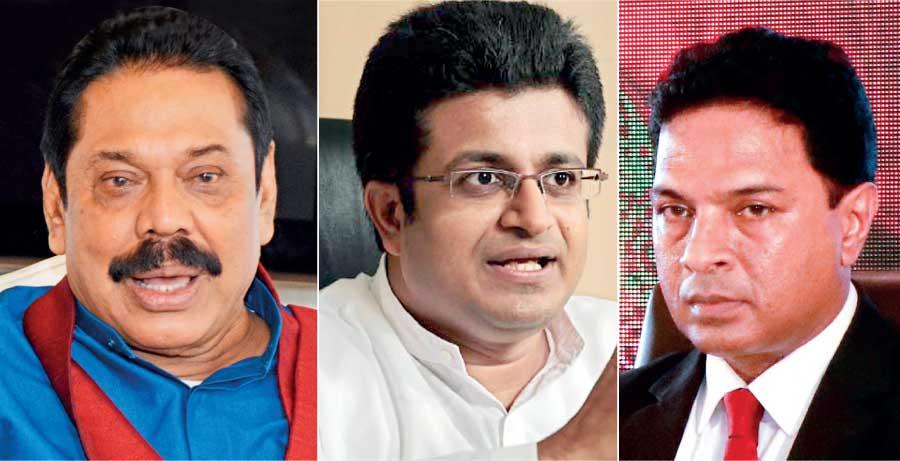
The statement put out by SLPP (Sri Lanka Podujana Peramuna) General Secretary Sagara Kariyawasam, critical of Energy Minister Udaya Gammanpila over the latest fuel price hike, laid bare once again factions and frictions in the government .
It is commonsense that the fuel price hikes cannot be enforced without sanction of the Finance Ministry. The subject ministry can make recommendations, but it is finally the collective decision of the government under usual circumstances. The recent spike of fuel prices to reflect increases in the world market is no exception to the rule. It, however, added to the woes of people who are already battered by the pandemic-related restrictions in pursuit of their livelihood activities. A public outcry is naturally expected against the fuel price revision, a move having ripple effects in various sectors of the economy.
“The Prime Minister is the leader of the SLPP. In reality, its political activities are operated by its National Organizer Basil Rajapaksa. Therefore, the story in the rumour mills is that Mr. Kariyawasam worked out this statement at the behest of Basil Rajapaksa”
The SLPP is the governing party. Therefore, it would have been privy to circumstances that led to the upward revision of fuel prices. Still, Sagara Kariyawasam released this statement trying to blame the price revision solely on Minister Gammanpila. The government came under severe criticism by the general public after the price hike which will result in the rise of cost of living at the end. Already, the prices of bakery products have gone up, and, so will be passenger transport fares. Mr. Kariyawasam, would have attempted to palm off the responsibility on one minister, absolving the government of it. The SLPP General Secretary, in his statement issued under the party’s letterhead said Minister Gammanpila’s approach only led to the government increasing the prices.
Nevertheless, facts are facts. It is the collective decision taken by the government through the cost of living committee chaired by President Gotabaya Rajapaksa and Prime Minister Mahinda Rajapaksa. As such, the Minister had the valid points to counter Mr. Kariyawasam’s statement. He did it with vigour at a press conference the very next day. Besides, he got a shot in the arm when the President’s Office also defended the fuel price revision. The President’s Media Division (PMD) issued a press statement justifying the decision. The PMD said a spike was warranted by the present local and global economic realities.
No matter what, the blame game amply displays internecine warfare within the government. The SLPP has been at loggerheads with its minor allies such as Minister Gammanpila’s Pivithuru Hela Urumaya (PHU) and Industry Minister Wimal Weerawansa’s party for some time. It turned out to be obvious particularly when the 20th Amendment to the Constitution was enacted last year. In some instances, the leaders like Minister Weerawansa became of the subject of vilification and slander by the SLPP legislators, particularly the newcomers, both in and outside Parliament. The latest incident on the fuel price is just an amplification of strife between the SLPP and its allies.
“Samagi Jana Balawegaya (SJB), the main opposition, has responded to the situation by opting to move a no confidence motion against Minister Gammanpila. For the SJB, as a force opposed to the ruling side, have reasons for such a step”
The alliance partners have now formed into a group to muster collective strength to respond to the SLPP. Eight such parties came out with a statement condemning Mr. Kariyawasam’s statement. The Prime Minister is the leader of the SLPP. In reality, its political activities are operated by its National Organizer Basil Rajapaksa. Therefore, the story in the rumour mills is that Mr. Kariyawasam worked out this statement at the behest of Basil Rajapaksa. Senior SLPPers such as Agriculture Minister Mahindananda Aluthgamage gave rise to such speculation. No one has yet denied such involvement of Mr. Basil Rajapaksa who is currently in the United States. Finally, the SLPP had to eat humble pie when it became established that Mr. Kariyawasam’s statement was unacceptable.
At a press conference on Tuesday, State Minister Arundika Fernando extended an apology to Minister Gammanpila. It looks like that Mr. Kariyawasam is isolated with no one for his defence in the case. Now, Samagi Jana Balawegaya (SJB), the main opposition, has responded to the situation by opting to move a no confidence motion against Minister Gammanpila. For the SJB, as a force opposed to the ruling side, have reasons for such a step. First, it can take the government to task both on the fuel price region during the debate on the no confidence motion once it is placed before Parliament. Likewise, the debate will afford the main opposition and others to mock at the government over its internal squabbling.
“The SLPP is the governing party. Therefore, it would have been privy to circumstances that led to the upward revision of fuel prices. Still, Sagara Kariyawasam released this statement trying to blame the price revision solely on Minister Gammanpila”
But, it is difficult to win the motion unseating the Minister from office since it is nowhere near the required majority. The opposition will raise tricky questions which the government will find it difficult to answer convincingly. The SJB legislators will sneer at the government benchers during the course of the debate, for sure. However, despite differences among its own ranks, the government is not placed to allow the no confidence motion against one of its own ministers being adopted by Parliament. As such, the government will forget all differences and act for the defeat of the motion if it is put to a vote in the House. In that sense, it will be a factor that unifies the otherwise different of voices of the government.
The concerns have been raised to such an extent over the contradictory figures on COVID-19 deaths and cases in the country that medical experts claim that to be a conspiracy.
Government Medical Officers Association (GMOA) President Dr. Anurudda Padeniya voiced against the controversy over COVID-19 figures.
I say with responsibility that there is a conspiracy behind it. Data are not released by the Epidemiology Unit. Three officials are also behind it,” Dr. Padeniya stressed.
The Epidemiology Unit has been entrusted with six responsibilities such as surveillance, outbreak control, vaccination, clinical managed coordination, operational research and monitoring and evaluation,” he said.
Dr. Padeniya expressed these views before President Gotabaya Rajapaksa at a recent COVID-19 Task Force meeting at the Presidential Secretariat.
Meanwhile, when asked of this, Director General of Health Services Dr. Asela Gunawardena said it was not possible to conclude that there is a conspiracy behind this but there had been some issues with the figures.
In addition, the Daily Mirror at an earlier occasion noticed that there was a considerable gap between the figures on COVID-19 in the Health Ministry and Epidemiology Unit websites.
However, when we later inquired about this from Deputy Director General of Health Services Dr. Hemantha Herath said the Epidemiology Unit would look into the matter as the issue had occurred from their side.
Subsequently, the figures were rectified.
In such a situation, Chief Epidemiologist Dr Sudath Samaraweera was transferred to the Dengue Control Unit as its Director.
One way of erasing the Eelam victory is by declaring that the
officers, who led the military campaigns, had committed war crimes. Critics observed that army officers who led
front line fighting formations in the Eelam war were relentlessly pursued on
the basis of unsubstantiated war crime allegations, not proved in a court of
law.
On 19 May
2009, the Sri Lankan military effectively concluded its 26-year operation
against the LTTE. The 58 Division of the Sri
Lankan Army led by Brig. Shavendra Silva, 59 Division led by Brig.
Prasanna de Silva and the 53 Division commanded by
Gen. Kamal Gunaratne, after having boxed in the remaining LTTE cadres into a
small area of territory near Nandikadal
lagoon. The battle for the last patch of LTTE held territory was led by
Brig. Shavendra Silva, one of the Gajaba Regiment veterans handpicked by Lt.
Gen. Fonseka for the Vanni offensive.
Shavendra
Silva commanded the celebrated formation that killed the most number of
terrorists, recovered the most number of weapons and brought the large parts of
western and eastern Vanni under government control, said Major General Chagi Gallege.
Shavendra
Silva refused to join the peacekeeping mission to Haiti, despite the financial
benefit that would result, as he thought he should remain on the battlefield at
the height of operations. The offer of Haiti was probably
made to remove this capable officer from the war campaign.
The 58 Division
was Sri Lanka’s most successful fighting Division. It was not only the best,
but the youngest Division which fought alongside eight other formations on the
Vanni front paving the way to the final battle.
The 58 Division, formerly known as the Task Force I, played a
significant role in eradicating the LTTE’s conventional fighting capability in
the Vanni region. It fought its way from
Mannar to Vellamullivaikkal -a distance of 201 kms. No other fighting formation
had even come close to challenging the 58 Division’s record, though the
battlefield success was due to the combined efforts of the armed forces, said
Shamindra Ferdinando.
The 58 Division’s biggest achievement was the unprecedented
operation at Anandapuram, where it killed over 600 LTTE cadres, including the
most experienced LTTE commanders. The operation conducted together with 53 Division,
helped hasten the collapse of the LTTE.
Shavendra
Silva who led the 58 division became the main target of those prosecuting war crimes.
Shavendra Silva was targeted as a ‘war criminal’ by the International Truth and
Justice Project, Sri Lanka (ITJP) administered by the Foundation for Human Rights, South Africa,
under the direction of Yasmin Sooka.
In 2017, Yasmin Sooka in her capacity as the Executive Director, ITJP
wrote to Coca Cola Company critiquing it for sponsoring Gajaba Supercross 2017
held at Saliyapura, Anuradhapura in August that year. The Gajaba Regiment was
responsible for war crimes and human rights violations over the past several
decades and Shavendra Silva was its Commander.
Sooka wanted to know why Coca Cola financed an event organized by this
notorious war criminal.
In 2019, ITJP
released a defamatory 137-page dossier on Shavendra Silva, (Shavendra Silva
chief of army staff, Sri Lanka .Dossier29 January 2019) containing data cobbled
together from media reports. It is not a document that will be taken seriously
in a court of law.
ITJP
however is very proud of the document. This Dossier presents the most detailed
body of evidence against any Sri Lankan military figure to date, said ITJP. It amalgamates photographs, contemporaneous
SMS and witness testimony, including from insiders, with linkage evidence in
the annexures, such as official Army releases which were deleted offline after
the War to hide the truth, as well as relying on the findings of past UN
investigative reports. It also presents
a legal analysis of the evidence gathered, knowing that a more detailed
examination would be needed to frame criminal charges.
There is a tremendous amount of
evidence in this dossier, meticulously collected by my team over many years,
said Sooka. This dossier is just a fraction of the information we hold. Many
successful cases at international tribunals and the International Criminal
Court had less to work with. There is now no excuse for this man to remain as
number two in the Sri Lanka Army: he must be suspended immediately and a criminal
investigation instituted, she said.
ITJP said Shavendra
Silva was arguably the most important frontline ground Commander in the 2008-9
War in Sri Lanka, in which war crimes were committed. There are reasonable
grounds to believe that Major General Shavendra Silva committed war crimes
either directly by ordering them or by failing to prevent his troops from
committing them.
Given the evidence set out in this
report and the findings by the OISL, Major General Shavendra Silva can and
should face charges of war crimes of rape, torture and outrages upon personal
dignity, as well as torture as a separate crime, committed by troops under his
effective command and control. There are reasonable grounds to believe that he
knew or had reasons to know about these crimes and even then failed to prevent
the crimes from occurring and punish those responsible, said ITJP.
Silva commanded a large number of
troops throughout the offensive in the north of the island he was instrumental
in the attacks on all the strategic towns and villages in 2009. He was also
personally present at the white flag surrender at the end of the War, when hundreds
of Tamils disappeared in Army custody and others, including women and children,
were subjected to summary execution, continued ITJP.
Shavendra
Silva’s troops fought in almost every major battle during this phase – in
Mannar, Pooneryn, Kilinochchi, Paranthan39, Tharmapuram, Vishwamadu,
Thevipuram, Puthukkudiyiruppu (PTK), Iranapalai, Ananthapuram, Pokkanai,
Putumattalan, Valayanmadam and finally Mullivaikkal. The UN report from 2015
also confirms the 58 Division’s presence in these locations.
Shavendra
Silva’s troops were instrumental in the attacks on all the strategic towns and
villages in 2009. He was also personally present at the surrenders at the end
of the War, at which point hundreds of Tamils disappeared in Army custody and
others, including women and children, were subjected to summary execution.
The ITJP
report also said the following:
Silva has never been held accountable for his role in crushing
the Janatha Vimukthi Peramuna uprising” in the late eighties.
An insider witness reported that Silva was the officer who ordered
attacks on Kilinochchi while there was still an international presence in the
town. These attacks resulted in civilian casualties and extensive damage to the
hospital and the UN compound
Based on the evidence set out in this report, the Sri Lanka Army
was responsible for shelling the Kilinochchi Hospital and the UN base in town
knowing that civilians were inside, which resulted in civilian casualties and
damage to the UN buildings and the hospital.
The evidence in this report confirms that troops under the
effective command of Major General Silva were involved in the military
operations in Pokkanai
The MOD Situation Reports provide further corroboration that the
58 Division was directly involved in the military operation in PTK – a small
town in the Vanni, spearheaded by Gajaba Regiment veteran Brig. Shavendra
Silva.”
The OISL found reasonable grounds to believe the 58 Division was
among units that repeatedly shelled Putumattalan Hospital
Similarly, as corroborated by the Sri Lanka Army MOD Situation
Reports, in late April 2009 the 58 Division was involved in the military
operation in Valayanmadam. The evidence gathered indicates that shelling, tanks
and cluster munitions coming from the Sri Lanka Army side were used in the
attack against Valayanmadam, including at the church
There are reasonable grounds to believe that Shavendra Silva’s
troops were involved in attacks against the hospital and the church in
Valayanmadam which resulted in the civilian casualties and damage to the church
and the hospital.
The presence of the 58 Division in Mullivaikkal and surroundings,
where daily intense bombardment by Sri Lanka Army artillery, the air force and
navy was reported, has been further corroborated by MOD Situation Reports
Several LTTE members were shot dead in the ‘White Flag Case’ where
they surrendered to his Division. Eye witnesses placed Silva on site and claim
he even shook hands with the LTTE political wing leaders who surrendered on 18
May 2009, only to be summarily executed shortly thereafter.
The evidence demonstrates that troops under the effective control
of Shavendra were present at the Wadduvakkal Bridge, where according to the
available evidence, hundreds of surrendering LTTE military and political
leaders and their families were subjected to summary execution and arbitrary
detention, as well as enforced disappearance.
Shavendra Silva is quoted as having said: Our aim was not to gain
ground but to have more kills.
In light of
the above, there are reasonable grounds to believe that the 58 Division under
the effective military command of Major General Shavendra Silva violated
international humanitarian law by failing to distinguish between civilians and
LTTE fighters as well as between civilian objects and military objectives said
the Dossier.
The Dossier concludes
by suggesting Sri Lanka should a) immediately suspend Shavendra Silva from
service pending investigation. b) The Attorney General of Sri Lanka should
immediately institute an investigation of the allegations of grave crimes made
against Shavendra Silva with a view to prosecuting him. c) UN Member States should either impose a
travel/visa ban on Shavendra Silva or move to arrest him under universal
jurisdiction if he enters their territory. He should not under any
circumstances be granted immunity d). The United Nations should cease all
peacekeeping deployment from Sri Lanka so long as its Army is overseen
Shavendra Silva, who is one of the world’s worst alleged war criminals
Instead, Shavendra Silva was appointed as Sri Lanka’s Deputy
Permanent Representative to UN, 2010-2015. Though the attempts at preventing
Silva’s appointment to the UN failed, a consolation of some sorts was achieved
when Silva was debarred from participating in meetings of the Special Advisory
Group related to UN peace keeping missions of which he was a member
representing the Asian group of countries said Global Tamil Forum.
The chairperson of the Group, Louise Frechette, a former UN Deputy
Secretary General, informed Silva that his participation in the Group was
‘inappropriate’ and advised him to keep away from all ‘deliberations’ of the
panel. A law suit
was filed against Silva by the relatives of Tamil victims in the District Court
of the Southern District of New York.
Silva returned
to Sri Lanka at the end of his term in
the UN and In January 2019 Silva was
promoted to Chief of Staff of the Sri Lankan Army. In August 2019 he was
appointed Commander of the Sri Lanka army.
The appointment was made because he was the senior most serving military
officer and there are no proven allegations of human rights violations against
him, the government explained. The appointment was one made by the Head of
State and the government will not tolerate criticism, Sri Lanka said. Any
criticism is unwarranted and unacceptable” .
But there was
a chorus of disapproval from several directions.
There was opposition from UN Secretary-General
Antonio Gueterres, United Nations High Commissioner for Human Rights. Michelle
Bachelet the European Union (EU), UN human rights
experts including Bernard Duhaime, and Tae-Ung Baik of the Working Group on Enforced or
Involuntary Disappearances, and High Commission of Canada in Sri Lanka. They
all said that Shavendra Silva should not have been given this appointment, given
the allegations of grave human rights and humanitarian law violations against
him.
Global Tamil Forum (GTF) urged UN Human Rights Council (UNHRC to
take action in respect of wartime General Officer Commanding 58 Division Maj.
Gen. Shavendra Silva receiving appointment as the Chief Staff of the Army.
Among all the Sri Lankan military officers implicated in war
crimes, Silva is perhaps the most well-known. In many ways, he symbolized war
crimes and committed by the Sri Lankan armed forces during the last stages of
the war, said the GTF. The Tamil National Alliance also protested.
The
International Truth and Justice Project (ITJP) has described Major General
Shavendra Silva’s appointment to the post of Army Chief as a move which
immensely” damages the country.The ITJP Executive Director Sooka also noted
that the appointment could affect US assistance to Sri Lanka, since the Leahy
Laws in the US, prohibits it to provide military assistance to foreign security
units which violate human rights with impunity”.
Major
General Silva of course is not alone in being promoted post-War –there is a
pattern of rewarding, honoring and promoting alleged perpetrators, deploying
them in prestigious UN jobs, as diplomats and in the former conflict areas to
administer the very people they defeated. This is a text book case of impunity,
ITJP said.
The United
States Embassy in Colombo said The United States is deeply concerned by the
appointment of Lt. General Shavendra Silva as Army Commander. The allegations
of gross human rights violations against him, documented by the United Nations
and other organizations, are serious and credible. This appointment undermines
Sri Lanka’s international reputation
US Ambassador to Sri Lanka, said It is only
an articulation of our concerns” and should not be seen as interference in
the affairs of another country or an attempt to dictate who should be appointed
to key positions. “The allegations
of gross human rights violations against Lt.Gen. Silva, documented by the
United Nations and other organizations are serious and credible,” she
noted.
In 2020, the USA showed its disapproval by prohibiting Silva and
his family from entering USA. The New York Times noted that this travel restriction was the first significant international
penalty to be imposed on a Sri Lankan official over atrocities committed during
Eelam War IV. Human Rights Watch welcomed the travel restriction and urged the
European Union and Britain to consider similar sanctions against Silva and
others accused of wartime violations.
Government of Sri Lanka, for once, did not take this lying down. Foreign
Ministry asked USA to review its
decision to impose travel restrictions on Shavendra and his immediate family.
Sri Lanka ambassador to US said imposing a travel ban on Lt. Gen.
Shavendra Silva based on allegations is regrettable and contrary to the
principles of natural justice ” Even members of his family who have not
been accused of any wrongdoing, have been subjected to a collective punishment
reminiscent of the practice in medieval Europe.” .
Just as much as the U.S. is proud of the men and women of their
armed forces, Sri Lanka is no different. We also have war heroes. Sri Lanka’s proud security forces completed
the task assigned to them by a democratically elected administration.
“Lt. Gen. Silva was
one of the senior military officials who contributed significantly to liberate
Sri Lanka from terrorism over a decade ago, and it is disappointing that a
foreign government should question the prerogative of a democratically elected
President to call upon persons of proven expertise to hold key positions on national
security related matters the Ministry said. Government of Sri Lanka said it will remain strongly engaged on this issue with the
United States to have it review its decision.
In 2021 the
International Truth and Justice Project (ITJP) said it had compiled a 50-page
dossier on General Shavendra Silva, which it has submitted to the Sanctions
Department of the UK’s Foreign, Commonwealth and Development Office. The
Submission argues why Silva, who is Sri Lanka’s current Army Commander, should
be designated under the United Kingdom’s Global Human Rights (GHR) Sanctions
Regime established on 6 July 2020. . The Submission also looks at Silva’s
alleged involvement in torture and sexual violence, including rape.
We have an extensive archive of evidence on
the final phase of the civil war in Sri Lanka, meticulously collected by
international prosecutors and lawyers. The testimony of victims and witnesses –
many now in the UK – was vital in informing this Submission, and making the
linkages to Shavendra Silva and those under his command,” said Yasmin Sooka.
UK
designation would be another significant step forward. 11 British
parliamentarians had wanted to know, in Parliament, why the UK government had
not applied sanctions against Sri Lankan military figures, including Shavendra
Silva, who was named six times in this context.
Shavendra
Silva denied all allegations of human rights violations. Everyone knows the truth about these allegations. I
will not personally respond to them. The Foreign Ministry will do so, he said.
Government of
Sri Lanka said, Sri Lanka has consistently refuted the credibility of the false
and unsubstantiated allegations leveled against Lieutenant General Shavendra
Silva, the present Commander of Sri Lanka Army and Actg. Chief of Defence Staff
(CDS).
Sri Lanka
considers that the continued arbitrary accusations made against Lt. Gen. Silva
in OHCHR Reports and elsewhere, are unacceptable and a violation of the
principles of natural justice. We also stress that there are no proven
allegations against individuals on war crimes or crimes against humanity in the
OISL report or in any subsequent official document. It is an injustice to
deprive any serving or retired officer of the Sri Lankan security forces of
their due rights. ( Continued)
It is
necessary to examine thoroughly the allegation that the government denied food
and medicine to the Tamil population in Vanni during Eelam war IV. This is a
lie, Sri Lanka never deprived the north of food and medicine, reported
Shamindra Ferdinando. Even during the Vanni offensive they received supplies.
Never in the
history of world has warfare had a government of any country provided food for
thirty long years to people living in a territory that was controlled by the
enemy, said Lt Col Anil Amarasekera.
As
a party to the conflict the Government of Sri Lanka was not obliged to supply
humanitarian aid in terms of food and supplies, though it did so, to areas
under the control of the LTTE. This would sustain the conflict and be counter
productive to the military objectives, observed Neville Ladduwahetty.
President Mahinda
Rajapaksa had set up a Consultative Committee on Humanitarian Assistance (CCHA)
in Oct 2006 to ensure essential supplies
to the Northern Province. This Committee
decided on supplies to the LTTE held area. The
CCHA consisted of government, diplomatic, NGO and INGO representatives. The
Committee was chaired by the Minister of Disaster Management and Human Rights.
President
Mahinda Rajapaksa had included the
following in CCHA: the US (Ambassador Robert Blake), EU (Ambassador
Julian Wilson), EU Representative (German Ambassador Jorgen Wert and UK High
Commissioner Dominic Chicot), Japan (Kiyoshi Araki), UN (Frederick Lyons and
Neil Buhner), UNHCR (Joanna Van Germen and Philippe Duhamel), UN Office for the
Coordination of Humanitarian Affairs (Valentine Gatzinski, Zola Dowell), WHO
(Dr. Agnostic Borra), WFP (Taft Dick, Mohamed Salaheen and Adhnan Khan),
Food and Agriculture Organization (Marc Bellemans), ILO (Tine Staermose),
Country Security Advisor, UN Department of Safety and Security (Chris du Toit),
European Community Humanitarian Office (David Verboom) and ICRC (Toon
Vandenhove and Paul Castella). In addition to foreign representatives, CCHA
accommodated Jeevan Thiagarajah and Firzan Hashim, both executive directors of the Consortium of Humanitarian
Agencies, to ensure local participation, reported Shamindra.
Gotabaya Rajapaksa, then Defence Secretary, said
that no one had complained about shortage of food and other essential items. There
were requests for zinc sheets, cement and iron.
CCHA minutes could confirm measures taken by the government to move
required supplies overland and by sea. These
minutes were available, verification could be made. The minutes
would also show that the UN and Western governments never complained about food
and medicine shortage. ICRC also had clear records of the food and medicine the
government sent in until the end of the war, noted Rajiva Wijesinha.
The Commissioner
General of Essential Services had continued throughout the conflict to provide
supplies in terms of the numbers agreed upon with the UN. A substantial amount
of food and other essential supplies had been shipped to Puthumathalan, from
February 10, 2009, to May 9, 2009, in accordance with a joint plan implemented
by Sri Lanka and the international community. In addition the government had
arranged to purchase vegetables from
farmers in the war area. Therefore there was more than enough food.
Supplies sent
by the government were in accordance with the amounts specified by the UN. The
Commissioner General of Essential Services had worked in accordance with these figures, while also
ensuring that extra medicines were sent. I have seen the medicines that were in
the hospitals. Doctors who worked there, including those in the LTTE hospitals,
told me they had adequate supplies including anesthetics, said Rajiva. When Rajiva visited the north later on he
found that there were stocks of unused medicine outside the hospitals.
There were deliberate obstructions to the supply of food. The
senior UN official who had taken effective measures to store sufficient food
stocks in the north was moved out and sent to Japan on a false pretext.
The Government was sending about 20 lorries each day with food, to
the war zone, said Rajiva. LTTE had fired at these food
convoys. LTTE also
attacked two government ships that had
taken food to Jaffna. Bags of rice sent
by the government were used by the LTTE to strengthen their bunkers in the NFZ, said Anil Amarasekera. After the war we
found unopened sacks of rice piled up, said Rajiva.
Channel 4 said that there had been a deliberate denial of food. It
showed David Milliband claiming that
only 60 tonnes of food was delivered to the war zone between April 1st and 27th,
2009. If so little food was sent in that
period, then everyone would have been dead, observed Rajiva.
The Channel Four statement is incorrect, said Rajiva. Over
1,000,000 kilograms of food went through the ICRC into the war zone in April,
2009. There is a letter from the Commissioner General of Essential Services to
the ICRC asking them to expedite delivery of the food he had got ready. That
letter mentions 1000 tonnes of food
delivered in April.
Also, buffer stocks had been put in place. It is precisely because
of this that so many of the displaced survived, and were able to make their way
to safety. I myself saw bags of rice that had been used to make bunkers, which
suggests that if there were shortages, it was not due to us, concluded Rajiva
Wijesinha. (Continued)
A criminal complaint has been filed with prosecutors over the death in March of a Sri Lankan woman who was being held at an immigration facility in Nagoya.
Masaki Hirata, a Nagoya City University scholar and supporter of Ratnayake Liyanage Wishma Sandamali, accused an unknown person of failing to provide appropriate medical services to the woman despite her deteriorating health, according to the complaint.
“As a citizen, I was heartbroken by the tragedy. I thought about what I could do to help and came up with lodging the complaint,” Hirata, an associate professor of international relations at the university, told a press conference on Friday.
Wishma, 33, died on March 6 after complaining of stomach pain and other symptoms from mid-January while being held at the Nagoya Regional Immigration Services Bureau in Aichi Prefecture.
The complaint also questioned the rejection of a support group’s request for the provisional release of Wishma so she could receive an intravenous infusion and other treatment.
Wishma, who came to Japan in 2017 on a student visa, was taken to the facility in Nagoya in August 2020 after it was found her visa had expired.
Critics have cited her death as evidence of the problems riddling Japan’s immigration and asylum system, particularly with regard to the indefinite detention of foreign nationals facing deportation.
Meanwhile, the Justice Ministry is yet to determine the cause of death and has turned down a request by Wishma’s family and supporters to release video footage showing her in the facility, citing security reasons.
Former Prime Minister Ranil Wickremesinghe said that under the leadership of the Communist Party, China had become the most powerful country in the world economy today and it was important for Sri Lanka to understand how the development of the future cyber age applies to Sri Lanka and how it progresses.
Mr.wickremesinghe made this remark during a speech via zoom, held to celebrate the centenary of the Communist Party of China (CPC).
It is important for all of us to think of the development of the Chinese Communist Party when attempting to transform a non-industrial agricultural country into an industrialised country.the Chinese Communist Party started all these activities by recognising the reality of world development,” Mr. Wickremesinghe said.
We should appreciate the leadership given to China by the Chinese Communist Party. Under the leadership of the Chinese Communist Party, China has become the most powerful country in the world economy today. It is important for us to understand how the development of the future cyber age applies to Sri Lanka and how it progresses.the Chinese Communist Party,as a world power, has a great responsibility to lead China and ensure world peace,” he also said.
Mr.wickremesinghe also said,we all remember the past today. Sri Lanka and China launched the War of Independence against the imperialists in 1919.At that time we in Sri Lanka started the Ceylon National Congress”. China launched a campaign called May 04”. It was through that movement that the Chinese Communist Party was formed in 1921.
As the Chinese Communist Party celebrates its 100th anniversary, I take this opportunity to congratulate them on behalf of myself and the United National Party.the Republic of China should be commended for its efforts to eradicate poverty within their borders.
President Deng Xiaoping was one of the leaders who led the Chinese Communist Party to make China a world power.at that time,based on the Chinese experience, socialism unique to China was created.
The Chinese Communist Party pursued to this basic goal based on three main aims, to double the GDP from 1983 to 1990, quadruple the GDP from 1980 to 2000, and to give the people of the country a globally mediumsized per capita income by 2020.
That journey was taken forward by President Jian Jemin and President Hu Jintao.today, under President Xi Jinping, development has begun to ensure the greatness of the Chinese nation and action has been taken to provide a green economy.
The Belt and Road Initiative, in particular, creates a new economic framework that connects Asia,africa and Europe.this is the first time in the world that such an economic framework is emerging in Asia.
With the Chinese Navy getting new port projects in Sri Lanka, a top Indian Navy officer said that it ‘could pose a threat’ to Indian interests in the region and there is a need to keep a close watch on such activities.
In an interview with ANI, Navy vice-chief vice-admiral G Ashok Kumar said the Indian Navy is very well prepared to secure the maritime boundaries of the country and there is no way anyone can surprise us.
“If you want to analyse whether it is a threat or not, it is a very difficult question. But the fact that when somebody is external to the region starts showing so much interest even though they might have rational reasons to do so as the majority of their energy sources pass through this region … Is it a logical thing for nations to do, yes? Could that pose a threat to us, it could. We just need to ensure that it is being closely watched,” he said on Friday, responding to a query on whether China’s getting hold of a new port in Sri Lanka could pose a threat to India.
Asked if the Indian Navy was keeping a close watch on such activities, he said, “Yes, on the entire region.”
The Chinese have been making inroads in Sri Lanka where they recently got a reclaimed port city near Colombo. Prior to that, they gained control over the Hambantota port which was built by them.
Responding to a query on whether the Chinese could surprise us through the sea route as they did along the northern waters last year, he said that after the 26/11 attack on Mumbai, India had taken a number of steps like installation of coastal security network and had enhanced surveillance capabilities.
“The chances of we getting surprised in the maritime domain to have reduced… we are much better prepared today than what we were a decade ago,” the vice-admiral said.
He said that the Indian Navy is a capability-driven force and more strength would be added to it in form of new assets in the near future.
President Gotabaya Rajapaksa has amended the functions, responsibilities and institutions coming under the purview of Industries Ministry and the Agriculture Ministry through a Gazette Extraordinary, effective from June 17.
The communiqué was published on Friday (June 18), amending the Gazette Extraordinary No. 2187/27 issued on August 09, 2020.
Thereby, Lanka Phosphate Company Ltd. which was previously under the purview of the Industries Ministry has been brought under the Agriculture Ministry.
As per the new gazette notification, the following institutions have been gazetted under the Industries Ministry:
1. Ceylon Industrial Development Board 2. Lanka Leyland Ltd. 3. Lanka Ashok Leyland Ltd. 4. National Paper Corporation Ltd. 5. Kahagolle Engineering Services Company Ltd. (KESCO) 6. Manthai Salt Ltd. 7. Elephant Pass Saltern 8. Centre of Excellence for Robotic Applications 9. Lanka Cement Ltd. 10. Sri Lanka Cement Corporation 11. Lanka Mineral Sands Company 12. Paranthan Chemicals Ltd. 13. Kahatagaha Graphite 14. Ceylon Ceramics Corporation (Brick and Tiles Division) 15. BCC (Pvt.) Limited 16. National Enterprise Development Authority
Meanwhile, the following four institutions were gazetted under the Agriculture Ministry:
1. Agriculture and Agrarian Insurance Board 2. Department of Agriculture 3. Janatha Estate Development Board 4. Lanka Phosphate Company Ltd.
The Epidemiology Unit of the Health Ministry reports that another 749 persons have tested positive for COVID-19 in Sri Lanka, moving the daily total of new cases to 2,169.
This brings the total number of confirmed cases of coronavirus reported in the country to 237,588.
As many as 199,393 recoveries and 2,534 deaths have been confirmed in Sri Lanka since the outbreak of the pandemic.
The Epidemiology Unit’s data showed that 35,709 active cases are currently under medical care.
According to the Genome sequencing results of the lions which tested COVID-19 positive at the Chennai Zoo, four samples have been identified as Delta” variants of the virus.
As per the World Health Organization(WHO), this variant showed higher transmissibility and reduced neutralisation(by antibodies). This variant is first said to have been detected in India in late 2020. Variants of the SARS-CoV-2(infection) have been emerging and circulating around the world throughout the COVID-19 pandemic.
In two batches, eleven samples from the Chennai zoo lions were sent for testing. The ICAR-National Institute of High-Security Animal Diseases (NIHSAD), Bhopal was sent four samples on May 24 and seven samples on May 29 and of the total samples, nine tested positive and it was reported on June 3 and the lions have been under treatment since then.
Genome sequencing of four of the samples was done at NIHSAD, Bhopal. Analysis of the sequences shows that all the four sequences belong to Pangolin lineage B.1.617.2 and are Delta variants as per WHO nomenclature” said the Director ICAR-NIHSAD. It was added that on May 11 2021, the WHO classified B.1.617.2 lineage as a variant of concern (VOC).
The Arignar Anna Zoological Park locally known as Vandalur Zoo housed 15 lions out of which two(lion and lioness) passed away due to COVID-19.
According to the deputy director of the Zoo, eight out of the thirteen lions are COVID-19 positive at present. While four of them are said to be completely safe, two are asymptomatic, and two are showing occasional lack of appetite owing to age.
Temperature checks, eating patterns and food data of 53 different animals are being monitored on a regular basis. Tigers did show appetite issues, but they were fine after we replaced beef with chicken. But even these tigers’ results returned negative. Rest all animals are okay” Naga Sathish Gidijala, IFS, Deputy Director, AAZP told Zee media.
While the mystery over how the captive big cats got infected with the deadly virus remains unsolved, experts and vets advising the Zoo suspect human-animal(man to single lion) transmission followed by animal-animal(lion to multiple lions) transmission.
Based on a discussion between experts, the transmission from man-animal seems to have happened, despite animal keepers and feeders having worn PPE suits and followed precautions.
On the possibility of animal-human transmission, they felt that it could not be ruled out. Citing existing information, they said that only know cases of animal-man transmission are said to be from bats.
Even in the case of pet dogs getting infected, the team feels that dogs got infected from humans and not vice versa. They feel that lion-lion transmission is likely, whereas there are no known cases of dog-dog transmission.
AAZP authorities have been providing treatment to the animals and following protocols in consultation with experts from Tamil Nadu Veterinary and Animal Sciences University (TANUVAS), Veterinarians of Hyderabad Zoo and Bronx Zoo.
A team of technical experts of the European Union (EU) will be assisting the Sri Lankan government to assess the environmental damage caused by the fire-ravaged container ship that sank off Colombo, the Ministry of Foreign Affairs said on Friday (June 18).
According to a statement from the ministry, the EU/ECHO – the emergency arm of EU funding – through the United Nations Environment Programme (UNEP) supports three technical experts to help the government in this regard.
The experts include Stephane Le Floch – an expert on oil and hazardous and noxious substances (HNS) deployed to emergencies, HNS and marine litter expertise Camille La Croix and Luigi Alcaro who specialised in environmental impact assessment following oil and HNS spills also with previous deployment experience.
A meeting was organized by the Foreign Ministry to brief the experts on the current ground situation and the action taken by the relevant stakeholder agencies. The meeting was chaired by Director General, Ocean Affairs, Environment and Climate Change Hasanthi Urugodawatte Dissanayake together with UN Resident Coordinator in Sri Lanka Hanaa Singer-Hamdy.
The meeting commenced with an introduction to the disaster that occurred, setting the background for further elaboration and updates from the relevant stakeholder agency, with the relevant mandate.
The meeting paved the way to understand the mandates of the agencies in relation to environmental damages connected to the disaster and the role of the agencies and initial discussions on how the 03 experts could contribute to support the process with recommendations on future action to be taken by the key stakeholder agencies.
Participating stakeholder agencies included senior officials from the State Ministry of Urban Development, Coast Conservation, Waste Disposal and Community Cleanliness, Marine Environmental Protection Authority (MEPA), Sri Lanka Navy, Sri Lanka Coast Guard, National Aquatic Resources Research and Development Agency (NARA), Central Environmental Authority (CEA), Department of Wildlife Conservation (DWC), Merchant Shipping Secretariat, Sri Lanka Ports Authority (SLPA), Department of Fisheries and Aquatic Resources, Ministry of Environment, Justice Ministry, Attorney General’s Department, as well as UN Office in Colombo and Asian Development Bank, European Union and several experts from the team established by MEPA to assess the ecological damage caused by the disaster.
The experts would be working closely with MEPA and other government agencies such as NARA, Ministry of Environment, CEA and the DWC in coming days.
It was six months ago that American insurrection took place in Washington DC. January 6th 2021, will undoubtedly go down in history as the darkest day of American democracy. The world watched with horror as the most powerful beacon of democracy was coming apart by angry White mobs. They were politically and racially motivated, fuelled by their supreme leader Donald Trump and his Republican enablers. He had been shamelessly and cleverly manipulating his followers for four years with lies and conspiracies, like never seen before.
Many
pundits and commentators on mainstream and social media described how shocking
and horrifying these attacks on Capitol Hill were. It was the temple of the
American democracy, boasted as the epitome of the democracy since the inception
of democracy in Greece centuries ago.
America
had been telling the world how great its democracy, rule of law, and freedom
were. All the while they were turning a
blind eye to their own racism, social injustice, violence, and income inequality,
including lack of basic social services to millions of low-income Americans,
most of whom are Black, Latino, and Indigenous Americans.
Every
American administration in the past, be it Republican or Democrat, had been boasting
and preaching to the world – especially to developing countries like Sri Lanka –
to follow those American values they hold so dear to their hearts. They told us
in the developing world that we should follow the rule of law and democracy,
respect human rights, and treat minorities with respect and dignity. Yet, they
never follow their own rules in treating American minorities with respect and
dignity. Human Rights? America is the biggest violator of human
rights in the world. They have killed, maimed, and caused unprecedented human
miseries around the world, in the name of preserving their version of democracy,
rule of law, and freedom, by invading other nations.
Yet,
despite the rhetoric and hypocrisy, the rest of the world, including us in Sri Lanka,
believed America for decades for its version of democracy, rule of law,
innovations in science, technology, and their so-called exceptionalism – the
theory that they were inherently better than other nations.
Like
many in my generation, I clearly remember the day in July 1969 when the first man
landed on the moon, which was an unprecedented milestone in the history of the
mankind. As a teenager interested in
science and technology, I became a great admirer of America and what it had to
offer to the rest of the world. I was not alone in this respect. Millions of young
baby boomers around the globe admired USA for many reasons. Among them rock and roll music, cowboy
movies, luxury automobiles, open and vast landscape, not to mention the
Hollywood – a portal to the unique American culture and its glamorous lifestyles,
like no other. Like many teens at the time, I was in awe and mesmerized by this
glorified culture that was exposed to the world through its mainstream media.
We did not realize at the time that there was a dark side to its glory.
However,
after living nearly five decades in Canada, America’s friendly neighbour to the
north, I see now how we have been misled and lied to by this self-proclaimed
protector of the world. Not only to the world, but to a generation of its own
citizens, American governments (like many governments around the world) have
not been exactly honest. In my opinion, every US administration (Republican/Democrat
alike), had been misleading the American people for decades.
The
most obvious deception is how America fabricated facts to invade other nations.
There are many examples, such as the Vietnam and Iraq wars. These are some of the
most obvious wars that America got involved in to fulfil its own imperialist agenda.
For
example, in August 1964, the US claimed that one of their naval vessels was
attacked by the North Vietnamese (Communist) forces at Gulf of Tonkin, to
justify the invasion. It was admitted later by US naval officials that such an
incident never happened.
The
result of this lie was the massacre of thousands of innocent Vietnamese by the
American war machine, and loss of over 50,000 US soldiers, who were mislead by
their own government into thinking that they were fighting to save their
country from evil Communism.
There
was no other war that has created such social, cultural, and political upheaval
in America the way Vietnam War did. Yet America has never learned from its past
mistakes, perhaps due to their ongoing perception of American exceptionalism.
The
invasion of Iraq was another debacle that the US fabricated, accusing Sadam
Hussein to have weapons of mass destruction. This turned out to be one of America’s
biggest propaganda lies, causing wide-spread destruction and atrocities for
years to come. This also led to the destabilization of Middle East, giving rise
to Jihadist terrorism.
All
this destruction and mayhem was caused by America and its Western alliance in
the name of preserving democracy, rule of law, and the biggest lie of all is to
protect human rights, while killing thousands of innocent people in the process.
The biggest crime of all is that America has never been held accountable for
the war crimes committed in other countries. The United Nation Human Right
Commission (UNHRC), Human Right Watch (HRW), had failed to raise concerns
against these heinous war crimes. It clearly shows how biased, and who these organizations
are working for. It was obvious as none
of these human right crusaders uttered a word when an innocent Black man –
George Floyd, was murdered (lynched) by White police officers in public. If
that was not blatant violations of human rights, then I do not know what it is?
America
calls itself a moral leader and protector of freedom and rule of law, yet cozies
up to some of the worst dictatorships, such as the one in Saudi Arabia, as well
as other well-documented human right violators like Israel, Brazil, etc. There
is no end to American hypocrisy.
What
we have witnessed on the January 6th, 2021, could well be the
beginning of the end of a superpower, thanks to its own arrogance, ignorance,
and exceptionalism.
Confidence is an asset for any nation. But when a
nation perceives itself as above the law and convinced of invincibility or that
it cannot fail, then reality is likely to deliver a wakeup call – which came
for US on the 6th of January, at the Capitol Hill. Ancient Greece, Napoleonic France, imperial
Japan, and colonial Britain have demonstrated this sort of arrogance, and all with
disastrous results.
The
conspiracy theories (https://www.factcheck.org/2020/10/trumps-long-history-with-conspiracy-theories/),
and pathological lies of Donald Trump and his Republican enablers had managed
to convince almost 70% of the Republican voters that Trump would have won
landslide if the election was not rigged by the Democrats.
For
four years, Donald Trump conditioned his supporters to distrust democratic
institutions such as the government. At
every political rally, he drove his supporters into frenzy with lies and
conspiracy theories. Like those ancient
Viking and Anglo-Saxon warriors, they love to bang their chests chanting USA! USA! USA!” and carry the flag,
including the Confederation flag – a clear symbol of White Supremacy and
systemic racism. His supporters call themselves patriots, willing to die for
their cause. This cause is the preservation of White supremacy and White privilege.
Of
course, Donald Trump did not invent White Supremacy or racism. He just gave oxygen to those under currents that
were always there already. They never
went away. If they did, Black leaders
like Martin Luther King, John Lewis, Malcolm X, and their ancestors would not have
had to fight for civil rights for decades. The Black Lives Matter movement is the
result of ongoing injustice and systemic racism in America and its
institutions, including in the media.
To
understand what happened on the 6th of January, one must understand America’s
violent history, which led to the creation of the US constitution after the
civil war, nearly 245 years ago.
White
entitlement, racism, and slavery were the undeniable factors that shaped the
American political and cultural landscape for centuries. Times may have changed
but the American (White) mentality may have not. The brutal violence and racist
sentiment that led to the first civil war and subsequent insurrections were
clearly on display on the 6th of January, when a White mob attacked
Capitol Hill. In some ways it may be a precursor to what to expect in the future
if the US leaders and law makers ignore this reality. The White Supremacy in America is not a new
phenomenon. It has always been there.
In
1877, the southern Democrats passed the Jim Crow law to maintain White
Supremacy, segregating and denying civil rights to Black people. These policies
continued for generations and were worse in some southern states as late as the
1960s. https://onlinellm.usc.edu/a-brief-history-of-jim-crow-laws/
It
is a prime example of how White lawmakers embedded systemic racism to
marginalise Black people and other minorities to maintain White privilege and
entitlement intact for generations.
Unfortunately, many Black people are still treated like third class
citizens in their own country, especially by the law enforcement agencies and
many other institutions.
White
supremacy is not limited to America. It thrives in many European countries
including the United Kingdom, France, Germany, and in regions of Scandinavia,
and Eastern Europe. Even in countries perceived as progressive, like Canada and
Australia, there are some groups who still believe in White supremacy and Nazi ideology.
Despite
generations of injustice, systemic racism, and oppression, the history shows the
American Blacks have never stormed US institutions like Capitol Hill. Yet it was the most privileged, well-protected,
group of White Supremists who done the most damage to their own institution that
protected them for generations.
It
was often the Black community, with leaders like Martin Luther King Jr. and
John Lewis, who have upheld peaceful and non-violent principles to demand basic
civil rights. Perhaps it is time for the
White America and its leaders to learn and understand from Black community how
hard it has been in their life-long struggle in America. Perhaps it is also time for the rest of the
world to stop stereotyping Black people as violent, lazy, drug addicts, and
criminals – the ugly picture that America and its White media portrayed to the
world for generations.
We
are living in turbulent times, with a global pandemic like none we have
witnessed almost in a century. Last year (2020) the world’s most powerful
country was out of control in their handling of the pandemic. This is mostly due
to the ignorance and impotence of the former Trump administration, also due to the
American public’s distrust of authorities, and refusal to follow rules like
wearing a mask or follow social distancing. No country in the world has politicized COVID-19
the way America had done under Trump – making them the number one nation of COVID-19
deaths and cases so far. https://www.cnn.com/interactive/2020/health/coronavirus-maps-and-cases/ It was truly a tragedy and a shame,
especially for a country that used to lead the world in many areas, including
medical and health field.
The
rest of the world may be having serious doubts if the US can face its
challenges, unless the new administration manages to stop the proverbial bleeding
initiated by Trump four years ago. It will be a monumental task to unite a
country that is deeply divided racially, politically, and economically.
No
matter how painful it is, America must come to terms with the new reality of a
fragmented country. American leaders must stop misleading the people with their
political rhetoric and hollow slogans of American exceptionalism and past
glory. They must look inward to their own problems, rather than lecturing the
other nations and trying to police the world.
America
is not in a position to dictate its terms on democracy, rule of law and human
rights to other countries, especially when its own citizens are refusing to
obey those rules and values. It has lost its credibility and moral values. Then
again, America has a habit of interfering in other nations, ignoring all their
own problems that happen in their own backyard.
President
Biden, recognising the dire state of the Union, gave a passionate and emotional
speech at his inauguration (January 20, 2021), reminding Americans of the
uphill battle that America is facing. Biden’s
speech was a sombre reminder to all Americans that they cannot take democracy,
liberty, or freedom for granted, which White America (majority) had enjoyed for
generations. These values are under attack not from a foreign enemy, but rather
by made-in-America White terrorists. It was a rude awakening for America to see
their symbol of democracy – Capitol Hill- surrounded by heavily armed military,
more like what we have seen in Bagdad or Kabul. Ironically, those were the images the world
saw in Iraq, Libya, Afghanistan, etc., after the US military invaded and
destabilized these nations. Now, the chickens have come home to roost to remind
Americans that pain and mayhem that they had caused in those countries may
easily come back to haunt them. It remains to be seen how America will overcome
these self-inflicted wounds, which will have ramifications not only for US but
for the entire world.
America is not the dominant power it once was. There
are new and upcoming nations in the world. Once a powerhouse of economic,
military, technological, and industrial strength, the country now has a
formidable challenger. China will surpass US in these areas soon if it has not already.
America
and Europe led the world in the 20th century, as they have benefited
and prospered, especially US. All the
while the developing countries were struggling to survive the brutal European
colonialism, and the mess it had left behind. After the Second World War, the Western
nations led by US – dominated the world’s finances, industry, trade,
manufacturing, etc. They established global institutions like International
Monetary Fund (IMF), World Bank (WB), and the World Trade Organization (WTO),
which greatly benefited a limited number of countries and is used to control developing
and less developed nations. Thanks to these organizations and their pro-Western
policies, the West has prospered tremendously, especially US becoming the most
powerful nation on earth, economically and militarily. Global wars and conflicts have been extremely
profitable for the US economy, and its war machine.
At
the beginning of the 21st century, the shifting of economic power from
West to East had started, as China and India begun to develop their economies
rapidly. This is especially true of China, which has become an economic powerhouse.
With economic dominance comes the financial and military power. The West cannot afford to ignore or treat
China as an enemy, the way they had treated Soviet Union during the cold war.
The rise of China is a remarkable story itself, and the West did not expect
China will be their biggest rival economically and militarily in such a short
time. Today world’s economy, especially US, depends on China, as majority of
consumer, industrial and medical products are manufactured in China. While the
rest of the world is facing a negative growth in economy due to COVID-19, China
is the only country showing a significant growth of its GDP this year,
surpassing all the other major economies.
America
has a new President, who has made promises to be a healer of the deep divisions
of inequality and systemic racism. Nearly
half of the country https://www.cnn.com/election/2020/results/president
voted for Donald Trump, who literally set fire to American democracy, and its
institutions on his way out. Yet almost seventy percent of Republican voters still
believe in Trumpism, including many Republican law makers. Whether President
Biden can safely navigate the landmines laid by Trump and his supporters and bring
back the country to its normality, remains to be seen.
Part II: Lessons for
Sri Lanka
Like
USA, Sri Lanka has been a divided nation politically and socially for many
decades. Sri Lanka had its share of corrupted
leaders – be they Sinhalese, Tamil or Muslim – who were hypocrites, liars, and conspirators.
They have been misleading Sri Lankans for generations for their own benefits
and gains. We have seen how our
political and community leaders manipulate their own communities with lies and
conspiracies, fuelling racial and social disharmony. Such unscrupulous activities led to 35 years
of terrorism and a war, killing innocent Tamils, Sinhalese, and Muslims, while
sinking the country economically, socially, and politically.
Just
like the US must learn from its ugly past, Sri Lanka must also learn from its
past if the country is to move forward as a unified nation. It is always the politicians (not the
citizens) who exploit and create division and mayhem. There are many lessons Sri Lanka can learn
from America and its mistakes of racial, divisive, and entitlement politics.
Whether
we like it or not, a change of government in America will affect Sri Lanka in
one way or the other. The Biden administration will not be favourable towards Sri
Lanka when it comes to HRs and reconciliation efforts. There is no reason to
believe they will be any different this time around, especially at the UNHRC session
in Geneva. If anything, America will
continue to harass and bully developing nations like Sri Lanka with their
hypocrisy of HRs, democracy, freedom, etc, with the help of their biased
agencies like UNHRC, ICC, HRW, AI, and other NGOs.
The
underlined motive of America (and its Western alliance) towards Sri Lanka is
not necessarily democracy, HRs or rule of law, or the ethnic issues, but the
importance of strategic geo-political location of Sri Lanka in relation to
China – the nation considered to be the single biggest threat to Western
economy and security today. The US dominance of Indian and Pacific oceans is threatened
by the rising navel and military power of China. Whoever controls the Indian
Ocean will greatly benefit from having Sri Lanka on their side, since it is
only 10 nautical miles north of the world’s busiest navel traffic.
The rise of China and its close relationship with Sri Lanka is the main
reason why Sri Lanka has come under scrutiny of America and its allies. India has always been a political conundrum for
Sri Lanka due to its unwelcome political influence and proximity. For majority
of Sri Lankans, especially for Sinhalese, India is like an obnoxious and
annoying relative who is always poking fingers in their family affairs, mainly
due to historical, cultural, and religious bind between two countries.
Sri
Lanka should be careful not to depend on India for its economic, political, and
national problems. India has its own agenda
and own problems when dealing with Sri Lanka due to its domestic politics in
Tamil Nadu, and perceived threat to their security from emerging China, which is
gaining a wide foothold in India’s neighbours. Taking advantage of India’s insecurity,
America is exploiting it heavily to make India their proxy to counter China. America is no different than the defunct
British Empire which used divide and rule” tactics to destabilize and colonize
countries. America is following the same
path in a different manner using democracy, HRs, rule of law, as their weaponry
to control or destabilize countries like Sri Lanka. The shameless manner of the
former US ambassador to Sri Lanka, Alaina B. Teplitz interfered in domestic
issues is a classic example of how Western diplomats meddle in Sri Lanka well
beyond their diplomatic mandate.
The
Quadrilateral Security Dialogue (known as the Quad) is an example of how US is
trying to form a strategic partnership between the United States, Japan, Australia,
and India to counter the emerging economic and military power of China. QUAD is called an Asian NATO led by USA. Why the Quad Alliance Is
Ambiguous and Contradictory | Time
The
West exploits local divisions of ethnic and religious minorities, and internationalizes
those issues through their institutions like UNHRC, HRW, AI, and other Western
based NGOs and think tanks, to show that the West is concerned about the freedom
and human rights of global minorities. This is while turning a blind eye to systemic
racism, and oppression of minorities in America – such as Black people, Latinos,
and Native Americans, Indigenous communities in Canada and Australia, non-white
immigrants and Muslims in UK, and in the European Union. The list goes on, but
they conveniently turn a blind eye to their own biases and prejudices.
Yet
these hypocritical Western nations are eager to point fingers on developing
nations, such as Sri Lanka for eliminating terrorism and bringing peace and
stability, which benefited the war-ravaged North and East the most. Democracy,
freedom, equity, justice, and lasting peace are universal values shared by all of
humanity. The difference is that the West believes (arrogantly) that these values
belong only to them, and they can weaponize such values to crucify other nations
that do not buy into their hypocrisy.
Sri
Lanka should tread cautiously. Certainly,
Sri Lanka needs global markets, investors, and expertise to further develop its
economy, manufacturing, and infrastructure. Due to its strategic geo-political location,
Sri Lanka must be careful in identifying its allies and enemies. The most strategic
way to leverage geo-political importance is to be cautious about aligning with
India, USA, or China. Sri Lanka must not give ownership of its natural resources
or sell off national assets like harbours and airports. However, Sri Lanka desperately needs the
support of reliable partners like China – not only to develop the country but
to defend Sri Lanka at the international stage from hostile and bias
institutions like UNHRC. It might be a high
wire balancing act to stay non-aligned, especially when Sri Lanka is in significant
debt and its economy is perilous. But opportunities
exist if the current leaders are politically and diplomatically savvy to
understand that global politics is a chess game, which needs strategic, and out
of the box thinking. The late Prime Minister of Singapore, Lee Quan, understood
it early on. That is why Singapore is one of the countries with highest per/capita
income in the world today, equally admired by the East and the West.
Unfortunately,
we have yet to see such a visionary leadership that can guide Sri Lanka, to
move forward with unity, prosperity, respecting the will of the people. Almost 73 years after independence, Sri Lanka
is still struggling economically, socially, and politically. Many other countries in the region such as
Vietnam, South Korea, Taiwan, which have been ravaged by wars and other disasters
have moved on becoming economic miracles and social models that many countries
look up to.
Culture
of corruptions, ego-centric politics with entitlement, with little or no respect
for the law and order are the primary reasons why Sri Lanka has been unable to move
forward as a nation; making it dangerously vulnerable for the foreign, and
other undesirable forces to interfere in domestic, and international affairs of
the nation.
The
latest developments in Canada and USA should be a great concern for the present
regime in Sri Lanka. The passing of Ontario Bill-104 (Tamil Genocide and
Education Week Act –Bill
104, Tamil Genocide Education Week Act, 2021 – Legislative Assembly of Ontario
(ola.org))
sent shock waves among Sri Lankan communities around the world. Its
ramification on future generation of Sri-Lankan Canadians will be devastating
as every school in Ontario will have to teach every year (in May), about an
alleged genocide of Tamils in Sri Lanka.
The
other most disturbing development is the passing of a resolution by the US
Congress recognizing North and East of Sri Lanka as the traditional homeland of
Tamils. This is a recipe for disaster if not met head on by the Sri Lankan
government. H.
RES. 413
Both
these events are extremely damaging to Sri Lanka, and it might open a pandora’s
box as many pro-LTTE associations and their supporters in many countries will
be encouraged to bring numerous bills and resolutions against Sri Lanka,
especially after the passing of Ontario Bill-104.
Sri
Lanka may have won the terrorist war, but unfortunately it has failed the
propaganda war miserably after the war. As a result, well-organized,
well-funded, well-connected LTTE organizations in the West are ramping up their
propaganda war against Sri Lanka in the international arena with vengeance.
Ignoring
these critical and dangerous issues is not an option for Sri Lanka any longer.
There will be a domino effect of these in the Western countries where powerful
pro-LTTE Diaspora is lobbying relentlessly with the help of their supporters
(politicians) to make Sri Lanka a global pariah.
What
we are witnessing now is the results of 12 years (since the end of the war) of
negligence and inactions by the successive Sri Lankan governments to counter pro-LTTE
propaganda in the Western nations like Canada, UK, USA, and Australia where
pro-LTTE Tamil Diaspora lobbying is powerful and effective.
Sri
Lanka no longer can afford to ignore these highly critical issues, which will
not only affect the reputation of Sri Lanka severely, but more importantly its international
trade, tourism, etc. This will have a devastating effect on economy, which has
suffered badly already due to global pandemic.