THE Sri Lankan government aims to vaccinate its entire population against the coronavirus by the end of 2021 or early 2022, said Army Commander General Shavendra Silva.
The country has been able to manage the pandemic without any delay in major development projects and infrastructure project, Silva said, adding, the health and safety of the workers too had not been compromised”.
Sri Lanka’s pandemic management strategy included the uninterrupted running of industries, factories, export agencies, and international businesses, where employees had been assured to work amid the pandemic with all necessary healthcare precautions and associated facilities. This has been the strength of Sri Lanka so far,” he said, while addressing a virtual summit of the Sri Lanka Investment Forum (SLIF) on Tuesday (8).
Silva said despite the disruption caused by the Covid-19 pandemic, it was necessary to maintain economic, diplomatic, and social relationships with the world.
Managing the pandemic, preserving the economy, and restoring complete normalcy is an enormous challenge,” he added.
In order to reinstate the economic normalcy, usual livelihood and social aspects amid the Covid- 19 pandemic, it is decisive to bring the country into a certain condition in which socio-economic activities could be continued with the best practices under minimum regulations.”
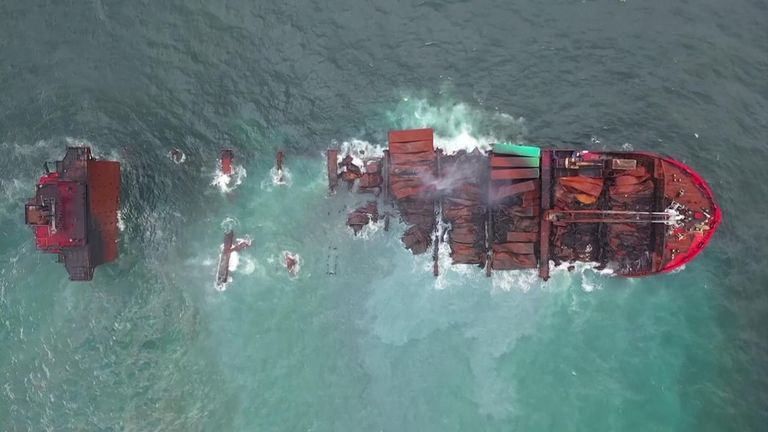
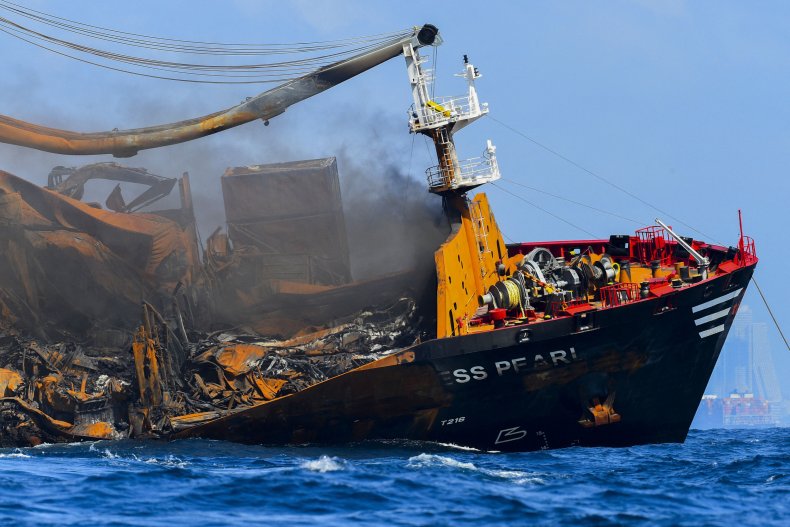
A Singapore-registered container ship sank off Sri Lanka last week, causing the worst marine ecological disaster for the South Asian country.
SINGAPORE: As Sri Lanka deals with its worst marine ecological disaster after the sinking of a Singapore-registered container ship, questions have been raised about who bears the responsibilities in maritime incidents.
The stricken ship, X-Press Pearl, sailed under the flag of Singapore. It is owned by Singapore-based shipping group X-Press feeders, which has offices around the world.
The vessel was sailing from India to Colombo when it caught fire on May 20 off the west coast of Sri Lanka. It burned for 13 days before the blaze was finally put out.
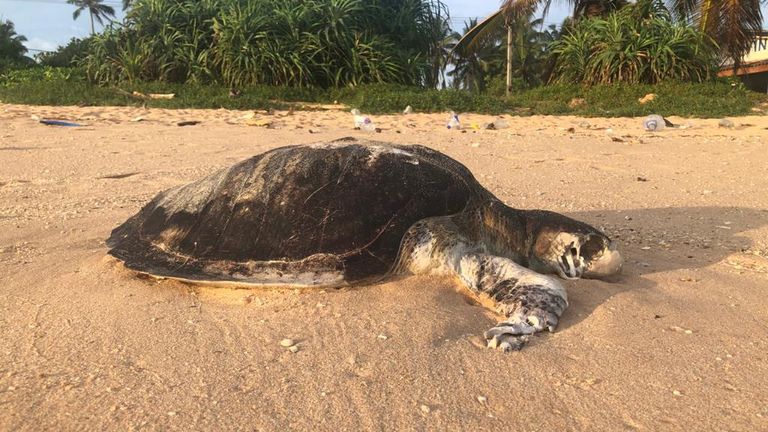
But it left behind a huge environmental impact, with possible oil spills and tonnes of plastic waste already washed ashore. The ship’s cargo included 25 tonnes of nitric acid, sodium hydroxide and other chemicals.
The Maritime and Port Authority of Singapore (MPA) said on Jun 2 that as the flag state, it is communicating with the Sri Lankan authorities and other parties to minimise the environmental impact of the incident.Advertisement
WHERE A SHIP IS REGISTERED – DOES IT MATTER?
Maritime experts said there are several considerations in the decision to register a vessel under a certain country or territory – and the flag state does not typically bear the liabilities in incidents such as that of the X-Press Pearl.
International law requires every merchant ship which is participating in international trade to be registered with a country. This is also known as the ship’s flag state,” said Singapore University of Social Sciences (SUSS) maritime expert Yap Wei Yim.
A vessel is bound by the laws and regulatory requirements of the flag state, which is responsible for the enforcement of standards, noted Dr Yap, who heads the international trade management minor programme at SUSS.
Flag states have certain duties under Article 94 of the United Nations Convention for the Law of the Sea, he added.
According to Article 94, these responsibilities include taking measures to ensure the safety of ships through their construction, equipment and seaworthiness, as well as conducting an inquiry into incidents such as those that cause “serious damage” to the marine environment.
However, it is not uncommon for vessels to fly the flag of one country even while their owners are based in another country.
As shipping is an international business, ship owners and operators typically have many options to choose their flag of choice” from a variety of ship registers around the world, said Dr Yap.
Shipping lawyer Dennis Tan, a partner with law firm DennisMathiew, said that the choice of flag or ship registry depends on a variety of factors.
These include the amount of tonnage taxes payable to the ship registry, as well as the standards on matters such as compliance with international conventions and marine environmental protection.
Another factor is the reputation of the ship registry, said Mr Tan, who is also the Member of Parliament for Hougang.
He noted that the registries of territories such as Panama, Singapore and Hong Kong are relatively more well-regarded compared to those of so-called flags of convenience”.
A vessel registered with a more reputable registry may also invoke more confidence from port state control of the ports the vessel may visit,” he said.
Despite the country’s size, Singapore has the fifth largest ship registry in the world, with more than 4,400 vessels on its register.
The Singapore Registry of Ships is an important component of Singapore’s maritime ambitions, said Dr Yap, adding that one key aspect is the decision to position the registry as a quality flag”.
The MPA requires ships registered under the SRS (Singapore Registry of Ships) to comply with international regulations and practices. This distinguishes the SRS from flags of convenience which are run purely on commercial terms,” he said.
CIVIL LIABILITY LIES WITH SHIP OWNERS
Despite the associated responsibilities, a flag state does not typically bear the liability in incidents such as the one involving X-Press Pearl, said lawyer Mr Tan.
In such a marine casualty involving one vessel, civil liability for the damages caused does not usually rest with the port state or the flag state as such,” he said.
“The civil liability of the ship owners for the losses to cargoes onboard and for damage to the environment will depend on the evidence in respect of the cause of the fire and the actions taken by the shipowners and/or crew.”
This will likely be covered by the vessel’s insurers, Mr Tan added.
The Sri Lankan government has said it would seek compensation for the incident.
Speaking to CNA last week, X-Press Feeders chief executive Shmuel Yoskovitz said it would be very hard to assess the damages now and that it would be a “long process”.
He noted, however, that the direct financial burden on X-Press Feeders would be “very limited” as the company is insured.
In a statement on Jun 8, X-Press Feeders said there are no confirmed reports of fuel oil pollution as of 6pm Sri Lanka time.
“The shoreline cleanup is ongoing, and we remain committed to contributing earth movers to assist,” it added. Source: CNA/az(gs)
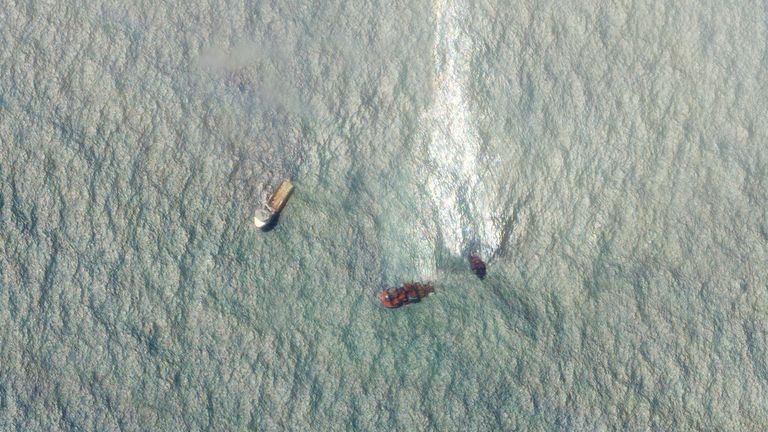
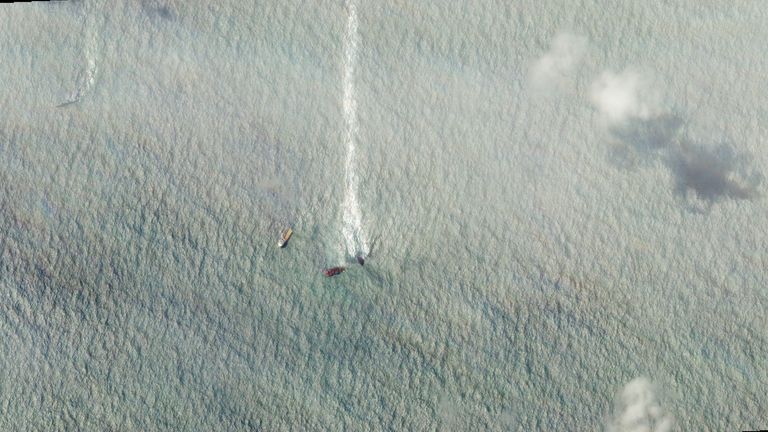
Image:The oil can be clearly seen drifting over a large area of open water. Pic: Planet Labs
Evidence of the spill comes just days after attempts to assess the vessel for leaks were delayed due to rough seas and poor conditions.
The environmental impact of the disaster is being closely monitored by the International Maritime Organization.
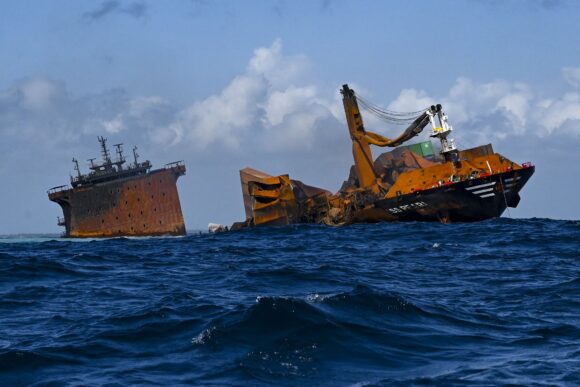
The ship broke apart the day after authorities managed to put out the fire on board the vessel, which had been raging for 12 days.
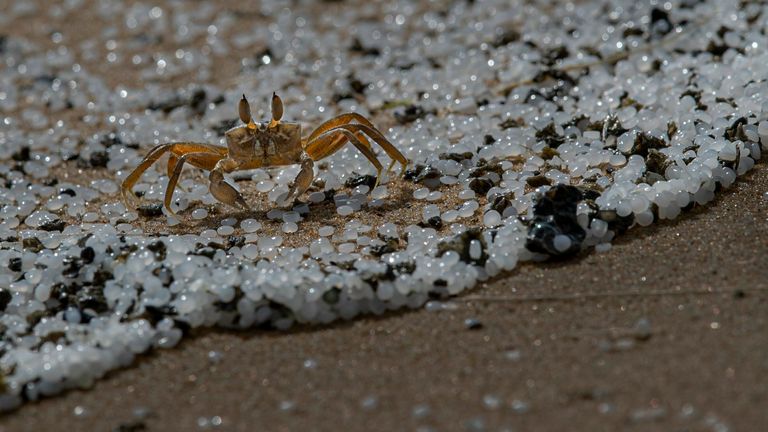
Image:A crab roams on a beach polluted with polythene pellets that washed ashore from the burning ship. Pic: AP
Most of the ship’s cargo, which included 23 tonnes of nitric acid and other chemicals, was destroyed in the fire. Efforts are under way to clear up and prevent the remaining materials from reaching the surrounding beaches and wildlife.
The navy believes the blaze was caused by its chemical cargo.
An investigation is under way. The ship’s Voyage Data Recorder (VDR), commonly known as the “ship’s black box”, was recovered. It records data on the operation of the vessel.
Play Video – Drone footage of sunken cargo shipDrone footage of sunken cargo ship
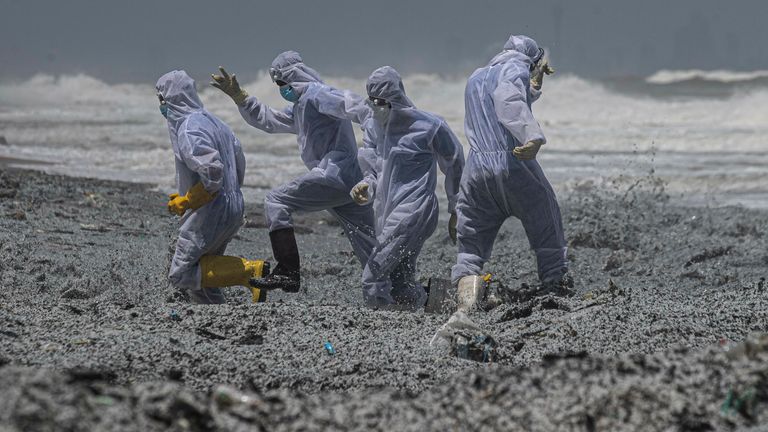
Image:Sri Lankan navy soldiers clad in protective suits attempt to evade a wave drifting debris ashore. Pic: AP
The captain, chief engineer and assistant engineer of the Sri Lankan-flagged vessel have been banned from leaving the country.
The government has said it will take legal action against the owners of the ship to obtain compensation.
Shumel Yoskovitz, chief executive of the ship’s operator X-Press Feeders, apologised for the disaster, saying in an interview with Channel News Asia last week: “I’d like to express my deep regret and apology to the Sri Lankan people for the harm this incident has caused both to the livelihood and environment of Sri Lanka.”
‘The best option available is to use a mixture of both synthetic and carbonic fertilizers, benefiting from their advantages to help farmers increase the agricultural output.’
Emeritus Professor of Agriculture Biology University of Ruhuna and Former Executive Director Sri Lanka Council of Agriculture Research Policy
The Cabinet of ministers last month approved President Gotabaya Rajapaksa’s proposal to ban the importation of chemical fertilisers. In addition to synthetic fertilisers, the importation of synthetic pesticides whether they are CLASS 1A or Class1B (Toxic) or Class 2 Less toxic is also banned. The reasons for the ban are listed according to our knowledge
The President has emphasised that despite the claim that the use of chemical fertilisers leads to a better harvest, their adverse effects on human lives through the pollution of lakes, canals, and groundwater outweigh the benefits and profit. State expenditure on treating patients with non-communicable diseases caused by these chemical fertilisers remains high.
Saying that organic fertiliser will be provided instead of subsidised fertiliser to farmers, the President has stressed that USD 400 million is spent on fertiliser imports and it could be used to uplift the lives of the farmers.
The Agriculture Ministry has undertaken to convert the state-owned Ceylon Fertiliser Company Ltd. into an institution that would produce, supply, and distribute organic fertiliser with the help of local government institutions.
Minister of Agriculture Mahindananda Aluthgamage says the government will do everything in its power to increase the use of organic fertiliser for the cultivation of paddy and other crops up to 30% within the next three years. Accordingly, private companies that come forward to manufacture organic fertiliser will be provided tax concessions, technology and technical expertise, land and raw materials.
It has also been reported that the government has turned away two shipments of 18,000 MT of chemical fertilisers for paddy and other crops.
Political decision not practical?
Does the country have the capacity and capability to produce a large amount of organic fertilisers in the short-run for next Maha season. Secondly, the methodology as regards the application of such a huge quantity of natural fertilisers has not been defined. Farmers across the country are already facing a shortage of fertilisers and pesticides for the current Yala season although the authorities claim adequate stocks are available.
In this respect, one may recall that the previous government launched the politically-motivated non-toxic agriculture” project in 2016, and it failed and the Strategic Enterprise Management Institute (SEMA) established to implement that programme was closed down in 2018.
Such experiences in the past are the reasons why farmers are uncertain and confused as regards the ban on the import of agrochemicals.
Dr Warshi Dandeniya Head of the Department of Soil Science University of Peradeniya has disclosed why and how agrochemicals have become such a big problem in Sri Lanka, One of the major problems in Sri Lankan agriculture is the application of fertilsers outside the fertiliser recommendations. Farmers misuse or overuse fertilisers. When more fertiliser is applied, they can be washed away and added to water sources. The relevant nutrient content may be greater than the amount a plant actually needs. When used sparingly, the plants may not get proper nutrition, which can lead to many diseases. Both of these methods cause damage. Also, soil degradation is accelerated as the soil contributes as much as possible to the plant with less fertiliser application.”
It is thus clear that a proper assessment of soils is necessary before fertiliser application.A similar situation has arisen as regards pesticides. With the devolution of power, the subject of agricultural extension which had been under the Department of Agriculture was devolved and brought under the Provincial Ministries of Agriculture. NGOs like Sarvodaya, private sector pesticide companies and leading farmers started advising farmers on crop protection and fertiliser applications creating much confusion. Farmers anticipating higher profits use higher amounts of agrochemicals. Cocktails of pesticides result in toxic problems for themselves and the environment. The Sri Lanka Tea Board (SLTB) has stated recently that it has performed well in January and February this year, earning Rs 41 billion in export revenue, compared to the beginning of last year. The total tea production too has increased when compared to last year, it has said.
According to the SLTB statistics, tea exports in 2021 amounted to Rs 41 billion, as compared to the beginning of last year, when the revenue was Rs 38 billion. The price of FOB (Full on Board) had increased from Rs. 832 to Rs 932.
The SLTB expects to export 295 – 300 mn kg of tea this year, and more than 100 countries are importing Ceylon tea. The SLTB is planning to promote artisanal teas such as Ceylon green tea and organic teas to very specific markets segments.
Sri Lankan planters use urea as a synthetic fertiliser to promote vegetative growth of tea.
With the fertilizer ban it may be not possible to achieve the targets’ of SLTB
No country in the world depends entirely on organic agriculture for crop production as the plant varieties bred after green revolution in 1960s are fertilizer responsive and will give the maximum yield only with correct fertilizer application. The ban on synthetic fertilizer have a drastic effect on tea and rice yields.
Here are some major pros and cons of organic and synthetic fertilizers:
Organic fertilizers
Advantages
Retention capacity of water is high No toxin buildup
Fosters a sustainable ecosystem for plants and organisms alike and improves plant structure
.Can breakdown contaminants
Disadvantages
It takes lot of time to show results
Natural fertilizers can be messy and difficult to apply precisely
The number of nutrients and microorganisms in the soil can vary
Synthetic fertilizers
Advantages
The synthetic products act fast
Easy to handle and available everywhere
Inexpensive when compared with organic products in the long run
Disadvantages
The majority don’t contain micronutrient organisms
Can easily be over-applied or less
Can release nutrients too quickly or too slowly
The best option available is to use a mixture of both synthetic and carbonic fertilizers, benefiting from their advantages to help the farmers to increase the agricultural output.
Sri Lanka on Wednesday (June 09) registered 54 more victims of COVID-19, marking the highest number of deaths recorded in a single day.
The latest fatalities have moved the country’s death toll to 1,910, the Department of Government Information said.
The Department of Government Information stated that 19 of the victims had succumbed to the virus infection between the period of May 17 – May 31. The rest of them have died between June 01 – June 08.
The Epidemiology Unit of the Health Ministry reports that another 543 persons have tested positive for COVID-19 in Sri Lanka, moving the daily total of new cases to 2,716.
This brings the total number of confirmed cases of coronavirus reported in the country to 213,396.
As many as 180,427 recoveries and 1,843 deaths have been confirmed in Sri Lanka since the outbreak of the pandemic.
The Epidemiology Unit’s data showed that 31,126 active cases are currently under medical care.
The Regional Director of Health Services and the Regional Epidemiologist of Galle District have been demoted and transferred over the incident of vaccinating many people from Western Province as revealed by Ada Derana ‘Ukussa’.
This is the result of the preliminary inquiries carried out by the Health Ministry following the exposé by Ada Derana, which the ministry says is being further investigated.
The Ministry of Health had launched an investigation into the irregularities at a COVID vaccination program held recently at Unawatuwa in Galle, after the matter was exposed by Ada Derana ‘Ukussa’ on Monday (07).
Several politicians and trade unions had highlighted the incident after it was uncovered by Ada Derana while the State Minister of Production, Supply and Regulation of Pharmaceuticals, Prof. Channa Jayasumana also brought the matter to attention during the parliamentary session yesterday (08).
As per ‘Ukussa’ revelation, a group of individuals from the Western Province had also arrived for the vaccination program in Galle to receive the second dose of Oxford-AstraZeneca coronavirus vaccine, despite the islandwide travel restrictions in place.
State Minister Prof. Jayasumana had said a team from the Health Ministry has been deployed to Galle to look into the matter and that legal and disciplinary action will be sought against those the individuals who attended the vaccination program violating the protocols.
President Gotabaya Rajapaksa’s request made to the Prime Minister of Japan, Yoshihide Suga, seeking to obtain 600,000 doses of AstraZeneca vaccine has been met with positive responses.
This was disclosed during a meeting held between the President and the Japanese Ambassador to Sri Lanka Sugiyama Akira at the Presidential Secretariat this morning (June 09), President’s Media Division revealed.
The Japanese Government has also acceded to the President’s request to provide medical supplies and healthcare equipment needed to contain the spread of the COVID-19 virus.
The President also drew the attention of the Japanese Ambassador to obtain technical assistance required for expeditiously respond to maritime accidents.
Deputy Ambassador at the Japanese Embassy Kitamura Toshihiro, First Secretary Imamura Kayo, Secretary to the President P.B. Jayasundera, Principal Advisor to the President Lalith Weeratunga, and Foreign Secretary Admiral Jayanath Colombage were also present at the meeting.
There are two
schools of thought in Sri Lanka regarding the UNHRC Resolutions against Sri
Lanka. There are those who are delighted that their country is censured by the
UNHRC and there are those who are not delighted. They are indignant.
The first
group contains those who wish to see Sri Lanka lose its independence, fail as a
country, and eventually become a puppet state of the USA. The second group is
loyal to the country. They are fiercely proud and protective of Sri Lanka,
despite its many deficiencies. The senior members of this group remember the British
colonial experience and do not wish to see it repeated. This group is contemptuous of the USA and do
not wish to see Sri Lanka come under US influence.
Marwan Macan
Markar saw the UNHRC voting as an indicator of Sri Lanka’s standing in the UN
and therefore, in the world. In the 2009
Resolution,, Sri Lanka got 29 votes, then
in 2012, it was 15, 2013 it was 13 in
2014 it was 12 and in 2021 it was 11, a
clear downward spiral. Can the country
sink any lower, he asked.
The Sri Lanka
intelligentsia however, is not very concerned about what the 47 countries which
constitute the UNHRC panel think. Sri Lanka is utterly contemptuous of the Resolutions
and the countries that support it.
Sri Lanka‘s
pro-Eelam group have tried to present the UNHRC as a fearsome body. Many
years ago a newspaper ran the headline, Sri Lanka to be roasted at the UNHRC.”
That was intended to frighten Sri Lanka. UNHRC cannot roast any country. Instead there is a good chance that UNHRC itself
may get roasted by the UN General Assembly when UNHRC comes up for review. Its
very existence is uncertain today.
One USA
supporter stated triumphantly, that even if Sri Lanka withdrew its sponsorship
from Resolution 30/1 of 2015, the
resolution still remains. M.A. Sumanthiran said that though the Government is not
legally bound to implement the UNHRC 2021 Resolution the Government will have
to implement it. UN Peace Keepers might
come to Sri Lanka if the Government fails to implement the UNHRC Resolution.
Another
commentator observed that if Sri Lanka does not comply with UNHRC, then the European
Union may withdraw its GSP concession and the Sri Lanka economy will get into difficulties. A critic
observed that the values and scruples of those who support these Resolutions in
this manner should be examined.
A UNP politician
sneered that in going to Geneva and
opposing the UNHRC resolutions, Sri Lanka was trying to show a ‘nethi loku kamak’. He saw Sri Lanka as inferior to the UNHRC and
wanted to see Sri Lanka humbled. Actually it is not’ nethi’. It is ‘ethi loku kama”. Sri Lanka is a member state of the UN. Sri
Lanka therefore ranks above UNHRC. UNHRC was set up by the UN General Assembly
of which Sri Lanka is a member.
Further, UNHRC
is
toothless. It does not have the power to act against
countries. It cannot impose
economic sanctions. UNHRC
Resolutions cannot be enforced. The resolutions of other UN special agencies such as International
Maritime Organization (IMO) and International Civil Aviation Organization
(ICAO) are binding on all nations, but
UNHRC resolutions are not.
By 2021, the
west had realized that it was not going to crush Sri Lanka through the UNHRC. That
is why the US at its fifth try, in 2021,
decided to move the action from UNHRC to the Office of the High
Commissioner of Human Rights which is a department of
the Secretariat of the United Nations.
The current Resolution,
Resolution 46/1 of 2021 stated that it Recognizes
the importance of preserving and analyzing evidence relating to violations and
abuses of human rights and related crimes in Sri Lanka with a view to advancing
accountability, and decides to strengthen in this regard the capacity of the
Office of the High Commissioner to collect, consolidate, analyze and preserve
information and evidence and to develop possible strategies for future
accountability processes for gross violations of human rights or serious
violations of international humanitarian law in Sri Lanka, to advocate for
victims and survivors, and to support relevant judicial and other proceedings,
including in Member States, with competent jurisdiction. (clause 5)
Analysts have
looked at the Resolution. There are
certain gains, they said. The Resolution
recognizes the sovereignty, independence, unity and territorial integrity of
Sri Lanka. The demand for setting up of a hybrid court with foreign and local
judges has been removed. There is a grudging acceptance of the Lankan Government’s
insistence on having its own domestic mechanism”. Also the focus on war crimes has given way to
a survey of present day violations of human rights.
The
weaknesses attributed to Sri Lanka (section 7) are not unique to Sri Lanka,
said Ladduwahetty. There are similar weaknesses in every country. elsewhere too
there are policies that affect freedom of religion or belief; marginalization
of persons or groups; restrictions on media freedom; shrinking democratic
space; sexual and gender-based violence and so on. these defects could be found
in all of the 22 countries that supported the Resolution Therefore, what is so
special or unique about Sri Lanka for it to deserve special attention, asked Ladduwahetty.
Don Manu saw
the gravity of the Resolution. Don Manu said the United Nation’s watchdog on
human rights, the UNHRC, has put the Government of Lanka in the dog house and
warned: ‘From henceforth, everything you say, every move you make will be
monitored and held against you in any future legal proceedings. We will be
watching you.’
Pohottu will
have to run the Geneva gauntlet and survive its spikes for a considerable time
in the future. After going through the wringer in what crumpled wretched state
Lanka will emerge is anyone’s guess, concluded Don Manu.
OHCHR is now empowered to look also at the
present and ongoing situation in the country .
it is not longer limited to war time violations only. This effectively
means that the government will be monitored 24/7 to collect and collate
necessary evidence of possible human rights abuse, observed Don Manu.
But, UNHRC
has neither the mandate nor the competence to collect evidence relating to International
Humanitarian Law or to support judicial proceedings in member states, said
critics. UNHRC is expected to function within the mandate stated in UN
resolution 60/251. Sri Lanka should
table a resolution in the UN General Assembly highlighting the issues at stake
and seek redress, said critics.
There is
another aspect to this. Since the war ended a long time ago, in 2009, it will not
be easy to collect war crimes data. It will be interesting to see what the
OHCHR comes up with. OHCHR will not find it easy to obtain evidence. They will
need a bit of help.
The Tamil
Separatist Movement faced this same problem when the Darusman committee was
sitting. They had to launch a special project to collect evidence. They cajoled
people to lodge complaints with the Darusman committee.
On Dec 08,
2010, seven days before the expiry of the first deadline to submit complaints,
‘Eelam View’ website appealed for more complaints including ones from those who were not
directly affected by the conflict. ‘Eelam View’ posted 25 sample letters for
the complainants to choose from. Click the
line below to access sample letters they said. (http://www.eelamview.com/2010/12/08/un-submission-sample-letters-7-days-left-have-you-made-your-submission/). Since the
number of complaints received by the Darusman committee was not sufficient, the
UN extended the deadline for complaints to Dec 31, 2010
In 2019, two
international NGO’s appealed for help to collect the names of the conflict dead
to estimate the final death toll, says a report published by the Human Rights
Data Analysis Group. The report said that the International Truth and Justice
Project (ITJP) and the Human Rights Data Analysis Group (HRDAG)
urge groups inside and outside Sri Lanka to share existing casualty lists
and go out and record new ones.
A decade after the war ended, nobody knows to
the nearest ten thousand how many people died in Sri Lanka in 2009, let alone
in the decades before. The aim of this initiative is to use a statistical
approach to estimate the probability of a final death toll, the two NGOs
said.
“We urge
Tamils all round the world in the next few months to speak to their families,
their friends, and their neighbors to collect the names of the dead. We
have suggested a format to collect the information.” said Patrick Ball
of HRDAG.”Several groups inside and outside the country have already
started collecting lists. Recording the names of the dead is a way of
collating the available information. And we can use statistical models to
estimate how many people are likely missing from the data collected. Don’t
worry about duplication! We will take care of the lists.”
Particularly important is to collate all existing lists so if you know of a
list please contact us. (continued)
Contaminants released from the wreckage of a container ship off the coast of Sri Lanka could be dragged thousands of kilometers by ocean currents, impacting wildlife and humans in far-reaching latitudes.
Authorities and salvage crews are now working to prevent the more than 300 metric tons of oil transported by the MV X-Press Pearl from spilling out of the ship’s fire-damaged hull. But significant damage has already been done. Chemicals and tiny plastic pellets that were once onboard the 186-meter vessel have already entered the ocean, causing one of Sri Lanka’s worst environmental disasters to date.
Oil, chemicals and plastic pellets are probably the worst combination you can have,” said Delphine Lobelle, a postdoctoral researcher specializing in ocean plastics at Utrecht University in the Netherlands. It’s really unfortunate that the ship was carrying so many harmful materials.”
Millions of plastic pellets have washed up on Sri Lanka’s southwestern coast, a tourist destination famous for its golden-sand beaches, fringed by palm trees and coconut groves. Debris from the vessel has already affected about 150 kilometers (93 miles) of shoreline, and the Singapore-based ship operator, X-Press Feeders Ltd., faces criminal charges for pollution, the Straits Times reported earlier this week.
Images from the beaches in Colombo, Sri Lanka’s capital, show the sand covered in a layer of white plastic pellets and people in blue scrubs and white boots shoveling them in bags.
Pellets the size of a grain of rice can easily be mistaken for food by birds or fish, Lobelle said, but consuming them can be deadly. If the animals don’t die and are instead eaten by predators, the plastics can move up the food chain until they eventually reach humans. With time, the pellets break into even smaller pieces, known as microplastics, which are even more difficult to detect and control.
The real danger of having plastic on a beach is if it’s brought back into the ocean by tides,” Lobelle said. If it moves further offshore then it’s impossible to clean up. Currents spread plastic everywhere and there’s no way to collect it.”
The ship was carrying 1,486 containers holding chemicals such as nitric acid, a highly corrosive mineral acid, methanol, sodium hydroxide and about 400 containers of small plastic pellets known as nurdles, according to ITOPF, a nonprofit set up by the shipping industry that’s assisting the Sri Lankan government in the emergency response to the incident.
How many pellet containers have either burned or fallen off the ship isn’t clear, said ITOPF’s technical director Richard Johnson. At least four containers have washed ashore and many more are thought to have sunk. About 1,000 people are participating in cleanup efforts, Johnson said, with the rest of the city under a strict lockdown to prevent the spread of coronavirus.
About 11 million metric tons of plastic find their way into oceans every year, causing damage to wildlife habitats, humans and animals, according to a report on ocean pollution last year. If no action is taken, plastic litter will almost triple by 2040 as humanity increases the use of hydrocarbon-based plastics, which don’t degrade naturally. The cumulative amount of plastic in the ocean could reach 600 million tons in 20 years’ time.
Studies done by Ifremer, the French institute for research and exploitation of the seas, show that fish can actually expel small pieces of virgin plastic like the ones in the Sri Lanka shipwreck, according to project manager François Galgani. If local bacteria and plankton get stuck in the plastic and wash up in other countries and continents, it can disrupt existing ecosystems. That phenomenon occurred in the aftermath of the Fukushima disaster in Japan, said Galgani, who also advises the International Maritime Organization on shipping-related environmental issues.
Some potential damage can be avoided by loading pellets at deck level or below instead of on top, according to Galgani. But ship owners tend to put these containers on top because they’re the cheapest load, and they leave the most expensive goods at the bottom. We know that certain ship owners load ships with more containers than they should,” Galgani said. Then captains throw the containers on top off board because they can endanger the safety of the whole ship.”
Even if authorities manage to seal the oil containers aboard the X-Press Pearl, the fuel will remain at the bottom of the ocean and could start leaking any time.
Maybe a black tide doesn’t touch the Sri Lankan coast in the next days or months,” Galgani said. But in 30, 40, or 50 years, there will be a leak, and the hydrocarbons will end up getting there. Even if it looks like the problem is fixed today, it’s just pollution being delayed through time.”
Photograph: The container ship MV X-Press Pearl sinks while being towed away from the coast of Colombo on June 2. Photo credit: Ishara S. Kodikara/AFP/Getty Images.
A man who contracted the infectious Delta COVID-19 strain mistakenly opened his room door soon after entering hotel quarantine in Melbourne, but Victorian authorities are downplaying the chances this incident caused transmission.P
A worker at a Melbourne medi-hotel. Photo: AAP /James Ross
Health officials have linked an outbreak of the Delta strain in Melbourne to the hotel quarantine case, a man in his 40s, who returned from Sri Lanka on May 8.
They are now scrambling to work out the connection, with health officials believing it is most likely the man transmitted the virus to a staff member while in transit or to a fellow guest.
Genomic sequencing shows his infection is identical to one of two families linked to the North Melbourne Primary School, which has emerged as the epicentre of the West Melbourne outbreak.
But it remains unclear how the virus was transmitted from the returned traveller – who lives in the suburban Glen Eira area in Melbourne’s southeast – to the infected family.
The man initially stayed at the Novotel Ibis Hotel before testing positive and transferring within 24 hours to the Holiday Inn health hotel”.
During his stay at the Ibis, the man opened his door while a staff member was in the corridor.
But Emma Cassar, the head of COVID-19 Quarantine Victoria, says this incident is unlikely to be the reason for the Delta variant spreading.
The only IPC (infection prevention control) breach is when this resident opened (his) door for less than a minute – he thought there was a knock on the door (but) it was a room further up,” Cassar said.
He even acknowledged the staff member on the floor was more than six metres, so it’s not enough for a transmission event … he would have had very low levels of infectiousness at that point.”
Get InDaily in your inbox. Daily. The best local news every workday at lunch time.This site is protected by reCAPTCHA and the Google Privacy Policy and Terms of Service apply.I accept the terms & conditionsSUBSCRIBE
She added the worker in the corridor was wearing an N95 mask and a face shield.
The City of Whittlesea cluster, which triggered Melbourne’s current lockdown and is separate to the Delta cluster, is linked to a Wollert man who caught the virus at Adelaide’s Playford medi-hotel.
An SA Health report said the man most likely caught the virus because of the opening and closing of doors in the hotel corridor.
Meanwhile, acting Premier James Merlino says Melbourne and regional Victoria remain on track” for eased restrictions at 11.59pm on Thursday.
State prosecutors in Sri Lanka‘s Colombo Magistrate’s Court on Monday accused the operators of the ship that caught fire with 25 tons of acid onboard of a cover-up. The Deputy Solicitor General alleged that Sea Consortium Lanka, the local agent for the ship, deleted several emails exchanged with the vessel’s captain that were characterized as important to the investigations.
The Singapore-registered MV X-Press Pearl cargo ship caught fire on May 20 and burned for 13 days while anchored in the waters near Colombo, Sri Lanka’s capital. As a result, tons of chemicals spilled into the Indian Ocean. Potentially toxic debris and plastic pollutants also washed ashore the nearby beaches in what’s been called one of the worst ecological disasters to hit the island nation.
Authorities are still bracing for a potentially larger problem. The International Maritime Operation is monitoring the stranded ship in case the 278 metric tons of bunker oil and 50 metric tons of gasoline aboard leak into the ocean.
Smoke billows from the Singapore-registered container ship MV X-Press Pearl as another vessel unsuccessfully attempts to tow it away from the coast of Colombo on June 2, 2021.GETTY
When the case was taken up before a Colombo magistrate on Monday, Deputy Solicitor General Madhawa Tennakoon—appearing on behalf of the Criminal Investigation Department (CID)—sought an order naming seven individuals as suspects of the case and to issue notices ordering them to appear before the court. One individual named was the managing director of Sea Consortium Lanka.
President’s Counsel Sarath Jayamanne, who represented the cargo ship’s chief engineer and the first assistant engineer (whose names were also among those named by the Deputy Solicitor General as suspects) appealed the order. He said the Magistrate’s Court had no jurisdiction to hear the case, and that any proceedings should be carried out by the country’s High Court.
The magistrate sided with the President’s Counsel and dismissed the request, stating the Magistrate’s Court does not have the jurisdiction to issue notices to the said individuals. The magistrate, however, did accept a request made by the CID to order the Navy to protect the vessel’s submerged wreckage.READ MORE
Perhaps the biggest development from the court hearings came when Deputy Solicitor General Tennakoon said Sea Consortium Lanka had deleted several emails exchanged with the X-Press Pearl’s captain. The magistrate called for the original emails to be recovered and handed over to the CID.
Tennakoon also said probes have found that the acid leak onboard the vessel that caused the fire was first reported on May 10. Tennakoon alleged the captain and the crew were aware of the situation and gave false information in order to enter Sri Lankan waters. He also claimed that Sea Consortium Lanka informed the Colombo Harbor Master of a fire onboard the vessel after it had already entered Sri Lankan waters and was awaiting permission to anchor.
President’s Counsel Jayamanne denied the allegations that the crew concealed the truth about the acid leak when the vessel entered Sri Lankan waters.
Xi Jinping is winning the war without firing a shot in Sri Lanka, observes Colonel R Hariharan (retd).
IMAGE: Sri Lanka’s Prime Minister Mahinda Rajapaksa, right, bumps fists with China’s State Councilor and Defence Minister General Wei Fenghe in Colombo, April 28, 2021. Photograph: Dinuka Liyanawatte/Reuters
Many would consider the passing of the controversial Colombo Port City Economic Commission Bill by the Sri Lanka parliament, with a comfortable margin on May 20, as a victory for President Gotabaya Rajapaksa.
President Rajapaksa’s personal reputation was at stake, after supreme court scrutiny had found both constitutional and procedural anomalies with the draft.
In the end, the government accepted all the amendments suggested by the supreme court, though it bypassed suggestions for referendum and two thirds majority for certain sections, to rush it through parliament.
The Act empowers the Sri Lankan president to create a commission for the special economic zone to manage the SEZ, accord tax and duty concessions for investors.
Concerns of ‘foreigners’, euphemism for Chinese, being inducted into the commission were assuaged after President Rajapaksa appointed President’s Counsel Gamini Marpana to head the Port City Commission with six other Sri Lankans including Treasury Secretary S R Attygalle as members.
The Economic Commission, which was mooted as an independent body, will now function under the country’s regulatory authorities and constitutional bodies including the parliament.
The companies in the Colombo Port City will have to operate under Sri Lankan laws and judiciary and conform to financial and customs regulations applicable to elsewhere in the country.
This has taken some sheen off the original proposal, depriving the Colombo Port City much of the hype to become an international financial hub on the lines of Dubai or Singapore.
Reconciling the demands of the SEZ to attract investment with the constraints imposed by the Act, must be worrying the Rajapaksas.SponsoredMore from around the web
The project is being developed by CHEC Colombo Port City Pvt Ltd with an initial investment of $1.4 billion.
Reclamation of 269 hectares of land was completed by January 2019.
The development of common infrastructure underway now is expected to be completed by the end of the year.
According to a PwC report, in the next 20 years, real estate development, including commercial, financial, hospitality, residential and social infrastructure, is expected to be completed.
In this period, a total of 160,000 jobs are expected to be created.
After that in the operational stage when the project matures, in all 210,000 jobs are estimated to be created.
The PwC report also envisaged the value addition to the GDP due to the project at infrastructure, lease of land and construction stage at $4.16 billion and $13 billion respectively.
During the debate in parliament Prime Minister Mahinda Rajapaksa spoke of $15 billion investments flowing into the project in the next five years.
He also touched upon the huge potential for creating 200,000 jobs during the construction phase of the project.
These claims have given rise to huge expectations about the project among the people, though many have expressed their concern over sovereignty of the project, because of increasing Chinese domination seen everywhere.
The Colombo Port City Economic Commission Act coming into being may be considered a victory for China as it gains yet another strategic foothold in the heart of Colombo.
In the larger context of China’s global image building under President Xi Jinping, the CColombo Port City project promoted by the state-owned China Heavy Engineering Corporation (CHEC), is set to showcase the success of the Bridge and Road Initiative.
Quoting what it claims to be a cabinet paper submitted by Prime Minister Mahinda Rajapaksa on May 17, Nimal Ratnaweera writing in the Web-based Colombo Telegraph, averred, ‘Over the next two years, the government plans to sell hundreds of acres of prime State-owned land in Colombo Fort and its adjacent Slave Island area, including property currently being used by the Sri Lanka Air Force and Sri Lanka Army.’
The Colombo Telegraph, known to be critical of the Rajapaksas, said it learnt ‘the bulk of these properties have been reserved for the China Harbour Engineering Corporation, through an intermediary local firm created specifically for the purpose of easing the path for transfer to the Beijing-owned entity and other affiliated investors.’
The report further added the state owned Selendiva Investments ‘has been tasked with transforming several underperforming state-owned assets into ‘viable, profitable and marketable’ assets.’
The Urban Development Authority was seeking approval to move ahead with three investment portfolios: The Colombo Fort Heritage Square, The Immovable Property Development and The Government-owned Hospitality Sector under Selendiva Investments.
The earlier Sirisena-Wickremesinghe government was known to have listed many of these government properties in a bid to transform Colombo City into a commercial and financial capital.
According to the Colombo Telegraph, ‘that diversification was to be streamlined under a competitive bidding process for interested investors.’
But given the speed at which the Chinese operate, the competitive bidding process may be given the go by as it happened recently.
Close on the heels of the enactment of the Colombo Port City Economic Commission, the cabinet decided to award the contract to build the 17 km Kelaniya-Athurugiriya elevated highway project, estimated to cost $1 billion to the CHEC, without competitive bidding.
The Chinese company will build, own and transfer the major highway after 17 years, adding yet another feather in Xi’s BRI cap.
While Chinese investors would probably bid for ‘choice property’ in the Colombo Port City, will the investors from the West and India be keen to invest in the CPC? Any international investor other than local or from China, is likely to have two concerns before opting for the Colombo Port City.
First, the ability of the government to provide a safe and corruption-0free environment with good governance both within and outside the economic zone.
The Sri Lanka government under Rajapaksas carries a legacy of total disregard for international concerns since the end of the Eelam War in May 2009.
These include issues of governance, rule of law, restoring ethnic peace and human rights, which continue to figure in the UN Human Rights Council deliberations.
The Sri Lankan judiciary has not covered itself in glory in quite a few cases. The state of law and order has been subject to severe political influence.
Corruption is endemic. The mess created in handling the COVID-19 pandemic speaks poorly of the administration’s ability to handle critical situations facing the country.
Cumulatively, these issues could make international rating agencies think twice before recommending the Colombo Port City as a favourable investment destination.
The Rajapaksas have become increasingly dependent upon China to bail them out, not only in the UNHRC and the UN Security Council, but to ward off financial crunch.
They are paying the price for it by taking decisions favouring the Chinese, to the detriment of other nations.
They cancelled the memorandum of cooperation the previous government had signed with India and Japan to jointly develop the Eastern Carrier Terminal at Colombo port, on the specious ground of Sri Lankan sovereignty.
Such concern was markedly absent when it came to the Colombo Port City project, actively and publicly promoted by the CHEC.
The Rajapaksas also decided against signing $480 million investment plans of the Millennium Cooperation Corporation on similar grounds, though in his earlier term as president, Mahinda Rajapaksa had mooted the proposal.
Both the US and India are unlikely to forget such conduct, when they deal with Sri Lanka.
With both the US and India recasting their relations with China, Sri Lanka could face the flak of their reaction.
Lastly, one wonders how President Gotabaya Rajapaksa would stick to his assurance to India’s concerns on security, with the Chinese literally breathing down his neck.
The situation reminds us of the visuals of the Singapore-registered cargo ship MV X-press Pearl burning off the Wwest coast of Sri Lanka for over two weeks, polluting the environment around, while Sri Lanka, India and international fire fighters douse the fire.
They learnt rather too late that the ship was carrying 25 tons of a toxic chemical: Nitric acid.
2021 is the Chinese Year of the Ox, considered good for those born in the Year of thr Snake, like Xi Jinping (born in 1953); Mao Zedong was also Snake year-born.
So far it seems to be working for him in Sri Lanka. Xi is winning the war without firing a shot in Sri Lanka.
Colonel R Hariharan, a retired military intelligence officer, is associated with the Chennai Centre for China Studies and the South Asia Analysis Group.
Russian Foreign Minister Sergey Viktorovich Lavrov who had a telephone conversation with his Sri Lankan counterpart Dinesh Gunawardane said Russia was fully cooperative of the initiative to co-produce its Sputnik V vaccine here and asked the Sri Lankan authorities to expedite the process.
Minister Gunawardane told Daily Mirror that the Russian Minister assured him of the supply of Sputnik V vaccine to Sri Lanka as committed.
Besides, the two countries are expected to resume their trade dialogue as early as possible.
Sri Lanka has given regulatory clearance for emergency use of this vaccine against Covid-19.
Russia is keen to send its tourists to Sri Lanka once the situation is normal. This is another aspect we discussed ,” he said.
He said he, on behalf of Sri Lanka , thanked the Russian Minister for support at the UNHRC. (Kelum Bandara)
Ajith Siriwardana and Yohan Perera Courtesy The Daily Mirror
While claiming that five committees have been appointed to work on the procedures to demand claims from the X-Press Pearl vessel, Ports and Shipping Minister Rohitha Abeygunawardane said today steps were being taken to seek assistance of the international legal experts on the matter.
The Minister told parliament that international legal procedures would also come into play in this process in addition to the domestic legal framework.
He said legal assistance of the international legal experts would be sought in a transparent manner.
The Minister said the matter with regard to the claiming of compensation from the vessel was discussed with the Justice minister and the Attorney General.
“We have identified five areas such as environment pollution, marine pollution, air pollution,lagoon pollution and damage caused to the fishing community. We have appointed five committees to study these affected areas,” he said.
He said steps would be taken to compensate those directly affected due to the incident initially and secondly the institutions such as Sri Lanka Ports Authority (SLPA), Sri Lanka Navy, air force and the Marine Environment Protection Authority (MEPA) that engaged in dousing the fire would claim compensation.
He said compensation would be sought for marine pollution as well. ()
Chaturanga Samarawickrama Courtesy The Daily Mirror
The reason for the flood situation in the Gampaha district was caused by reckless actions taken by the previous government during the construction of the segment from Kadawata to Gampaha of the Central expressway, Tourism Minister Prasanna Ranatunga said.
He told the Daily Mirror that the proposed segment from Kadawata to Gampaha of the Central expressway was to be constructed as an elevated highway.
However, the previous administration did not follow the proposed plans, and they used it to fill the ground with earth for the construction of the highway, he said.
“The Central expressway was a combination of selected segments of previously proposed two Expressways. The segment from Kadawata to Gampaha remains the same alignment on the previously proposed Colombo – Kandy Alternate Highway (CKAH) trace (2001 – 2011) and beyond Gampaha, the trace is the Northern Expressway trace (2011 – 2014) up to Dambulla and Kandy (Galagedara). After that, the previous government had decided to change the starting point of the NEP and also to implement it with the assistance of Donor Agencies. Then it was decided to change the project name to Central Expressway in 2015,” he said.
Minister Ranatunga said a meeting was held today to review the construction work of the Central Highway from Kadawata to Gampaha.
During the meeting, it was discussed to review the appropriation of the number of estimated culverts used during the construction.
When running the expressway parallel to and in line with the existing railway line, the culverts should be placed according to the recommended sizes and to the approved numbers of culverts.
He pointed out that the outlets of those culverts were not equal to the size of the inlets. According to the Minister, the expressway was discovered to be parallel to the existing railway line, and the outlet sizes of the culverts under the railway track were smaller than the inlet size of the culverts under the expressway.
Therefore, the culverts can not hold the water capacity running through them during high rain fall. As a result, the current flood situation in Attanagalla, Magalegoda in Veyangoda, Meerigama, Ganegoda, and Gampaha town had been created.
Instructions were given in this regard to the Highways Ministry Secretary, Irrigation department and the Expressway Operation Maintenance And Management Division of the Road Development Authority to seek solutions and procedures for the recent floods in Gampaha.
No flood situation would occur in Gampaha if the previous government built the expressway as an elevated highway, the Minister said. ()
Foreign Minister Dinesh Gunawardena today sought the immediate intervention of the US State Department to convey the concerns and the position of the government on the proposed resolution No. H.Res.413, which was introduced by Congresswoman Deborah Ross,to the Chair and members of the House Foreign Affairs Committee as well as the respective Congresspersons in order to withdraw or amend it.
The Minister made this appeal when Charge d’ Affairesmof the US Embassy in Colombo Martin T. Kelly called on him at the Foreign Ministry today.
The Minister explained that the said Resolution will not be useful for reconciliation efforts in Sri Lanka.
The Foreign Minister thanked the government and people of the United States for the continued support extended to Sri Lanka.
He particularly appreciated the US President’s recent announcement that Sri Lanka will be one of the countries receiving COVID-19 vaccines through the COVAX programme.
He also thanked for the consignment of USAID emergency medical supplies which arrived on 04 June 2021 and possible US technical assistance to mitigate adverse environmental impact caused by the MV X-Press Pearl disaster.
A wide range of bilateral matters, including convening of Partnership Dialogue and Joint Commission of Trade & Investment Framework Agreement, were also discussed.
Joining the meeting, Foreign Secretary Admiral Prof. Jayanath Colombage elaborated on the government’s efforts to control the COVID-19 pandemic and the status of the on-going national vaccination programme.
Kankyo Daizen’s fertilizer wins over farmers in Vietnam and Cambodia
ASAHIKAWA, Japan — An organic products company based in northern Japan hopes its environmentally friendly fertilizer made from cow urine will catch on with farmers in Southeast Asia.
The liquid fertilizer, Tsuchi Ikikaeru — or “soil comes back to life” — is sold in five countries including Vietnam and Cambodia. Farmland in much of Southeast Asia faces degradation and declining fertility, the result of longtime overuse of agrochemicals.
Kankyo Daizen collects the urine from dairy farmers in Hokkaido, the northernmost of Japan’s main islands, where the company is located. In 2012, it began exporting Tsuchi Ikikaeru to agricultural producers through two Japanese trading houses.
Cow urine, which is often dumped into rivers or sprayed over farmland, contaminates water sources and has an offensive smell. Kankyo Daizen has turned this nuisance into a valuable resource for Hokkaido farmers. Now the natural soil conditioner is winning new customers abroad.
Kankyo Daizen, which also makes organic deodorizers, estimates that its overall sales rose 11% to 230 million yen ($2.13 million) for the 12 months ended in January. Its overseas business has grown and now accounts for 10% of total revenue, as the company has expanded its sales channels.
“Southeast Asia has a young and growing population,” Kankyo Daizen President Makoto Kubonouchi said. “It is a promising market as long as we can meet registration requirements in different countries.”
Kankyo Daizen’s environmentally friendly liquid fertilizer is making inroads in Vietnam and elsewhere in Southeast Asia.
Growing incomes in Southeast Asia have spurred interest in more natural farming practices in the region. Kankyo Daizen’s organic fertilizer, for example, is a good substitute for conventional agrochemicals. The company says the product, which is diluted with water when applied, is an effective growth booster for a wide range of crops including rice, vegetables, flowering plants and farmed shrimp. It also helps maintain soil fertility when the same crop is grown on the same plot of land year after year.
Kankyo Daizen also plans to sell Tsuchi Ikikaeru in Malaysia and the Philippines, but it is not limiting its ambitions to Asia. In February, Kubonouchi traveled to Brazil as part of a research tour organized by the Japan International Cooperation Agency, inspecting large farms growing crops such as soybeans and sugar cane. The company plans to explore market opportunities there after receiving a positive response from local farmers. One challenge to overcome is the shipping cost, given the distance between Japan and Brazil.
In Japan, the company works with a number of dairy farmers in Kitami and areas along the Sea of Okhotsk. The manufacturing process starts by fermenting cow urine using a special mix of microbes. The liquid is collected in a tanker truck and then fermented some more in six 18-ton tanks at Kankyo Daizen’s headquarters. The company believes lactic acid bacteria and yeast grown with cow urine inhibit the growth of harmful bacteria in the soil.
Kankyo Daizen sells 50 products in all, including a clear, colorless liquid designed to eliminate household odors. The fertilizer and the deodorizer look different but the bacteria that they contain work the same way. The company provided the deodorant free of charge to evacuation shelters and temporary toilets in areas hit by recent earthquakes in northern Japan.
Kankyo Daizen verified the effectiveness of its cow urine-derived products in tests conducted at the Kitami Institute of Technology. But mysteries remain, including how the active ingredient forms through fermentation and how it reduces odors and increases soil fertility. The company plans to work with a private research group to solve these puzzles.
Ministry of Health has launched an investigation into the irregularities at COVID vaccination program at Unawatuwa in Galle, following the exposé by Ada Derana ‘Ukussa’ on Monday (June 07).
State Minister of Production, Supply and Regulation of Pharmaceuticals, Prof. Channa Jayasumana brought the matter to attention during the parliamentary session convened earlier today (June 08).
As per ‘Ukussa’ revelation, a group of individuals from the Western Province had attended the vaccination program in Galle to receive the second dose of Oxford-AstraZeneca coronavirus vaccine.
State Minister Prof. Jayasumana said a team from Health Ministry has already been deployed to Galle to look into the matter.
Legal and disciplinary action will be sought against those the individuals who attended the vaccination program violating the protocols, he stressed.
Sri Lanka on Tuesday (June 08) registered 54 more victims of COVID-19, marking the highest number of deaths recorded in a single day.
The latest fatalities have moved the country’s death toll to 1,843, the, the Department of Government Information said.
The Department of Government Information stated that 15 of the victims had succumbed to the virus infection between the period of May 10 – May 31. The rest of them have died between June 02 – June 07.
As per official data, 26 victims in total were aged over 70 years. Eleven victims were in the age group 61-69 years and ten were aged between 50-59 years. Remaining seven victims were in the age group of 30-49.
COVID pneumonia and complications from chronic diseases such as diabetes and heart disease have been recorded as the cause of death of the victims.
The Epidemiology Unit of the Health Ministry reports that another 514 persons have tested positive for COVID-19 in Sri Lanka, moving the daily total of new cases to 2,637.
This brings the total number of confirmed cases of coronavirus reported in the country to 210,661.
As many as 178,259 recoveries and 1,789 deaths have been confirmed in Sri Lanka since the outbreak of the pandemic.
The Epidemiology Unit’s data showed that 30,613 active cases are currently under medical care.
Competition
is a helpful disposition in the dynamic environment and might help for social
and economic progress if it works well in society concerning the broader
spectrum. The concept of competition entered politics as a feature of democracy,
and many opinions that competition in politics would be harmful to society when
competition animates, dividing people in society. In connection with Sri Lanka,
it observed that the competition in politics has divided the society as every
matter of human life has been invaded by politics. This idea may not be
accepted by many who engage in competitive politics, people with historical
knowledge gratifying the view comparing social experience in the current
society and the past might have different points of view. Sometimes, diverse
people might argue about competition with the broader view as it can find
supportive and contrary panorama.
However,
the pure competition gradually turned into an oligopoly that defined in the
game theory that zero-sum two persons will be achieved when entered an unusual
competition, especially in economic activities, many firms dissolved or sold
out because of lack of ability to compete. During the past several centuries
people haven’t had a concrete experience like the Covid-19 pandemic that forced
them to change attitudes toward social, economic, political, and religious aspects.
G8 countries have agreed to increase tax for multinational firms because of the
impact of the Covid-19 pandemic. The concept of competition had been working
engendering society and creating massive disadvantage to the poor, but
political administration in the capitalist system elevated competition stating
it will create benefit to society. It is the pluralist problem.
During
the reign of Kings and Queens, a cut-thought competition was not animated in a
liberal format by a political administration that had direct or indirect
support to rich people. Most probably such competition could have led to
destroying the capitalist class. Despite the deep analysis of the competitive
environment, it showed that monopolistic competition embarked on the market,
reducing the spirit of competition. As monopolistic competition was among few, it
disadvantaged the poor than pure competition. Business giants in the reign of
royals may have a difference in strategy in terms of royal advisors to secure
the capitalist system and protect the capitalist approach from communist
ideology. The visible nature of the world was a competitive environment was
working, dividing people and creating disadvantages for the poor. Powerful
countries in the world are gradually understanding the truth at present and
attempt to make some decisions and the determination of the success of such
decisions is too early.
In
the modern era, it observes that cut-thought competition is being a part of a business,
and firms promote products in a market economic system highlighting the
products that are closer to the desires of consumers, and many accept that the market
economic system has been supported creating disadvantages to the poor despite a
few ratios of the community look opposite way. Entrepreneurs and capitalists are
generating massive benefits which are not reflected as profits but in other
formats such as share options, housing, and many others. People who have capital
in hand or capable of borrowing may able to get market power in this situation
and competition keep in hand. Political focus and economic policies in many
countries could be seen either have refuge in the two aspects of competition
secretly manipulate to show justice to the mass community.
Another
repercussion of modern competition is the declining trend of product quality. People
observe much cheating in price slashing, product quantity changes, quantity
changes in product ingredients, and many others in modern competition. A
notable example shows in Sri Lanka arts have entered a competition and the
quality of products such as teledrama, cinema, and many products are being
declined and use the market of drama to promote business.
The
traditional society had been efficiently operated and aligned to competition
with reasonable routes. In modern society, regulations have become an
instrument to show justice whilst they become a constraint providing limited
opportunities, however, the mass community accepts that regulation provides
justice to a certain extent as they support minimizing disadvantages. Another
vital point in the traditional society was that entry-exit abilities for
business were free and people had very limited concern on the matter.
Regulations in the modern business environment show support justices, however,
many instances show that they support limiting entering new investors to the
market.
When
critically evaluate socio-economic, political, and religious evolution, the
COVID-19 pandemic has become a turning point of changing society when compared
to evidence found in the past several centuries. It came to this world in 2019
as an epidemic and quickly infected people in China. WHO later revealed the
epidemic was a pandemic that spreads all over the world. No doubt that the
pandemic can infect people in any country and spread without discrimination.
Since 2019, businesses have been suffered from the pandemic relating to factors
of production, distribution of production, and selling productions. Producers and
consumers are suffered from various areas of production and consumption-related
issues. The Covid-19 pandemic has influenced human life than any other incident
except world wars in history. However, governments, political, social, and
economic organizations reluctant to openly talk about the real impact of the
pandemic as they assume, open talks would be harmful to society
After
the spread of the pandemic, notable changes in attitudes of people are visible in
the socio-economic environment, as many countries have recognised social
distancing as an effective way of controlling the spreading of the virus, it is
seen in many countries lockdowns and opening frequently and the situation has
become perilous experience, some instances difficult to adapt.
Since
the 1980s developed as well as developing countries gave priority to service
industries in which social gatherings were a common feature such as in sports, nightclubs,
and many other services that promoted social integration. Poor people and the
middle class associated with social and economic integration that has been
generated economic and social benefits such as employment, small business
opportunities, subcontracts, and understanding each other for business
promotion. From the religious point of view, social integration is forced to
reject social values and promote the immoral behavior of the young generation,
making a society forcing the governments to spend more funds for policing and
controlling illicit drugs, alcohol, prostitution, and conflicts. Social
integration has generated advantages and disadvantages. Rich people in all
countries gained massive advantages and market opportunities from social
integration and the social distancing began with the covid pandemic created
massive losses to the rich.
Now
it seems developed countries attempt to manipulate the market by misleading
people. The best example is market manipulation in the property market and media
supports fabricating land and house prices massively increased when many people
are suffering without money to buy a piece of land to build a house. It is like
the statement made by the French queen if there is no bread to eat cake. When
poor people have no shelters to live in, capitalist governments say land and
house prices have gone up. If it thinks from the point of view of religion,
governments sell lands that were created by God for people ignoring the poor.
The covid pandemic forces to change market manipulation and do justice to the
poor.
I
visited a place where the government organised to jab covid vaccine and people
haven’t had smiling faces as they were concerned about the effect of the
pandemic. People need to change attitudes towards many aspects. The capitalist
system used price mechanisms to answer basic economic problems, and after the
Russian Revolution, Central Planning Systems in communist countries fixed to
answer basic economic problems, and many countries attempted to follow a mixed
economy that has a mixture of capitalist and communist systems. These systems
ignored genuine issues of the poor who represent over 70% of the world
population.
COVID-19
pandemic has forced us to invent an alternative method that would be reasonable
to the rich and poor in consumption, investment, and saving. The higher rate of
profits generate from enterprises goes to capital owners and executive
management of firms. Poor workers push behind the rich class and to gain a
small benefit the families need to struggle that creating problems society.
Many small countries are blotted to spreading the myth of modernization in the
market and certain fashion forces young people to accept immoral behavior and
addict vicious narcotics. Technology has been an innovative aspect, but it has
failed to give justice to society. All activities in the modern market
safeguard the principles of a capitalist system and changing attitudes of
people to force the rulers to make a new market approach is directly or
indirectly by the covid pandemic. However, rulers of large developed countries
have no agreement on this matter. They want to hang in capitalist approaches.
Innovation
in the social system and promoting human values based on science and technology
are needed but not converting them to make massive profits to rich class and
promoting these attitudes to change society is reminded by the Covid pandemic. The
current system of treatments in the economic and social system might not be useful
for the post-pandemic environment. Justice in society will be achieved by
conserving together economy and society with justice.
Religious
attitudes of people are disciplined by public behavior of people than thinking about
religions (philosophical and social aspects) are not from the point of view of
scientific discoveries. Beliefs of people on religious concepts have ingrained
looking at discoveries on the planet Mars. When religions began in the world,
people had a mere belief about the planet Earth and now people believe about
the universe which comprises billions of galaxies, and the power of almighty
God creating the universe and controlling it. Although people think almighty
God is like a human, it is not. The role of religions is to convince those
humans in a fallen stage upgrading to convincing grace is an essential task.
People were relegated to the fallen stage because of various reasons, religions
give reasons for committing sins, and all religions, irrespective of what
religion is, support people, to come on convincing grace.
By Noor Nizam – Peace and Political Activist, Political Communications Researcher, SLFP/SLPP Stalwart, Convener The Muslim Voice” and Member Viyathmaga”, June 7th., 2021.
ARE THEY MISUSING THE POWER OF THE
PEN”/INTERNET TO MISGUIDE PEOPLE?
Content about Sri Lanka’s relationship with
China and the newly developing Colombo Port City Project with Chinese
engagement has been subjected to a lot of scrutiny by the print, electronic,
digital and social-media freelance journalists since the Colombo Port City Bill
was presented to Cabinet
by President Gotabaya Rajapaksa for approval on the 4th., January
2021. The bill once approved will become legislation on being gazetted
and passed in Parliament.
The Parliament of Sri
Lanka on Thursday May 20th., passed the Port City Economic
Commission Bill with 149 votes in favour and 58 against, as reported by the
local media and which has been gazette officially. An Economic Commission has
already been established for the $1.4 billion Colombo Port City enabling it to
attract investment and function as an international financial city. In the Keynote
Address at the inauguration of the Sri Lanka Investment Forum 2021 held on 7th.,
June 2021 – His Excellency Gotabaya Rajapaksa, President of Sri Lanka had this
also to state:
We now stand on the cusp of a
national transformation that can not only uplift Sri Lanka but have positive
impacts on the entire region while creating tremendous value for investors
across multiple sectors and through diverse instruments.
I invite you to join us on this transformational journey by
investing in Sri Lanka.”
FACTS HAVE TO BE STUBBORN.
JOURNALISM IS THE ONLY WAY TO BRING OUT FACTS.
SOCIAL MEDIA IS THE STRENGTH OF THE PEOPLE THAT CAN VOICE THE TRUTH.
The forces that are and the West ” WERE ” very much
concerned to STOP this Bill from getting passed in Parliament. China’s support
to Sri Lanka cannot be stomached by the West and the USA, including the EU,
because Sri Lanka will be in the One Belt One Road” project and will later
join the CPEC (China Pakistan Economic Commission) as invited by Hon. Imran
Khan, PM of Pakistan, a must for Sri Lanka to become a prosperous and developed
Nation, economically and socially to achieve Peace and Harmony in the coming
decades. The Colombo Port City will become a Financial Hub and an investment
center in the region and this will accelerate the growth of all the nations in
South East Asia and the Asia Pacific, with China being the guiding light. If
the verdict of the Supreme Court is that certain amendments should be in
coopted to the Bill, then the government acted accordingly and got this
Bill passed at the very earliest for the benefit of our Mathruboomiya” and the
next generation.
It is a pity that our law makers, MAJORITY of the 225
in parliament are all idiotic fools who sit in parliament consuming our tax
money being elected by the innocent people who are hoping for a better future.
I do not think that even 25 of these fool (MP’s) would have read the bill or
have resourced content/knowledge material in print or the internet to take a
look/understand what is the larger picture of both these major Chinese projects
are (Hambantota Habour and the Colombo Port City) in respect to the REALITY it
will be for Sri Lanka.
Look
at the KARAKORAM HIGHWAY” that China has built jointly with Pakistan, a road
that is now linking Pakistan and China – 1300 km long which had taken 20 years
to accomplish and claimed today as the 7th., wonder of the world. These MP’s
who are trying to criticize should have visited Pakistan and taken a trip
(drive) from Pakistan to China on this highway to see for themselves the
development and socio-economic development this project has brought to the
rural and remote villages/urban towns and the people through which the Highway
has been built. THE FREELANCE JOURNALISTS, SHOULD ALSO TRY AND MAKE A VISIT TO
PAKISTAN, YOURSELVES TO SEE FOR YOUR SELF the reality. The Pakistan High
Commission in Colombo may be too pleased to help you out if needed, I am sure.
This Karakoram HW link has benefited Pakistan with Sterling pounds 14 billion
annually from trade alone.
The KARAKORAM HIGHWAY” and rail links will
reach out to all the CIS countries and reach the Mediterranean Sea in the near
future and become part of the One Belt One Road” project. Sri Lanka cannot
lose this great opportunity because our law makersand “Freelance
Journalists” cannot SEE FAR”. The Government has got this bill passed in
parliament on the foundation of the support of the people, by the grace of God
AllMighty.
As
you all are aware, the bill 104, namely Tamil
Genocide Education bill has become a law in Province of Ontario on 12th
May 2021.
The law alleges that a Tamil Genocide, has taken
place in Sri Lanka since 1948, and it says it is necessary to educate school
children about its history to remember.
Under these
circumstances, I presume that all of you very well understand the situation our
young kids would face in schools in the future. Canadian born young Sinhala
kids would be mentally harassed for no fault of themselves. They would not know
anything of these ugly made-up stories with full of hate.
Under this unfortunate situation, we strongly believe
that SLUNA should take a lead in protecting our young children from this sad
situation. Though, this year they were silent, we are sure
that they would do a well-planned Tamil genocide education week by 2022. It
will be much easier for them carry on with such a task with the support of many
Tamil trustees in school boards.
For 35 long years SLUNA fought a very tiresome
battle against Tamil terrorism propaganda which was designed to destabilise our
Mother country, Sri Lanka. Therefore, we strongly believe that it is our duty
to fight this discriminatory piece of legislature of Ontario with the legal
system of Canada.
Few Sri Lankan community organizations, namely,
Sri Lanka Canadian Action Coalition (SLCAC)
Sri Lanka United National Association of Canada (SLUNA)
Canadian Sri Lankan Center for Social Harmony
(CSLCSH)
Sri Lanka Canadian Action Coalition Brampton (SLCAB)
We now have come together and planned to launch a
legal battle against this discriminating piece of legislature of the Ontario
government. We do not see any other
remedy to overcome this discriminatory situation.
Our group have discussed this matter with
eminent lawyers and sought their advice and they said the chances are very good
for us to win the case. We have now chosen the most suitable legal firm of lawyer
to represent us in the court. The company is well experienced in constitutional
matters.
I very earnestly appeal to you, on behalf of SLUNA
executive committee, to be a strong force in protecting our children’s future
in Canada.
Your generous contributions / donations purely
would be going to meet the cost of this legal battle. We only know the initial
cost $25000 but not the follow ups. It could be much more depends on the time
it would lead in the future.
Your generous contributions could be sent to the
bank account of SLUNA of which the details are given below. Every contribution
would be duly acknowledged.
Name of the bank account: Sri Lanka
United National Association of Canada.