‘’TALE OF TWO NATIONS’’

June 11th, 2021

Sarath Wijesinghe President’s Counsel, former Ambassador to UAE and Israel, President Ambassador’s Forum, (currently in United Kingdom) sarath7@hotmail.co.uk

(Sri Lankan Lawyers in the United Kingdom (ASLLUK) made a request from the British Prime Minister Boris Jonson for vaccinations for Sri Lanka and it will be followed by a webinar organized by the Ambassador’s Forum and the Expats Community with the same request, urging the Sri Lankans worldwide to follow suit. We are informed that many countries have made the same request and there is a possibility for a favourable response considering the circumstances. Read below for details on British PM 0044207219568 Boris Jonson Prime Minister of the United Kingdom, House of Commons, Westminster SW1AOAR to whom the Lawyers Association has made the request)

We have messed up but must get over the crisis

It is admitted that we have messed up in the second and third waves and the entire operation on the vaccine process, not having managed well and not taking prompt steps on time and professionally not meeting the unexpected and unforeseen demands. Please do not get angry with us on our constructive remarks to correct ourselves when we are in real danger on looking for a solution. Somebody must bell the cat and we though we should do it however risky it is. Rich countries had sufficient funds to combat with expert and scientific knowledge which we discuss below taking the success story of UK as an example. But to the credit to the Armed forces and the medical sector we won the first wave over successfully in an exemplary manner setting an example to the rest of the world mainly to the credit to the health sector and dedicated armed forces. News we receive are frightening on possible predictions of thousands and millions of cases on the way threatening to exceed the Indian situation fearing of deaths, and uncontrolled crisis situation. This is not the time for a blame game, and not to find who is responsible; instead we must find a temporary and a permanent solution by setting aside al differences in the interest of the nation. UK has proved that vaccines have answered the call to bring the death to zero from thousands. It may be an uphill task to vaccine majority of citizens until a consorted effort is exerted by Sri Lankan, and the community world over, including the network of the Ambassadors, Human Rights Commission in Sri Lanka with funds and contacts world over and Sri Lankans spread worldwide as one with determined aim to mobilize on countries with sufficient and excess vaccines to help us win the war on Covid19.

Covid 19 fast spreading like wildfire

‘Covid 19’ situation is fast increasing worldwide with no visible signs of a permanent solution preventing deaths, infections and spread of the pandemic with a tremendous speed compared to the world trends. Virus is so crafty that it adopts itself with different variants. Despite the developments in science and technology, no country or a multinational company has come even near to a permanent cure to the virus attach and the vaccines invented are of quality and stranded to meet the change, faced by the world. Sri Lanka won the first wave with ‘’0 ‘’deaths when UK was facing deaths facing over tens of thousands. Today UK is zero deaths with Sri Lanka facing average 38 deaths daily with 2123 deaths these days, which is horrifying and worrying indeed. Apparently UK went through 3 and 4 months continuous lock downs and got ready to bail out the economy by pumping 5 billion pounds to the business, industrial, government and private sector pumping funds and paying 80% salary of all government and private sectors with a long master plan on economic recovery while strictly adhering to the advice of the experts and scientist leaving them to fight the pandemic war interfered. Prime Minister Boris Jonson who himself a victim said that he will be in the back seat allowing the experts to fight providing them with all facilities. Penalty of breaking the law was at tiles 10,000 pounds which is far excessive but it worked.

It is north worthy for us to find out what went wrong in the second and third waves and to find out ways and means for complete eradication of the crisis, whilst looking for interim solutions. Let us admit we blundered by politicising   the issue without strictly adhering to the expert advice like UK, and also misbehaviour of the citizen and their indifference and regardless to the law and procedure. It is never too late in life of a nation!

Nation

Nation is a large body of people united by common descent, history culture or language inhibited by particular country or territory. United Kingdom and Sri Lanka are such two nations situated in Europe and Asia with distinct people living different parts of the hemisphere. United Kingdom found the way to Sri Lanka in Asia due to the naval power then and colonized as a part of the Kingdom then under the Queen. Both nations are victims of the ferocious Cvid19 that has engulfed the entire world mercilessly killing thousands with no notice or giving an opportunity to cure themselves in this highly scientifically advanced society. Covid19 has ferociously and successfully won over the modern science and developments that has been a threat to the nature with miraculous inventions and scientific cures with modern science and advancements in the field of medicine. There is first, second and third worlds categorized by the economic strength and poverty as they say which varies  from time to time as in Korea  an emerging power stepping up to the developing world leaving away from the stigma once of poorest of the  poor. It is interesting and noteworthy to note how two nations UK and Sri Lanka managed to hold the covid 19 enemy temporarily, in different ways to what it is today. Death rate in UK have been in hundreds and thousands once  on covid 19  has now come down to two figures on infections  and less infections and zero deaths, only fearing of the Indian variant and other possible variants  from other countries. UK did not talk proper precautionary measures in the first wave, but tightened the rules and acted swiftly and scientifically strictly based on scientific advice and not politicians who kept away leaving the campaign to the professionals. NHS the health service in UK appear to have taken full control of the situation today bringing down the situation near normalcy except for new threats. Vaccination process is swift, methodical and no pressure was exerted to the NHS in any way disturbing them due the process and the programme. United Kingdom is an economically stable world power experienced in world trade as a world business centre and swiftly took steps to manage trade, economy, and the trader including Banks to strengthen them economically despite Corona menace in the peak with thousands of deaths per day which has now come to two figures due to hard and committed work by the committed and professional health sector. I arrived UK with the first vaccine, and compelled to go through the compulsory ten day quarantine at home under the online supervision of NHS who sent the PRC kit with advice and assistance by post. End of ten days we went through the PCR again and called for the second vaccine at a public surgery on appointment close to my residence. The reception at the surgery have been warm and friendly and it is a matter of few minutes for me to go through the second test in this world with law and order in a disciplined society, reminded of the first vaccine taken in so harsh and not that friendly atmosphere. It was in a website that in Australia the wait for a vaccine in four to five hours showing the problem is worldwide and serious. Sri Lankan doctors in UK are so friendly and polite to the patients giving kind advice and detailed assistance in information are completely changed in Sri Lanka assuming a most serious unfriendly attitude especially to the poor is something we cannot understand as it seems the attitude changes on changing the boundaries of the new nation of theirs which we understand common to many Asian and African countries. Funniest part and the matter we cannot understand is very kind and professional Sri Lankan Doctors in the United Kingdom when serve  in Sri Lanka completely changed to be most  unfriendly and arrogant! (Not all only some).Today the good news in UK is there is no single corona death that has come down to three figure numbers, few months ago. When the situation is worsening in Sri Lanka with number of deaths and suspected positive cases positive cases, which is worrying in a country where the first wave was successfully contained. What went wrong and what is the remedy we presume is within ourselves where we ourselves had messed up probably on excessive intervention of the politicos and by passing the scientific and health advice and guidelines in the system messed up by the media, politicos, and those enjoyed in giving voice cuts in the guise of professionals and experts. System in this nation is systemic, orderly with application of due process and law and order with an excellent control on the systems of governance with control of private and state sector which the other nation too have inherited not taken notice of. United Kingdom handled the ‘Covid 19’ menace in an exemplary and professional way with directions and advice of the professionals unlike in Sri Lanka where the politicians and business interests took control and precedence over the professionals.

Sri Lanka’s worrying story with death on coid19 in thousands

Sri Lanka with unsuccessful story in fighting coid19 with in Lanka with a reasonably advanced medical system in South Asia imported from the UK NHS model, with western qualified doctors among Sri Lankans with commendations from the WHO as reasonably good system compared to many developing nations, having gone through Malaria, Small Pox, and many pandemics previously until the invasion of Covid19 having now going through three waves to date. It is to the credit to the then governance, the health workers and the security forces the first wave was successfully controlled with the minimum number of deaths and infections standing on lower levels in line with the other countries fighting hard to contain. Reason for the initial containment is not known, but could be presumed as discipline, acting on and following basic rules, inbuilt immunity and administer of traditional precautionary measures, or all the death toll and the infections were minimum at the first wave. Today the situation has escalated to the worst situation with 1484 deaths and 189241 detected cases to date a sorry state when UK has come down to zero from three figure numbers months ago – we must somehow contain short and long term, learning from our mistakes and success stories of other countries. Obviously it is a world pandemic the world powers too in a pathetic position with the maximum number of deaths and cases spreading fast by the ferocious virus spreading at will worldwide with no control or sympathy and it is not the time to engage in the blame game today instead of finding a solution short and long term with the world over. Bhutan is a Buddhist country living with nature with 80% forest cover which is carefully and jealously guarded, and supposed to be in the highest in the index of happiness, is a case study, when we destroy our nature at a terrible rate actively engaged in deforestation, sand mining, and many other destructive ways. Ship disaster is the worst among generation when generations are bound to suffer on the environmental disaster due to the mismanagement and lack of professionalism and knowledge of the subject and lacking required supervision and discipline on the subject matter which has add to fuel to the volatile situation brewing out of control.  In the United Kingdom we observe an orderly nature, displayed in every respect and following the rules on health and other ways of many other steps in life, which unfortunately is lacking in Sri Lanka. It is a pity today things have turned around United Kingdom with zero deaths down from three figures and Sri Lanka is rising to three figures fast with worst news and many more to come with unsatisfactory and disturbing information from all corners. At the same time please keep in mind that we are not the worst compared to the world situation when in Australia it is in news that sometimes the citizen has to be in a queue for four to five hours to receive the vaccination being a comparatively rich country with enormous resources and vaccines in stock showing that the issue is no simple and we are not alone in the maize of complicated world crisis. Having said that we should keep in mind we should be quick and smarter in winning the war as proved to the world in the first wave as a successful nation to contain and control then. Then what went wrong? Economy and the covid-19 control is interconnected with the measures taken strictly on professional advice and guidance. UK gave full attention an prominence to economy and to strengthened the business community and trade an economy with the Banks giving facilities to the business community and the professionals giving sufficient hand-outs for their maintained and existence despite lock downs strictly on the advice of the professionals and the medial sector, using the reserves and other funding available for a rainy day when Sri Lanka is compelled to think hard and long for lock downs due to eh economic constraints. It was too late to take strict and strain measures in Sri Lanka due to compulsion and until it was necessary and compelling. In the UK the system is orderly and the law and order is strictly adhered to by imposing heavy fines to the community breaking the law on regulations and rues made by the health sector. NHS in UK is the most advanced spread length and beneath of UK through the network of GPs and teaching hospitals, monitoring and supervising the covid19 an addition, was doing a wonderful job in controlling the pandemic to what it is today. Legal system and the administrative set us contributed immensely in strengthening the system supported with the free legal aid scheme and the police station mechanism with the computer links with the courts, police stations, legal aid and other government institutions. The prime Minister of UK who himself a patient and the Chancellor of Germany publicity declared that they will be in the backseat allowing the professionals and the medical team backed by NHS to fight the crisis. In UK the lock down is effective with airports closed and the state seriously clamping down with the help of friendly and effective police force, when in Sri Lanka even today there are thousands of vehicles and commuters driving through with lame excuses in the corruption full system in place. This is the time the Unions, Professional bodies such as OPA, BASL, and NGO’s be active on the roads to feed the 80% the population with no proper wages and income with hand to mouth existence. Top fat cat companies in Sri Lanka are exploiting the citizen with 500% profits linked to international companies with soring profits adding injury to the wounds.

 Duty of all to work together to save the globe from Pandemic spreading fast

We compared the two nations and the conduct of the crisis to learn from each other and help each other when every world citizen is faced with the same danger in various degrees, with no success in sight, requiring a joint effort of the countries and the world over with a common plan and strategy which is formulated by the UN with greatest difficulties that requires world attention and support. It is time for the world citizens, diplomatic community worldwide and countries to act as one and fight together against this unseen, undetectable, enemy of all for the betterment of all.

From the Archaic diaries -SRI LANKAN PSHYCOANLIST

June 11th, 2021

By Dr. Tilak S. Fernando

Ronald Senaratne  in action with an Indian Actress.

The late Ronal Senaratne called himself a ‘self-made psychoanalyst.’ He was popular among the Indian folk in London. Those who believed in ‘Chakra’ in the human body thought in Ronald Senaratne’s predictions. ‘Chakras’ are various focal points used in multiple ancient meditation practices. He had travelled to the UK for the first time in 1988.   News spread among the Sri Lankan community about a mystic practitioners’ presence in London.  He later used to rent a room in London and survived the entire period in London out of his psychoanalytic readings. 

His technique

He adopted a technique by walking into any ‘Indian Corner shop’ in London and studied the eyes of the person who sits at the cashier’s desk and revealed a recent event the cashier had experienced. (Usually, the owner of the corner shop sits at the cashier’s desk).  When the cashier dismissed his theory, Ronald approached the cashier and placed his thumb on the cashier’s forehead and said something additional that confused the victim! The cashier would then ask Ronald: ” How did you work that out”?  Next, Ronald grabbed hold of his the casher’s thumb with his right hand and revealed another  (domestic) problem which only the cashier was ware of. From there onwards, he said: ” I am a psychoanalyst, and if you need any more information, the reading will cost you £10/-” 

So, those who were convinced paid him money to help Ronald survive in London. Ronald saved all his earnings in Pound Sterling and deposited every penny in a Bank of Ceylon NRFC ( Non-Rupee Foreign Currency) account. When he visited Germany, the USA or France, usually he stayed with friends. Lager he became a regular visitor to London, and his savings in the NRFC  bank account always helped him obtain  tourist visas to travel and mainly because he had not abused the visa period.

First Meeting.

The writer first met him at the  MCC Cricket Grounds at Lord’s, during a cricket match between Sri Lanka vs England. During the conversation, the writer gathered that at the age of 15, Ronald had researched into the universal powers of pre-historic ‘Hela Yakka’ that developed over generations covering Ravana, Mandori, Vibishana, Pulasthi etc., He also acquired knowledge through Ramayana and folk stories in Sri Lanka. This experience of tapping into the invisible forces helped him energise his subconscious mind through meditation. He seemingly developed a unique technique of touching various ‘chakras‘ in a person’s body to come out with the recipients’ problems.

A book based on ‘Astral bodies and human body aura’ by  Lombasam Lomba strengthened his knowledge. It helped him delve into palmistry, astrology, psychic reading, hypnotherapy, clairvoyance, and numerology.

In 1979 he was sent to an International Exhibition held in Frankfurt as a delegate to represent Laksala, where he worked as the Manager at the Fort Branch. From Germany, he proceeded to France and met with the Sri Lankan Ambassador, Tissa Wijeratne, who introduced him to many personalities in Paris.

En route to Sri Lanka, via England, he was introduced to the Leader of the then Liberal Party, the late Jeremy Thorpe, through a friend of Tissa Wijeratne. Ronald was also introduced to the late Dame

Contact with British politicians

Ronald Senaratne was introduced to Mrs Margret Thatcher by Tissa Wijeratne’s friend. Ronald predicted that  Mrs Margaret Thatcher  would become ‘the Prime Minister of England with a landslide victory and bring about a great victory for  the Conservative Party; and Mrs Thatcher would govern  the UK  for over ten years!’

Ronald predicted that Jeromy Thorpe would get involved in an embarrassing court case, but he would be acquitted of all allegations, ‘yet his political career would be in danger!’  A few years later, as Ronald envisaged, Jeremy Thorpe faced trial on a scandalous ‘gay’ accusation. Finally, he was acquitted, but he lost his party leadership and disappeared from the political scene forever.

Ronald Senaratne also predicted  Mrs Sirimavo Bandaranaike’s civil rights case in advance, yet he maintained that she would continue her political career without any hindrance in the future. Ronald Senaratne also predicted Mrs Indira Gandhi’s political comeback and her son Rajiv Gandhi’s transformation from an airline pilot to an international young political leader. This Sri Lankan psychoanalyst has also recorded Pakistan’s President Zia Ul-Haq’s tragic end. The writer did write about Ronald Senaratne for the first time in the Sri Lanka Sunday Observer on November 27 1988, under the caption: ‘Sri Lankan clairvoyant uses tactile phenomena.

With an unpredictable tactile phenomenon on a person’s chakras, he managed divulge many controversial facts about a recipient – face to face, irrespective of one’s social background. It no doubt shocked many seekers to become dumbfounded in front of him.

Hallmark

During the UK elections in 1979, Mrs Thatcher won a landslide victory for the Conservative Party. She was elected as the Prime Minister and continued for over ten years, as Ronald predicted.  She later wrote a  letter to Ronald, personally appreciating his talents. Jeromy Thorpe, too wrote to Ronald, thanking him for his accurate predictions.

Ronald used such letters to his advantage and exhibited those complimentary letters to whoever was cynical about his tactile approaches. He always had a soft touch towards Mrs Thatcher, akin to the Ancient Mariner in Samuel Taylor Coleridge’s poem – ‘The Rime of the Ancient Mariner.’

He maintained that  ‘Sri Lanka needed to be thankful to Mrs Thatcher for the Mahaveli Victoria dam project in Kandy, as it was named to honour Queen Victoria, one of the greatest monarchs, who ruled England and the British Empire for an extended period’.

Psycho-analytical sojourns

The accurate predictions on two staunch British politicians encouraged Ronald to become more prevalent in his readings. They helped him to develop new contacts in many parts of the West and the USA. He became more popular as a ‘psychic consultant’ among his new fans. They always invited him regularly to visit them in their countries and provided board and lodging for him. Such invitations helped him to see the West,  India and the USA annually. He called such travels  “psycho-analytical sojourns”.

Ronald Senaratne’s Motto.

His motto was, “seeing is believing“, “touch is fascinating and real“, and “practical experience is nature consciousness“. In attempts to put such theories into practice, he often experienced barrages of criticism from the UK Sri Lankan community, but his fans did acknowledge his astuteness.

Ronald identified those chakra points in the human body connected  to one aura. They helped him to  find out about the person past and  predict future experiences, who sits in front of him. When he met with the Hollywood actress Goldie Hawn with Shirley Temple, he followed the protocol of advising Goldie Hawn about his technique of tactile phenomenon. He explained to the American actress many native doctors do recognise a patient’s diseases by feeling the patients’  pulse. Likewise, in his psychic readings, it was akin to the feeling of recipient’s pulse. Goldie Hawn allowed him to follow his style. Having done so, Ronald predicted several personal details to her, which convinced her immeasurably. On June 13, 1966, he received a fax message from Goldie Hawn,  which read, in part, as follows:

“Dear Ronald,

I had the most enlightening experience with you today. More than forecasting the future, you saw my soul through your gift of reading the light chakra energy – Goldie Hawn”.

Ronald’s meeting with the Hollywood actress became public knowledge, by word-of-mouth,  and Sri Lankans in the USA and Americans sought after him, which  increased his USA clientele.

Before leaving the USA, Ronald revisited Goldie Hawn in her mansion in Hollywood to bid her goodbye. At that moment, she was relaxing in her private swimming pool at home. She welcomed him and issued a cheque for $500 as a gift token. On his return to London, and visited the writer with this fascinating story and showed the cheque, the writer immediately published it in a Sri Lankan English newspaper, with a copy of the cheque.  The writer was accredited as the London Correspondent for a Newspaper Group in Sri Lanka at the time.

Essence of nature

Delving further into the subject of nature, he referred to the Sidashwatha ( Bo ) tree, which protected Prince Siddhartha during his tedious process of seeking enlightenment to become the Buddha. The Bo-tree and Prince Siddhartha’s relationship appears to be a  symbol of interwoven natural elements blending with everything in individual consciousness.  In other words, it develops the sixth sense aura in man, who then realises the amount of permanency and impermanency within one.

His first book.

His first book was his travel experiences named “Sangna Lokayen Vihidena Rahas” (secrets that emanate from the universe ). The book covered topics about his meetings with eminent universal Personalities; Human Aura; Radiation of Energy out of the  Bo Tree; the Kingdom of Death; Under-Water Eye; Mighty ocean;  ‘Naga Lowa’ (Kingdom of snakes) et al.

Ronald Senaratne handing over his first copy to Dr. Walter Jayasinghe – Los Angeles – USA

Dr Praneeth Abayasundara of Sri Jayewardenepura University once commented on Ronald Senaratne’s

book. He said that “a psychic expert had gained a profound knowledge of meditative forms“. He raised some questions to every reader of this book by asking:‘Whether people should accept only things that can be seen and heard? Are there not many facets to life where people are unable to see and hear? How many research papers are there concentrating on such topics, and can such work be considered good science?”

Mrs. Sirimavo Bandaranaike

He always associated with Mrs Sirimavo Bandaranaike – studying, analysing, and discussing the planetary movements that affected her life. When Mrs. Bandaranaike’s future appeared to be ‘clouded’ with a pending civic rights case against her by J.R.Jayawardene, she consulted Ronald Senaratne and wanted to know the case’s outcome. He predicted it appeared to be bleak. As predicted, she had to go through twelve years of traumatic experience. He also predicted that after her traumatic experience Mrs. Sirimavo Bandaranaike would shine again in the political arena.

As Ronald Senaratne propasised Mrs Bandaranaike became the Prime Minister of  Sri Lanka for the third time, but she became the world’s first woman Prime Minister. Many other females such as Indira Gandhi, Margaret Thatcher and Golda Meir followed suit.

Mrs Bandaranaike always invited Ronal Senaratne to her birthday parties  at Horagolla, whenever he was in Sri Lanka , and introduced him to her friends and relations.  He always maintained that her aura helped the Sri Lanka Freedom Party gain power within a short period of its formation. Also, he predicted that her daughter, Chandrika Bananalike Kumaratunga, would become the President of Sri Lanka and govern the country for eleven consecutive years.

At the time of his demise, Ronald Senaratne was working on an English version of his second book in-depth with concise additional material and revelations out of his latest experiences.

Ronal Senaratne’s ultimate ambition in life was to retire as a ‘global senior citizen’ by travelling around the world and tapping into peoples’ auras.

tilakfernando@gmail.com

සන්සුන්වන්න! කලබල නොවන්න! සිතන්න! සිතන්න! සිතන්න!

June 11th, 2021

චන්ද්‍රසේන පණ්ඩිතගේ විසිනි

ශ්‍රී ලංකාවේ ජීවත්වෙන අපි ගතකරන්නේ අමුතුම කලබලකාරී පරිසරයකය.අපි උපතේ සිටම මරණය දක්වාම මහා කලබලයකින් මොකක්දෝ කරමින් සිටි.අපි කරමින් සිටින්නේ කුමක්දැයි ජීවත් වෙන කිසිවෙකු නොදනී. ජීවත්වන්නේ කුමකටදයිද නොදනී. මොකක්ද මේ කලබලය? බෝඩ් උස්සගෙන , සටන් පාඨ හඬ නගමින් මියදින ලෙඩුන් දෙස නොබලමින් මොකක්ද ඔබ ඉල්ලන්නේ? මොකටද ඔබ ඉල්ලන්නේ? ඔබ ඔබෙන්ම ප්‍රශ්න කරන්න.

ඔබ ජීවත් වෙන්නේ රෝගීන් නිසාය. එබැවින් ඔබ සේවය කල යුත්තේ රෝගීන්ටය. ඔබට රෝගීන්ගෙන් තොර ජීවිතයක් නැත. එබැවින් ඔබ කරන සියල්ලක්ම රෝගී හිතකාරක ලෙස සිදුවිය යුතුමය.

බලන්න! අද ඔබ මේ මාරාන්තික රෝගය රට පුරාම පැතිරෙද්දී, ඔබේ වගකීම අත්හැර, මුදලක් ඉල්ලා මොර දෙන්නේ,ඇයි? දොස්තරවරුන්ට කුමක්දෝ දීමනාවක් ලැබුන නිසාලු. දොස්තරවරුන්ට එහෙම දෙයක් ලැබුනේ නැත්නම්, ඔබට ප්‍රශ්නයක් නැහැ නේද? තවත් අයෙකුට යමක් ලැබීම ඔබේ මනස අවුල් කොට ඔබතුලවූ මිනිසත්කම පහත හෙලා, ඔබ මුදලට මිනි මරණ පාතාලයකුගේ තත්වයට පත්ව ඇති බවක් ඔබට නොහැගෙන් නේද? ඇත්තටම ඔබ කුලියට මිනි මරන්නේකුගේ තත්වයට වැටී ඇත. පාතාල නායකයින් බවට පත්ව සිටින්නේ,ඔබේ වෘත්තීය සමිති නායක පරපුරයි.

පාතාලය මර්ධනය කරමින් සිටින රටක සංවිධානාත්මක පාතාලයක් සෞඛ්‍ය සේවක සේවිකාවන් වන ඔබ අද නිර්මාණය කර ඇත.මේ සමග මියැදෙන රෝගීන් සංඛ්‍යාව නිවැරදිව ගණනය කළහොත් තව තවත් ඉහල යනු ඇත. එසේ මල කඳන් ඉහල යනවිට ඔබ තව තවත් පහසුකම් හා දීමනා ඉල්ලා පාරට විත් සටන් පාඨ කියනු ඇත. මේ ඔබ පත්ව සිටින නවතම ස්ථානයයි. පාතාලයට සම්බන්ධවුවන්ට කිසිදා ගැලවීමක් නැත. ඔබටද වෘත්තීය සමිති නායකයින්ගෙන් ගැලවීමක් ලැබෙන්නේ නැත. ඔබ මොර දෙන සටන් පාඨ ඔබ සකස් කරන සටන් පාඨ නොවේ. ඒවා වෘත්තීය සමිති නායකයින්ගේ නිර්මාණයන්ය.

ඔබේ වර්ජන, රෝගීන්ට තදින්ම බලපායි. ඒ බව හොදින්ම දන්නා ඔබ ඒ බලපෑම ඔබේ ඉල්ලීම දිනා ගැනීම සඳහා උපයෝගී කරගනී. උගත්කමක් ඇති ඔබව පහත් ක්‍රියාවන් සඳහා යොදාගෙන ඇතිබව ඔබට හැඟුනත්, එහෙම තමයි වෘත්තීය සටන් කියන්නේ යන හැඟුමින් ඔබ සිත හදා ගන්නවා ඇත. නමුත් මේ අතරතුර රෝගීන්ට සිදුවෙන සියලුම අපහසුතා වලට ඔබ සැම වගකිව යුතුමය. එයින් මිදීමට ඔබට නොහැක. මේ ඔබ විසින් සිදුකරන්නේ මෙරටට පමණක් සීමාව ඇති දැවැන්ත නිදහස් සෞඛ්‍ය සේවාව විනාශ කිරීමයි. ඔබේ වෘත්තීය සමිතිවල අරමුණද එයයි. ඔබ සිතන්න! සිතන්න! ඔබලා වෘත්තීය සමිතිවලට සාමාජික මුදල් බැරකරන්නෝ පමණක් නොවෙන්න. රට ජාතිය බේරා ගැනීමේ සටනේදී,තුවාල ලද හමුදාවන්ට සේවය කල ආකාරයටම මේ අවස්ථාවේදීද සේවය කර රට ගොඩනැගීමට දායකවන්න.

වෘත්තීය සමිති කරන පහත් වැඩය නවතාලිමටද පිලියම්ද ඇත. ඒවා තේරුම්ගෙන කටයුතු කිරීමට පාලකයින්ට ඥානය පහල වෙවායි පතමු.

ERASING THE EELAM VICTORY Part 18D Pt 4E

June 11th, 2021

KAMALIKA PIERIS

One aspect of the Eelam war which has not received much attention is the support at UN level for Eelam War. To start with, the UN High command, based in New York, was supporting the Eelam War.

 In 2005,   Kofi Annan, as UN Secretary General had sent a condolence message on the death of LTTE Eastern province political wing leader, Kaushalyan. The National Bhikkku Front marched down the streets and demonstrated outside the UN Head Office in Colombo. They said this gesture   by Annan had given diplomatic status to a terrorist outfit. 

V. Nambiar, UN Under-Secretary-General had phoned the leading LTTEer KP” (K. Pathmanathan) in Malaysia. Nambiar had been in touch with the LTTE for some time, said the media in 2009. Diplomatic circles had commented on the clandestine links top UN envoys maintained with the LTTE, the media added.

Some UN agencies in Sri Lanka were supporting Tamil separatism, observed Shamindra Ferdinando. In     2007 UNICEF had imported 6000 ready to eat meal packs and it was suspected that this was for the LTTE. UNICEF staffers in Sri Lanka were working with the LTTE.  James Elder, the official spokesman for   UNICEF in Sri Lanka was ordered to leave the country in September 2009 for “supporting terrorism”.

Rajiva Wijesinha   said he had been saying for a long time, that Sri Lanka was simply too indulgent about letting in UN staff, without a proper assessment.  They should be vetted more carefully. He found that junior staff of the UN came to Sri Lanka with agendas.

Chris du Toit, the Head of UN Security in Sri Lanka, had built up a network of UN informants, in LTTE controlled areas, said Rajiva Wijesinha. The purpose of this network, Rajiva thought was to declare that large numbers of civilians were being killed in the war zone. The existence of this network was first revealed in the Darusman Report. Rajiva Wijesinha observed that this revelation has not received the attention it deserved. The propriety of UN setting this up needs to be questioned. Rajiva had wanted the government to call in the head of the UN and find out on what mandate such a network had been set up.

The Sri Lanka United National Association of Canada wrote to the UN Secretary General, in 2011 objecting to the appointment of Chris du Toit as the UN Security Chief in Sri Lanka, Du Toit had trained and advised terrorists in Angola. Further, he has established a network of observers In Sri Lanka described as ‘a ring of paid informers and questionable snoopers”. The Association wanted him removed. The Secretary General took no notice. Du Toit continued in Sri Lanka till the end of the war.

Some UN officials posted to Sri Lanka during Eelam war IV were supporters of Eelam. Gordon Weiss was the UN’s official spokesman in Sri Lanka during the final stages of the civil war. He was nowhere near the war zone, he was in Colombo, but in 2009 he spoke of a bloodbath in Mullaitivu. His visa was not renewed.

Gordon Weiss was a major player in the numbers game, said Rajiva Wijesinha.  When he was working for the UN in Colombo, Weiss said the number of civilian casualties at the end of Eelam War IV was 7,000. This became the official figure at the Office of the UN General Secretary. Then Weiss left the UN, returned to Australia and increased the figure, first to 15,000, then to 40,000, the figure quoted thereafter by everybody.

The United Nations Office for Project Services (UNOPS) had a number of staff in Sri Lanka, who supported the LTTE, such as Peter Mackay and Benjamin Dix.  Two other   UNOPS staffers were arrested for transport of weapons.

Benjamin Dix had worked as a Communications Manager for the United Nations and various international NGOs across Asia and Africa for over 12 years. He had a BA in Political Geography of South Asia (SOAS, 2002) to which he later added an MA in Anthropology of Conflict and Violence, (2011) and a PhD in Anthropology (2016).

Dix had worked in Sri Lanka from 2004 -2008 as Communications and Liaison Manager for the UN   He had been based in Kilinochchi. I interviewed hundreds of people whilst I worked in Vanni for 4 years, he said. The experience, it appears had affected him and he had returned to London with Post Traumatic Stress Disorder.

He then turned propagandist for Eelam. Amnesty International had taken Benjamin Dix   to a UNHRC session in Geneva to speak on the war after the Eelam War ended, said Rajiva Wijesinha. Benjamin Dix and Gordon Weiss provided interviews to Channel Four’s No fire Zone” and ‘Sri Lanka Killing Fields.’

In 2019, Dix produced a cartoon book on Tamil refugees, which included the last stages of the Eelam War. The book followed the fortunes of one fictionalized Tamil family, through war, displacement and the search for asylum abroad. The book, ‘Vanni, a family’s struggle through the Sri Lanka   conflict”, by Dix and Pollock,   was published by Penguin Random House, 2019. It was funded by Arts Council of England. 

Dix and Pollock decided on telling the story through a ‘comic book’. They thought it a good way to reach the public. Comics reach a different readership. Cartoon books connect with people in a different way. The initial impulse for the book was publicity, to alert the general public to the injustice which had befallen the Tamils. It was intended to educate and campaign.

I left Vanni with a huge collection of interviews, photographs and reports, along with my own lived experiences and relationships within the Tamil community. A deep sense of shame and guilt engulfed me as I drove out of Kilinochchi in the last UN convoy on 16 September 2008,” said Dix to Indian Express in 2019.

I wanted to turn what I was seeing in Vanni into a graphic novel, depicting the displaced people, the carnage, our impotence at the UN and the many stories of human suffering,” he told the interviewer.

For the international media, the war remained largely a story of freedom” from a terrorist organization. But that did not take into account the hundreds of displaced Tamilians, on the move, dying as shelling continued, or of the many others who were disappearing” into internment camps, continued Dix.

Sri Lanka is especially important, because, Dix said, 10 years on; there still has not been any credible sense of closure and justice for the victims. The lack of respect the state shows towards their people sets a dangerous precedent.

Peter Mackay, of Australia,   was Field Coordinator, UNOPS,  from June 2008 – January 2009.  He managed the UNOPS Offices in Kilinochchi, Mullaitivu & Vavuniya and was based in Kilinochchi.

 Then he was made Field Coordinator, UN Department of Safety and Security (UNDSS). After that he was appointed UNDSS Representative in the UN Office for the Coordination of Humanitarian Affairs, Colombo from January 2009 – October 2009.  He also represented UNOPS on the Special Crisis Operations Group (COG) in the same UN Office. During this time, he oversaw the collection, documentation & dissemination of information relating to civilian casualties & possible violations of international laws in   the war.

Mackay was in touch with local staff and put together briefings, for embassies in Colombo,   using eyewitness reports of the war. These briefings challenged Sri Lanka’s official civilian death toll and its arrangements for relief operations. They led the UN to warn of a “bloodbath” in the final weeks of fighting. Mackay, played a key role in keeping the outside world informed about the number of civilians killed in the final months of the war, deaths that Sri Lanka was keen to play down, said Guardian.

In July 2009, Mackay was asked to leave the country   saying that his “adverse activities had come to the notice of the intelligence services”.  The  UN took the matter up through diplomatic channels with the government, but their decision remained unchanged”, said the UN.

On leaving Sri Lanka, Mackay joined International Crisis Group.  He held the post of United Nations Representative – Sri Lanka Investigations Unit of the International Crisis Group  from August 2009 – December 2009. He was based in Brussels.

  His work there included assisting the International Crisis Group in forming the framework for the investigation of war crimes committed in Sri Lanka in 2008-2009.  He facilitated the collection, analysis & dissemination of information to the ICG investigative team and provided them with the data assembled from the UN Crisis Operations Group in Colombo. He also helped ICG search for possible violations of all applicable international laws, covenants and conventions. He helped to obtain additional evidence testimony.

MacKay had also been part of the network of UN informants which Chris du Toit, the Head of UN Security in Sri Lanka, had built up. Mackay appears to have stayed on in war zone, after the UN staff were asked to leave. He says he got trapped by artillery fire in Mullaitivu and was stranded behind LTTE lines.  He was repeatedly bombed for 10 days in January 2009.

During this secret stay, Mackay had obtained high-resolution satellite images showing that the number of people trapped on beaches where the Tigers made their last stand was far higher than that claimed by the government. The scale of civilian casualties at the end was far higher than the Sri Lanka government claimed, said Amnesty International.

McKay alleged government forces deliberately targeted those taking refuge in the first No Fire zone declared in late January 2009. The data showed that not only were more people in danger than the government admitted, but that the food and medicine sent to the “No fire zone” were inadequate, said Guardian. Mackay was the source for Channel Four’s report of bombardments on a UN camp in January 23rd.

There was another channel which the UN used to provide  pro-Eelam information. The UN left the Wanni at the end of September 2008, but continued to send food convoys deep into LTTE territory, returning to base at Vavuniya after each trip.

 On January 21 2009, a convoy delivering food to Puthukudiruppu (PTK) returned to Vavuniya after being stuck for four days because of fighting. This convoy was labeled Convoy 11.  But two UN staffers stayed back and set up an unauthorized UN hub” in Susantipuram, reported Padraic Colman.

 This was in direct contravention of UN General Assembly Resolution A/RES/46/182 of 1991. The UN hub was deliberately located between two hostile military forces and the UN personnel did not follow basic UN rules for humanitarian workers in conflict zones.

UN claimed that Convoy 11 stayed on after it had unloaded supplies because ‘the government had cancelled their permission to return’. Government says there was no such cancellation. The Convoy had decided, without consulting the government, to use this opportunity ‘to negotiate the release of United Nations national staff and dependents by the LTTE’, reported Rajiva Wijesinha.

The convoy staff returned to Vavuniya, leaving behind two international United Nations staff who chose to stay back with the national staff.’ Rajiva Wijesinghe thought they were there to confirm that large numbers of civilians were being killed.  Wijesinha said that Mackay’s name was not on the list of persons travelling in Convoy 11.

One officer who remained was Colonel Harun Khan,  from Bangladesh. Harun Khan said that the fire came overwhelmingly from government forces”.’  ‘The night’s bombardment was nothing short of the intentional massacre of civilians” he is reported to have said.’ But Rajiva observed that when shooting was supposedly taking place, near Puthukkudiyirippu Hospital, the colonel who was staying in a house just across the hospital,  had slept soundly. [1] (Continued)


[1] https://rajivawijesinha.wordpress.com/2011/07/05/gordon-weiss-and-his-military-mentor-jonas-savimbi-as-predecessor-to-mr-prabhakaran/

China’s High Speed Rail. Profit-Driven New Cold War Against China

June 11th, 2021

By Danny Haiphong Global Research, 

Report by Corporate-Funded Think-Tank. The same report paradoxically acknowledges the failure of the economic model the U.S. has tried to impose on the rest of the world

A new report published in Railway Age magazine and written by the Information Technology Innovation Foundation (ITIF) has sounded the alarm about China’s growing high-speed rail sector. The report comes amid escalations in the U.S.’s New Cold War against China, of which technology is a key component.

China is by far the world leader in high-speed rail investment and development, sporting more than 35,000 kilometers (21,700 miles) of high-speed rail, or 68 percent of the world’s total. The ITIF itself admits to China’s rapid success in this sector since its first high-speed rail line was completed in 2008:

Since then, China has opened thousands of kilometers of high-speed lines with speeds ranging from 200 to 350 kph. To do this, China spent hundreds of billions of dollars on the world’s most expensive public-works project since President Eisenhower’s Interstate Highway System of the 1950s. 

The United States might learn from China’s success in investing in high-speed rail and try and emulate it; however, according to the ITIF, China’s high-speed rail policies damage innovation” by privileging domestic market development and state-owned enterprises over the interests of private, foreign firms primarily residing in the West. China is accused of employing a form of mercantilism” to manipulate the global market at the expense of the superior capabilities of Western, Japanese, and American investors.

The term mercantilism” has been used by big business interests in the U.S. and West to portray China’s policy of indigenous development as a high crime against the free market. In fact, the ITIF has been sounding the alarm about China’s prioritization of its own tech sector since 2013.

It lamented that China was no longer keeping its promise to be a low-cost production platform for foreign multinational corporations (MNCs).” As if the Chinese government’s function was to serve the latter’s needs and not that of its own people.

The ITIF’s latest report focusing on China’s high-speed rail sector comes amid escalating U.S. attacks on China’s tech sector. Most associate this tech war” with the Trump administration’s sanctions on China’s Huawei Corporation and social media apps such as WeChat and TikTok. However, the Biden administration and its allies have been just as aggressive in their attempts to forestall China’s technological development.

Biden has proclaimed that the U.S. is in a battle against China to win the 21st century” and has expanded the list of Chinese telecommunications and supercomputing companies on the U.S.’s blacklist. In a recent speech to the UK-funded Chatham House, neo-con hawk and twice-failed presidential candidate Hillary Clinton passionately claimed that the U.S. is at the mercy of China” and demanded that the U.S. take back the means of production.”

The U.S. war on China’s tech sector therefore shares widespread bipartisan support. As this analysis will demonstrate, far from calling for more public investment in the needs of an increasingly destitute U.S. workforce, the ITIF’s new warnings about China’s high-speed rail sector reveal how powerful economic interests are pushing for a new Cold War with China alongside the perpetuation of neoliberal economic policies that prioritize the interests of multi-national corporations.

Who Is behind ITIF?

Richard Haass, the President of the Council on Foreign Relations noted in a 2002 speech at the State Department that think tanks serve as an important bridge between policy and action, and have been shaping U.S. foreign policy for over 100 years.

What Haass leaves out is that the majority are funded by corporate and military interests to help condition the public and skew public policy in a direction that favors capitalist elites and not the public at large.

The Information Technology Innovation Foundation (ITIF) claims to be an independent public policy think-tank based in Washington, D.C. However, a closer look into its background demonstrates that ITIF is a pillar of free-market fundamentalism and the military and corporate domination in world affairs required to maintain the U.S.-led neoliberal order.

Currently, it is one of several players driving a false and demonized view of China that may very well provoke a new world war.

The ITIF receives the vast majority of its funding from U.S. corporations in every sector of the economy. This includes the two largest employers in the United States, Walmart and Amazon.

More notable in the realm of technology and militarism is the host of donors from the defense and U.S. big-tech industries. Northrop Grumman, Boeing, and leading Silicon Valley corporations as well as the Charles Koch Institute join an alliance of U.S. monopolies and industry associations backing the ITIF.

The same corporations backing the ITIF have led the charge in pressuring Washington to take a hostile approach to China’s tech sector, whose success threatens them. Amazon and Northrop Grumman, the major arms manufacturer also are top sponsors of the Australian Strategic Policy Institute (ASPI).

Logo, company name Description automatically generated

[Source: antinuclear.net]

ASPI has produced several dubious reports on China’s supposed repression of Uyghurs in Xinjiang. Some of these reports attack journalists who have challenged the official narrative, notably at the Grayzone project. ASPI publications have generally been used by Washington to enhance sanctions against China over human rights” claims.

A group of people standing in front of a building Description automatically generated with medium confidence

Cover of ASPI report on the persecution of Uyghurs in China’s Xinjiang province. Military-funded think-tanks are playing up China’s alleged human rights abuses in Xinjiang to mobilize public opinion against China. [Source: saveuighur.org]

ITIF founder and President Robert D. Atkinson is a champion of global neoliberalism who is regarded highly in elite circles as a tech policy guru.

Prior to founding the ITIF, Atkinson served as Vice President of the Progressive Policy Institute, a think-tank of the Bill Clinton-led Democratic Leadership Council (DLC) that sports initiatives such as the Neoliberal Project. Atkinson has served as an adviser for every U.S. administration from Bill Clinton to Donald Trump.

Atkinson currently holds a post as an adviser for the Minister of Science, Research, and Innovation in the UK. He also serves on the Markle Foundation’s Task Force on National Security, which helped write the 9/11 Commission Report and regularly lobbies for the privatization of the national security state in Congress on behalf of the Foundation’s president, Zoë Baird, Bill Clinton’s failed Attorney General nominee.

In a testament to his commitment to Clinton-era neoliberalism, Atkinson argued in a 2011 article that progressives should drop social welfare policies and instead support corporations” in their fight against  foreign mercantilism.”

More recently he has been warning about the China threat”which he uses as a pretext for promoting the implementation of his conservative economic ideals.

China’s High-Speed Rail Ascendency a Nightmare for Neoliberalism

Given Atkinson’s history, it should come as little surprise that the ITIF’s report Heading Off Track: The Impact of China’s Mercantilist Policies on Global High-Speed Rail Innovation reads like a cartoonish screed against public investment.

Authored by Nigel Cory, the report provides an inside look into the nightmare that China’s high-speed rail presents to the global order of neoliberalism.

Mercantilism is a derogatory word devised by free-market fundamentalists to describe the prioritization of domestic market development. According to the report, China’s largest rail manufacturer, the CRRC, is state owned and has the largest share of the global high-speed rail market due to its dominance of the Chinese market.”

What is particularly troublesome to the ITIF is that China’s early reliance on foreign technology to develop its high-speed rail sector has been gradually replaced with domestic alternatives.

The report blames China’s dominance over its own market for the failures of European, Japanese, and U.S. rail manufacturers to keep up with high-speed rail production. European firms such as Alstom or Japanese firms such as Hitachi are described as innovative” more than a dozen times yet have seen their market share in the industry decrease as much as fifty percent since 2007. The United States does not have a single high-speed rail firm capable of developing high-speed rail and has thus fallen the furthest behind.

US High Speed Rail Association

[Source: ushsr.net]

That more innovative” firms in the U.S. orbit have fallen behind China is an obvious contradiction. To explain away failure, the ITIF outlines measures China has taken to unfairly keep foreign corporations out of the Chinese market. Many of these claims are contradicted in the report itself.

Forced technology transfer” is a particular sore point for the ITIF and forms the basis of claims of stolen” intellectual property constantly made by the United States and its allies. China is accused of forcing foreign firms to share technology on an unequal basis. Yet so-called forced” technology transfers are not forced at all. Rather, as the report explains:

China’s ongoing requirement for 100 percent Chinese-owned technology in many procurement contracts, combined with foreign firms having to engage with majority-Chinese owned JVs [joint ventures] in order to submit a bid, amounts to a de facto mandate to transfer technology to local partners. Foreign firms continue to capitulate because they have no choice—they either give up their technology or lose out to other competitors in the growing Chinese market.

Describing this scenario as forced” obscures the actual problem: that China does not allow its high-speed rail market to be controlled and dominated by foreign, mainly U.S. and European, firms. Rather, China allows foreign firms to invest in rail development only if Chinese firms maintain majority ownership and are allowed access to information which allows them to develop the technology domestically.

While the ITIF claims foreign rail firms had no choice” in doing business with China, it also admits that these same firms entered into such agreements willingly in part because China was not expected to catch up to its foreign peers so fast.

Another particularly sore point for the ITIF is China’s bidding process. Foreign rail firms must partner with a Chinese firm just to hold a license to operate and compete for procurement contracts in the Chinese market. Foreign firms are allowed no more than forty-nine percent of the shares in any joint venture.

As the report laments, only a limited number of entirely state-owned companies are allowed to contract for projects in China, thereby ensuring little flexibility in the way revenue is spread between foreign and Chinese partners.

A huge fear among the industrial and financial magnates that fund ITIF is that China’s model for infrastructure development in the high-speed rail sector will spread globally. The report expresses anguish over the Belt and Road Initiative directly, the massive government-led global infrastructure plan that China hopes will create sustained trade relations between itself and nations along the old Silk Road.

China has appointed CRRC, its foremost state-owned rail company, to develop rail projects abroad such as the Sino-Laos railway set to debut before 2021’s end.

The global expansion of China’s high-speed rail sector is particularly problematic because of its disregard for profit. High-speed rail is a costly endeavor which requires massive investments in research and development and components that can range from $17 to $21 million per kilometer of rail. The report quotes an unnamed executive who makes clear that foreign firms lack the full weight and money of the state behind them in the way the Chinese rail companies do.”

In sum, China is accused by the ITIF of unfairly gobbling up market share from foreign firms by stealing” intellectual property and forcing” technology transfer. No proof is provided by the ITIF that verifies either claim. More importantly, the report simultaneously admits that foreign (read U.S. and EU) firms are unable to compete with China in large part because high-speed rail requires massive public investment rather than the prioritization of private profit.

Sanctions: Economic Weapon of the New Cold War

To punish China’s public investment in high-speed rail, the ITIF recommends first and foremost that foreign competitors, principally the United States and Europe, pursue sanctions against China. Thirty-nine countries around the world currently suffer from starvation sanctions imposed by the U.S. or EU. Sanctions are an act of war that cuts off a country’s access to the international market and, in the cases of Iran and Venezuela,prevent the import of crucial supplies necessary to sustain human life.

The World Must End the US' Illegal Economic War. Sanctions Imposed on 39 Countries - Global Research

CodePink activist protests U.S. worldwide sanctions.

The ITIF specifically calls on the EU and the United States to work together to prevent Chinese acquisition of rail firms and contracts abroad. This would amount to a de facto blockade of China’s access to European and U.S. technology required for the development of high-speed rail and is not dissimilar to existing U.S. sanctions on the semiconductor industry meant to slow China’s progress in the realm of smart” technology.

The ITIF also suggests that U.S. and European governments adopt higher prices for public procurement contracts for foreign investment in rail projects and more stringent screening processes to essentially prevent China’s high-speed rail sector from expanding into the industrialized world.

Perhaps most damning is the ITIF’s inclusion of the demand that the World Bank withdraw financial support to China. Historically, the World Bank has operated alongside the IMF as an enforcer of global privatization, particularly in the Global South.

Structural adjustment programs implemented in countries across Asia, Latin America, and Africa have reinforced neocolonialism and massively increased extreme poverty around the world to the benefit of financial elites in the U.S. and Europe. That the ITIF would demand the withdrawal of World Bank funds from Chinese-backed high-speed rail projects demonstrates the lengths the U.S. and its allies will go to contain the rise of China.

Sanctions are indisputably the economic weapon of choice in the U.S.-led New Cold War on China. While many who politically identify as left” in the U.S. and West see China as a capitalist” country, it is clear that the U.S. and its allies employ targeted sanctions not on capitalist firms but on socialist development in China and elsewhere.

The ITIF specifically targets state-owned enterprises in China for sanctions in the same manner that the U.S. currently enforces targeted sanctions on state-owned enterprises in Belarus and Myanmar.

Regardless of whether the justification is human rights” or competition,” the effect of sanctions is to starve countries of their capacity to meet the needs of their people in the hopes that they will either play ball” with U.S. and EU hegemony or see their political systems replaced with more compliant regimes.

China does not play ball” with U.S. hegemony. China maintains public ownership over key sectors of the economy such as high-speed rail and disregards U.S. and European sanctions placed on poor nations across the Global South. This is evidenced by China’s massive bilateral relationships with Iran and Russia. China is also Europe’s, Latin America’s, and Africa’s largest trading partner.

Furthermore, high-speed rail marks only one area where China has surpassed the U.S. and European powers technologically. China leads the world in artificial intelligence, regenerative medicine, and a host of other sectors that once were dominated by private U.S. and European firms.

china

Visitors check their phones behind the screen advertising facial recognition software during the Global Mobile Internet Conference (GMIC) at the National Convention in Beijing, China, April 27, 2018. [Source: pri.org]

Sanctions are thus deemed necessary to arrest the development of China’s large publicly driven tech sector from taking the reins as the foremost economic power. The ITIF published a follow-up article authored by Robert Atkinson himself which anguished over the reality that Chinese state-driven development is fast becoming the engine of the global economy.

This article appeared to reflect a tacit admission of the failure of the economic model Atkinson and his ilk have tried to impose on the rest of the world, and reaffirmation of China’s policies.

Free-Market Fundamentalism Spells Doom for Humanity

The ITIF not only calls for sanctions but also for direct public investment to spur innovation” and make the U.S. and its allies competitive again. The U.S. Senate Commerce Committee has followed these recommendations by approving $110 billion in basic research in the tech sector.

Still, there is an obvious contradiction in the demonization of China’s state-owned economy and the U.S.’s decision to increase government spending in tech research to counter China. This contradiction is unlikely to be resolved given that the New Cold War is predicated upon the religion of free-market fundamentalism—an ideology which is foundational to U.S.-led neoliberal capitalism.

As economist Michael Hudson remarks, the New Cold War on China is essentially a clash of two systems:

Today’s Cold War 2.0 aims to deter China and potentially other counties from socializing their financial systems, land and natural resources, and keeping infrastructure utilities public to prevent their being monopolized in private hands to siphon off economic rents at the expense of productive investment in economic growth. 

Free-market fundamentalism spells doom for humanity. It is that which Secretary of State Tony Blinken chastised China when he said they were not following the rules-based international order.”

Free-market fundamentalism is behind the massive bailouts and stock buybacks Biden supported under the Obama administration and the massively bloated U.S. military budgets, which pad the profits of private weapons manufacturers.

Abroad, free-market fundamentalism inspired the 1973 CIA-backed coup in Chile, sanctions on Zimbabwe for its engagement in land reform, and the dozens of societies destroyed by the U.S. in the name of freedom” and democracy.”

China’s high-speed rail sector is now under fire from the U.S.-led neoliberal order precisely because the titans of big tech and finance cannot imagine development that does not place the massive profits of capitalists such as Jeff Bezos and Bill Gates in command of international politics.

Think-tanks such as the ITIF serve as mouthpieces for their Wall Street and Silicon Valley fundersIt is quite clear from ITIF’s report on high-speed rail that, beneath the bellicose rhetoric and policies of the U.S.-led New Cold War on China, is a very real attempt to stymie the progress of alternative economic arrangements to neoliberalism on the world stage.

Note to readers: Please click the share buttons above or below. Follow us on Instagram, @crg_globalresearch. Forward this article to your email lists. Crosspost on your blog site, internet forums. etc.

Danny Haiphong is an activist and journalist in the New York City area. He and Roberto Sirvent are co-authors of the book entitled American Exceptionalism and American Innocence: A People’s History of Fake News—From the Revolutionary War to the War on Terror(Skyhorse Publishing). He can be reached at wakeupriseup1990@gmail.com, on Twitter @spiritofho, and with the Black Agenda Report on Youtube at The Left Lens with Danny Haiphong.

වැඩිම කෝවිඩ් මරණ ප්‍රතිශතයක් වාර්තා වන දෙවන දිස්ත්‍රික්කය වන බදුල්ලට අවශ්‍ය පහසුකම් සැලසිම

June 11th, 2021

රජිත් කීර්ති තෙන්නකෝන් දකුණ හා මධ්‍යම පළාත් හිටපු ආණ්ඩුකාර

ඌව පළාත් ආණ්ඩුකාරවර,
එම්. මුසම්මිල් මහතා,
ආණ්ඩුකාර කාර්යාලය,
බදුල්ල.

දිසාපති/දිස්ත්‍රික් ලේකම්,
බදුල්ල.

ප්‍රිය ආණ්ඩුකාරතුමනි, දිස්ත්‍රික් ලේකම්තුමියනි,

බදුල්ල දිස්ත්‍රික්කයේ කෝවිඩ් තත්වය හා ඉහළ යන මරණ සංඛ්‍යාව සම්බන්ධයෙනි

ශ්‍රී ලංකාවේ කෝවිඩ් රෝගීන් සංඛ්‍යාව සහ මරණ සංඛ්‍යාව අතර දෙවන ඉහළම අනුපාතය බදුල්ල  දිස්ත්‍රික්කයෙන් වාර්තා වේ.   රෝගීන් සියයකට සිදුවන මරණ සංඛ්‍යාව, වසංගත රෝගයක් සම්බන්ධයෙන්  යම් භූගෝලීය කලාපයකට සිදු කරන බලපෑම/ප්‍රබලත්වය පිළිබඳ තීරණාත්මකම සාධකයයි.

බදුල්ල දිස්ත්‍රිකයේ කෝවිඩ් රෝගීන් ගේ මරණ සංඛ්‍යාව ඉහළ මට්මක පැවතීමට ප්‍රධානතම හේතුව දිස්ත්‍රික්කයේ සෞඛ්‍ය පහසුකම් බිඳවැටීමයි.  කෝවිඩ් මර්ධනය සඳහා අවශ්‍ය අත්‍යවශය පහසුකම් සපයා නොගැනීම,  රෝගීන් සඳහා අවශ්‍ය ඖෂධ, කෘතීම ස්වසන යන්ත්‍ර, හා වෙනත් පහසුකම් ඒ අතර වේ.  තවත් අතකින් ලංකාවේ අඩුම ජනගහන ප්‍රතිශතයක් එන්නත්කරණය සිදු කළ දිස්ත්‍රික්ක අතරට බදුල්ල ද එක්ව ඇත. රජයේ කෝවිඩ් නීතිවලට පරිබාහිරව කටයුතු කිරීම පළාතේ සෞඛ්‍ය බලධාරීන්ට බලපෑම් කළ බවට ද තොරතුරු ගණනාවකි.

දත්ත – රජයේ වෛද්‍ය නිලධාරීන්ගේ සංගමය

කෝවිඩ් ප්‍රතිකාර සඳහා අවශ්‍ය යන්ත්‍ර සපයා ගැනීම සඳහා බදුල්ල රජයේ වෛද්‍ය නිලධාරීන්ගේ සංගමය සහ සුබපතන්නන් එක්ව පෞද්ගලික ආධාර සපයා ගනිමින් සිටී.  ඔවුන්ගේ උත්සාහ අගයන අතරම, එයින් කියවෙන්නේ බදුල්ල දිස්ත්‍රික්කය අවශ්‍ය අවම පහසුකම් සැලසීමට හෝ රජය හා පළාත් බලධාරීන් මේ දක්වා අසමත් වී ඇති බවයි.  

බදුල්ල දිස්ත්‍රික්කයේ කෝවිඩ් මර්ධනය හා රෝගීන්ට ප්‍රතිකාර කිරීමේ දී ඇතිව තිබෙන දුෂ්කරතාවයන් වෛද්‍යවරුන්, වෛද්‍ය කාර්ය මණ්ඩල පමණක් නොව වෙනත් කණ්ඩායම්වලට දැඩි දෝෂ දර්ශනයට ලක් වෙමින් තිබීම අවසානාවන්ත තත්වයකි.

ලංකාවේ දෙවන වැඩිම රෝගීන් සංඛ්‍යාව මිය යන දිස්ත්‍රික්කය බවට පත්ව ඇති බදුල්ල ට අවශ්‍ය පහසුකම් සලසා ගැනීම කෙරෙහි සෞඛ්‍ය අමාත්‍යාංශය හා අනෙකුත් ආයතනයන් හි අවධානය යොමු කරවන ලෙස බදුල්ලේ ජනතාව වෙනුවෙන්, බදුල්ල දිස්ත්‍රික්කයේ ඡන්දදායකයෙකු ලෙස ඉතා කාරුණිකව ඉල්ලා සිටිමි.

මේ පිළිබඳව ඔබ දෙපළ ගනු ලබන ඉක්මන් පියවර සම්බන්ධයෙන් බලාපොරොත්තු සහගතව ස්තුතිය පුද කරමි.

මෙයට හිතවත්,

රජිත් කීර්ති තෙන්නකෝන් දකුණ හා මධ්‍යම පළාත් හිටපු ආණ්ඩුකාර

0777791225

1.      බදුල්ල දිස්ත්‍රික්කයේ සියළුම පාර්ලිමේන්තු මන්ත්‍රීවරුන් වෙත

2.      ජනාධිපති ලේකම් – ජනාධිපති ලේකම් කාර්යාලය

3.      අග්‍රාමාත්‍ය ලේකම් – අග්‍රාමාත්‍ය කාර්යාලය

4.      ලේකම් – සෞඛ්‍ය අමාත්‍යාංශය

5.      සෞඛ්‍ය සේවා අධ්‍යක්ෂ ජෙනරාල්

6.      ප්‍රධානී – ජාතික කෝවිඩ් මර්ධන ඒකකය

7.      ප්‍රධාන ලේකම් – ඌව පළාත් සභාව

8.      ආණ්ඩුකාර ලේකම් – ඌව පළාත් සභාව 

ලෝක ළමා ශ්‍රම විරෝධී දින පණිවුඩය

June 11th, 2021

මහින්ද රාජපක්ෂ ශ්‍රී ලංකා ප්‍රජාතාන්ත්‍රික සමාජවාදී ජනරජයේ   අග්‍රාමාත්‍ය

ගෝලීය වශයෙන් ළමා ශ්‍රමය තුරන් කිරීමට අන්තර්ජාතික කම්කරු සංවිධානය සහ එක්සත් ජාතීන්ගේ මහා මණ්ඩලය ලෝක ප්‍රජාව පෙළගසමින් සිටින කාලයක ළමා ශ්‍රමය තුරන් කිරීමට සාධනීය කාර්යය භාරයක් ඉටුකර තිබෙන ශ්‍රී ලංකාවේ අග්‍රාමාත්‍යවරයා ලෙස අදට යෙදී තිබෙන      ලෝක ළමා ශ්‍රම විරෝධී දිනය වෙනුවෙන් පණිවුඩයක් නිකුත් කරනුයේ ඉමහත් සතුටිනි.

ළමා ශ්‍රමය තුරන් කරන්න – දැන්ම ක්‍රියාත්මක වන්න” තේමාවෙන් ලෝකයම අද පෙළගැසෙන්නේ 2021 වසර ළමා ශ්‍රමය තුරන් කිරීමේ අන්තර්ජාතික වර්ෂය ලෙස ද නම් කරමින් බව මම ඔබට සිහිපත් කරමි.

අන්තර්ජාතික කම්කරු සංවිධානය සහ එක්සත් ජාතීන්ගේ ළමා අරමුදල ගෝලීය තිරසර ඉලක්කයක් ලෙස 2025 වසරවනවිට ළමා ශ්‍රමය ලොවෙන් තුරන් කිරීමේ ඉලක්කගත වැඩපිළිවෙළකට මුලපුරා තිබේ.

දරුවන්ගේ අනාගතය සුබවාදී මාවතකට ගෙනඒම වෙනුවෙන් අතීතයේ කැපවීම් කළ අප අදත් ඒ වෙනුවෙන් වෙහෙසී කටයුතු කරන බව අමුතුවෙන් මතක් කළ යුතු නැත.

රජයක් ලෙස ළමා ශ්‍රමය තුරන් කිරීම සඳහා මේ දක්වා ගෙන ඇති වැදගත් තීන්දු තීරණ හේතුවෙන් ඉතා නුදුරේදීම ගෝලීය තිරසර ඉලක්ක සපුරමින් ශ්‍රී ලංකාවෙන් ළමා ශ්‍රමය තුරන් කිරීමට හැකිවනු ඇති බව මාගේ විශ්වාසයයි.

අනර්ථකාරී රැකියා සඳහා ළමුන් යොදා ගැනීම ද ඇතුළුව සියලුම ආකාරයේ කටයුතු සඳහා ළමා ශ්‍රමය යොදා ගැනීම්  වැළැක්වීමට අනපනත් කිහිපයක්ම මේ වන විටත් රජයක් ලෙස අපි  සංශෝධනය කර තිබේ.

1956 අංක 47 දරණ වසර 65 ක් පැරණි  කාන්තාවන් තරුණ අය හා ළමුන් සේවයේ යෙදවීමේ පනත” සංශෝධනය කරමින් මෙතෙක් වයස අවුරුදු 14ක්ව පැවැති අවම සේවයේ යෙදවිය හැකි වයස් සීමාව අවුරුදු 16 දක්වා ඉහළ දැමීමට ද අපි පියවර ගත්තෙමු.

ඒ අනුව දැන් වයස අවුරුදු 16 ට අඩු ළමුන් ශ්‍රී ලංකාව තුළ සේවයේ යෙදවීම තහනම්ය. එය සැළකෙන්නේ ඳඩුවම් ලැබිය හැකි වරදක් ලෙසිනි.

කම්කරු දෙපාර්තමේන්තුව ඒ සම්බන්ධයෙන් කැපවීමකින් කටයුතු කරන අතර, ළමුන් සේවයට යෙදවීම් සම්බන්ධයෙන් එම දෙපාර්තමේන්තුවත්, ජාතික ළමා ආරක්ෂණ අධිකාරියත්, පරිවාස දෙපාර්තමේන්තුවත් , ශ්‍රී ලංකා පොලීසියේ ළමා හා කාන්තා අපයෝජන නිවාරණ කාර්යංශයත් ප්‍රසංශනීය සේවයක් ඉටුකරයි.

ළමයාගේ ළමා කාලය අපි ලබාදිය යුත්තේ ළමුන්ටමය. විධිමත් පාසල් අධ්‍යාපනයක් ලැබීමේ අයිතියද ඔවුන්ට ලබාදිය යුතුය. නිසි ගෞරවයද හිමිවිය යුතුය. මෙම නව වෙනසින් ඒ සියල්ල ළමයාට හිමිව ඇත්තේ අවුරුදු 16 දක්වා  අනිවාර්ය විධිමත් පාසල්  අධ්‍යාපනයක් ලැබීමේ අයිතියද තහවුරුකරමිනි.

ඒ අනුව පාසල් නොයන වයස අවුරුදු 16 ට අඩු ළමුන්  හදුනාගනිමින්  පාසල් වෙත යොමුකිරීමේ විධිමත් වැඩපිළිවෙලක්ද කම්කරු දෙපාර්තමේන්තුව  ඇතුළුව ආයතන කිහිපයක් එක්ව ක්‍රියාවට නංවා තිබේ.

මෙරට යුද්ධය පැවැති සමයේ එල්.ටී.ටී.ඊ.ය සිය ත්‍රස්ත ක්‍රියාකාරකම් සඳහා ළමුන් යොදාගැනීම් බහුලව සිදුවිය. ඒ හේතුවෙන්  ළමා සොල්දාදුවන් සම්බන්ධයෙන් ශ්‍රී ලංකාව පැවැතියේ ලොව නම් දැරූ රටක් ලෙසිනි. වසර 12 කට පෙර ඊටද අපි නැවතීමේ තිත තැබු නිසා උතුරු හා නැගෙනහිර පළාත්වල දරුවන්ට ද ළමයින්ට හිමි සියලුම අයිතීන් හිමිකර දීමට අපි කැපවී ඇත්තෙමු.

ඒ අනුව ළමා ශ්‍රමය පමණක් නොව, ළමයින්ට එරෙහිව සිදුවන සියලුම ආකාරයේ හිංසන වැළැක්වීම සඳහා අන්තර්ජාතික ප්‍රඥප්ති හා බැඳීම්වලට අනුගතව අපි රටක් ලෙස කටයුතු කරමින් සිටියි.

අද අප ළමුන් සම්බන්ධයෙන් තීන්දු තීරණ ගනු ලබන්නේ වර්තමාන ළමා පරපුර පමණක් නොව අනාගත ළමා පරපුර ගැන ද කල්පනා කරමිනි.

එබැවින් ළමා ශ්‍රමයට පමණක් නොව, ළමයාට සිදුවන සියලුම හිංසන සහ අපරාධ පිටුදකිමින් ඊට එරෙහිව  නැගී සිටීමට කිසිවිටකත් පසුබට නොවන මෙන් ශ්‍රී ලංකාවේ ආදරණීය ජනතාවගෙන් මම ඉතා කරුණාවෙන් ඉල්ලා සිටිමි.

  මහින්ද රාජපක්ෂ

  ශ්‍රී ලංකා ප්‍රජාතාන්ත්‍රික සමාජවාදී ජනරජයේ

  අග්‍රාමාත්‍ය

රාජ්‍ය ඉංජිනේරු සංස්ථාව යළි සක්‍රිය කරන්නැයි අග්‍රාමාත්‍යතුමාගෙන් නියෝගයක්

June 11th, 2021

අග්‍රාමාත්‍ය මාධ්‍ය අංශය

යහපාලන රජය ගෙනගිය අකාර්යක්ෂම කළමනාකරණය සහ මූල්‍ය අවභාවිතාව හේතුවෙන් පාඩු ලබන රාජ්‍ය ඉංජිනේරු සංස්ථාව යළි සක්‍රිය තත්ත්වයට පත්කිරීමට වහා කටයුතු කරන ලෙස ගරු අග්‍රාමාත්‍ය මහින්ද රාජපක්ෂ මහතා ඊයේ (10) පස්වරුවේ නියෝග කළේය.

ශ්‍රී ලංකා රාජ්‍ය ඉංජිනේරු සංස්ථාවේ වත්මන් තත්ත්වය පිළිබඳව අරලියගහ මන්දිරයේ දී පැවති සාකච්ඡාවකට එක්වෙමින් අග්‍රාමාත්‍යතුමා මේ බව අවධාරණය කළේය.

පසුගිය යහපාලන ආණ්ඩු කාලය තුළ රාජ්‍ය ඉංජිනේරු සංස්ථාව ඔස්සේ අත්තනෝමතික ලෙස ව්‍යාපෘති රැසක් ක්‍රියාත්මක වී ඇති අතර ඒවායෙන් ලැබිය යුතු රුපියල් බිලියන ගණනක මුදල් මේ දක්වා ඉංජිනේරු සංස්ථාවට අය වී නොමැති බව මෙහිදී අණාවරණය විය.

සිරිකොත පක්ෂ මූලස්ථානයේ ඉදිකිරීම් සඳහා ද රාජ්‍ය ඉංජිනේරු සංස්ථාවේ සේවය ලබාගත් බවත් මෙතෙක් ඒ සඳහාවත් ගෙවීම් කර නැති බවත් ඉංජිනේරු සංස්ථා නිලධාරියෙක් මෙහි දී හෙළි කළේය.

යහපාලන රජය සුදුසුකම් රහිත පත්වීම් සහ උසස්වීම් ලබාදීම හේතුවෙන් රජ්‍ය ඉංජිනේරු සංස්ථාව තුළ මේ වනවිට සේවක අර්බුධයක් ද මතුව ඇති බව එම නිලධාරීන් පෙන්වා දුන්නේය.

අග්‍රාමාත්‍ය මහින්ද රාජපක්ෂ මහතා විසින් ජනාධිපති ධුර කාලයේ ආරම්භ කළ සංවර්ධන ව්‍යාපෘති ගණනාවක් යහපාලන රජය විසින් නවතා දැමීමට කටයුතු කිරීම හේතුවෙන් එම සංවර්ධන කටයුතු ඇණහිට ඉංජිනේරු සංස්ථාව කබලෙන් ලිපට ඇද වැටුණේ යැයි නිලධාරීහු කියා සිටියහ.

පෑලියගොඩ සී සිටි ( C City ) වෙළඳ සංකීර්ණය මෙලෙස අතහැර දැමූ එක් ව්‍යාපෘතියක් පමණක් බව මෙහි දී හෙළි විය. අග්‍රාමාත්‍ය මහින්ද රාජපක්ෂ මහතාගේ නියෝගයක් පරිදි ග්‍රාමීය නිවාස හා ඉදිකිරීම් සහ ගොඩනැගිලි ද්‍රව්‍ය කර්මාන්ත ප්‍රවර්ධන රාජ්‍ය  අමාත්‍ය ඉන්දික අනුරුද්ධ මහතා සහ අග්‍රාමාත්‍ය කාර්යය මණ්ඩල ප්‍රධානී යෝෂිත රාජපක්ෂ මහතාගේ අධීක්ෂණයෙන් යුතුව අදාළ වෙළඳ සංකීර්ණයේ කටයුතු පසුගිය දා යළි ආරම්භ විය.

රාජ්‍ය ඉංජිනේරු සංස්ථාව යළි සක්‍රිය කිරීමේ දී මෙතෙක් ඇණහිට තිබෙන ව්‍යාපෘති ආරම්භ කිරීමට සාකච්ඡා මාර්ගයෙන් පොදු තීන්දුවක් ගන්නා ලෙසත්, ඊට අවශ්‍ය මූල්‍ය සහය ලබා දීම පිළිබඳව අදාළ අංශ දැනුවත් කරන බවත් අග්‍රාමාත්‍යතුමා මෙහි දී දැනුම් දුන්නේය.

අග්‍රාමාත්‍යතුමාගෙන් මෙම හමුවේදී ලැබුණු යහපත් ප්‍රතිචාරය රාජ්‍ය වෘත්තිය සමිති නියෝජිතයෝ ඇගයීමට ලක් කළහ.

ඉතාමත් වාසනාවන්ත කාලයක් ඉංජිනේරු සංස්ථාවට උදාවන බවයි අද සාකච්ඡාවෙන් පෙනී යන්නෙ. දැනට පවතින ණය මුදල් ගෙවා ගැනීම පිළිබඳව වැඩපිළිවෙලක් සාකච්ඡා වුණා. දැන් අපට තිබෙන්නෙ සාමූහික වගකීමක්. අපිව එදා වැඩ බිමෙන් අයින් කරපු යහ පාලනය මරු පාලනයක් කළා. එක රාජ්‍ය ආයතනයක් ඔවුන්ගෙන් බේරුණේ නැහැ. සංස්ථා, මණ්ඩල නැති කරා. රාජ්‍ය ආයතන ටික කන්න බැරි නිසා දුර්වල කරා. අපි මේක දැක්කා. අපි බලා සිටියා ජාතික සම්පත් එළියට ගන්න පුළුවන් මෙවැනි නායකත්වයක් එනකම්. ඒ නිසා අපි කවදත් ආදරය කරන ජන නායකතුමා මහින්ද රාජපක්ෂ අග්‍රාමාත්‍යතුමායි. අපි මේ සාකච්ඡාවෙන් පස්සෙ හෙට ඉඳන්ම වැඩබිමෙන් වැඩබිමට අපි යනවා”යැයි ඒකාබද්ධ වෘත්තිය සමිති මධ්‍යස්ථානය ජාතික සංවිධායක ප්‍රේමලාල් පෙරේරා මහතා පැවසීය. මෙම අවස්ථාවට අමාත්‍ය ගාමිණී ලොකුගේ, රාජ්‍ය අමාත්‍ය ඉන්දික අනුරුද්ධ, අග්‍රාමාත්‍ය ලේකම් ගාමිණී සෙනරත්, අග්‍රාමාත්‍ය අතිරේක ලේකම් චමින්ද කුලරත්න, ග්‍රාමීය නිවාස සහ ඉදිකිරීම් සංවර්ධන  හා ගොඩනැගිලි ද්‍රව්‍ය ප්‍රවර්ධන රාජ්‍ය අමාත්‍යාංශයේ ලේකම් කිරීති රංජිත් අබේසිරිවර්ධන, ශ්‍රී ලංකා ඉංජිනේරු සංස්ථාවේ සභාපති නිතීඥ රත්නසිරි කළුපහන මහත්වරු ඇතුළු රාජ්‍ය ආතයන ප්‍රධානීන් සහ ඉංජිනේරු සංස්ථාවේ වෘත්තීය සමිති නියෝජනය කරමින් නිලධාරී පිරිසක් එක්ව සිටියහ

යුරෝපා පාර්ලිමේන්තුවේ ලංකාවට එරෙහි ජීඑස්පී නැවැත්වීම සලකා බැලීමේ යෝජනාව – ඔක්සිජන් නැතිව ලෙඩ ඇදට වැටුණු ලංකා ආර්ථිකයේ අවසන් හුස්ම පොද සිර කරනු ඇත

June 11th, 2021

හිටපු ආණ්ඩුකාර රජිත් කීර්ති තෙන්නකෝන්

ශ්‍රී ලංකාවට ලබා දෙන ජී.එස්.පී. පලස් සහනය ඉවත් කළ යුතු දැයි සළකා බැලීමට යුරෝපා පාර්ලිමේන්තුව ඊයේ යෝජනාවක් සම්මත කොට ගෙන ඇත.  ඒ අනුව, ජීඑස්පී සහනය තවදුරටත් ශ්‍රී ලංකාව වෙත ලබා දෙන්නේ දැයි සලකා බැලීමට යුරෝපා කොමිසම ඉදිරියේ දී කටයුතු කරනු ඇත.

මන්ත්‍රීවරුන් 705 ක් සිටින යුරෝපා පාර්ලිමේන්තුවේ වැඩිම පිරිසක් ලංකාවට එරෙහිව යෝජනාවකට ඡන්දය ප්‍රකාශ කළ අවස්ථාව ලෙස ඊයේ ජීඑස්පී සහනය ඉවත් කිරීම සලකා බැලීමේ යෝජනාව පත්විය. එම යෝජනාව ක්‍රියාත්මක කිරීමට යුරෝපා කොමිසම නිර්දේශ කරන්නේ නම් ශ්‍රී ලංකා ආර්ථිකයට එය මරු පහරක් වනු ඇති බව හිටපු ආණ්ඩුකාර කීර්ති තෙන්නකෝන් මහතා නිකුත් කළ නිවේදනයේ දැක්වේ.

ශ්‍රී ලංකාවේ සිවිල් නිදහස සීමාවීම පිළිබඳ පාර්ලිමේන්තුවේ විපක්ෂය සහ රට තුල ක්‍රියාත්මක සිවිල් හා බලපෑම් කණ්ඩායම් මේ වන විටත දක්වමින් ඇත්තේ අඩු උනන්දුවයි.  සුළු ජාතික කණ්ඩායම් වෙත මෙන්ම තමන්හා කටයුතු කළ දේශපාලනඥයින්, වෘත්තිකයින්ට, ජනමාධ්‍ය ක්‍රියාකාරීන් පිළිබඳ ද පාර්ලිමේන්තු විපක්ෂය හඬක් නගවන්නේ නැත. 

එසේ තිබිය දී යුරෝපා සංගමය පහත සිය අවධානය යොමු කර ඇති කරුණු වන්නේ,  

1.      මානව හිමිකම් සම්බන්ධයේ ලංකා රජය පොරොන්දු ඉටු නොකිරීම

2.      ලංකාවේ මානව හිමිකම් තත්වය පිරිහීම

3.      ත්‍රස්තවාදය වැලැක්වීමේ පනත ඇතුළු අණ පනත් දේශපාලන/සිවිල් ක්‍රියාකාරීන්ට විරුද්ධව පාවිච්චි කිරීම  යන කරුණු ය.

යුරෝපා සංගමයේ ජීඑස්පී සහනයෙන් වැඩිම වාසියක් ලබන රාජ්‍යයන් අතර ශ්‍රී ලංකාව වේ.  2020 වසරේ ලංකාවේ අපනයනයන්ගෙන් 22.4% සිදු කර ඇත්තේ යුරෝපා සංගමයට ය.  (පසුගිය වර ලංකාවට ජීඑස්පී සහනය අහිමි කිරීමට පෙර එය 35% ක් විය) චීනයට පසු ලංකාවේ විශාලතම වෙළෙඳ සහකරුවා යුරෝපා සංගමය වන නමුත් යුරෝපා සංගමයේ 69 වන වෙළෙඳ සහකරුවා ලංකාවයි.  යුරෝපය ලංකාවේන් භාණ්ඩ 27 ක් ආනයනය කරන අතර ඇඟළුම් ඒ අතර ප්‍රධානය.  යුරෝ මිලියන 2083 ක් යුරෝපා වෙළදාමෙන් පසුගිය වසරේ ලැබුණි.

යුරෝපය හා ශ්‍රී ලංකාව අතර වෙළෙඳ පරතරය අප රටට වාසිදායක ලෙස පවතින අතර, දැන් ක්‍රියාත්මක ආනයන සීමා කිරීම් පිළිබඳ යුරෝපා සංගමයේ නියෝජිතයින් අවස්ථා ගණනාවක දී රජයට අනතුරු හඟවා තිබුණි. 

යුරෝපය වෙත ලංකා අපනයන අඛණ්ඩව වැඩිවන අතර නමුත් 2008 දී යුරෝපය ජීඑස්පී සහනය නවතා දැමීමත් සමඟම ලංකාවට දැවැන්ත ආර්ථික අර්බුදයකට මුහුණදීමට සිදු විය. ලංකාවට යුරෝපයේ වූ ඇඟළුම් වෙළෙඳපොල බංගලිදේශය විසින් ආක්‍රමණය කළ අතර හයිඩ්‍රාමනි ඇතුළු ලංකාවේ සමාගම් බංගලිදේශය වෙත සිය කර්මාන්ත රැගෙන ගියේය. එය බංගලිදේශයේ ඇඟළුම් ආදායම ඉහළ නැංවීමට හේතු වූ අතර, ලංකාවට එරටින් ණය ආධාර ලබාගැනීමට සිදුව තිබේ.  

ලංකා ඉතිහාසයේ දැවැන්තම ආර්ථික පසුබෑම සිදු වෙමින් පවත්නා මොහොතක ‘‘යුරෝපා කොමිසම විසින් ජීඑස්පී ප්ලස් සහන ලංකාවට ලබාදීම පිළිබඳ ඇගයීමක්‘‘ සිදු කරනු ඇත.  එහි දී ලංකාවේ මානව හිමිකම්, කම්කරු නීති ආරක්ෂා කිරීම, කම්කරුවන් සදහා ලබාදෙන පහසුකම් පිළිබඳ දැඩි විමර්ශනයක් සිදු කරනු ඇත.

මෙයට පෙර ශ්‍රී ලංකාවට මානව හිමිකම් චෝදනා සහ ජීඑස්පී සහන ඇතුළු බලපෑම් එල්ලවන විට රනිල් වික්‍රමසිංහ මහතා ප්‍රමුඛ විපක්ෂයට එවකට පැවති රජයන් දැඩි චෝදනා එල්ල කිරීම විශේෂත්වයකි.  සිවිල් සමාජ ක්‍රියාකාරීන් සහ බලපෑම් කණ්ඩායම් වෙත වෛර සහගත චෝදනා එල්ල විය. එසේ නමුත්, වත්මන් විපක්ෂය මානව හිමිකම් සම්බන්ධයෙන් ද, සමාජ ක්‍රියාකාරීන් මර්ධනය සම්බන්ධයෙන් ද දැඩි නිහඬතාවයක් අනුගමනය කරමින් සිටී. ජාත්‍යන්තර ප්‍රජාව ලංකාවේ මානව හිමිකම් තත්වය පිළිඳව විපක්ෂයට වඩා උනන්දුවක් දක්වන බව මෙම යෝජනාව අනුව පැහැදිලි ය. ජීඑස්පී සහන ඉවත් නොකිරීම සඳහා ‘යුරෝපා කොමිසම‘ එකඟ කරවා ගැනීමට ශ්‍රී ලංකා රජයට දැඩි වෙහෙසක් දැරීමට සිදුවන බව ඉතා පැහැදිලිය. 

හුදු දේශපාලනික ජනප්‍රියත්වය උදෙසා දේශීය ආදායම් අහිමිකර ගැනීම, විදේශ ණය හා පොලී ගෙවීම,   පොහොර ආනයනය නතර කිරීම වැනි ජයප්‍රිය සටන්පාඨවලට මුවා වී  දේශීය කෘෂි නිෂ්පාදන අහිමිකර ගැනීමෙන් අසාධ්‍ය තත්වයට පත්ව ඇති ලංකා ආර්ථිකයට ජීඑස්පී අහිමිවීම මාරාන්තික ප්‍රහාරයක් වනු ඇත්තේය.

රජිත් කීර්ති තෙන්නකෝන්

දකුණ හා මධ්‍යම පළාත් හිටපු ආණ්ඩුකාර

Islandwide travel restriction extended till June 21

June 11th, 2021

JAMILA HUSAIN Courtesy The Daily Mirror

The ongoing islandwide travel restriction has been extended til June 21 at 4 am, under the instructions of President Gotabaya Rajapaksa, Army Commander General Shavendra Silva said. 

Silva told Daily Mirror that following a discussion with the COVID-19 task force, President Gotabaya Rajapaksa decided to extend the ongoing travel restriction, but under certain conditions.

Under the new conditions, all factories including apparel factories, major construction projects, essential services, economic centers, who will be notified what are the days they can open per week, those involved in agricultural projects, organic fertilizer manufacturers and weekly fairs (sathi pola) will be allowed to operate. 

CEYPETCO fuel prices hiked from midnight today

June 11th, 2021

Courtesy Adaderana

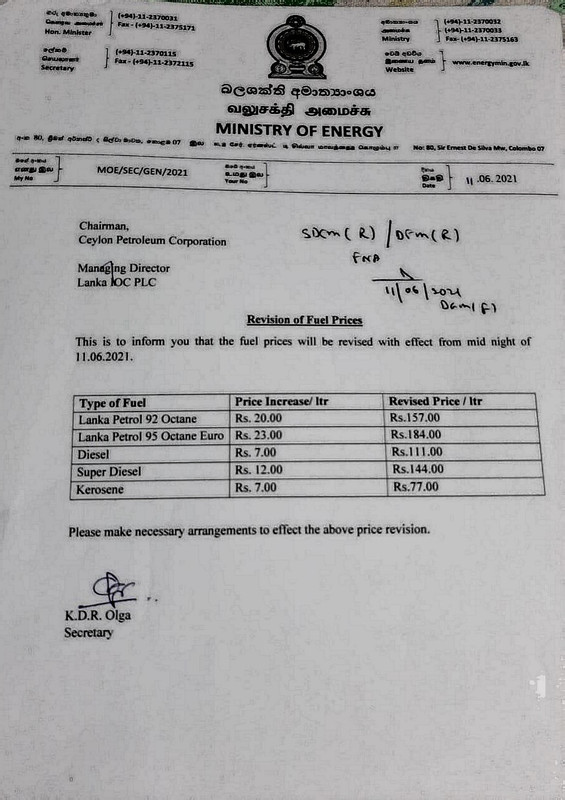
The Ceylon Petroleum Corporation (CEYPETCO) has decided to increase fuel prices with effect from midnight today (June 11), the Ministry of Energy says.

The fuel price revision has increased prices of Petrol 92 Octane by Rs. 20, Petrol 95 Octane by Rs. 23, Diesel by Rs. 7, Super Diesel by Rs. 12 and Kerosene by Rs. 7.

Accordingly, the new CEYPETCO fuel prices are as follows:

Lanka Petrol 92 octane – Rs 157.00
Lanka Petrol 95 octane – Rs 184.00
Diesel – Rs 111.00
Super Diesel – Rs 144.00
Kerosene – Rs. 77.00

Earlier today, Energy Minister Udaya Gammanpila announced that the Cabinet Sub-Committee on Cost of Living (CoL) has given the nod to increase fuel prices.

He stated that due to the prevailing Covid-19 situation in the country, the government cannot announce the date of the effective date in advance as the public would start forming long queues near fuel stations.

COVID: 2,759 new cases confirmed within the day

June 11th, 2021

Courtesy Adaderana

Daily COVID-19 cases count hit 2,759 on Friday (June 11) as 527 more people were tested positive for the virus in Sri Lanka.

The new development brings the total number of confirmed cases of coronavirus reported in the country to 218,893.

As many as 184,090 recoveries and 2,011 deaths have been confirmed in Sri Lanka since the outbreak of the pandemic last year.

According to official data, up to 32,818 active cases are currently under medical care at designated hospitals and treatment centres.

Sri Lanka’s COVID death toll tops 2,000 with 101 new victims

June 11th, 2021

Courtesy Adaderana

Sri Lanka on Thursday (June 10) registered 101 more victims of COVID-19, as the death toll crossed the grim milestone of 2,000.

This is reportedly the highest number of COVID-19 victims the country has confirmed in a single day.

The latest fatalities have moved death toll from the virus infection to 2,011, according to Epidemiology Unit’s data.

COVID-19 Deaths Confirmed on 10-06-2021 by Adaderana Online on Scribd

Importing organic fertiliser; Do we need plant deceases, unwanted pests and plagues to add to the country’s woes?

June 10th, 2021

By Raj Gonsalkorale

The President and the government is urged to at least postpone the decision made to ban the import of inorganic fertiliser at least for one year until it has had time to consult widely with experts and arrive at a more informed decision. Depriving some crops with inorganic fertiliser in the immediate term, and importing organic fertiliser as a substitute could be catastrophic in many ways.

Judging by comments made by politicians and even some experts” on the subject of fertilisers, both organic and inorganic, it appears there is a clear need for a better understanding on the pros and cons of using either or both categories of fertilisers.

The entire discourse on the fertiliser issue seems to be riddled with confusing and incomplete statements. What some understood to be a policy decision applicable to the current season, which is the Yala season is now understood to be from the following Maha season. The Minister for Agriculture also was heard in Parliament stating that organic fertiliser is currently being imported by some 20 importers and that the government will not import it. If his statement was correctly heard, he is saying that the country is already importing unwanted, undesired foreign substances and living matter and polluting and even poisoning the ground and possibly, ground water. He was also heard saying that there is enough stock of fertiliser for the current season, assuming the available stock referred to inorganic stock, although some feedback from growers seemed to indicate they do not have adequate fertiliser for this season.

The government must realise that the policy decision on the banning of imports of inorganic fertiliser, and how it is being implemented, information on the status quo when it comes to availability of fertiliser (organic and inorganic), and how it plans to address the gap between the requirement for organic fertiliser and what might be available locally and how they intend increasing the manufacture of it over the next few years, how they would contend with the after effects of not providing some crops with its essential nutrients found in inorganic fertiliser, and other related consequences will be managed. Perhaps a comprehensive press statement that covers all aspects will be not just helpful, but essential.

In a wide ranging opinion by Professor Janendra De Costa, Professor of Crop Science at the University of Peradeniya (See The Fertiliser Saga; A Considered Opinion, https://island.lk/fertilizer-saga-in-sri-lanka-a-considered-opinion/), a well-researched and balanced opinion, Professor De Costa explains how a balance could be found between the progressive reduction of inorganic fertiliser and the increase in use of organic fertiliser, without endangering the health of people, with a guided, guarded and selective use of inorganic fertiliser, needed to ensure food security and export earnings in the immediate and medium term, and a self-sufficiency program for organic fertiliser through local manufacture. Resorting to importation of organic fertiliser with all its negatives associated with the introduction of unwanted evils that come when importing organic fertiliser, and creating a potential catastrophe even in the nature of a devastating plague that could impact very seriously on the country’s agrarian economy.

Readers are urged to consider the opinion expressed by Professor De Costa, and get clarity on why fertiliser is needed, and also the role played by inorganic fertiliser in particular for crops like Tea, Rubber and Coconut, and Rice, and how organic fertiliser introduction could be achieved without a disruption to crop yield, which will have a direct cascading effect on foreign exchange earnings and also on the country’s food security. Some have questioned, cynically perhaps, whether food importation is the real desired outcome of this sudden shift to organic fertiliser.

The merits associated with not using inorganic fertiliser are many, and health benefits are significant. Neither Professor Costa nor any other person questions these benefits or the duty of care that is owed to the people of the country. Inorganic fertiliser manufacture is also very expensive and using the money spent on importing it could be better used to manufacture organic fertiliser.

However, in assessing benefits of using it for a better crop yield, at least in regard to some crops where subsidies are extended, it is possible that the costs may outweigh the benefits in regard to some crops if the actual cost rather than subsidised costs are taken as the cost of inputs.

Whilst not wishing to label it as a benefit in using inorganic fertiliser, the reality as pointed out by Professor De Costa, in the role played by inorganic fertiliser for Tea, Rubber and Coconut, and Rice output, Sri Lanka’s key foreign exchange earners, and the staple food of Sri Lankans, Rice, is indeed a benefit or could even be labelled a necessary evil” for this key export based agriculture industry which could have a significant downturn in yield, and therefore export earnings, in attempting to switch virtually overnight to organic fertiliser. In regard to Rice, such a drop in yield will result in the need to import Rice. Ironically, such imports of Rice will very likely be from inorganic fertiliser fed Paddy.

Besides the pros and cons associated with the fertiliser issue, the timing of the decision to impose a total ban on imports of inorganic fertiliser, switching to organic fertiliser, reliance on imported organic fertiliser to meet gaps in demand for it along with all the pitfalls associated with imported organic fertiliser, looks like a self-inflicted punishment, when this decision is considered from the troubled environment faced by Sri Lanka at present. It has more than enough of a share of bad luck and bad management. First, the COVID pandemic, which has impacted on the country’s health, education, the economy and brought out the worst in the country’s citizens, then the X Press ship linked pollution that will affect the environment of the country for more than 100 years according to several experts, and the rain and floods ravaging the country that poses a serious danger to the lives of many, and the country’s agriculture and food production.

The pit falls associated with importing organic fertiliser is explained by Professor De Costa as follows, Almost all organic fertilizers, being material of plant, animal or human origin, retain a diverse population of microorganisms.  Unlike inorganic fertilizers, which are inert material, organic fertilizers are live material.  Microorganisms, whether in soils, plants or any other location or entity, are often highly environment-specific. Introduction of such alien microorganisms to Sri Lankan soils could cause all types of unforeseen interactions with local microorganisms. Some of these interactions could have environmental repercussions, which are irreversible as once released to the soil, these alien microorganisms cannot be ‘recalled back’.  Therefore, it is always advisable and safer to develop organic fertilizers locally rather than importing from overseas.

Sterilization of imported organic fertilizer to kill all alien microorganisms via a process of fumigation after importation is suggested as a solution to this problem.  However, in view of the large quantities of organic fertilizers that are required to be imported and the toxicity levels of the chemicals that are used in fumigation could lead to environmental issues that the organic fertilizers are aiming to prevent. The Cabinet Minister of Agriculture went on record saying that only sterilized organic fertilizer conforming to quality standards acceptable to a government-appointed expert committee will be imported. Given the poor record of regulation, implementation and enforcement of quality standards on a range of items, both imported and locally-produced and both agricultural and non-agricultural, it remains to be seen whether these promises will be fulfilled

In reading Professor De Costa’s article, one gets the impression that the hurried decision to impose and immediate ban on inorganic fertiliser has been a decision based on an inadequate degree of consultation with experts on this subject. In this regard, the President and the government is also urged to consider the issue of fertiliser from a wider perspective of land management, and a long term policy on it with immediate, medium term and long term objectives.

As the President rightly acknowledged at the inauguration of the Investment Forum on the 7th June, the long term goal should be to produce more with less, meaning using research and development to produce crop varieties that will yield higher crops using less land. This objective can only be achieved through research and development work and not by chance activity. In this regard, it is abysmal that, according to Professor De Costa, the country spends only 0.11 % of GDP on research and development including in Agriculture.

The answer to a higher yield is not to use more land in order to achieve that goal. Unless someone has missed it, Sri Lanka is not exactly blessed with huge tracts of arable land!

Land management and a policy on land management should also take into account the current use of land for different agriculture products, and the future of such products. This is especially relevant when it comes to Tea, Rubber and Coconut. Plucking tea and tapping rubber is increasingly becoming a challenge, and is predicted to be even more of a challenge say in 10-20 years. 

Mechanisation of this activity may be a possibility, but in regard to Tea, the land terrain in most Tea growing areas will be a challenge by itself for mechanisation. Again, research work will be needed as to how best technology could be used to find solutions to such difficulties. In the event some land that is presently used for Tea and Rubber becomes so unproductive and therefore unprofitable, thought will have to be given as to what other agricultural use such land can be employed to serve the needs of the country.

As regards coconut, an assessment of whether land used for coconut cultivation is optimally used or not is an assessment that will have to be made. In some countries land used for coconut cultivation is also used for other crops like cocoa and coffee.  Perhaps even crops like cinnamon, and other spices may be possible in some areas.

Optimum use of land therefore has a direct relationship to fertiliser as all agricultural products need to be fed, either with inorganic fertiliser or organic fertiliser. The better, safer, cheaper and healthier option is to use organic fertiliser indigenously produced and on lands that has been acclimatised to organic fertiliser. This however, needs to be done progressively, ensuring there is no reduction in crop yield and no threat to food security in the country.

Water management is the other key aspect that needs to be considered in formulating a land management policy. Agriculture without water is not a possibility and envisaged land use needs to be considered along with availability of water to sustain the use of land for agriculture.

The government is therefore urged to consider the issue of fertiliser more holistically and from the wider perspective of a policy on land management, which must also include water management, and do so through a long term plan that has short term, medium and long term objectives and relevant action plans, targets and milestones. This requires an extensive consultation process, not just with experts, but also with people who are currently engaged in agriculture, health officials, community leaders and economists, and very importantly, the private sector.

It is hoped that the government will commence such a consultative process and perhaps by the middle of 2022, come up with a long term vision and a plan that is suitable for the country and which has broad acceptance of the people, therefore a sense of ownership of the plan.

The government is also urged to partner with the private sector in the country, and with universities (we have 17 of them now), so that the future direction when it comes to land management encompasses the interconnected, mutually dependent aspects which are all driven by research and development and private sector entrepreneurship.

Unfortunate as it is, it needs to be stated that the calibre and the quality of the country’s elected representatives, even highly educated academics who have turned politicians, leaves much to be desired, and government driven entrepreneurship would be an oxymoronic contradiction, and this task should be one that is driven and managed by the private sector in combination with universities that will be responsible for research and development work.

The planning horizon should not be when the next election is to be held, but how many generations are to be advantaged with sound, long term policy decisions.

ශ්‍රී ලංකාසාගර විශ්ව විද්‍යාලයේ විද්‍යාර්ථින්ට ලැප්ටොප්පරිගණක ලබා ගැනිමට අධ්‍යාපන ණය පහසුකම්

June 10th, 2021

State Ministry of Skills Development, Vocational Education, Research & Innovations

ශ්‍රී ලංකා සාගර විශ්ව විද්‍යාලයේ විද්‍යාර්ථින්ට ලැප්ටොප් පරිගණක ලබා ගැනිමට අධ්‍යාපන ණය පහසුකම්

නිපුණතා සංවර්ධන, වෘත්තීය අධ්‍යාපන පර්යේෂණ හා නව නිපැයුම් රාජ්‍ය අමාත්‍යාංශ අනුබද්ධ ශ්‍රී ලංකා සාගර විශ්ව විද්‍යාලයේ උපාධි අපේක්ෂිත සිසුන් සදහා ඔවුන්ගේ අධ්‍යාපන කටයුතු පහසුකිරිම වෙනුවෙන් ලැප්ටොප් පරිගණක ලබා ගැනිමට අධ්‍යාපන ණය පහසුකම් සැලසීමට මහජන බැංකුව කටයුතු කරයි. නිපුණතා සංවර්ධන, වෘත්තීය අධ්‍යාපන පර්යේෂණ හා නව නිපැයුම් රාජ්‍ය අමාත්‍ය විශේෂඥ වෛද්‍ය සීතා අරඹේපොල මහත්මියගේ ඉල්ලීමකට අනුව මහජන බැංකුව මෙම පහසුකම සලසා තිබේ.

WISDOM අධ්‍යාපන ණය යෝජනා ක්‍රමය යටතේ ණය ලබා දීමට කටයුතු සලසා තිබෙන අතර මින්පෙර අනෙක් රාජ්‍ය විශ්ව විද්‍යාල සිසුන් හට මේ සදහා අනුමැතිය තිබුණද සාගර විශ්ව විද්‍යාලයේ සිසුන් හට නොලැබිණි. සාගර විශ්ව විද්‍යාලයේ ඉගෙනුම ලබන සිසුන් හට තම ශීෂ්‍යභාවය තහවුරු කරන ලද ලිඛිත ලිපියක්ද සමග මේ සදහා ඉල්ලීම් කිරිමට හැකියාවක් පවතින අතර සාගර විශ්ව විද්‍යාලයේ සිසුන්හට වැඩිදුර තොරතුරු සදහා  0711730540 යන දුරකථන අංකය හරහා සම්බන්ධ විය හැක.

මාධ්‍ය ඒකකය

නිපුණතා සංවර්ධන, වෘත්තීය අධ්‍යාපන පර්යේෂණ හා නව නිපැයුම් රාජ්‍ය අමාත්‍යාංශ 

සාගර විශ්ව විද්‍යාලයේ වෙබ් අඩවිය – https://ocu.ac.lk

R&D Media

State Ministry of Skills Development, Vocational Education, Research & Innovations

FB: https://www.facebook.com/MoTRAE2013

ශ්‍රී ලංකා වරාය අධිකාරියේ ප්‍රධාන වෛද්‍ය නිලධාරීතුමිය අනිවාර්ය නිවාඩු යැවීම සම්බන්ධවයි.

June 10th, 2021

සමස්ත ලංකා වරාය පොදුසේවක සමිතිය

වරාය හා නාවික කටයුතු පිළිබඳ ගරු අමාත්‍ය,
රෝහිත අබේගුණවර්ධන මැතිතුමා,
වරාය හා නාවික කටයුතු අමාත්‍යාංශය,
අංක 19, චෛත්‍ය පාර,
කොළඹ01.

ගරු ඇමතිතුමනි,

ශ්‍රී ලංකා වරාය අධිකාරියේ ප්‍රධාන වෛද්‍ය නිලධාරීතුමිය අනිවාර්ය නිවාඩු යැවීම සම්බන්ධවයි.

ශ්‍රී ලංකා වරාය අධිකාරියේ ප්‍රධාන වෛද්‍ය නිලධාරීතුමිය වහාම ක්‍රියාත්මක වන පරිදි අද දින සිට (2021. 06. 10) අනිවාර්ය නිවාඩු යවා ඇත.

ඊට හේතුව නිල වශයෙන් අනාවරණය කර නැතත් වාණිජ කර්මාන්ත හා සේවා ප්‍රගතිශීලී සේවක සංගමයේ සභාපති සංජය කුමාර වැලිගම මහතාගේ මුහුණු පොතේ ඊයේ දවසේ (2021. 06. 09) පලකරන ලද පෝස්ටුවකට අනුව ප්‍රධාන වෛද්‍ය නිලධාරීතුමිය විසින් හොර පාරෙන් 230 කට එන්නත් කර ඇති බවත් ආයතනය වෙනුවෙන් කැපවෙන සේවකයින්ගේ බිරිඳට, දරුවන්ට, අම්මට තාත්තට ලබා දීම ප්‍රතික්‍ෂේප කල බවට හැඟවෙන ප‍්‍රකාශයක් සිදුකර ඇත.

01.
එම ප්‍රකාශය ඉතා බරපතල ප්‍රකාශයකි. ඇස්ට්‍රාසෙනිකා එන්නත්වල Astrazeneca vaccines හිඟයක් හේතුවෙන් දෙවැනි මාත්‍රාව ලබා දීම බරපතල ගැටලූවක්ව පවතින මොහොතේ ප්‍රධාන වෛද්‍ය නිලධාරීතුමිය විසින් 230 කට හොරපාරෙන් එම එන්නත ලබා දුන්නා නම් එය බරපතල කරුණකි,

02.
එසේම වරාය සේවකයින්ගේ දෙමව්පියන්, බිරින්දෑවරුන් හා දරුවන්ට එම එන්නත ලබාදිය යුතුය යන්න අපගේද ස්ථාවරය වේ. එය අනුමත වී ඇත්නම් ඔබගේ මැදිහත්වීම අප වරාය සේවකයින් වෙනුවෙන් අගය කර සිටිමු,

03.
අනුව වරාය සියලූ සේවකයින්ට බව දන්වා කඩිනමින් එම වැඩපිළිවෙල දියත් කරන ලෙසත් ඊට එරෙහිවන අයෙක් වේ නම් ඔහුට හෝ ඇයට විරුද්ධව දැඩි ක්‍රියාමාර්ග ගන්නා ලෙසත් ඉල්ලා සිටිමු.

04.
අප විසින් මෙම සිදුවීම පිළිබඳව කරුණු සොයා බැලූ අතර වරාය ප්‍රධාන වෛද්‍ය නිලධාරීතුමිය නියමිත පටිපාටිය අනුව නීත්‍යානුකූලව කටයුතු කර ඇති බවට අප වෙත තොරතුරු වාර්තා වේ.

05.
කෙසේ වෙතත් සත්‍ය අසත්‍යතාව විධිමත් පරීක්‍ෂණයක් අවසානයේ තහවුරු කර ගත හැක. අප කිසිවෙකුට සුදු හුණු ගාන්නේ හෝ මඩ ගහන්නෙ නැත. වරාය සේවකයින් වෙනුවෙන් හා මහජනතාව වෙනුවෙන් මෙම සිදුවීම සම්බන්ධව කඩිනමින් දැනට පවතින තත්වය රටට හෙළිදරව් කරන ලෙස ඉල්ලා සිටිමු. එසේම වැක්සීන් ක්‍රියාවලියට අදාලව සිදුකරණ පරීක්‍ෂණය අපක්‍ෂපාතීව හා සාධාරණව සිදුකරන ලෙසත් අවශ්‍ය වේ නම් ඊට සෞඛ්‍ය දෙපාර්තමේන්තුවේ සහාය ලබාගන්නා ලෙසත් අප ඔබතුමාගෙන් ඉල්ලා සිටිමු.

තවද වරාය සේවකයින්ගේ බිරිඳ, ස්වාමි පුරුෂයින්, අඹු දරුවන්, දෙමව්පියන් වෙත එන්නත ලබාදීම කඩිනමින් සිදුකරන ලෙස අප ඔබතුමාගෙන් ඉල්ලා සිටිමු.

ස්තූතියි.

මෙයට,
විධායක සභාව වෙනුවෙන්,
නිරෝෂන් ගොරකානගේ
ප්‍රධාන ලේකම්
සමස්ථ ලංකා වරාය පොදු සේවක සමිතිය.

සම්බන්ධීකරණය0718443028
Coordinating – +94 718443028

පිටපත්
1.
සෞඛ්‍ය සේවා අධ්‍යක්‍ෂ ජනරාල්තුමා (දැනගැනීම හා අවශ්‍ය කටයුතු සඳහා)
2.
ජනතා විමුක්ති පෙරමුණ නායක පා.. අනුර කුමාර දිසානායක සහෝදරයා (අවධානයට)
3.
සභාපතිශ්‍රී ලංකා වරාය අධිකාරිය
4.
සියලූ ජනමාධ්‍ය වෙත

Indian envoy in Sri Lanka seeks stable and predictable policies

June 10th, 2021

Courtesy NewsIn.Asia

Indian envoy in Sri Lanka seeks stable and predictable policies

Colombo, June 10 (newsin.asia): The Indian High Commissioner in Sri Lanka Gopal Baglay has emphasized the need for stable and predictable policies” for the promotion of economic interactions between India and Sri Lanka.

Speaking at a session dedicated to India on June 9, at the Sri Lanka Investment Forum (SLIF) 2021 organized in the virtual format by the Board of Investment (BoI) of Sri Lanka, the Ceylon Chamber of Commerce (CCC), and the Colombo Stock Exchange, Baglay said that expedited implementation of bilateral projects would enhance investor confidence and boost economic growth. He identified stable and predictable policies as being the key for the promotion of economic interactions between India and Sri Lanka.

Economic and commercial bilateral partnership could focus on areas such as ports, shipping, connectivity, logistics, energy/renewable energy, IT, tourism and hospitality, transport, real-estate, health, education and agriculture, the envoy said. 

Outlining the comprehensive nature and scope of Indian investments in Sri Lanka, the High Commissioner underlined the importance of private sector participation and noted that Indian business and industry are perhaps the best suited to partner with Sri Lanka by the virtue of proximity, familiarity, and longstanding ties between the two sides.

He mentioned that expedited implementation of bilateral projects would enhance investor confidence and boost economic growth. Stable and predictable policies were identified as being the key for promotion of economic interactions

Lankan Minister Balasuriya

The dedicated session also heard remarks by several dignitaries including the State Minister for Regional Cooperation Tharaka Balasuriya. In addition there was a panel discussion involving representatives of three Indian companies with successful ongoing investments in Sri Lanka – HCL, IOCL (LIOC), and Ashok Leyland.

Minister Tharaka Balasuriya spoke about significant Indian investments in Sri Lanka and highlighted various sectors and projects in Sri Lanka that could be of interest for Indian investors. The areas outlined by him included automobile components, apparel industry/fabric parks, IT sector, pharmaceuticals, and education. He also thanked India for its support in terms of medical supplies related to Covid-19, specially the supply of vaccines under the Vaccine Maitri Programme.

The Acting High Commissioner of Sri Lanka to India Mr. Niluka Kadurugamuwa and Mr. Vish Govindasamy Vice-Chairman of CCC also spoke at the country session. 

Mr. Pasan Wanigasekara, Director General of BoI of Sri Lanka gave a presentation on investment opportunities in Sri Lanka along with the regulatory and tax framework for investors.

During the panel discussion, the three Indian companies shared their investment experience in Sri Lanka and spoke about their efforts to expand the business in Sri Lanka, especially in the context of the challenge posed by the pandemic. 

Chinese Ambassador lists difficulties faced by Chinese investors in Sri Lanka

June 10th, 2021

Courtesy NewsIn.Asia

Colombo, June 10 (newsin.asia): The Chinese Ambassador to Sri Lanka, Qi Zhenhong, told the Sri Lanka Investment Forum 2021 this week here that while the island nation is well positioned geographically to develop into an international investment hub, it has to remove certain impediments such as policy inconsistency, administrative inefficiency and indulgence in biased anti-Chinese propaganda.   

Sri Lanka’s industry is not strong. Its development of the supply chain and supporting facilities is far from perfect. Second, although the policies to attract foreign investment are in place, the following problems still exist at the stage of implementation: lack of concrete measures, cumbersome administrative procedures, lengthy coordination process among government agencies and inefficiency in decision-making etc. Much remains to be done in terms of investment facilitation. Thirdly, Sri Lanka has a dynamic environment of public opinion. Among the diversified views, unfortunately, there are at times baseless accusations and attacks on Chinese businesses.”

Only with the guarantee of the right policies, could we expect foreign investment to take root and bear fruit. Therefore, it is important for the Sri Lankan government to ensure the consistency, stability, transparency and effectiveness of its investment policies to the largest extent. As such, China and Sri Lanka need to continue our efforts promptly to carry out the outline of the medium and long-term plan for investment cooperation and development between our two countries signed in 2017. At the same time, negotiations on the China-Sri Lanka FTA should be resumed as soon as possible. If a timely agreement can be reached, it will surely further promote our bilateral trade and investment.”

Only by creating an easy-to-do-business environment and providing favorable conditions for investors, the host country can obtain an early advantage from the get go, in the increasingly competitive world to attract international investment. As mentioned earlier, we count on the Sri Lankan government’s efforts to further streamline its review and approval processes, promote digitalization in the administration and improve the efficiency of government services provided (for instance, to establish the electronic one-stop-shop for investors), with the view to minimizing the cost of communication and coordination between businesses and authorities.”

Third, to better cultivate the pro-business atmosphereattacks targeting Chinese businesses in the media while discussing the Colombo Port City and Hambantota Port from time to time. The accusation sometimes even labels the Chinese government for creating debt trap” and colonialization” in Sri Lanka. Those groundless accusations have to some extent affected the healthy atmosphere for our extensive cooperation. As a matter of fact, those Chinese companies took on the projects at the request of the Sri Lankan government in an hour of need, rather than taking advantages” as claimed by some.”

The Belt and Road Initiative is guided by the principles of extensive consultation, joint contribution and shared benefits, with the view to achieving the win-win outcome, rather than the zero-sum” game. I believe, in order to properly address the difficulties encountered in bilateral cooperation, both sides should always keep in mind the mutually beneficial nature of our cooperation and our strong partnership as a whole.”

We should neither overlook the prominent problems arising in key projects because of our friendship, nor can we allow anxiety to cloud our judgement over short-term gains and losses: we need to avoid the mentality of feeling on the losing side when the projects are making progress with promising benefits; or to throw blame around when the projects are moving slow or temporarily hindered.”

However, ending on a note of optimism, the envoy said: All in all, despite existing challenges, the time has come to invest in Sri Lanka. I sincerely believe, with the strong commitments by the Sri Lankan government to address those challenges, as well as the wisdom of our experienced investors, we are looking at an extremely promising future of our investment cooperation ahead.”

As Bangladesh Rises, Sri Lanka Finds India is Not the Only Neighbour With Deep Pockets

June 10th, 2021

Courtesy The Wire

The currency swap arrangement between Sri Lanka and Bangladesh seems to be the first time that any country other than India has provided macroeconomic support to another South Asian country.

As Bangladesh Rises, Sri Lanka Finds India is Not the Only Neighbour With Deep Pockets

About two weeks ago, Bangladesh’s central bank approved, in principle, a $200 million currency swap deal for Sri Lanka, intended to bolster the latter’s dwindling foreign exchange reserves. This has evoked more than a little surprise, given the overall development levels of the two countries: Sri Lanka’s income per person is twice that of Bangladesh (in terms of current US dollars), and the global perceptions of Bangladesh are not always flattering. How did it come to this?

The proximate cause of Sri Lanka’s plight is government borrowing, especially from foreign sources. When its civil war ended in 2009, Sri Lanka enjoyed a peace dividend. Its economic growth accelerated from 3.5% in 2009 to 8, 8.4 and 9.1% over the next three years. However, this growth was driven by unsustainable increases in government spending, with the rolling out of mega infrastructure projects, largely financed by the public sector. One example is the economically unviable Hambantota Port.

In recent years, Sri Lanka’s growth has plummeted, from 5% in 2015 to 2.3% in 2019, the pre-COVID year, and to an estimated -3.6% in 2020. External debt as a share of gross national income grew from 39% in 2010 to 55% in 2014, and further to 69% in 2019. Most of this increase originated in the public sector. The Spring 2021 World Bank economic update shows Sri Lanka facing a high risk of debt sustainability, and rating agencies have downgraded its long-term debt rating.

However, a big part of the crisis owes to Sri Lanka’s trade regime and the resulting trade outcomes. In 1977, Sri Lanka became the first country in South Asia to start liberalising its protectionist trade stance; it reaped handsome dividends in the form of a rising share of exports and trade in its economy. Unfortunately, this course was reversed in the early 2000s, with the introduction and increasing importance of non-transparent para-tariffs”: tariffs that have different nomenclatures such as cess, ports and airport levy, etc., but that are import duties in all but name. If such para-tariffs are included in the calculation of overall tariffs, as they should be, Sri Lanka’s reported average tariffs (2016 data) shoot up from 10.8% to 22.4% (see Chapter 2 in A Glass Half Full). Moreover, these average tariff calculations obscure the much higher overall import protection as well as effective protection” in sectors of domestic interest. Overall, these changes led to an increasingly anti-export bias” in the economy, with growth being propelled by non-tradable sectors. Such impulses have seen a renewed boost since a new government, led by President Gotabaya Rajapaksa, came to power in late 2019.

The starkest evidence of the anti-export bias can be seen in the share of Sri Lanka’s trade and exports in its overall economy. Its trade to GDP ratio peaked at 89% in 2000, but then saw an unprecedented decline to 46% by 2010; it was 52% in 2019. Similarly, exports as a share of GDP declined from 39% in 2010 to less than 20% in 2010; they rose somewhat to 23% by 2019. But the overall decline in exports and imports since 2000 is possibly without precedent in a small, modern economy.

A group of Sri Lankan visitors at the new deep water shipping port watch Chinese dredging ships work in Hambantota, 240 km (150 miles) southeast of Colombo, March 24, 2010. Credit: Reuters/Andrew Caballero-Reynolds/Files

A group of Sri Lankan visitors at the new deepwater shipping port watch Chinese dredging ships work in Hambantota, March 24, 2010. Photo: Reuters/Andrew Caballero-Reynolds

Bangladesh’s golden goose

Contrast this with Bangladesh. Famously dubbed as a basket case” by Henry Kissinger at the time of its independence in 1971, Bangladesh has been a remarkable case of sustained and rising growth. One reason for this is its sound macroeconomic management, arguably the best in South Asia. Despite very low tax revenue (a trait that it shares with Sri Lanka and most other South Asian countries), Bangladesh has been careful to not run large government deficits or take up projects that do not have a high economic and social rate of return. Its external debt as a share of GDP has fallen from a peak of 44% in 1994 to 16-18% over 2016-19. Part of the reason for this was the steady increase in Bangladesh’s growth rate, which meant that GDP increased much faster than external debt. This falling debt has provided space to Bangladesh’s private sector, unlike Sri Lanka, where rising debt tends to crowd out” its private sector: a telling example of this is the share of interest payments (domestic and foreign) in total government revenue, which was as high as 47.5% in Sri Lanka in 2019, versus around 18.5% for Bangladesh in 2016 (and likely falling or steady thereafter, see World Bank Data).

Bangladesh’s export story is more nuanced, but nonetheless very impressive. Like Sri Lanka, Bangladesh has been unable to diversify its export basket. Readymade garments comprise as much as 83% of its total exports. However, unlike Sri Lanka, Bangladesh’s exports have contributed significantly to its overall economic growth story. Sustained by its apparel sector, exports grew from 11.1% of GDP in 2004 to 15.3% of GDP in 2019: implying that exports grew much faster than an already fast-growing domestic economy. Perhaps the simplest way to contrast the relative export performance is to look at the absolute export numbers. In 2004, both countries’ exports of goods and services were at $7.3 billion. In 2019, Sri Lanka’s exports were $19.4 billion, Bangladesh’s $46.3 billion (World Bank data). Even though Bangladesh is heavily reliant on garments, and needs to diversify, it also has a lot of room to continue to grow in the garments sector, based on its expertise in mass manufacturing and its large pool of labour. It is now among the top three apparel exporters in the world, and, along with Vietnam, is gradually taking market share from China, still the dominant player in this sector.

It needs to be said that Bangladesh also has a strong anti-export bias in its overall trade orientation, based on similar considerations as in Sri Lanka: non-transparent para-tariffs, and much higher effective protection in sectors where there is a domestic interest. However, this approach has not hurt Bangladesh on the macroeconomic front in the same way that it has Sri Lanka. One reason, of course, is that Bangladesh is a much bigger economy, and trade is not expected to play as important a role as in Sri Lanka. But there is another reason as well: Bangladesh has protected its high-performing apparel sector from the inefficiencies of its overall trade regime through a special dispensation that was not available to other exporting sectors (see box 2.3 in Strengthening Competitiveness in Bangladesh). This has worked remarkably, at least so far, enabling Bangladesh to capitalise on a deep world market for inexpensive clothing, and in the process increasing (pre-COVID) total employment of about four million garment workers, about 40% of the country’s total industrial employment.

Garment workers return from a workplace as factories reopened after the government eased COVID-19 restrictions in Dhaka, Bangladesh, May 4, 2020. Photo: Reuters/Mohammad Ponir Hossain

And thereby hangs a tale 

Sri Lanka’s persistent and often large shortfalls in its trade and current account meant that it needed capital inflows to cover the external deficit. It was also borrowing for large projects and thus racking up additional debt. And its inflows of foreign direct investment were sluggish and well below par. Bangladesh’s current account deficits, on the other hand, were rarely over 2% of GDP (in fact, they were often in surplus, not a good sign of investment potential, but that is another story); it also enjoyed soft loans from the World Bank and the Asian Development Bank. Thus, Sri Lanka’s external debt service (principal repayments plus interest) as a share of exports of goods and services rose sharply from 5.5% in 2005 to 31.7% in 2019; for Bangladesh, this ratio came down from 34% in 1990 to 5% in 2010, and, while rising somewhat in the last few years, was at a manageable 12.8% in 2019.

The foreign exchange reserves of the two countries encapsulate this story. In 2000, the reserves of both countries stood at around $1 billion. By 2019, Sri Lanka’s reserves had crept up to $7.7 billion, while Bangladesh’s had shot up to $32.7 billion. By February 2021, Bangladesh’s reserves had crossed a record $45 billion, while Sri Lanka’s had dwindled to $4.5 billion (April 2021). Currently, while Bangladesh’s reserves are sufficient to cover almost eight months of imports of goods and services, Sri Lanka is down to less than two months of import cover (using import figures from 2019, the pre-COVID year). Such a low cover is very risky; it prompted the Central Bank of Sri Lanka to seek emergency assistance from multiple sources, including from Bangladesh Bank.

The South Asian perspective

The currency swap arrangement for Sri Lanka seems to be the first time that any country other than India has provided macroeconomic support to another South Asian country. Given current economic trajectories, it would not be surprising if Pakistan approaches Bangladesh with a similar request in the foreseeable future.

From a South Asian perspective, the rise of Bangladesh is a welcome development, for several reasons. First, it helps move South Asian countries move away from a fixation on India, and provides opportunities for more meaningful (non-India) bilateral economic partnerships in the region. Second, it helps India to be less dominant. For example, in the BBIN (Bangladesh, Bhutan, India and Nepal) subregion, both Nepal and Bhutan are looking at exporting hydropower to Bangladesh. With its growing economic clout, Bangladesh can potentially import increasing amounts of hydropower from Nepal, which can reduce the latter’s fears about being too dependent on India as a market for energy. Third, the growth of Bangladesh’s middle class and its multinational firms support the deepening India-Bangladesh relationship, a win-win for both countries. Fourth, other countries in the region can learn from Bangladesh’s experience of prudent macroeconomic management. All of these factors can help chip away at the trust deficit induced by India’s disproportionate weight in South Asia.

This is not to say that Bangladesh does not have its fair share of problems. That is a discussion for another time. For now, South Asia (and the world) can celebrate the rise of a significant economy that can play an increasingly positive role in the region.

Sanjay Kathuria is Senior Visiting Fellow at the Centre for Policy Research, India; Non-Resident Senior Fellow at the Institute of South Asian Studies, Singapore, and Visiting Professor at Georgetown University and Ashoka University. Twitter: Sanjay_1818

කොරෝනා ආසාදිතයන් තිස් ලක්‍ෂයක් සමාජයේ..

June 10th, 2021

උපුටා ගැන්ම ලංකා සී නිව්ස්

අද වන විට ශ්‍රී ලංකාවේ සමාජය තුළ කොරෝනා ආසාදිතයන් මිලියන තුනකට වඩා වැඩි පිරිසක් සිටින බව ඖෂධ හා සෞඛ්‍ය කළමනාකරණ උපදේශක ආචාර්ය සංජය පෙරේරා මහතා සඳහන් කරයි.

එන්න එන්නම රට බරපතළ අවදානමකට පත්වෙමින් ඇතැයිද පවසන ඔහු බලධාරීන් සහ උපදේශකයන් විසින් ජනාධිපතිව රවටමින් සිටින බවද කියා සිටියි.

මෙම තත්වය යටතේ ඉදිරියේදි ලංකාවෙන් නවතම කොරෝනා ප්‍රභේදයක් බිහි විය හැකි බවද ඔහු පෙන්වා දෙයි.

මෙම තත්ත්වය කළමනාකරණය කර ගැනීමට නම් අවහ වශයෙන් දින 21 කාලයක් රට වසා දැමීමක් සිදු කළ යුතු බවද ඔහු පවසයි.

අන්තර්ජාල නාලිකාවක සාකච්ඡාවට එක්වෙමින් ඒ මහතා මෙම අදහස් පළ කළේය.

Travel restrictions to be lifted on Monday: Army Chief

June 10th, 2021

Courtesy The Daily Mirror

The ongoing island-wide travel restrictions will be lifted at 4.00 am on Monday (14), Army Commander General Shavendra Silva said.

Although the island-wide travel restrictions are lifted, various restrictions including provincial travel restrictions will remain in place.

He also urged the public not to be deceived by rumors circulating on social media about travel restrictions.(Darshana Sanjeewa Balasuriya)

2,715 coronavirus cases confirmed within today

June 10th, 2021

Courtesy Adaderana

The Ministry of Health says that another 573 persons have tested positive for coronavirus, increasing today’s tally of new Covid-19 cases to 2,715.

It said that all positive cases reported today are associated with the ‘New Year’ Covid-19 cluster.

This brings the total number of Covid-19 patients reported from the Minuwangoda, Peliyagoda, prisons and New Year clusters to 209,332 thus far.

A total of 216,134 confirmed cases of coronavirus have been reported in Sri Lanka while 31,986 patients are currently under medical care.

Total Covid-19 recoveries stands at 182,238.

COVID-19: Highly transmissible Alpha variant reported from multiple areas

June 10th, 2021

Courtesy Adaderana

Patients with an infection of the highly transmissible B.1.1.7 (Alpha) UK variant of the coronavirus have been reported from multiple areas of the island.

https://www.facebook.com/watch/live/?v=540754927097793&ref=watch_permalink&t=0

As per the biological samples obtained from COVID-19 patients, the cases are reported from Batticaloa, Trincomalee, Kuliyapitiya, Wariyapola, Habaraduwa, Tissamaharama, Karapitiya, and Ragama areas, Dr. Chandima Jeewandara, the Director of the Department of Immunology and Molecular Medicine of the University of Sri Jayewardenepura said.

Meanwhile, a patient infected with the B.1.617.2 (Delta) Indian variant has been identified from a quarantine center in Wadduwa.

Reportedly, the relevant patient had arrived in the country from India.

The latest study report on the spread of COVID-19 in Sri Lanka was handed over to the Director-General of Health Services this morning (10), Dr. Chandima Jeewandara said.

Meanwhile, Australian authorities reported that the recent outbreak of the Delta variation of coronavirus in Melbourne was transmitted by a person who arrived from Sri Lanka.

However, during a press conference today (June 10), Dr. Jeewandara stated that this information was untrue.

The person in question had traveled to Melbourne via transit in Sri Lanka, Dr. Jeewandara clarified.

He said, that Sri Lankan authorities had looked into the matter and it has been confirmed that the relevant passenger had not entered the country and that no infection of Delta variation has been reported from the community on the island.

Tamil Eelam in Tamil Nadu or every ethnic group around the world will demand Homelands too

June 9th, 2021

Shenali D Waduge

Countries & governments of the world must begin to worry about a future scenario of Chinese in US seeking homeland in USA, Sikhs in UK seeking a homeland in UK, Muslims in US seeking a homeland in USA, Chinese in Australia seeking a homeland in Australia, Muslims in India seeking a homeland in India & Tamils in Canada, UK, South Africa, Singapore also seeking a homeland in those countries using the very arguments being used to demand a homeland in Sri Lanka. All of the Tamils living around the world – in the Caribbean, East Asia, South Africa etc were Tamils plucked by colonials and planted in all parts of the world to work as indentured laborers. They were later absorbed as citizens. But, the crux of the argument is that their natural home was Tamil Nadu, South India. It is where they evolved from and there are millions of such Tamils around the world. It is therefore mindboggling that a handful of pro-LTTE groups & some bankrupt TNA politicians claim that the homeland of Tamils is in Sri Lanka. Yet, they cannot prove that all of the Tamils domiciled around the world were taken from Sri Lanka but there are enough of evidence to showcase Tamils being brought by colonials & settled in Sri Lanka. What if the 47million blacks in US start demanding a separate black homeland in the USA?

Tamils in Tamil Nadu raised a very valid reason for self-determination based on the key argument that Tamil Nadu was always a separate & autonomously run area during pre-colonial rule. It was only in 1947 that the colonial British cobbled up princely kingdoms and independent territories and created INDIA – which in reality has a history of 74 years. There was no India before 1947. No pre-colonial ruler, ruled all that which is termed India today.

Ethiopian Origin Of Tamils & Dravidian Indians,

The Tamil homeland demand for self-determination was denied by Gandhi & the British. The take away from this is that Tamils of Tamil Nadu sought self-determination first. India palmed off India’s headache to Sri Lanka helping arm, train and fund Sri Lankan Tamil separatism & militancy to use for India’s political mileage. The scenario served the Tamil militant groups and Sri Lankan Tamil politicians as it propped up their importance among Tamil people, brainwashing their minds into believing in the creation of a utopian homeland, without fundamentally realizing that the same ethnic group cannot demand a homeland for the same ethnic group in two different sovereign countries.History will show that Sri Lanka was never ever linked to India even looking at the Pangaea map of how lands split to create modern day countries. https://www.youtube.com/watch?v=ojxWbZqG-HA&t=56s

Therefore, the same ethnic group cannot demand homelands in 2 different countries.

If so, there is no reason why using the same arguments the American Chinese can demand a homeland in USA, the American Muslims can demand a Homeland in USA, the British Sikhs can demand a homeland in UK…. So large congregations of immigrants will also use the arguments that they have their own language, their own culture, they had been living in an area and have their own history and demand their homeland on mono-ethno-religious lines. It also may even open doors for pro-LTTE Tamils in Canada, UK, France, US & Australia (their heavenly abodes) to also seek a separate homeland in those countries.

So, what happens to all the big talk by the UN, international bodies & foreign governments about ‘multiculturalism’ ‘secular states’ ‘assimilation’ ‘cohabitation’ ‘united in diversity’, cultural diversity etc.

Therefore, everyone must start thinking wiser and not fall prey to fake propaganda that was created to justify militancy in Sri Lanka and justify refugee/asylum status in western countries and justify collecting funds that created the LTTE kitty and a nexus of international legal & illegal money making ventures on which many of these Tamils depend on to survive and lead rich and luxurious lives far above the ordinary Tamils who have gone to make a home overseas.

The GoSL via the Foreign Ministry must convey this basic and fundamental logic and argument that the same ethnic group cannot demand 2 different homelands in 2 different countries as it is only paving the way for other ethnicities living in foreign shores to also argue for a separate homeland.

This is going to cause chaos across the world as there are plenty of people counting fingers to create conflicts to enable the sustenance of the arms supply, weapons industry for profit. The world does not need any more conflicts, loss of life and divisions as no ethnic group can live in isolation and no ethnic group can claim to be living happily ever after even amongst their own. Look at how divided Tamils are in Tamil Nadu – where caste & class are shocking dividers no different to the same scenario amongst Tamils in Sri Lanka as well.

If anyone says a mono-ethno-religious homeland is going to be honky dory and happy ever after they are reading too many fairy tales!

Its time to stop these politically advantageous but socially dangerous stunts to break up and divide nations on silly arguments created to suit a handful of people.

People must learn to live, they must learn to adapt to their environment, they must cohabitate, they must respect others & their cultures and realize that their human rights stops the moment they violate the human rights of another.Separatist demands are hurtful of others and foreign governments & UN officials must stop providing fuel to separatist agendas in whatever form.

UN should be showing people of the world to live together in peace not in pieces.

Shenali D Waduge

ERASING THE EELAM VICTORY Part 18D Pt 4C

June 9th, 2021

  KAMALIKA PIERIS

The United Nations  is not as pure as we think. The United Nations, along with the 193 diplomatic missions located in New York, have long been veritable battlegrounds for spying, wire-tapping and electronic surveillance, said Thalif Dean. (2021). At the UN, virtually all the big powers play the spying game. US National Security Agency (NSA) and Britain’s spy agency, the Government Communications Headquarters (GCHQ), had once targeted over 1,000 political leaders, diplomats, and international institutions.

During the height of the Cold War in the 1960s and 1970s CIA had planted one of its Russian lip-reading experts in a press booth overlooking the Security Council chamber so that he could monitor the lip movements of Russian delegates, as they consulted each other in low whispers.

US had cracked into the UN’s encrypted video system and there is very aggressive monitoring of UN officials and high-ranking diplomats, continued Thalif. in 2013, Brazilian President Dilma Rousseff, launched a blistering attack on the United States for illegally infiltrating its communications network, surreptitiously intercepting phone calls, and breaking into the Brazilian Mission to the United Nations.

The illegal electronic surveillance of Brazil was conducted by the US National Security Agency (NSA). NSA technicians had managed to decrypt the UN’s internal video teleconferencing (VTC) system. This finding not only embarrassed the United Nations but also put its integrity, impartiality and credibility in doubt.

When UN member states compete for the Presidency of the General Assembly or membership in the Security Council or various other UN bodies, the voting was largely tainted by bribery, cheque-book diplomacy and offers of luxury cruises in Europe.

Just ahead of an election for membership in the Security Council, one Western European country offered free Mediterranean luxury cruises in return for votes while another country dished out — openly in the General Assembly hall— boxes of gift-wrapped expensive Swiss chocolates.

Fathulla Jameel, a former UN Ambassador and later Foreign Minister of the Maldives, said that when Maldives asked for foreign aid, to help fund some of country’s infrastructure projects. One rich Asian country, a traditional donor, had responded. The project would be fully funded and for free, but there was a catch: If there is a vote at the UN, and it is not of any national interest to your country”, said the donor country’s foreign ministry, we would like to get your vote.”

There is horse trading of votes at the UN, observed Guardian. One country will pledge to vote for a motion here in exchange for a vote to be on a committee there. There is arm twisting too. The weaker nations are made to vote against their conscience. In the case of Sri Lanka, US got reluctant countries to at least abstain. The countries that refrained from voting made speeches in Sri Lanka’s favor and then refrained from voting, which was their way of indicating that they were refraining from voting only under duress, reported the media.

‘All member states in the UN rank equally at the formal level, but the money contribution to the UN varies and some countries such as USA pay large amounts, said critics.  Over the years,  instead of keeping the UN as skeleton organization to maintain a line of communication between sovereign states and a meeting place for them, the west have taken the lead in piling more and more tasks on the UN system  creating a great dependency on the voluntary contribution to keep the system going. This has made the UN depend on about        ten to 15 western countries, and these countries have turned this dependency to a handle to make the UN further their foreign policies.  There is at least one document that admits that this distorts the priorities of the UN system. And to retain their jobs the UN officials have to pander to these countries, including Ban Ki Moon, said Chandraprema in 2013. (continued)

Statement of HE Mahinda Rajapakse, the Prime Minister and Finance Minister of Sri Lanka on the World Accreditation Day 2021

June 9th, 2021

Mahinda Rajapakse Prime Minister and Finance Minister of the Democratic Socialist Republic of Sri Lanka

Ministers, Secretaries,

Distinguished Invitees, Ladies and Gentlemen

It is with great pleasure that I issue this message today as we celebrate the World Accreditation Day under the theme Accreditation: Supporting the implementation of Sustainable Development Goals (SDGs).

Sri Lanka, along with the other member states of the United Nations endorsed the Sustainable Development Agenda (the Sustainable Development Goals) in 2015, a Universal Call to Action to end poverty, protect the planet and ensure that all people enjoy peace and prosperity by 2030.

Sri Lanka has begun its transformation towards a sustainable and resilient society. Even with the challenges imposed by the global Covid-19 pandemic, the government is taking concrete efforts to make progress towards achieving the SDGs. Our National Policy Framework ‘Vistas of Prosperity and Splendor’ is a comprehensive and holistic development framework that has effectively integrated our global SDG commitments. The three core areas; economic growth, social inclusion, and environmental protection are all addressed in the National Policy Framework and all institutions must work towards achieving these objectives.

Our government has established an inter-ministerial Steering Committee under my leadership to steer and guide the SDG implementation process in Sri Lanka by mobilizing various government agencies around SDGs whilst ensuring and facilitating integrated approaches towards implementation. The Sustainable Development Council, as the mandated agency to provide technical guidance and coordination support towards this process, has been empowered to perform its core functions.

Considering the strategic importance of SDGs for the upliftment of mankind and the environment, the two global organizations namely, the International Laboratory Accreditation Cooperation (ILAC) and the International Accreditation Forum

(IAF) have declared the theme of this year’s Accreditation Day as Accreditation: supporting the Sustainable Development Goals (SDGs)”. I am happy to note that the Sustainable Development Council is entering into a partnership with the Sri Lanka Accreditation Board (SLAB), the apex organization in the Quality Infrastructure of Sri Lanka to assist the government and private sector organizations meet sustainability standards. The SLAB supports internationally recognized conformity assessment services through testing, inspection and certification.

We must all work towards ensuring that the accreditation process delivers the best quality and environmentally sound outputs benefitting both the people and the planet. I am confident that this partnership will assist the relevant public and private agencies to work towards this objective which in turn will accelerate Sri Lanka’s journey towards sustainable development.

I wish both organizations all success in their future endeavors.

Mahinda Rajapakse
Prime Minister and Finance Minister of the Democratic Socialist Republic of Sri Lanka

09th June 2021

විශ්‍රාම ගිය හෙද හෙදියන් අවශ්‍යතාවය අනුව කොන්ත්‍රාත් පදනම මත නැවත සේවයට බඳවා ගන්න – අග්‍රාමාත්‍ය මහින්ද රාජපක්ෂ මහතා

June 9th, 2021

අග්‍රාමාත්‍ය මාධ්‍ය අංශය

විශ්‍රාම ගිය හෙද හෙදියන් අවශ්‍යතාව අනුව කොන්ත්‍රාත් පදනම මත නැවත සේවයට බඳවා ගන්නැයි ගරු අග්‍රාමාත්‍ය මහින්ද රාජපක්ෂ මහතා අද (09) දින අරලියගහ මන්දිරයේ දී සෞඛ්‍ය ඇමතිනි පවිත්‍රා වන්නිආරච්චි මහත්මියට උපදෙස් දුන්නේය.

හෙද සේවයේ පවතින ගැටලු සම්බන්ධයෙන් සාකච්ඡා කිරීමට රාජ්‍ය සේවා එක්සත් හෙද සංගමයේ සභාපති, බස්නාහිර පළාත් ප්‍රධාන සංඝනායක මුරුත්තෙට්ටුවේ ආනන්ද නාහිමියන්ගේ ඉල්ලීමකට අනුව පැවති සාකච්ඡාවකට එක්වෙමින් අග්‍රාමාත්‍යතුමා මේ බව සඳහන් කළේය.

දිවයින පුරා හෙද හෙදියන් 34000ක් පමණ මේ වනවිට සේවයේ නිරතව සිටින අතර ඔවුන් දැනට මුහුණ පා ඇති ගැටලුවලට කෙටි කාලීන හා දිගු කාලීන විසඳුම් සහ යෝජනා සාකච්ඡා කිරීම මෙම හමුවේ අරමුණ වී තිබිණි.

මෙහිදී හෙද හෙදියන්ට ලබා දෙන දීමනා සහ පහසුකම් ඉහළ දැමීම සම්බන්ධයෙන් මුරුත්තෙට්ටුවේ ආනන්ද නාහිමියෝ අදහස් පළ කළහ.

කොතලාවල ආරක්ෂක විශ්ව විද්‍යාලයීය හා නෙවිල් ප්‍රනාන්දු රෝහලේ දැඩි සත්කාර ඒකකයට නුපුහුණු හෙදියන් යොදා ගැනීම සම්බන්ධයෙන් ද උන්වහන්සේ මෙහි දී පෙන්වා දුන්හ.

සෞඛ්‍ය ඇමතිනි පවිත්‍රා වන්නිආරච්චි මහත්මිය ඒ සම්බන්ධයෙන් අදහස් පළ කරමින් දැනට වසරකට පුහුණුව සඳහා බඳවා ගන්නේ හෙද හෙදියන් 2000ක් තරම් අඩු පිරිසක් නිසා මෙම තත්ත්වය උද්ගතවී ඇති බව පෙන්වා දුන්නාය.

දැනට එම ඒකකවල සේවය කරන නුපුහුණු හෙද හෙදියන්ව අදාළ ඒකකවල කටයුතු කරන කාලය ද පුහුණු කාලයට එක් කරන්නැයි අග්‍රාමාත්‍යතුමා මෙහි දී උපදෙස් දුන්නේය.

ඊට අමතරව දැඩි සත්කාර ඒකක සේවයට කෙටි කාලීන පුහුණු වැඩසටහන් හඳුන්වා දෙන්නැයි ද අග්‍රාමාත්‍යතුමා දැනුම් දුන්නේය. එහිදී අදහස් දැක්වූ සෞඛ්‍ය අමාත්‍යංශ ලේකම් එස්.එච් මුණසිංහ මහතා, දැනටමත් හෙද හෙදියන් 840 දෙනෙකුට දැඩි සත්කාර ඒකක සේවා සම්බන්ධයෙන් කෙටි කාලීන පුහුණුවක් දී ඇති බවත් තවත් 1000කට ආසන්න පිරිසකට කඩිනම් පුහුණු වැඩසටහනක් ක්‍රියාත්මක කරන බවත් කියා සිටියේය.

විශ්‍රාම ගිය හෙද හෙදියන් අවශ්‍යතාව අනුව කොන්ත්‍රාත් පදනම මත නැවත සේවයට බඳවා ගන්නැයි සෞඛ්‍ය ඇමතිතුමියට මෙහිදී දැනුම් දුන් අග්‍රාමාත්‍යතුමා, හෙද හෙදියන්ගේ සේවා කාලය දීර්ඝ කිරීමේ කාර්යයේ වත්මන් තත්ත්වය විමසා සිටියේය.

හෙද හෙදියන්ගේ සේවා කාලය වසර 63ක් දක්වා දීර්ඝ කිරීමේ අමාත්‍ය මණ්ඩල සංදේශය මේ වනවිට කැබිනට් මණ්ඩලයේ අනුමැතියට යොමු කර ඇති බව සෞඛ්‍ය අමාත්‍යංශ ලේකම් එස්.එච් මුණසිංහ මහතා මෙහි දී අනාවරණය කළේය.

කොවිඩ් වසංගත තත්ත්වය හමුවේ සෞඛ්‍ය සේවයේ නිරත සියලුම කාර්යය මණ්ඩල මේ වනවිට විශිෂ්ට සේවයක් ඉටුකරමින් සිටින බව සිහිපත් කළ අග්‍රාමාත්‍යතුමා, ඔවුන්ව එන්නත්කිරීමේ කටයුතු ගැන සෞඛ්‍ය අමාත්‍යංශ ලේකම්තුමාගෙන් විමසුවේය.

සෞඛ්‍ය ක්ෂේත්‍රයේ සියලුම දෙනාට පාහේ මේ වනවිට කොවිඩ් එන්නත් ලබා දී ඇති අතර ඒ අයගේ පවුල්වල සාමාජිකයන්ට දෙවැනි මාත්‍රාව ලබා දීම මේ වනවිට ආරම්භ කර ඇතැයි සෞඛ්‍ය අමාත්‍යංශයේ ලේකම් විශේෂඥ වෛද්‍ය එස්.එච් මුණසිංහ මහතා ඊට පිළිතුරු දුන්නේය.

සංචරණ කාල සීමාව තුළ හෙද හෙදියන්ගේ ප්‍රවාහන  පහසුකම් සැලසීමේ නිසි ක්‍රමවේදයක් සකස් කරන්නැයි ද අග්‍රාමාත්‍යතුමා මෙහි දී නිලධාරින්ට උපදෙස් දුන්නේය.

හෙද උපාධිය ලබා දීමේ කාර්යය කඩිනම් කිරීම සඳහා අවශ්‍ය පියවර ගන්නැයි ද අග්‍රාමාත්‍යතුමා, සෞඛ්‍ය ඇමතිතුමියට දැන්නුවේය.

මේ වනවිට හෙද උපාධිය ලබා දීමේ කාර්යය නීති කෙටුම්පත් සඳහා නීතිපති දෙපාර්තමේන්තුවට  යොමු කර ඇති බව මෙම හමුවේ දී හෙළි වූ අතර අදාළ කෙටුම්පත කඩිනමින් පාර්ලිමේන්තුවට යොමු කිරීමට අවශ්‍ය පියවර ගැනීමට මෙහි දී තීරණය විය.

අග්‍රාමාත්‍යතුමා, ජනාධිපතිවරයා ලෙස සිටි සමයේ දී හෙද හෙදියන්ගේ නිල ඇඳුම් දීමනාව ඉහළ දැමූ පසු මේ දක්වා එම දීමනාව වැඩිකර නැතැයි කී මුරුත්තෙට්ටුවේ ආනන්ද නාහිමියෝ, එම දීමනාව වැඩි කර දෙන්නැයි ඉල්ලා සිටියහ. ඒ සම්බන්ධයෙන් පොදු තීන්දුවක් ගෙන ඉදිරි අය-වැය තුළින් එය ඉටු කර දිය හැකි බව අග්‍රාමාත්‍යතුමා පැවසීය.

සෞඛ්‍ය ඇමතිනි පවිත්‍රා වන්නිආරච්චි, අග්‍රාමාත්‍ය ලේකම් ගාමිණි සෙනරත්, මුදල් අමාත්‍යංශයේ ලේකම් එස්.ආර් ආටිගල, අග්‍රාමාත්‍ය කාර්යය මණ්ඩල ප්‍රධානී යෝෂිත රාජපක්ෂ, සෞඛ්‍ය අමාත්‍යංශ ලේකම් විශේෂඥ වෛද්‍ය එස්.එච් මුණසිංහ, සෞඛ්‍ය සේවා අධ්‍යක්ෂ ජනරාල් වෛද්‍ය අසේල ගුණවර්ධන, රාජ්‍ය සේවා එක්සත් හෙද සංගමයේ ප්‍රධාන ලේකම් එච්.ඒ.ඩී කල්‍යාණි, උප සභාපති ආර්.කේ බටුවිට, උප ලේකම් පුෂ්පා රම්‍යානි ද සොයිසා, කඳාන හෙද විදුහලේ විදුහල්පති ඩබ්ලිව්.ඒ කීර්ති මහත්ම මහත්මීන් ඇතුළු පිරිසක් මෙම හමුවට එක්ව සිටියහ.

රාජ්‍යය නිළධාරීන්ටත් එන්නත්කරණයේදී ප්‍රමුඛතාවක් ලබා දීම සම්බන්ධයෙන් බළධාරීන් සමඟ සාකච්ජා කරන බව රාජ්‍යය අමාත්‍යය දුමින්ද දිසානායක මහතා පවසයි

June 9th, 2021

තිසර සමල් – අනුරාධපුර 

රාජ්‍යය යාන්ත්‍රනය ඇත්තටම දැන් දුවන්නේ ප්‍රාදේශීය ලේකම්කාර්යාල ප්‍රාදේශීය සභා, සෞඛ්‍ය අංශ නිසා, මේ ටික අපි බේරා ගත්තේ නැත්නම්, මේක කඩා වැටුනොත් එහෙම ඊළඟට සේරම ටික ඉවරනේ, මේ ටික තමයි අපි ඉස්සරලාම ආරක්ෂා කර ගන්න ඔ්න. ඒ නිසා රාජ්‍යය නිළධාරීන්ටත් එන්නත්කරණයේදී ප්‍රමුඛතාවක් ලබා දීම සම්බන්ධයෙන් බළධාරීන් සමඟ සාකච්ජා කරන බව රාජ්‍යය අමාත්‍යය දුමින්ද දිසානායක මහතා පැවසීය.

ඒ මහතා මේ බව ප්‍රකාශ කර සිටියේ අනුරාධපුර, තිරප්පනය ප්‍රාදේශීය කොවිඩ් කමිටුව අමතමින්ය.තිරප්පනය ප්‍රාදේශීය ලේකම් සජිදා භාණු, තිරප්පනය ප්‍රාදේශීය සභා සභාපති රොෂාන් ඉලංගසිංහ, තිරප්පනය සෞඛ්‍ය වෛද්‍ය නිළධාරීතුමන්  යන මහත්වරුන් ඇතුළු ප්‍රදේශයේ රාජ්‍යය නිළධාරීන්ගේ සහභාගීත්වයෙන්  මෙම කමිටු රැස්වීම තිරප්පනය ප්‍රාදේශීය ලේකම් කාර්යාල ශ්‍රවණාගාරයේදී පැවැත්විණි.

එහිදී එන්නත්කරණ වැඩපිළිවෙල, රෝගීන් හදුනාගැනීම නිරෝධායනය කිරීම, අඩුආදායම්ලාභීන්ට හා නිරෝධායන පවුල් සඳහා මුදල් හා ද්‍රව්‍ය ආධාර ලබා දීම සම්බන්ධයෙන් හා මහජනතාවට අවශ්‍ය පහසුකම් සැලසීම සම්බන්ධයෙන් සාකච්ජා කෙරිණි.

එහිදි අදහස් දැක්වූ තිරප්පනය සෞඛ්‍ය වෛද්‍ය නිළධාරීතුමන්,

තිරප්පනය සෞඛ්‍ය වෛද්‍ය නිළධාරී කොට්ඨාශයේ වැඩිම ආසාධිතයින් ප්‍රමාණයක් වාර්ථා වුනේ කඩ වීදියෙන්, 18 දෙනෙක් ආසාධිතයින් වාර්ථා වුණා, ඊට පස්සේ අලිස්ථානයේ 08 දෙනෙක්, වන්නම්මඩුව, වනමල් උයන ඇතුළුව නගරය ආශ්‍රිතව ගම්මාන වල 61 දෙනෙක් ආසාධිතයෝ බවට පත් වුණා. යැයි පැවසීය.

රාජ්‍යය අමාත්‍යය දුමින්ද දිසානායක මහතා,

රජය මන් ලබා දෙන රුපියල් 5000 සඳහා ලැයිස්තු සකස් කර අවසන්ද? පවුල් කීයක් සුදුසුකම් ලබලා තියෙනවාද යැයි එහිදී රාජ්‍යය අමාත්‍යය දුමින්ද දිසානායක මහතා ප්‍රාදේශීය ලේකම්තුමිය ඇතුළු අදාළ නිළධාරින්ගෙන් විමසීය.

පවුල් 9520 ක් රජය මගින් ලබා දෙන රුපියල් 5000 ක දීමනාවට සුදුසුකම් ලබා ඇති බව එහිදී නිළධාරීන් පැවසීය. වැඩිදුරටත් අදහස් දැක්වූ තිරප්පනය ප්‍රාදේශීය ලේකම්තුමිය කියා සිටියේ සමෘද්ධීලාභීන්ට දෙනවා,වැඩිහිටි දීමනා, වකුගඩු දීමනා ලබන්නන්,ආබාධිත දීමනා ලබන්නන් හා පොරොත්තු ලේඛණයේ අය, ක්ෂය රෝග ඇතුළු රෝග සඳහා ආධාර ලබා ගන්නා අය හා මහජන ආධාර ලබා ගන්නා අය තමයි අදාළ කර ගන්න කියලා තියෙන්නේ.ඊට අමතරව රැකියා අහිමි පවුල් හා අනු පවුල් වලටත් 5000 ක දීමනාව දෙන්න කියලා තියෙනවා. මේ වන විට යම් ආධාරයක් ගන්නා අයට අවම ආධාර මුදලේ සිට රුපියල් 5000 ට ගලපලා දෙන්න කියලා තමයි උපදෙස් දීලා තියෙන්නේ.උදාහරණයක් විදිහට සමෘද්ධිය රුපියල් 3500 ක් ගන්නා පවුලකට  දෙන්න වෙන්නේ රුපියල් 1500 ක් පමණයි. වකුගඩු ආධාර ආබාධිත ආධාර ආදී සියල්ල ලබා ගෙන රුපියල් 5000 ක්ම ගන්නවා නම් සානුකම්පිත දීමනාවක් ලෙස රුපියල් 2500 ක් දෙන්න කියලා උපදෙස් ලැබිලා තියෙනවා යැයි පැවසුවාය.

සංචරණසීමා පනවා ඇති අවස්ථාවේ ජනතාවට භාණ්ඩ මිලදී ගැනීමට වෙළඳසැල් විවෘත කිරීම කෙසේද සිදු වන්නේ යැයි රාජ්‍යය අමාත්‍යයතුමන් එහිදී නිළධාරීන්ගෙන් විමසා සිටියහ.

ගම්මාන වල වෙළඳසැල් ඇරලා තියෙනවා කිසි ගැටලුවක් නෑ, නගරයේ වෙළඳසැල් ලෙස තොග කඩ පමණයි විවෘත වෙලා තියෙන්නේ, තොග ගෙන ඒමට යාමට අවසර පත්‍ ලබා දීම කරනවා යැයි නිළධාරීන් පෙන්වා දුන්හ.

මිනිස්සුන්ටත් ගැටලුවක් නොවන, සංචරණ සීමා දැම්ම ඒකේ ප්‍රථිපලයක් තියෙන විදිහට අපි මේ වැඩ ටික හදාගන්න අවශ්‍යයි. සුදුසු විදිහට සෞඛ්‍ය අංශ වලින් උපදෙස් අරගෙන සෞඛ්‍ය නීතී රීතී අනුව ජනතාවට තියෙන බලපෑම අවම වන විදිහට තීන්දු ටික ගමු යැයි දුමින්ද දිසානායක මහතා පැවසීය.

එන්නත්කරණය කිරීම සම්බන්ධයෙන් අදහස් දැක්වූ සෞඛ්‍ය වෛද්‍ය නිළධාරීතුමන්,

ග්‍රාම නිළධාරී කොට්ඨාශ මට්ටමින් වැඩිම ආසාධිතයින් වාර්ථා වීමට ප්‍රමුඛතාවය දීලා එන්නත්කරණය ආරම්භ කරනවා, යම්කිසි ප්‍රථිශතයක් අපි අත්‍යවශ්‍ය සේවා සපයන රජයේ නිළධාරීන්ට ලබා දෙන්න තීරණයක් තියනවා. සංචරණසීමා දැම්මත් ග්‍රාමසේවක මහත්වරු, ප්‍රාදේශීය ලේකම්කාර්යාල නිළධාරීන්, හදිසි මරණ පරීක්ෂකවරුන් එන්නත් කරණය කළ යුතුයි.එන්නත් ලැබුණු පසු ග්‍රාම නිළධාරී තුළාන මට්ටමින් එන්නත් කරණය කරනවා.

එහිදී අදහස් දැක්වූ අමාත්‍යය දුමින්ද දිසානායක මහතා,

රාජ්‍යය යාන්ත්‍රනය ඇත්තටම දැන් දුවන්නේ ප්‍රාදේශීය ලේකම්කාර්යාල ප්‍රාදේශීය සභා, සෞඛ්‍ය අංශ නිසා, මේ ටික අපි බේරා ගත්තේ නැත්නම්, මේක කඩා වැටුනොත් එහෙම ඊළඟට සේරම ටික ඉවරනේ, රුපියල් 5000 දෙන එක වෙන්න පුළුවන්, බඩු මළු බෙදන එක වෙන්න පුලුවන් මේ ටික තමයි අපි ඉස්සරලාම ආරක්ෂා කර ගන්න ඔ්න.රටේ සියලුම දෙනාව එන්නත්කරණය කරන්න ඔ්න බව ඇත්ත,ඒ වගේම මේ රාජ්‍යය යාන්ත්‍රණය වැටු‌නොත් එහෙම සේරම ටික කඩා වැටෙනවා, මේ වගේ ප්‍රාදේශීය ලේකම් කාර්යාලයක් වහන්න වුණොත් මුකුත්ම කර ගන්න බැරි වෙනවා.මේ ගැන ඉහළට යෝජනාවක් කර තීන්දුවක් ගන්නම්.රජයේ නිළධාරීන් තමයි වැඩියෙන්ම ජනතාවට සමීප වෙන්නේ.

මේක අපිට ඉක්මනින්ම ඉවර කර ගන්න තමයි සැලසුම් හදන්න ඔ්න,ඒකට අපි සෞඛ්‍ය අංශයේ උපදෙස් ටිකත් අරගෙන  මේකෙ ඉක්මනින් ඉවර කර ගන්න ඔ්න, සමහර විට මේක තව ටිකක් කල් තියෙයි.හැමෝම එකතු වෙලා මේක පාලනය කර ගත්තොත් තමයි අපි හැමෝගෙම වැඩේ ඉස්සරහට සාර්ථක වෙන්නේ.එහෙම නැත්නම් අපි තනියම ජීවත් වෙලා මොනවා කරන්නද? අපි අභ්‍යන්තරයේ ගන්නා තීන්දු තීරණ ටික හැමෝටම පහසු වෙන විදිහට හැබැයි සෞඛ්‍ය පැත්තෙන් ඒ සීමා පැනවීම් වලදී රෝගය බෝ වෙන්න අවම ඉඩක් ලැබෙන විදිහට කොහොමද අපි කටයුතු කරන්නේ කියන එක තීන්දුවක් ගන්න. යැයි පැවසීය.

A talk on the other side of the story in Canada.

June 9th, 2021

SRI LANKAN DIASPORA

කාබනික පොහොර ආනයනය කරයි.. දැනටමත් ගොඩබා අවසන්….

June 9th, 2021

උපුටා ගැන්ම ලංකා සී නිව්ස්

කාබනික පොහොර බහාලුම් කිහිපයක් පෞද්ගලික සමාගමක් විසින් මෙරටට ආනයනය කර ඇතැයි සමස්ත ලංකා ගොවිජන සම්මේලනයේ ජාතික සංවිධායක නාමල් කරුණාරත්න මහතා පැවසීය.

ඔහු සඳහන් කරන්නේ කාබනික පොහොරෙ අඩංගු කන්ටේනර් තුනක් දැනටමත් කොළඹ තොටළඟ පිහිටි කන්ටේනර් අංගනයේ අසුරා තිබෙන බවයි.

ඉන්දියාවේ සිට මෙම කාබනික පොහොර තොගය එම සමාගම විසින් ආනයනය කර ඇතැයි ද ඔහු පැවසීය.

ශාක නිරෝධායන පනත සහ සත්ව නිරෝධායන පනත යටතේ මෙරටට කාබනික පොහොර ආනයනය තහනම් තත්ත්වයක් යටතේ ඒවා ආනයනය කළේ කෙසේදැයි ඔහු ප්‍රශ්න කරයි.

කෙසේ වෙතත් මෙම චෝදනා වලට පිළිතුරු දෙමින් කෘෂිකර්ම අමාත්‍ය මහින්දානන්ද අලුත්ගමගේ මහතා සඳහන් කරන්නේ දැනටමත් මේ රටට කාබනික පොහොර සමාගම් 20ක් හරහා ආනයනය කරන බවයි.

කෙසේ වෙතත් කාබනික පොහොර ඉදිරියේදී ආනයනය කිරීමට බලාපොරොත්තු නොවන බවද කී ඇමැතිවරයා අවශ්‍යතාවයක් වූවොත් පමණක් නයිට්‍රේට් දියර පමණක් පමණක් ආනයනය කරන බවද කියා සිටියේය.


Copyright © 2026 LankaWeb.com. All Rights Reserved. Powered by Wordpress