Sri Lanka and China agreed to enhance defence cooperation, particularly in terms of high level exchanges and training, informed sources said.
The enhancement of defence ties and other bilateral cooperation were discussed when visiting Chinese National Defence Minister Wei Fenghe held talks with President Gotabaya Rajapaksa and Prime Minister Mahinda Rajapaksa today.
According to informed sources, Sri Lanka was appreciative of China’s cooperation.
Before his arrival in Sri Lanka, he visited Bangladesh and met with the top political and military leaders there. He is the second top ranked official from China to visit Sri Lanka since the outbreak of the pandemic after foreign policy chief Yang Jiechi visited the island last October.(Kelum Bandara)
Mutations specific to UK variant of SARS-CoV-2 (B.1.1.7) have been detected in Sri Lanka, says Dr. Chandima Jeewandara, Director of Allergy, Immunity and Cell Biology Unit of Sri Jayewardenepura University.
Addressing during a special media briefing on Wednesday (April 28), he said the mutations were discovered in the samples obtained from Colombo, Boralesgamuwa and Kurunegala areas.
This confirms that B.1.1.7 is the currently circulating strain in Sri Lanka, responsible for the ongoing massive outbreak, Dr. Jeewandara noted.
Speaking further, he explained that this variant has a 50% increase in transmissibility and 55% increase in death as opposed to other variants.
However, the Oxford-AstraZeneca coronavirus vaccine which is currently being rolled out in the country is effective against the B.1.1.7 variant, he stated on a more positive note.
This highly contagious variant, which was first found in Kent of southern England last December, is also dominating the virus transmissions across Europe and North America at present.
With a spike in COVID infections, Sri Lanka’s daily cases count stayed above the grim milestone of 1,000 for the second consecutive day on Wednesday (April 28).
The Health Ministry initially confirmed 988 new coronavirus-positive cases earlier today, and 463 more later in the day.
Following the new development, the island nation has recorded 1,466 fresh cases of coronavirus within the day, marking the highest single-day spike in positive cases.
Government Information Department said 32 of the new infections were from the prison cluster, 15 were arrivals from foreign countries and the remaining 1,419 were associates of the Peliyagoda cluster.
According to official figures, Sri Lanka’s confirmed coronavirus cases count now stands at 104,953 and 9,209 active cases are still under medical care at treatment centres and hospital.
Number of patients who recovered from the virus infection meanwhile sits at 95,083.
Sri Lanka has also witnessed 661 deaths since the outbreak of the pandemic last year.
Six new COVID-related deaths were reported in Sri Lanka on Wednesday (April 28), says the Director-General of Health Services.
Following the confirmation of latest coronavirus victims, the country’s death toll now stands at 661.
According to the particulars released by the Government Information Department, the details of the victims are as follows:
01. A 56-year-old man from Pallegama area: He died on April 25 while receiving treatment at the Mawanella Base Hospital. The cause of death was identified as COVID pneumonia.
02. A 45-year-old woman from Weerapokuna area: She was diagnosed with novel coronavirus while receiving medical care at the District General Hospital in Chilaw. She was then moved to the Homagama Base Hospital where she died on April 27. COVID pneumonia and sepsis were cited as the cause of death.
03. A 72-year-old man from Haliela area: He was transferred from Badulla General Hospital to Theldeniya Base Hospital where he died on April 28 due to acute COVID pneumonia.
04. A 65-year-old woman from Mawanella area: After testing positive for novel coronavirus, she was transferred from Mawanella Base Hospital to Sir John Kotelawala Defence University Hospital where she died on April 23. The cause of death was recorded as heart failure aggravated due to COVID infection.
05. A 66-year-old man from Nittambuwa area: He died on April 24 at Wathupitiwala Base Hospital after suffering from COVID lung infection.
06. A 69-year-old man from Wattala area: He passed away on April 27, while undergoing treatment at the National Hospital for Respiratory Diseases in Welisara. The cause of death was recorded as COVID pneumonia.
Chinese State Councillor and Defence Minister, General Wei Fenghe is currently holding bilateral discussions with Prime Minister Mahinda Rajapaksa, says the Premier’s Media Division.
During the meeting, PM Rajapaksa has appreciated China for donating 600,000 doses of Sinopharm COVID-19 vaccines and Personal Protective Equipment (PPE) to Sri Lanka to help the fight against the pandemic situation. We look forward to China’s continued support in dealing with this crisis,” he said further.
Speaking further, the Premier explained that, despite the recent surge in COVID-19 cases, Sri Lankan government has decided not to pursue countrywide lockdowns due to the impact such lockdowns have on the island’s economy and society.
There is still a lot that needs to be done for post-pandemic economic recovery,” PM Rajapaksa said noting that one the government’s main priorities in this effort is to attract investments from around the world. Sri Lanka looks forward to China’s support in rebuilding investor confidence in the island, the Premier told the Chinese Defence Minister.
The prime minister conveyed his warm wishes on the 100th year anniversary of the Chinese Communist Party this year and for all its achievements. China has uplifted nearly 100 million rural residents out of absolute poverty. And you have accomplished these 10 years in advance of the completion of the U.N. Sustainable Development Goal in poverty alleviation. This is an impressive achievement.”
The Chinese defence minister also called on President Gotabaya Rajapaksa earlier today (April 28). Commenting on the meeting with the President, General Wei Fenghe has stated that the bilateral discussions were extremely fruitful. He also stated that relations between the two nations were further strengthened by this visit.
The Chinese defence minister arrived in Sri Lanka last night (April 27) on a two-day official visit.
Upon arrival, General Wei Fenghe was received by a Sri Lankan Defence delegation led by Defence Ministry Secretary, Gen. (Rtd.) Kamal Gunaratne at the Bandaranaike International Airport (BIA).
The visiting Chinese delegation had arrived in a special aircraft and was welcomed in keeping with Sri Lankan traditions at the BIA.
The visit and the reception had been organised in accordance with the healthcare guidelines and ‘Air Bubble’ concept to prevent the spread of coronavirus, according to the government.
The World Health Organization said Tuesday that a variant of COVID-19 feared to be contributing to a surge in coronavirus cases in India has been found in over a dozen countries.
The UN health agency said the B.1.617 variant of COVID-19 first found in India had as of Tuesday been detected in over 1,200 sequences uploaded to the GISAID open-access database from at least 17 countries”.
Most sequences were uploaded from India, the United Kingdom, USA and Singapore,” the WHO said in its weekly epidemiological update on the pandemic.
The WHO recently listed B.1.617 — which counts several sub-lineages with slightly different mutations and characteristics — as a variant of interest”.
But so far it has stopped short of declaring it a variant of concern”.
That label would indicate that it is more dangerous that the original version of the virus by for instance being more transmissible, deadly or able to dodge vaccine protections.
India is facing surging new cases and deaths in the pandemic, and fears are rising that the variant could be contributing to the unfolding catastrophe.
The explosion in infections in India — 350,000 new cases were recorded there on Tuesday alone — has driven a surge in global cases to 147.7 million.
The virus has now killed more than 3.1 million people worldwide.
The WHO acknowledged that its preliminary modelling based on sequences submitted to GISAID indicates that B.1.617 has a higher growth rate than other circulating variants in India, suggesting potential increased transmissibility”.
It stressed that other variants circulating at the same time were also showing increased transmissibility, and that the combination may be playing a role in the current resurgence in this country.”
Indeed, studies have highlighted that the spread of the second wave has been much faster than the first,” the WHO said.
It highlighted though that other drivers” could be contributing to the surge, including lax adherence to public health measures as well as mass gatherings.
Further investigation is needed to understand the relative contribution of these factors,” it said.
The UN agency also stressed that further robust studies” into the characteristics of B.1.617 and other variants, including impacts on transmissibility, severity and the risk of reinfection, were urgently needed”.
Chinese State Councillor and Defence Minister, General Wei Fenghe, today called on Sri Lankan President Gotabaya Rajapaksa for a bilateral discussion at the Presidential Secretariat in Colombo this morning.
The Chinese Defence Minister was received by the Secretary to the President P.B. Jayasundera and Foreign Secretary Admiral (Retd.) Prof. Jayanath Colombage, upon arriving at the Presidential Secretariat.
General Wei Fenghe said the bilateral discussions held with the President were extremely fruitful and also said the relations between the two nations were further strengthened by this visit.
Chinese Defence Minister General Wei Fenghe placed a note on the Book for Special Guests to mark the meeting with the President.
Chinese Ambassador to Sri Lanka Qi Zhenhong, Deputy Chief of staff of Joint Staff Department under the China’s Central Military Commission Lieutenant General Shao Yuanming, Major General Ci Guowei and Secretary to the President P.B. Jayasundera participated in the discussion.
The Chinese defence minister had arrived in Sri Lanka last night on a two-day official visit.
The high-ranking Chinese official is also expected to meet Prime Minister Mahinda Rajapaksa today (28) for a discussion before leaving the country tomorrow morning (29).
General Wei Fenghe was received by a Sri Lankan Defence delegation led by Defence Ministry Secretary Gen. (Rtd.) Kamal Gunaratne at the Bandaranaike International Airport (BIA), upon arrival in the island last night.
The visiting Chinese delegation had arrived in a special aircraft and was welcomed in keeping with Sri Lankan traditions at the BIA.
The visit and the reception had been organised in accordance with the healthcare guidelines and ‘Air Bubble’ concept to prevent the spread of coronavirus, the government said.
Chinese Ambassador in Sri Lanka Qi Zhenhong, Chief of Defence Staff and Army Commander Gen. Shavendra Silva, Navy Commander Vice Admiral Nishantha Ulugetenne, Air Force Chief of Staff Air Vice Marshal Prasanna Payoe, Chinese Embassy Officials and Senior Military Officers were also present to receive General Fenghe.
MUMBAI (AFP) – Airfares soared and demand for private jets boomed Friday (April 23) as Indians who could afford it scrambled to escape a Covid-19 surge before flights to the United Arab Emirates shut down.
All flights from the UAE to India – one of the world’s busiest air corridors – will be suspended from Sunday as coronavirus cases in the South Asian nation reach record levels and overwhelm hospitals.
Price comparison websites showed one-way commercial flights from Mumbai to Dubai on Friday and Saturday costing as much as 80,000 rupees (S$1,400), around 10 times the usual rate.
Tickets for the New Delhi to Dubai route were going for more than 50,000 rupees, five times the normal level.
No tickets were on offer from Sunday, when the 10-day flight suspension comes into force.
For private jets, the amount of interest was “absolutely crazy”, a spokesman for charter company Air Charter Service India told AFP.
“We have 12 flights going to Dubai tomorrow and each flight is completely full,” the spokesman said.
“I’ve fielded almost 80 enquiries for flying to Dubai today alone,” said a spokesman for Enthral Aviation, another provider.
“We have requested more aircraft from abroad to meet the demand… It costs US$38,000 (S$50,000) to hire a 13-seater jet from Mumbai to Dubai, and US$31,000 to hire a six-seater aircraft,” he told AFP.
“People are making groups and arranging to share our jets just to get a seat… We’ve had some queries for Thailand but mostly the demand is for Dubai.”
About 300 commercial flights a week usually operate between the UAE and India, according to local media.
The UAE is home to roughly 3.3 million Indians, who make up a third of the population – most of them in Dubai, one of the seven emirates that make up the federation.
The UAE’s General Civil Aviation Authority said those coming from India through other countries must stay in that third destination for at least 14 days.
UAE nationals and passengers in private jets are exempt from that requirement. Cargo flights are not affected.
On Friday, a ban on arrivals to Britain from India also came into force, except for British and Irish citizens or third-country nationals with residency rights.
One-way flights from Mumbai or Delhi to London on Friday were priced at between 100,000 and 150,000 rupees, at least double the usual rate when booking at short notice.
Seats on routes to the United States were still available but with prices substantially higher, in some cases almost double the normal fare.
By Noor Nizam – Peace and Polotical Activist, Political coomunications Researcher, SLFP/SLPP Stalwart and Member “Viyathmaga”, April 27th., 2021..
IS HE AN IMAGE OF THE
LATE KING BHUMIBOL ADULYADEJ OF THAILAND WHO SAID DURING HIS RULE THAT THERE
WAS MUCH TO DO AT HOME.
HE. Gotabaya Rajapaksa is the image
of the late King Bhumibol Adulyadej of Thailand (ninth king of the Chakkri dynasty (1950–2016), who said during his
rule that there was too much to do at home. He was content to
trudge through croplands in distant provinces in an open-neck shirt and sport
coat, tending to the many development projects he encouraged and oversaw:
milk-pasteurizing plants, dams that watered rice fields, factories that
recycled sugar-cane stalks and water hyacinths into fuel, and countless
others.
Today Sri Lanka, our
“MAATHRUBOOMIYA” has got a President and Leader – like King
Bhumibol Adulyadej of Thailand who is “TRUDGING” the villages of the
the most remote Divisional Secretariat Divisions of our
“MAATHRUBOOMIYA” Sri Lanka to implement and monitor the development
projects the president had initiated in these villages at the request of the
people.
The bigest threat to
the “PEOPLES” welbeing and “DEVELOPMENT” of our
“MAATHRUBOOMIYA” is not terrorism or extremism as it seems. IT IS THE
CORRUPT GOVERNMENT OFFICIALS AT ALL LEVELS OF PUBLIC SERVICES IN THE
COUNTRY.
HE. Gotabaya
Rajapaksa, should NOT fear the 1.3 million odd public/government servants
because they may retaliate if the president takes action against them or strike
and cripple the economy/country, but like how the president eradicate the
ruthless LTTE in 2009 during his tenure as Secretary of Defence in the Mahinda
Rajapaksa regime, wage war against these corrupt officials and rid the country
of this menace once and for all. Those patriotic government officials/servants
who love their “MAATHRUBOOMIYA” should come forward to help the
president do this. The president has just 31/2 year left of his Presidency. The
president should make it a “TOP PRIORITY” to rid corruption in the
country during this balance period.
The people will vote
the present government and the president again at the next elections, if the
president will fulfill this inner “DESIRE” of our NATION. Even the
humble voters supporting the opposition, JVP, SJB, TNA, SLMC & ACMC will
give their votes to the president to continue this “NOBLE” task for
the benefit of our “NEXT GENERATION”.
The people and the government
officials and all parliamentarians should extend their fullest support to his
development programmes with out putting politics and party affiliations and
importance for “SELFISH” reasons. The country should be in their
foremost thoughts. The Gama
Samaga Pilisandara’ programme of the President should be made a success.
The prat-fallen and shameless Jeppo leader Anura Kumara Dissanayake, who was mainly responsible from 2015 to 2020 for all the ravages, hardships, and torments suffered by the people of this country due to his utterly disgraceful servitude to protect his Ranil Haamu and his destructive government keeps on holding meetings just in a vain attempt to project that he is a valid politician in this country by making mischievous and scornful allegations against the government.
This member of the gang of robbers who ferociously snatched away the ID cards, gold jewelry, and money from the people during their horrendous rule from 87-90 and still audaciously celebrate these atrocities in the despicable name of Ilviriu Semarumaruma” in the month of November every year has that this government is run by a ‘Ring of Thieves’ that is bleeding the country’s coffers dry and embezzling billions of rupees in kickbacks while thousands of rural schools around the island lack basic toilet facilities and citizens are killing themselves unable to repay predatory loans. One pertinent question to ask him before proceeding further is from where he got funds to buy the alleged house and property in Ireland where property prices are reported to be very high? *
The
traditional Red Shirt is no more – perhaps left in Ireland
As he has suddenly fallen from an alien planet and was not in this country from 2015 to 2020, he has said that the People in this country are starving. There are invalids unable to afford their medication, farmers losing their livelihoods and homes because of the human-elephant conflict, people are paying with their lives because of predatory loan schemes. Meanwhile, the people’s wealth is being embezzled, These were the malaise that existed in this country between 2015 toc2020 which were oblivious to this former Gonibilla as he was enjoying the comforts of Temple Trees office and was traveling in chauffer driven SUVs.
This alleged Gonibilla seems to be very angry and ferocious about the report of the Presidential Commission, led by Supreme Court Judge Upali Abeyratne, which has remended that Dissanayake and several leading opposition MPs be stripped of their civic rights for their role in an ‘anti-corruption committee’ established by former Prime Minister Ranil Wickremesinghe to supervise action on high profile corruption cases in the 2005-2014 period.
Mocking the recommendation by the Abeyratne Commission that his civic rights should be stripped for his participation and leadership” in the Anti-Corruption Committee, Dissanayake said President Gotabaya Rajapaksa could roll up the threat and shove it.”Whether they appoint 8 or 9 commissions, throw me in any number of prisons or even kill me on the streets, he has said that he will never end his battle against this corruption. Speaking in the parliament he has admitted that on the invitation of Prime Minister Ranil Wickremasinghe he attended the Anti-Corruption Committee meetings to give information.
Continuing
venting out his fury on the Abeyratne Commission he has said that based on its
mandate, the Commission to investigate political victimisation could only
entertain complaints from public officials, armed forces and police personnel
and personnel at state institutions.
Who did they eventually entertain complaints from? The Avant-Garde Mudalali, Udyanga Weeratunga, Jaliya Wickremasuriya, Rohitha Bogollagama – how are these people, public officials?” Dissanayake charged.
Dissanayake has further stated that he took the Commission to court for investigating a complaint about a case that was an ongoing trial before the High Court. The JVP leader filed an action in the Court of Appeal against the Commission for summoning him to testify in a complaint lodged by Avant-Garde Chairman Nissanka Senadhipathi. He has said that he went to the Court of Appeal against the Commission to complain about its decision to entertain the complaint by Avant-Garde Chairman. The Commission sent an official to the Court who provided an undertaking to the Court of Appeal that until the Avant-Garde trial was concluded the Commission would not summon me for an inquiry-based on the Avant-Garde complaint,” Dissanayake revealed.
But when the Commission issued its report, Dissanayake said his name had been listed as an accused in the Avant-Garde complaint. Upholding Senadhipathi’s complaint, the Commission recommended that Dissanayake and a host of others, including Navy officers that the Avant-Garde chairman has accused of victimizing him, be prosecuted and punished under the Penal Code of Sri Lanka.
After shamefully carrying out scavenger work for almost five years thinking that Rajapaksas will never come back to power m this country the Jeppo leader has never expected that he will have to face a Presidential Commission of Inquiry (PCoI) on political victimization and he will be grilled by this PCoI about the bizarre misdeeds he and his acolytes carried out against JO MPs and their family members and their activists by imprisoning them on feigned and bogus allegations. Some JO members had to languish in prisons for almost three months and the former Minister Johmstomn Fermamdo had to face 12 Court cases against him. The Jeppo leader and his hooligans made much rejoicing over the misery faced by these victimized JO members.
As it says that every action has a reaction the table has been turned on them now and this Jeppo leader seems to be extremely furious about the determinations that have been made by the PCoI. In a fiery speech in Parliament on 23rd April 2021 the Jeppo leader has condemned what he called the highly suspect behavior and conduct of the Presidential Commission on Political Victimization, and the ludicrous manner in which it exonerated crooks and criminals associated with the President and his family
He has said that in 75 days,
the Commission had investigated 136 complaints and in 78 such complaints, the Pissu Poosa
Commission” (he has borrowed the term from the ultra-racist MP C.V.Wigneswaran) recommended exonerating and
acquitting some Rajapaksa family members, military officials and political
associates – even those against whom criminal trials are currently underway in
the courts of law.
Among those whose trials the Government is seeking to terminate on the basis of the PCoI recommendations he has said were Nalaka Godahewa and Udaya Gammanpila and the two MPs would perform the unprecedented and historic action of raising their hands to vote in support of ending their own judicial proceedings and has alleged that the Commission has gone to many lengths to accommodate complaints from Government affiliated stooges.
The Jeppo leader has further stated that although the Commission was mandated to conclude accepting complaints on March 7, 2020, seven months after this deadline, and mere weeks before the Commission handed over its report to the President, the Commission heard two complaints, submitted on October 25, 2020, by Mr. Nadesan, a Rajapaksa in law, and on October 23, 2020, Yoshitha Rajapaksa lodged a complaint with the Commission. On the 26th, 27th, and 28th of October, the cases were heard.
Dissanayake alleged that the Commission had summoned Senior
State Counsel Janaka Bandara for questioning. He said that these are trials
that are ongoing in our courts of law and for the first time ever a Commission
has begun to investigate those trials.
Dissanayake said that the Commission’s recommendation, brought before the Parliament through the Prime Minister’s Resolution, was to end judicial proceedings in 78 cases, and of these, eight were ongoing trials in the High Court. One of the MPs in Parliament had spent an hour explaining a case in which he had been a lawyer, but all of these facts could be presented in a court of law.
Dissanayake listed the cases set for termination which were just reputation of news items and articles that appeared in the media many times earlier and in conclusion, he said that the JVP’s fight was against corruption. However, he failed to mention or deliberately avoided giving reasons why they not only remained silent but even collaborated in corruption and malpractices during the Sirisena/Ranil rule from January 2015 onwards.
Meanwhile, testifying before the PCoI on political victimization on 28th September 2020, the JVP leader Anura Kumara Dissanayake in an apparent betrayal of his cherished and beloved Ranil Haamu, stated that the statement made by former Prime Minister Ranil Wickremesinghe about the Anti-Corruption Committee was completely untrue. Testifying before the Presidential Commission of Inquiry into Political Victimization when the complaint lodged by the former Divi Neguma Director General Kithsiri Ranawaka was heard on 28th September 2020 Anura Kumara Dissanayake stated that the evidence given by the former Prime Minister Ranil Wickremesinghe before the Commission that the Anti-Corruption Committee was set up with the approval of the National Executive Council was false. He denied seeing the relevant cabinet paper before but added that he had noted a mentioning of a cabinet memorandum in the file of Dr. Nihal Jayatilleke and has added that no such cabinet paper was presented at any of his meetings.
He further stated that nowhere in the testimony of the former Prime Minister does it say who presented it to the National Executive Council.
He has explained that the President is the
head of the National Executive Council and if it is approved by the National
Executive Council, it should go through the President and no such document was
submitted to the National Executive Council.
Responding to a question raised by the Chairman
of the Commission, former Supreme Court Judge Upali Abeyratne, Anura Kumara
Dissanayake said that he cannot read the mind of the former Prime Minister so
well, no one can and he cannot say what the Prime Minister was trying to convey
to the Cabinet by applying such a word with the approval of the National
Executive Council” to the Cabinet Paper.
Responding to a question asked by his lawyer whether there was a suggestion to grant him membership of a committee such as the Anti-Corruption Committee or to say that he was not reluctant to be appointed to such a committee, Dissanayake said that there could be two interpretations. It could be said that the Anti-Corruption Committee was set up with the approval of the National Executive Council or that it was not me, the National Executive Council set up the Anti-Corruption Committee.”
In further response, Dissanayake said whether there was a suggestion to grant him membership of a committee such as the Anti-Corruption Committee or to say that he was not reluctant to be appointed to such a committee, he was not aware of any facts regarding his appointment as the Coordinator of the Anti-Corruption Committee Quick Response Committee and that he never represented or coordinated it.
As India battles devastating COVID-19 crisis, the US has decided to lift embargo on export of raw materials required by SII for production of Covishield.
As India battles the devastating second wave of COVID-19 pandemic with the nation clocking more than 3 lakh cases every day and making a new high in single day spike of COVID-19 infections, the US government has decided to lift the export ban on the essential raw materials required by the vaccine manufacturer in India for production of COVID-19 vaccine.
This development comes as National Security Advisor Ajit Doval and US counterpart Jake Sullivan had a phone conversation regarding the dangerous spike in COVID-19 infections across the country. Sullivan affirmed America’s solidarity with India, the two countries with the greatest number of COVID-19 cases in the world.
A statement released by the White House read, “Just as India sent assistance to the United States as our hospitals were strained early in the pandemic, the United States is determined to help India in its time of need.” 00:08 / 00:30
This also seemingly comes after several US lawmakers voiced their concerns over the COVID-19 situation in India. They exerted pressure on the Biden administration to extend assistance, release vaccines and other raw materials critical for India.
‘Identified source of specific raw material’
“The United States has identified sources of specific raw material urgently required for Indian manufacture of the Covishield vaccine that will immediately be made available for India. To help treat COVID-19 patients and protect front-line health workers in India, the United States has identified supplies of therapeutics, rapid diagnostic test kits, ventilators, and Personal Protective Equipment (PPE) that will immediately be made available for India,” the statement read.READ | US lawmakers express concern over India’s COVID situation, press Biden to provide help
“The United States also is pursuing options to provide oxygen generation and related supplies on an urgent basis. The U.S. Development Finance Corporation (DFC) is funding a substantial expansion of manufacturing capability for BioE, the vaccine manufacturer in India, enabling BioE to ramp up to produce at least 1 billion doses of COVID-19 vaccines by the end of 2022,” the statement added.READ | UK sends life-saving medical equipment to India to tackle COVID-19
Adar Poonawalla appeals to Biden
Earlier in April, Serum Institute of India’s (SII) CEO Adar Poonawalla had requested United States President Joe Biden to lift the embargo of raw material exports from the US. Taking to Twitter, Poonawalla appealed to Biden Poonawalla to lift the ban by stating that it will “ramp up” the vaccine production amid the COVID-19 pandemic.READ | Registration on CoWIN must for those between 18 and 44 years to get vaccine shot
SII is currently manufacturing AstraZeneca-Oxford’s COVID-19 vaccine ‘Covishield’ and it will reportedly soon start producing Novavax vaccine, developed by the US biotech company. Poonawalla had also said in an interview that SII was struggling due to an embargo in the US and India requires those materials sooner. He also said that India has ruled out importing raw materials from China considering the quality issues.READ | US CDC recommends pregnant women to take COVID-19 vaccine jabs
India continues to grapple with the alarming surge of COVID-19 infections, deploying all its resources to battle the pandemic. The country has recorded over a million infections in four days, with 349,961 new cases on Sunday. The Sunday’s record spike has become another highest single-day spike globally. According to the Union Health Ministry, the country has recorded 2,767 new deaths due to COVID-19 in the last 24 hours.READ | Maharashtra sees worst 1-day COVID fatality with 832 new deaths; state offers free vaccine
Colombo, April 26 (ECONOMYNEXT): Sri Lanka’s ruling party MPs have requested President Gotabaya Rajapaksa to initiate legal action against the entire cabinet of the United National Party (UNP)-led Yahapalana government over the 2019 Easter bombings, a top minister said.
Minister of Agriculture Mahindananda Aluthgamage told reporters yesterday that the Presidential Commission of Inquiry that probed the attack has clearly stated in its report that the previous government should be held responsible for failing to prevent the deadly bombings.
The April 21 attack, perpetrated by an Islamist outfit known as the National Thowheed Jamath (NTJ), killed 269 people and injured over 500. The Yahapalana (Good Governance) administration of then President Maithripala Sirisena and Prime Minister Ranil Wickremesinghe stood accused of failing to prevent the massacre despite having received intelligence of an impending terrorist attack.
When the report says ‘former government’, it means the blame should be put not just on Sirisena and Wickremesinghe but on the entire cabinet which includes [incumbent opposition leader] Sajith Premadasa, [former ministers] Lakshman Kiriella, Kabir Hashim and Champika Ranawaka,” said Aluthgamage.
So we asked the president to take legal action against the entire cabinet of ministers over the Easter bombings,”he added.
Former minister Rishad Bathiudeen was arrested last Saturday (24) for allegedly aiding and abetting the suicide bombers and for doing business with them, said Alutghagame.
The former minister and brother arrested over alleged links to Easter Sunday bombers
As a followup to Bathiudeen’s arrest, the agriculture minister said, authorities must look into how Mohamed Yusuf Ibrahim, the businessman father of two of the suicide bombers, became a national list candidate of the opposition Janatha Vimukthi Peramuna (JVP).
Ibrahim, a wealthy spice trader, was reportedly well-acquainted with a number of politicians in both the government and the opposition.
This is not an attempt to suppress the opposition. The presidential commission has recommended that proceedings be initiated against these people. When we do that, we get accused of suppressing the opposition,” said Aluthgamage.
He added that opposition leader Premadasa who spouts much rhetoric about the Easter attack must also be held accountable and produced before the courts with the others.
These revelations about the attack came to light after the ruling Sri Lanka Podujana Peramuna (SLPP) government came into power, he further said.
If Gotabaya Rajapaksa had not become president, there wouldn’t have been an Easter Sunday commission,” he said.
The presidential commission of inquiry (PCoI) was appointed by former president Sirisena. The commission recommended in its final report that criminal proceedings be initiated against Sirisena and other officials. Notably, the PCoI did not recommend action against ex-PM Wickremesinghe, who Sirisena had politically fallen out with in the months leading up to and after the 2019 bombings.
The security and intelligence lapses that allowed the attack to take place was blamed on the animosity between the two, in particular Sirisena’s alleged refusal to invite Wickremesinghe to meetings of the national security council.
In its report, the PCoI faulted Wickremesinghe for not raising the issue of not being invited to security council meetings in parliament or cabinet and also for an alleged lax approach” to Islamic extremism.
Sirisena is now a member of Parliament representing the SLPP-led government, of which his Sri Lanka Freedom Party (SLFP) is a constituent, though unofficially tensions between the SLPP and SLFP appear to be at an all-time high.
Wickremesinghe’s UNP failed to secure a single seat in parliament at the 2020 general election following the departure of Premadasa and a large chunk of the party membership who went on to form the now main opposition Samagi Jana Balavegaya (SJB).
Colombo, Apr 27 (Prensa Latina) The first batch of Russian Sputnik-V vaccines will arrive in Sri Lanka this week, State Minister of Pharmaceutical Production, Supply and Regulation Channa Jayasumana said on Tuesday. According to Jayasumana, talks are being held to organize the means of transportation in order to bring the shipment to Sri Lanka, News First website reported.
‘We will most likely receive confirmation today or tomorrow as to when air transportation will be available,’ the minister said.
Sri Lanka has reported 102,376 Covid-19 cases, 647 deaths and 94,577 recovered patients from this pandemic so far, according to official statistics.
The visit of the Chinese Defense Minister Wei Fenghe to Sri Lanka which begins on Tuesday, is significant as it indicates that Sino-Lankan relations may go beyond economic engagement to acquiring a military dimension.
It is reported in a local Sunday paper that Wei’s visit will result in China’s giving Sri Lanka equipment to modernize the army, navy and air force and enhancing the training component. Though independent confirmation of this has not been possible, what is clear is that China is looking beyond infrastructure development projects in Sri Lanka. It views the island nation as a strategic asset in the military sense also.
China has been a supplier of military hardware to Sri Lanka during the long drawn out war against Tamil separatists when other countries refused to supply arms on humanitarian grounds or because they were partial to the Tamil movement. China did not have any such considerations. After the war ended in 2009, training of Lankan troops and the supply of new hardware continued, albeit on a limited scale. The focus had shifted to infrastructure development in a big way. China built highways, a container terminal, a whole new port and a new airport with amazing speed.
Earlier in April, Sri Lanka inked an agreement with the state-run China Development Bank for a loan of US$ 500 million. A month or so earlier it signed a currency swap deal worth US$ 1.5 billion with China to ensure fiscal stability in the face of the unceasing pandemic. The USD 500 million loan was a part of the USD 1 billion loan (signed before), out of which USD 500 million was released last year,” the Sri Lankan embassy in China explained. A Sunday paper added that another US$ 700 is being sought.
Apparently under pressure from the Chinese President, Xi Jinping, who spoke to his Sri Lankan counterpart Gotabaya Rajapaksa, the Lankan government tried to speed up implementation of the languishing US$ 1.4 billon Chinese added Colombo Port City project. A hurriedly drafted Port City Commission Bill was submitted to parliament. But the Bill was immediately taken to the Supreme Court by 19 litigants who alleged that the Bill bristled with unconstitutionalities. The most embarrassing allegation was that the Lankan government is creating a Chinese colony in Sri Lanka” through the Colombo Port City Commission Bill. The Court’s verdict is awaited.
It is in this situation that the Chinese Defense Minister Gen.Wei Fenghe has come to Sri Lanka for a three-day stay which ends on April 29. Chinese sources described the visit as a routine one undertaken as part of a trip to other countries. On the face of it, this could very weIl be just that, but there is more to it than meets the eye.
Wei’s sojourn in Vietnam, just prior to his arrival in Colombo, may provide a clue to what might emerge from his trip to Sri Lanka. On Monday, Wei met the General Secretary of the Communist Party of Vietnam Central Committee Nguyen Phu Trong and the Vietnamese President Nguyen Xuan Phuc. On the Sino-Vietnamese conflict in the South China Sea, Trong was soft, saying that the two countries should properly handle the issue based on mutual trust and respect, and prevent any related negative effect on bilateral relations. President Phuc said that Vietnam firmly upholds the One-China principle and opposes any forces’ interference in China’s internal affairs.
” Vietnam will stay on guard against and firmly resist any schemes to undermine the Vietnam-China relations, and will never follow other countries in opposing China,” Phuc noted.
Both countries spoke about enhancing military cooperation. But no details were given.
Likewise in Sri Lanka too, military cooperation is likely to be discussed. In his phone conversation with President Gotabaya Rakapaksa on March 29, President Xi Jinping had said that China attaches great importance to the development of bilateral ties, and stands ready to work with Sri Lanka to determine the strategic direction and achieve steady growth of the relationship.”
There was no mention of military cooperation in Xi’s remarks, but the use of the term strategic direction” is noteworthy in the context of the US and Indian interest in recruiting Sri Lanka as a partner in their ventures to safeguard their maritime security interests against alleged Chinese expansionism in the Indian Ocean Region. Sri Lanka is already a part of the India-inspired Indian Ocean Maritime Domain Awareness Structure. The Secretariat for this is located in Colombo.
However, China has a long way to go before it can claim to have achieved a credible presence in Sri Lanka and the Indian Ocean Region (IOR). Its naval reach is still short of the requirement in the IOR, which is still dominated by the US and India. But at the same time, China has a pressing need to safeguard its ships plying on the East-West route which lies just south of Sri Lanka. Its efforts to get a foothold in Sri Lanka will thus continue.
But progress in this sphere will necessarily be incremental as alarm bells will started ringing in India the moment Colombo talks of military cooperation with China. India, which considers Sri Lanka as being within its legitimate strategic ambit, got alarmed in 2014 when President Xi Jinping’s visit to Colombo almost coincided with the secret visit of a Chinese submarine to Colombo port.
The US-based Sri Lankan expert, Nilanthi Samaranayake argues in a special report for the United States Institute of Peace, that South Asian leaders are well aware of the Indian military’s operational reach into their countries—whether invited or uninvited. As a result of their fundamentally asymmetric relationship with India, South Asian countries do not have the political will or capability to meaningfully cross this rising power. This includes providing military basing access to China, Samaranayake said.
More recently, India objected to the Lankan government’s giving a Chinese company the contract to build three small power plants on some islands in North Lanka located very near Indian shores across the Palk Strait. The Lankan government had to keep that project in abeyance.
UPDATE: Education Minister Professor G.L. Peiris stated that all pre-schools and Piriven will also be closed until Friday (April 30).
The government has decided to close all schools, pre-schools and Piriven across the island until Friday (April 30),” the minister told reporters in Colombo today.
In the weekend, we will discuss with the health authorities, provincial education directors and school principals and reach a decision regarding the next week which is commencing on May 03.”
He assured parents that they always give priority to the healthcare of children when taking decisions regarding schools while also emphasizing the importance of strictly following health guidelines within schools.
The government has decided to close all schools and tuition classes across the island until the 30th of April, says Minister Keheliya Rambukwella.
The decision has been taken during the meeting of the Cabinet of Ministers held today (April 27).
Minister Rambukwella noted that all other educational institutions also should take measures to remain closed until Friday (April 30).
The country has been seeing a surge in the infections following the festivities of Sinhala and Tamil New Year last week.
Sri Lanka on Monday (April 26) witnessed the highest single-day COVID infections with a total of 997 including 45 arrivals from foreign countries and 8 from the prison cluster. Accordingly, confirmed coronavirus cases in the country now stand at 102,376. The death toll meanwhile reached 647.
Meanwhile, the health authorities revealed that a new highly transmissible, airborne variant of novel coronavirus has entered the country.
Accordingly, the members of the public have been urged to wear face masks properly and to adhere to the health protocols introduced by the authorities to prevent the further spread of the virus.
Eight more COVID-related deaths were confirmed in Sri Lanka on Tuesday (April 27), says the Director-General of Health Services.
The latest coronavirus victims have pushed the country’s death toll from the pandemic to 655.
According to the Government Information Department, the details of the deceased are as follows:
01. A 62-year-old man from Polgolla area: He died while receiving treatment at the Kandy National Hospital on April 23. The cause of death was recorded as COVID pneumonia.
02. A 45-year-old man from Hettipola area: After testing positive for the virus, he was transferred from Kurunegala Teaching Hospital to Kandy National Hospital where he died on April 25. COVID pneumonia was recorded as the cause of death.
03. A 53-year-old man from Matugama area: He died on April 25 due to COVID pneumonia and multiorgan failure cause by sepsis. He was under medical care at the Kalutara General Hospital.
04. A 56-year-old man from Nugegoda area: He died on April 26 while receiving treatment at the National Institute of Infectious Diseases (NIID). He fell victim to respiratory failure due to COVID infection, sepsis, diabetes, hypertension and asthma.
05. A 76-year-old man from Pannipitiya area: He was moved from Sri Jayewardenepura Hospital to Homagama Base Hospital after testing positive for the virus. He died on April 26 as a result of COVID pneumonia.
06. A 48-year-old man from Ambagahapelessa area: He was under medical care at the Theldeniya Base Hospital before being transferred to Kandy National Hospital upon testing positive for the virus. he passed away on April 22 due to COVID pneumonia.
07. A 73-year-old woman from Wattala area: She was moved to Pimbura Base Hospital after testing positive for coronavirus at the Sri Jayewardenepura Hospital. She died on April 27 after suffering from COVID pneumonia.
08. A 57-year-old man from Sri Jayewardenepura area: He fell victim to COVID pneumonia and sepsis on April 27 while receiving treatment at a private hospital in Colombo.
Sri Lanka recorded the highest single-day spike in coronavirus cases on Tuesday (April 27) with more than 1,000 people testing positive for the virus within the day, the National Operation Centre for Prevention of COVID-19 Outbreak (NOCPCO) revealed.
A total of 674 people were initially confirmed as coronavirus-positive cases, while another 422 were registered later.
Sri Lanka has thus registered a total of 1,096 fresh cases of coronavirus on Tuesday as the cumulative cases tally touched 103,472
A decision has been taken to draft a Bill banning the full face covering in public places, says Cabinet Co-Spokesperson Minister Keheliya Rambukwella.
He made this remark during the media briefing held today (April 27) to announce Cabinet decisions.
Speaking further he pointed out that issues concerning national security and terrorism have emerged as full face covering makes it difficult to confirm one’s identity.
There are certain countries that have already banned the full face covering, he said further.
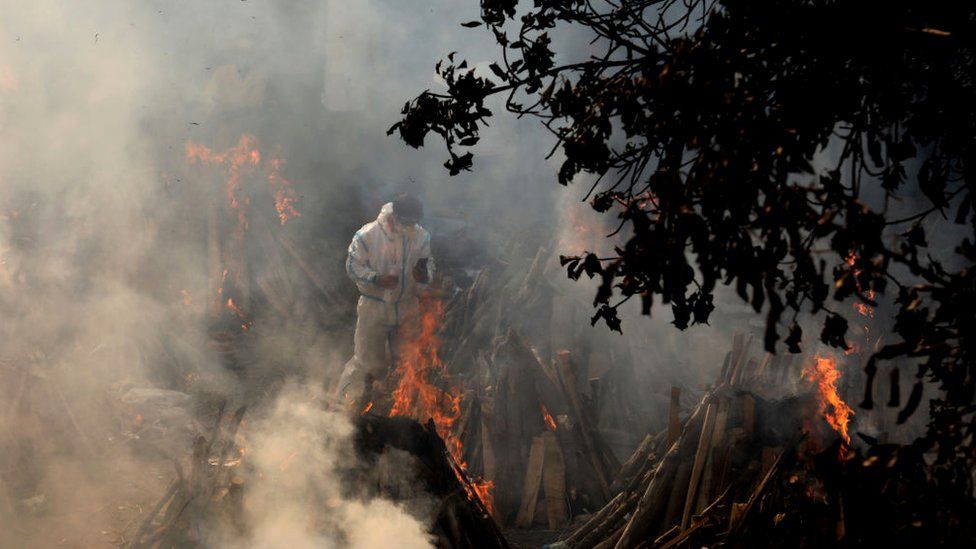
Funeral pyres have been built in parks and other empty spaces after Delhi’s crematoriums reached capacity
Crematoriums in the Indian capital Delhi have been forced to build makeshift funeral pyres, as the city runs out of space to cremate its dead.
Staff are working around the clock, while parks and other empty spaces are also being utilised for cremations.
Families have had to wait hours before being allowed to cremate their dead due to the rise in demand.
Deaths have been surging in India as a second wave of infections devastates the country.
The rising number of deaths – 380 were recorded in Delhi alone on Monday – has left crematoriums in urgent need of space.
At the capital city’s Sarai Kale Khan crematorium, at least 27 new pyres have been built and dozens more are being added in a nearby park. Officials are also looking for additional space near the city’s Yamuna river bed.
A worker at the crematorium, which originally had capacity for only 22 bodies, told The Hindu newspaper that they are operating continuously from early morning until midnight.
In Delhi, the authorities have reportedly cut down trees in city parks for use as kindling on funeral pyres. Relatives of the dead have also been asked to help with cremations by piling wood and assisting in other rituals.
The possibility of a coup d’etat had been known from 1958. In Parliament in November 1958 NM Perera had dropped hints of a plan for a coup d’etat. He referred to Sidney de Zoysa, not by name, but as a person who was gathering power by placing his men in key positions in the police force.
Philip
Gunawardene picked this up and expanded on the subject in Parliament in 1958. Sydney de Zoysa was a trouble maker, he said. During the emergency
of 1958 where ever Sydney went, there was trouble. People were thrashed,
Buddhist monks were turned out of their temples and there would be an attack by the police after Sydney left.
Sydney has gone to Gal Oya, where the 1958 race riots had started, and given
‘political lectures’.
Philip accused
Sidney de Zoysa of leading a conspiracy to wreck the MEP government. Sidney was brewing
discontent in the higher ranks of the police. Good men in the police service
were removed from their positions and replaced by Sydney’s men, Philip said. The chief of CID had been removed and Sidney’s
stooge put there. Sidney was regularly meeting naval officers and army officers
to bring about a coup. He was at Diyatalawa, recently, canvassing army officers to support him in overthrowing
this government, Philip said.
On
May Day 1959, speaking at a public gathering Philip made open accusation
against Sydney de Zoysa. He appealed to
Prime Minister to get rid of Sydney. Instead SWRD gave permission to Sydney to
sue Philip for defamation. The defamation case was heard in 1960.
Judge
agreed that the statements made were defamatory, but the Penal Code made an exception for statements
made in good faith in the public interest.
Philip’s May Day speech was made in that spirit. Also,
Philip’s unflattering observations about Sydney, that Sydney molested and ill
treated people, was correct. Philip’s prediction of a junta was also correct. A
junta led by Dahanayake, came to power after the death of Bandaranaike said the
Judge. The judge acquitted Philip. He said that Philip had created a very favorable
impression, specially compared to Sydney. Philip was candid and truthful.
Sidney
de Zoysa had links to the right wing of
the MEP. Sydney de Zoysa’s brother Dickie was one of the persons behind the
company set up by Buddharakkita, Ceylon Shipping Lines. When
Dahanayake became Prime Minister he appointed Sidney as Permanent Secretary to
a newly created Ministry of Internal security.
In
his 1958 speech in Parliament, Philip had also pointed out that there was foreign
involvement in the matter. Powerful forces are at work, Philip told Parliament. The people
of this country must be warned. There are vested interests, foreign as well as
local that would like to see the MEP government go. They wish to
set up a government under them rather than permit the MEP government to carry
on, continued Philip. They wish to set up a
reactionary junta.
Philip also drew attention to the close
connection between foreign embassies and senior officers in the armed services.
He specifically mentioned the US embassy. He said that the US embassy invited military
officers to parties and got them drunk. Philip said that some control should be
exerted. Hereafter military officers should get state permission to attend
these functions.
America
did not like the 1956 MEP government.
TIME said the government was seen as a high risk regime. It was swinging sharply to the Left. US Assistant Secretary of state William
Rouwntree visited Ceylon in 1958 to check on this.
Philip’s 1958
speech was the first time that the country became aware that a conspiracy was brewing,
said Ananda Meegama. Philip’s allegations of 1958
were political dynamite, for they indicated that there was a group working
overtime to over throw the government and also perhaps replace Parliamentary
democracy with a military dictatorship.
Meegama
says that Philip’s announcement of an impending coup triggered the events that
led to his and William Silva’s eviction from government. It was necessary to remove Philip from the scene,
before Bandaranaike was killed, because otherwise
he may have replaced SWRD.
Philip
had pointed out the danger of keeping on the old gang” in army and police. He
said the
High
officers of the army and navy, particularly navy, do not look with friendly
eyes towards the people of Ceylon and our independence in the control of our affairs. The
higher echelons of the police and armed service were also unhappy about the
progressive measures of the MEP. The
dangers of a coup were ever present.
Philip had informed SWRD, directly that
several leading officers in police and army were
plotting to overthrow the government. But
the MEP government failed to make the much needed reforms in
police and armed services. SWRD was getting ready to do something about this when he was
killed.
Instead of the
expected coup there was an assassination. Bandaranaike
was killed on September 26.1959. At that time it was thought that the monk
Buddharakkita had done it, because he did not get a sugar tender. It is now
suggested that USA was behind the assassination. Bandaranaike was assassinated
by a Buddhist monk at a time when the CIA was weaponising Buddhism, to contain
the spread of Communism from the USSR and China, said Darini Rajasingham
Senanayake .
This was a time
when US, UK and retreating European empires were instigating assassinations,
coups and regime-change in third world countries, from Patrice Lumumba in Congo
to Mossadegh in Iran, to Suharto in Indonesia, she added.
But the MEP government did not fade away after the assassination
of Bandaranaike. Sirimavo who took over was much firmer
than SWRD and more decisive.The sudden departure of Electric Eel did
not diminish his influence on the island. It seems to be even more powerful now
that when he was alive, complained Flybynight in his Island inthe Sun series.
So Sirimavo also had to go.
It was best to do so through a coup. Philip had warned Sirimavo in 1960 that there could be a
coup very soon.. Sri John has met some of his old war comrades in the Volunteer
force, said Philip. Also, there was a
conference of the Ceylon Cadre battalions which was attended by the former
commander, who had come from Pakistan to attend it, this would have been Major
general Anton Muttukumaru who was then ambassador to Pakistan.
The
commanding officer of the army was present, at this conference, continued
Philip. Rear Admiral of the navy was also present [possibly Royce de Mel]. The only
outsider invited to this conference was Fr. Peter Pillai. Next they are going to have another conference
called nuclear conference in Diyatalawa, continued Philip. All important
officers have been asked to attend this conference. I think that beneath the
nuclear conference there must be
another conference, concluded Philip.
The plan was
for troops to seize strategic positions and installations, cordon off Colombo
preventing troops from the Panagoda Cantonment reaching
Colombo and arrest all ministers. SirOliver Goonetilleke, Governor General would be asked to dissolve Parliament and take
direct control of the state. He would be assisted by a Governing Council of Dudley Senanayake and SirJohn Kotelawala, with Wijayananda Dahanayake also invited
to join.
Wikipedia said
that the coup leaders had intended to send Sirimavo to the United Kingdom by
plane with her family to join her daughter who was studying at Oxford at the
time. This is unlikely. She would have
been a threat to them wherever she was.
They would have had to kill her.
The coup was
aborted at the last minute after an informant revealed the plans to the Prime Minister.
The coup leaders were arrested and put into prison. The
press focused on the discomfort and harassment these poor arrested leaders were
facing in jail.
Since no
shots were fired and no troops deployed, the Penal Code could not be used
against the coup leaders. . Therefore the government passed a new law called Criminal Law (Special Provisions) Act, No. 1
of 1962. Supreme Court convicted
11 of the 24 accused including Col F.C. de Saram, Col. Maurice de Mel, Rear
Admiral Royce de Mel, Douglas Liyanage, and Sidney de Zoysa. They appealed to Privy Council. Privy
Council held the Special Act of 1962 violated the
Ceylon constitution and had denied fair trial. The coup leaders
were acquitted on this technical point.
For
decades the intelligentsia had suspected that the UNP leaders had a hand in the
coup. The names of SirOliver Goonetilleke, and former
Prime Ministers Dudley Senanayake and SirJohn Kotelawala had come up
in the investigation and at the trial. Sir Oliver was removed from the position of Governor
General.
Wikipedia said that years later J. R. Jayewardene had stated
that at a meeting on 13 April 1966 he
was told by Sir John Kotelawala that he
and Dudley Senanayake had been aware of the coup. JR’s
biographers, K.M. de Silva and H Wriggins, 1988, recorded advice that JR had given
to the key conspirator, Sydney de Soyza. Sirimavo when she found out had decided to keep the matter a secret.
If the 1962 coup had succeeded, there would have been
civil war, with the 3rd field regiment of the Ceylon Artillery
taking on the Ceylon Light Infantry possibly at the Kirulapona Bridge as the
regiment came in from Panagoda. The government later disbanded the 3rd regiment
and raised another infantry regiment, the Gemunu Watch.
Of the 24 arrested 12 were Sinhalese, 6 were Tamils and 6 Burghers. All were from the westernized upper class, property owning,
well-educated and with right-wing ideologies. It showed
the public that an antinational minority still wielded power in the country.
All
24 conspirators were Christians. The
percentage of Christian and Catholic in the armed force during the time of the
coup was well above the national average for these two groups. Higher
officers of the navy were Catholics. Recruitment to the army and navy are done
by boards which are all Catholic said Philip.
And
the Catholic Church in Sri Lanka is against progressive movements,
he added.
Today’s
thinking is that most of the regime changes of the Third World or newly independent
countries were engineered by the USA. USA was considered responsible
for the1958 and 1977 coups in Pakistan and 1960 and 1980 coups in Turkey. Britain
and the United States were active in 1965 coup by Suharto against President
Sukarno in Indonesia, said analysts.
CIA played a
crucial role in the Ba’ath coup d’état in November 1963 against PM Qassim in
Iraq, against Kwame Nkrumah in Ghana and against Patrice Lumumba in Congo. CIA
had a hand in coups in Ecuador in 1950and early 1960s. There was direct U.S .involvement
in1949 and 1951 coups in Syria, analysts said. (continued)
The horrifying tragedy that is unfolding before our very eyes worldwide but particularly in India, and God fearing traditional Christian countries such as USA, Brazil, Italy, Spain, France, U.K., Germany, Belgium, Portugal, Netherlands, Switzerland, Austria, Norway and Sweden raises fundamental questions not only in respect to humanity’s capacity to combat the spread of the coronavirus that has taken a huge toll of over 3 .1 Million fatalities and over 147 million infections up to date, but also on the very existence of GOD on whom so much faith and trust has been placed by billions of people adhering to Abrahamic religions such as Catholicism, Protestant Christianity, Islam and Judaism.
Is the colossal damage being done
globally by the Coronavirus pandemic evidence of God’s wrath or of God’s non –
existence?
Have any Church authorities up to
date announced and stated that the Coronavirus Pandemic was nothing but a
demonstration of God’s wrath and punishment for the sins of the victims? In the
aftermath of the Lisbon Earthquake (1755) Church leaders did exactly just that.
Explained away the destruction of Lisbon by a trio of natural disasters as a
manifestation of God’s wrath.
Alternatively, can the current
ongoing annihilation of the human race by the Coronavirus be explained away on
the basis of Karmic retribution?
Is God defying Coronavirus a form of
Karmic Retribution targeting mostly countries that have done wrong to others?
especially a number of select western countries that have a shared sordid past
over a period of 500 years of rapacious colonialism all over the world,
committing Genocide and Mass Murder of native people?
India is not lily white either. India’s
track record of interference in the affairs of neighbouring countries including
training and support for terrorist groups like the LTTE to commit genocidal
crimes and mass murder of innocent civilians in Sri Lanka before the brutal
murder of Rajiv Gandhi by the LTTE, raises questions whether India too is now
under the watch of Providence meting out punishment to wrong doers. Those who
evade accountability under man made laws will have to one day answer and face
punishment under the fiat of Providence.
” There were chaplains on the
slave ships that ferried human cargo across the Atlantic. The atomic weapons
that obliterated civilian population centers in Japan were blessed and prayed
over before being loaded onto U.S. bomber planes. The anti – semitic writings
of Martin Luther, the Protestant Reformation hero who purportedly nailed his 95
grievances to doors of a Catholic church, were used by the Nazi government’s
propagandists to convince German Christians that the imprisonment and expulsion
of the Jewish people was a righteous cause. White slave owners in the South
used the Bible to justify slavery and, a hundred years later, their descendants
used the same Biblical texts to defend so-called separate but equal”
segregation policies”. (Joe Forrest in ‘Instrument
of Mercy’ – A
Progressive Christian’s Blog on Faith, Culture, Doubt, and Secularism)
Western countries that manipulate
the UN system including the UNHRC to project an unsustainable image as
‘Protectors of Human Rights’ ( while evading accountability for the gross
violations of Human Rights of others ) must take full responsibility for the cynicism
with which the Human Rights discourse is now viewed all over the world. Soiled
hands undermine the moral credibility of an undertaking that they touch.
Let alone Crimes against Humanity,
what about Crimes against innocent animals which continue to this day in
countries like Brazil, Spain and Portugal where the barbaric BullFighting is
treated as a popular sport and shown on prime time TV.
Is this not an appropriate time for
reflection and catharsis on the part of humanity all over the world, and
particularly in countries badly affected by the Coronavirus pandemic ?
The purpose of this brief article is
to open and explore significant religious and philosophical issues that have
arisen in the light of the bewildering and catastrophic Coronavirus Pandemic
that continues to rage havoc with no end in sight.
Points for reflection
1) Treatment of Animals
a) What we do to animals ruthlessly
and brutally the Coronavirus is doing likewise to humans, generating so much
fear, alarm and anxiety. Do humans deserve pity, when we have no pity for
innocent animals, who are eternal victims of our cruelty and inhumanity?
b) Should the yardstick of judging a
civilization and its progress, be based on massive development projects,
technological inventions and innovations, political achievements, literature OR
how it treats all creatures, big and small, on earth humanely to the maximum
possible extent?
c) It was Mahatma Gandhi who said
that a country’s progress should be judged by the way it treats its animals and
all other living creatures. When someone asked him what he thought about
Western civilization, his reply was: It’s a good idea.”
d) In other words, what Gandhi meant
was that the West was not truly civilized, in a moral sense. If the West was
civilized, would it have conquered, occupied and exploited Asian, and African
countries and decimated the native people in the two Americas and Australia
until they were almost extinct? And committed Crimes against Humanity, Mass
Murder, and Genocide including Cultural Genocide?
e) Many condemn racial
discrimination, caste discrimination, and mistreatment of vulnerable communities
but hardly bother to refer to abhorrent treatment and mass killing of animals
on an industrial scale. Are these non – human living beings meant to be
expendable at the discretion, whim and fancy of human beings?
f) Recent expose of Wet Markets in
Wuhan and other parts of China showed obnoxious eating habits and brutal
slaughtering practices that by any definition would be classed as barbaric and
primitive. Some Animals were shown plucked from the supermarket shelves and
eaten alive. Anything that moves on legs, crawls, wriggles or swims (live or
killed) is deemed edible and fit for consumption.
g) No health authority including the
WHO has stated that flesh consumption is essential for human health survival.
On the contrary there is enough evidence to show that meat consumption is the
prime cause of many Chronic diseases such as cancers, type II diabetes (T2D)
and cardiovascular diseases (CVD).
h) The biggest problem is that all
those who consume and support the flesh consumption culture take the view uncritically
and unscientifically that the earth belongs to humans and all other non – human
living beings have no rights to live out their natural life to the fullest
except to serve human needs and requirements including sacrificing their
precious lives to fill the stomachs of humans.
i) This indefensible view is largely
influenced by the Biblical Injunction ‘Kill and Eat Flesh’.
j) Ethically speaking it is an
unsustainable argument. Buddhism in its very first precept rejects that view
without qualification.
k) The Buddhist approach of peaceful
co- existence between man and animal is supported by Jainism and several
Western Philosophers such as Schopenhauer and Albert Schweitzer (philosopher,
theologian, organist and physician, and recipient of the Nobel Peace Prize in
1952 )
l) Albert Schweitzer made a
remarkable statement when he said that Until he extends the circle of
compassion to all living things, man will not himself find peace.” A man is
truly ethical only when he obeys the compulsion to help all life which he is
able to assist, and shrinks from injuring anything that lives.”
m) Spain is one of the major victims
of the Coronavirus Pandemic. As much as humanity would like to extend its moral
support to the people of Spain to overcome this crisis without further
suffering, it would be tantamount to a dereliction of moral duty if the very
humanity were not to raise the issue of Bull – fighting in Spain. Bull fights
are not ‘ fair fights’ but a highly staged form of Spanish Govt. subsidized
animal cruelty that projects the misleading view that torturing and killing
animals for fun and amusement is acceptable. Animal cruelty of this kind should
have no place in our world today, even though it is presented as a deep –
rooted Spanish cultural tradition and sanctioned by the Spanish Supreme Court.
n) Every year, approximately 250,000
bulls are killed in bullfights. The countries where this cruel practice still
takes place are Spain, France, Portugal, Mexico, Brazil, Colombia, Venezuela,
Peru, and Ecuador. All of these Catholic countries are reeling today under the
onslaught of the Coronavirus Pandemic in varying degrees of intensity.
o) The detoxification of these
countries to get rid of the coronavirus must also extend to scrapping the
inhumane cruel practice of Bull Fights, falsely categorized as a Sport and
which has brought nothing but shame and disgrace on both the Government and
people of Spain.
p) The lock down all over the world
has confined the vast majority of humanity to their homes. It is discomforting
and frustrating being caged, metaphorically speaking. Is this not exactly what
humans do to animals by forcing them to live within small spaces in cages in a
vast prison euphemistically called a Zoo for the whole of their natural lives?
To serve a life sentence without committing a crime. When will this injustice
to animals be undone?
2. Do Prayers work?
Do prayers work? Is God listening?
How does one explain the silence of God at a time of mass upheaval and sorrow
among believers who are dying in their thousands? Is the appeal to God through
prayer to save the flock an exercise in futility? These are valid questions.
Atheists, Agnostics and Pagans
(their numbers are rising rapidly in Europe) are least troubled by these
questions. The latest coronavirus related tragic events are an affirmation of
their skepticism. It is more a challenge for the Believers.
We in Sri Lanka have faced similar
questions and underwent this exercise in the wake of the Easter Sunday bombing
in 2019
On 21 April 2019, Easter Sunday,
three churches in Sri Lanka and three luxury hotels in the commercial capital,
Colombo, were targeted in a series of coordinated Islamic terrorist suicide
bombings. Later that day, there were smaller explosions at a housing complex in
Dematagoda and a guest house in Dehiwala. Two hundred and fifty-nine people
were killed, including at least 45 foreign nationals and three police officers,
and at least 500 were injured. The church bombings were carried out during
Easter services in Negombo, Batticaloa and Colombo.
Like in the currently unfolding
Coronavirus tragedy where the vast majority of the victims are citizens of
predominantly Christian countries of Europe, the majority of the victims of the
2019 Easter Sunday Attacks were ardent followers of Christianity, and praying
in some of the hallowed Churches in the country e.g. St. Anthony’s Shrine
(dedicated to St. Anthony of Padua and designated a national shrine and minor
basilica), located at Kochchikade, Kotahena, Colombo 13.
These acts of violence targeting
mainly Christians on a special Christian holiday inside Christian churches
invariably raised legitimate questions on God’s benevolence and its powers of
divine intervention. Why did God fail in his own house i.e. the Church? And on
one of Christianity’s holiest days i.e. Easter Sunday, where church attendance
in Sri Lanka is very high.
3. Does God Exist?
Lisbon Earthquake (1755) and the
Fall out on changing religious beliefs in Europe
It is said that one of the first
modern atheistic movements in Europe commenced after this tragedy, renouncing
religious ideologies as basis of critical thinking.
We must go back in time. A terrible
tragedy similar to the unfolding COVID – 19 Pandemic in Europe and other
Western countries took place on a much bigger scale in Europe nearly 270
hundred years ago when Lisbon (capital of Portugal) was subject to a series of
cataclysmic earthquakes on the morning of Sunday November 01, 1755, which was
All Saints’ Day and many people were attending the Churches whose architecture
and building structure was not resistant to seismic tremors.
The earthquakes caused massive damage
to the city of Lisbon and demolished around 12,000 households, killing over
60,000 people.
This unfortunate coincidence of the
earthquake on a Sunday was definitely one of the factors that had contributed
to the extremely high death toll in this event, as the Christian devotees that
stood between the weak walls of the churches were crushed in large numbers.
The city walls, houses and buildings
were not able to escape the 8.0 magnitude of the earthquake. Almost 85% of
Lisbon’s buildings were reduced to rubble.
The earthquake had reportedly lasted
about 5 minutes, causing 5-meter fissures in length which split-opened in the
city center.
In addition the tremors triggered
three (3) tsunamis of 6 meter wave length which were flooding the region wave
after wave, drowning and killing even more people.
Fires broke out soon after the
earthquakes killing a lot more people. The flames lasted for 5 days and
destroyed many important documents and personal records of the Portuguese
people. Many had died from inhaling the smoke and collateral damage.
The resulting chaos forced the
citizens, including prisoners that used their chance of escape, to flee the
city.
Survivors soon began questioning
God’s existence and his absence at a time when God’s help was most needed to save
lives. The scale of suffering opened up many issues among thinkers, the clergy,
politicians, and philosophers.
On the other hand, the Church
authorities in Lisbon did actually announce and state that the earthquake was
indeed a demonstration of God’s wrath and punishment for the sins of the
victims.
Amusingly, the sinful Lisbon’s
red-light district had suffered only minor damages while the churches despite
the purported piety were completely obliterated.
The Lisbon earthquake of 1755
exerted a great cultural, religious and political impact. Europe was stunned by
the merciless destruction of one of the continent’s most opulent cities.
Leading intellectual and philosophical figures—Voltaire, Rousseau, Pope, Goethe
and Kant, among others—became fascinated by the question of divine intervention
in human affairs. Lisbon, still home to the Inquisition, had been immolated:
was this evidence of God’s wrath or of God’s nonexistence?
The Lisbon Earthquake also opened
the door to new genre of literature questioning God and wisdom of relying
solely on God and engaging in recital of prayers. Renowned French writer and
philosopher Voltaire produced a classic piece of satirical writing called
‘Candide’ (1759). The events discussed in the novel are often based on historical
happenings, such as the ‘Seven Years’ War and the 1755 Lisbon earthquake.
Voltaire ridicules religion, theologians, governments, armies, philosophies,
and philosophers. Candide satirizes various
philosophical and religious theories that Voltaire had previously criticized
including the belief in God. . .
4) The Portuguse Inquisition in
Ceylon
Portugal and Spain were the two main
centers of the Catholic Inquisition, which lasted for several centuries.
Though confined mainly to Europe,
the Portuguese nevertheless introduced the Inquisition to countries in its
Asian Empire such as Goa and Ceylon (later known as Sri Lanka). The Inquisition
is infamous for its persecution of heretics which extended to Muslims and Jews
in Europe, and Hindus and Buddhists in Goa and Ceylon.
Though both Portugal and Spain
amassed great wealth during their hey days as empire builders they remained
backward countries slow to evolve morally and ethically and distance themselves
from barbaric cultural traditions such as Bull – fights. Unlike their
neighbours in Northern Europe which broke away from the diktat of the Vatican,
both Portugal and Spain together with Italy were unfortunately held captive for
a long time in a stranglehold of religious dogma.
There was an intellectual aftermath
of the Lisbon Earthquake disaster all over Europe. The cataclysm resulted in
widespread Enlightenment discussions about God and the natural world.
Conclusion
The tragedy of the Coronavirus
Pandemic has already rocked the world prompting wide ranging intellectual
debates about the natural world and God’s place in human affairs. A new world
order is emerging that can be expected to be vastly different to the one that
is being left behind.
It is already attracting widespread
attention and speculation among thinkers and policy makers. Would God continue
to remain at the apex of the moral and spiritual world despite rising
misgivings in the mono – theistic Abrahamic world?
Buddhism has shown that it is
possible to establish a highly effective and admirable ethical system for
humanity with benefits for all living beings seen as members of one moral
universe, without reference to an all mighty creator God.
J. Takakusu, who was
an internationally known Japanese Buddhist scholar, and Professor Emeritus
of Sanskrit at the Tokyo Imperial University at the time of his death in 1945,
had this to say:
if civilization is
really what the present civilization of the West represents, it is a curse
rather than a blessing. The shortest cut to remedy its shortcomings and make it
complete is . . . to spread to the West the culture, philosophy and faith of Buddhism.”
Takakusu Junjiro ,
in Europe Ripe for Buddhism ” (1927)
What will replace God if the belief
in God becomes increasingly unsustainable in the wake of catastrophes such as
the Coronavirus Pandemic?
Senaka Weeraratna
……………………………………………………
See also
Voltaire laments the destruction of Lisbon in an
earthquake and criticises the philosophers who thought that all’s well with
the world” and the religious who thought it was God’s will” (1755)
In his long
poem On the Lisbon disaster; or an Examination of the Axiom, “All is
Well” (1755) Voltaire (1694-1778) laments the death of a hundred thousand whom
the earth devours” and reminds us how fragile human life is and how close we
all are to death from such cruelties of fate” :
Unhappy mortals! Dark and mourning
earth!
Affrighted gathering of human
kind!
Eternal lingering of useless pain!
Come, ye philosophers, who cry,
All’s well,”
And contemplate this ruin of a
world.
Behold these shreds and cinders of
your race,
This child and mother heaped in
common wreck,
These scattered limbs beneath the
marble shafts—
A hundred thousand whom the earth
devours,
Who, torn and bloody, palpitating
yet,
Entombed beneath their hospitable
roofs,
In racking torment end their
stricken lives.
To those expiring murmurs of
distress,
To that appalling spectacle of
woe,
Will ye reply: You do but
illustrate
The iron laws that chain the will
of God”?
Say ye, ‘er that yet quivering
mass of flesh:
God is avenged: the wage of sin
is death”?
What crime, what sin, had those
young hearts conceived
That lie, bleeding and torn, on
mother’s breast?
Did fallen Lisbon deeper drink of
vice
Than London, Paris, or sunlit
Madrid?
Full Quote
About this Quotation:
The devastating
earthquake in Haiti recalls the impact the Lisbon earthquake of November 1755
had on European society. In his later writings Voltaire referred to it
repeatedly but his most extended commentary was in a long poem he wrote on it
which had the rather odd subtitle or an examination of the axiom, all is
well.” As in his philosophic tale Candide, or Optimism Voltaire
wanted to attack the complacency of many European thinkers such as Leibnitz
that this was the best of all possible worlds”. Voltaire thought the
earthquake had a very different lesson, namely that nature can be capricious
and does not respect human life. If there were to be a happier, more
prosperous, and more just world, it would have to be one created by human
activity.
The following statement by the Indian
Foreign Minister reported to have been made in the Indian Rajaya Sabha calling
for early elections to Provincial Councils etc is a direct interference with
the Sovereignty and Freedom of this country that should be deplored by every
Sri Lankans.
0 .3 wants Sri Lanka to hold early
election to provincial councils: Jaishankar Indian Foreign Minister
CHENNAI, April
19, 2021 18:34 IST
India supports
the call of international community for the Sri Lankan government to fulfill
its commitments on devolution of political authority including through early
holding of elections to provincial councils, according to S. Jaishankar,
External Affairs Minister.
This also covers
the commitment of ensuring that all the provincial councils are able to operate
effectively in accordance with the 13th Amendment to the Constitution of Sri
Lanka, Dr. Jaishankar has stated in his letter sent recently to the AIADMK’s
Member of Parliament (Rajya Sabha) M. Thambi Durai.
The Minister’s
reply was in the context of the AIADMK leader raising the Sri Lankan Tamil
issue in the Rajya Sabha last month in the context of a resolution adopted by
the United Nations Human Rights Council.
Pointing out
that the position of India was conveyed during the deliberations on the motion
at the Council, Dr. Jaishankar said the country voted in abstention at the
UNHRC but it made a strong statement” as Explanation of Vote, stressing our
abiding commitment to aspirations of the Tamils of Sri
Lanka for equality, justice, peace and dignity.” It had also urged the
Sri Lankan government to carry forward the process of reconciliation, address
the aspirations of the Tamil community and continue to engage constructively
with the international community.”
I would like to
respond to this mad statement as follows.
The spokesman Jaishankar,
External Affairs Minister is a South Indian Tamil politician in the Indian
National Cabinet From the above
statement of the Minister it appears
that the Minister does not know the basic fat that Sri Lanka is not part of India Otherwise how can he lays down
these conditions as to how we should govern this country. The Tamils living in
this country are Sri Lankan Tamils and not Indian Tamils, although both
parties, the Tamils living in this country and the Indian Foreign Minister and even
the Indian Government think otherwise. Things like the type of Constitution,
form of Government, the legal system the administrative machinery a country
should have and when to have elections etc are entirely matter for Sri Lankan Government and
its people to decide Sri Lanka is not a part of India We have a separate Independent
sovereign country with our own Government elected by the people of this country
with whom the sovereignty lies. So what legitimate right on earth Jaishankar
External Affairs Minister of India, has to tell us to have election to Provincial
Councils soon or any other political body in this country which is the
prerogative of the citizens of this country. As such what business the Indian
Foreign Minister has to talk about on these matters.
We can understand his sentiments as a South
Indian Tamil who descends from a set of people historically who have been craving
to own this Island from the dawn of history or even before. We know this type
of rhetoric is important for him to muster his votes in Tamilnadu to continue
as a Minister in Delhi. We have no bone to pick with him but he should
understand that thereby he is illegally interfering with the sovereignty of
another country. Therefore the Delhi Government should lay down the limits to
its Ministers within which they should operate when it comes to International
matters.
But my question
is as to why the Delhi Government or the Indian Prime minister don’t tells this
Minister to mind his business in India without talking on matters that does not
fall within his list of duties, unless he is doing so with the explicit
connivance of the Indian Government and the Prime Ministers. If that is so it
is still worse as it amounts to illegal interference and naked aggression by
India on this country. On the other hand the Government of this country should
lodge a strong protest with the Indian Government for this Ministers foolish statement.
Minister
Jeisankar has further complicated this issue by trying to canvass international
community on this matter when he says our abiding commitment to aspirations
of the Tamils of Sri Lanka for equality, justice, peace and dignity.” It had
also urged the Sri Lankan government to carry forward the process of
reconciliation, address the aspirations of the Tamil community and continue to
engage constructively with the international community
What does the
Indian Minister means by just repeating these stale
words prepared by Indian Kautillayan mandarins.as if there is equality,
justice, peace and dignity for Tamils in South India. Does he know that Tamils
in this country enjoy far better equality, justice and peace here than In
India, although the Tamil Politicians say no.
What is even
more important for us is why doesn’t the Government of Sri Lanka take up this issue
with Delhi Government and protest or ask Delhi Government to appoint a man
from a non-Tamil state as foreign
Minister who does not depend on Tamil votes in Tamilnadu so that he will be able
to look at international matters from a broader perspective.
As far as I see
there is hardly any difference between what Rajiv Ghandi did and Minister
Jaishakar is doing now. He should not forget the fact Rajiv who did the same
mistake, gav e32,m US ,provided military training for the LTTE and gave the all
logistics and even military equipment and ammunition and finally gifted his
bullet proof jacket as a gift to Prabhakaran somewhere in March to wage war
against Sri Lanka Government was assassinated by the very LTTE on 29th
April the same year.
Therefore the
Government of this country should lodge its strong protest against this unwarranted
silly statement and ask Delhi Government to put an end to this type of cheap
politics and aggressing neighboring countries and mind its own business.
If the
government is not doing that all patriotic people should, I think, protest
against this interference and ask the Sri Lankan Government to abolish this PalathSabha
huniyama as early as possible to save this country and the Sinhala Nation
without betraying the Motherland and the Sinhala nation..
It is also high
time that the Government tell all Tamils living in Sri Lanka to behave as
citizens of this country who have to abide by the Constitution of this country
and end their continued allegiance to India or any other. If they cannot do
that the only alternative they have is to get back to any country with what
they have their alleegiance
It was
reported on Sri Lankan media about an incident involving two Muslim youths at Pannala
in Ibbagamuwa, receiving injuries while making what is supposed to be
fireworks. The news also says that the local Police together the Police Special
Task Force are investigating with the assistance of the Government Analyst
Department.
It is very
clear from the description of the incident that the two youths Abdul Muhthalib
Mujibur Rahman and Abdul Muthalib Mohammed Mufsil were making a rudimentary
Pipe Bomb.
Wikipedia
explains a pipe bomb as follows:
A pipe
bomb is an improvised
explosive device which
uses a tightly sealed section of pipe filled with an explosive material. The containment provided by the
pipe means that simple low explosives can be used to produce a
relatively large explosion due to the containment causing increased pressure,
and the fragmentation of the pipe itself creates potentially lethal shrapnel.
Premature
detonation is a hazard of attempting to construct any homemade bomb, and the materials and methods used with pipe bombs make unintentional
detonation incidents common, usually resulting in serious injury or death to
the assembler.
In many
countries, the manufacture or possession of a pipe bomb is a serious crime, regardless of its intended use.” Further information on Pipe Bombs can
be obtained by visiting the following web site : https://en.wikipedia.org/wiki/Pipe_bomb
So now it
is up to the Police to investigate the matter as one related to terror
activities and proceed without ‘pussy footing’ around the incident and wasting
unnecessary time and government funds. This one is clearly an Islamic Terror
related project that has backfired on the two-misguided youth, now at the
receiving end of what they intended to do elsewhere on unsuspecting innocents. The
Police should not leave any ‘stone unturned’, as this is definitely not an
isolated incident, but with many connections to minor masterminds of which
there could be hundreds within the island who are self-radicalized either on their
own reading Islamic Texts or through involvement with like-minded individuals
or organizations within or outside Sri Lanka. All those involved will lie
through their teeth as they are proficient in the Art of Al Taquiyya!
Given the
existing political climate and the desperation of the failed Islamic Project to
incite violence from among the population following the Easter Sunday Terror attacks,
this type of activity to revive the failed project is to be expected. Time is
of the essence for the government to be doubly vigilant and eradicate without
impunity all sources of terror within Sri Lanka. The danger to the ordinary
citizens of Sri Lanka is still very high from the purveyors of Islamic Terror
as well as from resurgent LTTE terror groups!
… UNHRC avoids query whether new probe unit can seek those dispatches from Colombo
Following the UK’s refusal to accede to Sri Lanka’s recent request for disclosing British wartime defence attaché Lt. Col. Gash’s dispatches from Colombo, Conservative member Lord Naseby has sought an explanation as regards the procedures followed by the Defence attachés in gathering and submitting information to Her Majesty’s Government.
Authoritative Sri Lankan government sources told The Island that the UK in spite of being a member of the Geneva-based United Nations Human Rights Council (UNHRC) had taken extraordinary steps to keep Gash dispatches under wraps.
Sources appreciated Lord Naseby’s efforts to unravel the truth in the face of a new high-profile inquiry initiated by the UNHRC.
In response to Sri Lanka’s request made in early March, the UK faulted Gash for not obtaining independent confirmation of reports he had sent to the Foreign, Commonwealth and Development Office (FCDO) during the final phase of the Vanni offensive, only after Sri Lanka sought their release!
Sri Lankan government sources pointed out that the UK never questioned the legitimacy of its defence attaché during the conflict till over a decade after the end of the war.
The following are the questions tabled by Lord Naseby at House of Lords recently: (i) To ask Her Majesty’s Government what criteria they used to assess the credibility of evidence reports they have received which related to the situation in Sri Lanka during the civil war in that country between 1 January and 18 May 2009; and whether it has ever been their practice to accept reports from unnamed sources (ii) To ask Her Majesty’s Government whether the information contained in dispatches written by UK defence attachés must be independently verified before submission; if so, whether it is standard practice to ensure that such attachés are briefed to that effect; and if so, what record, if any, they hold of Lieutenant Colonel Gash, being so briefed (iii) To ask Her Majesty’s Government what sources they used to inform their assessment of the situation in Sri Lanka during the civil war in that country between 1 January and 18 May 2009 and finally (iv) To ask Her Majesty’s Government, further to the dispatches written by Lieutenant Colonel Gash, the former defence attaché of the British High Commission in Sri Lanka about events in that country between 1 January and 18 May 2009 relating to the civil war, whether they consider all reports by UK military attachés and diplomats to be evidence based-assessments.
At the recently concluded 46th session of the UNHRC, the UK in its capacity as Sri Lanka Co-Chair led the offensive for the setting up of special unit at a cost of USD 2.8 mn to probe Sri Lanka accountability issues.
Sri Lanka requested the UK to handover Gash dispatches to the UNHRC in the wake of the proposal to set up a special unit to ‘collect, consolidate, analyze and preserve information and evidence’ in respect of Sri Lanka. The unit is also meant for the development of required strategies to deal with the country in case of gross violations of human rights or serious violations of international humanitarian law.
Meanwhile, The Island on April 06, 2021, having obtained prior sanction submitted the following question in respect of the ‘Oral statement of programme budget implications arising from draft resolution A/HRC/46/L.1/Rev.1 of the Human Rights Council,’: (i) Is there provision for the proposed unit set up to gather evidence, information et al to ask for British HC dispatches from Colombo (January-May 2009) or diplomatic cables from any other UN member state? (ii) What remedial measures Geneva can resort to in case governments decline to cooperate?”
In spite of repeated reminders Geneva didn’t respond to The Island query.
The month-long Geneva sessions ended on March 23, with the 47-member council adopting a fresh accountability resolution with 22 countries voting for, 11 against and 14 abstaining.
We strongly believe those dispatches from Gash can facilitate Geneva investigations. However, the British, despite repeatedly assuring us of longstanding friendship denied credible information in their possession,” a government source familiar with accountability matters, said.
After Gash’s departure from Colombo, the UK discontinued having a resident Defence Advisor here. Instead, New Delhi-based Defence Advisor looked after matters pertaining to Sri Lanka for nearly a decade. However, in January 2019, the UK re-appointed Colonel David Ashman as their resident Defence Advisor in Colombo.
Sources pointed out that despite Lord Naseby’s disclosure of a section of the Gash reports in Oct 2017, Sri Lanka refrained from requesting examination of the dispatches till March 2021.
Gash countered the primary UN allegation (Panel of Experts’ report issued in March 2011 that the Sri Lankan military massacred 40,000 civilians. Gash estimated the number of deaths at 7,000 to 8,000, including LTTE combatants. His assessment largely tallied with a confidential UN survey (Aug 2008-May 13, 2009) that placed the number of dead at 7,721.
Sources said that the UK had taken contradictory positions as regards Gash dispatches at the hearings at the UK Information Commission following Lord Naseby’s initial bid compel disclosure and when Sri Lanka recently requested for the full disclosure of relevant dispatches. The UK owed an explanation whether those dispatches weren’t made available to POE and the Report of the OHCHR Investigation on Sri Lanka (OISL) also on the grounds they weren’t credible.
Colombo, April 23 (www.counterpoint.lk): The miracle of Shenzen” inspired governments globally to find ways and means out of adverse situations that plague countries in terms of their economic performance, especially in the post-second world war era.
Shenzen was well-regarded the world over as the most judicious and prudent way of experimenting with fundamental economic reforms the Chinese leaders wanted to introduce to the country’s economic structure.
It was more of a litmus test of how market reforms such as liberalisation of the economy works within the global economic context.
The man behind the Shenzen success story was Chairman Deng Xiaoping. The story of Shenzen began in May 1980 and spread its wings rapidly across various parts of China, making dramatic and dynamic changes in that country’s economic growth story.
There was a similar success story in respect of economic growth in our own country when President J.R Jayewardene strategically placed Sri Lanka in the global open market by introducing the Greater Colombo Economic Commission (GCEC) through a parliamentary Act even before China embraced the market economy in a more phased out manner. Sri Lanka gradually lost its clout as a pioneering nation in the region to introduce market reforms, perhaps due to unforeseen and unknown reasons and internal political squabbles that led to economic instability.
At one stage former President Jiang Zemin, as a young engineer and a Vice Minister of China, visited Sri Lanka to study the pros and cons of a liberalised economy taking President Jayewardene’s model as a case study before launching the Shenzen in 1980.
Former Foreign Secretary Bernard Goonetilleke who was assigned to Beijing as our ambassador had a personal tete –a- tete with Chairman Jiang Zemin when he presented his credentials some years ago.
Mr Goonetilleke had this interesting story to relate on Chairman Jiang’s visit to Sri Lanka.
I presented credentials as Ambassador of Sri Lanka to the People’s Republic of China to President Jiang Zemin in early 2000 as the successor of Ambassador R.C.A Vandergert. Usually, several newly appointed ambassadors present their credentials to the Head of State at the same time. The usual practice is that the Chinese president makes use of the opportunity to have a short discussion with the newly appointed ambassadors.
When the opportunity came for me to present my credentials to the President, he took approximately forty minutes to engage in a discussion with me which was unusual. The intimate discussion demonstrated not only China’s interest in Sri Lanka as a friendly nation but also his affection towards our country.
The backdrop to the discussion was twofold. The first was the security situation in Sri Lanka resulting from the separatist war which was quite intense around that time. He wanted to get an overall picture of the security situation and how the security forces were managing it, in particular who was responsible for supporting the LTTE. His interest was justifiable on two counts. One was that China was among the few countries that were supporting Sri Lanka against the LTTE, supplying arms, ammunition and heavy artillery weapons to fight the guerailla group. The second was that China itself was facing a similar security situation in the Xinjiang autonomous region which was getting intense at that time.
The second area of discussion related to Sri Lanka’s experience with the open economy introduced by the government of late President J.R. Jayewardene. As you would recall, China itself was moving in the direction of an open market economy and welcoming foreign investments during the latter part of the 1970s. The new administration in Sri Lanka wanted to open up the economy and sought the assistance of the UNDP to get it moving in a new direction. For this, in 1978 the government sought the support of UNDP and through it obtained consulting services from Shannon Free Airport Development Company Ltd. Phase I of the GCEC project started in June 1979 and lasted till April 1980 whereupon phase II started in mid-1982 and lasted till 1983. Phase III of the project started in August 1984.
Around this time young Jiang, with a degree in electrical engineering and having worked as an engineer in several factories, had become Vice Minister of the State Commission on Imports and Exports (1980) and become a member of the Central Committee of the Chinese Communist Party (1982).
During the conversation President Jiang said that in the early 1980s China was looking for a suitable model to open up its economy and sought the help of the UN (I presume it was UNDP) and decided to dispatch a team of experts for a study. For this purpose, they had selected two countries viz. Malaysia, which already had an open economy and Sri Lanka, which was moving from a closed to a free market economy with the establishment of GCEC assisted by the UNDP.
During the discussion, he said that the Chinese team first went to Malaysia and later visited Sri Lanka. He said that the government accorded them with all facilities and the GCEC officials were very cordial and helpful and requested the Chinese team to ask any question they wished to ask. After a successful visit, the Chinese team had returned home.
As an afterthought, President Jiang inquired from me whether I knew who was in the Chinese delegation and who headed it? While I knew of the visit, I was not privy to the details of the visit and I told him so. What followed was a burst of loud laughter and thumping of the chest by President Jiang, loudly saying I”, meaning that that delegation was led by none other than him.
While I do not recall when this visit had taken place, it would have taken place around 1980 or 1981, in between Phase I and Phase II of the GCEC project. The rise of the Chinese economy commenced with the opening up of foreign trade and investment and the implementation of free-market reforms in 1979 which coincides with the establishment of the GCEC. There was no looking back so far as China was concerned, returning a real annual gross domestic product (GDP) growth averaging 9.5% through 2018, a pace described by the World Bank as the fastest sustained expansion by a major economy in history”.
Not even President Jayewardene would have thought that the young Vice Minister would become the President of China at a later stage.
President Jayewardene by all means was acting contrary to the assertions of the closed economic concept of Prime Minister Sirimavo Bandaranaike and cracked open the economy to compete with external market forces.
He was aware of the intricacies that would crop up with controversial legislation where the Commission was empowered to amend or suspend certain laws stipulated in a Schedule of the Act.
President Jayewardene was mindful to enact the Greater Colombo Economic Commission (GCEC) Act when the 1972 first republican constitution was still in force and the National State Assembly, which was later replaced and named as the Sri Lanka Parliament under the constitutional reforms introduced by him in September 1978, was in existence.
The GCEC Act came into being in March 1978 under which Sri Lanka’s first Special Economic Zone was established.
Through the1978 Constitution, among other things, the then UNP government in power added an entrenched provision which stipulates that the ‘Sovereignty of the People’ that included the legislative power of the people exercised through Parliament. Article 3 of the 1978 constitution makes the sovereignty of the people inalienable and Parliament in that context is unable to abdicate its power of suspending or amending Acts of Parliament and delegate the legislative power to another institution. Therefore, where the Colombo Port City Economic Commission (CPCEC) Bill is concerned, the government must take a fresh look at some of the provisions which would enable the Commission to exercise legislative power and which may fall outside its ambit. Legal experts are of the view that to make it workable, the government may have to go before the people for approval unless it finds another way out to surmount this difficulty.
With the GCEC Act, President Jayewardene nevertheless circumvented a foreseeable difficult situation by passing it when the 1972 Constitution was in force. A two-thirds majority was sufficient to bring or introduce any reform necessary to make the GCEC workable. In the absence of the referendum clause linked to sovereignty in the constitution, President Jayewardene fulfilled the required tenets of granting the Commission the power to make necessary amendments to the parliamentary Acts specified in the Schedule. However, in the present context the government has to exercise caution in dealing with this specific situation.
The Colombo Port City Economic Commission is the second of its kind that is similar to the GCEC to encourage foreign direct investments to the country in a bid to boost its economic prospects. The main objective of the Colombo Port City Economic Commission (CPCEC) Bill is to showcase Sri Lanka to the entire world as a potential investment destination and an economic hub in the Indian Ocean with incentives. There are many arguments that it will be a separate entity and a pseudo-Chinese colony, but this argument does not hold any water. The definition for a separate state is stipulated in the Montevideo Convention which came into force in December 1933 among Latin American countries and the United States and is now considered a part of International Law. The criteria for statehood according to the Convention are that a state must possess a permanent population, a defined territory, a government, and the capacity to conduct international relations. As far as the Colombo Port City is concerned none of the conditions required to fulfil this have been found.
Minister of Justice Ali Sabry claimed that the Port City is very much a part of the Colombo administrative district but then there are arguments that the Bill should go before the Western Provincial Council for approval. Gamini Marapana, Presidents Counsel, however pooh-phooed this contention when he said that since the PC’s (Provincial Councils) are not in operation the argument does not arise with regard to the Colombo Port City. This is a point that the Supreme Court, the Apex Court looking into the constitutionality of the Bill, will look at.
In the meantime, the government should also take a close look at Clause 7 and Section 4 subsection 2 of the CPCEC Bill which respectively state that:
The Bill provides for the establishment of a Commission consisting of 5 -7 persons appointed at the sole discretion of the President;
The Commission shall, in consultation with the Project Company, and with the concurrence of the President or in any event that the subject of the Colombo Port City is assigned to a Minister, with the concurrence of such Minister, identify any amendments to the Master Plan, if such amendments are considered necessary in the national interest or in the interest of the advancement of the national economy, to ensure through its viability the enhancement of the businesses carried on, in and from the Area of Authority of the Colombo Port City
These apart, the former Governor of the Central Bank Dr Indrajit Coomaraswamy took a closer look at the CPCEC Bill and emphasized the need to compare it with the provisions of the GCEC which had more autonomy in terms of infrastructure, taxation, customs etc.
Dr. Commaraswamy’s observations are as follows.
Several countries have overcome ideological, political or capacity-related constraints to improving their business climate by creating special economic zones/ enclaves. FDI driven export growth has often been the key to accelerate the growth and employment generation trajectory of an economy. This has been the case for countries as large as China or as small as Singapore. Also, for more centrally planned economies such as Vietnam, or more market-oriented ones. Special zones have been a useful mechanism for attracting FDI and promoting exports as they present a more manageable prospect for pushing through policy, structural or institutional reforms which are more difficult on a national scale.
Shannon, in Ireland, provided an initial template for setting up special zones. Sri Lanka was one of the early movers in the developing world when it implemented the Greater Colombo Economic Commission (GCEC) Act.
The GCEC had a great deal of autonomy in terms of infrastructure provision, taxation and customs. It would be good to compare the GCEC Act with the current Colombo Port City Economic Commission (CPCEC) Bill in terms of their respective provisions concerning these matters.
Colombo Port City, Xi Jinping, Deng Xiaoping, Jiang Zemin and Bernard Goonetilleke
An important dimension of this comparison needs to be how matters related to public finance (both revenue and public expenditure) are handled in terms of Parliamentary oversight. Any resources that have an impact on the Consolidated Fund would normally involve Parliamentary oversight. One would need to examine the constitutionality of avoiding Parliamentary oversight in such circumstances.
In a country where revenue collection is severely challenged (less than 12 per cent of GDP when peers mobilize over 20 per cent), it is questionable whether such generous tax concessions are necessary.
There is a large volume of research which demonstrates that tax concessions are not an important determinant of the location of investment. There are several other more significant considerations. Sri Lanka built up its vaunted social indicators by consistently collecting 20-21 per cent of GDP (please see op-Ed by Professor Mick Moore in Daily FT). Professor Moore also points out that revenue constraints lead to loss of sovereignty as governments are forced to accept external conditions to raise the financing they require.
Careful consideration should be given to the provisions in the Bill relating to the legal and regulatory functions of the Commission and the entities under it. They should be aligned with good practice elsewhere, particularly about the nexus between oversight functions within the zones and outside it.
The Bill should set out the mix of expertise and experience that should be reflected in the composition of the Commission. It should be built into the Bill as much as possible to ensure that the appointments are based on professional merit rather than political favour. One way of doing this is to provide for bodies such as the Charted Accountants of Sri Lanka, Bar Association of Sri Lanka, Association of Professional Bankers to recommend (even nominate) representatives for the Commission. This may not be perfect, but it is better than leaving it to individual politicians.
Entities such as the Central Bank of Sri Lanka, Attorney General’s Department, Securities and Exchange Commission and Financial Intelligence Unit should have senior ex-officio membership of the Commission or key entities under it.
All provisions of the proposed Act should be carefully screened to ensure that they do not discriminate unduly against the rest of the economy.
I also should point out that taxation serves to transfer some of the benefits accruing from the Colombo Port City to the population at large. This is important given that tax collections would have assisted in financing the infrastructure and educating/ training workers for the CPC.
A recent Price Waterhouse Coopers report states that the Sri Lankan economy stands to gain from the proposed Colombo Port City. According to extracts from the study:
At present, Sri Lanka receives around USD 1.bn to USD1.5bn on FDI annually. Hence the expected flow of FDI would be sizable and it is expected that Sri Lanka will be well-positioned for attracting FDI due to Port City Development. Moreover, it is expected that there will be a spillover effect as well where the Port City may encourage FDI flows outside the project. Taken together, the Port City should be a key driver in attracting FDI in future Sri Lanka.
Government revenue will be derived through several channels during the development of Port City. At the land reclamation and common infrastructure development stage, GoSL may incur some costs for providing certain infrastructure facilities to the outer border of the Port City namely electricity, water, road access etc.
Some concessions and exemptions given on import duty may have a negative impact on government revenue (in terms of loss of royalty payments for sands, import of material etc).
Besides, in each operational year, the government could receive USD 800 million worth of revenue from income taxes, import duties, license fees etc. Taken together, the Port City will be a good source of revenue generation for the government and would certainly support the GoSL in increasing its expenditure on development and welfare activities elsewhere, along with reducing the dependency on borrowing. However, it should be noted that the estimates were based on the prevailing/proposed tax rates and any exemptions or concessions provided for the operators within Port City may lead to a reduction in tax revenue.
The economic impact assessment undertaken which captures both direct and indirect effect clearly indicates that the Port City would have a significant impact on the national economy in terms of employment generation, attracting FDIs, GDP contribution, BOP (Balance of Payment) and government revenue when it progresses as envisaged.
The Port City could be classified as a strategic investment project and a potential source and driver of economic growth and development for Sri Lanka. Such investment projects elsewhere in the world have historically played a significant role in transforming developing economies into more advanced ones.
One of the key determining factors in achieving the expected result would be the pace of the city development process and the enablement of its smooth functioning. Delays in construction, as well as the red tapes to functioning, could significantly lower the economic potential. In this context, it would be beneficial to have a clearly defined regulatory policy framework for Port City, as this would support the achievement of the aforementioned economic targets. It is important to highlight that in addition to the impact on economic growth, any negative developments and barriers could affect the attraction of FDI’s to the Port City project and other investment projects in Sri Lanka.
Port City in short gives an explicit picture of how Sri Lanka could develop its economy to go forward in the global economic melee and stand as a steadfast economy in the developing world
Colombo, April 26 (newsin.asia): Underlining the deep people-to-people connect and shared Buddhist heritage between India and Sri Lanka, Dr. Rewant Vikram Singh, Director of Swami Vivekananda Cultural Centre (SVCC), cultural arm of the High Commission of India, undertook a three-day Dhamma Yatra to Kadurawewa and Bingiriya villages of the Kurunegala district from 24 to 26 April.
The Yatra was undertaken mainly to commemorate the auspicious Bak Full Moon Poya Day, the Indian High Commission said in a press release.
During the Yatra, Most Venerable Mahasangha and the people of Kadurawewa and Bingiriya villages held a prayer on April 24, at Sri Sudarshanaramaya Temple to express solidarity with India and its fight against the COVID-19 outbreak.
Dr. Singh expressed gratitude to the Mahasangha and the people of the two villages for these prayers. He also prayed at the Devagiri Raja Maha Vihara at Bingiriya, and paid his respects to the Mahasangha on the same day.
Dr. Singh visited the neighboring villages of Kadigamuwe and Panawawe upon the invitation of the local clergy on 25 April. In addition to paying homage to Mahasangha in these two villages, he prayed at the local temples and Pirivena.
On Bak Full Moon Poya day on 26 April, the Director SVCC participated in ‘Dhatu Wandana’ in Sudarshanaramaya Temple, Kadurawewa.
The Mahasangha and the people of the villages appreciated the Dhamma Yatra organized by the High Commission of India and requested for more similar, close interactions between the people and clergy of Sri Lanka and India.
It may be recalled that addressing the Dharma Chakra Day celebrations in New Delhi in 2020, Prime Minister Narendra Modi had said that lasting solutions to the extra ordinary challenges being fought by the world could come only from the ideals of The Buddha. The Prime Minister had stressed these ideals were relevant in the past, are relevant in the present, and will remain so in the future too
The Samagi Jana Balavegaya (SJB) yesterday (25) protested against the arrest of its Vanni District member Rishad Bathiudeen and his brother, Riyaj in connection with the 2019 Easter Sunday carnage under the Prevention of Terrorism Act (PTA).
Rishad Bathiudeen is the leader of the All-Ceylon Makkal Congress (ACMC), a constituent of the SJB. The ACMC leader served as a Cabinet minister under both President Mahinda Rajapaksa (2010-2015) and President Maithripala Sirisena (2015-2019)
SJB MP Manusha Nanayakkara told The Island that the latest arrests had been made close on the heels of the main Opposition alleging possible involvement of some members of the intelligence services in the carnage.
The Criminal Investigation Department (CID) and the Terrorist Investigation Department (TID) arrested Rishad and Riyaj from their respective residences at Bauddhaloka Mawatha and Wellawatte.
DIG (Legal) Attorney-at-Law Ajith Rohana said that Bathiudeen brothers had been taken in following a joint CID-TID operation. The suspects were being interrogated on a Detention Order obtained in terms of the PTA for a period of 72 hours, he said.
Depending on the ongoing investigations, the police under the PTA could detain the suspects for further 90 days, DIG Rohana said, adding that they were among altogether 702 persons arrested in connection with the Easter Sunday carnage.
The DIG said that of those arrested 202 had been remanded and 83 held by the CID and the TID under the PTA.
The Police Spokesman said that investigators had conducted a comprehensive probe into funding of the Easter Sunday suicide bombers and a range of financial transactions that had taken place in the run up to the 2019 attacks.
Sources familiar with the high-profile investigation said the CID had quietly released Riyaj in late 2020 after declaring the police had not been able to gather sufficient evidence in respect of his alleged involvement with those who carried out Easter attacks. The CID arrested Riyaj on April 14, 2020. Riyaj’s release triggered protests within the ruling SLPP government with over 100 MPs including ministers signing a petition demanding an immediate inquiry into the unexpected development.
Attorney General Dappula de Livera, PC, intervened amidst allegations that the police were suppressing information as regards Riyaj’s involvement. The AG summoned the DIG CID, Director CID and other officers directly involved in the inquiry for discussions at his department where fresh instructions were issued in respect of the investigation.
Attorney-at-law Rushidhi Habibi on behalf of the ACMC questioned the need for law enforcement authorities to raid the former minister’s residence when he always reported to the CID when asked to do so. The lawyer questioned why the police had behaved that way during Ramadan.
Alleging that Bathiudeen was a victim of a political conspiracy, the lawyer claimed the Presidential Commission of Inquiry that probed the Easter Sunday carnage had not found anything against the former minister. The ACMC spokesman alleged that Rishad had been targeted because his party with four members in parliament and 169 in Local Government bodies backed the Opposition candidate at the 2019 presidential poll.
In a social media post just before the police took him away, Bathiudeen said that he would have come willingly if he had been asked to. The MP questioned the rationale behind over 100 policemen raiding his Bauddhaloka Mawatha residence as if they were coming to take Velupillai Prabhakaran.
Top Church spokesperson Rev Father Cyril Gamini yesterday told The Island that the Church was closely following the ongoing investigations. We are concerned. We are really concerned. Those who suffered expect justice not a cover-up. We are closely following the investigation,” he said, adding that they were in the process of examining all available information including statements made in Parliament on the Easter carnage.”