In the wake of the escalation of Covid-19 cases across the region, Chinese Foreign Minister Wang Yi will initiate a dialogue with his counterparts of Sri Lanka, Bangladesh, Pakistan, Nepal and Afghanistan today on pandemic-related cooperation, poverty alleviation and other support needed at this hour, a Minister said.
Foreign Minister Dinesh Gunawardane told Daily Mirror that the virtual meeting would take place today afternoon, and Sri Lanka would present its position on the situation.
The meeting is meant for the exploration of new areas of cooperation during the trying time. Covid-19 is spreading fast in the region taking a heavy toll on human lives and economy.
Sri Lanka is planning to seek more and more investments from China. (Kelum Bandara)
Chief Epidemiologist Dr. Sudath Samaraweera said numerous Covid-19 clusters were emerging in the country, but the cases could be traced back to their contacts.
Dr. Samaraweera told Daily Mirror the number of infections had increased because of the existence of many clusters. However, he said he could not view it as a sign of the disease spreading cutting across the country. (Kelum Bandara)
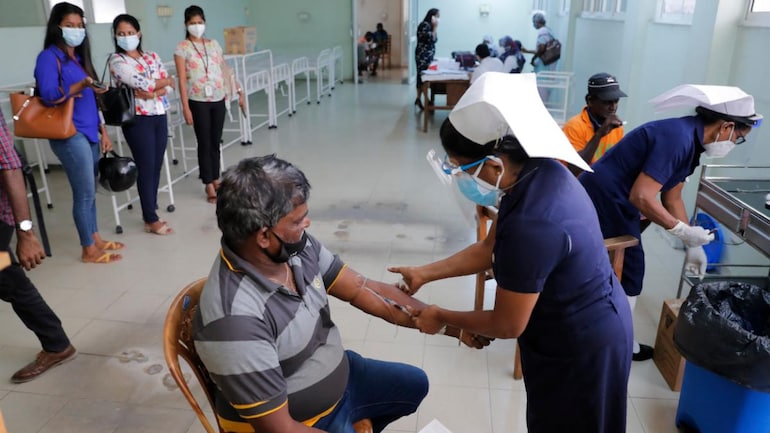
With the number of COVID-19 cases on the rise daily, there is a shortage of beds in Intensive Care Units (ICUs) for the COVID-19 patients in hospitals islandwide.
Primary Health Care, Epidemics and COVID-19 Disease Control Minister Sudarshani Fernandopulle told Daily Mirror that the available capacity in ICU was almost full.
Steps are being taken to increase the capacity in ICUs and High Dependency Units in order to address the issue,” she said.
She also said a new strain had been apparently identified and that’s why the ICU admissions had gone up.
There is a tendency of youths getting COVID-19 complications and being admitted in ICUs than adults at present,” she said.
However, we are taking all measures to mitigate the situation and minimise the risk,” she added.
Meanwhile, the State Minister said people were not careful and were acting in an irresponsible manner. (Sheain Fernandopulle)
Education Minister Professor G.L Peiris announced that all schools, pre-schools and Piriven in the Western and North Western provinces will remain closed until the 30th of April, 2021.
This decision has been taken as a precaution due to the recent surge in new COVID-19 cases.
However, the schools in other provinces will reopen for students as per usual from tomorrow (27), the Education Ministry said.
The government has taken a decision to close all schools, pre-schools and Piriven located within the Western and North Western provinces until April 30.”
There is no change in the academic activities of schools in the remaining provinces of the country. If there are any changes, we will notify immediately,” the Minister of Education said in a statement today.
He also requested the parents and students to strictly follow the health guidelines within the schools that will remain open as it is highly important to do so.
UPDATE: In view of the government’s decision, all Catholic schools in the Western and North Western provinces will also be closed until Friday (April 30), the Bishop’s House said.
Addressing the 77th Session of UNESCAP, Sri Lanka’s Prime Minister Mahinda Rajapaksa said the government is keen on strengthening the island nation’s regional ties and emphasize the need to accelerate the South-South” cooperation.
Towards that end, we believe UNESCAP should commit itself to being relevant and responsive with measures such as assisting small countries with pandemic recovery and vaccination programs, encouraging growth of foreign employment opportunities, promoting Eco-tourism and Health-tourism and encouraging investments into and find markets for emerging nations.”
Rajapaksa, today via a video message, addressed the opening segment of the 77th Session of the United Nations Economic and Social Commission for Asia and the Pacific (UNESCAP).
This year’s meeting was conducted virtually from April 26—29, 2021, under the theme Building Back Better from Crises Through Regional Cooperation in Asia and the Pacific.”
While the COVID-19 pandemic dominated the discussions this year, other issues such as climate change, debt relief, investments, equitable health access, sustainable development and regional cooperation were also discussed.
Full Text of Prime Minister Mahinda Rajapaksa’s Speech
Madam Executive Secretary,
Chairperson,
Excellencies,
Ayobowan!
I am pleased to be able to address you at the 77th Session of UNESCAP. Despite the current challenges, it is very important for us to gather at this forum. This year’s theme is significant and timely as we work on strategies to overcome this pandemic, and start rebuilding our economies and societies.
Sri Lanka has made remarkable progress in controlling the spread of COVID-19, recording a very low death rate and a high recovery rate through case detection, contact tracing, quarantining and patient treatment. Sri Lanka’s robust public healthcare system provided free access to health and helped control the pandemic. The Government also repatriated nearly 100,000 Sri Lankans and started our vaccination program in February.
Even during the pandemic, economic activities continued in several sectors. The export sector continued to function, and tourism restarted in January. The Central Bank reduced policy rates and implemented several concessionary refinancing programs.
Excellencies,
Our Government is deeply committed to achieving the Sustainable Development Goals. For this purpose, an Inter-ministerial Steering Committee on Sustainable Development has been formed under my leadership. Our youth are also an important component of our development agenda. That is why decade 2021 to 2030 has been declared the Decade of Skills Development in our country.
We are also keen on strengthening our regional ties and emphasize the need to accelerate the South-South” cooperation. Towards that end, we believe UNESCAP should commit itself to being relevant and responsive with measures such as
• Assisting small countries with pandemic recovery and vaccination programs.
• Encouraging growth of foreign employment opportunities.
• Promoting Eco-tourism and Health-tourism
• And
• Encouraging investments into and find markets for emerging nations.
In conclusion, let me state that we deeply appreciate the timely efforts taken by UNESCAP to bring the Member States together for a constructive and interactive regional discussion on the COVID-19 pandemic.
The Director General of Health Services confirms three more Covid-19 deaths today, pushing the country’s death toll from COVID-19 to 647.
1. A 70-year-old female from Galpatha who had passed away on April 26 while receiving treatment at the Kalutara District General Hospital. The cause of death is reported as Covid-19 pneumonia.
2. A 92-year-old male from Kandana who had passed away on April 25 while being treated at IDH. The cause of death is cited as Covid-19 pneumonia, acute kidney damage, high blood sugar, high blood pressure and kidney disease.
3. A 70-year-old female from Avissawella who had been transferred from Sri Jayawardenapura Hospital to Neville Fernando Hospital after being identified as Covid-19 positive. She had passed away on April 26 due to complications caused by Covid-19 pneumonia and acute raspatory and heart failure.
Commander of the Army General Shavendra Silva announced that a decision has been taken to isolate several Grama Niladhari (GN) divisions in three districts with effect from 8.00 p.m. tonight (26) to control the spread of Covid-19.
Gampaha District:
Polhena, Heeralugedara and Kaluaggala GN divisions in Kotadeniyawa police area and Aswennawatta East GN division in Minuwangoda police area will be isolated from 8.00 p.m. tonight until further notice.
Kalutara District:
Miriswatta, Pelawatta North and Pelawatta East GN divisions in Meegahatenna police area will also be isolated in the same manner.
Trincomalee District:
Poompuhar Grama Niladhari Division in Trincomalee police area will also be isolated from 8.00 p.m. tonight.
In addition to this the premises of the Dambulla Dedicated Economic Centre has been isolated for two weeks from today.
The Ministry of Public Administration says that the heads of all government institutions will be empowered to decide on the number of employees required to report to work from tomorrow (27).
The relevant circular will be issued tomorrow, the Secretary to the ministry said.
Accordingly, state sector offices will operate with a limited number of staff from tomorrow due to concerns over the spread of COVID-19.
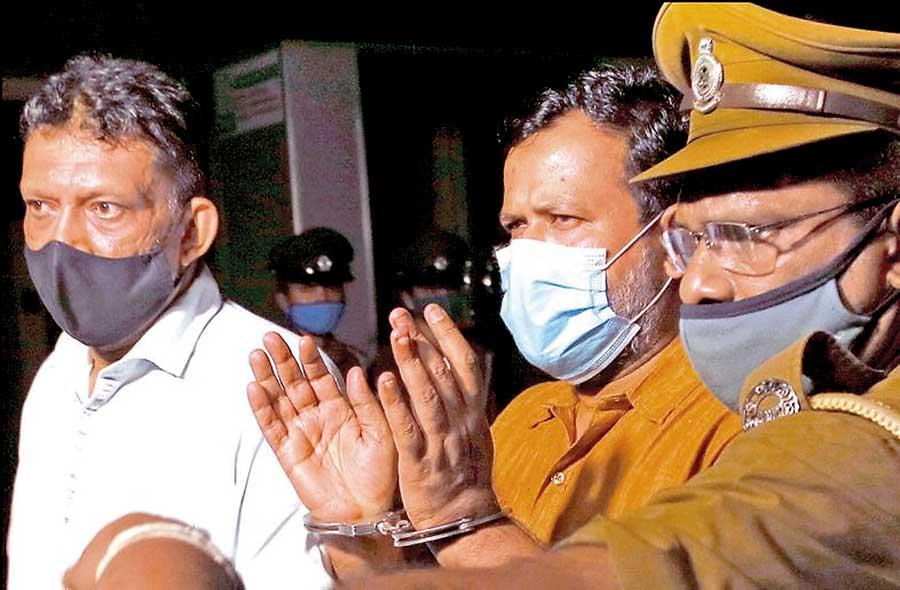
Sri Lanka Police says that a total of 117 persons were arrested within yesterday for not following quarantine regulations, the highest number of arrests within a single day for offences under the quarantine law.
Sri Lanka Police has intensified the quarantine operation procedures because it has been observed that Covid clusters and sub clusters have been created in various localities, police spokesman DIG Ajith Rohana said.
He said that the quarantine law gazette notification was published on the 15th of October 2020 and that however the police have been enforcing the law regarding the quarantine gazette since the 30th of October 2020.
He stated that they have arrested persons, produced them in courts and charge them under the provisions of the Quarantine and Prevention of Diseases Ordinance as well as the Sri Lanka Penal Code.
However, yesterday we have arrested 177 persons in connection with the violation of quarantine rules and regulations,” the police spokesman said.
This is the highest number of persons police have arrested within a period of 24 hours, since the 30th of October 2020 to date, he noted.
DIG Rohana stated that out of these individuals, 134 persons were arrested from Western Province alone and that 39 have been arrested within Colombo City.
Meanwhile 45 have been arrested in Gampaha District and 50 persons have been arrested in Kalutara area.
The police are continuing operations to arrest individuals committing offences under the quarantine law and all officers-in-charge (OICs) of police stations have been instructed to deploy police officers in civilian clothing and uniform in order to apprehend persons who violate quarantine rules and regulations, he stressed.
He said that police officers especially observe whether the public are adhering to rules related to wearing facemasks and maintaining social distancing.
In addition to that, no one should organize any events without the prior approval of health authorities and police, he said, adding that if an event is organized any person, he or she is liable for a punishment under the quarantine law.
We are going to strictly implement the quarantine rules and regulations. Therefore, everyone should wear a mask in public places and in public transportation.”
He added that OICs of police stations have been informed to monitor the situation in deploying surveillance teams in their respective areas.
It
seems that economic development and growth in Sri Lanka could be used with different
approaches and many Sri Lankans mean that economic development is individual
prosperity while growth is an aggregate status that could reflect the comparative
position of individuals with the previous pattern of consumption and other
matters. Many students who learn macroeconomics in Sri Lanka and other
countries know that consumption function may reflect the points to assess the
development and growth of a country. The demonstration effect is the best
example of this idea and can this apply to determine the size and nature of
economic development in Sri Lanka is a question. It is clear that the living
standard of people in Sri Lanka has been improved since the independence in
1948, this could have further improved the population growth reduced to less
than 1% and the depreciation of the currency unit controlled as the way country
wanted.
I
observed many UTUBE PROGRAMS” conducted by Sri Lankans attempt to show
demonstration effect and could such situation explain as a better way of
showing economic development and growth?
My answer is not and they are misleading people. I started working in Sri Lanka in Mid-1975
and I observed in offices at that time people hadn’t positive attitudes among
people many macroeconomic factors such as education and skills development,
population control and productivity improvement, and many factors. When I was
working in the offices, I had a feeling that people with outdated attitudes
were considering education and skills development as a curse to the country.
Some employees thought that English knowledge is the only way for development
and growth, but not work skills and qualities. Later, when people were going
overseas for working these people with outdated attitudes realized education
and skills development key factors for the economic development and growth of
the country.
Now, it also seems that politicians and
economic policymakers are stuck with inaccurate determination, and people in
the country consider economic development and growth have associated with power
playing politics. This is the notable difference meant in Sri Lanka regarding
the development and growth compared to many countries. When I have been living
outside Sri Lanka since 1990, I had a feeling that the economic status of the
country being tremendously improved and the major criteria I was using the
demonstration effect. During the COVID 19 season, my mind has pushed to the
reality and now I feel that the demonstration effect in Sri Lanka is a witchery
that hoodwinker of people outside the country. The true nature of development
and growth is a mound raised by white ants of debts and it is not an economic
improvement. Is that the meaning of economic development and growth in Sri
Lanka?
Sri
Lanka has many limits to growth and development. The best example for this
situation is looking at the economic achievements of China and Russia. while it
could observe that China and Russia have been achieved rapid economic
development and growth with rapid market-oriented policies Sri Lanka has failed
to show economic development and growth to people like the way Chinese and
Russian people achieved or demonstrated to the outside world. Policymakers in
Sri Lanka conduct meeting every day and submit reports to political authority,
but such actions have not impressed people to feel the economic development and
growth. Why this situation is going on in Sri Lanka? Why politicians are too
much talking about Singapore where the economic growth and development have
strongly associated with macroeconomic factors such as population, skills
development, investment, liberal approach for controls, regulating market than
controlling.
Did
the government and policymakers consider this situation and identify the
reasons for not impressing people on the growth and development? The major
reason is ignoring the concept of balanced growth, which is not a process like
balancing accounts in an accounting process.
Balance growth is a broader concept that is going beyond the
microeconomic process. Growth and development involve in the macroeconomic
process that has links between sectors and the outcome of inter-industrial
demonstrates that development is a mound raised by hard-working white ants or
termites.
Economic
development concerns two areas of policies, the restructuring of economic
activities considering the cost and benefits of policies to supporting
macroeconomic progress and directing investments for productive and possible
developing future links to the economy. As I have seen in Sri Lanka that
microeconomic reforms are needed for the improvement of productivity. Politically based trade unions and other
racist organizations have become a barrier to policy development and
implementation. The best example is the policy development for the Colombo Port
city project. Many critics of racist and trade unions have not made a positive
approach and the best outcomes have been achieved and will be achieved from the
project. The best outcome that could be observed is adding a piece of land to
the country that has not been seen since the era of King Vijaya. I read many
articles about the subject and nobody has mentioned this point.
Economic
growth is an aggregate position of the combination of various sectors’ outcomes
compared to the quantitative status of the previous period. The quality of the
progress may not ignore because if the quality of the progress is higher it
would go to people, most probably the distribution of quality may have unequal
apportionment. The meaning of economic
growth and development to Sri Lanka should consider as a successful outcome of
both processes and the distribution of outcomes among the rural and urban
population. China and Russia have demonstrated the successful outcome of
development and growth, but Sri Lanka has collapsed coordination of the two
processes and the main reason for this situation is the self-centered attitudes
of policymakers and the authority of policy implementation.
The
direct impact of this dualistic process of economic development and growth
seems that created by the instability of the economic policies of the country
and the distribution of benefits of projects among people. The second problem
with economic development and growth is policymakers have ignored the
fundamental requirement of balanced growth and turning to politics of development
for indulgence by media. The best example is the process of Port City
Development in Colombo. The benefits of the project expand to a limited volume
of population and media attempts to close eyes of people for political
impression or influence.
The
public needs to comprehend the issues social media out of the focus as many who
use social media users have a lack of understanding of the subject matter and
my feeling is the management of social media doesn’t bother about the
development and growth. I feel that
social media also working like opium as the way Karl Marx talked about
religions.
………Please
understand the global movement that becomes a cat’s paw of other individuals
and groups who have nothing to do with your deep faith and your sincere desire
to live your religion to the fullest to reach their selfish goals. Be brave
enough to reject extremism. Rise up against schools and organizations that
brainwash (the faithful) to kill people in the name of religion. ….”
Malcolm Cardinal Ranjith to My dear Muslim brothers and
sisters”of Sri Lanka
No ethnic or religious strife to be quenched in Sri Lanka
Sri
Lanka has never had an ethnic conflict between the Sinhalese majority and the
Tamil minority. It’s only a separatist problem that had its origins in the last
decades of the divisive British colonial rule that came to its demise in 1948;
but its powerful ghost is still haunting Sri Lanka in the form of Western
neocolonialist interventionism. Tamil separatism gradually escalated into a
fully fledged military confrontation/a civil war of over twenty-five years
duration (1983-2009). While the government security forces clashed with armed
rebels, mostly in the jungle and while separatists mounted terror attacks on
civilian targets in towns, the ordinary Sinhalese and Tamils lived in
accustomed peace and amity, equally tortured by the extremists’ terrorist
violence. Mainstream Muslims (mostly following the Sufi tradition) who
form the second largest ethnic minority in the country, largely Tamil speakers
themselves (Tamil-Sinhala bilingualism is more common among them than among the
other two communities), used to get on well with both Sinhalese and Tamils
until, with the recent advent of Wahhabism/Salafism related Islamist
isolationism, a sort of religious separatism came into the picture. (If there
is any subterranean Muslim vs non-muslim religious division in Sri Lanka, the
total responsibility for that lies with the handful of Islamist extremists who
have taken cover behind certain powerful opportunistic communal Muslim
politicians as strongly suggested by information gathered by the police
and army intelligence agencies since the 2019 Easter blasts and evidence
revealed in the course of investigations by the PCoI.
Apparent travesty of justice in some PCoI recommendations
Though
these politicians are mentioned in the PCoI Final Report with relevant
allegations of having been accountable for behaviours which were contributory
towards the provocation of the Easter bombings, apparently no punitive action
is recommended against them. Two outstanding cases are All Ceylon Makkal Congress
leader Rishad Badiuddeen and Ceylon Tawheed Jamath leader Razik Abdul. In
stark contrast, there is a special severeness in the recommended treatment of
Ven. Galaboda-Aththe Gnanasara Thera in the same context whose name appears at
the end of the list: The organization that he heads should be banned on the
basis of the allegation that its activities undermine religious harmony. His
speeches and and actions are alleged to have partly contributed to the
radicalisation of Muslim youth. The AG is to consider instituting criminal
action against him under the ICCPR Act for his speeches made at Aluthgama in
June 1914 and on Feb. 17, 2013 at Maharagama, which will mean that he will be
charged with an unbalable offence leading to a heavy sentence. A strange case
of criminal suspects with plausible evidence against them going free, while the
complainant is sent to jail. There must be some power or force behind such a
judicial aberration. This reminded me of (then MP, now Minister) Udaya
Gammanpila’s emotional speech in parliament on May 9, 2019 on the subject of a
brazen attempt at direct interference in our judiciary by a foreign power
geared to reinforce the ‘successes’ achieved through the regime change that
they engineered in January 2015, which, according to him were: pushing through
the until then stalled federal constitution and anti-terrorism acts, and the
witch-hunt against the war heroes. In this speech Gammanpila also praised the
Cardinal (who, he said, was one of the total 120 Cardinals who provided spiritual
leadership to the 1.3 billion Catholics of the world) for his sagacity in
calming down the targeted Catholics and in bravely identifying the Easter
attacks as the result of an international conspiracy, and not the work of the
country’s Muslim community (something he repeated with more conviction
during a commemorative ceremony on the second anniversary of the attacks held
on April 21 this year a couple of days ago, as you will see below – RRW). The
MP remarked on the existing accustomed peace and fellow feeling among the
communities demonstrated in the fact that Buddhist pansalas were offered
to the Catholics to perform their services, and that Muslims helped apprehend
suspect extremists among them and hand them over (to the police).
A history of colonial discrimination against the majority
community through the preferential treatment of a small elite of the
minorities
Just
as the European colonialists used a minuscule elite of the minority communities
through preferential treatment during their rule to the disadvantage of the
majority Sinhalese, whose unique historic homeland they were occupying, their
successors, the Western hegemonic powers, assisted by determined Indian
expansionism, are capitalizing on false allegations of Sinhalese majoritarianism
and ethno-religious (Sinhalese) Buddhist intolerance by a handful extremists of
the same minorities and supportive foreign funded NGOs, to undermine the Lankan
state. These same neocolonialist powers seem to have found an ally in the
widely known global exporters of ruthless Islamist extremism in destabilizing
the Sri Lankan state purely in the interest of their geopolitical agenda in the
so-called ‘Indo-Pacific’ region, where it is geographically located. It will be
to the great detriment of Sri Lanka for its politicians, whether in or out of
power, to agree to kowtow to the latter (i.e., those that the
Americans earlier held to be purveyors of Islamic extremism) while allowing
them to act on the false assumption that mainstream Muslims of Sri Lanka are
single-minded supporters of the few Wahhabist/Salafist extremists.
His Eminence the Cardinal’s special statement on April 21, the
second anniversary day of the Easter bombing
In
his special statement on April 21, 2021 the second anniversary of the Easter
Sunday attacks, His Eminence Malcom Cardinal Ranjith reiterated his not
unreasonable allegations of neglect and dereliction of duty by the
highest political and civil authorities of the previous regime that allowed the
attacks to be carried out. He was clearly dissatisfied with the level of
progress so far made under the present administration in bringing those
responsible to justice. Was there an attempt to sweep the truth under the
carpet in order to let those behind the crime escape punishment as a result of
some political wheeler-dealing? Politicians of both the previous and present
governments acted and are acting in an indifferent, inactive manner swayed by
changing political winds. He repeated his determination to pressure the authorities
to deliver justice. The cardinal expressed special appreciation of the Buddhist
clergy and the laity for always being with the Catholic community in dealing
with the tragic aftermath of the devastating terror attacks, while preserving
national peace and unity. The Catholic prelate implied that the Muslims’
attitude was different on the whole. You haven’t still come forward to condemn
the Easter attacks. If you joined us in an earnest spirit, demanding (of the
authorities) to find out who was responsible for the attacks, the problem would
have been resolved by now….”. But, in the same breath, he stated that this
lapse on the part of Muslims in general was only until that moment (of
speaking), for the moulavi who spoke before him (Hassan Moulana) stressed how
his fellow Muslims totally rejected the terrorists who blew themselves up
(because they were not true Muslims), and how they refused to accept their
bodies for burial and handed them over to the army to be disposed of in
whatever manner they decided.
The
Cardinal further said (in verbatim translation): …Therefore I’d like to take
this opportunity to make a special request of you my dear Muslim brothers and
sisters: In geopolitics, there are its local agents and brokers who are
prepared to commit any form of betrayal out of their greed for money and power.
Please understand that religious extremism is a useful tool for attaining their
goals. Please rise up against Wahhabist schools and organizations that
brainwash (adherents) to kill in the name of religion. Let us bring pressure on
the government to fulfill the promises given to the people. Because the process
of finding out the truth is still not happening at an acceptable level of
transparency, and because it is the expectation of everybody to see that goal
achieved, let us encourage the authorities to devise an express mechanism to
that end. We urge that steps be taken immediately to implement the relevant
recommendations of the PCoI to ban schools and organizations that propagate
Wahhabism”.
What Ven. Dr Omalpe Sobitha said
Ven.
Dr Omalpe Sobitha Thera said that the most primary obligation of a government
was to protect the people. The previous government miserably failed to perform
this responsibility. He pointed out that there were many allegations heard from
all directions that the present government was not doing better in the area
either, and that they must immediately improve matters. He remarked that though
some one billion rupees was received from the Muslim World League for helping
the affected families, no one knew what happened to those funds. (However, the
monk seems to be ill informed about it; the money has still not been paid by
the Islamic NGO as MP Wijedasa Rajapaksa complained recently. – RRW)
‘National Conference on Peace, Harmony and Coexistence’
After
these background comments, let me address the subject proposed by the title. A
(actually, the second) meeting of the so-called ‘National Conference on
Peace, Harmony and Coexistence’ was held at the Nelum Pokuna Theatre, Colombo
on March 4, 2021. The chief guest was the general secretary of the Saudi-based
pan-Islamic NGO the Muslim World League (MWL) Dr Sheikh Mohamed bin Abdul
Kareem Al-Issa. (MWL leader Mohamed Abdul Kareem had pledged USD 5 million to
support the families of the dead and injured in the Easter Sunday terror
attacks at the first National Peace Conference that took place at the same
venue under the patronage of the previous president Maithripala Sirisena on
June 30, 2019; but this money has not been received yet.) This arguably
questionable NGO involvement in the aftermath of the Easter Sunday suicide
bombings through this rather adventitious National Conference on Peace, Harmony
and Coexistence has passed almost unnoticed in the media. The negative
repercussions of this well- or ill-intentioned intervention in a situation
created by dangerously radicalized Muslims will be evident in the time to come.
The MWL itself deserves our gratitude for offering to help us on this occasion.
Not so the politicians involved, who should be the object of our reproach.
(Strangely, MP Wijedasa Rajapaksa, who believes in the good intentions of the
MWL, has made an issue of the nonpayment of the promised money by the Saudi
based and funded NGO even by the second anniversary of the Easter bombings.
Shouldn’t he have known better, I wonder. Doesn’t he know the calibre of the
Muslim politicoes mentioned in the PCoI Final Report who appear to seeking
undeserved refuge under the wings of the powerful global Islamic organization?)
The
Hiru TV news footage of the event that I watched the next day (March 5, 2021)
showed PM Mahinda Rajapaksa and former presidents Maithripala Sirisena and
Chandrika Bandaranaike attending the event along with some Muslim politicians
including A.H.M Fowzi, Rishad Badiuddeen and M.L.A.M Hizbullah and others (the
last two having got ‘honourable’mention in the Final Report as shown above).
There were also a group of Buddhist monks who had been invited as guests
(though it was evident that they were unwilling guests). The news report
featured two leading monks expressing their views about the incompatibility
between the Islamic religious ideology that the MWL espouses and the
ethical philosophical doctrine of Buddhism where peace-making was concerned;
one of them spoke in Sinhala and the other in English. The monks were the
Anunayake of the Asgiriya Chapter Ven. Wendaruwe Upali Thera, and Ven. Dr
Omalpe Sobhita Thera. The first, speaking in Sinhala, emphasized the
ideological hiatus between religion/s and the (Buddha) dhamma:
Anunayake of the Asgiriya Chapter Ven. Wendaruwe Upali Thera’s
definition of the difference between religions and Buddhism
The
truth about our participation in this event must be stated: It needs to be
remembered that we are here as a mark of respect to the order given by the
Mahanayake Theras, and that too, only as observers. It must be due to
some shortcoming somewhere that this multi-religious concept has come about.
All religions might be the same; but it is a well known fact that the Buddha
Dhamma is not a religion. Religion and the dhamma are clearly two
different things. The dhamma guards the mind whereas religion gratifies the
mind. When a Buddha statue was damaged (by jihadist fanatics) at Mawanella, it
was as if we were struck on the head. But won’t you accept the fact that our
Mahanayake Theras did not incite the Buddhist public to violence (in
retaliation)? How forbearing we were (even under such provocation)! How well
were peace and harmony preserved avoiding a bloodbath after the April 21
attacks due to the calming voice of (His Eminence) the Cardinal! In reality, we
don’t have anything to learn from you about peaceful coexistence; it is
we who are teaching you (now) and have taught you (before this moment) about
it”.
(What
I have added parenthetically and what I have specially emphasized in my
translation here are naturally grasped by a Sinhala speaking audience without
them being explicitly expressed. The valid point the monk raises here is
something not very easy for a non-Buddhist or a non-Sinhala speaker to grasp
and appreciate. Even today, in rural Sri Lanka, Christians are colloquially
mentioned by Buddhist neighbours among themselves as ‘agamkarayo’ (people of
religion), the implication being that what they follow for moral and spiritual
guidance, Buddhism, is not a religion. The important Article 5 of the Kandyan
Convention of 1815 contains the crucial phrase The Religion of the Boodhoo….”
in its English version (The phrase was actually a product of a political and
linguistic sleight of hand by ace intriguer and spy John D’oyly who drafted
it). The Sinhala original, which was really important from the point of view of
the occupied nation, had the equivalent of the ‘sasana of the Buddha’ or
Buddhist establishment and the ‘agama’ (religion) of the devas (deities)”; but
this didn’t appear in D’oyly’s English version. When Christian Europeans
arrived in Sri Lanka at the beginning of the 16th century, there was no
religion in the modern sense in the country, but a highly cultured society with
its Buddhist spiritual foundation, the Buddha Sasana and its characteristic
practices and cultural rituals; there was no Buddhist ‘religion’. (Of course,
no one could expect a positive response to the monk’s words from the head of an
Islamic NGO that is devoted to the task of promoting a particular brand
of religion in a world where the scientific knowledge enlightened people
are fast moving towards a global humane culture without religion.)
Ven. Dr Sobitha’s challenge to the Islamic peacemakers
In
the course of his speech, which was in English, the other monk, Ven. Dr Omalpe
Sobhita, said, as reproduced here thus unedited: While we are trying to be
united together as Sinhalese, Tamils, Buddhists, Christians and Hindus, it is
regretted that our Muslim friends are demanding for a separate food system,
they are demanding for separate law and order system, separate uniform and
dress code, separate education, separate universities, separate, separate, and
separate. Ultimately, we understand this separatism paved the way for separate
from the whole. Actually, friends, we are hurt so much; we are disappointed.
Then we find out what is the reason for these different ideas and
separatism. Then I found the very reason is the Quran. I am not criticising the
Quran. I am revealing the truth. Let me quote certain phrases of the Quran:
‘Allah will shed human blood while angels praise in heaven (Surah Al Baqarah No
2); again, ‘Kill disbelievers wherever you find them, but if they desist in
their unbelief, don’t kill them’ (Surah Al Baqarah). ‘Attack on the necks of
the disbelievers whenever you fight against them. Those who die fighting for
Allah will be rewarded’ (Surah Muhammad No 47). Lastly, I just quote this line
(from) Surah Al Fath: ‘If you refuse to fight for Allah, he will punish you
with a painful doom’. If this is the teaching in this holy book, how can
it be implemented to achieve peace and harmony in this society? Please
enlighten us if we are wrong, and let us enlighten you if you are wrong”.
From
their point of view, the monks here, no doubt, believe that they have hit the
nail on the head: the root of the trouble is in the religion itself, in its
basic teachings (but this view is not likely to be shared even by the least
dogmatic Muslim. Dr Omalpe Sobhita’s desperate challenge or invitation to some
sort of intellectual or ideological interaction is not likely to be entertained
by the MWL or its local proteges. But the monk cannot be blamed for that. The
BBS leader Ven. Galaboda-Aththe Gnanasara has, on a number of occasions, also
hinted at the idea of arranging a peaceful resolution of the growing Islamic
extremist problem through a rational dialogue or debate with Islamists, the
sort of adversarial but cultured interreligious disputation between erudite Buddhist
monks and unrelenting Christian missionaries equally well versed in their
religion in the form of the famous Five Great Debates (Pancha Maha Vadaya)
including the iconic Panadura Vadaya (1873) in the latter part of the 19th
century. The missionaries were well and truly beaten by the monks in this
ideological confrontation. The news of the Panadura Debate impressed the
American soldier, journalist, lawyer and theosophist Colonel Henry Steel
Olcott. His arrival in Sri Lanka (then called Ceylon) in 1881 contributed to
the boosting of the already burgeoning Buddhist revivalism in the island. But
such an easy resolution of the anti-Buddhist Islamic fundamentalist problem is
impossible, given the fact that Muslim believers, particularly the Wahhabist
literalists that the MWL was believed to represent in the past (Wikipedia) will
never be amenable to any form of argument that contradicts Quranic teachings or
challenges their infallibility. It would be too naive for these monks to even
remotely imagine that their form of ‘non-religious’ (Buddhism is not a
religion) polemic will prevail against what is accepted as divine revelations
by Muslims the world over. By now, they are informed enough about the
differences between Muslims’ religious beliefs and their own characteristically
liberal Buddhist attitudes; these differences cannot be resolved through
dialogue with those extremists. For dogmatic Muslims, religion and politics are
one. Something that the Islamic peacemakers should not overlook is the fact
that these monks know more about the religion of Islam than they (Islamic
peacemakers) themselves probably know about Buddhism.
Any reason for MWL’s involvement?
As
far as I can see, there is no reason why the NGO known as the Muslim World
League should offer to make peace or mediate between Sri Lanka’s minority
Muslims and their non-Muslim neighbours (the majority of whom are Buddhists)
between whom there has never been any religious controversy or physical
clash that we know of in our post-independence history. A few Buddhist monks
started sounding warnings about foreign funded promoters of potentially violent
forms of Islamism in the country at least two decades ago, and have come out
with evidence of unacceptable activities targeting Buddhists (and Tamil Hindus)
by Islamic and other religious extremists; they have brought it to the
attention of the authorities. But the monks’ complaints fell on deaf ears.
Nothing was done about provocative anti-Buddhist excesses committed by
Jihadists, such as encroaching on ancient Buddhist archaeological sites,
vandalizing Buddha statues, and raising false allegations against the activist
monks to demean and deprecate them in the eyes of the world. The most prominent
one among these monks was reported to have been described by the leading April
suicide bomber Zaharan, as a ‘demon’. Zaharan had been angered to call Ven.
Gnanasara a demon by his relentless but just criticism of the former’s violent
movement.
During
the Presidential Commission of Inquiry on the Easter attacks (PCoI)
investigations it was revealed, as the media reported, that though Zaharan’s
original plan was to bomb the Kandy Perahera which is annually held in
August, he changed his target and advanced the time of attack in order to make
use of the then prevailing lax national security situation under Yahapalanaya
to avoid the risk of his plan being discovered and aborted. Attackers did not
differentiate between Buddhists and Catholics. However, it was evident that
anti-Buddhist elements and media regretted that there was no indication of a
Buddhist link to the bombings.
Why
does a Muslim World NGO seem to take it upon itself to re-create the
interreligious peace that is already there? This is like the West’s
reconciliation mantra. It is true that a handful of Islamic extremists who
probably had enjoyed the patronage of the Saudi-based movement tried to wreck
that peace in the name of the religion that the MWL fosters, which means that
the MWL should do better to rehabilitate those misguided Islamists from among
whom the suicide bombers emerged. Be that as it may, the fortuitous National
Conference on Peace, Harmony and Coexistence that hosted its chief met about
two and a half months after the bombings. No doubt the organization has good
intentions. When it was first held, the Yahapalana president Sirisena presided,
with his predecessors Mahinda and Chandrika in attendance. People are yet to
learn what new thing they learned about peace, harmony and coexistence? The
same dignitaries were dutifully present at the NGO’s recent second
meeting. What did they achieve for the country by having this sort of thing
organized? What is more important?National dignity need not be relinquished in
accepting charity offered in friendship. National sovereignty was debased and
national security compromised under president Sirisena. Should that evil legacy
be allowed to continue into the future indefinitely? Unfortunately, there has
been no clarity in this department of governance in the wake of the yahapalana
maladministration, a situation worsened by the choppy waters of humanity
denying geopolitics amidst the still rampant the Covid-19 pandemic. The MWL, on
other hand, should be careful not to be misled by the local promoters of
Islamist extremism that caused the Easter Sunday attacks to take place two
years ago.
The solution lies mainly with the mainstream Muslims
I
wish to conclude this piece with the following part of the Cardinal’s appeal to
his dear Muslim brothers and sisters” during his commemorative statement on
April 21 aforementioned, which makes oblique reference to the interventionist
global powers that instrumentalise Islamist fundamentalism in pursuit of
their geopolitical agendas: ………Please understand the global
movement that becomes a cat’s paw of other individuals and groups who have
nothing to do with your deep faith and your sincere desire to live your
religion to the fullest to reach their selfish goals. Be brave enough to reject
extremism. Rise up against schools and organizations that brainwash (the
faithful) to kill people in the name of religion. ….”
But China has told us take whatever (money) necessary
and pay back whenever possible.” Parliamentarian S.B. Dissanayake (to Rev.
Keppitiyagoda Siriwimala Thero – 4.4.2021)
Days after the presidential election of 2010, the
Rajapaksa siblings gathered to enjoy an evening of musical extravaganza.
Organised by the state-owned ITN and titled Jaya Jayawe (Victory Victorious),
the show was billed as a Musical tribute to the Heroes of the Nation.” The
evening began with a lullaby about how King Mihindu” and his Chief General
Gotabaya” saved Mother Lanka from demons. Song after saccharine song followed,
hailing the wisdom and valour the Heroes of the Nation,” Mahinda Rajapaksa and
– to a lesser extent – Gotabaya Rajapaksa. The evening ended with a tribute to
the Rajapaksa sibling’s heaven-dwelling mother.
In May 2009, the royal astrologer” had predicted that
President Mahinda Rajapaksa and the Rajapaksas will rule this country for a
long time.” Jaya Jayawe was a symbol of this New Civilisation,” veteran
politician J.R.P. Sooriyapperuma explained in his guest lecture. The message
was clear. The Rajapaksas saved Sri Lanka. Therefore, like in the old folk and
fairy tales, the country belonged to them. All Lankans owed them a sacred duty
of obedience.
Monarchy, said Voltaire in A Philosophical Dictionary, is
a system where a single individual exercises absolute power, accumulates all
honours and tastes all pleasures, provided he has plenty of money.” Kingdoms
can be poor but kings can’t. The Rajapaksas faced this dilemma in 2006, when
they came up with the plan to transform the family’s birthplace Hambantota from
a sleepy backwater into a dazzling, bustling metropolis.
The first item on the agenda was the Hambantota Port.
Neither India nor international lending agencies were willing to shell out the
necessary funds. That was when China stepped in. The Rajapaksas needed a patron
with deep pockets. China was looking for clients in South Asia. It was a match
made in Tiãn (Chinese Heaven).
Sri Lanka’s gravitation towards China’s orbit accelerated
with the advent of President Xi Jinping and his Belt-and-Road fantasy. The
China-Pakistan Economic Corridor was gathering steam. An artificial island on
India’s doorstep, built and controlled by Beijing, fitted in with China’s
aggressive moves to become the predominant power in South Asia, a prelude to
its larger plans to replace the US as the new global hegemon.
Official Lankan propaganda claimed that the idea of an
artificial island was birthed in President Mahinda’s brain. In reality, it was
contained in an unsolicited proposal by the China Harbour Engineering Company.
Going by Chamal Rajapaksa’s recent revelations, this was the time that plans
were being made to construct two massive reservoirs in the Sinharaja Forest.
Sri Lanka was being transformed into a politico-economic periphery of China. To
ensure their place as Sri Lanka’s overlords, the Rajapaksas were becoming China’s
satraps.
These best laid plans came unstuck in 2015 when Mahinda
Rajapaksa lost the presidency. Had he won, Sri Lanka’s future as a Rajapaksa
fiefdom and a Chinese client-state would have been set in stone. Though the
Sirisena-Wickremesinghe administration violated many of its pledges – not least
the one to put an end to the Port City project – it enabled Sri Lanka to be
freer internally and more non-aligned externally.
So the country the Rajapaksas regained in November 2019
was not quite the country they lost in January 2015. In the intervening five
years, people had lost their fear, and become accustomed to criticise and
ridicule their leaders. The rule of law had been restored to some extent. A
handful of Rajapaksas and Rajapaksa acolytes had been charged with crimes
ranging from corruption to murder in courts of law. Sri Lanka, while vulnerable
to Chinese inveiglements, had ceased being a Chinese satellite on the regional
and world stage.
That semi-democratic interregnum has compelled the Gotabaya-Mahinda
regime to start from square one. Familial rule has to be restored and dynastic
succession assured. Sri Lankans have to be returned to the old habit of
unquestioning obedience. Sri Lanka needs to be placed back in China’s orbit.
Little wonder the family is in a hurry. To quote the
immortal Khayyam, the Bird of Time has but a little way to fly…”
The House of Rajapaksa
In Little Dorrit, Charles Dickens introduces the reader
to the Circumlocution Office. This unique institution has a finger in the
largest public pie, and in the smallest public tart,” and is peerless in
perceiving how not to do things.” From the economy to pandemic-control, from
environment to corruption, the performance of the Gotabaya-Mahinda regime
resembles this Dickens’ invention. But when it comes to protecting core
Rajapaksa interests, the Siblings move with a speed and a focus that leave
their opponents scrambling to understand let along respond adequately.
The Rajapaksas have also mastered the art of timing.
Lasantha Wickremetunga was murdered one week after the taking of Killinochchi
and one day before the fall of Elephant Pass. Shani Abeysekara was arrested
four days before the 2020 parliamentary election. Hejaaz Hisbullah was arrested
on the day before the Sinhala and Tamil New Year in 2020.
This New Year season was an extra busy time for the
government. On April 13, civil society activist Asela Samptha was arrested for
poking fun at tuition master-turned-economic guru Bandula Gunawardane’s relief
package.” Minister Sarath Weerasekara used the holidays to announce government
plans to amend the penal code to punish those who disseminate fake news” or
engage in extremist propaganda” on the internet.
On April 9, Premier Mahinda tabled a resolution in
parliament which aims to free Rajapaksa siblings, sons, nephews, cousins, and
acolytes from all legal entanglements. Never mind that this amounts to a gross
violation of the doctrine of separation of powers, as the BASL points out. The
only separation of powers the Family is willing to tolerate is the one within
the Family. The UNHCR Resolution 46/1 is spot on. Under Rajapaksa rule, all
doors to justice and accountability will remain closed and bolted.
The Rajapaksas also used the festival season to unveil
another seminal piece of legislation, the Colombo Port City Bill. The Bill
turns the Port City into a Chinese enclave. Unsurprisingly. Why else would
China pump money into creating an artificial island off Sri Lanka, but to
create its own exclave? The raison d’être for Colombo Port City is to give
China a secure foothold on India’s doorstep. The Rajapaksas ignoring this
danger was understandable. They were doing a deal, Chinese patronage for Lankan
fealty. The rest of us have no right to be surprised or outraged. The Colombo
Port City was never going to be anything but a Chinese city. If we didn’t see
it, it was because we opted not to.
The world seems to be on the verge of a new cold war,
with Asia as its main theatre of conflict. This week, top US intelligence
officials provided the American Senate with their assessment of threats facing
US interests globally. China tops the list. Avril Haines, director of national
intelligence, described China as a near-peer competitor challenging the United
States in multiple arenas, while pushing to revise global norms in ways that
favor the authoritarian Chinese system.” President Joe Biden’s first virtual
engagement was with the leaders of the QUAD countries, a loose formation
grouping US with India, Australia, and Japan, aimed mainly at containing China.
Mr. Biden’s first in-person meeting was with the Japanese prime minister, with
China being the number one item on the agenda.
When big powers are lining up against each other, the
best place for small countries like ours is the sidelines, aligned with none
and opposed to none. If ever there was a time to stick to a non-aligned
position vis-a-vis both the US and China, that is now. But thanks to
Rajapaksas’ power hunger, Sri Lanka is placing herself right in the middle of
the battle zone.
Two back-to-back happenings this week serve as a warning
of the pitfalls of our new dependent status. On April 13 it was reported that
the Chinese Defence Minister will visit Sri Lanka later in the month. On April
14 an Indian navy destroyer made a sudden visit to Sri Lanka for a two day
visit.
The future of the House of Rajapaksa cannot be secured
without Chinese patronage. The price of that deal is likely to be Sri Lanka’s
disastrous entanglement in the coming cold war. When big powers want to prick
each other, the chosen method is slashing the other’s proxies. So it was in the
last cold war. So it will be in the coming one.
A revolt in the Rajapaksa temple?
At his one and only media conference as presidential
candidate, Gotabaya Rajapaksa admonished the journalists for asking questions
about his past. You are talking all the
time on the past, no. Ask the future. I’m trying to become the president of the
future Sri Lanka. If you concentrate on the future, I think it is better,” he
said, interspersing his words with his signature laughter.
The past Gotabaya Rajapaksa wanted us to forget is
haunting two men who laboured more than most to make him president. Wijeydasa
Rajapakhse, by his own admission, used his authority and influence as justice
minister to keep Gotabaya and other Rajapaksas out of jail. Muruttetuwe Ananda
Threo turned his temple into the Rajapaksa political headquarters, when the
electorate ousted the Brothers from power. This week, these two Rajapaksa
acolytes reportedly had a taste of Gotabaya Rajapaksa’s ire.
President Gotabaya’s alleged conduct towards Mr.
Rajapakshe and Muruttetuwe Thero bears a striking resemblance to Defence
Secretary Gotabaya’s reported conduct towards the then Sunday Leader editor,
Frederica Jansz. In July 2012, Ms. Jansz called Mr. Rajapaksa over a Swiss
puppy. An enraged Mr. Rajapaksa reportedly called Ms. Jansz a shit eating pig”
and threatened her. In less than three months, a Rajapaksa cipher purchased the
Sunday Leader. Out of a job and fearful for her life, Ms. Jansz fled the
country.
Threatening critics is in the Rajapaksa blood. On
November 25, 2007, the Sunday Leader reported the details of an alleged conversation
between President Mahinda Rajapaksa and editor Lasantha Wickremetunga. I will
show you what it is to be scared,” the President allegedly told the Editor. I
will rest only once I have destroyed you.”
In some places, the past is the present and the future.
I am not reconciled to a world in which a gesture or a
word misunderstood can cost a life”, wrote Heinrich Böll in Billiards at Half
Past Nine. Thanks in part to men like Wijeydasa Rajapakshe and Muruttetuwe
Thero, Sri Lanka is back in that world where words can have lethal
consequences. There might be a shade of poetic justice in what is happening to
them. Still, so long as they remain victims of Rajapaksa vengeance (they might
shift to a song of obedience soon, as they did during the 20th Amendment
drama), they deserve the solidarity of those who value their own freedom.
The spat, irrespective of its final outcome, is important
because it demonstrates that the Rajapaksa project rests on just one lynchpin,
Premier Mahinda. He is the only Rajapaksa who is capable of hegemony. If his
siblings and sons were to stay in power, after him, their rule will be based
primarily, even exclusively, on dominance. Only Mahinda Rajapaksa can hold the
disparate coalition together, only he can prevent the base from cracking.
The art of gaining the consent of allies with the optimum
mix of persuasion and coercion, a Mahinda Rajapaksa forte, is clearly beyond
the capacity of President Gotabaya. The image of him as a hegemonic figure was
an artificial construct, an illusion that has not worn well. President Gotabaya
is Defence Secretary Gotabaya in a bush shirt. If anything is restraining him –
and the family as a whole – it is probably the Magnitsky Act which became
global only in 2016. That piece of legislation is used by the United States and
several other Western nations to identify (some) human rights offenders, and
impose travel bans and asset freezes on them. Not a prospect the Rajapaksas can
take lightly, given their familial connections with the US.
The essence of Gotabaya-Mahinda rule is restorationist.
The Rajapaksas fought to regain power not to enthrone their loyal acolytes (lay
or ordained) but to enthrone themselves. The purpose of every controversial
deed of the last 17 months was to set the House of Rajapaksa on a solid
foundation. That those very deeds are exacerbating the divisions within the
government is a result of the changed politico-psychological landscape the
reincarnated Rajapaksa project is compelled to navigate.
The House of Rajapaksa came into being with Mahinda
Rajapaksa. Can it survive sans him? What role will the military play in a
Gotabaya-Basil-Namal (or a Basil-Namal) government? What will Beijing do to
ensure its political, economic and security interests are not undermined by its
client’s internal political developments? Will we find ourselves in the same
unenviable condition countries like Guatemala, Chile, Grenada et al found
themselves during the Cold War, subject to coups and conspiracies, paying the penalty
of being a super-power’s dependent?
Mahinda Rajapaksa is our king…. King Rajapaksa’s name
will be written in history in letters of gold…” a boy barely older than a
toddler lisped at the 2010 musical extravaganza. Will those gold letters be in
mandarin?
Tony Donaldson, with underlining emphasis inserted bt The Editor, Thuppahi Courtesy Thuppahi’s Blog
On 1 October 1949, the People’s Republic of China was proclaimed by Mao Zedong. Two months later, on 6 January 1950 the Ceylon government recognised Red China– one of the first countries to do so. Seven years later, in early 1957, the Premier of China, Zhou Enlai, made an historic five-day visit to the island, which paved the way for the establishing of diplomatic relations between Ceylon and China. Before exploring Zhou’s visit to Ceylon, it is worth diverting for a moment to briefly sketch the key events that led to his historic visit.
Zhou Enlai in China relaxing shortly after his trip to Ceylon.The story begins in 1950. A few months after Mao’s proclamation, a remarkable telex from Hong Kong arrived on the desk of Terence de Soysa at the C. W. Mackie & Co in Colombo.[1] The telex was offering a deal to purchase rubber from Ceylon to be shipped to Red China. At the time however, the US and UK did not recognize China and frowned on countries having anything to do with China. Fully realising the dilemma, Terence de Sosya went to meet the Prime Minister of Ceylon D. S. Senanayake to seek his advice on the proposed rubber deal, as described by his son Rohan:
He [my father Terence] related how he came to office one morning, in 1950, if I remember right, to find a telex from a Hong Kong agent. He was offering to pay 8 old pence per pound of rubber more than the then world-market price of 40 old pence per pound — if he would ship to Red China. None of the other rubber producing countries, for example, Thailand and Malaysia, would do so. Ceylon was a friend of America, which was then at war with China, in the Korean War. Thus, my father was in a quandary.
Having ascertained it was not a joke, he went and met the Prime Minister, D. S. Senanayake, and asked him what action to take in view of the ongoing Korean War. D.S. asked him, Terence, is it good for our country?” When my father told him it was very good, D. S. told him to go ahead — it was in our interest to do so.[2]
This was the beginning of trade ties between Ceylon and China. While it cannot be ascertained whether Terence de Soysa’s rubber deal with Red China occurred before or after the Ceylon government’s recognition of China in 1950 — it doesn’t matter as a country can freely trade with another country even if it doesn’t recognise the government of that country. Whatever the circumstances, Terence de Soysa’s deal with China was the foundation stone” of the Rubber-Rice Pact, which was signed in Peking two years later on 4 October 1952. During the signing of the Pact, the leader of the Ceylon delegation to Peking, R. G. Senanayake, a cousin of D.S., marked the occasion by inviting Premier Zhou Enlai to visit to Ceylon. These developments indirectly helped to accelerate decolonialisation in Ceylon.
However, the invitation to Premier Zhou fell into abeyance the following year after Sir John Kotelawala became Prime Minister of Ceylon. Pro-Western, and staunchly anti-communist, Sir John refused to allow Zhou Enlai’s goodwill delegation to visit Ceylon. The situation reverted back again however, after Sir John lost power to SWRD Bandaranaike in 1956. Shortly after coming to power, SWRD rekindled R. G. Senanayake’s invitation to Zhou Enlai, and it was agreed that Premier Zhou Enlai and a Chinese delegation would visit Ceylon during Independence Day celebrations in February 1957.
Zhou Enlai arrived in Ceylon on 31 January 1957. The next day (1 February), Premier Zhou and his delegation, which included Deputy Premier Ho Lung, began a provincial tour to the hill country, including Kandy and Peradeniya. The party travelled by road from Colombo – occasionally stopping at a village for refreshments and to greet local villagers.
On visiting the Peradeniya Botanical Gardens, Premier Zhou planted a sapling to commemorate his visit to the island. He and the Chinese delegation also visited Peradeniya University. Here, they met the Vice-Chancellor Sir Nicholas Attygalle and senior university officials. These visits and meetings were recorded in black and white photographs published in the Ceylon Daily News, which remain a valuable historical record of Zhou Enlai’s visit to the island.
A visit to the Peradeniya University: Premier Zhou Enlai is seen (left) with the Vice-Chancellor, Sir Nicholas Attygalle and the Chinese Vice-Premier, Mr. Ho Lung (right).
The Vice-Chancellor of Peradeniya University Sir Nicholas Attygalle receives a gift from Premier Zhou Enlai on behalf of the University.
Premier Zhou Enlai plants a sapling at Peradeniya Botanical Gardens to commemorate his visit – a tradition which all important visitors follow.
In Kandy, Mr. Zhou visited the Sri Dalada Maligawa and handed over a cheque to the Diyawadana Nilame, Mr. C. B. Nugawela and the Nayake Theros as a gift for work on the temple. As noted in the Ceylon Daily News, at the time, Zhou’s donation to the Maligawa was the biggest single donation ever offered by a distinguished visitor, royal or commoner, Buddhist or non-Buddhist.” Mr. Zhou also presented the Maligawa with a set of valuable Buddhist books containing pictures of paintings and statues of Gautama Buddha, edited by the Chinese Buddhists’ Association, and published by the National Publishing House of Peking.
Premier Zhou also met the Mayor of Kandy, Mr. E. L. Senanayake. After a civic address of welcome given by the Mayor, Mr. Zhou delivered a speech to the citizens of Kandy thanking them for their warm and enthusiastic welcome and went on to predict a successful future for Ceylon-China relations.
Premier Zhou Enlai is accorded a civic reception as he enters the city of Kandy. Here, Mr. E. L. Senanayake, the Mayor, is seen with the visiting Premier, who spoke to the vast gathering that turned out to welcome him.
Press conference with Premier Zhou Enlai in Colombo
Premier Zhou and his party returned to Colombo on 3 February to attend Independence Day events on the following day. Before leaving Ceylon, on the afternoon of Tuesday 5 February, Zhou Enlai held a one-hour press conference at Queen’s House. During the press conference, Zhou declared: The peace and prosperity of Asia must be planned and worked out by Asians themselves – on the principles adumbrated at Bandung.”[3]
He disliked the idea of Asian countries obtaining foreign assistance with strings attached,” as such assistance inevitably led to military packs.” This process, he said, was bad for the economy of the country receiving assistance. He also discussed Hungary, the US, India, Pakistan, and the Kashmir problem. The following are edited extracts from the press conference, taken from the article ‘Beware Foreign Aid with Strings’, published in the Ceylon Daily News on 6 February 1957.
What are conditions like in China for the Catholic Church?
China has no particular dislike for the Catholic Church. There are 3,000,000 Catholics in China. China allows people of various religious persuasions to practice their religions without hindrance.
What is the purpose of your present tour of Asia?
My visit has three purposes: (a) to seek friendship, (b) to seek for peace, and (c) to seek for knowledge. We have achieved all three purposes in our visits to eight Asian countries.[4] We have found that the people of the eight Asian countries strongly want peace and friendship. We have learnt much from these countries. We have always thought that we have something good in our own countries which can be learned from other countries. We also contacted the leaders of the eight Asian countries for discussing matters of mutual interest on the basis of the Bandung Principles of peaceful coexistence. Efforts for the promotion of peace and cooperation will be continued.
What agreements have been reached for economic cooperation between Ceylon and China?
Nothing specific has been finalised between Ceylon and China.
Do you think UN mediators will settle the problem of Kashmir?
We were always of the opinion that no good result can be achieved by referring the question to the UN. We are also not in favour of UN forces being sent to Kashmir. We appeal to India and Pakistan to seek a peaceful solution by themselves. At present, the Western countries are exploiting the situation to create conflict between the two countries. The attention of the world is now focused on the Middle East and Asian countries. I appeal to these countries to stand united on the basis of the Bandung Principles in order to shake off the shackles left behind by colonialism.
In your meeting with the two Prime Ministers of India and Pakistan, have you discussed the basis of a mutual settlement?
The Prime Ministers of India and Pakistan did not reject our appeal and of course, for the two sides to have direct negotiations it is probably not an easy thing. It is because there are difficulties in the way of such direct negotiations that we are trying to promote such direct negotiations instead of allowing Western countries to sow dissension.
What is your view of Mr Eisenhower’s Middle East Doctrine?
The purpose of the Middle East program of Mr Eisenhower is to take the place of Britain and France in the Middle East, and the Near East. The US President’s State of the Nation speech also revealed this plan.
People of Asian countries want to live in peace and friendship with other countries, and for this purpose they need the help of other countries. Such help must come without strings. Some countries want to make use of such help to ask for privileges, to ask for military bases, to ask the countries receiving such help to join blocs. Although such a policy of giving help might be effective in some places for a period of time, eventually the aggressive purpose of such a policy will be revealed.
The harm in accepting help, under such a policy, to the people in the receiving countries will also be revealed in time. It will become a burden to those countries. They will have to pay the price in granting privileges to those countries giving them help and this will ultimately impoverish the receiving countries. So, in short, Mr Eisenhower’s Middle East policy will, in the long run, bring no good results.
Could you comment on Israel’s refusal to leave Gaza, and the tension created as a result?
We always anticipated that Israel would give trouble over this matter. The West is now trying to exploit this situation to maintain tension in the Middle East and in the Near East.
Will China consider making a fresh approach to bringing about an understanding with the US by releasing the Americans held in prisons in China?
Why should we always listen to the words of the President of the US. The US does not recognise China and has always obstructed China being recognised by the United Nations. The US is still carrying on that policy. The US is still hostile to China. Why do not our Asian friends appeal to the United States to change its policy towards China? We Asians have all suffered from colonialism, and why should we pay so much attention to the Western countries, still less to the US government? Even without the US government we will continue to exist – to live well. Let the US continue not to recognise China for ten years, for 100 years, but China will not topple down just for that!
What is your view about the Afro-Asian Secretariat?
The proposed Afro-Asian Secretariat will be a very helpful thing for solving Asian economic problems.
What are your relations with General Chiang Kai-shek and the position of Formosa?
That is a delicate question on which I do not like to speak.
What is your view about the situation in Hungary?
Last year [1956], from the end of October to the middle of November, Western countries exploited discontent of the Hungarian people. Western countries carried on their propaganda by the despatch of agents through Vienna. Such agents worked with the counterrevolutionaries in Hungary. They succeeded in taking control of the Government by massacring the people. Bishop Mindszenty was directing such activities, and the Bishop eventually escaped to the American Embassy in Budapest. There were enough documents to prove such activities.[5]
Could you say more about the suggested collective security pack for Asia?
We proposed this idea some time back, but it is not developed yet. To develop that we want the cooperation of all the countries in Asia, and the Pacific region, because no country can be left out.
At the conclusion of the press conference, Zhou Enlai freely gave his autograph to those attending. When one pressman offered his visiting card, Mr Zhou autographed it and said: Now you can come to China with this.END NOTES
***** *****
END NOTES
[1] Terence de Soysa acquired C. W. Mackie & Co in 1946. It was the first major British company to be Ceylonised.
[2] Rohan de Soysa, Decolonisation in the Rubber Trade, 1946 to 1954,” in Slow-Cooked Thoughts: Articles, Talks, Essays, One Old Poem and Two Tales. Singapore: Partridge, 2019.
[3] This refers to the Bandung Conference, also known as the Afro-Asian Conference, which was held in Bandung in April 1955 with 29 countries participating. The Conference paved the way for the formation of the Non-Aligned movement.
[4] The eight countries were Vietnam, Cambodia, India, Burma, Pakistan, Afghanistan, Nepal and Ceylon. Zhou’s tour of Asia went from late 1956 to early 1957.
[5] A few weeks before his visit to Ceylon, Zhou Enlai led a Chinese delegation to the Soviet Union on 7 – 10 January 1957. The delegation met separately with officials from the East German government and visited Poland from 11 to 16 January. On 16 January, Zhou visited Hungry to meet with senior government leaders and to give speeches at mass rallies. Thus, he was well-informed about the Hungarian revolution in 1956.
THUPPAHI EDITORIAL ADDITIONS
JB Kelegama 2020 [from 2002] A Landmark Trade Pact: Rubber-Rice Deal between Sri Lanka and China, 1952,” 23 July 2020,
Transcript: As the vaccine to protect against COVID-19 continues to roll out to more and more people, there is bound to be more and more side effects. Today, we are discussing the most dreaded side effect, i.e., Cerebral Venous Thrombosis (CVT)” Great concern of the people today is to have the COVID-19 vaccine against COVID-19 or not, and that is the question. Because of this situation the hesitancy rates seem increasing, and the anticipated herd immunity may be prolonged for at least another 4 years. Recently, it has been discovered a few people have got brain blood clots within 14 days of having the Oxford-AstraZeneca vaccine, among the ages less than 60. These clots have been recorded from other vaccines like Pfizer Biotech, Moderna, and Johnson and Johnson. • The World Health Organization, the U.K.’s medicines regulator and the International Society on Thrombosis and Haemostasis have all said that the benefits of administering the Oxford-AstraZeneca shot far outweigh the risks. WHO message is not to alarm people, but to calm them down to have the jab in a general sense. But you could be the exceptional case that could have the blood clots from the jab, and that becomes part of the statistics, no concern to the public. It is only a concern to your immediate loved once and close associates. These blood clots seem to be combined with low levels of blood platelets occurring within two weeks of vaccination. They are referred to as Cerebral Venous Thrombosis (CVT). These blood clots seem to occur in the sinus veins, and not in arteries of the brain, where the blood moves slower and the platelets have the time to over-react and clot. Reported cases of CVT per million population, in the general population- the incidence is 0.4 due to other causes. After Pfizer vaccine- 4 cases of CVT per million people Moderna- 4 cases per million people AstraZeneca- 5 cases per million people Video link https://youtu.be/FANlHolmISk Website: www.Doctorharold.comSo, the incidence of CVT is much higher among those COVID-19 who had no vaccine. People who contract COVID-19 before the vaccine was administered, seem to be 100 times more likely to experience CVT than the general population. It is also claimed that blood clots up to 10 times common with those who has contracted COVID-19, having had no vaccine. This will open your mind to consider having the vaccine. You are between the devil and the deep blue sea as the expression goes. Two teams of scientists in Europe recently said they have discovered the cause of the rare blood clots among some patients who received the first jab of AstraZenecaCOVID-19 vaccine. CVT was also found to be more common among people who received either Pfizer, Moderna or AstraZeneca vaccines- at a rate of between 4-5 per million. This also means that people with corona virus infection are between 8-10 times more likely to develop the blood clots than those who have been vaccinated against it. A group of German scientists led by Professor Andreas Greinacher from the University of Griefswald believe that blood clots in the brain of a few cases who received the AstraZeneca vaccine, is due to an overactivation of platelets in the blood. This led to the possible deadly blood clots. This overaction seems to be due to damage to the changes in the inner lining of the veins. In such endothelial cells damage situation, the platelets seem to meet exposed collagen and von Willebrand factor, becoming activated. Von Willebrand disease is an inherited bleeding disorder that results from the low levels of specific clotting protein in blood. This protein is called von Willebrand factor (VWF) Von Willebrand disease is common, and in Australia there are more than 10,000 cases per year. These activated platelets after the COVID-19 AstraZeneca vaccine seem to change in shape and pseudopods form on their surfaces, determining a star-like appearance. These activated platelets are coated with collagen and leads to thrombin activation. Thrombin is an enzyme in blood plasma which causes the clotting of blood by converting fibrinogen to fibrin and activates other procoagulant factors. So, human thrombin activates clotting. So, I hope you understood the mechanism of blood clotting in COVID-19 and after vaccination. Recently, Australia recorded the first death from blood clots likely linked to AstraZeneca Covid vaccine. That was a woman 48 years old. The case is the third instance of the rare blood clotting disease linked to the vaccine in Australia but the first death. It was revealed that this woman had complicated underlying medical conditions, including diabetes. Platelet factor 4 (PF-4) Platelet factor 4 (PF-4) is a strong inhibitor of angiogenesis i.e., development of new blood vessels.”There’s some good data to suggest [the AstraZeneca vaccine] is creating an inappropriate immune reaction against a protein that’s found in blood platelets called platelet factor 4,”. Platelet factor 4, or PF4, allows blood cells to communicate with each other. There are antibodies that deactivates Platelet factor 4. These Anti-PF4 antibodies which activates platelets have been found in almost all other cases reported internationally of blood clots with thrombocytopenia (low platelet count) associated with the AstraZeneca vaccine. In Australia TGA said there had been at least 885,000 doses of AstraZeneca vaccine administered, and only three cases of the rare blood clotting have occurred and that is equivalent to approximately one in 250,000, after AstraZeneca vaccine. Cerebral venous thrombosis CVT Blood clots are as prevalent with Pfizer and Moderna vaccine as with AstraZeneca. A study by Oxford University found the number of people who receive blood clots after getting vaccinated with a coronavirus vaccine are about the same for those who get Pfizer and Moderna vaccines as they are for the AstraZeneca vaccine. According to CBS News based on a preprint study -4 in one million people experienced CVT after getting the Pfizer or Moderna vaccines. With AstraZeneca 5 in 1 million had CVT. AstraZeneca’s vaccine use has been halted or limited in many countries on blood clot concerns. Seven people have died from unusual blood clots after getting the Oxford-AstraZeneca vaccine in the UK. UK vaccine regulator reports 68 more cases of rare blood clots after AstraZeneca jabs in total 168cases- but insists ‘benefits outweigh risks’ with 21 million people now having had the shot. Moderna vaccine CVT incidence =4.1 %per million people Rare blood clots occurring in combination with thrombocytopenia. Possibility of exceedingly rare cases of blood clots combined with low levels of blood platelets occurring within two weeks of vaccinations in 86 European cases. Plausible explanation for these rare side effects is an immune response to the vaccine. Benefits of vaccination outweighs the risk. All vaccines have a risk, but the risk is small. The UK regulator, the Medicines and Healthcare Products Regulatory Agency, has concluded from its review of cases in the UK that the overall risk of the rare blood clots was approximately one in 250,000. On Tuesday, April 13, 2021, U.S. health agencies called for a pause” in use of the Johnson & Johnson COVID-19 vaccine after ongoing safety monitoring identified a rare blood clotting disorder in six people who had received the vaccine. This adverse event is extremely rare. Those who have not had any specific vaccine so far, should not rush to any conclusions about the vaccine. Over 31 million people in the US have received at least one dose of the vaccine with minimal side effects. Even the few cases of the dreaded CVT incidence, people are bound to increase their fears, and in half a mind whether to have or not have the jab. However, there is an inconclusive link between the disorder and vaccines, and it is stressed that the vaccines are safe. The disorder is not enough to avoid getting the vaccine. The risk of developing a serious illness from Covid-19 is much greater than developing the rare disorder. Scientists have repeatedly insisted that there is no proof that the extremely rare cerebral blood clots are from the coronavirus vaccines. So, in a way it is essential to have the jab, considering these serious episodes. If you ask for my advice, you should have the jab, especially if you are planning travel during the festive season. Hope this video talk was useful. Stay safe and Goodbye for now
Colombo, April 24 (Daily Mirror) – The guidelines for tourist arrivals to Sri Lanka is expected to be updated owing to the present COVID19 situation, Tourism Ministry sources told the Daily Mirror yesterday.
The move comes after the health authorities issued new health guidelines for the country effective till May 31.
Tourism Ministry sources said that they anticipate a change in the number of days tourists need to be quarantined when visiting Sri Lanka.
Tourists visiting the country are currently restricted to a bio bubble.
Meanwhile Army Commander
General Shavendra Silva said yesterday Sri Lankan citizens returning back to the country will have to undergo the 14 day quarantine once again due to the present virus situation.
For those who are fully vaccinated, discussions will be held by the Health Ministry and a new set of guidelines will be issued soon, the Daily Mirror learns. (Jamila Husain)
Former Minister Rishad Bathiudeen being taken to prison when he was arrested in October last year
All Ceylon Makkal Congress (ACMC) leader and ex-Cabinet Minister Rishad Bathiudeen is a prominent Sri Lankan politician, who is very often in the news for the wrong reasons. The 48-year-old Bathiudeen hailing from Dharapuram in the Mannar District is an engineer by training. Known widely as Rishad, he was first elected to Parliament from the Northern Vanni electoral district in December 2001. He has been consistently elected as Vanni MP since then in 2004, 2010,2015 and 2020. Rishad has also served continuously from January 2007 to November 2019 as Cabinet Minister in the governments of Mahinda Rajapaksa and Maithripala Sirisena. Currently his party the ACMC has 4 MP’s and 169 Local Authority Members. Rishad Bathiudeen was arrested by the Police at 3 a.m. on Saturday, April 24 2021. Prior to Rishad Bathiudeen’s arrest at his residence on Bullers Road (Bauddhaloka Mawatha) in Colombo 7, his brother Riyaj Bathiudeen was arrested at his house in Colombo 6 by the Criminal Investigation Department (CID) of the Police. Shortly before his arrest, the ex-cabinet Minister Tweeted:
The CID has been standing outside my house in Bauddhaloka Mawatha since 1.30 a.m. today attempting to arrest me without a charge. They have already arrested my brother. I have been in Parliament, and have cooperated with all lawful authorities until now. This is unjust.” A video in Tamil was also posted on Rishad Bathiudeen’s official Facebook in which the sarong clad Vanni District MP said that the Police refused to answer when queried whether the Speaker of Parliament Mahinda Yapa Abeywardena had been informed that the MP was going to be arrested. I’m a Member of Parliament and a leader of a political party. If I’m to be arrested, they must first inform the Speaker,” emphasised Rishad.
He also said there was no response when asked whether the Police had an appropriate arrest warrant to take him into custody. Bathiudeen also stated in the video that he was being arrested in the holy month of Ramazan when people of the Islamic faith engage in a 30-day fast during the daytime. The ACMC leader kept repeating in the video that he was totally innocent and that he along with his brother were being penalised unjustly. He also reiterated that there was a conspiracy to silence him to prevent his speaking out on behalf of the Muslim people in Sri Lanka.
Aiding and Abetting
Later Police Spokesperson DIG Ajith Rohana told the media that the Bathiudeen brothers were arrested at their residences. They were arrested by the CID on the charges of aiding and abetting the suicide bombers responsible for the 2019 April 21st attacks,” said DIG Ajith Rohana. The Criminal Investigations Department had recorded statements from witnesses and collected circumstantial as well as scientific evidence, he added. Further investigations will continue under the provisions of the Prevention of Terrorism Act (PTA), he said. It is learnt that both the Bathiudeen brothers have been detained for 72 hours under the PTA.
Meanwhile, Public Security Minister Sarath Weerasekara told the Sunday Times that the former Minister and his brother were arrested following a long-running joint investigation by the CID and the Terrorism Investigation Division (TID). He claimed that there was evidence that the suspects had maintained links with the Easter Sunday suicide bombers and aided and abetted them to amass funds to carry out their activities. While police have already forwarded eight files on the eight suicide bombings carried out on that day to the Attorney General, Weerasekara said suspects were still being taken into custody from time to time as more evidence emerged.
Some hours after the arrest, a statement was issued by Rushdhie Habeeb, Attorney-at-Law. Habeeb stated that he had been authorised by the families of the Bathiudeen brothers and the All Ceylon Makkal Congress to issue the statement on their behalf. Here are some relevant excerpts- We have been instructed by the members of the family of Hon. Rishad Bathiudeen MP and his brother Reyaj Bathiudeen and the All Ceylon Makkal Congress to issue this statement to the media conveying their shock and surprise on the sudden and unannounced arrests by officers of the CID, past midnight on Saturday 24th April 2021 from their homes.”
All Ceylon Makkal Congress
At the outset, we have been asked to appeal to the members, well-wishers and the island-wide voters of the All Ceylon Makkal Congress (ACMC), a registered political party with four elected Members of Parliament and 169 members of local authorities, to stay calm and continue the fasting in this holy month of Ramazan.”
We are instructed to state that if the CID had noticed the two of them, they would have appeared at the CID, as they had done many times in the past, both as party noticed as well as complainants. There was no need to have demonstrated, any show of force to the rest of the family or those around. We understand that no reasons for the arrest had been given at the time of their arrest by those who conducted the midnight raid. We are shocked that those representing the democratic state should begin this process in violation of the law which requires the persons arrested to be informed of the reasons at the time of the arrest or to uphold the principle of the presumption of innocence.”
“At the outset, we have been asked to appeal to the members, well-wishers and the island-wide voters of the All Ceylon Makkal Congress (ACMC), a registered political party with four elected Members of Parliament and 169 members of local authorities, to stay calm and continue the fasting in this holy month of Ramazan”
The Easter Sunday Attacks Commission headed by an Honourable Judge of the present Supreme Court had gone into all the complaints and allegations made against the two of them. They had heard and recorded the evidence of the complainants, the investigators and several others. They had heard the two, who were accused of allegations of aiding and abetting a suicide bomber.”
The Commissioners had heard in evidence and by affidavit that Hon. Rishad Bathiudeen, in his then capacity as Minister, had refused to grant an appointment to meet the Minister, to one of them who had sought the appointment, at a time when no one in the country knew that he would turn out to be a suicide bomber later on. They had also received the evidence that Minister Bathiudeen was sent a letter of demand by the future bomber claiming damages for refusing the appointment and for not granting the meeting he had requested.”
Commission Found No Evidence
Having evaluated the evidence, the Easter Commission found no evidence of any one of the Bathiudeens having aided or abetted the suicide bombers in the Easter Sunday bombings. Their arrest without any justifiable material is in violation of the rule of law.” We are instructed to state that the arrests are politically motivated. The ACMC supported the present opposition at the last Presidential and General Elections. The ACMC is today a part of the country’s opposition. The ACMC also represents a predominant share of the Muslim community.”
Interestingly enough references to the Bathiudeen brothers figured at a press conference conducted by the Catholic Church last week. A joint press conference was held by Archbishop of Colombo Cardinal Malcolm Ranjith, Bishop of Chilaw Most Rev. Valance Mendis and the Bishop of Galle Most Rev. Raymond Wickremesinghe on 19 April. It was about the 2nd anniversary of the Easter Sunday bombings on April 21st. According to a news report on the Economy Next website, the Cardinal was asked at the press conference whether he was satisfied with the progress of inquiries into the Easer Sunday bombings.
The Cardinal had replied that political wheeler-dealing appeared to be obscuring efforts to bring perpetrators to justice. Cardinal Malcolm Ranjith referred to how the Government secured the support of Muslim legislators to ensure a two-thirds majority for the 20th Amendment and warned that the Government should not take him for a fool. Tell it to the Chinese with a Ponytail
“The Commissioners had heard in evidence and by affidavit that Hon. Rishad Bathiudeen, in his then capacity as Minister, had refused to grant an appointment to meet the Minister, to one of them who had sought the appointment, at a time when no one in the country knew that he would turn out to be a suicide bomber later on. They had also received the evidence that Minister Bathiudeen was sent a letter of demand by the future bomber claiming damages for refusing the appointment and for not granting the meeting he had requested”
A few days before seven Muslim MPs voted for the 20th Amendment, (former Minister) Rishad Bathiudeen’s brother was released from custody……… When I raised this issue, the government said there was no connection (to the 20th Amendment)…….. But, we saw the way they voted. Especially, to support a person who came to power saying he did not want the votes of Muslims. There is a saying (tell it to the Chinese with a ponytail) Do they think we are ” (Usually a derogatory term referring to a dimwit) According to the news report the Cardinal had gone on to say that ad hoc arrests and releases would not inspire confidence in the investigations into the 2019 Easter Sunday attacks that killed 269 and wounded over 500 people. However, he had said the Church was willing to give more time for the authorities to identify all those behind the attack and bring them to justice. Cardinal Malcolm Ranjith was referring to Rishad Bathiudeen’s brother Riyaj being arrested in Mid-April 2020 under the PTA and detained for five and a half months before his release in early October.
When Riyaj Bathiudeen was arrested there were media reports alleging that his arrest was in regard to several telephone conversations with Inshaf Ahmed Ibrahim who was the suicide bomber who targeted Cinnamon Grand Hotel. Riyaj Bathiudeen’s wife wrote a letter to Dr Deepika Udagama, who was the Chairperson of the Sri Lanka Human Rights Commission at that time.
In that letter, Mrs Fathima Bathiudeen explained that her husband who was a businessman had several telephone conversations regarding commercial matters with Inshaf Ibrahim, whose family were the leading Spice exporters in Sri Lanka. The then Police Spokesman SSP Jaliya Senaratne explained the reason for Riyaj’s release thus: A person is arrested only after a reasonable suspicion has arisen regarding an investigation. As soon as the suspicion was nullified, the suspect was released. That is what happened to Riyaj Bathiudeen.” Jaliya Senaratne’s reasoning was not acceptable to many including Cardinal Malcolm Ranjith.
Cardinal Malcolm Ranjith
Cardinal Malcolm Ranjith the Roman Catholic Archbishop of Colombo convened a press conference on October 3, 2020, where he aired his misgivings and doubts candidly. According to media reports the Cardinal said he was astounded and dismayed” that a powerful Muslim politician’s brother detained under special laws for his alleged part in the Easter Sunday attacks has been set free. Cardinal Ranjith said he could not comprehend how a person who the Police said had dealings with the Easter bombers, did business with them and engaged in discussions with them is suddenly found to be entirely innocent and released unconditionally.”
The Catholic prelate queried openly whether the Government was cutting a political deal” with Rishad Bathiudeen to get his support for the controversial 20th Amendment to the Constitution and therefore releasing his brother Riyaj from detention. The Cardinal’s allegation had a quick and unexpected response from the Country’s Executive President himself. On Oct 4, President Gotabaya Rajapaksa posted on his Facebook account the following ensuring national security is the first and foremost responsibility of my Government. I emphasize that our government has not entered into any political deal with Parliament member Rishad Bathiudeen”. President Rajapaksa further said:
I am not prepared to hand over the power of arresting or arbitrarily releasing people to politicians, as happened in the past. I assure my citizens that I will not forsake the trust that they have placed in me and I will most certainly continue to work towards strengthening the trust we have built.” In a further development, more than 80 MPs belonging to the Sri Lanka Podujana Peramuna (SLPP) signed a letter addressed to both President Rajapaksa and Prime Minister Rajapaksa. The Govt MPs demanded that the released Riyaj Bathiudeen be re-arrested immediately. They also emphasized that no political deals should be struck to garner a two-thirds majority in Parliament.
Bargain with Bathiudeen
All this speculation about a political deal being struck with Rishad Bathiudeen was over the 20th Amendment to the Constitution that was passed in late October last year. With some of the minor parties in the Govt showing signs of dissent”, there were doubts whether the Govt could get the two-thirds majority necessary for a Constitutional Amendment. Against this backdrop, there were many rumours that a bargain had been entered into with Bathiudeen whose ACMC had 4 MP’s in Parliament with one each from the Vanni, Anuradhapura, Amparai and the Puttalam Districts.
When Cardinal Ranjith gave voice to those suspicions publicly, President Rajapaksa responded through Social media to allay such doubts. It appeared that there was going to be no deal with Rishad Bathiudeen. Nevertheless when the 20th Amendment vote was taken, Six Muslim MP”s from the Muslim Congress (SLMC)led by Rauff Hakeem and the Makkal Congress (ACMC) led by Rishad Bathiudeen supported the amendment from the Opposition. Another MP from the ACMC voted for 20 A at the Committee stage. Only SLMC leader Hakeem and ACMC leader Bathiudeen voted against the 20th amendment totally.
This bizarre voting pattern of the Muslim parties led to much excitement in a nation noted for its fascination for conspiracy theories. It is indeed noteworthy that both the SLMC and ACMC have not taken effective action against its MP’s for flouting Party discipline and voting with the Government despite the facade of an inquiry” being conducted. Currently, both Hakeem and Bathiudeen seem to be leaders without followers in Parliament. The four SLMC and three ACMC Parliamentarians seem to be in” but not of” their respective parties.
Deal or No Deal?
This state of affairs too has given rise to renewed suspicion that a deal had indeed been cut. This question of deal or no deal” has once again been aired publicly by Cardinal Malcolm Ranjith through his candid comments followed by the Brouhaha caused by the arrest of the Bathiudeen brothers. ACMC Leader Rishad Bathiudeen’s arrest and detention under the PTA has come in for heavy criticism by several Muslim and Tamil political leaders. Sri Lanka Muslim Congress leader Rauff Hakeem MP issued a statement expressing sadness at the manner in which Rishad and his brother Riyaj were arrested.
He also condemned the arrest. Tamil Progressive Alliance leader Mano Ganesan MP was critical of the arrest in a post on his Facebook. Ganesan asked whether Rishad Bathiudeen was a member of the underworld to be arrested in this manner. It remains to be seen as to what the Leader of the Opposition Sajith Premadasa has to say about the arrest. Bathiudeen campaigned for Premadasa at the Presidential elections and contested on the SJB ticket at the Parliamentary elections.
Despite the reasons given for the arrests by the Police Spokesperson and Public Security Minister, one is not sure of the real motives behind the arrest. Obviously, both Rishad and Riyaj would have voluntarily submitted themselves for interrogation by the CID or TID if the Police had noticed them. This sudden arrest by night” grandstanding seems unnecessary. It is unclear as to why the arrests were made in this way. Was it a knee jerk reaction to the Cardinal’s assertion that he was not a Kondhaya Bandhapu Cheenu”? Whatever the reason the arrest by night grandstanding certainly leaves much to be desired. Already the Gotabaya Government has been severely faulted for the way it is alienating the Muslim people of Sri Lanka. It is an issue that has been raised even within the UN Human Rights Council (UNHRC).
Political Witch-Hunt
Whatever his flaws, Rishad Bathiudeen is the leader of a party that represents a sizeable number of the Muslim people. The Govt may be able to win over MPs elected from the ACMC through carrot and stick methods. However, the people who voted for them are not so fickle and would remain steadfast loyalists of the party for quite a while. The Govt would do well to avoid creating an impression that Rishad Bathiudeen and his brother are targets of a political witch hunt.
D.B.S.Jeyaraj can be reached at dbsjeyaraj@yahoo.com
Researchers in Sri Lanka say they have detected a new variant of coronavirus on the island nation which is highly transmissible and can remain airborne for nearly an hour. Sri Lanka is reporting over 600 new cases each day.
HIGHLIGHTS
The variant is highly transmissible: immunologist Neelika Malavige
Sri Lanka’s ministry of COVID prevention has issued new guidelines to contain the spread
Symptoms are now more visible and young people are more likely to develop them: Dr Asela Gunawardena
Anew coronavirus strain that is airborne and more potent than all those found previously in Sri Lanka has been discovered in the island nation, according to a top immunologist based in Colombo.
The variant, which is highly transmissible, can remain airborne for nearly an hour and is spreading fast, Neelika Malavige, the head of the Department of Immunology and Molecular Sciences of the Sri Jayawardenapura University said.
“This variant of coronavirus is more highly transmissible than all found so far in the island. The new strain is airborne, the droplets can remain airborne for nearly an hour,” Malavige said.
Health authorities feared that the new variant is spreading rapidly after last week’s New Year celebrations with more younger people getting infected.
“In the next two incubation periods, the disease can progress to a third wave,” Upul Rohana, of the Public Health Inspectors said, adding that the real situation would emerge only in the coming 2-3 weeks.
Meanwhile, the ministry of COVID prevention issued new guidelines which would remain in force until May 31.
The guidelines dictate a 50 per cent capacity operation for most institutions with all forms of revelry being banned.
The country-wide cases which were around 150 before the mid-April New Year have now shot up to over 600 a day. Sri Lanka is also running out of its health care capacity, officials said.ADVERTISEMENT
Sri Lanka, like many other nations, is witnessing a surge in the number of coronavirus cases, with the current figure standing at 99,691 cases and 638 deaths due to the disease.
Director General of Health Services Dr Asela Gunawardena said hospitals still have enough ICU capacity to treat COVID-19 patients but it is more important that health guidelines are followed in order to avoid infection.
“Previously the symptoms were not very apparent. Now they are much more visible and young people are more likely to develop them,” he said.
Those who have tested positive now develop more breathing difficulties, requiring ICU admission and oxygen, he said.
Sri Lanka is not the only nation to have witnessed new strain of Covid-19 but also other Asian nations such as India, Pakistan, Indonesia among others
ISLAMABAD: A 14-member delegation of visiting Buddhist monks from Sri Lanka visited several archaeological sites of Gandhara civilisation in Khyber Pakhtunkhwa and performed religious rituals.
The delegation arrived in Pakistan on Wednesday for a week-long visit aimed at strengthening cultural ties between Islamabad and Colombo based on shared Buddhist heritage.
The guests visited the sites in Taxila, Khanpur, and Takht-i-Bhai and evinced keen interest in the preservation of the sites by the government.
They praised the restoration of the Buddhist religious sites at Bhimala in the Khanpur town of Haripur.
Special Assistant to the Prime Minister on Tourism Zulfi Bukhari, Khyber Pakhtunkhwa tourism secretary, and scholars accompanied the delegation.
The monks were informed about the progress of work on the Buddhist sites in Taxila and Khanpur for the promotion of religious tourism by the government.
Bukhari while talking to reporters on the occasion said the government has a vision to complete the world’s biggest Ghandhara trail by 2022.
The tour has been arranged by the Pakistan High Commission in Colombo to boost religious tourism in Pakistan by showcasing its rich cultural heritage.
The visit is in line with Prime Minister Imran Khan’s vision to promote religious tourism, project the country’s historical treasures and strengthen cultural ties, said Ayesha Abu Bakr Fahad, Second Secretary at Pakistan Mission in Colombo.
Scientists say that the new coronavirus strain can remain airborne for nearly an hour and it is spreading fast in the island nation
In the backdrop of a Covid-19 resurgence in many parts of the globe, researchers in Sri Lanka have discovered a new, highly potent strain of coronavirus.
According to scientist, the new strain is airborne, highly transmissible and more potent than all other strains of the virus found on the island-nation.
Experts believe that the new strain is responsible for the spike in the number of infections in Sri Lanka as it can remain airborne for nearly an hour and is spreading fast.
This variant of coronavirus is more highly transmissible than all found so far in the island. The new strain is airborne, the droplets can remain airborne for nearly an hour,” Neelika Malavige, the head of the Department of Immunology and Molecular Sciences of the Sri Jayawardenapura University said.
Health authorities fear that the new variant is spreading rapidly after last week’s New Year celebrations with more younger people getting infected.
In the next two incubation periods, the disease can progress to a third wave,” Upul Rohana, of the Public Health Inspectors said, adding that the real situation would emerge only in the coming 2-3 weeks.
Meanwhile, the ministry of COVID prevention issued new guidelines which would remain in force until May 31. The guidelines dictate a 50 per cent capacity operation for most institutions with all forms of revelry being banned.
The country-wide cases which were around 150 before the mid-April New Year have now shot up to over 600 a day. Sri Lanka is also running out of its health care capacity, officials said.
Sri Lanka, like many other nations, is witnessing a surge in the number of coronavirus cases, with the current figure standing at 99,691 cases and 638 deaths due to the disease.
Director General of Health Services Dr Asela Gunawardena said hospitals still have enough ICU capacity to treat Covid-19 patients but it is more important that health guidelines are followed in order to avoid infection.
Previously the symptoms were not very apparent. Now they are much more visible and young people are more likely to develop them,” he said.
Those who have tested positive now develop more breathing difficulties, requiring ICU admission and oxygen, he said.
Sri Lanka is not the only nation to have witnessed new strain of Covid-19 but also other Asian nations such as India, Pakistan, Indonesia among others.
However, so far, there have been no reports of the new Lankan strain infecting people outside the country.
At the moment, three strains of the virus are the most commonly found ones all across the globe– UK Strain (B.1.1.7 Variant), South African Strain (B.1.351 Variant) and Brazilian Strain (P.1 Variant).
A double mutant strain was also recently discovered in Maharashtra. It has been identified as B.1.617 variant.
A Buddhist monk praying in front of the meditating Buddha in Jahanabad, Swat. The statue blown up by militants was restored by the department of archaeology and museums. — Dawn
SWAT: Sri Lankan Buddhist monks said here on Saturday that the paradisiacal Swat valley remained the centre of Buddhism and had immense importance for Buddhists all over the world.
They said this during their visit to the Buddhist archaeological sites of Gandhara Buddhist civilisation in Swat valley.
The delegation include senior monks Dr Walpole Piyananda, Dr Bodagama Chandima, Dr Assaji Thero, Dr Pallegama Rathanasara, Prof Kallanchiye Rathanasiri, Uduwe Dhammaloka, Muruththettuwe Ananda, Embilipitiye Rahula, Korathota Dammadassi, Dr Atapattukande Ananda, Asela Pushpa Kumara Wickramasinghe and Aaishah Abu Bakr Fahad, who is Second Secretary (political) at Pakistan High Commission, Colombo.
The monks said that Swat valley had high importance for Buddhists and its name meant a blessing.
Swat is also important for us as both the Mahayana and Vajrayana Buddhism started from here and spread into Southeast Asia.
It is also the place where most venerable monks like Padmasambhava were born and spread Vajrayana Buddhism to Tibet, Bhutan and other countries of Southeas Asia,” said Dr Walpole Piyananda.
Visitors invite pilgrims to Pakistan
However, he said that people in Sri Lanka were afraid to go to Pakistan because of certain media reports and he himself was hesitant at first.
When we came here and saw the love and respect of the local people, we became very happy and now we send the message to all the Buddhists to come and visit Pakistan,” he said.
Asela Pushpa Kumara Wickramasinghe, the coordinator officer, said the monks were hesitant to visit Pakistan because of the wrong image developed through media, but thanks to the Pakistan High Commission which not only assured them but also arranged the visit.
People are amazingly helpful and hospitable here and when I saw their love with us it erased the wrong image of Pakistan from our minds and hearts,” he said, adding he and the tourism minister of Pakistan discussed a tourism plan between both the countries.
Aaishah Abu Bakr Fahad said that during recent visit of Prime Minister Imran Khan to Sri Lanka he invited the Buddhist monks to Pakistan, so the Pakistan High Commission in Colombo organised the visit.
We tried to take the delegation to the proposed Buddhist Trail and we hope that through this not only people-to-people contacts between Pakistan and Sri Lanka will strengthen, but the religious tourism will also increase from Sri Lanka to Pakistan,” she said, adding it was also aimed at showing the true and peaceful image of Pakistan to the world.
Sri Lankan police have arrested a prominent Muslim politician and his brother over suspected connections to the Easter Sunday suicide bombings in 2019 that killed 269 people.
Rishad Bathiudeen, a former cabinet minister who currently leads an opposition party in Sri Lanka’s parliament, was arrested in the capital Colombo along with his brother, Reyaj Bathiudeen, for aiding and abetting the suicide bombers who committed the Easter Sunday carnage”, police said.
A spokesman added that the brothers have not yet been officially charged.
Two local Muslim groups who had pledged allegiance to the so-called Islamic State group have been blamed for the six near-simultaneous blasts at two Roman Catholic churches, a Protestant church and three tourist hotels.
Both Muslims and Catholics are minorities in Sri Lanka, where Buddhists make up 70% of the population.
Before his arrest Saturday, Bathiudeen wrote on Facebook that police were standing outside his house since 1.30am today attempting to arrest me without a charge … They have already arrested my brother. I have been in Parliament, and have cooperated with all lawful authorities until now. This is unjust.”
The arrests came amid growing demands for justice by Sri Lanka’s Catholic leaders and community, which were repeated during a commemoration on Wednesday to mark the second anniversary of the attacks.
Last month, Sri Lankan Catholics also attended Mass dressed in black and held placards in a silent Black Sunday” protest.
Most of the people connected to the groups accused of carrying out the attacks have been arrested, but Archbishop of Colombo Cardinal Malcolm Ranjith has insisted the bombings could not have been planned by the leader, who took his own life in one of the attacks.
The government of president Gotabaya Rajapaksa, who came to power later in 2019 after promising to determine the truth behind the attacks, is under pressure to find the person responsible.
His government accused an Islamic cleric arrested soon after the attacks of being the organiser, but the claim has not been accepted by the Catholic Church, which suspects there was larger foreign involvement.
Archbishop Ranjith said a presidential commission that investigated the attacks focused on failures by those in political power at the time to prevent the bombings, rather than finding the people who were directly responsible.
A power struggle between the then-president and prime minister, which led to a communications breakdown and a resulting lapse in security coordination, is said to have enabled the attacks, which occurred despite prior foreign intelligence warnings.
The Muslim community in Sri Lanka disowned the attackers and did not allow their bodies to be buried in its cemeteries, to show their actions are not part of Islam.
The Director General of Health Services today confirmed two more Covid-19 related deaths in the country moving the death toll so far to 644.
One of the victims is a 79-year-old female from Kelaniya who had been transferred from Teldeniya Base Hospital to Neville Fernando Teaching Hospital (NFTH) after testing positive for Covid-19. She had passed away on April 25. The cause of death is cited as cardiac and raspatory failure caused by Covdi-19 pneumonia.
The other patient is a 73-year-old male from Polonnaruwa. He had been transferred from Polonnaruwa District Hospital to Anuradhapura Teaching Hospital after being identified as Covid-19 positive and had passed away on April 25 due to Covid-19 pneumonia.
Police Spokesman DIG Ajith Rohana says that 19 individuals were arrested within yesterday for not following quarantine regulations, and urged the public to adhere with quarantine rules and regulations at all times.
He stated that the COVID-19 virus is once again spreading across the country with clusters and sub-clusters being created. The police are therefore compelled to implement the quarantine procedures and the quarantine laws.
Accordingly, 19 persons have been arrested within yesterday in respect of the offences of failure to wear facemasks and maintain social distancing.
He said that a total of 3,470 individuals have been arrested since the 30th of October 2020 to date, for the offences of not wearing facemasks and not maintaining social distancing.
Sri Lanka Police are conducting continuous operations in this connection because we need to control the pandemic and therefore the general public are kindly requested to adhere with quarantine rules and regulations, the police spokesman said.
Don’t move anywhere without a facemask. Especially we have instructed our traffic police officers to check the procedures in respect of public transportation,” he said.
Therefore, police officers are conducting quarantine operations once again at all times and the general public should follow the health guidelines, rules and regulations, he added.
DIG Ajith Rohana stated that if a person is arrested in respect of the offences under the quarantine law, he or she would be fined Rs 10,000 by the court in addition to serving 6 months of rigorous imprisonment.
The Director General of Health Services confirms five more COVID-19 related deaths pushing the death toll due to the virus pandemic in Sri Lanka to 634.
01. The deceased is an 80-year-old male resident in Moratuwa. He died on 20.04.2021 while undergoing treatments in Kothalawala Defense University Hospital. The cause of death is mentioned as COVID-19 Pneumonia complicated with heart failure and atrial fibrillation.
02. The deceased is a 63-year-old male resident in Kandy. He was diagnosed as infected with Covid-19 virus while undergoing treatments in National Hospital Kandy and transferred to the Base Hospital Theldeniya where he died on 22.04.2021. The cause of death is mentioned as sever COVID Pneumonia in the background of chronic liver cell disease and cystic bronchiectasis.
03. The deceased is a 71-year-old male resident in Peliyagoda. He died on 20.04.2021 while undergoing treatments in District Hospital Iththapana. The cause of death is Covid-19 Pneumonia.
04. The deceased is a 76-year-old male resident in Kottamulla. He was diagnosed as infected with Covid-19 virus while undergoing treatments in Base Hospital Marawila and transferred to the Base hospital Mulleriyawa where he died on 21.04.2021. The cause of death is mentioned as COVID Pneumonia, Diabetes Mellitus, Chronic Kidney Disease, Dyslipidaemia and Ischemic Heart Disease.
05. The deceased is a 77-year-old female resident in Narahenpita. She was diagnosed as infected with Covid-19 virus while undergoing treatments in the National Hospital Colombo and transferred to the Base Hospital Homagama where he died on 22.04.2021. The cause of death is mentioned as Heart disease and Covid-19 pneumonia.
The Government Information Department reports that another 137 persons have tested positive for COVID-19 increasing the total number of fresh cases identified today to 657.
All new cases are close associates of patients from the Peliyagoda Covid-19 cluster.
This brings the tally of cases associated with the Minuwangoda, Peliyagoda and prisons clusters to 93,157.
The total number of Covid-19 cases reported in the country so far has climbed to 98,722 while total recoveries stands at 93,884.
Information on the
Easter Sunday attack tickles in slowly. Based on available information, the
radical group members that carried out the attack had agreed not to attack
Sinhalese, especially Buddhists when some of them had suggested otherwise.
Going by this decision, they avoided Sinhalese in their attacks except on the
occasion of the Katuwapitiya Church attack.
Based on available
information, it was not on the plan. However, the Tamil partner of the attacker
had intervened in the terrorist act. Most likely her involvement was to target
this church which resulted in a complete change of the ethnic profile of
victims. Unlike others (wives, family members, etc.) who were close to those
involved in the attack, this woman fled. Others stayed back. Obviously, she had
her strong reasons to flee. India hasn’t co-operated with Sri Lanka on this
woman despite many agreements and understandings to share information on
terrorism between the two countries!
Then there is the
failed” attack on the Taj Hotel. It is obviously a red herring as no other
bomb failed to detonate or no other bomber failed in his mission. It was an
obvious misleading piece deliberately planted to distract. Taj is an Indian
investment and it’s very unlikely the attackers would attack it. The staged
drama was only a distraction. However, the suicide bomber later killed himself!
Funny bomb!
Based on available
information all fingers are pointed at India which exploited radicalized
Islamic extremists to carryout the attack as punishment for Sri Lanka’s
continued closeness to China (despite India engineered regime change in 2015).
India uses this very same technique in Pakistan where it exploits anti-Pakistan
Islamic extremists against Pakistan. India also used radicalized Islamic
elements to launch attacks against Bodh Gaya a few years ago, just after the
Indian supreme court decided to handover the shrine to Buddhists from Hindus.
After the small-scale numerous bomb attacks blamed on Islamic terror, the
Indian central government took over the administration of the shrine under
their charge claiming security.
Explosive devices
used in the Easter Sunday attack were the same used by Tamil terrorists. Bomb
making allegations of a local copper plant proved misleading and all suspects
were released recently. Totally absurd theories are floated by politically
motivated persons and those who want to hide the Indian connection by blaming a
legitimate sea marshalling operation that maintains approved floating weapons
warehouses to fight pirates. Obviously, no one fights pirates with suicide
bombers! This piece of evidence is also incriminating of the Tamil and Indian
connection.
The Tamil-Islamic
terrorist connection is nothing new. US based investigators and a Singapore
based terrorism expert uncovered it separately in 2001. When the government is
keen to get to the bottom of the matter, Tamil and Muslim extremist elements
joined forces in Sri Lanka calling them P2P” and also heavily canvassed
against Sri Lanka at the UNHRC. Does the Indian facilitated Tamil-Muslim amity
in 2013 called Singapore Principles have anything to do with this?
The claim that Indian
agencies informed Sri Lankan authorities is misleading. Sri Lankan, Pakistani,
Turkish, Arabic and US agencies made the same revelation before India. The
Indian communication also points to a red herring than a genuine attempt to
warn Colombo as it came later than others.
While all Tamil and
Muslim political parties are mum about India’s role in the attack, national
parties also keep silent for a completely different reason. This too is nothing
new. When India created and funded Tamil terrorists in the 1970s, very few
politicians stated it in public. For the same reasons. The three very senior
politicians who were bold enough to publicly state it were killed within just 18
months during 1993-94. Their alleged killers also died with them burying
evidence and hiding their Indian tracks.