-Ibrahim brothers and several int’l orgs funded Thawheed Jamaath
-Save the Pearl” had provided legal assistance to Zahran and his group
-Wearing of the Burqa will be banned in public places.
-Eleven extremists organisations to be banned
The intelligence services have identified Naufer Moulavi as the mastermind behind the Easter Sunday terror attack while Ibrahim brothers and several international organisations have funded the Thawheed Jamaath to carry out the attack, Public Security Minister Sarath Weerasekara said today.
He told Parliament that it was revealed that Naufer Moulavi, who was based in Qatar, had provoked Zahran and his followers to carry out the attack by brainwashing them.
He said it was also revealed that two Sri Lankan born Australian nationals Lukman Thalib and his son Lukman Thalib Ahmed had facilitated Zahran to meet four religious extremists in the Maldives.
The Minister said according to intelligence information, these extremists had met Zahran on several occasions from 2016 till the attacks took place and added that Lukman Thalib Ahmed had facilitated the meetings in Sri Lanka.
He said an international organisation called Save the Pearl” had provided legal assistance to Zahran and his group.
The Minister said 99 suspects have been arrested in Sri Lanka and 35 suspects overseas for directly and indirectly supporting the Easter Attack, under this Government.
He also said 54 Sri Lankan suspects have been arrested in five countries and added that 50 of them have been brought down to Sri Lanka. The other four will be brought back after legal procedures in those countries are completed,” he said.
The Minister said 35 suspects have been arrested in connection with the incident where 1,440 swords were brought to Sri Lanka from China. Cases have been filed against seven of them,” he said.
He said legal action would be taken against all those who were involved in the attack and added that several actions will be taken to prevent such incidents in the future and ensure national security in the country.
Wearing of the Burqa will be banned in public places. Eleven extremists organisations have been identified and steps will be taken to ban them. Muslim Marriage and Divorce Act will be amended in coordination with the Justice Ministry. Madrasas will be regulated,” he said. (Yohan Perera and Ajith Siriwardane)
Wahabbism and Quasi Courts should be banned in Sri Lanka as it is recommended by the report of the Presidential Commission which probed the Easter Sunday attacks, MP Venerable Rathana Thera told Parliament yesterday.
The Thera said those organisations which embrace Wahabbism, such as All Ceylon Jamiyyathul Ulama should be probed and banned.
The PCOI probing the Easter Sunday attack has revealed that the Jamiyyathul Ulama Organisation had embraced Wahabbism,” the Thera said. All politicians and even Cardinal Malcolm Ranjith should support the move to ban Wahabbism and quasi Courts. Quasi Courts had prevented Sinhalese who had married Muslims to seek legal redress from normal courts,” he said. The Thera also opposed the recommendation made by the Presidential Commission to ban Bodu Bala Sena. No Sinhalese organisations staged violence in this country to date,” he said. (YOHAN PERERA)
SLMC Leader Rauff Hakeem and ACMC Leader Rishad Bathiudeen have been associated with the Easter Sunday attackers, Minister Mahindananda Aluthgamage told Parliament yesterday.
Minister Aluthgamage said both Mr. Hakeeem and Mr. Bathiudeen visited those who were wounded in some incidents which took place prior to the Easter Sunday attacks.
Mr. Hakeem went to hospital to visit a member of Zahran’s group who was injured in an attack. Even Bathiudeen visited a person who was injured in an attack. Asath Sally got those who were arrested for the attack on the Mawanella Buddha statue, released. These are all allies of SJB,” he said.
SLMC leader had a electoral pact with Zahran in 2015,” he also said. Meanwhile State Minister Arundika Fernando said Archbishop of Colombo Cardinal Malcolm Ranjith should be patient until the Government identifies and punishes those who are responsible for the attack. (YOHAN PERERA AND AJITH SIRIWARDANA)
The Director General of Health Services has confirmed 05 more Covid-19 related deaths, increasing the death toll due to the virus in the country to 520.
01. The deceased is a 56-year-old female resident from Nawalapitiya. She was diagnosed as infected with Covid-19 virus while undergoing treatments at District Hospital Nawalapitiya and transferred to Base Hospital Theldeniya and again to the District Hospital Nawalapitiya where she died on March 08. The cause of death is mentioned as pneumonia and Covid infection.
02. The deceased is a 63-year-old female resident from Angulana. She was diagnosed as infected with Covid-19 while undergoing treatments at General Hospital Colombo and transferred to Base Hospital Mulleriyawa where she died on March 09. The cause of death is mentioned as blood poisoning shock, heart disease and Covid infection.
03. The deceased is an 80-year-old female resident from Maththegoda. She died on March 11 while undergoing treatments at Base Hospital Homagama. The cause of death is mentioned as Covid-19 pneumonia.
04. The deceased is a 67-year-old male resident from Bibila. He was diagnosed as infected with Covid 19 while undergoing treatments at Base Hospital Hambanthota and transferred to Base Hospital Homagama where he died on March 11. The cause of death is mentioned as pneumonia and Covid infection.
05. The deceased is a 68-year-old male resident from Dehiwala. He was diagnosed as infected with Covid 19 while undergoing treatments at Colombo South Teaching Hospital and transferred to IDH hospital where he died on March 11. The cause of death is mentioned as Covid-19 pneumonia.
Samagi Janabalavegaya MP Ashok Abeysinghe today expressed his regret before the CID over the statement made regarding the Easter attack.
After failing to appear on the two previous occasions when he was called, he was at the CID for nearly five hours providing statements today.
The Leader of the Samagi Jana Balawegaya and leader of the Opposition Sajith Premadasa, General Secretary Ranjith Madduma Bandara and several others accompanied him.
After giving a statement before the CID, MP Ashok Abeysinghe stated that the case has now become a legal matter. Meanwhile hsi lawyer said that the video was edited.
Police Media Spokesman DIG Ajith Rohana expressed his views to the media this afternoon regarding the statements obtained from MP Ashok Abeysinghe. He stated that the MP could not present any facts to substantiate his statement.
The Police Media Spokesman also stated that he regretted the opinions that developed in this regard. He stated that further steps will be taken on the advice of the Attorney General.
Does the UNHRC have a mandate to judge international humanitarian law in an armed conflict?Sri Lanka’s conflict is defined as a non-international armed conflict where governing rules are IHL. Why is the UNHRC taking Sri Lanka to task based on human rights alone and that too human rights that are outside of the conflict. When the UNHRC attempts to cunningly use human rights over IHL, the Global South nations of the UNHRC must realize the dangers for their own countries by the intrusive resolutions being passed which in turn can be applied to their countries by the precedents being created. Why has Sri Lanka’s Foreign Ministry & Legal Advisors not demanded UNHRC or the international community stick IHL and bring forward allegations of violations with facts & evidence instead of plucking non-conflict related human rights issues which can easily be taken up at universal periodic reviews of UNHRC.
Human Rights Law is displaced by International Humanitarian Law during an Armed Conflict. This does not mean human rights law is invalidated within the zone of an armed conflict. What it does mean is that where rules of war are concerned the applicable laws are IHL which follow the maxim lex specialis derogate legi generali (where norms deal with the same subject, priority is given to the norm that is more specific – which is IHL and not IHR) Thus, lex specialis is humanitarian law. ICJ accepts this too. Human Rights Law is applicable in an armed conflict but it cannot conflict with IHL. Wherever there is a conflict, IHL prevails.
What are the LAWS applicable to a Non-International Armed Conflict?
LTTE recruitment of children as child soldiers –
LTTE violated fundamental rights of a child to education/violated Article 26 of the UN Declaration of Human Rights / Geneva Convention IV Article 50/ Additional Protocol I of 1977 Article 77(2) / Additional Protocol II of 1977 Article 4(3)(c) / Convention on the Rights of the Child 1989 Article 38(3) /
LTTE violated Principle of Distinction (Rule 1, 2, 5, 6, 7, 8, 9, 10)
Rule 1 LTTE had a civilian armed force & combatants fought in civilian clothing & herded civilians with purposeful intent to put civilian life at risk & as a defense.
Rule 2 LTTE fired at fleeing civilians and fired from among civilians
Rule 5 LTTE herded civilians with them knowing they were putting civilian lives at risk
Rule 6 LTTE did not protect civilians against attack and forced civilians to engage in hostilities by forcibly recruiting civilians and giving them short training & sending them to the war front (such civilians engaging in hostilities do not qualify to be classified as civilians as LTTE were using them as a military objective)
Rule 7 LTTE herded civilians into the safe zone demarcated for only civilians and fired from among civilians. LTTE even fired at civilians fleeing LTTE
Rule 8 LTTE fired from among civilians inside the safe zone which was not meant for LTTE. Sri Lanka Armed Forces had every right to return fire because LTTE was prohibited to fire from among civilians.
Rule 9 LTTE used civilians as objects
Rule 10 LTTE did not protect civilians against attack.
LTTE violated Principle of Indiscriminate attacks (Rule 11, 12, 13)
The safe zone was meant for civilians. It was not an official demarcation but the SL Armed Forces dropped leaflets in Tamil and spoke over loudspeakers advising civilians to seek shelter in the safe zone. Knowing this, LTTE committed a grave violation by not only entering the safe zone with the civilians but firing from among civilians putting civilians on the line of fire.
LTTE violated Principle of Proportionality in Attack (Rule 14-24)
Rule 14Sir Geoffrey Nice QC & Rodney Dixon QC international terrorist experts concluded in their report that applicable legal standards did allow Sri Lanka Armed Forces to attack the LTTE & its military locations. Under IHL civilian casualties are allowed though to precise number but requiring to be commensurate to the aim of defeating LTTE. Such an assessment should be by independent top-level military personnel (not NGO panelists like Sooka)
Not only did LTTE use civilians in hostilities, LTTE had a trained armed civilian force, it kept civilians as human shields and hostages and fired from among civilians. On 27 January 2009 US envoy Robert Blake publicly stated LTTE must immediately desist from firing heavy weapons from areas within or near civilian concentrations”. This clearly exposed LTTE.
Then there was the US cable with ICRC Head of Operations for South Asia, Jacques de Maio stating that ‘LTTE commanders objective was to keep the distinction between civilian and military assets blurred”
LTTE did not fire wearing uniforms further confounding distinction.
IHL requires parties not to target civilians but military objectives can be attacked.
In creating a safe zone and asking civilians to move into it – the Sri Lanka Army did its part to safeguard the civilians.
Rule 15– In joining the civilians inside the safe zone and firing from inside the safe zone – LTTE were violating the rule of IHL. Collateral damage is allowed. If by the statistics of dead which was below 8000 including LTTE, this loss is certainly acceptable considering Sri Lanka Armed Forces saved 300,000.
Rule 16The LTTE violated this principle that requires it to verify targets as military objectives – LTTE fired at fleeing civilians and killed them. No one knows how many civilians LTTE killed in this manner.
Rule 17LTTE violated this principle by not taking precautions to avoid, minimize, incidental loss of civilian life, injury to civilians and damage to civilian objects.
Rule18The Sri Lanka Armed Forces took every precaution to avoid incidental loss of life to civilians. However, LTTE broke all rules.
Rule 19Firing from among civilians knowing Sri Lanka Armed Forces had every right to return fire, by LTTE was with purposeful intent of putting civilians lives in jeopardy.
Rule 20LTTE violated this principle of not giving advance warning of attacks affecting civilian population because LTTE was firing from among civilians.
Rule 21Again LTTE was in violation of this principle as LTTE chose to fire from among civilians expecting the Armed Forces to return fire and thus cause civilian casualties.
Rule 22LTTE was in violation of this principle that required it to take all precautions to protect civilians under its control – LTTE was actually putting civilians in harms way and even firing at fleeing civilians.
Rule 23LTTE violated this principle that required it to avoid military objectives within or near densely populated areas – LTTE fired from inside the safe zone and LTTE fired from hospitals and schools keeping civilians with them
Rule 24LTTE did not remove civilians under its control from vicinity of military objectives – instead LTTE used civilians and kept them in the line of fire.
LTTE violated Principle of Protecting Special Persons & Objects – medical & religious (Rule 25-30)
Rule 25LTTE violated this principle by forcing doctors working in the hospitals to lie and give false figures
Rule 26 In all probability LTTE violated this principle too as the doctors working in the conflict zone were not allowed to follow medical ethics.
Rule 27This principle required religious personnel to be respected and protected – they however lose that protection if they commit anything outside their humanitarian function. It is good to evaluate the religious personnel who were with LTTE during the conflict & their conduct. No such religious persons were with the Sri Lanka Armed Forces.
Rule 28LTTE did not allow medical units to function as per their purpose.
Rule 29LTTE forced medical transports to be used for its advantage – even essentials sent for civilians were confiscated and given only to LTTE & their families.
Rule 30LTTE did attack UN convoys and even ship carrying medical and essentials to the conflict zone.
LTTE violated Principle of Humanitarian Relief Personnel & Objects (Rule 31-32)
Rule 31 LTTE did not respect humanitarian relief personnel nor protected them
Rule 32 LTTE was using hospitals and schools to nurse LTTE while the same venues were used for civilians while LTTE fired from these places
LTTE violated Principle of Personnel & Objects in Peace Keeping Mission (Rule 33)
Rule 33 – LTTE fired at convoys carrying relief, including ships
LTTE violated Principle of Journalists (Rule 34)
Rule 34 – there were no journalists with LTTE unless they were part of LTTE, while the journalists with the armed forces were given fullest protection by the troops
LTTE violated Principle of Protected Zones (Rule 35-37)
LTTE violated these principles
LTTE violated Principle of Cultural Property (Rule 38-41)
This violation occurred across the 3 decades of conflict, where LTTE stands guilty of attempting to destroy Sinhala Buddhist cultural heritage to secure their argument for an exclusive Tamil Eelam.
Principle of Works & Installations Containing Dangerous Forces (Rule 42)
Avoiding installations containing dangerous dams, dykes, nuclear etc to be avoided to prevent loss of civilian life.
This would need to be further investigated.
LTTE violated Principle of Natural Environment (Rule 43-44-45)
LTTE destroyed natural environment not only during the final phase of the conflict but throughout its terror rule. Imagine constructing a swimming pool in the middle of the Vanni jungles!
Principle of Special Methods of Warfare – No Quarter Given (Rule 46)
Meaning no survivors is regarded a war crime. The rule may be applicable where LTTE shot dead Tamils attempting to flee them which was a violation of Article 3 of the Geneva Convention guaranteeing prohibition of murder.
LTTE violated Principle of Attacking persons recognized as hors de combat (Rule 47)
LTTE violated this rule by not only attacking Tamil civilians some who were injured but also attacking injured soldiers/unarmed soldiers.
Principle of Attacking persons parachuting from aircraft in distress (Rule 48)
There are enough of instances that LTTE have violated this fundamental principle
LTTE violated Principle of destruction & seizure of property (Rule 50)
Enough of instances prevail where LTTE has seized property belonging to adversary
LTTE violated Principle of access to humanitarian relief (Rule 52-53-54-55-56)
This is an area that UNHRC has purposely omitted from investigation as the essential relief sent to the Tamil civilians were not only inflated in numbers but were confiscated to be given only to LTTE combatants & their families. That Tamil civilians were in starvation was apparent from interviews given by them revealing the manner essentials were stolen by LTTE and not given to them.
LTTE thus stands guilty of attempting to starve the civilian population which was a violation of Rule 53 Customary IHL.
LTTE also broke Rule 54 of attacking & rendering useless objects indispensable to the survival of civilians
LTTE also broker Rule 55 as the humanitarian relief sent to civilians was denied to them
LTTE violated Rule 56 as civilians were denied freedom of movement to access the humanitarian relief sent to them.
LTTE violated Principle of International Humanitarian Law (Rule 57)
As is clear, LTTE violated all international humanitarian law –but the question is why were none of these taken up by the OISL or even UNHRC or those drafting resolutions against only the armed forces of Sri Lanka?
Principle of While Flag (Rule 58)
The military attaches of the UK and US embassies in their secret memos to their governments clearly have debunked the myths surrounding the white flag, another ruse unfairly used against Sri Lanka Armed Forces.
Principle of Improper use of Distinctive Geneva Emblems (Rule 59-60-61-62-63)
This would require to be further investigated
Principle of Concluding agreement to suspend combat with intent of surprise attack (Rule 64)
This would require to be further investigated
LTTE violated Principle of killing, injuring, capturing adversary for perfidy (Rule 65)
The best example of this was the killing of 600 policemen by LTTE, as they were asked to surrender and instead ended up being slaughtered one after the other. Enough of occasions, LTTE has violated this Rule.
Rule 66, 67, 68, 69 – cover Communication with the Enemy
Rule 70 – cover Principles on the use of weapons
Rule 72 – cover use of poison or poisoned weapons
Rule 73 – cover use of biological weapons
Rule 74 – cover use of chemical weapons
Rule 75 – cover use of riot-control agents
Rule 76 – cover use of herbicides as a method of warfare
Rule 77 – cover use of bullets which expand/flatten in the human body & is prohibited
Rule 78 – cover use of anti-personnel bullets which explode in human body & is prohibited
Rule 79 – cover use of weapons which are not detectable by x-ray in the human body
LTTE violated Principle of using booby-traps (Rule 80)
LTTE’s use of suicide human beings put civilian life in jeopardy when LTTE disguised as a civilian blew herself up at a civilian-refugee receiving centre killing scores of Tamil civilians and Army personnel
LTTE violated Principle of Landmines (Rule 81-82-83)
There are enough of examples of LTTE using landmines on civilians across 3 decades of terror.
The recently released video-footage of LTTE experimenting land mines using dogs was also shocking. This was the first time a terrorist organization was using animals for its terror experiments.
It must be noted that the Sri Lanka Armed Forces applied Rule 83 in ensuring the areas occupied by LTTE were free of landmines before settling people back to their homes. However the international community insisting that IDPs return home before such landmine checking makes any to wonder what the real intent was in their demand!
LTTE violated Principle of Incendiary Weapons (Rule 84-85)
LTTE took no care to protect civilians whom they herded to be used as human shields and hostages and even shot at them for trying to flee. These civilians were even used to engage in hostilities and many would have lost their lives as a result. However, LTTE must be faulted for violating of this Rule of IHL.
LTTE violated Principle of using blinding laser weapons (Rule 86)
this would need to be further investigated
LTTE violated Principle of Treating civilians & injured persons (Rule 87-88)
LTTE has violated this fundamental Rule as civilians were used in hostilities, given only basic training and injured combatants were put into buses and these were blown up. How many combatants LTTE killed in this manner is not known and UNHRC is obviously not interested to find out.
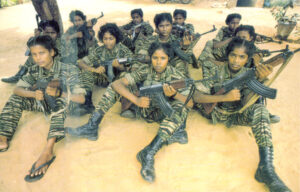
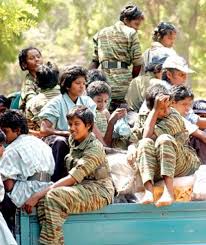
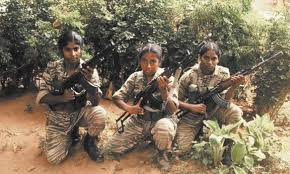
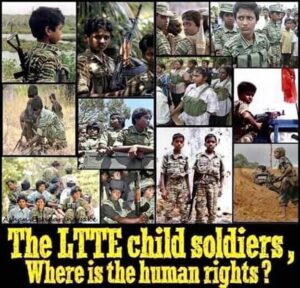
Children as young as 7 years were taken as child soldiers – how many such children met their sad death is also not known.
The elderly were also handed guns & ordered to shoot – how many such died engaging in hostilities is also unknown.
However, none of these deaths qualify as civilian deaths if they were engaged in hostilities.
LTTE violated Principle of Murder (Rule 89)
LTTE not only murdered fleeing Tamil civilians, LTTE also murdered injured LTTE combatants
LTTE violated Principle of Torture, Inhuman treatment (Rule 90)
The manner that children & elderly were forced to take up arms and fight has to be condemned as an act of torture and inhuman treatment and degradation. Why is the UNHRC and international community silent about this?
LTTE violated Principle of Corporal Punishment (Rule 91)
How many LTTE combatants, child soldiers did LTTE punish for not following orders and injuring them for life?
Why doesn’t the UNHRC investigate into this?
Principle of mutilation, medical/scientific experiments (Rule 92)
Principle of rape & sexual violence (Rule 93)
There are allegations that LTTE female combatants to sexual misadventure by LTTE male combatants and this has been hushed up without investigation.
LTTE violated Principle of Slavery (Rule 94-95)
LTTE forced combatants to dig the bund that was to protect LTTE from the Sri Lanka Armed Forces. Throughout LTTE rule, whether LTTE combatants were paid or were looked after is unknown.
It’s surprising that the OISL and UNHRC never raised this too.
LTTE violated Principle of Taking hostages /human shields(Rule 96-97)
This was a very clearly violated principle by LTTE having herded almost 300,000 people to be used as hostages and human shields and was the reason for collateral damage of civilian lives. Again why OISL, UNHRC or the international community ignore this important Geneva Convention violation is baffling.
LTTE violated Principle of Enforced Disappearances (Rule 98)
Both LTTE and the Sri Lanka Armed Forces are accused of this violation & require to be investigated with facts and evidence.
LTTE violated Principle of Arbitrary deprivation of liberty (Rule 99)
By denying Tamil civilians their right to seek shelter and safety, LTTE violated this principle. Again why UNHRC and IC are not bothered about these violations is also baffling.
Principle of fair trial (Rule 100-101)
The kangaroo court that the UNHRC is advocating, based on hearsay from LTTE remnants living overseas and parroted by NGO heads on payroll is being used to put a national army on trial without presenting facts & figures with evidence. The People of Sri Lanka stand up in unison against this blatant violation of Customary IHL.
Rule 101 declares that no one can be accused or convicted of a criminal offence or an act of omissionwhich did not constitute a criminal offence under national or international law – therefore, it is wrong for the UNHRC to judge the national army of Sri Lanka on hearsay only.
Rule 102 – declares that no one may be convicted of an offence except on basis of individual criminal responsibility– the allegation of 40,000 killed comes with no proof of names, dead bodies or even skeletons but the UNHRC wants an entire army to be declared war criminals
Rule 103 – declares collective punishment as prohibited
This is exactly what the kangaroo court of UNHRC via its resolutions is aiming at.
Rule 104 – convictions and religious practices of civilians and injured must be respected
LTTE violated Principle of respecting Family Life (Rule 105)
LTTE violated this by kidnapping even children – breaking up homes, denying fundamental rights to education for children, freedom of movement or even peace of mind to Tamils
LTTE violated Principle of Combatants & Prisoners of War (Rule 106-107-108)
Prisoner of War status is only applicable to International Armed Conflicts not NIAC
Rule 106 requires combatants to distinguish themselves from civilians – LTTE violated this fundamental rule. LTTE fought in civilian clothing and LTTE had a civilian trained unit. None of these fighters can claim to be a civilian if shot at.
LTTE violated Principle of wounded, sick, shipwrecked (Rule 109-110-111)
LTTE attacked ships carrying essential items for civilians. LTTE sent its sea tigers to attack such vessels carrying relief. LTTE even sent a suicide bomber to a relief centre accepting IDPs many of whom were elderly and injured.
LTTE violated Principle of evacuating dead (Rule 112-113-114-115-116)
LTTE attempted to destroy evidence of its combatants by blowing them up while living
Enough of LTTE video footage show how inhumanely LTTE treated dead Sri Lanka Army soldiers.
LTTE violated Principle of Missing Persons (Rule 117)
LTTE and LTTE fronts are claiming 40,000 dead/missing but is unable to provide even the names of the supposed dead, or even family members of the supposed dead.
LTTE violated Principle of Depriving Liberty (Rule 118-119-120-121-122-123)
LTTE denied Tamil civilians food, water, clothing, shelter and medical attention. It is mind boggling that the OISL and UNHRC ignore this fact revealed even by the IDPs.
LTTE also denied women their right to liberty by forcefully turning them into fighters
LTTE denied children their right to liberty by turning them into child soldiers and even training them to commit suicide by biting cyanide capsule.
Rule 121 requires Tamil civilians to have been kept separate from the combat zone – LTTE actually herded them as hostages and human shields and denied them basic health & hygiene.
Rule 122 required LTTE to refrain from pillage of personal belongings – LTTE stole house, property and lands of Tamils including writing their deeds in LTTE names. These need proper investigation.
LTTE violated Principle of Non-International Armed Conflict (Rule 124)
ICRC was in the conflict zone throughout and ICRC communiques reveal in detail their role.
But, on many occasions ICRC was not allowed by LTTE to inspect
Rule 125 – persons deprived of liberty allowed to correspond with families – LTTE did not allow such
Rule 126 – An allegation against the Sri Lanka Armed Forces is that civilian IDPs were held in internment camps and not allowed out and did not have access to relations. This was not true and can be proven with facts. The initial stages no one was allowed out until screening process was complete as well as the clearance of land mines etc.
Rule 127– Personal convictions/religious practices respected – the IDP centres all catered for this
Rule 128– No sooner that it was safe for the IDPs to return to their homes, they were released. Within months of the conflict ending, IDPs were able to return to their homes or to relations. World IDPs that run into millions are still to return home!
Rule 129– In a NIAC, the GoSL had every right to put up IDPs in centres to protect them from the conflict until such time alternatives were prepared for their return. The security and safety of the civilians were taking into account
Rule 130– applies to only IAC
Rule 131– The GoSL took every measure to provide the basic facilities to the IDPs and these were inspected by the ICRC and the UN officials arriving. All of them praised the efforts in Sri Lanka but returning to Geneva years later, they tell a different story. Wonder why?
Rule 132– Displaced have a right to voluntary return to homes – this was allowed once land mining was cleared
Rule 133– Property rights of displaced. It is important to note here that simply claiming entitlement to a land area without proof and carrying out media campaigns is not the best way to claim land. But this is the path being opted unfairly.
LTTE violated Principle of Special protection for needs of women (Rule 134)
LTTE used women even grandmothers when fighters were in want. Where’s UNHRC about women’s rights?
LTTE violated Principle of Children entitled to special respect & protection (Rule 135-136-137)
LTTE violated this principle by having an entire unit of child soldiers trained to kill. Where was UNHRC?
LTTE broke Rule 136 in recruiting children – what did UNHRC do about this?
LTTE broke Rule 137 in putting children to engage in hostilities – what did the UN do about this? 1/3 of LTTE comprised child soldiers
LTTE violated Principle of elderly / disabled and infirm given protection (Rule 138)
LTTE violated this Rule by putting the elderly in harms way, not feeding the elderly, not allowing the elderly to leave, and even engaging elderly in armed hostilities.
LTTE violated Principle of Compliance with IHL (Rule 139-140-141-142-143)
LTTE may be a terrorist organization. LTTE may not sign conventions or treaties. But LTTE was bound to comply with international humanitarian laws. LTTE flouted all of these Rules.
It is questionable why Sri Lanka’s legal advisors did not take the violations of IHL and the requirement to be judged by violations of IHL to argue one’s case against the bogus charges being cooked up by NGO’s lobbied by LTTE fronts.
Rule 143 requires teaching of IHL to civilians and this must be included as a special subject in Sri Lanka.
Rule 144 – requires States must not encourage violations of IHL
Rule 145 -146-147 – applicable to IAC
Rule 148 – Parties in a Non-International Armed Conflict cannot resort to belligerent reprisals.
Rule 149 – A State is responsible for violations of IHL whether state or non-state. If a State is responsible, then the State is permitted to take action to ensure IHL is not violated. In so doing, Sri Lanka cannot be found fault with.
Rule 150 – State is responsible for violations of IHL to make full reparations for loss or injury
Rule 151 – Individuals are criminally responsible for war crimes they commit. Therefore the question is why have LTTE combatants not been charged?
Rule 152 – Commanders and other superiors are criminally responsible for war crimes committed pursuant to their orders.This has to be proved with facts & evidence, not on hearsay by LTTE runaways and their NGO heads!
Rule 153 – Commanders & superiors are criminally responsible for war crimes committed by subordinates if they knew, or had reason to know that these were to be committed and no action was taken to prevent such.
Rule 154 – Combatants can disobey a manifestly unlawful order
Rule 155 – Obeying superior order does not relieve subordinate of criminal responsibility if subordinate knew act ordered was unlawful.
Rule 156 – Serious violations of IHL constitute war crimes
Rule 157 – States have right to vest universal jurisdiction in national courts over war crimes
Rule 158 – States must investigate war crimes committed by nationals or armed forces on their territory and prosecute suspects – evidence must prevail
Rule 159 – at end of hostilities authorities must grant broadest possible amnesty in a NIAC – the GoSL gave a presidential pardon to 594 child soldiers of LTTE treating them as victims.
Rule 160 – Statutes of limitation may not apply to war crimes
Rule 161 – States must make every effort to facilitate investigation of war crimes and prosecution of suspects. The problem we have is that we do not wish to have UNHRC create kangaroo courts where the national army are given retributive justice while LTTE terrorists are given restorative justice.
Why does Sri Lanka not demand the UNHRC to present with facts& evidence Sri Lanka’s violations of IHL during the final phase of the conflict instead of meekly accepting the cooked up human rights allegations most of which do not even cover the conflict but are seeking war crimes charges quoting the final phase of the conflict.
Sri
Lankan Catholics, led by His Eminence Malcom Cardinal Ranjith, Bishop of
Colombo, marked Black Sunday on March 7, with the participation of
representatives from Buddhist, Hindu, Christian and Muslim religious
communities, demanding justice for the victims of the Easter Sunday suicide
bomb attacks carried out by local Islamist Jihadists two years ago. The
Archbishop threatened further activism including asking for international help
unless there emerge sure signs before April 21 that the real masterminds behind
the horrendous crime are clearly identified and duly punished so that no
repetition of the like will occur in the future. The event was immediately
provoked by what was perceived by them and members of the opposition as well as
some law-makers of the ruling alliance, and sections of the civil society, as
foot-dragging by the government over punishing the guilty.
That
questionable perception was prompted by the president’s appointment on February
19 of a six-member ministerial committee to study the Final Report of the
Presidential Commission of Inquiry into Easter Sunday Attacks which had been
presented to him nearly three weeks before, and also the report submitted
to parliament by the Sectoral Oversight Committee on National Security, which
was also appointed by the previous government in the wake of the April 21, 2019
suicide bomb attacks. The SOC report, after about one year’s sittings, was
presented to the yahapalana parliament in February, 2020, just eleven
days ahead of the dissolution of parliament. Its recommendations were also
meant to prevent the recurrence of extremist violence.
I,
for one, do not question the appropriateness of the president’s move; it must
be part of the proper procedure he has chosen to deal with the matter.
Considering the dismal history of commissions of inquiry in our country, which
a past left politician in parliament once likened to a ‘loo visit’ – sitting,
deliberating, reporting and dropping the matter- , what is at present happening
under President Gotabaya is quite efficient and quick. Significant initial
progress has already been made under the new administration although people are
not still aware of it. Those who are waiting to fault the government on the
slightest pretext jumped to conclusions when it was revealed that 22 out of the
87 books (with a total of 69,770 pages according to Minister Wimal Weerawansa)
each of an average length of 800 pages were being withheld for security
reasons. True, this was something unexpected. The alleged decision to keep the
information contained in the 22 books even from the attorney general sounded
absurd, but most probably it was a temporary decision. Generally though, as
Minister Udaya Gammanpila explained in a separate context, certain confidential
pieces of information provided to the Commission by private witnesses, such as
what some Muslim women told it in camera about their husbands’ criminal
dealings with Islamic terrorists, have to be kept under wraps for the safety of
those individuals. Such unavoidable censorship will not prevent that
information from being made available for the prosecutors when the hearings
against the suspects actually start. Anti-government detractors, especially the
members of the yahapalana regime who intentionally or unintentionally
facilitated the April 21 attacks, are doing their damnedest to propagate the
false claim that this (probably temporary) secrecy imposed on a part of the
information recorded by the PCoI is meant to conceal the present government’s
culpability. Nothing could be further from the truth. It is utterly wrong to
suggest that the Easter Sunday attacks alone overwhelmingly contributed to
Gotabaya’s election or the success of the SLPP at the subsequent parliamentary
polls, for the SLPP swept the island-wide local government elections in
February 2018, that is, more than a year before the Islamist terror attacks.
The
ministerial committee is required to hand over its report on or before March
15. Committee member Minister Prasanna Ranatunga said yesterday (March 8) that
the report will be submitted on March 15, as scheduled. The PCoI was appointed
by (previous) president Sirisena in September, 2019, and its term was extended
several times by incumbent president Gotabaya without introducing any change to
the composition of its membership. In fact, the president was reported to have
personally asked the Cardinal whether he would like to see the composition of
the committee changed; the latter had answered in the negative. It is not
likely that the unacceptable practice of interfering with the judiciary or in
due legal processes for which the previous yahapalanaya was severely criticised
and was made to pay a heavy price in the form of a humiliating electoral defeat
would be repeated by the present government, least of all by Gotabaya, given
his immaculate professional record and his impeccable personal probity.
(Incidentally, something I frequently observed in Gotabaya’s campaign speeches
in Sinhala was his studied avoidance of noncommittal promissory statements
containing {First Person Singular} verbs ending in the suffix -nnam, e.g.,
karannam {I shall/will do}; he always used the present affirmative forms like
‘mama karanawa’ ‘I do’ instead of the future optative ‘karannam’ {I’ll do}
form; ‘karanawa’ expresses a solemn pledge, not a casual promise.
Gotabaya has already amply proved that he is a man of his word, just as much as
he is a man of action.) Meanwhile it is unlikely that the Cardinal has lost his
trust in the president, who had repeatedly reassured him that the culprits
won’t be allowed to go free, though the former has found it fit to observe a
Black Sunday. That must be to provide a shot in the arm for the president and
the government to reaffirm their commitment and renew their resolve for
expediting the commencement of due processes for ultimately meting out justice
to all affected persons; but that kind of coaxing is redundant, in my
opinion.
A
day before the Black Sunday was marked (i.e., Saturday 6), the president held
the 13th session of his ‘Gama Samaga Pilisandara’ ‘Conversation with the
Country’ programme with the people of the village of Giribawe, Weragala, in
Kurunegala. He had a copy of the Final Report (probably, a summary, still
massive) and spoke turning its pages, which showed that he had a good idea of
its contents. He explained to the people that he got the report on February 1,
and that the commission was appointed by the previous president. President
Gotabaya pointed out that the Report clearly blames the attacks on the
(Yahapalana) government. It identifies governmental inefficiency as the
principal contributory factor that led to the Easter Sunday attacks. He
stressed the fact that the Report apportions blame not only to former president
Sirisena and the ex-premier (Ranil), but also to the ‘rajaya’ or the government
(that they headed). President Gotabaya laid emphasis on the word ‘rajaya’ (government)
from the Report in this context.
‘But
today’, he added, ‘those who were in that government speak as if they weren’t
in it. During president Mahinda Rajapaksa’s time, we gave priority to state
security……This report makes it abundantly clear that a situation like this
resulted from the discontinuance of that security framework. We completely
reject the absurd, baseless allegation that our government must be held
responsible for the Easter attacks……The Report has recorded who is
accountable for them. It is, however, our responsibility to see them punished,
because we are the government now. We will properly execute that (duty). We
have not only this report, but also (reports from) the CID, the TID, and
intelligence sectors. Since we came to power, we have apprehended many other
new suspects. We are continuing (with this process). Punishments will be meted
out to these people and those..’
My
feeling, for what it is worth, is that the president and the government must be
allowed time and freedom to deal with the burning issues in the current
unprecedentedly critical circumstances. A local, Sri Lanka bashing,
propagandist tabloid has started calling the president ‘Nandasena’ (from his
full name ‘Gotabaya Nandasena Rajapaksa’). This is clearly meant to be
derogatory, for it acoustically links him with his failed predecessor Sirisena,
who in actuality, through his ungrateful 2014-November betrayal of his elder
brother the then president Mahinda, has brought endless disaster to the
country. Such inimical portrayal of president Gotabaya as a failure is wrong.
(It is tragic that some prominent monks who helped bring Gotabaya to power,
have now been duped to look away from him in apparent disillusion and defend
Sirisena instead who is being justly threatened with possible prosecution in
connection with the Easter attacks). With a little hindsight Gotabaya
supporters may draw fresh inspiration.
The
newly elected President Gotabaya Rajapaksa handled with aplomb the sham kidnap
episode which had been staged courtesy the Swiss embassy in Colombo on November
25, 2019 and which had certainly been meant to embarrass and undermine him
internationally. The alleged abduction and rape of a local female employee of
the embassy by the unusual name of Gania Banister Francis was soon revealed by
the police to have been a gimmick set up by some anti-Sri Lanka-politics driven
hirelings. Having been elected president without a burdensome backpack of a
professional political background, he was able to adopt a confident, unperturbed,
and matter-of-fact approach to get at the truth, and suitably dispose of the
filthy stuff. The naive embassy officials who had been knowingly or unknowingly
taken for a ride by the plotters of the prank had egg on their faces; but the
president treated them with the respect and dignity that their posts deserved,
without any rancour. He even offered them a piece of friendly advice about the
importance of guarding against being misled by fabrications of liars against
the country (or something to that effect).
Currently
a worse, more damaging, drama is being acted out by the powers that be
centering on the release of the Final Report of the Presidential Commission of
Inquiry on the Easter Sunday Attacks. This must be intended to bamboozle the
SLPP government under Gotabaya’s presidency to veer off its course into
floundering in the stormy seas of geopolitics. This time however, the issue
that is to be tackled is not so straightforward as the silly embassy skit. It
will need Gotabaya’s hard-nosed practical approach as well as a seasoned
politician’s pragmatism. Unfortunately, according to my lights, at present,
Gotabaya is not getting the undivided support of those who are closest to him,
but who are apparently pulling in different directions, though their loyalty
may be unquestioned; this is an unacknowledged dichotomy in the
government’s inner circle, which is good for his and the country’s enemies.
This must be remedied immediately.
This
unnecessary division of opinion or lack of unanimity has significantly stymied
the resolution of a range of issues including the trivial burial problem
fraudulently blown into international proportions by Jihadist apologists and
others illdisposed towards the country and the present government. How the
government ignominiously embarrassed itself through needlessly bungling the
issue is now common knowledge. Mandatory cremation of Covid-19 dead was a sound
scientific decision. It was just yesterday (March 8) that 9NEWS, the
national news service of the Nine Network in Australia, reported Deputy Chief
Health Officer Dr Chris Lease revealing at a press conference held the day
before (March 7) that a ‘very strong positive’ COVID-19 sample had been
detected in Adelaide’s wastewater and that in response to this South Australia
had been put on coronavirus alert. Doesn’t this suggest that Sri Lankan
experts’ initial caution regarding possible contamination of groundwater was
correct and still remains valid? Mandatory cremation (condemned as ‘forced
cremation’ by vested interests) was not politically motivated to hurt the
feelings of a particular religious community.
The
ad hoc use of plots of land on the edge of environmentally sensitive forest
reserves for rural poverty alleviation in these hard times is a process that must
be strictly supervised by state officials and utilized by a properly informed,
responsible civilian population with the least environmental impact. This need
not be a basis for attacks on the government. Of course, it is absolutely
necessary to protect the forest reserves from endless encroachments in the
future by unscrupulous elements. It is the authorities’ responsibility to turn
the local beneficiaries of the concession into committed environment
protectors. This can be done by injecting into them a dose of patriotism.
Issues relating to the development of important sea ports with or without
foreign collaboration, and the findings and recommendations of various
commissions of inquiry appointed to look into bank scams, political
victimizations, and the Easter Sunday attacks of April 21, 2019, etc., should
be dealt with as national issues that should not be politicised or mishandled
inviting detrimental foreign intervention in our domestic
affairs.
Sarath Wijesinghe President’s counsel, former Ambassador to UAE and Israel, President Ambassador’s forum
Covid 19 spreads worldwide as a world wildfire
Covid19 is spreading worldwide affecting billions as a major pandemic changing the world drastically with the slowdown in economies, developments, living conditions, and all kinds of day to day and permanent lifestyles of all with downturns in all areas in life with drastic effects and limited solutions. Lot is discussed on the origin and the current situation monitored by WHO as the leader and guide to the world in monitoring and providing information to governments and the public. Governments are shaken and giving top priority to the pandemics that have taken hundreds of millions of lives of world citizens worldwide. The death toll is large and fluctuating at an alarming rate in rich-poor and powerful nation’s mercilessly taking lives of world citizens at the wish and will of the pandemic dragon spreading tentacles worldwide through boarder in various ways despite protective measures adopted. The virus is spreading faster with variants adapting to different environments. Citizen is advised to take precautions by WHO and governments taking measures for new vaccines for protection and end the disaster with little or no side effects. There are now several vaccines in use.175.3 million have been administered with 7 different kinds of vaccines approved by WHO and respective governments. Oxford, Pfizer, and vaccines created by Russia, China, India, the USA, UK and other member nations are being introduced and tested still in formative stages. It looks as the vaccine is working in the UK based on information received on deaths reduced number of patients but it takes time to find the side effects and complications. There is a change in Sri Lanka too on vaccination and we look forward to it for a speedy recovery of our economy and lifestyle. In many countries including the USA vaccine has answered with slow progress depending on the conduct of the citizen. The vaccine alone is not the answer that all guidelines need to be followed continually. It is proved that the best is to be careful and follow the guidelines of the WHO and Sri Lanka health guidelines. No permanent solution is nearby and the world is living on hopes subject to experiments for a new world with horrifying unprecedented deaths all over the world. It is proved that the strategy should be worldwide and not in isolation confined to countries as the pandemic spreads fast due to developed world with modern physical movements and complicated interconnected lifestyle. It is a world affair and the treatment should be worldwide and simultaneous. Time has come to make life simple, plain and properly programmed, and to be broad not being selfish. Covid 19 has taught bitter but lifelong lessons to be civic conscious and magnanimous towards the world, and what is permanent in the world is sheer impermanence as Lord Buddha has taught.
Pandemic has changed the world
Pandemic has changed the world and life style to work home and embrace
digitalization out of compulsion in all areas of life including education where
students in rural areas students climbed water tanks for WIFI and villager used
what’s app to pay bills with the help of young students in the family using the
mobiles of 110% penetration and computer centres in every corner. Families have
come closer due to compulsion to be indoors, new ideas and innovations are
emerging to meet challenges. Despite the disaster there is a silver lining
emerging to be innovative, digitalize and modern to keep the pace with the
changing world. Life is changing all over. Transport is less and telecomm
nation is used in advanced modes as in modern innovating nations telecomm
nation is giving top priority. We were on the door steps on digitalization and
now fast entering into the era of digitisation out of compulsion. Education
Health, Economy, agriculture, will be modern and revolutionized. There will be
international platforms on trade and commerce with modern and international
trends and expenses on date will be curtained due to competition. These things
are happening and the citizen/consumer appear to be adoptable and intelligent
to embrace changes.
Vaccine Diplomacy/Diplomacy/Priority is Pandemic and not Geneva
Diplomacy is influencing the decisions of the foreign governments by
peaceful means short of war and disputes. On diplomatic means sovereign states
settle disputes by dialogue negotiations discussions and other measures short
of violence. Modern diplomacy emerged from Europe in the 20 th century, with the
emergence of league of Nations as a world group and United Nations with the UN
Convention. It involves summoning meetings conferences which also deals with
international relations. Diplomacy deals with and among sovereign countries and
main outlets known as Embassies in countries with diplomatic relations. Sri
Lanka maintains Missions worldwide
expecting to promote the image of the Nation and to promote business and trade
as now counties are giving priority to Economic Diplomacy. Whether Sri Lanka
have quality and committed diplomats capable of promoting the image and trade
and business is a moot issue considering the quality of diplomats compared to
the counterparts. Ambassadors must be skilled in diplomacy, language, and
friendly and human behaviour to deal with expert diplomats in other counters.
Geneva a group of misguided nations are finding fault of few countries on
violations of human rights which are outdated and not practical. It is time for
the world to be united and work together to eradicate pandemic and emerge
victorious in the interest of the needy human worldwide undergoing sufferings.
Danger and fear on the pandemic is the best play ground for the eradication of
the dangerous pandemic dragon for ever.
Diplomacy and International relations in Sri Lanka and Asia
International relations and diplomacy in Sri Lanka and Asia runs back to
247 AD when King Asoka a Myrun” Emperor sent his son Arath Mahinda” and
daughter Mahni Sangamitta” to Sri Lanka as Emissaries of the King and India
to his unseen close friend with the message of Lord Buddha to propagate Buddhism in Sri Lanka when connections
reactivated after the era of Rama and Ravana five thousands of years ago. Friendship with Sri Lanka and
India continued with some stormy periods of Chola” and Pandi” invasions.
Relations with India was on the peak during Madam Bandaraneike which deteriorated
during JR Jayawardena era with disputes with Rajive on 13th
Amendment but the bond with two countries are ever cemented with the bond of
Buddhism originated in India. India is firm on towards India Policy” and the
disputed issues on economic front were brewing on Oil farm, Port, Harbour, Trincomalee
harbour, Chinese influence, 13th Amendment, Geneva Process and many
similar matters to be settled by diplomatic means. India promptly offered
vaccine to Sri Lanka as a friendly gesture when both countries are in
difficulties. Sri Lanka was ever grateful for the great gesture and the prompt
steps taken by India by giving the vaccines when Sri Lanka needed it badly and
results are now showing with reduced number of cases. It was timely and showed
the advanced stages of diplomatic skills of the world famous Indian diplomacy
which has won the world over. All the leading nations and the world community
is together in helping the world In USA US aid is in the forefront in helping
the world where as Russia has developed a vaccine and planning to offer to the
less fortunate countries economically. China has offered 20.5 billion dollars
and engaged in research to invent a vaccine to compete the pandemic. We expect
the diplomacy to flourish worldwide until the pandemic is eradicated.
Way forward in the new World Order
It may be that we may be in a new world full of kindness, passion,
loving kindness having realized the impermanent nature of the life and the
suffering of the patients and the loved ones. Whole world lives on hopes and
full of uncertainty on the future with less hopes of a permanent solution at
sight with full of predictions and promises. Entire world is in a mess and in
the verge if destruction due to massive environmental destructions and
disasters which has led to Covid 19 to this magnitude. Powerful rich countries
are the most hit due to excessive developments and leading an artificial life
unlike in less developed and powerful countries living with nature. Impact in
Sri Lanka is less as they live with nature with and eating hot spices. It is
time for the world to give priority to environment and live with nature with
environment friendly environment. It is also time for the leading powers to
unite to eradicate the pandemic helping the small nations and learning from their
traditional therapies which appear to be effective. Vaccine diplomacy will help
to create a new world order with friendly nations helping each other creating
natural immune systems in the natural environment. Disastrous multinational
food chains to be terminated in place of healthy food devoid junk and cola
worldwide especially among the rich/ children /students, mainly in the west.
Worldwide campaign for environmental protection and healthy food should be
given priority with uniformity worldwide. Agriculture to be streamlined with
new healthy and human friendly seeds vegetable and fruits with agreements with
the rich as well as poor large as well as small. Living with nature and give
priority to native and local is advisable for a long-term stable solution to
the disastrous pandemic we are surround with. Vaccine diplomacy will lead to
traditional diplomacy bonding the nations with goodwill love and cooperation on
political and economic frontiers leading for a post pandemic happy era soon. Living
with environment and protection of environment is paramount for a long lasting
solution for pandemic dragon.Sarath7@hotmail.co.uk
On 25th of February 2021 ‘’Ceylon Daily
News’’ published following news item;
‘’An ancient Ola leaf original copy of the Mahavamsa”
(Great Chronicle) currently kept at the library of the University of Peradeniya
is to be declared as a UNESCO World Heritage. The decision has been reached by
UNESCO experts upon verifying that all sections of the Mahavamsa” (the written
history of ancient Sri Lanka) were correctly conserved at the University
Library, Prof. Upul Dissanayake, Vice Chancellor of the Peradeniya University
told the media yesterday.’’ (https://dailynews.lk/2021/02/25/local/242520/ola-leaf-mahavamsa-be-declared-world-heritage)
According to same news item representatives of UNESCO have
inspected other Mahavamsa” palm-leaf books located at various places in the
country, but due to their shortcomings, they were deemed not eligible for World
Heritage status.
Mahavamsa” or “The Great Chronicle” is the
documented history of the great dynasty of Sri Lanka in general and Sinhalese
Buddhist in particular. This important work of Lankan origin is believed to have been written by Bhikku Mahanama in Pali language describes the life and times
of the people who forged Sri Lankan nation, from the coming of Vijaya in 543
BCE to the reign of King Mahasena (334 – 361) (6th Century BC to 4th Century
AD).
If not for the discovery of this great chronical by an
Englishman born in Ceylon the history of Sri Lanka would have taken a different
turn. He is the Hon. George Turnour. His
father George Turnour (Snr) landed in Ceylon in 1783 with 73rd
Regiment and in 1795, he was appointed Fort Adjutant of the Jaffna
Fort and later made Commandant of the Mannar Fort in
1797. He married Emilie de Beaussett, niece of Cardinal Duc de Beaussett. Born
in Ceylon on 11 March 1799, George Turnour Jnr was the eldest of six
siblings, he had one younger brother Edward Archer and four Sisters Anne Emily,
Frances, Elizabeth and Jane. Having
shown knack for academic enrichment, he was sent to England for education under
the patronage of Sir Thomas Maitland in 1811.
He returned in 1820. During this era most educated, talented
young men were drawn into the Colonial Service. Their principal objective was
the betterment of mankind in general, and not personal prosperity. Young George
Turnour was one of them and he joined the Ceylon Civil Service (CCS) as an
Assistant to the Commissioner of Revenue. Subsequently he was made
Assistant to the Chief Secretary. In 1822 he was appointed the Collector
of Kalutara thereafter he was appointed Government Agent
(GA) of Sabaragamuwa Province in 1825.
He noticed a strange document lay on his table not connected
with his routine duties as GA of the Province. This was an ola leaf manuscript
(palm-leaf manuscripts) brought by his friend Galle, a Buddhist monk. (Most
probably he was called Galle because he was a monk from ‘Mulikirigalla’). Galle
realised that the GA who was fairly knowledgeable in Sinhala language and a
talented man interested in history. They
had many discussions about the country’s history. As a result Turnour ’s
interest was aroused. Galle searched for ancient manuscript of history at many
Buddhist temples and finally found Tikā or commentary on the Mahāvaṁsa at
Mulikirigalla Rajamaha Vihara, near Tangalle. This was a temple founded one
hundred and fifty years before the birth of Christ.
Unfortunately the manuscript was written in ‘’Pali.’’
Although fluent in the Sinhalese vernacular, with a considerable knowledge of
Sinhalese script, Turnour knew nothing of Pali; an extinct language at that
time. But his friend Galle was there to help him. Galle contacted many Buddhist
monks who had scant knowledge of Pali language and helped his friend with
research. It took nearly 10 years to research and translate the chronical of
Sri Lanka ‘’Mahawansa’’ to English language while carrying out his official
duties. That was in the year 1837. However based on his study of the Mahawamsa
and other materials, Turnour published an article titled ‘Epitome of the
History of Ceylon’ in the Ceylon Almanac in 1833. In this
article he listed down the succession and genealogy of 165 Kings from the
arrival of Vijaya to the British. James Emerson Tennent who became the Colonial
secretary of Ceylon referring to the article said in this work, after infinite
labour, he (Turnour) succeeded in condensing the events of each reign,
commemorating the founders of the chief cities, and noting the erection of the
great temples and Buddhist monuments, and the construction of some of the reservoirs…he
thus effectually demonstrated the misconceptions of those who previously
believed the literature of Ceylon to be destitute of historic materials”.
The existence of an historical record called the Mahavansa,
or Great Dynasty, was known to a handful of Buddhist priests before translated
into English language. Since then many local and foreign scholars became
interested in the history of Ceylon. As a result many other ancient written
historical documents were discovered such as Deepawansa, Chulawansa, Atthakata
etc.
It is interesting to note some of the views expressed by
European scholars, prior to the 1830s, Robert Percival in his book in 1803
stated the wild stories current among the natives throw no light
whatever on the ancient history of the island. The earliest period which we can
look for any authentic information is the arrival of the Portuguese under
Almeida in 1505” and John Davy in his book in 1821 mentions the
Singhalese possess no accurate record of events; are ignorant of genuine
history, and are not sufficiently advanced to relish it”. (Quoted from ‘’Archaeological
Milestones in Sri Lanka: Part 01’’ by Chryshane Mendis)
If not for the efforts of George Turnour one of the oldest continuously recorded
chronicles in the world covering a period of over twenty three centuries like
Mahawamsa would have lost and the history of ‘’Sinhalese Buddhists’’ all but
forgotten.
George Turnour was appointed as Assistant Colonial Secretary
and was appointed Treasurer in 1841. Due to ill health he retired early and
returned to England and set out to Italy where he died in Naples on the 10
April 1843 aged 44 years.
This great scholar and historian was elected an honorary
member of the Royal Asiatic Society of Great Britten and Ireland. Following his
death, a fund was raised which erected a tablet at St. Pauls Church, Kandy. The
remaining funds were used to start the Turnour Prize at the Royal College,
Colombo.
Established in 1846, Turnour Prize was the
oldest of the panel prizes of the oldest public school of Sri Lanka, Royal College Colombo. It is one of the
most prestigious prizes and honour awarded to a student of the school. First
awarded to Charles Ambrose Lorensz (1846)
there are over 150 students who received this award on merit. All most all of
them became eminent personalities who made enormous contribution to the
progress of Sri Lanka and mankind.
Turnour Prize was dedicated to the historian George Tunour who surfaced the history
of Sri Lanka which was called ‘Tambapanni’, ‘Ratnadeepa’, ‘Dharmadeepa’,
‘Sinhale’, ‘Taprobane’, ‘Serandib’, ‘Zelan’, ‘Çeylon’ and many other names by
the inhabitants, visitors, travellers and conquerors. Finally his discovery has
been recognised as a ‘’World Heritage’’
George Tunour’s 222nd
birth anniversary falls on 11th March 2021.
I take pleasure in greeting all those celebrating the
Maha Sivarathri Festival in Sri Lanka and World over a blessed day.
Hindu devotees in Sri Lanka have a long tradition of
living in harmony with all ethnic groups. Devotees of the Hindu faith will fast
on the day of the festival as they believe that spiritual liberation will
manifest through the fast.
They believe that fasting and engaging in holy rituals
will lead to enriching their spiritual lives. They believe that observing a
pure and holy fast will bless them with the spiritual strength of God.
I trust that the pure and holy fast of the Hindu
devotees world over will be blessed by Lord Shiva and that all that is good and
pure will come to pass.
May all the hopes of a prosperous future be fulfilled
by the light of the lamps lit on the day of Maha Shivarathri.
May Maha Shivarathri be a meaningful and joyous day
for all those celebrating in Sri Lanka and around the world!
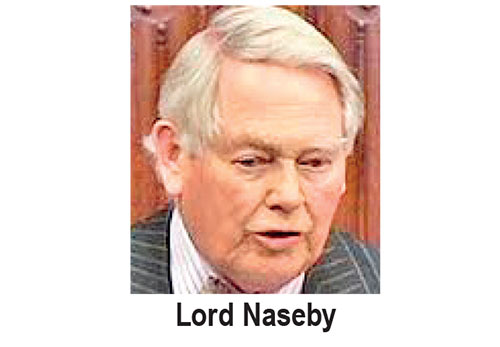
Lord Naseby yesterday (9) said that in spite of the Core Group’s resolution being further watered down, the possibility of the government of Sri Lanka accepting it was unlikely.
The Island raised the issue at hand with Lord Naseby, who unconditionally threw his weight behind Sri Lanka’s efforts to counter unsubstantiated war crimes accusations.
Q: Having made invaluable representations to UNHRC on behalf of Sri Lanka, at the current session too, what would you think is advantageous to Sri Lanka (a) to go with the Core Group resolution or (b) seek a vote whatever the consequences?
A: It appears as far as I can see the Core Group resolution is slowly being amended and may yet be amended further before March 22 so I cannot give a definitive Yes or No now however it seems unlikely it will be acceptable to Sri Lanka. If this turns out to be the case then I personally would support a vote.
(Q) Many Sri Lankans believe successive governments conveniently failed to exploit Oct 2017 disclosure made by you in the House of Lords.
Do you believe your disclosures, statements as well as statements made by US Defence Advisor Lt. Col. Smith in June 2011 and Wikileaks revelations could have been used in a much better way by GoSL?
(A) I think the previous Government missed a trick in not exploiting all the evidence that clearly refuted the allegations in the Darusman & OISL reports. I think the present Government faces so many challenges e.g. pandemic, financial challenges plus Geneva plus a devious UK who never supplied the Gash dispatches to the UNHRC plus a constant barrage from the Diaspora all in a short time frame that I do not criticise them. In fact the actions to revitalise the Missing Person Commission & the Reparations Commission are both really positive.
(Q) Are you disappointed with the way Sri Lanka’s defence continued to be handled?
(A) Remember my role is to try to help the people of Sri Lanka.
Well informed sources said that the government was under heavy pressure to accept the Core Group’s resolution with India being asked by the government to back Sri Lanka whereas the TNA insisted on New Delhi’s support.
Rs 3.72 billion worth of pepper imported between 2015 and 2019
Investigations were underway to ascertain information about a nexus between spice traders and the Easter Sunday terrorists, Trade Minister Bandula Gunawardena told Parliament yesterday.
Minister Gunawardena said so in response to a question by SLPP MP Mohamed Muzammil, who said that one of the leading sponsors of the Zahran Hashim’s group that executed the Easter Sunday terror attacks was Mohamed Yusuf Ibrahim, who had been a JVP national list candidate for parliamentary elections. Ibrahim’s sons were involved in the attacks and there had been a nexus between spice traders and Muslim extremist groups. Ibrahim was one of the wealthiest pepper exporters. The funds earned through pepper exporting were channeled for the terrorist activities.”
Minister Gunawardena said that investigations were underway to uncover more details about the nexus between pepper exporters and terrorists.
Minister Gunawardena said that between the years 2015 and 2019 the highest amount of pepper had been imported to the country by various businessmen at the expense of the local pepper cultivators. The total amount was five million kilos at a cost of Rs. 3.72 billion.
President Gotabaya Rajapaksa had stopped importing pepper. Today, the pepper farmers sell a kilo of pepper at Rs 600-800 a kilo,” the Minister said.
The Attorney General (AG) has directed the Inspector-General of Police to investigate five suspects whose names were disclosed by the report of the Presidential Commission of Inquiry (PCoI) which looked into the Easter Sunday terror attacks.
Accordingly, probes will be carried out into Abu Hind, Lukman Thalib, Lukman Thalib Ahmed alias Abu Abdulla, Rimzan and Mahendran Pulasthini alias Sara Jasmine who were named in the 17th chapter in the report.
In a statement issued today (March 10), AG’s Coordinating Officer State Counsel Nishara Jayaratne said a special team of 12 legal officers of the Attorney General’s Department has been assigned to study the recordings of evidence in the PCoI report.
The Attorney General, on March 08, has called on His Eminence Malcolm Cardinal Ranjith to brief him about the progress of the legal matters and investigations pertaining to the carnage.
During the meeting, the Attorney General has stressed the importance and the need to study all evidence recorded by the Presidential Commission during its proceedings.
Pointing out that the PCoI’s final report was focused on the individuals who failed to prevent the attacks, the Attorney General has noted that it is paramount to study all recordings of evidence as the report does not reveal concrete information about the real ‘masterminds’, conspirators and individuals who directly and indirectly aided and abetted the blasts, the coordinating officer said further.
She assured that all individuals who are accountable for the attacks will be brought to book.
In the meantime, investigations of the Criminal Investigation Department (CID) must be completed and all evidence recorded by the PCoI must be studied by the Attorney General before serving indictments against all those who were responsible for the dastardly act, State Counsel Jayaratne added.
A total of 676 individuals have been arrested in connection with the 2019 Easter Sunday terror attacks, Minister of Public Security Rear Admiral Sarath Weerasekera stated.
Among the arrested, 202 have been imprisoned and another 66 persons are currently being interrogated under detention, he said.
The Minister mentioned this speaking at the debate on the report of the Presidential Commission of Inquiry on the Easter attacks, at the parliament today (10).
Meanwhile, Sri Lankan intelligence had uncovered information in early 2020 regarding a female unit trained under the suicide bomber named Zahran Hashim, Weerasekera added.
The seventeen women who had been trained under Zahran had taken the ‘Bayat’ oath [oath of allegiance], the Minister said.
Five of them had died and another three have been charged and imprisoned, he added.
Another seven of them are currently detained and being investigated, the Minister said.
Sri Lanka has reported 04 more coronavirus-related deaths, the Director-General of Health Services confirmed today (March 10).
As per the Department of Government Information, one female patient and three male patients are among the victims.
The new deaths bring the number of COVID-19 related deaths witnessed in Sri Lanka to 515 in total.
01. The deceased is a 74-year-old male resident from Colombo 14. He died on 08.03.2021 at his residence and the cause of death is mentioned as Covid-19 pneumonia.
02. The deceased is a 57-year-old male resident from Colombo 09. He died on 08.03.2021 on admission to the General Hospital Colombo. The cause of death is mentioned as Covid-19 pneumonia and acute diabetes.
03. The deceased is a 23-year-old male resident from Alawathugoda. He died on 08.03.2021 while undergoing treatments at National Hospital Kandy. The cause of death is mentioned as Covid-19 pneumonia and acute blood poisoning.
04. The deceased is a 77-year-old female resident from Nugegoda. She was diagnosed as infected with Covid-19 while undergoing treatments at Colombo South Teaching Hospital and transferred to Base Hospital Pimbura where she died on 10.03.2021. The cause of death is mentioned as Covid-19 pneumonia and blood poisoning.
A five-member judge bench of the Supreme Court has been appointed by the Chief Justice to take up a petition challenging the 20th Amendment to the Constitution.
Supreme Court Justices Gamini Amarasekara, Yasantha Kodagoda, A.H.M.D. Nawaz, Kumudini Wickremesinghe and Shiran Gunaratne will accordingly serve as the members of the bench.
The relevant petition, filed by public interest litigation activist Attorney-at-Law Nagananda Kodituwakku, has been fixed for support on the 12th of March.
Through his petition, Kodituwakku had stressed that the manner in which the 20th constitutional amendment was passed is against the law and that it has jeopardized the sovereignty of the judiciary.
Second and third readings of the 20th Amendment to the Constitution were passed with amendments with a two-thirds majority in October 22, 2020.
The Attorney General has directed the Inspector General of Police (IGP) to conduct investigations in the import of several swords, daggers, and other such weapons into the country.
This was in relation to the Writ Application filed by His Eminence Cardinal Malcolm Ranjith, stated the Coordinating Officer of the Attorney General, State Counsel Nishara Jayaratne.
Accordingly, Attorney General Dappula de Livera has issued the following instructions to the IGP C. D. Wickramaratne:
I. To apprehend the large consignments of swords, daggers, and similar weapons imported during, before, and after the 2019 Easter Sunday terror attacks ii. To identify the places where those weapons may be kept, stored, or concealed iii. To arrest and take legal action against those who possessed, distributed, and/or imported these weapons
The IGP has been further instructed to submit a complete report on the aforementioned action to the Attorney General before March 26.
When the petition filed by the Archbishop of Colombo seeking an impartial investigation into the import of a large consignment of swords following the Easter Sunday terror attacks, the Court of Appeal, on March 05, directed the Attorney General to present submissions on probes into the incident in consultation with the IGP and the Defence Secretary.
The Colombo High Court issues warrant on former MP Hirunika Premachandra for not appearing before courts over the case on the abduction of a youth in 2015.
A 35-year-old man was abducted in 2015 at Baseline Road area in Dematagoda and assaulted by a group of individuals who had arrived in a Land Rover Defender which was allegedly owned by Premachandra.
The victim who was identified as a resident of Kolonnawa had been abducted on December 21, 2015.
Nine including Premachandra were charged over the abduction. However, the suspects excluding the former parliamentarian later admitted before the Colombo High Court to abducting the youth. They were sentenced to 2 years rigorous imprisonment suspended for 12 years by the Colombo High Court.
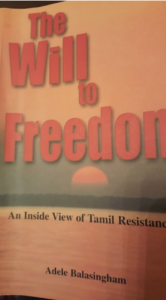
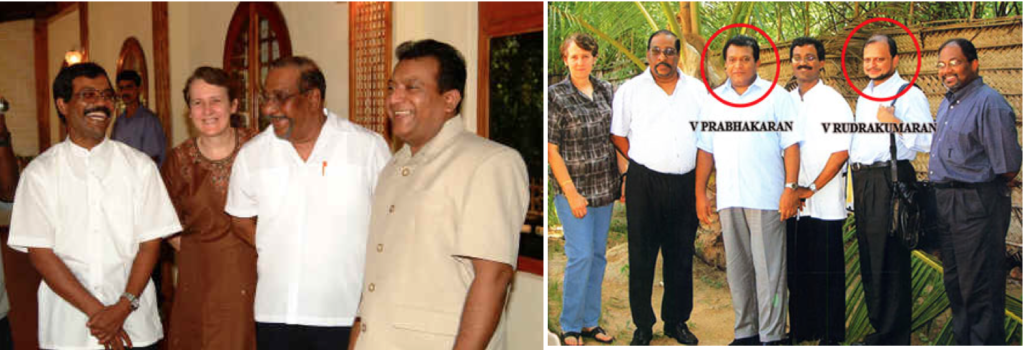
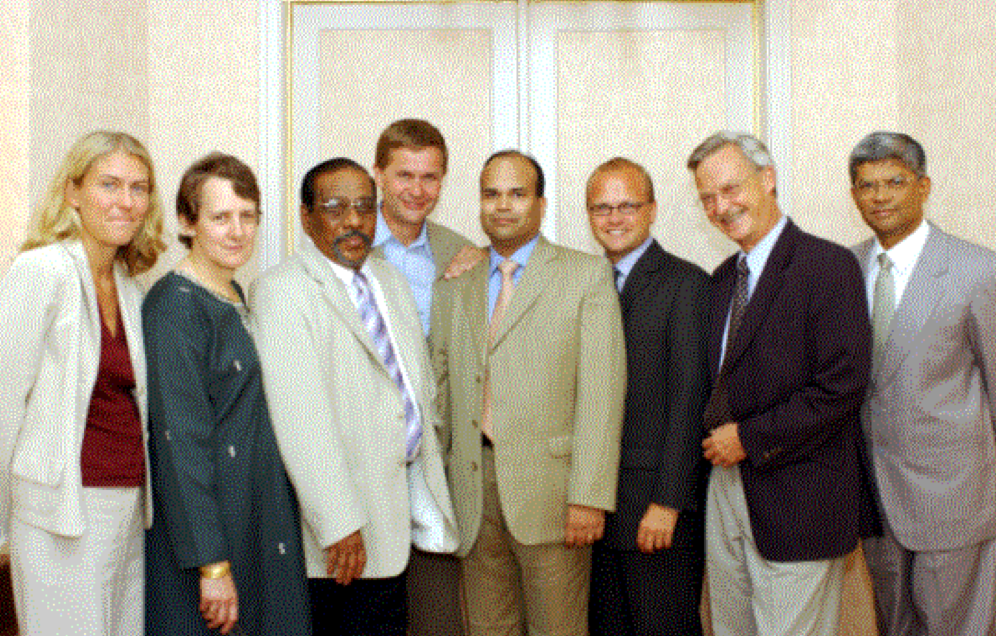
How come LTTE terrorist Aunty Adele is more important to the UK than Lord Naseby?
Lord Naseby has asked a very pertinent question – why is UK not prosecuting Adele Balasingham for child soldier recruitment. The UK is not answering him? This is the same UK Government drafting resolutions against Sri Lanka for war crimes, but the UK Government sees fit to provide safe haven to a woman who denied children their right to be a child, their right to be with their families, their right to education, their right to freedom of movement & their right to life. Are these not pretty serious charges. The irony of it is that she has even boasted of her achievements in 2 books authored by her which easily provides the evidence for the UK to frame charges against her. The Question is why is the UK Government shy to take action against a woman who turned children into child soldiers, who denied women their rights and who even trained children to commit suicide biting a cyanide capsule that she gifted them at the end of the training.
One time good pals – some of these personalities are very much involved in the political scene. What they are really up to no one knows! Can’t be that good though!
The Murderers Club
Imagine how many young children and young women were prevented from becoming a SOMEBODY IN LIFE by this AUNTY who taught them only to hold a gun and shoot people and commit suicide when caught.
What kind of sadistic woman was this? She was a NURSE too.
Imagine how many lives she destroyed?
Imagine how many women could have become doctors, engineers, accountants or even a loving mother … instead she confined them to the dirty Vanni jungles, put them into LTTE uniforms and taught them to murder.
Where is the JUSTICE for her CRIMES?
We again ask the question from the UK Government – Why is Adele more important to the UK Government than Lord Naseby? Why is the UK Government not taking action against Adele for her crimes against children and women?
Operation Vadamarachchi that encircled Prabakaran was brought to a close by Operation Poomalai by India and Prabakaran was evacuated to India by helicopter and kept until the Indo-Lanka Accord was signed and Rajiv Gandhi returned to Delhi. By rescuing Prabakaran in May 1987 India is responsible for every killing by LTTE until finally Sri Lanka’s Armed Forces eliminated Prabakaran in May 2009 though that too served India’s/QUAD interests.
Operation Vadamarachchi (Liberation) – 26 May 1987 (Phase 1) 3 June 1987 (Phase 2)
Nearly 5000 Sri Lankan troops were deployed to vest control over LTTE held areas of Jaffna using 3 brigades. By 1987, Sri Lanka’s Armed Forces were 40,000.
The decision was taken following a spate of attacks by the LTTE.
3 May 1986 Air Lanka flight UL512 killing 21 including 13 foreigners
7 May 1986 Parcel bomb at Central Telegraph Office killing 11 and injuring over 100
29 May 1986 bombing at Ceylon Cold Stores warehouse in Slave Island killing 9
17 April 1987 Aluth Oya massacre killing 127 civilians
21 April 1987 Pettah bus stand bombing killing 113 civilians.
28 May 1987 LTTE’s notorious Canada Bunker’ (2 storied building) was captured.
28 May 1987 – Uddupidy & Nelliady was captured by Sri Lanka troops
31 May 1987 Vadamarachchi region was recaptured.
1 June 1987 – Army approached Point Pedro
2-4 June 1987 – Flotilla & Parippu drop
5 July 1987 – LTTE’s first suicide bomber – Capt Miller who drove a lorry loaded with explosives to the Nelliady army camp in Vadamarachchi.
21 July 1987 – India sends 6 helicopters to transport Prabakaran, his wife & family to Delhi Ashok Hotel. He was given no access to his men
29 July 1987 – Indo-Lanka Accord
30 July 1987 – IPKF landed claiming ‘we will have Prabakaran in our custody within 72 hours’.Eventually, IPKF ended up gunning down Tamils, raping Tamil women, attacking Sinhalese villages until IPKF was asked to leave Sri Lanka by March 1990.
2 Aug 1987 – Prabakaran flown back to Jaffna ONLY after PM Rajiv returned to Delhi from Colombo after signing indo-Lanka Accord
The 2ndphase commenced on 3 June 1987 heading to Achchuveli to capture Jaffna. This was when India sent a flotilla of ships but the Sri Lankan Navy threatened to open fire if Sri Lanka’s territorial waters were breached. India’s response was to dispatch 5 aircrafts with a threat to Sri Lanka’s envoy in Delhi.
The offensive that started on 26 May 1987 was brought to an end on 4 June 1987 because of India. India saved LTTE. India is responsible for every loss of life committed by LTTE since June 1987. Has India not prevented LTTE’s demise and capture of Prabakaran in May 1987, the conflict would not have dragged till May 2009.
According to Manoj Joshi, LTTE received about 20tonnes of explosives from RAW in June 1987.
Operation Poomalai (Eagle Mission 4) – Indian invasion of Sri Lanka
On the 4th of June 1987, India stopped the siege of Jaffna by the Sri Lankan army.
India’s Foreign Minister rang Sri Lanka’s ambassador in Delhi just 30 minutes before 5 Indian aircrafts escorted by 4 Mirage 2000s fighter aircrafts, violated Sri Lanka’s airspace and flew over Jaffna Peninsula carrying just 25tons of food on 4 June 1987. India called the intervention a ‘mercy mission’ delivering just 25tons of food! 35 Indian & international journalists were onboard the 5 flights (7 on board each plane). It was a ‘blatant violation of sovereignty’ by India. With this invasion the Vadamarachchi Operation Liberation came to an end giving a life line to LTTE. 2 days earlier on 2 June 1987 PM Rajiv Gandhi sent a flotilla by sea which the Sri Lanka Navy sent back irking India.
LTTE was openly involved in India & explains why India wished to save LTTE
1982 shoot-out in Pondy Bazaar
1983 LTTE office in Basant Nagar, Madras
1990 February Indian police constable killed in Ramanathapuram district
1990 June – 13 EPRLF leaders killed in Chennai including K Padmanabha
these are boys who were trained by us from 1977”(Dixit, Assignment Colombo)
It is a well-known fact that the LTTE and other Sri Lankan Militants camps were established in India ever since 1982 in tune with the policy of the Central Government at that time” Shri M. Karunanidhi, Chief Minister of Tamil Nadu (affidavit no. 187/94)
I state that the Congress Governments under the Prime Ministership of late Smt. Indira Gandhi and late Thiru Rajiv Gandhi encouraged, trained and supported the LTTE and other Tamil Militant groups.” Shri K. Mohandas – then Dir Gen. Police (affidavit no. 64/92-JCI)
The international community stood silent regarding India’s intervention. The GoSL had no choice but to abort Operation Vadamarachchi.
No friend of Sri Lanka would train armed militants and sponsor terror resulting in killing of innocent people.
No friend of Sri Lanka would threaten our ambassador to say that opposition ‘would be met by force’
Can India expect Sri Lanka to forgive India for this role?
By saving LTTE in May 1987 – India stands guilty of every murder and war crime committed by LTTE
LTTE killed Rajiv Gandhi on 21 May 1991, India banned LTTE on 14 May 1992 – why didn’t India ban LTTE for killing innocent people? All of these lives would have been saved if India did not prevent Sri Lanka from capturing Prabakaran in Vadamarachchi in May 1997.
6 Oct 1987 – Valachchenai massacre of 40 Sinhalese travelling on train
6 Oct 1987 – Tharavi massacre of over 25 Sinhalese civilians including pregnant mothers
6 Oct 1987 – Sagarapura massacre of 27 Sinhalese villagers
7 Oct 1987 – Pottuvil massacre of 30 Sinhalese travelling on a bus
10 Oct 1987 – Ganthalawa massacre over 10 civilians killed
15 Oct 1987 – Ella Kantale massacre of 14 Sinhalese mostly women and children
16 Oct 1987 – Pulimodai massacre of 11 Sinhalese on a bus
19 Oct 1987 – Kalkudah massacre of 40 persons on a bus
9 Nov 1987 – Maradana bus bombing killing 27 civilians, and 15 shot dead by LTTE
11 Nov 1987 – Kalkuda massacre killing 7 Sinhalese selling fish
15 Dec 1987 – Devalagodella massacre killing 9 civilians in Polonnaruwa
22 Dec 1987 – Morawewa massacre killing 7 Sinhalese fishermen
31 Dec 1987 – Kaththankudi massacre killing 30 Muslims
31 Dec 1987 – Mahadivulwewa massacre killing 10 villagers
1 Jan 1988 – Kuruniyankulama massacre in Trinco killing 5 Sinhalese
2 Feb 1988 – Bogamuyana village massacre in Ampara killing 11 civilians
2 Mar 1988 – Morawewa village massacre killing 15 Sinhalese
5 Mar 1988 – Sittar, Kantale in Trinco 24 civilians killed by LTTE land mine
11 Mar 1988 – Suhadagama Anuradhapura massacre killing 19 passengers on a bus
14 Mar 1988 – Peniketiyawa, Trinco killing 28 civilians on a bus
14 Mar 1988 – Galmitiyawa, Kantale – LTTE shoot 13 Sinhalese dead
15 Mar 1988 – Kivulkade, Morawewa – LTTE kill 7 Sinhalese villagers
17 Mar 1988 – Deegawapiya, Amapara – LTTE hack to death 13 Sinhalese villagers
22 Mar 1988 – Pudukulam, Vavuniya – LTTE kill 6 Sinhalese villagers
22 Mar 1988 – Medawachchiya, Vavuniya – LTTE kill 9 Sinhalese villagers
27 Mar 1988 – Medawachchiya, 9 civilians killed in bus bomb
29 Mar 1988 – Wewalketiya – LTTE blow bus killing 9 passengers
31 Mar 1988 – Sainadamaradu – LTTE kill 10 Muslims and 7 Tamils
8 Apr 1988 – Horawapathana, LTTE kill 14 Sinhalese
30 Apr 1988 – Aranthalawa – LTTE kill 4 civilians on a bus
1 May 1988 – Sittaru, Kantale, LTTE explode land mind killing 12 Sinhalese, 9 Muslims
21 Jul 1988 – Time bomb in Bandula Hotel, Trinco killing 5 persons and wounding 15
28 July 1988 – Weli Oya LTTE kill 16 Sinhalese villagers
10 Aug 1988 – LTTE attack central camp Ampara killing 11 civilians
16 Aug 1988 – LTTE explode bomb killing 6 Sinhalees, 2 Muslims, 1 Tamil and a soldier
25 Aug 1988 – Marawila, Polonnaruwa LTTE kill 11 civilians by cutting their necks
10 Sept1988 – 16thColony, LTTE shoot 7 Sinhalese and 4 Tamils
10 Oct 1988 – LTTE attack Mahakngaskada, Medawachchiya killing 44 civilians
14 Nov 1988 – Gomarakadawela, Trinco LTTE shoo 28 Sinhalese
12 Dec 1988 – Sumedagama, Trinco LTTE kill 28 civilians
17 Jan 1989 – Maharambekulam, Vavuniya LTTE kill 9 civilians
2 Feb 1989 – Bogamuyana, Ampara LTTE kill 11 civilians
11 Feb 1989 – Dutuwewa, 37 Sinhalese killed
11 Feb 1989 – Sinhapura LTTE kill 6 Sinhalese
27 Feb 1989 – Borawewa, Polonnaruwa LTTE kill 8 Sinhalese
13 Apr 1989 – Central Road, Trinco LTTE explode bomb killing 51 civilians
17 Aug 1989 – Nochchikulam, Vavuniya 8 civilians killed
30 May 1990 – Mihindupura, Trinco LTTE kill 5 civilians
11 Jun 1990 – over 600 unarmed policemen killed in East Sri Lanka
24 July 1990 – Aralaganvila, Ampara 8 civilians hacked to death
25 July 1990 – Meeyankulam, Polonnaruwa 8 civilians hacked to death
26 Jul 1990 – Thammennawa, Ampara 19 civilians killed by LTTE
29 Jul 1990 – Samanthurai, Ampara, LTTE kill 5 in mosque
The above list is nowhere near the number of civilians killed by LTTE and does not include civilians killed from LTTE attacks on politicians and other prominent persons.
That India banned LTTE only after its own Prime Minister was assassinated and US and Western countries began banning LTTE only after 1997, ignoring the spate of LTTE killings directly targeting unarmed civilians, should make you ask why UN or the Western human rights organizations just allowed LTTE to kill. These entities are so concerned about how LTTE was eliminated but not the least bothered about how unarmed civilians were killed by LTTE. Doesn’t this appear strange?
The question next requiring answer is why did India not save LTTE & Prabakaran in May 2009 as India did in May 1987?
To answer that it is important to note how India masterminded evacuation of Prabakaran on 21 July 1987 to Delhi and kept him in India till 2ndAugust 1987 by which time the Indo-Lanka Accord was signed on 29 July 1987 and Rajiv Gandhi returned to Delhi on 2 August 1987. India made sure India’s plans were complete without Prabakaran.
That India was only using Prabakaran to further its plan was made clear when Maj. Gen. Harkirat Singh commander of the IPKF revealed that he was ordered twice to eliminate Prabakaran in September 1987.
With the Indo-Lanka Accord signed, 13a approved and IPKF in Sri Lanka – India did not need Prabakaran anymore. India had begun to train and arm Eelam National Democratic Liberation Front. IPKF declared war on LTTE on 8 Oct 1987.
Prabakaran would have noted all the humiliations he had to suffer and he delivered his returns on 21 May 1991 by assassinating Rajiv Gandhi in Tamil Nadu. Ironically, had Maj. Gen. Harkirat Singh carried out orders Rajiv Gandhi would be alive and Prabakaran would be dead!
Tamil militancy was a tool of India’s design for Sri Lanka, and to justify India’s interference in Sri Lanka. It should be quite clear that even 1983 July riots must have been masterminded by India just as we must also look at the Easter Sunday attacks and phase 2 of India’s intervention. Until and unless Sri Lanka’s policy makers wake up to these ground realities and look at the devious plans of India, we will get nowhere by dishing out strategic assets to India claiming India is our friend.
India prevented capture of Prabakaran.
India gave Prabakaran life because India was buying time for bigger role in Sri Lanka
By May 2009 India was part of QUAD and the Allies did not require LTTE or Prabakaran and thus the covert support to end LTTE. QUAD allies are today more than comfortable to manipulate the LTTE fronts operating from their countries.
But India, must account for every civilian killed as a result of rescuing Prabakaran in May 1987 and even the lives of the LTTE combatants who were wasted fighting an useless cause that was manipulated from Delhi.
Oprah Winfrey’s
interview with Meghan and Harry pulls in 17.1 million
viewers on CBS. Prince Harry and Meghan, the Duke and Duchess of Sussex,
speak with Oprah Winfrey for a two-hour telecast on CBS
Prince
Harry, the Duke of Sussex and Meghan the Duchess of Sussex are troubled
individuals. One cannot but feel for them in their hour of reflection, tinged
with more than a share of bitterness, anger, anguish and disappointment.
The
Royal household in the UK is an anachronism, more to the rest of the world
perhaps than to the UK itself. The popularity of Queen Elizabeth and generally
the lustre that accompanies the Royalty, but, not forgetting the scandals that
paradoxically humanises them, is a big draw to many in the UK, as well as to
tourists who go there. The ongoing Royal opera earns plenty of money for the
country.
Whilst
not wishing to make any judgements or cast any aspersions on the dilemma faced
by Prince Harry and the Duchess of Sussex, and the Royal household in UK, it
needs to be said that the attention given to them and the interest shown by
millions of people throughout the world, very sadly dwarfs the interest that
should be given by the very same people to the tragic situation faced by
millions of people throughout the world.
Some of these human tragedies are noted below
The World Bank in its 2018 report states
that The global extreme poverty rate was 9.2 percent
in 2017. That is equivalent to 689 million people living on less than $1.90 a
day. At higher poverty lines, 24.1 percent of the world lived on
less than $3.20 a day and 43.6 percent on less than $5.50 a day in 2017.
The US Centre for Disease Control says that
Worldwide, 780 million people do not have access to an improved
water source and an estimated
2.5 billion people lack access to improved sanitation (more than 35% of
the world’s population)
They also say that an estimated 801,000
children younger than 5 years of age perish from diarrhoea each year,
mostly in developing countries. This amounts to 11% of the 7.6 million
deaths of children under the age of five and means that about 2,200
children are dying every day as a result of diarrheal diseases
The
organisation Humanium says that today, education remains an inaccessible right
for millions of children around the world. More than 72 million children of
primary education age are not in school and 759 million adults are illiterate
and do not have the awareness necessary to improve both their living conditions
and those of their children.
The WHO says that at least half of the world’s
population cannot obtain essential health services and each year, large numbers
of households are being pushed into poverty because they have to pay for health
care out of their own pockets.
The Wikipedia states
that as per the latest reviewed country reports, the latest accepted revision
reviewed on 7 February 2021, states that an estimated 150 million people
are homeless worldwide. Habitat for Humanity estimated in 2015 that 1.6
billion people around the world live in “inadequate shelter
According to the United Nations and UNICEF,
one in five girls of primary-school age are not in school, compared to one
in six boys. One factor accounting for this difference is the lack of
sanitation facilities for girls reaching puberty. Girls are also more
likely to be responsible for collecting water for their family, making it
difficult for them to attend school during school hours.
An estimated 801,000 children younger than
5 years of age perish from diarrhoea each year, mostly in developing
countries. This amounts to 11% of the 7.6 million deaths of children under
the age of five and means that about 2,200 children are dying every day as
a result of diarrheal diseases. Unsafe drinking water, inadequate availability
of water for hygiene, and lack of access to sanitation together contribute
to about 88% of deaths from diarrheal diseases
Trachoma is the world’s leading cause of
preventable blindness and results from poor hygiene and sanitation.
Approximately 41 million people suffer from active trachoma and nearly 10
million people are visually impaired or irreversibly blind as a result of
trachoma 12. Trachoma infection can be prevented through
increased facial cleanliness with soap and clean water, and improved
sanitation.
This is the real world most people inhabiting it live in while some
concern themselves with the plight of a few favoured and fortunate individuals
who have basically brought their troubles on themselves as a consequence of
their own actions.
It is perhaps time that more people gave some thought to the world that
is full of unfortunate people, including women and children who, for no fault
of theirs have been born into and are subjected to living conditions that are
not suitable for any living being.
Chaturanga Samarawickrama Courtesy The Daily Mirror
When looking at the final report of the Presidential Commission of Inquiry (PCoI) into the Easter Sunday attacks, the international community can decide that this attack was carried out by the Sinhala Buddhists, Deputy Secretary of the Asgiriya Chapter Ven. Narampanawe Ananda Thera said.
The prelate expressed his views after visiting the Bodu Bala Sena (BBS) General Secretary Ven. Galagoda Aththe Gnanasara Thera and a group of monks representing national organizations at the Asgiriya temple yesterday.
Ven. Ananda Thera said the personal views of the Asgiri and Malwatu chapters have already been presented to the President regarding the report.
The report had depicted a totally wrong image about the attack.
The Thera also mentioned that the Former President, former IGP and the BBS organisation had been mentioned responsible for the attack, according to the report, and gives the impression that this attack was launched by the Sinhala Buddhist people.
Hence, Ven. Gnanasara appealed to Asgiriya Chapter’s Ven. Narampanawe Ananda Thera to take action to issue a joint statement from the Asgiri and Malwatte chapters to ease the tension that has arisen in the minds of the Sinhala Buddhist people.
The Catholic Bishops’ Conference in Sri Lanka (CBCSL) has urged the government to take immediate action to implement the recommendations in the report compiled by the Presidential Commission of Inquiry which investigated the 2019 Easter Sunday attacks.
In a special statement issued following a special meeting held today (March 09), the CBCSL further appealed to the government that full power and freedom be given to the Attorney General to prosecute the perpetrators who aided and abetted the dastardly terrorist act and those who were found guilty of negligence.
We urge that the judicial mechanism to do that be set in motion with immediate effect.”
They also drew the attention to 22 sensitive documents that were withheld from the Attorney General, stating that we feel that these documents should be given to him as soon as possible.”
The statement read that almost two years have lapsed and the affected people are still longing for justice.”
Catholic Bishops’ Conference also welcomed the findings of the PCoI report on the carnage and the specific recommendations that were made.
In its conclusion, the statement stressed that people are awaiting immediate and transparent process of justice which is to be carried out with a sense of urgency.
Reiterating that justice delayed is justice denied,” the Catholic Bishops urged all individuals concerned to act without delay in on this crucial matter.”