The Ministry of Health says that 383 new cases of novel coronavirus have been identified increasing the tally of positive cases reported within the day to 726.
All are new cases are close contacts of patients from the Peliyagoda cluster.
The total number of Covid-19 cases from the Minuwangoda, Peliyagoda and prisons clusters has increased to 64,575 with this.
Pregnant women and children aged below 18 years will not be vaccinated against COVId-19, says Chief Medical Officer of Health of Colombo Municipal Council Dr. Ruwan Wijayamuni.
He noted that people should not have undue fears about getting themselves vaccinated.
Speaking to media today (February 06), Dr. Wijayamuni said people with chronic health conditions and those who suffer from high blood pressure, diabetes and heart diseases should not be afraid of receiving the vaccine.
However, individuals with severe allergic reactions must inform the respective medical officer before receiving the vaccine, he stressed.
Further, Dr. Wijayamuni said a total of 875 health workers and other officials engaged in COVID-19 prevention efforts in Colombo were vaccinated by the end of yesterday (February 05).
After receiving the vaccine, they showed mild fever, loss of appetite, body aches, joint pains and mild headaches, but no severe complications were reported, he stated.
When the vaccine is administered, the body produces antibodies against the SARS-CoV-2, Dr. Wijayamuni explained. After receiving the vaccine, even if come across a person infected with COVID-19, our body will begin producing antibodies against the virus when we are contracting the virus.”
Majority of the people need to be vaccinated in order to increase the level of immunity in the community for preventing the transmission of the virus, Dr. Wijayamuni pointed out.
World Health Organization chief Tedros Adhanom Ghebreyesus called on more pharmaceutical companies on Friday to share manufacturing facilities to help ramp up the production of COVID-19 vaccines.
The WHO also said its technical advisers would meet next week to assess versions of the AstraZeneca vaccine from the Serum Institute of India (SII), the largest vaccine maker, and from South Korea’s SK Bioscience ahead of a possible WHO emergency listing.
Speaking at an online news briefing from Geneva, Tedros said almost 130 countries with a combined population of 2.5 billion people were yet to administer any vaccines, and repeated his plea for rich nations to share doses with poorer countries once they have vaccinated health workers and older people.
But we also need a massive scale-up in production,” the WHO director-general said.
Last week, Sanofi announced it would make its manufacturing infrastructure available to support production of the Pfizer/BioNTech vaccine. We call on other companies to follow this example.”
France’s Sanofi said last week it would fill Pfizer’s vaccine from July, aiming to help supply more than 100 million doses this year amid massive demand.
Other companies are already getting on board, as well.
Switzerland’s Novartis struck a similar deal for the Pfizer shot, while Germany’s Bayer signed on to help CureVac.
Emergency Approval
The WHO has so far approved a single COVID-19 vaccine for emergency use, the shot from Pfizer and its German partner, BioNTech.
That could be expanded soon, with the independent WHO advisory group meeting on Feb. 15 to look at versions of AstraZeneca and its partner Oxford University’s shot being made by the Serum Institute of India and SK Biosciences in South Korea.
This data only came to us a few weeks ago,” Mariangela Simao, WHO assistant director-general for vaccine access, said of the upcoming assessment, adding the group must analyse not only AstraZeneca’s core data”, but also data from sites where the vaccine is being made, of which there are eight, before issuing its recommendation.
Investigations will be carried out into certain banks debiting money without informing account holders, says State Minister of Finance and Capital Market and Public Enterprise Reforms Ajith Nivard Cabraal.
Complaints regarding similar incidents have been received, the State Minister said adding that strict action will be taken against such banks.
Cabraal noted that he expects to propose new rules in the future to prevent unfair moves taken by certain banks.
By P.K.Balachandran/Weekend Express Courtesy NewsIn.Asia
Muthuvel Karunanidhi’s decision to support the Liberation Tigers of Tamil Eelam (LTTE) to the hilt when he was Chief Minister of Tamil Nadu between January 1989 and January 1991 had several adverse and wide-ranging consequences. The Dravida Munnetra Kazhagam (DMK) government, which he headed, was sacked citing collusion with the LTTE, when it had completed only two years of its five year term.
Peaceful Tamil Nadu had become the scene of assassinations. And the cause of the Sri Lankan Tamils, which Karunanidhi claimed to uphold as the Tamizh Ina Thalaivar (Leader of the Tamil Race), suffered a huge setback.
It was during that time that the Tigers’ war against the Indian Peace Keeping Force (IPKF) in North and East Sri Lanka was at its height and the violence and lawlessness across the Palk Strait had spilled over to peaceful Tamil Nadu. The leeway given to the LTTE by the DMK regime enabled the militant group to massacre the leadership of the rival Lankan Tamil group, the Eelam Peoples’ Revolutionary Liberation Front (EPRLF), in Madras on June 19, 1990.
The government’s indulgence paved for the assassination of former Prime Minister Rajiv Gandhi in the State on May 21, 1991. The man who led the squad which massacred the EPRLF leadership, the one-eyed Sivararsan, was to mastermind the assassination of Rajiv Gandhi. The Tamil Nadu police had allowed Sivarasan and his squad to escape to Sri Lanka in 1990 in defiance of orders from Delhi to catch them. Sivarasan would came back to plot the killing of Rajiv Gandhi.
But Rajiv’s assassination resulted in a loss of sympathy and support for the Sri Lankan Tamils and the Tigers in Tamil Nadu. New Delhi began to distance itself from the Sri Lankan Tamil cause. Eventually, all this enabled the Sri Lankan armed forces to crush the LTTE and the Eelam movement in May 2009.
An insider’s account of this sordid saga is found in a recent book entitled: Service Uninterrupted: Memoirs of M.M.Rajendran (Har-Anand Publications, New Delhi, 2020, INR 700).
Rajendran was Chief Secretary in the TN government when Karunanidhi was Chief Minister. Rajendran says that the Central Indian intelligence agencies were constantly complaining to the Tamil Nadu government about the LTTE’s activities but to no avail. The agencies therefore took up the matter with the then Prime Minister V.P.Singh. Despite being a political ally of Karunanidhi’s, Singh conveyed his displeasure to him. But this too had no effect because Karunanidhi was convinced that if he had to be the Leader of the Tamil race” he had to support the Tigers. Rajendran’s suggestions to be tough on the Tigers fell on deaf ears.
However, undaunted, Rajendran continued to ask the then Director General of Police (DGP) to take action against the LTTE. Strangely, Rajendran does not mention the DGP’s name which was P.Dorai. He refers to him only as DGP”. The DGP gave shortage of men and inadequate fire power as excuses for inaction. Significantly he did not ask for enhancement of facilities. There were clear indications that a section of the police was hand in glove with the Tigers with the government’s and the political leadership’s tacit consent.
As feared, at a checkpoint on a road between Ramanathapuram and Mandapam, LTTE cadres brazenly shot dead two policemen who had tried to stop their vehicle. Rajendran ordered the DGP to nab the culprits, expecting him to avenge the killing of fellow policemen. But there was little or no action. The killers were allowed to go to Madurai smoothly and check into the posh Pandyan Hotel. When told about this lapse, the Chief Minister was nonchalant. So were the DGP and the Home Secretary (R.Nagarajan).
On June 19, 1990 the day EPRLF leader Padmanabha and 12 of his colleagues were massacred in Kodambakkam, a heavily populated area in Madras, Karunandhi and Rajendran were in Delhi for a meeting with Prime Minister V.P.Singh. Such an assassination in Tamil Nadu was new and was clearly too much for Karunanidhi. He spoke to Singh in private and came out saying that the PM desired stern action.
Rajendran immediately called the DGP and ordered a manhunt. But when he came to Madras the next morning and met the top brass, including the Home Secretary (Nagarajan) he found that no action had been taken. He told them that some militants were holed up in a house near the State police HQ and ordered a pre-dawn swoop. But the next day he was told that the inmates had scooted.
Two things became clear from this episode, namely, the DGP was not feeding me with full information and secondly no explanation was forthcoming as to how they could have escaped when the police were maintaining road blocks on all the roads,” Rajendran writes.
Earlier, in March 1990, when the IPKF was returning to Madras at the end of their mission in Sri Lanka, the Indian navy had invited Karunanidhi to a function at the harbor to welcome the soldiers. Although Prime Minister V.P.Singh had requested Karunanidhi to attend the reception, he boycotted it saying that the IPKF was a Indian Peace Killing Force” (having killed Sri Lankan Tamils in the fight against the LTTE).
Singh was not at all pleased with Karunanidhi’s stance, but did not give in to the demand of the opposition Congress party and the All India Anna Dravida Kazhagam (AIDMK) led by Jayalalitha to sack his government.
However, there was a sea change when Singh lost power in November 1990 to Chandrashekhar, who was supported by Congress. With the anti-LTTE Subramanian Swamy as a minister in his cabinet, Chandrashekhar firmly told Karunanidhi that the LTTE’s activities should be curbed effectively. He even threatened to set the Navy and the Coast Guard against the LTTE and demanded that the Tamil Nadu government cooperate. Karunanidhi agreed but sought permission to allow medicines to be ferried on humanitarian grounds. The Prime Minister reluctantly agreed, Rajendran recalls.
On returning to Madras, Karunanidhi instructed the DGP to tighten measures against the LTTE on the lines suggested by the PM. But a few days later it came to Rajendran’s notice that the Prime Minister had expressed unhappiness that the instructions given to the CM in a closed door meeting had been leaked to the LTTE. Chandrashekhar suspected the Tamil Nadu government’s complicity in this.In January 1991, Chandrashekhar felt constrained to dismiss the DMK government on the grounds that it was not maintaining confidentiality.
Prior to his dismissal, Karunanidhi had lost confidence in Rajendran. Perhaps the Chief Secretary’s consistent efforts to get the police to contain the LTTE did not endear him to Karunanidhi. Rajendran was sent off to be Chairman of the Tamil Nadu Electricity Board. However, Rajendran managed to get transferred to the Central government. Later he became Governor of Odisha.
The DGP (P.Dorai) was in a soup as he was suspected to have scotched proceedings against the killers of the leaders of the EPRLF. When Home Secretary R.Nagarajan was arrested allegedly for instructing the police to go easy on the Tigers, DGP Dorai feared that Nagarajan would squeal and that he too would be arrested. In December 1991, Dorai died under mysterious circumstances. Though a Christian, his body was cremated and no post mortem was done according to India Today. Home Secretary R.Nagarajan was eventually acquitted for lack of evidence.
The Colombo High Court today served indictments against former Minister Ravi Karunanayaka and PTL owner Arjun Aloysius over a Bribery case.
The case filed by the Bribery Commission was taken up before Colombo High Court Judge Aditya Patabendige today.
The two accused were released on a cash bail of Rs. 500,000 and two sureties of Rs. 5 million each after serving the indictments.
The Bribery Commission had filed indictments on six counts against former Minister Ravi Karunanayaka and PTL owner Arjuna Mahendran over purchasing an apartment in Kollupitiya in 2016.
After allegations about railway carriages were manufactured in China, the Chinese company involved in the project said these carriages were delivered in 2008, and after the warranty period of 3 years, in 2011 they were handed over to Sri Lanka railways for normal operation.
National Machinery Import & Export Corporation (CMC) said, after the commercial agreement with Sri Lanka Railways in 2007, these 100 railway carriages were manufactured in accordance with contract requirements and railway technical standards, and delivered in 2008.
After the warranty period expired in 2011, they were handed over to Sri Lanka Railways for normal operation.With active support from Sri Lanka Railways, this batch of carriages has been successfully operating in Sri Lanka for more than 12 years, with completely reliable quality and performance.
The company said, The fundamental reason is that these carriages are in urgent need of maintenance after being used for more than 12 years
Long-time operation without effective maintenance has led to the serious aging and wear of spare parts including the brake system. After more than 12 years, the brake system, coupling and buffer device, and suspension system are now in urgent need of overhaul and maintenance.
It is necessary to replace vulnerable parts and upgrade them in accordance with new technical standards for safe operation.
Chinese company is willing to work with Sri Lanka Railways
Disregarding the truth that CMC has fully fulfilled contractual obligations and that these carriages have been successfully operating for many years with outstanding performance, this false news attributes mistakenly related actions of Sri Lanka Railway Drivers Union to faulty brake systems and claims that they pose a threat to passengers.
This kind of ungrounded accusation damages the reputation of Chinese companies and products, while doing no good to the operational safety and long-term development of Sri Lanka railways.
As carriages supplier, CMC has closely cooperated with Sri Lanka Railways for many years. The reason to make this clarification is that we hope this false news will not influence the long-term good cooperation CMC has established with Sri Lankan partners.
And if Sri Lanka Railways needs, CMC is very willing to offer assistance in later maintenance and upgrading of carriages.
We believe that through our joint efforts, Sri Lanka Railways will be able to properly solve these operational problems and continue to provide safe and reliable services to the public.
In response to internet media reports about India asking for the settlement of US $ 400 million currency swap as an act of retaliation for the cancellation of the port project, the Indian High Commission said a rollover facility for the settlement of had been granted for the Central Bank of Sri Lanka till February 1, and further extension was impossible without Sri Lanka having successfully negotiated staff level agreement for an IMF programme.
A spokesman of the Indian High Commission who commented on such media reports said, We have seen speculative reports about the US$ 400 million settlement of currency swap facility by Central Bank of Sri Lanka (CBSL). In this respect, it is pointed out that Reserve Bank of India (RBI) and CBSL had concluded a US$ 400 million currency swap agreement on July 24, 2020 under the SAARC Currency Swap Framework. This swap facility was drawn by CBSL on July 31, 2020 for an initial period of three months,”
He said a three -month rollover was provided at CBSL’s request till February 1, 2021, and further extension would require Sri Lanka having a successfully negotiated staff level agreement for an IMF programme.
Sri Lanka does not have at present. The Central Bank settled the swap facility with the Reserve Bank of India as scheduled and this was clarified by the Central Bank on February 5, 2021,” he said.
He also said India abides by all of its international and bilateral commitments in letter and spirit.
Bilateral relations with India hit a new low recently after the government reneged from a committee made in 2019 under the previous rule to develop the East Container Terminal of Colombo Port through an equity sharing arrangement . India conveyed its displeasure on this issue formally the Sri Lankan leaders last Tuesday. (KelumBandara)
Sri Lanka has registered 399 more positive cases of Covid-19 today (February 05), the Ministry of Health confirmed.
Department of Government Information said 393 of the newly-identified patients are close contacts of earlier cases detected from the Peliyagoda cluster. The remaining 06 are arrivals from the United Arab Emirates (UAE).
Thereby, Sri Lanka has detected 735 new positive cases of COVID-19 within the day.
As per statistics, the total number of Covid-19 infections confirmed so far in the country now stands at 67,850.
Recoveries from the virus meanwhile climbed to 61,461 earlier today, as 894 more patients regained health.
However, 6,046 active cases are still under medical care at selected hospitals and treatment centres located across the island.
Total lives claimed by the pandemic outbreak sits at 343 at present.
Total COVID-19 related deaths recorded in Sri Lanka climbed to 343 today (February 05) as four more persons fell victim to the virus.
According to the Department of Government Information, all four victims are over the age of 60.
One of them is a 75-year-old man from Colombo 03 area who died at his home on February 02. The cause of death was cited as COVID-19 pneumonia and high blood pressure.
Meanwhile, an 89-year-old man, a resident of Nawala area, died at the National Institute of Infectious Diseases (NIID) on February 04. He had been transferred from Dr Neville Fernando Teaching Hospital. COVID-19 pneumonia, chronic kidney disease, blood poisoning, chronic heart disease and diabetes have been recorded as the cause of death.
A 72-year-old man from Bogawantalawa also succumbed to the virus on February 04. He had been transferred to Anuradhapura Teaching Hospital from Dickoya Base Hospital after testing positive for COVID-19. Reportedly, he died of heart failure caused by COVID-19 pneumonia.
In addition, a 63-year-old woman who was living in Mattakkuliya area died on February 04 due to blood poisoning, multiple organ failure caused by COVID-19 pneumonia. She had been under medical care at the Homagama Base Hospital at the time of her passing, after being transferred from Colombo National Hospital.
President Gotabaya Rajapaksa today (February 05) inaugurated the construction work of the 28km-long ‘Irrigation Tunnel’ which will be the longest irrigation tunnel in South Asia upon completion.
The event took place at Palugaswewa in Anuradhapura, the President’s Media Division (PMD) said.
The tunnel will be built under the first phase of the North Central Province Maha Ela Project, in parallel to the ‘Waari Saubhagya’ (Irrigation Prosperity) programme to rehabilitate 5,000 tanks.
The North Central Province Maha Ela Project is being implemented as the 6th and final phase of the Mahaweli Development Scheme.
The objective of the project is to divert water from Moragahakanda and Kalu Ganga reservoirs to Rajarata.
It is designed as an eco-friendly development programme. Excess water from Moragahakanda and Kalu Ganga reservoirs is carried to Yakalla along a 65km long canal.
Three sanctuaries have to be passed through when constructing the canal, the PMD said.
Irrigation tunnel is being constructed in order to prevent damage to the environment and wildlife. The tunnel which starts from Elahera Konduruwewa ends at Palugaswewa Mahamigaswewa.
The President has instructed relevant officials to complete the North Central Province Maha Ela project, which was earlier scheduled to be completed in six years, within the next four years, by 2025.
The cost of the tunnel, funded by the Government of Sri Lanka and the Asian Development Bank, is USD 244 million, according to the PMD.
The lack of safe drinking water has been a major reason for poverty and kidney disease of the people living in the North Central, Northern and Eastern Provinces. After the completion of the project, 25,000 families in 13 Divisional Secretariat Divisions in the North Central Province will be benefited.
A total of 43,000 hectares are expected to be cultivated during the Yala and Maha seasons by supplying water to 1200 small tanks.
The inauguration ceremony to mark the construction work of North Central Province Maha Ela Irrigation Tunnel under the Irrigation Prosperity’’ was held at Mahamigaswewa, Anuradhapura.
At the auspicious time this morning, the President who unveiled the plaque amidst the chanting of Seth Pirith by the Maha Sangha carried out the maiden earth digging.
Addressing the gathering, Minister of Irrigation, Chamal Rajapaksa said that the objective of the present government is to use every drop of water falling from the sky and flowing into the sea to cultivate the fields by following the path of the former kings.
Siripala Gamalath, State Minister of Development of Common infrastructure Facilities of Settlements and Canals in Mahaweli Zones, said that the Vistas of Prosperity and Splendour” is making a reality a dream of the Rajarata people to receive water for drinking and cultivating purposes when water flows through the North Central Province Maha Ela, thereby transforming their lives for the better.
The Maha Sangha of Tri-Nikayas, Cabinet Ministers, State Ministers including the State Minister of Irrigation Development, Anuradha Jayaratne, People’s Representatives of the North and North Central Provinces, Secretaries to Ministries and Government Officials also graced the event.
Russia has offered to assist Sri Lanka with manufacturing Sputnik V COVID-19 vaccines, says Dr. Amal Harsha de Silva, the Secretary to the State Ministry of Primary Health Services, Pandemics and COVID Prevention.
In a statement, he said the Chairman of State Pharmaceuticals Corporation (SPC) Dr Prasanna Gunasena is making necessary arrangements to procure the Russian vaccine.
Dr. Harsha de Silva added that the President had made a request from the Russian government with regard to vaccine procurement. In response, Russia has offered to help Sri Lanka to manufacture them within the country.
Sri Lanka also plans to purchase 2 million doses of Pfizer-BioNTech vaccines, Dr. Harsha de Silva noted.
According to an interim analysis of Phase 3 trial results of the Russia-developed Sputnik V vaccine, it is 91.6% effective against symptomatic COVID-19 and 100% effective against severe and moderate disease.
Sputnik V vaccine is a two-dose adenoviral vector vaccine and its doses are administered 21 days apart.
The vaccine’s production has been funded by the Russian Direct Investment Fund (RDIF), which is also responsible for selling it globally.
The vaccine is already approved in Russia, Belarus, Serbia, Argentina, Bolivia, Algeria, Venezuela, Paraguay, Turkmenistan, Hungary, UAE, Iran, Guinea, Tunisia, Armenia and the Palestinian territories.
As per reports, Sputnik V has been administered to more than 2 million people worldwide so far.
Sri Lanka has settled its currency swap facility with the Reserve Bank of India as scheduled, the Central Bank of Sri Lanka (CBSL) announced today (05).
Sri Lanka has undergone 3 phases of mass killings against unarmed civilians. These were no individual incidents or spur of the moment killings. These were all premeditated murder. Colonial crimes in then, Sinhale covers the period from 1505 to 1948. All developing nations were subject to mass genocide, plunder by the very countries relentlessly preaching about human rights completely ignoring their violations of it for 500 years. The next period of gruesome murder came with 2 JVP insurrections in 1970s and 1980s. The people must know how JVP roasted people on tyres or tied them to lampposts naked. The third phase of mass pre-meditated murder came with the LTTE killings that initially started by killing Tamils and then went on to kill innocent villagers and thereafter to a brutal attack using sophisticated weaponry supported by the LTTE diaspora. The Armed Forces of Sri Lanka defeated the ground force of the LTTE in May 2009, yet the LTTE diaspora that provided material support continues their bogus campaigns. Interestingly, they are located & operating from the very countries that committed mass colonial crimes. When they fund lies demanding truth, we must present the truth and expose their lies – the War Crimes Museum is showcase to the world their crimes. This is crucial as Sri Lanka is never given any empathy in the international arena which the countries that committed mass crimes since 1505 control. Therefore, we must have a national initiative to absolve us of false allegations and the War Crime Museum will enable Sri Lanka to set the story straight. Sri Lanka must obtain assistance from the countries that played no role in either of these 3 murderous phases of our past.
Colonial Crimes (1505 to 1948)
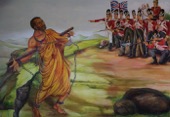
Colonial crimes by West are so heinous that none of the crimes taking place today come anywhere near what these colonial invaders committed. Infecting natives with disease (small pox), throwing native babies to crocodiles, pounding people to death, killing elephants even pregnant elephants for sport, enjoying breakfast while watching natives being hung, burning down entire villages, killing livestock with intent to make natives die of hunger are just a handful of gruesome crimes committed by the White Man today presenting himself in international halls as the crusaders and angels of peace and human rights.
Their 24×7 jargon of human rights, democracy, freedoms, transparency, justice and what not did not exist across 500 years of their rule taking over nations already inhabited and declaring it theirs claiming to having ‘discovered’ them. The Papal Bulls giving this right exist to this day.
Ironically, these very countries refuse to put their crimes to the dock and will not atone for a single murder committed under orders of their King/Queen/Church.
The manner these countries use the UN to accuse countries they ruined with their divide and rule policies is unbelievable. The manner they control media and global publicity necessitates that the third world correct the factually incorrect history being created as future generations will not know what took place.
These are the very countries preaching about Acknowledgement & Accountability. Sri Lanka must make the 3 countries Portuguese, Dutch & British that occupied Sri Lanka, acknowledge their crimes and account for their crimes. The cultural genocidein all colonies must also be accounted for.
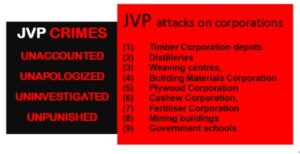
Two insurrections took place by the JVP starting in the 1970s and then again in 1980s. How the JVP started, who were behind its creation, why and for what reason is important and will answer to the present political role they play. Obviously, they have an external influence with funding and instructions coming and modus operandi also decided. The key point to take note was that the JVP has been used to divide & destroy the Sinhala Buddhists. Brainwashing youth in universities, the JVP movement aimed at ensuring cream of Sinhala Buddhists diverted from making a name for themselves using their education/talents and instead put them on the roads to protest. This game plan continues to this day. The insurrections resulted in the loss of lives of thousands of Sinhala Buddhist talented youth who would have been good leaders had they not been brainwashed to rebel. Thus, whoever funded JVP ensured that Sinhala Buddhists got killed by Sinhala Buddhists when the JVP attacked the Armed Forces and their families.
This period for Sinhalese in particular was one of fear. A man on a bicycle throwing a piece of paper was enough to put an entire town in darkness. The chit carried a threat that any house with lights on would be torched and occupants killed. This was a period Sinhalese families lived in fear for the safety of their children. No one knew who came to houses and took away youth, never to return. People will remember the streets smelling of burnt tyres with an unknown person burning on it. People will remember men naked tied to lampposts. The people must know how many Buddhist clergy were killed, how many buses and trains were torched, how many professionals were killed by the JVP and even gangs under patronage of the ruling government. These were all premeditated acts of murder and the lists of people killed during this period is available and JVP crimes must be made available in a Museum for the present and future generations to see. Today, the JVP is pretending to be a chameleon, changing colours by presenting itself in different names to fool the masses but JVP has yet to come clean on its crimes and this needs to be presented to the people and the world to know what the innocent citizens went through during this gruesome period post-independence.
The third phase of brutal murder came after the unknown Tamil New Tigers formed in 1972 by Prabakaran rechristened itself LTTE in 1976 and hijacked the separatist quest from the Tamil leaders who indirectly played a role thinking they could take over the mantle after LTTE was able to declare a separate state with the gun. Unfortunately, LTTE’s leader had other plans and the cream of the Tamil leadership was slowly eliminated by him leaving weasels willing to tow his line and TNA was happy to play lead role as LTTE’s political party.
It is important for the world to know who supported Tamil political quest for separatism and whether the same entities supported the LTTE terror quest too. LTTE began killing Tamil leaders first, then Tamil public servants like Tamil policemen and thereafter only did LTTE turn its guns on the Sri Lanka Armed Forces. The first attack by LTTE on villagers were with the brutal attacks on the Kent & Dollar Farms cutting pregnant mothers and infants to pieces. Thereafter, for 3 decades over 300 LTTE attacks took place virtually every day, every month, every year.
The country only heard ambulances screeching past carrying almost dead casualties to hospitals. Parents fearfully said goodbyes to their children leaving for schools or husbands going to work. No one knew whether they would return.
Today, the UN is demanding to know how LTTE was killed pretending they want to know how ‘civilians’ were killed, but what did this UN or UNHRC do about LTTE killings since 1980s?
All that the diplomats and the UN did was to issue a lukewarm statement and ask the GoSL to have tea with the tigers!
Today, the same UN/UNHRC is passing resolutions chanting accountability, truth, justice but where were they when real civilians were being targeted as an act of premeditated murder by LTTE.
The last phase took place inside a war zone where areas were demarcated for civilians. But who were the civilians because LTTE had its own civilian armed force trained to kill and were just as brutal as their uniformed force.
But, when LTTE attacked passenger buses, trains, public places etc they planned to kill, they planned in advance – why did the UN/UNHRC not give due attention to these murders. Have they even documented the LTTE attacks upon real civilians since 1980s?
Today, the hilarious factor is that the LTTE Diaspora, the very entity that provided LTTE material support throughout LTTE’s murderous past is dictating to the UN & Diplomats how GoSL should be punished for eliminating LTTE. They are all making the mockery of the truth.
It is for this reason that Sri Lanka must have a War Crimes Museum and put every murder committed by LTTE for the world to see for themselves because the future generations are unlikely to know any truth reading reports by UN/UNHRC to what took place in Sri Lanka.
Therefore, this Government owes the victims justice by erecting a War Crimes Museum and documenting every victim killed by LTTE since 1980s.
At the same time, alongside the War Crimes Museum there should also be a Peace & Unity Hall to present to the world how our people lived in peace and unity before 1505 and how that peace & unity was destroyed by colonial invaders via their divide and rule policies.
History will be witness to showcase not a single incident where Tamils or Muslims faced wrath under the Sinhale kings before 1505.
The Peace & Unity Hall must highlight all of the happy ventures that the communities in Sri Lanka indulge in. As per the UN/UNHRC & diplomatic reports, anyone who has not been to Sri Lanka will think the communities are daily killing each other. This is totally untrue and a fabrication.
Go to any public or private workplace and see how people work in unity. The people share food, go to parties, go shopping and have fun together. As humans, everyone has differences, but differences do not mean communities are 24×7 at loggerheads. Most of the incidents that have taken place have some form of external interference and hanky panky. Therefore, we must have a Peace & Unity corner to highlight how ordinary people live together peacefully. The best example of this is how everyone unites each time there is a natural calamity and everyone chips in to help others.
The GoSL must allocate land for this War Crimes/Peace Museum and talented architects and IT experts must come forward to propose how this can be set up – we can have video versions, digital 3D/4D, documents/articles archived, erections of key attacks by LTTE, lists of people killed/assassinated y LTTE. The objective is for people who had thus far digested the lies of LTTE propaganda to see the real version and to know the truth.
LTTE diaspora fund lies demanding truth, Sri Lanka must present the truth and expose their lies – the War Crimes Museum will showcase to the world LTTE crimes.
This national initiative must absolve us of false allegations and the War Crime Museum will enable Sri Lanka to set the story straight.
We should not delay this any further. When LTTE Diaspora are going to the extent of funding foreign MPs and UN Officials to parrot their lies, Sri Lanka must respond by showcasing to the world the truth via actual incidents that took place.
Similarly, the countries pointing fingers at Sri Lanka will also have to respond to the colonial crimes committed as a government rule/orders, while JVP pretending to be angels must also be made to account for their mass murder of innocent people. Inadvertently, the ruling party of that period will also have to face the tune for their crimes as well.
Every period that mass crimes has taken place must be covered and such mass crimes and murder took place only during colonial occupation, 2 JVP insurrections and 3 decades of LTTE terror.
If funding is an issue, GoSL must reach out to countries that helped Sri Lanka end LTTE & who played no role in funding LTTE, for support.
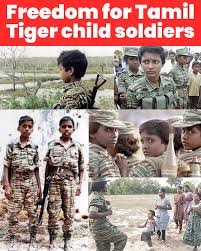
The Diplomats and UN officials and members of the international community always enjoy visiting the TNA every time they come to Sri Lanka and even invite TNA to their countries as well. At the same time these diplomats and UN officials spend a lot of time speaking about human rights, children’s rights and a plethora of other rights associated with children. We know that 30% of LTTE comprised of children. If LTTE had a strength of 10,000 of this 3000 would have been children. It also meant that 30% of casualties & fatalities would have also been children. How many times has TNA, most of whom were fathers and mothers themselves tried to prevent child recruitment by LTTE?How many TNA members had their children sent overseas for foreign education but kept mum about less-privileged Tamil children being kidnapped and turned into child soldiers. How happy is the UN and diplomats with TNA inspite of keeping mum about Tamil children turned into child soldiers?
HRW Sri Lanka: Tamil Tigers Forcibly Recruit Child Soldiers
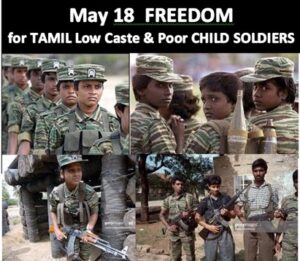
The TNA and many others will not like to admit that the recruitment of Tamil children as child soldiers had a key criterion.
These Tamil children were from low caste Tamil homes and they were from impoverished Tamil families.
The reason why the LTTE child soldiers were taken from low caste impoverished Tamil homes was
Tamil low caste families could never go against LTTE holding guns
Tamil low caste families could not say much in a highly caste-oriented Tamil society
Tamil low caste families had little hope of getting justice from Tamil high caste/class officials who cared not what happened to these low caste children.
Tamil low caste families had to silently watch and weep as their children were taken never to return
The flip side of this was that low caste Tamil children turned into child soldiers became very aggressive as the gun gave them a power over their own society. This was a bonus for the LTTE. Every Tamil low caste child brainwashed to hate, became more ferocious than anyone else as they carried a grouse against society. Their new found ‘freedom’ via holding a gun and their ability to scare society gave them a power they could never achieve in society given their caste status.
If anyone is questioning the caste aspect of the LTTE child soldiers or even LTTE ground force, it is certainly a good research study academically.
Prabakaran himself was a low caste and many of his key advisors were also. They all found a power via the gun that they could never obtain from society.
It is good for the diplomats and the UN to run through the speeches, statements by TNA since 2008 which will confirm that TNA spoke not a word about the people LTTE were keeping as hostages and human shields and every statement was cloaked to give a window of hope to the LTTE and an opportunity for the LTTE for some breathing space.
TNA did not ask LTTE to release a single child soldier, ever!
Thus, TNA did not rescue a single child from being kidnapped from school, from returning home from school, or from being kidnapped going to school because the TNA and the LTTE Diaspora needed these children to advance their own agendas.
When these children died, of course they were sad, not because the child was loss but because it meant they would have to finance another child to be trained as a child soldier.
Imagine how many Tamil low caste and poor Tamil children would have perished during hostilities with a national army, or during training or being shot dead for trying to flee LTTE camp?
Imagine how many of these Tamil low caste and poor children lost their entire childhood living in the jungles, not having the love of their parents, not having a proper meal, even satisfying the sexual appetites of the senior LTTE combatants while inside bunkers for months?
Is the UN and diplomats not bothered about this?
Imagine the agony of the teenage female child soldier having to suffer monthly period pains and other female agonies without a mother or friend to share these with.
This ordeal that these Tamil low caste children underwent took 30 years and where was Navi Pillay, Radhika Coomaraswamy, Yasmin Sooka, Michelle Bachelete to save them?
Where were all those women who love publicity speaking about child rights and freedoms but only subjecting those to mikes and pieces of paper. Did they carry out any international campaign strong enough to take action against LTTE to stop recruiting child soldiers.
What is hilarious was that many of the NGOs and INGOs stationed in the North while LTTE ran a defacto rule, had their offices right next door to LTTE offices and they would have seen enough of LTTE child soldiers even entering their own offices, but did they report these to the UN? Did they demand that action be taken to stop child recruitment? Did they do anything worthwhile to actually stop child soldier recruitment when they could?
These questions are asked because after a 30 year conflict ended, the UN has suddenly woken up and is asking Sri Lanka how it ended terrorism and finding fault with ending it too but this same UN watched children been turned into killers and did nothing about it.
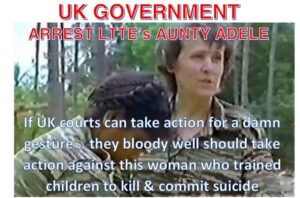
More importantly, from 1970s to 1999 Adele Balasingham a nurse from Australia was not only training Tamil children to kill but she also taught them how to commit suicide biting a cyanide capsule given at the end of the training. This nurse committed 2 crimes against humanity but the UN is not bothered to go after her and the UK issuing demarches against Sri Lanka are silent about this nurse happily living in the UK.
So where was the UN for these Tamil low caste and poor children?
What did UN do about turning children into child soldiers?
Imagine if LTTE recruited 500 children a year for 30 years that would have meant 15,000 child soldiers. Out of this number how many are alive?
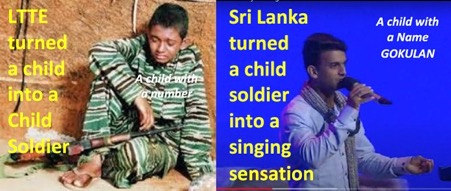
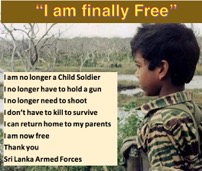
We know that in May 2009, 594 child soldiers surrendered to the armed forces. The GoSL did what the UN did not do in 30 years. The GoSL gave a Presidential Pardon and then put them through education and skills development. Gokulan a one-time child soldier is today a singing star much loved by all Sri Lankans.
Did UN create a single Gokulan in all of the 30 years UN claimed to assist Sri Lanka?
We implore the UN and the diplomats to stop patronizing Sri Lanka unfairly.
Too bad the LTTE is no more, too bad the LTTE Diaspora that funds many international programs are angry. GoSL and the Armed Forces ended a brutal terror movement. Yes, there has been casualties during the last phase. Both sides were not engaged in firing roses. The LTTE were given chances to lay down arms and surrender. They chose not to. They chose their fate. How many soldiers have LTTE killed when they surrendered to them? How many unarmed Sri Lankan Police did LTTE kill?
It is unfortunate that the UN and diplomats seem to be more bothered about how and why LTTE died totally ignoring that the Sri Lankan citizens are living life without fearing LTTE suicide missions and bombs. It’s time for the UN and the diplomats put an end to this ‘how did LTTE die’ song pretending they are only interested in civilian deaths. They know very well that the LTTE had a trained civilian armed forces – their deaths cannot be presented as civilian deaths.
So until UN and clearly differentiate who was LTTE who was a civilian – the UN cannot be issuing any red notices to Sri Lanka’s Armed Forces.
The Committee on Foreign Relations of the US presented an analysis on Sri Lanka to the Senate on December 7, 2009, i.e. almost seven months after the war on terrorism ended with the world’s most ruthless terrorist outfit, the Liberation Tigers of Tamil Eelam (LTTE) being comprehensively defeated by the Sri Lankan security forces. The document was titled, ‘Sri Lanka: recharging US strategy after the war.’ It was presented by John F Kerry and Richard G Lugar on behalf of the Committee.
There was analysis and there were recommendations to the Obama administration, international financial institutions, the US Congress and the Sri Lanka Government. The main concerns regarding Sri Lanka were about resettlement of the internally displaced, i.e. the hundreds of thousands held hostage by the LTTE and duly rescued by the Sri Lankan security forces at heavy costs to personnel.
The rest of the recommendations were nothing more than the usual noises about democracy, nothing to make a song and dance about. No mention of ‘war crimes.’ Nothing of the need to haul Sri Lanka over the coals in Geneva, so to speak, as has been the case since an intemperate and maverick diplomat angered Israel and earned the wrath of Washington following heavy lobbying by the Jewish lobby in the USA.
Indeed, it brings to mind observations on Sri Lanka made by Lord Naseby, during the course of an intervention in the House of Lords debate on the ‘Overseas Operations (Service Personnel and Veterans) Bill, designed to protect British troops from ‘vexatious charges’ (or, provision of immunity for all excesses including crimes against humanity): ‘I made a Freedom of Information Act inquiry because I was told by the UN that there were 40,000 casualties. I asked the Foreign Office about Colonel Gash’s independent dispatches, which took two years to obtain. They made it clear that no war crimes were carried out in Sri Lanka.’
The Kerry-Lugar submission also observed, ‘Real peace will not come overnight to Sri Lanka and cannot be imposed from the outside.’ Such wisdom seems to have been tossed out in deliberations regarding Sri Lanka. Most importantly, the Kerry-Lugar report noted that the US focus on IDPs and ‘civil society’ (quotes mine) as opposed to the economy and security sector had isolated Sri Lanka economically and politically from the West. The recommendation for the then administration included support for Sri Lanka’s efforts in resettlement, reconstruction and rehabilitation, and assistance for development in all parts of the country. There is some mention of strengthening justice system by supporting police reforms, but certainly nothing about war crimes tribunals and the kinds of mechanisms that the US later pushed for at the UNHRC.
Following a fairly comprehensive analysis of geopolitical realities pertaining to the region, the committee proposed that the Obama administration ‘take a broader and more robust approach to Sri Lanka that appreciates new political and economic realities in Sri Lanka and U.S. geo strategic interests.’ Such an approach, according to the Kerry-Lugar submission, ‘should be multidimensional so that U.S. policy is not driven solely by short-term humanitarian concerns but rather an integrated strategy that leverages political, economic, and security tools for more effective long-term reforms.’ What happened though? The US essentially sought to secure its strategic interests by concocting a lie (as evidenced by the massive distance between the privileged narrative on human rights and the observations embedded in the Kerry-Lugar Committee, the International Red Cross and Colonel Gash), leveraging it to harass the then Sri Lankan regime to a point that would enable ‘regime change,’ i.e. to obtain strategic goals through a US-friendly regime. It worked. Perhaps in order to ‘press advantage home,’ the US used its Sri Lankan pawns to co-sponsor an anti-Sri Lanka resolution.
What happened then? A regime whose incompetence was compounded by the perceived sell-out was comprehensively defeated. The ‘bad guys’ were back. And now what? Well, the Kerry-Lugar thinking is certainly not being revisited. Instead, it’s same-old, same-old. Well, not exactly, because the US of 2009 is not the US of 2021. The China of 2009 is not the China of 2021. The veiled threats issued by the US mission and that of the principal US ally, the UK, echoing the ‘tough words’ of the USA’s best friend in Geneva, Michelle Bachelet, the chief of UNHRC, are all based on lies agreed upon, lies which, the Kerry-Lugar committee, to be fair, had not thought fit to conjure back in December 2009. There’s talk of pushing for action in the UN General Assembly. There’s talk of sanctions. There’s talk of the matter being taken to the Security Council.
Now leaving aside the blatant disavowal of the principle of equality in treatment (the UK, for example, was found guilty of war crimes by the International Criminal Court and was let off ‘on account of demonstrating genuine interest in implementing correctives’ even as that country sought to provide constitutional cover for its forces who, let us not forget, have a considerable track record as criminals against humanity — the UK, ladies and gentlemen, will not be touched by Bachelet), these threats will certainly have repercussions. Sri Lanka will not be a happy recipient. However, leaving Sri Lanka with few choices, the USA will essentially push the island nation into the (waiting) arms of China and of course Russia.
So there was and is a baby: US strategic interests. It was bathed in toilet wash. The US and her allies have washed the baby so many times that when the baby was thrown there was only bathwater left. Maybe it seems warm. Maybe the preference for closed-noses and closed-eyes made for a kind of oblivion. The US is wallowing in the gooey stuff.
We don’t know where John F Kerry and Richard J Lugar are right now. Sri Lanka, however, does know where China is. And it seems that the US has not ‘taken a broader and more robust approach to Sri Lanka that appreciates new political and economic realities.’ The ‘humanitarian concerns’ are no longer on the table, resettlement being done and dusted years ago, reconstruction outstripping development in areas outside the principle combat areas, democratization completed and livelihoods restored to levels on par with any other part of the country. It’s been ‘short term human rights concerns’. Well, ‘concerns’ (within quotes).
Sri Lanka will have to pay a price for refusing the inhabit the USA’s version of Sri Lankan reality. Sri Lanka will be made to pay, rather. The USA will also have to deal with some costs: the strategic baby that Washington has tossed out in ill-willed and ill-conceived fixations with bathwater.
Note: Supreme Court judges are still not willing or not
skilled to write their judgements in Sinhala. They have a mental blockade, a
Eurocentric fever. So, they want their pupils to learn English. They ignored
the 1956 Official Language Act for over 60 years. That is two generations of unfair
privileged status! The gazette to go back to English by the council of legal
education (CLE) had to wait until a non-Sinhala minister of justice lands as a
national list MP. They better be ready with valid reasons to justify their stealth
decision when the country gets this bad news.
Previous three essays, this essay and one more to
come were written as responses to past attempts made by black-white souls to
promote English as panacea for politician-generated problems in Ceylon
(Sinhale)/Sri Lanka. The expectation is that CLE members and other Eurocentric NGO
agents etc. would get an idea by reading these, what the other side think.
================
The Island-Opinion, 2008/08/22
I thank Gamini Gunawardane for his article on the
evolution of Sinhala Cricket (Island, 8/15/2008). If Ajantha had to pass
an English language test before he could play cricket, he would have missed the
bus, and with teams of English-speaking cricketers, Sri Lanka would not have won
a place in world cricket. I see a personal connection here because I was able
to become a college professor and a director of research in the USA because of
the language-blind university entrance exam in 1960-61. In fact, I did not take
even Sinhala as one of the four subjects!
Because of Gamini’s reply and because of Bandula
Abeyewardene’s (BA) total misunderstanding of my response (Island, 8/2),
my task is reduced to answering a few, below the belt personal and private
issues raised by BA.
Because of his inability to understand the message
in my letter, BA has now made another mistake by placing patriotism and fluency
in English on a collision path (Island, 8/9). I see no direct connection
between the two except that I know that some people stress the fact that when
two Tamils meet or when Indians meet each other, they always speak in Tamil or
Hindi respectively, but when two Sinhalyas meet, they tend to use English. I do
not worry about such habits. SWRD who helped the Sinhala people had a grade three
level student’s ability in reading and writing in Sinhala.
I was only challenging BA’s idea that “a
Sinhala cricketer who might become a cricket hero at a future date could avoid
the ‘embarrassment’ of not being able to speak in English if cricketer-training
includes tutoring in English. I did not oppose English or people learning it as
a second language. The gist of my letter was to tell people not to take the
raft (English) on to your shoulders after using it to cross the river. Learning
English or any language for that matter is like learning how to swim or how to
ride a bicycle. We do not carry the bicycle on our backs when we walk.
The problem in the former colony called Ceylon is
that those who had money could learn English and they used it as an extra weapon
in their hands to oppress those who could not learn it. I wrote two essays
previously on this subject: ‘Gurulugomi to the rescue: the re-enthronement of
the English language’ (Island, 4/13/2001) and ‘Empowering law students
with an English language education’ (Island, 3/19/2008)) and BA would be
able to better understand my point, if he cares to read them.
I said he had a colonial mentality because of the
statements I saw in his responses (I have not seen the response of Daya
Ranasinghe as I do not know when it appeared in The Island) revealing a
mind blocked with an English-based inferiority complex. He sank further and
deeper with his new theory that the language of cricket is English. So, if
Susanthika wins an Olympic gold medal, then what would be the language of
running, according to BA? If an American wins 8 gold medals in swimming, then
what will be the language of swimming?
I went to the Peradeniya University through the
Sinhala medium and studied law later in English. Dr. Joe Silva, who was a past
Law College principal, was my classmate. As a grade school student, I went to a
night school in Panadura to learn English. My father used to tell me that he
too learned his English by attending a night school.
This brings me to the question BA has about my name.
Like Don Baron Jayatilleke, my father’s name was Gilton Don Manis. My mother’s
name was Dona Baby Manamperi. My mother was a teacher and named me Chandrasiri
(in the birth certificate it appears in English as Chandarasiri) not Conrad.
What BA needs to understand is that the name given to one by his or her parents
has nothing to do with what that person does later in his or her life. SWRD did
so many things that his parents or relatives never expected him to do. Parents
in the past gave their children one Sinhala and one English
name—Chandra-Richard, Ananda-Edward, Cyril-Banda are examples. I knew
personally how Cyril-Banda used his names, depending on with whom he was
talking, he used what he thought was the appropriate name!
BA also needs to understand that because he was
related to Sir DBJ, he cannot have an automatic share of DBJ’s past glory. BA
has to earn his own place by his own work. No doubt the connection to DBJ
helps, but it is not a free lunch. During the past 10 years, by way of marriage
connections, I came to know about the second or third generation DBJ relatives,
and I found that they had nothing of their own in serving the public that would
have made DBJ feel proud of them. This is called “vanse kabal
gaama.”
BA’s story reminded me of the stories I heard about
Anil Moonesinghe when he was Chairman, CTB. He had a life-size picture of
Anagaarika Dharmapala on the wall behind his desk. The uncle and nephew,
however, were poles apart.
About eight years ago I helped to begin an evening
English school (two days of the week) at the Siri Siddhartharamaya, Walana,
Panadura for the poor children who did not have money for English tuition
classes. It now has about 100 students. I did this because when I was growing
up in Walana, my mother had a hard time in giving me the monthly tuition fee of
Rs.5/- for my English tuition. Rather than feeling embarrassed, BA could have
contacted Ajantha Mendis privately and offered him free tuition. I hope BA
could find time to visit the temple at Walana (Ven. Walane Siddhartha was the
person who began the Parama Dhamma Chethiya Pirivena at Ratmalana from which
came the two monks who started Vidyodaya and Vidyalankara Privenas) and started
a similar free English school in his temple.
According to BA, patriots are those who stay in the
country. If that is the case, then Sri Lanka already has over 18 million
patriots! Black whites frequently use two interrelated phrases—greener pastures
and second-class citizens—to sling mud at people who for various reasons left
Sri Lanka on a temporary or permanent basis. Those who went to universities in
the swabasha mediums left Sri Lanka in frustration after failing to serve the
motherland, and USA took them in without a language test. This group is now Sri
Lanka’s Seventh Great Force (sixth force is janitors and maids toiling in Arab
lands pumping money for the Colombo people to import BMWs). They became
successful in their lives after hard work and personal sacrifices and if the
Sri Lanka Government is ready, there will be thousands of them who will come.
Whether or not one is a second-class citizen in a new country is a state of
mind. For example, in my country of birth in Sri Lanka, with caste and class
discrimination and nepotism, so many times I felt that I was a second-class
citizen. I was often asked whether I was from Galle because of my last name. I
had to tell them that my parents (if BA wants to know govigama caste) were from
Horana and that my last name was spelt as Wije-ya-wickrema not Wijewickrema. In
the USA, I was in an ocean of white people, but did not feel that I was second
class. I have white and black Americans working under me and I got my jobs
after a country-wide competition. If I go to a KKK meeting, may be they will be
treat me as a second class citizen, but I can live freely selecting what I want
or do not want to do.
Ceylon (Sri Lanka) has had two circuits, the
English-speaking Colombo circuit, and the Sinhala and Tamil Speaking non-Colombo
circuit. In 1956, this began to change. After 1959, both the UNP and the SLFP
mismanaged the country and after 1977, the country fell into a hell.
Fortunately, a reverse gear has been on since November 2005. BA is a person
caught in this transition but making money out of it. I know some outrageous
stories of how English tuition masters fleece money out of poor mothers who are
led to believe that if their children know English, nirvana is just
around the corner for them. If this is the case, then the English-speaking
countries in the world should not have all kinds of problems, including poverty
and misery. The plight of poor Americans around me is even worse than that of
the Sri Lankan poor.
I feel sad when I see Sri Lanka copying bad things
from the West, that the West itself is trying to get rid of Kentucky Fried
Chicken, Coke and Hamburgers. The bath kade idea of BA is an example of
copying the unhealthy American fast-food businesses. Save time to do what,
watch TV? No wonder 30-40% of Sri Lankan people are now suffering from
diabetes. Free trade, globalization, privatization took mung beans, kadala
and kurakkan away from homes. We, the Seventh Great Force in Sri Lanka,
not the English tuition masters, are in a better position to take an
enlightened approach to help the Sri Lankan masses.
Note:
The unreasonable, unfair, arbitrary, and undemocratic (anti-poor people)
decision taken stealthily by the Council of Legal Education to take back law
college to pre-1956 era, is nothing but one more step to try to give oxygen to
the NGO supported black-white plan to harm the 2,600-year-old Sinhala Buddhist
heritage of Sinhale (Ceylon).
Therefore, there is no wonder, a collection of lawyers known
as the Council of legal education (CLE), a kind of lawyers’ trade union, wants
to restrict lawyers from poor families populating rural areas and make legal
services cheaper like in India. There one can find lawyers with a table under a
huge tree practicing law. This reduces the gap between a lawyer and his client.
Gandhi once said lawyers are like barbers. They do an
important social service. But how many lawyers in Ceylon today know why there
is small pocket (pouch) back of their black coat? Clients in Roman times drop
coins into this pocket and the lawyer does not know who put how much. A lawyer
once asked my relative to pay Rs. 70K to draft a simple, half-page affidavit.
Who is more human, a man who catches fish one by one using a fishing rod or
this kind of lawyer?
The black-white mind is a shameless mind. Just imagine the
situation covered in the essay below. When Ajantha Mendis, an army soldier,
played international cricket and brought fame to Sri Lanka, a black white had
the nerve to write that Ajantha was an ‘embarrassment’
to Sri Lankan cricket, because he could not answer in English questions asked
by reporters. I consider this assessment
of Ajantha by a man of a delusional mind is in the same category of the action
by the CLE to create lawyers made in English.
=================
Source: Island newspaper, August 2,
2008
Bandula Abeyewardene’s (BA) much
hesitant response (Island, 7/23/2008) to Daya Ranasinghe’s (DR) reaction
to BA’s view on the need to teach English to cricketers, provided more evidence
of the colonial mentality of BA. English like any other language is a tool like
a computer or a typewriter and nothing more.
Who is a
black-white?
The black-white phenomenon is found
in former colonies, which is a state of mind. This was why Carlo Fonseka had to
engage in a series of debates in the recent past in trying to define who is a
black-white. Whether one knows English (in the former French or Spanish
colonies those two languages) or whether one lives abroad has no direct
connection with it. Recently, I saw a poem written by DR about a female soldier
on guard duty, and reading it gives one goose bumps of pride and patriotism. A
black-white cannot pen such poems. We know the poems by the Tibetan monk S.
Mahinda who was more Sinhala than the native Sinhalayas.
In Mexico, a black-white is called a
coconut—brown outside, white inside. One of the tests one can use in this
regard, if he or she is visiting Anuradhapura from Colombo, is whether he or
she gets goose bumps or a chill running through the spinal code (the awesome
feeling) at the first sight of the Ruwanvali Maha Seya or standing on the bund
of the Tissa Vawa. Just think of the mental state of some Marxists who called
the King Dutugamunu, a fool of bricks (gadol
modaya) for erecting the Ruwanvali, but they take trips to see the pyramids
in Egypt!
As a tuition master in English, BA
has every right to promote English classes. But his mental status is summarized
by his word “embarrassment.” Princess Diana had to take tuition to
learn how to speak English. The current U.S. President has trouble in speaking
English despite a Yale education. SWRD had a silver tongue but could not read
or write in Sinhala. In USA, 40% of college students need remedial education in
reading and writing. Humans must communicate and unlike animals they have
developed languages. Why is it that in Sri Lanka not knowing English is an
embarrassment?
In British colonies, English was the
language of the ruler and those who acted as translators became powerful and
privileged. The colonial master needed more people able to work in English and
a class of people evolved who learned English and embraced Christianity, the
religion of the master.
Lord McCaulay, in the 1840s in
India, formulated an education policy to create a class of Indians who were
brown in colour, but English in thinking and behaviour. More than Lord Nelson
or Cecil Rhodes, it was McCaulay who helped the continuation of colonialism
after giving the former colonies “independence”. We have a ruling class
in Colombo, who are remote-controlled from London or Paris.
When language is power, it is more
than a communication tool. At the time of independence, only 5% of people in
Ceylon knew English. This group mostly living in Colombo or in big cities
continued the white rule with minimum of changes, spatially or structurally, under
the colonial open economy, exporting rubber and graphite and importing pencils
and erasers. The attempt to change this policy began only after 1956, which BA
brands as a mess and a sin. Poor people had no means to learn English.
Why people learn other languages?
Only rarely, people learn languages
for the fun of it. They learn it if it benefits them. Taxi drivers and Colombo
Ayahs or lads at tourist sites use it. Thus, in those days people learned how
to sign a document in English because otherwise there had to be a witness to
his or her non-English signature. Today people learn Japanese or Hindi for the
market value of it. In USA, parents force their children to learn Chinese,
Russian, Hindi, or Japanese and not German or French as was done in the past.
Nurses going to USA needs English as patients they meet cannot speak Sinhala.
That is why Tamil doctors in Colombo should know Sinhala not because of
discrimination, but to earn money. If Ajantha Mendis wants to learn English or
Hindi, it will be his decision and not others. Herein lies the mental status
problem of BA. He should not be the person to decide or suggest it. I have no
doubt that Mendis tried to learn English at school, but could not be, due to
lack of competent teachers or not being able to afford private tuition.
In the 1936 Olympics when several
black Americans won gold medals, Hitler said they ran fast because unlike the
white athletes, blacks were closer to monkeys. The ability to become a good
cricket player or a good dancer-drummer or a musician has nothing to do with
one’s language skills. Some people learn so many languages effortlessly.
If the fans of Mendis want to
communicate with him and Mendis also wants to communicate with them in return,
they will find a solution of their own. I knew a Commissioner of Marketing who
did not know English but used his deputy as the English link. To expect to
start English classes as part of training in cricket is to devalue the skill of
them as cricketers and to try to inject one’s inferiority or superiority
complexes on to otherwise innocent army-serving, village-born poor youth by a
Colombo black-white. Even in the legal field we find attempts to convert into
English medium as if that will help the legal empowerment of the poor.
Just like learning a language is a
matter of economics, leaving Sri Lanka for alternative life in another country
is a matter of economics. Most people who live abroad did so due to economic
reasons or due to the corrupt political system in Sri Lanka. They did not have
pastures in Sri Lanka in the first place to look for ‘greener pastures.’ They
were like Jinadasa in Gamperaliya who went to Sinhale looking for work. Those
who live outside Sri Lanka are in a better position to help Sri Lanka to help
change it from a corruption and criminal paradise to a land where peace and
prosperity is possible so that those who went abroad can return with a pension
because they will not be under the control of corrupt politicians or officers.
Opportunity versus access to opportunity
Providing equal opportunity without
the necessary support is meaningless as we see in Sri Lanka today. People like
BA can talk, but even within a radius of 20 miles from Colombo there are few
schools that have teachers qualified to teach English as a second language.
With a colonial drawback of laughing at a person who makes a mistake while
speaking in English (this does not happen in making mistakes in learning Hindi
or French), it is much better that Mendis speaks about his cricket skill in his
mother tongue than in broken English without making his cricket skill secondary
to his newly acquired “talent” in English.
Intentionally or unknowingly BA has
done a disservice to village boys who have talent not blunted by an English
barrier. Village boys play cricket with kaduru balls found at the edge
of paddy fields with polpithi bats. They will never go to Royal, St.
Thomas’ or to an international school to learn cricket, because Lord McCaulay
did not play cricket. They say the language of science is mathematics, but the
language of cricket is not English. Fluency in English does not make one a
world class cricketer, but talent and skills one is born with and sharpened.
Before Mr. Gotabaya Rajapaksa was
selected as the nominee of Pohottuwa for the presidential election in 2019,
there were many misconceptions, manipulations, and vicious engineering against him,
and the malice engineering was focused on personal attacks against Mr.
Rajapaksa as he had gained strong confidence of people than the performance of
the Yahapalana regime. Critically considering the comparative quality of Mr.
Gotabaya with previous presidents who held the office, Mr. Gotabaya was
attracted by people with a hope that he will do or give leadership to do what
people expect. The animosity of
analysts on the points raised disclosed that they were organized attempts of
dirty politics in Sri Lanka, which were motivated by financial incentives of
political groups or international human rights activists with the funds of
foreign governments. The best example was the court case filed by Gamini
Viyangoda and Chandragupta Thenuwara.
The major focus of criticism against
Mr. Gotabaya Rajapaksa was that he had been served in the Army and the critics
did not concern about the work performed by Mr. Gotabaya Rajapaksa as the
Defence Secretary and Urban Development Activities as the secretary of the
ministry. The knowledge and skills gained from the Army supported him to
dispose of the best performance during the regime of Mr. Mahinda Rajapaksa and
the opposition was scared of the practical achievement of Mr. Gotabaya as
people were fully aware of the performance. If criticism attempted to deny good
work, it would have equivalent to a statement that there is no country called
the USA”. Therefore, they manipulated the point, he served in Army and his
characteristics are like army personnel or a dictator.
The opposition critique before the
presidential election in 2019 directly focused that Mr. Rajapaksa will act like
a dictator because of his military background, but the opposition consigned to
oblivion that the best presidents in many countries in the world had served in
arm forces. In the USA and many other countries, presidents were served in arm
forces before the election to the president position and it was a special
qualification to lead countries, and why such a respectable experience used as
a point to criticize Mr. Rajapaksa before an election to the position, might
have a question to the general public. The advisors of the opposition did not
catch the point, but they stuck with the point and ultimately failed.
The main reflection of opposition
critiques against Mr. Gotabaya Rajapaksa was that they were not consistent with
the expectation of the public, and in fact, the public of Sri Lanka was
expecting a partial dictatorship from the president to clean the country where
the underworld, corruption, and illicit liquor and drugs entirely devoured the
country and the young generation is being attracted to evil things. The secret
of the success of Mr. Gotabaya Rajapaksa was that the opposition had been in a
wrong putting, and the mythical trend of cheap international politics that was
based on human rights than any other significant points that are allured by
people in Sri Lanka. This trend has not
been changed after the election and the human rights report of Ms.Michel
Bachelor shows misconceptions are alive.
The public in Sri Lanka did not expect
the quick economic revolution from Mr. Gotabaya Rajapaksa when they were voting
for him in 2019 as it was not realistic in a situation where the country has
been suffered from tremendous economic problems since the colonial
administration. The major expectation of
the public was to give leadership to fight against corruption, drugs, the
underworld, and the black economy. The greatest enemy of poor people in Sri
Lanka was the black economy. If Mr. Rajapaksa has given leadership to control
the underworld and related activities it would be the symbol of the success of
Mr. Rajapaksa. When it analyses from the point of views of the working-class
against the underworld there is no question that Mr. Gotabaya’s regime has
taken satisfactory action consistent with the expectation of the public, and if
Mr. Rajapaksa continuously associates with anti-underworld policy, he will be
in a comfortable position to re-elect at the next presidential election in
2024.
In addition to the above point, the
success of Mr. Gotabaya Rajapaksa’s performance will be depending on taking
policy actions to make a production economy in the country. The truth in this
globe that no country can be a developed nation without adopting the policy of
production economy. The reign of Kings and queens in ancient Sri Lanka was
considered the concept of production economy and became a developed country and
the production economy as a major role need to consider broader area such as
agriculture, industry, construction, and services. The concept of production economy is broadly
related to an inter-industrial economic plan with nationalism encompassing all
ethnic groups with an attractive reconciliation process.
The attempt of the Gotabaya regime to
draft a new constitution will be successful in the reconciliation process if it
makes a good cultural design to the country.
The story of Mahavamsa in connection with the visit of Lord Buddha to
settle the conflict between Chulodara and Mahodara shows an example to make a
cultural design without harming any ethnic group in the country. The
philosophical idea of B.F. Skinner, which is associated with human nature (this
behavior reflects in Sri Lanka by Sinhala, Tamil, and Muslim communities) and
the good society through a cultural design.
Human nature cannot change by force, and a cultural design strongly
supports to control of human nature and unite the country to achieve the
economic desires of people.
For a successful plan to achieve a
production economy, the country needs a 98% accurate input-output analysis, and
has the government bureaucracy did it, is not certain to people and the
ministries of planning and finance seem to be less talking because the public
will monitor the planning and implementation process of the government.
According to newspaper reports, government officers are looking for when the
government is going to relax import regulation to vehicles and other luxury
items than promoting domestic production.
However, the government attempts to
create an economic zone in the area of Port City. It is good action subject to
conditions. Will a cultural design in
the country be grappled with the legal structure of Port City? and will support
to go from social dualism to technical dualism is a question of people. The appreciation of people regarding the port
city is creating a new piece of land for the country, nevertheless, people
don’t expect legal dualism like in China and Hong Kong. This is a vital factor
that should be considered by the regime of Mr. Gotabaya.
The concept of production economy might
clash with the legal system that will be introduced in Port City, and it may be
a point for the opposition to taking arms to fight against the government.
Economic liberalization is an essential condition and ignoring macroeconomic
variables, liberalization is not appropriate. On the other hand, the prime
objective of the port city is to bring a massive volume of foreign investments
and a considerable volume of such investment may be related to black money
deals. King-ping of the underworld of Sri Lanka may associate with black money
deals based on investments and the country needs a successful monitoring system
to avoid such possibilities because it will be a major point to work against
Mr. Gotabaya Rajapaksa.
It can be observed that China is
closely monitoring the black economic activities of Hong Kong, Taiwan, and
Macao, and the port city of Sri Lanka needs to be monitored with a team of
highly skillful intelligence service.
The most dangerous matter would be Sri Lankan drug dealers might use Port
City to make an international narcotic conglomerate and it will be a serious
problem to Sri Lanka. If it creates
problems for India Sri Lanka must ready to defend the country as India will
take various actions to disturb the operation of Port City.
The
major issue during the next five years to Mr. Gotabaya Rajapaksa will be how to
reconcile the technical dualism between the Port City and the rural economy. Port
City is a good economic strategy for showing to the world, but the reality is
the provincial economy which consists of more than 70% of the macroeconomy
might clash with the project, and internationally, India might influence the
operation of Port City as it associates with China. Although many people don’t
understand this issue the recent manipulation regarding the East and West
Terminals of the Colombo Port reflected the complex nature of the issue.
To
gain more votes the provincial economy is a critical factor for the Rajapaksa
government. Before the election in 2019, Mr. Rajapaksa talked about a
provincial development project, and no public service or planners of the
government planned and made blueprints for the project. It is a
mega-development project that could successfully address human nature related
problems and arriving at a cultural design such mega projects which provide
benefits to all ethnic groups.
The
COVID-19 pandemic has negatively impacted the development policies of the
Rajapaksa government. Foreign employment and the tourism industry have been
played a key role in the economy since the 1970s, and the contribution from
these two areas have declined with the effect of COVID_19, and regaining such
areas is vital and how could regain the economic benefits have become a
critical question. The changing of internal policy structure by reforming
education and using the provincial labour to contribute a higher pace in the
development process is vital through an inter industrial plan.
The
opposition political parties prefer to talk about soda bottle opening type
issues and they have no solid policy structure that massively attracts the
support of the provincial community and Mr. Gotabaya Rajapaksa must focus on
the use of provincial labour at an internationally competitive price. Why rural
women go to the Middle East for domestic services because the price of labour
of women in the country was comparatively lower and if Mr. Gotabaya Rajapaksa
plans to give the right price to provincial labour and a reasonable value to
Sri Lanka rupee, many issues at the provincial level will be changed without
changing his power base at rural level.
The
valuable practice of Mr. Gotabaya Rajapaksa is visiting interior rural villages
and listing to poor people. This practice was done by previous presidents, but
it was not a consistent approach or a productive way of public relations. The
experience of Mr. Rajapaksa as an army person has motivated him to maintain
good public relations and give quick solutions to the problems of rural people.
Although the previous presidents visited rural people, they didn’t give
solutions to highlighted problems. Mr. Gotabaya Rajapaksa demonstrates he is
practical and give solution to problems. The significance of experience gained
in the army reflects positively working with President Rajapaksa and the
opposition parties have to close their opposition to Mr.Rajapaksa saying he was
an army person.
The
joke that appeared in the opposition is Mr. Sajith Premise also visits people
in the rural area and his talk with the innocent peasant (Churi archaic,
countrymen) that when he comes to power he will give a solution to the rural
problems and when he will come to power is unsure. In such a situation the
opposition cannot attract the support of the rural people. It showed that the
opposition shouldn’t do all that the government is doing when it has no
political power. Talking or promising to peasants is a style of politics in Sri
Lanka, and the countrymen know that they are just talking than honest planning
do so.
Many
reforms in economic and social sectors are essential and Mr.Rajapaksa promised
to people effectively launch reforms before the presidential election in 2024. The education reforms, reforms in the
financial system, and the reforms in the socio-economic structure to attract
peasants to productively participate in the economic process are essential
areas and the administration of Mr. Gotabaya Rajapaksa needs to expedite these
reforms. People in Sri Lanka understand that these reforms could not perform
overnight and they will take time. Although
nearly two years of completing in the power, talks on reforms are not
sufficient and the short experience is suggested reforms are behind than people
are expecting, and it seems the ball is passing one person to others and no
changes are being eventuated in the economic and social system. Many view that
although the president has changed the bureaucracy has not changed consistent
with the policies of the president.
Education
reforms are key to make many changes, one significant point Mr.Rajapaksa
highlighted before the presidential election was incorporating vocational
education to tertiary education and allowing rural kids to gain quality
tertiary education and the level of tertiary education be practical with the
vast area of fields. However,
bureaucracy in the education field has poor knowledge and skills in the area
and Mr.Rajapaksa needs motivating bureaucrats to expedite reforms.
The
reforms relate to the financial system are crucial to converting Sri Lanka’s
economy for attracting investors, and the experience since 2019 shows that a
significant fluctuation in the financial system that is disadvantaged to the
country. The banking and non-bank financial market require quick reforms to
assure investors and users to stick in the system. As a regulatory authority,
the Central Bank of Sri Lanka needs to introduce reforms, and many times it
shows the Central Bank’s policies have limited to no actions talks only. I proposed
in the late 1990s to make many reforms especially in the stock market and
superannuation system, but they were not
effective and crooks were dominating in the system. The best example is recent
records of the Colombo Stock Market which reported a quick boost and after few
weeks the gains transferred to loose as short selling used by crooks to play
the game, and why Mr.Rajapaksa doesn’t direct the Central Bank to change the
legal structure and allow rural communities to participate in the market operations.
As 70% of the economy of Sri Lanka is in the hand of rural people the Colombo
Stock Market could be boosted with rural cash if the policymakers do the
needful for changes.
Social
reforms are essential to change the attitudes of people. The government of Sri Lanka has failed to
eliminate social dualism that leads to technical dualism. If we look at the
Asian countries where achieved stable economic growth and development in Japan,
South Korea, and others the achievements have been centered on changing the
social system with modernization and elimination of social dualism and
integrating all into one nation. This
fundamental concept has neglected policymakers in Sri Lanka. What were the influential factors for this
situation? Mr. Gotabaya Rajapaksa needs to concern about this matter. The
attitude of people regarding schooling has not changed the mentality of
colonialism dominates in attitudes.
Mr.Gotabaya
Rajapaksa has a massive challenge and the deal with the challenge needs
changing attitudes of people.
New Delhi to issue statement on the Lankan cabinet’s decision to back out on the East Terminal deal and offer the West Terminal instead as a sop.
Colombo, February 3: India-Sri Lanka relations have come under strain following Sri Lanka’s withdrawal from its written commitment to give Colombo port’s Easter Container Terminal (ECT) to India, and to offer the West Container Terminal (WCT) in lieu of it as a sop.
A disappointed Indian High Commissioner Gopal Baglay met President Gotabaya Rajapaksa, Prime Minister Mahinda Rajapaksa and Foreign Minister Dinesh Gunawardena on Tuesday apparently to express India’s dismay about the breach of trust.
Asked about the outcome of the discussions, the Indian High Commission said that India will issue a statement on it from New Delhi. The statement is awaited.
The suddenness of the Sri Lankan cabinet’s decision, without any prior discussion with India, had upset New Delhi, Indian sources said. The cavalier fashion in which a bilateral agreement and repeated verbal commitments were flouted is bound to have an impact on the relationship, though it is too early to say in what particular ways it will be impacted, the sources added.
As regards the offer of the West Container Terminal (WCT), the sources said that it had come out of the blue. Firstly the offer has to be made officially and with adequate details for India to consider it in depth, the sources said. As of now there is only a public statement, albeit official, that the WCT will be built and run by the Sri Lanka Ports Authority (SLPA) in collaboration with India and Japan for 35 years as a private public partnership to go by, Indian sources said.
Immediately after the February 1 cabinet decision, the Indian High Commission had issued a statement reiterating India’s position that all parties to the May 18, 2019 Memorandum of Cooperation (MOC) – Sri Lanka, India and Japan – over the ECT, should adhere to it. It was stated that the MOC had emerged from discussions at the highest national level and was backed with assurances from the Sri Lankan government subsequently, and even recently.
Earlier in January, the Indian Foreign Minister S.Jaishankar had indicated India’s deep interest in the ECT. India is interested in the security and development of Colombo port,” he said in explanation when asked about his talks on it with the Sri Lankan President here.
Just a few days prior to the cabinet decision, the government of India had gifted 500,000 doses of the COVISHIELD vaccine to Sri Lanka as part of its Neighborhood First Policy” and had committed itself to a steady supply of the vaccine. India was, as in many cases in the past, the first respondent to the virus pandemic in Sri Lanka. China has only promised to send 300,000 doses of its vaccine.
Support in UNHRC
Earlier, Sri Lanka had made a request to India to support it at the UN Human Rights Council (UNHRC) where a hostile resolution is likely to be introduced in March by the Core Group led by Western nations backed by the US. The UN High Commissioner for Human Rights, Michelle Bachelet, had recommended targeted sanctions” against Sri Lanka and also referring it to the International Criminal Court (ICC) for alleged war crimes”. The US is at odds with Sri Lanka since the later rejected a grant of US$ 480 million for transport development and land registration under the Millennium Challenge Corporation Compact.
In the light of Colombo’s decision on the ECT, the question that is asked is: Would New Delhi’s approach to Sri Lanka’s case in the UNHRC change? However, informed sources said that there is still a lot of time for India to adopt a stand on this issue. Much would depend on the exact nature of Colombo’s offer of the West Container Terminal and the seriousness of its intention to stick to commitments solemnly made in regard to it, they added.
Reasons For Denial
While it was true that Sri Lankan nationalists, both within the government and outside, along with 23 workers’ unions and a section of Buddhist monks, were against giving the ECT to India, it was believed President Gotabaya Rajapaksa was himself in favor of the deal largely based on the May 2019 MOC.
It was believed that Gotabaya was considering several factors such as: geo-political factors, the importance of India for the defense of Sri Lanka, and the need to maintain a balance between China and India in economic and strategically important projects. The President was therefore expected to be able to convince the agitated port workers’ unions that the ECT was not going to be sold or leased out to India and that the SLPA would have majority stake (51%) in the terminal.
But at the end of the day, the workers’ view prevailed. This was because they kept insisting that the President’s election manifesto Vistas of Prosperity and Splendor had explicitly mentioned Public-Private Sector Partnership only in the case of the development of the West Container Terminal (WCT), and not the ECT. What was implicit in the line on ECT was that the government will build and run the ECT.
Furthermore, key members of the President’s own think tank Viyathmaga” such as Dr.Nalaka Godahewa and Dr.Priyath Bandhu Wickrama had had discussions with the workers’ unions and had reported back to the President to say that the workers’ case was reasonable based as it was on the election manifesto. The interlocutors assured the President that the workers’ were in agreement with him on Public-Private cooperation in building and running the West Container Terminal.
So far, India has not indicated whether it will accept the Lankan proposal on the West Container Terminal. The proposed deal appears to be the same as that which related to the ECT broadly. But the WCT has to be constructed from scratch and the details as to the stakes are yet to be worked out.
Some hardline Lankan nationalists would continue to agitate against giving any port terminal to India even a 1% stake” as a union leader said.
The General Secretary of the Port Workers’ Union, Niroshan Gorakahenna, has been quoted in the Tamil paper Virakesari as saying that the workers were opposed to giving any terminal to foreign countries whether it was ECT or WCT. The WCT could not be bartered away to get back the ECT, he stressed. The workers would now discuss what steps they should take to press their case, Gorakahenna added.
In its defense, the government could say that it is only implementing the President’s election manifesto faithfully, a manifesto for which 6.9 million Lankans (52%) voted to install Gotabaya Rajapaksa in power.
India will Mount Pressure
India is also expected to flex its muscles so that Sri Lanka does not take it for granted. It is already raising the Tamil-Sinhalese ethnic reconciliation issue especially the full implementation of the 13 th.Constitutional Amendment (13A) which stems from the India-Sri Lanka Accord of 1987.
The 13A, which established elected provincial councils, gave the Tamil majority province (as well as other provinces) a modicum of devolved power, which in India’s view, would led to the extinction of separatist tendencies among the minority Tamils. There is an apprehension that in the proposed new Lankan constitution, the provisions contained in 13A will not find a place.
On Tuesday, the Indian Deputy High Commissioner, Vinod.K.Jacob, met two Tamil leaders from the Eastern Province, former Chief Minister and current MP, Sivanesathurai Chandrakanthan alias Pillayan, and former Minister Vinayagamurthi Muralitharan, alias Karuna Amman, and discussed 13A.
Jacob had reiterated the position of the Government of India that meaningful devolution is the way forward for achieving the aspirations of the Tamil people and stressed full implementation of 13th amendment.
The other sensitive issue is the tough resolution which is likely to be moved in the UN Human Rights Council (UNHRC) in Geneva in March. While the Human Rights High Commissioner Michelle Bachelet has recommended targeted sanctions and hauling up Sri Lanka before the International Criminal Court for alleged war crimes” the Sri Lankan government has taken a defiant stand accusing the UNHRC of going by falsehoods and recommending remedies which violate the sovereignty of Sri Lanka.
Sri Lanka has asked for India’s support in the UNHRC since India has generally been supporting Sri Lanka in the council. Colombo hopes that with the grant of the WCT to compensate for the denial of the ECT, New Delhi will oblige Colombo at the UNHRC. Sri Lankans point out that China and Russia have already pledged support openly.
The Government of Sri Lanka has decided to reject the report compiled by the United Nations Human Rights Commissioner Michelle Bachelet on alleged human rights violations in Sri Lanka, says Minister Udaya Gammanpila.
He said Sri Lanka’s response to the report, which has already been submitted in writing, will be made public when Foreign Affairs Minister Dinesh Gunawardena addresses the UN Human Rights Council.
The government decided to reject the report as it has been prepared in violation of the mandates given through resolutions 30/1 and 40/1 of the UN Human Rights Council, Minister Gammanpila noted.
Further, the 17-page report only contains 02 pages that are in accordance with the mandate conferred on the Human Rights Commissioner, the Minister explained. The remaining content of the report are maliciously aimed at the government, contrary to their scope, he added.
In addition, the report has failed to present credible evidence pertaining to the allegations levelled at Sri Lanka, Minister Gammanpila said further.
In the report published in late January, the UN rights chief had stressed that the failure of Sri Lanka to address past violations has significantly heightened the risk of human rights violations being repeated.
She also called for an International Criminal Court investigation into Sri Lanka’s Tamil separatist conflict and sanctions on military officials accused of war crimes.
Domestic initiatives for accountability and reconciliation have repeatedly failed to produce results, more deeply entrenching impunity, and exacerbating victims’ distrust in the system,” the report read.
It went on to say that the government of President Gotabaya Rajapaksa has reversed some advances made under previous administrations in protecting human rights.