KAMALIKA PIERIS
Today, the world is not interested in India’s politics or India’s
economy. The world is interested primarily in India’s relations with other
countries. It is interested in the possibility of war in the Bay of Bengal with
India helping.
That is because India has linked militarily with the war mongering
USA. India’s initial hesitation in yoking itself to USA appears to have finally
gone, said analysts. After some hesitation, India has
decided to establish a military alliance with USA. India, a founding member of
the Non-Aligned Movement has now become an ally of the US, said critics.
US has established a military alliance with India, confirmed
analysts. India is now part of USA’s Quadrilateral
Security Dialogue, consisting of United States, Japan, Australia and India. The purpose
of this US-India alliance is to contain China.
India has signed four military agreements with USA. The General Security of Military
Information Agreement (GSOMIA) was signed in 2002. The agreement enables the
sharing of military intelligence between the two countries and requires each
country to protect the others’ classified information. Thereafter, in 2010 USA entered into a civilian nuclear program with
India.
The second agreement, the
Logistics Exchange Memorandum of Agreement (LEMOA), was signed on 29 August
2016. The LEMOA permits the military of either country to use the others’ bases
for re-supplying or carrying out repairs. It allowed Indian and US navies to
support each other in joint operations and exercises.
After LEMOA, US made India a “Major Defence Partner”, a
designation that allowed India to buy advanced, sensitive technologies from America
at the same level as other US allies and partners. In 2016, US supported India
in its surgical strikes on Pakistan
occupied Kashmir and Joint US-India military exercises took place near the India- China border. There was a trilateral joint military
exercise involving Japan, US and India in 2016.
The US National Defence Authorization Act of 2017 further
recognized India as a major defence partner of the US. In 2019 United States Senate passed legislation
that brought India onto the same level as NATO, Israel and South Korea for
defence cooperation.
The third agreement, Communications Compatibility and Security
Agreement (COMCASA) was signed in September 2018. This allowed the Indian and
US navies to support each other in joint operations and exercises.
The fourth agreement, the
Basic Exchange and Cooperation Agreement (BECA), signed in 2020, permits the
exchange of geospatial products between India and the US National Geospatial-Intelligence Agency (NGA).
BECA is a crucial agreement.
It permits the sharing of sensitive satellite and map data. This
agreement will give India access to topographical, nautical and aeronautical
data vital for pinpointing attacks using missiles and armed drones. BECA clears the path for India acquiring armed
drones and fighter aircraft.
India has now completely integrated with the four-nation
Quadrilateral Strategic Dialogue (QUAD) to monitor the Indian pacific region’,
said analysts. US had turned India into its proxy and India will now assume
some of the security functions carried out by US, said analysts . With this
alliance, India has become one of the players in the current geo politics of
the Bay of Bengal.
A US carrier strike group led by aircraft carrier USS Nimitz was
set to conduct an exercise with Indian warships near the Andaman and Nicobar
archipelago in July 2020 . Indian and
Japanese warships carried out a small
exercise near the Malacca Strait in June 2020.
In November, all four countries
participated together for the first time
in the Malabar exercises.
In 2020 India has given a 100-million-dollar grant to fund the
Greater Male Connectivity Project which is the largest ever such infrastructure
project undertaken in the Maldives and a project loan of 400 million dollars for Cooperation
in Sports and Youth Affairs. This is interpreted as part of the encircling plan
of the Quad.
There is another angle to this. Critics note that Hillary Clinton visited Tamilnadu on her visit to India
in 2009 and Kolkata in 2012. These cities are by the Bay of Bengal. Shenali Waduge
says it is possible that USA will encourage India to balkanize.
India
has always had ‘great power ‘dreams. However, a report by London School
of Economics in 2012, concluded, that India is not
a superpower and will not become one in the future. It has too many weaknesses,
such as poor leadership, extreme social divisions, poverty and religious
extremism.
India now
finds itself dwarfed by China, a much bigger power with global ambitions. China has overtaken
India in economic performance. The
Indian economy is still one fifth of China and the defence budget is way below,
said experts in 2017 and again in 2019. The Indian Navy is ahead at present,
but China is rapidly developing its naval power experts said in 2017.
India is worried about China’s
entry into South Asia. India is
particularly concerned about China’s ‘string of pearls’ which is like a naval
necklace around India. India sees China everywhere, said an analyst in 2012. China on the other hand, sees India as an
unstable state with weak leadership, deep religious and linguistic divisions.
New Delhi must now accept a Chinese presence in many sectors
previously considered as India’s exclusive domain said observers. However,
India is not prepared to accept a subservient role. That is why India has
decided to link with USA.
China is now
preparing for a border war with India. China does not recognize the McMahon
line which divides China and India.
China and India have settled their
border in the middle of this Line of Control but not at the two ends. China
wants parts of Ladakh at the western end and the whole of Arunchal Pradesh at
the eastern end. In June 2020, China
seized control of Indian Territory in eastern Ladakh, with India opposing.
In November
2020, China has placed its military all
along the Line of Control, starting from Ladakh in the west, also Aksai Chin,
Karakorum Pass, Himachal Pradesh, Uttarakand, Sikkim and Arunchal Pradesh in
the east. There is a massive road
–communication-surveillance upgrade all along the LAC, with the potential of
opening of other fronts, said observers.
China has
established a logistical supply depot at Ladakh that can serve military needs
up to Uttarakand. There is an electronic warfare unit at Arunchal Pradesh, with
jammers and satellites. There is
patrolling of the skies at Aksai China and China has expanded its air bases in
Tibet.
India is trying to settle its disputes with China. China and India met at a summit in Chennai
in October 2019. This is the 19th
occasion that they have met since Indian Prime Minister Modi took office, said analysts. Some
meetings were informal visits.
There are
tensions between India and Pakistan as well. Pakistan is angry. Pakistan says
India is strengthening its hold on
Jammu and Kashmir. The number of ceasefire violations on the Line of Control, between
the two countries at Jammu and Kashmir has increased significantly. Pakistan
says there have been 2,158 ceasefire violations by India as of September 2020.
India has
withdrawn the special constitutional status accorded to Jammu, Kashmir and
Ladakh, and Pakistan announced plans to make the Pakistan administered section
of Kashmir into a separate Province. Is the stage being set for a historic
military confrontation over Kashmir, asked analysts.
It will be a simple matter for Pakistani and
China to join hands in attacking India. Not only China, but Pakistan too is a formidable military power. When
they do China will grab a chunk of northern India. Pakistan will try to seize Kashmir ” as Indian troops
would be reduced to less than half the normal deployment in Kashmir.
The
possibility of collusion between these two military adversaries of India, is
high, said experts. If that happens then India
faces a two front war, which it cannot possibly win. There will be very little possibility of
switching troops and resources from one front to another in case of a war on
two fronts, said military experts.
India has not
stayed still where military power was concerned. In 2017,India strengthened its
naval bases in Andaman and Nicobar Islands. About 3000 Indian soldiers trained
in amphibious warfare were deployed there. The latest landing ships can carry
10 armored vehicles, 11 armored personnel carriers and more than 500 troops,
media reported in 2017.
In 2017 India launched the nuclear-capable Agni V missile,
with an expected range of over 5,000 kilometers. The missile achieved its objective
and landed off Australian waters. All major cities of China are now within
Indian missile range. But Agni V is not
a surprise to China. India has been working on it for years.
analysts say
that India appears completely
unprepared for a two-front conflict. India’s stocks of ammunition are below the
minimum acceptable risk level” which means 20 days of war fighting. Some ammunition is not sufficient for even 10
days of intense fighting said experts in
2009 .
The fleet of
the Indian Air Force is not large enough
, either. The minimum strength necessary for a two-front conflict is 42
squadrons. The Indian Air Force has only 30 squadrons of fighter jets said
experts in 2020.
India’s air force planes are old models. In 2019, India sent war
planes over Pakistan- controlled Kashmir, and dropped bombs onto Balakot .India’s a Soviet-era
MiG-21was easily shot down by the
Pakistan Air Force’s F-16 and the pilot taken captive. India has bought4.5-generation
French Rafale. The air force will have a total of 36 Rafale by 2022. These planes will face China’s
indigenous fifth generation fighter, the J-20.
India has managed to clash with all of its neighbors, at
one time or another..India annexed Sikkim using political cunning and the use of RAW. Sikkim is starting to
question. Nepal has recently enlarged its territory by taking over land form
the India side without consulting India.
When
Bhutanese Prime Minister Jigme Thinley
met the Chinese Prime Minister , Wen Jiabao, in 2012 at the United
Nations Conference on Sustainable Development at Rio, India got angry.
India retaliated by withdrawing fuel subsidies to Bhutan. New Delhi’s
heavy-handed response was deeply resented by Bhutan.
India said in 2009 that Sri Lanka must realize that India is the big power in
the region and it should stop going to Pakistan and China to get arms. We are
prepared to accommodate Sri Lanka within the framework of our foreign policy. India supporters in Sri Lanka have tried to create
subservience to India. Finland is careful not to antagonize its neighbor Russia.
We must also follow a policy of Finlandization and not antagonize our big
neighbor India, they said.
However,
Sri Lankan public is openly anti-India. They have not forgotten the Parippu
drop. They say that India has forfeited the respect and confidence of Sri
Lanka. Relations between India and Sri Lanka should be based on mutual respect,
not superiority. One side should not be
in a perpetual state of superior bargaining power, Sri Lanka said.
India realized then that imposing pressure from above will not work,
with Sri Lanka. India now wants to develop its relationship with Sri Lanka on a
one to one basis; with mutual respect and open hands, respecting the
sovereignty and dignity of the two countries
said India in 2017.
Today, in
2020, Sri Lanka has cordial relations with India. President Gotabaya Rajapaksa’s first official visit abroad
was to India. However, India objects to China’ presence in Sri Lanka specially
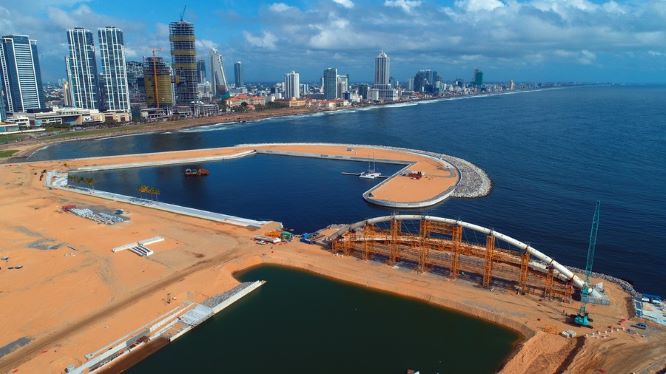
Hambantota and Colombo. Land in
the Colombo Port City was given to China on a 99 year lease, which is a long time,
India complained.
Sri Lanka
explained that In 2009 Sri Lanka needed money for its
development plans. The amount far exceeded what India alone could do. The only
country that came forward was China.It
wasn’t a foreign policy shift but an economic necessity.
In 2020 Sri
Lanka has made three requests to India for a postponement of its
debt repayment, a debt moratorium and for a currency swap facility. The Reserve
Bank of India signed a $400 million swap agreement with Sri Lanka in July, to
help boost Sri Lanka’s foreign reserves, and is perusing a further $1 billion
requested by Sri Lanka.
But New Delhi
has not responded to the request for a
debt moratorium. Sri Lanka owes $ 960 million to India. It is now more than
four months after the request was made no decision has been taken, the media
observed in August, 2020. The swift assistance to the Maldives and the delay in
responding to our request may be a
message to Sri Lanka , critics said.
But it shouldn’t then be a surprise if Sri Lanka seeks reprieve from China,
they warned.
India has
established sound military relations with Sri Lanka . The
maiden overseas port call of INS Vikramaditya, India’s aircraft carrier, also
India’s newest and largest ship was made to Sri Lanka In January, 2016. Sri Lankan President Maitripala Sirisena was
the first foreign head of State onboard the ship.
India extended a defence Line of Credit to Sri
Lanka for US$ 100 million to procure variety of defence equipment and supplies
in 2017. India also gave two Offshore
Patrol Vessels. India provided large
number of training slots to Sri Lankan military and security personnel in 2017.
Sri Lanka
Navy has for many years, had a bilateral
maritime exercise with India. SLINEX-20
was conducted off Trincomalee in October 2020, for the eighth year. The
previous edition of SLINEX was conducted off Visakhapatnam in September
2019.The Sri Lanka Navy was represented by SLN Ships Sayura (Offshore Patrol
Vessel) and Gajabahu (Training Ship) as well as the locally built ASW corvettes
Kamorta and Kiltan.
SLINEX-20
aimed at enhancing inter-operability, improving mutual understanding and
exchanging best practices and procedures for multi-faceted maritime operations
between both navies. In addition, the exercise showcased capabilities of our locally
constructed naval ships and aircraft. Surface and anti-air exercises including
weapon firing, seamanship evolutions, maneuvers and cross deck flying
operations were included in the exercise.
SLINEX exercises helped when the two navies went to the rescue of MT
New Diamond, a Very Large Crude Carrier (VLCC), which had caught fire off the
East Coast of Sri Lanka. The exercise was conducted in a non-contact
‘at-sea-only’ format in the backdrop of COVID-19 pandemic.(Continued)