The project will be developed under a credit line facility from the Exim Bank of India.
The Sri Lanka Sustainable Energy Authority has issued a tender to seek consultants for the pre-feasibility study of a large scale PV power plant.
The project will be developed under a $100 million credit line facility from the Exim Bank of India. Of this sum, $85 million will be devoted to the deployment of rooftop PV arrays in government buildings under the country’s net metering scheme, $5 million will be used for floating installations, and $10 million will be allocated for installing solar-plus-storage systems for low-income households.
Interested consultants will have time until December 9 to submit their bids.
According to a recent joint study by the UN Development Programme (UNDP) and Asian Development Bank (ADB), Sri Lanka has the potential to deploy 16 GW of solar power. It aims to cover its entire power demand with renewables by 2050.
At the end of 2019, according to the International Renewable Energy Agency, the country had 215 MW of installed solar power. Through its solar energy program, dubbed the Soorya Bala Sangramaya (battle for solar energy), Sri Lanka hopes to add 1 GW by the end of 2025.
Tamil Makkal Viduthalai Pulikal (TMVP) leader and parliamentarian Sivanesathurai Chandrakanthan alias Pillayan” has been granted bail by the Batticaloa High Court.
The Batticaloa District MP was ordered released on bail by Batticaloa High Court Judge T. Wigneshwaran, when the case filed over the murder of former TNA MP Joseph Pararajasingham was taken up today.
Four other defendants in the case who were in remand custody were also granted bail by the court, Ada Derana reporter said.
They were ordered released on two personal bonds of Rs 100,000 each while the case was postponed until December 08.
Pillayan had been in remand custody since his arrest on October 11, 2015 when he arrived at the CID to give a statement in connection with the assassination of the late Tamil politician Joseph Pararajasingham, who was shot dead on Christmas Eve in 2005.
A gunman opened fire on TNA MP Pararajasingham after he received communion at St Mary’s church in Batticaloa, killing him and injuring eight others including his wife.
Contesting at the General Election 2020, Pillayan had obtained the highest number of votes from the district of Batticaloa and entered Parliament.
Four new Covid-19 related deaths have been reported in Sri Lanka, the Director-General of Health Services confirmed a short while ago.
One of the victims is a 74-year-old male from Ginigathhena area. Reports revealed that he passed away on November 22 while receiving treatment in the Intensive Care Unit (ICU) of Ragama Teaching Hospital. The cause of death was cited as multi-organ dysfunction due to complications of diarrhea induced by Covid-19 infection.
The second victim, a 54-year-old male from Siyambalape South who was under treatment at the Colombo National Hospital has died on November 22. The death was ruled as a result of coronavirus infection and chronic kidney disease.
A resident of Colombo 05 area, a woman aged 73 also died of Covid-19 infection earlier today. She was admitted to the Colombo National Hospital after testing positive for the virus and was later transferred to the Homagama Base Hospital. Covid-19 pneumonia was determined as the cause of death.
The fourth victim was identified as a 42-year-old male from Atulugama area in Bandaragama. According to reports, he was transferred to the Infectious Disease Hospital (IDH) from Panadura Base Hospital. He has died of complications of Covid-19 infection, chronic liver disease and encephalitis.
Following the new developments, Sri Lanka’s Covid-19 death toll now stands at 94.
Fresh COVID-19 positive cases were identified in Sri Lanka as the total number of cases reported from the Minuwangoda and Peliyagoda clusters reached 17,436.
The Department of Government Information said 171 more persons were tested positive for the virus. A total of 287 more new Covid-19 cases were reported earlier evening bringing the total cases so far to 20,795, the Health Ministry said. All contacts are close contacts of earlier patients.
All the new cases are close contacts of the Peliyagoda Fish Market cluster, reports confirmed.
With the new development, Sri Lanka has confirmed 20,966 novel coronavirus infections to date.
According to the Health Ministry’s data, 14,462 of the confirmed patients have made complete recoveries from the virus.
The 26th of November is the
Birthday of the dreaded leader of Liberation Tigers of Tamil Eelam
(LTTE) who was shot dead in 2009. Prabhakaran
assassinated the elected leaders of the Tamil community in the 1980s [1],
massacred other rival groups, suppressed dissent, and hijacked the control of Tamil politics,
to launch a brutal war against the Sri
Lankan government that lasted some three decades, ending in May 2009. The whole of Sri Lanka, including the majority of Tamils who live in the South with
the Sinhalese celebrated the event. It was recorded as such in film by Poongkothi
Chandrahasan [2] the grand daughter of SJV Chelvanayagam, the acknowledged
leaders of the Tamil Nationalist movement. Luckily for him, SJV” passed away before the rise of Prabhakaran.
Mr. Amirthalingam, SJV’s
lieutenant, was shot dead by
Prabhakaran’s agents to pass mantel of Tamil leadership to Prabhakaran un-equivocally.
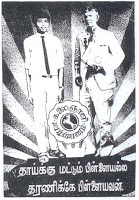
SJV founded the separatist Ilankai Thamil Arasu Kadchi, or Lanka Tamil
Kingdom Party” that envisioned a separate Tamil kingdom known as Eelam
in 1949 [3]. SJV may have settled for a federal solution with strong autonomy”
for the 12% population of Tamils. But the forces that he unleashed demanded Arasu
itself, roused Sinhala extremism, and proposed to create a Tamil kingdom by
force in in the Vaddukkoddai resolution” [4]. Nevertheless, Sri Lanka, India and the West
sought a futile peaceful solution” that led to near four-decades of Eelam
wars, State Brutality and Tiger Terror extending even to Tamil diaspora who
faced extortion and Tiger violence.
The first suicide offensive of the Tigers
is usually ascribed to Vallipuram
Vasanthan alias Captain
Miller” of the LTTE in 1987. He drove a truck of explosives into an army camp
in Nelliyaddi (නෙල්ලියැද්ද). However, he
diabolical distinction of being the first dispoasable Tiger should go to
Sivakumaran who tried to rob a bank in Kopay (Bopé, බෝපේ ) in June 1974, and committed suicide to
prevent arrest. This gave Prabhakaran the idea of a cadre of suicide killers
who make the ultimate commitment” to him personally, and to the Tiger
movement. The day after Prabhakaran’s birthday was selected for the annual commemoration and
glorification of these human explosives as great heroes” or Maaveer”.
These events were held in a grand ritualist format during Prabhakaran’s
lifetime.
Seconds before Tamil Tigress exploding
When the North became accessible during the peace breaks, it revealed itself steeped in the notion of self-sacrifice. Tamilselvan, the late head of the political wing of the Tigers stated that it is not killing oneself” or thatkolai”, but thatkodai”, which means to give yourself” to cause maximum damage to the enemy with just one lost to the Tigers. Thamilini was the 30-year-old head of the female suicide cadre. Some 30 to 40 percent of suicide fighters, including the assassin of Prime Minister Rajiv Gandhi in 1991 have been young women. Many of them had been
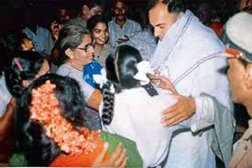
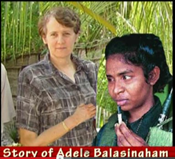
trained by Adel Balasingham, an Australian now living herself, after approaching to garland Gandhi living with impunity in the United Kingdom [5].
Pictures of suicide attackers like Captain
Miller” were every where in Tiger territory. The Tigers filmed their suicide attacks and sold CD’s
with songs glorifying the Black Tigers,
and videos of attacks on the airport, the central bank and other targets. The
Tamil Disapora approved the violence or
remained silent out of fear, and donated money” anyway. These amounted to millions of dollars annually [6].
Today, even though the LTTE was decapitated
in Sri Lanka, it is alive and well in Canada, UK, and other Western countries
where such tributes and memorials are held every year on 27th
November. The sale of videos, memorabilia and the collection of donations”
help to fatten the coffers of pro-LTTE
organizations even today.
The glorification of Black Tigers as role
models for the young is accompanied by a justification ofhttps://policy-research.ca/publications/
violence claiming that there was a Genocide of Tamils in Sri Lanka who fought
for liberating their traditional homeland”.
Pro-Tiger politicians have attempted to
create an Education Week” in Ontario to teach a re-packaged false history of
the conflict and hide the nature of these diabolical human bombs and present
them as Martyrs of human rights. The
real facts of the alleged Tamil genocide”, an allegation already rejected by
the UN High Commissioner for Human Rights in 2015 (Al Z. Husein, U-Tube, Rejecting the Genocide claim
https://www.youtube.com/watch?v=C7bhAkM8PaM),
may be followed in more detail at the website https://dh-web.org/Canada/Background104.html
. The
present article deals with the history of the Black Tigers, or Suicide
killers whose techniques were closely copied by the Al Queda.
Sivakumaran’s radicalization shows that
attempts to appease” fanatically brain-washed individuals is of little use.
Thus, in July 1970 the Deputy Minister of Cultural Affairs Somaweera
Chandrasiri, a Sinhalese politician, claimed that Sinhalese and Tamil cultures
were linked, angering Sivakumaran who tried to assassinate Chandrasri in
September 1970.
Sivakumaran and Chelva”.
Sivakumaran’s cases show that if any moderate” Tamil or Sinhalese were to look for peace and middle ground between the two communities, they were targeted for elimination. This followed the doctrine of the irreconcilability” of the Sinhalese and the Tamils announced by the ITAK theoretician V. Navaratnam in 1957. Although SJV presented a façade of peacefulness, he had no hesitation in nurturing boys” like Sivakumaran[7] who had attempted to blow up the Minister Somaweera Chandrasiri in 1970, and the Tamil Mayor Durreiappah in 1971[8].
Once Prabhakaran became the unquestioned leader of the Tigers, it was not necessary for him to carry out or lead assassinations in person. He created the dreaded Black Tigers made up of men and women whose job was to become human bombs who can get to a target and blow themselves, killing the intended victim as well as all innocent by-standers who become mere expendables. For this purpose, the LTTE fashioned a suicide vest that could be worn unobtrusively, and could be activated by the Tiger at an opportune moment. The Tigers shared their suicide technology with Arab terrorists that they had links with at the time. The concept of sacrifice and belonging to the community and caste rather than to oneself, and the belief in rebirth made the gift of the supremesacrifice” for the cause socially acceptable to these young men and women.
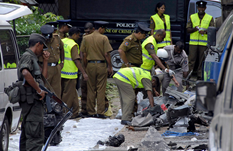
An LTTE attack on a funeral in Akuressa lights up the background.
The induction process or brain-washing” was slow, and even depended on dedicated orphanages like the Tiger Orphanage in Sencholai and Arivuchcholai, where a handler became the parent and confidante who guided the children to become suicide killers who have accepted the higher destiny” of blowing themselves. The songs” of the orphanage will send a chill down the spine of most people but not to many members of the Toronto Tamil diaspora!
The Sencholai Padalkal” goes as
follows [9]:
The tomb shall wait for me Flowers as offerings shall there blossom A memorial for me who turn into a myriad atoms The burning embers shall watch over me.
The LTTE crashed a light plane in asuicide attack on the Revenue Dept. Sri Lanka in Jan. 2009.
The macabre poet” who autoured this then
describes a variety of possible deaths
awaiting her – such as shells and bullets. The
satanic poem” runs:
The poison (cyanide) I bore since I became a Tigress Shall also await me. The hawk and the hound to taste my flesh Shall stalk the field where I do battle. …All these will I endure for my land To me a grateful nation shall arise.
The Sri Lankan army honours and remembers its dead as all other armies do, without the sacrificial mysticism of the LTTE
When this training-camp cum orphanage of Tiger Suicide Cadre was bombed in 2006, the Western-funded NGOs in Colombo and the Tiger Diaspora in Canada raised an international campaign against Sri Lanka claiming that it bombs orphanages”. While pro-Tiger spokesmen addressing Western audiences take care to claim that the suicide cadre only targeted soldiers, quite the opposite is true. Civilian political leaders have been blown up with heavy civilian casualties. The suicide attack on the Central bank in 1996 killed close to 100 people, while even funerals have come under attack.
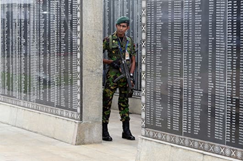
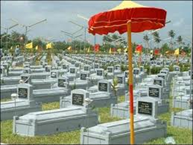
The Tigers built many war memorials and
grave yards for the black tigers who blew themselves up, killings dozens of
people. Theses grave yards (see figure on the right)
are like Christian graveyards, with much propaganda value. This is indeed contrary to Hindu cultural practices where dead bodies are burnt (cremated), and graveyards are shunned except by the very “lowest castes”. However, many of the suicide cadres were Catholics, and the Tamil population had been Christianized to a larger extent than the Sinhalese in the south. Furthermore, the Tigers cleverly exploited the Natu-kal” tradition of South India to justify the practice and bring it to the areas controlled by the tigers [10].
The Maaveer Thuyilim Illam or “Martyrs” sleeping house was in
Kopay’s Northeastern city limits. Around 2000 epitaphs had been placed, but it
has been alleged that many of the graves were empty.
The
Sri Lankan army removed the stonework leaving behind only a commemorative
plaque, following the practice of the Allied army in WW-II in dealing with Nazi
cemeteries[11]. Tiger supporters simply
retaliated by destroying the commemorative plaques.
Today, the right to remember the dead”
has been abused and used as an excuse to
hold politicized memorials for the suicide killers. The Northern Provincial
Council which gave powers to rule the majoritarian-Tamil Northern Province, led
by the controversial Mr. Wigneswaran,
did very little to ameliorate the economic well being of the Tamils. It
devoted most of it efforts to Eelamist propaganda, trying to build memorials to
the Maaveer and obstructing more moderate Tamil politicians like Mr.
Sumanthiran. The extreme fringes of Tamil politics in Sri
Lanka have used the 27th of
November, the Maaveer day” as a
day for mounting confrontations with the Sri Lankan police and the army, by
trying to hold memorials with glorification of suicide killers and poltical
speeches. This would be equivalent representatives of the extreme Right in Germany trying to
commemorate fallen leaders of the SS or other killer squads of the Nazis today.
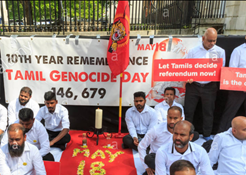
Politicized sections of the Western diaspora continue to support Prabhakaran’s violent version of Tamil Nationalism vigorously and continue to seek means of reviving the ashes of the LTTE is Sri Lanka itself. This enables them to support bogus refugee claims by asserting that Tamils are Not safe” in Sri Lanka. They claim that thousands of tamils have disappeared and that 146,679 Tamils were killed in the last days of trhe Eelam war, using falsified statistics that should now be laid to rest
in view of the investigations by the British House of
Lords led by Lord Naseby where the number dead is estimated to be less than
7000 [12,13]. These matters, and the
numbers unaccounted for, have been examined by several commissions including
the Paranagama commission [14]. The
General Secretary of the Tamil United Liberation Front (TULF) pointed out how
the LTTE eliminated its very own cadre and wounded civilians
during its retreat to Mulliavaikkal as
the LTTE regarded its wounded as a
liability, adding to the disappeared”.
In 2018, (during the
Sirisena-Wickremasinghe govenment), an Eelamist motor bicycle drive-in by youths (mostly politicized Jaffna
University Undergraduates) wearing black outfits, black and white flags etc.
brought them to Mullivaikkal (Mul-vakkadé, මුල් වක්කඩෙ) [15]. A rally was held
here as a “Remembrance Day” event where the more moderate leading
Tamil politicians were excluded, in a manner reminiscent of the exclusion of
the TULF by the early LTTE, and by other
early youth movements of the late 1970s. It was declared a day of “Genocide
Remembrance” by C.
Wigneswaran, the first Chief Minister of the Northern provincial
council who was the only politician allowed in.
Wigneswaran, an upper class Colombo
Tamil and Ex-Judge who worked
closely with the Sri Lankan government
before he came to politics, has embraced political extremism, even rejecting
inter-marriage between races to safeguard “Tamil” racial purity, even
though his own children have rejected such racist views. He also holds a romanticized view of the
history of the Island where the Tamil people are believed to have a long and glorified role extending to millennia
contrary to the accepted historical narrative. The Eelamists hold that the
North and East of Sri Lanka are the “Traditional Homelands of the
Tamils”, a doctrine enunciated in 1949 by the Tamil political party. However,
the mere fact that a majority of older place names in the North and East are
based on Sinhala Place Names testifies to the fact that these areas had been
under Sinhala Rulers, as also testified by stone inscriptions, and the Pali
chronicles.
Tt is well known that most Tamil
expatriates belong to
Ur-Societies” linked to villages (Ur) back in Sri Lanka [15]. They visit their
villages happily, safely and regularly, belying claims that Sri Lanka is unsafe
to Tamils. Over 50% of the Tamils live in the south and are leaders of
business, industry, export-import and banking, occupying a more influential
place than even the majority community.
Unfortunately, the open and liberal society
in Canada is exploited by the pro-LTTE Diaspora groups, and political organizations like the
Transnational Government of Tamil Eelam (TGTE) to paint a false picture. They
have sought to hold Maaveer celebrations, glorify suicide killers and teach violence and ethnic hate to a
younger generation that these political organizations hope to exploit in the
future years to come. Wittingly or unwittingly, Canadian politicians who nurse
electorates with sizable Tamil populations have even attended these suicide-killer memorial events that are held
in the guise of mourning of lost kith
and kin!
[6] Ms. Jo Becker of Human Rights Watch (see, The Globe and Mail, March 16,
2005 report by Timothy Appleby) stated that “In Canada, families were
typically pressed for between $2,500 and $5,000,” Ms. Becker wrote,
“while some businesses were asked for up to $100,000”. These
assertions have also been supported by the RCMP and other Canadian law
enforcement organizations, and finally led to the banning of the WTM in 2008.
The Sri Lankan government alleges that the victims of LTTE-bombings and suicide
attacks at the Colombo Central Bank, at the Bandaranaike Airport, and places of
worship, schools, railways, public buses etc., were funded from Canada.
[15] https://www.asiantribune.com/node/91870
The commemoration ceremony on 17-May-2018 in remembrance of Tamil civilians who
died in Vella-mulliwaikkal during the last days of the ethnic conflict- Asian
Tribune, Rajasinghan, 19-May-2018
[16] Thanges Paramsothy, Caste within the Sri Lankan
Diaspora, Anthropology Matters Journal, 18, No.1 (2018)
President Gotabhaya Rajapaksa’s Anniversary speech and the brilliant 2021 futuristic Budget presented by the Prime Minister Mahinda Rajapaksa have raised the trust of the people who suffered immensely under the destructive yamapalana government for the last 4 ½ years. The Anniversary speech clearly outlined the performances achieved during President’s first year under various obstacles made by the Sirisena/Ranil government and restrictions that had been placed upon him by the obnoxious 19th Amendment. The President also outlined details of the work to be carried out and steps to be taken in the next four years of his term. Hat these measures will definitely be carried out regardless of opposition from any quarters.
In this atmosphere
the foreign servile discarded and despicable Dayan Jayatilleke(the 3 D
Jayatilleke) in his utter frustration of success being made by thus government
has made silly and stupid attempts to admonish the President on what and what
he should do and what and what he should not do and what coarse correction he
should undertake. This stupid writer says that the President must seek the
Middle Path, occupy the moderate political centre, not the extreme, and return
to the mainstream democratic political culture and tradition of his family, the
Rajapaksas
Thinking that he is the Messiah
reborn he states that the President has made strategic blunders and his term of
office will end up in a one-term wonder, like the Trump Presidency (2016-2020),
Yahapalana (2015-2019), and the Samagi Peramuna (1970-1977).
Showing his dislike with one of Sri Lanka’s much-admired political columnists Chandraprema, he says that back in June, GR insider, author of the Gota’s War (2012) and Sri Lanka’s new ambassador/PR to the UN-Geneva, commented that Trump will win and argued assuredly that polarisation around the ‘law and order’ vs. ‘anarchy’ issue guaranteed a white majoritarian tsunami for Trump and this 3D stupid adds that in a fascinating coincidence, this was the core of the successful GR game-plan of 2019.
Referring to Sirisena presidency he states that when that Sirisena Government was heading rapidly in the wrong direction, which will prove unsustainable, result in unfavourable polarisation, and crash and burn unless there’s a drastic course-correction back to the moderate centre, Sirisena heeding to the advice given by him and some other prominent people instituted a coarse correction. Ignoramus Sirisena may have needed such advice but it does not apply in the case of much talented and highly erudite President Gotabhaya Rajapaksa.
This 3D fool says that the
Gotabaya Presidency, as per his diagnosis won’t end well, but it will end
sooner rather than later.
He blames the President for adopting a zero merit policy and asserts that the Gotabaya administration hasn’t yet had a bond scam type scandal on its watch, but the factor underlying that scandal is something that the GR Presidency has been greatly susceptible to not appointing officials on the basis of the highest merit of excellences similar to Ranil Wickremesinghe’s choices. In President Gotabaya’s first year, the abandonment of meritocracy has become a rule rather than an exception. Despite internationally admired steps that have been taken to arrest Covid-19, this fool asks whether anyone believes, or can anyone believe, that the finest available Sri Lankan talent, the best available brains, the human resources of the highest quality and achievement in the fields relevant to the COVID-19 virus, have been mobilised and are actually driving the national/State effort to rescue us from the pandemic?
The President’s appointments
to/within the military have been fine, but the appointment of the serving and
retired military to posts in which they have registered no expertise or
experience, still less excellence, will prove at least as systemically
damaging, he says. He may have said the
same thing when Mr. Gotabhaya Rajapaksa as the Secretary to the Ministry of
Defence took steps to place suitable security personnel to fight the terrorist
aggression.
He points out that the retreat
from the principle of merit in post-Independence Sri Lanka began with the
Sirimavo Bandaranaike Government’s twin measures (in the early 1970s) of the
abolition of the independent public service and the introduction of
district-wise and media-wise standardisation at university entrance.
The government of Madam
Bandaranaike was forced to introduce the standardization system for University
Entrance to rectify and overcome a long felt anomaly for Sinhala and Muslim
students under which majority of students selected for the Medical and
Engineering faculties had been Tamil students.
Investigation carried out in this respect revealed that prior to the
University Entrance examinations Tamil Professors held clandestine classes for
Tamil students and passed out the question papers and also they were told to
write the word OM” in their answer scripts to facilitate their
identification. Only after the
standardization system and the Z score system the anomaly was rectified and
students from remote areas like Monreagala and Anuradhapra districts got a fair
treatment for entering Universities and the artificial merit system of Tamil
students getting concocted higher marks were stopped.
Today, he says that it is
presupposed that ex-military appointments across the state system, and the
annexation of civilian functions under the Defence Ministry headed by a retired
General, accord with the criterion of merit, because the military/ex-military
has the collective institutional ‘karmic merit’ for having performed the
ultimate meritorious deed of saving the country from terrorism.
This 3D fool further states that
on many occasions since January, President Gotabaya Rajapaksa has gone on
public record, including two international audiences – the SAARC leaders
virtual summit and the UN 75th anniversary world leaders summit – respectively
downplaying the danger and claiming success in containing Corona (in
self-congratulatory detail). If the anti-coronavirus campaign had been fought
by an elite Task Force of the finest trained and credentialed professionals in
the field, the President would not have made such statements because he would
have been far better briefed and advised. Instead he has set up an echo
chamber. Sadly, he is imitating the practices not of the victorious last war –
the nation’s and his elder brother Mahinda’s finest hour, and his own finest
contribution.
He predicts that the next major
crisis we shall face is the economic crisis. This time too, it won’t matter to
the suffering citizenry that there was a global pandemic, any more than it
mattered to the voters who threw the Sirimavo Bandaranaike Government overboard
in 1977 despite the OPEC oil shock of 1973 affected a great many countries.
As in the case of combatting
Covid-19, this is not what the Gotabaya administration has done. Pushing Dr.
Dushni Weerakoon, Executive Director of the Institute of Policy Studies (IPS),
out of the Monetary Board is hardly a sign which inspires confidence. Having obtained
her PhD at age 27, she has risen to be perhaps our top professional economist,
with a reputation for non-partisan, independent policy diagnosis and lucid
prescription.
He asserts that the Sirisena/Ranil
government was doomed to a one-term existence by its adherence to an
ideological model rather than to Realism. That Government felt it more
important to drive through a set of reforms which stemmed from its obsolescent
ideological model of the neoliberal glory days of the 1980s and 1990s.
Referring to the previous government which he admired in all its aspects, the 3D bluffer now says that the UNP Leader, Ministers and civil society ideologues were blissfully unaware that in the 21st century a social backlash had overthrown the model in favour of statist-nationalism in Russia and populist religio-nationalism in Eastern Europe. Even when the rebellion reached the West with Brexit, followed by the Trump victory of 2016, the UNP didn’t change course. These global trends apart, the reality of Sri Lankan society – made transparently clear at the Feb 2018 Local Authorities Election – made the Ranilist UNP model utterly untenable.
The UNP, he adds, sought to turn us into a neoliberal neo-colony of the West. The GR model was designed to turn us into a military-occupied territory ‘liberated’ from liberal-democracy and inhabited by a regimented, controlled, drone-monitored citizenry. The Yahapalana and Gotabaya administrations share the assumption that their electoral victories were some kind of ‘revolution’ and a mandate for a total transformation in accordance with their respective ideologies.
The first anniversary of the Gotabaya Presidency coincides with the victory of Joe Biden. He admonishes that President GR must learn the correct lessons of the defeat of President Trump, whose proudest boast of not being a ‘politician’ but a success in other fields, was the source of his biggest blunders, since as a political amateur he had no respect for the values, norms and ethos of democratic politics and governance.
GR and his fellow (Sinhala) long-time supporters of the California Republican Right must absorb the lessons of the two-thirds vote that the Democratic ticket obtained in California (possibly due to Kamala Harris). With or without Democrat control of the Senate, President Rajapaksa can surely figure out the implications of a Democratic administration. Space could open for generalised, permanent ‘lawfare’ under ‘universal jurisdiction’, which could go global.
For the moment the biggest political advantage that President Gotabaya enjoys is the fog of intellectual and psychological confusion in the democratic resistance space. In a threatening note to President GR this American worshipping 3D fool says that in the USA, the democratic intelligentsia (most indelibly Noam Chomsky), the media and the politicians (most notably Barack Obama) sounded the clarion call that the main existential danger was a second term for President Trump – Chomsky called it a threat to humanity – and that the indubitably overriding objective must be to prevent it. In the midst of the primaries, the Democratic field suddenly cleared for the candidate who had the best chance of winning back the blue-collar white voters and breaking through to the American heartland. The left, progressives, women, and the Black community rallied around him, submerged differences to attain the objective of stopping a second Trump term, perceived as the portal to Fascism of some variety and form.
He laments that by contrast, the Lankan democratic intelligentsia remains ‘The Gang That Couldn’t Think Straight’. Recently, an emeritus political science academic urged the democratic Opposition to model itself on that led by Sirimavo Bandaranaike – who it must be noted, never proceeded to lead her country after she lost the General Election in 1977 and was beaten to the presidency by populist Ranasinghe Premadasa in 1988.
This pro-Indian betrayer states that he associated Mr. Mahinda Rajapaksa for more than 20 years and hence he knows more than Viyath Maga-Eliya hawks may assume and adds that being only a student of politics, he remained a passive participant at the meetings his father had with Lakshman and George Rajapaksa, gathering valuable points”
When an extremist ideological
network-cum-pressure group (self-professedly pro-China) – the Janavegaya –
arose within the ruling family and Coalition Government and spread through the
State apparatus, George and Mahinda Rajapaksa stood against it. The Rajapaksa
political culture was light years away from a ‘Military First’ or ‘Make the
Army Great Again’ (the local MAGA) perspective in peacetime. It was civilian,
parliamentary, democratic, centre-left progressive, moderate nationalist,
undogmatic, pragmatic, flexible, open, reasonable and consensual.
In a ridiculous attempt to create a rift between the President and the Prime
Minister similar to the failed attempt he made to creep into Viyath Maga and
create dissensions in that organisation this 3D foreign stooge says that Mr.
Mahinda Rajapaksa’s decade was not reshaping the country according to some
ideology or model and he was determined to achieve a decisive end, operating
within the democratic Constitution, to the existential danger that confronted
the nation: Prabhakaran and his LTTE. By doing so MR achieved the most historic
transformation of all. Like his elders, he was very comfortable with the
country’s democratic character and civic way of being, in which he swam like a
big fish in the sea.
1. Abolition of Indo Lanka Accord.
Adoption of a Foreign Policy of Balance to counter regional players. Adoption
of a “Total Defence” policy based on Psychological, Social, Economic,
Civil, Digital and Military Defence.
The following two sections should be
included in a future constitution and national policy:
A lesson in history:
2. It was a catastrophic,
incompetent, foolish and UNMITIGATED DISASTER to have abrogated the Anglo
Ceylon Defence Agreement (of 1947) in 1957. This led to a loss of a
guaranteed ally and assistance in the event of foreign attack. Had we kept it
in force, then India would have been kept at bay. It was a mutually
beneficial agreement and provided an indirect export to Ceylon also. During
that period we had an independent foreign policy as proven by the simultaneous
existence of this Defence Agreement with Britain and the Rubber Rice Pact with
China.
It is absolute FOOLISHNESS and
revisionist history of leftists to claim that this was somehow a flaw, or “not
independence” or a bad situation to be in. Ceylon was FULLY independent
and its status akin to what Singapore enjoys today in terms of defence. It is
furthermore, INSANE for many of these same “critics” to remain silent
on the Indo Lanka Accord which BLATANTLY strips us of our independence and
ability to engage with whomever we damn well please. This so called “non
alignment” and “neutrality” that we have suffered (not enjoyed)
has sadly been nothing more than Indian subservience and the restrictions of a
vassal state status, to third rate India to add insult to injury!
Under the original Defence Agreement
we enjoyed from 1947:
1. It was not constitutionally
objectionable (unlike the Indo Lanka Accord)
2. It was for an indefinite period
and allowed for any modification by agreement
3. A commitment by the United Kingdom
to provide defence against external aggression and for the protection of
essential communications
4. Military assistance included naval
and air assistance.
5. Bases for forces required for the
purpose of defending Ceylon would be provided as may be MUTUALLY AGREED and
only if required for said defence.
6. The Government of Ceylon would
receive military assistance in the training and development and equipping the
Ceylonese Armed Forces.
7. Unlike other nations at the time
like Australia, Ceylon would not have to pay Britain for the upkeep,
maintenance and equipment for any forces provided (that were mutually agreed)
to defend us. This provided us with an indirect export.
8. Ceylon would have no obligation to
pursue the foreign policy of its partner, nor was it a commitment to any
alliance. Indeed, Ceylon was protected from the more noisy antics of the
Americans and Soviets as well as the hegemonic ambitions of its third rate
neighbour India.
It is sad that when one views
historical footage of our Independence Day celebrations of the past in the
1940s-60s, that we had more planes/jets then than we do now! How is this
acceptable?
The removal of this Defence, the
failure to make up for this by arming the country to the teeth, the complete
incompetence at developing the country left us open to India to force itself on
us leaving us in this dismal state today.
This must be reversed and a competent
Defence and Foreign policy pursued!
There is no racial inequity in Sri Lanka, but there are spatial (georaphical) inequities, and lack of equal access to oppurtunites affecting all its citizens.”
APRC and the bio-regional vision, The Island, 25/2/2009.
Language-blind regional development units, The Island, 25/10/2006
Prevention of black-whites’ plan to balkanaize Sri Lanka, Lankaweba (LW) , 22/10/2017
Reconciliation & balkanization in Sri Lanka, LW, 11/3/2018
Michael Robert meets Anaagaarika Dharmapala, LW, 14/8/2016
President Sirisena (2016) confronts Commissioner Colebrooke (1832), LW, 3/11/2016
End of Humiliation, LW, 9/9/2009
LLRC and the future of Sri Lanka, LW, 16/8/2011
Who is afraid of the Buddhist flag? (educating Navaneetham Pillay) LW, 4/10/2013
Ambassador Sison and Asath Sali, LW, 5/5/2013
Sri Lanka: black-white rule and the temple, LW, 24/10/2017
19-A and balkanization plan, LW, 7/12/2018
Wigneswaran Damanaya (taming the shrew!)- part 1, LW, 15/2/2015
Report of the Local Government Reforms Commission (The Abhayawardena Reoport) (Sessional Paper 1-1999)
By the adoption of a variety of tactics, tailored to suit the power-equation at any given point of time, Lankan Buddhists kept blunting the attack and managed to preserve Buddhism as the dominant religion of the island.
Sri Lankan Buddhists came under a sustained and frontal assault by Christian missionaries during Portuguese and Dutch rule for nearly three centuries (1505 to 1796). Given the adverse balance of power, many Buddhists compelled or enticed to convert to Roman Catholicism under the Portuguese and to Calvinism under the Dutch. But by the adoption of a variety of tactics, tailored to suit the power-equation at any given point of time, Lankan Buddhists kept blunting the attack and managed to preserve Buddhism as the dominant religion of the island.
Sir James Emerson Tennent, Colonial Secretary from 1841 to 1850, traces the ultimate success of the Sinhala Buddhists to one of their innate qualities. In his book Christianity in Ceylon (John Murray, London, 1850), Tennent says: In the hands of the Christian missionary they (the Buddhists) are by no means the plastic substance which such a description would suggest – capable of being molded into any form or retaining permanently any casual impression – but rather an yielding fluid which adopts its shape to that of the vessel into which it may happen to be poured, without any change in its quality or any modification of its character.”
The nature of the assault on Sinhala-Buddhism and the ingenious ways in which the Buddhists tackled and overcame the threat are graphically described by Prof.P.V.J.Jayasekera in his book: Confrontations with Colonialism Vol:1 1796-1920 (Vijitha Yapa, 2017). Jayasekera uses the term Christian colonialism” for Portuguese and Dutch rule as both Christianity and colonialism as a politico-economic system went hand in hand. The agenda of the colonialists was to exercise political, economic and spiritual control over their subjects simultaneously. Indeed, the spiritual and the temporal reinforced each other.
The ideology of Christian colonialism” was rooted in the assertion of Pope Innocent IV in the 13 th.Century, that, as the Vicar of Christ, the Pope had the power not only over Christians but also over non-believers. Through a series of Papal Bulls and Inter Caeteras from 1455, the Portuguese and the Spanish were given the power to exercise temporal and spiritual control over believers and heathens the world over. They were authorized to vanquish, enslave, humiliate or subdue the non-believer in pursuance of the divine mission.”
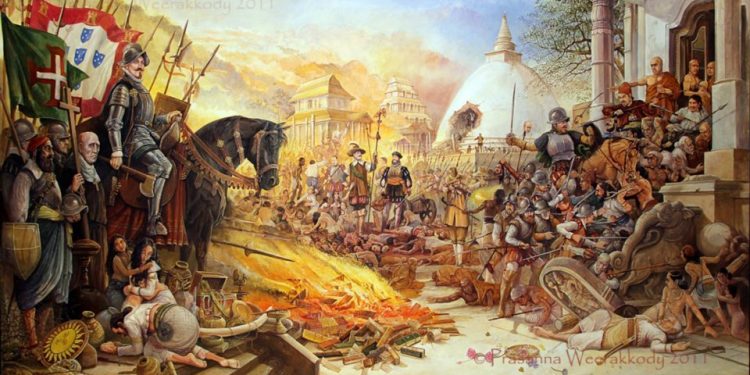
In Sri Lanka, the Portuguese systematically destroyed Buddhist, Hindu and Islamic places of worship. Harsh laws were enacted to prevent the practice of indigenous religions. At that time, Lankan Buddhists believed that salvation could be reached through multiple paths and therefore allowed the Portuguese to engage in conversion. King Buvanekabau of Kotte (1458-1550) even invited missionaries, though he himself refused to convert.
But his grandson and successor, Dharmapala (aka Don Juan), converted in 1557. Put off by that, the Buddhists revolted. Thirty Bhikkus were martyred. There were at least ten popular revolts in 44 years. One of which was led by Edirille Rala (1594-1596) which the Portuguese described as the revolt of the Sinhalese nation”. Portuguese chronicler Queroz noted that a saintly monk Budavance” was behind the uprising in Sitavaka. Missionaries and churches were attacked. In 1630-1631, destruction of Portuguese properties was extensive. To put it down, the Portuguese stepped up destruction of places Buddhist and Hindu worship.
Interestingly, many of the rebel leaders like Edirille Rala, Kangara Arachchi and Nikapitiya Bandara were themselves converts! Many who converted for one reason of the other eventually revolted or relapsed to their old faith. This made the Portuguese (and later the Dutch) despair that conversion of a Sinhalese meant nothing really. Even 50 years after the establishment of Portuguese rule on the West coast, they were busy destroying Buddhist temples showing that missionary activity had not borne fruit. Disappointed with adult conversion, the Portuguese concentrated on children in the schools they set up.
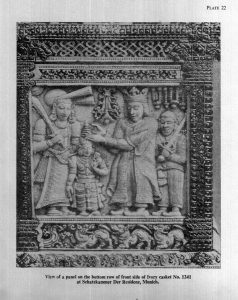
The symbolic crowning of the Kotte King Don Juan Dharmapala by the King of Portugal after his convesion to Christianity.
Dutch Used Laws
The Dutch, who ruled Sri Lanka from 1658 to 1796 immediately after the Portuguese, were less violent but more legalistic in their proselytization. The Dutch used laws backed by a system of harsh punishments.. Baptism was needed to bequeath property. Marriages had to be registered in church. Many Buddhists had to convert on the death bed to bequeath their property to their heirs. A non-convert’s evidence was not admissible in court.
Schools were established mainly for the purpose of conversion and school masters were made in-charge of adherence to Christian practice. The Governors of the Dutch provinces (Disawes) accompanied by Dutch pastors inspected schools four times a year with armed escorts. Those who neglected their duties were severely punished. Heavy fines and forced labor in chains for three months were the order of the day. On seeing that people were ignoring the Placcaats or orders, the Dutch in 1732 issued an order asking all village headman to eliminate Buddhist temples in their areas. To enforce it, the Dutch enhanced punishment to 2000 Rix dollars or chained labor for 25 years.
But despite the harshness of the punishments, defiance by the Buddhists continued both passively and violently. In 1646, Kottapitiya Appuhamy of Weligama Korale, rebelled. Monks and Silvatas (lay preachers) openly mocked Dutch pastors. The put up anti-Christian arguments written on Ola leaves on tree trunk so that people could read.
Monks and lay preachers from Galle and Matara were particularly active, which made the famous Goan Jesuit missionary Fr.Jacome Gonsalves say that the Buddhists of Galle and Matara were particularly attached to Buddhism. The southern rebels had the full support of the Kandyan monks also. A desperate Dutch Galle district Church Council wrote to Amsterdam in 1736 saying: The native has an aversion to Christianity and is attached to Heathenism.”
The Buddhists fought hard for the recovery of the Kelaniya Raja Maha Viharaya, which the Buddha had visited and which the Dutch occupied. The Dutch had used the temple’s stones to build the Colombo Fort. In 1647, the Kandyan King Rajasinghe II (1629-1687) asked the Dutch to vacate the temple but he was ignored. Subsequently, King Wimaladharmasirya II (1687-1707) asked for permission to Buddhists to at least worship there. But the Dutch would not allow idolatry. The Dutch relented only 140 years later in 1780, when they decided that persecution would not work with the Sinhalese Buddhists.
(The painting at the top shows the Portuguese destroying a Buddhist temple in Sri Lanka: Picture credit goes to Prasanna Weerkkody)
The doctor who was arrested by the Maharagama Police for shooting a school student with an air-rifle has been remanded by the order of the Nugegoda Magistrate’s Court.
A 17-year-old student of the ErewwalaEast Dharmapala Vidyalaya had entered a private property near the school, yesterday (22) to retrieve a ball that had been thrown into the property during a game of cricket.
Reportedly, an argument has ensued between the students and the owner of the property, a doctor serving at the Apeksha Hospital in Maharagama.
This has resulted in the doctor firing an air rifle at the students.
The student injured in the incident is currently receiving treatment at the Colombo South (Kalubowila) Teaching Hospital.
The doctor was subsequently arrested by the police over a complaint received by them and was produced before the Nugegoda Magistrate’s Court today (23).
Accordingly, the Magistrate ordered him to be placed under remand custody until December 02.
At the Presidential Commission of Inquiry probing Easter Sunday terror attacks, it was revealed that funds worth Rs. 04 billion has been received to two bank accounts that belong to former Governor of the Eastern Province M.L.A.M. Hizbullah.
It was revealed that these funds had been received from foreign countries on several occasions.
It was further revealed that even the Central Bank had not been informed about receiving such a large amount of money.
The speaker stated that the Parliamentary Council has verified the nomination by the President to appoint C.D. Wickramaratne for the post of Inspector General of Police and 14 Judges to be appointed to the Court of Appeal.
Speaking to the Hiru news team the Speaker said that the Parliament also recommended the names of 14 Court of Appeal Judges presented by the President.
The names of High Court Judges Menaka Wijesundera, D.N. Samarakoon, M. Prashantha de Silva, M.T.M. Lafar, C. Pradeep Keerthisinghe, Sampath B. Abeykoon, M.S.K.B. Wijeratne, R. Gurusinghe, G.A.D. Ganepola and K.K.A.V. Swarnadhipathi nominated by the President has been verified by the Parliamentary Council.
W.M.N.P. Iddawala, Sampath Mendis, Mayadunna Cooray and Prabhaharan Kumaratnam of the Attorney General’s Department nominated by the President as Justices of the Court of Appeal have also been verified by the Parliamentary Council.
The
writer is a graduate of University of Peradeniya, which was constructed during
the colonial period and opened by HRH prince Philip, the queen’s husband, ‘to
be more open than usual’ in the early 50s. The Engineering Faculty that was
established there was of the same standard as world leading universities like
Cambridge, following same courses. Those who passed out and gained scholarships
these universities did very well topping the batches. Moratuwa Technical
College also became an Engineering Faculty in early 70s.These universities
together with others now attract the top scorers of A’ Levels and are churning
out engineers more than what is required for the country. Majority of top
scorers in Engineering select Civil courses instead of Mechanical and
Electrical Engineering which are more relevant to today’s needs. Most of them
become managers in public or private sector. I believe this is a waste of
talents as they are not able to contribute much for the country in this digital
age.
When
we look at South Korea and Vietnam we see that they have achieved high level of
development and growth rates not through so much of expenditure on education
but by letting their entrepreneurs engage in digital technology and
manufacture. I believe we should do the same without wasting our meagre
resources and producing jobless graduates who become a burden on the government
after they pass out. The introduction to digital technology, particularly the
wiring up of electronic circuits should be started in the secondary school
level itself. The world is entering into a new realm of automation and our
youths should be trained to be at the forefront.
I give below some videos that explain the
current situation and the direction in which the digital technology is moving.
The organizations like BBC that introduced the BBC Micro in 80s to their
schools (and to other anglophone countries) prompted the birth of businesses
like ARM and are now promoting a new technology, which is a new way of
computing using an open source architecture in the CPUs. I think we too should
join them and get our students to build the machines of the future. I tried to
get our university guys to work on these about four years ago by writing to
them without any success. And we do not hear any of the academics in them
talking about these new developments( like RISC-V etc) If a thirteen year old boy can understand the
technology and build his computer by wiring up the RISC-V chip, as can be seen
from the third video down below, why not we get our secondary school students also
involved in similar projects?. The GOSL
should encourage these academics to get involved or initiate similar projects
without further delay.
Please
view these videos if time permits. The first one is from a Sri Lankan and the
comments there on shows how enthusiastic the local young ones are.
The Buddhists wish—and quite rightly—that in this country where they form 70 percent of the population, Buddhism should be recognized as the predominant religion of the people. In the rest of the world, Ceylon is regarded as essentially a Buddhist country, and they want this claim established here as well…They will not be content to remain in the position of inferiority to which they have been reduced by 450 years of foreign occupation… They have no desire to make Buddhism the State religion—in spite of the cry raised by self-seeking politicians— but they want the State to help them rehabilitate themselves and undo some, at least, of the injustices perpetrated against them during the days of their subjection.”
(quoted from a speech by Professor Gunapala Malalasekera, President of ACBC reproduced in Times of Ceylon, January 15, 1956, and referenced on page 196 of the book, Ceylon: Dilemmas of a New Nation,” by W. H. Wriggins, Princeton Univ. Press,
1960)
If the Tamils’ cry [Tamil politicians living in Colombo!] for separatism is given up, the two communities could solve their problems and continue to live in amity and dignity.” – M.C. Sansoni, CJ—(Sessional Paper No. 7 of 1980)
Talking once with a miner I asked him when the housing shortage first became acute in his district; he answered, when we were told about it,” meaning that till recently people’s standards were so low that they took almost any degree of overcrowding for granted.”
George Orwell, The Road to Wigan Pier (1937), 64a,
Any re-connection with our ancient village concept should primarily enable the creation of new ideas so that the soulless town becomes as holistically vibrant as the village.
Colombo, November 21: How is our village relevant to us in the city? What can having a ‘village in the city’ mean to a people such as us, Sri Lankans who have an ancient heritage that we have distanced ourselves from?
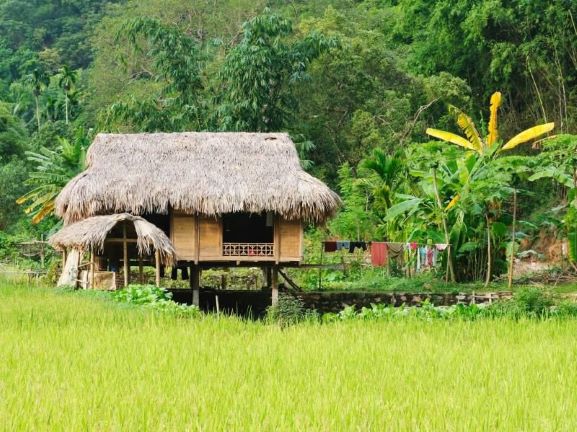
It is few years ago, soon after its creation, that I visited the Ape Gama (Our Village), located at the Jana Kala Kendraya in Sri Jayawardenepura Kotte, conceptualised to be the way a village was typically before colonisation (where the houses were made of clay).
Subsequently as part of my research in how our heritage is looked at by Sri Lankans including the younger generation, I had interviewed in-depth some of those who were recruited to play act in Ape Gama the roles of teacher and Gamarala and several other characters respectively. I went to their hometowns/villages, some of them very remote to understand how their children related to the identity of the ‘village.’
In one instance the villagers pointed to a youth who was the son of one of the employees of Ape Gama and joked how the 22-year-old abhorred the traditional Lankan dress for males, the sarong, along with the traditional diet and how he spent his time roaming around on a motor bike his father had bought him and searching out typical ‘Western type food.’ This is a simple example to show that we have not succeeded in making the young generation vibe with their past and where they see their parent’s association with it is ‘backward.’ This is the malady of our nation that we should seriously strive to change.
The stereotype image of the typical ancient ‘village’ consists of clay huts (although in practical reality today they are seen as symbols of either poverty or ironically as abodes made for foreigners). In our actual reality we have not made clay, one of the most sustainable elements for construction as part of our living heritage. If we are having a concept such as Ape Gama in the heart of the city, we should also have a policy where the construction of clay houses is mainstreamed and encouraged in the town, with appropriate heritage driven sustainable city planning.
The Ape Gama concept could also be used as a strong influencer for schoolchildren to learn about their heritage in as detailed a manner as possible, systematically, in a backdrop where the school syllabus does little to contribute to this. This writer has in many instances pointed out that every child in Sri Lanka should grow up learning as basic everyday knowledge their indigenous food and medicinal heritage.
Overall, what we need in Sri Lanka is to actively, consistently and innovatively project the village not as a quant, docile entity but rather as a thriving life force of a nation. It is from the village that all inventions needed sprang forth and at a time when ‘sustainability’ a Western-dominated buzzword word is repeated by us without even contemplating on its true significance there is much potential to actively use a concept such as Ape Gama to promote Sri Lanka’s rural economic regeneration as well as influencing the city towards true sustainability.
The agrarian root of the village could be discussed at length and an endeavour such as Ape Gama should ideally explore initiatives involving conserving endemic plant varieties (Deshiya Beeja), and medicinal plants which are fast becoming extinct while encouraging the agrarian and irrigation policies of our kings to be re-enacted in real life. Related projects could be routed through the Ape Gama but initiated elsewhere in the country, especially the cultivation of trees. Such an initiative could lead to product creation for the local and export market as well, especially in times of pandemics, capitalising on the unique heritage of Sri Lanka such as the Deshiya Chikitsa medical heritage which we have totally undermined. There are also many ways in which a concept such as Ape Gama could be used to leverage Sri Lanka internationally at a time when that leveraging is desperately needed and tourism and indigenous medicinal knowledge sharing and export industry are just two of them.
A ‘living heritage’
We have to keep in mind that this endeavour to reproduce this village experience in the heart of the city was aimed at it being a ‘living heritage.’ To what extent our village is still a ‘living heritage’ in reality is debatable given that our current medicine tradition, our basic village, town and city planning policy is not even remotely connected with our heritage. We are a country who gave permission for soil destructing pine trees to be grown in the 1970s (on the advice of foreigners) and Dr. Ranil Senanayake, the man who objected to it in his capacity as an ecologist who had proposed a village-based agro-medicinal reforesting model had to finally leave his job. So, in any effort to replicate the village in the city, we have to eradicate any oriental or romanticising of the rural and see it for its practical worth.
In the village kiosk at the Ape Gama that I visited four years ago I drank herbal tea in a cleaned-up coconut shell thinking of the potential for detailed research in how the coconut shell is believed to have properties that will purify water and where prolonged use of water in a coconut shell is thought of as strengthening bones. (The coconut as a whole whether it is coconut water or the kernel or shell, holds significant curative properties especially coconut milk which is known to remove poison from the body). It is a pity that the average youth of a village whose biggest dream is to get to the city (and then leave for a foreign country) would not imbibe such information such as these. The purpose of an initiative such as Ape Gama should therefore be for a re-connection with what is ours, whether it is irrigation, agriculture, forestry, craftsmanship, construction techniques and traditional immunity boosting diet and medicinal heritage.
Any re-connection with our ancient village concept, should also primarily enable the creation of new ideas so that it is juxtaposed with the old but where the end result would not be that the village yearns to be like the town, but rather where the soulless town aims to become as holistically vibrant as the village.
How many of us drink pre-colonial herbal drinks such as Beli mal (flowers), Ranawara mal (flowers) and Polpala morning noon and evening as we drink tea introduced by the British? Despite having many indigenous herbal drinks, after 70 years of independence tea is promoted as our ‘heritage drink; and yes this is partially right – it is our colonial heritage but not representative of the thousands of years of our civilisation in which our food and drink evolved with what was endemic to our land.
The Ape Gama concept had fitted in the typical Gurukula (a teacher’s abode) like setting with one small clay made house reminiscent of a teacher’s residence which was the pre-colonial equivalent of the modern school. In this pre-colonial education system we had, the child learnt introspection, mindfulness, some specific craft and above all qualities such as gratitude to the teacher, kindness and empathy (qualities which are sorely lacking in today’s education sector).
Despite the British believing that they were the superior benefactors of so-called Western Science based ‘education’ it is Sri Lanka’s ancient Gurukula model that produced the architects and the engineers who designed world wonders such as Sigiriya where Western engineers (as well as Lankans who learn the Western model of engineering) are clueless as to how water flow was sent up to a high rock.
Among other potentials, one of the strongest points of the Ape Gama concept as this writer sees it is to resurrect the Gurukula system once again to be a training hub for children on diverse aspects of heritage as highlighted and detailed above throughout this article. In these times of pandemics, we need such knowledge to be especially related to the maintaining of health and immunity through traditional medicines and imparting a wide-scaled knowledge for children on their endemic herbs.
The knowledge of our indigenous medicine was imparted to everyone as Robert Knox observed in his memoirs. Training in traditional medicine that had put Sri Lanka on the map from the ancient most times of kings had received a significant importance in the Gurukula system. Today we have to keep in mind that strategising to build up a nation’s immunity and health go hand in hand with its economy and international positioning in the short and long term.
This pandemic time gives us the opportunity to take bold steps in our policy making and emulate countries such as Bhutan who came up with their own model of Gross National Happiness. With a concept such as Ape Gama we can mould a village development policy for ourselves where the village is positioned as a centre where innovation, nature, simplicity and economic activity go hand in hand. It should be reiterated that the village was the mother of all inventions – whatever that was needed for survival was invented in the village. Sri Lankans who built the world’s first hospital in the world in Mihintale were ancient villagers. Those who crafted the hospital surgical equipment (scores of them shaped like beaks of birds for specific purpose of operations) were educated in the Gurukula tradition and yes, they too were villagers.
It is lapse of Sri Lanka that we have not looked at each village as the epicentre of humane progress, of holistic advancement and as in the days of monarchy the representation of advanced science (that could make rough stone pulp to enable engraving and create ponds and carve palaces from sky high stone such as done in Sigiriya).
Thus, we have the potential to mould the village to be representative of our ancestors and their values and truly initiate both a training as well as research hub for retracing many of our lost heritage knowledge. Sri Lanka has many committed professionals in this regard who have spent years studying different branches of these themes.
What is our village to us?
Our village is the birthplace of all innovation. What we need we create. We do so with nature and without harming the natural world.
Our village is where we have an equilibrium between what we can create to sell to others so that we could buy what we need but we are not dominated by greed and mindlessness. Our village is a place that teaches us about life.
Our village is not a place which is of the distant past, it exists today and we create it and our values. We learn from it our indigenous principles of sustainability. Our Lankan village is a model to the world which can be emulated in any era.
Our village is not a sentimental myth which is a spectator’s novelty. Our village is the heart and soul of our tradition, of wellbeing and holding the spiritual ethic of the country.
Our village is the vein that connects our past with our present. In it exists our spiritual heritage, our medicinal legacy and our agrarian tradition.
Our village is not an isolated entity which is a prototype of poverty and backwardness. It is the opposite. It thrives as a hub where the world learns from Sri Lanka’s heritage knowledge whether it is our ancient Deshiya Chikitsa medical heritage or our vast knowledge in many areas that includes irrigation, ancient construction methods using rocks and clay respectively, artistry and craftsmanship.
Our village teaches the world by re-learning about our indigenous medicine Deshiya Chikitsa and bestows upon the world healing in uncertain times through the resurgence of an indigenous medical industry.
Our village is representative of what education should truly be and gives the world an example of the Gurukula system where students first learnt introspection, mindfulness, respect and gratitude to their teacher and then to create using the bounties of nature and with the creativity of their higher consciousness. It is the Gurukula system that bears testimony to the greatest artistic feats of Sri Lanka.
Our village represents Sri Lanka not as a mere exhibition point for a rustic experience but an experience that will change attitudes, ideology and lives forever. Our village brings the world together especially in this time of pandemics towards a whole new order of reflection missing today in a disjointed world.
Our village shows the world how we looked at sustainability and humane progress.
The national security could not be still assured until the people who led Zahran Hashim to carry out the sudden terror attacks are identified, former SDIG of the Criminal Investigation Department (CID) Ravi Seneviratne yesterday informed the PCoI probing Easter Sunday attacks.
Testifying before the Commission former SDIG Seneviratne said that Zahran’s initial plan was to carry out the attack in 2020 and suddenly he had decided to conduct the attack in April, 2019.
We have to identify the persons who were above Zahran and operated to conduct the attack. Until we investigate that part, this inquiry is incomplete,” he said.
Former SDIG said that the plan to carry out the attack in April, 2019 was Zahran’s own decision and due to that decision some members of National Thowheed Jamath (NTJ) had a conflict with Zahran. He said that Zahran Hashim was active from 2014 and he had initially decided about the conduct of terror attacks in 2017 or 2018.
Then in 2018 vandalizing Buddha statues in Mawanella took place. In that instance Zahran had advised one of the suspects of Mawanella case Mohommad Ibrahim Abdul Sadiq to damage at least one Buddha statue,” he said. He further added that according to the CID inquiry it had found that NTJ had 41 bank accounts and the funds received to those accounts via Ibrahim brothers who blasted themselves at Shangri-La and Cinnamon Grand hotels on April 21, 2019.
Former SDIG said that the CID had led extensive investigations into Zahran’s connection with a foreign organisation but it could not trace anything regarding to that organisation.
Commissioners then questioned about Zahran’s plan to have another baby in March, 2019 and he had consulted a doctor together with his wife.
Responding to a question the witness said that the CID had also inquired about it and found the doctor.
However, Commissioners said that according to Zahran’s wife’s evidence given before the Commission Zahran Hashim did not have a such plan to have another baby.
Meanwhile, former SDIG said that according to CID’s investigations the plan of NTJ was if any suicide bomber had failed to carry out the attack, that bomber had to go to a safe place and the place was a church in Colombo. (Yoshitha Perera)
Four more Covid-19 related deaths are reported in Sri Lanka, the Director-General of Health Services confirmed.
One of the victims is reportedly a 70-year-old female from Colombo 15 area. She has died upon admission to the Colombo National Hospital on Saturday (21). The cause of death has been cited as Covid-19 pneumonia.
A 53-year-old male from Colombo 12 area also succumbed to the virus after being admitted to the Colombo National Hospital on Friday (20). As per reports, he died of a chronic respiratory disease induced by Covid-19 infection.
Meanwhile, an 84-yeard old female from Borella area, fell victim to the virus on Saturday (21). Her cause of death was determined as Covid-19 pneumonia.
Another man, a 75-year-old from Colombo 10, died virus infection while receiving treatment at the ICU of Infectious Disease Hospital (IDH) earlier today (20). The patient was under medical care at the Colombo National Hospital before being transferred to the IDH. Reports revealed that he also died of Covid-19 pneumonia.
This development brings the total number of Covid-19 deaths recorded in the country to 87.
The Easter Sunday terror attack was a conspiracy launched by a powerful nation to spread extremism in the country, says Samagi Jana Balawega MP Rishad Bathiudeen.
The MP, who is currently under remand custody at the Welikada Prison, mentioned this yesterday (21), testifying before the Presidential Commission of Inquiry probing the 2019 Easter attacks.
The State Counsel on the Commission inquired the MP whether he had influenced any of the investigations on FETO, a banned organization in Turkey, conducting business in Sri Lanka, which had been halted after a revelation that 02 Sri Lankan Cabinet Ministers –one of them being MP Bathiudeen -being involved with the FETO members.
The parliamentarian, claiming that it was untrue, said that he has no affiliation with any individual or organization in Turkey and that he had not influenced the investigations.
The Commission then inquired the witness whether he was aware that a house belonging to his sister in Canada was being used as a safe house by suicide bombers. To which the MP replied saying that he was not aware of that fact and that got to know about this only after the attacks.
Responding a query, he added that he had never visited the house in question. The Commission then asked Bathiudeen whether his brother Riyaj Bathiudeen was arrested by the Criminal Investigation Department at any point.
He replied, Yes, he was arrested in connection with the investigation into the Easter attack. It was reported through the media that Cinnamon Grand Attacker Insaf Ahmed had taken 07 phone calls to my brother. I do not know the exact dates. Somehow it was taken before the Easter attacks, in 2019.
I asked my brother why Insaf had called. He said it was to seek some relief with regard to the government suspending copper exports. I don’t know if that’s what they talked about on all seven occasions. But on all 07 occasions, Insaf had called my brother.”
The Commission pointed out that while Rishad Bathiudeen had previously testified that he had not helped out Insaf Ahamed to buy copper, it is noted that Ibrahim’s son’s company had been issued 25,000 kilos more copper than other companies. The Commission asked Bathiudeen, who had signed for the marriage of Insaf, whether he had indirectly supported Insaf.
Bathiudeen said, I totally reject that claim. I categorically say that I have not helped any of Ibrahim brothers.”
A judge in the Commission asked, You said you were in a war refugee camp for five years after the LTTE expelled you from the North. How did you come to politics and become so wealthy?”
To which Bathiudeen replied that he does not have to beg because he became a refugee and that he could do business.
In response, the Commission asked whether he used his privileges as a minister and the ministry to amass such wealth and develop his and his family’s businesses.
Bathiudeen replied, No, I have not used such privileges in any way to advance the business. I have been a Member of Parliament since 2001 and have made declarations of assets and liabilities every year.”
The Commission member question again, We are not saying you have committed fraud, but I’m asking how you got so much money after being war-displaced.”
MP Rishad Bathiudeen responded to the question with some emotion: There is no relation between assets and the Easter attacks. These questions are better suited for character assassination. Therefore, I ask you to investigate the Easter attacks.”
Fresh COVID-19 positive cases were identified in Sri Lanka as the total number of cases reported from the Minuwangoda and Peliyagoda clusters reached 16,427.
The Department of Government Information said 175 more persons were tested positive for the virus.
All the new cases are close contacts of the Peliyagoda Fish Market cluster, reports confirmed.
With the new development, Sri Lanka has confirmed 19,946 novel coronavirus infections to date.
According to the Health Ministry’s data, 14,069 of the confirmed patients have made complete recoveries from the virus.
The committee of experts appointed to examine methods for disposal of Covid-19 victims has requested the authorities to continue with cremation until their final report is submitted.
Director-General of Health Services Dr Asela Gunawardena said the committee had conveyed this to the Secretary of Health Ministry.
A committee of experts was appointed by the Health Ministry after the Muslim community raised concerns over cremation of Covid-19 victims, stressing that it is against the dictates of their faith.
The topic was also brought to the attention of the Cabinet of Ministers on several occasions.
However, the Cabinet decided to refer the matter back to the experts’ committee to look into the possibility of burying Covid-19 victims in a remote, dry area.
Last week, UN Resident Coordinator in Sri Lanka, Ms Hanaa Singer wrote to Prime Minister Mahinda Rajapaksa, reiterating the concerns of the United Nations with the existing Health Ministry guidelines, which stipulate cremation as the only method for the disposal of bodies suspected of COVID-19 infection.
In her letter, Singer had noted that the common assumption that people who died of a communicable disease should be cremated to prevent spread is not supported by evidence.