The Covid pandemic: broadening the discourse

November 11th, 2020

By ASOKA BANDARAGE Courtesy Asian Times

It is time for a more balanced way of living that respects the environment and upholds bioregionalism

Technicians prepare for large-scale production of the University of Oxford’s Covid-19 vaccine candidate, AZD1222. Photo: AFP / Vincenzo Pinto

SARS-CoV-2, the coronavirus that causes Covid-19, has been spreading exponentially across the world over the last 10 or so months. More than a third of the global population has been placed on lockdown. The global economy is experiencing the deepest recession since World War II and massive numbers of people are losing their livelihoods and suffering serious effects on their physical and mental health.

The pandemic has allowed states and corporations to tighten technological surveillance and authoritarianism, curtailing privacy and democratic protest. As virulent second and even third waves of the pandemic speed across countries, people are gripped with fear and despair over their own survival and what the future holds for humanity.

The origin and prevention of the virus are mired in controversy and conflict between conventional and conspiracy” theories. This unprecedented, multifaceted global crisis, however, calls for deeper exploration and broader discourse on its causes and long-term solutions. Biomedical science, social science and ecological and ethical perspectives need to be integrated to overcome this pandemic as well as other pandemics predicted in the years ahead.

Controversy over origin and prevention

Given the lack of media coverage, there is scarce public awareness of the likely laboratory origins of previous pandemics like the H1N1 outbreak of 1977-78. Scientific and media establishments attribute the origin of Covid-19 to an animal-to-human (zoonotic) transmission at a seafood market in Wuhan, China, in December 2019.

While US intelligence sources also originally asserted this, they conceded in March 2020 that the pandemic may have originated in a leak from the lab at the Wuhan Institute of Virology in China.

The Wuhan Institute is linked to the US Army’s Defense Advanced Research Projects Agency (DARPA), which does research and testing involving bats and coronaviruses and gene-editing bioweapons.” The Wuhan Institute also has a close, decades-old partnership with the US Army Medical Research Institute of Infectious Diseases (USAMRIID) in Maryland, the leading US military laboratory for biological defense” research. USAMRID is known for periodic shutdowns due to its problematic record on safety procedures.

Gain-of-function research (GOF) involves manipulating viruses in the lab to explore their potential for infecting humans.” This type of research is criticized by many scientists on ethical grounds because of the risks GOF viruses pose for human health from accidental release.

Because of public health concerns, in October 2014, the US government banned all federal funding for efforts to weaponize three viruses: influenza, Middle East respiratory syndrome (MERS), and severe acute respiratory syndrome (SARS). In the face of this ban in the US, Dr Anthony Fauci, the director of the National Institute of Allergy and Infectious Diseases (NIAID), reportedly outsourced in 2015 the GOF research on bat coronaviruses to China’s Wuhan lab and licensed the lab to continue receiving US government funding.”

In early 2018, US Embassy officials in China raised concerns about inadequate safety” at the Wuhan Institute of Virology. US science diplomats warned that, in part because of a lack of adequate safety personnel, the research that the lab was conducting in relation to bats represented a risk of a new SARS-like pandemic.” Yet action was not taken and despite the controversies, Dr Fauci was appointed as the leading doctor in the US Coronavirus Task Force and continues to function in that position.

Hollywood films like 2011’s Contagion presented eerie premonitions of the Covid-19. In 2015, billionaire and global-population-control proponent Bill Gates warned of a huge threat of a global pandemic. A pandemic simulation called Event 201 was conducted in October 2019 by the Johns Hopkins Center for Health Security in partnership with the Bill and Melinda Gates Foundation, and the World Economic Forum projected up to 65 million deaths due to a coronavirus.

However, the biomedical, political and business leaders who were well aware of the impending Covid pandemic did not take the precautionary action needed to safeguard people. The United States, Europe and other regions found themselves without adequate testing kits, respirators, hospital beds and medical personnel when the virus started to spread.

A failure of leadership lies behind the massive destruction of human life, livelihoods and social life that we are experiencing today.

Controversy over mitigation

While lockdowns, curfews and the isolation of entire communities and regions seem to be the norm, the effectiveness of this approach and its enormous negative consequences on the economy, society and mental health are coming into question. The success of the mainstream approach depends on a host of local socio-economic factors, such as the age of the population, health infrastructure, leadership, and mobilization of people, as well as just, uniform and compassionate enforcement of preventive measures.

Double standards in enforcing Covid health protocols can contribute to resentment and weaken overall conformity jeopardizing the health and safety of entire populations. Apparently, under strict guidelines in Australia, some individuals have been prevented from visiting dying family members while at the same time VIPs and celebrities have been exempt from strict quarantine measures.

Likewise, in Sri Lanka, high-powered delegations from China and the United States (the latter led by Secretary of State Mike Pompeo) arrived in the midst of the worsening second wave in October, seemingly forgoing national Covid guidelines.

Many countries in the Global South such as Vietnam, Cambodia, Senegal and Rwanda have contained the pandemic more successfully than the United States and the rich European countries. As of November 1, Rwanda and Senegal reported 0.28 and 2.04 Covid deaths per 100,000 people respectively, whereas the corresponding number for the US was a staggering 70.4.

The vast majority of those infected recover easily and only the elderly and those with other pre-existing illnesses are the most vulnerable. As of November 6, of the total confirmed 49,195,581 cases, 32,368,883 had recovered. Given this reality, many epidemiologists are suggesting focused protection” of the most vulnerable groups, allowing the rest of the population to develop herd immunity,” the point at which the majority of a population becomes immune and limits the spread to those that are not immune.

Sweden is the leading example of a country that went against the global norm of mandatory lockdowns, social distancing and use of face masks. Sweden experienced a much higher numbers of cases and deaths than its Scandinavian neighbors during the first wave of the pandemic.

However, Sweden has had relatively fewer deaths during the current second wave while other Scandinavian and European countries that imposed strict lockdowns early in the pandemic are facing massive spikes in infections and deaths. Given the relative failures of the mainstream lockdown approach and its negative socio-economic and psychological impacts, alternative long-term approaches like that of Sweden warrant consideration.

A report in May from the Center for Infectious Disease Research and Policy in the US suggested that the Covid-19 outbreak will not end until 60% to 70% of the human population becomes immune to the virus, which could take anywhere from 18 to 24 months. Meanwhile, many virologists and global leaders argue that the only way to eradicate the virus would be with a vaccine delivered to every human being as quickly as possible.

අග්‍රාමාත්‍යතුමා පොතුවිල් මුහුදු මහා විහාරයේ නිරීක්ෂණ චාරිකාවක

November 11th, 2020

අග්‍රාමාත්‍ය මාධ්‍ය අංශය

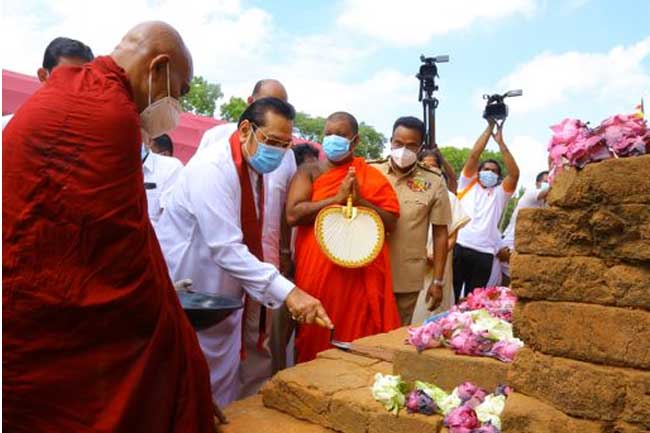
අම්පාර, පොතුවිල් පිහිටි ඵෙතිහාසික මුහුදු මහා විහාරයේ නිරීක්ෂණ චාරිකාවක් සඳහා ගරු අග්‍රාමාත්‍ය මහින්ද රාජපක්ෂ මැතිතුමන් අද 2020.11.11 දින එක්විය.

විහාරස්ථානයට පැමිණි ගරු අග්‍රාමාත්‍යතුමා ආගමික වතාවත්වල නිරතවීමෙන් අනතුරුව ගරුතර මහා සංඝරත්නයේ  ආශිර්වාද ලබා ගත්තේය.

ඵෙතිහාසික මුහුදු මහා විහාරයේ විහාරාධිපති, නැගෙනහිර පළාතේ ප්‍රධාන සංඝනායක, වරකාපොළ ඉන්දසිරි නාහිමි, අක්කරේපත්තුව ශ්‍රී විජයරාමාධිපති දේවගොඩ සෝරත හිමි, බෞද්ධයා නාලිකාවේ සභාපති බොරලන්දේ වජිරඥාන හිමි ඇතුළු මහා සංඝරත්නය මෙම අවස්ථාවට වැඩම කළ වඳාළහ.

ගරුතර මහා සංඝරත්නය  සෙත් පිරිත් සඡ්ඡායනා කර අග්‍රමාත්‍යතුමාට ආශිර්වාද පැමිණවීය.

මුහුදු මහා විහාරයේ ඉදිරි සංවර්ධන කටයුතු සම්බන්ධ පැවති සාකඡ්ඡාවට එක් වූ අග්‍රමාත්‍යතුමා විහාරස්ථානයේ ඉදිරි සංවර්ධන කටයුතු පිළිබඳව අදාළ නිලධාරීන්ට උපදෙස් දුන්නේය.

විහාරස්ථානයට අයත් භූමිය අනවසර පදිංචිකරුවන්ගේ ග්‍රහණයට ලක්වීම පිළිබඳව පසුගිය ආණ්ඩු සමයේ විශාල ආන්දෝලනයක් පැවතිණි.

එම ගැටළු නිරාකරණය කරමින්, මුහුදු මහා විහාරස්ථානයට අයත් භූමිය ලකුණු කර එය පූජා භූමියක් ලෙස නම් කර ඊට අදාළ බලපත්‍රය ලබාදීමට ගරු අග්‍රාමාත්‍ය හා බුද්ධශාසන, ආගමික හා සංස්කෘතික කටයුතු අමාත්‍ය මහින්ද රාජපක්ෂ මැතිතුමා  තමන්ට උපදෙස් ලබා දුන් බව මෙම අවස්ථාවට එක් වූ බුද්ධශාසන, ආගමික හා සංස්කෘතික කටයුතු අමාත්‍යංශ ලේකම් මහාචාර්ය කපිල ගුණවර්ධන මහතා කියා සිටි‍යේය.

එමෙන්ම මෙම භූමිය ආරක්ෂා කිරීම සඳහා අග්‍රාමාත්‍යතුමාගේ මැදිහත්වීම යටතේ නාවික හමුදා අනු කණ්ඩයක් පිහිටුවීමට ආරක්ෂක ලේකම් කමල් ගුණරත්න මහතා කටයුතු කර තිබේ.

ඵෙතිහාසික මුහුදු මහා විහාරයට අයත් අක්කර 72 ක භූමිය ආරක්ෂා කර දෙන ලෙසත්,   නැගෙනහිර පළාතේ හඳුනා නොගත් පුරා විද්‍යා ප්‍රදේශ ආරක්ෂා කර දෙන ලෙසත්, මුහුදු මහා විහාරයේ විහාරාධිපති, නැගෙනහිර පළ‍ාතේ ප්‍රධාන සංඝනායක, වරකාපොළ ඉන්දසිරි නාහිමියෝ අග්‍රාමාත්‍යතුමාගෙන් ඉල්ලා සිටියහ.

අග්‍රාමාත්‍යතුමාගේ ප්‍රධානත්වයෙන් 2003 වර්ෂයේ මුල්ගල තැබූ ඵෙතිහාසික මුහුදු මහා විහාරයේ චෛත්‍ය රාජයාණන් වහන්සේගේ වැඩ කටයුතු මේ වන විට අවසන් කර ඇති බව විහාරාධිපති වරකාපොළ ඉන්දසිරි නාහිමියෝ අග්‍රාමාත්‍යතුමාට දැන්වූහ.

මෙම අවස්ථාව සඳහා රාජ්‍ය අමාත්‍ය විමලවීර දිසානායක, අම්පාර දිස්ත්‍රික් සංවර්ධන කමිටු සභාපති, පාර්ලිමේන්තු මන්ත්‍රී ඩබ්.ඩී.වීරසිංහ, නැගෙනහිර පළාත් ආණ්ඩුකාර අනුරාධා යහම්පත්, ආරක්ෂක අමාත්‍යංශයේ ලේකම් මේජර් ජනරල් (විශ්‍රාමික) කමල් ගුණරත්න, බුද්ධ ශාසන ආගමික හා සංස්කෘතික කටයුතු ලේකම් මහාචාර්ය කපිල ගුණවර්ධන, පුරා විද්‍යා අධ්‍යක්ෂ ජනරාල් මහාචාර්ය සෙනරත් බණ්ඩාර දිසානායක, සිවිල් ආරක්‍ෂක දෙපාර්තමේන්තුවේ අධ්‍යක්‍ෂ ජනරාල් රියර් අද්මිරාල් (විශ්‍රාමික) ආනන්ද පීරිස්,  අම්පාර දිස්ත්‍රික් ලේකම් එන්.එල්.ඩබ්ලිව් බණ්ඩාරනායක මහත්වරු ඇතුළු සම්භාවනීය අමුත්තන් රැසක් එක්ව සිටියහ.

මෙම නිරීක්ෂණ චාරිකාවෙන් අනතුරුව සංචාරක පුරවරයක් වන ආරුගම්බේ ප්‍රදේශයේ වෙරළ ඛාදනය වන ප්‍රදේශ නිරීක්ෂණය කිරීම සඳහා  අග්‍රාමාත්‍ය මහින්ද රාජපක්ෂ මැතිතුමා එක්විය.

Request for donations for Sri Lanka to help with recent Covid-19 outbreak

November 11th, 2020

Ven. Walpola Piyananda

Dear Sir/Madam, 

Sri Lanka’s governments’ timely actions from when the COVID-19 virus first entered the country helped keep the situation under control for a long period of time.

Recently the situation has quickly escalated and several Covid-19 positive clusters were found from the community. Therefore there is a quarantine curfew currently in place in the Western province, including Colombo the capital of Sri Lanka. Additional lockdowns and quarantine curfews are being imposed in affected areas.

Sri Lanka is identified as one of the most vulnerable middle income country at risk with an economy that depends on the tourism industry and exports. As the number of positive cases increases our healthcare system will come under significant further strain.

Therefore, I am requesting that our dear friends will be able to send support by making a donation to Sri Lanka in this difficult time.

You can donate directly to the Sri Lankan president’s fund or to Dharma Vijaya Buddhist Vihara.  I will personally forward any donations sent to the temple to President Gotabaya Rajapaksa with the donor’s information. 

President Fund-…..The Bank of Ceylon   acct#  85737373…..

 OR:  To send to Dharma Vijaya Buddhist Vihara

1847 Crenshaw Blvd., Los Angeles, CA 90019

OR: send through Zelle

Zelle:  dharmavijaya1@yahoo.com

With Metta,        Ven. Walpola Piyananda

අග්‍රාමාත්‍යතුමාගේ ප්‍රධානත්වයෙන් දීඝවාපී චෛත්‍යයේ ප්‍රතිසංස්කරණ කටයුතු ඇරඹෙයි

November 11th, 2020

අග්‍රාමාත්‍ය මාධ්‍ය අංශය

සොළොස්මස්ථාන වලට අයත් නැගෙනහිර පළාතේ පිහිටි වැදගත්කමින් හා විශාලත්වයෙන් ප්‍රමුඛස්ථානය ගන්නා දීඝවාපී පුද බිමෙහි ඇති චෛත්‍ය රාජයාණන් වහන්සේ ප්‍රතිසංස්කරණය කිරීමේ සමාරම්භක අවස්ථාවට ගරු අග්‍රාමාත්‍ය මහින්ද රාජපක්ෂ මැතිතුමන් අද 2020.11.11 දින එක්විය.

දීඝවාපී චෛත්‍යයේ ප්‍රතිසංස්කරණය ඇරඹේ

ප්‍රථමයෙන් ආගමික වතාවත්වල නිරතවූ අග්‍රාමාත්‍යතුමා අනතුරුව පිරිත් සඡ්ජායනා මධ්‍යයේ චෛත්‍ය රාජයාණන් වහන්සේ ප්‍රතිසංස්කරණය කිරීමේ සමාරම්භය වෙනුවෙන් මුල්ගල තැබීය.

මෙම ඓතිහාසික අවස්ථාවේදී දීඝවාපී රාජමහා විහාරාධිපති, අම්පාර මඩකළපුව දෙදිසාවේ උප ප්‍රධාන අධිකරණ සංඝනායක සංඝ කීර්ති ශ්‍රී බුද්ධරක්ඛිත සාම ශ්‍රී සද්ධර්ම වාගීෂ්වර, සද්ධර්ම කීර්ති ශ්‍රී, මුළු දිවයිනටම සාම විනිසුරු, ශාස්ත්‍රපති පූජ්‍ය මහඔය සෝභිත නාහිමියෝ අනුශාසනවක් පැවත්වූහ.

යුධමය වතාවරණය හමුවේ ජන ශූණ්‍ය වෙමින්, සංවර්ධනය අඩාල වූ උතුරු හා නැගෙනහිර සීඝ්‍ර සංවර්ධනය යථාවත් කිරීමට ගරු අග්‍රාමාත්‍ය, පස්වන විධායක ජනාධිපති මහින්ද රාජපක්ෂ මැතිතුමන් කටයුතු කළ බව උන්වහන්සේ පැවසූහ.

දීඝවාපී පුදබිම ගැසට් කිරීම මඟින් එය සංරක්ෂණය කිරීමට අග්‍රාමාත්‍යතුමා කටයුතු කළ බව සිහිපත් කළ සෝභිත නාහිමියෝ යුධ ගිනි නිවා රට එක්සේසත් කළ ගරු අග්‍රාමාත්‍යතුමාගේ එළඹෙන උපන් දිනයට නිදුක් නිරෝගී චිර ජීවනය ප්‍රාර්ථනා කළහ.

දිගු කාලයක් මුලුල්ලේ ස්වාභාවික හා මිනිස් ක්‍රියාකාරකම් හේතුවෙන් පරිහානියට ලක්ව ඇති දීඝවාපී පුද බිම දශක කිහිපයක් පුරාවට කිහිපවතාවක් ශ්‍රී ලංකා රජය සහ වෙනත් පාර්ශවයන් මඟින් ප්‍රතිසංස්කරණය කිරීමට උත්සාහ කළද එම සෑම ප්‍රයත්නයක්ම අසාර්ථක වී තිබිණි.

ත්‍රිවිධ හමුදාවේ පූර්ණ දායකත්වය සහ සිවිල් ආරක්‍ෂක බලකායේ පූර්ණ ශ්‍රම දායකත්වය යටතේ පුරාවිද්‍යා දෙපාර්තමේන්තුවේ මඟ පෙන්වීමට අනුව වසර දෙකක කාල සීමාවක් තුළ චෛත්‍යයේ වැඩ කටයුතු සම්පූර්ණයෙන් අවසන් කිරීමට අපේක්ෂිතය.

මෙම ප්‍රතිසංස්කරණ කටයුත්තට සමගාමීව චෛත්‍ය වැඳපුදා ගැනීමට පැමිණෙන බැතිමතුන් හට නැවතීම සඳහා විශ්‍රාම ශාලා ගොඩනැගිල්ලක්ද ඉදිකිරීමට නැ‍ගෙනහිර පළාතේ පුරාවිද්‍යා උරුමය කළමනාකරණය සඳහා වන ජනාධිපති කාර්යය සාධක බලකායේ සභාපති, ආරක්‍ෂක ලේකම් කමල් ගුණරත්න මහතා ඇතුළු කාර්යසාධක බලකාය අදහස් කර ඇත.

පූජා භුමිය අලංකාරවත් කිරීම සඳහා ගස් සිටුවීමේ ව්‍යාපෘතියක් ද ක්‍රියාත්මකය. එය ආරම්භ කරමින් ගරු අග්‍රමාත්‍යතුමා නා පැළයක් රෝපණය කළේය.

දීඝවාපී චෛත්‍යයේ චූඩා මාණික්‍යය, කොත් වහන්සේ සහ විහාරගෙය නා උයන ආරන්‍ය සේනාසනයේ ප්‍රධාන සංඝ නායක පුජ්‍ය අගුල්ගමුවේ අරියනන්ද ස්වාමීන් වහන්සේගේ අනුශාසනා පරිදි ධන පරිත්‍යාගයෙන් ඉදි කරයි.

එසේම, සඳහිරු සෑයේ සලපතල මළුව සහ විහාරගෙයද නා උයන ආරන්‍ය සේනාසනයේ ප්‍රධාන සංඝ නායක පුජ්‍ය අගුල්ගමුවේ අරියනන්ද ස්වාමීන් වහන්සේගේ අනුශාසනා පරිදි, නා උයන මහා භාරකාර මණ්ඩලයේ ධන පරිත්‍යාගයෙන් ඉදි කිරීමට නියමිතය.

ඒ සඳහා රුපියල් මිලියන 76ක චෙක් පත නා උයන මහා භාරකාර මණ්ඩලයේ ලේකම්තුමා විසින් ගරු අග්‍රාමාත්‍ය මහින්ද රාජපක්ෂ මැතිතුමන්ට භාරදීම ද මෙහිදී සිදු විය.

මෙම අවස්ථාව සඳහා උතුර සහ නැගෙනහිර දෙපළාතේ සහ තමන්කඩුව දිසාවේ ප්‍රධාන සංඝනායක අරිසිමලේ ආරණ්‍ය සේනාසනාධිපති පූජ්‍ය  පනාමුරේ තිලකවංශ නායක ස්වාමීන් වහන්සේ, නා උයන ආරන්‍ය සේනාසනයේ ප්‍රධාන සංඝ නායක පුජ්‍ය අගුල්ගමුවේ අරියනන්ද ස්වාමීන් වහන්සේ, පූජ්‍ය බොරලන්දේ වජිරඥාන ස්වාමීන් වහන්සේ ඇතුළු මහා සංඝ රත්නය වැඩම කළ වදාළහ.

රාජ්‍ය අමාත්‍ය විමලවීර දිසානායක, පාර්ලිමේන්තු මන්ත්‍රී ඩබ්.ඩී.වීරසිංහ, නැගෙනහිර පළාත් ආණ්ඩුකාර අනුරාධා යහම්පත්, ආරක්ෂක ලේකම් මේජර් ජනරල් (විශ්‍රාමික) කමල් ගුණරත්න, බුද්ධ ශාසන ආගමික හා සංස්කෘතික කටයුතු ලේකම් මහාචාර්ය කපිල ගුණවර්ධන, පුරා විද්‍යා අධ්‍යක්ෂ ජනරාල් මහාචාර්ය සෙනරත් බණ්ඩාර දිසානායක, සිවිල් ආරක්‍ෂක දෙපාර්තමේන්තුවේ අධ්‍යක්‍ෂ ජනරාල් රියර් අද්මිරාල් (විශ්‍රාමික) ආනන්ද පීරිස්, ජාතික බුද්ධි ප්‍රධානී මේජර් ජනරල් (විශ්‍රාමික) ජගත් අල්විස් මහත්ම මහත්මීන් ඇතුළු සම්භාවනීය අමුත්තන් රැසක් එක්ව සිටියහ.

අධ්‍යාපනය පිළිබඳ ගැටඵ වලට විසදුම් සෙවීමේදී වගකීම් විරහිතව කටයුතු කිරීම සම්බන්ධවයි.

November 11th, 2020

ලංකා ගුරු සේවා සංගමය.

ලේකම්
අධ්‍යාපන අමාත්‍යංශය,
ඉසුරුපාය,
බත්තරමුල්ල.

ලේකම්තුමනි,

අධ්‍යාපනය පිළිබඳ ගැටඵ වලට විසදුම් සෙවීමේදී වගකීම්
විරහිතව කටයුතු කිරීම සම්බන්ධවයි.

2019 අ.පො.ස උසස් පෙළ විභාගයේ ප‍්‍රතිඵල මත විශ්වවිද්‍යාල ප‍්‍රවේශය සඳහා වන සීමා ලකුණු (ජමඑ දෙෙ ප්රනි* ගැටඵව පිළිබඳ මෙන්ම මීට පෙර වසංගත තත්වය පහව යාමත් සමග පාසල් විවෘත කිරීම, අ.පො.ස උසස් පෙළ විභාග පැවැත්වීම හා ඊට දින නියම කිරීම සම්බන්ධව ජනාධිපතිවරයා, අධ්‍යාපන අමාත්‍යවරයා මෙන්ම ලේකම්වරයා හා විභාග කොමසාරිස්වරයා සමග ද පැවැත් වූ තීරණාත්මක සාකච්ඡුා වලදී ඊට අදාළව වගකීම් දරන ගුරු – විදුහල්පති වෘත්තිය සමිති පසෙකලා මැතිවරණ වලදී ආණ්ඩුවට සහාය දැක්වූ ටියුෂන් ගුරුවරුන් වැනි පාර්ශව පමණක් දිගින් දිගටම සහභාගි කර ගැනීම සම්බන්ධව ලංකා ගුරු සේවා සංගමය දැඩි විරෝධය පළ කර සිටිමු.
02ග විශේෂයෙන් 2019 අ.පො.ස උසස් පෙළ සීමා ලකුණු පිළිබඳව පැන නැගී ඇති ගැට`ඵව සම්බන්ධව අංක: ල.ගු.සේ.ස/අ.ඇ/2020 හා 2020.10.29 දිනැතිව අප සංගමය විසින් ඔබතුමාට ද පිටපත් සහිතව අධ්‍යාපන අමාත්‍යවරයා වෙත කරුණු පෙන්වා දීමට කටයුතු කළ නමුත් ඒ පිළිබඳව සාකච්ඡුා කිරීමට හෝ අවස්ථාවක් ලබාදීමට කටයුතු කර තිබුණේ නැත.

03ග නමුත් එය එසේ තිබියදී ආණ්ඩුව සමග සිටි එක්තරා ටියුෂන් ගුරුවරයෙකු අධ්‍යාපන අමාත්‍යවරයා කැදවනු ලැබු සාකච්ඡුාවකදී 2020.11.09 මෙම ගැටඵව විසඳීමට තමන් මැදිහත් වී කටයුතු කරන බව පවසමින් සමාජ මාධ්‍යවල දැන්වීම් පළ කර සිසුන්ගෙන් තොරතුරු රැුස් කරමින් තම ව්‍යාපාරයට අනියම් ප‍්‍රචාරක වාසි සඳහා මෙම ගැටඵව යොදාගෙන තිබීම කනගාටුවට කරුණකි. මෙවැනි සිදුවීම් හරහා වර්තමාන ආණ්ඩුව රටේ අධ්‍යාපනය සම්බන්ධව දක්වන ආකල්ප හා ප‍්‍රතිපත්තිය මැනැවින් පිළිබිඹු කර ඇති බව අපගේ විශ්වාසයයි.

එහෙයින් තවදුරටත් රටේ අධ්‍යාපනය සම්බන්ධව පටු උවමනාවන් පෙරදැරි කර ගෙන සිදු කරනු ලබන මෙවැනි මැදිහත්වීම් වලට ඉඩ නොතබා වගකීම් සහගතව කටයුතු කරන ලෙසත් එහිදී විශේෂයෙන් රටේ අධ්‍යාපන ක්ෂේත‍්‍රයේ පැන නගිනු ලබන ගැටඵ සම්බන්ධව එහි සෘජු වගකීම් දරන ගුරුවරුන්, විදුහල්පතිවරුන් නියෝජනය කරනු ලබන අප වෘත්තීය සමිති සමග සාකච්ඡුා කිරීම අදාළ අධ්‍යාපන බලධාරින්ගේ වගකීම බවත් නැවත අවධාරණය කර සිටිමු.

මෙයට,
විධායක සභාව වෙනුවෙන්,

මහින්ද ජයසිංහ,
ප‍්‍රධාන ලේකම්,
ලංකා ගුරු සේවා සංගමය.

පිටපත් – 01. ගරු අධ්‍යාපන අමාත්‍ය – අධ්‍යාපන අමාත්‍යංශය
02. සභාපති – විශ්ව විද්‍යාල ප‍්‍රතිපාදන කොමිෂන් සභාව

Tiny Georgia Wows Australia With Sri Lankan Cuisine!

November 11th, 2020

Courtesy hoteliers.global

 Tiny Georgia Wows Australia With Sri Lankan Cuisine!

Georgia, a cute, talented and confident 11 year old competing in the Junior MasterChef contest in Australia, was crowned the winner this week. The announcement saw millions of viewers who were captivated by the little contestants flood the internet with heartwarming messages of happiness and appreciation.

Georgia has Sri Lankan roots and is immensely proud of her heritage. In the final episode of the show, she cooked a pork curry, cashew curry, eggplant curry, plus yellow rice, pappadums and cucumber raita for her main.

Her dessert, which she named ‘Tropical Mess’ had five elements:  toasted coconut ice cream, brown bread crumb, Davidson plum pearls, Davidson plum meringues and a lemongrass granita. It’s a blend between Sri Lankan and Australian – a bit like me!” Georgia explained to the judges.

While contestants on the grown up version of the show may be tempted to whip up fancy meals with French names, the little kids on Junior MasterChef have always preferred to do things their own way. For Georgia, that meant going back to her Grandma’s Sri Lankan recipes, which she has always enjoyed relied on throughout the show. And those dishes were enough to convince the judges that they had finally found their winner!

Having first started cooking when she was around three years old, Georgia was inspired to take up the craft after watching her family gather in the kitchen to cook. Curiosity took over, and she has been cooking ever since.

Georgia has previously credited her grandmother for teaching her to cook.

I’m very close to my Nanna and my Papa,” Georgia said on the show, explaining she’s also learnt to make dishes that reflect her cultural heritage.

They’re both Sri Lankan. My Nanna taught me how to make lots of different Sri Lankan food.”

On the final episode of the show, the kids also showed surprising maturity in dealing with their mishaps, teaching adults a thing or two about dealing with emotions. Out of all the contestants, Georgia actually had the toughest time. Though her curries were the standout in the main course, her dessert literally fell apart. The base split, the ice cream didn’t set properly. She started to lose it. Her mum yelled out, You can do it, my angel,” and she replied, heartbroken, No I can’t.”

I always try to get everything right but that’s not how life works,” Georgia said. After a hug from her mum, she managed to get the final elements on the plate.

Ultimately, the judges said the decision came down to pure deliciousness”. And on that, Georgia just couldn’t be beaten.

After winning, Georgia said she’s not too sure what she’ll do with the AUD 25,000 prize money, but said she will definitely use it for something fun and food-related.

I’ll have access to it when I’m 18 so I have seven years to think about it,” she said. I’m thinking travel and starting a food stall.”

Re: Mr. Bodhi Dhanapala’s personal attacks on Professor Wimalawansa

November 11th, 2020

Sunil Wimalawansa 

Dear Editor: 

It is very unfortunate that most of the comments by the author of the email below are unfounded, scientifically incorrect, and is geared to nothing else but character assassination.  Just because a person disagrees, there is no reason to attack him or her and engage in assassination.  This is scandalous and defamatory.  

The author had been unsuccessfully tried previously using the same tactic, using different platforms.  Over the years, some of you may have seen such unfounded deep and unscientific criticisms.  Thus, I am not surprised.   

One such example was https://basecamp.com/2488885/projects/9243833 (currently, inactive), that was funded by the SLGo and maintained by the ministry of scient and technology, by its head, Prof. de Alwis.  [this website states, this Basecamp account is temporarily paused. Ajith de Alwis can resume it].   The goals of this blog site were to come up with novel solutions to help to curb chronic kidney disease in the NCP region in Sri Lanka.  More than 250 people from multiple countries participated and contributed to this site for the benefit of Sri Lanka, at least over four-year period.   

For more information, kindly contact the site administrator, Dr. Sachi Panawela at the ministry of science and technology (pvsachie@gmail.com ; Project Scientist – COSTI).  Because of his extreme, repeated personal attacks that had no relevance to science and the mission of the site, his participation was terminated (in fact, banned) by the mentioned Basecamp site administration.   

Banning of his participation of the government-run blog site was due to a similar, aggressive personal attacks and vicious character assassinations on Sri Lankan scientists that was disruptive and became a nuisance to the participants against other contributors.  This example also demonstrates the trend of his disliking others with differing views.  Despite multiple warnings by the SLGo site administrators, author continued with his unfounded vicious attacks led to preventing his participation after that.  This author-initiated email below is yet another beginning of similar line, to demonstrates his glory but with empty information.  Such should not be tolerated or encouraged.   

I have neither interest or time to waste to refute falsified and bogus clams, interrogations, and personal attacks by anyone.  My comments and writings are based on science as we know of today (with the advancement of science and knowledge, these can be changed tomorrow) and on global evidence that is applicable to Sri Lanka.   

I have no political affiliations in Sri Lanka.  I have lot more important things to do on my primary global efforts for the past four decades, on disease prevention;” not treatment as falsely claimed. 

Kind regards and good luck. 

Sunil Wimalawansa 

No final decision on East Container Terminal taken yet, says Sri Lanka

November 11th, 2020

Meera Srinivasan  Colombo |  Courtesy The Hindu BusinessLine

Although the Sri Lankan government is yet to declare its final position on developing the strategic East Container Terminal (ECT) at the Colombo Port jointly with India and Japan — agreed in May 2019 by the previous government — Port worker unions that are resisting the project think Sri Lanka might concede”.

Colombo seems to be under great pressure from New Delhi to go ahead with this project. We think our government will concede,” said Palitha Athukorala, President of the National Union of Seafarers Sri Lanka.

In May 2019, Sri Lanka’s Maithripala Sirisena-Ranil Wickremesinghe administration signed a Memorandum of Cooperation (MoC) with India and Japan to jointly upgrade the terminal with the aim of enhancing Sri Lanka’s status as a maritime hub. As per the MoC, the Sri Lanka Ports Authority (SLPA) was to retain 100 per cent ownership, while a jointly-owned terminal operations company — 51 per cent stake with Sri Lanka, and 49 per cent with India and Japan — would run the terminal. Despite the tripartite understanding, the former government was unable to take the deal forward.

After Sri Lankan President Gotabaya Rajapaksa assumed office in November 2019, the resistance to the project grow louder, including from some opposition parties and port workers opposed to foreign involvement in national assets”.

The Adani link

In July this year, BusinessLine reported that Adani Ports was eyeing the Colombo terminal project, with the Indian government’s backing. More recent international and local media reports on the Gujarat-headquartered Adani Group being the front-runner” for the project has put the controversial ECT is under the spotlight again.

However, when contacted, SLPA Chairman RM Daya Ratnayake denied the media reports. The matter would be discussed at the government level, but the SLPA is not aware of any such development,” he said.

Concurring with him, Cabinet spokesman Keheliya Rambukwella said: The government has appointed committee of experts to evaluate the different options to upgrade the Port, but there is no final decision yet.”

Strategic location

Meanwhile, the SLPA recently sought government approval to operationalise the ECT — even though only 40 per cent of its construction is complete — to handle the traffic, especially with staffing difficulties due to the pandemic. We decided to use cranes meant for another terminal at the ECT to deal with the congestion,” Mr. Ratnayake said.

Sri Lanka has repeatedly acknowledged the growing shipping traffic in the region and the need to expand operations at the Colombo Port with improved facilities. Over 70 per cent of the transhipment business at the Port is said to come from India.

India’s interest in the project has well-known commercial and strategic motives. The ECT adjoins the Colombo International Container Terminal (CICT), the SLPA’s joint venture with China Merchants Port Holdings Company Limited, that holds 85 per cent of the stakes. The ECT is also located near the China-backed $1.4-billion Port City coming up at reclaimed land at Colombo’s sea front. New Delhi has more reasons to pin its hope on the ECT, especially after the Rajapaksa administration ruled out any Indian involvement in developing the Mattala airport, located near the Chinese-built Hambantota Port — leased to China for 99 years — in the island’s Southern Province.

Japan, one of Sri Lanka’s biggest donors over the years, is also keen to help develop the ECT.

Now, SJB MP says she renounced British citizenship in 2015

November 11th, 2020

by Shamindra Ferdinando Courtesy The Island

…received official SL passport as Ranminithenna Chairperson

Dissident Samagi Jana Balavegaya (SJB) MP Dayana Gamage yesterday said that she had renounced her British citizenship in 2015 to launch her full time political career here. She insisted that she had obtained an official Sri Lankan passport in her capacity as the Chairperson of Ranminithenna Tele-Cinema village in 2017 during the UNP-led yahapalana administration.

The SJB National List MP said so when she was repeatedly accused of having entered parliament despite being a British national. Chamuditha Samarawickrema yesterday raised, during Salakuna programme on Hiru TV, the contentious issue of a British passport holder being in Parliament.

MP Gamage was among seven NL members appointed on the SJB list. The UNPer is the only newcomer to parliamentary politics.

Repeatedly asked whether she carried two passports, the MP said that she had received a British passport as her mother was British by birth. Responding to another query, Gamage said that as a British passport holder she had obtained a resident visa during 2005-2015 period. According to Gamage, the relinquishment of her British citizenship had enabled her to engage in Sri Lankan politics full-time.

Asked whether she had ever served as private secretary to one-time LTTE Eastern commander Vinayagamurthy Muralitharan aka Karuna Amman, a smiling Gamage told the interviewer he was referring to another woman. I have nothing to do with Karuna,” Gamage said, strongly denying the accusation that she deliberately refrained from informing relevant authorities here regarding her decision to give up British citizenship.

The interviewer sought an explanation regarding her conduct on the basis of a complaint made by civil society activist Oshala Herath over the alleged use of passports issued by the UK and her gaining entry into parliament in violation of the Constitution, Gamage said that Herath had nothing better to do.

Denying all accusations, the MP recalled how Herath, a candidate at the 2020 general election had made an abortive bid to sabotage the SJB nominations by moving the Supreme Court.

Herath, who served as a member of President Maithripala Sirisena’s media team recently wrote to Director, CID regarding MP Gamage’s citizenship. Herath made available a copy of his complaints to Secretary to the President, AG and Director CID, in addition to the Chairman of the Election Commission.

Herath unsuccessfully contested the last general election on the UNP ticket from the Colombo District.

Asked why she had not obtained dual citizenship, MP Gamage said that she had felt no need to do so. She compared the high profile campaign carried out against her alleging that she was holding British citizenship, as well as her alleged involvement in the project to efforts to deprive SLPP candidate Gotabaya Rajapaksa of the opportunity to contest 2019 presidential election.

Gamage said that she served as a Provincial Council member in 2014. Responding to questions as regards the documents required to prove her nationality, MP Gamage said that she was in possession of all such documents including the National Identity Card.

MP Gamage strongly defended her right to have voted for the 20th Amendment regardless of a decision taken by the SJB to oppose the new law. My husband Senaka de Silva informed Mr Premadasa of my decision. I took this decision in consultation with my husband.” The MP dismissed SJB threat to deprive her of NL seat.

MP Gamage said that her husband had made it possible for the rebel UNP group led by the Deputy UNP leader Premadasa to contest the election by handing over his Ape Jathika Peramuna (AJP). The SJB secured 54 seats, including seven on the NL. Pointing out that many political parties had been sold for big amounts over the years, Samarawickrema asked the MP how much her husband had received and whether the NL slot, too, was part of the deal. Denying having received funds for the transferring of the ownership of the party, Gamage claimed that unlike others they had not benefited from that initiative.

In fact, the NL slot was offered by Mr. Premadasa to my husband, one time Secretary to General Sarath Fonseka when the latter contested the 2010 presidential election as the common candidate.

Responding to another query, MP Gamage revealed that AJP had been registered by Mangala Samaraweera after he was sacked by the UPFA. Declaring that AJP no longer existed, MP Gamage said that both she and her husband handed over their resignation letters as Secretary and Deputy Chairman, respectively, to SJB General Secretary Ranjith Madduma Bandara about a week after she voted for the 20th Amendment.

In a wide ranging interview, MP Gamage revealed that UNP leader Ranil Wickremesinghe had planned to introduce a new piece of legislation similar to the 19th Amendment to the Constitution in case General Sarath Fonseka won the 2010 presidential election. MP Gamage claimed that her husband as the Secretary to the war-winning Army Chief had advised him not to do so as whoever functioned as the President needed necessary executive powers.

Passenger bus services entering and exiting Western Province suspended

November 11th, 2020

Courtesy Adaderana

All passenger bus services that enter and exit the Western Province have been temporarily suspended. 

State Minister of Bus Transport Services Dilum Amunugama stated that all passenger bus services have been suspended from leaving the Western Province until midnight on November 15 (Sunday).

He also said that buses from other areas have been requested not to enter the Western Province until then.

Meanwhile people in the Western Province have been prohibited from travelling outside the province with immediate effect until midnight on Sunday (Nov. 15)

Earlier today, President Gotabaya Rajapaksa had instructed officials to take necessary steps to prevent movements from the Western Province, where the majority of the COVID-19 infected were identified, to other parts of the country.

The President had also said that no one should be allowed to enter or leave the areas which have been designated as isolated areas. 

He had issued this directive during the daily briefing with the members of the Task Force on COVID-19 Prevention held at the Presidential Secretariat today (11).

626 Covid-19 cases reported so far today

November 11th, 2020

Courtesy The Daily Mirror

A total of 317 fresh COVID-19 cases were reported a short while ago increasing the total cases detected today to 626, Army Commander Shavendra Silva said.

He said all the patients have been identified as close contacts of the Peliyagoda cluster.

Sri Lanka confirms 46th COVID-19 death

November 11th, 2020

Courtesy Adaderana

Sri Lanka’s Director General of Health Services has confirmed another COVID-19 death, bringing the death toll from the virus to 46 in the country. 

A 63-year-old male from Imbulgoda has passed away while receiving treatment at the Maharagama Apeksha Hospital. 

The PCR test carried out at post mortem has confirmed that he was infected with COVID-19 virus.

Exacerbation of leukemia and a complication of the respiratory system are mentioned as the immediate causes of death.

The Director General of Health Services has defined this as a death caused by COVID-19 infection and, accordingly this is the 46th death of a Covid-19 infected patient in the country.

This is also the fifth Covid-19 death reported within today (11). 

Russian Covid-19 vaccine Sputnik V is 92% effective & causes no serious side effects – preliminary report on Phase III trial

November 11th, 2020

Courtesy RT

The developers of Russia’s pioneering Sputnik V coronavirus vaccine say their formula appears to show 92 percent efficacy and no serious side effects, based on the preliminary results of a large-scale Phase III clinical trial.

The vaccine is being tested in a large-scale double-blind survey involving 40,000 volunteers. Preliminary results based on the observation of 16,000 participants indicate that the drug does a good job of protecting people from the coronavirus, the Gamaleya Research Institute of Epidemiology and Microbiology said on Wednesday.

According to the statement, there were 20 confirmed Covid-19 cases among the group, which consisted of volunteers who were injected either with the vaccine or a placebo. The effectiveness of Sputnik V is estimated at 92 percent, meaning it boosts the immune system enough to fend off the coronavirus in just over nine out of ten people.

The subjects of the Phase III testing were not the only ones to receive the jab. Russia registered the vaccine in August after it was proven safe in a smaller Phase II survey and made it available to volunteers from high-risk groups, like doctors in Covid-19 wards. The developers observed 10,000 of those people and now say the results showed a similar efficacy rate of over 90 percent.ALSO ON RT.COMRussia says Sputnik V vaccine equally as effective as US pharma giant Pfizer’s newly unveiled Covid-19 formula

The report said that, as of Wednesday, no unexpected adverse events were identified as part of the research.” Some of the vaccinated people reported flu-like symptoms such as fever, fatigue and headache, or pain at the injection site, but those were all short-term.

The Gamaleya Institute promised to publish a report on its findings in a world-leading medical journal after an evaluation and to provide access to a full clinical trial report once the tests are fully complete. The researchers say six months will be necessary to make sure that participants of the study do not develop dangerous side effects.

The vaccine is based on two types of human adenoviral vector, with two shots administered three weeks apart.ALSO ON RT.COMTurkey ‘interested’ in producing pioneering Russian-developed ‘Sputnik V’ coronavirus vaccine – Moscow

Russia has great hopes for the vaccine, which was funded by the country’s sovereign wealth fund, the RDIF. Some other countries, including Belarus, the UAE, Venezuela, and India, are conducting their own clinical trials of Sputnik V, with an eye towards potentially purchasing it for domestic vaccinations or licensing it for production.

Travel out of the Western Province suspended until 15

November 11th, 2020

Courtesy Hiru News


Army Commander Lt. Gen. Shavendra Silva stated that no one will be permitted to travel out of the Western Province with immedite effect until midnight on the 15th of this month (November)

Coronavirus vaccine: Medicine not money motivates husband and wife behind the jab

November 10th, 2020

Oliver Moody , Berlin Courtesy The Times

On the morning of their wedding Ozlem Tureci and her groom Ugur Sahin turned up to the laboratory as usual. After a brief interlude at the register office they put their white coats back on and returned to work.

It was this tranquil single-mindedness that made Dr Tureci, 53, and Dr Sahin, 55, paper billionaires and two of the most interesting figures in modern oncology.

Now it has put the German-Turkish couple on the brink of claiming the world’s first demonstrably effective coronavirus vaccine and may bolster their fortune to more than £3 billion.

Ozlem Tureci and Ugur Sahin were pioneers in the treatment of cancer

Ozlem Tureci and Ugur Sahin were pioneers in the treatment of cancer

Both were four years old when their parents moved from Turkey to settle in Germany as part of the first Gastarbeiter, or guest worker generation.

Yet they came from quite different social backgrounds. Dr Sahin, who was born in Iskenderun, near the Syrian border, was the son of a Cologne car factory worker and picked up his enthusiasm for medicine from popular science books.

Dr Tureci, an Istanbul surgeon’s daughter who describes herself as a Prussian Turk, grew up with medicine in her blood and watched her father operating on patients while she was still a child.

The pair met at Saarland University Hospital in Homburg, a few miles from the French border. They soon found themselves at the cutting edge of cancer medicine, working out how to train the immune system to spot and eradicate tumours itself.

At the time the notion of treating cancer with anything other than surgery, radiation and chemotherapy seemed outlandish. It took a long time to become accepted that the immune system is a very potent tool to fight cancer,” Dr Tureci said in 2017, a year before three of the field’s pioneers were awarded the Nobel prize for medicine.

In 2001, the year before they married, they founded their first joint company. Ganymed Pharmaceuticals specialised in what was at the time a relatively new and exciting class of drugs known as monoclonal antibodies, essentially mass-produced and harmless tags that teach the body’s defences to recognise cancer. The firm was eventually sold for €1.3 billion in what was the biggest biotechnology deal in German history.

Their next venture made them celebrities, at least by the standards of experimental oncology.SPONSOREDTired of 2020 waylaying your plans? Read thisThis is what companies could have done better during lockdown

Until last year Biontech, founded in 2008 and based in Mainz, was best known for building personalised cancer vaccines” out of messenger RNA (mRNA), which carries genetic instructions for cells. Essentially, the vaccines prompt the body to mobilise against cancer the way it would against a virus.

Fortunately for mankind, this strategy would also be theoretically quite handy against the coronavirus.

In January Dr Sahin read an article in The Lancet about an outbreak of a novel infectious disease in Wuhan. He instantly spotted the danger. Experts experienced with previous outbreaks said this will come and go,” he told the Financial Times months later. I said, ‘No, this time it is different.’ ”

Within days of the pandemic’s arrival in Germany, Dr Tureci, Dr Sahin and their colleagues began adapting their technology to Covid-19. Biontech was placed on a war footing” for what was known internally as the speed of light” project because of the intense time pressure it was under.

Pfizer, an American pharmaceutical company, soon piled in with funding and the company’s share price tripled over the course of the summer. This increased the couple’s fortune to roughly €2.4 billion (£2.16 billion) by September, according to the Welt am Sonntag newspaper, which ranked the couple at 85th on its national rich list. Their young company is now worth more than €20 billion, making it more valuable than Porsche and Deutsche Bank.

Biontech’s mRNA-based approach is technically ambitious compared with the methods of other groups including the Oxford team, who have taken the more tried-and-tested path of adapting a virus that already exists in nature.

The manufacturing process, in which the mRNA is bundled into a microscopic blob of fat, is well suited to mass production and the company has said that it aims to have 100 million doses waiting to go by the end of the year. But the colossal scales involved are uncharted territory for the technique.

If the experiment pays off, it will not just be good news in the battle against coronavirus, as well as a vindication and a fabulously lucrative payday — on paper at least — for the scientists. It will also be proof of a concept for a promising new way of warding off a whole menagerie of diseases from HIV to melanoma through the body’s own fortifications.

In keeping with the customs of the German super-rich, Dr Sahin and Dr Tureci have maintained relatively modest public profiles.

Investors well acquainted with the couple say that they remain driven by the prospect of medical advances rather than money.

Dr Sahin still commutes to Biontech’s modern office block near the west bank of the Rhine by bicycle and retains his professorship and the chairmanship of experimental oncology at University Hospital Mainz.

He is said to avoid checking the company’s share price. Had he broken with his habit and looked at it yesterday he would have seen it rise by as much as a quarter in a matter of hours.

SCIENCE BEHIND BURYING COVID 19 INFECTED DEAD BODIES.

November 10th, 2020

Ranjiith Soysa

Attn the HON ALI SABRY

Dear Minister.
kindly note the following.
Thanks

SCIENCE BEHIND BURYING COVID 19 INFECTED DEAD BODIES.

,,,,WHO RECOMMENDATIONS SUIT TEMPERATE COUNTRIES ,NOT TROPICAL HIGH RAIN HIGH TEMPERATURE COUNTRIES The Sri Lankan Scientist- – by Meththika Vithanage – –

Prof. Meththika Vithanage (Ph.D. in Hydrogeology; Prof. in Natural Resources) Director, Ecosphere Resilience Research Centre,

Faculty of Applied Sciences, University of Sri layewardenepura meththika@sjp.ac.lk

With more than two third of the world is under lock down due to Covid-19, many countries are facing problems that they have never encountered before. Those problems range from quarantine issues to last rights of the people die from this infection. In a viral pandemic like COVID-19, the concern is that the dead bodies of victims can spread the virus among the people who closely handle or work with them. At the same time there is a huge debate on whether burying the bodies of COVID-19 victims may facilitate the viral spread through the ground water table. In this article we try to look back at scientific literature and review the risk of ground water contamination through the burial of viral disease victims’ dead bodies.

It has been a well-known fact that the cemeteries are among the chief anthropogenic sources of pollution and contamination of groundwater in urban areas and beyond, in the area of hydrogeology. In the process of decomposition of a human body, 0.4-0.6 liters of leachate is produced per 1 kg of body weight, which may contain pathogenic bacteria and viruses that may contaminate the groundwater. Burial in any means causes soil contamination and then leads to groundwater pollution via the discharge of inorganic nutrients, nitrate, phosphate, ammonia, chlorides etc. and various microorganisms. High biochemical and chemical oxygen demands, ammonia, and organic carbon have been reported as high as several hundreds of mg in L from cemeteries and mass burial sites.

In the case of viruses, recent studies indicate that viral may transport in soil with rainfall infiltration and extends specifically to drinking water from an untreated groundwater source. Several scientific publications report virus occurrence rates of about 30 percent of groundwater. Virus transport in groundwater is associated with a high degree of temporal and spatial variability, which is often attributed to absorption, filtration, soil water content, temperature, pH, type of virus, and hydraulic stresses and climatic conditions. It has been observed that viruses in groundwater can be correlated with their concentrations in wastewater and with groundwater recharge events. The ex-filtration from sewers and cemeteries are the most likely source of human viruses to this groundwater system, and leakage from sewers during heavy precipitation enhanced virus transport. The transport is often associated with both the unsaturated and saturated subsurface composed of varying geological settings with corresponding hydro-geological variability. Included among the essential hydro-geological factors that can be used to evaluate viral transport are the flux of moisture in the unsaturated zone, the media through which the particles travel, porosity, the length of the flow path, and the time of travel. In Sri Lanka, we experience high rainfall, low groundwater table, highly porous subsurface soil, and fractured rocks compared to most temperate countries in the world, which may lead the transport of biological and chemical compounds from dead bodies. Although WHO recommendation guidelines suit temperate countries mainly, not tropical high-temperature high rainfall countries where we experience high decomposition rates and highly variable water table. This is where the local hydro-geological knowledge is essential to protect groundwater as well as forthcoming infection occurrence. Given the vulnerability of our groundwater aquifers, and lack of understanding about the behavior of COVID-19 virus, there can be a risk from dead bodies, septic waste or sanitary waste are having any contact with water sources. Hence, it is advisable to have careful measures in destroying the infected dead bodies, septic, and sanitary waste in proper conditions without provisioning chances for any future disease outbreak.

Pfizer’s Covid-19 vaccine: ‘Normal life by spring’ after jab stops 9 in 10 infections

November 10th, 2020

Courtesy The Times

The Biontech founders Ozlem Tureci and Ugur Sahin, a German-Turkish couple, are behind the vaccine. It may bolster their fortune to more than £3 billion
The Biontech founders Ozlem Tureci and Ugur Sahin, a German-Turkish couple, are behind the vaccine. It may bolster their fortune to more than £3 billionFAZ FOTO/WOLFGANG EILMES

Britain should be heading back to normal by the spring, scientists said yesterday, after the announcement of a vaccine that is 90 per cent effective in stopping the coronavirus.

Jonathan Van-Tam, the deputy chief medical officer for England, said that the huge milestone” meant this wave of infection could be the last that Britain endured.

He said he was hopeful that the first Britons could be injected with the Pfizer and Biontech vaccine before Christmas. Britain has bought 40 million doses in advance, enough to inoculate 20 million people, and the NHS is preparing to start with the most vulnerable.

Scientists also said that the apparent success of the vaccine was a positive sign for others, such as the Oxford project, which is expected to report findings within weeks.

Stock markets rose sharply in response to the announcement, which Albert Bourla, Pfizer’s chief executive, described as a great day for science and humanity”.

The FTSE 100 enjoyed its best day since March, rising by 4.7 per cent, or 276.27 points, to close at 6,186.29, and the Dow Jones industrial average in New York improved by more than 1,500 points to hit a new intraday high.

In other developments:

• Half a million instant Covid-19 tests will be sent to councils within days.

• Four former prime ministers urged Boris Johnson in the summer to throw the full weight of the British state” behind coronavirus testing, it emerged.SPONSOREDA simple change that could get you through anxious times2 women share the story behind their love of teaching

• Donald Trump Jr cast suspicion over the timing of Pfizer’s announcement, suggesting that it was delayed to harm his father’s election prospects. He wrote on Twitter: Nothing nefarious about the timing of this at all right?” He concluded with an eye-rolling emoji.

• Quarantine for travellers to Britain could be scrapped under plans for one-hour Covid-19 tests on arrival, the transport secretary said.

• Ofsted warned that school and nursery closures had led to children regressing in basic learning and social skills.

• Britain recorded another 21,350 coronavirus cases, up 3.9 per cent in a fortnight, while there were 194 deaths over a 24-hour period.

The prime minister said last night that the Pfizer announcement was a sign that the scientific cavalry” was on its way, but he emphasised that it was very, very early days”.

Matt Hancock, the health secretary, told Times Radio that Pfizer’s announcement was a promising step” but there would be more steps to come” before any return to normality.

Warning against any sudden relaxation of restrictions, he added: I want life to be back to as close as normal as soon as possible. We are all pleased to see some light at the end of the tunnel but it’s absolutely crucial in the meantime that we hold our resolve.”

He went on to stress that the roll-out of the vaccine would be a colossal exercise … an NHS-led project supported by the armed forces”.

Scientists have still not seen the full data from the vaccine trials. In particular they said that they wanted to understand its effectiveness in older people, whether it stopped transmission as well as illness, and how much long-term immunity it conferred.

The preliminary results, based on 94 infections in the trial group, greatly exceeded the hopes of most scientists. To be approved, the vaccine had to prevent 50 per cent of symptomatic infections. The results make it more likely that other vaccines, which use the same target on the virus, will also be successful.

Sir John Bell, regius professor of medicine at Oxford University, was hopeful that this marked the beginning of the end of the pandemic. I’m really delighted by this result, for no other reason than it shows you can make a vaccine against this little critter,” he said.

When asked by the BBC if this could mean a return to normality by the spring, Sir John, who is involved in the Oxford vaccine, said: Yes, yes, yes. I’m the first guy to say that, but I will say it with some confidence.”

Professor Van-Tam said that the results were a great success on their own, and also a proof of principle. This is like getting to the end of the playoff final, it’s gone to penalties, the first player goes up and scores the goal,” he said. You haven’t won the cup yet, but it tells you that the goalkeeper can be beaten.”

He said that the public would not see an immediate benefit and, alongside Mr Johnson yesterday, warned that the country must not let up on social distancing. Frankly, we’re in the middle of the second wave and I don’t see the vaccine making any difference for the wave we are now in,” he said. I’m hopeful that it may prevent future waves, but this one we have to battle through to the end. We’ve seen a swallow, but this is very much not the summer.”

The vaccine, which is based on experimental mRNA” technology, will have to be approved by regulators, who will demand the full data. The trial will continue and it will be a fortnight before they have collected enough data to satisfy safety criteria. However, it is expected that the process will then be expedited, assuming that all criteria are met.

Pfizer and its German partner Biontech, founded by Ozlem Tureci and Ugur Sahin, anticipates supplying ten million doses to Britain by the end of the year. One of the challenges for the NHS will be to distribute them. Each person vaccinated requires two doses.

The Pfizer vaccine must be stored at minus 70C until the day it is used, when it can be stored in a normal fridge, and experts have warned that the cold chain” logistics will be challenging.

This temperature is far out of the reach of standard refrigerators. The requirements may make holding vaccinations in GP clinics, care homes and other locations difficult.

The doses of the vaccine will be brought to the UK from a manufacturing facility in Belgium and the military is expected to be called in to help with distribution, although that could be limited.

Pfizer has designed a suitcase-sized container to keep the doses at minus 70C for up to ten days. Each container holds between 1,000 and 5,000 doses that are packed with dry ice. However, there are rules on how the containers can be used. After Pfizer delivers them, they must be repacked with fresh dry ice within 24 hours. After that they can only be opened for a minute at a time and not more than twice a day, according to leaked Pfizer documents.

Some of the vaccine candidates under development, specifically the RNA vaccine candidates, require a very challenging cold chain,” Rongjun Chen, a reader in biomaterials engineering at Imperial College London, said. Any break of the cold chain can considerably reduce vaccine potency.”

Kate Bingham, chairwoman of the government’s vaccines taskforce, said last week that up to ten million doses of the Pfizer vaccine could be available by January but cautioned that providing it would be challenging. [mRNA vaccines] may be relatively straightforward to manufacture initially but the cost of deployment and the complexity of deployment is very high. We have to find better vaccine formats,” she said.

After being transported and held in storage the Pfizer vaccine can last for only about 24 hours at normal” refrigerated temperatures, Dr Chen said.

Meanwhile, the Brazilian clinical trial for a Chinese Covid-19 vaccine has come to a halt after the health regulator Anvisa reported a severe adverse” incident.

The health authority said it took place on October 29 but did not provide any further details.

The Sinovac vaccine is one of several in final-stage testing globally. China has already been using it as part of an emergency programme to immunise thousands of people in China.

Sinovac Biotech defended its vaccine, saying in a statement today that it was confident in its safety and that the adverse incident was unrelated to the vaccine”.

How will Covid-19 vaccine be rolled out and who will get it first?

November 10th, 2020

Rhys Blakely, Science Correspondent Chris Smyth, Whitehall Editor |Kat Lay, Health Editor Courtesy The Times

Vaccine developed by Pfizer and Biontech could be approved for use as early as next month. Getting it to clinics and into the arms of the British population will be one of the biggest challenges faced by a peacetime government.

The vaccine appears to be highly effective at preventing symptomatic Covid but is unstable at anything but ultra-low temperatures. The technology has never been used at scale and will require a supply chain unlike anything used before.

GPs have been asked to contribute to an ‘all hands to the pump” effort to administer the jab — but experts have doubts over whether primary care clinics can cope. Mass vaccination centres are planned, preparations are being made to take the vaccine to care homes and the military is standing by to assist. The scientists have done their bit, now they pass the baton to the NHS.

The factory
Britain’s doses will come from a factory in Puurs in Belgium, where the manufacturing process will have begun with a snippet of DNA.

This will have been used as a kind of template to synthesize billions of copies of a second type of genetic material known as mRNA, the messenger molecules at the heart of the Pfizer vaccine. Once injected into a person, they instruct cells to produce the coronavirus’s famous spike protein”. This trains the immune system in how to fend off the real pathogen.

An advantage of using mRNA is that a little goes a very long way. A one-litre flask might contain enough raw material for tens of millions of doses. First, however, it must be purified and then encased in microscopic fatty capsules.

This is where things get complicated. At room temperature, these capsules will clump together, rendering the vaccine useless. To prevent this, it must be kept in ultra-cold conditions.

This morning John Bell, regius professor of medicine at Oxford University, spelt out the stakes to MPs. The vaccine needs to be stored at minus 70C, according to Pfizer.

The idea that that’ll be done through local GPs sounds a bit unlikely to me,” he told a joint hearing of the health and social care and science and technology select committees. A bespoke solution” was required, he said.

He put the chances of vaccinating the most vulnerable parts of the population by Easter at 70-80 per cent, provided they don’t screw up the distribution”.

The supply chain
Pfizer has created two distribution hubs. A plant in Kalamazoo in Michigan will serve America while Britain’s supplies will come from Belgium. Each facility has hundreds of large ultra-cold freezers, ready to store millions of doses before they can be shipped around the world.

Pfizer wants to deliver as many as 100 million doses this year, with up to ten million going to the UK. It aims to produce another 1.3 billion in 2021. Each person will require two shots, separated by three weeks; protection against Covid should develop a month after the first injection.

It’s the biggest vaccination campaign in history,” Tanya Alcorn, Pfizer’s vice-president of supply chain, said.

In the US the company plans to use cargo space on an average of 20 flights every 24 hours and a similar timetable is expected in Europe. Pfizer has a goal of getting doses to the point of use in no more than 72 hours.

When they reach the UK, however, responsibility will be handed over to the NHS.

The final miles
When they arrive in Britain, the vaccines will be in special suitcase-sized containers capable of keeping them at minus 70C for up to ten days, if the outside temperature is not above 25C and the box is not opened. This means refrigerated trucks will not be needed. Each container is designed to hold between 1,000 and 5,000 doses. They will be packed with dry ice and they have a GPS system to track their location and a thermal sensor.

The rules on how they can be handled are demanding and still evolving. After Pfizer hands them over, they must be repacked with fresh dry-ice within 24 hours. After that, they can only be opened for a minute at a time. Pfizer told US officials in August that they should not be opened more than twice a day, though this may change.

Once defrosted, the doses can be held in a standard refrigerator, at between 2C and 8C. Exactly how long they can be stored like this is unclear. In a document prepared for US officials during the summer, Pfizer originally spelt out a 24-hour limit. There are signs that this could be increased, with a spokeswoman for the company saying today that the vaccine has an effective life of up to five days” when stored at temperatures of 2-8C.

She added: We seek to work with governments to support distribution to their defined priority groups, and we anticipate that points of vaccination will vary around the globe but may include: hospitals; outpatient clinics; community vaccination locations and pharmacies.”

At room temperature they will last only a couple of hours.

Where will the vaccines be given?
The government has plans to train an army of workers, including physiotherapists, paramedics and midwives, to administer Covid jabs. Matt Hancock today outlined several routes of delivery. Large vaccination centres would be set up, he said. These could include sports halls and car parks.

The vaccines will also be taken to care homes, whose residents and staff will be a top priority.

GPs were also issued instructions in a letter from NHS England. They were told to work in groups of practices called primary care networks, designating one site in each area to host a vaccine programme between 8am and 8pm, seven days a week including bank holidays”, raising the possibility of vaccinations on Christmas Day.

Each site should plan on delivering a minimum 975 doses a week and with 1,250 such networks that amounts to capacity for at least 1.2 million doses a week. At this rate it would take about five months to vaccinate everyone over 65.

The letter asks GPs to recognise that running a potential Covid-19 vaccination programme requires ‘all hands to the pump’ and pragmatism”. But GP and health leaders have warned that this could mean significant disruption to other routine services, with the NHS Confederation saying: Delivery of a vaccination programme on this scale from scratch means business as usual is not feasible so public expectations will need to be managed.”

GPs were also told to assume that they will need to leave at least seven days between flu and Covid vaccines. Specifications for vaccination sites do not mention freezer space, only the need for refrigeration, possibly suggesting that each site will be supplied daily.

Who will be vaccinated first?
Boris Johnson said yesterday that decisions on who would be prioritised were yet to be finalised. The final order will depend on how effective the inoculation is in older people, which is not yet known. The Oxford vaccine might become available early next year, which could provide more logistical flexibility.

At present, the joint committee on vaccination and immunisation has a provision plan which calls for older people in care homes and care home workers to be vaccinated first. Next come all those 80-plus and health and social care workers.

There then comes a tier system of age groups: all those 75 and older, then all those 65 and older. High-risk adults under 65 come next, followed by moderate-risk adults under 65. Then all those 60 and older; those 55 and older; those 50 and older. Finally comes the rest of the population.

Whether young fit adults and children would be vaccinated is unclear. Some experts feel that the risks of using a new vaccine on these groups may outweigh the risks of catching Covid. Without them, however, herd immunity — where enough of the population is protected to prevent the explosive growth of new outbreaks — would probably not be achieved.

UK National Health Service plans to vaccinate one million every week

November 10th, 2020

Courtesy The Times ((UK)

Health service ready to give first doses next month, insists Hancock

A million people a week could be vaccinated against coronavirus under NHS plans to ensure a jab can be administered as quickly as it is manufactured.

All over-65s may be able to get the Pfizer jab before Easter if it is approved, with officials hopeful that the Oxford vaccine could allow a wider programme during the winter if it is also successful.

The government hopes to cover all over-50s and the most vulnerable younger adults, who account for 99 per cent of Covid-19 deaths, early next year in the first stage of a three wave” strategy, if supplies allow. It will set out its plans in more detail next week.

INTERACTIVETracking coronavirus in the UK: where the latest cases have spreadSee how the virus has escalated in areas across the country as the number of identified cases in Britain continues to growRead more

Matt Hancock, the health secretary, said yesterday that the NHS would be ready at the start of next month if a jab were approved. He suggested that regulators would be able to give the go-ahead within days of final results.

Vaccination would be a mammoth logistical operation” and would involve the NHS working seven days a week to distribute supplies that must be kept at minus 70C. He promised that it would inject hope into millions of arms this winter”, telling MPs: The logistics are complex, the uncertainties are real and the scale of the job is vast, but I know that the NHS, brilliantly assisted by the armed services, will be up to the task.”

It came as:

• Plans to spend up to £43 billion on mass testing were revealed as the government began sending rapid results kits to 67 councils.

• A further 532 deaths were reported yesterday, the highest figure since May 12, and a further 20,412 cases.

• Hundreds of thousands of students could be tested in the last week of term to allow them home for Christmas.SPONSOREDThe future thinking financial healthcheck that puts you in controlHere’s why responsible investing is your best option in 2020

• Pilot schemes for using home tests every other day to avoid the need for contacts of confirmed coronavirus cases to isolate for 14 days are to begin.

Initial vaccine distribution plans are based on standard methods for winter flu and NHS chiefs have written to GPs saying that they should deliver a vaccination service seven days per week including bank holidays between 8am and 8pm if vaccine supply allows”.

Each of England’s 1,250 GP networks has been set a minimum target of administering one batch of 975 doses a week, equivalent to about 1.2 million doses nationally, enough for 600,000 people. Officials are optimistic that GPs could do more, and pharmacists, who typically deliver a fifth of flu vaccines, will also be used.

In addition, Mr Hancock said that doses would be delivered to care homes and that mass vaccination centres would be set up in car parks and sports halls. Sources said that this meant the total weekly vaccination capacity could be double” that of GPs by February, supplies permitting.

The government has a contract for 40 million doses of the Pfizer vaccine, which officials estimate would be enough for all 12 million over-65s plus three million health and social care workers in the programme’s first phase. Results from the Oxford/Astrazeneca vaccine, of which the government has bought 100 million doses, are expected soon and this would allow a wider programme from the spring once vulnerable people had been covered.

Mr Hancock said that after these two candidates it is next summer before the next vaccine candidate comes on stream and so the focus of the roll-out plan at the moment is on delivering the Pfizer and the Astrazeneca projects if they pass the safety tests”.

The second phase of the programme would be geared towards preventing hospital admissions. This could reduce the need for lockdowns by reducing the risk that the NHS would be overwhelmed. The final phase would be aimed at attaining herd immunity through vaccinating the rest of the adult population, although this is thought unlikely before the summer.

Sir John Bell, regius professor of medicine at Oxford, said that there was a 70-80 per cent chance” of vaccinating all vulnerable groups by Easter, provided they don’t screw up the distribution of the vaccine”.

How quickly can the NHS start using the vaccine?
Officials have promised that the limiting factor will be the rate at which Pfizer supplies doses, a pledge that calls for a herculean effort from the NHS. Britain expects to receive as many as ten million doses before the end of the year, enough for five million people. According to Age UK, there are about 400,000 older people in care homes across the UK. Ideally, they will be the first in line. There is a caveat: we do not yet know how well the vaccine works in older people. We also do not know how long immunity will last. More trial data will have to be gathered and analysed.

Could you get the Pfizer jab privately?
Probably not. During the initial pandemic stage, our contracts are with the governments,” a Pfizer spokeswoman said yesterday.

Why are two injections needed?
The Pfizer jab needs to be given twice, with a three-week gap between the initial shot and the booster. This is a common strategy with vaccines, which ensures that the immune response that is stimulated is strong enough to fend off the disease. After one dose some people may not develop enough antibodies. Trials suggested that two shots of the Pfizer vaccine were better than one: antibody levels were far higher after the booster. Health chiefs would prefer a one and done” solution.

How about storing the vaccines — isn’t it complicated?
Yes, but Pfizer provided some details yesterday that suggest that the NHS will have more flexibility than had been thought. The vaccine will have to be kept at about minus 70C during shipping and Pfizer has developed a special container packed with dry ice that can keep the doses ultra-cold” for ten days. The company had said that once they were defrosted the vaccines could be stored in an ordinary fridge for only 24 hours. Yesterday it clarified that the doses would have an effective life of up to five days” when stored at 2C to 8C. The logistics will still be demanding but this will make life easier for GPs’ surgeries and other vaccination centres.

Who will get the vaccine first?
Boris Johnson has said that the decision has not been finalised. A provisional plan calls for people in care homes and care home workers to be first. Next come those over 80 and all health and social care workers, followed by all those 75 and older, then all those 65 and older. High-risk adults under 65 come next, followed by moderate-risk adults under 65. Then all those 60 and older, those 55 and older, and those 50 and older. This should cover the groups that accounted for 99 per cent of deaths in the first wave, health chiefs have said. A second phase will aim to protect key workers, starting with the oldest.

What about everybody else?
Whether healthy under-50s are offered a jab will depend on the vaccines that become available. Herd immunity, when enough of the population is protected to avoid explosive growth of new outbreaks, might require 90 per cent of the population to be injected. However, it could be achieved only if the vaccine prevented transmission. Data released by Pfizer suggests that its jab reduces only cases of symptomatic Covid-19. We do not know whether it reduces asymptomatic infections, and therefore reduces the spread of the disease.Share

Pathfinder Indian Ocean Security Conference speeches

November 10th, 2020

Press Release 

The Pathfinder Indian Ocean Security Conference as a webinar Inaugural Session held on 10th, November 2020 and it will continue next two days as the three sessions. The first, on Maritime Security and Freedom of Navigation, will be moderated by Prof. Raja C. Mohan, Director-Institute of South Asian Studies, National University of Singapore; whilst the second session on Enhancing Connectivity will be moderated by Dr. Frederic Grare, Senior Associate and Director South Asia programme, Carnegie Endowment for International Peace and the third session to be moderated by Amb. Robert O. Blake Jr., former Ambassador of the United States to Sri Lanka, Maldives and Indonesia and Assistant Secretary of State for South and Central Asian Affairs. The three sessions will include presentations by speakers from India, Russia, the US, Singapore, South Africa, Sri Lanka, Australia, China and Japan.

Thirty-six littorals and IORA Dialogue Partner countries were participated to the conference, focusing on Maritime Security and Maritime Governance in the Indian Ocean with over one hundred online participants including governments, diplomatic missions, academia, think-tanks and research institutes and the business community.

The inaugural session of the event includes an address by Foreign Secretary, Admiral (Prof.) Jayanath Colombage, Ambassador of the United States. H.E. Alaina Teplitz; Ambassador of Japan, H.E. Akira Sugiyama; and Co-chairs of the conference, Amb. Shivshankar Menon, who was the former Foreign Secretary and National Security Advisor to the Government of India and Bernard Goonetilleke, Chairman-Pathfinder Foundation.

Foreign Secretary, Admiral (Prof.) Jayanath Colombage

PATHFINDER INDIAN OCEAN SECURITY CONFERENCE(PFIOSC)  2020

10th November 2020

Key note speech by Admiral Prof. Jayanath Colombage, Secretary, Foreign Ministry and Director General Institute of National Security Studies (Sri Lanka)

Indian Ocean

•           Sea has always been instrumental in defining the destiny of the world by bringing people closer, melting down cultures and supporting the global economy.

•           Seaborne trade has been an engine for inclusive and sustainable growth.

•           Maritime connectivity is the key to substantive economic development for many nations.

•           Covering a massive water body of app. 70 million sq. km. and a vast geographical area stretching from the eastern shores of Africa to Australia, the Indian Ocean region is home for app. 2.7 billion people resident in the littoral countries.

•           Asia’s growing economic and political importance is undeniable

•           With the rise of Asia, the political and economic balance is increasingly shifting towards the Indo Pacific.

•           The region is becoming the key to shaping the international order in the 21st century.

•           Latest initiative for this region- Policy guide lines for the Indo-Pacific- shaping the 21st century together-

Prosperity of our society depends on freedom of shipping”. Hence need to participate in functioning growth markets

•           Global value chains are intertwined here.

•           Indian Ocean has been a well-connected ocean for trade, culture religion to move across

•           This is part of a Global Maritime Common- All should be free to be here

•           Half of the world’s container ships, one third of the World’s bulk cargo traffic and 72% of global oil shipments depend on this water body for transit purposes.

•           Security of shipping will remain a primary concern during times of peace as well as conflict. We very well know what happened during Somali Piracy

•           After an interval of nearly three decades, there are signs of IOR once again entering into another phase of big power rivalry with potential for military confrontation.

•           The Question is should the littoral countries get dragged into a superpower confrontation that is not of their making or in their interest?

•           Shouldn’t we be focusing of economic and social development? And achieving the SDGs by the target year of 2030

•           ADB report has estimated that infrastructure needs of Asia and the Pacific would exceed $ 22.6 trillion through 2030.

•           Where can this money come from? Donors? Bilateral and multilateral lenders? FDI?

•           Covid-19

o          Old certainties are questioned

o          A dangerous Recession? slowing down economies

o          Socio-economic tensions and Human emotions rising high and creates a fear and insecurity

o          Extreme forms of nationalism

o          There is and there will be interruptions to Global Supply Chains

o          Multilateral Health governance may be the way forward. Health diplomacy is at it’s best

o          Attention to Food and Medicine security

o          Countries choosing to invest more on Hospitals and Laboratories?

Geo-Political, Geo- Economical and Geo- Strategic landscape

         Indian Ocean has become significant in the 21st Century

         Two very significant initiatives are here

         Indo Pacific Strategy- Free and Open Ocean

         Belt and Road Initiative- maritime trade and infrastructure related development

         Sri Lanka wishes for a free and open Indian ocean for maritime commerce, development of maritime related infrastructure and connect to the Global supply chain across the ocean

         Present day Indian Ocean has become a stage for strategic competition for regional and global powers

         Competition is for RMB- Resources, Markets and Bases(places)

         More and more governments, organisations and institutions worldwide are making the Indo-Pacific their conceptual frame of reference and thus the basis of their policies

         However, they differ, in terms of their objectives, emphasis on different policy fields

         Today, the Quad (India, Japan, US, and Australia) is being institutionalised with a special focus on upholding the rules-based order for a free and open Indo-Pacific.

         Quad’s resolve to dominate Indo-Pacific high seas is being questioned

         Is Quad the principle driver of Indian Ocean security?

         No one country can be the net-security provider in the IO as clearly evidenced by the Piracy if the Gulf of Eden and Western Indian Ocean

         Is there a Maritime ‘Cold War’ or ‘Cool War’

         Insecurity of one country lead to insecurity of others

         IO Region is characterised by rapidly increasing arms dynamics.

         Identifying and Addressing Major Issues Including ‘mistrust’ and ‘trust deficiency’

South Asia in the Indian Ocean

•           South Asia is a complex security construct

•           South Asia is militarily, politically and economically a dynamic region

•           Region lack a common security consensus- lack of interdependence and strategic ambiguity is prevalent

•           This is a nuclearized region with two nuclear powers, India and Pakistan who are enemies for the last 72 years

•           Region borders another nuclear power- China

•           We witness regional and national security interplay in this region

•           Impact of geographic proximity on security interactions is strongest and most obvious

•           For countries such as Sri Lanka, which is an adjacent state to nuclear India -this is a trilemma- 3rd party effects-

•           Security of an innocent state can be impacted in someone else’s war

•           India’s geographical centrality, size, population and economy are key factors

•           Free and open Indian ocean for what? We need it for trade, investment, development, cooperation

Sri Lanka in the Indian Ocean

         Centrality in the Ocean

         Close proximity to major SLOCs

         Close geographical proximity to India

         Amidst the spheres of influence of India, USA, China, Japan and Australia, EU, UK

         Survival of the state is most important for Sri Lanka

         We are a small state and do not have any hegemonic intentions

         Sri Lanka wishes for an Internationally accepted Rules based maritime order and freedom of maritime commerce

         To overcome asymmetry

         We believe in Multilateralism and not in Unilateralism

         We do not like to see securitization of maritime trade and development

         We wish to see a ‘balance of power’ and not a mighty hegemonic power

         Sri Lanka is not a piece of ‘Real Estate’. Please respect Sri Lanka’s National Interests

Sri Lanka’s Economy and Foreign Policy directives

         There is a brewing economic crisis amidst the Covid-19 induced global economic meltdown

         Presidents’ three pillar strategy

         National Security

         Economic Development and Empowerment

         Foreign Relations

         Five pillars of our foreign policy

         Neutrality

         Friendly relations with everyone

         Not to be caught up in major power game. We do not like to ‘hedge’ or ‘choose’ between states or ‘Band Wagoning’.

         We need to maintain Strategic Autonomy”

         Sri Lanka will not cede control of strategic assets to foreign concerns.  Investment according to SLs vision articulated in Presidents’ ‘Vistas of Prosperity and Splendour’

         Understand India’s strategic security concerns specially in maritime and air domains and not to be a strategic security concern to India.

         MDA and NSA level talks between India, Sri Lanka and Maldives

What we the Indian Ocean Littorals wish to see taking place

 We need a critical retrospection about Indian Ocean from within

•           We wish to insulate the Indian Ocean from great power rivalries as in 1971 IOPZ (49 Years ago)

o          Free from Nuclear weapons

o          No great power rivalries

o          No bases to support such rivalries

•           Peace and stability in the IO- to spread good will- to allow littoral states to develop economically

•           Strengthen Economic Cooperation- SDGs UN 2030 Agenda

o          Create wealth for people

         Ethically

         Environment friendly

•           Strengthen Global supply chain

•           Strengthen defence cooperation

•           Strengthen Maritime security Cooperation

•           Technology cooperation- Education, Health

•           Mutual respect and mutual benefit

•           Partnerships- Inclusivity and not Exclusivity.

•           Spirit of shared ‘Global Responsibilities’

         Indian Ocean to be an Open, Inclusive, Transparent, Rules based, Cooperative ocean may be under the UN

         Strengthen multi-lateral cooperation, for security, diplomatic and an economic architecture for cooperative, collaborative Regional collective security mechanism

         Alliances and partnership for the IOR to convert Maritime Asia in to Continental Asia

         There is a critical need for an Indian Ocean Narrative, Indian ocean maritime security strategy, IORA may be the way forward

         The essence of foreign policy is the relationship with the ‘other’: the ally; the foe; the friend.

         International diplomacy should work at its best in the IOR

         A journey of thousand miles start with the first step. PF IOSC

         President Elect Joe Biden stated during his victory speech You can be opponents but you do not have to be enemies”

Key note speech by Ambassador of Japan, H.E. Akira Sugiyama;

First of all, let me begin by expressing my heartfelt appreciation to the Pathfinder Foundation (PF) for organizing this conference most efficiently despite having had to face numerous challenges due to the prevailing pandemic of COVID-19. In this regard, I would like to commend the ablest team of the PF led by Mr. Milinda Moragoda, the Founder of the Foundation and Ambassador Bernard Goonetilleke, Chairman, as well as Ms. Ameera Arooze, Director-Programmes, among other staff, for working tirelessly to bring us together on the common platform once again to discuss the pressing topics on the security of the Indian Ocean.

Ladies and Gentlemen,

The meeting of the International Advisory Group (IAG), which was convened on March 18th last year, had aimed at hammering out the multifaceted issues impacting on the security of the Indian Ocean, and prepared ground for the current PF-IOSC. The meeting thus conducted under skillful chairmanship of Ambassador Shivshankar Menon has successfully distilled the differing views and ideas into three essential issues upon which the distinguished participants are going to discuss over the course of the next three days.

The IAG meeting identifed; a) Maritime Security and Freedom of Navigation, b)Enhancing Connectivity, and c)Addressing ‘Mistrust’ and ‘Trust Deficiency’ which resonate very closely with the three principles of the vision of a Free and Open Indo-Pacific, that is, a)Strengthening the Rule of Law, especially Freedom of Navigation, b) Enhancing Connectivity through Quality Infrastructure”, and c)Maintaining peace and prosperity of the Indo-Pacific Region and beyond.

A Free and Open Indo-Pacific, whose acronym is FOIP that the Government of Japan envisages and promotes, is a vision that upholds the Indo-Pacific Oceans to be Global Commons,” or international public goods,” which would benefit all the countries, littoral and non-littoral alike, and is an inclusive concept open to all countries that share its basic principles. Such universal nature of FOIP, in my view, may have led the IAG to reach the basic affinity in its approach, which also reflects the common aspirations being long pursued in the history of the Indian Ocean – in the form of mare liberum or the free sea.

Ladies and Gentlemen,

            Sri Lanka, located at the strategic position on the east-west sea lanes, is an important partner in realizing a Free and Open Indo-Pacific”. Our Foreign Minister MOTEGI Toshimitsu, during his visit to Sri Lanka last December, shortly after the inauguration of the new government under H.E. President Gotabaya Rajapaksa, renewed Japan’s commitment to assisting Sri Lanka’s development as a hub in the Indian Ocean. The foundation of the present maritime cooperation between Sri Lanka and Japan, however, was laid back in 2014 when the then Prime Minister Abe paid an official visit to Sri Lanka. On that occasion, the then Prime Minister Abe and the then H.E. President Mahinda Rajapaksa issued a Joint Statement, which was appropriately titled A New Partnership between Maritime Countries”. In this Joint Statement, the two leaders expressed their determination to elevate Japan-Sri Lanka relations, which have matured and diversified based on the long-standing friendship, into a new partnership between maritime countries”; and to further strengthen the cooperative relations to play significant roles in the stability and prosperity of the Indo-Pacific Ocean regions. Under the leadership of new Prime Minister SUGA Yoshihide, Japan continues to pursue a Free and Open Indo-Pacific, and I would like to add that, as Prime Minister SUGA stated during the recent maiden Prime Ministerial visit to Vietnam and Indonesia, ASEAN’s vision for the Indo-Pacific, that is, ASEAN Outlook on the Indo-Pacific (AOIP) shares many fundamental commonalities with the FOIP.

Based on the agreed framework, Japan and Sri Lanka have made steady progress in the area of maritime cooperation. On the maritime safety and security, to begin with, Japan has extended assistance to Sri Lanka by, a)granting two new patrol vessels to Sri Lanka Coast Guard, b)extending technical assistance for improving oil spill management to Sri Lanka Coast Guard, in view that Sri Lanka faces heavy traffic of oil tankers off the coast everyday, and c)supporting VBSS (Visit, Board, Search and Seizure) Training Courses conducted by Global Maritime Crime Progrrame of UNODC closely supported by Sri Lanka Navy, to tackle the mounting challenge of illegal drug trafficking plaguing the regions, among others. Recently, the same patrol vessels also played an active role in contributing to the joint effort carried out by Sri Lanka and India in successfully extinguishing the fire that broke out on a distressed oil tanker steering off the coast of Sri Lanka.

In addition, Japan has been strengthening exchanges between the Japanese Maritime Self Defense Force (JMSDF) and the Sri Lanka Navy through regular port calls by JMSDF, especially on their way to and from the Gulf of Aden to engage in the counter-piracy operations.

With regard to enhancing the connectivity and maintaining the peace and prosperity in the region, Japan has been promoting Quality Infrastructure” development in accordance with international standards, with particular emphasis on a) open access, b) transparency, c) economic efficiency including life-cycle cost, and d) financial viability of recipient countries. Japan continues to engage in the development of quality infrastructure in Sri Lanka most diligently, with special focus on ports, airports, power supply, water supply, and irrigation, among others, to correspond to the needs of the Government and people of Sri Lanka. 

            Finally, the importance of Confidence-building cannot be over-emphasized for realizing the vision of a Free and Open Indo-Pacific. The present conference of the Pathfinder Foundation will help create a conducive atmosphere for confidence-building among different stakeholders. As I stressed last year, Pathfinder Foundation’s initiative to hold this important conference has particular significance because of Sri Lanka’s unique geographical location, as I mentioned earlier, and the prominent role Sri Lanka has been playing in promoting the peace and prosperity of the region. I strongly hope that today’s conference will provide a valuable opportunity for close and constructive exchange of views of prominent experts, which will lay a precious foundation for common understanding on the way forward.

On this note, I would like to express our great pleasure of being a  partner of PF-IOSC, and once again, appreciate the Pathfinder Foundation for organizing this iconic conference.

Thank you very much for your kind attention.

Co-chairs of the conference, Amb. Shivshankar Menon,

I would like to join Ambassador Bernard Goonetilleke in welcoming you all to the Pathfinder Foundation Indian Ocean Security Conference. It is a particular pleasure to welcome (back) Admiral Colombage, who made this conference possible in his previous avatar, and whom we have the privilege of hearing today.

It is good to see so many old friends at once, though virtually. I am particularly happy to see the number and high level of participants in the conference — we have over a hundred participants from business, think tanks, government, diplomatic missions and academia. This is tribute to the reputation and expertise of the speakers and the excellent papers that they have prepared.

It is also due to the importance of the subject of this conference, Indian Ocean security, and its topicality.

The Indian Ocean has always been an ocean of peace, an ocean of trade and human contact and migration. It has avoided the fate of some closed seas of being primarily a battle space or a domain of contention. It did so largely due to its geography, though the inhabitants of the littoral can claim some credit. Its open geography and predictable winds made it so.

But today our life has been complicated by several factors: by advances in technology which make contention in large open ocean spaces like the Indian Ocean and the western Pacific possible; by the contention between great powers that characterises the geopolitics of today; and, by the very high stakes that we all have in the flow of trade and energy across the Indian Ocean sea lanes. Today, the Indian Ocean is ringed by rising and rapidly developing states, and is significant to the security and prosperity of several extra-regional powers. The size of the arms build up in the Indo-Pacific in the last two decades has no parallel anywhere in history. The central geopolitical fault line in the world today is in the Asia-Pacific, not in Europe as it was in the Cold War, and the Indian Ocean, or the larger body of water known as the Indo-Pacific, is at the heart of that. As a consequence, when the world is between orders, great powers are bringing their contention to the Indian Ocean. Security has thus become an issue in forms that are new and different from what we were used to.

I speak here of security in the broadest sense — not just of the safety of mariners, fishermen and their vessels but of everything up to ecological security, including the effects that climate change and human actions are having on the ocean that is critical to our livelihoods. This is why we have sessions not just on the traditional hard security issues later today, but also on enhancing connectivity tomorrow and on identifying and addressing major issues day after tomorrow.

But lest by speaking of complicated geopolitics and ecological threats I leave you with the wrong impression, let me hasten to say that I am an optimist about the future of Indian Ocean security, despite the complications of contemporary geopolitics and the prospect of sustained great power rivalries. That is because we have the skills and experience of working together and cooperating to deal with emerging security threats. In the past, we cooperated in new and imaginative ways to successfully deal with piracy off the Horn of Africa and earlier around the Straits of Malacca. If we put our minds to it, and realise our common interest in keeping this a free and open ocean of peace, trade and travel, I am confident that we will succeed.

And that is what I hope this conference will result in — that our discussions over these three days will identify what is missing, and what more can be done, not just by the states and navies but also by the other actors who affect Indian Ocean security, broadly defined. What we suggest will have to inclusive, to serve the common interest, and to provide the maritime security and public goods in these commons that we have so far taken for granted but that are today at risk not just from geopolitics but from environmental and other factors.

I do hope that we are able through our discussions to arrive at a common understanding and a set of recommendations that would be of use to the governments, navies and others in our countries, around the Indian Ocean and beyond, build on UNCLOS to create a free and open Indo-Pacific.

With these few words, let me welcome you again and wish you success in the conference.

This track 1.5 event is expected to create a platform for all stakeholders i.e. policy makers, relevant government officials, researchers, scholars, subject matter experts, think-tank representatives, print and electronic media etc. to engage in a constructive discussion, sharing expertise on relevant topics with a view to contribute to maintain the Indian Ocean free of power rivalry, and facilitate free and unimpeded navigation for all interested parties, without exception and exclusion. The space provided by the conference could also be used to enhance bilateral, regional and multilateral cooperation and collaboration to address common threats in this global maritime common. It will also provide opportunities for networking and fellowship among participants and policy makers.

The platform provided by the conference for an open and free discussion is expected to create a conducive environment to address existing mistrust and rivalry among the regional and extra-regional states; the impact on environmental security arising from climate change and global warming; and transnational maritime crime among others. It is the expectation of the Pathfinder Foundation that an open discussion on the above and other related issues would result in mutually beneficial win-win situation for the littorals as well as other users of the Indian Ocean.

Bernard Goonetilleke, Chairman-Pathfinder Foundation.

Sri Lanka & the Indian Ocean

The Pathfinder Foundation is pleased that it was able to conduct this meeting amidst difficult circumstances. Originally, we planned to have the meeting in April this year with personal attendance of littoral countries in the IOR, for which purpose we held a preparatory meeting in March 2019. However, it had to be postponed due to the  ongoing pandemic, which made us to conduct this gathering in virtual format.

Sri Lanka’s interest in the Indian Ocean is not new. Almost half a century ago, with the support of the non-aligned countries, Sri Lanka succeeded in getting  Res.  2832 adopted by the 26th  Session of the UN General Assembly. That task was undertaken with the intention of declaring the IO as a Zone of Peace. However, the intensity of the Cold War prevailed around that time prevented further negotiations to bring that Declaration closer to reality.

During the past several years, the Pathfinder Foundation has done considerable work on the IO. We first focused on the Bay of Bengal, on which we held two regional meetings, one in 2017, and the other in 2018. And now, our focus is the wider Indian Ocean. Also, in 2018, our Foundation proposed a draft ‘Code of Conduct for the Indian Ocean’, to get the attention of the regional and extra-regional countries  for mutually agreed rule-based arrangement for the IO.

Trade led to conquest

For millennia, IO has been a place famous for maritime trade, – and, conquest was not the norm. However, with the arrival of the European powers since the beginning of the 16th century,  first for trade and later conquest, majority of L & H countries of the IO ended up becoming colonies of – one or the other European powers. Decolonization process that commenced since the end of the Second WW, saw the withdrawal of colonial powers dominated by the British from their possessions, which vacuum was quickly filled by the USA. The Great Power rivalry that was at its height around this period, led to the establishment of  new military bases, and forced countries in the region to throw their lot in favour of one or the other ideological camps.  The emergence of the NAM, since the Belgrade Conference, enabled the newly independent countries, to take shelter from the super-power rivalry. 

Rationale for the IO Security Conference

Let us briefly consider reasoning for this Conference to be convened by the Pathfinder Foundation.  Almost 3 decades after the end of the Cold War dominated by a unipolar world, we are currently witnessing signs of another change. That is, emergence of a multi-polar world, yet again. In this scenario, there are emerging global powers such as China and India, and the former, is said to be challenging the current hegemon, with consequential reaction by the US.  Meanwhile, both China and India are expected to reach the heights of their new-found economic power by the middle of the century. What has not been clearly assessed is whether China is seeking to replace the US as the leading power in the Indo-Pacific, or merely looking for its rightful place in the global system.

To achieve the predicted economic growth, emerging economic powers will require unimpeded access to energy and other resources and markets for finished goods. Each rising global power would consider that – it is their right to have unhindered access to  the desired natural resources, and it would be their duty to protect the conveyance of  such resources to their countries. Securing international sea lanes and ensuring the vital choke points in the IO will not be blocked by hostile forces, will be a responsibility that no major industrial power could ignore.

Meanwhile, no one should be surprised by the determination of the current dominant power in the IO to hinder the progress of the challenger, notwithstanding the fact it will be a harbinger for confrontation. In the colonial era, European powers fought against each other using cannons mounted on sail ships. Any naval confrontation in the 21st century will rely on submarines, cruise missiles and wholly new generation of weapons with devastating results, disrupting the global economy and security.

We have also witnessed extra-regionals getting involved in regional armed conflicts such as the ‘Tanker War’ during the 8-year long Iran-Iraq war. As the confrontations escalated, the USA,  its allies and the Russian Federation deployed their naval vessels to protect movement of oil tankers. In that process, firing of missiles against ships, deploying of mines  in the Gulf resulting in hits that nearly sank ‘USS Samuel B. Roberts’,  attacking Iranian oil platforms, and accidental downing of an Iranian civilian airliner by a missile occurred in quick succession. Fighting raged until July 1988, when the UN Security Council Resolution 598 was adopted resulting in a ceasefire. That confrontation was not an isolated incident, as similar confrontations occurred in in the Gulf, during 2019 and 2020, with attacks, counter attacks and seizure of oil tankers etc. drone attacks against Aramco owned oil processing facilities  in Saudi Arabia etc., which threatened the security of the Gulf region and the global economy.

Looking at the larger picture, confrontations between the dominant power and the challenger, may or may not decide, who the winner is.  However, consequential fallout will be detrimental to the interests of the littoral countries, whose priority would be uninterrupted economic development leading to wellbeing of their populations. According to the ADB, the development needs of the Asian countries would be in the range of massive 26 trillion dollars from 2016 – 2030! Consequently, priority of the countries in the region  would be to realize their development goals, and that will not be possible by choosing to become party to military confrontations of others.

Meanwhile, we also note the steady expansion of navies by regional states, such as India, Iran, Pakistan etc. while other countries such as Bangladesh and Myanmar have acquired submarine capability demonstrating their interest in safeguarding their national security.

Countries in the region also have to face security threats emanating from non-state actors, who engage in piracy, drug and gun running, people smuggling, IUU fishing etc. Piracy around the Horn of Africa necessitated establishment of tripartite coalition consisting of the NATO, the EU and the US combined Maritime Forces, with others, such as India and China joining in  anti-piracy patrolling, in response to the call made by the UN Security Council.

We have to accept the fact that the Indian Ocean is a common heritage of the global community, and as in the past, its sea lanes will continue to provide accessibility to regional as well as extra-regional states. Meanwhile, non-state actors too will make use of the ocean to carry out illegal activities, as Sri Lanka had experienced during the separatist war that ended in 2009. What is needed therefore is an arrangement to maintain ‘good order at sea’.  Ensuring the ocean is ‘open and free’ for all, without exception, in keeping with the Convention on the Law of the Sea and finding ways and means of addressing any shortcomings in that Convention, through discussion and negotiation, and taking steps for domain awareness are among the solutions to the problem.

Let me conclude by asking, is it practical to expect removal of naval and other military assets of the extra-regional powers from the IO? Is it pragmatic to expect emerging naval powers not to establish such facilities, which in their opinion, are necessary to ensure supply energy and other resources? Finally, what specific arrangements are available or necessary to address the prevailing mistrust, which may result in miscalculations leading to armed confrontation? Perhaps we should concentrate more on confidence building measures and give high priority to domain awareness.

It is the expectation of the Pathfinder Foundation that the papers submitted by the eminent academics and professionals would enable the participants to address the broad issues during our 3-day discussion.

Thank you.

අග්‍රාමාත්‍යතුමාගේ ප්‍රධානත්වයෙන් රු.මිලියන හයසීයක ඉන්දු-ලංකා ප්‍රජා සංවර්ධන ව්‍යාපෘති ගිවිසුම අලුත්වෙයි

November 10th, 2020

අග්‍රාමාත්‍ය මාධ්‍ය අංශය

ඉන්දියානු ආධාර ප්‍රදාන යටතේ රුපියල් මිලියන හයසීයකට අධික වියදමකින් මෙරට ක්‍රියාත්මක කරන ප්‍රජා සංවර්ධන ව්‍යාපෘති සඳහා ශ්‍රී ලංකාව සහ ඉන්දියාව අද 2020.11.10 දින අවබෝධතා ගිවිසුමකට එළැඹිණි.

මුදල් අමාත්‍යංශ ලේකම් එස්.ආර්.ආටිගල මහතා හා මෙරට ඉන්දීය මහ කොමසාරිස් ගෝපාල් බාග්ලේ මහතා මෙම ගිවිසුමට අත්සන් තැබූහ.

මෙම ගිවිසුම 2005 වර්ෂයේදී වත්මන් ගරු අග්‍රාමාත්‍ය මහින්ද රාජපක්ෂ මැතිතුමා ජනාධිපතිව සිටි සමයේ අත්සන් තැබුණු ගිවිසුමක් වන අතර එය සෑම වසර 5කට වරක් දීර්ඝ කරමින් මෙම ගිවිසුම අත්සන් කරනු ලබයි.

අග්‍රාමාත්‍ය මහින්ද රාජපක්ෂ මැතිතුමාගේ ප්‍රධානත්වයෙන්, මෙරට ඉන්දීය මහ කොමසාරිස් ගෝපාල් බාග්ලේ මහතාගේ සහභාගිත්වයෙන් මෙම  අවබෝධතා ගිවිසුමට අත්සන් තැබීම විජේරාම පිහිටි අග්‍රාමාත්‍ය නිල නිවසේදී පැවැත්විණි.

මෙම ගිවිසුමට අදාළව විශේෂ සංවර්ධන ව්‍යාපෘතිවල පිරිවැය රුපියල් මිලියන 300 ඉක්මවන අතර හදිසි පූර්ව රෝහල් සත්කාර ගිලන්රථ සේවය, නිවාස ව්‍යාපෘති, නව යාපනය සංස්කෘතික මධ්‍යස්ථානයේ කටයුතු ඒ ඔස්සේ ක්‍රියාත්මක වේ.

කුඩා සංවර්ධන ව්‍යාපෘති සඳහා උපරිම වශයෙන් රුපියල් මිලියන 300 ක් වැය කරන අතර නැවත පදිංචි කිරීම, නවාතැන්, ජීවනෝපාය, රැකියා, කාන්තා සවිබල ගැන්වීම වෘත්තීය පුහුණුව, අධ්‍යාපනය සහ පර්යේෂණ, සංස්කෘතික කටයුතු, ක්‍රීඩා, කාර්මික සංවර්ධනය, වෛද්‍ය මධ්‍යස්ථාන හා රෝහල්වල යටිතල පහසුකම් සංවර්ධනය සහ වෛද්‍ය උපකරණ සැපයීම ඒ යටතේ ක්‍රියාත්මකය.

දැනට ක්‍රියාත්මක මෙම ව්‍යාපෘති නව ගිවිසුම ප්‍රකාරව අඛණ්ඩව පවත්වාගෙන යාම සිදුවේ.

කොවිඞ්-19 වසංගතයේ බලපෑමට ලක්ව සිටින ඇඟළුම් ක්ෂෙත‍්‍රයේ සහ අපනයන සේවක ක්ෂෙත‍්‍රයේ සේවක සේවිකාවන් සඳහා නිදහස් වෙළඳ කලාප සහ පොදු සේවා සේවක සංගමය ඒකාබද්ධ ඇඟළුම් කර්මාන්තශාලා හිමියන්ගේ සංසදයට ඉදිරිපත් කරන ලද ඉල්ලීම්

November 10th, 2020

General Services Employees Union


කොවිඞ්-19 වසංගතය සඳහා යෝජිත ප‍්‍රතිචාර
සේවක පක්ෂයේ සහ සේව්‍ය පක්ෂයේ නියෝජිතයින්ගෙන් සැදුම්ලත් ද්විපාර්ශවික සෞඛ්‍ය කමිටු ආයතන මට්ටමින් පිහිටුවීම සහ එමගින් සෞඛ්‍ය විධිවිධාන ක‍්‍රියාත්මක කිරීම පිළිබඳව නිතිපතා විමර්ශනය කිරීම සහ ඒ පිළිබඳව ඇඟළුම් කර්මාන්තශාලා හිමියන්ගේ සංසදය විසින් පිහිටුවනු ලබන ජාතික ද්විපාර්ශවික සෞඛ්‍ය කමිටුවට වාර්ථා කිරීම මෙම සෞඛ්‍ය කමිටුව විසින් පහත දැක්වෙන විධිවිධාන විමර්ශනය කරනු ඇත.

සෞඛ්‍ය අමාත්‍යංශය විසින් නිකුත් කරන ලද සෞඛ්‍ය විධිවිධාන සහ උපදෙස් අකුරටම ක‍්‍රියාත්මක කිරීම කොන්ත‍්‍රාත් සේවකයින් ද ඇතුළුව සියළුම සේවකයින් පී.සී.ආර්. පරීක්ෂණවලට භාජනය කිරීම සහ ඒ සඳහා වැයවන මුදල් සේවා යෝජක විසින් දැරීම සෑම ආයතනයක් විසින්ම නිරෝධායන මධ්‍යස්ථාන පවත්වාගෙන යාම සහ සෑහීමකට පත්විය හැකි ප‍්‍රමිතියකින් යුතුව සියළු පහසුකම් සහිතව එම මධ්‍යස්ථාන පවත්වාගෙන යාම

නිෂ්පාදකයින්ගේ සංගමය විසින් නඩත්තු කරනු ලබන රෝහල් නිදහස් වෙළඳ කලාප සහ කාර්මික පුරවල පිහිටුවීම

තම ඥාතීන්ට දැන ගැනීමට හැකිවන පරිදි කොවිඞ්-19 ආසාදිතයින් සහ ආශ‍්‍රිතයින් පිළිබඳව ඔවුන්ගේ කැමැත්ත මත විද්‍යුත් දත්ත පවත්වාගෙන යාම
කිසියම් ආයතනයක සේවකයින් නිරෝධායන මධ්‍යස්ථානවලට හෝ රජයේ රෝහල්වලට ප‍්‍රවාහනය කිරීමේ කටයුතු මහජන සෞඛ්‍ය නිලධාරීන්ගේ අධීක්ෂණය යටතේ සෞඛ්‍ය සේවකයින් විසින් සිදු කිරීම

පරීක්ෂණවල වාර්ථාවන් ලැබෙන තෙක් පරීක්ෂණයට භාජනය කළ සේවකයින් අනෙකුත් සේවකයින්ගෙන් වෙන්කර තැබීම සඳහා හුදකලා මධ්‍යස්ථාන තිබිය යුතු අතර ඒවා සඳහා සියළු පහසුකම් සේවා යෝජක සමාගම් විසින් ලබාදිය යුතුය

තම ගම්බිම්වලට යාමෙන් වසංගතය පැතිරීමට ඇති ඉඩකඩ නිසා නේවාසිකාගාරවල නැවතීමට සිදුවී ඇති සේවකයින් සඳහා දිනකට ආහාර වෙල් 03 ක් සේවා යෝජක සමාගම් විසින් ලබාදිය යුතුය. අවසන් වරට සේවය ලබාගත් සේවා යෝජක සමාගම් මෙළෙස නේවාසිකව සිටින කොන්ත‍්‍රාත් සේවකයින්ට ද එම පහසුකම් ලබාදිය යුතුව ඇත.

ඇඳිරිනීතිය, ප‍්‍රදේශ වසාදැමීම්, තාවකාලිකව කර්මාන්තශාලා වසාදැමීම් යන හේතූන් මත සේවයට වාර්ථා කිරීමට නොහැකි වන ඔවුන්ගේ වැටුප් සහ අනෙකුත් දීමනා ගෙවිය යුතුය

සෑම නේවාසිකාගාරයක්ම ශ‍්‍රී ලංකා ආයෝජන මණ්ඩලය විසින් විශබීජහරණය කළයුතු අතර අත් සේදීමේ සහ විෂබීජනාශක දියර සහිත සෞඛ්‍ය කට්ටල සෑම නේවාසිකාගාරයකටම ලබාදිය යුතුය. සෑම නේවාසිකාගාරයකම සෞඛ්‍ය කමිටු පිහිටවිය යුතු අතර එම නේවාසිකාගාරවල තත්ත්වය පිළිබඳව ප‍්‍රධාන ද්වි පාක්ෂික සෞඛ්‍ය කමිටුවට වාර්ථා කිරීම සමහර සේවකයින් සේවයට වාර්ථා නොකර සිටියදී සේවයට වාර්ථා කරනු ලබන සේවකයින් හට වසංගත අවදානම් දීමනාවක් ලෙස දිනකට රු. 250/= ක දීමනාවක් ගෙවීම රෝහල්ගතවී හෝ නිරෝධායන මධ්‍යස්ථානවල හෝ නේවාසිකාගාරවල සිටීමට සිදුවී ඇති සේවකයින් හට ඔවුන්ට අහිමිවූ ආදායම පියවීම සඳහා දිනකට රු. 350/= ක දීමනාවක් ගෙවීම

FROM SRI LANKA WITH LOVE-Tribute to Sean Connery (1930-2020)

November 10th, 2020

Rohan Abeygunawardena,Nugegoda.

The 32 year old six footer who thrilled the youths as well as adults in Sri Lanka (then Ceylon) in early sixties is no more. His full name is Thomas Sean Connery died on 31 October2020, five days after his 90th birthday.

Sean became an overnight sensation when the English movie Dr. No was screened sometime in 1964 at the Savoy cinema in Wellawatte, Colombo. Young men and women who saw the movie were fascinated by the way James Bond (played by Sean) introduced himself to a pretty lady playing the Baccarat table seated opposite to him at the London club Le Cercle. After losing two rounds Sylvia Trench (played by Eunice Gayson) wants to continue while Bond remarks he admires her courage. Sylvia replies Í admire your luck ….Mr.’

Then came the sensational introduction, while lighting a cigarette with his Ronson Bond….. James Bond.

An article written by my friend and classmate Firoze Sameer, published in ‘The Sunday Times Plus’ on 25 May, 2008, under the title ‘He lit a flame that thrilled audiences through the ages’ which was a tribute to the 100th birth anniversary of Ian Fleming, the creator of James Bond, the British Secret Service agent, explained the scenario after screening ‘Dr No.’:

Quote We were then grade ten students at Royal College Colombo. Connery in the plush casino answering a beaut across the green baize, Bond, James Bond,” while lighting one of his Morland Specials with a gunmetal Ronson against that famous theme, made an indelible impact in a bizarre way on our sensitive psyches. We switched from reading Chase to Fleming’s Bond books. Although we did not know it then, Ian Fleming had died in the same year on August 12.

Bond’s meeting with beautiful ‘Honey Ryder’ (played by Úrsula Andress’) who rose out of sea at the Crab Island beach off the coast of Jamaica in an ivory hued bikini singing the popular number ‘Underneath the mango tree‘ was another scene from the movie which will be remembered for ever. When James Bond repeated the song astonished Ryder pulled out her diving knife that she was sporting on her hip, challenging the stranger.

Apparently that ivory-coloured two piece is to go under the hammer in Los Angeles on 12th November, where the set is estimated to sell for up to $500,000 according to the auctioneer’s estimate.

James Bond who had a licence to kill, moving from one hotel to another, flirting with beautiful dames, driving flashy cars captured the youthful imagination of many a Sri Lankan youth. They imitated the lighting of cigarettes, style of talking, walking, smoking, eating, drinking and many actions of Double-O-Seven.

Sean Connery was born in Fountainbridge, Edinburgh, Scotland on 25th August 1930. His mom, Euphemia “Effie” McBain McLean, was a cleaning woman and dad Joseph Connery, was a factory worker and lorry driver. His paternal great-grandparents emigrated to Scotland from Ireland in the mid-19th century. The others in his family were of Scottish origin. He joined the Royal Navy in 1946 at the age of 16. He was trained at the naval gunnery school and in an anti-aircraft crew. He was then assigned as an Able Seaman on HMS Formidable. Sean was discharged from the navy at the age of 19 on medical grounds due to a duodenal ulcer, a condition that affected most of the males in previous generations of his family (Wikipedia).

As a youth Sean had many different jobs such as a milkman, lorry driver, a laborer, artist’s model for the Edinburgh College of Art, coffin polisher. Then he ventured in to body building for a short time and while at a competition held in London in 1953, he had the opportunity to face an audition for the production of the South Pacific musical. He was selected for a minor part as one of the Seabees chorus boys. Due to popular demand the play was staged several times in Edinburgh and by then Sean was given the important role of Lieutenant Buzz Adams at a fee of £14–10s a week. In a real life drama around this time, the Valdor gang, one of the most violent in the city targeted him and tried to grab his jacket at a billiard hall in Edinburgh. Later he launched an attack singlehandedly against the gang members, grabbing one by the throat and another by his biceps and cracked their heads together. From then on, he was treated with great respect by the gang and gained a reputation as a “hard man.

Sean once said he had a choice between becoming a professional footballer or an actor at the age of 23. Even though he showed much promise in the sport, his choice of acting he said, was one of his more intelligent moves.

For some time he played a blend of small stage and minor television roles. Fortunately he got the chance of acting as the aging boxer Mountain McClintock in Requiem for a Heavyweight” on live television for the BBC from March 1957. A reviewer for The Times of London wrote, he had shambling and inarticulate charm.” Soon after, Sean Connery received movie offers.

He was selected for minor roles in a string of movies, including Action of the Tiger” (1957), a thriller starring Van Johnson and Tarzan’s Greatest Adventure” (1959), in which he played a villain out to destroy a village. He also played as a private in Daryll F Zanuk’s all-star D-Day saga The Longest Day” (1962) and a man enchanted into falling in love in Disney’s Darby O’Gill and the Little People” (1959).

Sean’s big breakthrough came when he was selected for the role of British secret agent James Bond in Dr No. He owed a lot to Dana Broccoli, wife of producer Albert “Cubby” Broccoli, who told her husband that Sean was the right man for the job. Director Terence Young took him under his wing, accompanied him to dinner, showed him how to walk, how to talk, even how to eat and polished him. The tutoring was successful and Dana Broccoli proved correct when Sean Connery received thousands of fan letters a week after Dr No opening, and became a major sex symbol in film.

When The Longest Day” was first screened in Colombo Sean’s name did not appear in billboard or newspaper advertisements, as he appeared only for few second carrying an injured soldier in a stretcher, but when the movie was screened a second time his name appeared along with John Wayne, Henry Fonda and Richard Burton. Such was the impact made by Sean’s James Bond role in Dr No.

As a result of the popularity of Dr No and From Russia With Love (the second Bond film to be screened in Colombo) a Sinhala spy movie Sorungeth Soru (සොරුන්ගෙත් සොරු) was produced starring Gamini Fonseka as secret agent Jamis Banda directed by Mike Wilson, the Englishman who produced and directed the first Sinhala colour movie Ranmuthu Duva.” Other actors included Jeveranee Kurukulasuriya, Robin Fernando, Bandu Munasinghe, Joe Abeywicrama, Piyadasa Gunasekara and Liz Wilson (Mike’s wife). The black and white movie won the best film award and best actor award (Gamini) at the 5th Sarasaviya Awards in 1968.

Next Bond movies which followed, screened in Colombo were From Russia With Love’’ at the Savoy Cinema in 1965 followed by Gold finger” in 1966, Thunderball” in 1967, You Live Only Twice” in 1968, Diamonds are Forever’’ in 1973. Connery acted in all these movies as the dynamic MI6 agent James Bond attached to the Double-0 section with number Seven. Bond movies which followed after his departure, starring with other actors including Roger Moore as the agent 007 were popular among the Sri Lankan fans, but many who saw Dr No, and especially From Russia, With Love which was the favourite of Connery and author Ian Fleming, in their youth consider Sean Connery as the greatest James Bond.  

Rohan Abeygunawardena,

Nugegoda.

A Message of Congratulations to the newly elected President of USA,

November 10th, 2020

Ven. Dr. Omalpe Sobhita Thero President Justice for Animals & Nature Sri Lanka

Hon. Joseph Biden

We wish to congratulate the newly elected President of the USA, Mr. Joseph Biden on a spectacular victory, on behalf of the Justice for Animals & Nature of Sri Lanka, and extend our warmest wishes for a successful period in office while addressing global concerns for the future of the animals, natural environment and related issues.

USA, in particular as a superpower, bears a huge moral responsibility to protect the environment as well as all forms of life including non – human living beings from being subject to abuse, cruelty and inhumane treatment.

We hope to see your new administration take animal welfare seriously and use America’s global influence to encourage other countries that lag behind in providing an up to date legislative protection to animals to do so without further delay, and ensure that animals are protected and safe under the Rule of Law.

May you be protected by the Blessings of the Lord Buddha.

Yours with Metta, Ven. Dr. Omalpe Sobhita Thero President Justice for Animals & Nature Sri Lanka

Lanka could look forward to fruitful bilateral ties with US under Biden

November 10th, 2020

By P.K.Balachandran/Daily Mirror

Biden’s nuanced approach to China and his development-orientation will suit Sri Lanka under President Gotabaya Rajapaksa

Colombo, November 10: Going by the policy pronouncements made by the US President-elect Joe Biden during the poll campaign, it seems that Sri Lanka can hope for better understanding from, and fruitful bilateral cooperation with, the Biden Administration when it comes into being on January 20, 2021.

US-Lanka relations will have to be seen in the context of US-China relations because as in the case of Trump, containment of China will be Biden’s focus in his policy on Asia, including South Asia. Therefore, Sri Lanka, with its growing economic ties with China, may continue to feel the pinch. But Biden’s approach to China is expected to be more nuanced than Trump’s, and this could work in Sri Lanka’s favor.

Biden sees China’s rise as a serious challenge, but he does not see China as a sworn enemy which deserves an urgent regime change. Trump’s Secretary of State Mike Pompeo has been openly campaigning for the overthrow of the predatory” Chinese Communist Party. In contrast to Trump, Biden sees China as a competitor” albeit an unruly competitor. He has riled against China’s abusive” practices in the trade, technology and financial sectors, but he will counter it with better US technologies and the willing cooperation of America’s democratic allies”. Biden is pledged to take America’s democratic partners along with him in his campaign to make China realize that change will be in its own interest.

Biden has acknowledged that China is making massive investments in energy, infrastructure, and technology that threaten to leave the US behind. He would attempt to reverse this trend to be able to face China credibly and in a peaceful manner.

According to the Council on Foreign Relations (CFR), Biden believes that remaining competitive with China hinges on US innovation and uniting the economic might of democracies around the world.” This involves economic cooperation with other countries, including Sri Lanka.

As Vice President under Obama, Biden had backed the Administration’s Asia-Pacific trade deal, the Trans-Pacific Partnership (TPP), arguing it helped check China’s influence. But Trump had quit the TPP saying that it favored China.

On military intervention abroad, Biden advocated narrower objectives for the use of force, and was skeptical about US attempts to reshape foreign societies through regime changing. This is good news for Sri Lanka as it is constantly worried about alleged Western attempts to bring about a regime change.

Human Rights Issues

Yes, like any other US President, Biden would encourage democratic and human rights movements in various countries including Sri Lanka. But he is against unilateral and aggressive efforts, preferring diplomacy and working through alliances and global institutions, CFR points out.

Biden will take the US back into the UN Human Rights Council (UNHRC), reversing Trump’s decision. Therefore, as in the Obama era, the US would back Western efforts to push for the implementation of UNHRC resolutions on ethnic reconciliation in Sri Lanka including the setting up of credible” judicial mechanisms to address allegations of war crimes” against the Lankan armed forces.

This could be an embarrassment for President Gotabaya Rajapaksa particularly because he has clearly stated that Sri Lanka would quit international organizations which poked their noses into its internal affairs” and that on no account would he allow the country’s war heroes to be hauled before international judicial mechanisms.

Tamil Factor

A section of the majority Sinhalese are perturbed by the fact that the Vice-President-elect, Kamala Harris, is party Tamil. This section, using the social media, is incorrectly portraying Harris as a person of Jaffna-Batticaloa origin to underline her alleged links with the Lankan Tamils and the Tamil Diaspora in the US . A columnist in a State-owned Lankan paper has even said that the Tamil Diaspora has established links with her.

However, knowledgeable sources say that while Harris and Biden are committed to human rights, in contrast to Trump, they will weigh various issues before they shape their policy on the human rights and war crimes issues in Sri Lanka. One of the most important considerations will be the need to keep the government in Colombo from leaning more and more towards China and one way to doing so is not to press too hard on the rights and war crimes issues. India too is focused on the Chinese threat to its position in the region and its policy on the island nation will be shaped by that.

Development Oriented

Unlike Trump, Biden will be development-oriented which will suit Sri Lanka, as it is presently focused on development under the leadership of President Gotabaya Rajapaksa. According to a report in devex.com, Antony Blinken, a foreign policy adviser for the Biden campaign, said: We’d bring aid back to the center of our foreign policy — the emphasis would be on diplomacy, on democracy, and on development.” Biden is one of the most knowledgeable on development. He was very supportive of development” as Vice President. At USAID’s 50th anniversary celebration in 2011, Biden talked passionately about the role of development, with really deep knowledge of how USAID and development works, according to a former USAID official.

Lanka Ready For US Investments

That Sri Lanka is ready to go half way to make friends with the US by welcoming US investments, was made clear by President Gotabaya Rajapaksa when the current Secretary of State Mike Pompeo came calling recently. Answering the US allegation that China had put Sri Lanka in a debt trap, Gotabaya told Pompeo that this was not true and that China was only funding development works. The President also made it clear that Sri Lanka has no favorites and that it will welcome US investments.

Foreign Minister Dinesh Gunwardena gave a list of areas in which US investments will be welcome. The listed included: trade, investment, and tourism; assistance for building capacity of Sri Lankan business; enhancing bilateral cooperation in fields such as ICT, Cyber Security, science, technology, and innovation; power (LNG) sector; energy sector and railway sector (locomotives); greater access to the US market including through the expansion of US-GSP List.

On his part, Pompeo promised aid in developing Lankan tourism and agriculture. In order to further invigorate the bilateral engagement to enhance cooperation in economic, defence and security spheres, the two countries intend to convene the already established bilateral dialogues, i.e. US- Sri Lanka Partnership Dialogue, and the Joint Council of the Trade and Investment Framework Agreement at an early, mutually convenient, time frame. Pompeo suggested that Sri Lanka work with International financial institutions such as IMF to address debt-related relief measures. Sri Lanka is already doing so.

Sri Lanka Will Remain Neutral

While the United States was keen to advance the US initiative to keep the Indo-Pacific region free and open”, President Gotabaya stated that Sri Lanka’s foreign policy will be neutral.

As a Sovereign, Free, Independent nation, Sri Lanka’s foreign policy will remain neutral, non-aligned and friendly. Conscious of the opportunities and responsibilities that come with our strategic location, we see the importance of maintaining freedom of navigation in our seas and air space, also protecting sea lines of communication and undersea cables. We believe all countries should adhere to and respect international law, including the UN Convention on the Law of the Sea (UNCLOS). We share views on the potential multifaceted maritime cooperation.”

The Trump Administration has not challenged this policy yet. But Biden is expected to be more accommodative on these issues than Trump. He would try and get American companies to invest as much as possible, though the investment climate in Sri Lanka for the private sector is not ideal. To take Sri Lanka along, Biden’s administration might even agree to re-negotiate the Millennium Challenge Corporation (MCC) compact. A Sri Lankan Presidential Commission had pressed for the re-negotiation of the controversial pact.

Burial of Covid-19 victims: Govt will not oppose if health sector approves

November 10th, 2020

Courtesy The Daily Mirror

The government will only take a decision to bury Muslim citizens who died due to Covid-19 disease on the advice of a committee appointed by the Ministry of Health, Minister of Environment Mahinda Amaraweera said.

Responding to questions on whether the government has taken a decision to bury Muslims who died due to Covid 19 disease, the Minister said the government would only agree to act on the recommendation given by the health sector.

He said the government will give its approval most likely today.

The last rites of people who die of Covid-19 disease are not based on race or religion. The decision will only be taken on the advice of a committee appointed by the Ministry of Health,” he said.

The Minister said that the government would not oppose the recommendation to bury Covid-19 victims on the instructions of the health authorities.

When burying the bodies of those who died due to Covid 19, a dry land was selected to prevent the germs from the corpses seeping into ground water” he added.

The Minister said that Minister of Health Pavithra Wanniarachchi had clarified the facts at the recent Cabinet meeting which has been approved by many countries in the world.

Ceylon Thwaheed Jamaath (CTJ) yesterday thanked President Gotabaya Rajapaksa for permitting the burial of deceased COVID-19 victims of Islamic faith.

Still no change to current procedure of cremation: Health Ministry

November 10th, 2020

Darshana Sanjeewa Balasuriya Courtesy The Daily Mirror

Ministry of Health says that it has not taken a decision to change the current procedure of cremation of those who succumbed to COVID-19, Health Ministry Spokesman Dr. Jayaruwan Bandara said.

He said the current decision to cremate corpses of persons who tested positive for COVID-19 was taken by the Director General of Health considering scientific and technical reasons both related to the pandemic as well as the soil in Sri Lanka. He said a circular was issued in this regard. As of this moment there is no change in that decision, Dr. Bandara said.

Meanwhile, he said Sri Lanka still has a chance to avert a major disaster if everyone follows safety precautions to avoid being infected.

Commenting on several reports of suicide incidents reported in the county over fear of virus infections, Dr. Bandara said there is no need to be afraid of Covid-19.

Nearly 80 per cent of COVID-19 patients recovered completely without showing any symptoms. Most of other patients who recovered experienced some complications such as breathing difficulties and fever,” he said.

He said individual commitment is vital to avoid contracting the Coronavirus.

Sri Lanka confirms 41st death from Covid-19

November 10th, 2020

Courtesy Adaderana

Sri Lanka’s Covid-19 death toll climbed to 41 as another person infected with the virus passed away, the Director-General of Health Services confirmed.

The Department Government Information said the victim is a 48-year-old male residing in Ragama area.

Reports revealed that he had been suffering from cancer for a long period of time.

He has died while at home and the post-mortem examination carried out at the Ragama Hospital has posthumously found him to be a novel coronavirus infected person.

Sri Lanka also registered 4 other deaths from Covid-19 earlier today.

430 tested positive for COVID-19 Today

November 10th, 2020

Courtesy Hiru News

Another 125 have tested positive for COVID-19. All are close contacts of previous patients. 

The total reported cases today increases to 430 with this 125 persons. 

Parliamentary council observations to appoint 06 Supreme court judges

November 10th, 2020

Courtesy  Hiru News

Parliamentary council observations to appoint 06 Supreme court judges


Copyright © 2026 LankaWeb.com. All Rights Reserved. Powered by Wordpress