Indian Ocean should be a free zone open to every country – President

September 30th, 2020

Courtesy Adaderana

Sri Lanka is located in a place of strategic importance and therefore, the country is attracted to many parties, says President Gotabaya Rajapaksa. In this context, Sri Lanka has chosen neutrality as its foreign policy.” 

Our top most priority is mutually beneficial development cooperation. This country is open for foreign investments.” 

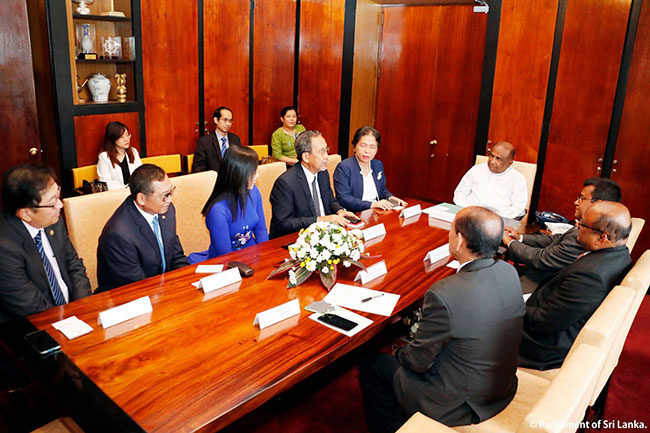
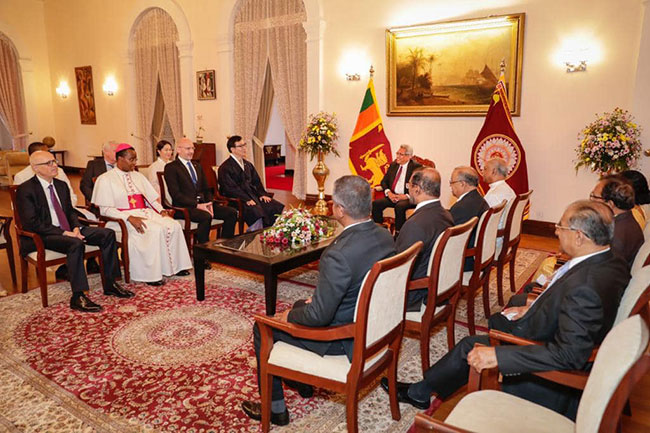
He mentioned this during a brief cordial conversation with four newly appointed Ambassadors to Sri Lanka, following the presentation of their credentials at the President’s House on Wednesday (30).

Ambassador of Republic of Korea Mr. Jeong Woonjin, Ambassador of Germany Mr.  Holger Lothar Seubert, Apostolic Nuncio of the Holy See Monsignor Brian Udaigwe and Ambassador of Switzerland Mr. Dominik Furgler presented their credentials.

Explaining Sri Lanka’s policy towards the Indian Ocean during the discussion with the new envoys based in Colombo, it was mentioned that the Indian Ocean should be a free zone open to every country. Five decades ago, it was Sri Lanka that proposed Indian Ocean to be declared as a zone of peace.”

While paying attention to the development efforts of Sri Lanka in the recent past, after defeating terrorism in 2009 priority of the Government as well as the people of Sri Lanka was to achieve a rapid development, the President said.

The economy was weakened due to terrorism. We required foreign investments for speedy development. China came forward to invest in development projects in the country. It was only a commercial transaction between our two countries. But some described this as a manifestation of a pro-China policy. Sri Lanka is a friend of all countries.”

He said the construction of the Hambantota Port with funding from China was a project with enormous development potential, although some call it a debt trap‟. He said the previous Government leased the Hambantota Port to China but it is being used only for commercial purposes.

Expressing their views, the Ambassadors commended both government and the people of Sri Lanka for successfully controlling the COVID–19 pandemic. Sri Lanka is so safe”, Ambassador of Korea Mr. Jeong Woonjin remarked.
Ambassador of the Federal Republic of Germany Mr. Holger Lothar Seubert said he is pleased to be appointed as an envoy to Sri Lanka that has overcome the COVID–19 pandemic.

We are not here to lecture you but to offer any possible assistance. We are certain that Sri Lanka is capable of choosing what needs to be done. We are ready to extend our cooperation to achieve development aspirations of Sri Lanka”, both German Ambassador Mr. Holger Lothar Seubert and Switzerland Ambassador Mr. Dominik Furgler echoed.

Communicating congratulations of Pope Francis to the government for the massive mandate received during elections, Apostolic Nuncio of the Holy See Monsignor Brian Udaigwe said he was a member of the entourage of the Holy Father during his visit to Sri Lanka in 2015. The Apostolic Nuncio said the geographical location is a great gift to Sri Lanka.

-PMD

Special unit to bring technology, research and innovation related services closer to general public

September 30th, 2020

Courtesy Adaderana

The Ministry of Skills Development, Vocational Education, Research and Innovation has initiated measures to setup a coordinating unit to bring Technology, Research and Innovation related services closer to the general public, as well as to provide technical guidance in addressing the issues related to the said fields faced by the general public, in pursuance of a concept by State Minister Seetha Arambepola.
 
It is envisaged to ensure an efficient and friendly service is provided promptly to all individuals seeking services from research and development institutions functioning under the Ministry.
 
This unit will be inaugurated on October 05, 2020 at the Ministry premises on the 6th floor of Sethsiripaya stage II building.
 
The ministry said this would pave the way for a place where a collective effort could be made to make use of research and innovation benefits towards the growth of the economy. Those who seek assistance from the unit will be provided with technical guidance and assistance for research and innovation, with the opportunity for commercialization. 

Further, assistance will be provided for the small and medium scale entrepreneurs for business development, technology transfer and in securing financial assistance. Following the setting up of this unit, a representative from all the relevant institutions will coordinate with the unit on every Monday of each week, who will be held accountable for finding solutions for the said issues.
 
Services relating to the field of innovation and research will be facilitated by this unit with the coordination of Sri Lanka Inventors Commission, Sri Lanka Institute of Nanotechnology, Industrial Technology Institute, National Engineering Research and Development Centre, Arthur C Clarke Institute for Modern Technologies, National Science Foundation, National Science and Technology Commission, National Research Council, National Institute of Fundamental Studies, Coordinating Secretariat for Science Technology and Innovation, Citra Social Innovation Lab, Vidatha Resource Centers established Island wide as well as World Intellectual Property Organization.
 
It is expected that this unit will be instrumental in assisting inventors and entrepreneurs in saving their valuable time and energy otherwise spent on visits to numerous institutions in search of services or guidance, as well as avoiding many hardships and despair they would be subjected to, in developing their inventions or businesses.”

Five new cases of Covid-19 reported

September 30th, 2020

Courtesy Adaderana

Five new cases of novel coronavirus have been reported increasing the total number of cases detected in Sri Lanka to 3,379.

Four arrivals from Oman including an Indian seaman and one arrival from United Arab Emirates (UAE) have tested positive for Covid-19.

Currently 136 patients infected with the virus are being treated at hospitals while total recoveries have increased to 3,230. 

ASEAN Ambassadors commend govt for combating COVID-19

September 30th, 2020

Courtesy Adaderana

The Ambassadors of five countries from the Association of Southeast Asian Nations (ASEAN) have commended the government for successfully combatting the COVID-19 threat in Sri Lanka.

This was conveyed during a meeting held with Speaker Mahinda Yapa Abeywardena at Parliament yesterday (29), the Speaker’s Office said. Furthermore, it was stated that Sri Lanka is one of the leading countries in the world to have overcome the COVID-19 threat through the execution of a proper plan.  

The Speaker and the Diplomatic community representatives discussed the COVID-19 situation in each country and how Parliaments conducts their activities. While appreciating the close ties the ASEAN countries have with Sri Lanka, the Speaker reiterated that Sri Lanka will continue the friendship in the future as well. 

An invitation to visit Kuala Lumpur to further strengthen the bilateral ties by the Ambassador of Malaysia was also extended to the Parliamentarians from Sri Lanka. The request was welcomed in principality where the ambassador stated that a written invitation on this regard will be sent to the Sri Lankan Parliament in the future.

Tan Yang Thai, High Commissioner of Malaysia to Sri Lanka, Pham Thi Bich Ngoc, Ambassador of Viet Nam, Gusti Ngurah Ardiyasa, Ambassador of Indonesia, Chulamanee Chartsuwan, Ambassador of Thailand and Han Thu, Ambassador of Myanmar represented ASEAN at the meeting.

The Speaker was accompanied by the Secretary General of Parliament Dammika Dasanayake and Wasantha Yapa Abeywardena.

Export sector has grown – State Minister Ajith Nivard Cabraal (Video)

September 30th, 2020

Courtesy Hiru News

State Minister Ajith Nivard Cabraal states that the export sector of the country has grown to the level that it was before the covid 19 epidemic.

Meanwhile, the Leader of the Opposition Sajith Premadasa stated at a press conference that the country is in a difficult economic situation.

State Minister Ajith Nivard Cabraal also responded to this statement today.

Maha Sangha informed about 20 Amendment (Video)

September 30th, 2020

Courtesy Hiru News

The Registrar of the Asgiriya Chapter Ven. Medagama Dhammananda Thero states that the positive proposals of the committee appointed to review the 20th Amendment to the Constitution should be taken up during the committee stage of Parliament.

He was speaking at a meeting with representatives of the National Movement for a Just Society today.

Former Speaker Karu Jayasuriya and representatives of the National Movement for a Just Society called on the Chief Prelates of Malwatta and Asgiriya today and briefed them on the 20th Amendment to the Constitution.

Government aim is to take Sri Lankan education to international level – PM (Video)

September 30th, 2020

Courtesy Hiru News

Prime Minister Mahinda Rajapaksa states that the country’s economy will develop with the emergence of students with proper education and that his government’s goal is to take education in the country to the international level.

The Prime Minister was addressing a function held at the Colombo Hindu College today.

President tells foreign ambassadors about H’tota Port’s high potential

September 30th, 2020

Courtesy Hiru News

President Gotabaya Rajapaksa has described to a group of newly-appointed foreign ambassadors about the high development potentials of the Hambantota Port.

After receiving their credentials, the president had cordial discussions with the ambassadors from Korea Republic, Germany, the Vatican and Switzerland this morning (30).

He refuted claims by some that the port, built with Chinese financial assistance, was a debt trap.

The port was being used for commercial purposes only, he noted.
Speaking further, the president said Sri Lanka’s strategic location attracted many parties, prompting the country to adopt a moderate foreign policy.
He stressed the Indian Ocean region should be open for all countries.

Conditions Tamils and Muslims have to fulfill to be a part of the Sri Lankan society to coexist with the Sinhala people

September 29th, 2020

Dr Sudath Gubasekara Mahanuwara

(Continued from 26. 9. 2020)

 According to all available evidence accepted by historians the world over it was the ancestors of the present day Sinhala nation who first found this country in the pre Christian period. They were the founder architects of the civilzation of this Island nation, defended it against all foreign invasions, through out history, dying in millions in battle and protected it for the present generation. They also formed the dominant segment of the population often comprising almost 100 percent. Minoriy communities like Tamils and Muslimwho later joined this society at differen times under varying circumstances increased their numbers to about 5% by 1815 and it increased dramatically to about15 % due to the colonial policies of importing them to work on their various projects with the largest number number being about 1,2 million to work in the planation secto in the  newly opened up tea estates in the hill country. It is  a well known fact that during colonial times the minorities always took the side of the invaders as mercenaries and spies against the native Sinhalese, which was very common during the British invaders time starting from 1797 to 1948 for which thye were heavily rewarded.

Therefore none of them couldt be fully trusted as a people who consider this country as their motherland or the native Sinhala people as their brothers and sisiters. As such they can never be trusted or considered to be an inherent part and parcel of the Sri Lanka Sinhala Buddhist society in this country. As such those Tamils and muslims who want to be full citizens (Ratavesiyo) of this Island nation and to be treated as equals before of the Sinhalese as the fully pledged sons of this soil until and unless they abide by the following 30 non-negotiable and inalianable conditions of the Sinhala people in this country and swear that they will never wage war as Pirapaharan did and claim Home lands in any part of this country as exclusive communities. They also have to take an oath that they will treat this country as their only motherland and never claim separate territories as separate nations within the bounderies of the Sri Lankan State of the Sinhala nation.   

ඇමුණුම 1

මේ සිංහලේ රාජධානියේ කිසිදිනක කිසිවෙකුට අහිමිකළ නොහැකි එසේම සාකච්ඡා කළ නොහැකි   සිංහලයාගේ ජන්ම අයිතිවාසිකම් 30 ක්.

මෙම කරුණු 30 සිංහලේ රාජධානියේ කුමන රජයක් බලයට පත්වුවද කිසිම දිනක කිසිවෙකුට අහිමිකළ නොහැකි, වෙනස්කළ නොහැකි, එසේම සාකච්ඡා කළ නොහැකි අනුල්ලන්ඝනීය රාජ්ය ප්රතිපත්ති වශයෙන් සදාකාළිකවම පැවැතිය යුතුය.

1 මේ රට යලිත්සිංහලේ’රාජධානිය වශයෙන් නම්කොට පිළිගත යුතුය

මේ රට දැනට ඇති ලිඛිත සාක්සි අනුව ක්රිස්තු පූර්ව 543 සිට ක්රි. ව. 1815 දක්වා වසර 2563 ක කාල පරාසයක විජගේ  සිට ශ්‍රී වික්රම් රාජසින්හ දක්වා සින්හල රජවරුන් 191 ට අධික  රජවරුන් සන්ඛ්යාවක් අඛන්ඩව  රජකම් කල රාජධානියකි.  සමස්ථ ලෝකයේම එවැනි ඉතිහාසයක් හෝ සම්පරදායකි ඇති රටවල් තව කීයක් ඇතත්දැයි නොදනිමි. 1815 එම සම්ප්රදාය අපට අහිමිකළේ බ්රතාන්ය ජාතිකයින් විසිනි. මේ නිසා අපගේ මේ රට නැවතත් රාජධානියක් වශයෙන් නම් කිරීම අපගේ ඒ ප්රෞඪ අතීත උරුමය නැවත ස්ථාපිත කිරිමක් පමණි.

බ්‍රතාන්යයින්ගේගේ රටේ රජ සම්ප්රදාය අදවනතුරුම පවත්වාගෙන ගියත්  වසර 2563 ක අපගේ සම්ප්රදාය 1815 දී අහිමිකළ ඔවුන් 1948 දී ආපසු යනවිට අපගේ එම පවුරානික සම්ප්රදාය ඇතිකරගැනිමේ නිදහස  අපට අහිකළහ. එසේ කරණු වෙනුවට වසර 133 ක සූරාකෑමෙන් පසුද ඔවුන් මෙහි ස්ථාපිත කොට ගියේ ඔවුව්න්ගේ රාජ්යපාලන ක්රමය වූ වෙස්ට්මින්ස්ටර් ආණ්ඩු ක්රමයයි. ඒ අනුව මේ රටේ පාර්ලිමේන්තුවක්, අගමැතිවරයකුගේ ප්රධ්හනත්වයෙන් අමාත්ය මන්ඩලයක් සහ  එන්ගලන්ත ආකුර්තියේ අධිකරණ හා නීතිපද්ධතියක්  සහ පරිපාලන ක්රමයක්ද අපට දායකකොට  මේ සින්හල රාජධානිය එන්ගලන්තයේම අකුර්තියක් බවට පත්කොට පෙරලා ගිහහ. එම් ආවස්ථාවේදි ඊනියා නිදහස ලබාගත් පුද්ගල්යින් කිසිවකු 1815 දී අපට අහිමිවු අපේම් ආණ්ඩුක්රමය නැවත ස්ථාපිත කරගැනිම ගැන කල්පනාකළ බවක් නොපෙනේ.1815 දි අපට අහිමිකල ඒ උරුමය අඛණ්ඩව පැවති පරිදි යළිත් මේ රට සිංහලේ   රාජධානිය වශයෙන් නම් කළයුතුය . එසේම  මේ රට සිංහල ජාතියේ අයිතිහාසික මාතෲභූමිය ලෙසද ප්රකාශයට පත්කළයුතු අතර මේ රටේ සිටින සියලුම සුළුජන කොටස් හෝ වෙන කිසිවෙකු එය විවාදයට භාජනය නොකළ යුතු හා සාකච්ඡා කළ නොහැකි කරුණක් වශයෙන්ද ප්රකාශ කොට විවස්ථා ගතකළ යුතුව තිබිණ

 තවමත් මානසික වසයෙන් එන්ගලන්තයේ සිටින අපේම කලුසුද්දන් සහ මේ රට බලයෙන් අල්ලාගැනීමට වළිකන දෙමලුන්  සහ මුසල්මානුවන් හැර මේ රටේ සිටින සෑම සින්හල මිනිසකුම එම් අදහසට එකහෙලා එකන්ග වන බවද මට සහතිකය.

(සියලුම අයිතිහාසික හා සාහිත්ය මූලාශ්රයන් මේ රට හඳුන්වා ඇත්තේ සිංහලේ, සිංහලද්වීප, සීහල දීප, ත්රි සිංහලේ,  ලක්දිව හෝ ලංකාව ලෙසය. දකුණු ඉන්දියාවේ පුරාණ මලයාලම් ජනයා පමණක් එය ඊලම් ලෙස හඳුන්වා ඇත. ඉන් ඔවුන් අදහස්කළේ සින්හලයින්ගේ රට යන්නමය. 1815 මාර්තු 2 වන දින උඩරට ගිවිසුම මගින් ඉන්ග්රීසීන්ට භාරදුන්නේද සිංහලේය.ඔවුන් සිලෝන් ලෙස එය පරිවර්තනය කරන ලදි, එහි අර්ථයද සිංහල ජනයාගේ භූමිය යන්නමය. එබැවින් රටේ මුල් න හෝ නොපමාව යථා තත්වයට පත් කළ යුතුය. සින්හළේ හා ලංකාව යන දෙකම ඉතා අතීතයේ සිටම මේ රට හැඳින්වීමට භාවිතා කර ඇත. 1972 ආණ්ඩුක්රම ව්යවස්ථාව ශ්රී ලංකා ජනරජය ලෙස නම් කරන ලද අතර අද එය ජාත්යන්තරව ශ්රී ලංකාව ලෙස හැඳින්වෙයි. මහජන එකඟතාවයකින් පසුව අවශ්ය නම් එය සිංහලේ හෝ ශ්රී ලංකාව ලෙස හැඳින්විය හැකිය. (කෙසේ වුවද එසේ කරන්නේනම් සින්හලේ යන නාමය වරහන් තුල හෝ යෙදිය යුතුය). මන්ද එය මේ රටේ ජාතිය හා බැදුණු අනන්ය නාමය වන බැවිණි . ලන්කා යන්න මද්යයේ පිහිටි, ලස්සණ රට  යන තේරුම ඇති විශේෂණ පදයක් පමණී. එවිට මේ රට සියලුම භාෂාවලින් සිංහලේ හෝ ශ්රී ලංකාව ලෙස හැඳින්විය යුතුය. ඊලාම්, ඉලන්කෙයි හෝ කලිස්තාන් වැනි වෙනත් අපබ්රන්ශ නම්වලින් එය නොහැදින්විය යුතුය.

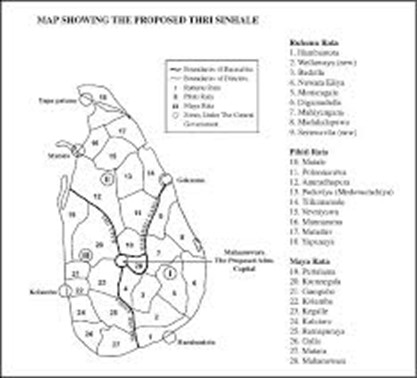
2 සුද්දාගේ පලාත් වෙනුවට පුරාණ තුන්සින්හලේ සින්හල රාජධානියේ පරිපාලන බෙදිම් නැවත පිහිටවිය යුතුය.  

                    තුන්සින්හලේ සහ දිසා මායිම්

        මූලාශ්‍රය සුදත් ගුණසේකර 1991                                                       

මේ අනුව රට නැවතත්  පැරණි තුන් සින්හලේ වශයෙන් බෙදේ. එක් රටක් දිසා 9 බැගින් මුලු රට නැවත දිසා 27 කට බෙදීමටැ යෝජනා කෙරේ.තුන් රට මායිම් එක්වන රට මධ්යයේ තුන් රටින්ම කොටස් එක්වන පරිදී විශේෂ කලාපයක් වසයෙන් අගනුවර දිසාව පිහිටවේ. එය 28 වන දිසාව ව්ශයෙන්ද සැලකිය හැක. රටේ අගනුවර මෙහි නැවතත් පිහිටවිමත් යෝජනා කෙරේ. සින්හල බෞද්ධ රාජ්යයේ මුදුන් මල්කඩ වු ශ්‍රී දළදා මාලිගාව, සහ අස්ගිරි මල්වතු මූලස්ථාන දෙක, සින්හලේ අන්තිම රජුගේ රාජ මාලිගාව මෙහි පිහිටා තිබීම,හාත්පසින් මුහුදින් හා සියළු දිසාවන්ට සමදුරින් පිහිටා තිබිම නිසාද රටේ කාර්යක්ෂම පරිපාලනය පහසුවීම්, රාජධානියේ මධ්යයේ පිහිටා තිබීම සහ 1505 සිට 1815 දක්වා වසර 310 ක කාලයක් තුල රටේ ස්වාධීනත්වය රැකගැනීමට උපකාර වන පරිදි ආරක්ෂ්ක බලකොටුවක් වශයෙන් අතිසාර්ථක අන්දමින්  පැව්තීම යන කරුණු නිසා රටේ අගනුවර මෙහි පිහිටුවීම් ඉතාමත් යෝග්ය බැව්  යෝජනා කරමි.

3 මේ රටේ භූමිපුත්රයින්ගේ භාෂාව සින්හල බැවින් ජාතියේ නමද යලිත්   ”සිංහලවියයුතුය

අමෙරිකාව, ඕස්ට්රේලියාව් වැනි නව ලෝකයේ රටවල්වල හැර අනෙක් හැම රටකම ජාතිය නම්කොට ඇත්තේ ඒ රටේ බූමිපුත්රයින්ගේ භාෂාව අනුවය. ජපන්, චීන කොරියන් , බුරුම, ඉන්දියානු, ග්රීක. ප්රන්ශ සහ ඉතාලි මෙනි. 1815 වනතුරුම මේ රටේද නම සින්හලේ වූයේ ඒ අනුවය. ඒ සින්හල  භාෂාව කථාකරන සින්හල මිනිසුන්ගේ රට යන අරුතෙනි. සුද්දන් සිලෝන් කීවේත් ඒ අනුවමය. ඒ සින්හල මිසුන්ගේ රට යන අරුතෙනි.

ක්රිස්තු පූර්ව 543 සිට 1972 දක්වාම මෙම රටේ ජාතියේ නම සිංහල විය. 1815 වනතුරුම මේ රටේ සියළුම් ජනකොටස් ඇතුලු ජාතිය හැදින්වූයේද සින්හල වශයෙනි. ද්රවිඩයන් හා මුස්ලිම්වරුන් මේ රටේ එවකටත් සිටියද කිසිදිනක ඔවුන් ජාතීන් වශයෙන් කිසිම තැනක හන්දුන්වා නැත. එමනිසා මින් පසුවද ඔවුන් සුළු ජන කොටස් ලෙස මිස කිසිවෙකු විසින් ජාතීන් වශ්යෙන් නොහැදින්ඳිවිය යුතුය. ඔවුන් සුළු ජන කොටස් මිස ජාතීන් නොවේ. ඔවුන් සුළුජාතීන් වශයෙන් පරිවර්තනය කොට  තිබීම මෙම අර්බුධයට හේතුවන්නට ඇත. තවද දෙමළ මිනිසුන්ට දකුණු ඉන්දියාවේ අවශ්යනම් ජාතියක් වසයෙන් හඳුන් වාගත හැකි අතර මුස්ලිම් කියා ජාතියක් ලෝකයේ කිසිම රටක නැති බවද මෙහිදී පෙන්වා දිය යුතුව ඇත. මුස්ලිම් කියන්නේ ඉස්ලාම් ආගම අදහන මිනිසුන්ට මිස ජාතියකට නොවේ. එසේ තිබියදී මේ රටේ පමණක් මුස්ලිම් ජාතියක් සිටින්නේ කේදැයි අපි ප්රස්න කරමු.   තව දුරටත් ලෝකයේ ඔනෑම රටක සිටින්නේ එක් ජාතියක් පමණක් බවද මෙහිදී පෙන්වාදිය යුතුව ඇත.එමනිසා මේ රටේ පමණක් කිසේත්ම ජාතීන් කීපයක් සිටිය නොහැක.

මේ නිසා මින් පසු මේ රටේ සියළුම ජාතියකටම, සෑම ජාතියකටම සියළුම හා සෑම ජාතින්ට වැනි වචන දේශපාලකයින් ඇතුළු සියළුදෙනාම ප්රකාශ කිරිම සහ භාවිතය වහාම නතර කළයුතුය. මන්ද එසේ කිරීමෙන් මේ  රටේ ජාතින් කීපයක් සිටින බව ගම්යවෙවන  නිසාය.

4 මේ රටේ රටවැසියන් (පුරවැසියන්) සිංහල වියයුතුය. සිංහලේ වැසියන් යන අරුතිනි.

ඉතිහාසය පුරාම මේ රටේ රටවැසියන් (පුරවැසියන්) හඳුන්වා ඇත්තේ සිංහල ලෙසය.අමෙරිකාවේ අමෙරිකන්, ජපානයේ ජපන් චීනේ චින සහ ඉන්දියාවේ ඉන්දියන් වශයෙනි. සිංහලේ පුරවැසියන් වීමට කැමති 1815 න් පසු මෙහි පැමිණි සියළුම විදේසිකයින්  සිංහල භාෂාව ඉගෙන ගත යුතුය, සිංහල නම් ගත යුතුය, ඔවුන්ගේ මුල් රටට ඇති පක්ෂපාතිත්වය අතහැර දමා 1947 දී බුරුමයේ කළාක් මෙන් ස්වදේශික සිංහල නම් ගත යුතුය. සිංහල සමාජය සමඟ සම්පුර්ණයෙන්ම අන්තග්රහණය විය යුතුය. මෙම අවශ්යතාවයන්ට අනුකූල නොවන අයට සිංහලේ පුරවැසිභාවය ලබා නොදීය යුතුය. ඇම්රිකාවෙ අමෙරිකන් ඉතිහාසය පිළළිබද විභාගයකින් සමත් නොවෙන කෙනෙකුට අමෙරිකානු පුරවැසි බව නොදේ. අපටත් එම ක්රමය ක්රියාත්මක නොකළ හැක්කේ ඇයි

5 රටවැසියන් දෙයාකාර වියයුතුය

අ) පරම්පරාවෙන් රටැවැසියෝ (භූමිපුත්රයෝ) 1815 ට පෙර සිංහලේ පදින්චිව සිටි අයගෙන් පැවත එන්නන්

ආ) ලියාපදිංචි වීමෙන් රටවැසියෝ.රටවැසිභාවය සම්බන්ධව මහනුවර ප්රඥප්තියේ (2019) අන්ක 7 හි දක්වා ඇති කොන්දේසි වලට යටත්ව, මෙහි ඇතුළත් කර ඇති ඇමුණුම 1 සහ 11 හි සඳහන් කොන්දේසි පිළිගෙන ලියාපදිංචි වූ  අයද මේ ගණයට ඇතුළත් ය.

6 බුද්ධාගම යලිත් මේ රටේ රාජ්ය ආගම ලෙස විවස්ථාගත කළයුතුය

ක්රිස් පූර්ව 307 සිට 1815 දක්වාම මේ රටේ රාජ්ය ආගම වූයේ බුද්ධාගමය. එමනිසා බුද්ධාගම රාජ්ය ආගම ලෙස ප්රකාශයට පත්කළ යුතුය. අනෙකුත් සියළු ආගම් ඇදහීමේ පූර්ණ නිදහස තහවුරු කෙරේ. එසේ උවද ඒවා ප්රසිද්ධියේ ප්රකාශයට පත් කිරීමට, ඉගැන්වීමට හෝ ප්රචාරය කිරීමට කිසිදු අයිතියක් නොමැත. මේ රටේ ඉතිහාසයේ ආරම්භයේ සිට 1815 දක්වා පැවතියේ එම තත්වයය. අතීතයේ දී මෙන්ම  සමකාලීන කාලවලදී පවා ‘අනෙක් සියලුම ආගම්  කුඩා ශාඛා පමණක් බවද බුද්ධාගම  ප්රධාන ගස ලෙස පිළිගෙන ඇති බව අගරදගුරු මැල්කම් ප්රනාන්දු රදගුරුමන් ද ප්රකාසකළේය.,මේ අනුව බුද්ධාගම මේ රටේ රාජ්ය ආගම ලෙස නීතිගත කිරීමට කිසිදු භාදාවක් නැත. 1987 ආණ්ඩුක්රම විවස්ථාවේ 9. සහ 14 (E) මේ අනුව පරිච්චින්න කළයුතුය. 

එසේම මේ රටේ අයිති හාසික සන්ස්කෘතික අනන්යතාව ආරක්ශා කිරීම සඳහා රටපුරා සෑමතැනකම තිබෙන පවුරානික සින්හල බෞද්ධ පුරාවස්තු සන්රක්ශනයකොට ආරක්ශා කළයුතු අතර ඒවාට හානි පමුණුවන පුද්ගලයින්ට විරුද්ධව දැඩි දඩුවම් ලබාදිය යුතුය.

7 1815 දක්වා තිබුණුපරිදි මුළුරටේම සියලුම රටවැසියන්ට එක් නීතියක් තිබිය යුතුය

 දැනට පවතින පරිදි මේ රටේ සුළුජන කොටස් වන දෙමල මින්සුන්ට තේශවලමේ සහ මුස්ලිම් භක්තිකයින්ට් මුස්ලිම් නීතියක් තිබිය නොහැක. මෙහි ඇති අරුමයනම් රටේ භුමිපුත්රයින්ට ඔවුන්ගේ නීතිය නොදි ඉන්ග්රීසි සහ රෝමානු ලන්දේසි නිතිය පටවා ආගන්තුකයින්ට පමණක් ඔවුගේ නීති ලබාදිමය.  මෙම කොන්දේසි වලට එකඟ වීමට සූදානම් නැති කිසිම පුරුෂයෙක් හෝ ස්ත්රියක් මේ රටේ පුරවැසියෙකු වීමට හෝ ජාතික දේශපාලනයට පිවිසීමට හෝ රාජ්ය සේවයට පත් කිරීමට සුදුසු නොවන බැවින්, එවැනි කිසිදු පුද්ගලයෙකු රාජය යටතේ කිසිම තණතුරකට තෝරා පත්කර නොගත යුතුය. (මේ එක් එක් කාරණය පිළිබඳ විස්තර සඳහා කරුණාකර මහනුවර ප්රඥප්තිය 2019 අදාළ කොටස් බලන්න).

සම්ප්රදායික දේශීය නීති මත පදනම්ව, භූමිපුත්රයින්  විසින් රටට අව්ශ්ය නිති සම්පාදනාය කළයුතුය. ඊට සමගාමීව රට ජාතිය බෙදීම සඳහා ලන්දේසීන් සහ බ්රිතාන්යයන් විසින් මේ රටට හඳුන්වා දුන් තේසවළමෙයි (මලබාර් වැසියන් සඳහා නීතිය) සහ  මුස්ලිම් නීතිය (මුස්ලිම්වරුන් සඳහා) වැනි ජනවාර්ගික නීති අහෝසි කොට තහනම් කළයුතුය. දැනට පවතින ක්රමයේ විහිළුව වඩාත් කැපී පෙනෙණුයේ දේශයේ භූමිපුත්රයින්වූ සින්හළයින්ගේ ගේ වසර දහස් ගානක් පැවෙති ස්වදේශීය නීතිය ඉවත්කොට ඒ වෙනුවට ඔවුන් පමණක් රෝම ළන්දේශි හා ඉන්ග්රීසි නීතියට යටත් කිරීමයි. නීතිය කාටත් සමාන වියයුතු අතර නීතියේ ආධිපත්ය ඉදිරියේ සියළුදෙනාම සමාන වියයුතුය.

8 මේ රටේ රාජ්ය භාෂාව සින්හල වියයුතුය.

ක්රිස්තු පුර්ව 543 සිට 1815 දක්වා මේ රටේ පැවති රාජ්ය භාෂාව සිංහලය. අදටත් රටේ මුළු ජනගහනයෙන් 75% පිරිසක් සින්හල නිසාද, 100%  පිරිසක් සින්හල කථා කරන නිසාද මේනිසා කිසිවෙකුට අසාධාරනයක් සිදු නොවේ. අනෙක මේ සින්හල රටේ රාජ්ය භාෂාව සින්හල නොකරන්නේ නම් එය අපි කරන්නේ හඳේදැයි විමසිය යුතුය. ස්වදේශිකයන්ගේ භාෂාව එනම් සිංහල නොදන්නා කිසිවෙකුට මේ රටේ සම්පූර්ණ රටවැසිභාවය ලබා  නොදිය යුතුය.

9 එක් රටක්, එක් ජාතියක්, එක් ජාතික ධජයක් සහ එක් ජාතික ගීයක් පිළිගත යුතුය

මෙකී නියමයන් ආණ්ඩුක්රම ව්යවස්ථාවේ ඇතුළත් කළ යුතුය. ජාතික ගීය ගායනා කළ යුත්තේ ආණ්ඩුක්රම ව්යවස්ථාවේ දක්වා ඇති පරිදි සිංහල භාෂාවෙන් පමණි. (මෙය එක් ජාතියක් ලෙස එක්සත්කම හා දේශප්රේමය වැඩි දියුණු කර ශක්තිමත් කරනු ඇත)

(මෙම සියළු තත්වයන් ම 1815 දී උඩරට ගිසුමේ සම්මුතියෙන් මේ රට ඉන්ග්රීසීන්ට භාර දෙන අවස්ථාවේ දී පැවති බැවින් මේ කොන්දේසි පැනවීමෙන් මෙම රටේ භූමිපුත්රයන්ගේ නීත්යානුකූල අයිතිවාසිකම් යථා තත්ත්වයට පත් කිරීම හැර අන් කිසිවක් මින් සිදු නොවේ. 1818 නොවැ. 21 දිනැති බ්රවුන් රිග් ආණ්ඩුකාරයා විසින් ගේ ඒකපාර්ශවිකව පණවන ලද රාජකීය ප්රකාශණයෙන් නීතිවිරෝධී ලෙස බ්රිතාන්යයන් විසින් උල්ලන්ගණය  කරනණු ලැබුවද, උඩරට ගිවිසුම අනුව අදද රටවල් දෙකක් අතර  ඇතිකරගත් ගිවිසුමක් වශයෙන් වළන්ගුය. මේ රටේ නිදහස අර්ථවත් කිරීම සඳහා මෙම කොන්දේසි 1948 දී යථා තත්වයට පත් කළ යුතුව තිබුණ නමුත්  එසේ නොකළද 1815 ට පෙර මේ රටේ සියලුදෙනාම එම නීති පද්ධතිය තුළම ජීවත් වූ බැවින් මෙම කොන්දේසි අද පැනවීම අභියෝගයට ලක් කිරීමට දෙමිළ හෝ මුස්ලිම්වරුන්ට නොහැකිය. අද ඔවුන් භුක්ති විඳින සියලු අයිතිවාසිකම් ඔවුන්ට ලබාදී ඇත්තේ රටේ භූමිපුත්රයින්වූ සින්හලයින්ට එරෙහිව ඉන්ග්රීසීන් ක්රියාවට නන්ග්වනලද දැඩි මර්දනය යටතේය)

10 මේ රටේ ජනාධිපති, අගමැති, අග්රවිස්චයකාරතුමා, ත්රිවිධ හමුදාපතිවරුන් සහ පොලිස්පති සෑමවිටම සම්මුතියෙන් හා නීතියෙන් සිංහල බෞද්ධයන් පමණක් වියයුතුය.              

11 මේ රටේ භුමිපුත්රයින් වශයෙන්  සිංහල ජනයාටද තමන් කැමති ඕනෑම ප්රදේශයක ජීවත්වීමේ අයිතිය මෙන්ම ඉඩම් මිලදී ගැනීමේ සහ රැකියා කිරීමේ අයිතිත තිබියයුතුය.

දෙමළ හා මුස්ලිම් ජනයා දැනට භුක්ති විඳින ආකාරයට සිංහලයින්ටද මේ රටේ ඕනෑම  තැනක ඉඩම් මිළදී ගැනීමට,පදින්චි වීමට, පන්සල් හා සිද්ධස්ථාන වැනි ආගමික ආයතන ගොඩනගා ගැනීමට අයිතිය තිබිය යුතුය. යමෙක් මෙම කොන්දේසිය ප්රතික්ෂේප කරන්නේනම් ඔවුන් ඉන්දියාවේ හෝ අරාබියේ තම මව්බිම් බලා පිටත්ව යා යුතුය. මන්ද මේ රට ඔවුන්ගේ මාතෲ භූමිය නොවන නිසාය. මේ රටේ  භුමිපුත්රයින් වන සින්හලයින්ට හැර වෙනත් කිසිම සුලු ජනකොටසකට අයිතිහාසික මාතෲ භූමි මෙහි නැත.

12 රටේ භුමිය ඇතුලු සම්පත් සීමිත බැවින් දැඩි ජනහන පාලන ප්රතිපත්තියක් තිබිය යුතුය.

13 බහුවිවාහ වහාම නම්කිරීම කළයුතුය

14 ජනවාර්ගිකත්වය,ආගම,කලාපය හෝ මේ රටට කිසිසේත්ම නොගැළපෙන ෆෙඩරල්, ටීඑන්ඒ, ටෙලෝ, .එල්.එම්.එස්, ටී.සී සහ .පී.ආර්.එල්.එෆ් නිබෙදුම්වාදී, ආගම්වාදී. හා දේශපාලන මතවාදී වශයෙන් මේ රටට නොගැළපෙන සියලුම දේශපාලන පක්ෂ තහනම් කළයුතුය.

 ජේ.වී.පී. වැනි මාක්ස්වාදී පක්ෂවල පවා දේශපාලන මතවාද මේ රටට කිසිසේත්ම නොගැලපෙන පමණක් නොව අතිශයින්ම විනාශකාරී බැවින් තහනම් කළයුතුය, ශ්රී.ල.නි.ප, එ.ජා.ප.,කො.ප., හා ල.ස.ස. වැනි පක්ෂ මේ වන විටත් මිහිදන් වී හමාර බැවින් ඒ ගැන කථා කිරිමෙන් පළක් නැත.

15 රාජ්යසේවයට බඳවාගැනීම ජනවාර්ගික අනුපාතයන්ට අනුකූලව සිදුකළ යුතුය

16 රටේ ඔනෑම ප්රදේශයක දෙමළ මුස්ලිම් තනි ජනවාර්ගික ජනපදකරණය තහනම්කිරීම සහ රජය විසින් පිහිටවණුලබණ සියළුම නවජනපදවල මිශ්රව පුරවැසියන් පදින්චි කළයුතුය.

17 දේශපාලානඥ්යින්ට මෙන්ම සියළුම රාජ්ය නිලධාරීන්ට විශේෂ සුදුසුකම් හා දැඩි ආචාර ධර්ම මාලාවක්  නියම කළයුතුය.

 18 මේ රටේ අයිතිහාසික අනන්යතාව ආරක්ෂා කිරීම සඳහා උතුරු නැගෙනහිර අතුලු සෑම ප්රදේසශයකම තිබෙන පවුරානික බෞද්ධ සිද්ධස්ථාන නැවත සන්රක්ෂනයකොට එවාට පුරාවිද්යාත්මක සාක්ෂි අනුව රජදවස තිබුනු සම්පූර්න භූමි ප්රමාණයන් නැවත ලබා දී සන් රක්ෂනය කළයුතුය

19 ඹෞද්ධ සිදස්ථාන වලට අයත් ඉඩකඩම්වල පදින්චිය බෞද්ධයින්ට පමණක් සීමා කළයුතුය

20 ජනාධිපති, අගමැති, අගර්විනිචයකාරතුමා, නීතිපති ත්රිවිධ හමුදාපතිවරුන් සහ පොලිස්පති සින්හලයින් පමණක් විය යුතුය

21 රටේ කිසිම් ප්රදේශයක තනි දෙමල හෝ තනි මුස්ලිම් ගම්මාන නොපිහිටවිය යුතුය.

22 මේ රටේ පුරවැසිකම ලබාගැනීම සදහා සින්හල භාෂාව් සහ ලන්කා ඉතිහාසය පිළිබද පරීක්ෂනයකින් සමත් වීම අනිවාර්ය කළයුතුය.

23 සියළුම් සුලුජන කොටැස් ඔවුන්ගේ ප්රස්න ලන්කා රජය සම්ග විසදාගනු විනා කිසිම් විදේශ රටක් සමග එය සාකච්චා නොකල කළයුතුය.

24 මේ රටේ තිබිය යුත්තේ ජාතික දේසපාලන පක්ෂ පමණි.ආගම්, ජනවර්ගය හෝ භාෂාව ආදිය පදනම්කොටගත් දේශපාලන පක්ෂ සියල්ල තහනම් කළයුතුය.

 25 සියලුම දෙමළ සහ මුස්ලිම් වරුන් ඉන්දියාවට හා අරබිකරයට වන්දනාමාන කිරිම් නවතා මේ රට ඔවුන්ගේ මව්බිම වසයෙන් සැලකිය යුතුය

26 මේ රටේ සමස්ථ ජීවී පද්ධතිය සහ ශිස්ඨාචාරය ආරක්ෂා කරගැනිම සදහා  මු ම 5000 න් ඉහල අධි රක්ෂිත වනාන්තර වසයෙන් ප්රකාශකොට ආරක්ෂාකර ගැනීම සහ 3500 න් ඉහල කිසිම තැනක ජනාවාස නොපිහිටුවිමේ ජාතික ප්රතිපත්තිය සියලුම රටවැසියන් පිලිගත යුතුය.

27 මේ රටේ සිෂ්ඨාචාරයේ පදනම සින්හල බෞද්ධ ශිස්ඨාචාරය බව සියලුදෙනාම පිළිගත යුතුය

28 මේ රටේ වාසය කරන සෑම දෙනාම ලන්කාණ්ඩුවට තම පූර්ණ පක්ෂපාතිත්වය දැක්විය යුතුය.

39 එසේම් අන්කිසිම විදේශ රටක් සමග රහසිගත සම්බන්ධතා නොපැවිත්විය යුතුය

30 රටේ කිසිම පුරවැසියකු මේ රටට විරුද්ධව පිට රටවල් හෝ කිසිදු ජාත්යන්ත්‍ර ආයතන සමග කිසිදු  රටටැ එරෙහිව සාකච්චවක් හෝ සම්බන්ධතාවන් නොපැවැවිය යුතුය

අග්‍රාමාත්‍යතුමා ග්‍රන්ථ ද්විත්වයක් එළිදැක්වීමේ උළෙලට එක්වෙයි

September 29th, 2020

අග්‍රාමාත්‍ය මාධ්‍ය අංශය

කාන්තාවන් පිළිබඳව විශේෂ අවධානයක් යොමුව ඇති මෙවැනි කාල වකවානුවක එලීනා ජයවර්ධන වැනි නිහතමානී කාන්තාවක් පිළිබඳ කෘතියක් එළිදැක්වීම ඉතා කාලෝචිත බව අග්‍රාමාත්‍ය මහින්ද රාජපක්ෂ මැතිතුමා පැවසීය.

කොළඹ බණ්ඩාරනායක ජාත්‍යන්තර සම්මන්ත්‍රණ ශාලාවේ අද 2020.09.29 දින පැවති ප්‍රදීප් ජයවර්ධන මහතා විසින් රචිත  ප්‍රජාතන්ත්‍රවාදයේ ඒකාධිපතියා – ජේ. ආර්. ජයවර්ධන යුගයේ නොපළ කතා” කෘතිය සහ සාගරිකා දිසානායක මහත්මිය විසින් රචිත එලීනා ජයවර්ධන – චරිතයක කථාවක්” යන කෘතීන් එළි දැක්වීමේ අවස්ථාවට එක්වෙමින් අග්‍රාමාත්‍යතුමා මේ බව සඳහන් කළේය.

අග්‍රාමාත්‍ය මහින්ද රාජපක්ෂ මැතිතුමා මෙසේ ද කීය,

ඇත්ත වශයෙන්ම මම සන්තෝෂ වෙනවා මෙම කෘතීන් එළි දැක්වීමේ අවස්ථාවට එක්වීමට ලැබීම ගැන. මම පාසල් යන අවධියේ නැවතිලා හිටියේ ජේ.ආර්. ජයවර්ධන මහතා ගේ නිවසට ආසන්න නිවසක. එතන තවත් වෛද්‍ය ශිෂ්‍යයන් පිරිසකුත් හිටියා. මම එතුමිය දැක්කේ ඒ දවස් වල. ඇය ඉතාම නිහතමානී චරිතයක්. එලීනා මැතිනිය ගැන කෘතිය එළි දැක්වීම කාලෝචිත ක්‍රියාවක්. අද ගොඩක් දේශපාලනඥයින් පිරිහෙන්නේ ඔවුන්ගේ භාර්‍යාවන් නිසයි. මේ පොත කාන්තාවන් කියවන්න. එය කාන්තාවන්ට ඉතා වැදගත් වනු ඇතැයි ”  අග්‍රාමාත්‍යතුමා පැවසීය.

බස්නාහිර පළාත සහිත කොළඹ සහ නව තොටමුණේ උප ප්‍රධාන සංඝනායක පූජ්‍ය ගැටහැත්තේ සෝභිත නායක හිමි, ජපානය ප්‍රමුඛ අග්නිදිග ආසියාවේ ප්‍රධාන සංඝනායක පැල්පොල විපස්සී නායක හිමි ඇතුළු ගරුතර මහා සංඝරත්නය හා හිටපු ජනාධිපති මෛත්‍රීපාල සිරිසේන, පරිසර අමාත්‍ය මහින්ද අමරවීර, පාර්ලිමේන්තු මන්ත්‍රී චරිත හේරත් හා හිටපු පාර්ලිමේන්තු මන්ත්‍රීවරුන් ඇතුළු සම්භාවනීය අමුත්තන් රැසක් මෙම අවස්ථාව සඳහා එක් වූහ.

බෙලිඅත්තෙ පාසල් දෙකක සිසු පිරිසක් අරලියගහ මන්දිරය නැරඹීමට පැමිණෙති

September 29th, 2020

අග්‍රාමාත්‍ය මාධ්‍ය අංශය

බෙලිඅත්ත පුවක්දණ්ඩාව ප්‍රාථමික විද්‍යාලයේ සහ බෙලිඅත්ත ධම්මපාල බාලිකා විද්‍යාලයේ සිසු සිසුවියන් පිරිසක් අද 2020.09.29 දින අරලියගහ මන්දිරය නැරඹීමට පැමිණ සිටියහ.

මෙසේ අරලියගහ මන්දිරය නැරඹීමට පැමිණි සිසු සිසුවියන්ට අරලියගහ මන්දිරය පෙන්වූයේ අග්‍රාමාත්‍ය මහින්ද රාජපක්ෂ මැතිතුමාය.

කාර්ය බහුල දෛනික කාර්යන් මදකට පසෙක දැමු අග්‍රාමාත්‍ය මහින්ද රාජපක්ෂ මැතිතුමා දරුවන් සමඟ සුහද කතාබහක නිරතවෙමින් ඔවුන් සමඟ සමූහ ඡායාරූපයකටද පෙනී සිටියේය.

මෙම අවස්ථාවට බෙලිඅත්ත පුවක්දණ්ඩාව ප්‍රාථමික විද්‍යාලයේ විදුහල්පති ඊ.ඒ සමන් කීර්ති මහතා, බෙලිඅත්ත ධම්මපාල බාලිකා විද්‍යාලයේ විදුහල්පතිනිය මංගලිකා විදානගම මහත්මිය ඇතුළු ගුරුවරු පිරිසක් ද එක්ව සිටියහ.

විසි වෙනි සංශෝධනයට කිසිඳු ගැටලුවක් වෙන්නේ නෑ – අග්‍රාමාත්‍ය මහින්ද රාජපක්ෂ මැතිතුමා

September 29th, 2020

අග්‍රාමාත්‍ය මාධ්‍ය අංශය

විසි වෙනි ව්‍යවස්ථා සංශෝධනයට කිසිඳු ගැටලුවක් ඇති නොවන බවට තමන්ට විශ්වාස යැයි අග්‍රාමාත්‍ය මහින්ද රාජපක්ෂ මැතිතුමා අද 2020.09.29 දින අරලියගහ මන්දිරයේදී පැවසීය.

විද්‍යුත් හා මුද්‍රිත මාධ්‍ය ආයතන ප්‍රවෘත්ති අධ්‍යක්ෂකවරුන් සහ පුවත්පත් කතුවරුන් අතර පැවති හමුවේදී අග්‍රාමාත්‍ය මහින්ද රාජපක්ෂ මැතිතුමා මේ බව අවධාරණය කළේය.

මෙම හමුවේදී අග්‍රාමාත්‍ය මහින්ද රාජපක්ෂ මැතිතුමා, ජ්‍යෙෂ්ඨ මාධ්‍යවේදීන් ඇසූ ප්‍රශ්නවලට මෙසේ පිළිතුරු ලබා දුන්නේය.

මාධ්‍යවේදියා – විසිවැනි සංශෝධනය සම්බන්ධයෙන් අග්‍රාමාත්‍යතුමාගේ මතය කුමක්ද ?

අග්‍රාමාත්‍යතුමා – ආණ්ඩුවක් වුණාම, ආණ්ඩුව ගන්න මතය තමයි මගේ මතය වෙන්නෙ. 20 වැනි සංශෝධනයට කිසි ගැටලුවක් වෙන්නෙ නැහැ.

මාධ්‍යවේදියා – විසිවැනි සංශෝධනය සම්බන්ධයෙන් ආණ්ඩුවට සම්බන්ධව සිටින  පක්ෂ විසින් කමිටු පත්කරලා තියෙනවා නේද ?

අග්‍රාමාත්‍යතුමා – හැම පක්ෂයකටම ඒ සම්බන්ධයෙන් කමිටු පත්කරන්න අයිතියක් තියෙනවා. නමුත් අවසානයේ අපි එක මතයකට එනවා. විසිවැනි සංශෝධනය ගැන අපි සියලු දෙනා සමඟ අමාත්‍ය මණ්ඩල රැස්වීමෙදි කතා කළා. මම දැක්කා විපක්ෂයත් කමිටුවක් පත් කරලා තිබුණා.

මාධ්‍යවේදියා – විසිවැනි සංශෝධනයෙන් පසුව අග්‍රාමාත්‍යතුමා නාමික වෙනවා ද ?

අග්‍රාමාත්‍යතුමා – නෑ. නාමික වෙන්නෙ නෑ. අග්‍රාමාත්‍යතුමා අතේ තමයි ඒක තියෙන්නෙ.

මාධ්‍යවේදියා – ඉන්දීය අග්‍රාමාත්‍යතුමා සමඟ පැවැති සාකච්ඡාවේදී 13 වැනි සංශෝධනයට බලකළා කියලා මාධ්‍ය වාර්තා ඉදිරිපත් වුණා.

අග්‍රාමාත්‍යතුමා – දැනට තිබෙන ව්‍යවස්ථාව තමයි ක්‍රියාත්මක වෙන්නෙ. පළාත් සභා මැතිවරණය කල්දැම්මෙ කවුද ? ඡන්ද නොතියා හිටියෙ කවුද කියලා ඔබ දන්නවා. අපි කළේ නියමිත පරිදි ඡන්ද තියපු එක. 

මාධ්‍යවේදියා –  අලුත් ව්‍යවස්ථාවක් ගෙන එනවාද ?

අමාත්‍ය උදය ගම්මන්පිල මහතා – අමාත්‍ය මණ්ඩලය නව ව්‍යවස්ථාවක් කෙටුම්පත් කිරීමට ජනාධිපති නීතිඥ රොමේෂ් ද සිල්වා මහතාගේ ප්‍රධානත්වයෙන් කමිටුවක් පත්කර තිබෙනවා. ඒ සඳහා ජනමත විචාරණයකට යන්න වෙනවා.

අග්‍රාමාත්‍යතුමා – මුළු ව්‍යවස්ථාවම වෙනස් වෙනවා නම් ජනමත විචාරණයකට යන්න අවශ්‍යයයි. හැබැයි අපට ඒ ජනවරම පැහැදිලිව ලැබිලා තියෙනවා.

අමාත්‍ය කෙහෙළිය රඹුක්වැල්ල මහතා – 19 ව්‍යවස්ථාව ඉවත් කළ යුතුයි කියලයි ජනවරම ලැබුණෙ. එය කෙටි කාලින විසඳුම. අලුත් ව්‍යවස්ථාවක් ගෙන ඒම දිගුකාලීන විසඳුම වෙනවා.

මාධ්‍යවේදියා – අග්‍රාමාත්‍යතුමා දේශපාලනයෙන් විශ්‍රාම යනවා කියලා ප්‍රවෘත්තියක් පළවෙලා තිබුණා ?

අග්‍රාමාත්‍යතුමා – දේශපාලඥයො කවුද විශ්‍රාම ගියේ ? මම විශ්‍රාම යන්නෙ නැහැ.

මාධ්‍යවේදියා – විසිවැනි සංශෝධනය සම්මත වෙන්න දෙන්නෙ නැහැ කියලා එක පැත්තක් කියද්දි විස්සට විස්සක් ගන්නවා කියලා ආණ්ඩුවෙන් කියනවා.

අග්‍රාමාත්‍යතුමා – අපට තුනෙන් දෙකක බලයක් ජනතාව දී තිබෙනවා. පක්ෂවලට, පුද්ගලයන්ට තව තව මතවාද තියෙන්න පුළුවන්. ස්ථිර ලෙසම අපට තුනෙන් දෙක තියෙනවා. ඒ ගැන සැකයක් තියාගන්න එපා.

මාධ්‍යවේදියා – කොවිඩ්-19 නිසා ලෝකයේ සෑම රටකම ආර්ථිකයට බලපෑම් එල්ල වී තිබෙනවා. ලංකාවේ ආර්ථිකය ශක්තිමත් කීරීමට ගන්න පියවර මොනවාද ? විදෙස් ණය ගෙවා ගත හැකිද ?

අග්‍රාමාත්‍යතුමා – දේශීය ආර්ථිකයට මුල්තැන දීම තමයි රජයේ ප්‍රතිපත්තිය. ඒ වෙනුවෙන් ආණ්ඩුව දේශීය කර්මාන්ත නගා සිටුවීමට දැනටමත් පියවර ගනිමින් සිටිනවා. අපි මොනදේ තිබුණත් වෙලාවට ණය ගෙවලා තිබෙනවා.

මාධ්‍යවේදියා – පොල් ගැන ලොකු ආන්දෝලනයක් තිබෙනවා.

අග්‍රාමාත්‍යතුමා –  කවදත් පොල් සම්බන්ධයෙන් මෙවැනි තත්ත්වයන් තිබුණා. අපට පාරිභෝගිකයා වැදගත්. ඒ නිසා පාලන මිලක් සම්බන්ධයෙන් වන යෝජනාව හොඳයි. එය විධිමත්ව කැබිනට් මණ්ඩලයට ඉදිරිපත් කරනවා.

මාධ්‍යවේදියා – ආණ්ඩුව ගැසට් ගහනවා. ආයෙ හකුළගන්නවා කියලා චෝදනාවක් තියෙනවා.

අග්‍රාමාත්‍යතුමා – ඒකෙන් පෙනෙන්නෙ ප්‍රජාතන්ත්‍රවාදය වෙන මොකුත් නෙමෙයි.පොල් පිළිබඳව ප්‍රශ්නය නිරාකරණය කරන්න විෂය භාර අමත්‍යවරයාට මම ඒ බව දන්වනවා.

මාධ්‍යවේදියා – කහ ප්‍රශ්නය නිරාකරණයවනතුරු රටින් කහ ආනයනය කළ නොහැකිද ?

අග්‍රාමාත්‍යතුමා – දේශීය ගොවියා දැන් කහ වගා කරමින් සිටින්නෙ. ඔවුන්ව අධෛර්යමත් කරන්න අපට බැහැ. ඒ නිසා දේශිය කහ ගොවියා ධෛර්යමත් කරන්න නම් මේ තත්ත්වයට මුහුණ දෙමින් අප ඉදිරියට යා යුතුයි. පිටරටින් ආයෙමත් කහ ගෙන්නුවොත් ගොවීන් වගාව අත්හරිනවා.

මාධ්‍යවේදියා – වාහන සහ වාහන අමතර කොටස් ඉතා අධික මිලක් යටතේ අලෙවිවීමෙන් දුෂ්කරතා රැසක් මතුවී තිබෙනවා.

අග්‍රාමාත්‍යතුමා – අමතර කොටස් ගෙන්වන්න කියලා තියෙන්නෙ. අමතර කොටස් ගෙන්වීමේ බාධාවක් නැහැ.

මාධ්‍යවේදියා – ගුවන් තොටුපළ විවෘත කිරීම සම්බන්ධයෙන් අවධානය යොමු වී තිබෙනවාද ?

අග්‍රාමාත්‍යතුමා – කොවිඩ්-19 තත්ත්වය සැලකිල්ලට ගනිමිනුයි එය කළ යුත්තෙ. අපි ඉන්දියාවේ තත්ත්වය යුරෝපයේ තත්ත්වය සැළකිල්ලට ගෙන ඒ ගැන අවධානය යොමු කරලා තියෙනවා.

මාධ්‍යවේදියා – පාසල්වල ළමුන් ඇතුළත් කිරීමේදී පදිංචියට අදාළව ළමුන් ඇතුළත් නොකර ගැනීමෙන් අසාධාරණයක් වී තිබෙනවා.

අමාත්‍ය විමල් වීරවංශ මහතා – ඡන්ද හිමි නාම ලේඛනයේ නම තිබීම ප්‍රමාණවත් කියලා දැනට කැබිනෙට්ටුවේ මේ ප්‍රශ්නය සාකච්ඡාවට ගෙන තිබෙනවා.

මාධ්‍යවේදියා – අනවසර ඉන්දීය ධීවර ප්‍රශ්නය ගැන විසදුමක් තිබේද ?

අග්‍රාමාත්‍යතුමා – අනවසර ඉන්දීය ධීවර ප්‍රශ්නය ඉන්දීය අග්‍රාමාත්‍යතුමාට ඉදිරිපත් කළා. රටක් විධියට ගත යුතු ක්‍රියාමාර්ග අපි නාවික හමුදාවට දැනුම් දී තිබෙනවා.

අමාත්‍ය ඩග්ලස් දේවානන්දා මහතා – ඉන්දීය අගමැතිතුමාට මේ සම්බන්ධයෙන් දැනුම් දුන්නාම පැහැදිලි පිළිතුරක් ලැබුණෙ නැහැ. දකුණු ඉන්දියාවේ මහ ඇමැතිතුමා එක්ක කතා කරලා විසඳුමක් දෙන්න කියලා අපි එතුමාගෙන් ඉල්ලා සිටියා.

මාධ්‍යවේදියා – තිලීපන් සැමරීමට ඉල්ලමින් උතුරේ හර්තාල් ක්‍රියාත්මක වෙනවා ආණ්ඩුව මේ තත්ත්වයට මුහුණ දෙන්නෙ කොහොමද ? පසුගිය කාලයේ වගේ තත්ත්වයක් නැවත ඇතිවෙයිද ?

අග්‍රාමාත්‍යතුමා – එහෙම එකක් නැවත ඇතිවෙන්නෙ නැහැ. රට ආරක්ෂිතයි. ආරක්ෂාව සම්බන්ධයෙන් අපි බොහෝ අවධානය යොමුකර කටයුතු කරනවා. නැවත උතුරේ එවැනි තත්ත්වයක් ඇතිවෙනවා නම් පසුගිය කාලේ දුන්න උත්තරේම තමයි උත්තරේ.

මාධ්‍යවේදියා – එම්.සී.සී ගිවිසුම සම්බන්ධයෙන් ආණ්ඩුවේ යටින් යන වැඩපිළිවෙළක් තියෙනවාද ?

අග්‍රාමාත්‍යතුමා – අපි යටින් වැඩ කරන්නෙ නැහැ. එම්.සී.සී ගැන අපි යටින් සාකච්ඡා කළේ නැහැ. දැනට එහෙම සාක්චඡාවක් වෙලත් නැතිව එහෙම ප්‍රශ්නයක් ගැන කතා කරන්නෙ මොකටද ?

මාධ්‍යවේදියා – විස්සට අත උස්සන්න ආණ්ඩුවට ගන්න මන්ත්‍රීවරුන්ට තනතුරු දෙනවාද ?

අග්‍රාමාත්‍යතුමා – අපට 150 තියෙනවා. තනතුරුවලට එන මන්ත්‍රීවරුන් දැන් නෑ. මේකත් කියන්න උවමනායි. මම නම් 19 ට ඡන්දෙ දුන්නෙ නෑ.

අමාත්‍ය විමල් වීරවංශ මහතා – 20ට විරෝධය දක්වන්න පාර්ලිමේන්තු විරෝධයට ආපු නැති අය ගැන හෙව්වොත් කවුද අපට සහය දෙන්නෙ කියලා හොයා ගන්න පුළුවන් වෙයි.

මාධ්‍යවේදියා – විසිවැනි සංශෝධනයට ඔබතුමා පත්කළ කමිටුවේ වාර්තාව සමාජගත නොකළේ ඇයි ?

අග්‍රාමාත්‍යතුමා – ඒක මට බලාගන්න දීපු එකක්. (සිනාසෙයි) අවශ්‍ය සංශෝධන කාරක සභා අවස්ථාවේ ඉදිරිපත් කළ හැකියි.

අමාත්‍ය විමල් වීරවංශ මහතා – කමිටුවේ නිර්දේශ ලැබුණා. ඒවා සාකච්ඡා කරලා. අග්‍රාමාත්‍යතුමාගේ සංශෝධන සහ කාරක සභා අවස්ථාවේ ඉදිරිපත් කරන සංශෝධන ගැන ජනාධිපතිතුමා සමඟත් සාකච්ඡා කරලා එකඟත්වයකට පැමිණිලයි තිබෙන්නෙ.

මාධ්‍යවේදියා – මත් කුඩු ජවාරම සමාජයට පිළිලයක් වී තිබෙනවා. මේ සදහා ස්ථීර විසඳුමක් ගෙන එනවාද ?

අග්‍රාමාත්‍යතුමා – අපි මේ උවදුර හැදිනගෙන වැටලීම් කරන්න පටන්ගෙන තිබෙනවා. දැන් අපට අහුවෙන්නෙ මේ ජාවාරමේ පොඩි අය. ප්‍රධාන අයයි අල්ලගන්න උවමනාවෙන්නෙ. අප ඒ සඳහා අවශ්‍ය කටයුතු කරනවා. ඒ අය අත්අඩංගුවට ගෙන අපට මෙම මත් කුඩු උවදුර මර්දනය කළ හැකියි.

මාධ්‍යවේදියා – වතු කම්කරුවන්ට රුපියල් දහසේ දීමනාව ලබා දීම ක්‍රියාත්මක කරනවාද ?

අග්‍රාමාත්‍යතුමා – අපියි ඒ ගැන කතා කළේ. දැනටමත් විෂය භාර අමාත්‍යතුමා එම උපදෙස් දී තිබෙනවා.

මාධ්‍යවේදියා – ජනාධිපතිතුමා ගමින් ගමට යන්නෙ ඇමැතිවරුන්ගෙන් වැඩ වෙන්නෙ නැති නිසාද ?

අග්‍රාමාත්‍යතුමා – එහෙම එකක් නැහැ. ජනාධිපතිවරුන් ගමට යන එක අද ඊයේ සිදුවෙච්ච දෙයක් නෙමෙයි.

අමාත්‍ය විමල් වීරවංශ මහතා – ජනාධිපතිතුමා ගමින් ගමට යන එක වැරදිද ?

මාධ්‍යවේදියා – මහ බැංකු බැඳුම්කර වංචාවට අදාළව අර්ජුන් මහේන්ද්‍රන් මෙරටට ගෙන්වා ගැනීමේ වැඩපිළිවෙළ ක්‍රියාත්මක වෙනවාද ?

අග්‍රාමාත්‍යතුමා – ඒ සම්බන්ධ පරීක්ෂණ අඛණ්වව සිදුවෙනවා. ජාත්‍යන්තර නීතිය අනුවයි ඇතැම් කටයුතු සිදුවන්නෙ.

පාර්ලිමේන්තු මන්ත්‍රී ප්‍රේමනාත් සී දොලවත්ත මහතා – පසුගිය ආණ්ඩුව වගේ අපි අධිකරණ කටයුතු සඳහා පෞද්ගලික මැදිහත්වීම් සිදු කරන්නෙ නැහැ. අධිකරණ කාර්ය ඒ සම්බන්ධයෙන් ක්‍රියාත්මක වෙනවා.

අමාත්‍ය විමල් වීරවංශ මහතා – පහුගිය ආණ්ඩුව දූෂණ විරෝධි කමිටුවක් හැදුවා. නීතිපති දෙපාර්තමේන්තුවේ නීතිඥයන්ටත් වෙනමම මුදල් දීලා. රුපියල් කෝටි තුනක් අයතා වියදම් කරලා. ඒ අනුව දූෂණ විරෝධි කමිටුවෙත් දූෂණයක් කරලා. අර්ජුන් මහේන්ද්‍රන් ගැන වගකියන්න උවමනා එතුමාව පත්කරපු අයයි.

මාධ්‍යවේදියා – අග්‍රාමාත්‍යතුමාගේ පවුලේ සාමාජිකයන් මෙන්ම අද අමාත්‍යවරුන්ව සිටින බොහෝ දෙනා නිකරුනේ සිරභාරයට පත් කළ අවස්ථා පසුගිය කාලේ තිබුණා. ඒ වෙනුවෙන් ක්‍රියාමාර්ගයක් ගන්නවාද ?

අග්‍රාමාත්‍යතුමා – පෞද්ගලික ප්‍රශ්න ගැන හිතුවෙ නැහැ. අපි එකට එක කරන්න කැමැති අය නෙමෙයි. අපි ඉතිහාසයේ කවදාවත් පළිගත්තෙ නැහැ. තව දෙයක් අපි ඉදිරියේදී හැම මැතිවරණ කොට්ඨාශයක්ම නියෝජනය වන පරිදි ගෙවල් 100 යුතු මහල් නිවාස ක්‍රමයක් රටට හඳුන්වා දෙනවා.

මෙම අවස්ථාව සඳහා ජනමාධ්‍ය අමාත්‍ය කෙහෙලිය රඹුක්වැල්ල, කර්මාන්ත අමාත්‍ය විමල් වීරවංශ, බලශක්ති අමාත්‍ය උදය ගම්මන්පිල, ධීවර අමාත්‍ය ඩග්ලස් දේවානන්දා, අධ්‍යාපන ප්‍රතිසංස්කරණ, විවෘත විශ්වවිද්‍යාල හා දුරස්ථ අධ්‍යාපන ප්‍රවර්ධන රාජ්‍ය අමාත්‍ය සුසිල් ප්‍රේමජයන්ත, පාර්ලිමේන්තු මන්ත්‍රී ප්‍රේමනාත් සී දොළවත්ත අග්‍රාමාත්‍ය ලේකම් ගාමිණී සෙනරත් මහත්වරු සහ විද්‍යුත් හා මුද්‍රිත මාධ්‍ය ප්‍රධානීන් රැසක් එක්ව සිටියහ.

Pursuing political agendas at the expense of national security

September 29th, 2020

By Shamindra Ferdinando Courtesy The Island

Yahapalana President Maithripala Sirisena recently contradicted former Defence Secretary Hemasiri Fernando as regards the latter’s statements before the Presidential Commission of Inquiry (P CoI) probing 2019 April 21 Easter Sunday attacks.

It was, in fact, Sirisena who appointed the P CoI several weeks before the end of his term.

Without realising the possibility of being pulled up for contempt of the PCoI, in a statement issued on Sept 19, the Sri Lanka Podujana Peramuna (SLPP) Polonnaruwa District lawmaker, who is also the leader of the Sri Lanka Freedom Party (SLFP) rejected Fernando’s damning accusations, pertaining to the former President’s culpability as regards his government’s failure to thwart the deadly attacks.

There had never been an instance of a former President having to contradict a Defence Secretary, he himself appointed.

Fernando, who had been President Sirisena’s Chief of Staff squarely, faulted the President for lapses, as well as a brazen bid to cover up the humiliating failure to prevent nearly simultaneous suicide attacks.

Referring to a meeting, he had with President Sirisena on April 24, 2019, Fernando alleged that the President attempted to bribe disgraced IGP Pujitha Jayasundara.

During Sirisena’s tenure, as the President, he appointed no less than five Secretaries to the Ministry of Defence. That too must be a record for any Sri Lankan President. Hemasiri Fernando had been the fourth to serve as Secretary Defence during the disastrous yahapalana rule, followed by retired Army Commander Shantha Kottegoda, who received the appointment in the wake of the Easter Sunday attacks. It would be pertinent to mention that President Sirisena held the defence portfolio by special arrangement, though his successor was to be deprived of the privilege in terms of the 19th Amendment to the Constitution.

Having won the 2015 January 8 presidential election, Sirisena named one-time environment and renewable energy Secretary B.M.U.D. Basnayake as Secretary to the Ministry of Defence (11.01.2015-08.09.2015). Subsequently, Karunasena Hettiarachchi (09.09.2015-05.07.2015), Kapila Waidyaratne (06.07.2017-30.10.2018), Hemasiri Fernando (30.10.2018-25.04.2019) and Gen. Shantha Kottegoda (24.04.2019-19-11.2019) received appointment as the Secretary to the Ministry of Defence, amidst the massive turmoil caused by the Easter carnage.

Ex-top cop replaces ‘intel’ veteran

The yahapalana leaders also appointed a retired DIG as the Chief of National Intelligence (CNI) – a special post created by President Mahinda Rajapaksa, in late 2006, on the advice of the then Defence Secretary, Gotabaya Rajapaksa, to oversee all intelligence services, including the SIS (State Intelligence Service).

The Rajapaksas created the post of CNI, by way of a cabinet paper, especially for Maj. Gen. Kapila Hendavitharana, in the wake of his retirement. Hendavitharana, who had been deeply involved in clandestine operations against terrorists, knew what was going on in the war zone, elimination of high profile LTTE targets, or overall attempts to intercept LTTE arms shipments on the high seas et al. Even after the successful conclusion of the war, in May 2009, the CNI continued to play a significant role in the previous Rajapaksa government’s security strategy.

An operation, involving the Office of the CNI, and the Navy, to seize an LTTE ship, anchored in a foreign harbour, as well as apprehending Prabhakaran’s successor Kumaran Pathmanathan, alias ‘KP’, in Malaysia, and whisking him back to Colombo, under a web of secrecy, were some of the notable operations undertaken by them.

The yahapalana lot came to power determined to dismantle the security apparatus. The Office of CNI was handed over to the retired DIG Sisira Mendis, an experienced investigator, though he lacked experience in running such a high profile operation. On top of that, the yahapalana administration, on its own, worked overtime to undermine the intelligence services. Even the new CNI lacked swift access to political leadership.

The yahapalana administration was bent on destroying the intelligence outfits. Selected officers were used in the yahapalana administration, much to the dismay of the armed forces. Senior security forces officers were harassed. Among those who had been targeted was the then Commodore D.K.P. Dassanayake, who was recalled from overseas where he was taking part in a US-sponsored programme.

The SIS was brought under SSP Nilantha Jayawardena, in the first week of March 2015. The appointment was made by the then IGP N.K. Illangakoon, obviously on the instructions of the yahapalana grandees. Two years later, the National Police Commission cleared Jayawardena to hold the rank of DIG. The SIS Chief received the promotion, just a couple of weeks before the Easter Sunday carnage. In spite of him being implicated in the overall intelligence failure, rightly or wrongly, it did not prevent the Sri Lanka Podujana Peramuna (SLPP) government in having Jayawardena as Senior DIG, in charge of the Eastern Range – a hot bed of Muslim extremism.

Geneva betrayal

The Defence Ministry, during Sirisena’s tenure as the President, simply turned a blind eye to what was going on with the political leadership, working overtime to haul up the war-winning Sri Lankan military before the Geneva-based Human Rights Council. The Geneva betrayal was far worse than the intelligence failure that allowed the National Thowheed Jamaat (NTJ) to mount a coordinated terror campaign, in April 2019. The Defence Ministry conveniently refrained from representing the interests of the armed forces and the police. Instead, the Defence Ministry provided the backing required for the political leadership to proceed, with a despicable operation that finally led to President Sirisena’s government co-sponsoring an accountability resolution against one’s own country. In spite of President Sirisena, publicly blaming it on the UNP, on numerous occasions, he did nothing to reverse the Geneva process. The government failure to thwart the Easter Sunday attacks shouldn’t be examined in isolation. Instead, the Easter Sunday catastrophe should be studied as part of a comprehensive study on the Yahapalana government’s defence policy/strategy.

Perhaps, the P CoI should scrutinize the overall security failure to recognize what really went wrong on April 21, 2019. Having won the presidential election in January 2015, the UNP, in spite of not having 50 members in parliament, received the premiership. The badly shaken UPFA handed over parliamentary control to the UNP, while President Sirisena took over the SLFP.

The stage was set for the first mega Treasury bond scam, in late Feb 2015, after the dissolution of parliament, in late June 2015, and the general election, two months later. The June 2015 dissolution was meant to save the UNP from a massive embarrassment, in case the parliamentary watchdog committee, COPE, handed over its report on the first Treasury bond scam to parliament. President Sirisena delivered a stunning blow to his own party by declaring that Mahinda Rajapaksa wouldn’t be appointed the Premier, even if they won the 2015 August general election.

The President’s contemptible announcement, almost on the eve of the election, obviously even discouraged some UPFA supporters from casting their vote. The President’s bid was meant to give the UNP an advantage over his own party. The treacherous move could be only compared with Sirisena switching allegiance to UNP leader Ranil Wickremesinghe, in Dec 2014, to bring an end to the Rajapaksa era.

Having won the general election, with rival leader Sirisena’s support, the UNP formed a coalition that betrayed the armed forces, in Geneva, a few weeks later, with the President conveniently looking the other way. The UNP-SLFP coalition should take the responsibility for the Geneva betrayal, though the SLFP always denied having a hand in it. Those who masterminded the Easter Sunday massacre must have taken the political situation into consideration in planning the terror project.

A role for the late Mano

The UNP-SLFP coalition created a special post for overseeing the Geneva operation. The late Mano Tittawella, in his capacity as the Secretary General of the Secretariat for Coordinating Reconciliation Mechanisms (SCRM), instructed Sri Lanka’s Permanent Representative in Geneva, A. L. A. Azeez, in March 2019, to accept resolution 40/1 on behalf of the government of Sri Lanka.

Tittawella received his appointment, on March 29, 2016, around the time the UNP perpetrated the second and much bigger Treasury bond scam.

The UNP-UPFA coalition established the SCRM, under the Prime Minister’s Office in terms of a Cabinet decision, dated Dec 18, 2015.

The Secretary General reported directly to Prime Minister Ranil Wickremesinghe.

Knowing Tittawella was carrying out Wickremesinghe’s directives, the President lambasted him publicly, but never challenged Wickremesinghe’s authority, granted by way of a cabinet decision. Addressing a public gathering at Meegahatenna, in late March 2019, President Sirisena accused Azeez of having betrayed the country and its armed forces.

The Oct 01, 2015 resolution had been endorsed by Ambassador Azeez’s predecessor, Ravinatha Aryasinha (our next Ambassador to Washington). Azeez took over the Geneva mission, in April 2018. Aryasinha signed the March 2017 resolution, which gave Sri Lanka two more years to fulfill its Geneva commitments.

Mangala Samaraweera functioned as the Foreign Minister (January 2015 to May 2017), followed by Ravi Karunanayake (May 2017 to August 2017), Tilak Marapana PC (Aug 2017 to Oct 2018), Dr. Sarath Amunugama (Oct 2018 to Dec 2018) and Minister Marapana took over again before the change of government, in Nov 2019.

Both Defence and Foreign Ministries actively contributed to the campaign against the war-winning armed forces. By the time NTJ mounted its deadly operations, the State security apparatus was in chaos. In late January 2019, Defence Secretary Fernando caused quite a controversy when he called for Tamil Diaspora to cooperate with government investigations into alleged war crimes, as well as other high profile cases, such as the disappearance of 11 Tamils, blamed on the Navy. Fernando, an old boy of Nalanda College, called for Tamil Diaspora support at an event organized by the Nalanda College Ranaviru Society to felicitate him. Thereby, the former Volunteer Navy officer reiterated the Sirisena-Wickremesinghe government policy as regards the post-war accountability issues though, by then, the yahapalana arrangement was in tatters.

A Defence Secy. before LLRC

Hemasiri Fernando’s accusations, directed at former President Sirisena, reminded the writer of one of Fernando’s predecessors, Austin Fernando, appearing before the Lessons Learnt and Reconciliation Commission (LLRC), in August 2010. One time top civil servant, Austin Fernando, acknowledged that there hadn’t been proper consultations between the government and the military before the finalization of Oslo-arranged Ceasefire Agreement (CFA). Testifying before LLRC, headed by one-time Attorney General C.R. de Silva, Austin Fernando claimed in spite of him being the Secretary Ministry of Defence he didn’t enjoy the authority to intervene, though the CFA dealt with national security matters. Fernando also denied having a hand in preparing the CFA. Fernando took up the position that, in spite of serious concerns expressed by the top brass, the UNF government of Premier Ranil Wickremesinghe went ahead with the Norwegian hatched project regardless of the consequences.

The writer covered the LLRC throughout its sittings at the Kadirgamar Institute. At one point when Fernando claimed that he hadn’t been involved in drafting the CFA, LLRC Chairman shot back no Sri Lankan was involved in the process.” Austin Fernando also blamed the Norwegians and the Sri Lanka Monitoring Mission (SLMM) for failing to implement the CFA properly (Lessons Learnt and Reconciliation Commission: Now ex-Defence Secy slams CFA – The Island, August 19, 2010).

The UNP proceeded with the CFA agreement, at the expense of national security, and jeopardising the country’s fate. The government bent backwards to appease the LTTE, following the signing of the CFA. The government, on March 31, 2002, closed down ‘Wanni Sevaya’ which was in operation for the benefit of the armed forces and the police, while allowing the LTTE to import state-of-the-art equipment to expand its radio.

When Security Forces Commander, Jaffna Maj. Gen. Sarath Fonseka strongly opposed the reduction of high security zones in the north, without the required security guarantees, from the LTTE, the government engaged a retired Indian General to review the ground situation in the Jaffna peninsula. The government move drew widespread condemnation though Wickremesinghe blindly pushed ahead with it, believing the self-appointed international community.

Merril G on security fiasco

The UNP took national security lightly. The party played politics with vital security issues. The handling of matters, related to the CFA et al, was quite knowledgeably discussed by retired Senior DIG Merril Gunaratne, who had also functioned as the Director General of Intelligence during his long police career. Gunaratne’s ‘COP IN THE CROSSFIRE’ first launched in 2011, expertly dealt with the perilous way the UNP handled national security matters. The Chapter titled ‘On the Ministry of Defence with Prime Minister Ranil Wickremesinghe’ described the Premier’s response to security matters. Gunaratne should send a copy of ‘COP IN THE CROSSFIRE’ to the P CoI. Perusing Gunaratne’s work would certainly help those interested in knowing the truth or understanding the ground situation at the time of the Easter Sunday attacks, as well as the UNP thinking. The writer focused on the Premier and the Secretary Defence.

The Sirisena-Wickremesinghe government refused to take action against extremist Muslim groups for political reasons, between the 2015 and 2019 period, leading to the massive Easter Sunday attacks.

Similarly, Wickremesinghe, at the onset of the CFA, declined to act on information provided by his own intelligence services. Gunaratne explained how the Premier dismissed their assessment as regards the rapid LTTE build-up on the basis of what the Indian Intelligence told him. Gunaratne quoted Wickremesinghe as having told a special security meeting; even the Indians think the numbers were highly exaggerated.”

Gunaratne criticized Wickremesinghe over leaking of intelligence reports by way of a weekly column in the ‘Sunday Observer’ as well as opening up regular sensitive intelligence meetings, to a foreigner, at the expense of national security. The situation during the periods 2002 to 2003 (UNF) and 2015 to 2019 (yahapalana) administrations, can be easily compared. During the Oslo-run CFA, the UNP was seriously scared of the LTTE quitting the negotiating table. Wickremesinghe believed the success of his political future depended on having the LTTE at the negotiating table, at any cost. The UNP felt comfortable even after the LTTE forced the Illankai Tamil Arasu Kadchi-led Tamil National Alliance to recognize them as the sole representative of Tamils. Although the TULF later pulled out of the coalition, it remained loyal to the LTTE until the group’s annihilation militarily on the Vanni east front.

Athaulla’s warning

During the yahapalana fiasco, the UNP, and even President Sirisena, didn’t want to do anything to ruffle the feathers of Muslim political parties, as well as those outside parliament, but wielded immense power. National Congress leader A.L.M. Athaulla’s somewhat controversial assertion that those who had a hand in engineering Mahinda Rajapaksa’s defeat, at the 2015 presidential, were also responsible for the Easter Sunday attacks, should be carefully examined. Western powers are alleged to have pushed for Rajapaksa’s ouster, in 2015, as part of their efforts to counter the growing Chinese influence in Colombo. Addressing the media last Sunday, lawmaker Athaulla explained how violence, directed at the Muslim community, in June 2014, transformed the Muslim community into an anti-Rajapaksa movement. Perhaps, the post-Easter Sunday situation should be examined, taking into consideration the ‘Mission Impossible’ type internal and external engineering, by hidden forces, that may have contributed to an explosive situation – causing unprecedented chaos, a decade after the conclusion of the war.

PCoI on Easter Sunday Attacks – Yahapalana Govt. didn’t pay attention: Wijeyadasa

September 29th, 2020

Courtesy The Daily Mirror

If the former yahapalana government had paid attention to the statements made in the Parliament regarding the involvement of Sri Lankans in the Islamic State (IS) organization, the coordinated terror attacks on April 21 and the destruction of the UNP could have been prevented, MP Wijeyadasa Rajapakshe told the PCoI on the Easter Sunday attacks.

He said this when questioned by MP Mujibur Rahman.

Dr Rajapakshe submitted a list of names of those having alleged connections to extremists and MP Rahman’s name was also mentioned. This led to MP Rahman requesting the PCoI to question Dr. Rajapakshe.

MP Rahman asked Dr. Rajapakshe the basis on which his name had been mentioned in the list.

Dr. Rajapakshe in his response said in the list he had mentioned were several names of the politicians including M.L.A.M. Hizbullah and Azath Sally.

“Former minister Rajitha Senaratne and MP Rahman had challenged me over the statement I made in the Parliament on November 18, 2016 regarding Sri Lankans joining IS. Challenging such a statement in itself a support for terrorism,” he said. (Yoshitha Perera)

Cabinet approval to ban cattle slaughter in Sri Lanka

September 29th, 2020

Courtesy Adaderana

The Cabinet of Ministers has granted approval to implement the proposals tabled by Prime Minister Mahinda Rajapaksa, on banning of cattle slaughter in the country with immediate effect, subjected to the implementation of relevant measures.

As a country with an economy based on agriculture, the contribution of the cattle resource to develop the livelihood of the rural people of Sri Lanka is immense,” the government said in a statement.

Various parties have pointed out that the livestock resource that required for traditional farming purposes is insufficient due to the rise of cattle slaughter and the insufficient of livestock resource is an obstacle to uplift the local dairy industry which enabling development of the livelihood of the rural people while reducing the substantial amount of foreign exchange attracted towards foreign countries on imported milk powder. 

Taking this situation into consideration, the Cabinet of Ministers granted the approval to implement the following proposals tabled by the Prime Minister:

• Taking immediate necessary actions to amend the Animal Act No.29 of 1958, the cattle slaughter Ordinance No.09 of 1893 and other related laws and regulations passed by the local authorities regarding cattle slaughter which are currently in force the country.

 Taking immediate necessary actions to import the required meat and provide it at a concessionary price for the people who consume beef.

 Implementing a suitable programme for ageing cattle which cannot be used effectively for agricultural purposes.

 Banning of cattle slaughter in the country with immediate effect subjected to taking such measures.

Special unit to reform judicial process within 3 years

September 29th, 2020

Courtesy Adaderana

The Cabinet of Ministers approved a proposal submitted by Minister of Justice Ali Sabry to establish a special unit under the Ministry of Justice to implement a Judicial Reform Program.

It has been noted that there have been 766,784 pending cases in the courts by the end of 2019 and that delays in the judicial process in Sri Lanka have severely affected the people involved as well as the country’s economy.

The government said in a notice that the National Law Committee, in 2016, presented a report on the various issues that cause delays in cases, the adverse consequences that result from these issues, and the proposed solutions.

Accordingly, it has been identified that necessary steps need to be taken through infrastructure development, legal reform, judicial automation and capacity building to address the issues that cause delays in cases.

Thereby, the Cabinet of Ministers approved the proposal to establish a special unit under the Ministry of Justice to implement a Judicial Reform Program within a period of 3 years with the assistance of legal experts.

Meanwhile, the Cabinet also granted approval to amend the Code of Criminal Procedure Act No 15 of 1979 with regard to the presence of suspects at court to extend remand orders.

In view of preventing future occurrences if unfortunate and violent incidents, the Cabinet has agreed to amend the code to empower the Magistrate to remove the need of the presence of suspects or accused before the Magistrate to extend the remand orders.

The amendments were submitted to the parliament previously, however, the approval had not been obtained due to the prorogation of the parliament.

Accordingly, the Justice Minister submitted a proposal to the Cabinet of Ministers to provide audio-visual communication facility for the accused and suspects to appear before the courts and to provide such facilities to the accused and suspects who are already being rehabilitated under a court order of an another case.

Taking the current COVID-19 pandemic situation into account, the Cabinet approved the proposal and it has been decided to advise the Legal Draftsman to draft the bill accordingly.

Cabinet approval to scrap Light Rail Transit project.

September 29th, 2020

Courtesy Adaderana

The Cabinet of Ministers has given its approval to terminate the Japan-funded Light Rail Transit (LRT) project, which was planned to be implemented in the western region of Sri Lanka as a solution for the severe traffic congestion.

The approval of the Cabinet was previously granted to launch the project under the funds provided by the Japan International Cooperation Agency (JICA).

However, the observations made by the Minister of Transport have revealed that the project is unable to achieve the desired results.

Taking into account the following submissions made by the Transport Minister as the minister in charge of the project, the Cabinet of Ministers has decided to terminate the LRT project stretching from Colombo to Malabe:

• The basic plan of the project had proposed to build a light rail system with facilities to travel along the overland railway tracks as an alternative mode of transport for people who enter the city of Colombo for employment and other needs, using their personal vehicles.

• However, the former government had altered the initial plans and took measures to implement the proposed light rail transit system on a railway line built on towers which could cause severe environmental damage.

• If the project is implemented, a large number of properties including houses, workplaces will have to be demolished and the cost for constructing the towers for the light railway system will be sky-high.

• In addition, the trains which were to be put in place to operate under the proposed Light Rail Transit system as an alternative mode of transport are unable to provide the required facilities.

• Further, it has been observed that if the Light Rail Transit project implemented, it will incur a heavy operating cost.

අපරාධ පරීක්ෂණ දෙපාර්තමේන්තුවේ නිළධාරීන් ගැන සන්ධ්‍යා කුමාරි කළ හෙළිදරව්ව (වීඩියෝ)

September 29th, 2020

Courtesy Hiru News

19 වන ආණ්ඩුක්‍රම ව්‍යවස්ථාවට අනුව , වඩාත් අපක්ෂපාතී යැයි පවසමින් පත් කළ පොලිස් කොමිසම දේශපාලණීකරණය වී ඇතැයි දේශපාලන පලිගැනීම් පිළිබඳ සොයා බලන ජනපති කොමිසම නිරීක්ෂණය කළ බව එහි සභාපති විනිසුරු උපාලි අබේරත්න මහතා අද ප්‍රකාශ කළා .

>ඒ යුද හමුදා පළමුවන  බුද්ධි බලකායේ විශ්‍රාමික කෝප්‍රල් රවීන්ද්‍ර රූපසේන මහතා කළ පැමිණිල්ලකට අදාළව ඔහුගේ බිරිඳ වන සන්ධ්‍යා කුමාරි මහත්මිය කොමිසමට කළ කරුණු දැක්වීමේදීයි.

මාධ්‍යවේදී ප්‍රගීත් එක්නැලිගොඩ මහතා පැහැරගෙන ගොස් අතුරුදන් කිරීමේ සිද්ධියට අදාළව විමර්ශන කළ අපරාධ පරීක්ෂණ දෙපාර්තමේන්තුවේ නිළධාරීන්  2015.09.04 වන දින උදෑසන 5.30 ට පමණ බලහත්කාරයෙන් සිය නිවසට කඩා වැදුණු බව සන්ධ්‍යා කුමාරි මහත්මිය කොමිසම හමුවේ සදහන් කළා.

ඇය පැවසුවේ රාත්‍රී ඇදුමෙන් සැරසී සිටීම නිසා දැඩි අපහසුතාවයට පත් වූ තමා එම ඇඳුම මාරු කර ගැනීමට සී.අයි.ඩී යේ උප පොලිස් පරීක්ෂක ප්‍රේමතිලක නැමැත්තා ගෙන් ඉල්ලීමක් කළ ද ඔහු ඒ සඳහා අවස්ථාව ලබා නොදුන් බවයි .

තම ස්වාමියා පිළිබඳව කරුණු නොදන්නා බව අවස්ථා කිහිපයකදී පැවසීමෙන් අනතුරුව උරණ වූ සී. අයි.ඩී යේ ප්‍රේමතිලක නැමැත්තා  තමන් අමතා ” මේකිව හුරතල් කරලා  හරි යන්නේ නැහැ.මේකිවයි දරුවයි වාහනේ දාගෙන යන්න ඕන” යැයි පවසමින් බලහත්කාරයෙන් තමා රැගෙන යාමට කටයුතු කළ බව ඇය  වැඩිදුරටත් ප්‍රකාශ කළා.

එම කරුණු සලකා බැලූ කොමිසමේ සභාපති විනිසුරුවරයා පැවසුවේ සී.අයි.ඩී නිලධාරීන් කොල්ලකරුවන් ලෙස කටයුතු කර ඇති බවයි.

>සන්ධ්‍යා කුමාරි මහත්මිය සඳහන් කළේ ඒ අවස්ථාවේදී තම ඉල්ලීම මත රාත්‍රී ඇඳුම මාරු කර ගැනීමට  සී.අයි.ඩී නිලධාරින් අවස්ථාව ලබා දුන්නද ඒ අවස්ථාවේ උප පොලිස් පරීක්ෂක ප්‍රේමතිලක නැමැත්තා තමාට කාමරයේ දොර වසා ගැනීමට අවස්ථාවක් ලබා නොදී ඒ අසල රෑදී සිටි  බවයි .

සන්ධ්‍යා කුමාරි මහත්මිය සඳහන් කළේ , උදෑසන 6.30 සිට පස්වරු 2.00 පමණ දක්වා තමාට හෝ සිය පුතුට ශරීර කෘත්‍යයන් ඉටු කර ගැනීමට හෝ  පානය කිරීම සඳහා ජල බිඳක් ලබා දීමටවත් සී.අයි.ඩී ය  සානුකම්පිත නොවූ බවයි .

තමාට  ඉවසා ගත නොහැකි නිසා ස්වාමියා සේවය කරන ස්ථානයට ගිය පසු ශරීර කෘත්‍යයන් ඉටු කර ගැනීම සඳහා ඉඩ ලබා දෙන්නැයි  ඉල්ලීමක් කළ අවස්ථාවේදී ඔවුන් වැසිකිළියේ දොර වසා ගැනීමට ඉඩ නොදී ඒ අසල රැඳී සිටි බව සංවේදී වෙමින් ඇය ප්‍රකාශ කළා.

කොමිසමේ සභාපති විනිසුරුවරයා නිතිපති දෙපාර්තමේන්තුව වෙනුවෙන් පෙනී සිටි අතිරේක සොලිසිටර් ජෙනරාල් ජනාධිපති නීතිඥ රොහාන්ත  අබේසූරිය මහතා ගෙන් විමසුවේ , මෙම කාන්තාවගේ පැමිණිල්ලට අදාළව දණ්ඩ නීති සංග්‍රහයේ කුමන වගන්ති උල්ලංඝනය වී ඇත් ද යන්නයි .

එයට අනුව ලිංගික හිරිහැර කිරීමේ වරද සිදුකර ඇති බව හැගී යන්නේ යැයි රොහාන්ත අබේසූරිය මහතා ප්‍රකාශ කළා .

මෙහිදී පොලිස් කොමිසම සන්ධ්‍යා කුමාරි මහත්මිය වෙත එවා තිබූ පිළිතුරු ලිපියක් සම්බන්ධයෙන් කොමිසමේ අවධානය යොමු වුණා .

” කාන්තාවක් බලහත්කාරයෙන් වාහනයක දමා ගෙන යාම විනය විරෝධී ක්‍රියාවක් නොවන බව පොලිස් කොමිසම කියනවා.මෙහෙම පොලිස් කොමිසමක් අවශ්‍ය ද? .කන්න බොන්න නැතුව , ඇදුම් මාරුකරගන්න දොරවල් අතරට වෙලා හිටපු එක විනය විරෝධි ක්‍රියාවක් නොවන බව ට කියන්න තරම් පොලිස් කොමිසම මේ තරම් පහත් ද ? පොලිස් කොමිසමේ අසාර්ථකභාවය මෙයින් පෙනී යනවා .පොලිස් කොමිසම කොතරම් දේශපාලනයට ගැති වෙලා තියෙනව ද යන්න කොමිසම හමුවේ ලැබෙන සාක්ෂිවලින් පෙනී යනවා.” කොමිසමේ සභාපති විශ්‍රාමික ශ්‍රේෂ්ඨාධිකරණ විනිසුරු උපාලි අබේරත්න මහතා වැඩිදුරටත් සදහන් කළා.

Seven (07) more persons confirmed for Covid -19: SL Country total increases to 3,372

September 29th, 2020

Courtesy Hiru News

7 more arrivals, 6 from Oman & 1 from Qatar have tested positive for Covid-19 raising the total in Sri Lanka to 3,372.

Special Statement by MP Wijedasa Rajapaksa (Video)

September 29th, 2020

Courtesy Hiru News

Parliamentarian Dr. Wijedasa Rajapaksa says that if the previous government had paid attention to the statement made by him in Parliament regarding the joining of a group of Sri Lankans to the IS, the Easter attack as well as the loss of power could have been prevented.

This was giving evidence before the Presidential Commission of Inquiry probing into the Easter attack.

Also, MP Mujibur Rahman who testified before the Presidential Commission said that the previous government was inevitably responsible for the Easter attack.

IS JVP A POLITICAL PARTY THAT DEVIATED FROM THE TRADITIONAL LEFT POLITICS AND DEVELOPMENT ORIENTED?

September 28th, 2020

BY EDWARD THEOPHILUS

It is amorphous what the objectives of traditional left political parties when they were established in Sri Lanka? People of Sri Lanka had been adapted to feudalism in politics and administration since Kalinga rule, and generally, they did not prefer a revolutionist administration that turns the country to upside down.  Many historians view that the leftist politics in Sri Lanka, which began in the 1930s was only a small weave of a revolution that represented less than 0.01% of the population. Many views the weave of the Bolshevik Revolution in 1917 had not been able to influence Sri Lanka because the country consisted of more than 70% of people who were farmers and did not expect radical changes.

The concept of revolution of JVP was a result of provocative speeches of JVP leaders than a genuine expectation of people since the 1971s and the movement has declined now rock bottom in 2020 reflecting the actual nature of the movement and expectation of people.   The potential outcomes of left politics in Sri Lanka that were commenced by a foreign-educated handful of people the movement mirrors the true nature now. When looks at the strategies followed by them, it can assume that they did not want to capture the political power of the country and implement the dreamed economic policies to bring liberation to proletarians.

Left political parties including LSSP. CP, and others, JVP too since the inception demonstrated that they have no adroitness to construct effective leadership and workable policies, which would be beneficial to ordinary people in the country.  If it conducts scientific research on the relationship between education expansion and the political alignment to left parties in Sri Lanka, it can be found that when the education level of the general public has been expanded the alignment to left political parties has been deteriorated or radically declined to approximate zero levels. 

Although left political parties since inception have been appealing to proletarians using terms of Karl Marx’s in Communist statement, that proletarians have nothing to lose, they have a world to win, the statistical evidence is quite informative that the support of ordinary people to left political parties had been draining since independence and the lowest has reached in elections in 2019 and 2020.

After the 1956 blue revolution, left political parties adapted certain engineering strategies to safeguard the parliament seats of party leaders rather than capturing the political power of the country.  Later, they had opportunities to join with governments to obtain cabinet posts, JVP separated from governments manipulating theoretical issues or other reasons, but the truth was they were incapable of developing policies to attract people.  In the 1977 general election, traditional left political parties were wiped out from the parliament by the voters of the country. The effort of the late 1980s of JVP entirely failed and the bemoan result was primarily responsible for eliminating thousands of youths giving sorrow to parents, relatives, and friends. Many JVP supporters contemplated the situation and left the party.

Many political analysts brood that JVP was established as an alternative to left political parties in the late 1960s and the entire policy structure of the party was weakly founded on five political lessons that secretly delivered to intending members. Mr. Rohana Wijeweera rejected rural farmers stating that they were not revolutionists.   Political lessons aimed to motivate young people to overthrow the democratically elected government by an armed struggle.  The party was an affinity to Cuban and North Korean models, which were struggling to survive in isolation from the democratic world.  The party leader, Mr. Rohana Wijeweera expressed that the party would reject traditional left political parties because they were either reformists or agents of capitalists.

The five political lessons were based on points mentioned in books and speeches that were popular at that time. Political lessons were constructed from the analysis of political philosophies (Deshapalana Dharshana Vigrahaya) by JRP Suriapperuma, an article written by Mrs. Sunethra Bandaranaike criticizing left politics, some speeches delivered by Kim Ill Sung, the leader North Korea, Speeches delivered by Illanchellion of we Tamils Movement” – Api Demalu Viyaparaya” which supported to South Indian Expansionism, many speeches of Cuban Leader Fidel Crusto and Che Quora.  JVP did not get any support from a powerful country.  Five political lessons were comprised of provocative ideas against capitalism and western political opinion on various issues. 

Many Marxist concepts were complicated dilemmas that had difficulty in comprehending. Some ideas expressed by JVP leaders were vague and confused.  One idea that stuck with JVP was, the capital originates from and belongs to labor, and this idea was based on the points expressed in a booklet, Labor, and Capital written by V.I Lenin.  The main point of the book was to argue capital is a result of labor but not any factor, and it ignored the relationship with other factors such as land and entrepreneurship.

The South Indian Expansionism was not an idea of the Central government of India, the concept of South Indian Expansionism was strongly refused by India and the division of India was refused by Mathma Gnandi and succession leaders after the separation of Pakistan.  The government and opposition jointly against separatist policies and India helped Sri Lanka to destroy the LTTE movement, which had the idea of Vijaya Nagar kingdom in 2010 as the policies of LTTE focused to create the Vijaya Nagar Empire, which was a threat to many countries in the South and Southeast Asia. The JVP leader, Rohana Wijeweera was the opposite of LTTE.

Since the late 1960s, JVP was able to convince its message to a handful of people in rural areas and few university students and the majority of university students rejected JVP policies and strategies as they were blindly constructed and may be fallacious in the social and cultural environment of the country.  Few educated youths in villages armed with locally made crude weapons in 1971 and attempted to over through democratically elected government with a vast majority of parliament seats.  In 1971 and 1988-89, JVP overestimated the strength of the party looking at people who attended political rallies addressed by Mr.Rohana Wejeweera, who was a charismatic orator and also underestimated the armed power of the government forces and international supports to the government.

The government easily controlled the 1971 insurrection and later uprising with the supports of insiders such as Mr.Anura Kumara Dissanayake. JVP lost the majority of its leaders and devoted young supporters during the two struggles, which were ill-advised and wrong motivated. The experience gained from two insurrections indicated that JVP leaders never respected human values and have used education and the young generation as billyboys for sake of the party.

Did Mr.Rohana Wejeweera talk to people with an effective plan to solve economic and social issues in Sri Lanka?  This was a vital issue that many educated people discussed and debated in the past as the behavior of JVP from 1971 to 1989 was critically suspicious and many responsible people were unable to understand what they wanted to do.  JVP hasn’t had a strong trade union base or block votes of farmers or the middle class.  They attempted to play politics with high school and university students who were the future of Sri Lanka. Since 1971 JVP unreasonably put hands to Sri Lanka’s education, and the quality of education unexpectedly eroded by the manipulating issues they used for their benefits.

After 1995, JVP admitted their past mistakes of attempting to overthrow the government by an armed struggle and accepted the democratic path to capture the power by peoples’ votes.JVP gave priority for eliminating corruption, youth unemployment, and promoting nationalism and they delivered speeches in political platforms like crusaders and they captured several seats of traditional left parties in the parliament. After the general election of 2004 they joined hand with SLFP but. Separated sooner than the experience in the coalition government in 1970.  If JVP assumes that it is a policy-oriented party and it has capabilities to fight against corruption and restore transparency in administration, why did it leave the government in early 2000 and became armchair critics like traditional leftists?

Since the beginning of JVP, it had two major weaknesses in constructing the party as an alternative to the ruling government.  The first weakness was that it had no foreign exposure to run the country forward adapting to the modernization of the world.  According to radical changes physically happening in the world after the postmodern era, no one can deny or isolate from or reject the modernization of the world, to going along with the modernization of gaining the benefits of developing science, technology, and innovations to the people of Sri Lanka.  To achieve these purposes, leaders of political parties like JVP need good foreign exposure to see what is happening in the world and to construct economic, social, and political policies which are parts of modernization.

Under Deng Xiao Ping, China rapidly modernized because in spite of communist background, a conservative Maoism of a gang of four, Deng had an excellent foreign exposure by the educating in the USA and gaining knowledge of modernization to critically analyze what is going in the world and how to reshape policies of the communist party adapting to modernism.  Under Boris Yeltsin and Putin in Russia and current Vietnam and many communist countries did the same thing to modernize policies in line with changes in the postmodern era.

The second weakness is related to the economic philosophy that would be adopted by the party if it comes to power.  The current global economic fundamentals crystallize that Marxist policies aren’t working in the modern world because the capital is the center of development and the government is not an efficient organization to manage the capital to generate productivity and employment.  According to Mr.Wejeweera JVP was a party that strongly believed a  classical Marxist economic philosophy that has no faith in the capital and private entrepreneurship.  The reality in our region is that many Asian countries had good economic philosophers like Lee Kwan Yu in Singapore, Mahathir Mohamad in Malaysia, and Isaku Sato in Japan.

These political leaders launched their countries with a strong economic philosophy response to economic issues.  For example, as a political leader, J.R.Jayawardane has a strong economic philosophy that many countries were willing to support by financing the projects under this philosophy.  As a result, Mr J.R.Rayawardane was able to bring modernization and reshape the economy accepting that capital is the center for development and private entrepreneurship is the hope for the eradication of poverty, generation of employment, and increasing national income.

On the other hand, Mr.Mahinda Rajapaksa has a philosophy, which is called Mahinda Chinthanaya, which is accepted by foreign governments as a direction for the country, which is the possible solution for the country’s economic issues.  I think Mr.Nipun Ranavaka is the right leader for the country after Mr.Gotabaya Rajapksa to launch Mahinda Chinthanaya.

JVP has no philosophy and people are scared to vote for him and hand over the power to them because nobody knows what they will do after capturing power. People need a clear responsible policy statement from JVP, which could be verified while they are in the opposition before taking over the power. Although few corruptions have been recorded by some JVP members it is recognized by the general public that JVP is a disciplined party, which could win the support of the public and foreign countries, if they are willing to change the classical Marxist attitudes and ready to accept the market economic policies. When compared to Singapore, Malaysia, and Japan, if market economic policies have been implemented with disciplines and constant monitoring generate the right benefits to the country Sri Lanka would have been achieved developed status. JVP must be ready to change the policies and give up the traditional left politics to attract the wide support of the domestic and international community, it can achieve the opposition leadership and Mr.Anura Kumara Should leave the leadership.     

Restoration of Authority of the President

September 28th, 2020

Palitha Mapatuna

Paradoxically, the contention in some quarters seems to be that  restoration of the authority of the president to that held prior to the 19th amendment to the constitution would now amount to an infringement of the sovereignty of the people. 

In any case, the president is directly elected by the country and, as such, may be seen as the principal repository of the sovereignty of the people.

In contrast, parliament most likely would consist of diverse groups with diverse wants and, hence, lack cohesiveness to be regarded as representing such sovereignty to the extent that the president does. 

That this is the case seems implied by the fact that the constitution itself  designates the president as the head of the state.

Early in the term of the previous regime, popular resentment towards that regime seemed  evident; results of the delayed local government elections (2018) and the extent of its defeats in subsequent presidential and parliamentary elections confirmed this.

An earlier dissolution of parliament seemed in order, but was prevented by the 19th amendment.

Ironically, the very legitimacy of the 19th amendment is doubtful; it sought to make fundamental changes in the constitutional authority of the president, without being subjected to ratification and validation by the people at a referendum.

Nevertheless, the position in some quarters today seems to be that the discontinuation of those apparently illegitimate changes needs a referendum! 

Strangely and hypocritically, those who ignored the people earlier now seem to be saying ‘let us ask the people’!

Palitha Mapatuna

Small is Beautiful

September 28th, 2020

Chanaka Bandarage

According to Professor Bent Flyvbjerg of the University of Oxford, nine out of ten megaprojects in the world end up in failure. The biggest drawback in megaprojects is their cost overruns. In the US alone, about 65% of the megaprojects have failed.

In Sri Lanka, since Independence successive governments have adopted a ‘bigger is better’ policy. 

Our governments have believed that it is through megaprojects that the country could be developed.

In Sri Lanka, the main reasons for the drawbacks in megaprojects have been waste, mismanagement and massive scale corruption.

Some of our megaprojects are Galoya River Valleys scheme, Kanthale Sugar, Laxapana Hydro Power Complex, accelerated Mahaveli program, Expressway motorways, Hambanthotha Port, Mattala airport and the Port City project.

Though some have been successful some have been failures.

This article stresses that ‘Small is Beautiful’ should be the slogan to develop our country. 

Small appropriate technologies and polities should be used to empower the people, not the ‘bigger is better’ concept.

The Port City Project seems to be causing enormous environmental destruction. The landlords who own coastal lands from Preethipura to Pitipana (Negambo) have suffered tremendously during this year’s monsoon rains (July, August, and September). They remonstrate that the coastal erosion this year has been two or three times bigger than any previous year; and this has been due to the Port City project.

The Port City project has extensively dredged the ocean very close to these specific coastal areas. They had used large floating vessels for this purpose.

The vast amount of the excavated sea sand had been disposed of at the Port City for landfill.

Their acts have affected water turbidity and rise in the sea water table. The villagers say that this year they experienced extensive sea flooding and as a result had extensive land losses.

They say this year it is a story of ‘sea eating the land at home’.

They fear that the situation will be worse next year, and years to come.

Some villagers say they suspect that the company inside their vessels bagged the excavated sand for commercial purposes. The writer is unaware of the authenticity of this story.

These are some of the bad side effects of megaprojects.

Megaprojects can cause untold harm to the environment. In Sri Lanka this has been a recurring thing.

Rather than too much concentrating on megaprojects the governments should consider on small businesses. The governments should publicly acknowledge that small business is the main source of the country’s economic growth.

Small business dominates Singapore’s economy with over 95% of its businesses are considered small to medium scale enterprises.  These small businesses contribute over 50% of the national GDP. The story is similar in Australia.

Singapore has no foreign debt and has high government revenue. The country consistently produce an economic surplus.

Like Singaporeans Sri Lankans are also entrepreneurial, hardworking and determined. What they require is a small incentive from the government to start their small business. Then, they will continue with it and flourish.

To develop the country, the government must pay more emphasis on helping small businesses. This should be the government’s number 1 priority, not megaprojects.

It is small businesses that should create jobs and not the public service.

Giving incentive for small business can stop people from leaving the country looking for greener pastures. Many people are returning to Sri Lanka owing to the Covid 19 virus. These people must be encouraged to stay. It is the duty of the government to create opportunities for them to remain in the country; they could live around their families.

Today, it is very difficult for a person to obtain a personal loan, even a small amount from a bank. This especially applies to poor people who are required to provide valuable security and/or various guarantees. The current government is making strident efforts to resolve this anomaly.  This is part of the government’s Sawbaghyaye Dakma program; this should be commended.

What is important is for the governments to intervene and start initiatives to provide people with microloans so that they can start their own businesses. The previous government’s ‘Enterprise Lanka’ scheme was good.

In Sri Lanka even with a startup capital of Rs 100,000, a person can make a big difference in their business life. Many people want to become their ‘own boss’.

Microcredit is the best way of empowering women who are capable of uplifting entire communities. Grameen Bank founded in Bangladesh reports that the repayment success rates by women are between 95% and 98%. Grameen loans have been provided to people from buying a cell-phone to establishing a profit making venture – fishery, livestock, carpentry, masonry, tailoring, food preparation, cleaning, grocery store, typing services, IT related work and running passenger transport operation.

The microloans need to be low, fixed rate interest loans, with no fees and charges attached. As stated before, these loans should be available to people who want to start/expand their own small businesses.

Facilitating the Introduction of Urgent Bills through the 20th Amendment to the Constitution

September 28th, 2020

Lt Col. Anil Amarasekera (Retd.) Mr. K M B Kotakadeniya (Senior D.I.G. Retd.) Co-Presidents – National Joint Committee

Mr. Kalinga Indratissa PC
The President Bar Association of Sri Lanka,
Hulftsdrop Street,
Colombo 12.

Dear Sir,

Facilitating the Introduction of Urgent Bills through the 20th Amendment to the Constitution

The Government has presented to Parliament an amendment to the Constitution title 20th Amendment” which would allow urgent bills” to be brought circumventing the existing provisions that provides for the challenge of such bill before the Supreme Court. An Urgent Bill can be brought giving the Supreme Court only 24 hours to give its opinion on the constitutionality of such bill. The existing provisions gives a citizen an opportunity of challenging such bill within 7 days of the bill being presented in Parliament.

It was just the other day that the Government resisted an opposition call to reconvene parliament to pass laws that in their opinion would help combat the COVID-19 pandemic. It was the position of the Government before the Supreme Court that no new laws are needed to prevent the spread of the virus. We concluded a 30 year old war without any new law to combat terrorism.

If any existing law is obsolete or a new law is needed in an emergency situation the President has the power to declare emergency overriding, suspending or amending any existing law or to enact any new law pending approval of Parliament. When all these remedies are available one cannot understand the need to amend the existing Constitution to prevent the challenge of a Bill before the Supreme Court.

Although we are confident that His Excellency the President will not abuse such provisions, a future government can utilize these proposed provisions introduced through the 20th Amendment to prevent citizens challenging bills brought against the national interest. Whether this attempt to curtail the existing powers of the Supreme Court (to duly consider bills after giving a hearing to citizens) is an encroachment of the Judicial Power of the people and therefore a violation of the Sovereignty of the people that will attract a referendum may be considered by the Supreme Court and hence we do not wish to express any view.

However we wish to place on record that this attempt is a blow to democracy and a violation of the inherent rights of the people of Sri Lanka when we think of the possibility of a future government bringing legislation to facilitate the MCC agreement to provide the required land to the notorious American project. We also do not consider the proposed changes to give the executive the right to decide on the composition of the Judicial Service Commission, desirable.

In the circumstances we urge the Bar Association of Sri Lanka to intervene and ensure that these draconian provisions are not included in the Constitution through the 20th Amendment.

Lt Col. Anil Amarasekera (Retd.) Mr. K M B Kotakadeniya (Senior D.I.G. Retd.) Co-Presidents National Joint Committee

‘Doesn’t Belong Here’: Danish Prime Minister Lashes Out Against Sharia Law in Parallel Societies

September 28th, 2020

by  Courtesy Sputnik

As previous surveys have indicated, nearly four out of ten Danish Muslims would like to have the country’s laws at least partly based on Sharia law, and over 10 percent even said Denmark’s laws should be solely based on Sharia.

Danish Prime Minister Mette Frederiksen

Danish Prime Minister Mette Frederiksen has strongly denounced recent examples of Sharia law practised by certain imams in the country.

Among others things, controversial imam Abu Bashar (civil name Mohamad Al-Khaled Samha) from the city of Odense has demanded than women sign divorce contracts, which is contrary to Danish law. According to them, a woman loses custody of her children if she remarries or behaves in a way that “violates her own or her family’s honour”, and additionally must provide her husband with money to obtain a divorce.

Odense Mayor Peter Rahbæk Juel was shocked and distressed by the news.

“It is psychological violence, carried out by means of Sharia law. It’s unacceptable, and it hurts my stomach to read these things”, he told the newspaper Berlingske, calling this a “wake-up call” about the situation in parallel societies.

© AFP 2020 / MPSPrison Terror Suspect Held ‘Sharia Courts’ in Cell to ‘Recruit’ Fellow Inmates For Jihad – ReportThe imam was subsequently reported to the police for psychological violence, which is punishable by up to three years in prison. The extent of similar arrangements bypassing Danish law remains unknown.

Juel expressed hope that strong action will send “a clear societal signal to imams and preachers who practise Sharia law that it is punishable in Denmark”.

Frederiksen issued a stern condemnation, stressing that Sharia “doesn’t belong in Denmark”.

“It is wrong. It is oppressive of women. It is not Danish. And it must never, ever become Danish”, Frederiksen wrote in a Facebook post.

Furthermore, Frederiksen pledged that the government will do “everything in its power to stop this”.

“An imam should not interfere in divorce at all. It is only a choice to be made by the two persons who in their time entered into the marriage. Nobody else. This confirms our fearful suspicions about the undemocratic tendencies that exist in parts of Denmark”, Frederiksen wrote.

Previous surveys in the country indicated that four out of ten Danish Muslims would like to have laws at least partly based on Sharia law, and over 10 percent even said the nation’s laws should be solely based on Sharia.

A more recent report by the Danish Justice Ministry found that nearly eight out of ten Danish Muslims would like to make criticism of Islam illegal, as opposed to merely 18 percent of the general population.

Islam is Denmark’s largest minority religion at over 300,000 Muslims, or 5.4 percent of the total population.

The College of Community Physicians of Sri Lanka media Release on Attempts to Legalise Cannabis in Sri Lanka

September 28th, 2020

Dr. Nihal Abeysinghe College of Community Physicians of Sri Lanka

The College of Community Physicians of Sri Lanka (CCPSL) is the apex professional body for the practice of public health in Sri Lanka. The CCPSL is responsive to the current and emerging public health challenges and see it as our duty to advocate on issues with an impact on public health.

Cannabis or marijuana is an addictive substance that leads to many negative consequences to public health. Addictions reduce productivity and wellbeing of the individuals, reduce quality of inter-human relationships, incur costs on households and health care systems and burden communities and society with direct anti-social impacts such as thefts, violence and poverty. In the recent past, tobacco and pharmaceutical industries’ interests on cannabis had led to a well-funded global lobbying movement for its legalisation. As tobacco is going out of popularity, tobacco industry is searching for an alternative and many major tobacco companies have now invested on cannabis trade. For them, it’s simply replacing one leaf by the other in their supply and manufacturing processes.

World Health Organization highlights cannabis’ potential to be a gateway drug, which may lead to tobacco, alcohol or other illicit drug addictions in youth. Studies show that the concentration of the addictive chemical (Tetrahydrocannabinol – THC) in cannabis in the market today is as high as 30%, a drastic increase from what it used to be in the past (around 3%). Thus, the current cannabis varieties in the market have a huge potential to be addictive and cause more harm if its availability and accessibility is improved by legalisation of the trade. Just because a drug is legalised, its illegal form will not disappear from the market as evident from tobacco and alcohol trades. There is plethora of evidence of harms of its use, including addiction, psychosis, memory disorders, permanent damage to developing brains of young users, respiratory diseases, subfertility and even acute cardiovascular effects causing sudden cardiac deaths. It has also led to increased road traffic accidents in Canada and the few states of United States of America in which the drug is legalized for recreational use.

We acknowledge the use of cannabis in traditional medicine, and as currently it is legal and available for use for that purpose in Sri Lanka, we don’t see a justification to change the current status quo related to cannabis legalization status in our country. Recently we have noticed increased lobbying by different individuals and parties, who openly declare that they are cannabis users. We are surprised that the policymakers are publicly accepting the arguments of individuals addicted to an illicit drug and contributing to normalise its availability in the market. In addition, we observe that these lobbyists are publicly attacking the advocates of public health who raise their voices against this movement. We condemn such personal attacks on professionals and believe that these incidents indicate the negative impact on the society if this addictive substance become more available. We sincerely hope the government will show its interest in protecting the health of the public by not supporting this detrimental movement to legalise an addictive substance in Sri Lanka.

Dr. Nihal Abeysinghe

23rd September 2020

රත්නපුර මුද්දූවේ දී දරුවන් පිරිසක් අග්‍රාමාත්‍යතුමා වටකර ගනිති

September 28th, 2020

අග්‍රාමාත්‍ය මාධ්‍ය අංශය

ලෝක ළමා දිනයට ඇත්තේ තවත් දින දෙකකි. අග්‍රාමාත්‍ය මහින්ද රාජපක්ෂ මැතිතුමා දැයේ දරුවන්ගේ ආදරණීය අප්පචිචිය. 

අද 2020.09.28 දින රත්නපුර ප්‍රදේශයේ උත්සවයකට යන අතරවාරයේ අග්‍රාමාත්‍යතුමා රැගත් හෙලිකොප්ටරය ගොඩ බස්සන ලද්දේ රත්නපුර මුද්දූව ක්‍රීඩාංගණයටයි.

පාසල් දරුවන් රැසක් අග්‍රාමාත්‍යතුමා දැක ගැනීමට මුද්දූව ක්‍රීඩාංගණයට රොක් වී සිටියහ.

උත්සවයට යන ගමන මොහොතකට පමා කළ අග්‍රාමාත්‍ය මහින්ද රාජපක්ෂ මැතිතුමා ශ්‍රී සුමන මහ විදුහලේ දරුවන් ඇතුළු පැමිණ සිටි පාසල් දරුවන් සමඟ මොහොතක් ගත කළේය.

දරුවන්ගේ සුව දුක් විමසමින්, ඔවුන්ගේ අඩුපාඩු සොයා බැලීමට අග්‍රාමාත්‍යතුමා ඒ අසල සිටි ඇමතිනි පවිත්‍රා වන්නිආරච්චි මහත්මියට සහ රාජ්‍ය අමාත්‍ය ජානක වක්කුඹුර මහතාට උපදෙස් දුන්නේය.

උත්සවයට යාමට සැරසෙන අග්‍රාමාත්‍යතුමා වටකරගත් දරුවෝ එක පෙළට පෙළ ගැසෙමින් අග්‍රාමාත්‍ය මහින්ද රාජපක්ෂ මැතිතුමාගෙන් ආශිර්වාද ලබා ගැනීමට වූහ.

ඔයාලා හොදින් ඉගෙන ගන්න ඕන. අවශ්‍ය දේවල් අපි කරලා දෙන්නම්” යැයි අග්‍රාමාත්‍යතුමා දරුවන්ගේ මුවගට බලාපොරොත්තුවේ පහන් දැල්ලුවේය. 

අග්‍රාමාත්‍යතුමාගේ ප්‍රධානත්වයෙන් චීන මහජන සමූහාණ්ඩුවේ 71 වැනි ජාතික දින ශ්‍රී ලංකා සැමරුම පැවැත්වෙයි

September 28th, 2020

අග්‍රාමාත්‍ය මාධ්‍ය අංශය

ශ්‍රි ලංකාවේ චීන සංගමය සංවිධානය කළ චීන මහජන සමූහාණ්ඩුවේ 71 වැනි ජාතික දින සැමරුම අග්‍රාමාත්‍ය මහින්ද රාජපක්ෂ මැතිතුමාගේ ප්‍රධානත්වයෙන් කොළඹ බණ්ඩාරනායක අනුස්මරණ ජාත්‍යන්තර සම්මන්ත්‍රණ ශාලාවේදී අද 2020.09.28 දින පස්වරුවේ පැවැත්විණි.

චිං රාජ වංශය බිදවැටීමත්, වූචං කැරැල්ල සහ චීන මහජන සමූහාණ්ඩුවේ ආරම්භයත් සිහිකිරීම වෙනුවෙන් සෑම වසරකම ඔක්තෝම්බර් 01 වැනිදා චීනය සිය ජාතික දිනය සමරනු ලබයි.

චීන රජය සංවිධානය කළ ආසියානු කලාපීය පාසල් චිත්‍ර තරගාවලියේ ප්‍රථම, දෙවන සහ තෙවන ස්ථාන සඳහා සහතිකපත් සහ ත්‍යාග ප්‍රදානය ද අග්‍රාමාත්‍යතුමා අතින් මෙහිදී සිදුවිය.

මෙයට සමගාමීව චීන-ශ්‍රී ලංකා පාසල් ළමුන් පවත්වනු ලැබූ චිත්‍ර ප්‍රදර්ශනය නැරඹීමටද අග්‍රාමාත්‍යතුමා එක්විය.

ඇමැතිනී පවිත්‍රා වන්නිආරච්චි, හිටපු කථානායක කරූ ජයසූරිය, හිටපු අමාත්‍ය ගීතාංජන ගුණවර්ධන, වැඩබලන ශ්‍රී ලංකා චීන තානාපති හූ වෙයි, ශ්‍රී ලංකා චීන සංගමයේ සභාපති ජෙනත් ද සිල්වා මහත්ම මහත්මීන් ඇතුළු සම්භාවනීය අමුත්තන් පිරිසක් මෙම අවස්ථාවට එක්ව සිටියහ.

දුෂ්කර සහ නොදියුණු විහාරස්ථානවලටත් රජයේ මූල්‍යාධාර ලබාදෙන්න අග්‍රාමාත්‍යතුමා උපදෙස් දෙයි

September 28th, 2020

අග්‍රාමාත්‍ය මාධ්‍ය අංශය

විහාරස්ථාන කිහිපයකට පමණක් රජයේ මුල්‍යාධාර සීමාවීම වැළැක්වීම සඳහා රට පුරා සියලු දුෂ්කර සහ නොදියුණු පන්සල්වලටද ඉදිරියේදී මුල්‍යාධාර ලැබෙන පරිදි රජයේ ප්‍රතිපාදන වෙන්කළ යුතුව ඇතැයි අග්‍රාමාත්‍ය මහින්ද රාජපක්ෂ මැතිතුමා අද 2020.09.28 දින පැවැසීය.

පසුගිය කාලයේ රජයේ මුල්‍යාධාර ලබා දීමේ වැඩසටහන්වලදී දියුණු විහාරස්ථානවලට රුපියල් මිලියන ගණනින් ආධාර ලබා දී ඇති බවත්, දුෂ්කර සහ නොදියුණු පන්සල් සංවර්ධනයට මුදල් වෙන් නොවීමත් සැලකිල්ලට ගනිමින් අග්‍රාමාත්‍යතුමා මෙම උපදෙස් ලාබා දුන්නේය.

කුරුණෑගල දිස්ත්‍රික්කයේ දොඩම්ගස්ලන්ද ආසනයේ සංවර්ධන කටයුතු කඩිනම් කිරීම සම්බන්ධයෙන් අග්‍රාමාත්‍ය මහින්ද රාජපක්ෂ මැතිතුමා සහ ශ්‍රී ලංකා ජාතික භික්ෂු පෙරමුණේ දොඩම්ගස්ලන්ද ආසනයේ භික්ෂූන් වහන්සේලා අතර සාකච්ඡාවක් කොළඹ විජේරාමයේ පිහිටි අග්‍රාමාත්‍ය නිල නිවසේදී පැවැති අවස්ථාවේ අග්‍රාමාත්‍යතුමා මේ බව අවධාරණය කළේය.

දොඩම්ගස්ලන්ද ආසනයේ පවතින ගැටලු ගණනාවක් පිළිබඳව මෙහිදී අග්‍රාමාත්‍යවරයාගේ විශේෂ අවධානය යොමුවිය.

නෙල්ලිගල රාජමහාවිහාරය පූජා භූමියක් ලෙස නම් කිරීම සහ විහාරස්ථානවල සංවර්ධන කටයුතු සම්බන්ධයෙන් බුද්ධශාසන අමාත්‍යංශයේ ලේකම් මහාචාර්ය කපිල ගුණවර්ධන මහතාට මෙහිදී අග්‍රාමාත්‍යතුමා උපදෙස් ලබාදුන්නේය.

දොඩම්ගස්ලන්ද ආයුර්වේද රෝහලේ පවතින ගැටලු පිළිබඳව අවධානය යොමුකරන ලෙස සෞඛ්‍ය අමාත්‍ය පවිත්‍රා වන්නිආරච්චි මහත්මියට උපදෙස් ලබාදුන් අග්‍රාමාත්‍යතුමා දොඩම්ගස්ලන්ද නගරයේ පවතින ප්‍රධාන අඩුපාඩුවක්ව පැවැති පොදු වැසිකිලි පද්ධතියක් ඉදිකිරීම ඇතුළු අනෙකුත් ගැටලු සම්බන්ධයෙන් අවශ්‍ය කටයුතු පිළිබඳව සොයා බලන ලෙස වයඹ පළාත් ආණ්ඩුකාර රාජා කොල්ලුරේ මහතාට ඒ මොහොතේදීම දන්වා සිටියේය.

ශ්‍රි ලංකා ජාතික භික්ෂු පෙරමුණේ දොඩම්ගස්ලන්ද ආසනයේ සභාපති කිරිදිවත්තේ සුමනසාර නායක ස්වාමින්වහන්සේ, ශ්‍රී ලංකා ජාතික භික්ෂු පෙරමුණේ දොඩම්ගස්ලන්ද ආසනයේ ලේකම් කටුකෙන්දේ චන්ද්‍රසිරි ස්වාමින්වහන්සේ, රිදීගම ශාසනාරක්ෂක බලමණ්ඩලයේ ලේකම් රම්බඩගල්ලේ තිලකවංශ ස්වාමින්වහන්සේ, දොඩම්ගස්ලන්ද ශාසනාරක්ෂක බලමණ්ඩලයේ ලේකම් කැකිරියේ විමලසිරි ස්වාමින්වහන්සේ, සහ  බුද්ධශාසන අමාත්‍යංශයේ ලේකම් මහාචාර්ය කපිල ගුණවර්ධන, අග්‍රාමාත්‍ය උපදේශක එස්.ලියනගම මහත්වරු මෙම අවස්ථාවට එක්ව සිටියහ.

Provincial Councils More problems than solutions

September 28th, 2020

By Sugeeswara Senadhira Courtesy Ceylon Today

On the sidelines of the debate on proposed 20th Amendment to the Constitution to end the period of instability in governance due to the creation of two power centres by the 19th Amendment reducing the powers of the Executive Presidency, another debate on today’s relevance of another amendment, 13A has also arisen.

The three-decade old system of Provincial Councils has become the main focus, as the majority opinion seems to be that the 13A has resulted in duplication of administrative structures and entities placing a heavy burden on rapidly dwindling Treasury resources. Furthermore, the devolution of powers to provinces did not solve the issue of militancy-turned-terrorism problem in the North and the East and it took two more decades to militarily eliminate the curse of terrorism.

The Second Republican Constitution of Sri Lanka introduced by the first Executive President, J.R. Jayewardene in 1978, was amended 19 times over the years and the 20th Amendment to the Constitution is already tabled in Parliament.

The 1978 Constitution was brought in as a solution to the country’s problems, but despite 19 amendments, the Constitution itself has become the source of many issues pertaining to the balance of powers between the Executive, Legislature and Judiciary, the preferential voting system, devolution under the 13th Amendment, and the creation of two power centres as a result of the 19th Amendment.

In accordance with the Indo-Sri Lanka Agreement signed by President Jayewardene and Indian Prime Minister Rajiv Gandhi in 1987, the 13th Amendment was enacted to set up the Provincial Councils. The provincial governance structure was established to devolve powers solely held by the Central Government as a solution for minority issues. But the Provincial Councils Law, enacted by the Government of President Ranasinghe Premadasa, failed to give due considerations to the Principles of Public Administration. As a result, wide powers were devolved to the PCs, thus shrinking the core administration of the Central Government.

Duplication of administrative structure

The duplication of administrative structure was the primary reason why the Provincial Councils have become white elephants. In 2013, the top public servant of the country, Lalith Weeratunga, the then Secretary to the President has said on Twitter that the Provincial Councils system is a white elephant.”

Under the old system, the District Administration was pivoted on the Kachcheri, which among other functions like enforcing the general laws and collecting revenue, also served as the provider of the general administrative services or the so-called housekeeping services such as providing space for the different departments or branch offices of the Central Government departments, providing centralised filing and record-keeping, centralised  communications etc, retired Civil Servant, R.M.B. Senanayake stated. The Government Agent was the Head of the Kachcheri and he was empowered in many laws and legislative enactments as the person in whom power is vested in the district for the implementation of these laws. But when the functions of the Central Government were devolved to the Provincial Councils, the Kachcheri continued to be under the Central Government, although the Government Agent was designated as the District Secretary. He should really serve as the Secretary to the Provincial Council. But instead of doing so and bringing the Kachcheri under the Provincial Council, the government of the day set up new institutions to function under the Provincial Council. So, there is duplication of the costs of the administrative establishment, Senanayake pointed out.

The five-year term of all the nine Provincial Councils lapsed and the provincial administration is currently under the Provincial Governors. Last year, the opinion of the Supreme Court on holding the continuously postponed PC Elections were sought and the Supreme Court clarified that the old Elections Act was no longer applicable and that the Elections should be held according to the provisions of the newly proposed Act, of which the delimitation report is a compulsory pre-requirement. The Government appointed a committee to compile the delimitation report in accordance with the new Bill on Provincial Councils Elections, which later presented its report to Parliament. This report was defeated by a two-thirds majority. Hence, the issue is deadlocked.

Last year, SLPP Chairman, Professor G.L. Peiris also raised the question of the future of Provincial Councils. People would question the practical need for Provincial Councils if the Government delayed elections to them any further,” he warned.

Rear Admiral Sarath Weerasekara, State Minister of Provincial Councils, asserted immediately after assuming office that land and Police powers will not be given to Provincial Councils. Such powers will not be given to Provincial Councils until the harmful elements of the 13th Amendment to the Constitution are abolished,” he said.

Last month, the National Joint Committee (NJC) has urged the Government to scrap the provincial council system and do away with the existing proportional representation system of elections. We have now existed without these provincial councils for almost three years. The provincial councils are white elephants which this country cannot afford. The 13th Amendment provides for the creation of ethnic enclaves by amalgamation of provinces,” the NJC statement said.

Indo-Sri Lanka Agreement

When the Indo-Sri Lanka Agreement was signed, then Opposition Leader Sirimavo Bandaranaike lead a Satyagraha against it at the Bo Tree in Pettah and the leaders who were sitting with her included the current Prime Minister Mahinda Rajapaksa and Foreign Minister Dinesh Gunawardena. They opposed the Provincial Councils Act and after the PCs were established by the Jayewardene Government with its steamroller majority, the Sri Lanka Freedom Party boycotted the PC Elections for a decade.

Former Minister Milinda Moragoda also proposed last year that the 13th Amendment to the Constitution should be repealed and the Provincial Council system should be abolished, because they have become white elephants costing Sri Lankan citizens over Rs 250 billion annually. With the Provincial Councils out of the way, power should be devolved to specially to empower local councils and municipalities,” he said. Interestingly, Moragoda has been named next High Commissioner to India.

Since the 1987 Indo-Lanka Pact, the wheel has turned a full circle and the Sri Lanka Podujana Peramuna Government is today equipped with a two-thirds majority to decide the fate of the Provincial Councils.


Copyright © 2026 LankaWeb.com. All Rights Reserved. Powered by Wordpress