The Government of Sri Lankan is committed to protect and sustainably manage natural resources, President Gotabaya Rajapaksa said addressing the United Nations Summit on Biodiversity on Friday (30).
Sri Lanka is home to two UNESCO Natural Heritage Sites: the Central Highlands, and the Sinharaja Rain Forest Reserve. We are also proud of our six sites recognized under the Ramsar Convention on Wetlands. Sri Lanka firmly stands committed to protect and sustainably manage these natural assets that contribute to our unique and rich biodiversity” President Rajapaksa told the virtual gathering held under the theme of Urgent action on biodiversity for sustainable development”.
The Summit will highlight the crisis facing humanity from the degradation of biodiversity and the urgent need to accelerate action on biodiversity for sustainable development. It will provide an opportunity for Heads of State and Government and other leaders to raise ambition for the development of the post-2020 global biodiversity framework to be adopted at the 15th Conference of Parties to the Convention on Biological Diversity in 2021.
Emphasizing that the concept of biodiversity must be at the very core of the 2030 Sustainable Development Agenda, President Rajapaksa pointed out that despite the rapid decline seen in biodiversity globally, over the recent decades, Sri Lanka is deeply committed to uphold the overarching spirit of the Convention on Biodiversity.
There is a critical need for a transformational change in the relationship between nature and people and contemporary global environmental governance,” he remarked.
The ancient governance of Sri Lanka was built on the concept that the ruler is never the owner of the land; he is merely its caretaker on behalf of his countrymen and all living beings, he said further. This is the very principle that my Government has adopted in our development agenda said the President while stressing as mere trustees of this planet and its resources we must resolve to protect what is in our trust and pass it to future generations as best as we could.”
President Gotabaya Rajapaksa’s full speech is produced below:
Mr. President,
Mr. Secretary General,
Excellencies,
Distinguished Delegates,
Ayubowan!
I am deeply honoured to represent the people of Sri Lanka at this High-Level Summit on Biodiversity.
The concept of biodiversity must be at the very core of the 2030 Sustainable Development Agenda.
Despite the rapid decline seen in biodiversity globally, over the recent decades, Sri Lanka is deeply committed to uphold the overarching spirit of the Convention on Biodiversity.
There is a critical need for a transformational change in the relationship between nature and people and contemporary global environmental governance.
Excellencies, Distinguished Delegates,
As a member of the Commonwealth of Nations, Sri Lanka endorsed the Commonwealth Blue Charter in 2018 and as such we will champion the Commonwealth Blue Charter Action Group on Mangrove Ecosystems and Livelihoods.
Further, the Colombo Declaration on Sustainable Nitrogen Management was adopted last year. We as world leaders, must better manage nitrogen, ensuring the sustenance of humankind.
Sri Lanka is home to two UNESCO Natural Heritage Sites: the Central Highlands, and the Sinharaja Rain Forest Reserve. We are also proud of our six sites recognized under the Ramsar Convention on Wetlands.
Sri Lanka firmly stands committed to protect and sustainably manage these natural assets that contribute to our unique and rich biodiversity.
We have been mindful of conserving ecosystems to the highest extent possible, even during the redesigning of cities and urban areas. The wetland parks that we have created in cities, especially in and around our Capital Sri Jayawardhanapura Kotte, are home to an array of plant and animal species, offering a ‘mini-rainforest experience’ within crowded cities.
The ancient governance of Sri Lanka was built on the concept that the ruler is never the owner of the land; he is merely its caretaker on behalf of his countrymen and all living beings. This is the very principle that my Government has adopted in our development agenda.
Excellencies, Distinguished Delegates,
As mere trustees of this planet and its resources we must resolve to protect what is in our trust and pass it to future generations as best as we could.
MEPA informed the Attorney General that relevant authorities have been informed that approval permitting the MT New Diamond to leave will only be granted after negotiations are completed regarding oil pollution damage.
MEPA has stated that they will grant approval to tow the ship away from of Sri Lankan waters as per the authority given to MEPA by the Marine Pollution Prevention Act No. 35 of 2008, once the negotiation process is completed.
This is because they are in the process of negotiating through AG’s Dept., with the Owners / P & I Club and their lawyers to secure a guarantee for the environmental pollution resulted due the oil spill.
Attorney General has informed MEPA that negotiations pertaining to the claim regarding Marine Pollution caused by MT New Diamond are pending and other claims have not been settled.
MEPA informed the Attorney General that relevant authorities have been informed that approval permitting the MT New Diamond to leave will only be granted after negotiations are completed regarding oil pollution damage.
MEPA has stated that they will grant approval to tow the ship away from of Sri Lankan waters as per the authority given to MEPA by the Marine Pollution Prevention Act No. 35 of 2008, once the negotiation process is completed.
This is because they are in the process of negotiating through AG’s Dept., with the Owners / P & I Club and their lawyers to secure a guarantee for the environmental pollution resulted due the oil spill.
The Minister of Power and Energy Dullas Alahapperuma states that more than 100 mega watts could be added to the national grid using wind power before the end of this year.
The Minister said this while inspecting the construction work of the Mannar Wind Power Plant, the largest wind power plant under construction in the country.
This wind power project is being constructed in the Mannar area with the aim of adding more than 100 mega watts of capacity to the national grid
Launched in 2015, the project stretches 12 kilometers parallel to the coast.
The cost of this wind power project is US $ 135 million.
Spread over an area of 320 acres, it has 33 wind turbines.
The expected power to be generated is 103 MW.
If this energy is generated by fuel combustion, the amount of carbon dioxide released per year is estimated at 285 tons.
In that sense, this is a very eco-friendly energy generation project
Minister of Power and Energy Dullas Alahapperuma accompanied by Minister of State Duminda Dissanayake on an inspection tour to inspect the construction work of this wind power plant.
The Minister further stated that more than 80 percent of the work on this power plant has been completed and under the first phase, about 30 mega watts will be added to the national grid before the end of this month.
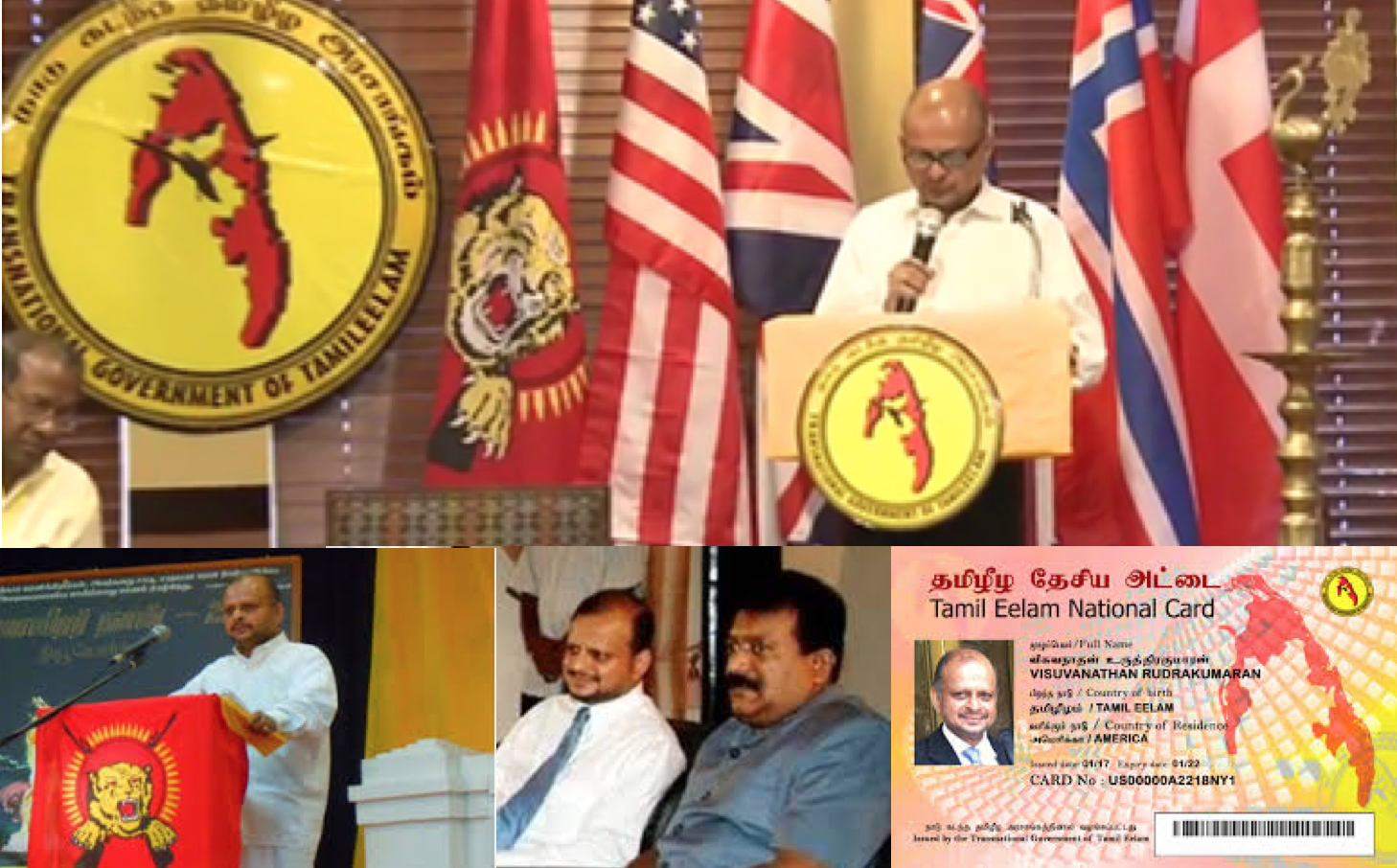
The UN & foreign governments facing some form of terrorist threat should be worried about a new trend taking place with terrorist fronts forming virtual governments and referring to themselves as Prime Ministers.We are looking at shadow world governments setting up across the world where most of these terrorist organizations have kitty’s fatter than the GDP of sovereign states. By virtue of their ability to connect across the board and link international illicit and illegal operations, they would pose a formidable threat in the future. Rudrakumaran has no qualms about putting a terrorist flag alongside the mighty US National Flag and delivering speeches.The manner their illegal money has managed to scoop powerful politicians and professionals to speak on their behalf is also worrisome. That people like Rudrakumaran and his entity are able to mix and mingle with powerful world bodies and lobbies on the strength of their ‘funding’ will soon get copied by other terrorist fronts to do the same. Let it not be forgotten that it was from LTTE that the world’s terrorists copied modern suicide terrorism, child soldiers and other modus operandi that turned a guerilla movement to become FBI’s most dangerous terrorist outfit.
Rudrakumaran is a US citizen living and working in the USA.
Rudrakumaran was terrorist LTTE leader Prabakaran’s legal advisor during 1985 Thimpu talks, 1996 Canberra Conference. Rudrakumaran organized the LTTE Hero’s Day in New Jersey in November 1998 the year after LTTE was designated as a foreign terrorist organization by the US. Rudrakumaran was also legal advisor for LTTE during Peace Talks in Thailand in 2003. Rudrakumaran was also defending LTTE during the Rajiv Gandhi assassination trial in 1997.
Rudrakumaran’s association with LTTE goes further he was LTTE’s chief negotiator in 2006 (Oslo/Geneva Talks). He even delivered LTTE’s policy statement in Switzerland in 2006 and address Tamils in Germany months after LTTE defeat in September 2009. He went on to deliver LTTE’s Heros Day statement in November 2009 – the first time such a statement was delivered without Prabakaran.
No sooner Prabakaran and LTTE were militarily eliminated, Rudrakumaran set up the TGTE in 2010. This entity was banned by Sri Lanka’s Government as a LTTE front in April 2014 and remains banned to date. LTTE is also banned in US since 1997.
How is TGTE registered in US?
If US has a Presidential system and President Trump is the President, how can Rudrakumaran be Prime Minister?
What if other terrorist fronts operating from US start calling themselves ‘Prime Minister’ or even President’ what a joke that would be for the US!
LTTE lobbies across the world have found it easy to tap people’s weaknesses. Likewise, the bevy of personalities that speak on the LTTE front stages, shows how money can buy” the most respected” of people if they have a penchant to be ‘bought over’.
We all know that LTTE survived to kill over 3 decades on the strength of its foreign lobbying and propaganda primarily as a result of the souls the LTTE kitty could win over.
Rudrakumaran has also been coordinating with South Sudan People’s Liberation Movement – imagine them also creating a virtual government and designating that leader the ‘Prime Minister or President’?
What if all terrorist organizations who create virtual governments & call themselves ‘prime ministers’ or ‘presidents’ also begin to challenge arrests of their combatants as Rudrakumaran did in challenging US designation of LTTE in the Suresh Manikkavasagar trial in Canada?
Can US continue to watch as their citizens who hold allegiance to the US flag and pledge to uphold US values & the US constitution also function as Prime Ministers or Presidents of governments in the sky with parallel laws and objectives?
What if all terrorist organizations start holding virtual elections like TGTE and appointing their cabinet of Ministers? What if these terrorist organizations start dealing in the very same relations that sovereign governments deal in but at a virtual level?
LTTE was banned since 1993 by India and since 1997 by US. Rudrakumaran publicly spoke on behalf of the LTTE
If Rudrakumaran & TGTE ‘VIRTUAL GOVERNMENT’ is allowed to continue, it is simply encouraging other terrorist organizations to also set up similar virtual governments and together they can pose a more lethal threat to sovereign governments.
Imagine these terrorists operating Virtual Governments with their own banking, credit card systems, travel/tourism, illegal trade, exchanging illegal armaments & weapons, dealing in illegal narcotics etc?
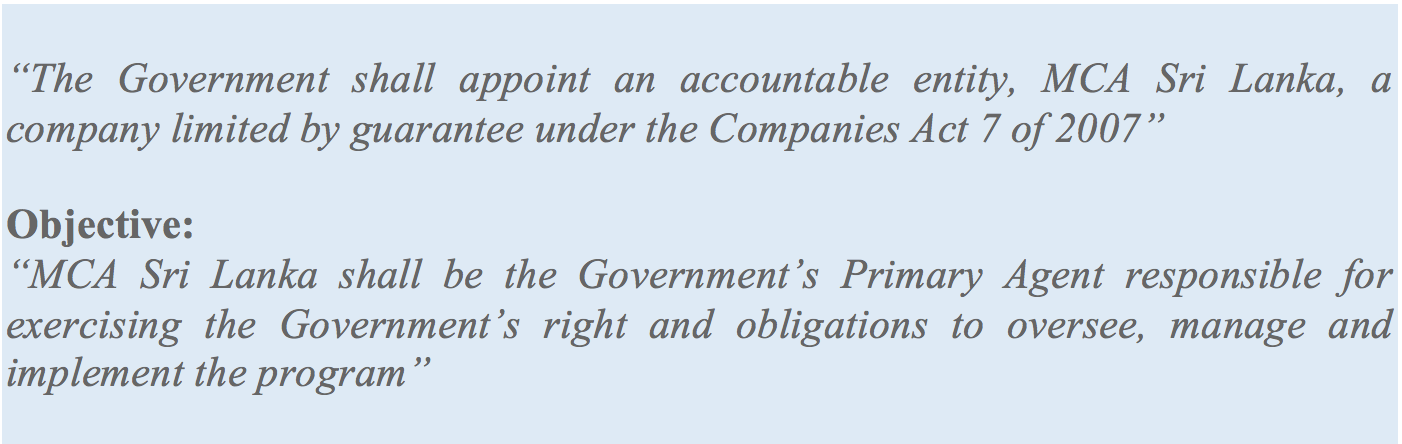
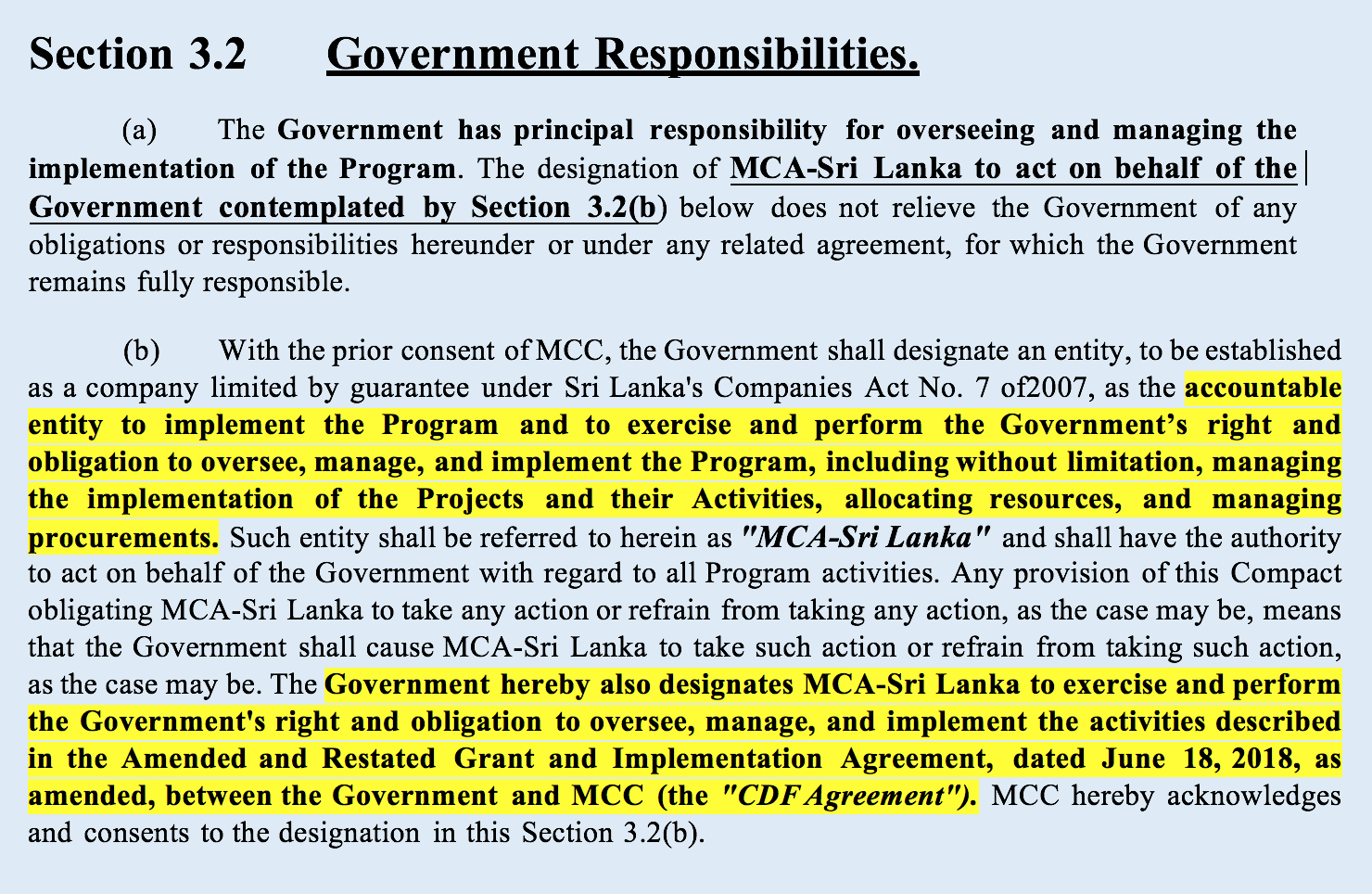
We are living in times when international companies are taking governments to courts and winning millions in compensation. Sovereign governments cannot afford to hold the tax payers to ransom with irresponsible decision making that will only leave the People to suffer consequences. No compensation for wrongs of politicians has ever been paid by them. MCA-SriLankaisto be a private company set up AFTER signing MCC & AFTER the signed MCC Agreement is passed by Sri Lanka’s Parliament.In setting up a private company, the MCC/USA demands that Sri Lanka DELEGATES its POWERS to a private company.If the alarming nature of this has not digested into Sri Lanka’s politicians yet, it should do so. They are likely to soon be jobless. This would mean no requirement for a Parliament, politicians or elections. With powers being passed by politicians to a private company, we are seeing governance of countries pass from people’s representatives to corporate hands.Is Sri Lanka an experiment to see how the political apparatus can be transferred to international corporate hands?
Whether it is this government or the previous government, those flirting with the thought of signing MCC Compact must first realize the dangers they are subjecting Sri Lanka & its citizens for a paltry $480m not even given to Sri Lanka’s Treasury.
A Government is elected to a term in office & expected to function as the guardians of the land & resources and the protector of the People’s sovereignty. Yes or No?
Therefore, the first question is – Do the People elect a government to have them delegate powers the People give to the Government to hand over to a private company? Annex 1-34 of MCC Annex IV
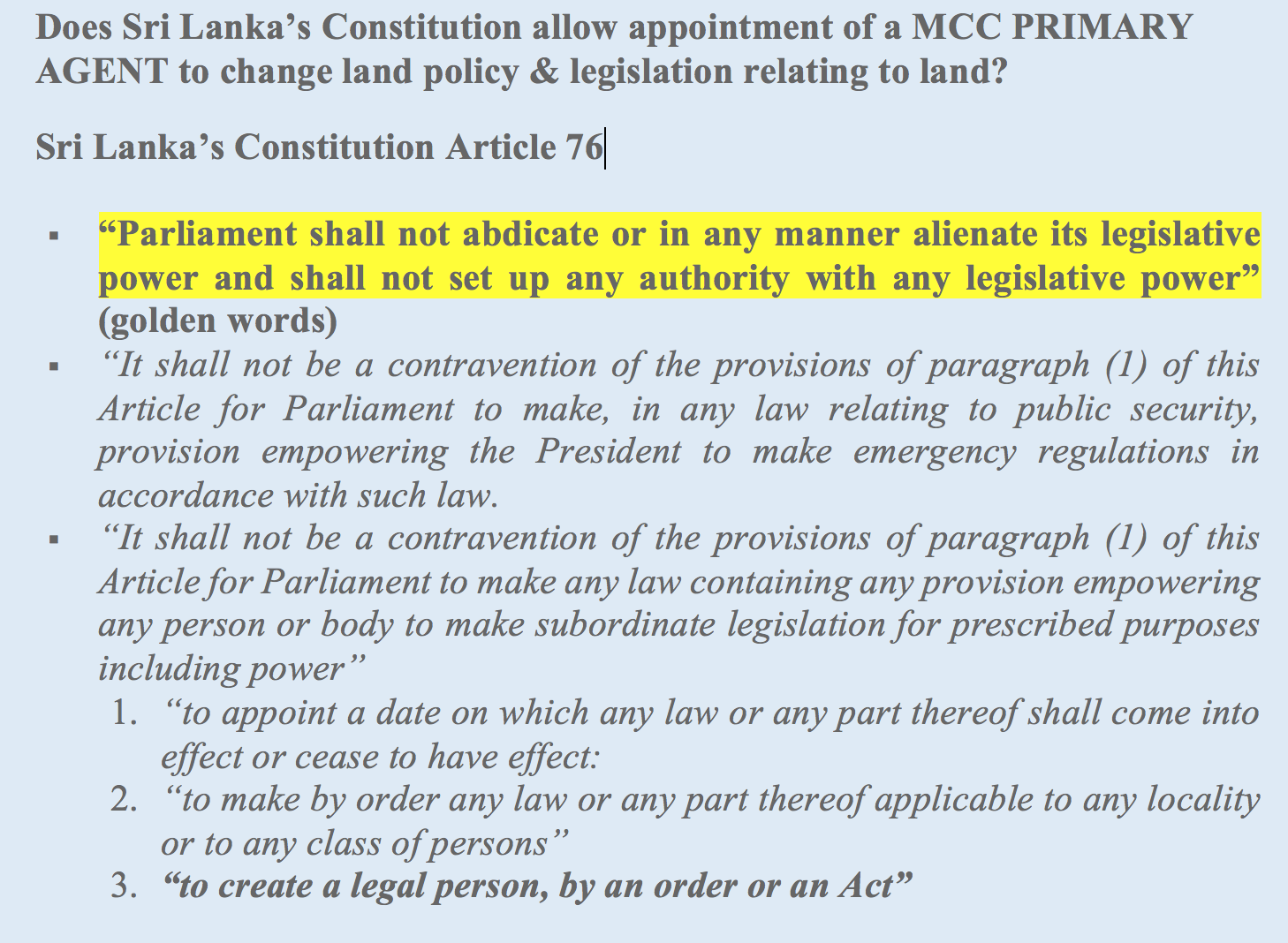
How can GoSL allow a Private Company to be the PRIMARY AGENT of the GOSL to legislate on behalf of the Sri Lankan People.
How can GoSL allow a Private Company to enter into UNDISCLOSED AGREEMENTS?
How can GoSL allow a Private Company to CHANGE LAND POLICY & LAND LAWS of Sri Lanka – [MCC Annex 1V under Independence and Autonomy]
Why should Sri Lankasign an agreement with a sub-unit of a foreign country, establish a private company (even if it has foreign-friendly locals working in it) and become the AGENT of the Sri Lankan Government ‘on behalf of the people’. Shouldn’t the GoSL be functioning on behalf of the people not a part-foreign company?
Do we know what the powers of this MCA Sri Lanka Private company is? NO.
Shouldn’t the GoSL know what the mandate and powers of this private company is before even considering to sign MCC turning a private company to be the PRIMARY AGENT of the GOSL?
How many are aware that the $480m funding is to be channeled by this company not by GoSL. Not a penny will go into the Sri Lankan Treasury!
Are Sri Lanka’s Politicians aware that Sri Lanka laws will NOT APPLY when MCC becomes operational. INTERNATIONAL LAWwill apply. WITH NO IMMUNITY FOR SRI LANKANS. Immunity given to only one party to the contract constitutes UNFAIR CONTRACT. With international law being applied and MCC US citizens immune from all wrong doings – no Sri Lankan citizen can go to Sri Lanka’s Supreme Court or seek legal assistance.
How can GoSL sign MCC Compact & agree to commit an entire nation to a set of ‘unknown agreements’ to be signed by MCA-SRI LANKA on behalf of GoSL (Annex IV) & MCC Page 6/2.5 Government has already agreed to act according to future agreements”
Why is GoSL agreeing to privatize ALL STATE LAND?
Who has ownership & patent for all passwords/access codes/security codes and back office changes
Of late we are having unprecedented interferences on Sri Lanka’s internal affairs coming from Quad quarters. We are seeing manipulations in statistics too.
It’s all about Modi, Moragoda and Moodys now.
But more worrying to the politicians should be their future – MCC signed & passed by Parliament means international corporates will rule Sri Lanka under international law.
Expectations were high from the summit with Rajapaksa, the first of its kind PM Modi has had with any South Asian leader, but the fault lines have appeared.
The virtual summit between the Indian Prime Minister Narendra Modi and his Sri Lankan counterpart Mahinda Rajapaksa turned out to be somewhat surreal. The summit was the first of its kind Modi has had with any South Asian leader. The expectations were high. But fault lines have appeared.
On the core issue of the Sri Lankan Tamil problem, the joint statement issued after the September 26 summit says, Prime Minister Modi called on the Government of Sri Lanka to address the aspirations of the Tamil people for equality, justice, peace and respect within a united Sri Lanka including by carrying forward the process of reconciliation with the implementation of the Thirteenth Amendment to the Constitution of Sri Lanka. Prime Minister Mahinda Rajapaksa expressed the confidence that Sri Lanka will work towards realising the expectations of all ethnic groups including Tamils, by achieving reconciliation nurtured as per the mandate of the people of Sri Lanka and implementation of the Constitutional provisions.”
Clearly, Rajapaksa failed to give any commitment regarding the implementation of the 13th Amendment enacted by the previous government, which came to power in 2015 after his ouster. Instead, he has spoken of the expectations of all ethnic groups including Tamils” and has stated his intention to nurture” national reconciliation as per the mandate” he received in the February election and the relevant constitutional provisions.
Interestingly, Rajapaksa also called Modi’s attention to the massive mandate” that he received from the electorate. Rajapaksa said, It is our responsibility to work for all, with all.” In sum, he has conveyed to Modi that the reconciliation process must have acceptability among the majority Sinhala community — implying that Delhi is barking up the wrong tree. The irony is that the Modi government too practises a majoritarian ideology within India.
There is already a demand from the Sinhalese majority community that the 13th Amendment should be scrapped. Nonetheless, Modi decided to press ahead. Effectively, Rajapaksa has pushed back at Modi’s emphatic demand that the implementation of the 13th Amendment is essential”.
The Sri Lankan Tamil problem has had a geopolitical dimension, historically. India has been a star performer on that diplomatic turf. The Indian intervention took different forms at different times. Since the late 1970s, for a decade Delhi used the Tamil problem to pressure the pro-western Sri Lankan leadership of President J.R. Jayewardene (1978-1989).
But Colombo exhibited exemplary diplomatic skill to ward off India’s intrusive policies. By the mid-1980s Jayewardene brilliantly outmanoeuvred Delhi by enticing it to jettison its previous role as the mentor of the Tamil militant groups and instead be their terminator, and in the process wearing out Delhi so comprehensively that it somehow extricated itself altogether from the Sri Lankan nationality question, finally, to count its losses.
Through the next two decades, geopolitics took a back seat in the Indian calculus, which immensely helped Colombo to successfully defeat the Tamil separatist groups by 2008 after twenty-six years of conflict.
Enter Modi government. Geopolitics began staging a comeback almost overnight in 2014, thanks to the animus against China in the Modi government’s foreign policy. By January 2015, for the first time in Sri Lankan history, external powers orchestrated a regime change in Colombo ousting the staunchly nationalist leadership of Rajapaksa who was perceived aspro-China” in Delhi and Washington.
A unique feature of the regime change project was that the Tamils organised under the Tamil National Alliance [TNA] was grated on to it to overthrow an established Sinhala-led government in Colombo. The TNA will carry this opprobrium for a long time to come. It was not in Tamil interests to have identified with what was quintessentially a geopolitical project.
In retrospect, although the futility of the 2015 regime change project soon dawned on them, Delhi and Washington decided to double down on the Sri Lankan turf. This is so because Rajapaksa’s return to power in Colombo has coincided with the surge of the US-Indian Indo-Pacific strategy” to contain China.
The new agenda is to bring the Rajapaksa government into the orbit of the Quad (Quadrilateral Alliance between the US, Japan, India and Australia.) But the Sri Lankan nationalists are unwilling to take sides between the Quad and Beijing — as indeed most countries in the Asian continent.
Hence the renewed use of the Tamil problem to pile pressure on Colombo. The humanitarian intervention” in Sri Lanka is in pursuit of a geopolitical agenda. But Mahinda Rajapaksa is a democratically elected leader who received a massive mandate of 71% of votes, and he owes nothing to Delhi or Washington for staging his political comeback.
The virtual summit last week reveals that Sri Lankan nationalism continues to militate against Delhi’s intrusive policy. Delhi has baited the Sri Lankan religious establishment with a US$15 million grant for promotion of Buddhist ties”, but Colombo will remain vigilant about Indian intentions in cultivating the powerful Buddhist clergy. The modus operandi in the 2014-2015 period to destabilise the incumbent government must be still fresh in memory.
Colombo is in a far better position than at anytime before to counter US-Indian intervention in Sri Lanka’s internal affairs. Fundamentally, there is a contradiction insofar as while Sri Lanka’s external policies are driven by geo-economic considerations, the agenda pursued by India and the US is paramountly geopolitical, drawn from a perspective that the island is a permanent aircraft carrier,” as a former Indian national security advisor once candidly put it.
The induction of Quad into the Indian Ocean region is an urgent necessity for the US’s Indo-Pacific strategy. An American military presence in Sri Lanka would enable the US to advance a so-called island chain strategy” to control the sea lanes of the Indian Ocean, which are of vital importance to China’s foreign trade.
Top US officials have been threatening the Sri Lankan government since last year that unless it cooperated with the Indo-Pacific strategy, its human rights record in the war against Tamil separatists in the 2007-2008 period will be held against it and there will be hell to pay. (See India’s Quad Dilemma in Sri Lanka)
Without doubt, Rajapaksa accepted Modi’s invitation to the virtual summit anticipating the likelihood of the Sri Lankan Tamil problem being brought to the forecourt of the bilateral discourse. He was ready with a response. Delhi should think hard how far it is in India’s interests to be seen hawking the US’ Indo-Pacific strategy in the South Asian region.
The Hon President may please consider getting the
Army to establish the Marketing Department of the Fifties and thereby enable
vegetable availability as well as controlling inflation. It can be later
developed to be a major department. The total outlay can be recouped including
the cost of establishing a Cannery within the first year. I can vouch for this,
My earlier paper is reproduced and if implemented
now(can be done in days) will be a great feat.
It is hoped that our
President’s attention is brought to the fact that our country was the only
country in the world to have a system by which the prices of veg and
fruit was unofficially controlled. That was the Marketing Department(MD) at
work, buying and selling vegetables and fruit, competing with private traders,
keeping a low margin of around fifteen percent to cover up cost of transport
and wastage in handling.
It would behove of our
President to immediately order the Army to buy vegetables from the Producer
Fairs, keep a margin of fifteen percent to cover cost of petrol and wastage and
sell in the Cities. Traders keep at least a total of one hundred percent
at the buying place, at the wholesale dealer in Colombo and at the retailer’s
place.
The Army was entrusted with
this task in the days of Premier Mahinda Rajapaksa in about 1998 and then the
city was full of army lorries selling vegetables. I have seen them perform this
yeoman service.
The Dambulla Economic Centre
and economic Centers at many places- is not the answer, because as detailed in
the Daily Mirror of 24/2 Take Immediate steps to control Veg prices: Pres. to
Officials” because vegetables brought to Dambulla from the areas of vegetable
cultivation are distributed back (for sale) to the original areas… these
centers are controlled by large scale traders with vested interests.”
Once it was reported that the officer entrusted with the Dambulla Economic
Center was severely assaulted.
It is traders that rule. When I
once went to Dambulla and walked around, it was only traders. My incessant
visits to producer Fairs for over six years enables me to sniff producers
from a fair distance. It will be a difficult task to find a Producer Fair in
entire Sri Lanka not visited by me.
In 1955 when I joined the MD as
an Assistant Commissioner we did work from small shanty type of sheds- we
called them Packing Sheds. They were all buildings built with timber, a cement
floor and a corrugated cladding to keep off the rain and in a corner was housed
the Assistant Commissioner working in the air and dust of onions and
condiments. There were no DPJ Towers or Setsiripayas for us. These were
shed put up overnight to house the British Army when the Japanaese declared
war.
In the MD,our work commenced at
4 AM in the mornings on at least four days a week, visiting Producer fairs and
ensuring that we bought produce competing with the traders.
I include parts of my earlier writings, edited to avoid
repetition in support.
Once in the pre IMF days, in the days before Sri Lanka started
playing poodle to the IMF Sri Lanka did have a method by which it controlled
inflation.
That was the Marketing
Department at work. There was a scheme where the Marketing Department
purchased vegetables at the producer fairs, brought the produce overnight to
the cities and sold the produce keeping a very low margin of fifteen percent to
cover up cost of transport and wastage. This Scheme which had been developed by
Sri Lankan administrators and politicians was abolished on instructions from
the IMF in 1978 when the Jayawardena Government caved in to the IMF. Since then
it is the private sector traders that rule trade.
If only the Marketing
Department activities are restored, we can not only control inflation,
but we can also reduce imports and also find employment for our people.
It is time that our new
Government makes an initiative to re establish the Marketing Department
activities- its vegetable and fruit marketing scheme and the Canning Factory.
That will be a real achievement.
Inflation- Rising Prices is a
major concern today. Sri Lanka had built up the infrastructure to control
inflation. What we are seeing today-unbridled inflation, has been caused
because we did away with the infrastructure we had.
For the marketing of essential
commodities, in my own words:
The Department for the Development of Agricultural Marketing”¦
ensured that prices of all essential commodities were indirectly controlled and
the traders were compelled to offer fair prices to the producers and the retail
shop keepers were compelled to sell at fair prices to consumers. This is
a system that I have never seen elsewhere in the world’ ¦The motto of the
Department was to pay the highest possible price to the producer and sell at
the lowest possible price to the consumer.( From: How the IMF Ruined Sri
Lanka,”¦ (Godages: 2006)
I was involved with the entire System
because I was appointed Assistant Commissioner for the Development of
Agricultural Marketing in 1955, and worked in the Ratnapura, Hambantota,
Anuradhapura Districts as well as was in charge of the Tripoli Market,
the Headquarters of the Vegetable Marketing Scheme for a year in 1957.
This System involved a Network of Retail
Shops(Fair Price Shops) in every major city and a Vegetable and Fruit
Marketing Scheme involving purchasing, selling and processing
vegetables and fruits, a Scheme that covered the entire island.
The entire island was covered
by Assistant Commissioners in the Provinces and Marketing Officers posted in
producer areas, who had to report the availability of produce, prices at the
Fairs, and guide producers to plant varieties in demand.
The Marketing Department
established Vegetable and Fruit Packing Sheds(actually purchasing units) in all
producing areas. The name given was packing sheds and they were in many places
in temporary buildings mostly made with timber. Even some Assistant
Commissioners had their offices in these temporary buildings in 1955.
The entire Vegetable Marketing
Scheme was administered from Tripoli Market, based in the largest hangar in the
Colombo Goodshed. One part of the Scheme was to purchase vegetables and
fruits from producers who brought their produce to our Vegetable Packing Sheds.
They were paid immediate cash. The Department was equipped with lorries that
were sent to the chief Producer Fairs in the producer areas. Thus there
were mobile purchasing uints at all major fairs like Embilipitiya, Colombage
Ara, Bandarawela, Welimada, Kekirawa to mention just a few. These
Purchasing Units comprised Marketing Officers and a staff of purchasing
officers and labourers. The produce brought in was weighed and accepted from
producers and they were paid cash immediately. The Assistant Commissioners of
the Districts were required to visit all major fairs to ensure that the
purchases were made regularly. When I worked in the Districts on most days my
day commenced at four to get to the Fairs by six in the morning. Vegetables
were purchased and packed and dispatched to Triploi by evening either by
wagons(by trains) or by special lorry.
At Tripoli Market, the
Assistant Commissioner had a Marketing Officer at the Colombo Wholesale
Market. His task was to report the prices at which the wholesale traders sold
the produce to the retail traders and to report on the availability of produce.
In the Districts, the Assistant Commissioners and the Marketing Officers had to
report the prices at which private traders purchased vegetables and
fruit. Generally there was a wide gap between the prices at which the
traders purchased goods and the prices at which the Wholesale Traders sold to
the retail traders in Colombo. Based on these prices, the Assistant
Commissioner at Tripoli Market decided the purchasing prices at which goods
were to be purchased at the Fairs. This price was always above the prices
offered by the traders who bought goods at the Fairs. This helped the producers
and the traders at the Fairs too had to offer a similar price because otherwise
they will be out of business.
On a daily basis Tripoli Market
received around twenty wagon loads of vegetables and a similar number of
lorries bringing in produce. These were checked and had to be in our Retail
shops by ten in the morning. Tripoli Market was a hive of activity from
early morning. Then the Railways ran a very efficient service and brought
in produce in time. For instance curd from Ridiyagama Farm in Hambantota
was sent by lorry to Matara and came by night mail train to Tripoli. This was
an item in high demand. The retail price we fixed for Ridiyagama Curd
effectively controlled the prices of curd in private shops in Colombo.
The Assistant Commissioner at
Triploi Market kept a very low margin to cover up cost of transport and
handling and fixed a low price for sales to the consumers through the network
of Shops. Generally the Marketing Department kept a margin of around 10 to 15%
above the purchase price while the private trader at the Fair kept a
margin to 40 to 50% and the Whoelsale Traders too kept around 40% and further
the retail trader too kept around 40%. Thus while the private trader
generally kept a margin of 100% or 120% over the purchasing price at the Fair,
the Marketing Department kept a margin of 10% to 15%.
The working of the Marketing
Department meant that the private traders at the Fairs and the Wholesale
Traders as well as the Retail Traders in the cities had to be satisfied with a
low margin.
The Marketing Department in the
Fifties was headed by BLW Fernando, a Chartered Accountant and he would not
allow any Assistant Commissioner to keep a higher margin than 15%. That was a
rule to be followed. Every month all Assistant Commissioners had to attend a
Conference where the Profit and Loss calculations were closely studied and the
Commissioner would chastise all Assistant Commissioners that had a profit
of over 10% or incurred a loss. We were expected to cover up, not to
incur a loss or to get a large profit.
This was the key method by
which the prices of vegetables and fruits were kept in check. The Scheme has
thus a dual aim- of offering the producer a fair price as well as offering the
consumer a low price. At times it was like walking on a rope but we got
used to walk on it.
The Retail Shops had to be well
stocked and full of goods otherwise the wrath of the Commissioner had to be
faced.
A few years ago on one of my
visits I found tomatoes being sold at forty rupees a kilo by a producer on the
Mahiyangana Road, when the retail price in Colombo was around rupees eighty to
one hundred, a margin of over hundred percent. This could not happen while the
Marketing Department was at work. The Assistant Commissioners were
eternally traveling as they had to visit Fairs, inspect purchasing at the Fairs
and the Vegetable Purchasing Depots, contact producers and offer advice on
items on demand. Generally our traveling allowances exceeded our salaries.
Tripoli Marker had cold rooms
where the excess produce could be stored.
This Vegetable Marketing &
Fruit Marketingh Scheme was very successful in ensuring that consumers in
cities obtained vegetables and fruits at cheap rates. The Cost of Living was
effectively kept in check.
The Canning Factory
Local producers got a boost
with the establishment of the Canning Factory in 1955. At that time Sri Lanka
imported fruit juice and fruit from Australia and the task of the Canning
factory was to produce fruit juice, jam and jellies. The Vegetable Purchasing
Centers sent goods to the Canning Factory. At the initial stages in canning
fruit juice many problems were faced and it took over a year to surmount them
and get down to production for all Sri Lanka’s requirements. The Marketing
Department offered floor prices for pineapples, red pumpkin and ash
pumpkin and producers benefited immensely. Floor prices meant that the
Department will purchase everything offered at that price. Pineapple was tinned
and even an export trade was built up. Assistant Commissioner Oswald
Tilekeratne spread his wings abroad very often. Red Pumpkin was turned into
Golden Melon Jam and Ash Pumpkin was turned into Silver Melon jam. The Factory
activity made Sri Lanka self sufficient in fruit juice, jam and many other
processed food within a few years.
The Marketing Department was called upon to attend to many
tasks.
Once Sri Lanka was not self
sufficient in eggs. The Marketing Department offered a floor price for eggs and
Triploi Market collected eggs from the Negombo-Nattandiya area till Sri Lanka
was self sufficient in egg production. Once Self sufficiency was reached
the scheme was disbanded.
With the abolition of the
Marketing Department, and the privatization of the canning factory all this
achievement was lost. That was the way in which the IMF crippled the
development of the Third World and created a situation where we had to import
our requirements from the Developed Countries.
Once the tomatoes producers at
Hanguranketa made pandals of tomatoes in order to highlight their plight of not
being able to sell their tomatoes. This could not have happened while the
Marketing Department was functioning. To start with the Assistant Commissioner
of the area would be held responsible. If that happened when I was in charge of
The Tripoli Market I would have sent a few lorries and the entire stock of
tomatoes would have been purchased within a few hours and it would have been
turned into Tomatoe Sauce and Juice at the Factory. The MD had a fleet of over
a hundred lorries. Today Spain produces tomatoe sauce, tomatoe juice, tomato
paste and sun dried tomatoes for most countries in Europe. With a Tomatoe belt
in Hanguranketa we cannot produce tomato sauce even for our requirements. Our
climate had enabled a variety of crops. There is a mango belt from Anuradhapura
to Matale. Even today if action is taken to pluck mangoes and process it, we
can be self sufficient in all fruit juice within one year. The Chena
cultivators will find sales for their Red Pumpkin,Ash Pumpkin and Melon. There
is an Avacado belt from Peradeniya to Gampola and avacado juice can easily be
made. The country will benefit by avoiding the millions spent on imports.
Following the liberalization
free market economics of the IMF we created a market for tomatoe sauce
from the USA, and fruit juice from as far as Canada and Oregan in the
USA. Our producers have stopped producing large quantities for fear of
being unable to sell and we have unemployment and our farmers have low incomes.
The Colombo Supermarkets are full of Heinz Tomatoes sauce from the USA and
fruit juice and jam from Australia.Even vinegar from the USA! The IMF did its
work right to cripple development in our countries and for us to buy goods from
the Developed Countries. That was the Structural Adjustment Programme in
action. (For more details: How the IMF Sabotaged Third World Development:
Kindle & Godages) It is sad that we have deaf, dumb and
blind economists who even fail to come to grips with how we were duped by
the IMF.
I hope the Army will be
enlisted for this task of marketing development. In President Trump’s USA the
Army is widely used for irrigation, power station construction, even
maintaining levees that keep the sea from flooding New Orleans. In my wide
travel in the USA, clocking over 50,000 miles in my Roadtrek motorhome,
crossing America thrice I have seen the Army at work doing non military duties
on a regular basis. It is we fools that do not enlist the Army for development
tasks. If at all we touch the army we call them to the barracks in a short
while.
Let the Army experience of Van
Sales, this time end with the establishing of a proper Marketing Department
with a Cannery. The total cost of establishing a Cannery can be easily recouped
in the very first year by the savings of foreign exchange we use today to
import fruit juice and fruit preparations Later on the Army venture
can be handed over to a SLAS Department and the Army moved to another task-
perhaps the reconstruction of our irrigation tanks.
The
recent unfortunate incident where three lives were lost due to a building
collapse in Kandy prompted me to write this article.
About
six months ago there was a ‘Question Time Meeting ‘ of a professional
association allied to building construction industry held in Wijerama Mawatha
in Colombo 7. The topic of that particular meeting was the construction of
Shangrila Hotel Building. It was presented very well by one of the engineers
responsible for the management aspect of the project.
At
the end of the presentation, I put the question as to which code of practice
the building was designed. There was no doubt as to whether the project has
been designed well and what I wanted to know was which code has been used for
the project. The presenter informed that a Hong Kong based consultancy had done
the structural design, and with respect to the code he said it has been
designed according to BS 8110 (British Standard No. 8110). I then asked why we
stick to an old code even Britain has superseded, here in Sri lanka, there was
no answer. It is not only the Structural Design Code (such as the Eurocode or
the British code mentioned above) that is important for such a project but other aspects such as Drainage, Sewerage, Roads,
the aspects with regard to soil investigations etc are all included in a
document called ‘Building Code’ and made into law by every responsible
government in the world. So I asked the
question whether there is such a document existing in Sri Lanka. After a lapse
of few minutes one lady got up and said that such a document is being prepared.
For
such a document to be prepared there is
a need to put in the details of other codes as well and it is not possible to
have it as there are no codes for any of the aspects mentioned above existing
in our country as at now, as far as I know. Those foreign consultants that get
the assignments for various projects do the design using whatever the criteria
they can get hold of and get the building approval probably by various means
just like in the case of the collapsed building in Kandy.
So,
my appeal to the political authority is to get the mess with respect to
authority approval of buildings sorted out and stream lined by having various
codes prepared as soon as possible and fall in line with other countries like
Singapore, Hong Kong etc in the region without further delay. I have observed
from some CCTV footage that some of the road accidents that happen in our
country are due to not adhering to the design principals in road widening etc.
Since 13A was imposed
on Sri Lanka by India in 1987 with the help of gunboats, an invasive Indian
army and Indian sponsored Hindu terrorist groups, a number of progressive laws
and constitutional amendments have been blocked as they were inconsistent with
the provisions of 13A.
Divi Neguma is
one such attempt to take benefits of post-war economic revival (the peace
dividend) to people of all corners of the island. But 13A blocked it.
A number of
agrarian services acts were passed against 13A provisions and they cannot be
implemented in a number of provinces as a result, which is a severe blow to
agricultural revival.
13A created
nine provinces with extensive powers in the island of just 65,000 square
kilometres which is a joke that made Sri Lanka the smallest federal country in
the world. Although 13A kept the unitary” clause of the constitution, in
reality Sri Lanka is an extreme federal country after 13A where even the
parliament cannot pass laws without consulting provincial councils! Somewhat
similar to the United States of America and now defunct Soviet Union. Even the
Indian federal model allows the parliament to pass any law without consulting
states.
The only way
to silence local and regional separatists is to present 13A to a referendum. If
people reject it, that will be the end of 13A. No matter what international
commitments Sri Lanka has, people hold the nation’s sovereignty. Sri Lanka must
comply with what the people decide.
The government has the golden opportunity to turn tables on
democracy champions. Put 13A to a referendum. Why fear the people if 13A is so
good!
The moral obligation for all people living in Sri Lanka is
to live in harmony with each other and particularly in harmony with the pre-
dominant religious culture and beliefs and not hurt the moral sensitivities of
the majority.
This requirement prevails in all Countries influenced by
Abrahamic religions, especially in Islamic countries.
This condition also prevailed in Sri Lanka prior to 1505.
When in Rome do as the Romans is a wise way to avoid
conflict between communities.
This requirement needs to be stressed by the State in
Schools, Media, Public Relations, and be made part of public policy.
We, in Sri Lanka, can no longer afford to take chances with
failed ideas and experiments not of our own making.
Press Release Minister of Skills Development, Vocational Education, Research and Innovation
In
pursuance of a concept by Dr (Mrs.) Seetha Arambepola, the State Minister
of Skills Development, Vocational Education, Research and Innovation, the
Ministry has initiated measures to setup a coordinating unit to bring
Technology, Research and Innovation related services closer to the general
public, as well as to provide technical guidance in addressing the issues related
to the said fields faced by the general public.
It is envisaged to ensure an
efficient and friendly service is provided promptly to all individuals seeking
services from research and development Institutions functioning under the
Ministry.
This unit will be inaugurated
on 05/10/2020 at the Ministry premises on the 6th floor of Sethsiripaya stage
II building.
This would pave the way for a
place where a collective effort could be made to make use of research and
innovation benefits towards the growth of the economy.Those who seek assistance
from the unit will be provided with technical guidance and assistance for
research and innovation, with the opportunity for commercialization. Further,
assistance will be provided for the small and medium scale entrepreneurs for
business development, technology transfer and in securing financial assistance.
Following the setting up of this unit, a representative from all the relevant
institutions will coordinate with the unit on every Monday of each week, who
will be held accountable for finding solutions for the said issues.
Services relating to the
field of innovation and research will be facilitated by this unit with the
coordination of Sri Lanka Inventors Commission, Sri Lanka Institute of
Nanotechnology, Industrial Technology Institute, National Engineering Research
and Development Centre, Arthur C Clarke Institute for Modern Technologies,
National Science Foundation, National Science and Technology Commission,
National Research Council, National Institute of Fundamental Studies,
Coordinating Secretariat for Science Technology and Innovation, Citra Social
Innovation Lab, Vidatha Resource Centers established Island wide as well as
World Intellectual Property Organization.
It is expected that this unit
will be instrumental in assisting inventors and entrepreneurs in saving their
valuable time and energy otherwise spent on visits to numerous institutions in
search of services or guidance, as well as avoiding many hardships and despair
they would be subjected to, in developing their inventions or businesses.
Media
Unit
Minister
of Skills Development, Vocational Education, Research and Innovation
Late President J. R. Jayawardane initiated a massive operation to create an Executive Presidency with the intention of ensuring stability and economic freedom in the country, Pradeep Jayawardane, grandson of the first Executive President yesterday said.
Mr. Jayawardane, who authored the book ‘Prajathanthrawadaye Ekadhipathiya’ (Dictatorship within Democracy), speaking at the book launch said yesterday that the Executive Presidency helped in effectively navigating the country amidst many grave challenges.
The Executive Presidency helped in containing and defeating invasions, intrusions by foreign military, uprisings and the war which was ravaging the country,” he said.
However, he said the Executive Presidency in Sri Lanka never grew into a Presidency like that of in the US which constantly clashed with the Congress.
After the Executive Presidency was created, JR made 10 pledges to ensure that the post will not become a powerhouse that overshadows the Parliament. He pledged to go through the MPs and Ministers without appointing a separate team for the President. He also pledged not to create an over-powerful Secretary to President. These pledges which were followed by all Presidents helped Sri Lanka in preventing the Executive from growing into one like in the US,” he said.
Another book titled ‘Elina Jayewardene’ which was authored by Sagarika Dissanayake was also launched at the event which was attended by Prime Minister Mahinda Rajapaksa, former President Maithripala Sirisena, family members of the Jayewardene family and others.
Prime Minister Rajapaksa, commenting on the biography ‘Elina Jayewardene’ the wife of late President JR Jayewardene, said many politicians fail or become wane due to actions of their wives and that they could learn from the life of Elina Jayewardene.
I got to know of Ms. Jayewardene when I was staying in a house next to the Jayewardenes. She was a humble character. Launching a book on her life story is timely and this book will help many, especially women,” Mr. Rajapaksa said.
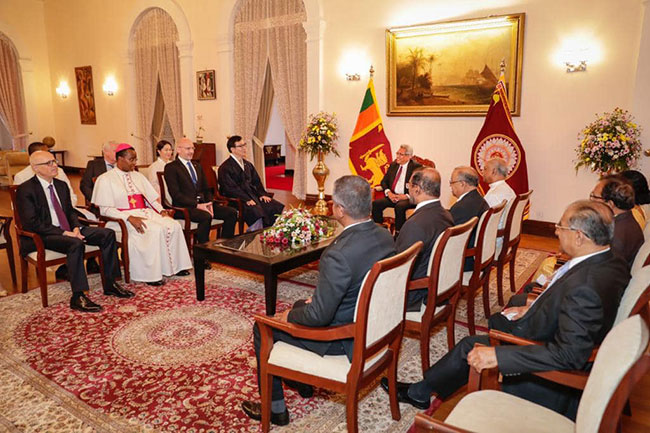
President Gotabaya Rajapaksa during a conversation with four newly-appointed Ambassadors to Sri Lanka, today said China came forward to invest in development projects in the country, which was only a commercial transaction though some described it as a pro-China policy.
Ambassadors of Republic of Korea, Germany, Holy See and Switzerland presented their credentials to the President, the President Media Division said.
Commenting on Sri Lanka’s development in the aftermath of the war, President Rajapaksa said the priority of the Government as well as the people of Sri Lanka is to achieve rapid development after defeating terrorism in 2009.
The economy was weakened due to terrorism. We required foreign investments for speedy development. China came forward to invest in development projects in the country. It was only a commercial transaction between our two countries. But some described this as a manifestation of a pro-China policy. Sri Lanka is a friend of all countries,” President explained.
President Rajapaksa pointed out that the construction of the Hambantota Port with funding from China was a project with enormous development potential, although some call it a ‘debt trap’. The previous Government leased the Hambantota Port to China, but it is being used only for commercial purposes, he said.
Explaining Sri Lanka’s policy towards the Indian Ocean during the discussion, the President said the Indian Ocean should be a free zone open to every country.
Sri Lanka is located in a place of strategic importance. Therefore, our country is attracted to many parties. In this context, Sri Lanka has chosen neutrality as its foreign policy. Our topmost priority is mutually beneficial development cooperation. This country is open for foreign investments,” the President said.
K. Buddhika Kumarasiri and Nihal Wettasinghe Courtesy The Daily Mirror
Provincial Councils is an internal matter which should be decided by the President of Sri Lanka and not by the leaders of other countries, Provincial Councils and Local Government State Minister Sarath Weerasekera today said.
Speaking at an event in Padukka, State Minister Weerasekera said, India cannot interfere or intimidate that we should continue with the Provincial Councils,” he said.
He said ours is an Independent Sovereign country and therefore India cannot interfere in our internal affairs.
The 13th Amendment was introduced into our Constitution under the Indo-Lanka pact and according to which India had to fulfil several conditions and one of which was the disarming of the LTTE, which never took place. India could not accomplish it. Therefore, it is questionable as to what extent this Indo-Lanka agreement is effective,” he said.
Sri Lanka is located in a place of strategic importance and therefore, the country is attracted to many parties, says President Gotabaya Rajapaksa. In this context, Sri Lanka has chosen neutrality as its foreign policy.”
Our top most priority is mutually beneficial development cooperation. This country is open for foreign investments.”
He mentioned this during a brief cordial conversation with four newly appointed Ambassadors to Sri Lanka, following the presentation of their credentials at the President’s House on Wednesday (30).
Ambassador of Republic of Korea Mr. Jeong Woonjin, Ambassador of Germany Mr. Holger Lothar Seubert, Apostolic Nuncio of the Holy See Monsignor Brian Udaigwe and Ambassador of Switzerland Mr. Dominik Furgler presented their credentials.
Explaining Sri Lanka’s policy towards the Indian Ocean during the discussion with the new envoys based in Colombo, it was mentioned that the Indian Ocean should be a free zone open to every country. Five decades ago, it was Sri Lanka that proposed Indian Ocean to be declared as a zone of peace.”
While paying attention to the development efforts of Sri Lanka in the recent past, after defeating terrorism in 2009 priority of the Government as well as the people of Sri Lanka was to achieve a rapid development, the President said.
The economy was weakened due to terrorism. We required foreign investments for speedy development. China came forward to invest in development projects in the country. It was only a commercial transaction between our two countries. But some described this as a manifestation of a pro-China policy. Sri Lanka is a friend of all countries.”
He said the construction of the Hambantota Port with funding from China was a project with enormous development potential, although some call it a debt trap‟. He said the previous Government leased the Hambantota Port to China but it is being used only for commercial purposes.
Expressing their views, the Ambassadors commended both government and the people of Sri Lanka for successfully controlling the COVID–19 pandemic. Sri Lanka is so safe”, Ambassador of Korea Mr. Jeong Woonjin remarked. Ambassador of the Federal Republic of Germany Mr. Holger Lothar Seubert said he is pleased to be appointed as an envoy to Sri Lanka that has overcome the COVID–19 pandemic.
We are not here to lecture you but to offer any possible assistance. We are certain that Sri Lanka is capable of choosing what needs to be done. We are ready to extend our cooperation to achieve development aspirations of Sri Lanka”, both German Ambassador Mr. Holger Lothar Seubert and Switzerland Ambassador Mr. Dominik Furgler echoed.
Communicating congratulations of Pope Francis to the government for the massive mandate received during elections, Apostolic Nuncio of the Holy See Monsignor Brian Udaigwe said he was a member of the entourage of the Holy Father during his visit to Sri Lanka in 2015. The Apostolic Nuncio said the geographical location is a great gift to Sri Lanka.
The Ministry of Skills Development, Vocational Education, Research and Innovation has initiated measures to setup a coordinating unit to bring Technology, Research and Innovation related services closer to the general public, as well as to provide technical guidance in addressing the issues related to the said fields faced by the general public, in pursuance of a concept by State Minister Seetha Arambepola.
It is envisaged to ensure an efficient and friendly service is provided promptly to all individuals seeking services from research and development institutions functioning under the Ministry.
This unit will be inaugurated on October 05, 2020 at the Ministry premises on the 6th floor of Sethsiripaya stage II building.
The ministry said this would pave the way for a place where a collective effort could be made to make use of research and innovation benefits towards the growth of the economy. Those who seek assistance from the unit will be provided with technical guidance and assistance for research and innovation, with the opportunity for commercialization.
Further, assistance will be provided for the small and medium scale entrepreneurs for business development, technology transfer and in securing financial assistance. Following the setting up of this unit, a representative from all the relevant institutions will coordinate with the unit on every Monday of each week, who will be held accountable for finding solutions for the said issues.
Services relating to the field of innovation and research will be facilitated by this unit with the coordination of Sri Lanka Inventors Commission, Sri Lanka Institute of Nanotechnology, Industrial Technology Institute, National Engineering Research and Development Centre, Arthur C Clarke Institute for Modern Technologies, National Science Foundation, National Science and Technology Commission, National Research Council, National Institute of Fundamental Studies, Coordinating Secretariat for Science Technology and Innovation, Citra Social Innovation Lab, Vidatha Resource Centers established Island wide as well as World Intellectual Property Organization.
It is expected that this unit will be instrumental in assisting inventors and entrepreneurs in saving their valuable time and energy otherwise spent on visits to numerous institutions in search of services or guidance, as well as avoiding many hardships and despair they would be subjected to, in developing their inventions or businesses.”
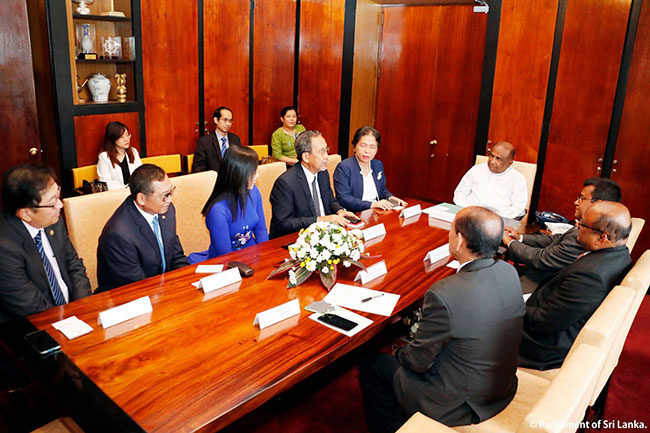
The Ambassadors of five countries from the Association of Southeast Asian Nations (ASEAN) have commended the government for successfully combatting the COVID-19 threat in Sri Lanka.
This was conveyed during a meeting held with Speaker Mahinda Yapa Abeywardena at Parliament yesterday (29), the Speaker’s Office said. Furthermore, it was stated that Sri Lanka is one of the leading countries in the world to have overcome the COVID-19 threat through the execution of a proper plan.
The Speaker and the Diplomatic community representatives discussed the COVID-19 situation in each country and how Parliaments conducts their activities. While appreciating the close ties the ASEAN countries have with Sri Lanka, the Speaker reiterated that Sri Lanka will continue the friendship in the future as well.
An invitation to visit Kuala Lumpur to further strengthen the bilateral ties by the Ambassador of Malaysia was also extended to the Parliamentarians from Sri Lanka. The request was welcomed in principality where the ambassador stated that a written invitation on this regard will be sent to the Sri Lankan Parliament in the future.
Tan Yang Thai, High Commissioner of Malaysia to Sri Lanka, Pham Thi Bich Ngoc, Ambassador of Viet Nam, Gusti Ngurah Ardiyasa, Ambassador of Indonesia, Chulamanee Chartsuwan, Ambassador of Thailand and Han Thu, Ambassador of Myanmar represented ASEAN at the meeting.
The Speaker was accompanied by the Secretary General of Parliament Dammika Dasanayake and Wasantha Yapa Abeywardena.
The Registrar of the Asgiriya Chapter Ven. Medagama Dhammananda Thero states that the positive proposals of the committee appointed to review the 20th Amendment to the Constitution should be taken up during the committee stage of Parliament.
He was speaking at a meeting with representatives of the National Movement for a Just Society today.
Former Speaker Karu Jayasuriya and representatives of the National Movement for a Just Society called on the Chief Prelates of Malwatta and Asgiriya today and briefed them on the 20th Amendment to the Constitution.
Prime Minister Mahinda Rajapaksa states that the country’s economy will develop with the emergence of students with proper education and that his government’s goal is to take education in the country to the international level.
The Prime Minister was addressing a function held at the Colombo Hindu College today.
President Gotabaya Rajapaksa has described to a group of newly-appointed foreign ambassadors about the high development potentials of the Hambantota Port.
After receiving their credentials, the president had cordial discussions with the ambassadors from Korea Republic, Germany, the Vatican and Switzerland this morning (30).
He refuted claims by some that the port, built with Chinese financial assistance, was a debt trap.
The port was being used for commercial purposes only, he noted. Speaking further, the president said Sri Lanka’s strategic location attracted many parties, prompting the country to adopt a moderate foreign policy. He stressed the Indian Ocean region should be open for all countries.
According to all available evidence accepted
by historians the world over it was the ancestors of the present day Sinhala nation
who first found this country in the pre Christian period. They were the founder
architects of the civilzation of this Island nation, defended it against all
foreign invasions, through out history, dying in millions in battle and
protected it for the present generation. They also formed the dominant segment of
the population often comprising almost 100 percent. Minoriy communities like
Tamils and Muslimwho later joined this society at differen times under varying
circumstances increased their numbers to about 5% by 1815 and it increased dramatically
to about15 % due to the colonial policies of importing them to work on their various
projects with the largest number number being about 1,2 million to work in the
planation secto in the newly opened up
tea estates in the hill country. It is a
well known fact that during colonial times the minorities always took the side
of the invaders as mercenaries and spies against the native Sinhalese, which
was very common during the British invaders time starting from 1797 to 1948 for
which thye were heavily rewarded.
Therefore none of them couldt be fully
trusted as a people who consider this country as their motherland or the native
Sinhala people as their brothers and sisiters. As such they can never be
trusted or considered to be an inherent part and parcel of the Sri Lanka
Sinhala Buddhist society in this country. As such those Tamils and muslims who
want to be full citizens (Ratavesiyo) of this Island nation and to be treated
as equals before of the Sinhalese as the fully pledged sons of this soil until and
unless they abide by the following 30 non-negotiable and inalianable conditions
of the Sinhala people in this country and swear that they will never wage war
as Pirapaharan did and claim Home lands in any part of this country as
exclusive communities. They also have to take an oath that they will treat this
country as their only motherland and never claim separate territories as
separate nations within the bounderies of the Sri Lankan State of the Sinhala
nation.