Kitul to be planted in landslide prone areas:Strict laws to stop felling Palmyra trees:Two million home gardens to receive 4 million Coconut saplings:
President plans to promote Kitul and Palmyra into main export crops- Time: 18:28 President Gotabaya Rajapaksa revealed his intention to develop Kitul(Fishtail Palms) and Palmyra Palms plantation into main export crops of Sri Lanka in order to open a new avenue of foreign exchange earning. President pointed out to the officials the requirement of an appropriate procedure to promote Kitul and Palmyra plantations and remove obstacles in the field in order to encourage production, stated the President’s Media Division. President advised the officials to take swift steps to establish a separate State Institute for Kitul and strictly enforce the laws prohibiting the cutting down of Palmyra trees. He made these recommendations during a discussion to review the future plans of the State Ministry of Coconut, Kitul, Palmyra and Rubber Product Promotion and Allied Industrial Production and Export Diversification at the Presidential Secretariat yesterday. President Rajapaksa highlighted the importance of this State Ministry as it is capable of bringing in a large sum of foreign exchange into the country. President advised the officials to devise short term plans for the new State Ministry. When the subject of Coconut plantation was first taken up for discussion it was noted that the annual coconut production in the country is at 3 billion nuts and 1.8 billion nuts are used for local consumption. President highlighted the requirement of developing coconut plantations with the aim of increasing exports. Instructions were given to expedite the plantation of coconut trees in identified lands in a number of areas including the Northern and Eastern provinces. Abandoned paddy lands identified by the Land Use Policy Planning Department will also be used for this purpose. Head of the Presidential Task Force for Economic Revival, Basil Rajapaksa stated that steps should be taken to plant 4 million coconut saplings in 2 million home gardens during September. The proposal to set a fixed price for Coconuts was also discussed at the meeting. The need for using hybrid seeds for a better production was also discussed. Annual income from rubber exportation is Rs 600 million and strategies have been made to raise the revenue to Rs. 2000 million in 2020. President also suggested to introduce rubber variants and plantation of rubber trees in the slope areas instead of Fines trees. Basil Rajapaksa highlighted the importance of restricting importation of rubber in order to encourage and strengthen the local rubber producers and rubber plantations. In addition, he also stressed the requirement of a procedure to import rubber only to meet the demand of the local manufacturers who are engaged in rubber-related products. The importance of ascertaining how the crape rubber exported from Sri Lanka is used in other countries for their production purposes was also stressed during the discussion Minister Ramesh Pathirana, State Minister Arundika Fernando, Secretary to the President, P.B. Jayasundera, officials attached to both the Ministry and State Ministry and several representatives from plantation and production institutes were present at the meeting.
Centrally located on the island, the Kandakadu Rehab Centre has become a COVID-19 cluster, with 629 people infected. About 50,000 Sri Lankans have lost their jobs abroad from lockdowns and plan to come home.
Colombo (AsiaNews) – The number of people infected with the SARS-CoV-2 coronavirus continues to rise in Sri Lanka, especially at one rehab centre and from the growing number of Sri Lankan migrants coming home.
Overall, some 2,984 cases have been reported in the country with 12 deaths. The authorities yesterday added ten more cases at the Kandakadu Treatment and Rehabilitation Centre and two cases involving Sri Lankans returning from the Maldives.
The possible spread in correctional and other facilities is of great concern. The Kandakadu centre, which is centrally located, has become a COVID-19 cluster with 629 people.
Opened in 2010 to re-educate former Tamil Tigers terrorists and fighters, it was repurposed to treat drug and other addicts.
So far, at least 508 residents have tested positive for the SARS-CoV-2, plus 67 staff members, 5 teachers, 48 relatives and associates, as well as a prisoner from Welikada prison.
At a press conference, the Commander of the Sri Lanka Army, General Shavendra Silva, noted that another source of contagion are Sri Lankans or foreigners coming from countries affected by COVID-19.
Because of lockdowns abroad, some 50,000 Sri Lankans have lost their jobs, especially in the Persian Gulf, and are trying to come home.
The government plans to repatriate them, but is now concerned that, in addition to its cost, the operation might see returnees spread the virus
For this reason, General Silva has urged Sri Lankans to remain alert and not let their guard down.
During the recent election campaign, many people failed to wear a mask and maintain social distancing.
In view of this, the general warned that Whilst the virus is not spreading among communities in Sri Lanka at the moment, the threat of that happening cannot be ruled out”.
Thameenah Razeek and Amani Nilar Courtesy Ceylon Today
The islandwide power outage that occurred on 17 August was found to be the result of a mistake made by the officer responsible for general maintenance at the Kerawalapitiya Grid Sub Station.
According to the Committee appointed by the Minister of Power, Dullas Alahapperuma to probe the power outage on 17 August, the oversight of an Electrical Superintendent was the cause of the nearly eight-hour blackout experienced islandwide.
Cabinet Spokesperson, Keheliya Rabukkawella also stated today (27) that the cause for the total power outage because of a mistake occurred from an officer responsible for general maintenance by that time in the Kerawalapitiya Grid Substation,” and added that the Cabinet is leisurely” discussing what actions the Government should take against the officer.
Cabinet Co-Spokesman and Energy Minister, Udaya Gammanpila said there is no need to hastily take action against the officer responsible for the blackout, but that focus should instead be placed on the backup plans that need to be in place to prevent such a disruption.
When asked whether the Ministry of Power or the Ceylon Electricity Board (CEB) had placed too much responsibility on a single officer, Gammanpila said that the CEB and its operations are technically hard to understand.” He added the proper procedure regarding the officer and his duties would begin after tomorrow’s (28) press briefing regarding the technical side of the report.
He also noted that the blame could not be placed on Power Minister, Dullas Alahapperuma, as the blackout occurred just 96 hours after his assumption of duties.
The Committee’s report, tabled for the attention of the Cabinet of Ministers yesterday (26), listed 11 recommendations to this effect. It recognised the lack of a disaster management methodology to monitor and maintain constant power supply, and stressed that such a system should be in place to prevent such disasters from occurring again.
The Cabinet of Ministers, considering the information submitted by the Power Minister, will now take steps to estimate the costs of implementing such protocols.
The Police Unit of the Presidential Commission of Inquiry (PCoI) probing the Easter Sunday attacks, today issued summons on a few more political figures to record their statements over the coordinated terror attacks.
Accordingly, former MP Sunil Handunnetti will appear before the Commission’s police unit tomorrow (28). UNP General Secretary Akila Viraj Kariyawasam will appear before the Police Unit on August 31.
Former MP Ashu Marasinghe and former Law and Order Minister Ranjith Maddumabandara will provide statements on September 2.
Former Finance Minister Mangala Samaraweera and Tamil Makkal Viduthalai Pulikal Party Leader Sivanesathuri Chandrakanthan alias “Pillayan” will provide statements on September 3.
Media Minister Keheliya Rambukwella will appear before the police unit on September 7 while State Minister Dilum Amunugama will provide a statement on September 8.
Former State Intelligence Service (SIS) Director Nilantha Jayawardena today informed the PCoI probing Easter Sunday attacks that he has technical evidence to prove his innocence if any official was claiming that the SIS had not done its part properly with regard to the coordinated terror attacks.
Testifying before the Commission, SDIG Jayawardena said the SIS was well aware about of National Thowheed Jamaat (NTJ) and its Leader Zaharan Hashim’s extremist practices.
“Since 2016, the SIS had taken steps to inform issues related to Islamic extremism, specially to the National Security Council (NSC). It was a problematic situation if officials in these security agencies were not aware about Zaharan and his extremist practices,” he said.
Mr. Jayawardena further added that there were officers and gentlemen before the Easter Sunday attacks who served at these security agencies including the NSC but now there were only individuals.
Mr. Jayawardena said that the SIS had requested the NSC to deploy a special team to arrest Zaharan in 2018. “If the NSC had acted on the information provided, Zaharan and his group would have not been able to conduct a coordinated terror attack,” he said.
When Sophie arrived in Sri Lanka for her long awaited vacation in March 2019, little did she know of the nightmare that awaited her in the island of paradise. Sophie, a frequent traveller, expected to make new friends and memories during her stay. Unfortunately for Sophie, neither the friends nor memories of Sri Lanka were of the kind a traveller would cherish.
Sophie Roberts (name and identifying details changed to protect identity) an Australian citizen, arrived in Sri Lanka on March 23, 2019. During her stay, Sophie was brutally assaulted by a man she befriended. Speaking to the Daily Mirror, Sophie recalled that she expected to stay in Sri Lanka for about a month. Last year I was travelling solo through Sri Lanka, something I do often and this time I had planned to stay for about a month. In my first week I met a guy from Weligama and after meeting we continued to see each other for about a week,” she recalled.
I couldn’t move”
One night we went together to a party on the Mirissa beach and after the party we went back to where we were staying. We were just drinking and talking, listening to music,” Sophie said. According to Sophie, everything seemed normal until suddenly her new friend became enraged for reasons Sophie says, she will never comprehend.
Everything seemed normal until suddenly her new friend became enraged for reasons Sophie says, she will never comprehend
Suddenly, he pinned me down to the ground. I didn’t have the strength to break free. I was screaming at him get off me”, leave me alone” and yelling out for help,” she said. Sophie’s desperate cries for help went unheard. She recalls being overwhelmed by the strength of her attacker. After what felt like forever but was probably only a few minutes, I managed to break free of his grip and lock myself in the bathroom,” she said.
Sophie was injured and shocked. She had been briefly acquainted with some of her attacker’s friends, whom she quickly messaged about this incident. I got my phone and messaged some of his friends to come and get him. I didn’t know anybody else in the country that I could reach out to as I had spent most of my time with him.” Although Sophie locked herself in the bathroom for a long while, hoping that her attacker would leave, he didn’t. Instead he had changed his tone, and started talking to Sophie through the door, calmly. He was apologetic and begged for her forgiveness.
I’m so sorry, I don’t want to hurt you. I just want to be with you” Sophie heard. It seems so stupid now, but at that moment I felt the situation had cooled down enough that I could push him out of the room and lock the doors. I guess I was in shock and my body was just running on adrenaline.”
Sophie slowly opened the bathroom door, thinking that she was in control of the situation, convinced that her attacker had calmed down after the sudden outburst. Just as Sophie emerged from the bathroom, her attacker caught hold of her, and assaulted her again. This time, it was far more painful and frightening.
He held me up against the wall. I couldn’t move. He had taken control over my entire body. I could only move my arms from the elbows down. So I lifted my hands and used my nails to scratch his neck in an attempt to hurt him to get him off me. It worked, and he jumped back. It was then that I saw the look on his face and immediately wished I had done nothing,” Sophie recalled.
when she slowly regained consciousness, Sophie saw the man standing over her. As fear gripped her body, Sophie’s instinct was to scream as loud as possible
The next thing she knew, her attacker punched Sophie in the face, twice. Her head smashed back against the cement wall and she collapsed on to the ground. Sophie isn’t sure of how long she lay on the ground. But when she slowly regained consciousness, Sophie saw the man standing over her. As fear gripped her body, Sophie’s instinct was to scream as loud as possible. Despite her screams, nobody came to her aid. But it was enough to scare her attacker that he ran away from her. I locked the doors behind him, locked myself back in the bathroom and sat there all night, sick and shaking, trying to comprehend what had just happened.”
Police didn’t listen or care!”
Sophie couldn’t even recognise her own face the following day. With a bleeding head injured from hitting the hard concrete wall and bruises all over her body, Sophie rang the local Police station for help. After four attempts of trying to explain what had happened to her, Sophie says the Police hung up on her after listening to her story.
Sophie then decided to visit the Tourist Police unit in Mirissa. She was greeted by four officers, who listened to her story. She was then asked to identify the attacker through his social media account. They told me they would go and get him as they already ‘knew him well’ and this wasn’t uncommon behaviour from him.” But whatever hopes Sophie had of justice soon dwindled, as the police officers insisted that the matter could be ‘settled’.
Mirissa Tourist Police had asked the young Australian to write a ‘report’ of the incident on a scrap piece of paper, which she said was collected off the ground
Sophie recalls being hysterical at this point. I cried and cried, pleading with them not to bring him as I was terrified to see him again, knowing what he was capable of. They didn’t listen or care. Within about 15 minutes I was forced to face him and sit in a room with him for hours, while the police officers joked and laughed with him at my expense, making a mockery of me and the situation.” Sophie was humiliated, felt stupid and worthless.
Instead of recording a statement from Sophie or shielding her from the attacker, the four police officers of the Mirissa Tourist Police had asked the young Australian to write a ‘report’ of the incident on a scrap piece of paper, which she said was collected off the ground. After she wrote the so called report, the officers read it, when one of them decided to question Sophie; So you had sex?”
Sophie began crying uncontrollably. One Police officer turned around, showed the report to the man who assaulted Sophie and then laughed along with him. They told him to sign it, telling him to change his signature so it was unrecognisable. They wouldn’t give me a copy of the report or a reference number or anything to prove I had ever been there. When I tried to take a photo of the signed report” with my phone, the officer threatened me and hit my hands,” Sophie said. Despite asking for a reference number for the complaint, or a copy of the complaint, Sophie received no proof of ever having lodged the complaint with the Police.
For over four hours Sophie sat at the Police Unit not knowing what was happening as nobody spoke to her other than continuously telling her to ‘please wait’. I said I don’t know what I’m doing here!? You’re just laughing at me!” And then one officer said are you scared?” then walked away and laughed.”
To Sophie’s greatest horror, an hour later, another Police officer came to her to inform her about a new development. She was told that the man who abused her, was taking legal action against Sophie. They said I was facing legal action because of a scratch on his neck and that if I tried to press charges I would be arrested. I was utterly confused as to how this could possibly be the outcome as all the officers could clearly see that I was in pain and my face was all busted up. I realised that the Police were protecting him and I didn’t stand a chance. The officers forced me to sit alone in a room with him to settle the matter”. I was terrified and ran outside and rang my father.”
Sophie’s father, who was in Australia at the time, immediately phoned the Australian High Commission in Sri Lanka. The consular officials reached her on a locally purchased mobile number and confirmed her worst fears. The lady who spoke to me said it was extremely unlikely that I could win a case against the attacker because of the unjust policing and court systems in Sri Lanka. It was then that I realised all this had been completely useless and so, I ran away.”
A year of silence
The weeks and months that followed were the most brutal and agonizing for Sophie. Looking back at the week I spent with him prior to the assault filled me with shame. It took me a very long time to forgive myself for being so stupid and allowing myself to get into that situation. I couldn’t face up to tell anyone the truth, not even my own family and friends. Instead, I let the self blame eat away at me for over a year.”
After more than a year of silence, Sophie has finally decided to speak about her ordeal in Sri Lanka. My mind didn’t only become filled with deep darkness about what had happened in Sri Lanka, but much worse. It had me reliving another traumatic memory I had experienced when I was much younger that I thought I had already dealt with and overcome, a long time ago. I thought that after time passed these memories would fade and the pain that came with them would eventually just disappear. But it doesn’t. That utter worthlessness and deep depression you feel in those moments… You never forget that feeling,” she said.
I could potentially help other women who may have gone through something similar, to know they are not alone and to help them feel brave enough to also share their truths
Sophie was sexually assaulted once before, when she was very young. Since then, for over ten years, she spiralled into a world of overwhelming pressure from society to hide her true feelings. But as she read about more women who have been assaulted and lived through the trauma of assault and abuse, Sophie felt empowered to speak up.
Reading their stories has helped me to find my own self-acceptance and I didn’t feel so alone or guilty anymore. This is why now, I have decided to also share my own story. The possibility that I could potentially help other women who may have gone through something similar, to know they are not alone and to help them feel brave enough to also share their truths brings me the confidence that I need to do it,” Sophie said.
Daily Mirror contacted the Mirissa Tourist Police Unit and the Tourist Police Headquarters to inquire into this incident, and were informed that Police would share information regarding the case later this week. Daily Mirror will continue reporting this story.
SriLankan Airlines says that the airline continues to fly to selected international destinations including Italy- Milan, United Kingdom-London, Japan – Tokyo, Maldives- Male, Germany- Frankfurt, France- Paris and Australia-Sydney during the current global lockdown period.
Passengers who are intending to travel with the airline to these destinations and beyond are requested to book their tickets from SriLankan Airlines ticket office in Colombo, Galle, and Kandy or any preferred travel agent.
For more information passengers are requested to contact the global contact center by dialing 1979 or visit www.srilankan.com.
The Buddhasasana Task Force has informed President Gotabhaya Rajapaksa that correcting the 19th Amendment alone is not enough and that other amendments should be made soon.
Addressing an article entitled ‘Think Longer Before the 20th Amendment’.
It states that the confusion created in the country by the present constitution should be rectified immediately and that holding provincial council elections under the current circumstances is an irrevocable danger.
This letter was signed by Ven. Itthapane Dhammalankara Thero and 30 monks and organizations as well as the members representing the Buddhasasana Task Force.
President Gotabhaya Rajapaksa has drawn attention to the road that is said to be under construction in the vicinity of the Sinharaja forest.
Co-Cabinet Spokesman Minister Ramesh Pathirana addressing a media briefing in Colombo today stated that the President intends to visit the area and observe the situation.
The Minister of Agriculture Mahindananda Aluthgamage held a special discussion with the Government Medical Officers’ Association at the Govijana Mandiraya today (27) regarding the issue of giving a glass of traditional rice porridge instead of a glass of milk to school children.
This program was presented by the Government Medical Officers’ Association as a solution to the inadequate milk production in the country and the malnutrition of school children.
There is malnutrition as well as excessive weight gain among school children today and the prevalence of non-communicable diseases such as high blood pressure and diabetes is on the rise among school children.
The Government Medical Officers’ Association (GMOA) has pointed out that it is more important to provide a glass of porridge made from non-toxic traditional local rice as a solution to these problems.
The Ministry of Agriculture agreed to the proposal and appointed a committee to conduct a feasibility study of the program.<
Retired Major General Sumedha Perera, Secretary to the Ministry of Agriculture and officials from the Department of Agriculture and the Department of Agrarian Development were also present on the occasion.
The Sri Lanka Human Rights Commission and its controversial head needs to be reviewed to determine if during the period of good governance rule, their actions have been prejudicial to the interests of Sri Lanka by carrying out an agenda inimical to the national interests of the country. The Commission head was seen on many occasions not standing up for the country or armed forces during international forums and this has given rise to many questionable opinions of the Commission & its head by citizens of Sri Lanka. The people must have faith in the entities set up & bound by the constitution to protect the sovereignty & territorial integrity of Sri Lanka while upholding the rights of all its citizens not only some.
To allay these allegations and doubts, the Government must appoint a committee to review
Whether the SLHR head had links to LTTE diaspora
Travel itinerary and officials & non-officials met
Funding sources
Links to separatist ideology / organizations and individuals
And a content analysis of the statements made throughout this period
How many cases handled and resolved and type of cases taken up
No public official should be allowed to denigrate the nation in particular its armed forces in international forums abusing their position.
Many of todays cardboard heroes did pittance during decades of terror and it took the blood sacrifices of the Armed Forces to bring an end to terror and serial murders.
This sacrifice cannot be demeaned and ridiculed or downplayed.
Western countries whose armies were sent on illegal interventions are yet protected by their governments, Sri Lanka’s armed forces were only defending the nation & its citizens from terror. The role they played during the conflict & thereafter can never be belittled by anyone, especially a public official.
A
black economy could be described as economic activities in a country that the
revenue flow from economic activities doesn’t officially add to the gross
domestic product. The revenue generates from the black economy may connect with
the official economy indirect way in some areas, for example, suppose a person
buys a motor vehicle earned money from the narcotic business, and the
transactions related to the motor vehicle are related to the official economy
and they cannot easily separate the part that is related to the official
economy. The traditional economy was considered static (the economy was equal
to consumption plus little bit savings) that did not involve in the black
economy which comprised of a massive volume of illegal activities generating
revenue to the economy. Two reasons to consider the static status, one there
was no official calculation of the value of the domestic products and services
in the economy to add the total volume of the economy, and the second was no
official tax base that was effective in the country, neither citizens nor
non-citizens paid taxes using valid money to the government.
It
seemed that the economy was independent of government intervention. The history
of Sri Lanka gives evidence that people paid taxes to the government by
providing services and materials that they produced and it was government
intervention to a certain extent. The size of the traditional economy had not
been officially accounted for, or calculated to express the value of the
economy, and the results of the performance were not published to know people
in the country or overseas. There was clear evidence that economic rules on
account of activities did not effective such as registration of businesses and
paying tax for business operations and many others.
After
the economy becoming a dynamic, which means the government activities, savings,
and investments, imports, and exports (C+S(I)+G+ Ex-Im=Y) added the official
calculation of the gross national product commenced, and the monetary value of
the economic activities doesn’t add to the gross national products, are brooded
as the black economy. To accurately calculate the value of the economy the
equation should be changed as Y= C+S(I)+G+ Ex-Im+BE(black economy). In any country, there is a black economy in
the modern era despite many regulations exist, however the official value of
the black economy is less than 2% of the GDP. It is believed that if a Robinson
Cruso economy does exist in a country in the modern world the black economy
might not exist as there are no indirect economic activities, and Cruso may use
a fishing rod to catch fish and consume.
When
critically evaluates Sri Lanka’s economy since the 1930s there had been
evidence for a circumspect black economy and after the independence in 1948,
the black economy operations have been contemplated a large volume and after
1970 the value of the black economy could have risen to estimated millions and
now it has a value of rupees billions or more than a trillion. Not an economist
estimated the volume to quote in this article.
What
are the activities and services included in the black economy in Sri
Lanka? Since 1970 the black economy has
been commenced dramatically expanding and the market economy began in 1978
supported the black economy from the deregulation process, the deregulation
process implemented without disciplines, and the following activities could be
treated as visible contributors to the major roles of the black economy.
Narcotic business (Heroine,
Ice, and other chemical substances).
Illicit liquor production
and sale.
Businesses are related to
illegal substances such as opium, marijuana, Cannabis, Coken, and others.
Prostitutions, underaged
sex operations, child molestation, teledrama business-related young women
abuses, and much other business using young women and male. It is believed that
the tourism business is involved in this area.
Immoral dealings of night
clubs, terrorist work, killing people for money, ransom taking from business
and personnel, and bribery offering and taking for official activities (for
example, to admit a kid to school takes money from parents although the
education is free in Sri Lanka).
Under invoicing for
imports and domestic sales to reduce indirect taxes, commission payments, and
hampers for bank employees and many others.
Demanding or charging a
secret fee or commission from foreign or domestic investors, the best example
was a secretary of the president (Mr.M.Sirisena demanded to sell an industrial
firm for scrap metal).
The
size of the black economy is massive and if it assumes that Sri Lanka has no
black economy and adds the outcomes of all economic activities to the official
statistics and the population is about 12.0 million Sri Lanka is economically
better than Singapore. However, the above-mentioned economic activities could
not convert to officially authorized economic functions because many of them
are internationally illegal economic activities and people who engage in such
economic activities are punishable offenders in any country. Although a
monumental volume of money generates from the black economic activities the
impact of such activities is considered harmful and highly strung on people are
poor and disadvantaged communities in Sri Lanka.
What
is the economic and social impact of the black economy? The main economic sock
is the increasing inflation which cannot be controlled by the monetary policy
of the central bank. The government
policy-makers in a wrong estimation that the effects of inflation are equally
distributed among all communities in the country. It is a wrong assumption and
the worse affected people are disadvantaged communities. The price of bread,
rice, and consumer items has sky risen and poor people cannot afford the
prices. The black economic activities
add more monies or supply more money to the economy increasing the demand
(demand-pull theory and cost-push). As these activities are working as a result
of the black economy policy-makers are innocent to implement an inflation tax
as stated by Professor Milton Freidman. In this situation, the best policy
action is crackdown the black economy. The entire macroeconomy has been
impacted by the black economy.
The
other negative impact is declining in the domestic and foreign value of Sri
Lanka rupee and if the black economy effectively crackdowns the exchange value
of Sri Lanka rupee could be improved to a US $ to Rupees 100. When it
critically evaluates foreign transactions have been increased after 1978, many
people used money earned from black economic activities to demand foreign
exchange while there was slower growth in foreign exchange supply in the
country. The demand for foreign exchange was for legally valid reasons in terms
of exchange control regulation of the central bank such as education, business
investment, imports, and many others.
The demand for foreign exchange was for services that supply in the
country and to purchase goods that could have been produced in the country. A
considerable volume of foreign exchange earning used for black economic
activities such as purchasing houses overseas and other transactions. Trading
banks and finance companies in Sri Lanka provided credit facilities against
expected foreign exchange flows that could have assumed to generate from
illegal economic activities.
The
black economy has created intractable trade issues in the trade balance,
balance of payment adjustment, terms of trade, and many problems. The impact of
these factors should be analyzed by a multi-regression analysis and determine
the pace of impact. The task many not
easier and economists in the central bank should do such research and analysis.
The
truth is, Sri Lanka has a massive black economy, which has been gradually
expanded since 1978 as there were not effective disciplines in the implementing
process of the market economic system.
Now there is a challenge Mr.Gotabaya Rajapaksa to crackdown the black
economy. It is not easy work because the
black economy has been involved with international black economic activities
and the underworld. Many developed countries could not crackdown the black
economy, however, the pace of black economic activities in developed countries
is less than two percent of the official economy, in Sri Lanka’s situation is
different because the black economy might equal to the official economy. Many governments new about the black economy
but, but they were silent when the country’s moral values have been degrading
because the black economy helped politicians to the front of voters say that
the country is developing under their administration.
In February 2015, I wrote
a series of short essays titled, Taming Vigneswaran.” These essays, printed by the Lankaweb, and especially
part V, is directly relevant today, because Vigneswaran has now moved his Eelam
battle to the 2020 parliament.
Separatist Tamil
political paper tiger establishment is now grasping for its last breath, and
Vigneswaran must be planning an international oxygen-seeking campaign inside
the parliament, with western embassy agents sitting at the visitors’
lobby.
Just like the Great Panadura
Debate was a suicidal game invited by a few Christian pastors from the Buddhist
monks at that time, Vigneswaran is out there now inviting an ideological
assault, that he was able to escape as the Chief Minister of NPC.
It is said that the
Hansard is not a legally binding document, and any member has a right to
express his/her opinion without any hindrance. The duty of the Speaker is to
protect this right. Apparently, that was how Ranjan Ramanayaka and Hirunika Premachandra
divulged their private filth.
The Tamil separatist
movement, started first in 1923/24, was defeated by war in May 2019. But the
ideological war was allowed to survive, because the Sinhala politicians did not
know or did not want to kill it. This is why, Vigneswaran with two Sinhala
daughters-in-law at home talk of genocide by the Sinhala government today,
which even Prabakaran or Balasingham did not try to use as an argument for
argument’s sake.
Vigneswaran is now giving
an opportunity, just like the Christian pastors during 1840s-1870s provoked
Buddhist monks, to defeat his myths inside the Parliament. One cannot cure a
cancer by feeding it; to eradicate mosquitos one has to empty the dirty pond.
New MPs in the 2020 parliament should not let Vigneswaran or Gajendra
Ponnambalam escape uttering falsehood under the cover of MP privileges. They and the embassy crowd watching them with
cameras must be confronted, with facts, scientific and Buddhist, that 13-A is
bad law and does not help the suffering masses in Jaffna or Hambantota.
Top of Form
Wigneswaran Damanaya
(taming the shrew!) – Part V Tamil separatism and the Karuna paradigm (Give us
what Colombo gets”)
Next Parliamentary election:
Are you for or against 13-A?
In this final segment of
the Wigneswaran (Angulimala) Damanaya, a five-part series, we discuss how he
could be tamed with the help of the Karuna paradigm. The responsibility in this
regard lies with the Sinhala Buddhist leaders of Sri Lanka, those who consider
13-A as a death trap to the continuity of the island as one country. Thus, W
Damanaya is actually a Damanaya of the Sinhala Buddhist politicians!
At the next parliamentary election, they will
have to tame not only W and his TNA, but also the federal couple of Ranil
and CBK as well as MahindaR, if he plans to become the next PM, because
he had failed to implement the April 2007, SLFP policy of abolishing 13-A, not
once, but twice. If the rally held at Nugegoda on the 18th is
an indication, MR’s message, read by the father of 13-A plus, Dayan
Jayatilleke, the so-called smart Sinhala patriot, was silent on the 13-A
debacle.
Wimal Weerawansa, Dinesh Gunawardena, Udaya
Gammanpila and Vasudeva, the four behind the Mahinda come back campaign must
disclose if they are for or against 13-A, along with Nimal Siripala, Susil
Premjayanth, and Ven. Maduluwawe Sobhita. JHU and JVP must also disclose their
stand, anew, at the new election. Sinhala Buddhists in both UNP and SLFP need
to be well informed about the 13-A death trap, because the danger of possible a
break-up of SLFP is possible after the 18th meeting.
At the last presidential
election, 13-A was a prohibited word. By working on 13-A as a priority after he
formed the cabinet, Ranil with Mangala became dishonest Lichchavis. They had no
mandate to think of implementing their old federal plans which people rejected
at election after election. The common presidential candidate Maithripala S did
not say anything about 13-A. The TNA and other Muslim parties came under his
tent voluntarily with no secret or open offers from MS. Their votes for him has
no connection with 13-A. Because, if Tamils thought about 13-A, positively,
they would have voted for MahindaR who was for 13-A since May 22, 2009. Tamil
people are not worried about 13-A, it is the TNA and the Ranil-CBK-Managala
trio who want do divide the country.
New task before BBS
With Dayan Jayatilleke,
the new smart Sinhala patriot attacking BBS and JHU, and CBK assuring Muslims
at Thiriyayi that she will put the Bodu BALU Sena in dog cages, it is time for
BBS to inform the public about the danger of UNP, SLFP, JHU, JVP, Nalin Silva,
Gunadasa Amarasekera trying to bypass the 13-A issue for personal political
gain. Only BBS can expose these political rascals and force them to act in the
interest of the country. Thus, the Damanaya is actually, a Damanaya of
practically all shades of Sinhala Buddhist political leaders! The Karuna
paradigm and the Jana Sabha concept are in agreement with the Buddhist concept
of the Middle Path (reasonableness).
Karuna paradigm
Karuna, the former
terrorist, later an SLFP Vice President, understood the Tamil problem when he
said in 2006, Give us what Colombo gets.” Was this not what JVP said in
1971– Milk to Colombo, fodder to villages?” G. L. Peiris quoted this in his Youth
Commission Report prepared for R Premadasa in March 1990. Actually, Karuna and
Arun Thambimuttu are different and more enlightened than Jeyaraj Fernandopullai
or Lakshman Kadiragamar, (Tamil Obamas?) who were given Buddhist funeral rites!
They were both Christians by birth. Karuna does not want 13-A, Karuna
learns Sinhala, and Karuna does not believe in Tamil homelands. So is Arun.
There was no Sinhala or Sinhala Buddhist politician in the parliament, but
Karuna, to answer the massacre” talk of Sampanthan. This was after the defeat
of MR.
Did they become
Sinhalayas or accepted reality and decided to live as proud Tamils? Was
Karuna a Tamil traitor as marked by Mano Ganeshan living in Colombo? Karuna and
Arun went beyond the advice given by a former C.J., M.C. Sansoni —if the
Tamils’ cry for separatism is given up, the two communities could solve their
problems and continue to live in amity and dignity (Sessional Paper No. 7 of
1980). It was in this kind of spirit that the JHU offered a parliamentary seat
to Anandasanagaree in 2004, with no strings attached.
This was why
Anandasangaree said, that JHU was not a racist party despite Dayan Jayatilleke,
the new smart Sinhala patriot’s opinion, to the contrary. Anandasangaree
is a poor Christian and Dayan is a black-white, establishment, a Christian-born,
Marxist. Samantha Powerss and the Pilipino-American, Michele Sisson, do not
like to hear Karuna-Arun kind of stories. After all, the R2P in the case
of Sri Lanka is the world genocide game in another name to camouflage the
American interests in the Indian Ocean. Two countries in Sri Lanka mean two
American embassies, one near Trincomalee.
The solution
The solution is not just
the removal of 13-A, lock stock and barrel. 13-A has created a 5,000 strong
political gold diggers’ crowd who will fight tooth and nail to retain the PC
system which helped nobody, but the corrupt political kith and kin. Actually,
the power behind keeping 13-A is not a Tamil or Muslim power, but the nobodies
to somebodies’ power of Sinhala second class new-rich politicians, based on the
local caste system. National leaders tried to use these local somebodies to
tighten their hold from Colombo.
The solution, therefore,
is to replace 13-A with the Jana Sabha concept. This was proposed by the Tissa
Vitharana’s APRC committee as well as by the LLRC. Basil Rajapaksa had a post
of Director General of Jana Sabha created to implement it, but then suddenly
stopped it and went to a mega Divi Naguma Program which was the anti-thesis of
people-based, non-partisan Jana Sabha approach.
I think we can understand
this solution by examining the essay below which I wrote sometime back as a
reply to DBS Jeyaraj, a journalist living in Canada, which is self-explanatory.
Only item one can newly add to it is the idea of moving the capital of Sri
Lanka to Raja Rata, as a 20-year development plan, to be implemented
incrementally. A location inside the triangle,
Anuradhapura-Pollonnaruwa-Trincomalee, would be ideal.
DBS Jeyaraj’s third idea
Posted on February 28th, 2019
C.
Wijeyawickrema
(A
respected journalist, DBS Jeyaraj, operating from Canada, makes suggestions
from time to time on how to solve the ‘Tamil issue’ in Sri Lanka. Jeyaraj
presents himself as a Tamil Moderate. If you just take R Premadasa’s (and now
Ranil W’s) servant cum master Paskaralingam as a test case, no sane person
could believe that there are Tamil moderate souls in Sri Lanka, meaning Tamils
who will refuse a Tamil state with a UNO flag, if it is possible within their
life time. Jeyaraj revolves around the ‘F’ solution, just like Anandasangaree’s
‘Indian F” solution in the past. But is he willing to come out of the Tamil
homeland in east myth of SJV Chevanayagam? During Mrs. Chandrika’s package deal
days, Neelan Thiruchelvam, a symbol of Tamil Moderatism, did not want to accept
the Pondicheri model (other ethnic enclaves within) as a compromise to
mono-ethnic Tamil N-E region. He did not want a moth-eaten like Tamil homeland.
Jeyarj’s
latest proposal (February 25, 2019, Daily Mirror), this time promoting a
Supreme Court three-judge decision dated August 4, 2017, on a thesis that
federalism is not separatism,” needs a critical analysis, because the judges’
illogical thesis was based on their lack of knowledge in history and geography
of the island and their poor understanding of local and world politics and
geopolitics.
Before
that, readers need to be aware of a previous attempt made by Jeyaraj and a
reply sent to him requesting him (dbsjeyaraj@yahoo.com)
to print it on his website so that his readers get an opportunity to see the
other side of the story. If Jeyaraj is sincere in his quest for a peaceful Sri
Lanka unbroken, I cannot understand why he is afraid of a dialogue.
Fortunately, that reply was printed on Lankaweb on February 13, 2014).
I
hope DBSJ print this essay on his website.
DBS Jeyaraj’s third idea – a
reply
Last year, Mr. DBS
Jeyaraj, printed an essay on his own website under the title, Sixty-six Years
of Independent Sri Lanka and the Tamil State of Mind,” (6 February 2014), which
he said was, an updated version of the DBS Jeyaraj Column article that
appeared in the Daily Mirror of February 2nd 2013. In it he appeals moderate
Sinhala and Tamil people to find a third way to live amicably in the island of
Sri Lanka.
DBSJ says there are three
schools of thought clashing- hegemonism, secessionism and pluralism… the
Sinhala hardliners want Sinhala-Buddhist domination. They see this country as
theirs alone. Others are excluded or reduced to subservient status in this
‘Chinthana.’….
…the Tamil hardliners
want a separate state for the north-east known as Tamil Eelam. Just as Sinhala
hawks say Sri Lanka is for the Sinhalese, these Tamil hawks say Tamil Eelam is
for the Tamils…”
…..A state for the
dominant ethnicity within, excludes by definition, other ethnicities living
within these real or imaginary borders. Both these ideas have brought about
disunity, violence and destruction. The nation bled profusely, and the country
diminished drastically.
The third idea is that of
establishing an egalitarian and plural society where all children of this
country can live together in amity and fraternity. It incorporates a vision
where no one will claim superior rights on the basis of belonging to the majority
race/religion or claim exclusive rights to their historic habitat…..Power will
not be confined to Colombo but shared with the periphery. All people regardless
of race, religion, caste or creed will have their say and a role to play…”
Tamil Obama
Lakshman Kadiragamar’s
and Jeyaraj Fernando Pullai’s funerals showed that a Tamil Obama in Sri Lanka
is not an impossible idea. Both of them were given Buddhist funeral rites by
monks came from all over the island despite the fact both were Christians by
birth. Take Arun Tambimuttu’s case. What Sinhala Buddhist voter will not vote
for him as he is not telling anything different from what the Bodu Bala Sena
has been telling for the past two years?
Except for a few
adjustments needed, DBSJ is advocating a position that I have been writing for
the past 15 years or so. Sri Lanka has a third way, if it can get rid of the
two political establishments known as SLFP and UNP. These two parties destroyed
Sri Lanka, so said the monks Ven. Walpola Rahula and Ven. Balangoda Anandamaitreeya.
The third way is based on reasonableness which is also the Buddhist way.
This must be the way that two Indian ex-presidents meant when they said that
solutions to world’s problems could be found from Buddhism.”
The Tamil state of mind
that DBSJ presented was based on facts he considered true and relevant. There
are other facts that one can list which would modify what DBSJ used to
interpret his side of the story of Sinhala-Tamil drama. Suffice it to say that
the black-white ruling class in Sri Lanka converted a Buddhist-Christian clash
into a Sinhala-Tamil clash so that the black-whites could thrive while the
country goes down.
Local black-whites are
supported by global whites who use R2P, HR, pluralism and Interfaith as tools
of exploitation. Living in peace with minority communities should not make a
majority a minority, and if pluralism means that, then pluralism will not work.
As the army commander Sarath Fonseka once clarified, Sri Lanka is the country
of the Sinhala Buddhists. Minorities could live with equal rights and equal
opportunities, but they cannot make unreasonable demands.” This is a good
Buddhist approach.
For example, a pluralism
pioneer France is however, not ready to deny that France is the country of the
French, just like Norway is not ready to deny that Norway is the homeland of
the Norwegians. Pluralism should mean a majority allowing a minority to live
with equal rights and equal opportunities like the majority, and no
discrimination based on religion or language. But this ought to be governed by
the doctrine of reasonableness.
A Muslim woman should not
expect a right to cover her face with only two hole and walk in public street
in a crime-filled, bomb-carrying country, because that is not reasonable. Same
way a national anthem or a national flag is a symbol that cannot be dismembered
with translations. The Indian national anthem cannot be sung in Tamil or
Telegu. Then it is not a national anthem. The Indian national flag has a
Buddhist symbol and not a cross or a crescent moon. Hindus, Muslims and
Christians cannot modify it.
Sri Lanka’s two problems
Sri Lanka has two
problems created by the black-white politicians of green, red and blue colors.
One is mismanagement of economy, or their inability to change the colonial
economic system. In 1948 there was a majority and a minority. That was Sinhala
and Tamil-speaking majority and an English-speaking minority. Then there was a
rich Colombo crowd and the poor villagers. 1962 coup represented the minority.
1971 JVP insurrection represented the majority.
Rather than learning
lessons from these the politicians who came to power, and tried to stay in
power by dismembering constitutions at first, and then changing constitutions,
changing parliamentary to executive presidency, thinking that they outsmarted
the opponents. Today the country is in a big mess, because these changes gave
rise to an evil triangle, the politician, officer and the NGO.
The other is the ethnic
problem. There are two aspects to this. First is the fear of Sinhala people
that Tamil Nad will grab Sri Lanka. Statement by SJV Chelvanayagam, GG
Ponnambalam created this fear which during Dudley Senanayaka’s time came as the
DMK threat of illegal immigration of Indians into Tamil areas in upcountry
(Kallathoni). 1976 Vaddukoddai resolution and the behavior of the leader of the
opposition Amirthalingam added more fear and then came Prabhakaran. Today the
fear is even worse with western white countries trying to break the country
into two.
Next, we have the second
aspect, Tamil political leaders looking for recognition for them, and in that
process creating a thing called- Tamils have aspirations. Tamil politicians
living in Colombo talk about it. Whatever its origin, one has to accept that
they need a reasonable geographical area for them to promote these aspirations.
When Ven. Maduluwave Sobhitha asked Kumar Ponnambalam to name any item that the
Sinhalese have but Tamils do not, he paused for a while and said, Tamils have
aspirations.” Tamils have a source region just 22 miles of shallow sea away.
The only real estate for the 16 million Sinhala people in a 6 billion world is
this tiny island.
The reasonable solution
to this ethnic problem is to remove Sinhala fears and to give fairly reasonable
geographical areas for the Tamils to engage in their aspirations. One immediate
requirement is that Sinhala and Tamil should be taught to school children from
grade three. If a solution to these two needs could also handle the first
problem of mismanagement so much the better. If the solution also takes care of
the ecological problems and global warming related environmental threats, then
it will be perfect. If it could be in agreement with Buddhist and Hindu
principles people will be happy.
I presented such a
solution for consideration by LLRC and when I read between the lines of LLRC
report I see it written there. The problem was that Lalith Weeratunga who was
asked to examine it did not see it in the LLRC report or in the documents
forwarded to him by me directly and indirectly. Instead a Divi Neguma thing
came, and Geneva March 2014 is a direct result of this unwise behavior of the
top government officer. If Sri Lanka is to remain as one country, if Sri Lanka
wants to come out of mismanagement and does not want to get labeled as a
corrupt, crime-ridden land, I think it has to follow a solution like what I
have suggested.
Here is the solution in
brief:
Demarcate
GSN units in Sri Lanka as lowest level ecological units. RPremdasa had
increased them from 4,000 to 14,000, god only knows why. But following the
trinity of village-water tank-temple in ancient Sri Lanka, an
ecology/hydrology-based GSN unit is a pragmatic gift, rulers can grant to
people. Engineer D.L.O Mendis recently documented that this kind of eco
villages were part of both Jaffna and dry zone farming communities.
Empower
a ten-member committee elected on non-political party basis to run the basic
daily affairs of the unit identified as a Jana Sabha (if one unit is too small
due to geographical reasons then combine them as needed. This committee
approach should not surprise anybody, as under the Gami Diriya program this
method of empowerment has been in practice, yes despite the anger and jealousy
of local and national politicians.
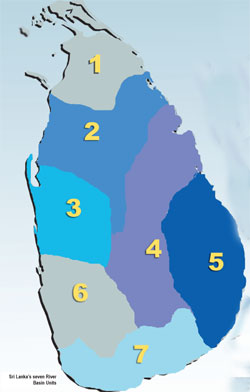
Because
Sri Lanka has 103 river basins, use these GSN units to create Seven River Basin
Regions for Sri Lanka. This map has seven units so that Jaffna region
gets one large basin area for them to feel that there is territory for Tamil
aspirations to grow. This division gives a sea face to each region, all of
equal size and most importantly because it is language-blind, western white
countries or Tamil Nad or Prabhakaran remnants in New York or London cannot
talk of a homeland based on the eastern province. That takes away the fear of
Sinhala people. At GSN level there will be so many Tamil units, Muslim
units and mixed units where people can talk of aspirations at that level too.
The beauty is that no one unit can become a threat to another unit. They will
learn to respect each other because, if one unit acts selfishly, then the other
units will also act selfishly, and all units will be in trouble.
When
one looks at problems of living, people face today, they are not big complex
problems. How to dispose garbage, how to control Dengue, water supply, water
pollution, basic health and basic education, how to get a birth certificate,
how to prevent GSN asking bribes or school principal asking a sex bribe; these
can be easily and effectively handled at local level. This way 70% of peoples’
basic issues can be transferred to local units, which is what people want,
empowerment, not devolution of powers to provincial politicians.
Because
the basic unit is an ecological/hydrological unit they can be combined to
represent an electorate or district-size units before becoming one of the Seven
River Basins. Thus, this horizontal division can go upward administratively
with representatives sitting at a separate national body.
What
should be done at the national/central government level to allow minority
participation, if more is needed than what is proposed by item 5, such as a new
constitution for the country, they can be considered without disturbing the GSN
(Jana Sabha) system, proposed.
Seven
River Basins
Yalpanam Raja Rata Dambadeni Mahaveli Deegavaapi Kelani Ruhunu (Compare this map with the nine-province map which cuts all major rivers into artificial pieces).
Mr. C V Vigneshwaran, the MP for Jaffna and
the former Chief Minister for the Northern Province, deserve Kudos from the
Government for his statement at the opening day of the Parliament where he made
totally unwarranted claims about his race and its ancestry in this
country. This is because he made those
flagrant statements in the context where the new Government, having withdrawn
from resolution 30 A at the UNHCR, will now have to convince the international
community that the problem in Sri Lanka is not the violation of HR by the
county’s forces but the racialist claims and the misplaced nationalism of the
leaders of its principal minority, the Tamils. Mr Vigneshwaran has now provided
material to help the government substantiate its case citing his statement as
evidence that the Tamil leaders are bent in creating racial tension by making outlandish
and unfounded claims at important and sensitive national events to provoke the people
and create trouble in the country, as they have been doing all this while.
Mr. Vigneshwaran was given time at the
inaugural ceremony of the new Parliament to address the new parliamentarians as
a new Member of Parliament for Jaffna but he abused that gesture of goodwill
and bonhomie to unload his divisive thinking and racial prejudices signifying
that all what the Tamil leaders wish is the assertion of their race’s
superiority and its fabricated ‘grandiloquent’ history. The
irony however is that this uncalled pomposity appears to be an attempt to prevent
the Sri Lanka nation from treating that intransigent and destructive past period
of the nation as a part of its history.
As an avowed supporter of that fascist LTTE
leader, Piriphakaran, Mr Vigneshwaran is also following the advocacy of that
fascist propagandist, Joseph Goebbels, who declared that ‘ you could make a lie
appear as true by repeating and asserting it over a period of time’. Joseph Goebbels also maintained that ‘every
German Soldier should carry the glorified German history in his backpack to
motivate him in his quest.’ Accordingly, Mr. Vigneshwaran is propagating lies
at crucial national events with the hope that those will earn a semblance of
veracity someday while at the same time glorifying those falsehoods to propel
innocent young men to combat, just as Appapillai Amirthalingam did with his
Vadukkodai resolution back in 1976. However, it is doubtful whether the present
generation of young men could be as foolish as those in the 1970’s as they have
been witnesses to how the egoism of Amirthalingam destroyed him and pushed
their community back by a few decades, in the end.
Recent Sri Lankan history will prove that ‘provocating
the majority’ is the popular tactic the leaders of the country’s Tamil minority
resorted to in order to manufacture and propagate their ‘causes’ to earn the
sympathy and support of the ’international community’. Chelvanayagam tarred the vehicle registration
numbers and Sinhala street names in 1958, Amirthalingam called the Tamil youth
to arms in 1976 and both those instances were followed by communal riots in the
country. Now Vigneshwaran, after all
that, is blithely staking fabricated claims to the country’s anthropology
inventing a new brand of Sri Lankan history!
The Sri Lankan nation has to be on the lookout, for there seemed to be
an inexhaustible supply of ‘cast conscious’ and ‘egoist’ Tamil leaders on the
country’s highways inebriated with Tamil racialism and nationalism.
However, the previous instances of communal
riots in the country have not been without their dividends to the Tamil
leaders. Thanks to the 1958 riots Chelvanayaganm was able to establish the Tamil
Diaspora in the west in 1960 and thanks to Piribhakaran and Amirhalingam ,the
riots of July 83 strengthened the Sri Lanka Tamil Diaspora to well above 800,000
in numbers. Accordingly, the big question now is, is Mr Vigneshwaran trying to
rejuvenate the migratory opportunities of Tamils by prompting another riot, since
there is some paucity in those opportunities since 2009? After all, it is the
Diaspora income that financed the war for 35 years.
In making these quant historical claims,
what these claimants ( Tamil leaders such as Vigee. ) do not realize is, that a
particular community or civilization could only have only one native land and
therefore it is anthropologically and practically, on all counts, impossible to
have two native set- ups for a single civilization. Narayan Swami is an Indian author who
authored 4 books on the LTTE and on Piribhakaran, having researched a whole lot
of information about the movement from the 1970’s. He had, parenthetically,
mentioned in his books that he never felt that he was living out of India when
he stayed in North of Sri Lanka because, the way of living, food, customs and
everything else remains as they were in Tamil Nadu. Therefore in a situation
where even a civilization with limited numbers like the Sinhalese have
evolved slight differences in their
language, customs and dance forms, depending on their distances and
habitations, it would be preposterous for the Tamils to claim that their
civilization evolved identically from two different origins. This is as
unthinkable as a single child being born to two mothers!
Therefore, just as India and Tamil Nadu provide
strength for Ceylon Tamils when it comes
to waging war and bargaining internationally, the same India is proving to be
their weakness when they try to make ‘historical claims’ in other countries. On the other hand, Sinhalese are a unique
civilization of which no traces are found anywhere in the world. Although there
are historical stories of an advent of an Indian Prince in to Sri Lanka, the
island was inhabited long before that and it is only that the island’s history
was only recorded after this event.
Listening to Mr. V’s speech, I often
wondered whether he spoke something different to what he meant to say, because
it is always possible that he meant to say ‘the earliest invaders of the
island’ when he said ‘the earliest settlers of the island’. If that is what he
meant, then no history scholar would have qualms about his assertion because
Kalinga Magga, the first invaders of ‘Sinhaley’, as the island was known then,
were said to be Andra- Tamils.
There is yet another inherently foreboding
aspect of this ‘historical claim of ownership’ made by these intransigent Tamil
leaders that the other inhabitants of the country should wisely take note of;
Sinhala and the Muslim communities. This is particularly relevant to the
devolution of power that the Tamil leaders have been clamoring for and these
claims of anthropological ownership signifies that the intention of these leaders
is not of just obtaining a legal framework for the exercise of power for the country’s
good and co-existence, but of consolidating their ownership claims for an
eventual separate state. This undeclared intention will eventually lead to a
demographic and geographical disaster for all the people inhibiting the Island
and may, in all probability, end up with a protracted sectarian/ big power war
in the island
Further it may not sound fair to conclude
this write up without taking up the queer interpretation Mr. V has adduced to
the word ‘nation’ in his speech. He maintains that Tamils in Sri Lanka is a
nation and not a community. Well, we have the United Nations that comprises 196
Nations of the world and if we are to bestow nationhood to every community in
every country the UN may well end up having about three or four thousand
nations. In that context, India alone
may have a ‘United Nations’ of its own because they alone have about 200
different communities with a myriad of languages. The meaning of a word should
be taken in the context of its popular use and just because Mr V. desires to be
the Head of a nation state he cannot make the SL Tamil community in to a nation,
in the acceptable context.
Every word Mr. V spews out in his speech
denotes his separatist virus and it is for this reason that they demand
separatism of powers in the guise of devolution. What the Sri Lankan rulers
should realize is that all the countries in this world with devolved power
structures (Federal), have been populations that have been brought together, in
their own interest. Their unitary
character is a strength and a welcome feature and is also a necessity for all
of them. Often it is because they desire
nationhood in a country as they had not been a recognized as a country before.
On the other hand the Tamil leaders in Sri Lanka are demanding a Federal
structure because their desire is to be separated and not united. In other
words they are not ‘staying together inclined’ but separatist inclined. Also
this would be the first time in the world governance that a country that has
been single from the time immemorial is being separated in to federal states. Federalism
therefore could be in danger with Tamil nationalist and racialist such as Mr V.
Thus, Mr V., by standing as a Tamil Parliamentarian
in the inaugural parliament and expressing his, divisive, nation within a
nation concept, and fallacious ownership claims, has depicted to the world that
the Tamil issue in Sri Lanka is not just about violation of human rights but a
case of the country’s inability to grant ‘extraordinary ownership rights’ to
the Tamils.
If Mr. Shri Ponnambalan
Ramanadan were here today, he would kill this liar Vigneswaran and other
traitors of Sri Lanka. That much love he and other honorable Tamils cared and
had for the country.
So called Vigneswaran
is a disgrace for his schools, higher education institutes and institutions he
worked and affiliated with.
Simply
narrating wrongful and most dangerous speech in an opening session of a
parliament, he tries to include it into the hazard. Subsequently he wants to
kill more innocent Tamils in Sri Lanka.
In
my opinion, Ven. Athuraliye Ratana and Ven. Galaboda-aththe Gnanasara were
following two different lines of activism in the arena of inclusive
nationalism until their recent joint pratfall in the mire of dirty
politics. The first appears to be a shrewd politician who is trying to get involved
in issues that should not be politicized; the second is a sincere idealist
passionately committed to a worthy cause, but constantly defeated by his own
uncontrolled temper and unguarded tongue.
Though
both are university products, their areas of study were not the same. The first
studied philosophy at Peradeniya, while the second focused on Buddhist studies
at the Kelaniya and Sri Jayawardanepura universities. Ven. Ratana was among the
founder members of the Jathika Hela Urumaya party formed in 2004. The formation
of the party was broadly a response to Buddhist-targeted unethical conversions
and Christian fundamentalist activities issues. He was one of the nine members
of the party returned to parliament under the UPFA at the parliamentary election
held that year. Ven. Gnanasara founded the Bodu Bala Sena in 2012 mainly to
counter the steady growth of multifarious Islamic extremist groups that
eclipsed the still active Christian fundamentalist activities in the public
consciousness.
Defensive
reaction by the victimised majority to the tyranny of racist minority politics
of Tamil separatists has long been misinterpreted in the biased global
media and in the international (Western) diplomatic space relating to Sri Lanka
as unwarranted Sinhalese discrimination against Tamils in general. In the same
prejudiced way, they have successfully demonized Buddhist monk activists who
are actively opposing both covert and open religious fundamentalist aggression
and this has affected the honest but naive Gnanasara Thera more than it has the
worldly-wise Ratana Thera. It looks as if the former is now caught in the
vice-grip of a stratagem set up by the latter.
Ven.
Galaboda-aththe Gnanasara Thera’s Bodu Bala Sena organization was formed in
2012 for the purpose of exposing the subversive activities of Christian and
Islamic fundamentalist sects and alerting the authorities and the Ven.
Mahanayakes to the danger posed by them to the whole nation. He endeavoured to
do this in the calm and composed way characteristic of a Buddhist monk,
without expecting any reward in return (= ‘nissaranadyashayen’ as he used
to put it). He has had no political or other materialistic ambitions. For many
years he tried to explain his case to politicians in power and those in the
opposition to address the problem without politicizing it. In a few instances,
peaceful marches organized by the BBS led to clashes between Buddhists
and Muslims for which only the former were blamed. In the biased media, Muslims
were portrayed as the victims and the Buddhists as the aggressors. The true
situation was otherwise. Buddhists never initiated any violent incidents. Some
unruly elements from the Muslim side started the trouble. For example, in 2014,
some young Muslim men threw stones from the roof of a mosque at a peaceful
Buddhist procession at Aluthgama and this led to violence, which quickly
spread to a number of other towns (including Panadura, Beruwala, Welipenna,
etc) in south-western Sri Lanka. There were social media videos showing this
provocative act – stone throwing by some young Muslims – at the time. On that
occasion, thousands of innocent Muslims and and similarly innocent Buddhists
were affected and their shops, houses, and places of worship were attacked.
Though the then Mahinda Rajapaksa-led government did its best to stop the
violence and restore normalcy, the incidents were not adequately investigated,
and not enough was done to clear the name of the BBS which was solely blamed
for all that happened. The involvement, on that occasion, of a crafty
politician in the garb of a patriotic ally of President Mahinda Rajapaksa, but
with a personal agenda of his own that was inimical to the latter’s policies,
added a political tone to the naive monks’ (Ven. Gnanasara’s) peaceful protests,
and biased reportage turned him into a bogeyman.
The leaders of
successive governments didn’t take Ven. Gnanasara seriously enough because they
thought that if they took any decisive action, on his word, against the handful
of powerful communalists among minority politicians who, intentionally or
unintentionally, either facilitated, or provided a cover for, questionable acts
such as anti-Buddhist subversion, illegal felling of trees in the state forest
reserve in Wilpattuwa, alleged settling of illicit Muslim immigrants from
certain Islamic countries in the same reserve, encroachment and even
vandalizing of historic Buddhist places of worship in the North and East, and
so on, they would lose the support of the mainstream Christian and Muslim
communities, which being minorities, naturally tend to form themselves into
‘block vote’ bases at the instance of opportunistic politicians. The
majority of ordinary Muslims do not want to support communalist politicians,
but they are often in the thrall of those politicians, because of the latter’s
ability to ‘deliver’, whichever major party or alliance happens to be in power.
The polity
consisting of the majority community (Sinhalese) cannot behave like this. In
any country, it is normal for the majority community to be unconsciously
undermined by a false sense of security vis-a-vis the minorities, whereas the
latter feel a bit paranoid with or without justification. The Sinhalese voting
public are always divided into rival parties, and at parliamentary elections, under
the existing electoral system, it is extremely rare that a major party is able
to form a viable government without the assistance of one or more
minority parties, a situation where the latter become kingmakers despite the
insignificance of their numerical strength. The slightest movement towards
redressing the balance in favour of the disadvantaged majority Sinhalese in any
anomalous situation would invariably earn the individual Sinhalese activist or
the group behind that initiative the label of racist or extremist or
chauvinist. So, the Sinhalese (Buddhists, particularly) get criticised and
condemned as racists, tribalists, etc. while in reality being victims of the
racism, fanaticism, and extremism of groups within the minorities. This applies
to Ven. Gnanasara as well who is engaged in the performance of the duty that
has historically devolved on him as a Buddhist monk, a duty that is above
politics, pragmatic or otherwise.
Ven. Gnanasara
Thera approached the Most Ven. Mahanayakes in Kandy and pleaded with them
beseechingly, not once, but several times, and explained to them this problem
with video evidence of outrageous Buddhism-bashing speeches of Wahabist
zealots, to no avail. Once, a few years ago, the monk led a large procession of
well disciplined young activists (more than 2000) from Getambe to the Sri
Dalada Maligawa (a distance of about four kilometers), and then they proceeded
to the Malwatu Vihara, the monastery of the Ven. Mahanayake of the Malwatte
Chapter. The Mahanayake Thera, at first, very unfairly, refused him an
audience. Later, having found that they were not ready to leave without seeing
him, he allowed Ven. Gnanasara and a few of his companions to come before him.
Nothing resulted from that meeting.
The BBS leader
wanted the Maha Sangha to play their historic role as Buddhist monks without
stooping to politics, and was determined to resolve the Islamic extremist
problem through rational dialogue with the participation of the clergy of other
religious groups (which is what he has always wanted to do because even groups
of traditional Muslims, he claims with evidence, approached him and pleaded
with him to rescue them from Wahabist and Salabist extremists). Unlike him Ven.
Athuraliye Ratana Thera seemed to be adopting a political approach in his one
man political crusade against Islamist extremists. Just before the recent 2020
general election Ven. Gnanasara gave up his non-political stance, probably
under someone’s persuasion.
The April 21,
2019 Easter Sunday terrorist bombings led to a heightening of public awareness
about the Islamist problem that had been brought to light by monk activists
years before; the issue began to receive attention from the clergy of other
religions , as well. The then UNP national list MP Ven. Ratana took the
opportunity to visit the construction site of an alleged Sharia university in
Baticaloa in the east being built without proper authorization from the Sri
Lankan government and financed by suspicious foreign sources; he
succeeded in forcing the Yahapalana government of which he was a prominent
member at the time to suspend the construction work for the time being.
Under the same pretext, he staged a ‘fast unto death’ in the vicinity of the
Dalada Maligawa, in Kandy. It was tantamount to claiming exclusive credit for
creating a groundswell of popular opposition against Islamist extremism.
I, as a journalist, wrote at the time that his maverick intervention in the
latter instance (the uncalled for gatecrashing of the protest movement with a
fast) was bound to undermine the emerging unity among the Maha Sangha in the
face of adventitious ISIS terror.
I expressed
the opinion that the activism of Buddhist organizations including Ven.
Gnanasara Thera’s BBS facilitated this awakening among the Buddhist clergy and
that it could help form a united Sanga community that spoke with one voice on
matters that came within their purview. But it appeared that Hon MP Ven.
Ratana, most probably, wanted to edge out the leaders of that movement and
assume control of it, with a view to playing a powerful dual role in the
corresponding political power structure that would evolve: the traditional role
of a representative of the Maha Sangha as the guardian of the Buddhist
moral-cultural establishment, the nation (the people), and the country
(territory) of unitary Sri Lanka on the one hand and the acquired role of party
politician on the other.
Thus, Ven. Ratana
seemed to be trying to play a two-in-one function combining both those roles.
However, the role traditionally assigned to the Maha Sangha has been above that
of the king or, in modern times, the government. The ruler assigned a higher
seat to the monk and paid him obeisance. The monks didn’t dabble in policy
making or in governing, but advised the ruler on how to rule in the righteous
way according to the Dasa Raja Dharma or the Ten Duties of the King. The
question of a problematic religion state relationship did not arise. Buddhism
is not a political religion. The only politics it advocates is democracy. The
Maha Sangha is a perfectly democratic social entity. In the modern world it is
considered essential to keep religion and the state separate from each other in
order to ensure democratic governance of the Western type (This is more
relevant to societies dominated by political religions.) So every secular
democracy can be regarded as broadly consistent with Buddhist principles and
vice versa.
Ven. Ratana
cannot provide the political leadership that the country needs, nor can he
provide any spiritual leadership either, because of his attempted dabbling in
statecraft and priestcraft simultaneously. A Buddhist monk is not likely to
make a good president or prime minister. The impression among political
analysts is that Ven. Ratana is a typical politician and a pragmatic
political strategist (Pragmatism is amoral, or rather not moral, but it is part
and parcel of realpolitik that a politician can rarely avoid). That he is
clever at dissembling was evident to the less gullible onlookers during his
‘fast unto death’ before the Sri Dalada Maligawa (He took care not to die, by
drinking water, as the Catholic priest who joined him on the fast revealed,
probably inadvertently). It was obvious that he was not alone in staging the
show. The Ven. Mahanayake Theras severely criticised him after the event. He
had approached them beforehand and told them about his intention of staging a
fast, but cunningly he did not reveal the venue to them. Had they been told
that he was going to have his fast in the hallowed precincts of the Maligawa,
they would not have permitted him to do so; that would have been a serious
setback for him.
Because of Ven.
Gnanasara’s exertions, unprecedented prospects of different religious
communities standing up to the common enemy of murderous religious extremism
were brightening. We were witnessing the first stirrings of a spring in the
Sangha Sasana, that is potentially freed from abominable Nikaya divisions,
which are based on caste in stark contradiction of the compassionate Buddha’s
teaching. Ven. Gnanasara made arguably the largest contribution to this most
positive development. However, his entanglement with Ratana Thera has cost him
his reputation.
The monks do not
relish the idea of establishing a Buddhist theocracy, which is, in any
case, inconceivable, considering the spirit of absolute democracy that
characterizes the Maha Sangha. Buddha praised the system of government followed
by the Licchavis of Vesali of his time, who were his relations of his own
warrior caste (not that the Buddha was a casteist; he was a perfect
renunciant). It was a form of a republican system of government by common
consent, an ancient version of what we call democracy today. However, the
monks’ staying above mundane politics doesn’t mean that they don’t have
anything to do with secular politics (or how the country is run). Buddhist
monks in the majority Buddhist Sri Lanka have been the custodians of the
country’s Buddhist cultural heritage for over two thousand two hundred and
fifty years according to written records. By the way, which other country in
the world can boast of such a long unbroken singular spiritual cultural
tradition? Shouldn’t the United Nations Organization make special recognition
of this fact in the name of human civilization, which is currently being
threatened with annihilation by murderous religious extremism?
By the influence
of its humane spiritual values, Buddhism ensures, not only the peaceful
coexistence of the various communities who live in the country, but also the
unhindered enjoyment and protection of their freedom of belief and worship.
However, Buddhists will not accept the alleged divine right of adherents of any
particular religion to kill or persecute those who don’t share their beliefs
and practices or to discriminate against them. What Ven. Gnansara proposed to
the Maha Sangha is that they unite and provide the necessary moral guidance for
the rulers to rule the country righteously, whatever political ideologies they
subscribe to. This does not involve any violation of secular democracy in
governance. He says that the Sri Lankan society today is sick in every way. To
heal the society, the Maha Sangha must unite and provide guidance to the
rulers. He quotes the Buddha’s teaching: ‘sukho sanghassa samaggi’ ‘Happy is
harmony among the Sangha’.
Ven.
Gnanasara Thera predicts that when the Maha Sangha are united, the politicians
and the people will fall in line, and a suitable lay political leadership will
emerge. Ven. Ratana’s intervention in his capacity as an MP monk probably
produced some limited positive results in the immediate context, but in the
long run, it will be counterproductive. He is only doing more of what he did in
the past. And we all know what he did has led to. His involvement will be an
obstacle to the functioning of the lay political leaders that the whole country
approves of as being capable of fixing not only the problem of Wahabist
incursion, but also the infinitely greater issue of external interference in
the country’s domestic affairs that, in the first place, as the media reveal,
inflicted it (jihadist terrorism) on our nation under the Yahapalanaya. It is not
that he (Ven. Ratana) is not aware of what he is doing; he is not such a dumb
character. We may be sure that, sooner or later, he will make amends in some
way.
by Sebastian Rasalingam Courtesy Sri Lanka Guardian
( May 24, 2013, Toronto, Sri Lanka Guardian) A propos the discussion between Mr. Dayan Jayatilleke, G. H. Peiris and others in the public media, allow me to add a few words – the words of a humble Tamil who comes from a social stratum lacking a voice in Tamil affairs. The dominant Thamillian-voice is that of the upper classes (‘castes’) led by the Karuvakaddu (Ciannamon gardens) lawyers, anglicized and christianized in attitude except when dealing with those in lower stations of life.
Mr. Jayatilleke is part of the environment of our Periah-Dorai class of Thimpu Tamils stuck in the 1980s, in spite of the changed politics of today. Mr. Jayatilleke claims (234d May, Island) that “Tamils of that province have evolved and crystallised a collective identity …”. Mr. J should know that this “identity” is based on landownership by a small elite who is even today trying to “re-settle the IDPs in the old villages”, reviving the caste-delineated social structures that existed in the the North. He knows how the North remained mired in poverty, with the Karuvakaddu lawyers treating the North as their private estate, run by their agents who were the Northern equivalents of the Mervyn Silva’s (`palavanthans’) of the south. The rise of Prabhakaran in such a society long dominated by strong men is no accident. Prabhakaran was a “palavanthan” who grew from among the ‘boys’ nurtured by the Karuvakaddu lawyers. He went beyond the usual Vanniayar palavanthans by successfully assassinating enough of them to subjugate the Thimpu class. The Northern Provincial council, if established will become an arena for new palavanthans and muttukans who will play each Tamil-Nadu leader against another, and each Diaspora leader against another, while the Karuvakadduns and their NGO friends will fish freely in such troubled waters. The Northern provincial council, if constituted, will plunge the North back into dark ages. Angered politicians of the south will cut the flow of capital for building the modern infrastructure that the North never had, or was dismantled by the Tigers. The way forward for the Tamils of the North is not that charted by DJ or the Thimpu. The Northern Tamils must emulate the Colombo Tamils, and develop their commerce and industry, hand in hand with the Sinhalese and Muslims, to create a vibrant tapestry of cultures rather than the narrow mono-culture proposed by Jayatilleke. In my view, Mr. Jayatillke does not understand Sinhalese or Tamil society at their grass roots, and comprehends no Tamil? Political apologists like him are useful to the Thimpu and their international friends with their threats and treats. However, unlike during J. R. Jayawardena’s time, Sri Lanka has nothing to fear even in a military confrontation with India which remains a disfunctional land of beggars and billionaires that cannot even defend its own borders, inter-state or international. It is time to bury this amendment with this proverbially unlucky number.
During
a meeting with the newly elected President of TTAA, Mr. Suthiphong Pheunphiphop
and the Committee Members, held at the TTAA Headquarters, H.E. Mrs. Samantha K.
Jayasuriya, Ambassador of Sri Lanka to Bangkok, while extending felicitation on
the election of the new committee, exchanged views on a broad range of areas,
to further enhance collaboration with the TTAA.
The
meeting also provided an opportunity to meet and discuss with several Committee
members of the TTAA who have expertise on outbound tourism to Sri Lanka from
Thailand. Sri Lanka was also invited by the TTAA
President to join the 2021 TITF Fair.
The Mr.
Anil Sirimanna, Counsellor (Commercial) of the Embassy was associated with the
Ambassador at the meeting.
The Palestinian Ambassador to Sri Lanka
Dr. Zuhair M.H. Dar Zaid paid a courtesy call on Prime Minister Mahinda
Rajapaksa this morning at Temple Trees.
Speaking about the recently-concluded
General Election, Ambassador Zaid said, All Palestinians are very happy about
the peaceful, democratic process that happened in Sri Lanka.”
The Ambassador also conveyed
congratulatory wishes from Palestinian President Mahmoud Abbas and thanked
Prime Minister Rajapaksa for this continued support to Palestine.
We will never forget your strong support
to Palestine,” Ambassador Zaid said recalling then President Mahinda
Rajapaksa’s visit to Palestine in 2014. During that visit, the Government of
Palestine conferred then President Rajapaksa with the Star of Palestine” – the
highest award of the State of Palestine – for continued support and commitment
to the Palestinian cause.
Prime Minister Rajapaksa is a long-time
supporter of the Palestinian cause and is the Founder President of the Sri
Lanka Committee for Solidarity with Palestine. Also in 2014, under President
Rajapaksa, the Sri Lankan Government made a US$1 million donation to Palestine.
Speaking about the COVID-19 pandemic
Ambassador Zaid said, We feel safe here in Sri Lanka. Sri Lanka is doing very
well. Congratulations on your success [in handling the pandemic].”
The delegations also spoke about possible
areas on which Sri Lanka and Palestine could enhance collaboration, including
trade and bringing in investments.
Better connectivity that results in better
trade relations could mutually benefit Sri Lanka and Afghanistan. This was the main
focus of the discussion when Ambassador of Afghanistan to Sri Lanka Ashraf
Haidari called on Prime Minister Mahinda Rajapaksa this morning at Temple
Trees.
The two governments are currently working
on the possibility of establishing a direct air link between Sri Lanka and
Afghanistan, which will enable the two countries to explore trade and
cooperation in a number of areas.
Ambassador Haidari also congratulated
Prime Minister Rajapaksa on a very successful
election and a notable, historic victory.” Calling it a big win for
democracy,” Ambassador Haidari further said, We are inspired by the success of
democracy in Sri Lanka. We continue to look forward to your strong support for
the democratic process in Afghanistan.”
He also conveyed best wishes from
President Ashraf Ghani and former President Hamid Karzai.
Other sectors targeted for further
cooperation include working together to combat regional drug trafficking, and
exploring opportunities in the gem industry, education sector and medical tourism.
Noting that Afghans are heavy drinkers of tea, most of which is currently
supplied by Vietnam, Ambassador Haidari said there is also vast potential for
Sri Lankan tea producers to tap into the Afghan market.
By Kelum Bandara/Daily Mirror Courtesy NewsIn.Asia
He spells out how the Government will reconcile competing interests of China and India, and how Sri Lanka can have healthy ties with other countries including Pakistan and Bangladesh.
Colombo, August 26: Newly appointed Foreign Secretary Admiral Prof.Jayanath Colombage spells out the foreign policy of the Government of Sri Lanka (GoSL). He spells out how the Government will reconcile competing interests of China and India, and how Sri Lanka can have healthy ties with other countries including Pakistan and Bangladesh.
Excerpts:
Q We came across media reports quoting you that the foreign policy of the new Government would be Asia-centric. What do you mean?
A: We have experienced a very difficult period in our country. That is COVID-19. It was unprecedented. We were not ready for it. We felt that the international system was not there for us whenever there was a situation like a pandemic. Instead, it’s our neighbours who are coming to us first. That is our immediate neighbourhood or even beyond. We are in the 21st century. We see a clear shift in the world economic order from the west to the east or Asia for that matter. Therefore, our main focus should also be on neighbourhood- South Asia, Africa, the Middle-East, ASEAN and Far East. We were a British colony for a long time. We have maintained a non-aligned policy since independence. We also see that we have been having somewhat of a Western-oriented diplomacy. We venerate the West virtually. Even in the Foreign Ministry, there are special grade appointments. Most of these appointments are in Western capitals. It isn’t a sacrosanct one. There is a perception that these postings to western capitals are superior. It is a kind of a norm. President Gotabaya Rajapaksa thinks otherwise. He says the best and the most dynamic ones in the Foreign Service should be here in our neighborhood, in the Middle-East, Bangladesh, Africa and ASEAN. This is the policy shift that we advocate. This is on par with the President’s thinking and the changing global dynamics. It is in economic sense. This is based on what is best for Sri Lanka. Our foreign policy should not be tailored to what is best for another country. It should be tailored for what is best for Sri Lankans and Sri Lanka. COVID-19 has served us with a wake-up call to revisit our past on foreign policy.
Q When you mention Asia, we know China and India have competing interests in the region. How do you reconcile relations with them?
A: It is right. Both these countries are in Asia. China is the second largest economy in the world and India is considered the sixth largest. In 2018, India was the world’s fastest growing economy. That means we are between two economic giants. How we benefit from both is diplomacy or the art. That is why the President mentioned that as far as strategic security is concerned, Sri Lanka will always have an India-first approach. That means Sri Lanka will not do anything harmful to India’s strategic security interests. As far as economic development is concerned, we cannot depend on one country. We are open to anyone. We know China is one country willing to invest and develop. They have the capacity to do it. We have to benefit from it. We have to balance.
The President has outlined a few specific things. Sri Lanka should be a neutral country. Sri Lanka does not want to be caught up in the power game. Sri Lanka wants to develop friendly international ties with everybody. Sri Lanka should have Sri Lanka-first policy. These are the five areas we have to navigate. If we can do it successfully, we can balance anyone.
This is on par with the President’s thinking and the changing global dynamics. It is in economic sense. This is based on what is best for Sri Lanka. Our foreign policy should not be tailored to what is best for another country. It should be tailored for what is best for Sri Lankans and Sri Lanka. COVID-19 has served us with a wake-up call to revisit our past on foreign policy”
Q: Certain sections of the Indian society, particularly the Indian media, view economic investment projects by China as a security threat. They see the Hambantota Port and the Colombo Port City projects as threats to their security. How do you allay such fears?
A: You mentioned two projects. These are major investments for the country. The Hambantota Port is located at the most strategic point in the Indian Ocean. That is the centre of the ocean. It is exactly in the centre between Singapore and Dubai, and Shanghai and Rotterdam as far as the distances are concerned. The busiest shipping lane in the world is just 12 nautical miles south off Hambantota. That is the shipping lane conveying 50 percent of world containers, 35 percent of bulk cargos and 72 percent of energy- gas and oil. We need a port there. Everyone knows, we initially offered it to India. India did not undertake it for whatever the reason. May be it was because of lack of capacity. Or, they could not take that decision at that moment. Then, it went to a Chinese company.
Now, we have given 85 percent stake of that port to China Merchant Port Holding Company. That should be limited to commercial activities only. It is zero for military purposes. Sri Lanka cannot afford, should not afford and will not afford any particular country to use Sri Lanka as a staging area to do anything against another country- especially so India.
Q: At a critical security situation can we do it?
A: Of course, we can. We are an independent, sovereign nation. If any warship arrives in Sri Lanka, there is a procedure. They have to write to the Foreign Ministry first. Then, the Foreign Ministry writes to the Defence Ministry. The Defence Ministry approves and informs the Navy. Then, the Navy ensures security. Any warship arrives in Sri Lanka only with our authority. If somebody comes by force, that is war. We have to separate commercial activities from strategic and security activities.
Q: As the Foreign Secretary and formerly as the Additional Secretary to the President, you would have engaged with China many times. Does China understand Sri Lanka’s position?
A: China really understands it. I have not seen China pushing for strategic things. But, China is pushing for commercial things. We need Foreign Direct Investment, joint ventures, Built, Operate Transfer (BOT) projects, technology transfers etc. China understands the strategic situation here. China also understands it isn’t ethical to push Sri Lanka beyond a certain point that is worrisome to India. China understands that stable Indo-Lanka relations are good for China. The relationship we have with China, Japan, the United States and European Union or any other country are purely on commercial, interests.
” We are in the 21st century. We see a clear shift in the world economic order from the west to the east or Asia for that matter. Therefore, our main focus should also be on neighbourhood- South Asia, Africa, the Middle-East, ASEAN and Far East. We were a British colony for a long time. We have maintained a non-aligned policy since independence. We also see that we have been having somewhat of a Western-oriented diplomacy”
Q: Do you see a clear policy change from the Indian side as far as the Sri Lankan situation is concerned?
A: In 2015, India feared that we had moved towards China too much. Probably, India wanted that regime to be changed. India was happy that the regime was changed. What happened afterwards made India happy. We had given the Hambantota Port on a 99-year-lease to China Merchants Port Holding Company, which India, Japan and America considered as wrong. We actually made India jittery during the period between 2015 and 2019. But India is comfortable with President Gotabaya Rajapaksa.
Q: India asked for a stake in the Easter Container Terminal (ETC).What is your view?
A: India didn’t ask it from this Government. There is a MoU signed in 2017 between India, Sri Lanka and Japan. The present President is committed to honour it because it is an arrangement between the two countries. The only thing is that there is opposition to it from port workers. The president, the chairman of Sri Lanka Ports Authority and other stakeholders are studying it thoroughly. They will find a solution. India has a solid argument on this. Actually, 38-40 percent of transshipment containers we handle arrive from India. About 70 percent of businesses we handle are from India. Colombo port is the second biggest port for Indian containers after Jawaharlal Nehru Port Trust in Mumbai. They argue that they should have a stake in this issue as a result. Yet, they don’t have the capacity to build and operate the terminal. Therefore, they have linked with Japan to do it. The President has said that he is ready to honour that agreement. As per the new guidance of the President, no national asset is given with total control to any country. It means at least 51 percent of stake will always remain with the GoSL, and the balance can be divided.
Q: In your Asia-centric foreign policy, there is another tricky area- that is to manage relations with India and Pakistan. Both the countries are trying to reach out to Sri Lanka. How do you manage relations with them without compromising the interests of one against the other?
A: In South Asia India and Pakistan are encountering problems. Both have been our friends. Both have helped us during very difficult times. During the war time, we almost lost the north to the operation launched by the LTTE. It was Pakistan which sent us MBRL (Multi-barrel rocket launchers). Pakistan was using them in their operational areas. The Pakistani authorities removed them and airlifted them to Sri Lanka. That only prevented Jaffna from being overrun by the LTTE. That is something great! We should stay away from this issue. We should not allow Sri Lanka to be used by one party against the other. Both the countries are important to us. India is our neighbour.
How we benefit from both is diplomacy or the art. That is why the President mentioned that as far as strategic security is concerned, Sri Lanka will always have an India-first approach. That means Sri Lanka will not do anything harmful to India’s strategic security interests. As far as economic development is concerned, we cannot depend on one country. We are open to anyone”
Q: How do you view relations with Bangladesh?
A: Bangladesh is the sleeping tiger in South Asia. It is the fastest growing country in terms of the GDP. We have the unique advantage. We are in the SAARC region. We are in the BIMSTEC. Bangladesh has huge potential. That is why the President has very clearly stated that we should pursue relations with Bangladesh. The best and most effective Foreign Service person should be posted to Bangladesh.
Q: What is going to be the future of Millennium Challenge Corporation (MCC) agreement?
A: I’m not in a position to give a full commentary on it. We all know that there was a committee appointed by the President to study the MCC. The committee has forwarded its submissions. That committee has raised many issues regarding national interests. We need to find answers to these queries. I think the report will be submitted to the new Cabinet. The new Cabinet will be expected to make observations for each ministry. Once that is done it will be referred to Parliament and probably debated on for a compromise. I don’t know which compromise that would be.
Q: You talk about an Asia centric policy. The West is where Sri Lanka’s export destinations are located. Also, we find certain groups operating in the West lobbying against Sri Lanka on human rights issues. How do you respond?
A: The relationship with the whole world is important. The U. S. and European Union are our leading export markets. Yet, Asia has the potential to be the next developing world. In South Asia, we have a large population. If you take the Indian Ocean, one-third of the world population lives here. Populations mean markets. Our economic model needs to be changed. We have an import–dependent economy. We should become an export–led economy. This transition does not take place targeting the West only. It can be the Middle-East, South-East Asia etc.
Bangladesh has huge potential. That is why the President has very clearly stated that we should pursue relations with Bangladesh. The best and most effective Foreign Service person should be posted to Bangladesh”
Q: But, you have to face human rights allegations in the West.
A: These allegations are totally unjustifiable. We also believe in the fact that these accusations do not help reconciliation. Rather, it tries to divide us. We don’t want anyone to hold a sword against us. We believe in the fact that reconciliation cannot be achieved by force. It has to evolve from society. Defending ourselves against these allegations is not our target.
By P. K. Balachandran/Daily Express Courtesy NewsIn.Asia
If Presidential Task Force on Archaeology in the Eastern Province usurps powers of Director General Archaeology
Colombo, August 26: The Tamil National Alliance (TNA) has threatened to go to court if the Presidential Task Force on Archaeology in the Eastern Province acts contrary to the provisions of the Antiquities Act and usurps the powers of the Director General of Archaeology (DGA).
The Tamils have been dismayed by the fact that the Presidential Task Force has no Tamil or Muslim members, though the Tamils and Muslims together outnumber the Sinhalese Buddhists in the Eastern Province. However, TNA spokesman, M. A. Sumanthiran MP, said a legal issue would occur only when the Antiquities Act is violated or if the Task Force usurps the powers of the Director General of Archaeology as defined in the Antiquities Act.
Therefore, we will have to wait and see how the Task Force functions,” he said.
As per the Antiquities Ordinance 1940, no excavation can be undertaken except with a licence from the Director-General of Archaeology (DGA). No person shall excavate for the purpose of discovering antiquities, whether on land belonging to him or otherwise, except under the authority of a licence issued by the DGA.
The DGA, may, in his discretion, grant or refuse any application for a licence to excavate. The owner of the land where the proposed excavation is to be made has to consent to the excavation. The proposed excavation will not cause any damage or inconvenience to persons residing in the vicinity of such land, or to any place used for religious purposes, or to any cemetery, school, water source, irrigation work or public road, or that if any such damage is likely to be caused adequate provision has been made by the applicant for the payment of compensation thereof. The applicant should furnish security for the due observance by him of the provisions of this Ordinance or any regulation.
Legal aspect aside, there is also a politico-historical dimension to the issue which could gain public attention and trigger communalism.
The Tamils are deeply concerned about the absence of Tamil and Muslim archaeologists in the Task Force while there is a surfeit of Buddhist monks. . The leader of the Tamil National Alliance (TNA) R. Sampanthan has written to President Gotabaya Rajapaksa to correct the anomaly in ethnic representation in the Task Force.
Archaeologists themselves are grossly under-represented in the Task Force. Only two archaeologists, the Director-General of Archaeology, Dr. Senarath Bandara Dissanayake,and Dr. Raj Somadeva of Kelaniya University are members.
The Tamils fear the Task Force being heavily loaded in favour of the Sinhala-Buddha Sasana, and headed by Defence Secretary Maj. Gen. (Rtd) Kamal Gunaratne, would ignore archaeological sites of interest to the Tamils or forcibly prevent research on Tamil history to prove that the Eastern Province is the historical ‘Sinhala-Buddhist” Homeland and not part of a historic ‘Tamil’ Homeland in Sri Lanka.
Prof. S. Pathmanathan, formerly of the History Department of Peradeniya University, has said that funds for research in Tamil history and archaeology are hard to get. In Digamadulla, in the Ampara district, Buddhists and Muslims have clashed over archaeological sites.
Local media on Wednesday (26) reported that the president had, in an extraordinary gazette notification, added four senior members of the Buddhist clergy to the existing Presidential Task Force constituted in June, increasing its size to 15.
The new appointees are: the Asgiriya Chapter Abhidhana Anunayaka, Ven Vendaruwe Dharmakeerthi Sri Rathanapala Upali Thera; Malwathu Chapter General Secretary, Ven. Dr. Pahamune Sumangala NayakaThera; Asgiriya Chapter General Secretary, Dr. Ven. Medagama Dhammananda NayakaThera; and Karaka Sangha Sabha member of the Malwathu Chapter, Ven. Ambanwalle Sri Sumangala Thera.
Explaining the move, the government said Since many of the archaeological heritages in the Eastern Province are based on the Buddhist religious background and associated with those places of worship, it has been recognized that the guidance and patronage of the Venerable Maha Sangha is still needed in the identification and management of those heritages.”
When it was set up in June, the Task Force had Ven. Ellawala Medhananda Thera and the Chief Prelate for the Northern and Eastern Provinces Ven. Panamure Thilakawansha Thera.
The other members of the expanded Task Force are: Archaeology Director-General, Dr. Senarath Bandara Dissanayake; Land Commissioner General, Chandra Herath; Surveyor General, A.L.S.C. Perera; University of Kelaniya, Senior Lecturer, Prof. Raj Kumar Somadeva; University of Peradeniya, Medical Faculty Lecturer, Prof. Kapila Gunawardena, Western Province Senior DIG, Deshabandu Tennakoon; Eastern Province Provincial Land Commissioner, H.E.M.W.G. Dissanayake and Derana Media Network Chairman, Dilith Jayaweera. Senior Assistant Secretary to the President Jeevanthie Senanayake was named Secretary of the Task Force.
The members of the Task Force have been tasked with identifying sites of archaeological importance in the Eastern Province and implementing an appropriate program for the management of archaeological heritage by conserving and restoring such identified sites and antiquities.
It has also been tasked with identifying the extent of land that should be allocated for such archaeological sites; taking necessary measures to allocate them properly and legally; preserving the cultural value of sites of archaeological importance; promoting the uniqueness of Sri Lanka, both locally and internationally; and making recommendations for the promotion of such heritages.
The president has issued directives to the Department of Archaeology to respond to requests made by the Maha Sangha to preserve antiquities and historical sites. The possibility of obtaining the services of the Civil Defence Force in the implementation of the program of conserving archaeological sites and antiquities had also been discussed at the session.
President Gotabaya is set to amend the Antiquities Ordinance in order to strengthen the preservation of antiquities and historical national heritage. The Task Force will be expected to suggest amendments. Meanwhile, the President’s Media Unit said measures will be taken to increase the annual fund allocated to the Department of Archaeology and to address the shortage of employees.
Colombage made similar remarks in an interview with the Daily Mirror newspaper, pointing out Sri Lanka is between two economic giants”.
Jayanath Colombage, a retired admiral who commanded Sri Lanka’s navy during 2012-14 and is perceived as close to Rajapaksa, made the remarks in two interviews to the media.(SOURCED.)
President Gotabaya Rajapaksa has made it clear that Sri Lanka’s strategic security policy will have an India first” approach though Colombo remains open to dealing with other key players for economic development, the country’s new foreign secretary Jayanath Colombage has said.
Colombage, a retired admiral who commanded Sri Lanka’s navy during 2012-14 and is perceived as close to Rajapaksa, made the remarks in two interviews to the media. He also said Rajapaksa’s administration has adopted a posture of neutrality in its dealings with key powers at the regional and global level as Sri Lanka cannot become a staging area” for any country to do anything against another country – especially…India”.
Very categorically, the president has stated that we have a strategic security-wise ‘India first’ policy because we cannot be, we should not be, we can’t afford to be a strategic security threat for India, period,” Colombage said in an interview to Derana 24 news channel that aired on August 20.
We can’t be and we don’t have to be [a security threat to India]. They are a very big power, [the] fastest developing major economy in 2018, 1.34 billion people, a 7,500-km coastline, it’s a huge country. We need to benefit from India,” he added.
Colombage made similar remarks in an interview with the Daily Mirror newspaper, pointing out Sri Lanka is between two economic giants”. He added: That is why the president mentioned that as far as strategic security is concerned, Sri Lanka will always have an India-first approach. That means Sri Lanka will not do anything harmful to India’s strategic security interests.”
However, he said Rajapaksa had made it clear to India’s leadership that Sri Lanka cannot depend on any one country for economic development. We are open to anyone. We know China is one country willing to invest and develop. They have the capacity to do it. We have to benefit from it. We have to balance,” he told the Daily Mirror.
Colombage also told the news channel: Even to India…very firmly, the president has said, you are my first priority in so far as security is concerned but I have to deal with other players for my economic prosperity.”
Colombage, who was appointed foreign secretary on August 14 and previously served as additional secretary to the president for foreign relations, also said the Sri Lankan government will not hand over total control of strategic national assets to a foreign power following the experience with Hambantota port, which was given to China Merchant Port Holding for 99 years.
Now in that deal, roughly…about 85% of that project’s stakes are for China Merchant Port Holding and only 15% for Sri Lanka. We will do everything so that no one can use our country against another country but then giving total control for a long period, of majority 85% is a very high stake,” he told the news channel.
In future ventures, Sri Lanka will retain a 51% stake in any project with foreign investment, he said.
Colombage told the Daily Mirror that China understands Sri Lanka’s position and is pushing for commercial things”. He added, China also understands it isn’t ethical to push Sri Lanka beyond a certain point that is worrisome to India.”
He also told the daily that in 2015, India feared we had moved towards China too much”, and that India, Japan and the US considered it was wrong for Sri Lanka to give Hambantota port on lease to a Chinese firm. We actually made India jittery during the period between 2015 and 2019. But India is comfortable with President Gotabaya Rajapaksa,” he added.
The Modi government has focussed on improving ties with Rajapaksa’s administration. Modi was the first world leader to congratulate Rajapaksa even before the final results of Sri Lanka’s parliamentary elections were declared earlier this month, after his Sri Lanka Podujana Peramuna (SLPP) party took an unassailable lead.
Last month, India announced a $400-million currency swap facility for Sri Lanka under the Saarc framework, and officials said Colombo’s request for a bilateral swap facility for $1.1 billion was also being considered.
When Rajapaksa visited India last November, just 10 days after becoming president, New Delhi announced a $400-million line of credit to boost infrastructure and development, and offered another $50 million to fight terrorism and enhance intelligence gathering.
Sri Lanka is seeking joint venture opportunities and investments from Qatar, especially for its Port City Colombo’s infrastructure, as part of strategies to strengthen the bilateral trade between the two countries.
In a webinar hosted by Doha Bank on Wednesday, Sanjaya Mohottala, director general, Board of Investments of Sri Lanka, outlined the project progress of Port City Colombo, where 68 hectares is ready for construction.
“Bridges, roadways and boulevard for Phase I (are) to be completed by 2021,” he said, adding $500mn has been invested to date and further $500mn would be invested.
The country has floated request for proposals for 13 plots in the marina precinct (20 hectares), he said, adding a draft special economic zone law (for the port city) is under review and soon expected to be tabled for cabinet and parliamentary approval.
Port City is a new development, built as an extension of the central business district of Sri Lanka’s commercial capital, Colombo. When completed, it will have over 5.6mn sqm of built space, offering facilities and spaces in healthcare, education, entertainment, hotels and restaurants, retail and office with an integrated resort and a marina.
He highlighted the levers to create a compelling investment climate in Sri Lanka, which provides connectivity to South Asia, Africa and East Asia.
Highlighting the country’s five-year National Exports Strategy (NES), which will run until 2022; Chitranjali Dissanayake, director general, Sri Lanka Export Development Board, said it outlines opportunities in sectors like IT-business process management, wellness tourism, boat building, processed food and beverages, electrical and electronics, and spices and concentrates.
“The Middle East is one of the key regions and Qatar can play a vital role in Sri Lanka’s strategic expansion,” she said, adding Colombo will work closely with Doha Bank in actively promoting bilateral trade relationship between the two countries. Sri Lanka targets $50mn exports to Qatar by 2025 from the present $27mn.
Qatar is now Sri Lanka’s eighth export destination in the Middle East and 49th in the world and seventh import source Colombo in the Arab region.
Its main exports to Qatar are bananas, lentils, tea packets, fruits, coconut milk powder, processed food, vegetables, sugar confectionary, pneumatic and retreated rubber and other products.
Qatar’s imports to Sri Lanka include plastics products, petroleum oils and gases, standard wire of aluminium, paper and paper products, footwear, inorganic chemicals and products of base metals.
Dr Chandranath Amarasekhara, director, Economic Research Department, Central Bank of Sri Lanka; gave an overview of the island country’s macroeconomic targets for 2020-25.
“We are confident that Sri Lanka would be able to take the next leap forward in becoming the model economy in Asia,” he said, adding the macroeconomic target is to achieve a minimum average economic growth of 6.5%, budget deficit at less than 4% of gross domestic product, annual inflation of less than 5% and a “stable” level of exchange rate of its currency.
By fourth quarter of 2020, economy activity is expected to accelerate and by next year, normalcy would return, he said, adding the remittances, which are usually $7bn annually and mainly from the Middle East, may be 15% lower for this entire fiscal.
Doha Bank chief executive Dr R Seetharaman said Sri Lankan economy is slated to contract by 0.5% this year but highlighted that the country’s Vision 2025 has given thrust on foreign direct investment and exports and to improve per-capita income.
An accomplice of underworld figure ‘Angoda Lokka’ had been arrested with 42 kgs of heroin, three T-56 weapons, 170 rounds of ammunition and a 9mm pistol at Ambatale.
Police said the Colombo Crimes Division (CCD) arrested the suspect during the interrogation of two accomplices of the Angoda Lokka who were arrested earlier.
The heroin haul, firearms and live ammunition were found hidden in a house.(DSB)
Matale District SLPP MP Pramitha Bandara Tennakoon today handed over the first private member Bill in 9th Parliament to Parliament Secretary General Dhammika Dassanayake to set the minimum age of marriage of Sri Lankan Children at 18.
In the Bill titled ‘Minimum Age of Marriage’, MP Tennakoon said the Bill’s intention is to ensure that the State fulfils its national and international obligations to protect the rights of every child in the country.
Children must be treated as children and this Bill’s intention is not to marginalise anyone,” he said.
He further said Sri Lanka is a party to the Convention for Elimination of All Forms of Discrimination against Women (CEDAW) and Convention on the Rights of the Child (CRC) under which Sri Lanka has the obligation to introduce a standard minimum age of 18 without exception for all children regardless of religion and personal statute laws.
“A standard age will guarantee and protect the rights of all Sri Lankan children,” he said and gave special acknowledgement to former MP Dr. Thusitha Wijemanna who took steps to formulate policies in this regard in the 8th parliament.
According to the proposed Minimum Age of Marriage Bill, No marriage contracted after coming into force of the Act shall be valid unless both parties to the marriage have reached 18 years of age.”
Every child marriage, whether solemnised before or after the commencement of this Act, shall be voidable at the option of the contracting party who was a child at the time of the marriage. Once an application to annul a child marriage is filed, and if the Court is satisfied with the application, the court shall grant a decree of nullity of such marriage,” the Bill says.
Darshana Sanjeewa Balasuriya Courtesy The Daily Mirror
Defence Secretary Maj. Gen. (Rtd) Kamal Gunaratne said today that they were successful in eradicating organized crimes, narcotic waves, extortion and underworld activities in the country.
Assuming duties as the Secretary to the Internal Security, Home Affairs and Disaster Management State Ministry during a ceremony held at the Ministry in Narahenpita, he said that they were also able to curb corruption within the prisons.
“We were able to curb the wide-spreading waves of organized crime as well as drugs, extortion and the activities of the underworld in the country which were largely going in the wrong direction. Today we have been able to steer the society in the right direction and that we have reaped great success so far. ” he said.
The secretary said he would look forward to continuing to achieve such success and to create an environment where the people and the future generation could live in peace, secure and dignity.
In the case of any disaster, steps will be taken to manage and control such disasters by deploying appropriate personnel to appropriate positions and at the appropriate time,” Gunaratne said.
Minister Chamal Rajapaksa, Army Commander Shavendra Silva and heads of the Institutions and Departments, Divisional Secretaries and Police officers were also present at the ceremony.