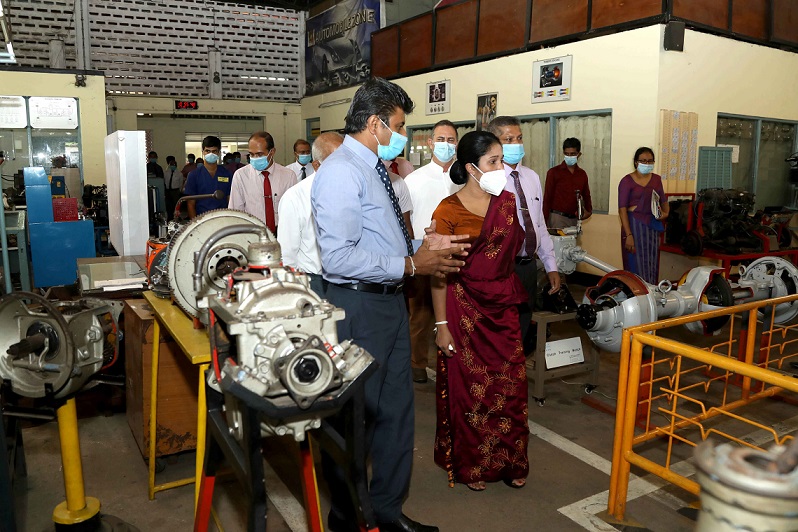
Colombo Dockyard (CDPLC) is set to start the construction of six Eco Bulk Carriers for Norwegian company Misje Eco Bulk.
The contract also includes four optional Eco Bulk Carriers.
Initially signed in March, the contract is expected to become effective next month after receiving the owner’s final board approval.
The 89.95m-long vessels will be able to accommodate the cargo capacity of 5,000 deadweight tonnage (dwt).
The vessels will be powered by a four-stroke engine and will be able to carry bulk cargo, grain, timber, unit loads and containers.
The eco-friendly vessels will emit lower emissions than the traditional bulk carriers.
Wartsila Ship Design Norway provided the concept and the basic design of the bulk carriers while Colombo Dockyard is responsible for the detailed designing.
Former President Maithripala Sirisena was not informed about the foreign intelligence information with regard to possible terror attack by National Thowheed Jama’at (NTJ) leader Zahran Hashim and his associates, former State Intelligence Service (SIS) Director SDIG Nilantha Jayawardena today informed the Presidential Commission of Inquiry (PCoI) investigating the Easter Sunday attacks.
SDIG Jayawardena made this statement while responding to a question raised by a commissioner. He was also questioned about the threat assessment report prepared by the SIS prior to President Sirisena’s visit to Batticaloa on April 12, 2019.
The threat assessment report did not refer to a foreign intelligence agency on April 4, 2019 which mentioned that a group including the National Thowheed Jama’at (NTJ) leader Zahran Hashim and his followers could launch a terror attack.
In response, he said that it was not mentioned in the report, as it was not something relevant to former President’s visit.
SDIG Jayawardena added that the SIS regularly received information with regard to certain security threats to various VVIPs served in the previous ‘Yahapalana’ government, but most of them did not pay attention to those intelligence.
Chaturanga Samarawickrama Courtesy The Daily Mirror
The Government had decided to provide motorcycles for Public Health Inspectors (PHIs) to encourage and appreciate their services during the COVID-19 pandemic in the country.
Accordingly, more than 800 motorcycles would be given away as the first phase of the programme before August 30 in Colombo.
Director General Of Health Services Dr. J.M.W. Jayasundara Bandara said the programme will go ahead according to the guidelines issued by the Health Ministry.
Cabinet had given its nod to a paper submitted by Prime Minister Mahinda Rajapaksa as his capacity of being the Minister of Finance to probe all alleged misdeeds of state banking network that had taken place during the past years.
The paper also sought to further strengthen the state banking network.
The state banks including the Bank of Ceylon, Peoples Bank, National Savings Bank and Rural Development Bank will be prepared and shaped to meet the challenges brought on by the COVID -19 pandemic while misdeeds that had taken place these banks since January 8, 2020 will also be probed. A study will also be conducted to determine whether these banks have violated the Banking Acts and whether they have carried out non-productive activities during the given period as per the cabinet paper,” a release from the Finance Ministry said.
Another objective of the cabinet paper is to determine as to which officers are responsible for misdeeds and also the external forces which have been involved in them and to ensure that there will not be any misdeeds in the future.
Former High Court Judge Sisira Ratnayake, Certified Accountant Susantha de Silva, Retired Additional Auditor General W. Premananda will be included in the committee appointed to conduct the probe.
Puttalam district – SLPP Chinthaka Amal Mayadunne (46,058) MNA Abdul Ali Sabri Mohamed (33,509)
Kurunegala district – SLPP Dr. Gunapala Ratnasekara (141,991) Asanka Nawaratne (82,779) Samanpriya Herath (66,814) U.K. Sumith Udukumbura (51,134)
National list MPs SLPP Sagara Kariyawasam (lawyer) Ajith Nivard Cabraal (former Central Bank governor)< Mohamed Ali Sabri (president’s counsel) Jayantha Weerasinghe (president’s counsel)< Manjula Dissanayake (widow of the late minister Salinda Dissanayake) Senior Prof. Ranjith Bandara Prof. Charitha Herath Gevindu Kumaratunga (Yuthukama) Yadamini Gunawardena (engineer) Dr. Surendra Raghavan (former northern province governor) Dr. Seetha Arambepola (former wesern province governor) Mohamed Falil Marjan (entrepreneur) SJB Diana Gamage (lawyer) ITAK Thavaraja Kalai Arasan AITC Selvarasa Gajendiran JJB Dr. Harini Amarasuriya
Dr. Chula Rajapakse MNZMFRCP(UK)FRACP( Aust/NZ)Wellington New Zealand
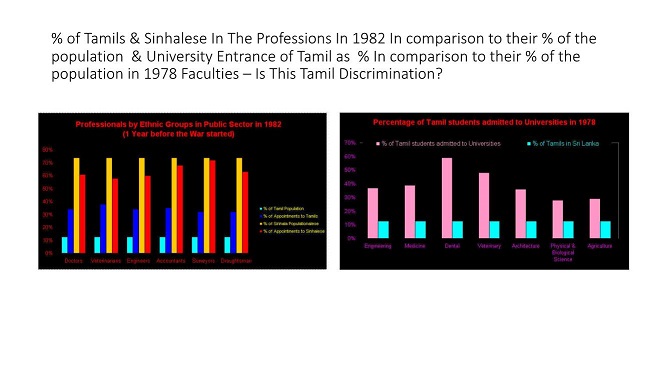
The about 10% Tamil minority in Sri Lanka were the privileged minority of one hundred and fifty years of the Divide and Rule” British Colonial administration, while the about 75% Sinhalese majority were the oppressed and disadvantaged majority, as they posed the greatest threat to the colonial administration.
Thus at independence, nearly 90%of Engineers and Surveyors and 60% of doctors, and a vast
majority of the civilian administration were from the 10% Tamil minority. The
first Sri Lankan to act as head of state in post independence Sri Lanka was a
Tamil, Justice C Nagalingam , i1954 as
acting Governor General. The first army commander in post independent Sri Lanka
was a Tamil, Brigadier Anton Muthucumaru . The longest serving attorney general
in SL was a Tamil, Siva Pasupathy. Till the time of the LTTE uprising in July
1983, that forced, many Tamils to flee SL as refugees to the west, lest their
children would be forcefully conscripted into the LTTE ranks, the level of
Tamil representation in all walks of Sri Lanka life was way more than the 10-12% Sri Lankan Tamils
represented of the islands population.
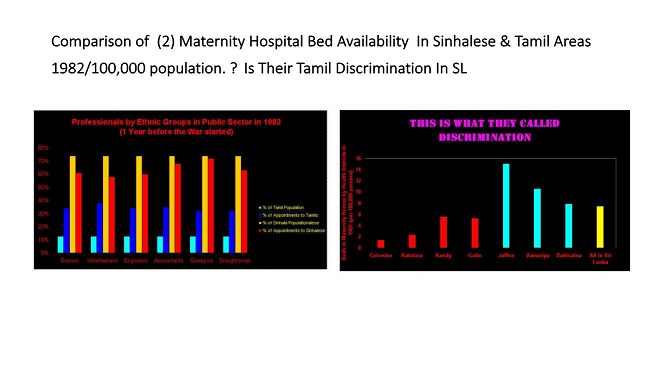
This is hardly the picture of Tamil discrimination they had by now
started orchestrating in the west and to the world
When the British left Sri Lanka
in 1948, attempts were made to redress the disadvantages of the Sinhalese especially
in education. This led to the inevitable loss of the privileged status of
Tamils and the over representation of Tamils in all walks of Sri Lankan life,
especially in the much sort after positions. This was seen as and deliberately
presented by some Tamils as discrimination to both fellow Tamils and the
western world, ready to believe any
claim of ‘’discrimination of a
minority” . This led to the call in 1976 by some Tamils the TULF n Vadukuddai
Northern SL, for a separate state
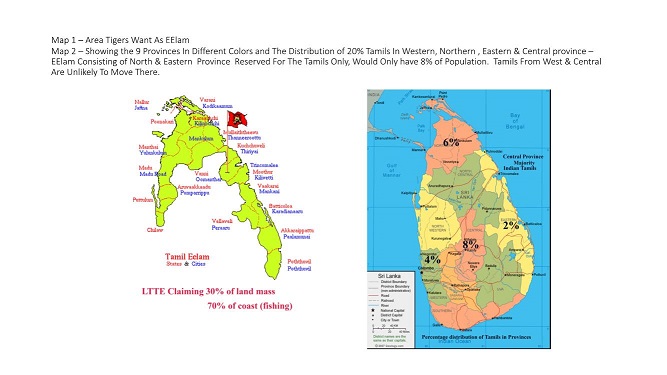
of Elam consisting of 2/3rds of the coast line and 1/3 of the land of Sri Lanka , for this now 12% minority. This
really reflected the privileged mind set, they still had.
They tried to draw support for this avaricious objective by claiming Elam
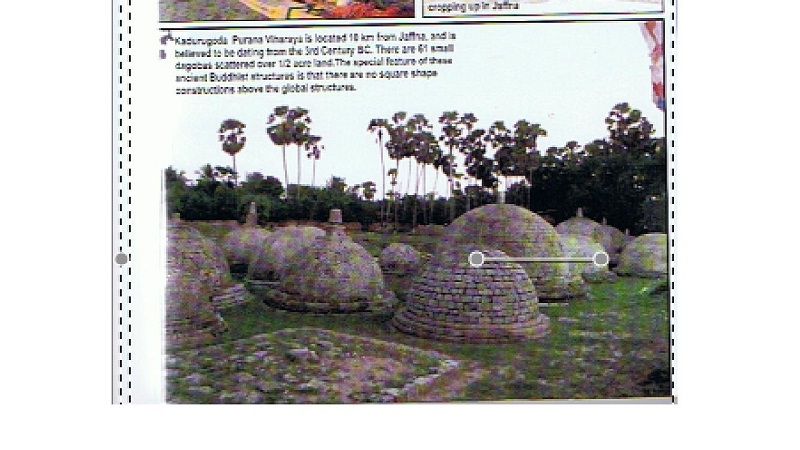
to represent the Traditional Homeland of Tamils” . This picture of A Collection of Buddhist Shrines Dating Back
To 3rd Century BC , still evident in the heart of Jaffna peninsula and
other Buddhist archeological monuments scattered
through out Sri lanka is witness to the
fact that all of Sri Lanka was homeland to it’s Buddhist Sinhalese civilisation
for 2500 years, as the Mahavamsa records. Tamis , Arabs & Malays were able
to settle in various parts of SL , due to the kind & welcoming disposition
inherent to Buddhism, acknowledged many times recently by no less a person than
Cardinal Malcolm Ranjith, head of the Roman catholic Church In SL
In 1983 this separatist Elam movement
became a brutal terrorist war against the rest of Sri Lanka, waged by the LTTE,
( Liberation Tigers of Tamil Elam)., at one stage labelled the world’s most
brutal by the FBI US, no less. They drew support in finance and propaganda
for their bloody campaign from an Internationally based Tiger Diaspora, that
had by then become well established in the west , especially in the UK, Canada
and USA, cleverly exploiting their claim of
Minority Discrimination”, to hoodwink their unsuspecting host
countries. Their hosts were ready believe these claims , without any evidence
being supplied to support these claims, accepting it as the inevitable for a
minority in a third world country.
The making of Sinhala, the mother tongue of the 75% majority in 1956, as
the state language was one major complaint of the 12% Tamil minority. In most
countries, much lesser percentage of the majority community would have been
adequate to justify this. Not so for this minority used to 150 years of
colonial privileges. The provisions of the Reasonable use of Tamil act that
enshrined the right of every Tamil child to receive a free state education in
the Tamil medium upto end of tertiary education, no different from a Sinhalese
child, the right of every Tamil citizen to address the government for their
wants in Tamil and receive a response in the same language, the provision for
the courts in the Tamil majority districts to conduct their affairs in Tamil,
and the right for any Tamil to compete for entry into the public service
without any knowledge of Sinhalese provided they gained competence upto some
level a few years later, did not satisfy the avaricious appetite of this once privileged
group. Additionally this requirement to gain competence in Sinhalese , after
joining however was not a requirement in
professional fields like in medicine . Now Both Sinhalese & Tamil are state
languages on par with each other.
After three decades, the brutal terrorism
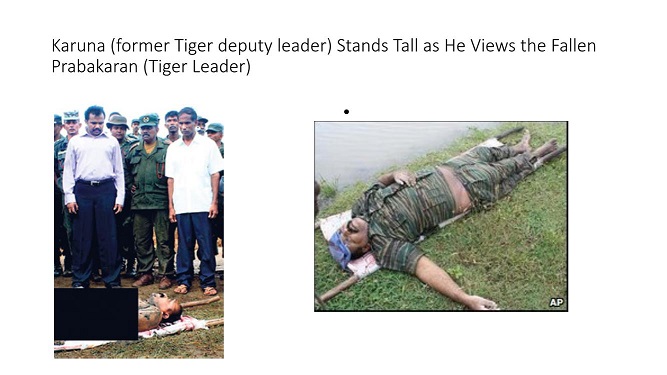
of the Tigers came to an end on 19th of May, 2009, when all
of the LTTE Terrorists were laid to rest on the banks of Nandikadal Lagoon in
Mullaitivu. This victory was thanks to
the transformation of what was once ceremonial security forces to a truly
professional service, conforming to the highest standards, as was widely
acknowledged .
However, the internationally based Tiger Diaspora, that supported
the Tigers with finance and
propaganda throughout, were left entirely unscathed as was their Billion dollar war chest
amassed through Distortion (misinformation to justify tiger terror so
enable collections in the west), Extortion , ( forcibly compelling
Tamils whom the diaspora helped to achieve refugee status in the west to
contribute large portions of their social service handouts and forcibly
taxing” by then well established Tamil
businesses in the west) and Drug & Human Trafficking (Tiger Diaspora groups
have been exposed of being guilty of this
many times). With this burgeoning war
chest no longer required for arms purchases, they had plenty of resources to
procure cash trapped TV stations like Channel 4
UK to produce infamous films like Sri Lanka Killing Fields”, to
discredit SL and their war achievements. A New York times critic described this
as a collection of video strips, un authored and unlocated held together by a partial commentary that
led the viewer to attribute all the ills shown, to be acts of the SL Security
forces. Much of these strips have since been shown to be Tamil Tigers, clad in
the uniforms of captured soldiers committing atrocities on these victims
This new phase of discrediting the war efforts after the annihilation of the Tiger fighters in SL
in May 2009, was clearly a well planned move that was executed within days of the fall of the Tigers in Sri
Lanka, by this well resourced , powerful
and devious Tiger Diaspora, to discredit
the Security Forces, by claiming that
their victory had been achieved at the expense of gross human rights violations
alleging an unacceptable loss of Tamil civilian lives of any thing between 40,000 -100,000 in the last few weeks of the war. They claimed
this to be the result of indiscriminate & even directed fire at fleeing
civilians. Though all the evidence was that nothing was further from the truth,
& that the civilian toll was of the order of 7000, , they persisted in orchestrating these Tiger
Diaspora allegations internationally
with Joseph Goebbelian zeal, as they had done with all their false propaganda
through the earlier three decades, till these were believed in the west .
The assessment of the UN representative based in Colombo at the end of
the war Sir John Holmes was that the Tamil civilian casualties were about 7000
at most. This number was confirmed a few
months later by a census carried out by the Tamil University Teachers, as the probable number
Tamil civilian casualties. Wiki leakes
leaked information also revealed
that defence attaches in both the UK and US embassies at that time had
confirmed these numbers in their dispatches to their various countries and had
also mentioned that but for the care taken by the SL security forces to
minimise Tamil civilian casualties, the war would have been over well before
and with less SL security forces casualties. Besides, it made no sense for the
SL forces to attack civilians and then a few weeks later for these same
civilians, nearly 300,000 of them to flee straight into the arms of the security
forces to escape from the Tigers who had held them as hostages to use as human
shields against the advancing SL forces. These were all confirmed by these
civilians once in the safe haven of the camps arranged by the SL forces. Even
more these civilians were resettled in their homes within a few months after
the war , once the SL forces had risked their lives to demine these areas ,
heavily mined by the retreating Tigers.
All of these were confirmed by documents tabled in the British House of
Lords in 2017 by Lord Naseby , who after a long battle accessed some of these
original dispatches from the UK H/Commission in Colombo. Additionally the
Paranagama Presidential Commission tasked with investigating allegations of missing
ersons, cleared SL forces of been
complicit of systematic or direct killing of civilians . Additionally these findings were endorsed by
a panel of several internationally well known panel of legal experts on war
crimes, headed by Sir Desmond de Silva QC from UK
The Tigers derived their story of
40,000 casulaties or more initially
from Gordon Weiss claiming from
unnamed sources who later retracted it under questioning . He was an UN employee based in Colombo in May 2009,
who was after boosting sales of his book. The major boost for the claim came
from the Darusman commission Report. This commission having only interviewed the Tigers and Not SL
sources, suggested this number as a credible allegation” but refused to reveal
the source of this information for thirty years. So much for it’s
credibility This commission was
appointed by the then UNSG to report to him on accountability provisions in SL,
without the authority of the UN or UNSC and against the specific wishes of two
of its members, Russia and China and hence not a UN report. However ,
this did not deter the Tiger Diaspora from orchestrating this as a UNreport to add muscle to
their allegation. This label UN
Report”has since stuck
It did not take long for them to go a notch higher making these evidence of Tamil Genocide , even more appealing
to the unsuspecting liberal western minds. This allegation of Tamil Genocide has been
craftily orchestrated since , even luring unsuspecting and misinformed western liberal parliamentarians to make this call, on
their behalf,. This we saw most recently in May’20 with the Mayor Columbine from Canada and NSW state
parliamentarian Mr Hugh McDermott from
Australia, to coincide with the 11th anniversary of the fall of the
Tigers.
If this is to be countered the first requirement would be making this information on the truths behind
the Tamil Genocide Claim , widely known in the west, especially, Canada, UK and US , amongst it’s
media and politicians , state and
federal. These would then need to be orchestrated repeatedly, at
every opportunity and creating opportunities, just like the Tiger Diaspora has
done with misinformation.. These message would need to be repeated using modern
media of email and others . Messages should
be short where the bold titles conveys
the main message, and repeated frequently. Eye balling the title is what most
would do and that should convey the main message The aim would be to achieve a default position in the minds of these
recipients and institutions that Tamil Genocide has no factual basis”
and that it was post independence loss of privileges enjoyed under British colonial rule, was what was presented
as discrimination”.
The next requirement is to highlight the motivation among
a large section of the Diaspora, to continue to paint a negative
picture of Sri Lanka and a risk to
their safety in SL if they were sent back to SL, even if there is none , as
their continuing to enjoy western privileges
as refugees , depends on this.
On the other hand these should be coupled with information on life of
Tamils in Sri Lanka now , showing the freedoms and opportunities they enjoy
back in SL. A truly tri lingual Sri. Lanka would help the cause immensely. The
Covid crisis has exposed the potential for TV & E teaching & learning and could be utilised to achieve this and so
win – win for all.
The third requirement should be to focus spot light on
The Tiger Diaspora, the funders of terror in Sri Lanka for over thirty years that saw the loss of
over 300,000 lives , , now sitting snug in the comfort of their western
homes. The call should be for a commission of inquiry, initially perhaps a
Presidential Inquiry in Sri Lanka with a view to ultimately having them brought
before courts, even international courts. This should provide something to keep
them occupied, and away from orchestrating unsubstantiated calls of Tamil
Genocide. There should also be an investigation to see if legal avenues could
be used to curb the ongoing baseless allegations of Genocide, as a violation of
the basic human rights of the accused , not to be subjected such ongoing
baseless accusations
This three pronged approach should be coordinated and driven from Sri
Lanka, utilising expatriates on the ground for advice , ideas and to execution . The expatriates should use
their clout with the vote to get the message across to their rulers , as
the Tiger Diaspora has done so effectively.
Almost certainly, these should be driven by a dedicated devision in the Foreign Ministry in the
Government in SL , prepared for the long hall of a few decades. That was
how long the battle with the sword took
to win and this battle with the pen would be more devious and could be even
more prolonged . It is certainly more challenging than the battles on the field
,& against a very wily opponent.
There should be a realisation in Colombo that, left unchecked or
countered half-heartedly, the Tiger Diaspora has the capacity to undermine the
SL administration’s best developmental
efforts, for a long time to come, using mislead western governments, and UN
agencies, to aid them in this ,as we have seen since 2009.
However, these efforts,
should not detract from ongoing efforts
at Integration rather than segregation as the answer to SL’
ethnic issues. Being truly trilingual and encouraging a fusion culture,
perhaps fusion dances of the two cultures Barata Natyam and Kandyan Dancing , as we have in NZ who always sing the National
anthem in two languages English &
Maori are some thoughts.
Dr.
Jay Gunawardana, a Sri lankan-born blood cancer researcher at the University of
Queensland (Translational Research Institute in Brisbane, Australia) has
received the prestigious American Society of Haematology Global Research Award.
This
highly sought-after award is the result of a global search for competitive
research proposals. It will enable Dr. Gunawardana to investigate the tumour
microenvironment of the rare and largely neglected Nodular Lymphocyte
Predominant Hodgkin Lymphoma subtype. His aim is to harness the power of
patients’ own immune systems using combinatorial inhibitory drugs to remove ‘brakes’
that cause patient T-cells to become non-reactive towards cancers.
It is critical to match the biology of a patient’s tumour to a treatment that is both effective and will cause fewer side effects. This major step forward in our knowledge will be translated into new tools for matching a patient’s lymphoma to the correct treatment and improving patient outcomes. This research project is part of a broader effort to develop cell-based immunotherapy in conjunction with immune checkpoint blockade, a highly innovative endeavour previously not attempted in treating lymphoma” Dr. Gunawardana said.
Dr.
Gunawardana will be working alongside Prof. Maher Gandhi, Director of Mater Research
and Prof. Catherine Bollard, Director of the Program for Cell Enhancement and
Technologies for Immunotherapy, The George Washington University School of
Medicine. The team will also have access to the largest clinically curated
lymphoma repository in Australia via The Australasian Leukaemia & Lymphoma
Group and the largest collection of umbilical cord blood in Australia via the
Mater Queensland Cord Blood Bank.
Dr.
Gunawardana is an alumnus of Royal College (Sri Lanka), Temple University
(USA), The University of Rhode Island (USA) and The University of British
Columbia (Canada).
In a
series of speeches made at the State Council, especially during 1933-34,
Wimalasurendra identified the broad alliance that worked against the
Hydroelectric Scheme. He used different names at times to identify this
alliance: ‘Big Business’, ‘Oil and Coal Combine’, ‘Almighty Oil Interests’,
‘Big Business and Alien Combines’, ‘Imperialistic Element’, ‘Big Business
Element’, ‘Big Business Party.’ – B.D. Witharana
• Wimalasurendra came upon the massive waterfall, which he
brilliantly named, Laxapana – 100,000 Lamps – and engineered
its hydroelectric scheme, but the English erased his name, claimed it as their
invention, and screwed it up!
ee highly recommends
this week’s story about DJ Wimalasurendra, the founder of hydroelectricity in
Sri Lanka”. His absolutely fascinating contribution to early industrialization
– thwarted and delayed to prevent us creating our own energy sources – appears
almost erased. The metanarrative of imperialist suppression and white
supremacism continues to this day, to prevent transformation of this colonial
import-export plantation farce! (see ee Focus)
The Censored Story of D. J. Wimalasurendra: Imagining the
Industrial Nation of Ceylon
B.D. Witharana (Part 1)
Excerpts from Negotiating Power &
Constructing the Nation: Engineering in Sri Lanka:
The
streets of Colombo were provided with a few gas lamps in 1872 by the Colombo
Gas & Water Co. Electricity was generated using diesel and was first
introduced symbolically to the island in 1882 by illuminating the Billiard Room
of the Bristol Hotel in the capital Colombo. It was provided on a commercial
basis by Boustead Brothers Ltd since 1895 (Phillips 1981). Electricity was
generated on a limited scale by generators of 5-122 horsepower scale for the
use of plantations even by 1885…
Aberdeen-Laxapana Hydroelectric Scheme (1900-36) – My main
interest is to revisit the idea about the non-emergence of a discourse on
developmental nationalism in Sri Lanka, as witnessed in neighbouring
India. Why did the demand for an industrially developed independent Ceylon made
by Ceylonese leaders such as Marcus Fernando, Anagarika Dharmapala and
Cumaratunga Munidasa not evolve into a mature ‘plan’ leading
ultimately to the establishment of a Sri Lankan developmental nation? Or
was there, in fact, such a ‘plan’ which escaped the gaze of historians for some
reason? Exploring Land, Labor, Capital &
Sectional Interests in the National Politics of SL, in the first
part of the 20th century, a study on peasantry and agriculture, V
Samaraweera (1981) observes… Ceylonese nationalists began to look towards a
realistic program of industrialization for the country” only by the 1940s.
By selecting the first mass-scale
hydroelectricity generation scheme, the Aberdeen-Laxapana Scheme as my
‘worksite’, I discuss… how a widespread campaign for a Ceylonese developmental
state was, in fact, present. The discourse anchored in the Aberdeen-Laxapana
Scheme proposed an alternative future for the island against the romantic
peasant agriculture based vision that succeeded…
The hydroelectric scheme that was under
discussion for decades during British colonial rule. and began operations in
the mid-20th century, was the terrain for a range of important colonial
– anti-colonial – and nationalistic ideas and counter-ideas that have
largely gone unrecorded in the discourse of Sri Lankan nationalism so far. The
biography of DJ Wimalasurendra, the key Ceylonese behind the scheme, opens an
avenue for one to visit this hidden past and to observe that a realistic
program of industrialization was present long before the 1940s.
Both Marcus
Fernando and Cumaratunga Munidasa were influenced by the ideas
forwarded by Wimalasurendra. The initial ideas of industrialization presented
on a ground of Sinhala nationalism, eg by Dharmapala, seem to have
transformed into a clear narrative of developmental nationalism by 1920-30s,
thanks to the contributions made by Wimalasurendra.
Anagarika Dharmapala, who had a
more radical approach in comparison to most of the political and social
elite, loyal to British at the time, was the leading figure who mixed social
morality with Buddhist agitation and was hence instrumental in politicizing the
movement. Dharmapala contrasted Buddhist values with the moral failings of
missionaries, e.g. meat and alcohol consumption and lack of a norm against
killing animals…
DJ Wimalasurendra (1874-1953)
dedicated his entire life, from the days of his early career as a District
Engineer of the Public Works Dept to his later life as a politician in the
first State Council of Ceylon, to seeing the Scheme pushed through, amidst
numerous obstacles. In the early 20th century
he investigated in detail the possibility of developing the hydro potential of
the island, made important contributions to design… The paper he presented in
1918 at the Engineering Association of Ceylon, Economics of Power Utilization
in Ceylon” which linked hydropower with the development infrastructure for
industrialization, can be considered as the first draft of a vision for a
developmental nation, that evolved further during the following decades.
Wimalasurendra who, out of frustration, took early retirement from the
Dept of Electrical Undertakings in 1930, tried his best to campaign for the
recommencement of construction of the Scheme, as a member of the first State
Council 1931-36. Speeches made by Wimalasurendra at the State Council are a
testimony to the advanced imagination of a Ceylonese developmental
nation underpinned by the industrial potential provided by the
Hydroelectric Scheme.
One
can argue that this delay of almost half a century in implementing the Laxapana
Scheme, which under normal circumstances would have taken just 4 years, could
have prevented a possible early industrialization of Ceylon.
Wimalasurendra was born in 1874
as a member of the Navandanna, the caste that historically specialized in
‘engineering’, according to the division of labour defined in the local caste
system… His father, Don Juan Wimalasurendra, earned recognition for his
master-craftsmanship and was awarded the title ‘Mudaliyar’ by the colonial
government. His family tradition can be seen as the original influence on
Wimalasurendra’s practical skills. After completing his secondary education at
the prominent Sinhala Buddhist school, Ananda College, Wimalasurendra received
his initial education in engineering at the Ceylon Technical College. [He
became] a Chartered Civil Engineer and Chartered Electrical Engineer, a
rare achievement even by today’s standards. In 1924 he was appointed Head
of the Electrical Engineering Section of the Public Works Department.
A detailed discussion of the evolution
of the Hydroelectric Scheme is required to appreciate the nuances of the
imagination of a technologically advanced Ceylon – an imagination in which
Wimalasurendra takes centre stage…
A closer look at these sources spread over the span of half a
century leads one to identify 2 rather incompatible narratives
that highlight the important tensions that defined the final shape of
developmental nationalism in the first half of the 20th century.
The clarity of the ‘facts’ that are relatively clear in retrospect, may not
have been so apparent in the heat of the controversies that surrounded this
developmental imagination at the time…
Almost all the officials who held
high office during the first half of the 20thC were
British. Some of the post-independence sources… reflect some features of this
first narrative as a result of their dependence on the colonial sources from
the first half of the century. The 2nd narrative that contests the 1st
colonial-narrative draws mainly from local sources and is interwoven closely
with the life story of engineer DJ Wimalasurendra. Information can also be found
to strengthen this second narrative in official colonial sources. However, when
they are from colonial sources they do not appear in the main text but in
the annexes produced by locals. There are also some colonial texts produced by
Englishmen that can be used to strengthen the second narrative when they were
written especially for the readership of locals (e.g. motions presented for
approval of the Legislative Council, dominated by Ceylonese members).
The important feature that differentiates the 2 narratives from
each other is the place reserved for Wimalasurendra. While narratives that
use colonial sources underplay the role of Wimalasurendra, the 2nd narrative
highlights it. 1910 is given as the date of the origin of the Hydroelectric
Scheme in the first narrative: …Nov 1910, that FB Rylands, the Government
Electrical Engineer attached to the PWD, reported, sufficient hydropower was
available near Laxapana for the total electricity requirement of the
government. The 2nd narrative, however, marking an extended history takes the
origin of the Hydroelectric Scheme further back to the year 1901, and hence
transfers the credit from Rylands to Wimalasurendra and the time when the idea
of generating electricity from the Laxapana falls was conceived by Wimalasurendra.
While involved in a government
assignment to search for minerals and particularly gold, Wimalasurendra, as an
acting District Engineer, is said to have found the new ‘mine of gold’ in 1901
when he saw by chance the falls of Laxapana and realized their potential to
generate electricity. It was this thought from 1901 that had led to his
investigation of the hydroelectric potential of the island, which he published
as a technical paper in 1918. Interestingly some of these important
years do not appear as milestones in the colonial narrative on the
Scheme…
After being appointed on 22 Aug 1904 as
an Acting District Engineer and posted to Diyatalawa, a small town in the
central hills, Wimalasurendra was assigned with 2 tasks: to build camps to
house the South African Boer prisoners of war, and to search for prospects for
minerals in the island. A Boer prisoner Ian Van Geyzel, who was an
engineer himself, was selected by the government to accompany him on
excursions in search of minerals. Wimalasurendra gives credit to his companion,
who had the opportunity of traveling worldwide and experiencing hydroelectric
power generation, for suggesting the possibility of tapping Laxapana for
electricity generation.
The waterfall which was known till then
as Kiriwan Eliya Falls was renamed by Wimalasurendra as Laxapana to
mean 100,000 light bulbs”. Arumugam finds this new name as a proof of
Wimalasurendra’s engineering genius. Based on the overall water-head (520m) and
the installed capacity (100MW) of the present scheme, Arumugam calculates
backwards to estimate the possible installed capacity of the water-head (129m)
Wimalasurendra must have observed in 1901/4. The figure 11.6MWs Arumugam
derives as the installed capacity is, in fact, equivalent to illumination of
116,000 of 100W light bulbs…
Another interesting contrast between
the 2 narratives becomes apparent when the reasons for the delay in
construction are discussed. The first narrative avoids discussion by just
attributing it to ‘various reasons’ without further explanation, or just refers
to the ‘unsatisfactory position’ with regard to the status of the Scheme. The
2nd narrative, however, adds clarity to the ‘mystery’. While some describe the
delay within a framework of a personal conflict between Rylands and
Wimalasurendra or between the white colonial government and
Wimalasurendra, others point to a larger picture of institutionalized
racism at work in the government service at that time. Wimalasurendra
took it even further to position the delay in a discourse on the business
and economic interests of the British imperialist project…”
Early lockdown, fast tracking of Covid-19 suspects and financial intervention in key areas, are the most significant highlights of their success story.
As the subcontinent struggles to flatten the coronavirus curve, with India alone recording 2.7 million cases and taking the third spot in the world, Sri Lanka offers a glimmer of hope in curbing the daily infection rate.
So far the country has recorded 2,893 cases among its population of 21.67 million people.
How did the Sri Lankan government manage to keep the deadly virus at bay?
Early lockdown, a high testing rate and effective social distancing measures have proved to be key for Sri Lanka in their fight against the pandemic and keeping the infection rate low.
From March to the end of April, the country had conducted 930 tests per 1 million people, while its South Asian neighbours had a very low testing rate: Bangladesh (393), India (602) and Pakistan (703).
“More than 50 percent of the COVID-19 cases in Sri Lanka are of people between the ages of 20-60. These are relatively younger people who are less vulnerable to a severe presentation of the disease. A reason why most of the cases are mild may be that the lockdown in Sri Lanka started very early,” said Razia Pendse, a WHO representative to Sri Lanka.
Another major source of support came in the form of The Central Bank of Sri Lanka (CBSL) – it came up with policies for monetary easing from the start of 2020. CBSL suspended loan payments and launched a concessional refinancing programme of $27 million (Rs. 50 billion), which is 0.33 percent of the country’s GDP, for activities affected by the pandemic.
Robust healthcare
The Sri Lankan government, led by Prime Minister Mahinda Rajapaksa, also committed 0.1 percent of GDP for quarantine and containment measures, and an additional $5 million to the SAARC COVID-19 Emergency Fund. A Petroleum Stabilization Fund (PSF) was built to utilise the lower international prices of oil. A separate presidential contributory fund was also raised, which is worth $7.4 million to date.
Apart from all these measures, the government laid a strong emphasis on the surveillance system to keep COVID-19 mortality at bay.
In light of a remarkable response to the pandemic, health experts from around the world have lauded Sri Lanka’s healthcare system, which has already been made a case study for other countries since the 1980s.
For instance, the Rockefeller Foundation’s report published in 1985, described Sri Lanka as a country that has created an affordable healthcare system. In most districts of the country, primary healthcare facilities are within 3 kilometres for each neighbourhood.
The ease of accessing health facilities, coupled with low cost services, has helped the country improve its public health.
Sri Lanka’s robust healthcare infrastructure was one of the main reasons the government was able to act swiftly to respond to the first calls of Covid-19 infections.
The government mobilised healthcare workers to closely monitor the pandemic’s movement right after the first case was reported in the country, and they ensured that most Covid-19 suspects are traced in potential hotspots.
“The first case came out in Sri Lanka in the last week of January, after which there were no cases till about mid-March. During that gap, the government ensured that the public health surveillance was activated to find any cases with respiratory illnesses. Once the cases were identified, we conducted the needed diagnostics so that we were able to rule out any suspected COVID-19 cases,” the WHO’s Pendse told German news organisation, DW. Source: TRT World
A sea change came about when the Rajapaksa regime recognized that the war against the Sea Tigers cannot be won if command over the sea is not established and the navy is not given its due and made pro-active, innovative and daring, says Adm (Rtd) Dr.Jayanath Colombage
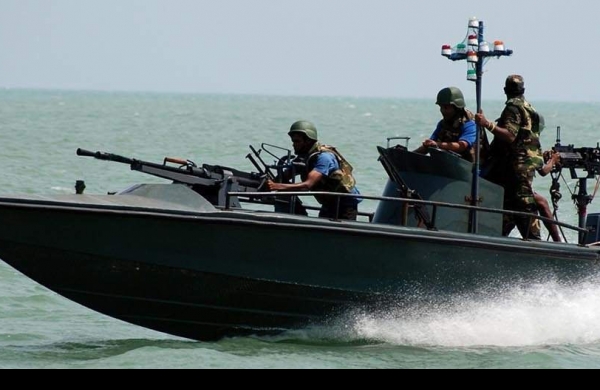
Sri Lanka navy’s Cedric class assault boats
In his book Asymmetric Warfare at Sea: The Case of Sri Lanka” Adm. Dr.Jayanath Colombage, former Commander of the Sri Lankan navy, who is now the country’s Foreign Secretary, tells the fascinating story of the transformation of the Sri Lankan Navy (SLN) from a small, poorly funded and non-innovative conventional fighting force to a spirited, innovative and well-armed force which, in just three years, broke the back of the intrepid and deadly Sea Tigers, the naval wing of the Liberation Tigers of Tamil Eelam (LTTE).
Adm.Dr.Jayanath Colombage
Adm.Colombage’s narrative begins with a candid account of the state of the SLN vis-à-vis the Sea Tigers during most the 30-year separatist war. The SLN was the underdog, suffering humiliations at the hands of the Sea Tigers, till the 2006-2009 Eelam War IV during which it emerged as the top dog to decimate the Sea Tigers.
While accounting for past failures, Adm.Colombage says that successive Lankan governments (barring the Mahinda Rajapaksa regime which came into being in 2005) saw the war against the Tamil militants as a land war to be fought principally by the army. Although the adversary was using the sea to bring in supplies, initially using the Palk Strait and eventually the wide ocean, Lankan governments did not see the need to strengthen the navy. It was relegated to the margins and expected to little more than defend itself when attacked, not to go hunting for the adversary. The navy was not given the manpower and equipment go on the offensive. It was also trained to fight conventional battles, not maritime terrorist groups whose tactics were unconventional, cunning, ever-changing and gutsy. Due to the differences in strategy and tactics, the Sea Tigers managed to destroy 28 SLN vessels in encounters.
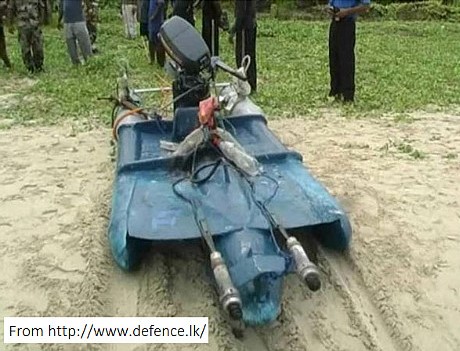
Sea Tiger human torpedo
In contrast to the Lankan State, the LTTE was a sea-oriented group from the very beginning. Its leader, Prabhakaran, and his initial band of followers, were sea farers from the fishing community of Valvettithurai. In contrast to Lankan strategists, Prabhakaran firmly believed that to fight the Lankan forces on land, he has to have command over the sea.
Therefore, the LTTE designed and appropriately armed small boats of four different kinds. Its suicide boats used stealth technology and were high speed and armored. The Sea Tigers used RADAR to ensure accurate firing. Besides, the LTTE acquired ocean-going vessels which cleverly combined legitimate business and arms smuggling, and acted as floating warehouses” on the high seas. The Sea Tigers had devised techniques to camouflage its gun-running vessels. To land its lethal cargo on the Lankan coastline, it used small boats disguised as fishing trawlers. Not short of ammo, thanks to its floating warehouses, the LTTE was able to rain artillery shells and mortar bombs to unnerve the Lankan army on the battlefront.
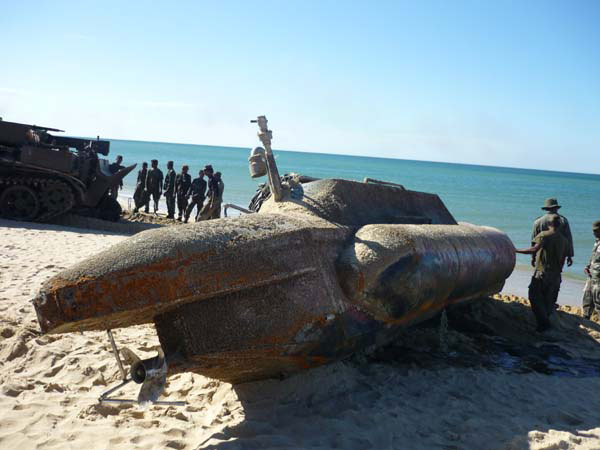
LTTE submarine, june 15,2009
Not surprisingly, SLN’s lumbering vessels, including Fast Attack Craft (FAC), were overwhelmed by the Sea Tigers’ small, fast boats, attacking in swarms. The Sea Tigers also deployed suicide boats which conventional navies do not. It staged underwater attacks using modern equipment. The Sea Tigers not only attacked Lankan harbors but in 1997, even hijacked a vessel carrying 32,000 mortar bombs ordered by the SLN from Zimbabwe. That event showed the depth of the LTTE’s penetration into the Lankan defense Establishment. In contrast, Lankan intelligence gathering lacked penetration, was piecemeal and its use was uncoordinated, Adm.Colombage says. The air force did not undertake sea surveillance which could have helped the navy locate the floating warehouses long before September 2007 when they were located with US help.
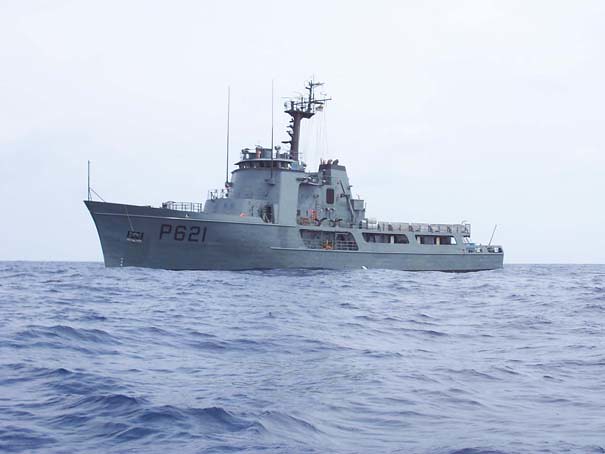
OPV Samudra
Sea Change
But come Mahinda Rajapaksa as President and his brother Lt.Col (Rtd) Gotabaya Rajapaksa as Defense Secretary in 2005, a sea change occurred. The Rajapaksas decided that there would be no more talks (or a ceasefire) with the LTTE and that the war would be fought to the finish regardless of pressure from global powers and the peace and rights lobbies.
The navy had to go for the kill. The navy Commander was ordered to be unsparing with his subordinates, even as he encouraged brainstorming to get the best ideas from his staff. The Commander personally selected officers for key positions on merit and not seniority alone.
The strength of the navy was increased from 36,000 to 54,000 and the budgetary allocation went up by more than 60% by 2007. The required equipment was ordered. Where imports of were costly, naval engineers devised alternatives. Old equipment were reconditioned to the optimal level.
sri lanka navy fast boat
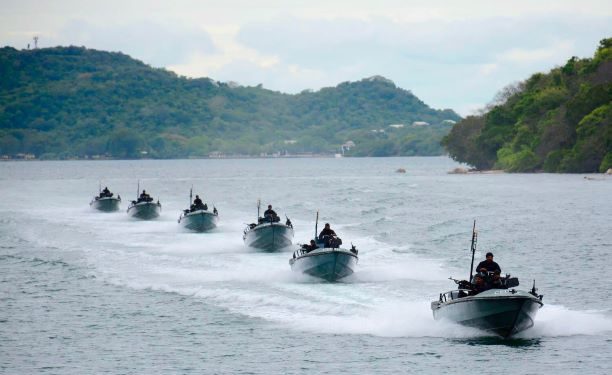
Tactics underwent a sea change with the SLN imitating the Sea Tigers and using small boats to penetrate the latter’s hideouts and confront them in swarms. Small boat production increased exponentially. The LTTE had to fight similar boats, similarly equipped and similarly-led but in much greater numbers. Guns on board Lankan vessels were enhanced through indigenous innovations.
The resources of the SLN were not only put to use, but enhanced. The Small Boat Squadron (SBS) was reactivated. The decision to acquire Offshore Patrol Vessels (OPV) – two from India and one from the US Coast Guard – and Fast Missile Vessels (FMV) from Israel, added to the reach, speed and punch of SLN vessels.
Following 9/11, the SLN used the Global War on Terror to get the US on board. The US said that it would help SLN locate the LTTE’s floating warehouses provided the SLN assured that it would not attack civilian vessels. The assurance was given. But the location of the OPVs was not easy as the LTTE had got wind of the SLN’s plan. It had stopped using satellite communication and kept off shipping lanes.
However, in September 2007, the US detected a target. But again, the SLN had an issue – the endurance of its OPVs so far from their base. SLN engineers solved such problems. The OPVs were then stationed in the calm waters of the equator to minimize wear and tear. Patrolling ships came to the equator to refuel and refit.
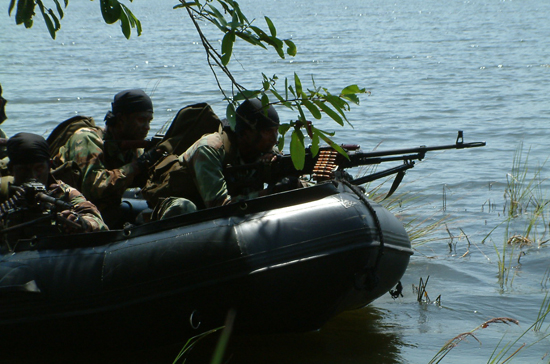
Sri Lanka navy’s Special Forces
The Small Boat Squadron (SBS) also participated in the destruction of the Floating Warehouses with their Combat Rubber Raiding Craft (CRRC) firing Rocket Propelled Grenades (RPGs). The LTTE weaponry which went to the bottom of the sea included 152mm,130 mm,122 mm artillery shells and120 mm mortar rounds. MV. Koshia itself lost 29,000 artillery shells.
Meanwhile ,in Sri Lanka, the electronic surveillance network was enhanced to enable the Navy Commander and field commanders to get a real time picture. At the Defense Ministry level, the older system of various intelligence units working independently and in an uncoordinated way, was replaced by regular interactions in which information was shared and actionable intelligence distilled and communicated to the right units. All equipment required was acquired even though the West and India refused to sell or gift weapons on political or human rights grounds.
Corruption in military procurement was a major issue in the Lankan armed forces during most of the 30-year war. But an end was put to it by the formation of the Lanka Logistics Technologies Ltd.,(LLTL) involving service Commanders and Chief of Defense Staff. The LLTL helped standardization of equipment ordered. Procurement was made a confidential process.
All these measures helped reverse the earlier situation in which the Navy was lagging behind. When the SLN was using 20 mm guns, the Sea Tigers were using 23mm. The FACs were therefore modified to carry a 30 mm gun and a 107 mm rocket launcher. 25 and 50 KW RADARs were installed. The Fast Gun Boats were equipped with modified Multi-Barrel Rocket Launchers (MBRLs) to enhance their destructive capability.
A drawback which dogged the SLN was a lack of understanding between the army and navy commanders. But the ground commanders remained in close contact with each other and worked together enabling mutual support,” Adm.Colombage recalls. Be that as it may, the net result was the total destruction of the Sea Tigers and the elimination of its leaders.
The margin of the SLPP (Sri Lanka Podujana Peramuna) victory, at the Aug 5, 2020 general election, stunned the ruling coalition. The best possible result the SLPP expected was around 130 seats, including National List slots. SLPP Chairman and its top National List nominee, Prof. G.L. Peiris, about aproximately 30 minutes after polling commenced, countrywide, told the writer they expected around 130 seats.
About two weeks earlier, the leader of the Pivithuru Hela Urumaya (PHU) and Attorney-at-law Udaya Gammanpila, too, privately acknowledged they could secure around 130 seats.
Experienced campaigner and turncoat, S.B. Dissanayake, also of the SLPP, placed the number of seats, anticipated, a little less than 130 seats. But, they all predicted a very comfortable victory for the SLPP, though two-thirds seemed quite unrealistic.
The Aug 5 result proved a two-thirds majority was achievable, under the Proportional Representation (PR) system, though so-called experts thought otherwise. However, the margin of victory surprised even the three-and-half-year old SLPP, as well as the tattered UNP, established over 70 years ago.
For the first time, in our political history, a party (that ruled the country on several occasions) ended up without a single elected lawmaker. The UNP managed to secure one National List seat. The JVP did much better than the UNP by securing three seats, including one National List slot, but it was a comedown when compared to its previous performance at the August 2015 general election.
General Secretary of the UNP, Akila Viraj Kariyawasam, on Friday (7), blamed their worst defeat ever on their ‘own actions’ and those of others. The latter was definitely a reference to former UNP Deputy Leader Sajith Premadasa causing a split.
It would be pertinent to examine what Kariyawasam meant by ‘own actions’ in his pathetic attempt to explain the debilitating setback the once proud party suffered. The EC decision not to count preference votes, received by candidates of political parties that didn’t receive seats, saved them from further humiliation. If not, the paltry number of votes received by Ranil Wickremesinghe, Assistant Leader Ravi Karunanayake, National Organizer Navin Dissanayake, as well as financier Daya Gamage, would have become public, adding to the humiliating defeat.
The emergence of the SLPP, at the expense of the SLFP (Sri Lanka Freedom Party), should be studied, taking into consideration the deliberate wrongdoings, blunders, lapses, treachery and utterly irrational policies followed by the yahapalana administration, consisting of the UNP and a section of the SLFP-led UPFA.
Before we discuss why the voting public handed over such a massive mandate to the SLPP, it would be pertinent to mention that those who served the ruinous yahapalana coalition ended-up in four groups. The largest group formed (1) the Samagi Jana Balavegaya (SJB), (2) remained in permanently damaged UNP, (3) what was left of the SLFP and (4) those who returned to the Rajapaksa Camp, having served Maithripala Sirisena for some time.
Having publicly alleged that he would have ended up six feet under if Mahinda Rajapaksa had won the 2015 January presidential election, Maithripala Sirisena, too, returned to the Rajapaksa Camp to avoid being politically eliminated. If Sirisena’s SLFP contested the recently concluded general election, on its own, it, too, could have suffered the same fate that befell the UNP. The SLFP obviously avoided the disgraceful defeat by contesting under the flower bud symbol.
The SLFP, on its own, winning a seat in the Jaffna peninsula, is an exception. The SLFP contested the electoral districts of Jaffna and Kalutara. Final result of the Kalutara district reflected the ground situation, in 18 districts, where the SLPP recorded landslide victories. The SLFP polled 10,979 votes (1.57%), in the Kalutara district, and was placed 5th, whereas the SLPP obtained a staggering 448,699 votes (64.88%). The SLFP survived a political massacre by accepting the SLPP’s terms. The SLPP, quite rightly, dismissed the SLFP’s efforts to contest both the presidential and parliamentary polls, under a common symbol. Polonnaruwa district candidate Sirisena, in spite of being verbally abused and humiliated by fellow district SLPP candidate Roshan Ranasinghe, as well as Gampaha District SLPP leader Prasanna Ranatunga, polled the highest number of preferential votes from the Polonnaruwa District. Sirisena polled 111,137 preference votes, whereas Roshan Ranasinghe obtained 90,615. The SLFP, due to consensus with brazen SLPP, even at biased terms, has managed to save face.
‘Own actions’
The UNP suffered an irreparable setback, at the third parliamentary poll, since the conclusion of the war, in May 2009. The UNP’s loss, at the 2010 general election, was understandable. The then SLFP-led UPFA obtained 144 seats, including 17 National List slots, whereas the UNP secured 60. The UPFA taking the parliamentary election was a foregone conclusion in the wake of Mahinda Rajapaksa defeating General Sarath Fonseka at the 2010 January presidential election. But, the UNP obtained a respectable 60-member group and, five years later, used it to spearhead a high profile project to bring down Mahinda Rajapaksa.
But, the UNP, at the general election just concluded, has been reduced to just 1 National List MP. The UNP General Secretary should explain what he really meant by ‘own actions’ contributing to its downfall. Let me examine what these ‘own actions’ were as the SLPP triumph transformed the political landscape.
The SLPP can easily secure two-thirds with the backing of the SLFP (one elected from Jaffna) and three other Tamil and Muslim parties. Perhaps, it would be much better to amend the 19th Amendment to the Constitution, in consultation with the SJB (54 MPs), TNA (10), Jathika Jana Balavegaya (JJB/3) and the UNP (1) than exploiting the overwhelming majority to its advantage.
Sri Lanka is in such a political-economic mess, the SLPP should act responsibly. The formidable political power shouldn’t pursue abusive policies against the backdrop of annihilation of the Opposition. It would be a grave mistake on its part to tinker with the Constitution for its benefit. Perhaps, a consensus can be reached soon, on an amendment, to allow the President to hold the Defence portfolio.
Treasury bond scams
Having ousted Mahinda Rajapaksa, at the 2015 January presidential poll, a cocky UNP leadership brought in Singaporean Arjuna Mahendran as the Governor of the Central Bank, in January 2015. Wickremesinghe simply ignored Sirisena’s concerns as regards the appointment. Under heavy pressure, Sirisena handed over Mahendran’s letter of appointment. The Singaporean moved into the Governor’s Office, on January 26, 2016. The then Finance Minister Ravi Karunanayake made the recommendation in this regard. The first Treasury bond scam was perpetrated just four weeks later.
Kariyawasam’s reference to ‘own actions’ without doubt include the 2015 Treasury bond scam and the second perpetrated 13 months later, after the 2015 general election. The government was so cocky, it not only once but twice perpetrated massive Treasury bond scams at the expense of the national economy. In spite of the then yahapalana partner, the SLFP, making a big noise about Treasury bond scams, Sirisena’s party solidly stood by the UNP. Sirisena went to the extent of dissolving parliament, on the night of June 26, 2015, to prevent the Committee on Public Enterprises (COPE) presenting its report on the first Treasury bond scam to parliament. Sirisena exposed himself by delaying the appointment of the Presidential Commission of Inquiry (P CoI) to probe the Treasury bond scams, till January 2017; over seven months after Dr. Indrajith Coomaraswamy succeeded the Singaporean.
The top UNP leadership caused the party downfall by its ‘own actions.’ The SLFP, too, contributed to the rapid deterioration of the yahapalana government by playing ball with the UNP. Having allowed the UNP to ruin the yahapalana arrangement, Sirisena resorted to a constitutional coup, in late Oct 2018, to take back control of the government. Sirisena failed miserably.
The new government now faced a huge challenge in bringing the Treasury bond scams case to a successful conclusion. Ranil Wickremesinghe and Ravi Karunanayake embroiled in Treasury bond cases are no longer lawmakers. Wickremesinghe and Karunanayake, having first entered parliament in 1977 and 1994 (National List), respectively, served as members of parliament successively until last week. Wickremesinghe and Karunanayake now face the bleak prospect of facing a long drawn out case.
Geneva betrayal
Between the February 2015 and March 2016 Treasury bond scams, the UNP betrayed the country, at the Geneva-based United Nations Human Rights Council (UNHRC). Sirisena did absolutely nothing but to publicly criticize the Geneva betrayal. The President, in spite of being the Commander-in-Chief and the Defence Minister, answerable to the people, stayed with the UNP decision. In a bid to deceive the public, the yahapalana lot replaced the then Foreign Minister, Mangala Samaraweera, who directed the then Sri Lanka’s Permanent Representative in Geneva Ambassador, Ravinatha Aryasinha, to co-sponsor the controversial resolution, with Ravi Karunanayake, in May 2017. In spite of on and off public criticism, Sirisena, and those SLFPers who received ministerial portfolios, remained with the UNP. Karunanayake, embroiled in the Treasury bond scam controversy, continued with Samaraweera’s Geneva project. When Karunanayake was compelled to resign in the second week of August 2017, over shocking revelations before the Presidential Commission of Inquiry, Wickremesinghe brought back Tilak Marapana to the cabinet. One-time Attorney General Marapana, PC, took over the Foreign Ministry. Marapana, too, faithfully continued with the Geneva project. The Geneva betrayal was part of the UNP’s agreement with the Tamil National Alliance (TNA) and the US. Sumanthiran revealed the existence of a treacherous agreement, in June 2016, when he addressed a gathering in the US. Sumanthiran declared that he negotiated with the US and Sirisena’s government, on the Geneva resolution, and the inclusion of foreign judges in war crimes courts.
Lord Naseby, in Oct 2017, gave Sri Lanka a golden opportunity to counter war crimes allegations. Based on secret dispatches from the UK High Commission, in Colombo, in 2009 (January to May), Lord Naseby successfully countered the primary allegation, regarding the massacre of 40,000 Tamil civilians on the Vanni east front. The UNP turned a blind eye to Lord Naseby’s revelations. Yahapalana partner, the SLFP, too, followed the same policy. When the writer inquired about how the government intended to use Lord Naseby’s revelations for Sri Lanka’s defence, at the post-cabinet media briefing, co-cabinet spokesman Dayasiri Jayasekera reacted angrily, though he quickly calmed down. An irate Jayasekera accused the writer of raising unnecessary issues with a view to causing problems. Jayasekera revealed that up to the time the question was posed to him, the cabinet hadn’t at least discussed the matter. Field Marshal Sarath Fonseka, as well as the SLFP spokesman Mahinda Sanarasinghe, at separate media briefings, in response to questions posed by the writer, admitted that the cabinet didn’t discuss the Geneva matter.
The Foreign Ministry’s thinking reflected the despicable UNP policy towards the armed forces. The initial Foreign Ministry response, to Lord Naseby’s Oct 2017 bid to save Sri Lanka, revealed its role in a high profile anti-Sri Lanka project. The Foreign Ministry issued a statement in response to a query posed by the writer to the then spokesperson. However, the Foreign Ministry cannot be faulted for following the instructions given by the Prime Minister, and the Foreign Minister, at that time.
The SLFP cannot absolve itself of the responsibility for the Geneva betrayal. Today, those SLFPers, who had fully cooperated with the UNP (2015 August –Oct 2018), are in parliament, on the SLPP ticket. They survived by contesting the Aug 5 parliamentary election on the SLPP ticket. If not, the SLFP, too, would have ended up with perhaps one National List MP, like its partner in ‘crime’ the UNP.
In the wake of the Geneva betrayal, several countries imposed travel restrictions on senior military commanders. Field Marshal Fonseka, Maj. Gen. Chagie Gallage and Army Chief Shavendra Silva are among those who were slapped with travel bans.
Now, it would be the responsibility of President Gotabaya Rajapaksa’s government to set the record straight. The UNP and the Illankai Thamil Arasu Kadchi-led TNA, responsible for the Geneva betrayal, suffered serious setbacks at the general election. Having campaigned for 20 seats, the one-time LTTE mouth piece was reduced to 10 seats, including one National List slot. In the last parliament, the TNA had 16 lawmakers, including two National List slots. Obviously, the Tamil electorate snubbed the TNA by causing the ITAK leader Mavai Senathirajah’s defeat. The TNA, too, plunged into crisis with a section of the former LTTE proxy demanding that Senathirajah be appointed to parliament through the National List whereas the TNA, at the behest of Sampanthan, named Chairman of Ampara Navindaveli Pradeshiya Sabha Thawarasa Kalaiarasan as their National List member.
Prez-PM failure in 2019
The Treasury bond scams (February 2015 and March 2016) and the Geneva treachery (Oct 2015) was followed by the indefensible failure to thwart the April 2019 Easter Sunday carnage. In this case, too, both the UNP and Sirisena failed the country very badly. The revelations, made before the Parliamentary Select Committee (PSC), in 2019, and the on-going Presidential Commission of Inquiry (P CoI), proved beyond doubt the culpability of both Sirisena and Wickremesinghe for the Easter Sunday carnage. In spite of knowing the imminent threat, posed by Thowheed Jamaat, Sirsena went on a pilgrimage to neighbouring India. Sirisena, wife, Jayanthi Pushpa Kumari, and other members of their family, offered prayers at the hill shrine of Lord Venkateswara. Sirisena took part in the ‘Suprabhatha’ ritual and offered prayers to the presiding deity of Lord Venkateswara. From there, the Sirisenas flew to Singapore. They were on holiday when Thowheed Jamaat carried out the near simultaneous attacks. Sirisena got caught lying to the PSC regarding the delay on his part in returning to Colombo in the aftermath of the attack. The PSC, in its report released to the public in Oct 2019, revealed how Sirisena shunned two earlier Sri Lankan flights to return in the early hours of the following day on a Singapore Airlines flight.
The SLPP will have to deal with media furore when the P CoI releases its report later this year. Sirisena, who held the Defence and Law and order portfolios at the time of the attack, in addition to being the Commander-in-Chief, cannot absolve himself of the responsibility for the unprecedented security failure.
H’tota deal and FTA with Singapore
Sirisena authorized the 99-year-lease on Hambantota port, in lieu of what Sri Lanka owed China, as well as the controversial Free Trade Agreement with Singapore (FTA) during his tainted presidency. On behalf of Sri Lanka, Sirisena’s nominee, Ports and Shipping Minister, Mahinda Samarasinghe, signed the agreement with China. Sri Lanka and China finalized the Hambantota port deal, in late July 2017, and the FTA with Singapore, in January 2018. Malik Samarawickrema signed the agreement on Sri Lanka’s behalf. It was finalized after six rounds of talks. Both Sirisena and Samarasinghe re-entered parliament on the SLPP ticket. Samarasinghe even took SLPP membership in the run-up to the general election. Samarawickrema, who was accommodated on the UNP National List in the previous parliament, quit parliamentary politics.
The SLFP has conveniently forgotten that it held the post of Deputy Speaker in Parliament till May 25, 2018. Thilanga Sumathipala served as the Deputy Speaker and the Chairperson of Committees of parliament. Sumathipala was replaced by Ananda Kumarasiri, who later headed the PSC that probed the Easter Sunday carnage. The Supreme Court has been moved by seven parties, including the Government Medical Officers’ Association (GMOA), against the FTA with Singapore. The SC last heard the case in the second week of July, 2020. It will be taken up again on Nov 03, 2020. A committee, appointed by the government after the last presidential election to review the FTA with Singapore, is yet to release its final report.
Having promised to review the Hambantota deal, the incumbent administration subsequently dropped the idea after China, in no uncertain terms, objected to that move. Those who represented the previous parliament and those who elected to new parliament should keep in mind there is no difference in the 99-year-lease on Hambantota port and the outright sale of such a valuable asset.
ACSA et al
Sri Lanka first entered ACSA (Access and Cross Servicing Agreement) in March 2007. Gotabaya Rajapaksa, in his capacity as the Secretary to the Ministry of Defence, signed ACSA on Sri Lanka’s behalf for a period of 10 years. Sirisena, in his capacity as the President, authorized signing a far more comprehensive ACSA, in August 2017. Sirisena’s government also discussed SOFA (Status of Forces Agreement) with the US, in addition to finalizing the MCC (Millennium Challenge Corporation) Compact.
When the writer raised the issue with Wickremesinghe at the final government media briefing, at Temple Trees, two weeks before the Nov 16, 2019 presidential election, the Premier, without hesitation, declared it would be signed. Now, President Gotabaya Rajapaksa’s government will have to decide on the controversial agreement. The government is obviously in a dilemma. Having secured a near two-thirds majority, the SLPP cannot, under any circumstances, accept the agreement in its present form against the backdrop of Prof. Lalithasiri Gunaruwan’s damning report, in Sinhala, on it. Perhaps, copies should be made available to all members of the new parliament.
Sri Lanka shouldn’t accept SOFA, under any circumstances. Instead, Sri Lanka should guarantee that it wouldn’t engage in /allow foreign activity inimical to regional or world powers. The new government cannot be unaware how the majority community reacted to the UNP’s response to ACSA, SOFA and MCC. The SLPP campaign, against US agreements, gave Gotabaya Rajapaksa a tremendous boost at the presidential poll, as well as the recently concluded general election.
Paddy at Mattala airport
Having ousted Mahinda Rajapaksa, in January 2015, and then won the 2015 August general election, the UNP brazenly stored paddy at the Mattala Rajapaksa International Airport (MRIA). Wickremesinghe repeatedly called Sri Lanka’s second international airport a white elephant. Storing paddy at MRIA was nothing but political suicide. It was meant to humiliate the war-winning President and his administration.
Storing paddy at MAIA is as bad as betraying the war-winning armed forces in Geneva. Five years later, the majority community, through overwhelming votes at the presidential and parliamentary polls, sent the UNP home. Sajith Premadasa and his group survived by contesting under a different symbol. Whoever secures UNP’s solitary National List slot, one UNP lawmaker in parliament would be a grim reminder to those who destroyed the once great party.
The Presidential Commission of Inquiry (PCoI)probing incidents of political victimization has issued summons on former Prime Minister Ranil Wickremesinghe and former ministers Mangala Samaraweera, Patali Champika Ranawaka, Sarath Fonseka, Malik Samarawickrama and Rauff Hakeem.
They have accordingly been informed to appear before the PCoI on the 7th of September.
Further, Jathika Jana Balawegaya (JJB) leader Anura Kumara Dissanayake and Tamil National Alliance (TNA) leader R. Sampanthan were also issued summons by the PCoI to record statements on the same day.
Former Director of the State Intelligence Service Nilantha Jayawardena stated that the State Intelligence Service also knew before the Easter attack that Rifkan Bathiudeen, the brother of former Minister Rishad Bathiudeen, had helped Saharan Hashim, who was evading court despite being issued a warrant, to flee to India by boat from Mannar.
This was when he testified before the Presidential Commission of Inquiry into the Easter attack today (18).
He testified before the Presidential Commission today for the 13th day
He stated that he first received the intelligence on April 4 last year and stated that he had told the then IGP Pujith Jayasundara on April 7.
Meanwhile, former Minister of Defense Ruwan Wijewardene also appeared before the Police Investigation Unit of the Presidential Commission today (18) and statements were recorded from him for more than 5 hours.
Also, former Director of the CID Shani Abeysekara, who is currently in remand custody, appeared before the Commission’s Police Investigation Unit today
Sri
Lanka has been confronting critical issues in constitutional reforms since
independence, and many issues were underwater until 1970, in spite of receiving
a dominion status in 1947 with a written constitution, constitutional reforms
seemed to be a demand of academic and students. The constitutional reforms had been limited by
the lack of parliament power (a two-third majority), and the election in 1970
gave the essential power in the parliament to a coalition government with SLFP,
LSSP, and CP then began constitutional reforms. Although the ruling party
gained a two-third majority in the parliament, a large volume of people
represented the opposition with supports for constitutional reforms or without
support for reforms. Constitutional reforms have contributed to political talk
shows of loquacious people, and neglect the public demand for government
intervention in policy-making for economic prosperity with the balanced growth
process.
A
large sum of funds spent on constitutional reforms and economically Sri Lanka
gained nothing from the constitutional reform process than creating political
differences and racial hates. The plurality of the population had no
understanding or interest in constitutional matters and the contents of various
clauses of the constitution are not apprehended by the public as they are
related to legal matters.
The
concept of constitutional reforms has created internal conflicts, armed struggles,
and hate within a small volume of population.
Now many people say constitutions reforms relate to personal matters or
family matters than the requirement of the country. After the general election held in 2020,
constitutional reforms have come again to doorsteps of people, and the new
minister appointed for justice affairs has publicly expressed that cabinet
papers are ready to dismiss the 19th amendment to the constitution replaced
by the 20th amendment. As the amendment has not published, nobody
knows what are contents in the amendment. The major question is, could the
proposed constitutional reforms be united the divided community and if so how
could be done it.
In
addition to the basic idea, some people clamor to cancel the 13th
amendment that created the provincial councils with a view to satisfying the
Tamil community as the government at that time wrongfully believed that the
creation of provincial councils would be an effective solution or a viable
alternative to eradicate racial hates, and the war had been in the country
between the government forces and LTTE terrorists mainly focused on creating a
separated state in the North and East or a creating a combined provincial
council with numerous power. Practical results reflect that the Tamil community
has divided with the result of creating provincial councils than they were
under a unitary structure of the constitution. Ordinary Tamil people in North
and East gained nothing from constitutional reforms in the 13th
amendment, but few leaders may have gained for job opportunities.
Tamil
leaders expected more power to provincial councils such as the power to
combining councils and others when enacted the 13th amendment, the
police power and land powers to councils were not given, and many others such
as the power to borrowing from overseas and to maintain the relationships with
overseas countries reflecting a federal status or beyond the federal framework
ignored as it was a creating a separate state. Mr.J.R.Jayawardane, the
president of Sri Lanka at that time refused additional demands and agreed only
to the delegation of central government power that considered appropriate to
provincial councils for economic, social, and cultural developments in the area
with strict supervision of the central government. A concrete argument of
Mr.J.R.Jayawardane was Sri Lanka as one country should allow North and East to
accommodate for people in the Western and Southern provinces when population
explosion experience in these provinces.
If additional power is given to provincial councils it would be creating
problems in the country. The Indian
advisors also viewed that allowing more political power to the provincial
council could be a threat to India because LTTE terrorists intended to recreate
the Vijayanagar Empire with a part of India and other Asian countries.
The
reality of the 13th amendment was economically disadvantaged to the
country because a large sum of government funds absorbed into unproductive
provincial councils administration and economically provincial council administration
created fiscal problems, inflation, and many problems to the monetary policy of
the central bank. When compared to ideological gains received by the North and
East people they cannot equalize the economic gains received by the country.
The purpose of creating the provincial council was to helping economic
decisions to improve the life of poor people in North and East as well as
people in other areas of the country.
The experience is more than 30 years in the past indicates that
provincial councils are a whited sepulcher.
If provincial councils dismissed the government can save a large sum of
money and use them for the development purposes of the provinces. However, it
may be a problem not only for people in the North and East but also to people in
other areas too.
The
13th amendment has not supported to procreate economic federalism
despite the support to maintain a unitary system in political
administration. Economic federalism
radically supports economic decision making at the provincial level and supports
for balanced growth in the country. Since Donomore ameliorates economic
decision-making at the provincial level was neglecting while the balanced
growth has been gone to a unitary system that means economic decision-making
and planning have gone to government bureaucrats, who are in the Colombo city.
Top to bottom budgeting has been the priority Sri Lanka has become an economy
depending on foreign debt, importing all items that could be produced in the
country but the colonial government wanted a centralized system to control the
country using bureaucracy. Several
members of the state council (Mr.D.S. Senanayake, Mr.C.W.W Kannangara) wanted
economic federalism giving justice to regional Sri Lanka. People in Sri Lanka want economic federalism
that supports for economic planning and decision-making in regional. To provide water to rural farmers, open
schools to educate rural kids, provide language skills (English) to rural
people, and the ability to convert the current depending economy to a
production economy. The economy cannot manage properly giving benefits to
regional Sri Lanka by a unitary system that makes decisions from Colombo.
Under
the reign of Kings and Queens, Sri Lanka had strong economic federalism and a
unitary system in political administration. The economic federalism supported
King Parakramabahu the great to export rice and the unitary system in political
administration supported King Gajabu to invade India and bring back Sinhala
people and additional South Indians and settle near the seaside area. Therefore,
constitutional reforms in the country should be supporting task that
strengthens economic federalism and political unitary system to keep Sri Lanka
as a strong country.
Some
people express that the protection of peoples’ sovereignty is a major
expectation of constitutional reforms and for this purpose, appointing members
from the national list and bonus MPs should be dismissed and the number of
members to parliament limits to 100. The election system should be maintained
based on electorates and not proportional representation. After the election in
2020, there are complaints that some electorates have no members. The president
and representatives to legislature must be elected by votes of people.
The
19th amendment degraded the concept of people’s sovereignty helping to appoint representatives
from a national list, who cannot obtain required supports from people. If
people want to elect professionals to parliament it would be an issue because
many professionals in various fields don’t like to engage in politics.
I have a dream! That one day, ministers will be chosen for their character and not for their family.
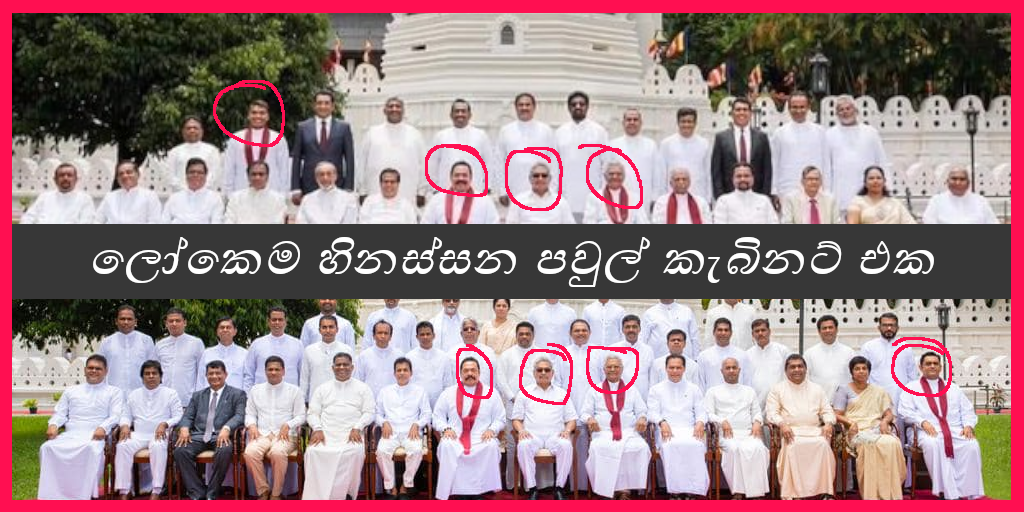
The scale and extent to which Sri Lanka has been captured by family-rule under the Rajapaksas is unprecedented. No country in the world sees such a depth and breadth of family members simultaneously occupying positions of power at every level of government.
Dynastic politics is common in South Asia. But the situation in Sri Lanka is orders of magnitude worse. Not only has there once again been brazen capture of the state apparatus by various clan-members, but the speed with which this happened, merely days after the election results, is both stunning and sickening.
This kind of clan-rule has happened in undeveloped African countries, but usually it has involved father-son dynamics only. Nowhere else in history have we seen father, uncle, son, another uncle, and nephew in cabinet together; not to mention both senior and junior minister posts being awarded to some of the same individuals.
The question that needs to be asked is,
Why doesn’t this happen in other countries?
The answer is simple,
It always fails.
In the span of human history, it is likely that other people have believed they and their blood line alone were the only ones fit to rule a nation. That is the nature of some megalomaniac rulers. And it is probable that throughout history, nations would have been captured by one particular family.
But why don’t we have any examples to refer to?
Because the nations which permitted this, or which were powerless to stop this, do not exist. They have been destroyed, or conquered, long forgotten, erased from human knowledge.
Ugly Wonder of the World
There is no contemporary country around the world where we have a similar situation as Sri Lanka is faced with.
Look at the pariah states — Iran, North Korea, Venezuela, Syria, Cuba — not a single one sees a family cabinet ruling it.
Fine, Fidel Castro’s younger brother took over… but that’s the point. He took over, when Fidel stepped aside. He didn’t co-rule.
The Kim clan of North Korea rule in a hereditary manner, but only after the older person dies.
Let’s look at some respectable countries such as Japan, South Korea, France, Canada or Australia. Can you, off the top of your head, right now, tell me how many brothers or sisters the present leaders of each of those countries has?
Can you name Shinzo Abe of Japan’s children? Do you even know if he has any children? How many cousins does Justin Trudeau of Canada have? Do the numbers come to mind, right now? Can you name them? Without checking Wikipedia or searching online?
No. You cannot. Because those leaders don’t bring their entire family into the cabinet, or even give them prominent roles.
I was recently surprized to hear that Donald Trump, braggadocious even by American standards, had a younger brother! I read widely, but had no idea he had one. This is how it should be. And Trump, as a political outsider without backers, and surrounded by political enemies even within the Republican party, did not bring a single one of his children into the cabinet or give them a ministry to run. Why is that? Common decency, that’s why.
But why is it that Sri Lanka, a country honorably ruled by great Kings, and shaped by thousands of years of Buddhism which emphasizes compassion, has to be compared with the worst states of the present age? We are a democracy, the second oldest in Asia, and have many fine and talented citizens, who excel and become prosperous when they move abroad. But apparently, only one family deserves all offices of state.
And yet we are forced to plumb the depths of the global cesspit to even try and find a similar family-ruled country, and still, we come up empty-handed.
So Sri Lanka has become unique — an ugly wonder of the world.
Gotabaya’s Betrayal
During the war years from 2005-2009, most of Mahinda’s excesses and his close affiliation with gangsters such as Mervyn Silva (have we forgotten the attack on Rupavahini, and how he tied up an official to a tree, and how that victim was so scared to say what happened, that he said he had tied himself by accident?!) because there was a war to be fought. We ignored his jumbo cabinet and his purchasing of parliamentary votes through the dishing out of invented ministries, because there was a war to be fought.
And then the war was won. In 2011, Mahinda obtained a 2/3 majority in parliament in conjunction with Muslim parties. But nothing changed.
He had the chance to fix this country. He could have dismantled the 13A, a single action which would have solved multiple problems. It would have stopped the possibility of separatism, it would have removed the complication of transferring land and police powers, but most of all, repealing 13A would have reduced suffering: all those who have been beaten, bullied, and killed, tormented by the violent Provincial Council campaigns.
But no, Mahinda had other priorities. So he used his 2/3 majority to remove term limits on himself. And rather than strengthen democratic governance by appointing patriotic independent commissions, he took the power to appoint these committees for himself.
Mahinda has forgotten now, but it was due to the lawlessness, the corruption, and the day-to-day thuggery that ordinary Sri Lankans of every class suffered from 2011-2014, that he was rejected by the people on his 3rd election. The alternative was not the most appealing or well known person, and the association with Ranil made it a difficult decision, but in the end the Sinhalese decided that enough was enough, and booted him out.
Then in 2015, despite many realizing that yahapalanaya” was not what it was advertised as, and that a lot of the charges laid against the Rajapaksa regime were false, people still voted for a UNP government, even knowing that this would make Ranil the prime minister, again because they did not want a return to the Mahinda-domination of just a few months prior.
We have worked hard on these pages and on the earlier iteration (see footnotes), to fight against the lies, and treachery of the Sirisena-Wickremesinghe government, for five long years. We were appalled to see Mahinda and the Rajapaksa family — which despite all their many, many faults, still did rescue the country from terrorism and stood up to massive foreign pressure — being dragged through the mud, harangued, and vilified, not by some foreign occupier, but by our own lawyers, judges and prosecutors.
What is wrong is wrong. And locking up Namal and Wimal was wrong. Bringing war crimes charges against Gotabaya was wrong. Arresting Mahinda’s secretaries was wrong.
As 2019 approached, we needed a new leader to rally around, one who was patriotic and who would develop the nation, instead of dividing it and selling it. There were a few choices, but clearly Gotabaya, with his track record of efficient improvements to Colombo, was a good choice for president.
In manner, style, and speech, Gotabaya was different to the typical Rajapaksa. That is why he won the presidency. And during the recent general election campaign, the SLPP was able to get 2/3 purely because of Gotabaya. If you watch any of the media reports, you can see that he was at the forefront of the campaign, and he was the one who got the most air-time. The message was clear, and spoken by Gotabaya himself: vote SLPP, give me 2/3, so that I can fix the constitution and develop the country.
The people believed Gotabaya. The people trusted Gotabaya. They voted for Gotabaya to run the country in a different manner and style, with a focus on quality over quantity.
And then the cabinet was unveiled.
Back to the Future
It was a coup.
Not Mahinda against Gotabaya, no. It was a coup of the Rajapaksas against the people of Sri Lanka.
Gotabaya hoovered up the votes of everybody by promising Singapore style efficient governance — not just from the Sinhala Buddhists, but even from some Tamils and Muslims who’d finally had enough of poverty and extremism, and even from UNP bastions of Colombo and Kandy — and placed them all in Mahinda’s lap.
The first sign of the trouble ahead was the swearing in of Mahinda. Rather than use a historic and humble setting, as has been the tradition until now, the government went for full theatrics. Mahinda’s inauguration as prime minister for the 4th time was nothing less than a coronation of a king.
The country is in serious peril on the economic front, but there was not a hint of the seriousness and gravity of the situation. In true show-man Mahinda fashion, the whole event was a celebration, an Ancient Rome style triumph, a carnival in honor of this man and every member of his family.
It doesnt’t seem to have registered that in reality he was just another MP, that he is not monarch for life but elected for just 5 years.
Out went the promised scientific method, and in came the same old Mahinda method. No, the determinant for a cabinet ministry was not suitability, skill set, or vision. Instead cabinet posts and ministries were handed out like candies, rewards for loyalty.
And don’t even get me started on the use of Sri Dalada Maligawa as the venue for the cabinet inauguration — someone please tell Mahinda, and Gotabaya, that they aren’t kings.
The 19A limits the cabinet to 30 ministers, but that doesn’t mean all 30 slots had to be filled! But we got this absurdity:
a minister for Power, and a minister for Energy;
a minister for Trade, and a minister for Industries, and a minister for Labour, and a minister for Plantations;
a minister for Transport, and a minister for Highways, and a minister for Ports;
a minister for Agriculture, and a minister for Irrigation, and a minister for Water Supply, and a minister for Fisheries;
a minister for Environment, and a minister for Wildlife;
a minister for Urban Development, and a minister for Land;
6 ministers could do the job of the 17 fake ministries listed above. A cabinet of 10 was more than enough.
Next, there is no limit for the number of State ministers, so we got this farce:
a state minister for internal security and disasters, and a state minister for prisons;
a state minister for foreign employment, and a state minister for skills development;
a state minister for batik, and a state minister for national heritage;
a state minister for cooperatives and market development, and a state minister for home economy, and a state minister for natural product export, and a state minister for regional cooperation;
a state minister for cane and clay, and a state minister for ornamental fish, and a state minister for livestock and eggs, and state minister for paddy and cereals and organic food and vegetables and fruits and chilies and onions and potatoes and seed production and high tech agriculture, and a state minister for sugarcane and maize and cashew and pepper and cinnamon and bulath;
a state minister for road facilities, and a state minister for port facilities, and a state minister for aviation services, and a state minister for vehicle registration;
a state minister for land management, and a state minister for paddy field irrigation, and a state minister for rural water supply, and a state minister for rural infrastructure, and a state minister for canals, and a state minister for rural construction, and a state minister for fertilizers and pesticides;
a state minister for tea estates, and a state minister for estate housing;
a state minister for indigenous medicine, and a state minister for pharmaceuticals;
a state minister for wildlife protection
So that’s 30 state ministers doing the job of 9 state ministers. And the 10th one on the list, wildlife protection, could easily be part of the wildlife” cabinet ministry above. Simply put, there are 22 superfluous state ministries, with all their attendant perks, vehicles, staff, and expenses. And God knows how many thugs and crooks will be employed at each of these ministries, at taxpayer expense.
Now let’s look at how many ministries the Rajapaksas have awarded themselves:
Gotabaya – ministry of defense (I am not specifically against this, if legal)
Mahinda – ministry of finance, and urban development, and Buddha Sasana and Culture
Chamal – ministry of irrigation, and state ministry of internal security
Namal – ministry of sports
Shasheendra – state ministry of paddy and cereals and organic food and vegetables and fruits and chilies and onions and potatoes and seed production and high tech agriculture
So that is 8 out of 67 ministries. Five immediate members of the same family occupy 12% of all cabinet positions. How many salaries are they getting from the taxpayer? This is unprecedented — whether you are comparing with democracies or dictatorships.
Will the clause of the 19A barring dual-citizens from holding office also be scrapped, so that Basil can be brought into the government again?
Mind you, these are merely the open” Rajapaksas, there may be some other hidden” relatives with different names in the cabinet, and this does not account for those family members who work within ministries, state companies, regulatory bodies, or within the diplomatic service.
Jumbo cabinet is back, this time with a minister for bulath.
Wrong is Wrong
Men? Men are weak… It is because of men the Ring survives. I was there. I was there 3000 years ago… when Isildur took the Ring. I was there the day the strength of men failed. I led Isildur into the heart of Mount Doom, where the Ring was forged, the one place it could be destroyed! It should have ended that day, but evil was allowed to endure. Isildur kept the Ring.”
Lord Elrond speaks to Gandalf at Rivendell — The Lord of the Rings: The Fellowship of the Ring
Looking at what is going in front of us right now, I cannot help but feel like Elrond, the leader of the Elves, from The Lord of the Rings novels. He recounts how, when there was a chance to destroy evil forever, the man who should have done it faltered, was seduced by power, and thought he could use it to strengthen his blood line. In the end it destroyed his family.
Sri Lanka too is at a crucial moment in its history. The wretched citizens, with nowhere to turn, placed their hopes in Gotabaya — so desperate were they to lift themselves out of the abject poverty they find themselves in. But at the crucial moment, Gotabaya has faltered, and together with Mahinda, has been seduced by power.
As I said earlier, what is wrong is wrong:
It is wrong to give your own family members multiple ministries in the cabinet.
It is wrong to give your body-builder, undignified, poorly educated, uncultured son a ministry when there are plenty of others more qualified and better suited.
It is wrong to give your idiot brother Chamal ministries. It is wrong to give your good-for-nothing clown of a nephew Shasheendra a ministry when there are so many others who are deserving.
It is wrong to abuse the people’s trust like this. It is wrong to hold the people in contempt like this — they are free and sovereign citizens, with hopes and dreams.
It is wrong to obstruct others with talent from entering parliament by stuffing nomination lists with your clan, or gaining ministry experience.
It is wrong to treat this ancient nation with its great history and the legacy of all those who fought and died to protect it over millennia as if it is your personal property, to divide up into pieces and apportion those chunks to your own family members as you, and only you, see fit.
It is wrong to declare that only you and your blood line are capable, smart, and deserving enough to be ministers, prime ministers and presidents.
The placement of Namal, Chamal and Shasheendra on the minister list shows that Gotabaya and Mahinda have placed their clan above the country. They work not for the betterment of the people, but for the betterment of the Rajapaksas. We knew this was the case back in 2004-2014. But to see it repeating again in front of our eyes right now, and so soon, is stupefying. Have they learnt nothing from their rejection in 2015? Or perhaps the better question is, have we learnt nothing of the Rajapaksas?
Sri Lanka Weeps
There was a better way.
Gotabaya could have said Mahinda, I don’t think it’s right for you to be prime minister again, and what will the public think if I make Namal and Chamal and Shasheendra ministers?! Let us show the people that we will do things differently this time, that we are are responsible. Let us limit the cabinet to a bare minimum, given how small our country is and how poor we are.”
Mahinda could have said Gotabaya, I’ve been prime minister 3 times already, let someone else do the job. I will be your adviser instead. And no, of course Namal should not be getting a ministry! How embarrassing that would be for me, the public would think we are mad, spreading nepotism like this!”
Namal could have said Father, Uncle, I do not deserve a minister position. What skills do I have? I only got a 3rd-class bare minimum pass law degree from a 3rd rate polytechnic college. Let me be an MP and learn for a few more years. I want to become a minister on my own accord, through my own skills, and not through nepotism or favors. What will the public think?!”
But that is not what happened. The conversations at the dinner table at Temple Trees and the Presidential Palace took a different turn. There was only one thought process and only one mission. Mahinda, Gotabaya, Namal, Chamal, Shasheendra, and all the others spoke with one voice:
We are back! They’ve voted for us again! With 2/3 this time! Let’s take whatever ministries we can. Let’s reward our cronies. Let’s divide up the state and hand out pieces of it like candy to those who lick our boots. Let’s make sure Chamal succeeds Mahinda, and create a path so Namal succeeds Gotabaya, and Shasheendra succeeds Namal!”
Sri Lanka will weep because the power play of the Rajapaksa clan enriches the family, while the country is hobbled. It will remain impoverished, decaying and stagnant. The people will toil, and pray for decent leaders, but none will come. Those who are genuine, and honorable, and noble, and honest, will have all those good attributes ground out of them through frustration. No one with skill and ability will be allowed to rise up. They will be noticed and identified, and will be sidelined, or worse. The Rajapaksa clan will have taken over everything, from the parliament to the ministries to the regulatory bodies to the state enterprises to the the private companies.
There is Always Hope
At the beginning of this article I asked the question, why we do not see any other country, now or in the past, with a similar clan-based government? I answered that it was because such countries collapse and are conquered, and are erased from history.
Saddam Hussein worked hard to hand Iraq to his sons. Gaddafi wanted his sons to take over Libya. Mubarak wanted his son to take over Egypt. They all held onto power for decades, hoping to suffocate anyone who would be a challenger to their children, to their succession. It’s important to note that even these dictators did not stack their cabinets with relatives, though they had full power to do so.
But all three of these people failed. Their sons never saw power.
In America, the Bushes are a dynasty of far superior quality than any third world political family, and yet the youngest one, Jeb, was unable to secure the presidential nomination.
In a slightly different example, the great minds of Imperial Japan planned to create an ever-lasting East-Asian empire, but two atom bombs came out of nowhere and put an end to that.
Closer to home, Ranil’s father was adamant that Ranil should rule the country one day, but he could never become president, while his premierships always ended in failure. Chandrika became president, but her son has no chance of entering high office.
What I seek to illustrate by all this is that the best laid plans, even those created by far greater minds than the Rajapaksas of Medamullana, can go awry.
It is certain that without the backing of Gotabaya or Mahinda, who have huge political resonance due to the war effort, the Rajapaksa family will lose all its clout, and will shrink into obscurity.
Perhaps then, things will improve. Until then, never give up. Demand better! Do not let them get away scot-free. Until then, keep fighting!
We shall go on to the end. We shall fight in France, we shall fight on the seas and oceans, we shall fight with growing confidence and growing strength in the air, we shall defend our island, whatever the cost may be. We shall fight on the beaches, we shall fight on the landing grounds, we shall fight in the fields and in the streets, we shall fight in the hills; we shall never surrender!”
Prime Minister Winston Churchill — Address to Parliament with Nazi invasion of Britain looming, June 4th 1940
Sri Lanka has reached an important threshold of her history with the conclusion of the General Elections and the undisputed victory of the nationalist forces led by President Gotabaya Rajapaksa, While we still remember the memorable victory of Mahinda Rajapaksa. over the Tamil Tiger terrorists in another epoch, we could not make use of the opportunities
created to pave the way for the defeat of anti-nationalist forces to wrest the control of affairs of the country in 2015. The action plan of the Yahapalanya completely overturned the destiny of the country in that the war heroes who saved the country from the rule of terror of the Tamil Tigers were hunted down and Sri Lanka became the co-sponsor of UNCHR resolution which was drafted on the assumption that our forces committed human rights violations, ‘discovered and concocted ‘ by some NGO scriptwriters and their fellow travelers. In regard to internal affairs, in our attempts to give recognition to the term, “reconciliation ” we were made to forget the separatist specter which was active in the country from the time of Independence. In the end, with the Islamic terrorists killing nearly 300 unarmed civilians the chapter on Yahapalnay ended proving again that the State should be strong enough to protect the people and the country at large.
One of the most critical issues which need the attention of the new government is to consider introduction of a unitary constitution for the country doing away with the 13ht amendment based on JR/Raviv accord signed on 29th July 1987. The 13th A not only diluted our constitution but also created a white elephant in the form of Provincial councils. The history of the Provincial Councils in Sri Lanka teaches us a lesson on how not to create tiers of administration which provides jobs for the marginalized politicians, how not to waste public funds and enterprise. The colossal wastage of funds on the running of the Provincial councils is a crucial factor to be recognized in the management of the post-Corvid economy. Based on the official sources. the expenditure figures are as follows.
Sri Lanka’s Provincial Councils: Expenditure data was reported at Rs 286,031.000 million in Dec 2017. In 2016 it was Rs 276,147.000 million For the 31 years of the Provincial councils the expenses incurred had been calculated to be Rs 3.2 billion according to one reviewer. At present. the salary component of the expenditure is estimated to be 65% of total expenditure was spent on manpower while only 16% of their total budget was used for capital expenditure.” This abominable practice of spending money for the survival of the men in power cannot be justified under any acceptable criteria.
An important issue in creating the Provincial councils was that it would provide more opportunities for the minority Tamil people in the North and the East provinces. However, when the facts are analyzed one can conclude that it was again only an opening for an additional set of politicians to enjoy at the expense of the public funds. It was the central government that drove the economy and administration while the Provincial Councils enjoyed the ill-gotten benefits.
Therefore,
the new nationalist government should;
1 Not plan to have elections for the Provincial Councils as it will be a big drain on the coffers of the country and it will a stepping stone to revive PCs. The present need is to spend every cent to plan the development and the administration of the country hit by COVID 19.
2 To initiate a course for the abolition of the 13 A and restore the Unitary Constitution of Sri Lanka within the next 3 months.
3 To draw
up a plan to accommodate minority representation at the center through a second
chamber or delegating powers to expedite the implementation of economic plans
to joint District Development Councils.
The entire nation of Sri Lanka was left without power Monday in a seven-hour outage following a failure at a key electricity facility, officials said.
Minister of Power Dullas Alahapperuma said an unspecified “technical issue” at the Kerawalapitiya power complex just outside the capital Colombo was the cause of the blackout, which hit the entire nation of 21 million people at about midday.
Power was restored in Colombo after seven hours, but some other parts of the island nation were yet to be reconnected.
It was the worst disruption since March 2016, when the whole country was without electricity for more than eight hours following a massive system breakdown.
The public utilities regulator said there would be a probe into the failure and gave the state-run electricity monopoly, the Ceylon Electricity Board, three days to explain the massive disruption.
The power cut caused chaos on already congested roads in Colombo, with traffic lights not operating and police struggling to man key intersections.
Water supply was also affected as there was no electricity to operate the pumps.
Hospitals and other critical infrastructure in the country had power generators. The main airport has remained mostly shut because of the coronavirus pandemic.
Sri Lanka generates just over half of its electricity through thermal power. The remainder comes from hydro and wind power.
Kerawalapitiya is an oil-fired thermal power station with a 300-megawatt capacity, about 12 percent of the country’s electricity demand.
Localised power failures are not uncommon but nationwide outages are rare.
I refer to the two
articles of Kalyananda Tiranagama, Executive Director, Lawyers for Human Rights
and Development, under the titles Is
Sinhala the Official Language of Sri Lanka” and How
Premadasa turned the Official Language Policy upside down” appeared in The Island dated 28th and 29th
respectively.
The articles quoting typical examples of the plight of the Sinhala people in
the North and the East are facing today, gave a detailed account analysing how the crafty Tamil and Muslim politicians
in the North and East got the relevant Constitutional provisions changed to
suit them by extending the support to the power-hungry politicians in the South.
As stated by Mr
Tiranagama, the people in our
country, including the politicians and the political parties in the South may
believe that Sinhala is the Official Language of Sri Lanka applicable
throughout the country. But the Tamil and Muslim politicians in the North and
the East know that it is not the case.
We have seen several articles and
heard many speeches expressing the harmful effects of 13th and 19th
Amendments to the Constitution and why those should be repealed or replaced. Unfortunately people in our country,
including most of the current politicians in the South, seem not aware of the
contents of the 16th Amendment or its repercussions which was
introduced in December 1988, just 2 days prior to the Precedential Election, when there were disappearances, abductions and
killings were the norms of the day during the infamous ‘Bheesana
Samaya’ in late 80s.
Sinhala remained the Official
Language of Sri Lanka continuously for 32 years from 1956 to 1988. Although Tamil was also made an official
language in 1987 under the 13th Amendment, it did not relegate the
status given to Sinhala as the Official Language of the whole country.
As per the 16th Amendment made in
1988, Sinhala language, in effect is no longer The Official Language or the
language of administration throughout Sri Lanka. It is only an Official
Language in the sense that it is the language of administration in seven
provinces other than the Northern and Eastern Provinces where as Tamil can be
the language of administration throughout Sri Lanka in addition to its Official
Language status, since there is no limitation imposed on its application as in
the case of Sinhala. Sinhala is no longer the language of administration
throughout Sri Lanka.
As stated in the article, this has resulted in
the denial of the rights of tens of thousands of Sinhala speaking people in the
Northern and Eastern Provinces in Sri Lanka from conducting communications with
Provincial administrations and local authorities in their national language and
placing them in great difficulty, compelling them to transact their
communications with public institutions in Tamil, a language they are not
conversant with.
The articles also state how the provisions of
the 16th Amendment paved the way for the creation of minority
linguistic ethnic units at the Divisional Secretariat level using languages
different from the language of administration in the province as the language
of administration for such areas. The said articles reveal, sighting examples,
how racist politicians of ethnic and religious minority political parties have
bargained and are continuing, step by step, to do so with the power-hungry
political leaders in the South during election times.
As I
remember, Dr. Colvin R de Silva, deputy leader of the LSSP who opposed the
Official Languages Act in 1956 said that one language would result in two
countries. What is really happening
today is that two languages in one country are gradually paving the way for resulting
two countries at the end.