Dr
Wijedasa Rajapakse no doubt is an ambitious man. But he has also resisted
requests from Yahapalana gang to put GR in jail. WR is a self-made
man. He usually has his own agenda.
WR
is not a good listener. I have doubts that he will be able to work in a team,
with GR. GR has a plan, he will not deviate from it. He need a team
to carry about his plan, whether 19a, 13a, 18a, or drafting new
constitution.
According
to media, WR wants Ministry of Justice. GR is not a person to give
into someone, because he ask for it. GR is not MR. Ministry of
Justice is a very clouded role at the moment. There are many
pending inquiries relating to Muslim Leaders and their believes.
Wahabsim, Madrasa Schools, Easter attack, marital age etc. If a Sinhala
minister is given the role, discrimination against Muslims will be brought in,
if and when above issues and legal cases are aggressively
pursued. If the Justice Minister is a Muslim, it will be a
different scenario.
There
is no doubt the Road Map for the new constitution has already been compiled
by a team of Viyathmaga and SLPP. The Constitutional affairs
minister need to draft the legal parameters to satisfy the Road Map, instead
of arguing.
Dr
Wijedasa Rajapakse’s refusal to accept the portfolio offered is not an
act of professionalism. If the President gives in to WR, then how
about former President Maithreepala? Then why not a cabinet role
for Dr Sarath Weerasekera, who has done an enormous contribution on vital
issues. Then you could argue, if Ali Sabri, a new comer is selected for
cabinet role, why not Dr Seetha Arambepola etc?
The
entire campaign to bring back Mahinda was initiated by the Mahinda Sulanga in
Nugegoda. Where was WR at that time?
Learning
lessons of the past, those who stood by you during difficult times and defeat,
can be regarded as true believers of this great success and should form
part of the team, even if they are not highly qualified .
Instead
of being a Big Headed man, we hope WR will eventually accept the role offered
to him at this moment. He should be able to make a great
contribution by working with Prof G L Peiris, in the field of education as a
state minister.
The 1971
JVP insurgency has been described as a romantic, innocent revolution, an unplanned spontaneous attack. It was
nothing of the sort. It was pre-planned and well organized. The purpose was to
bring down the SLFP government of Sirimavo Bandaranaike. JVP was planning a
putsch, to remove the government by force.
Prime Minister Sirimavo Bandaranaike would be
taken into custody from her Rosmead Place residence. The army cantonment at
Panagoda would be attacked. Navy
personnel at Ragama and air force personnel at Katunayake were to be immobilized
by introducing a purgative to their food.
To help
this, JVP cadres were expected to take and hold certain Sinhala areas. There was method in their operations. Before attacking police stations, the
electricity supply was cut. Approaches to police stations were sealed off, in
some cases, by felling large trees.
JVP took
Vavuniya in such a planned manner. JVP
controlled the road at Iratperiyakulama and Omanthai, cutting Vavuniya off from
Anuradhapura and Jaffna. JVP also
controlled roads at Medawachchiya, Rajangana, and Polgahawela, which meant they
had control of all key road and rail junctions. JVP controlled Madukanda, a village in Vavuniya which provided a link to
Trincomalee.
Vavuniya was one of the
pockets where the JVP was able to hold out for a long time, observed
Jayaweera. They were eventually
defeated, but a hard core of about 25
stayed on in the thickly forested ridge off Mamaduwa village, north east of
Vavuniya from where till mid August, 1971 they made regular incursions into
town and torched school buildings and buses and sniped at army camps and
patrols. Air strikes failed to flush
them out, said Jayaweera.
The JVP
also tried to destablise the state. Once the new government came into power
there was an unprecedented outburst of lawlessness throughout the country. JVP
had infiltrated government industrial concerns and had intimidated the
workers. There were work stoppages, said
Senator S. Nadesan.
JVP was from
the beginning, trained for armed violence. On
the night of the 5th of April, the J. V. P. was responsible for violence, on a scale
which had never been experienced in Sri Lanka, observed Samaranayake.
JVP only killed in Sinhala areas.
JVP attacked 92 police stations.
They were all in ‘Sinhala’ areas. Estate owners were killed. At
Deniyaya, there was the high profile killing of the popular Dr Rex de Costa,
who had openly helped the Deniyaya police during the insurgency. A friend told
me that three of her husband’s cousins, who owned tea small holdings in Matara,
were shot and killed.
There were economic targets as
well, also in Sinhala areas. A cotton processing factory had been set up at
Mirijjawila near Hambantota In 1956, to encourage cotton cultivators in
Hambantota and Monaragala. Cotton was a popular crop in the Eastern part of
Hambantota and Monaragala, at this time. Cotton was cultivated under rain-fed
conditions. This factory functioned satisfactorily and it had started
processing their home grown cotton. JVP
set fire to it. That was the end of the
factory. It was never re-started.
Garvin Karunaratne, who was GA,
Matara during the insurgency observed that the insurgency affected the economy
of the south. Many well to do people
from the rural areas, immediately transferred themselves and their moveable
possessions to the towns.I was
inundated with requests for petrol for this purpose, he said. Karunaratne also observed that till then, houses
with gardens only had two-foot high parapet walls. After the JVP insurgency, walls
were raised to six feet.
The notion that the JVP was only interested in taking over police stations
is incorrect. This was only a cover. The target was the armed forces and the
military installations. During the insurgency, JVP took over the Anuradhapura
air strip and was eyeing the one at Vavuniya.Several members of the armed forces were recruited into the JVP
and used very discreetly, said Indradasa. Wijeweera
had tried to recruit SLFP army personnel arrested on suspicion of trying to
over throw the UNP government, but they were not interested.
Wijeweera was more successful with the navy. Wijeweera targeted
the Sri Lanka navy from the very beginning. This is not well known. A list of
navy personnel were submitted to him by a contact whose name is given in
Indradasa’s book.
Wijeweera met this group at
Trincomalee navy base and spoke to them,
probably in 1965. Many naval personnel attended the JVP classes in 1966
and 1967. And a group of JVP navy men” was created. Naval ratings who were close to Wijeweera
were among the instructors at the JVP training camps, said Indradasa.
Uyangoda
alias “Oo Mahattaya” of the JVP had visited Karainagar naval base in
1971 and met one these JVP navy men.This navy man had succeeded in
posting pro JVP sailors to work at the armories of the outstation navy bases,
telling his superior that they were trustworthy men. The gullible superior had believed him. If
the JVP plan had succeeded in 1971 it would have been disastrous for the navy
as well as the country, said Indradasa.
Janaka Perera, former
chief of staff of the Sri Lanka army described one navy episode. Towards the
end of March, 1971, the Trincomalee Naval Base received a letter from the
Peradeniya University requesting to arrange a football match between university
students and Navy personnel on the naval base grounds n Trincomalee on April 5.
The letter also requested the Navy to arrange for the university team to spend
the night at the base, since it was difficult for them to return to Peradeniya
the same day after the match.
The naval
authorities were wary. The Navy decided
it was not safe to allow a football match between the Navy and University team
at Trincomalee. The university authorities were informed that the naval base
grounds could not be given for the match.
If the match was
held as planned, one of the Navy men who would have participated was Able
Seaman H.M. Tillekeratne, one of the Navy’s best football players. A strong
well-built man, Tillekeratne was serving at the Navy’s Elara Camp in Karainagar
at the time.
Tillekeratne was
the ‘Coordinating Officer’ between the Navy and the JVP, which was planning to
appoint him as North-East commander if they seized power.
He was in the habit of regularly travelling between the Elara Camp
and the Trincomalee Naval Base. He was conducting political classes for
some Navy personnel.
On April 4,
Tillekeratne was on duty at the Elara Camp when the JVP insurgency began.
By this time the CID had got wind of Tillekeratne’s strong connection with the
JVP. Within 48 hours of the JVP uprising
Superintendent of Police Jaffna, received a message from Colombo of a
suspected move by Tillekeratne to put sleeping tablets into the water
filters at the Elara Camp’s officers mess.
The police took immediate action.
Tillekeratne was
ordered to go to Chunnakam and thereafter proceed to Palaly Airport for the
flight to Colombo. He knew the game was up. There was no question
he would be arrested as soon as he arrived in Colombo. Tillekeratne headed for
Chunnakam in a Navy jeep.
What happened next
was like a scene from a gangster movie, said Janaka Perera. Upon reaching the power station Tillekeratne
got off the jeep, instructing the driver to keep the engine running.
Tillekeratne then walked nonchalantly towards the power station, which was guarded
by a detachment from the Elara Camp. They knew him well. When he entered the
power station the naval guards who had completed their duty the previous night
were relaxing. They had kept their submachine guns aside. Suddenly,
Tillekeratne picked up one of the guns ordered the other Navy men to raise
their hands.
All obeyed
Tillekeratne, except Petty Officers Cecil Gunasekera, N.J.T. Costa and another.
Since the three men were his close friends they thought he was joking. He then
repeated his order. “This is my last warning. Are you putting up your
hands or not?” But the three men ignored him.
Then Tillekeratne
opened fire, killing two of them –Gunasekera and Costa – on the spot. Several
others were seriously injured, among them a Navy PT instructor, T.M.N. Abdul,
who was crippled for life as a result.
Following the
shooting Tillekeratne, according to Abdul, had forced two other Navy men at gun
point to load the jeep with all the weapons and ammunition he had seized from
his colleagues, and accompany him in the vehicle. Tillekeratne’s aim was
to join the insurgents.
Suspecting that
he would try to flee Jaffna, the SP Sunderalingam, promptly telephoned ASP
Mendis, manning the Elephant Pass Police check point to be on the alert for the
jeep carrying Tillekeratne. As soon as the message was received, the
policemen at the check point along with army personnel waited for the vehicle
to appear. A short while later they saw the jeep at a distance. They waited
until it came close and then ordered the driver to stop. Their guns were aimed
at the jeep. At first it appeared the vehicle was going to slow down.
Suddenly Tillekeratne tried to grab the submachine gun on his seat. But those
manning the check point were faster. Their shots killed Tillekeratne and the driver
on the spot.
After
Tillekeratne’s death, police searched his personal belongings and found secret
documents, and several bottles of sleeping tablets which were to be put into
the water filters of the Elara Camp’s officers’ mess. His plan was to seize
all weapons and ammunition from the camp’s magazine, before joining his JVP
comrades, after making naval officers unconscious, concluded Janaka Perera.
JVP gained control of some areas during the
insurgency, but did not know what to do next. The hierarchical system of cells had
kept members isolated from each other and ignorant of the JVP’s overall plan.
Instead of taking over neighboring towns and cities and marching on to other
areas, they simply waited until those areas were also captured. They failed to set up a new government or new
administration in the areas they controlled.
They were not trained for that. They were trained to await orders from a
higher authority.
Analysts
observed that JVP’s conspiratorial structure
was excellent for surprise armed attack, but not for long drawn-out
guerrilla warfare. The cadres were not physically or psychologically prepared
to continue an armed struggle either. They only had a scanty and inadequate
training in military tactics and weapons use. The arms and ammunition
such as shotguns and locally made hand-thrown bombs were not only inferior in
quality but were in short supply as well.
(Continued)
The April 1971
JVP insurrection took the country by surprise because it was against a popular, SLFP government which had just one year
before, won 91 seats out of 151 in the 1970 general election. The JVP
insurrection of 1971 was met with stunned disbelief, said Suriya
Wickremasinghe. It was marked with confusion, bewilderment, rumor and
speculation. How such a situation could have come about. Was there a foreign
hand behind this extraordinary event?
Of course there was. It was obvious
that this was no home grown insurgency. But JVP was able to hide its
international links. “We were
home-made revolutionaries, with no proper arms and ammunition and bombs made of
tinkiri tins,” said JVPer Sunanda Deshapriya.
We in the CID were asked to probe whether and
how the JVP was funded, said Gamini Gunawardene. But no
definite avenues of financial assistance to the J. V. P. were established, said
Samaranayake.The international links maintained by the J. V. P were
vague, said Samaranayake.
But a scapegoat was needed. The public were told that North Korea was responsible
for the insurgency.Implicating
evidence was found and the North Korea Embassy was immediately closed down and
the diplomats banished from Sri Lanka.
Experts knew that North Korea had nothing to
do with it, so did seasoned politicians. Rohana Wijeweera, it was alleged, had
been secretly recruited by USA when he was in Moscow.
N.M Perera stated that the insurgency was a CIA operation. Several politicians,
including N.M. Perera thought the JVP
were CIA agents, added H.L.D. Mahindapala.
The JVP also said
so, accusing each other of being CIA. Dharmasekera, who was dismissed from the
JVP, accused Rohana Wijeweera of being a CIA agent. Rohana Wijeweera said that Dharmasekera’s
organisation ‘Mathroo bhumi Arakshaka Sangamaya’ was CIA. When, ‘Vikalpa
kandayama’, another splinter group of ex JVPers, emerged, Wijeweera said its
leader was a CIA agent.
Analysts observed that when the government,
appealed to foreign governments for assistance
the assistance from the US government was very little. However Prime Minister Sirimavo had been
told to ask for help from the US Seventh Fleet which was exercising in the
Indian Ocean at the time. The Sri
Lankan Government received significant military assistance from the U. S. S.
R., including five fighter air-craft and six helicopters.
Garvin Karunaratne, who was GA, Matara at the time
said that in the days immediately after April 5, 1971, ‘when we were holding
onto the coastal strip at Matara,’ a very large ship appeared on the coast and
came very close to Dondra. Sri Lanka did not have a ship of that size. Watching the drama through binoculars from
the Army camp I saw a number of boats being lowered to the sea and things being
put into them.
Dondra
was under JVP control at that time except for the police station and the
adjacent areas and there was no possibility of conducting checks in the area.
We radioed Army Headquarters and one of our planes came, hovered around the
ship and we heard machine gun fire for around fifteen minutes. The ship
vanished just afterwards. This episode is known only to me and the Army on duty
at that time, concluded Karunaratne.
The government responded strongly to the Insurgency
and suppressed it successfully, using army and police. We have learned too many
lessons from Vietnam and Malaysia. We must destroy the insurgents completely.
We have no choice, said an army official.
But there were criticisms. Senator S Nadesan
drew attention to the Emergency Regulations enacted at the time, particularly
Regulations 19 and 20 which dealt with arrest, detention, cremation and burial.These Regulations say that any police
officer may arrest without a warrant a person suspected of an offence under the
Emergency Regulations. The earlier
safeguards that such a person must be produced before a magistrate within 24
hours and also that police must report to magistrate if they arrest a person
without a warrant were removed. When the Parliament met, many MPs,
mainly government MPs, brought in many allegations of abuse against the police.
This was Sri Lanka‘s
first insurgency, and the country, naturally, had no laws to deal with it. A
Sedition act had been prepared in March 1971, said Samaranayake and this was to be used for arrest and trial
of insurgents on charges of sedition.
Attorney-General
stated that there were no provisions to prosecute JVP members who had been
taken into custody without arms. The government therefore passed the Criminal
Justice Commission Bill. The Criminal Justice Commission conducted
investigation into the 1971 uprising. Critics said that the Act violated
natural law. It was intended to
prosecute persons for an offence committed in the past. It was retrospective.
Senator Nadesan made a long speech in
Parliament about the JVP insurgency. He took pains to project the insurgency as
a home grown operation. Senator
Nadesan’s speech was used as an
appendix in the report made by Lord Avebury, who came on behalf of Amnesty International, to
report on the 15,000 people kept in detention without trial.
In his speech, Nadesan attributed the rise of
the JVP to population growth, higher education and unemployment. The insurgents
were mainly poor undergraduates who saw no future for themselves, said Nadesan.
There were no jobs awaiting them. They
were studying because there was nothing else to do. Politics was the principal
diet of the students.
Nadesan agreed that the armed uprising had attacked a duly
established, democratically elected, popular government. But he listed several weaknesses in the government,
such as nepotism, favoritism when it came to jobs and compulsory retirement of
those over 55. Very violent speeches were made by the sons of these dependants,
observed Nadesan. Also said Nadesan, there was unemployment. People were thrown
out of jobs.
MPs gave themselves pensions, enhanced
allowances and wanted to import Peugeot cars for official travel. The Senators listening to Nadesan helpfully
added at this point, ‘there were also objections to MPs foreign travel and
safaris’. Nadesan said he did not know
of those and was speaking only of what he did know.
Nadesan listed a series of allegations
regarding criminal behavior on the part of the armed forces dealing with the
insurgency. Allegations have reached my ears from reputable sources whose names I will not disclose here, that
insurgents who surrendered or were captured were shot in a large number on the
ground that there was no way of keeping them in prison and there were no
faculties for transporting them or for accommodating them. Whether this
allegation is true or not is a different matter.
Allegations
have been made that in areas far away from the place of actual confrontation
between security forces and insurgents, a number of youth were arrested on
suspicion. Some were shot summarily, others assaulted, tortured, taken away and
shot. Suspects were asked to run away
from the police station and then shot when running.
Allegations have been made that in some police
stations torture and sadisms have been indulged in by some police officers,
they were deprived of their wrist watches and then sent off. Nadesan had been
able to verify one such case.
Allegations have been made that the houses of
parents of a large number of young persons who were suspected of being
insurgents have had their houses burnt down. Allegations have been made that
some members of the police force and army have in broad daylight gone to shops,
markets and other places and helped themselves to goods and in some cases they
have indulged in looting of shops and boutiques, taking away jewellery.
Allegations have been made that after curfew
house in places close to Colombo like Nugegoda and in faraway places like Badulla
members of security forces have gone into boutiques and shops and carried away
jewellery and cash to the extent of Rs 5,000, 6000 and 7000. Allegations have
been made that people’s residences, shops and boutiques with all valuables have
been burnt down, concluded Nadesan.
Neville Jayaweera,
then GA Vavuniya, said the JVP were not mean criminal types. They were decent
and most respectful, very young and idealistic. They were fighting for a new society. They
were a couple of thousand starry eyed youth armed with shot guns and homemade
bombs, with a charismatic leader. They had
no idea what they were to do after capturing Vavuniya police station and
Kachcheri, added Jayaweera.
My encounters
with them in 1971 in Vavuniya had been wholesome ones, he said. Jayaweera had sent some money to his wife
through a trusted bus driver. JVP had
stopped the driver, detained him, used the bus, and then sent him on to Colombo
with the money intact. Jayaweera was full of praise for their
honesty.
Neville Jayaweera
felt sorry for the dead JVP. They were misguided but they had caught a vision.
The loss of their lives was no less tragic, their deeds no less heroic. For
their dead no bugles, no volley in salute, only the indignity of tyres. JVP leader attacking Vavuniya police station took
over three hours to die, it was heartrending
said Jayaweera. I was left with a pang
of conscience at the wanton killings of their cadres carried out by the
security forces, said Jayaweera. (Continued)
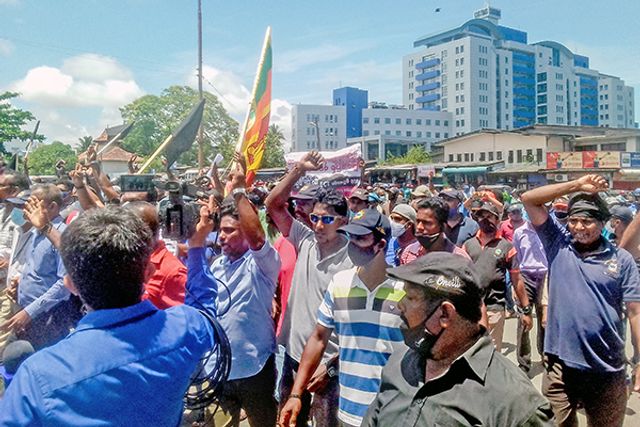
Sri Lanka’s government was pushed into crisis by a series of protests by Colombo Port workers last month against plans to privatise the port’s Eastern Container Terminal and hand it over to an Indian company. During the workers’ actions, Prime Minister Mahinda Rajapakse admitted that the US and India want to transfer the terminal to India’s Adani Ports and Special Economic Zone Limited.
Speaking at a port workers’ protest on July 24, Udeni Kaluthantri, the secretary of Jathika Sevaka Sangamaya, which is affiliated to the right-wing United National Party (UNP), revealed that when the union leaders met with Prime Minister Rajapakse at his ancestral home, he told them: [W]e can allow you to unload the gantry cranes, but can’t let the operations start [at the terminal]. I had to go home once, because I got hammered by the US and India. I won’t make the same mistake again.”
Rajapakse was referring to a demand by the unions to fit two gantry cranes at the terminal and start operating it under the government’s Ports Authority, without privatisation.
Workers protest against privatisation of Colombo port terminal
Kaluthantri added: During the last regime, the then Prime Minister Ranil Wickremesinghe told me, that you have a right to protest, but don’t protest against [the terminal] privatisation. That will offend India. We cannot protect our government if India is offended.”
Rajapakse’s reference to being hammered” pointed to the Washington-orchestrated regime-change operation in 2015, which ousted him as president and brought Maithripala Sirisena to power. New Delhi supported the political operation.
Washington backed Rajapakse’s brutal war against the separatist Liberation Tigers of Tamil Eelam and his anti-democratic rule, but was hostile to his growing relations with Beijing. The US wanted to integrate Sri Lanka into its military encirclement of China and make India a frontline state in its confrontation with Beijing.
After taking power, Sirisena appointed Wickremesinghe as prime minister. They initially halted all Chinese projects and began integrating the military, particularly the navy, with the US Indo-Pacific Command. They conducted joint exercises and sought to develop the island into a logistics hub. India also enhanced its military and political relations with Sri Lanka.
The cash-strapped Sirisena-Wickremesinghe government later turned to Beijing for loans and allowed the resumption of Chinese projects, but continued the military integration with the US and India. That explains Wickremesinghe’s statement to the UNP union leader about not being able to offend India.
The comments of both Rajapakse and Wickremesinghe demonstrate the subservience of Sri Lanka’s capitalist establishment to the interests of US imperialism, with which Indian Prime Minister Narendra Modi is aligned.
On July 24, the union leaders met with a representative of President Gotabhaya Rajapakse requesting his assurance that the terminal would not be privatised. He refused to issue any such guarantee.
Terrified that workers’ anger over the privatisation would spiral out of their control, the union bureaucrats initiated an impotent Sathyagraha” (sit-down protest) from July 29, again demanding a written promise” from the president that [the terminal] will not be privatised.” Some of the unions also tried to divert workers’ opposition into a nationalist anti-Indian campaign.
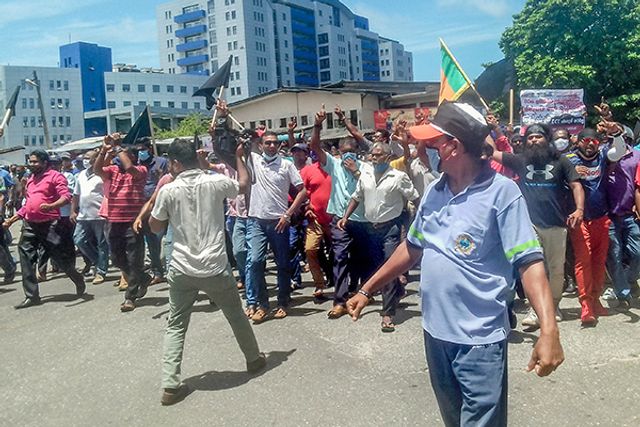
Anti-privatisation protest in Colombo
However, 10,000 workers began a strike on July 31, blocking all roads into and inside the port, completely paralysing it.
President Rajapakse not only refused to talk to the unions but attacked the workers’ struggle as an extremist act of sabotage,” declaring: I cannot be intimidated [by such actions].”
Facing this threat, the union leaders met with the prime minister at his residence again to obtain another empty pledge not to proceed with the agreement with India. Mahinda Rajapakse gave a promise,” but only to prevent the strike continuing, just five days before the August 5 national election. The union leaders immediately called off the stoppage.
The government, as well as the unions, feared the strike would attract the support of other sections of workers also angered by decades of attacks on social and democratic rights.
Behind President Rajapakse’s threat and the manoeuvres by his brother the prime minister lies the pressure of India and the US, which want to gain control over the strategic Colombo port. The president and prime minister, well aware they are treading on a geostrategic minefield, do not want to annoy Washington and New Delhi.
Mahinda Rajapakse’s previous regime allowed China Merchant Port Holdings (CMPH) to build and operate the Colombo South harbour in 2012. The Chinese company also constructed the Hambantota harbour and, a few kilometres away, the Mattala airport. In 2016, the Sirisena-Wickremesinghe government leased the entire Hambantota port to CMPH. The US and India expressed their concerns and accused China of creating a debt trap” to secure the port.
The Indian company’s bid for the terminal is not merely to extract profit from it. It is a move to strengthen India’s grip over the key port—another step in Washington’s economic and military offensive against China, which began under the Obama administration’s pivot to Asia.”
Amid the world capitalist crisis escalated by the COVID-19 pandemic, US President Donald Trump has intensified the provocations against China. The US has formed the Asia-Pacific quadrilateral (Quad) alliance with Japan, India and Australia, against China. It also backed India in the deadly border clashes that flared in the Himalayan region between China and India in July.
The Colombo Port workers’ struggle has demonstrated that the US and India want Sri Lanka tied to their strategic and military moves against nuclear-armed China, raising the danger of a catastrophic war in which the island would become embroiled.
With untouched golden beaches to discover, atmospheric train rides through tea-carpeted hills, and ancient temples to admire, Sri Lanka is Lonely Planet’s top country to travel to in 2019. Here are 12 more reasons to visit.
Jayanath Colombage headed the Sri Lanka Navy between 2012 and 2014, and since November last year, he has been the foreign affairs advisor to President Rajapaksa.
The Sri Lankan government on Friday appointed ex-commander of the Navy Admiral Jayanath Colombage as the new Foreign Secretary, days after the new Cabinet took the oath with President Gotabaya Rajapaksa retaining the key defence ministry.
Mr. Colombage, 62, replaces Ravinatha Aryasinha, a career foreign service officer. He headed the Sri Lanka Navy between 2012 and 2014, and since November last year, he has been the foreign affairs advisor to President Rajapaksa.
This is the first time that a non-foreign service person has been appointed as the Secretary to the Foreign Ministry.
President Gotabaya administered the oath of office to the 28-member Cabinet which is two less than the 30 allowed by the Constitution on Wednesday. He retained the Ministry of Defence while his elder brother and Prime Minister Mahinda Rajapaksa were assigned finance, urban development and Buddhist affairs ministries.
Mr. Colombage served the Sri Lanka Navy for 36 years and retired as the Commander of the Navy in 2014. Under the repatriation programme initiated by him, nearly 19,000 stranded Sri Lankans were repatriated from 94 countries.
Meanwhile, Sri Lanka’s oldest political party, the United National Party (UNP) which suffered a humiliating defeat in the parliamentary election has put the issue of appointing a new leader in limbo despite expectations that former prime minister Ranil Wickremesinghe would step down.
A party statement has said that it will appoint a young leader from among those who have been identified or would voluntarily come forward to take over the leadership.
Mr. Wickremesinghe, who led the party since 1994 and has been blamed for a string of electoral defeat, is hanging on to the leadership.
The UNP, for many years the main opposition party, was reduced to just 2% of the national vote in the election. It did not win a single seat from each of the 22 electoral districts and Mr. Wickremesinghe too was ousted from parliament for the first time since 1977.
His former deputy Sajith Premadasa’s new party won 54 seats with the help of its Tamil and Muslim minority allies and now sit as the main opposition party. Mr. Premadasa broke away after he lost the November presidential election to President Rajapaksa.
A Gazette revealing 196 new members of the Parliament who have been elected at the Parliamentary Election held on August 5 is out. We have to wait to know the names of the rest of the parliamentarians until respective parties announce their national list members.
Election results show a new trend in Tamil politics in Sri Lanka. The so-called Sri Lankan Tamil parties contested only in two provinces, Northern and Eastern that they claimed as their ‘traditional homeland’. What do the Election results signify? How should we read them?
Results of the Northern and Eastern Provinces
Although Sri Lanka is divided into 25 administrative districts, when it comes to the Elections it has only 22 electoral districts. Just have a look at the relevant 4 districts, Jaffna, the Vanni, Trincomalee and Batticaloa.
On the basis of these results, Tamil National Alliance (ITAK) is entitled to get 10 seats including one on the national list.
Most notable result is that the TNA stalwart Mavai Senathirajah failed to win in Jaffna District. And more interestingly, it lost its traditional position as D B S Jeyraj noted ‘the accredited premier political
configuration of the Northern and Eastern province Tamils’. How do we read this electoral failure of the TNA? The TNA was closely associated with the Yahapalana Government between 2015- 2019 and the main factor that mobilised the support for the UNP-led front at the Presidential Elections in 2015 and 2019. TNA and its conciliatory policies were strongly questioned by C.V. Wigneswaran of the TMTK and Gajendrakumar Ponnambalam of the ACTC.
These two parties represented in the Election as a radical Tamil alternative to the TNA that has failed miserably to either win constitutional reforms on a federal framework or obtain from the Colombo Government an adequate package of welfare and social development to Tamil people. It appears that Tamils were tired of their rhetoric that they firmly reiterate that they stand for Tamil rights, to eliminate their grievances and to fulfil their aspirations.
Most interestingly, in the last five years, they equally defend wittingly or unwittingly economic policies based on the fundamentalist version of neoliberalism advocated and implemented by the Yahapalana regime. Hence, the people in the Northern and Eastern Provinces naturally shared the same disappointment and discontent as the people, especially poor people, in other districts about the policies of the last Government. Therefore, the Election results should not be read in isolation since island-wide economic downturn had affected people irrespective of their ethnicity or religion.
The disappointment and discontent with the TNA and its association with the UNP seem to have generated in the parliamentary sphere two new trends in Tamil politics breaking the TNA’s almost monopoly position in Tamil politics after the defeat of the LTTE.
The first trend that is represented by C. V. Wigneswaran and Gajendran Ponnambalam appears to stand for a separate state and eventually they will seek an internationally supervised referendum among the Tamils to decide if Tamils decide to stay in Sri Lanka or to leave it. They may also strive to drag the Sri Lankan Government to the International Criminal Court (ICC). In this respect they would closely work with the Tamil diaspora in Western countries. Moreover, they would try to pressurise the Indian Union Government by linking with radical groups in Tamil Nadu.
The most interesting developments in Tamil politics that was reflected in the Election results has been the emergence of a significant trend that is supposed to work with the Sri Lankan Government seeking economic development, employment and increased social welfare. This pro- Government section is represented by Douglas Devananda and Kulasingham Dileepan – Eelam People’s Democratic Party; Angajan Ramanathan – Sri Lanka Freedom Party; Sivanesathurai Chandrakanthan alias Pillayan- Tamil Makkal Viduthalai Puligal and Sadasivam Vyalendran – Sri Lanka Podujana Peramuna. Initially, we have this kind of Tamil politics had been very much isolated from the Tamil people.
It may be too early to come to a definite conclusion on the issue of strengthening of this conciliatory political tendency and what would be its future. One may attribute this development to policies of former president Maithripala Sirisena who adopted conciliatory policies especially on the issue of land by handing over Government occupied land back to the people although the issue has not yet been completely resolved. Similarly, his choice for the post of Northern Governor a Tamil speaking person might have facilitated the Government’s contact with the people. What would be the policies of the new Government towards Tamils and the social and economic developments of their traditional habitats may be crucial as far as the future of these three tendencies is concerned.
TNA spokesperson, M.A. Sumanthiran’s appeal to other Tamil representatives to work together for uniform Tamil cause may not work immediately as pro- Government tendency would try to strengthen their line of approach through compromise and consultation. So far, an extreme version of identity politics has dominated in the traditional habitats of Tamils with almost no positive results. The Election results of 2020 seem to have raised an issue if the economistic politics can take the lead over identity politics. It may be too early to answer this question as the outcome depends on multiple factors. (The writer is a retired teacher of political economy at the University of Peradeniya. E-mail: sumane_l@yahoo.com)
History is known to change constantly. And, history is written depending on the changes that tend to take place during certain periods. Even Karl Marx has written that history is made up of various struggles and fights that had taken place among various social classes.
Hence, Sri Lanka’s political history has also been written containing various setbacks and triumphs. The victory that was gained by the SLPP in 2020 has already created a significant mark in the local political sphere. The reason for that is, people booting out the country’s oldest political party from the Parliament and then voting into office with an overwhelming majority the SLPP which is only two years old.
How did this political turnaround take place which the people would not have anticipated? Some may even not know as to who was behind this remarkable political transformation of the SLPP. He is none other than former SLFP stalwart D.A. Rajapaksa’s youngest son, Basil Rohana Rajapaksa, hailing from the Rajapaksa political clan of Giruwappattuwa in the Southern Province.
Basil, it is said has never sought publicity for the work he had done. Hence, many are unaware of his talents. However, Basil Rajapaksa had played a pivotal role in the local political firmament since the 1970s. He is a very shrewd and knowledgeable political strategist. He is also a workaholic. Basil had always stood behind the oppressed masses during his political career. Basil also has taken up challenges whenever they had been entrusted to him and had never shirked responsibility placed on his shoulders. He is also a dedicated servant and strives to fulfil whatever task entrusted to him 100 per cent.
D.A. Rajapaksa and Dandina Samarasinha Dissanayaka were blessed with nine children. They are Chamal, Jayanthi, Mahinda, Chandra, Dudley, Gotabaya, Basil, Preethi and Gandhini. Of the boys, the youngest is Basil and there was a noticeable feature in him. That feature was he had performed his duties to the letter and he was also known to complete his work right on time. As he grew older, Basil was able to sustain these traits. Even the rest of his family members were also aware of these gifts of Basil.
Staging an annual alms-giving event at the Medamulana ancestral home was a tradition. Even from his young days Basil was in charge of organising the alms-giving ceremony. His sister Preethi had even once remarked what great pains had been taken by Basil in carrying out the organisational work of this religious event annually at their ancestral house. Also, Basil had maintained documents regarding the harvest gained from the coconut trees at their Medamunlana house in those days.
For most of the remarkable political feats that took place in this country in the recent past what paved the way for it was Basil Rajapaksa’s skill at organisational work. He first broke into local party politics through the 1977 General Election. In that Poll where the UNP obtained a 5/6 majority Basil who contested the Mulkirigala seat was defeated. Basil was also the youngest politician that had contested the 1977 Poll. The SLFP was only able to get eight MPs elected at that election.
Providing political impetus
Minister of Mahaweli Development Gamini Dissanayaka who was part of the 1977 UNP regime of J.R. Jayewardene was a friend of Basil. Gamini had known about the talents of Basil. Basil had also worked for a period, attached to the said Ministry. During this period Basil had organised most of the internal activities at all elections when his elder brother Mahinda contested the Beliatta seat from the SLFP ticket. In 1989 as well as in 1994 when the SLFP regained political power, Basil was busy providing the political impetus to his elder sibling Mahinda’s political journey.
Several people have aired their views regarding the dual citizenship of Basil. Especially concerning his US citizenship. After his spouse Pushpa Rajapaksa had won the US Green Card lottery in 1997, his family members left to reside in the US. The 2005 Presidential Poll was decisive not only to Mahinda, but to Basil as well.
As at the time Basil was not a livewire of the SLFP, he was asked to provide the political boost to Mahinda from outside the party. The main issue was getting the Presidential nomination. In order to get the nomination for the Poll from the UPFA ticket, Basil fought for Mahinda’s seniority.
Basil was also the behind-the-scene collaborator in bringing the PM post to Mahinda Rajapaksa in the 2004 Chandrika Bandaranaike regime. An issue that emerged before the election was whether the Presidential Poll should be staged in either 2005 or 2006. At this time, Chandrika attempted to hold the Poll in 2006.
The Poll that was due in 2005, Chandrika sought to delay it by 12 months. In order to thwart her moves, Basil filed a petition with the Supreme Court (SC). The SC deemed that the Presidential tenure of Chandrika would end in 2005. Hence, it paved the way for the conduct of the Presidential Poll as it was originally scheduled, in 2005.
Basil reviewed how people had voted at the 2004 General Election. He monitored how the people had voted in the LTTE controlled areas in the North-East. He noticed that on the polling day the casting of ballots had increased from 20 per cent to 85 per cent from 3 to 4 p.m. If Mahinda were to win the Poll the conducting of the polling in the LTTE held areas had to be stopped. Basil decided to seek an order from the Court to this effect.
Actually speaking, the LTTE did not boycott the 2005 Presidential Poll. If the Tamil people cast their ballots they had to head to areas under the control of the Government. Through that, casting of rogue votes was overcome. Through the tactic used by Basil, Mahinda Rajapaksa was able to win through a certain percentage of the vote. Though most of those close to Mahinda had expressed the fear that the latter would lose, Basil had known for a certainty that Mahinda would triumph in the end.
Though Mahinda Rajapaksa was sworn in as the President, the UPFA Government only had 105 seats in Parliament. If the UNP, JVP and TNA were to strike agreements there was the threat of the Government being toppled? Hence, Basil began talks with the JVP and the SLMC. Basil’s goal was to do the necessary work and prevent the new Government from collapsing. At this time, the UNP General Secretary had said that at the coming Sinhala New Year period a UNP regime would be installed.
Basil decides to enter House
An incident that most were aware at the time was Karu Jayasuriya talking with him 17 MPs and joining the Government. Karu left the UNP due to him being overlooked for the post of Deputy Leader. The Government which had only 105 seats was ultimately able to command two-thirds majority due to the groundwork laid by Basil.
Basil never had any intention of heading to Parliament. But, due to the constant requests made to him by his elder brother Mahinda, Basil decided to enter the House in 2007. However, he did not enter Parliament from the SLFP ticket but from the National Congress.
Basil was adept and adroit at noticing the political changes that were taking place at the time. He was also able to study the strategies of the Opposition and defeat them. At one time during a vote on the Budget President Mahinda was not in the country. The JVP had said they will vote against the Budget. Basil having been joined by Minister Fernandopulle began individual talks with all Government MPs. At the end he was able to get the JVP on board as well.
At the height of the war in the North, politicians in Tamil Nadu began to feel the pinch. They were forced to adopt whatever tactics in order to please their voters. The Tamil Nadu Chief Minister went on a death fast.
That had an impact on Sri Lanka. The Indian Envoy briefed the President’s Secretary Lalith Weeratunga, Defence Secretary Gotabaya Rajapaksa and Basil regarding the crisis situation faced by his country. He informed them that if Karunanidhi were to die it will impact India seriously. The Envoy suggested that Basil should meet the Indian Prime Minister as a special rep in order to bring about the crisis situation between the two countries to a close.
On the same night, based on advice from the President, Basil flew to New Delhi. Afterwards he signed an agreement with then Indian Foreign Minister Pranarb Mukherji, National Security Adviser M.K. Narayanan and Foreign Secretary Shiv Shankar Menon and pacified the situation. The Indian Government stated that they will never support terrorism.
During the war Sri Lanka also received support from China and several nations in Europe. All those Envoys coordinated with Basil. Having met UN Secretary General Ban Ki-moon at a decisive moment Basil managed to gain the trust of the UN official. The UN official assured Basil that he will never act to destabilise the Government of President Mahinda.
Basil’s intervention also went a long way towards getting the support of all nations in the UN Security Council towards Sri Lanka. During the latter stages of the war, Sri Lanka’s foreign reserves had declined rapidly. In order to increase those reserves, the help of the IMF had to be sought. But, the IMF had mooted several proposals to which the Government was unable to agree.
In order to hold talks on debt, Basil flew to Washington. He met top officials from the IMF and said, You have your own policies, and we have our own. If we could reach a pact then we should try to work together. If not Sri Lanka will be forced to look elsewhere.” Sri Lanka then sought aid from countries such as Libya and loans from China and Iran. IMF realised that suspending the foreign reserves would not impact Sri Lanka.
Supplying fuel to Jaffna
After the closure of the A-9 route, supplying fuel to Jaffna was an issue. The problem was entrusted to Basil. He then got hold of a report containing details of fuel stores in the Jaffna Peninsula. The fuel that was needed was then supplied through a ship with protection supplied from the Forces. The issues that had stumped the Security Forces personnel were resolved by Basil.
It was Basil who gave leadership to the programmes such as ‘Uthuru Wasanthaya’ and ‘Negenahira Udanaya’. He was able to complete the infrastructure development of the Northern and Eastern Provinces in less than a five-year period. The resettling of those displaced, the removal of landmines, the construction of large bridges were some of the work supervised by him. When he initiated the ‘Gama Neguma’ programme, some ridiculed the venture initially. But, Basil was able to redevelop scores of villages through his novel concept.
The UNF-led regime, when it was installed on 9 January 2015, proved to be decisive for Basil. Some who had contributed to the ousting of the Mahinda Rajapaksa Government began to level baseless criticism against Basil. They charged it was all Basil’s work. They even gave political connotations to a photo taken of Basil at the BIA, saying that after the defeat Basil had fled the country.
However, Basil knew who was behind the mudslinging campaign that had been orchestrated against him. He then decided to bide his time at his residence in California. He also saw how some of the frontline SLFP MPs were receiving ministerial posts from the new UNF Government. Several of those MPs had gone behind then President Maithripala Sirisena seeking such posts in the new regime.
Basil also knew well that the Maithri-Ranil marriage would be short-lived. The new Government, instead of working for the country and its people, began to go on a witch-hunt against those in the previous Rajapaksa regime. Most of the cases were filed against Basil by the FCID. Having been informed of the situation, Basil decided to return to the country.
After arriving home, Basil was forced to spend most of his time fighting a spate of legal cases that were filed against him. Each day was spent in courtroom. If there were any free days in between attending Courts in Hulftsdorp, Kaduwela or Pugoda, on such days he was summoned to the FCID.
Once, after being questioned by the CID throughout the day, he was taken to the Kaduwela Magistrate’s Court around 11 at night. Surprisingly, by the time he was taken there, the Magistrate was still present in Court, and even more surprisingly, a prison bus was already there, ready to take Basil to prison.
In the meantime, with the CBSL Treasury Bonds scams taking place in 2015, the anti-Government sentiments began to rise. Those UPFA MPs who had obtained posts from the new Government were forced to feel ashamed of their act as the new regime began to hound their political rivals most brazenly.
Joint Opposition
It was at this time that those opposed the views of the UPFA, began to function as the Joint Opposition (JO) in Parliament. They even sought the Opposition Leader post but then Speaker Karu Jayasuriya did not heed their request. At this time the real Opposition’s work was done in the House by the JO. At this time Basil had put in place plans for the defeat of the political rivals of the JO. He did this work during the time that he was imprisoned.
Another boost he received was the massive number of people who had converged at the Medamulana residence to welcome Mahinda upon his defeat at the Presidential Poll. Afterwards the ‘Mahinda Wind’ began to seep through country, having begun at Nugegoda.
In November four years ago, Basil decided to register the SLPP. He created a programme for the SLPP to encompass the 14,032 Grama Niladhari Divisions of the country. Basil also had the computer data at his disposal to know beforehand those who had expressed their allegiance to his party from every area here and those who were not so. He also saw how the political landscape began to change towards the SLPP. The future measures were initiated by him accordingly.
The LG Poll staged on 10 February two years ago was the maiden Poll contested by the SLPP. Fulfilling Basil’s aspirations, the SLPP received a total of 5,006,837 votes and obtained 3,436 seats at LG bodies from the Poll and became the country’s new political force.
It was through the shrewd political strategy implemented by Basil that Gotabaya Rajapaksa was able to triumph at last year’s Presidential Poll with 6.9 million votes. Basil is also equipped with a Digital APP that covers all electorates here politically. Therefore, he is able to predict how the people would vote at Polls as he has gathered data from 10 houses from each electorate.
We will certainly receive over 130 seats at the Poll. Our hope is that during the final stage of this election, the people will grant us over 150 seats. Some of the parties that support us will probably receive four or five seats. The TNA will win the Districts of Vanni, Batticaloa and Jaffna. From the total vote that is received by us our closest rival will not even receive half of it. I also would like if the JVP will also receive at least some seats.
This could be a controversial remark. Why I say this is when you look at the Opposition in the last Parliament, they were reduced to a bunch of jokers. Some even uttered foolish remarks. Some made jealous and hateful comments. I also would like to predict that one of the country’s oldest political parties would be reduced to the fourth place at this Poll.” The readers only need to look at the 5 August General Election results to decide for themselves as to the veracity of Basil’s prediction.
Basil Rajapaksa is no doubt at the forefront of the local political firmament as a master political strategist. He has proved his skill to all and sundry. Despite these achievements Basil continues to lead the life of an ordinary person with simple and a charming demeanour. Though he continues to engage in politics that is not his true love. He is a farmer at heart. A land in Hambantota that was bequeathed to him by his late father D.A. Rajapaksa is now being cultivated by him. Even when he resides in California, he derives much satisfaction through the growing of local vegetables. Basil Rajapaksa is a political heavyweight which this country is badly in need of presently.
State Minister of Provincial Councils and Local Government, retired rear admiral Sarath Weerasekara who assumed duties yesterday, pledged to remove all clauses — in the 13th Amendment to the Constitution — which are detrimental to the well-being of the nation.
We will not devolve police and land powers to the provincial councils,” he said while highlighting the fact that handing over the State Ministry of Provincial Councils and Local Government to him might have been a plan of destiny because he was one who vehemently opposed the 13th Amendment.
The state minister said the government would use its two-thirds majority in Parliament to remove all draconian laws in the Constitution and pledged to make every city in the country beautiful with cooperation of the local bodies.
I will also restore the Mulleriyawa lake which is of historical value because it is the location where the locals defeated the Portuguese,” he said.
Local Government and Provincial Councils Ministry Secretary J.J. Ratnasiri said ministry staff were ready to work to fulfill the government’s prosperity policy (Saubagayaye Dekma).
Defence Secretery retired major general Kamal Gunaratne, several high ranking army officers, clergy and several guests were present at the ministry to welcome the new state minister.
President Gotabaya Rajapaksa has decided to re-commence, without delay, the programme to provide employment opportunities to 150,000 persons that was halted due to the General Election, the President’s Media Division said.
The number of unemployed graduates to be recruited is 50,000. For the remaining 100,000 jobs, candidates will be selected from families of the lowest strata of income earners in the society.
The programme to employ 50,000 graduates and 100,000 low-income earners was formulated within weeks after President Rajapaksa assuming office in November last year.
Shortlisting suitable candidates from applications received from graduates commenced in the first week of February. A Multi-Purpose Development Task Force was established to recruit 100,000 low-income earners.
The objective of the programme is to transform Sri Lanka into a country free from poverty as per the Saubhagyaye Dekma” policy statement of the President, the PMD said.
Chairman of the Election Commission directed to suspend the program to offer jobs for 150,000 unemployed persons following the announcement of the General Election 2020. Accordingly, the programme was suspended.
Immediately after the conclusion of the General election on the 5th of August, President Rajapaksa took measures to establish the executive of the Government adhering to the provisions given in Chapter VIII of the Constitution.
The Prime Minister of the new government took oaths on Sunday, the 9th of August. The Secretary to the Prime Minister was appointed on the following day. A week after the election on August 12, both Cabinet ministers and state ministers were sworn in. Secretaries to the Ministries were appointed on the following day (August 13).
The inaugural parliamentary session will ceremonially commence on the next Thursday (20). Following the formal establishment of the administration, the President has decided to implement the programme of providing 150,000 employment opportunities without any delay.
The relevant list of graduates eligible for employment will be published on the official website of the Ministry of Public Services, Provincial Councils and Local Government on next Monday (17).
The respective Ministry will commence sending letters of appointment to those who got selected immediately. Appointed candidates should report to their nearest Divisional Secretariat on September 02.
The programme to provide employment to 100,000 poorest of the poor will be implemented by the Task Force established solely for this purpose from 02nd, September.
Attorney General Dappula De Livera today strongly denied media reports alleging that he has approved the Millennium Challenge Corporation (MCC) Compact agreement.
The Attorney General further informs that the matter is still under consideration, the AG’s Coordinating Officer Nishara Jayaratne said.
The Experts’ Committee appointed to review the proposed Millennium Challenge Corporation Compact (MCC) had handed over its final report to the government in June.
The report was subsequently made public while it urges the government to reject the agreement.
The MCC agreement is currently being reviewed by the Attorney General’s Department.
The Working Committee of the United National Party has decided to take another six months to elect a new leadership.
According to party sources, the UNP Working Committee met at the Sirikotha party headquarters this morning to discuss the party leadership and the post of National List MP for more than two hours.
The United National Party (UNP) suffered a crushing defeat in the August 5 general elections, after which Ranil Wickremesinghe, who had been the party’s leader for 26 years, decided to resign.
Accordingly, 8 names were proposed for the new party leadership.
Party General Secretary Akila Viraj Kariyawasam, Deputy Leader Ravi Karunanayake, National Organizer Navin Dissanayake, Party Treasurer Daya Gamage, Deputy General Secretary Ruwan Wijewardena, Vajira Abeywardena, Arjuna Ranatunga and Palitha Range Bandara have been nominated.
Also, former Speaker Karu Jayasuriya had stated yesterday that he was ready to take over the leadership of the party if requested.
UNP Deputy General Secretary Ruwan Wijewardena also issued a statement yesterday stating that a comprehensive reorganization program is essential to re-emerge as a political party.
However, at today’s UNP Working Committee meeting, former Speaker Karu Jayasuriya had a lengthy discussion regarding the appointment of the UNP leader.
Navin Dissanayake, the National Organizer of the party, speaking in favor of Karu Jayasuriya has stated that he is suitable for the party leadership.
Ranil Wickremesinghe has stated before the Working Committee that Karu Jayasuriya has informed him that he would be willing to take over the leadership of the party and accordingly, it could be considered as well.
However, Ravi Karunanayake has said, “There is no urgency about the leadership yet. We can make a decision in a little while.” Ranil Wickremesinghe responded, “I would like to hand over the leadership. therefore decide among yourself. ”
Speaking to the Working Committee, Vajira Abeywardena said, “As the election was lost, we will wait for a while to make a decision about the leadership and we will talk about it later. ”
However, many in the Working Committee are of the view that a young person should be appointed for future leadership.
Accordingly, the Working Committee has agreed to delegate responsibilities to those currently nominated for the leadership of the party and to select the future leadership based on their performance.
They will be given six months to do so and Ranil Wickremesinghe will continue to lead the party for the next six months.
Also, the National List seat won by the United National Party was discussed at the Working Committee meeting today.
However, no agreement has been reached on that either.
Meanwhile, the time given to political parties that have won National List seats to nominate names is due to end today.
Police Media Spokesman SSP Jaliya Senaratne stated that over Rs. 220 million has been transferred through the bank accounts of persons involved in drug trafficking in the last two weeks alone.
He was speaking at a media briefing held at the Police Headquarters today.
Also, a woman has been arrested for circulating over Rs. 310 million earned from drug trafficking in five accounts in two banks during the past three years.
It has been revealed that the suspect arrested today in Mt. Lavinia is the sister of a drug trafficker who is in jail.
At the time of her arrest nearly Rs. 3 million was found in her bank accounts.
Meanwhile, Police Media Spokesman SSP Jaliya Senaratne stated that the fingerprints and photographs of the Angoda Lokka, an organized criminal who was allegedly murdered in India, have already been sent to India.
Former President Chandrika Bandaranaike Kumaratunga says she is not surprised that the Sri Lanka Podujana Peramuna has a two-thirds majority at a time when the two main parties in the country have been destroyed.
She stated this in a special statement to the media.
Former Director of the State Intelligence Service Nilantha Jayawardena today admitted that when he received information through a foreign intelligence service that a suicide attack was being carried out in the country, he knew that Saharan had the physical and mental capacity to carry out such an attack.
He was testifying before the Presidential Commission of Inquiry probing into the Easter attack for the 11th day today.
Former DIG Nilantha Jayawardena, the former Director of the State Intelligence Service, was summoned to testify before the Commission today for the 11th time.
The Additional Solicitor General, representing the Attorney General, questioned whether the State Intelligence Service already had information on the names of persons named in the foreign intelligence service.
The President of Sri Lanka has handpicked & appointed a first
time National List nominee as Justice Minister who was not a politician, never
a Member of Parliament and not a public figure except to serve as a lawyer to
clients and regular speech maker following Presidential elections. The
appointment was given amidst much controversy and appeals not to do so. The
onus certainly is on the appointee to make good of the appointment by serving
the nation’s interest first, rather than the parochial interests of one’s own
religion and co – religionists. The President’s vision and platform to rally
citizens has been based on the theme One Law One Country. The citizens would
like the Justice Minister to make clear his position on the following & the
citizens are asked to watch the Justice Minister deliver on the wishes of the
People based on the Vision of H.E the President Mr. Gotabaya Rajapakse.
A. One Law One Country means the enactment of
a Uniform Civil Code and nullification of all separate legal systems &
personal laws
B. Official Language of Sri Lanka being
Sinhala & Tamil means NO ARABIC SCHOOLS/MADRASSAS operating in Sri
Lanka.
C. Equality before the Law
means:
· Strict adherence to Article 12 of the
Constitution
Article 12 of the Constitution lays down the
general rule of equality that all persons are equal before the
law and are entitled to equal protection of the law and that no citizen shall
be discriminated against on grounds of race, religion, language, caste, sex,
political opinion, place of birth or any of such grounds
· No separate food labeling for one ethnic group – that ethnic group cannot demand all companies to pay
to a private company to have anything exported with a label that does not
belong to the State. The private company can pay to the companies exporting
& have labels placed on items sent to countries where that ethnic group
demands such labels. It is unfair to force other ethnic groups to pay for
labels to the wishes of one ethnic group.
· No Shariah courts or laws in Sri Lanka– there is only ONE LAW for ALL CITIZENS
· No separate marriage laws & no polygamy– if Sinhalese & Tamils can have only 1 legal
spouse, that same law should apply to Muslims as multiple wives means multiple
children to whom the State must spend for free education and this violates the
law of equality to all.
· No separate helmet laws– if police require all to wear helmets it is
applicable to all & punitive measures must be adhered to sans political
involvement
· No proliferation of Mosques and Madrassas in Sri Lanka
· The total no of places of worship of any given
religion should be in proportion to its percentage of adherents in the country.
If there are 10% Muslims in the country then the percentage of Mosques must be
within 10% vis a vis the total number of places of worship
· No building of Mosques within Buddhist citadels such
as Anuradhapura, Mihintale, Mahiyangane, Mahanuwara, Dambulla etc.
· No use of Loudspeakers at Mosques for purpose of
Azan
· No strategic use of natural Birth to subvert the
dominance of the majority community by increasing the population of Muslims
over and above the national average
· No opposition to enactment of the Animal Welfare Bill
and similar legislation on the ground that Muslim countries do not protect
animals nor prevent animal abuse through legislation nor punish offenders that
commit acts of cruelty to animals
· Ban on Animal Sacrifice and ritual killing of animals
in places of worship
D. The citizens wish to have a Public
Statement by Justice Minister on the following:
· Open inquiry into how under a previous Justice
Minister who was a Muslim an excessive number of students from one ethnic
community entered Law College
· Assurance that no interference or influence will be
made to release or dilute the charges against a Muslim lawyer arrested &
held under PTA in connection with the Easter Sunday Mass murder that
constituted a crime against humanity
· Any Hate Speech legislation must cover religious texts
that call upon one religion to target another religion & vilify their
followers as infidels or Kaffirs
· Action on suicide terrorism as an increasing number of
global terrorist acts are by Islamic suicide terrorists
· Action against terrorists under terrorism laws
· Action against separatism under 6thamendment
to the Constitution of Sri Lanka
Dr. Nalin the Silva refers to an article in the recent issue of Science (dated 11August 2020 although Science is a weekly journal) entitled: Senior U.S. lawmaker wants National Academies to scrutinize racism in science”, and uses this to jump to another topic, which he says is NOT discussed in the above article. In Dr. Nalin de Silva’s article (published in his website Kalaya), entitled බටහිර විද්යාවේ ජාතිවාදය”, or Racism of Western Science”, he uses the Science” article to give seeming credence to a point of view totally unconnected with the article.
He uses the Science article on racism among scientists to elaborate on what is the cultural narrative available for Western Science, other than the Western Christian Culture? (බටහිර විද්යාවේ බටහිර ක්රිස්තියානි සංස්කෘතියෙන් පිට සංස්කෘතියක සංස්කරණය කෙරෙන කතන්දරයක් (ප්රවාදයක්) පිළිගැනීමට ඇති සම්භාවිතාව කුමක් ද?)”. This becomes a spring board to beat his favourite bête noire – namely, Western Science” which is a ”Patta-pal-boruwa” (i.e., well-fermented lie) concocted within the Western Christian Narrative, and hence having no validity in other cultures. Of course, Dr Silva prefers to ignore that all this has nothing to with the fact that some scientists happen to be racists, just as some Buddhists and some Christians happen to be racists.
Dr. Nalin de Silva and others like
him fail to distinguish between (a) the cultural adaptations or doings of
practitioners of various professions who may use universal truths
in their professional work, and (b) the universal truths themselves. This is
true in every type of human endevour, not only in science but even in a
narrative” like Buddhism that Dr. Silva has not yet openly rejected as a mere
cultural concoction.
For instance, there is a distinction
between the Buddha’s teaching (the facts” discovered and enunciated by the
Buddha), and the practices and beliefs of Buddhism as enacted by
various Buddhist cultures. For instance, the Buddha rejects the caste system based
on birth, but various monks, or groups of temples belonging to a
Nikaaya” will practice it.
The Buddhist teaching itself is presented in different forms, in different
cultures. For example, the Dhyaana tradition in India becomes the Zen
tradition of Japan and takes priority over other practices. The entirely
pacific teachings of the Buddha are modified and even martial arts are included
in some forms of oriental Buddhism, ostensibly for keeping fit.
Then it is further justified as being for self-defence though the
concept of the self is non-existent in early Buddhism. These
modifications and cultural adaptations” are corruptions of the original
universal teaching of the Buddha. Even the Buddhist Saints (Arhants) and
Bodhisatvas are re-interpreted to fit in with the demands of various
nationalisms. For instance, God Natha, the serpent-headed divine figure
venerated by the Naga people is re-interpreted as Mathreeya
Bodhisatva. Divine figures of other religions are given a place as other Bodhisatvas
or at least as Buddhist devas. The mighty Greek conqueror Alexander – Iskander
in Persian, becomes God Skandha and a shrine in the south of
Sri Lanka is ascribed to him. So, Alexander is venerated as a
Buddhist” divine figure.
However, these modifications do NOT mean that the universal truths taught
by the Buddha are merely a matter of culture, and have no validity beyond
confines of those cultures. Only the cultural practices, which have nothing to
do with the original Arya Sathya”, and other teachings are subject to cultural
relativism.
Dr. Nalin de Silva is well known as a person who has claimed that science is a
well-fermented lie – a Patta Pal Boruwa”, although he earned his living by
practicing this alleged lie, and misguiding young Sri Lanka students away from
it, and adulating occult, unsubstantiated belief systems like astrology and
divine revelation. I think, in replying to a query by Dr. Carlo Fonseka,
Dr. Nalin de Silva wrote ,අපි පේන අසමු, කේන්දර බලමු, ….etc, on 16-June 2015 අපට වෙච්ච දේ – 2) and embrace the
very Brahmajaala” that the Buddha condemned. In effect, science is a
well-fermented lie, while reading horoscopes is a way to getting at the truth,
according to this ex-Dean of Science.
The basis of Dr. Nalin de Silva’s objections to science seems to be that
scientific truths are (according to him) just cultural artifacts which
are in essence lies. So, the claim that the earth is a spheroid (and not
more or less flat) is a patta-pal-boruwak”, while the laws of
electromagnetism” that make computers possible are a mere manifestation of a
Western Cultural Construction. According to Dr. de Silva and his followers,
when science” is properly de-constructed”, there is nothing in it but a
patta-pal-boruwa”.
And yet, Dr. Silva would say that although science is a
patta-pal-boruwa”, one can use it for practical purposes (e.g, use a computer
or listen to TV) as a set of useful lies” that work! So he admits
that science is a lie” that works in every culture! This is nothing but sheer
casuistry.
What is the underlying cultural narrative of science? The cultural
narrative of science was laid down by the Greeks, with Archimedes using the
experimental method to study floating bodies, levers and pulley systems, while
the use of mathematics in these investigations was laid down by people like
Heraclitus and Pythagoras. They in turn inherited the analytical and rational
approach contained in the Buddhist teachings (e.g., the Gnana Sutta and the
Kalama Sutta) that had reached them through the silk road a century
earlier. It was the Buddha who said, if you have to determine if a piece of
metal is a base metal, or a Nobel metal, then you use the touch stone to test
it. In the same way, Monks, you determine the truth of the Dhamma by trying it
out”. That was the first clear exposition of the experimental method,
several centuries before Archimedes. I have discussed the links of Greek
Science with early Buddhist thought in my book A Physicist’s view of
Matter and Mind” (World Scientific, 2014).
But science has come a long way since the time of Archimedes, Ptolemy and
others. What are the universal truths of science? Science holds that there are
several types of energy fields. The energy in these fields can manifest in the
form of particles or waves which are called excitations”. There are several
types of excitations (particles), these being. e.g., quarks,
leptons, photons, or gravitons. Whether the excitations are waves, or
particles, is determined by the boundary condition” used to specify the action
of the measuring apparatus on the system under observation. How the particles
(or waves) interact, what laws they obey etc., can mostly be
deduced from simple assumptions like the isotropy of space and time (together
forming at least four dimensions), and basic symmetries (gauge symmetry,
Lorentz symmetry). The movements of particles obey a minimum principle
known as the principle of least action”. It is that principle that makes a ray
of light follow the shortest path between two points. Aristotle was intrigued
by this teleology”, but today we understand it fully as a consequence of
gauge symmetry”. Using these, one can deduce the various equations” that
govern the universe, and arrive at the equations of Einstein, Dirac, Maxwell,
Schrodinger and others.
There is
nothing Christian” in all this. In fact, some writers have claimed that the
narrative” in terms of energy fields is very much in line with
Buddhist and other Indian thought systems.
A tensed situation was witnessed today at the Presidential Commission Inquiring into political revenge and victimization.
This was regarding an interview given by former Solicitor General Suhada Gamlath to a weekend newspaper regarding the legal status of the M V Mahanuwara vessel of Avant Garde.
Former Senior Additional Solicitor General Wasantha Navaratne Bandara, appearing for Dilrukshi Dias Wickramasinghe, the former Director General of the Bribery Commission, asked Suhada Gamlath on what basis he had submitted and interview to a newspaper stating that Dilrukshi Dias Wickramasingh was performing her duty subject to political revenge.
Former Solicitor General Suhada Gamlath stated that he made this statement due to the media coverage of a conversation between Dilrukshi Dias Wickremasinghe and Nissanka Senadhipathi, Chairman of Avant Garde.
The lawyer representing Nissanka Senadhipathi also spoke and the presiding judge ordered that the audio recording be submitted to the commission on the 28th.
However, the Commission strongly objected to certain allegations made by former Senior Additional Solicitor General, President’s Counsel Wasantha Navaratne Bandara against former Solicitor General Suhada Gamlath.
He was strongly advised by the Chairman of the Commission to act with dignity.
By Kelum Bandara/Daily Mirror Courtesy NewsIn.Asia
The ruling Sri Lanka Podujana Peramuna (SLPP) had fielded 16 members of two professional bodies and a dozen of them got elected, outperforming traditional, entrenched political candidates.
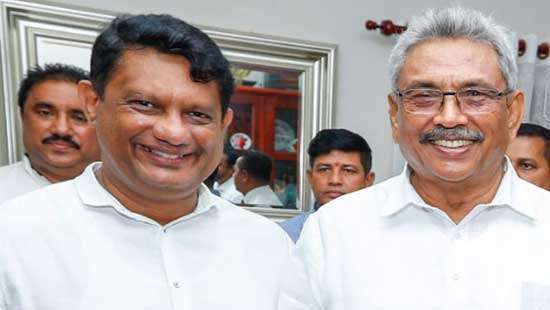
(The featured image shows Dr.Nalaka Godahewa, an engineer and management professional, with Gotabaya Rapakasa. A member of Gotabaya Rajapaksa’s Viyathmaga organization, Godahewa got the highest number of preference votes in Gampaha District -325,479 as against 316,544 secured by professional politician Prasanna Ranatunga)
Colombo, August 13: The results of the August 5 Parliamentary Elections reflected on new political dynamics in Sri Lanka, be it in the north and the east, or outside. Sri Lanka Podujana Peramuna (SLPP), led by President Gotabaya Rajapaksa and Prime Minister Mahinda Rajapaksa, polled a resounding number of votes in all the areas bar the north and the east. The percentage was above 70 in some areas.
The traditional political landscape has witnessed a clear shift given the way SLPP voters have marked their preferential votes this time around. Voters had limited choices in marking their preferences for their representatives since they had to choose three members only from among those nominated by the respective parties only. There was no choice beyond.
Subject to such limitations, the voters who exercised their franchise at this election have tried to seek a departure from traditional politics at varying degrees in different electoral districts of the country. As far as the SLPP is concerned, the people have made it a point to infuse new blood into parliamentary politics. The SLPP allocated slots for such newcomers on its nominations lists. And they are the ones who were originally identified with the professionals’ wing called ‘Viyath Maga’ and ‘Yuthukama organization’, which advocated the presidential candidacy to President Rajapaksa last year.
Nominations were given to 16 members of these two bodies, and a dozen of them got elected outperforming traditional, entrenched candidates or relegating them to lower positions on the selected lists. This is a phenomenal change in Sri Lankan politics where people are disillusioned with traditional politicians due to their perceived failures to live up to public expectations. In fact, Gotabaya Rajapaksa is the first apolitical President of Sri Lanka. His ascendancy to the presidency is also a phenomenon that can partly be attributed to some people’s desire to experiment with non-career politicians.
This dynamic change in politics is manifested in the assignment of subjects and responsibilities to the newly elected politicians. In the appointment of the chairmen of the District Coordinating Committees (DCC), the President has handpicked the professionals-cum- politicians for most districts. The DCCs are bodies with sufficient authority for decision making at district levels as far as administrative and development matters are concerned. Likewise, a fair number of newcomers have been assigned state ministry portfolios. The representatives of Viyath Maga and Yuthukama have already been appointed to most of the statutory boards. All these moves indicate the fact that executive authority is laid in the hands of the non-career politicians or technocrats to a considerable extent in the implementation of the policies envisaged in the manifesto of the government. It is a clear departure from traditional politics.
Three Strands Of Tamil Politics
The political complexion of the northern and eastern constituencies was found to be drastically changed according to the election results this time. And, it is yet another radical shift in political dynamics of Tamil polity. The Tamil National Alliance (TNA), which is an amalgam of three parties, found its parliamentary representation reduced from 16 to ten. It is an upfront challenge to its claim of being the sole representatives of the Tamil speaking people in the north and the east Sri Lanka. Still, the TNA remains the single largest political force in the north. Its vote bank plummeted quite drastically because four different parties, including Sri Lanka Freedom Party (SLFP), made inroads into it.
These four parties that impacted the TNA basically represent two different strands in Tamil politics. Tamil Makkal Thesiya Kootani (TMTK) and Ahila Ilankai Tamil Congress (AITC) won three seats at this election. They contested separately, but have common extreme demands for power-sharing. They agitate for extensive power-sharing so much so that their demands sometimes borders on a separate state. They have polled a segment of Tamil votes mainly in the north and to a certain extent in the east.
Besides, Eelam People’s Democratic Party (EPDP) secured two parliamentary seats in the north and the SLFP one seat. This is yet another development. In fact, it is the first ever parliamentary representation for the SLFP in Jaffna. These two parties favour power devolution, but lays emphasis more on economic development of their areas. For them, development comes first and devolution later. Likewise, these parties are in alliance with the governing SLPP. Their ability to attract a fair number of Tamil votes suggest a new line of thinking among northern constituencies who used to get carried away by Tamil nationalist demands during previous elections. The TNA is somewhere in between the two, but lays more emphasis on power sharing on Federal lines. Accordingly, three strands of political thinking now prevail among the northern constituencies.
TMVP And Its Eastern Identity
In the eastern province, gains made by the Tamil Makkal Viduthalai Pulihal (TMVP) are noteworthy. It won one parliamentary seat from the Tamil majority Batticaloa District and trailed behind the TNA only by a narrow margin. This is a result of political dynamics unique to the eastern province. It is a province with a lot of development disparities on ethnic lines. The Muslim pockets of the province such as Kattankudy are streets ahead of Tamil areas in terms of development. The Muslim political representatives have always been party to the ruling side, and they have succeeded in securing allocations for the infrastructure improvement of their areas. In certain instances, there has been inequitable distribution of budgetary allocations, though. On the contrary, the TNA kept on agitating for power devolution. Such political approach of the TNA kept the Tamil areas lagging far behind the Muslim areas in economic prosperity. There is self-realisation now among Tamil constituents that they should team up with the party in power to see development. It is one reason for the TMVP to win votes this time. Also, communal politics also played a role this time.
The TMVP, in its election campaign, took a tough position against Islamic extremism. It was critical of signs of radicalisation in the east. It could drive home its message effectively because of the ISIS inspired attack on Zion Church in Batticaloa. The TMVP is also a party that advocates the eastern identity of Tamils.
Ours is a party with its origin in Batticaloa. Tamil politics has always been dominated by those in the north. We are particular about our eastern identity,” party spokesman Asath Moulana told this columnist.
The TMVP’s achievement under its incarcerated leader Sivanesathurai Chandrakanthan alias Pilleyan should be taken into account against such a backdrop. It is a real dynamic shift in the east and characteristically different to the north.
The TMVP will be a party to the government this time. If it delivers to people in terms of what it promised, it will make further gains.
I have the great honor to announce that I’ve picked @KamalaHarris — a fearless fighter for the little guy, and one of the country’s finest public servants — as my running mate,” the former vice-president wrote on twitter.
Washington, August 12: Joe Biden, the presumptive Democratic nominee for president, has named Kamala Harris, who is of mixed Black and Indian heritage, as his pick for vice-president in a much anticipated announcement Tuesday that was described as historic” and seismic” by Democrats, including many ecstatic Indian Americas, and non-partisan observers.
Biden announced his pick in a tweet late afternoon as speculation reached a feverish pitch on all leading TV channels and social media. I have the great honor to announce that I’ve picked @KamalaHarris — a fearless fighter for the little guy, and one of the country’s finest public servants — as my running mate,” the former vice-president wrote on twitter.
His campaign followed up with a more expansive explanation of the pick. Joe knows more about the importance of the Vice Presidency than just about anyone, and he is confident that Kamala Harris will be the best partner for him to finally get the country back on track,” it said in a statement, and added, Kamala will be ready to tackle the work that is needed to heal our country on Day One of the Biden-Harris Administration.”
Kamala Harris, moyhrt Shaymala Gopalan and younger sister Maya Harris
In her first public response to the announcement, Harris wrote on twitter:, shortly: @JoeBiden can unify the American people because he’s spent his life fighting for us. And as president, he’ll build an America that lives up to our ideals. I’m honored to join him as our party’s nominee for Vice President, and do what it takes to make him our Commander-in-Chief.”
A win in November will make Harris the first female vice-president of the United States and set her up the presidency in 2024, at the end of Biden’s first term, or 2028. Most vice-presidents have gone on to run for the top job themselves and win, with some exceptions such as Al Gore.
Indian Roots: Kamala Harris, back row, left. From left: her grandmother Rajam Gopalan, grandfather P.V. Gopalan and sister, Maya Harris. Front row: Maya’s daughter, Meena, left, and Harris’ cousin Sharada Balachandran Orihuela.
President Donald Trump, who had earlier called Harris a fine choice” if picked by Biden, felt differently and accorded the announcement the full Trump treatment. He slammed her as nasty” and the meanest, the most horrible, most disrespectful” for her grilling of Brett Kavanaugh at his senate confirmation hearing for the Supreme Court. His campaign called her phony”.
Harris was not a surprise pick as she had been on everyone’s shortlist of Biden’s choices, which at some stage had 11 names. In recent days the former vice-president had been focussed on three — Harris, former National Security Adviser Susan Rice and Congresswoman Karen Baas. Some days ago, Biden may have tipped his hand inadvertently when notes he held during a press interaction showed several check-marks against her name.
The 55-year-old first time senator from California is now the first American of Indian and Asian descent to run for vice-president. She is also the first African American of a major party and only the third woman yet to run for that office, after Democrat Geraldine Ferraro and Republican Sarah Palin. The US hasn’t had a female vice-president, or president, yet.
Kid Kamala with her mother Shyamala in Chennai
Harris’s mother Shyamala Gopalan (Harris by marriage) came from Chennai. She was a cancer researcher, who raised Harris and the younger daughter Maya Harris, as a single-mother mostly after early separation from Donald Harris, who had come to the US from Jamaica. Gopalan passed away in 2009.
Indian Americans were ecstatic. Ramesh Kapur, a veteran Democrat who hosted a fundraiser for Harris at his home in Boston in 2016 during her senate run, said he believed the Tuesday announcement was the start of a journey. It’s the beginning of her becoming the first Indian American president — this is a journey.”
Moment of great pride for the Indian American community,” said Shekar Narasimhan, a top Democratic strategist and fundraiser. It’s a first in so many ways and will help Joe Biden win the presidency which is the first priority. A seismic shift occurred today and its ramifications will be felt for many decades”.
Harris was friends with Biden’s elder son Beau Biden, who died of brain cancer. But her links to the family were said to have suffered a major blow after she attacked the former vice-president’s record on racism at one of the Democratic primaries. Biden is reported to have been hurt by Harris’s attacks. But Biden made clear in recent days that he does not hold grudges as he considered Harris along with a long list of 10 other women for his vice-president pick.
The Trump re-election campaign picked on that debate exchange to attack Harris. Not long ago, Kamala Harris called Joe Biden a racist and asked for an apology she never received,” Katrina Pierson, a Trump 2020 senior advisor, said in a statement, adding, Clearly, Phony Kamala will abandon her own morals, as well as try to bury her record as a prosecutor, in order to appease the anti-police extremists controlling the Democrat Party.”
Harris became the first Indian American woman to run for US president ever — from either party in 2019. The first from the tiny minority community of 4 million was Bobby Jindal, the Republican governor of Louisiana, who didn’t last the primaries that were eventually won by President Trump in 2016. Harris is also the first Indian American Democrat — ale or female — to try for the job; she failed also..
Kamala Harris with husband Douglas Emhoff
Harris was only the second African American woman of a major political party to run for the presidency. Shirley Chisholm, also a Democrat, was the first, making an unsuccessful bid in 1972. The list thus far, however, has been dominated by men, which includes, most famously, Barack Obama who went on to win two terms. Also, Jesse Jackson, who ran twice, unsuccessfully.
Harris addressed her mixed heritage in her autobiography released 2010, The Truth We hold: An American journey”. Growing up, her mother and her relatives instilled pride in our South Asian roots. Our classical Indian names harked back to our Indian heritage and we were raised with a strong awareness of and appreciation for India culture. All my mother’s words of affection or frustration came out in her mother tongue — which seems fitting to me, since the purity of those emotions is what I associated with my mother most of all.”
She also wrote, My mother understood very well that she was raising two black daughters. She knew that her adopted homeland would see Maya and me as black girls. and she was determined to make sure we would grow into confident, proud black women.”
Harris was sworn in as a United States Senator from California in 2017, only the second African-American woman and first South Asian-American senator in history. She served on the Homeland Security and Governmental Affairs Committee, the Select Committee on Intelligence, the Committee on the Judiciary, and the Committee on the Budget. And quickly earned a reputation for her hard-nosed prosecutorial manner of questioning of witnesses at hearings.
Her website says she has spent her entire life fighting for justice, as a passion that was first inspired by her mother, Shyamala, an Indian-American immigrant, activist, and breast cancer researcher”.
Harris grew up in Oakland. And after earning an undergraduate degree from Howard University in Washington DC, and a law degree from the University of California, Hastings, she began a career in law in the Alameda County District Attorney’s Office. She became the district attorney of San Francisco in 2003. And after two terms as district attorney, she was elected California’s attorney general. (that’s how she met Beau Biden, who was attorney general of Delaware).
Harris is married to Doug Emhoff and is stepmother to Ella and Cole Emhoff.
An expert in international relations, Adm. Colombage’s Ph.D thesis was on Asymmetric Warfare at Sea; the case of Sri Lanka”. It was published by Lambert Academic Publishing in Germany. He is also a Fellow of the Nautical Institute of London.
Colombo, August 13 (newsin.asia): Sri Lankan President Gotabaya Rajapaksa on Thursday appointed international relations expert Admiral (Rtd) Dr. Jayanath Colombage to the post of Secretary to the Ministry of Foreign Relations. Previously, Adm. Colombage was Additional Secretary to the President dealing with foreign relations.
Adm.Colombage succeeds Ravinatha Aryasinha, a career Foreign Service officer.
Apart from Adm.Colombage, there are three other former military men in the list of Secretaries: Maj, Gen. (Rtd) Kamal Gunaratne (Defense re-appointed), Maj. Gen (Rtd) Sanjeewa Munasinghe (Health re-appointed) and Maj.Gen (Red.) A.K. Sumedha Perera (Agriculture-re-appointed). All three have been with President Gotabaya since he was elected late last year.
Strategic Significance
Admiral Colombage’s appointment as Foreign Secretary is of strategic significance as Sri Lanka has assumed importance in the emerging situation in the Indian Ocean region. India, China, US, Australia and Japan are jockeying for positions in the region which is on the main East-West shipping route. With regional and world powers vying for dominance in the region, the Sri Lankan Ministry of Foreign Relations may have to play a critical role in containing tensions and ensuring peace in the region. As a former member of the Pathfinder Foundation, a Colombo-based Think Tank, Adm.Colombage had been involved in dialogues and seminars with India, China and other countries on a variety of issues including trade and investment.
An expert in maritime security and asymmetric warfare, apart from international relations, Adm. Colombage’s Ph.D thesis was on Asymmetric Warfare at Sea; the case of Sri Lanka”. It was published by Lambert Academic Publishing in Germany. He is also a Fellow of the Nautical Institute of London.
Adm. Colombage had served the Sri Lanka Navy for 36 years and retired as the Commander of the Navy on July 1, 2014. He was the 18th Commander of the Sri Lanka Navy and was decorated for gallantry and commended for exceptional service to the navy. Upon retirement, Adm. Colombage served as the Director for Indo-Sri Lanka Initiatives and Law of the Sea Centers at the Pathfinder Foundation. He represented the Pathfinder Foundation and Sri Lanka in many bilateral, regional and international fora, presenting papers, participating in panel discussions and chairing sessions on international politics, strategic and maritime security-related fields. Adm. Colombage has been a guest lecturer in universities and training institutes in Sri Lanka, India and China. Admiral has also been an editor and reviewer of number f internationally renowned academic journals.
Apart from a PhD from General Sir John Kotalawela University, Adm.Colombage has an M.Sc in Defense and Strategic Studies from Madras University and an MA in International Studies from Kings College, London. He is a fellow of Nautical Institute of London.
Other appointees to posts of dSecretary are:
W.M.D.J. Fernando (Cabinet Secretary)
R.W.R. Pemasiri (Ministry of Highways)
S.R. Attygalle (Ministry of Finance)
J.J. Rathnasiri (Ministry of Public Services, Provincial Councils and Local Government)
Jagath P. Wijeweera (Ministry of Mass Media)
Ravindra Hewawitharana (Ministry of Plantation
D.M. Anura Dissanayake (Ministry of Irrigation)
W.A. Chulananda Perera (Ministry of Industries)
Ms. Wasantha Perera (Ministry of Power)
S. Hettiarachchi (Ministry of Tourism)
R.A.A.K. Ranawaka (Ministry of Lands)
M.P.D.U.K. Mapa Pathirana (Ministry of Labour)
Ms. R.M.I. Rathnayake (Ministry of Fisheries)
M. K.B. Harischandra (Ministry of Wildlife and Forest Conservation)
N.B. Monti Ranatunga (Ministry of Transport)
Dr. Priyath Bandu Wickrama (Ministry of Water Supply)
Ms. J.M.B. Jayawardene (Ministry of Trade)
Anuradha Wijekoon (Ministry of Youth and Sports)
Ms. K.D.R. Olga (Ministry of Energy)
Prof. Kapila Perera (Ministry of Education)
Sirinimal Perera (Ministry of Urban Development and Housing)
HE Metropolitan Police have opened an investigation into war crimes allegedly committed by British mercenaries in Sri Lanka during the 1980s.
The force’s War Crime Team has begun a scoping exercise under Crown Prosecution Service guidelines, the Foreign Office has told the UN Working Group on Mercenaries (UNWGM).
The probe follows the publication earlier this year of Keenie Meenie: the British Mercenaries Who Got Away with War Crimes, by former Morning Star journalist Phil Miller.
Mr Miller exposed how British military veterans from a company called Keenie Meenie Services (KMS) evaded accountability for their part in war crimes against Tamil civilians at the start of Sri Lanka’s civil war.
KMS became involved in the conflict after a special adviser to then British prime minister Margaret Thatcher suggested that British support for the south Asian country’s security forces might be privatised.”
The company trained a new Sri Lankan police unit called the Special Task Forces (STF) which became notorious for carrying out atrocities, including the 1987 massacre at a prawn farm in which 85 people were killed.
KMS also hired British pilots who flew helicopter gunships on combat missions, such as an alleged raid on a village in 1985 in which 16 people died.
The London-based Tamil Information Centre (TIC) raised the findings with the UNWGM, which then submitted its concerns about KMS to the Foreign Office, asking what criminal measures the government had taken to combat impunity.”
Criminologist Dr Rachel Seoighe, who alerted the UN on behalf of the TIC, said: It is welcome that the Metropolitan Police have finally begun to investigate what KMS did in Sri Lanka, after allowing British mercenaries to operate with impunity for so long.
The UN was right to raise concerns about the lack of action by the British authorities.
Tamil survivors have waited decades to see those responsible for the massacres of loved ones held accountable.”
The UN also wrote to special-forces veteran David Walker, now aged 78, who ran KMS in the 1980s while serving as a Conservative councillor in Surrey, seeking answers to the allegations
Mr Walker did not respond to the agency and has previously refused to co-operate with a US investigation into claims that KMS bombed a hospital in Nicaragua during the Contra war in 1985.
New Secretaries have been appointed to 25 Cabinet Ministries today (13), stated President’s Media Division issuing a press release.
The new Ministry Secretaries were handed their letters of appointment by President Rajapaksa at the Presidential Secretariat this evening.
It is noteworthy that Dr. Anil Jasinghe has been appointed as the Secretary to the Ministry of Environment. Jasinghe has been serving as the Director-General of Health Services.
Meanwhile, Major General (Retd.) Kamal Gunaratne, and Admiral (Retd.) Jayanath Colombage have been appointed to their previous portfolios.
The newly appointed Ministry Secretaries are as follows:
01. Secretary to the Cabinet: W.M.D.J. Fernando 02. Ministry of Highways: R.W.R. Pemasiri 03. Ministry of Finance: S. R. Attygalle 04. Ministry of Public Services, Provincial Councils and Local Government: J. J. Rathansiri 05. Ministry of Mass Media: Jagath P. Wijeweera 06. Ministry of Plantations: Ravindra Hewawitharana 07. Ministry of Irrigation: Anura Dissanayake 08. Ministry of Industries: W. A. Chulananda Perera 09. Ministry of Power: Wasantha Perera 10. Ministry of Tourism: S. Hettiarachchi 11. Ministry of Land: R. A. A. K. Ranawaka 12. Ministry of Labor: N. P. D. U. K. Mapa Pathirana 13. Ministry of Fisheries: R. M. I. Ratnayake 14. Ministry of Defense: Major General (Retd.) Kamal Gunaratne 15. Ministry of Wildlife and Forest Conservation: M. K. B. Harischandra 16. Ministry of Transport: N. B. Monty Ranatunga 17. Ministry of Water Supply: Dr. Priyath Bandu Wickrama 18. Ministry of Trade: J. M. B. Jayawardena 19. Ministry of Health: Major General Sanjeewa Munasinghe 20. Ministry of Agriculture: Major General (Retd.) A.K. Sumedha Perera 21. Ministry of Youth and Sports: Anuradha Wijekoon 22. Ministry of Energy: K. D. R. Olga 23. Ministry of Foreign Affairs: Admiral (Retd.) Jayanath Colombage 24. Ministry of Environment: Dr. Anil Jasinghe 25. Ministry of Education: Prof. Kapila Perera 26. Ministry of Urban Development and Housing: Sirinimal Perera
Kurunegala Municipal Council members have left a council meeting expressing their displeasure over the Mayor’s failure to attend the meeting on time.
Reportedly, the Kurunegala Mayor had been attending an event inaugurating the newly appointed Minister of Highways Johnston Fernando while a council meeting had been convened today (13).
The Mayor had also made the welcome speech at the said function.
Subsequently, he arrived at the Kurunegala Municipal Council at around 12.10 pm following the conclusion of the function.
A member of the council proposed to postpone the meeting as many members had left the council by the time the Mayor arrived.
The mayor then adjourned the meeting, explaining the reason he had failed to arrive on time.
Meanwhile, Chairman of All Ceylon Farmers Federation Namal Karunaratne alleges that this meeting was convened to approve the payment of the lawyer’s fee of the Kurunegala Mayor’s case on the demolition of a part of the Buwanekaba Raja Sabha building in Kurunegala.
Karunaratne stated that there is an attempt to approve a sum of over Rs. 4.4 million to pay the lawyer’s fees in the case against the Mayor.
Every last individual who is responsible for the 2019 Easter attacks will be brought before the law, says newly appointed Minister of Justice President’s Counsel Ali Sabry.
He expressed these views speaking at a program held in Kandy yesterday (12).
He stated that he took oaths as the Minister of Justice not to serve one community but to for the whole country.
We are committed to establish the constitution of this country. I have sworn twice, once as a lawyer and another time as a President’s Counsel, to protect the constitution of this country.”
Sabry says that he will guarantee that he not commit even a minute wrongdoing towards this country, its peace, and its brotherhood.
For 1,100 years Muslims in Sri Lanka have lived with dignity. Therefore there is no other person who wants extremism eradicated from the Muslim community, more than us. Because we cannot live freely when extremists exist.
We are fully committed to bring every last person responsible for the Easter attacks before the law and punish them.”
Minister Ali Sabry says that he has come to bring people together and not to build walls between them.
He further said that the Muslims and the minority in the country have commenced on a new journey that is ‘national politics based on policies instead of politics based on race’.
However, when the minorities join this journey, it a responsibility of the major parties to extend their arms of brotherhood towards them.
The message given by the President and the Prime Minister when appointing him as the Justice Minister was that ‘all will be treated equally’, Minister Ali Sabry added.
Rt. Hon. Justin Trudeau Prime Minister of Canada Office of the Prime Minister 80 Wellington Street Ottawa, Ontario K1A 0A2
Rt Hon Prime Minister Mr Justin Trudeau,
Statement by the Prime Minister on the anniversary
of Black July 1983
This letter has reference to the statement made by
you (PM) on the 23rd July 2020 in Ottawa. While we as SriLankan
respect your views as the PM, and former national Boxing champion, and I being
a Tamil from SriLanka, Australian would like to loosen certain secrets of what
is happening in SriLanka right from 1948. I can only refer to certain web sites
and blogs for your government executives to read and digest rather throw it
into the bin, which then will project the true value given by Canada.
Vellupillai
Prabakaran (VP) was the leader of the LTTE, the worst terrorist among the group
of terrorists in the world. VP right from 1978 wanted racial riots to flare up
so that he can get international support from sympathy. However, he knew that
he had little support from Tamil Diaspora and particularly from Canada. He knew
the weakness of the western world and the willingness of the west to destroy SL.
The island is located in a strategic location in the Indian Ocean which gives
them a military advantage for dominating the SE Asian region. USA and China are
greedy of military dominance, which paves the way to access indirectly. Maybe
the people in SL are fools like wilder beast herd but some intellectuals can
understand what is going on in the west. However, it is a pity that some of
these can be bought through kickbacks and bribes.
As said above the 1983
incident was initiated by VP to drive a racial riot so that the western nations
will openly show their hostility towards SL. 13 military soldiers were blown up
with bombs in Tirunelveli in Jaffna which is a major road that links
Kankesanthurai to Jaffna. The corpses were taken to Colombo by the military and
cremated. Every human suffers from a certain kind of psychological weakness and
psychiatric issues. This incident was reacted with violence. I do not think
that as a person I will support a racial riot, however, such psychiatric nourished
patients like VP should have been eliminated by the people/military in the
first place. Sir, you will agree that any person who attempts to commit suicide
suffers from some degree of psychiatric disorder. In the USA and Canada, if
correct, I believe police personal are sent for psychiatric evaluation if they
shoot a civilian. In cognitive science (CS) area quote: CS is the interdisciplinary study of mind
and intelligence, embracing philosophy, psychology, artificial intelligence,
neuroscience, linguistics, and anthropology.
Not only this incident, but LTTE cadre members also carried
out machine gun shooting in Anuradhapura bus station killing several Sinhala
civilians. I cannot list all the killing here in this document. Please view and
read quote: (i) https://en.wikipedia.org/wiki/Air_Lanka_Flight_512
Sir, can you devise
some methods to control the emotions of your patriotic citizens when the wrong
killing of a group of Ottawa’s law & order personnel are killed by some
gangs? During the riots in 1983, several Tamil families were given refuge by
Sinhala Buddhist families in their homes and protected.
Therefore, the
conclusion is that the entire riot and killing was instigated and indirectly
inculcated and intoxicated by the LTTE.
Migration
Subsequently, VP
ordered some of his cadres to migrate to Canada and the UK in the name of
refugees so that they can work for him.
Sir, it is certain and
known that LTTE cadre in the rank of, Captain, intelligence and other officers
are hiding in Toronto, which may not be known to the Canadian government.
Canada opens up her arms to all. It is known that certain engineers and others
who came into Canada via the USA and ended up in Quebec were getting government
income support and also secretly earning income through working. I have to open
up this issue as Canada is a country which helps all but some people are crooks
who swindle the government. That’s Tamil culture. Today’s situation the true
refugees who migrated are small in number. However, those who associate with
politicians are not true refugees but came to Canada to earn money and elevate
their status. A gentleman name Gary Anandasangaree is the son of an unpopular
Tamil politician and has no grievances in SL. There are thousands of Tamils in
Canada who are there to motif a bad name for SL. What is those people’s
scientific contribution to the science and industry in Canada? Why do they want
to enter politics rather practice their discipline?
Statement by the PM of Canada
Quote: On behalf of the Government of Canada, I extend my deepest
sympathies to all those who suffered and lost loved ones during Black July and
the ensuing conflict. Canada remains committed to facilitating an
accountability process that has the trust and confidence of all victims, which
is central to achieving lasting peace and reconciliation. We continue to offer
support to all those working toward these goals.”
The world should regret to note that Canada has
forgotten to express their sympathies to those who were massacred by the LTTE
e.g. the Sinhalese civilians and military personnel. All are humans.
Development was slowed down as a result of the terrorism by the LTTE.
PM; Have you thought about the rest of the people in SL? How
can they live peacefully with terrorism planted on their soil? Tamils flee SL
in the name of refugee for the economic growth of their coffer. Sir, have you forgotten
the mass killing of red Indians like Incas, Mayans, & Aztecs from the soil
of America? Spanish wiped out several thousands of Indians in Lima leaving only
2 million people left a few hundred years later.
However, there were no mass killing or genocide in SL. It was
the Indians from India who invaded SriLankan soil in the early centuries and
wiped out several thousands of Sinhala people from the soil. It would be
preferred that non-history experts in Canada better keep their lips sealed
rather spitting unnecessary news and causing uproar among society.
It causes tension, bitterness & conflict among the people in SL, and raise
confusion around the world.
Heavy Weapons manufactured by the LTTE
Please refer to
annexure A” which depicts the type and number of weapons manufactured in
Mullivaykal by the LTTE. These weapons are not for pleasure drive or training
etc, however, for the mass killing of the people in SL. It is presumed to blow
up Naval ships owned by India and SL and passenger ships travelling to SL.
These are suicidal operation. Again, I wish to reiterate that anyone who
attempts to commit suicide can be regarded as suffering from a psychiatric
disorder. Therefore, the conclusion is that from top to bottom the LTTE cadre
may have been inflicted with a psychiatric disorder.
The big question is;
who supported the technical capability to design and manufacture these weapons.
If these weapons were used, just imagine the devastation that would have
occurred in SL.
Genocide, War Crimes, Missing People
Tamil Diaspora has
formed organisation, and Forums around the western world and have been shouting
that SL should be tried for war crimes, genocide and missing persons. Firstly,
who should be tried for war crimes? Is it the LTTE or SL military? All LTTE
cadre who should be tried for war crimes is have been given harem in the West.
The UN should know the distribution of Tamil refugees around the world. How can
Tamil refugees end up in Ukraine? It is sure that Tamil refugees when ended up
in a country change their name and hide under the new name, hence become
missing persons”.
As claimed by the TNA
and the Tamil Diaspora, there wasn’t any genocide in SL, and for sure we know
that Genocide was carried out by the Spanish, American, and how about the
millions of red Indians massacred in the USA and Canada? How is Canada treating
the Red Indians in Canada? Put them in Reservations”?
During the 2009 war,
the SL military rescued 300,000 Tamils to safer places.
During this pandemic
period of God’s punishment of COVID-19” to people who have uppishness and
megalomania attitude, why do Tamil Diaspora take such move when people are
suffering.
Bill 104 – AN Act to proclaim Tamil Genocide Education Week- Mr. V. Thanigasalam
This act is supposed to educate people on Genocide. Where and when
was the Genocide occur? If it is true, The Tamil LTTE carried out the genocide
of non-Tamils in SL since 1972. The Sinhalese people lived in fear of island-wide.
It is a request that the Canadian Government convene a meeting with the
Sinhalese experts and Tamils in Canada to discuss the truth and coverups. With
USA having an ulterior motive of establishing a base in SL, wish to intimidate
SL by acts such as this via Tamil US lickers. Why should Tamils allow such a
decree to be established in Canada when it is a cooked-up lie. Let the
Canadians rise to learn the truth and oppose the government not to allow any
Tom, Dick, & Harry to place such private members bill. Canada is a country
with intellectually knowledgeable human and scientific resources; however, it’s
neighbour the USA may be intimidating Canada. Canada is not like a third world
country with third world resources. The only mistake Canada made was to allow
with little knowledge of illiterates and half-baked people with lack of
perception. The Tamil Diaspora has a plan, working their way through from
getting into politics, enter the parliament and put forward such private member
bills. Already the January bill was pushed through if I am not mistaken.
The Canadian government
should study and understand the benefits that are accrued through these bills
in a multicultural environment. People should practice living cohesively in a
multicultural environment. The liability is cost only, while there are no
benefits.
This is an indication
that the TD of Canada are not patriotic, however, attached to their own
country’s (SL) selfishness.
The parliament of
Canada should reject this bill.
Perception
Quote: Perception is an active mental act. It is a dynamic, a dialectical
conflict between the self-perspective transformation and external vectors of
power bearing upon us. That which we perceive is a balance between these
antagonists”. (Ref: Understanding Conflict and War: vol. 1: the dynamic
psychological field, chapter 11, by R.J. Rummel)
Humans perceive different
effects about the same state, as perceptions vary from person to person. People
assign different meaning to what they perceive. (Kanthar B)
Although all human males are
born with ≈1.5 kg of the brain, not all perceive the same thing in the same
perspective, the same way.
Knowledge is defined as
information, proofs, aptitudes and proficiencies, acquired through involvement
and practise; i.e. an appreciation of the theoretical and practical training,
and understanding of a subject or job.
Democracy
Third world democracy; – There cannot be any
principles to follow democracy. Collateral is the basic policy in this type of
democracy. It may be in the form of money, votes, or other interesting
materials plus through the racial campaign. This occurs mostly in the third
world like India, SriLanka Africa etc.
Ideal Democracy: This
exists in the developed world, which is the West. Collateral is not practised except some political parties
in some European world try to attract in getting votes through collateral.
The photos below are a sample of TD’s false make-believe. Indicate the Integrity Of TD.
Photo
B”- VP is discussing with Anton Balasingham.
Using Photoshop, the person edited and pasted VP’s dead body to show
that VP was viewing his own dead body.
That’s TD’s capability to fool the world.
Annexure
A”
Heavy
Weapons Manufactured & owned by LTTE
Kanthar Balanathan, Australia
These weapons were
manufactured and owned by the LTTE, Tamil terrorist group in Sri Lanka. Does
anyone think whether any government will ignore the LTTE with such Weapons? Who
manufactured these weapons? Who helped the LTTE to manufacture these weapons?
Was there any inner secret by the host in manufacturing? Do we think that the
USA or Canada will tolerate such weapons in their backyard? What do we think
the final result will be?
Does anyone think
that SL should not worry about their Sovereignty? If mushroom Malawi can be a
republic with peace, why not SriLanka? These weapons were not for luxury trips,
but the mass killing of the Sinhalese people and the state machinery. This can
be directed as “GENOCIDE”:
Most of the machine
is for suicidal assaults. Sri Lankan Navy does not own any of such Submarine.
To those who blabber the word Genocide” in SL, please study this and talk to the High Commission before you spit out garbage. There was never a Genocide” in 2009.
The animosity towards Buddhism in
Eastern Province is becoming confrontational. There is now an open tussle between the
Buddhists and non Buddhists in Eastern Province. Neither side is prepared
to give in.
Buddhists
are determined that the Eastern Province must continue as a Buddhist province.
They are setting up new Buddhist temples. It was reported In January 2019 that
construction work had started on the tallest Buddha statue in the Batticaloa
district at Mahindaramaya, Mayelankarachchi, Valaichchenai. The 60-foot statue
will be the tallest in Batticaloa said Mahindaramaya Chief Incumbent Ven. Kaddukasthodda
(Katugastota?) Mahindalangara.
Existing Buddhist temples in the Eastern
Province were to be enlarged .A new building for Sri Pantharma Temple in
Vellaveli was provided by the army in 2015.
The commemorative plaque was entirely in Sinhala, complained Tamilnet.
In the meantime, a Buddha statue had
been vandalized in Abhayaramaya in Trincomalee.
The dagoba at Sudaikuda in Sampur was razed
and its artifacts destroyed, before the
dagoba could be labeled an archaeological site. But
Archaeology Department said it intended to take over the site.
Attorney-at-Law
Dharshana Weraduwage filed a Fundamental Rights petition, in October 2019,
seeking an order directing authorities to investigate the imminent danger to
the Buddhist religious sites and several archaeological sites situated in the
Northern and Eastern Provinces.
A Hindu-Buddhist conflict
developed in Trincomalee over a mound found near the Kinniya hot wells. Archaeological Department had gone there to do
some routine conservation work. In the process some bricks had got dug up.
Buddhist and the Hindus both claimed these bricks. Bhikkhus such as Ven. Ampitiye Seelavansa of
Velgam vihara said they belonged to an
Anuradhapura era stupa which has been leveled and a Hindu temple built on top.
Hindus said this was the ruins of a Pillaiyar kovil.
The locals were extremely aggressive towards
the conservation work, said the Archaeological Department. A crowd of Tamils
had gathered. Tamil politicians had also
come. Television news showed two groups
fighting. Police, riot squad and Special Task Force were called in. Police came
with a magistrate order, to stop the protest, that it would cause communal
tensions.
Thereafter,
Kokila Ramani, a resident of Trincomalee, petitioned the Provincial High
Court, saying the land where the Kinniya
hot springs are located belonged to her
and the Archaeology Department is trying to construct a Buddhist structure
there without her permission. The Department plans to construct a temple on the
site of a Hindu kovil and Hindu devotees are being obstructed from entering the
site by the Department, she said. TNA Parliamentarian M.A. Sumanthiran appeared
for her. Provincial High Court Judge M.
Illanchiyan issued an interim injunction suspending the conservation of the Kinniya
hot springs which will remove the alleged ruins of a Hindu kovil.
During
British rule, the Muhudu Maha Viharaya in Pottuvil owned 264 acres or so. The site had been excavated. We are not told
when. Hundreds of stone columns buried under the sand had emerged, indicating a
large monastery complex. About one hundred stone pillars were recovered. There
were extensive ruins buried in the sand. The stone columns that were unearthed
and brought out for display were stolen.
Muhudu Maha
Viharaya had been listed as a protected archeological monument in 1951, by the Commissioner
of Archeology, with an archeological reservation of 72 acres of land. In 1964 Muhudu Maha vihara was a coconut
estate owned by a Muslim, said Ellawala Medhananda. Excavations showed a vihara. In
1965, the Department of Archeology re-confirmed the protected monument status
of the Temple but with the reservation reduced to 32 acres. The reasons for the
drastic cut-back in the acreage is not known.
Some of the
temple land was forcibly occupied and the incumbent monks compelled to abandon
the temple in the 1990s. This was due to political pressure. Some of the statues
that were there in 1990 then disappeared. 11 acres were distributed under the
Jayabhoomi scheme of 1995-2002. Since
then, the temple has been continuously losing land and now
it has only a nominal ownership of three acres.
Visitors to Muhudu
Maha Vihara have known for years that the site was heavily encroached by Muslims. The authorities, including the Maha Sangha
who administered the temples of the eastern province have done nothing about
it. Anuradha Yahampath, Governor of the
Eastern Province, was the first to draw attention to this and ask for action. She
wanted an inquiry into the various clashes occurring over the ownership and
encroachment of the temple’s land.
President Gotabaya
sent a high level military delegation to visit the Pottuvil Muhudu Maha
Viharaya and report. The delegation included the Defence Secretary, Commanders
of the Army and Navy and the Acting IGP.
Defense
Secretary, Major General (Retd) Kamal Gunaratne on the instructions of
President Gotabhaya Rajapaksa ordered the Navy, to immediately establish a
naval contingent to protect the Pottuvil Muhudu Maha Vihara temple and its
land, and stop forcible acquisition by
other parties. Navy and the Police were
asked to work together to provide maximum security to the place and stop any
further encroachment. The Defense Secretary said steps would be taken to
reclaim all the lands belonging to the temple. Surveyor General was instructed
to survey the 30 acres belonging to the vihara and gazette it.
There was an
immediate reaction. The People’s Alliance for Right to Land (PARL) protested. PARL
is a voluntary coalition of civil society organizations working together since
2011 lobbying for land rights. It was
against land-grabbing, and for the housing, land and property rights of poor
and marginalized communities in Sri Lanka.
PARL said it
was deeply disturbed by the military intervention in Muhudu Maha Viharaya, and
the move to turn this into an archaeological site. No mention is made of the Tamils
and Muslims who have resided in the area for several centuries. Today, Muslim and Tamil populations densely
occupy the coastal belt, whilst the Sinhala population is largely concentrated
inland.
PARL
continued, the Dighavapi ‘sacred lands’, Pottuvil land and archaeology based
dispossession are clear examples of land disputes in the Ampara area which are
based on discrimination, use of force, and ethnic thinking. The demarcation of Muhudu Maha Vihara land as
an archaeological site lacks clarity, publicity, and threats of dispossession,
said PARL.
PARL has
documented the trend of using the Departments of Archaeology, Wildlife and
Forests, to acquire lands with vague or little justification. These arbitrary
land acquisitions have caused dispossession of established communities, and
created land disputes that affect ethnic minorities.
PARL calls on
the President to take all of the above into consideration, and to instruct the
Ministry of Defence to withdraw the establishment of a Naval unit in the
Pottuvil area without delay. military involvement in what is essentially a
civil administration issue will only make this issue worse. Any law and order
issue in this regard should be under the purview of the Police.
PARL calls on
the Minister of Lands to ensure that the designation and acquisition of land
for archaeological conservation or any other purpose is transparent based on
clear justification and that affected individuals and communities be included
in the process.
PARL calls on
the Minister of Land to recall instructions to acquire by gazette land
surrounding the Pottuvil Muhudu Maha Viharaya until this matter is properly
investigated by civilians, affected parties are consulted and heard, all
information made public and just and equitable solutions reached. (I have re-phrased some of the PARL
statement)
The government
was not impressed with any of this. President Gotabaya appointed a Task
Force on Archaeological Heritage Management in the Eastern Province (PTF) to conduct
a comprehensive survey of archaeological sites in the East and to take measures
to preserve them.
The PTF was headed by the Defence Secretary.
The others in the PTF were Ven. Ellawala Medhananda, Ven. Panamure
Thilakawansha, Chief Prelate for the Eastern and Northern Provinces, Anuradha
Yahampath, Governor Eastern Province, Senarath Bandara Dissanayake, Director
General of Archaeology, Chandra Herath, Commissioner General of Land, A.L.S.C.
Perera, Surveyor General, the Senior DIG
Western Province, the Provincial Land
Commissioner, Raj Somadeva and Kapila Gunawardena.
PTF was
given the task of conserving all archaeological heritage sites in the Eastern
Province irrespective of religion. PTF must identify the land that should be allocated
to each archaeological site and take necessary measures to allocate them
properly and legally. A data base containing
geo-spatial data of The archaeological sites would be created, to help
preservation and conservation work. PTF said it would work closely with all the
ethnic groups in the Eastern Province to restore and manage those historical
archaeological sites.
Rajan Philips commented. The appointment of a
Presidential Task Force for Archaeological Heritage Management in the Eastern
Province, with its ethnically exclusive but otherwise oddly mixed composition,
has created political ripples not only in Sri Lanka but also outside the
country, Philips said. When you add the
Islamic and Muslim cultural additions over nearly a thousand years, and five
hundred years of colonial accretions, there is much heritage to cherish and
preserve in Lanka’s East.
There
is also the question of whether atask
force on archaeology is needed at the moment in the midst of a global pandemic
and whether aPresidential Task Force
is a suitable cultural mechanism for preserving cultural heritage. The Task
Force excludes not only Tamil and Muslim archaeologists but also renowned
Sinhalese archaeologists, said Philips.
The matter could have been left to the
Department of Archaeology, one of the oldest and well-respected government
departments. It has a professional reputation that extends beyond Sri Lanka. It
has a well-established Exploration and Documentation Division that mandates
Archaeological Impact Assessments to be undertaken for any development project
on a parcel of land exceeding 0.25 hectares.
If the department is well funded and its
independence is not overridden by powerful politicians there should not be any
danger to Sri Lanka’s heritage resources due to human action. One does not preserve heritage by bulldozing
away living communities to create new vistas of past glories, concluded Philips.
The Eastern
Province was completely Sinhala and Buddhist when the British took over the
country. The British administration deliberately killed off the Sinhala
villages in the east. The Government Agents in the Eastern Province pleaded
with their British superiors, saying
‘these villages and its inhabitants are dying. All they need is a little help
to renovate their tanks.’ The British government instead, let the Sinhala
villagers die. And then introduced Tamil settlers from India, into the Eastern
Province. The arrival of the Tamils to the Eastern Province could therefore be
dated to mid 19th century.
When the Portuguese expelled the Muslims
living in their territory, the Muslims ran to the Udarata kingdom and told king
Senerat (1604-33) that they had nowhere to go. This meant that these Muslims were
not permanent settlers in the island. They were temporary residents in the
Kotte kingdom, who for some reason, were unable to return home. Senerat sent them to Batticaloa. The
Batticaloa settlement could therefore be considered the first Muslim settlement
in Sri Lanka.
The next
Muslim advance came in 1942, when D.S. Senanayake sent A.M.A .Azeez, then AGA
at Kalmunai, to accelerate food production in the Eastern Province. His area of
administration covered the whole of present day Ampara. Azeez distributed state land for paddy
cultivation, also for government run goat farms and poultry farms. Azeez used
the opportunity to further entrench Muslims in the area by giving them land
grants.
Land was
distributed through land kachcheries. Land allotted in this manner exceeded
12,000 acres, of which 4000 cares were given to farmers of Akkaraipattu,
Kokavil, Thambiluvil and Tirukovil. Some of the land distributions are: Pottanaveli
(130 acres) and Usaraveli (50) in Irakkamam. Anaivilunthan (100) and Mottaiyandeveli (60) in Sammanthurai. Pooranpuri (200) in Karaivahu. Kayattiyadi
(100) in Nintavur. Pallaveli (50) in Ampara. (CONCLUDED)