KAMALIKA PIERIS
Sri Lanka
is now in approaching its fourth round of western rule, this time under the
United States of America. When the British left Ceylon in 1948, USA was ready
to take over, but in the euphoria of independence, this went unnoticed.
Britain
had anticipated that its empire would end some day. It was too huge, too expensive to run and
the colonies were starting to kick. Britain had therefore made all the necessary arrangements to help its successor take over the island
of Sri Lanka.
The
importance of Sri Lanka lay in its coast, not the interior. Sri Lanka coast
gave access to the Bay of Bengal on the right and to south India on the left.
The prime attraction was the ready made capacious harbor at Trincomalee, but
there was also the Pulmoddai mineral sands, and, much later on, the possibility of oil near Mannar.
Britain
therefore created three coastal
provinces, which they called, the Northern, Eastern and North Western
provinces. These are not natural
provinces. They are not historical provinces either. They were artificially
created by the British. The Northern and Eastern Provinces were created in 1833
and the North Western Province in 1845.
Northern Province is 8,884 square kilometers and Eastern province 9,996 square kilometers. The Eastern Province went right down the Eastern flank of the island. It was kept separate from the interior. The Eastern Province faced the Bay of Bengal, and had within it, the harbor of Trincomalee. These three provinces joined together, (minus Kurunegala district) make Eelam”.
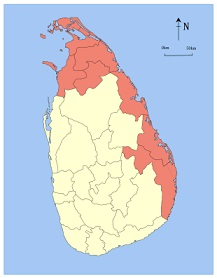 | 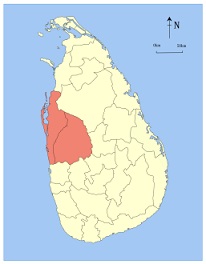 | 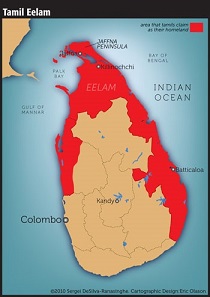 |
Northern and Eastern
provinces | Northwestern
province | Map of Eelam |
The
British invented two bogus races, the ‘Ceylon Tamil’ and the ‘Ceylon Moor’ and
allocated these three coastal provinces to them. ( Denham. Census of Ceylon
1911). These two bogus races, particularly the bogus ‘Ceylon Tamil’ race was
created to function as a disruptive entity working against the unity of the island.
Britain
retreated from Ceylon, leaving a pro-west government in place. This was no accident. Britain sent D.B.
Jayatilaka to India, ignored SWRD Bandaranaike, and selected D.S.Senanayake
(1947-1952) to lead the newly independent Ceylon. DS Senanayake was not very educated
nor well travelled. He was very pro-British.
When he
died, D.S. Senanayake’s son, Dudley was chosen as Prime
Minister by the Governor General, Lord Soulbury, ‘to the surprise of many ‘.Dudley did not last long as Prime Minister
and was followed by Sir John Kotelawala, (1953-1956) who, to the delight of
USA, was utterly anti Communist.
The US had
established a presence in Sri Lanka in the 1950s. Philip Gunawardena observed
in 1956, that an American NGO, CARE, had been invited
by the UNP government to distribute milk powder. CARE was an acronym for
Cooperative for American Relief Everywhere’. Philip
objected to CARE distributing milk powder. It could be done by local agencies. Also what was the need for CARE to set up an
office here, for the mere supervision of distribution. Why did the previous government allow a
voluntary organization to set up a
branch office in Ceylon. Philip was suspicious. ‘I fear the Greeks even when they offer gifts ‘he said. Philip
had tried to change the agreement
,but found that was not possible. ‘I
looked,’ he said. ‘
US showed that it could take aggressive action
when necessary. When the Rubber Rice pact of 1952 was signed, USA promptly cut
off aid to Sri Lanka, under its rule of not giving aid to countries that sold
strategic materials to Communist countries. USA also stopped the sale of its
sulphur fungicide, needed by Sri Lanka rubber plantations.
The US had
supporters in high places. Bandu de Silva observed that the Rubber Rice Pact
was heavily opposed by some members of Parliament, notably J.R. Jayewardene,
Minister of Finance. When the Pact came up for renewal in 1957, certain parties
attempted to sabotage the Pact. The
prominent name was J.R. Jayewardene, continued Bandu. The press had published some secret communications on the matter, and it
was suspected that the source was “Yankee Dickie”, added
Bandu de Silva.
The next
Prime Minister, SWRD Bandaranaike
(1956-1959) initiated diplomatic
relations with Russia and China and
favored non alignment. This would not have pleased the US. The MEP government of the period was in constant
turmoil over local issues, such as Sinhala Only and the Paddy lands Bill.
The focus was on internal matters .
But Philip
Gunawardene saw signs of active foreign
intervention. Philip was familiar with
international intrigue, having seen it at first hand when he was working with socialist groups in
France, Germany and Spain. Therefore Philip, unlike the rest, could detect
foreign intrigue in Sri Lanka, when he saw it.
Certain
embassies, were developing close connections with the armed forces, Philip
Gunawardene said. He specially
mentioned US embassy. Powerful forces are work, he said in Parliament in 1958. A
group was working to overthrow the MEP government and set up dictatorship. Philip anticipated the creation of a junta. NM Perera agreeing, spoke of a possible coup
d’état. Philip ended his speech saying to SWRD, Sir, your life is in danger.
SWRD
was assassinated in September
1959 by a Buddhist priest, Somarama, on the verandah of his home. This was the
USA’s first assassination in Sri Lanka and its first attempt at regime change
in Sri Lanka . The assassination was planned. That was obvious. But it was not
difficult to execute. Bandaranaike had no security protection whatsoever. Anyone could kill him anywhere.
At that
time the public readily swallowed the explanation that the person responsible
for the assassination was the High Priest of Kelaniya, Buddharakkhita. They
accepted the ridiculous argument that Buddharakkhita got Bandaranaike killed
because Bandaranaike had
refused to give Buddharakkhita a contract to import rice and another to set up
a sugar factory. Heads of state are not assassinated for such flimsy reasons.
There is an interesting religious twist to the
Bandaranaike assassination. The participation of the Sangha in this
assassination was expected to be a triumph for anti-Buddhist forces and a
terrible blow to the powerful Buddhist movement of the time. But that did not
happen.
Somarama
gave up robes during the trial and weeks before his execution was
converted to Christianity and was baptized in his cell by the Anglican priest
Mathew Peiris. Somarama had used a revolver which had belonged to a notorious underworld
figure, Ossie Corea. Ossie Corea was a Catholic. Vimala
Wijewardene, another accused, converted to Catholicism and gifted her houses
and land to the Catholic Church.
Satchi Ponnambalam writing in
2009 wondered whether the CIA was
behind the Bandaranaike assassination. Was any ‘foreign hand’ involved, he asked. Did Buddarakkitha have any contacts with
international agents.’ it is now well known that between 1959 and 1962 the CIA
had made several assassination and assassination attempts on political leaders
who were pro-Left, why not SWRD. The death of Buddarakkitha in prison at the
relatively young age of 46, during a UNP government may also be significant, he
said.
D.B.S.Jeyaraj (2014) also
openly questioned whether
any ‘foreign hand’ was involved in Bandaranaike’s assassination. Did
Buddharakkhita and Somarama act on their own. He points out that USA had a
strong anti-communist policy at this time. It was well known, he said, that
between 1959 and 1962, the CIA was involved in assassinations, and failed attempts at assassination, of political
leaders who were pro-Left, like Lumumba, Sukarno and Fidel Castro. In the 1990s
it was found that the CIA had given money to the Dalai Lama who was opposing
Communist China’s takeover of Tibet. (http://dbsjeyaraj.com/dbsj/archives/33515)
The intended regime change, after the death of
SWRD, did not take place .SWRD
was replaced by Sirimavo, which the US did not expect.
Bandaranaike’s wife, Sirimavo took his place
as Prime minister in the SLFP led government of 1960 and, to the surprise of everybody, including
probably, Sirima herself, ran the country better than SWRD had done. She
took firm decisions as PM, without dithering, and was excellent in her
foreign policy.
She seemed set to go on forever. Another round
of ‘regime change’ was necessary. Philip Gunawardene warned
Sirimavo in 1960 of the danger of a military coup. Such a coup was planned to take place on 27 January 1962. If
it had succeeded, Sirimavo would have
been killed.
The coup was planned by an assortment of army and police
officers. They were almost entirely,
Christian, upper class, westernized, right wing and UNP. The leaders were F. C. de Saram, Commanding Officer, Ceylon
Artillery who later made a confession assuming full
responsibility, Maurice De Mel, former Chief of Staff of the Army and Royce de
Mel, Captain of the navy. They were joined by
five subordinate officers from
the Ceylon Artillery, several commanding officers from the Ceylon Signals Corps, and one from Ceylon Electrical
and Mechanical Engineers
.The Police was represented by
C.C.Dissanayake Deputy Inspector General of Police, Sidney
de Zoysa, former
Deputy Inspector General of Police (DIG) , three Superintendents of Police and
two Assistant Superintendents of Police.
The coup was to be carried out by troops from the 3rd Field
Regiment, 2nd Volunteer Antiaircraft Regiment of the Ceylon Artillery, almost the entire officer corps of these regiment were involved,
2nd (V) Field/Plant Regiment of the Ceylon Engineers, 2nd Volunteer Signals Regiment of the Ceylon Signals Corps, the Armored cars of the
Sabre troop of the Ceylon Armoured Corps and some members of the
Police.
It was to be a swift, surgical strike, accomplished within a few
hours from midnight on the 27th.Police cars equipped with radio and
loudspeakers were to go around Colombo and outskirts at midnight, announcing a
24 hour curfew. People had to remain indoors. Anyone seen outside would be shot
on sight. Soldiers with vehicles and radio equipment were to be stationed at
key locations in suburban Colombo and strategic junctions within Colombo city.
Armoured cars and army vehicles fitted with radio equipment were to be
stationed at the two Kelani bridges.
Police headquarters, Criminal Investigations
Department (CID) and the Central Telephone and Telegraph exchanges would be
taken over and all tele-communication suspended until further notice. A special
telephone line from the Army headquarters to the Army barracks in Echelon
square in Fort had been set up earlier, to be used for urgent intra-army
communication. Fully armed Signals corps dispatch riders on motor cycles were
to be positioned from 11 pm at
Torrington (Independence) square, to storm Radio Ceylon” and take it over when
the password ‘Holdfast ‘ was given. Lake
House and Times of Ceylon were also to be taken over and newspapers were to
cease publication for a few days. At
Temple Trees the duty officer for the night had been replaced.
After 1956, many
Sinhala-Buddhists were taken into the armed forces to counter the large number
of Christians who had been recruited in British times. These soldiers it was
anticipated would be loyal to the government. The coup leaders had to therefore
prevent a potential counter-strike by such officers and troops. Soldiers stationed at the Panagoda cantonment
had to be prevented from entering Colombo at all costs, until the transfer of
power was completed. Armoured cars and army vehicles fitted with radio
equipment were to be stationed at the Kirillapone Bridge.
The Prime Minister , Cabinet Ministers, Parliamentary Secretary for Defence and External affairs (Felix Dias Bandaranaike), Permanent secretary to the Ministry of Defence and External affairs (N. Q.
Dias), Army Commander, acting Captain of the Navy, Inspector General of Police as well as DIG (CID) (S A. Dissanayake) and SP (CID) (John Attygalle) were to be arrested and taken to the Army Headquarters, where they would be held as prisoners in the ammunition
magazine, which was an underground bunker. Government members of Parliament and
all LSSP, MEP and CP members of the opposition were to be detained en masse at
e the Sravasti” MP’s hostel. Other officials, including service commanders,
were to be placed under house arrest in their own homes in Colombo.
Maurice de Mel was to coordinate from Army headquarters, F.C. de
Saram from Temple Trees” where the password
was to be British Grenadier” and Dissanayake from President’s House,
then known as ‘Queens House”, password was Dowbiggin”. Queen’s House was the
official residence of the Governor-General Sir Oliver Goonetilleke. Once the
coup was successful, the coup leaders would meet Sir Oliver, request him to
dissolve Parliament and take direct control. The country would then be run by a
‘junta’ of ex-Prime Ministers, Dudley Senanayake and Sir John Kotelawela.
The coup never happened. The government was alerted by P de S
Kularatne, who had been told about it by his son in law, Stanley Senanayake.
the leaders were rounded up, charged and found guilty. They got off on an
appeal to Privy Council, London.
The coup was not led by the head of the army which meant that
other high ups were masterminding it.. It was alleged that several VVIPs were
in on this. Sir Oliver Goonetilleke, who was never charged, resigned as Governor-General and went into
self-imposed exile in Britain. The public had suspected
for decades that JR may have had
a hand in it. this was confirmed in his biography which recorded some advice
that JR gave to Sydney de Zoysa, reported analysts.
I cannot recall what the public thought of
this coup at the time, but people started saying, decades later, on the Internet, that western powers were
probably behind it. One commentator said the coup was Plan B. Plan A was the
assassination of Bandaranaike, which was easily achieved but did not bring the
expected outcome
Another said in 2014, that he
thought the CIA, MI5 and ‘other such organizations’ were trying to set up
puppet governments in the emerging nations. A third commentator, Nicky
Karunaratne, also 2014, wondered whether ‘those guys handling the 1962 coup were being groomed by the CIA to carry out
their agendas. Such actions were openly carried out in other countries’.
The United States
has interfered in at least four elections in Sri Lanka , in support of UNP,
said Prof. Dov Levin of Carnegie Mellon university, a leading expert on
American and Russian interventions in foreign elections. Prof. Levin says he has found no evidence of
Soviet meddling in any of the Sri Lankan
elections he studied.
Levin observed
that John Foster Dulles visited in March 1956
before the General election of 1956.
He was the first US Secretary of State to visit the island .He spoke
with Prime Minister , John Kotelawala. UNP
signed an aid pact with the USA for 5
million USD aid ,in April just days before the 1956 General election.
There was covert CIA support to the UNP In the two 1960 general elections,
as well. Members of the UNP directly requested help from the US embassy in both
elections and were directed to the CIA. The US sent campaign
advisers to help the UNP and probably gave covert funds to the party, Levin
said.
In 1965 election, too, there was similar
covert interference by the US.
Levin’s research
is supported by information from elsewhere. Diplomat Robert Keeley said that the US intervention in Sri Lanka
in 1965 installing the UNP in power was held up as an example by US embassy staff in Athens as they discussed
proposals for a possible massive intervention by the CIA, in Greece’s elections
of 1967. UNP’s acceptance of US/CIA
covert aid in the 1965 elections
was considered a possible model
for US intervention in Greece. This is
said in Keeley’s book The Colonel’s Coup and the American Embassy:
A Diplomat’s View of the Breakdown of Democracy in Cold War Greece” .
The 1965 election
was closely followed by US media which hailed the UNP’s crushing victory” as a
triumph for America itself, commented Hassina Leelaratna. Dudley
Senanayake was frequently referred to as either pro-Western” or pro-American”
and praised for his promises of improving relations with the US, opening the
island toforeign investors, and
compensating the American oil companies, Esso and Caltex, and British oil
company, Shell nationalized by Mrs. Bandaranaike’s government. The US media called the UNP’s win an American victory, for
Senanayake prefers American foreign aid to Soviet aid.”. (
continued)