Sino-Lankan relationship is a strategic partnership not limited to economic development, says China’s Acting Ambassador
September 15th, 2020Courtesy NewsIn.Asia
China never forces Sri Lanka to choose sides and is happy with the latter’s friendship with its neighbors, Hu Wei told Kelum Bandara of Daily Mirror.
By Kelum Bandara/Daily Mirror
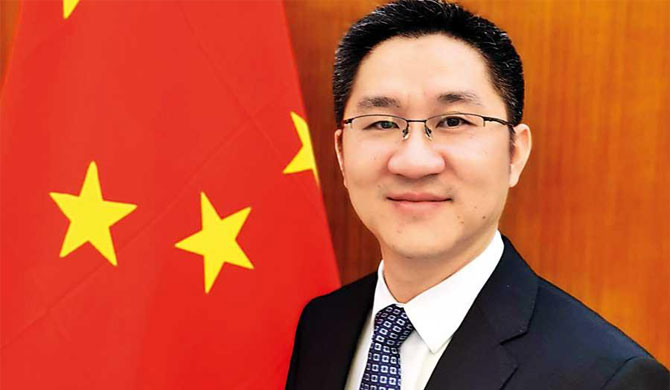
Colombo, September 14: The Acting Chinese Ambassador to Sri Lanka, Hu Wei, spoke to Daily Mirror about the present status of bilateral relations between China and Sri Lanka and responded to questions about controversial issues relating to China’s relations with the US and India. Here are Excerpts:
*How do you analyze the present status of Sino-Lankan bilateral relations?
I think it might be the best time of our bilateral relation in history. During the past half of the year, both the countries suffered a lot from the COVID-19 pandemic. Our bilateral relations have stood the test of difficulties again, and got even stronger. One best thing in the pandemic is that we learnt much more about our friendship. The two peoples supported each other during the past few months. With mutual support, we managed the situation better than other countries.
*In my recent interview with Foreign Secretary Jayanath Colombage, he spelled out that Sri Lanka will reach out to China for economic cooperation. However, he said Sri Lanka would never compromise strategic security concerns of India. How does China view it?
First of all, every independent country should not compromise its own national interests for others. As far as Sri Lanka’s concerned, it should be Sri Lanka First. Secondly, China is a best friends and partner of Sri Lanka when we talk about economic cooperation. But actually our friendship is far beyond that. Our relationship is based on strategic partnership cooperation, not economic development only. As you know, we supported each other even during the past few months in the fight against the pandemic. Numerous amounts of urgent medical supplies including more than 73,000 testing kits, 4.5 million face masks, 54,000 Personal Protective Equipment (PPE) have been donated after the coronavirus outbreak in Sri Lanka, which were not only from Chinese central government, but also from local governments, companies, organizations and ordinary people. During the past decade, in the international arena, China always defended Sri Lanka for many key issues. We should not limit our cooperation to economic relations only. It is much more colorful, broader and deeper than that.
*When you say strategic partnership cooperation, what do you mean by it?
As strategic partners, we should have a better understanding with each other. We support each other in matters of our core interests and defend each other. Whenever Sri Lankan government comes to China during difficult times, we will definitely help. If China need support in bilateral or multilateral issues and come to Sri Lanka, we receive similar solidarity from the island. It is a comprehensive partnership.
*How do you look at the security aspect in this case?
Sri Lanka, as an independent country, has normal security cooperation with all the neighboring countries no matter it is India, China or any other countries. We respect it. We are also open to it.
*Now, both China and Sri Lanka have contained COPVID-19. How do you see the potential for economic cooperation?
It is already on the way. We should not wait. Even during the past few months, even before the general election, both sides gave mind to strengthening economic cooperation, particularly to help the revival of economy in Sri Lanka. The embassy tried to extend cooperation both in finance and investment. We have already made some positive progress. In March, Sri Lanka needed some urgent loans to settle external borrowings and fight the pandemic. The China Development Bank provided a very concessionary loan of US $ 500 million within 10 days. There is another big investment of some US $ 300 million lined up in Hambantota, a big tyre manufacturing centre, under very positive negotiation. A lot of rubber is needed for tyre manufacturing. More than 2,000 direct and indirect jobs would be created for Sri Lanka.
*How big is demand for Sri Lankan rubber in China?
In China, there are already quite a few tyre manufacturing centres. But there is still a huge demand in the domestic and international markets. The only thing to worry about is whether Sri Lanka can provide enough rubber supplies to meet the demand.
*What is the current status of Colombo Port City Project?
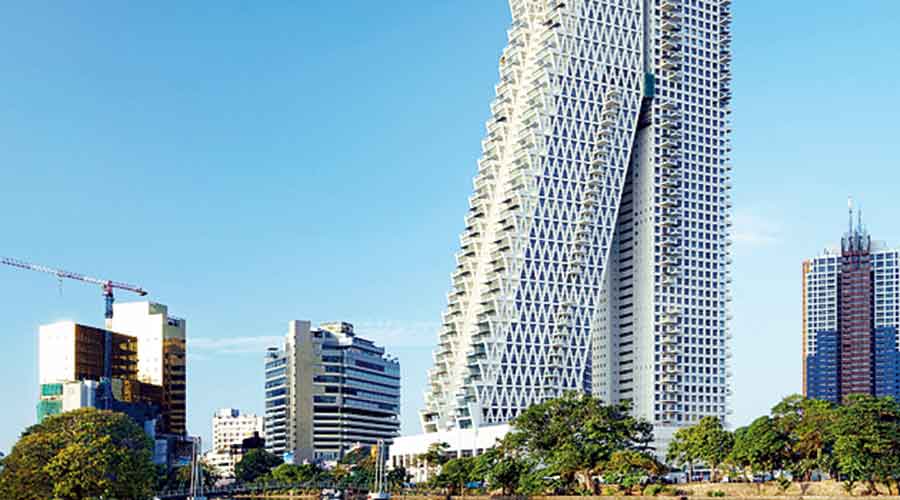
It is a US $ 1.4 billion project. It has generated a lot of jobs as you see. They have already reclaimed land from the sea. For the past few months, despite the COVID-19 pandemic, a lot of infrastructure work has been done. According to the master plan, an international financial centre will come up as a pioneer. We are waiting for the enactment of legislation by Sri Lankan Parliament for the next phase of development.
*Recently, the United States imposed sanctions on China Communications Construction Company. It is the parent company of China Harbour Engineering Company which constructed the port city. Will it affect work here?
The Colombo Port City is Sri Lanka’s largest Foreign Direct Investment. US $ 1.4 billion is only for Phase 1. For the second phase in next two decades, there will be another US $ 13 billion investment and creating more than 83,000 jobs. It will be the new engine for economic revival of Sri Lanka.
Some subsidiary companies of CCCC are blacklisted, but China Harbour Engineering Corporation itself is not on the list as far as we learn. What more important is, I don’t think we need to worry about it too much. The Colombo Port City is a joint project in Sri Lankan territory, not in the US. Such unilateral sanctions from the US that severely intervene other sovereign countries’ internal affairs have no international legal effect at all and will not be accepted.
In 1950s, China and Sri Lanka signed the remarkable Rubber-Rice Pact” to break the blockade of the US. Its legacy is still guiding us. I do have confidence in current Sri Lankan government. The President and the Parliament were elected by the people. I believe they understand what people need and will firmly safeguard the national sovereignty and interests. If a government cannot even protect the largest foreign investment which benefits greatly the country and people, who will come for future investments? We have no reason to doubt about it. Colombo Port City project will be a new version of Rubber-Rice Pact” to break the western blockade. We will definitely succeed again.
*In the Indian media, we see a lot of criticism of projects involving China. Earlier, there was an idea for talks involving Sri Lanka, China and India on matters of concern. How receptive are you to that idea?
We should not be driven by some biased media. We are open to the idea of regional cooperation in Sri Lanka and the region. As a true friend, China never says China First and force Sri Lanka to choose sides. We don’t want to do so. We are happy that our friend is making friends with others, especially with its neighbors. That is normal and healthy international relations.
*Border tension is high between India and China. Will it have ripple effects in the region?
China and India are in close communication through diplomatic and military channels over the recent developments in the border areas. I do not wish to go into further details. While you will hear many stories from the other side, I would just like to emphasize one fact: during the past decades China has already solved the border issues with 12 out of its 14 neighboring countries through friendly and peaceful negotiations, not via conflicts and wars. After boundary demarcation, borders are not lines of tension anymore. They become bridges to connect two countries and two peoples together. We’ve developed the border areas with most of our neighbors successfully. China never seeks hegemony over its neighbors.
*Your idea on the impact of the U.S- China trade war on Sri Lanka?
I don’t think there is any big impact. You may have heard some stories from the western media about many foreign companies’ relocating from China to other countries. It’s not true. There are indeed some companies that moved out of China. It is not because of the so called trade war, but due to stricter regulations in China for environment protection and labour protection. Most of the international companies chose to stay in China because they cannot find a better or safer place than China especially after COVID-19 breakout. The US-China Business Council which represents more than 200 American companies with decades of experience in China, found that in its latest survey that its U.S. member companies remain focused on a long-term commitment to China, with 83% viewing China as the number one, or in the top five, priorities for global strategy, and almost 70% saying they are optimistic about the commercial prospects of the market over the next five years. 87% of the companies indicate they have no plans to move production operations out of China. Actually, in the second quarter of this year, the GDP growth of China is 3.2 percent, which marks the best performance compared with other major economies and provides more confidence to all the international companies in China.
*What is the next step of Sri Lanka – China cooperation on the Belt and Road Initiative (BRI)?
After the parliamentary elections, Sri Lanka has established a very strong government with two–thirds majority. This might be the best time for our cooperation. We can proceed with cooperation faster and broader. We can attract more investment from China to help Sri Lanka promote its economic and social developments.
*What do you push for more- infrastructure development or industrial zones?
To be frank, Sri Lanka needs both. In China, we say if you want to get rich, build the road first. Transportation is vitally important. Now It only takes two and half hours to reach Hambantota from Colombo thanks to the southern expressway. In the past, it might be more than seven hours. Industrial development is also very important for the whole nation, which is one of the biggest experience China learned from its 40 years reform and opening up. The potentials of Sri Lanka’s industrialization is huge.
*Is there any Chinese investment lined up for the construction of the central expressway and the Colombo-Ratnapura expressway?
As far as I know, Chinese companies and financial institutes are well engaged in the Central Expressway. Some of them are also interested in the Ratnapura part.
*Earlier, your President Xi Jinping invited President Gotabaya Rajapaksa to visit Beijing. Now, both the countries have contained COVID-19. Is there any possibility for such a visit to take place?
There is surely a possibility. President Gotabaya Rajapaksa’s visit to China is always on the top of priority list for both sides. Under current situation, we need to find a convenient time for both sides. Before that, some minister level visits may take place first to warm up, which is a normal practice for state visit. At the moment, Sri Lanka’s border is closed for visitors. We expect that there would be some flexible arrangement for the warming-up visits before the state visit.
*When it comes to the concept of free and open Indo-pacific policy advocated by the west, what does China expect?
We have no problem with free and open navigation. We are always supportive of it but sorry to see it has been used as an excuse to attack other countries especially China. The U.S. has not only set up its Indo-pacific command with over 300,000 personnel, but also deployed their military bases in the Indian Ocean. China doesn’t have any command or military base in the region. Who is threatening the free and open region, and who has more reason to worry about it?
*What do you expect Sri Lanka to do in this regard?
Sri Lanka with a unique strategic geo-political location, should adhere to free and open navigation. I think the island should stick to its sovereignty, independence and not accept any foreign interference . That is the key to its national interests.
*Is there any plan for the implementation of the next phase of the Hambantota port project?
As I mentioned, we have investments coming up. There is also bunkering business opened recently. Even HSBC set up Express Banking Centre there last month. We do have confidence in the bright future of the project.
*What are the plans for people to people exchanges?
That is also one of the most important things we are expecting to do. After the pandemic, there will be more and more people to people exchanges. Both the President and the Prime Minister told me that Sri Lanka was expecting more Chinese tourists. We also expect Chinese people to choose Sri Lanka first if they intend to travel abroad.
*In you view, what is unique about Sri Lanka?
First of all, the general perception among Chinese people is that Sri Lanka is a friendly country. That is the most important part. Chinese people are sometimes very cautious. They think about safety and security first when they choose their destination. In Sri Lanka, of course, we also have a lot of beautiful views.
*Finally, Sri Lankan government asks for a debt moratorium from China. Are you responding positively?
To be frank, I don’t think debt moratorium is a good option for Sri Lanka. It might only solve a small percentage of existing problems but with huge prices. Sri Lanka has a very good reputation of settling its debts although there are a lot of foreign debts. The island always honours its debt commitments, which is highly appreciated and should be cherished. The reputation helps Sri Lanka a lot in the international financial markets to get more assistance and confidence. Furthermore, investment is a much better option which could not only bring direct income for Sri Lankan government, jobs for Sri Lankan people, but also rebuild international confidence on Sri Lanka. As a true friend , China will always try to help in all the possible manners.