UNP Parliamentarian Kabir Hashim has announced his decision to step down as the chairman of the party and his ministerial portfolio.
MP Hashim has been in office as the Minister of Highways & Road Development and Petroleum Resources Development.
Former wartime Defence Secretary Gotabaya Rajapaksa was elected as the President of Sri Lanka in the 7th Presidential Election that took place yesterday (16).
Following his massive victory, several parliamentarians of the UNP stepped down from their positions in the party, including the NDF presidential frontrunner Sajith Premadasa, who had been serving as the deputy leader of the UNP.
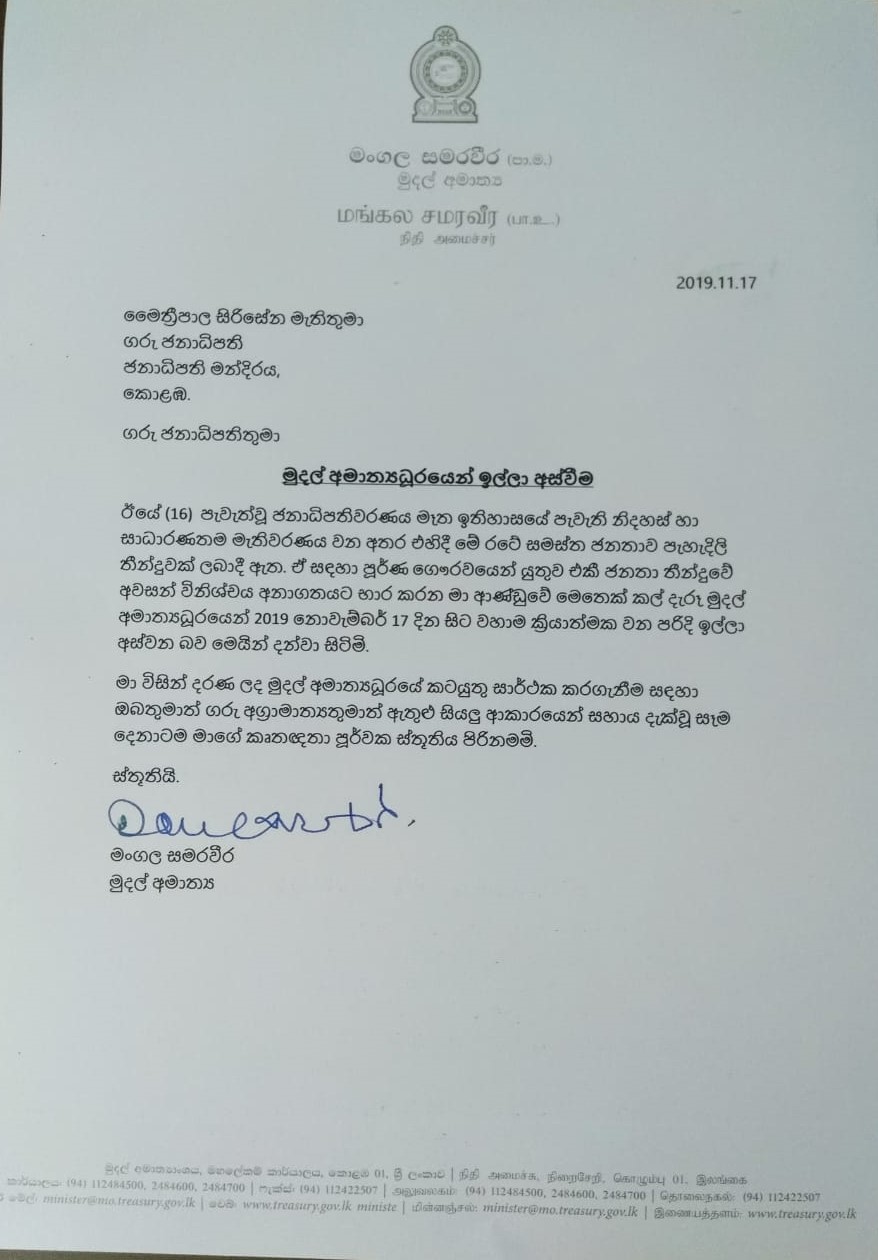
In the meantime, Parliamentarians Mangala Samaraweera and Harin Fernando also informed that they would be resigning as Minister of Finance and Minister of Telecommunication, Foreign Employment and Sports.
Colombo, November 17 (AIR): Following the victory of Gotabaya Rajapaksa iof the Sri Lanka Podujana Peramuna (SLPP) in the November 16 Presidential election, party chief Mahinda Rajapaksa said that the incumbent Prime Minister Ranil Wickremesinghe of the United National Party (UNP) must step down.
Gotabaya had defeated the UNP candidate Sajith Premadasa convincingly. Gotabaya is to be sworn in as new President on Monday.
His brother, party chief and former President Mahinda Rajapaksa hinted at a change of government in the wake of the result. In a message, the former President said that in view of the unequivocal people’s mandate, the SLPP believes that the government will abide by parliamentary traditions as appropriate in such circumstances.”
Gotabaya’s party had made it clear before the elections that they would expect the incumbent government under Prime Minister Ranil Wickremsinghe to step down in event of an SLPP victory.
The former President also said that the Presidential election will be seen as referendum ahead of the Parliamentary election due next year.
Meanwhile, at least four ministers, including Finance Minister Mangala Samarweera, have resigned after the defeat of Sajith Premadasa.
Prime Minister Wickremsinghe said in a message that a decision on the next general election will be taken after discussions with the parliament Speaker, party leaders and government MPs.
Gotabaya received around 6.9 million votes against his main rival Sajith Premadasa who got around 5.56 million votes in the final vote count announced by country’s Elections Commission this afternoon. Gotabaya received 52.25 percent of total valid votes.
He is the younger brother of former President Mahinda Rajapksa and served as Defense Secretary in the final stages of the war against the LTTE.
In a message, Gotabaya called for a new journey” for Sri Lanka adding that all Sri Lankans are part of this journey. He said he is the President of not only those who voted for him but for all Sri Lankans and that is the greatest honor in his life.
He got overwhelming support in the majority Sinhalese-dominated areas of the country. But Premadasa received wide support from minority Tamil and Muslim areas in the North and East.
Gotabaya Rajapaksa secured over 52 per cent of votes cast in Sri Lanka’s presidential election.
NEW DELHI: As Gotabaya Rajapaksa prepares to take over as Sri Lanka’s seventh Executive President on Monday, SNI Editor-in-Chief Nitin A. Gokhale, who has known and interacted with the President-elect while reporting on Eelam War IV (2006-2009) and in subsequent years, brings out some fascinating and little known facts about the man who will lead the island nation for the next five years:
Gotabaya joined the Sri Lankan Army in April 1971 as a cadet officer.
He was commissioned in the Signals Regiment and sent for the Young Officers’ course to Rawalpindi in Pakistan.
On his return, his first posting in the SL Army was Palaly in northern Sri Lanka.
In October 1974, Gotabaya opted to move to the infantry, joining the Sinha Regiment. Later, he was tasked with raising the Gajaba Regiment and commanded the 1st Gajaba Battalion.
In 1983, he completed the Staff Officers Course at the Defence Services Staff College in Wellington, near Ooty, in India.
Then Lt Col (now Field Marshal Sarath Fonseka), commanding the 1st Sinha Battalion and Gotabaya, as Commanding Officer of the 1st Gajaba Battalion, launched a combined operation to rescue Sri Lankan Army soldiers from the besieged Jaffna Fort, surrounded by the LTTE.
The current Commander of the Sri Lankan Army, Lt Gen Shavendra Silva, has served under Gotabaya in the 1st Gajaba Battalion as a young officer.
Gotabaya quit the Army in November 1991 and migrated to the United States.
He returned to Sri Lanka to help his elder brother Mahinda’s election campaign in 2005 and stayed on to become Defence Secretary and play a pivotal role in Eelam War IV to end the Tamil insurgency in Sri Lanka.
November 17 (newsin.asia) – Ministers from Sri Lanka’s ruling United National Front (UNF) government began resigning from their portfolios on Sunday after the ruling presidential candidate Sajith Premadasa lost the presidential elections.
Minister of Sports, Telecommunications and Foreign Employment, Harin Fernando, was one of the first Ministers to hand in his resignation saying he had decided to step down respecting the people’s mandate. Fernando said he was also resigning from his positions in the United National Party (UNP) which is the largest party in the UNF alliance.
Minister of Digital Infrastructure and Information Technology, Ajith Perera in a statement said he too had handed in his resignation respecting the mandate of the Sri Lanka people.
Several more Ministers are rumored to have sent in their resignation letters after Sajith’s defeat and it is likely that Prime Minister, Ranil Wickremesinghe will also hand in his resignation letter later today.
President-elect Gotabaya Rajapaksa will take his oath as the new president of Sri Lanka on Monday morning in Anuradhapura, his party the Sri Lanka Podujana Peramuna (SLPP) said in a statement.
Thereafter Rajapaksa is expected to form a caretaker government.
SPUR (Society for Peace, Unity and Human Rights for Sri Lanka Inc) Reg: A 003 0777 M PO Box 4066, Mulgrave, VIC 3170, Australia Tele/Fax: (03) 97957143 Email: ranjiths@spur.asn.au Website: www.spur.asn.au
Attn NEWS EDITOR-SBS
.Dear Editor, Your following news item re above -link is given- is completely baseless and overturns the code of conduct by fabrication and allowing only one side to voice as its opinion
1 Except for Tamil Tiger terrorists and their fellow travelers and some NGO spokesmen who are following closely the terrorist’s dictates no accepted source have directed any charges or proved any charge against Mr. Gotabaya R about the violation of HR or recommitting of war crimes.
2 What
the biased sources have stated, HAVE NOT BEING PROVED BY ANYONE.
3 It was under Gotabaya’s as the Defence Secretary that he liberated about 20 million Sri Lankans from the yoke of the Tamil Tigers who were waging war with the SL Govt, killing unarmed civilians, exploding bombs in the city centers., freeing the child soldiers who were kept by force by the Tamil Tigers.
4 If you happen to go through your library you will find/see that the SL Govt forces under the directive of Gotabaya R freed 280,000 unarmed civilians from the Tamil Tigers who kept them by force and they were protected and looked after by the defense forces under Goatabya.
5 The defense forces further rehabilitated over 50,000 Tamil fighters and ushered speedy economic development program in the Tamil majority areas,
5 Therefore, the belief that Goatbaya R, if elected will act nullifying the freedom, etc IS WRONG AND IT IS INCORRECT and your sources point of views represents the general tendency of Asylum seekers who will always direct complaints about their country of origin as they want to continue living in Australia as economic refugees.
We
request you to RECTIFY THE ABSURD SITUATION CREATED by the news story and to
consult and give publicity views of all sections of Sri Lankans when airing
controversial topics as it is the more ethical and logical way.
Ps. I
send herewith the details of Sri Lankan origin Population figures in Australia as
you should take this into account when discussing Sri Lanka and we are willing
to help you if you need contacts
Hope you are well. I am not sure whether
you have time to read my message, but I hope you read it one day.
I am one of the silent majority who wish
and pray that you win with a majority tomorrow. I left my motherland when I was
23 years old, but I still love the country I was born 60 years ago.
I never had the opportunity to vote in my
motherland, but I always wish to see that my country will prosper and the
innocent people will have an opportunity to live peacefully no matter what
their background or race.
I know that you have a clear vision to lead
this country for the next 5 years. Hope and wish that you will have good health
to lead this country for the next generation. I know that you have an agenda to
help the youth especially kids who cannot continue their education after year
12 exams, and unable to enter University. The country can prosper with a good leader,
and I truly believe that you have a dream for this beautiful nation, and people
around you will support you wholeheartedly for your vision.
Please promote tourism like Vietnam where
we visited villagers on a group tour and we saw how they promote local
creations and allow people with talents to perform for tourists to make some
money. Our motherland is rich with natural resources, and poor people should
get some opportunity (creating local jobs) to earn a living not big
corporations.
My last wish is to build up the economy you
need strong characters with qualification and knowledge and not people who
shout and embarrassed you. You ran an excellent campaign and will reap the
rewards tomorrow.
Minister Sajith Premadasa, who contested at the forefront in the
Presidential Election 2019 from New Democratic Front (NDF), has
announced his decision to step down as Deputy Leader of the United
National Party (UNP) with immediate effect.
Minister Harin Fernando, taking to his official Facebook account
today (17), published a special statement from Minister Premadasa.
Accordingly, DNF contender has conveyed his wishes to the seventh
President of Sri Lanka, Gotabaya Rajapaksa, who contested in the
Presidential race and currently leading the election results.
It is my privilege to honour the decision of the people and
congratulate Mr. Gotabaya Rajapaksa on his election as the seventh
President of Sri Lanka,” Premadasa said in his special statement.
Premadasa says the country has witnessed the most peaceful
Presidential Election in the history of its independent republic. This
was a result of the democratic gains and institutional reforms that have
taken place over the last five years that empowered an independent
elections commission and restored the rule of law, Premadasa said
further.
He appealed to the incoming President is that he would take this
process forward and strengthen and protect the democratic institutions
and values.
Premadasa expressed his gratitude for those who assisted him in his
presidential bid and the people who stood by him through his political
journey.
The complete statement of Minister Sajith Premadasa is as follows:
At the conclusion of a hard-fought and spirited election campaign, it
is my privilege to honour the decision of the people and congratulate
Mr. Gotabaya Rajapaksa on his election as the seventh President of Sri
Lanka.
I express my heartfelt gratitude to all of our citizens who voted for
me, in all corners of the island. I am humbled that you placed your
faith in me. Your support has been a fountain of strength throughout my
twenty-six-year-long political career. I also wish to place on record my
gratitude to all those who worked tirelessly on my campaign. My family
and I will never forget your sacrifice and dedication.
We have just witnessed the most peaceful presidential election in the
history of our independent republic. This was a result of the
democratic gains and institutional reforms that have taken place over
the last five years that empowered an independent election commission
and restored the rule of law. My appeal to the incoming President is
that he take this process forward and strengthen and protect the
democratic institutions and values that enabled his peaceful election as
the 7th President of Sri Lanka. I also urge Mr. Rajapaksa to ensure
that the post-election environment is peaceful and that no citizen or
NDF party supporter is persecuted or harmed for their role in supporting
my candidacy.
For 26 years, I have been an active politician in this country.
During that time, I have made every effort to serve the people, in my
home district of Hambantota and wherever and whenever they needed my
assistance. It has been my privilege to serve as Housing Minister in
this Government for five years, prioritizing the creation of a
home-owning society by 2025. I hope the people understand that these
were sincere, heartfelt efforts to uplift the lives of my fellow
citizens.
In light of today’s decision by the electorate, I have decided to
step down as Deputy Leader of the United National Party with immediate
effect.
In the coming weeks, in consultation with all those who supported my
presidential bid, the people who have stood by me through my political
journey and my loved ones, I will reflect on the future of my political
career and where my life will take me hereafter. Bound to the people of
Sri Lanka, I remain their faithful servant, today and always.
We are now awaiting the results of what will hopefully be Sri Lanka’s last presidential election. There are 35 candidates contesting this presidential election with a ballot paper over two feet long for a position that has no power at all. Today, Sri Lanka’s supposedly executive presidency has less power than the nominal President in India. In India as in Sri Lanka it is the President who has the power to summon, prorogue or dissolve parliament. The Indian president is constitutionally required to act in accordance with the advice of the Cabinet. However no court of law can inquire into whether he was in fact acting in accordance with the advice given to him by the Cabinet.
After the 19th Amendment in Sri Lanka, the President is barred from dissolving Parliament at his discretion before the lapse of four and a half years. Prior to the 19th Amendment, a great part of the President’s power lay in the fact that his actions could not be challenged in courts. However the 19th Amendment has made it possible to challenge actions taken by the President by way of a fundamental rights application. In October last year, the President dissolved Parliament and the governing party went to courts and got the dissolution annulled. With the restriction on the dissolution of Parliament, one of the key powers that made the President the main repository of political power in the country has been done away with.
According to Article 43 of the Constitution as amended by the 19th Amendment, it is the President who will determine the number of ministries and the subjects and institutions that are to be assigned to those ministries. He may, only if he deems it necessary, consult the Prime Minister in doing so. However, when appointing individual MPs to hold these ministries, the President is mandatorily required to consult the Prime Minister. After the Cabinet is formed in this manner, the President may at any time change the assignment of subjects and functions and the composition of the Cabinet. Article 43 is silent on the question whether the President is required to consult the PM when he changes the assignment of subjects and functions and the composition of a Cabinet that has already been formed.
Presidential powers removed
However, the wording of Article 43(2) seems to suggest that in appointing MPs to be Ministers, the President cannot avoid consulting the Prime Minister whether it be before the Cabinet is appointed or afterwards. Certainly when it comes to removing ministers who have been appointed, Article 46(3) which was introduced by the 19th Amendment states that they can be removed by the President, only on the advice of the Prime Minister. Logically you can’t replace a minister without removing the incumbent. Hence Articles 43(2) and 46(3) taken together means that the President can neither appoint nor remove a Minister without the Prime Minister’s approval.
Before the 19th Amendment repealed and replaced Chapter VIII of the Constitution, under the old Article 47, the President could sack the Prime Minister at any time he wished. When the PM ceases to hold office, the Cabinet also stands dissolved. However after the 19th Amendment, under the new Article 46(2), the Prime Minister ceases to hold office only if he (a) resigns his office by a writing under his hand addressed to the President; or (b) ceases to be a Member of Parliament. There is now no provision for the President to be able to sack the Prime Minister. The only way that a prime minister can be removed upon a new President taking office is to prove that the PM does not have a majority in Parliament.
Before the 19th Amendment, it is the President who made all the important appointments such as Supreme Court and Appeal Court judges, the Attorney General, the IGP, The Elections Commissioner and The Inspector General of Police. Today, the President cannot make any important state appointment except in mandatory consultation with the ten-member Constitutional Council. With regard to certain positions like the IGP and AG, and judges of the higher judiciary, the President has to make the recommendation and get it approved by the Constitutional Council. When it comes to making appointments to the independent commissions such as the Elections Commission and the Public Services Commission, the Constitutional Council that makes the recommendation for the approval and appointment by the President. Either way, it’s the Constitutional Council and not the President who plays the pivotal role in making these appointments.
Before the 19th Amendment, all Presidents held various portfolios under the old Article 44(2) which stated that the President may assign to himself any subject or function and will remain in charge of any subject or function not assigned to a Minister. However this provision no longer exists in the Constitution. Though there is this theory that the President may be able to retain the defence portfolio citing Article 4(b) which states that the President exercises the executive power of the people including defence, the fact is that up to the 19th Amendment the president’s power to assign to himself any portfolio he wishes was derived not from Article 4(b) but from the old Article 44(2) which has now been repealed.
After the 19th Amendment, the President still remains the head the Cabinet, yet he is barred from holding any portfolios and functions more like the Chairman of the Cabinet. President Sirisena holds the Defence, Mahaweli and Environment portfolios only by virtue the transitional provision in Section 51 of the 19th Amendment which enables him to hold those three specified portfolios. This transitional provision ceases to operate with his retirement. When Sirisena bows out, those three portfolios will have to be given to ministers recommended by the Prime Minister. After the 19th Amendment, the President has no power worth talking about. He cannot wield any real power and do anything in his own right. The real power lies with the Cabinet of which the president is also a member.
The President has powers over the appointment of the commanders of the armed forces, ambassadors, provincial governors and ministry secretaries. Though some think that the President will be able to run the country through the ministry secretaries bypassing the Ministers, the way President R. Premadasa is supposed to have done during his ‘one man show’, this will not be possible because Article 52(2) of the Constitution states very clearly that the secretary to a ministry shall exercise supervision over the departments and other institutions in charge of the Minister subject to the direction and control of his Minister.
If President R.Premadasa was able to run a one man show by controlling all the ministries through the ministry secretary, that was only because the President could at that time sack both the minister and his secretary at any time. So at that time the minister dared not protest even if the President was dealing directly with his secretary behind his back. Today however, the President cannot sack a minister unless it is on the recommendations of the Prime Minister. What we have under the 19th is not really a President but a quarter of a President. Even the Prime Minister is a quarter of a Prime Minister because the only claim to power that he has is being the effective appointing authority of ministers. Thus with a quarter of a President and quarter of a Prime Minister, we have half an executive with the other half lost in a constitutional limbo.
We all have to hope that the voting public would have voted in their numbers for Gotabhaya Rajapaksa at this election because it is only he together with his brother as Prime Minister and the synergies they have with the rest of the political grouping they represent that will be able to restore a semblance of a proper government to this country. The dyarchy created by the 19th Amendment is tailor made to foster confusion and conflict between the President and the Parliamentary government – each elected separately by the people and each having a claim to be exercising the people’s sovereignty.
Any attempt to remedy this by amending the Constitution to recreate a J. R. Jayewardene style Executive President will encounter such resistance that it will politically destroy the person or political party that attempts any such thing. Such an attempt will be counterproductive and will not be worth the effort. The only feasible option will be the abolition of the executive presidency and the creation of a parliamentary form of government which we hope will take place before 2025 so that this becomes the last presidential election we have. Because the present proportional representation system has produced a clear majority in Parliament for the party that wins a general election only on two occasions in 1989 and 2010, reform of the electoral system has been seen as a necessary precursor to the abolition of the executive presidency.
Working majority in Parliament
As far as electoral reform goes, the most feasible system was recommended by the Parliamentary Select Committee headed by Dinesh Gunawardene over a decade ago. However, the implementation of this system will require a fresh delimitation of constituencies and Dr. Sudantha Liyanage, who designed the system adopted by the Dinesh Gunawardene PSC envisages a deadlock at the delimitation stage because many existing electorates will have to be merged to reduce the present 160 electorates to 140. What this means is that we are saddled with the district based proportional representation system for the foreseeable future and adjustments will have to made within the existing framework. The three main requirements are firstly, to ensure that the winning party gets a working majority in parliament, secondly to do away with the preference vote system and thirdly, to have an MP to represent each constituency.
The question now is to achieve those objectives within the existing district based proportional representation system. One quick fix solution proposed to the problem of ensuring a working majority for the party that wins parliamentary elections, is to take about 12 seats out of the national list and to give them to the winning party as bonus seats. The system proposed by the Dinesh Gunawardene Committee also had five bonus seats from the national list allocated to the winning party. At the parliamentary elections of 1994, 2000, 2001, 2004 and 2015 the winning parties got 105, 107, 109, 105 and 106 seats respectively inclusive of the national list seats.
So it was a case of being short of anything between four to eight seats to have the 113 seats that will provide a working majority. At the elections mentioned above, the number of national list seats that the winning party was entitled to was 14, 13, 13, 13, and 13 respectively. Hence even if 12 seats are taken out of the national list and given to the winning party as bonus seats, that number would include about six to seven seats that the winning party was entitled to anyway, and the number of seats the winning party finally gets as actual bonus seats, could be as low as five or six.
This could lead to a situation where even after getting the 12 bonus seats, the winning party may still not get a working majority of 113 seats. In this context, there is perhaps a solution which this writer would like to suggest. The national list was only an afterthought which came with the Fourteenth Amendment. In JRJ’s original 1978 Constitution, there were supposed to be only 196 MPs in Parliament, and no national list. My suggestion is that the national list be abolished altogether leaving only 12 bonus seats for the winning party after the fashion of the 1948 Constitution, which had provision for the appointment of six MPs by the party that forms a government after an election. That would reduce the number of MPs in Parliament from the present 225 to 208 (196 elected MPs + 12 appointed MPs).
It is important to specify that the 12 bonus seats will be given to the party that wins the most number of seats at the parliamentary election, and not to the party that manages through various horse deals to cobble together a government after an election. The 1948 Constitution, with only 101 MPs in Parliament, gave the party that forms a government six bonus seats. So to have 12 bonus seats in a Parliament of 208, is not excessive. If the number of MPs is reduced to 208, the number of MPs necessary to form a stable government will be 105. An examination of the election results of the past 30 years will show that after 196 MPs are elected from the districts, an additional 12 bonus seats would enable the winning party to have a working majority.
It is, of course, impossible to totally eliminate the possibility of the winning party falling just short of a working majority. The idea would be to ensure that hung Parliaments are the exception rather than the norm. As things stand today, winning parties without a working majority is the norm. The national list has earned a bad name and abolishing it will be welcomed by the public and even by elected MPs. One difficulty in abolishing it is that over the years, every political party has got accustomed to nominating a few critically important people to Parliament through the national list. The winning party will have the 12 bonus seats to which such persons can be appointed. However, in the absence of a national list, the parties in the opposition will have no way of appointing MPs to Parliament.
Shifting responsibility to political parties
Perhaps, the way to deal with this may be to draw inspiration from the original 1978 Constitution and give the political parties unfettered authority to appoint whoever they like to one or two seats won by that party in each province. Under the present electoral system, each province is allocated four seats in Parliament. When these seats are apportioned to the various electoral districts in the province, they become the district bonus seats that everyone is familiar with. Even though the popular belief is that each district has only one bonus seat, some districts have two bonus seats.
To illustrate this by way of an example, the Colombo district is entitled to17 seats going by the number of registered voters in the district. With the bonus seat, the Colombo district should have 18 seats. But it actually has 19 seats because it has got two bonus seats. The four seats allocated to the Western Province are distributed as one bonus seat each for the Gampaha and Kalutara districts and two for the Colombo district. In the Central Province, after Matale and Kandy have been allocated one bonus seat each, the Nuwara Eliya district has got two bonus seats. Likewise, the Anuradhapura and Polonnaruwa electoral districts in the North Central Province have two bonus seats each because the NCP has only two electoral districts.
If each electoral district was to have only one bonus seat, there would be only 22 bonus seats for the 22 electoral districts in the country. But in reality there are 36 bonus seats which works out to 14 extra seats. If the political parties are allowed to fill one or two seats they win in each province as the party deems fit, that may meet the need of political parties to accommodate politically important individuals in Parliament. Of course such dignitaries may have to make themselves useful in the election campaign in the relevant province and especially in the district concerned so as to justify their appointment to Parliament.
If J.R.Jayewardene’s original plan was to give the political party complete authority over appointing MPs to Parliament after an election, surely there is nothing wrong in allowing political parties to appoint just one MP at their discretion and that too only in the districts that have this extra seat over and above one bonus seat per district?
One way to solve the issue of having constituency based representation and achieving the objective of eliminating the preference vote system, could be to adopt a modified version of the system originally envisaged by JRJ by giving the political parties the power to nominate candidates to Parliament. All political parties still appoint their electoral organizers on the basis of the existing 160 electorates or polling divisions as they are now known. The appointment of an electoral organizer by a political party could become a more formal affair where the letter appointing a person as an electoral organizer is accorded some legal validity while political parties retain the entitlement to change their organizers at any time as they deem fit.
These electoral organizers become candidates at parliamentary elections with their names appearing on the party nominations list. Candidates can be nominated to Parliament by their party on the basis of the percentage of votes that each electoral organizer/candidate obtains within his constituency to bolster the overall performance of his party in that district. This will eliminate the need for the preference voting system and the need for candidates to canvas for votes throughout an entire district. Since the number of MPs that a political party will get in a district will be decided on the basis of the proportion of votes it polls, and not on the number of constituencies it wins, every electoral organizer will have to be given constituencies of a uniform size with a specified minimum number of registered votes so as to give him a fair chance of obtaining the proportion of votes that would get him a seat in Parliament.
Dividing or combining the existing electorates to make up constituencies for their organizers will be the responsibility of each political party. Under such a system, it could well be that a candidate who has won the constituency allocated to him by his party may not be elected an MP if his party’s allocation of seats according to the proportion of votes won in the district runs out before it comes to his turn. He would then be the next on the list to be appointed to Parliament on the death or resignation or expulsion of an MP elected on his list. If one gives it careful thought, there is in fact a way in which J.R.Jayewardene’s original parliamentary electoral system could be adapted to meet present day requirements.
Even as the Yahapalan government goes through their last gasps, it merits reflecting on the complex web of deceit and deception that they spun on Sri Lankans to grab power and stay in power, in a hope to prevent Sri Lanka’s history being so slurred, ever again.
In January
2015, unseating a regime that had ended a thirty year old terrorist war dubbed
an unwinnable war”, and maintaining the peace for five years thereafter without even the slightest whiff of terror ,
while at the same time ushering in
unprecedented development, would to say the least be a daunting
challenge.
This
development had seen Colombo seeing a
visionary transformation from a city wanting even in garbage disposal to one so
beautiful that enabled Sri Lanka to be named the year’s top tourist destination twice by Lonely planet and once by CNN, that
had seen a pot hole driven road network to being transformed to one good as any,
any where in the world , & had seen after decades of vacillation opening
of equally world class motor ways, & had seen the building up of ports and airports that within
a few years is seeing the most powerful nations competing with each other to
gain influence over, & had seen the building of a port city in Colombo to
be an international financial centre equal to Singapore & had seen the building of a new eastern
terminal in the Colombo harbour equipped
to service modern mega ships that dock
and tranship most goods to the eastern coast of India thanks to the shallow palk strait, &
had seen the compete electrification of the entire country an achievement not
even remotely achieved by their mighty South Asian neighbours, & had seen
growth rates of over 7% on the trot for several years second only to China, &
that had seen the per capita of it’s citizens income double ad even treble to
the extent that it was elevated from a Low Income Nation” to a Middle Income
Nation” .
To meet
this daunting challenge , it would appear that the budding Yahapalanites” had
taken a leaf from the Tiger book of web
of deceit and deception” that enabled them for decades, to garner western
support for their terrorist war claiming it to be a freedom struggle.
The
strategy for the Jan. 2015 election,
therefore was to neutralize the war achievements through claiming that these were achieved through violation of human rights and the development was achieved through bribery and corruption in the form of
unacceptably high commissions for politicians in power. Though these allegation had virtually no evidence in
support, following the doctrine of Joseph Goebbels, Hitler’s minister of
propaganda, that any lie would eventually be believed if repeated frequently
enough, they kept bombarding these unmitigated lies to the electorate through
media, especially social media, that eventually saw them achieve their election
victory in 2015.
They are
repeating the ploy in Nov 2019, but the electorate and their opposition are
probably wiser now
In 2015 ,they
also cleverly exploited the presence of many members of the Rajapaksha family
in positions of power, presenting it as family rule ” cleverly ignoring that all of these
Rajapakshas were in these positions
because they were mandated by the people with huge majorities .
Once in
power Yahapalanites continued their denigration of the war victory culminating
in arguably the most treasonous and despicable act in Sri Lanka’s proud history
of over 2500 years. This they did when they joined the US in sponsoring a
resolution at the UNHCR accepting that the allegations of human rights
violations during the war victory were
credible” , and asking for an investigation into these allegations , to be
conducted with the participation of foreign judges. Such offering of the
Ranaviru for slaughter for the crime of rescuing their nation from terror, mprobably has no equal in the entire history
of the human race. This is in stark contrast to UK Premier Theresa May defiantly
announcing that she would never subject her soldiers for any kind of inquiry
into their actions in Iraq and a similar pronouncement by the US President.
This sin of
the Yahapalana has been compounded for
the past five years through by passing many opportunities to extricate it self
from this crime for eg by , tabling the
Paranagama commission report that clearly established that there were no war
crimes committed by the security forces, or by tabling the more recent
revelations of Lord Naseby in the British House of Lords through the
information he gathered including communications from the British High Commission in Colombo that
revealed the civilian casualty rate was of the order of five thousand
& not the forty thousand quoted in the UNHCR resolution, or by
simply withdrawing it’s sponsorship of this resolution , which would then lapse
as the other sponsor, the US, is no longer a member of the UNHCR , which
they left two years ago denigrating it as a cesspit of political intrigue”, a
reality that had struck home to many like me well before it did to the US
President.
One would
fervently hope that the new President Gotabaya Rajapaksha would correct these
wrongs at the earliest opportunity.
The
harassing and imprisonment of Ranaviru on flimsy grounds, dismantling the
intelligence and internal security apparatus that the Mahinda Rajapaksha administration
was not merely an act of omission. This was also an act of commission as
Yahapalana sees this as a threat to their agenda which was destabilisation of
internal security that would pave the way for US boots to hit ground in Sri
Lanka as provided for in the ACSA agreement. The Easter Bombings were equally
both a result of omission as well as
commission, as it was being engineered by some in Yahapalana to create a
Sinhalese backlash that would have provided the conditions for actioning the
ACSA as above. The PM’s first call after the explosions that, there were
international forces involved and we may need foreign assistance to cope” also
lends support this belief. Thankfully, the prompt and mindful response of the
clergy of all denominations enabled this part of the web of deception to be
foiled. Equally, the agitation there from has at least seen the deferring of
the other two agreements with the US, the SOFA and MCC, being deferred at least
till after the election. It has seen the
failure of the strategy of sign before
election and debate after election” , stratergy. However, even to attempt so is
a contemptuous insult to the intelligence of the Sri Lankan people .
On another
aspect, the PM has also attempted to absolve himself of responsibility for the
easter bombing because he was not an invitee to the national security meetings.
This happened since the SLFP pulled out of the Yahapalana in October 2018 and
the spat between himself and the President. If he the PM was responsible, he
would have at least raised this in cabinet or parliament or if he had any shame
would have resigned his post and gone for a general election as the President
and opposition wanted, when it became
clear that his minority government was compromising it’s responsibility to the
country. That he had no shame, was evident to any body who saw him being mercilessly admonished
by the President in full view of the nation on TV, at their first meeting after
his reappointment .
Having come
on a holier than thou -Yahapalana”,
canard , the deception by violating the constitution started from the their
very first act after installing the Yahapalana President . This was when
a new Prime Minister was appointed, while the previous prime minister with
Parliamentary Majority was still in office . However , this was just a taste of
much worse to follow which happened in February and March in the form of the
two Bond Scams”. Perhaps, the crowning ignominity of the Yahapalana actions in this saga was
the attempt on the part of it’s Prime Minister to shamelessly attempt to
reinstall the disgraced governor of the central bank to the same post once
again , stopped only by the firmness of the President. Even to this day he
continues to abscond, though clearly a close associate of the PM. How much more Ayahapalana” one can be, or
deceitful one can be, is beyond any ones
imaginations.
Having won
the 2015 election on the strength of
allegations of a fortune of 18 billion
dollars being embezzled by the former
President and his family and of their ownership Lamborghini cars and helicopters , Yahapalana
has failed to establish a penny of this
despite the use of all of the state resources for four and a half years.
Despite the establishment a FCID to effect a highly politicised investigation
against the Rajapaksha family, as confirmed by several of their senior legal
and administrative employees, not one case has even gone to court.
Having
condemned the Colombo port city project and stalled its construction for two
years they are now back building on the same model at an enhanced cost and two
years behind schedule . Having condemned the Hambantota harbour the first act
of Yahapalana in January 2015 was to stop the first revenue
earning activity of the harbour, the bunkering(refuelling of ships) activity
that started in June 2014 .The implication is that ships who form Europe would
carry enough fuel to go to Singapore, could carry considerably less fuel and
more cargo, win , win for both SL and Ships with Singapore being the looser.
One would be excused for wondering whether this may be the reason for the
bunkering still not being restarted and whether the secrecy behind the clause in the trade deal with Singapore is related.
In January
2015 there were three daily flights to Mattala.
The first action of Yahapalana was to
stop all flights, store paddy in the hangers despite damaging the sophisticated
equipment and denigrating it to be a
loss making airport. With such management ,what else could one expect. With the
longest runway in SL Mattala is the only airport capable of landing A 380 double decker planes , in South Asia. With
at least four of them flying over
Mattala every night on their way from Australia and NZ to the Middle East, and
vice versa, and paying $2000 per trip ,
for emergency landing rights, Mattala is earning it’s keep by simply being there . With
visionary and energetic leadership the potential for securing a passenger drop
off from at least one of those flights
exists. This could be a boon to get the airport cracking , and for
increasing tourism targeting south SL
from down under, a difficult place to get to SL from. It would also be a boon
to returning home Sri Lankans.
Instead of
developing these new constructions to
make them more revenue earning, Yahapalana once again deployed their strategy
deceit claiming a debt trap” to discredit their predecessors for political
gain. Had the previous regime been in place, in the same capable and visionary
hands these constructions would by now
be paying for themselves. We never heard the terms debt traps” during the
previous regime. Debt Trap” , a US
coined term is music to US ears giving a handle to displace China from
SL to serve US interest and another handle for Yahapalana to deceive SL.
Even in
their dying moments the deceit in relation to Mr Gotabaya Rajapaksha’s
eligibility to contest is truly mindboggling and shameful. First the claim was
he will not be able to renounce his citizenship as there are legal case in US,
then it was that it would be months before he is cleared even if application
for renunciation is submitted. Even when the certificate of loss of US
citizenship was displayed on TV, the same claim
continues to be made even till the very end . They appear to have gone
to the extent of even attempting to confuse the voter by fielding another
candidate Namal Rajapakse whose name would be next to Gotabaya Rajapakse .
Despicable complex web of deceit and deception” was a description used on LTTE
misinformation campaign of ten to twenty years ago, which I followed on
international media for years and countered regularly. I thought it would be an
act never to be beaten From what I have seen in the last five years from
Yahapalana, it would appear to me now that , I was wrong then.
Dr. Sudath Gunasekara Former Permanent Secretary to Prime Minister Sirimavo Bandaranayaka and Ex- President of the Sri Lanka Administrative Services Association (1991-19194)
14. 11. 2019.
After the 16th
of Nov. 2019, this has been an often displayed slogan I have seen in many a
SLPP political parleys. But at all these meetings they only focused and talked
on the need to vote their candidate on the 16th. It indeed is the most critical issue and absolutely
there is no argument about it. But I was deeply disturbed to note that no one
paid any attention to the practical problems they would have to face under the
provisions of the 19th Amendment after the President assumes Office
in a situation where there is already a Government opposed to them in office. No
one spoke a single word about the imminent problems of governance they will
have to face and the solution they propose to overcome that political impasse
after the election and how they expect to overcome this crisis. I hope and wish
already they have a fool proof mechanism in store to overcome this danger. I do
not know whether they keep their strategy a top secret.
However this in
my opinion is very critical as reaping the harvest of the Presidential victory depends
much on the political stability and compatibility of the next Government since
the government is the real machinery through which we have to implement the
Presidential manifesto for which the people have given the mandate. I wish the
SLPP had a preplanned shortcut solution to overcome the 19th A
restrictions so that straight away the new President could appoint Mahinda
Rajapaksa as the Prime Minister in keeping with the burning aspirations of the
masses. Such action will seal the preceding reign of anarchy and immediately
bring victory for the people’s mandate. In the alternative they should have
asked for a full mandate from the people to counter the 19th A
restrictions imposed on the new President so that they could have appointed MR
as the Prime Minister immediately after the President has sworn in. Such
mandate will have the legality of a referendum would have enabled the new
President to circumvent all the barriers in the 19th A without
resorting to vote hunting in a hostile Parliament composed of an anti-Sinhala
anti-national and anti-Buddhist UNP and its Tamil and Muslim allies and the JVP
which is a real high risk gamble they failed in 2018. I really do not know as
to why such precautions were not taken and why their legal luminaries didn’t
advise to do so.
Therefore, although
too late, I suggest the Gota’s Team draw its immediate attention to this
extremely crucial issue lest it gets too late to get ready to face this very
critical aspect of the post Presidential Election scenario.
I also don’t understand as to why the Gota
Team did not ask for a mandate from the country to abolish the Provincial
Councils and the Rajiv/JR Accord of 29th July 1987, that Indian conspiracy that
ruined the entire native political system and paved the way for division,
destabilization and destruction of this country. Had they done that Gota’s
could have got even a bigger majority.
Gota’s Victory is a foregone conclusion and it
is really the victory of the people and he will get elected with the highest
majority ever for any President in this country while Premadasa will go down in
history as the worst loser in the country’s political history.
Talking about
the Election per-se, in my opinion it is definitely a forgone conclusion, as
the Sun and Moon rise in the East, Gotabhaya Rajapaksa’s victory is a certainty.
He will definitely get elected as the 7th President of the
Democratic Socialist Republic of Sri Lanka on the 16th of this month with the
highest majority ever by any Presidential candidate in this country. Only some
unforeseen catastrophe like a sudden subsidence of this Island in the Indian
Ocean on the 16th can stop it. Not only Sajit Premadasa or the traitors
like Mangala, Rajjita, Chandrika and Champika but also not even a God or a Brahma can stop his victory. Going by the general
political tempest fast gathering momentum, in the villages, towns, market and
work places that is getting polarized around the burning patriotic feelings of
the Sinhala Buddhist masses for their motherland, the Sinhala nation and Samma
Ssambuddha Sasana all over the country and even abroad, no one will be able to
reverse that trend. As things stand Gota will get elected with the highest
majority ever for any President in this country while Premadasa will go down in
history as the worst loser in the country’s political history.
However the days
that follow the Presidential elections are not going to be that rosy for two
reasons. That is firstly, the restrictions imposed on the new President by the
19th Amendment and secondly, the peculiar anti-Sinhala and
anti-Buddhist and hostile political composition of the present Parliament headed
by Ranil Wickramasingha and thirdly, the absence of a working majority for the
SLPP and its allies in Parliament.
The purpose of
this brief note is to draw the immediate attention of the SLPP, UPFA, and SLFP
hierarchy and their close advisers to some vital factors and a very critical
situation that might bring about an extremely dangerous (possible) state of
political confusion, uncertainty and instability in the post Presidential
Election period in this country that might crop up. I am making these observations
as a responsible citizen of this country for the benefit of those who are
directly involved in this game to take adequate precautions to avert his
political impasse. What is the guarantee that Ranil will not resort again to
the same game of making Temple Trees the Head Quarter of another International
conspiracy with the assistance of his Speaker Karu Jayasuriya and the Diplomatic
corps of the colonial West? The only consolation we have in this regard is that
there is a different President now presiding over the State of Sri Lanka. I
hope and wish that Ranil will understand that it is Gotabhaya Rajapaksa, a true Sinhala Buddhist leader and not
Sirisena he has to deal with, before he again resorts to such deplorable and
treacherous gimmicks.
Once the new
President is elected the next step is to form the Government, the legal
machinery that has to run the country. Going by the often quoted statements
made on the election stages the new President will appoint Mahinda Rajapaksa as
the new Prime Minister who will then name the new Cabinet and form the new
Government. This exactly is the fervent hope and the wish of the majority of
patriotic people in this country. But just now there is a very big hitch to
this dream for the SLPP and its allies, unless they have already made some
concrete arrangements to get the minimum 113 votes required to show the
majority in Parliament to form a Government. This is a Constitutional
requirement which the Supreme Court has already upheld in 2018 on this matter. Going
by the present constitution of the Parliament where the present Government
headed by Ranil Wickramasinha still has a working majority with the UNP,TNA and
even the JVP MPP as it had been functioning for the past miserable and anarchic
4 ½ years, the chances of getting a majority in Parliament for the Mahinda camp
is very remote. He has only 93 SLPP,
SLFP and UPFA plus Rev Ratana and Wijedasa Rajapaksa. Even if we add the highly
unpredictable Wasanta Senanayaka the total come to only 97 while the UNP has
nearly 125. That is UNP 103.TNA 16 and JVP 6.
Therefore,
unless the President’s Camp is already armed with a working majority in Parliament most probably the new President
will be compelled to carry on with Ranil’s Government composed of the same pack
of rogues like Mangala. Rajita, Ravi. Hakeem, Badurdeen, Daya Gamage, Kiriella,
Sajit, Fonseka, Samarawickrama and Madduma Bandara until March 2 nd under
the prevailing situation after which of cause the President can dissolve the
Parliament. Even after dissolution again he will have to work with the same
Cabinet headed by Ranil until the results of the General election are declared.
This is going to be another period of terrific political conflicts and
frustrations that will destroy the hopes and aspirations of the people who have
elected the new President. This means the same chaotic and anarchic situation
that was there for the past 4 ½ years will persist. This time the conflict
could be even worse in view of the restrictions imposed on the powers of the
President by the infamous 19th Amendment, the brain child of RW, the
master mind of the CB scam.
Of cause as some
of the pro Rajapaksa legal circles have already opined the President Gotabhaya may
be able to carry on without much ado as the Head of the State, the Head of the
Cabinet and the Chief Commander of the Armed Forces unlike submissive
Sirirsena. Nevertheless such speculations want be that realistic as there is
going to be much legal conflicts as to the interpretations of the provisions of
the 19th Amendment. As such it will be another six months of utter
confusion, chaos and political instability which the country cannot simply
afford to have at a time like this after a long period of confusion and
absolute anarchy.
The only way out
to avoid this catastrophe is to find some patriotic cross overs from the UNP to
support MR until the General elections are held. How you do that is immaterial so
long as you have a people friendly programme at work, as the end justifies the
means. This in my opinion is the best
arrangement one has to think of in the broader interest of the country and the
people. But going by past experience and knowing the narrow political psyche of
our self-centered power hungry politicians, especially those of the UNP; again
I have my great doubts whether they would comply with that type of patriotic
thinking. A short cut to win them would be to offer them SLPP nomination at the
next election by making them to understand that here is no future for UNP any
more either under Ranil or Sajit. I also would like to propose that the new
President appoint a leaner cabinet of say about 15 for the interim period. That
will make his even more popular as that had been a major clamor by most right
thinking people of this country
When we think of
the conflict between Rannil and Sajjit camps the situation could be even worse
even if if Sajit wins. But this situation can be easily ruled out as Sajit will
never win this election. The most likely slot for Sajit in the next Parliament
is the Leader of the Opposition as Ranil will be voted out as Leader of the
UNP. What exactly will happen after Sajit fail to win; only God can predict.
Whatever it is, definitely there will be a major split in the UNP ending up
with Ranil losing the leadership and Sajit getting elected as the Leader of a
disintegrating Party and that will make him the Leader of the opposition and he
too will go in to political oblivion after losing the next General election.
Post-Presidential
election period might also give rise to two situations within the UNP. That is
first, there could be a temporary reconciliation between Sajith and Ranil Camps
and second, those who don’t like that
situation crossing over to the opposition. Whatever the changes within the UNP
are going to take place in the post Presidential election and whatever
restrictions are supposed to have been imposed on the President by the 19th
A no one can underestimate the authority of the President as he is elected by
the people for a six year period by a thumping majority under the provisions of
the Constitution. Therefore the UNP will have no alternative other than to
cooperate with the President of the people to run the country smoothly until
the next General Election. Their failure to do so will only make them more unpopular
and reduce their vote base at the forthcoming General election. This is where
all politicians, legal luminaries and patriotic citizens have to focus their
attentions in the broader interests of the country and the people as we are not left with any
more room to fall down any further thanks to the four and half years of
Yahapalanaya of Sirisena-Ranil combination.
The struggle for political power throughout
human history all over the world is full of conspiracies, intrigues and even
murder driven by personal ambition and endless vanity and craving for power. This
story is vividly recorded in classical treaties on statecraft like Kautilya’s Arthasatra,
Machiavelli’s’The Princ’ and even in our Mahavamsam and many other historical documents
of the world nations. The stories of Queen Leelawathi where the wife killed the
husbands, Dhatusena and Sitawka Rajasinha where the sons killed the Fathers in
our own ancient history and the famous murder of Julius Cesar by Brutus in
Roman history recall too well known such events. As such I do not consider
these events in contemporary Sri Lankan politics as something extraordinary
either.
I will end this note with a reminder and an
appeal to the Mahasangha of this country. Rev Sirs it was you who advised and
directed the Kings and Queens of this Island Nation throughout history ever
since the advent of Buddhism to this country in 307 BC, whenever there was a
major crisis in the affairs of the state. That is why you have been quite aptly
decorated as the Jatiye Muradevatavun vahanse” of this country. Therefore I
appeal to your good selves to prevail over these, power hungry and self-seeking
unpatriotic rustic politicians, give them wisdom, if you can, and advise them
on the correct path they should take, to protect our mother land the Sasana and
work for the good of the people and their wellbeing as the ancient Kings did,
following the path laid down by the Lord.
The
2019 Presidential Election is expected to generate 82% of valid votes as
an average. This trend is likely to eventuate in Vavuniya, Ratnapura,
Kurunegala, Kilinochchi, Kegalle, Kalutara,Jaffna, Gampaha, Galle, Matara,
Anuradhapura, Polonnaruwa, Monaragala, and Matara. In some districts in
the above list valid votes in the band of 85-90% could not be ruled out.
The
JVP is expected to achieve 4.2% of valid votes. Sajith Premadasa is likely to
achieve 31.3%.
The
Winner Gotabaya Rajapakse is likely to achieve a record 64.5%, marginally short
of a 2/3rd majority. The collection and survey was
concluded 3 days ago, positive movements may even produce 2/3rd
majority for Mr Gotabaya Rajapakse. He is also expected to achieve the
highest majority in the history well in excess of 2 million votes.
The margin of error is 3%+/-.
Survey
shows the Gota campaign was further accelerated during last 2 weeks with the
strategic introduction of Mahinda Sulanga”, aimed at forming a Government with
Mahinda Rajapakse as PM.
The
average (mean) is showing favourable trends towards a High Standard Deviation.
Rajapakses, Geopolitics, ‘Eurocentric Developmentalism,’
and the western hegemony
(Part 20-A)
From
time to time throughout history, if foreign powers recurrently have been
hellbent on grabbing what is legitimately yours, at times by force and
conspiracy, what options would you have in order to resolve that problem? If
their land grab is targeting the most valuable property you have due to its
strategic location in the Indian Ocean, and if this land is historically and
ancestrally belonging to you, and if this conspiracy is being launched with the
active help of some of your own family members plotting against you within,
what is the simple solution you have in your disposal to resolve such dilemma?
The full occupation of the said property is the only solution, isn’t it? Your
significant presence in this property would be the only answer, correct? As
long as you keep this property open without having your physical presence
there, (not just partial presence, but a significant presence) that reason
along encourages others to grab it. Because you haven’t shown that you value
and beholden to this diamond in the rough, because you are so stupid, a
congenital idiot not to know that it is a rare diamond hiding the future of
your success. The land grab becomes easier when the true owner of this property
doesn’t show interest in it. The same stupidity brought disaster to our nation
earlier in our history and now it happens again. It is a time tested,
historically proven truth about the relationship between man and the land, man
and his geography. Outsiders will come in and fill the vacuum and settle there
when you are not there.
‘Gokanna’ is the ancient name of
Trincomalee, an ancient port city located on the east coast of Sri Lanka
overlooking an insulated deepwater natural harbor. This is the only location in
Sri Lanka where we have beautiful precipitous hills in the oceanfront letting an
observer see several miles into the ocean. This is also a well-known habitat of
wild elephants with a specific talent. It is a common spectacle to see them
frequently swimming in the ocean, swimming between forests in the mainland and
the hilly islands situated in the ocean.
Apart from the natural beauty, this has
been the battleground for many battles in the ancient and modern history of Sri
Lanka. Since the Portuguese era, this location has been one of the main
interests of competition among world maritime powers to have it in their
possession. Based on the evidence, we know our location in the Indian Ocean,
especially Trinco harbor is one of the main reasons why most of the western
countries and India supported separatism and terrorism in Sri Lanka. They might
have strategized to weaken the nation trough division of its territory by
pitting different races up against each other.
Trincomalee’s name has been written in
modern world history due to a couple of reasons. One such reason was the
greatest naval battles that took place in its vicinity, between largest
maritime powers at that time, France and England off the coast of Trincomalee.
And also Trincomalee was well known for
its being the commanding post of Lord Mountbatten (British), Supreme Allied
Commander, South East Asia Command, during the second world war.
The onslaught of western maritime
powers who desired to possess this strategic island and the Trinco harbor has
been intensified in recent history after China became an economic powerhouse in
Asia., The western interest of having a foothold in Sri Lanka has never died for
the last 500 years. If we do not put utmost importance to undertaking this
dilemma and divert all our physical and intellectual resources/wealth
prioritizing to resolve it to bring a lasting solution for this problem, our
future in the Indian Ocean will be no different from that of the Chegosians in
Diego Garcia islands.
If we go back to the beginning of the
modern history of the island nation, Sri Lanka’s first western encounter was
the Portuguese. They ruled the coastal belt of the island from 1505-1658. Then
the Dutches ruled almost the same areas approximately for another 150 years and
finally, Britain managed to rule the entire island nation from 1815-1948. The
western powers partially or fully possessed the island for 443 years, during
this time they controlled our ports and maritime capabilities and even our
access to the ocean most of the time. And the western rule tells another aspect
of the culture and their political affiliations of the people of Sri Lanka.
Although the people in coastal belt experienced and lived through western
culture for the entire colonial period of Sri Lanka for 443 years, the people
of the hinterland and deep countryside experienced it only from 1818-1948, just
for 130 years. Isn’t that an important reason to understand why Colombian
thinking is completely different from that of the village people in Sri Lanka?
Colombian is the trusted foster child of western colonialism.
The British were the only colonial
power that could claim to have their full authority in Trincomalee. Until then
it was under the jurisdiction of Sinhala kingdom. (By the way, Wikipedia
carries an article with falls history about Trincomalee glorifying it as a
region entirely remained under the rule of Tamil kingdom for two millennia.
Someone may have to correct this false narrative of history in Wikipedia.)
Then we were granted independence in
1948, eventually, we could establish a fully independent ‘state’ of Sri Lanka
in 1972. We have been independent only for 70 years. However, within 25 years
after the independence, some of the western countries and India rattled and
ruined our so-called ‘Independence.’ They covertly and overtly backed
separatism and terrorist movements in the island, who challenged the legitimate
‘statehood’ and its territorial authority. These terrorist organizations also
desired to possess this land. Even in this conflict, Trincomalee was the target
of many who had stakes in the national issue of Sri Lanka. On the other hand,
we were told that our independence was won by Colombians without shedding a
single drop of blood. How come? No one seems to question this false official
narrative of our history.
‘In-dependent’ Sri
Lanka was kept in-check all the way through
Sri Lanka was never given a chance to rest during her entire
history. However, the desire of the west to get a
foothold in Sri Lanka was not new. It never changed even after ending
western colonialism. During the Portuguese era, the Portuguese had envisioned
to create a second Portugal in Sri Lanka. That was the dream of Admiral Afonso de Albuquerque.
(The notorious conqueror Afonso de Albuquerquewho
raided, captured, and conquered many coastal cities in Asia for the Portuguese
Empire-Wikipedia).The reason and justification
for his decision were related to our strategic location.
By 1590 the Portuguese were
dreaming to colonize the entire island. So they planned to conquer Kandy. Just
before the Portuguese invasion of Kandy, with the intention of enthroning Dona
Katharina in Kandyan court to create a protectorate under Portuguese
supervision, convincing the Viceroy and his war council about the prospects of
conquering and colonizing the entire Island was presented explicitly by their
war strategists as follows…
It is a desirable
possession for any nation. It was, moreover the natural center of the rich
traffic with the southern seas; and so long as the Portuguese were supreme at
sea, its insular position would render its defense against all possible enemies
no difficult matter. Could it be that Ceylon destined to be the scene of the
fulfillment of AlBOQUERQUE’S dream that Ceylon would be established a second
Portuguese nation which should hold sway over the whole of India?” (P.E. Pieris)
This insular position it mentions is nothing but
the Trincomalee harbor I think. And also this statement reveals another
timeless truth behind western desire to possess it. It is to hold sway over the whole of India. Controlling India would
be an easy task for any power if it possesses Trincomalee harbor. This reveals
that the short-sighted foolish Indians have dug their own grave by creating the
separatist monster in Sri Lanka eventually to bite them.
However, the Indian thinking seems to be quite
different. They seem to dig deep and entrench in the island when this endgame
of dividing Sri Lanka happens. As the sole regional power, India might be envisioning
to annex North-East Sri Lanka if everything goes in favor of separatism. When I
say this, I am pretty sure that the Colombians will chuckle and even will post
a comment refuting this hypothesis as complete bunkum. (It is clear that few
commenters in LankaWeb are paid bots by external espionage agencies.) The
reason for this reaction is simply because Colombians don’t get it. They do not
get it because they are brain dead or their brains are full of sawdust. They
live in an alternative reality. While living in such a bubble of a fairy tale type of false reality, they still
possess the authority for giving interpretations and explanations, especially
in our foreign policy matters. This needs to be ended. Yes fully ended.
Why do we persistently having the same problem
for the last 500 years even after the Portuguese, Dutch and British occupation
is ended? And even 70 years after the western occupation was ended? The reason
is that we haven’t been able to get hold of the main location of western
interest in our land fully into our hands. Until the Sri Lankan state fully
occupies the entire eastern flank of the country, and until we move into
Trincomalee and having our significant presence there, the separatism will
stay, terrorism will stay, and the western and Indian interference into our
internal politics will stay. Because the lifeline of all those disorders
originates from a single epicenter, that is nonother than the desire of
outsiders to have Trincomalee in their possession.
For many, our location is the curse for our
country, like hydrocarbon deposits for middle eastern countries and minerals
for the African countries. But how if we think positively about it? Can we turn
this curse into a blessing? But we know that the uncreative foolish Colombians
cannot turn this curse into a blessing because they already have turned this
curse into their personal blessing through NGOs turning our bleeding wounds
into their source of income. If there is any hope, we can hope only that
Rajapaksas would have the courage to change this situation. Mahinda and
Gotabhaya are the only duos who can do it. That is the reason why I decided to
write this article after almost ten years of silence.
Historical periods of a nation associated with
the capital of that period of history. On every occasion, for legitimate
reasons, far-sighted rulers have established their capitals in different
locations in Sri Lanka. Anuradhapura, Polonnaruwa, Yapahuwa, Dambadeniya,
Kotte, Seethawaka, Kandy are some examples. Always there was the name of a king
also associated with the establishment of these capitals.
But Colombo was established by Portuguese for
colonial reasons. Getting out of this fake city is an overdue task if we truly
need to be independent. If we analyze the reasons for relocating our capital in
this period of political turmoil, the most qualified location will be
Trincomalee. If Gotabhaya and Mahinda Rajapaksa managed to initiate this relocation,
Tamils will be happy (not the separatists), Muslims will be happy; however, the
less happy community will be Sinhalese. The reason is that a good part of the
Sinhalese community is being hoodwinked by the Colombians through their power
of interpretation and explanation of the history of our country. This monopoly
of the Colombians for explanations and interpretations is another area that
needs a radical change.
The map below shows that the perfect location
for establishing our post-independence capital is Trincomalee, not Colombo.
Spice route of Indian
ocean in 16th century (See the significance of Sri Lanka within the
route)
First and foremostly Trincomalee is located in
the east, the emerging future of the world. Secondly, if Sri Lanka to be a
proud nation with her own capital representing her history and culture and its
visual traditions, then she needs to build her capital with her cultural
metaphor imprinted and engraved in it. Colombo is not that capital. It harbors
all the ailments of colonial historical injustices. It is an alien place to the
native. Ask this question within the first few weeks of their arrival from
university students who are coming from villages to Colombo University. They
will tell how alien it is to them. Or they might sing the song of Weraliyadda
as the answer to that question.
මල්වියනින්බැඳීමහබැද්දේඋන්
අකුරුකොරාන්නටනුවරටගියෙමම්
නුවරපිරිලාඑරමිනිකටුවැල්(unfamiliar and
unfavorable colonial weeds and thorny
obstacles)
ආයෙත්බැද්දටඑනවාමම්
මහතූන්වෙනවටවැඩියහොඳායිමට(becoming a gentleman through colonial education)
බැද්දෙබතාක්කරහිටියානම්
Let us build our postcolonial capital
of the new nation of Sri Lanka in Gokanna /Trincomalee
Moving the nation’s
capital is not a new thing in our history. We have moved our capital so many
times for the same reason of external invasions and interference. Then in
independent Sri Lanka, Colombo, the bastion of colonial power, segregation and
apartheid, became our capital. We have moved the capital from Anuradhapura to
Polonnaruwa, then to Yapahuwa, Dambadeniya, Kotte, Seethawaka and to Kandy. But
we got stuck in Colombo. Why? There is no reason for us to be in Colombo
When we go into
history, different historical periods are referred by the name of the capital
of the said period; such as Anuradhapura period, Polonnaruwa period. The modern
history of Sri Lanka referred to as the Colombo period. That is why we have
poets of Kotte period and Colombo period. But the question is, does our capital
Colombo truly represent the soul of the nation? I have a pretty bold answer.
NO! Guarded by parapet wall culture, this is the symbol of Apartheid,
segregation and even compartmentalization of our society. The demolition
(symbolically not literally) of this city and its colonial ruins are overdue
folks.
Based on this background, I would like
to suggest our next president Gotasbhaya Rajapaksa and next prime minister
Mahinda Rajapaksa to relocate our capital in Trincomalee. Why? Because of a
myriad of reasons. This relocation would be the remedy for most of our
vulnerabilities currently we are grappling with. For instance, when the central
government of Sri Lankan state is located there in Trincomalee, the intensity
and velocity of western and Indian interference will be faded away since we
legitimately occupying their object of interest. And also it removes the kernel
of separatism because a separate state cannot survive without Trincomalee.
Since the state of Sri Lanka is firmly situated there, the adversaries who want
to fork their fingers into our affairs to divide us will be discouraged.
Without Trinco, the value of the Tamil cause will be decreased in western
foreign offices. Fake crocodile tears of Human Rights organizations and NGOs
will be dried off without profits. The funding sources for NGOs will be ceased.
One single stroke of statesmanship will resolve a myriad of problems for Sri
Lanka. It will be a Putin-ist masterstroke by Gotabhaya and Mahinda. If they
can do this, Gotabhaya and Mahinda’s names will be written in golden letters in
the history of Sri Lanka. Because it will open a new chapter in our history called
the ‘Trincomalee period.’ Just like every other period was referred with the
name of a king associated with the respective period, Gokann or Trincomalee
period of our history will be referred to Rajapaksas.
Gotabhaya already has
mentioned about the development of Colombo into a futuristic city. That is a
good thing. He should do it. However, our future will be tainted in Colombo and
the futuristic city that he envisions to build in Colombo will be built on the
smelling rotten ruins of colonialism, its tradition of apartheid and
segregation. The entire Colombo is full of rotten colonial ruins contaminating
the air in Colombo mixed with the odor of colonial leftovers. Sorry for the
foul language, but it is the truth. This is the allegorical Trumpian ‘shithole’
by its very meaning of the word, (This is the new word that US presidents added
into the vocabulary of political science in American English, so I consider it
is not a bad word anymore) This is the place where our colonized brown sahibs
thinking that they can become more civilized merely by associating with
bathroom tissues, Sunday English newspapers while constantly uttering empty
English phrases.
It is the place where
all these champions and the admirers of our ‘charitable’ free ‘independence’
from Britain live in. Colombians brag that they won independence from Britain
for us in Sri Lanka. But they never tell us that they never fought or contested
anything to win. They never fought for our independence per se, but instead, received
it through kissing rear ends of colonial masters, and begged for it. Compare
the Indians’ independence struggle with our independence struggle; the Indians
have fought tooth and nail to gain their independence. However, in the case of
Sri Lanka, independence was not at all a glorious achievement to be proud of,
it only confirms our conformity to Britain. The Colombians assured to Britain
not to change anything fundamentally and assured to maintain the status quo in
post-independent Sri Lanka was one main reason why Britishers granted
in-dependence to Colombians.
But again, Indian official historians
never question the reason why the British authority never adhered to even
greater violence for the suppression of Indian independence when they really
neede their colonies to rebuild England in the post-war era. What was the
guaranty for the safety net of Gandhian moment come from? First and foremost,
the historical moment was in favor of Gandhi. Otherwise, he also might have
been ended like Patrice Lumumba. We might have found him hanging in a tea
plantation or in a similar location. Churchill was a well-known megalomaniac
criminal doubly insane than Prabhakaran, capable of using extream violence, but
couldn’t push his already violent suppression into the extream in India. Why?
Why even the leaders after Churchill could not use full force to suppress
Indian independence?
The reason was that Churchills’ hands
were tied by US president Roosevelt; Roosevelt envisioned that the post-war
world was favorable to USA inasmuch colonial empires are dismantled and Europe
is completely decimated. He was envisioning
a new American century. He truly wanted Europe to be destroyed, or in
Clintonian political vocabulary, obliterated. That was the exact reason why he
delayed sending American troops to Europe when the battle was very thick. Not
only that, Rosevelt depleted Churchills’ treasury. Took all the gold for the
payments for the equipment he sent. He demanded the end of the Imperial
preference scheme in trade and wanted Churchill to dismantle the colonial
empire. So wittingly or unwittingly Roosevelt’s position strengthened Gandhi
and created the safety-net in favor of Indian independence.
India’s meek acceptance of independence
and the admiration of their very oppressors by leaders like Naru would be the
reason for the Colombians to adhere to the liberation philosophy of the tongue.
Here I am not referring to patois of Colombians, or their talents in liberatory
orations or sermons. But a completely different way of their use of tongue that
nature had never envisioned. Alas…if there was a single Colombian in Mout
Vernon Virginia with General Geoge Washington during American independence,
General Washington could have averted the wasteful bloodshed and unnecessary
human cost of American independence. The same goes for Haitian leader Toussaint
Louverture, Simón Bolívar, Fidel Castro, Che Guevara, Lenin, and other
revolutionary leaders.
However, Britain granted independence
to Colombians, not because of Britain’s merciful benevolence. Or, it was not
because they awesomely satisfied the butt liking style of the Colombian tongue.
Actually, it was completely a remote reason, that was the US policy led by
Roosevelt. As I said earlier, Britain granted independence to all its colonies
because US president Roosevelt demanded Britain and Frace to do it if they
wanted the USA to involve in the second world war. Roosevelt’s arm twisting
strategy made British PM Churchill to grant independence to all British
colonies. Roosevelt’s position about America’s involvement in the war was
clear. Roosevelt stubbornly demanded that if the USA to get into the war to
save Britten and Europe from Germany, England and France must agree to
dismantle their colonial empires and imperial preference scheme that choked all
other economies including the USA’s. Dig deep into the history folks, you will
find not only this reality but also that Churchill had hated Roosevelt more
than he hated Hitler.
Our independence was just an offshoot,
a side effect of this larger world event. We never fought for it. Oh no! I am
sorry, in fairness to our ‘Nidahase Piyas in Colombo,’ I must say… yes, indeed,
Colombians fought a fierce battle for our independence with cutleries and wine
glasses in dinner and cocktail parties with Brits.
As a result of the aftermath of the
second world war, Colombians slavishly received our independence as a merciful
charity from Britain on
terms and conditions of the Brits. In India, British conditions brought
disaster. The partition of India was one such condition that Britain created.
Colombians never questions the reasons as to how and why Britain granted our
independence without a fight when they actually vanquished us after beating the
shit out of us in Wellassa in 1818 and in Matale in 1848. Dear folks, can you
be proud of such independence when it is granted without a fight, at least
through a war of words? No, no, no! February 4th should be a day of
mourning, not celebration. Because Colombians received independence after they
destroyed the real fighter, Anagarika Dharmapala, who fought for respectable
independence. Now Colombians can ask why we should have an unnecessary fight
for our independence when Britain was ready to grant it free. Then the question
arises as to why then Britain didn’t want to grant the same independence free
to Anagarika Dharmapala? Isn’t that fishy?
Well, it won’t go
both ways; either you have to live in shame rest of your life or you have to
win your freedom in the same manner you lost it. At least stop this bragging
about it. It is sickening for those who know history. Bragging about winning
our independence this manner is similar to that of bragging about winning a
cricket match (our colonial master’s game) due to bad weather. Since the
Colombians received our independence as a charity (Pinata) from Britain, we
must call the receivers ‘Nidahase Pin-Piyas,’ rather than ‘Nidahaser Piyas.
Please let us stop
this bogus history lesson about the independence of Sri Lanka. Let us face the
bitter reality. We never being independent folks. That is the truth. Just see
how the Colombians behave even today. Aren’t they behave like foreign agents?
Are they behaving independently? Or behaving in-dependence?
By the way, although
it is going out of our subject matter too far, we must thank our first prime
minister of independent Sri Lanka D. S Senanayake for his dedication to the
resettlement program in Galloya project. He also built splendid Senanayake
Samudraya without borrowing a single cent from external lenders. We must bow
our heads for it, not because he never borrowed funds, but for not breaking the
central bank when it was having full of cash.
The reason why D.S
did not need to borrow money for the construction of Senanayake Samudra was
that the British colonial administration had had a wonderful fiscal policy
throughout the colonial time to leave the treasury full of cash when we were
granted independence. And for the foolishness of the Brits, they didn’t know
how to break a central bank. Alas…poor Brits foolishly left the central Bank of
then Ceylon full of cash. For the bad luck of the British colonial leaders,
Ranil was also too young, therefore, he could not teach them how to break a
bank; not just a regular bank, but a central bank. That is the only talent he
had learned in Royal Collage and had mastered in politics. We also must thank
D.S for not breaking the central bank when it was full of cash.
But however, we also
must grudgingly thank Senanayakes for their immense contribution to making us
an independent nation of insurmountable alcoholism (pardon me, because I love
alcohol). According to Kumari Jayawardene’s brilliantly written historical
account of the rise of our colonial bourgeoisie, ‘Nobodies to Somebodies,’
Senanayake family was one of the leading families in Sri Lanka with a humble
beginning, who became wealthier through Arrack licensing in colonial Ceylon. Also,
do not forget to compare that information with the British prisoner Robert
Knox’s account about Sinhalese in the 19th century Ceylon. Knox said
that Ceylonese of the time never consumed alcohol at all. Robert Knox was a
prisoner in the Kandyan kingdom at the end of Duch occupation and beginning of
British influence.
Great job by our
Colombians who became somebodies by spreading alcoholism among locals. It is
remarkable to see what they have done to a non-alcoholic nation, turning them
into the number one alcoholic consuming nation in the world within a short
period of time during the colonial era. No wonder why people called
Senanayake’s ancestral house The Manor of the Bottle.” (බෝතලේවලව්ව)
Colombo is a city of slavish mental
slaves
Colombo is a city without morals. It is
the epicenter of all ill wills of our country. Colombians are the shameless
callous bunch of baboons walking in the breeze of Gallface green with open
butts. Think about the current politics of UNP, NGOs and so-called civil
society. All these parasites are originated in Colombo working hard to enslave
our nation.
First of all, Colombo was created as a
colonial city by the Portuguese. If we were truly gained independence in 1948,
we must have built our own capital elsewhere at that time. But we couldn’t do
it then, because the postcolonial Colombians who gained political power after
independence didn’t want to do it. Now with all the internal and external
political reasons, it is time for Gotabhaya and Mahinda to do it. At the same
time, I would like to add specifics to it by suggesting to relocate our capital
to Trinco once again so Gota and Mahinda can begin their true futuristic city
from ground zero there.
Since Gotabhaya has envisioned other
development plans, our entire resources cannot be diverted into building cities
alone. But his first task must be developing the Gokanna/Trinco harbor into a
modern harbor. Then we must have an international airport in the suburbs. Let
us create an administrative district in it where we can have beautiful
boulevards especially for all government ministries and departments. We also
can have an embassy-row in a newly created beautiful boulevard. All government
ministries can be next to the embassy row. The parliament can be in the center
of the administrative district. The city center can have a gigantic monument,
it could be our own ‘Arc de Triomphe.’ That could be a part of the monument for
our independence. We also can have all cultural centers art galleries, sports
grounds…what not? The streets also can be super-wide allowing for future
expansions.
Gotabhaya
and Mahinda are the futuristic leaders who are capable of taking on this kind
of history-making task.
Gotabhaya is not a typical politician
that calculates every move through the prism of selfish political gains and
party politics. His not being another politician is the exact reason why people
trust him and hoping that he will bring peace and prosperity, and resolve many
of our postcolonial political, economic and social ailments.
The main reason for people to invest a
lot of expectations on Gotabhaya is that they think he has the courage to do
the unthinkable; unthinkable for many other politicians. When many other
politicians repeated the same mantra of the invincibility of the LTTE, he
managed to convince his brother, then president Mahinda Rajapaksa to think
otherwise. With his brother Gotabhaya’s military conviction, Pres. Rajapaksa
professed to Erik Solheim, that he will defeat Prabhakaran. And he did it within
two and a half years of a time frame. No one in the world could believe it. The
entire western world who covertly and overtly supported terrorism in Sri Lanka
took by surprise. In an article I published in 2010 on LankaWeb, I said…
In politics, the creative spirit demands tremendous courage to take
risks; all remarkable politicians in world history were as audacious as they
were fearless risk-takers. Sometimes, of course, creative destruction helps to
build new foundations. In fact, colonial Sri Lanka has been built on a fake
structure that has been reached to its limits. In order to go into the future,
SL ought to demolish not only this fictitious structure itself but also its
ruins. Indeed, as political history revels, there is nothing right or wrong as
such in political actions but only justified measures, justified to the given
circumstance and their contexts. If anyone can suggest an alternative strategy
to disprove the actions of Rajapakse within the current Sri Lankan political
context, then this writer invites them to come forward and submit their views
to Lanka Web to enlighten the readers.”
I think Gotabhaya and Mahinda have this
creative spirit and the courage to apply creative destruction to establish our
nation anew.
The other reason for people to trust
Gotabhaya is Gotabhaya never aspired to be the president of Sri Lanka, but
people are the ones who wanted him to be the president. Although it looks so trivial, it is a very
important reason. This is the exact reason why he had the courage to trash the
13 conditions of the Tamil parties without even reading them. That tells that
he is not in a position to do anything and everything to grab power like his
opponent.
People want Gotabhaya to bring lasting
solutions to our national issue. We know that although we won the war in
Nanthikadal, we haven’t been able to defeated the ideology of terrorism and
separatism.
Gotabhaya era must be an epochal period of change. The history is yearning for a new beginning with a new chapter of our history. The ‘Colombo period’ of our history, the history of the swamp of two river watersheds of river Keleni and Kalu, must be ended. Sri Lanka demands a Gotabhaya version of draining the swamp in Sri Lanka. Colombian ideology must be destroyed into smithereens. The new historical period that begins with Gotabhaya will represent a different Lanka. That new historical period will be called the ‘Gokanna Period’ or the Thrikunamalaya period. Gotabhaya and Mahinda will be the pioneering establishers of this new historical period of Sri Lanka. Is Sri Lanka ready to accept the sea change that is awaiting in the horizon?
In Sri Lanka, voters will elect a new President this weekend and they look likely to bring back a familiar face. Gotabaya Rajapaksa was the defence secretary who oversaw the end of a decades-long civil war.
The UN says at least 40,000 Tamil civilians died during the war’s final months and Mr Rajapaksa stands accused of ordering war crimes. But after the easter bombings by Islamist terrorists, his strongman persona and family name has made him favourite to win power.
In this last moment to save the country, the responsibility of all people who love the country is to ensure Gotabaya Rajapaksa’s victory by voting for the Sri Lanka Podujana Peramuna (SLPP) on 16 November, former President and current Opposition Leader Mahinda Rajapaksa said.
The only way that the country and the people can be saved from harmful domestic and foreign forces, like the country was saved from the Liberation Tigers of Tamil Eelam (LTTE) terrorism is by electing Gotabaya Rajapaksa as the President, he added.
When the country has accepted that Gotabaya Rajapaksa is only a citizen of Sri Lanka, all insults against him amount to mere lamentations of regressive forces that have gone berserk in the face of defeat, he opined.
Minister Rajitha Senaratne who hurls insults using liars and men with fake beards would even attempt to level baseless allegations against Gotabaya Rajapaksa in these last few days by bringing Zahran’s wife in or bringing Zahran back from the grave, Opposition Leader Rajapaksa said, adding that Rajith Senaratne is such a person in nature.
He added, “They ruled the country for five years and could have gone to the Court against all the accusations they are levelling, the Opposition Leader claimed, adding that these sudden insults confirm their inability to accept the fact that Gotabaya Rajapaksa is on his way to a grand victory.”
He went on to say that after coming to power, Gotabaya Rajapaksa will launch a systematic investigation into the Easter Sunday attacks and take legal action against and penalise persons engaged in the attack regardless of their status.
He added that a large number of Sri Lankan expatriates who love the country and have seen the services done by Gotabaya Rajapaksa and his Government are returning to the country these days to use their votes to ensure Gotabaya Rajapaksa’s victory.
During my visit to the North, it was confirmed, through the responses of the people that the Tamil National Alliance (TNA) is becoming an invalid coin among the people of the North, the Opposition Leader Rajapaksa further said.
He went on to say that the way the people of the North detest the present Government and its leaders has become evident through the opposition expressed by them regarding the decision taken by the Tamil National Alliance (TNA) to back Sajith Premadasa.
Tamil people must act in collaboration against the expectations of the Southern Sinhala people regarding Gotabaya Rajapaksa’s victory and prevent Sinhala leaders from emerging victorious, Tamil National Alliance (TNA) Spokesman and MP, M.A. Sumanthiran said.
At the upcoming Presidential Election, all the Tamil people must unite to stifle the ‘Gotabaya menace,’ he stressed.
He made these statements at a public rally held in Mankulam, Mullaitivu to express support for New Democratic Front (NDF) Presidential Candidate Sajith Premadasa.
The Tamil people must act to stop another Rajapaksa family-administration, including Gotabaya Rajapaksa without giving them any opportunity to resurface, he emphasised, adding that the Tamil people in the North and the East must unite to vote for Sajith Premadasa at the Presidential Election.
The Tamil people who ended the Mahinda Rajapaksa administration should now take action to drive out Gotabaya Rajapaksa. In 2005, the Rajapaksa family came into power because the Tamil people didn’t vote, he added.
He added, “One Presidential candidate in his election manifesto, has stated that he will devolve power in a unitary and an undivided country. Although one candidate had the strength to make such a statement, no such statement can be found in Gotabaya Rajapaksa’s election manifesto. They don’t have the strength to at least present a solution to the national issue or to make a statement in that connection. Therefore, we request the Tamil people to vote for NDF Presidential Candidate Sajith Premadasa.”
Daya Gamage worked at the American Embassy in Colombo, as the Sole Foreign Service National and a Political Specialist. He retired in 1994 and has been living in Las Vegas since retirement. After two years of concentration, he has been able to share his knowledge, understanding and his intimate professional association with the US Department of State in the form of a book – ‘Tamil Tigers’ Debt to America’. Being aware of how America’s foreign policy worked- sometimes in a strange manner, he has come out with an unbiased text full of data in his book nowhere else is contained. Daya Gamage has authorised the writer to ‘ to quote anything from his book’ so that the readers will get a clear picture of America’s Foreign Policy, Sri Lanka’s National Issues and the LTTE struggle in depth.Gamage handles the United States Bureau of the Online daily newspaper Asian Tribune constantly making the readers knowledgeable of the manner in which U.S. foreign policy towards Third World nations works. His book is available at Amazon.
The LTTE has been on the US terrorist list since 1997. One of the most brutal, lethal, terrorist organisations in the world ( http://uspolicy.be/headline/campbell- conversations). As the Sri Lankan Army was pushing north into predominantly Tamil areas that were controlled by the LTTE for more than two decades, the Army displaced a large number of Tamil civilians and they began to move away from conflict areas. However, the LTTE systematically refused such efforts to allow those internally displaced persons to move away from these areas to the south where they could have been given food and shelter. So, the LTTE basically and systematically refused all efforts and thus violated international law by not allowing freedom of movement to those civilians. Had the LTTE allowed the Tamils to move towards the south, none of this would have happened in the first place. It is important to make that point, which often gets lost in the debate on this.
Secondly, the LTTE often deliberately placed its heavy artillery amid civilian encampments, precisely to draw fire so that civilians would get killed in the hope to create international outrage and cause the Sri Lanka government to stop fighting and to agree to some sort of a negotiated settlement.
LTTE TACTICS
The Sri Lankan Government, not without reason, argued that the LTTE was never interested in a peace formula and always used cease-fires as a way to re-group and re-arm themselves essentially refusing any of the peace process attempts.
Robert O Blake categorically stated, ” so we faced this very difficult situation. On the one hand, we wanted to see the defeat of a terrible terrorist organisation that had been responsible for hundreds, if not thousands of civil casualties. On the other hand, we wanted to ensure that there were not going to be civilian casualties as a result.”
Daya Gamage was confident that throughout its (un)official role in the Sri Lanka conflict, the United States manoeuvered to secure a ‘defeat and not a total annihilation’ of the LTTE. The US policy throughout was guided by the view that the LTTE was an invincible force and it was an integral part of the Sri Lankan solution as there were a very clear resemblance of its political agenda ( except independent Tamil State) to that of other democratic Tamil political movements.
Political solution
Thirty months before the January 2011 in a radio interview to the University of Madras in Chennai in 2008, Robert O Blake said, “one of the reasons for the lack of recent progress on a consensus APRC document, is that some in Sri Lanka believe that the government should defeat the LTTE and then proceed with a political solution. The US view is that the government should further isolate and weaken the LTTE if it articulates now its vision for a political solution”. The APRC ( All-Party Representative Committee) was in progress to identify national issues represented by elected members of the Sri Lankan Parliament.
Daya Gamage states that it should be borne that the US Government in November 2007 froze the United States held assets of the Tamil Rehabilitation Organisation, which was a ‘ charitable’ organisation associated with the LTTE. In February 2009, the US froze the assets of the Maryland-based Tamil Foundation, on suspicion that they were funneling money to the LTTE.
Regular campaign
The LTTE campaigned regularly to be taken off the US State Department’s terrorist list. However, in August 2006, Federal Authorities arrested and charged eight suspects in New York while attempting to bribe the US officials to remove the LTTE from the terrorist list. The suspects, who were supposed to have had close ties with LTTE leader Prabhakaran, were charged with trying to purchase surface-to-air missile launchers, AK-47, and other weapons for the LTTE.
The Federal authorities took strict measures to prevent Sri Lanka’s LTTE from getting material support, while the US Supreme Court gave a landmark judgment on 21 June 2010 declaring that “even providing opinion in a designated foreign terrorist organisation amounts to providing material support”.
Notwithstanding the United States’ officials step and measure to make it difficult for the LTTE to collect funds on US soil and prevent the transfer of funds overseas to proscribed organisations that the US Treasury Department discovered, after lengthy investigations of the Tamil Tigers giving material support, which is prohibited under federal laws and the US authorities working with Government of Sri Lanka to strengthen Sri Lanka’s financial system’s ability to cut off terror financial system’s ability to cut off terrorist financing flows .
US State Department officials and Foreign Service Officers have been advocating a negotiated settlement with the LTTE. On no occasion have they made remarks or taken an official position advocating the complete annihilation of the movement. Instead, they urged the LTTE to surrender their weapons and come to a negotiated settlement relating to the Tamil issue. The United States took this position with the full knowledge that the LTTE was bent on terrorism and nihilism since its inception in the late 1970s. However, in private ( intimately known to Daya Gamage) US considered LTTE as an agitation movement that epitomised the ‘Tamil national struggle’, and as a useful instrument to exert pressure on the Government of Sri Lanka and its allied ‘ Sinhala Nationalists’ to be more flexible towards ‘Tamil demands’. The FSOs were careful not to give the impression that the United States considered the LTTE as a liberation organisation.
When the Democratic Party Congressman and leading member of the sub-committee on South Asia in the House Foreign Relations Committee, at a hearing on Sri Lanka, asked the principal deputy assistant secretary of the State Department Donald Camp, who was the earlier Labour and Political Officer in the Diplomatic Mission in Colombo whether the Tamil Tigers could be described as a liberation movement, Donald Camp’s response was that no movement bent on terrorism should be considered a liberation movement ( http://www.island.lk/2008/02/11/features1.html).
Reality
Nevertheless, the State Department and the FSOs who served in the Colombo diplomatic mission unofficially believed that the LTTE as an organisation that stood for long-denied Tamil rights. The US further believed that the terrorist manoeuvres and tactics were used to bring some sense to the Sri Lankan authorities. In the opinion of the Americans, Sri Lanka was too stubborn to accept the reality that there was substance to what the Tamil representatives’ organisations emphasised on Tamil rights and their place in Sri Lankan society.
As much as the US attributed the emergence of the Tamil Tiger movement to the grievances of the minority Tamil population in Sri Lanka, this fact was openly confirmed by a State Department official two weeks before the total defeat of the movement.
On 6 May, 2009, Media briefing at the State Department in Washington, Mike Owens, Deputy Assistant Secretary for South and Central Asian Affairs, was very clear when he said that ‘ legitimate Tamil grievances, in fact, gave birth to the Tamil Tiger,’ a thinking the FSOs at the American embassy in Colombo in the 1980s and 1990s held. And thereafter used as a guiding light to push Sri Lanka, at times through India for a negotiated settlement.
Mike Owens had earlier served in Colombo American embassy’s political section, and before his position as the deputy assistant secretary, he was the director of the State Department’s Office for India, Nepal, Sri Lanka, the Maldives, and Bhutan. At this State Department media briefing, Mike Owens further said the following:
“We, of course, have designated the LTTE as a terrorist organisation, and we certainly have no sympathy for some of the things they have carried out, but I think you do have to ask a very legitimate question: Why did they have a following in the beginning? And I think it is because some in the Tamil Community do have legitimate grievances, and we need to find”. “I think it is imperative for Sri Lankans to find a way to give everyone in the community, all Sri Lankans, a legitimate voice in their government. And so, we want to support the Government of Sri Lanka as they move forward to do exactly that.”
Colombo, November 15 (Ada Derana): The Embassy of the United States in Colombo says the widely circulated dubbed video statement of the US State Department’s spokeswoman regarding the citizenship of SLPP’s presidential hopeful Gotabaya Rajapaksa is fake.
The spokeswoman of the US Embassy, Nancy VanHorn told Ada Derana that this video, which is currently being circulated in social media, is manipulated and distorted.
A dubbed video which allegedly contains a statement from the spokesperson of the US State Department was released to the social media today (15). VanHorn said the original statement was issued by the US State Department’s spokeswoman Morgan Ortagus on the 9th of July during a media briefing. This statement was fraudulently dubbed and released to social media platforms.
Drastic differences between the colours of the original video and the fake could be noticed.
In the meantime, Ada Derana contacted the US Department of Justice regarding an alleged press release on Gotabaya Rajapaksa’s citizenship, it was revealed that this statement is also manipulated.
This release is claimed to be issued by the US Department of Justice on the 11th of November. However, the Department pointed out that November 11th is a public holiday in the United States, hence the reason as to why such a letter could not have been issued by them.
Sign on Desperation
The fake video and press release were part of a last ditch effort of the Sajith Premadasa camp to put seeds of doubt about the eligibility of his rival Gotabaya Rajapaksa to contest the Presidential election which is to be held on Sunday November 16.
The Sri Lanka Podujana Peramuna (SLPP) Spokesman, Keheliya Rambukwela, said that the last ditch fake new barrage is due to desperation based on ground level indications that the Gotabaya has greater support.
He reiterated that the fact that SLPP candidate Gotabaya Rajapaksa had renounced his US citizenship was accepted by the Elections Commissioner. Even those civil society activists who challenged his eligibility to contest in the Court of Appeal had raised only the issue of the manner in which he secured Sri Lankan citizenship. The court had quashed that case.
The expectation in the SLPP camp is that Gotabaya will score high among the Sinhala majority which accounts for more than 70% of the population. Through this, he is expected to make up for lack of support among the minority Tamils and Muslims. However, a section of the minorities could support Gotabaya as his economic agenda and economic focus have acquired some traction in recent years.
The US embassy in Colombo has announced that the video clip on the internet claiming to be a US State Department spokesperson detailing US Citizenship is a fake video.
Media spokeswoman Nancy Van Vonhorn said that it can be verified as a fake video that has been dubbed which is not linked to her department.
A video is being circulated on the internet claiming to be a US State Department spokeswoman detailing on American citizenship.
The US embassy in Colombo today announced that the video is a fake video and it has been fabricated.
The Millennium Challenge Corporation (MCC) Compact is temporarily down but is not out. Despite this set-back, it is bound to resurface after the Presidential Election when it would be submitted to Parliament as required by the provisions of the Compact. However, a fact that needs to be acknowledged is that if not for the concerted public pressure that included Ven. Ududumbara Kashyapa Thera to launch a protest fast, the Compact would have been signed by now.
The issue is not whether the MCC Compact was beneficial to Sri Lanka as claimed by some or inimical to Sri Lanka’s national interest as claimed by others, it is the secrecy with which the Government set about handling issues relating to this Compact that caused the public to be wary of the true motives behind the smoke screen of addressing poverty with a grant of $480 million. These doubts had justification because until recently, there was a threat that the Cabinet was keen on signing the Compact without submitting it to Parliament, thus repeating the practice the Government adopted when they co-sponsored UNHRC Resolution 30/1.
Strange as it may seem, it has now come to light that the MCC Compact still requires it to be submitted to and enacted by Parliament for Entry into Force. Had this been known from the beginning, most of the concerns would have been assuaged, as it has been a lack of transparency by the Government throughout that has dented U.S.-Sri Lanka relations.
PROVISIONS in the MCC COMPACT
The need to have Parliamentary approval is not prompted by constitutional necessity or for reasons of good governance as some advocate, but instead by a requirement of the Compact itself as stated in Article 7 “ENTRY INTO FORCE”. Section 7.1 titled “Domestic Proceedings”. Section 7.1 which states:
“The Government shall proceed in a timely manner to complete all of the domestic requirements for this Compact and PIA to enter into force. The parties understand that, consistent with Sri Lankan Law, prior to the Government sending letters described in Section 7.3, this Compact is to be SUBMITTED TO AND ENACTED BY THE PARLIAMENT OF SRI LANKA”.
“Submitted to and Enacted by Parliament” means that the MCC Compact would (invariably) be debated in Parliament after which it (should) be transformed into a Legislative Statute before Entry into Force. It is during these debates that Parliament would have the opportunity to raise issues that are of a controversial nature such as the following:
Section 3.6 “Procurement and Grants. The Government shall ensure that the procurement of all goods, works and services by the government or Provider to implement the Program shall be in accordance with MCC’s Program Procurement Guidelines… Accordingly, neither the Government Procurement Guidelines (2006), nor any other laws or Regulations of Sri Lanka regarding procurement shall apply…”
Section 6.4 “Governing Law. This Compact is an international agreement shall be governed by international law”. Since Sri Lanka operates on a dualist legal system the only international laws that would be applicable to Sri Lanka would be those that have been incorporated into domestic law.
Section 6.8 “MCC Status. MCC is a United States government corporation acting on behalf of the United States Government in the due implementation of the Compact. MCC and the United States Government assume no liability for any claims or loss arising out of activities or omissions under this Compact…The Government agrees that MCC and the United States Government or any current or former officer or employee of the MCC or the United States government shall be immune from jurisdiction of all courts and tribunals of Sri Lanka for any claim or loss arising out of activities or omissions under the Compact”.
These and other contentious issues, the most significant being issues relating to the two main objectives of the Compact, namely, the Transport Project and the Land Project, are likely to be raised when the MCC Compact is submitted to Parliament. However, the Compact itself needs to be presented in a form that it would have the status of a Legislative Statute following which it needs to incorporate any amendments prior to approval by Parliament.
The all-important question that needs to be resolved is whether it would be approved by a simple majority, a two-third majority of Parliament or by a two-third majority of Parliament and a referendum.
PROJECT OBJECTIVES
The two Project Objectives are the TRANSPORT PROJECT and the LAND PROJECT. Of the two, it would be the Land Project that would determine which majority in Parliament would make the MCC Compact a Legislative Statute.
LAND PROJECT
(a) Summary of Project and Activities
“The Project Objective of the Land Project is to increase the availability of information on private land and under-utilized State Land in order to increase land market activity. The land Project would increase tenure security and tradability of land for smallholders, women and firms through policy and legal reforms….”.
(b) Parcel Fabric Map and State Land Inventory Activity
“The aim of the Parcel Fabric map and State Land Inventory Activity is the creation of a parcel fabric map that covers up to 28 percent of the land area of Sri Lanka, focused on seven districts…The parcel fabric map is intended to become the base map for the completion of an inventory of State lands in the same districts, which is intended to help the Government determine which state lands are underutilized and available for investment and which lands are in active use….”.
(c) Registration of Absolute Land Grants Sub-Activity
“MCC Funding shall support Government efforts to convert permits and grants in State Lands “absolute land grants” that are expected to be registered as freehold rights in land. The sub-activity would support conversion of State Land to the private domain creating a marketable and bankable title to this land holder…”
IMPACT of GRANTING ABSOLUTE TITLE
As admitted in the MCC Compact document the intention of the Land Project is to convert State Lands that are currently held by members of the public on the basis of permits and grants into Private land in order to make them marketable and bankable. Since ALL STATE LAND IS VESTED IN THE REPUBLIC it belongs to all the People of Sri Lanka. It therefore follows that any Legislation that enables permit and grant holders the right to absolute title amounts to a privilege that is denied to others. This violates the Fundamental Rights of those who do NOT hold permits and grants to State Land as provided in Article 12 (1) of the Constitution. Furthermore, since Fundamental Rights are part of the Sovereignty of the people as per Article 3 of the Constitution that state “Sovereignty includes the powers of government, fundamental rights and franchise”, any impact of Article 3 requires a 2/3 approval of Parliament and a referendum. Therefore, if the objectives relating to the Land Project in the MCC Compact are to be fulfilled, a special majority applicable to entrenched Articles is an absolute necessity. If such a majority is not possible, the Land Project component of the MCC Compact cannot be implemented.
The intention of the State Land (Special Provisions) Bill was to be an “AN ACT TO GRANT ABSOLUTE TITLE TO STATE LAND HELD BY CITIZENS WHO ARE HOLDERS OF GRANTS OR INSTRUMENTS OF DISPOSITION; AND TO PROVIDE FOR MATTERS CONNECTED THEREWITH OR INCIDENTAL THERETO”. Since this Bill was withdrawn no law currently exists to grant absolute title to State Land. Under these circumstances what is the future of the MCC Compact?
CONCLUSION
The MCC Compact has run into a storm of protests from the public. The main reason is speculation arising through the lack of frank information regarding the scope and nature of the project. The fact is that whatever information that was available was what the public could gather in dribs and drabs released by the Government and their spokespersons. For this the government has to take full responsibility.
For instance, these spokespersons keep insisting that there is no mention of a transport link connecting the Ports of Colombo and Trincomalee in the MCC Compact. This is correct. What they do not mention is that the seven targeted districts judiciously selected link the two Ports. Furthermore, growth in these seven districts is not possible without Transport Networks. It is through such networks that the transport link between the two Ports would be established. The credibility deficit in the minds of the public is natural in that if the stated goal of the MCC Compact is to address poverty, why were these particular districts selected considering that the majority are well above the national poverty index?
More importantly, it is the Land Project that is bound to encounter the most resistance. Historically, past attempts to make State Land available to the public have met with considerable resistance, primarily because State Land belongs to the Republic and consequently belongs to ALL the People as part of their sovereignty; a fact stated in Supreme Court judgments. Consequently, granting absolute title to current permit and grant holders would be discriminatory by the rest. Therefore, the only manner by which State Land could be made available with Absolute Title to the public is by securing a 2/3 approval of Parliament and approval by the People at a referendum. This is too high a mountain to climb.
Those associated with the development of the MCC Compact in Sri Lanka should have appraised the U.S. Authorities that the Constitutional impediments associated with the Land Project make it a near insurmountable undertaking. It is inevitable that the ensuing disappointment for this lapse could have an impact on U.S.-Sri Lanka relations.
By Dr. C. S. Weeraratna (csweera@sltnet.lk) Former Professor at Ruhuna and Rajarata universities Courtesy The Island
November 14, 2019, 6:35 pm
Agricultural sector is the cornerstone in the economic and social development of the country and hence, a number of presidential candidates in their manifestoes highlighted the need to improve this sector.. Around 1.6 million ha of the country is cultivated with annual and perennial crops and around 25 percent of Sri Lankans are employed in the agricultural sector.
Domestic Food Sector
Around 860,000 ha in Sri Lanka are under food crops such as cereals, legumes, oil crops, vegetables etc. The total production of most crops, except rice and maize, cultivated in Sri Lanka during the last decade does not show any upward trend. Due to shortage of food availability, a colossal sum of money is spent annually to import food as indicated in the table given below. . In 2018 around Rs 320 billion worth of food including milk food has been imported. Most of these can be locally produced. With about 2.5 million hectares of hitherto uncultivated/partly cultivated land, importing Rs. 320 billion worth of food annually is an anomalous situation.
See Table 1.
Table 1. Value of food imports (Rs. millions)
Numerous food production programmes such as “AMA’, ” Waga Sangramaya” and “Govi Sevana ” were implemented during the last decade but these have not made any significant impact on the agricultural sector of the country, indicated by increase expenditure on importing food. Those responsible need to look into the various issues that limit food production in the country and take appropriate action. It will contribute in a more meaningful way towards the socio-economic development of the country by increasing food security, reducing the annual trade deficit which stands at around US$ 10 billion and also increasing employment opportunities.
Many factors influence level of crop production and an important factor among these is water which tends to be a limiting factor. In spite of the country receiving around 100 billion cubic meters of water annually, inhabitants of many parts of the country do not get a regular supply of water for their farming and domestic activities. . It is estimated that around 60% out of the 100 billion cubic meters of rain water received annually escape to the sea.
An integrated plan needs to be implemented in collaboration with the relevant ministries to improve water supply. One of the main reasons for water shortage in many parts of the country is high surface run-off. Rainwater that falls on to the ground infiltrates and the balance runs-off. Most of the soils, especially those in the high rainfall areas are eroded and cannot retain much water thus favouring run-off. Silt and clay carried by run-off water get into tanks, reducing its capacity to hold water. It is because of this that most tanks spill after a few rains and dry up after a few weeks/months of dry weather. The amount of water available for irrigation, domestic use etc. can be increased considerably by implementing appropriate soil conservation measures which will reduce run-off and promote infiltration. Most farmers have to face droughts which seriously affect crop production although there are around 12,000 tanks in the dry zone which collect rainwater to be used for crop and animal production and various domestic activities. Water shortage which the farmers in the dry zone face can be partly attributed to the inability of the governments from 1977 to rehabilitate most of these tanks.
In addition to cultivating food crops a large number of crops which would yield to agro – industries can be cultivated in the hitherto uncultivated/partly cultivated lands, Among these are cassava, horticultural and floricultural crops, , cane, bamboo, sunflower, castor , ayurvedic herbs, etc. which have a considerable industrial potential. Development of industries based on these crops will also increase export income and will have a tremendous impact on the economy of the country and also provide employment opportunities among rural people. Private sector can be involved in such projects for which appropriate technical assistance need to be given by the relevant public organizations.
Plantation Sector
The plantation sector which includes tea, rubber, coconut, cashew, sugarcane and minor exports crops such as cinnamon, cardamom, cocoa ,plays a very important role in the economy of the country. Since the implementation of the Land Reform Law in 1972, the large estates of tea, rubber and coconut were nationalized and their management was given over to the State Plantations Corporation (SPC) and the Janatha Estates Development Board (JEDB). In the year 1992, a large number of these estates, nearly 300, were given on lease to Regional Plantation Companies (RPCs).
The extents under plantation crops is around 870 ,000 ha. Nearly 30% of the labour force is involved in this sector, which earns about 20% of export earnings. . According to Central Bank reports, as shown in Table 2 , the production of these crops does not show any significant increase during the present decade.
See Table 2.
A number of issues can be attributed to this unsatisfactory state in the plantation sector. Among these are (a) Increasing cost of production ( b) Old machinery (c) Land degradation (d) Old age of crops (e) Low value addition (f) Inadequate diversification and intercropping and (g) Insufficient marketing strategies
Land Degradation: One of the important contributory factors for the decline in the productivity of the plantation sector is Land Degradation. Soil erosion, soil compaction, and nutrition depletion, cause productivity of land to decline, making crop production less profitable. In view of the importance of land degradation, the Ministry of Environment, in 2005, established an expert committee on Land Degradation and mitigating the effects of drought in SL. This committee comprised a number of experts in the field of land management and the main role of the committee was to advice the Ministry of Environment, on issues related to controlling land degradation. This committee has not met since Feb. 2013.
At the first national symposium on Land Degradation held in 2010 , organized by the Ministry of Environment and the expert committee on Land Degradation, the participants, who were representing many land-related institutions in the country, revealed that a substantial amount of soil/ha/year is lost due to soil erosion. They were of the view that urgent action such as implementation of proper land use planning and the soil conservation and environment act etc. need to be taken by the relevant organizations to control land degradation.
There are many ministries, departments and other institutions which are expected to take appropriate control measures. During the last few decades a large number of seminars, workshop s have been held on this topic. In spite of all these, land degradation continues to take place evident by the common occurrence of landslides, depleted top soil, siltation of tanks and reservoirs, decline in crop yields, eutrophication etc. The Ministry of Environment (ME) needs to activate the already established Committee on Land Degradation which would make appropriate recommendations to reduce land degradation to be implemented by ME.
Diversification: Productivity of many estates under planation crops is at a low level. Diversification of such unproductive lands is essential . A survey need to be done to identify these unproductive lands which need to be diversified. Such lands may be put under pasture and have cattle which will reduce our expenditure on milk imports, it will also reduce degradation of the lands resulting in less silting of the reservoirs. There are many other crops such as spice crops, horticultural crops etc. which could be cultivated in the unproductive lands. These crops would give better returns to the cultivators. An in-depth study needs to be carried out as early as possible to determine appropriate land use in the unproductive holdings/estates giving due consideration to factors such as climate, topography, availability of labour etc. Those lands which are not going to be diversified need to be managed better. In this regard, infilling, cultivation of better clones and their effective management including better fertilizer and pest management practices, , increased rate of replanting, reducing soil degradation and conservation practices are essential.
Deterioration of the plantation sector will exacerbate the financial and social problems we are facing.. The annual trade deficit which stands at around Rs. 1800 billion and unemployment among the rural plantation community will get worse. In view of these critical issues faced by the Plantation Sector it is necessary that the relevant authorities develop an integrated plan to increase the productivity of the plantation sector.
Lack of an integrated plan is a factor responsible for the low productivity in the agricultural sector. For example a land use policy has been formulated but is not effectively implemented to reduce land degradation which has serious repercussions on the productivity. The Land use policy need to be implemented as an integrated programme in which many ministries have to be involved.
By Noor Nizam – Convener The Muslim Voice” – November 14th., 2019.
The present presidential elections should have the freethinking participation of all Sri Lankans, by the Sinhalese, Tamils, Muslims, Burghers and others The Mahinda Rajapaksa, Gotabaya Rajapaksa (the SLPP Presidential candidate) and Basil Rajapaksa have stated that they want the minority votes added to the majority votes when winning this presidency.
Every community has its strengths and weakness. Every community has members who support the various political ideologies. They also support different political parties. For what do they do all these? To get the legitimate share of their RIGHTS and to contribute the best towards their motherland with civic contentiousness.
Sri Lanka is a Nation of mostly peasants, farmers, workers, teachers and small-time traders. Some communities, due to the British divide and rule, political governance and administration from 1812 to 1956, have benefited educationally and career-wise. Since 1956, the majority of Sinhalese have seen tremendous changes in their political and socio-economic development, with much progress in education and professionalism. They are 72% of the population, but penalized by the British and foreign colonization had led them to their plight. The Muslims who comprise 8% of the population have been a sidelined community in the political annals of Sri Lanka, until 1981 and then in 1986 when the SLMC entered the national political arena of Sri Lanka. Since 1946, the elite of the community benefited the best until a change happened in the early 1960 tees with the late Hon. Badiuddin Mahmud becoming the Minister of Education, under the late Hon. Sirimavo R.D.Bandaranaike as the PM.
History has been repeated since then, where the elite, especially those in Colombo, has benefited the best in all avenues of political influence and sharing the spoils of the elections. The worst affected being the Muslims, especially those of the North and Eastern provinces and the denial of the Muslim Factor.
In the political drama of the Presidential Elections of January 2019 which is happening, again it was the elite (both politically and financially) that have the lobbying power to have their shots. Those governing/controlling the minority parties have shown their colors either to HE. Mahinda Rajapaksa/Presidential candidate Gotabaya Rajapaksa (SLPP) or NDF candidate Sajith Premadasa, like the peacock” spreading the feathers to gain the benefits of mating. But it is the VOTES” of the members of the communities that they will be trading for future benefits for themselves. This is a special phenomenon in the Muslim Community in the political playing field of Sri Lanka and especially these days.
The Rajapaksa brothers should not be carried away by these sweet talk” of some of the Muslim leaders gathered around them at this hour. The Muslims really want to support HE. Mahinda Rajapaksa and VOTE for Gotabaya Rajapaksa, but the SLPP campaign team lead by Basil Rajapaksa has done a wonderful job to break the unseen fence around them in this campaign and reach out to the 300,000 Muslim voters in the North and East that could support them, directly. You have taken a firm stand on this. It is a few hours left now and you will see the benefits of it on the 17th.,/18th., of November 2019.
The ordinary Muslim voters, are waiting to assure you that they want to vote for you. According to an analysis The Muslim Voice” has done, evidence can be arrived at that at least 38% of the Muslim Vote bank, including the new vote additions in the Muslim community, who voted against Mahinda Rajapaksa in 2015 will vote Gotabaya Rajapaksa at the November 16th., 2019 Presidential Elections, Insha Allah. They will do this because – the Muslim Vote Bank has decided to act on their own and not be misled by “OPINION CREATORS”. They will vote Gotabaya/SLPP/Pottuwa as retaliation towards the Muslim politicians, Political Parties and civil society organizations who have hoodwinked the Muslim Vote Bank for their personal gains throughout and especially since January 8th., 2015. They also hope to vote by “NECESSITY” to please the majority community that they also are partners of the victory of the majority and the Maha Sanga or as an investment for their safety because of fear, and this is a REALITY” not a weakness, a move towards reconciliation.
Call out or reach out to
the Muslim VOTERS and talk to them directly Presidential candidate Gotabaya
Rajapaksa after your VICTORY” Insha Allah. They have built a new TRUST” in
you, Mahinda Rajapaksa and Basil Rajapaksa. They need assurances from you, not
through deceptive, hoodwinking opportunistic Muslim politicians, brokers or
agents on the resolution to the Muslim Factor, Land issues in the East,
Socio-Economic and Social development matters, Employment, Education, Religious
security, Madrasa education, MMDA and the general Security of the Nation as an
UNDIVIDED COUNTRY, our MAATHROBOOMIYA which we all Sri Lanka love and have a
duty to protect.
YOU HAVE A VERY GOOD AND DEDICATED TEAM COMPRISING UNDERSTANDING MUSLIM PERSONALITIES LIKE ATTORNEY-AT-LAW ALI SABY – PC WORKING WITH VIYATHMAGA AND ELIYA” ORGANIZATIONS WHO HAVE PROVEN THEIR DEBUT IN THE PRESIDENTIAL CAMPAIGN. YOU ALSO HAVE A SET OF YOUNG MUSLIM LOCAL GOVERNMENT POLITICIANS IN BERUWELA, ALUTHGAMA AND KALUTARA WHO HAVE STOOD FIRM WITH THE SLPP. IT IS BETTER FOR YOU TO ENGAGE THEM IN YOUR REACH-OUT TO THE MUSLIM COMMUNITY IN THE NEXT CAMPAIGN FOR THE GENERAL ELECTIONS IN 2020. THE SUGGESTION OF SETTING-UP THE MUSLIM ADMINISTRATION COUNCIL” WIL BE A BIG RELIEF TO THE MUSLIMS IF YOU WILL REALLY SET IT UP. DO NOT TRUST THE DECEPTIVE AND HOODWINKING” ONE OR TWO MINISTERS AND GOVERNOR WHO HAVE JOINED YOU NOW FOR THEY WILL BE WITH YOU FOR THEIR POLITICAL SAFETY AND PERSONAL POLITICAL GAINS, NOT FOR THE INTEREST OF THE MUSLIM COMMUNITY AT LARGE.
If you do not do this, it may cost the SLPP or its alliance 300,000
to 350,000 Muslim votes, at the next general elections in 2020 and your Muslim
agents or brokers will not be the losers. It will be the Muslim Community at
large and you, as there are chances that the Muslim Vote Bank is drifting away
from the SLMC, ACMC, NATIONAL CONGRESS and the NATIONAL FRONT FOR GOOD
GOVERNANCE towards the JVP or newly formed Muslim Parties. You will have won
the Presidential election, but without the block vote of a major minority community
– the Muslim of Sri Lanka, you may lose forming a majority member government in
2020.
The Muslim Voice” has been at the forefront from around February 2015 lobbying for the Mahinda Rajapaksa, Mahinda Pela”, The Joint Opposition” and the Sri Lanka Podujana Peramuna since its formation of the SLPP in November 2016 till to date. The focus was on the Tamil speaking Muslim Vote Bank. The mode of lobbying and campaigning was the use of the print, internet, and social media avenues. The Muslim Voice” has published nearly 1500 rebuttals” and comments” to support the SLPP and your presidential campaign. Though The Muslim Voice” was slammed by the anti-Mahinda”, anti-Mahinda pela”, the joint opposition”, anti-SLPP and the Gotabaya Rajapaksa presidential election campaign by the deceptive and hoodwinking Muslim leaders, even with threats of legal action, reporting to the law-enforcing authorities and intimidations, The Muslim Voice” which has a large following, did not deter in its sincere campaign to support the Mahinda/Basil and Gotabaya political camp.
IT IS WITH THIS LEGITIMATE RIGHT THAT THE MUSLIM VOICE” IS MAKING THIS KIND REQUEST TO YOU TO CALL OUT OR REACH OUT TO THE MUSLIMS VOTERS AND TALK TO THEM DIRECTLY PRESIDENTIAL CANDIDATE GOTABAYA RAJAPAKSA. AFTER YOU’RE VICTORY” on November 14th., 2019, Insha Allah.
About the
writer.
The writer is a longstanding political and Peace activist who has been a Senior Party supporter since 1969 and district Organizer of the SLFP, Trincomalee District for many years. He was a very close confidant of the late Hon. Mrs. Sirimavo Bandaranaike and later HE. Mahinda Rajapaksa. In the 2010 Presidential election campaign, the writer co-headed the Muslim Propaganda Unit under Hon. Basil Rajapaksa at Temple Trees which campaigned to harness the Muslim votes. At that elections 20% of the Muslim Vote Bank voted Mahinda Rajapaksa, to become the President even when the SLMC and some Muslim groups worked for Sarath Fonseka. The agenda for Peace in Sri Lanka, the concerns of the Muslim Factor and defending the sovereignty and integrity of Sri Lanka against all anti-Sri Lanka fronts abroad have been his primary engagements. Being a Tamil speaking minority Muslim, he is also very much concerned about the Eastern Province of Sri Lanka. He vehemently supports the candidature of HE. Gotabaya Rajapaksa at the forthcoming presidential elections. Member, Viyathmaga, Peace and Political Activist, Political Communication Researcher, SLFP/SLPP Stalwart and former District Organizer, SLFP, Trincomalee District & Former Press and Media Officer to HE Mahinda Rajapaksa – Presidential Secretariat 2011 – 2015.
This is the season for lying. With a few days left for the Presidential election panic and distortion, lies and damned lies have overtaken supporters of one side as they fight tooth and nail to survive an impending change of leadership. One minister on TV (11 Nov 19) produces a snarky looking man with a palpably false beard who says he transported 7000 tons of gold after the war from Jaffna. He named the person who allegedly gave the order, a rival candidate.
Not to be out done another minister on the same day lamented that Army HQ was moved out of the location it had been for ‘150 years’. The 10 acres of land was sold for US $ 125m to Shangri-La Hotels, Hong Kong. This Minister accuses the same rival (named) of having got US $ 5 million (about 5%) for his labours.
It was Benjamin Disraeli who said ‘lies, damned lies and statistics’’. Liars can be of many types. The most common are pathological and compulsive liars. Pathological lairs have high levels of self assurance and are verbally dramatic. The compulsive liar can be habitual or narcissist. They are also called ‘pseudo logic fantastica’. They lie for self preservation or to practice deception.
Liars are wholly indifferent in the choice of truth and falsehood. Pathological liars are “aloof, self centered, with little concern for others. They have a chronic tendency to lie driven by an innate personality disorder. They are cold and calculating. They lie for self preservation having mastered the art of deception. They start with an element of the truth and end with lies. They avoid eye contact and fix their gaze on you. The Compulsive liar is one by habit. He breaks out in a sweat, also avoids eye contact and blinks while rambling and tripping over words. Readers can take their pick in identifying members of this obnoxious tribe.
The gold ‘robbery’ canard was immediately squashed by a veteran wrecker. Goebbels had been out done. The Reserve Bank of India has only 60 tonnes .The value of just 7000 tonnes of gold would be worth nearly $ 30,000 billion.
The minister who sorrowed over Army HQ selling its land needs to know that Army HQ was not situated there for ‘150’ years however suddenly he is attached to that memory. The Ceylon Defence Force was established in 1910. Presumably some type of a HQ even if it was not an Army HQ may have been built around that time- about 109 not ‘150’ years ago. Army HQ raised in 1949 moved to its last location about 30 years ago.
The new Defence HQ will certainly not be the colossal waste of money spent on Diyawanna which may have cost about 10 times its actual value according to the first Vice Chancellor of the Minister’s Katubedde University. He should also have known, though he failed to state it, that the Army land was sold for 3 times its market value according to former deputy Minister Yapa.
The land called Echelon Square where the WTC, Bank of Ceylon HQ and Kingsbury hotels are, also belonged to the Army from 1900 to the late 1970s. They were sold by the UNP. The Sinha Regiment finally and the SL Artillery before, were stationed there. The land on which Taj Samudra stands was similarly sold by the same government. It was also in Army hands until the late 1970s.
There were 2 suicide attacks on Army HQ during his time killing a total of over 25 people. Another attack killed the SL Navy Commander Admiral Clancy Fernando in front of the Taj Samudra hotel, 500 m west of AHQ. Moving Army, SL Navy and SL Air Force HQs and the Defence Ministry to Akurugoda is a well planned move for many reasons including security. Even SF would scarce forbear to cheer ante bellum. After all he wanted a 400,000 army after the war ended. Developing remorse 5 years later for 100 years of half Colonial history is not a convincing performance.
The Minister produced a pamphlet ‘Charge of the Lion Brigade’ immediately after the SL conflict that spanned nearly 30 years. It was not a very wise title to begin with even if the other side called themselves ‘Tigers’. It was actually a silly attempt to use the title of a heroic if not also shambolic ‘Charge’ of the Light Brigade that was over in 30 minutes in the Crimean war over 170 years ago. It was over in 30 minutes. Has it anything in common with SL Army’s victory or history?
The Minister with disdain for intellectual honesty states Prussian Major General Carl Philipp Gottlieb Von Clausewitz (1780- 1831) the author of the best known book on war Vom Kriege (On War) as a ‘military ‘philosopher. He quotes that “war is an extension (continuation) of politics”. This is an over simplified statement that has been misused often. Was it used to show how important politicians like him were in war?
Von Clausewitz fought as an officer in the Russian army at Jena (1806) and was at Waterloo on the staff of Marshal von Blucher. The Minister may have misinterpreted Clausewitz’s philosophy of war that still influences strategy, for this reason.
Some excerpts from the pamphlet make very revealing reading:
“I find it difficult to forgive both the JVP and Premadasa for what they did…”’My wrath towards Premadasa knew no bounds when he gave a new breath to the LTTE’ (page 12) “… we formed a citizen’s front to fight against Premadasa’s gross violations of human rights ….. I saw over 147 dead bodies in the Mahabodhi premises (1989) – (page 10). “…. although we knew that Chandrika Kumaratunga was an anti nationalist and staunch supporter of federalism”…(page 14) “Ranil Wickramasinghe showed his inherent hatred towards the Sinhalese and especially Sinhalese Buddhists”(page 16”).The JVP “committed the most traitorous act when it left .. and worked against Mahinda Rajapakse”. The SL Muslim Congress is the only fundamentalist Muslim party to be funded by Western Embassies. . (pg 77). “…. with Western backing, their stooge -the SLMC – crossed over to the Opposition” (pg 78).The LTTE was provided with … fighter aircraft…” (pg 72). He justifies the killing of VP’s family (page 68). He was then a Minister in MR‘s government. Will his next pamphlet be called ‘Elephant Walk’? Will he add ‘Easter Sunday carnage’?