India invites applications for scholarships

January 9th, 2019

Courtesy NewsIn.Asia

Colombo, January 9, (newsin.asia): The High Commission of India, Colombo on Wednesday announced the offer for the following Indian Council of Cultural Relations (ICCR) scholarships for the 2019-2020 academic sessions:

Nehru Memorial Scholarship Scheme: under this scheme covers allUndergraduate courses(except Medical/Paramedical& Fashion Design course) including Engineering, Science, Business, Economics, Commerce, Humanities and Arts.

Maulana Azad Scholarship Scheme:Masters Degreescourses (except Medical/Paramedical& Fashion Design course) including Engineering, Science, Economics, Commerce, Humanities and Arts. However, preference would be given to the fields of Engineering, Science and Agriculture.

Rajiv Gandhi Scholarship Scheme:Undergraduate coursesin the field of ‘Information Technology’ leading to a B.E or B.Tech Degree.

Commonwealth Scholarship Scheme:PhD Degreesin all subjects except Medical/ Paramedical& Fashion Design course.

The Government of India selects meritorious Sri Lankan nationals for the award of these scholarships. Selection of candidates is done in consultation with the Ministry of Higher Education, Government of Sri Lanka, to pursue undergraduate, postgraduate and PhD Degrees in some of the topmost universities in India.

All scholarships cover full tuition fees for the entire duration of the course, monthly sustenance allowance, and annual grant for books & stationary. The Selected candidates would also be provided hostel facility inside the campus. No student will be allowed to stay in a private accommodation. Besides, all ICCR scholars in India are provided full healthcare facilities, air fare to the nearest destination in India and an annual grant for educational tours to various parts of the country, apart from several other auxiliary benefits.

The eligible candidates can download the application form from the website of Ministry of City Planning, Water supply & Higher Education atwww.mohe.gov.lk.The last date for submission of duly filled up application forms for Undergraduate/ Postgraduate & PhD courses at Ministry of City Planning, Water supply & Higher Education is January 25, 2019.

Prospective students are advised to approach the Ministry of City Planning, Water supply & Higher Education or High Commission of India, Colombo to learn more about the eligibility criteria and selection procedure.

(The picture at the top shows Sri Lankan students off to Kerala in India for graduate studies in the performing arts)

මන්ත්‍රිවරුන් බිලී බාගන්න විශාල මුදලක් දෙමළ ඩයස්පෝරාව හිටපු ජනාධිපතිනියට දීලා

January 9th, 2019

හර්ෂනී අර්සකුලරත්න උපුටාගැණීම  මව්බිම

බෙදුම්වාදයට අවශ්‍ය ෆෙඩරල් ව්‍යවස්ථාව සම්මත වුවහොත් රටේ ඓතිහාසික ගමන එතැනින් එහාට ලියැවෙනුයේ අපේ පෑනෙන් නොව බෙදුම්වාදීන්ගේ සහ විදේශ බලවේගවල පෑනෙන්, ඔවුන්ගේ අභිමතාර්ථයන්ට අනුව බව ජාතික නිදහස් පෙරමුණේ නායක පාර්ලිමේන්තු මන්ත්‍රි විමල් වීරවංශ පවසයි.

එම ව්‍යවස්ථා පෙරළිය නතර කර දැමීමට නම් මන්ත්‍රිවරු 113ක් වත් නොමැතිව මන්ත්‍රිවරු හිඟා කකා ඇවිදින ආණ්ඩුවට 2/3ක බලය අහිමි කළ යුතුව පවතින බවද ඔහු පැවැසීය.

ඔහු මේ බව පැවැසුවේ ඊයේ (8දා) පිටකෝට්ටේ පිහිටි ජාතික නිදහස් පෙරමුණු පක්ෂ කාර්යාලයේ පැවැති මාධ්‍ය හමුවක් අමතමිනි.
මන්ත්‍රිවරයා එහිදී මෙසේද පැවැසීය.

‘දෙමළ ඩයස් පෝරාව විශාල මුදලක් හිටපු ජනාධිපතිවරියක් හරහා ලබාදීලා තිබෙන බවත්, ශ්‍රී ලනිප මන්ත්‍රිවරු සැලකිය යුතු ප්‍රමාණයක් බිලී බාගන්න උත්සාහ කරනවා කියලත් දැනගන්නට තිබෙනවා.
ඒ නිසා මේ වෙලාවේ මෛත්‍රිපාල සිරිසේන ජනාධිපතිතුමාටත් විපක්ෂ නායක මහින්ද රාජපක්ෂ මහත්මයටත් ඉතාමත් වැදගත් ඓතිහාසික වගකීමක් පැවැරිලා තියෙනවා. මේ දෙදෙනාගේ සමඟිය මතයි මේ ගෙන ඒමට නියමිත ව්‍යවස්ථාව සම්මත කරගැනීමට අවශ්‍ය 2/3 බලය අහිමි කළ හැක්කේ.

ඔවුන් හැකි ඉක්මනින් නව සන්ධානයක් ගොඩනඟා ගැනීම අවශ්‍යයි. ඒ සන්ධානය ගොඩනැඟීම පමා වන මොහොතක් මොහොතක් පාසා සිදුවන්නේ මන්ත්‍රිවරු බිලී බා ගැනීමට බලා සිටින පිරිසට ඒ සඳහා ඉඩප්‍රස්තා නිර්මාණය වීමයි. එය සම්මත කරගැනීමට අනියම් සහයෝගයක් එහිදී සිදුවන්නේ.

ව්‍යවස්ථා සංශෝධන ක්‍රියාදාමයකින් රාජ්‍ය මේ විදියට සීසීකඩ බෙදුණොත් මේ රටට අනාගතයක් ඉතිරි වෙන්නෙ නෑ.

සුමන්තිරන් මන්ත්‍රිවරයා කියලා තියෙනවා මේ ව්‍යවස්ථාව ගේන්නෙ අනාගතයේ නැවත වෙනස් කරන්නවත් බැරිවෙන විදියටයි කියලා. ඒ කියන්නේ පාර්ලිමේන්තුව හදපු නීතියක් පාර්ලිමේන්තුවට නැවත හකුළා ගන්න බැරි කරනවා. ඒ නීතිය වෙනස් කරනවා නම් සෙනෙට් මන්ත්‍රි මණ්ඩලයට ගෙනියන්න ඕන. ඒක 2/3 සම්මත වෙන්න ඕන. දමිළ මන්ත්‍රි බහුතරයකින් සම්මත වෙන්න ඕන. නීති හදන ආයතනය වන පාර්ලිමේන්තුවට තමන් හදපු නීතිය තමන්ට වෙනස් කරන්න බැරිවෙන විදියටයි මේක ගේන්නේ. දැනට ඉදිරිපත් කරලා තියෙන කෙටුම්පතේ තියෙන්නෙ එහෙම.

අනාගතයේදීවත් නිවැරැදි කළ නොහැකි වරදකුයි මේ සිද්ධ කිරීමට නියමිතව තිබෙන්නේ. ඒ නිසා එම වරද වෙන එක වළක්වන්න නම් 2/3ක යන එක නවත්වන්න අවශ්‍යයි.

වෙන කවරදාවත් වඩා රනිල් වික්‍රමසිංහ මහත්මයා පන්සල් ගාණෙ දේවාල ගාණෙ යමින් සිල්වත්තු මෙන් හැසිරෙමින් මේ ලැහැස්ති වෙන්නේ මොකටද කියලා මේ රටේ ජනතාව ඉතා හොඳින් කල්පනාවට ගත යුතුයි.
සිංහල බෞද්ධ ජන සමාජයෙන් නැඟෙන විරෝධය සමනය කර ගැනීමටයි මේ දේවල් කරන්නෙ.

දැනටමත් සුමන්තිරන් මන්ත්‍රිවරයා ඔවුන් පැවැත්වූ රැස්වීම්වලදී ප්‍රකාශයට පත් කරලා තියෙනවා, ගෙන ඒමට නියමිත ෆෙඩරල් ව්‍යවස්ථාවෙන් ඉන්දියාවේ ප්‍රාන්ත ආණ්ඩුවකට නැති තරමේ බලයක් තමන්ට ලැබෙන බව. ඒ වගේම පළාත් දෙක ඒකාබද්ධ කිරීමෙන් එහි ජනතාවට බලාපොරොත්තු අයිතිය හිමිවන බව පළාත් සභාවකට මැදිහත් වීමට මධ්‍යම රජයට කුමන හෝ බලයක් තිබුණා නම් එය සම්පූර්ණයෙන් නැති කරන බව.

මේ අපි කියන කතා නෙවෙයි. අනුර කුමාර මහත්තයා හැරුණු කොට රනිල් වික්‍රමසිංහ මහත්තයට ඉන්න අනෙක් ප්‍රධාන ගැලවුම්කරුවයි මෙහෙම කියන්නේ.

තනතුරු අහිමි වුණහම දාලා යන්න බැරි රෝග තියෙන්නේ රනිල් වික්‍රමසිංහ මහත්තයට විතරයි කියලා හිතුවට දැන් බලාගෙන යද්දී ජේ‍යෂ්ඨ දේශපාලනඥයෙක් ලෙස කවුරුත් පිළිගන්න සම්පන්දන් මන්ත්‍රිතුමාටත් වැලැඳිලා.
මමයි විපක්ෂ නායක කියලා කියාගෙන විපක්ෂ නායක කමයි කාර්යාලයයි බහිරවයා වගේ බදාගෙන ඉන්නවා කියන්නේ දේශපාලන වශයෙන් විළි ලැජ්ජා නැති වැඩක්.

රනිල් වික්‍රමසිංහගෙ පණ බේරන්න ගිහිල්ලා තනතුර නැති වුණේ සම්පන්දන්ට විතරක් නෙවෙයි අනුර කුමාර දිසානායකටත් ඒකම සිද්ධ වුණා.

හර්ෂනී අර්සකුලරත්න

මන්ත්‍රිවරයකුට රුපියල් මිලියන 400 බැගින් දීලා ෆෙඩරල් ව්‍යවස්ථාව සම්මත කරගන්න හදනවා

January 9th, 2019

ක්‍රිෂාන් පතිරත් ජයසූරිය උපුටාගැණීම  මව්බිම

සුමන්තිරන් මන්ත්‍රිවරයා යෝජනා කරන ෆෙඩරල් ව්‍යවස්ථාව සම්මත කර ගැනීම වෙනුවෙන් එක් මන්ත්‍රිවරයකුට රුපියල් මිලියන 400ක් පමණ ලබාදීමේ සූදානමක් පිළිබ¼දව කතාවක් පැතිරෙනවා යැයි පිවිතුරු හෙළ උරුමයේ නායක උදය ගම්මන්පිල පවසයි.

ෆෙඩරල් ව්‍යවස්ථාව පාර්ලිමේන්තුවේ සම්මත කරගැනීමට තුනෙන් දෙකක මන්ත්‍රි බහුතරයක් ආණ්ඩුවට නොමැති නිසා මෙසේ මන්ත්‍රිවරුන් මුදලට බිලී බා ගැනීමේ සූදානමක් ඇතැයි ගම්මන්පිල මහතා ප්‍රකාශ කළේය.
ඒ මහතා මේ බව පැවැසුවේ ඊයේ (8දා) කොළඹදී පැවැති පිවිතුරු හෙළ උරුමයේ මාධ්‍ය සාකච්ඡාවකට ක්වෙමිනි.
හෙතෙම මෙසේද පැවැසීය.

පැති මාරුවලින් පස්සේ දැන් එජාපයට ඉන්නේ මන්ත්‍රිවරු 101යි. ශ්‍රී ලනිප මන්ත්‍රිවරුන් හයදෙනාත් එක්ක 107යි. දමිළ සන්ධානයට 14යි. ජවිපෙට 6යි. ආණ්ඩුවේ පුළුල්ම සන්ධානයට ඉන්නේ මන්ත්‍රිවරු 127යි. කථානායකට ඡන්දය ප්‍රකාශ කරන්න බැරි නිසා ඇත්තටම රට බෙදන ෆෙඩරල් ව්‍යවස්ථාවට සහාය දෙන්න ඉන්නේ මන්ත්‍රිවරු 126යි. ෆෙඩරල් ව්‍යවස්ථාව සම්මත වෙන්න නම් පාර්ලිමේන්තුවේ තුනෙන් දෙකේ බහුතරය හෙවත් මන්ත්‍රිවරු 150ක සහයෝගය ලැබෙන්න ඕනෑ. ඒ කියන්නේ ෆෙඩරල් ව්‍යවස්ථාව සම්මත කර ගන්න මන්ත්‍රිවරුන් 24ක් මදි. එහෙම නම් ශ්‍රී ලනිප මන්ත්‍රිවරුන් 21 සහාය ලබාගෙන ෆෙඩරල් ව්‍යවස්ථාව සම්මත කර ගන්නවා කියා සුමන්තිරන් මන්ත්‍රිතුමා කියන්නේ කොහොමද? සුමන්තිරන් මන්ත්‍රිතුමාට ගණන් වැරැදිලා. 21ක් නොවේ 24ක් නැතිව ෆෙඩරල් ව්‍යවස්ථාව සම්මත කර ගන්න බෑ.

ලංකා ඉතිහාසයේ ලොකුම පැති මාරුව තමයි කරු ජයසූරිය මැතිතුමා සමඟ 17 දෙනකු ආණ්ඩුවට එකතු වීම. ඒ 17 එකතු වුණේ ජනතාවගේ ආශීර්වාදය මැද ත්‍රස්තවාදය පරාජය කරන ආණ්ඩුවකට. ඒ වගේම ඒ සියලුම දෙනාට ඇමැති ධුර හිමි වුණා. මෙදා පාර 24 දෙනකු එකතු වෙන්න ඕනෑ රටේ දැවැන්ත විරෝධයක් තිබෙන ෆෙඩරල් ව්‍යවස්ථාව සම්මත කර ගන්න. ඒ වගේම එ් කිසිවකුට ඇමැති ධුර හිමි වෙන්නෙත් නෑ. ඒ නිසා ෆෙඩරල් ව්‍යවස්ථාවක් සම්මත කරගන්න ආණ්ඩුවට සහාය දෙන්න විපක්ෂයේ මන්ත්‍රිවරුන් 24ක් ආණ්ඩුවට එකතු වෙවි කියා මම නම් හිතන්නේ නෑ. 21ක් එනෝ කියලා කෑ ගහන්නේ යම් දෝ නොයම් දෝ කියලා සිතමින් ඉන්න අයට අවශ්‍ය විශ්වාසය ලබා දෙන්නයි.

පසුගිය නොවැම්බර් මාසයේ එජාප මන්ත්‍රිවරු තුන්දෙනෙක් අපේ ආණ්ඩුවේ ඇමැතිවරුන් විදියට දිවුරුම් දුන්නා විතරයි. ප්‍රජාතන්ත්‍රවාදයේ ඊනියා ආරක්ෂකයන් විරෝධතා පුවරු ඔසවා ගෙන සටන් පාඨ කියමින් පාරට බැස්සා. ‘අපේ ඡන්දය වෙන්දේසි කරන්න එපා’ කියලා කෑ ගැහුව්වා. දැන් ඔන්න ශ්‍රී ලනිප මන්ත්‍රිවරුන් හයක් එජාපයට එකතු වෙලා. තවත් 21ක් එනවා කියලා සුමන්තිරන් මන්ත්‍රිතුමා කියනවා. ප්‍රජාතන්ත්‍රවාදයේ ආරක්ෂකයෝ දැන් කෝ?

මන්ත්‍රිවරුන් සන්ධානයට එකතු වන විට ඒක ප්‍රජාතන්ත්‍ර විරෝධියි කියා ප්‍රකාශ නිකුත් කරපු තානාපතිලා නිහඬ ඇයි? මාධ්‍ය නිහඬ ඇයි? රාජ්‍ය නොවන සංවිධාන නිහඬ ඇයි? සුමන්තිරන්ගේ ප්‍රකාශය හෙළා දැකලා ප්‍රකාශයක් නිකුත් නොකරන්නේ ඇයි? මේ කලබගෑනි මැද ඊනියා ප්‍රජාතන්ත්‍රවාදීන් නිරුවත් වෙලා බවයි අපට නම් පේන්නේ.

කිලිනොච්චි පොලිසිය පලෙයි ප්‍රදේශයේදී ලංකාවට රහසිගතව ගෙනා කේරළ ගංජා නමැති මත්ද්‍රව්‍ය විශාල තොගයක් අත්අඩංගුවට ගන්න වැටලීමක් කරනවා. ඒ අවස්ථාවේ මේ අය පොලිසියට පහර දෙනවා. නමුත් මේ අය අත්අඩංගුවට ගන්න පොලිසිය සමත් වෙනවා. පොලිසියට පහර දෙන්න තරම් හයියක් ජාවාරම්කරුවන්ට ලැබුණේ කොහොමද කියන එක හෙළි වෙන්නේ මේ අපරාධකරුවන් පොලිසියට ගෙනාවට පස්සේ.
නොනිල අගමැති ලෙස රටම දන්නා දෙමළ ජාතික සන්ධානයේ යාපනයේ දිස්ත්‍රික්කයේ පාර්ලිමේන්තු මන්ත්‍රිවරයකු පොලිසියට කතා කරලා මේ පිරිස තමන්ගේ ආධාරකරුවන් නිසා වහාම නිදහස් කරන්න කියා නියෝග කරනවා.

මේ අත්අඩංගුවට ගැනීම පිළිබඳව පොලිසියට තදින් බැන වදිනවා. මේ පිළිබඳව පොලිස්පති විසින් විශේෂ විමර්ශනයක් ආරම්භ කර තිබෙන නිසා මේ පිළිබඳ මීට වඩා විස්තර කරන්නට බැහැ.
පිවිතුරු හෙළ උරුමයේ නියෝජ්‍ය නායක මධුමාධව අරවින්ද

ලංකාවේ තියෙනවා දේශපාලන කුණුගොඩක්. ඒ තමයි සිරිකොත කුණු ගොඩ. සිරිකොත කුණු ගොඩේ ඉන්න මහත්වරුන්ට මුකුත් පේන්නේ නැහැ. මෛත්‍රි මහත්තයා ගියේ අපි ළඟ හිටපු කුණු ගොඩවල් සිරිකොතේ තියලා එන්නයි. රාජිත, චම්පික වගේ අය තමයි ඒ කුණු ගොඩවල්. අපි මෛත්‍රිපාල මහත්මයාට ස්තුතිවන්ත වෙනවා ඒ කුණු ගොඩවල් සිරිකොතේ තියලා ආවාට.


PM to table draft constitutional proposals tomorrow

January 9th, 2019

By Saman Indrajith Courtesy The Island

The Constitutional Assembly will meet, at 10.30 am tomorrow with Deputy Speaker Ananda Kumarasiri presiding.

The expert panel report, which contains draft constitutional proposals, will be tabled by Prime Minister Ranil Wickremesinghe during the sitting. The views of political parties are also given in the report and the report will be available in all three languages.

Speaker Karu Jayasuriya is the Chairman of the Constitutional Assembly, but since he is out of the country, the Deputy Speaker will chair the sittings.

Once the report is tabled, the floor will be opened for party leaders to express their views. The Constitutional Assembly will continue till 12.30pm and Parliament will commence at 1.30pm.

The Steering Committee headed by Prime Minister Wickremesinghe presented an interim report on September 21, 2017. It was then debated for five days. The 10-member expert panel handed over its report to the Steering Committee on August 8, 2018.

The members of the Panel of Experts included Prof. Suri Ratnapala, Prof. Austin Pulle, Prof. A.M Navaratna Bandara, N. Selvakkumaran, Prof. Camena Gunaratne, Prof. Kapila Perera, Suren Fernando, Niran Anketell, Asoka Gunawardena and Chamindry Saparamadu. They were appointed based on nominations from different political parties in the Steering Committee.

The Steering Committee had conducted about 80 meetings since its first meeting on April 5, 2016.

Delay in empowering CIABOC: Prez-Speaker powwow soon Treasury bond scams

January 9th, 2019

By Shamindra Ferdinando Courtesy The Island

President Maithripala Sirisena will soon request Speaker Karu Jayasuriya, in writing, to take tangible measures to enact the Presidential Inquiry Commission Amendment Act to enable the speedy prosecution of those responsible for treasury bond scams perpetrated in 2015 and 2016.

President Sirisena will take the issue up with the party leaders via the Speaker against the backdrop of the President himself accusing parliament of sabotaging his efforts to amend the law for over six months.

SLFP spokesman MP Mahinda Samarasinghe yesterday briefed the media of steps that were to be taken by the President to expedite the process.

Samarasinghe said that the Commission to Investigate Allegations of Bribery or Corruption (CIABOC) couldn’t move expeditiously unless it was empowered to utilize evidence/information gathered by the Presidential Commission of Inquiry (P CoI) that probed the treasury bond scams.

The P CoI handed over its report in late Dec 2017 to President Sirisena.

Addressing the media at SLFP office at T.B. Jayah Mawatha, the former Ports and Shipping Minister Mahinda Samarasinghe said that the passage of the Presidential Inquiry Commission Amendment Act would be a priority this year.

Samarasinghe lost his ministerial portfolios due to the UPFA quitting the UNP led United National Front Government.

The parliament on Oct. 26, 2018 deferred a vote on the Presidential Inquiry Commission Amendment Act, indefinitely.

Samarasinghe said that the proposed law should be unanimously endorsed by parliament comprising 225 lawmakers.

The Island asked Samarasinghe whether he really believed all lawmakers would back the Presidential Inquiry Commission Amendment Act as some of them were alleged to have received kickbacks from disgraced primary dealer, Perpetual Treasures Limited (PTL), the SLFP spokesman said that no one had been found guilty in a court of law. Samarasinghe said that he didn’t know who received money.

During the inquiry, it transpired that lawmakers, UNPer Sujeewa Senasinghe and SLFPer Dayasiri Jayasekera received Rs 3 mn and 1 mn, respectively. UNP MP Sarath Fonseka revealed that he received Rs 100,000 during the last parliamentary polls campaign.

Samarasinghe said that President Sirisena was a member of the cabinet. The cabinet was collectively responsible for ensuring President Sirisena’s proposals, in this case enactment of new law to ensure expeditious prosecution, Samarasinghe said. The former minister said so when The Island sought an explanation whether with the presidential election expected to be called in coming late Oct or November, in addition to Provincial Council polls this year and parliamentary polls next, President Sirisena would receive the UNP’s cooperation.

Samarasinghe said that those who sought to deliberately delay judicial inquiry would receive the wrath of the electorate.

Responding to a spate of questions as regards their prospective presidential candidate, Samarasinghe emphasized that the SLFP backed President Sirisena for a second term. The SLFP believed President Sirisena’s candidature would be backed by the Sri Lanka Podujana Peramuna (SLPP), Samarasinghe said, asserting there couldn’t be any ambiguity over the SLFP’s stand on President Sirisena’s candidature.

Samarasinghe said that President Sirisena, in his 2015 presidential polls manifesto, never promised to abolish the executive presidency. The then common candidate promised to dilute presidential powers, Samarasinghe said. The former minister, however, acknowledged that President Sirisena, in his funeral oration to late Ven. Maduluwawe Sobitha thera promised to abolish the executive presidency.

Asked whether the President Sirisena would call early presidential election, Samarasinghe emphasized the election would be called at the right time. The MP ruled out early presidential poll under any circumstances, though the President, in terms of the 19th Amendment could call fresh election once he/she completed four years.

President Sirisena completed four years in office yesterday (January 09).

Responding to another query, Samarasinghe said National Integration, Official Languages, Social Progress and Hindu Religious Minister Mano Ganesan on Tuesday queried President Sirisena whether Governors of provinces were replaced in preparation for forthcoming elections. The issue was raised at lunch when Ganesan walked up to President Sirisena after the inauguration of the latest phase of the Moragahakanda-Kalu Ganga project.

Samarasunghe said that President Sirisena was not in a hurry.

In terms of the 19th Amendment, presidential poll can be called on completion of four years out of the five-year term. Parliament can be dissolved after completion of four and half years out of five year term, in accordance with the 19th Amendment. Parliament enacted 19th Amendment on April 28, 2015.

Samarasinghe pointed out that those who had taken SLPP membership repeatedly declared that they remained loyal members of the SLFP. Therefore, there couldn’t be any issue as regards the SLFP and the SLPP backing President Sirisena’s candidature.

Responding to another query, Samarasinghe asserted that their victory depended on the SLFP and the SLPP backing President Sirisena’s candidature. Referring to the percentages of votes received by the SLFP and SLPP at the last local government polls in February, 2018, the President’s spokesman said that the victory could be theirs only if they reached consensus on President Sirisena’s candidature.

Samarasinghe emphasized the pivotal importance of securing the minority vote at the presidential election. According to him, President Sirisena had the required backing among Tamil and Muslim communities and was likely to further consolidate his position as a result of post-war ongoing development in the Northern and Eastern provinces.

Asked by The Island who the SLFP preferred to face in case the UNP-TNA-JVP-SLMC combine backed a candidate as they did in 2010 and 2015, Samarasinghe expressed confidence combined SLFP-SLPP led grouping could defeat anyone put forward by the UNP led side.

Life finds a way: Microbes on ISS mutating to survive the void of space

January 9th, 2019

Courtesy RT

Good news for future astronauts and budding space tourists alike: spacebound microbes aren’t mutating into the humanity-threatening, antibiotic-resistant superbug form as many had previously feared.

A new study by researchers at Northwestern University found that microbes on board the ISS mutated different genes than their Earthbound counterparts, either as part of natural selection or a possible mutation.

There has been a lot of speculation about radiation, microgravity and the lack of ventilation and how that might affect living organisms, including bacteria,”said Northwestern’s Erica Hartmann, who led the study.

These are stressful, harsh conditions. Does the environment select for superbugs because they have an advantage? The answer appears to be ‘no.’”

Hartmann is an assistant professor of environmental engineering in Northwestern’s McCormick School of Engineering. Her work investigated how bacterial life fares in orbit which will provide early, invaluable insights into how microbes and humans will interact on longer distance voyages through space, like on repeated trips to the moon, Mars or beyond.

People will be in little capsules where they cannot open windows, go outside or circulate the air for long periods of time,”said Hartmann. We’re genuinely concerned about how this could affect microbes.”

Or maybe how the microbes, in turn, might affect the humans on board.

The ISS is already home to thousands of microbes, transferred via the astronauts or cargo. In fact, some superbugs were already transferred there by SpaceX so we can predict mutations back here on Earth. No outbreaks or worrying contaminations have been reported… so far.

ALSO ON RT.COMSpaceX to deliver superbug to ISS – so we can kill it faster in future

Hartmann’s team used publicly available data on ISS microbes to compare strains of Staphylococcus aureus (which lives on human skin and contains the tough-to-treat MRSA ‘superbug’) and Bacillus cereus (likely a control, as it lives in soil and poses no major threat to human health) on the ISS to those back here on Earth.

It looks like bacteria are adapting to live, not evolving to cause disease,” said Ryan Blaustein, a postdoctoral fellow in Hartmann’s laboratory and the study’s first author. He added:

We didn’t see anything special about antibiotic resistance or virulence in the space station’s bacteria.

While this is good news for astronauts, the study’s authors are still wary of the implications for the slowly-growing space tourism industry.

Astronauts are exceedingly healthy people. But as we talk about expanding space flight to tourists who do not necessarily meet astronaut criteria, we don’t know what will happen. It’s like when someone coughs on an airplane, and everyone gets sick.”

Think your friends would be interested? Share this story!

Yahapalana Record Sheet (Jan2015-Jan2018)

January 8th, 2019

Removing Rajapakse corruption & restoring democracy was the campaign slogan that brought Yahapalana to power in January 2015. There is little to debate that what the voters got was nowhere near good governance and the plethora of piling corruptions against yahapalana keeps getting worse. In 4 years the damage done has been far worse than Sri Lanka suffering 30 years of terrorism. Economy is in a state of ruin, natural & national assets are being siphoned to foreign hands never likely to return, national security threats & risks abound, illegals & aliens are entering Sri Lanka as guests – everything is being put to experiments by foreign advisors who are being handsomely paid by the tax payer & not many seem to still understand the larger picture even after members of the TNA clearly spell what the intention behind the new constitution is. Time Sri Lankan citizens seriously kick out allegiance to political parties and realize that their ignorance & don’t care attitude is giving oxygen to politicians to do as they like & ruin our beautiful island nation.
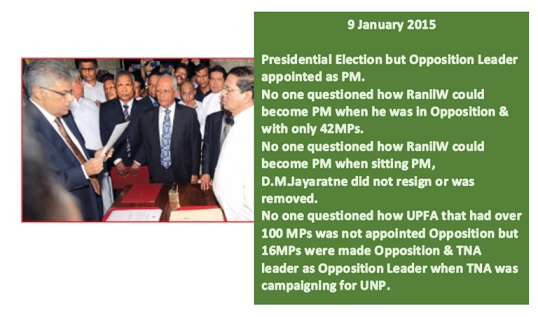
A handful of records by yahapalana since 2015 is presented for you to get an overall idea of the damage that has been done in 4 years.
Appointments:
  • · Legally questionable appointment of RanilW as PM in January 2015 following a Presidential election & not Parliamentary election while RanilW had only 42 MPs in Parliament
  • · Legally questionable appointment of RanilW as PM in January 2015 as sitting PM was not removed by gazette notification.
  • · Speakers refusal to acknowledge the over 50 MPs of the UPFA as Joint Opposition – naming TNA which had just 16MPs as the Opposition & TNA leader Sambanthan as Opposition Leader.
  • · Speaker also appoints JVP with 6 MPs as Chief Opposition Whip. (ironically both JVP & TNA helped Yahapalana to come to power – therefore how can they function as Opposition?) First time that Leader of Opposition voted for a Govt budget when TNA voted in favor of Yahapalana budget in 2016.
  • · Foreigner as Governor of Central Bank despite objections & despite him having a chequered record as BOI head in 2001
  • · Allegedly LTTE-linked former UNP President’s advisor being appointed as Financial Advisor in 2001 & again in 2015.
  • · Brother of former UNP Chairman as Air Lanka head
  • · Alleged appointments of Royalists to key posts
  • · Appointments of family members to ministries & other statutory bodies


Corruptions & Wastage
  • · 2 Central Bank Bond Scams – PM Ranil takes Central Bank directly under PM in Jan2015, nominates his friend a Singaporean national as Governor Central Bank despite protests, assures parliament he would be accountable for Mahendran. After the bond scam was exposed PM Ranil appoints 3 UNP lawyers to investigate, removal of UNP MP Velukumar & replaced with MP Sujeewa S, ArjunaM’s statement to COPE that PM Ranil only ordered change in method for Bond Sales, UNP Members of COPE functioned under direct instructions of PM Ranil, Governor Mahendran was not even sent on leave pending conclusion of inquiry, Chairman & Senior officials of the 3 state banks giving evidence at the Presidential Inquiry in Oct2017 confirmed that RaviK had instructed them to make bids at lower interest rates, not taking action against those responsible for the scam even after its exposure.
  • · Former PM Ranil announced new economic plan in 2016 as Minister National Policies & Economic Management & hired US Consultancy firm McKinsey & Company in November 2016. McKinsey identified 3 areas for accelerated development: Tourism – Agriculture – Manufacturing – Sri Lanka had to pay $2,997,666m for this proposal! Why couldn’t our own people prepare a plan for our development?
  • · On 3 occasions former PM Ranil had presented proposals to privatize Bank of Ceylon, Peoples Bank, National Savings Bank & state pawning outlets. (Derana news & President Sirisena) RW also planned to bring Samurdhi Bank with assets of Rs.200b under Central Bank & Finance Ministry – this too was seen as an attempt to deny the poor relief.
  • · In May 2018 on application filed by Office of Public Trustee & Colombo District Court granted approval for the dept to open 254 last wills lying in a public safe between 1932 & 1992. If there are no heirs to these last wills – wonder what will happen to the fortune/wealth?
  • · Sri Lanka’s Mobil Industry was a key contributor to Sri Lanka’s economy for decades & delivered mobile services at low tariff rates. In 2017, Cellular Tower Levy was introduced & Rs.200,000 per month per tower charged. Monthly operational cost would increase from Rs.115,000 to Rs.315,000 (174% increase) Three of the 5 mobile operators are now running at a loss.


Questionable Bills/Amendments

  • · 19th amendment was passed in April 2015 diluting Presidential powers without mandate of People
  • · Amended Land Ordinance Act presented by Ranil in September 2018 would if passed in November privatized all state land leaving ownership with foreigners.
  • · Amending – Rent Act, No. 7 of 1972 which limits the ownership of houses and the rent to be charged
  • · Amending – Paddy Lands Act, No. 1 of 1958 and the Agricultural Lands Act, No. 42 of 1973 to allow the farming of alternate crops.
  • · Local Government Authorities Elections Act No.16 of 2017 – Bill said to correct technical issues at Committee stage, after second reading, Yahapalana brings totally new amendments & changes entire electoral system. The Bill was not presented to Supreme Court. The Bill finally passed was not the Bill read the 1st & 2nd time or the one that was gazette. UNP, dissident SLFP, JVP, SLMC & ACMC & TNA supported it
  • · Sabaragamuwa, North Central, Eastern PCs were to be dissolved in September/October 2017. But a day or two before dissolution, yahapalana changes Provincial Council Elections System via amended Act. Provincial Councils(AMD) Act No.17 of 2017. AGAIN – sweeping amendments were brought at Committee stage where the gazette was only to increase women’s representation at PCs. Amendments made at Committee stage was not gazette or made available to MPs at 2nd reading stage. Note: Act was passed INSPITE OF Supreme Court ruling that the extension of PCs or postponement of elections require a referendum + 2/3 majority in Parliament
  • · National Audit Bill : Original bill had provision to impose Rs.100,000 on officials who furnish false information during audit queries. This fine was reduced to Rs.5000 in amendment. The original Bill that had provisions for Commission to investigate special projects outsourced to private companies WAS REMOVED. Powers of Auditor General related to internal audits of statutory bodies including govt corporations, boards, authorities also removed. Bill also prevents Right to Information requests on audit queries. WHY GO TO THESE LENGTHS?
  • · Foreign Exchange Act 12 of 2017: HIGHLY CONTROVERSIAL BILL. Petitions against Bill – violating Constitution, claiming Bill deprived & abrogated power of Parliament to control public finance, removed powers of Central Bank/Monetary Board to supervise, regulate & control foreign exchange including gold, currency, payments, securities, debt, import, export, transfer & settlement of property as provided by Exchange Control Act 24 of 1953. Yahapalana was accused of denying challenging of Bill within 7 days by placing it on Order Paper of Parliament on Friday 7 April 2017 as Supreme Court was on holiday thereafter. Bill was adopted by preventing it from being challenged.
  • · Enforced Disappearance Protection Bill: Presented to Parliament twice & withdrawn due to Public protests. But Bill was passed in March 2018 violating Standing Orders & denying Opposition request for more time to debate it. Passed on the same day it was presented! Bill was declared passed in Parliament with only 53 MPs voting in its favor.
  • · Office of Missing Persons Bill 2016: Virtually bulldozed through Parliament by UNP, SLFP dissidents, JVP & TNA despite objections. Less than 40 minutes given to debate this new law. Vote was taken & Speak declared Bill as passed. The Act protects members of the OMP, officers, servants & consultants of OMP from Right to Information scrutiny in respect of matters communicated to them in confidence” Why the need to include such?
  • · Judicature Act No.2 of 1978 – May2018: Act enables to set up permanent High Court at Bar to hear cases relating to offences specified in the Sixth Schedule of the Act. The Bill empowers Permanent High Court at Bar to try offences – theft, dishonest misappropriation of property, criminal breach of trust by public servants, bankers, merchants, agents & dishonestly receiving stolen property… cheating, forgery, making false documents, counterfeit, money laundering etc. MPs, police officers, peace officers, Bribery of Judicial officers & other public officers an be tried. Bill was passed without JO at the Committee Stage with majority of 51 votes.AG & DG for Prevention of Bribery & Corruption were given discretion to select cases to the Court. Prosecuting officers had power to arbitrarily select cases. BASL petitioned challenging Bill to say there is no court called Court at Bar in law. Many referred it as a Kangaroo Court. Bill was passed with majority of 67 votes
  • · 19a Constitutional Council: Normally, a CC must rule if proposed statues are Constitutional after Parliament votes & before President signs into law. Sri Lanka’s CC has nothing to do with the constitution (name is inappropriate) Sri Lanka’s CC = PM, Speaker, Leader of Opposition, 1 person appointed by President, 5 nominated by President on recommendation of PM, Leader of Opposition & 1 person nominated by majority MPs. Tenure is 3 years & consists of 10 members. Main function of CC is to recommend Chairman & members of the National Commissions (Elections, Public Service, Police, Audit Service, HR, Bribery & Corruption, Finance, Delimitation, Procurement, UGC, Official languages. CC recommends 3 & President must choose from 1 from the 3. CC also recommends 3 names for Chief Justice & Judges of SC, President & Judges of Court of Appeal, Members of Judicial Service Commission, AG, IGP. CC is not a Parliamentary committee & not answerable to Parliament – no one knows who CC is answerable to. However the composition of CC gives 7 persons a clear majority & thus controlled & manipulated by politicians for politicized appointments.
  • · Active Liability Management Bill sought authorization to borrow over Rs.1trillion from local & foreign sources separate to the yearly borrowing limit set by Parliament. It enabled bypassing of existing controls for loans and Parliament will have no control in the manner funds are utilized. The Bill also removed civil or criminal liability of those who utilized the money. Though Supreme Court was petitioned the Bill was passed in March 2018.
Anti-democracy
  • · When removed by gazette as PM without accepting the sacking or taking legal measures against it, RanilW goes crying to the western/indian envoys requests them to come to Temple Trees & is regularly in discussions with them – externalizing an internal matter.
  • · President gives reason for removing Ranil as PM – attempting to usurp Presidential powers, exceeding his limits, ruling with arrogance, ignoring collective decisions, these are not what the voters were shown
  • · President accuses RanilW of establishing a fraudulent committee to manage economy & President had no alternative National Economic Council committee which RanilW prevented from functioning by asking the international monetary organization paying the salary of the consultant to stop payment.
  • · When President wanted to visit Central Bank, Ranil’s response was Central Bank belongs to me, why do you want to go there’.
  • · Amendments were made to the Commission on Bribery or Corruption Act & sent to Parliament so that Bond Scam perpetrators would be given due punishment. Parliament has postponed approval of amended Act indefinitely.
  • · Co-sponsorship of legally questionable UNHRC resolution in Sept2015 placing national army in a very embarrassing predicament and agreeing to terms that will pose national security risk while also agreeing to a new constitution
Economy
  • State of the Economy: PM Ranil said yahapalana was saddled with $1900m loans (exclusive loans taken by state institutes) PM Ranil said national debt at 31 Dec 2015 was Rs.4,959.2billion (local) and Rs.3,544b (foreign)
  • Debt had increased to Rs.9,387b in 2016 (57% local & 43% foreign)
  • Foreign loans had increased from $1.82b in 2016 to $2.41B IN 2017
  • Sri Lanka printed currency worth Rs.217b from Jan-Mar2017 to pay public sector salaries & other state expenditure.
  • 50 public institutions (including Sri Lankan Airlines/hotels) lined up for privatization in 2017 budget to cover 2016 budget deficit
Comparing Rajapakse & Yahapalana economy:
2009-2011 – 8% growth
2015 3rd quarter – 4.8% growth
Sri Lanka Rupee depreciated from Rs.132 in 2005 to Rs.153 in March 2017 by end 2018 it was Rs.180
Foreign reserves:
$324.3m withdrawn in 2016
$309m withdrawn in Jan-Feb 2017
official reserves down to $5.5b (Jan2017) compared to $6b end of 2016
Foreign Direct Investment:
Dropped from $658m in 2015 to $300m in 2016
Bloomberg rated Sri Lanka as high risk for investments.
Moody, Fitch, Standard & Poor rating agencies gave Sri Lanka a negative rating for 2017.
Yahapalana loans
Auditor General says loans taken by yahapalana in 2015 was double borrowing limit mandated by Parliament
From Jan2015 to Sept2016 yahapalana had borrowed $2.3b from India, $3.65b through sovereign bonds, $3.1b through SL development bonds & $1.5b from IMF (Total $10.5b in 18 months)
In 2016 yahapalana also arranged with 5 banks (including HSBC, Credit Suisse, Citibank) for a syndicate loan of $3.5b (includes clause that govt can be asked to pay back entire amount)
Yahapalana borrowed Rs.23b from NSB & People’s Bank in Feb2017 to fund Central Expressway Project.
$1.5b from IMF in June 2016.
IMF approved 3year Extended Fund Facility of SDR $1.5b (so far 2 tranches given to value of Rs.239m ($325m)
Chinese govt offered $1000m at 2% so govt would not need to take IMF loan of $15,000m at 6%. IMF loans are subject to conditions that hit the middle class & poor – higher taxes, reducing govt welfare subsidies, sale of state-owned enterprises to foreign buyers, state land given to foreign investors, increasing taxes, liberalizing trade, killing agriculture self-sustenance. Yahapalan govt as per IMF demands has reformed taxes, land ownership & labor laws.
· In Jan2017 Cabinet approved a further USD1500 million bond issue
· Sri Lanka printed currency worth Rs.217 billion from January to March 2017.This was needed to pay public sector salaries50 public institutions had been lined up for privatization in 2017.
· Ranil & Co came to power to ease the domestic burden of the consumer – today prices of food have sky rocketed
· Suspending re-exporting karunka (dried arecanut) which earned Rs.9.1billion in 2015 becoming highest foreign exchange earner. 4 local companies were engaged in this trade. Former Finance Ministery RaviK issued permits to other companies & now the income has dropped from Rs.9.1b in 2015 to Rs.4.9b in 2016.
· Release of state lands for foreign ownership – 2017 budget announced removal of restrictions limiting land ownership rights of listed companies with foreign owners / yahapalana also removed restrictions on foreigners purchasing condominiums below 4th floor.
· PM’s advisor presented in 2015 a proposal by Trimble Navigation Ltd (US company) for Title/Tenure Regularization & Cadastral Registry Modernization’ in Sri Lanka the proposal which had been rejected in 2010. Trimble asked $170m which was reduced to $154m without TENDER to be taken as a loan at 4% interest to be paid in 15 years. Finance Ministry’s External Resource Dept was to negotiate with Trimble – database of 3.6m parcels of state owned land. Trimble given management of SL Survey Dept, controlling SL’s electronic land register & details of land will mean a threat to Sri Lanka’s national security
· In 2018 the National Gem and Jewellery Authority (NGJA) imposed a levy of Rs. 25,000 per 100 carat on gem export sales or contracts and increased the license fee to half a million rupees from only Rs. 35,000. Sri Lanka Gem and Jewellery Association complained that NGJA is stifling the industry by levying such charge on the value of exports resulting in a huge drop in gem and jewellery revenue in exports
· In 2018 Yahapalana placed a 15% tax on gold imports in 2018.
· Protests managed to stop import of eggs which would have destroyed the local poultry industry
· Opening Sri Lanka to foreign retail industry in March 2018 – (shoes, grocery, floor tiles etc) all threatening local businesses. Minimum requirement for foreign investors or JV set by Govt is $5m – foreigners end up paying same tax and duty as Sri Lankans but earn bigger profits as they repatriate their profits and this affects foreign exchange reserves too. Foreigners in retail market are selling foreign goods.
· Hallmarks of every new investment has been the lack of exit clauses, rule, regulations & monitoring mechanisms, cancellations for violations, checks & balances etc (Sri Lankans cannot set up retail outlets in foreign countries as these countries protect their local industries)
· Local metal industry – scrap metal that can be refined locally is being sent abroad illegally avoiding duty, manipulating HS codes. Law allows only export of locally unrefinable scrap
GSP+:
GSP+ is not an incentive to garment producers but a concession given to importers at European end so importer will not have to pay duty when importing garments from Sri Lanka.
Sri Lanka garment industry did not fall even when GSP+ concessions was removed in 2010 & was doing well from 2005 to 2010.
GSP concessions are conditional & conditions have nothing to do with trade & cover human rights, environment, labor laws & even UN compliance.
Job losses as a result of FTA
Giving resident status, foreign labor permission to foreign investors mean that not only there is likely demographic issues in the future but massive job losses & issues related to food, energy and residential problems too likely to emerge.
Burdening the Tax Payer & Small/Medium Businesses
· Proposal to tax EPF 28% (14% on income & 14% on withholding tax) impacting private sector employees who depend on EPF to live after retirement.
· VAT has increased from 11% to 15% burdening the consumer & impacting small & medium businesses
· Using social concern – wayside stalls etc are being targeted (micro enterprises account for 91.8% of total business in Sri Lanka – employing 44.6% labor)
· Rs.1m imposed on import of vehicles in 2017 – mini-trucks jumped from Rs.1m to 1.8m – these were used by small businesses
· A water tariff carrying a sharp increase was imposed, outside the 2017 budget on Schools, religious place and even hospitals
· tax exemption for deposits of senior citizens has been removed and their withholding tax has been increased
· Yahapalana increased import levies on confectionary fats from 60% to 160% in 2016 budget affecting even local consumers resulting in cheap inferior import flooding the market (Lanka Confectionary Manufacturers Association press release)
· Removing taxes on lease of land to foreigners & removed restrictions on ownership of investments enabling foreign companies to set up shop & reside in Sri Lanka which will impact small & medium local industries. Offering 5 year multiple visas to foreign investors & their labor confounds matters further. Tax concessions & visa extensions were given to those who invested over $1.5m
· Special Deposit Account Act in 2017 that allows foreigners with a deposit of $500,000 to obtain resident visa to a period of 10 years. Spouse & minors also eligible to stay. These foreigners can also invest in Sri Lanka. No State monitoring authority is mentioned in act.
· Census Department reported that inflation has increased to 7.9% in August 2017 from 6.3% in July 2017.
· 6000 small & medium scale rice mills closed & 100,000 lost jobs in 2017. Wheat imports from increased from 800,000 tonnes to 1,700,000.
· Tea Industry accuses Ministry of Finance of appropriating Rs.7b from the cess fund of Sri Lanka Tea Board used for global tea promotion. Despite protests tea cess was transferred to Treasury (2016) The 2019 budget plans to take the Tourism cess fund under Treasury too.
· In 2018 Ranil Govt permitted entry of new type of prawn – Pacific White Legged Shrimp imported by a private company. The Economic Research Council headed by former PM Ranil instructed the National Aquaculture Development Authority (NAQDA) to permit import. Experts say this shrimp carries infectious disease & import has not followed proper legal procedure
· Yahapalana proposes to abolish para tariffs (extra tax imposed on goods in addition to usual duties) in 1200 imports. Para tariffs on 253 products removed in 2017.
· Yahapalana killing SL footwear industry: Indian non-leather footwear manufacturer (Veekesy Slippers) allowed to enter market without restrictions using Section 16 of BOI minimum investment $250,000 investment (100% foreign or JV with local) & gives unlimited access to local market sales. Investment promised to purchase raw material from SL, provide 250 direct & 250 indirect employment to locals (when 150 small & medium SL local footwear manufacturers are employing 350,000 workers). BOI then Chairman Upul Jayasuriya had given approval for 10% local manufacturing & 90% exports.
International record sheet speaks for itself
· Economic Freedom Report, places Sri Lanka 112 out of 180 countries, down from 2016. Sri Lanka ranks lower than Uganda, Swaziland, Mali, Nicaragua, Benin, Honduras (Heritage Foundation & Wall Street Journal)
· Global Competitiveness Report 2017/18 (World Economic Forum) Sri Lanka is 85. In 2016/17 Sri Lanka was ranked 71
· Ease of Doing Business Index” 2017 (World Bank) Sri Lanka is 110.
· Corruption Perception Index” (2017) Transparency International, places Sri Lanka 95 out of 176 countries.
How independent are these ‘independent commissions’
Prof. S.Ratnajeevan H. Hoole, a member of the Election commission filed a Fundamental Rights petition seeking an Interim Order restraining the Elections Commission from proceeding to take any steps to conduct the Parliamentary election – he has not even resigned before or after showing his bias and has the audacity to write about what he did.
Anti-Buddhist agenda
· Ven. Devalagama Dhammaratana, sangha nayake of Hambantota said Hambantota lands were to be taken over, they had already measured them. About 100 temples and their lands were included in this takeover.
· In May 2018 university students and sangha demonstrated in Colombo over the removal of ‘Buddhist Philosophy’ as a subject from the University.
· August 2018, Office of National Unity & Reconciliation (ONUR) launched several radio dramas all of which attempted to ridicule Buddhism & insult Buddhists & lack of respect for Buddhist cultural sensitivities.
· government taxed Rs 3.2 million on Buddha statues brought by a Chinese delegation on a request by Mihintale Raja Maha Vihara to be distributed among poor temples in the remote areas.
· planned movement to mislead Buddhists by distorting Buddhism & certain Buddhist monks and laymen were distorting Buddha’s teachings when preaching
· Taxing temple tills
· There are over 40 Buddhist monks in prison – no charges no bail for trivial reasons.
This is an incomplete list of yahaplana blunders, in competencies & selling the countries assets & resources into foreign hands with no reduction in national debt situation or relief to the masses. In privatizing & siphoning off national assets yahapalana has only reduced Sri Lanka’s bargaining power & sovereignty as well. When people eventually realize the damage that has been done in the past 4 years it would be too late and sadly the nation & the future generations will suffer the perpetrators & traitors would absolve itself of all responsibility.
Shenali D Waduge

Proposed constitution

January 8th, 2019

Proposed constitution – What you should know

මීගහතැන්න නගරයෙහි පෙර තිබූ බස් මගී ආවරණ යලි ඉදි කර දෙන මෙන් මගීන් මැසිවිලි නගති.

January 8th, 2019

පේශල පසන් කරුණාරත්න සභාපති සමනල යෞවන සමාජය

කළුතර දිස්ත්‍රික්කයේ  වලල්ලාවිට ප්‍රාදේශීය ලේකම් කොට්ඨාශයට අයත් මීගහතැන්න නගරය වළල්ලාවිට, පැලවත්ත සහ මතුගම දක්වා විහිදෙන ප්‍රධාන මාර්ගයන් තුනක් එකිනෙක සම්බන්ධ වන අධික ජනාකීර්ණ නගරයකි. මීගහතැන්න මධ්‍ය මහා විද්‍යාලය, පොලිස් ස්ථානය, මහජන පොළ, පිරිවෙන, රෝහල, බැංකු ඇතුළු රාජ්‍ය සහ පෞද්ගලික ආයතන රැසක් මීගහතැන්න නගරය ආශ්‍රිතව පවතින අතර මේ නිසා අවට ප්‍රදේශවල විශාල ජනතාවක් තම අවශ්‍යතා සඳහා දිනපතා මීගහතැන්න නගරයට ඇදී ඒම සිදුකරයි. මෙම නගරය දකුණු පළාත සහ බස්නාහිර පළාත සම්බන්ධ කරන ප්‍රධාන මධ්‍යස්ථානයද වන අතර මීගහතැන්න නගරයෙන් වළල්ලාවිට මාර්ගය ඔස්සේ ඇල්පිටිය හෝ පිටිගල හරහා අම්බලන්ගොඩ, ගාල්ල, මාතර වැනි ප්‍රදේශයන් වෙතත් ඉත්තෑපාන, ලෙව්වන්දූව හරහා අධිවේගී මාර්ගය වෙතත් පිවිසීම සිදුකල හැකිය. පැලවත්ත මාර්ගය ඔස්සේ නෙළුව, දෙනියාය, උඩුගම, මොරවක, බදුරලිය වැනි ප්‍රදේශ වෙත ගමන් කල හැකි අතර මතුගම මාර්ගය ඔස්සේ මතුගම, අගලවත්ත, හොරණ,අළුත්ගම නගර හරහා දිවයිනේ අනෙකුත් ප්‍රදේශ වලට පිවිසිය හැකිය. මේ නිසා මීගහතැන්න නගරය හරහා මාර්ග අංක 428, 435,42, 399, 174,  138, 410,  99/5,  210/2, 18 ඔස්සේ වළල්ලාවිට, අවිත්තාව, ගුලවිට, මතුගම, අළුත්ගම, කොළඹ, මහරගම, බදුල්ල, නුවරඑළිය, ඇඹිලිපිටිය, පැලවත්ත, පහලහෙවෙස්ස, නෙළුව, තවලම, මොරවක, දෙනියාය, බෙලිඅත්තකුඹුර, උඩුගම, මාපලගම, ඇල්පිටිය, පිටිගල, නැදුන්වත්ත වැනි ගමනාන්ත කරා බස් රථ විශාල ප්‍රමානයක්ද දිනපතා ධාවනය වේ. මෙම බස්රථ දිවයිනේ ප්‍රධාන නගර හරහා ධාවනය වන බැවින් මේවා මගින් ගමන් පහසුව සලසා ගැනීම විශාල මගී  පිරිසක්ද දිනපතා මීගහතැන්න නගරයට එක්රැස් වේ.

එසේ නමුත් මෙම මගීන් සඳහා බස් මගී ආවරණ (Bus Halt) නොමැති වීම ප්‍රබල අඩුපාඩුවක් වී ඇත. මීට වසර කීපයකට පෙර මෙම මීගහතැන්න නගරය කේන්ද්‍ර කොට ගනිමින් බස් මගී ආවරණ 4 ක් පැවතියද මාර්ග පද්ධතිය අළුත්වැඩියා කිරීම සඳහා ඒවා කඩා ඉවත් කල නමුත් මාර්ග අළුත් වැඩියා කොට කලක් ගත වුවද තවමත් එම මගී ආවරණ ඉදිකර නොමැත. මේ නිසා නගරයට පැමිනෙන දහස් සංඛ්‍යාත පිරිසකට මහත් පීඩාවන්ට ලක්වීමට සිදුව තිබේ. මීගහතැන්න නගරය ආශ්‍රිත ප්‍රදේශය වසරේ බොහෝ කාලයක් අධික වර්ෂාවක් ලැබෙන ප්‍රදේශයක් වන අතර දිවා කාලයේදී දැඩි අවුරශ්මියක්ද පවතින ප්‍රදේශයකි. මේනිසා නගරයට පැමිනෙන ජනතාවට දැඩි හිරු රැසින් සහ වර්ෂාවෙන් පීඩා විඳීමට සිදුව තිබේ. බස් රථ පැමිනෙන තුරු වාඩීවී සිටිමට සෙවනක් හෝ වෙනත් සුදුසු ස්ථානයක්ද මීගහතැන්න නගරයේ නොමැති අතර බඩු මලු ඔසවාගෙන මහාමාර්ගය දෙපසට වී  බස්රථ පැමිනෙන තුරු බලා සිටීමට සිදුවී ඇත. මෙය ඉතා අනතුරු දායක ක්‍රියාවකි. ප්‍රථිකාර ලබා ගැනීමට පැමිනෙන රෝගීන් හට විවිධ අපහසුතා විඳිමින් කඩපිල් වල හෝ පාර දෙපස බිම වාඩිවී සිටිමට සිදුව ඇත.

මීගහතැන්න මං සංදියේ පෙර තිබූ බස් රථ මගී ආවරණ (Bus Halt) යලි ඉදිකිරීමට හෝ මීගහතැන්න නගරයට බස් නැවතුම්පොළක් (Bus Stand) ඉදිකරීම මේ වන විට විශාල අව්‍යතාවයක් වී ඇති අතර එබැවින් මෙම ගැටළුව පිළිබඳව සොයා බලා කඩිනම් විසඳුමක් ලබා දෙන මෙන් අදාල බලදාරීන්ගෙන්  ඉල්ලා සිටි.


පේශල පසන් කරුණාරත්න

සභාපති

සමනල යෞවන සමාජය

නාවලකන්ද, මීගහතැන්න.

ELIMINATION OF RACIAL AND RELIGIOUS DIFFERENCES IS A RESPONSIBILITY OF ALL PARTIES INVOLVED

January 7th, 2019

BY EDWARD THEOPHILUS

It is obvious from the current debate on the elimination of racial and religious differences in Sri Lanka that many minor parties to involved in the debate attempt to blame a single party, Sinhala Buddhist, for the failure of the thrust.  In fact, it is not the right way of conflict resolution or reconciliation. Any matter in Sri Lanka seems to be used for politics and the blaming for Sinhala Buddhists for everything is not true democracy or justice. However, the nature in Sri Lanka is to blame Sinhala Buddhists for everything because they are silent on this type of blame game. If people carefully study this matter considering the historical facts too, Sinhala Buddhists were more tolerance group in Sri Lanka than any other party to the issues.

Recently, Cardinal Malcolm Ranjith clearly stated that Buddhism is the main part of a tree and all other branches or religions are connected to the tree with the main part. If anyone tries to destroy the main part it will not support the growth of branches of the tree.  This example clearly reflects the real situation in Sri Lanka where the outside forces and domestic forces attempt to harm or annihilate the tree without realizing that if any attempt to dismantle the main part of the tree will impact to die the branches of the tree.

It is quite clear that small ethnic and religious groups endeavor to blame Sinhala Buddhists for all matters. Sinhala Buddhists are estimated 73% of total population of Sri Lanka and the balance 27% of the population, which includes, Hindus, Sinhala Christians, Tamil Christians, and Muslims has no agreement with this blame game and most probably the hating group of the population might be less than 1% of the population.  However, the opinion and the behavior of this less than one percent of the population are given priority by media and outside forces, who are concerned with making money or any other benefits out of this issue.

The true democratic principle is that ethnic and religious issues in Sri Lanka are a responsibility of all parties, but not only the responsibility of Sinhala Buddhists.  The environment of Sri Lanka seems that small group of people such as TNA and Muslim Congress and tiny Christian religious sects attempt to profit out of the problem. Sinhala Buddhists are highly tolerance group of people in Sri Lanka and they have no intention to create violence or discriminating minor groups in the country.

In history, Kings of the country excellently gave the lead for the tolerance and punished people without a difference, who attempted to go against the unity.  Robert Knox reported that Senkadagala Rajasinghe gave capital punishment to his relative son for disturbing the unity. After the independence in 1948, the executive power of the country strongly supported to maintain the tolerance of the country.  For example, in 1958,  Governor General Sir Oliver Gunatilake, despite his status as nominal head to executive power and controlled the intolerable situation.  In 1983, Mr. JR Jayawardane controlled intolerance.  Recent intolerance in Beruwala controlled By Executive president Mr. Mahinda Rajapaksa and Kandy incidents controlled by President Mr. Sirisena. All executive presidents supported to maintain the peace and stability of the country and they were Sinhala Buddhists and maintained and supported to maintain tolerating society.

Executive presidents may have corrupt people as they were elected by the votes of public and the most corrupted person was Mr. R. Premadasa as his associates were corrupt people. All other presidents had corrupt associates. However, Sri Lanka is a tolerable society and foreigners understand well this truth.  Although TNA thinks that their actions are praised by foreign governments it is not the truth.  Foreign countries know well that Sinhala Buddhists are more peaceful and tolerable people than any other group of people in Sri Lanka.

Nevertheless, in Sri Lanka, there is a serious problem in policy development, policy monitoring, and remedial management.  This situation can see in many other countries especially in developing countries. Many countries I worked noticed that policies are used as ornaments than working instructions. In a Pacific country, I saw that policy document develops to attract foreign aids but not to implement them. In Sri Lanka for anti-discrimination laws were not tolerated by minor groups of the population but not the major group, Sinhala Buddhists.

In 18 hundreds  Emperor Napoleon prophesied..” quand la chine s’éveillera, le monde tremblera »- when China awakens the World will tremble. And where is Sri Lanka in the meantime with pseudo democracy and an independent Judiciary  ?

January 7th, 2019

By Charles S.Perera

In 1933 Pearl S.Buck won the Nobel Prize for literature for  writing brilliant novels such as The Good Earth  describing the poverty of the Chinese peasants. She described  in moving terms  how the Chinese peasants who had no food to eat survived eating barks of trees , and how the peasant  women sold little babies on the way side.

Later the western press described  how Mao’s Communism  massacred its own people, and later how the Communist governments violated human rights of the Chinese people. When the west triumphed  in breaking up the powerful USSR, they thought they would follow it up with China and erase  Communism from the face of earth.

In 1989 the Chinese Students manipulated by interested parties  came out in thousands to manifest against the Chinese Communist Regime. The American and the Western press overjoyed rushed  in  to take images of floundering Communism to show the Americans to rejoice the end of Communism in China, and the victory of Western democracy.  However, the government of the People’s Republic of China  suppressed the students manifestation  which the western press immediately flashed  in large letters in the first pages as the Tiananmen Square Massacre.

America took away the student leaders who led the manifestations as heroes of democracy. The Western press described in details  to shock the American public the suppression of the student manifestations as brutal  and the massacre of thousands of Students . American Government as usual suspended arms sale to China, and imposed economic sanctions.

Thereafter, at every international forum America and the West condemned China for violation of human rights, and it became their preoccupation for a number of years continuing to do so even now. However, despite refusal of the West to transfer science and  technology, China which had begun its development process in stages first by even melting  iron ore in home furnaces, rose from the state  of poverty, despite  American and Western barriers for its development with  anti China propaganda, and  yet as if it were overnight  became the economic leader of the world, second only to that of the America.

When in 1969 the Americans landed the Spacecraft Apollo II on the moon, while relations between China and Russia had turned sour and there was conflict brewing between the two- the Dragon and the Bear, in 1969 China celebrated its 20th Anniversary of Mao’s declaration of the People’s republic of China on 1st October,1949.

To crown it all on the 4th January, 2019,  China Landed a spacecraft on the dark side of the Moon, the side unseen from the earth.  That is a first by China and perhaps a slap on America with Trirmph’s declared trade war against China. But the West are not generous even to accept such a great achievement of China. France television  while discussing this great Chinese achievement  shamelessly questioned on  China’s  violation of human rights. America and Europe are hopelessly involved in a political and an economic  crisis- America with a President who does not seem to know what he has to do, UK has problems with regard to entering or leaving the EU, France in a political stand still with thousands of people on the streets  protesting against taxation,  Germany’s political crisis over immigration. Italy in the hands of extreme rightwing politicians with a crisis over EU, all that while China sails peacefully on a  calm sea  bereft of rough political waves towards greater  hope and prosperity.

The Chinese people were able to recognise their President Xi Jinping  elected by them on the 15th November,2015  as the  man capable of leading their country forward to success, and  elected him  as their  President for life on 25 October,2017.  That is how countries could prosper. Russia too found a great leader in  Vladimir Poutine and continues to elect  him term after term  to develop Russia further  as he is  loved by  the Russian people and earned their confidence.  .

We in Sri Lanka should also have re-elected Mahinda Rajapakse and kept him as the President for  few more years, as in him Sri Lanka found the correct political leadership to lead the country to prosperity. All scandals started by UNP dictated to by the West about Mahinda Rajapakse being a corrupt politicians were all lies  because he was a great patriot who was in the service of the people and the country. It is still the educated Colombians, UNP and the Tamil politicians  that are a barrier to Sri Lanka’s development and prosperity. 

Not understanding this reality deprived Sri Lanka the services of a great political leader , as it has been proved today how wrong the people were  in electing another President to replace Mahinda Rajapakse for a change,   which brought back an incapable political leadersip under a Ranil Wickramasinghe a puppet of the West,   politically blind to lead Sri Lanka any where towards development.

RanilW has taken  Sri Lanka many miles backwards on the path of development that was traced by Mahinda Rajapakse. They accused Mahinda Rajapakse  for a family regime having his brothers around him, but those brothers  were an essential part of Mahinda Rajapakse’s equipment for his vision of development. 

America and the West  mindful  that wide powers  of exploring the space  vested with  people with special qualities, wanted to guard that knowledge for themselves. Hence America  did not pass on scientific and technological know how to China, as such knowledge they thought  requires making important decisions which will affect the whole world  and most of such decisions may not be reversible to make.

This sounds same as those wise words of Sri Lanka’s appeal court  judgement in which the judicial duo said to be independent  democratic appeal court judges, said why they cannot entrust the function of the duties of  a Prime Minister  and Cabinet of Ministers to a group that had been sworn in by the President of Sri Lanka.

No one can stop China reaching greater heights in  all fields of development. Sri Lanka should take a lesson and elect a visionary leader as a President of Sri Lanka, or while China goes from prosperity to prosperity we in -Sri Lanka,  with our pseudo democracy and pseudo independent Judiciary is  going down from poverty to poverty.

It is  time that the people take note and end this nonsense of  Sumandiran- Ranil Wickramasinghe Regime- for that is what it has become with their determination to pass a new  federal Constitution, with nine provinces, allowing JVP to present a 20th Amendment to the Constitution to have a President for Sri Lanka elected no more by the people, but by the Parliamentarians of no-confidence motion with 122 votes fame, allowing North and East to form a Single Tamil only Province, enact the Trade Agreement with Singapore and ruin Sri Lanka making it a puppet state of the West.

Sri Lanka cannot go to the Moon. But Sri Lanka has to preserve its territorial integrity, without allowing it to be  divided by a power crazy UNP and its allied political parties, to please  a handful of racist Tamil  politicians. Therefore  , the patriotic Sri Lankans should determine never  again to vote for any one from UNP or from its  allied parties for them to form a government or be party to a coalition government.

How many nations are there in this country?

January 7th, 2019

Dr. Sudath Gunasekara:   (SLAS) Retired Permanent Secretry,  President Senior Citizens movement Mahanuwara.

7.1.2019.

This has been a very big puzzle for me for quite some time. I have no doubt that majority of you who read this note might have had the same problem.  This is mainly because very often people who mater in society, when they speak at public fora use to say ”me rate Siyaluma jatinta’ meaning for all nations in this country. What baffle and confuse me is the question as to how many nations are there in this country. Because I always thought there is only one Nation in this country like any other country in the world. You would have heard and noticed this lose utterance over the TV, Radio, the press, at public meetings and even at private conversations. I have seen this happening very often. Our politicians starting from the President, Prime Minister downwards, academia in universities including even some professors of Sinhala and History, almost all religious dignitaries, some so-called intellectuals who have got disoriented or brain washed in the course of their political and ideological transformations and many more go on uttering these lose words repeatedly like parrots most probably without knowing the seriousness of the damage they to the Nation that is  Sinhala or Sri Lankan.

In my opinion politicians who woo for minority votes to come to power, people who do not have that spiritual attachement that infuse a sense of nationality and  those who do not have a proper Jatakaya (birth) are the people who indulge in such nonsense. Of course those who really do not know the actual meaning also may use it. But they could be corrected whereas the other categories cannot be at any rate.

When all these big shots either driven by their personal the minorities also to and believe  they are separate nations. The most dangerous thing about this trend is the psychological transformation of the perception and attitude of the people that would settle down permanently in their minds and become irreversible. In this instance I would like to draw a parallel between the division of the Sinhala people living in the hills and the lowlands in to two rival groups  by the colonial powers as Kandyans and Low Country Sinhalese by the British. Until then they were one nation, that is Sinhala. But since then these artificially created two groups behaved as if they were two different nations and at the early stages of agitation for constitutional reforms in the 19th and early 20th centuries they even asked for two separate federal states. Thanks to the fact they all belong to one race, speak the same language, professed the same religion and have common roots the differences were patched up and went back to square one.

As such why can’t this band of ignoramus who chant the ‘mantram of many nations’ understand that this country, like any other country in the world has “only One Nation’ as it was the case from the dawn of historyWhat is more funny is at the same time these very people talk, of one nation,  (ekama Jatiyak) some times in the course of the same speech.  They say jati bhedayak neti ekama jatiyak. They little realize if there are many nations how on earth you can have a Ekama Jatiyak. This clearly shows these people do not know what they are talking.  So it is no wonder that the ordinary people get confused and also begin to think that this country really has more than one nation. The situation is made even worse when top Politicians from high flat forms describe this country as a multinational society. Minority communal elements meanwhile make the maximum use of his confusion and mak hay while fool display their political rhtorics.It is like the famous sinhala adage ‘panina rilawunta iniman bendeema’.

As for me from my small days I thought we have only one nation in this country. That was how the teachers of our day have taught us in school. According to them we are called the Sinahala nation and the country is nhale, meaning the land of the Sinhala people. They also told us that, that could be either because we descend from Vijaya (a man from the Sinha race whose father Sinhabahu is said to have killed the lion father)  who is supposed to have found this nation or because we descend from the Sivhela namely, yaksha, Raksha, Deva and Naga who had been living in this Island long before Vijaya arrived in the 6th century BC. Since this Island had been known as Lanka or Lankadeepa or Lanka dvipa (the resplendent Isle) even from the time of legendary Ravana time we were also called Lankan or Lankika Jatiya, meaning those who were born in Lanka. They also taught us that meanwhile there had been South Indian Tamil invaders, starting from 2nd century BC, who had been trying to capture this country from time to time. But every time they attempted to do so they were defeated and the Sinhala Kings ruled this country continuously until 1815 when the British conquered it by deceit.

Those invaders who were left behind from very early times got absorbed and integrated to the main stream and became Lankans or Sinhala people while some of them retained their religion and sub culture. Also in between there were others especially the Arab traders who came from time to time in small numbers, not as invaders but as traders who were later known as Muslims going by their religion. Most of them the native Sinhala language, got married to local Sinhala women and even took Sinhala ge names and lived among the Sinhala people.  All these men got absorbed in to the main stream while retaining their religious identity only. In addition to the language of the country, that is Sinhala, they also spoke Tamil. This may be due to the fact that some of them came from South India and also they did business with both local and Indian Tamils across the sea.  But the important thing to note here is that almost all these people, both Tamils and Muslims knew the language of the Land. So, even today nearly 95 % of the population or even more in this country is conversant in Sinhala, although some Tamil politicians dont speak Sinhala as thye hate Sinhala people as wellas Sinhala language while shamelessly subsist on th eresources of this land of the Sinhala people.The estate Tamils who were brought by the British after 1840s and continued up tp 1948, even though they were deliberately kept separated from the local as a community also learnt Sinhala as they came in contact with the neighbouring Sinhala villages.  So if you take the language as the dominant factor that unifies a nation, in this case Sinhala, what is the other name by which you should name this country and the nation? See our immediate neighbour India, then countries like Thailand, Japan, China, Korea, Russia, Germany, France, Italy, Greece, Spain and England to name only a few. All these countries are named after the dominant language spoken in those countries. So why the hell on earth our politicians are hesitant to do so is my million dollar question?

It is only at the time of Donoghmore reforms the Tamil politicians tried to establish a separate identity. With the growth of Tamil communal politics they assumed a Tamil National” attitude and Tamil nationalism emerged which in later years tried to assert as a separate nation within this country. The label ‘Ceylon Tamils’ given by Arunachalam Ponambalan in 1911 as the Director of Census and Statistics was also responsible for this nationality perception in Tamils.No wonder these minions behave like goliaths when there are no Sinhala Leaders of stature, love tot he country and courage to draw the line and tell everybody that this country has only one nation and those who talk of many nations will be charged for treason or deported to their original places.

Although the idea of nationality is difficult to define the term nation in modern society is generally used to describe ‘a community of race and language, geographic unity, community of religion, common political aspiration and, above all, historical development over a long time’. This is of course not universal. But however it is essentially a sentiment of unity, spiritual in character and the will of a people to live together as Laski put it. The unity is the outcome of a common history. The Sinhala people even in this context had been a nation at least from the 6th century BC in this country. Even the four groups who lived here previously got identified as one nation as Sivhela or Sinhala. That is why the land was called Sinhale meaning the land of the Sivhela or Sinhala. With the introduction of Buddhism in 307 BC, they became Buddhists and ever remained as ‘The Sinhala Buddhist Nation’ in this country. With all the vicissitudes of history even in 1815 more than 90 % of the people in this country came within this category.

Even the Kandyan Convention of 2 March 1815 referred to this country as Sinahale while the also called it Ceylon- meaning the land of the Sinhala people. The said Convention was drawn between betwee the two countries The United Kingdom and Sinhale. So what evidence you need to call this coutry by its ancient name Sinhale.

This was indeed their only motherland from the dawn of history and it is so even today.Thousands of archaeological, epigraphical and literary evidence often running even to prehistoric times spread over the entire length and breadth of this country (From Peduru tuduwa in the North to Devundara in the South and Madakalapuwa in the East to Halawatha in the West) bear enough evidence to this conclusion that has been proved beyond all doubts. Therefore the nationhood of the Sinhala people in this country is irrefutable and no one can contest it.On the other hand Tamils have their own motherland in South  India and Muslims a motherland in Arabia, whereas, the Sinhalese have only this tiny Island (250 330 Sq Miles)  as heir motherland.

In this historical backdrop Tamils, Muslims and any other minor ethnic group in this country that forms a part of the Sri Lankan nation or the Sinhala nation is only an integral part of the ”Nation Lankan or Sinhala’ as this country had been known as the land of the Sinhala people right through out in history.Here I must clearly point out that this had never been known as a multi national, multi liguistic or mutlireligious country ever before, untill the concept was introduced th e British under sec 29 of the Soulbury Constitution in 1948.Had the national leaders in 1948 been intelligent enough to demand the original name of the country (Sinhale) language (Sinhala) and religion (Buddhism). this multi- barrel Multi, Multy headache would never have been there. If that was done  the minority gruops would have accepted their  due role within the Lankan nation, and conceded to this historical reality and learn to live with the major Sinhala community without running to America, India and other countries asking to tame the Sinhala nation and thereby creating unwanted problems for us as well as for themselves as they do today. I am positive that the big majority of both Tamils and Muslims, who are sensible, are prepared to do so. It is the communal minded power hungly Tamil and Muslim politicians whp are afraid opf losing their power base whomare against this reality.For those who are not prepared to concede to this irrefutable reality, I think, it is high time that they should renounce their craving for this day dream of separate ethnic states and go back to their own motherlands without trying to dream of a motherland on somebody else’s country, when they already have one somewhere else, and claiming illegal ownership of someone else’s soil by going round the world just denigrating our country.

On the part of our politicians I think it is high time that first they should rise above petty party politics and assert and behave as statesmen and declare that this country like any other has only one nation and that is Sinala Nation’ and no other. Then write this provision in to the Constitution of this country and declare that anyone agitating, behaving or instigating, aiding and abetting others to talk, act, or behave as separate nations or agitate for separation, contravening the law of the land, shall be charged for high treason. I also have a word of warning even for the UNP, SLPP, SLFP  and JVP  that unless they acceed to this Sri Lankan reality they too will be wiped out from the political scene and replaced by another who acceed to this reality. There is already a formidable strong people’s movement gathering momentum for a nationwide call to restore the   pre 1815 name of the country, the then prevailing status of the language and religion  and also a   call fordeclaring one nation, one country with Sinhala as the state language and buddhism as the state religion.

This will put an end to separatism and lay the foundation for Nation building at least now, even though already it is late by  70 years.

අහෝසි කළයුත්තේ අගමැති ධූරයයි!

January 7th, 2019

ආචාර්ය වරුණ චන්ද්‍රකීර්ති

අවුරුදු හතළිකහට ආසන්න කාලයක් තිස්සේ අපි කියන සිංදුවක් තියෙනවා. ඒ තමයි විධායක ජනාධිපති ධූරය අහෝසි කරනු” කියන එක. 1978 හඳුන්වා දීපු දෙවැනි ජනරජ ව්‍යවස්ථාවෙන් තමයි විධායක ජනාධිපති ධූරය ඇති කළේ. ඒක ඇති කරපු අය මුල් කාලේ ඒ ගැන මහා උජාරුවෙන් කතා කළා. තව කට්ටියක් එකට විරුද්ධ වුනා. දැන් වැඩේ කණපිට හැරිලා. විධායක ජනාධිපති ක්‍රමය ඇති කරන්න මුල්වෙච්ච සමහර අය දැන් දඟලන්නේ ඒක නැති කරලා දාන්න. ඒ කාලේ ඒකට විරුද්ධ වෙච්ච අය දැන් ඒක ආරක්‍ෂා කරගන්න මහන්සි වෙනවා.

මෙහෙම වෙලා තියෙන්නේ අවස්ථාවාදයක් හින්දා කියලා හිතන එක වැරැදි. අපේ සමාජ බලවේග කඳවුරු බැඳගෙන ඉන්න විදිහට තමයි මේක වෙන්නේ. ජාතික අදහස් නියෝජනය කරන බලවේගයට අපේ සමාජයේ විශාල පිරිසක් ඇතුළත්. ඒ අය බෙදිලා, වෙන්වෙලා, කා කොටාගන්න එක වෙනම කතාවක්. ඒ තරම් පිරිස් බලයක් ලිබරල් අදහස් තියෙන අයට නෑ. හැබැයි ලිබරල් අදහස් තියෙන අය තමයි අපේ රටේ සෑහෙන ආයතන ප්‍රමාණයක බලය අල්ලගෙන ඉන්නේ. එක පැත්තකින් ඒ අයට ඉංග්‍රීසි පුළුවන්. ඉහළට ඉගෙනගත්තා කියලාත් කියනවා. ඒ අය කැමැති මේ ලෝකයේ බටහිර බල කඳවුරත් එක්ක හාදකම් පවත්වන්න.

ඔය අතර ලිබරල් මූලධර්මවාදීන් පිරිසකුත් ඉන්නවා. ඒ අය ඔක්කොම ගත්තාම දෙදාහක්වත් ඉන්නවා කියලා කියන්න බෑ. හැබැයි තමන් හදාගෙන ඉන්න රාජ්‍ය නොවන සංවිධාන වගේ ආයතන සිවිල් සංවිධාන කියලා හඳුන්වාගනිමින්, සමහර මාධ්‍ය ආයතනවල බලයත් අල්ලාගෙන, මෑතක දී ඒ අය වෙනුවෙන් ම හදලා දීපු ස්වාධීන කොමිසන් සභා වගේ ආයතනවල බලයත් අල්ලාගෙන වැඩ පෙන්නන්න පුළුවන්කමක් ඒ අයට ලැබිලා තියෙනවා. ඒත් තමන්ට ප්‍රමාණවත් තරමින් පිරිස් බලයක් නැති හින්දා සුළු ජාතික පක්‍ෂත් නම්මවාගෙන, බිඳ වැටිච්ච සහ බිඳවැටෙමින් තියෙන වමේ පක්‍ෂත් අල්ලාගෙන ව්‍යවස්ථා විප්ලවයක් හරහා තමන්ගේ බලය ආරක්‍ෂා කරගැනීමේ ව්‍යායාමයක ඒ අය යෙදිලා ඉන්නවා.

එක්සත් ජාතික පක්‍ෂය කියලා කියන්නේ පරගැති, විජාතික අදහස් තියෙන බල කඳවුරක් නෙවෙයි. ඒ පක්‍ෂයේ ඉන්නෙත් අපේ ම යාළු මිත්‍රයෝ, නෑදෑ හිතවත්තු. කාලයක් පුරාවට මේ රටේ තිබුණු ප්‍රධාන ම දේශපාලන කඳවුර ඒක තමයි. ඒත් 1993 න් විතර පස්සේ ඒ පක්‍ෂය ලිබරල් මූලධර්මවාදී අදහස් තියෙන කණ්ඩායමක ග්‍රහණයට නතුවුනා. ඉතින් එදා ඉඳලා මේ වෙන කල් ම ඒ පක්‍ෂයට රටේ බහුතර පිරිස් බලයක් දිනාගන්න බැරිවෙලා තියෙනවා. පක්‍ෂයේ බලය අල්ලාගන්න ජාතික අදහස් තියෙන අය පොරකෑවත් ඒ අයට ඒක කරගන්න බැරිවෙලා තියෙනවා. ඉතින් අද වෙද්දි රටේ බහුතර පිරිස් බලයක සහාය නො ලබන ඒ පක්‍ෂයේ නායකත්වය උත්සාහ කරන්නේ ජනතාවගේ බහුතරයේ බලයෙන් තෝරාගන්නා විධායක ජනාධිපති ක්‍රමය නැති කරලා දාන්න.

ජාතික අදහස් නියෝජනය කරන පක්‍ෂවල ඉන්නේ එක්තරා ආකාරයක බයියෝ ටිකක්. අධ්‍යාපන ක්‍රමයත්, සමාජ ක්‍රමයත් සෑහෙන දුරකට බිඳවැටිලා තියෙන හින්දා ඒ පක්‍ෂ නියෝජනය කරන මැද පෙළේ නායක කාරකාදීන් කරන කියන දේවල් ගැන ඒ අයටවත් අවබෝධයක් නෑ. මේක එක්සත් ජාතික පක්‍ෂයටත් අදාළ කාරණයක්. බාහු බලය පෙන්නන එක, පිහි උළුක් කරන එක, මිරිස් කුඩුවලින් ගහගන්න එක තේරම් කරගන්න පුළුවන් මේ දේ අවබෝධ කරගත්තොත් විතරයි. මේ මිනිස්සු ඔක්කොම අවුලක ජීවත්වෙන්නේ.

දූෂණය කියන්නේ එක පාර්ශ්වයකට විතරක් අදාළ කාරණයක් නොවන බව මහ බැංකු කෝලලය හරහා අපි දැනගත්තා. වැඩේ තියෙන්නේ මැණික් හොරුන්ට වඩා අලි හොරුන්ව රටට පේනවා. බොහෝ වෙලාවට අලියකුගේ මිලට වඩා වටින මැණික් තියෙනවා. ඉතින් ස්මාර්ට් හොරු යටි මඩි ගහගන්නේ මැණික්. ඒ වගේ අය අහුවෙන්නේ බොහොම කලාතුරකින්. ඒ හින්දා ජාතික අදහස් තියෙන අය හොරු, ලිබරල් අදහස් තියෙන අය මහත්තුරු වගේ බොළඳ අදහස් ඇති කරගන්න උවමනා නෑ. ඒ හපන්කම් ගැන සැළකුවා ම කවුරුත් එකයි.

දැන් අපි ජනාධිපති ධූරය ගැන තියෙන අවුල ගැන අවධානය යොමුකරමු. අපේ දෙවැනි ජනරජ ව්‍යවස්ථාවේ 4 වැනි වගන්තියෙන් ජනතාවගේ ව්‍යවස්ථාදායක බලයත්, විධායක බලයත් බොහොම පැහැදිළිව වෙන්කරලා දක්වලා තියෙනවා. ඒත් පස්සේ පස්සේ මේ දෙක එකට කවලම්කරනවා. රටේ ම ජනතාව තනි ඡන්ද කොට්ඨාශයක් විදිහට කටයුතු කරලා තමන්ගේ විධායක බලය නියෝජනය කරවන්න ජනාධිපතිවරයෙක් තෝරාපත් කරගත්තාට ඒ බලය එ තැනින් පහළට නියෝජනය කරවන්න උවමනා ඇමැති මණ්ඩලය තෝරාගන්න වෙලා තියෙන්නේ ව්‍යවස්ථාදායකයෙන්.

අද අපේ තියෙන දේශපාලන අවුල්වලට මූල්වෙච්ච ප්‍රධාන ම හේතුවක් විදිහට මේ ලේඛකයා දකින්නේ මේ අච්චාරුව. ව්‍යවස්ථාදායකය නීති සම්පාදනය කරන කටයුත්තට විතරක් සීමා නොවී විධායක බලයේ නියෝජනත්වයත් අපේක්‍ෂා කරන හින්දා මේ ආයතන දෙක විසින් කළ යුතු රාජකාරි පිළිබඳව හිතාගන්නත් බැරි තත්ත්වයකට අද අපි පත්වෙලා ඉන්නවා.

මේ ලේඛකයා විශ්වාසකරන විදිහට ව්‍යවස්ථාදායකය නීති සම්පාදන වැඩවලට විතරක් සීමා කළ යුතුයි. ඒ වෙනුවෙන් ඡන්දය දීලා ජනතාව තෝරාපත් කරගන්න නියෝජිතයන්ට ඇමැතිකම් ලබාදිය යුතු නෑ. ඇමෙරිකානු ජනපද සංගමයේ සෙනෙට් සභාවටත් කොංග්‍රසයටත් විධායක බලයක් නෑ. නීති රීති සම්පාදන කටයුතුවලට අමතරව විධායක බලය හොඳින් ක්‍රියාත්මක කරන්න උවමනා නාස් ලණු මෙහෙයවන එක විතරයි ඒ මණ්ඩලවලින් කරන්නේ. ඒ රටේ අගමැති කෙනෙක් නැති බව අපි හැමෝ ම දන්නවා. විධායක බලය නියෝජනය කරවන්න ඒ අය යොදාගන්නේ වෙනත් ක්‍රමවේදයක්.

අපිට ඒ අයගෙනුත් යමක් ඉගෙනගන්න පුළුවන්. ඒ අනුව කටයුතු කරලා විධායක සහ ව්‍යවස්ථාදායක බලය වෙන්කරන ක්‍රමයක් අපි හොයාගන්න ඕන. ඒ හින්දා දැන් අපි කරන්න ඕන විධායක ජනාධිපති ක්‍රමය අහෝසි කරලා ජනතාවගේ විධායක බලයත් පාර්ලිමේන්තුවට පවරන ක්‍රම හොයන වැඩේ නම් නෙවෙයි. අපි අද කරන්න ඕන මේ ආයතන දෙක වෙන වෙන ම ප්‍රජාතන්ත්‍රවාදී පදනමක් උඩ ස්ථාපිත කරවන්න උවමනා විධික්‍රමයක් හඳුනාගන්න එක. ඒ සඳහා යොදාගන්න පුළුවන් ක්‍රමවේදයක් ගැන අදහසක් මේ ලිපියෙන් කියන්නම්.

ජනාධිපතිවරණය අවසන් වූ වහා ම විධායක සභාවක් තොරාගැනීමේ ඡන්දයක් තියන්න බැරිකමක් නෑ. ජනාධිපතිවරයා සමඟ ම උප ජනාධිපතිවරයකුත් තෝරා පත් කරගන්න පුළුවන්. ඊට අමතරව රටේ ඇති කරන නව ආයතන ව්‍යුවහයක් හරහා අමාත්‍ය මණ්ඩලය තෝරාගැනීමේ ක්‍රමවේදයක් හඳුන්වාදෙන්නත් පුළුවන්. මේ සඳහා හඳුන්වාදිය යුත්තේ මොන විදිහේ ආයතනික ව්‍යුවහයක් ද?

අමාත්‍යංශ ගණන ව්‍යවස්ථාවෙන් ම තහවුරු කරගන්න එක තමයි ඒ වෙනුවෙන් කරන්න පුළුවන් මූලික ම කටයුත්ත. මේ කියන්නේ ඇමැතිවරු ගණන තැන නෙවෙයි. අමාත්‍යාංශ ගණන ගැන. නිසි විදිහට වර්ගකරලා නිශ්චිත නම් තියෙන අමාත්‍යාංශ තිහක විතර ප්‍රමාණයක් ඇති කරගන්න බැරිකමක් නෑ. මේ විදිහට නියම කරගත්ත අමාත්‍යාංශ ලැයිස්තුව උප ලේඛනයක් විදිහට ව්‍යවස්ථාවට ම ඇතුළත් කරන්න පුළුවන්.

ඊ ළඟට කරන්න ඕන ඒ අමාත්‍යාංශවල පාලනයට උදව් කරගන්න පුළුවන් වෙන විදිහේ ආයතනික සහ වෘත්තීය සභා නිල වශයෙන් ස්ථාපිතකිරීම. උදාහරණයක් විදිහට සෞඛ්‍ය අමාත්‍යාංශය අපිට සළකා බලන්න පුළුවන්. ඒ අමාත්‍යාංශය යටතේ තියෙන සෑම ආයතනයක් වෙනුවෙන් ම ආයතනික සභාවක් පිහිටුවන්න පුළුවන්. රෝහල් මට්ටමින්, වෙනත් ආයතන මට්ටමින් රාජ්‍ය – පුද්ගලික භේදයක් නැතිව ආයතනික සභා ඇතිකරන්න පුළුවන්. මේවා ඒ ආයතනවල පාලක සභා විය යුතු නෑ. ඒවා හුදෙක් ම ප්‍රජාතන්ත්‍රවාදී විදිහට තෝරාගත්ත ආයතනික නියෝජිතයන්ගෙන් සමන්විත සභා සමූහයක් වෙන එක ප්‍රමාණවත්. ඊට අමතරව, සෞඛ්‍ය අමාත්‍යාංශයට අදාළ කටයුතුවල නිරතවෙන වෘත්තිකයන්ටත් තම වෘත්තිය පදනම් කරගෙන වෘත්තීය සභා ඇති කරගන්න පුළුවන්. වෛද්‍යවරුන්ට පුළුවන් තමන්ගේ නිල සභාවක් පිහිටුවාගන්න. හෙදියන්ට පුළුවන් ඒ අයගේ නිල සභාවක් පිහිටුවාගන්න.

දැන් මේ විදිහට සෑම අමාත්‍යාංශයක් සඳහා ම ආයතනික සභා සහ වෘත්තීය සභා පිහිටුවාගත්තාට පස්සේ ඒ අයට පුළුවන් ඇමැතිවරු තෝරාගන්න වැඩේට දායක වෙන්න. ජනාධිපතිවරයාට පුළුවන් ඒ අමාත්‍යාංශය වෙනුවෙන් නම් කරපු පස් දෙනකුගේ ලැයිස්තුවක් අදාළ අමාත්‍යාංශ සභාව වෙත ඉදිරිපත් කරලා ඒ අයගේ ඡන්දයෙන් ඇමැති ධූරය සහ නියෝජ්‍ය අමාත්‍ය ධූරය සඳහා පුද්ගලයන් දෙන්නෙක් තෝරාපත් කරගන්න. ඒ විදිහට ඉදිරිපත් කරන නම් පහට කාන්තා සහ තරුණ නියෝජනත්වයක් අනිවාර්යය කරන්නත් පුළුවන්.

මේ විදිහේ ක්‍රමයක දී තමන්ගේ හිතුමතේට ඇමැතිවරු පත්කරන්න පුළුවන්කමක් ජනාධිපතිවරයාට ලැබෙන්නේ නෑ. මේ විදිහට පත්කරගන්න අය බොහෝ දුරට අදාළ අමාත්‍යාංශයේ විෂයය හා බැඳිච්ච අය වෙන්නත් පුළුවන්. ඉතින් මේ විදිහට ආණ්ඩුවක් (ඒ කියන්නේ විධායක බලය නියෝජනය කරන ආයතනයක්) තෝරා පත් කරගත්තට පස්සේ ආණ්ඩු කරන වගකීමෙන් ව්‍යවස්ථාදායකය නිදහස් කරන්න පුළුවන්. රට කරවන්න නීති අණ පනත් (අයවැය වගේ මුදල් පනත් ද ඇතුළත්ව) සම්මත කරවලා දෙන වැඩේ විතරක් ඒ අයට කරන්න පුළුවන්. ඉතින් මෙහෙම කරනවා නම් අගමැති ධූරයක් මොකට ද? පගාවට ඇමැතිකම් දෙන ක්‍රමයක් මොකට ද?

ඊ ළඟට අපි හිතන්න ඕන ව්‍යවස්ථාදායකය පත් කරගන්න ක්‍රමය ගැන. නීති සම්පාදනය සඳහා පත් කරගන්න ව්‍යවස්ථාදායකය අවුරුදු පහක් වගේ දීර්ඝ කාලයක් පවත්වා ගෙන යන්න උවමනා නෑ. ප්‍රාදේශීය බල ප්‍රදේශ සඳහා තෝරා පත් කරගන්නා නියෝජිත සභා (උදාහරණයක් විදිහට කියනවා නම් ප්‍රාදේශීය සභා), ආයතනික සහ වෘත්තීය සභා කියන ආයතනවල නියෝජිතයන්ගෙන් සමන්විත ආයතනයක් විදිහට ව්‍යවස්ථාදායකය පිහිටුවා ගත්තා ම ඇති. ඊට අමතරව ප්‍රාදේශීය ශාසනාරක්‍ෂක බල මණ්ඩල වගේ ආගමික ආයතනවලටත් ව්‍යවස්ථාදායකයේ නියෝජනයක් ලබාදෙන්න පුළුවන්.

මේ විදිහේ නියෝජිත ආයතන ජනතා‍වගෙන් ඈත්වෙච්ච ඒවා නෙවෙයි. ඉතින් ඒ ආයතනවලින් තෝරලා ව්‍යවස්ථාදායකයට එවන අය ජනතාවගේ මතය වඩාත් හොඳින් නියෝජනය කරන අය විදිහට හඳුනාගන්න පුළුවන්. මේ විදිහට පත් කරගන්න ව්‍යවස්ථාදායකයේ නියෝජිත ප්‍රමාණය 225 කට සීමා කළයුතු නෑ. ඒ ගණන හාර පන්සීයක් වුනත් කමක් නෑ. උදේ – හවස නීති වෙනස් කරන්නේ නැති රටකට ව්‍යවස්ථාදායකය නිතර ම රැස්කරන්න උවමනාවක් ඇතිවෙන්නෙත් නෑ.

ඉතින් මේ විදිහේ විසඳුමකින් අපේ මේ දේශපාල අවුල් විසඳගන්න බැරි ද? එහෙම නැතුව ආයෙත් විධායක බලය ව්‍යවස්ථාදායකට පැවරුවොත් අපිට අත්වෙන සුගතිය මොකක් ද? මේ ගැන තවදුරටත් කතා කරලා අපිට ගැලපෙන පාලන ක්‍රමයක් අපි ම ගොඩ නඟාගනිමු!

2019 ජනවාරි මස 7 වැනි දා

Mahinda Rajapakse was punished severely.

January 7th, 2019

Stanley Perera.Melbourne, Australia.    

Sinhala Buddhist’s most loved leader Mahinda Rajapakse had been severely punished for the sins of Shivanthi, Namal and Yoshitha.  Mahinda is not an angel.  But he is also a human like you and me.

What ever said and done and whatever he did bad in his time of reign must be forgiven for creation of an environment to the entire Siri Lankan Nation to live a life without a fear of terrorism.  That alone is good enough to cover the sins of Mahinda Rajapakse.

The writer too was blind folded with anti Mahinda propaganda carried out by the bogus Tamil dispora together with the white skinned barbarian west and parasites Indians until Mahinda Rajapakse stuck his neck in the chopping block at the request of the HE Maithreepala Sirisena.  Some people said Mahinda was too quick to accept the post of Prime Minister.

The writer vehemently reject the view expressed by them.  The  writer would say it is the right time he came forward though he could not hold it for a length of time.  That was purely because of the corrupt politicians greed for the materialistic comforts,  his and hers luxury BMWs, scholarships to their children in Australia, citizenships in USA, UK, Australia or anywhere in the world they wished knowingly very well that they will disappear in the forthcoming general election.

Had Mahinda Rajapakse not making a commitment and Sirisena not kicking up the arsc of Mr. Batalanda midnight law making would have seen the end of North and East merger with a creation of EElam in the North and East.  Saibu Nana and the painted white eye brows ugly looking too old son of a b… racist Sumbadana would have become the sole beneficiaries.

It is the great buddhist philosophy Mahinda practised by not punishing traitors Sumbundung and Saibu Nana.  What a sad state of affairs that came head on with 14 racist Tamils and one Saibu Nana take the entire nation of 22 million people in the island nation Siri Lanka to a ransome.  Forgive and be forgiven.  Long live MR.

OPEN LETTER TO HON. MAHINDA RAJAPAKSE M.P. RE- XAVIOR OF SINHALA BUDDHISTS

January 7th, 2019

Stanley Perera. Melbourne, Australia.  

Dear Sir,

RE- XAVIOR OF SINHALA BUDDHISTS

Mahinda, Maithree combination as I see is a rock solid combination for a landslide victory for the forthcoming General and Presidential elections.  It is not a reason to be complacent.  Please, bare in mind that it is absolutely essential that you work damn hard to gain two third majority so that you do not have to depend on anti Sinhala racist minority parties including the treacherous JVP.  Without any fear or hesitation the writer wishes to say that your goodself is reagarded as the xaviour of Sinhala buddhists.  As a strong man you have proved yourself  a patriotic leader in a heroic manner bringing the entire country under one umbrella.  Sinhala buddhists together with the caring for the country people of the minority communities are grateful to you for creating an environment to live a life without any fear of racist Tamil Terrorism.  That alone is good enough to be called born again Dutu Gemunu.  You exterminated the Racist Tamil Terrorists.  Unfortunately you failed to lock up for life those remnents namely: Sampandung, Sumanthiran, Sivajilingam, Saibu Nana AKA Kumari killer Hakeem and many more,  As a result to-day Sri Lankan people are being hounded by those remnents.  The butterfly gang Samaraweera and Wicremasinghe are working to the agenda of Bogus Tamil Refugees world wide and white skinned barbarian west with the filthy Indians to take the revenge from Sinhala buddhists for anihilating Racist Tamil Terrorists and defeating butterfly Wickremasinghe for 29 times.  You treated Mahasanga and Cardinal Malcolm Ranjith not forgetting Hindu and Muslims alike as a A TRUE BUDDHIST.  That behaviour of yours is not superficial.  It is what you have inherited from your father the great D.A.Rajapakse.  The writer is a baptised buddhist.  The writer takes his hat off to Matara Nizam and Kanthar Balachandran who are trusted friends of Patriotic Sri Lankan.  It is to our best advantage that we build very strong ties with, Pakistan, Russia and China who helped us win the war against Racist Tamil Terrorist.  They never pointed their finger at us.  Jappa put a dollar both ways.  My dear Hon. Mahinda Rajapakse, I wish you well and landslide victory in the forthcoming elections.

Yours Truly,

Stanley Perera.

Melbourne, Australia.  

අද (07) දින ශී‍්‍ර ලංකා පොදුජන පෙරමුනේ මාධ්‍ය සාකච්ඡුාව

January 7th, 2019

අද (07) දින මාධ්‍ය සාකච්ඡුාවට සහභාගි වූ නියෝජිතයින්

ශී‍්‍ර ලංකා පොදුජන පෙරමුනේ සභාපති මහාචාර්ය ජී. එල්. පීරිස් මහතා
පාර්ලිමේන්තු මන්තී‍්‍ර රෝහිත අබේගුණවර්ධන මහතා
පාර්ලිමේන්තු මන්තී‍්‍ර තාරක බාලසූරිය මහතා

 මේ රජයේ දේශද්‍රෝහී වැඩපිළීවෙලට එරෙහි, ශක්තියක් දේශපාලන නායකත්වය නිශ්ශබ්ද කිරීම රජයේ අරමුණයි.
 මහින්ද රාජපක්ෂ හා ගෝඨාභය රාජපක්ෂ මහත්වරුන්ට එරෙහිව යුද අපරාධ චෝදනා ඉදිරිපත් කරලා සිරගත කිරීමේ වැඩපිළීවෙලක් ජාත්‍යන්තරව දියත් වෙනවා.
 ජනතා නියෝජිතයින් පාර්ලිමේන්තුවෙන් නෙරපා හැරලා පඹයන් ටිකක් පාර්ලිමේන්තුවට ගෙනත් ආණ්ඩු ක‍්‍රම ව්‍යවස්ථාව සම්මත කරගන්නයි සූදානමක් තියෙනවා.

ශී‍්‍ර ලංකා පොදුජන පෙරමුනේ සභාපති මහාචාර්ය ජි. එල්. පිරිස් මහතා
අද බලයේ සිටින්නේ සුලූතර ආණ්ඩුවක්. ජනතාවගේ සහයෝගය තමන්ට නැති බව මේ රජය දන්නවා. ජනතාවගේ කැමැත්ත ඇතිව වැඩපිළිවෙලක් කි‍්‍රයාත්මක කිරීමේ හැකියාව මේ අණ්ඩුවට නැහැ. තීරණ අරන් වැඩ කරනවා වෙනුවට වෙනත් බලවේගවලට යටත්ව වැඩ කරන ආණ්ඩුවක්. විශේෂයෙන්් සුමන්දිරන් මන්තී‍්‍රවරයාට. මේ අතර යෝජිත ආණ්ඩුක‍්‍රම ව්‍යවස්ථාව භයානකයි. මේ ව්‍යවස්ථාව ජනතාවගේ කැමැත්තෙන් කිසිසේත් සම්මත කරගන්න බැරිබව මේ සුලූතර රජය දන්නවා. ජනතාවගේ ආදරය ගෞරවය දිනාගත්, දේශ ද්‍රෝහී වැඩපිළීවෙලට එරෙහිව ජනතාවට ශක්තියක් ඇති දේශපාලන නායකත්වය නිශ්ශබ්ද කිරීම තමයි දැන් සූදානම වෙලා තියෙන්නේ.
මහින්ද රාජපක්ෂ මහතාට එරෙහිව සැලසුම් සහගත වැඩපිළීවෙලක් මේ වන විට කි‍්‍රයාත්මක වෙනවා. ජාත්‍යන්තර වශයෙන් සංක‍්‍රාන්ත ජාත්‍යන්තර ඊළාම් රජයේ අගමැති තමන් කියලා නම් කරගත්ත කෙනෙක් ඉන්නවා රුද්‍රකුමාර් කියලා. මේ කියන සංක‍්‍රාන්ත ජාත්‍යන්තර ඊළාම් රජය ජාත්‍යන්තරව පිළිගත් රජයක් නෙවෙයි. මේ අය මහින්ද රාජපක්ෂ හා ගෝඨාභය රාජපක්ෂ මහත්වරුන්ට එරෙහිව යුද අපරාධ චෝදනා ඉදිරිපත් කරලා ජාත්‍යන්තර අධිකරණ හමුවට මේ දෙපළ යවා සිරගත කිරීමේ වැඩපිළීවෙලක් දියත් වෙනවා. ඊට සහාය දීමේ නීතීඥ කටයුතු සිද්ධ වෙන්නේ සිවානි ත්‍යාගරාජා කියන නිතීඥවරයා අතින්. මේවා අපි සැහැල්ලූවට හෝ අවතක්සේරුවට සලකන්න හොද නැහැ. විශාල ධනස්කන්දයක් යොදවලා ජාත්‍යන්තර නිතීඥවරුන්ගේ සහායෙක් මෙවැනි වැඩපිළීවෙලක් දියත් වෙනවා. ඒ අතර යස්මින් සූසා කියන දකුණු අපි‍්‍රකාවේ ජිවත් වන කාන්තාව දරුස්මන් කමිටුවේ සාමාජිකත්වය අරන් ලංකාවට එරෙහිව වාර්තාවක් සකස් කළා. එතුමිය එළිපිට ප‍්‍රකාශ කරලා තියෙනවා අපේ යුද හමුදාවේ නායකයින් 57ක් සිරගත කළයුතු බව. එසේ කරන තෙක් ඔවුන් සෑහිමකට පත් නොවන බවද සදහන් කර තිබෙනවා.
බි‍්‍රතාන්‍ය පාර්ලිමේන්තුවේ සහුබාන් මැක්ඩොනර් මන්තී‍්‍රවරයාගේ සහභාගීත්වයෙන් පසුගියදා රැුස්වීමක් පැවැත්වුනා මේ වැඩපිළීවෙල සාර්ථක කරගැනීම සම්බන්ධයෙන්. මේ සුලූතර රජය දැන් සැරසෙන්නේ යෝජිත ආණ්ඩුක‍්‍රම ව්‍යවස්ථාව පාර්ලිමේන්තුවට ඉදිරිපත් කිරීමටයි. ඒකට අවශ්‍ය වටපිටාව ජාත්‍යන්තර බලවේග දැන් කි‍්‍රයාත්මක කරලා තියෙනවා. ඊට සමානව අපේ රට තුළත් බොහෝම භයානක වැඩපිළීවෙලක් කි‍්‍රයාත්මකයි. මහින්ද රාජපක්ෂ මහතා ශී‍්‍ර ලංකා පාර්ලිමේන්තුවෙන් නෙරපා හැරීමේ වැඩපිළීවෙලක් තමයි දැන් කි‍්‍රයාත්මක වෙන්නේ. ඒ විතරක් නෙවෙයි අපේ මන්තී‍්‍රවරු 47ක් පාර්ලිමේන්තුවේ නෙරපන්න සූදානම.
පාර්ලිමේන්තුව හරහා මේ යෝජිත ආණ්ඩු ක‍්‍රම ව්‍යවස්ථාව සම්මත කර ගන්න බැරි නිසා ජනතා නියෝජිතයින් පාර්ලිමේන්තුවෙන් නෙරපා හැරලා පඹයන් ටිකක් පාර්ලිමේන්තුවට ගෙනත් ආණ්ඩු ක‍්‍රම ව්‍යවස්ථාව සම්මත කර ගන්නයි හදන්නේ. ඒ ආණ්ඩුක‍්‍රම ව්‍යවස්ථාවේ කිසිම සුජාතභාවයක් නැහැ. එවන් උත්සාහයකට අපේ කිසිම සහායක් නැහැ. අපි දිවිහිමියෙන් එය පරාජය කරන්න කැප වෙනවා. එදිනෙදා ආණ්ඩුවක් ගෙන යන්නවත් බැරිව, මෙවැනි කුමන්ත‍්‍රණ අත්හැරලා පාර්ලිමේන්තු මැතිවරණයක් පවත්වලා අපේ රටේ ජනතාවට අලූත් පාර්ලිමේන්තුවක් පත්කර ගැනීිමට අවස්ථාව දීමයි වියයුත්තේ.

කිරිපිටි පැකට්ටුවක් රුපියල් 135කින් වැඩි කරන්න ඉල්ලීම් ඇවිත්.ගෑස් සිලින්ඩරයකට රුපියල් 378ක් වැඩි කරන්න ගෑස් සමාගම් ඉල්ලා තිබෙනවා.
ආණ්ඩුවේ ඇතුලේ රණ්ඩුවෙන අයගෙන් මියගිය අතුරුදන් වුනු මාධ්‍යවේදීන් ගැන තොරතුරු කියැවෙනවා. මේ සම්බන්ධයෙන් පරීක්ෂණයක් පවත්වන්න අවශ්‍යයි.

පාර්ලිමේන්තු මන්තී‍්‍ර රෝහිත අබේගුණවර්ධන මහතා
2018 වර්ෂය අවසාන භාගයේ රටම කතාවුන මාතෘකාවක් වුනේ ප‍්‍රජාතන්ත‍්‍රවාදය සුරකිමු. ව්‍යවස්ථාව ආරක්ෂා කරමු වගේ දේවල්. මහා හයියෙන් ඒ දේවල් කියපු අය අද ප‍්‍රජාතන්ත‍්‍රවදාය ආරක්ෂා කරලාද නැද්ද කියන ප‍්‍රශ්නය රට ඉදිරියේ තියෙනවා. ප‍්‍රජාතන්ත‍්‍රවදයේ හිරු දෙවියෝ රනිල් වික‍්‍රමසිංහ, සදු දෙවියෝ අනුර කුමාර, තරු දෙවියෝ සුමන්දිරන්. මේ දෙවිවරු කලේ ප‍්‍රජාතන්ත‍්‍රවාදයේ නාමයෙන් රනිල් වික‍්‍රමසිංහ නැවත බලයට පත්කිරීමයි. පක්ෂය ඇතුලේ ප‍්‍රජාතන්ත‍්‍රවාදය ගැන කියලා බලාපොරොත්තු දුන්නා. බලාපොරොත්තු කඩවෙලා හිටපු එජාපයේ කට්ටිය හිතුවා රනිල් වික‍්‍රමසිංහ කියන්නේ දැන් අලූත් නායකයෙක් කියලා. ඒ වුනාට දැන් බලද්දි පරණ රනිල්ම තමයි. පාක්ෂීකයාටවත් තමන්ගේ මිනිස්සුන්ටවත් කන්නොදී රනිල් වික‍්‍රමසිංහ එයාගේ ගමන යනවා. අනුර කුමාරගෙන් අහන්න තියෙන්නේ ඔබට දැන් සතුටුයිද කියලා තමයි.
කිරිපිටි පැකට්ටුවක් රුපියල් 135කින් වැඩි කරන්න ඉල්ලීම් ඇවිත්. මිල වැඩි නොකලොත් කිරිපිටි ගෙන්වීම නතර කරන්න වෙනවාලූ. කිරිපිටි කිලෝවකට රුපියල් 170ක් බදු ගෙවනවාලූ. කිරි දරුවන්ට දෙන කිරි ටිකෙන් බදු ගහන ආණ්ඩුවක්. නමුත් කතා කලේ සක‍්‍ර දේවියන් වඩම්මලා ෂක‍්‍ර දෙවියන්ට කරන්න බැරිදේත් කරනවා වගෙයි. ගෑස් සිලින්ඩරයකට රුපියල් 378ක් වැඩි කරන්න ගෑස් සමාගම් ඉල්ලා තිබෙනවා. මේ විදියට 2019 කියන්නේ ජිවත් වෙන්න හැකියාවක් තියෙන වසරක් වෙයිද? මේ දවස්වල ඇමැති පොරයක් ඇති වෙලා. ඉස්සර අපි ආණ්ඩුව කරද්දි ආණ්ඩුව විවේචනය කරන්නේ විපක්ෂය. දැන් ආණ්ඩුවට බනින්නේ ආණ්ඩුවමයි. හිටපු මුදල් ඇමැති, වත්මන් විදුලි බල ඇමැති කියනවා කිසිම හැකියාවක් නැති අය පක්ෂයට ඇවිත් අපිව පක්ෂයෙන් එළවන්න හදනවාලූ. කේවට්ටයෙක් පක්ෂයේ ඉන්නවාලූ. මේ කේවට්ටයා මලික් සමරවික‍්‍රමයි. මේ ආණ්ඩුවේ ඉන්න අය එකිනෙකාට බැන ගන්නවා. කම්බ හොරු කියනවා. පහුගිය මහින්ද රාජපක්ෂ අගමැති සමයේ ජාතික ආණ්ඩුවක් නෙවෙයි තිබුනේ. ජාතික ආණ්ඩුවක් නම් විතරයි ඇමැතිවරු තිහකට වැඩිවෙන්නේ. ඒ දවස්වල කිසිම කෙනෙක් ඇමැති තනතුරු වලට පොරකෑවේ නැහැ. අපි කිව්වේ අපිට ඇමැතිකම් එපා කියලයි. ආදර්ශය අපි පෙන්නුවා. අනුර කුමාර දිසානායකට මේ ආණ්ඩුවේ දේවල් පේන්නේ නැහැ. ෆොන්සේක තෙවරප්පෙරුම රණ්ඩුවක් තියෙනවා. ඒ කතා ඇතුලේ මේ රටේ අතුරුදහන් වුනු අය, මාධ්‍යවේදීන් ඝාතනය කිරීම් ගැන කියැවෙනවා. ඒ ගැනයි හොයලා බලන්න ඕනේ. ඇයි නිහ`ඩ. දැන් ඇත්ත එළියට එනවා. ජවිපේ කට්ටිය දැන් ආයෙත් විද්වත් සභාවක් පටන් අරන්. සරත් ෆොන්සේකා හොදයි කියලා ජනාධිපති ඇදුම ඇන්දුවේ ජවිපෙයි. ජවිපේ තීන්දු ගැන රටේ මිනිස්සුන්ට දැන් හොදට තේරෙනවා. රට අස්ථාවර තීන්දු ගන්නේ ජවිපෙයි.

සුරක්ෂා රක්ෂණය ගැන විශේෂයෙන් සොයා බැලීමක් කළ යුතුයි.

පාර්ලිමේන්තු මන්තී‍්‍ර තාරක බාලසූරිය මහතා
මේ ආණ්ඩුවේ ආයුෂ සීමිතයි. රක්ෂණ සංස්ථාවත් එක්ක කරපු සුරක්ෂා රක්ෂණය බහුජාතික සං්විධානයක් එක්ක පවත්වා ගෙන යාමේ උත්සාහයක් තියෙන බව දැන ගන්න ලැබෙනවා. මුදල් අමාත්‍යංශයේ් චක‍්‍රලේඛණයේ කියන්නේ රජයේ රක්ෂණයක් නම් රක්ෂණ සංස්ථාවට දියයුතු බවයි. රක්ෂණය ගෙවලා තියෙන්නේ බිලියන 475යි. මාර්කටින් වියදම් විදියට මිලියන 200ක් දාලා. මේ මිලියන 200 වියදම් වුනු විදිය ගැනත් හොයලා බල්න්න කියලා අපි ජනාධිපතිතුමාගෙන් ඉල්ලා සිටිනවා.
රක්ෂණයක් කරන එක හොදයි. මේ ක‍්‍රමවේදය ඉදිරියටත් කි‍්‍රයාත්මක කරන්න පුලූවන්ද කියන සැකය අපිට තියෙනවා. රක්ෂණ ක‍්‍රමවේදය ගැන අවබෝධයක් ගන්න කාලයක් ගත වෙනවා. ගෙවලා තියෙන වන්දි ප‍්‍රමාණ්‍ය බිලියන 450යි. දෙවැනි අවුරුද්දේ වැඩි වෙනවා. ඉදිරියේදී ගෙවන මුදල වැඩි වෙන්න ඉඩ තියෙනවා. මීට වඩා හොදයි සිසුන් වෙනුවෙන් රෝහලක් හදන එක. රක්ෂණ ක‍්‍රම හදුන්වා දීමේදීත් එක එක ඇමැතිනවරුන්ට කොමිස් මුදල් දෙනවාද කියන කියලත් සැකයි මේ ගැනත් හොයලා බලන්නයි අපි ජනාධීපතිතුමාගෙන් ඉල්ලා සිටිනවා.

The north and the south cannot be bridged politically. It is futile attempting it.

January 7th, 2019

 Dilrook Kannangara

The north will remain Tamil only forever. Try changing that first. Until then, forget about reconciliation in the north. Reconciliation in the south means only Sinhalese making more and more sacrifices and compromises while Tamils freeload. It is a one way street.

සිත හැදෙන තුරු – උතුර දකුණ යා කරන මනුෂ්‍යත්වයේ පාලම – දෙසැම්බර් වැඩසටහන

India Delays Project to Modernize Key Sri Lankan Airport

January 7th, 2019

MOHAMMED RASOOLDEEN SOURCE: MCCLATCHY Courtesy aviationpros.com

ON JAN 6, 2019
Jan. 06–COLOMBO — An India-led project to modernize a northern Sri Lankan airport has been delayed because of political instability, according to media reports citing an unnamed aviation official.

India’s Ministry of External Affairs (MEA) has yet to give the green light for the Airport Authority of India (AAI) to press ahead with its proposed redesign of Palaly Airport as it is waiting for the political climate to settle, the reports said.

Sri Lanka was thrown into turmoil last October, when President Maithripala Sirisena sacked Prime Minister Ranil Wickremesinghe and reinstated his predecessor Mahinda Rajapaksa.

The power grab triggered international condemnation, and even clashes in Parliament, as the government ground to a halt.

Rajapaksa stood down last month and Wickremesinghe was reinstated.

Jayant Sinha, India’s minister of state for aviation, told Parliament earlier this week that the AAI had signed an agreement with the MEA to prepare a detailed project report for developing airports in Kalay in Myanmar and Palaly in Sri Lanka.

The go-ahead had been given for the Myanmar project but not the Sri Lankan one, he said.

“The delay in getting the MEA nod is due to the current political climate in Sri Lanka,” the unnamed AAI official was reported as saying. “If the relationship between both countries, which is still sort of fragile, gets stronger in the coming months we will definitely get a go-ahead to develop the airport.”

The AAI signed the agreement for Palaly Airport last September, before the Sri Lankan crisis kicked off.

Mano Ganesan, a Sri Lankan government minister, said while there was a conducive political climate for foreign investment on the island there were factions for and against the airport project being carried out by India.

“This has to be sorted out first,” he told Arab News.

Sri Lankan politician and western province governor Azath Salley said it was not a question of India pointing a finger at the island’s political instability, but mixed feelings in the government about whether to accept or reject India’s offer to modernize the airport.

China has been investing heavily in Sri Lanka, developing infrastructure, and India has been eyeing up opportunities in response.

Sri Lanka: After the Crisis, What Next?

January 7th, 2019

By Umesh Moramudali Courtesy The Diplomat

2018 was a very dramatic year for Sri Lankan politics and it left the possibility of more surprises in 2019. The political and constitutional crisis that created so much uncertainty in Sri Lanka now seems to have settled temporarily, with the ousted prime minister being reappointed while most of his cabinet ministers were reinstated.

The crisis lasted for almost two months after President Maithripala Sirisena dismissed Ranil Wickremesinghe as the prime minister October 26, 2018 before also attempting to dismiss Parliament itself. Although Wickremesinghe has been sworn in as the prime minister once more, the fissure between the president and the prime minister’s United National Party (UNP) is very much still evident. Sirisena’s speech after the swearing in ceremony included a number of verbal attacks against Wickremesinghe  and his cabinet.

The Parliamentary Tug-of-War

The crisis started with Sirisena’s party, the Sri Lanka Freedom Party (SLFP) leaving the unity government. The next step was Sirisena ousting Wickremesinghe and tapping former President Mahinda Rajapaksa as the prime minister in late October. Yet Rajapaksa struggled to prove that he commands a majority of the Parliament. Wickremesinghe earlier claimed that even though the SLFP left the unity government, he and the UNP still commanded a parliamentary majority. However, Sirisena issued a gazette notification dissolving the Parliament, preventing the legislature from clarifying the issue of who commands a majority. The Supreme Court of the country suspended the dissolution of the Parliament and ruled it as unconstitutional. Later, the Parliament was reconvened and despite the hostility in the chamber, a no-confidence motion was passed against Rajapaksa holding the office of the prime minster. Out of 225 MPs, 121 parliamentarians voted in favor of the no-confidence motion.

However, the no-confidence motion against Rajapaksa didn’t mean that Wickremesinghe commanded a majority of the Parliament either. The UNP, the party headed by Wickremesinghe, had only 106 parliamentarians while a simple majority requires a minimum of 113 MPs to show command of the Parliament. Earlier Wickremesinghe had more than two-thirds Parliament majority under the unity government formed together with the president’s party. The Tamil National Alliance (TNA), which represents a majority of the Tamil population in Sri Lanka’s Northern, and Eastern provinces came to the rescue of Wickremesinghe and the UNP. The TNA, which was an opposition party, extended support to the UNP to gain a parliamentary majority. TNA MPs voted in favor of Wickremresinghe in a vote of confidence.

Subsequent to the TNA supporting Wickremesinghe, Rajapaksa’s faction claimed that TNA leader R. Sampanthan cannot hold the office of the opposition leader any longer. Later, parliamentarians who support Rajapaksa informed the speaker in writing that a majority of the opposition wanted Rajapaksa to be appointed as the opposition leader, and he now holds that post.

The Role of the Judiciary

The path to reinstating Wickremesinghe as the prime minister was quite a ride and the judiciary played a crucial role in it. Sirisena had earlier insisted that he will not appoint Ranil Wickremesinghe as the prime minister again, but he was compelled to do so after pressure from the Parliament as well several court rulings.

During this political crisis, the judiciary played a vital role. A number of petitions were filed in the Supreme Court as well as in the Court of Appeal challenging the decisions taken by Sirisena. Some of the verdicts are still yet to be delivered. The key petition was filled by a group of UNP MPs; some of them were among the ministers ousted on October 26. The petition claimed that the president has no authority to dissolve Parliament at this point without having the approval of a two-thirds majority. The power vested upon the president to dissolve the Parliament after it completes just one year of its term was taken away by the 19th Amendment to the constitution, passed with the support of more than 90 percent of the MPs (including most of the MPs who support Rajapaksa).

Sirisena would have expected Rajapaksa to secure a majority in the Parliament using several cross overs, as Rajapaksa has done in the past. As president, Rajapaksa was very successful in fishing MPs. In 2010, Rajapaksa was able to get UNP parliamentarians to cross over to his government to secure a two-thirds majority in the Parliament. However, this time it was different. Rajapaksa failed to secure a simple majority of the Parliament and 121 members out of 225 voted in favor of a no-confidence motion against him. However, that was not sufficient to remove Rajapaksa from the post of prime minister — Sirisena as well as the MPs supporting Rajapaksa claimed that the no-confidence motion was brought in violating the standing orders of the Parliament. Subsequently, the matter was taken to the Court of Appeal, which issued an interim order suspending Rajapaksa from acting as the prime minister along with suspending the cabinet ministers from holding their posts, citing the results of no-confidence motion. After the Supreme Court delivered its ruling stating that the president has no power to dissolve Parliament prior to four-and-a-half-years into its term, Rajapaksa said he would resign from the post of prime minister, although the legality of him holding the post in the first place was questionable. Subsequently, Wickremesinghe was reappointed as prime minister.

Policy Inconsistency and the Economic Implications

The political instability of late 2018 affected the Sri Lankan economy badly. For one thing, the political crisis postponed the government budget for 2019, which was to be presented to the Parliament in November. Subsequent to the reinstatement of Wickremesinghe, Finance Minister Mangala Samaraweera presented a vote of accounts to the Parliament to obtain approval for government expenditure for the first four months. Accordingly, the budget for 2019 will be presented to the Parliament early this year.

At the time the political turmoil started, Sri Lanka’s domestic currency had started to fall significantly as a result of a strengthening dollar. The political crisis made the situation much worse and with the increasing uncertainty, foreign investors started to exit from the domestic security market, increasing the outflow of dollars. This resulted in the Sri Lankan rupee depreciating at a much faster rate.

With the high level of uncertainty, the yield for Sri Lankan bonds in international capital markets increased significantly, posing a risk to increase the interest rate on international capital markets. These implications resulted in three major credit rating agencies downgrading the credit ratings of Sri Lanka. Moody downgraded Sri Lanka’s ratings from B1 to B2 while Fitch and Standard and Poor both downgraded Sri Lanka’s credit ratings from B+ to B, citing the policy uncertainty and the risk to the fiscal consolidation due to the transfer of power.

The downgrades were not baseless. In addition to the government budget not being presented on time, several changes were introduced to the recently passed Inland Revenue Act, which simplified the taxation structure of the country. These arbitrary changes raised uncertainty among investors, undermining the major objective of introducing a new Inland Revenue Act in the first place.

Upcoming Elections and Beyond

At this point, the government headed by Wickremesinghe and the cabinet of ministers is carrying out its functions. Although political instability and tension seem to have eased, a fire is still smoldering under the ashes. The president has already indicated his displeasure about having to work with the Wickremesinghe government and Sirisena maintains some executive powers. That leaves us with number of possible scenarios to be witnessed this year.

The next general election is due in September 2020. However, the president can dissolve the Parliament in March 2020, when the Parliament will complete four-and-a-half years of its term. Yet, before that, Sirisena’s own presidential term will be concluded. Presidential elections are due between November 2019 and January 2020, but Sirisena could call for earlier polls. The next president — whether a re-elected Sirisena or a new face — should be sworn in by January 2020.

Prior to the General Election and presidential elections, several Provincial Council elections are due. Subsequent to the recent crisis, there is also renewed talk about a new constitution with changes to the executive presidency. That would result in a national referendum, the first in more than two decades.

Umesh Moramudali is a Sri Lankan journalist who is currently pursuing a Masters in Economics at the University of Warwick, U.K.

Elephant tramples a man to death as he tried to HYPNOTISE it in Sri Lanka

January 7th, 2019
  • Man tried to hypnotise an elephant in Kataragama in southern Sri Lanka
  • Video shows the man walking up to the elephant as it grazes in a field
  • He gets attention of the elephant, which charges at him and tramples him

A Sri Lankan man has been trampled to death by an elephant after he tried to hypnotise it.

Video footage shows the unnamed man walking up to a wild male elephant grazing in a forest clearing.

He then gestures to get the huge animal’s attention, after which it begins charging at him

Video shows the man walking up to the grazing elephant near Yala National Park, southern Sri Lanka, and getting its attention, after which is charges at him

In what is said to have been an attempt to ‘hypnotise’ the elephant and stop it in its tracks, the man does not run away.

The elephant knocks the man to the ground and tramples him to death on the spot.

The incident took place in Kataragama near Yala National Park in southern Sri Lanka.

The  man then tries to 'hypnotise' the animal to stop in its tracks as it runs towards him

The  man then tries to ‘hypnotise’ the animal to stop in its tracks as it runs towards him

Even as the elephant comes up close, he does not run away, and ends up being trampled to death by the huge animal

Human interaction with wild elephants is not uncommon in the area as expansion of infrastructure and homes has destroyed the animals natural habitat.

The local forestry department have been made aware of the incident and said they are supporting the family.

Why is food so expensive in Sri Lanka?

January 7th, 2019

By Ravi Ratnasabapathy/www.research.advocata.org Courtesy NewsIn.Asia

Colombo, January 7: Sri Lanka has a high cost of living. Data for August 2017 gathered by Numbeo, a crowd-sourced database, indicates that grocery prices are 34.48% higher (and consumer prices 25.22% higher) than in India.

Chicken is actually cheaper in Singapore than in Sri Lanka. Whole chicken retails for around Rs.425/-kg, while it is available in supermarkets in Singapore for around S$2.85 for 800g or Rs.412/kg. Unlike Sri Lanka, Singapore imports most of its food yet domestically produced chicken in Sri Lanka is marginally more expensive, even after taking into account Singapore’s higher rents and salaries.

Compared to Malaysia, which does produce its own chicken it is even worse; chicken breast costs Rs.670/kg in Sri Lanka but only RM 12.99/kg in Malaysia equivalent to Rs.472/kg.

Why is food so expensive in Sri Lanka?

One reason for the high prices is tax, Sri Lanka’s Government taxes food, sometimes quite heavily.

Chicken prices are high in Sri Lanka because of the high taxes levied on the raw materials used in poultry feed. The two main ingredients maize and soybean meal are taxed at an effective rate of 90% and 45%, respectively. (This is the total tax made up of duty, PAL, VAT, NBT , Cess.)

The Government imposes these taxes to promote the domestic cultivation of these crops, neither of which were cultivated on a mass scale until recently. In terms of stimulating production, the strategy has worked: the country produces around 200,000mt of maize and 30,000mt of soybeans but at a huge cost to consumers who have to pay higher prices for chicken.

The protection is generally justified on the grounds of promoting local production but in the case of wheat, protection is even extended to domestic processors of imported wheat grain.

Sri Lanka does not grow wheat as its climate is unsuitable so the entirety is imported. Wheat is the second most important cereal consumed after rice and its importance is growing as consumption is increasing. Lifestyle changes due to urbanisation, increase in the number of working mothers and the demand for convenience foods are some of the factors that are driving growth.

A high tax applies on wheat flour (effectively around 85%) while a lower tax (effectively around 23%) applies on wheat grain. This results in a high effective protection for domestic wheat millers who import the grain and grind it to flour.

The millers are able to earn a significant excess profit (termed a rent” in economics) due to the differential in taxes between grain and flour. The local millers are able to sell flour at high prices because the duty keeps the price of imported flour high. The apparent anomaly is no accident but the result of lobbying by industry groups to protect local industry.

The result of these policies is that wheat flour costs Rs.92/kg in Sri Lanka but is available for Rs.49/kg (RM 1.35/kg) in Malaysia. World wheat prices (along with other commodities) have fallen 50% since 2013 but the price of bread in Sri Lanka keeps rising.

These but two examples, there are plenty of others as recent policy has been directed towards import substitution both in agriculture and industry.

A second reason for the high levels of tax is revenue. Government spending has grown by leaps and bounds: between 2010-2015 total expenditure grew by 81.5%. The Government has sought ever more innovative ways to tax in order to support the growth in expenditure.

A basic principle of tax is that if revenue is to be raised, the most effective way to do so is to tax essentials. People have limited options with essentials so consumption does not drop significantly when taxes are raised.

This is why the Government has chosen to tax food. Sri Lanka’s Government earns substantial revenue through food taxes. The Special Commodity Levy (SCL), which usually applies to food earned the Government Rs55.8bn in 2016.

The public is unaware of the extent to which food is taxed, so we have compiled a table showing the tax on basic foodstuffs. The results are surprising, even shocking. Import taxes add Rs.130 to a bottle of cooking oil, Rs.880 to a kg of butter, Rs.625 to a kilo of yoghurt. The table gives details of the taxes.

දේශීයත්වයට ජීවය දුන් බණ්ඩාරනායක චින්තනය

January 7th, 2019

ෂාන් විජයලාල් ද සිල්වා

හෙට (08දා) දිනට යෙදෙන හිටපු අග්‍රාමාත්‍යවරයකු වන දිවංගත ඇස්.ඩබ්.ආර්.ඩී. බණ්ඩාරනායක ශ්‍රී මතාණන්ගේ 120 වැනි ජන්ම සංවත්සරය වෙනුවෙනි

ශේ‍ර්ෂ්ඨ යුග පුරුෂයෝ විශිෂ්ටත්වයට පත්වීමට අපේක්‍ෂා නොකරති. එහෙත් ඔවුහු සිය ප්‍රජාව වෙනුවෙන් විශිෂ්ට දේ කිරීමට උත්සුක වෙති. ඒ නිසාම ඔවුහු ජනතා සිත් සතන් තුළ සදාකාලයටම ජීවමාන වේ. බණ්ඩාරනායකයන් දැයට අහිමි කොට දශක හයකට ආසන්න කාලයක් ගත වී ගියද අදටත් සමස්ත ජාතිය මහත් කෘතවේදීව එතුමා අනුස්මරණය කරන්නේ ඔහු තුළින් දිස්වූ ඒ අතිශය උත්තරීතර මානව ගුණය නිසාවෙනි.
යටත්විජිත පාලකයන් විසින් මෙරට නිර්මාණය කළ ජාතිකත්ව අක්මුල් සිඳබිඳගත් අනුකාරක පන්තියකට අයිතිව ඉපදුණද එකී පැලැන්තියේ අපේක්‍ෂාවන්ට ප්‍රතිවිරෝධී වෙමින් බි්‍රතාන්‍ය පාලකයන් විසින් වුවමනාවෙන් යටපත් කර දැමූ දේශජ චින්තනයට යළි ජීවය ලබා දුන්නේ බණ්ඩාරනායකයන් විසිනි.

වර්තමානයේ අප දේශය මුහුණ දී සිටින සංකීර්ණ දේශපාලන, ආර්ථික, සමාජයීය මෙන්ම වාර්ගික අර්බුද රැසකට මුල් වී ඇත්තේ බණ්ඩාරනායකයන් විසින් මතු කළ ඒ දේශජ චින්තනය නිවැරැදිව කියැවීමට තවමත් අපි ජාතියක් ලෙස අසමත් වී තිබීම බව අප බහුතරයකගේ විශ්වාසයයි. එතුමාගේ ජන්ම සැමරුම අවස්ථාවේදීවත් ඒ දැක්මට, එම චින්තනයට යළි ජීවයක් ලබාදීම යුගයේ යුතුකමයි.

මුදලිඳු සොලමන් ඩයස් බණ්ඩාරනායක මහතාට මෙන්ම ඩේසි ඇස්ලින් ඔබේසේකර මහත්මියට දාව 1899 ජනවාරි 8 වැනි දින උපත ලැබූ බණ්ඩාරනායක මහතා මූලික අධ්‍යාපනය ලැබුවේ නිවෙසට කැඳවාගත් කීර්තිමත් බි්‍රතාන්‍ය ජාතික රැඩ්ෆර්ඩ් හා එමර්ෂන් ආදී ගුරුවරුන්ගෙනි.

අනතුරුව පාසල් අධ්‍යාපනය සඳහා 1907 වසරේදී ගල්කිස්ස ශාන්ත තෝමස් විදුහලට ඇතුළත් වන බණ්ඩාරනායකයන් 1915 වන විට කේම්බි්‍රජ් විශ්වවිද්‍යාලය මඟින් පවත්වන ලද කේම්බි්‍රජ් – සීනියර් විභාගයෙන් ඉංග්‍රීසි, ලතින්, ග්‍රීක් හා ප්‍රංශ භාෂාවන්ට සම්මාන සහිතව විශිෂ්ට ප්‍රතිඵල ලබා ගැනීමට සමත් වන්නේය.

කේම්බි්‍රජ් – සීනියර් විභාගයෙන් සමත්ව සිටි බණ්ඩාරනායක මහතා 1919 වසරේදී බි්‍රතාන්‍යයේ ඔක්ස්ෆර්ඩ් විශ්වවිද්‍යාලයට ඇතුළත් කෙරිණි. ඔක්ස්ෆර්ඩ් සරසවි දිවිය තුළදීම තමාගේ නිසග ශාස්ත්‍රීය මෙන්ම චතුර කථිකත්වය ඇතුළු සුවිශේෂී හැකියාවන් විදහා දැක්වූ බණ්ඩාරනායකයන් සිය අනාගත විශිෂ්ටත්වයේ ගමන්මඟ ශිෂ්‍ය අවධියේදීම සනිටුහන් කළේය.

කේම්බි්‍රජ් විශ්වවිද්‍යාලයීය ශිෂ්‍ය සංගමයේ මහ ලේකම් ධුරය මෙන්ම සභාපති ධුරයද හෙබවූ එතුමා විශ්වවිද්‍යාල අධ්‍යාපනය නිමවා උපාධිධාරියකු මෙන් බැරිස්ටර්වරයකු ලෙස 1925 පෙබරවාරි 24 වැනි දින ආපසු ශ්‍රී ලංකාවට පැමිණියේය.

1925 අප්‍රේල් 09 දින ශේ‍ර්ෂ්ඨාධිකරණයේ අධිනීතිඥයකු ලෙස දිවුරුම් දී ඉතා ඉක්මනින් අපරාධ නඩු පිළිබඳ දක්‍ෂ නීතිඥයකු ලෙස කීර්තියට පත් වූයේය. යුක්තිය, සාධාරණත්වය මුල් කරගෙන නීතිඥයකු ලෙස සේවය කරන ලද හෙයින් බණ්ඩාරනායක මහතා ඉතා කෙටි කලකින්ම නැති බැරි මිනිසාගේ අද්වකාත්වරයකු ලෙස ප්‍රසිද්ධියට පත් විය.

ලංකා ජාතික සංගමයෙන් සිය දේශපාලන ගමන අරඹන බණ්ඩාරනායක මහතා මුල සිටම දේශජ වූ දැක්මකින් කටයුතු කළේය. උපතින් කිතුනුවකු වූ බණ්ඩාරනායක මහතා මැවුම්වාදය බැහැර කරමින් ග්‍රීක දර්ශනය, ලිබරල් වාදය මාක්ස්වාදය මෙන්ම ගාන්ධිතුමාගේ අහිංසාවාදය ආදී දර්ශන හා මතවාද පිළිබඳ මනා අවබෝධයක් ලබා ගත් බණ්ඩාරනායක මහතා ඒ කිසිවක් එලෙසින්ම ලංකාවට ගැළපීමට උත්සුක නොවූ අතර ලංකාවේ දේශීයත්වයට උරුම ගමන්මඟ සිය දේශජ වූ චින්තනය ඔස්සේ තහවුරු කිරීමට උපරිම ශක්තිය යෙදවීය.

රාජ්‍ය මන්ත්‍රණ සභා කාලයේ සිටම එතුමා ක්‍රියාත්මක වූයේ යටත්විජිත පාලන යුගයේ අභාවයට පත්ව තිබූ සිංහල භාෂාව, ආගම, සාහිත්‍යය, දේශීය වෙදකම, පිරිවෙන් අධ්‍යාපනය විදේශීය පාලකයන් විසින් හිතාමතාම අමතක කර තිබූ ඉපැරැණි ආගමික හා සංස්කෘතික නගර යළි පණගැන්වීමටය. එතුමාගේ නායකත්වයෙන් පැවැති සිංහල මහ සභාව ක්‍රියාත්මක වූයේ ඉහත කරුණු පිළිබඳ ජනතා උනන්දුව හා උදේ‍යා්ගය පණගන්වන නියාමක බලවේගයක ලෙසිනි.

ලංකාවට සර්වජන ඡන්ද බලය ලැබීමත් සමඟ ව්‍යවස්ථාපිත වූ රාජ්‍ය මන්ත්‍රණ සභාවේ මන්ත්‍රිවරයකු ලෙස 1932දී තේරී පත්වූ බණ්ඩාරනායක මහතා එකී පාලන සමය තුළ සෞඛ්‍ය හා පළාත් පාලන අමාත්‍යවරයා වශයෙන්ද කටයුතු කළේය. සිංහල මහ සභාව එතුමාගේ දේශපාලන පක්‍ෂය වූ අතර 1948දී ශ්‍රී ලංකාව නිදහස් රාජ්‍යයක් බවට පත්වීමත් සමඟම රාජ්‍ය බලය හිමි වූ අගමැති ඩී.ඇස්. සේනානායක මහතාගේ ආණ්ඩුවේ සභානායක හා සෞඛ්‍ය හා පළාත් පාලන අමාත්‍යවරයා වූයේ බණ්ඩාරනායක මහතාය.

එහෙත් එම කිසිදු රජයකින් සිය දේශජ වූ අපේක්‍ෂාවන් ඉටු කර ගැනීමට නොහැකි බව බණ්ඩාරනායක මහතාට ඉතා කෙටි කලකින්ම අවබෝධ විය. බටහිර ගැති පැරැණි යටත්විජිතවාදී දේශපාලන දර්ශනයටත්, මෙරට ජනවිඥානය ස්පර්ශ නොකළ මාක්ස්වාදයටත් ගැති නොවුණු මෙරට ජන ජීවිතය, සංස්කෘතිය, ජනවිඥානය හා සිතුම් පැතුම් මූර්තිමත් කළ ප්‍රායෝගික දේශීය චින්තනයක් ජනගත කිරීම බණ්ඩාරනායකයන්ගේ අභිප්‍රාය විය.
එක්සත් ජාතික පක්‍ෂය තුළින් තවදුරටත් දේශයේ හා ජාතියේ අපේක්‍ෂාවන් ඉටු නොවන බව පසක් කරගත් බණ්ඩාරනායක මැතිතුමා තම අදහස් හා මත දැරූ තවත් පිරිසක් සමඟ එක්සත් ජාතික පක්‍ෂයෙන් ඉවත් වී ලංකාව සඳහා යෝග්‍ය ස්වදේශීය ජන සංස්කෘතික රටාවට ගැළපෙන නව දේශපාලන ගමනක් යෑම සඳහා නව පක්‍ෂයක් පිහිටුවාලූහ.

බණ්ඩාරනායක මහතා සමඟ එක්සත් ජාතික පක්‍ෂය හැරදා පැමිණි ඒ.පී. ජයසූරිය, ඩී.ඒ. රාජපක්‍ෂ, ඩී.ඇස්. ගුණසේකර සහ ජයවීර කුරුප්පු ආදී පිරිස සමඟ තවත් විශාල පිරිසක් කොළඹ නගර සභා ශාලාවට එක්ව 1951 සැප්තැම්බර් 2 දින ශ්‍රී ලංකා නිදහස් පක්‍ෂය පිහිටුවනු ලැබීය.

මෙලෙස 1951දී බණ්ඩාරනායක මහතාගේ නායකත්වය සහිතව ශ්‍රී ලංකා නිදහස් පක්‍ෂය පිහිටුවීමෙන් පසු 1952 මහ මැතිවරණයට ඉදිරිපත් විය. පාර්ලිමේන්තුව තුළ වැඩි ආසන සංඛ්‍යාවක් දිනා ගැනීමට නව දේශපාලන පක්‍ෂයට නොහැකි වුවද ඡන්ද 361,240ක් ලබා ආසන 09ක් හිමිකර ගත හැකි විය. බණ්ඩාරනායක මහතා 1952 සිට 1956 කාලය තුළ ශ්‍රී ලංකා පාර්ලිමේන්තුවේ විපක්‍ෂ නායකවරයා වශයෙන් ක්‍රියා කළේය.

1955 සැප්තැම්බර් 24 දින බණ්ඩාරනායක මහතාගේ නායකත්වය සහිත ශ්‍රී ලංකා නිදහස් පක්‍ෂය ලංකා සමසමාජ පක්‍ෂය සමඟ නිතරග ගිවිසුමක් ඇති කර ගන්නා ලදී. මෙම වකවානුව තුළදී ලංකා රාජ්‍ය භාෂාව පිළිබඳ පුළුල් කතිකාවක් නිර්මාණය විය.

මේ අතරතුර 1955 දෙසැම්බර් 17 දින සිංහල භාෂාව ලංකාවේ රාජ්‍ය භාෂාව බවට පත් විය යුතු බව ශ්‍රී ලංකා නිදහස් පක්‍ෂය සිය දෙවැනි සමුළුවේදී සම්මත කර ගන්නා ලදී. එසේම සිංහල භාෂාව පමණක් ලංකාවේ රාජ්‍ය භාෂාව විය යුතුය යන හ¾ඩින් කොළඹ නගර සභාවේ පැවැති එක්සත් භික්ෂු පෙරමුණ ඉදිරිපත් කළ ‘දස පනත’ බණ්ඩාරනායක මහතා විසින් පිළිගත් අතර තම ඉදිරි ආණ්ඩුවක් මඟින් එය ඉටු කරන බවද ප්‍රකාශ කර සිටියේය.

පොරොන්දු වූ පරිදිම 1956 බලයට පත් වී ‘සිංහල’ රාජ්‍ය භාෂාව බවට පත් කළේය. එතුමාගේ රාජ්‍ය භාෂා ප්‍රතිපත්තිය නිවැරැදිව ග්‍රහණය කරනොගත් පිරිස එතුමා ඉන් සිදු කළේ දෙමළ ජනතාවගේ හදවත් පෑරීමක් බවත් පසුකාලීනව ඇති වූ වාර්ගික දුරස්වීම් සඳහා එකී රාජ්‍ය භාෂා ප්‍රතිපත්තිය හේතු වූ බවත් ප්‍රකාශ කරති. නමුත් එවකට පැවැති දේශපාලන හා සමාජයීය තත්ත්වයන් විශ්ලේෂණය කිරීමේදී එතුමාට එරෙහිව නැඟි එම චෝදනා සාවද්‍ය බව පසක් වේ.

සිංහලය රාජ්‍ය භාෂාව කිරීමෙන් දෙමළ ජනතාවට කිසිදු මදිපුංචිකමක් කිරීමට එතුමා කිසි ලෙසකත් අපේක්‍ෂා කළේ නැත. එදා දේශීය භාෂාවන් වූ සිංහල හා දෙමළ යන භාෂා දෙකටම වඩා ඉහළින් වැජඹුණේ ඉංග්‍රීසියයි. ඉංග්‍රීසිය රජවීම තුළින් දේශීය භාෂාවන්ට සිදුව තිබූ ඓතිහාසික අසාධාරණයන් අහෝසි කිරීම එතුමාගේ මූලික අභිප්‍රාය විය.

මෙම වකවානුව වන විට සිංහල කතා කරන ජනතාව තුළ ඉංග්‍රීසි භාෂා ශාක්‍ෂරතාව පැවැතියේ ඉතාමත් අවම මට්ටමකය. ඒ නිසාම ඉංග්‍රීසිය රජ වීම තුළ බහුතර සිංහලයා ඓතිහාසික බරපතළ අසාධාරණයට ලක්ව සිටියේය.

රාජ්‍ය භාෂා ප්‍රතිපත්තිය තුළින් දෙමළ ජනතාවට කිසිදු අසාධාරණයක් කිරීමට අපේක්‍ෂා නොකළ බණ්ඩාරනායක මහතාට අවශ්‍යව තිබුණේ බහුතර සිංහල ජනතාවට සිදුව තිබූ ඓතිහාසික අසාධාරණය නිවැරැදි කිරීමයි. ‘බමුණු කුලය බිඳ දැමීම’ යනුවෙන් අර්ථ ගැන්වුණේ එකී සමාජ සංස්කෘතික විප්ලවයයි. අනතුරුව එතුමා බලයට පත්වීමෙන් පසුව රටේ දේශපාලන, ආර්ථික, සමාජයීය විප්ලවයක් ඇති විය. එතෙක් ධනවතුන් කිහිප දෙනකු සතුව තිබූ ශ්‍රී ලංකාවේ වෙළෙ¼දාම ඇතුළු ආර්ථිකය රජය මැදිහත් වීම මඟින් පොදුජන ව්‍යවසාය ආර්ථිකයක් දක්වා වර්ධනය කර සමාජවාදී ආර්ථික මාවතක් විවෘත කරනු ලැබීය.

එතෙක් වරප්‍රසාදලත් පැලැන්තියට පමණක් සීමා වූ අධ්‍යාපනය සියලුම ප්‍රදේශ කරා ව්‍යාප්ත කෙරිණි. ඒ ස්වභාෂා අධ්‍යාපනය සියලු ජන කොටස් සඳහා සහතික කිරීමෙනි. විදේ‍යාදය – විද්‍යාලංකාර පිරිවෙන් ද්විත්වය විශ්විද්‍යාල මට්ටමට පත් කිරීම තුළින් ස්වභාෂා මාධ්‍යයෙන් අධ්‍යාපනය හැදැරූ අයට සරසවි වරම් හිමිවිය.

විවිධ සමාජ පීඩනයන්ට ලක්ව සිටි දහස් සංඛ්‍යාත ගම්බද තරුණ තරුණියෝ බණ්ඩාරනායකයන් සිදු කළ එම සමාජ විප්ලවය නිසා සමාජයේ තමන්ට හිමි ස්ථානය ලබා ගත්හ.

වැඩ කරන ජනතාව ඇතුළු සාමාන්‍ය ජනතාවට අධ්‍යාපන, සෞඛ්‍ය, කෘෂිකර්මාන්තය, කර්මාන්ත හා සේවාවන්වල උපරිම ප්‍රතිලාභ ලැබෙන අයුරින් නව නීතිරීතී අණපනත් හඳුන්වා දෙනු ලැබීය.
එතෙක් කිසිම දේශපාලනඥයකු විසින් නොදත් සත්‍යයක් පසක් කර ගත් එතුමා ශක්තිමත් රාජ්‍ය අංශයක් සඳහා ඉතා නිර්භීත තීන්දු තීරණ රැසක් ගනු ලැබීය. ගුවන්තොටුපළ, වරාය, තෙල්, බස් සේවාවන් ජනසතු කළ බණ්ඩාරනායක මහතා ඉන් නොනැවතී රක්‍ෂණ සංස්ථාව, සේවක අර්ථසාධක අරමුදල පිහිටුවීම, සීනි, පේෂකර්මාන්ත, තෙල් හා මේද, පරන්තන් රසායන, සිමෙන්ති, පිඟන්, කඩදාසි වැනි සංස්ථා ඇති කිරීම තුළින් රටේ පොදු ජනතාවට ප්‍රතිලාභ ලැබෙන තිරසර ආර්ථික වැඩපිළිවෙළක් දියත් කළේය.

බණ්ඩාරනායක යුගය ලාංකික සමාජයේ පරිවර්තනීය යුගයක් විය. එය සමාජ ප්‍රගමනයේ එක් යුගයකින් නව යුගයක් කරා ගමන් කළ සංක්‍රාන්ති කාලයක් විය. එතුමාගේ යුග මෙහෙවර විශිෂ්ට වන්නේ එය ධනවාදී හෝ සමාජවාදී අන්තයන් කරා ඇදී නොගිය මැද මාවතේ ඇදී ගිය ලංකා පොළොවේ රෝපණය වූ දේශජ වූ ජාතික ගමන් මඟක් වූ නිසාය. බණ්ඩාරනායකයන් එම ගමන් මඟ නිර්මාණය කර ගත්තේ ආක්‍රමණිකයන් විසින් බලහත්කාරයෙන් යටපත් කර දැමූ දේශීයත්වයට යළි ජීවය දෙමිනි.

බණ්ඩාරනායකයන් විසින් යළි ජීවය ලබාදුන් එකී උත්තුංග ජාතිකත්වය යළි යළිත් ජීවත් කර වීම 1956 සමාජ විප්ලවයේ වත්මන් සැබෑ උරුමක්කාරයන් වෙත පැවරෙන අත්හළ නොහැකි වගකීමකි.

ෂාන් විජයලාල් ද සිල්වා

අපේ ප්‍රශ්න අපි විසඳගන්නම් පුළුවන් නම් උදවු කරන්න නැත්නම් වැඩක් බලාගන්න

January 7th, 2019

සවනි ශේශාධි උපුටාගැණීම  මව්බිම

මෙරට ‘ආගමික සහජීවනය’ සහ ‘ජාතීන් අතර සහජීවනය’ සම්බන්ධයෙන් අර්බුද පවතිනවා නම් ඒවා සඳහා විසඳුම් සොයාගැනීම ආගම් තුළ ඇති ආධ්‍යාත්මික මඟ පෙන්වීම් තුළින් කළ හැකි බවත්, ඒ සඳහා කිසිසේත්ම විදේශීය අතපෙවීම් අපිට අනවශ්‍ය බවත් කොළඹ අගරදගුරු අතිඋතුම් මැල්කම් කාදිනල් රංජිත් හිමිපාණෝ පැවැසූහ.

අන්තවාදී රටක් ලෙස සිතා ශ්‍රී ලංකාවට අස්ථානගත චෝදනා එල්ල කරමින් හංවඩු ගසන බටහිර රටවල් ඇතුළු ලෝකයා සිදු කරනුයේ එකී රටවල නිෂ්පාදිත අවි ආයුධ විකුණමින් ඔවුන්ගේ මූල්‍ය ශක්තිය තව තවත් වැඩි කර ගැනීම විනා අන් කිසිවක් නොවන බවත් පවසන උන්වහන්සේ විදේශීය රටවලට අවධාරණය කරනුයේ මෙරට තත්ත්වය තවදුරටත් අවුල් නොකර තම තමන්ගේ වැඩක් බලාගන්නා ලෙසටය.

බානගල උපතිස්ස නාහිමි චරිතාපදානය එළිදැක්වීමේ අවස්ථාවට එක්වෙමින් උන්වහන්සේ මේ බව පැවැසූහ.
උන්වහන්සේ තවදුරටත් මෙසේද කීහ.

බොහෝ වෙලාවලදී විදේශීය රටවල් ලංකාව ම්ලේච්ඡ ජාතිකයන් සිටින රටක් ලෙස හංවඩු ගහනවා. පොඩ්ඩ එහාට මෙහාට වුණාම මනුස්සයන්ගේ දුර්වලකම් තුළ යමක් සිදුවුණාම මේ රටේ සිංහල ජාතිය, සිංහල බෞද්ධයා, මේ රටේ ජීවත්වන අනෙකුත් ආගමිකයන් සියලු දෙනා අතර විරසකවීම් ඇති වෙනවා කියලා අනවශ්‍ය විදියට සුළු සුළු සිද්ධීන් පවා විශාල සිද්ධීන් ලෙස හුවා දක්වලා අපේ රටටත් රටේ කීර්ති නාමයටත් කැළැල් ඇති කරන බොහෝ දෙනෙක් බටහිර යුරෝපය ඇතුළු බොහෝ රටවල ජීවත්වෙනවා. එය අපිට කනගාටුදායක කාරණයක්.

ශ්‍රී ලංකාව තුළ විවිධ ආගම් අදහන විවිධ ජාතීන් වෙසෙනවා. සාමදානයෙන්, සහෝදරත්වයෙන් ජීවත් වෙනවා. අපිට කවදාවත්ම ආගමක් වශයෙන් සලකා කරදර හිරිහැර කිසිවක් එල්ල කොට නැහැ. පොඩි – පොඩි වරදවල් තේරුම් නොගැනීම් විවිධ අවස්ථාවල සිද්ධ වෙනවා. මනුෂ්‍යයෝ විවිධ නම් එවැනි තත්ත්වයන් ඇතිවෙනවා. ඒ දේවල් පමණට වඩා උලුප්පලා පෙන්වලා මේ රට තුළ ආගමික විවිධත්වය පිළිගන්නේ නැහැ කියලා චින්තනයක්, භීතියක් මේ රට ගැන ලෝකය තුළ ඇති කරන්න සමහරුන් කටයුතු කරනවා.

අනෙක් රටවල මෙවැනි සුළු සුළු අර්බුද නැහැ කියලා කියන්න බැහැ. මෙවැනි දේවල් ව්‍යාප්ත කිරීම මඟින් ඔවුන් බලාපොරොත්තු වෙන්නේ ශ්‍රී ලංකාව අන්‍යයන්ගේ මත නොඉවසන අන්තවාදී රටක්, බුදු දහම කියන්නේ අන්තවාදී ආගමක් කියලා ලෝකයට කියන්නයි. ආගමික, සහජීවනය ඇතිව සමානාත්මතාවෙන් මේ රටේ අපි ජීවත් වෙනවා. වෙන අයට ඕනෑ විදියට අපිව භේද කරන්න බැහැ. මේ රට ගහකට සමාන කළොත් එහි කඳ හෙවත් මුදුන් ලීය තමයි බුද්ධාගම. ඒ කඳට සම්බන්ධ වුණු අතු තමයි මේ රටේ විවිධ ආගම් අදහන අය. අපි සියලු දෙනා හරි ලස්සනට මේ රටේ ජීවත් වෙනවා.

ඔබ මේ කරන චෝදනා අස්ථානගත චෝදනා කියලා අපි ලෝකයටම කියනවා. එවැනි චෝදනා අපිට එල්ල කරන්න එපා. අපේ ආධ්‍යාත්මික පසුබිම තුළ අපේ ප්‍රශ්න විසඳගන්න අපිට පුළුවන්. ඒ නිසා අපි ම්ලේච්ඡ ජාතියක් කියලා කියන්න එපා. ම්ලේච්ඡ සංස්කෘතියක් අපිට නෑ. ඒ කතාව අපිට පිළිගන්න බැහැ. අස්ථානගත චෝදනා එල්ල කරලා රට තුළ භේද ඇති කරවා ඒ රටවල් නිෂ්පාදනය කරන ආයුධ අපිට ලබාදීලා අපි එක එකා කොටවන එක නෙවෙයි කරන්න ඕනෑ. අපේ රටේ අනන්‍යතාවට, එහි පැවැත්මට ඒ අය ගරු කළ යුතුය.

ඒ අයගෙන් අපි බලාපොරොත්තු වෙන්නෙත් එවැනි දෙයක්. මේ රටේ සාමදානය, සහජීවනය පිළිබඳව යම්කිසි ප්‍රශ්නයක් තියෙනවා නම් අපි ඒකට විසඳුම් සොයා ගන්නම්. ඒක අපිට පුළුවන්. ඔබ මේකට අතදාන්න එන්න ඕනෑ නැහැ. ඒ විසඳුම් සොයා ගැනීම සඳහා ආධ්‍යාත්මික මඟ පෙන්වීම් අපි ඉගෙන ගන්නා ආගම් තුළ තියෙනවා. විශේෂයෙන්ම බෞද්ධ දර්ශනය තුළ ඒ මඟ පෙන්වීම තියෙනවා. ඔබ කරුණාකරලා අපිට අවශ්‍ය නම් උදවු වෙන්න. අවශ්‍ය නැත්නම් ඔබගේ වැඩක් බලාගන්න. මෙහෙට ඇවිල්ලා අපේ රටේ තත්ත්වය අවුල් කරන්න එපා. මේක අපි ලෝකයට කියන්න ඕනෑ යැයිද උන්වහන්සේ තවදුරටත් පැවැසූහ

Petition calling for report on President’s mental health dismissed

January 7th, 2019

The petition calling for a medical report on the President’s mental status has been dismissed by the Court of Appeal.

The petitioner has also been ordered to pay an amount of Rs 100,000 as government legal costs.

The consideration of the relevant petition, filed by Thakshila Lakmali Jayawardena, a resident in Colombo 12, was done today (07), before the Court of Appeal President Justice Preethi Padman Surasena and Justice Arjuna Obeysekara.

The Additional Solicitor General, representing the Attorney General, objected stating that the Appeal Court does not have the power to take up the case.

As per the Ordinance on Mental Illnesses, if there is any information on a person ailing from a mental illness, it, first, should be reported at a police station. And then if the police do not take an action on the information, one can take legal action at the courts, pointed out the Solicitor general.

However, as there has been no police report on such afflictions on this case, this false petition has been filed with the purpose of humiliating the President, he said.

Further commenting, the Additional Solicitor General stated that under the clause 35 of the Constitution a case cannot be carried against the President.

Accordingly, the Additional Solicitor general requested the Court of Appeal to dismiss the relevant petition.

Following lengthy considerations, the judge panel declared that there is no fair legal basis to hear the petition.

Pointing out that the petition filed without any substantiation has had an adverse impact on both the Head of the Government and the country, the judge panel stated that the court procedure followed by the petitioner has no legal basis.

Accordingly, the petition was dismissed without being taken up for hearing and the petitioner was ordered to cover government legal costs.

Petition calling for report on President’s mental health dismissed

January 7th, 2019

The petition calling for a medical report on the President’s mental status has been dismissed by the Court of Appeal.

The petitioner has also been ordered to pay an amount of Rs 100,000 as government legal costs.

The consideration of the relevant petition, filed by Thakshila Lakmali Jayawardena, a resident in Colombo 12, was done today (07), before the Court of Appeal President Justice Preethi Padman Surasena and Justice Arjuna Obeysekara.

The Additional Solicitor General, representing the Attorney General, objected stating that the Appeal Court does not have the power to take up the case.

As per the Ordinance on Mental Illnesses, if there is any information on a person ailing from a mental illness, it, first, should be reported at a police station. And then if the police do not take an action on the information, one can take legal action at the courts, pointed out the Solicitor general.

However, as there has been no police report on such afflictions on this case, this false petition has been filed with the purpose of humiliating the President, he said.

Further commenting, the Additional Solicitor General stated that under the clause 35 of the Constitution a case cannot be carried against the President.

Accordingly, the Additional Solicitor general requested the Court of Appeal to dismiss the relevant petition.

Following lengthy considerations, the judge panel declared that there is no fair legal basis to hear the petition.

Pointing out that the petition filed without any substantiation has had an adverse impact on both the Head of the Government and the country, the judge panel stated that the court procedure followed by the petitioner has no legal basis.

Accordingly, the petition was dismissed without being taken up for hearing and the petitioner was ordered to cover government legal costs.

Sri Lanka: How To Avoid Hybrid Governments – OpEd

January 6th, 2019

By Courtesy eurasiareview.com

Sri Lanka’s experiment with hybrid governments failed miserably. By hybrid government, I mean a government that entails the president from one party and the administration or the cabinet of ministers from another party (or a coalition). Under the Second Republican Constitution, the country had three hybrid governments: (1) Wijetunga -Kumaratunga administration, (2) Kumaratunga-Wickremesinghe administration, and (3) Sirisena – Wickremesinghe administration.

Hybrid Governments

The first hybrid government was formed when Chandrika Kumaratunga, the rising star of the Sri Lanka Freedom Party (SLFP), won the August 1994 general election. Dingiri Banda Wijetunga of the United National Party (UNP) was the president. This government operated without any significant hiccups. Hence, one can argue that this part of the experiment was smooth and uncontroversial.

There were two main reasons why this government was unproblematic. One, it lasted only for about five months as Kumaratunga won the presidential election in November 1994. Two, Wijetunga was not an ambitious politician when he was president. It was Wijetunga’s lack of political ambition that influenced President Premadasa to make Wijetunga the Prime Minister. Premadasa did not want to opt for Lalith Athulathmudali or Gamini Dissanayake who were too ambitious and challenged Premadasa from within the party.
Wijetunga was rather unexpectedly forced to accept the presidency when Premadasa was assassinated by the Liberation Tigers of Tamil Eelam (LTTE) in May 1993. Wijetunga did not contest the presidential election in 1994 either. He allowed the nomination of Gamini Dissanayake, who was also killed during the campaign. The final contest was between Chandrika Kumaratunga and Sirima Dissanayake. Hence, Wijetunga did not have long-term political ambitions, which facilitated the smooth operation of the first hybrid government.

When the second hybrid government was formed, Kumaratunga was serving her second term as president. The United National Front headed by Ranil Wickremesinghe won the general election and formed the government in December 2001. The country expected what we then called cohabitation” between Kumaratunga and Wickremesinghe. This government which lasted for about two years was a mess.

The struggle between the President and the Prime Minister started even before the swearing in of the new government. Kumaratunga wanted to retain important portfolios such as the Ministry of Defense and opposed the inclusion of some ministers in the cabinet. For example, she did not want S.B. Dissanayake in the government. The President and the Prime Minister had vastly differing opinions about the peace talks with the LTTE and the ceasefire agreement signed in February 2002.

Kumaratunga who gradually started to take over government institutions from the control of the UNF, eventually reclaimed the ministries of Defense, Interior, and Mass Communication in November 2003. The Kumaratunga – Wickremesinghe government was terminated when the President prematurely dissolved Parliament in February 2004. Hence, this government represented constant confrontation rather than cohabitation.

The last experimentation was undertaken when Maithripala Sirisena and Ranil Wickremesinghe formed the government in September 2015. This should have been a relatively positive experience because they won elections with assistance from the same political alliance, although Sirisena was originally from the SLFP (and assumed leadership of the party as soon as he became president).

Despite the promise to serve only one term as president, Sirisena developed long-term political ambitions. Knowing very well that he cannot regain UNP votes in the next presidential election, he cooked up a political coup in collaboration with Mahinda Rajapaksa and dismissed Prime Minister Wickremesinghe from the office. The act pushed the country into a severe crisis. The crisis intensified when Parliament was dissolved in November 2018.

Eventually, the judiciary intervened to restore the status quo. However, there is no evidence to suggest that the problems between the government and the President have been resolved completely.

Abolishing the Presidency

What is evident from the experiment with hybrid governments is that this mode of arrangement cannot work in Sri Lanka when both the president and the prime minister are politically active and ambitious. On the other hand, hardly any politician in Sri Lanka is unambitious. They do not retire too easily. They cling on to power.

Meanwhile, there is no guarantee that Sri Lankans will not produce hybrid governments in the future. People vote based on the day’s problems and expectations. They do not vote on future scenarios. They could be wrong even if they take into account future scenarios. Who would have expected Sirisena to fire Wickremesinghe given the nature of relations that existed between them in August 2015?

So, how do we avoid another hybrid problem? One option is to abolish the executive presidential system and to return to the Westminster model of governance. Abolishing the presidential system has been a long-standing political slogan of almost all major political entities in the South. Many of them have won elections based on this promise. Nevertheless, they were not sincere. They like the powers” of the president. Hence, there has been an emotional attachment to the presidency among some political actors. Others have resisted the change on the belief that the return to the Westminster system would empower the minority political parties as they, most probably, have to be accommodated in a parliamentary form of government.

Hence, all major projects and proposals to change the system have already failed. Even attempts to water down the presidential powers through the 19th Amendment in 2015 faced stiff resistance. The JVP’s proposal for the 20th Amendment has no takers. Therefore, it seems that resolving the hybrid issue by abolishing the executive presidential system will not work in the short-term.

Elections on the Same Day

The other option is to conduct both the presidential and general elections on the same day. In order to implement this option, the voter needs to be given two ballot papers to fill when they go to the polls. Sri Lankan people generally have firm political opinions. Hence, they are unlikely to vote one party for the president and another party for Parliament. In other words, a majority of the Sri Lankan voters will vote for the same party on both ballots, if both elections are held on the same day. This would ensure the same party (or coalition) governments. What we are talking about here are regular elections, not special elections created by unexpected circumstances.

This option entails several benefits. First, the country could avoid problems, especially instability caused by hybrid governments. Two, national elections are costly affairs in Sri Lanka. Combining the two most significant elections and conducting them on the same day could save an enormous amount of public resources. Three, in the past, presidents have abused general elections to buttress their positions in Parliament. Presidents tend to conduct general elections when they suit their needs. This option could reduce presidential abuse of power at least marginally.

In order to implement this option, the country needs to make some serious decisions and introduce new legislation. Necessary legislation could be introduced with a simple majority in Parliament. In terms of decisions and legislation, the present government and the president need to be involved. The president and the government should understand the damage future hybrid governments could cause and act preemptively.

If conducting two elections on the same day is not acceptable, they should come up with other alternatives. It is in the best interest of the president and the government to avoid hybrid administrations.

Moreover, the voter needs to be educated on how to vote on two ballots. This will not be demanding. We had educated voters on new polling systems when the proportional representation system and the provincial council elections were introduced. The Election Commission could play a significant role in educating the voters.

Won’t allow the country to be divided through Constitution: MR

January 6th, 2019

Navaratne Samaratunge, Wasantha Chandrapala and Priyantha Thilakaratne Courtesy The Daily Mirror

Opposition leader Mahinda Rajapaksa said yesterday that they would not allow anyone to divide the country, which was rescued from the LTTE, through a Constitution.

Addressing an event held in Ampara, he said plans were afoot to bring in a new Constitution, which would pave the way to divide the country and added that it was not possible to bring in a Constitution forcibly.

He said the national question could not be resolved through a Constitution, which would incite hatred among the communities but it should be a Constitution agreeable to all communities of Sinhala, Muslim and Tamil.

We managed to rescue the country, when the LTTE was trying to divide it. It will be silly to think that we will allow the country to be divided through a Constitution,” he said.

He said it was questionable whether the government ensured the due place and respect to Buddhism, whereas it claimed that due place and respect were given to Buddhism in the Constitution.

සිංහරාජ අලි දෙදෙනා නැවතත් උතුරු මායිමට, අලි දෙදෙනාගේ සහ ගම්වාසීන්ගේ ජීවිත රැකීමට කඩිනම් ක්‍රියාමාර්ග ගන්න.

January 6th, 2019

පේශල පසන් කරුණාරත්න මාධ්‍ය සම්බන්ධීකාරක වැසිවනාන්තර සුරකින්නෝ සංවිධානය

ලෝක උරුම සිංහරාජය ආශ්‍රිතව වර්ථමාන වැඩිහිටි පරම්පරාව අනුව ඔවුන් කුඩා කායේදී අලින් 17 ක් පමණ සිංහරාජ වනාන්තරයේ ජීවත් වූ බවත් එතරම් අලි ප්‍රමාණයක් සිටියදීත් ඔවුන් මිනිසා සමඟ ගැටීම් වලින් තොරව මනා සහජීවනයකින් යුක්තව ජීවත් වී ඇත.  එසේ සහජීවනයෙන් ජීවත් වූ අලි රංචුවේ සංඛ්‍යාව වර්ථාමනය වන විට  තුන් දෙනෙක් දක්වා පහත වැටී ඇති අතර අදට දැක ගැනීමට හැකියාව ඇත්තේ පිරිමි අලි දෙදෙනෙකු පමණි. තුන් වැනි අලියාට සිදු වූ දෙය අදටත් අභිරහසකි. ගම්වාසීන්ගෙන් දැන ගැනීමට හැකි වූයේ වෙඩි පහරකට ලක්වූ අලියාගේ ලේ තැවරුණු තැන් කිහිපයක් පමණක් අවසන් වරට දැක ගැනීමට හැකි වූ බවයි.

වර්ථමානයේ වෙසෙන අලි දෙදෙනා තමන්ගේ ආහාර අවශ්‍ය තාවය සපුරා ගැනීම සඳහා  වාර්ෂිකව සිදු කරන්නා වූ  සංක්‍රමණ රටාවේ වසරේ මුල් මාස කිහිපය ගතකරන්නේ සිංහරාජයේ උතුරු මායිම ආශ්‍රිත ප්‍රදේශ වල බවත් අනෙක් කාල වකවානුව තුල වන බිමෙහි අභ්‍යන්තරය දක්වා ගමන් කර අනෙකුත් මායිම් දක්වා ගමන් කරනු ලබයි. එම සංක්‍රමණ රටාව ඔවුන්ගේ පාරම්පරිකව පැවත එන්නා වූ ජානමය සංක්‍රමික රටාවක් බව විද්වතුන්ගේ මතයයි.

එදා විශාල අලි ප්‍රමාණයක් සමඟ සහජීවනයෙන් ජීවත් වූ ජනයාට අද අලි දෙදෙනෙකු සමග සහජීවනයක් ඇති කර ගැනීමට නොහැකි වී ඇත්තේ සිංහරාජ වනාන්තරය ආශ්‍රිතව සිදුවන දැව හෙලීම, වල්ලපට්ට කැපීම, කසිප්පු පෙරීම, පතල් හැරීම වැනි විවිධ වූ ජාවාරම් වල යෙදෙන්නන්ට මෙම අලි දෙදෙනා බාධාවක් බැවින් ඔවුන් අලි දෙදෙනාට ඇසිඩ් ගැසීම, ඇණ පටි තැබීම, වෙඩි දැමීම වැනි නොයෙක් හිරිහැර නිරන්තරයෙන් සිදු කිරීම නිසා අලි දෙදෙනා ප්‍රචන්ඩ වීම නිසා බව ගම්වාසීන් පවසයි. එම හේතුන් නිසාවෙන් මේ වන විට සිංහරාජයේ අලින් විසින් මිනිස් ජීවිත කිහිපයකටම හානි පමුණුවා ඇත. මේ අලි දෙදෙනා බොහෝ විට ගැටුම් ඇති කර ඇත්තේ පොතුපිටිය සහ රක්වාන අතර ඇති ගම්මාන කිහිපයක ජනතාව සමගින්ය. නමුත් සිංහරාජයේ අලින් බොහෝ විට සිංහරාජය අවට ඇති සියලු ගම්මාන ආශ්‍රිත ප්‍රදේශ කරා ගමන් කලත් එම ගම්මාන වල ජනතාව සමගින් ගැටුම් ඇති වී ඇති බවක් වාර්ථා නොවන තරම්ය. කෙසේ නමුත් අලින්ට සුදුසු වටිනා පරිසර කලාපයක් වන වලන්කන්ද, හඳපාන්ඇල්ල වැනි ප්‍රදේශවලට අලියා ගමන් කිරීම නිසා මෙම ප්‍රදේශවල පිහිටි රජවත්ත, කෝපිකෑල්ල, තේ කොරටුව, මානික්කවත්ත, වැනි ගමානවල අලි දෙදෙනාගේ ක්‍රියා කාරීත්වය වැඩි වී ඇත.

පසු ගිය සමයේ මෙම අලි දෙදෙනා අල්ලා වෙනත් ප්‍රදේශයකට රැගෙන යාමට ගත් උත්සහයෙදී ගම්වාසීන්, පරිසර සංවිධාන, සහ සිංහාරජ අලියාට ඇලුම් කරන පරිසරවේදීන්ගේ දැඩි විරෝධය මත අලි දෙදෙනා සිංහාරාජ වන බිමෙන් විතැන් කිරීමට නොහැකි විය. ඒ හේතුව නිසාවෙන් පසුගිය සමයේ හිටපු වනජීවී ඇමති විසින් මෙම අවසන් වන අලි දෙදෙනා කොටු කර තැබීම සඳහා හෙක්ටයාර 30ක පමණ කුඩා භූමි කොටසක් දොලේකන්ද ප්‍රදේශයේ ස්ථාපිත කිරීම ඇරඹූ අතර එහි භුමියේ පිහිටීම හා ප්‍රමාණය අනුව එය ඉතා අසාර්ථක ක්‍රමයක් බව ප්‍රදේශවාසීන් හා පරිසරවේදීන් විසින් පෙන්වා දෙන ලදී. හෙක්ටයාර 11000 වපසරියක් පුරා වාර්ෂිකව සැරි සරන අලින්ට එම හෙක්ටයාර 30ක භුමි ප්‍රමාණය කෙසේවත් ප්‍රමාණවත් නොවේ. එය අලි දෙදෙනා සිරිකිරීමෙන් තවත් ප්‍රචන්ඩකාරී තත්වයකට ගෙන යාමක් පමණි.

නව වසර උදාවත් සමඟම අලි දෙදෙනා නැවතත් සිංහාරජ උතුරු මායිමට සංක්‍රමණය වී රක්වාන, 4 කනුව ප්‍රදේශයේදී දැක ගැනීමට හැකි විය. පසු ගිය කාලයේ සිදු වූ සිදු වීම් සහ එහිදී මතු වූ විවිධ වූ කරුණු කාරණා සලකා බලද්දී මෙවර පැමිණි අලි දෙදෙනාගේ ජීවිත වලට තර්ජන එල්ල විමට හැකියව ඇත.  විදිමත් ක්‍රම වේදයක් සමඟින් අලි දෙදෙනාට සහ ගම්වාසීන්ට සුවිශේෂි ආරක්ෂාවක් සැලසීම අත්‍යවශ්‍යම කරුණක් වී පවතී. මෙතෙක් අලි දෙදෙනා සමග ඇතිව ඇති ගැටුම් සලකා බලද්දී නොසැලිකිලිමත් බාවය නිසාම සිදු වී ඇති ගැටළු ලෙස හඳුනා ගත හැකි අතර රාත්‍රී කාලයේදී මාර්ග තුළ අඳුරේ ගමන් කිරීම, බීමතින් ගමන් කිරීම, අලින්ට පහර දීම් ආදී කරුණු හේතුවෙන් ගැටුම් ඇති වී ඇත. මෙවර එම ගැටුම් වලක්වා ගැනීම සඳහා සුවිශේෂ වැඩ පිලිවෙලක් සකස් කොට ජීවිත අවධානම තුරන් කිරීම කල යුතුය.

දැනට ප්‍රදේශය පුරා වන අලින් ගැවසෙන බවට අනතුරු ඇඟවීමේ පුවරු සවිකර ඇතත් එය ප්‍රමාණවත් නොවන අතර ,අලි දෙදෙනාට GPS / GSM / රේඩියෝ කරපටි පැළදවීම මගින් සංචරන ප්‍රදේශ අධ්‍යනය, එමගින් අලින් ගැවසෙන ප්‍රදේශ පිළිබද ගම්වාසීන් දැනවත් කිරීම, රාත්‍රී කාලයේ එම ප්‍රදේශයන් හි අතුරු මාර්ග අලෝකමත් කිරීම ,එම ප්‍රදේශය තුල වනජීවී නිලධාරීන්ගේ සංඛ්‍යාව වැඩි කිරීම, මුර සංචාරයේ යෙදීම ආදී ක්‍රියා මාර්ග  සිදු කිරීම මගින් අලි දෙදෙනා සහ මිනිසුන් අතර ඇතිවන ගැටුම අවම කිරීමට හැකියාව ලැබේ. වනජීවී දෙපාර්තමේන්තුව, වන සංරක්ෂණ දෙපාර්තමේන්තුව හා අනෙකුත් වගකිව යුතු ආයතන එක්ව අලි දෙදෙනා සහ ගම් වාසීන් රැක ගැනීම සඳහා කඩිනම් ක්‍රියාමාර්ග ගන්නා මෙන් වැසිවනාන්තර සුරකින්නෝ සංවිධානය ඉල්ලා සිටී. නැතහොත් තවත් මිනිස් ජීවිතයකට හෝ වැරදි කරුවකු නොවන දැවැන්තයෙකුට ජීවිතයෙන් වන්දි ගෙවීමට සිදුවනු ඇත.

මේ පිළිබඳ විමසීම සඳහා 0777771348 (ජයන්ත විජේසිංහ, කැඳවුම්කරු, වැසිවනාන්තර සුරකින්නෝ සංවිධානය)

පේශල පසන් කරුණාරත්න

මාධ්‍ය සම්බන්ධීකාරක

වැසිවනාන්තර සුරකින්නෝ සංවිධානය

2020-2025 අතරතුර ලක්වැසියන්ගෙ වාසනාවට පහල වෙන අදිසි කුමාරයා

January 6th, 2019

ඕස්ට්‍රේලියාවේ, සිඩ්නි නුවර නයෝමි සමරතුංග

ඉතාමත් සශ්‍රීකව පවතින ලක් දෙරණ ක්‍රම ක්‍රමයෙන් 2020 කාලය දක්වා අගාධය වෙත ඇදී යමින් එහි වෙසෙන ජනයා ගුණගරුක බවින් දුරස්ව පීඩිත තත්ත්වයකින් කල් ගෙවමින් සිටිනු ඇත. ආක්‍රමණිකයන්ගේ පාලනයට යටත්ව අනතුරුව එළඹෙන වසර 300ක කාලය එහි උච්චතම වකවානුව වේ. ගුණ ධර්ම මෙන්ම ධර්මයද පිරිහෙමින් මිනිසුන් නොමිසුන් වන වකවානුවකි ඒ කාලය. මිනිස්සු බලය වෙනුවෙන් සටන් වදිති. 2000 සිට ක්‍රමයෙන් 2018 වසර එළඹෙන්නේද රාජ්‍ය තන්ත්‍රය සම්පූර්ණයෙන්ම තම ජනතාව මුළා කරමින් පසුවෙද්දීය. මානසිකත්වයෙන් ඉතා අයහපත් අය තම නායකයන් බවට ජනතාව විසින්ම පත් කරගැනීමට තරම් ජනතාව මුළාවකින් පසුවන යුගයකි. රාජ්‍ය භාණ්ඩාගාරය නායකයන්ගේ දේපළ මෙන් පරිහරණය කරන අතර ඒ බව දැන ගත්තද ජනතාවට කළ හැක්කක්ද නොමැතිව සිටින කාලයකි.

එහෙත් බුද්ධි මට්ටම් අඩු තත්ත්වයක පසුවන වැඩි ජනතාවක් වෙසෙන කාලයක් බැවින් මුළාවේම වෙළී වැරැදි නායකයන්ම යදින කාලයකි. මිනිසුන් අන්ත දුක්ඛිත තත්ත්වයකට පත්වෙමින් තම ආහාර වේලද නොමැතිව දුකට පත්ව ජීවත්වන ජනතාවකි. එලෙස ජනතාව ජීවත් වෙද්දී නායකයන් ජනතා මුදල් රිසිසේ පරිහරණය කරමින් සිටින අයහපත් කාලයක නිමාවද එලෙසින්ම සුවිශේෂී සිදුවීමක් සමඟම ඇතිවීමට නියමිතය.

තත්ත්වය එසේ අර්බුදයට ලක්වෙද්දී ඉන් වසරක් ගත වන විට එනම් 2019 වසර එළඹෙන්නේ ඉන් වසර 2500කට පෙර සිදුවූ අතිශයින්ම වැදගත් උත්තම අධිෂ්ඨානයක නැවුම් බලාපොරොත්තුවක් මල්පල ගන්වමිනි. ඒ මහා බලසම්පන්න උතුම් කුමරකුගේ සම්ප්‍රාප්තිය සිදුවීමත් සමඟය. සටහන් කර ඇති ලෝක අක්ෂාංශ දේශාංශ සැලකීමේදී ඉංග්‍රීසි රටවල් වන කැනඩාව, ඇමෙරිකාව යන රටකින් මෙම උතුම් කුමරාගේ සම්ප්‍රාප්තිය සිදුවීම 2019 වසර මුල් භාගයේදී සිදුවනු ඇත. එතුමා පෙර මහා විරුවෙකි.

තම ජීවිතයේ විවිධ රටවල මෙන්ම ශ්‍රී ලංකාවේද අඩ සියවසක තම අත්දැකීම්වලින් පසුව වීරෝදාර කුමරු සමාජයට අවතීර්ණ වන්නේ මුළු ලෝකයම උඩු යටිකුරු කරමිනි. ඒ සා කාලයක් එතුමන් සඟවා තැබීමට විශ්වය ක්‍රියාත්මක විය. බුද්ධියෙන් කිසිවකුට සම කළ නොහැකි බුද්ධියෙන් අනූන කුමරෙකි. විද්‍යාවෙන්, තාක්ෂණයෙන් පරතෙරට දත් කුමරෙකි. ඒ උතුම් කුමරා නම් ලොවක් පාලනය කළා වූ මහා බලැති 6 වැනි මහා රාවණාගේ ආදරණීය පුත් කුමරාම වේ. ඔහු නම් රජෙකි. රජුන්ගෙත් රජෙකි. දිව්‍ය ලෝක 6ක ආදරයට පත් උතුම් කුමරෙකි. විශ්වයම තම අතට ගෙන එහි සැබෑව ගෙන හැර දැක්විය හැකි තීක්ෂණ බුද්ධියක් සතු කුමරෙකි. එදින දක්වා ලෝකයේ සියලු අය අධ්‍යාපනය ලැබූ විද්‍යාව ඔහු විසින් වෙනස් කරනු ඇත.

විද්‍යා පොත් අලුතින් ලිවීමට සිදුවනු ඇත. වෛද්‍ය විද්‍යාවද අලුතින් බිහිවීමට තරම් ඔහුගේ සම්ප්‍රාප්තියේදී එතුමන් ලොවට හෙළි කරන නව තතු සමත් වනු ඇත. මිනිසාගේ ආයු කාලය වසර 80 සිට 200 දක්වා ඉහළ නංවා ගැනීමට ඉදිරි අනාගතයේදී එතුමන් ලොවට හෙළි කරන දෙයින් හැකිවනු ඇත. ලෝකයේ ප්‍රබල රටවල කෙරෙන අභ්‍යවකාශ පර්යේෂණ එතුමන් හෙළිකරන සත්‍යතාවක් මඟින් නැවුම් මාවතකට පත්වනු ඇත. ඒ වන විට ලෝකයේ පවතින පාසල්වල සහ විශ්වවිද්‍යාලවල අධ්‍යාපනය ලබාදෙන ශේ්‍රෂ්ඨ විද්‍යාඥයන්ගේ සියලු න්‍යායන් බිඳ වැටෙනු ඇත. ඒ සියල්ල අභිභවමින් මේ ශේ්‍රෂ්ඨ කුමරා හෙළිදක්වන සැබෑ විද්‍යාවෙන් අවිද්‍යාව වසා දමනු ඇත. ලොවම උඩු යටිකුරු කරමින් එකින් එක සැබෑ විශ්වය හෙළි කරනු ඇත.

එතුමන්ගේ නාමය ඉඳින් තවත් වසර 2500ක් කල් යනතුරු ලෝකයේ සතර දිග් භාගයේම රන් අකුරින් ලියැවෙනු ඇත.

ලොවට සිදුවන සම්ප්‍රාප්තිය එතුමන් ඉංග්‍රීසි රටකින් සිදුවූවද ලක් දෙරණට ඔහු ඇලුම් කරනු ඇත. ඒ පින්වත් කුමරුගේ පූර්ණ ආශීර්වාදය ශ්‍රී ලංකාවට ලැබෙත්ද ඒ රටත් එහෙ වෙසන ජනතාවත් සෞභාග්‍යයෙන් පිරී ඉතිරී යනු ඇත. ඒ උතුම් කුමරු ගෝතම නම් බුදුන් වහන්සේගේ විවරණ ලබා ඇත්තාහ. බුදුන් වහන්සේගෙන් නිර්මල ධර්මය පිළිබඳ සියල්ල එවකට ලස්සන රාජ කුමාරයෙක් වූ මේ කුමරා නිරන්තරයෙන් උන්වහන්සේගෙන් දැන ඉගෙන අවධාරණය කරගෙන ඇත. ඒ මතකයන් සමඟ එතුමන් මිනිසත් බව ලබා තිබීම ලෝවැසි සියල්ලෝගේම භාග්‍යයකි. වෙනස්ව ඇති නිර්මල බුදු වදන් සැබෑ ලෙසම එතුමන් හෙළි දක්වන විද්‍යා සත්‍යතාවන් මඟින් ලොවට සනාථ වන අතර ලෝවැසි සියල්ලෝ ඉනික්බිතිව ඒවා උකහා ගැනීමට පෙලඹෙන අතර තවත් වසර 2500ක් කල් නිර්මල ධර්මය ඉතා යහපත් ලෙසින් සුරැකෙනු ඇත.

ඔහු යනෙන තැන සියලු දිව්‍ය පුත්‍රයන් සිටිනු ඇත. කිසිවකුටත් ඒ උතුම් කුමරාට හානියක් කිරීමට හෝ සිතීමටවත් නොහැක්කේමය. යමෙක් යම් විපතක් කරන්නට සැරසෙද්දී වෙන කවරදාකටවත් වඩා ඒ අයහපත් මිනිසුන් සියල්ලෝම සුන්නද්දූලි කර දැමීමට සියලු දිව්‍ය පුත්‍රයන් ක්‍රියාත්මක වනු ඇත. එතුමන්ට එරෙහිව යමකු කුමන්ත්‍රණයක් කරත්ද ඒ දෙයින්ම කුමන්ත්‍රකරුවන් වැනසෙනු ඇත. එතුමන් යන්නේ ලොව කොයි දෙසද ඒ රටේ ස්වාභාවික විපත් අවම වනු ඇත. ඒ පින්වත් කුමරාගෙන් ආශීර්වාදය යමකු ලබත්ද සියලු දෙවිවරුන්ද එතුමන්ගෙන් ආශීර්වාදය ලබන අයද එතුමන්ගෙන් ආශීර්වාදය ලබන ගම් නියම්ගම්ද රැකගනු ඇත.

මේ අසිරිමත් කුමරා එතරම් බලසම්පන්න වූවද එතුමන් සාමාන්‍ය මිනිසකු වශයෙන් පෙනී සිටීම විශේෂත්වයක් වනු ඇත. මුහුණේ නිරන්තර සිනාවකි. උසැති ඔහුට ළගන්නා සිරුරකි. 2019 වන විටද කිසිදු විටෙක ශ්‍රී ලංකාවේ පාර්ලිමේන්තුවක හෝ එවැනි දේශපාලන පාලන තන්ත්‍ර නිලයක නිරතව නොසිට ඇත. එහෙත් විවිධ රටවල මෙන්ම ශ්‍රී ලංකාවේද විවිධ වූ රාජ්‍ය උසස් තනතුරු හොබවා නොයෙක් විධ අත්දැකීම් ලබාගෙන සිටිනු ඇත. රාජ්‍ය නායකයන් ළඟින් ඇසුරු කර ඒවායේ අත්දැකීම්ද විඳ සිටිනු ඇත.

2005 සිට 2015 වසර දක්වා එතුමන් ලක් දෙරණේ විවිධ ප්‍රදේශවල සැරි සරද්දී වරෙක උසස් නිලධාරියෙක් ලෙසද වරෙක සාමාන්‍ය අයකු ලෙසද වරෙක නගරයේ උසස් සමාජයේද වරෙක ගැමි සමාජයේ ගැමියන් සමඟද සිටිනු ඇත. මේ පින්වත් කුමරු නොදැන සිටියද එතුමන්ට ගරු කළ නායකයන් එම වකවානුවේ රාජ්‍යත්වයට පත්වීම සිදුවනු ඇත. ඒ බව එතුමන් නොදත්තෝය. එතුමන්ගේ පිබිදීමට අවහිර කළෝද ඉවත් කළෝද තැකීමක් නොකළෝද රජකු වුවද මහා බලයක් තිබුණද එකෙණෙහිම ඉන් ඇද දැමීමද සිදුවනු ඇත.

එතුමන්ගේ පෙර භාවයන්වලදී ලක් මාතාව බේරාගත් අවස්ථා රාශියකි. රුවන්වැලි මහ සමිඳු එතුමන්ට සමීපය. දළදා සමිඳු බේරා ගත්තෝද මේ සුපින්වත් කුමරාම වේ. 2019ට වසරකට පෙර 2018 මුල් භාගයේදී ශ්‍රී මහා බෝධිය වන්දනා කිරීමේදී එතුමන්ගේ ශරීරය වටා සුදුව වූ රැස් වළල්ලක් විහිදුවමින් එතුමාගේ සම්ප්‍රාප්තියට කාලය එළඹ ඇති බවට එතුමන්ට සිහිකරදීමට ප්‍රබල දිව්‍ය පුත්‍රයන් කටයුතු කරනු ඇත. දුටුගැමුණු රජතුමාගේ අදරැති පුත් කුමාරාද වේ. අනාගතයේදී කේතු සක්විති රජු යුව රාජ කුමරුද එතුමන්ම වනු ඇත. ඉනික්බිති අනාගතයේදී මතු බුදු වන මෛත්‍රි බුදු සමිඳුන්ගේ දයාබර පුත් කුමරාද වනු ඇත. මේ සුපින්වත් කුමරුට ආශීර්වාද කළෝ කවරෙක්ද ඒ පින්වතුන් මෛත්‍රි බුදු සමිඳුන් මතු භවයකදී දකින්නෝද වනු ඇත.

එතුමන් මුළුමහත් ලෝකයම නව මාවතකට යොමු කරමින් ලොවම උඩු යටිකුරු කරන අලුත්ම සොයාගැනීම හෙළි කරද්දී ශ්‍රී ලංකාවේ ජනතාව මහත් ආදරයෙන් එතුමන්ගේ නාමය අගය කරන්නේද නාමය ගම් නියම්ගම්වල දර්ශනය වේද එතුමන් ඒ රටට නැවත යෑමට උනන්දු කරවනු ඇත. දිව්‍ය පුත්‍රයන්ගේ රැකවරණ මැද එතුමන් ශ්‍රී ලංකාවට සැපත් වනු ඇත. එතුමන්ගේ උත්පත්තියත් සමඟම උසස් තලවලින් පැමිණ එතුමන්ට අත්වැලක් වන්නට මෙහි උපත ලබා එහෙත් ඒ වනතෙක් නොදැන විවිධ තැන්වල දිවි ගෙවූ සියල්ලෝ එතුමන් වටා රොක් වනු ඇත. ඒ සඳහා ඉන් වසර කිහිපයකට පෙර ඒ අය වෙත තම අතීතය සිහිපත් කරදීමටද දේව සභාව කටයුතු කරන්නට වේ. එලෙසින් ඒ පින්බර කුමරුගේ සැපත්වීමත් සමඟම ශ්‍රී ලංකාවේ සෞභාග්‍යය ඉදින් ඇරැඹෙනු ඇත. ජනතාව ඉන් පසු වසර කිහිපයක් යන විට සතුටින් සැපයෙන් ජීවත් වීමට හැකි පරිසරය එතුමන් නිසා ඇරැඹෙනු ඇත. ශ්‍රී ලංකාව ලෝකයේ ප්‍රබලතම රාජ්‍යය බවට පත්වීමට නියමිත වනු ඇත. එහෙත් එතුමන් බල ලෝභිත්වයට ආශාවක් නොමැත.

එතුමන්ට නැවතත් රජකු වීමට එතරම් උනන්දුවක් නොපවතිනු ඇති අතර ඒ එතුමන් ලක්දිව චිරාත් කාලයක් රාජ්‍යත්වයේ සිටි උතුම් මිනිසකු වූ බැවිනි. එහෙත් බලවත් ජනතා ඉල්ලීමට එතුමන් කන් දෙනු ඇත්ද? එහෙත් එතුමන් සිය කැමැත්ත ඒ කෙරේ දක්වන්නේද එය වූ කලී ලක්වැසියන්ගේ වාසනාවකි. මෙම වාසනාවන්ත බව ලක්වැසියන්ට උදාවීම 2020 වසරේ සිට 2025 දක්වා අතර යම් දිනකදී සිදුවනු කිසිවකුටත් වැළැක්විය නොහැක්කේමය.ඒ දක්වා කැකෑරුණු ලංකාවේ මිනිසුන්ගේ අවාසනාවන්ත දුක්බර දිවි පෙවත වාසනාවන්ත වනු ඇත. එතෙක් යක්ෂ, ප්‍රේත, කුම්භාණ්ඩයන්ගේ ග්‍රහණයට පත්ව තිබූ ලක් දෙරණ උන් පලවා හැර දිව්‍යලෝකයට සමීප කරනු ඇත. ඉදින් මේ උතුම් කුමරාගේ සම්ප්‍රාප්තිය සිදුවීමෙන් පසු ලක් දෙරණට අවැඩක් නම් සිදු නොවනු ඇත.

ශ්‍රී ලංකාවට නව හිරු පායනු ඇත.
වසර 300කට පමණ පෙර ඉංග්‍රීසි බසට පරිවර්තනය කරන්නට ඇතැයි සිතිය හැකි, දකුණු ආසියාවේ රටකින් මහා බි්‍රතාන්‍යයට ගෙන ගොස් රාජකීය පවුලක් භාරයේ තිබූ පෞරාණික රන් පත්‍රිකාවල දැක්වෙන අනාගත අනාවැකි සටහන් සිංහලයට පරිවර්තනය කළේ,


CMC to collect a sewerage disposal service charge

January 6th, 2019

Courtesy The Daily Mirror

Colombo Municipal Council (CMC) has decided to impose a sewerage disposal service charge from commercial and industrial companies within the city.

It is expected to earn Rs.667 million revenue with the introduction of this scheme of revenue.

In replying to a question CMC member Sharmila Jayawardena Gonawala said proposal to collect this revenue had been included in the CMC budget for the year 2019.

The decision to levy sewerage disposal charge has been taken on the instructions by the Asian Development Bank.

According to the CMC budget proposal this fee will be imposed on all the institutions within the city limit except private houses.


Copyright © 2026 LankaWeb.com. All Rights Reserved. Powered by Wordpress