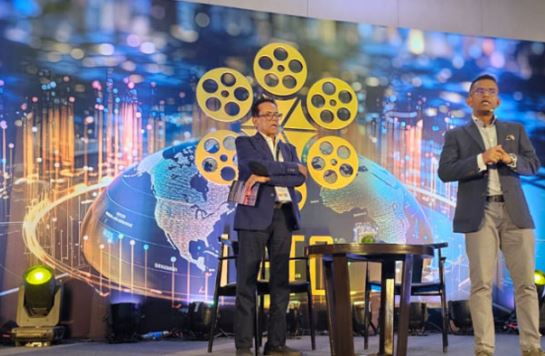
Dec 3 (AdaDerana) – Sri Lanka’s tourism sector is taking a bold step into the limelight as a leading destination for Indian film productions, with the Sri Lanka Tourism Promotion Bureau (SLTPB) taking centre stage at the 10th edition of the India International Film Tourism Conclave (IIFTC) in Mumbai, held from October 23 to 25, 2024.
The event, renowned as the largest film tourism platform in India, provided an exceptional opportunity for Sri Lanka to showcase its diverse landscapes and cultural richness to the Indian film industry, positioning the island as the perfect location for cinematic ventures. Sri Lanka’s focus on film tourism aligns with global trends where countries are seeing significant economic benefits from attracting international film productions.
A high-profile delegation from Sri Lanka, led by renowned international film producer Chandran Rutnam and supported by the International Film Producers Association of Sri Lanka (IFPA), joined forces with SLTPB to captivate key stakeholders from India’s film industry. Mr. Chaminda Munasinghe, Assistant Director of SLTPB responsible for film tourism promotions, presented Sri Lanka’s potential as a top-tier filming destination at the main event of IIFTC.
ADVERTISEMENT
The SLTPB’s presentation at IIFTC 2024 was a masterclass in promoting Sri Lanka’s unparalleled natural beauty, cultural diversity, and ease of access. The showcase specifically targeted the Bollywood, Telugu, Kannada, Tamil, Malayalam, Bengali, and Marathi film industries, emphasizing Sri Lanka’s scenic landscapes ranging from pristine beaches to lush jungles and vibrant cultural sites. Sri Lanka’s capability to cater to large-scale productions with minimal logistical challenges was a key highlight of the presentation.
Discussions were held by Mr. Munasinghe and Mr. Chandran Rutnam with some of the most influential Indian film industry representatives—ranging from producers to location managers—resulting in promising dialogues and a roadmap for future collaborations. Targeted digital campaign undertaken at the event aimed over 800+ attendees amplified Sri Lanka’s appeal as a cinematic hotspot.
A pivotal part of Sri Lanka’s strategy was its partnership with the Sri Lanka Consulate General Office in Mumbai, which collectively worked to enhance the country’s visibility within the Indian film tourism sector. Specially, Mrs. Shirani Ariyarathne Actg. Consul General has been eagerly supported Sri Lanka Tourism’s delegation to connect with Indian Film Producers as well as key Indian government officials from The Ministry of Information and Broadcasting of India. A series of high-level meetings at the Sri Lanka Consulate General Office in Mumbai provided further opportunities for strengthening ties and securing support from Indian production houses.
In addition, discussions with the Indian Film Development Corporation (NFDC) which is the main governing body for all Indian Cinema was a significant milestone. NFDC extended a formal invitation to the SLTPB team to explore future promotional opportunities at the prestigious International Film Festival of India (IFFI) 2025, which is set to feature countries like Australia, Japan, Hong Kong and South Korea. This partnership is expected to pave the way for even greater visibility for Sri Lanka in the global film tourism market.
Colombo, Decembr 1: Buddhism and democracy are two sides of the same coin, if they are seen in the correct way, says the father of India’s democratic constitution and the modern-day apostle of Buddhism in India, Dr. B. R. Ambedkar. He saw Buddhism as a democratic religion and he converted to it with lakhs of his socially oppressed followers called Dalits, in 1956.
In a radio broadcast on October3, 1954, Dr. Ambedkar said that his social and political philosophy was enshrined in three concepts: Liberty, Equality and Fraternity. These were the foundational principles not just of the 18 th.Century French revolution but also Buddhism, founded by Gautama Buddha centuries earlier, Dr.Ambedkar said.
ADVERTISEMENT
Let no one say that I have borrowed my philosophy from the French Revolution. I have not. My philosophy has roots in religion and not in political science. I have derived them from the teachings of my Master, the Buddha. In his philosophy, liberty, equality and fraternity had a place. Fraternity is the only real safeguard against the denial of liberty or equality,” he said and added that brotherhood based on fraternity, was only another name for religion.
Sangha
Ambedkar recalled the democratic practices in the Buddhist brotherhood called the Sangha. The Bhikkhu Sangha had the most democratic constitution. The Buddha was only one of the Bhikkus. At the most, he was like a prime minister among members of the Cabinet. He was never a dictator. Twice before his death he was asked to appoint someone as the head of the Sangha to control it. But each time he refused, saying that the Dhamma is the Supreme Commander of the Sangha. He refused to be a dictator and refused to appoint a dictator”, the Indian legal luminary noted.
14th Dalai Lama of Tibet, Tenzin Gyatso also believes that Buddhism and democracy are compatible as both are rooted in the belief that all, whether social or economically high or low, have the same potential to grow and excel.
The Sakya kingdom to which the Buddha belonged, was ruled by a Council, or Gaṇasangha, rather than a monarch. It was made up of an elite class of warriors and ministers. The leader of the Council was elected by its members and was called the Raja. The Raja had considerable authority but he could not rule autocratically. Questions of importance were debated in the Ganasangha and decisions were taken by consensus.
In his essay, Buddhism in a Democratic World, in The Golden Lotus, August, 1960, the German-American scholar, Kurt F. Leidecker, says that though the Buddha was the founder of Buddhism, he put his own person in the background and put the insight he had got in the shape of the Dhamma in the foreground.
Dr .B.R.Ambedkar
He was a teacher, but such a one that will not make the acceptance of the thing he taught dependent on the fact that it was he who taught it. He never asked anyone to follow him, personally. He asked people to think with him and, having thought, prove their findings reasonable to themselves. He left the personality of the pupil intact,” Leidecker says.
The Buddha did not believe in indoctrination. He gave his followers the freedom to think on their own. Teaching and expounding of the Dhamma was carried on in an ideal way, with no trace of indoctrination, without coercion. The pupil gave his free assent, if he so decided, with his own mind, left to think on its own.
According to Prof Leidecker, this is the ideal form of education. Just as the garden needs a gardener, so the pupil needs a teacher. The gardener can do no more than to hoe, weed and water. That there shall be flowers and fruits is dependent on the inherent qualities of the plants themselves,” he explained.
For the Buddha, Dhamma was like a road-sign which may be heeded or ignored. No wayfarer is compelled to read it and benefit from it. Likewise, the Buddha’s Four Noble Truths or the Eight fold Path are there to accept or reject by men.
So thoroughly did the Buddha eschew the personality cult, that the first centuries of Buddhist history allude to him only in symbols—in the wheel, the column, the tree, the empty throne. These symbols came to stand for the Buddha as well as the idea he preached,” Prof.Leidecker points out. It was only during Greek-influenced Gandhara period in North Western India that the image of the Buddha as we know today came into existence. Until then, the Buddha was largely a concept, a philosophy, a way of life.
Even the great Emperor Asoka, whose son and daughter brought Buddhism to Sri Lanka in 247 BC, shunned the personality cult. Asoka preferred to be known not by his given name or kingly titles, but as Devanampiya Priyadarshi” (the beloved of the Gods who regards others with kindness”.
A number of Sri Lankan kings from Uttiya to Yasalalakatissa from the 2nd century BC to the 1st century CE, also adopted that name. Uttiya ruled Anuradhapura from 267 BC to 257 BC. And Yassalalaka Tissa was King of Anuradhapura from 52 to 60 CE.
Placing knowledge above power and pelf, the Buddha shed all the trappings of power and pelf as a Sakya Prince and left his palace and kingdom to seek knowledge through acetic practices, dialogues and meditation. It is in emulation of the Buddha that in Thailand and Myanmar boys spend at least three months out of their lives in Buddhist institutions renouncing pleasures, wealth and all attachments, wearing the yellow robe. The belief is that it is in humbleness that wisdom grows and that insight comes with detachment.
Prof. Leidecker point out that the Buddha did not scorn or shun Kingship and worldly pomp but stressed inner worth, the nobility of thought and character. He even recognised caste in the sense that it represented a classification of society according to occupation. He recognised recognized the Brahmin. But for him, the real worth of a Brahmin or a Prince was in his character his nobility. A person is noble or not is not determined by birth but by his character. The Buddha did not recommend a false equalisation of society.
According to Prof.Leidecker, the Buddha was not a reformer or a revolutionary. He did not seek to upset the existing order but only wanted it to be value-based as per his Dhamma. That Buddha set out to reform society is a gross misstatement of the facts. His aim was enlightenment and the elimination of sorrow and suffering, both among the high and the low.”
Buddha’s approach to social ills was not based on class struggle either. His method was peaceful, did not require conversion by force of those who thought differently. All he sought was setting one’s own thinking in order. Salvation, or Vimukti, was not to be attained by outward means but through an inner reformation of the spirit,” Dr.Leridecker points out.
aaBuddha in Nagapattinam, Tamil Nadu
As in a good Buddhist society, in truly democratic societies too, individuality is guaranteed. In the Milindapanha it is stated that as trees differ depending on the nature of the seed, so the character and destiny of man varies with the different deeds whose consequences are earned. This is the doctrine of Kamma, action.A man becomes good by good action, and bad by bad action. The Western democracies call it the doctrine of individual responsibility which also goes with the concept of individual freedom, the freedom to choose one’s path to either sublimity or degradation.
Fixing individual responsibility based on individual freedom is essential to make laws work, Leidecker says. Society would disintegrate, just as nature would, if the laws of causality (Kamma) are not universal, he argues.
Freedom, in fact, is the very life-blood of Buddhism. A society which believes in strict determinism will eventually ensnare man in a world of thought and action in which he can no longer move about freely. Vimukti then becomes impossible through individual effort, the writer says.
It was Ralph Waldo Emerson, the American philosopher who said, civilization depends on morality” and that the purpose of life is not to be happy. It is to be useful, to be honourable, to be compassionate, to have it make some difference.”
With this, every Buddhist would agree, for Sīla is basic to human life, Leidecker points out. Perfect speech (Samma Vaca), perfect comportment (Samma Kammanta), and a perfect occupation or livelihood, and (Samma Ajiva) are three important points in Buddha’s Eightfold Path.
If truth and sincerity are not in the word, which is the very cement of human relationships, for without language man cannot be man, society breaks down and with it civilization goes by the board. The same holds true if we behave anti-socially by harming our fellowmen bodily or taking from them what does not belong to us, or engage in activity which does not make them happy and content,” Leidecker explained.
The scholar points out that in any truly democratic society, there is room for the virtues mentioned by the Buddha. As in Western democracies in Buddhism, both Bhikkhu and laymen are encouraged to move and have their being guided by Metta (goodwill), Karuṇa (compassion), Mudita (sympathy).
Today, December 4th, upon the request of the Government of the Democratic Socialist Republic of Sri Lanka, the Government of Japan has decided to provide emergency relief goods (tents, plastic sheets, sleeping pads) through the Japan International Cooperation Agency (JICA) to Sri Lanka in response to the damages caused by the flood and landslide.
In light of the humanitarian perspective and the friendly relations between Japan and Sri Lanka, Japan has decided to provide emergency assistance to Sri Lanka to support the people affected by the flood and landslide.
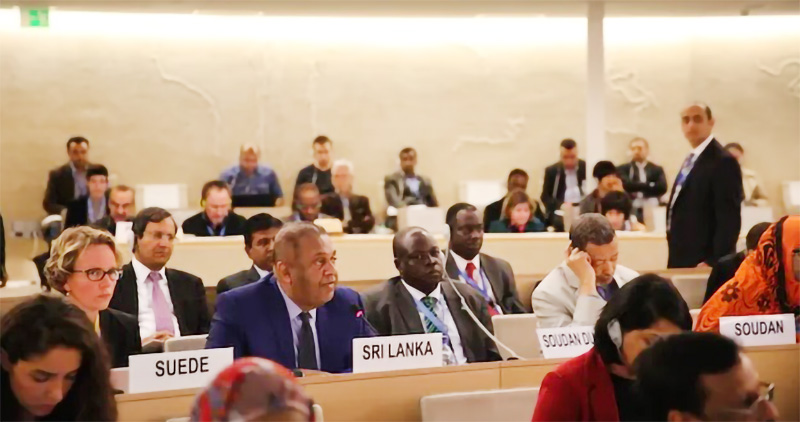
Foreign Minister Mangala Samaraweera at the UNHRC in 2015.(Picture courtesy Sunanda Deshapriya)
Ever since the victory of the Sri Lankan armed forces against the LTTE in May 2009, the international community has been calling on successive governments in this country to ensure ‘transitional justice.’ These governments, in turn, have spent tens of millions of rupees on such efforts. Unfortunately, there has been little or no critical analysis in local newspapers or academic journals over whether the concept of ‘transitional justice’ is applicable to Sri Lanka. It is in the public interest to begin such a discussion.
I argue that, the concept is inapplicable to Sri Lanka. ‘Transitional justice,’ as originally conceived by international law experts, is intended for countries where the rule of law has completely collapsed, i. e., where all democratic processes along with the institutions for the administration of justice have collapsed. There is no evidence that such a situation prevailed in Sri Lanka at the close of the LTTE war. For instance, even at the height of the conflict, the normal courts continued to operate throughout much of the island. Therefore, if the aforesaid concept is to be applied here, it has to be modified. For reasons that will be explained later, there is no evidence that this has happened either.
In this article, I will discuss: i) the history of the concept,’ ii) its application in Sri Lanka, and iii) provide an assessment of such application.
The History of the Concept
According to Oleksii Plotnikov, a visiting fellow at Cordozo School of Law in the US, the concept of transitional justice emerged in the context of the fall of the Soviet Union as a means of addressing the collapse of the institutions of governance in the former Soviet states. He traces the origin of the term to a conference in Salzburg in 1992, attended by policymakers and scholars from the West along with the post-Soviet countries. He says:
Rudi Teitel, who participated in the Salzburg Conference, claims personal authorship: ‘transitional justice is an expression I coined in 1991 at the time of the Soviet collapse and on the heels of the 1980s Latin American transitions to democracy. In proposing this terminology my aim was to account for the self-conscious construction of a distinctive conception of justice associated with political change following past oppressive rule.’” (‘Defining Transitional Justice: Scholarly Debate and UN Precision,’ p. 54.)
To fast forward to the early 2000s, the UN took up the concept and expanded it beyond regime-change situations to include post-conflict situations as well. The UN Security Council, in a well-known report in 2004, defined ‘transitional justice’ as: The full range of processes and mechanisms associated with a society’s coming to terms with a legacy of large scale past abuses in order to secure accountability, serve justice and achieve reconciliation.” (UN Doc. S/2004/616, 23rd August 2004.)
Such, then, is the history of the concept. To repeat, it was originally intended to address regime-change situations and post-conflict situations where a country’s institutions of governance had completely collapsed.
The application of the concept to Sri Lanka
The ‘Yahapalana government’ (2015-2019) is the first Sri Lankan government to fully embrace the concept of transitional justice. At the 30th session of the Human Rights Council (UNHRC) in September 2015, the then Foreign Minister, the late Mangala Samaraweera, announced that the government had a comprehensive plan to address accountability and reconciliation issues. He said:
The government of Sri Lanka recognizes fully that the process of reconciliation involves addressing the four broad areas of truth-seeking, justice, reparations and non-recurrence, and for non-recurrence to become truly meaningful the necessity of reaching a political settlement that addresses the grievances of the Tamil people.” (Foreign Minister’s Statement at the General Debate, 14th September 2015, www.mfa.gov.lk)
He proceeded to lay out the government’s plans in regard to each of the said components, to wit: truth-seeking (a ‘Truth Commission’ along with an Office on Missing Persons), justice (a hybrid court including foreign judges), reparations (an Office on Reparations), non-recurrence (constitutional reforms involving the full implementation of the 13th Amendment to the Constitution.) These ingredients were later incorporated into resolution 30/1 adapted by the Council in October 2015. The government of Sri Lanka co-sponsored that resolution.
Assessment
There are two problems with the application of the concept ‘transitional justice’ to Sri Lanka. First, as mentioned earlier, the concept was originally intended to address situations where the institutions of governance, especially those dealing with the administration of justice, have completely collapsed. There is no evidence that this had happened at the close of the LTTE war in May 2009. On the contrary, the evidence suggests that the end of the war made it possible for the government to reassert the authority of the old institutions, especially that of the courts, in the areas that had fallen into the hands of the LTTE. This is confirmed, albeit indirectly, by no less than the Human Rights Council (UNHRC). In the resolution on Sri Lanka adapted by following a special session on 27th May 2009, the Council states:
Welcoming the conclusion of hostilities and the liberation by the Government of Sri Lanka of tens of thousands of its citizens that were kept by the Liberation Tigers of Tamil Eelam against their will as hostages, as well as the efforts by the Government to ensure the safety and security of all Sri Lankans and to bring permanent peace to the country.” (UN Doc. A/HRC/S-11/1)
If the Council had considered that law and order had completely collapsed in this country, it could not have made such a statement. Second, I concede that the four components of truth-seeking, justice, reparations and non-recurrence are internationally recognized processes for pursuing transitional justice. The question, however, is whether they are to be pursued in sequence – ie starting with truth-seeking and then followed by the others based on the findings of the aforesaid effort -or each independently of the others. Common sense and reason suggest that the former should be the case, because of the following reasons.
Without first knowing the facts as to what may have happened during a conflict, it is difficult to see how one could decide on methods of holding people accountable for alleged crimes, assign reparations, or formulate constitutional reforms to address the causes of such conflict. It appears that the government, in resolution 30/1, has agreed to pursue each of the transitional justice processes in question independently of the others. This is unreasonable. For instance, if ‘truth-seeking’ and ‘constitutional reforms’ are to run parallel to each other, what happens if the findings of the truth- seeking process are at variance with the proposed constitutional reforms?
One must also consider the following matter in regard to the above. Between 2010-2015, ie during the Mahinda Rajapaksa Administration, the government launched two domestic mechanisms: The Lessons Learnt and Reconciliation Commission and the Paranagama Commission. Rightly or wrongly, these constitute official attempts at truth-seeking by a Government of Sri Lanka. In these circumstances, successor governments cannot simply ignore the findings of such Commissions unless they first establish that the said findings are wrong.
The ‘Yahapalana government’ never produced a report that critically assessed the conclusions and recommendations of either the LLRC or the Paranagama Commission reports and deemed them to be wrong. Hence, for all practical purposes, one must presume that these conclusions and recommendations were valid at the time of the UNHRC’s 30th session. It is important to note that, neither the LLRC nor the Paranagama Commission recommend hybrid courts or constitutional reforms involving the full implementation of the 13th Amendment. They do recommend a ‘truth commission’ and reparations. They advise, however, that these things be done in way that avoids internationalizing the reconciliation process.
Conclusion
‘Transitional justice,’ as the name implies, is intended for a temporary purpose. In times of peace, the normal democratic processes, along with the institutions for the administration of justice, are supposed to protect the rights of the people. Arguably, normalcy has now returned to the former conflict-zone in Sri Lanka. The question is whether, the existence of transitional justice processes could potentially stifle the growth of the regular institutions for the administration of justice, especially the courts, or worse, become a means of continually re-opening old wounds.
The present government has inherited a complicated legacy in regard to transitional justice. On the one hand, it is obliged to ensure justice to the people. On the other, it has to satisfy the international community that it is not reneging on commitments made in resolution 30/1. If processes that go beyond the normal courts are necessary to ensure justice to the people, they will have to be explored. The government, however, has vowed to do everything in its power to prevent the wasting of public funds. In these circumstances, it is hoped that the relevant officials will re-evaluate whether continuing with transitional justice initiatives stemming from resolution 30/1 is in the country’s interest, and if not, bring such initiatives to a formal close.
(Dharshan Weerasekera is the author of, ‘A UNHRC Resolution of Questionable Legality on Sri Lanka and its Importance as a Catalyst for Future UN Reform’ (2024) 10 Groningen Journal of InternationalLaw 120)
The NPP government should probe the killings of its founder leader Rohana Wijeweera and actor turned politician Vijaya Kumaratunga in keeping with the pledges made by President Anura Kumara Dissanayake during his policy statement, opposition MP Chamara Sampath Dassanayake told Parliament yesterday
The President in his address to Parliament said cases which are buried will be taken out again. Therefore, we request that a probe be conducted on JVP founder leader Rohana Wijeweera and actor turned politician Vijaya Kumaratunga,” MP Dassanayake said.
Find out who blindfolded Wijeweera at Kirulapone police station and how he was killed and how he was taken to Borella Kanatha. Also probe as to who shot Vijaya and from which garage in Polhengoda the killer got the T56 rifle to shoot him. Mete out justice to Wijeweera’s children and children of Vijaya,” he added.
There was one incident in Uva where all children of one family were killed just because one child joined the JVP in 1989. These incidents also should be probed,” he said.
Sarath Wijesinghe (President’s Counsel, Senior Solicitor, former Ambassador to UAE and Israel, President Ambassador’s Forum UK / Sri Lanka)
Attention and priority to foreign policy
Nations give attention and priority to foreign policy due to the importance of the subject for the successful existence in the family of nations they live in. USA gives top priority to the formulation and application of foreign policy based on main four criteria towards and beneficial towards USA friendly foreign policy that entangles with the economy, international relations, aiming at prosperity and development of USA followed by major powers as well as small nations as they too are bound to maintain international relations with the rest of the world for their on benefit and survival. Foreign Policy of a nation is carefully formulated and followed for the benefit of the country promoting the image and policies of the country that benefits the respective nations that benefits all the members of the world family for their economic and all other kinds of activities promoting their countries an all areas. Small countries too must give special emphasises on foreign policy as they depend on the world for their existence as living in isolation is impossible in the modern world that are closely interconnected and interwoven in all respects, that applies Sri Lanka being a comparatively small Island in the complicated and modern world at the door steps of digital Artificial Intelligence age. Rich and powerful countries maintain foreign policy to maintain their power and control of the world on econimic, political and other factors for leadership connected to teh economy of the country, sometimes to be the world policeman. USA foreign policy is based on protection of USA, Advancement of Arms trade, maintain the democracy of the world, Global and international balance, maintain American values amongst many other as the main world power in the absence of the former world power USSR, when there is threat from emerging econimic power China to be a world econimic giant. USA has a direct and indirect control over the United Nations organization which moulds directs and influences the foreign of all nations as members of the UN. UN promotes mutual respect, co existence, respect to each other and neutrality as guidelines the nations expect to follow.
Sri Lanka friendly foreign policy
Sri Lanka foreign policy is very broad friendly and compatible with the modern current and universal world trends to maintain and enhance friendly ties and foreign relations, that benefits Sri Lanka as a Sri Lanka friendly foreign policy that benefits the people of Sri Lanka and Sri Lankans. In nutshell it is based on the principles friendly towards all enormity towards none practised over thousands of years in Sri Lanka especially from 1950 with the declaration principles and application of non alignment subsequently better practised as the leader of the non alignment movement cementing the principle of NAM active to date. At this unstable and volatile situations in the world with signs and threats on another worldwar it is the duty of all members of the United Nations to be extremely cautious and act with restrain to avoid a calamity that will have drastic results with the modern and sophisticated weaponry and modern technology. Sri Lanka though a small nation is a senior member of the UN and has actively participated in world affairs involved and participated in peace building promoting peace and reconciliation, may play a positive role in peace and a new era on foreign relations that will benefit the world to prosper economically and and all other ways.
Collection of strategies on foreign policy and relations
Foreign Policy is a collection of strategies country uses to guide it’s relations with the rest of the world that world watches carefully before talking any steps with the respective member and it is obvious the state will have to take great care in formulating and pronouncing the policy that are bound to change with the movement of the rest of the world whose interest would be themselves and economic and political benefits at an cost in the interest of their respective nations. Diplomatically the newly elected government is bound to take over liabilities of the previous governance and bound to carry on the foreign policies with extreme caution and great care on formulation of new policies without antagonizing those who engaged with the nation based on may be on different policies and strategies.
Conduct of foreign policy
It is the head of the State or the foreign minister ( with the advice of the head of the state) who will conduct and apply foreign policy to suit the nation which is an extremely arduous task, Sri Lanka managed most of the time historically. With the economic downturn and volatile political situation in the world and bitter and unwise steps taken by the predecessors the task appear to have been difficult to the current Minister and the regime appear to be managing the situation quite successfully in the current and difficult context. When Indian ocean is important for all world powers and powerful neighbours independent Sri Lanka placed strategically on the main silk route is sandwiched with requests and demands by many, it is time for Sri Lanka to strengthened foreign policy and relations and be firm on Sri Lanka friendly policy which is strategically and arduous task. World and regional powers including India, China, USA, USSR , and even Pakistan including Indian ocean rim countries have direct and indirect interest on Indian Ocean and obviously trying to influence small nations such an Sri Lanka and Maldives islands and to prevent the pressure the best weapon would be a stable firm and a correct foreign policy and a stable governance.
Challenges to the current regime and the foreign minister
Challenges are immense considering the high expectations of the people who has taken a bold collective decision and the family of states awaiting the conduct of the new government with not much experience and reputation. The current governance is bound by previous decisions with the other members of the world family and international originations which includes IMF taking independent and firm decisions become still difficult, yet it appears the new Minister has managed general and specific reasonably well and obviously he needs bit more time and experience to deliver. But as economy politics and international relations are interconnected and interwoven the task of the governance and the minister is still difficult.
What are the challanges before the newly elected and the Foreign Minister?
Challanges are immense as to date no policy declaration has not been made on teh foreign policy assuming that it is carrying on unchanged as middle path based on the policy of friendly with angry with none, and to be independent from all political and other blocks. Agreements by previous governments, and the importance of Sri Lanka locating in a strategic situation when the two super and regional powers India and China have an econimic war and events taking place in the powerful indian ocean has placed Sri Lanka in difficult stations to maintain and balance especially when she is undergoing econimic hardships needing favours from regional powers will still makes maters world in the operation and conduct of foreign relations.
Unique Feign Policy for Sri Lanka
Sri Lanka needs a unique foreign policy considering the complex nature of the happing around and unstable political and economic turmoil hovering around the world and the neighbourhood, and the policy have to be adjusted and adopted according to the conflicts and differences of the world and regional leaders, based on Sri Lanka friendly policy document. Ambassador’s forum has edited a separate volume on Sri Lanka friendly foreign policy document with 40 chapters from reputed anthers in the field of foreign policy and relations.Ambassador’s forum and 13 volumes on foreign policy with topics including Sri Lanka foreign policy is available on Google Drive to be viewed free to the public with 600 chapters on varied topics and subjects and you are invited to browse the internet and be in touch the Ambassador’s Forum for further details which is offered free to any world citizen. Sarath28dw@gmail.com
Sarath Wijesinghe President’s Counsel Sri Lanka, Solicitor in England and Wales, President Ambassador’s Forum UK/SL, and former Ambassador to UAE and Israel
Tourism is a Competitive trade
Tourism is competitive as it is the fastest and easiest to thrive with available resources the country is bestowed with naturally not everybody is lucky to possess. World is different and complex with different climatic, geographical, and difficult condition with some counties prune to natural disasters often and difficult weather conditions. Yet in the modern world all the countries and the world over is contributing a substantial amounts to teh GDP of the nation led by USA, China, Mexico, France and many including Asian counterparts.
Small tourist nations
Napal is a landlocked poor country at the mercy of giant India for access and extreme cold weather close to Everest Mountains Nepal makes use of for tourism making use of expeditions by those who climb the mountain as pleasure and challenges in life. Nepal is a hotspot on tourism also being the birth place of ‘’Gouthama Buddha’’ venerated by Buddhists worldover that also helps tourism in Nepal. Sandy UAE is not attractive or beautiful for tourists or tourism. They use sandy mountains for the enjoyment of tourists mainly during teh night, and after they are blessed with oil in 1960, diverted it to the tourist hotspot with most modern belongs, houses, shopping malls and making available for tourists and investors to invest with tax incentives, based on a vision by visionary leaders, showing vision is the main requirement to implement the mission with necessary adoptions to the system of governance and the culture and religious practices. Islam is a highly disciplined religion – yet in Dubai it is relaxed for tourist to flourish. Singapore once have been a barren land until a visionary leader imposed disciplined less corruption country to be the business, and a naval hub with advanced legal system as a centre for Arbitrations, by the vision of teh visionary took the nation with him to be a leading business hub with rich country with rich inhibitions once a poor island helplessly awaiting for help from the rest of the world. Maldives have no resources or income with no income expect dried fish to consume and export.Visionary leaders exploited sandy beaches, shallow sea water and the cluster of small islands to attract high end tourists to be a rich nation with full of tourists famous for tourism. These are not miracles, it is teh vision and sheer hard work with determined continuous efforts.India and China are industrial, and agricultural countries yet they concentre on tourism which co exists with tourism earning billions for the GDP and citizens with necessary environment protections and precaution on the protection of culture. Malesia is sensitive on ethnicity with three nations living shoulder to shoulder yet on the tourism sector they are a tourist country, making use of the climatic conditions, beauty,and natural resources balancing all areas and sectors. Thailand is a Buddhist country adopted themselves for tourism despite strong religious customs and ties tourists are attracted to Thailand for food, climatic condition, culture, friendly nature, sea and greenery and is a hotspot and a competitor for Sri Lanka due to many similarities. China attracts 50.6 million visitors and Sri Lanka is depending on Indian, Chinese, USA, UK, Germans, as positive customers patronising Sri Lanka in addition to Israel’s visiting for shallow sea surfing and trave, many others to visit historical and religisious places of significance including great history and water and irrigation systems of King of Sri Lankas giving priority to irrigation and construction of Dagobas and ‘Wevas’ that are massive removers of water connected to agricultures and agrarian services the western engineers to have praised for the knowledge of he engineers then.
Where is Sri Lanka positioned today?
Sri Lanka is positioned in the map of tourism as a tourist country with lot of beauty and the compact island, with excellent climatic conditions, network of roads connected to high ways, beauty greenery and scenery, reasonable good hotels, lacking in night life, Malls are being constructed, food prices not as low and reusable as before, political stability unlike sometime back with less crime rate and controlled bribery and corruption, and most importantly a reasonably disciplined community at least on election where free and fair elections help in a most peaceful and exemplary manner of European standard with no violence of any incidents hat had been the practice before.
Security and protection
Tourists are sensitive to security and protection from violence and incidents of this nature are rare on tourists and warnings by foreign embassies are not frequent. There is no tourist place but generally police and security forces have respect and attention for tourists.They move free with bit harassment from beggars, yet tolerated having got used to the way of life. Society is English spoken and consumer items and services are available to the tourists a the retail price with some unpleasant incidents of overcharging by errant traders. We remind the tourist authorities to re introduce tourist police to be active and to be seen to the tourist world watching us with teh microscopic eye. And take steps to protect whale population which is a rate treasure to us without driving them away by lot of stress and disturbances.
Sri Lanka is in need of a vision and a visionary? Can we expect a vision and a visionary for tourism ?
Vision of a leader is is granted to the nation by the visionary with great leadership, with dedication, hard work, understanding and research. Dubai leader we understand has studied and researched the achievements of Singapore, Israel and many other success stories before implementing his vision using the geographical situation, the nee found oil money, and the human factors by spending heavily to employ CEOs to most vent’s from the west including USA to manage app important hotspots. We need a leader with a vision and committed for the cause who is educated and researched the challenge, and it is to be considered whether we have one or some body or a group will put forward a vision by a visionary who has commitment and power to implement. Our citizen is intelligent and are in a position to judge and decide to themselves on the future and future challenges, programs and visionaries. The write is extropy pleased if the readers comment and come out with propositions ideas and share with the majority of the community of all races and languages and they are main barriers today, yet fortunately citizen is computer literate and digitally armed with a Mobil phone with almost every citizen. Sarath Wijesinghe could be contacted on sararhdw28@gmail.com and you are requested to retrieve/read my articles by browsing the internet – digitalisation and tourism today on 27th nov and Lanka web number of other articles on the web against name of the author. Day Sri Lanka becoming the best destination is not too far if we work hard with a vision led by visionary leaders. Let us live on hopes but work hard non stop until we reach teh destination to be the best tourism hotspot in the world.
Sri Lanka will not be able to afford a large public sector in the near future and will soon need to start reducing the number of state employees, a senior advisor to the president said yesterday.
Projecting that the Treasury would be unable to sustain the current expenditure levels in the coming years, Senior Presidential Advisor Duminda Hulangamuwa said that the country would have to downsize its public sector workforce from its current 1.3 million employee base to 750,000 employees.
I can tell you that as we move forward, the funds available in the Treasury will not be enough in the coming years. We can’t afford to have a large public sector. So, we need to rationalise public services, cut down the numbers and move towards digitalisation,” Hulangamuwa said at the BETA Annual Report and Accounts (BARA) Awards of the Association of Public Finance Accountants of Sri Lanka (APFASL), held at the BMICH yesterday.
We will need to reduce the 1.3 million employees to at least 750,000 and pay the remaining staff competitive salaries for efficiency. We will also need to begin digitising these services and make sure the taxpayers’ funds are used effectively,” he added.
Hulangamuwa went on to opine that the public opinion about the inefficiency in public service institutions has both a fair and unfair side, as inadequate salaries also contribute to poor performance in public sector service delivery.
He stressed that the state sector employees, particularly those involved in finance, should explore how public assets can be monetised to improve the overall institutional performances.
Government servants have the liberty to identify inefficient services and remove layers of red tape to see how they can be avoided and rationalised. We are not saying we should privatise. We are saying to generate more profits and serve the public with better efficient services,” he stated.
President Anura Kumara Dissanayake in October announced that the government plans to raise the public sector salaries in the 2025 budget. (NR)
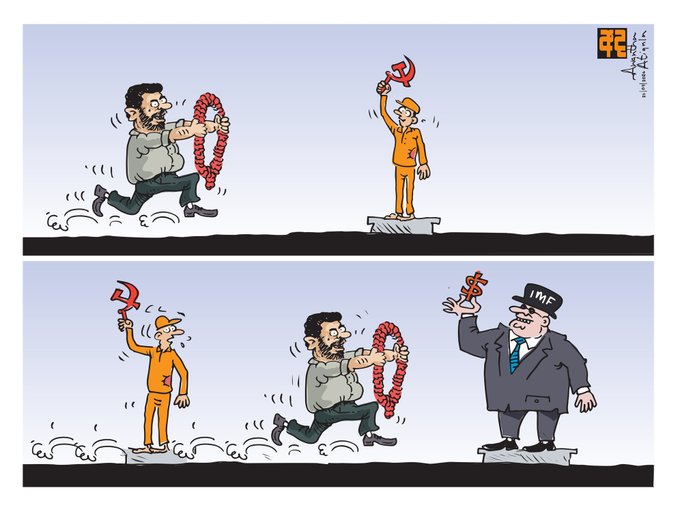
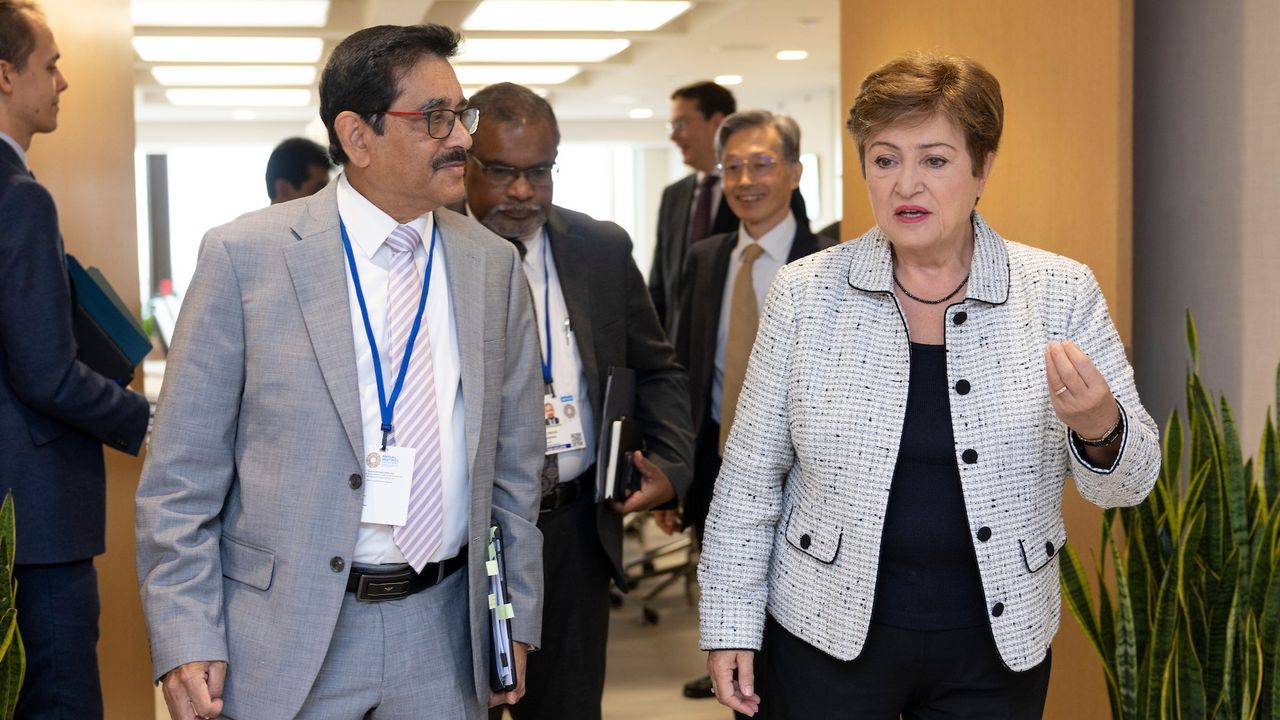
Central Bankers come and go, but the zombie ghost of the Central Bank of Ceylon’s first US governor John Exter still haunts and rules the land, still laying down the dictat of the US Treasury. IMF Chief Missionary Peter Breuer cannot divulge what the US has threatened the JVP with, that will ‘hit’ them if they do not stay with the ‘guards’. Breuer has been illegally scampering in & out of Sri Lanka, before, during & after elections. They will now be allowed to police the budget (tho this is not new). ‘The IMF is keen that [the budget] is in line with the program objectives. He cited the primary surplus, the revenue & the quality of fiscal measures as the important guardrails… Responding to a query about the announcement by the previous government to lift the ban on vehicle imports, he said it was discussed and would be a very important source of revenue for the government in the year ahead. So, after all that talk of ‘Chinese debt trap’, it turns out the US & so-called ‘local banks’ who are actually importers of crap machinery, and in fact are controlled by the World Bank etc, ‘own’ over 50% of Sri Lanka’s debt. Is it any surprise that the US Treasury Secretary is part of the US National Security Council? (seeee Random Notes).
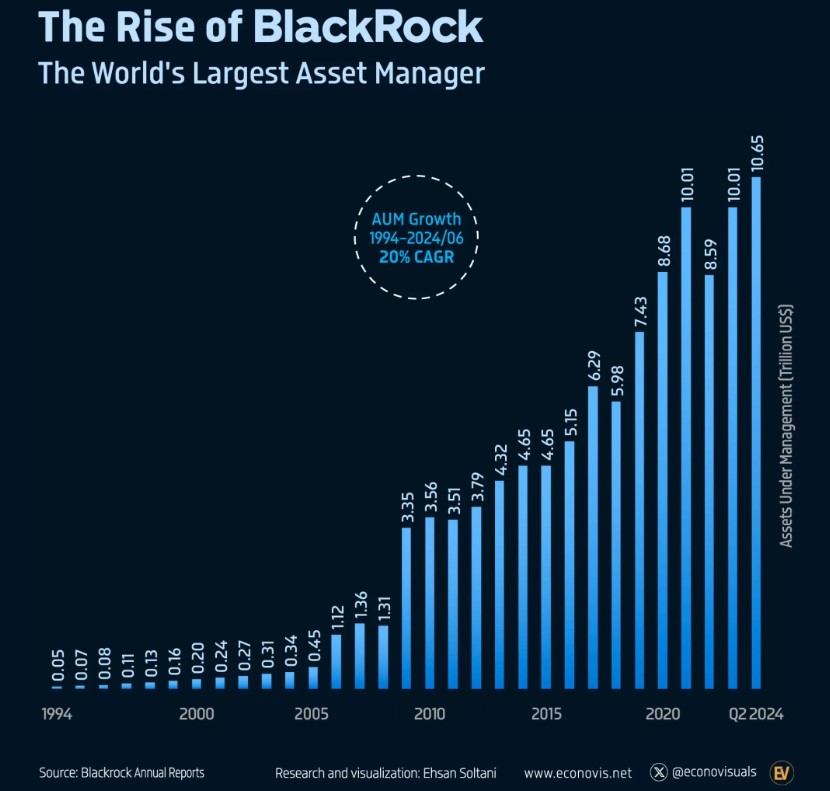
Who Holds the Wheel? – A ‘Steering Committee’ of a so-called ‘Ad-Hoc Group of Bondholders’ own about 40% of $12.55billion of defaulted bonds, while a ‘Local Consortium of Sri Lanka (LCSL)’, with 11 members including banks, have around 12%. The Steering Committee is made of funds managed or advised by Amundi Asset Management, Barings, BlackRock & its subsidiaries…(to see the rest of the suspects, see Random Notes)…
*
‘The current funding arrangement for digitisation of television in Sri Lanka
is a ‘soft loan‘ from the Japanese government, & it is tied up in ‘one bundle’
with loans for other projects… based on the premise that
the deployment of the Japanese digital television standard,
Integrated Services Digital Broadcasting-Terrestrial is mandatory.’
– ee Industry, Japanese Digital Television Project announced after meeting AKD…
*
‘Conduct a detailed debt audit on foreign loans obtained
by the governments to ensure transparency & accountability
in public financial management and to take legal action
against those who have misappropriated such loans.’
– NPP policy document: A Thriving Nation, A Beautiful Life.
*
Indeed, we do not wish to add to the NPP’s heavy load, but their audit of debt could list which corporations & banks import which industrial goods, naming the makers & financiers of such imports. They could also demand, like Indonesia has just done, that certain goods sold domestically need to contain at least 40% of parts manufactured locally in Indonesia (see ee Industry).
And a note to a supine merchant media: When news items declare, ‘ADB approves $200mn Sri Lanka loan for battery storage, grid upgrade’, instead of being pom-pom wielding cheerleaders, they could also list which US & Japanese corporations, for whom the Asian Development Bank is a front for, would supply such industrial goods for ‘battery storage’ & ‘grid upgrades’.
We should also note that the merchant media’s economists & foreign thinktanks are firmly opposed to state-owned enterprises (SoEs), whether they make money or not, and staunchly against any ‘local content’ laws & ‘import-substitution’. Their main interest is high interest rates for their financial finagling, & imports of their industrial products, & export of our natural resources, including workers – the sum total of their slave economics.
*
• Not so Peaceable Coercion – Dhananath Fernando, a smart ‘poor’ Koralawella boy (these are his backers’ own patronizing words), has been groomed by Catholic Action and the US government, to front as the grand-sounding ‘CEO’ of the US thinktank Advocata Institute (tho behind him reigns the real power – Borah importer & Advocata Chair Murtaza Jafferjee – CEO, Chair… such bureaucratic corporate hierarchies, but never mind). Fernando had this to say in a recent Financial Times column:
‘As James Madison, one of the great thinkers behind modern democracy, once said:
‘If men were angels, no government would be necessary.
If angels governed men, no checks would be needed.
But because governments are made up of people,
we must create systems that control the government itself’.’
(see, ee Economists, New era of hope & responsibility)
So, so, so, who is ‘we’ who will create these systems to control people? Robots? The ‘business as usual’ merchants & moneylenders & their foreign overlords?
Good Liberals, Mass Rape & the Ideal Commodity – Now let us see who the real James Madison is – what the US embassy will never teach Fernando. According to The American Slave Coast: a History of the Slave-Breeding Industry by Ned & Constance Sublette, Madison was fully part of ‘the brutal story of how the Anglo-US slavery industry made the reproductive labor of the people it referred to as ‘breeding women’ essential to the young settler-state’s expansion. The ‘Captive African Americans in the slave nation were not only laborers, but merchandise & collateral all at once. In a land without silver, gold, or trustworthy paper money, their children & their children’s children into perpetuity were used as human savings accounts that functioned as the basis of money & credit in a market premised on the continual expansion of slavery. Slaveowners collected interest in the form of newborns, who had a cash value at birth and whose mothers had no legal right to say no to forced mating.’
The Sublettes’ story describes power struggle between the rulers of Virginia, the slave-raising ‘mother of slavery’, and South Carolina, the massive importer of Africans – a conflict that was central to US politics from the making of the Constitution through the debacle of the Confederacy. Virginia slaveowners won a major victory when Thomas Jefferson’s 1808 prohibition of the African slave trade protected the domestic slave markets for slave-breeding. (continued in ee Random Notes)
*
• In the aftermath of the 19th century US war between their industrial north & the agricultural south, Karl Marx & Friedrich Engels & eminent US jurists declared that slave masters should never be allowed political rights again! Well, the failure to comprehend the true nature of a triumphant white-settler state, despite its social-media-driven virtue signalling, has led to widespread indignation among US-embassy-liberals in Sri Lanka that such a leader as Don ‘Let’s Make a Deal’ Trump could emerge in their promised land. Yet brain-dead Joe Biden was just as bad, 2 sides of a printed US dollar, which baldly declares, ‘In God we Trust’. So what will Trump bring to our table?:
*
‘Trump will have a 2-year window before the midterm congressional elections,
during which he will have a certain freedom to push his policies through
the Senate & the House of Representatives. After that, his decisions could
face resistance both domestically & from US allies.’
– Andrey Sushentsov, Russia Foreign Ministry’s MGIMO International Relations Dept dean
(see ee Sovereignty, A defining moment in the Ukraine war)
*
‘Industrial policy for me, free trade for thee…’
– see, ee Focus
• Thisee focuses on ‘the challenges of a Trump presidency’, with a yet more expensive US dollar placing inflationary pressures on import-dependent countries like Sri Lanka, which will further impact the foreign debt burden. Shiran Illanperuma notes how the theories & policies propounded by neoliberal thinktanks like the Atlas Foundation-affiliated Advocata Institute & the Friedrich Naumann Foundation, have little to no influence in their own countries of origin. He concludes that Trump offers a ‘Window of Opportunity’ and insists that ‘for an underdeveloped country like Sri Lanka, no industrial policy tool should be off the table. Well, tell that to the traders!
eeFocusalso reproduces Dhanusha Pathirana’s insistence that it is ‘evident’ that the Sri Lankan government’s deal with the USA ‘has been influenced by corrupt interests’. He concludes ‘Sri Lanka’s debt crisis is a stark example of the destructive power of predatory lending’, and calls for holding ‘these lenders accountable for their role in exacerbating the debt crisis in the third world’
Finally, ee reproduces Part 2 of Bram & Howard Nicholas’ ‘Poverty of CBSL’s Monetary Policies’. They too point out, ‘High domestic interest rates on Government debt, combined with the absence of Central Bank intervention to purchase newly issued debt, will escalate the domestic debt servicing burden.’ Such interest rates will have detrimental effects on investment & economic growth. They call for ‘the establishment of development banks (where have we heard this before?) to provide concessional finance for specific sectors. Though they conclude, ‘However, these too are unlikely to sufficiently offset the negative effects of elevated & volatile medium- & long-term real interest rates’. (see ee Focus)
*
• A purported ‘mafia’ (aka cartel) of rice millers & rice importers have been dominating the mafia cartel of newsmakers, while winds & rains heralding the northeast monsoons, buffet & inundate the homes & fields of the land. We should recall the Great Uva Rebellion, the first war of independence against English colonialism, took place in such intramonsoonal conditions from October to November in 1818. Also, the failure to complete that independence with the weakening of the ‘independent’ state, especially over its control of agriculture, hijacked by such English multinationals as Unilever (Liptons), ICC-CIC, Ceylon Tobacco Co, has led to various fissiparous tendencies. This is most symbolic in LTTE leader Prabhakaran who was born through such elements in November 1954, and who was propelled to power especially after JR Jayawardena’s fake ‘Open Economy’, which told Jaffna cultivators to sell their onions wherever they pleased – Colombo likewise was going to import them onions too. A portentous month is November, indeed! Then again, all months are… in a Sri Lanka still under siege after 500 & more years of invasions.
The media portrays a battle between rice millers & rice importers, with all manner of ranting & raving, gnashing & grinding of editorial false teeth. But the central issue remains the uneven application of rural labor, and the failure to organize the whole society & rural industry in particular on the basis of the rhythms of rice cultivation – the primary agricultural pursuit. The English destroyed canals & irrigation systems and village industries, particularly iron & steel making. This was done to destroy the solidarity of the ancient village councils, whose unity was based on the management of the irrigation systems. As noted by a reader in the last ee, failure to keep up one’s share of the canal system, could result in being whipped, with the guilty having to also pay for the cost of being whipped. SBD de Silva in his last years focused his research on the urgent need for rural & agricultural industrialization: He noted the control of the village economy by Colombo merchants of imported goods, & related moneylenders, and their control over the media (led by Unilever) prevent such issues from even being broached: eg, he noted the failure to monetize & commercialize the rural economy, with fundamental economic relationships dominated by the pre-capitalist barter of harvests for industrial goods, which could just as easily be made in villages (ask the Japanese ambassador!). De Silva always recalled how the oncoming Japanese kamikazes post-1939 forced the English to give peasants a fixed price, and workers a fixed wage. Indeed, Silva also noted that such price controls required rationing.
Rice rationing was introduced during England’s WW2, and people had to be taught how to use the rice ration book. This period of shortages of essential goods resulted from the non-arrival of merchant vessels due to war. The rationed commodities were then distributed through co-operative societies established throughout the country.
After the end of the white war on Korea led to the end of ‘the export boom’, the terms of trade grew even more unfavourable – due to the refusal of imperialist powers, particularly the USA, to pay a fair price for tea & rubber. The World Bank (IBRD) agreed to ‘rescue’ the economy, according to certain criteria. The US Governor of Ceylon’s Central Bank advised the Prime Minister Dudley Senanayake, who had just won an election, to seek an election before imposing the World Bank’s stringent conditions. Sound familiar?
‘Shortages’ then led to pressure on the government for an increase in the price of rice. At the behest of the World Bank‘s first mission to Sri Lanka, Finance Minister JR Jayewardene increased rice prices from 25 cents a measure to 72 cents. ‘Workers’ parties’ campaigned against the increases, by collecting and submitting hundreds of signatures to parliament, joining national protest against the cutting also of the rice-ration by a 1/4 measure, and the increase in flour price by 15 cents.
Calls for the conclusion of a Rubber-Rice Pact with the People’s Republic of China to solve the rice shortages were strenuously opposed by a US lobby within Sri Lanka, led by (another ‘former Marxist’!) JR Jayewardene, resulting in his nickname, Yankee Dicky, with the proponent of the pact within the government, RG Senanayake, being dubbed China Dicky.
Rice rationing was again introduced in 1974, on the ground that rice was not purchasable for any love of money on the world market… The UNP gained from this total failure of the United Front Government, and especially of the discrediting of the LSSP & CP…. Sound familiar…?
A Statement by Advisor Duminda Hulangamuva tells that our President Anura Kumara Dissanayake has decided to delay the implementation of the IMF’s decision that Imputed Taxes should be taxed. (EN: 2/12/24)
Our President has to be congratulated for this decision.
This is a minor decision but it is important to note that it is a decision by the IMF that has been varied in the interests of our Motherland.
I must mention that it is the decision of the IMF to impose the Structural Adjustment Programme provisions on our country in 1977 when President Jayawardena requested the IMF for help that has proved detrimental to the development of our country.
It is hoped that our President will also consider implementing a programme to create employment opportunities for our people in the process of producing what the country requires. Such a programme will alleviate the poverty in people as well as produce items that are now being imported.
This can be implemented with no additional staff costs as the staff- members of the Administrative Service and the Clerical Service are already available. They do have the ability and the experience as they did once implement similar programmes like the Divisional Development Councils Programme in the days of Prime Minister Sirimavo.
Such a move will also bring great credit and prestige to the present Government of President Anura Kumara Dissanayake.
The National People’s Power (NPP) has called on the highest echelons of the Government to abolish the placed Party sources revealed. Executive Presidency as promised and the discussions in this regard have already been initiated, highly- The NPP has always criticized the current Executive Presidency, introduced by the 1978 Constitution, which consolidates significant power in the hands of the President, often bypassing legislative checks and undermining democratic governance.
Under this system, the President holds control over critical areas, including Executive decisions, Military Commands, and sometimes Judicial and Parliamentary functions.
Critics argue that the overconcentration of power has led to political instability, corruption, and weak institutional oversight.
The NPP, therefore, views the abolition of the Executive Presidency as part of a broader effort to decentralize power, foster democratic reforms, and restore parliamentary sovereignty, Government sources said.
However, they said the implementation of this change will require significant constitutional amendments, as the Executive Presidency is entrenched in the current Constitution.
The NPP policy statement, under 4.1 ‘A new Constitution – A united Sri Lankan nation’ also mentioned these points: ‘Introducing a new parliamentary electoral system, limiting official presidential residences to one and abolishing the pensions and special privileges given to retired presidents and their families’.
However, they said the implementation of this change will require significant constitutional amendments, as the Executive Presidency is entrenched in the current Constitution”
How Safe & Secure are the Security Operational Functions & Details of Global Political & Commercial Leaders?
When a bullet transmitted by a highly visible weapon, reached the Ear of an ex-President of USA”, despite a highly professional Team of Secret Service Security personnel, the Safety Operational Control of Security is a Question Mark!
Events proved from the time of Jesus Christ, the closest Disciple, Confidant like Judas Iscariot,gave the Kiss of Death for a few Pieces of Silver!
Julius Caesar was stabbed on his back by Brutus!
Several Presidents of USA were brought down by a bullet.
Even the Pope of the Catholic Church suffered an attack in the Vatican despite the protection of his colourful Swiss Guards.
The Prime Minister Indira Gandhi was shot by her own trusted” Sikh security guard.
The Prime Minister of Ceylon (Sri Lanka) S.W.R.D Bandaranaike was shot by a Buddhist Monk!
When the trusted Attorney Michael Cohen, who stated that he would take a bullet for President Trump, gave Confidential” details to the public, during a bust-up by-passing his ProfessionalEthics & Code of Conduct .
Michael Schumacher’s Former Bodyguard Blackmails the Family demanding for over Euro 12 million, for holding Sensitive Material.
So many other leaders have suffered the Fate of the Trusted security detail breach, either embarking on a corrupt scheme, to take advantage, or totally turn a blind eye on their asset!
Now To The Food Chain!
Canaries are used in Mines to check Oxygen, Why Not Mice & Rats as Food Tasters to Check Poisons!
Whilst the obvious and highly visual Personal Security today is a Question Mark on its Viability, even a greater concern is highlighted on the invisibility of the security of the Food Chain.
The Food Chain is at worst is several thousand kilometres long, hundreds of operational humans and complex with tons of variables both in Time & in Distance.
Several English kings, a Catholic Pope and many important persons died of food poisoning.
Air travel even in your Private Personal Official Jet, either the food is brought with you or secured on arrival at a foreign airport, the security logistics is a nightmare.
How to protect a Country Leader crossing boundaries having to eat what is being offered?
Should the Official Food taster stand behind the dignitary with a fork and taste a bite off the plate?
Should the bottle of water, checked if the top seal is unbroken, and the food taster checks the safety!
Or should the VVIP carry his own starved Food Tasting Mice in a special cage?
Can every bottle of wine is checked if a few drops of Eye Drops were inserted in between the serving?
No Animal Deserves Cruelty!
However there is an opening for starved Mice & Rats being used as a disposable Food Tasters!
Should an animal be used as a Guinea Pig to Save a Human Life?
Express Your Opinion – Read What Others Say! The Independent Interactive Voice of Sri Lanka on the Internet.
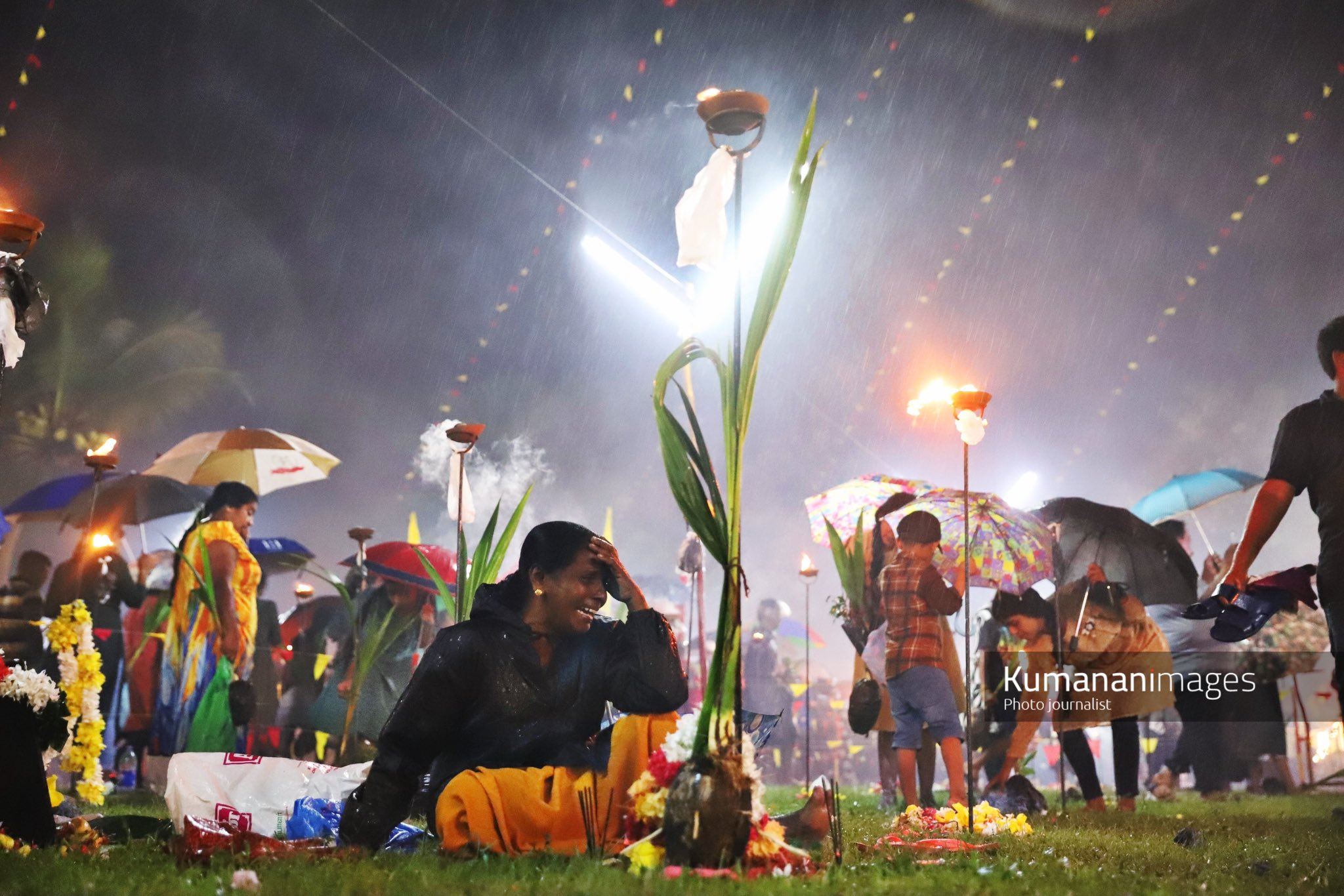
In northern and eastern Sri Lanka, people held a peaceful day of remembrance on 27 November for their civil war dead. Despite bad weather, they laid flowers, candles, and fruit in Maaveerar Thuyilam Illam, heroes’ final homes. No restrictions were imposed under the new government. Muthukumara, a businessman from Colombo told AsiaNews, that everyone is a human being,” urging the government to go ahead with peace.”
Colombo (AsiaNews) – Flowers, lamps, candles, coconuts and other fruit are, according to Tamil tradition, offered on 27 November to remember the war dead. Despite heavy rains and the threat of Cyclone Fengal, communities in the northern and eastern Sri Lanka observed “Maaveerar Naal”, Great Heroes’ Day, in memory of those who died during the country’s civil war (1983-2009).
On this occasion, lamps are lit and solemn prayers recited. But for Tamils, this is the first time in 15 years that they can freely commemorate their dead. Many people in southern Sri Lanka who spoke to AsiaNews said that peaceful remembrance “is a right of Tamils”.
Unlike previous years, the recently installed National People’s Power administration of President Anura Kumara Dissanayake has not tried to impose legal restrictions or tried to stop commemorations.
The families of those who lost loved ones joined in common prayers, gathering in places called “Maaveerar Thuyilam Illam”, or Heroes’ Homes, for the fallen in war, but also in temples and churches, to pay tribute.
Special platforms supported by poles were erected to allow people to pay their respect to those who fought with the Liberation Tigers of Tamil Eelam (LTTE) for the freedom of their traditional homeland in the northern and eastern regions of the island.
According to reporters covering events in the northern and eastern provinces, more than 200 cemeteries were visited, in almost every district in this part of the country
Ramalingam Chandrasekar, the new Minister of Fisheries and Aquatic and Ocean Resources, said that the government would not stop those who wanted to celebrate “Maaveerar Naal”, noting that they have the right to do so.
At the “Thuyilum Illam” in Kanagapuram, tributes were paid to the fallen, while hundreds of people decorated the place with red and yellow flags, waving in the rain and wind, witnesses reported.
This scene was repeated at other cemeteries in Mullaitivu Theravil, Mannar Atkattiveli and Jaffna Kodikamam, where friends and family, including children, gathered.
Fifteen years after the end of the civil war, which saw the LTTE’s fight for a Tamil homeland crushed, the parents of those who lost their lives against the Sri Lankan army, paid homage to their sons and daughters.
In Jaffna and eastern Batticaloa, Tamils peacefully paid their respect at the Tharavai cemetery and the campus of the Eastern University. People showed up in large numbers with flowers, candles, and incense sticks. Events were also organised in Tharmapuram, Killinochi District, at the “Maaveerar Thuyilum Illam” in Koppai and at the University of Jaffna.
In Mullaitivu, soldiers and police did not interfere with Heroes’ Day preparations, but the organising committee reports ongoing surveillance and intimidation by the intelligence service.
In Mullivaikkal, where the last battle took place, the parents of the war dead, their relatives, former LTTE members, and the public gathered, braving the pouring rain, and paid solemn tribute.
Politicians in the northern and eastern provinces also joined the commemorations held in their respective regions. They include the leader of the All Ceylon Tamil Congress (part of the Tamil National People’s Front), and Jaffna District MP Gajendrakumar Ponnambalam, Batticaloa District MP Shanakkiyan Rasamanikkam, and Tamil Eelam Liberation Organization leader and Vanni District MP Selvam Adaikalanathan.
“We in the south and even past governments every year considered this anniversary as a great terrorist act carried out by Tamils. This is quite wrong. Everyone is a human being. Those who died are also their relatives,” said Namal Muthukumara, a businessman from Colombo, speaking to AsiaNews.
If a man does not allow another man to commemorate his dead relatives, then who will? We are happy. This is the first year we have not heard any court order or harassment by the police and the army against the people commemorating this day. This government should go ahead with peace,” he added.
A woman working for a private company in Colombo, Mala Karunaseeli, also spoke to AsiaNews. When will the people of this country forgive and shake hands with the innocent Tamils in the north and the east? People should forget the wrongs of the past and unite in peace for the good of all human beings.”
Colombo, December 2 (Daily Mirror) – Referring to the recent actions of President Anura Kumara Dissanayake and Prime Minister Harini Amarasuriya which has gained much publicity, Samagi Jana Balawegaya (SJB) MP Nalin Bandara Jayamaha today said both should stop grandstanding
The MP was referring to the report that said Prime Minister Amarasuriya had visited a supermarket on her own and the report that President Dissanayake had walked from the Presidential Secretariat to the Finance Ministry.
The Prime Minister’s grandstanding comes at a time when the country is hit by a serious natural disaster. She should learn to manage her time. She has so many institutions under her purview which need her attention. She should focus on these rather than putting up a show and wasting her time,” the MP said.
We can do the shopping for you, Prime Minister,” he added in a lighter vein.
I have the same remark on the actions of President Dissanayake. He does not have to do grandstand by walking but should manage his time even by using a helicopter,” the MP said.
Also, he said the recent flood could be an ill omen triggered by not reciting Jaya Mangala Gatha at the ceremonial opening of the tenth Parliament.
He said the Rs 1 billion which the government has allocated to provide relief to those affected by the floods is hardly sufficient. At least Rs 20 billion is needed to provide proper relief,” he said.





.jpg)