Menacing echoes of the regime change of 2015 – III

April 26th, 2026

By Rohana R. Wasala

Continued from April 16

Part II of this write-up concluded with a reference to the perceived anti-Buddhist (and anti-Hindu) mindset of the ex-Marxist strategist who advocated the abolition of the institution of executive presidency as the single pivotal goal to be fought for by the promoters of the engineered regime change  at the 2015 January presidential election. (I describe the 2015 regime change as ‘engineered’ with powerful external support and corresponding internal collaboration, not based on any special information that I have discovered on my own; I do so based on what I have heard and read from dozens of highly knowledgeable and trustworthy political commentators in and on the free media.) The late Kumar David (whom I used to respect as an intellectual with advanced linguistic capacity, despite his politics) held that an executive president undermined Sri Lanka’s democracy. But the architects of the executive presidential system introduced with the adoption of a new constitution in 1978 by the UNP  believed that a strong executive presidency was essential for preserving the unitary status of the Sri Lankan state as a bulwark against ethnicity based fragmentation of the country by ethnicity based separatists that threatened intercommunal peace, national security, political stability, and economic development. 

Under the presidential system, the president became both the head of state and the head of government, whereas under the Westminster style parliamentary system that survived the proclamation of the first republican constitution of 1972, the prime minister held the most power and the non-executive president was only the nominal head of state. Under the current several times amended 1978 constitution, national sovereignty lies in the people. The president is directly elected by the people. He or she acts as the people’s supreme representative as well as the symbolic personification of national sovereignty. But the president is under the constitution, not above it. A morally adequate executive president does not jeopardize democracy. 

Regime change supporters have made much against Article 9 of the constitution that offers the foremost place for Buddhism, though it does so without making it the state religion. They argue that it threatens the secularism of Sri Lankan democracy.They have also objected to describing Sri Lanka as a Buddhist country/nation. (May the impartial reader judge the fairness of this criticism in comparison with the status given to majority religions in other democratic countries, except in neighbouring India, where 80% of the people are Hindu, but Hinduism is not the state religion.. The only democratic country in the world that shares Sri Lanka’s susceptibility to criticism in this respect is Israel, which has no state religion but ensures freedom of religion to all its diverse ethnic groups, while giving Judaism a privileged place, and calls itself a ‘Jewish democratic state’.) It is beyond dispute that Israel, Sri Lanka, and India are the most accommodating towards religious multiculturalism.  

Despite this, a trend towards relaxing the observance of Article 9 emerged during the civil conflict, especially in the worst affected northern and eastern provinces, and it became more apparent after January 2015. Acts of discrimination against the Sinhalese Buddhists left  after ethnic cleansing by the separatists in those areas, and vandalizing of pre-common era Buddhist archaeological sites notwithstanding the protection provided by  the supposedly powerful Antiquities Ordinance, sabotaging of the commemoration of the 270th anniversary of the bringing of the Higher Ordination ritual from Siam (Thailand) in 1753, that was being organized by the Siyam Nikaya during UNP’s Ranil Wickremasinghe’s presidency in 2023; the fate of its 275th anniversary in 2028 is yet to be seen.  The same propensity seems to be continuing under the ruling JVP/NPP, whose leaders made common cause with the regime changers who had sought the abolition of the executive presidency. Concerned legal experts might accuse incumbent Anura Kumara Dissanayake of having subjected Article 9 to constitutional neglect by effectively scrapping (?) a separate ministry for Buddha Sasana and by appointing an alleged non-Buddhist to take care of Buddha Sasana-related affairs, and a Muslim Maulavi, an alleged owner of madrasas, as his deputy. The seemingly subtly sabotaged progress of the Walk for Peace under the apparently unsolicited patronage of the government is leaving a bad taste in the mouth.This is in spite of the president having been recently trying to downplay his secular persona.    

A gesture that president Anura Kumara Dissanayake made towards that was when he invited  Pope Leo XIV to visit Sri Lanka on a still unspecified date in the future. His official invitation was handed over to Archbishop Paul Richard Gallagher, Holy See’s Secretary for Relations with States, at the Vatican by Minister Bimal Ratnayake on March 3, 2026 during the latter’s recent state visit to Italy. President Dissanayake has also opted to offer state patronage to the Walk for Peace monk delegation headed by Vietnamese American Theravada Buddhist Bhikkhu Ven. Pannakara Thero of the Huong Dao Vipassana Bhavana Center in Fort Worth Texas, USA, currently visiting Sri Lanka. 

President Dissanayake might deserve Sri Lankans’ appreciation for these hopefully pious decisions. But he should remember the following lines from Verse 1 of Dhammapada:

If with an impure mind a person speaks or acts – suffering follows him like the wheel that follows the foot of the ox.”

Verse 2 says:

If with a pure mind a person speaks or acts – happiness follows him like his never-departing shadow”

Both verses state a natural law. There is nothing magical or mysterious here, because

Mind precedes all mental states –  mind is their chief, they are all mind-wrought.” 

The responsibility for the cultivation of sound mental states, arriving at well thought out decisions, and taking the right actions weighs infinitely more heavily on the ruler of a country than it does on a single individual.

Hence the daily prayer of Buddhist monks: raja bhavatu dhammiko ‘May the ruler be righteous!’  

Leader of the Walk for Peace Bhikkhu Pannakara constantly stresses the importance of restraining our ever-shifting ‘monkey mind’ (that is always in a state of restlessness, confusion, and continuous chatter) to let inner peace and happiness bloom. 

Although the Walk for Peace monks are absolutely devoid of any political or missionary motive beyond disseminating that simple but profound message of peace and compassion, the people of Buddhist majority Sri Lanka could unobtrusively use their visit to raise the  image of Sri Lanka as a nation with a rich Buddhist cultural heritage that has survived for over twenty-three centuries based on a moral framework that asserts the values of karuna (compassion), metta (loving-kindness), ahimsa (non-violence), mindfulness, panna (wisdom), and shanti (deep inner peace) which is the genesis of national and world peace. These are the humane values that the Walk for Peace monks demonstrate and teach for individuals to assert in their lives in order to reduce their own suffering, while helping create a society that is peaceful and happy. This is broadly what the Buddha advised his first sixty disciples to do, when he started his ministry after  setting the Wheel of the Dhamma” in motion:  Go forth O bhikkhus, for the good of the many, for the happiness of the many, out of compassion for the world, for the benefit, welfare and happiness of gods and men”. 

Right now, though, as strongly hinted by the independent media and as constantly argued by the Opposition, President Dissanayake is living a lie, nay, is lying in a bed of lies with sharp teeth that he has himself made. He pretends to be committed to a secular liberal democracy that he seems to have no clear idea about, and tries to show proof of his secular credentials by implicitly disowning the Sinhalese Buddhist culture he was born into. His conduct as president doesn’t reflect any awareness, on his part, of the remarkable compatibility of that culture with the ethical standards of modern secular democracy. The socially egalitarian and ethically progressive spirit of democracy that Buddhism, across all its denominations, infuses into societies is being increasingly recognized and respected around the civilized world. Dissanayake’s profound ignorance of, or callous insensitivity to, this fact is a glaring instance of his internalized racism (i.e., involuntary adoption of Western prejudices and stereotypes against one’s own non-White race), which prompted him to disparage Sri Lanka as a ‘hunduwa’ for what he has identified as its underdeveloped economic capacity. 

Be that as it may, his efforts are apparently expended on appeasing the handful of racist Tamil separatists and the few religious extremists hiding safely in plain sight, taking refuge within the larger peaceful Tamil, Catholic, and Muslim mainstream minority communities. The latent resurgence of political (Tamil separatist) and religio-political (Catholic and Islamist) extremism has become a complex social, political, and security issue for the Sinhalese Buddhist majority Sri Lankan state. This problem gets more complicated by the interventionist attention that is focused into its internal affairs by competing global and regional superpowers in the geostrategically supersensitive Indo-Pacific, where Sri Lanka is located, especially by the powerful Western countries that have taken in large Tamil diaspora populations. The Buddhist majority community is not totally free from its own variety of extremists. The agitating monk activists like Balangoda Kassapa Thero and Galaboda-aththe Gnanasara Thero who criticise the Walk for Peace having misunderstood its genuine purpose, are examples; they are doing a great disservice to the genuine causes they are trying to bravely champion. ………..

The most frightening echoes in the next, hopefully the final, part.
Kasi Hideaki’s Vote of Thanks to Senaka Weeraratna’s speech at the Japanese Parliament on November 14, 2018

April 26th, 2026

History

Introduction:

Mr. Senaka Weeraratna, Attorney – at – law, delivered the keynote address at a
Symposium held on the premises of the Japanese Parliament (Conference Room No. 101 of the Diet) on 14th November, 2018 on the topic titled ‘ Japan’s attack on Pearl Harbour ignited the liberation of Asia from Western Domination – Time for Asia to express gratitude to Japan’. 

The Symposium was organized by the Society for the Dissemination of Historical Fact.
Mr. Weeraratna was the first Sri Lankan and first Asian to thank Japan on the premises of
Japan’s Parliament for making huge blood sacrifices of Japanese soldiers and thereby paving the
way for the liberation of Europe’s Asian colonies including British occupied Ceylon.

Following his speech Mr. Kase Hideaki, Diplomatic critic and Chairman of the Society for the Dissemination of Historical Fact, proposed the Vote of Thanks. His speech was entitled ‘THE GREATER EAST ASIAN WAR: HOW JAPAN CHANGED THE WORLD’

https://www.sdh-fact.com/CL/Kase-Speech.pdf

Good evening, ladies and gentlemen. I would like to extend my heartfelt thanks to Mr.
Senaka Weeraratna for his kind words, especially those pertaining to my father, Kase
Toshikazu.


September 2, 1945 was a day of humiliation for my entire family. My father, then aged
42, was one of the envoys present at the ceremony during which Minister Plenipotentiary Shigemitsu Mamoru signed the Instrument of Surrender. My father stood next to Mr. Shigemitsu as the haughty Douglas MacArthur looked on.


Mr. Weeraratna was kind enough to say a few words about my book, ‘The Greater East
Asian War: How Japan Changed the World’. My father, who lived to the ripe old age of
101, had a habit of looking me straight in the eye and saying, We may have lost the
battle, but we won the war because we liberated the Asian and African peoples.”


I am seldom moved to tears by anything I see on television, but I do remember one
exception. In September of this year American actress Meghan Markle and British Prince Harry got married. Their magnificent wedding ceremony was held at Windsor Castle (the residence of the British royal family, known as the House of Windsor). As it
approached St. George’s Chapel, the horse-drawn carriage bearing the royal couple
looked as though it had been taken straight from a fairy tale, and the silver armor worn by the escort guards gleamed in the sunlight. I was deeply moved.


Inside the chapel an African-American clergyman invited to participate in the ceremony
preached about the power of love, speaking in the African-American vernacular.
When I heard a black gospel choir (also from the US) sing Stand by Me” (originally a
spiritual entitled Stand by Me, Father”), tears streamed down my cheeks. I imagine
many of you reacted in the same way.


Ms. Markle’s father is white; her mother is African-American. Throughout the long
history of the British royal family, the idea that an African American might become the
consort of a prince who is sixth in the line of succession to the British throne would never have crossed anyone’s mind.


Japan deserves credit for helping make this remarkable turn of events possible. We
fought a huge war at great human cost and sacrifice. All the nations of Asia won freedom, and the momentum behind their liberation then spread to Africa, whose nations broke the yoke of colonialism, one by one.

In the late 1950s I traveled to the US to study at Columbia University. In those days
African Americans could not vote. Furthermore, they risked being lynched if they dared
cross the thresholds of hotels or restaurants patronized by whites. There were separate
drinking fountains and public lavatories for whites and blacks.


But when the peoples of Africa won freedom, their nations built embassies near the
United Nations in New York City, and in Washington DC. African diplomats began to
frequent hotels and restaurants that were inaccessible to African Americans. Eventually
African Americans followed their lead.


Dr. Martin Luther King, Jr.’s civil rights movement began to bear fruit in the 1960s.
Before then sexual relations between whites and blacks constituted criminal offenses; nor was intermarriage between the two races permitted. Discrimination showed no mercy. African-American baseball players could not work in the major leagues until after World War II.


When I was studying in the US, African Americans were barred from golf courses
(unless they were caddies). Today tennis champion Osaka Naomi is playing in
tournaments all over the world, but not so long ago the only African Americans seen on
tennis courts were members of the cleaning staff or ball boys.


As I watched the wedding ceremony of American actress Meghan Markle and British
Prince Harry, it occurred to me that the spirits of Japanese soldiers who gave their lives
on the vast battlefields of the Greater East Asian War must also have delighted in these
nuptials. That thought precipitated another flood of tears.


At the royal wedding Queen Elizabeth II, Prince Philip, and Crown Prince Charles, all in
formal dress, were present as Prince Harry took an African-American woman as his bride. An ideal world had materialized, thanks to Japan’s strength. Throughout human history, which revolution stands out the most? The French revolution? The Russian revolution? The Industrial Revolution? The IT revolution? None of these. The greatest revolution in human history was the achievement of racial equality in the world.


This year marks the 150th anniversary of the Meiji Restoration. What is noteworthy here
is that between 1853, when Commodore Matthew Perry’s fleet of black ships appeared at Uraga and 1868, the first year of the Meiji era, only 15 years elapsed.


Japan had replaced the Edo Shogunate, which had persisted for 260 years, with a new
regime. We greeted Meiji, a new era. This year, 2018, is the 30th year of the Heisei era, which will come to a close in April 2019. How will we remember the Heisei era? It will have been a 30-year period during which we failed to revise the current disgraceful Constitution, crammed down our throats by the Occupation forces.

We were able to recreate Japan during a 15-year period beginning with Perry’s incursion into Japanese waters. But we could not revise the Constitution over the past 30 years. What have we been doing (and I include myself), for the past 30 years?
Between the last days of the Shogunate and the dawning of the Meiji era we Japanese had two immense dreams. One was the revision of insulting, unequal treaties that had been forced upon us by the imperialist powers of the West. 


Japan could not set its own tariffs for imports and exports. Foreign fleets stationed
themselves in our ports, in Yokohama and Kobe. We did not have the authority to try
foreigners in our courts. We needed to revise those disrespectful treaties.


The other dream was achieving racial equality throughout the world. Many members of
Japan’s warrior class traveled to the West on observation missions between the end of the Edo Shogunate and the beginning of the Meiji era. During their ocean voyages, the
Japanese travelers saw how their fellow Asians were abused by their white bosses, treated like beasts of burden, like slaves.


The Japanese made truly strenuous efforts to get the unequal treaties revised. At the
famous Rokumeikan, Prince Ito Hirobumi and his subordinates felt obligated to learn
ridiculous Western ballroom dances and to wear Western clothing. Surely such
accommodations would prove that Japan too was a civilized nation, and then perhaps the Japanese could make progress with treaty revision.


Until the end of the Edo era (1603-1868) the Japanese wore white when they attended a funeral. However, in the hope of revising the unequal treaties, the Meiji government
decreed that black clothing be worn at funerals, as it was in the West. Such were the
lengths that the Japanese were willing to go to for the sake of treaty revision.
Early in the Meiji era, again looking toward treaty revision, the Ministry of Education
sent notifications to all girls’ schools announcing that students should be prohibited from
urinating standing up. During the war my mother took me to Nagano prefecture to escape the bombing that was occurring in cities. There I saw a young girl urinating, standing up, on a footpath between rice fields.


I used to travel to Indonesia on business. When I spotted a woman urinating, standing
up, at the roadside in a rural area of Java, I felt a wave of nostalgia and thought, They’re just like us.”


When a foreign head of state visits Japan, a banquet is held in his or her honor at the
Imperial Palace. At these banquets the food served is always French cuisine. At the Great Hall of the People, facing Tian’anmen Square, the Chinese serve Chinese cuisine. The Koreans serve Korean cuisine. The Thais serve Thai cuisine. The Indians serve Indian cuisine. Why do the Japanese serve French cuisine?

By the 1970s Japan had just about caught up with the Western powers; at that point
someone suggested serving Japanese cuisine. I said that French cuisine should be served for all eternity. We should serve French cuisine so that the pains our ancestors took to get the unequal treaties revised would not be forgotten.


Apparently we began serving French cuisine at state banquets because Japanese cuisine was deemed barbarian, and no nation would want to conclude treaties on equal terms with barbarians. So the Japanese built the Rokumeikan, imitated the Westerners, wore black at funerals, and served French cuisine. We must never forget these efforts.
We dreamed of and longed for a world of racial equality. In fact, racial discrimination
was one of the primary causes of the Pacific War.


The phrase hakko ichiu, meaning all the world under one roof” appears in a decree
issued by Emperor Jimmu on the occasion of his coronation (ca. 660 BCE). It means that in an ideal world the peoples of the world are living together happily under one roof. The Japanese have no history of racial discrimination.


Earlier Mr. Weeraratna mentioned my father, who was head of the Foreign Ministry’s
North American Division when war between the two nations broke out. He oversaw
negotiations between Japan and the US from Tokyo. The foreign minister at that time
was of Korean descent. His Japanese name was Togo Shigenori. He was a native of Kagoshima; the name on his census record was Pak Mu-dok. When he matriculated at the Law Faculty of Tokyo Imperial University, he changed his surname to Togo, and adopted the Japanese pronunciation of his given name.


Before World War II, Park Chun-gum ran for a seat in the House of Representatives,
using his Korean name. He won, and ended up serving two terms. Tokyo’s Koto Ward,
the district from which he was elected, had some Korean residents, but they were
overwhelmingly outnumbered by Japanese. If the Japanese had discriminated against people of other ethnicities, it is very unlikely that a Korean using his birth name and running from Koto Ward could have won a seat in the House of Representatives, certainly not for two terms.


Nowhere in Japanese history do you find instances of racial discrimination. Nor have the
Japanese ever kept slaves. I once held a press conference at the Foreign Correspondents’ Club of Japan in Yuraku-cho. On that occasion I voiced my objections to press coverage of the comfort women.


A correspondent from a leading US newspaper posed the following question: It is
common knowledge today throughout the world that the Japanese condemned young
women to a life of misery by forcing them to become sex slaves. How dare you make a
statement that defies common knowledge?”

I replied,” I would prefer not to entertain a question of that sort, posed as it was by a
reporter from a country that practiced slavery until right before Japan entered the Meiji
era (1868-1912).” Japanese and Asian journalists in the audience, which numbered about 150, applauded.


In August of this year (2018) the Palais Wilson in Geneva, Switzerland was host to a session of CERD (the UN Committee on the Elimination of Racial Discrimination). At that session CERD was reviewing the situation in Japan. Apparently the committee’s members, who represent Korea, the US, Belgium, and other countries had denounced Japan, believing that there is a great deal of racial discrimination there. A delegation from Japan’s Foreign Ministry was present; it was led by Otaka Masato, ambassador in charge of UN affairs; Mr. Otaka speaks excellent English.


Mr. Otaka provided a careful explanation of Japan’s position. He mentioned that 
The Japanese government had already offered apologies. In fact, his report was so detailed that it sounded as though he was apologizing again. In his place I would have gone on the offense, emphasizing the fact that the Japanese had never kept slaves, and attacking those nations that had.


There is no point in wasting our tax revenue by paying dues to CERD. It is completely
ridiculous for us to be doing this. The Japanese government should tell them that we’ll
stop paying our share unless they rename Palais Wilson.


February 13, 2019 will mark the 100th anniversary of the Paris Peace Conference (also
known as the Versailles Peace Conference), held after World War I ended. At US
President Woodrow Wilson’s suggestion, those in attendance decided to establish the
League of Nations as an organization entrusted with overseeing the postwar world. The
Japanese delegation proposed including a clause advocating the elimination of racial
discrimination in the Covenant of the League of Nations of Versailles. When the proposal was submitted to a vote, there were 11 votes in favor of (some of them from Europe’s smaller nations) and five votes against its adoption.


However, President Wilson issued a pronouncement to the effect that a unanimous vote
was necessary to approve a matter of such great importance, thus quashing the Japanese proposal. Wilson was a dyed-in-the-wool white supremacist. During his presidency discrimination against African Americans worsened. He stated that people of color are intellectually inferior to whites (those who seek proof need only refer to transcripts of his lectures). Like Hitler, Wilson was a proponent of eugenics.


President Wilson once served as president of Princeton University. Nevertheless,
members of the school’s student body (including white students), recently launched a
campaign to remove Wilson’s statue from the campus. In the 1960s the US Congress
sponsored the establishment of a think tank called the Wilson Center. But here too a
movement has arisen that would change the name of the institution, as Wilson’s name is
now an embarrassment.


The Japanese government delegation should insist that the name of Palais Wilson be
changed. Its members should say that they will refuse to enter the building until it is
renamed. I believe that Japan’s history of equality began with the Jomon era (ca. 14,000-1,000 BCE), even before Japan was born. The Japanese have always valued harmony among people.


Perhaps I am engaging in wishful thinking, but I think that next year China will be on the
road to ruin. I am convinced that as long as Japan does not give in to China’s demands,
the world will see the dawning of an Asian era in which Japan takes the lead.
Monotheism has come to a standstill. As Mr. Weeraratna mentioned, Nazi racial
discrimination was religious discrimination. If you read the New Testament, the new
promises of Jesus, you will find the following reference to the Jews: You are the
children of the devil, and his works ye shall do.”


Since Hitler was the son of a devout Roman Catholic, he carried out Jesus’ teachings to
the letter. Europeans had been massacring Jews for nearly 1,000 years. But the Germans, with their sophisticated technical skills, were able to kill more than 5 million of them. Monotheism is exclusive; it does not value harmony. The adherents of Sunni and Shia, the two main branches of Islam, simply cannot get along with each other. These conflicts have resulted in a great deal of killing. 

The Japanese have always prized harmony. We have harmony when three, or four, or five, or six people gather and say, Let’s work together.” In Japan we have always had harmony — people working together toward a common goal, with the emphasis on the group rather than the individual.


In closing I would like to mention that it has been some time since the world’s attention
has come to focus on Japan like this. From the end of the Shogunate through the Meiji era, Japan exerted considerable influence on the Western world: we had ukiyo-e, Japonisme, Japanese design, and Japanese architecture. But these were visual influences.


However, what has caused Japan to capture the world’s heart and at long last to become the center of attention goes beyond the visual, even beyond the spiritual. As Mr. Weeraratna said earlier, Japan accomplished the most prodigious revolution in the world.  We broached the idea of racial equality to the world. But I do not think we should look to the nations of Asia for gratitude.


But we should be grateful to our heroes, our so-called war criminals. When I go to
worship at Yasukuni Shrine, the shrine for our war dead, I will be sure to thank the
heroes who created this wonderful, ideal world.

Kase Hideaki

PS

Hideaki Kase (加瀬 英明, Kase Hideaki; 22 December 1936 – 15 November 2022) was a Japanese diplomatic critic known for promoting historical negationism.[1] His father, Toshikazu Kase, was a diplomat under Shigenori Tōgō who negotiated an end to the Pacific war. Yoko Ono is his cousin.  Kase died on 15 November 2022, at the age of 85

See 

https://en.wikipedia.org/wiki/Hideaki_Kase

https://www.dailymirror.lk/opinion/Did-Japan-contribute-to-Sri-Lanka-and-India-to-gain-independence/172-105069

Japan’s Master Plan for Victory

SRI LANKAN NOVELIST SHORTLISTED FOR TWO AWARDS IN THE ROMANTIC NOVELISTS’ ASSOCIATION ROMANTIC NOVEL OF THE YEAR AWARDS 2026

April 26th, 2026

THE ROMANTIC NOVELISTS’ ASSOCIATION

British Sri Lankan author and former Musaeus College student, Jeevani Charika, is a finalist in two categories of Romantic Novel of the Year Awards 2026. Both books were published last year and have British-Sri Lankan heroines as main characters.

How Can I Resist You? (written as Jeevani Charika) is a contemporary romance/women’s fiction story about Vidya who is trying very hard not to fall for her work colleague and has been shortlisted in the Contemporary Romance Novel category. It is published by HQ (Harper Collins).

Christmas With The Secret Tycoon (written as Rhoda Baxter) is a festive sweet romance about a designer called Madhuri, and is shortlisted in the Shorter Romance Novel category. It is published by Mills and Boon.

Although Jeevani has been writing under both pen names for several years and has been shortlisted for awards before, this is the first time both names have been shortlisted in the same year.

This year is a particularly good year for Sri Lankan representation in the romance industry, because Shalini Abeysekara, a Canadian-Sri Lankan novelist has also been shortlisted for the Romantasy/ Romantic Fantasy category. It is published by Hodderscape.

The Romance Novelists’ Association (RNA) Romantic Novel of the Year Awards is an annual awards ceremony celebrating excellence in romantic fiction in all its forms. In the past awards have been won by writers such as Jojo Moyes, Elizabeth Buchan, Philippa Gregory and Katie Fforde.

UK based mum of two, Jeevani Charika writes romantic comfort reads with a dash of fun. She also writes under the pen name Rhoda Baxter (named after the bacterium she studied while doing her PhD). Her books have been shortlisted for multiple awards. She was born in the South of England, but spent much of her childhood in Sri Lanka, with short forays to Nigeria and Micronesia, before returning to settle in Yorkshire. Taking her father’s advice to focus on science and get a ‘real job’, she studied Biochemistry and Microbiology. She ended up working in university intellectual property. All of this, it turned out, was excellent preparation for becoming a novelist.

Jeevani loves all things science geeky. She also loves cake, Lego and British comedy. When she’s run out of excuses not to, she writes books.

You can find out more about her (and get a free book by signing up to her newsletter) on her website. www.jeevanicharika.com

She commented, I am thrilled to bits to be shortlisted for the awards (twice!). The books are judged by readers, not writers, which makes the awards extra special.

We need cosy and uplifting books in these dark days, and these awards celebrate the best of them. I’m very excited to see my comfort reads listed alongside books by so many authors whose books I love.”

The RNA Chair, Seána Talbot, said, This year’s finalists represent the very best of what our romantic fiction community has to offer—from indie to traditionally published, from cosy to spicy and everything in between. We at the RNA are proud to recognise talented authors across the breadth of romance books, encompassing the full range of romance and romantic fiction subgenres. We look forward to celebrating with the romantic fiction community and can’t wait to announce the winners.”

The RNA Romantic Novel of the Year Awards have eleven award categories and they are: Debut Romance Novel Award, Romantasy/Romantic Fantasy Award, The Romantic Thriller Award, The Festive/ Holiday Romance Novel Award, The Shorter Romance Novel Award, The Saga Romance Award, The Historical Romance Award, The Contemporary Romance Novel Award, The Contemporary Spicy Romance Novel Award, The Romantic Comedy Award, and The Romance Bestseller Award.

The shortlisted novels were determined exclusively by reader-judges and the finalists illustrate the highest standards of romantic fiction across all genres. The winners of the eleven categories will be announced during the awards ceremony on the 18th of May in London, along with the winner of The Joan Hessayon Award for New Writers.

Award winning author Brigid Coady will host the evening. The Joan Hessayon Award for New Writers which is sponsored by the estate of Dr David Hessayon will also be presented at the ceremony by Claire McCauley (winner of the Award in 2024 and now its Coordinator). The RNA President and Sunday Times Bestselling Author Sue Moorcroft will present the Contemporary Romance Novel Award and the remaining awards will be presented by the RNA Chair Seána Talbot.

The awards ceremony will be held at the Leonardo Royal Hotel London City, 8-14 Cooper’s Row, London EC3N 2BQ, on Monday, the 18th of  May 2026 at 6.30pm.

Tickets are available here:

For the full list of finalists and contenders please visit the RNA website:

HOW CAN I RESIST YOU?  BOOK BLURB (Publisher: HQ – Harper Collins)

Vidya isn’t in Waterloo Bay for a holiday. Officially, she’s visiting the beautiful, quirky seaside town for work – but unofficially, she’s on a mission. One of her colleagues hooked up with her sister at a party, and now her sister is pregnant. As the sensible one in the family, it’s Vidya’s job to find out who he is.

But there’s a catch: all she has to go on is a vague description of a chest tattoo. Vidya has just two weeks to glimpse her colleagues shirtless without getting fired, but crazy hotel guests, malicious seagulls and her pesky day job keep getting in the way.

And then there’s Leo, the most frustrating, patronising, handsome man she’s ever met…

CHRISTMAS WITH THE SECRET TYCOON  BOOK BLURB (Publisher: Mills and Boon)

Hotel tycoon Tristan needs to lay low after a media scandal…so why not go undercover as a guest at one of his own country hotels? His mind isn’t on work for long, though. When he meets captivating local Maddie, he’s soon swept up in finding someone who cares about him, not his wealth. But Maddie is reeling after being betrayed by her conman ex and Tristan knows trusting him doesn’t come easy… When his true identity comes out, will he lose her forever?

ADDITIONAL MEDIA INFORMATION ABOUT JEEVANI CHARIKA

Jeevani has written eight novels as Jeevani Charika (book 9 coming out in July 2026) and eleven novels as Rhoda Baxter. She has also written two books of writing advice for novelists. She does freelance work as a developmental editor for fiction and runs courses teaching authors all the extra skills you need to learn after you get your publishing deal.

JEEVANI CHARIKA/ RHODA BAXTER MEDIA DETAILS

Website: rhodabaxter.com

Social media links:

Bluesky: https://bsky.app/profile/jeevanicharika.bsky.social

Tiktok: https://www.tiktok.com/@jeevanicharikaauthor

Instagram: https://www.instagram.com/jeevanicharika/

Facebook: https://www.facebook.com/rhoda.baxter.5/

YouTube: https://www.youtube.com/@jeevanicharika

IS PEACE FAR AWAY FROM US?  IS DONALD TRUMP ISOLATED?

April 26th, 2026

Sarath Wijesinghe Presidents Counsel Former Ambassador to UAE and Israel President Ambassador’s Forum Uk

DONDLD TRUMP AND USA

Trump is the President of USA supposed to be the richest nation who is self-appointed the world policemen despite the existence of UN and the major five powers which can take decisions for the world through United Nations now appear to be inactive and in effective especially when major nations are fighting, though all nations are equal before the UN Convention on which the organization is formed. There is no world president but UN can be the Parliament as a talking shop considering all nations equal in including Sri Lanka which is a senior member of the UN with an excellent reputation though a small nation. World was has ended but there are mini wars based on various reasons may be border disputes and mainly on economy. World court is too expensive and time consuming to settle disputes. But generally, disputes are settled based on diplomacy and principles of international law and international relations. Those who do not abide by international law and relations are ‘’Pariya’’ Countries and nations are careful to maintain to be Gentlemen in the nation brotherhood. USA is bestowed with  great presidents and it is yet to prove the true colors of  Trump on whom world had hopes as an ant-war President during his campaign for Presidency as a  peace candidate during the elections which he is disproving the expected image by conduct. UN system has 193tions in the world family acting as a world parliament with no executive but five world power to take major decisions including the power of Veto which is powerful to outweigh other proposals by this special power. Family of nations are expected to follow and abide by international law irrespective of the size of the nation as according to the UN convention every country has equally powers and opportunities and every country is expected to follow international law. Do all follow international law is a moot issue known to the world and there is procedure laid down in the UN convention how to engage in a war- just war to punish wrong doers. Iraqi war Bush and Blair used UN to punish Iraqi and find nuclear armaments which they never found resulting complete destruction of the powerful Iraqi shambles  for oil and wealth they possess  and to curtail power of then ruler, and the opportunity was taken to destroy many other leaders in the Middle East powerful being a threat to the west and USA all self-appointed leaders. UAE is a country in the middle East invested the oil they discovered in 1960 wisely mad eit a  a commercial hub using the strategical situation which Sri Lanka should use and made use of, being a better location and full of beauty unlike UAE heaved for tourists.

USA is a country with a history of few hundred hears with an infamous history on humanity full of brutality yet has converted to be a rich country with exploiting the wealth of other countries and continue to continue. It had great leaders such as Kennady , Abram Lincon Rooswelt  and many more though the current President  Donald Trump who came to a compromising candidate for peace against war unfortunately has turned to be different from the expected world leader who was expected to take world towards peace and prosperity has surprisingly changed to be a world leader disappointment the peace-loving world citizen.

Trump  came to power as a anti war President and world has had lot of hopes on him to be a great world leader is in isolation due to his interest on oil resources in countries in the middle east especially Iran a soft target an abundance of iol farm

Is Trump really  Isolated

President Trump is the President of the richest country on the globe and considers him as the world policemen who can control the world based on the ‘’rule of the jungle’’ based on the theory survival of the fittest. Lion is the king of the jungle who is free to take any animal for his pray with no restrictions, and no governance in the jungle controlled by the nature. Now that the cold war is no longer in existence the other leading powers are in the back seat watching the situation carefully but intensively, appear to be active at any stage of need. They concentrate on economy and becoming economic giants when Usa uses different tactics to be the leader wanting to control the world resources especially oil which is the main sources of energy.

Our World

World is the same with the occupants make it spoilt and dirty. World family has had an organization with no leader but an organization that can be somewhat considered a world Parliament with no executive powers There are 193 nations recognized by the United Nations Organization which they say is a toothless lion unable to perform as a strong world organization which is funded by USA and rich members based on the proposals of their income. UN was set up due to the aftermath of the world war with massive destructions, atomic bombing, when the League of Nations was inactive toothless and unable to face fierce world wars.

PCI gets Chairman, journalist-quotas remain vacant.

April 26th, 2026

Nava Thakuria

After months of uncertainties, the Press Council of India (PCI) got its chairman as  Justice Ranjana Prakash Desai assumed the charge on 24 April 2026. The retired judge of the Supreme Court of India, who was nominated for a second term for a period of three years, served as the PCI chairman from 17 June 2022 to 16 December 2025. However, the quotas for working journalists remain vacant as seven members, to be represented by professional scribes (other than editors) and six members, to be represented by journalist-editors, are yet to be picked up to complete the 15th council (https://presscouncil.nic.in/CurrentMemberPCI.aspx).

Mentionable is that two months back,  Rajya Sabha member Sasmit Patra  urged the Union government in New Delhi to complete the current press council to safeguard democratic principles and strengthen media accountability. Speaking in the upper house of Parliament on 10 February, the Biju Janata Dal leader asserted that the constitution of full-fledged council after the term of 14th council expired on 5 October 2024 was necessary for a free, fair and responsible press. Patra specifically emphasized on appointing the new chairperson, as the PCI remained headless since 17 December last year, to pave the way for completing the  council of the statutory, quasi-judicial and autonomous body.

Currently the PCI has functioning members namely  Sudhanshu Trivedi,  Brij Lal (Rajya Sabha lawmakers), Sambit Patra, Naresh Mhaske and  Kali Charan Munda (Lok Sabha members),  Ashwini K Mohapatra (University Grants Commission),  Manan Kumar Mishra (Bar Council of India),  K Sreenivasarao (Sahitya Akademi), Sudhir Kumar Panda, MV Shreyams Kumar, Gurinder Singh, Arun Kumar Tripathi, Braj Mohan Sharma and Arti Tripathi (who either own or carry on the business of management in big/ medium/ small newspapers). Initiatives continue to fill up the remaining 14 seats even though different hurdles have surfaced in the recent past.

The 29-member media watchdog, which was initially set up in 1966 under the Press Council Act 1965 and later re-established in 1979 following the Press Council Act 1978 with an  objective to improve the standard of newspapers and news agencies in the billion plus nation,  should have 13 individuals representing the professional journalists (out of whom 6 need to be editors and 7 working journalists of newspapers/news agencies), but those seats remain vacant till date. Months back, a good number of media organizations demanded to rejuvenate the PCI with more power to its ambit.

The crisis started as many national journo-bodies opposed a change in the PCI rules to   pick up members from various press clubs instead of the national union of working journalists. Some of them even approached the court making the situation more complex. They argue that the press clubs are basically recreational bodies and their coverage areas normally stick to a particular region, city or town. Often the press clubs offer memberships to non-working journalists (like academicians, writers, film personalities and also diplomats) to enhance their influences, and hence their members may not do justice to the professional media personnel in various crucial junctures. More precisely the  press club/press guild/ media club cannot have an all India body (nonetheless the nomenclature Press Club of India) with representatives from various parts of the vast country. On the other hand, they argued that recognized journalist-unions  usually comprise members from different parts of India.

As the PCI became headless for months (it happened for the first time in the history of PCI), the question arose who was taking  care of the robust Indian print media fraternity (comprising over 100,000 publications, endorsed by the Registrar of Newspapers for India, in various frequencies and languages)? The PCI is authorized to accept complaints against any  newspaper/news agency or an editor/working journalist for their professional misconduct deteriorating the standard of journalistic behaviours. But it has limited power to enforce its guidelines by penalizing  print outlets as well their editors and working journalists for the violation.

Besides the newspapers, the billion plus nation also supports nearly 400 satellite news channels along with millions of portals, whatsapp and other digital media outlets. But those are not yet under the purview of the PCI. In reality, all modern technology-driven news outlets remain out of its purview. As the PCI enjoys  the authority to make observations whenever the conduct of any government is found inappropriate while ensuring freedom of the press. So the  demand to bring  all the news channels, radio and digital platforms under the PCI’s jurisdiction  and its subsequent empowerment continues to grow.

හැකර් ඉස්සුවා කියපු ඩොලර් මිලියන 2.5 ඩුබායි බැංකුවක් හරහා ගිහිං තියෙන්නේ

April 26th, 2026

භාණ්ඩාගාරේ කොල්ලය ඇතුලෙන්ම ගහපු ගේමක් මෙන්න සාක්ෂි..Account එක චෙක් කරන්න හොරාටම කෝල් කරලා.

April 26th, 2026

Truth with Chamuditha and Chamuditha News Brief

Sri Lanka’s Cardinal Questions: Why were Churches targeted? — The Facts Answered

April 25th, 2026

Shenali D Waduge

The Cardinal has publicly expressed uncertainty as to why churches were targeted in the 2019 Easter Sunday attacks. However, this is not an unresolved mystery in terms of established findings. Multiple investigations — including international intelligence assessments, the Presidential Commission of Inquiry (PCoI), Parliamentary Select Committee (PSC), Supreme Court observations, and other formal reviews — have already examined the matter in detail.

  1. Established facts are clear

The Easter Sunday attacks were carried out by a structured extremist network led by Zahran Hashim.

Across all investigative findings, a consistent pattern emerged:

  • progressive ideological religious radicalisation
  • formation of an organised extremist network
  • training, logistics, safe houses, and coordination mechanisms
  • prior intelligence warnings received by state agencies
  • inaction on the warnings to prevent attacks
  • coordinated suicide attacks on churches and hotels

The selection of churches was not random.

Globally, extremist movements have repeatedly targeted places of worship due to their symbolic, psychological, and ideological impact. Egypt, Nigeria, Congo are the latest examples.

This fits a known operational logic: attacking symbolic civilian targets to maximise fear, visibility, and ideological messaging.

Established sequence:

radicalisation → organisation → preparation → intelligence awareness → security failure → execution

This chain is consistently reflected across investigative findings and has not been replaced or disproved by any official inquiry.

  1. The emerging new narrative” and arrests

A newer narrative has emerged in public discourse that does not dispute the existence of Zahran Hashim’s extremist network, but instead suggests that external actors have influenced, enabled, or shaped the outcome for a political objective.

This version strives to make the external actor the driving force of the outcome and not the religious ideological objective that drove the extremists to their goal.

This creates a major shift in how the events are being explained.
It moves away from the established view that the attacks were driven by extremist ideology, and instead suggests they were mainly caused by outside influence and not for religious martyrdom.

This raises concerns about discussing intelligence matters publicly, especially when claims are made without clear evidence.

When officers who have served the nation are subjected to arrest or public allegation without clearly established evidence, it can have a wider institutional impact. It risks creating a climate of caution within the services, where personnel may become more risk-averse in their operational decision-making, which can in turn affect overall operational effectiveness and, by extension, national security and public safety.

Some versions of this new narrative further imply that selective individuals within state structures played roles in facilitation or coordination of the Easter attacks itself.

However, this poses immediate evidentiary and logical challenges:

  • No verified primary evidence has been produced that establishes such operational linkage despite claim in October 2021.
  • Many claims emerge years after the event through secondary commentary or retrospective interpretation
  • Investigative standards require that allegations must be supported by substantiated material before conclusions are drawn
  • The burden of proof lies first with those making claim, not retrospectively on investigative institutions tasked to find the evidence, raising concerns that investigations may be moving toward finding evidence for claims, rather than testing claims against existing
  1. Timeline and operational logic do not support external control

Key individuals referenced in newer narratives were not in operational command roles during critical phases, and in some instances were not present in the country during relevant periods.

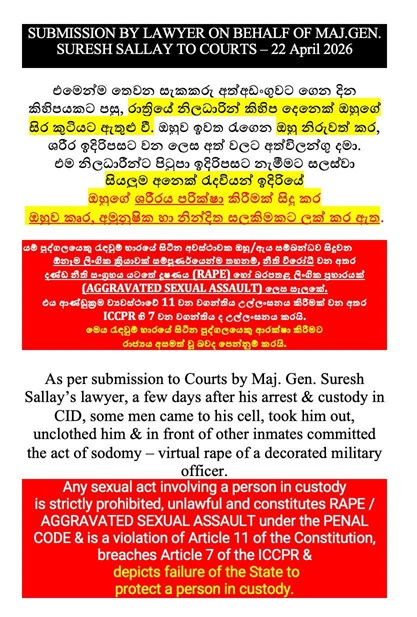
Maj. Gen. Suresh Sallay was arrested and held under CID detention under a 90-day detention order issued under the PTA.

Public commentary surrounding the new narrative has also indicated the possibility of further arrests, with narratives already beginning to build around certain individuals, creating an expectation that they may be targeted for arrest next.

This raises a fundamental question:

How can a locally embedded, ideologically driven extremist network be externally engineered” without embedded operational presence, command access, or sustained ideological infiltration?

Radicalisation is not a remote event.

It is a long-term internal process based on ideology, trust networks, and sustained indoctrination.

Suicide coordination requires deep internal conviction — not external instruction without embedded control.

No established counter-terrorism framework supports the claim of externally directing a fully formed suicide network without ideological penetration or operational command presence.

  1. Political outcome theories lack evidentiary grounding

Another strand of the narrative links the attacks to subsequent political transitions.

However, this interpretation does not align with the political realities of the period:

  • Likely electoral and governance changes were visible prior to April 2019.
  • Public sentiment and political momentum were already changing.
  • Institutional instability and governance controversies were shaping political outcomes
  • February 2018 local government results / Central Bank Bond Scam / corruptions and mismanagement cases a few examples.
  1. What the new narrative is attempting to do

The emerging narrative is not a simple alternative interpretation.

It is a structured reframing of an already established investigative record.

The Actors in the new narrative

Advanced through a convergence of different groups with shared hostility:

  • selective interpreters of the official record
  • narrative expanders who elevate unverified claims
  • political commentators linking events to governance narratives
  • emotive amplifiers circulating emotionally charged interpretations
  • silent endorsers who reinforce repetition without verification

These actors may not coordinate, but they converge on a shared interpretive direction.

The emotive driver: capture through shared hostility

A significant sustaining force of this narrative is emotive capture.

A recurring undercurrent is shared political hostility toward a particular political leadership and its associated governance period, which appears to be the origins of the new narrative and the reason for its continued persistence and amplification.

This produces three effects:

  • lowers evidentiary thresholds in favor of accepting speculative claims
  • allows retrospective attribution of systemic failures to personalised political narratives
  • it substitutes emotional alignment for factual verification in parts of public discourse

In this environment, acceptance of claims is often shaped less by evidence and more by pre-existing political sentiment.

How the narrative is being sustained

The narrative persists through method rather than proof:

  • selective use of unverified statements as quasi-evidence
  • reinterpretation of known intelligence gaps as proof of hidden orchestration
  • sensationalized narrative repetition across digital and commentary platforms until assertion gains perceived legitimacy through repetition
  • relying on emotional interpretation instead of established investigative findings, while at the same time asking investigators to prove claims that were not originally supported by evidence

Over time, this creates a parallel interpretive layer that competes with and even replaces, the established investigative record.

A further concern is the selective direction of scrutiny.

While new theories are being promoted, far less attention is being given to the documented fact that multiple individuals within the security and intelligence structure were already aware of Zahran Hashim’s extremist activities well before April 2019, and that he remained at large despite being a known figure and, at times, a fugitive.

If accountability is the objective, then this raises a fundamental question:

  • why is there less focus on those who had prior knowledge and the authority to act, but failed to prevent the attacks?

Shifting attention toward unproven new theories, while established lines of responsibility remain insufficiently examined, risks diverting focus away from the factual record and the core issue of prevention failure.

Additional concerns arise regarding consistency and credibility in the investigative process.

Individuals who were previously subject to findings of negligence and removed from their roles are now again involved in investigative functions.

At the same time, scrutiny appears to be directed toward individuals who were not in command positions during the relevant period, or who had taken some level of action based on available intelligence.

This creates a perception of inconsistency in how responsibility is being assessed.

When lines of accountability appear unevenly applied, and when public narratives begin to focus on selective individuals rather than the full chain of responsibility, it risks shifting attention away from the broader institutional failures that have already been identified in formal investigations.

  1. Core contradiction with established findings

The established record consistently confirms:

  • ideological religious radicalisation within a structured extremist network
  • operational planning and coordination led by Zahran Hashim
  • documented intelligence warnings prior to the attacks
  • systemic security failures in prevention and coordination

The emerging narrative introduces a different causal model:

  • external orchestration as primary driver
  • operational influence without documented command presence
  • replacement of ideological causation with political attribution

These frameworks cannot simultaneously function as primary explanations.

Because:

  • radicalisation is internally developed and ideologically sustained
  • suicide operations require embedded indoctrination and organisational control
  • no investigative finding replaces ideological causation with external operational command

Therefore, the contradiction is structural, not interpretive.

  1. The analytical tension

The durability of the new narrative does not stem from evidentiary strength, but from the convergence of:

  • emotional alignment
  • selective interpretation of gaps
  • retrospective causal reconstruction
  • political agendas and a gradual shifting of accountability

It does not disprove the established chain of radicalisation and execution.

It overlays an alternative causation model without dismantling the evidentiary foundation already established through multiple investigations without dismantling the evidentiary foundation already established, while shifting focus toward selected individuals rather than those who held responsibility during the period of the attacks.

This is not a rejection of inquiry, debate or discussions.

Legitimate questions must be asked.

But inquiry must remain anchored in evidence, not reconstructed through selective interpretation and emotional convergence.

The victims of the Easter Sunday attacks deserve justice based on verified facts, not interpretations shaped by retrospective political framing while disregarding the established extremist threat that existed.

Accountability must be built on evidence — not narrative alignment or political agendas. When established findings are selectively reinterpreted, the result is not clarity, but distortion of the investigative record.

Truth does not emerge from repetition or shared hostility.

Truth emerges from evidence — consistently applied, without bias, selective interpretation and without deviation.

We have full faith in the Courts and the Judiciary to distinguish fact from fiction and to ensure truth is not diverted or diluted by the new narratives that attempt to manipulate the truth.

Shenali D Waduge

THANK YOU AND CONTGRADULATIONS

April 25th, 2026

Sarath Wijesinghe President’s Counsel former ambassador and Chair Ambassador’s forum UK/SL

We congratulate

We congratulate ‘’Mr Mithree Gunaratna’’ PC and the media Giant and attorney -at- law ‘’Diith Jayaweera’’ for having exposed the scam of robbery, or misappropriation of 25 million us dollars to an unknown group in Australia, the funds due to be paid as an installment of the loan due to the IMF for loans granted to Sri Lanka. This scam was not informed to the public until the free lawyers group pointed out that this amount is syphoned, robbed or taken which belongs to the citizen and it appears the government willfully or by ignorance not informed the public or police came to know on January this year until Mr Gunaratna exposed the scam to the public through Free Lawyers’ group which is his civic duty as a lawyer and it is now  time for the BASL  to take the ‘relay’ as it is the duty of BASL to expose such scams against the citizen if it is done willfully by government or a private party.

 Episode

This episode is carried out with the direct supervision of the Treasury Secretary who is supposed to be an academic/politician inexperienced in such practical and complicated commercial affairs, which is difficult to an academic in other disciplines other than complicated Faisal ad Monitory issues of governances’ affairs. Funds belong to State has to be dealt with sacred and utmost care with no room to rob or taken illegally by illegal means knowingly or unknowingly using diligence as promised to the citizen. We go by news reports and according to press conferences the Treasury Secretary has an interest in Australia and it says and it is doubtful he possesses interests and roots in Australia which is to be found and clarified. If so, he is legally not in position to hold this position and next his experience and qualifications are in question as he is a politician and early an academic and not qualified or experienced to hold this post previously held by highly qualified and experienced personalities on the subject. Many law makers are academics and few professionals and the post of Treasury Secretary is the person who has the ‘Golden Key’ to the Treasury Funds stored belongs to the citizen collected by taxes and borrowed from the world organizations. Citizen must be positive that their money in treasury and banks is safe and in good hands competent to handle international transactions with no leakages such as the current episode, which is worrying.

Banking System in Sri Lanka

Sri Lanka stood tall when the world was in crisis as banks in the west were collapsing our banks were careful and maintained standards and stability. Foreign Banks collapsed but only few Banka of ours collapsed due to mismanagement again. Scam at NSB is colossal with loss of billions but the Chairman and board members have not resigned yet though the entire board and the line minister must take responsibility with Central Bank the main regulator whose duty is to regulate banking system of the massive amounts robbed. Are they not responsible to the scam and if so, what is the use and idea of the appointing authority – the line minister appointing then giving responsibilities to run the instruction with all perks and facilities. Writers have to be careful naming people and scams when PTA and emergency is in operation as the powers contain are enormous arbitrary and could be used by some for their promotions. It is a matter to be notices even some state counsels are overdoing and making politically sensitive submissions expecting future promotions which is carefully observed by the legal professions and BASL at meetings discussed these behaviors of some legal professionals giving ‘jucy ‘statements to be picked by the media that will help their future promotions. Loss of the colossal amount from NDB is a hole in the safe and a worrying more than the famous Central Bank robbery by Arjun Mahandran who left Sri Lanka to attend a wedding in Singapore to attend a wedding and now said to be in Singapore or Australia leading a luxurious life out of the funds belong to Sri Lankan citizen.

Way Forward

Digitalization process is on and we must rethink before embarking on new explorations until and unless we are safe and knowledgeable. Citizen is intelligence with high rate of literacy and it literate and with 110% mobile penetration and powerful social media network with many foreign platform active in Sri Lanka. Young generation is very observant and should not be underestimated as they too have a vision for the country they live and love. Therefore, the governance will have to put forward a vision and a strategy for the nation with no corruption and innovative and modern approach for future governance with the future generation in mind. The episodes of this nature have to be avoided and professionalism and professionals including professional politicians should come forward with a new vision that attracts the young and the world. (Wijesinghesarath05@gmail.com 0094766530166)

What should the Government of Sri Lanka do to contain the spread of the harmful false narrative that the Buddha was born in Sri Lanka?

April 25th, 2026

Senaka Weeraratna 

What should the Government of Sri Lanka do to contain the adverse effects on Sri Lanka in the rest of the World by the spread of the false narrative and pseudo history that the Buddha was born in Sri Lanka, including instituting action in court for wilful distortion of historical fact and diabolical undermining of the Buddha Sasana which the State is mandated under Article 9 of the Constitution to protect and foster?  

Query:  Senaka Weeraratna 

AI Overview Response is as follows:

To contain the adverse effects of the false narrative that the Buddha was born in Sri Lanka, the Government of Sri Lanka (GoSL) must act under the constitutional mandate of Article 9, which requires the state to “protect and foster the Buddha Sasana”. 

Proposed actions to combat this, based on calls for state intervention, include:

  • Legal Action and Court Proceedings: The State, particularly the Attorney General, is urged to initiate legal proceedings against individuals or groups spreading false narratives that undermine the Buddha Sasana. This includes treating the spread and dissemination of pseudo-history as a “civilizational injustice” and initiating action for distorting Buddhist history.
  • Establishment of a Regulatory Framework: The Ministry of Buddhasasana is expected, as an overwhelming legitimate expectation of the Buddhist public, to establish a “Constitutional National Buddhist Heritage Commission” to monitor and protect against the distortion of Buddhist heritage.
  • Preventing Misuse of Media: Authorities are called upon to act against social media and online content spreading, as reported, “myths” about the Buddha’s birth and travels.
  • Archaeological Evidence and Education: The Department of Archeology is advised to officially refute these claims and bolster the promotion of authentic archeological findings (e.g., Lumbini). Educational curricula should be reinforced to highlight established Buddhist history.
  • Utilizing the ‘Kathikawatha’ (Code of Conduct): The Sangha Council can pass regulations (Kathikawatha) to control monks who promote such narratives, in line with traditional methods of purifying the Sasana.
  • International Engagement: To mitigate damage to Sri Lanka’s reputation in the international Buddhist community, the government should engage in educational efforts regarding the authentic history of Buddhism in Sri Lanka (as an “island of the Dhamma”) rather than a place of birth. 
  • Investigate whether these bogus claimants and distortionists have foreign backers to continue the mission started in 1505 with the arrival of  foreign missionaries to dislodge Buddhism from its paramount place among religions in Sri Lanka 
  • Legal Steps
  • The Government of Sri Lanka (GoSL) is constitutionally mandated under Article 9 to protect and foster the Buddha Sasana. Addressing the “Buddha born in Sri Lanka” narrative—which mainstream historians and archaeological evidence from Lumbini (Nepal) classify as a myth—involves a combination of legal, archaeological, and diplomatic strategies. 
  •  

Legal and Judicial Measures

  • Enforcement of Penal Provisions: The GoSL can use Section 291A and 291B of the Penal Code, which criminalizes acts intended to wound religious feelings or outraging religious sentiments through the distortion of teachings.
  • Fundamental Rights (FR) Petitions: Legal precedents exist where individuals have filed FR cases in the Supreme Court to compel the Minister of Buddha Sasana to take action against threats to the Sasana’s integrity.
  • Buddha Sasana Task Force: The establishment of a Task Force Advisory Council can facilitate formal legal and administrative dialogue on how to prosecute those spreading pseudo-historical claims that cause schisms and hurt to Buddhists, both locally and globally. The historical fact of a Buddhist Civilization built by the Sinhalese Race as seen in the ancient ruins of Anuradhapura, Sigiriya, Dambulla, and Polonnaruwa among others must be treated as a non – negotiable. They provide undeniable evidence of a sophisticated, enduring civilization.  

Administrative and Archaeological Actions

  • Official Debunking: The Department of Archaeology has previously stated that myths regarding the birth of the Bodhisattva in Sri Lanka will not be allowed to spread, as they harm the religion’s credibility.
  • Scientific Excavations: Conducting excavations at sites associated with these myths (e.g.,

Hiriwadunna

) under the supervision of the Buddhist Advisory Committee to provide empirical evidence that refutes false claims. 

International Diplomacy and Outreach

  • World Fellowship of Buddhists (WFB): Utilizing global platforms like the WFB to reaffirm Sri Lanka’s adherence to the historical consensus of the Buddha’s birthplace in the ancient Indian subcontinent.
  • Diplomatic Reassurance: Engaging with Nepal, India, China, Thailand, Myanmar, Vietnam and the wider Buddhist world to distance the State from fringe narratives that threaten international religious harmony. 

Internal Sangha Discipline

Source: AI Overview

Science Diplomacy by Professor Ranjith Senaratna and Dr Palith Kohona

April 25th, 2026

Sarath wijesinghe President’s counsel and former Ambassador to UAE and Israel

Science Diplomacy

The book on Science Diplomacy is timely, creative, and first attempt on the topic except for few attempts at the other parts of the world, yet the contents and quality of the book is excellent and useful to academics, students, and diplomats. The two editors need no further introductions to the areas they have excelled to the esteem, yet the readers are given an overview on their services sometimes not known to the public. Diplomacy is a part of governance required by the world, world family and states for peace, peaceful co-existence and developments in the changing a competitive world nearing turmoil due to the current crisis every world citizen is worried about and concerned. Had the two authors published the book bit later during the current crisis it would be invaluable contribution to learn and ease the tension world is worried about.

Diplomacy

Diplomacy is a part of governance essential at all ages in the process of governing states confronted with differences, and friendly coexistence where diplomats assist the governments and the people in promoting friendly relations of any country which are important and essential to the promotion of all other areas. diplomacy is a science and an art, which requires education, tolerance, patient and friendly relations with all strata of the society in performing their impartial and responsible duties for the respective nations. Governments give special emphasis for diplomacy and train the foreign ministries out of politics so that change of governments will not bring about drastic changes except main political changes India being a classic example. Both editors are educated diplomats and academics of great repute world over. Experienced and trained diplomats and academics which is a rare breed and an assert to any nation, and we salute them for commencing this arduous novel and creative task with a novel and modern approach. This is a time practical use of science diplomacy is badly needed when rich and powerful countries have chosen war in place of diplomacy which is as powerful as war if properly used and managed.

The Book

Twelve topics and equally powerful and important chapters are chosen by diplomats, academics of the highest caliber care full chosen possible using their goodwill during their carrier as academics and diplomats. All articles are equally important and the selection of the authors are rare and may have obtained with the goodwill of the learned editors. This book in useful to the .ministries of foreign affairs world over, universities, academics and the citizens  as a rare book produced by highly qualified two authors using their , knowledge, reputation and experience which is rare as the book itself and the Ambassador s Forum convey great regard and command the initiative of the two editors to continue the great effects to initiate the novel opening to the foreign policy makers governments and academics. Sarath Wijesinghe PC Solicitor former Ambassador and  President Ambassadors forum 0094766530166

‘’HOLES IN THE TREASURY COFFERS AND TIGHT -SEALED AND WELL SECURED BANKS’’

April 25th, 2026

Sarath Wijesinghe President’s Counsel Former Ambassador to UAE and Israel solicitor in England and Wales

Sri Lanka country with educated citizens and educated Law Makers

Sri Lanka is considered to be a nation of educated intellectuals with a great history and exemplary banking system withstood the collapse of banks world over sometime back to the credit to the banking system in Sri Lanka. Today nation is being digitalized to be in per with the age of artificial intelligence with experts heading the ProJet. Sri Lanka is not a rich country and depending on loans granted by International Banks and friendly countries so that every Pounds or  Dollars matter to the citizen and to be treated fuds scared and used carefully with no chances to ‘ROB’ by insiders or outsiders. Country is fortunate to possess a government with a massive majority and professors, and lectures of universities and heads private tuition establishments, whose qualification and integrity has been questioned by some.

Banking System

Central Bank has the supervisory power on private and public banks as a regulator with enormous powers, with unfortunate historical events of the Governor himself broke the bank and left Sri Lanka for a wedding in Singapore, and still continue to live as a citizen of the country, who is said to help his friend who people say helped him to escape. Laws delays applied and nobody is aware of when and where the stage of the litigation is – if there is. Banking system in very tight to the extent is  the hardest job for a citizen to obtain a loan as any bank is so strict asking for barrage of questions and sureties yet researchers say recovery process of colossal amount of robbery is ‘look worm’ slow with vague press conferences by politicians and not professionals as expected. Treasury is the institution that stored and protects our hard earned, and mostly borrowed money with all kinds of guards physical and technical.  NSB Bank is one of the top banks in Sri Lanka among top banks managed by top professionals, and it is to be noted any top appointment is to be approved and consented by ‘invisible hands’ at one of the richest institutions in Sri Lanka. Amount missing is callosal. Line minister who is the political head cannot run away from the responsibility.

Millions Syphoned

Funds Syphoned from Treasury and NSB despite tight security, supervision and pass words, that worries the citizen armed with mobile phones with 110% penetration and internet freely used especially the young in Sri Lanka and abroad watching carefully monitoring the situations via social media and modern platforms Sri Lankans have full access to. Not necessary to repeat the amounts which has been repeatedly brought to notice well and good which is bad news to the citizen finding difficult to make ends meet with fast rise if cost of living.

Hackers or Insiders? As historically it is a former CB Governor who broke the Bank and currently living in Singapore leading a luxurious life

It is such a colossal amount and full-scale inquiry is required against the read thief, and those who neglected the supervisory duty by willingly, negligently, or intentionally. Emergency is in power and under PTA one can be a ‘’Sallay’’ easily on suspicion of being straight in expressing views on public affairs which is a civic duty.

Rethinking on proposed Digitalization of the Nation

Rethink on digitalization process of the economy, treasury and banks in the nation until and until we are fool proof not repeating the same mistake again and again. It is time for Dr Hans Wijesuriya to take more and more precautions before embarking on unknown areas and it is good to learn from Singapore, Hong Kong and Malasia on modern trends. Professionalism is lacking and the university lecture Sers are cot competent to run and administration and fiscal management executed by experienced professionals heading the technical ministries and departments, and English Education too matter lot. We wish and hope Dr Hans Wijesuriya will take care of the digitalization process well.

Who are responsible and who has the supervisory power

It is the line minister, the Secretary and the Central Bank Governor who has the supervisory and administered power and we hope they will do the needful even though the horse has left the stable already.  Other worrying factor is the Secretary of the Treasury is a politician with many interests unlike previous precedents. Citizen hopes and believes corrective measures have already taken and funds lost will be recovered. Interdiction of an official may not be helpful as the funds may have gone overseas in seconds. It is a good idea to appoint an experienced honest professional and not a politician supervised by outside invisible forces to inquire into the episode  where country has lost billions. Citizen has a right to know the real story and whether precautionary measures have been taken or will be taken immediately and properly.  We wish and hope there will be no more robberies and Hakureis by hackers international or local. Sarath Wijesinghe PC

රුසියානු තෙල් ඩොලර් 150ට දෙන්න හදද්දි ඉන්දියාවෙන් ඩොලර් 258ට ගන්නේ ඇයි? උවිඳු ප්‍රශ්න කරයි

April 25th, 2026

Lanka Leader

ලංකාවේ  බලශක්තිය නිෂ්පාදනයට අදාලව උපරිම දාරිතාව ලබාදිය හැකි ගල් අඟුරු ලංකාවට පැමිණ නැති බව මේ වන විට අනාවරණය වී ඇති බවත්, එනිසා ගල් අඟුරු හරහා විදුලිය නිෂ්පාදනය කිරීමේදී බලශක්ති ක්ෂේත්‍රයේ දැවැන්ත පසුබෑමක් ඇතිවී තිබෙන බවත් දෙවන පරපුර පක්ෂයේ නායක උවිඳු විජේවීර මහතා පවසයි.

මෙම තත්ත්වය යටතේ ගෝලීයව ඇතිවී තිබෙන තත්ත්වයත් සමග මෙම අර්බුදය ලංකාවට ඉතා තදින් බලපා ඇති බවත් පවසන ඒ මහතා මෙයින් ගොඩ ඒම සඳහා රුසියානු රජයෙන් ලංකාවට ඉතා වාසි සහගත දැවැන්ත යෝජනාවක් ගෙනවිත් තිබුනද ඊට රජයෙන් ප්‍රතිචාර ලබාදීම ප්‍රමාද වන්නේ කිසිවෙකුගේ බලපෑමක් නිසාදැයි ප්‍රශ්න කරයි.

සවිස්තරාත්මක වීඩියෝව නරඹන්න..

භාණ්ඩාගාර හොරකම තුළින් පෙන්වන්නේ ආණ්ඩුවේ ඩිජිටල්කරණ උපදේශකයින්ගේ තරම නොවේද? – ජාතික සංවිධාන ප්‍රශ්න කරයි..

April 25th, 2026

Lanka Leader

ශ්‍රී ලංකා ඉතිහාසයේ ප්‍රථම වතාවට සිදුවූ භාණ්ඩාගාර ගෙවීමක් මගින් සිදුකළ මුදල් වංචාව පිළිබඳව ලංකා ලීඩර් ජාතික සංවිධානවල මතය විමසන ලදී.

මේ වෛද්‍ය වසන්ත බණ්ඩාර මහතා දැක්වූ අදහස් ඔහුගේ වචනයෙන්,

“මේක පැහැදිළිවම බරපතළ මුදල් වංචාවක්. බොහෝ පාර්ශ්ව චෝදනා කරන ආකාරයට මෙය සිදුවන්නේ අභ්‍යන්තර දුර්වලකමක් නිසා නම් එය බරපතළ තත්ත්වයක්. එහෙත් වෝහාරික විගණනය මගින් වැරදිකරුවන් සොයාගත හැකියි. එසේම වගකීම් පැහැර හැරීම සහ වගවීමට අදාළව වගකිවයුතු පුද්ගලයින් සොයාගත හැකියි.

නමුත් ආණ්ඩුවේ යම් පාර්ශ්ව කියන ආකාරයට මෙය හැකර්ලා හෙවත් සයිබර් අපරාධකරුවන්ගේ වැඩක් නම් ඔවුන් ඇතුළට සම්බන්ධ වුවද එසේ නැද්ද යන්න කෙසේවෙතත් ඒ මගින් භාණ්ඩාගාරයේ දත්ත පද්ධතිවල ආරක්ෂිත භාවය පැහැදිලි වෙනවා. මීට පෙර සයිබර් අපරාධකරුවන්ගෙන් ආක්ෂාවීම සඳහා පිහිටුවන ලද “සයිබර් ආරක්ෂක මෙහෙයුම් මධ්‍යස්ථානයට” මුදල් අමාත්‍යාංශය ඇතුළු තීරණාත්මක පද්ධති සහිත රාජ්‍ය ආයතන 27ක් තවමත් ඇතුළුකර නැති බව දැන් හෙළිදරව් වෙලා තිබෙනවා. ඒ මගින් පැහැදිලි වන්නේ ඩිජිටල්කරණය ගැන බොරු කයිවාරු ගැසූවද ආණ්ඩුවේ උපදේශකයන්ගේ සහ වගකීම් දරන පුද්ගලයන්ගේ දුප්පත්කම තමයි. දැන්වත් වරද පිළිගෙන එය නිවැරදි කළ යුතුයි.”

Australian officers currently assisting investigations in SL

April 25th, 2026

Courtesy The Daily Mirror

Colombo, April 25 (Daily Mirror) – Australian officers are currently assisting with Sri Lanka’s investigation into the incident in which cyber criminals stole US $ 2.5 million after breaching the computer systems of the Finance Ministry, according to Australian High Commissioner Matthew Duckworth.

The funds were part of a bilateral debt repayment to Australia, with a settlement due in September 2025. The diversion had taken place in January.

Finance Ministry Secretary Dr Harshana Suriyapperuma told a news conference that the cyber criminals had intervened and diverted the funds to other accounts after Sri Lanka made the due payment.

Asked for a comment in this regard, the Australian High Commissioner said, From our perspective, really, the two points I would make. Firstly, we are obviously aware of the incident and our officers in Canberra are assisting with Sri Lanka’s investigation. The second point I’d make is that this doesn’t otherwise undermine our ongoing commitment to supporting Sri Lanka’s return to debt sustainability.”

According to him, the main issues are really for Sri Lanka to resolve through the investigation already undertaken.

Sri Lanka has currently launched investigations into the incident with the involvement of multiple agencies.

IMF monitors $2.5 million cyber theft at Finance Ministry

April 25th, 2026

Courtesy Hiru News

The International Monetary Fund closely monitors the situation in Sri Lanka following a cybersecurity breach at the Finance Ministry.

Officials confirm that cybercriminals gained unauthorized access to the External Resources Department (ERD) computer systems, resulting in the theft of US$ 2.5 million.

These funds were intended for debt repayment to Australia.

An IMF spokesperson informed Hiru that the organization is aware of the Finance Ministry’s statement regarding the unauthorized access and considers this a significant development.

Deputy Minister of Digital Economy Eranga Weeraratne stated that an international firm volunteered to assist in tracing the destination of the stolen funds.

Meanwhile, Chairman of the Committee on Public Finance, Dr. Harsha de Silva, officially summoned the Secretary to the Ministry of Finance to appear before the committee.

Lead Information Security Engineer of the Sri Lanka Computer Emergency Readiness Team, Charuka Damunupola, noted that forensic analysis of the affected system continues and technical precautions were recommended.

International media highlighted the incident, which reports suggest is the first cyber breach of its kind in the nation’s history.

“හැකර් නෙමෙයි මෙතන ඉන්නේ පචයෙක්” – “හැකර් කියන කතාව මම පිළිගන්නේ නැහැ” – Hiru News

April 25th, 2026

අතුරුදහන් වූ ඩොලර් මිලියන 2.5 ගැන හිටපු ආණ්ඩුකාර රජිත් කීර්ති හෙළිදරව්වක් කරයි

April 25th, 2026

භාණ්ඩාගාරේ ඩොලර් මිලියන ගානකට ගේම දුන්නේ හැකර්ලා නෙවෙයි. ගනුදෙනුවේ Emails නිකන් love letters වගේ.

April 25th, 2026

Truth with Chamuditha and Chamuditha News Brief

Ven. Panakkara – World’s most influential Buddhist Monk

April 24th, 2026

Senaka Weeraratna

Venerable Bhikkhu Paññākāra (also known as Sư Tuệ Nhân) is a Vietnamese-born Buddhist monk who recently gained global recognition as a “Peace Monk” for his 2,300-mile “Walk for Peace” across the United States. While the title “world’s most influential” is subjective, his recent pilgrimages have made him one of the most visible modern figures in Vipassana meditation and engaged Buddhism

Key Facts and Achievements

  • Background: Before ordaining, he was a Motorola engineer with a degree in Information Technology from the University of Texas at Arlington.
  • The Walk for Peace (2025–2026): He led a 108-day journey from Fort Worth, Texas, to Washington, D.C., through 10 states. The walk was a silent meditation trek aimed at promoting inner peace and compassion.
  • International Presence: Following the U.S. walk, he traveled to Sri Lanka in April 2026 to lead a historic Peace Walk. He previously completed a 3,400-kilometer pilgrimage through India and Nepal in 2022.
  • “The Peace Dog” (Aloka): He is often accompanied by Aloka, a former stray dog from India who joined him during his pilgrimage and has become a symbol of loyalty and mindfulness.
  • Philosophy: His teachings emphasize that peace is a personal responsibility and an internal state rather than an external goal. He is based at the Hương Đạo Vipassana Bhāvana Center in Fort Worth, Texas. 

Comparison to Other Influential Monks

While Ven. Paññākāra is currently trending globally for his physical pilgrimages, other monks traditionally cited as among the most influential include: 

  • The 14th Dalai Lama: The highest spiritual leader of Tibetan Buddhism.
  • Thích Nhất Hạnh: Often called the “father of mindfulness,” his influence remains monumental in Western Buddhist practice despite his passing in 2022

………………………………………..

Venerable Bhikkhu Paññākāra (Sư Tuệ Nhân) is a Vietnamese-born Theravāda Buddhist monk known for leading the 2025–2026 “Walk for Peace,” a 2,300-mile barefoot,, meditative journey from Texas to Washington, D.C.. Based at the Hương Đạo Vipassana Bhāvana Center in Texas, he teaches Vipassana meditation to promote inner peace, mindfulness, and compassion. 

Key Aspects of Ven. Paññākāra’s Mission:

  • The Walk for Peace (2025–2026): He led a group of international monks and a rescued “peace dog” named Aloka on a 108-day journey to promote mindfulness, compassion, and peace within the United States.
  • Background: Formerly an IT engineer, Ven. Paññākāra is a Vietnamese-born monk who brings a logical and systematic approach to teaching Buddhism.
  • Focus on Mindfulness: His teachings emphasize “Inner Peace” and “mindfulness” for all human beings, regardless of religious belief.
  • Dhutanga Practice: He often leads long-distance walking meditations to train the mind and body, known as a form of ascetic practice.
  • Message of Compassion: He is recognized for advocating that peace comes from inner transformation and mindful action, not solely through words. 

Global Impact and Recognition:

  • Modern Day Messenger: He has been recognized as a modern-day reminder to practice mindfulness, particularly in Western societies, as seen in his 2026 interview in Sri Lanka and his 2026 peace walk.
  • Spiritual Leader: He is respected for leading by example, often walking through difficult weather conditions in the United States.
  • Supporter of Compassion: He serves as a role model for people who choose to act with compassion and kindness to make a positive impact in the world. 

Ven. Paññākāra continues to be a prominent figure in promoting mindfulness, compassion, and peace in modern society through his walking, teachings, and YouTube channel, which, as seen in this YouTube video, often focus on mindful living.

https://share.google/aimode/EyMX6Ju7GLr5m86Qb

Source:  AI Overview

Pepe Escobar : What to Expect From China

April 24th, 2026

Judge Napolitano – Judging Freedom

Against Preventive Detention: Recognition, Coercion, and Mental Health Policy

April 24th, 2026

Sam Ben-Meir

In recent years, jurisdictions such as New York City have expanded policies permitting the involuntary psychiatric evaluation—and in some cases detention—of individuals deemed to pose a potential risk to themselves or others, even in the absence of any criminal act. These policies are often defended as pragmatic responses to public safety concerns, homelessness, and untreated mental illness. Critics typically object on utilitarian grounds (questioning effectiveness or unintended harms) or deontological grounds (invoking individual rights and bodily autonomy).

While these objections are important, they do not reach the deepest ethical problem with preventive detention. What is at stake is not merely the balance of harms and benefits, nor the violation of abstract rights, but the very conception of the person presupposed by such policies. From a Fichtean standpoint—one grounded in mutual recognition as the condition of freedom—preventive psychiatric detention represents a profound ethical failure. It is not simply misguided policy; it is a structural denial of recognition that undermines the intelligibility of freedom, responsibility, and the state itself.

Utilitarian critiques of preventive detention emphasize its dubious empirical foundations: predictive assessments of dangerousness are notoriously unreliable, disproportionately target marginalized populations, and often exacerbate the very harms they purport to prevent. Deontological critiques, by contrast, stress that involuntary detention without wrongdoing violates fundamental rights to liberty, due process, and bodily integrity.

Fichte’s philosophy does not reject these concerns, but it reorders them. For Fichte, ethics does not begin with outcomes or rules; it begins with the social conditions under which a person can appear as a free being at all. The central question is not whether preventive detention maximizes welfare or violates a right, but whether it preserves or destroys the relation of recognition through which freedom becomes possible.

At the core of Johann Gottlieb Fichte’s moral and political philosophy lies a radical thesis: freedom is not a private inner possession, nor a metaphysical given. It is a practical achievement constituted through relations of mutual recognition. In the Foundations of Natural Right, Fichte argues that a rational being becomes conscious of itself as free only when it is recognized as such by another rational being. The self does not precede social relation; it emerges through it.

Recognition, for Fichte, is not merely a moral attitude or psychological acknowledgment. It is an embodied, institutional, and reciprocal relation enacted through law, social practices, and material conditions. To recognize another as free is to relate to them as a potential author of their actions—even when their capacities are impaired, fragile, or undeveloped.

This has decisive implications for how we understand mental illness. If freedom is constituted through recognition, then policies that suspend recognition in advance—on the basis of predicted incapacity or risk—do not protect freedom; they dissolve its very conditions.

Preventive psychiatric detention operates on a logic of preemption. Individuals are detained not for what they have done, but for what they might do. This shift is ethically catastrophic from a Fichtean perspective. It replaces recognition with suspicion, reciprocity with unilateral assessment, and responsibility with administrative control.

To detain someone preventively on the basis of mental illness is to declare, in advance, that they cannot be recognized as a responsible agent within the shared social world. The person is no longer addressed as a participant in the normative order, but as a site of risk to be managed. This is not a temporary limitation of freedom in response to wrongdoing; it is the suspension of freedom as such.

Fichte insists that coercion can be justified only as a response to an actual violation of right—an act that disrupts the conditions of reciprocal freedom. Preventive detention, by contrast, treats freedom itself as a liability. It transforms the possibility of agency into grounds for confinement. In doing so, it reverses the ethical order: instead of securing the conditions of freedom, the state preemptively nullifies them.

A common defense of preventive detention is that severe mental illness compromises agency to such an extent that recognition is no longer appropriate. From a Fichtean standpoint, this argument rests on a fatal confusion between empirical impairment and normative status.

Fichte grounds recognition not in actual capacities—such as rational deliberation, self-control, or coherence—but in the idea of the person as a bearer of freedom in principle. Recognition is owed not because someone currently exercises freedom well, but because freedom remains the horizon of their existence. To withdraw recognition on the basis of impairment is to make dignity conditional on performance.

Indeed, Fichte is clear that the demand for recognition becomes more acute precisely where freedom is threatened or fragile. To encounter vulnerability with derecognition is not realism; it is ethical abdication. Preventive detention communicates a devastating social message: that those who struggle with mental illness are not fellow participants in freedom, but latent dangers whose presence must be neutralized.

For Fichte, the state exists to secure the external conditions under which reciprocal freedom can flourish. This includes material support, legal protection, and institutional recognition. The state does not exist to optimize safety at all costs, nor to eliminate risk from social life. A world without risk is a world without freedom.

Preventive psychiatric detention represents a transformation of the state from guarantor of recognition into manager of danger. It substitutes administrative judgment for legal accountability and replaces the language of right with the language of risk. In doing so, it undermines its own legitimacy. A state that detains without offense ceases to relate to its citizens as co-legislators of freedom and instead treats them as objects of governance.

This is especially troubling when such policies are disproportionately applied to unhoused individuals, people of color, and those lacking access to voluntary mental healthcare. What appears as neutral concern for safety becomes, in practice, a mechanism for managing social disorder through coerced invisibility.

The strongest objection to a Fichtean critique of preventive detention appeals to public safety. Surely, it is argued, the state has an obligation to intervene when credible threats exist, even before harm occurs. A Fichtean response does not deny this obligation—but it sharply limits its scope. Intervention may be justified when there is an imminent and specific threat that cannot be addressed through recognition-preserving means. But such intervention must be narrowly tailored, temporally limited, and oriented toward restoring recognition, not suspending it indefinitely.

Preventive detention policies fail this test. They rely on vague criteria (appears mentally ill,” may pose a risk”), grant wide discretion to authorities, and often lack robust procedural safeguards. More importantly, they treat mental illness itself as a proxy for dangerousness, thereby collapsing vulnerability into threat.

From a Fichtean standpoint, the state may act to prevent harm only insofar as it continues to address the individual as a participant in the normative order—capable of response, entitled to justification, and oriented toward re-entry into reciprocal recognition. Policies that bypass this relation in the name of safety ultimately erode the very social trust they claim to protect.

Another common defense is that forced psychiatric evaluation is an act of care—an intervention on behalf of those who cannot recognize their own needs. Fichte’s philosophy allows for forms of assistance, but it draws a sharp distinction between aid that sustains recognition and coercion that replaces it. Care that treats the other as a passive object—even benevolently—undermines the conditions of freedom. Genuine care must be structured so that recognition is preserved, agency is addressed, and participation remains possible.

In practice, forced evaluation often functions less as care than as containment. It substitutes clinical authority for dialogical engagement and replaces trust with surveillance. Even when motivated by concern, such interventions risk entrenching the very alienation and mistrust that exacerbate mental distress.

The deepest problem with preventive psychiatric detention is not that it sometimes gets things wrong, but that it institutionalizes a logic in which recognition is conditional, revocable, and subordinated to risk management. This logic corrodes the ethical foundations of social life. A Fichtean ethics insists on a different threshold: recognition must come before risk assessment, not after. One must first encounter the other as a bearer of freedom—even fragile, compromised, or suffering—before any intervention can be justified. Where recognition is suspended, freedom cannot be restored; it can only be replaced by control.

Consider a middle-aged man encountered by outreach workers on a Manhattan subway platform late at night. He is disheveled, speaking to himself, and pacing erratically. He has committed no crime, threatened no one, and refuses assistance when approached. A passerby reports him as disturbing.” Under current policy, this constellation of behaviors may be sufficient to justify involuntary psychiatric evaluation on the grounds of potential risk.

From a Fichtean standpoint, the ethical question is not whether the man might one day harm himself or others, but how the state first encounters him: as a bearer of freedom whose agency is fragile yet still addressable, or as a latent danger to be neutralized. Preventive detention resolves this ambiguity in advance by suspending recognition itself—transforming uncertainty into justification for coercion. What is lost in this transition is not merely liberty, but the very relation through which responsibility, care, and ethical response could meaningfully arise.

Preventive detention of individuals with mental illness, especially in the absence of any criminal act, cannot be justified on Fichtean grounds. It represents a preemptive withdrawal of recognition that undermines freedom at its root. Unlike utilitarian critiques, which focus on outcomes, or deontological critiques, which appeal to rights, a Fichtean critique reveals something more fundamental: such policies distort the very meaning of ethical and political responsibility.

A society committed to freedom must resist the temptation to govern through fear, prediction, and preemption. It must instead invest in the difficult work of recognition—creating institutions that support agency, address vulnerability without erasing personhood, and preserve the fragile social conditions under which freedom remains possible.

Recognition before risk is not a moral preference. It is the condition under which freedom can appear at all. Where recognition is withdrawn in advance—on the basis of prediction, impairment, or fear—freedom is not protected but displaced by administration. A society that authorizes such practices does not merely misjudge particular cases; it reorganizes its relation to persons at the level of principle. What presents itself as prudence becomes a form of derecognition, and what is lost is not only liberty, but the very framework within which liberty could be meaningfully claimed.

Sam Ben-Meir is an assistant adjunct professor of philosophy at City University of New York, College of Technology.

‘වෛරයෙන් නොව ප්‍රේමයෙන් වෛරය නැති වේ’.

April 24th, 2026

රොහාන් අබේගුණවර්ධන

ශ්‍රී ජයවර්ධනපුර මහ රෝහලේ කතාව

අපගේ මතකය අතීතයට ගලා යන්නේ 1951 සැප්තැම්බර් මාසයේ පැවති ‘සැන් ෆ්රැන්සිස්කෝ සාම ගිවිසුම් සමුළුව’ දක්වා ය.

1945 අගෝස්තු 6 සහ 9 යන දිනවල හිරෝෂිමාවට සහ නාගසාකි යන නගරවලට එක්සත් ජනපදය විසින් පරමාණු බෝම්බ හෙළීමෙන් පසුව අගෝස්තු 15 වන දින ජපානය සිය යටත් වීම නිවේදනය කළේය. ඉන්පසු ජපානය එක්සත් ජනපද හමුදා  පරිපාලනය යටතේ පැවති අතර, එම කාලය තුළ  රට ප්‍රජාතන්ත්‍රවාදී කිරීමට සහ නිරායුධ කිරීමට කටයුතු කරන ලදී.

එක්සත් ජනපදය (බ්‍රිතාන්‍ය සහාය ඇතිව)1951 සැප්තැම්බර් මාසයේදී සැන් ෆ්‍රැන්සිස්කෝ හි සමුළුවක් සංවිධානය කරන ලද අතර එහි අරමුණ වූයේ ජපානය සමඟ සාම විසඳුමක් ඇති කර ගැනීම සහ දෙවන ලෝක යුද්ධයෙන් පසු නැගෙනහිර ආසියාව නැවත ගොඩනැගීම සඳහා  සහය ලබාදීමය. මෙම සාම සමුළුව සඳහා රටවල් 52 ක් සහභාගී විය.

ලංකාවේ පළමු අගමැති වූ ඩී.එස්. සේනානායක, තම තරුණ හා දක්ෂ මුදල් අමාත්‍ය ජේ.ආර්. ජයවර්ධන මහතා, ලංකාවෙන් සමුළුවට යන නියෝජිත පිරිසට නායකත්වය දීම සඳහා තෝරා ගත්තේය.

1951 සැප්තැම්බර් 6 වන දින, ඔහුගේ 45 වන උපන්දිනයට දින 11 කට පෙර ඔහු එම සමුළුවේදී තම ඓතිහාසික කතාව පැවැත්වීය.

දෙවන ලෝක යුද්ධයෙන් පසු ජපානයට ජාත්‍යන්තර සමාජයට නැවත පැමිණීමට ඉඩ සලසන ‘වෛරයෙන් නොව ප්‍රේමයෙන් වෛරය නැති වේ’ (නහි වේරේන වේරානි) යන බුදු රජාණන් වහන්සේගේ වචන උපුටා දක්වමින් මෙම ශ්‍රේෂ්ඨ දූරදර්ශී පුද්ගලයා ජපානයේ ස්වෛරී අයිතිවාසිකම් ආරක්ෂා කළේය.

බොහෝ ආසියානු රටවල් සමුළුවට සහභාගී වූයේ ජපානයෙන් වන්දි  ඉල්ලීම  සඳහා විශාල ලැයිස්තුද සූදානම් කරගෙන  බව කියැවිණි. දෙවන ලෝක යුද්ධයෙන් පසු ආර්ථික ස්ථාවරත්වයක් ලබා ගැනීමට ජපානය උත්සාහ කරමින් සිටි අතර එවැනි ගෙවීම් සිදු කළේ නම්, එය ඇගේ ආර්ථිකයට අහිතකර ලෙස බලපානු ඇත.

‘වෛරය නතර වන්නේ වෛරයෙන් නොව ප්‍රේමයෙන් (නහි වේරේන වේරානි)’ යන බුදුන් වහන්සේගේ ඉගැන්වීම උපුටා දක්වමින් ජයවර්ධන මහතා ඔහුගේ දේශනයේදී   ඉල්ලා සිටියේ වන්දි සඳහා වන ඉල්ලීම් අත්හැර, ජපානය ජාත්‍යන්තර ප්‍රජාවේ සාමාජිකයෙකු ලෙස  වැළඳ ගන්නා ලෙසයි.

තවද ඔහු වැටී සිටින  ජපන් ජනතාවට නැවත නැගී සිටීමට  අත දෙන  ලෙස ඉල්ලා සිටි විට, පැමිණ සිටි පිරිස ජපානයෙන් වන්දි ඉල්ලා සිටි ඔවුන්ගේ ලැයිස්තු ඉල්ලා අස්කර ගත් අතර එමඟින් ජපානය ආර්ථික ව්‍යසනයකින් බේරා ගත්හ.

එම කතාවෙන් වසර විසි හයකට පසු ඔහු ශ්‍රී ලංකාවේ විධායක ජනාධිපති බවට පත් විය.

1977 ජූලි මාසයේදී J. R. ජයවර්ධනගේ නායකත්වයෙන් යුත් එක්සත් ජාතික පක්‍ෂය (UNP) ජාතික රාජ්‍ය සභාවට 5/6 ක දැවැන්ත බහුතරයකින් තේරී පත් විය. (1972 මැයි මාසයේදී ජනරජ ව්‍යවස්ථාවක් හඳුන්වාදීමත් සමඟ පාර්ලිමේන්තුවේ නම වෙනස් කරන ලදී)

ශ්‍රී ලංකා ආර්ථිකය ඒවනවිට ඉතාම දුර්වල මට්ටමක තිබුණි. පසුගිය රජය අනුගමනය කරන ලද අභ්‍යන්තරික සමාජවාදී ප්‍රතිපත්ති ඊට ප්‍රධාන හේතුව විය.

ඒ වනවිට රටේ සංවර්ධන කටයුතු පහළ මට්ටමක තිබුණ අතර විරැකියා අනුපාතය 15% දක්වා ඉහළ ගොස් තිබුණි. එවකට පැවති ආනයන පාලනය සහ බලපත්‍ර ලබා දීමේ ක්‍රමය නොයකුත්‍ දුෂණයන්ට හේතුවිය.

1961දී වසර 30කට සැලසුම් කළ රජයේ ආර්ථික සංවර්ධන වැඩසටහනේ මූලිකම ව්‍යාපෘතිය ලෙස සැලකූ බහුකාර්‍ය මහවැලි විවිධාංගීකරණ වැඩසටහන ඉතාමත් මන්දගාමී ලෙස,   ගොළුබෙල්ලෙකුගේ වේගයකින් ඉදිරියට යමින් තිබුණි.

නව අගමැති J. R. ජයවර්ධන සහ ඔහුගේ රජය ආණ්ඩුක්‍රම ව්‍යවස්ථාව වෙනස් කර ජනාධිපතිවරයා රාජ්‍ය නායකයා ලෙසද, ආණ්ඩුවේ ප්‍රධානියා ලෙසද කටයුතු කරන විධායක ජනාධිපති ක්‍රමයක් හඳුන්වා දුන්නේය.

ජේ ආර් ජයවර්ධන ශ්‍රී ලංකාවේ ප්‍රථම විධායක ජනාධිපතිවරයා ලෙස 1978 පෙබරවාරි 4 වැනිදින දිවුරුම් දුන්නේය.

ඇත්තටම ජේ.ආර්.ජයවර්ධන 1966 දී ‘ලංකා විද්‍යා අභිවෘද්ධිය සඳහා වූ සංගමයේ’ රැස්වීමක දී ජනතාව විසින් තෝරා ගන්නා ලද ශක්තිමත් විධායකයක් මුලින්ම යෝජනා කළේය. සිරිමාවෝ බණ්ඩාරනායක මැතිනිය සහ ඇගේ සමඟි පෙරමුණු රජය ‘1972 ජනරජ ව්‍යවස්ථාව සම්පාදනය කරන විට එම අදහස නැවතත් ඔහු විසින් යෝජනා කරන ලදී. නමුත් අවස්ථා දෙකේදීම එය නොසලකා හරින ලදී.

1977 දී තේරී පත් වූ අග්‍රාමාත්‍යවරයා ලෙස ජේ.ආර්. ජයවර්ධන මහතා ප්‍රකාශ කළේ තමාගේ පළමු, දෙවන සහ තුන්වන ප්‍රමුඛතා වූයේ පොදුවේ ජනතාවට සහ විශේෂයෙන්ම තරුණයින්ට රැකියා අවස්ථා නිර්මාණය කිරීම බවයි.

නව රජය කාලය නාස්ති නොකර රට නවීකරණය කිරීමේ දැවැන්ත සංවර්ධන වැඩපිළිවෙළකට අවතීර්ණ විය.

කඩිනම් මහවැලි විවිධාංගීකරණ වැඩසටහන යුරෝපයේ සහ ජපානයේ දැවැන්ත මූල්‍ය හා තාක්ෂණික සහාය ඇතිව ආරම්භ කරන ලදී. කටුනායක අපනයන සැකසුම් කලාපය (EPZ) සහ නිදහස් වෙළඳ කලාපය (FTZ) පිහිටුවන ලද්දේ සෘජු විදේශ ආයෝජන (FDI) ගෙන ඒම සහ අපනයන නැඹුරු කර්මාන්ත ආකර්ෂණය කර ගැනීම සඳහා ය. මෙහි අනෙක් අරමුණ වූයේ නවීන කාර්මික හා තාක්ෂණික දැනුම ලබා ගැනීමයි. වෙළඳ කලාප පරිපාලනය සඳහා මහ කොළඹ ආර්ථික කොමිසම (GCEC) පිහිටුවන ලදී.

නිදහස්  හෝ විවෘත ආර්ථිකයකට අනුගතවන ප්‍රතිසංස්කරණ ආරම්භ කරන ලදී. නිෂ්පාදන අංශය වඩ වඩාත් අපනයනට-නැඹුරු වු අතර අවශ්‍ය ආනයනික යෙදවුම් ලබා ගැනීම සඳහා තිබූ සීමාවන් ඉවත් කරන ලදී.

ශ්‍රී ලංකාවේ පළමු විධායක ජනාධිපති ජේ. ආර්. ජයවර්ධන මහතාට 1979 දී ජපන් රජය විසින් රාජ්‍ය සංචාරයක් සඳහා ආරාධනා කරන ලදී. මෙය ශ්‍රී ලාංකික රාජ්‍ය නායකයෙකු ජපානයට කළ අද්විතීය සංචාරයක් විය. ජපන් සන්නද්ධ හමුදා විසින් ඔහුට ආචාර වෙඩි මුර විසි එකක්  පිරිනමා  හොඳින් පිළිගනු ලැබූ අතර, එය සාමාන්‍යයෙන් අධිරාජ්‍යයාට පමනක් පිරිනමන ආචාර සම්ප්‍රදායකි. මේ අනුව, 1951 සැප්තැම්බර් මාසයේ සැන් ෆ්‍රැන්සිස්කෝ සාම ගිවිසුම් සමුළුවේදී තම රට ආරක්‍ෂා කළ පුද්ගලයාට ජපානයේ කෘතඥතාව පළ කිරීමට අවස්ථාවක් කරගන්නා ලදී.

සංචාරය අවසානයේ ජනාධිපති ජයවර්ධන සහ ජපාන අගමැති ඔහිරා මසයෝෂි ඔවුන්ගේ අදාළ නිලධාරීන් සමඟ ද්විපාර්ශ්වික සාකච්ඡාවල නිරත වූහ. මෙම අවස්ථාවේදී,  ජපානය සහ ශ්‍රී ලංකාව අතර ශක්තිමත් මිත්‍රත්වයක් තහවුරු කළ සැන් ෆ්‍රැන්සිස්කෝ සමුළුවේදී ජනාධිපතිවරයා කළ ශ්‍රේෂ්ඨ කතාව අගමැතිතුමා සඳහන් කළේය. ජයවර්ධන මහතාගේ සංචාරය සිහිපත් කිරීම සඳහා සහ සමුළුවේදී ඔහු කළ ශ්‍රේෂ්ඨ කතාවට ගෞරවයක් වශයෙන් විශේෂ තෑග්ගක් ලබා දීමට තම රජය අදහස් කරන බව මසයෝෂි මහතා  ඉන්පසු ඇඟවීය.

ත්‍යාගය පිළිබඳව ජනාධිපති ජයවර්ධන සහ ජපාන අගමැති ඔහිරා මසයෝෂි අතර ඇති වූ සංවාදය, 2002 දී රෝහල නිරීක්‍ෂණ චාරිකාවකට පැමිනි ජපන් ජාත්‍යන්තර සහයෝගිතා ඒජන්සියේ (JICA) සභාපති ටකාඕ කවකාමි මහතා විසින් විස්තර කරන ලදී.

1979 දී ශ්‍රී ලංකා ජනාධිපතිවරයාගේ ජපන් සංචාරයේදී ඔහු  ජපන් අගමැතිගේ ලේකම්වරයා විය. රෝහල් කළමනාකරණ කමිටුවේ සාමාජිකයින් විසින් JICA සභාපතිවරයාට උපහාර දක්වන ලද අතර මෙම ලේඛකයාද එම කමිටුවේ සාමාජිකයෙක් විය.  ඒ අනුව ඔහුගේ කතාවට සවන් දීමට අවස්ථාව ලැබුණි.

‘ඔබ කුමන ආකාරයේ තෑග්ගක් ගැනද සිතන්නේ?’ ජනාධිපතිවරයා ඇසුවේය.

‘ඔබේ නවීකරණ වැඩසටහනට උපකාර කිරීමට ප්‍රයෝජනවත් දෙයක්, සමහරවිට  ව්‍යාපෘති ප්‍රදානයක් ලෙස’ අගමැති පිළිතුරු දුන්නේය.

ජනාධිපතිවරයාගේ ඊළඟ ප්‍රශ්නය  වූයේ  ‘ප්‍රදානය කොපමණ විශාලද?’ යන්නය.

‘එය වැදගත් නැහැ, ඔබට අවශ්‍ය කුමක්ද කියන්න’ අගමැතිතුමා ඉල්ලා සිටියේය.

ජනාධිපති ජයවර්ධන මහතා පැහැදිලි කළේ තම රජය ඓතිහාසික ශ්‍රී ජයවර්ධනපුර කෝට්ටේ නගරය, ශ්‍රී ලංකාවේ පරිපාලන අගනුවර ලෙස ස්ථාපිත කිරීමට සැලසුම් කර ඇති බවයි. එබැවින් එම නව නගරයට නවීන රෝහලක් ඉතා ප්‍රයෝජනවත් වන බව ඔහු ප්‍රකාශ කළේය.

ජපානය වෙනත් රටකට රෝහලක් තෑගි කර ඇත්දැයි අගමැති මසයෝෂි නිලධාරීන්ගෙන් විමසීය. තායිලන්තයට තෑගි කළ නවීන රෝහලක් ඇති බව ඔවුහු තහවුරු කළහ.

ජනාධිපතිවරයාගේ ඊළඟ ප්‍රශ්නය වූයේ ‘ඒ රෝහල කෙතරම් විශාලද?’ යන්‍නය. එවිට නිලධාරියෙක් පැවසුවේ එය ඇඳන් 1000 කින් යුත් රෝහලක් බවයි.

එසේ නම් අප රෝහල  ‘ඇඳන් 1001 කින් යුත් රෝහලක් බවට පත් කරන්න’ ජනාධිපති ජයවර්ධන මහතා විහිළුවටමෙන් කීවේය.

විනෝදයට පත් අගමැති මසයෝෂි ‘ඒ අමතර ඇඳ කාටද?’ කියා ඇසුවේය.

ඒ ඇඳ ‘මට’ ජනාධිපතිවරයා පැවසීය.

ජපන් ජාතිකයින් වසර තුනක් ඇතුළත නුගේගොඩ, තලපත්පිටියේ ‘කූඹි කැලේ’ නම් අක්කර 24 ක ඉඩමක අලංකාර, නවතම වෛද්‍ය තාක්‍ෂණයන්ගෙන් සමන්විත නවීන රෝහලක් ඉදිකරන ලදී.

ඇඳන් 1001 කින් සමන්විත මෙම නවීන රෝහල 1984 සැප්තැම්බර් 17 වන දින ජපාන නියෝජිත ඉෂිමයිසු කිටගාවා සහ ජනාධිපති ජයවර්ධන මහතා විසින් උත්සවාකාරයෙන් විවෘත කරන ලද අතර එදින ජනාධිපතිවරයාගේ 78 වන උපන්දිනය විය.

පරිපාලන ගොඩනැගිල්ලට ඇතුල් වන ස්ථානයේ ඉදිකර ඇති ඉඩකඩ සහිත සියලු පහසුකම් සහිත කාමරයක අමතර ඇඳ පිහිටා තිබුණි. මෙම ඇඳ එකල ශ්‍රී ලංකාවේ කිසිදු රෝහලක නොතිබූ ඉතා සුවපහසු නවීන රෝහල් ඇඳක් ද විය.

ජනාධිපති ජේ.ආර්. ජයවර්ධන මහතා කිසිදිනක මෙම ඇඳ හෝ කාමරය භාවිතා කළේ නැත.

(මෙය මා විසින් ඉංග්‍රීසි භාෂාවෙන් ලියන ලද, 2021 සැප්තැම්බර් 16 වන දින LankaWeb හි පළ කරන ලද ලිපියක් මත පදනම් වේ.)

රොහාන් අබේගුණවර්ධන

හොරාගේ අම්මගෙන් නෙවෙයි දැන් පේන අහන්නේ හොරාගෙන්..එළියට නොදා මේක වහගන්නද බැලුවේ?

April 24th, 2026

Dasatha News

ඩොලර් මිලියන 2.5ක හොරකම ගැන කරුණු රැසක් එළියට..ජනපති මුදල් ඇමතිකමින් ඉවත් වෙන්න

April 24th, 2026

Dasatha News

හැකර්ලට අපහාස කරන්නේ නැතුව ඉන්නවද ? දිලිත් ආණ්ඩුවට හැකර්ලා ගැන කියා දෙයි

April 24th, 2026

SRI LANKA: Silent shift from Sovereign Control to India-Centric System Dependence

April 23rd, 2026

Shenali D Waduge

Sri Lanka is not being taken over by force. No foreign troops. No invasion. No declaration of surrender. What is happening is far more dangerous. History has shown us that sovereignty was not lost in the battlefield. The 1815 Kandyan Convention is a grim reminder of how power shifted via agreement. Authority was ceded. The consequences were long term & irreversible. Fast forward to present century, Sri Lanka appears to have a penchant for repeating its mistakes. Strategic sectors are being interconnected to externally controlled systems. Many have not passed through form legal parliamentary approved & constitutionally defined processes. But the agreements are linking Sri Lanka’s energy, transport, finance, digital infrastructure, resources, and even its culture & workforce into externally dependent networks. A dangerous structural shift is taking place. Sri Lanka is moving from a nation that controls its own systems to a country that will have to operate within external systems that its govts will have no power to change. The dangers are not immediate but soon the Govt & people will realize they have no power to change policies, no power to control prices & no power to take decisions without facing consequences. Sri Lanka will remain sovereign in paper, may hold glamorous independence day parades but in reality control over how these assets operate is increasingly shaped by external system linkages arising from agreements already signed.

  1. WHAT IS BEING BUILT (NOT PROJECTS — SYSTEMS)

Sri Lanka is not signing isolated deals.

It is signing agreements that build externally-interconnected local systems across all of Sri Lanka’s strategic sectors:

  1. TRANSPORT & LOGISTICS SYSTEM

(Ports + Rail + Roads + Airports + Cargo)

Assets / Agreements

  • Colombo West Terminal (51%)
  • Dockyard (51%)
  • Trincomalee port & oil tanks
  • Port–rail–airport corridors
  • Freight & cargo hubs

How control works

  • Controls movement of imports/exports
  • Can influence pricing, access, priority
  • Sri Lanka’s entire supply chain becomes dependent
  • One disruption = national impact

Control of logistics = control of trade flow

AIRPORTS / TRANSPORT INFRASTRUCTURE)

Assets / Agreements
• Bandaranaike International Airport (BIA) – expansion & management partnerships
• Mattala Rajapaksa International Airport – operational partnerships / lease interest
• Domestic airport network upgrades
• Aviation fuel, cargo handling, and ground services integration
• Air cargo + logistics corridor alignment with ports and trade hubs

How control works
• Air cargo routes influence import/export priority flow
• Airport operations affect tourism, trade, and supply chain speed
• Strategic aviation assets become part of wider logistics network
• Coordination of air–sea–land transport reduces independent operational flexibility

Air transport becomes the aerial extension” of the logistics control system

  1. ENERGY SYSTEM

(Electricity + Fuel + Grid + Pipelines)

Assets / Agreements

  • Wind/solar (North, Mannar, Pooneryn)
  • Trincomalee energy hub
  • Grid interconnection
  • LNG + pipelines

How control works

  • Power linked externally
  • Fuel tied to long-term contracts
  • Pricing influenced externally
  • Sri Lanka cannot switch suppliers easily

Energy dependence = immediate national vulnerability

STRATEGIC MINERALS & SUBSURFACE RESOURCES

(Land + Seabed + Industrial Minerals)

Resources included
• Cobalt (emerging battery supply chain material)
• Graphite (Sri Lanka is already globally significant)
• Ilmenite, titanium sands
• Phosphate deposits
• Rare earth elements (exploration stage / potential reserves)
• Offshore seabed mineral zones
• Oil & gas exploration blocks
• Fisheries + deep-sea resources

How control works
• Long-term exploration and extraction agreements define access rights
• Value chains tied to external industrial demand (energy transition supply chains)
• Processing, pricing, and export routes influenced through contractual frameworks
• Strategic minerals become integrated into global supply networks

Resource control = long-term industrial leverage + future energy transition relevance

  1. DIGITAL & GOVERNANCE SYSTEM

(ID + Payments + Data + Public Services)

Assets / Agreements

  • Digital ID
  • UPI–LankaQR
  • DPI stack (ID + banking + welfare)

How control works

  • Transactions flow through integrated systems
  • Data becomes externally visible/influenced
  • System replacement becomes impossible
  • Control of Sri Lankan citizens private data / intellectual property

Control of payments + data = control of daily life

  1. FINANCIAL SYSTEM

(Credit + Currency + Trade Mechanisms)

Assets / Agreements

  • $4B support + swaps
  • Payment systems
  • Trade facilitation
  • Currency swap

How control works

  • Liquidity influenced externally
  • Currency stability linked to external support
  • Policy shaped by financial dependence

Finance control = macroeconomic leverage

  1. DEFENCE & SECURITY SYSTEM

(Surveillance + Maritime + Intelligence)

Assets / Agreements

  • Defence MoU
  • Radar systems
  • Maritime surveillance
  • Intelligence sharing

How control works

  • Shared monitoring limits independent visibility
  • Security decisions influenced externally
  • Maritime awareness interconnected

Note:

LTTE’s use of India as a hub and its initial training India show that national security concerns of both nations may not necessarily match.

Security integration = strategic dependence

  1. NATURAL RESOURCES & TERRITORIAL SPACE

(Land + Sea + Minerals + Fisheries)

Assets / Agreements

  • Offshore wind zones
  • Fisheries zones
  • Oil/gas exploration
  • Mineral extraction (land + seabed)

How control works

  • Long-term rights over resources
  • Control of extraction, pricing, access
  • Economic value tied externally

Resource control = long-term economic power

  1. LAND, URBAN & ECONOMIC ZONES

(Port City + Industrial Zones + Leases)

Assets / Agreements

  • Port City
  • Industrial zones
  • Long-term leased land

How control works

  • Functional control without ownership
  • Special regulatory zones
  • Future growth shaped externally

Land control = geographic influence

  1. WORKFORCE, EDUCATION & CULTURE SYSTEM

(People + Skills + Narrative) Even Sri Lanka’s 2500 history/heritage at risk

Assets / Agreements

  • ETCA (labour mobility)
  • Education alignment
  • Training systems
  • Tourism narratives as per external requirements

How control works

  • Talent pipelines shift outward
  • Decision-makers shaped by system
  • Cultural narratives influenced

Human + cultural alignment = long-term control

  1. WHAT THIS ACTUALLY CREATES

Not projects.

One integrated operating system

  • Transport → trade network
  • Energy → supply system
  • Digital → control layer
  • Finance → economic system
  • Workforce → cross-border pipeline

No sector stands alone anymore

  1. HOW CONTROL EMERGES (THE REAL MECHANISM)

This is not takeover.

This is structural lock-in.

STRATEGIC CHOKE POINTS (WHERE CONTROL CONCENTRATES)

  • Ports (entry/exit of goods)
    • Energy supply (fuel + electricity)
    • Payment systems (money flow)
    • Data systems (information control)
    • Logistics corridors (movement control)

If these are externally influenced → entire nation becomes system-dependent regardless of ownership

4 CORE DRIVERS:

  1. Dependence

Energy, finance, tech, supply chains

  1. Contracts

Long-term + penalties + legal enforcement

  1. Integration

Everything interconnected

  1. Networks

People, institutions, systems aligned

+ CRITICAL ADDITIONS

  • Land & spatial control
  • Resource control
  • Data control
  • Cultural influence

Together = irreversible system

  1. WHAT HAPPENS NEXT (TIMELINE)

0–5 YEARS → ENTRY

  • Projects begin
  • Contracts signed
  • Dependency starts

5–10 YEARS → DEPENDENCE

  • Systems interconnected
  • Policy flexibility reduces

10–15 YEARS → LOCK-IN

  • Exit becomes economically impossible
  • System defines national choices
  1. REALITY CHECK

Sri Lanka:

  • Keeps ownership
  • Keeps elections

BUT loses:

  • Policy freedom
  • Pricing control
  • Economic independence
  1. FINAL TRUTH

Control will NOT come from:

  • Military
  • Land ownership

Control WILL come from:

Who operates the systems Sri Lanka depends on

This is not loss of sovereignty in law

This is loss of freedom in practice

  1. CORE QUESTION

Sri Lanka will still vote.

But:

The elected government has to govern or manage systems they cannot change.

THE REAL QUESTION

What is the use in spending on elections after such integration has been signed off?

What good comes of voting for individuals or parties that India may even help come to power to in turn govern the nation on their behalf. Who will they serve?

  1. WAY FORWARD & SAFEGUARDS

If we have now understood the dangerous outcomes.

The question is do we want to stop becoming system controlled externally?

If yes, then we must demand:

  • Mandatory parliamentary approval for all strategic agreements
    • Full public disclosure (non-classified)
    • National impact + exit-cost assessment before signing
    • Time-bound contracts with review clauses
    • National control thresholds (energy, ports, digital, finance)
    • Data sovereignty law (data = national asset)
    • Multi-vendor tech systems (no lock-in)
    • Independent system audit body

LEGAL REALITY

If agreements bypass proper process: We must declare that all such agreements
• Can be challenged
• Can be delayed
• Can be renegotiated

They are NOT untouchable

This is not loss of sovereignty by force.

Control will NOT come from:
• Military presence
• Ownership of land

Control will come from:
• Who operates the critical systems Sri Lanka cannot function without
This is loss of flexibility by design.

This is handing over control of governance by Sri Lanka’s elected Govts to an external system not controlled by Sri Lanka’s elected government.

How foolish can a govt be?

Shenali D Waduge

මුදල් අමාත්‍යාංශ ලේකම් හර්ෂණ සුරියප්පෙරුම වහා ඉල්ලා අස්විය යුතුය.

April 23rd, 2026

ජනාධිපති නීතිඥ මෛත්‍රී ගුණරත්න නීතිඥ අතුල ද සිල්වා

ඩොලර් මිලියන 2.5 ක් තෙවන පාර්ශවය අතට පත්වීම සම්බන්ධයෙන් මුදල් අමාත්‍යාංශයේ ලේකම්වරයා වහා ඉල්ලා අස්විය යුතු බව ‘‍ෆී ලෝයර්ස්’ සංවිධානය අවධාරණය කරයි.

මුදල් අමාත්‍යංශ ලේකම්වරයා විසින් අද දින පැවැත්වූ පුවත්පත් සාකච්ඡාව කෙරෙහි අප සංවිධානයේ අවධානය යොමු විය.  2025 සැප්තෑම්බර් මස මුදල් අමාත්‍යාංශයේ පරිගණක සර්වරයේ ‘රූට් ඇස්කස්’ (Root Access) ලබාගැනීමට යම් පුද්ග‍ලයෙකු සමත්වී තිබුණි.  අමාත්‍යාංශ ලේකම්වරයා එම තොරතුර දැන සිටි නමුත්, ඒ පිළිබඳ කිසිදු විධිමත් ආරක්ෂක පියවරක් ගනු නොලැබීය.  මේ බව අද පුවත්පත් සාකච්ඡාවේ දී ද, ඔහු විසින් වසන් කරන ලදී.  එමගින් ඔහු රටත් ජාතියත් සියළු පාර්ශයන් ද රැවටීමට ලක් කරනු ලැබීය.

තව ද, ලේකම්වරයා අප විසින් මෙය අනාවරණය කරන තෙක්, මාස 7 ක් පුරා, අවම වශයෙන් මේ පිළිබඳ අමාත්‍ය මණ්ඩලයට, පාර්ලිමේන්තුවට හෝ වෙනත් කිසිදු වගකිවයුතු පාර්ශවයක් වෙත දැනුම්දීමට පියවර ගෙන නැත. මෙය පැහැදිලි ලෙස ‘වගකීම් පැහැර හැරීමේ අපරාධයකි’. 

මුදල් අමාත්‍යාංශ ලේකම්වරයා මෙම සිද්ධිය හුදු ‘සයිබර් ප්‍රහාරයකට’ ලඝු කිරීමට උත්සහ දරමින් ඇත.  මුදල් අමාත්‍යාංශ ලේකම්වරයා ගේ ලිඛිත අනුමැතිය සහිතව මෙම ගෙවීමේ සියළු කටයුතු සිදුව ඇත.  විදේශ සම්පත් දෙපාර්තමේන්තුව සහ රාජ්‍ය ණය කළමනාකරණ දෙපාර්තමේන්තුවේ ඉහළ සිට පහලට සෑම මට්ටමකම නිලධාරීන් 16 කට ආසන්න පිරිසකගේ දායකත්වය මෙයට ලැබී ඇත. එබැවින් මෙම ඔවුන් පවසන පරිදි සයිබර් ප්‍රහාරයක් නොවන බවත් මෙය මුල්‍ය අපරාධයක් බව අපගේ විශ්වසයයි.

ලංකා භාණ්ඩාගාරයට ඩොලර් මිලියන 2.5 ක් අහිමිවීට හේතුව මුදල් අමාත්‍යාංශයේ හා භාණ්ඩාගාරයේ කටයුතු සම්බන්ධයෙන් කිසිදු අත්දැකීමක් හෝ පළපුරුද්දක් නොමැති හර්ෂ සුරියප්පෙරුම ලේකම්වරයා ලෙස කටයුතු කිරීමය.    ඔහු මෙම තනතුරට පත්වීමට පෙර ජාතික ජන බලවේගයේ පාර්ලමේන්තු මන්ත්‍රීවරයෙකු ලෙස පත්වී මුදල් නියෝජ්‍ය ඇමතිවරයා ලෙස කටයුතු කිරීමයි.  ඒ හැර මෙම තනතුර දැරීමට ඔහුට කිසිදු සුදුසුකමක් නැත. ඉතිහාසයේ කිසිදු අවස්ථාවක භාණ්ඩාගාර ලේකම්වරයා ලෙස අවම වශයෙන් ප්‍රාදේශීය ලේකම්, සහකාර ලේකම්, දෙපාර්තමේන්තු ප්‍රධානී, අතිරේක ලේකම් වැනි වගකීමක් දරනු නොලැබූ සහ රාජ්‍ය සේවයේ පරිපාලන අත්දැකීම් නොමැති ආධුනිකයෙකු පත් වී නැත.

ඕස්ට්‍රෙිලියානු ගෙවීම සම්බන්ධයෙන් සියළු මුලික අනුමැතීන් ලබාදුන් මුදල් අමාත්‍යාං‍ශ ලේකම්වරයා මෙම තනතුරේ තබාගනිමින් සිදු කරන කිසිදු විමර්ශනයකින් සාධාරණයක් ඉටුවිය නොහැකිය. එබැවින් මෙම වංචාව සම්බන්ධයෙන් පළමු අනුමැතිය ලබාදුන් මුදල් අමාත්‍යාංශයේ ලේකම් හර්ෂ සුරියප්පෙරුම මහතා එම ධූරයෙන් ඉවත් විය යුතුය.  ඔහු ඉවත් නොවන්නේ නම්, අමාත්‍යාංශ ලේකම්වරයෙකු පත් කිරීමේ බලය සහිත අතිගරු ජනාධිපතිතුමන් විසින් ඔහු එම ධූරයෙන් ඉවත් කර, පරිපාලන අත්දැකීම් සහිත වගකීම් දැරිය හැකි ජ්‍යෙෂ්ඨ නිලධාරියෙකු එම තනතුරට පත් කළ යුතු බව ‘‍ෆී ලෝයර්ස්’ සංවිධානය අවධාරණය කරයි.

 (ඇමුණුම නිල පුවත්පත් නිවේදනය අමුණා ඇත)

ජනාධිපති නීතිඥ මෛත්‍රී ගුණරත්න

නීතිඥ අතුල ද සිල්වා  

Origins and evolution of inhabitants in Sri Lanka

April 23rd, 2026

By Raj Gonsalkorale

Race is a social construct used to categorize humans into groups based on shared physical traits (such as skin colour, hair texture, or facial features) or ancestry. Modern science views race as a system created by society, not as a biological, genetic, or scientific fact. It often carries implications for social hierarchy and power, influencing cultural perceptions and systemic treatment – National Human Genome Research Institute

Sri Lanka’s ancient chronological history, particularly the Sinhala Buddhist history, has generally been taken from the literary records in the Mahavamsa, which recounts Sri Lanka’s history from time Prince Vijaya landed in the island some 2600 years ago, and these accounts then carried forward through an oral tradition for nearly 1000 years before a Buddhist Monk, Venerable Mahanama completed the first written account of the Mahavamsa in 400 AD. Archaeologists however have tended to arrive at historical timelines based on their research findings. To this extent, one could say theirs is a more scientific narrative rather than a literary narrative on the ancient history of the island.

While Archaeologists concur that the Mahavamsa has a high degree of accuracy for later periods based on research, they are of the opinion that its early accounts are more mythical and legendary in the absence of scientific research to support accounts of the early periods. For example, there is no direct archaeological evidence (coins or inscriptions) for a specific “King Vijaya” from the 6th century BCE.  Experts opine that timeline discrepancies exist between the Mahavamsa and Archaeological digs, particularly in the Citadel of Anuradhapura, where using carbon dating to test the timeline of early settlements, have revealed discrepancies. While the Mahāvaṃsa says the city was founded in the 5th or 6th century BCE by Prince Vijaya, carbon dating of pottery and charcoal shows that Anuradhapura was actually a thriving town as far back as 900–1000 BCE, some 500 years prior to Vijaya’s landing.

HISTORY OF HUMAN HABITATION ON SRI LANKA

Earliest possible history of human habitation – While subsequently updated based on advances in dating technology, Archaeologist Dr Siran Deraniyagala had established that the archaeological sites of Pathirajawela and Bundala are southern occurrences of the Iranamadu Formation (IFM), an extensive geological unit characterized by “red latosol” (red coastal sands) and basal gravels, a coastal geological unit that appears in the island’s North and Northwest going back around 125,000 to 200,000 years ago.The Department of Archaeology has noted that the IFM deposits in the North have yielded the “oldest evidence of human habitation,” with some speculative relative dates reaching as far back as 500,000 years. As mentioned, the revised chronology (25,000 BCE) has provided a more modern geochemical position based on the 2024 OSL (Optically Stimulated Luminescence) testing. It suggests the earlier dates were a result of “solar resetting” issues in the quartz and the more recent testing has contested the earlier findings. However, conclusions maybe drawn that some human inhabitations have been there despite the later conclusions as both methods had used non-human being material for testing purposes.

A geneticists view of ancient history – This the DNA Story (60,000–70,000 years ago)which basically takes a look at the blood of people living today and “count back” the mutations suggesting that the ancestors of everyone currently alive in Sri Lanka, left Africa about 60000–70,000 years ago.

History based on scientific testing of human skeletal remains– Done for the first time on human full skeletons and advanced tools found in caves have shown that humans inhabited the island some 38,000 Years Ago which period is referred to as the “Balangoda Man” Phase. 

THE BALANGODA MAN

Actual Archaeological evidence from human skeletal remains and cultural artifacts such as geometric microliths (stone tools) found in the Fa Hien Cave and  Batadombalena have have established that the Balangoda man (Homo sapiens balangodensis) inhabited the country some 30,000 years ago, and is described as the prehistoric original inhabitants of the country. Evidence also shows these ancestors were skilled hunters who used fire and crafted tools from bone and stone. Finds of marine shells in inland caves suggest they maintained active contact or trade routes with coastal regions as far as 40 km away. 

Origins and Migration

  • The Land Bridge: For much of the last 500,000 years, Sri Lanka was intermittently connected to India via a land bridge roughly 100 km wide. This connection, now largely submerged as the Adam’s Bridge shoals, allowed for the continuous movement of early human and faunal populations across the continental shelf.
  • Out of Africa Timeline: The Balangoda Man’s arrival aligns with major migratory patterns of modern humans departing Africa approximately 60,000 to 70,000 years ago. These early Homo sapiens moved through South Asia, with Sri Lanka serving as a critical point for understanding how they adapted to diverse tropical environments.
  • A “Hunters in Transition” Model: Professor Somadeva’s research project, “Hunters in Transition”, posits that the indigenous people didn’t just disappear or get replaced. Instead, the descendants of Mesolithic hunter-gatherers (Balangoda Man) gradually evolved into the structured “Hela” or indigenous society, which included the Yakkha, Naga and Deva tribes. 

Evolution of inhabitants

The main groups who evolved from the original inhabitants, the Balangoda man, are understood to be the Yakkha, Naga, Raksha and Deva groups (collectively referred to as the Hela group) and the Vedda group. The distinction between these groups is generally seen as socio-economic rather than biological:

  • The Hela (Yakkha/Naga/Raksha/Dewa):These were the descendants who transitioned into settled life. Professor Somadeva’s findings at sites like Ranchamadama show they developed a “Mountain (Hela) Civilization” with advanced iron-smelting, proto-writing, and complex burial rituals by the 1st millennium BCE.
  • The Vedda: These were the descendants who chose to remain in the forests, preserving the hunter-gatherer lifestyle of their Balangoda Man ancestors well into the historical period. 

There is actual archaeological evidence in the form of early Brahmi inscriptions (c. 3rd century BCE to 1st century CE) where individuals identify themselves using these names. For example, inscriptions mention donors named “Naga” and “Deva”.Geographic Names: Ancient names for regions, such as Nagadeepa (the Jaffna peninsula), have been used for nearly 2,000 years, suggesting a long-standing association between certain regions and these tribal identities. From a scientific standpoint, archaeologists generally view these names not as different “species” or biologically distinct races, but as socio-political or totemic tribes:

  • Naga: Likely a maritime and mercantile group that used the cobra as a symbol. Archaeological findings like “Naga stones” (cobra-guarded stones) near ancient reservoirs and ports support the idea of a group that held specific cultural and engineering roles. The Naga community habitation had been mainly the coastal areas of the Northwest of the country and closest in proximity to Southern India.
  • Yakka: Often associated with iron-smelting and mountain-dwelling. Archaeological evidence of advanced iron-smelting in areas like the Uva province (dating back to 2400 BCE) is sometimes linked to the “Yakka”.
  • Raksha and Deva: These are less clearly defined in the physical record. “Raksha” is often a pejorative term used by later chroniclers for forest-dwellers, while “Deva” may have referred to a clan that eventually took on administrative or “god-like” status in folklore. 

Connection between Balangoda Man and the Four Tribes

Archaeologists see a cultural and biological continuum rather than a clean “break” between these groups: 

  • The Evolutionary Link: The “Balangoda Man” represents the Mesolithic hunter-gatherer foundation (starting ~48,000 years ago). Over millennia, these populations transitioned into the Early Iron Age (c. 1000–800 BCE).
  • Transformation: The tribes known as Yakka and Naga are essentially the Iron Age descendants of the Balangoda Man. As the island’s original inhabitants adopted farming, metalworking, and seafaring, they likely organised into the tribal structures described in the chronicles.
  • The Vedda Position: The Vedda are those who maintained the original Balangoda hunter-gatherer lifestyle into modern times, whereas the Yakka and Naga groups were those who modernised and eventually assimilated into the broader Sinhalese and Tamil populations

The Deva (or Dewa) group was one of the four main indigenous clans of ancient Sri Lanka, alongside the Yakkha, Naga, and Raksha. Collectively, these four are often referred to in modern Hela tradition as the Siew Hela (Four Helas). After the arrival of Buddhism in the 3rd century BCE, the distinct tribal identities of the Deva, Yakkha, Naga, and Raksha began to fade. They were largely absorbed into the broader Sihala and later Sinhala identity. The Adivasi (Vedda) people are the indigenous, forest-dwelling, first inhabitants of Sri Lanka, known traditionally as hunters-gatherers with a history extending back to the prehistoric era, long before the 6th-century BCE arrival of the Indo-Aryans. They are closely linked to the island’s earliest human residents, sharing genetic ties with indigenous groups in southern India and Southeast Asia. Today, they are concentrated in regions like Dambana and are navigating the transition from a traditional forest lifestyle to modern society. 

Origin of the Sinhalese – A traditional point of view

Sihala (also spelled Sīhaa) is actually the original Pali and Prakrit name for the same community and island. While “Sinhala” is the modern Sanskritized form commonly used today, “Sihala” is the term found in ancient religious and historical texts. Professor Rajasoma, a well-known Sri Lankan Archaeologist whose work has fundamentally challenged the traditional timelines of Sri Lankan history, suggests that an advanced, indigenous civilization existed on the island long before the arrival of Prince Vijaya (c. 543 BCE). He mentions the “Hela” Theory – Often called the Siv-Hela (Four Helas), which suggests that before Prince Vijaya arrived, the island was home to four tribes—the Yaksha, Raksha, Naga, and Deva.

According to this view, these groups merged to form the Hela (later Sihala) people, long before North Indian influence became dominant. Professor Somadeva argues that the Yakkha, Naga, Deva, and Raksha clans mentioned in the Mahavamsa chronicles were not mythical beings, but actual indigenous human communities. 

He suggests the name “Sihala” (or Hela) evolved from these indigenous groups merging together. He discovered a cave inscription in Tamketiya containing the word Yagasha (belonging to Yakshas), which he uses to link historical chronicles with archaeological reality. 

Impact on History

His work shifts the “Sihala” origin story from a 2,500-year-old immigrant tale to a 4,000-to-6,000-year-old indigenous evolution. He focuses on the “cognitive advances” of these early people, showing they were a resilient, trading society with their own technological and religious practices before any external arrival. Archaeological evidence suggests that a significant prehistoric and proto-historic civilisation inhabited the Knuckles Mountain Range (historically known as Malaya Rata or Giri Divaina). Recent research, including surveys and excavations, supports the presence of an advanced community in this region long before the traditional historic period. Local residents have traditionally and historically called this area Dumbara Kanduvetiya (“Mist-laden Mountain Range”), while ancient texts refer to it as a stronghold for indigenous tribes. The modern name “Knuckles” was actually assigned much later by British surveyors who thought the peaks looked like a clenched fist. The area surrounding the Knuckles Mountain Range is indeed home to what researchers like Professor Raj Somadeva identify as a “Sihala” or Hela civilization dating back several millennia. His research posits that the Knuckles was a major hub for an advanced, mountain-dwelling civilization that existed long before the traditional dates of recorded history.

The Naga people and theories on ethnic roots

Dravidian Links: Some historians, such as H. Parker, suggest the Nagas were an offshoot of the Nayars of Kerala, sharing a common culture of serpent worship. Other researchers argue that the Nagas were a Tamil-speaking tribe that eventually assimilated into the broader population in the north and other parts of the island. The archaeological records in Northern Sri Lanka provides concrete evidence of the Naga people’s existence and their deep cultural ties to South India. These sites reveal a society that was not isolated but acted as a bridge for trade and religious exchange between the island and the mainland. Amongst these are, Kandarodai (Kadiramalai) located inland from Jaffna, this site was likely the ancient capital of Naka-Nadu. Excavations have revealed a cluster of small stupas and Black and Red Ware pottery, a hallmark of the South Indian megalithic culture. Roman and Chinese coins found here confirm its role as a major mercantile hub, Anaikoddai, a megalithic burial site in Jaffna where the famous Anaikoddai Seal was discovered in 1981. This 3rd-century BCE soapstone seal features a bilingual inscription with megalithic graffiti and Tamil-Brahmi script reading “Ko Veta” (King Veta). This find is critical as it provides firm proof of local chieftaincy and literacy during the Naga period, Nainativu (Nagadeepa), an island off the Jaffna peninsula mentioned in both the Mahavamsa and the Tamil epic Manimekalai. It is home to the Nagadeepa Vihara, marking where Buddha reportedly settled a dispute between Naga kings Chulodara and Mahodara. Artifacts like the Naga guard stones and idols found here showcase the fusion of serpent worship and Buddhism. It is very plausible that the Naga community and their descendants were the forebearers of the ethnic group that evolved as the Tamils of Sri Lanka.

Sinhala and Tamil genetic links

Recent genetic and archaeological studies have clarified the complex origins of Sri Lanka’s ethnic groups, confirming that the Sinhalese and Tamils are more genetically similar to each other than to any other South Asian population. Professor Raj Somadeva has co-authored and contributed to research that highlights these shared roots through several key lenses. Both groups share a significant common genetic foundation that differs from both North and South Indian populations, suggesting a unique Sri Lankan genetic identity developed over millennia of isolation and interaction on the island. 

Conclusion

The research information that is available on the origin and evolution of inhabitants of the island is extensive and cannot be covered in one article. There is clear evidence that the island was inhabited by civilised community groups for thousands of years, beginning with the scientifically established Balangoda man phase of history. From a contemporary point of view, the ethnic and religious divides that occurred are historically very recent, and from an ancient historical point of view, unfortunate and unnecessary. It is clear from an archaeological and scientific point of view that the island’s inhabitants had one primary lineage, the Balangoda man, while descendent community group mixing obviously occurred from within and from outside over time. In this respect, the genetic studies that have confirmed that the Sinhalese and Tamils are more genetically similar to each other than to any other South Asian population is an interesting unifying factor that could guide the future of the country.

Brutal treatment of Maj. Gen. Suresh Sallay in CID custody

April 23rd, 2026

Copyright © 2026 LankaWeb.com. All Rights Reserved. Powered by Wordpress