President tells party leaders to prove majority properly

November 15th, 2018

Courtesy Adaderana

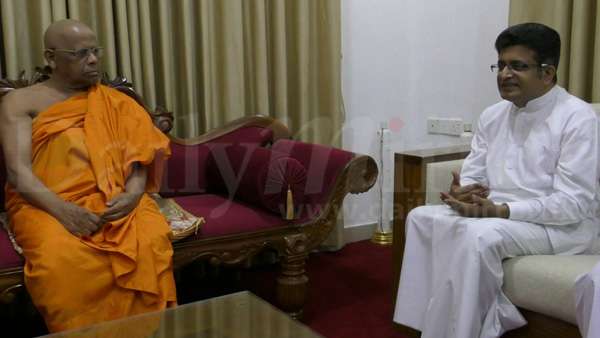
A special meeting was held this evening (15), between President Maithripala Sirisena, Speaker Karu Jayasuriya and the leaders of all political parties affiliated with United National Front (UNF) and Tamil National Alliance (TNA).

The meeting, which lasted for nearly two hours, was focused on the existing political situation of the country.

According to the President’s Media Division (PMD), the group of party leaders had stated that they hold the parliament majority and requested the President to accept this fact.

In response, the President has emphasized that he always acts in accordance with the Constitution of the country and that he respects it.

The President also informed them to respect the Parliamentary traditions and to prove the parliament majority properly.

The meeting has also discussed the removal of Clause 01 of the resolution that was presented to the Parliament yesterday and resubmission of the resolution tomorrow (16).

The President informed the party leaders to call for the vote by name and to prove parliament majority accordingly in order to take subsequent constitutional measures in this regard.

President Maithripala Sirisena requests all representatives of the Parliament to ensure peace within the Parliament and to act in accordance with democracy and standing orders, the President’s Media Division noted.

Govt. ready to defeat NCM if UNF-led alliance adheres to protocols: SB

November 15th, 2018

Sandun A. Jayasekera Courtesy The Daily Mirror

If the UNF-led political alliance follows proper Parliamentary procedures and Standing Orders when bringing in a no-confidence motion (NCM) against the government and Prime Minister Mahinda Rajapaksa, the government is ready to face it and defeat it, Chief Whip and Highways Minister S.B. Dissanayake said today.

He said the government would easily secure a minimum of 125 votes in Parliament to defeat the NCM.

Addressing the media at his office, the minister said the UNP-led alliance against the government could hand over the NCM to Speaker Karu Jayasuriya after Parliament met this afternoon and ask for an early date for the debate and vote.

The NCM must remain in the Order Book for a minimum of five days. The party leaders must then decide a date for the debate and vote at the Business Committee meeting. Usually, an NCM can be given an early date for debate on the priority basis and we are ready to accept the outcome of the NCM if and when it is debated and voted. EPDP leader Douglas Devananda will bring three members to the government from the North. M.L.M. Hizbullah will bring another three. There will be three others joining the government from Mano Ganesan’s and Palani Digambaram’s parties. Arumugam Thondaman will bring five members to expand the government to 125. The UNP will be reduced to 65 and will fail to garner the magic number of 113 even with the support of the TNA, JVP, SLMC and ACMC. However, we are not ready to loosen the government from our grip. We will continue to rule the country. There will be selling and buying of members in days to come once again,” he said. The minister said Speaker Jayasuriya acted arbitrarily on Wednesday and violated Parliamentary proceedings and Standing Orders. He said lawyers representing the government should have asked the Supreme Court for an injunction against the reconvening of Parliament until the final determination of the case and admitted it was a mistake on the part of the counsel of the government.

“The counsel arguing the case on behalf of the government will make a request to the Supreme Court for a bigger bench of five or seven judges or even more,” he said.

Pix by Pradeep Dilrukshana

Thewarapperuma brandishes knife in House

November 15th, 2018

By Kelum Bandara, Sandun A Jayasekera and Yohan Perera Courtesy The Daily Mirror

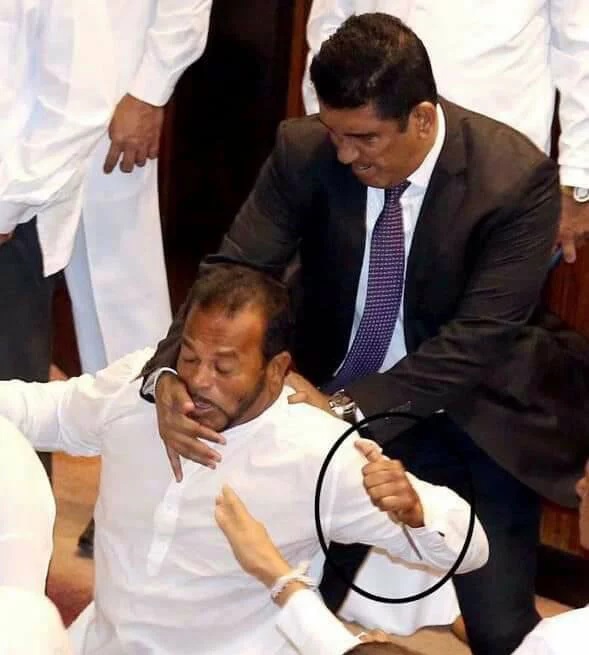
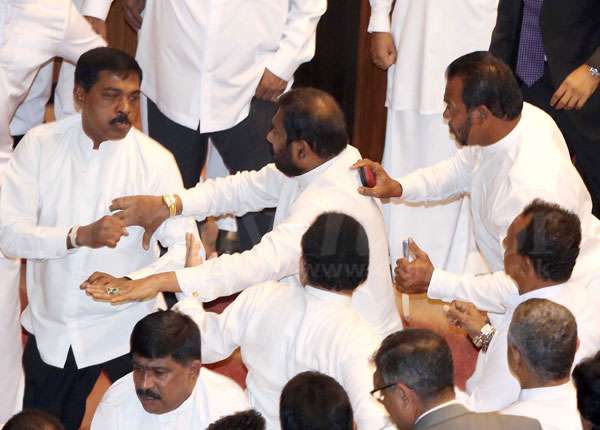
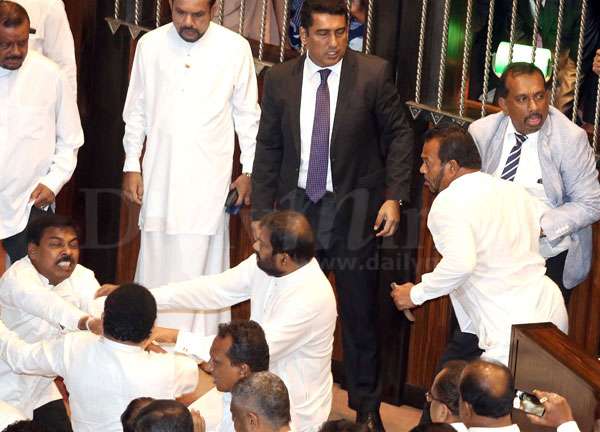
The conduct of some parliamentarians stooped down to such low levels today that, for the first time in history, there were allegations that some UNP MPs smuggled in sharp knives into the Chamber of the House for any untoward action.

The photos went viral in the internet and social media showing UNP MP Palitha Thewarapperuma brandishing a knife in an apparent brawl with UPFA MP Prasanna Ranaweera behind the Speaker’s Chair during commotion in the House.

UPFA MPs Johnston Fernando and Mahindananda Aluthgamage were seen trying to stop him from attempts to strike Mr. Ranaweeera who was also behaving menacingly.

Government MP Jayantha Samaraweerra also charged that MP Palitha Thewarapperuma had a knife which he pointed at the government MPs.

Highways and Road Development Minister S.B.Dissanayaka told reporters at his Ministry that he was disgusted, disappointed and ashamed of what happened in Parliament.

“They should not have behaved in this manner and degrade themselves. Some of them behaved like cats and dogs. There was blood letting as two Deputy Ministers had smuggled knives to the House,” he charged.

All Members of Parliament must be determined to safeguard parliamentary tradition decorum and discipline in and out of the House, he added.

Pix by Sajeewa Chinthaka

Knife brandishing: Complaint lodged against Ranjan, Palitha

November 15th, 2018

Lahiru Pothmulla Courtesy The Daily Mirror

The government yesterday said it had lodged a complaint with the police over UNP MPs Ranjan Ramanayake and Palitha Thewarapperuma who had allegedly threatened government MPs in Parliament with a knife.

Govt. MP Indika Anuruddha said a complaint has been lodged with the police post at the Parliamentary complex.

Both Ranjan Ramanayake and Palitha Thewarapperuma threatened me with a knife inside the chamber. When I brought Speaker’s attention to this, he said not knives but swords should be brought in because of the current state of affairs.

“This is unacceptable. Prime Minister Mahinda Rajapaksa’s seat was a few rows away from these unruly MPs. This was a threat to all MPs. Therefore, we lodged the complaint with the police,” he told a news briefing held at the Prime Minister’s Office.

MP Johnston Fernando said the MPs who allegedly threatened others with a knife should be arrested. We have to find out how a knife was brought into parliament. We will bring this issue to the attention of both the President and IGP as well,” he said.

ජනාධිපතිතුමා රැකිය යුත්තේ එක එක පක්ෂවල ප්‍රතිපත්ති නොව ව්‍යවස්ථාවයි

November 15th, 2018

ක්‍රිෂාන් පතිරත් ජයසූරිය උපුටාගැණීම  මව්බිම

ජනාධිපතිවරයා මෑත කාලයේදී ගත් තීන්දු හා තීරණ ව්‍යවස්ථාවට අනුකූලව නිවැරැදි ක්‍රියාදාමයන් බව එළිය සංවිධානය වෙනුවෙන් අදහස් දක්වමින් එරන්ද ගිනිගේ මහතා ප්‍රකාශ කරයි.

ඊයේ (13දා) එළිය සංවිධානයේ මාධ්‍ය හමුවකට එක්වෙමින් ගිනිගේ මහතා මෙසේ ප්‍රකාශ කළේය.

එරන්ද ගිනිගේ මහතා මෙසේද පැවසීය.

“දැන් අපේ රටේ ඇති වී ඇති තත්ත්වය සමහරු අර්ථකථනය කරනවා ව්‍යවස්ථා අර්බුදයක් ලෙස. මේ කතා කරන බොහෝදෙනා ශ්‍රී ලංකාවේ ව්‍යවස්ථාව කියවලා නැහැ.

ඔබ ව්‍යවස්ථාව අරගෙන කියවන්න. සමහරු කියනවා පාර්ලිමේන්තු මන්ත්‍රිවරු 225 තමයි උත්තරීතර කියලා. එය සම්පූර්ණයෙන්ම වැරැදි ප්‍රකාශයක්. ශ්‍රී ලංකා ජන රජයේ උත්තරීතර නීතිය හා ආයතනය ව්‍යවස්ථාවයි. එහි තිබෙනවා ශ්‍රී ලංකා ජනරජයේ පරමාධිපත්‍යය ජනතාව කෙරෙහි පිහිටා ඇත්තේය. පරමාධිපත්‍යය අත්හළ නොහැක්කේය. මේ රජයේ පාලනය කිරීමේ අවසාන බලය තිබෙන්නේ ජනතාවටයි. මේ ව්‍යවස්ථාවෙන් තරම් බලය බෙදලා නැහැ වෙන කිසිම ව්‍යවස්ථාවකින්. සියලුම ජනතාවට එක හා සමානව බලය බෙදලා තිබෙනවා ව්‍යවස්ථාවෙන්. එයයි ප්‍රජාතන්ත්‍රවාදය කියායි තිබෙන්නේ.

ප්‍රජාතන්ත්‍රවාදය කියන්නේ බරපතළ වචනයක්. ඒ වචනය ජනතාවට තේරුම් ගැනීමට ටිකක් අමාරුයි.

ජනතා පාලනය කියලා කිව්වා නම් එය නිවැරැදියි. ජනතාව විසින් සිදුකර ගන්නා පාලනයක් විය යුතුයි එය. එය කරන්නේ කොහොමද කියලා ව්‍යවස්ථාවේ පැහැදිලි කරලා තිබෙනවා. එය ජනතාවගේ ව්‍යවස්ථාදායක බලය ඇත්තේ පාර්ලිමේන්තුවේ හා ජනමත විචාරණයකයි. ජනතාවගේ විධායක බලය ජනාධිපති හරහායි ක්‍රියාත්මක වෙන්නේ. ඒ වගේම තියෙන්නේ ජනතාවගේ අධිකරණ බලයයි.
අපේ රටේ ප්‍රජාතන්ත්‍රවාදය සකස් කරලා තිබෙන්නේ 1978 ව්‍යවස්ථාවෙනුයි.

අපිට ඉන්නේ ජනතාව විසින්ම පත්කර ගත් නායකයකුයි. ජනාධිපතිවරයායි රටේ නායකයා. ජනාධිපතිවරයායි රටේ ව්‍යවස්ථාව ක්‍රියාත්මක කරන්න බැඳී සිටින්නේ.

එතුමා ඉන්නේ එජාපයේ හෝ ශ්‍රී ලනිපයේ ප්‍රතිපත්ති ක්‍රියාත්මක කරන්න නොවේ.

ජනාධිපතිතුමා ව්‍යවස්ථාව ආරක්ෂා කළ යුතුයි.

මේ වෙනස හදිසියේ ඇතිවුණේ නැහැ. මේ වෙනස ජනතාව බලාපොරොත්තු වුණේ අවුරුදු 3ක විතර ඉඳලායි.

නොගැළපෙන කඳවුරු 2ක් එකතු වෙලා හදපු අසාර්ථක වැඩපිළිවෙළ ජනතාව ප්‍රතික්ෂේප කරමිනුයි සිටියේ. ඒ මහ බැංකුවේ සිදුවුණු මහා සොරකම නිසායි. ඒ නිසා මේ රටේ ව්‍යවසායකයා ඉතා අසරණ තත්ත්වයකට පත් වුණා. ඒ නිසා පොලී අනුපාත වැඩිවුණා. ව්‍යාපාරවලට ක්‍රියාත්මක වෙන්න ප්‍රාග්ධනයක් නැති වුණා.

බදු බර වැඩිවුණා. ජීවන වියදම වැඩි වුණා. ඒ නිසායි මේ වෙනස සිදු වූවායින් පස්සේ මිනිස්සු ප්‍රීති ඝෝෂා කළේ. ඒ අප්‍රසාදය පසුගිය මැතිවරණයෙන් අපි දැක්කා.

රනිල් වික්‍රමසිංහ ප්‍රමුඛ එජාපය සහ ඔවුන්ගේ එන්.ජී.ඕ. නඩයයි මේ රටේ ප්‍රජාතන්ත්‍රවාදය විනාශ කළේ.

2015දී මේ රටේ වුණු පාලන වෙනස ඇමෙරිකාව ආදී රටවල් ඒ රටවල ජනතාවගේ බදු මුදල් යොදා ගෙන කරපු දෙයක්. එය එදා ජෝන් කෙරී පවා ප්‍රකාශ කළා. ඇයි එහෙම කළේ.

2009දී අපි ලබපු නිදහස ඔවුන්ට දරාගන්න බැරි වුණා. මේ රට දියුණු රටක් බවට පත්වෙනවාට ඔවුන් කැමැති නැහැ. ඇමෙරිකාවට තමන්ගේ ජීවන රටාව පවත්වා ගන්නට නම් අනිත් රටවල් දියුණු නොවී තිබිය යුතුමයි. ඇමෙරිකාව වගේ මුළු ලෝකයම දියුණු වුණොත් පෘථිවියන් හතරක පමණ සම්පත් අවශ්‍ය වෙනවා. එයයි විද්‍යාව.

පසුගිය කාලයේ මේ රටේ ඇත්ත විපක්ෂය විදියට වැඩ කළේ ඒකාබද්ධ විපක්ෂයයි. ජනතා විමුක්ති පෙරමුණට අද මොකක්ද වෙලා තියෙන්නේ.

ජනතා විමුක්ති පෙරමුණ අද එජාපයේ කුක්කන් වෙලා. 20 වැනි සංශෝධනය ඔවුන් ගෙන ආවේ ඒ නිසායි.

ජ.වි.පෙ. 1977දීත් එ.ජා.ප.ය සමඟ කුමන්ත්‍රණ කළා. 1983 දෙමළ කෝලාහල පිටුපස ජ.වි.පෙ. සිටියේ කොහොමද කියලා අපි දන්නවා. අදත් ජ.වි.පෙ. එ.ජා.ප.ය සමඟ කුමන්ත්‍රණ කරනවා.”

ක්‍රිෂාන් පතිරත් ජයසූරිය

President lashes out at Speaker over his ‘conduct’

November 15th, 2018

Courtesy Ceylon Today

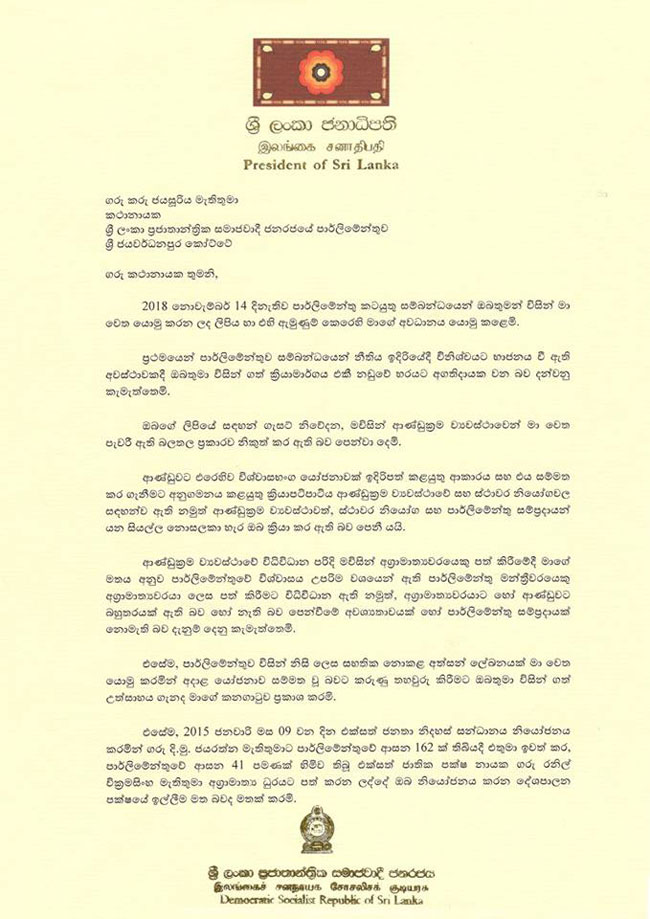
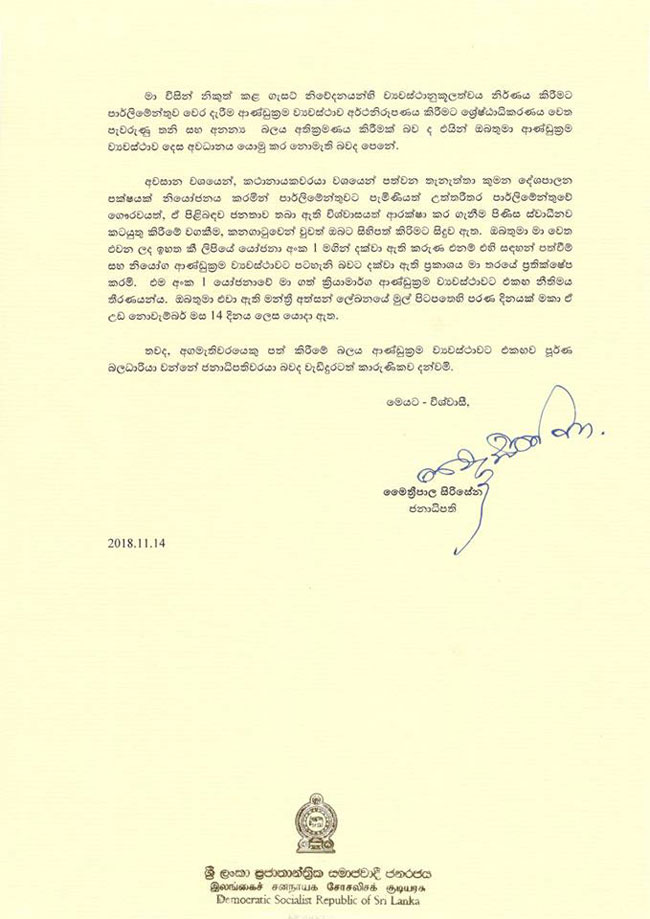
President Maithripala Sirisena reminded Speaker of the House, Karu Jayasuriya that on 9 January of 2015, he had appointed Ranil Wickremesinghe as the Prime Minister on the request of the United National Party (UNP), the political party the Speaker represents, even though the UNP had only 41 seats in the House.

The President responded to the letter sent by the Speaker in relation to the Parliamentary matters on 14 November 2018 (reconvening of the House).

When appointing a Premier in accordance with the Constitution, the provision is that I shall appoint a Member of Parliament, who, in my opinion, is most likely to command the confidence of the Parliament and there is no requirement or Parliamentary tradition that the Prime Minister or the Government has to show the majority of the confidence of the Parliament,” he pointed out.

The President stated that the Speaker had ignored the Constitution, standing orders and Parliamentary conventions.

The President further stated that the Speaker’s ‘conduct’ when there is a Judicial process underway regarding the Parliament, is detrimental to the legal process concerning the case before the Court.

He said that the Gazettes referred to by the Speaker were issued by him in accordance with the powers vested in him by the Constitution.

The letter further stated: The procedure for submitting a No-Confidence Motion against the Government and the steps that have to be taken to adopt it are mentioned in the Constitution and the standing orders, but, you have acted in disregard of the Constitution, the Standing Orders and the Parliamentary conventions. Furthermore, your attempt to prove that the said motion was duly adopted by sending me a document with signatures that has not been certified by the Parliament is regrettable. The Parliament making attempts to define the Constitutional validity of the Gazette Notifications issued by me is tantamount to usurping the powers of the Supreme Court, which has been entrusted with the sole power to interpret the Constitution. Finally, I remind you regrettably that the Speaker, whichever the political party represented to enter Parliament, once appointed as Speaker has the responsibility to work independently to safeguard the dignity of the August House and the trust kept by the people in it. I completely reject your statement in Proposal Number One that the appointments made and orders issued by me are contradictory to the Constitution. I have taken those steps listed in Proposal Number One in accordance with the Constitution. The old date of the document that contained signatures of MPs’ sent by you has been erased and the date has been suffixed as 14 November. Moreover, I, with respect, inform you that the President has the absolute power to appoint a Prime Minister in accordance with the Constitution.”

Lankan opposition agrees to move fresh No Confidence Motion as per established norms

November 15th, 2018

Courtesy NewsIn.Asia

Colombo, November 15 (newsin.asia): Opposition parties in the Sri Lankan parliament are expected to submit a fresh Motion of No Confidence (MNC) against Prime Minister Mahinda Rajapaksa soon, following an agreement they had reached with President Maithripala Sirisena here on Thursday.

President Sirisena told opposition leaders who met him, that he is not opposed to moving an MNC against the government headed by Prime Minister Mahinda Rajapaksa. According to Mano Ganeshf Tamil Progressive Alliance, the President also promised not to prorogue parliament again.

Lankan opposition agrees to move fresh No Confidence Motion as per established norms

But he made it clear that he would insist that the MNC is worded in the proper way and the set procedure for presenting, debating and voting on it, is followed.

The President had called a meeting of the opposition parties which supported the MNC on Wednesday, such as the United National  Party (UNP), the Tamil National Alliance (TNA), the Sri Lanka Muslim Congress (SLMC), All Ceylon Makkal Congress (ACMC), the Tamil Progressive Alliance (TPA).

He pointed out that unwarranted and unconstitutional remarks had been made in the motion statement motion. These have to be removed. Statements disputing the constitutional status of the Prime Minister and his cabinet ministers sworn-in by him have to be deleted.

The set procedure for accepting and fixing a date for debate and voting, which were flouted ,have to be followed. Electronic voting or voting by the showing of hands and not voice voting should be adopted, the President said.

Timetable

According to the Democratic Left Front (DLF) leader and MP, Vasudeva Nanayakkara, who is part of Prime Minister Rajapaksa’s United Peoples’ Freedom Front (UPFA), said that if proper procedure is followed, it will take about two weeks to complete the entire process.

Government is ready to accept the result of the vote on the motion. But it wants to ensure that it is done as per the set procedure,” Nanayakkara said.

As on date, the Rajapaksa government does not have the numbers (at least 113 out of 225 ) to defeat an MNC. The opposition is claiming the support of 122 MPs. 122 MPs had signed on a statement saying that they had supported the motion which had been adopted by voice vote earlier.

The President pointed out a flaw in that statement too. It was not certified by parliament. The date had also been changed giving rise to suspicion about the authenticity of the list.

Given the fact that Rajapaksa is far from having the required number ( with some crossing over to the opposition even on Wednesday), defeat is likely.

Wickremesinghe’s Chances

Asked whether UNP leader and ousted Prime Minister Ranil Wickremesinghe will be appointed again, Nanayakkara said that the new appointee need not be Wickremesinghe.

It is the prerogative of the President to call upon any MP, who in his opinion enjoys the confidence of the House, to be the Prime Minister. It need not be Wickremesinghe. It may be somebody else,” Nanayakkara said.

Persistent Conflict

President Sirisena and former Prime Minister Wickremesinghe have been having a running battle since they established a coalition or National Unity government in January 2015.

They differed on economic, social, domestic and foreign policies. While Wickremesinghe hardly consulted the Prime Minister when taking decisions, the President overturned decisions he did not favor, using his over-riding power as the directly elected Executive President. As a result, the administration of the country came to a standstill.

The President had, for some time, been toying with the idea of sacking Wickremesinghe and appointing  Speaker Karu Jayasuriya  or UNP Deputy Leader Sajith Premadasa as Prime Minister. But both Jaysuriya and Premadasa turned down the invitation.

Meanwhile, leaders and cadres of the Sri Lanka Freedom Party and the UPFA were pressing the President to make Rajapaksa the Prime Minister, given his grassroots level popularity and the  brilliant performance of his Sri Lanka Podujana Peramuna (SLPP) in the February 2018 local bodies elections.

And after all, Rajapaksa was a chip of the old SLFP block.

On October 26, President Sirisena summarily sacked Wickremesinghe and appointed Rajapaksa as Prime Minister triggering a domestic and international uproar.

The President then prorogued parliament from October 27 to November 15 to help Rajapaksa  get 113 MPs to sustain himself in power. When Rajapaksa appeared to be failing in this, the President dissolved parliament and fixed January 5, 2019 as the date for fresh polls.

The opposition went to the Supreme Court challenging the dissolution. The court gave leave to proceed and passed a stay order effective till December 7.

With parliament brought back to life, the opposition hurriedly brought a Motion of No Confidence against the Rajapaksa government, disregarding the set procedure. The motion was passed amidst an uproar by a voice vote. A statement with 122 signatures was submitted to the Speaker as proof of voting for the motion.

Prime Minister Rajapaksa and President Sirisena vehemently opposed the manner in which the motion was introduced and passed. There was no debate.

While Rajapaksa said that he is not enamored  of the Premiership, and prefers to come back to power through a fresh election, the President said that he will allow an MNC and accept parliament’s verdict, provided the process adhered to the sanctioned procedure.

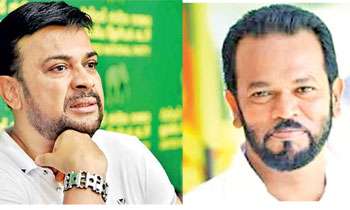
(The images at the top is that of ousted Prime Minister Ranil Wickremesinghe and incumbent PM Mahinda Rajapaksa)

Sri Lanka’s UNP says ready for elections, but only if held legally

November 15th, 2018

Addressing the rally, Wickremesinghe said that a no confidence motion on Prime Minister Mahinda Rajapakse which was presented in Parliament on Wednesday had been passed by a majority and called on President Maithripala Sirisena to accept the results declared by Speaker Karu Jayasuriya.

Wickremesinghe said his party was ready to face a parliamentary election but only if it was held according to the country’s Constitution.

We will protect out Parliament. We are not scarred to hold an election. We are ready to hold  Presidential and a General Election both, but only if its held legally,” Wickremesinghe said.

Sri Lanka’s UNP says ready for elections, but only if held legally

Thousands of people attended the rally held on Thursday afternoon under tight security with police unable to confirm an exact number.

Security was heightened in several areas in Colombo and several roads were cordoned off as a result of the demonstration.

Earlier on Thursday, delivering a special statement in Parliament Prime Minister Mahinda Rajapakse called for all parties to agree to hold a parliamentary election in order to resolve the weeks long political crisis.

He said true democracy would only prevail if the public were given a mandate to decide their future government.

Sri Lanka has been embroiled in a severe political turmoil, when on Oct 26, President Maithripala Sirisena surprisingly sacked his cabinet and Prime Minister Ranil Wickremesinghe and appointed former president Mahinda Rajapakse to the post and appointed a new caretaker government.

Lankan Prez accuses Speaker of violating parliamentary procedures

November 15th, 2018

Courtesy NewsIn.Asia

Colombo, November 14: Sri Lankan President Maithripala Sirisena on Wednesday refused to accept a letter sent by parliament Speaker Karu Jayasuriya explaining  the happenings in the House earlier in the day, according to a ruling party member Dayasiri Jayasekara. Instead, he issued a statement saying that the Speaker had flouted parliamentary procedures in getting the No Trust Motion passed.

The President said that the Speaker had failed to adhere to Standing Orders and other Parliamentary procedures when it came to the No Confidence Motion against Prime Minister Mahinda Rajapaksa and his government.

Lankan Prez accuses Speaker of violating  parliamentary procedures

The list of signatures attached with the motion has not been certified by Parliament,” Sirisena said whilst adding that the date of the motion had also been changed in an unacceptable matter.

Sirisena said the Parliamentary tradition does not make it necessary for a newly appointed Prime Minister to prove  majority support.

The President has the power to appoint any member of the house as Prime Minister, who, in his opinion, has  majority support in Parliament.

Sirisena said he is the sole ‘appointing authority’ in regard to the Prime Minister.

Earlier, released a copy of the No Confidence Motion and the letter sent to President Maithripala Sirisena.

The letter signed by 122 members of parliament stated that the cabinet and the Prime Minister were appointed in violation of the constitution.

The release added that copies of these letters and documents were sent to the President in order to facilitate the next course of action in line with the constitution.

Parliament convened at 10am on November 14) in accordance with Gazette notification 2095/50 which was issued by the President.

After general announcements made by the Speaker, Tamil National Alliance MP M. A. Sumandiran submitted a proposal to suspend the Standing Orders.

Thereafter members of the JVP (Anura Kumara Dissanayake and Vijitha Herath) submitted a No-Confidence Motion against the Government.

The JVP members had called on the Speaker to assess the opinion of the House. A vote was held on the NCM and a majority of the members who were present in Parliament voted in support of the NCM.

Thereafter MP Lakshman Kiriella proposed that the parliamentary session be adjourned till 10 am tomorrow November 15.

ජනතා පරමාධිපත්‍යට ඉඩ දෙමු

November 15th, 2018

මාධ්‍ය නිවේදනය 2018 නොවැම්බර් 15 වෙනි බ්‍රහස්පතින්දා ගරු අග්‍රාමාත්‍ය මහින්ද රාජපක්‍ෂ මහතා පාර්ලිමේන්තුවේ කළ කතාවේ පිටපත

ගරු කථානායකතුමනි,

පැවති ආණ්ඩුව විසිරුවල  ඊලඟ මහ මැතිවරණය තෙක් අන්තර්කාලීන ආණ්ඩුවක් පිහිටවපු හේතු ජනාධිපතිතුමා පැහැදිලි කරලා තියෙනවා. පසුගිය ඔක්තෝබර් 26 වෙනිදා වෙනකොට ජනතාව හිටියේ විශාල පීඩනයකින්. ඉන්ධන මිල සූත්‍රය හා රුපියලේ කඩාවැටීම නිසා දිනෙන් දින වැඩිවෙන ජීවන වියදම, කිසිදාක අත්නොදුටු ආකාරයේ බදු බර, මහ බැංකු මංකොල්ලය නිසා දෙගුණයකින් වැඩි වුණු පොලී අනුපාතය, රටේ වරායවල්, ගුවන් තොටුපොලවල්, රජයට අයත් ලාබදායි ව්‍යාපෘති, ඇතුලු සියලු රජයේ දේපොල විදේශිකයන්ට විකිනීමට සැරසීම, ඉඩම් සින්නක්කරව විදේශිකයන්ට විකිනීමට නව නීති සැකසීම, විද්වතුන් හා දේශීය ව්‍යාපාරිකයන්ගේ මතය නොසලකා විදෙස් ගිවිසුම් වලට එළැඹීම, අයෝජකයන්ගෙන් මහා පරිමාන අල්ලස් ඉල්ලීම වගේ කාරණා නිසා පැවති ආණ්ඩුව ගැන රටේ විශාල අප්‍රසාදයක් තිබුණා.

අපි දැක්කා ජනාධිපතිතුමා පසුගිය කාලේ එක්සත් ජාතික පක්‍ෂෙය් ආර්ථික කළමණාකරන කමිටුව විසිරුවල රටට වෙමින් තිබෙන විනාශය අවම කරගන්න යම් උත්සාහයක් ගන්නවා. මේ කාරණා ගැන අගමැතිතුමා සමඟ කැබිනට මණ්ඩලයේ බහින්බස්වීම් ගැනත් අපිට අහන්න ලැබුණා.  ඒ අවස්ථාවේ තමයි පොලීසියේ පිරිසකුත් හවුල් වෙලා ජනාධිපතිවරයාවත්, හිටපු  ආරක්‍ෂක ලේකම්වරයාවත් ඝාතනය කරන්න එක්සත් ජාතික පක්‍ෂයේ පිරිසක් කුමන්ත්‍රණය කලායි කියන ආරංචිය පටිගත කරපු සාක්‍ෂිත් සහිතව අපිට අහන්න ලැබෙන්නේ. තත්වය එතනට ගියාට පස්සෙ තමයි, ජනාධිපතිවරයා තීන්දු කලේ ආණ්ඩුවෙන් එක්සත් ජනතා නිදහස් සන්ධාන පාර්ශවය ඉවත් කරගන්න. එජනිසය ආණ්ඩුවෙන් ඉවත් වෙනවත් එක්කම පැවතුණු සභාග ආණ්ඩුව විසිරුනා. ඒ අවස්ථාවේදී ජනාධිපතිතුමා ආණ්ඩුක්‍රම ව්‍යවස්ථාවෙන් ඔහුට ලැබී ඇති බලතල අනුව මට ආරාධනා කලා අග්‍රාමාත්‍ය ධූරය භාර අරගෙන ආණ්ඩුවක් පිහිටුවන්න කියලා.

ඒ අවස්ථාවේදී මට තෝරා ගැනීමක් තිබුණා එක්කෝ ඒ ආරාධනය පිළිගන්න, නැතිනම් ප්‍රති‍ක්‍ෂේප කරන්න. මට ඕනනම් කියන්න තිබුණා  UNP එක අවුරුදු හතරකට කිට්ටු කාලයක් හිටපු විදියට ඉතිරි ටිකත් හිටපුදෙන් කියලා. තව අවුරුද්දයි තිබුණෙ. නමුත් අපි තමයි ප්‍රධාන විපක්‍ෂ බලවේගය. අපි තමයි රටේ ලොකුම දේශපාලන පක්‍ෂය. අපිට යුතුකමක් තියෙනවා රටේ ජනාධිපතිතුමා මුලු රටටම වෙන්න ගිය මහා වින්නැහියක් වලක්වාගන්න අපිට රට බාරදෙනකොට, ඒ වගකීම් බාරගන්න. ඒ අනුව මම ඒ වගකීම  බාරගත්තා. ඒ වගේම මට තිබුණු ප්‍රශ්නය තමයි එජාප ආණ්ඩුව තවත් අවුරුද්දක් තිබුණනම් රටට මොනවායින් මොනව වෙලා තියෙයිද කියන එක. 2015 ජනවාරියේ ඉඳලා එජාප ආණ්ඩුව විදේශ විනිමය ණය විතරක් ඇමරිකානු ඩොලර් බිලියන 21 ක් ලබාගෙන තියෙනවා. 

මේ ඉවක් බවක් නැති ණය ගැනිල්ල තමයි රටට වෙමින් තිබුණු ලොකුම විනාශය. අපි පිහිටෙවුවේ මහ මැතිවරණයක් පවත්වන තුරු අන්තර්කාලීන ආණ්ඩුවක් පමණයි. ඒ නිසා තමයි, ඒකාබද්ධ විපක්‍ෂෙයේ සුළු පිරිසක් පමණක් ආණ්ඩුවේ ඇමතිකම් බාර ගත්තෙ. රට ප්‍රපාතයට යනවත් එක්කම අපි ඒකාබද්ධ විපක්‍ෂය හැටියට පසුගිය කාලේ දිගින් දිගටම මහ මැතිවරණයක් ඉල්ලා හිටියා.

නමුත් පැවති ආණ්ඩුව මැතිවරණ සිතියම අකුළලයි තිබුණෙ.  2015 මාර්තුවේ විසිරුවපු පලාත් පාලන ආයතන වලට ඡන්ද පවත්වාගන්න අවුරුදු තුනක් ගියා. පලාත් පාලන මැතිවරණ ක්‍රමය වෙනස් කරලා, සීමා නීර්ණය ගැටළු තියෙනවය කියල ඡන්දය කල් දැම්මා.  උසාවියේ නඩු දාලා පලාත් පාලන ඡන්දය නොතියන තැනට වැඩ සලස්සන්න හදන කොට මැතිවරණ කොමිසමේ සභාපතිවරයා, සීමා නීර්ණ ගැටළු නැති පලාත් පාලන ආයතන සඳහා ඡන්දය පවත්වන්න සූදානම් වුනහම තමයි ආණ්ඩුව අවසානයේදී ඒ මැතිවරණයවත් පැවැත්වූයේ. අද වෙන විට සබරගමුව, උතුරු මැද හා නැගෙනහිර පලාත් සභා විසිරුවලා අවුරුද්දකට වැඩිය කාලයක් ගතවෙලා තියෙනවා. පසුගිය මාසය වන විට උතුරු පළාත් සභාව ඇතුලු තවත් පළාත් සභා තුනක් විසිරිලා ගියා, නමුත් ඡන්ද නෑ.

ජනාධිපතිතුමා තමාට ව්‍යවස්ථාවෙන් හිමි බලතල අනුව පාර්ලිමේන්තුව විසිරුවලා ඡන්දයක් කැදෙවුවාම, ලංකා ඉතිහාසයේ පලමු වතාවට එජාපය, ජවිපේ ඇතුළු පක්‍ෂ ශ්‍රේෂ්ඨාධිකරණයට ගිහිල්ලා තියෙනවා මැතිවරණයක් පවත්වනවට විරුද්දව. මේ පාර්ශවම තමයි ගිය අවුරුද්දෙ කිසිම හිරිකිතයක්, ලැජ්ජාවක් නැතුව පලාත් පාලන ඡන්දයත් පලාත් සභා ඡන්දත් දින නියමයක් නැතුව කල් දාගන්න, වෙනත් කාරණා වලට පාර්ලිමේන්තුවට ඉදිරිපත් කරලා තිබුණු පනත් කෙටුම්පත්වලට කාරක සභා අවස්ථාවේදී පස්සා දොරෙන් සංශෝධන ගෙනල්ලා ඡන්ද ක්‍රමයත් මුලුමනින්ම අවුල් කරලා ඒ ඡන්ද කල් දාගත්තේ. මේ රටේ ජනතාවගේ ඡන්දය දැමීමේ අයිතිය එදත් මේ පිරිස විසින්ම පැහැරගත්තා.

අද මම පාර්ලිමේන්තුවට එනකොට දැක්කා පෝස්ටරයක් – මහ මැතිවරණයකින් මූලික මිනිස් අයිතිවාසිකම් කැඩෙන්නේ කාගේද?” මේක වැදගත් ප්‍රශ්නයක්.

අපේ රටේ 1947, 1951, 1956, 1960 පත් වෙච්ච සියලුම පාර්ලිමේන්තු කලින්විසිරුවලා මහ මැතිවරණ තිබ්බේ ජනතාවට තම පරමාධිපත්‍ය බලය තුළින් තමාට කැමති ආණ්ඩුවක් පත් කරගන්න ඉඩ දෙන්නයි. ඒකෙන් තමයි ඒ කාලේ ජනතාවගෙ පරමාධිපත්‍ය බලය රැකුණෙ. පැවති ආණ්ඩුවට මේ රටේ ප්‍රශ්න විසදන්න බෑ කියලා අවබෝධ වුණු නිසා තමයි ජනාධිපතිතුමා මට රට භාර ගන්න කියලා කිවුවෙ. මම අගමැති හැටියට දිවුරුම් දීපු ගමන්ම රට පුරා නව බලාපොරොත්තු සහගත  හැඟිමක් පැතිර ගියා.

අපේ කථානායකතුමා බටහිර තානාපති කාර්යාල හා තමන්ගේ පක්‍ෂය එක්ක එකතුවෙලා රටේ ව්‍යවස්ථාවටත්, පාර්ලිමේන්තුවේ ස්ථාවර නියෝගවලටත් පටහැනිව මට විරුද්ධව ශබ්දය අනුව” විශ්වාසභංග යෝජනාවක් සම්මත කර ගත්තයි කියලා කියනවා. සද්දෙන් බෑ යෝජනා සම්මත කරන්න. කථානායකවරයාගේ ඊනියා විශ්වාසභංගයේන්  පස්සෙ  හිටපු අගමැතිතුමා නැවතත් අගමැති වෙලයි කියලා හිටපු ඇමතිවරු ඒගොල්ලන්ට කලින් තිබ්බ අමාත්‍යංශ වලටත් ගිහිල්ලා තියෙනවා. රටේ අගමැතිවරයා ඇතුලු ඇමති මණ්ඩලය පත් කරන්නෙ ජනාධිපතිතුමා. පාර්ලිමේන්තුවට හෝ කථානායකවරයාට ඒ බලය ව්‍යවස්ථාවෙන් දීල නැහැ.

නමුත් දැන් මෙතන පාර්ලිමේන්තුවේ දෙපාර්ශවයක් අතර මත ගැටුමක් තියෙනවා. මේ ආරවුල පාර්ලමේන්තුවේ ඉන්න 225 දෙනා අතරේ විසදාගන්න හදන්නේ නැතුව මේ රටේ ලක්‍ෂ 150 ක් ඉක්මවන ඡන්ද දායක ජනතාවට බාර දෙමුයි කියලා මම යෝජනා කරනවා. ඒකයි පාර්ලිමේන්තු සම්ප්‍රදාය. දේශපාලඥයෝ හැටියට අපි හැමෝම තේරුම් ගන්න ඕන, අපේ ව්‍යවස්ථාවට අනුව පරමාධිපත්‍ය බලය තියෙන්නේ පාර්ලිමේන්තුවට නොවෙයි, ජනතාවටයි කියන එක. මම සංතෝස වෙනවා ජනතා විමුක්ති පෙරමුණ ඊයේ කිවුවා පාර්ලිමේන්තුව විසිරුවලා ඡන්දයකට යන්න යෝජනාවක් අවොත් ඒගොල්ලෝ ඒකට පක්‍ෂ වෙනවා කියලා. එක්සත් ජාතික පක්‍ෂය ඒ ගැන දරණ ස්ථාවරය මොකක්ද කියලා මේ පාර්ලිමේන්තුව තුළ අද ප්‍රකාශයක් කරයි කියලා මම බලාපොරොත්තු වෙනවා. 

ජනතාවට තමන්ගේ අභිමතය අනුව නව රජයක් තෝරා පත්කරගන්න සාධාරණ, යුක්තිසහගත මැතිවරණයක් පවත්වන්න මා සමඟ අත්වැල් බැඳගන්නා ලෙස පාර්ලිමේන්තුවේ ගරු මන්ත්‍රීතුමන්ලා 225 දෙනාගෙන්ම මම ඉල්ලා සිටිනවා.

ස්තුතියි. 


Let the people’s sovereignty prevail

November 15th, 2018

MEDIA RELEASE Text of the speech made by the Hon. Prime Minister Mahinda Rajapaksa in Parliament on Thursday the 15th  November 2018.

 Hon Speaker,

The President has explained why he dismissed the previous government and appointed an interim government until the conclusion of the next general election. By the 26th of October, the people of this country were living under enormous pressure. The cost of living was increasing on a daily basis due to the fuel pricing formula and the rapid depreciation of the Rupee. The unprecedented tax burden, the doubling of interest rates as a result of the Central Bank bond scam,  the preparations being made to sell off harbour terminals, airports and profitable government ventures to foreign parties, the laws being drafted to enable foreigners to purchase freehold land in Sri Lanka, the signing of free trade agreements against the advice of professionals and local businessmen, the soliciting of bribes from potential investors were all weighing down on the people and there was a great deal of popular resentment against the previous government on that account.

We saw the President making some effort to mitigate the damage that was being done to the country by taking steps such as dismissing the UNP’s economic affairs committee. We heard that there had been sharp exchanges between the President and the Prime Minister in cabinet over these issues. It was at this stage that the media began to broadcast voice recordings relating to a conspiracy by persons associated with the UNP to assassinate the president and the former Defence Secretary with the involvement of certain elements in the police. It was only after things reached such a pass that the President decided to take the UPFA out of the coalition government. The withdrawal of the UPFA led to the dissolution of that government and the President under the powers vested in him by the Constitution, invited me to accept the Premiership and form a government.

I had the choice of either accepting that invitation or declining it. I could have simply said that it was best to allow the UNP government to continue in office for the remaining one year or so.  However, we were the main opposition force in the country. We are the largest political party in the country. When the President hands the country over to us in order to prevent a major catastrophe from taking place, it is our duty to accept that responsibility. I accepted the responsibility of running the country on that basis. Another matter that I had to take into consideration was what would have happened to the country if the UNP had continued in power for another year. Since January 2015, that government had borrowed more than USD 21 Billion in foreign currency loans.

This reckless borrowing spree was by far the most serious damage that was being done to the country. What we formed was only an interim government until a general election is held. That was why only a handful of Joint Opposition members accepted portfolios in the new government. As the situation in the country deteriorated, the Joint Opposition had been consistently calling for Parliament to be dissolved and fresh elections held.

However the previous government had literally ‘rolled up the electoral map’. It took nearly three years for elections to be held for the local government institutions that had been dissolved in March 2015. They postponed elections on the pretext of issues pertaining to the delimitation of wards. When that government filed action in court and attempted to put off local government elections indefinitely, the Chairman of the Elections Commission announced that they would hold elections to the local government bodies that did not have any delimitation issues. It was only then that the government finally agreed to hold that long delayed election. For more than one year, there have been no functioning Provincial Councils in the Sabaragamuwa, North Central and Eastern provinces. Last month, three more provincial councils including the Northern PC stood dissolved. But there have been no elections.

When the President dissolved Parliament and called a general election, for the first time in the history of this country, the UNP and the JVP have petitioned courts against the holding of a general election. These are the same parties that shamelessly perverted the entire law making process by bringing in committee stage amendments to change the entire system of elections to the local government institutions and Provincial Councils to Bills that had been introduced in parliament for completely different purposes in order to postpone elections to those bodies. The same parties that have gone to courts against holding an election, deprived the people of the right to vote at that time as well.

The Parliaments of 1947, 1951, 1956, and 1960 were all dissolved early to enable the people to exercise their franchise and elect a government of their choice. That was how the people’s sovereignty was safeguarded at that time. It was because the President realised that the previous government was not able to solve the problems of the country that he invited me to form a new government. There was wave of relief throughout the entire country when I was sworn in as Prime Minister.

Our Speaker who acts hand in glove with certain Western embassies and his political party has in violation of the provisions in the Constitution and the Standing Orders of Parliament, announced that a no confidence motion has been passed against me in Parliament by a voice vote. Everyone saw that a proper vote was never taken in Parliament. After the Speaker announced the purported result of a no-confidence motion, former Ministers of the previous government had gone to their previous ministries claiming that Mr Ranil Wickremasinghe was now once again the Prime Minister. Only the President can appoint a Prime Minister and a Cabinet. The Speaker and Parliament have no role in making such appointments.

However, there is now a dispute in Parliament. I suggest that we take this matter before the 15 million plus voters in the country instead of trying to resolve this among the 225 persons sitting in this House. That is the parliamentary tradition. We politicians must realize that according to our Constitution, sovereignty resides in the people not in Parliament. I was pleased to hear the JVP stating at a press conference yesterday that if someone brings a resolution to dissolve Parliament and hold a general election, they would support that motion. I expect the UNP to make their stand on this matter known today on the floor of this house. I invite all 225 Members of this House to join me in paving the way for the sovereign people to decide.

Thank you.

Speaker to decide on new seating arrangements today??

November 15th, 2018

Sudath Gunasekara

15.11.2018

Nov 15 (FT) T 2018.

New seating arrangement in Parliament will be decided by Speaker Karu Jayasuriya this morning.

The Speaker, though he madly thinks, pretends and tries to acts as the Head of the State, being completely out of his normal senses, should at least now understand he is not yet the Head of the State or the Government of this country under the Constitution. Therefore it is illegal and unconstitutional for him to make someone else to sit there. Fortunately for the country he is not the authority constitutionally empowered to appoint the Prime Minister in this country. Besides, it is common sense that no one can sit in the seat reserved for the Prime Minister in Parliament, when it is in session, unless he or she has been legitimately appointed as the PM by the President under his signature, as he is the only person who has the power to appoint the Prime Minister in this country under the Law.

Anyone who tries to do that should be tried for high treason first and then warded in Angoda until the day of hanging comes. Looking at the way he is behaving and acting even an ordinary man or women will think that this man by accident has been put on the wrong place, mistaking Parliament to be  Angoda, though  in reality Angoda is million times better than our present Parliament.

In any case for the record he holds, he will go down in history as a mad man who was trying nakedly to unsuccessfully, to execute the neck of the Goddess of democracy in this country, at the Public Executioners block.

”ගජා” සුළි කුණාටුව හේතුවෙන් සිදුවිය හැකි හානි

November 15th, 2018

දිනසේන රතුගමගේ

ගජාසුළි කුණාටුව හේතුවෙන් සිදුවිය හැකි හානි අවම කිරීම සදහා ගත හැකි සෑම පියවරක්ම ගෙන ඇති බවත් යම් හෙයකින් ජනතාව විපතට පත් වුවහොත් ඔවුන්ට ඉතා කඩිනමින් සහන සලසා දීමට අවශ්‍ය සෑම පියවරක්ම ගෙන ඇති බවත් උතුරේ දිසාපතිවරු සදහන් කරයි.

යාපනය දිසාපති නාගලිංගම් වේදනායගම් මහතා කියා සිටියේ යාපනයේ ධීවරයින්ව මුහුදු යාමට නොදී නාවික හමුදාව හා ධීවර නිලධාරීන් ඔවුන් පිළිබදව දැඩි විමසිල්ලෙන් සිටින බවයි.

යාපනයේ කන්කසන්තුරේ පේදුරුතුඩුව යන පළාත් කෙරෙහි දැඩි අවධානයක් යොමු කොට ඇති බව කී දිසාපතිවරයා මන්නාරම හා වවුනියාව යන පළාත් වල දිසාපතිවරු සමග මේ කටයුත්තේදී ඉතා දැඩි සබදතාවයකින් සිටින බවද කියා සිටියේය.

එම පළාත්වල දිසාපතිවරුන්ගෙන් හා නිලධාරීන්ගෙන් යම් හෙයකින් උදව්  අවශ්‍ය වුවහොත් උදව් ලබා ගැනීම සදහා සාකච්ඡා කොට ඇති බව කී යාපනය දිසාපතිවරයා යුද හමුදාව ඇතුළු සියළු ආරක්ෂක නිලධාරීන් සමගද උදාවිය හැකි ඕනෑම තත්ත්වයකට මුහුණ දීමට අවශ්‍ය පියවර සාකච්ඡා කොට ඇති බව කියා සිටියේය.

මේ අතර වවුනියාව දිසාපති මොහොමඩ් හනීෆා මහතා කියා සිටියේ මෙම ගජාසුළි කුණාටුව පයකට කිලෝ මීටර් 660 ක් පමණ වේගයෙන් හමායන බවට විශ්වාස කෙරෙන නිසා ඉන් යාපනයට පමණක් නොව උතුරේ බොහෝ පළාත් වලට හානි සිදුවිය හැකි බවයි.

මේ තත්ත්වය නිසා පළාතේ ආරක්ෂක නිලධාරීන් හා ආපදා කලමනාකරණ නිලධාරීන් දැණුවත් කොට ඇති බව කී වවුනියාව දිසාපතිවරයා  සිදුවන සිදුවීම් වලට ශක්තිමත්ව මුහුණ දීමට හැකි අන්දමට  අවශ්‍ය සම්පත් කලමනාකරණය කොට ඇතැයි කියා සිටියේය.

Mahinda Rajapaksa’s full speech in Parliament-Let the people’s sovereignty prevail

November 15th, 2018

Courtesy Adaderana

The full text of the speech made by the Prime Minister Mahinda Rajapaksa in Parliament on Thursday (November 15).

Let the people’s sovereignty prevail

Hon Speaker,

The President has explained why he dismissed the previous government and appointed an interim government until the conclusion of the next general election. By the 26th of October, the people of this country were living under enormous pressure. The cost of living was increasing on a daily basis due to the fuel pricing formula and the rapid depreciation of the Rupee. The unprecedented tax burden, thedoubling of interest rates as a result of the Central Bank bond scam,  the preparations being made to sell off harbour terminals, airports and profitable government ventures to foreign parties, the laws being drafted to enable foreigners to purchase freehold land in Sri Lanka, the signing of free trade agreements against the advice of professionals and local businessmen, the soliciting of bribes from potential investors were all weighing down on the peopleand there was a great deal of popular resentment against the previous government on that account.

We saw the President making some effort to mitigate the damage that was being done to the country by taking steps such as dismissing the UNP’s economic affairs committee. We heard that there had been sharp exchanges between the President and the Prime Minister in cabinet over these issues. It was at this stage that the media began to broadcast voice recordings relating to a conspiracy by persons associated with the UNP to assassinate the president and the former Defence Secretary with the involvement of certain elements in the police. It was only after things reached such a pass that the President decided to take the UPFA out of the coalition government. The withdrawal of the UPFA led to the dissolution of that government and the President under the powers vested in him by the Constitution, invited me to accept the Premiership and form a government.

I had the choice of either accepting that invitation or declining it. I could have simply said that it was best to allow the UNP government to continue in office for the remaining one year or so.  However, we were the main opposition force in the country. We are the largest political party in the country. When the President hands the country over to us in order to prevent a major catastrophe from taking place, it is our duty to accept that responsibility. I accepted the responsibility of running the country on that basis. Another matter that I had to take into consideration was what would have happened to the country if the UNP had continued in power for another year. Since January 2015, that government had borrowed more than USD 21 Billion in foreign currency loans.

This reckless borrowing spree was by far the most serious damage that was being done to the country. What we formed was only an interim government until a general election is held. That was why only a handful of Joint Opposition members accepted portfolios in the new government. As the situation in the country deteriorated, the Joint Opposition had been consistently calling for Parliament to be dissolved and fresh elections held.

However the previous government had literally ‘rolled up the electoral map’. It took nearly three years for elections to be held for the local government institutions that had been dissolved in March 2015. They postponed elections on the pretext of issues pertaining to the delimitation of wards. When that government filed action in court and attempted to put off local government elections indefinitely, the Chairman of the Elections Commission announced that they would hold elections to thelocal government bodies that did not have any delimitation issues. It was only then that the government finally agreed to hold that long delayed election. For more than one year, there have been no functioning Provincial Councils in the Sabaragamuwa, North Central and Eastern provinces. Last month, three more provincial councils including the Northern PC stood dissolved. But there have been no elections.

When the President dissolved Parliament and called a general election, for the first time in the history of this country, the UNP and the JVP have petitioned courts against the holding of a general election. These are the same parties that shamelessly perverted the entire law making process by bringing in committee stage amendments to change the entire system of elections to the local government institutions and Provincial Councils to Bills that had been introduced in parliament for completely different purposes in order to postpone elections to those bodies. The same parties that have gone to courts against holding an election, deprived the people of the right to vote at that time as well.

The Parliaments of 1947, 1951, 1956, and 1960 were all dissolved early to enable the people to exercise their franchise and elect a government of their choice. That was how the people’s sovereignty was safeguarded at that time. It was because the President realised that the previous government was not able to solve the problems of the country that he invited me to form a new government.

There was wave of relief throughout the entire country when I was sworn in as Prime Minister.

Our Speaker who acts hand in glove with certain Western embassies and his political party has in violation of the provisions in the Constitution and the Standing Orders of Parliament, announced that a no confidence motion has been passed against me in Parliament by a voice vote. Everyone saw that a proper vote was never taken in Parliament. After the Speaker announced the purported result of a no-confidence motion, former Ministers of the previous government had gone to their previous ministries claiming that MrRanilWickremasinghe was now once again the Prime Minister. Only the President can appoint a Prime Minister and a Cabinet. The Speaker and Parliament have no role in making such appointments.

However, there is now a dispute in Parliament. I suggest that we take this matter before the 15 million plus voters in the country instead of trying to resolve this among the 225 persons sitting in this House. That is the parliamentary tradition. We politicians must realize that according to our Constitution, sovereignty resides in the people not in Parliament. I was pleased to hear the JVP stating at a press conference yesterday that if someone brings a resolution to dissolve Parliament and hold a general election, they would support that motion. I expect the UNP to make their stand on this matter known today on the floor of this house. I invite all 225 Members of this House to join me in paving the way for the sovereign people to decide.

Thank you.

Tense situation in Parliament; Speaker leaves chamber

November 15th, 2018

Courtesy Adaderana

UPDATE (10.56 a.m.) – Speaker Karu Jayasuriya got up from his chair and left the chamber amidst the uproar during the Parliamentary session and arguments between MPs from government and opposition.

He left, without adjourning parliament, as MPs from both sides surrounded him and continued to argue and clash.

The legislators refused to return to their seats and let the session resume despite the repeated calls by the Speaker to do so.

However, a large number of MPs representing both the government and opposition still remain within the Chamber with some even chanting slogans in protest.


A tense situation has been reported during the Parliamentary session today (15), after the conclusion of the special statement made by Prime Minister Mahinda Rajapaksa.

After the PM concluded his speech, MP Lakshman Kiriella moved a motion of no-confidence against the statement made by Rajapaksa.

The Speaker then inquired whether the House would like to go for a vote on that, resulting in objections from members of the ruling party.

Several MPs approached the Speaker and voiced their disapproval to his actions while the MPs of the UNP also gathered around the chair, leading to an exchange of verbal barbs and profanities amidst pushing and shoving.

PM Rajapaksa is his speech had accused the Speaker of misusing his powers and being biased towards his party.

The Parliamentary session commenced at 10.00 a.m. this morning, however, proceeding of the session has been obstructed due to the behavior of the parliamentarians.

The Parliament reconvened today following its adjournment last morning (14).

A no-confidence motion was passed against PM Rajapaksa during the Parliamentary session yesterday.

Speaker is misusing powers – Mahinda Rajapaksa

November 15th, 2018

Courtesy Adaderana

Mahinda Rajapaksa says that the Prime Minister is appointed by the President and not the Speaker and accused Speaker  Karu Jayasuriya of misusing his powers and acting in a baised manner.

He also said that he does not care about the premiership and that he accepted the position to save the country from the brink of disaster.

Prime Minister or not, I am still Mahinda Rajapaksa. I don’t care about the Prime Ministership,” he responded to accusations from opposition MPs, saying he was no longer PM, as he commenced his speech in Parliament this morning (15).

It may be big for him. But not for me. I didn’t come here for the premiership. I have been prime minister before and I have been president,” he said.

Don’t think I am here talking for the premiership,” he asserted.

Rajapaksa said that he had never seen a darker day” like yesterday in Parliament of the country, referring to the no-confidence vote.

He said that when the President invited him to take over the position of Prime Minister he could have said no and to let the UNP continue for another year.

But we have a duty to save the country from the brink of disaster, he said.

Referring to the passing of a motion of no-confidence against him and the government at parliament yesterday, which was taken by voice vote, Rajapaksa said that such important votes cannot be taken by voice.

He stated that the Prime Minister is appointed by the President and not the Speaker.

Don’t misunderstand your powers,” he said pointing to the Speaker. Parliament has not given you those powers.” He also accused the Karu Jayasuriya of misusing powers of the Speaker.

We are expecting an independent speaker not a biased speaker,” he said.

The Prime Minister expressed his regret that the Speaker is acting for his party and friends abroad”.

Rajapaksa expressed his gratitude to the JVP for stating yesterday that they would support a motion to dissolve parliament and go for polls. What is UNP’s stance?” he questioned.

He invited all 225 Members of the Parliament to support him to hold a General Election and not think about their pensions at this moment.

We want an election. A general election,” he emphasized.

The Prime Minister said that the government will reduce fuel prices once again tonight to give relief to masses.

Will not recognize any PM or Cabinet hereafter – Speaker

November 15th, 2018

Courtesy Adaderana

Speaker says hereafter he will not accept any Prime Minister or Cabinet of Ministers in the parliament since a No Confidence motion had been passed yesterday (15).

Speaker Karu Jayasuriya mentioned this at the parliamentary session held today (15).

He says that he will not recognize all current ministers, state ministers, deputy ministers as well as the current Leader of the House and the Chief Government Whip.

I can be challenged only within the parliament. Outside of the parliament, I cannot be criticized”, he further said.

The Parliamentary session commenced at 10 am this morning; however, proceeding of the session has been obstructed due to the behavior of the parliamentarians.

The Parliament reconvened today following its adjournment last morning (14).

A no-confidence motion was passed against PM Rajapaksa and the new Cabinet during the Parliamentary session yesterday.

YAHAPALANA AS A PUPPET REGIME Part 1

November 14th, 2018

KAMALIKA PIERIS

Pub 14.11.18  Rev 15.11.18

The Yahapalana government elected in 2015 is Sri Lanka’s very first puppet government. Analysts were quick to spot this. Lasanda Kurukulasuriya asked in 2015 ‘is Lanka being micro managed from afar.  In 2016, the media said, ‘Yahapalana is acting on a preplanned scenario.’  ‘Government is following a foreign agenda.’ The public agreed. ‘Certain countries were exploring every possible political avenue, by hook or crook, to topple Mahinda Rajapaksa and to install a puppet regime to achieve their goals,’ said S. Akurugoda. Ranil was acting according to the dictates of the western masters, said Vasudeva Nanayakkara.

If Yahapalana is a puppet government then who is pulling the strings? It is the United States of America, chorused analysts. The USA favors the creation of democratically elected puppet regimes, which will thereafter act on behalf of the USA, explained Tissa Vitarana. Sri Lanka will be a puppet of the USA like the Philippines, he added. Yahapalana government, is   a ‘fully pro-Washington regime’, said Tamara Kunanayagam.  The regime change of 2015 was to secure for USA, through a puppet Prime Minister, the strategic prize of Trincomalee, said Dayan Jayatileke.

Tissa Vitarana stated that the Yahapalana conspiracy started in London with America and Delhi joining in.  The people involved were Chandrika, Ranil and Mangala and they had worked on it for 18 months.  This was reported by Ashok Mehta in Hindu in January 2015, said Vitarana. Maithripala was brought in, in the last two months. Sirisena will find that he cannot control the process, those forces are too powerful, observed Vitarana.

The general election was held on 8th January 2015. The results were announced on 9th January at around 8 am and Sirisena was sworn in as President on the same day at 6.20 pm. This was therefore a very hurried swearing in.  We saw on television, an uncertain Sirisena, guided along by Chandrika Kumaratunga. A few minutes after Sirisena took oaths as President, Ranil Wickremasinghe was installed as Prime Minister, despite the fact that there was a sitting Prime Minister. This was noted by the watching public and put aside for future use.   We could not hear what Ranil Wickremasinghe was swearing to.

The plan was that Sirisena would thereafter abolish the Presidency and hand over executive power to Ranil as Prime Minister. This was reported by Chandraprema as early as November 2015. In 2018, Rajiva Wijesinha confirmed this. While he was ‘heavily involved in preparation of the manifesto for the 2015 Presidential election’ he was told that it had been agreed that the presidency would be abolished and power transferred to the Prime Minister within a day if Maithripala Sirisena were elected.

On 28TH April 2015 Parliament passed the 19th amendment to the Constitution. It was passed unanimously. According to the 19th amendment, the Prime Minister Ranil Wickremasinghe could not be removed    and   Parliament could not be dissolved for the next four and half years.

The 19th amendment was brought in solely to keep Ranil Wickremasinghe as Prime Minister and   keep the UNP government in place for the full period of five years. Recently, it was found that the clause saying ‘Parliament cannot be dissolved for 4 ½ years’ was not in the original draft sent to Supreme Court for clearance. It has been added on later.

The UNP, utterly pro USA, held the ruling position in Parliament. Other key positions were   given to the two  political parties which were loyal to  USA, namely, the TNA and JVP. The Speaker refused to recognize the ‘Joint Opposition’ which had over 50 SLFP MPs as the Opposition. Instead the position of Leader of the Opposition was given to R.  Sampanthan of the TNA which had 16 MPs.  The JVP which had six MPs was given the position of Chief Opposition Whip. The result was a Yahapalana Opposition as well as a Yahapalana government, said critics.

The TNA   which is the main ‘opposition party’, votes with the government and cooperates with it, inside and outside Parliament, hooted critics. R.  Sampanthan, the Leader of the Opposition voted with the government at the 2016 Budget debate. This was the first time an opposition leader has voted in favor of an annual budget of any government in Sri Lanka, said critics. Sampanthan is making history as a unique Leader of Opposition, anxious to save the government from being ousted.

The Tamil National Alliance is definitely anti Mahinda Rajapaksa .They will not support Mahinda Rajapaksa under any circumstances. A four-member TNA delegation led by its leader R. Sampanthan made this position clear to President Sirisena. The JVP which is a CIA outfit is working in tandem with the UNP and TNA. This was seen in Parliament when it assembled on November 14, 2018  after the interim court order. Sumanthiran wanted the   standing orders suspended, the Speaker agreed and JVP then came in with a resolution against Mahinda Rajapaksa.

The Yahapalana puppet government is wholeheartedly supported by the ‘minorities’, the Tamil, Muslims and the estate Tamils. This became clear In November 2018, when 13 Fundamental Rights petitions challenging the President’s decision to dissolve Parliament were filed in Supreme Court. These petitions had been filed through Tamil National Alliance leader R. Sampanthan, UNP General Secretary Kabir Hashim, JVP leader Anura Kumara Dissanayake, Sri Lanka Muslim Congress leader Rauf Hakeem, All Ceylon Makkal Congress Party leader Rishad Bathiudeen, Democratic People’s Front  and Tamil Progressive Alliance  leader Mano Ganeshan and five others.

Once Yahapalana government was installed, the US moved in and took control of the administration and the economy. Secretary of State John Kerry, arrived in triumph, followed by Nisha Biswal, his assistant.  US involvement in Sri Lanka’s internal affairs, constitution reform, the UN HRC resolutions and the armed services training is no secret, observed Ladduwahetty. When ordinary citizens went to open Fixed Deposits they were asked ‘are you a citizen of USA’

UN Under Secretary General for Political Affairs, Jeffrey Feltman, a former US Assistant Secretary of State arrived in Sri Lanka in 2018. Feltman is a neo-conservative hawk, who has been involved in breaking up sovereign states into ethnic enclaves. Within the UN, he is also responsible for a team working on arrangements promoting federalism as a response to ethnic minority grievances, said critics.

The US recently admitted the release of millions of USD in support of projects in Sri Lanka, in response to a query raised through Freedom of Information Act. The report said USD 40 million had been released from Complex Crises Funds (CCF) in support of governance, rule of law and economic reform in Sri Lanka. The same report said Sri Lanka received CCF amounting to USD 13,589,951 in 2015.

The Center for International Development (CID) of Harvard University took over economic planning.  Executive Vice President of the Overseas Private Investment Corporation (OPIC) visited Sri Lanka in October 2018. OPIC is the U.S. government’s development finance institution. OPIC said it came to promote U.S. investment in the region and strengthen cooperation with regional allies. OPIC wanted American companies given the opportunity to compete for government tenders in Sri Lanka. OPIC also wanted to invest in Sri Lanka‘s ports.

The US 7th fleet came visiting, and had training session with Sri Lanka navy. These joint operations and military exercises, where ships    planes, ground forces and special ops take part, are  actually practicing for war, said TIME. They are executing defined war plans. President Maithripala Sirisena on a visit to South Korea, in association with South Korean President Moon Jae-in, strongly condemned North Korea testing long-range ballistic missiles.

Other western counties linked to the USA were also active. The ambassadors of UK, France, European Union, Germany, Netherland, Italy and Romania were present at a high level meeting chaired by Prime Minister Ranil Wickremasinghe to discuss the Code of Criminal Procedure Act, anti-terrorist legislation, extensive amendments to the Public Security Ordinance.

Yahapalana government was given the deadly task of totally annihilating the sovereign state of Sri Lanka and its people. Yahapalana was expected to weaken the central government, weaken the economy and   create a restless population so that the west could intervene.

Yahapalana is also planning to shrink the Lankan state by selling the country’s lands and ports. Recently, a Gazette gave 8 acres of land in Colombo to a foreigner, added a critic.  Yahapalana plans to sell off or give on long lease, swathes of this small island thereby effectively shrinking Sri Lanka as a sovereign state, confirmed Dayan.  What remains of the shrinking State will be converted into a repressive State, said Tamara Kunanayagam.

The first task of the puppet government was to deliver Trincomalee to USA. ‘Yahapalana plans to   give Trincomalee as a military base to the USA,’ warned Vitarana. For the first time after British colonial rule, a foreign base is being established in Sri Lanka he said. We will become part of the chain of military bases, which has been established by the USA worldwide, patrolling the Indian Ocean for them at our expense. Trincomalee will be a beachhead in the Indo-US axis against China. A beach head is a position from which an attack can be launched.

Yahapalana also plans to give a part of Sri Lanka to India. Prime Minister Ranil Wickremesinghe plans to create a Tamil Nadu-Trincomalee-Vavuniya axis, said Dayan Jayatilleke. He knows full well the implications of what he is planning. Ranil Wickremasinghe said at an election rally in Vavuniya in February 2018, ” the rapid development of neighboring Tamil Nadu,  and the development of the Trincomalee area will empower the island’s North and East, including Vavuniya.

Yahapalana plans to allow foreign companies, to buy land in the North-East, said Dayan. Indian and Tamil Nadu companies    would buy land and this would create a de facto Tamil Eelam or a Greater Tamil Nadu. The North and East will be converted either into a separate state, or annexed to India.  India’s border will shift from India into this island itself. India has launched a housing project in Trincomalee   and is reconstructing the railway line from Talaimannar to Medawachchiya reported the media. India will also fund Palaly Airport, inaugurating direct air links from South India to Palaly and Batticaloa.

On the 26 of October, 2018, President Sirisena removed Ranil Wickremasinghe and    appointed Mahinda Rajapaksa as Prime Minister. The public who had yearned to see Ranil go and Rajapaksa come back, lit crackers and cheered. Ranil Wickremasinghe refused to accept his dismissal and stayed on in Temple Trees. He invited the ambassadors of EU, USA, India, Japan, Australia and Canada for a discussion at Temple Trees after he was deposed as Prime Minister.

Then he wrote to the ambassadors of USA, UK, Germany France, Norway and Italy, on the letter head of the Prime Minister of Sri Lanka, saying that he sought their cooperation to protect Sri Lanka and its peace. He said, please consider the possibility of deploying UN Peacekeeping Force here, and let me know. A photo of this letter is available on Lankaweb (https://www.lankaweb.com/news/items/2018/10/31/call-for-ranil-to-be-indicted-for-high-treason) .

It is of note that instead of seeking the support of his own people when removed as Premier, Ranil Wickremasinghe turned to his mostly Western friends and allies, said Tamara Kunanayagam. The intention was to agree on a narrative that helps legitimize external intervention, she said.

The change of Government in Sri Lanka, following the unceremonious sacking of Prime Minister Ranil Wickremesinghe by President Maithripala Sirisena, has given rise to a crescendo of alarmist commentary in the Western media said Palitha Kohona. No other country appears to have generated so much interest in the west  . One after the other, the Western media outlets have taken a critical approach to the change and have begun to characterize the replacement of the Prime Minister as a Crisis.”

This ‘crisis’ brought out into the open the countries which were loyal to USA. Several European countries came out in open support of Ranil Wickremasinghe .These countries had never complained about the Bond scam, or the postponing of elections.    When Ranil Wickremasinghe was removed as Prime Minister they rushed in, said observers contemptuously.

The EU Heads of Mission as well as the Ambassadors of Norway and Switzerland resident in Colombo issued a statement saying. “The Ambassadors of the European Union, France, Germany, Italy, Netherlands, Romania, United Kingdom, as well as the Ambassadors of Norway and Switzerland wanted a vote in Parliament to decide who the Prime Minister was.”

Canada issued a separate statement. “Canada is very concerned by the recent events in Sri Lanka and is closely monitoring the situation. A number of countries, including the United States, United Kingdom, European Union and several other European countries, Australia and India have expressed concern over the sudden transition of power by President sacking Prime Minister Ranil Wickremesinghe and appointing former president Mahinda Rajapaksa as the Prime Minister, concluded Canada. Australia said it is seriously concerned at reports that the opportunity for a confidence vote will be denied when Sri Lanka’s Parliament reconvenes. UK Parliament said that they recognize Ranil Wickremasinghe as Prime Minister.

Ambassadors of EU, UK, Canada, and Germany   had also met the Speaker and warned of the unfriendly situation the country could face over the unexpected transfer of political power. ’ There was also a comment that the crisis could lead to a “bloodbath” on the streets if   Parliament does not hold a vote soon.  The Speaker’s Office said that the Speaker had urged the delegation not to take action against Sri Lanka.  Speaker told the media that he saw nothing wrong in meeting diplomats.

USA which was so brash and confident in 2015 has turned cautious within Sri Lanka . The acting US Ambassador together with the Head of the Political Division in the embassy had met with Speaker. They     said they were surprised at the developments and they were watching. In Washington, the spokesman for the Secretary of State was evasive when   asked whether USA would take action on the coup. The spokesman replied that the United States believes the determination should be made in accordance with the Sri Lankan law and due process. But others were more extreme. Samantha Power, former US representative  at the UN, said USA should suspend aid and impose sanctions.

The US embassy was however, quietly working with the public. There was a meeting of trade union leaders and US Embassy’s Economic and Commercial Officer at the Colombo office of the Solidarity Centre, a US- based labor rights group. US Embassy officials had wanted to ascertain the view of the unions on the present crisis. After this meeting one trade union issued a statement saying the country was slipping into anarchy and urged the authorities to call a Parliamentary election.

Japan is USA’s military front in Sri Lanka. Japan knows that the pro-USA puppet government will continue. Japan said it plans to further expand defence cooperation and exchanges with Sri Lanka. Japan’s activities will move from navy to the Army and Air Force. Sri Lanka is a maritime country located at a strategic point in the middle of the Indian Ocean sea lane. Therefore Sri Lanka is important for Japan to maintain and promote our foreign policy. Sri Lanka is important for smooth operations of the Japan – Self-Defence Forces (JSDF) since ships and aircraft of JSDF make frequent port calls in Sri Lanka.

There were veiled threats too, but they were made abroad. Jeffrey Feltman said at Brookings Institute, said that UN and the International community should  intervene  to prevent conflict. The International Commission of Jurists  had issued a statement saying The Human Rights Council will be watching closely to assess whether Sri Lanka is in breach of its commitments. Any serious threat to progress on human rights accountability will compel the establishment of an independent accountability mechanism.”

Kohona said  there was no crisis. Mahinda Rajapaksa ‘s appointment as Prime Minister was a very popular one. Fire crackers exploded all over the country, including in Jaffna. there is little chance of a descent in to violence as anticipated by Jeffrey Feltman. Sri Lanka  is the oldest democracy in Asia, the oldest country to enjoy universal adult franchise in Asia, a country that has faced elections on a regular basis and held its course .

It is quite clear that there is a concerted intentional conspiracy to destabilize Sri Lanka, said Rohana Wasala. There is no coming back for this country if it goes through, observed Dayan Jayatilleke.  Certainly, Sri Lanka is a resilient nation that has withstood challenges. But Sri Lanka will find that it will not be as easy to get rid of Yahapalana as it was  voting it in. USA will not let a country go once it has got its claws into it.  Look at Iran. Yahapalana Series One has ended. Await Yahapalana Series Two. It will not be arriving at a cinema close to you. It will arrive with a thud on your front doorstep. (continued)

At Last the President has taken the best decision to solve the present political crisis allowing the people to sort it out peacefully and democratically in the interest of the country and the people, when RW opts for a blood bath uprising to keep him in power by calling his butterfly supporters to stage a nationwide protest for 13 days. 

November 14th, 2018

Dr Sudath Gunasekara

12.11. 2018.

Since I am not a lawyer I do not propose to comment on the legal side of this issue. I leave it for legal luminaries to do that job. But as a layman and a retired senior public servant and also as an apolitical man who puts the country and its people first, I have the right to express my personal opinion.

Regarding the now confused legal opinion, suffice it to say the President’s decision to dissolve the Parliament in terms of the powers vested in him by the Constitution of the Republic under 33 (2) and Sec70 and furthermore the Supreme Court decision 2015 April on the 19th Amendment is conclusively legitimate and constitutional that no court can challenge. It is also should be noted that powers reposed by the Constitution in a President directly elected by the people cannot be removed by an act of Parliament as he is not elected by it.    That could be done only by a referendum

However legal opinion on either side of the political divide is, as usual, divided on this Issue.  They perhaps look at it from their own perspectives and party affiliations more than the sanctity of the law or justice for the people. Moreover lawyers always argue tooth and nail to prove their preconceived point of perception to safeguard their personal interests rather than the client’s interests. When they fail to convince court through legal arguments they resort to subtle legal points to prove their point, the ordinary man cannot understand and where even the judges get confused at times. Finally judgments in courts all over the world are given the way the Judge sees or understands as right and proved. The question of whether that is the right or the wrong judgment is immaterial once it is given and it remains the judgment. Apparently there is no room to punish a judge for a wrong judgment either. Of cause the aggrieved party can go for an appeal even though one cannot have full hope to win. On the other hand even the judges could be influenced either by bribe or by appealing to their emotions. This reminds me of the story of an American judge who was used to declare any one coming before him convicted, one day suddenly found change his attitude and was going all out to defend the accused, to find that, that day the accused was his own son. This may be why I think the common adage that the ‘law is an ass’ has come to stay in the present day society.

These intricacies also remind me of the judicial process that comes in the celebrated Ummagga Jataka story in the days of the Mahasudha Panditha. In the Jataka story the adjudications were done personally by the judge based only on the direct evidence available. The prosecution, defense and the judge-all three were in one man. There were no defense or prosecution lawyers either. Isn’t it a socially and culturally a worthy exercise to explore the possibility of introducing such a system in litigation at least in countries like ours brought up in a tradition completely different from the western legal tradition as an experiment?  But of cause in present day society the probability of getting judges of the character and caliber of Mahusadha is almost zero.

In present day court proceedings usually both the prosecution and defense are represented by lawyers. They argue in court for money and not for justice. As such most judicial decisions are conditioned by factors like money, the cleverness of lawyer’s submissions or the personal convictions of judges. As such since there is a very big margin of risk in an unjust judgment being delivered? Therefor the safest and the best solution in my opinion is to go for General elections or a referendum so that the people with whom sovereignty lies can directly decides without depending on their unreliable and corrupted representatives in Parliament. To buy over few MPP as required to form the majority in the present day context is very simple. But you can’t buy the people of a whole country.

To digress I propose to make few observations as an ordinary but responsible citizen concerned about the good of the country and the people, in the following pages particularly for the benefit of the general public.

Why it should not be left to the present Parliament to decide on this all important national issue

First and foremost the present parliament has no legitimate mandate to sit on judgment on this type of broader national issues that decides the fate of the nation for the following reasons.

1 The present Parliament is obsolete as the mandate it is supposed to have got deceptively in August 2015 is now outdated as the results of the 2018 Feb 10th Local Government elections have completely nullified it. I presume that 50 % voted for them in August dropped down to even less that 30 % in Feb 2018. I guess it could be even less now perhaps around 20% or even less. As such the wishes of the majority of people are not represented in the present Parliament. It was clearly displayed at the 2018 Feb Local Government elections where the RW camp was reduced to mere 32 % of the total voted in the country whereas MR and MS Camps together polled 54 %. Any court of law cannot ignore this hard fact   which is an irrefutable ground reality.

2 Most of the MPP of the present Parliament are illegally appointed persons. 29 of them have been appointed through the so-called national list. They are either defeated candidates at the August election or political stooges picked by dirty political manipulations whereas the purpose of the National list was to bring in men and women who have rendered a distinguished service to the country. Therefore they are not at all representatives of the people whose sovereignty they are supposed to uphold and protect. They only represent their own interests and those of their corrupt leaders who appointed them. To that extent they are a bunch of undemocratically placed men and women.

3 All these fellows could be easily bought over by bribe as they are there only to make money and never to serve the people or the country and not answerable to the people either.

4 The appointments of the PM, Leader of the Opposition and even the Chief Organizer of the Opposition in this Parliament were illegal and unconstitutional. Therefore the legality of the whole Parliament is   highly questionable.

5 The behavior of the Speaker of the House is also not democratic. He does not know his role either in the house or outside and always acts partially and behave like the speaker for the UNP and its Deputy leader in the House rather than the Speaker of the Parliament and who always takes the side of the UNP is also not consistent with the supreme parliamentary traditions.

6 Furthermore even those other elected MPP are not true representatives of the people of any electorate although the 196 electorates are demarcated with the basic principle of electing representatives to Parliament to represent the voters of such electorates actually they do not represent their electorates. Firstly they represent the districts and not the electorates as laid down in the principle of electoral division thereby making democracy a mockery. Secondly the elected are mostly outsiders and not residents of the particular electorates. Thirdly all of them are only nominees of the Party leaders very often out siders who have nothing to do with the electorates they are supposed to be representing in the Legislature. One could argue that since they were elected under the proportional and preferential system under the Constitution their membership in the legislature is legal. But yet the fact remains that they were not directly representing the local people of the respective electorates.  They represent only their party leaders and themselves. This is a new kind of democracy peculiar to Sri Lanka.

7 As such how can one expect this Parliament and its proceedings to be legitimate and constitutional?

8 To this extent I raise the very vital question as to what extent the constitution of the present Parliament is democratic in the first place.   Does it actually represent the peoples will?  The answer in my opinion is not at all. Therefore their being in Parliament is undemocratic and illegal.

Secondly the 2015 Local Government elections results have very clearly nullified the 201August mandate. Therefore those who got elected or appointed to Parliament in 2015 have ceased to be true representatives of the people long before the President sacked RW as PM.

In my opinion therefore if RW pretends to be a democratic leader he should have resigned immediately after the 2015 Local Government elections. At least he should have stepped down from the Party Leadership giving room for someone who is capable of leading it. He didn’t and he waited until he was sacked and kicked out. Even after he was kicked out this man is still sticking on like a leach to Temple Trees Therefore if he has an atom of self-respect and decency at least now when he is legally sacked owing to his miserable record as the PM he should honorably go home. Obviously he is no more the PM of this country. He ceased to be so on the 18th of October 2018. As such he should immediately leave the Temple Trees, the Official residence of the legally appointed Prime minister without behaving like a child crying for the spilt milk to draw the attention of his Western friends at the expense of the innocent people of this country without creating an artificial state of anarchy in the country as if the reign f anarchy he  steered for the past  4 years is not enough.

The whole country knows that he has been the miserable Leader not only who ruined the country but also completely ruined the UNP that provided bread and butter for him for over 4 decades beyond recovery. The fact that three is not a single man or woman in the UNP to take over as its future leader in spite of its countrywide losses at 29 elections under his miserable leadership alone is enough for him to be sacked from the Party. I pity those who still want to keep him as their Leader and I am lost to understand as to what their heads contain if they have any. In this backdrop I see the present UNP as a   corpse without a head.

Under such unprecedented inconsistencies, risks and un certainties, as I see it,  going for general elections or a referendum is the best option as you cannot bribe the whole country unlike a few self-centered power and money hungry MPP in Parliament. This is particularly relevant to our present parliament as most of the MPP there are illegally appointed persons come through the back door purely through   treacherous political manipulations and therefore don’t care a damn for the people.

Ranil urges public to continue 13-day protest against corrupt dictatorship Ranil Wickramasinha and Karu Jayasuriya the Speaker continue to behave like children crying foul to get the attention and sympathy of the people and their so-called International friends.  Moreover the way how RW sticks to Temple trees and also talks with unbelievable confidence even when 70% of the people in this country excluding   his own party men on his leadership are not with him, I also suspect some big international support and another conspiracy just like in 2015 to keep him in power as their darling.

In this backdrop the President has taken the most appropriate decision by dissolving the Parliament so that the people with whom the country’s sovereignty is deposed can select and elect their true representatives, a new Parliament and a new Government  to end four years of absolute state of anarchy  so that firstly,  people of this country can get relieved of uncertainty and confusion and the country can once again forge ahead with peace and sanity towards political stability, social and economic prosperity.

That is the only way to end the present political impasse and the current state of anarchy brought about by an undemocratically and illegally constituted Parliament and manipulated by power hungry and self-seeking political leadership at home and conspirator foreign powers and to restore sanity and peace to the Motherland and its people.

I only hope and wish the Supreme Court will take these in to consideration when it delivers its final judgment on the dissolution of Parliament by the President in the broader interest of the future of the country and its people

So that it will bring this unfortunate situation immediately to an end and pave the way to change the prevailing corrupt system of Government by the politicians, for the politicians and of the politicians and replace it with a   government of the people, by the people and of the people where the age old Buddhist concepts of good governance of dhammena pare ranjetiti Raja and Bahujana hitaya bahujana sukhaya” are enshrined once again on this land of righteousness.  The wheel of power should revolve on the wheel of Dhamma as it had been so for the past 2600 years on this Islan

It is uncivilized, barbaric and despotic for unpatriotic politicians to hang on to power for their own benefit and personal aggrandizement totally ignoring the wishes of the people.

PS

This was written before the Supreme Court decision was announced. Now under the new situation unfortunately we have to wait and see what next.

But one thing is certain. The country has now fallen even from the frying-pan to the fire. It is utterly chaotic and confusing to see. No one can say what is going to happen next. It is so unpredictable and unimaginable. I feel the whole country is caught in a disastrous mega tempest at mid sea.  It appears that no one in authority is concerned about the plight of the country or the people. They are concerned only about their own power, vanity and gain. Curse be on all those who brought about this disastrous situation to this country.

Although the SC has issued an interim order to take more time to hear the case, I don’t think it will suspend elections in view of the chaotic situation that might follow in the country. I only pray and wish the SC will seriously take in to consideration the actual ground political situation in delivering its final verdict. Assuming that elections will be held sooner than later I propose that election should be held on the first-past the post system for the 196 electoral districts and suspend the appointment of 29 nominated MPP on the National list. In the event the 29 list cannot be suspended I suggest it be filled by appointing only people who have rendered a distinguished service to the country in some professional fields.  That will firstly eliminate undesirable people getting in to the Parliament through the infamous national list and will also enhance the quality of House.  Even if the elections are held this way the UNP will not get more than 17 seats under RW’s leadership. If the leadership is replaced with Sajith they might get about 30 seats the most in the 196 Parliament. If elections are held under the PR system this could be slightly higher.  Nevertheless a repeat of 1956 for the UNP cannot be avoided in any case, going by the ground situation created by RW during the past few years.

I also propose the SLPP nominate at least one new outstanding candidate of impeccable character and   proven quality who can command the respect and support of the people so that they could vote with   new hopes for better democracy and good governance. In the event the SLPP leadership takes this suggestion and conduct the election in the proper manner I can predict it can hit the target of over 150 seats in the next Parliament to secure the 2/3 so that it can have a strong and stable Government without  wooing the communal minorities.

It it uncommon to have a Minority government ?

November 14th, 2018

minority government, or minority cabinet or minority parliament, is a cabinet formed in a parliamentary system when a political party or coalition of parties does not have a majority of overall seats in the parliament. It is sworn into office, with or without the formal support of other parties, to enable a government to be formed. Under such a government, legislation can only be passed with the support of enough other members of the legislature to provide a majority, encouraging multi-partisanship.

A minority government tends to be much less stable than a majority government because if they can unite for the purpose, opposing parliamentary members have the numbers to vote against legislation, or even bring down the government with a vote of no confidence.

In most Westminster system nations, each constituency elects one member of parliament by simple plurality voting. This system heavily biases the vote towards increasing the number of seats of the top two parties and reducing the seats of smaller parties, a principle known in political science as Duverger’s law, and thus minority governments are relatively uncommon. Advocates of this system see this as one of its advantages. A party with less than 40% of the popular vote can often win an outright majority of the seats. (For instance, in the 2005 UK General Election, the governing Labour party won by a majority of 66 seats in the House of Commons with only 35.2% of the popular vote.) If support for some parties is regionally concentrated, however, then Duverger’s law applies separately to each region, and so it is quite possible for no party to be sufficiently dominant in each region so as to receive a majority of the seats. This was the situation in Canada in the 20042006, and 2008 federal elections, with no party obtaining a majority due in part to the dominance of the Bloc Québécois in the province of Quebec.

There have been few occasions since 1900 when a single party has not commanded a parliamentary majority. The 2010–2015 Conservative/Liberal Democrat coalition government was the first of its type in Britain since the National Government between 1931 and 1945.

The Labour Party, led by Harold Wilson, formed a minority government for seven months after the General Election of February 1974. That situation lasted until the prime minister called another election in October that year, following which the Labour Government obtained a tiny majority of three.[1]

The following administration also became a minority government after the collapse of the Lib–Lab pact in 1977, and the then British Prime Minister James Callaghan’s Government fell in March 1979 as the result of a vote of no confidence which was carried by a single vote.

A minority Government held power in the UK between December 1996 and the general election in May 1997. The Conservative Party, led by John Major, had won the 1992 General Election with an absolute majority of 21 seats over all other parties. That majority was progressively whittled away through defections and by-elections defeats, the most notable of the latter including those in NewburySouth East Staffordshire and Wirral South, resulting in the eventual loss of the Major government’s majority in Parliament. However, the Conservatives maintained support from Northern Ireland‘s Ulster Unionist Party and Democratic Unionist Party.

Westminster and the British media tend to perceive minority governments as unstable and ineffective, possibly because recent examples of minority governments (Callaghan and Major) occurred as the result of governments in decline.[2]

In the 2010 General Election, the Conservatives won the most seats and votes, but only a minority of seats in parliament. There was some discussion after the election of the possibility of creating a Conservative minority government and, because the then Prime Minister Gordon Brown had the first opportunity to form a government, there were also talks about creating some sort of alliance between the Labour Party, the Liberal Democrats and other smaller parties. However Brown waived his right, acknowledging that because the Conservative Party had won the largest number of seats in the House of Commons, it should have the first opportunity to form a government. Further discussions then led to the establishment of a formal coalition between the Conservatives and the Liberal Democrats, which enabled the formation of a majority government, because it was thought that would ensure more stability.

In the 2017 General Election, the Conservatives won the most seats and votes, but lost their majority in the House of Commons. The Conservative Party, led by Theresa May, formed a minority government, with 317 seats, on 9 June 2017. On 10 June, the Prime Minister’s Office announced a deal with the Democratic Unionist Party which would see the DUP support the Conservative government on a confidence and supply arrangement.[3] However, the DUP later announced that no such deal had been reached.[4] This remained the case until 26 June 2017, when a deal was agreed and announced between the two parties.[5]

Canada[edit]

During the history of Canadian politics there have been twelve minority governments on the federal level, in eleven separate minority parliaments (there were two minority governments during the life of 15th Parliament). One of these minorities, the 14th Parliament, was only a minority for half of its duration owing to floor-crossings and by-elections. The tenth and eleventh were elected twice in Canadian federal elections of 2006 and again in the 2008 election. There have also been numerous minority governments in provincial legislatures, particularly in provinces such as Ontario where there are strong third parties.

At the federal level, the party which has won the most seats in a general election has formed the government in all but the 15th Parliament.[6] There have also been instances of parties which did not win a plurality forming the government at the provincial level (notably under David Peterson). For information about minority governments at both the federal and provincial levels see Minority governments in Canada.

Denmark[edit]

Since 1982 most of the coalition government in Denmark are in minority, that the minority government coalition need to make deals and reach support with the opposition parties.

Estonia[edit]

Estonia has had several minority governments. A minority cabinet can occur:

  1. when the governing coalition loses support due to a coalition member leaving the governing coalition (Vähi II and Ansip II cabinets);
  2. when MPs leave party factions (Ratas cabinet);
  3. when a minority government is appointed with additional parliamentary support (Tõnisson IV, Vähi Interim, Siimann and Kallas cabinets); or
  4. when the government is voted into office with a plurality and some MPs abstain from voting (Birk, Tõnisson II, Piip and Akel cabinets).

Additional support is possible also because MPs leaving a party faction are not allowed to officially join another faction until the next elections. A government can be a minority government either throughout its term or just a part of its term, usually the later part. A list of minority cabinets:

Parliament dissolved to form a People’s Government – Part IV

November 14th, 2018

By : A.A.M.NIZAM – MATARA .

In part III of this article it was highlighted yesterday the treachery of Anura Kumara and his money voracious Cabal.  In their malicious servility to Ranil Wickunanasinghe they unsuccessfully brought 20th amendment to the constitution as a private members motion to usurp all the powers of the President and confer those powers and some additional powers to their patron Ranil. An ardent member of the JVP cabal Vijitha Herath recently said that they were ready to defeat Mahinda Rajapaksa government in the parliament and accordingly they submitted a No Confidence Motion when the parliament resumed today under the demented speaker Karu Jayasuriya, which he accepted much enthusiastically.  It must be  reminded that during the recent Ranil government many No Confidence Motions(NCM) submitted against the Ministers of that government were not taken up for debate and were not even listed in the Order Paper as it is required to be done.  One week’s time at least should be given for the members to prepare them self to participate in the relevant debate.  It must be reminded that this speaker did not arramge4 debate and voting for several NCMs submitting during Ranil’s deposed government.  The4se included an NCM against Ravi Karunanayake, 2 NCMs against Rajitha Senaratne and 2 NCMs against Faizer Mustapha.

Ass per today’s Order Paper the Secretary General of the Parliament was to read the President’s Policy Statement and then close the business for the day. This demented speaker has completely ignored this Presidential Proclamation which is appended below:

But in this case the demented speaker was hyper active and as requested by tiger terrorist proxy Sumandiran to suspend Standing Orders completely neglecting the parliamentary traditions, displaying his arrogance, stubbornness and insane qualities unitarily decided to call for a vote.  As the Government Members vehemently and in unison protested over this action and left their seats and gathered in the well of the House and shouted protest slogans thee demented speaker announced that the opposition led by Ranil has established their majority in the Parliament.  This announcement caused a tense situation leading to scuffles and the parliament was adjourned till tomorrow.

Many government members including the leader of the House Minister Dinesh Gunawardene flaying the speaker over his despicable and tyrannical activities said that there has never been a speaker attempting to promote his political party and this speaker has brought shame and disgrace to the country.   Also, it must be noted that during this hassle the Maze, availability of which is a must for legality of proceedings was not in place at that time.

Addressing a media conference in the parliament subsequently Ranil Wickunanasinghe said that the speaker has taken the decision to confirm his holding of majority in parliament based on Voice Vote. This is the first instanced that a parliament vote is reported based on the gue4ss of the voice of me4mbers.   He said that he has given a letter to the speaker in which 125 members reportedly have pledged support for him.

 It must also be noted that this incident was the 3rd attempt by the JVP to destroy and destabilize this country.   In the first two attempts they used revolutionary slogans and in the first attempt they made over 2,000 youth to sacrifice their lives and in the 2nd attempt they made over 60,000 youth to sacrifice their lives.  This time instead revolutionary slogans they have adopted the slogan of ”Mudal Apita –Api Mudalata”(Money for us and we are for Money)

In the access road to Parliament there were huge crowds demonstrating in support of their groups for the first time as far as I can remember there were well clad ladies from Colombo 7, Colpetty, Bambalapitiya, and Wellawatte areas as they were participating in a beauty contest. This is a good indication that this country is now getting transformed into the class of affluent, butterflies and Westernophiles on one side and the class of toiling masses, professionals and patriots on the other side.  .

President Maithripala Sirisena commenting about this shameful situation has said that he would put a clamp down to this blackmailing situation within the next 24 hours and Prime Minister Mahinda Rajapaksa is to make a special statement in the Parliament tomorrow.

Political analysts point out that if the forthcoming election was held on the first past the post system based on electoral basis the UNP will get their lowest number of seats, less than the pre3sent lowest number of seats of 8 obtained in 1956 and the results of February 10 local government election was a premonition for its future acceptance among the people.  They say that unfortunately the delimitation commission delayed its work and hence the forthcoming ele3ction is forced to be held on the despicable3 preferential vote system which would enable the Bond Scam money Perpetual Treasuries money and Tamil diaspora black moneyto be flooded throughout the country at a time the UNP is faced with the worst infighting.

The analysts point out that the UNP is now split into 3 groups headed by Ranil, Sajith and Rajitha-Champika rogues.  They say that Ranil group is still powerful with minority parties and hill country votes behind it and lot of access to foreign funds and support from the reactionary capitalists and traditional UNPers..

As regards Sajith they that he has a lot of treasure hunt funds and he is making many self-contradicting statements and untrustworthy as he has discarded many people who supported him. Also they point out that he is notorious for bulldozing ancient heritage sites, for instance the Wijithapura areas for treasure hunting in the pretext of establishing Udagam housing projects.

About Rajitha-Chanpika duo the analysts say that both of them are crooks responsible for many fraudulent activities in Mahinda Rajapaksa and Ranil governments and they too have funds accumulated through ships owned by Rajitha under third party names and funds accumulated by Champika through fraudulent coal supply contracts and establishment of air pollution centres. Details about the three group of musketeers will follow:

(to be continued)

West should not meddle with internal matters: Prelate

November 14th, 2018

Courtesy The Daily Mirror

The Mahanayake of the Asgiriya Chapter Most Ven. Warakagoda Gnanarathna Thera said on Tuesday that Western countries should not infringe on Sri Lanka’s internal matters.

The prelate expressed these views when Buddha Sasana Affairs Minister Udaya Gammanpila called on the Thera.

The Ven. Thera said following the change of the Government, it was now possible to save many resources that were about to be surrendered to the foreign countries.

Western forces had become displeased over the sudden political change happened in Sri Lanka without their knowledge and we have to confront strong foreign forces such as the USA, India and Europe and therefore we should not engage clashes over minor matters within the country,” Minister Udaya Gammanpila said.

He said the process of appointing Mahinda Rajapaksa as the Prime Minister was done very secretly and it was not known even to his family.

These foreign forces do not recognize our Government and engage in doing all that they can do to obstruct the Government and our aim is to strengthen our power through an election. The President has decided to hold an election to show peoples sovereignty under the democracy.

Minister further said that UNP was able to get only 29.65 per cent of votes which shows 70 per cent of people opposing them and they were attempting to divide the country into nine through a federal constitution which was to be presented in parliament on 07 November. However, this attempt was thwarted with the prorogation of the parliament.

The Anunayake of the Asgiriya Chapter Ven. Anamaduwe Dhammadassi Thera said in the recent past there was instability in a country over some matters and movement of parliamentarians to and fro and it is a matter for regret to see them changing the parties.

Changes for the monetary gain is inappropriate unless it is on policy matters,” he said.

This change has averted the transferring of nation’s assets to foreigners. We all should unite to achieve the full benefit of the change without leaving the opportunity for the rivals, he said.

The Minister also visited the Dalada Maligawa and received the blessings. The Kandy Buddhist Affairs Commissioner Parakrama Jayawardena were also present on the occasion.

The Minister also visited the Malwatte Chapter Maha Nayake Most Ven. Thibbatuwawe Sri Siddhartha Sumangala Thera. (Nadeeka Daya Bandara)

President accuses Speaker of ignoring Constitution and Standing Orders

November 14th, 2018

Courtesy Adaderana

In a letter to the Speaker, President Maithripala Sirisena says that the Speaker of Parliament has ignored the Constitution, Standing Orders and Parliamentary traditions in passing the no-confidence motion against the Prime Minister.

The letter is a response to the letter and attached documents sent by Speaker Karu Jayasuriya to the President regarding the motion of no-confidence passed during the parliament session this morning, against Prime Minister Mahinda Rajapaksa or the Cabinet of Ministers and government appointed on or after 26th October 2018.

The motion had stated that the Gazette Extraordinary Nos. 2094/43, 2094/43A and 2094/44 dated 26th October 2018 promulgated by the President, and the purported acts and appointments referred to therein, are unconstitutional, and are null and void and of no force or effect in law.”

However, the President in his letter to the Speaker says that the Gazette notifications in question were issued in accordance to the powers vested in him by the Constitution of Sri Lanka.

He accused the Speaker of acting while ignoring the Constitution, Standing Orders and Parliamentary traditions although the Constitution and Standing Orders explain how a motion of no-confidence against the government should be presented and the process which should be followed to pass the motion.

The President states that while the Constitution dictates that he appoints the Member of Parliament who commands the most confidence in the Parliament according to his opinion as the Prime Minister, there is no need or parliamentary tradition to show whether the Prime Minister or government has or does not have a majority.

He also expressed regret over the Speaker’s attempt to confirm the passing of the said motion of no confidence by sending him a list of signatories not properly certified by the Parliament.”

In his letter to the Speaker, the President also categorically rejects the statement in the motion that the purported acts and appointments referred to therein, are unconstitutional.

He emphasized that his decision are legal and comply with the Constitution.

The President also points out that the date on the list of signatures of the MPs sent to him has been erased and the date of November 14, 2018 inserted on top.

Previous

Constitutional gridlock and petitions against a Parliamentary election

November 14th, 2018

With the suspension of the gazette notification dissolving Parliament till the 7th December, the political uncertainty in the country is set to continue for three more weeks. When one looks at the petitioners who went to the Supreme Court against the President’s decision to dissolve Parliament and hold fresh elections, we cannot help but notice that they were the same political parties that colluded with one another to change the local government elections system in August 2017 in order to delay holding elections to local government bodies that had been dissolved more than two years earlier in March 2015. As the pressure to hold the local government elections which had been delayed by two years and four months mounted, the government made changes to the local government electoral system creating constituencies and then delayed the local government elections further by citing delimitation disputes. The manner in which the local government elections system was changed was also unprecedented.

article_image

Instead of gazetting a Bill to change the system of elections and then giving the people an opportunity to have its constitutionality examined by the Supreme Court, the entirely new system of elections was brought as committee stage amendments to a Bill that had been gazetted and then introduced in parliament to correct some technical glitches in the local government elections law. Thus, the Bill that was gazetted and introduced in parliament and even read the second time, was not the Bill that was finally passed by parliament after the committee stage, but something totally different. Having changed the local government elections system in this devious manner, the then government appointed a delimitation committee and delayed the local government elections further by citing delimitation disputes. After having run around in circles for several months and after dodging persistent questions from journalists about the delay in holding local government elections, the government then got some of their supporters to file action in courts against the delimitation of wards in a large number of local government institutions so as to delay the election further.

The only reason why we had a local government election in February this year was because the head of the Elections Commission Mahinda Deshapriya announced that they would go ahead and hold elections to the 93 local government institutions in respect of which there were no delimitation disputes real or contrived. At that point the government caved in and decided to have elections to all the local government institutions because the damage would be done anyway even if elections were held for a limited number of local government bodies. The cases that had been filed against the delimitation report were then miraculously withdrawn to enable the local government elections to be held. That made it only too obvious that the judicial process was being abused by that government to delay elections. One month after the local government elections system was changed in the manner described, the government also moved to change the system of elections to the provincial councils as well. There was an urgent need to change the system of elections to the provincial councils because the Sabaragamuwa, North Central and Eastern provinces were to stand dissolved in late September and early October 2017.

Once those provincial councils stood dissolved, the process of holding elections would start automatically without the need for anybody to initiate the process. When a provincial council stands dissolved, the elections commissioner has to fix the dates to call for nominations within a certain period. Then the returning officers in the districts where PC elections were being held will have to fix the date of the poll, once again within a specified period. So if the intention of the government was to postpone elections, they had to move fast and change the system of elections so that a delimitation committee can be appointed and the elections process stalled. Sure enough in September 2017, just a day or two before the Sabaragamuwa, North Central and Eastern provincial councils were to stand dissolved, the government changed the provincial councils elections system. Once again the method in which this change was effected was by bringing sweeping committee stage amendments to a Bill that had originally been gazetted and introduced in Parliament to increase women’s representation in the provincial councils.

Horse trading to dodge PC elections

On the day that Parliament was to make changes to the system of elections to provincial councils, at around 5.00 pm the Attorney General by virtue of the powers vested in him under article 77 of the Constitution informed the Speaker that the Bill to increase women’s representation in parliament which had now been changed completely to become a Bill to change the system of elections to the PCs, could not be passed without a two thirds majority in parliament. When the AG said that the government would need a two thirds majority in parliament to get that Bill passed, the government which was desperate to stop the provincial councils election from taking place at any cost, filibustered in parliament until they were able to collect enough MPs to make up a two- thirds majority. Even when the two-thirds majority had been assembled, that was not the end of the story. Some of the smaller parties made that an occasion to extract their pound of flesh. They demanded that the proportion of candidates elected on the basis of the constituencies and proportional representation be changed from 60%-40% to 50%-50%.

This major change to the elections law was made at the last moment literally on the floor of the house in order to prevent the smaller parties from voting against the proposed amendments. Thus we have the anomalous situation where the proportion of constituency-based seats and proportional representation seats is 60%-40% at the local government level and 50-50 at the provincial council level! So shameless was that government’s headlong scramble to avoid holding the provincial council elections. To this day no provincial council elections have been held and now six provincial councils are without functioning provincial councils. The manner in which the PC elections have been stalled is somewhat different to the manner in which the local government elections were postponed. At the LG level, the delay was executed by manufacturing delimitation disputes. At the provincial council level it was by delaying the delimitation process itself.

According to the Act that was passed in September 2017 changing the provincial councils elections system, the delimitation report had to be completed within a period of four months and then tabled in parliament by the Minister in charge of the subject. Within one month of it being tabled in Parliament, the delimitation report had to be passed with a two- thirds majority. Even though the delimitation report was tabled in parliament in March this year, it was not passed within the stipulated period of one month. Thereafter, there was a long delay of several months. When it seemed as if the Joint Opposition was about to go to the Supreme Court to get a ruling that the amendments made to the Provincial Councils elections law were now defunct, the government suddenly placed the delimitation report on the order paper and after a debate, even the Minister who presented it to Parliament voted against it to buy further time.

Under the amending Act of September 2017 if Parliament does not pass the provincial councils delimitation report, the next step in the process was for the Speaker of Parliament to appoint a Review Committee comprising of the Prime Minister and four other members which would make recommendations within a period of two months to the President and the latter was to gazette the delimitation report with any changes made by the Review Committee. There was no provision in the law to extend the two month period. This period expired on the 28th of October and no report has been submitted by the Review Committee to the President. Under the provisions of Section 6(2) of the Interpretation Ordinance, if an amendment brought to an Act is, for some reason, inoperative then the previous provisions of the law before amendment continue to apply. Thus, the so called independent Elections Commission had the power to call for nominations to the delayed provincial councils, any time after the 28th of October but nothing happened.

EC Member allergic to elections The Supreme Court in the 1998 case of Karunatilleke and Another Vs Dayananda Dissanayake, Commissioner of Elections made it quite clear that the task of the Elections Commissioner was to hold elections and not to collude with the government in postponing polls. That judgment also stated the extent of the Elections Commissioner’s discretion in this regard. There was no need for the Elections Commissioner to go before the Supreme Court to obtain a ruling as to whether the Act that sought to change the system of elections to the PCs was inoperative. They could have if they wanted to, simply started the process of having elections according to the old system and told anyone who was against holding an election to go before the SC if they so wished. However another option available to them after the 28th of October was going before the Supreme Court to obtain a ruling on the matter. However very significantly, not one of the three members of the Elections Commission ever went before the SC in that regard.

However, when the President dissolved Parliament and declared a general election, one member of the Elections Commission petitioned the Supreme Court against the dissolution of Parliament and the calling of an election. In doing so he was joining the very same political parties the UNP, the TNA, the JVP and two Muslim political parties that colluded with one another to change the local government elections system and the provincial council elections system in violation of all the provisions in the Constitution and the Standing Orders of Parliament so as to delay elections. Thus the Elections Commission has been complicit with the UNP, TNA and JVP in delaying elections. When an election is declared, they go to courts against it, but do not go to courts against the indefinite postponement of elections! Such is the situation that Sri Lanka finds itself in today. When the yahapalana government was formed after the August 2015 general election, they divided up the government and opposition positions among themselves with the JVP and TNA taking over the opposition and the UNP and UPFA taking over the government and they appointed a Constitutional Council consisting only of yahapalanites.

The partisanship of some members of the Elections Commission is only too plain. The reason why that government delayed holding the local government elections is because of the fear that it would lose. When it was finally held they did lose. The reason why they have postponed the provincial council election is also because of the fear they would lose. The reason why they went to court to challenge the dissolution of Parliament and the calling of a general election is also because they believe they will lose. All this while, the conventional wisdom in this country was that no political party should postpone elections because the people will turn against them when an election finally comes along. If that is so, what is the harvest that the present lot can expect to reap after having made it so painfully obvious that they are against the holding of any election? What kind of a political party would go to courts against the holding of an election and when the court issues a stay order temporarily suspending the dissolution of Parliament and the elections process until the end of the hearing, hail that as a victory?

We were given a demonstration of the extent of the yahapalana reluctance to hold elections when in August this year, the yahapalana government voted against their own PC constituencies delimitation report just to buy an additional two months time. So that is the kind of people who have petitioned the Supreme Court against the Parliamentary election. Once a government paints itself into a corner where it is unable or unwilling even to think of holding elections and will go to any lengths to avoid having one, where do we go from there?

Antho jata, bahi jata

November 14th, 2018

Editorial Thursday 15th November, 2018 Courtesy The Island


The country finds itself in a perfect mess. It has two Prime Ministers and two governments. The Speaker and the President are acting like two private bus drivers disputing the lead; they have already brought the institutions they represent—the legislature and the executive—on a collision course besides creating some bad precedents which will not just go away after the dust settles on the political arena sooner or later. There’s the rub. As for the current situation, one may say, antho jata bahi jata (‘conflicts within, conflicts without’).

President Maithripala Sirisena has drawn heavy flak for the way he sacked the UNP-led government. The issue of the dissolution of Parliament is currently before the Supreme Court and it is best left to the learned judges. The manner in which the UNP and its allies acted in Parliament yesterday has also left a bad taste in many a mouth. Their haste was unwarranted; it smacked of sheer desperation and lack of respect for parliamentary traditions and values they claim to uphold. They were confident of having a majority in the House and, therefore, they should have waited until the next sitting to have their no-confidence motion placed on the order paper and call for a division with the mace in its rightful place.

What we witnessed, yesterday, in the House was more like a fish market brawl than a parliamentary sitting. The stramash made it impossible for anyone to figure out who said what, but a voice vote was taken and the result announced! That unfortunate situation was not without a precedent, though. It may be recalled that last year a bill pertaining to one of the Sirisena-Wickremesinghe government’s Geneva commitments was ratified in the most despicable manner. The House was in turmoil, but a vote was taken. Minister Mahinda Samarasinghe, who was then an ardent defender of the Sirisena-Wickremesinghe government claimed, at a subsequent media briefing, that the proper process had been followed and the vote was valid. We pointed out, in this space, the absurdity of his contention and warned that it would set a very bad precedent. Today, Samarasinghe’s party is crying foul over the manner in which yesterday’s vote was taken.

There is no reason to doubt the UNP’s claim that it and its allies have a majority in the House even if the outcome of yesterday’s vote is not be taken into account. Prime Minister Mahinda Rajapaksa, obviously, lacks a working majority and that was why Parliament was first prorogued and then dissolved. But it is not clear whether those who have opposed the appointment of Prime Minister Rajapaksa will get together to form a government.

The UNP had the highest number of seats (107) in Parliament before the change of government on Oct. 26. There were some defections from its ranks thereafter, but yesterday some MPs crossed over to its side. How many seats does the UNP have now? If the number is lower than 113, how does it propose to muster a working majority? Will the TNA undertake to back it? Or will there be a hung Parliament? What will the UNP do if President Sirisena refuses to appoint its leader Ranil Wickremesinghe Prime Minister again? Will the Speaker declare that pre-Oct. 26 status will prevail and recognise Wickremesinghe as the Prime Minister? Will such a move be legal? These are only some of the many questions that may arise anent the present chaotic situation.

Meanwhile, there is a situation where the SLPP-SLFP combine is scared of facing votes in Parliament and the UNP and its allies need elections like a hole in the head. The former wants the current political battle taken out of Parliament and the latter is doing its damnedest to confine it to the banks of Diayawanna, where its defences are strong.

Only the people can resolve this conflict once and for all. They are the best judges as attempts by other to tackle it have come a cropper.

Lankan Prez accuses Speaker of violating parliamentary procedures

November 14th, 2018

Courtesy NewsIn.Asia

Colombo, November 14: Sri Lankan President Maithripala Sirisena on Wednesday refused to accept a letter sent by parliament Speaker Karu Jayasuriya explaining  the happenings in the House earlier in the day, according to a ruling party member Dayasiri Jayasekara. Instead, he issued a statement saying that the Speaker had flouted parliamentary procedures in getting the No Trust Motion passed.

The President said that the Speaker had failed to adhere to Standing Orders and other Parliamentary procedures when it came to the No Confidence Motion against Prime Minister Mahinda Rajapaksa and his government.

The list of signatures attached with the motion has not been certified by Parliament,” Sirisena said whilst adding that the date of the motion had also been changed in an unacceptable matter.

Lankan Prez accuses Speaker of violating  parliamentary procedures

Sirisena said the Parliamentary tradition does not make it necessary for a newly appointed Prime Minister to prove  majority support.

The President has the power to appoint any member of the house as Prime Minister, who, in his opinion, has  majority support in Parliament.

Sirisena said he is the sole ‘appointing authority’ in regard to the Prime Minister.

Earlier, released a copy of the No Confidence Motion and the letter sent to President Maithripala Sirisena.

The letter signed by 122 members of parliament stated that the cabinet and the Prime Minister were appointed in violation of the constitution.

The release added that copies of these letters and documents were sent to the President in order to facilitate the next course of action in line with the constitution.

Parliament convened at 10am on November 14) in accordance with Gazette notification 2095/50 which was issued by the President.

After general announcements made by the Speaker, Tamil National Alliance MP M. A. Sumandiran submitted a proposal to suspend the Standing Orders.

Thereafter members of the JVP (Anura Kumara Dissanayake and Vijitha Herath) submitted a No-Confidence Motion against the Government.

The JVP members had called on the Speaker to assess the opinion of the House. A vote was held on the NCM and a majority of the members who were present in Parliament voted in support of the NCM.

Thereafter MP Lakshman Kiriella proposed that the parliamentary session be adjourned till 10 am tomorrow November 15.


Breaking constitutional and parliamentary norms appears to be the new norm in Lanka

November 14th, 2018

Courtesy NewsIn.Asia

Colombo, November 14 (newsin.asia): Sri Lanka was for long a bastion of Western culture in social and political behavior. But these  markers, which distinguished it from its neighbors in South Asia for decades after independence from British rule, are fast disappearing in the political sphere.

Politics in Sri Lanka is now a crass and unabashed pursuit of self interest and power, irrespective of its impact on institutions so painstakingly built up and so carefully nurtured over the years since 1931 when universal adult franchise was introduced in the island for the first time in the British Empire.

Breaking constitutional and parliamentary norms appears to be the new norm in Lanka

The on-going sordid saga relating to the Premiership of the country involving the President, two Prime Ministers and the Speaker of parliament, brings out the nature of the disease in all its ugliness.

The malaise could become endemic if not checked in time. As on date, Lankans have little or no hope that it will be checked in the absence of a larger than life messianic figure who can take the people on a new path.

On Wednesday, parliament Speaker Karu Jayasuriya declared that a No Confidence Motion against the government of Prime Minister Mahinda Rajapaksa was passed. But this was done in the midst of utter chaos, without a debate and without using the electronic voting system to make sure of the number of Ayes and Nays.

The Speaker said that the voices and the look on the faces of the MPs showed that the motion had the approval of the majority of the members and declared the motion passed.

It was on a questionable  basis that the motion was said to have got 122 votes in the House of 225 MPs.

Government spokesman Keheliya Rambukwella said that the Standing Orders of Parliament lay shattered” as the Speaker accepted a No Confidence Motion presented by the Janatha Vimukthi Peramuna (JVP) leader Anura Kumara Dissanayake in his chamber and acted on it immediately.

Normally, it takes about five days for a motion of this sort to be taken up by the House. Firstly, all parties in parliament are consulted and dates are fixed for debate and voting.  Secondly,  as Minister Dinesh Gunawardene said,  the electronic voting system is used to leave no doubt about the figures for and against.

The Speaker flagrantly flouted norms. I say with responsibility that the current Speaker is the worst in the world,” government spokesman Rambukwella said.

Government benches led by Prime Minister Rajapaksa vehemently protested when the Speaker said that a Motion of No Confidence presented by the opposition Janatha Vimukthi Peramuna (JVP) was being taken up. During the uproar,  Rajapaksa walked out. The Speaker declared the motion passed with alacrity and promptly adjourned the House till Thursday morning.

Perhaps anticipating trouble, President Sirisena was not present in the House, though customarily the President delivers an address on government’s policy on the day a prorogued parliament is reconvened.

Observers wondered why the Speaker and the opposition leaders took this controversial route when everybody knew that the Rajapaksa  government did not have the minimum of 113 MPs in its  pocket to survive a Vote of No Confidence.

Even on Wednesday, government MPs, AHM.Fowzie, Vasantha Senanayake, Manusha Nanayakkara, Piyasena Gamage and Vadivel Suresh crossed over to the opposition.

Under these circumstances the Speaker (who has identified himself totally with the opposition) could have stuck to the established procedure and waited for a few days to have a debate and vote on the No Trust Motion. But a peeved Speaker did not.

Due to this hasty move, the opposition has lost the moral high ground it had acquired when President Sirisena controversially sacked Prime Minister Ranil Wickremesinghe, appointed Rajapaksa in his place, prorogued  parliament and dissolved it pursuit of his self interest.

Sirisena could not get along with Wickremesinghe right from the word go in January 2015, though Wickremesinghe had put him up as the Joint Opposition  candidate in the January  2015 Presidential election and made him President. Wickremesinghe had been trying to grab power from the President to the utter annoyance of the latter.

At first, Wickremesinghe pressed Sirisena to sign an MoU with him surrendering  all his executive powers to him as the Prime Minister. But Sirisena refused saying that he would not surrender the powers vested in him as a directly elected Executive President in an avowedly Presidential System.

Wickremesinghe then used his political dominance to take all the economic ministries under his wing and started taking decisions without consulting the President, though the latter was the head of the cabinet and the government. The President’s party Sri Lanka Freedom Party (SLFP) was also ignored in the Council of Ministers.

With the Presidential system thus threatened and the cabinet not being able to function harmoniously, ministers and MPs from the President’s party the SLFP, pressed Sirisena to break ties with the UNP or sack Wickremesinghe.

SLFP cadres were also eager to tie up with the Sri Lanka Podujana Peramuna (SLPP) founded by former SLFP chairman Mahinda Rajapaksa especially after the latter swept the local bodies elections in February 2018.

But Sirisena hesitated to take such a precipitate step. But this did not prevent Wickremesinghe from pursuing his goal of isolating  the President and making a mockery of the Executive Presidency.

The breaking point came in October when the President felt that a perceived threat to his life from a foreign backed assassin was not properly investigated by the police under Wickremesinghe.

President Sirisena then sacked Wickremesinghe and swore in Mahinda Rajapaksa as Prime Minister, though this was bad in law.

Ahe 19 th.Amendment passed in 2015 clearly says that the Prime Minister cannot be asked to go unless he loses a Vote of No Confidence or resigns on his own or ceases to be an MP.

But the President used a single line in the constitution that says that he can appoint any MP as Prime Minister, who in his opinion, enjoys the confidence of parliament, to sack Wickremesinghe and appoint Rajapaksa.

However, Rajapaksa did not have the required 113 MPs to survive a Vote of No Confidence. The President prorogued parliament from October 27 to November 15,  allegedly to allow Rajapaksa to get MPs to cross over (with  inducements of course).

But when it was clear after several days of assiduous horse trading that Rajapaksa was not going to get the required number ( given the hostility of the Muslim and Tamil parties), the President dissolved parliament  in the hope that Rajapaksa will be able to come back to power on a popular wave.

In the meanwhile Speaker of Parliament Karu Jayasuriya jumped into the fray and challenged the prorogation of parliament.He threatened to summon parliament on November 7, though he had no constitutional right to do so.

As per the constitution, only the President can summon parliament.

But given mounting international pressure and subtle hints of sanctions by the EU and US, the President  announced the convening of parliament on November 14.

However, knowing full well that Rajapaksa would lose a Motion of No Confidence which the opposition was going to move, the President dissolved parliament, again going against the constitution.

According to the 19 th.Amendment of the constitution, parliament cannot be dissolved before it completes four and a half years. But this condition was not met in November 2018.

This time, the opposition went to the Supreme Court challenging the dissolution. The government’s lawyers argued that the President has the right to summon, prorogue and dissolve” parliament and that it is a plenary right” which cannot be linked to any other clause.

But the litigants’ lawyers pointed out that another article in the same 19 th.Amendment gives the conditions attached to the exercise of this power. Parliament has no plenary power” as argued by the Attorney General, the oppositions’ lawyers contended.

Following this, parliament met as scheduled. But a Motion of No Confidence was moved without following the due procedure. The Standing Orders were suspended to make this possible. The Speaker, in association with the opposition, hurriedly moved a motion submitted only on that day, and amidst chaos, declared that the motion was passed. He dispensed with the debate and a proper vote using the electronic voting device.

As expected the Rajapaksa group did not take it lying down. It  maintains that Rajapaksa is still the lawful Prime Minister. Further steps to establish this claim are being discussed,” said government spokesman Rambukwella.

(The picture at the top shows from left to right: Mahinda Rajapaksa, Ranil Wickremesinghe and Maithripala Sirisena. Photo. Getty Images)

No Trust Vote against Rajapaksa regime “passed” amidst chaos

November 14th, 2018

There was no debate, and no vote as such was taken. But the Speaker said that voices and the look on the faces of the MPs showed that the motion had the approval of the majority of the members.

No Trust Vote against Rajapaksa regime “passed” amidst chaos

Later, the motion was said to have been passed with 122 votes in favor. The House has a total strength of 225.

The government led by Prime Minister Rajapaksa vehemently protested when the Speaker said that a Motion of No Confidence presented by the opposition Janatha Vimukthi Peramuna (JVP) was being taken up.

Government spokesman, Keheliya Rambukwella said that the Standing Orders of Parliament lay shattered as the Speaker accepted a No Confidence Motion presented by the JVP leader Anura Kumara Dissanayake in his chamber. Normally it takes about five days for a motion of this sort to be taken up by the House and that after consulting all parties in parliament. But on Wednesday the Speaker flagrantly flouted this norm.

I say with responsibility that the current Speaker is the worst in the world,” Rambukwella said.

Minister Dinesh Gunawardena said the vote was not passed as the Speaker had not followed normal parliamentary traditions by calling for an electronic vote.

During the uproar, Prime Minister Rajapaksa walked out and the Speaker declared the motion passed. He then promptly adjourned the House till Thursday morning.

President Sirisena was not present. Customarily the President delivers an address on government’s policy on the day a prorogued parliament is reconvened.

Karu Jayasuriya Speaker of the Sri Lankan parliament

United National Party (UNP) MP Lakshman Kiriella told journalists following the adjournment that the No Confidence Motion was passed in terms of parliamentary procedure.

We have the majority and the proper parliamentary procedures were followed. The new government is no more.  Ranil Wickremesinghe will once again be the Prime Minister of the nation,” Kiriella said.

Meanwhile, some MPs and Ministers in the Rajapaksa government crossed the floor to the Opposition, further weakening the Rajapaksa camp.

The Ministers who left were AHM.Fowzie, Vasantha Senanayake, Manusha Nanayakkara, Piyasena Gamage and Vadivel Suresh.

As it is, the Sirisena-Rajapaksa government lacks majority. Its efforts to get 113 plus in the House of 225 since Rajapaksa took over as Prime Minister on October 26 upon the summary dismissal of the government headed by Ranil Wickremesinghe, had failed.

It is not clear what President Sirisena would do now.

We are still discussing the steps to be taken,” said government spokesman Rambukwella.

Possible Scenarios

Will President Sirisena call upon Ranil Wickremesinghe to form a government or will be calling someone from Wickremesinghe’s United National Party (UNP) like Sajith Premadasa to form the government?

Citing unbridgeable cultural, attitudinal and policy differences, Sirisena had declared that he will not be in office for even an hour if Wickremesinghe became PM.

While Sajith Premadasa might be more congenial than Wickremesinghe, he has time and again declared that he will not take up the Premiership under the present circumstances.

Can the President dissolve parliament? He cannot at this point of time because the Supreme Court is considering the issue in a case filed by opposition parties.

On Tuesday, the apex court had granted an interim stay on the President’s proclamation dissolving  parliament. The court said that it is staying the proclamation till December 7 and that it will hear the case on from December 4 to 6.

(The featured image at the top is that of Lankan Prime Minister Mahinda Rajapaksa)

Sri Lanka’s political crisis heightens with Mahinda Rajapakse’s party not accepting NCM

November 14th, 2018

Courtesy NewsIn.Asia

Colombo, Nov 14 (newsin.asia) – Sri Lanka’s political crisis heightened further on Wednesday when ousted Prime Minister Ranil Wickremesinghe and former president Mahinda Rajapakse both claimed they would continue in government following a heated debate in Parliament earlier in the day.

Hours after a no confidence motion was submitted on the floor of Parliament against new Prime Minister Mahinda Rajapakse and his government, ousted Prime Minister Wickremesinghe said the motion had been passed through a ‘voice vote’ with a majority of legislators voting for it.

He then told journalists in a media briefing from the Parliamentary complex that 122 legislators in the 225 member Parliament had signed a motion favoring the no confidence motion and it was handed to Speaker Karu Jayasuriya.

Sri Lanka’s political crisis heightens with Mahinda Rajapakse’s party not accepting NCM

Now that the motion has been passed, the government which ruled before Oct 26 will come back into effect. I am informing the police and state officials not to carry out any orders handed over by the illegal government,” Wickremesinghe said.

However Sri Lanka Podujana Peramuna legislator, Dinesh Gunawardena said the vote of no confidence had been invalid as Speaker Jayasuriya had not followed the normal parliamentary traditions by calling for an electronic vote.

He said the new government led by President Maithripala Sirisena and Prime Minister Mahinda Rajapakse would continue in government and all ministries would continue to function under the new regime.

Meanwhile protests erupted outside the country’s Parliament by pro-Rajapakse  supporters with riot police called in to maintain law and order.

Parliament is expected to convene again on Thursday.

Sri Lanka has been embroiled in a severe political turmoil, when on Oct 26, President Sirisena surprisingly sacked his cabinet and Prime Minister Ranil Wickremesinghe and appointed former president Mahinda Rajapakse to the post and appointed a new caretaker government.

Wickremesinghe’s United National Party called the sacking illegal and called for Parliament to convene to prove their majority.

As the political instability continued, President Sirisena, last Friday dissolved Parliament and called for a snap parliamentary election in January which was temporarily suspended till December by the Supreme Court in a ruling handed out on Tuesday.

UPFA rejects MR No-Confidence Motion

November 14th, 2018

Courtesy Ceylon Today

United People’s Freedom Alliance (UPFA) MP Dinesh Gunawardena today (14), said the UPFA does not accept the No-Confidence Motion of the Janatha Vimukthi Peramuna (JVP), against newly appointed Prime Minister Mahinda Rajapaksa, and the newly appointed Cabinet as a valid one, because no Motion was moved when the Parliament sitting was in progress.

Addressing a media briefing in Parliament, shortly after the adjournment of the Parliamentary sitting, Gunawardena said that as per the Order Paper of the day, there were only two items.

Those items are the announcement of the proclamation of the President summoning Parliament and the adjournment of the House. As the Leader of the House, I adjourned Parliament. Whatever happened after that cannot be taken as official,” Gunawardena said.

He also argued that when the no faith motion was moved, the mace was not in the bracket. The Sergeant-at-Arms removed it after I adjourned the House. Everyone knows that the mace is the symbol of authority in Parliament. It is only after the mace is brought to the House and placed in the bracket that the Speaker can come to his seat and commence the sitting. Once the mace is removed, the sitting is over officially. Whatever happened inside the chamber thereafter is not considered official. The so-called motion was nothing but an illegal move by Speaker Karu Jayasuriya,” he claimed.

Gunawardena claimed that the Speaker had exposed his alliances. It is very unfortunate and sad that Speaker Jayasuriya behaved in that manner. It is such a low and shameless act,” he said and added, The Government having a majority or minority in Parliament is not the question here. There have been many minority Governments in our Parliamentary history, but Speakers never behaved like this. For example, in 1960, there was Dudley Senanayake’s minority Government, which could have been overturned by others with the help of the Speaker. But the then Speaker upheld his unbiased impartiality, but today we have to witness the undoing of all such norms by the holder of the Speaker’s Office.”

Speaker Jayasuriya first recognized newly appointed Prime Minister Mahinda Rajapaksa and the Cabinet. He also prepared to arrange seats for them. Suddenly, he changed and started to behave in this strange manner. He began to use Parliamentary traditions and Standing Orders to help the Party he was elected to Parliament from. Now, it is clear that the Speaker’s intention was to lead Parliament to chaos, and the country to anarchy.”

MP and purported Minister Nimal Siripala de Silva claimed that those who stated that the new Government was not official or was illegal, would not be able to say so going forward, as Parliament accepted the ouster of the Prime Minister, and appointment of a new one. Those documents have been tabled and that means this Parliament recognizes those two moves. Nobody can say that the appointments made by the President are illegal,” de Silva said.

Leaders of the parties in Government ranks were present at the media conference.


Copyright © 2026 LankaWeb.com. All Rights Reserved. Powered by Wordpress