India expresses concern over huge Chinese housing project in Sri Lanka’s north-east

June 24th, 2018

Courtesy NewsIn.Asia

Colombo, June 24 (Sunday Times) – India has raised concern at the highest levels of the Sri Lankan Government about the manner in which a contract to build 40,000 houses in the North and East was recently awarded without tender to a Chinese company that has no history of building houses in the country.

The Resettlement Ministry last month secured Cabinet approval for China Railway Beijing Engineering Group Co Ltd and its country representative Yapka Construction (Pvt) Ltd to construct 40,000 prefabricated concrete houses for the war-affected in the North and East. They are the same parties selected by the Disaster Management Ministry to build 10,000 houses for landslide victims.

India expresses concern over huge Chinese housing project in Sri Lanka’s north-east

However, the Sunday Times learns that the Indian Government has questioned the decision to give the hefty tender–which is likely to see Chinese labour spread across the North and East–to a company that has not even built one house yet in Sri Lanka”. It has also been queried how a company which is unfamiliar with conditions in those areas, including that of the soil and weather, could be given the contract without a comprehensive study.

The Indian Government has not raised issue about the granting of Cabinet approval to build 25,000 brick-and-mortar houses to a consortium of humanitarian agencies led by UN Human Settlements Programme (UN-Habitat), the UN Office for Project Services (UNOPS), Habitat for Humanity Sri Lanka and the Sri Lanka Red Cross Society.

One of the main qualifications the Resettlement Ministry seems to have considered is that the Chinese company was also awarded a deal for 10,000 houses in Badulla. However, only a model house has still been built. And that contract, too, was not given through a tender process.

The projects will be funded through private commercial loans at a base price of Rs 1.28mn a house.
New Delhi has particular interest in ensuring that projects in the North and East are genuine because of the physical proximity of those areas to India, political analysts said. It is also not known how much of Chinese labour will be involved and this has raised worries in addition to the fact that a contract was awarded in a strange manner” to a company with no track record in Sri Lanka.

The Resettlement Ministry, which is promoting the project, is banking on Tamil National Alliance (TNA) support to push it through. Officials took four TNA MPs to Badulla in March this year to inspect the model house.

Subsequently, TNA Leader R Sampanthan issued a letter to Resettlement Minister D.M. Swaminathan stating that, The MPs are satisfied with the house constructed using new technologies and they are of the view that this type of houses [sic] are suitable to the environment and acceptable to the people of the Northern and Eastern Provinces.”

However, Mr Sampanthan said yesterday that the TNA was not informed that it was a Chinese project. Nor was it made aware of any other details. It was initially recommended as an alternative to the (metal) prefab houses,” he told the Sunday Times. Some of our MPs went and saw model houses in the upcountry areas and seemed to be satisfied.”

But now we have been informed that it’s a Chinese project and there are also some questions being raised with regard to the raw materials to be used,” he continued. This is a matter of concern to us, something we were not aware of at the time our MPs went and saw the houses. We will see how it goes.”

The precast ALC concrete panel is to be made overseas and imported. However, the Resettlement Ministry has decided to establish two factories to produce the panels and other housing materials to be used for the projects throughout the North and East. Land has been identified for this purpose in the Mankulam and Batticaloa areas and the authorities hope to use fly ash from the Lakvijaya coal power plant to manufacture the concrete panels. This prompted protests by concerned locals in the East this week. The protesters said the ash was toxic.

India has funded 50,000 houses in the country on a grant basis. Of these 46,000 went to the North and East and 4,000 to the upcountry. Another 10,000 houses have now been pledged to the hill country.

Why India and Tamil National Alliance oppose Chinese housing project in North Lanka

June 24th, 2018

Courtesy NewsIn.Asia

Colombo, June 24 (newsin.asia): India and the Tamil National Alliance (TNA) have told the Sri Lankan Prime Minister Ranil Wickremesinghe that his government’s decision to award to a Chinese company a contract to build 40,000 houses for war-displaced people in the Tamil-speaking  Northern and Eastern Provinces is flawed, impractical and unsuited to the climate and culture of the area.

Sources in the Tamil National Alliance (TNA) said that they had been told about India’s objections by Prime Minister Wickremesinghe himself.

Why India and Tamil National Alliance oppose Chinese housing project in North Lanka

The contract was given by the Ministry of Rehabilitation which is under Minister D.M.Swaminathan who belongs to Prime Minister’s  United National Party (UNP) and is a loyal follower of Wickremesinghe’s to boot.

The TNA shares the government of India’s views on the unsuitability and untenability of the contract, party sources added.

However, both Indian and TNA sources stated that the objection is not to the award of the contract to China, or any other country for that matter.  The objection is to the project model and the housing model opted for; and the opaque manner in which the contract was awarded ,they said.

It remains to be seen if the powers-that-be in Colombo will take  into account India’s objections and revise or jettison the contract.

Firstly, the Lankan government had abandoned the tendering process and had suddenly announced the decision to give the project to a Chinese company.

Secondly, the government  had adopted the contractor driven” model, which in India’s experience,  had not worked in the Northern province. India had built 46,000 houses for war refugees there and knows the problems of house building in that location.

The contractor driven” model which India had started off with (to build 1000 houses), had to be abandoned because the beneficiaries had complained about the contractors.

In the owner-driven’ model, which was adopted in the second phase to contruct 45,000 houses, the beneficiary got funds from the Indian government housing scheme and technical help from designated experts. The beneficiary used family and locally available labor and material, thus giving a boost to the local economy.

Thirdly, the materials and house design suggested by the Chinese are not suited to the climatic and cultural environment in the Tamil-speaking Northern and Eastern Provinces ,the Indians and TNA leaders said.

The Chinese have proposed that the pre-fabricated houses use ALC concrete panels using fly ash from the Norocholai coal fired power plant.

But the TNA has pointed out that fly ash is an environmental risk.

According to The Sunday Times the Resettlement Ministry under D.M. Swaminathan decided to establish two factories to produce fly ash based panels and other housing material.  Land has already been identified for this purpose in the Mankulam and Batticaloa areas in the North and East respectively.

But the move to set up a factory using fly ash led to protests from locals in Batticaloa. The protesters said the ash is toxic, the paper pointed out

According to a TNA MP, the Chinese design is unsuited to the place and the culture of the people because there was only one door in the model house shown to visiting TNA MPs.

The single door is in the front of the house, when Tamil houses  typically need  two doors, with one at the back leading to the backyard and one at the front for people to enter. Cross ventilation in a warm climate is a must and two doors provide it. Secondly, in Tamil culture, there  are things which you don’t bring in or take out through the front door. Therefore a house has to have  two doors,” the Tamil leader explained.

The fourth flaw in the Lankan government’s scheme is the time frame given to complete the project. Indian sources point out that it is virtually impossible to build 40,000 by the end of 2019, which is the target set.

Clearly, the ruling United National Party (UNP) is trying to get the houses done before the January 8 2020 Presidential election and the August 2020 parliamentary elections.

And if the houses are to be built within the narrow time frame, imported Chinese labor will have to be used in large numbers. This will not only deprive the project of a an element of local participation but also pose a security threat to India given the fact that the Northern Province is only a hop, step and jump away from South India.

ArelorMittal prefabricated house using steel but no bricks or cement. Project abandoned after public said it was not habitable.

Indian sources said that India is very keen that the severe housing shortage in the war-devastated areas  (which is estimated to be over 100,000), be addressed as early as possible. But they added that India is concerned about the sustainability of the government’s scheme.

India had earlier funded 50,000 houses in the country on a grant basis. Of these 46,000 were in the North and East and 4,000 to the upcountry or the Central Province. Another 10,000 houses have now been pledged to the hill country in Central Sri Lanka.

India had expressed interest in participating in the latest housing program in the North and East, and had even talked to some Indian companies to get them to bid for the contract. At least one of the companies is keen on examining the possibilities.

And finance is no problem, whatever the amount,” an official said. While a grant is ruled out, an Exim Bank loan with an affordable interest rate will be made available,” he added.

The Sunday Times reported that the Lankan Resettlement Ministry last month secured cabinet approval for the China Railway Beijing Engineering Group Co Ltd and its country representative Yapka Construction (Pvt) Ltd to construct 40,000 prefabricated concrete houses for the war-affected in the North and East.

They are the same parties selected by the Disaster Management Ministry to build 10,000 houses for landslide victims in Badulla in Central Sri Lanka.

In addition, 25,000 brick-and-mortar houses are to be constructed by a consortium of humanitarian agencies led by UN Human Settlements Programme (UN-Habitat), the UN Office for Project Services (UNOPS), Habitat for Humanity Sri Lanka and the Sri Lanka Red Cross Society.

The projects will be funded through private commercial loans at a base price of Rs 1.28 million per house.

In March this year, the government had  asked the TNA to send some of its MPs to see a model Chinese house. Four MPs saw the house and  reported that it was acceptable. This was communicated to the government.

But MP, M.A.Sumanthiran, said that he would reserve his verdict till he was satisfied that there was no fraud, irregularity or corruption involved.

Sumanthiran had earlier filed two cases to halt the ArcelorMittal project to build 65,000 pre-fabricated houses. He argued that traditional brick and mortar houses would be more suitable climatically, and that they could be built at a fraction of the cost. He withdrew the cases only when the project was officially abandoned.

(The featured image at the top shows a Lankan Tamil refugee family standing in front of their house built under the Indian owner driven scheme)


Adding a spiritual dimension to Indo-Lankan military diplomacy

June 24th, 2018

Courtesy NewsIn.Asia

Colombo, June 24 (newsin.asia):  A group of 160  Sri Lankan military personnel and their families took off for the Buddhist pilgrimage center of  Bodh Gaya in north India on Sunday for a three-day visit, giving  Indo-Lankan military diplomacy” a new, pleasant and spiritual dimension.

Adding a spiritual dimension to Indo-Lankan military diplomacy

In the first ever journey of this kind, unique in the annals of military to military relations across borders, the group flew by an Indian Air Force  C 17 aircraft from Colombo.  The group will be flown back on Tuesday by the same aircraft.

High Commissioner Sandhu speaking to the pilgrims

The idea of a family pilgrimage for Sri Lankan officers in uniform  was mooted during the visit of the Indian Army chief Gen.Bipin Rawat to Sri Lanka in April and was promptly cleared by the Ministry of Defense.

The Indian High Commissioner Taranjit Singh Sandhu and the Sri Lankan army chief. Lt.Gen. Mahesh Senanayake, saw to it that this unusual step in military diplomacy got  off to a flying start. Both were at the Colombo airport to see off the pilgrims.

The travellers were excited about the special visit, and thanked the Government of India and Indian Army for arranging it.

Indian envoy Taranjit Singh Sandhu with Lankan army chief Lt.Gen. Mahesh Senanayake

Indian Army Spokesperson Aman Anand described it as a triumph of  military diplomacy. All stakeholders have worked overtime to put it together in such a short time. The Government of India is bearing all the related costs. The Sri Lankan personnel will visit the Officers Training Academy (OTA), Gaya, and religious places including Bodh Gaya,” he said.

Among the group, 82 are from Sri Lankan army, 40 from navy and 38 from the Air force.

Lt.Gen.Mahesh Senanayake thanking High Commissioner Taranjit Singh Sandhu

India and Sri Lanka share robust defense ties with large number of Sri Lankan military personnel getting training in India.

This year, India handed over a second advanced off-shore patrol vessel to Sri Lanka. The armies of India and Sri Lanka, along with five other countries will participate in a joint military drill under the BIMSTEC forum in September this year.

(The featured image at the top shows the Indian High Commissioner Taranjit Singh Sandhu and Sri Lankan Army Commander Lt.Gen.Mahesh Senanayake seeing off military officers and their wives at the Colombo airport) 

AG prevents Austin from releasing some parts of bond report

June 24th, 2018

By Rathindra Kuruwita Courtesy The Island

Attorney General Jayantha Jayasuriya has informed Austin Fernando, Secretary to President Maithripala Sirisena, that certain annexures of the report submitted by the Presidential Commission of Inquiry on the Treasury bond scams cannot be made available to the public as they might affect the ongoing investigations, according to sources.

The Attorney General has not mentioned what these annexures are. Earlier the Secretary to the President wrote to the Attorney General asking the latter whether he could release the annexures of the Presidential Commission of Inquiry report.

The government has come under pressure to release the full bond commission report since former Minister Dayasiri Jayasekera’s claim that some 118 MPs had received money from Perpetual Treasuries (Pvt.) Ltd involved in the bond scams.

Speculation is rife in political circles that the government is not releasing the full commission report to shield some key politicians who have benefited from Perpetual Treasuries owner Arjun Aloysius currently in remand prison.

Global warming

June 24th, 2018

Chandrasena Pandithage

Sitting on the north pole
Looking at iceberg
Crying; saying; melting ongoing
mountains’ ice

Rising rivers flow to the sea
Make the level high; high, high
Tell with tearful eyes
Teardrops make that higher

Fulmar fly very high
But why not cry
He knew the warming can dry
Not bring sea level higher

SINISTER ATTACKS ON DR GOTABAYA RAJAPAKSE

June 23rd, 2018

By M D P DISSANAYAKE

There are early  signs of generating a scare campaign against Dr Gotabaya Rajapakse.  Discarded politicians of UNP, SLFP, bankrupt JVP are forming together with a primary objective of tarnishing the image of the former Defence Secretary.

These idiotic politicians are trying to develop   a specific line of attack to test the waters.  The nation is looking forward to the decision of GR, as they are convinced of his managerial and administrative capabilities as  a person with unchallenged qualities of Leadership.  GR’s innovative ideas are on display wherever we go in Sri Lanka.

Provision of excellent living conditions for defence forces, provision of modern infrastructure facilities for those who injured during the war, conversion of historic old buildings into lucrative business ventures, establishment of environmentally friendly parks and recreation projects were few hallmarks of this Great Leader.  Above all GR was a team player, soft spoken, non-assuming articulate leader who had succeeded in getting the JOB DONE.

It is not GR who is working 24/7 to become the future leader of Sri Lanka.  But it is the average Sri Lankans who are joining in outpouring numbers to persuade GR to make a decision.

There are some quarters who believe that President MR could also be eligible to contest for the Presidential Election as well.  In my personal opinion, if eligible, MR should contest the next Presidency.   Dr Gotabaya Rajapakse will rally the nation in a spirited manner to become the next Executive Prime Minister of Sri Lanka.  This will further provide an opportunity to display his managerial and administrative visionary skills, providing a sound all around experience in the Jungle of Sri Lankan Politics.  Such a ground work  will be valuable  to make GR the next-next President.

The Need to reduce the Excessive National Holidays if we are to move forward as a Nation

June 23rd, 2018

Sudath Gunasaekara

23.6.2018

It is a well-known fact that we are a nation of lotus eaters, the main factor, why we lag behind other nations. This trend was set in motion by the colonial powers to keep us as eternal beggars. At least now let us rise from this deep slumber in to which colonial invaders have put us and our politicians have never dared to address for the past 70 years.

Today we have the highest number of public holidays in the world. Politicians decide on them to suit their political agendas. 2018 has 26 public holidays in this country and when you add the week ends we have about 130 holidays per year. We have no national policy in deciding the Public Holidays. Fortunately we have only 365 days for a year. If we had more our politician would have definitely increased our public holidays as well to get some more votes.

The average number of public holidays in the world is 12. USA 10 UK 8 Japan 15 Russia 15 India 17 and Singapore 14 while we have 26 even for this year, as if we are above all these countries in development. The world index on public holidays is a good pointer as to why we should drastically reduce the number of holidays, if we ever dream of development

National holidays in any country, unlike Sri Lanka, are decided by their national policies. Unfortunately we have none. To do that you must have national leaders at the political helm. Most our politicians don’t know even we had a nation. That was at least 2600 years old. That is why they accepted this country as a multinational country in 1948 by accepting the name UNP for the first democratic political party to be set up and even now parroting ‘all nations in this country’ day and night without being able to understand that the colonials have planted the idea that there are many nations in this country where as we had only one nation when we handed over the country in 1815 to them.

A country’s public holidays should reflect its culture and historical values. This country having been a Sinhala Buddhist country at least for 2600 years should reflect that history and tradition. It is a big tragedy that no national leader of standing, either lay or religious has brought up this issue up to date at any forum.

In this backdrop to preserve and portray our heritage to the world and take this country to make it once again the miracle of at least Asia, I suggest the following scheme of public holidays for this country be adopted as soon as possible

 Name                                           Month            Number of days

1 Sinhala New Year                     April 13 &14           2

2 Vesak                                          May Vesak poya    2

3 Janaraja Dinya                           May  22                  1

4  Jatika Govi Kamkaru Dinaya  May    1                  1

5 Poson day                                 July                          1

Date to be decided by the Government

6    Jatika Veera dinaya                                              1

7   Parisara Dinaya                                                      1

8 Jatika Lama  Dinaya                                                1

9 Jatika Mav varunge dinaya                                   1

10 Jatika Wedihiti Dinaya                                        1

Total                                                                          12

*Other religious days such as Catholic, Hindu, and Muslim should be declared holidays only for the followers    of those religions.

* All four Poya days of the month should be declared as week-ends holidays for government offices and schools. We need to adjust office days and School days to suit his system. So you don’t need to have the present system of five days a week which is the imposition of the Gregorian calendar, a colonial relict on us by force from 1815.  We owe an obligation by the 70 % Buddhist populous in this country at least now to restore their heritage, though it is already too late.

This will give 12 public holidays and 49 week-ends, a total of 60 for public officers and we will be left with a minimum of 305 working days for a year, which will give you 101 working days a year for all men and women on the basis that all of them sleep 8 hours a day.  So you can imagine what a difference would be there in production in 10 years with 3050 more days a year at our disposal.  This will also help us to make this country Asia’s miracle in 10 years as I have proposed in my Siya Panatha, proposed to be   given to all political parties in due course as a people’s manifesto to be accepted and implemented by them.

We need to assert our independence at least now, which all our politicians have tragically failed  for 70 long years , shame to them, as we are no longer a colony of the British Empire to follow that system blindly since we  are supposed to have got political independence in 1948.

I hope and wish that this new holiday system will serve as a major lever for us to realize our dream of making this country the miracle of Asia, in 10 years, under a new patriotic Government.

විශ්වවිද්‍යාල අර්ථ සාධක අරමුදලෙන් (UPF) පමණක් නොව ‘විශ්වවිද්‍යාල ප්‍ර‍තිපාදන කොමිෂන් සභා අරමුදලෙන්‘ ද බැදුම්කරයට මුදල් ඇදලා

June 23rd, 2018

කීර්ති තෙන්නකෝන් විධායක අධ්‍යක්ෂ/ශ්‍රී ලංකා මානව හිමිකම් කේන්ද්‍ර‍ය සහ කැෆේ සංවිධානය

පළමු බැදුම්කරයෙන් UPF අරමුදලට මිලියන 5 ක් පාඩුවන විට, විශ්වවිද්‍යාල අරමුදලට” (UGC FUND) රු. මිලියන 141 ක් පාඩුයි!

බැදුම්කර වංචාව සදහා මුදල් සපයා ගැනීමට විශ්වවිද්‍යාල අර්ථ සාධක අරමුදලෙන් (UPF) පමණක් නොව ‘විශ්වවිද්‍යාල ප්‍ර‍තිපාදන කොමිෂන් සභා අරමුදලින් ද, මුදල් ලබාගෙන ඇති බව ශ්‍රී ලංකා මානව හිමිකම් කේන්ද්‍ර‍ය අනාවරණය කරයි.

‘විශ්වවිද්‍යාල අරමුදල‘ විසින් බැදුම්කර මිල දී ගැනීම නිසා පමණක් පර්පචුවල් සමාගම වෙත ලැබී ඇති සෘජු ලාභය රු. මිලියන 141 කි.  දුෂිත බැදුම්කර වංචාව සිදු කිරීම සදහා අවශ්‍ය මුදල් පර්පචුවල් සමාගම වෙත නොතිබූ බැවින්, ඉතා සුක්ෂම සහ සැලසුම් සහගත ලෙස ඒ සදහා විශ්වවිද්‍යාල ප්‍ර‍තිපාදන කොමිෂන් සභා අරමුදල් ඒ සදහා භාවිත කොට ඇත.  ඒ සදහා යොදා ගත් අවම මුදල රු. මිලියන 880 ක් වුවත්, එය රු. මිලියන 1000 ඉක්මවිය හැකි බව අපගේ මුලික නිරීක්ෂණය යි. 

මේ අතර, විශ්වවිද්‍යාල කොමිෂන් සභාවේ ඉහළම නිලධාරීයෙකු ප්‍ර‍කාශ කළේ ‘විශ්වවිද්‍යා අරමුදලට සිදු වූ පාඩුව පියවා ගැනීම සදහා නඩු පැවරීමට‘ ලේඛන සකස් කරන බවයි. කොපමණ මුදලක් සම්බන්ධයෙන් නඩු පැවරීම සිදු කරන්නේ ද? යන ප්‍ර‍ශ්නයට ඔහු නිශ්චිත පිළිතුරක් ලබා දුන්නේ නැත.    

ශ්‍රී ලංකා මානව හිමිකම් කේන්ද්‍ර‍ය අවධාරණය කරන්නේ, සේවක අර්ථසාධක අරමුදල (ETF) ට සිදුව ඇති පාඩුවටත් වඩා වැඩි පාඩුවක් බැදුම්කර මගඩිය නිසා ‘විශ්වවිද්‍යාල අරමුදල්‘ සදහා සිදුව ඇති බවය. ශ්‍රී ලංකා මානව හිමිකම් කේන්ද්‍ර‍ය නිශ්චිතව තහවුරු කර ගෙන ඇත්තේ ”විශ්වවිද්‍යාල ප්‍ර‍තිපාදන කොමිෂන් සභා අරමුදලට පමණක් රු. මිලියන 141 ක පාඩුවක් සිදුව ඇත. එයට අමතරව, විශ්වවිද්‍යාල අර්ථසාධක අරමුදලට (UPF) රු. මිලියන 5 ක පාඩුවක් සිදුව ඇත.   (විශ්වවිද්‍යාල අර්ථසාධක අරමුදල් සම්බන්ධ පාඩුව මෙයට වැඩි බව අනුමාන කෙරේ.)  එසේ තිබිය දී, විශ්වවිද්‍යල අරමුදල් සම්බන්ධයෙන් නඩු පැවරීමේ ලේඛන සකස් කිරීමට මෙම අනාවරණය සිදුවන තුරුම කටයුතු නොකළේ ඇයි ද පැහැදිලි කිරීම විශ්වවිද්‍යා ප්‍ර‍තිපාදන කොමිෂන් සභාවේ සහ උසස් අධ්‍යාපන අමාත්‍යාංශයේ වගකීමකි.   

1978 අංක 18 දරණ විශ්වවිද්‍යාල පනතේ 89-96 වගන්ති යටතේ ‘විශ්වවිද්‍යාල අර්ථ සාධක අරමුදලට‘ මුදල් ආයෝජනය කළ හැක.  එහි ප්‍ර‍තිලාභි සාමාජික සංඛ්‍යාව 35,200 කි. (සටහන – වත්මන් සේවක සංඛ්‍යාව 15,000 ක නමුත්, මේ වන විට විශ්‍රාම ගොස් ඇති පිරිස ද එහි ප්‍ර‍තිලාභීන් වෙති).   ‘විශ්වවිද්‍යාල ප්‍ර‍තිපාදන කොමිෂන් සභා අරමුදලේ‘ මුදල් බැදුම්කරවල ආයෝජනය කිරීමට ඇති නෛතික ප්‍ර‍තිපාදනය පැහැදිලි නැත.      

බැදුම්කර කොමිෂන් සභාවේ දී හෙළි වූ කරනු අනුව බැදුම්කර වංචාවට පෙර දින ‘උදෑසන ආහාරවේළ සහිත රැස්වීමේ දී‘ කරුණු සාකච්ඡා කෙරී ඇති බව අනාවරණය විය.  එම අවස්ථාවේ දී, විශ්වවිද්‍යාල ප්‍ර‍තිපාදන කොමිෂන් සභාව, උසස් අධ්‍යාපන අමාත්‍යාංශය යටතේ පාලනය වූ අතර, එවකට එහි අමාත්‍යවරයා වූයේ කබීර් හෂීම් ය. කෙසේ නමුත්, බැදුම්කර කොමිසමේ දී කබීර් හෂිම් මහතාගෙන් මේ පිළිබද නීතිපති දෙපාර්තමේන්තු නිලධාරීන් ප්‍ර‍ශ්න කළේ නැත.

මෙම කාලවකවානුවේ දී ම, විශ්වවිද්‍යාල ප්‍ර‍තිපාදන කොමිෂන් සභාවේ එවකට සභාපති මහාචාර්ය හිරිඹුරේගම මහතා ඉවත් කිරීමට රජය උත්සහ කළේය.  ඒ සම්බන්ධයෙන් එවකට උසස් අධ්‍යාපන රාජ්‍ය අමාත්‍යවරයා වූ මහාචාර්ය  රජීව විජේසිංහ මහතා අග්‍රාමාත්‍ය රනිල් වික්‍ර‍මසිංහ සහ කබීර් හෂිම් සමග ගැටුමක් ඇති විය. ‘යහපාලන රජය බිද දැමීම සදහා‘ මෛත්‍රීපාල සිරිසේන මහතා පොදු අපේක්ෂකයා කිරීම සදහා පැමිණි පිරිස අතර 2015 පාර්ලිමේන්තුවට පත් නොවූ එකම මන්ත්‍රීවරයා වූයේ රජීව විජේසිංහ මහතා ය.

කීර්ති තෙන්නකෝන්

විධායක අධ්‍යක්ෂ/ශ්‍රී ලංකා මානව හිමිකම් කේන්ද්‍ර‍ය සහ කැෆේ සංවිධානය

2018 ජූනි 23


Gnansara will be used to split Sinhala Buddhist vote in 2019 – Major Ajith Prasanna

June 23rd, 2018

Courtesy The Island

Last week, Attorney at Law and political activist Major Ajith Prasanna addressing a media conference in Colombo made a startling revelation. He stated that since the yahapalana government came into power, many members of the armed forces have been arrested and remanded or held in detention but that Galagodatte Gananasara had not attended any of the court hearings pertaining to those cases. He said that he was making that statement with authority because he himself had attended courts on every single occasion when anybody belonging to the armed forces had been arrested by this government and that no one even representing the Bodu Bala Sena had been present at those hearings but that Gnanasara had come for one hearing relating to the Prageeth Ekneligoda disappearance and made a scene in courts probably with the intention of courting action against himself. What Major Ajith Prasanna was implying was that Gnanasara had used this opportunity to bring himself back into the limelight and to win the sympathy of at least a section of the Sinhala Buddhist masses.  He stated that an ordained monk cannot be unaware that nobody can shout at witnesses inside a court house and expect to get away Scot free.

At the 2015 parliamentary election, the Bodu Bala Sena fielded a list against the UPFA and when President Rajapaksa was asked about this during his interview on Derana TV, he said that they have been deployed by their masters to deprive the UPFA of at least a few Sinhala Buddhist votes. Major Ajith Prasanna also stated during his media briefing that the yahapalana government and their foreign patrons were preparing to use Gnanasara in yet another operation to deprive the Rajapaksa camp of some Sinhala Buddhist votes at the 2019 presidential election. If he was to contest as a candidate at a presidential election, Gnanasara would need a political ‘make over’ and that this was what was happening  with this whole drama surrounding the jailing of Gnanasara.

In fact Gnanasara has never attended a hearing against any armed forces personnel even after this incident at the Homagama Magistrate’s court, which does seem to give credence to Major Ajith Prasanna’s argument. This in a way highlights the predicament that Ganansara now faces which we explained in the main body of this article. He rose to prominence through thuggery and has no way of maintaining that prominence by any other means, without constant street appearances to create trouble. Such appearances carry a risk because the state authorities would be compelled to take action against him as we saw in the episode last year, where he had to be in hiding for some time and then to come out only after arriving at an understanding with the government where he was granted bail by three different courts on the same day. For one such bail hearing, Gnanasara had come with a DIG who had told courts that the police will not object to bail. Major Ajith Prasanna said that on this occasion the Magistrate had sarcastically asked the DIG whether they accorded the same privileges to other suspects as well.

So what we have here is a monk having to resort to extreme measures to stay in the spotlight. Getting himself jailed for six months to gain prominence is all a part of the game. Besides, there is not much risk in getting arrested for a relatively minor offence because the actual time he will have to spend behind bars will be minimal. When the Magistrate handed down the sentence, he was taken to jail but when he files an appeal, he will be out again on bail. And the appeal will be heard over a long period of time. The end result of all this is that after 2015, Galagodaatte Gnansara is once again in the limelight and Major Ajith Prasanna may be right when he says that Gnanasara’s next contract may be contesting the next presidential election to take some Sinhala Buddhist votes away from Gota. Which brings us again to the unenviable position that Gnanasara finds himself in of being a hit man in robes. He has still not been able to break away from the role that Champika Ranawaka assigned to him many years ago, according to Dilantha Vitanage’s testimony.

The incarceration and release of Galagodaatte Gnanasara

June 23rd, 2018

The monk Galagodaatte Gnanasara who was serving a six month sentence handed down by the Homagama Magistrate’s court for threatening and intimidating a witness in the court premises has now been released on bail pending his appeal. The reason why he is in this sorry situation today is because of the inability of the bhikku Nikayas in this country to enforce discipline among their monks. In the recent past, there was an attempt to confer legal status on the Kathikawath or rules governing the various Nikayas so that a monk expelled by a nikaya could be made to disrobe through the intervention of the organs of the state including the judiciary. However this fell by the wayside because some senior monks opposed this proposed law on the grounds that when legal status is conferred on the Kathikawath of the various Nikayas, that will have the effect of solidifying and once again bringing to the fore the various differences among the various Nikayas.

article_image

Galagodaatte Gnanasara

They pointed out that in the decades since Independence, the differences between the various Nikayas had progressively diminished to the point where to outsiders such differences would almost be imperceptible. The end result of this is that there is no mechanism at all to expel and disrobe monks who behave in a manner unbecoming of a monk. Even if a bhikku had been expelled by his Nikaya and his name struck off the register of bhikkus maintained by the Commissioner of Buddhist Affairs, there was still no legal mechanism by which he could be disrobed. Senior monks have told this writer that there are several instances where monks who had been expelled by their Nikayas and whose names have been struck off the register of bhikkus have continued to wear robes.

One version of a proposed amendment to the Buddhist Temporalities Ordinance had a Section numbered as 43(4)(a) which specified that if a person whose name has been struck off the register of bhikkus, continues to be in robes, the Commissioner General of Buddhist Affairs can bring it to the notice of the Magistrate’s court of the area and after due inquiries, the Magistrate has the power to order that individual to appear before him in the clothes of a layman. Such a system of giving practical effect to the disrobing of an expelled monk would have solved a major problem faced by the Buddhist dispensation in this country. Because no mechanism exists to expel and disrobe monks who behave in a manner unbecoming of a monk, Gnanasara who should long since have been expelled from bhikkuhood and disrobed, is now a convict who has been enlarged on bail.

If the bhikku oganizations in this country had the powers that they should be vested with, he would not be in jail or on the streets but at home, living as a layman. No other religious order in this country or the world would have tolerated the outrages committed by this monk. Yet the Buddhist dispensation in this country has remained paralysed. Sandya Ekneligoda is not the only person that Gnanasara has insulted or threatened, He has threatened this writer as well. Sandya Ekneligoda was intimidated, threatened or humiliated inside a court room. In my case, I was threatened at the funeral of the mother of Ven. Medagoda Abhayatissa. So this is a monk who cares very little about what he does and where he does it. So far as I am aware, Gnanasara had not used any obscenities on Sandya Ekneligoda. In my case as well, the offensive words used was the term ‘thamuse’ and ‘kana palanawa’.

Senior monks worse off than Sandya

The senior bhikkus are far worse off. Some senior monks have lifted the phone only to find a familiar voice at the other end cursing and bellowing obscenities and unprintable adjectives in their ears. As the person at the other end is familiar with goings on within temples, these details are mentioned with many an imprecation laced with choice epithets. The bhikku community can cope with a threat coming from outside but in the 2500 year history of this country, the bhikku community never learnt how to deal with a peril coming from within because no such thing existed until just a few years ago. The former Magistrate and the present Magistrate of Homagama should know that by hearing the case against Gnanasara and sentencing him to jail, they have not only done justice to a witness and upheld the status of the court, but also done the entire Buddhist dispensation in this country a great service.

It has to be said that the Americans and the Norwegians who unleashed this destruction upon Sri Lanka have chosen well. The Americans granted Gnanasara thera a multiple reentry visa to the USA in 2011 and this was canceled later only after the Sunday Island questioned the connection between this monk and the American embassy. In 2012, it was a few months after a trip to Norway that bhikku Gnanasara first emerged as a public figure by spearheading an anti-Muslim campaign. Since then he has won the dubious distinction of being the only Buddhist monk to become a public figure entirely through thuggery. Before he first appeared on the streets, he was completely unknown. So far, the Bhikku establishment, governments, the police and even public opinion has not been able to stop the depredations of this monk.

It is only the Homagama Magistrate’s court that has at least implemented the law of the land in relation to this monk and for that the two Magistrates should be commended. Gnanasara thera was the monk that the JHU deployed to break up meetings of the Norwegian funded Anti-War front during the early days of the last phase of the war against the LTTE. The Bodu Bala Sena CEO Dilantha Vithanage said very openly at a press conference that it was Champika Ranawaka who directed Gnanasara to violence (prachandathwayata yomu kale). What the Norwegians did in 2012 was to co-opt this very monk who was used to disrupt their activities and to use him instead against the Sri Lankan national interest and Buddhism itself.

Dr Rajitha Senaratne has told this writer that Gnanasara thera should be given an award for the role he played in bringing the Rajapaksa government down. This was once again an operation of the JHU as explained by a founding member of the JHU Asoka Abeygoonesekera in his book ‘Yuga Peraliya’. The strategy was to use Gnansara to thrash the Muslims and Christians so that the Rajapaksa government becomes dependent only on the Sinhala-Buddhist vote and then at the last minute the JHU defected to the other side taking with them a crucial number of Sinhala votes so that the Rajapaksa government fell. This was a conspiracy more than two years in the making from 2012 onwards. After having come into national prominence through thuggery, Gnanasara is now stuck with that role. Monks who were parallel to him in seniority in the bhikku order are today well known academics and respected heads of institutions. They can reach presidents and prime ministers and opposition leaders over the phone any time they like. They can invite heads of state and political leaders to their functions and be assured of attendance.

But all political leaders avoid Gnanasara like the plague. Nobody wants to be seen or photographed in his company. Nobody invites him for important functions. Recently, when Gnanasara attended a meeting in Japan that was attended by President Maithripala Sirisena and photographs of this meeting were circulated widely over the internet, the President’s media division quickly issued a press release stating that he was not among the invitees but had attended that meeting uninvited and they took care to state that the only monk who had officially been a part of the President’s entourage was Ulapane Sumangala thera. Thus, while the latter who is a contemporary of Gnanasara thera, is welcomed and acknowledged officially, Gnanasara himself is shunned. This is a situation that Gnanasara will have to live with for the rest of his life. One could say that these are the consequences of seeking instant fame through thuggery and hooliganism.

The genius to turn everything into dust

For a while, student activists in the universities feel they are riding high with their faces being shown on the TV news bulletins every night, but after a while they realize that this fame was not doing them any good and they fade away to be replaced by someone else. In Gnanasara’s case, he has no way out of it even if he wants to. The only way that he can be seen on the TV channels is through his usual hooliganism. No TV channel will be interested in broadcasting a sermon by him. In fact he would look absurd trying to preach Buddhism – it would be like Mervyn Silva trying to deliver lectures on history in a university. Just as the media does not expect learned speeches from Mervyn Silva, what they expect from Gnansara is thuggery. Since this is the only way Gnansara can remain in the public eye, he readily supplies the media with what they expect.

Furthermore, it is only through this thuggery and hooliganism that he is able to have a small following of like minded individuals. There is always a lunatic fringe in society and Gnanasara thera has tapped into a segment of it. If fame cannot be achieved, even infamy is better than obscurity. There is also a cottage industry associated with this activism which seeks to milk expatriate Sri Lankans for funds to meet their expenses. There are videos of Gananasara speaking to expatriate Sinhalese about the expenses relating to the numerous cases against him. This lunatic fringe really does not bother about the results achieved by Gnanasara. The fact is that as far as the Sinhala nationalist cause is concerned, he has had the effect of turning everything he touches into dust. The small lunatic fringe following that Gnansara has may think it was a great act of heroism to have threatened Sandya Ekneligoda in courts, but the effect this had has is that everyone is talking about Sandya Ekneligoda and Gnanasara but nobody is talking about the armed forces personnel who were imprisoned.

In Kandy, the death of a Sinhala youth was caused by four drunken Muslims. Gnanasara visited the area and a riot ensued. Now everyone is talking about the Sinhala -Muslim riot but nobody is taking about the Sinhala youth who was killed or whether action is being taken against the four Muslims who started the whole thing. The same thing can be said about Beruwela. It all started off with reports of a monk being assaulted by a group of Muslims. Gnansara went to Beruwela and a riot ensued and now nobody knows what happened to the monk who is supposed to have been assaulted or the Muslims who are supposed to have carried out the assault. That is obviously not the way things are supposed to happen. Quite apart from what Gnanasara has done to the so called causes he has espoused through his pig headed approach, he has painted himself into a corner and is now unable to get out of it.

What takes the cake is that the yahapalana conspirators who came into power by deploying him to attack the Muslims and Christians, are now seeking to stay on in power with the help of the Muslim vote by showing the latter that unlike the Rajapaksa government, they have taken steps to deal with this monk that they remanded him once and have now convicted him and even made him wear prison garb instead of his robe! This is similar to ISIS using mentally retarded persons to wear suicide vests which can be exploded by an operator once he reaches the target. Little wonder that many in the social media circuits refer to him not as ‘Gnanasara’ but as ‘Nanasara’.

හිට්ලර් පාලනය ගැන අනු නාහිමිගෙන් අභිධර්මයෙන් නිවේදනයක්.. තැන තැන ගල් ගැසූවන්ගේ කටවල් වැහේ..

June 23rd, 2018

lanka C news

ගෝටාභය රාජපක්ෂ හිටපු ආරක්‍ෂක ලේකම්වරයාගේ නිවසේදී පැවති දානමය පිංකමකදී තමන් වහන්සේ විසින් කරන ලද ප‍්‍රකාශය මගින් අදහස් කරන ලද්දේ රට පාලනය කිරීමේදී සෘජු ප්‍රතිපත්ති තිබිය යුතුය යන අදහස බව අස්ගිරි අනුනායක වෙඬරුවේ උපාලි හිමියෝ පවසති.

විශේෂ නිවේදනයක් නිකුත් කරමින් හිමියන් පවසන්නේ හිට්ලර් ආකාරයෙන් මිනිසුන් මරා දමමින් ම්ලේච්ඡ ආකාරයෙන් රට පාලනය කරල යුතු බවක් තමන් අදහස් නොකල බවයි.

අනු නායක හිමියන් විසින් නිකුත් කරන ලද සම්පූර්ණ නිවේදනය මෙහි දැක්වෙයි.

Wedaruwe Upali Thero issues clarification on ‘Hitler’ comments

June 23rd, 2018

Courtesy Adaderana

The Anunayaka Thero of the Asgiri Chapter, Venerable Wedaruwe Upali Thero, today issued statement to clarify the comments he had made during a religious ceremony held recently to invoke blessing on former Defence Secretary Gotabaya Rajapaksa on his birthday.

During the event, the Thero blessed Rajapaksa on his 69th birthday on Wednesday (20) while encouraging him to come to power and rebuild the country” even if it means establishing military rule.

Some people have described you as a Hitler,” he had said referring to Gotabaya before adding: Be a Hitler. Go with the military and take the leadership of this country.”

The Thero’s comments had come under heavy criticism from various sections of the country including politicians and civil society groups who warned that it was a bad precedence.

However, issuing a statement today the Anunayake Thero said that what he meant was that direct policies are necessary to govern a country and that he did not mean a brutal regime by killing people like that of Hitler’s.

සජිත් නායකත්වයේ යහලක්‍ෂණ පෙන්වයි.. හිට්ලර් අල්ලාගෙන පක්‍ෂ විපක්‍ෂ උන් ගෝටාට මඩ ගහද්දී සජිත් මඩ අතහැර උඩුගං පිහිනයි..

June 23rd, 2018

lanka C news

පසුගියදා ගෝඨාබය රාජපක්‍ෂ මහතාගේ නිවසේ පැවති දානමය කටයුත්තේදී අස්ගිරි පාර්ශවයේ අනුනායක වෙඩරුවේ උපාලි හිමියන් විසින් සිදු කරන පද ප‍්‍රකාශයන් කිසිම ආකාරයෙන් නරක දෙයක් අදහස් කලේ යයි තමන් විශ්වාස නොකරන බව ඇමති සජිත් පේ‍්‍රමදාස මහතා පවසයි.

උන් වහන්සේ විසින් කියු දෙයිහි අර්ථය ඊට වඩා දුරදක්නා නුවනින් බාර ගැනීමට තමන් කැමති බවද ඇමතිවරයා සදහන් කරයි.

‘අපේ රටට අවශ්‍ය වන්නේ රටට ආදය කරන, ජනතාවට ආදරය කරන, ජනතාවට සෙත සලසන, අපේ කමට ආදරය කරන, ආගම ධර්මය සුරකින පාලනයක්’ යයිද ඇමතිවරයා කියා සිටියේය.

සජිත් නායකත්වයේ යහලක්‍ෂණ පෙන්වයි.. හිට්ලර් අල්ලාගෙන පක්‍ෂ විපක්‍ෂ උන් ගෝටාට මඩ ගහද්දී සජිත් මඩ අතහැර උඩුගං පිහිනයි..

පක්‍ෂ විපක්‍ෂ දේශපාලඥයන් බොහෝ දෙනෙකු අදාල ප‍්‍රකාශයට විවිධ අර්ථකතන දෙමින් අස්ගිරි අනු නාහිමිටත් ගෝටාභය රාජපක්‍ෂ මහතාටත් නොයෙකුත් අවලාද එල්ල කරද්දී එජාප නියෝජ්‍ය නායකයා විසින් යම් සාධනීය අදහසක් දැරීම විශේෂත්වයකි.

හිටපු ජනාධිපති මහින්ද රාජපක්‍ෂ මහතාගෙන්ද දේශපාලන වාසිය නොතකමික් මේ ආකාරයේ දුර්ලබ භාවිතයන් බොහෝ දැකගත හැකිය.

ධර්මද්වීපය හාල්පාරුවන්ගේ අසූචි වළක් කරලීමට ඉඩ දෙමුද?.. අනුනාහිමි හා ගෝටා වෙනුවෙන් විමල් පෙරට.. ‘හිට්ලර් මිලිටරි’ කතාව සහසුද්දෙන්ම කියා දෙයි..

June 23rd, 2018

ජාතික නිදහස් පෙරමුණේ නායක පාර්ලිමේන්තු මන්ත‍්‍රී විමල් වීරවංශ මමහතා විසින් නිකුත් කරන ලද නිවේදනයක් මෙහි දැක්වෙයි.

ධර්මද්වීපය දේශපාලන හාල්පාරුවන්ගේ දේශපාලන අසූචි වළක් බවට පත් කරලීමට ඉඩ දී බලා සිටිමු ද?

තම සමස්ත දේශපාලන සර්වාංගයෙන්ම, දේශද්‍රෝහී බව ඕජස් ගලන මංගල පින්සිරි සමරවීර අමාත්‍යවරයා, හදිසියේම නිර්මල ථේරවාදී බෞද්ධ ධර්මයේ ආරක්‍ෂාව උදෙසා නැගී සිට තිබේ. හිටපු ආරක්‍ෂක ලේකම් ගෝඨාභය රාජපක්‍ෂ මහතාගේ උපන්දිනය වෙනුවෙන් පැවැති දානමය පිංකමේ දී, එම අවස්ථාවට වැඩම කර සිටි ‘අස්ගිරි පාර්ශ්වයේ අනුනායක අතිපූජ්‍ය වෙඩරුවේ උපාලි ස්වාමීන්වහන්සේ විසින් සිදු කරන ලද ප්‍රකාශයක් හේතුකොටගෙන මංගල පින්සිරි සමරවීර අමාත්‍යවරයා සිය බුද්ධාගම රැක ගැනීමේ සටන අරඹනු ලැබ තිබේ. අමාත්‍යවරයා 2018-06-22 දාතම සහිතව තම අමාත්‍යාංශ ලිපි ශීර්ෂය යොදා ගනිමින් නිකුත් කර තිබෙන ප්‍රකාශය කියවා බැලූ විට, ඔහුගේ හදිසි බෞද්ධ ප්‍රේමය වටහා ගැනීම අසීරු නොවේ.

උක්ත ලිපිය මගින් පින්සිරි සමරවීර මහතා පෙන්වා දෙන්නේ අතිපූජ්‍ය වෙඩරුවේ උපාලි ස්වාමීන්වහන්සේ කරන ලද ප්‍රකාශයක බරපතළකම ය. ඔහුට ප්‍රශ්නය වී තිබෙන ගරුතර ස්වාමීන්වහන්සේ සිදු කළ ප්‍රකාශය මෙසේය.

ඔබතුමා ගැන සඳහන් කරන කොට හිට්ලර් හැටියටත් හඳුන්වලා තිබුණා. ඉතිං අපි මතක් කරනවා. හිට්ලර් කෙනෙක් වෙලා හරි මේ රට හදන්න කියන එක තමයි මහා සංඝරත්නය අවසාන වශයෙන් මතක් කරන්නේ. ඔබතුමා මිලිටරි පාලනයක් හරි අරගෙන ඇවිල්ලා මේක හදන්න කියලා නැවතත් මතක් කරනවා”

පින්සිරි සමරවීර අමාත්‍යවරයා කලබල වී ඇත්තේ මෙම ප්‍රකාශයේ සඳහන්ව ඇති හිට්ලර් කෙනෙක් වෙලා හරි මේ රට හදන්න” කියන කොටසට ය. ඔහුට අනුව එය නිර්මල බුදුදහමට පටහැනි ය. දැන් මෙරට සියලු භික්‍ෂූන්වහන්සේ බෞද්ධ ධර්මයට අනුකූල කුමක්ද, අනනුකූල කුමක්ද, යන්න විමසා දැනගත යුත්තේ පින්සිරි සමරවීර උපාසක අමාත්‍යවරයා වෙතිනි. එසේම හිට්ලර්ගේ වදකාගාරවලටත් එහා ගිය වදකාගාර පවත්වාගෙන ගිය බටලන්ද ඝාතකයා, තම නායකයා කරගත් මේ උපාසක තෙමේ දෙසන ‘බණ’ ඇසෙන විට අපට ඇති වන්නේ අරුම පුදුම ප්‍රීතියකි.

අතිපූජ්‍ය වෙඩරුවේ උපාලි ස්වාමීන්වහන්සේගේ අදාළ ප්‍රකාශය තේරුම් ගත යුත්තේ ඊට අදාළ සංදර්භය මත තබා මිස, එයින් වියුක්තව නොවේ. උන්වහන්සේ මේ සරලව පවසන්නේ, ගෙවුණු වසර 3ක කාලය තුළ පින්සිරි සමරවීරලාගේ සමරිසි” ආණ්ඩුව මේ රට ඇදවට්ටවා ඇති ප්‍රපාතයේ තරම ය. යහපාලනය” නැමැති වචනය ගණිකා ව්‍යාපාරයේ යොදවා බලයට පැමිණ සමාජ, ආර්ථික, දේශපාලන, සංස්කෘතික යන සෑම අතින්ම රට ඇදගෙන ගොස් ඇත්තේ දශක ගණනාවකින් පසුපසට ය. පින්සිරි සමරවීරලාගේ දක්‍ෂතාව හේතුකොටගෙන අද රුපියල ඇ. ඩො. 161 දක්වා බාල්දු වී ඇත. චීනයේ සිට වැඩම කරවන ලද බුදු පිළිම වහන්සේලාට මිලියන ගණනින් බදු ගහන පින්සිරිලාගේ ආණ්ඩුව, තිරිඟුපිටි සමාගම්වලට, කිරිපිටි සමාගම්වලට බදු සහන දී ඇත්තේ වසරකට රු. මිලියන 52,000කට වඩා මහා භාණ්ඩාගාරයට අහිමි වන පරිදි ය. නීතිය, කැමති අතකට නැවිය හැකි පාලකයන්ගේ අවිය වී තිබේ.

පින්සිරිලා ජිනීවා ගොස්, ඇමරිකා එක්සත් ජනපදය ශ්‍රී ලංකාවට හතුරුව ගෙන එන ලද 30/1 යෝජනාවට සම්පූර්ණ අනුග්‍රාහකත්වය දැක්වීමේ ප්‍රතිඵලයක් ලෙස අද රට බේරාගත් රණවිරුවන් ඉන්නේ හිරගෙදර ය. අද ආරක්‍ෂක හමුදාව 25%කින් කප්පාදු කිරීම අරඹා ඇත්තේ ද පින්සිරිලාගේ ජිනීවා පාවාදීමට අනුව ය. දැනට පවතින හමුදා කඳවුරු සියයක් ගැලවීමට තීරණය කර ඇත්තේ ඒ පාවාදීමට අනුවම ය. ‘මිලේනියම් සිටි’ කුප්‍රකට බුද්ධි අංශ පාවාදීමට වරදකරුවන් වූ හමුදා නිලධාරීන්ට හිඟ වැටුප් හා උසස්වීම් සමඟ විශ්‍රාම යාම සලසා දුන්නේ පින්සිරිලාගේ අාණ්ඩුවම ය. ඔඞ්ඩුසුඩාන් ප්‍රදේශයේදී පසුගියදා ක්ලේමෝ බෝම්බ, වෙනත් ආයුධ, කොටි නිල ඇඳුම් හා කොටි කොඩි සමඟ කොටි සැකකරුවන් පොලිසියට හසුවන්නේ පින්සිරිලා ලබා දී තිබෙන අපූරු යහපාලනයට පිං සිදු වන්නට ය.

බදු බර අහස උසට ය. රාජපක්‍ෂ පාලන සමයේ රටවැසියා වෙතින් අය කරන ලද මුළු බදු ප්‍රමාණයට වඩා දෙගුණයකටත් වැඩි බදු බරක් පින්සිරිලාගේ ආණ්ඩුව ජනයා මත පටවා ඇත. අද ව්‍යාපාරිකයන් මහන්සි වන්නේ ලාබය වැඩිකර ගැනීමට වඩා, සිය ව්‍යාපාරය වැසී යාමට නොදී රැක ගැනීමට ය. පින්සිරිලාගේ ආර්ථිකයේ නියම තත්වය වටහා ගැනීමට නම් බැංකුවක කළමනාකරුවකුගෙන් දිනකට අගරු වන චෙක්පත් ප්‍රමාණය කොපමණදැයි විමසා බැලිය යුතු ය. මහජනතාවගේ මුදලින් කොටි ත්‍රස්තයන්ගේ පිළිම උතුරේ හැදුව ද පොදු ජනතාවගේ සැබෑ අවශ්‍යතා ඉටු කරන සංවර්ධනයක් පෙනෙන තෙක් මානයකවත් නැත.

අනෙක් අතට පින්සිරිලාගේ ආණ්ඩුව කරන හොරකම්වල ද කෙළවරක් නැත. අර්ජුන් මහේන්ද්‍රන්ලාට නීතිය ක්‍රියාත්මක වන අපූරු අන්දම දෙස මහජනතාව බලා සිටින්නේ ඉමහත් උත්ප්‍රාසයෙන් යුතුව ය. පාතාල කල්ලි දිනපතා මිනී මරන්නේ පින්සිරිලාගේ පාලනයෙන් ලැබී තිබෙන අපූරුව දනවමින් ය. පින්සිරිලා කියන මහින්ද රාජපක්‍ෂ යුගයේ (පින්සිරිලාට අනුව කළු දශකය) රට තිබූ තැනත් අද වැටී තිබෙන තැනත් ගැන මෙරට මහජනතාවට ඇත්තේ දැඩි කනස්සල්ලකි.

අතිපූජ්‍ය වෙඩරුවේ උපාලි ස්වාමීන්වහන්සේගේ ප්‍රකාශය වෙතින් පිටවන්නේ, මුළුමහත් සමාජය තුළ දැඩිව පවතින මෙම කනස්සල්ල ය. එසේ නොවේනම්, රටට සිදු වෙමින් තිබෙන විනාශය පිළිබඳ කලකිරීම ය. මෙම කලකිරීමේ ප්‍රතිඵලය වන්නේ යකෙක් හරි කමක් නෑ දැන්නම් ” කියා හිතෙන මට්ටමට මිනිසුන් පත්වීම ය. හිට්ලර් වෙලා හරි කමක් නෑ මේ රට හදන්න!” යන ප්‍රකාශයෙන් උන්වහන්සේ පවසන්නේ ගෝඨාභය රාජපක්‍ෂ මහතාට හිට්ලර් වන්නට නොවේ. මොන විදියකින් හරි මේ වැටෙන රට හදන්නට ප්‍රමුඛත්වය ගන්න කියා ය. පින්සිරිලා ද මාධ්‍ය නිවේදන මගින් කුමක් කීවත්, සත්‍ය මෙය බව නොදන්නවා නොවේ.

අලි පැටවකු පන්සලේ ඇතිදැඩි කළ වරදට පවා භික්‍ෂූන්වහන්සේ සිරගත කළ පින්සිරිලාගේ ආණ්ඩුවට, බුද්ධාගම රැකගැනීමට සිතක් පහළවීම ද එක අතකින් සතුටට කාරණයකි. සමරිසි ජීවිතය ගැන පෙර පාසල්වල සිට පාසලේ 3 වන පන්තිය දක්වා කියා දෙන්නට රාජ්‍ය නොවන සංවිධාන ජාලය සමඟ වැඩසටහන් පවත්වාගෙන යන පින්සිරිලාගේ ආණ්ඩුවට බුද්ධාගම ගැන හිට්ලර්” කෙනෙක් නිසා හෝ ඇල්මක් ඇති වී තිබේනම් එය ද යහපතකි.

රාජපක්‍ෂලාගේ ඊනියා කළු දශකයක් ගැන කියමින්, අසත්‍ය චෝදනා කරමින් නැවත නැවතත් පච වැපිරීම පින්සිරිලාගේ ආණ්ඩුව කරන එකම රාජකාරිය ය. පසුගිය වසර 3 පුරාම සිදු කළේ එකී පච බේගල් නැවත නැවතත් වැපිරීම මිස අන් යමක් නොවේ. ඔවුනට ඉදිරියට ද කරන්නට ඇත්තේ ඒ වැඬේ පමණි. අවසන් වශයෙන් මා පින්සිරි අමාත්‍යවරයා වෙතින් ඉල්ලා සිටින්නේ ඔබට හා ඔබ පසුපස සිටින විදේශීය හාම්පුතුන්ට රාජපක්‍ෂලා කෙරෙහි ඇති වී තිබෙන වෛරය ගරුතර මහා සංඝරත්නය වෙතින් පිට නොකරන මෙන් ය. කසාවතට මේ මව්පොළොව සමඟ ඇති ඓතිහාසික බැඳීම නොදන්නා ඔබ වැන්නකු, එයින් සිදුකර ගන්නා අගතිය සුළුපටු නැත. එදා රනිල්ට බෑ!” කියූ ඔබ අද රනිල්ට පුළුවන්!” කියන විට ඔබ වැන්නකු ගැන අපට කතා කරන්නටවත් කිසිවක් ඉතිරි වී නැත. බුද්ධාගම හෝ ශාසනය ගැන හෝ වද නොවී, ඩොලරයට සාපේක්ෂව රුපියලේ ඇද වැටීම වළක්වන්නට හැකිනම් පියවර ගන්නා මෙන් ඔබ වෙතින් ඉල්ලා සිටිමි.

පින්සිරි අමාත්‍යවරයාගේ යහපත පිණිස, අවසාන වශයෙන් මම බුදුන් වහන්සේ දේශනා කරන ලද ධම්මපදයේ වන පහත සඳහන් ගාථාව ඉදිරිපත් කරමි.

අත්ථාන මේව පඨමං
පතිරූපේ නිවේශයේ
අතඥ්ඥ අනුසාසෙයිය
නිබ්චිලේ සෙයිය පණ්ඩිතෝ”

මෙහි අර්ථය මෙසේය.
අන්‍යයන්ට උපදෙස් දීමට පෙර තමා පළමුව සුදුසු තැනක පිහිටිය යුතු ය.”

විමල් වීරවංශ (පා.ම)
නායක,
ජාතික නිදහස් පෙරමුණ.

TAMIL SEPARATISM AND THE INDEPENDENCE MOVEMENT   

June 23rd, 2018

KAMALIKA PIERIS

Tamil separatism” is not a post-Independence phenomenon, as we are made to believe. Tamil separatism had emerged long before ‘Sinhala only’ (1956) and ‘standardization’ (1970) took place. Tamil separatism started in the 1920s when Sri Lanka was still under the British. Tamil separatism was a dominant political force in south India at that time. The   Justice Party, which wanted Tamil rule, was in power in the Madras Presidency of India from 1920 onwards.  This would have given strength to Tamil separatism in Ceylon.

Sandagomi Coperahewa records that the term Tamil Eelam” was used for the first time for the North- East by Ponnambalam Arunachalam in his address to the Tamil League in 1923. In this speech he spoke of the ‘desire to preserve our individuality as a people,’  (Coperahewa 2009 p 59)

When it became clear that Ceylon was moving towards independence and that the British were leaving, the Tamil leaders became alarmed. The ‘Ceylon Tamil’ and the ‘Ceylon Moor’ knew that they owed their    position to   British rule in Ceylon. They were concerned about what would happen to them in independent Ceylon. They opposed all moves towards independence. They protested before the Donoughmore Commission, (1927) the Soulbury Commission (1944) and strongly objected to the” Ministers Draft Constitution” (1944).

The 1920’s saw the beginning of Ceylon’s agitation for independence from Britain. To start with, the Ceylon National Congress wanted territorial representation in the Legislative Council elections planned for 1924. The Tamil leaders were against this. A memorandum prepared by Ponnambalam Ramanathan was sent to the Colonial Office in London in 1922. This memorandum set out the view of the minorities on future constitutional reform and included a draft scheme of constituencies with representation on an ethnic basis. Governor Manning endorsed it and praised it as a model memorandum.

But in London, the Colonial Office authorities, Viscount Milner and H. Cowell ‘were perceptive enough to raise doubts about the Tamil demands’. ‘Their demands in the joint memorandum are excessive; it would be a doubtful measure to agree to communal representation of Tamils who are a progressive and numerous class,’ they said.

‘All Ceylon Village Committee Association’ was formed in 1924, but the Northern Province had its own association the ‘North Ceylon Village committee.’  This organization lobbied the colonial government about colonization schemes, provision for irrigation and causeways, credit for tobacco and paddy farmers and solicited aid for village workers.

Recognizing Ceylon’s desire for greater independence, Britain appointed the Donoughmore Commission in 1927 to look into a new constitution for Ceylon. Alarmed Tamil leaders appeared before this Commission and lobbied for communal (ethnic) representation. Donoughmore Commission did not accept their views.

The new Donoughmore Constitution which came into effect in 1931 provided, instead for a State Council, with Executive Committees for each subject. It also gave a   vote to all citizens. The Tamil leaders heartily disliked this universal franchise vote. They count people like cattle, 20 to that side and 30 to this side. There is no way that the village headman and the labourer are going to have the same vote!” said Ponnambalam Ramanathan in 1931.

H.A.P. Sandrasagara made a significant observation in 1931. He said in 1931,’ I will make Jaffna an Ulster and I will be its Lord Carson’. This remark is revealing. Let us therefore looked at what happened in Ulster.

‘Ulster’ was the Protestant part of Northern Ireland, with Belfast as its center. In 1912, Britain planned to give ‘Home Rule’ to Ireland. Ireland was a part of Britain at the time. Instead of rejoicing, ‘Ulster’ objected, because under Home Rule, Protestant Ulster would become a minority in deeply Catholic Ireland. Unionist Ulster wanted the link with the British Empire to continue.

On ‘Ulster Day’ 28 September 1912 over five hundred thousand Unionists signed the Ulster Covenant drawn up by Irish Unionist leader Sir Edward Carson, pledging to defy Home Rule by all means possible. They prepared for war. They obtained weapons from abroad. Carson meanwhile lobbied Parliament. Parliament agreed to give partial autonomy to Ulster inside the Home Rule. The legislation was ready, but World War I intervened. Thereafter, Government of Ireland Act 1920 partitioned Ireland, creating Northern Ireland and setting up separate Home Rule Parliaments in Dublin and in Northern Ireland.

The matter did not end there.  Northern Ireland   erupted into a protracted, highly publicized Protestant –Catholic war which lasted from 1968-1998. There was severe rioting between Catholics and Protestants in Northern Ireland. This Northern Ireland conflict has been described as a thirty year bout of political violence, low intensity armed conflict and political deadlock. It included an armed insurgency. During Unionist rule, Catholics were discriminated against and Irish language and Irish history were not taught in state schools. The conflict ended with the Good Friday Agreement of 1998 which recognized both Protestant and Catholics in Northern Ireland. Northern Ireland’s future remains uncertain.

Now, back to British Ceylon. Governor Caldecott, in 1938 recommended the abolition of the State Council and replacement with the Westminster system of Cabinet government. G.G. Ponnambalam, leader of the All Ceylon Tamil Congress, and member of the State Council wrote to Governor Caldecott in 1939, saying that there were strong differences of opinion between the majority community and the minorities regarding the next constitutional change. He said that any action on the part of the British to support the ideas put forward by the Sinhalese Ministers in the State Council, would be viewed with extreme disfavor by the Tamils. He said he was writing this letter at the instance of a number of representatives of the minority communities.

A set of State Council members consisting of 2 Tamils (Ponnambalam, Dharmaratnam) 2 Indian Tamils (Natesa, Pereira) one Muslim (Kaleel) one Malay (Jayah) had also  sent a telegram to Britain asking that any future constitutional reform should safeguard minority representation in the government.

In November 1939, G.G. Ponnambalam wrote to Sir N. Stewart Sandeman, Conservative MP from Lancashire, telling him that ‘there are certain sinister moves by being made by our Sinhalese friends just now to wrest control of the country.’ Sandeman forwarded the letter to Colonial Office, stating” I am taking almost as much interest in Ceylon as I did on the question of the India Bill. My sole aim in doing so is my feeling that the minorities have to be protected more in the East even than in Europe. I have the feeling that the Sinhalese may try to exploit the fact that there is a war on (he is referring to the Second World War) in order to gain their own ends.” This shows that the Tamil Separatist Movement had started cultivating friends in UK, long before Eelam.

In 1941, Sir Mohammed Macan Markar, as leader of the Muslim minority met Governor Caldecott. He argued that if the Executive Committee system was to be abolished, then some method of ‘protecting minorities’ be devised in its place

In 1942, Britain promised to give greater self -government to Ceylon once the Second World War came to an end. Britain asked the State Council of Ceylon to prepare a draft constitution for Ceylon. The Board of Ministers of the State Council, led by D.S. Senanayake, sat down and drafted a constitution and sent it off to London. This was known as the ‘Ministers Draft Constitution ‘of 1944.

This Draft Constitution was based on the Westminster model. It included weighted representation for Tamil majority areas. In addition to the normal allocation of parliamentary seats on the basis of population, the Northern and Eastern Provinces would be allocated an additional number of seats to increase their representation, because these two provinces were sparsely populated. There would also be a   clause which would prohibit discriminatory legislation against minorities.

The Tamil leaders were not impressed. They informed London that they did not like the draft, specially the way it had been prepared. The “Draft ‘ had not been submitted to the State Council for approval.  Tamil leaders had serious ‘anxieties over the protection of their legitimate rights’ in the future constitution.

Britain decided to appoint a committee to look into the matter. The ‘minorities’ of Sri Lanka had reservations about this also. ‘Representatives of the minority Communities in State Council” had requested Ponnambalam to write to Secretary of State, in London, and inform him that they were against any Commission appointed only to consider the ‘Draft Constitution’ which had been drawn up by Ministers who belonged only to -the Sinhalese community.  Ponnambalam had been asked to point out that that the minorities constituted at least one quarter of the House, and thus claimed the right to contribute to the discussion. Secretary of State, in London had replied that the draft constitution would not be accepted until it was thoroughly examined.

Ponnambalam objected to the appointment of a Commission only to examine the draft Constitution’ of 1944.   Ponnambalam called for a commission to review the situation in Ceylon, saying that the existing constitution, which also had operated to the detriment of the minorities, should be amended.

Ponnambalam kept on writing to the British government about Tamil views and Tamil objections to the constitutional reform process.  He sent a spate of communications to Britain, complaining and criticizing. Ponnambalam was the chief, in fact, the only, personality of any significance in the arena at this time on this matter observed K. M de Silva.

Thanks to these letters, London wanted Ponnambalam’s All Ceylon Tamil Congress investigated. Colonial Office prepared a note on the ACTC which said that the Tamil Congress was a recent organization. It was neither representative of the Tamil community nor did it have deep roots in the Tamil community. It was an artificial creation of a group of Tamil politicians led by Mr. Ponnambalam, for the purpose of presenting a unified front against the Sinhalese majority community where constitutional reform was concerned.

The Tamil assumption that the Sinhalese and Tamil communities cannot work together in politics was ‘not borne out by events’, continued the note. Colonial Office decided simply to acknowledge the various communications from Ponnambalam and state that they have been referred to the Secretary of State for the Colonies.

K.M de Silva has suggested that these protests were effective, and contributed to Britain’s decision to widen the terms of reference of the Soulbury Commission,   to include a study of the minority situation. However, G.G. Ponnambalam did not impress the two Ceylon Governors he dealt with. Caldecott, Governor of Ceylon from 1937-1944, treated his letters rather coldly. Caldecott questioned one of Ponnambalam’s statements in his letter of 4.4.1944, sought clarification, and said that he did not think the matter important enough to send it by telegram, as Ponnambalam had requested. Air mail would do. However Caldecott refers to Ponnambalam as ‘redoubtable and intransigent’,

IN 1944, a Tamil doctor from South Arcot in southern India, Dr. S Ponniah wrote to the Colonial Office in Britain, emphasizing the difference between ‘Tamil Ceylon and the rest of Ceylon”. Here are quotations from his letter:

With reference to the future political reforms to be granted to Ceylon, I beg to state [that the Tamil speaking part of Ceylon (re: comparison of other minor communities with the Tamils) is a well defined territory where Tamil only is spoken. Besides, it had its own history, civilization, politics, and Kingdom for roughly about 1,500 years 1 or perhaps more. It had been and is different from the rest of all Ceylon by history, race, language, creed, culture, customs and manners, politics, civilization and the ideals of life.

Tamil Ceylon is a unit by itself. If Tamil Ceylon with Jaffna as centre is created a separate political unit by the World Protecting British Nation, the story will be different. Jaffna will play the part of a bond of union between Mother India and Daughter Lanka (Ceylon) and of a buffer political unit medium between these two countries for the happy betterment of their mutual feelings and their economic, political, and cultural progress. The best of understanding has still to be reached between these two countries and it is essential and vital that it should be reached soon as attested by war time troubles.

Some politicians will try to plaster over the differences between Tamil Ceylon and the rest of Ceylon but it is extremely difficult to make the two ends meet. The promises of these politicians are with selfish motives, short-lived and Ideologic. They are ambitious and power-loving; they want to satisfy their feelings of supremacy and to bring all Ceylon under one umbrella. If the ideas and ideals of these politicians are carried through, the Tamil people of Ceylon will be reduced to the position of ryots and serfs. Almost all the coveted high posts will be occupied by the major community as was the beginning [sic] seen during the past decade or two. All the public money will be spent to better their own lands and people. The Tamils will suffer economically and they will deteriorate and degenerate mentally and morally. The Tamil language and culture will slowly disappear, the beginning of which is seen in the Ceylon University. Whereas in India they are Tamilising sciences and are ‘beginning to teach Mathematics and Sciences in Tamil in the schools and colleges. Incidentally I may add a Jaffna University has to come into being sooner or later. » (CO/54/986/7 no 35 of 1.Sept 1944, British Documents on the End of Empire Item 223.)

In 1944, the British government in London appointed a committee led by Viscount Soulbury to go to Ceylon, study the situation, and recommend a suitable constitution for Ceylon (Sri Lanka). They were specifically asked to discuss the matter with the ‘minorities’. This Commission arrived in Ceylon in 1944. The Commissioners looked around, met the State Councilors and the leaders of the ‘minorities’ and made its recommendations in a report titled Ceylon, Report of the Commission on Constitutional reform” published in 1945.

The Tamil leaders had a series of complains to make to the Soulbury Commission regarding State Council. The Commissioners looked into each of the complaints and recorded their observations in the Report. The Tamils complained about discrimination in appointments to the public services. They stated that before 1931, arithmetic was compulsory for the General Clerical services examination. After the State Council was established in 1932, arithmetic was deleted. This was done because the Tamils were superior at mathematics. The Soulbury Commission did not agree. They found, instead that the Burghers and Tamil were over represented in the public service. The Sinhala challenge to the Tamil position was not ‘discrimination.’ It is the ‘natural effect of the spread of education and efforts made to bring other portions of the island up to the intellectual level of one portion of it.’

The Tamils also complained of discrimination in the provision of schools.  They   complained that very few of these government schools were sited in the north and east. The Commissioners thought otherwise. The Soulbury Commission rejected the statistics offered by the Tamil groups, saying that they differed greatly from the official statistics.    They pointed out that Jaffna already had a fine network of schools, provided by the Christian missions. The Soulbury Commission concluded that the discrepancies in expenditure were due to the government’s desire to ‘redeem certain localities and communities from the neglect of past years’. The Commission praised Kannangara, ‘himself a Sinhalese and Buddhist ‘for promoting schools for Muslims.

The Soulbury Commission was full of praise for the good work done in education by the State Council from 1931. They said that the Minister for education, C.W.W.Kannangara was attempting to provide government schools throughout the country. Between 1931 and 1944 there had been a remarkable expansion in the provision of Sinhala and Tamil schools. Since there was not enough money for school buildings, Buddhist temples had been asked to allow schools to be conducted in their halls. Soulbury Commission  noted  that Kannangara had succeeded, against fierce opposition to introduce a system of school meals for children. They also noted that Kannangara wished to  introduce English to all schools and develop a set of Central schools

The Tamils complained about the lack of  agricultural and irrigation development  in the northern and eastern provinces. They charged that after the State Council was set up, the money allocated to the north and east had decreased. Soulbury Commission pointed out that  the British had    concentrated mainly on restoring irrigation tanks in the north and east.   Up to 1931, nearly 50% of the total expenditure on irrigation works was for the  northern  and eastern provinces. The State Council had concentrated on developing irrigation in the Central and North Central provinces. Soulbury Commission  also noted that the population in the north and east was little more than 10% of the total  population.  But from 1931 to 1943 the expenditure for the north and east was around 19% of the  total allocation.

The Tamil complained about the Anuradhapura Preservation Ordinance, 1942. This Ordinance was enacted to preserve the historical city of Anuradhapura and  create a new town outside the zone of its archaeological remains. The Tamils complained that  there were around 10,000 Tamils and Muslims in Anuradhapura ,  and they either owned or occupied a greater proportion  of the land affected by this Ordinance.  Hennayake (2009) confirms that Anuradhapura town  had ‘always had’ a relatively large Tamil population. They were largely engaged in business and related activities.   Soulbury Commission thought that the preservation of the ancient city of Anuradhapura was  in the best interest of Ceylon as a whole. It was sensible to  safeguard the remains of an ancient city of great extent and beauty. They did not think this  specially  benefited the Sinhalese and saw no intention to discriminate against the minorities

The Tamil and Muslim traders had objected to the  all island Cooperative movement which the State Council had started. The All Ceylon Tamil Congress stated that the  Cooperative sector was intended by the  Sinhalese to cut out the trade of the Indians and Europeans. They said the Indians had an aptitude  for trade  which the Sinhalese did not possess and the  government wanted to benefit the Sinhalese at the expense of the others. Soulbury Commission declared that it  was a good thing to develop a cooperative movement as it would benefit the poor. The cooperatives they visited were well run. The charge of communal discrimination was dismissed.

The Tamil  leaders also complained about religious favoritism. The Tamil leaders had  stated that there were just 61% Buddhists in 1944 with  22% Hindus and 10% Christians.  They had combined the Ceylon and Indian Tamils together. They complained against the Buddhist Temporalities Ordinance of 1931. Under the terms of  this Ordinance the Public Trustee was expected to carry out the administration of the Buddhist temples. The Ceylon Tamils had complained  that by this nearly half a million rupees from 1931 to 1944, went from the public revenue,  year after  year as  the cost of the Public Trustees administration.  This meant that the taxpayer was  paying for the administration  of   temples which served only a section of the population. The minorities considered this to be discrimination in favor of Buddhism . Soulbury Commission agreed with this, and concluded that the Sinhala majority of the State Council had  favored their own religion.

In 1945, the Soulbury Commission produced the Soulbury Report, recommending further constitutional reform for Ceylon. The Report recommended a Prime Minister, Cabinet, and a Legislative Assembly. Its recommendations resembled the ‘Draft Constitution’ of the State Council. D.S. Senanayake, later Ceylon’s first Prime Minister, wanted to go to London, to meet the British Secretary of State to press for independence, before this Report was released .  He was invited in his capacity as Vice-Chairman of the Board of Ministers and Leader of the House. He was in London in August and September, 1945.

G.G. Ponnambalam also requested the same privilege. He sent a telegram, through the Governor, stating that the All Ceylon Tamil Congress did not like the exclusive opportunity given to D.S.Senanayake to hold discussions with the Secretary of State without any representative from the opposition. Senanayake cannot claim to speak for ‘ five out of the six communities in the Island.’ Tamils wanted an equal opportunity of discussion with Secretary of State.  Secretary of State replied that he was not prepared to issue invitations to Ponnambalam or anybody else, nor was he going to pay for their passage to come to London.  It was also decided that Secretary of State should not discuss the Soulbury Report with Ponnambalam.

Monck Mason Moore who was Governor in Ceylon (1944-1948) had to deal with Ponnambalam’s visit to London. He remarked that that he did not think that Ponnambalam had the wide backing he claimed. He recommended that the Secretary of State should not issue an invitation to Ponnambalam to come to London, as no good purpose would be served by such an arrangement. He also stated that Ponnambalam was not prepared to accept the explanation that  British  was inviting D.S. Senanayake to London only as Leader of the House, despite the fact that Moore had had two interviews with Ponnambalam.

Ponnambalam went anyway, accompanied by several other delegates from a special ‘Conference of Minorities’. He stated that they wished to be available for discussion, whether invited or not, as Senanayake could not claim to speak for them and did not enjoy their confidence. There was also another delegation from Ceylon. The Indian Mercantile Association, who wished to discuss the Indian community in Ceylon, and their mercantile interests in particular. The Secretary of  State had confidential discussions with D.S Senanayake, who said that he was expressing the views of the people of Ceylon.

G.G. Ponnambalam did finally see the Secretary of State for half an hour on 10 September 1945. There is a record of this meeting in the Colonial office document CO 54/987/1)no 62 of 11.9.1945. The contents of this minute are entertaining. Ponnambalam began by stating that he had no objection to D.S.Senanayake being consulted in his capacity as Leader of the House. Secretary of State had interrupted to point out  that that was precisely why D.S. had been invited.

Ponnambalam thereafter stated that Senanayake had ‘no mandate whatsoever to represent the views of all five groups in Ceylon, and could not be expected to put forward views held the minority groups with which he was not in sympathy. ‘ Also that the British  government  would be influenced by him and be. thus biased towards the majority Sinhalese community. He could not_ understand why British had invited ‘the one man who instigated and  led the boycott of: the Soulbury Commission in Ceylon ,” Ponnambalam maintained that Senanayake was anxious to prevent the Soulbury Commission hearing the view of the considerable minority groups in Ceylon.

At this point the listeners had inquired whether Ponnambalam represented the four minority groups. He replied that in theory he did not. He did however hold a mandate from about 1 million Tamils and thought that there was already sufficient evidence to show that his views were the views of all the minorities.

Ponnambalam had pointed out that under limited franchise which  operated between 1834 and 1931, the Sinhalese had never held more than 50 of the seats. But after universal franchise came in, the Sinhalese kept getting a majority. His listeners had inquired how Ponnambalam intended to rectify matters since he too had approved of universal franchise. Ponnambalam suggested weighted representation for minorities such as had been proposed for the Muslims in India. Secretary of State pointed out that the Muslims in India had  turned down the idea. Thereafter 5ecretary of State departed and Creech Jones who was left had a few  more words with Ponnambalam  which ‘got nowhere’. On 19 November 1945, Sidebotham commented ” Ponnambalam is still on our doorstep.  He will go back a sadder and I hope, a wiser man”.

However Ponnambalam was not that easily quelled. When the Soulbury Report was published, he had plenty to say about it. He sent  a long letter of complaint to the Colonial Office protesting against the Soulbury recommendations The main  point in this lengthy memorandum is that the minorities should have been, given special status in the Soulbury reforms. “The Tamils (Ceylon and Indian) who are more than 25 of the population maybe given such weightage as to receive one-third (33) of the seats.”. There is no indication that there was any official response to this memorandum.

In this letter he also  provided an analysis of Ceylonese society. the people of Ceylon were not a single entity. The population was heterogeneous. The social. structure  was founded  upon a communal basis and the needs of the various communities differed widely. it was , he said, a  plural society of antagonistic communities  and the principle problem of government is the protection of minorities.

Of the Minorities, the Tamils form the most important entity; they were the original habitants and rulers of the Island who established independent Kingdoms and even exercise sway over the entire Island over a long period of years. They remember With pride that the Kings of the Singalese were largely of Tamil extraction and that for quite a century till the British occupation the ruling dynasty was wholly Tamil. They Impressed their culture and policy on the Singalese and have been in the main, responsible for the political advancement of the country. In the economic sphere it was British capital and Tamil manpower that came over from South India that have contributed very largely to the development of the land in the plantation industries, Ponnambalam concluded.”

The Soulbury reforms appeared as a White paper in the State Council of Ceylon, and was passed with a generous majority, the Tamils councilors voting for it. Soon after, in a letter dated 13. November 1945, the Secretary of the All Ceylon Tamil Congress, sent a statement to Britain, explaining that they only voted to ensure independence through Dominion status. That otherwise they were against this White Paper. ACTC spoke of the need for ‘concrete proposals for safeguarding the Tamil position’ and the ‘political extinction of the Tamil community in Ceylon’   The Tamil Congress had convened a special session in Colombo to debate this matter.

In January 1946, Sivasubramaniam, Secretary of the All Ceylon Tamil Congress sent a letter to Britain criticizing the proposed constitution for Ceylon. he complained about the possibility of an ‘immutable succession of Sinhalese Buddhist Prime Ministers.’, of rule by one community, that the rule of a Singhalese oligarchy was disastrous to a people of the stature and culture of the Tamils, that an ethnic pact should have been decided on, that the Tamils  be given an effective share in  government  Further that the Tamil people ‘refuse to believe that the British government ( would) impose a constitution on  an unwilling people’ or that it would watch the political extinction of the Tamil community in Ceylon. Britain was reminded of the Arabs and Jews in Palestine, and also reminded that there were 40 million Tamils in India watching all this.  There is no indication that Britain took any notice of these observations either.

Independence was granted and Ceylon prepared for its big day. A flag was needed. The national flag of Ceylon became an issue in 1947. The obvious choice was the Sinhala flag rescued from  some hospital in Chelsea, London. S. J. V. Chelvanayagam, Member for Kankesanturai opposed the lion flag, saying it was not a national flag, it is the Sinhala flag.   K. Kanagaratnam, Member for Vadukoddai seconded it. Vanniasingham (Kopay) and K.V. Nadarajah (Bandarawela) also spoke. C. Suntheralingam said ‘hoist the lion flag and then change it afterwards.’

  1. Sri Nissanka observed that ‘we are now under a new dispensation. The lion flag is the Sinhala flag, not the national flag and other communities can’t be asked to salute it’. Others said that the lion flag was only the royal standard, not the national flag.  We need a new flag to represent the multi- ethnic character of the country, a flag for all communities, they said.  The national flag should be Lion, Nandi and crescent of the Muslims said  Chelvanayagam. This was rejected. Prime Minister referred this matter to a committee of both houses. Its Tamil members were G.G. Ponnambalam and S. Nadesan. The committee recommended that that the national flag of Ceylon should be the lion flag of the Sinhala kingdom, with vertical stripes in green saffron to represent the Tamils and Muslims.

However, the lion flag was hoisted at the Independence function. It was also flown at the opening of Parliament. Prime Minister D. S. Senanayake and other authorities had prohibited any communal flags being hoisted on Independence Day. Those who objected to the Lion flag could raise the Union Jack. All state buildings flew the Lion flag and Union Jack. But Jaffna had flown the Nandi (bull) flag and in Colombo several Tamil leaders, including Deputy Solicitor General M. Thiruchelvam flew the Nandi flag on their vehicles. H.L.D.Mahindapala also recalls that On Feb 4, 1949 M Thiruchelvam, father of Neelan Thiruchelvam, was in a car which flew the Nandi flag. This shows that the Tamil separatist movement was   already in existence and gathering momentum at the time of independence.

Tamil Separatist Movement  said  that the Sri Lankan Tamils ‘consented’ to the granting of independence in 1947, on the understanding that there would be no discrimination against the minorities. If they wished to, the Tamils could have asked for, and got independence as a separate entity. Jaffna had originally been a separate kingdom, and it was this kingdom which went under the Portuguese and Dutch.

This essay shows that that was not the case. There is no mention of the ‘Kingdom of Jaffna’ in the Tamil utterances on constitutional reform. Further, during the granting of independence, Britain was concerned about losing its control of the Indian Ocean. Britain was hardly likely to create two countries at once, when they were scared that even the one independent state would start kicking eventually and oppose Britain. The Tamil protestations against the majority Sinhalese were considered, and then dismissed.
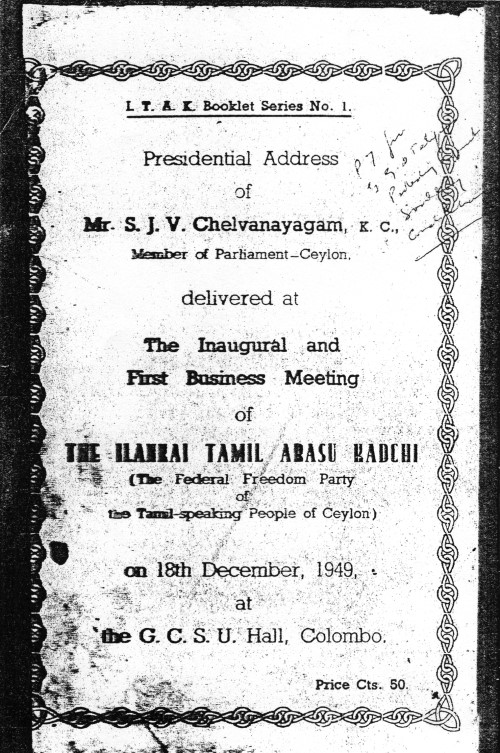
One year after Independence, S. J. V. Chelvanayakam, C. Vanniasingam, and Senator E. M. V. Naganathan founded the Illankai Tamil Arasu Kadchi. The inaugural meeting which was also the first business meeting was at the GCSU Hall in Maradana on 18 December 1949. Maradana was selected instead of Jaffna because the politically alert Tamils were in Colombo. Many were clerks in the GCSU. ITAK translated the name into English as Federal Party.” This was intended to mislead the Sinhalese. The correct translation is ‘Lanka Tamil state Party.’ This  political party was committed to a separate state, not federalism.

I am unable to find the full text of the inaugural speech by Chelvanayagam. Here are excerpts. We have met together with the common aim of creating an organization to work for the attainment of freedom for the Tamil speaking people of Ceylon. A Unitary Government with present composition of legislature and structure of executive totally unacceptable to the Tamils. In the absence of a satisfactory alternative we demand the right of self-determination for the Tamil people.”

The Tamils leaders of the 1940s were very arrogant. They looked down on the Sinhalese. According to Sebastian Rasalingam, Ponnambalam had called the Sinhalese ‘racial half breeds’ as a meeting in Nawalapitiya in 1939. When universal suffrage was granted the Tamil leaders expressed indignation at the prospect of a Sinhalese takeover of Ceylon. Chelvanayagam is reported to have said ‘Sinhalese are too small to govern the Tamils’,. Chelvanayagam later canvassed for an exclusive Tamil university in the North. When questioned as to why it had to be exclusively Tamil, he had replied because the Tamils are more intelligent than the Sinhalese.”

Pay compensation to LTTE terrorists says Minister Swaminathan !

June 23rd, 2018

P.A.Samaraweera, Brisbane

 Minister Swaminathan has presented a cabinet memo to pay compensation to LTTE terrorists and the families of the dead terrorists. According to him there are about 12,000 rehabilitated LTTE terrorists and about 30,000 from LTTE Mahaveera families. In addition to this, there will be many Tamil terrorist sympathisers who migrated to foreign countries returning for the sake of claiming compensation. 

These terrorists fought a 30 year war against a legitimate govt demanding one-third of the country for 11 per cent of the Tamil population. During this period they used suicide bombers to kill leading political figures, destroyed public property, bombed sacred Buddhist places of worship, killed Buddhist monks, civilians and members of the armed services. They bombed the Central Bank to destroy the economy. 600 innocent policemen who surrendered were killed mercilessly. Minister Swaminathan is not the least interested in the damage done to  the country by the worlds number one terrorist group, who claimed to be invincible. Based on the cabinet memo, compensation has to be paid to any members of Prabhkaran’s family  as well. According to his vision, there is no difference between the LTTE terrorists and the members of the armed services who fought them. Surprisingly, UNP MP Mujibur Rahman supports this memo. He seems to have forgotten so quickly how the LTTE terrorists massacred Muslims while praying in Mosques. And how Muslims were given only two hours to leave Jaffna. 

This compensation has to come from the taxes paid by the people. This includes members of the armed forces and the people who suffered from the atrocities of the LTTE. The irony is that these people are contributing to pay compensation to terrorists who tried to wipe them out. This is an insult to the “Rana Viruvos ” who fought the war risking their lives. 

Obviously, Minister Swaminathan is acting on the instructions of the LTTE rump and the Tamil diaspora, and presented the cabinet memo to appease them. So far the Yahapalanaya govt seems to be silent on this.  

Sri Lanka Will be Destroyed, Violated and Divided into Two Nations Under a Hitler-Like Leader

June 22nd, 2018

Dilrook Kannangara

By 1930s Germany was in utter desperation somewhat like Sri Lanka today. However, instead of overcoming its problems the right way, voters increasingly empowered the Nazi Party lead by Adolf Hitler. Within six years the country was in total ruin. US and Soviet soldiers rampaged the country in every way imaginable. Thereafter they shared the loot among themselves – the US taking West Germany and the SU taking East Germany. If Sri Lanka elects a similar character by any comparison, Sri Lanka’s fate will be no different.

There are strange elements that support a local Hitler arguing that it will lead to rapid development, promotion of national interests, renew national dignity and bring social discipline. They cannot be more wrong. Sri Lanka depends on the US and the EU for over than one half of its export income. Antagonizing these two will immediately ruin Sri Lanka’s economy and pit the people againt the leaders. These two blocks (despite their own shortcomings) stand for democracy and human rights. Even the election of a Hitler-like leader will pit them against Sri Lanka. Tamil Eelamists will support a local Hitler as they know such a despot will pave the way for the division of the island nation.

Sri Lankans are not a lazy lot. They are doing their very best under very difficult conditions. The nation, saddled deep in debt, has very limited economic potential. This can be fixed by increasing (not decreasing) tax. Increases in tax should not target the average family, but the ultra-rich tax evading cartels. However, both major political camps are their lapdogs. They are mere servants of these crooks. As such, there will be no improvement in state tax revenue and the debt crisis will only deepen. If US and EU export income is any way affected, Sri Lanka’s assets will have to be auctioned, like it or not. Over-governance is another problem. Until the economic crisis is over, local government bodies and provincial councils must be scaled down.

JR and Premadasa tried the violent approach to terrorize people and force them to work under bad economic conditions. It failed to achieve any economic improvement. Instead these policies gradually reduced the GDP growth rate until the LTTE did the nation a great favour in 1993. People received the news with jubilation. Authoritarianism has no history in Sri Lanka and it certainly has no future.

Those who still support a Hitler-like leader must look at countries like Cuba, Venezuela, North Korea, Laos, Cambodia, Yemen, Zimbabwe and Burma. They suffer stagnant economies and people grab the first opportunity to leave these hell holes. No Sri Lankan living in the island wants to end up like this.

Sri Lanka needs law and order. The law must be implemented equally to all. It can be done if there’s the political will. However, a Hitler-like leader cannot do so as he will protect his goons over others. Only a true democrat can bring about law and order and tap the freedom-driven intellectual potential of the knowledge economy.

ජාතික ආරක්ෂාවට මුවාවී ආණ්ඩුව මාධ්‍යවේදීන්ගේ ජීවිත අනතුරේ දැමීමට ගන්නා උත්සාහය වහා හකුලා ගනු!

June 22nd, 2018

වෙබ් මාධ්‍යවේදීන්ගේ ජාතික ව්‍යාපාරය  

ජාතික ආරක්ෂාවට මුවාවී ආණ්ඩුව මාධ්‍යවේදීන්ගේ  ජිව්ත අනතුරේ දැමිමට ගන්නා උත්සහය වහාම හකුලා ගන්නා ලෙස වෙබ් මාධ්‍යවේදීන්ගේ ජාතික ව්‍යාපාරය ලෙස අපි ජනපතිවරයාට,අගමැතිවරයාට මෙන්ම ආණ්ඩුවේ වගකිවයුතු පාර්ශවයන්ට දැඩි ලෙස අවධාරණය කර සිටිමු.

මැයි මාසයේ උතුරේ හා දකුණේ පැවැති විරු සැමරුම් පිළිබඳව ආරක්ෂක අංශ ගන්න පියවර සම්බන්ධයෙන් තොරතුරු ඇතුලත්ව 2018 මැයි මස 25 දා දිනමිණ හා ලක්බිම පුවත් පත් හි පළවු ප්‍රවෘත්ති ගැන අපරාධ පරික්ෂණ දෙපාර්තමේන්තුව පරික්ෂණයක් ආරඹා ඇති අතර ඒ හරහා එම පුවත් සංස්කරණය කල මාධ්‍යවේදීන්ගේ පෞද්ගලික තොරතුරු ලබා ගැනිම හරහා ඔවුන්ගේ ජිවිත අවදානමකට ලක්කිරීමට කටයුතු කර තිබේ.  

පසුගිය මැයි මස 25 වන දින ලක්බිම පුවත් පතේ මාධ්‍යවේදීන් වන ලසන්ත වීරකුලසුරිය,ගයත්‍රී ගිංගගආරච්චි විසින් සංස්කරණය කර ඇති  අදාළ පුවත පිළිබඳව අපරාධ පරික්ෂණ දෙපාර්තමේන්තුව හරහා පරික්ෂණයක් කිරිමට අවශ්‍ය බව දන්වමින් අපරාධ පරික්ෂණ දෙපාර්තමේන්තුව විසින් ලිපියක් යොමුකර ඇති අතර එම ලිපිය මගින්  අපරාධ පරික්ෂණ දෙපාර්තමේන්තුව  අදාළ ලිපිය පලකල මාධ්‍යවේදීන්ගේ නම්,ලිපිනය ඇතුලත් විස්තරයක්ද ඉල්ලා තිබේ.

ඊට අමතරව ලිපිය පලකිරිම සදහා අනුමැතිය ලබාදුන් අය සහ එම පලකරන ලද ලිපියේ සහතික කල පිටපතක්ද අපරාධ පරික්ෂණ දෙපාර්තමේන්තුව විසින් ඉල්ලා තිබේ. ලක්බිම පුවත් පත විසින් අදාළ ප්‍රවෘත්තිය පල කිරීමේදී එම පුවතේ අදාළ මාධ්‍යවේදින්ගේ නම් සදහන් කර තිබියදි තවදුරටත් ඔවුන්ගෙ නම් සහ පෞද්ගලික තොරතුරු අපරාධ පරික්ෂණ දෙපාර්තමේන්තුව ඉල්ලා සිටින්නේ මන්ද යන්න ගැටලුවකි.

අනිත් අතට රජයේ රහස්‍යභාවය පිළිබද කිසිදු ගැටලුවක් නොවන මෙම ප්‍රවෘත්තිය සම්බන්ධයෙන් පරික්ෂණයක් කරන්නේ කවර නිතිමය ප්‍රතිපාදන යටතේද යන්න පිළිබද ගැටලුකාරී තත්ත්වයක් මතුව ඇත. මේ සම්බන්ධයෙන් රහස් පොලිස් ආරංචි මාර්ග සදහන් කරන්නේ ආරක්ෂක මණ්ඩලයේ සාකච්ඡා වු කාරණයක් ලෙස මෙය පළ කිරිම හේතුවෙන් පරික්ෂණ සිදු කරන බවයි. එහෙත් එවැනි කාරණයක් ගැන පරික්ෂණයක් කරන බවක් අපරාධ පරික්ෂණ දෙපාර්තමේන්තුව විසින් එම පුවත් පත් දෙකට පරික්ෂණයක් කරන බව දැන්වු ලිපියේ සටහන් කර නොතිබිමද පුදුමයට කරුණකි.

රට බෙදන වැඩ ගැන ආරක්ෂක අංශ සීරුවෙන් …. ජනපති -අගමැති උපදෙස් දෙති! යනුවෙන් පලකල පුවත් හරහා රටේ ජාතික ආරක්ෂාවට සිදුවු හානිය කෙසේවෙතත් ආණ්ඩුව තුල සිටින කල්ලි කණ්ඩායම් එම පුවත පලකල මාධ්‍යවේදීන් සම්බන්ධයෙන් මේ අකාරයේ ක්‍රියාමාර්ගයක් ගැනිම හරහා කිසියම් පිරිසක් සතුටු කිරිමට උත්සහ දරණ බව නම් මනාව පැහැදිළිය. එම පිරිස සංතර්පණය කිරීම සඳහා  මෙම මාධ්‍යවේදීන්ගේ තොරතුරු අනාවරණය කිරිමට ආණ්ඩුවේ කල්ලි කණ්ඩායම් හි උත්සහය බව අපගේ මතය වේ. එය තවත් තහවුරු වන්නේ එම ප්‍රවෘත්තිය සම්බන්ධයෙන් අපරාධ පරික්ෂණ දෙපාර්තමේන්තුවට පරික්ෂණයක් කිරිමට අණ දුන්නේ කව්ද යන්න පිළිබදව තවමත් අනාවරණය නොවිම හරහාය.

ජාතිවාදය පෙන්වමින් ආණ්ඩුවේ නොහැකියාව,දුෂණ,වංචා,අපරාධ වසා ගැනිම සදහා වෙබ් අඩවි සහ සමාජ ජාලා අවහිර කිරිමට කටයුතු කල වත්මන් යහපාලන ආණ්ඩුව එහි තවත් දිගුවක් ලෙස පසුගියදා අමතක වු අතීතය මතක් කල  TNL රූපවාහිනියේ පොල්ගහවෙල ප්‍රති විකාශනාගාරය ද ගලවාගෙන ගිය අතර එය මාධ්‍යයට එරෙහි ආණ්ඩුවේ මාධ්‍ය මර්දනය සදහා නීතිය භාවිත කරන බවට හොදම සාක්ෂිය බවට මේ වන විට පත්ව තිබේ.

ඒ හේතුවෙන් මාධ්‍යවේදීන් ආරක්ෂා කරන බවට පොරොන්දු වෙමින් පැමිණි යහපාලන ආණ්ඩුව දැන් කිසිදු අපරාධයක් නොවන කාරණා සම්බන්ධයෙන් පවා මාධ්‍යවේදින්ගෙන් ප්‍රශ්න කරන්නේ කුමකට ද යන්න පිළිබදව බලධාරීන් වහාම අවධානය යොමුකල යුතු බව වෙබ් මාධ්‍යවේදීන්ගේ ජාතික ව්‍යාපාරයේ අදහසයි.

කැදවුම්කරු 

දුමිදු දිසානායක

වෙබ් මාධ්‍යවේදීන්ගේ ජාතික ව්‍යාපාරය  

සැ.යුපුවතට අදාළව රහස් පොලිසිය ලක්බිම පුවත් පතට යැවු ලිපිය සහ අදාළ පුවත මේ සමග අමුණා ඇත.  

Yahapalanaya: Comedy continues!

June 22nd, 2018

By Dr Upul Wijayawardhana Courtesy The Island

When I wrote ‘Raigamaya and Gampolaya’ just before the last local government elections (The Island, 5 February), I thought it was impossible for the state of affairs to get much worse. I am proved wrong; well, things have got worse and the comedy continues. Sorry, I should call it a tragi-comedy, with apologies to the populace that has to tighten belts, regularly, with no hope in sight, witnessing helplessly ramping corruption destroying the country, while politicians get enriched. Admittedly, no political script writer, even with an avid sense of humour, could have imagined such a farcical story as the unfolding Yahapalana saga. But, what is happening to our country is absolutely tragic.

Yahapalana mob does not care, busy feathering its own nest; the two leaders are at each other, undercutting and scheming to win the next presidential election, a post they vowed to abolish at the feet of Venerable Maduluwawe Sobitha Thero. In a way, the Venerable Thera was fortunate to depart to a better place, before his heart was fully broken by the antics of those he empowered. He is dead and gone but even death has not spared him of political manoeuvring. He would have turned 76 and definitely lived much longer had he not got involved in politics, on 29th May. To commemorate this birth anniversary, a ceremony had been held, but I simply cannot understand why this is done after someone is DEAD. Birth ends in death and, after that, if any, it is sensible to remember on the day of death; but that is another story. Our ‘great’ President gate-crashed, by his own admission, but it looks as if the ‘forgetful’ former Finance Minister was invited. “Prez lambasts UNP, warns of further revelations” was the main headline in ‘The Island of 31 May. He promised to do everything he had failed to do in the last three years and blamed the ‘other-half’ for all the failings. If you believe in an afterlife, as death would not dim the determination of a great being, Venerable Sobitha should have appeared from a ‘higher plane’ and told him, then and there, “Sirisena! Enough is enough, call off the bluff!!”

After the miserable showing in the local government elections, His Excellency planned his greatest ‘coup’; a no-confidence motion to oust the Prime Minister, he himself appointed, unconstitutionally. He was sure of success as there were enough UNPers ready to stab the aging and ‘never-winning’ leader in the back. Stage for the show-down was set, when TNA, ‘minority opposition’ declared they would abstain. Sensing danger, interested parties, including the USA and terrorist rump went into overdrive, as the fall of their man would lead to dampers on their project. ‘Bosses’ instructed TNA to vote against and everyone, including the President, got cold feet when he changed his instructions. His flock was allowed to vote as they wished, resulting in a further division of the SLFP; so, Rani survived, yet again!

Not to be outdone, the UNP taught the President a lesson by catching his Chief-of-Staff in the act of accepting a bribe. Pretty smart operation that was and wish there were many, so that the country would be rid of corruption. But the UNP is not interested in the country, any longer, but simply carries on with Dicky’s dictum: ‘Catch the corrupt only if they hurt us’.

Then comes the revelations about the millions gifted by Perpetual to (Dis) Honourable Members of Parliament who added provisos to the COPE report. Which side leaked the information, no one seems to be sure but it does not matter, as allegations are flying across the Chamber of The House, showing what a bunch of hypocrite’s rule over us. The usually sedate Speaker got up from a slumber, to plead with his colleagues not to throw mud at each other, without realising that they are simply doing what is natural to them.

An addendum is needed to my article ‘Ranil’s Watergate’ (The Island, 2 April) considering what has transpired since. The President’s attempt to bury parts of the report in the secrecy of the National Archives is a cover-up too. Surely, his secretary would not have done this without HE’s instructions and the Secretary’s claim that blacked-out portions will be sent to the Parliament on the basis of the Attorney General’s advice is nothing short of putting the honour of public servants at stake.

It is pretty obvious that the bond scams, and the cover-up by Ranil, and the subsequent cover-up of the report, by Maithri, make it the ‘Yahapalana Watergate’.

In this scenario, it is not surprising that there is a vast amount of correspondence in ‘The Island’ with various suggestions, as to how we can get out of the mess. Of course, there are repeated pleas from NGO lackeys for reinvigorating the Yahapalana project, some misquoting, may be through ignorance or even may be deliberate, from Buddhist concepts. Some go to the opposite of looking for fresh faces. It is wonderful, if it can be done but it is an impossible task. Though we mock and blame politicians, it is no easy task which needs much experience. We cannot have a distinguished personality from a different field, simply because s/he is honourable. By trying to learn on the job, much harm can be done.

Considering all this, the suggestion by Prof N A De S Amaratunga seems most practical: ‘MR must learn from past mistakes’ (The Island, 18 June). True, there are accusations of corruption; very true, MR made mistakes. Who does not? Which politician does not? Those who heap praise on Lee Kuan Yew forget, very conveniently, that he was a dictator who suppressed any opposition, mercilessly. We need a politician with a proven track record who can deliver and MR fits the bill, provided he has learned from past mistakes. The voters punished him for his mistakes and he has paid for his sins but the question is ‘Has he learned from past mistakes?’. Hope he has, for the sake of the future of our Motherland.

We are still under threat from international do-gooders. Unpatriotic politicians of ours, co-sponsored UNHRC resolutions against us, at the behest of the USA. Even when lifelines were thrown at us they disregarded. Lord Naseby’s sterling efforts were met with ridicule by our foreign ministry. After all this, what has happened? On 19th June, Nikki Hayley, the US envoy to the UN, said UNHRC was a “hypocritical” body that “makes a mockery of human rights”. In announcing the withdrawal of the USA from UNHRC she said “it was a cesspool of political bias” How true! Some of us have been telling this for a long time, Nikki!

The USA pushed us to the cesspool. Our then Foreign Minister, must be a lover of cesspools, volunteered to jump. Now the USA is running from the cesspool but we are drowning in it. Yahapalanaya pushed us there and we need someone to save us!

JO asks Sirisena why he is still in yahapalana Govt.

June 22nd, 2018

By Shamindra Ferdinando Courtesy The Island

Joint Opposition MP Shehan Semasinghe yesterday said that President Maithripala Sirisena owed an explanation as to why he continued the partnership with the UNP after having accused that party of destroying the national economy.

Semasinghe pointed out that President Sirisena had gone to the extent of claiming that only his intervention saved the state banking sector from being destroyed by the UNP.

The Anuradhapura District MP said so when The Island inquired about the ongoing efforts undertaken by a section of the SLFP to bring warring factions together.

article_image
Semasinghe

Semasinghe said that President Sirisena and the SLFP parliamentary group couldn’t absolve themselves of the responsibility for protecting those responsible for the first treasury bond scam perpetrated on Feb 27, 2015.

Could President Sirisena assure the public that dissolution of parliament in June 2015 wasn’t meant to save the UNP from the fallout of the first bond scam? Semasinghe asked. Pointing out that the decision to dissolve parliament to prevent the tabling of the COPE report on the first bond scam in parliament on June 24, 2015, Semasinghe alleged that the UNP-SLFP combine was responsible for every wrongdoing thereafter.

Had the SLFP allowed the normal COPE procedure followed by proper legal action, the far bigger second bond scam could have been averted, Semasinghe said. In fact, the SLFP’s reaction to the first bond scam was likely to have influenced the second much bigger heist, Semasinghe added. The MP pointed out that the much touted Presidential Commission was appointed only in January the following year and by the time President Sirisena received the report at the end of 2017, the disgraced former Central Bank Governor Arjuna Mahendran had already fled the country.

Semasinghe said that of the 95 lawmakers elected and appointed on the UPFA ticket at the last parliamentary polls in 2015 August 41 (39 SLFP and two CWC members) sided with President Sirisena.

Responding to another query, Semasinghe said that the electorate had rejected both the UNP and the SLFP alike at the countrywide Local Government polls last Feb. Both the SLFP and the UNP hadn’t been able to recover in spite of much publicized cosmetic cabinet changes and restructuring and various other measures even four months after massive electoral drubbing, the Anuradhapura District MP said.

Referring to a recent live interview on the programme Salakuna on Hiru, Semarasinghe said that Minister Patali Champika did not mince his words when he declared that the SLFP was no longer in a position to contest a countrywide election. Minister Champika is on record as having said that the UNP, too, would suffer the same fate in case it lost the next election, he said; adding that the Joint Opposition was in a commanding position.

The JO contested the February Local Government polls on the Sri Lanka Podujana Peramuna (SLPP) ticket.

Semasinghe alleged that the country was at a standstill thanks to waste, corruption and irregularities. Of course, there had been mistakes during the previous Rajapaksa administration. There were shortcomings and failures, the MP said. But, under the former President’s leadership, the UPFA achieved many successes, in addition to bringing the once invincible LTTE to its knees militarily.

Recent images from Vishvamadu of a Lieutenant Colonel Ratnapriya Bandu felicitated by civilians proved beyond the success of post-war national reconciliation process initiated by the war winning government. The government conveniently turned a blind eye to glaring example of the military-civilian relationship, Semasinghe said. In spite of lies propagated by those interested parties hell-bent on hauling Sri Lanka before hybrid judicial mechanism, the people of the Vanni heartland had recognized government efforts, the MP said.

The MP alleged that the government wanted to find fault with the previous government and the military for defeating the LTTE.

Commenting on ongoing controversy over Rehabilitation, Resettlement and Hindu Affairs Minister D.M. Swaminathan proposing special compensation package for those who had been killed fighting successive governments, Semasinghe said the government seemed confused. Obviously, there had not been any previous instance of any government compensating under any circumstances terrorists and their families, Semasinghe said.

The MP said that the electorate would vote against the UNP and the SLFP at any election. They had been rejected in February and the same fate awaits them at Provincial Council, presidential and parliamentary polls.

යුද හමුදාවේ බලඇණි 33ක් ඉවත් කිරීම

June 22nd, 2018

අනුරුද්ධ බණ්ඩාර රණවාරණ මාධ්‍ය ලේකම් ජාතික නිදහස් පෙරමුණ

යුද හමුදාවේ බලඇණි 33ක් ඉවත් කිරීමට සහ නිලධාරි තනතුරු 938ක්, සෙසු නිලයන් 23,266ක් ඉවත් කිරීමට 2018 ජූලි මස අග වන විට කටයුතු කරන ලෙස යුද හමුදා රෙජිමේන්තු ප්‍රධානීන් හා අදාළ ඉහළ නිලධාරීන්ට නියෝග කරමින් එහි ප්‍රධාන මාණ්ඩලික, අධ්‍යක්‍ෂ ජනරාල් මේජර් ජෙනරාල් ජී.ඩී.අයි. කරුණාරත්න නිකුත් කළ 2018 ජුනි 14 දාතම සහිත ලිපිය ජාතික නිදහස් පෙරමුණේ ජාතික සංවිධායක, පාර්ලිමේන්තු මන්ත්‍රී ජයන්ත සමරවීර මහතා මාධ්‍ය වෙත ඉදිරිපත් කර සිටියේය.

එම ලිපියට අමතරව ඊට අදාළ ඇමුණුම් දෙකක්ද ඔහු මාධ්‍ය වෙත යොමුකර තිබේ. ඉන් එක් ඇමුණුමක සඳහන් වන්නේ, යුද හමුදාවේ නිත්‍ය බලඇණි සංඛ්‍යාව 112 සිට 98 දක්වා 14කිනුත් ස්වේච්ඡා බලඇණි සංඛ්‍යාව 80 සිට 61 දක්වා 19කිනුත් අඩු කළ යුතු ආකාරය ය. එසේ බලඇණි ප්‍රමාණය 33කින් අඩු වන විට යුද හමුදාවේ නිලධාරින් සංඛ්‍යාව 5793 සිට 4855 දක්වා 938කිනුත් සෙසු නිලයන් 1,33,427 සිට 1,10,161 දක්වා 23,266කිනුත් අඩු කිරීමට ද එම ඇමුණුම මගින් උපදෙස් ලබා දෙයි.

දෙවන ඇමුණුම මගින් පෙන්වා දී ඇත්තේ අහෝසි කිරීමට නියමිත බලඇණි 33ට අදාළ තොරතුරු ය. එක් බලඇණියක නිලධාරීන් 25ක් සහ සෙසු නිලයන් 650ක් සිටින අතර එක් බලඇණියක් ස්ථානගතව සිටින්නේ හමුදා කඳවුරු 04ක් හෝ 05ක් ලෙස ය. ඒ අනුව බලඇණි 33ක් අහෝසි කිරීමත් සමඟ ඒවාට අනුයුක්තව පැවැති හමුදා කඳවුරු 100-150ත් අතර ප්‍රමාණයක් ඉවත්ව යයි. එසේම එම දෙවන ඇමුණුම මගින් දක්වා ඇත්තේ නන්දිකඩාල්, වව්නියාව පෙරියනාඩු, මැණික්ෆාම්, තිත්තම් පේදුරුතුඩුව, තුනුක්කායි මල්ලාවි, මුරුක්කන්, ජීවනගර්, වැලිඔය, යාපනය, නෙල්ලිඅඩි, ඉරණමඩු, මන්නාරම, මුලතිව්, තාලෙයි මන්නාරම, තඞ්ඩුවාන්, පුනරින්, කිලිනොච්චිය, පුදුකුඩුඉරිප්පු යන ආරක්‍ෂක මර්මස්ථානවල පිහිටි බලඇණි හා ඒවාට අයත් කඳවුරු ඉවත් කළ යුතු බව ය.

මෙසේ තිබියදී හමුදා මාධ්‍ය ප්‍රකාශක, බි්‍රගේඩියර් සුමිත් අතපත්තු එම කරුණු වසන් කිරීම කනගාටුවට කරුණක් බව ද ජයන්ත සමරවීර මහතා පැවසීය.

ඔඞ්ඩුසුඩාන් ප්‍රදේශයෙන් ක්ලෝමෝ බෝම්බ ඇතුළු අවි ආයුධ හමු වී ඇති මේ මොහොතේ එම ප්‍රදේශවල ස්ථාපිතව ඇති යුද හමුදා කඳවුරු ඉවත් කිරීම යළි බෙදුම්වාදී කොටි ත්‍රස්තවාදයට උඩගෙඩි දීමක් යැයි ද ඒ මහතා පෙන්වා දුන්නේය.

අනුරුද්ධ බණ්ඩාර රණවාරණ
මාධ්‍ය ලේකම්
ජාතික නිදහස් පෙරමුණ

PTL’s alleged money trading: 10,000 cheques perused

June 22nd, 2018

Shehan Chamika Silva Courtesy The Daily Mirror

Senior Deputy Solicitor General Haripriya Jayasundara, appearing for the CID, told the Fort Magistrate’s Court yesterday that the prosecution was perusing some 10,000 cheques in expectation of uncovering the PTL’s money trading patterns, which was not an easy task by any means.

She explained this in response to President’s Counsel Kalinga Indatissa, who questioned the prosecution on the progress of the investigation during the past two weeks as the further reports filed recently had nothing to do with the main inquiry.

SDSG Jayasundara responded saying it was a complex and broad investigation in which the prosecution was checking on other potential wrongdoings committed by the suspects under the Registered Stock and Securities Ordinance.

During her submission, she said the CID had recorded another statement from a person called Amal Ravindranath who confirmed the earlier revelation of Rs.3 million worth of cheques received by an MP (Sujeewa Senasinghe) from W.M. Mendis & Companies.

Gazette issued listing 14 LTTE members

June 22nd, 2018

Courtesy The Daily Mirror

The Government has issued an extraordinary gazette on Wednesday listing 14 individuals as designated persons who have connections with the LTTE in terms of terrorism-related activities and funding and financing of terrorism, to the List of Designated Persons.

The Gazette which was issued by Defence Ministry Secretary Kapila Waidyaratne, adds amendments to the List of Designated Persons under Regulations 4 (7) of the United Nations Regulations No. 1 of 2012.

According to the Gazette, the names and designations of the 14 people are:

LTTE intelligence Leaders Nadaraja Sathyaseelan alias Seel Maran, Antonyrasa Antony Calistor alias Parathan and Jeewarathnam Jeewakumar alias Siranjeew.

Air Wing Members Velaudan Pradeepkumar alias Kaleeban, Siwarasa Surendran alias wadann, Sivagurunadan Murugadas alias Kadirawan and Thirunilakandal Naguleshwaran alias Pushpanadan.

Flying Instructor Maheshwaran Ravichandran alias Mendis alias Thirukkumaran.

International Financial Leader Sivasubramaniyam Jeyaganesh alias Ganesh alias Samraj.

Money Collector Ponnasami Paskaran alias Jeyakaran.

LTTE members Suresh Kumar Pradeepan, Kandasamy Krishnamoorthi alias Moorthi, Kamalasinham Arunakulasinham alias Kamal and Tony Jihan Murugesapillai.

The United Nations Regulations No. 01 of 2012 issued by the Foreign Affairs Minister promulgating the United Nations Security Council Resolution 1373 (2001) designating individuals and entities related to terrorism and terrorist financing in national level.

Accordingly, Institutions are obliged to have measures in place to identify and freeze funds, financial assets or economic resources of such designated persons and entities upon order by the Competent Authority.

Under the provisions of said regulations Secretary to the Ministry of Defense has been appointed as the Competent Authority for the implementation of UNSCR 1373 and its successor resolutions in Sri Lanka.

Leopard killing: Court orders to arrest suspects

June 22nd, 2018

Courtesy The Daily Mirror

The Kilinochchi Magistrate’s Court today ordered the police to examine video clips of the incident where a leopard was brutally killed in Kilinochchi on Thursday and arrest those involved in the killing.

Special investigation against leopard killers – Kiriella

June 22nd, 2018

Courtesy Adaderana

The individuals responsible for the killing of a leopard at Ambalkulam area in Kilinochchi will be punished accordingly, says Deputy Minister of Sustainable Development, Wildlife and Regional Development Palitha Thewarapperuma.

He made these comments to the media last night (21).

The deputy minister added that the Minister of Sustainable Development, Wildlife and Regional Development Field Marshal Sarath Fonseka has approved to take the maximum legal actions to be taken against the killers.

The government is investigating the killing of the leopard that had attacked a village in the Kilinochchi area, says the Leader of the House, Minister Lakshman Kiriella.

He emphasized this today (22) responding to a query raised in the parliament regarding the incident.

Minister of Buddha Sasana Gamini Jayawickrama also pointed out that immediate legal actions need to be taken against the killing of the leopard and the responsible individuals should be arrested.

https://youtu.be/nKK84mdohoU

Gnanasara Thero granted bail

June 22nd, 2018

Courtesy Adaderana

General Secretary of the Bodu Bala Sena (BBS) organisation Ven. Galagoda Aththe Gnanasara Thero has been granted bail by the Homagama Magistrate’s Court.

He was ordered released on two personal bonds of Rs 500,000 each by the Homagama Magistrate Sudesh Ranatunga, who also barred Ven. Gnanasara Thero from leaving the country.

The magistrate ordered to notify the Immigration and Emigration Controller regarding the decision.

Ven. Gnanasara Thero was sentenced to 6 months of rigorous imprisonment on June 14, for threatening Sandya Ekneligoda, the wife of missing journalist Prageeth Eknaligoda within the Homagama court premises.

Attorneys representing the Thero filed an appeal challenging the verdict the very next day.

The appeal, which was slated to be taken up on Monday (18), had been postponed to today due to the absence of an official from the Attorney General’s Department for the hearing.

The BBS General Secretary was granted bail when the appeal was taken up for hearing today (22).

Matara jewellery theft & shootout: 3 arrested suspects in the ICU (with latest CCTV foootage) රන් මංකොල්ලයේ සියල්ල හෙළිවෙයි-අත්අඩංගුවට පත් සැකකරුවන් 3ක් ICU (නවතම CCTV දර්ශන සමඟ)

June 22nd, 2018

Sri Lanka Police said the four suspects arrested so far following the exchange of gunfire between a gang of armed robbers and police officers during a jewellery shop robbery gone awry in broad daylight in Matara, are notorious criminals connected to a number of other crimes.

Three police officers and two civilians were injured and hospitalised following the shootout outside a jewellery shop in the Matara town, between several armed men wearing helmets who were robbing the store and policemen responding to a witness phone call, at around 10.45am this morning.

One of the wounded police officers, identified as a Constable by the name of Weerasinghe Gedara Suranga Pradeep Weerasinghe (69532), succumbed to injuries while receiving treatment at the Matara Hospital’s ICU.

Acting IGP C.D. Wickramaratne has decided to posthumously promote the police officer who died in the line of duty to the rank of Sergeant.

Two motorcycles used by the suspects, one ‘Mini-Uzi’ submachine gun, eighteen 9mm bullets and a magazine sound at the scene of the incident have been taken into custody.

Following a search operation carried out in the vicinity by the police immediately after the gun battle, one of the suspects was caught in the Hunukotuwa area.

The suspect was identified as Chamara Indrajith Jayasundara, a resident of Maligathenna in Veyangoda.

He is also the main suspect in the shooting and killing of an individual and injuring four others including a pregnant woman during a musical show at Nittambuwa on April 21, 2018.

The other three suspects were arrested after they had admitted themselves into the Karapitiya Teaching Hospital with gunshot wounds.

One of them has been identified as Dharmakeerthi Tharaka Perera Wijesekara a.k.a ‘Kosgoda Tharaka’, who is a notorious criminal involved in organized crime and wanted by the police in connection with several crimes.

Police said that he is currently receiving treatment in the ICU of the Karapitiya Hospital.

Another injured suspect was identified as Dharmakeerthi Maduka Nirmal Perera Wijesekara, the brother of the aforementioned ‘Kosgoda Tharaka’, while he too is in the intensive car unit of the hospital.

The other arrested robber is an individual by the name of Irandeniya Athula Kithsiri Kumara, a resident of Dutuwewa.

In addition to this police have also taken into custody Kosgoda Tharaka’s mother, Agampodi Janaki Priyanthi Soysa, under whose name one of the motorcycles used by the suspects was registered under.

Police also discovered a locally-manufactured firearm (Galkatas) which uses 9mm bullets inside her home.

https://youtu.be/27J8wye368A

Two nabbed with LTTE uniforms, flags and claymore explosives

June 22nd, 2018

Courtesy Adaderana

Two individuals in possession of LTTE military uniforms, flags of the terrorist organization and a stock of claymore explosives have been arrested this morning (22) on the Oddusuddan road in Mullaitivu.

According to the police, the suspects were taken into custody in a sudden search carried out by the police, while the goods and the explosives were being transported in a three-wheeler.

There had been three suspects in the vehicle and one of them had managed to escape while the police was making the arrest.

The arrested suspects will be produced before the Mullaitivu Magistrate’s Court.

Oddusuddan police is conducting further investigations to uncover the reasons for transporting the said items and explosives.

ඔඩ්ඩුසුඩාන්වලදී ඇල්ලූ LTTE කොඩි බෝම්බ ආවේ කොහෙන්ද? ප්‍රදේශය පුරා සෝදිසි මෙහෙයුමක්

June 22nd, 2018

මුලතිව්- ශෂිකුමාර් උපුටාගැණීම  මව්බිම

මුලතිව් _ ඔඩ්ඩුසුඩාන් ප්‍රදේශයේදී කොටි සංවිධානයට අයත් නිල ඇඳුමක්, කොටි සංවිධානයට අයත් කොඩියක් සහ බෝම්බ ඇතුළු යුද උපකරණ තොගයක් ත්‍රිරෝද රථයකින් ප්‍රවාහනය කරමින් සිටි පිරිසක් අත්අඩංගුවට ගත් බවට ඔඩ්ඩුසුඩාන් පොලිසිය කියයි.

ඔඩ්ඩුසුඩාන් පේරාරු මංසන්ධිය ප්‍රදේශයේදී මාන්කුලම් පොලිසියට අයත් රථවාහන පොලිස් නිලධාරීන් පිරිසක් පසුගියදා (21දා) රාත්‍රියේ මුර සේවයේ යෙදී සිටියදී පැමිණි ත්‍රිරෝද රථයක් පරීක්ෂා කිරීමට යෑමේදී ත්‍රිරෝද රථය නොනවත්වා ධාවනය කොට ඇති අතර, පසුව රථවාහන පොලිස් නිලධාරීන් විසින් ත්‍රිරෝද රථය ලුහුබඳින අවස්ථාවේදී එහි සිටි එක් අයකු පලාගොස් ඇත.

ත්‍රිරෝද රථයේ රියැදුරු හා තවත් අයකු අත්අඩංගුවට ගැනීමට එහිදී රථවාහන පොලිස් නිලධාරීන් විසින් පියවර ගත් අතර මුලතිව් පුදුකුඩිඉරිප්පු දේවිපුරම් ප්‍රදේශයේදී ත්‍රිරෝද රථයේ සිට පැනගිය බවට සැක කෙරුණු පුද්ගලයා පෙරේදා (22දා) අත්අඩංගුවට ගෙන ඔඩ්ඩුසුඩාන් පොලිසිය ප්‍රශ්න කරගෙන යයි.

ත්‍රිරෝද රථය පරීක්ෂා කිරීමේදී කොටි සංවිධානය විසින් භාවිත කරන ලද නිල යුද ඇඳුමක්, කොටි සංවිධානයේ කොඩි කිහිපයක්, ක්ලේමෝ බෝම්බයක්, අත්බෝම්බයක්, ඩෙටනේටර් තොගයක්, ටී. 56 පතරොම් ඇතුළු යුද උපකරණ තොගයක් තිබී පොලිසිය අත්අඩංගුවට ගෙන තිබේ.

කෙසේ නමුත් යුද සමයේදී කොටි සංවිධානය විසින් භාවිත කරන ලද මෙම යුද උපකරණ නැවත මෙලෙස රැගෙන යෑම පිළිබඳව ආරක්ෂක අංශවල දැඩි අවධානයකට යොමුව ඇත. ප්‍රදේශයේ සිටින සියලුම පොලිස් නිලධාරීන් හා යුද හමුදා නිලධාරීන් එක්ව පෙරේදා (22දා) අලුයම සිට පුළුල් සෝදිසි මෙහෙයුමක් දියත් කොට ආරක්ෂාව තර කොට ඇත.

අති විශේෂ ගැසට් එකක් කොටි 14ට එන්න තහනම්

June 22nd, 2018

චාමර අමරසූරිය උපුටාගැණීම  මව්බිම

එල්.ටී.ටී.ඊ. ත්‍රස්ත සංවිධානයේ නායකයන් ඇතුළු එම සංවිධානයේ සාමාජිකත්වය දැරූ දැනට විදෙස් ගතව සිටින පුද්ගලයන් 14 දෙනකුට මෙරටට ඇතුළු වීම තහනම් කරමින් අති විශේෂ ගැසට් පත්‍රයක් නිකුත් කර තිබේ.

ආරක්‍ෂක අමාත්‍යාංශයේ ලේකම් ජනාධිපති නීතිඥ කපිල වෛද්‍යරත්න මහතා විසින් මෙම අති විශේෂ ගැසට් නිවේදනය නිකුත් කර ඇත.
අංක 2076/18 දරන එම අති විශේෂ ගැසට් නිවේදනයෙන් දැක්වෙන්නේ 2012 අංක 1 දරන එක්සත් ජාතීන්ගේ නියෝගවල 4 (7) වැනි නියෝගය අනුව නම් කරන ලද තැනැත්තන්ගේ ලැයිස්තුව මෙලෙස සංශෝධනය කර ඇති බවයි.

නඩරාජා සත්‍යසීලන් හෙවත් සීල්මාරන් (බුද්ධි අංශ නායක), කමලසිංහම් අරුණ කුලසිංහම් හෙවත් කමල් (එල්.ටී.ටී.ඊ. සාමාජික), ඇන්ටනී රාසා ඇන්ටනී කැලිස්ටර් හෙවත් පරදන් (බුද්ධි අංශ නායක), සිවසුබ්‍රමනියම් ජෙයගනේෂ් හෙවත් ගනේෂ් හෙවත් සාම්රාජ් (ජාත්‍යන්තර මුදල් අංශ නායක), පොන්න සාමිපාස්කරන් හෙවත් ජෙයකරන් (මුදල් එකතු කරන්නා), වෙලායුදන් ප්‍රදීප් කුමාර හෙවත් කලීබන් (ගුවන් අංශ සාමාජික), සිවරාසා සුරේන්ද්‍රන් හෙවත් වදාන් (එල්.ටී.ටී.ඊ. සාමාජික), සිවගුරුනාදන් මුරුගදාස් හෙවත් කදිරවන් (ගුවන් අංශ සාමාජික), තිරුනිලකන්දල් නගුලේෂ්වරන් හෙවත් පුෂ්පනාදන්, (ගුවන් අංශ සාමාජික), මහේෂ්වරන් රවිචන්ද්‍රන් හෙවත් මෙන්ඩිස් හෙවත් තිරුක්කුමාරන් (පියාසර උපදේශක), සුරේෂ් කුමාර් ප්‍රදීපන් (එල්.ටී.ටී.ඊ. සාමාජික), කන්දසාමි ක්‍රිෂ්ණමූර්ති හෙවත් මූර්ති (එල්.ටී.ටී.ඊ. සාමාජික), ජීවරත්නම් ජීවකුමාර් හෙවත් සිරන්ජීව් මාස්ටර් (බුද්ධි අංශ නායක), ටෝනිජිහාන්මුරුගේසපිල්ලෙයි (එල්.ටී.ටී.ඊ සාමාජික) යන තැනැත්තන් 14 දෙනාගේ නම් මෙරටට ඇතුළු වීම තහනම් කරන අයගේ නම් ලැයිස්තුවට ඇතුළත් කර තිබේ.

ත්‍රස්තවාදය හා සම්බන්ධ ක්‍රියාකාරකම්වල නියැළීම, ත්‍රස්තවාදය සඳහා මුදල් සැපයීම යන කරුණු පෙරදැරි කර ගනිමින් එම ලැයිස්තුවට මොවුන්ගේ නම් මෙලෙස ඇතුළත් කර ඇත.

මේ සම්බන්ධයෙන් ‘මව්බිම’ කළ විමසුමකදී ආරක්‍ෂක ලේකම් ජනාධිපති නීතිඥ කපිල වෛද්‍යරත්න මහතා සඳහන් කළේ බුද්ධි අංශ සහ ආරක්‍ෂක අංශවලින් ලබාදුන් තොරතුරුවලට අනුව මෙම පුද්ගලයන් 14 දෙනාගේ නම් අදාළ ලැයිස්තුවට ඇතුළත් කළ බවයි.

ත්‍රස්තවාදයට සම්බන්ධ පුද්ගලයන්ගේ නම් මෙලෙස ගැසට් කිරීමෙන් ඔවුන් පිළිබඳව විදෙස් රටවල් ආරක්‍ෂක අංශද අවදියෙන් සිටින බව ආරක්‍ෂක ලේකම්වරයා සඳහන් කළේය.

මෙම පිරිසට එරෙහිව ඉදිරියේදී විදෙස් රටවලද සහාය ලබාගෙන නෛතික ක්‍රියාමාර්ග ගන්නා බවද ආරක්‍ෂක ලේකම්වරයා පැවැසීය.
මෙම පුද්ගලයන් 14 දෙනා අතර සිටින ටෝනිජිහාන්මුරුගේසපිල්ලෙයි යන අයට 2009 සැප්තැම්බර් 04 වැනි දින ජාත්‍යන්තර පොලිසිය විසින් රතු නිවේදනයක්ද නිකුත් කර තිබේ.


Copyright © 2026 LankaWeb.com. All Rights Reserved. Powered by Wordpress