සමාජ ආර්ථික දේශපාලනයෙහි විප්ලවීය වෙනසක් කරමු. -සමාජ ප්‍ර‍ජාත්නත්‍ර‍වාදී පක්ෂය

April 12th, 2018

තුසිත බාලසූරිය, ලේකම්, සමාජ ප්‍ර‍ජාතන්ත්‍ර‍වාදී පක්ෂය

ජාතික ආණ්ඩුව එක් අර්බුදයක් නිසා තවත් අර්බුද රැසක් නිර්මාණය කරගෙන ඇත. ජාතික ආණ්ඩුවෙහි අවසානය යහපාලනය උදෙසා කැප වු පුරවැසි බලාපොරොත්තුව නොවුවත් රට පත්ව ඇති අරාජකත්වයට ජාතික ආණ්ඩුව හෝ ජාතික ආණ්ඩුවෙහි හවුල්කාර සිවිල් සංවිධාන නිශ්චිත විසදුමක් ලබාදීමට අපොහොසත් වීම නිසා ජාතික ආණ්ඩුවෙහි අනාගතයද නිශ්චිත නැත.

අද ජාතික ආණ්ඩුව යනු ජාතික උත්සව සංවිධානය කරන ආයතනයකි. ජාතික ආණ්ඩුව විසින් විවිධ ජාතික උත්සව සංවිධානය කරන අතර ජාතික නිදහස් උත්සවය, ජාතික අවුරුදු උත්සවය, ජාතික වෙසක් උත්සවය හා ජාතික නත්තල් උත්සවය ආදී උත්සව පවත්වනවා හැර ජාතික ආණ්ඩුව මෙරට ජාතික ගැටලු විසදීමට විසදුමක් යෝජනා කර නැත.

ජාතික ආණ්ඩුව බලයට පත්වන විට පොරොන්දු වු තිරසාර ජාතික සමගිය උදෙසා වු බලය බෙදීම වැනි සංකල්ප ඒකාබද්ධ විපක්ෂයේ නිරන්තර කකුලෙන් ඇදීම නිසා ආපස්සට ගෙන ඇති අතර නව ව්‍යවස්ථාවක් සම්පාදනය කර ගැනීම වෙනුවෙන් ඇති වු කතිකාව අඩපන කොට ඇත. ඒකාබද්ධ විපක්ෂයට අනුව මෙය යහපාලන ජාතික ආණ්ඩුවක් නොව යමපාලන විජාතික ආණ්ඩුවකි.

සිවිල් සමාජය යෝජනා කරන පරිදි සර්ව පක්ෂ ජාතික ආණ්ඩුවක් නිර්මාණය නොවන්නට ජාතික ආණ්ඩුවෙහි ප්‍ර‍ධාන හවුල්කාර පක්ෂ දෙක අතර විරසකයක අවසන් වීමට නියමිතව ඇත්තේ රට ආපස්සට රැගෙන යන අරාජකත්වයකිනි. එම අරාජකත්වය සාමුහික සමාජයක් උදෙසා වු වාම ව්‍යාපාරයකට ජයගත හැකිය යන්න විප්ලවවාදී වාම අදහසයි.

සමාජ ප්‍ර‍ජාතන්ත්‍ර‍වාදී පක්ෂය විශ්වාස කරන්නේ සිවිල් සමාජය විසින් යෝජනා කරන සමාජ දේශපාලන ප්‍ර‍තිසංස්කරණ සහ විප්ලවීය වාමවාදීන් යෝජනා කරන සමාජ ආර්ථික ප්‍ර‍තිසංස්කරණ ක්‍රියාත්මක නොකර ආණ්ඩු මාරු කිරීමෙන් පවත්නා අරාජකත්වය ජය ගැනීමට නොහැකි බවයි. ඊට අවශ්‍ය විප්ලවීය ප්‍ර‍තිසංස්කරණ යෝජනා කිරීමට අපි ඉදිරියේ දී බලාපොරොත්තු වෙමු.

තුසිත බාලසූරිය
ලේකම්
සමාජ ප්‍ර‍ජාතන්ත්‍ර‍වාදී පක්ෂය

I have a dream  —  Martin Luther King

April 12th, 2018

Dr.Sarath Obeysekera

https://www.lankaweb.com/news/items/2017/01/25/i-have-a-dreammartin-luthe-king/

Posted on January 25th, 2017 Lanka Web

News Item

Martin Luther King anniversary marked by events from Washington to Memphis

Marches, speeches and reflection honour the civil rights leader killed 50 years ago: ‘It makes me cry when I think what they took from us’

I have a dream that one day this nation will rise up and live out the true meaning of its creed: We hold these truths to be self-evident; that all men are created equal.”

I have a dream that one day on the red hills of Georgia the sons of former slaves and the sons of former slave owners will be able to sit down together at the table of brotherhood.

I have a dream that one day even the state of Mississippi, a state sweltering with the heat of injustice, sweltering with the heat of oppression, will be transformed into an oasis of freedom and justice.

I have a dream that my four little children will one day live in a nation where they will not be judged by the color of their skin but by the content of their character.”

And ……….I have a dream today.”

Photograph above is extracted from the Web-page of Megapolis .When I see that area being developed by Chinese ,I feel that Mahinda had some vision and a dream, and if it could have been continued  just after his debacle ,we would have been selling plots to investors. Construction Industry, Cement Industry would have been booming by now.

With Nelum tower in the background , development was  a dream for us .They plan to liberalize boat ownership and Sri Lanka upper echelon who has money will buy a Yacht  ( instead of buying a Benz or a BMW) and park in Port City Marina .It is timely that we started the Yacht Repair and Building Yacts  in Colombo and Galle

We need Marinas and high rises like in Singapore with good facilities and entertainment to entice  investors  .

Galle Harbour was earmarked for a Marina Development .Blue prints were made but various ministers are dilly dallying .If it is implemented ,Galle will be the pinnacle of success in developing tourism like Puket in Tlailand .

Quote

  • SUNDAY TIMES 2

MTD Walkers PLC steps in to resurrect Galle Marina project

By Bandula Sirimanna

Sri Lanka’s ambitious ‘Galle Marina’ project aimed at making the Galle harbour a tourism port which was temporarily halted by the Bodu Bala Sena-led communal tensions in Aluthgama in 2014, is to be resumed soon.  MTD Walkers PLC, an integrated infrastructure and engineering solutions providers has been granted approval to re-commence the construction of yacht/leisure craft repair/shipbuilding facility at the Port of Galle under this initiative, official sources revealed.  This yacht repair project was launched in 2013 with Hadi Hamam Group of Saudi Arabia as the investor and Sea Gulf Shipyard (Sri Lanka), the project proponent at an estimated cost of US$44 million during the Rajapaksa regime.  The Saudi Arabian investor then backed out from the project after the Aluthgama incident where 3 people were killed and 80 were injured.

It is now ready to re-commence the construction work of the yacht repair project in partnership with MTD Walkers PLC as a sum of $ 2 million has already been spent on the project. However Sri Lanka Ports Authority (SLPA) has objected to the recommencement of the project when this matter was taken up at the meeting of Cabinet Committee on Economic Management (CCEM) recently.  SLPA officials claimed that a yacht repair facility was not included in Request for Proposals (RFP) on the proposed Galle Marina.  Overruling the objection, the CCEM has granted approval to MTD Walkers PLC noting that the project should be allowed with clear guidelines on specifications of yachts, this repair facility site could be undertaken.

The SLPA has been directed to provide clear guidelines for this purpose.  The facilities for yachts provided at Galle Port had been damaged during the tsunami and the proposed development is to provide a fully-fledged Marina for the Galle Port to facilitate calling yachts as well as to attract more yachts.  The repair facility in Galle will also attract a large number of vessels from the Maldives, creating many business opportunities for Sri Lanka, official sources said.  The Galle Port is the only Sri Lankan port that provides facilities for pleasure yachts. The International Yacht Society has also recognized the Galle Port as one of the world’s best tourist attraction, officials added.

Unquote

And nothing happened !

People may protest including JVP because they do not like the country to grow .If the country develops them will lose their vote base.

No country can develop without corruption at some level, Even though there are some people in both governments get some kick back  and yet we will have a development which will benefit all of us. .

I have a dream like Martin Luther King ones said..

I want to see that whole Sri Lanka will be a Marina –Paradise with Blue Economy in full swing

Dr.Sarath Obeysekera

Sri Lanka: Canada High Commissioner called over at Ahmadiyya Center, Colombo.

April 12th, 2018

PRESS RELEASE. Abdul Aziz – Press Secretary

E. David Mckinnon, the Canadian High commissioner of Sri Lanka called over at National Headquarters of Ahmadiyya Muslim Jama’at in Colombo today – 11thApril 2018. He was accompanied by Trevor Ludowyke, Senior Development Officer of Canada High Commission.

A.H. Nasir Ahmad – National President, M. Anis Ahmad – National Vice President, R. Bashirudin – General Secretary, A. Abdul Aziz – Press Secretary & National Secretary Tabligh, Moulavi A.B. Musthaq Ahmad – Missionary-in-Charge participated in this audience with the High Commissioner.

A brief introduction on Ahmadiyyath in Sri Lanka as well as the claim of Hazrat Mirza Ghulam Ahmad, peace be on him, was put forward before the High Commissioner.

        High commissioner was presented the book: World Crisis and the Pathway To Peace – A compilation of addresses in various Parliaments by His Holiness Hazrat Mirza Masroor Ahmad, May Allah Strengthen his hands. Few copies of Sinhala Translation of this book as well as Sinhala Translation of the Holy Qur’an were also gifted to the High Commissioner, for the reading of Sri Lankan staff in the Canadian Embassy in Colombo.

        In the end, High commissioner thanked for the opportunity provided.

.

POLITICAL CRISIS DRIVES LANKAN PRESIDENT TO PROROGUE PARLIAMENT TILL MAY 8

April 12th, 2018

Colombo, April 12 (newsin.asia): The looming political crisis in Sri Lanka, especially in parliament, has forced President Maithripala Sirisena to prorogue parliament till May 8.

A gazette notification issued by the President on Thursday said: By virtue of the powers vested in me by Article 70 of the Constitution of the Democratic Socialist Republic of Sri Lanka, I, Maithripala Sirisena, President, do by this Proclamation, prorogue Parliament with effect from the midnight of the Twelfth day of April, Two Thousand Eighteen, and fix the Eighth day of May, Two Thousand Eighteen, as the date for commencement of the next session of Parliament.”

The prorogation came as a surprise, as only hours earlier, the President had sworn-in four cabinet ministers to partially fill vacancies created by the defection of 15 ministers, both senior and junior, to the opposition.

One of the rebels, junior Minister Dilan Perera, said that the President apparently needed time to sort out many matters agitating members of his Sri Lanka Freedom Party (SLFP) and the coalition government he is running with the United National Party (UNP) headed by Prime Minister Ranil Wickremesinghe.

16 MPs of the ruling SLFP defected to the opposition and these included six cabinet ministers besides State and Deputy Ministers.

They said that they could not work with Prime Minister Ranil Wickremesinghe as they were odds with his right wing and pro-West ideology and style of functioning.

They had voted for the No Confidence Movement (NCM) against Wickremesinghe moved by the Joint Opposition (JO) led by former President Mahinda Rajapaksa.

Having voted  against their own Prime Minister they said they could not be part of the government And since the differences with Wickremesinghe were deep, they decided to sit in the opposition.

The rebels had been campaigning for the removal of Wickremesinghe for long, but in vain.

As Dilan Perera said, the rebels were willing to work with anyone from the UNP other than Wickremesinghe. But President and SLFP chief Sirisena, under the influence of some forces, had decided to go along with Wickremesinghe.

However, the rebels have not abandoned President Sirisena and have promised to support him from outside. They also vowed not to join the Joint Opposition led by his rival Mahinda Rajapaksa.

If only the UNP had removed Wickremesinghe and put up somebody else, the coalition government would have sailed smoothly and it would have enjoyed two thirds majority in parliament. But certain forces scuttled that prospect by insisting that Wickremesinghe must remain,” Dilan Perera said.

President Sirisena now has a hard task ahead of him. He has to keep his flock together. The 25  MPs who are still with him also want Wickremesinghe out and had abstained from voting on the No Trust Motion. They could shift loyalties at any time.

As the head of a weak party, the President will have a hard time controlling Prime Minister Wickremesinghe and the UNP, who have emerged stronger from the crisis triggered by the No Confidence Motion.

Thus the Lankan government’s stability appears to be under threat.

Adrift in a stormy sea

April 12th, 2018

Editorial Courtesy The Island


Rats are abandoning the yahapalana schooner, with tattered sails and broken masts. Sixteen rodents have already jumped off the vessel, adrift in a stormy sea, and speculation is rife that six more will follow suit, soon. Chances of their survival, however, are zero. Citizen Perera is standing, astonished, on the deck. Is this his Casabianca moment?

The skipper of the battered vessel is taking wing for a glad-handing session in a faraway land, we are told. His predilection for gloveless handshakes is monumental. He won’t give a tinker’s cuss about the ship or anyone left on board. His subordinates are no better.

The koha seems to be unaware of the plight of Sri Lankan public; it is making its strident mating calls, heralding the Sinhala and Tamil New Year, which usually ends with mudalalis laughing all the way to the bank, and the ordinary people sobbing all the way to the pawnbroker.

Some good doctors have advised the public to cut down on their food intake during the festive season for health reasons. They deserve praise for their concern about people’s health. But their exhortation, we believe, is redundant in that there won’t be much food on anyone’s table this year. (The horizontally-gifted creatures in kapati suit, which croak near Diyawanna from time to time and their cronies are, of course, an exception.) Citizen Perera is dutifully waiting for the yahapalana Barmecide feast for the fourth consecutive year only to be disappointed again. He doesn’t care. He is used to waiting for Godot.

If the ominously dark clouds, gathering on the economic front, are anything to go by, then people should be encouraged to partake of as much food as possible before the conclusion of the traditional New Year––for all signs are that their struggle to dull the pangs of hunger will take a turn for the worse after the festive season. Some pro-government trade unionists, feigning concern for the public, have warned of a petroleum price hike. Such warnings are trial balloons and aimed at preparing the masses psychologically for the shock of price increases. So, it is as good as confirmed that a fuel price increase is in the pipeline, and the hapless public is in for another body blow before long. Probably, there will be a media-created hoopla about a Cabinet reshuffle or some other issue of that nature, and oil prices will be jacked up, in the meantime. That is the name of the game.

The holier-than-thou Rathu Sahodarayas, on whom yahapalanaya has apparently palled over the years, tells the public that the cost of living has increased under the present dispensation. They are preaching to the choir. We thought they were also instrumental in installing the present regime and the blame for its faults had to be apportioned to all government backers. They demand that workers be given a 6,000-rupee pay hike. They know they won’t succeed in their endeavor, but they couldn’t care less because they gain political mileage by flogging intractable issues.

The newly introduced tax laws, rejected by Africa and foisted on poor Lanka, will make the people skip more meals; the extortionate withholding tax will stop the frail tickers of some of the senior citizens who have deposited all their savings in banks or other financial institutions. What the yahapalana worthies are doing to them is akin to plundering homes for the aged. This may be the last avurudda for many of the elderly victims of the yahapalana extortion.

The tumble of the rupee continues and the country’s foreign reserves continue to dwindle at an alarming rate. The prevailing political instability is sure to aggravate the situation.

‘Things fall apart and the centre cannot hold’. Unless some miracle happens total anarchy is bound to be ‘loosed’ upon the country.

People, however, deserve some fun. They find themselves in a situation which is popularly known as apaye interval (or ‘Interval in Hell’) After all, avurudu comes only once a year. Even the Titanic band played on, didn’t it?

Second SLFP schism: a survival strategy

April 12th, 2018

The biggest loser in Sri Lankan politics simply has to be Chandrika Bandaranaike Kumaratunga. The daughter of two Prime Ministers and a former two-term President, she was on top of the world when she succeeded in ousting her arch rival Mahinda Rajapaksa in January 2015. And look where she and Mahinda are now.

Mahinda is the head of a formation which not only has the largest number of seats in the opposition but more importantly, beat both the UNP and the SLFP to emerge the island’s largest political entity at its electoral debut under a new symbol. His formation even did better than SWRD Bandaranaike’s SLFP/MEP did in 1956, which was the second, not the first, election it faced!

article_image

By contrast, not only did Chandrika fail to prevent the SLFP-UPFA from soliciting and accepting Mahinda’s leadership at the parliamentary election campaign of August 2015, she also failed to prevent the majority of SLFP MPs from staying with Mahinda and rejecting her brainchild, the so-called national Unity government in the aftermath of that parliamentary election.

Now she has scored a hat-trick of political failure. She has failed to prevent a second split in the SLFP, this time in the minority faction that had remained in government; a split that has carried the overwhelming number of seniors in the party’s Central Committee into Opposition, turning their face against CBK’s line. She has failed to convince even her nominee President Sirisena who had rebutted her line of argument about January 2015. What an utterly dismal performance for the heiress of the Bandaranaike political real estate and fortune!

It is entirely appropriate that the television news carried an item (hitherto un-contradicted) that on the very day the SLFP rebels met President Sirisena, obtained his consent and broke away from the government, ex-President Kumaratunga was seen cruising in to Temple Trees where Prime Minister Wickremesinghe was holding a series of meetings. Whether or not the news report was accurate, the daughter is winding up, de facto, with the UNP, from which her father broke away and entered History.

Worse still she is an unsuccessful prop of a UNP under a rightwing neoliberal leadership, while she was earlier a bitter opponent of the UNP under President Premadasa, a populist who was the closest to the line of SWRD’s SLFP ever to emerge within the UNP—and a man with whom Chandrika’s charismatic and progressive husband, Vijaya Kumaratunga (the Barack Obama that Sri Lanka never had), had a political dialogue and an equation! So Chandrika rejected the UNP when it was under progressive, patriotic leadership but embraced it when it came under the most rightwing, pro-imperialist leadership ever! It is as if SWRD Bandaranaike supported a coalition government with Sir John Kotelawela’s UNP, instead of overthrowing it!

The SLFP Sixteen have just saved the party from the fatal electoral consequences of Chandrika’s line. She is hardly the slinky femme fatale of Hollywood movies, but she was proving to be a femme fatale for the SLFP, to be sure—so vertical was its fall in electoral performance, following, and in consequence of, her policy of alignment with Ranil’s UNP.

Susil Premajayanth, SB Dissanaike, Dayasiri Jayasekara, Thilanga Sumathipala, Lakshman Yapa Abeywardena et al, must be congratulated on their backbone and their intelligence in offering to rescue their party from the fate of the Titanic.

Any doubt that the ship is sinking was dispelled when the senior-most UNP parliamentarian, John Amaratunga, said on TV news (Wednesday April 11th evening) that “apata thiyenney thava avurudu ekahamaarai ney?Janathaava monavagey theenduvak deiyda kiyala kiyanna be ney?” Which in translation means: “we have only one and a half years more. After all we cannot say what the judgment of the people will be”. Coming from John Amaratunga this is tantamount to a senior doctor who is a close relative of the patient announcing that the latter has only one and a half years to live!

Further indications of the inevitable fate of this government came from a moderate ideologue of the SLFP, Reginald Cooray, Governor of the Northern Province, who urged that an early parliamentary election is the only way out of the mounting political crisis. That this looking like the only way out of the governmental gridlock is evidenced by the fact that the JVP’s Lal Kantha also urged an early Parliamentary election.

The SLFP will survive not despite the most recent split but because of it. If the Sixteen rebels had not stood their ground and the SLFP had remained as it was, superficially united but also within the unity government, the whole SLFP would have drowned in the coming electoral tsunami. In order to survive, the SLFP had to choose between three options:

1. Remain united as a party and remain united with the UNP within the ‘Unity’ Government, while the UNP itself remains united under Ranil’s leadership. (The CBK line). If the UNP had dumped Ranil, this may have proved less than fatal to the SLFP, but it didn’t, so if this line were adhered to the SLFP would predictably be extinct in pretty short order.

2. Remain united as a party but quit the relationship with the Ranil-led UNP. This still remains an option but the Central Committee must meet to debate this to a finish.

3. The SLFP splits once again, with a faction remaining in Government together with Ranil’s UNP, and another hitting the ejector button and landing up in the Opposition. This is the option that has been taken, though Option 2 remains a possibility.

In nature, when a tree is in danger of dying, a sapling is planted elsewhere to ensure continuity. The sapling must be planted in fertile soil. The same is true of civilizations. If they are dying, perhaps due to changes in the ecology, a survival strategy is for a group to set off, perhaps by ship, and establish a new community in a new place. Someday, humanity may have to do that on another planet.

The SLFP is dying in the coalition with Ranil and his UNP. It tried to replace him in order to remain for a greater length of time with a greater margin of safety, but failed. A responsible and heroic group of dissidents have done the right thing. They should be congratulated for having done so. I sincerely wish them luck.

Thank God for party politics!

April 12th, 2018

By Uditha Devapriya Courtesy The Daily Mirror

Rathana Thera, Patali Champika parted ways in parliament

JO saw the balance tilt in their favour over Maithri faction

PM enjoys broad support from middle class, urban elite loyals

I never thought I would say this, but thank God for party politics!  The UNP is in shambles. The SLFP is in a mess. The Joint Opposition has won a majority of the seats and has voted more mayors than any other party. The JVP, at least for the time being, has indicated that it’s willing to overtly wade against the UNP and the policies of Ranil Wickremesinghe. Rathana Thera and Patali Champika Ranawaka have parted ways in parliament, the latter voting against the No Confidence Motion and the former abstaining from voting. Amidst all this mess, I spot out the Rajapaksas, smiling if not grinning at the bigger messes it will probably create if this government continues the way it has so far.

And now, the SLFP has split again. Most of the MPs who voted against the premier last week have willingly (or so they say) tendered their resignations (despite the protestations of the President, who wanted them to stay) and now sit in an Oppositional space, although reports indicate that they will not sit with the Joint Opposition and the Rajapaksas (to imagine that

they would is to imagine the likes of S. B. Dissanayake and Lakshman Yapa Abeywardena sitting next to the same Cabal they lambasted and condemned to the dustbin of history over the last three years). The UNP has repeatedly hinted that any moves towards consolidating political gains with the Joint Opposition will only split the SLFP vote further. They are correct, but in just one way: the truth is that the JO has caused the balance to tilt in their favour, ahead and over the Maithripala faction.

I honestly see nothing to celebrate or condemn in this, but I do see something that worries me: the lack of a proper Oppositional entity. The JO cannot and will not be taken seriously by anyone other than their most ardent fans and voters unless they overcome their biggest hurdle: the lack of a reckonable parliamentary presence.
With the LG polls, they proved, for the first time in three years, that they had the numbers at the grassroots level. But the grassroots level has not had an impact on the larger mandate that was given in 2015. That mandate can only be questioned with a parliamentary majority, if not sizeable presence. The No Confidence Motion, as reporters here and elsewhere have pointed out, was, while not a total success, a warning sign for the ruling coalition. Just as well.

And now, the SLFP has split again. Most of the MPs who voted against the premier last week have willingly (or so they say) tendered their resignations (despite the protestations of the President, who wanted them to stay)

By de-legitimising the JO, that ruling coalition, which is a coalition from the side of the SLFP and UPFA only thanks to those seen as losers” by their own constituencies (like Duminda Dissanayake), committed a serious mistake. They legitimised the only parliamentary group that showed itself to have taken the grievances of the people, you and I, seriously. The first step towards creating your enemy is by de-validating him at each and every turn. Inasmuch as the JO can very well be an outfit housed by old timers, losers, and political hacks (and this is an indictment I subscribe to an extent), ignoring and shelving it was not going to be the answer. How on earth could the SLFP (the Maithripala faction) have conceded that this was going to be the way through which they could gain popularity from their voters? It’s like imagining a Gaullist Party, during de Gaulle’s time, without de Gaulle – simply put, it was not going to happen.

The only way the government can change is if the leadership of the parties of the ruling coalition change, and that’s not going to happen anytime soon. Moreover, there’s a significant difference between the calls made for such a change in the two parties. The UNP, for all intents and purposes, has clinched the moment and, at least superficially, validated Ranil Wickremesinghe, both because of the Constitution of that party and also because there isn’t an alternative to him in there. Despite the observations of various objective political commentators, who have noted the leadership lacuna and the absence of a youth presence among the top rungs of the UNP, I can’t fathom a UNP after Wickremesinghe unless and until a leader groomed by him, and appealing to a more varied base, comes up; in other words, we are not going to see another Premadasa coup.

The only way the government can change is if the leadership of the parties of the ruling coalition change, and that’s not going to happen anytime soon. Moreover, there’s a significant difference between the calls made for such a change in the two parties

In any case, Premier Wickremesinghe enjoys broad support from the demographic that would never fail in its loyalty to the Greens: the urban elite and middle class bourgeoisie, situated for the most in and around Colombo, Kandy, and Galle. This class is mostly composed of the businessmen and entrepreneurs and the cosmopolitan liberals.

Regardless of the disastrous policies of the UNP in the last three years on the economic front, we are not going to see changing and shifting loyalties among that class anytime soon, which obviously means that Premier Wickremesinghe, as long as he obtains unconditional loyalty from them, will triumph over any attempts made from within to oust him. Unless a Gorbachev comes up, he will simply not go. Not that I see anything wrong in that: despite what people may say of him, that he is not a populist does not automatically mean that he does not have ideas which the country can make use of well.

President Maithripala Sirisena’s situation is trickier, because here is a person, who, like Mr. Wickremesinghe, was pushed into the leadership vacuum of his party, and who, unlike the latter, was artificially made the leader of that party

President Maithripala Sirisena’s situation is trickier, because here is a person who, like Mr. Wickremesinghe, was pushed into the leadership vacuum of his party, and who, unlike the latter, was artificially made leader of that party. In 1994, the UNP had no alternative: Ranasinghe Premadasa, Gamini Dissanayake, and Lalith Athulathmudali were all dead. In 2014, there was a coup in the SLFP. If one peruses history, one will infer that the SLFP has consistently shown a bad record when it comes to recovering from such coups: the C. P de Silva crossover in 1965, the resignation of the Old Left from the Samagi Peramuna in 1975, and the many clashes of loyalties and personalities in the eighties. Each time, the kalabili within the SLFP has got worse, and none has been worse than what we saw after 2015. In all these instances, who won? The UNP, of course: smugly grinning in the corner while superficially hailing the virtues of coalition politics.

Given the stunning retreat of the Maithripala Faction (the members of which have a dark, bleary future – oh yes, they do, don’t have any doubts about that now!) from the UNPs attacks on them, what else would the electorate have inferred other than the point that they were more concerned with chasing the Rajapaksas out than being a proper counterpoint to the party they teamed up with. Which voter in his/her right mind would consider that a point in his/her favour, except the most servile? Stunning retreats of this nature, no matter how pompously they may be announced, no matter how much the retreating party may pump them up in the name of good governance, do not bode well for loyalists, and SLFPers, tired of the compromises made by their parliamentarians in the face of the traditional enemy, gave them the proverbial boot. The likes of S. B. Dissanayake and Dayasiri Jayasekara, especially the latter, have one last shot – but will they take it, or evade it, as they’ve done for the last three or four years?

That question brings me to my first point – thank GOD for party politics!

THE LANKAWEB WISHES ITS READERS A HAPPY AND PROSPEROUS NEW YEAR

April 12th, 2018

The New Year’s celebration is all the more festive because it is observed by both Sinhala Buddhists and Tamil Hindus. The annual event is marked by religious ceremonies, family activities, traditional foods, colourful decorations and a general feeling of good will toward neighbours and friends. This important national festival, known as Avurudu in Sinhala and Puththandu in Tamil, is not celebrated in any other nation. It is unique to the people of Sri Lanka.

The Sinhala calendar indicates that Avurudu is to be celebrated when the sun, or Bak, reaches a given astronomical alignment. The term Bak is derived from the Sanskrit word bhagya, or fortunate. The word is most appropriate since Aluth Avurudda is primarily a harvest celebration, especially in agricultural communities. The Maha harvest provides an opportunity to give thanks and enjoy the fruit of the land.

There are many customs associated with Aluth Avurudda, including bathing and viewing the moon on the final day of the old year. The joyful sound of drums and bells can be heard coming from the village temple. Parents and elders are honoured with gifts of betel, the leaves of a local evergreen shrub that are traditionally presented as a sign of respect and gratitude. One unusual aspect of the Sinhala and Tamil New Year festival is a period of time between the old and new year known as the nonagathe. The people attend religious ceremonies and abstain from work during this neutral period of celebration. The neutral period is also known as the Punya Kalaya, meaning prior to Avurudu.

Avurudu is a time to express gratitude for the bounty of the old year and celebrate the dawning of a new year. Housewives spruce up their homes and traditional foods such as sweetmeats, kokis and aggala for example, are prepared in advance. Herbal baths are prepared by a village priest to anoint the males of the village for health and longevity. Another custom is to visit family and friends, honouring them with a sheaf of betel. The celebration is also highlighted by the playing of outdoor games, including olinda keliya and mevara, and celebrating the arrival of the Avurudu Kumarayadressed in princely attire to symbolise the dawning of a new year.

Demand for the abrogation of Ranil-Sambandan Pact

April 11th, 2018

By : A.A.M.NIZAM – MATARA

There were reports that the joint opposition was now contemplating to bring a No Confidence Motion against the official (illegal) opposition leader Sambandan, which is a welcome move that should be undertaken without any further delay.  What the country expect from the joint opposition now is to carry forward unceasingly the successes it achieved through the No Confidence Motion against Ranil Wickremasinghe which split Sirisena’s SLFP, exposed Sirisena’s double games and treachery, identified the blokes who would without any self respect and moral principles stoop to any bottom level to protect their perks, privileges, and and undue benefits, and Ranl Wickremasinghe’s sell out of the country to the Tamil racists under a 10 point secret agreement without approval or even without the knowledge of the UNP parliamentarians.  It was reported that this agreement had been signed by Ranil Wickremasinghe placing his signature along with few lines indicating that he had taken due note of the points mentioned and that he would guarantee speedy implementation of those proposals.

The proposed No Confidence Motion should be well crafted indicating that ‘it is against Sambandan illegally holding the post of Opposition Leader with minority representation in the Parliament  and misusing this position to enter into a clandestime 10 point agreement with the Prime Minister without approval from the Prime Minister’s political grouping’ and it should be submitted immediately after the New Year and each and every member in the joint opposition should make every effort to give maximum publicity to the vicious 10 point agreement with dedicated participation of the members of the Maha Sangha and Prelates of other religions of the respective areas and personally apprise all non-TNA members of Parliament on the dangers hidden in the agreement and seek their cooperation to get this NCM passed, particularly to get the agreement abrogated..  The 220 odd Municipal and Urban Councils and Pradeshiya Saha Institutions under the control of the SLPP should also carry out an islandwide agitation demanding Ranil Wickremasinghe to abrogate the Ranil-Sambamdan Pact publicly similar to the abrogation of the Bandaranaike-Chelvanayagam Pact and Dudley-Chelvanayagam Pact in the past.  .

Political analysts point out that this sell-out agreement is worse than the Ceasefire Agreement (CFA) signed by Ranil with the megalomaniac Prabhakaran in  2001.  They say that even implementing a few points of the vicious agreement would be utterly detrimental to the country and would violate the sovereignty, the terriroriaal integrity and fundamental rights of non-Tamils.

The Tamil biased writer D.B.S.Jeyaraj in a lenghthy article to Daily Mirror on 10th  April has strongly justified and commended Sambandan and the TNA for what he says rightly deciding to defeat the No Confidence Motion and entering into the10 point agreement

Let us critically view the justifications and the appreciations being made by Jeyaraj in this article.  :

  • the leader of the opposition Sampanthan departed from tradition by criticising the NCM and supporting the Prime Minister. All 16 MPs of the TNA voted against the NCM.They played a crucial role in ensuring defeat of the attempt to topple the Prime Minister.
  • the weight of TNA support helped tilt the scales in favour of Wickremesinghe. That is why the ire and wrath of the NCM proponents have turned against the TNA in the aftermath of the vote.
  • Crude attempts are being made to communalise the issue by racist elements supportive of a Rajapaksa return to power. Some hawkish elements are trying to spread a canard that the LTTE and pro-LTTE elements in the Diaspora got the TNA to support Ranil because he was going to give the tigers a separate state through a federal constitution.
  • If saner counsel does not prevail and the NCM against Sampanthan is put to the vote we may very well witness another political absurd drama where the Prime Minister and bulk of the Govt are likely to repay Sampanthan by voting against the joint opposition motion. If these events do take place then Sampanthan and Ranil Wickremesinghe would go down in Parliamentary history as the leader of the opposition who safeguarded the Prime Minister of the Ruling Govt and the Prime Minister who protected his leader of the opposition.
  • Once it became apparent that the proposed NCM against the Prime Minister was a tripartite plot hatched by anti-UNP elements, sections of the SLFP led by Sirisena and the Sri Lanka Podujana Peramuna (SLPP) of which Mahinda Rajapaksa was the unofficial” leader, the TNA hierarchy began to get perturbed. These sentiments got further exacerbated when percolating media reports speculated that Sirisena was having plans of replacing Ranil with Karu Jayasuriya as a stop gap measure.
  • This then made Ranil Wickremesinghe indispensable to Sampanthan’s vision and political goals. The TNA leader has been somewhat miffed with Ranil for the tardy progress on the Constitutional front ever since the interim report of the steering committee was released.
  • Wickremesinghe remains the best choice of what is available for the minority communities in general and Sri Lankan Tamils in particular. There was no alternative to Ranil whose unseating was certain to paralyse the political quest of a new power-sharing Constitution.
  • There was another reason also for the TNA to support Ranil. The TNA has been closely associating with India and other influential western nations like the USA, Britain,Canada and Norway to help bring about a political settlement and ethnic reconciliation in Sri Lanka. Most of these nations were also of the view that it was politically important and imperative to ensure the continuation of Wickremesinghe as Prime Minister, who now regards Ranil as the sheet anchor of the present Govt. Replacing Ranil with another was not to be countenanced. The TNA being on the same political wavelength concurred with this perspective.
  • Finally the inner -party discussions ended with all MPs agreeing that the TNA should support the PM by voting against the NCM and they felt that they should extract some concessions from the Prime Minister in return for supporting him.
  • The issues raised were categorised into ten main points which became the crux of the 10 point agreement. .
  • The Tamil National Alliance can take justifiable pride in voting against the no-confidence motion. It was the TNA decision that removed uncertainty and tilted the decision in the Premier’s favour.
  • Once it became known that the TNA was firmly behind Wickremesinghe, it was obvious that the NCM would be defeated and this impacted on the voting stances of undecided parties and MPs. Also it was the TNA support which helped Ranil Wickremesinghe greatly to exceed the magic number of 113 by nine more votes.


This ten point agreement is a glaring example of the Tamil politicians attempting to subdue Sinhala leaders of Sri Lanka at times of difficulty without any concern for the peaceful co-existence of the country and only thinking about to get what they want by hook or crook and Sinhala leaders shamelessly genuflecting before them with total disregard for the welfare of the country and the people.


Contrary to the justifications presented by the Tamil bias writer Jeyaraj, the veteran journalist Sunday Island political columnist C.A.Chandraprema comments that (Sunday Island – 0804,2018)

Some of these points such as the formulation of a new constitution before the next election are obviously not practicable. The constitutional reform process grounded to a halt months ago due to the inability of the Muslims and the upcountry Tamils to agree to the devolution proposals put forward. It is very unlikely that this reform process can be resuscitated before the next presidential election is called in October next year. Even if it is, the possibility of getting a two thirds majority on parliament is now virtually non-existent.

The demand to release all ‘political prisoners’ however gives cause for serious concern. What the TNA means by the term political prisoners are the several dozen hardcore LTTE terrorists who are still in detention awaiting trial. Even though over 11,000 LTTE cadres were released, these several dozen hardcore terrorists who are considered beyond rehabilitation were kept in detention to be tried. It is these people the TNA wants released as ‘political prisoners’. The problem is that they were never political activists or dissidents but the most dangerous terrorists in what were once formally declared by the USA to be the most dangerous terrorist organization in the world.

Another extremely dangerous condition is the appointment of only Tamils as District Secretaries (Government Agents) in the north and east. This combined with the conditions that government jobs in the north and east should be given only to those who are resident in those two provinces, and that the views of the two provincial councils should be respected in matters relating to development work, would be an unprecedented move that will turn the north and east into a ‘liberated zone’ for the TNA.. These are conditions that the opposition should vigorously contest.”

Meawhile, Kanthar Balanathan, a patriotic Sri Lankan Tamil resident in Australia who is the retired Director and Specialist Power Systems Engineer. Australia in an article to Lannkaweb titled Sri Lankan Democracy in Peril” asks whether Sri Lanka is run by a democratically elected government or a dictatorial tyrant assisted with corrupted Politicians.  Mr. Balanathan, unlike the Tamil biased D.B.S. Jeyaraj strongly find faults with the appointment of the leader of a minority party Tamil National Alliance (TNA) as the Leader of Opposition (LOP) inducting the whole world to ridicule and laugh at GOSL. He says that the old Sambanthan’ s mind is clouded to perceive that he is the leader for the Tamils ONLY and he is not at all interested in initiating any development on the island to which he is the LOP. Mr. Balanathan emphasizes that The Leader of the Opposition is a title traditionally held by the leader of the largest party not in government in a Westminster System of parliamentary government. The Opposition’s main role is to question the government of the day and hold them accountable to the public. It is discernible in the political sphere that the Opposition represents an alternative government and is responsible for challenging the policies of the government and producing different policies where appropriate”  and asserts that the leader of the opposition and the TNA voting against the NCM are violating the fundamental principle of democratic norm creating a new form of democracy.. In conclusion of his article, he states that on the whole, the NCM was voted based on bribery, intimidation, conditional ethnic favors, retribution threats, violation of law & order, and support from the Tamil Diaspora and the West and it was not on democratic principles.

Under these circumstances the joint opposition and the SLPP LG institutions have a great responsibility to defeat Sambandan-Ranil manouvers and save this country from falling into this latest trap of subjugating this country to Tamil Diaspora, the Western powers an the hegemonic India.  The Joint Opposition should undertake this move immediately after the New Year Holidays on a full time basis. .

May the New Year be a prosperous and happy New Year that will free this country from all bondages and foreign servitude!


SINHALESE PEOPLE SHOULD TAKE FULL CONTROL OF THE POLITICAL DEMOCRATIC PROCESS IN SRI LANKA.

April 11th, 2018

By Noor Nizam, Peace and Political Activist, Political Communication Researcher, SLFP Stalwart and Convener – The Muslim Voice – April 11th., 2018.

POLITICAL PARTIES BASED ON COMMUNITY, RELIGION AND COMMUNAL BASIS HAS TO BE BANNED IN SRI LANKA BY THE MAJORITY SINHALESE COMMUNITY AND NATIONALIST SINHALA FORCES IMMEDIATELY UNDER ANY NEW CONSTITUTION TO BE PRESENTED IN PARLIAMENT. FOR THIS ALL SINHALA FORCES, INCLUDING THE MAHA SANGHA, THE SLFP, UNP, JVP AND OTHER PATRIOTIC POLITICAL PARTIES INCLUDING THE SLPP/JO SHOULD GIVE THEIR FULLEST SUPPORT. 72% SINHALA MP’s (voters) CAN EASILY DO THIS. MINORITY REPRESENTATION IN THE NATIONAL PARTIES SHOULD BE BY MEMBERSHIP AND BY BEING ELECTED FOR OFFICE IN THOSE PARTIES.

THIS IS THE ONLY WAY VOTE BANK CREATION BY MINORITY COMMUNITY POLITICAL LEADERS WHO TRADE THE VOTE BANK FOR SELFISH PERSONAL BENEFITS FORGOING THE REAL BENEFITS FOR WHICH THE MINORITY GROUPS, ESPECIALLY THE MUSLIM VOTERS CAN REAP THE TRUE BENEFIT OF THEIR POLITICAL ASPIRATIONS AND INSPIRATIONS.

In 1994, when it found an opportunity to supported by R. Premadasa to reduce the cut-off point in proportional representation from 12.5 to 5 per cent, the SLMC joined the UNP. That was the beginning of the “DEMOCRATIC DOWNFALL” of the aspirations and inspiration of the Sri Lanka Muslim community, because the late M.H.M. Ashraf started to trade with the Muslim vote bank to gain ministerial and deputy ministerial positions, high government statutory post, diplomatic posts and many other perks for his stooges/henchaiyas.

Today this has become a MENACE and a SICKNESS in the democratic political process of our country. THIS HAS TO STOP FORTHWITH FOR A HEALTHY POLITICAL PROCESS TO TAKE PLACE IN OUR COUNTRY and the RIGHT for the voters to decide what their parties and the majority who are SINHALA VOTERS to decide what is best for the country they should do.

Possible US-UK-France-Israel-Saudi Alliance Verses Russia-Iran-Syria Military Showdown

April 11th, 2018

Kumar Moses

Western regimes (without evidence) have alleged Syrian government used chemical weapons and threatened military action. Russia and Syria at the emergency UN Security Council meeting demanded UN chemical weapons inspectors carry out an investigation immediately. USA, UK and France vehemently opposed any such investigation! Syria is facing Iraq’s WMDmoment. Unlike Iraq 2002, Syria 2018 is backed by Russia and Iran.

Game of threats and counter threats

USA, UK and France have threatened to carry out military strikes against the civilian Assad regime. Israel has already carried out limited air attacks on Syrian military killing over a dozen Syrians. Saudi Arabia as expressed willingness to join them. Interestingly Saudi Prince MbS recently conceded the right of Israel to exist as a nation, as it is, and allowed Indian and other airlines headed to Israel to overfly Saudi Kingdom. Israel now has the Sunni Kingdom at their feet.

In turn Russia has promised dire consequences for the US lead alliance if any Russia is harmed intentionally or not. Iran has a continuing threat to close the Strait of Hormuz if it is attacked. This will be a windfall for Russia and Iran in their petroleum exports as Saudi and Qatar petroleum exports will be disrupted.

Across the globe, China is accused of staging military drills mocking the invasion of rebellious Chinese province of Taiwan. USA raised tensions in Taiwan after it lifted a travel ban on US officials to Taiwan and agreed to sell weapons hitherto withheld from selling. If war breaks out between USA and Russia in and around Syria, China will grab the good opportunity to assert its influence in the western Pacific.

Military build-up

USA is preparing to strike Syria with the guided missile destroyer USS Donald Cook armed with Tomahawk cruise missiles. April 2017 saw Tomahawk missiles attacking Syrian airfields and the same warship attacked Libyan air defences before taking on Kaddafi’s forces. USS Donald Cook is now in the Eastern Mediterranean close to Syria. Russian military base Latakia in the Syrian western coast may also be a target.

US aircraft carrier Harry S Truman along with a Carrier Strike Group has left Norfolk heading to the Middle East to engage Syria. USA already has one carrier battle group stationed in the Middle East.

France and UK have sent their own warships to the region.

An armed Russian warplane harassed French frigate Aquitaine in the region after using advanced electronic warfare jamming mechanisms to shut out the French frigate’s defences. Electronic warfare of Russian troops also saw action against US surveillance and attack drones in Syria recently. Just a month ago Iranian troops in southern Syria shot down an Israeli F-16fighter jet with a 1960s Russian S-200 missile system.

Quiet escalation or noisy chicken-out?

In most likelihood parties will chicken out with some noise as USA did in April 2017. US Tomahawk missiles, 59 of them, failed to cause real damage to Syria but they made a lot of noise convincing some people to believe they won the encounter! In reality the opposite happened – Syrian troops won a number of battles against US funded terrorist groups and reclaimed territory occupied by them. Both sides quietly shared wins – publicity wins for the democratic camp and actual military gains for the other camp.

This will be the same in most likelihood. However, there is some probability of escalation, if the parties stick to their public threats. Trust between NATO and Russia is at all-time low, lower than during the Cold War. Since April 2017, the parties have worsened their ties by expulsion of diplomats, economic sanctions, military drills, new weapons development and deployment and tit-for-tat disruption of UN Security Council resolutions.

During the Cold War USA and the Soviet Union didn’t have aggressive leaders at the same time. When the US was ruled by an aggressive leader, the SU was ruled by a pacifist leader; when the SU was ruled by a relatively hawkish leader, the US was ruled by a relatively pacifist leader. This ensured de-escalation of tensions. However, this is not the case today. Both near peer rivals are ruled by powerful leaders. Even China is ruled by a powerful leader with little room for compromise. This makes a US-Russia confrontation far more likely today than during the Cold War.

Even if they walk out of total war with some casualties this time, it will not be the last of their confrontations. They will clash again in the near future.

Appoint a Presidential Commission of Inquiry into Ethno-Religious Issues in Sri Lanka

April 11th, 2018

When military interventions and R2P have taken place based on false flags, false rescues, fake videos/documentaries, false allegations & fake witness accounts, when media has been used to fool & lie to the general public, when actors/actresses are hired to pretend they are victims we have every right to wonder whether events have authenticity or whether they have been created or manufactured with other intents & agendas in mind. When there has been no historical evidence of the Sinhalese, Tamils or Muslims living in disharmony in the past and all troubles started after arrival of colonial invaders using their divide & rule policies, it is time a Presidential Commission was appointed to generate Island-wide participation from the citizens to ask them their inputs & for the Commission to put down the reasons, the actions, the reactions, the external players & funds that have created the disharmony that prevails. Any solution must come AFTER the public are given an opportunity to put on record their views and solutions must come from them.


The Presidential Commission must cover

  • How many racial conflicts have taken place before 1505, from 1505 to 1948 and since 1948. What has been the background to the start of these conflicts – who first started it, how, has anyone funded it externally & why, are their names, political parties or external players that can be identified & named?

  • How did armed militancy start in Sri Lanka – both JVP & LTTE, who initially trained, armed & funded them, who later adopted them to align to their political agendas? Are there any government, INGO, NGO, individuals, officials linked to these groups – can they be identified & named & what has been the actions taken against them? Are they active now & in what ways do they contribute to the tensions. Why are those who try to convey the truth demonised and called names? Is it to silence them or to ensure people are mentally programmed to not take in what they have to say? These are time-tested tactics that are applied globally. Every person trying to highlight the other version are called all sorts of denigrative names.

  • What are the reasons for some ethno-religious tensions – is it the rise in extremist fundamentalists – if so how have they been allowed to promote their extremism, who is funding them, how are they getting their funds, where have they infiltrated, are politicians involved – can these be identified & named? Who threw the first stone, why is that never highlighted and instead only the reaction is given prominence by media?

  • How have disproportionate-to-population rise in mosques, kovils, churches, madrassas, prayer centres contributed to tensions. Most of these start out not as such but end up becoming religious places & when people object it is quickly promoted as racist/racial discrimination thus ignoring the illegality of such but allowing it which instils distrust & anxiety among communities.

  • Have sudden demographic change & the inequality in application of laws for all become reason for the anxiety – if so what are these? Is it the demand by ethno-religious political parties, politicians, civil society groups that have played a role in increasing these tensions, if so what are the examples that can be given? Allow people to name these examples. Give both versions a chance.


  • Have incursions into sacred heritage sites, destruction of sacred sites, ancient architectural & archaeological sites, cunning bulldozing of ancient sites & building other religious structures on top of it, bribing of government officials and accruing illegal buildings/lands & facilities contributed to these tensions –if so what examples can be cited? Allow people to place allegations of these taking place throughout the country.

  • Have the political bargaining of ethno-religious political parties using global en bloc country pressure diplomatically, in the UN, through their religious entities & through trade contributed to the animosities & tensions? Has it been an option to throw money & silence authorities from taking action?


  • Have ethno-religious tensions contributed as a result of the funding and bribing of ethno-religious politicians, even Sinhala politicians, media, law enforcement authorities and others contributed to the rising tensions where the minorities have found it convenient to bribe and get what they want done & then use media to cry foul when the majority react – if so, what are the instances that can be cited for such scenarios.

  • How have media contributed to the ethno-religious tensions in the country. How relevant are the findings of the Press Commission Report to the present day conduct of media, editors & columnists many of whom are writing under pseudonyms and media is giving them an open platform to denigrate? Are they following proper ethics in their writings, have they promoted or fanned ethnic tensions – the public must be given instances to bring out allegations against the media for their bias in reporting and how these have contributed to the ethno-religious tensions particularly keeping in mind the violations committed by global mainstream media in the manner they have helped lie to the general public to justify invasions, military interventions & regime change in countries by relaying false news, fake witness accounts, fake rescue operations, fake videos etc. How relevant & applicable are these to Sri Lanka as well.


  • What is the role of Foreign Embassies, Envoys, foreign NGOs & locals on their payroll including the UN & associate entities in inciting racial tensions – have they funded programs, initiatives etc that have contributed to these tensions, are initiatives like Democracy in Elections nothing but devising ways to rig elections, are programs like Good Governance in Parliament nothing but helping regime change? – if so, what are they & people must be given an opportunity to express their views and opinions of the instances they feel that these entities have applied covert & overt operations & actions to create racial tensions.

These are just a handful of scenarios that are never taken to consideration when throwing allegations at parties claiming them to be guilty. Funnily enough those making the allegations are the usual culprits that have contributed to tensions in other parts of the world. Therefore, it is very important that we do not take their version of things as it is anyway biased and advancing other agendas. People need to identify what is taking place in Sri Lanka with that of what has taken place in other parts of the world where these targeted countries are now in ruins. We do not wish to be another victim nation.

It is time the public, given that they end up the ultimate victim whoever is responsible for tensions, should have their say and a Presidential Commission must call for public hearings & written submissions from people that will cover all and more of the above scenarios that may have contributed or are the actual cause for the tensions that exist or have been manufactured to shut the voice of one party to enable the agenda using the other party/parties to continue without objections.


The truth must come out – there is no single version to things but there are actions that generate the animosity to create a reaction or actions which are purposely created to trigger a reaction. The authentic & false actions/reactions are what we need to now identify and find solutions to only the authentic grievances & not the manufactured ones.


Shenali D Waduge


THE ‘LONG WATCH’ OF COMMODORE AJIT BOYAGODA

April 11th, 2018

KAMALIKA  PIERIS

Revised 4.9.18

A Long Watch, War, Captivity and Return in Sri Lanka” (pub 2016) by Commodore Ajit Boyagoda,  as told to Sunila Galappatti, deals with Boyagoda’s  eight-years in captivity, 1994-2002, in Jaffna, under the LTTE. This is a beautifully written book. The narrative tone is retained throughout, the Sinhala nuances are preserved, and the personal aspect is skillfully woven into the political events.

Commodore Ajit Boyagoda   was captured by the LTTE after his ship was sunk by the LTTE in 1994. Boyagoda had been on his final voyage, commanding Sagarawardene, one of the two 40 meter long Colombo Dockyard built OPVs in service at that time.  Boyagoda had not wanted to go. He has asked to retire.’ I had a middling sort of career without specialization and I wasn’t expecting major promotion’ and this seemed the best time, to retire and move elsewhere.  His request was denied and he was instead sent to command Sagarawardene. SLNS Sagarawardena was sunk by the LTTE  on the night of September 19, 1994, off Mannar, during an unofficial truce between the Kumaratunga administration and the LTTE.

After Sagarawardene was hit, Boyagoda was rescued by the LTTE, who spoke to him in Sinhala.  He had told them he was the commanding officer of the ship they had attacked. They seemed surprised. Soon after arrival on land, Boyagoda was met by Soosai, the leader of the Sea Tigers. Soosai had personally commanded the Sagarawardene attack. ‘He came and shook hands with me’, recalled Boyagoda. Boyagoda had then   said ‘I have heard you so many times over the net. I am glad to meet you.’ Soosai nodded and pointed to the jeep for Boyagoda to get in, and personally drove him away.

The author never explains why he was glad to meet the man who had ordered destruction of his vessel.” observed Shamindra Ferdinando. Soosai, and those around him, would have been certainly surprised by Boyagoda’s remark. How could a senior officer be happy to meet the man who had ordered his vessel sunk causing the death of the majority of his crew? Sagarawardene had been the largest vessel available to the Navy at that time”.

The sinking of Sagarawadene and capture of its commanding officer was a   great triumph for LTTE. They had carried out a successful attack and taken a ranking prisoner.  Boyagoda was the only Commanding Officer of a ship ever to be captured by Sea Tigers. The LTTE distributed flyers in commemoration. ‘ A stream of people came to see me’ including  Dinesh, secretary  to Karuna, said Boyagoda .

Boyagoda was proudly presented to the media. He was interviewed for television and for the Eelam newspaper. Boyagoda’s journey from Kilali to Jaffna was filmed for LTTE propaganda. Soosai was there for this film, in full camouflage uniform ‘looking impressive ‘ said Boyagoda . Soosai said his pistol  and T56 were ‘gifts from Premadasa.’

Boyagoda, together with a select group of   prisoners, which included  his Leading Supply Assistant Vijitha, were thereafter housed in various camps. They were chained around the ankles  and given very poor food. In one prison they were put into animal cages till the cells were ready.  In another 27 of them were locked into one room, because the LTTE had forgotten to bring the  padlocks for the cells  and had to use the padlock of the lorry they had come in. But they were not tortured and killed. That is because they were special. They were to be exchanged for LTTE prisoners held by the Sri Lanka  government. LTTE was  going to use Boyagoda  to bargain for a good  exchange.

Therefore, Boyagoda and the rest were registered as a prisoners by ICRC.  They were seen regularly by the ICRC and their progress monitored. There were letters from home. Boyagoda said that he had never been a ‘temple going man’ but his wife and mother-in-law sent books on Buddhist meditation and that had  helped him.

They received newspapers, and in one prison they played cricket in their chains. LTTE permitted them to cook their own food. ‘We began to live very well,  cooking with fine ICRC deliveries of milk, dhal, oil, noodles, canned fish, tea and  coffee,.’ They shared the biscuits and cigarettes they got with their guards. ICRC sent playing cards and Sinhala books. ICRC also gave them unexpected gifts, things they had not asked for such as a shirt, a  towel. ICRC had given them appointments diaries too.

Boyagoda  took a liking to the Tamil captors he mixed with. And they took a liking to him. ‘When Sri Lanka  cricket team won  its first world cup final, the guards cheered with us.’ George Master, was a  retired postmaster who had served in  Ratnapura and elsewhere in southern Sri Lanka . After 1983 riots he was displaced and  came to Vanni. He was fluent in English, Sinhala, and Tamil. He  used to talk with Boyagoda about his days in the south.George Master was now the official LTTE translator.

Mohan, one of Boyagoda’s guards  spoke to him in Sinhala. Mohan  had been in Wellawatte, went to Royal College, then went to Jaffna after 1983. The rest  of his family had gone to Switzerland, but he had joined the LTTE. His mother had  been greatly opposed to this.  The Boyagoda  group of prisoners  seem to have been provided with guards who had lived in the south.

One of his guards, Newton always hoped Boyagoda and the rest would go home. Boyagoda  looked after his two daughters when Newton had to bring them to work    and when Boyagoda  left for Colombo, Newton had given him a photo of the two children. It is still in his possession. Newton wanted a Tamil homeland. Boyagoda  agreed that  regional devolution was necessary.   ‘This gentle soft spoken man was reputedly one of the best and most ruthless bomb experts the LTTE had ever had’, announced Boyagoda .

Selvaratnam, head of the LTTE reconnaissance unit  and  military office, was a frequent visitor to Boyagoda . Selvaratnam belong to the second generation of LTTE cadres. He was from  an area between Trincomalee and Weli oya, He experienced   upheaval and displacement on account of his culture and ethnicity and this led straight to the movement, said Boyagoda.

Selvaratnam spoke  English. They had long discussions on Tamil politics. He gave out scraps of information. He said that  the only arms they had surrendered at the Ceasefire were arms they were going to decommission. Selva did not believe in peace talks, they were just a breather, giving LTTE time to prepare for another war. Selva  was sure that Eelam would have come by 2000.

Boyagoda did not see the war but he was able to see the LTTE reactions. When they bombed Central Back LTTE were jubilant, in ecstatic mood. It was one of the most successful and symbolically significant attacks the LTTE had ever made. When the Mullaitivu debacle took place, as usual our jailer looked happy and told us the story. The Tigers had completely destroyed the military camp at Mullaitivu, 1200 government troops were killed. When something good happened they were ready to talk, when there were reversals they were moody and monosyllabic, such as the Welioya incident where they were killed, said Boyagoda .

Boyagoda thought that it would have been hard for the LTTE to hold on to their cadres as the war continued. ‘They joined at 18 they were still there at 28 when they wanted other things, like a family. Struggle would not be the only thing and beside you have been in it for a long time. Many cadres escaped south and disappeared, ‘said Boyagoda.

Boyagoda and the other prisoners also had a glimpse of the other side of LTTE. LTTE had a network of prisons and Boyagoda was moved from one to the other.  One prison had been a regular house. They mixed these military houses with civilian houses for camouflage and protection.  In one of his prisons he found Sinhala names scratched on the walls.

Boyagoda had seen the torture chairs the LTTE locked them into before removing their fingernails. They saw other prisoners, who looked only half conscious, as if they had been tortured. I have heard screams from underground cells. . In one prison, we heard their cries, then the noise stopped, I think they were killed.

Boyagoda’s co prisoner, Sagarawardene’s Leading Supply Assistant, Vijitha hated the LTTE for capturing them. Vijitha had also swum towards the boat and was captured but he was not treated well, he was hit. ‘ Godata genella dekak anna’. Boyagoda ‘s gold chain was  taken when he was captured..  It was returned by the LTTE, LTTE knew the value of their prisoner and the need to maintain a clean image.

Boyagoda presents a negative picture of the Sri Lanka army. He says the LTTE attack in Karainagar in 1991 was ‘not bad’ but after that the army had looted wholesale. The looting was systematic. They knew the shrine room contained the family safe so they broke into that looking for gold jewelry.

I had heard that they looted gold this was the first time that I saw it with my own eyes.  Further, whatever they saw they destroyed. Wardrobes, opened, clothes pulled out photographs smashed. 90% of the houses had been forced open by the marching troops. Anyone returning to those homes, if young would have joined the LTTE.”

It was here that I really saw the mentality of the Sinhala army walking through a Tamil village. I could not stop the looting but I stopped them taking it off the island of Karainagar.  He later tried to return the items to the owners.   He also feared other types of aggression if the women were separated from the men. He suggested that families should be kept together.

Boyagoda  presents a negative picture of the navy as well.. Some officers in the navy were smuggling gold, he was asked to get back some lost gold and take a cut, instead he looked up the roster found that a boat had gone out without sailing order, reported it and the officer was called  up and never promoted.

Boyagoda was openly sympathetic to the Tamils. He does not hide this. In 1977 at home in Kandy, he had rushed to save a Tamil mother and daughters in their town, the father and sons were working in Zimbabwe. When he was serving in Karainagar in the 1980s he took vegetables and medicine back to Karainagar residents when he returned from his leave in Colombo.

Boyagoda firmly supported the Tamil cause. ‘I never felt any animosity to the LTTE,’  he said in the book.  ‘After 1983 never  could I take issue with the idea of a Tamil homeland in the north, if Tamil people were not safe in the south and were safe in the north then that was their homeland. ‘I had accepted the causes of LTTE struggle, but not the means.’      Boyagoda  favored a federal solution, not Eelam.

But, best of all, he indirectly  helped   the LTTE navy. Soon after he was captured he was shown  an album with photographs of the ships belonging to the Sri Lanka navy. He had promptly identified Sagarawardene as the ship they had destroyed. ’I found, later,  that the LTTE knew more of the Sri Lanka Navy than I did. They had made a study of the Navy.’  They asked him about places he had not worked in for years and he found that their knowledge was more up to date. Boyagoda saw names of retired naval officers  in the books the LTTE had with them.

Selvaratnam brought four young cadres   to Boyagoda. He told Boyagoda ‘these are our students and we want them to learn about the Sri Lanka  Navy. Tell them everything you know.’ The four consisted of the boy Oppilan and three girls. They were teenagers not experienced interrogators. They wanted to ask about the Sri Lanka navy. They  came to see him every morning. ‘I answered their questions.’

We would sit together in the hall around the table. They    gave me the seat at the head. Oppilan brought a questionnaire with him and he would work through the questions one by one.. Oppilan would ask me questions and I would answer. Mohan acted as translator. It was all done very politely . All the questions asked were general not operational.  But they wanted to know about the layout of Trincomalee. ‘They brought me a map and they would ask me about the places on it one by one’

Boyagoda says that the information the LTTE got from him was neither exact nor extensive. It would have been impossible to base an attack on what he said. I did not need to lie, said Boyagoda . The answers he gave were all in ‘Janes fighting ships.’ . Since he had not served in HQ he  did not know any secrets. ‘I only knew how things has been in the places I had been posted to’.

Boyagoda said he did occasionally hold back, such as when they asked about the naval armaments department which he had served in the 1980s. ‘I gave vague answers. Sometime I gave out-of-date information, I did not refuse to answer questions, but I was not eager to give information about my own force’.

‘These four   also asked for my help in translating a standard manual of seamanship. This I was willing to do, I read the English manual,  and explained to Mohan in Sinhala and Mohan then translated from Sinhala  to Tamil.

The LTTE naturally had high hopes of  Boyagoda . A person called  Sangeethan came to see him, and said they could arrange for him to return to his family immediately. In exchange he was to provide shelter for LTTE cadres gathering intelligence in the south. Boyagoda  had to house  them and find plausible cover for them. They would cover all costs and Boyagoda would be paid as well. Sangeethan said there were lots of people in the south helping them. Boyagoda  should not miss this opportunity of going home.

Boyagoda greatly to his credit  refused, but  did so  diplomatically, he was still a prisoner. Sangeethan made a second offer, to work covertly for the LTTE when the ICRC brought his wife to visit. His  wife had also been approached separately when she came to see him. They both  said NO. The LTTE remained hopeful. When the whole family was reunited briefly, later on, the LTTE had gene all out to please. They  prepared the best food, with  jumbo prawns, crab. The family was taken on outings to see LTTE graveyards and  Mullaitivu.

The long awaited prisoner exchange took place on Sept 28, 2002. ‘13 LTTE cadres were exchanged for 7 of us.’  Shamindra Ferdinando recalls   I was among those journalists, taken by the Army to Omanthai, to cover the exchange of prisoners of the conflict. The LTTE turned the event to a major propaganda project. The then Army Chief Lt. Gen. Lionel Balagalle, had to sit between two terrorist leaders in uniforms carrying arms.

Boyagoda recalls it differently. He was happy to see that the two  sides were represented by the top officials. ’It was an incredible and hopeful gesture, this gathering of important people from both sides of the conflict.’ Selvaratnam and Suda Master had   come to speak to the  Boyagoda  family  and to shake hands with Boyagoda .

Boyagoda  was swapped for Kennedy, (Jesumy Fernando), whom the LTTE most wanted back. Kennedy  had led a successful commando raid, on Palaly airbase, in early August 1994.. Prabhakaran made several attempts to secure Kennedy’s release, over the years, and finally succeeded in Sept 2002. Boyagoda had  said Hello to Kennedy as the exchange proceeded.

Having lived with the LTTE for eight years, Boyagoda had been so sorry to leave his guards, particularly Newton, who had been in charge of them for some time. “It was a heart-breaking departure, if you can believe that. We had been living with all of these cadres for so long that there was a kind of brotherly understanding between us. We were taking leave of a family we would probably never see again. .

However, he was wrong there. He met them all a few years  later. The private company he was working for asked Boyagoda to take Tsunami supplies to the LTTE. (Dates not  given)  When he went there, ‘everyone greeted me’. Suda Master and Daya Master were there. ‘George Uncle,’ he was told was at home, his wife had died. Boyagoda went to see him. George  was very pleased to see him, the two had chatted for one hour. The children who had come from abroad were summoned and  introduced to Boyagoda.

The  firm sent him on a second relief programme to Elephant Pass to hand over some fishing boats. There he met Newton, who had travelled from Mullaitivu to Kilinochchi ,over an hour by motor bike to see him. ‘We talked and drank tea together.’ Newton was then in his 30s, Boyagoda was in his  50s.

Boyagoda had met  Pulidevan, a high ranking LTTE officer, at ICRC meetings in Jaffna. He was surprised, after his release to Colombo,  to see Pulidevan in the queue to pay a Dialogue bill. He said ‘Ah captain how.’ He  too had come to pay his bill  It was such a surprise to see him moving freely about in Colombo. He had a phone with satellite communication as there were no mobile towers in Vanni.

Oppilan, had found Boyagoda on Face book and had called him, Oppilan was now Murali and living in Canada. Oppilan  told Boyagoda that when he was in LTTE intelligence he was also simultaneously working for RAW who had blackmailed him in to service. Then he had worked with the Sri Lanka intelligence in return for passage out to Canada.

Boyagoda  found  the Sri Lanka Navy was ‘now a huge professional force’.  He returned to work but found he had no real place in it. ‘Nobody asked about the 8 years I had spent in captivity. Not even in a chatty curious way. They all thought he had sold out to the LTTE. I never got over this mistrust.’

The Navy was clearly not interested in what Boyagoda had to say. The navy would have had reports on Boyagoda from the ICRC and the prisoners who had left before Boyagoda. The navy had its own intelligence and was aware, that the LTTE was not the fearsome organization it was made out to be.

In his absence  the navy had found Boyagoda  guilty of willful negligence for  ‘anchoring my ship in one place and putting the vessel and it men in danger.’ Boyagoda wished to clear his name. On his return, Boyagoda asked for an inquiry. An inquiry was held, and Boyagoda was able to show that he had reason for keeping his ship anchored in one place for so long. His witnesses were the ships Communicator and two additional officers who had been on board. These men, fortunately had escaped the attack. In addition, the ships logbook  had  also survived the attack. Boyagoda was exonerated of all charges and no new charges were brought against him. He was given the promotion he asked for but was asked to retire.


Professor Keith Scott- Mumby discovered Srilanka was the origin of much thought and substance.

April 11th, 2018

By Palitha Ariyarathna

Srilanka and history

This island nation once called Ceylon. Srilanka- the name means splendid, brightly shining- is rich in religions celebration. each summer in the city of kandy. the temple of the tooth blazes with light for the festival honouring Buddha’s tooth. Elephants parade in jewels and satin. Dancer whirl through the night to ward of evil. Witch doctors try to cureills with drumming, chanting, and fire eating.

As the professor Keith Scott- Mumby discovered Srilanka was the origin of much thought and substance. Srilanka formerly known to the Arab as a serandib. the ancient Egyptian pharaohs, who were buried in the Valley of the Kings and the pyramids, had their nostrils, sinuses and body cavities stuffed with black peppers, to preserve them, The black pepper, even today, grows only in Sri Lanka.


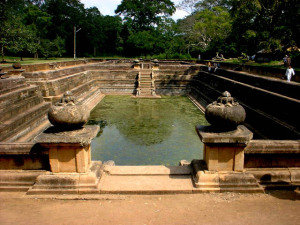
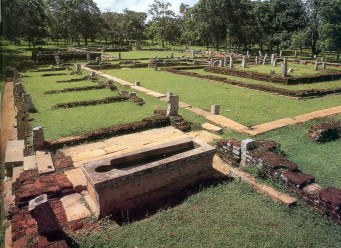
Kuttam Pokuna (Twin Ponds/Pools).The said pair of pools were built by the Sinhalese in the ancient kingdom of Anuradhapura

Sri Lanka was a major player on the world stage. Sri Lanka had great kings, great art and monumental works of irrigation and building. This island was evidently on a par with ancient Greece, Ancient Rome and Egypt of the pharaohs. Long before the Romans (400 BC), Sri Lanka had hydro spas, swimming pools, public baths with working spray-jet showers, major irrigation reservoirs and hydro-engineering skills that worked accurately to a fall of one inch in one kilometre.

Homo sapiens sapientis, the wisest of the wise may having come out of Srilanka and not “out of Africa” at all! Known locally as the “Balangoda Man”,Balagodans ate a diet of plants, animals and seafood (oysters, molluscs and other gastropoda), typical of today’s fashionable “Detox” plans. Balangoda Man, over 30,000 years ago, began to fashion quartz, flint, bone, chert and other minerals into various functional shapes of great utility and technological sophistication.


Mihintale hospital

Professor Anton Jayasuriya describe first industrial revolution establish Balangoda Man. Over 30000 years ago. Their descendants are the Vaddas (aboriginal Sri Lankans), living in the jungles of Wanni. The Vaddas, along with Balangoda Man remains, have been extensively studied by Dr Diane Hawkey of the Arizona State University. Her analysis of dental morphology shows that Balangoda Man (Homo sapiens balangodensis) may well have marched forth and inherited the Earth.

The king ruling Sri Lanka about 10,000 years ago, called Ravana, was also a great healer. He is portrayed with 10 heads, signifying immense wisdom, and twenty hands, signifying great dexterity.

The king ruling Sri Lanka about 10,000 years ago, called Ravana

The King Pandukabhaya (c. 500 BC) built the first general hospital in the world, according to American historians Will and Ariel Durant. King Mahinda IV built the oldest properly excavated hospital in the world, at Mihintale (8th century). King Dutugemunu is well reputed to have built many hospitals and put dispensaries in very village of size. King Aggabodhi VII (766-772 AD) studied the medical plants over the whole island of Lanka (to find out) whether they were wholesome or harmful for the sick.

King Buddadasa (c. 3rd AD) is credited with the saying “If you can’t be the king, be a healer.” King Buddhadasa carried out great feats of surgery on humans and animals, including brain surgery.

The Sri Lankans are a most hospitable and proud people.


JESUS CHRIST : EXPOSURE TO BUDDHISM

April 11th, 2018

Dr. Daya Hewapathirane

The Silk Road was well established centuries before the birth of Jesus Christ, providing opportunities for diverse groups of people to share not only goods but also their ideas and knowledge, including their spiritual faiths. In Jesus’ time, Buddhism was already five hundred years old and had spread from India in all directions within and outside the Indian sub continent. The overland route westward was through Afghanistan, northern Iran (Persia) and Iraq and then branched to Palestine and Egypt and through Syria and Turkey to Greece. Alexander the Great travelled through the Silk road from Macedonia Greece to Northwest India

Historic evidence shows that by the 3rd century BCE, Buddhism has spread throughout the area from Mesopotamia to Egypt. Mesopotamia was a historical region in West Asia situated within the Tigris–Euphrates river system, roughly corresponding to most of present IraqKuwaitSyriaTurkey. When it was under the Achaemenid Empire, in 332 BCE, Mesopotamia fell to Alexander the Great, and after his death, it became part of the Greek Seleucid Empire. Around 150 BCE, Mesopotamia was under the control of the Parthian Empire. The empire, located on the Silk Road trade route between the Roman Empire in the Mediterranean Basin and the Han Empire of China, became a center of trade and commerce. At its height, the Parthian Empire stretched from the northern reaches of the Euphrates, in what is now central-eastern Turkey, to eastern Iran.

The Parthians largely adopted the art, architecture, religious beliefs, and royal insignia of their culturally heterogeneous empire, which encompassed PersianHellenistic, and regional cultures. Native Parthian sources, written in ParthianGreek and other languages, are scarce. Much of Parthian history is only known through external sources which include Greek and Roman histories, but also Chinese histories. The Parthian Empire, being culturally and politically heterogeneous, had a variety of religious systems and beliefs. There is some archaeological evidence for the spread of Buddhism from the Kushan Empire into Iran proper. It is known from Chinese sources that An Shigao (148 to 180 CE), a Parthian nobleman and Buddhist monk, traveled to Luoyang in Han China as a Buddhist missionary and translated several Buddhist canons into Chinese.

The Alexander Empire in 323 BCE, more than 300 years before Christ, included most of Greece, Turkey, Syria, Iraq, Iran, Afghanistan, Pakistan and NorthEast India.  Records from Alexander the Great indicate a steady stream of Buddhist monks and philosophers living in his Empire which was at the crossroads of commerce and ideas, influenced the philosophical currents of the time.

The legacy of Alexander the Great included a collection of Greek kingdoms and trade routes from the Mediterranean to the places in central Asia and the stage was set for Greek spiritual practices to mix with Buddhism and become Greco-Buddhism. Two Greek kingdoms the Greco-Bactrian Kingdom from 250 to 125 BCE, and the Indo-Greek Kingdom from 180 BCE to 10 CE, practiced Greco-Buddhism. Buddhist shrines and monasteries were set up on the Silk Road and these places had monks who preached Buddhism to locals and travelers. Over the centuries, merchants played an increasingly large role in the spread of Buddhist teachings and in exchange for their support, Buddhist monasteries offered them a place to stay as they moved along the Silk Road.  By the first century BCE, the Greek kingdoms of Central Asia were Greco-Buddhist, and the stage was set at this time for Buddhism to spread far and wide to the West and East via travellers on the Silk Road.

In the 3rd century BCE, the Indian Emperor Asoka sent Buddhist missionaries to all parts of India and beyond up to the Mediterranean. Even several decades prior to Emperor Asoka’s reign, there were Buddhist missionaries spreading the teachings of the Buddha over all parts of Asia, including Egypt.  Edicts of Asoka set on stone, some written in Greek, confirm that Buddhist emissaries were sent by Asoka to Greek lands in Asia and the Mediterranean. Buddhism was the first of the major missionary religions to expand its influence through travel on the Silk Road. By the 1st century BCE, Buddhism had spread to lands now known as Afghanistan, Pakistan and countries further west.

Historical evidence indicates that Jesus knew about Buddhism, because in his early years, he lived in Judea, the southern region of ancient Palestine, which was an important cosmopolitan shipping center for trade between India and the West. The overland routes from Judea extending to Persia and western India were especially active after the invasion and occupation of western India by Alexander the Great in 330 BCE.  During Jesus’ time, Judea was a Roman dominion and being the wealthiest empire of the time, Rome had trade connections with India and other places in central Asia. Most of this trade reached the Mediterranean through Judea making it a cosmopolitan shipping center. Most traders exchanged information of places, people, and events along their routes. Inevitably, Buddhism was well known to the people in Judea and Buddhists settled in northern Arabia, including Judea. There were many Jewish settlements established during and after Alexander’s invasion of the East, especially along the invasion route through Persia and what is now Afghanistan and Kashmir/Punjab. This was a practice encouraged by Alexander to maintain his empire.

Given these East-West trade and settlement patterns, Jesus inevitably would have been exposed to Buddhism and there is the possibility that Jesus would have known about Buddhism as a teenager. The Bible makes no mention of where the young Jesus lived and provides no account of Jesus’ lost years between ages thirteen and twenty-nine. If Jesus was lost, where was he? Nonbiblical historical accounts indicate that Jesus traveled outside Judea. Old Muslim records refer to Jesus as the “traveling prophet” and as the “chief of travelers.” The more Jesus traveled about, the more he would have encountered Buddhist ideas. If he traveled outside Judea, especially to Mesopotamia, his exposure to Buddhist-influenced groups is inevitable. Historic evidence shows that by the 3rd century BCE, Buddhism has spread throughout Mesopotamia which was the region situated within the Tigris–Euphrates river system in West Asia.

The biblical silence about Jesus’ lost years is one of the strangest hiatuses in history. It is a total silence about one of the greatest personalities in human history, covering seventeen years of the life of Jesus, between the ages of twelve and twenty-nine. From the second century CE, onwards until about the turn of the twentieth century, when the question of Jesus’s travels as a young man was raised by Nicolas Notovitch, the church of Christ was destroying every piece of evidence of the life of Jesus Christ that did not support its doctrines. The doctrine of the church was that Jesus started his own religion as the Son of God. Any evidence not supporting this view was condemned. Therefore, the travels of Jesus and his exposure to Buddhism could not be acknowledged under any circumstances by the church. Hence, the inexplicable lost years of Jesus.

Nicolas Notovitch as he was called in the West, was in actual fact a Jewish Russian known as Nikolai Aleksandrovich Notovich, born in 1858, known for his 1894 book published in 1894, disclosing that Jesus left Galilee for India during the unknown early years of his life, and studied with Buddhists and Hindus before returning to Judea when he was 29 years of age. His observation was based on a document he had seen at the Hemis Monastery that he had visited in India. This was a Tibetan Buddhist  monastery located in HemisLadakhIndia. Although Notovitch had been discredited in Europe for his proclamations on Jesus’s early life, subsequent research led to its confirmation.

Swami Abhedananda, a contemporary and colleague of the famed Swami Vivekananda, visited the Hemis monastery in 1922 to confirm the reports of Notovich that he had heard the previous year in the USA. The lamas at the monastery confirmed to him that Notovich visited the monastery and that the manuscript on Jesus Christ was shown to Notovich and its contents were interpreted to him, so that he could translate them into Russian. The original manuscript was in Pali in the monastery of Marbour near Lhasa. The manuscript preserved at Hemis was in Tibetan. Swami Abhedananda himself was shown the manuscript, which had 14 chapters containing 223 couplets (slokas). The Swami got some portions of the manuscript translated with the help of a lama, about 40 verses appearing in the Swami’s travelogue. According to the manuscript Jesus Christ came secretly to Kashmir and lived in a monastery surrounded by many disciples. The original manuscript in Pali was prepared “three or four years” after Christ’s death, based on reports by local Tibetans and the accounts from wandering merchants regarding his crucifixion. In 1927, the manuscript was published serially in Visvavani, a monthly publication of the Ramakrishna Vedanta Samiti, and subsequently published in a book form in Bengali. The fifth edition of the book in English was published in 1987, which also contains as an Appendix, an English translation of Notovich’s book titled Life of Saint Issa.

Another author named Elizabeth Clare Prophet, in her book titled The Lost Years of Jesus: Documentary Evidence of Jesus’ 17-Year Journey to the East, asserts that Buddhist manuscripts provide evidence that Jesus traveled to India, Nepal, Ladakh and Tibet. In his book titled Jesus lived in India, a German author namedHolger Kersten, makes a thorough, methodical  and authoritative examination of the evidence of Jesus Christ’s life beyond the Middle East, in India, before crucifixion and again in Kashmir India after it where he arrived with Mother Mary. After many years in Kashmir, teaching people who venerated him as a great prophet and saint. His death and entombment were in Kashmir. Jesus travelled to Kashmir via Turkey and Persia. Holger Kersten cites ancient stories in Turkey and Persia of a saint called ‘Yus Asaf’ whose behavior and teachings are remarkably similar to that of Christ. Kersten claims that there are more than twenty-one historical documents that bear witness to the existence of Jesus in Kashmir, where he was known also as Yuz Asaf and Issa.

It is possible that Jesus travelled extensively throughout Asia which increased his exposure to Buddhism. His travel is indicated by the many records found in India and China. Textual evidence shows that Buddhism not only had spread West through the Silk Road travelers and contacts between East and West from conquests of Alexander, but also had been deliberately propagated through emissaries sent from India during the 3rd century BCE. This influence is revealed both by the actions and statements of Jesus Christ and by the Old Testament prophecies about the Messiah, a term derived from Sanskrit, which means “Maithri” (the future Buddha of this world). Jesus revealed to Peter information about his life, which Peter passed over to Matthieu and Luke. Most of what Jesus Christ said is confined to the gospels of Matthieu, Mark, Luke and John were said more than five hundred years earlier by the Buddha. Much of what Jesus Christ did was done more than five hundred years earlier by the Buddha. What Jesus Christ said is explicit in the gospels of Matthew, Mark, Luke and John. Therefore, educated and trained as a Buddhist, Jesus spoke and acted like a Buddhist.

Numerous scholars long ago discovered Buddhistic elements in the Gospel of John and recognized the Buddhistic background of Essenism, by which Jesus was greatly influenced. Essenes was an ascetic Jewish sect or a monastic brotherhood of Jews in Palestine that existed from the 2nd century BCE to 2ndcentury CE. There are strong similarities between Buddhist monastic teachings and Jewish ascetic sects, such as the Essenes, that were part of the spiritual environment of Palestine at the time of Christ’s birth. The Gospel of John, is one of the four canonical gospels in the New Testament along with the Gospels of MatthewMark, and Luke, all written between 65 and 95 century CE. John was one of Jesus’ Twelve Apostles and the Gospel of John was considered in ancient times to be the “spiritual Gospel,” and it wielded a profound and lasting influence on the development of early Christian doctrine. The conclusion is inescapable that Palestine, together with many other parts of Asia Minor, was inundated with Buddhistic propaganda for two centuries before Christ.

Given the foregoing plausible evidence, it is possible that Jesus Christ was a Buddhist, perhaps a Bodhisattva or an Enlightened Being with a compassionate determination to help others on their quest for the highest state of spiritual development. Nineteenth century Christian missionaries in India translated and read ancient Buddhist Sanskrit and Pali documents in India and ironically, referred to Buddhism as the Christianity of the East. But the real fact is that Christianity is Buddhism of the West because Buddhism existed five hundred years before Jesus Christ.

මලික් සමරවික්‍රම මහතා ඉවත් කළ යුත්තේ ඇයි?

April 11th, 2018

ලසන්ත වික්‍රමසිංහ ලේකම් තොරතුරු තාක්ෂණ වෘත්තීයවේදීන්ගේ සංසදය

තොරතුරු තාක්ෂණ වෘත්තීයවේදීන්ගේ සංසදය විසින් අද දහවල් පැවැත්වූ මාධ්‍ය සාකච්ඡාව සම්බන්ධ ප්‍රවෘත්තිය.

අත්සන් කරන ලද සිංගප්පූරු-ශ්‍රී ලංකා ගිවිසුම මඟින් ශ්‍රී ලංකාව පාවාදීමකට ලක් කර ඇති බව තොරතුරු තාක්ෂණ වෘත්තීයවේදීන්ගේ සංසදය පෙන්වා දෙයි. සංවර්ධන උපායමාර්ග සහ ජාත්‍යන්තර වෙළදාම අමාත්‍යවරයා දැනුවත්ව රට පාවා දීමක නිරත වන නිසා ඔහුව එම තනතුරුන් පහකරන ලෙස ජනාධිපතිතුමාගෙන් ලිඛිත ඉල්ලීමක් සිදු කළ බව එම සංගමය පවසයි.

එහිදී අදහස් දැක්වූ එම සංගමයේ ලේකම් ලසන්ත විකමසිංහ මහතා..

වීඩියෝව

https://www.youtube.com/watch?v=KJu1Ql_MLmE

සිංගප්පූරු-ශ්‍රී ලංකා ගිවිසුම ගිවිසුම නිසා සිංගප්පූරුවට වසරකට ඇමරිකානු ඩොලර් මිලියන 10 ක බදු මුදලක්‌ ඉතිරි වන බව සිංගප්පූරු වෙළෙඳ සහ කර්මාන්ත අමාත්‍යාංශයේ ප්‍රකාශයක සඳහන් විය. එහි අර්ථය වන්නේ, සිංගප්පූරු භාණ්‌ඩ සඳහා ආනයනික බදු වශයෙන් ලංකාවට ලැබෙන මුදලින් අවම වශයෙන් රුපියල් මිලියන 1500 ක බදු ආදායමක්‌ වාර්ෂිකව මෙම ගිවිසුම නිසා රජයට අහිමි වූ බවයි. ඒ වෙනුවට ලංකාවෙන් සිංගප්පූරුවට අපනයනය සඳහා ලැබුණේ මොනවාද යන්න සලකා බලන විට මෙම නිලධාරීන් කෙතරම් බරපතළ පාවා දීමක නිරත වූයේ දැයි පැහැදිලි වේ. සිංගප්පූරුව ආනයනික බදු ඒකපාර්ශවිකවම ඉතා අවම මට්‌ටමක පවත්වා ගන්නා රටකි. නව ගිවිසුම මගින් ශ්‍රී ලංකාවට බදු සහන ලැබුණු භාණ්‌ඩ වලින් 99%ක්‌ම සියලුම රටවල් සඳහා සිංගප්පූරුව විසින් මින් පෙරත් ආනයනික බද්දෙන් නිදහස්‌ කර තිබූ භාණ්‌ඩමය. එසේම මෙම ගිවිසුම තුළ, යම් භාණ්‌ඩයක අගයට සිංගප්පූරුව තුළදී එකතු කළ අගය මැන බැලීම (Rule of Origin) සඳහා වන කොන්දේසිය ඉතාම දුර්වල ලෙස අන්තර්ගත කර ඇත. ඒ අනුව සිදුවන්නේ වෙනත් රටවල නිපදවන භාණ්‌ඩද සිංගප්පූරුව හරහා ශ්‍රී ලංකාවට බදු රහිතව ඇතුළු වීමයි. මෙය දේශීය කර්මාන්තකරුවාට එල්ලවන මරු පහරක්‌ වනු ඇත.

රජය විසින් ළඟදීම එට්කා ගිවිසුම අත්සන් කරන්න සූදානම් වී සිටියි. එම ගිවිසුමෙන් වාසි ලැබෙන බව ප්‍රකාශ කළ ආචාර්ය හර්ෂ ද සිල්වා, මහාචර්ය රොහාන් සමරජීව ආදී ආර්ථික විශේෂඥයන් තම සංගමය විසින් ප්‍රකාශයට පත්කළ ‘එට්කා නෑයෙක්ද? ආක්‍රමණිකයෙක්ද?” කෘතිය පළ වීමෙන් පසුව සත්‍ය කරුණු එළිදැක්වුණු නිසා එට්කා ගිවිසුම පිළිබදව කතා කිරීම නතර කර ඇත. නමුත් සංවාදයක් නැති වුවද දුෂිත පුද්ගලයන් යොදා ගෙන එම කටයුත්ත සමාජයට හොර රහසේ සිදු කරගෙන ගොස් දැන් අවසානයට ළඟා වී ඇත.

රජය ආර්ථික ගිවිසුම් වලට එළැඹෙන්නට උත්සාහ කරන්නේ ඉන්දියාව, චීනය සහ සිංගප්පූරුව යන අපට වැඩිම වෙළද හිඟියන් ඇති රටවල් සමඟයි. මෙවැනි අවාසිදායක ගිවිසුම් නිසා වෙළද හිඟය වැඩි වී ඉදිරියේදී විශාල ආර්ථික ගැටලුවල්ට මුහුණ දීමට සිදුවනු ඇත. රටින් වැඩිපුර පිටවන මුදල යළි කෙසේ හෝ රට තුළට ගෙන්වා ගැනීම්ට සිදු වේ. ඒ සඳහා මැදපෙරදිගට මවුවරුන් යැවීම, ජාතික සම්පත් විකුණා දැමීම හා විදේශීය ණය ලබා ගැනීම් වැඩි කරන්නට සිදු වනු ඇත. මෙය මේ රට විනාශ කිරීමේ පැහැදිළි කුමන්ත්‍රණයකි. මලික් සමරවික්‍රම මහතා මෙහිදී විදේශීය බලවේගවල ඉත්තෙකු ලෙස යොදා ගැනේ. එසේම මලික් සමරවික්‍රම මහතාට මෙවැනි වගකීමක් දැරීමට අවශ්‍ය  සුදුසුකමක් නැත. ඔහු සතුව ප්‍රමාණවත් අධ්‍යාපන සිදුසු ක්අමක් නැති අතර මහජන නියෝජිතයෙකුද නොවේ(ජාතික ලයිස්තුව) . ඔහුට දේශපාලනය කිරීමට ඇති එකම සුදුසුකම පාසල් කාලයේ පටන්  රනිල් වික්‍රමසිංහ අගමැතිවරයාගේ සහකරු වීම පමණකි. මේ කාරණා මත නම් රටේ අනාගත පරපුරේ ඉරණම විසදෙන්න්නේ ඒ සඳහා ඉඩ නොදිය යුතුය. 

එසේම සිංගප්පූරු ගිවිසුම සම්බන්ධයෙන් සහ නව වෙළඳ ප්‍රතිපත්තියට කැබිනට් අනුමැතිය ලබා ගැනීමෙදී මලික් සමරවික්‍රම අමාත්‍යවරයා ජනාධිපතිතුමාව නොමඟ යවා ඇත.

ජනාධිපතිතුමා විසින් මලික් සමරවික්‍රම මහතා එම අමාත්‍යාංශයෙන් ඉවත් කළ යුතු අතර මේ සියලු දුර්ධාන්ත ක්‍රියාවන් සඳහා මැදිහත් වී ඇති අමාත්‍යාංශ ලේකම් චාන්දනී විජේවර්ධන මහත්මියද එම තනතුරෙන් පහ කළ යුතුය. එසේම දූෂිත එට්කා සාකච්ඡා කණ්ඩායමද විසුරුවා හැරිය යුතුය. නැතහොත් මේ පාවාදීම් හමුවේ ජනාධිපතිතුමාද බරපතල අර්බුදයකට ලක්වීම වැළැක්විය නොහැකිය.

එහිදී අදහස් දැක්වූ සංගමයේ සභාපති කපිල පෙරේරා මහතා.

වීඩියෝව

https://www.youtube.com/watch?v=kOwKauF7rZs

පසුගිය අප්‍රියෙල් දෙවෙනිදා අතිගරු ජනාධිපති තුමාට ලිපියක් යොමුකරමින් තොරතුරු තාක්ෂණ වෘත්තීය වේදීන්ගේ සංගමය ලෙස අපි පෙන්වා සිටියේ සංවර්ධන උපායමාර්ග සහ අන්තර්ජාතික වෙළඳාම පිළිබඳ අමාත්යංශය අක්‍රමිකතා රාශියක් පසුගිය කාලය තුලසිදුකොට ඇති බවයි. 

එහෙයින්ම මලික් සමරවික්‍රම ඇමති තුමා, අමාත්‍යංශ ලේකම් චාන්දනී විජේරත්න මහත්මිය එම අමාත්‍යංශයෙන් ඉවත් කොට වෙළඳ ගිවිසුම් පිලිබඳ සාකච්ඡා කණ්ඩාම විසුරුවා අමාත්‍යාංශයත් එම සාකච්ඡා කණ්ඩාමත් ප්‍රතිසංවිධානය කරන මෙන් ඉල්ලා සිටියා.


මෙහිදී මූලික වශයෙන් ආකාර 4ක අක්‍රමිකතා සිදුවී පවතිනවා


  1. ජාත්‍යන්තර වුවමනාවන්ට අනුකූලව කටයුතු සිදුවීම.
    1. ඇමරිකානු උපදේශකයන් 3දෙනෙකුගේ උපදෙස් වලට අනුකූලව සංවර්ධන උපායමාර්ග සහ අන්තර්ජාතික වෙළඳාම පිළිබඳ අමාත්‍යංශය සිය කටයුතු මෙහෙයවයි.
    2. සිගප්පුරුව සමග වෙළඳ ගිවිසුමට ඔන්න මෙන්න කියා තිබියදී, ලංකාවේ සාකච්ඡා කණ්ඩාමේ කිහිපදෙනෙකු, සිංගප්පූරු සාකච්ඡා කණ්ඩායමේ ප්‍රධානීන්ගෙන් පුහුණුවක් ලැබීමට පිටත් කිරීම, අමනෝඥ ක්‍රියාවකි. වෙළඳ ගිවිසුම් පිලිබඳ පුහුණුවක් ලබාදීමට තවත් ඕනා තරම් රාජ්‍යයන් තිබියදී, අදට සාකච්ඡා පවත්වන රටක සාකච්ඡා කණ්ඩායමේ අයවලුන්ගෙන් පුහුණුව ලැබීම අනුමත කිරීම පැහැදිලි අක්‍රමිකතාවකි.
    3. නවසීලන්ත ජාතිකයෙකු ලවා අන්තර්ජාතික වෙළඳ ප්‍රතිපත්තියක් සකස් කිරීමට උත්සාහ දැරීම, මහබැංකු අධිපති කම සිංගප්පුරු වැසියෙකුට පැවරීමට වඩා දෙවැනි නොවේ. නවසීලන්ත පුරවැසිභාවය හිමි ආචාර්ය රවී රත්නායක Bridging the Gap නමැති එන් ජීඕ ආයතනයේ සාමාජිකයෙකි. එම ආයතනය හරහා මේ පුද්ගලයා ASEAN සංගමයේ සාමාජික රටවලට ශ්‍රී ලංකාවට භාණ්ඩ අපනයනය සඳහා පෞද්ගලික උපදේශකයෙකු ලෙසද කටයුතු කරයි. සංවර්ධන උපායමාර්ග සහ ජාත්‍යන්තර වෙළඳාම අමාත්‍යාංශයවිසින් ශ්‍රී ලංකාවට ආනයනය කරන භාණ්ඩවලින් බදු සහන ලබාදෙන භාණ්ඩ ලයිස්තුව සකස් කිරීමේ වගකීම මොහුට ලබාදීම ඉබ්බා දියේ දැමීමකි. පිටරටවල වුවමනාවලට සේවය කරමින් වැටුප් ලබන අතරම ඒ රටවලව අවශ්‍ය පරිදි මෙරට තුළ වැඩ කරනවාටදෙනවාට අපේ බදු මුදලින්ද මේ දූෂිතයෝ වැටුපක් ලබති.


  1. නිවැරදි ක්‍රමවේදයෙන් පටහැනිව සිදුවන සාකච්ඡා
    1. මෙම කිසිදු ගිවිසුමක් සම්බන්ධව ශක්‍යතා අධ්‍යයනයක් සිදුකොට නොමැති අතර, එම ගිව්සුම් මගින් රටට සිදුවන අවාසි ගණන් බලන්නේද ගිවිසුම අත්සන් කිරීමෙන් අනතුරුවය.
    2. පැහැදිලි ජාතික ප්‍රතිපත්ත්යක් නොමැති බවත්, එම ප්‍රතිපත්ති ක්‍රියාත්මක කරවන ආයතන සහ ක්‍රමවේදයන් නොමැති බවත්, ඒ සඳහා අමාත්‍යංශය අවංක උත්සහයක් නොදරීමත් මෙහිදී මතුව පෙනෙයි
  2. ආර්ථික වශයෙන් පාඩු සිදුවන ගිවිසුම් කරා එළඹීම.
    1. සිංගප්පුරු ගිවිසුමේ අලාභය රජය විසින් පවා පිළිගෙන ඇති අතර විද්වතුන් බොහෝදෙනෙකු පෙන්වා දී තිබෙයි.
  3. බැදීයාවන් පිලිබඳ ගැටුම් ඇතිකරන පත්වීම
    1. සිය හදිසි අභාවය සිදුවන තෙක්ම එට්කා ගිවිසුමේ සහ චීන-ශ්‍රී ලංකා නිදහස් වෙළඳ ගිවිසුමේ ප්‍රධානියා වශයෙන් කටයුතු කර ඇත්තේ ආචාර්ය සමන් කැලේගමයි. ඔහු එසේ කටයුතු කර ඇත්තේ බහුජාතික සමාගමක ශ්‍රී ලංකා ශාඛාවේ සභාපතිවරයාවශයෙන් කටයුතු කරන අතරය. එම බහුජාතික සමාගම විසින් ප්‍රධාන වශයෙන් සිදු කරන්නේ ඉන්දියාවේ සහ චීනයේ නිපදවන භාණ්ඩ මෙරටට ආනයනය කර අලෙවි කිරීමය. එවැනි සමාගමක සභාපතිවරයෙක් ආනයනික බදු සහන ලබා දෙන භාණ්ඩලැයිස්තුව තීරණය කෙරෙන ගිවිසුමක් සම්බන්ධයෙන් සාකච්ඡා කරන කණ්ඩායමක ප්‍රධානියා ලෙස පත් කිරීම ඉතා පැහැදිලිවම බැදියාවන් අතර ගැටුමක් නිර්මාණය කිරීමකි.
    2. කැලේගමගේ අභාවයෙන් පසුව එම තනතුර සඳහා පත් කළ කේ. ජේ. වීරසිංහ සම්බන්ධ කාරණය වඩාත් ජුගුප්සාජනකය. කේ. ජේ වීරසිංහ මෙම ආර්ථික ගිවිසුම් සඳහා සාකච්ඡා කණ්ඩායමේ සාමාජිකයකු වශයෙන් කටයුතු කරන අතර ඒකාබද්ධ ඇඟලුම්සංගම් සංසඳයේ (Apparel Association Forum – JAAF) උපදේශකයෙකු වශයෙන් “වැටුපක්” ලබාගත්තේය. ඇඟලුම් නිෂ්පාදනය හෝ ඇඟලුම් වෙළඳාම සම්බන්ධයෙන් හෝ ප්‍රවීණයකු නොවූ වීරසිංහ ඊනියා උපදේශකයෙකු ලෙස ඉහළ වැටුපක් එම ආයතනයෙන්ලබාගත්තේ කෙසේද යන්න අනෙකුත් දේශීය නිෂ්පාදකයන්ගේ ඉරණම සමඟ බැදී පවතින්නකි. වීරසිංහ මහතා කොතෙක් උත්සාහ දැරුවත් මෙම ඇඟලුම් කෝටාව ඉවත් කිරීමට ඉන්දියාව තවම එකඟ වී නොමැති වීම මඟින් සිය කේවල් කිරීමේ බලය උපරිමමට්ටමකට පවත්වා ගැනීමට ඉන්දියාව සමත් වී තිබේ. වීරසි‍ංහට එය ඉටු කරගැනීමට නම් ඉන්දියවට අවශ්‍ය ඉන්දියානු භාණ්ඩ වැඩි ප්‍රමාණයක් සඳහා ශ්‍රී ලංකාවේදී බදු සහන ලබාදීමට සිදුවේ.  ඒ මඟින් සිදු වන්නේ ජනාධිපතිතුමා රැක ගත යුතු යයි පවසනදේශීය නිෂ්පාදකයා විනාශ වීමයි. කේ. ජේ. වීරසිංහ  ඒකාබද්ධ ඇඟලුම් සංගම් සංසඳයෙන් ලැබුවේ වැටුපක්ද අල්ලසක්ද යන්න තීරණය කිරීම එතරම් අපහසු නොවේ.
    3. ආචාර්ය රවි රත්නායකගේ පත්වීම සම්බන්ධයෙන්ද පෙර සඳහන් කල පරිදි බැදීයාවන් පිලිබඳ ගැටුම් ඇතිකරයි

සංවර්ධන උපායමාර්ග සම්බන්ධ අමාත්යංශය මගින් රටේ සංවර්ධනය කෙරෙහි සිදු ඇති මෙහෙවරක් වීද? අපගේ විශ්වාසයේ හැටියට පක්ෂ ප්‍රතිසංවිධානය කරන යුගයක ඊට මත්තෙන් කලයුත්තේ මෙවන්වූ අක්‍රමිකතා සහිත අමාත්‍යංශයන් ප්‍රති සංවිධානය කිරීමයි. 

ස්තූතියි

ලසන්ත වික්‍රමසිංහ

ලේකම්

තොරතුරු තාක්ෂණ වෘත්තීයවේදීන්ගේ සංසදය

අගමැති අභාවය සිදු වූ දින රාත්‍රියේ රාගම නිවාස සංකීර්ණයක ‘බාල්කෑමක්’ Conspiracy surrounding the S.W.R.D.Bandaranaike Assassination – A new perspective

April 11th, 2018

Copy of a page of the Satana Supplement of the ‘ Mawbima’ paper ( Sunday – April 08, 2018), which provides a new perspective on the conspiracy surrounding the assassination of the late Prime Minister S.W.R.D. Bandaranaike

The writer is Udeni Saman Kumara.

විශ්‍රාමික අධ්‍යාපන අධ්‍යක්ෂවරයකු වූ ජයසිංහ විජයරත්න මීගමුවේ දාගොන්න ප්‍රදේශයේ වැසියෙකි. අපට ඒ මහතා හමුවූයේ දාගොන්න ප්‍රදේශයට ගිය අවස්ථාවකදීය. බණ්ඩාරනායක ඝාතනය සම්බන්ධව විජයරත්න මහතා සමඟ නියැළුණු සංවාදයේදී හෙතෙම පැවැසුවේ බණ්ඩාරණායක ඝාතනයට හේතු වූ කාරණා සොයා අඳුරේ අත පත ගාන්නට අවශ්‍ය නැති බවය.

මාර්ටින් වික්‍රමසිංහ සූරීන් ‘බමුණු කුලය බිඳ වැටීම’ යනුවෙන් ඉදිරිපත් කළ කරුණු තුළ බණ්ඩාරනායක ඝාතනයට තුඩු දුන් හේතු විස්තර කර තිබෙන බව ඒ මහතා පෙන්වා දුන්නේය.
‘චීනය හා සෝවියට් දේශය සමඟ සබඳතා ගොඩනැඟීම, විදුදය, විද්‍යාලංකාර විශ්වවිද්‍යාල ඇති කිරීම රාජ්‍ය භාෂාව සිංහල කිරීම සහ අධ්‍යාපන මාධ්‍යය ස්වභාෂාව වීම, විදෙස් සමාගම් ජනසතු කරමින් අධිරාජ්‍යවාදීන් අනුමත නොකරන මාවතකට රට යොමු කිරීම ආදී කරුණු වික්‍රමසිංහ හෙළිදරව් කොට තිබිණි. ඒ වන විටත් නීතිය ක්‍රියාත්මක කරන ආයතන පැවැතියේ යටකී ඝාතක බලවේග සතුවය.

ඔවුන් විසින් නැව් සමාගමක කතාවක්ද පටලවා බෞද්ධ භික්ෂුන් වහන්සේද සම්බන්ධකොට එක ගලෙන් කුරුල්ලන් දෙදෙනාම බිම දමා ඇතැයි විජයරත්න මහතා කීය.
කොටහේනේ සිට දාගොන්නට පැමිණි ඔසී කොරයා 1957 වසරේ දාගොන්නේද තැබෑරුමක් ආරම්භ කර ඇත. ඒ වන විටත් ඔහු සතුව මීගමුව ප්‍රදේශයේ තවත් තැබෑරුම් කිහිපයක් තිබී ඇති අතර ප්‍රදේශයේ චණ්ඩියකු වශයෙන්ද නම් දරා සිටියෙකි. තැබෑරුම ආරම්භ කොට කෙටි කලකින් කොරයා දාගොන්නේ කුකුළු පොර සූදුවක්ද පටන් ගෙන තිබේ. උත්සවශ්‍රී යෙන් කුකුළු පොර සූදුව ආරම්භ කරන්නට පැමිණි ආරාධිත අමුත්තා වූයේ 1956 බණ්ඩාරනායක අගමැතිවරයාගේ ආණ්ඩුවේ මුදල් ඇමැති ස්ටැන්ලි ද සොයිසාය. ඔසී කොරයා කුකුළකුද අතින් ගෙන මුදල් ඇමැතිවරයා සමඟ පෙනී සිටින ඡායාරූපයක් දාගොන්නේ රූබන් පෙරේරාගේ ගෙයක පිහිටි රා තැබෑරුමේ බොහෝ කලක් ප්‍රදර්ශනය පිණිස එල්ලා තිබූ බවද ප්‍රදේශවාසීන්ට මතකය.

ඔසී කොරයා පසු පස තිබූ දේශපාලන බලයත්, පොලිස් බලයත්, හේතුවෙන් කිසිවකු ඔහු අභිභවා නැඟී සිටීමට බිය වී ඇත. ඔහුගේ දුරාචාර වැඩවලට බාධාවක්ද තිබී නැත. පුද්ගල මරණ දෙකක් සම්බන්ධයෙන්ද ඔසීට චෝදනා එල්ල වී තිබිණි. ඔහු නඩු දෙකෙන්ම නිදහස් වූ බව දැනගන්නට ඇත. බණ්ඩාරනායක ඝාතනය සිදු වූ දිනවල ඔසී හිස බූ ගා සිටි බව තමන්ට හොඳින් මතක බව ප්‍රදේශයේ වයසක අය කියති.

විජයරත්න මහතාත් අප මීට ඉහත සඳහන් කළ අල්විස් මහතාත් තවත් සිදුවීමක් හෙළි කළහ. එනම් 1959 සැප්තැම්බර් 26 වැනිදා රාත්‍රියේ රාගම බටුවත්තේ ඩිකී සොයිසාට අයත් ගෙවල් සියය නිවාස ක්‍රමයේ පැවැති ‘බාල් කෑමක්’ ගැනය. අහල පහළ කුකුළකු බේතකටවත් සොයාගත නොහැකි තරමට නැඟලා ගිය බව කියන මේ බාල්කෑම ගැන ප්‍රදේශයේ වයසක උදවියට තවමත් මතක බවද කියති. ඩිකී සොයිසාද, මුදල් ඇමැති ස්ටැන්ලි ද සොයිසාද, බණ්ඩාරනායක අගමැතිට වෙඩි තැබීම සිදුවූ සැණින් රොස්මිඩ් වලව්වට පැමිණ සියලු පරීක්ෂණ තම අතට ගත් නියෝජ්‍ය පොලිස්පති සිඩ්නි ද සොයිසාද සොහොයුරෝය. මේ සියල්ලෝම නඩුවේදී පැමිණිල්ලේ සාක්ෂිකරුවෝ වූහ. ඔසී කොරයා ද මේ කණ්ඩායමේ ගජ මිතුරකු වූ අතර ඔහුද පැමිණිල්ලේ සාක්ෂිකරුවෙකි.

අගමැති බණ්ඩාරනායක මහතාගේ ඝාතනය සිදුවන විට බණ්ඩරනායක පවුලේ බාලයා වූ අනුර බණ්ඩාරනායක රාජකීය ප්‍රාථමික විද්‍යාලයේ සිසුවෙකි. එවකට අනුරගේ සම වයස් සිසුවකු වූද ලංකාවේ ප්‍රකට පවුලක සාමාජිකයකුද, ප්‍රකට නීතිඥවරයකුද වූ සේනක වීරරත්න මහතාද අපූරු තොරතුරක් සඳහන් කරයි. ‘මා 1959 සැප්තැම්බර් 25 දින රෝයල් ප්‍රයිමරියේ ඉංග්‍රීසි පාඩම ඉගෙන ගනිමින් සිටියා. එවකට අනුර බණ්ඩාරනායක, දිනේෂ් ගුණවර්ධන, රනිල් වික්‍රමසිංහ තිදෙනාම ප්‍රයිමරියේ සිසුන්. එදින පෙ.ව. 10.30 විතර අනුරගේ ආයා පැමිණ කොරිඩෝව දිගේ ඔහු කැඳවා ගෙන යන අන්දම මා දුටුවා. ඔහු කැටුව යන්නේ මන්ද යන්න අපි කිසිවකු ඒ වෙලාවේ දැනුවත්ව සිටියේ නැහැ. නමුත් දහවල් විදුහල්පති එච්.පී. ජයවර්ධන මහතා ඇතුළු ගුරුවරුන්ගේ කතාබහෙන් අපි දැන ගත්තා අනුරගේ තාත්තාට වෙඩි තබා ඇති බව.

26 වැනිදා සන්ධ්‍යාවේ මමත් මගේ අම්මත්, තාත්තත්, සහෝදරියත් 65, රොස්මිඩ් පෙදෙස, කොළඹ 7 පිහිටි අනුරගේ නිවෙසට ගියා. අගමැතිතුමාගේ දේහය සාලයේ තබා තිබුණා. මා අනුර හමු වී ශෝකය පළ කළා. ඔහු මා සමඟ කතා කරන්නට නොහැකි තරම් කම්පනයක සිටියා. මට හොඳට මතක සිදුවීමක් තිබෙනවා. නියෝජ්‍ය පොලිස්පති සිඩ්නි ද සොයිසා මා දන්නවා. මා දුටුවා ඔහු ඇඳ සිටි කළු පැහැති කලිසමේ සාක්කුවේ දෙඅත් දමාගෙන ගැඹුරු කල්පනාවෙන් යුතුව බිම බලාගෙන අගමැති දේහය වටා සෙමෙන් ගමන් කරමින් සිටියා.

The writer is Udeni Saman Kumara

SLFP headed for a split?

April 11th, 2018

By Kelum Bandara Courtesy The Daily Mirror

A section of the Sri Lanka Freedom Party (SLFP) backed the move to bring the no confidence motion in the hope of unseating Prime Minister Ranil Wickremesinghe. The Prime Minister survived the motion with the support of his party men and the main opposition Tamil National Alliance (TNA). Be that as it may, the SLFP is now in disarray due to consequences of the motion.


  • SLFP now embroiled in political turmoil
  • Anura Yapa, Dayasiri, SB want to leave Govt.
  • 16 members who voted for NCM in dilemma
  • SLFP, as a party was on the wane politically – Dayasiri
  • SLFP should stick to Govt. to fulfil  January 8,  2015  mandate

President Maithripala Sirisena spelled out that a team of SLFPers, adamant on leaving the unity government, worked hand in hand with the Joint Opposition and a faction of the United National Party (UNP) to work out the no faith motion.

I only asked them to muster the required number if possible and get back to me,” he said.

True to his word, actually 16 SLFP Ministers voted for the motion, but another 25 members of the party were absent during voting. The UNP team finally backtracked from their previous position and voted against the motion enabling Mr. Wickremesinghe to tide over the crisis.

The Prime Minister survived the motion with the support of his party men and the main opposition Tamil National Alliance (TNA). Be that as it may, the SLFP is now in disarray due to consequences of the motion

But, the SLFP is now embroiled in political turmoil, widening the already existing chasm within the party. One group of the SLFP has functioned in Parliament under the banner of the Joint Opposition right from the beginning. Now, the faction, serving in the government is also afflicted with division since 16 members who voted for the no confidence motion, try to sit in the opposition whereas the others argue otherwise.

The SLFP Central Committee, authorized to take vital party decisions such as whether to stay with the government, converged on Monday night at the residence of President Sirisena to discuss the current predicament and the way forward.

First, the committee discussed logistics for May Day celebrations to be conducted on May 7 instead of May 1, this year because of the annual Vesak festival falling in between.

Anura Yapa, Dayasiri, SB want to leave Govt.
Afterwards, Disaster Management Minister Anura Priyadarshana Yapa opened his mouth. He said the party took a policy decision to vote against the no faith motion, and he, along with 15 others, acted accordingly.

He said it was not appropriate for him and others to stay with a government that they sought to unseat.

We should leave this government forthwith,” he said.

Social Empowerment, Welfare and Kandyan Development Minister S.B. Dissanayake endorsed his views and stressed that it was time to quit the government.

After him, Sports Minister Dayasiri Jayasekara got on his feet and started airing out his views. He detailed the political developments that took place after the defeat of the local authorities election on February 10, 2018.

After the elections, we took up the position that we can no longer serve under the current PM. Instead, we asked for the appointment of someone from the UNP as PM by unseating Ranil Wickremesinghe. It did not work. Then, we said we would work for the appointment of Transport Minister Nimal Siripala de Silva. In the aftermath of such developments, we voted for this motion. Now we have to leave,” he said.
Mr. Jayasekara said the SLFP, as a party, was on the wane politically under the current circumstances and action should be taken without delay for its resuscitation.

Though it is a unity government, he said the UNP acted in its own without consulting the SLFP.

The unity government does not mean the endorsement of what the UNP does. There were three budgets. We were consulted on two occasions in preparation of them. But, our views were incorporated. For one budget, we were not consulted at all. The PM even sought the enactment of certain legislations without consulting us. We cannot proceed like this,” he said.

Former Minister Athauda Seneviratne, who is politically close to former President Chandrika Bandaranaike Kumaratunga [CBK], frowned on Mr. Jayasekara’s viewpoints. Trying to argue that the SLFP should stay with the government at this juncture, he made a scathing attack on the Joint Opposition calling it ‘a thieving lot with racial ideas’.

CBK draws flak from President 
Ms. Kumaratunga, who appeared at the Central Committee meeting after a prolonged absence, was critical of the move by some members to break ranks with the government. She said the SLFP should stick to the government in line with the mandate given at the Presidential Elections conducted on January 8, 2015.

She said the people voted for a certain movement at that election, but not for an individual. After her remarks, she left the meeting place.

In her absence, she drew fiery criticism from the President. Firing a salvo at her, the President said the person whose leadership for such a movement got the candidature.

CBK appeared at the CC meeting after a prolonged absence, was critical of the move by some members to break ranks with the govt. She said SLFP should stick to the govt in line with the mandate given at 2015 Presidential Elections

Otherwise, they could have fielded someone from the UNP and won. They could not do so. Why?” he asked.

Despite many deliberations, the SLFP could not reconcile their differences. It, in fact, became a daunting task for the party. The only decision taken was to boycott the Cabinet meeting on Tuesday till the two factions reached a common understanding.

In all probability, the SLFP is headed for a major split in the government ranks. It is due to the fact that those wanting leave the government refuse to budge an inch from their position.

People want non-traditional politicians – Gotabhaya Rajapaksa

April 11th, 2018

By Kelum Bandara Courtesy The Daily Mirror

  • Spells out what he would do in case he is picked as presidential candidate
  • Explains what he would do regarding his US citizenship
  • Emphasizes the need for strong leadership and political stability

We should not get involved in super power rivalries. As a small country, if we get involved in these rivalries, we would be in trouble. 

Former Defence Secretary Gotabhaya Rajapaksa, in an interview with the Daily mirror , spoke about his future plans and the way forward for the country.   Excerpts:   

QThere is a lot of talk about you being chosen as the presidential candidate. Has anyone actually approached you to be the candidate for the presidency?

No. But, there is talk. I think there is enough time- one and half years- to decide on that. It depends on former President Mahinda Rajapaksa. He has to decide who the best candidate is. He knows who is the most suitable one who can win.

QUnder the current circumstances, what do you feel about that role? 

The best person to be the candidate is none other than former President Rajapaksa. He is the person who has the public support, popularity and the leadership needed at this juncture. He has the experience. Unfortunately, he cannot contest for the presidency because of the 19th Amendment. Then, you have to find the next best person. Anyone who obtains his support will be able to win.

Q In case, you are handpicked as the candidate are you ready to take up the challenge?

If he thinks that I should contest, I have to come forward. I think I am capable of doing so.

QYet, there is a barrier for you because you are dual citizen also having citizenship in the United States. How do you address this?

Again, because of the 19th Amendment, I cannot contest as things are at the moment. Yet, if the former President’s choice is me, I have to go through the process of renouncing dual citizenship.

Q What is that process actually?

It depends on me. There is a process. But, it is a very clear and short process.

QApart from that, what is your opinion on the recent outbreak of communal violence in Kandy?

If you browse the newspapers, you find incidents all over the country, not in Kandy alone. Murders, robberies are everywhere. There is a definite breakdown in the rule of law. I think that is the main reason. As for the Kandy incidents, there could have been quicker and faster actions taken to prevent them. As far as I know, the incident took place between two parties. There was one week gap until the first incident and the death of that person. I do not think that the Government took enough precautionary measures. When an incident of that nature takes place, anybody can anticipate that there could be reaction from the other side. They should have taken quick action to stop it. May be, the incident was not taken seriously. Or else, information about the incident had been sent to the relevant persons. I think there was a lapse on this regard.

QSome people say the intelligence authorities failed to sense the impending danger. As the former Defence Secretary, what do you feel about it?

They must be referring to the police intelligence. It is not the duty of other intelligence agencies to cover that area. But, we had a very good intelligence service previously. We were capable of handing similar situations. They had tackled more serious situations back then. If there had been a lapse on the part of the intelligence authorities, again, the Government is to blame. This Government was undermining the work of intelligence agencies. There were certain incidents taking place. The effect of the intelligence service has been undermined. That is the reason for the lethargy or the weakness on the part of the intelligence services.

QSimilar violence broke out in Aluthgama and Beruwala during the time the last regime. You were accused of backing Bodu Bala Sena (BBS) that instigated the violence. How do you respond?

That is not correct. If you look at the history, communal violence has been taking place for many years. What is more important is whether the Government concerned was able to respond to such incidents during such times. When the Aluthgama incident unfolded, we took immediate action and were able to control the situation. The Government had nothing to do with BBS. That was a myth created by the then opposition. I am not in anyway connected with BBS. Now, you can see things happening. You can see who is behind such organizations.

The politicians are trying to take advantage by putting the blame on us.

QYet, there was a failure on the part of the previous Government to take preemptive measures?

You have to understand the position of the Government at that time. You cannot say that we did not take any preemptive action. Action you take has to be justified by the Government. You cannot just go and arrest people without a reason. We took many precautionary measures. We never encouraged people to do any of these things.

I took a lot of action to control the situation. I had several meetings with different sections of the Muslim community. I met their clergy and business community. I met not only BBS priests, but also other eminent Buddhist monks. I brought both the parties to the table. It was not merely about taking legal action. There is something more to it. We discussed measures to take control of the situation and build an understanding between the communities. We had many discussions on this regard.

QIn your view, what should be done to avoid the recurrence of such incidents in the future?

You cannot explain it in one word. It is a matter of understanding among all the communities. You cannot put the blame on one community. If there is any reaction from the majority community, it is not that easy to instigate people to do something like this. There are elements on both sides, that are radical or extreme. The majority of the people of both communities are not extremists. The majority of the people of both communities don’t have radical ideas. Both communities should understand the situation and not leave room for radical elements. I think the community leaders must take action to understand each other and to take advice from the religious and community leaders in areas where the minorities are concentrated.

QDo you see that Sri Lanka is under the threat of international terrorism?

What is happening in the world today is anyway affecting any country. Anybody can read what is happening all over the world thanks to the latest technology and social media. Something affecting another country can make an impact on Sri Lanka as well. The Government intelligence agencies should be conscious of this fact. I do not see this (The security factor).


  • As for the Kandy incidents, there could have been quicker and faster actions taken to prevent them
  • This Government was undermining the work of intelligence agencies
  • We need to introduce legislation to protect Government servants
  • I do not understand the difference between a good politician and a good administrator
  • But, he (Mahinda Rajapaksa) conducted the war very efficiently because he was listening

Q Now, you are being seen as the presidential candidate by some in the country. People say that you are only an administrator, not a politician. How do you respond?

I do not understand the difference between a good politician and a good administrator. A good politician is a person who is administering a country.

QThey must be talking about party politics in the present sense

May be, I am not a politician. I have never been a politician.

Q How would you fit into the shoes of a politician?

That may be a very difficult situation for anybody. All over the world, there is a trend that traditional politicians are rejected. It looks like they are being rejected not only in Sri Lanka, but also in the UKL, France, the US, Germany etc. People want non-traditional politicians. People tend to select such nontraditional politicians. It is up to them, after becoming politicians, to get adjusted to that position. I do not understand the kind of special qualities other than what a leader has. What matters most is leadership qualities be it a politician, manager or a military officer. That is the main qualification.

QWhat is the advice you were given by former President Mahinda Rajapaksa, who is your brother?

What I have learned from him is about leadership qualities. I have learned a lot from him. He is a team player. He listens to others. A person cannot be an expert in everything. One can be an expert in one thing, not in everything. To run a country, you have to listen to the people. You have to get advice from people. He is a person who is ready to do it. He is a good decision maker. Once he decides on something, he is very clear. For example, he is not a military man. But, he conducted the war very efficiently because he was listening.

When listening to the speeches by powerful Government ministers, it is very clear that they are trying to stop certain people coming forward

QDo you fear that you would be incarcerated by the Government ahead of the Presidential Elections?

That I do not know. When listening to the speeches by powerful Government ministers, it is very clear that they are trying to stop certain people coming forward. They took action to stop the former President coming forward. There is a lot of talk to strip him of his civic rights. They have a lot of cases against me and Mr. Basil Rajapaksa. By taking undemocratic action you cannot prevent people from selecting a person. If they think that they can cling on to power forever by doing so, it is not correct.

In the world, there were powerful people who tried to remain in power forever. They failed. Ultimately, it is the people’s wish. If they prevent me or the former President, people would select another. They will always find a leader. This is still a democratic country. Nobody can go against the will of people. It is futile to take such action.

Q If you become the President, what would you do to get the economy out its current mess?

This is a very challenging thing for any leader. Whatever anyone might say in the Government, the Rajapaksa Government was able to end the war that prevailed for 30 years. We created an environment for the development of the country. We were lagging behind mainly because of the war. We took certain steps to develop the country. We were able to bring foreign investment. We started by developing infrastructure, roads and seaports. The new Government stopped development work, especially the ones launched with Chinese assistance. For some reason, the Port City project was held back for two and half years. They delayed the second phase of the Hambantota port Project. By stopping these development projects, the Government retarded the economic growth. The Government could not rectify it.

It is challenging for the upcoming Government to rectify this situation. There are things you can do. First, there has to be political stability with strong leadership and investor confidence has to be instilled. During our time, we were able to bring a lot of investment to Sri Lanka- Shangri-La, TATA etc. When an investor comes, he should see a stable Government. You have to take quick action to solve their issues. That machinery is not in operation today. You have to create an environment to attract foreign investment. You have to encourage investors. Research and development is a key area this country needs. That project is not moving forward. There are many local entrepreneurs who can kick-start or drive the economy.

You can learn a lot from countries such as Japan, China, Taiwan, Indonesia, Vietnam, Singapore and South Korea. These countries had strong political leadership. Behind these leaders, there were local entrepreneurs and technocrats who developed the country. It is not merely the leaders only. We talk about Singapore’s Li Quan Yu, General Park in South Korea,  Suharto in Indonesia and Deng Xiaoping in China. Behind these political leaders, there were technocrats who were responsible for the development of those countries. Now, the situation is different in the world. The low cost manufacturing economy is gone. We have to consider our areas of strength. We have to consider high skilled industries for the development of our economy. We have to use these knowledge-based industries. For that, we need to have a good industrial policy. It is very challenging. We have skilled people. We cannot be satisfied with low income and labour intensive industries.

QThe other problem that was experienced during the latter half of the previous Government is India’s concerns about Chinese investments here. It was seen as the reason for India’s subtle moves to bring down that Government. Have you mended fence with India?

That is a difficult thing to do while being in the opposition. The present Government fears that any other country, be it India or anyone, would speak to someone connected the previous Rajapaksa Government. It is very difficult to clarify these things. Everybody knows that there is a geopolitical situation in the region. Sri Lanka is positioned strategically in the Indian Ocean region though it is a small country. We know that China has emerged as an economic power. It is trying to become a military power as well. When China becomes a super power, they would have certain issues. They are keen on keeping open the sea-lanes in the Indian Ocean. The Indian Ocean is a very important region. India also shows interest in it. We must be neutral in this region in which many powers interested. We should not get involved in super power rivalries. As a small country, if we get involved in these rivalries, we would be in trouble. Ultimately the present Government has been involved in super power rivalries unnecessarily. That has also created difficulties for anybody to come.

Though we received a lot of assistance from China, we never got them permanently involved here. We were conscious about what India was saying. Leasing out the Hambantota Port, it has created a grave situation. I am sure India is concerned about it.

Also, leasing out the Mattala Airport and Trincomalee Seaport to India is an invitation for unnecessary trouble. Sri Lanka’s future leaders would have a difficult job as a result.

QWhat are the other aspects you intend to rectify?

There is another mistake done by the Government. They have inflicted fear in the Government service. Officials do not take decisions and implement them because of the fear they have for the Financial Crimes Investigation Division (FCID). We need to introduce legislation to protect Government servants.

CHINA-BUILT COLOMBO PORT CITY AIMS TO BE SOUTH ASIA’S HUB IN FIVE YEARS

April 11th, 2018

Colombo, April 11 (newsin.asia): The US 1.4 billion State of the Art Colombo Port City (CPC), built by the China Harbor Construction Company (CHCC) in association with the Singapore-based designers Surbana Jurong group and the business advisory group Atkins Acuity, is expected to be South Asia’s commercial and entertainment hub within the next five years.

Spread over 269 hectares of land reclaimed from the sea adjacent to the present commercial district of Colombo, the CPC will be a Singapore” within Sri Lanka, performing similar  functions as a commercial, financial, residential and international entertainment hub.

Being the first such city in South Asia, the CPC will also serve as the South Asian region’s financial, commercial, and entertainment hub.

With land reclamation almost over, plots are now being marketed in the reasonable expectation that the CPC will come alive in about five years, official said.

It will be a smart and green” city, working under a modern British legal system and not the outdated Sri Lanka legal system, said the Sri Lankan Minister of Megapolis, releasing the CPC’s Development Control Regulations” at a colorful function here on Tuesday.

Not An Exclusive Preserve

At first glance, the CPC might seem tailored to be an exclusive preserve of the rich, but it is not in reality. In fact it is designed to be accessible to all classes,  said  Minister Ranawaka.

The CPC’s world class facilities and attractions will be accessible to all sections of society through a well-knit system of accesses to and from the old city. Rail and road links with the mother city of Colombo will make the CPC an integral part of Sri Lanka’s capital.

Land reclamation on for Colombo Port City. Photo Lu Tang

A noteworthy aspect of the CPC will be facilities for the existence of pollution free non-motorized transport. Every road will be a boulevard, and a network of pedestrian pathways will connect the many public parks which will dot the landscape, said Anandan Karunakaran, Director Urban Planning and Design (Africa and South Asia) at Surbana Jurong Consultants.

Added to the public facilities will be plazas where public events could be held to give the CPC a 24 into 7 vibrancy”, Karunakaran said.

Addressing one of the main concerns of the people of Colombo regarding the continued existence of the popular Galle Face Green recreational area facing the sea, Karunakaran said that a 2 km beach front will be part of the CPC, to which the public will have free access. There will be a Marina, again open to the public from all over.

Besides, the neglected Beira Lake will be developed and linked to a waterway which will course the CPC. The waterway, which will be a visual treat, will have entertainment facilities to give it constant vibrancy.

Adding to the green in the thickly built-up CPC will be podium landscaping in the high rise buildings. Another unique feature will be the facility to go from one building to another through an interconnecting link to enable movement without using a street, pointed out Nihal Fernando of the Urban Development Authority (UDA) which will manage the CPC.

Sustainability and Accountability

Marie Lam Frendo of Atkins Acuity, said that sustainability” and accountability” will be key watchwords for those involved in the building and maintenance of the CPC.

There is an ethical framework” built into the Development Control Regulations (DCR), she said.

Frendo mentioned water management as a key aspect of CPC. Rain water harvesting and underground storage of water are important aspects of the design, she said.

The Minister for Megapolis, Champika Ranawaka said that the CPC will not be an alien implant on Sri Lanka but a blend of modernity and Sri Lanka’s traditional culture.

Colombo Port City model

Cities as Engines of Development   

Stressing the need for urban development, Ranawaka said that cities have proved to be the engines of growth in the economic history of countries across the globe.

Urbanization will be a dominant feature of the future, because by 2050, half the world’s population will be living in urban areas, he said.

Therefore countries will have to ensure the proper growth of cities so that these can perform their destined role in economic development, Ranwaka argued. This is why the CPC’s laws are to be based, not on Sri Lankan laws, but on modern British law, the minister added.

Need for Flexibility

Town planner Nihal Fernando said that a unique feature of the CPC is its flexibility”. As the CPC’s design is to last at least for the next 25 to 30 years, its current design has provisions for changes and adjustments to meet emerging requirements, he said.


SRI LANKA TO CALL FOR FRESH BIDS FOR OIL EXPLORATION IN MANNAR BASIN

April 11th, 2018

April 11, 2018 Courtesy NewsIn.Asia

Colombo, April 11 (newsin.asia) – Sri Lanka will call for fresh bids for an oil exploration block off the island’s northwestern coast in May, where traces of natural gas was discovered in 2011, Cabinet Spokesperson Rajitha Senaratne said Wednesday.

Senaratne said that following a proposal by Minister of Petroleum Resources, Arjuna Ranatunga, the cabinet also agreed to enter into agreements with global oil companies for land and offshore exploration work along the Eastern coastal belt

A natural gas field was found for the first time off the coast of Sri Lanka in the Mannar Basin after the previous government signed an agreement with Cairn India Limited, in 2008 to explore for oil and gas off the country’s north-western coast.

However, according to local media reports, Cairn India pulled the plug after two-years of exploration as oil prices plunged.

Sri Lanka produces no oil and is dependent on imports.

Senaratne said with global oil prices rising, the government is keen to revive and fast-track the search for petroleum resources in the island country.

DISSIDENTS IN LANKAN PRESIDENT’S PARTY WILL SIT IN THE OPPOSITION BUT WILL CONTINUE TO SUPPORT HIM

April 11th, 2018

Colombo, April 11 (newsin.asia): The 16 MPs and ministers belonging to the Sri Lanka Freedom Party (SLFP) led by President Maithripala Sirisena, who had voted for the No Confidence Motion (NCM) against Prime Minister Ranil Wickremesinghe on April 4, will be sitting in the opposition benches, but will support President Sirisena, a source close to the President said on Wednesday.

The source further said that the dissidents will not join the  Joint Opposition led by former President Mahinda Rajapaksa.

The Central Committee of the SLFP met President Sirisena late on Wednesday to take a final decision on the party’s stand on the NCM against the Prime Minister.

Six cabinet ministers, namely, S. B. Dissanayake, John Seneviratne, Dayasiri Jayasekara, Susil Premajayantha, Anura Priyadarshana Yapa and Dayasiri Jayasekara had voted for the NCM. They  have already resigned from the government on moral grounds. Along with ten other MPs, and State and Deputy Ministers who had also resigned, these dissidents will be sitting in the opposition benches and supporting President Sirisena.

The 25 SLFP Ministers and MPs who had abstained from voting on the NCM, will however continue to support President Sirisena and serve in the Council of Minister if appointed to it in the reshuffle which is  due in the next few days.

The SLFP dissidents do not want to work with the coalition partner United National Party (UNP) led by Prime Minister Ranil Wickremesinghe as his right wing and pro-West policies are distasteful to them.

The dissident Ministers might have faced a Motion of No Confidence against them filed by UNP MPs, if they had stayed put.

The resignations of the ministers and the decision of 16 MPs to sit in the opposition will not affect the stability of the SLFP-UNP coalition government because the government will still have the needed number of supporters in parliament.

The UNP with its allies in the SLFP ,along with the MPs of the United National Front  and the 16 MPs of the Tamil National Alliance (TNA), will have the support of 145 MPs in a House of 225. The minimum number required to have a simple majority is only 113.

Therefore, the SLFP-UNP National Unity Government led by President Sirisena and Prime Minister Wickremesinghe will continue. Its term ends only in  August 2020.

However, the ball is in Wickremesinghe’s court now. He has to maintain his following in the UNP in the face of impatient dissidents. There are 25 to 27 UNP MPs who had been campaigning for Wickremesinghe’s removal if he did not change the leadership of the UNP and infuse new and young talent into leadership positions.

Wickremesinghe had asked for, and had got time until April 30 to bring about the changes. Meanwhile, he asked for  for and got the resignations of the Chairman of the UNP, Malik Samaraweera and the General Secretary Kabir Hashim to give party cadres a foretaste of the kind of changes they expect.

But if he does not being about the kind of changes expected by his party men, especially the dissidents, the UNP itself would be in turmoil and the stability of the National Unity Government might be in doubt, political observers say.

(The featured picture at the top shows Prime Minister Ranil Wickremesinghe in a happy mood. His government is safe despite a division in the coalition partner SLFP)


SRI LANKA HAS ONE OF THE BEST HEALTH SERVICES IN THE WORLD, SAYS WHO

April 11th, 2018

Colombo, April 11 (newsin.asia) – Sri Lanka’s health service is one of the best not only in Asia but in the world, World Health Organisation (WHO) Director-General, Dr. Tedros Adhanom Ghebreyesus, quoted in a local media report said here Wednesday.

Dr Tedros who visited the island country recently to celebrate World Health Day which fell on April 7, said the reason Sri Lanka had such a high quality health service was because of its free availability and the country’s political leadership gave a clear guidance to the health service.

Sri Lanka which was earlier ranked as a low income country had now emerged as a middle income nation and under this situation, the island’s heath sector was ‘excellent’, Dr. Tedros explained.

This is a good example even for high income countries,” the WHO Official said.

WHO Regional Director for South East Asia, Dr. Poonam Khetrapal Singh said it was admirable that Sri Lanka had reduced the prices of drugs and the government had taken measures to control the use of tobacco.

The WHO has planned to achieve sustainable development goals by 2030 but Sri Lanka has already achieved some of them. The steps taken by the Sri Lankan government to control Non Communicable Diseases provide a good example for other countries,” Dr. Singh said.

A majority of Sri Lanka’s 22 million population rely on the state’s free health service. State Hospitals are set up in districts across the island.

In 2016, the WHO certified Sri Lanka as a malaria free nation after the island launched a nation wide campaign.

Terming it as a remarkable achievement, the WHO said Sri Lanka was an example to other nations.
Sri Lanka had been among the most malaria-affected countries in the mid-20th century.

SRI LANKA’S MEGA $1.4 BLN PORT CITY PROJECT READY TO BE MARKETED TO INVESTORS

April 11th, 2018

Colombo, April 11 (newsin.asia) – China Harbour Engineering Company, which is constructing a mega 1.4 billion dollar Port City project close to the Colombo Harbour, on Tuesday evening presented the Colombo Port City’s Development Control Regulations (DCR) to the government which will now enable land to be sold to investors.

In an event held in Colombo titled, ‘Roadmap to Prosperity’, the DCR was handed over to Minister of Megapolis and Western Development, Champika Ranawaka and the Urban Development Authority.

The DCR provides details on the use of land and development regulations which will need to be maintained by developers, investors and all other development partners of the Colombo Port City.

It directs all partners with a set of development objectives, definition and regulations which will enable the Port City to be more connected and provide a higher quality of life with provision for space for people to socialize and interact in.

Speaking at the event, Minister Ranawaka said that with the DCR now ready, marketing teams could now actively market the plot of lands in the Colombo Port City as valuable real estate.

He said the DCR will also enable good town planning, the best designs, state of the art technology and the best work practices to be upheld in the Port City.

The DCR will benchmark standards for the Megapolis  and the rest of country,” the Minister said.

Spread over 269 hectares of land reclaimed from the sea adjacent to the present commercial district of Colombo, the Colombo Port City will be a commercial, financial, residential and international entertainment hub in the Indian Ocean region.

It will be the first of its kind to be constructed in South Asia.
Once completed, it is estimated to have 5.65 million square meters of built up space, with some of the best designed infrastructure to make it a hub in South Asia.

How the TNA and foreign powers saved Ranil—And the guarantee he signed in return

April 11th, 2018

by Dr. DAYAN JAYATILLEKA Courtesy The Island

So now we know. We know the truth about the no-confidence motion and what happened behind the scenes. We know that the no-faith move could have succeeded. We know who decided to save Ranil. We know why. We know which foreign powers encouraged and backed that operation to rescue him. We know what Ranil signed—yes, actually SIGNED in reciprocity. We know the role Mangala played. We know what to expect in the coming weeks and months. We also know the plan behind the new Constitution.

We know all this thanks to an in-depth piece of extended political reportage by DBS Jeyaraj, one of the most eminent Sri Lankan journalists and certainly the most authoritative analyst of Tamil affairs as well as the most authoritative Tamil analyst of Sri Lankan and Sinhala political trends. Meanwhile, important new information about the new Constitution is disclosed in an article by President Kumaratunga’s ex-advisor, Harim Pieris.

In his article entitled ‘ the TNA’s Key Role in Defeating No-Confidence Motion Against Ranil’ (Daily Mirror April 10th 2018) Jeyaraj helps us piece together how the no-confidence motion was defeated, who played the most crucial role of all, and how that role was the move that set off a chain reaction.

“…The TNA effect on the no-confidence motion exercise was far in excess of its number of MPs. It was more of a qualitative than quantitative nature. It could be argued to a reasonable extent that the weight of TNA support helped tilt the scales in favour of Wickremesinghe in a manner that belies the actual 15 it had…

…The Tamil National Alliance can take justifiable pride in voting against the no-confidence motion. It was the TNA decision that removed uncertainty and tilted the decision in the Premier’s favour. It was after the TNA decision that President Sirisena realizing the NCM battle was lost backed out and asked the SLFP to abstain from voting. It was the TNA decision that thwarted the conspiracy within UNP ranks to vote against their leader. It was also the TNA decision that convinced the fence sitters among Muslim parties to decide firmly on voting against the NCM instead of abstaining. Once it became known that the TNA was firmly behind Wickremesinghe, it was obvious that the NCM would be defeated and this impacted on the voting stances of undecided parties and MPs. Also it was the TNA support which helped Ranil Wickremesinghe greatly to exceed the magic number of 113 by nine more votes.”

(http://www.dailymirror.lk/article/TNA-s-key-role-in-defeating-no-confidence-motion-against-Ranil-148497.html)

David Jeyaraj unearths the role of foreign powers in the rescue of Ranil, the axis between theses external forces and the TNA and the influence they had on the political decision-making of the TNA.

“…There was another reason also for the TNA to support Ranil. The TNA has been closely associating with India and other influential western nations like the USA, Britain, Canada and Norway to help bring about a political settlement and ethnic reconciliation in Sri Lanka. Most of these nations were also of the view that it was politically important and imperative to ensure the continuation of Wickremesinghe as Prime Minister. The perceived somersaults of President Sirisena in trying to re-align with the Rajapaksas has jarred and jolted the international community which now regards Ranil as the sheet anchor of the present Govt. Replacing Ranil with another – least of all a member of the Rajapaksa clan – was not to be countenanced. The TNA being on the same political wavelength concurred with this perspective….” (Ibid)

This reveals that Ranil, rather than President Sirisena, is the poodle of the US, the UK, Canada, Norway and India. And the TNA is a twin poodle.

The Jeyaraj report gives us the reasons behind the TNA’s support for Ranil and its expectations of him.

“…Sampanthan realizes and recognizes that among the active frontline Sinhala political leaders only Ranil Wickremesinghe (not counting the “retired” Chandrika Kumaratunga) has shown some keen interest in bringing about a lasting settlement of the Tamil national question through a new Constitution providing adequate power sharing…Wickremesinghe is a neo-liberal with a technocratic temperament. His primary goal is to modernize Sri Lanka and uplift the economy. However he realizes that this cannot be done well as long as the “ethnic wound” festers. Ranil would therefore like to bring about a satisfactory resolution of the Tamil question through acceptable power sharing arrangements in a new Constitution.” (Ibid)

Jeyaraj clearly confirms that “Ranil Wickremesinghe [is] indispensable to Sampanthan’s vision and political goals”! So, no Ranil Wickremesinghe as PM means no realization of “Sampanthan’s political vision and goals”! This view of Ranil is not limited to Sampanthan or even the TNA alone. DBS Jeyaraj underscores the ‘Ranil plus minorities’ nexus –which inevitably lends to the perception that this UNP-dominated government has a minoritarian bias.

“This then makes Ranil Wickremesinghe indispensable to Sampanthan’s vision and political goals. There is a convergence if not an identity of interests…In spite of all his shortcomings and faults, Ranil Wickremesinghe remains the best choice of what is available for the minority communities in general and Sri Lankan Tamils in particular…There was no alternative to Ranil whose unseating was certain to paralyze the political quest of a new power-sharing Constitution…

…The voting once again revealed that the minority ethnicities of the island were solidly behind Ranil Wickremesinghe. The majority of Tamil and Muslim MPs voted against the no-confidence motion. About seven Tamil and Muslim MPs absented themselves at voting time. What is important however is to note that no Tamil or Muslim MP (except Dr. Sudarshani Fernandopulle) voted for the no-confidence motion against Ranil. Even SLFP Wanni district MP Cader Masthan who had signed the NCM earlier kept away from the House at voting time.” (Ibid)

Perhaps of the greatest importance is the news that Prime Minister Wickremesinghe actually signed a document put before him by the TNA.

“A delegation of TNA parliamentarians led by Sampanthan therefore called upon Wickremesinghe and explained the position. The MPs outlined their grievances and sought a guarantee from Wickremesinghe that he would address them in due course…Ranil Wickremesinghe placed his signature along with a few lines indicating that he had taken due note of the points mentioned and that he would guarantee speedy implementation of those proposals. He said that he would refer to them in his parliamentary speech and also asked Finance Minister Mangala Samaraweera who was present to elaborate more on the issues raised in his speech. Samaraweera consented. Thereafter a satisfied TNA departed having reached an understanding with the Prime Minister and obtaining assurances without entering into any formal pact or forging a UNP-TNA agreement.” (Ibid)

The crucial phrases here are “guarantee speedy implementation” and “obtaining assurances”. Of the 10 points, later stretched to 12, that the TNA presented Ranil and he signed off on, the most crucial is point No 2: “Renewing the dormant Constitution making process to enact a new Constitution.”

If it is not a ‘pact’ or an “agreement’, why on earth did the Prime Minister affix his signature to it? If it is merely a restatement of the long standing grievances and demands of the TNA, why not simply accept it as such without placing one’s signature on the paper?

How dare the PM sign a document when the subject matter, including the retrenchment of the Sri Lankan armed forces from certain areas, falls outside his purview and falls squarely within the exclusive purview of the Head of State and Commander-in-Chief of the armed forces, the executive President?

Isn’t the PM’s gesture of signing, the equivalent of his earlier unilateral moves of signing the Ceasefire Agreement (CFA) with Prabhakaran and of co-sponsoring the Geneva 2015 resolution?

Why is this alarming for the country, dangerously irresponsible on the part of the Prime Minister and stupid on the part of the TNA?

The crucial question here is why a NEW Constitution and not an amendment to the existing one, along the lines of the 19th amendment which did not require a referendum? An amendment could rectify any shortcomings in the existing 13th amendment and do so without a referendum. Maximum devolution within a unitary state could be obtained by a reboot of the 13th amendment with a two thirds majority. What is it that requires a brand new Constitution and which cannot be achieved by better operationalizing the 13th amendment?

Obviously it is the qualitative leap beyond the parameters of the 13th amendment. It is the elimination of the unitary (not merely “ekeeya”) character of the Sri Lankan state.

This is what the TNA has pushed, Prime Minister Ranil Wickremesinghe has guaranteed and signed off on. This is what Mangala Samaraweera indicated, on Ranil’s instructions in his speech on April 4th. This is the project that Chandrika Kumaratunga and Jayampathy Wickremaratne are “emotionally” committed to, but Ranil is the most important driver of, according to the TNA and the West. This is the change that Ranil has promised to expedite, in exchange for the decisive support the TNA gave him at the no-confidence motion.

The TNA and Ranil Wickremesinghe have recommitted to the new Constitution on a fast track, despite the repeated statements by the SLFP that it was opposed to such a change and that President Sirisena had committed only to that which could be changed without recourse to a referendum. They do not seem to mind pressing ahead without the support of the SLFP or most of it—possibly including the President himself.

According to an ex-advisor of former President Chandrika Bandaranaike Kumaratunga, the “political elite” has agreed that the proposed new Constitution will ban ex-President Mahinda Rajapaksa from being elected Executive Prime Minister.

“Even if the executive presidency is abolished, clauses that bar two term former presidents from being prime minister has already been mooted. Preventing Mahinda Rajapaksa from being number one has sufficient and adequate support within the political elite to ensure that he personally cannot hold the top most office. That reality means that deciding whether brother number one or brother number two (no pun intended), becomes the standard bearer has created factions and is causing friction within the JO. While the friction is not yet a fracture it can get there and has the indications of getting worse.”

(http://www.dailynews.lk/2018/04/11/features/148116/insufficient-appetite-rajapaksa-return)

So the new Constitution will give the TNA what it wants, prevent the strongest patriotic political personality we have, Mahinda Rajapaksa from becoming Prime Minister and leader of the country, and create a system in which Ranil Wickremesinghe will be entrenched with the support of the minority parties just as he was at the no-confidence motion! The new Constitution will politically decapitate the majority and structural weaken the state, the nation and the capacity to protect and defend national sovereignty, independence and territorial integrity.

The course of action the PM has committed to, places us on the path to a referendum, which he is very likely to lose. If he doesn’t care then his loyalties are other than to his party, his government, his country and his own political career.

The TNA for its part probably knows a referendum will be lost but it would have amounted to a referendum in the North and East which will vote one way while the South votes the other. In short it will be a referendum on Tamil “internal self-determination” and the rejection of the unitary constitution.

What is stupid is the TNA and the minorities’ identification of Ranil as their strategic partner and ally. It is perfectly understandable for a community to pick a like-minded political leader of the majority community as their preferred partner, PROVIDED that leader can deliver the majority community. Ranil cannot do this. As the case of Mandela and De Klerk, not to mention Mao and Nixon, classically demonstrate, one’s prudent choice as negotiating partner is the leader who most represents the other side and can that side; deliver the consent of The Other. In Sri Lanka’s case that would not be Ranil, Chandrika, or Mangala. That would be Mahinda Rajapaksa or someone he nominates/supports. The TNA’s behavior is utterly imprudent in that its identification with Ranil will be remembered for years to come, and will colour the conduct of the successor administration that is elected late next year. It is far worse that imprudent—it is crassly unethical—when it is recalled that with 16 seats the TNA calls itself the Opposition, but chose to prop up the PM on a morally indefensible issue, while it had the option of rising above the fray.

A prelude to polls postponement

April 11th, 2018

It looks as if the government were all out to put off the Provincial Council (PC) polls again owing to its seemingly intractable problems, both internal and external. The unfolding drama in the yahapalana camp is like the political version of the Night of the Long Knives. The UNP is all out to purge what is known as the ‘unity’ government of the SLFP ministers who voted for the no-faith motion against Prime Minister Ranil Wickremesinghe the other day. President Maithripala Sirisena, who made a determined bid to remove the PM, albeit in vain, and went so far as to strip the latter of control over the Central Bank and disband the Economic Management Committee, has now changed his tune. However, rapprochement between the UNP and the SLFP doesn’t seem to be within the realms of possibility.

All signs are that the government will come out with some excuse to postpone the PC polls. President Sirisena has suddenly awoken to the realisation that the new electoral system is riddled with flaws; he has lamented the massive increase in the number of local government members to more than 8,000 from about 4,000.

The President has got it right; there are far too many local government members and the current electoral system is a disaster. If he had heeded mavens’ prescient warnings and taken action to obviate those flaws while the electoral reforms were still on the anvil, the present chaos could have been avoided. However, better late than never!

The preferential vote or manape as it is popularly known, is one of the main reasons, cited in justification of electoral reforms. It has been made out to be the fountainhead of election violence and corruption. Contrary to this much-publicised claim, manape is a salutary feature of the proportional representation (PR) system in that it enables an elector to vote for the candidate/s of his or her choice without allowing the leader of the party concerned to make arbitrary decisions. In a situation where there is no preferential vote, a party leader can overlook even the most popular candidate who attracts the highest number votes and appoint someone else from the PR list. The self-righteous leaders of all main parties have abused the Additional List to appoint candidates who are their favourites, including some of the candidates, defeated at the Feb. 10 local government polls

The manape has come to be considered synonymous with violence and corruption because party leaders nominate political dregs, including criminals, to contest polls. It may be recalled that the JVP has been free from manape battles because its candidates put the party before self and conduct themselves properly. Newly-elected Polonnaruwa Pradeshiya Sabha Chairman P. Munasinghe, representing President Sirisena’s party, the SLFP, has been arrested and remanded for assaulting two traffic policemen. If political party leaders, the President included, cared to field decent candidates, all elections would be peaceful with or without the preferential vote system. Abolishing the manape as a remedy for election violence and corruption is like banning potent painkillers because they are abused by druggies.

It is heartening that President Sirisena has admitted that the number of local government members must be drastically reduced. Even the previous number was too high, in our book, and it doesn’t make any sense to allow the number of members to exceed that of wards. The ‘hovering’ members are a bunch of freeloaders.

Flaws in the new electoral system can be rectified if some remedial measures are adopted urgently. The Additional List appointments should be limited to about 25% of the total number of members and the winning party given two bonus seats each, which can be used to boost female representation, where necessary, and help form stable administrations. Most of all, the cut-off point has to be reintroduced to prevent even political parties/independent groups which fail to poll enough votes to save their deposits securing seats. The elimination of the cut-off point is largely responsible for the present chaos.

Civil society outfits are reportedly trying to solve the issues associated with the new electoral system. The blame for the chaotic situation due to harebrained electoral reforms should be apportioned to them in that they were instrumental in introducing the failed hybrid system.

Parliament ought to decide, as a matter of national priority, to hold the next provincial council elections under the PR system until a better electoral system is put in place. The government must not be allowed to postpone the PC polls on the pretext of rectifying errors in the new system, because an electoral reform exercise is bound to take a month of Sundays. One is justified in arguing that the President’s criticism of the electoral system, at this juncture, smacks of a move to postpone PC polls again.

SLFP ministers’ failed bid to oust PM: Buckling under pressure, Prez accepts resignations

April 11th, 2018

By Saman Indrajith and Rathindra Kuruwita Courtesy The Island


Sirisena to go abroad on April 15 SLFP CC will meet after his return

President Maithripala Sirisena, yesterday, accepted the resignation letters tendered by 15 SLFP ministers, including six Cabinet members, and the Deputy Speaker, who voted for the no-confidence motion against Prime Minister Ranil Wickremesinghe last week. Their resignations would take effect from midnight yesterday, former State Minister of Public Enterprise Development Lakshman Yapa Abeywardena said.

The UNP called for the resignation of the SLFP ministers who had turned against their leader and PM. Co-Cabinet Spokesman Dr. Rajitha Senaratne told the media yesterday that a new Cabinet would be appointed shortly without the SLFP ministers who had voted against the PM.

SLFP sources said President Sirisena had come under heavy pressure from the UNP as well as the well-wishers of the yahapalana government to allow the SLFP ministers to resign so that the ruling coalition could continue.

SLFP Ministers Susil Premajayantha, Dayasiri Jayasekara, Dilan Perera, John Seneviratne, Lakshman Wasantha Perera, Dr Sudarshani Fernandopulle, Tharanath Basnayake, Susantha Punchinilame, Anura Yapa, S B Dissanayake, Lakshman Yapa Abeywardena, Chandima Weerakkody, Anuradha Jayaratne, T. B. Ekanayake and Sumedha Jayasena Deputy Speaker Thilanga Sumathipala voted for the no-confidence motion against Prime Minister Wickremesinghe for his alleged involvement in treasury bond scams and failure to act promptly to contain ethnic violence in Ampara and Kandy.

Abeywardena said that the President had informed the ministers that he would accept their resignation letters, at a meeting they had with him last night.

The 16 SLFPers would sit in the Opposition and continue to support President Sirisena, Abeywardena said.

Former President Mahinda Rajapaksa told this newspaper on Monday that the 16 SLFP dissidents who had voted for the motion of no confidence against the PM would join the Joint Opposition after the Sinhala and Tamil New Year.

Sources told The Island last night that President Sirisena was scheduled to go abroad on April 15 and the SLFP Central Committee would meet after his return to decide whether the remaining SLFP ministers who abstained from voting last week would remain in the government.

A perfect storm

April 10th, 2018

Editorial Courtesy The Island


The Joint Opposition (JO) is bragging that it has caused extensive damage to the yahapalana government with its no-faith motion against Prime Minister Ranil Wickremesinghe. Its ill-conceived move to oust the PM was born out of pure political adventurism. The abortive attempt has, however, yielded some results the JO did not bargain for.

Prime Minister Wickremesinghe, out of sheer desperation to defeat the no-confidence motion, enlisted the backing of the TNA on ten conditions, some of which he must be regretting now. He also undertook to restructure the party. But, introducing reforms, as demanded by the UNP ginger group, will require him to clip his own wings. Unless he makes good on his promises the resentment of party dissidents is likely to spill into the streets.

As we reported yesterday, the UNP is in a quandary over selecting its general secretary because, unlike in the past, the person selected for the post is debarred from holding a ministerial post. The UNP leadership seems to have adopted the famous Kamaraj Plan, which in the 1960s, made the key figures of the Congress party in India resign from their ministerial posts so as to devote all their time and energy to party work. It is said that this plan helped Indira Gandhi remove some ambitious Congress heavyweights from her path.

Minister Navin Dissanayake is reportedly coming under pressure to give up his ministerial portfolio and accept the post of the UNP General Secretary. This country is notorious for patronage-based politics and a ministerial post is the dream of every politician. After all, it was only the other day that Dissanayake lamented the UNP’s failure to have given jobs to party supporters. Is there any minister who is willing to give up his Cabinet post and be confined to Sirikotha?

As if its internal problems were not enough, the UNP has decided to get rid of the SLFP ministers who voted for the no-faith motion against the PM. What we are witnessing is an interesting turn of events replete with irony. It may be recalled that the UNP hailed Maithripala Sirisena as a hero when he broke ranks with the SLFP and challenged his boss, the then President Mahinda Rajapaksa, in the presidential race in 2015. After defeating Rajapaksa, Sirisena went on to sack the SLFP-led government, take over the SLFP leadership and engineer the SLFP-led UPFA’s defeat at the last general election so as to prevent Rajapaksa from becoming the Prime Minister. The UNP broke into a rapturous applause. Having welcomed what the SLFP considered downright treachery on the part of Sirisena and benefited therefrom, the UNP is now baying for the blood of the SLFP ministers who voted against the PM.

The SLFP’s reaction to the UNP’s hostile campaign against some of its ministers has been to threaten to leave the government. The SLFP ministers boycotted yesterday’s Cabinet meeting. A possible SLFP pull-out will prompt the UNP to form a government of its own with the help of some SLFP crossovers and the TNA. But, such an eventuality will be to the advantage of the JO. For the position of President Sirisena will be further weakened and the JO/SLPP will swallow, so to speak, what remains of the SLFP and its vote bank in time for the next presidential election. The SLPP secured about 45% of the votes countrywide at the Feb. 10 local government polls and the UPFA/SLFP 13%. If one extrapolates these percentages to a presidential election, the SLPP’s battle plan will become clear.

There seems to be no end in sight to the disintegration of the SLFP. The Sirisena faction of the SLFP has suffered another split with six more SLFP MPs having joined forces with the ministers who stepped out of line and voted against the PM. The SLFP Central Committee had a stormy session on Monday with most of its members apoplectic with rage. It is scheduled to have a crunch meeting today to decide whether to remain in the government or leave it. Speculation is rife that some of the SLFP ministers who abstained from voting last week might switch their allegiance to the UNP in case the SLFP decides to pull out of the unity administration. If what is being speculated comes true, the President will be further isolated in the SLFP.

The yahapalana government is caught in a perfect storm. Whether President Sirisena and Prime Minister Wickremesinghe will be able to keep the troublemakers in their parties on a tight leash and save the yahapalana marriage remains to be seen. As things stand, there is little chance of rapprochement between the UNP and the SLFP.

The Human Mind

April 10th, 2018

Dr Ruwan M Jayatunge 

There is a popular notion that states – As humans we live in our Minds.  Mind has been variously defined as that which is responsible for one’s thoughts and feelings, the seat of the faculty of reason or the aspect of intellect and consciousness experienced as combinations of thought, perception, memory, emotion, will and imagination, including all unconscious cognitive processes ( Pandya, 2011).  The mind is the organized totality of an organism’s mental and psychological processes, conscious and unconscious. According to Krishnamoorthy (2009) the mind is a virtual entity, one that reflects the workings of the neural networks, chemical and hormonal systems in our brain. Tan (2007) highlight that the mind does not end in the brain and brain is the liaison between mind and body.

The timeline of human evolution spans approximately 7 million years (Klug etal., 2012). Human mind is a part of human evolution that started 7 million years ago in the African savannah. Human mind developed over many centuries. Biology and environment affected the human mind. The biological evolution, including human evolution is mainly driven by environmental changes (Lakatos & Janka , 2008). The functional structure of self-aware consciousness in human beings is described based on the evolution of human brain functions (Cloninger , 2009).


Mind is supreme. The human mind has enormous capabilities. But the mind is exceedingly subtle.  The mind is not a tangible object but rather a process. It is an extended phenomenon. The mind extends into the environment and experiences. The British neurophysiologist Charles Scott Sherrington stated: the brain is the provider of mind. The brain is the organ of the mind just as the lungs are the organs for respiration (Pandya, 2011).

The English neurologist John Hughlings Jackson called the prefrontal cortex as the organ of mind. The mammalian prefrontal cortex comprises a set of highly specialized brain areas containing billions of cells and serves as the centre of the highest-order cognitive functions, such as memory, cognitive ability, decision-making and social behaviour (Zhong et al., 2018). The prefrontal cortex has multipledimensions (O’Reilly, 2010). The prefrontal cortex is responsible for personality. Mentalization is reliably associated with activation of the medial prefrontal cortex (Otti et al., 2015).  According to Bateman  and  Fonagy   (2004) Mentalization is “the mental process by which an individual implicitly and explicitly interprets the actions of himself or herself and others as meaningful on the basis of intentional mental states such as personal desires, needs, feelings, beliefs, and reasons.

René Descartes, Baruch Spinoza and Immanuel Kant expressed their views on the human mind. According to Descartes the nature of the mind is a thinking, non-extended item. Descartes proposed that the human mind and body were completely separate entities.  He stated that the mind is utterly indivisible but mind and body work together like the sailor and the ship that are closely joined.

Spinoza believed that there is only one substance and that physical nature, the human mind and God are all of the same substance (Logan et al., 2005). Immanuel Kant believed that the mind is complex set of abilities (functions). Immanuel Kant suggested that the mind’s intrinsic features are intimately linked to the extrinsic stimuli of the environment it processes (Northoff , 2012).

The Buddhism defines mind as a non-physical phenomenon which perceives, thinks, recognizes, experiences and reacts to the environment.The Buddhist teachings explain the moment-to-moment manifestation of the mind-stream (Karunamuni ,2015).  According to Lama Zopa Rinpoche mind is a phenomenon; that is not body, not substantial, has no form, no shape, no color, but, like a mirror, can clearly reflect objects.

The Buddha explained that the mind is exceedingly subtle and is difficult to be seen. It attaches on whatever target it wishes. The mind moves about so fast it is difficult to get hold of it fully. It is swift. It has a way of focusing upon whatever it likes. The mind is capable of travelling vast distances – up or down, north or south, east or west – in any direction. It can travel to the past or the future. It roams about all alone. The Buddha viewed mind as a non-physical phenomenon which perceives, thinks, recognizes, experiences and reacts to the environment. The Buddha further stated that mind is the ultimate cause of everything in this world.

Sigmund Freud developed a topographical model of the mind, whereby he described the features of the mind’s structure and function. Freud used the analogy of an iceberg to describe the three levels of the mind.  He believed that the mind is like an iceberg, it floats with one-seventh of its bulk above water. As Freud described id, ego, and superego are the structures of the mind. Freud once stated: “The conscious mind may be compared to a fountain playing in the sun and falling back into the great subterranean pool of subconscious from which it rises”

Carl Jung believed that the human psyche was composed of three components: the ego, the personal unconscious, and the collective unconscious. Jung concluded that the collective unconscious is formed by instincts and archetypes that are symbols, signs, patterns of behavior, and thinking and experiencing, that are physically inherited from our ancestors.

The American, logician, mathematician, and philosopher Kurt Gödel argued that human mind is a Turing machine.  A Turing machine is a mathematical model of computation that defines an abstract machine which manipulates symbols on a strip of tape according to a table of rules (Stone, 1972).  For Kurt Gödel human mind was fully algorithmic.

Noam Chomsky believed the connection between language and mind. Chomsky highlighted the linguistic contributions to the study of mind. The origin of speech and the human mind emerged simultaneously as the bifurcation from percepts to concepts and a response to the chaos associated with the information overload that resulted from the increased complexity in hominid life (Logan,2000a). The mind is defined as the brain plus language entail a form of dualism (Logan et al., 2005).  Extended Mind model   the mind is defined as the brain plus language (Logan,2000a).

Some experts claim that emotions, memories, goals, and the self are collections of mental state. According to Thompson (1990) the state of a mind is not static, but more a `state of propensity’: it is a continual recollection of past events and continual anticipation of future possibilities. Mind is not a physical object but the mind is infinite. Mind is expanding and transforming. The American philosopher and psychologist William James stated; you can alter your life by altering the state of your mind.  Changing one’s mind on the basis of new evidence is a hallmark of cognitive flexibility (Fleming et al., 2018).

Cognitive psychology attempts to understand the nature of the human mind by using the information-processing approach.  Human mind can be described at three levels—computational, algorithmic–representational, and implementational (David et al., 2004). The mind is a computer functioning in the brain (Leisman &, Koch, 2009). However Gazzaniga  (1998) argued that the brain is clearly not a general purpose computing device but is a collection of circuits devoted to quite specific capacities.

The Cognitive Psychologist Steven Pinker expressed that human mind is a naturally selected system of organs of computation. Steven Pinker states that cognitive psychology has shown that the mind best understands facts when they are woven into a conceptual fabric, such as a narrative, mental map, or intuitive theory. Disconnected facts in the mind are like unlinked pages on the Web: They might as well not exist. The mind is built on the notions of computation, specialization, and evolution (Pinker, 2005).

The English Philosopher Charlie Dunbar Broad viewed the phenomena of mind as the phenomena of consciousness. According to William James our conscious mental life flows continuously like a stream in which “the transition between the thought of one object and the thought of another is no more a break in the thought than a joint in a bamboo is a break in the wood.

Understanding the division of labor between conscious processes and unconscious ones is central to our understanding of the human mind (Hassin, 2013).  Some define consciousness as complex interactions among individual neurons. Conscious experience emerges when a critical level of complexity is reached in the brain’s neural networks.  Human consciousness includes personality, physicality, emotionality, cognition, and spirituality in a unified developmental framework (Cloninger , 2009).  However brain mechanisms causing consciousness are still unknown.

Can quantum mechanics explain the human mind? Some experts use quantum theory to explain the human mind. They suggest Quantum Consciousness; consciousness arises from a quantum mechanical structure. Marshall (1989) hypothesized that the mental and bodily realms derive directly from a quantum realm. The British physicist Roger Penrose surmised that quantum mechanics is involved in consciousness.Quantum physics can reveal the boundary between mind and matter.

The concepts of quantum brain, quantum mind and quantum consciousness have been increasingly gaining currency in recent years (Tarlacı &, Pregnolato , 2016).  Consciousness is attributed to human (and possibly animal) mind, quantum underpinnings of cognitive processes are a logical extension (Hameroff et al., 2014). Tannenbaum (2001) proposed consciousness might be understood as the property of a system that functions as a sense in the biological meaning.

Marchetti (2018) states that consciousness is a unique way of processing information, in that: it produces information, rather than purely transmitting it; the information it produces is meaningful for us; the meaning it has is always individuated.

According to James E. Alcock  – Professor of Psychology at York University (Personal communication , 2018) “mind” is the subjective, “conscious” awareness of  the physical brain at work, not separate from the physical brain but a reflection of it. Mind and brain are not separate; mind and brain are one. The mind and brain fit together by approximate analogy with hand and glove, or, better, with tissue and skin.  The mind provides all the directed activity of the brain, just as the tissue of the hand provides all the directed activity of the skin of the hand. (Thompson, 1990).

The spiritual author Eckhart Tolle affirms that boredom, anger, sadness, or fears are   conditions of the human mind.  He further states that the mind is a superb instrument if used rightly. Used wrongly, however, it becomes very destructive.

An extract from the final Chapter of the Book ‘ Malabar and the Portuguese’ by K.M. Panikkar

April 10th, 2018

K. M. PANIKKAR

“An influential school of history holds that the benefits, that India has received from the direct contact with Europe, are of such a nature that, in spite of all
their faults, the Portuguese should be considered as the pioneers of civilisation and as the forerunners of the British Empire. It may be permitted however, to ques- tion the correctness of the point of view, wrongly called historical, which thus tries to import retrospective values into events of an earlier date.

Even accepting that the connection with Europe has been beneficial to India, it is open to doubt whether a century and a half of barbarous outrages, of unscrupulous plunder and of barren aggression, is not too great a price to pay for the doubtful benefits of having the way opened for other European traders. India’s own direct trade was ruined, and, in its place, there was established a mono- poly by alien races, which had the effect of draining the wealth of India into Europe.

The Portuguese could not even claim what the Mahommedan Rulers of India could legitimately put forward in their justifica- tion, that they had a cultural contribution to make, to the life of India, such as we may, even now, see in the magnificent architectural monuments at Agra, Delhi, Ahmedabad. The Portuguese of the 16th and the 17th centuries had nothing to teach the people of India except improved methods of killing people in war and the narrow feeling of bigotry in religion. Surely, these were not matters of such importance as to make it necessary for Indians to feel grateful towards Vasco da Gama or his successors.

The relations between Portugal and India were barren of cultural or political results, and there is in that history nothing which any civilised nation can be proud of. A host of imagina- tive historians, anxious to sing the glory of their fatherland, have pictured to us the heroic story of a small nation going forth to conquer India and holding it under sway for 150 years, fighting and win- ning battles against great hordes and conquering heathen worlds for Christ.

Europe has accepted as true, for too long a time, the myths and legends of Barroes, Castenheda and Correa. The idea is wholly and absolutely untrue. The Portuguese had mastery of the Indian seas; but never had they the mastery of any area in India outside the range of their ships’ guns. The battles they won were more mythical than actual; ani the pompous descriptions of Portuguese historians should not make us forget that all their campaigns were nothing more than indecisive skirmish- es against very minor local Chieftains. It is indeed a fine picture which writers have drawn for us — a small heroic country draining itself of its best blood in a great attempt to conquer and hold India

But the picture has not even a background of truth except in the vainglorious phraseology of the Portuguese Kings, who called their administrative representatives, the “Viceroys of India,” and the few square miles of territory at Goa, the ” Estado da India. “

K. M. PANIKKAR


Copyright © 2026 LankaWeb.com. All Rights Reserved. Powered by Wordpress