රනිල් නීතිපති එක්ක 225 ම සහ රටම අන්දපු හැටි
October 27th, 2017SL VLOG
https://youtu.be/ny6v0iqvGFY
|
|
 |
https://youtu.be/ny6v0iqvGFY
යෝජිත නව ආණ්ඩුක්රම ව්යවස්ථාව, සයිටම් අර්බුදය , මහා බැංකු බැඳුම්කර වංචාව, ජීවන වියදම, වැඩවර්ජන හා උද්ඝෝෂණ ආදී ප්රශ්න නිසා දිගින් දිගටම රට තුළ නොසන්සුන්තාව පැතිර යද්දි මේ ප්රශ්න එකිනෙක විසඳා ගන්නවා වෙනුවට ආණ්ඩුවේ ඇතැම් ඇමතිවරු දැඩි මුරණ්ඩු ස්ථාවරයක සිටීම ආණ්ඩුවේ පැවැත්මට අහිතකර ලෙස බලපාන බව පෙනේ. මේ මුරණ්ඩු ඇමතිවරුන් දෙතුන්දෙනකු නිසා සමස්ත ආණ්ඩුවේ පැවැත්ම අනතුරේ පවතින බව ආණ්ඩුව මතකයේ තබාගත යුතුව තිබේ. විශේෂයෙන්ම මැතිවරණ කීපයක් ඉදිරියේ තබාගෙන ඇතැම් ඇමතිවරු හැසිරෙන අන්දම පුදුම සහගතය.
විශේෂයෙන්ම මේ වන විට යෝජිත නව ආණ්ඩුක්රම ව්යවස්ථා කෙටුම්පතට මහාසංඝරත්නය ඇතුළු රටේ දසදෙසින් විරෝධය එල්ලවී තිබේ. පවතින ආණ්ඩුක්රම ව්යවස්ථාව වෙනස් නොකරන ලෙස මේ වනවිට මල්වතු – අස්ගිරි සංඝ සභාවන් ඇතුළු අනෙකුත් නිකායන් දැඩි ලෙස ආණ්ඩුවට දැනුම් දී තිබේ. රටේ ජනතාව තුළිsන්ද නව ව්යවස්ථා කෙටුම්පතට ඇත්තේ දැඩි විරෝධයකි. එසේ තිබියදී ජාතියේ මුර දේවතාවුන් වහන්සේලා වන මහා සංඝරත්නයට කන්නොදී ආණ්ඩුවේ ඇමතිවරුන් හා එන්ජීඕ ඒජන්තයන් ලවා මහා සංඝරත්නයට අපහාස කරමින් රටේ ජනතා කැමැත්තට කන්නොදී ආණ්ඩුව නව ව්යවස්ථාවක් ගෙන එන්නට උත්සහ දරයි. මේ නිසා රටට අනවශ්ය ව්යවස්ථාවක් මේ තරම් විරෝධතා මැද ගෙන එන්නට උත්සාහ දරන්නේ කවුරුන් සතුටු කරන්නට දැයි අප තුළ ඇත්තේ දැඩි සැකයකි.
ආණ්ඩුක්රම ව්යවස්ථාවක් යනු කිසියම් රටක පාලන ක්රමය හා සම්බන්ධ වූ ආයතන එනම් ව්යවස්ථාදායක, විධායක, අධිකරණ යන ආයතනවල සැකැස්ම, කාර්යයන්, බලතල ක්රියාකාරිත්වය එකිනෙක ආයතන හා එම ආයතනත්, පුරවැසියන් අතරත් පවතින සබඳතාවයන්, පුරවැසියන්ගේ මූලික අයිතිවාසිකම් හා ආණ්ඩුක්රම ව්යවස්ථා සංශෝධන පිළිවෙත් පිළිබඳවත් වූ මූලික නීති මාලාවක් ලෙස හැඳින්විය හැකි ය. ඒ අනුව ආණ්ඩු ක්රම ව්යවස්ථාවක් රටේ මූලික නීතිය වන අතර එය රටේ සාමාන්ය නීතියට ද ඉහළින් පවතින ශේ්රෂ්ඨ නීතිය ලෙස හැඳින් වේ. එම නිසා එය නිර්මාණය විය යුත්තේ සමස්ත ජනතා අවශ්යතාවයන් හා කැමැත්ත මත පදනම් කරගෙනය. එම නිසා රටේ බහුතර ජනතාවට හොරෙන් එන්ජීඕ නඩයකට රටේ ජනතාවගේ අනාගතය තීරණය කරන්නට ඉඩදිය නොහැක.
කිසිදු ලෙසකින් අලුත් ව්යවස්ථාවක් මේ මොහොතේ රටට උවමනා නැති බවත් ඊට වඩා විසඳිය යුතු ප්ර්රශ්න අද රටේ ඇති බවත් කෝට්ටේ ශ්රී කල්යාණි සාමග්රී සංඝ සභාව තීරණය කර ඇත.
එම පාර්ශවයේ අනු නායක බෙල්ලන්විල විමලරතන හිමියෝ සඳහන් කරන්නේ සංඝ සභාව විසින් ගත් මෙම තීරණය ඒකමතික තීරණයක් බවය.
දැනට ඉදිරිපත් වී ඇත්තේ කෙටුම්පතක්වත් හෝ පනතක් නොවන බව දන්නා නමුත් ඉදිරිපත් වී ඇති යෝජනා මාලාව මත පිහිටා ඉදිරි කටයුතු සිදුවීමට ඉඩ ඇති බවත්, මෙම යෝජනා කෙටුම්පතක් හෝ පනතක් වීමට පෙර තම අදහස් පළ කරනු ලැබුවේ ඒවා සලකා බැලීමට යයිද උන් වහන්සේ පවසති. මේ මොහොතේ නව ව්යවස්ථාවක් ගෙන ඒම කාලෝචිත නැති බවද උන් වහන්සේ සදහන් කළහ.
නව ව්යවස්ථාවක් ගෙන ඒමට මේ මොහොතේ කිසිදු උවමනාවක් නැති බව ශ්රී්රS ලංකා අමරපුර ධම්මරක්ත මහා නිකාය වෙනුවෙන් ත්රිකුණාමලයේ ආනන්ද නාහිමියෝ පවසති.
මේ අතර ආණ්ඩුක්රම ව්යවස්ථා සම්පාදන මණ්ඩලය විසින් ඉදිරිපත් කර ඇති අතුරු වාර්තාවට සම්පූර්ණයෙන් විරෝධය පළ කරන බව එක්සත් ජාතික පක්ෂ ජාතික ලැයිස්තු පාර්ලිමේන්තු මන්ත්රී්රS පූජ්ය අතුරලියේ රතන හිමියෝ පවසති.
උන්වහන්සේ පෙන්වා දෙන්නේ ඉදිරිපත් කර ඇති යෝජනාවලිය මගින් ජාතික සමගිය සහ සංහිඳියාවට යැමට තිබූ ඉඩකඩ සම්පූර්ණයෙන්ම අහුරා දමනු ඇති බවයි.
මේ සදහා වන ඡන්ද විමසීමේදී තමන් වහන්සේගේ ඡන්දය ඊට විරුද්ධව ප්රකාශ කරන බවද මෙම විසංවාදී ලියවිල්ලක් හේතුවෙන් රට සම්පූර්ණයෙන්ම අවුල් ජාලයක් වනු ඇතැයිද පැවසූ රතන හිමියෝ අදාළ යෝජනාවලිය සැකසීම සදහා කිසිවෙකුගෙන් අදහස් විමසා නැති බවටද චෝදනා කළහ.
මේ අතර මෙරට අතිශය ප්රබල වෘත්තීය හා සිවිල් සංවිධානයක් වන ශ්රීලංකා නීතීඥ සංගමය ද නව ආණ්ඩු ක්රම ව්යවස්ථාව සම්බන්ධයෙන් දැඩි මතයක සිටී.
ආණ්ඩුක්රම ව්යවස්ථාව සංශෝධනය කිරීමට යන වගන්තීන් වලින් ඒකීය රාජ්ය, ව්යqහය, පෙඩරල් ව්යqහයක් දක්වා පරිවර්තනයකට ලක් වන්නේද යන්න පැහැදිලි කරන්නැයි ඉල්ලමින් ශ්රී ලංකා නීතීඥ සංගමය රජයට ප්රශ්නාවලියක් යොමු කොට ඇත.
නව ව්යවස්ථාවක අවශ්යතාවය, නව ව්යවස්ථාව මගින් ශ්රී ලංකාව තවදුරටත් ඒකීය රාජ්යයක් වන්නේද? එසේ නම්, ඒකීය රාජ්යය යන සංකල්පය , පළාත් වලට කුමන බලතල පවරන්නේද? මධ්යම රජයට හෝ පාර්ලිමේන්තුවට අවශ්ය නම් එම බලතල ආපසු ලබා ගැනීමට හැකියාවක් තිබෙන්නේද? ඒ කුමනාකාරයෙන්ද?, යම් සුදුසු තත්ත්වයන් යටතේදී ජනාධිපතිවරයාට තම බලය සෘජුව පළාත් තුළ ක්රියාත්මක කිරීමට හැකියාවක් ඇද්ද විධායක ජනාධිපති ධුරය අහෝසි කරන්නේද? අධිකරණ ව්යqහය කුමක්ද? ව්යවස්ථාවක අධිකරණයක් තිබේද? එසේ නම්, අධිකරණ සඳහා විනිසුරුවරුන් පත් කරන ආකාරය කෙසේද ?, ශේ්රෂ්ඨාධිකරණයට හා අභියාචනාධිකරණයට විනිසුරුවරුන් පත් කරන්නේ කෙසේද? එම පත් කිරීම් සඳහා ක්රමවේදය, ශේ්රෂ්ඨාධිකරණයේ විනිසුරුවරුන් ඉවත් කරන ආකාරය, දිවයින පුරා ඇති දිසා අධිකරණ හා මහෙස්ත්රාත් අධිකරණවල විනිසුරුවරුන් පත් කරන්නේ, ඔවුන් ස්ථාන මාරු කිරීම් හා විනය පියවර ගනු ලැබීම අධිකරණ සේවා කොමිසමෙන් පමණක් සිදු කරනු ලබන්නේද? යන්න, ආණ්ඩු ක්රම ව්යවස්ථාවෙන් බලාත්මක කළ හැකි මූලික අයිතිවාසිකම් මොනවාද, එම මූලික අයිතිවාසිකම් බලාත්මක කරන්නේ කුමන අධිකරණ වලින්ද, ආණ්ඩුක්රම ව්යවස්ථාවට අනනුකූල පනත් සීමාසහිත කාලයක් තුළ විමර්ශනය කිරීමේ බලය අධිකරණයන්ට ලැබේද යන්න එම ප්රශ්නාවලියට අයත්ය.
අලුත් ව්යවස්ථාව වෙනුවෙන් ආණ්ඩුක්රම ව්යවස්ථා මණ්ඩලයේ මෙහෙයුම් කමිටුව විසින් සකස් කළ අතුරු වාර්තාවේ දෙමළ පිටපතේ සඳහන් පරිදි ශ්රී ලංකාව ඒකීය රාජ්යයක් ලෙස පිළිගැනීම බැහැර කොට ඇතැයි ශ්රී ලංකා නීතිඥ සංගමය පවසයි. එහී ඒකිය යන අරුත් ගැන්වෙන වචනයට යොදා ඇති දෙමළ වචනයෙන් අරුත් ගැන්වෙන්නේ “ඔරුමිත්ත නාඩු” යනු ප්රාන්ත කිහිපයකින් සැදුම්ලත් රාජ්යයක් බවද ශ්රී ලංකා නීතිඥ සංගමය කියා සිටී.
“ඔරුමිත්ත නාඩු” යන වචනය යොදමින් සිදුකර ඇති මෙම කමිටු වාර්තාව ඉතාමත්ම බරපතළ තත්ත්වයක් බැවින් වහාම රජයෙන් ඒ සම්බන්ධයෙන් පැහැදිලි කිරීමක් ලබාගැනීමට නීතිඥ සංගමය බලාපොරොත්තු වේ.
රටේ ආර්ථික තත්ත්වය එන්න එන්නම අයහපත්ය. මේ නිසා රටේ ජනතාව දැඩි අපහසුතාවන්ට මුහුණ දෙමින් සිටිති. අත්යවශ්ය භාණ්ඩ සඳහා මිල පාලනයක් අවශ්යම මොහොතක රජය ඒ සම්බන්ධයෙන් නිසි අවධානයක් යොමු කරනු නොපෙනේ.
ජීවන වියදම සම්බන්ධයෙන් ආණ්ඩුව වැඩි අවධානයක් යොමු නොකරන නිසා එම ප්රශ්නය විසඳන්නටද ජනාධිපති මෛත්රීපාල සිරිසේන මහතාට සිදුව තිබේ. ඒ සම්බන්ධයෙන් වගකිවයුතු පාර්ශ්ව ගෙන්වා කරුණු විමසා ඇති ජනාධිපතිවරයා වහාම ජීවන වියදම අඩුකරන්නට කටයුතු කරන ලෙස උපදෙස්දී තිබේ.
මේ අතර පාතාලයට සම්බන්ධ බවට හෙළිවුණු එජාප පළාත් සභා මන්ත්රීවරයට එරෙහිව විනය පියවර ගන්නට එජාප නායකත්වය තීරණය කර තිබේ. මෙය ඉතාම හොඳ ප්රවණතාවයකි. මේ ආකාරයටම මහා සංඝරත්නයට හා අධිකරණයට අපහාස කළ එජාප ප්රබලයන්ට එරෙහිව විනය පියවර ගැනීමට එම පක්ෂය කටයුතු කළ යුතුය.
දේශීය නිෂ්පාදකයන් හා ව්යාපාරිකයන් රැක ගන්නට ආණ්ඩුව වහාම යම් යම් තීරණ ගත යුතුව තිබේ. විවිධ බදු සහන යටතේ මෙරටට එන විදේශීය ව්යාපාරිකයන් විසින් මෙරට වෙළෙඳපොළ ආක්රමණය කිරීම වැළක්වීමට ආණ්ඩුව වහාම පියවර ගත යුතුව තිබේ. අපේ රටේ දේශීය ව්යාපාරිකයෝ ශ්රී ලාංකිකයන් දහස් ගණනකට රැකියා ලබාදී තිබේ. යම්ලෙසකින් මේ ව්යාපාර කඩා වැටුණහොත් මේ පිරිස්වලට රැකියා අහිමි වේ. එම නිසා කිසියම් හෝ වෙළෙඳ ගිවිසුම් ඇතිකර ගන්නට පෙර මෙරට ව්යාපාර ගැන රජය සිතා බැලිය යුතුය.
October 27, 2017, 9:48 pm
“Ranil used the term asymmetrical federalism, which is federalism [but] with more powers given to the Tamil Northeast…” (Solheim, in To End a Civil War,Salter, p96)
“…the only viable solution was…a federal constitution…”
(Chandrika Bandaranaike Kumaratunga, SJV Chelvanayakam memorial lecture, April 2015)
“…Which makes it clear that it is a federal state, but without the label”.
(Jayampathy Wickremaratne, Salter, Ibid p 59)
-UWS-26.jpg)
When the Sri Lankan Government keeps saying that the proposed Constitution will be unitary in character, why should we suspect and mistrust it? One reason is simple. Recall the phrase “would you buy a used car from this man?” Well, would you buy a new Constitution from the same folk who defrauded the entire country by pulling the Central Bank bond scam?
The less flippant answer is that extreme suspicion and vigilance is needed over the likelihood, nay, probability, of Sri Lanka’s unitary status being constitutionally scammed because two of the three leading figures of the Sri Lankan government today are on the record proposing non-unitary, federal systems.
I hope I will be pardoned by readers for commencing the presentation of evidence of a federalist Constitutional bond scam by recycling something I surfaced in recent articles. I have already identified the mother of the new federalizing Constitution, namely, ex-president Chandrika Bandaranaike Kumaratunga who as far back as 1994 is quoted as having said:
“…The present provincial council system is useless…The word ‘federal’ has been abused in the past. Therefore we will avoid that word and implement devolution in a meaningful manner. The country can be divided into five units of devolution, and wide powers can be granted to them. It will be possible to find a solution to the ethnic problem by bringing the North and the Tamil areas of the East under one unit and giving it the necessary powers”. ’ (Tamil Times, 15 July 1994)
But as we shall see in a moment, this turns out to be only the tip of the iceberg.
The “present provincial council system” which she described as “useless”, was precisely the one that her late husband welcomed, defended and lost his life defending. In fact that “useless” system of provincial councils was almost exactly the one that Vijaya Kumaratunga and the Left, including Dr. Colvin R de Silva and Pieter Keuneman, had designed in considerable detail (the printed text was over 40 pages), over several weeks of deliberation, and had been agreed upon by President Jayewardene in mid-1986 at the Political Parties Conference (PPC), which itself had been convened upon a written request made by Vijaya to that President. Certainly Chandrika’s fealty to the policies of her late husband was far less than Madam Sirimavo Bandaranaike’s fealty to the policies of her late husband, which she would constantly invoke.
Two decades later, as the Yahapalana government came into office, she reiterated her commitment to federalism in her SJV Chelvanayakam memorial lecture in 2015 and confirmed that her efforts at constitution making as President in the 1990s were of an explicitly and decidedly federal character:
“Hence we adopted a strategy of honest, public discourse to inform the people that the only viable solution was to choose the path of dialogue, negotiations and peace achieved by means of a federal constitution and by building a cohesive Nation and an inclusive State.”
(https://www.colombotelegraph.com/index.php/winning-the-war-is-not-establishing-peace-full-text-of-chandrika-kumaratungas-sjv-chelvanayakam-memorial-lecture/)
By regarding federalism as “the only viable solution” and seeking to implement it, Chandrika not only avoids the question of why her late father SWRD Bandaranaike did not acceded to SJV Chelvanakayam’s federal demand and opted instead for devolution/autonomy within the unitary Soulbury framework, but also why her mother Sirimavo Bandaranaike regarded federalism as a deadly danger to the nation.
While we have established beyond reasonable doubt the federalist commitment of ex-President Kumaratunga and therefore the fact that she is the Mother of Federalization in Sri Lanka, we now have to conduct the paternity test to establish who the Father of Federalization is.
The DNA test leaves no ambiguity about paternity. The evidence comes not from a hostile Sinhala xenophobe but from friendly Western sources. Mark Salter, formerly of the BBC, wrote a large, well-researched volume on the Norwegian peace effort in Sri Lanka entitled ‘To End a Civil War: Norway’s Peace Engagement in Sri Lanka’ published by the prestigious Hurst, London. The book was quite sympathetic to the Norwegians and the west in general. In it he quotes ErikSolheim pretty conclusively on federalism, and what is worse, an ethnically lopsided model of federalism:
“Ranil used the term asymmetrical federalism, which is federalism [but] with more powers given to the Tamil Northeast. At this point such a solution would have been acceptable to nearly all Tamils and a vast majority of Sinhalese as well. Then there could have been a referendum: police, land, and other such powers would be given over. And Prabhakaran could have been the Prime Minister of that area.” (Salter, p 96)
Salter’s quote from Jayampathy Wickremaratne, described as “current advisor to the Ministry of Constitutional Affairs”, clearly gives the lie to his current, publicly stated position that the intention is to retain the unitary character of the state and that there is no covert federalist purpose at work:
“In 1999 we had a strategy workshop and thought we should propose something different: ‘Sri Lanka shall be one’…An independent state consisting of institutions of the centre and the regions, who shall exercise power in accordance with the constitution. Which makes it clear that it is a federal state, but without the label”. (Salter, p 59)
To conclude, one must raise and confront the question as to why the Prime Minister would advocate federalism and such a biased form of federalism too. The answer that Solheim reveals in Salter’s book is disturbing indeed and reveals an anti-Sinhala racism:
“Moreover Helgesen came away with the impression that Wickremesinghe’s basic agenda was to ‘let the Tamils have whatever is needed, short of independence’…Wickremesinghe’s essential agenda was ‘…liberalise, privatise’. And in this context, Solheim recalls, the fact that he [Wickremesinghe] and Helgesen were conservatives ‘definitely helped’.” (Salter p78)
“Further he [Solheim] suggests that ‘Ranil took the view that the Tamils are generally more successful, that the Sinhalese should learn from the Tamils, [and that way] Sri Lanka would develop better. Economic prosperity was his agenda.’ ” (Salter p 96)
So, Prime Minister Wickremesinghe’s vision of “economic prosperity” is revealed as one that isn’t about building a strong nation or state. His ethnic and economic perspectives are two sides of the same coin, or more accurately, his is an ethno-economic perspective, biased towards one and against the other ethnic community.
Rising cost of living would make it difficult to face elections – President
Does the government really want to face elections?
The record of the past two years would show the government is, in fact, running away from elections, than wanting to face and contest them. This is true of both Local Government and Provincial Council polls. We will certainly have to wait and see if it wants to face another Presidential Poll and, more importantly, the next General Election.
A Presidential Poll, may not be needed if the Executive Presidency is abolished; but the General Election – could there be new legislation to delay it by some devious and errant means, as we saw happen for the Provincial Council polls? Will there be a new category of voters with rights to parliamentary representation? Why not have representatives of Sri Lankans living abroad elected? I’m sure the Poll Delay Minister Faiszer Musthapha will have a package ready for it.
Because the President’s worry was about the Cost of Living, let’s look at the Costs of Government that have contributed to rising living costs, in case the Yahapalanaya President does not know of these.
How much have political vehicles – luxury cars for MPs, Ministers, and senior officials, contributed to the budget deficit – that lead to the cost of living? The many millions in foreign exchange are not readily counted. They are brought for MPs and Ministers to serve their voters – to win the next poll; is that true?
-UWS.jpg) Attached to this import of luxury travel, is the cost of the duty waiver on these vehicles, not just once in a term of government, but many times over, with the politicians and other official beneficiaries, raking millions through the sale of Duty Free permits. This is certainly a cost of corruption that will be in the minds of future voters at any election.
Attached to this import of luxury travel, is the cost of the duty waiver on these vehicles, not just once in a term of government, but many times over, with the politicians and other official beneficiaries, raking millions through the sale of Duty Free permits. This is certainly a cost of corruption that will be in the minds of future voters at any election.
How much does each voter have to pay to maintain the MPs who will seek re-election, or their parties – through the Rs. 100,000 provided each month to 225 MPs to manage the political offices in their electoral districts? Did the public ever call for such a parliamentary bribe to its honourable members? Very costly, indeed!
How much do the house and office costs of MP and Ministers add to the cost of living that has to be borne by the voter? Does the President not know how much of this staggering cost, is for the long unoccupied Ministry of Agriculture – headed by the General Secretary of the SLFP? That is hardly the stuff of election-winning politics.
Talking of what is so common today – the cost of Bond Scams. How much would the Treasury Bond Scams have added to the Cost of Living? We are not talking about the cost of the Presidential Commission of Inquiry; the people would readily meet such costs. But the massive crooked activity that has been exposed – by Treasury bond dealers and also the manipulators in the Central Bank, Finance Ministry, several State Banks and the Employees’ Provident Fund. Surely this staggering amount – many billions of rupees, about which the Prime Minister of Yahapalanaya, too, must have much to explain– would also contribute to the Cost of Living that is beginning to frighten the President.
The President’s concerns about the Cost of Living posing a threat to the next election – obviously to those who hold the reins of power has much of political reality today. But there are bigger concerns that could very well shake up whatever confidence the people had in electing this Yahapalanaya Team, which has now turned out to be a team for their own crooked power, and not the service of the people.
While the rising Cost of Living will hang in the rear, there are bigger issues much more in focus that will affect any and every coming poll – whenever they are held. These include how much has been achieved in the promised fight against corruption in government – the theme of the Yahapalanaya Campaign, and the pledge of the Common Candidate – the President himself.
How can the people be convinced that a genuine fight against corruption is taking place when many who were suspected of corrupt deals in the past are now in the governmental embrace?
Also, whenever the next election that matters comes along, can the government show that it was genuinely interested in Sri Lanka having a New Constitution, and not the watered down farce that is most likely to be presented to the people: or even worse, no new constitution at all, being frightened by the so-called religious chants against it, as well as the bomb threats and warnings of the killings of those who call for such political change.
Yes, the next election is a poser – not only to the President but to all Sri Lankans.
October 27, 2017, 9:45 pm
Police Spokesman SP Ruwan Gunasekera, on Thursday, vehemently denied recent media reports that there had been political interference with the ongoing CID investigations into a complaint that a person, known to former Minister Ravi Karunanayake, threatened a key witness in the bond scam probe. He claimed the IGP had not come under any political pressure.
Sri Lankans usually don’t believe anything until the government officially denies it! What this country lacks is only a Ministry of Truth in the Orwellian sense. The whole world saw on television last year how the IGP obsequiously gave in to political pressure at a public function; he cringingly promised a ‘minister’, over his mobile phone, that a certain lay custodian of a shrine would not be arrested. That telephone conversation alone is sufficient proof that, in spite of the 2015 change of government, ministers still decide who should be arrested or not.
Police spokesmen are known for their flair for storytelling. Under the Rajapaksa regime a gang of pro-government thugs once operated, carrying poles, alongside the riot police to crush a UNP protest, in full view of the media in Colombo. When the then police spokesman was asked at a media briefing why no action had been taken against those underworld characters, he argued that they could not be considered thugs! Asked why they had been armed with poles, he had the temerity to say they may have tried to ward off stray dogs. Today, the big guns of the previous regime complain of stone-throwing yahapalana thugs operating alongside the riot police! The boot is on the other foot.
However, in fairness to the IGP, let the benefit of the doubt accrue to him anent the recent media reports at issue. Let’s pretend that the Police Spokesman has told us the truth, the whole truth and nothing but the truth. But, the question is why nobody has been arrested for issuing death threats to a witness.
The government is making a song and a dance about a loose-tongued Opposition MP’s recent utterance that a bomb should be dropped on Parliament if the MPs don’t deny the government a two-thirds majority for its new Constitution in the making. The Speaker has seen red and promised action against the MP concerned. Strangely, no action has been taken against the man who threatened to kill a bond probe witness and her family!
Police, more often than not, show their mettle by rounding up lovers in parks and on beaches, bundle them into waiting paddy wagons before taking them to police stations. A drunkard was arrested in Kalutara a few moons ago for urinating in a public place. A woman was recently arrested for stealing three mangoes. A child was once taken into custody and hauled up before courts for stealing a few coconuts to pay her school fees. Another small girl was taken in for walking off with a five rupee coin from her neighbour’s house. But, no arrests have been made in respect of the bond scams which have cost the state and the workers’ superannuation fund billions of rupees and, anyone, connected to the government, is free to threaten those who have the courage to give evidence against them.
The present government consists of many self-righteous politicians, who came to power, vowing to restore the rule of law and rid the country of bribery and corruption. But, they and their henchmen remain ‘more equal’ than the ordinary citizens before the law. The message the public has got from the government is apparently this: ‘Stop stealing mangoes and coins if you want to go scot free. Instead, join the ruling coalition and carry out billion-rupee rackets and threaten, with impunity, anyone who dares give evidence against you.”
On the basis of the evidence available to this Commission and the prevailing law, the suggestion that the crime of genocide was or may have been committed during the final phase of the war is without foundation.-Paranagama Commission
At the ongoing 36th session of the United Nations Human Rights Commission (UNHRC) although there is no agenda item on Sri Lanka, a number of countries have already referred to Sri Lanka’s human rights situation following the strong statement made by High Commissioner Zeid Ra’ad Al Hussein. High Commissioner’s indirect warning during his opening statement on 11 September 2017 to the effect that “the absence of credible action in Sri Lanka to ensure accountability for alleged violations of international human rights law and international humanitarian law makes the exercise of universal jurisdiction even more necessary,” is significant. The High Commissioner also called for a time bound action plan for the implementation of transitional justice process in Sri Lanka.
In the meantime, UN Special Rapporteur Pablo de Greiff, on a two- week visit to Sri Lanka, announced before his visit that he intends to “review the progress made thus far, to identify obstacles and bottlenecks in the implementation of the transitional justice and reform process”. The Sri Lankan Foreign Ministry for its part issued a media release insisting that “Governments are not bound by the advice or recommendations of Special Rapporteurs” and that it was up to the government of Sri Lanka to decide whether it will “draw on his knowledge, expertise and advice and consult him further in any manner.” This statement was an indication that the government will not capitulate before continuing international pressure on alleged human rights violations which are said to have taken place during the last stages of the war against terrorism in Sri Lanka. Although there is an allegation of 40,000 civilians being massacred during this period, there is hardly any credible evidence to substantiate this obviously false allegation. Such a large number of dead bodies have never been found. Even the channel 4 videos fabricated at the instance of the Tamil Diaspora representing the sympathizers of the LTTE hell-bent on taking revenge from the victorious armed forces, fail to produce such evidence.
Paranagama Commission
The 2nd Mandate Report of the Paranagama Commission, whose conclusion stated that allegations of genocide are without foundation as quoted at the outset was compiled with the advice of legal luminaries of international stature. It included a legal Advisory Council made up of Sir Desmond de Silva, QC (UK) as Chairman, with Prof. Sir Geoffrey Nice, QC (UK), and Prof. David M. Crane (USA).
It is of paramount significance that recently Lord Michael Morris Naseby, a British Baron told the British Parliament: “The West, particularly the US and UK, must remove the threat of war crimes and foreign judges that overhangs and overshadows all Sri Lankans, especially their leaders,” Michael Morris, Baron Naseby PC, who started the All-Party Parliamentary Group on Sri Lanka in 1975, expressed these views during a debate on Sri Lanka. The debate focused on what assessment the UK government has made of the progress made by Sri Lanka in meeting the requirements on reconciliation established by the United Nations Human Rights Council.
Lord Naseby further said he hoped that, as a result of the debate, the UK will recognize the truth that no one in the Sri Lankan government ever wanted to kill Tamil civilians. Furthermore, the UK must now get the UN and the UNHCR in Geneva to accept a civilian casualty level of 7,000 to 8,000, not 40,000. On top of that, the UK must recognize that this was a war against terrorism, so the rules of engagement are based on international humanitarian law, not the European Convention on Human Rights,” he said.
Ruthless activist
Lord Naseby stated in his address: “The Tamil youth have been activated by two people in particular. One is Balasingham, a British citizen after Blair’s government gave him that, and the other is a man called Prabhakaran, a single-minded ruthless activist. In 1973 Prabhakaran killed the Mayor of Jaffna, along with six soldiers whose bodies were brought to Colombo. …Fast forward to 18 May 2009. The Tamil Tiger terrorists are defeated in a military solution, and after nearly 30 years of war there is peace across the whole island, as there is today.”
In conclusion, it must be stated that the international community is being misled systematically by the Tamil Diaspora, sympathizers of the barbaric LTTE once known as the world’s most brutal terrorist organization, with their immense financial resources to initiate unwarranted international inquiries. Both President Maithripala Sirisena and Prime Minister Ranil Wickremesinghe have assured the people of Sri Lanka that there will be no foreign judges sitting upon judgment on our armed forces who ensured peace in our motherland.
මහින්ද ගේ ආණ්ඩුව පෙරලා දැමීම සඳහා සාකච්ඡාවක්, යුරෝපීය රටවල් දෙකක අනුග්රහයෙන්, 2013 වසරේදී සිංගප්පූරුවේදී සිදු වූ බව ටැමිල් නෙට් අඩවියේ වාර්තාවක සදහන්ය.
මීට සහභාගි වී ඇත්තේ මංගල සමරවීර, සුමන්දිරන්, ජයම්පති වික්රමරත්න, තමිල්මාරන් (කොළඹ නීති පීඨයේ පීඨාධිපති ) ඇතුළු පිරිසකි.
මහින්ද ආණ්ඩුව පෙරළා දැමීමට මෙහිදී මංගල සමරවීර ඉල්ලා සිටි අතර ඊට කොන්දේසි වශයෙන් දෙමළ බෙදුම්වාදි පාර්ශවය කරුණු දහයක් පාදක කොට ගත් ව්යවස්ථා වෙනසක් ඉල්ලා ඇත.
මේ වනවිට පාර්ලිමේන්තුව වෙත ඉදිරිපත් කොට ඇති අතුරු කමිටු වාර්තාවේ ඇත්තේ මේ කාරණා 10 ඒ ආකාරයෙන්ම පාහේ ඇතුලත්ව තිබීම විශේෂය.
එමෙන්ම මෙම සිංගප්පූරු මූලධර්ම එලෙසම මීට පෙර එල් ටි ටි කොටි සංවිධානය විසින් පවත්වාගෙන ගිය දැන් දෙමළ ඩයස්පෝරාව විසින් පවත්වාගෙන ටැමිල් නෙට් වෙබ් අඩවියට පිවිසිමෙන් මේ සියල්ලම ඒ ආකාරයෙන් දැකගත හැකිය.
ටැමිල් නෙට් අඩවියේ මුල් ලිපිය මෙතනින්
Mr M.A. Sumanthiran, the non-elected national list ITAK parliamentarian and Mr V.T. Thamilmaran, the dean of the Faculty of Law at the University of Colombo were the Tamil representatives from the island while representatives of the so-called Global Tamil Forum (GTF) were representing the Diaspora Tamils at a meeting in Singapore in 2013 when Dr Jayampathy Wickramaratne came with his proposal points to agree upon a conceptual framework aimed at regime change, the removal of Executive Presidency and other arrangements targeting good governance. Dr Jayampathy Wickramaratne was an adviser to Sri Lanka’s past two Presidents.
Mangala Samaraweera came as a ‘beggar’ urging Tamil support for regime change and abolition of the executive presidency. It was 2013,” said one of the participants, reflecting on the Singapore meeting.
Concerns have been expressed about the possibility that in consequence of the Government’s ratification of the Convention on Enforced Disappearances, Sri Lanka would appear to have submitted to the jurisdiction of the International Criminal Court, and is therefore legally bound by the Convention.
Therefore it is vitally necessary to examine and be clear about the point at which Sri Lanka is legally bound by International Conventions it has ratified.
The Bill on the subject of disappearances, which was to be presented to Parliament, is deeply flawed as explained by several writers.
Crucially, Neville Ladduwahetty has earlier clearly and succinctly explained why the Bill was contrary to the provisions of our Constitution, and highlighted those provisions which even contradict each other.
The Bill is an attempt to pass a law which in particular respects is even contrary to the Constitution and therefore would be unenforceable in those respects.
The fact that the President stymied the debate on the Bill in Parliament does not necessarily mean the end of the matter.
Attempts have been made to mislead the public by claiming it is the same as our statute on torture, but the latter is confined to extradition of non-nationals, while the Bill refers to extradition of
Sri Lankan nationals
Attempts have been made to mislead the public by claiming that the extradition clause in the Bill on disappearances is not a problem since it is the same as in our statute on torture, when in fact the latter is confined to extradition of non-nationals, while the Bill on disappearance refers to extradition of Sri Lankan nationals to foreign countries.
Obviously there must be a whole body of Sri Lankans who have been identified whose extradition to foreign countries has been already planned if the Bill is passed.
Signing or ratifying a Convention/Multilateral Treaty does not automatically make its provisions part and parcel of our national legal system [known in International Law as municipal law”], so as to create rights and obligations for the State. To explain why this is so, it is necessary to distinguish between two concepts in International Law – the Monist and Dualist systems of law. These concepts have been the subject of considerable discussion and debate for over seventy years among eminent international jurists. Whether Sri Lanka has submitted to international laws in the form of Conventions by only ratifying them, depends on whether Sri Lanka operates the Monist or Dualist system. The very fact that the Government finds it necessary to get Parliament to ‘transform’ international Conventions into our law, is an admission that such transformation into our legal system is necessary through our own legislative process to make such a Convention binding on us, and therefore Sri Lanka operates under a Dualist, and not a Monist, system of law.
Those advocating the Monist Theory have claimed that both national and international law are based on one principle, which has been variously described as ‘right’ or social solidarity or that agreements must be implemented [pacta sunt servanda].
The large majority supports the Dualist theory. While the State may have consented to a Convention by ratifying it, the Dualist theory requires that to be bound by such Convention, a State should have, by whatever means it promulgates laws, incorporated the International Law into its own legal system. There is, of course, nothing to prevent a State providing in its own Constitution for automatic incorporation into its laws by mere ratification.
That would make it a Monist system.
The Dualist Theory is implicitly based on the supremacy of the State. It claims that International and Municipal [national] laws exist as separate systems, and cannot over-rule each other. Liability under International Law, where there is provision for enforcement, can arise when a State which has violated the International Law [such as a Convention] has, in accordance with the doctrine of transformation”, incorporated such law into its own legal system. The position has never been different where Sri Lanka is concerned. It is a matter of prime importance that no so-called developed country has submitted to the Monist theory.
The overall conclusion is that Sri Lanka, operating under the Dualist system, can incur legal obligations under international Conventions ONLY if their provisions have been incorporated into our legal system through the proper procedures.
The conduct of officials of UN Agencies such as of the UNHRC for example, which includes sponsoring palpably false reports and threatening small/defenceless countries to please certain powerful countries, whilst turning a blind eye to their abuses, stands in stark contrast to that of a major UN specialised agency, the International Labour Organisation [The ILO, founded in 1919].
Its impeccable Constitution ensures its governance through its tripartite structure of Governments, employers’ and workers’ organisations, all of which are represented on its Governing Body and participate in its decision-making processes.
This makes it impossible for a few powerful Governments to control its agenda. It has passed 189 Conventions – more than any other body. ILO Conventions become a part of national law not on ratification by States, but by incorporation of their provisions in their national laws.
Unlike individuals in some UN agencies, ILO officials treat members with the utmost respect and in a civilized manner – a culture alien to many of these Human Rights specialists.
What if a Sri Lankan Government finds a way to incorporate foreign laws into our law through a process inconsistent with the law making procedure, even unconstitutional, and by-passing the Supreme Court?
In such an event, it would require the development of a doctrine of nullity [As the law has in other areas] applicable to such law.
Our Constitution debars a challenge of a law passed by Parliament and has received the Speaker’s assent. We need to develop a principle that if a law is passed by means which are surreptitious, a process which denies adequate scrutiny to prevent opposition, uses language in the Bill/Law which signifies different meanings in the three languages – such laws should not be covered by the constitutional bar to challenging it in the Supreme Court after it has received the Speaker’s assent.
Prior to December 1968 Courts in England took the view that a statutory provision that a Minister’s decision on a particular matter shall not be called in question in any court or otherwise, ousted the jurisdiction of the courts to examine and rule on such decision. However, in what came to be a famous decision of the House of Lords in Anisminic Ltd. v. Foreign Compensation Commission [1968 2 AC 147] the Court held that the principle of the exclusion of the Court’s jurisdiction to challenge a Minister’s decision in the earlier mentioned circumstances, did not apply where the Minister acted without jurisdiction [i.e. outside his jurisdiction].
A similar doctrine could be developed to the effect that the Constitutional bar to a challenge of a law after it was enacted would not apply where such enactment was improperly obtained through means earlier referred to.
The Government has resorted to a strategy of introducing amendments at the last moment into Bills which are unrelated to the subject matter of the Bill. In essence, the Government introduced a Bill to increase female representation in the PCs, but subsequently added at the Committee Stage, provisions contained in the proposed 20th Amendment which had failed to find acceptance by the Supreme Court.
These additions were unrelated to the subject matter of the Bill. What should have been done at that stage was for the Bill to have been returned as being inconsistent with proper legislative procedure.
The standard work on the subject, Erskine May’s Parliamentary Practice [17th ed.] refers to types of Bills returned by the Speaker in the House of Commons. Significantly it includes a Bill which has gone beyond its title” [page 248]. The chief characteristics of the Speaker’s Office are authority and impartiality [May, page 247]. He further states: Confidence in the impartiality of the Speaker is an indispensable condition of the successful working of procedure, and many conventions exist….. to ensure the impartiality of the Speaker…..” We thus need to develop a doctrine of nullity or an equivalent in the context of what is happening in the country, or else remove the constitutional bar to challenging a law after it has been enacted and the Speaker’s assent obtained.
Legislative powers are too important for the well-being of people in a country to allow laws improperly enacted to be protected from challenge due to a failure to dispute them prior to the Speaker’s assent. Legislation pushed through by curtailing the right to proper examination of its provisions or through other practices which amount to deception and/or a lack of transparency and/or a fraudulent procedure, is surely not valid law and is therefore a nullity.
If a law is enacted through such means before it can be challenged in Court authorising the Government to seize the assets of any citizen, or even order his/her imprisonment without due process, such would not be a law that would enjoy our Constitutional protection because it must surely be deemed a nullity.
These extreme examples raise questions such as: what is a law, what procedures must be followed for a law to acquire that status, etc.
If the Bill on Disappearances had been passed by Parliament before being challenged in Court, it would not qualify as a valid law due to its conflict with the Constitution, and therefore should be regarded as a nullity.
If it is not a nullity and therefore it cannot be contested in the Supreme Court after the Speaker’s assent, then the implication is that a government can change most of the Constitution by slipping unconstitutional provisions into other Bills. Even a fully fledged dictatorship could be established through the means presently being resorted to. If they are not contested before the Speaker’s assent, such would become law. We would then reach the situation that even non-laws become laws. All this calls for an appropriate legal fraternity willing to challenge the actions of the Government.
Introduction
The Sinhalese are continuously being denied from settling in the North by Tamil politicians. This has been a systematic, very successful campaign by them for more than 60 years.
The irony is that the Southern politicians do not want to acknowledge and rectify this racist policy.
The recent rhetoric of some TNA MPs and the Chief Minister of the Northern Provincial Council is clear that they are hell bent on preventing the Sinhalese from relocating to the North and establishing homes there.
The Elagu Tamil Movement was established under the patronage of the Northern Chief Minister, whose primary aim is to stop Sinhalese settlements in the North.
Press the links below and view the video clips that show how two TNA MPs opposed the return of a Sinhala woman (born and bred in Jaffna) to the North after the end of the war (www.youtube.com/watch?v=fKfrUS–twIs, https://www.youtube.com/watch?v=zWfucC_o270).
Herein, she was fighting the right to live in the North for herself and her fellow Sinhalese (obviously without any assistance from the Government and NGOs). The remarkable thing is that she speaks better Tamil than the two TNA MPs!
History
A foolish acknowledgement in the Indo-Lanka accord (1987) was the recognition that the North and the East are the historic habitation of the Tamil speaking people. Even though he was under extreme pressure of the foreign power, the then leader should not have agreed to this recognition, as it is a fabrication of the country’s history.
Upon Vijaya’s arrival the Sinhalese civilization was established in Sri Lanka. This happened more than 2500 years ago. Vijaya himself landed in the North – Thambbapanni, located in the present Mannar district.
Upon Vijaya’s rule, the Sinhalese population expanded rapidly and they were initially confined to the North, North Central, Wayamba and Eastern provinces. The Sinhalese citadel was established in Anuradhapura.
It is a fact that Sangamitta Theri reached Sri Lanka (around 290 BC) after landing in Jaffna – Dambakola Patuna. Thereafter, she and her fellow nuns walked along the Malvatu Oya (via Mannar) to Anuradhapura, where the King, Devanampiyatissa lived.
Gradually, the Sinhalese settlement expanded to the South. During the time of Elara rule (an invader from South India), the Sinhalese kingdom was moved to the South (Ruhunu) in Thissamaharama. King Kavantissa’s son, Dutu Gamunu (107 – 77 BC), killed Elara and reinstated the Anuradhapura kingdom.
From Anuradhapura and later from other capitals, the Sinhalese kings ruled the entire country including the North and the East.
In the early 16th century the North was ruled by the kingdom of Kotte. Prince Sapumal, the son of the Kotte king, 6th Parakramabahu, was planted as the ruler of Jaffna (Yapa Patuna).
Since the mid 16th century, the North was intermittently ruled by the Portuguese who firmed their grip in1591.
When Sri Lanka received independence in 1948, the British acknowledged that the North and the East are parts of the Sri Lankan state and never contemplated an India/Pakistan type partition, to give the North to the Tamil (this was their unequivocal acknowledgement that Sri Lanka has always been a One Nation).
The Tamils never made such a demand either – that the North be given exclusively to them. Though they now make a loud claim, they want the East too (from the Sinhalese), the Tamil knew it was a futile attempt to demand a separate state from the British. They simply could not produce a case for such a demand.
DS Senanayake was accepted by all as Sri Lanka’s first head of state and he ruled the entire country. Henry Monck-Mason Moore was the Governor General, appointed by King George VI of Great Britain.
It is believed that when the Sinhalese were ethnically cleansed by Prabhakaran in late 1970s and early 1980s, there were at least 50,000 Sinhalese permanently living in the Northern province. Today, beyond Vavuniya and disregarding the Sinhalese villages from Bogaswewa to Janaka Pura in largely Vavuniya District (Veherathenne, Nandimithragama, Namalgama, Welioya and HelambaWewa included), this number could not be more than 500.
We should not forget that soon after the war ended around 150 ex Northern Sinhala families returned to the North and camped in the former Jaffna Railway station demanding their Northern lands back. The then government forced them to return to the South. Some were promised with 2 acres of land in Mihinthale should they give up the demand. Most of them were repatriated to the South within 6 months of arrival in the North in SLTB buses. Some ‘hardcore’ Sinhalese ex Northerners dogged on. It is through their valiant effort that the Nawatkuli Sinhala Village was established (in 2010), about 7 km south of Jaffna.
The then government in 2009 soon after winning the war had the golden opportunity to allow the Sinhalese and Muslims to live in the newly liberated North. Instead, that government showed an extreme desire to maintain the existing provincial council system (13th Amendment) and to establish a new Northern Provincial Council, knowing well that the new Northern provincial government will be a threat to the country’s sovereignty and territorial integrity. The government was not brave and forthright in thinking about the country’s future as One Nation – that, it is our paramount duty to preserve the country’s sovereignty, and for this the 13th Amendment should be abolished by way of a referendum; furthermore, that both the Sinhalese and Muslims must be allowed to settle in the North, if they wish to do so.
The then leadership so desperate on holding CHOGM, very much wanted to hold the Northern Provincial Council election mainly to please the western world. The government knew that holding of the Northern Provincial Council election meant giving power to a TNA led Northern Provincial Council that will not allow the Sinhalese to buy land and/or live in the North. We all know CHOGM ended as a publicity disaster for the then government and the new Northern Provincial Government as expected has become racist. One example is that it does little to stop elements from trying to remove Buddha statutes from their current places of religious worship. There is a virtual ban on erecting new Buddha statutes in public places of the North. Examples of racism that the Sinhalese have suffered in the North since 2013 (after the establishment of the Northern Provincial Council Government) will be elaborated in a future article.
Even today there are thousands of ex Northern Sinhala residents who are earnestly wanting to return to their lands in the North. But, they do not receive any assistance from the government in this regard (the Nawatkuli Sinhalese built their own houses (59) without the Government’s help– some still have tin like sheds, some do not have any funds to erect their houses; in contrast the Tamils of the area received assistance both from the Sri Lankan and Indian governments. They live in comfortable houses).
A racist policy
Tamils are able to freely move in the country and live and work wherever they like. Today they live in almost every part of Sri Lanka, even in the remote South such as Hambanthota and Thissamaharama. There is nothing wrong with that. But, the same rationale should apply to the Sinhalese.
The Sinhalese who wish to establish farms, businesses or those who simply want to relocate to the tranquil North to live there with their families should not be prohibited or discouraged from doing so. But, this is exactly what is happening today.
This is totally contrary to the concept of ‘Sanhindiyawa’ (reconciliation), loudly propagated by the present government. These days the television and radio stations constantly ask people not to be racist and engage in Sanhindiayawa. This is very good. But, Sanhindiyawa must work in both ways, not one way only (do they promote this ideology only among the Sinhalese, especially the school children, or do they spread the message equally among the three ethnic groups?).
It is important to bear in mind that Freedom of Movement is implied in our Constitution. It is also embodied in the International Covenant on Civil and Political Rights 1966, which Sri Lanka is a signatory.
By disallowing and discouraging the Sinhalese from living in the North the governments and Tamil politicians are breaching both domestic and international laws.
Why Sinhalese settlements in the North are required?
The North and East consist of 1/3 of Sri Lanka’s land mass and about 2/3 of the coast. These are the best parts of Sri Lanka and where empty land is available in plenty. The South is chock-a-blocked, and people build houses even on 2 perches of land.
Basically, there is hardly any new land available in the South for citizens of Sri Lanka to live except in the North and East. The situation will become very grave in the future, given that the South’s population is ever increasing. The South’s natural environment has almost been destroyed and the forest cover has been reduced to the minimum. There is an enormous amount of pollution (air, water, soil, noise etc) in the big cities like Colombo, Kandy, Kurunegala, Anuradhapura, Galle and Mathara. Garbage disposal has become a nightmarish issue.
Furthermore, we need more population living in the North, which is still sparsely populated, to halt any future Tamilnadu invasion. This population can only be provided by the South (most of the Northern Tamils have migrated to various parts of the world).
Historically we have been subjected to Tamilnadu invasions commencing from Elara to Soli, Pallava, Kalinga-Magha invasions. They had caused enormous destruction to the country. There is still a lot of sympathy in Tamilnadu for the creation of the Tamil Eelam. The current waves of poaching by Tamilnadu fishermen is a major problem faced by the country.
Knowing well about the Tamilnadu threat, it was a decision by the British in the early 20th century to populate the North and the East with Sinhala colonists. The North and the East then had an extremely small population. The British did not want to fill these two provinces with indentured labour from Tamilnadu (using coolies who were brought to work in the tea plantations), but only from natives of the land, the Sinhalese.
Like in Australia, the British in Sri Lanka (Ceylon) too believed that a ‘populate or perish’ policy is required to save Sri Lanka.
The British also wanted to develop the rice cultivation of the country. They knew of the vast tanks that are located in the North and the East that would irrigate thousands of rice land.
The British handed the colonization task to DS Senanayake, who had served in their government as the country’s Minister of Agriculture and Lands (since 1932). He carried out the British policy meticulously well, where thousands of hardworking Sinhalese from the South were settled in the new settlements of the North and the East (eg Padaviya, Sri Pura, Helamba Wewa, Kanda Kaduwa, Ampara, Gal Oya, Seruwila, Kanthale, Gomarankadawela etc). During the war period, these areas were called the ‘marginal villages’.
After he became the Prime Minister, DS Senanayake continued with the British’s policy. His son, Dudley Senanayake, who was also the country’s Agriculture Minister and later the Prime Minister continued with the same policy. It was SWRD Bandaranaike who stopped the Sinhalese colonization program after he came to power in 1956.
A sad misconception
There is a misconception among the Sinhalese that the wet zone that they largely live in is the country’s best zone, it has the country’s best agricultural lands and that the North is an arid, unproductive and an uninhabitable area. It has been embedded into the Sinhala DNA (in the last 60 years), that they should not even think of settling in the North.
Very few Sinhalese now visit the North even for a holiday. Soon after the war ended thousands of Sinhalese travelled to the North every week hiring buses, especially to see LTTE memorabilia. The then government destroyed or removed most of them including Prabhakaran’s houses, his swimming pools, underground bunkers and the Sea Tiger’s submarines etc. Now the Sinhalese believe that there is hardly anything for them to see in the North except Nagadeepa and Naga Viharaya (this is another misconception on their part – there is so much to see in the North). The emergence of violent gangs in the North has also frightened the Sinhalese.
True the North has a plenty of dry, arid land, but, what the Sinhalese do not know (or do not want to know) is that it has some of the best fertile and productive lands of the country.
The North consists of hundreds of tanks. It is believed they were built by Sinhala Kings like Mahasen (334 – 362 BC) and Wasambha (127 -71 BC). There are scores of tanks in Vavuniya alone – along the North – Eastern boarder. The vast area around Mannar’s Yodha Wewa is named as the country’s Rice Bowl. The land around the tanks in Iranamadu and Kalmadu (Kilinochchi) and Vavunikkulam (Mulatiwu) are excellent agricultural lands of Sri Lanka.
The areas beyond Elephant Pass towards Point Pedro (including Jaffna) are excellent for setting up industries plus for the development of fisheries and tourism. Due to less population, unlike the South, these are fairly neat and tidy areas. There is less pollution in the North.
The North has a fine forest reserve, a large saltern, the potential to grow cotton on a large scale, lots of precious mineral sands and metals; its natural beauty often surpasses that of the South.
Encouraging and assisting the settlement of people of all three nationalities in the North and East is the best remedy to prevent an impending population explosion in the South, to achieve self-sufficiency in food, and most importantly to safeguard the Country’s sovereignty and territorial integrity
Future settlements in the North comprised of the three ethnic groups should be encouraged, this is a policy that will best serve Sri Lanka. Adaptation of such a policy will be in the best interests of the country.
Tamil politicians who genuinely love the country should support this policy rather than oppose it. It is important to bear in mind that this will not disadvantage the Tamils but will assist them too.
It will be the best medicine for ethnic reconciliation. If Tamil politicians of the North really believe in ‘Sanhindiyawa’, why do they not consent to establishing a ‘Sinhala Wellawatte’ and a ‘Sinhala Kotahena’ in Kilinochchi and Mulatiwu respectively?
This article has articulated that allowing and encouraging the Sinhalese to settle in the North will benefit Sri Lanka enormously, including the Tamils. It will be one of the best ways to prevent the emergence of another terrorist war – we have just come out of a 30 years long civil war. The war happened largely because less Sinhalese live in the North. It is well known that Prabhakaran and his cohorts had little knowledge about the Sinhalese, very few even spoke Sinhalese. If the governments desperately try to keep the Sinhalese away from the North, which is unfortunately the policy of all the recent governments, the Northern Tamils will hardly have the opportunity to get to know them. And, that is the worst recepie for Sanhindiyawa.
In the state of Sirisena and Ranil not heeding the objections being raised by the Maha Sangha and the people against the proposed constitution we must appreciate the former Prime Ministers S.W.R.D.Bandaranaike and Dudley Senanayake for bowing down to people’s demand and abrogating the agreements they reached with the father of Tamil separatists S.J.V.Chelvanayagam. We must also appreciate the former President J.R.Jayawardene for deliberately placing restrictions hindering the the full implementation of the despicable 13th Amendment forcibly imposed on the Sri Lankab constitutiin by the hegemonic Rajiv Gandhi.
Now we are facing a similar situation as a result of the envisaged new Constitution. Appreciably the Venerable Maha Sangha together with the patriotic people have entered the battle ground to defeat this envisaged move being attempted to implement by the government on the behest of the anti democratic western powers, western slavish UNHRC, hegemonic India, the Tamil diaspora, the local Tamil separatists and theTamil slavish NGOs and politicians.
Under mounting objections from the Maha Sangha for the proposed constitution the Tamil National Alliance which is determined to have the proposed new constitutions approved by hook ot crook or by bribing anyone with any amount of money or some other enticements, called for a special Central Committee Meeting on 24th October and decided to visit Kndy and obtain the consent of the Maha Nayake Theros of the Malwatte and Asgiriya Chapters to the new constitution. MP Sumanthiran said that they will make every effort to persuade the two chief prelates to consent for the new constitution. It reminds us that recently Wigneswaran also attempted to persuade the Mahanayake theros explaining the virtues of the federal system and try to convince them that the federal system is not a separatist system.
The Chancellor of the Sri Jayawardene University Ven. Prof. Bellanwila Wimalarathana thero said that if Ven. Maduluwawe Sobhita thero was alive he would be the first person to oppose the proposed constitution. The Ven. Thero made this statement at a media conference held on 24th October at the All Ceylon Buddhist Congress premises following a meeting on the proposed constitution held by a group of erudite members of the Maha Sangha. Around ome hundred members of scholarly monks from Colombo and other parts of the country participated in this discussion. Highlighting the dangers embedded in the proposals Ven. Wimalaratne thero explained if this constitution was approved as it is being proposed that it will not be possible to get any national policy approved. He said that the rulers seem to be deaf dumb and blind to all protests made by the Maha Sanfga so far. The Ven. Thero urged the government not to mislead the public by beguiling private ambitions behind technical terms. He said former President Chandrika Kumaratunga too unsuccessfully attempted to bring about certain constitutional changes and the present government is attempting to implement the same amendments in a different manner. The Ven.Thero further stated that the government will make use of all ruses to get the federal constitution approved similar to the disgraceful method it used to get the Provincial Council Election postponement Bill apptoved The Ven. Thero said when the constitution will be be placed before the people for a referendum, they will bring out all members of Maha Sangha to the streets to defeat it. He aso stated that a close examination of the proposals clearly revealed that there are some proposals that would not only jeopardise peaceful co-existence of the citizens of Sri Lanka but also help promote separatism. Stressing that the alternative proposals in the main document camouflaged the real intention of the government and some terms had different and conflicting meanings in Sinhala, Tamil and English, Ven. Wimalaratana Thera said that even though the proposals did not use the term federal directly, it had been subtly introduced by use of words that had different meanings in the three languages.
Venerable Muruththettuwe Ananda Thero said that although they are not against the existing Constitution, they oppose the presenting of new amendments to the Constitution. He was speaking at a press briefing of the ‘National Movement to Protect the Motherland’ at the Abayaramaya Temple in Narahenpita on 24th October. . The Ven. Thero said that that they will never allow any constitutional amendment being carried out to fulfill the needs of non-governmental organisations (NGOs). He said thar the President and Prime Minister are making contradictory remarks regarding the constitutional amendment. He said that the attempts by the government to change the constitution in the face of the displeasure of the Maha Sangha cannot be condoned.
The chief incumbent of the Sunethra Devi Pirivena, Ven. Dr.Medagoda Abeytissa Thera said it would be better to have Tamil speaking leaders as President and Prime Minister than to divide the country on ethnic lines. Addressing the media at the National Library and Documentation Centre, on 24th October, Ven. Abeytissa Thera said ththe mahanaayake Te government was trying to implement the 13th Amendment fully on the pretext of introducing a new Constitution. Ven. Dr. Medagoda Abeytissa Thera said that Jathika Sangha Sabhawa, the Federation of National Organisations, Patriotic National Movement, Mahajana Rajjya Sabhawa and the Global Sri Lanka Forum (GSLF) met President Sirisena on Monday 23rs October night and Sirisena was unwilling to halt or reverse the ongoing constitution-making process. Ven. Abeytissa told the media that Sirisena had said the northerners were unhappy as they had been denied their rightful place. Dr. Abeytissa thera also stated that as the Tamils, too, had immensely contributed to the Independence struggle and development of the country there couldn’t be any issue with having a Tamil speaking President or Prime Minister. The monk referred to the great contribution made by the late Mr. Lakshman Kadirgamar, in his capacity as the Foreign Minister of this country.
The AmerapuraNikaya is considered as the largest Nikayaa in this country. The Mahanayake Thero of the Amarpura Nikaya said that there is no need at present to bring a new constitution. The Mahanaayake Thero of the Nikaya Ven. Trincomalee Ananda Thero said yhat they would agree only for the change of election system and warned that proposals being made in the steering committee get incorporated into the constitution it would become a death trap. He said that the incumbent government cannot be trusted under any circumstance and warned that this despicable government would take any measure to get the proposed constitution approved.
The Chief Registrar of the Asgiri Chapter `of the Siyam Nikaya Ven. Dr. Medagama Dammananda thero said that for them rhere is no preference either for Mahinda or Maithri and they totally reject the proposed constitution and they wholly commit by themselves to protect the Sinhala Buddhists. Explaining the long discussions they held separately and jointly among the committee members and togetherwith the Mahanayake Theros of both chapers following the receipt of copies of the Steering Committee from Minister Kiriella, Ven. Dammanaanda Thero said that there are many proposals in the steering committee report that are dangerus to country as a whole and for the Sinhala Buddhists and for Buddhism and hence they totally reject the proposals. Ven. Dr. Dammananda thero also said that both the President and the Prime Minister will e summoned ti Kandy for a meeting with Mahanayake Theros of both Malwatte and Asgiri chapters and members of the Sangha Councils to discuss on the proposed constitution. He also stated that they have no trust about the proposed constitution and on those who are entrusted with the task of formulating it. ,
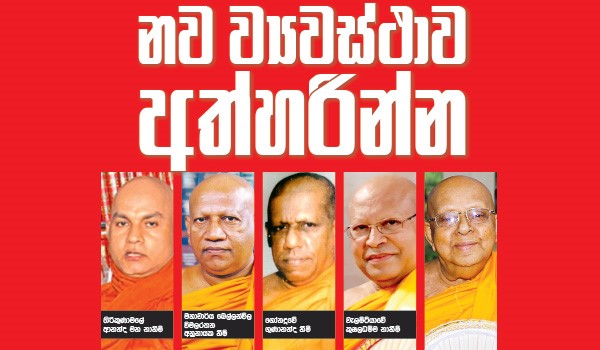
Photo : Courtesy – Mawbima
An appeal letter signed by more than 100 Mahanayake Theros and the Chief Incumbents in Colombo and the suburbs requesting to totally abandon all attempts related to formulating a new constitution has been handed over to both the President and the Prime Minister on th 24th of this month. The signatories of this appeal letter ibclude the Mahanayake of the Amaarapura Dharmraakshita Nikaya Ven Tribcomalee Ananda Thero, Ven. Prof. Bellanwila Wimalaratne Thero, Ven. Balangoda Sobhita Thero, Ven. Diviyagaha Yasassi Thero, Ven. Welamitiyawe Kusaladamma Thero, Ven. Gonaduwe Gunananda Thero, Ven. Nakulugaamuwe Pematilleke Thero, Ven. Pallattara Sumanajothi Thero, Ven. Akuratiya Nanda Thero, Ven. Yatuana Gnaawaasa Thero, Ven. Prof. Agalakada Sirisumana Thero, Ven. Wadduwe Dammawasa Thero, Ven. Nelumdande Wimalasaara Thero, Ven. Prof. Medagampitiye Wimalasiri Thero, Ven. Talalle Chandakitti Thero, Ven. Prof. Kongastenne Ananda Thero, and Ven. Walpola Gothama Theo.
The appeal letter has emphasize that members of the Maha Sangha and the religious leaders while enlightening all people’s representatives and the general public about the emerging nation disaster situation would muster all forces to reject the constitution proposals. They have said that these activities will be carried out devoid of personal or political objectives. They have also called to establish a dialogue on this matter.
n Ven. Athuraliye Rathana Thera has said he that he opposes the Steering Committee’s Interim Report and added that there are several other burning issues in the country that need to be addressed, other than bringing in a new Constitution. He pointed out that the new constitution proposes the merging of Northern provinces and the merging the Northern and Eastern provinces would lead to racial issues among the people. As such, he said, many members of Muslim communities in the East are not in agreement with this proposed constitution.
Rev.Fr. Vimal Tirimanna, CSsR, in an analytical article in The Island of 11th October, 2017 titled “Yahapalanaya govt. has neither valid mandate nor credibility to draft a new constitution” concludes “The only way the government can have both a mandate and the necessary credibility to drnew constitution is to call a general election and muster a clear-cut majority rather than hoodwinking the people with their fairy tale arguments, for postponing all elections. A new Constitution should not be a façade to achieve the egoistic agendas of its drafters irrespective of what the citizens really desire at this moment through such a Constitution”.
Archbishop of Colombo and Head of the Roman Catholic Church in Sri Lanka Rev. Dr. Malcolm Cardinal Ranjith publicly declared his opposition to any constitutional dilution of the foremost place granted to Buddhism in Article 9″,. Dr. Malcolm Ranjith participating at a religious ceremony held under the patronage of Chief incumbent Ven. Daranagama Kusaladhamma Nayaka Thera at the Sri Sambodhi Viharaya in Colombo said that the right status and respect deserved for Buddhism should remain intact in the constitution, He said that the prominence of the country relies on Buddhism and there should not be any decision to change its due place secured by the constitution as we all live in a country nourished by Buddhism.
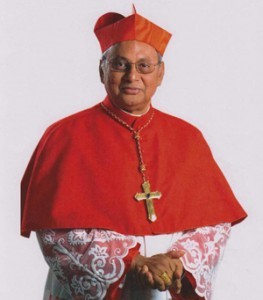
Archbishop of Colombo, His Eminence Dr. Albert Malcolm Cardinal Ranjith
Attorney at Law Rushdi Habib speaking at the inaugural event of he Eliya” movement stated that we seem to be moving from a unitary state to a federal state and that in such a situation it is important to study the implications that such change will have for the peaceful coexistence among communities, He stated that he had seen the proposals to amend the constitution and queried whether by putting forward a proposal to amend Article 9 (which gives foremost place to Buddhism) anyone can really expect reconciliation to take place in this country. He stated that the mere suggestion itself is counter productive.
He also pointed out that by devolving police and land powers and abolishing the concurrent list and giving all such powers to the provincial councils, whether there is any guarantee that the rights of the Sinhala and Muslim minorities living in the North and East will be protected. He drew attention to the fact that the Muslims were expelled from the north by the LTTE within 24 hours and that in a backdrop where such incidents have taken place, to create autonomous units which are not subordinate to the sovereign power in the country, would heighten the danger of parts of the country moving away from the state. He stated that the TNA has proposed the merger of the North and East and if a referendum is to held, that it be within the provinces to be merged. He stated that the majority of the Tamil and Muslim people in this country do not live in the North and East but elsewhere and if the North and East goes its separate way, he wanted to know what will happen to the majority of the Tamil and Muslim people living in other parts of the country? He said that the Tamil and Muslim people should oppose this proposed constitution and that they cannot agree to the arrangement being proposed.
He stated that by going for a foreign solution imposed upon us, the majority of the Tamils and the Muslims living in the South are being placed in danger by creating Tamil areas, Muslim areas and Sinhala areas and a Tamil police, Muslim police and Sinhala police etc. He stated that they have no issue living in a unitary state and that they don’t want separatism in this country.
Former Ambassador Tamara Kunanayagam speaking at the same function said, at the same time that a new Constitution was being discussed, a plethora of radical reforms” was also being rushed through. The fact that many of these reforms are being challenged as unconstitutional, indicates that the new Constitution is aimed at making what is unconstitutional today, constitutional tomorrow. In other words, making legal, what is illegal by a simple trick of changing the Law.”She said, efforts to draft a new Constitution is a project sponsored by the United States and that, through its intervention, what began as an agenda to abolish the Executive Presidency, has become a full-blown reform of the Constitution.
Meanwhile. The tiger terrorist website TamilNet in an article on 21st October under the titled ‘Unitary Constitution impossinle choice, irrelevant to fundaments, needs rejection by Tamils says that Eezham Tamils are a distinct nation with sovereignty-based claim to exercise their right to Self-Determination. A framework for political solution should therefore recognise the nationhood of Eezham Tamils, their geographically contiguous homeland and their inalienable right of self-determination. It outlines four essential elements of any framework to be qualified as a solution model to resolve the national question and which are 1) recognise Eezham Tamils as a nation 2) recognise their distinct sovereignty for self-governance 3) recognise that Eezham Tamils are entitled to exercise their right to self-determination without any compromise and 4) propose a model of governance ensuring their parity on the above three fundamentals. This shows that these separatist Tamils will not change their hardcore standard under any circumstances.
Why this Tamil and foreign slavish government cannot abandon this despicable constitution process as the respectful and exemplary paradigms shown by late Prime Ministers S.W.R.D.Bandaranaike and Dudley Senanayake?
(To be continued)
Lord Michael M Baron Naseby
House of Lords
Your Lordship,
We, the Global Sri Lankan Forum, GSLF write to convey our grateful thanks to you on behalf of the threatened Sri Lanka for you excellent presentation of facts at the recent All Party Group” debate on Sri Lanka. You have been contributing your unbiased views on Sri Lanka in the past without being pressurized by or caving into the lies and distortions spread by the separatists who supported the LTTE terrorism , so called NGO fronts and the politicians who are swayed by the vote banks of persons of Tamil origin in the UK and other countries.
For them the parroting of all the anti-Sri Lanka slogans and the false stories of perceived discrimination of Tamils, the exaggerated number killed at the war against LTTE terrorism and attempting to create instability in the small but a country with a long and proud history of being a unitary state is the unwavering agenda. With the present Sri Lankan government accepting the UNHCR resolution moved against the country in the guise of reconciliation Sri Lanka has been placed at an unenviable position.
As you recollected in your speech, the threat of war crimes on Sri Lanka should be removed for the country to progress with confidence.
Historically, was an exemplary co-existence among all the groups in Sri Lanka, if not for the attempts of the Tamil Vellalahas (so called high caste Tamils) who wanted to dominate Sri Lankan politics by demanding “the rights of the Tamils” at the expense of the territorial and the nation integrity of Sri Lanka,
We send herewith an article written by Mr HLD Mahindapala, on this important subject to identify the false story of Temil grievances.
We take this opportunity again to thank you for relating the true story of Sri Lanka in the public arena and request you kindly to continue your invaluable contribution to highly prejudiced case championed by the anti Sri Lanka fora.
Thanking you
Yours sincerely
Ranjith Soysa
Media Coordinator
For Global Sri Lankan Forum
විශේෂඥ ශල්ය වෛද්ය එස් එස් ජයරත්න මහතා සමග වැඩ කිරීමට ලැබීම භාග්යකි. එතුමා සමග මට වැඩ කිරීමට හැකි වූයේ කොලඹ යුද හමුදා රෝහලේදීය.
විශේෂඥ ශල්ය වෛද්ය එස් එස් ජයරත්න මහතා මනෝ චිකිත්සනය සඳහා මවෙත බොහෝ රෝගීන් යොමු කොට තිබේ. මෙම රෝගීන් අතර අවිඥාණික මානසික ගැටුමක් නිසා උදර වේදනාවෙන් පෙළුණු රෝගියෙකු පිලිබඳව මුලින්ම සඳහන් කල යුතුය. මෙම රෝගියාට දිගින් දිගටම වේදනා නාශක වලටද අඩු නොවන උදර වේදනාවක් තිබුනේය. ඔහු සබැඳිව කරන ලද සියළු පරීක්ෂණ සාමාන්ය වූ අතර එන්ඩොස්කොපි සහ උදරයේ ස්කෑන් පරික්ෂාවද කිසිදු වෙනසක් පෙන්වූයේ නැත. මේ නිසා මනෝ විද්යාත්මක තක්සේරුවක් කිරීම සඳහා මෙම රෝගියාව විශේෂඥ ශල්ය වෛද්ය එස් එස් ජයරත්න මහතා විසින් මාවෙත එවන ලදි. එම මනෝ විද්යාත්මක තක්සේරුවේදී යුද ආතතිය සමග බැඳුණු අවිඥාණික මානසික ගැටුම් හඳුනා ගන්නා ලද අතර ඒ සඳහා මනෝ චිකිත්සන ප්රතිකාර ලබා දෙන ලදින් ඔහුගේ උදර වේදනාව සුවපත් විය.
අවිඥාණික මානසික ගැටුම් නිසා මනෝ කායික රෝග ලක්ෂණ විශේෂයෙන් වේදනාව මූලික කර ගත් ලක්ෂණ පෙන්වන රෝගීන් සිටිති. බොහෝ විට මනෝ කායික උදර වේදනා තිබෙන රෝගීන් කෙලින්ම යන්නේ ශල්ය මේසය මතටය. මෙම රෝගියාගේ රෝග ලක්ෂණ කායික හේතූන් නිසා හට නොගත් බවට උපකල්පනය කිරීමට අවලෝකනයක් විශේෂඥ ශල්ය වෛද්ය එස් එස් ජයරත්න මහතා තුල තිබුනේය. මින් පෙනී යන්නේ එතුමා තුල පවත්නා සායනික දැණුමයි.
වෛද්ය එස් එස් ජයරත්න මහතා විසින් මවෙත යොමු කල තවත් රෝගියෙකු නම් දබර ඇඟිල්ල පක්ෂාඝාතයට ලක්වූ සොල්දාදුවාය. මෙම සොල්දාදුවාගේ දකුණු අතේ දබර ඇඟිල්ල හිටි හැටියේම පක්ෂාඝාතයට ලක් විය. මෙවැනි තත්වයන් සායනික මනෝ විද්යාවේ හඳුන්වන්නේ trigger finger palsy කියාය. බොහෝ විට යුද ආතතිය නිසා මතු වන අවිඥාණික මානසික ගැටුම් නිසා මෙම තත්වය ඇති විය හැකිය. මෙම පක්ෂාඝාතයේ සංකේතාත්මක අර්ථය නම් යුද භූමියෙන් ඉවත් වීමට තිබෙන අචේතනික උවමනාවයි. දකුණු අතේ දබර ඇඟිල්ල පණ නැති වීමෙන් සොල්දාදුවාට තුවක්කුවේ කොකා ගැස්සිය නොහැක. මේ නිසා ඔහුට තව දුරටත් සංග්රාමයට සහභාගී විය නොහැක. මෙවැනි trigger finger palsy පිළිබඳ සිද්ධි අධ්යනයන් සිග්මන්ඩ් ෆ්රරොයිඩ් ඉතා විචක්ෂණ ලෙස ලියා තිබේ. මෙවැනි රෝගීන් මෝහන ප්රතිකාරය සඳහා හොඳ ප්රතිචාර දක්වති.
2005 වසරේදී වෛද්ය එස් එස් ජයරත්න මහතා විසින් උපදේශනය සහ මනෝ ප්රතිකාර සඳහා විශ්රාම ලත් ජ්යෙෂ්ඨ සොල්දාදුවෙකු මා වෙත යොමු කරන ලදි. 1988/89 කාලයේ බොහෝ සැහැසි ක්රියාවන් වල යෙදුනු මෙම ජ්යෙෂ්ඨ සොල්දාදුවා දක්ෂ මෙන්ම ක්රෑර පුද්ගලයෙකු විය. ඔහු බොහෝ යුද මෙහෙයුම් වලට සහභාගි වී තිබුනේය. අධික දුම් පානය නිසා ඔහුගේ දෙපා වල රුධිර නාල අවහිර වී පා ඇඟිලි කෙමෙන් කෙමෙන් මිය යන්නට පටන් ගෙන තිබූ අතර වෙනත් විකල්පයක් නොවූ හෙයින් දණ හිසට පහලින් ඔහුගේ දෙපා කපා දැමීම තිබූ එකම ප්රතිකාරය විය. එම ප්රතිකාරය නොකලේ නම් ඔහුගේ ජීවිතය පවා නැති වීමේ ඉඩකඩ තිබුණි.
ඔහුගේ දෙපා කළුවී තිබුනේය. ඇඟිලි තුඩු මියැදී රුධිර නාලිකා ගසක මුල් මෙන් දිස් විය. නමුත් ඔහු අංගච්ඡෙදන ශල්යකර්මයට අනුමැතිය දුන්නේ නැත. තවද මෙම රෝගියා තමා අසලට එන හෙදියන්ට සහ අනෙකුත් වෛද්යවරුන්ට කෙළ ගසන්නට විය. ඔහු කෙළ නොගැසුවේ විශේෂඥ ශල්ය වෛද්ය එස් එස් ජයරත්න මහතාට සහ මට පමණි.
මෙම රෝගියාගේ බිරිඳ සහ දරුවන් මගින් ඔහුට ශල්යකර්මයේ අවශ්යතාව තේරුම් කර දීමට මම උත්සහයක් ගත්තෙමි. ඔහුගේ බිරිඳට සහ දරුවන්ට පණිවිඩයක් යැවූ අතර ඔවුන් වාට්ටුවට පැමිණ මා හමු වූහ. ඔවුන් පැවසූ පරිදි මොහු නිවසේද අක්රොශකාරී චර්යාවක් ගෙන ගිය අයෙකි. මේ නිසා ශල්යකර්මයෙන් පසු ඔහුව භාර ගැනීමට බිරිඳ සහ දරුවන් අකමැති වූහ. අප බොහෝ සෙයින් කරුණු පෙන්වා දුන්නද ඔවුන් තම තීරණය වෙනස් කලේ නැත.
මෙම සොල්දාදුවා බොහෝ කාලයක් පුර තම බිරිඳට සහ ළමයින්ට කායික සහ වාචික වශයෙන් හිරිහැර කර තිබුනේය. ඔහු රෝහලේදී පවා තම බිරිඳට කුණු හරපයෙන් බනිනු අපට ඇසුනි. කෙසේ නමුත් දැන් ඔහු අන්ත අසරණ අඩියට වැටී තිබේ. සිය පවුලෙන් ඔහුට සහයක් ලැබෙන්නේ නැත. මේ නිසා මම ජෙනරාල් තිස්ස පරණගම මහතාගේ ආධාරයෙන් උස්වැටකෙයියාව ප්රදේශයේ මහළු නිවාසයක් ඔහු සඳහා සූදානම් කලෙමි.
තමා දිනෙන් දින කායික මානසික වශයෙන් පිරිහෙන බවත් බිරිඳ සහ ළමුන් පෙරදා මෙන් තමන්ට බිය නොවන බවත් ඔහු වටහා ගත්තේය. දැන් ඔහු අසරණ මහළු මිනිසෙකි. තමන් ගේ තථ්ය තත්වය අවබෝධ කර ගැනීම නිසා ඔහු හිටි හැටියේ මා ඉදිරියේ මහ හඞින් හැඞුවේය. ළමා කාලයේ හැඞුවාට පසු හැඞුව ප්රථම අවස්ථාව එය වන්නට ඇත. ඔහු බොහෝ වේලාවක් හඞමින් තමා විසින් අතීතයේ පවුලට සහ අන්යන්ට කරන ලද පාපකාරී ක්රියා ගැන කීවේය. මම විනිශ්චය විරහිතව ඔහුට සවන් දුන්නෙමි. අවසානයේදී ඔහු ශල්යකර්මයට අනුමැතිය දුන්නේය. පසු දිනම ශල්ය වෛද්ය එස් එස් ජයරත්න මහතා අංගච්ඡෙදන ශල්යකර්මය කරන ලදි. ඉන් පසුව ඔහු තවත් සුමාන කීපයක් අපගේ වාට්ටුවේ සිටි අතර පසුව පෙර කී වැඩිහිටි නිවාසයට මාරු කර යවන ලදි.
දියවැඩියාව නිසා දණ හිසට උඩින් දෙපා කපා දමන ලද තවත් වියපත් සොල්දාදුවෙකු ශල්යකර්මයෙන් පසුව ආහාර ගැනීම අඩු කලේය. එසේම ඔහුගේ දෙපයේ ශල්ය තුවාලද ආසාදනය වන්නට ගත්තේය. මොහු තුල විශාදය වර්ධනය වන බවට සැක කල විශේෂඥ ශල්ය වෛද්ය එස් එස් ජයරත්න මහතා උක්ත සොල්දාදුවා මාවෙත යොමු කලේය. පසුව හෙලි වූ පරිදි මොහු දෙපයේ ශල්ය තුවාල ආසාදනය වීම සඳහා රාත්රියට එම තුවාල මත අසූචි තවරන බව හෙලි විය. කෙසේ නමුත් උපදේශනය සහ ප්රති විශාද ඖෂධ මගින් ඔහුගේ එකී අසාමාන්ය චර්යාව නිම විය. පසුව පූර්ණ සුවය ලබා ඔහු රෝහලෙන් පිට විය.
තවත් වරක් එතුමා මවෙත සෙබලකු යොමු කලේය. මේ සෙබලා උතුරේ සේවය කරමින් සිටියදී ඇතැම් ජේෂ්ඨ සොල්දාදුවන් විසින් කරන හිරිහැර නිසා බඩවතට වෙඩි තබා ගත්තේය. පසුව ඔහුව කොලඹට හදිසි ශල්යකර්මයක් සඳහා ගෙන එන ලදි. වෛද්ය එස් එස් ජයරත්න මහතා ශල්යකර්මයක් සිදු කොට මෙම සෙබලාගේ ජීවිතය බේරගත් අතර උපදේශනය සහ රාජකාරී ගැටළු නිරාකරණය සඳහා අපගේ සායනය වෙත එවන ලදි
මම පුත්තලම දිස්ත්රික් මානසික සෞඛ්ය සම්බන්ධීකරණ වෛද්ය නිලධාරී ලෙස සේවය කල කාලයේ දිස්ත්රික්කයේ වෛද්යවරු සහ හෙදියන් ඇමතීම සඳහා වරක් විශේෂඥ ශල්ය වෛද්ය එස් එස් ජයරත්න මහතාට ආරාධනය කලෙමි. මගේ ආරාධනය පිලිගත් වෛද්ය එස් එස් ජයරත්න මහතා මාදම්පේ පුත්තලම් දිස්ත්රික් නියෝජ්ය පළාත් සෞඛ්ය සේවා කාර්යාලයේ ශ්රවණාගාරයේදී වෛද්යවරු සහ හෙදියන්ට රෝගී සත්කාරය ගැන දේශනයක් කලේය.
විශේෂඥ ශල්ය වෛද්ය එස් එස් ජයරත්න මහතා මානුෂික ගුණයන් ගෙන් පරිපූර්ණ වූ වෛද්යවරයෙකි. ඔහුගේ දැණුම කුසළතාවට අමතරව කාරුණික ගුණය නිසාද රෝගීන් සුවය ලබති. මෙය මම වෛද්ය එස් එස් ජයරත්න මහතා ඇසුරෙන් ප්රත්යක්ෂ කලෙමි.
වෛද්ය එස් එස් ජයරත්න මහතා බුදු දහම ගැඹුරින් හදාරන්නෙකි. එතුමාට බුදු දහම පිළිබඳව කැළනිය විශ්ව විද්යාලයෙන් ගෞරව උපාධියක්ද තිබේ. එතුමා සමග සේවය කල කාලයේදී මම ඇතැම් විට බටහිර මනෝ විද්යාව සහ බුදු දහම පිලිබඳ කරුණු තර්ක කිරීමට පුරුදුව සිටියෙමි. එතුමාගෙන් බොහෝ දැණුම මම උකහා ගත්තෙමි. තවද මා විසින් ලියන ලද “ජාතක කථා මනෝ විද්යාත්මක ඇසින් ” කෘතිය සඳහා පෙරවදන සපයන ලද්දේ එතුමා විසිනි.
වෛද්ය රුවන් එම් ජයතුංග
Quoting from The Island newspaper, Sports Minister Dayasiri Jayasekara, addressing the weekly Cabinet Press Briefing, at the Information Department, said that finding solutions to the problems faced by the Tamils did not mean dismembering the country into pieces or combining the Northern and Eastern Provincial Councils into one, as demanded by some Tamil parties.
Then he went on to ask “Let me ask you’ll a question. The Tamils fought for autonomy for nearly 30 years. If you now tell them that devolution even within a united Sri Lanka is not possible, then you cannot rule out the possibility of another conflict.“
The main problem with this type of foolish arguments which purposely avoid specifying the so called ‘problems faced by the Tamils’ is they tend to covert the baseless discrimination allegation to a FACT. After many years of repetition more people will simply quote it assuming it is a true allegation which was proven long time ago.
Then he went on to ask the most foolish question shamelessly. It proves how unintelligent and uneducated our ministers are.
If Tamils demanded a fair ‘autonomy’ why did the successive governments did not listen to it and gave what they wanted ? Why did the two sides fought a war? How unfair was our successive governments?
Hitler wanted to liberate Germany from evil Jews (as he claimed) and waged a war. Did the victors took action against Jews to give Germans what they demanded after winning the war ?
The truth is a war was fought to end terrorism by Tamils, not because they demanded ‘autonomy’. They did not demand ‘autonomy’ but a sperate state and started terrorising the country and to kill innocent poor villages and then spreading it to kill indiscriminately abusing their own children and sabotaging the whole country for 30 years. It was Tamil politicians ( most of them were killed by Tamil LTTE) who demanded 50/50. If the government had given the 50/50 autonomy they wanted back in 1970’s would they have been silent and shaken hands with ministers to share power?
These foolish ministers should think before they open stupid mouths. The truth was LTTE ( Tamils) , which is still very much well organised overseas and now in the island as well, will never be satisfied with any sort of autonomy. It is only the Tamil politicians who are asking for a race based ‘devolution’ under ‘Orimitta Nadu’ whilst LTTE Tamils are getting re-organised in ‘Tamil Nadu’ under Viko. When the power is devolved, they will receive more power to evolve again, get things organised again in the North and start with killing of those very foolish Tamil politicians who are now asking for ‘devolution’. They will get ‘revolution’ instead and the History will surely be repeated.
‘Orimitta Nadu’ will be the ‘Kolaiyaali Nadu’ in no time with more intensity than ever before.
Say NO to racial discrimination, racist devolution and autonomy and YES to integration, friendship and compassion to work as single nation to make this country great again ! Whole country is the homeland for everyone, not that part to Tamils and this part to Sinhalese and in the end whole country to foreign powers.
මැතිවරණ කොමිසමේ සභාපති මහින්ද දේශප්රිය ඇද සිටි ඇදුම් මෙතෙක් කාලයක් තිස්සේ එක් එක් අය විසින් ගලවාගෙන ගිය බව පිවිතුරු හෙල උරුමයේ නායක පාර්ලිමේන්තු මන්ත්රී උදය ගම්මන්පිල මහතා පවසයි.
ඉතිරි වී තිබූ යටම ඇදුමද ඇමති මනෝ ගනේෂන් ගලවාගෙන යනවා තමන් දුටු බවද මන්ත්රීවරයා සදහන් කරයි.
පළාත් පාලන මැතිවණය පවත්වන්නේ ජනවාරි මස 27 වැනිදායි ඇමති මනෝ ගනේෂන් විසින් ප්රකාශ කර ඇති නිසා දැන් මැතිවණ කොමිසමට කරන්න කිසිම දෙයක් ඉතිරි කර නැති බවද ඔහු කියා සිටියේය.
මන්ත්රීවරය මෙම අදහස් පල කලේ පිවිතුරු හෙල උරුමය මූලස්ථානයේදී පැවති මාධ්ය හමුවක් අමතමිනි.
ව්යවස්ථා සංශෝධනයට වඩා රටේ ඇතිවෙලා තිබෙන ප්රශ්න එකින් එක සොයා බලා ඒවාට විසඳුම් සෙවිය යුතු බවත් ජාතිවාදීන්ට උඩගෙඩි දෙන අනවශ්ය ව්යවස්ථා සංශෝධනයක් ගෙන ඒම රට නැවතත් ආපස්සට තල්ලු කිරීමක් බවත් ජාතික මහ සභාවේ සභාපති පාර්ලිමේන්තු මන්ත්රී පූජ්ය අතුරලියේ රතන හිමියෝ පැවැසූහ.
යහපාලනයක් ඇතිකිරීම සඳහා පැවැති රජය පරාජය කර නව රජය බලයට පත්වූයේ රටට අහිතකර මෙවැනි සංශෝධන ගෙන ඒමට නොවන බවත් රටේ දැවෙන ප්රශ්න විස¹ සියලු ජනවර්ගයාට සාධාරණ අයිතිවාසිකම් ලැබෙන ජන සමාජයක් ගොඩනැගීම සඳහා බවද උන්වහන්සේ පැවැසූහ.

ඡායාරූපය – ජූඩ් ඩෙන්සිල් පතිරාජ
යෝජිත නව ව්යවස්ථාව සම්බන්ධයෙන් ජාතික පුස්තකාල හා ප්රලේඛන සේවා මණ්ඩලයේ පැවැති මාධ්ය හමුවකදී උන්වහන්සේ මේ බව සඳහන් කළහ. එහිදී වැඩිදුරටත් කතා කළ රතන හිමියෝ මෙසේ පැවැසූහ. ව්යවස්ථා සංශෝධනය සම්බන්ධයෙන් රටේ විශාල ආන්දොaලනයක් ඇතිවී තිබෙනවා. අපි බලාපොරොත්තු වුණේ ත්රස්තවාදය පරාජය කිරීමන් පසු රටේ සාමය පවත්වාගෙන යන්න වැඩපිළිවෙළක් සකස් කරන්න. මේ ආණ්ඩුව බලයට පත්වූ පසුව ජනතාව බලාපොරොත්තුවුණේ ගිය ආණ්ඩුවෙන් සිදුනොකළ අරමුණු සඵල කර ගැනීම සඳහායි.
මේ ආණ්ඩුව බලයට පත්වූ පසු යම්කිසි ව්යවස්ථා සංශෝධනයන් කරන බවට සඳහන් කළා. ඒ වගේම සමගිය මෙන්ම කඩා වැටුණු ආර්ථිකය ගොඩනගන බවට ජනතා පොරොන්දුවක් දුන්නා. ජනාධිපතිතුමා 2016 වසරේ 19 වැනි ව්යවස්ථා සංශෝධනයක් සිදුකළා. අධිකරණයට, රාජ්ය සේවයට, පොලිසිය කරන බලපෑම ඒ තුළින් නැති කළා. ජනමත විචාරණයකට තුඩු දෙන ව්යවස්ථා සංශෝධන සිදුනොකරන බවට විධායක ජනාධිපති ධුරය අපට කරුණු කිහිපයක් උඩ අවශ්ය වෙලා තිබෙනවා. යම් කිසි කෙනෙක් යම් කිසි විදියකට මේ මැතිවරණ ක්රමය වෙනස් කළහොත් දැනට තිබෙන අනුපාත ඡන්ද ක්රමය වෙනස් කරන්න බැහැ. එකම ක්රමය තිබෙන්නේ මනාප ඡන්ද ක්රමය පමණයි.
ඒ වගේම මේවන විට උතුරු හා නැගෙනහිර ජනතාවගේ ප්රශ්නවලට තවමත් විසඳුමක් ලබාගැනීමට නොහැකි වෙලා. හැබැයි ඒ සඳහා විසඳුම් සෙවීම සඳහා නව ව්යවස්ථා සංශෝධනයක් හරහා පාර්ලිමේන්තුවට අතුරු වාර්තා ඉදිරිපත් කර තිබෙනවා. මෙයින් රට ස්ථාවර වෙනවාද රටේ ස්ථාවරභාවයට හානිකරනවාද ඒ වගේම සුළු ජනවර්ගයන්ගේ ප්රශ්න වලට උත්තරයක් ලැබෙනවාද සංහිඳියාව ඇති වෙනවාද කියා සහ සොයා බැලිය යුතුයි. සියලු ජනකොටස් සමඟ සාකච්ඡා නොකර මේ තුළින් කිසිදු සංහිඳියාවක් ඇති නොවන බවයි අපේ මතය.
මේ ලියවිල්ල සමස්ත ජනතාවගේ යහපත උදෙසා නොවන බවද ප්රකාශ කළ යුතුයි. ආණ්ඩුව කියනව මේ අතුරු වාර්තාවක් මේකට කලබල වෙන්න එපා කියලා. අතුරු වාර්තාවක් දාන්නේ යම්කිසි කමිටුවක සාමූහික ඒකමතික තීරණයක්. එහෙත් මේ කමිටු වාර්තාව පාර්ලිමේන්තුවට දාල තියෙන්නේ විසි දෙනෙක් ඉන්න කමිටුවේ හත්දෙනකුගේ කැමැත්ත මතයි. පැහැදිලිවම විධායක ජනාධිපති ධුරය අහෝසිකරන ව්යවස්ථා සංශෝධනයකට ශ්රී ලංකා නිදහස් පක්ෂය කැමැති නැති බව. ඒ වගේම හෙළ උරුමය ඒ වගේම දෙමළ සන්ධානයද මේ සඳහා අදහස් පළකර තිබෙනවා. එසේ තිබියදී මෙම ව්යවස්ථා සංශෝධනය නිත්යානුකූල නැහැ. ඒ වගේම පවත්නා විධායක ජනාධිපති ධුරය සම්පූර්ණව අහෝසි කළහොත් එහි බලපෑම් වලටත් මුහුණ දීමට අපට සිදුවෙනවා. මේ තුළින් පාර්ලිමේන්තුවේ සංයුතිය වෙනස් වෙනවා. එය රටට හිතකර දෙයක් නොවෙයි.
විශේෂයෙන්ම උතුරේ ප්රශ්න රැසක් මේ වනවිට බිහිවෙමින් පවතිනවා. ද්රවිඩ සිරකරුවන් නිදහස් නොකිරීම, ඔවුන් අධිකරණයට ගෙනත් නඩු පැවැරීම් හා නිසිලෙස පුනරුත්ථාපනය කිරීම් වසර තුනක් ගියත් මේ ආණ්ඩුවට කිරීමට නොහැකිවී තිබෙනවා. ඒ වගේම මේ ඉඩම් ප්රශ්නය. යාපනයේ ඉඩම් වල වැඩි කොටසක් තිබෙන්නේ ජනතාවට නොවෙයි ප්රභූවරුන්ට. ඒවා සොයා බලා අහිංසක ජනතාවගේ ඉඩම් ලබාදී නැවත පදිංචිකිරීම් නිසියාකාරව සිදුකිරීමට මේ ආණ්ඩුව අපොහොසත්වී තිබෙනවා.
රජය මගින් නව ව්යවස්ථාවක් ඉදිරිපත් කිරීමට සූදානම්වීම සහ සිය මහා සභාවේ ස්ථාවරය පැහැදිලි කරනු සඳහා කොළඹ 07, නිදහස් මාවතේ පිහිටි ජාතික පුස්තකාල සහ ප්රලේඛන සේවා මණ්ඩලයේදී ඊයේ (25දා) උදැසන පැවැති මාධ්ය හමුවේදී ශ්රී ලංකා ජාතික මහා සභාවේ සභාපති, පාර්ලිමේන්තු මන්ත්රී පූජ්ය අතුරලියේ රතන හිමියෝ මෙලෙස අදහස් දැක්වූහ.
එම ජාතික මහා සභාවේ සාමාජික ආචාර්ය සුරේන් රාසවන් (දකුණේ) සහ ලංකා ජාතික කර්මාන්ත මණ්ඩලයේ හිටපු සභාපති තිස්ස සෙනවිරත්න යන මහත්වරුද වෙති.
October 26, 2017, 12:00 pm
Megapolis and Western Development Minister Champika Ranawaka declared the other day that the first phase of the Chinese-funded Colombo Port City project was nearing completion. He was in seventh heaven! We thought he would weep or at least mewl in public when he made that announcement. Why did we expect him to cry?
Ranawaka wraps himself in the flag. He wears his heart on his sleeve and keeps telling us that he will even risk his life to prevent anything bad from happening to the country. He is also surrounded by some patriotic environmentalists. So, how on earth can he rejoice when the Port City project makes some progress?
It may be recalled that on Dec. 16, 2014, in the run-up to the last presidential election, the then Opposition Leader Ranil Wickremesinghe declared that the Port City project, which had been approved by the Rajapaksa government, would destroy the coastal belt from Negombo to Beruwala and, therefore, he would scrap it after forming a yahapalana government. He earned plaudits from the yahapalana camp, of which Ranawaka is a prominent member, various environmental and religious organisations and poor fishers; the protesters voted for Maithripala Sirisena, in the presidential race, overwhelmingly, hoping for an end to the Port City project after a change of government.
But, alas, the yahapalana government did an about-turn. It initially suspended the Port City project, which was subsequently allowed to be built on a bigger land area to be reclaimed from the sea because it was desperate for Chinese loans. China had the last laugh. It dug up land to build an inland port in Hambantota and started filling up part of the sea to construct a city in Colombo, under the Rajapaksa government. After the 2015 regime change, it got the Hambantota Port for a song on a 99-year lease besides thousands of acres of land in the area and also resumed the Colombo Port City project. Now, the yahapalana leaders are all cock-a-hoop about the Chinese projects while the protesters they took for a ride are gnashing their teeth!
Ranawaka is lucky that he has, at last, got something to hold on to as the Megapolis minister; without the Port City project, he would have been left with some menial tasks such as removing stray dogs and cattle from roads in the Western Province in the name of urban development. That may be the reason why he is happy about the progress of the Port City project. But, there are some mega issues he will have to sort out before the project reaches completion.
An electrical engineer by profession and one of the few intelligent politicians in the current Parliament, Ranawaka can’t be unaware of the massive strain the national grid is sure to come under when the Port City gets fully functional. The Ceylon Electricity Board (CEB) is already struggling to meet the increasing demand for power and buying electricity at extortionate prices from the private sector. There are complaints that even the export processing zones experience frequent power cuts. Blackouts and brownouts are not infrequent in all parts of the country. If rains fail for a couple of months, the CEB complains of massive losses due to thermal power generation and power purchasing (fraught with corruption). How does the government propose to ensure a reliable power supply to the Port City? Does it have plans to increase the CEB’s generation capacity substantially within the next few years?
The Colombo Municipal Council (CMC) cannot even provide a satisfactory service to the ratepayers within the existing city limits. Piles of waste have appeared in some parts of the city during the past several months. Motorists complain of the bad road conditions in the city. Some roads are hardly motorable for want of repairs. Underground sewers burst because they are as old as the city itself. So, how does the government propose to manage garbage and sewage in the Port City?
Cities are known for their enormous thirst. The National Water Supply and Drainage Board cannot ensure a reliable water supply even in Colombo. Spells of drought lead to water cuts as the Kelani Ganga water levels recede. How will the government quench the thirst of the concrete Godzilla rising from the sea?
The ongoing Port City construction work may help the government satisfy its yen for dollars and give it something to flaunt by way of infrastructural development, which is conspicuous by its absence in most parts of the country. But, it has also exposed the yahapalana leaders as a bunch of hypocrites and is bound to cause unforeseen problems which they had better prepare themselves for if disastrous consequences are to be averted.
October 26, 2017, 9:44 pm
-pdc-3.jpg)
We live in a time of dwarfs, against whom we have to defend the achievements of giants.We have SWRD Bandaranaike’s historic rupture with the UNP to found a moderate nationalist anti-UNP formation and inaugurate a two-party system, reversed by Chandrika Bandaranaike’s realignment/reintegration of the SLFP with a markedly rightist UNP. We have the Sirimavo Bandaranaike-Felix Dias Bandaranaike-Colvin R. de Silva unitary Constitution assaulted by Chandrika Bandaranaike and Jayampathy Wickremaratne. We have the Gaullist executive presidential Constitution of JR Jayewardene besieged by Ranil Wickremesinghe, who failed twice to be elected to the presidency. Mercifully, President Jayewardene’s grandson Pradip has come forward to take on his distant cousin the Prime Minister, and defend the logic of the Jayewardene Constitution.
Can you think of anything worse than a referendum on a new Constitution which generates a massive NO vote in the South vocally mobilized by the Buddhist clergy and expressing economic protest, and a massive YES vote in the North? That would display to the world’s media a clear picture of a divided island, and through the international media, the impression would stick in the minds of the global public at large. Just for starters, what sentiments and enterprises will that trigger in Tamil Nadu? Well, that is the scenario that a new constitution, which indubitably needs a referendum, will bring about. Who would be wicked enough or crazy enough to want that?
The mother of the new, non-unitary constitution is Chandrika Bandaranaike Kumaratunga. This was what two publications with a largely Tamil readership, the Uthayan and the respected Tamil Times (London) published in 1994, quoting Wasantharajah, soon to be President Chandrika’s appointee as Chairman Rupavahini:
‘Chandrika replied as follows: “…The present provincial council system is useless…The word ‘federal’ has been abused in the past. Therefore we will avoid that word and implement devolution in a meaningful manner. The country can be divided into five units of devolution, and wide powers can be granted to them. It will be possible to find a solution to the ethnic problem by bringing the North and the Tamil areas of the East under one unit and giving it the necessary powers”. ’ (Tamil Times, 15 July 1994)
This was CBK in 1994. The same toxic, corrosive and highly inflammable stuff was in her ‘Package’ of 1995 and 1997 and in the Steering Committee interim report presented by Prime Minister Ranil Wickremesinghe and prepared by Jayampathy Wickremaratne. Riding on the back of a popular vote of over 60%, President Kumaratunga could not push through her new Constitution in 1995, 1997, 2000 or at any time during her two terms in office, including her popular first term.
CBK squandered the popularity of her first term on the ‘package’ and the ‘Sudu Nelum’ Movement of which Mangala Samaraweera was in charge. As Anuruddha Ratwatte told me (and reiterated in his book) it was because of the Sudu Nelum enterprise and its effect on recruitment that she could not win the war even after the liberation of Jaffna. What she should have done, certainly after Jaffna was won, was to accept her ally Douglas Devananda’s advice (later tendered publicly at the 50th anniversary of the founding of the SLFP) and implement the 13th amendment, starting with an Interim Administration of which he would be in charge. She just didn’t do that. She knew better, as she always does.
Her laser-like intellect (reinforced by the no less laser-like intellects of her crew of cronies, both retired and young NGOistas) tells her that what she couldn’t do under such favorable circumstances, i.e. a new non-unitary Constitution, she can get done now, when she isn’t even the President and isn’t even popular, but is a has-been ex-President and a wanna-be Sonia Gandhi. Go figure!
The legitimacy of the government or at least the UNP and the PM have been undermined by the revelations at the Bond Commission. The economy is growing at a slower rate than during a long, mid-intensity war. The government is running scared of elections. And it wants to weaken itself by abolishing the executive presidency and moving ahead with controversial, emotive ethnic reforms? Seriously?
This government is afraid not only of Provincial elections, it is apparently afraid of even municipal and Pradesheeya Sabha elections. Hence the likely postponement beyond January 2018. Would such a government, which is afraid of elections at a subnational level, at which the factor of incumbency gives the advantage of being the obvious source of future patronage, and at which there would be a three way split, take the risk of a nationwide referendum with a zero-sum outcome, at which a protest vote on economic issues and abstentions by the disgruntled UNP voters could cause an anti-government landslide? Almost certainly not.
That puts paid to a brand new Constitution for the foreseeable future, because it would indubitably require a nationwide referendum. The Supreme Court has correctly ruled that federalism is not coterminous with separation or separatism, but that does not mean that the same Supreme Court will rule that a dismantling of the executive Presidency and an unethical conversion to undeclared federalism, amounting to a constitutional bond scam, can be effected without a nationwide referendum.
With the government on the run from any and all elections, dodging a ballot bullet, it will get boxed into a Presidential election in late 2019. That can be postponed only by the abolition of the presidential system or by an amendment, but that brings us back to the starting point, namely the requirement of a referendum that the government is anxious to avoid or postpone; one that it cannot risk; MR and the JO’s silver bullet that it is trying to dodge.
What then can those who fear that a Sinhala electoral backlash in 2019-2020 would put paid to a political settlement with the Tamils, do now, and how can they do it? The answer is obvious if only logic and reason are your guides. The problem is that ideology intervenes. The logical answer is to effect a reform well before 2019, but keep it well within the limits that do not risk the reform being referred for a referendum. The most recent model is the 19th amendment which trimmed the excessive powers of the presidency. That is what a reform can do—trim the surplus or put more meat on the bones, but not undertake a complete change.
This is both feasible and easy. But there is a problem and that is of ideological extremism of two entirely contradictory, actually antipodal, varieties. The first is that of neoliberalism. Those of neoliberal persuasion insist on going beyond constitutional reform to total constitutional transformation i.e. a new Constitution. These are not merely fringe elements. This seems to be the view of the UNP, the TNA and the large, loquacious, sporadically logical lady.
Then there’s the other ideological extreme, namely these who do not want any constitutional reform whatsoever if it impinges on center-periphery relations. These are the neoconservatives and the New Right, located in the anti-government space and increasingly apart from the mainstream Joint Opposition.
The problem could be resolved if there is a mainstream consensus on pragmatic reform which eschews both the total transformation option as well as the zero change one. It will not be resolved because the main driver of the project for a new Constitution is lodged well within the ruling troika while by contrast, the anti-reform extremists are nowhere near the center of Joint Opposition decision making and are increasingly critical of both the JO and MR. What then is the way out?
‘The One and Only Path’ is the title of a recent article on the blog of a world renowned scholar. The friend I most respect and admire, Richard Falk, Emeritus Professor of International Law at Princeton, who teaches these days at the University of California, Santa Barbara, argued in a recent speech in Europe that the two-state solution to the Israeli/Palestine problem is no longer an option and that the focus should instead be on a one-state solution in which Israel’s apartheid structure is dismantled.
It seems to me that we in Sri Lanka could learn from Prof. Falk’s diamantine thinking. The ‘two-state solution’—Sri Lanka/Tamil Eelam– the Tamil separatists barbarically pursued was buried at Nandikadal. It may be revived someday through other means (leveraging the Indo-US axis, a Pongu Thamil civic uprising, a referendum etc.), but as Iraqi Kurdistan shows, that bluff could be forcefully called too.
The Tamil ‘one-and-a-half state’ solution of federalism by any other name is not going to work either, not least because it requires a referendum at which it will almost certainly be shot down by the Sinhala majority for whom federalism by any other name smells as bad.
What does that leave? A state of denial in which one pretends that there is no Tamil problem is one option, i.e. playing ostrich? That apart, there is a one-state solution, in which existing subnational autonomous units are strengthened while residual discrimination is legislatively eliminated.
If we apply that to Sri Lanka today, now that the Sudu Nelum Syndrome is back and CBK has driven the government into a minefield, what can be done? Be realist and effect political triage. The whole messy project of a new Constitution,and the internally (intra-governmentally) divisive issue of the abolition of the executive presidency which divides the coalition, should be junked in favor of a stand-alone effort which addresses the North-South Question. There too the aim must be a recalibration which does not risk a referendum by impinging on an entrenched clause.
What we are really talking about is the adjustment of the existing system of Provincial Councils which we have worked (ironically, except in the North) for thirty years this year;a constitutional adjustment, pressing the re-set button on the 13th amendment. With a solid phalanx of the Buddhist hierarchy from the Malwatte Chapter through Asgiriya to Amarapura having just come out decidedly against a new Constitution, the abolition of the Executive Presidency and the envisaged dramatic further empowerment of the Provinces, such a revision and upgrade of the existing 13A is not merely the best that can be achieved on the devolution front during thisadministration’s tenure, it is also the only thing that can be achieved. The window for such re-engineering is closing fast.
The Foreign Ministry said yesterday that war crimes allegations would be dealt through national independent judicial mechanisms. Foreign Ministry spokesperson Mahishini Colonne said so when The Island asked her whether the government would request UK and Geneva to review the allegation that 40,000 civilians had been killed during the Vanni campaign, in the light of Lord Naseby statement int he House of Lords disputing the figure on oct. 12.
The following is the full text of SM spokesperson’s statement:
“As you would recall, the 100 Day Programme ‘United for a Change. Dawn of Maithri Rule. A New Country in 100 Days’, in point 93, stated the following: “Since Sri Lanka is not a signatory to the Rome Statute regarding international jurisdiction with regard to war crimes, ensuring justice with regard to such matters will be the business of national independent judicial mechanisms.
“What this means is that the new Government of Sri Lanka pledged to re-assert lost sovereignty by taking ownership of processes that were in the international domain, by bringing them to the local domain, and that the Government of Sri Lanka, as a sovereign state that is responsible for all its citizens, and responsible to uphold the rule of law, democracy, and justice, would take responsibility for credible investigations, locally (by this time, as you would recall, there was already an international investigation on Sri Lanka by the OHCHR Investigation on Sri Lanka (OISL), set up by Resolution 25/1 of March 2014).
“As promised to the people by the 100 Day Programme (point 93), the National Unity Government proceeded to present its own set of national proposals for a transitional justice process, involving truth, justice, reparation, and guarantees of non-recurrence. For the first time, people were invited to present their views through a consultation process on reconciliation mechanisms that was set up locally, so that anyone could present their own ideas for reconciliation mechanisms to the Government.
“The Government of Sri Lanka remains committed to national processes aimed at realising the vision of a reconciled, stable, peaceful and prosperous nation. Engaging in arguments and debates in the international domain over the number of civilians who may have died at a particular time in the country will not help resolve any issues, in a meaningful manner, locally, except a feel good factor for a few individuals who may think that they have won a debate or scored points over someone or the other.
“This country has seen violence many times – for example in 1971, and also during the period between 1987 and 1989 when civilians died and went missing in the south. Once again, after the end of the conflict in May 2009, certain incidents took place in the south, such as the Welikada Prison incident, shooting at protesters in Rathupaswala and in the Katunayake Free Trade Zone. And today, there are attempts once again to instigate violence in the south by branding people as traitors and trying to create divisions in society. These indicate, whatever community one belongs to, one cannot be guaranteed of safety. All communities have been affected by violence at some point or the other in this country.
“Therefore, systems that restore trust in investigations and judicial processes, and systems that strengthen individual rights will benefit all communities and also enhance social trust over the long-term. This is what the Government seeks to carry out, for the benefit of all citizens, present and future, in the interest of long-term stability and prosperity of the nation.”
President Maithripala Sirisena has instructed the apex economic management body, the National Economic Commission (NEC) to renegotiate a dialogue with two international airlines in a bid to resuscitate the national carrier Sri Lankan Airlines (SLA) including the old partner Emirates and the latest rounds of talks have been satisfactory, a reliable senior government source said.
‘The issue of the future of the national carrier SLA was taken up by President Sirisena at the last NEC meeting held before his official visit to Qatar. It was pointed out by Public Enterprise Development Minister Kabir Hashim, who is also a member of the NEC that negotiations would begin very soon to set up a joint venture or outright sale of the SLA which has an outstanding debt of US4 600 million (more than Rs. 90 billion),” the source said on condition of anonymity. This large debt portfolio is holding back investors who are unwilling to partner with the SLA but reluctant to take up the liability,” he added.
Earlier, the cabinet appointed negotiating committee comprising Special Assignments Minister Dr. Sarath Amunugama, Minister Hashim and Development Strategies and International Trade Minister Malik Samarawickrama had a several rounds of detailed discussions with Emirates. The airline has raised its disappointment on the unilateral abrogation of the management agreement agreement with the SLA by the Mahinda Rajapaksa regime without considering the impact on Sri Lanka’s economy, tourism and the fate of the SLA. The sudden and imprudent decision had been taken reportedly on the instructions of UPFA national list MP and former President Rajapaksa’s right hand man and consultant Sajin Vaas Gunawardana, he noted
A large question mark is hanging over the deals negotiated to purchase 6 brand new Airbuses as the price quoted has been much higher than the prevailing market price and the FCID is investigating the deal right now, he said.
Tim Clark, the CEO of Emirates has stated during the first round of negotiations that the Emirates was willing to be partnered with the SLA once again but not ready for an equity partnership. However, the current negotiating team of the government is confident that further discussion would be continued until an agreement in a win-win situation is reached to both, he added.
Meanwhile, a Japanese airline has also expressed interests for a partnership agreement sponsored by a leading Sri Lankan businessman with interests in tourism, banking, insurance and milk products, he said.
The dispute arose when the Emirates refused to bump 35 passengers from a full London-Colombo flight to make way for former President Rajapaksa and his entourage in December 2007.
(Dr. Nalaka Godahewa is the former Chairman of the Securities and Exchange Commission (SEC) of Sri Lanka and the former Chairman of Sri Lanka Tourism)
Newspapers these days cover more or less the same subjects. Corruption allegations led by the infamous bond scam, opposition to the proposed Constitution, the cry for elections, the rising cost of living, student protests and Police violence, plans to sell national assets, and United Nations (UN) pressure on the government to deliver on commitments are frequently highlighted.
The author of ‘The Great Hand Book of Quotes,’ Israel more Ayivor says:
“If the problems you have this year are the same problems you had last year, then you are not a leader. You are rather a problem on your own that must be solved.”
Isn’t this true in the case of the current leadership of Sri Lanka? For almost 3 years, we have been hearing sad stories from our leaders. They keep blaming the previous administration for all their problems. They seem to have completely forgotten the fact that the mandate of a democratically elected government is only for five years and at one point you must stop complaining and get on with the work.
What is the current status of our economy? The national debt, which was Rs 7.3 trillion in 2014, had gone above Rs 10.1 trillion by June 2017. The current figure is worse. Inflation, which was 3.3% in 2014, has now reached 8.6%. The economic growth rate, which was above 7% in 2014, is below 4% this year. Unemployment had increased from 4.3% in 2014 to 4.5% by June 2017.
The Sri Lankan Rupee has depreciated by over 17% from January 2014 up to now causing a negative impact on the economy. The budget deficit which was Rs 591 billion in 2014 is expected to increase threefold to Rs 1.8 trillion in 2018 according to the latest Appropriation Bill that has been submitted to Parliament.
Bond scam
The economic impact of the bond scam is over Rs 1 trillion according to the State Minister of Finance and that has been confirmed by several other analysts as well. The number of people employed in the country in 2016 was 476,000 less compared to 2014 according to the respective annual reports published by the Central Bank. The three most reputed international rating agencies;
Fitch, Moody’s, and S&P have all downgraded Sri Lanka’s ratings compared to 2014. Bloomberg now ranks Sri Lanka as one of the highest risk countries for investment. These facts raise the question, why do people need a government? A government is needed to protect the rights of all the people. It should promote peace, harmony, justice, and equality. The government has a responsibility to provide people with the right economic development opportunities. It should facilitate what the private sector cannot or wouldn’t do like providing people with infrastructure and public services and continue to improve the living standards of people. The government has a responsibility to protect its citizens from external forces and to hold together territory. To what extent is our current government living up to these expectations? In order to win, it is always important for political parties to bring novelty and excitement to an election campaign, but the real challenge goes beyond just winning the election. A government once formed cannot be catering only to those who supported them politically. A national government is responsible for all the citizens in the country. As President Abraham Lincoln said in his famous ‘Gettysburg Address’ in November 1863, “the government should be of the people, by the people, and for the people.” Those inspirational words should be true for every democratically elected government in the world, Sri Lanka included.
Needs of people
To lead a government, “of the people, by the people, and for the people” the political leadership must understand the real needs of the people. These needs manifest in different ways at different times. In the most basic form, people want a government that can assure ‘peace, happiness, and prosperity’ for the citizens. Isn’t this what we say to our neighbours, co-workers, friends, and relatives at the dawn of every New Year? How can these expectations be translated into action by the government? We can identify three contributory factors in achieving ‘peace, happiness, and prosperity’ namely; stability, progress, and dignity. A critical analysis of these factors helps us understand the reasons for the defeat of the previous regime.
Stability means one’s ability to meet the basic needs of his or her family. Essential requirements include a regular income helping one to take care of basic requirements of oneself and the family such as food, clothing, transportation, medicine, and other needs, a place to live, a home which is in close proximity to schools, ease when it comes to admission to school for children, and availability of quality education, affordable healthcare, healthcare facilities in close proximity to the home, affordability of medicine, the ability to pay for hospitalization in the event of an emergency, not being subject to social crimes, ethnic violence, religious violence, social tensions and enjoying a peaceful, safe, and secure environment.
People not only want stability, they also want to progress in life. So, it is important that the economic management of the government create these opportunities for its citizens to progress in their lives which include; opportunities to supplement income, career advancement opportunities, opportunities to start a business, convenience of doing business, investment opportunities, advancement in living standards, better education opportunities for children, better housing, vehicle ownership, entertainment opportunities, and a clean environment.
Dignity of people
The third and perhaps mostly frequently ignored factor is the dignity of people. Dignity is the honour and respect one seeks in life which manifests in different ways such as national pride, need to be identified with an ethnic group, freedom to practice one’s faith, need for recognition as a member of a social group, need for respect as a citizen, freedom of expression, assurance that one’s rights as a member of the general public are not taken away, and satisfaction that one has elected the right leader.
The stability and progress of the society come with the implementation of the macroeconomic strategies of the government. There was an unprecedented focus on infrastructure development since the end of the war. There were clear signs that the country was on the path of economic development, but something was not right despite those economic indicators.
Better governance
It is quite interesting how ‘the need for better governance’ evolved to be the main theme of the last two election campaigns; the presidential and the parliamentary. The primary issue was not just the cost of living as in many other previous elections. It was also not patriotism as in the 2010 election. It was mainly the anger of citizens, who felt their dignity had been compromised. This had an impact on the results of the election.
A government should always aims at ensuring stability, progress, and dignity for its citizens. If the voter feels comfortable in all these areas then they are less inclined to vote against the existing government. When they are uncomfortable with any one of those factors they vote against the existing government. For example, it is the lack of stability or people’s inability to meet the basic needs of their families, which brought the 1970-1977 coalition government down. It was the opportunities for citizens to progress, which kept the UNP in power for 17 years thereafter. It was dignity in the form of national pride that helped the former President to win the 2010 election. It was the perceived violation of the people’s dignity that made him lose in 2015.
If the leaders of the present government were smart, their focus from the beginning should have been to ensure economic stability, opportunities for social progress and protection of personal dignity for all Sri Lankan citizens, but it looks like they are already 2 years and 10 months late.
When are they going to learn?
Maithripala Sirisena has a chronic disease of telling flagrant lies, shamelessly denying anything and everything, conveniently pretending that he was not aware of certain things and has a forked tongue to speak differently to the people of the North and to the people of the Soouth. On 15th November, 2015 standing before the mortal remains of the venerable monk Maduluwawe Sobitha Thero, minutes before they were consigned to the flames, and shedding crocodile tears the double tongued Sirisena swore to abolish the executive presidency. He said: I pledge that I will, to the best of my ability, take steps to abolish the executive presidency in order to create a just governance, to establish a democratic and just society and to usher in a just social system, in the manner the venerable Sobitha envisaged.”
The Maha Nayaka Theros of the Thri Nikayas issued a statement on 5th July decreeing that there is no need for a new constitution and it is also not necessary to make any amendments to the existing constitution and wanted the government to abandon the constitution formulating process. The Maha Sangha guiding the rulers to take the right path and restrain them from venturing into or undertaking measures abominable to the people and the country was a hisroric tradition and the rulers of the past strictly adhered to this age old practice. Buddhist history claims even Lord Buddha was involved in social matters and offered saner advice to the rulers whenever crisis situations occurred.
The present Constitution accords the “foremost place for Buddhism” and states that it is the “duty of the State to protect and foster the Buddha Sasana”. There are over 30,000 Buddhist monks in the country and they are ordained by these three Nikayas and they represent 14 million Buddhists in the country. Under these circumstances the State is bound to oblige to the decree of the Maha Nayakas as Buddhists form 72% of the population of this country. It is sad to note that certain NGO vultures, particularly fellows like the illiterate and idiotic Male Nurse Saman Ratnapriya who is a bootlicker of Viyangoda and who some months ago was alleged to have received from a powerful Minister a property worth Rs. 212 Million from the Nugegoda area have scoffed the decree of the Maha Nayake theroes saying that the Maha Nayaka Theroes belong to an insignificant minority compared to the population in the countey and their opinions should be shunned.
On 6th July Maithripala Sirisena on a visit to Kamdy met the Maha Nayaka Theros of the Thri Nikayas at the Kamdy Presidential house and said that there is no draft constitution and vowed that if a new Constitution is to be drafted it would be done only in consultation with the Maha Sanga and other stakeholders. The outcome of this discussion between the Maha Sangha and the President was disclosed to the media by the Ven. Omalpe Sobitha Nayake Thera.
The double tongued Sirisena has breached this vow already and the Parliament is to discuss on the Steering Committee proposals for three days starting end of this month and then start drafting the so-called Federal and Secular constitution and adopt it in the Parliament in January completely ignoring the Maha Sangha.
In the meantime Sirisena has started saying many things about the proposed new constitution. He has stated that the devolution of power should occur within the country not to benefit politicians, but to empower the people. Speaking to a gathering in Vavuniya, he has stated that the devolution of power will occur to ensure that each and every citizen reaps the benefits of financial progress and have the opportunity to better their lives.
Speaking in Ampara on 29th September he has said that the Government is paying its prime attention to provide solutions for the problems faced by the people in the North and the East, ensuring sustainable peace in the country, building reconciliation among all the communities in a way which will prevent the recurrence of war. Completely forgetting his July 6th vow to the Mahanayake Theros, he has made a request to the Mahanayaka Theros and all the religious leaders including Hindu, Islamic and Christian religious leaders to discuss, sitting at the same table, on ways and means to be adopteed for building reconciliation among all the communities.
Sirisena seems to be very much obliged to please the Tamil people and provide them whatever they need and whatever they aspire.TNA Parliamentarian Sumanthiran has told in an interview given to the London based website Tamil Guardan on 1st December, 2016 that Sirisena asked the TNA to come out with proposals for development, even if it’s a plan for the entie North-East and has promised that he will implement them without any hesitation. He has added that Sirisena is working on developing a mechanism under which the MPs and provincial councillors of the region will look after the development in the North-East.
The double tongued Sirisena while spuriously boasting in the South that he is the son of a farmer has told a meeting in Kilinochchi that it is in the North that the best farmers of Sri Lanka are found. He has said that in the past farmers in the North shed their sweat with determination to make our country a self sufficient country and a special programme should be implemented to save them from their debt burden and raise them once again as a strong farming community. He has further stated that he would discuss with officials of the State and Private Banks on the means to help the Northern farmers. It seems that when he goes to North he feels that it is his genuine country.
Sirisena’s this claim of Northern farmers making this country self sufficient goes against the history of this country and the Tank and Temple (Vaewai Daagaebai) concept and was it to have as swimming pools that large tanks such as Parakrama Samudray, Minneriya wewa (in his own district Polonnaruwa), Kantale wewa, Tisawewa, Tissawewa, Nuwarawewa etc, were built by Sri Lanka’s ancient kings?
Minneriya Wewa
Reports said that prior to addressing the Kilinochchi meeting Sirisena held a special meeting with a group of people who claim that their family members are missing. Sirisena has requested them to come and meet him at his office and promised them to do whatever it is possible to help them.
While telling to the people of the South there is no constitution being drafted, he has asked that if the people of the South oppose devolution of powers what is the alternative they have to propose? He has pointed out that power should be devolved not for the benefit of the politicians but for the benefit of the people. He has made these comments at Vavuniya on the 21st of September. Ranil Wickremasinghe has also attended this function.
Speaking further at this function Sirisena has said that on the January 8th Presidential Election 77% of the people of Vavuniya voted for him and he will give priority for the development of Vavuniya area which remains backward. He has said that newspapers whch claims as national newspapers publish distorted and spiteful false news most of the time to mislead the people of the South and to create disharmony and communal divisions among the people misusing the freedom of expression that has been bestowed to them. He has further stated that all those who speak against devolution of power should visit the Northern and Eastern provinces and see for themselves whether these provinces have the development as the developments that had been achieved by the Western province or even the Sabaragamuwa province. He has said that we have similar people throughout the country and all should have equal benefits and equal facilities without any form of discrimination and shortages.
Reports said that the parents of the slain Jaffna student Vidya met Sirisena at this function and he visited their house in Vavuniya at the end of the function. The reports further stated that during this visit Sirisena promised to help Vidya’s brother for his educational activities and to provide all possible assistance to Vidya’s family. It is strange that he remains completely aloof on speaking about mayhem and destruction caused by the LTTE in the Northern and Eastern provinces, let alone the other parts of the country including Dalada Maligawa and Sri Maha Bodhiya, Anuradhapura.
Under these circumstances it is pertinent to ask Sirisena what is that it is lacking for the people of the North and East despite their receiving many concessions and special favours. Since the end of war they had been receiving special concessions in almost all the fields including financial assistance. There are countries which had been at war and still the people in the war torn areas living in misery and as destitutes many years after ending the wars in those countries. For example people in Iraq, newly created states of former Yugoslavia, Afghaanistan etc.
In Sri Lanka Tamils in the North discriminates the Sinhalese and Muslims nott allowing them to buy lands due to the despicable ‘Desavalamai’ Law. Why a separate Land Law for Tamils and the general Law for others? This is what that should be eliminated if all should be treated on an equal basis as Sirisena professes. In the recently announced Grade V scholarship examination results it was shown that the cutoff marks for the Tamil medium students were much lower than the Sinhala medium students. My neighbour’s son got 159 marks and did not become qualified because the cutoff mark for Matara was 164. If he wrote the exam in Tamil medium he would have become qualified. Were these discriminations or special favours? Why Sinhala medium students get discriminated in this manner?
It was the so-called high class Wellala Tamils such as Sambandan Sumanthiran and their ilk who discriminated and still discriminates against the non-Wellala Tamils saying that they are low caste people, inhuman like animals and dogs and animals cannot be allowed to enter their Temples. Sirisena can go to Nallur, Koneswaram and other Temples but not the Tamils branded as Low Caste Tamils. Where is Sirisena’s much professed equality when Tamils get married? Can an upcountry or Eastern Province Tamil girl (even if she is highly qualified) can get married to a Tamil boy of Jaffnaa. It was the late Prime Minister Mr. S.W.R.D.Bandaranaike who enacted laws in 1957 to eliminate discriminations and ill treatment of Tamils by Tamils. It was the Wellala Tamil former Minister of the D.S.Senanayake government Vavuniya MP Mr. C.Sunderalingam who slept across the Nallur Kovil gate obstructing low class Tamils from entering the Temple. Karuna Amman has said that even in the LTTE Tamils of the Eastern province were ill treated and they were sent as front line soldiers in critical battles. These are the discriinatons and what Sirisena should think of eliminating without lecturing to the people of the South to build reconciliation with the Tamils.
During the unfortunate politically inspired riots in the South many Sinhalese saved the Tamils sheltered and fed them in their houses amd later personally took them to refugee camps. Has any example of Tamils doing such things but there were reports (authencity not confirmed) that during the anti ‘Shri’ campagn in the North the Tamil ‘Shri’ symbol was painted on the breasts of Sinhala women with Tar.
What Sirisena is going to do for the Sinhala people who owned bakeries, groceries and restaurants (Matara Bath Kades), and who were engaged in fishing with their own boats who were chased out from the North by LTTE barbarians and had to languish in Southern areas having become paupers overnight? I have a cousin sister whose family was among those who were chased out from Jaffna in this manner. Will Sirisena compensate them and facilitate them to return to their original habitats under Sirisena’s equal treatment policy? Before returning the lands allegedly being held by the security forces return the lands and properties that belonged to these people.
Passing through Wellawatte, Bambalapitiya, Pamankada and many other areas of Colombo one can see high rise muulti storied housing and shopping complexes belonging to Tamils. Will Sinhalese or Muslims be allowed to build housing and shopping complexes like this in Jaffna or Kilinochchi?
It also seems that Sirisena has become a spokesman of the Tamils. Participating in a meeting in a meeting in Colombo on Monday 23rd October he has said that Tamils claim that they have been discriminate for a prolonged period and because of that their faces look pale without signs of a drop of blood. He has said that hence something should be done to make them happy and lively.
Sirisena should read the marvellous speeches made by Rear Admiral Sarath Weerasekera, Dr. Nalaka Godahewa and Mrs. Anuraadha Yahampath at the 36th UNHRC sessions to find out how the Sinhalese and non-Tamils were discriminated prior to 1956 and details of high posts held by Tamils and still being occupied by Tamils and then he would realize the folly of his Tamil slavish attitude and the extent of treason he is committing against this country. Will this Aappa Drohyya have an iota of patriotism to realize it?
(To be continued)
මීට අවුරුදු එකසිය පනහකට දෙසියයකට පමණ පෙර අපේ සීයලා, ආච්චිලාගේ ජීවිතයේ සන්ධ්යා සමයේ තිබූ එකම ආශාව වට වන්දනාවේ යාමයි. මා අසා තිබූ අන්දමට ඔවුන් වට වන්දනාවේ ගියේ ඔවුන්ගේ වතුපිටි, ගෙවල් දොරවල් ආදිය තම දරුවන්ට පවරා දීමෙන් පසුව ය. මඟතොටවල් නොදියුණු, යාන වාහන දුලබ එකල එසේ කිරීම අරුමයක් නොවේ. තිස්ස සිට කතරගමට ගියේ ගොන් බැඳි කරත්තෙනි. දක්ෂිණ මහාමාර්ගය ඔස්සේ පැය 3 කින් කතරගමට දැන් ලගාවිය හැකිය. සේරුවිල රජමහා විහාරයට යා යුතු වූයේ පාරු පාලම් හතක් පසු කරමිනි. දැන් ඒ පාරු පාලම් එකක්වත් නැත. කැළණි විහාරයේ සිට සිරිමෙවන් කැළණියට යාමට තිබූ පාරුව ද දැන් අවශ්ය නැත.
වට වන්දනාව වශයෙන් හැඳින්වුවද, බොහෝ විට ගමනාන්තය වූයේ අනුරාධපුරය යි. බුදුරජාණන්වහන්සේ තුන්වන වරට ලංකාවට වැඩි අවස්ථාවේ උන්වහන්සේ සමාධියෙන් වැඩ සිටි ශ්රී මහා බෝධිය, රුවන්වැලි සෑය ඇතුළත් අටමස්ථානය වට වන්දනාවට ඇතුළත් විය.
ගමනාගමන හා නවාතැන් පහසුකම් වැඩිවත් ම අනුරාධපුරය බලා එන වන්දනාකරුවන්ගේ සංඛ්යාව වැඩිවීම ස්වාභාවික ය. දැන් කොළඹ සිට අනුරාධපුරයට ගොස් අටමස්ථානය වැඳ පුදා ගෙන එදින ම ආපසු ඒමට පුළුවන. සමහර වන්දනාකරුවෝ සංචාරයට පොළොන්නරුව හා සෝමාවතිය ද ඇතුළත් කර ගනිති. කොටි උවදුර මඟහැරි යාම ත් සමග දිවයිනේ පූජනීය ස්ථාන වැඳ පුදා ගැනීමට යාමට දැන් අවස්ථාව ලැබී තිබේ. ත්රිකුණාමලේ දිස්ත්රික්කයේ විල්ගම් වෙහෙර, සේරුවිල, අම්පාර දිස්ත්රික්කයේ අරන්තලාව, එදා කොටි ප්රහාරවලට ලක් වූ ස්ථාන ගණනාවෙන් කීපයකි. දිවයිනේ නැගෙනහිර ද බෞද්ධ පූජනීය ස්ථාන රාශියක් ඇතත්, ඈත අතීතයේ වුව ගම් මට්ටමෙන් වන්දනා නඩ සංවිධාන වූයේ ඉඳ හිට ය. රජයේ වුව අවධානය යොමුව ඇත්තේ ඉන් කීපයකට පමණි. දීඝවාපියේ පවා පුනරුත්ථාපන කටයුතු නිමා වී නැත. ඉඳ හිට එන වන්දනාකරුවන් ට පවා අවශ්ය පහසුකම් නැත.
ලාංකික බෞද්ධයන්ගේ අවධානය නැගෙනහිර ශුද්ධ භූමි කරා වඩ වඩා යොමු විය යුතු කාලය පැමිණ තිබේ. තපස්සු භල්ලුක දෙබෑයන් බුදුරජාණන් වහන්සේගේ කේශධාතු නිදන් කළ තිරියායෙන් අරඹා, විල්ගම්වෙහෙර, බුදුරජුන් පාද ස්පර්ෂයෙන් පූජනීය වූ දීඝවාපිය, මිහිදු හිමියන්ගේ භෂ්මවශේෂ තැන්පත් රාස්සගල, ඵෙතිහාසික මූදුමහ විහාරය, නිලගිරි විහාරය, මගුල්මල් විහාරය ලාහුගල විහාරය ඇතුළත් වන සේ නැගෙනහිර අටමස්ථාන, වටවන්දනාව සංවිධානය කළ හැක.
වර්තමාන ලංකාණ්ඩුක්රම ව්යවස්ථාවේ 13වන සංශෝධනය අනුව, පුරාවිද්යා භූමි අයත් වන්නේ සමගාමී ලැයිස්තුවට ය. යෝජිත නව ව්යවස්ථාව අනුව සමගාමී ලැයිස්තුව පළාත් සභා යටතට ගැනීමට යෝජනා කෙරේ. නැගෙනහිර පළාතේ ඉහත සඳහන් කළ පූජනීය ස්ථානයන් ට අමතරව, තවත් ඵෙතිහාසික ස්ථාන ඇත. එය අනුමත වුවහොත් මේවා සංවර්ධනය කිරීම තබා, නඩත්තු කිරීම හෝ ආරක්ෂා කිරීම අනාගත ප්රාදේශීය පාලකයන්ගෙන් බලාපොරොත්තු විය නොහැක. අප අසල්වාසී රටවල බෞද්ධ සිද්ධස්ථාන වලට වූ නස්පැන්තිය අප ඇස්පනාපිට දැක ඇත.
රුවන්වැලි සෑය අබියස නිතර පැවැත්වෙන විවිධ මල් පූජා වැනි ආමිස පූජාවන් නැගෙනහිර පුදබිම්වල ද ආරම්භ කිරීම වන්දනාකරුවන් මේ ස්ථානවලට යොමු කිරීමට හේතුවනු ඇත. දැනට දඹදිව, තායිලන්තය, මියන්මාර් වැනි රටවලට සංචාර සංවිධාන කරන සමාගම් හා බෞද්ධ සංවිධාන නැගෙනහිර ගැන ද අවධානය යොමු කිරීම ජාතියේ නාමයෙන් සිදු කළ යුත්තකි.
ආචාර්ය පී.ජී.පුංචිහේවා
The GMOA today accused the Finance Ministry of attempting to reduce the tax on liquor through the 2018 budget and said this would encourage the liquor use.It said despite the national policy of the country which is to prevent the easy access to liquor, the Finance Ministry was attempting reduce tax with the intention of promoting the tourism sector. GMOA spokesman Samantha Ananda said the Finance Ministry’s move would destroy the values of the country as it would encourage alcoholism.
Meanwhile, GMOA Secretary Haritha Aluthge said the GMOA was informed of an attempt to open liquor outlets countrywide at SATHOSA outlets. He said if it was done it would influence liquor consumption. Dr. Aluthge said liquor and tobacco were not essential to the tourism industry and tourists could visit the country to view its landscape and nature.”
(We should be happy that a Muslim Minister in charge of Sathosa is encouraging liquor sales despite threats from ISIS!)
First and foremost when did GMOA or their members were worried about health issues of the people? They go on strike for planning abolition of vehicle permits .Do they complain importation of vehicles and three wheelers which generate much ait pollution which affects the health of the nation ?Are elite GMOA goes on strike mercilessly for any minor issue and threaten the state inconvenience people.
Vietnam and Thailand and even Indonesia and even Male Resorts are growing faster because many tourists come to those countries .In Vietnam people drink so much of beer against consuming hard liquor. These countries are growing fast despite being Buddhist country We should liberalize and reduce beer prices and allow selling them in any grocery shop with toddy .Encouraging beer and wine drinking is not only good for health but also the discharges urine will enhance Urea content in soil ! Increase in beer sale will create more jobs for capitalist tycoons and also build more beer factories. .Abundant water flowing along Kelani and Kalu Ganga etc. to the ocean can be used to make beer .We can ask beer companies to filter and clean river water and provide part of it to water- board so that they fulfil Corporate Social Responsibility
We should liberalise liquor trade and also increase production of wines so that ordinary people can take a glass of red wine ( which same doctors advice to heart patients to consume) ,This industry will flourish and grape and other fruit growing will increase which is use to make wine .We can make rice wine so that rice production increases. All restaurants will have more business
Regarding Sathosa planning to sell liquor means more people will visit Sathosa and buy other products for their taste We will sell more meat which means we can also export.
More beer drinking can cure many kidney failures as your organs will work more efficiently ‘???
Sri Lank will have more and Machans .where people and youngsters will gather stop going for demonstrations where they provide hard liquor.
Beer Tycoons will flourish and they will re- invest the money .More tourists will come for Beer Festivals like in Germany and national income will increase, More beer sales will increase sale of fridges and bottle coolers .People will sip beer and wine and forget about SAITM and problems of amending constitution .
My final advice is we should allow legal prostitution also where all of them are checked by the same GMOA members to give a clean health bill to stop women going to middles east and be victims of Arab Vultures and return with illegitimate children. Condom production will go up and rubber industry will flourish .We may also liberalize same -sex trade so that more youngsters from Europe and Scandinavia. West is becoming more and more liberal in same-sex marriage and hotels can advertise the service and we get more tourists.
Impose traffic rules like in Norway where you cannot drive even after a glass of wine which means people will not use cars but some other means to travel, our accident rate will reduce
Our Lion Flag can fly all over the world with a brand name like that and whole world will know about the branded beer in Sri Lanka. (Currently we are quite famous for illegal same sex trade!)
So GMOA should look at the pros but only cons,
They should stop conning” the whole nation.
Dr Sarath Obeysekera
October 24, 2017, 12:00 pm
The British parliament was told, on Oct 12, 2017 that Velupillai Prabhakaran killed Jaffna Mayor Alfred Duraiappah in 1973. The statement was made by Michael Morris, Baron Naseby PC, during a debate on Sri Lanka. Having declared that he launched the All-Party Parliamentary Group on Sri Lanka, way back in 1975, the politician urged Theresa May’s government to review its policy as regards post-war accountability process in relation to the Geneva Resolution 30/1 adopted on Oct 1, 2015.
Very few foreign politicians could have declared that they had known Sri Lanka for over 50 years. Baron Naseby said that he was the current President of the All-Party Parliamentary Group and knew Sri Lanka for over 50 years.

But, having perused Baron Naseby’s statement, the writer is of the opinion that for want of a clear strategy on Sri Lanka’s part, the world didn’t really know the origins of terrorism here. What his statement proved was that Baron Naseby lacked understanding of the situation here. Let me reproduce verbatim Baron Naseby’s comment on Duraiappah’s assassination: “In 1973 Prabhakaran killed the Mayor of Jaffna, along with six soldiers, whose bodies were brought to Colombo. There was a resentful response from the Sinhalese youth, very sadly it was three days before a curfew was brought in, and well over 1,000 Tamils were killed. From then on it has been a situation of Eelam, the independent state, on one side versus the unitary state of Sri Lanka on the other.”
Would you be able to swiftly recognize Baron Naseby’s mistake? Those who had shared the report on the debate, initiated by Baron Naseby on the internet, obviously didn’t recognize the glaring but inadvertent blunder that had distorted the picture. The British politician has, obviously, due to lack of understanding and knowledge of the situation here, considered the assassination of Duraiappah, in July 1975, and the killing of 13 soldiers at Thinnaveli, Jaffna, in July 1983, as one incident.
Duraiappah was gunned down on July 27, 1975 when he arrived by car at the Ponnalai Varadaraja Perumal Temple with two companions, as was his custom on Friday evenings.
Mixing up of Duraiappah’s assassination, in 1975, with the wiping out of an army patrol, eight years later, highlights Sri Lanka’s pathetic failure to brief the international community.
The LTTE killed two soldiers, outside a hardware store, in Jaffna in Oct 1981. They were the first SLA personnel to die in the hands of the LTTE.
At the time Prabhakaran shot dead Duraiappah, the victim didn’t have even a police bodyguard, let alone soldiers.
Baron Naseby has, inadvertently, stated that anti-Tamil riots, that claimed 1,000 lives, had taken place in 1973, whereas they occurred in July 1983.
Baron Naseby referred to the Chola invasion of Sri Lanka and the subsequent Portuguese, Dutch and British colonisation of the country, though absolutely no reference was made to Indian intervention in the 80s. No less a person than the late Indian National Security Advisor (May 2004-Jan 2005) in his memoirs, Makers of India’s Foreign Policy: Raja Ram Mohun to Yashwant Sinha had admitted that India militarily intervened in Sri Lanka to thwart US-Israel-Pakistan using the country to New Delhi’s disadvantage. The shocking admission made by Jyotindra Nath Dixit, who had been New Delhi’s High Commissioner in Colombo during the deployment of the Indian Army (July 1987-March 1990) should be studied keeping in mind the then Cold War environment, with India solidly backing the Soviet Union. Dixit, boldly blamed the then PM Indira Gandhi for Sri Lanka destabilization project started by Delhi in the early 80s to teach a lesson to overtly pro-Western Lankan President J.R. Jayewardene, on top of tacit support for Soviet invasion of Afghanistan in Dec 1979. Dixit called those Gandhi decisions the only foreign policy blunders made during her tenure as the PM (1966-1984). She was assassinated on October 31, 1984 by her Sikh bodyguards for ordering the storming of their holiest site, Golden Temple in Amritsar in June of that year.
 For want of a cohesive strategy, Sri Lanka hadn’t been able to counter the massive propaganda project meant to pave the way for a new Constitution in the guise of addressing accountability issues. If Sri Lanka hadn’t been able to properly brief its friends, there is absolutely no point in blaming those wanting to achieve their despicable objectives through constitutional means, after having failed to overwhelm the Sri Lankan military. Baron Naseby’s statement has proved beyond doubt that successive governments lacked strategy to brief both friend and foe and rectify glaring mistakes.
The military brought the war to a successful conclusion on May 19, 2009, not on May 18, 2009, as stated by Baron Naseby.
But, Baron Naseby, quite rightly, explained the urgent need to reexamine the primary allegation directed at the Sri Lankan military as regards the number of civilians killed. Baron Naseby did it much better than any Sri Lankan politician, or Foreign Ministry has done so far. Having pointed out the absurdity and unfairness in the allegation that 40,000 civilians had perished in the offensive, Baron Naseby said: “…the UK must now get the UN and the UNHCR in Geneva to accept a civilian casualty level of 7,000 to 8,000, not 40,000. On top of that, the UK must recognize that this was a war against terrorism, so the rules of engagement are based on international humanitarian law, not the European Convention on Human Rights.”
Having relentlessly pursued Sri Lanka during the Rajapaksa administration and forced the Sirisena-Wickremesinghe government to co-sponsor Geneva Resolution 30/1 in spite of it being inimical to Sri Lanka, the UK will not, under any circumstances, accept a lower casualty figure.
The Minister of State, Foreign and Commonwealth Office, Lord Ahmad of Wimbledon of the Conservative Party, in his response, on behalf of the government, indicated, in no uncertain terms that the May administration wouldn’t seek reappraisal of casualty figures. “My noble friends Lord Naseby and Lord Sheikh talked about the numbers killed. While the differential may remain, what is undisputed is that a number of civilians died in the final stages of the war and there are still serious allegations of human rights abuses against both the Sri Lankan military and the Tamil Tigers.”
Lord Ahmad’s response revealed that they really didn’t know how many civilians died on the Vanni east front. The British response also disclosed that they didn’t have faith in the much touted UN Panel of Experts on Accountability in Sri Lanka whose report released on March 31, 2011, placed the number of civilians killed at 40,000. Had the British accepted the UN report, Lord Ahmad, wouldn’t have hesitated to directly quote from it. Instead, Lord Ahmad side-stepped Baron Naseby’s challenge. Interestingly, the State Minister conveniently refrained from using specific information provided by Colombo-based wartime British Defence Attache Lieutenant Colonel Anton Gash to the UK Foreign and Commonwealth Office during January 1-May 19, 2009 period. Had the State Minister placed the confidential information that had been provided by Gash, the lies propagated against Sri Lanka would have been exposed.
Baron Naseby quoted Gash as having told him, in January 2009, that he was amazed at the controlled discipline and success of the Sri Lankan Army (SLA) and in particular the care that it was taking to encourage civilians to escape and how well they were looked after, and that certainly there was no policy to kill civilians. Baron Naseby said that there could not be a better military man than Gash to express such an opinion. The politician described Gash as knowledgeable, independent and would be authoritative about what happened on the Vanni front.
The writer had the opportunity to meet Baron Naseby twice during the Rajapaksa administration. Once, the British politician visited The Island editorial to meet Editor-in-Chief Prabath Sahabandu and the writer for journalistic perspective of the conflict.
Obviously, the British had been concerned about the reports sent by Gash as they certainly exposed the absurdity of accusations made against the SLA. The British had shamelessly suppressed those reports while stepping up pressure on Sri Lanka to address accountability issues on the basis of mass killings committed on the Vanni east front. Thanks to Baron Naseby’s effort to secure reports sent in by Gash, during the Vanni offensive, the entire world got to know how the British desperately tried to hold in vital information that would have cleared the SLA. Unfortunately, the SLA failed to gather the required information and evidence, in a systematic way, to counter lies. Since the conclusion of the war, in May 2009, the SLA had done precious nothing to defend itself much to the disappointment of families of those courageous officers and men who died in the battle against terrorism. (In June, 2011, the SLA, during Lt. Gen. Jagath Jayasuriya’s command, simply ignored a statement made by the then US Defence Attache, Lt. Colonel Lawrence Smith in support of Sri Lanka. The statement made in response to a question posed by retired Indian Army Major General Ashok Mehta to Maj. Gen. Shavendra Silva regarding battlefield executions in May 2009 could have been the basis of SLA’s defence. But, the SLA didn’t even bother to examine it. The Island’s exclusive report by the writer on the US Defence Attache’s statement was not challenged by the US embassy. But, the US State Department declared that Lt. Colonel Smith wasn’t there in any official capacity. Whatever, his status at the first defence seminar, organized by the SLA, the officer was there, defended the SLA, though those in authority lacked the strength to exploit the opportunity for Sri Lanka’s advantage.)
Baron Naseby explained in parliament how the UK Foreign and Commonwealth Office had dismissed his 2014 request for Gash’s reports pertaining to the period January 1 to May 19, 2009, in accordance with the freedom of information law. Thereafter, Baron Naseby’s appeals to higher officials, too, had been rejected, prompting the intrepid politician to seek the intervention of the Information Commissioner. The Information Commissioner’s intervention resulted in the UK Foreign and Commonwealth Office making available 26 pages of heavily redacted dispatches from Gash. Had Gash condemned the SLA, those reports would have been extensively used by the British and the British media outfits such as Channel 4 years ago. Had the British not done so, the May government would have used them during debate on Sri Lanka in response to Baron Naseby.
The Baron explained to British parliament how he had received an additional 12 pages, all redacted, from the UK Foreign and Commonwealth Office when he pointed out insufficient number of Gash reports.
Baron Naseby explained how he gave up his struggle for Sri Lanka when judges of the First-tier Tribunal upheld the UK Foreign and Commonwealth Office assertion that had they revealed confidential information they wouldn’t receive such information in the future. It would be better to reproduce verbatim what Baron Naseby told parliament: “…Still concerned about the lack of dispatches in the past few days, I made a final appeal to the First-tier Tribunal, assisted my very good friend Amal Abeywardene. We had the sympathy of the judges for the cause, but they accepted the Foreign Office view that if confidential information was given out, nobody in future would give us any more. So I now have the princely sum of 39 pages of heavily redacted dispatches—nevertheless, if you dig deeply, as in life, you find some real gems. For example, on 28 January:
“It is not possible to distinguish civilians from LTTE cadres as few are in uniform”.
Then, from 16 February: “IDPs being cared for in Trincomalee. Welfare appears to be overriding security considerations”.
Then on 20 January they say, “no cluster munitions were used”, and on 26 April, “civilians killed Feb 1-April 26—6432”.
Obviously, the UK Foreign and Commonwealth Office stance cannot be acceptable as the person making available information in this case Lt. Colonel Gash was a British government employee. The British position could have been acceptable if those dispatches were sent by a mole within the Sri Lankan establishment. Those who had perused Wiki Leaks now know how our honourable members of parliament provided information to US diplomats in Colombo regarding a range of matters.
The reports submitted by Gash and Smith should be compared to ascertain the situation on the Vanni east front. The British and the American defence attaches would have shared information as well as ‘sources’ within the then administration, including the military as well as the LTTE. A thorough examination of despatches from US, British, Indian, Japanese, ICRC and UN missions will establish how the SLA behaved on the Vanni east front.
In fact, the UN Panel of Experts, headed by one-time Indonesian Attorney General Marzuki Darusman, admitted the existence of UN report that placed the number of dead at 7,721 and 18,479 injured from Aug 2008 to May 13, 2009. For some strange reason, Sri Lanka never officially requested the UN to release that report or requested the Geneva-based United Nations Human Rights Council (UNHRC) to examine it.
The UN report that dealt with 10 months should be compared with the UN Panel of Experts report which placed the number of civilians killed during the last phase (reference to Jan-May 2009 period) at 40,000.
Can there be anything as unfair as demanding Sri Lanka to establish Office of Missing Persons (OMP) and introduce new law against enforced disappearances to ascertain the truth while refusing to share information vital to achieve the same purpose. The British should be ashamed, especially because British national Anton Balasingham influenced the murderous LTTE for over three decades. UK-based Balasingham played a significant role in overall LTTE strategy hence there cannot be any dispute regarding his culpability for political assassinations—from TULF leader Papilla Thingamajig in 1989, Raj iv Gandhi in May 1991 and Lakshman Margarita in Aug 2005.
Both Gash and Smith would have had to send many dispatches as the SLA rapidly encircled the LTTE after having inflicted the single biggest battlefield defeat on Prabhakaran in early April 2009. The LTTE had no chance of reaching an understanding with the government following the Anandapuram battle that resulted in irrevocable damages. Among the dead were top commanders, including Pathuman, once the proud commander of LTTE formations deployed on the northern front.
Baron Naseby has exposed the British efforts to suppress the truth.
Interestingly, during the Oct 12, 2017 debate there hadn’t been any reference to a previous debate in the House of Commons on ‘human rights in the Indian sub-continent.’
Long standing LTTE supporter Siobhain McDonagh (Mitcham and Morden) (Labour) told the House of Commons on Sept. 15, 2011 that Sri Lanka’s war, in its last five months alone, had claimed the lives of 100,000 people, 40,000 of them civilians.
The MP never explained how she had come to such a conclusion and her claim should be now re-examined against the backdrop of Minister of State Foreign and Commonwealth side-stepping Baron Naseby’s challenge. McDonagh never responded to The Island queries regarding her controversial statement while the British High Commission in Colombo declined to confirm whether the MP had sought information from the diplomatic mission. The British High Commission adopted a similar stance when the writer asked whether the politician sought information from the mission.
Sri Lanka never conducted a proper investigation into various allegations/claims made in respect of Sri Lanka’s war. Had the government done that Sri Lanka could have exposed the big lie propagated by various interested parties.
UK-based Amnesty International, in its bulletin headlined ‘WHEN WILL THEY GET JUSTICE?,’ estimated the number of civilians killed at 10,000 on the basis of information provided by eye-witnesses and aid workers. The September 2011 report however didn’t make any reference to the number of combatants killed during Eelam war IV or the final five months.
If Amnesty International had based its report on eyewitnesses and aid workers, it would be interesting to know who briefed British MP McDonagh regarding the ground situation.
MP McDonagh thanked the previous British government for terminating the GSP plus trade facility given to Sri Lanka, opposing Sri Lanka receiving IMF stand-by facility amounting to $ 2.6 billion and thwarting a move to host the Commonwealth Summit in Colombo
The MP said: “Britain must take a brave and principled lead—just as we did in Kosovo and, with France, in Libya—and do all that it can to ensure that a full independent international investigation of war crimes takes place. Those of us who believe in justice want the people responsible to be held to account, just as all of us would agree about Colonel Gaddafi, Radovan Karadzic and Charles Taylor. Sri Lanka still wants to host the Commonwealth Summit in 2013. We should be clearly saying “No, not until there is a fully independent, UN-led international inquiry. I hope that if one thing comes out of today’s debate, it will be that commitment.”
That statement was clearly meant to prevent Sri Lanka hosting the useless Commonwealth Summit 2013. Had she succeeded, millions of taxpayers money could have been saved. Those who had been working with Tamil Diaspora pursued anti-Sri Lanka campaign at different levels. They had succeeded primarily due to Sri Lanka’s failure. Let there be a fresh call to the international community to re-examine allegations in the wake of debate on Sri Lanka in the UK parliament.
(To be continued on Nov. 1)
https://www.facebook.com/RManojGamage/videos/383171732103566/
October 26, 2017, 12:48 pm
National Freedom Front leader and Joint Opposition firebrand, Wimal Weerawansa, MP, has, true to form, rattled the cage of many a government politician. He said, with his trademark grin, that a bomb should be dropped on Parliament unless at least 76 MPs opposed constitutional reforms, thereby, denying the government a two-thirds majority. The yahapalana leaders have thrown up their hands in horror, asking for protection. At least, that is what Speaker Karu Jayasuriya has told the media; he has threatened action against Weerawansa for issuing what is being described as a threat.
Most of the yahapalana politicians in the current government were part of the UNP-led UNF administration from 2001 to 2004. They never so much as uttered a whimper of protest, let alone take action, while the LTTE was perpetrating numerous acts of terrorism. Nay, they grovelled before Prabhakaran, who posed the biggest threat to Parliament, and did their damnedest to appease him. Now, they pretend to be a bunch of terrified thothttha babas (babes in arms); they would have us believe that something, uttered by a loose-tongued Opposition politician, has given them a scare!
The yahapalana politicians are baying for Weerawansa’s blood over his statement because they are pursuing a vendetta against him. Their claim of a serious threat to their lives is, not to put too fine a point on it, pure bunkum. Instead, it is they who are a threat to others. A UNP provincial councillor with underworld links has recently been arrested following a fierce gun battle with the elite police commandos! A lethal haul has also been recovered from his residence. The SLFP also has underworld characters within its ranks.
President Maithripala Sirisena has, in a bid to make a public display of his compassion, pardoned an LTTE cadre who had tried to bomb him while he was in the Rajapaksa government. So, why is the government making an issue of a mere statement a frustrated Opposition MP has made?
Weerawansa’s statement in question would have caused serious concern to us if he had made it as a member of the JVP during the second southern insurrection in the late 1980s, when a grenade was lobbed at a government group meeting in Parliament. He and other JVP cadres who dreamt of blowing Parliament sky high have now been reduced to a bunch of lackeys at the beck and call of the two main parties. His erstwhile comrades, still flaunting a revolutionary cause, are cohabiting, for all practical purposes, with the very capitalists who unleashed barbaric violence to crush their bloody uprising and, above all, had their beloved founder leader cremated even before he had breathed his last.
With the kind of members it is burdened with, Parliament needs no enemies. The recently ratified Provincial Council Election (Amendment) Bill has had on Parliament a more devastating impact than a thousand bombs, in a manner of speaking. The original Bill had only one page containing four sections. By the time it was steamrollered through Parliament, it had as many as 21 pages. The yahapalana leaders had smuggled 27 sections into it at the committee stage so as to circumvent a Supreme Court ruling which thwarted their attempt to postpone the PC polls with the help of a previous Bill. The government has not only delivered a slap on the apex court but also caused a severe erosion of public faith in the legislative process. Bombs and guns, we repeat, can’t inflict so much of damage on Parliament.
Worryingly, standards of parliamentary debate continue to deteriorate. MPs are notorious for absenteeism and dereliction of duty. The House was half empty when Parliament celebrated its 70th anniversary on a grand scale recently. More often than not slanging matches and brawls pass for debates. Billions of rupees are unflinchingly allocated through supplementary estimates for ministers’ super luxury vehicles and perks for ordinary MPs.
So, instead of trying to make a mountain out of a molehill anent Weerawansa’s statement, the government ought to take cognizance of the fact that people are extremely resentful. Public anger can be far more destructive than bombs. The yahapalana leaders talk a blue streak while doing a precious little to improve people’s lot; they are busy feathering their nests instead. Corruption is rampant and so is the abuse of power. Most of the election promises have not been fulfilled. People have been denied their fundamental right to exercise their franchise and give vent to their pent-up anger. The government keeps postponing elections on some pretext or the other as it is scared of facing the electorate.
At this rate the day may not be far off when people seriously consider doing what is seen in the dramatic scene at the climax of the action flick, V for Vendetta, where thousands of livid pro-democracy protesters, wearing the Guy Fawkes masks, march on the British parliament.
October 26, 2017, 12:58 pm
The Most Ven. Maha Nayaka Theras, Kotugoda Dhammavasa, Ittapane Dhammalankara, Thirukunamale Ananda and Prof. Bellanwila Wimalaratne, having gone through the Report of the Steering Committee of the Constitutional Assembly with fine tooth comb, has warned of the dangers of this Report as “it seems that not only the alteration of the meanings of the constitution is fraudulent, it is also an attempt to mislead the Sinhala masses.”
“Among the proposals put forward is the proposal to amalgamate the northern and eastern provinces with the objective of legalizing the false and fraudulent demand for a historical Tamil homeland pursued by Tamil separatists”.
-ksn-3.jpg)
“We are constrained to point out that the advice given by the Maha Sangha on various occasions not to engage in such a distorted constitutional process has been ignored”.
These are only a few excerpts from the long Report of the Maha Sangha published in the Daily Mirror of 30th Sept.
Rev.Fr. Vimal Tirimanna, CSsR, in an analytical article in The Island of 11th October, 17 captioned “Yahapalanaya govt. has neither valid mandate nor credibility to draft a new constitution” concludes “The only way the government can have both a mandate and the necessary credibility to draft a new constitution is to call a general election and muster a clear-cut majority rather than hoodwinking the people with their fairy tale arguments, for postponing all elections. A new Constitution should not be a façade to achieve the egoistic agendas of its drafters irrespective of what the citizens really desire at this moment through such a Constitution”.
In The Island of 12th July, Mr.H.L.D. Mahindapala replying to Prof. L. Fernando’s letter “Sangha State behind the State” wrote “It is the Sangha that laid the foundation for this nation”.
In an article by NAN in The Sunday Island wrote “Buddhist Temples were ravaged, Sacred Books burnt and those of the Sangha whether Monks or nuns put to death, if they did not renounce their religion. This caused the demise of Nuns. Monks lived hiding in jungles or in disguise. Leadership of brave monks restored religion”.
It is a historical fact that all the invaders of our country committed so much atrocities to get rid of Buddhism, and if not for our Maha Sangha they may have even succeeded by resorting to the conversion of the Buddhists by all sorts of inducements to which only a few succumbed.
Seventy four percent of this country’s populace is Sinhalese and over 70 percent of them are Buddhists. And not the Tamils, not the Muslims, not the Hindus, not the Catholics, not the Christians ever asked for any change to Article 9 of the constitution. All knew that whatever decree on paper, Buddhism was deeply and indelibly written, etched in flesh and blood and transfused in every sinew, vein and artery of the majority’s Buddhist heart.
For what possible reason should any Sinhala Buddhist dominated government do that unless they had a death wish? Especially when no other religious leaders have ever called for it?
“Malcolm Cardinal Ranjith, Archbishop of Colombo and Head of the Roman Catholic Church in Lanka, was even moved to publicly declare his opposition to any constitutional dilution of the foremost place granted to Buddhism in Article 9” says Don Manu captioned “Will Lanka’s constitutional scapegoat face sacrificial slaughter on the people’s alter?” in the Sunday Times of October 15th.
This yahapalana government cannot bring about any reconciliation by juggling with words in Article 9 of the Constitution, which clearly states “The Republic of Sri Lanka shall give to Buddhism the foremost place and accordingly, it shall be the duty of the State to protect and foster the Buddha Sasana, while assuring to all religions the rights granted by Articles 10 and 14(1) (e)”.
P. S. MAHAWATTE
Colombo 5
October 26, 2017, 12:53 pm
The investigation into the Central Bank Bond issue is proceeding before the COI appointed by the President. It was reported that the Attorney General’s department had submitted a further list of witnesses it wants summoned before the Commission. The list reportedly includes the Prime Minister. A few days back a statement coming from Temple Trees announced that PM was ready to come before the COI if summoned. It will be a most welcome move for the consolation of all concerned if this is done.
The warrant issued by the President appointing the Commission to investigate and inquire into and report on several aspects related to the issuance of Treasury Bonds during the period 1st February 2015 and 31st March 2016, specifically include the following areas;
1. The Management and Administration and conduct of affairs of the CBSL in respect of,
a) The decision making process that preceded the issuance of bonds including decisions relating to Amounts to be raised
Determination of interest rates
The bond redeeming process
b) The disposal of Treasury Bonds by the dealers direct and indirect
2. Whether there has been any malpractice or irregularity or non -compliance in the procedure followed;
3. Whether the transactions have been carried out fraudulently, recklessly and negligently or irresponsibly resulting in any loss to the State;
4. Whether there has been non-compliance or disregard of the proper procedures applicable;
5. Whether such non -compliance and disregard of procedures have resulted in the improper or irregular or discriminatory award of bonds;
6. person or persons responsible for any such act , omission or conduct;
7. Whether any inquiry or probe into any of the above, had been obstructed or prevented in any manner resulting in damage or detriment to the Government;
The above provisions inter alia encompass the decisions and directions during the period prior to the issuance of the controversial bonds. Therefore the evidence of Prime Minister Ranil Wickremesinghe as the Minister in charge of the CBSL becomes important to clarify matters related to vital decisions taken based on directives said to be given by him regarding bond issues.
Testimony by the former Governor Arjuna Mahendran himself and several other officials from the CBSL before the COI , establish that the Governor acted on a directive by his Minister to do away with the direct Placement system in the bond auctions. There is no evidence of this directive being ratified or receiving the approval by the Monetary Board. In accordance with the warrant this matter falls within the ambit of the following;
Non-compliance in the procedure as it is an arbitrary change of procedure hitherto followed by the Public Debts Department,
A malpractice because the application of the new procedure was without any notice or pre-warning to the participating Primary Dealers,
An irregularity since it was not endorsed by the Monetary Board
While the governor is responsible for his unilateral action, the Minister has to explain and clarify how he expected his directive to be implemented besides the circumstances that compelled him to give such a directive. It is only by this one can determine whether there has been a disregard of the proper procedures applicable as required under the warrant.
The Auditor General, has stated before the 2nd COPE inquiry and also before the COI that the decision to increase the Bond sales to 10 Bn instead of the 2.6Bn, recommended by the PDD during the 1st Bond issuance on 27th February , has caused a financial loss to the Government. He has quantified the visible immediate loss and shown a projected accruing long term loss. These factors are relevant in the context of the Presidential decree as shown above under the clause, ” person or persons responsible for any such act omission or conduct”. According to evidence so far , as reported, the governor used the directive given to him by the PM to discontinue the direct placement practice as one of the reasons for his insistence to increase the bond issue to 10 Bn.
Ipso- facto the responsibility extends to the person who gave such a directive as regards the resulting loss.
The adverse effects of this directive becomes more significant and grave when we consider the bond transactions of 29th and 31stof March 2016. Due to the adhoc decision of the Governor, based on the Ministers directive, CBSL has closed these bond issues , by selling amounts much higher than the offers and at very high weighted average yield rates going far beyond the expected rates for settlement. In the 29th March bond issue the amount offered was 40 billion but the final accepted value risen up to 77.7 billion. The WAYR of these accepted bonds range between 12.78 and 14.23! This is a rate that could be categorised as unusually high when the relevant financial and economic factors are applied.
The same happened during the 31st March Bond issue that followed. Having offered to issue 20 Bn. they have issued 50 Billion. The applicable WAYR was between 11.75 and 13.72 much higher than the estimated rate for settlement. The Coupon rate applicable to the issue was ranging from 8.5% to 11.5 % only. These transactions took place under a virtually dealer dominated back ground asthe Bank was bound by a condition to accept auction offers only. Following factors have to be taken into consideration in this regard;
i. Two previous bond issues scheduled for 10th and 24th March were cancelled by the CBSL due to the bids received from the dealers being unacceptable due to unusually high rates
ii. The PD company related to the Governor’s son -in -law was the highest single beneficiary from these transactions and the procedure.
(1) It is observed that Perpetual Treasuries have been awarded 60% of the bonds issued in excess of the original amount called for (ie.77.7 less 40).
(2) This company has been provided Rs.36 Bn under the Reverse Repo and Intra Day Liquidity facility of the CBSL to settle their purchase liability on account of these bonds,
(3) The statistics show that they have obtained over 75% of the total such facilities extended compared to all other primary dealers.
(4) This company has failed to settle the CBSL on the due dates on account of these bond purchases and they were subject toa fine of Rs 26 million for this default.
iii. The action taken by the MOF Ravi Karunanayake, as revealed in evidence before the COI , to prevent the State banks from bidding freely at both auctions has immensely contributed towards the resulting illegitimate culmination
iv. The decision making influenced by the auction only process to accept whatever the bid rate submitted by the dealers has caused a big loss to the government, estimated by the Auditor General as Rs.784 million only for the day for the 29th March 2016 bond issue.
The direction given by Governor Mahendran to increase the Bank rate ( also known as SDF rate) to 6.5% from 5% on the morning of the 1st Bond issue of 27th February, helped him to justify the increase of the issuance to 10 Bn. This decision was contrary to a previous decision not to increase the rates by the Monetary Board. In effect the decision also contributed to creating a favourable secondary market to the successful bidders. It is established that his son-in-law’s company acquired 50% of the total bonds issued in that auction. However the rates were again reduced back to the previous position in April 2015.
In a strangely similar manner the SDF rates have been increased prior to the second bond issue on 29th March 2016 in the following manner;
On 30th December 2015, the rates were increased to 6.0% and 7.5%
On 19th February 2016 again the rates were increased to 6.5% and 8.00%
This undoubtedly lead to the creation of an artificial favourable market for bond dealers to demand high rates from the CBSL and also to sell them at an excessively higher rate in the secondary market subsequently. The transactions in the aftermath to the bond issue clearly establish the purpose and intentions of this manoeuvre. The overall resulting damage to the detriment of the Government is reflected in the following;
The market movements which caused an inflationary trend beyond the regulated limits,
EPF paying excess amounts to invest its funds in the secondary market,
The instant loss to the CBSL by selling bonds at very low prices offered by favoured PDs
The COI will decide whether this is an irresponsibility resulting in losses to the state and who are the persons that should be held responsible for such.
There are other fundamental issues centered round the relevant decision making process,
Viz. the failure and /or avoiding of proper precautionary action immediately following the furore of the 27th February 2015 bond issue;
a) Failure to suspend the Governor or to send him on compulsory leave at least pending the various investigations which were proceeding at a public level, 3 man committee appointed by the Minister, and two parliamentary COPE inquiries and suppressing the no confidence motion in the order book of parliament against the Governor signed by 90 MPs.
b) Not taking any action against the intransigence displayed by certain CBSL officials by not releasing required information to the Auditor General who was conducting an investigation on a directive by the COPE. It will be recalled that the Attorney General clarified the matter and stated that there is no reason for the CBSL officials not to provide the information sought by the auditor general. This is a lapse on the part of the Minister in charge of the CBSL since it is he who should have intervened in the matter due to the governor being under investigation.
c) There appears to be the existence ofsome collusion between the Minister of Finance and the Governor of the CBSL due to the accommodation of certain unprecedented acts like the placement of a central bank official above the head of treasury in the NSB and holding a meeting of Ministers and others to request funds from the CBSL by passing the Treasury.
The Minister in charge of the CBSL has to explain his position regarding these matters without which it would be difficult to determine whether there has been any omissions, oversights any lapses in the conduct of affairs falling within his responsibility.
The other area which needs to be explained or clarified is whether any inquiry or probe had been obstructed or prevented in any manner resulting in damage or detriment to the Government by any authority. It is the Ministers evidence that will be important in this regard. Any internal investigation following the revelations should have received his attention. Following events also need some authoritative explanation both in public interest and for assisting the COI.
The reason for the PM to appoint a committee of inquiry on the same day of the disputed 1st bond issue on 27th February 2015
Why was this report not allowed to be discussed in the parliament
Why did the PM state in the parliament that the Governor has done no wrong while the 3 man committee appointed by him was proceeding with its findings
Why did he recommend to dissolve the parliament on the day it was scheduled to table the 1st COPE report
Why did he not report to the parliament that the previous regime had entered into contracts beyond the provisions
Why did he give further instructions to the 3man committee while it was in progress
Why did the PM refer the COPE report that was tabled in parliament to the Attorney General before the parliament decided on the course of action to be taken.
In appointing the COI, the Presidential decree has stated as follows;
“And noting that this investigation and inquiry under this warrant is in addition to and without prejudice to any measures that have been taken or which will be taken by relevant authorities including the CBSL in the exercise of their statutory and legal responsibilities”
According to this the Minister in charge of the CBSL will have to explain and detail whether there are any ongoing other investigations under his purview or whether he has taken any steps towardssuch a course of action . In an issue of this magnitude, while obstructing and preventing will be considered as an irregularity, not taking any action that should be taken also will be considered as a non-compliance. The Public will welcome some explanation by the Minister in this regard.
October 26, 2017, 12:00 pm
Cabinet spokesman and Sports Minister Dayasiri Jayasekera yesterday said that the government could act on Lord Naseby’s recent call to Theresa May’s government in the UK to review the much-touted UN allegation that 40,000 Tamil civilians perished on the Vanni front in 2009 in the final phase of the war.
Minister Jayasekera said so when The Island asked whether the cabinet of ministers had discussed Naseby’s Oct 12, 2017 declaration in British parliament that as there couldn’t have been more than 8,000 deaths, the UK government should intervene on behalf of Sri Lanka to set the record straight.
The issue hadn’t been taken up at the cabinet ministers’ meeting on Tuesday (Oct 24).
The SLFPer addressed the post-cabinet media briefing at the Information Department yesterday with military spokesman Maj. Gen. Roshan Seneviratne.
When The Island pointed out that the parliament nor government hadn’t so far reacted to a most favourable statement made on Sri Lanka’s behalf, Minister Jayasekera said that they appreciated Lord Naseby’s effort.
Lord Naseby, in his Oct 12 statement strongly denied accusations that the Sri Lankan military had deliberately targeted civilians.
Reiterating their resolve to defend the armed forces, Minister Jayasekera said that Lord Naseby had spoken for Sri Lanka whereas many foreign politicians succumbed to Tamil Diaspora pressure for domestic political reasons.
Asked whether the government didn’t realize the urgent requirement to challenge unsubstantiated war crimes allegations against the backdrop of Lord Naseby’s statement as such accusations were the basis for forcing Sri Lanka to introduce a new constitution, Minister Jayasekera said that there was longstanding demand from the Tamil community for constitutional reforms.
Minister Jayasekera insisted that the Geneva hadn’t intervened in the process to introduce a new Constitution. The SLFPer said so when The Island pointed out that Geneva-based United Nations Human Rights Council (UNHRC) had specifically suggested in June 2016 that a new Constitution be introduced in 2017 subject to a referendum.
Minister Jayasekera inquired from The Island whether it accepted that the Tamil community experienced difficulties? In response to that query, The Island pointed out that they didn’t face any exceptional difficulties not experienced by other communities in Sri Lanka.
Minister Jayasekera said the government leaders had repeatedly assured that armed forces personnel wouldn’t be allowed to be harmed, when The Island pointed out that both the previous government in which he was a minister and the current administration had failed to make representations at the relevant forums.
The Island sought an explanation from Minister Jayasekera as to why Tamil National Alliance (TNA) leader R. Sampanthan had urged the northerners to vote for Gen. Sarath Fonseka at the 2010 January presidential polls after having accused his army of massacring Tamils on the Vanni front, the SLFPer said that the TNA wanted to defeat war winning President Mahinda Rajapaksa. The minister refrained from commenting on The Island observation even if Sampanthan requested, the electorate would have ignored the TNA chief’s call if they really believed allegations the Army deliberately killed thousands.
The TNA took a similar stand at 2015 January presidential poll, the minister said, referring to large scale post-war rehabilitation and reconstruction projects undertaken by the then government for the benefit of people living in liberated areas.
Maj. Gen. Seneviratne explained the gradual releasing of land held by the military since the successful conclusion of the war in May 2009.
In the Jaffna peninsula, the army commenced releasing land in Oct 2010 on the instructions of the previous government.
Maj. Gen. Seneviratne dismissed claims that the military held land hadn’t been released so may years after the war.
Minister Jayasekera warned of dire consequences unless grievances of those who had been affected by the conflict weren’t addressed.
යෝජිත නව ආණ්ඩුක්රම ව්යවස්ථාව පාර්ලිමේන්තුවේ තුනෙන් දෙකක ඡන්දයකින් සම්මත කරගත්ත ද එය ජනමත විචාරණයකට යැමේදී බහුතර ජන මතයකින් පරාජය කිරීමට මහා සංඝරත්නය පෙරටුව කටයුතු කරන බව ශ්රී ජයවර්ධනපුර විශ්වවිද්යාලයේ කුලපති මහාචාර්ය බෙල්ලන්විල විමලරතන නාහිමියෝ ඊයේ (24 දා) පැවසූහ.
ආණ්ඩුක්රම ව්යවස්ථා සම්පාදක මණ්ඩලයේ මෙහෙයුම් කමිටු අතුරු වාර්තාව පිළිබඳව අදහස් දැක්වීම සඳහා ඊයේ සමස්ත ලංකා බෞද්ධ මහා සම්මේලන මූලස්ථානයේ පැවැති මාධ්ය හමුවකට එක්වෙමින් උන්වහන්සේ එසේ ප්රකාශ කළහ.
අගමැතිවරයා ඇතුළු විවිධ පාර්ශ්ව මේ වන විට නව ව්යවස්ථාවක් හෝ කෙටුම්පතක් සකස් කර නොමැති බවත් එම නිසා ඒ ගැන කතා කරන අය කරුණු හරිහැටි නොදැන කතා කරන බවත් පැවසුවත් මහා සංඝරත්නය මේ ගැන ගැඹුරින් හදාරා කරුණු කාරණා දැනගෙන කතා කරන බව උන්වහන්සේ කීහ.
මෙම යෝජනාවලිය අධ්යයනය කිරීමේදී ඉතා පැහැදිලිව පෙනී යන්නේ ශ්රී ලාංකේය සමස්ත ජනතාවගේ අනාගතය හා ජන සමාජයේ සහජීවනය අවදානමේ හෙළීමට හා බෙදුම්වාදී අරමුණුවලට රුකුල් දීමට පාදක විය හැකි ව්යවස්ථා නිර්දේශ එහි අන්තර්ගතව ඇති බව යෑයි උන්වහන්සේ කියා සිටියේය.
ඡායාරූපය- දිමුතු ප්රේමරත්න

ඒවා අතර (අ) පාර්ලිමේන්තු බලතල දුර්වල කරන වගන්ති, (ආ) ජනාධිපතිවරයා විසින් ආණ්ඩුකාරවරයා හරහා පළාතක බලතල පාලනය කිරීමට දැනට තිබෙන ප්රතිපාදන අහෝසි කෙරෙන නිර්දේශ (ඇ) ඉඩම් ඇතුළු ඉතා වැදගත් ක්ෂේත්ර මත පවත්වා ශ්රේෂ්ඨාධිකරණයේ බල වපසරිය ව්යවස්ථා අධිකරණයක් (කොහොම පිsහිටුවනවද යන්න පැහැදිලි නැත) පිහිටුවීම තුළින් අහෝසි කෙරෙන වගන්ති (ඈ) උතුර හා නැගෙනහිර දෙපළාත් එක ඒකකයක් ලෙස සැලකිය යුතු බවට නව ව්යවස්ථාවෙන් පිළිගැනෙන පරිදි පැනවෙන වගන්තිද, (ඉ) පළාත් තුළ ජාතික වැදගත්කමකින් යුතු කටයුත්තකදී මැදිහත්වීමට රජයට මෙතෙක් තියෙන ඉඩකඩ අහෝසි වන පරිදි සමගාමී ලැයිස්තුව ඉවත් කිරීමට කෙරෙන යෝජනා ද (ඊ) ඕනෑම පක්ෂයක් සඳහා ජාතික ප්රතිපත්ති සැකසීමේදී රජයට හා පාර්ලිමේන්තුවට වර්තමානයේ ඇති ප්රතිපාදන ඉවත් කිරීමට කර තිබෙන නිර්දේශ ද (පළාත් සභාවකට අවශ්ය නම් පෝය නිවාඩුව වුවද එම පළාතේ බෞද්ධයන් අඩු නම් එය වෙනස් කර වෙනත් දිනයක් යොදා ගැනීමට හැකිය.) ඇතුළු තවත් බොහෝ යෝජිත පියවර ශ්රී ලංකා රාජ්යයේ ඒකීයත්වය විනාශ කිරීමට තුඩුදෙන බව මධ්යස්ථ හා නිර්දේශපාලනික මනසකින් මෙම ක්රියාවලිය දෙස බලන ඕනෑම අයෙකුට වැටහී යනු ඇතැයි උන්වහන්සේ පැවසූහ.
තවද මෙම යෝජනාවලිය තුළ අන්තර්ගත වී තිබෙන විකල්ප යෝජනා හරහා මෙහි සත්ය තත්ත්වය රටේ ජනතාවට වසන් කෙරෙන පරිදි සිංහල, දෙමළ, ඉංග්රීසි යෙදුම්වල පරස්පර තේරුම් ඇතිවන ආකාරයට වගන්ති සකස් කර තිබෙන බව පැහැදිලිව පෙනීයන බව ද උන්වහන්සේ කීහ.
උදාහරණයක් ලෙස යෝජිත ව්යවස්ථාවේ ශ්රී ලංකාව ෙµඩරල් රාජ්යයක් ලෙස සෘජුව සඳහන් කර නොමැති වුවත් වක්රව ඒ බව ඉස්මතු කිරීමට මෙම එකිනෙකින් වෙනස් තේරුම් සහිත සිංහල, දෙමළ, ඉංග්රීසි වචන භාවිතයෙන් උත්සාහ දරා ඇති බව ද උන්වහන්සේ අවධාරණය කර සිටියහ. එසේම බුදු සසුනට හිමි සුවිශේෂී ව්යවස්ථාමය ප්රමුඛස්ථානය ද ආණ්ඩුක්රම ව්යවස්ථාවේ 9 වැනි වගන්තියට සංශෝධන සහ විකල්ප ඉදිරිපත් කරමින් දියාරු කර ඇති බව ද උන්වහන්සේ කීහ.
මාධ්ය හමුව සඳහා පූජ්ය බලන්ගොඩ සෝභිත, අතිපූජ්ය තිරිකුණාමලයේ ආනන්ද, මහාචාර්ය කෝන්ගස්තැන්නේ ආනන්ද, බෙල්ලන පුණ්යරතන, පූජ්ය හෑගොඩ විපස්සි, ආචාර්ය රොටුඹ ප්රේමරතන යන නාහිමිවරු ද එක්ව සිටියහ.
Copyright © 2026 LankaWeb.com. All Rights Reserved. Powered by Wordpress