What did Mahinda Rajapaksa discuss with Indian PM Narendra Modi?

May 12th, 2017

Courtesy Adaderana

A hastily arranged meeting between visiting Indian Prime Minister Narendra Modi and Sri Lanka’s former President Mahinda Rajapaksa last evening (11 May) raised huge speculation within political circles in Colombo.

This was more since official from both sides had continued to maintain that Narendra Modi’s visit to Colombo had no economic or political objectives.

In the words of Taranjit Singh Sandhu, Indian High Commissioner to Sri Lanka, There are no economic or political objectives in the Indian Prime Minister’s visit to Sri Lanka.” This is what he said when he met a few senior journalists in Colombo at a hotel prior to the Indian Prime Minister’s visit.

This had also been repeated by Indian authorities long before Premier Narendra Modi’s visit.

However, Members of parliament from the Joint Opposition had gone to town while claiming that the Indian Prime Minister’s visit was to sign several agreements, contrary to the claims of the Sri Lankan government.

Furthermore, MPs like Jathika Nidahas peramuna leader Wimal Weerawansa, a close confidant of former President Mahinda Rajapaksa, had urged that Sri Lankans should protest against Modi’s visit and that they should hoist black flags to display their opposition.

Weerawansa who is a close ally of the Rajapaksa camp coming out with a statement of this nature raised several questions among many, since Weerawansa may have given voice to the intentions of former President Mahinda Rajapaksa.

With speculation thus doing the rounds, the former President was soon to clarify the statement made by Weerawansa, saying that it was not in protest of Modi. However, former President Rajapaksa also said that he would only attend the international Vesak day celebrations as it is an international event and that however he was against any kind of pacts with India that could sell the assets of the country to that country.

Meanwhile, India too confirmed that Premier Modi would make this visit purely a religious one and that he would not meet any political figures.

However, the Indian High Commission said, if at all, Modi may meet only Opposition and Tail National Alliance leader R. Sampanthan, apart from meeting President Maithripala Sirisena.

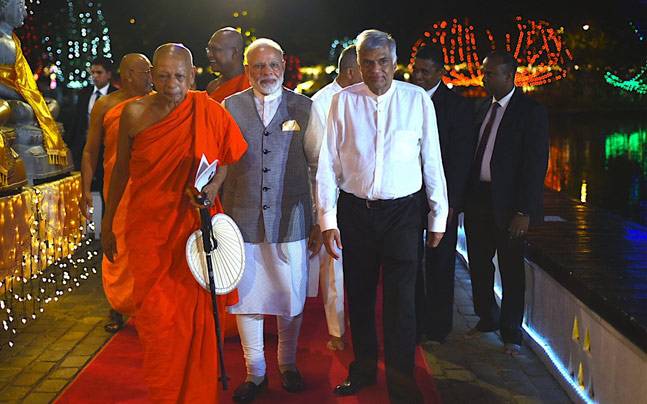
However, Ada Derana surprisingly learned last evening that former President Mahinda Rajapaksa was to meet Indian Prime Minister Narendra Modi at ‘India House’, the High Commissioner’s official residence in Colombo.

Ada Derana attempted to confirm this report, it proved unsuccessful, until Indian High Commissioner Taranjit Singh Sandhu disclosed such a meeting while speaking at a media briefing late last night at the Hotel Taj Samudra at around 11.45 pm.

In his brief statement to the media, Taranjit Singh Sandhu stated that Indian Prime Minister Narendra Modi received former President Mahinda Rajapaksa at his own request.

Ada Derana learned that this meeting at ‘India House’ had lasted over one hour.

This prolonged meeting at ‘India House’ did delay the news conference arranged for at 10.45 pm by over one hour, and it started at 11.45 pm instead.

Meanwhile, Ada Derana also learned that former Defence Secretary Gotabaya Rajapaksa and former foreign minister Prof. G.L. Peiris were also in the delegation that met the Indian Premier along with former President Rajapaksa.

From the Indian side, Ada Derana learns that Indian national Security Advisor Ajit Doval too had been present at this meeting along with Indian High Commissioner Taranjit Singh Sandhu.

When Ada Derana requested for more details, the Indian High Commissioner added that they had discussed further development ties of both countries.

Meanwhile, Ada Derana learned from sources that former President Mahinda Rajapaksa had been appreciative of Indian assisted development projects in Sri Lanka.

As these new developments unfolded within the political arena, the person who was mainly critical of Indian Prime Minister Narendra Modi’s visit to Sri Lanka, JNP leader Wimal Weerawansa was not available for comment when Ada Derana tried to obtain his reactions regarding the former President’s meeting with the Indian Prime Minister Narendra Modi.

what’s real reason behind MODI’s visit?

May 12th, 2017

By Shivanthi Ranasinghe Courtesy Ceylon Today

India needs to change its foreign policy vis-a-vis Sri Lanka immediately. These policies have not only failed, but have disastrously backfired on India, ending in a result totally unanticipated and always against India. The extent of the damage caused by their own policies to India can be measured against the success of their arch rival, China.

PM Modi visiting Sri Lanka for Vesak celebrations is viewed by the Sri Lankan public with extreme suspicion. Nobody accepts the government’s assurances that Modi is just being a good neighbour, popping in for tea and lanterns. In the fracas erupting with attempts to lease the Magampura Port to the Chinese, there was a significant fraction that saw the benefits of the Chinese coming in, and argued it would balance the Indians. However, no one has offered the same argument with respect to India’s interest in the Trincomalee oil wells. That is, the argument that the Indians in the East would balance the Chinese presence in Sri Lanka is not entertained by any quarter. It is the general view that Indians in Sri Lanka is bad news. This perception is entirely due to India’s own doing.

Since the ’70s, India had been playing deceptive politics with Sri Lanka as well as with their own people – especially in Tamil Nadu. Even at the height of friendship between the Indian PM Indira Gandhi and her Sri Lankan counterpart, Sirima Bandaranaike, India gave clandestine sanctuary and support to Tamil extremists from Sri Lanka. Starting actively with Gandhi, right up to and including Modi, these elements have found a sympathetic audience from the Indian government. Their sympathy for Sri Lankan separatists based on mono-ethnic claims is however disingenuous when they are also fighting separatism to maintain India’s overall unity and territorial integrity.

India fails because of a feudal mentality. They do not recognize Sri Lanka’s right to be a progressive sovereign State. They neither help Sri Lanka develop, nor let Sri Lanka get the necessary assistance from elsewhere. We saw this in the ’70s and its repetition after the successful conclusion of our war against terrorism.

JR Jayewardene’s attempts to forge relationships with other powers to neutralize the growing terrorist threat only brought the aggressiveness of India to the forefront. The USA, Pakistan and Israel factor was enough for India to arm and train the terrorists.

After 1983, this programme received renewed vigor. The intention was to destabilize Sri Lanka to force down our throats an Indian policy, but not a Tamil policy.

Coming in the guise of protecting the Tamils in the North and East, the conditions stipulated in the Indo-Lanka Accord reflect the foreign policies of the Indian central government. For instance, the Agreement extracted from the Sri Lankan Government that Trincomalee or any Sri Lankan port may not be used by a foreign country in a manner prejudicial to India’s interests.

Creation of PCs

The creation of the Provincial Councils (PCs) was to reduce the country’s control by the centre (as can be seen in today’s attempts to do away with the Executive Presidency). This way, the concessions extracted over Trincomalee can be further consolidated once power is devolved to the PC. That is why we see a Tamil polity that is subservient to India making strides in our halls of power whilst the Tamil leaders, whose thinking is independent of India, are near invisible.

Today – that is 30 years later – Trincomalee is again the focus of India. That is why Modi’s visit is viewed with such mistrust.

Former ambassador Bandu de Silva (BS), on whether Sri Lanka should offer more concessions to India over Trincomalee, says in his essay that “the Rajiv-JR Agreement of July 1987 should be read from back to front.” He explains that “India wanting to extract concessions over Trincomalee” was not brought suddenly into the Accord, but that Sri Lanka was under pressure to do so for quite some time. Indeed, according to former Indian Ambassador to Sri Lanka, JN Dixit, Gandhi did not rush JR or the Tamil parties concerned to accept the agreement. Instead, it had been under negotiations for nearly four years.

The other conditions, as major concerns to India, include that Sri Lanka may not employ foreign military and intelligence personnel and ensure any broadcasting facilities set up by a foreign broadcasting organization would be solely used for broadcasting purposes and not for any military or intelligence work.

An interesting condition India insisted then, and is still after, is that the restoring and operating of Trincomalee Oil Tank Farm must be undertaken as a joint venture between India and Sri Lanka. It was only if we fulfilled these conditions that India promised to deport all Sri Lankans engaged in either terrorist activities or advocating separatism or secessionism.

Self-determination

Clearly, none of these conditions address the need, nor provide the mechanism for self-determination that the Tamil separatists seek. The only mechanism this installs is one where India consolidates its power in Sri Lanka. Thus, Tamil civilians became hostages of both India’s foreign policy as well as that of the LTTE’s for nearly 30 years. India and the LTTE used the Tamils as an excuse to achieve their objectives. The Tamils who lived in the LTTE infested areas experienced rampant killing, torture, abductions, disappearances, conscription in their daily lives in addition to overall dehumanization. Tamils did not get the security they hoped for from the Indian Peace Keeping Force. Their many atrocities are yet to be investigated. Those who sought refuge in Tamil Nadu are still living in camps, under strict rules and regulations. They are not recognized by the Indian State at all, despite approaching their second generation. The Tamil Nadu fishing trawlers destroy the livelihoods of the Tamil fishermen. The Indian government refuses to take action. India appears unaware that their hypocrisy is exposed. What has India gained by deliberately destabilizing Sri Lanka? They transformed our ceremonial Army into the fighting force we have today. An important point India must deeply reflect upon is that the Vadamaarachchi Operation had the LTTE cornered. They were about to be annihilated, when India literally descended on us. They clearly thought that what they created, they can control.

The LTTE obviously disagreed and took on the IPKF. After two years, the IPKF was nowhere close to what the Sri Lankan military was about to achieve, had India not interfered. When the IPKF packed their bags to leave Sri Lankan shores, 1155 Indian officers and men had been killed and 36 permanently disabled. C.A. Chandraprema notes that not even in the battles with China and Pakistan, did India suffer so ignominiously. As a result of their deceptive politics, observes Chandreprema, the Indian Central Government, worried over the Tamil Nadu reaction, have not commemorated the deaths of these officers and men, despite the passage of time.

It was the Sri Lankan government that actually erected a monument in their honour, observes Chandreprema. Thus, until the defeat of the LTTE, the Indian military hierarchy was unable to even place a wreath at this memorial column and honour these officers and men. These two incidents – cornering the LTTE in 1987 and actually defeating them in 2009, and the decency of the Sri Lankan government to remember a force that invaded our country in all but name, should send a very important message to the Indian government. We proved that numbers and strength are two very different things. So are supremacy and decency things apart.

Instant hero

When India is dealing with Sri Lanka, India must not take their attention away from an incident that took place when Rajiv Gandhi was in Sri Lanka in 1987. He was here to sign the Indo-Lanka Accord. He had outsmarted JR the old fox and he was clearly very proud. At the Guard of Honour review, he was oozing with hubris until a naval rating stepped out of formation and swung his rifle at him as he was passing by.

To add to the shame and embarrassment, the naval rating upon being questioned as to his motives, explained that killing was not his intention, but would have whacked Gandhi even if all he had was a broom stick. Wijemuni Vijitha Rohana de Silva became an instant hero. Though he was sentenced to prison, as soon as Ranasinghe Premadasa succeeded JR, he had him released.
After that incident, no Indian PM dared visit Sri Lanka for the next 28 years. That was the legacy India inherited for destabilizing Sri Lanka.

Yet, India appears to have learnt nothing from these lessons. For 30 years we endured terrorism. During this time, India, lost their Rajiv Gandhi to the LTTE as he went on the campaign trail seeking re-election to power. Yet, it was India’s enemy States, Pakistan and China, which supported Sri Lanka in our efforts to eradicate terrorism. India not only procrastinated but also tried to dictate the weaponry we ought to get. Had it not been for Indian interference, we would have got the special radar equipment that would have detected the planes that flew over Colombo city, before they did so.

Against such experiences, our recognition of Pakistan and China as our all-weather friends is natural. Why India never factored this in when formulating their policies is indeed curious. At least, during the many cricket matches, India should have taken note that Sri Lankans cheer for the Pakistani team when they play against the Indian team.

When the Magampura Port was first offered to them, India should have helped. Instead, they dilly-dallied because their thinking was that a tiny country like ours does not need such infrastructural development. When we commenced the Colombo Port City Project, this was actually communicated to the then Defence Secretary, Gotabhaya Rajapaksa that besides the project being a security threat to India, we do not need such projects. This opinion did not come from an economist, but a national security advisor to the Indian government.

China on the other hand, understood the value of a port in Hambantota. Hence, while India baulked and belched, China quickly became our strategic infrastructure development partner and helped us with many of our other projects as well.

India should have been smart, but again decided to flex their muscles. This time of course, we did not get any dhal air drops or an Indian Peace Keeping Force. Instead we got Ajit Doval.

Considered second only to Modi in power, Doval has the dubious honour of being the architect behind our 8 January 2015 regime change. Former Director of Intelligence Bureau and now National Security Advisor, he is known as the Indian James Bond. An unconventional thinker, he has served his country well and has pulled off many dangerous heists and cunning strategies. Now in his 70s, more powerful than any ministers of defence or foreign affairs, he seems to have met his Waterloo by trying to do a Sikkim in Sri Lanka. Just as in Sikkim, through sheer cunning, he managed to change the face of political powers in Sri Lanka.

However, again due to the failure of Indian policy, Doval’s scheme has left egg on India’s face again. He managed to rid an administration that was forging close ties with China. If the new government is to survive, then obviously, someone had to fill the lacuna created by dislodging the Chinese from the picture. India again failed to understand this basic logic. They thus never brought any investments. Without investments, the government had no option but to go hat in hand back to the Chinese. The Chinese understood the Sri Lankan government’s difficulty and returned to develop the Colombo Port City, but naturally with conditions more favourable to China. Severely cash strapped, the government has opted to lease the Magampura Port to the Chinese – thereby further consolidating their presence in Sri Lanka.

India had stayed eerily quiet. They are yet to offer a solution to safeguard their interests. Instead, they are concentrating on the Trincomalee Oil Tanks. Susil Premajayantha – one time Minister of Power and Energy – is curious as to why India is after the oil tanks when their market share is less than 15pc. It has been noted that the Indians are not concerned about maintaining the oil tanks already in their custody.

This Oil Tank Farm, built in the vicinity of the Trincomalee Harbour – world’s second largest natural harbour – is a militarily strategic location with historic fame. Premajayantha categorically states that it is not the tanks that interest the Indians, but the land of 625 acres that holds the tanks.

As long as India stays with deceptive politics, they will continue to lose. They must understand that Sri Lanka is not their enemy, but also not their vassal. If they do not wish to be the stand-alone giant that they are today, then they must understand what they are doing wrong. In 1987, one lone naval rating, Wijemuni Vijitha Rohana de Silva, stood up for our honour. However, this time, judging from the crowds drawn to Joint Opposition’s May Day rally and from the demands made by Ceylon Petroleum Corporation and Government Medical Officers Association through their trade union actions, supported by many other trade unions – all standing against selling our assets to foreign interests, namely India – the gear has been shifted.

ranasinngheshivanthi@gmail.com


Sirisena’s grip tightens on the Presidency

May 12th, 2017

WINSTON DE VALLIERE Courtesy Ceylon Today

Considering the tremendous rapport she has with President Maithripala Sirisena and her ingrained comparatively ‘patrician’ revulsion she’s often harboured for the less than plebeian Rajapaksa clan, Chandika Bandaranaike Kumaratunga will exert considerable influence, needed or not, with President Sirisena, in matters pertaining to the relentless purge of the Sri Lanka Freedom Party. She was magnanimous and ‘big’ enough to let bygones be bygones and agree to accommodate S.B. Dissanayake’s subtle entry into the Sirisena camp and into a Cabinet portfolio as men of the ilk of Nimal Siripala also did, along with several other major-domos in the Rajapaksa Cabinet.

At best then, President Sirisena holds a bitter cup in his hand and is tested to the limits to keep his wits about him as he tries to steer a course that he and CBK hope will sometime in the medium term bring about a metamorphosis in the SLFP. Playing the numbers game in this exercise has imposed on him and CBK the indispensable need to let the weeds grow with the wheat until harvest time. To pull all the weeds out right now, especially within the government itself, can play havoc with the objective of maintaining a majority vote in the House to pass through some very radical reform Constitutional Bills and push through some very sensitive reconciliation issues in the overall selfless pursuit of securing the objectives of national communal reconciliation and subtly forge a national Sri Lankan identity.

This is an immensely daunting task and one that no former leaders in this country from any political party, have had the gumption to even consider let alone attempt to bring about. That’s an immense commitment, and I dare say, fraught with such tremendous dangers that can place at grave risk the lives of this duo. This is really what is back of the so-called slow progress in reconciliation efforts that the UNHRC Commissioner Zeid so naively criticized because of his lack of understanding the explosive social dimensions which can blow up in their faces as they tackle this seemingly impossible task.

With a rare psychological insight into the contemporary sometimes extremist Sinhala-Buddhist psyche, former President Chandrika said at a media briefing last Wednesday that if you do not work on this national policy of reconciliation to bring about religious and ethnic harmony, there can only be a continued isolation between the communities, triggering another war scenario, adding that only reconciliation can preempt such divisions, but some people do not understand this”.

With no intention to disagree, the fact is not a question of some people not understanding this but that they are rabidly against it for the simple reason that the supremacist status quo would be lost, submerged, in an egalitarian ethos.

The SLFP purge

Viewed in this context one then appreciates the more, longer-term objectives in President Sirisena inexorably pursuing the SLFP purge. It’s because these Rajapsaksa loyalists have one thing in common: THEY WILL BAULK AT AND VOTE AGAINST ANY ATTEMTP AT COSTITUTIONAL REFORM AND RECONCILIATION EFFORTS AND CONTINUE TO MAKE GOVERNANCE AT THE CENTRE AND PERIPHERY IMOSSIBLE. Wednesday’s sacking of

K.H. Nadasena from the Heath and Indigenous Medicine portfolio in the NCP Provincial Council is a case in point. Vitally important Bills presented in Parliament need a prior sanction by the Provincial Councils and Rajapaksa loyalists must hence be sent away, not only from Parliament and the PCs but also from the Party.

Early last year the purge began with 26 SLFP electorate and district organizers being sacked and new ones appointed in their place, by President Maithripala Sirisena.

Kolonnawa, Kotikawatte, Mulleriyawa, Minuwangoda, Maharagama were a few places from which MR loyalist were shown the door, with SLFP Treasurer, S.B. Dissanayake, made Chief Organizer of Hewaheta. Dehiwala followed. Peculiarly he has effected these changes not at meetings at Party headquarters but at the President’s official residence.

Much more are to follow because the Rajapaksa faction continues staging endless campaigns against the Sirisena government including the now exposed GMOA’s role as a political cat pulling MR’s chestnuts out of the fire.
Sirisena has often accused the Rajapaksa clan of trying to ‘divide’ and weaken the SLFP in a manner aimed at isolating Sirisena from its greater support base. But Rajapaksa’s former Health Minister who took him on at the polls in 2015 and beat him comfortably seems more than capable of thwarting every MR move.

Hence, the purge continues and the latest sacking in the North Central Province, where LG elections are expected by some in September this year, is significant. My bet is that LG elections all around will not be held until quite a few more MR loyalists have been kicked out of points considered key at provincial and central government level to Rajapaksa. The recent speculation about a Cabinet reshuffle was not so much supposedly because current UNP ministers are incompetent (though some are) but because the President is desperately looking for portfolios for more senior SLFPers who have been faithfully backing him. Premier Wickremesignhe has apparently thrown a damper on that plan going on record as having said that he’s not on the same page on that plan.

Breathing down the necks

The European Union is now breathing down the necks of the government pressing for constitutional reform and a host of other commitments as a trade off for restoring to Sri Lanka the GSP+ exports facility to EU markets. A cursory look at Sirisena’s team in Parliament will show that he’s got the same failed MPs who were Rajapaksa’s rubber stamps in Parliament and in the Cabinet most of whom functioned in default as it were because none of them had a say in governance in the former rubber stamp regime. The President and Wickremesinghe need each other for the next four years and have no option but to grin and bear their differences. But that the President has begun showing signs of impatience with the Premier (signs which were not there two months ago) might suggest that he wants a direct controlling role to play in economic affairs which he has hitherto largely left in the PM’s hands. But he now wants to have the final say on Hambantota as well as Trincomalee, and I presume in any future major economic plans. He is, therefore, not likely to go any further…not one single step further…in diluting the powers of the Executive Presidency because he now realizes that such powers do have their advantages. One is wont to presume, therefore, that he will the next time around be nominated as the SLFP’s own Presidential candidate…and that could suggest that party heavyweights now in his Cabinet can use that as a lever to make bigger demands of him as a trade-off in return for their continued support. He needs them more than they need him. This means he and the Premier will soon be getting together for a chat about a reshuffle in a manner that won’t ruffle feathers in the UNP or in Sirisena’s SLFP camp.

According to insiders, there are moles not only in Sirisena’s camp but in Wickremesinghe’s too.

This emerged when Justice Minister Wijeyedasa Rajapakshe apparently threatened to quit if Sarath Fonseka was given a prominent role in the UNP as well as in the Government. The grapevine has it that Wijeyedasa’s position in the Avant Garde affair threw up questions as to who was standing for what was right and who was trying to protect those who were wrong. So then, despite efforts being made to make it appear that the idea mooted that Fonseka be appointed to a position of high authority was all a mix up between Health Minister Rajitha Senaratne and his Cabinet colleagues, had there been no hard substance to it, the idea could have hardly been sufficient to rouse Wijeyedasa to such extremes. What prodded him to announce such a drastic decision?

That’s the current million dollar question…or perhaps more like a 10 million dollar question?

The joint opposition not planning to grab power: Former president Mahinda Rajapaksa

May 12th, 2017

  J.A.L. Jayasinghe Courtesy The Daily Mirror

Former president Mahinda Rajapaksa said today the joint opposition was not planning a conspiracy to grab power in the country.

“We are only opposed to the privatization and alienation of national resources,” he told journalists after visiting Sri Dalada Maligawa in Kandy.

When asked about the removal of a Sri Lanka Freedom Party (SLFP) provincial councillor from his portfolio, Mr. Rajapaksa said what happens when some members are removed is this his or her colleagues also resign in protest.

He said when agreements are being signed with the United National Party (UNP), other parties raised objections.

The crux of the problem is not the decrease or increase of the support to any party. The people will show displeasure when other parties join the UNP. These protests against the government increase day by day. This exposes the political instability in the country,” Mr. Rajapaksa said. (J.A.L. Jayasinghe)

– See more at: http://www.dailymirror.lk/article/JO-not-planning-to-grab-power-MR-128710.html#sthash.kFpxlZ22.dpuf

Govt. complicity in suspicious Bambalapitiya land deal?

May 12th, 2017

By C. A. Chandraprema

We have written extensively in this newspaper about the proposed Bambalapitiya flats redevelopment project. Despite the revelations about the lack of financial standing of the promoter UTL Global Projects Pte Ltd to undertake a project of this magnitude, in March this year, the Cabinet granted approval to the National Housing Development Authority (NHDA) to sign an agreement with City Square Projects (Pvt) Ltd., a fully owned subsidiary of UTL Global Projects Pte Ltd with the proviso that they had to bring USD 10 million into the country within four to six weeks of signing the agreement. The Bambalapitiya flats redevelopment project is an ambitious one which seeks to demolish the present apartments and to use the ten-acre land, on which they stand to build six towers of 36 storeys each with a total of 3,762 residential apartments along with shops, offices and hotels.

article_image
Bambalapitya flats

The present residents of the flats would be given 285 apartments and 12 shops after the completion of the project. Until the project is completed, they would be given a monthly allowance to live in rented houses. If financed and implemented properly, this would be a good project. However, the promoter of the project UTL Global Projects Pte Ltd, is a company that was incorporated in Singapore in February 2011 and its owners are three Indian nationals, Koorapati Premalatha Rani, Meena Pooja and Prashanth Koorapati – all members of the same family, without any known background in construction or real estate development or the financial resources to be able to handle a project of this nature. When this project was first mooted in 2014, UTL Global Projects Pte brought in as a partner, Patel Engineering Ltd a listed company in India, without extensive experience in real estate development or considerable financial clout.

A tripartite MOU was signed on 29 March 2014 between UTL Global Projects Pte Ltd, Patel Engineering Ltd and the NHDA for this project. Subsequently, however, Patel Engineering Ltd backed out of the project. At that point UTL Global Projects Pte Ltd purported to bring in another Indian investor, Engineering Projects India Ltd, a state-owned entity in India, with extensive experience in construction and real estate and solid financial backing. UTL Global Projects Pte Ltd and Engineering Projects India Ltd, jointly submitted a project proposal to the BOI on 12 September 2014 to redevelop the Bambalapitiya flats at a cost of USD 250 million over a seven-year period. On Dec. 30, 2014 Vinoo Gopal the Director Projects, of Engineering Projects India Ltd wrote to the NHDA hat they were, in principle, ready to join UTL Global Projects Pte in the project to redevelop the Bambalapitiya flats.

He also provided the NHDA with a letter from the Indian Overseas Bank, certifying that Engineering Projects India Ltd had the financial resources to be able to execute the USD 300 million project if it was awarded to them.

Based on this application, on Dec. 14, 2015, the BOI wrote to UTL Global Projects Pte Ltd that they had approved the application they had made jointly with Engineering Projects India Ltd to redevelop the Bambalapitiya flats. The project was also given a 15-year tax holiday. On April 19, 2016, the General Manager of the NHDA wrote to UTL Global Projects Pte Ltd and Engineering Projects India Ltd that the Cabinet had approved their joint project proposal and that, in terms of BOI requirements, the two partners in the consortium should incorporate a company in Sri Lanka as a special project vehicle for this project.

BOI rules bent and twisted

Thereupon, a company called City Square Projects Pvt Ltd was duly incorporated in Sri Lanka, but Engineering Projects India Ltd was not a part of this special project vehicle – a violation of BOI rules. City Square Projects Pvt Ltd is a fully owned subsidiary UTL Global Projects Pte Ltd., masquerading as a joint venture with Engineering Projects India Ltd. On June 22, 2016, a formal agreement was entered into between the BOI and City Square Projects Pvt Ltd. On March 05, 2016, City Square Projects Pvt Ltd signed an agreement with Engineering Projects India Ltd. But, up to the point of writing, Engineering Projects India Ltd does not own any shares in City Square Projects Pvt Ltd. The agreement states that Engineering Projects India Ltd ‘may’ purchase some equity in City Square Projects Pvt Ltd if their board and the Indian government agencies involved grant them permission.

The promoter UTL Global Projects Pte Ltd has not revealed to the Sri Lankan government what exactly Engineering Projects India Ltd has undertaken to do in terms of this agreement with City Square Projects (Pvt) Ltd. The BOI and the NHDA granted the approval for the project on the assumption that Engineering Projects India Ltd had undertaken to invest USD 300 million in this project on the strength of the letter written by the latter to the NHDA on Dec. 20, 2014. The promoter has provided only a redacted version of the agreement between Engineering Projects India Ltd and City Square Projects (Pvt) Ltd to the Sri Lankan government, claiming that the rest of it was ‘highly confidential’. The reason why UTL Global Projects Pte Ltd is keeping the most important parts of this agreement secret is to conceal the fact that Engineering Projects India Ltd has not made any worthwhile financial commitment to the project.

The redacted version of the agreement states that Engineering Projects India Ltd will ‘endeavour’ to find a third party to provide the working capital for the project. While this project proposal was being evaluated by the BOI and the NHDA, there was no talk of a still unknown and undiscovered third party who would be providing funding for the project. Furthermore, there are many ‘IFs’ in the agreement between Engineering Projects India Ltd and City Square Projects (Pvt) Ltd. The wording in the agreement is such that even if Engineering Projects India Ltd gets all the necessary clearances from the various agencies of the Indian government, they would still invest in equity in City Square Projects (Pvt) Ltd only at their discretion. Even if Engineering Projects India Ltd joins City Square Projects (Pvt) Ltd it will be playing only a limited role as per the agreement. The Sri Lankan government has no inkling of how limited this role is because it has not seen the full agreement entered into between these two entities.

If however, Engineering Projects India Ltd does not get permission from the Indian government, it will not be able to participate in this project even in that limited way. Now that the Cabinet has granted approval for the NHDA to sign an agreement for the project with City Square Projects (Pvt) Ltd, the land on which the Bambalapitiya flats stands will be transferred free of charge, on a 99-year lease to City Square Projects (Pvt) Ltd., which is wholly owned by three Indian nationals. If Engineering Projects India Ltd fails to join City Square Projects (Pvt) Ltd, three Indian nationals will hold a 99-year lease on ten acres of the best land in Colombo! Even if Engineering Projects India Ltd joins City Square Projects (Pvt) Ltd, that too means nothing because they have undertaken only a very limited role and the three Indian nationals who own UTL Global Projects Pte Ltd will still be calling all the shots.

Land to be mortgaged to third parties

We have incontrovertible proof that what UTL Global Projects Pte Ltd intends doing once they get their hands on the land is to mortgage it to third parties. What will happen after that is anybody’s guess. UTL Global Projects Pte Ltd has obtained a letter from a local bank expressing its willingness to provide an ‘overdraft facility’ of USD 25 million to City Square Projects (Pvt) Ltd for the construction of residential towers in Colombo 4. The security that the bank will retain against the money advanced will be a mortgage over the ‘project assets’ which is, in effect, the Bambalapitiya land, which is to be transferred to City Square Projects Ltd. The government has imposed the condition on City Square Projects (Pvt) Ltd that within 4 to 6 weeks of signing the agreement with the NHDA, they will have to bring in USD 10 million to the country. This will not be difficult because City Square Projects (Pvt) Ltd will be able to use that very agreement to obtain money by pledging the land as collateral.

Everything about this whole project smacks of a giant scam. The promoter has all made misrepresentations to the BOI and the NHDA and concealed information from the government without revealing the exact extent of the financial commitment made by Engineering Projects India Ltd. That can’t be the way a bona fide property developer goes about its business. Anyone can see from a mile away that this is not a project that is ever going to be completed. There is still no feasibility report for the project. The fact that the government has not shown any interest in seeing the full agreement signed between City Square Projects (Pvt) Ltd and Engineering Projects India Ltd indicates that powerful figures in the government are in on the deal along with the promoter UTL Global Projects Ltd. This is the kind of major project which should have solid financial backing by a developer as in the case of the Port City project, where the developer pumps in all the money and takes the subsequent profit as his reward.

The 300 odd families living in the Bambalapitiya flats should have the confidence that once they leave their apartments to make way for the project, they will get their rent allowance until the project is completed and they get their flats in the new development. The land on which the Bambalapitiya flats stand is a ten-acre rectangular block in a prime location, the likes of which cannot be found anywhere else in Colombo. As things stand now, the government is poised to give this prime land to a company which does not have the financial clout to be able to handle a project of this nature. This family owned company with no history worth talking about has brought in a reputed state owned Indian Company mainly for purposes of display. The government has shown no interest in finding out what Engineering Projects India Ltd has undertaken to do in relation to this project. Experience tells us that such governmental nonchalance can only be the result of massive kickbacks sloshing around.

It is definitely not a PUNANULA: is only THE NATURAL GRAIN OF THE ROCK

May 11th, 2017

Dr Sudath Gunasekara 6. May. 2017

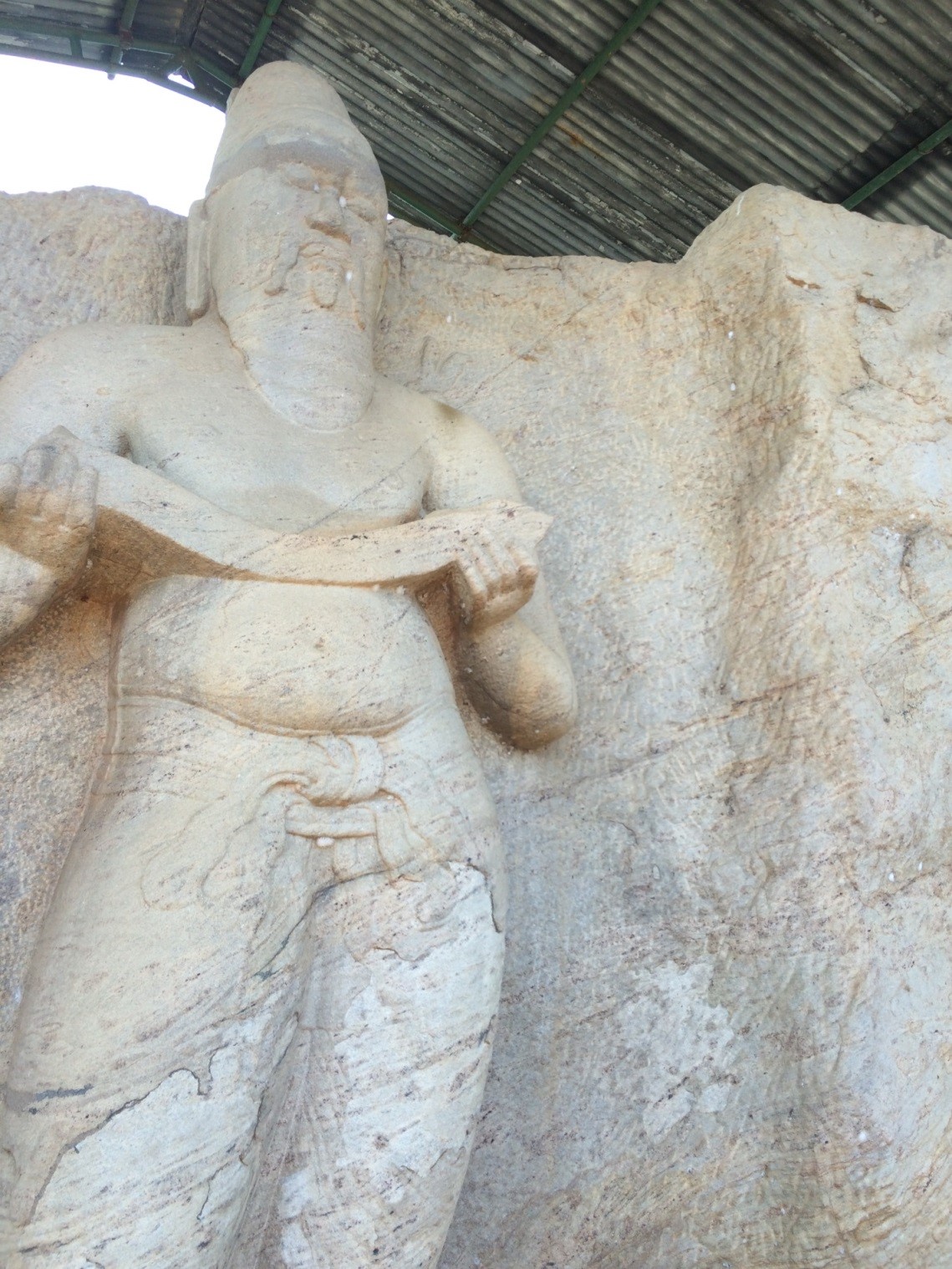
Photo by Dr. Achala Gunasekara Rockwell of Alabama university USA.

The above statue is widely accepted as the figure of King Parakramabahu the Great. But it also has been interpreted as a statue of a sage, either Agastya or Pulasthi.    Three reasons are adduced by those who call it a stature of a sage.  First, its proximity to the Pothgul Viharaya; and the other, more importantly a visible ‘Punanula’ that runs diagonally across the left shoulder of the statue from left to right. Thirdly the notion that the object held in the hands is a book.

Both Bell and Paranavitana have interpreted it as a Punanula (a sacred thread).  Probably in keeping with their scholastic traditions they may have wanted to give a more dignified and supra-mundane recognition to the statue and may have described it as that of a sage rather than that of a human. Paranavitana later however has interpreted it as that of Parakramabahu as well.

But as an ordinary observer I see the so-called punanula as the natural grain of the rock. One can see it clearly and also feel it. It is more than obvious to the naked eye.  A closer examination clearly shows that this is the natural grain of the rock. For example on the left side this is seen not on the mid shoulder as it should be but far on the edge of the shoulder. There are no signs of rapping it round the body of the Statue, on either side. This ‘wonderful Punanula’ continuous diagonally as one straight line across the whole length of the rock slab from SW to NE. This argument is further confirmed by the fact that this ‘Punanula’ (sacred thread) is clearly visible running over the object (book) held in the hands of the statue. It could never be visible running over the book; if it was a sacred thread it should run under the object as a thread worn on the body of the person who is holding the object. Therefore I think the idea of a Punanula is either a mistake or an esthetic invention by someone made without a closer examination of the trend line.  All these visible characteristics clearly prove that this is actually the natural grain of the rock. Though this line is more conspicuous than others one can also see many more similar lines all over the statue running in the same direction. Particularly the line visible about 3 inches below the so-called Punanula is the most prominent; these lines are more common below that line.

Furthermore he same pattern could be seen even in other statues both in Anuradhapura and in Polonnaruwa. The most conspicuous of these grains are displayed on the Galviharaya statues in Polonnaruwa. The Standing Buddha being the most prominent among them. Therefore I opine this as the line indicating the natural grain of the rock on which the statue is carved.

.Any student of basic geology who is familiar with the general geological formation and the trend line pattern of this part of the Island will vouch for this argument.

Statue of Parakkramabahu

The fact that this is found on the tank of the Sea of Parakkrama and it is also accepted to have been built during the reign of Parakaramabahu the Great 1 further makes it more probable that it is the Statue of Parakkramabahu the Great and no one else. The fact that the statue depicts a majestic figure with a grave expression also support that this statue represents the colossal figure of the King. . According to Senarath Paranavithana this statue is an embodiment of strength, majesty and dignity

The object held by the hands is also interpreted as that of an ola leaf book may be to prove the original identification of the statue with a sage. There is also another opinion that the object is a yoke” of kingship. I understand that there is another reference to the yoke being used as the symbol of Rroyal authority  mentioned in the Panakaduwa Tamba sannasa where King Vijayabahu of Polonnaruwa handing over a nindagam to his Army Commander after the completion of a war against the enemy. This brings us to a new notion of the yoke (Viyagaha) being used as a mace, the modern symbol of power and authority used in a modern parliament. Also from this one could surmise that the yoke would have been used in ancient Lanka as a symbol of Royal power, on occasions where Royal power is displayed. The yoke an important indigenous tool used in ploughing would have been definitely more appropriate and meaningful for an agricultural society than a modern mace probably adopted from a Yagadawa in the hands of Hanuma the monkey King in the Ramayana.

Naturally the Great King being the greatest tank builder of the Sinhala nation must have caused to erect his statue on the bank of the greatest irrigation feat of ancient Sri Lanka overlooking his pet project, the Parakrama Samudraya, the greatest achievement of Parakramabahu the Great with the yoke held in the hands to depict the authority of royal power he swayed over his Kingdom, Sri Lanka.

Accepting the classical punanula as the natural grain of the rock and the object held in the hands as a yoke in the hand of the King will also support the notion given in the Panakaduwa copper sannasa. That in turn will throw new light on the yoke being identified as the symbol of royal power in ancient Sri Lanka during the time of scribing Panakaduwa Sannasa. If this idea is accepted then we can also send the colonial mace to the museum and replace it with the Parakramabahu yoke as the new Sennkolaya, thereby giving a novel concept to the world on State power without just blindly following the British tradition.

Therefore first I request archeologists to review their old concept and go by reality seen on rock and also to revisit the concept of the yoke as the symbol of state power as mentioned in the Panakaduwa Sannasa.

DEVELOPMNT OF CONSTITUTIONAL UNCERTAINTIES

May 11th, 2017

Sarath Wijesinghe Solicitor-Attorney at law and a former Ambassador

Appellate and Writ Jurisdiction

Court of Appeal has the appellate and writs jurisdiction including quo warrantor” – invoked by the five petitioners successfully challenging Geetha Kumarasinghe (called GK hereinafter)- Member of Parliament elected by the people in the Galle district as their representative. Court of appeal held that she is not duly elected and not eligible to hold office on the grounds that she was holding dual citizenship which is not denunciated before the nominations on 13th July 2015, based on the hurriedly introduced 19th amendment restricting former Presidents to contest more than two terms and holders of dual citizenships to be elected as members of parliament possibly to prevent his brother Gotabaya – the new contender to enter the arena. Hurriedly passed 18th and 19th amendments led to various controversies and complications resulting hardships to the citizen and constitutional uncertainties leading to greater uncertainties and complications, imposing restrictions for periodic and free elections as before. Objections were raised at the nominations against GK which was not accepted by the returning officer for reasons not very convincing. He said the nominations cannot be rejected due to a defect of one candidate when there are numerous precedents including the rejection of the entire list in the Colombo Municipal Council election due to inclusion of one underage candidate in the list when the entire UNP list was rejected. Returning Officer has further stated that there is no provision in law where he could have rejected nominations on the grounds that a candidate was holding dual citizenship which is a very weak argument. The resulting situation in the event it was rejected at the nomination would have been different and prevented the current controversies. Now we are in a maze of legal complications with uncertainties until the Supreme Court determines with long and rigorous exercise with unpleasant and drastic results for the political culture and economy. Today the Election Commission is facing critizsm from all corners on partiality, inefficiency and inert attitudes on implementation of law and procedure. Galle district politicians in both parties are currently busy in political and legal exercises in” making hay when sun shines” by making use of the confused situation, as there are possibilities to disqualifying all UPLF contenders which will have a ripple effect on Fowzie MP and Faizer MP the 11th and 12th in the main list of nominated MPs in the UPLF list, and the UNP politicians are agitating strict compliance of the rules so that there is a possibility for the UNP and the JVP to be benefited over UPLF. It is in an uncertain and confused state.

Nominations challenged and appeal procedure

The petitioners challenged the appointment/election of GK for holding it without authority being a holder of dual citizenship, that she has contested the 2015 parliamentary elections without divulging her immigration states at the time of tendering nominations. Constitution states No person shall be qualified to be elected as a member of Parliament to sit and vote in Parliament if (d) (X11) a citizen of Sri Lanka who is also a citizen of another country” Court of Appeal with the powers vested in articles 137 to 147 has declared that by virtue of the constitution respondent MP is not qualified to be elected as a member of Parliament and thus not entitled to represent the electorate she won with a majority of 63955 votes. Courts held with the petitioners and ordered the Election commission and Secretary General to take appropriate steps according to law and procedure. The Attorney General’s recommendation that the respondent still possess dual citizenship was vital evidence, on the decision of the Court of Appeal against the respondent. Under normal circumstances the next in the list will be named to be the Member of the Parliament to the district and steps will have to be taken by the Commission and the Secretary General accordingly. This matter has transformed to an

extraordinary issue due to the appeal made by the respondent GK to the Supreme Court within the stipulated period of 42 days which is laid down in the Supreme Court rules on appeal procedure resulting stay of the execution of the determination until the decision of the Supreme Court either way. Apparently the lawyers of the respondent have informed the authorities accordingly to stall the proceedings forthwith. Conflicting news reports are viral that the Attorney General has advised/given opinion to the Secretary General of the Parliament to appoint the next in line comments to the media by different groups with different views due to uncertainty of the law and procedure and conflicting and contrary information on the same issue. Everything will depend on how the SG and Election Commission will act or react. Whatever happens the resulting position will be still complicated, if the position was taken and accepted that the respondent was not qualified to be nominated at the time the nominations are accepted and whether the entire party list will be null and void as has taken place in previous occasions. According to media both parties have met the Speaker and the Secretary General. GK has declared the intention to lodge an appeal and the appellants to expedite the execution of the decision. Speed in which the steps taken have by the SG and the AG in the fast tract within the appealable period has raised eyebrows of impartial political observers and professionals waiting for peace and peaceful transformation of events.

Previous Precedents

When late Ratnasiri Wickramanayaka fielded a list with an underage candidate the entire list was rejected in local government elections in Horana. Now though late if the UPLF list fielded is proved to be illegal at the time of nominations with the possible result of disqualifying the entire list with uncertain remedies the implications will be disastrous. Election for the entire Galle district will be an option if and when the jurisdiction is invoked by a citizen over a FR case or an election petition challenging the nomination of the respondent and the steps taken by the officers and authority thereafter. When Pilapitiya – former MP in UNP government then was unseated on an election petition he was appointed as a nominated MP by JRJ but the Supreme did not allow him function as a member of the Parliament. 19th Amendment merely states that a dual citizen is not eligible to contest for parliamentary membership but silent on appointed members of Parliament. Leader of Pivituru Hela Urumaya has made a public announcement that there are already 8 Members of Parliament with dual citizenships and official inquiries have been made under the new right to information act to verify the truth. In that event the situation will be still complicated requiring clarifications from the Supreme Court by way of writs, applications or FR applications by citizens with drastic changes in the chemistry of the Parliament.

Complex nature of the issues

Due to the complex nature of the issue in the absence of precedents the Supreme Court will have to give rulings for each and every issues starting with the appeal lodged by GK. Now that the appeal of the respondent and the letters from the Secretary General is before the Election Commission, the Commission is bound to give a quasi-judicial decision on the matter based on law practice and practices in the Supreme Court and Court Appeal. It is the practice/convention that has become part of semi legal binding that when an appeal is lodged the proceedings are stalled and no steps will be taken for execution. Most information is based on media and the fact remains that the Commission is independent to use the discretion obviously contested vigorously by both parties. The practice and the convention that once the appeal is lodged the proceedings will be stalled is a crystalized convention court practice. It is a moot issue how the Election Commission will act/react to this issue and whether proceedings will be stayed until the determination of the Supreme Court Decision.

Constitutional Uncertainties

Constitutional uncertainties are brewing and developing in a rapid phase due to hurriedly prepared legislation in haste and applicability based on personal and political agendas with ulterior motives with no broad national programs or ideologies. Now it has reached the melting point resulting uncertain and complicated legal and

political complications misbalancing the political outlook and the chemistry of the Nation. Currently UNP has 106, UPLF 95, JVP 6, TNA 16, EPDP 1 and SLMC1 with the possibility of UPLF losing all seats with advantages to UNP and JVP or a by election for the entire Galle district depending on the decision of the Supreme Court on GK’s case and connected issues. This shows how outsiders are benefited when the household is fighting with each other without resolving matters within. In 1965 George Kotalawala was appointed MP by the courts considering the votes casted and accordingly what is the justification of the SLFP voters voted with great aspirations and ambitions for their future? Whilst UNP is busy in claiming their portion in the prey made available by GK before the arena. In the absence of any precedents the resolution will be still difficult but these will be lessons in the constitutional making process on the table which is also a hurriedly dratted document without the participation and involvement of the entire nation. (Author who takes responsibility for the contents in the article could be reached on sarath7@hotmail.co.uk( 0777880166)

‘The SAITM Issue’ and the politics of misnaming

May 11th, 2017

 BY MALINDA SENEVIRATNE

Whoever is against SAITM should also be opposed to fee-levying institutions such as private nurseries, tuition classes, outfits that offer all kinds of certification and practices such as channeling services.  This is an argument that is widely tossed around by those opposing opposition to SAITM.  The flak that Dr Anuruddha Padeniya of the GMOA has got over the past few days has been liberally padded with such logic.  His detractors have roundly castigated him for offering consultancy services in private hospitals even as he spearheads the agitation against SAITM.
The cause of the GMOA has not been helped by the fact that some of its fellow-travelers have waved the anti-privatization flag.  In other words, the ‘SAITM issue’ for them is but an expression of a process or even an economic policy preference they oppose, namely privatization.  
AITM: Means different things to different people on both sides of the divide
 
All causes have to deal with different stakeholders who have diverse outcome preferences.  The opponents have the option of picking out one or more of the claims or parties and target these.  That’s politics.  Misidentification, mislabeling, misrepresentation and such are part of the game.  
There are therefore people who are calling for the blood of the movers and shakers of GMOA, especially Dr Padeniya.  Naturally ‘the sick’ are used as grist.  The pro-SAITM or let’s say the anti-GMOA lobby would have us believe that no one cares more about the poor and the sickly of this country than them.  That again is politics.  It is useful, after all, to have the key issues shoved out of the debate.  Indeed, part of the story is to define ‘key issue’ in ways that make for easy engagement.  Everyone involved in this drama does this.
What all this helps displace is the important (let’s not say ‘THE key issue’) matter of a coherent policy with respect to education in general.   It is easy to say ‘we need more doctors’.  Of course we need more doctors, there’s no question there.  It’s easy to ask ‘if you are raising concerns about quality, can you give any guarantees about the quality of doctors produced by the state universities?’  It’s a valid question of course.  
 
It’s easy to take medical mishaps, inflate them, display them, throw them in the face of those who bring up the issue of standards (pertaining to SAITM) and scream ‘you don’t have a case, hoo-hoo’.  
 
It’s easy to say such things and raise such questions as long as you desist from talking about the realities in our hospitals — the congestion, the financial constraints, under-staffing across all categories, the consequent stress and say nothing about the incredible services rendered therein.  Easy and irresponsible. 
The SAITM issue” is a book that has not yet been written, or rather is a book whose pages are all over the media, including Facebook, Twitter, the blogsphere and elsewhere on the internet.  This is not an abridged version of that book and neither is it a review.  What’s written above is preface and what follows will be a short note on the seeming contradiction of GMOA members engaging in ‘private practice’ with a view to separate the issue of privatization or private income-earning practices from that of regulation and accreditation.  
One of the most sober comments on this element of the debate was offered on Facebook by Dr Waruna Jayasinghe.  It is worth translation.  He called it ‘From nurseries through SAITM to channeling….”
Montessori Schools: Whether or not a child has attended a Montessori is irrelevant when being enrolled in a school. The particular child is not required to have obtained instruction on any elements of the primary curriculum.
Tuition: Tuition gives students preparing for exams a boost.  However it is not the tutor who sets and conducts the exam, but the state.  Those who attend tuition classes and those who do not are assessed by a single institution and process.  (We can define the SAITM situation as one where the tuition master himself conducts an exam and produces doctors according to a Montessori system).  
Private degrees (e.g. IT) and private medical colleges: Since many don’t see a difference, let me use an example.  I obtain an IT degree of forgettable quality.  You give me a job.  I write software programmes at a rate.  You realize that they are useless.  You sack me.  In other words, the consumer, the quality controller and the boss are all one person and someone who knows the subject well.  Now assume I get a degree from SAITM.  Even if the quality controller, the Sri Lanka Medical Council, says ‘poor quality,’ the law forces recognition. Accordingly I am recruited and sent to serve in Wanathavilluva.  I prescribe medicines like crazy.  I also engage in private practice.  The patients’ conditions get worse courtesy my treatment and prescription, but they wouldn’t know I am the cause.  Since there are very few senior doctors in such facilities they too wouldn’t notice my idiocy.  So I will remain secure and happy.  Here the consumer, the quality-controller and the boss are independent of one another.  The quality controller has been crippled.  The consumer has no knowledge of quality and no authority either.  The boss doesn’t have the means nor the mechanisms to assess the work of junior physicians.  I continue to practice.  One day you come to me for treatment.  I prescribe. You die.  Your loved ones complain to the SLMC and my registration is cancelled.  This is of no use to you, since you are dead.  My friends will continue to treat and prescribe medicine to their patients.   
Channeling: I work in a government hospital.  After I clock-out, I have the freedom to make koththu or engage in channeling.  Since I am a doctor, I choose private practice.  I have knowledge and training to offer for a price.  You come to purchase these because you find it more convenient or of greater value to obtain these in this manner rather than getting it free at a government hospital.  You have the complete freedom to obtain treatment from a government hospital or from some other individual should you feel that I am expensive or that you would not get value for money from me. 
What this shows is that although people try to put everything in one heap, it is SAITM that disempowers people from choices and that if the quality of medical degrees is not strictly monitored the outcomes could be disastrous. 
Now some may argue that (say in the USA) universities offer their own degrees.  The issue there however is that there is assessment, there are ratings, there are minimum standards that have to be met for purposes of accreditation.
‘The SAITM issue’ is about accreditation.  It’s about quality control.  One can vilify the SLMC and argue about the quality of doctors produced by state universities, but one cannot shove under the carpet the issue of coherent and comprehensive assessment.  There has to be a single authority in the business of regulation or else a coherent and comprehensive process of evaluation.  
 
Someone can claim that the SLMC is not perfect.  That’s fine.  The solution would be to improve the institution and the processes therein.  The Government, as of now, appears to be ill-equipped intellectually and politically to sort out the mess to which it has contributed (as did the previous regime) by being frivolous and arrogant.  
 
What’s evident is a scandalous disregard for regulation and a bastardization of accreditation.   The Government should rise about the politics of  misidentification, mislabeling and misrepresentation because a) it is unhealthy, and b) as things stand it could maim or kill a lot of things, including the Government itself.
This cannot be healthy. 
Malinda Seneviratne is a freelance writer.  Email: malindasenevi@gmail.com.  Twitter: malindasene.  Blog:malindawords.blogspot.com

Did Modi’s Sri Lanka visit influence Colombo to reject China submarine request?

May 11th, 2017

Courtesy India Today

Sri Lanka last allowed a Chinese submarine to dock in the capital of Colombo in October 2014, a move that triggered fierce opposition from India, which worries about growing Chinese activity in a country it has long viewed as part of its area of influence

Sri Lanka has rejected China’s request to dock one of its submarines in Colombo this month, two senior government officials said on Thursday as Prime Minister Narendra Modi landed in the island nation.

Sri Lanka last allowed a Chinese submarine to dock in the capital of Colombo in October 2014, a move that triggered fierce opposition from India, which worries about growing Chinese activity in a country it has long viewed as part of its area of influence.

Prime Minister Narendra Modi arrived in Sri Lanka today for a two-day official visit.

A senior Sri Lankan government official said China’s request to dock one of its submarines in Colombo this month had been rejected. He said Sri Lanka was “unlikely” to agree to China’s request to dock the submarine at any time, given India’s concerns. The official asked not to be named because of the sensitivity of the matter.

The second official, at the defence ministry, also said China’s request to dock this month had been rejected but that a decision on a further docking had been postponed.

“It might happen later,” the second official told Reuters, adding that China had requested approval to use the port around May 16 “sometime back”.

A source close to the Chinese embassy in Colombo confirmed that China had requested permission for the submarine visit but was still awaiting a response.

China has invested heavily in Sri Lanka in recent years, funding airports, roads, railways and ports, unsettling India, traditionally the closest economic partner of the island nation of 21 million people.

More than 70 percent of the trans-shipment in Colombo port comes from India.

Sri Lanka is finalising a plan to lease 80 percent of its loss-making Hambantotata port to China for 99 years, but the deal has been delayed because of opposition from trade unions.

The Sri Lankan government also wants to establish a petroleum hub with the help of India in the eastern port city of Trincomalee, where Lanka IOC, the subsidiary of Indian Oil Corporation, handles 15 out of 99 oil tanks.

A 1987 accord between India and Sri Lanka provides that their territories not be used for activities deemed prejudicial to each other’s unity, integrity and security.

ශිවාජිලිංගම්ගේ තර්ජනය

May 11th, 2017

නලින් ද සිල්වා

ශිවාජිලිංගම් හෙට සිට සතියක් ජනසංහාර විරෝධතා උද්ඝෝෂණ පවත්වනවා. මෝදිත් අද ලංකාවට එනවා. මෝදි උඩරටටත් යන්න ඉන්නෙ. එහෙදි ඉන්දියානු ජාතික කොඩි වනා මෝදි පිළිගැනීමටත් ඉඩ තියෙනවා. එය හුදෙක් විදේශීය රාජ්‍ය නායකයකුට කරන සැලකිල්ලක් ලෙස හිතන්න බැහැ. වතුකරයේ ඇතැම් දෙමළ ජනයාට පමණක් නොව උතුරු හා නැගෙනහිර පළාත්වල ඇතැම් දෙමළ ජනයාටත් තාම තමිල්නාඩු පෙකෙණීිවැල කපා දාන්න බැරි වෙලා. ඒකෙන් ම පේනවා දෙමළ ජනයාට මෙරට දිර්ඝ ඉතිහාසයක් නැති බව.

අද දෙමළ ජාතික සංධානයේ නායකත්වයත් බෙදිලා. ශිවාජිලිංගම්, විග්නේස්වරන්, සම්බන්ධන්, සුමන්තිරන් කටයුතු කරන්නෙ එකම කණ්ඩායමක් ලෙස නො වෙයි. ඔවුනොවුන් අතර භේද තිබෙනවා.  පහුගිය දා විග්නේස්වරන් තමිල්නාඩු උසාවියෙන් වරදකරුවකු වූ ප්‍රේමානන්ද නමැති අයකු ක්‍රිස්තුස්වහන්සේ සමග සංසන්දනය කරලා. එයට දෙමළ ක්‍රිස්තියානින්ගෙ තදබල විරෝධයක් තියෙනවා. යාපනය විශ්වවිද්‍යාලයේ උපකුලපති පත්කිරීම සම්බන්ධයෙනුත් ප්‍රශ්න නැගුණා.

පසුගියදා කිලිනොච්චියේ දෙමළ ජනයා පෙළපාලි ගොස් තිබෙනවා හමුදා ඉඩම් පවරා ගැනීමට විරුද්ධව. ඔවුන්ට හමුදා කඳවුරු පවත්වා ගෙන යෑමට අවශ්‍යයි. දෙමළ ජනයා සහ දෙමළ දේශපාලනඥයන් අතර වෙනසක් තියෙනවා. ඒත් ජනමාධ්‍යවල ඒ බව පිළිබිඹු වන්නේ නැහැ. දෙමළ ජාතික සංධානයට අවශ්‍ය හමුදා පළවා හැරීම. ශිවාජිලිංගම් කරන්නේ නායකත්ව සටනක්. එහෙත් අපට ඒ ගැන සුළුවෙන් හිතන්න බැහැ. ශිවාජිලිංගම්ට මෝදිගේ අවධානය දිනා ගැනීමට අවශ්‍ය වෙලා. ශිවාජිලිංගම් මෛත්‍රිපාලට තර්ජනය කරනවා. ඔහුගේ විරෝධය අස්සේ මෛත්‍රිපාලට වවුනියාවේ උත්සවයකට සහභාගි වෙන්න එපා කියනවා. එසේ සහභාගි වුණොත් මෛත්‍රිපාල ද යුද්ධාපරාධකරුවකු ලෙස සලකනවාලු. මෝදිගේ සහාය මෛත්‍රිපාලට නොව රනිල්ට.

යුද්ධාපරාධකරුවකු ද නැද්ද යන්න තීරණය කරන්නේ එලෙස ද? ඉතා පැහැදිලිව ශිවාජිලිංගම් තම නිර්ණායක අනුව යුද්ධාපරාධකරුවකු ද නැද්ද කියා තීරණය කරනවා. ශිවාජිලිංගම් මෙරට ජනාධිපතිට තර්ජනය කරන්නේ ඔහු ප්‍රභාකරන්ගේ ප්‍රභාකරන්ගේ මස්සිනාකම හිතට ගෙන ද? ජනසංහාරයක් කියන්නෙ සමූල ඝාතනයක්. එහෙත් අදත් දෙමළ ජනගහනයක් උතුරු පළාතේත් නැගෙනහිර පළාතේත් කොළඹත් කඳුරටත් බටහිර රටවලත් ඉන්නවා. අතුරුදහන් වූවා යැයි කියන අය බටහිර රටවල ඉන්නවා. අද ඔවුන්ට මෙරට ඡන්ද බලය දීමටත් රනිල් කටයුතු කරනවා.

මෛත්‍රිපාල ඒවා නැවැත්විය යුතුයි.  ඔහු හැම තැනම කියනවා බුද්ධාගමට ප්‍රමුඛස්ථානය දෙනවා කියා. ඒත් අගමැති මෙහෙයුම් කමිටුවට ඉදිරිපත් කරන වාර්තාවේ එයට විකල්ප හතක් තිබෙනවා. ඉන් බුද්ධාමට නීතියෙන් ඇති ප්‍රමුඛස්ථානයත් නැති වෙනවා. මෙරට බුද්ධාගමට ප්‍රායෝගික ව නම් කිසිම තැනක් නැහැ. අද මහානායක හිමිවරුන්ට ඇති තැන මුමක් ද? කාදිනල්වරයාට ඊට වඩා තැනක් තිබෙනවා.

මෛත්‍රිපාලට රනිල් නවත්වන්න බැරි ද? රනිල් කියන්නෙ බටහිරයෙක්. ඔහුගේ සංස්කෘතිය යුදෙව් ක්‍රිස්තියානි සංස්කෘතිය. ඔහුට සිංහල බෞද්ධ සංස්කෘතිය ගැන හැඟීමක් නැහැ. ඔහු අගමැති වුණෙ මෛත්‍රිපාලට පින් සිද්දවෙන්න. ඔහුට කිසි දිනෙක මෙරට ඡන්දයෙන් ජනාධිපති වෙන්න බැහැ. ජනාධිපති තියා ඔහුට බියගම මන්ත්‍රී වෙන්නවත් බැහැ. ඔහුට දකුණු කොළඹ, බටහිර කොළඹ ආදී ඡන්දකොට්ඨාශවලින් පිටට ගිහින් දිනන්න බැහැ. බටහිර හා ඉන්දියාව මහින්ද පරදවා රනිල් බලයට පත් කිරීමට මෛත්‍රිපාල යොදා ගත්තා. මෛත්‍රිපාල දැන්වත් තම තදබල වැරදි නිවැරදි කර රනිල් ඉවත් කළ යුතුයි.

මෛත්‍රිපාලට බුද්ධාගමට නීතියෙන්වත් ප්‍රමුඛස්ථානය දිය හැක්කේ රට වටා යමින් රනිල් සුද්ද කිරීමෙන් නොව රනිල් ඉවත් කිරීමෙන්. බ්‍රවුන්රිග් මෙරට ආණ්ඩුකාරයා බවට පත් කර ගැනීමෙන් පසුව අප කළ භයානක ම  වැරුද්ද රනිල් අගමැති කිරීමයි. එය ජේ ආර් ජනාධිපති වීමටත් වඩා භයානකයි. අද ශිවාජිලිංගම්ලා පිම්බෙන්නේ රනිල් නිසයි. සුමන්තිරන් හා රනිල් එකම සංස්කෘතියක. හමුදාවල ක්‍රියාකාරීත්වය පිළිබඳ විවිධ කතා රටේ පැතිරෙනවා.

මෝදි එන්නෙත් රනිල් වෙනුවෙන්. මෛත්‍රිපාල වෙනුවෙන් නොවෙයි. මෛත්‍රිපාල අද රනිල් ගිරයට හසුවෙලා. එය මෛත්‍රිපාලගේ ම වරදින් සිදු වුවක්. මෛත්‍රිපාල ජාතියෙන් සමාව ගැනීමට රනිල් ඉවත් කළ යුතුයි. ඔහුට එය කළ හැකියි. රනිල් බටහිරයෙක්. බටහිරයන් කලක සිට ඉන්දියාවට අනුග්‍රහ දක්වනවා. ඒ බව ජේ ආර් ඉගෙන ගත්තෙ තරමක් පහුවෙලා. ඒත් රනිල් ඒක කලක සිට ම දන්නවා. රනිල් තව ටික කලක් හිටියොත් රට දෙකඩ කරලා එක් කොටසක් ඉන්දියාවෙ ප්‍රාන්තයක් කරන්නත් බැරි නැහැ. රනිල්ට ඕන ලංකාව නොවෙයි. ජාත්‍යන්තරවාදී සුපිරි ව්‍යුහය. ඔහු ඒ සංස්ථාපනයේ අයෙක්.

ශිවාජිලිංගම්ලා මෛත්‍රිපාලට මිසක් රනිල්ට චෝදනා කරන්නෙ නැහැ. මෙරට ඊනියා ජනසංහාරයක් සිදු වුණේ නැහැ. ඒක බටහිරයන් හා ඉන්දියානුවන් රනිල්ලාගේ උදවුවෙන් කළ ප්‍රචාරයක් පමණයි. ජී එස් පී + තහනම, විවිධ තහංචි ඊනියා රාජපක්‍ෂ රෙජිමය එළවා දැමීමට ගත් පියවර පමණයි. මෛත්‍රිපාල ශිවාජිලිංගම්ලාට  හා රනිල්ලාට යට වී බෙලහීන ජනාධිපති කෙනකු ලෙස ඉන්නවා ද? රනිල් ඉවත් කරනවා ද?

මේ ලිපිිය ද තවත් ලිපි ද කාලය වෙබ් අඩවියෙන් කියවිය හැකි ය.

http://www1.kalaya.org

නලින් ද සිල්වා

2017 මැයි 11

අපායට සමීකරණ නැහැ

May 11th, 2017

නලින් ද සිල්වා

සිංහල බුද්ධාගම අද පිරිහිලා. වෙසක් උත්සවයත් වැටිලා. අපේ නිර්මාණශීලීත්වය නැවතිලා. අද නිර්මාණ කියන්නෙ කලා නිර්මාණවලට විතරයි. ඒවත් එක එකා පිට කසා ගැනීමේ නිර්මාණ වෙලා. පවතින කෘතියකින් දශම බිංදුවයි බිංදුවයි එකකවත් වෙනසක් නැති කෘති ඉතා අනගි නිර්මාණ බවට පත්වෙලා. යමක වෙනසක් ඇති බව පේන්න ඕන ඒ පද්ධතිය ඇතුළෙ ඉන්න අයට නොවෙයි. පිට ඉන්න අයට. සාරිය නාභිය පේන්න අඳින එක මහා නිර්මාණයක් නොවෙයි. නාභියට සෙන්ටි මීටරයක් යටින් ද සෙන්ටි මීටර එකයි දශමයකට යටින් ද සාරිය අඳින්නෙ කියන එක මහා නිර්මාණයක්වත් ජනමාධ්‍යයේ හා වෙනත් තැන්වල ඊනියා විද්වත් මණ්ඩපවල කතාකරන්න දේවත් නොවෙයි. සාරි නොඅඳින සංස්කෘතියක අයකුට එහි වෙනසක් පේන්නෙ නැහැ. පිරිමින්ගෙ ඇඳුම්වලත් තත්වය එහෙමයි.

අද තරම් අපරාධ සිදුවන යුගයක් මෙරට තිබී තියෙනවා ද? අද දෙමව්පියන් දරුවන් මරණවා, දරුවන් දෙමව්පියන් මරණවා, මිනීමැරුම් තුනක් ගැනවත් අහන්න වෙන්නෙ නැති දවසක් නැහැ. අහන්න වෙන්නෙ නැති මරණ කෙතරම් තියෙනව ද? ස්ත්‍රී දූෂණ ගැන කියන්න තියෙන්නෙ මොකක් ද? එදා තරුණියකට අතේ මැණිකක් රැගෙන කිසි බියක් නැතිව යන්න පුළුවන් වුණාලු. ඒත් අද? ගැහැණුන් ආරක්‍ෂා කර ගන්න වෙලා තියෙන්නෙ වෙන කාගෙන්වත් නොවෙයි පිරිමින්ගෙන්. පිරිමි මත්පැනට ගිජු වෙලා. සියල්ලන් ම මසට ගිජු වෙලා. චිකන් නැතිව කන්න තියා දානයක්වත් දෙන්න පුළුවන් ද? පඬියකු අහන්න බැරි නැහැ බුදුන් වහන්සේ මස් කෑම තහනම් කරලා තියෙනව ද කියලා. බුදු හාමුදුරුවො ස්ත්‍රී දූෂණය හරි සම ලිංගික ක්‍රියා හරි තහනම් කරලා තියෙනවා ද? ළමා අපයෝජන තහනම් කරල තියෙනවා ද? බුදු හාමුදුරුවො කර්මය ගැන නම් දේශනා කරලා තියෙනවා. ඒත් ඒකත් නියතිවාදයක් නො වෙයි.

අපට කල්පනා කරන්න තියෙන්නෙ සසර කෙළවර කරන්නෙ කොහොම ද කියන එක. ඒත් ඉතින් අප සසරක් තියෙනව කියලා කියන්නෙ කොහොම ද? සසර කෙළවර කරන්න පුළුවන් කියලා කියන්නෙ කොහොම ද? ඊනියා විද්‍යාවෙන්  ඒවා පෙන්නන්න පුළුවන් ද? සසර පංචෙන්ද්‍රිය ගෝචර ද? මැරුණට පස්සෙ මොක ද වෙන්නෙ කියලා අප දන්නව ද? අප දකින්නෙ මිනිසුන් මැරෙන එකයි උපදින එකයි. ආවෙ කොහෙන් ද යන්නෙ කොහාට ද කියලා අපට පේනව ද? පංචෙන්ද්‍රිය ගෝචර නැති දේ අපට පිළිගන්න පුළුවන් ද? මෙරට ප්‍රාඥයන් ලෙස පිළිගැණුනු පිළිගැනෙන ඇතැමුන් සසර පිළිගත්තෙ/පිළිගන්නෙ නැහැ.

නොදරුවො හය හතර දැන සිටියෙ නැහැ. ඒ අපාය හතර හා දිව්‍ය ලෝක හය. අද වැඩි හිටියනුත් දන්නෙ නැහැ. ඔවුන් දන්නවා අපාය දිව්‍ය ලෝක නැති බව. අපාය හා දිව්‍ය ලෝක පංචෙන්ද්‍රිය ගෝචර නැහැ. එහෙම ඒවා තියෙන්න බැහැ. අද අප පවට බිය නැහැ. පව් කරන්න ලජ්ජත් නැහැ. විද්‍යාව අනුව පව් කළාම අපායෙ යන්න විධියක් නැහැ. නැති අපායකට යන්නෙ කොහොම ද? අද සිංහල බුද්ධාගම නැහැ. අද තියෙන්නෙ ආගන්තුක විද්‍යාවක්.

ඒ විද්‍යාව අපේ නො වෙයි. ඒක බටහිර විද්‍යාව. අපට ඒක අපේ කර ගන්න බැරි වෙලා. සිංහල බෞද්ධයන්ට විද්‍යාවෙ නිර්මාණ කරන්න බැහැ. සංකල්පයක් ප්‍රවාදයක් නිර්මාණය කරන්න බැහැ. සංකල්ප ආදිය නිර්මාණ හැටියට සලකන්න පුරුදු වෙලා නැහැ. ඒවා ගැන හිතන්න පුරුදු කරලා තියෙන්නෙ සොයා ගැනීම් හැටියට. සිංහල බෞද්ධයකු එවැනි ඊනියා සොයා ගැනීමක් කර නැහැ. අරය අරක හොයාගත්ත මෙයා මේක හොයා ගත්ත කියලා එක එකාගෙ පිට කසා ගන්නවා විතරයි. තවම කවුරුන්වත් අපාය හොයා ගෙන නැහැ. ඒක නිසා අපට පව් කරන්න බය නැහැ. අද වෙසක් දවසෙත් පව් කරන අය අපමණයි. පවට අපමණ අගයක් ලැබිලා. අප පන්සිල් ගන්නවා, රකින්නෙ නැහැ.

බටහිර විද්‍යාව අපේ කර ගන්න බැරි වුණ නිසා එය ආගන්තුක ලෙස පවතිනව. අපට බටහිර විද්‍යාවෙ චින්තනයෙ, ඒ කියන්නෙ ග්‍රීක යුදෙව් ක්‍රිස්තියානි චින්තනයෙ හිතන්න බැහැ. අපට බටහිර සංගීතයෙ නිර්මාණ කරන්න පුළුවන් ද? අපට පුළුවන් බටහිරයන් අනුකරණය කරලා ඔවුන් කටහඬ හසුරුවන විධිය යම්තම් පුරුදු වෙන්න පමණයි. ඒක මහා වෙනසක් හැටියට පෙන්නනවා. මෙරට පඬියන්, කලාකරුවන්, විද්වතුන් ආදීන් ව්‍යාජ තුට්ටු දෙකේ අනුකාරකයන්. 

අප බටහිර විද්‍යාව කියන්නෙ මොකක් ද කියන එකවත් දන්නෙ නැහැ. බටහිරයන් බටහිර විද්‍යාව ගැන කියන බොරු අප විශ්වාස කරනවා. පරීක්‍ෂණ, නිරීක්‍ෂණ, නිගමන සූත්‍රය අප කටපාඩම් කර ගන්නවා. එහි කෙරෙන්නෙ උද්ගමනය, අනපෝහනය, උද්ගමනය කළ අනුමාන නීති අනුව අපෝහනය, වියුක්තය හා සංයුක්තය පටළවා ගැනීම ආදී වශයෙන් අප කියන විට, බටහිර විද්‍යාව පට්ටපල් බොරුවක් බව අප කියන විට, අපට හිනහවෙනවා. දැනුම නිර්මාණය කරන දෙයක් කියන එක පඬියන්ට තේරෙන්නෙ නැහැ. දැනුම නිර්මාණය කරන්න තියෙන එකම විධිය බටහිර විද්‍යාව නොවෙයි කිව්වම අප මිථ්‍යා පතුරවන අය ලෙස හඳුන්වනවා. මුහුණු පොතේ පඬි පෝතකයන් අපට ප්‍රතිචාර දක්වන්නෙ නාථ දෙවියන්ට හිනහවෙමින්.

අප බටහිර සංස්කෘතියේත් නැහැ. සිංහල බෞද්ධ සංස්කෘතියේත් නැහැ. මේ ගන්ධබ්බ තත්වයක්වත් නො වෙයි. ගන්ධබ්බයා යම් දවසක එකක් තෝරා ගන්නවා. අපට එහෙම කරන්න බැහැ. බටහිරයන් අනුකරණය කරමින් අපේ ආත්මාර්ථකාමීත්වය, පෞද්ගලිකත්වය ඉහටත් උඩින් ගිහින්. ඒත් අප බටහිරයන් මෙන් අනෙකාගේ පෞද්ගලිකත්වයට සලකන්නේ නැහැ. බුදු හාමුදුරුවන්ට වඩා වෝල්ටෙයාර් අපට ලොකු වුණත් අප වෝල්ටෙයාර් කිව්වෙ මොකක් ද කියලා දන්නෙ නැහැ. අපට දැන් තිසරණය නැහැ. ඒක අර පන්සිල් ගන්න වෙලාවට මතුරන දෙයක් පමණයි. අපට දැන් සරණ ගොඩක් තියෙනවා. කොපර්නිකස්, ගැලීලියෝ, නිව්ටන්, අයින්ස්ටයින්, ඩාවින් ආදීන්ගේ සිට මාක්ස්, රසල්, ඩෙරීඩා ආදින් දක්වා. ඒ අතර සිදු නාට්‍යයෙ සරණයත් ඉන්නවා. ඩෙරීඩාගෙ විසංයෝජනයේ බුදුදහම තියෙනවා කියලා පඬියන් කියනවා. පඬියන් දන්න විසංයෝජනය. ඩෙරීඩා අපාය ගැන කියලා නැහැ. අපට පව් කරන්න ලජ්ජාවක් බයක් නැහැ.  අපායකුත් නැති එකේ මොනව කෙරුව ම මොක ද? නොපෙනෙන අපාය වගේ ද නොපෙනෙන ගුරුත්වාකර්ෂණය?  ඒක නිව්ටන්වත් දැක්කෙ නැහැ. ඒත් ඒකට සමීකරණයකුත් තියෙනවා. අපායට සමීකරණ නැහැ.

මේ ලිපිිය ද තවත් ලිපි ද කාලය වෙබ් අඩවියෙන් කියවිය හැකි ය.

http://www1.kalaya.org

නලින් ද සිල්වා

2017 මැයි 10


පිං හරක්ට දෙන වරදාන ලැයිිස්තුව…!!!

May 11th, 2017

උපුටා ගැන්ම lankanews.org

මේ තියෙන්නේ පාර්ලිමේන්තු මන්ත්‍රීවරුන්ට ලැබෙන වරදාන හා වරප්‍රසාද….

මන්ත‍්‍රීවරුන්ට හිමි වරප‍්‍රසාද

  1. වෛද්‍ය රක්ෂණයත් ලක්ෂ තුන හමාර දක්වා වැඩි කරයි.
    2. මන්ත‍්‍රීවරයෙකුගේ මාසික වැටුප රුපියල්54,285කි.
    3. පාර්ලිමේන්තු සභා වාරය පැමිණීම වෙනුවෙන් දිනක දීමනාව රුපියල් 500.
    4. කොළඹින් බැහැර අයට නිල නිවාසයක් (ව.අඩි. 900 ක දෙමහල් නිවස).
    5. රාජකාරි හා පෞද්ගලික දුරකථන පහසුකම් සඳහා බිල්පත් ගෙවීම.
    6. තීරු බදු රහිත වාහනයක් (වසර 5 කට වරක් ගත හැකිය) බොහෝ විට මෙම වාහන බලපත‍්‍රය ලක්ෂ 30 ක 40 ක ලාභයක් ඇතිව විකිණීම සිදු වේ.
    7. ඉන්ධන දීමනාව (බස්නාහිර පළාතෙන් පිටත) පෙට‍්‍රල් වාහනයක් සඳහා –රුපියල් 50,000 (ඞීසල් වාහනයක් සඳහා – රුපියල් 20,000)
    8. කාර්යාල, නිවාස හා ජංගම දුරකතන බිල් ගෙවීම.
    9. දේශීය හා බටහිර වෛද්‍ය පහසුකම් නොමිලයේ.
    10. නිරෝගී ශරීර සෞඛ්‍ය සඳහා ආයුර්වේද සම්බාහන මධ්‍යස්ථාන පහසුකම්.
    11. විශේෂඥ වෛද්‍යවරයෙකු නියම කරන බෙහෙත් ඖෂධ වර්ග පවා නොමිලයේ ලබා ගැනීමේ පහසුකම්ි.
    12. වසර 5 ක පාර්ලිමේන්තු නියෝජනයෙන් පසු විශ‍්‍රාම වැටුප් හිමිකම.
    13. ලිපි ද්‍රව්‍ය පහසුකම් නොමිලේ.
    14. ලැප්ටොප් පරිගණකයක්.
    15. ෆැක්ස් යන්ත‍්‍රයක්.
    16. විදේශ සංචාර.
    17. කාර්ය මණ්ඩලය සඳහා දුරකථන පහසුකම්.
    18. ආරක්ෂක නිළධාරීන්.
    19. බාධක වලින් තොරව පාර්ලිමේන්තුවේ රැුස්වීම් වලට සහභාගි වීමට හා ඒමට මාර්ග පහසුකම් සැපයීම.

ඇමතිවරයෙකුට හා නියෝජ්‍ය ඇමතිවරයකුට හිමි වරප‍්‍රසාද (මාසිකව මුදල් හිමිවීම්ද ඇතුළත්ය)

1. ඇමතිවරයෙකුගේ වැටුප – රුපියල් 65,000 කි.
2. නියෝජ්‍ය ඇමතිවරයෙකුගේ වැටුප රුපියල් – 63,000 කි.
3. පාර්ලිමේන්තු රැස්වීම් වලට සහභාගි වීමේ දිනක දීමනාව – රුපියල් 500 කි.
4. කොළඹ ප‍්‍රදේශයෙන් බංගලාවක්.
5. නිල නිවාසයක් නොමැති නම් පෞද්ගලික නිවසක් කුලියට ගැනීමට මාසික කුළිය – 40,000 කි.

  1. ඇමතිවරයෙකුගේ කාර්යාල දුරකථන දෙකට ගාස්තුව රුපියල්20,000 කි.
    7. රාජකාරි නිවාස දුරකථන දෙකට රුපියල්– 10,000 කි.
    8. ජංගම දුරකථනයට රුපියල් 4,000 කි.
    9. නියෝජ්‍ය ඇමතිවරයෙකුගේ කාර්යාල දුරකථන දෙකට රුපියල් 10,000 කි.
    10. නිවාස දුරකථන දෙකට රුපියල් – 5,000 කි.
    11. ජංගම දුරකථනයට රුපියල් 2,000 කි.

බස්නාහිර පළාතෙන් පිටත ඇමතිවරයෙකුට

පෙට‍්‍රල් වාහනයක් සඳහා ඉන්ධන – රුපියල් 75,000 කි.
ඞීසල් වාහනයක් සඳහා ඉන්ධන රුපියල් – 30,000 කි.

බස්නාහිර පළාතෙන් පිටත නියෝජ්‍ය ඇමතිවරයෙකුට

පෙට‍්‍රල් වාහනයක් සඳහා ඉන්ධන – රුපියල් 65,000 කි.
ඞීසල් වාහනයක් සඳහා ඉන්ධන රුපියල් – 30,000 කි.

බස්නාහිර පළාතේ ඇමතිවරයෙකුට

පෙට‍්‍රල් වාහනයක් සඳහා ඉන්ධන දීමනාව – රුපියල් 50,000 කි.
ඞීසල් වාහනයක් සඳහා ඉන්ධන දීමනාව රුපියල් – 20,000 කි.

නියෝජ්‍ය ඇමතිවරයෙකුට

බස්නාහිර පළාත ඇතුළත පෙට‍්‍රල් වාහනයක දීමනාව – රුපියල් 40,000 කි.
ඞීසල් වාහනයක දීමනාව රුපියල් – 20,000 කි

*මන්ත‍්‍රීවරුන්ට හිමි අනෙකුත් සියලූ වරප‍්‍රසාද ඇමතිවරුන්ට හිමි වේ.

“බෞද්ධයින් සමග ගැටුම් ඇති කරගත් මියන්මාර මුස්ලිම් අනාථයන් බෞද්ධ ලංකාවට ඒම භයානකයි..” – ගම්මන්පිල

May 11th, 2017

ගම්මන්පිල

මහ බැංකු වාර්තාවට අනුව දශක ගණනාවකට පස්සේ 2015 දී සහ 2016 දී ලංකාවේ සංක්‍රමණ ධන අගයක් ගෙන තිබෙනවා. 2016 මහ බැංකු වාර්ථාවේ පනස් දෙවන සංඛ්‍යාසටහනේ පෙන්වනවා ලංකාවේ ශුද්ධ සංක්‍රමණ අනුපාත දශක ගණනාවකට පසු 2015 දීත් 2016 දීත් ධණ අගයක් ගෙන ඇති බව. වෙනත් වචන වලින් කියනවා නම් ලංකාව අත්හැර වෙනත් රටවල පදිංචියට ගිය පිරිසට වඩා වෙනත් රටවලින් ලංකාවේ පදිංචියට පැමිණි පිරිස වැඩියි. අතීතයේ දී සංක්‍රමණ ධන අගයක් ගත්තේ ඉන්දියානු වතු කම්කරුවන් පැමිණි යුගයේ දී. නමුත් ලංකාවේ ජනතාව බුරුතු පිටින් ඔස්ට්‍රේලියාව, ඇමෙරිකාව සහ බ්‍රිතාන්‍ය වැනි රටවල පදිංචියට යන වර්තමානයේ දී ලංකාවේ සංක්‍රමණ ධන අගයක් ගත්තේ කොහොම ද? ඒ ඇෆ්ගනිස්ථානය, මියන්මාරය සහ ඉන්දියාව වැනි රටවලින් ලංකාවේ පදිංචියට එන පිරිස් නිසා.

මේ සංක්‍රමණ නිසා ලංකාවේ ජන සංයුතියට බරපතල බලපෑමක් වෙමින් තිබෙනවා. විශේෂයෙන්ම මියන්මාරයේ සිට ලංකාවට පැමිණෙන රෝහන්ගියා මුස්ලිම් අනාථයින් මේ ආණ්ඩුව භාර ගැනීමට අපි විරුද්ධයි. මේ පිරිස් ලංකාවට එන්නේ මියන්මාරයේ බෞද්ධයින් සමග ගැටීම් ඇති කර ගෙන. ඒ නිසා ඔවුන් සිටින්නේ බෞද්ධයින් සමග වෛරයෙන්. මේ වන විටත් ඉතා සුළු පිරිසක් ලංකාවේ බුදු පිලිම කුඩු කරන පැරණි බෞද්ධ නටබුන් විනාශ කරන මුස්ලිම් අන්තවාදයක් ක්‍රියාත්මකකරනවා. එවැනි අන්තවාදින් සමග බෞද්ධයින් සමග වෛරයෙන් පසු වන මියන්මාර් අනාථයින් එකතු වුණොත් ආණ්ඩුව නිතර කතා කරන ජාතික ආගමික සමගියට බරපතල හානියක් අනිවාර්රයෙන් වෙනවා.

මරණයේ ගොවිබිම් (Killing Fields)

May 11th, 2017

වෛද් රුවන් එම් ජයතුංග 

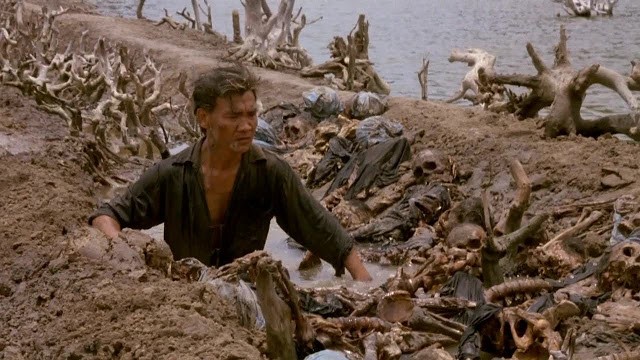
Cheoung Ek (Killing Fields) වැනි මරණයේ ගොවිබිම් ලෙස හැඳින්වුණු භූමිවල මිලියන දෙකකට ආසන්න නාගරික ජනතාව බලෙන් පදිංචි කරවන ලදී. ඔවුන්ට ගොවිබිම්වල ශ්‍රමය වගුරුවන ලෙස බලකරනු ලැබූ අතර, ආහාර හිඟය, ලෙඩරෝග හා වදහිංසා නිසා මිලියන 1.7 මිය ගියහ.

මරණයේ ගොවිබිම්වලට කම්පුචියාවේ ජීවත්වූ සුළු ජාතීන්ද රැගෙන එන ලදී. මේ අතර 90,000 පමණ වූ මුස්ලිම් ගෝත්‍රික ජනයාද මරා දමන ලද බව වාර්තා වේ.

නගරයෙන් පිටමං කළ ජනතාව මරණයේ ගොවිබිම් වලට දැක්කුවේ ඇයි? මේ පිළිබඳව නොයෙක් මත තිබේ. කැමරුජ්වරු නාගරික ජනයා කෙරෙහි තිබූ වෛරය, ඊර්ෂ්‍යාව එක් හේතුවකි. තවද නගරයේ දේශපාලන කඩාකප්පල්කාර ක්‍රියා කළ හැකි නිසා නාගරිකයන් ගොවිබිම්වලට පිටමං කිරීමෙන් ඔවුන් අකර්මන්‍ය වන බවට විශ්වාස කළහ. Killing Fields හි සමූහ මිනී වලෙන් දැනට මිනිස් හිස් කබල් 8000 ක් සොයා ගෙන තිබේ. දැනට මෙම ප්‍රදේශය සංරක‍ෂිත භූමියකි. වාර්ෂිකව සංචාරකයන් දහස් ගණන් මරණයේ ගොවිබිම නැරඹීමට පැමිණෙති.

පොල්පොට්ගේ මරණයේ ගොවිබිම පිළිබඳව වඩාත්ක ම්පනයක් ඇතිකළ චිත්‍රපටයක් ලෙස 1984 දී නිෂ්පාදනය කළ Killing Fields හැඳින්විය හැක. කම්පුචියානු පුවත්පත් කලාවේදියකු හා නිව්යෝක් ටයිම්ස් පුවත්පතේ වාර්තාකාරයෙකු අතර මිතුදහම හා කැමරුජ් ආගමනය පාදනකොට නිපදවා ඇති මෙම චිත්‍රපටය නිසා කෙමරුජ් භීෂණය පිළිබඳව යථාර්ථය ලෝකයාට දැන ගැනීමට හැකිවිය.

සිඩ්නි ෂෙන්බර්ග් නම් නිව්යෝක් ටයිම්ස් පුවත්පතේ වාර්තාකරුවා කෙමරූජ්වරුන්ගේ ආගමනයේදි නොම්පෙන් අගනගරයේ සිරවෙයි. කෙමරුජ්වරුන්ට මැදිවූ ඔහු ඇතුළු අනෙකුත් බටහිර මාධ්‍ය වාර්තාකරුවන් දිවිගලවා ගන්නේ ඩිත්ප්‍රාන් නම් කම්පුචියානු පුවත්පත් කලාවේදියා හා භාෂා පරිවර්තකයා නිසාය.

විදේශිකයන් රටින් පිටමං කරන අතර, ඩින්ප්‍රාන් කෙමරූජ්වරුන් විසින් මරණයේ ගොවිබිමකට පිටුවහල් කරති. ජීවිතයත් මරණයත් අතර දෝලනය වන ඩිත්ප්‍රාන් අවසානයේදී තායිලන්තයට පලායයි. එහිදී ඔහුට යළිත් තම අමෙරිකානු මාධ්‍ය මිතුරා සිඩ්නි ෂෙන්බර්ග් හමුවෙයි.

කෙමරූජ්වරුන්ගෙන් දිවිගලවාගත් ඩිත්ප්‍රාන් අමෙරිකාවට ගිය අතර නිව්යෝක් ටයිම්ස් පුවත්පතේ ඡායාරූප ශිල්පියෙකු ලෙස දේශණ පවත්වන ඔහු කම්පුචියාවේ වර්තමාන පරපුර කෙමරුජ්වරුන් කරන ලද විනාශය පිළිබඳ අවබෝධයක් ලබාගත යුතු බව අවධාරණය කරයි.

මරණයේ ගොවිබිම්වල ගතකළ කාලය මතක් කරන ප්‍රාන් නිරාහාරයෙන් කුඹුරුවැඩකළ, මිනිසුන් – මීයන්, හූනන්, ගොළුඛෙල්ලන්, සර්පයන්, අනුභව කළබව පවසයි. කුසගින්න නිසා ඇතැමෙකු මියගිය මිනිසුන්ගේ මෘතශරීරවල මාංශ කොටස් ආහාරයට ගත්බව පිළිගනිති. ඔහු දැනට Dith Pran Holocausl Awareness Project මගින් කෙමරුජ්වරුන්ගේ දිවිගලවාගත්, කම්පුචියානුවන්ට උපකාර කරයි.

අප්රේල් 17 1975

කම්පුචියාවේ අගනගරය වන Phnom Penh හි නගරවාසීන්ට එදින උත්සව දවසක් විය. දහස් ගණනින් ජයග්‍රාහි කැමරුජ් හමුදා නගරයට ඇතුළුවූහ. පාර දෙපස රැස්ව සිටි ජනයා කෙමරූජ් භටයන් පිළිගනිමින් ජයඝෝෂා පැවැත්වූහ. තමන් සාදරයෙන් පිළිගත් මේ හමුදාව තව නොබෝ දිනකින් නගරයේ ඉරණම වෙනස්කරන බව බහුතරයක් නොදැන සිටියහ.

දෙවන ලෝක යුධසමයේ බ්‍රිතාන්‍ය හමුදා භාවිතා කළ පැරණි යුධ ටැංකියක් නගර මධ්‍යයට පැමිණියේ ධූලි කුණාටුවක් නංවමිනි. යුධ ටැංකියේ කෙමරූජ් නිල ඇඳුම් ඇඳගත් භටයන් රොත්තකි. ඔවුන් අත ගිනිඅවි මෙන්ම කොඩිද තිබුණි. මේ අතර බාලවස්කාර කෙමරූජ් භටයන්ද දැකිය හැකි වීම විශේෂත්වයකි.

මග දෙපස රෑඳී සිටි ජනයා ජයග්‍රාහී හමුදාව පිළිගත්තේ උද්ධාමයෙනි. දීර්ඝ කාලයක් තිබුණු යුද්ධය නිම වී දැන් කම්පුචියාවට සාමය උදාවනු ඇතැයි ඔව්හු බලාපොරොත්තු වූහ. එහෙත් එම බලාපොරොත්තුව සිහිනයක් බව දැන සිටියේ සුළුපිරිසකි.

නගරය හිස් කිරීම

කම්පුචියානු නව පාලන පක‍ෂය විසින් ගත් නව තීරණයක් අනුව සියළුම නගරබද ජනයා ග්‍රාමීය ප්‍රදේශවලට පිටමං කරන ලදී. Phnom Penh හි වීදි පිරි තිබුනේ අවතැන්වූ ජනතාවගෙනි. මිනිසුන් තම චංචල දේපල අතින්ගෙන අරමුණු රහිතව ඉදිරියට ගමන් කරන ජන ගංඟාවට එක්වූහ. ගමන් කිරීමට ශරීර ශක්තිය නොතිබුණු මහල්ලන් පවා හැරමිටි ගසමින් මෙම දීර්ඝ ගමනට එක්වූයේ නගරයේ රැඳන්නන්ට වෙඩි තබන බවට දුන් නියෝගයට බියෙනි. මිලියන දෙකකට ආසන්න ජන සංඛ්‍යාවක් පා ගමනින්ම නගරවලින් පිටමං කෙරුණි.

ජනගංගාවේ අතරමංවූ කුඩා දරුවන් තම මාපියන් සොයමින් ඒ මේ අත දිවූහ. අසරණ වූ ජනතාව කිසිවෙකුට උදව් කරනු තබා තමන්ටවත් උදව්කරගත නොහැකි තත්වයක හෙම්බත් වී සිටියහ. වෙහෙස හා කුසගින්න ඔවුන් දැවූහ. මග දෙපස රැඳී සිටි කැමරුජ් භටයන් සෙමෙන් ඇදෙන ජනතාවට පහරවල් එල්ල කළේ ඔවුන්ගේ ගමන ඉක්මන් කරවනු සඳහාය. මග දෙපස ක්ලාන්තව ඇද වැටුණු මිනිසුන්ට වෙඩි තබන ලදී. නගරයේ රහසේ රැඳී සිටි පුද්ගලයන්ට ද අත්වූයේ මේ ඉරණමයි.

සුළු ව්‍යාපාරිකයෙකු වූ මියැං ජනගංඟාවට එක්වී ඉදිරියටම ගමන් කළේය. තදබල වෙහෙස නිසා ඔහුට ගමන් කරන්නට හැකි වූයේ සෙමින්ය. එක් කැමරුජ් භටයෙන් ඔහුට තුවක්කු මිටෙන් පහර ගැසීය. පහර කෑමෙන් බියට පත් වූ ඔහු ගමන ඉක්මන් කළේය.

හිස්වූ නගරයට කඩාවැදුණු කෙමරුජ් භටයන් කඩ හා නිවාස කොල්ල කෑහ. අත්පත් කරගත් භාණ්ඩ ඔවුන්ගේ මධ්‍යස්ථාන වලට ගෙනගියේ ලොරි පුරවාගෙනය. පාරේ තැනින් තැන වැටී ඇති මළකුණු හා දඩාවතේ යන බල්ලන් හැර නාගරිකයෙකු දක්නට නොලැබිණ. අවිගත් කෙමරූජ් භටයන් නගරය මුර කළහ.

ග්‍රාමීය ප්‍රදේශවලට පිටමං කළ ජනයාගෙන් දහස් ගණනක් අතර මගදී ආහාර හිඟකම, වෙහෙස, විජලනය, පාචනය වැනි තත්ව නිසා මරුමුවට පත්වූහ. Phnom Penh නගරවාසීන් සහමුලින්ම පිටමං කිරීම නිසා 2000-3000 අතර පිරිසක් මිය ගිය බව පසුකාලයක කියු සම්පෙන් ප්‍රකාශ කළේය. එහෙත් සත්‍ය සංඛ්‍යාව ඊට වැඩි ප්‍රමාණයකි. කෙමරුජ්වරු බලය අල්ලාගෙන පැය 24 ගතවීමට ප්‍රථම නගරයේ ජනතාව පිටමං කළහ. අමෙරිකානු ගුවන් ප්‍රහාර නිසා ජනතාව අගනුවරින් පිට කරන බව ඔවුන් පැවසුවද එය අසත්‍යයක් බව බොහෝ දෙනෙක් දැන සිටියහ. එහෙත් කිසිවෙක් මෙම තීරණය ගැන ප්‍රශ්න කළේ නැත. මිලියන 2.5 ක පමණ ජනතාවක් දින 5 ක් පුරා පා ගමනකින් ග්‍රාමීය ප්‍රදේශ කරා යවන ලදී. පළමු දිනයේදීම මිය ගිය ප්‍රමාණය 20,000 ක් වූහ. මෙලෙස මිය ගිය පිරිස අතර පුවත්පත් කළාවේදියෙකු වූ පොල්පොට්ගේ සහෝදරයා ක‍යය්හ ද විය.

පසු කාලයක පුවත්පත් කලාවේදියකු වූ පිලිප් ෂෝට් 1975 නොම්පෙන් නගරයේ බලහත්කාරයෙන් පිටකළ ජනයා හැසිරවූ කෙමරුජ් සොල්දාදුවෙකු හමුවී ඔහුගේ අත්දැකීම් විචාළේය. සොල්දාදුවා පැවසූ කරණු අනුව ගමන් කිරීමට නොහැකි මහළු පුද්ගලයන් මහා මාර්ගය අද්දරදී වෙඩි තබා ඝාතනය කල බව දැනගැනීමට ලැබුණි. මේ පිළිබඳව එම සොල්දාදුවාට කිසිම පශ්චාත්තාපයක් නොතිබූ බව එම මාධ්‍යවේදියා තවදුරටත් පවසයි.

අරමුණක් නොමැතිව මහාමාර්ගයේ ඇවිද යමින්

කෙමරුජ්වරු අගනුවර බලය අල්ලා ගත්විට ඔව්හු නගරවැසියන්ට නිවෙස් තුළින් එළියට එනලෙස අණ දුන්හ. අණ නොතකා නිවෙස් තුළ රැඳී සිටි පුද්ගලයන්ට වෙඩිතබා මරා දැමූහ. මෙගා ෆෝන් යන්ත්‍රවලින් සියළුම නගරවාසීන්ට නගරයෙන් පිටත්වන ලෙස දැනුම් දෙන ලදී. විදේශිකයන් පිටමං කළහ. බොහෝ විදේශිකයෝ ප්‍රංශ තානාපති කාර්යාලයේ රැකවරණය ලබාගත්හ. ඔව්හු බලා සිටියේ කොයි අවස්ථාවේ හෝ ලැබුණු ගමන් කම්පුචියාවෙන් පිටවීමටයි.

හිටපු සොල්දාදුවන්, රජයේ නිලධාරීන්, පුවත්පත් වාර්තාකරුවන්, ආදීන්ට අත්වූ ඉරණම වූයේ මරණයයි. මහා මාර්ගයට ඇද දැමූ මිනිසුන් මහජන ගංඟාව සමඟ එක්වී පෙරට ගමන් කළේ කිසිම අරමුණක් නැතිවය. ඔවුන් තුළ භීතිය නොඅඩුව තිබිණි. තමන්ගේ ඉරණම රුදුරු කෙමරූජ්වරුන්ට භාරදී මහජනයා කුසගින්නෙන්, වෙහෙසින්, පිපාසයෙන් හා භීතියෙන් ගමන් කළහ. වෙහෙස නිසා බිම ඇද වැටෙන්නන්ට යළිත් ජීවත් වීමට වාසනාව ලැබුණේ නැත.

1976 සිවු අවුරුදු සැලැස්ම

කෙමරූජ් සංවිධානය විසින් 1976 වසරේ සිවු අවුරුදු සැලැස්ම හඳුන්වා දෙන ලදී. මෙම සැලැස්මේ මුලික අරමුණ කෘෂි ආර්ථීකයක් කරා සමස්ත දේශයම ගෙනයෑමය. පොහොර හෝ දියුණු තාක්ෂණික ක්‍රම අතහැර සාම්ප්‍රදායික ක්‍රම මගින් කෘෂිකර්මය ප්‍රචලිත කිරීමට ඔව්හු තැත් කළහ. දේශයේ භුවිද්‍යාත්මක ලක‍ෂණ, පස පිළිබඳ අධ්‍යනයන් ආදී කිසිඳු කරුණක් පිළිබඳව සොයා නොබලා මෙම සැලැස්ම අසංවිධානාත්මකව එලි දක්වන ලදී. මෙම ළදරු සිව් අවුරුදු සැලැස්ම ඇති කළේ මාරක සුනාමි රැල්ලකි.

අලූත් ගමක්

බිම්මල් සමූහයක් මෙන් පොල් අතුවලින් තැනූ නිවාස සහිත අලූතින් ඉඳිකල ගම දිස්විය. කන්ඩාල් ප්‍රදේශයට අයත්වූ මෙම ප්‍රදේශය අතීතයේ සරුසාර ගොවි බිමකි. යුද්ධය හා බිමිබෝම්බ නිසා පාළුවී ගිය කුඹුරු පෙන්නුම් කළේ ශෝකාන්ත දසුනකි. කුකුල් කූඩුමෙන් තැනූ පොල්අතු නිවාස වලට නාගරික ප්‍රදේශ වලින් බලහත්කාරයෙන් ගෙන ආ පිරිස් පදිංචිකරවනු ලැබීය. පවුලේ සාමජිකයන් මියයෑම හෝ අවතැන් වීම නිසා වියෝදුක්ගිනි දරාසිටි ඔවුන් කුසගින්න හා වෙහෙස නිසා තමන්ට හිමි බිම්කඩවල වැතිරී ගිමන් ඇරියහ. ඔවුන් සැමදෙනාගේම මුහුණින් දිස් වූයේ භීතියයි. අපට කුමක් සිදුවේද යන අවිනිශ්චිතතාව සෑම පුද්ගලයෙකුගේම සිතේ ඇවිළුණු ගින්දර වූ අතර අන්‍යයන් සමඟ කතාබස් කිරීමට පවා බියගත් ඔව්හු වටපිට බැලූවේ මීළඟට කුමන හෙනයක් කඩා පාත්වේදෝ යන දෙගිඩියාවෙනි.

කෙමරූජ් භටයන් ඔවුන්ව මුර කළහ. කෙඳිරිලි හඬින් තවකෙනෙකු සමඟ කථා කිරීම වතුර හෝ කෑම ඉල්ලීම වැනි ක්‍රියා කළ පුද්ගලයන්ට තුවක්කු මිටෙන් පහරදීමට භටයෝ සූදානම්ව සිටියහ. රැස්ව සිට පිරිස අමතා කෙමරූජ් නායකයෙක් කථා කළේය. සහෝදරතුමා අංක 1 ගේ (මෙනමින් හැඳුන්වූයේ පොල්පොට්ය) නියෝගය අනුව කෘෂි ගම්මානයක් ඉඳිකිරීම සඳහා පැමිණි පිරිසට වැඩරාජකාරි පැවරෙන බවත්, එම වැඩ අනලස්ව ඉටුකළයුතු බවත්, දන්වා සිටියේය. තවදුරටත් කථාකළ ඔහු ගම්මානයේ නව නායකයන්ට අවනත නොවීම, වැඩ පැහැර හැරීම ආදිය සඳහා දඬුවම මරණය බව කීවේ රළු හඬකිනි.

තමන්ගේ පෞද්ගලික පාවිච්චියට කිසිඳු පැළයක් වැවීම තහනම් ක්‍රියාවකි. වපුරන අස්වැන්න රජයට අයත්වන නිසා නිසි කලට අස්වැන්න රජයට බාරදිය යුතුවේ. ගම්මානයෙන් පලායාමට මොහොතකටවත් නොසිතන ලෙස හෙතෙම අනතුරු ඇඟවීය. වැඩ මුරය උදෑසන හතරට ආරම්භ වන අතර, රාත්‍රී දහය තෙක් වැඩ කළ යුතුවේ. වැඩකරන්නන් සඳහා දෛනිකව ආහාර සපයනු ලැබේ. නිසිලෙස ශ්‍රමය ලබා නොදෙන්නන්ගේ ආහාරය සලාක කපා දැමීමට නව නායකයාට බලය ඇත.

අතීතිය ගැන කථා කිරීම, ප්‍රකෝපකාරී අදහස් ප්‍රචාරය කිරීම, මාධ්‍යයන්ට සවන් දීම, විදේශ භාෂාවලින් කථා කිරීම, තදබල දඬුවම් වලට යටත් කෙරේ. පිරිස ඔහුට සවන් දුන්නේ භිතිය, සැකය, හා පිළිකුල වැනි සඟවාගත් ආවේග මතිනි. ඔවුන්ට අළුත් ජීවිතයක් කැමරුජ්වරුන් විසින් ලබා දී තිබේ. මෙම ජීවිතයට කෙසේ හෝ පුරුදු විය යුතුයි. නැතහොත් භූමියට පොහොර විය යුතුයි.

සෑම පවුල් 10-15 අතර සංඛ්‍යාවක් සභාපතිවරයෙකු යටතේ ශ්‍රමය කැප කළහ. උදේ හතරේ සිට රාත්‍රී 10 දක්වා වැඩකළ යුතුව තිබූ අතර, දින දහයකට වරක් විවේක දිනයක් ලැබිණ. වැඩකරන අතරතුර කෙමරූජ් නායකයන්ගේ දේශන ශබ්ද විකාශන යන්ත්‍ර මගින් ඇසීමට සලස්වන ලදී.

මේ භීතිය රජ කරන යුගයයි.

කෙමරූජ් පාලන කාලය තුළදී ජනතාවට භිතිය කාවද්දන ලදී. නිරන්තරයෙන්ම අභ්‍යන්තර හා බාහිර සතුරන් පිළිබඳව පුන පුනා පවසනු ලැබීය. සතුරන් විනාශ කිරීම ජනතා ජයක් ලෙස ප්‍රකාශයට පත්කරන ලදී.

කෙමරූජ් නායකයන් තුළ නිරන්තරයෙන් තිබූ භීතිය හා සැකය ජනතාව තුළටද සම්ප්‍රේෂණය කරනු ලැබීය. අදිසි සතුරන් පිළිබඳව සියළු දෙනාම විමසිලිමත් වූ නමුදු කල්යෑමේදී මුළු රටම එකිනෙකාට සතුරු යැයි උපකල්පනය කළ හැකි මට්ටමට සැකය වර්ධනය විය. එබැවින් සුළු හේතූන් නිසා වුවද මිනිසුන් මරා දැමීම නොනවත්වාම සිදු කෙරිණි. නිබඳවම සතුරන් සෙවීම කෙමරූජ් සංවිධානයේ දෛනික රාජකාරියක් විය. සතුරන් පිළිබඳ මායාවට මුලාවූ ඔවුන් එකිනෙකාට චෝදනා කළහ.

බලෙන් කුඹුරට ඇද දැමූ ලක‍ෂ සංඛ්‍යාත ජනයා තමන්ගේ ඉරණම භාරදෙනු ලැබුවේ ගොරතර සංවිධානයකටය. ඔවුන් විසින් සාමූහික භීතියක් ජනතාව තුළ ඇති කරන ලදී. සෑම පැයකටම, සෑම මිනිත්තුවකටම භීතිය ඔවුන්ගේ ජීවිතවලට බද්ධව පැවතුනි.

බලය අහිමිවූ පසු කාලයක පොල්පොට්ගේ ප්‍රබල සහායකයෙකුවූ කියුසම්පන් මෙසේ කීවේ. කෙමරූජ්වරු කරන ලද එකම වැරැද්ද වූයේ තවත් වැඩිපුර මිනිසුන් තොගයක් නොමැරීමයි. කෙමරූජ්වරුන්ට මීට වඩා ඝාතන කිරීමට අවස්ථා තිබුණි. එසේ කළේ නම් එක්සත් ජාතින්ගේ සාම සාධක හමුදා කම්පුචියාවට එනවිට ඔවුන්ව සාදරයෙන් පිළිගන්නට ජනතාව ඉතිරි නොවනු ඇත.”

Duch හෙවත් වධකාගාර පාළකයා

Duch යන අන්වර්ත නාමයෙන් හැඳින්වූ කෙං ගෙක් ඉව් S-21 වධකාගාරයේ පාළකයා විය. ඔහුගේ නියම නම Kang Kech Eav වූ අතර වෘත්තියෙන් ගණිත ගුරුවරයෙකි. කෙමරුජ්වරු බලයට පැමිණීමත් සමඟ පාසලක් වූ Tuol Sleng ආයතනය වධකාගාරය බවට පරිවර්තනය කරන ලදී. මෙම වධකාගාරයේ ඔහුගේ පාළන සමයේදී පුද්ගලයන් රාශියක් මරා දැමුණු අතර මෙම වධකාගාරයෙන් ගැලවුනේ අතලොස්සකි. කෙමරුජ්වරුන්ගේ පරාජයත් සමඟම 1990 දී ඔහුව අත්අඩංගුවට ගෙන යුධ අපරාධ සඳහා චෝදනා ගොනු කරන ලදී. එළිසඛෙත් බේකර් පවසන අන්දමට Duch S-21 වධකාගාරයේ රැඳවියන්ට කිසිඳු අනුකම්පාවක් දැක්වූයේ නැත. ඔහුගේ නියමව පරිදි සිරකරුවන් වධකාගාරයට ගෙන ආ විගසම වධයට ලක් කරද්දී ද හා සිරකරුවන් මිය යමින් සිටිය දී ද ඡායාරූප ගත කළේය.

ඔහු ඝාතන දින නියම කරන ලදී. එක් දිනක වදකරුවන්ගේ ළමුන් ය. අනෙක් දින භාර්යාවන්ය. මෙලෙස ම්ලේඡ වධක දින නියම කිරීමේ උන්මාදයෙන් ඔහු පෙළුනේය.

S-21 වධකාගාරයේ පාලක Duch හට මිනිසුන් වධයට ලක් කිරීමටත්, මරා දැමීමටත් තිබුනේ නොමඳ ආශාවකි.

අතීතය පිළිබඳ පාපොච්චාරණය කරනු

මහජනතාව විප්ලවයට පෙර තමන් කළ, කියූ දෑ පිළිබඳව මහා රැස්විම් වලදී එලිදරව් කරන ලෙස කෙමරුජ්වරු ඔවුන්ට බල කළහ. විශාල රැස්වීම් වලදී ප්‍රසිද්ධියේ පාපොච්ඡාරණය කිරීමට මිනිසුන්ට සිදුවිය. විදේශිකයන් හමුවීම, වෙළඳ ගණුදෙනුවල යෙදීම්, විශේෂ වෘත්තීන්වල නිතරවීම, මෙවැනි දෑ භයානක අපරාධ ලෙස ලැයිස්තු ගතකර තිබිණි. පාපොච්චාරණය කරන්නන්ට සමාව දෙන බව කීවද ඔවුන්ට සමාවක් ලැබුණේ නැත. ලැබුණේ මරණය පමණකි.

කුණුවූ සියල්ල කපා ඉවත් කළ යුතුය.

කෙමරුජ් සංවිධානය විසින් පුද්ගලයන් දෙදෙනෙකුට වඩා එකවර ඒකරාශී වීම තහනම් කරන ලදී. නිරන්තර සැකය නිසා දිනපතා දහස් ගණන් පිරිස් ඝාතනයට ලක් වූහ. ඒ අතර බලයෙන් පහකළ කෙමරුජ් ප්‍රාදේශීය නායකයන් ද වූහ.

දේහය කුණුවීමට ප්‍රථම කුණුවූ කොටස කපා ඉවත් කළයුතු බව කෙමරුජ් නායකයන් ප්‍රසිද්ධියේ ප්‍රකාශ කළ අතර, සංවිධානයට ද්‍රෝහිවූ බවට නාමික සැකය නිසා වුවද මිනිසුන් නිසල කරන ලදී.

යේල් සරසවිය” විසින් සිදුකල අධ්‍යනයක් අනුව කෙමරුජ්වරුන් විසින් මරා දමන ලද සංඛ්‍යාව මිලියන 1.7 කි ඇම්නෙස්ටි ඉන්ටනැෂනල් ආයතනයේ දත්ත අනුව එය මිලියන 1.4 කි. ඇමෙරිකානු රාජ්‍ය දෙපාර්තමේන්තුවේ අදහස අනුව එය මිලියන 1.2 කි. එහෙත් සිදුවූ මිනිස් ඝාතන සංඛ්‍යාව පිළිබඳව නිශ්චිත අගයන් නොමැත. ඊට හේතුව සිහනුක්ගේ කාලයේ සිට රටේ පැවති අවුල් වියවුල්, ගුවන් ප්‍රහාර, ජනයා අවතැන්වීම වැනි තත්වයන් නිසා නිශ්චිත සංඛ්‍යාලේඛන නොමැති වීමය.

සමාජය තුළ කුණුවී වැගිරෙන දෑ අතර, පූජකයන්, වෛද්‍යවරුන්, නීතීඥයන්, ගුරුවරුන් වැනි කොටස්ද වූහ. කෙනෙකුට සැඟවිය ලැබිය හැකි වූයේ කලාතුරකිනි. බොහෝ දෙනෙකු තම ඉරණම ගොරතර කෙමරූජ්වරුන්ට බාර දුන්හ.

වධ බන්ධනයට ලක්කළ මිනිසුන්

කෙමරූජ්වරු ජනතා සතුරන්, පන්ති විරුද්ධවාදීන්, ඔත්තුකරුවන්, ප්‍රතිවිප්ලවවාදීන් ලෙස නම්කොට මිනිසුන් දස දහස් ගණන් වධබන්ධනයට ලක්කොට මරාදැමූහ. ඔව්හු වධබන්ධන සඳහා විවිධ ක්‍රම යොදාගත්හ. පිහිවලින් ශරීරයේ අවයව කැපීම, ශරීර කපා වෙන්කිරීම, මියයන තෙක් හුස්ම හිර කිරීම, අසූචි හා මුත්‍රා අනුභව කිරිමට හා පානය කිරීමට බලකිරීම, කකුල් දෙකෙන් එල්ලා තැබීම, දීර්ඝකාලයක් එලිමහනේ වැඩවල යෙදවීම, වැනි අමානුෂික ක්‍රියා වාර්තා වී තිබේ.

ප්‍රශ්න කිරීමේදී සිරකරුවන්ගේ නියපොතු ඇඟිලි වලින් උදුරා දමන ලදී. මේ අතර වාරයේදී නියපොතු රහිත තුවාල වූ ඇඟලිවලට මධ්‍යසාර වත්කරන ලද්දේ වේදනාව උත්සන්න කරවීමටය.

ඇතැමෙන් සිරකරුවන්ගේ හිස් වතුරේ එබූහ. හුස්ම ගැනීම සඳහා ඔවුන් දුබල ලෙස සටන් කළ නමුදු ඔවුන්ගේ හිස් නැවත නැවතත් වතුරේ එබීම නිසා ඔවුන් නිසල වූහ.

මරාදැමීමට නියමවූ සිරකරුවන්ට තමන්ගේ මිනීවල තමන් අතින්ම සෑරීමට නියමිතව තිබුණි. ඇතැමෙක් ගෙළ දක්වා පොළොවේ වළලා හිසට පෙට්‍රල් වත්කොට ගිනි තබන ලදී. 1997 ජුනි 30 දින නිවුස් වීක් සඟරාවේ පළමු ලිපියකට අනුව කෙමරූජ් සංවිධානය මගින් කෙලින්ම ඝාතනය කරන ලද පුද්ගලයන්ගේ සංඛ්‍යාව 100,000 කි. Jean Äcouture විසින් ලියන ලද Cambodia year zero කෘතිය මගින් පෙන්වා දෙන අන්දමට කෙමරූජ් නායකයන් ඔවුන් ප්‍රතිවිප්ලවවාදීන් හා ජනතා සතුරන් මිලියන දෙකක් මරාදැමූ බවට වහසිබස් දොඩා තිබේ. ජනයා විශාල ප්‍රමානයන් වක්‍රාකාරයෙන් ඝාතනය කළ බව සත්‍යයකි.

1979 වනවිට ග්‍රාමීය ජනයාගෙන් 15% ද නාගරික ජනයාගෙන් 25% ක් ද විනාශකර දැමීමට කෙමරුජ් සංවිධානයේ මාරක යන්ත්‍රය සමත් විය. මරා නොදමා සිරකරුවන් බවට පත්කළ පිරිස්වල ඉරණම වඩාත් භයාංකර විය. සිරකරුවන් සතුන් මෙන් මඩගොඩේ ගාල්කර තිබුණි. එකිනෙකා හා කථා කිරීම තහනම් විය. ඔවුන් නිදාගත්තේ සිමෙන්ති පොළොවේය. කොට්ට, මෙට්ට, මදුරුදැල් පේනතෙක් මානයක නොවීය. සුළු කරුණකදී වුවද ඔවුන්ට දැඩිලෙස පහරදෙනු ලැබීය.

ඔවුන්ට ආහාරලෙස නිසරු හාල් කැඳ ස්වල්පයක් පමණක් ලැබුණි. බීමට වතුර පවා ලැබුණේ දිනකට වරක් හෝ දෙකකි. වතුර ඉල්ලීම නිසා බොහෝ සිරකරුවෝ රැකවලූන්ගෙන් පහර කෑහ. ප්‍රශ්න කිරීම්වලිදී අභූත චෝදනා සිරකරුවන්ට ඉදිරිපත් කරන ලදී. ප්‍රතිවිප්ලවවාදී ක්‍රියා රජයේ ප්‍රතිපත්ති විවේචනය, ඔත්තු බැලීම වැනි බොරු චෝදනා මේ අතර සුලබ විය. සිරකරුවන් චෝදනා පිළිගන්නා තෙක් ඔවුන් දරුණු වධහිංසා වලට පත්කරන ලදී.

චෝදනා පිළිගත් පසු තමා සමඟ එක්වී ක්‍රියා කරන ලද සහායකයන්ගේ නම් හෙලිකිරීමට බලකර අතර, වධබන්ධනවලින් බේරීම සඳහා සිරකරුවෝ තම මිතුරන්ගේ, ඥාතීන්ගේ අසල්වැසියන්ගේ නම් පවා ඉදිරිපත් කළහ. සිරකරුවන් පැවසූ සෑම නමක් හා ලිපිනයන් සටහන් කරගෙන ඉන්පසු එම පුද්ගලයන් දඩයම් කිරීම ඇරඹිනි.

හෙන්රි ලොකාර්ඩ් කෙමරුජ් වධකාගාර පිළිබඳව ගවේෂණය කළ විද්වතෙකි. ඔහු පවසන අන්දමට S-21 ලෙස හැඳින්වූ Toul Sleng වධකාගාරය වැනි වධකාගාර 150 කට ආසන්න සංඛ්‍යාවක් කම්පුචියාවේ තිබුණි. S-1 වධකාගාරයේ රඳවාසිටි සිරකරුවන්ගේ සංඛ්‍යාව මෙසේය.

1976-2250

1977-2330

1978-5765

මෙම වධකාගාරයේ ළමුන් 2000 කට ආසන්න සංඛ්‍යාවක් මරා දමන ලදී. බොහෝවිට ළමුන් මරා දමන ලද්දේ කකුල් දෙකෙන් අල්ලා හිස බිත්තියේ ගැසීමෙනි. S-1 වධකාගාරයේ පමණක් පුද්ගලයන් 20,000 ක් මරාදමන ලදී.

NU Nim ගේ පාපොච්චාරණය

වධයට ලක්කිරීම නිසා NU Nim ඔහුට එදිරිව කළ සියළු චෝදනා වලට වරදකරු බව පවසන ලදී. ඔහු තමා සිහිනෙන්වත් නොසිතූ හා නොකළ වැරදි ලැයිස්තුවක් කියාගෙන ගියේය. මේ අතර කෙමරුජ් සංවිධානයට ද්‍රෝහි වීම, ඔත්තු බැලීම, විදේශිකයන් හා සබඳතා පැවැත්වීම වැනි බරපතල වැරදිද විය. අතරමගදී ඔහුගේ පීඩකයන් ඔහුට අසූචි කැවීය. මුත්‍රා පෙවීය. මුත්‍රා පානය කිරීමට කට අරින තෙක් පොලූ පහර දුන්හ. ඉක්බිතිව ඔහුට මෙසේ කීමට බල කරන ලදී.

මා මිනිසෙකු නොවේ

මම නිරි සතෙකි

මා මිනිසෙකු නොවේ

මගේ නම NU Nim නොවේ

මා සිව්පාවෙකි.

මොවුන් කුඹුරට දක්කනු. වැඩ කිරීමට නොහැකි උන් පොහොර කරනු.

කඩමාළුවී ගිය, කළු ගැමි ඇඳුම් වලින් සැරසුන දුක්බර මුහුණු සහිත කණ්ඩායමක් මොරසූරන වැස්සේ අගලක් කපමින් සිටියහ. දුෂ්පෝෂනයට ලක්වූ ශරීරකූඩු මෙවැනි බරපතල වැඩක් කරන්නේ කෙසේද? යැයි යමෙකුට සිතිය හැකිය. එහෙත් එය නිදහසට කරුණක් නොවේ. හාමතින් සහ දැඩි ශීතෙන් පීඩා විඳිමින් ඔවුන් තම කාරිය කරගෙන ගියේ මොහොතකටවත් විවේකයක් නොගනිමිනි. ඔවුන්ගේ මුහුණු වලින් දිස්වූයේ මිනිස් සිතකට හා කයකට දැරිය නොහැකි පීඩා නිසා විඳවන දුක් ගිනිය. එහෙත් ආයාචනා හෝ ඇවිටිලි බල රහිතබව ඔව්හු දැන සිටියහ. එම නිසා නා කපන වැසසේ, සීතලේ වෙවුලමින් ඔව්හු තම කාරිය කරගෙන ගියහ.

මඩේ එරී ඇති ඔවුන්ගේ දෙපා රිදුම් කන්නට විය. දුබල අත්වලින් එසවෙන උදළු මඩ සහිත පොළොවේ වදින්නේ බොල් හඬක් නංවමිනි. ඉරී ඇති කළු කලිසම්වල මඩ පහරවල් දක්නට තිබේ. ඇතැමෙකුගේ උඩුකය නිරුවත්ය. මඩ ගොහොරුවක දඟලන පනුවන් මෙන් ඔවුන් මෙම දුෂ්කර කාර්යය කරගෙන ගියේ රහසින් තම රැකවළුන් දෙස බලමිනි. එහෙත් එක එල්ලේ රැකවලූන් දෙස බැලීමට ආත්ම ශක්තියක් නොතිබුණු ඔවුන් තම පීඩකයන් නිරීක‍ෂණය කළේ යට දෑසිනි. එසේම තමන් ඔවුන්ව නිරීක‍ෂණය කරන බවට හැඟීමක් හෝ ලබා නොදීමට ඔව්හු වගා බලා ගත්හ. එම නිසා ඔවුන් රැකවළුන් දෙන බැලූවේ උදළුකෙටිය ඔසවන ගමන් වපරැසිනි. මෙම නිරීක‍ෂණය තත්පර දෙක තුනකට වඩා දීර්ඝ නොවීය. රැකවළුන් ඇඳසිටියේද කළු පැහැති ඇඳුම්ය. කළුදිග කලිසම, කළු කමිසය හා රතු තිත් සහිත මෆ්ලර් නිසා ඔව්හු ශ්‍රමය වගුරුවන්නන්ගෙන් වෙනස් වූහ. එසේම ඔවුන්ගේ දෙපා ආවරනය වූයේ සෙරෙප්පු වලිනි. ඔවුන් අතරෙන් කණ්ඩායම් නායකයා ලෙස ක්‍රියාකළ රැකවලා වැඩි වයසක් නොපෙනෙන තරුණයෙකි. රැකවළුන් අතරින් වැඩිමලා වූ ඔහු හිටපු ගරිල්ලා භටයෙකි. ඔහු වැඩකරන මිනිසුන් දෙස බැලූවේ ප්‍රිය නොඋපදවන, සතුරු බැල්මකිනි.

මී හරකා” ඔහු ආමන්ත්‍රනය කළේ වැඩකරමින් සිටි වයෝවෘධ තැනැත්තාටය. තෝ, අගල කපනවද? නැත්තං වැස්සේ නානවද?”

මහල්ලා නපුරු රැකවලා දෙස බැලූවේ භීතිය මුසු අනුකම්පාව ඉල්ලන බැල්මකිනි. එහෙත් අනෙක් ශ්‍රමිකයන් තම වැඩය පෙර පරිදි බිය මුසුව කරගෙන ගියහ.

මෙහෙ වර බැල්ලිගෙ පුතා”

භටයා වයස්ගත මහල්ලාට ඔවුන් රැඳී සිටි මඩුව වෙත එන ලෙස අණ කළේය. එක් අතකින් උදැල්ල හා අනෙක් අතින් හිස්වැස්ම සකස් කරමින් මහල්ලා රැකවළුන් වැස්සෙන් ආරක‍ෂාවීමට රැඳී සිටි මඩුව වෙත ගියේ දෙවියන් යදිමින් තොල්මතුරමිනි. මේ බලපිය, තෝ විප්ලවයට පෙර වැඩ කළේ කොහේද?”

මහල්ලා ගොත ගැසීය.

මී හරකා තෝ මට බොරු කිව්වොත් මම තොගේ දිව කපනවා” මෙසේ කියමින් භටයා මුවහත් පිහියක් අතට ගත්තේය. මහල්ලා දණින් වැටුනි. මම හිටපු කම්කරුවෙක්. මම කම්කරුවෙක්. මම නූගත් කම්කරුවෙක්. මම කෙමරූජ්වරුන්ට උදවු කරලා තියෙනවා” ඔහු ගාථාවක් කියන්නාක් මෙන් දෙඩවීය.

බල්ලා, තෝ බොරු කියන්නේ, තෝ වැඩ කලේ විශ්වවිද්‍යාලයේ, තොට අකුරු කියවන්න පුළුවන්. තෝ මට බොරු කරන්නද හදන්නේ. නැගිටපිය පරයා” මෙසේ කියමින් තරුණ රැකවලා මහල්ලාගේ ඉලඇටවලට පයින් ඇන්නේය.

කෙට්ටු කටු ගොඩක් වැනි මහල්ලා මඩ ගොඩේ මුණින් අතටය. ඔහුගේ මුහුණෙන් හා හිසකේ වල මඩ තැවරී තිබිණ. යළි ඉල ඇටවලට පයින් අනිනු ඇතැයි බියවූ මහල්ලා අසීරුවෙන් නැගිට්ටේය.

මම අකුරු දන්නේ නෑ. මම කම්කරුවෙක්.”

මහල්ලාට කීමට හැකිවූයේ මෙපමණකි. කෙමරුජ් භටයා මහල්ලාගේ මුහුණට දුන් පහරින් හෙතෙම යළි බිම වැටුණි. මෙවර මහල්ලාගේ තොල් පුපුරා ගේ ගලන්නට විය.

මී හරහා, තෝ දන්නේ විශ්වවද්‍යාල වල පහරන්න විතරයි. තෝ මකුණෙක්, ජනතාවගේ ලේ උරා බොන ඉනිකුණෙක්. තොට උදැල්ලක් අරගන වැඩකරන්න දන්නේ නෑ. බොරුවට මඩ ගාගන්නවා.” කෝපයෙන් වියරු වැටී සිටි කෙමරුජ් භටයා මහල්ලාගේ පපුව පාගන්නට විය. මහල්ලා හුස්ම ගත්තේ අසීරුවෙනි. ඔහු කුමක්දෝ තොල්මැතිරීය. එහෙත් එය කෙඳිරියක් බඳුය.

මෙහෙ බලපිය පරබල්ලනි,”මෙවර භටයා ආමන්ත්‍රණය කළේ වැඩකරමින් සිටි මිනිස් කණ්ඩායමටය. විස්සක් පමණ වූ පිරිස මොහොතකට උදළුතල බිම තබා කෙමරුජ් භටයා දෙස බැලුහ. තොපිට තාම අගල කපාගන්න බැරි උනාද?

තොපි මීහරක්, බලපිය මේ උගතා ඌට උදැල්ල පුරුදු නෑ. මූ කම්පුචියාවට බරක්. මම මූව පොහොර කරනවා. මුගේ ශරීර කූඩුව වී පැළ උරාගත්තාවේ. තොපි හැමෝම මේ අගලේ දමලා පස් ගහනවා. හිටපිය තොපිට”මෙසේ කියමින් තරුණ භටයා ගලක් අතට ගෙන පිරිස වෙත දමා ගැසීය. සියළුම දෙනා එකවර කථාකර ගත්තාක් මෙන් හිස් පාත්කර ගත්හ. එහෙත් පිරිසේ වූ අවාසනාවන්ත ශ්‍රමිකයාගේ නළලේ ගල වැදිනි.

බලපිය ශරීර හොරුන්ට අපි කරන දේ” සෙබලා තම සහකයන් දෙදෙනෙකුට ඉදිරියට එන ලෙස නියෝග කළේය. කළු කලිසම් හා කළු කමිසය ඇඳ, රතු තිත් සහිත මෆ්ලර් දමා සිටි අවුරුදු දොළහේ පමණ කොළු ගැටව් දෙදෙනෙකු පොලූ දෙකක් ගෙන මහල්ලා වෙත ලංවූහ.

මූව පොහොර කරපන්” ඔහු ළමා සොල්දාදුවන්ට නියෝගයක් දුන්නේය. එම විධානයත් සමඟම ළමුන් දෙදෙනා මහල්ලාගේ හිසට පොලූවලින් තඩිබාන්නට වූහ. මහල්ලා වේදනාවෙන් දැඟලීය. මඩගොඩේ වැටී දඟලන මහල්ලාගේ හිසෙන් ගලන ලේ කළු පැහැයක් ගත්තේය. තමන්ගේ දරුවන්ගේ දරුවන් බඳුවූ වධකයන්ගේ පහර නිසා ඔහු අසරණව වැද හොත්තේය. මේ අතර ළමුන් දෙදෙනා තරගයට මෙන් මහල්ලාගේ හිසට පොලූ පහර දෙන්නට වූහ. මැටි කළයකට පොල්ලෙන් ගසන විට එන හඬ වැනි හඬක් නිකුත් වූ අතර සෑම පහර කෑමකදීම මහල්ලාගේ මුවින් කෙඳිරියක් පිටවිය.

මඩේ එරී අගල කපමින් සිටි පිරිස භීතියට හා ශෝකයට පත්ව අසරණව මේ බිහිසුණු දර්ශනය දෙස බලා සිටියහ. ඇතැමෙකුට මෙම බිහිසුණු ජවනිකාව දැක තමන් සිහිසුන්ව වීමට යන්නාක් මෙන් දැනිනි. ඔව්හු තම දෑස් වසාගෙන පපුව ඇතුලෙන් පිළිස්සෙමින් සිටියහ. එහෙත් මේ දෙස නොබැලීමෙන් තමන් රැකවලූන්ගේ උදහසට ගොදුරුවේදැයි බියෙන් සැලිනි. ඒ සමඟම රැකවලූන්ට පෙනෙන ලෙස ඒ දෙස බැලීමටද අමතක නොකළහ.

ළමා සෙබලූන්ගේ පොලූපහර නිසා මහල්ලාගේ හිස කුඩුපට්ටවම් වී මොළයේ කැබලි එළියට පැන්නේය. රුධිරය ද ගලායමින් තිබිණි. මහල්ලාගේ පණ නිරුද්ධ වූ දේහය ඔව්හු මඩේ ඔබා ඊට කෙළ ගැසූහ.

වල්ඌරනි, වැඩ කරව්”යනුවෙන් කෙමරුජ් භටයා දුන් විධානය අනුව යළිත් උදළු ඔසවාගත් පිරිස තවදුරටත් අගල් කැපූහ. ඔව්හු වැඩකලා මිස කිසිවෙකු තම කණ්ඩායමේ සාමාජිකයෙකුගේ මුහුණ දෙස නොබැලීමට වගබලා ගත්හ.

වැස්ස නොකඩවා ඇද හැළුනි. තෙත බරිතවූ පිරිස වැස්සට තෙමෙමින්, පස් ඉවත් කරමින් අගල කැපූහ. පස් කණ්ඩි තෙත නිසා අගල කපන විට දෙපස කන්ඩිවල පස් නැවත අගලට වැටෙයි. එම නිසා ඔවුන්ගේ ශ්‍රමය අපතේ ගියේය. රැකවලූන්ගෙන් පහර කෑමට ඇති බිය නිසා ඔවුන් නිහඬව යළි පස් ඉවතට ගෙන අගල සකස් කළහ.

කණ්ඩායම සෙමෙන් වැඩකරන බවට චෝදනා කළ රැකවල් නායකයා ඔවුන්ට දහවල් ආහාරය දුන්නේ නැත. මේ නිසා හාමතින් පෙළෙමින් ඉතා අමාරුවෙන් මඩගොඩේ තම ශ්‍රමය මුදාහැරියේය. ක්ලාන්ත ගතිය දැනුනද තම ශරීර සිරස්ව තබා ගැනීමට හැකි උපරිම වෑයම ගත්හ. ක්ලාන්ත වන්නන් පසට පොහොර කිරීමට යක‍ෂයන් මෙන් රැකවලූන් බලා සිටින නිසා ඔව්හු උදළු මතට බරවෙමින් හෝ සිරුර නොවැටී තබා ගැනීමට උත්සාහ කළෝය.

වැස්සෙන් බේරීමට මඩුව ඇතුළේ සිටි රැකවළුන් පස්දෙනා දිවා ආහාරයට සූදානම් වූ අතර වරින් වර වැඩකරන කණ්ඩායම දෙස නෙත් හෙළීමට අමතක නොකළහ.

කාන්තා සෙබලියක විසින් බයිසිකලයේ පිටුපස ලෑල්ලකට තබා බැඳගෙන ආ මුට්ටි ප්‍රවේශමෙන් මඩුව තුළට ගන්නා ලදී. පිඟන් වෙනුවට තිබුණේ ඛෙලෙක් තැටිය. බත් හා දුඹුරුවන් හොද්දක් බේදාගත් ඔව්හු ශබ්ද නගමින් ආහාර ගත්හ. ඔවුන් ආහාරගත් මඩුවට යාබද මැටි පසේ අඩක්වැලලී ගිය මහල්ලාගේ මෘත දේහය කිසිවෙකුගේ අවධානයට ලක් නොවීය. මහල්ලාගේ ලේ හා මොළයේ කොටස් දැන් මඩ පසේ දක්නට නැත. නිරන්තරයෙන්ම ඇද හැළුන, වර්ෂාව විසින් මිනිස් ද්‍රව පටක වැසි ජලයේ දියකර හැරිනි.

මළසිරුරේ පිට හා හිසේ කොටස් බාහිරයට දිස්වෙයි. තුවාල වී ඇති හිසේ අතරින් පතර සුදු හිසකේ දක්නට තිබේ. මළ සිරුර මඩේ ඔබා ඇති නිසා මහල්ලාගේ නෙත් ඇරී තිබේදැයි කිසිවෙකු නොදනියි. ඔහුගේ කළු හිස් වැස්ම පමණක් වැසිදියේ පාවෙමින් තිබේ.

රැකවලූන් දිවා ආහාරය ගත්තේ ජ්‍යෙෂ්ඨ භටයාට සවන් දෙමිනි. අතරින් පතර වල්ඌරන්, මීහරක්, ප්‍රතිගාමීන්, යන වචන ඔහුගේ මුවෙන් පිට වෙයි.

ශ්‍රම කණ්ඩායම මුළු සවස් වරුවම වැඩ කළේය. එහෙත් තවමත් අගල කපා අවසන් නැත. කුසට ආහාර නොමැති විට ශක්තිය වැය කරන්නේ කෙසේද? මෙම සරල සමීකරණය කෙමරුජ්වරුන්ට නොතේරුනද එය ප්‍රායෝගිකව පහදා දීම වනාහි මරණයට විවෘත ආරාධනයකි.

එහෙත් බිය හා සන්ත්‍රාසය එක්වූ විට මිනිස් ශරීරය යාන්ත්‍රික ශරීරයක් බවට පත්වේ. වෙහෙස, කුසගිනි, නොදැනෙන මෙම කයට කාලය, අවකාශය, පිළිබඳව ඇති වැටහීම කෙමෙන් පහවී යයි. ඒකාකාරව බොල්හඬ නගමින් උදළු වලින් අගල කපාගෙන ගිය ඔවුන් රාත්‍රී දහය වන විට ශරීර ශක්තිය පිරිහීගිය හෙවනැළි බවට පත්වී සිටියද සිය කාර්යය නොකඩවා කරගෙන ගියහ.

ඔවුනට රාත්‍රි ආහාරය හා විවේකය ලැබිණි. හාල් ස්වල්පයක් දමා පිසින ලද කැඳ කෝප්පය ඔව්හු උගුරට දෙකට අවසන් කළහ. බඩගිනි ඉවසාගනු නොහැකිව ඇතැමෙක් අඳුරට මුවාවී වැස්සට පෙඟී ගිය කොළ හා දළු අමුවෙන්ම කටේ දමාගෙන ගිල්ලේ රැකවළුන්ට රහසිනි. පිරිහී ගිය ශක්තිය ඇති සිහින් උස් පුද්ගලයෙකු ගසකට හේත්තු විය. ඔහු මැදිවියේ සිටියද මුහුණ මහල්ලෙකුගේ මෙනි. ඊට හේතුව විය හැක්කේ නීරක්තයයි. සමට යටින් ඇති මේද පටක දියවී ගොස් තිබූ නිසා ඔහුගේ හකුඇට නෙරා තිබුණි. එහෙත් දෙනෙත් ගැඹුරුය. ඔහුගේ ඉතිහාසය කිසිවෙකු නොදනී. ඔහු කඳවුරේ සිටියේ අකුරු ලිවීමට හා කියවීමට නොහැක්කකු විලසිනි. දහවල කෲරලෙස වදදී මරා දැමුවේ ඔහු සමඟ නොන්පෙන් විශ්වවිද්‍යාලයේ සිටි කථීකාචාර්යවරයෙකි. තමාගේ ඉතිහාසය එළිදරව් විය හැකි නිසා ඔහු සිටියේ නිරන්තර සැකයෙනි. එක එල්ලේ අන් අයකුගේ දෙනෙත් දෙස බැලීමට ඔහු බියවිය. නිතරම හිස පහත් කොටගෙන සිටි ඔහු දුටුවේ තමාට අඩි කීපයක් ඈතින් සිටි පුද්ගලයන් පමණකි.

වෙහෙස නිසා ඔහුගේ නෙත් පියවෙයි. නොදැනුවත්මව ඔහුට ප්‍රංශ ගායිකා එතුවාල්ගේ දුක්මුසු ගීතයක් සිහියට නැගිනි. පෙරදාමෙන් දුක්මුසු ප්‍රංශ ගිතය ඔහු මිමිනීය. එහෙත් මොහොතක් තුළදී ඔහුට පියවි සිහිය ආවේ. තම ගීතය යම් අයෙකුගේ අවධානයට යොමු වූයේද යන්නට බියගත් ඔහු දකුණු අතින් මුඛය වසාගත්තේ තවදුරටත් මුවින් හඬක් පිට නොවීම සඳහා ය.

ඔහු අසල සිටි තරුණයා මැලේරියා උණෙන් පීඩා වින්දේය. මාමේ, මට බෑ තවත් දුක් විඳින්න. මට මියයාම සැපතක්.” ඔහු කෙඳිරීය. මැදිවයසේ පුරුෂයා ඈතින් සිටි රැකවළුන් දෙස බැලූවේය. උඹට පිස්සුද? නිදාගන්න එපා. උන් උඹව පොහොර කරයි.”

කමක් නෑ මාමේ, මුන්ට මට කරන්න දෙයක් ඉතිරිවෙලා නැහැ. මගේ මව, බිරිඳ කුඩා දරුවා මුන් මරා දැම්මා. මට තව මොනවද ඉතිරිවෙලා තියෙන්නේ?” තරුණයා බොල් හඬකින් පැවසීය.

නැහැ, අපි කොහොම හරි මේක දරාගත යුතුයි. අපි කවදාහරි ජීවමාන සාක්ෂි වෙයි. ඒ දවස එනතෙක් අපි ජීවත් වෙමු. ඔහු තරුණයාට බලාපොරොත්තුවේ සේයාවක් දුන්නේය.

තව කොච්චර කාලයක් ඉවසන්නද? මාමේ මේ මොන අවුරුද්දද?”

මම හිතන්නේ 1977 මුල් මාසේ” ඔහු පිළිතුරු දුන්නේය.

කොච්චර කාලයක් ගියාද? මම මෙහෙ ආවේ 1975 අවුරුද්දේ. ඒ අවුරුද්ද තමයි මගේ ළමයයි, ගෑනියි සාගතේට අහුවෙලා මළේ. අම්මයි මමයි කැලේ කොළ කාලා ජීවත් උනා. මුං මාව කඳවුරට ගෙනල්ලා හොඳටම ගැහුවා. අම්මා කැලෑ උණ හැදිලා මලා. මම වහලෙක් වගේ තවමත් කඹුරනවා.”

ධෛර්ය ගනින් පොහොර වෙන්න එපා. කොහොම හරි ශරීර කූඩූව තියාගනින්. ඔහු තරුණයාට අවවාද කළේය.

මාමේ උඹේ නම මොකක්ද?”

මගේ නම Bou Meng දැන් ඇති කථා කළා. අපි නිහඬ වෙමු.”

පෞද්ගලික දේපොළ අහිමි කිරීම

කෙමරූජ් සංවිධානය පෞද්ගලික දේපොළ අවලංගු කළේය. පුද්ගලයන් සතුව තිබූ යානවාහන, මිළ මුදල්, රජයට භාරදෙන ලෙසට අණ කරන ලදී. ගුවන් විදුලි යන්ත්‍ර, බයිසිකල් පවා පවරාගනු ලැබීය. ග්‍රාමීය ප්‍රදේශවලට පිටමං කරන ලද ජනතාවට කෙමරූජ් සංවිධානය මගින් නියම කරන ලද නිළ ඇඳුම් විනා අන් ඇඳුම් ඇඳීම සපුරා තහනම් කෙරිණි. මුදල් සංසරණය නවතා දැමීම නිසා ව්‍යාපාර කඩා වැටුණි. ඉඩම්වල වහළුන් සේ ශ්‍රමය වැය කිරීම විනා ඉඩම් අයිතියක් කිසිවෙකුට නොවීය.

සුළු ජාතීන්ගේ අයිතීන් අහිමි කිරීම

1978 එළිදක්වන ලද කුප්‍රකට කළු පත්‍රිකාව මගින් කම්පුචියාවේ සුළුජන වර්ගවලට ජීවත් වීමට තිබේන අයිතිය අවලංගු කරනු ලැබීය. කම්පුචියාවේ ජීවත් වූ චීන, වියට්නාම්, ලාඕස් සම්භව ඇති ජනයා ජන සංහාරයට ලක් කරන ලදී. 1975 වන විට ග්‍රෝත්‍රික ජනයා 425,000 මරා දමන ලදී. මෙම සංඛ්‍යාව එම ජනගහනයෙන් 50% පමණ විය.

අවශේෂ ජනවර්ගයන් වෙත දියත් කරන ලද ප්‍රචණ්ඩත්වයේ කූට ප්‍රාප්තිය සනිටුහන් වූයේ කම්පුචියා, වියට්නාම් දේශසීමා ආසන්නයේ සිදුකළ ඝාතන වලිනි. මෙම ප්‍රදේශවල ජිවත් වූ වියට්නාම් ජනවර්ගයට නිරතුරුවම ප්‍රහාර එල්ල කරන ලදී. කෙමරුජ් භටයෙකු විසින් දිනකට වියට්නාම් ජාතිකයන් 30 දෙනෙකු ඝාතනය කළයුතු බවට නොනිල මට්ටමේ අණක් පනවා තිබුණි. මේ නිසා වියට්නාමයට කම්පුචියාව ආක්‍රමණය කිරීමට මග සැලසුනි. සුළු ජාතීන්ට ඔවුන්ගේ භාෂාව කථා කිරීම සිරිත් විරිත්, සංස්කෘතික උත්සව පැවැත්වීම තහනම් කරනු ලැබීය.

යළි උපන් භූමියට පැමිණිය නොහැකිය.

කෙමරූජ් සංවිධානය විසින් ග්‍රාමීය ප්‍රදේශ කරා මිනිසුන් පිටමං කළේ ඔවුන්ගේ නිවාස පවා ගිනි තබමිනි. මෙයින් යළි ඔවුන්ට නැවත තමන් උපන් භූමිය වෙත පැමිණිය නොහැකි විය. ඔවුන් සන්තකයේ තිබුණ ද සියල්ල විනාශකොට තිබේ. එවැනි තත්වයකදී මිනිසුන්ට උපන් භූමියෙන් පිටුවහල් කඳවුරුවලට පියමනිනවා හැර වෙනත් විකල්පයක් නොවීය.

කෙමරුජ් නවරජයේ තීරණයක් අනුව සියළුම පුද්ගලයන් කුඹුරු වැඩ සඳහා සහයෝගය දිය යුතුවේ. සමෘධිමත් කෘෂිකාර්මික රටක් බිහි කිරීම සඳහා සියළු දෙනාම කුඹුරට බැසිය යුතුය. කර්මාන්ත ශාලා සේවකයින්, සුපවේදීන්, ටැක්සි රියදුරන්, කාර්මිකයන් ලිපිකරුවන් මෙකී නොකී සියළුම වෘත්තිකයන්ගේ වෘත්තීන් අහෝසි කොට තිබේ.

රජය විසින් සියළුදෙනාම එක රැයකින් ප්‍රවේනි දාසයන් බවට පත් කරන ලදී. ප්‍රග් විප්ලවය රුසියාවේ ක්‍රෙපස්නෝයි හ්රිස්තියාන් යනුවෙන් හඳුන්වන ලද ප්‍රවේනි ගොවීන්ට තිබූ නිදහසින් කාලක්වත් කම්පුචියාවේ ගොවීන්ට ලැබුනේ නැත. ඔවුන්ගේ ජීවිතය හා මරණය රැඳී තිබුණේ සංවිධානයේ තීරණ මතය. කම්පුචියාවේ අගනුවර වූ ඡයබදප ඡැබය හි වාසය කළ මිලියන 2 ක ජනයා කුඹුරු වැඩ සඳහා පිටමං කරවනු ලැබීය. කුඹුරට යැවීමට ප්‍රථම පුද්ගලයන්ගේ දෑත් පරීක‍ෂා කොට බලන ලදී. කරගැට රහිත අත් ඇති, බුද්ධිමත්, වෘත්තියක යෙදුණු පුද්ගලයන් වහා අත්අඩංගුවට ගෙන අතුරුදහන් කරවන ලදී. මිනිසුන් කුඹුරු වැඩට වන විට දෙපස සුපරික‍ෂාවෙන් බලා සිටි කෙමරූජ්වරු සැක සිතූ ඕනෑම පුද්ගලයෙකු මරා දමන්නට පසුබට නොවූහ.

ඔබට ගොවියෙකුගේ මුහුණක් තිබුනේ නම් ඔබ වාසනාවන්තයෙකි. මන්ද, ඔබ අද දවසේ මරා දමන්නන්ගේ ලැයිස්තුවට ඇතුලත් නොවෙනු ඇත. එහෙත් සාගින්දර ඔබගේ ඉරණම හෙට තීරණය කරනු ඇත. කුඹුරුවල ශ්‍රමය වැයකළ මිනිසුන් සඳහා දින තුනකට වරක් සහල් ග්‍රෑම් 180 ක් ලබාදෙන ලදී.

ළමුන් අහිංසකය

අවුරුදු 6 ට වැඩි ළමයින් දෙමව්පියන්ගෙන් පැහැරගනු ලැබිණි. දෙමව්පියන්ගෙන් වෙන් කරන ලද ළමයින් කෙමරූජ් සංවිධානය යටතේ අන්කා දහමට අනුකූලව හදා වඩා ගනු ලැබිණ. පාරම්පරික ගති සිරිත් වලින් ඈත් කරන ලද මේ ළමයින් කෙමරූජ් ළමා බළකායේ සෙබළු බවට පත් කරන ලදී.

ළමුන් වැඩිහිටියන් මෙන් අතීත මතකයෙන් දූෂිතව නොමැති නිසා ළමුන්ට ගෞරව කළ යුතු බව කෙමරූජ්වරු අවධාරණය කළහ. ළමුන්ගේ නියෝගයන්ට වැඩිහිටියන් අවනත විය යුතු බව කෙමරූජ්වරු යටතේ නීතියක් බවට පත්විය.

ළමුන් අයිති කෙමරුජ් සංවිධානයට මිස දෙමාපියන්ට නොවේ.

මා පිය දූදරු සබඳතාව කෙමරුජ්වරු හැඳින්වූයේ ප්‍රතිගාමි සබඳතා ලෙසටය. එම නිසා පවුල යන ඒකකය විනාශ කිරීමට ඔව්හු කටයතු කළහ. ළමුන් දෙමාපියන්ගෙන් ඉවත් කරන ලදී. ඔවුන්ට කුඩා වියේ සිටම අන්කා දහම උගන්වන ලදී. එසේම ළමුන් වැඩිහිටියන් මෙන් දූෂිත නොවුණු කෙමරූජ් හිතවාදී කොටසක් ලෙස සලකනු ලැබූ අතර ප්‍රතිවිප්ලවවාදීන් ලෙස ලේබල් ගැසූ කොටස් ඝාතනයන් සඳහා යොදවා ගන්නා ලදී. ළමා වියේ සිටම මිනීමැරීමට ඔවුන් පුහුණු කරවන ලදී.

ආගමික නිදහස නැති කරයි.

කෙමරූජ් සංවිධානය විසින් ආගම ඇදහීම තහනම් කරන ලදී. බෞද්ධ හා කතෝලික හා ඉස්ලාම් ආගම් අදහන්නන් කෙරෙහි කෙමරූජ්වරු දැක්වූ වෛරය සනිටුහන් වන්නේ කෙමරුජ්වරු කරන ලද ආගම් අදහන අය ඝාතනය කිරීමත්, ආගමික සිද්ධස්ථාන විනාශ කිරීමත් මගිනි. 1975 සිට 1979 දක්වා අතර කාලය තුළ පන්සල්, පල්ලි විශාල ප්‍රමාණයක් විනාශ කරන ලදී. පොල්පොට් යුගයේදී කම්පුචියාවේ බෞද්ධ භික‍ෂුන 40,000 සිට 60,000 දක්වා සිටි අතර, ඔවුන්ට කෙමරූජ් සංවිධානය විසින් නම් කරන ලද්දේ සමාජ පරපෝෂිතයන් හෙවත් Social þ¾sites වශයෙනි.

බලෙන් සිවුරු ඉවත් කරවන ලද භික‍ෂූන් කුඹුරුවල වැඩ කිරීම සඳහා යොදවන ලද්දේය. මුස්ලිම් ජන කොටස් පීඩනයට පත් කළ අතර, ඔවුන්ට වද බන්ධනය පමුණුවන විටදී ඌරුමස් කෑමට බල කරන ලදී. ඌරුමස් කෑම ප්‍රතික්ෂේප කළ මුස්ලිම්වරුන්ට වෙඩිතබා මරා දැමූ බව සාක‍ෂිකරුවෝ පවසති.


නුඹලා විවාහ විය යුත්තේ , සංවිධානයේ නියෝග මතය.

කෙමරූජ්වරු බාල සහ නව යොවුන් වියේ ළමයින් හා තරුණයන් පවුල්වලින් ඉවත් කළහ. ඔවුන් කෙමරූජ් සංවිධානය යටතේ අන්කා දහම අනුව ඇතිදැඩි කරන ලදී. පුද්ගලයෙකුට තමන් රිසි අයෙකු සමඟ විවාහ වීම වෙනුවට කෙමරූජ් සංවිධානයේ අවශ්‍යතා මත විවාහයන් සිදු කළහ. සාමූහික උත්සව වලදී මෙලෙස සංවිධානයේ තීරණ මත යුවතිපතීන් එක්තැන් කරන ලදී. මෙහි මූලික අරමුණවූයේ සැමියාගෙන් බිරිඳ පිළිබඳවත්, බිරිඳගෙන් සැමියා පිළිබඳවත් තොරතුරු සංවිධානයට ලබා ගැනීමයි. මෙවැනි යෝජිත විවාහයන් කෙමරූජ්වරුන්ගේ කාලයේ සුලබ විය.

වෛද් රුවන් එම් ජයතුංග 

Buddhism and Science: Probing the Boundaries of Faith and Reason

May 11th, 2017

Dr. Martin J. Verhoeven Religion East and West, Issue 1, June 2001, pp. 77-97

Abstract

Western interest in Eastern religions, especially Buddhism, historically coincided with the rise of modern science and the corresponding perceived decline of religious orthodoxy in the West. Put simply: Modern science initiated a deep spiritual crisis that led to an unfortunate split between faith and reason—a split yet to be reconciled. Buddhism was seen as an “alternative altar,” a bridge that could reunite the estranged worlds of matter and spirit. Thus, to a large extent Buddhism’s flowering in the West during the last century came about to satisfy post-Darwinian needs to have religious beliefs grounded in new scientific truth.

As science still constitutes something of a “religion” in the West, the near-absolute arbiter of truth, considerable cachet still attends the linking of Buddhism to science. Such comparison and assimilation is inevitable and in some ways, healthy. At the same time, we need to examine more closely to what extent the scientific paradigm actually conveys the meaning of Dharma. Perhaps the resonance between Buddhism and Western science is not as significant as we think. Ironically, adapting new and unfamiliar Buddhist conceptions to more ingrained Western thought-ways, like science, renders Buddhism more popular and less exotic; it also threatens to dilute its impact and distort its content.

Historians since the end of World War II, have suggested that the encounter between East and West represents the most significant event of the modern era. Bertrand Russell pointed to this shift at the end of World War II when he wrote, If we are to feel at home in the world, we will have to admit Asia to equality in our thoughts, not only politically, but culturally. What changes this will bring, I do not know. But I am convinced they will be profound and of the greatest importance.”

More recently, the historian Arthur Versluis, in a new book, American Transcendentalism and Asian Religions (1993), pieced together five or six major historical views on this subject, and presented this by way of conclusion:

However much people today realize it, the encounter of Oriental and Occidental religious and philosophical traditions, of Buddhist and Christian and Hindu and Islamic perspectives, must be regarded as one of the most extraordinary meetings of our age. . . . Arnold Toynbee once wrote that of all the historical changes in the West, the most important—and the one whose effects have been least understood—is the meeting of Buddhism in the Occident. . . . And when and if our era is considered in light of larger societal patterns and movements, there can be no doubt that the meeting of East and West, the mingling of the most ancient traditions in the modern world, will form a much larger part of history than we today with our political-economic emphases, may think.

These are not isolated opinions. Many writers, scholars, intellectuals, scientists, and theologians have proclaimed the importance of the meeting of East and West. Occidental interest in the Orient predates the modern era. There is evidence of significant contact between East and West well before the Christian era. Even in the New World, curiosity and interchange existed right from the beginning, as early as the 1700s. One can find allusions to Asian religions in Cotton Mather, Benjamin Franklin, Walt Whitman, and of course, more developed expressions in Henry David Thoreau, and Ralph Waldo Emerson.

By the mid-twentieth century this growing fascination with Asian thought led Arnold Toynbee to envision a new world civilization emerging from a convergence of East and West. He anticipated that the spiritual philosophies of Asia would touch profoundly on the three basic dimensions of human existence: Our relationships with each other (social); with ourselves (psychological); and, with the physical world (natural). What is the shape and significance of this encounter? What does Buddhism contribute to the deeper currents of Western thought; and more specifically, to our struggle to reconcile faith with reason, religion with science?

Science was already the ascendant intellectual sovereign when Buddhism made its first serious entry on the American scene in the latter decades of the 19th century. A World’s Parliament of Religions, held in conjunction with the 1893 Colombian Exposition in Chicago, brought to America for the first time a large number of Asian representatives of the Buddhist faith. These missionaries actively and impressively participated in an open forum with Western theologians, scientists, ministers, scholars, educators, and reformers. This unprecedented ecumenical event in the American heartland came at a most opportune time. America was ready and eager for a new source of inspiration, ex orient lux, the ‘light of Asia.’

By the 1890s America was caught in the throes of a spiritual crisis affecting Christendom worldwide. Modern scientific discoveries had so undermined a literal interpretation of sacred scripture, that for many educated and thoughtful people, it was no longer certain that God was in his heaven and that all was right with the world. These rapid changes and transformations in almost every aspect of traditional faith, had such irreversible corrosive effects on religious orthodoxy, that they were dubbed, “acids of modernity.” They ate away at received convictions, and ushered in an unprecedented erosion of belief. People like my grandparents, brought up with rock-solid belief in the infallible word of God, found their faith shaken to its very foundations. It was as if overnight they suddenly awoke to a new world governed not by theological authority but by scientists. New disclosures from the respected disciplines of geology, biology, and astronomy challenged and shattered Biblical accounts of the origins of the natural world and our place and purpose in it.          Sigmund Freud captured the spirit of the age well when he said the self-love of mankind has been three times wounded by science.” The Copernican Revolution, continued by Galileo, took our little planet out of the center position in the universe. The Earth, held to be the physical and metaphysical center of the Universe, was reduced to a tiny speck revolving around a sun. Then Darwin all but eliminated the divide between animal and man, and with it the “special creation” status enjoyed by humans. Darwin, moreover, diminished God. The impersonal forces of natural selection kept things going; no divine power was necessary. Nor, from what any competent scientist could demonstrate with any factual certainty, was any Divinity even evident—either at the elusive “creation,” or in the empirical present. Karl Marx people portrayed people as economic animals grouped into competing classes driven by material self-interest. Finally, Freud himself characterized religious faith as an evasion of truth, a comforting illusion sustained by impulses and desires beyond the reach of the rational intellect. Nietzsche’s famous declaration that God is Dead” may have seemed extreme, but few would have denied that God was ailing. And certainly the childhood version of a personal, all-powerful God that created the world and ruled over it with justice and omniscience was for many a comforting vision lost forever.

One of the lingering side effects of this loss has been the unfortunate disjunction of matter and spirit that afflicts the modern age. It can assume many forms: a split between matter and spirit, a divorce between faith and reason, a dichotomy between facts and values. At a more personal level, it manifests as a mind-body dualism. An unwelcome spiritual and psychological legacy from the late 19th and early 20th centuries, it is still very much with us today, something that haunts our psyches.

Much of today’s near-obsession with therapy in the West, and even the shift toward psychologizing religion (including the New Age” phenomenon) could be seen as attempts to heal this deep sense of alienation. The pragmatic philosopher, John Dewey, wrote: The pathological segregation of facts and value, matter and spirit, or the bifurcation of nature, this integration [i. e. the problem of integrating this] poses the deepest problem of modern life.” This problem both inspires and confounds contemporary philosophy and religion. Wholeness eludes us while the split endures; and yet, almost tragically, the very means we have available to heal it insure its continuation. For, all of our philosophies, academic disciplines, therapies, and even religious traditions are informed by and rooted in aspects of this dualism. Perhaps the most visible expression of this pathological segregation is the gap between science and religion.

Thus, when the eminent philosopher and mathematician Alfred North Whitehead scanned the broad outlines of our time, he wrote: The future course of history would center on this generation’s resolving the issue of the proper relationship between science and religion, so fundamental are the religious symbols through which people give meaning to their lives and so powerful the scientific knowledge through which we shape and control our lives.” And it is in regard to this troubling issue, I think, that Eastern religions, particularly Buddhism, are seen to hold out the promise of achieving some resolution. The idea dates back over a hundred years.

After the 1893 Chicago Parliament of World Religions, one Paul Carus, a Chicago-based editor of the Open Court Press, invited some of the influential Japanese Buddhist delegates to a week-long discussion at the home of Carus’s father-in-law, Edward Hegeler. Both deeply felt the spiritual crisis of the times. Both were trying to reform Christianity to bring it in line with current thought; in short, to make religion scientific. It occurred to them that Buddhism was already compatible with science, and could be used to nudge Christianity in the same direction. Toward this end, Carus wanted to support a Buddhist missionary movement to the United States from Asia. His thinking was to create something of a level playing field. Carus had witnessed the most ambitious missionary undertaking in modern history that send thousands of Protestant missionaries abroad to convert the people ‘sitting in darkness.’ He wished to conduct a Darwinian experiment of ‘survival of the fittest.” His goal: to bring Buddhist missionaries to America where they could engage in healthy competition with their Christian counterparts in the East, and thus determine the “fittest” to survive.

With the aid of his wealthy father-in-law who put up money, they sponsored a number of Eastern missionaries to the United States: Anagarika Dharmapala, from what was then Ceylon, now Sri Lanka; Swami Vivekananda, from India representing the Ramakrishna Vedanta movement; and Soyen Shaku, a Japanese Buddhist monk, and Shaku’s young disciple D.T. Suzuki. During his stay in the United States in the late 1890s and early 1900s, Suzuki lived in the small town of LaSalle/Peru, Illinois. He was in his twenties then, and for about eleven years he worked closely with Paul Carus translating Buddhist texts into English and putting out inexpensive paperback editions of the Asian classics. Suzuki later became the leading exponent of Zen in the West, when he returned in the 1950s on a Rockefeller grant to lecture extensively at East Coast colleges.  He influenced writers and thinkers like Carl Jung, Karen Horney, Erich Fromm, Martin Heidegger, Thomas Merton, Alan Watts, and the “beat Buddhists”—Jack Kerouac, Alan Ginsberg, and Gary Snyder. Suzuki died in 1966 in Tokyo. His influence in the West was profound—making Zen an English word, translating Asian texts into English, stimulating a scholarly interest in the Orient among American intellectuals, and deepening American respect and enthusiasm for Buddhism. The historian Lynn White Jr. praised Suzuki as someone who broke through the “shell of the Occident” and made the West’s thinking global. His introduction to the West came about through the hands of Paul Carus.

These early missionaries of Buddhism to the West, including Carus himself, all shared the same modern, reformist outlook. They translated Buddhism into a medium and a message compatible and resonant with the scientific and progressive spirit of the Age. They selectived passages of text to favor that slant, and carefully presented the Buddhist teachings in such a way as to appeal to modern sensibilities—empirical, rational, and liberal. Americans wanted religion to “make sense,” to accord with conventional wisdom. Then, as now, our primary mode of making sense of things was positivist—reliable knowledge based on natural phenomena as verified by empirical sciences. So firmly entrenched is the scientific outlook that it has for all practical purposes taken on a near-religious authority. Few, then or now, critically question our faith in science; we presume its validity and give it an almost unquestioned place as the arbiter of truth.

Thus, the early missionaries of Buddhism to America purposely stripped Buddhism of any elements that might appear superstitious, mythological, even mystical. Dharmapala, Suzuki, and Vivekananda clearly ascertained that Americans measured truth in science, and science posed little theological threat to a Buddhist and Hindu worldview. After all, Buddhism had unique advantages for someone who rejected their faith (Christian) due to its authoritarianism and unscientific outlook:

1) Buddhism did not assert or depend upon the existence of a God

2) Buddhism was a superstition-free moral ideal; it conformed to the scientific view of an ordered universe ruled by law (Dharma)—a system both moral and physical where everything seemed to work itself out inexorably over vast periods of time without divine intervention (karma)

3) Buddhism posited no belief in gods who could alter the workings of this natural law

4) Buddhism was a religion of self-help with all depending on the individual working out his/her own salvation

5) “Original” Buddhism was seen as the “Protestantism of Asia,” and Buddha as another Luther who swept away the superstitions and rituals of an older, corrupted form and took religion back to its pure and simple origins

6) Buddhism presented an attractive personal founder who led life of great self-sacrifice; parallels were drawn between Jesus and Buddha as the inspiration of a personal figure exerted strong appeal to seekers who had given up on theology and metaphysics.

Thus, Buddhism was packaged and presented in its most favorable light viz a viz the current spiritual crisis in the West; and, not surprisingly, Buddhism seemed immensely reasonable and appealing to Americans. Darwinism might be undermining Biblical Christianity, but it only enhanced Buddhism’s standing.

In fact, Darwin’s theory of evolution, which struck the most severe blow to the Judaeo-Christian edifice, was taken up as the leading banner for Buddhist propagation. With Darwin the concept of evolution became enshrined in the popular mind. Everything was evolutionary—species, races, nations, economies, religions, the universe—from the micro to the macro. Social Darwinists even saw evolution operating behind the vicissitudes of free-market capitalism. As the constant interaction of stimulus and response in nature, evolution seemed to match nicely with the notion of karma—the cyclical unfolding of events governed by the law of cause and effect. So Anagarika Dharmapala could announce in Chicago to his largely Judaeo-Christian audience that “the theory of evolution was one of the ancient teachings of the Buddha.” As it was in nature (at least in the new natural world of Darwin), so it was in the Buddhist universe.

Most people drawn to Eastern religions did not examine very closely the supposed identity of Darwin’s evolution and the Buddhist concept of karma. They were content, even predisposed, to imagine them the same. Buddhists ardent to convert Americans to Buddhism, as well as Christians eager to find some correspondence between modern science and their beleaguered faith, were happy to say, Yes, the similarities are close enough;  look, how the ancient Eastern religions anticipated our modern science!” Vivekananda, the charismatic and eloquent Ramakrishna delegate from India, met only hurrahs of affirmation when he proclaimed to a Chicago audience that the latest discoveries of science seemed “like the echoes from the high spiritual flights of Vedantic philosophy.”

This facile view that Buddhism and science were cut of the same cloth accorded nicely with the longing to reconnect the sacred and the secular. It held out hope that religion could once again assume its rightful place alongside (if no longer in the lead of) the emerging disciplines of biology, geology, and physics. It also fit neatly with the presumed “unity of truth” that Victorians held to so dearly—there could only be one truth, not two. The very nature of reality demanded that the truths of science and religion be one and the same.  Carus called his new system of thought “the Religion of  Science,” and Max Muller called his new theology “the Science of Religion.”

This trend linking Buddhism to science continued, even accelerated, into the 20th century. Einstein’s work and further developments in the new cutting-edge physics seemed to provide even further evidence that science and Buddhism were merely different rivers leading to the same sea. Where the old theologies crumbled under the juggernaut of science, Buddhism seemed to hold its own, even thrive. The early (and even contemporary) exponents of Buddhism pushed this idea. It remains an area of great promise and interest; but it is not one without difficulties.

One of the first to question this marriage, interestingly, was also one of its earliest  proponents, D.T. Suzuki. When Suzuki came to the United States to collaborate with Paul Carus, both were outspoken advocates of the link between Buddhism and science. Suzuki’s early writings make virtually no distinction between Buddhism and science. For Suzuki, Buddhism was eminently modern and progressive, compatible with the latest discoveries in Western psychology and philosophy. It was, in a word, scientifically sound.

By the time Suzuki returned to the United States in the 1950s, however, he had experienced a change of heart. He then wrote that his initial thinking—that religion must be based on scientific grounds and that Christianity was based on too much mythology—was a little ill-founded. An older, perhaps wiser Suzuki, came to doubt the sufficiency of a religion based on science, and even saw the need for religion to critique science. In 1959, Suzuki wrote that his early modernist agreement with Hegeler and Carus that “religion must stand on scientific grounds…Christianity was based too much on mythology,” was ill-founded. “If it were possible for me to talk with them now,” he reflected, “I would tell them that my ideas have changed from theirs somewhat. I now think that a religion based solely on science is not enough. There are certain ‘mythological’ elements in every one of us, which cannot be altogether lost in favor of science. This is a conviction I have come to.”

What had changed? First of all, two world wars. As the contemporary writer Kurt Vonnegut  has wryly observed, We took scientific truth and dropped it on the people of Hiroshima.” Suzuki was, of course, Japanese; he felt directly the negative weight of modern science. Having survived the brutal experience of a war initiated, carried out, and ended with weapons of mass destruction born of modern science, he was left less sanguine about the idyllic marriage with religion and science that he had heralded at the turn of the century. Suzuki was enjoying the wisdom of hindsight; but in fairness to Suzuki, so were many other people.

Since Suzuki’s turnabout in 1959, there have  been even further, more fundamental challenges to the presumed closeness of Buddhism and science. Questions have arisen in two areas. One, as a society we have come to reassess the blessings and the promise of modern science in terms of the socio-psychological impact. While people are mesmerized by science and dream about what science can do for them, they also have nightmares about what science can do to them. This bittersweet realization lingers in the contemporary psyche: we dream about all the wonderful things science is going to do for us; at the same time we are haunted by unsettling specters of the dreadful things science could do to us. This concern and troubling ambivalence seems to grow, not diminish, with each scientific advance.

At the popular level, movies and television play on variations of the Frankenstein, Godzilla, the X-Files motif, reflecting anxieties over science-gone-wrong. These “monsters” give form (albeit imaginary) to some of humanity’s deepest fears. They reflect not only the apprehension of Pandora’s box unearthed, but more significantly, the hubris of human pride and lust for power unrestrained. Nowhere is this more evident than in the new field of biotechnology—the actual manipulation of life at the subtle genetic source. Scientists now talk of the end of evolution, the end of nature, in the sense that humans will soon replace nature to direct the course of creation themselves. Doctor Panayiotis Zavos, who is now actively engaged in producing the first human clone, announced proudly, “Now that we have crossed into the third millennium, we have the technology to break the rules of nature.”

Thus, the development and unleashing of “advanced” weapons of mass destruction through two World Wars, the Cold War, and now almost daily in “hot spots” throughout the world; the unenlightened tampering with nature that has brought about widespread environmental pollution; the almost cavalier experiments with human reproduction, cloning, genetically engineered life, chemical-biological warfare—all threaten to make reality more frightening than fiction.

The second area of doubt regarding modern science arises from within the scientific community itself. The last decades of the 20th century have seen an internal reexamination take place within almost every scientific discipline, as each has been forced to question its own foundations and exclusive claims to truth. We are in the midst of a major paradigm shift, the outcome of which still remains unclear. It revolves around a loss of the positivistic certainty that science once enjoyed and now finds slipping away. Ironically, the scientific “establishment” finds itself confronting a challenge to its exclusive authority that in many ways mirrors the spiritual crisis that religious orthodoxy faced with the triumph of modern science.

Sigmund Freud exemplifies this ironic shift. Perhaps more than any modern thinker, he contributed to the undermining of religious certainty. He stated quite unequivocally that an illusion would be to suppose that what science would not give us, we can get elsewhere.” Elsewhere, of course, refers to religion, as he made clear in his pessimistic indictment of religion in The Future of an Illusion. And yet his own psychoanalytic theory has become a matter of intense debate, and has come under the critical scrutiny of the very scientific system he felt would validate his ideas. But it is in areas other than psychology, most notably in physics, and increasingly in the life sciences, that a growing body of new knowledge is beginning to strain existing models of explanation and understanding.

With the ground-breaking work of Niels Bohr, Heisenberg, and Sir Arthur Eddington, the rock-solid presupposition central to that classical scientific thought began to crumble. With the “new science” that started to emerge in the post-World War II era, the  observer and the observed could not be presumed separate and distinct. Gone too was the neat subject/object distinction that had come to define classical science. This shift away from the study of the “outside” objective world of nature to the “inner” subjective world of the observer is a hallmark of the new science. As Heisenberg observed, Even in science, the object of research is no longer nature itself, but man’s investigation of nature.”

For example, Heisenberg pointed out that the very act of measurement interfered with what one was attempting to measure. You cannot separate the subject from the object of the experiment. So, if the scientist changes the very nature of the “reality” he or she investigates, then what is truth? What is purely objective fact? Where does the boundary lie (indeed, if there is one) between the mind and the external world? Consequently, the quantum theory of the new physics no longer claims to be describing “reality.” It describes probable realities. The new physics looks for possible realities and finds them so elusive that no one model can exhaustively account for everything. The indeterminacy of models has replaced earlier certainties.

Some, like Thomas Kuhn, even questioned the notion of science as an objective progression towards truth. In The Structure of Scientific Revolutions (1962), Kuhn observed that science, like religion, becomes heavily encumbered with its own baggage of non-rational procedures. Science accumulates its peculiar set of  presuppositions, doctrines, and even heresies. Kuhn essentially demolished the logical empiricist and purist view that science personified the impartial progression towards a universal truth. Instead, he saw it as a series of shifting “paradigms”—a global way of seeing things which is relatively immune from disconfirmation by experience. One paradigm would hold sway for awhile, only to be displaced in a “revolution” by another conceptual worldview.  These paradigms, both self-contained and self-perpetuating, tended to conserve and perpetuate their own ideas, just as religion tends to conserve and perpetuate its own beliefs.

For example, Galileo declared in the early 1600s that Copernicus was correct: The earth moves, and the sun is the center of our galaxy. The Church denounced these views as heresies and dangerous to the Faith. They forced Galileo to recant during a trial under the Inquisition. Although he was publicly compelled to affirm the existing “scientific” paradigm, Galileo still defied the authorities. After getting up from his knees, he is said to have mumbled “E pur si muove” (nevertheless it still moves).  Placed under house arrest, Galileo lived out the rest of his life in seclusion.

The world, of course, shifted paradigms to accept the Copernican worldview. The Church, however, lagged behind, and only in 1992 did the Vatican lift the 1616 ban on the Copernican teaching. Einstein, whose theory of relativity was at first met with skepticism and doubt, later became an icon of scientific genius. And yet, even Einstein found himself resisting the new theories of the quantum physicists towards the end of his life—once again adding credibility to Kuhn’s thesis.

Whether Kuhn is correct or not is beside the point. His critique illustrates a larger trend: the suspicion that science does not have absolute answers, nor even ultimate authority. Thus, modern science presents less of a unified front, less of a final bastion of truth. Certainly many people still see themselves as living in a black and white world. But, in general, many scientists are coming to define their discipline in a more humble and tentative way. Science, for people at the turn of the century, stood for absolute, fixed truths and principles that held good forever; it embraced and explained an unchanging reality, or at least a reality that was changing according to constant and predictable laws. Today we are more modest, less presumptuous. A better working definition of science now might be a form of inquiry into natural phenomena; a consensus of information held at any one time and all of which may be modified by new discoveries and new interpretations at any moment.” In contemporary science, uncertainty seems to be the rule.

Thus, it grows increasingly difficult to believe in an external world governed by mechanisms that science discloses once and for all. Thoughtful people find themselves hesitant, unmoored, with an up-in-the-air kind of feeling regarding the most basic facts of life. It is said that “we live in an age when anything is possible and nothing is certain.” This post-modern dilemma highlights the felt need to reconcile facts and values, morals and machines, science with spirituality. And while traditional Judaeo-Christian theologies struggle to address this particularly contemporary malaise, Buddhism maneuvers this tricky terrain with apparent ease and finds itself sought after with renewed interest and popularity.

Moreover, some observers have puzzled over this anomaly: Asia accelerates in its secular and material modernization (read “Westernization”), while the West shows signs of a spiritual revitalization drawing on largely Asian sources—especially Buddhism. Buddhism is being ‘Westernized’ to be seen as a teaching that can mesh with both the good life and mitigate the stress of the faith/reason divide. Part of Buddhism’s immense appeal lies in its analysis of the mind, the subject/self—exactly the area where modern science now senses the next breakthroughs are to be made.

The Buddha, well before Aquinas or Heisenberg, stressed the primacy of the mind in the perception and even “creation” of reality. A central concept of Buddhism is the idea that “everything is made from the mind.” Any distinction between subject and object is false, imagined, at best an expedient nod to demands of conventional language. In the Avatamsaka Sutra, the Buddha uses metaphor to elucidate: “The mind is like an artist/It can paint an entire world. . . If a person knows the workings of the mind/As it universally creates the world/This person then sees the Buddha/And understands the Buddha’s true and actual nature.” (Chap. 20) We think we are observing nature, but what we are observing is our own mind at work. We are the subject and object of our own methodology. Moreover, this mind encompasses the entirety of the universe; there is nothing outside of it, nothing it does not contain, according to the Buddha.

Such insights early on intrigued Western thinkers, as Buddhism hinted of a new avenues of travel through the mind/matter maze. It led scientists like Albert Einstein to declare:

The religion of the future will be cosmic religion. It should transcend a personal God and avoid dogmas and theology. Covering both the natural and the spiritual, it should be based on a religious sense arising from the experience of all things, natural and spiritual and a meaningful unity. Buddhism answers this description. . . If there is any religion that would cope with modern scientific needs, it would be Buddhism.

The Nobel Prize winner was not alone in his positive assessment of the Buddhism’s  potential for going beyond the boundaries of Western thought. The British mathematician, philosopher Alfred North Whitehead declared, “Buddhism is the most colossal example in the history of applied metaphysics.” His contemporary Bertrand Russell, another Nobel Prize winner, found in Buddhism the greatest religion in history because “it has had the smallest element of persecution.” But beyond the freedom of inquiry he attributed to the Buddha’s teaching, Russell discovered a superior scientific method—one that reconciled the speculative and the rational while investigating the ultimate questions of life:

Buddhism is a combination of both speculative and scientific philosophy. It advocates the scientific method and pursues that to a finality that may be called Rationalistic. In it are to be found answers to such questions of interest as: ‘What is mind and matter? Of them, which is of greater importance? Is the universe moving towards a goal? What is man’s position? Is there living that is noble?’ It takes up where science cannot lead because of the limitations of the latter’s instruments. Its conquests are those of the mind.

As early as the 1940’s, the pioneering physicist Niels Bohr sensed this congruence between modern science and what he called Eastern mysticism.” As he investigated atomic physics and searched for a unified field of reality, he often used the Buddha and Lao Tzu in his discussions on physics in his classes. He made up his own coat of arms with the yin/yang symbol on it. The American physicist J. Robert Oppenheimer also saw in Buddhism a scientific parallel to the puzzling riddles of modern physics; his cutting-edge discoveries seemed to echo the enigmatic wisdom of the ancient sage. Wrote Oppeheimer:

If we ask, for instance, whether the position of the electron remains the same, we must say ‘no;’ if we ask whether the electron’s position changes with time, we must say ‘no;’ if we ask whether the electron is at rest, we must say ‘no;’ if we ask whether it is in motion, we must say ‘no.’ The Buddha has given such answers when interrogated as to the conditions of man’s self after his death; but they are not familiar answers for the tradition of seventeenth and eighteenth-century science.

In the 1970s, in The Tao Of Physics: An Exploration of the Parallels Between Modern Physics and Eastern Mysticism, Fritjof Capra expanded on some of Bohr’s and Oppenheimer’s tentative impressions. He argued that modern science and Eastern mysticism offer parallel insights into the ultimate nature of reality. But, beyond this, Capra suggested that the profound harmony between these concepts as expressed in systems language and the corresponding ideas of Eastern mysticism was impressive evidence for a remarkable claim: That mystical philosophy offers the most consistent background to our modern scientific theories.

In the 1970s this notion came as something of a bombshell. Suddenly religion and science reunited—though in a rather unexpected way—Eastern religion and Western science. This echoed the excitement of a hundred years previous that Carus and other late Victorians sensed in Buddhism’s potential. Then, however, the emphasis was on how Buddhism could help establish religion on a more scientific basis; now, it seems the other way around—that science is seeking Buddhism to stake out its spiritual or metaphysical claims.

Regardless, those familiar with Buddhist texts immediately saw (or thought they saw) the correctness of Capra’s revelation. Certain Buddhist scriptures in fact seemed most solidly to confirm the linking of science and Dharma. The most oft-quoted is the famous teaching called the Kalama Sutta. 

In this short discourse, we find the Buddha in his wanderings coming upon the village of the Kalamas. Religious seekers themselves, the Kalamas were bewildered by the plethora of divergent philosophies and teachers vying for their attention. They proceeded to ask the Buddha a series of questions. Here is the relevant portion of the text:

The Buddha once visited a small town called Kesaputta in the kingdom of Kosala. The inhabitants of this town were known by the common name Kalama. When they heard that the Buddha was in their town, the Kalamas paid him a visit, and told him:

            “Sir, there are some recluses and brahmanas who visit Kesaputta. They explain and illumine only their own doctrines, and despise, condemn and spurn others’ doctrines. Then come other recluses and brahmanas, and they, too, in their turn, explain and illumine only their own doctrines, and despise, condemn and spurn others’ doctrines. But, for us, Sir, we have always doubt and perplexity as to who among these venerable recluses and brahmanas spoke the truth, and who spoke falsehood.”

            “Yes, Kalamas, it is proper that you have doubt, that you have perplexity, for a doubt has arisen in a matter which is doubtful. Now, look you Kalamas, do not be led by reports, or tradition, or hearsay. Be not led by the authority of religious texts, not by mere logic or inference, nor by considering appearances, nor by the delight in speculative opinions, nor by seeming possibilities, nor by the idea: ‘this is our teacher’. But O Kalamas, when you know for yourselves that certain things are unwholesome (akusala), and wrong, and bad, then give them up…And when you know for yourselves that certain things are wholesome (kusala) and good, then accept them and follow them.”

The Kalamas voiced their doubts, their perplexity in determining truth or falsehood, as a result of having been exposed to all the competing teachers and doctrines of India at the time: not unlike our modern world today. Each teacher, each school, expounded different and often conflicting notions of the truth. The Buddha’s response was to set down a methodology that was in many ways ahead of its time in anticipating the skeptical empiricism of the modern scientific method.

He said, Do not be led by reports, or tradition, or hearsay. Don’t be led by the authority even of religious texts, nor by mere logic or inference, nor by considering appearances”—all of which eliminate exclusive reliance on cultural convention, received tradition, and deductive speculation, as well as mere sense impressions. Also rejected were opinions and “seeming possibilities”—the stuff of preconceived bias and subjective imagination and fancy. (Some might argue that being “led by appearances” would include a narrow scientific method, at least as it has come to be popularly understood—i.e. an exaggerated reliance on natural phenomena as the only basis of what is true or real. It would also dismiss the equally exaggerated claim that scientific knowledge is the only valid kind of knowledge.The Buddha even discounts blind faith in one’s teacher.

So what’s left? Here the Buddha lays out a subtle and quite unique epistemology: Oh Kalamas, when you know for yourselves that certain things are unwholesome and wrong and bad, then give them up. And when you know that certain things are wholesome and good, then accept them and follow them.” But how to interpret this key passage?

Many scholars and believers, both recently and at the turn of the century, jumped at this passage as confirmation that ancient Buddhist wisdom validates modern science. Early popularizers of Eastern religions in America like Anagarika Dharmapala, D. T. Suzuki, Paul Carus, and even Vedantists like Vivekananda, generally waxed enthusiastic about the compatibility of Eastern spirituality and Western science. They saw in passages like the Kalama Sutta proof positive that the Buddha prefigured the modern scientific outlook. Buddhism seemed eminently scientific: detached skeptical investigation of empirically testable phenomena; no faith, no dogma, no revelation. Experiments carried out by and confirmed by individuals regardless of time or place suggested “intersubjective testability”—one of the hallmarks of the scientific method. I do it, you do it; anyone can do it and obtain the same results. That Buddhism and science should be so nearly identical was understandably immensely appealing; it is also misleading.

While American thinkers and newly converted Western Buddhists thought they saw a natural fit between Buddhism and science, Buddhist teachers more steeped in the traditional discipline were less apologetic and often more critical of such facile comparisons. Two notable contemporary examples come to mind: Master Hsuan Hua, from the Mahayana tradition, and Wapola Rahula, a Theravada scholar-monk, both threw cold water on this notion.

The Venerable Hsuan Hua, a Ch’an and Tripitika master from China, arrived in America in the early 1960s to propagate the Dharma in the West. As he observed and studied the trends and currents of contemporary thought, he showed little enthusiasm for what seemed to him the exaggerated claims of modern science—theoretical or applied. He said, Within the limited world of the relative, that is where science is. It’s not an absolute Dharma. Science absolutely cannot bring true and ultimate happiness to people, neither spiritually nor materially.” This is strong criticism that portrays science as a discipline limited to relative truths, and as an unsatisfactory way of life. In another essay, he wrote:

Look at modern science. Military weapons are modernized every day and are more and more novel every month. Although we call this progress, it’s nothing more than progressive cruelty. Science takes human life as an experiment, as child’s play, as it fulfills its desires through force and oppression.

In 1989, Venerable Walpola Rahula, a Theravadin monk from Sri Lanka, also warned that daily life is being permeated by science. He cautioned, We have almost become slaves of science and technology; soon we shall be worshipping it.” His comments come well into the final decades of the twentieth century, when many people had in effect turned science into a religious surrogate. The Venerable monk observed, Early symptoms are that they tend to seek support from science to prove the validity of our religions.” Walpola Rahula elaborated on this point:

 We justify them [i.e. religions] and make them modern, up-to-date, respectable, and accessible. Although this is somewhat well intentioned, it is ill-advised. While there are some similarities and parallel truths, such as the nature of the atom, the relativity of time and space, or the quantum view of the interdependent, interrelated whole, all these things were developed by insight and purified by meditation.

Rahula’s critique goes to the heart of the matter: the capitulation of religion to scientific positivism; the yielding of almost all competing schemes of values to the scientific juggernaut. Huston Smith, the eminent scholar on the worlds religions, recently said that the weakness of modern religions in the West stems from their successful accommodation to culture. The contribution that Buddhism and other religions can make to the spiritual crisis facing modern society, therefore, may not lie in their compatibility with science, but in their ability to offer something that science cannot.

More importantly, as Rahula argues, Dharma, or abiding spiritual truths, were discovered without the help of any external instrument. Rahula concluded, It is fruitless, meaningless to seek support from science to prove religious truth. It is incongruous and preposterous to depend on changing scientific concepts to prove and support perennial religious truths.” Moreover, he echoes the deeper moral concerns expressed by Master Hua regarding the unexamined aims and consequences of the scientific endeavor:

Science is interested in the precise analysis and study of the material world, and it has no heart. It knows nothing about love or compassion or righteousness or purity of mind. It doesn’t know the inner world of humankind. It only knows the external, material world that surrounds us.

Rahula then suggests that the value of Buddhism redoubles, not as it can be made to seem more scientific, but in its reaffirming a different sensibility, an overarching and unyielding vision of humanity’s higher potential. He concludes emphatically:

On the contrary, religion, particularly Buddhism, aims at the discovery and the study of humankind’s inner world: ethical, spiritual, psychological, and intellectual. Buddhism is a spiritual and psychological discipline that deals with humanity in total. It is a way of life. It is a path to follow and practice. It teaches man how to develop his moral and ethical character, which in Sanskrit is sila, and to cultivate his mind, samadhi, and to realize the ultimate truth, prajna wisdom, Nirvana.

Both of these eminent monks pre-date and, in many ways, stand outside the popularization and “Westernization” of Buddhism. Unlike the Western-leaning translators of Buddhism Carus, Suzuki, Dharmapala, et al., they emerged from a monastic discipline grounded in a more traditional understanding, one less enamored of modern science and more critical of Western philosophy. They would not so readily concur with Sir Edwin Arnold, who wrote in his best-selling Light of Asia (1879) that “between Buddhism and modern science there exists a close intellectual bond.”

With this in mind, it would do well to take another look at the passage quoted above from the Kalama Sutta:

But O Kalamas, when you know for yourselves that certain things are unwholesome (akusala), and wrong, and bad, then give them up…And when you know for yourselves that certain things are wholesome (kusala) and good, then accept them and follow them.

These lines, I believe, hold the key to understanding the difference between Buddhism and modern science. The passage needs to be understood not simply as a nod to Western empiricism, but within a specific context of moral inquiry. This “knowing for yourself” locates knowledge (‘scientia’) firmly within the moral sphere, both in its aims and its outcomes. It employs a meditative form of insight to penetrate the ultimate nature of reality. It implies a concept quite foreign to modern science: that the knower and what is known, the subject and object, fact and value, are not merely non-dual, but that knowledge itself is inescapably influenced by our moral and ethical being. Perhaps this is exactly what Suzuki intuited was lacking in modern science when he wrote in 1959, “I now think that a religion based solely on science is not enough. There are certain ‘mythological’ elements in every one of us, which cannot be altogether lost in favor of science.”

Regardless, none of this critical reassessment should come as a surprise to thoughtful Buddhists. The Shurangama Sutra clearly notes, “when the seed planted is crooked, the fruit will be distorted.” The close link between intention and result, cause and effect, is central to all Buddhist philosophy. It should be obvious and expected that the very fabric of modern science, lacking as it does a firm grounding in the moral sphere, would result in deleterious discoveries and incomplete uses. Tragic examples abound attesting to the ill-fated marriage of scientific technology and human ignorance.

Nor, from a Buddhist perspective, can these examples be seen as unintended consequences or accidents—they are, rather, unavoidable and logical outcomes of a partial though powerful system of thought. There is nothing in science per se that would lead one to equate its advancement with increased social benefits and enhanced human values. And certainly the absence of ethical imperatives should alert any knowledgeable Buddhist to a fundamental flaw in equating the Eightfold Way with the practice of science. In fact, a close reading of the Buddhist sources, it seems, would lead one to question: Is science in itself sufficient for describing reality? Is it capable of meeting human needs?

Thus, the aforementioned Kalamas passage, depending on one’s frame of reference, could be seen more as a critique of than a correspondence with modern science. The key to understanding this difference lies in a correct Buddhist interpretation of “know for yourselves,” “wholesome,” and “unwholesome.” As Walpola Rahula indicates, these concepts are part of a specific and disciplined form or methodology of self-cultivation which, when diligently practiced, leads to true knowledge and wisdom. This method is referred to in Buddhism as the “three non-outflow science” (san wu lou xue), and consists of morality, concentration, and wisdom (Sanskrit: sila, samadhi, prajna).

The ethical component cannot be overemphasized, as “seeing things as they really are” entails an indispensable preliminary: “purification of the mind.” This clarity of mind and concentrated awareness in turn begins with and must be sustained by moral conduct. The Visuddhimagga (Path of Purification), an early Buddhist manual compiled in the 4th century by Buddhagosha, lists the Buddha’s “science” of inquiry as an interrelated three-step exercise of virtue, meditation, and insight. This is quite a different approach to knowledge than a modern-day scientist would presume or pursue. It is interesting that these ancient wisdom traditions considered moral purity as the absolute prerequisite of true knowledge, and that we today regard it as immaterial, if not downright irrelevant. Thus, fundamental and qualitatively different views of what constitutes knowledge and the acquisition of knowledge separate Buddhism and science.

Aspects of the above epistemological formula appear throughout the Asian religious traditions. For example, Taoism speaks of cultivating the mind (hsin), regarding it as the repository of perceptions and knowledge—it rules the body, it is spiritual and like a divinity that will abide “only where all is clean.” Thus the Kuan Tzu (4 to 3rd century B.C.) cautions that “All people desire to know, but they do not inquire into that whereby one knows.” It specifies:

What all people desire to know is that (i.e., the external world),

But their means of knowing is this (i.e. oneself);

How can we know that?

Only by the perfection of this.  1

Are we studying ourselves when we think we are studying nature? Will the “new science” eventually come to Kuan Tzu’s conclusion that only by perfecting this,” can we truly know that?  These ancient writings raise an interesting question: How accurate and objective can be the observation if the observer is flawed and imperfect? Is the relationship between “consciousness” and matter as distinct as we are inclined to believe?

The “perfection” mentioned above refers to the cultivation of moral qualities and in Buddhist terminology, the elimination of “afflictions” (klesa) such as greed, anger, ignorance, pride, selfishness, and emotional extremes. It seems less an alteration of consciousness than a purification and quieting of the mind. Mencius talks of obtaining an “unmoving mind” at age forty, again referring to the cultivation of an equanimity resulting from the exercise of moral sense. He distinguished between knowledge acquired from mental activity and knowledge gained from intuitive insight. This latter knowledge he considered superior as it gives noumenal as well as phenomenal understanding. Advaita Vedanta, the philosophical teaching of Hinduism, as well emphasizes that jnana (knowledge) requires a solid basis in ethics (Dharma). Chuang Tzu, spoke of acquiring knowledge of “the ten thousand things” (i.e., of all nature) through virtuous living and practicing stillness: “to a mind that is ‘still’ the whole universe surrenders.” 2  Even Confucius’s famous passage concerning the highest learning (da xue) connects utmost knowledge of the universe to the cultivation of one’s person and the rectification of one’s mind. 3

The challenge from these eminent Buddhist teachers to the nearly ex cathedra  authority generally accorded to science should give pause to anyone attempting a facile identification of Buddhism with science. Their aims and methods, though tantalizingly parallel, upon closer analysis diverge. Correspondences do exist, but fundamental differences inhere as well. To gloss over them not only encourages sloppy thinking, but approaches hubris. So we must ask: to what extent is our conception of science as the arbiter of knowledge culture-bound, even myopic? Could our near total faith in science blind us to an inherent bias in such a stance: we presume that the logic, norms, and procedures of the scientific method are universally applicable and their findings are universally valid. Science may not only have limited relevance for interpreting Buddhism, but may distort our very understanding of its meaning.

Thus, in a quest to reach an easy and elegant reconciliation of faith and reason, we may unwittingly fall prey to “selective perception”—noticing and embracing only those elements of Buddhism that seem consonant with our way of thinking and giving short shrift to the rest. Overplaying the similarities between science and Buddhism can lead into a similar trap, where our dominant Western thought-way (science) handicaps rather than helps us to understand another worldview. In Buddhism, this is called “the impediment of what is known.”

It may prove more salutary to allow Buddhism to “rub us the wrong way” — to challenge our preconceptions and habitual ways, to remain strange and different from anything to which we have been accustomed. To borrow a metaphor from Henry Clarke Warren, we might enjoy a “walking in Fairyland” in shoes that do not quite fit:

A large part of the pleasure that I have experienced in the study of Buddhism has arisen from what I may call the strangeness of the intellectual landscape. All the ideas, the modes of argument, even the postulates assumed and not argued about, have always seemed so strange, so different from anything to which I have been accustomed, that I felt all the time as though walking in Fairyland. Much of the charm that the Oriental thoughts and ideas have for me appears to be because they so seldom fit into Western categories. 4


1 ArthurWaley, The Way And Its Power: A Study of the Tao Te Ching and Its Place in Chinese Thought (New York: Grove Press, 1958), 47.

2 ibid, 58.

3 James Legge, Confucius: Confucian Analects, The Great Learning, and The Doctrine of the Mean [Translated by James Legge], (New York: Dover, 1893, 1971), 4-7.

4 Henry Clarke Warren,  Buddhism In Translations (Cambridge: Harvard University Press, 1896), 283-84.


Sri Lanka rejects China sub visit after India protest

May 11th, 2017

Courtesy Presstv

Sri Lanka refused permission for a Chinese submarine to dock at Colombo next week after a similar visit in 2014 angered regional superpower India, a top defense official said Thursday.

Chinese authorities had sought clearance for a port call at Colombo where a Chinese state-owned company operates a mega container terminal, the official said asking not to be named.

“They have asked for permission, but we have said no,” the official told AFP. “It is a very sensitive matter.” He did not elaborate.

The rejection came as Indian Prime Minister Narendra Modi was visiting Sri Lanka as chief guest of Vesak, the island’s main Buddhist celebration.

Indian Prime Minister Narendra Modi (R) shakes hands with Sri Lankan Prime Minister Ranil Wickremesinghe prior to a meeting in New Delhi on April 26, 2017. (Photo by AFP)

The request for the Chinese submarine visit was for next week, after Modi’s departure on Friday evening, official sources said.

There was no immediate comment from the Chinese embassy in Colombo, but two submarine calls at the Colombo harbor in 2014 had reportedly angered India which considered them as undermining its security.

New Delhi traditionally regards its smaller neighbor as being within its sphere of influence. New Delhi is said to have been worried about Beijing’s growing influence on Colombo under the former regime of strongman president Mahinda Rajapakse.

Sri Lanka’s new President Maithripala Sirisena came to power in January 2015 promising to loosen ties with China after a decade of hefty funding by Beijing under his predecessor.

However, analysts have noted that Beijing’s influence was on the rise again as Colombo struggles to find alternative sources of much needed foreign capital.

(Source: AFP)

India, Sri Lanka celebrates spiritual connectivity

May 11th, 2017

Courtesy The Economic Times

NEW DELHI: The Sri Lanka High Commission in India has made arrangements to display a Vesak Pandol, known in Sinhala language as “Thorana”, from 15-21 May here coinciding with PM Narendra Modi’s visit to Colombo to celebrate Lord Buddha’s life.

The inauguration of this Vesak Pandol will take place on May 15 by Akila Viraj Kariyawasam, Minister of Education, Sri Lanka and Kiren Rijiju, Union Minister of State for Home Affairs.

‘Vesak’ is the holy tri-festival that symbolizes the Birth (of Siddhartha Gautama in Lumbini, Nepal), the Enlightenment (in Bodhgaya, in India) and the Passing Away (in Kusinara, in India) of the Buddha, one of the most venerated philosophers in the world, celebrated by the Buddhists the world over with great reverence. It is known “Vesakha” or “Buddha Purnima” in India.

The Vesak is celebrated on the day of full-moon in the month of May commemorating these three holy events that took place 2561 years ago. This year, the “Vesak” full moon day falls on the 10th of May.

“Vesak” full-moon day has been recognized by the United Nations General Assembly Resolution 54/115 of 1999 as an international day of observance. Arrangements are underway for the annual UN Vesak celebrations to be held in a grand scale in Sri Lanka this year.

The “Vesak” season begins on the full-moon day of May with brightly lit Pandols, called “thorana”, erected mainly in the cities and scattered in the public places island-wide Sri Lanka. Usually each Pandol carries a Jataka story of the Buddha’s 550 previous births or any important event/s in the life of the Buddha. They are colourfully illustrated and illuminated with thousands of electric bulbs. The “thorana” in New Delhi depicts the story of “Angulimala”. The message given by this story to the humanity is that ‘Any untamable could be tamed by compassion’.

This is a 40 feet high artwork lit up with 15,000 bulbs, considered the first ever “thorana” (Pandol) erected in New Delhi, India. The story of Angulimala will be played in hindi language for the public to understand the story. Arrangements are also underway to have a Bakthi Gee Session (Buddhist religious songs) sung by the members of the Sri Lanka High Commission staff and their family members, Sri Lankan Students and Sri Lankans living in New Delhi deriving the true spirit of the qualities andand life of Buddha which will add colour to this auspicious event.

..


A Sacred Geography

May 11th, 2017

C. RAJA MOHAN Courtesy Carnegie India

Prime Minister Narendra Modi’s second visit to Sri Lanka in two years would hopefully launch a productive new phase in bilateral relations. In his first visit during March 2015, Modi promised to end India’s prolonged neglect of the very special relationship with Sri Lanka. Many reasons, including narrow domestic political considerations of previous governments, led to Delhi’s monumental errors in dealing with Colombo.

This had huge costs — in terms of generating a trust deficit and entrenched negative perceptions of India as a regional bully, insensitive to Lankan nationalism and sovereignty. Since the first visit, there has been an intensification of sustained high-level political engagement with Lanka. The Modi government also put new emphasis on expanding economic engagement with Sri Lanka.

Delhi’s new commercial possibilities in Lanka were highlighted by the expansive MoU on economic cooperation that was signed during Prime Minister Ranil Wickremesinghe’s visit to Delhi last month. The MoU identified many major projects, including infrastructure projects relating to ports and the energy and transportation sectors. Delhi is trying to change the perception that India does not have the will or the capability to undertake and implement large projects in the neighbourhood.

To be sure, there is some political backlash in Lanka against India’s new economic activism. Delhi can only overcome this resistance, part-genuine and part-simulated, through patience and sustained engagement. Above all, Delhi must address the deep sense of nationalist hurt in Colombo that has arisen from India’s intervention in Sri Lanka’s internal affairs over recent decades. Delhi now appreciates the importance of being seen as a well-wisher helping to promote reconciliation after a brutal civil war in Lanka, and not an external demandeur on its internal political arrangements.

Modi has also sought to restore the deeper cultural connect between the two nations as part of his effort to go past the divisive discourse of the last few decades and rebuild mutual trust between Delhi and Colombo. That, precisely, is where an important dimension of Modi’s second visit to Colombo comes — the bonds of Buddhism that bind India and Lanka.

Although Buddhism was an important part of Indian diplomacy in the 1950s, it is only over the last decade that efforts have been made to revitalise it. What was started by the UPA government at the turn of this decade has been given an unprecedented personal push by Modi. During the last three years, Modi has pushed consistently for rebuilding India’s Buddhist bridge to the world.

Some have seen this as part of India’s competition with China for regional influence. That, however, is too narrow a construction. Modi had, in fact, put Buddhism at the centre of his initial outreach to China’s President Xi Jinping. Modi sees Buddhism as integral to India’s international engagement. That the PM has been invited as the chief guest at Sri Lanka’s special international celebration of the Vaishakhi Day underlines Colombo’s recognition of Modi’s special attachment to Buddhism. On his part, Modi is acknowledging that Buddhism is a defining element of Sri Lankan national identity and is eager to build on the long-neglected spiritual links between the two nations.

Vaishakhi Day is a very special date for Buddhists around the world, for it marks the birth, enlightenment and death of Gautama Buddha. Thanks to the efforts of the late foreign minister of Lanka, Lakshman Kadirgamar, the United Nations General Assembly in 1999 called for the international commemoration of Buddha Purnima to acknowledge the rich contributions of the ancient faith to human civilisation. Although it was a Lankan diplomatic initiative, this is the first time Vaishakhi Day is being celebrated in Lanka.

As he joins the celebrations, Modi has an opportunity to applaud Sri Lanka’s special role in preserving Buddhist heritage through the centuries and playing a leading role in its revival in the 20th century. The PM must acknowledge the special role of the Sri Lankan scholar, Gunapala Piyasena Malalasekera, who convened the World Fellowship of Buddhists in 1950 in Colombo. Malalasekera, then president of the All Ceylon Buddhist Congress, dreamt of promoting exchanges between different sects of Buddhism around the world and building a global Buddhist organisation.

Modi must also recall the special role of Sri Lanka in the evolution of contemporary Indian Buddhism. It was a Sri Lankan monk, Anagarika Dharmapala, who set up the Mahabodhi Society in 1891. Shocked by the sorry state of these sites during a visit to Bodh Gaya in 1891, Dharmapala led a life-long campaign to restore them. The Mahabodhi Society moved its offices to Calcutta in 1892 and worked to revive the Subcontinent’s Buddhist heritage. Dharmapala’s address to the 1983 World Parliament of Religions at Chicago contributed in a big way to the global interest in Buddhism in the modern era.

Modi’s second visit to Lanka, focused on the Buddha Purnima celebrations, can lay a very different basis for India’s engagement with Sri Lanka. For too long, Delhi has viewed Sri Lanka as a part of India’s problems — domestic or foreign. Colombo was seen either as an adjunct to Delhi’s management of Tamil Nadu politics or a location in the grand contestation with China — a pearl on a long string across the Indian Ocean. It is time we moved beyond that awful and constricting frame in bilateral relations.

In reclaiming the shared spiritual heritage with Lanka, recognising its special position in the sacred geography of Buddhism, and acknowledging Colombo’s leadership role in Asia and the Indian Ocean, Modi can help rebuild the special relationship with Lanka based on sovereign equality, mutual trust and common benefit. That could generate a more helpful environment for the resolution of long-standing problems and the expansion of all-round bilateral cooperation.

This article was originally published in the Indian Express.

PM Modi meets former Lankan president Rajapaksa

May 11th, 2017

Courtesy ANI

Colombo [Sri Lanka], May 12 (ANI): Prime Minister Narendra Modi on Thursday met former Sri Lankan president Mahinda Rajapaksa here, in an unscheduled meeting.

Indian High Commisioner to Sri Lanka Taranjit Singh Sandhu told reporters, while briefing them about the Prime Minister’s itinerary over the day, that the meeting was held at Rajapaksa’s request.

The meeting comes days after Rajapaksa called for a black flag protest around Prime Minister Modi’s visit.

Rajapaksa had earlier accused Sri Lankan President Maithripala Sirisena of compromising the country’s sovereignty and declared that black flags would be shown to the visiting Prime Minister.

In a recent media interview, however, Rajapaksa said that he admired Prime Minister Modi, years after blaming India for his defeat in the January 2015 Presidential polls.

Meanwhile, Prime Minister Modi also met his Sri Lankan counterpart Ranil Wickremesinghe and discussed various issues that concern with the growing cooperation between the two countries.

Prime Minister Modi also met President Sirisena.

Sanjay Panda, MEA, said there were no MoUs signed between the two neighbouring nations on the opening day of Prime Minister Modi’s visit and the focus of the discussions was Buddhism, promotion of tourism, and enhancing the connectivity between the two nations.

“The visit assumes importance because of our common Buddhist heritage that spans over centuries,” Panda added, while briefing the media about Prime Minister Modi’s itinerary over the day.

“Space cooperation also featured in the discussions and India assured Sri Lanka of her help,” Panda added. (ANI)

ගාල්ලේ එජාප පරාජිතයෝ කුලප්පු වෙති.. ගාල්ලේ සන්ධාන ලයිස්තුවම අහෝසි කරන්නැයි නඩු දමන්න යයි..

May 11th, 2017

ලංකා සී නිවුස්

ගීතා කුමාරසිංහගේ මන්ත‍්‍රී ධුරය පිලිගත නොහැකි බව අභියාචනාධිකරණය විසින් තීරණය කිරීමත් සමග ගිය මැතිවරණයේදී ගාල්ල දිස්ත‍්‍රික්කයේ එක්සත් ජාතික පක්‍ෂයෙන් තරග වැද මනාප ලයිස්තුවේ ඊළගට සිටින අපෙක්‍ෂකයින් විසින් සන්ධාන ලයිස්තුව අහෝසි කරන්නැයි ඉල්ලමින් නීතිමය ක‍්‍රියාමාර්ග ගැනීමට සූදානම් වෙයි.

එජාප ලයිස්තුවේ පරාජිත අපේක්‍ෂිතයින් කිහිප දෙනෙකු ඊයේ පස්වරුවේ මුණ ගැසී මේ ගැන සාකච්චා කර ඇති අතර දුරකතන මගින් දිස්ත‍්‍රික්කයේ එජාප ඇමතිවරයෙකුගෙන්ද උපදෙස් ලබා ගෙන ඇත.

ගාල්ලේ සන්ධාන ලයිස්තුවම අහෝසි කරන්නැයි මැතිවරණ කොමසාරිස්ට නියෝග කරන්නැයි ඉල්ලමින් ඉදිරි දින කිහිපය ඇතුලත මෙම පිරිස මුලින් මැතිවරණ කොමිසමටත් දෙවනුව අධිකරණයටත් යනු ඇති බවද වාර්තා වෙයි.

ගාල්ලේ එජාප පරාජිතයෝ කුලප්පු වෙති.. ගාල්ලේ සන්ධාන ලයිස්තුවම අහෝසි කරන්නැයි නඩු දමන්න යයි..

ගාලු සන්ධාන ලයිස්තුව අහෝසියි.. අතුරු මැතිවරණයක් කැදවිය යුතුමයි..- නීතිඥ ප‍්‍රතිභා මහනාමහේවා

May 11th, 2017

නිමල කොඩිතුවක්කු – රිවිර

ගාල්ල දිස්ත්‍රික් පාර්ලිමේන්තු මන්ත්‍රිනී ගීතා කුමාරසිංහ මහත්මියගේ මන්ත්‍රී ධුරය අහෝසි කළ යුතු බවට අභියාචනාධිකරණය ලබාදුන් තීන්දුවත් සමග ගාල්ල දිස්ත්‍රික් එක්සත් ජනතා නිදහස් සන්ධාන ලැයිස්තුවම අභියෝගයට ලක්ව ඇතැයි හිටපු මානව හිමිකම් කොමසාරිස් කොළඹ විශ්වවිද්‍යාලයේ නීති පීඨයේ කථිකාචාර්ය, ආචාර්ය නීතිඥ ප්‍රතිභා මහානාමහේවා මහතා පැවසීය.

අදාළ මැතිවරණය සමානුපාතික ඡන්ද ක්‍රමය යටතේ පැවැත්වීම හේතුවෙන් අදාළ තීන්දුව සමස්ත අපේක්ෂක ලැයිස්තුවට බලපෑම් එල්ල වන බවත් ඒ අනුව එම ලැයිස්තුවම ප්‍රතික්‍ෂේප කිරීමට මැතිවරණ කොමිසමට හැකියාව ඇති බවත් ඒ මහතා අවධාරණය කළේය.

එහි දී දැනට සන්ධාන ලැයිස්තුවේ පවතින මන්ත්‍රී ධුර 06 එජාපය සහ ජවිපෙ අතර බෙදීයා හැකි බවත් නොඑසේ නම් එම මන්ත්‍රී ධුර සියල්ල අහෝසි කර ගාල්ල දිස්ත්‍රික්කය සඳහා නව මැතිවරණයකට යොමුවීමේ හැකියාව මැතිවරණ කොමිසමට පවතින බවත් ප්‍රතිභා මහානාමහේවා මහතා කීය.

හිටපු මානව හිමිකම් කොමසාරිස්, කොළඹ විශ්වවිද්‍යාලයේ නීති පීඨයේ කථීකාචාර්ය, ආචාර්ය නීතිඥ ප්‍රතිභා මහානාමහේවා මහතා මෙසේ පැවැසී ය.

‘මෙය අභියාචනාධිකරණ තීන්දුවක්. එම තීන්දුව තමයි කතානායකවරයා ළඟට ගිහින් මහලේකම් හරහා මැතිවරණ කොමිසමට දැනුම් දීලා තියෙන්නේ. ස්වාධීන මැතිවරණ කොමිසම රටේ කරන්න යන පළමු වැඩේ මේ. මැතිවරණ කොමිසම දෙපැත්තකින් හිරවෙනවා. එක තමයි මැතිවරණ කොමිසමට පුළුවන් එකවරම අභියාචනාධිකරණ තීන්දුව මත කි්‍රයාත්මක වෙන්න. ඔවුන්ට ඊළඟ නම ගැසට් කරන්න වෙනවා. ශ්‍රේෂ්ඨාධිකරණ තීන්දුව එනතුරු ඔවුන්ට සිටිය හැකියි. එක එක ඇමැතිවරු කෑගැහුවට මැතිවරණ කොමිසම ස්වාධීනයි. ඔවුන්ට පුළුවන් ඔවුන්ගේ ස්වාධීන බව කොන්ද කෙලින් තීරණ අරගෙන පෙන්වන්න.

දෙවැන්න මෙතැන ගැටලූවක් තිඛෙනවා. මේක ගෙනැවිත් ඇත්තේ මැතිවරණය අවසන් වී දින 21 කින් නොවෙයි. මැතිවරණය අවසන් වී දින 21ක් තුළදී ඔවුන්ට පුළුවන් මැතිවරණයට අළව සුදුසුකම් නැති අය ඉන්නවා නම් එ අයට එරෙහිවන්න. මේක ගෙනැත් තියෙන්නේ මැතිවරණය නිමාවෙලා දින 21ක් තුළ නොවේ නිසා ස්වාධීන මැතිවරණ කොමිසමට සිදුවෙනවා මොකක්ද ඔවුන් අනුමගමනය කළ යුතු ක්‍රමවේදය යන්න විමසා බලන්න. 1978 ආණ්ඩුක්‍රම ව්‍යවස්ථාවේ 10 වැනි පරිච්ඡේදයේ 66 (උ) වගන්තියේ සඳහන් යම්කිසි තැනැත්තකු මන්ත්‍රීවරයකු වශයෙන් තෝරාපත් කරගැනීම තත්කාලය බලපවත්වන නීතිය යටතේ නිෂ්ප්‍රභ කරනු ලැබේ. එකෙන් තමයි මොවුන්ට යන්න සිද්ධ වෙන්නේ. මන්ත්‍රීවරයෙක් මැරුණා නම් ගැටලූවක් නෑ. එතැනදී 66 වගන්තිය (අ) යටතේ මන්ත්‍රීවරයකු මියයාම, ඉල්ලා අස්වීම එතකොට පුළුවන් ඊළඟ එක්කෙනා යොදන්න. දැන් මතක තබාගත යුතුයි සමානුපාතික නියෝජන ක්‍රමය කේවල එක වගේ නෙවෙයි. මේ ලැයිස්තුවකින් එන්නේ. මේ ලැයිස්තුව අනිවාර්යයෙන්ම එක්සත් ජනතා නිදහස් සන්ධානය තමයි හදන්නේ. එහි ලේකම්වරයා, පක්ෂයේ බලයලත් නීතිඥවරු තමයි මේ ලැයිස්තුව හදලා ලැයිස්තුවේ ඇති නිරවද්‍යභාවය දිවුරුම් ප්‍රකාශයකින් ගාල්ල දිස්ති්‍රක්කයේ ඉන්න සහකාර මැතිවරණ කොමසාරිස්වරයාට දිය යුතුයි. එකෙ කියලා තියෙනවා මේ ඉන්න සියලූම අපේක්ෂකයන් එ සුදුසුකම් සපුරා ඇතැයි කියලා. දැන් මැතිවරණ කොමිසමට ප්‍රශ්නයක් එනවා මේ ලැයිස්තුවේ කෙනෙක් සුදුසු නැතිනම් මුළු ලැයිස්තුවම ප්‍රතික්ෂේප කිරීමේ හැකියාව මැතිවරණ කොමිසමට තියෙනවා. එතකොට මුළු ලැයිස්තුවම ප්‍රතික්ෂේප කළොත් එක්සත් ජනතා නිදහස් සන්ධානයේ සියලූම දෙනා නැතුව යනවා ඊළඟට එජාපයටයි, ජවිපෙටයි එ මන්ත්‍රී ධුර ඛෙදිලා යනවා.

අවශ්‍ය නම් ස්වාධීන මැතිවරණ කොමිසමට පුළුවන් මේක අවලංගු කරලා නව මැතිවරණයක් එ දිස්ත්‍රික්කය සඳහා ලබාදෙන්න. නීති ක්ෂේත්‍රයේ අපි කියන්නේ අතුරු මැතිවරණයකට වගේ ඔවුන්ට යා හැකියි. ශ්‍රේෂ්ඨාධිකරණයේ තීන්දුව ආවත් ලැයිස්තුවට යම් බලපෑමක් සිදුවෙනවා. එ නිසා ස්වාධීන මැතිවරණ කොමිසම මේ වෙලාවේ බුද්ධිමත්ව ජනතාවගේ සර්වජන ඡන්ද අයිතිය තහවුරු කළ යුතුයි. මෙතැනදී ස්වාධීන මැතිවරණ කොමිසම උගතෝකෝටිකයකට ගිහින්. මේක කල් අරගෙන විශ්ලේෂණය කරන්න ඔවුන් කටයුතු කළ යුතුයි. මොකද මේකත් එක්ක ඉදිරියේදී තවත් මෙවැනිම වූ පෙත්සම් ආ හැකියි’ යැයි ආචාර්ය ප්‍රතිභා මහානාමහේවා මහතා අවධාරණය කළේ ය.

ගාල්ල දිස්ත්‍රික් එක්සත් ජනතා නිදහස් සන්ධාන ලැයිස්තුවෙන් මන්ත්‍රීවරුන් 6 දෙනකු තේරී පත්ව තිබේ.
ඉන් තිදෙනකු මේ වනවිට ආණ්ඩුවට සහයෝගය පළකර ඇති අතර, අනෙක් තිදෙනා එකාබද්ධ විපක්ෂය නියෝජනය කරති.

එ අනුව යම් හෙයකින් මෙම ලැයිස්තුව අහෝසි කළහොත් අමාත්‍යවරුන් වන චන්දිම වීරක්කොඩි, නියෝජ්‍ය අමාත්‍යවරුන් වන මනුෂ නානායක්කාර සහ නිශාන්ත මුතුහෙට්ටිගම යන මහත්වරුන්ගේත් පාර්ලිමේන්තු මන්ත්‍රීවරුන් වන රමේෂ් පතිරණ, ගීතා කුමාරසිංහ සහ මොහාන් ප්‍රියදර්ශන ද සිල්වා යන අයගේත් මන්ත්‍රී ධුර අහෝසි වනු ඇත.

නිමල කොඩිතුවක්කු
– රිවිර

An open letter to Prime Minister Modi; An invitation to make history in Indo/Lanka relations

May 10th, 2017

Dr Sudath Gunasekara (SLAS) Ex Perm Sec to Mrs Sirirmavo Bandaranayaka and Ex President Sri Lanka Administrative Service Association 2017.5.10

Hon Prime Minister.

You are most welcome to this blessed Island of ours for the noble Vesak celebration as a special guest. Among all Heads of States invited undoubtedly you have a special place for two reasons. First you are our immediate neighbour. Second, you are the Head of State of the Buddha’s birth place, whose three notable events, that is the birth, attaining Buddhahood and Parinibbana are commemorated on this full moon day of Vesak. And third you are the ‘Present day Emperor’ of India, the land of Emperor Asoka the Great (The Greatest Emperor in the world as H.G. Wells said), who was responsible for the most precious gift India ever gave us by sending his own Son Manhinda Mahathera with the Buddha’s message and daughter Sanghamitta as noble religious emissary, with the Sacred Bo sapling,.

Though Buddha was born in your country, today you are stepping on to the Land of the Buddha which had been offered to him thrice and thenceforth had come to be known as the ‘Buddha’s Land’, the only country in the world to be offered to the Great Teacher and the only land on earth that has earned that noble epithet and thrice blessed by the Lord, where his Doctrine was predicted to last for 5000 years.

On the eve of this historic visit of yours let future historians write a memorable epithet in the annals of history in both countries, of cause if you do the right thing on this visit without getting involved in covert Indian politics by ‘mixing milk with cow dung’ as the Sinhala saying goes.

*Modi makes history in Indo-Sri Lanka relations after Asoka the Great. Will he go down in history as a second Asoka?

*Modi ends ugly and strained Indo-Lanka relations created by Gandhi dynasty, on this holey Vesak Fulmoon Day in the year 2561 of Buddhist era.

*Modi resolves the Tamil problem in Sri Lanka forever and rewrites Sri Lankan history by paving the way for Sinhala –Tamil integration leading to sustained peaceful co-existence and reconciliation between the two historically antagonistic ethnic groups

* Modi tells Tamils in Sri Lanka that they are Sri Lankan citizens and as Prime Minister he has no authority over them therefore they have to sort out their problems with the Sri Lankan Government

As you know it was Lord Buddha’s noble teachings that gave life and form to the unique Sinhala Buddhist civilization in this country.  It was that indelible cultural imprint that spans the length and breadth of the whole Island from Kankasanture in the North to Devundara in the south and Batticaloa in the East to Puttalama in the West that gives its distinctive cultural identity.  Every grain of sand on this Island’s entire 25,000 square mile area is soaked with the warm blood of Sinhala Buddhist men and women of chivalry who fought for centuries against  invaders from your own country from the second century BC  to the 12th century  AD and then from 1983 to 2009 against the LTTE of Tamil terrorists trained and largely financed by Indira and Rajiv  and from 1505 to 1948 by the Western colonial invaders, the Portuguese (1505-1640), Dutch (1640-1797) and English 1797-1948).

In spite of untold destructions and devastation done by these invaders what is visible on the surface of the landscape in the form of ruins and some renovated Stupas like Ruwanweli seya, Abhya giriya (the fourth highest brick structure in the world 400 ft h) and Jetavanaramaya in Anuradhapura, Great irrigation tanks like Parakrama samudra (P’Naruwava), Tisa Weva,Nuwara Weva (in A’pura and  Padaviya or Yoda Weva in Mannar District and temples, Buddhist sculpture on stone like Galviharaya in polonnaruwa and Avukana, Samadhi Pilimaya and Toluvila in Anuradhapura and Yapahuwa in Kurunegala and Sigiriiya the aesthetic Wonder of Sri Lanka and the hydraulic wonder of Asia comprising thousands of miles on the surface and what is found below buried under the surface that  form the solid and veritable palimpsest of the Sinhala Buddhist  heritage evince the true story of this Great Nation.

As you know our earliest ancestor Prince Vijaya came from your Motherland. The rich legacy of our whole civilization, though transformed in to a unique Sinhala Buddhist mould of our own owes its origin to ancient Bharata Desh. Though we are also of Indian origin we Sinhalese don’t have any interest in India. We don’t call ourselves PIO. We proudly call ourselves Sinhala people descending from the Sinha clan.  Besides the vast wealth of archaeological and religious monuments mentioned above, the fabulous wealth of religious and literary writings like the Tripitaka, Mahavamsa and the classical literary creations such as Amavatura, Dharma pradeepikava and Pujawaliya in Sinhala. Pali and Sanskrit bare  irrefutable testimony to the Great mono Sinhala Buddhist civilization that was there from 6th Century BC to 1815 AD.

Sri Lanka is our Motherland. Like the Tamils living here we don’t bother you saying we are also people of Indian origin and give us this and that etc. Our ancestors found and perfected the civilization on this Island. Therefore we claim it as ours.

All those Indians who came from different parts like Kerala Malabar Orissa etc in large numbers  during the medieval times learned the language of the land, took Sinhala names and embraced Buddhism and became Sinhala Buddhists and got integrated in to the  main Sinhala society, just as our ancestors did in 543 BC. Subsequently they in fact became better Sinhalese Buddhists than even the original settlers.  At that time we had Sinhala Kings and any foreigner who wanted to be a citizen of this country had to learn the language of the land and embrace Buddhism and that was a must. Those who did not, were never accepted as Sri Lankan citizens. They had to leave. There were no room for agitation and no international communities unlike today to threaten us or impose so-called international rules on human rights or reconciliation. We had enough freedom as a free and sovereign nation at that time. Therefore it was the best example of such social integration and reconciliation model never seen anywhere in the world.

Most of the Sinhala Buddhist community living in the stretch south of Colombo going up to Matara in the South comprise of this community. There is hardly any difference between them and the original Sinhalese Buddhists living here or in any other parts of the country. They are strongly bound together by blood, tradition and religion to that inseparable extent, no one can make any distinction among them. Today I must say these people are the best Buddhist in this country even though they too have undergone certain minor changes like their names due to Western colonial invasions that started in 1505 and continued up to 1948. But even that they have being changing. For example Don David became Anagarika Dharmapala and George George Pieris became  Gunapala Piyasena Malalasekara. Of cause in medieval times (14th 15th 16th and 17th Cs) the law of the land was that any immigrant to qualify to be a citizen of Sinhale (the name of this country up to 1948 was Sinhale as it was given in the 1815 Kandyan Convention) had to learn the language of the land, take local names and embrace Buddhism.

Even at that time this country was much sought after by south Indians for obvious reasons like its salubrious and pleasant climate and bounty. The famous saying among Malayalam people those days ‘ IIlam Kandavar illam kanukka illei’ (Those who saw the land  of the Sinhalese or Lanka will never come home) proves the high attraction this country had even at time.

But see how things have changed since then. The new generation of South Indians was brought here by the colonial powers as slaves to work on their farms and roads etc, like in the case of Africans to America. Today even illicit immigrants use force through India and western countries and often by themselves by various devices like local Tamil politicians to get citizenship. They even encroach on state land and they now want a claim self-rule and separate state too in certain parts of this country.

As you know Mr Prime Minister we have the northern Tamils and those in the central hills. Northerners, though they too have similar origin don’t regard Estate Tamils as equals. The Estate Tamils were brought here after 1835 by the British to work on their Coffee and later tea plantations after 1865 as the proud Sinhalese refused to work as labourers for the whites. The Indian labourers were herded in to large line rooms as in concentration camps. They were allowed to visit their homes in South India with their earnings once a year and finally in 1948 they were left behind destitute high and dry as the British left, without repatriating them to either India, their homeland, or to UK as British citizens, leaving behind an ugly bone of contentions for India and Sri Lanka to quarrel forever.

But the fact remains that all these people (in the North as well as on the hills) are outsiders and they are not original settlers who founded the civilization or contributed to the wellbeing of the country. They only devastated what was built by the Sinhalese both in the past and even in the present context where LTTE played havocs for 30 years killing tens of thousands both Sinhalese and Tamils and vandalizing Buddhist sacred places, including Sri Dalada Maligawa Kandy, and government properties including buildings, Airports and aero planes, trains, bridges and roads worth billions many prominent Sinhala and Tamil leaders including our President Premadasa and your own Prime Minister Rajiv Gandhi. Tamils are not conquerors either like in the case of white men conquering North and South America, Australia and New Zealand. As such they have to either leave for their Motherlands or get integrated to native society if they want to be equal citizens in the host country and live amicably with the native Sinhalese. There is absolutely no other way.

So why can’t these people do as former immigrant generations did without asking for separate states, this right and that for which they have absolutely no claim either historically, morally or ethically.

Though they are Sri Lankan citizens for all intent and purposes (how most of them have become citizenship is a different question) none of these Tamils think this is their mother land. They all think India as their motherland. Their allegiance is to India. For them this is the land of the Sinhalese (their EELAM robbed by them as they think). The attitude of the Indian Government and particularly the Tamilnadu State that wants to annex this country has heavily contributed to this notion and behavioral pattern.  So, my question is,

1 As to why India and you as PM cannot tell them that India and Sri Lanka are two separate, independent, sovereign, free countries

2 That you are only the Prime Minister of India and as such you have no legal authority over the Tamils in Sri Lanka who are not Indian citizens or no power to interfere or intervene with the policies of the Sri Lankan Government.

3 And there is a Prime Minister and above him a President who is head of government here

4 Therefore as citizens of Sri Lanka they are governed by the Laws of the Land and therefore get their things done from the government of Sri Lanka and not India.

Having said so I suggest that you cancel your trips to Dickoya on the central hills and Jaffna

5 Ask the Tamils of Sri Lanka to be loyal to the Government of the country and resolve to live with the Native Sinhalese, the sons of the soil, amicably without picking bones of contention with them unnecessarily for every imaginary minute issue  without creating unnecessary problems for Sri Lanka as well as India and stop all agitations for this ism and that ism like Federalism separatism etc. Stop trying to behave as a Tamil nation within this country. Tamil is only a language in this country not a nation. Even in India where 79 million Tamils live and where the traditional Homeland of Tamils was found in the South Tamils are not a Nation. What is more is Tamil is not even an Official language either. Then how come they try to be a nation here and you are trying to give them the impression that they are a nation here. Ask them to forget about India and Tamil diaspora as their saviors.

The so-called Tamil Diaspora, who are citizens of other countries, are only trying to create a ‘Home land ‘for Tamils in Sri Lanka as they have lost it in India and as there is no any hope of creating one there either as India has legally banned it.  Long ago. Today they constitute only a terrorist group like ISIS creating problems all over the world. They are people who have left Sri Lanka, India and other Tamil colonies created by the colonial powers and migrated to Industrial West and perhaps Australia and New Zealand in search of greener pastures. These fellows have no love either to India or Sri Lanka. They in fact hate both countries. They are trying to do it in Sri Lanka thinking Sri Lanka is a weak country and could be captured by the gun the same way as Prabha dreamt.

Reg the Tamils on the central Hill country estates the best solution id Nehru/Kotalawal Pact of 1954

Let them learn the language of the natives, Sinhala, as agreed in above Accord within 10 years (Already they know it), though mad fellows like Muthhu sivalingam have now started to call for parity like the Tamils in the North. These people by now would have become 100 percent Sri Lankans if not for the old Thonda who never spoke a single Sinhala word and kept all estate labour under his boots to collect the money to build up his Malaya Nadu in Sri Lanka. Thonda, a 11 year old boy from Munapudur who came here with this father to work as a labourer and later shrewdly got in to the higher echelons of Plantation world and became the owner of large tea estates like Weveldon and conspired against the Sinhalese.

In Sri Lanka both Tamils and Muslims are very ungrateful people. You know how Rajiv helped the LTTE Military with training, weapons, money logistics and Intelligence and finally the bullet proof jacket worn by him was given to Prabha karan to wage war against Sri Lanka. Finally what happened; Prabha got Rajiv assassinated by a suicide bomber woman  In fact about three months before he was assassinated I got the Mahanayaka Thero of Asgiriya chapter to send a letter asking Rajive not to help the LTTE and if continues I warned him he will be assassinated even before our leaders . Had he taken that advice sometimes he would have been alive even today.

Then about the communal politicians in the north why don’t you tell them to give up allegiance to India and behave like Sri Lankan citizens. It will put an end to this headache for us as well as you.

Mr Prime Minister this is the only way out for this vexed Indo-Lanka problem. There is no other way. As long as Tamils in Sri Lanka pursue the policy they are following now the country will ever remain in turmoil and poor. The Sinhalese will one day unite once they fully understand the western trick and the dangers ahead of them. Then they will fight back like how they did it against Indian invaders in the past and Colonial powers in the medieval times and against the LTTE in 2009. This is nothing new to them.’ They have done it from the 2nd Century BC against Indian invasions. Indian invaders could never capture the whole Island thou they have been holding sway for short time in parts of the North.

If you adopt the correct policy respecting our freedom and sovereignty the problem will come to an end in no time.  This is what Nehru dynasty failed to do. If you have the courage to depart from their arrogant India-Italian policy I have no doubt you will succeed and create history as Modern Asoka of India. Please don’t make it your problem. Leave it to us .Then we will handle it the way we have been doing it for 2500 years.

Asoka won the world through Dharmavijaya and not through Dikvijaya (war) or Kautillya tactics. Even Asoka rejected Kautilya and adopted the Buddhist approach That is why finally he won the major part of the contemporary world.

Then to complete perfect reconciliation

Official records show that South Indian labour was brought firstly, as local labour was not available; second Indians were cheaper; third strategically and politically  they could be used to fulfill their divide and rule policy by disintegrating the Island on ethnic basis and destroy the Sinhala Buddhist society.

The present Indo-Sri Lanka Tamil problem was created mainly by the British, though Portuguese and Dutch were also partly responsible. You know what they did to India. They robbed it, its technology and even people by packing them out to all countries around the Indian Ocean and Pacific. And finally divided it in to two as India and Pakistan and made Pakistan you arc adversary. They robbed the whole world boasting that they have the empire where the sun never set. While doing that they destabilized and destroyed almost all countries they captured with their guns. So Mr Prime Minister we have to identify our common enemy.

In Sri Lanka they laid the foundation strategically from 1832 onwards. But though they could leave behind colonial legacies their language, administrative and legal systems, education, religion and parts of their culture and values  conspiracies like separate laws to Tamils and Muslims like Thesavalamei and Muslim law, nearly 1 million Indian labour force in the central hill country as a political, social and economic cancer and even dividing the Native Sinhala  people artificially as Kandyans and Low country to create dissention, they could not destroy this country fully. What they are trying now to do is to complete what they could not do before they left in 1948 by empowering and assisting the Tami community, not because they like Tamils more but they want to destroy the Sinhala Buddhist imprint from this country by converting this country in to a fighting ground where different communities will eternally fight and all will lose at the end making room for the west to come again to this strategic hub in the Indian Ocean.

I know you are an ardent Hindu. At the same time I know you are a devout Buddhist too. That is why I like you been invited for this celebration. Your role in the RSS is known all over the world. I admire your leadership qualities and chivalry in defeating the feudalist Congress and your commitment to India and its People. But I see you are still caught in the crafty trap of the Indian bureaucracy and communal politicians like those in Tamilnadu.

So as a Man who can understand other people and their values much better than many other Indian politicians do I have no doubt that you are aware that India has antagonized almost all your nieghbores. Last Feb I met a prominent Buddhist scholar a monk in Nepal when I visited Lumbini, I remember the harsh words he had for India as a neihgbour. I am no expert on foreign policies but most of your problems with countries are created by your foreign policy advisors who inherit the Kautilyan strategies of statecraft of matsya niyaya of ‘the big fish swallowing the small.’ I think it is high time India under you leadership keep out of Kautilan and Machaeavelian policies and adopt a more pragmatic and friendly policy towards your neighbours.

Perhaps Asokian policies would be the best for you to emerge as the leader in South and South East Asia. In my opinion You cannot protect Indian Interest by antagonizing your neighbours and by trying to keep them under Indian grip. By trying to do that you are only making more adversaries. After all they all are free and Independent and sovereign States. Antagonizing them and trying to impose Indian hegemony is definitely not the way to keep India out of Chinese threat. The same principle applies to Sri Lanka as well.

As a trial case you try with Sri Lanka on this noble day you will succeed. Don’t depend too much on what Ranil or President Sirisena say. Because unlike you in India both of them are utterly unpopular at present, back at home. I can assure you there will be a change of Government very soon if they have an election. Also I must tell you that majority in Sri Lanka hate India for what Rajiv and Indira did in helping the LTTE and what Raw did in regime change in 2015 and how your Government is handling Sri Lanka Tamil problem at the moment, there is not a single Sinhala man or women out of the 75% who likes the attitude of India towards this country.

Your proposed visit to Dickoya and Jaffna to meet Tamils and participate in any function will only aggravate the situation. So by going there you are only antagonizing the Sinhala people of Sri Lanka and you become the target of their anger and hate. Why should an ascetic like man like you and a religious man should get that bad name. So my advice is please return to your country after taking part in this most important religious ceremony as the leader of 1.3 billion Indian citizens. No one will be against your visit to the Sacred Temple of the Tooth in Kandy So you can get the blessing there as well.

Imagine a Sri Lankan Head of State visiting India and trying to instigate the Sri Lankan community living in Buddhagaya or Benarese to rise up as Sri Lankans and hatch conspiracies to disintegrate India. I am sure you will not like it or allow it. You might most probably ask the Head of state to pack up and return to his country immediately. Similarly why don’t you put yourself in that position and suspend these meeting our own people” programmes without spoiling a sacred visit as the Head of the country  that is the birth place of Lord Buddha, who is regarded as the Greatest human being India has given to the world.

Visiting these places and addressing public meetings to please Tamil people will give the wrong impression that you are their savior. That will also devalue the Sri Lankan PM and President. The Tamils will thereafter always look up to you and Indian Government as their mentors. This will further complicate the Tamil problem in this country. The Sinhalese will regard you as their enemy who is helping Tamil to separate and finally get aligned with India.  I don’t see any difference between your attitude and that of Rajiv in this matter,

Therefore I earnestly request you to

1 Cancel these two visits and all other meetings with Tamil people living heror Jaffna

2 Stop all direct assistance to Tamil areas in future and all such assistance should be sent to the Government of this country as assistance to all Sri Lankans on a bilateral basis.

3 Your Governments present practice of offering scholarships only to Tamils also should be discontinued it would tantamount to India’s selective treatment to Tamils Indian assistance must come to Sri Lankans and not to any particular community or area as it will make other communities. (I am compelled to ell you this as I have seen some paper advertisement by you Embassy in Colombo calling for applications for Indian Scholarships only from Estate Tamils)

These practices have lasted long enough. This is how the Indian Government has driven a wedge between native Sinhalese and immigrant Indian Tamils. As such India is more responsible for ethnic clashes and ethnic separatism here even than Britain. Aren’t both parties are contributing to create ethnic compartments and communal unrest and building Chinese walls to keep the communities separately for ever.

Also tell them to drop Indian identity if they want to be Sri Lankans and develop a Sri Lannkan identity learn the language of the natives Then they will be equal with native Sinhalese

Actually it is the Government of this country that should make these requests from you. But I am compelled to make these request from you as a responsible Citizen on behalf of the Sinhala Community who are sick Indian interference in our domestic affairs and secondly, as there is no patriotic  Government in this country to do so and stand for its own people.

Such action may bring short term political gain to you. But they are detrimental to both countries in the long run. You must not act like a third grade Tamilnadu politician when it comes to matters like this. You must act and behave like an exemplary Statesman representing the land of the Buddha whom we worship day and night.

This is how your visit to Norwood had been reported in daily papers.

*Prime Minister Modi on May 12 will inaugurate a well- equipped hospital in the central hill area of Dickoya built with the Indian assistance. He will later address a public rally at the Norwood grounds.

* Modi’s visit: Wasp nests in estate sector to be removed

Ahead of Indian Prime Minister Narendra Modi’s visit to the upcountry areas, action has been taken to remove hornets and wasps nests found in certain parts of the estates to avoid any possible attack on the visiting dignitary.

These two paras speak volumes on popular protest on your visit. The mention about the removal of ‘hornets and wasps nests found in certain parts of the estates to avoid any possible attack on the visiting dignitary’ looks as if even the hornets and wasps are against your visit.

Only an intelligent man like you Mr Prime Minister who can read between lines and grasp the hidden meaning can understand the scale of underlining public resentment that is latent under this huge dormant volcano.

Finally,   In the light of this background I would like to suggest that you Mr Prime Minister don’t spoil you sacred visit by engaging in utterly unsacred and undiplomatic political ventures by trying to behave like a Tamilnadu politician. We Sri Lankans particularly the Sinhala Buddhist would like you to take care of India and it’s 1.3 Billion for which god has given you a mandate.   We will take care of Sri Lanka and its people. Please leave it to us.

The SAITM nonissue: The neck or the necklace?

May 10th, 2017

BY ROHANA R. WASALA

The landmark appeal court ruling delivered  on January 31, 2017 upholding the right of a graduate of the South Asian Institute of Technology and Medicine (SAITM) to be granted provisional registration with the Sri Lanka Medical Council (SLMC) was thought by many to have put an end to the private medical college crisis. However, there still appears to be a question mark over the issue, since the finality of the appellate court decision does not seem to have been yet accepted by the SLMC. The apex body itself is apparently in a quandary. The thing is that the problem has been so insensitively politicized that few people other than their parents appear to be concerned about the unenviable fate of the SAITM students. In spite of the appeal court decision, uncertainty still prevails regarding the students’ future. Whatever final solution is implemented, their welfare must be fully guaranteed by the government, because the future of these innocent students is synonymous with the future of the innocent youth of the whole country.

The irrational demand for the abolition of SAITM is likely to be met neither by the present nor by a future government. If continuing SAITM as a private medical college is not acceptable, then it is possible to nationalize the institute and the associated teaching hospital, the same way as the North Colombo Medical College (NCMC) started in 1980 was turned into the medical faculty of the Kelaniya University in 1989 during late Mr R. Premadasa’s presidency. The call to nationalize SAITM is one of the three key demands of the Government Medical Officers’Association (GMOA) that held a token strike on  May 05, 2017. However, the government seems determined to continue SAITM as a private institute.

About three weeks ago, it was reported in the media that, in answer to continued protests led by GMOA, the government was initiating a process to list SAITM in the Colombo Stock Exchange (CSE). It had also asked Dr Neville Fernando, the SAITM chairman, to bring the institute under a broad-based administration by appointing a board of directors. Along with the claim that steps were being taken to turn SAITM into a CSE-listed corporate firm, it was reported that the government made several proposals regarding the future of the institute: (1) that MBBS graduates from SAITM receive additional clinical training in relevant subjects, of one month’s duration for each subject, at the Homagama and Avissawella base hospitals, (2) that candidates sit an examination that must be taken for qualifying for provisional registration under the supervision of the SLMC and the UGC, (3) that the Ministry of Health (MoH) gazette the minimum standards for medical education submitted by the SLMC with the approval of the Attorney General, and (4) that the MoH bring the Neville Fernando Teaching Hospital under it (the MoH) and continue it as a teaching hospital.

What the government is offering seems to be something close to (but not identical with) what is available in the Kotalawala Defence University (KDU), that is, a combination of free and paid medical education. Now the General Sir John Kotalawala Defence Academy (KDA) was inaugurated on October 11, 1980, and established as a statutory institution by act of parliament in 1981 during the UNP government of  Mr J.R. Jayawardane. It was originally meant for the pre-commission training of officer cadets of the three wings of the Sri Lanka Armed Forces: Army, Navy, and Air Force. Its principal objective today is educating males and females to be commissioned officers of the armed forces of Sri Lanka. From 1980 to 1986, under UNP rule, a temporary arrangement was made for service officer cadets to follow courses in engineering and physical science at the universities of Colombo and Moratuwa. Later the KDA was raised to university status. It began offering degree courses in Defence Studies. Based on an amendment bill passed on March 18, 2007, the institute was renamed General Sir John Kotalawala Defence University” on October 11 the same year. The KDU is governed by a board of management with the Secretary of Defence as chairman. The board of management includes the commanders of the tri-forces and representatives of the University Grants Commission and the General Treasury, among others. It was Mr Gotabhaya Rajapaksa, former Secretary of Defence who was instrumental in inaugurating a medical faculty in the KDU as an ad hoc measure to meet a shortage of doctors in the defence forces at the time. Since 2012, the KDU has been open for non-military students on a payment basis. The KDU is now a fully fledged state university, which is a member of the Association of Commonwealth Universities, United Kingdom. It has evolved as such in response to an important national need, surviving and flourishing through a number of governments committed to different political ideologies. Under the new government, the KDU began enrolling paying students including from foreign countries in October 2015. Why can’t the SAITM be nationalized, but remain a fee-levying state university somewhat on the lines of the KDU, that is, as a state university that accommodates an optimum number (as determined by authorities depending on the  amount of resources it possesses) of prospective medical students from among those who get left out of medical faculties of state universities and are denied access to free education every year simply because of the paucity of vacancies in them?

The current controversy over the fate of the medical faculty of SAITM has arisen from the basic perception prevalent among university students, government doctors, trade unionists, politicians and the general public that privatizing medical education would invariably mean the production of low quality doctors through the possible compromising of standards as a result of prioritizing the profit motive on the part of the entrepreneurs behind the private institution, while at the same time threatening to undermine the free education system of the state. Of course, it is not wise to entrust medical education entirely to private entrepreneurs; the state must introduce strict regulatory measures to ensure that standards are maintained at any cost. Both the aforementioned dangers can be averted by bringing SAITM under proper state oversight as implied in the above proposals of the goverment. As we know, the medical graduates of the KDU are not challenged in this regard.

In reality, the SAITM case is now a nonissue. It may be characterized thus not in the usual sense of ‘a subject of little or no importance’, but in the sense that, in the context of a more or less informal, unregulated private education sector having evolved with the connivance or the tacit approval of successive governments over the past forty years (parallel to the state’s free education system), we are obliged to accept private education, including private medical colleges, as a fait accompli. All that we can now do is to introduce the necessary improvements to make the best of it in the general national interest. The government’s proposals are a step in that direction.

Unfortunately, among the three main demands of the GMOA, the SAITM nonissue has become the most prominent in the public eye. Though the doctors conduct their strike action as humanely as possible, few among the patients sympathize with their cause. But some are intelligent or knowledgeable enough to blame the government for all the inconveniences caused. Actually, the whole point of a strike is to bring pressure on a government and force it to listen to workers’ complaints and take action to resolve them. We can all see what is happening now. All the public anger, or much of it, is turned on the doctors by the wily politicians who, ironically, have their exclusive claim to it. My humble opinion as a concerned ordinary citizen is that the SAITM problem be shelved for the time being if not abandoned altogether in the interest of the other more important demands.

These centre on such things as forced constitutional reforms, Economic and Technical Cooperation Agreement (ETCA) with India, ‘foreignization’ of state assets, deteriorating national security, and a plethora of other similar really substantive issues, which should be resolved for us to survive as a nation/country. The late veteran trade unionist and SLFP stalwart Mr Alawi Maulana used to say, thaellata issarawela bella paressam karaganta onae” when talking about the subject of strategies for overcoming the separatist terrorism. The words literally mean: Protect your neck before you protect your necklace”. Mr Mahinda Rajapaksa remembered the late patriotic labour leaders words in his speech at the recent May Day rally of the Joint Opposition in the Galle Face Green. I too remember Mr Maulana uttering those words during the August 2015 parliamentary election campaigning. What he wanted to stress was that we needed to focus on the really important issues rather than on the ephemeral that could safely wait. It’s time that the doctors and all other patriots heeded Mr Alawi Maulana’s words of wisdom.

WHAT MODI DELIBERATS ON CASTE HIERARCHY IS A MALIGNANT CANCER IN INDIA AND SRI LANKA WHICH HE CANNOT SUPPRESS EASILY.

May 10th, 2017

By Dr.sripali Vaiamon-Canada

MODI JI WHO WILL LOOK INTO SEVERAL INTRICATING PROBLEMS OF INDIAN PEOPLE MIGRATED HERE CENTURIES AGO, WHILE PARTICIPATING IN RELIGIOUS AND BENIFICIAL ACTIVITIES AND STUDY THE CASTE PROBLEM SIMILER TO WHAT IS EXISTING IN INDIA.AUTHOR HAS WELL ILLUSTRATED THIS INTRICASY IN HIS BOOK ON SOCIOLOGY,RELEASED ABOUT FOUR YEARS BACK IN America- PRE-HISTORIC LANKA TO END OF TERRORISM AVAILABLE AT CARSON BOOK DEPOT,TORONTO.

The abominable 30 year barbaric WAR ended up by massacring thousands of innocent human beings, devastating billions from government coffers and extorting hard earned dollars and starlings from Tamils living abroad was not a result generating strife. Tamils in foreign soils didn’t realize the background clearly to understand the real issue of the LTTE.

Actually this dissension in a critical form cropped up several decades back. All because one of our political leaders, who were adamant to become the head of the country, issued an election pledge to make Sinhala the official language within 24 hours, and make Buddhism the State religion.

Indian Govt. at that time has made Hindi her official language which inspired SWRD to follow the same. 75% of the entire population was Sinhala Buddhists and he was dead sure they will cast their votes for him which will enable him to become the Prime Minister of the country.

Let me elaborate this misadventure from the beginning. SWRD was a son of a wealthy aristocrat. He was an Anglican Christine. When he was riding on the horse back, passerby get into the gutter and remove the neck towel as a mark of respect. Labour women in his estates were not allowed to cover their upper body. They were topless. May be that they were low caste people.

For 1956 election with the aforesaid pledges, he became the Prime Minister. Tamils kicked out Sinhalese who were in Jaffna and riot cropped up. He signed a pact with Tamil Leader Chelvanayagam to allocate from Manner to Jaffna and Jaffna to Batticalo for Tamils. Demarcated the same in the map. Because he was adamant to hang on to power. Riot started. A Buddhist monk shot at him.

Since Kandy period where there was a Tamil king Buddhist clergies in Srilanka was attacked with this caste cancer and it cannot be annihilate now. Laymen do not adhere to it so strongly, but monks who started with Siam Nikaya strictly confirmed it to Radala and Goigama castes. Subsequently all the other Nikayas implemented and structured their Nikaya system on caste hierarchies that their Teacher abhorred totally which is clearly annunciated in the Pharad Sutta. Even with regard to Indian Brahmins Buddha made a distinct clarification by the Gatha, NAJACHCAHOTI BRAHMANO.

Indian Prime Minister, Narendra Modi broke the crust of the upper cast with his brillant victory over Brahmin and Kshsthriya castes nearly 70 decades after independence which is something worth of mediation.

Indian Prime Minister, is not from a Kshastriya or Brahamin or any other so-called upper caste, but supposed to be from a lower caste. He is from a caste as some may have branded as, ‘Oil pressing caste. ‘Chekkali  Mundan’.It was a profession. Not a birthright. If he had possessed an oil Mill, perhaps could he be called a Chekkali Brahmin? India has twisted what few thousand years back Aryans who migrated first to Mohanjodaro during the great flood occurred in Mesopotamia and Ur regions established four groups of professions in the society.  Later these professions have multiplied today   up – to 3000 according to a research.  So now there are more than 3000 castes in India. Earlier terms were Srenis or Varna vadaya. Caste is a Portuguese term. Primitive Indian Pundits have made this a diabolical issue to suppress poor people by powerful groups. The so-called caste hierarchy now has become a cancer. An incurable cancer in this monumental landmass of India. It is an alien subject to western people. If this cancer could be cured, societies and the countries could be easily developed. Otherwise this cancer would be an indelible malignant. It is good and praiseworthy if the Hon. Prime Minister could gradually systematize the society and cure this social malady! He has the guts, he has the power, he has the support.Let him in due course of time take a remedial measure to wipe out what is unwanted for the 21st century. He very well has realized the sufferings undergone by poor Dalit people in India.

Narendra Damodara Modi was borne and brought up in Vadnagar. A town North of Gujarath with a history of more than 2000 years . It is few miles away from ancient Sinhapur or Sihor in Gujarath,where there was a massive forest that Indian lions were living. This has the connection to the yarn that Suppadevi of Vanga met a lion and lived in a cave in the jungle, where Vijaya, the son of Sinha Bahu and Sinha Seevali, sailed with a retinue of 700  and landed in Lanka in 543 BC. It was the year of Lord Buddha’s Parinirvana had taken place, according to Sri Lankan Chronicle, Mahavansa. The author of this ancient piece of literature compiled in the 5th century minus proper evidence and facts. He says this event marked the origination of the Sinhala race. This has a controversy; however, Sri Lanka has a long relationship with Gujarath where Modi served well as the Chief Minister for three consecutive terms.  Mr.Modi started his life as a tea seller. It is nothing wrong in it! His dazzling ascent from that low job to the top most job in this vast India is an amazingly rewarding! It is an unprecedented phenomenon where historians will take years to analyze. He is familiar with the masses from bottom to top. Dalits to Brahmins. He will generally look after 1.6 billion of population in India with special emphasis on the lower class whom he has to uplift to uplift the entire vast country for amicable living. Unlike many previous leaders in India Narendra Modi is not from upper Brahmin caste but from lower middle class. He has a modest upbringing that stands in contrast to that of his chief political rivals. I am sure he will deliver the goods what National Congress could not do during the past 60 odd years. But of course he needs time!

Papers were commenting that after the election people are expecting excellent road net work, nice buildings, better jobs, cars and luxury in modern India. People may have got the inspiration from present Sri Lanka where infrastructure development activities are unprecedented. But he may not kick out Brahmins and upper class. They have the money. They have the power. Without them PM, possibly can’t develop the country. He must be very shrewd and tactful.

He will get the support from China, Japan and Singapore. He will undoubtedly follow the steps taken by Sri Lankan Government, which is paramount for economic development.

What went wrong in Sri Lanka was, Prabakaran wanted to kick out the Brahmin type upper class, Vellalas who were harassing the low caste people in the North and East. I wish to quote a few paragraphs from my book on Sociology,`Pre Historic Lanka to end of Terrorism’, published in America couple of  years back, where I have with facts and figures substantiated the reasons for a 30 year war. (P.9- Tamil community had valid grounds to create dissension and conflict in the society. In nineteen fifties there was in the parliament a very ferocious Tamil politician who did not allow low caste people to enter their Kovils to make obeisance. They were scolded hammered and driven away. Lots of harassments were meted out to them by their land lords who were mostly Vellalas. In this situation country cannot forget the MP late Mr.Suntharlingam in early fifties.

These Vellalas were got down by Dutch from Tanjore for farming purposes. They earned plenty of money and purchased lands. Ultimately became land lords in the region. They treated low caste people most dastardly. One Scandinavian lady made an extensive research in the Tamil society in the North and released a publication where she had highlighted so many harassments to low caste people. For an example in a working place where all of them are working together, if a low caste person accidently touches a food parcel of a high caste, it won`t be consumed. It would be thrown away stating it got polluted.

If an outcaste is in urgent need of transport, usually as a result of accident, illness or complicated childbirth someone has to go to the neighbouring village, perhaps 5 kilo meters away to get a taxi. High caste taxi drivers close by will never oblige, even the person died they are not concerned. She had quoted so many similar situations.

Mostly women and elderly men in high caste categories were strongly caste conscious.

Caste system has given rise to serious social evils. It denied certain civil and religious rights to a large number of people and let to the oppressions and exploitations one caste by another, which proved a constant source of discontent or unrest.(p.149 the religion of the Hindus by Kenneth Moron)

Classic instant was that of Sir Ponnambalam Ramanaathen, a recognized Tamil leader, who opposed the introduction of Adult franchise on the ground that it would give the lower caste the right of vote. He also against the tradition of equal seating and commensurate in Jaffna schools.(James Russel-Ceylon Tamils and Donoughmore Commission.p.21)

Govt.issued The Social Disability Act, 1957, forbidding caste discrimination by land lords and other upper class and high caste elites but they did not pay any heed.

From the government side there were discriminations too. Perhaps because during the British period most of the higher places in the government service had been offered to them In order to create a divide and rule policy. Later found the qualifications submitted by most of the selected candidates were bogus.

One of the Ministers of the UNP Cabinet, Hon.Minister  D.K.Mathew made an extensive research with academics and issued two publications to this effect. However if Tamils have been recognized as citizens of the country, no discriminations should have been meted out to them. They were not second class citizens. Prabhakaran along with 25 other groups started their attack on two targets. To annihilate the so-called high caste elites and against Sinhala government for discrimination.  Prabhakaran launched his struggle on both this targets by killing the

the Tamil Mayor of Jaffna. His brutalities had no bound. Once in a farm in the North, Aranthalawa, if I can correctly remembered, where his Tigers hacked to death several Sinhala poor families including pregnant women and children. One bus load of Buddhist monks who had gone for a religious ceremony was mercilessly shot down. In the Wesak month of 1985,in Anuradhapura in the Sri Maha Bodhiya premises there was a blood bath where 70 male Upasakas and women who were observing Sil mercilessly shot down. Suicide bombers blasted in many crowded places and massacred so many innocents including their own Tamils. Suicide bombers attempted to massacre former President Chandrika Kumaratunga, Murdered prominent politician viz.Gamini Dissanayake, John Fernandopulle,and several others including brilliant academic Neelam Thiruchelvam. There were no limits for their genocides. At the last stage when they were rounded up to a jungle patch by the military they grabbed over 200,000 civilians as human shields.

One Tamil medical student tried to escape and he was killed, mutilated and displayed stating this would be the outcome if anybody tries to escape. Their brutalities were so abominable. When the Red Cross and Security services made possible attempts to rescue innocent civilians Tiger cubs shot most of them from behind even children and pregnant women.

These horrendous incidents were published in almost all local papers and electronic media. Sometime back with the Norwegian peace Council government offered them a political solution. But Prabhakaran was not prepared to accept it. He was adamant to have military solution. Mainly because, their community supporters in foreign soils pressed him to continue the war by giving assurance to funding sufficiently and provide sophisticated powerful weapons. Money was pouring from Tamil supporters from foreign countries as a result he led a posh life in bunkers and massacred most of the high caste people by tying them to lamp posts.

Even his leader who incited to take weapons against the government, Mr.Amirthalingam was bumped off. Innocent people including Tamils were died in cross-fire. But he didn’t bother at all. His supporters in foreign countries extorted money from Tamil immigrants, retain few percentage and sent millions over to Prabhakaran. They were adamant to have a separate region for prestige sake. If that happened leaders and their henchmen would have been better off, but the ordinary Tamils who find unable to meet both ends will suffer immensely. It would have been inevitable. Perpetuated heinous crimes committed by Prabhakaran were purely on the strength of the millions he received from Tamil Diaspora in foreign soils. They too should take the responsibility of devastating Sri Lanka, particularly in the north massacring innocent people, including their kith and kin in the country with sophisticated weapons supplied by them. Moreover ,internal complexity in the Sri Lankan Tamil community has not exploited well as such Tamils themselves were still in a quandary as to what genuine objective Tigers had in their target aimed at the envisaged separatism- war. If the LTTE won the expected separate state for them to govern, they will never allow, never entertain high caste people migrated to other countries of their community to step in because they have well realized the suppression they had under them. If somebody well analyze from the very inception of Velupillai Prabhakaran’s attacks he had selectively aimed at high caste Tamils and generally against Sinhala army. That suggests his bitterness was more towards his own high caste people whom he and his colleagues treated as number one enemy in the Tamil society in the North. Present Provincial Council where mostly consists with TNA members who are more proned to the philosophy of Prabhakaran eager to established an autonomy as prbhakaran dreamt.  They should make an attempt to understand that and do something to the battered community in the North.

Indian Govt. had a suspicion when Tamil Nadu was giving the LTTE an underhand support whether they had an internal plan to attack the Indian main Govt. with the help of a separate Eelam State created in the North of Sri Lanka and then get amalgamated with Tamil Nadu in order to fight with the Indian Govt. to curve a separate State in the South India. Rajiv Gandhi who smelled this dispatched an IPKF battalion in consultation with the President J.R.Jayawardana in order to crush the LTTE .Till late when the former Chief Minister was living,Tamil Nadu is still obsessed with this dream. It was to revenge this situation LTTE planned and killed Rajiv Gandhi…….

Prime Minister Modi requested Mahindra Rajapaksha to implement the 13th amendment fully.  Why would sober Vanni Tamils want the 13th amendment to legitimize upper caste local Rajas the land owning Kavarakkadu aristocracy?

Susma Swaraj who had visited Sri Lanka earlier and had discussions with Political Leaders, knows the contents in the 13th Amendment. She will advise the Prime Minister when the right time comes.

Mind you! Being the Prime Minister his prime responsibility is to maintain peace in the entire country. He has to develop the country. Develop citizens, Fatten the economy.

sripaliv@gmail.com

භාවනා මගින් මානසික රෝග සමනය

May 10th, 2017

වෛද් රුවන් එම් ජයතුංග 

භාවනා මගින් මානසික රෝග සමනය පිලිබඳව මුල් කාලයේදී මා තුල තද බල විශ්වාසයක් නොවීය​. දහම් පාසලේ දී නාරද මාහිමියන් යටතේ අපව භාවනාව කෙරෙහි  යොමු කෙරුවද අප එය බරපතල ලෙස නොගත්තෙමු. නමුත් යුද හමුදා රෝහලේදී පශ්චාත් යුද විශාදිය​, පශ්චාත් ව්‍යසන  ක්ලමථ  අක්‍රමතාවය (PTSD) මෙන්ම කායිකරූපී ආබාධ (somatoform disorders) වලට ලක් වූ සොල්දාදුවන්ට ප්‍රතිකාර කිරීමේදී   භාවනාව ඉතා ප්‍රබල ප්‍රතිකාරාත්මක මාධ්‍යක් බව පසක් කෙරුවෙමි. මේ සඳහා මට මාර්ගෝපදේශකත්වය ලබා දෙන ලද්දේ කොලඹ විපස්සනා භාවනා මධ්‍යස්ථානයේ ආරියවංශාලංකාර හිමියන් විසිනි. 

මුල් කාලයේදී යුද ආතතියට ලක් වූ සොල්දාදුවන් භාවනා පුහුණුව සඳහා මම ආරියවංශාලංකාර හිමියන් වෙත යොමු කෙරුවෙමි. මෙම සොල්දාදුවන් භාවනා මාධ්‍ය තුලින් සායනික ප්‍රගතියක් ලබා ගත්හ. එහෙත් යුද හමුදාවේ පුනරුත්ථාපන අංශයේ සිටි උසස් නිලධාරිනියක් මීට බාල්දියක් ඇද්දාය​. හේතුව ඉරිසියාව මෙන්ම මුග්ධතාව නිසාය​. මේ බාල්දිය හේතුවෙන් රෝගී සොල්දාදුවන් භාවනා කිරීම සඳහා යොමු කලේ මන්ද?  කියා එක්ස්පලේෂන් දීමට මට සිදු විය​. යහපත් සිතින් කරන ලද දේ නිසා මට අනපේක්‍ෂිතව ඉෂ්ඨ දෙවියෙකු ගෙන් පිහිටාධාර  ලැබුනි. මා වෙනුවෙන් දුර්ජන නිලධාරිනිය  ඉදිරියේ ප්‍රකාශයක් දුන් ක්‍රිස්තු භක්තික විශේෂඥ මනෝ වෛද්‍ය නීල් ප්‍රනාන්දු මහතා මා සිදු කොට තිබෙන්නේ ඉතා යහපත් ක්‍රියාවක් බවත් භාවනාව යුද ක්ලමථයට ලක් වූ සොල්දාදුවන්ට ප්‍රශස්ථ ප්‍රතිකාර මාධ්‍යක් කීම නිසා දුර්ජන බලවේග පසුබැස ගියහ​. ඉන් පසුව මම භාවනා ප්‍රතිකාර සඳහා ආරියවංශාලංකාර හිමියන් වෙත සොල්දාදුවන් යොමු කරා පමණක් නොව උන් වහන්සේ අපගේ වාට්ටුවට ගෙන්වා ගෙන භාවනා සැසියක් ද පැවැත්වූයෙමි. මේ සඳහා මේජර් අත්තනායක අගනා සහයක් මට දුන්නේය​. තවද ආරියවංශාලංකාර හිමියන් මගින් මම භාවනා ක්‍රමද උගත්තෙමි. 

භාවනා ප්‍රතිකාරය මගින් යුද ආතතියට ලක් වූ සොල්දාදුවන් බොහෝ දෙනෙකු සුවය ලැබූහ​. මින් එක් සොල්දාදුවෙක් මට තවමත් මතකය​. ඔහු සිංහ රෙජිමේන්තුවේ සාජන්වරයෙකි. ඔපරේෂන් මිඩ් නයිට් එක්ප්‍රස් ක්‍රියාන්විතයේදී මානසිකව තුවාල ලබා පශ්චාත් ව්‍යසන  ක්ලමථ  අක්‍රමතාවයට ලක්ව සිටියේය​. යුද ක්ලමථය නිසා වරක් ඔහු රාගම දුම්රිය පොලේදී කෝච්චියකට පැන දිවි තොර කර ගැනීමේ මානසිකත්වයෙන් ද සිටියේය​. ක්‍රමක් ක්‍රමයෙන් ආනාපානාසති භාවනාවට යොමු වූ ඔහු ලබා ගත් සායනික ප්‍රගතිය මම නිරීක්‍ෂණය කලෙමි. වසරක් තුලදී ඔහු තුල තිබූ පශ්චාත් ව්‍යසන  ක්ලමථ  අක්‍රමතාවයේ රෝග ලක්‍ෂණ අඩුවී යනු මම දුටුවෙමි. තවද යුද ආතතිය නිසා සමායෝගී ආබාධයකට ලක්ව සිටි එතරම් උගත්කමක් නොතිබූ සොල්දාදුවෙකු ලබා ගත් සායනික ප්‍රගතිය මා පුදුමයට පත් කලේය​. එසේම මෙම සොල්දාදුවාව දැන සිටි සිටි විජයබා පාබල ඒකකයේ  නිලධාරියෙකු වූ මේජර් ප්‍රියන්ත පොන්වීර ද ඔහු පෙරදා මෙන් නොව ඉතා හොඳින් ඒකකයේ සේවය කරනවා කීවේය​. 

කැනඩාවට පැමිනීමෙන් පසු මම භාවනාව ප්‍රතිකාරක මාධ්‍යක් ලෙස යොදා ගැනීම ගැන වඩාත් ගැඹුරෙන් අධ්‍යනය කලෙමි. ටොරොන්ටෝ විශ්ව විද්‍යාලයේ මහාචාර්‍ය රොබට් මැක්ෆාඩ්න් , මයිකල් ඇපොල්ලෝ , මැක් මාස්ටර් විශ්ව විද්‍යාලයේ කැනේඩියානු භික්‍ෂූ යුක්තධම්ම යන ප්‍රවීණයන් මගින් භාවනාව මනෝ චිකිත්සක මාධ්‍යක් ලෙස උගත්තෙමි. එසේම මැසචූසෙට්ස් විශ්ව විද්‍යාලයේ මනෝ වෛද්‍ය මහාචාර්‍ය Amy B. Wachholtz සමග පරියේෂණ පත්‍රිකාවක්ද එළි දැක්වූයෙමි 

වෛද්‍ය ඊලෑන් නහීම් විසින් මනෝ ප්‍රතිකාර සඳහා මා වෙත යොමු කරන ලද “ඩී” මහතා හෙරොයින් භාවිතාවට හුරුව සිටියේය​. ක්‍රොනික් ඩිප්‍රෙෂන් හෙවත් නිදන්ගත විශාදය ඔහුගේ මත්ද්‍රව්‍ය භාවිතාව උත්සන්න කරන ලදි. “ඩී” මහතා මා යටතේ ඉතා උනන්දුවෙන් ආනාපානාසති භාවනාව වැඩුවේය​. මාස හතරක් වැනි කාලයක් තුල ඔහුගේ විශාදය අවම වී ගියේය​. මේ අතර ඔහුගේ හෙරොයින් භාවිතය අඩු වූ අතර වෛද්‍ය  නහීම් විසින් සොබොක්සෝන් නම් ඖෂධය ආරම්භ කරන ලදි. මෑතකදී මෙම රෝගියා මා වෙත පැමිණි අතර පසුගිය මාස 3 තුල ඔහු හෙරොයින් ශිරා වලට විද නොගත් බව මට දැන්වීය​. ඔහුගේ මුත්‍රා පරීක්‍ෂා කල වෛද්‍ය  නහීම් එහි හෙරොයින් හෝ වෙන යම් මත් ද්‍රව්‍ය නොවූ බව සනාත කලේය​.මේ පුද්ගලයාගේ සායනික ප්‍රගතිය සඳහා භාවනාවද ඉවහල් වූ බව මම සිතමි.  

බටහිර ලෝකයේ මනෝ විද්වතුන් විසින් භාවනාව මනෝ ප්‍රතිකාර මාධ්‍යක් ලෙස දැන් රෝහල් තුල පවා යොදාගනිමින් සිටිති. මේ සඳහා මැසචූසෙට්ස් විශ්ව විද්‍යාලයේ වෛද්‍ය ජොන් කැබට් සින් විසින් කරන ලද භාවනා ආශ්‍රිත පරියේෂණ ඉවහල් විය​. ඔහු බෞද්ධ භාවනා වලට විද්‍යාත්මක අර්ථ කථනයක් දුන්නේය​. මේ නිසා ඇති වූ පුනරුදය දැන් බටහිර ලෝකයේ දැකගත හැකිය​. 

වෛද් රුවන් එම් ජයතුංග 

‘ලසන්ත වික්‍රමතුංග මරා දැමුවේ සරත් ෆොන්සේකා.. අගමැති රනිල් සාක්‍ෂියි..’ – 1000%ක් එකග වන තවත් සාක්‍ෂි ලැබේ..

May 10th, 2017

lanka C news | ලංකා සී නිවුස්

පිවිතුරු හෙළ උරුමය මූලස්ථානයේදී පැවති මාධ්‍ය හමුවේදී එම පක්‍ෂ ප‍්‍රධාන ලේකම් උදය ගම්මන්පිල මෙසේ අදහස් පල කලේය.

මහ බැංකු වාර්තාවේ බොරු ඉලක්කම් දක්වලා

මේ තිබෙන්නේ 2016 මහ බැංකු වාර්තාව. වෙනත් වචන වලින් කිව්වොත් 2016 දී ලංකාවේ ආර්ථිකයට මොකද වුණේ කියලා මහ බැංකු අධිපතිතුමා විසින් මෑතක දී මුදල් ඇමතිතුමාට ලබා දුන් වාර්තාව. මේ වාර්තාව නොකියා කියන්නේ ලංකාවේ ආර්ථිකය ග්‍රීසිය වගේ බිඳ වැටීම අබියස තිබෙන බවයි. මේක හරියට අයිසින් තැවරූ පුස් කේක් ගෙඩියක් වගේ.මේ වැඩ බැරි ආණ්ඩුවේ වැඩබැරිකම සගවගන්න, ආර්ථිකයේ භයානක තත්වය සැඟවීමට සංඛ්‍යා ලේඛණ විකෘති කර ඇති බවට අපට සාධාරණ සැකයක් ඇති වෙනවා. මම එක නිදසුනක් කියන්නම්.

‘ලසන්ත වික්‍රමතුංග මරා දැමුවේ සරත් ෆොන්සේකා.. අගමැති රනිල් සාක්‍ෂියි..’ – 1000%ක් එකග වන තවත් සාක්‍ෂි ලැබේ..

මෙම වාර්තාව අනුව ලංකාවේ රැකියා කරන පුද්ගලයින් ගණන නැති නම් සේවා නියුක්තිය 2015 දී 78,31,000ක් වී 2016 දී 79,48,000 වී තිබෙනවා. තත්වය සුන්දරයි. 2015ට වඩා 2016 දී සේවා නියුක්තිය 1,17,000 කින් ඉහළ ගිහින්. නමුත් 2015 මහ බැංකු වාර්තාව අනුව නම් 2015 දී සේවා නියුක්තිය 85,54,000ක්. එහෙම බැලුවොත් රැකියා කරන පිරිස 2016 වසර තුල දී 606,000 කින් අඩු වෙලා. වසර පහට රැකියා දශ ලක්ෂයක් දෙන්න ආපු ආණ්ඩුව එක වසරක් තුල ලක්ෂ හයක් රැකියා නැති කරලා විතරක් නොවේ ඒක සඟවන්න 2015 දී සේවා නියුක්තිය පිලිබඳ සංඛ්‍යා ලේඛණ විකෘති කරලා. 2015 වාර්තාවේ සේවා නියුක්තිය ලෙස පෙන්නුම් කළ ඉලක්කමට වඩා 723,000ක් අඩුවෙන් තමයි 2016 වාර්තාවේ 2015 සේවා නියුක්තිය ලෙස දක්වා තිබෙන්නේ. එහෙම කලේ 606,000කින් රැකියා අඩු වීම 117,000කින් රැකියා වැඩි වුණු බවට පෙන්වීමටයි. 2015 ඉලක්කම වෙනස් කිරීමෙන් 2016 ඉලක්කම 2015 ට වඩා ලොකු ඉලක්කමක් බවට පත්කරල තියෙනවා. මේ වැඩ බැරි ආණ්ඩුව හේතුවෙන් සිදු වන ආර්ථිකයේ කඩා වැටීම සැඟවීමට මහ බැංකුව දරා ඇති නිර්ලැජ්ජිත උත්සාහය මෙයින් හෙලිදරව් වෙනවා. කවුරුවත් හිතන්න නැතුව ඇති අපි 2016 වාර්තාව කියවන ගමන් 2015 තිබුනු ඉල්කකම් වලට මොකද වෙලා තියෙන්නේ කියල සොයා බලාවි කියල.

නීති විරෝධි සංක්‍රමණිකයින් හේතුවෙන් 2016 දී සංක්‍රමණ ධන අගයක්

ඒවගේම ඉතාම භයානක කාරණයක් මහ බැංකු වාර්තාවේ පෙන්වනවා. මහ බැංකු වාර්තාවට අනුව දශක ගණනාවකට පස්සේ 2015 දී සහ 2016 දී ලංකාවේ සංක්‍රමණ ධන අගයක් ගෙන තිබෙනවා. 2016 මහ බැංකු වාර්ථාවේ පනස් දෙවන සංඛ්‍යාසටහනේ පෙන්වනවා ලංකාවේ ශුද්ධ සංක්‍රමණ අනුපාත දශක ගණනාවකට පසු 2015 දීත් 2016 දීත් ධණ අගයක් ගෙන ඇති බව. වෙනත් වචන වලින් කියනවා නම් ලංකාව අත්හැර වෙනත් රටවල පදිංචියට ගිය පිරිසට වඩා වෙනත් රටවලින් ලංකාවේ පදිංචියට පැමිණි පිරිස වැඩියි. අතීතයේ දී සංක්‍රමණ ධන අගයක් ගත්තේ ඉන්දියානු වතු කම්කරුවන් පැමිණි යුගයේ දී. නමුත් ලංකාවේ ජනතාව බුරුතු පිටින් ඔස්ට්‍රේලියාව, ඇමෙරිකාව සහ බ්‍රිතාන්‍ය වැනි රටවල පදිංචියට යන වර්තමානයේ දී ලංකාවේ සංක්‍රමණ ධන අගයක් ගත්තේ කොහොම ද? ඒ ඇෆ්ගනිස්ථානය, මියන්මාරය සහ ඉන්දියාව වැනි රටවලින් ලංකාවේ පදිංචියට එන පිරිස් නිසා.

මේ සංක්‍රමණ නිසා ලංකාවේ ජන සංයුතියට බරපතල බලපෑමක් වෙමින් තිබෙනවා. විශේෂයෙන්ම මියන්මාරයේ සිට ලංකාවට පැමිණෙන රෝහන්ගියා මුස්ලිම් අනාථයින් මේ ආණ්ඩුව භාර ගැනීමට අපි විරුද්ධයි. මේ පිරිස් ලංකාවට එන්නේ මියන්මාරයේ බෞද්ධයින් සමග ගැටීම් ඇති කර ගෙන. ඒ නිසා ඔවුන් සිටින්නේ බෞද්ධයින් සමග වෛරයෙන්. මේ වන විටත් ඉතා සුළු පිරිසක් ලංකාවේ බුදු පිලිම කුඩු කරන පැරණි බෞද්ධ නටබුන් විනාශ කරන මුස්ලිම් අන්තවාදයක් ක්‍රියාත්මකකරනවා. එවැනි අන්තවාදින් සමග බෞද්ධයින් සමග වෛරයෙන් පසු වන මියන්මාර් අනාථයින් එකතු වුණොත් ආණ්ඩුව නිතර කතා කරන ජාතික ආගමික සමගියට බරපතල හානියක් අනිවාර්රයෙන් වෙනවා.

සරත් ෆොන්සේකා පිලිබඳ අගමැති රනිල් කියූ දේ හරි

සරත් ෆොන්සේකා ඇමතිතුමා මැයි 01 දා කිව්වා මහින්ද රාජපක්ෂ ජනාධිපතිතුමා මැරෙන තුරු සාටකයෙන් එල්ලා තබන්න ඕනි කියලා. නීතියේ හැටියටනම් වැරදිකරුවෙක්ට මරණ දඬුවම දෙන්නේ පෝරකයට නංවා මිස පැලඳ සිටින සාටකයෙන් ගෙල හිර කරලා නොවේ. මේ සරලව කියන්නේ මහින්දව අහු වුණොත් සාටකෙන් ගෙල හිර කරලා මරණවා කියන එකයි. මැයි 04 දා එතුමා කිව්වා ප්‍රේමකුමාර ගුණරත්නම් කියන්නේ කෙලෙහි ගුණ නැති කෙනෙක්. ජවිපෙ භීෂණ සමයේ ඔහු ත්‍රිකුණාමලයේ ජවිපෙ නායකයා. අපි අල්ලා ගත්තාම බිම දණ ගහලා මට වැඳලා කිව්වේ අනේ මගේ ජීවිතය බේරා දෙන්න කියලා. මම ඔහුගේ ජීවිතය බේරා දුන්නා. මොකද්ද මේ කියන්නේ? මට දණ ගහලා වැන්දේ නැති නම් එදා කුමාර් ගුණරත්නම් මරනවා.
මේ කතා දෙකම ඇහුව්වාම මට කියන්න තියන්නේ එක දෙයයි. ලසන්ත වික්‍රමතුංග මරා දැමුවේ සරත් ෆොන්සේකා කියලා අගමැතිතුමා විපක්ෂ නායක කාලයේ කරපු ප්‍රකාශයට මට සීයට දහසක් එකඟ වෙනවා හැරෙන්න වෙන කරන්න දෙයක් නෑ.

– අරවින්ද අතුකෝරල

මේ තීන්දුව අදහාගත නොහැකියි.. මත්ත‍්‍රී ධුරය අහෝසි කල හැක්කේ ශ්‍රේෂඨාධිකරණයට පමණයි..-GL

May 10th, 2017

ලංකා සී නිවුස්

මන්ත‍්‍රී ධුරය නීත්‍යානුකූල නැතැයි අභියාචනාධිකරණය විසින් ලබා දී ඇති තීන්දුවට එරෙහිව ශ්‍රේඨාධිකරණයේ නඩු පැවරීමට ගීතා කුමාරසිංහ මහත්මිය කටයුතු කර ඇති තත්වයක් තුල ඇය වෙනුවෙන් වෙනත් අයෙක් පාර්ලිමේන්තුවට පත් කිරීම අදහාගත නොහැකි බව හිටපු ඇමති මහාචාර්ය ජී.එල්. පීරිස් මහතා පවසයි.

මන්ත‍්‍රී ධුරය අහෝසි කරන අවස්ථාවක දින 42ක් තුල ඊට එරෙහිව ශ්‍රේෂ්ඨාධිකරණයට යාමට ව්‍යවස්ථාවෙන්ම ඉඩ සලසා තිබියදී එම තීන්දුව ලැබෙන තෙක් ඇගේ මන්ත‍්‍රී ධුරය අහිමි කිරීම නීති විරෝධී යයිද ඔහු පෙන්වා දෙයි.

මේ තීන්දුව අදහාගත නොහැකියි.. මත්ත‍්‍රී ධුරය අහෝසි කල හැක්කේ ශ්‍රේෂඨාධිකරණයට පමණයි..-GL

මන්ත‍්‍රී ධුරය සම්බන්ධයෙන් අවසන් තීන්දුව දීමේ හැකියාව ඇත්තේ අභියාචනාධිකරණයට නොව ශ්‍රේෂ්ඨාධිකරණය බවද ඔහු කොළඹදී පැවති මාද්‍ය හමුවක් අමතමින් කියා සිටියේය.

Bandula to go to SC on Mahendran’s citizenship

May 10th, 2017

 Courtesy The Daily Mirror

The joint opposition said today it would file a case in the Supreme Court seeking to clarify whether the duties and responsibilities carried out by former Central Bank governor Arjuna Mahendran were legal on the basis of not being a Sri Lankan citizen but that of Singapore.

Referring to the last week’s Appeal Court ruling disqualifying Geetha Kumarasinghe from being a parliamentarian because of her dual-citizenship, it queried as to how a citizen of another country could hold a top post like that of CB governor when a dual-citizenship holder is disqualified from being an MP.

Clause 165 of the Constitution states that all public officers should take an oath prior to commencing duties. However, Mr. Mahendran has told the Committee On Public Enterprises (COPE) that neither did take any oath nor did anyone ask him to do so. How can a foreign citizen without taking the oath of loyalty to the country function as the CB governor and continue to sign Sri Lanka’s currency notes,” MP Bandula Gunawardane told a news conference.

He said currency notes of Rs.100 and 5,000 signed by Mr. Mahendran were in circulation and the fact that he was a citizen of Singapore raised their legitimacy.

The MP said a citizen of Singapore could not work for the betterment of another country because Singapore does not recognise dual-citizenships. As far as we know, Mr. Mahendran is still a foreign citizen and had not abandoned his Singapore citizenship,” he said.

He said he would file action in the Supreme Court after Vesak so as to obtain a determination on this matter and to ascertain whether the currency notes signed by Mr. Mahendran were valid.

Clause 165 of the Constitution says any public officer is required by the Constitution to take an oath of allegiance on taking up office or duties.

Any such officer of an office failing to take and subscribe to such oath or make and subscribe such affirmation after the commencement of the Constitution on or before such date as may be prescribed by the Prime Minister by Order published in the Gazette shall cease to be in service or hold office,” the Constitution says. (Lahiru Pothmulla)


Video by Sanjeewa

– See more at: http://www.dailymirror.lk/article/Bandula-to-go-to-SC-on-Mahendran-s-citizenship-128611.html#sthash.3LvP8lil.dpuf

Another co-cabinet spokesman representing the SLFP?

May 10th, 2017

By Yusuf Ariff Courtesy Adaderana

Minister Mahinda Amaraweera says that a certain individual will participate as the Cabinet media spokesman on behalf of the Sri Lanka Freedom Party (SLFP) as well in the future.

Speaking at a SLFP press briefing today (9), he said that the decision was not taken with the intention of removing co-cabinet spokesman Dr Rajitha Senaratne but with the aim of taking the opinion of the SLFP to the people.

He stated that there is no issue with announcing cabinet decisions as the cabinet spokesman and that they expect to avoid issues which arise when expressing certain political opinions.

Govt. to use proceeds from non-strategic asset sales for liability management

May 10th, 2017

by Sanath Nanayakkare Courtesy The Island

Central Bank Governor Dr. Indrajit Coomaraswamy said yesterday that proceeds from the potential long lease of Hambantota Port and proceeds from the sale or divestment of other non-strategic state assets would be pooled into a separate fund for liability management as foreign debt servicing commitments “will come in a bunch from 2019 onwards.”

Responding to a question from the media in Colombo, on announcing the monthly monetary policy review, the Governor said,” The Prime Minister has articulated this fact and I think the government has accepted it at policy level.

article_image

“Our domestic debt servicing will spike in 2017 and 2018. And then from 2019 onwards, we will have to repay a bunch of external debts. With this in mind, the government intends to put the proceeds from the Hambantota Port deal and other non-strategic asset sales into a separate fund earmarking it for liability management. So, the government’s ability to attract foreign investors to divest in these assets will help its liability management programme, he said.

Coomaraswamy said that with a change of law we may borrow a bit more in the international capital market for liability management.

The Governor, however, pointed out that the real answer to servicing mounting national debt lies in increasing exports. There are some favourable signs in this direction. The United States, Europe and Japan are showing signs of rebounding even at a slower growth rate. If the GSP+ is restored as expected, it will help boost our foreign exchange yield from garment products, rubber etc. The international commodity prices also have rebounded. These three upbeat factors should offset the decline in exports in the first quarter of the year.”

Coomaraswamy also noted that last week’s international sovereign bond issue of US$ 1.5 billion reflected the level of confidence the international capital market has in the Sri Lankan economy.

“Last year, our 10-year bond issue was 554 basis points above U.S. treasury bond rates. This year it was 385, which means it was 169 basis points less. This is a significant improvement of the confidence of the international capital market in the way the fiscal consolidation and the monetary policy are handled , the Governor pointed out.


Copyright © 2026 LankaWeb.com. All Rights Reserved. Powered by Wordpress