BRICS Communique is a rebuff to India And a gift to Pakistan

October 18th, 2016

BY  Courtesy  Pakistan Today

The fundamentalist PM of India Modi has labelled Pakistan as mothership of terror during BRICS and BIMSTEC summit in Goa, India. But all other participants refused to isolate Pakistan and did not allow it to be included in the official communique. China categorically denied labelling Pakistan as a terrorist sponsoring country and instead recognized her sacrifices in the fight against extremism and terrorism. Bangladesh, Nepal, Myanmar, Thailand, Bhutan and Sri Lanka that forms BIMSTEC also refused to label Pakistan as a terrorist sponsoring country. All these countries preferred to make a general statement that cross-border terrorism should be condemned and contained. This is the same position Pakistan has promoted for a long time and it has been directly affected by the Indian state sponsored separatism and terrorism in Balochistan province.

This rebuke should be a clear reminder to PM Modi that his questionable conduct as Chief Minister Gujarat when over 1000 Muslims were killed in religious riots and human rights violations in Indian-occupied Kashmir are well known to the world. Not only that Sri Lanka had blamed India for providing support to Tamil separatist during a long and bloody civil war that ended with support from Pakistan.

The first para of the BRICS official communique says the countries will strive for among many other things to be inclusive. How can India take the position of isolation of a neighbour and at the same time agree to a policy of inclusiveness? The communique also states adherence to UN principles and respect for the international law. How can India claim to be an adherent to UN charter when it publicly announces support for separatists in violation of the sovereignty of a neighbouring country as well as ignore UN resolutions on Kashmir? How can India claim to be an adherent of International Law when it tries to unilaterally violate Indus Water Treaty brokered by World Bank? In the same para, it promises that peaceful resolution of disputes should be sought. That in a way is reprimand of unprovoked surgical strike claimed by India in a neighbouring country.

The reference to terrorism outline that many countries have experienced it including India. This recognises that all countries of the region are affected by it because of ongoing war on terror and is not a particular concern of any one country. India, China, Pakistan and Russia all have dealt with terrorist attacks that aim to destabilize these countries and undermine their progress.

The communique recognises the importance of regional integration. Pakistan has been the key partner of China and Russia to achieve this objective by implementing the CPEC, joining SCO and CASA 1000. Pakistan’s invitation to Iran, Afghanistan, and CIS countries to join CPEC initiative is an indication of our desire to connect rather than pursue Indian objective of isolating neighbours.

The communique addresses the Syrian and Palestinian crisis and seeks to resolve it through UN resolution. This in a way is an indirect acceptance of Kashmir conflict which has been on the UN agenda for over 70 years.

To fight poverty, ignorance, illiteracy and unemployment a better approach would be to create regional platforms for cooperation. India should strengthen SAARC rather than try to experiment with new formulations, motivated by hate, in order to seek isolation of one country.

The BRICS communique is a gift to Pakistan. Our diplomats should print the communique and take it to our partner countries to highlight the work done by Pakistan that conforms with the communique to ensure regional, peace, security and balance of power.

A New Book on Collective Trauma “-PTSD in the Soviet Union” Author :Dr. Ruwan M Jayatunge Godage Publishers – Colombo 

October 18th, 2016

Dr Gordon Atherley M.D. , PhD LLD, Honoris Causa, from Canada’s Simon Fraser University.

 When someone experiences an event which is unexpected and emotionally shattering it may continue to have serious effects on them long after any physical or other danger has passed. Persons with this kind of experience may relive the events that caused them intense fear and horror through flashbacks and nightmares, and they may become emotionally frozen. When they remain in this state for more than a month, their condition receives the medical diagnosis of Post-Traumatic Stress Disorder.

 Post-Traumatic Stress Disorder occurs in children as well as adults. It is a mental health disability that can become so severe that the individual finds leading a normal life difficult or perhaps even impossible. And especially so because it can have such serious consequences, which include suicide and addiction to dangerous substances. Post-Traumatic Stress Disorder follows trauma such as serious physical injury especially when the resulting disability is permanent; witnessing people being hurt or killed; experiencing dangerous events; feeling horror, helplessness, or extreme fear; receiving little or no social or psychological support following the trauma; and dealing with extra stress after experiences such as loss of a loved one, pain and injury, or loss of a career, job or home. 

Post-Traumatic Stress Disorder creates serious challenges for military personnel injured in military service, and for other persons who in the course of their duties, activities and involvements are confronted by violence. Their challenges add to and complicate the challenges for their family caregivers and families.

 Dr. Jayatunge graduated from Ukraine’s Vinnitsa National Medical University and then joined the Ministry of Health of the Government of Sri Lanka. In Sri Lanka he worked closely with war veterans and civilians affected by war. He studied in considerable depth the impact of war-related post-traumatic stress disorder. He became one of the pioneers in the study of its psychosocial effects in Sri Lanka. He has written several books and published several research articles that recount the war trauma and its consequences in Sri Lanka. Yet despite the cumulated, experience-derived knowledge relating to Post-Traumatic Stress Disorder, doubts about its reality still persist.

Dr. Jayatunge points out that the Soviet Union, from its foundation with the 1922 October Revolution to its dissolution in 1991, faced internal and external socio-political calamities that generated immense stresses among its population. But, he observes, little is known in the outside world about the psychological trauma experienced by the Soviet People. Which is why his exploration of the grim history of Post-Traumatic Stress Disorder in the Soviet Union is an important contribution to scientific and medical knowledge and why his work also provides powerful support for recognizing the troubling reality of Post-Traumatic Stress Disorder.


Perpetual and the problem of unfettered capitalism

October 18th, 2016

Chamath Ariyadasa Courtesy Daily FT

Questions about rampant capitalism are raised not just in Sri Lanka but in all developed financial markets. Hence, calls for a more subdued, socially conscious process reverberate here as well, and these arguments are important.

Once we set the rules, the private sector steps in to maximise profit – acting within the neoliberal agenda. That is the system we have created for ourselves, and our private sector is no exception.

But, like elsewhere, the nexus between the private sector and Government is a complex one, and some believe it has gone too far.

The administration of regulations in Sri Lanka is arguably poor, which means our companies operate within both the black and white, as well as the grey areas of the law. And they don’t disclose information when they don’t need to.

16-01

Government securities is a highly-regulated market, and there should be a paper trail within the Central Bank, and the State-owned funds, that explains the 10 billion rupee profit made by Perpetual Treasuries

This is why dialogue and negotiations with market participants, and fine tuning of regulations, has to be done constructively and on a continuous basis – but I may be getting ahead of myself here.

Along with profit maximisation is the hallowed concept of the private ownership of land and capital, a natural right, it is believed – this, together with political systems of hierarchy and subservience, means the trifecta is complete.

Of course we will be called communists” by our democratic allies, if we question any of these hallowed principles, so this writer won’t go there just yet.

The urgent matter at hand is whether we forge our own path in negotiating a just economic system, and whether we name and shame” a few companies while doing so – these days, at least, it seems just one company in particular – or are there alternatives?

Facts of the case

While the facts of the matter are murky, what can be said clearly is the following:

Many argue there has been complete collusion, not just between this company and the hierarchy of the Central Bank, but also at the highest levels of Government. This enabled the company, Perpetual Treasuries, to make 10 billion rupees in tax-free profits, which is a tenfold growth during a 14-month period.

The allegation continues that there was collusion with State pension funds, and the Central Bank, the designated supervisor and regulatory body, deviated from its regular function of monitoring and regulating the bond market, during this period.

Perpetual Treasuries, as a result, borrowed from the Central Bank repo window and other sources, and through highly leveraged positions, took positions that enabled massive profits, not once, but repeatedly.

But there are other arguments, and these deserve due consideration too.
Counter arguments

Primary dealers, according to the current state of regulation, are allowed to leverage up to 10 times their capital.

Although many companies would not take the risk of wiping out their capital, Perpetual Treasuries, it seems, took highly leveraged positions through various options.

They either did this with perfect information, or theycould predict the movement of interest rates in the illiquid and one-sided bond market, or they were willing to gamble their capital, given their view on interest rates.

It’s worth noting that some companies do this in developed markets too.

However, the supportive stance of State pension and long-term funds is essential to complete the equation.

What we do know

Even non-participants in the Sri Lankan bond market, can say a few things with clarity.

The Government had a predictable and massive budget deficit last year. In fact, Sri Lanka runs twin deficits every year.

Tax revenues were predictably lower, Government spending escalated, and a sharp outflow of foreign funds from the bond market, to the tune of 1.5 billion dollars thanks to the exit of Franklin Templeton, blew a huge hole in the balance of payments.

Given the heavy domestic and foreign borrowing requirement, (during an election year in which rates apparently don’t go up), the sharp decline in foreign reserves, and the need to resort to IMF funding and to protect the currency, the pressure on interest rates were clear – they were heading up.

Bit more analysis

With a bit of analysis, one can reach a few more conclusions about the situation in Sri Lanka.

Given the massive annual borrowing requirement of the Government, interest rates would continuously spike upwards if left to market forces.

The sheer volume of the borrowing program means the market is, arguably, one sided.

Without the savings and participation of long term funds, especially the State pension, savings and insurance funds, the Sri Lankan Government would not be able to meet its annual borrowing requirement.

The amount of savings the Government can access locally, outside of captive sources, is rather small. This means the Government has to compete with the private sector for these funds.

This competition in the secondary market is what gives the semblance of a demand and supply situation, the price of which is called market interest rates.

In other words, with the captive involvement of State funds, Sri Lanka does not have what can be called a properly functioning market.

“Given just how massively overstaffed and politicised the Central Bank is, it is possible that information suggesting that the issue would be upsized leaked from somewhere else. Information suggesting the issue would be upsized, as opposed to perfect information, may fall into a grey area on inside information. Whether the break from procedure to improve market performance, and naiveté that his son-in-law’s company was suddenly highly active in the market, was what really happened – naiveté can also stem from bad advice – the real question here is whether there was inside information. And that too from the mouth of the Governor. The jury is still out on that, in my opinion”

Captive funds continuously roll over their portfolios and purchase treasury bonds. If they do not do so, the Government would go bankrupt. At the same time, the funds would not be able to manage their massive portfolios. The EPF portfolio, for instance, manages 1.8 trillion rupees which are mostly in treasury bills and treasury bonds.
With predictable pressure on interest rates, and predictable buyers for bonds, a market participant may be able to map out a strategy by leveraging their positions, and arbitrage between short and long-tenure bonds – or so the argument appears to be from the Perpetual Treasuries’ side.

Theoretically, at least, this appears to be possible.

COPE report

According to the interim COPE report, the Government funding requirement, expected for March 2015 in late February 2015, was to the tune of 261 billion rupees, an exceptionally high month – it would be met by issuing 89.6 billion rupees in treasury bills, and 172 billion rupees in treasury bonds.

The report doesn’t explain why this was an unusual month. But the month follows elections held in January, and several months of auctions not being held.

The then Governor Arjuna Mahendran approved raising 40 billion rupees through the issuance of 20-, 30- and 50-year treasury bonds, of 10 billion rupees each, and noted that EPF, NSB and SLIC should stabilise rates.

This was however not implemented as approved, the report shows. Actual funds received during the month of March amounted to 185 billion rupees. The implications of this shortfall are also not explained.

The report further states that Central Bank officials, who are unnamed, were worried that there was a risk of being unable to raise all the money in March by resorting to direct placements. The writer of the report concludes that these concerns were unwarranted.

The dismissal of the concerns of Central Bank officials, the lack of detail on these particular events, and the short statement recorded from the EPF, suggests possible bias on the part of the author.

What happened on 27 February?

Mahendran subsequently explained, when speaking to media, that his general intention was to increase market participation in the bond market so as to build a more vibrant secondary market.

Maybe he suddenly upsized the primary auction bond issue on 27 February from one billion rupees to 10 billion rupees, for this reason, given the perceived shortfall in March.

In theory, at least, this is possible.

A careful market participant may have been able to guess that there was a serious shortfall in March, given the disclosures on the Government borrowing program and maturity profiles.

They may then have aggressively bid in the hope of getting lucky.

The dominant argument, however, is that they had inside information that made this aggressive bet worthwhile.

Inside information

Given just how massively overstaffed and politicised the Central Bank is, it is possible that information suggesting that the issue would be upsized leaked from somewhere else.

Information suggesting the issue would be upsized, as opposed to perfect information, may fall into a grey area on inside information.

Whether the break from procedure to improve market performance, and naiveté that his son-in-law’s company was suddenly highly active in the market, was what really happened – naiveté can also stem from bad advice – the real question here is whether there was inside information. And that too from the mouth of the Governor.

The jury is still out on that, in my opinion.

50 basis point rate cut

The other significant allegation is that the 50 basis point cut in policy interest rates in April last year, by Mahendran, was to further the goals of this primary dealer.

By association, this allegation assumes the Finance Minister, the Prime Minister, and the Monetary Board all colluded on this decision, since our Central Bank is by no means independent.

According to the monetary policy statement that month, the decision was made to boost economic growth amid low inflation. While again benefiting those who hold a significant portfolio of bonds, it is possible that Sri Lanka followed what 20 other countries did.

The Finance Minister, who strongly favours low interest rates, may have been involved in this scenario.

Given the upward pressure on interest rates, and this strange policy cut, all market participants should have been able to position themselves vis-à-vis their expectation on future interest rates, and arbitrage short and long-tenure bonds.
Predicting interest rates

Predicting interest rates is not a science, but even this writer believes that uncertainty ahead of securing IMF funding would drive interest rates up. Positive news that Sri Lanka secured IMF funding would drive interest rates down.

Similarly, a two percentage point move in secondary market interest rates, after tightened policy, is likely an exaggeration, and there should be a dip, while a delay to VAT implementation should drive interest rates up.

News of a successful sovereign bond issuance would, similarly, put downward pressure on interest rates.

Arguably, these were some of the major patterns, seen during the last year.

The other possibility, of course, is that market rates are continuously manipulated by the few players in the market – if this happens in stocks, it can happen in bonds.

Paper trail

At any rate, Government securities is a highly-regulated market, and there should be a paper trail within the Central Bank, and the State-owned funds, that explains the 10 billion rupee profit made by Perpetual Treasuries.

If there was a regulatory lapse, while these trades were being done, then there should be a paper trail on that too.

If the Central Bank did not have the necessary skills to monitor these highly leveraged trades, then it should admit to that, and boost its supervisory capacity going forward.

Economic priorities

To draw this long-winded and heated debate towards a conclusion, the opinion of this writer is that there are significant issues in every sector of the Sri Lankan economy.

SriLankan Airlines and Mihin have accumulated losses of 128 billion rupees, and total debt of 3.25 billion dollars, or 474 billion rupees, while cancellation of aircraft purchases recently cost the island 170 million dollars, or 25 billion rupees, in penalties, according to Reuters.

Perpetual’s 10 billion rupee profit pales in comparison.

If there is an economic first priority in the country, it is fixing this airline. There should be regular commissions and reports naming and shaming” everyone concerned, from consultants to advisors, since naming and shaming” seems to be the preferred way of doing things, and appears to gets things done.

Similarly, CPC, infrastructure and power sectors, bleed the country dry. The banking system is guilty of not providing loans to small and medium sized enterprises, while foreign banks play out Sri Lanka all the time, in everything from syndicated loans, to oil hedging contracts.

Primary dealer Entrust went bankrupt with over 10 billion rupees down the drain, CEO bonuses and perks, across the board, are not even discussed, while people clearly named in the Panama Papers have not been investigated.

There is a lot of naming and shaming” that needs to be done – all these numbers are staggering.
Conclusion

What is happening in bond trading should certainly be investigated, but to make Perpetual The” economic story in the country smacks of political bias. Despite every argument that this supported the Government, the coalition was the big loser in these scandals.

Related to this is how we go about fixing the economy.

Naming and shaming” is a rather archaic way of doing things, and a more evolved approach would be one of constructive dialogue.

This means discussions with market participants, and fine tuning of regulations on a continuous basis – arguably, there is no regulation in this island that doesn’t need to evolve regularly.

If individuals in the Panama Papers are investigated, give them the opportunity to bring back the funds, pay a penalty, and have a broad amnesty for what has been done. This seems the only way to ensure results.

Right now we have no results whatsoever.

While the option should be retained, heavy-handed approaches don’t seem to work. Otherwise I have no qualms against them.

Going forward, Sri Lanka needs a new approach in dealing with all of these economic problems. It must also find a progressive approach.

(Chamath Ariyadasa is the Editor for Lanka Business Online. He was a bureau chief for Dow Jones Newswires in Colombo, and has an MA in the social sciences.)

දිල්රුක්‍ෂි ඉවත් වුණේ මිතුරන්ට රිද්දන්න බැරි නිසා – නිශාන්ත ශ්‍රී වර්ණසිංහ

October 18th, 2016

සිරිමන්ත රත්නසේකර උපුටා ගැන්ම දිවයින

අල්ලස්‌ හෝ දූෂණ චෝදනා විමර්ශන කොමිසමේ අධ්‍යක්‍ෂ ජනරාල් දිල්රුක්‍ෂි ඩයස්‌ වික්‍රමසිංහ මහත්මිය සිය ධුරයෙන් ඉල්ලා අස්‌වීමට කටයුතු කර ඇත්තේ මහ බැංකු වංචාව සම්බන්ධයෙන් වැරදිකරුවන් වන තම මිතුරන්ට නීතිය ක්‍රියාත්මක කිරීමට ඇති අකමැත්ත නිසා යෑයි ජාතික හෙළ උරුමයේ ජාතික සංවිධායක, බස්‌නාහිර පළාත් සභා මන්ත්‍රී නිශාන්ත ශ්‍රී වර්ණසිංහ මහතා ඊයේ (18 දා) මාධ්‍ය හමුවකදී සඳහන් කළේය.

මහ බැංකු බැඳුම්කර වංචාව සම්බන්ධව නීතිය ක්‍රියාත්මක කිරීමට ඇති ආයතනය අල්ලස්‌ හෝ දූෂණ චෝදනා විමර්ශන කොමිසම බව කී හෙතෙම ජනාධිපතිවරයා පසුගියදා කළ ප්‍රකාශයට මුවා වී සිය තනතුරෙන් ඉල්ලා අස්‌වීමට එය ස්‌වර්ණමය අවස්‌ථාව කර ගනිමින් දිල්රුක්‍ෂි ඩයස්‌ මහත්මිය ඉල්ලා අස්‌ වූ බව ද කීවේය.

මහ බැංකු බැඳුම්කර සිද්ධියට අදාළ කෝප් කමිටු වාර්තාව මීළඟ සතියේ නිකුත් වීමට නියමිත බව ද එහිදී මහ බැංකු අධිපති වූ අර්ජුන මහේන්ද්‍රන් හා ඔහුගේ බෑණා වන අර්ජුන ඇලෝසියස්‌ යන අය සහ වත්මන් ආණ්‌ඩුවේ මැති ඇමැතිවරු රැසක්‌ වරදකරුවන් වනු ඇතැයි ද වර්ණසිංහ මහතා ප්‍රකාශ කළේය.

මෙම බැඳුම්කර වංචාවෙන් රුපියල් බිලියන 10 කට අධික මුදලක්‌ රජයට අහිමි වී ඇතැයි කී නිශාන්ත වර්ණසිංහ මහතා මෙම විශාල මුදල් සම්භාරය යළි පවරා ගැනීමට රජය කටයුතු කළ යුතු බව ද යහපාලන ආණ්‌ඩුවේ අපකීර්තිමත්ම සිද්ධිය මෙම බැඳුම්කර වංචාව බව ද කීවේය.

දකුණු ඉන්දීය කම්කරු පිළිලය 8

October 18th, 2016

ධර්මසිරි සෙනෙවිරත්න

ඩී එස් ලාට අවශ්යවුයේ මේ ශ්රමිnalකයන් වතුහිමියන්ගේ ප්රයෝජනයට තබාගෙන වැඩ පමණක් ගනිමින් චන්ද බලය වැනි වරප්රසාද අහිමි කිරීමය. මෙය අමනමෙන්ම මිනිසත්කමට නොහොබිනා සිතුවිල්ලකි.කලයුතුවුයේ උන් අපට බරක් කරනොගෙන මිනිස් අයිතිවාසිකම් ලැබිය හැකි උන්ගේ රටටම භාර දීමය.. එහෙත් මේ එජාපයම 1988 දී තමන්ට වතු කම්කරු චන්ද ලබා ගැනීමට හැකි බව පෙනී ගියවිට මුලදී නොදුන් රටවැසි අයිතිය ලබාදීමට කට යුතු කළේය . පාක්ෂිකයන්ටනම්ම්බාලයන්ඇත්තේ මේවා ගැන අවබෝධයක් නැත උන් අන්ධය. 1986 දී ජේ ආර් ජයවර්ධන ඉන්දියාවට යාමට සිටි 469000 කට රට වාසිකම් ලබාදුන්නේ උන්ගේ චන්ද ලබාගැනීමටය. දිවුරුම් පෙත්සම් දීමෙන් පමණක් රටවසිකම් දීමේ නින්දිත ක්රමය 1988 ප්රේමදාස රජයෙන් දියත් විය.
.
සංක්රමණිකයන්ට අයිති රටක් තිබියදීත් ඔවුන්ඒ රටට නොයවා මු ළු මහත් රටත් ජාතියත් අසරණ තත්වයට පත් කර රටේ භුමි පුත්රයන්ගේ අයිතිය පරදෙශීන්ට පාවාදුන් දේශ පාලනඥයන් පිටුපස යන අඳ බාලයන් ඇත්තේ ශ්රීලංකාද්වීපයේ පමණද?
1985
තිම්පු සාකච්චාවේදී තොන්ඩමාන් ඉන්දීය දෙමල ස්වයං පාලනයක් ගැන කතාකළේය. මොවුන් ප්රධාන පක්ෂ දෙකම අල්ලේ නටවමින් කේවෙල් කරමින්අවශ් දේ ලබාගනිති. 1983 පෙබරවාරි පෝෂණ වාර්තාව අනුව රටේ සාමාන් ජනතාව අතරින් වැඩිම එකපුද්ගල කැලරි පරිභෝජනයක් ඇත්තේ වතුකම්කරුවන්ටය. එය කැලරි 2543 කි.. සිංහල ගැමි ජනතාවගේ කැලරි2268 කි. වතුදෙමලඅයගේ විරැකියාව 4.9% කි . සිංහල ගැමි ජනතාව අතර 18.5% කි. ඉහල මහවැලි ජල ප්රදේශ යෙන් අක්කර 200,000 පමණ—38.7%— සෝදාපාළුවක් වී ඇතිබවමහවැලි අධිකාරිය පවසය් වාර්ෂිකව සේදීයන පස් ප්රමාණය ටොන් මිලියන 11කි තේ වගාවට කැලෑ එලිකිරීම නිසා මේ විනාශය සිදුවීගෙන යය් . තේ ආදායම අපනයන ආදායමෙන් 13% කි. මිලියනයකටත් වැඩි ඉන්දීයකම්කරුවන් නඩත්තුකිරීමට යන වියදම නිසා නිෂ්පාදන වියදම ඉහලයය්. මොවුන් නඩත්තුකලයුත්තේ අනෙක් අයගේ ආදායමෙනි. වෙනත් පාඩුලබන ඕනෑම ආයතන වල හා කළමනාකරණය නැංවීමට අවශ් ආයතනවල වැඩි සේවකයන් ඉවත් කරන රජය කවදාවත් මේ අතිරික්ත සේවකයන් වතුවලින් ඉවත් කරය් . ඩී එස් ජේ ආර් හා ප්රේමදාස විසින්සිදුකල නස්පැත්තිය කවදා සිංහලයන් විසින් අවබෝධ කරගනීද. තිස්අවුරුදු ත්රස්තවාදය අවසන්කර රටටසාමයදුන් මිනිසුන්ට ජීවිතය දුන් මහින්ද චන්දයෙන් පරදු මිනිසුන්ට ඔය නස්පැත්ති මතක තියෙය් .
රටවැසි අයිතිය නොදීමට විරුද්ධව තොන්ඩමන් නඩුමගට බැස්සේය. එංගලන්තයේ රාජාධිකරණයේ තීන්දුව වුයේද නීතිවිරෝධී ලෙස සංක්රමණිකයන්ට රටවසිකම් නොදියයුතු බවය . මේ නඩුතීන්දුවත් සමගම ආපසුයාමට බොහෝ සැරසුනත් තොන්ඩමන් විසින් එය වැලක්වන ලදී.ඩී. එස් ලා ගේ වැනෙන සුළු බව දත් තොන්ඩමන් වැඩවර්ජනයක් ඇරඹුවේය. නඩුතීන්දුව රජයට පක්ෂපාතීව තිබියදීත් මෙයින් පනස්දාහක් ලංකාවට භාර ගැනීමට ඩී එස් නේරුට 1952දීපොරොන්දුවිය.. නඩුතීන්දු ජයග්රහනයටවත් දීන දේශද්රෝහී නායකයන් වෙනස් කල නොහැකිවිය 1953 දී ඩඩ්ලි මේ ගණන 300,000 දක්වාඉහලනැංවිය.- —- තාත්තටම ගැලපෙන පුතා—- 1954 දීකොතලාවල තවත් 300,000 ක් භාරගැනීමට එකඟවිය..
මේ පිළිබඳව එදා අවබෝධයක් තිබු බණ්ඩාරනායක 1954 -01-31 දින පාර්ලිමේන්තුවේදීමප්රකාශ කරසිටියා DS වන විටත් වතු කම්කරුවන් ලක්ෂ 10ක් බාර ගැනීමට නේරුට පොරොන්ඩු වී සිටි බව. මේ හෙළිදරව්ව බොරුවකය් කියන්නට කිසිවෙකු ඉදිරිපත් නොවීය.යුක්තිය නීතිය පසෙකලා DS ලා එදා අපේඋන් අමතක කර තමන්ගේ පැලැන්තියේ නේරු සතුටු කළහ..
මතු සම්බන්ධය

රටට අහිමි කළ බිලියන 12ක් අපේ ආණ්ඩුවකින් යළි ලබාදෙනවා

October 18th, 2016

Adaderana

අල්ලස් හෝ දූෂණ චෝදනා විමර්ශන කොමිෂන් සභාවේ අධ්‍යක්ෂ ජනරාල්වරියගේ ඉල්ලා අස්වීම, එම කොමිසම පිළිබඳ ජනතා විශ්වාසය ඇතිවීමට හේතුවක් බව පිවිතුරු හෙළ උරුමයේ ප්‍රධාන ලේකම්, පාර්ලිමේන්තු මන්ත්‍රී උදය ගම්මන්පිල මහතා පවසයි.

‍අල්ලස් කොමිසම පිළිබඳ ජනාධිපතිවරයාගේ ප්‍රකාශයෙන් ඇඟවුණේ ඇය පිළිබඳ විශ්වාසයක් නැතිකම යයිද,එබැවින් ඇය ඉවත්කිරීමට ප්‍රථම ඉල්ලා අස්වීමට තීරණය කරන්නට ඇති බව මන්ත්‍රීවරයා කියා සිටියේ අද(18)කොළඹ පැවති මාධ්‍ය හමුවකදීය.

එහෙත් පෙර රජ කල ඉඟුරු දී මිරිස් ගත් අයුරින් දිල්රුක්ෂි යවා අර්ජුන් මහේන්ද්‍රන් එම පුටුවට පත්කරාවිදැයි නොදන්නා බව ද ඔහු සඳහන් කළේය.

අනෙක් අතට ජනාධිපතිවරයා කියා සිටියේ අල්ලස් කොමිසම ගැන පමණක් නොවන බවත්, පොලීසිය ගැනද සඳහන් කළ බැවින් දැන් පොලිස්පතිවරයාටද එම ආදර්ශය අනුව දිල්රුක්ෂි ගිය මාවතේම ගමන් කළ හැකි බවත් ගම්මන්පිල මහතා පෙන්වා දුන්නේය.

මන්ත්‍රීවරයා මෙහිදී වැඩිදුරටත් මෙසේද සඳහන් කළේය.

ජනාධිපතිවරණයේ ප්‍රධාන සටන් පාඨයක් තමයි මෙගා ඩීල්.  ඒ කාලයේ මෙගා ඩීල් ගැන මෙගා බොරු කියලා දැන් මෙගාපොලිස් භාරව ඉන්න පච රණවක ඇමතිතුමා කිව්වේ අධිවේගි මාර්ග පිරිවැයෙන් 90%ක්ම කොමිස් කියලා.  එතුමාගේ ලොකුම පච වැල වන “මෛත්‍රී පාලනයක්” ප්‍රතිපත්ති ප්‍රකාශයේ විසි වන පිටුවේ ඒ ගැන සඳහන් වන්නේ මෙහෙමයි. “රටේ සිදු වුණු මෙගා දූෂණය නවතාලීම මගින් පමණක් පසුගිය වසර හය තිස්සේ සිදු වූ සංවර්ධනය මෙන් දස ගුණයක සංවර්ධනයක් රටට ලබා දීමට කටයුතු කරන්නෙමි”.  කතාව හරිනෙ.  පිරිවැයෙන් 10%ට ව්‍යාපෘතියක් කරන්න පුළුවන් නම් දස ගුණයක සංවර්ධනය කරන්න මුදල් තිබෙනවානෙ.   ඒත් දැන් මොකද වෙලා තිබෙන්නේ ?

අපේ ආණ්ඩුව මධ්‍යම අධිවේගි මාර්ගය හදන්න බාර දුන්නු චීන සමාගමටමයි වත්මන් ආණ්ඩුවත් බාරදීලා තිබෙන්නේ.  රාජපක්ෂ ආණ්ඩුව සමග ඒ සමාගම කඩවත – මීරිගම කොටස සැකසීමට ගිවිසුම අත්සන් කළේ රුපියල් බිලියන 146කට.  මෙගාඩීල් චක්‍රවර්ති පාච රණවක ඇමතිතුමා කියූ විධියට සිරිසේන ආණ්ඩුව මේ ගණනෙන් 10%කට ඒ කියන්නේ රුපියල් බිලියන 14.6කට පාර හදන්න ඕනෑ.  නමුත් ආණ්ඩුව විසින්
සමාගම සමග ගිවිසුම අත්සන් කරලා තිබෙන්නේ රුපියල් බිලියන 158කට.  ඒ කියන්නේ බිලියන 12ක් වැඩිපුර.

 මොකක්ද මේකෙන් එන්න පුළුවන් නිගමනය. එකක් තමයි රාජපක්ෂ ආණ්ඩුවේ මෙගා ඩීල් ගැන කියා ඇත්තේ මෙගා බොරුය. එසේ නැත්නම් අනික් නිගමනය තමයි මහින් රාජපක්ෂ යුගයේ 90% කොමිස්නම් මේ ආණ්ඩුවේ 95%ම කොමිස්ය.   ඒ දෙකෙන් කුමක්ද හරි කියා පැහැදිලි කිරීම මේ ආණ්ඩුවේ වගකීමක්.  ඒ කොහොම උනත් මේ ආණ්ඩුව එදා කී මෙගා ඩීල් ගැන දැන් වැරදිලිවත් කතාකරන් නෑ. ගරු පා.ච . රණවක ඇමතිතුමන්නම් වැරදිලාවත් රෑපවාහිනී වවාදයකටවත් එන් නෑ එතුමන්ගෙන් මේ ටික අහන්න.  ඒ වගේම එතුමා තව පොරොන්දු උනා ඉන්ධන මත සියලුම බදු ඉවත්කරන  බවට.  නමුත් ඉන්ධනවල කිසිම බද්දක් ඉවත් කරල නෑ.
 
මෙගා බොරු විශ්වාස කරපු රාජ්‍ය නොවන සංවිධාන රාජපක්ෂ ආණ්ඩුව අත්සන් කර තිබුණු ගිවිසුම අවලංගු කරන්න බල කළා.  ආණ්ඩුවත් ඒ ගිවිසුම අවලංගු කළා.  ඒ ගිවිසුම අවලංගු නොකළා නම් එක පැත්තකින් ආණ්ඩුවට බිලියන 12ක් ඉතුරු වෙනවා.  අනිත් පැත්තෙන් මේ වන විට අධිවේගි මාර්ගයේ ඒ කොටස විවෘත කරන්නත් තිබුණා. අපේ ආණ්ඩුවක් බලයට පැමිණියාම මේ ගිවිසුම අවලංගු කරලා රටට බිලියන 12ක් පාඩු
කළ දේශපාලකයින් එන්ජීඕකාරයින් ඇතුළු සියළුදෙනාට දඬුවම් කරලා ඒ මුදල යළි අය කර
දෙනවා කියන ප්‍රතිඥාව ජාතියට ලබා දෙනවා.

VAT ආයෙත් නමවරක් FLAT වට වන්දනවේ යන්න වෙනවාමයි.. ගම්මන්පිල VAT රහස හෙලි කරයි..

October 18th, 2016

– අරවින්ද අතුකෝරල ලංකා සී නිවුස්

වැට්බදු පනත් කෙටුම්පතට එරෙහිව පාර්ලිමේන්තු මන්ත්‍රී නීතිඥ උදය ගම්මන්පිල මහතා විසින්  ගොනුකල පෙත්සම  කොළඹ අළුත්කඩේ ශ්‍රේෂ්ඨාධීකරණයේදී විභාගයට ගැනීමෙන් අනතුරුව ඒ මහතා මාධ්‍ය වෙත මෙසේ අදහස් පල කලේය.

වැට් බදු පණත් කෙටුම්පත අපි අභියෝගයට ලක්කරලා අද ශ්‍රේෂ්ඨාධීකරණයේදී එය විභාගයට ගත්තා. මා වෙනුවෙන් පෙනීසිටි මනෝහර ද සිල්වා මැතිතුමන් එහෙදී ප්‍රධාන තර්ක 4 ක් මතුකළා. මා මීට කළින් කිව්වා අපි ගාව වැට් රහසක් තියෙනවා ඒක ශ්‍රේෂ්ඨාධිකරණයේදී හෙළි කරනවා කියලා. ඒ රහස අපිහෙළි කළා. ඒ තමයි මේ පනතේ ක්‍රියාපටිපාටියේ දෝෂයක් තිබෙනවා. මා කිවූ ඒ රහස පිළිබදව අනාවැකියක් පලකරමින් ලක්ෂ්මන් යාපා ඇමතිතුමන් විසින් කියා තිබුණා මා විසින් මේ කියන්න උත්සහ කරන්නේ පනත ඇමති මණ්ඩලයට ඉදිරිපත් කිරීමට පෙර ගැසට් කිරීම වැරදී කියන එකයි කියලා.

නමුත් අපේ වැට් රහස උනේ ඒක නෙවෙයි. වැට් කියන්නේ පිරිවැටුම මත ප්‍රතිශතයක් ලෙස පණවන බද්දක්. පළාත්සභා ලැයිස්තුවේ 36 (1) වගන්තියට අනුව පිරිවැටුම් බදු අයත්වෙන්නේ පළාත් සභාවට. පළාත් සභා විෂයක් පිළිබදව මධ්‍යම ආණ්ඩුව නීතියක් ගෙන එනවානම් මුලින් සියළුම පළාත්සභාවලට යවලා එහි අදහස විමසන්න ඕනෙ. පළාත්සභා සියල්ලම එකගනම් පාර්ලිමේන්තුවට සාමාන්‍ය බහුතරයෙන් සම්මත කරන්න පුළුවන්. එක් පළාත් සභාවක් හෝ විරුද්ධනම් 2/3 විශේෂ බහුතරයකින් සම්මත කරගත යුතුයි.

VAT ආයෙත් නමවරක් FLAT වට වන්දනවේ යන්න වෙනවාමයි.. ගම්මන්පිල VAT රහස හෙලි කරයි..

නමුත් පාර්ලිමේන්තුවට වැට් පනත යොමු කිරීමට කලින් එය පලාත්සභාවලට ඉදිරිපත් කිරීමක් කර නෑ. ඒ නිසා ගිය පාර වගේම විධිමත් ඉදිරිපත් කරන ලද පනත් කෙටුම් පතක් පාර්ලිමේන්තුව තුල විවාද කර සම්මත කරගැනීමට පාර්ලිමේන්තුව ඉදිරියේ නැත කියන තර්කය අද අපි ශේෂ්ඨාධිකරණයට ඉදිරිපත් කලා. ඒක ඉතාම ප්‍රභල තර්කයක්. ඒ නිසා නැවත වතාවක් මේක අකුලගෙන මෙදා පාර පළාත්සභා 9යත් වන්දනා කරගෙනම තමයි ආණ්ඩුවට වැට් පනත් කෙටුම්පත ගේන්න වෙන්නේ.

ඒ වගේම මේ පනෙතන් උත්සහ කර තියෙනවා මැයි දෙවන දා ඉදලා ආණ්ඩුව එකතුකරපු වැට් බදු නීතිගත කිරීම සදහා නීතිමය විධිවිදාන ගේන්න. නීතිමය සංකල්පයක් තියෙනවා නීතිය මිනිසෙකුට කළ නොහැකි දේ කිරීමට බල නොකල යුතුයි. දැන් මේ පනත හරහා අළුත් වැට් බදු පරිමාවක් හැදෙනවා අළුත් බදු ප්‍රතිශතයක් ඇතිවෙනවා. අතීතයේ ඒ බද්ද අයකල යුතුයි කියල නියම කරනවා. සෘජු බද්ධක් අතීතියට බලපාන්න පනවන්න පුළුවන්. උදාහරණයක් ලෙස මා ආදායම් බදු 15% නම් ආණ්ඩුව කීවොත් එය 20% දක්වා වැඩි කර යුතුයි කියලා මට තියෙන්නේ ඒක 20% ප්‍රතිශතයට ගණන් හදලා අතීතයටත් එක්ක ගෙවන්න. නමුත් වක්‍ර බද්දකදී මම නෙවෙයි ගෙවන්නේ. මම වෙනත් කෙනෙකුගෙන් එකතු කරලා ගෙවන්න ඕන. උදා හරණයක් ලෙස මට කියනවා මැයි 2 දා මගේ ව්‍යාපාරයේ 15% බගින් වැට්බද්ද එකතුකළ යුතව තිබුනා කියලා. මම කොහොමද මැයි මාසයේ, ජූනි මාසයේ , ජූලි මාසයේ මගෙන් බඩු ගත්ත කට්ටියගෙන් වැට් එකතු කරන්නේ.ඒ නිසා අතීතයට බලපාන්න වැට් බදු පනවන්න බෑ.

ඒ වගේම මේ පනතෙන් කියනවා බදු නොගෙවා සිටීම වරදක් කියලා. වර්තමානයේ නීත්‍යානුකූල දෙයක් අතීතයට බලපාන්න නීති විරෝධී කරන්න බෑ. අපේ ආණ්ඩුක්‍රම ව්‍යවස්ථාවේ 13වෙනි වගන්තිය අනුව එය මූලික අයිතිවාසිකම් කඩකර තිබෙනවා. මේ මූලික අයිතිවාසිකම් කඩවීම ආණ්ඩුක්‍රම ව්‍යවස්ථාවේ 3 වෙනි වගන්තිය කඩ කිරීමක් වෙනවා. තුන්වෙනි වගන්තියට පටහැනි පනතක් ගෙන එනවානම් අනිවාර්යෙන්ම ජනමත විචාරණයකට ලක් කළ යුතුයි.

තුන්වෙනුව මෙහි රෙගුලාසි සෑදීමේ බලය ඇමතිවරයාට ලබාදී තියෙනවා. නමුත් මේ කෙටුම්පතේ කියනවා ඇමති හදන රෙගුලාසි අමාත්‍ය මණ්ඩලය විසින් අනුමත කල යුතුය. එතකොට ඇමතිවරයාව තියලා තියෙන්නේ ජනාධිපති ප්‍රමුඛ ඇමතිමණ්ඩලයට උඩින්. ඒක ජනතාවගේ ඡන්දයෙන් පත්වෙච්ච විධායක ජනාධිපති බලතල උල්ලංඝණය කිරීමක්. ජනතා පරමාධිපත්‍යය උල්ලංඝණය කිරීමක්. ඒ නිසා එම වගන්නතියටද ජනමත විචාරණයකට යන්න වෙනවා.

හතරවෙනි කාරණාව අපත් අනික් නීතීඥයොත් මතුකලා. ඒ තමයි සෞඛ්‍ය කේෂ්ත්‍රයේ බදු අයකරණ විදිහට තාර්කික පදනමක් නෑ. ඒ නිසා ආණ්ඩුක්‍රම ව්‍යවස්ථාවේ 12 (1) වගන්තිය උල්ලංඝණය වෙනවා. උදාහරණයක් ලෙස ගත්තොත් වකුකඩු රෝගීන් වැට් බද්දෙන් නිදහස්. අනිත් රෝගීන් වැට් බද්දට යටත්. ඒ වගේම බාහිර රෝගීන් වැට් බද්දෙන් නිදහස්. නේවාසික රෝගීන් වැට් බද්දට යටත්. රෝගියා වැට් බද්දෙන් නිදහස් කරන්නේ රෝගීයාට වැට් බද්ද පීඩාවක් වෙනවා කියන අදහසින් නම් නිදහස් කරන්න ඔනෙ බාහිර රෝගියා නෙමේ නේවාසික රෝගියා. මොකද ලොකු බිලක් එන්නේ එයාටයි. ඒ නිසා පැහැදිලි මේ බදු වර්ගීකරනයේ කිසිම තාර්කික භාවයක් නෑ. ඒ නිසා ආණ්ඩුක්‍රම ව්‍යවස්ථාවේ 12 (1) වගන්නතිය මින් උල්ලංඝණය වෙනවා.

මේ නිසා අපේ පලමු තර්කය ශේෂ්ඨාධිකරණය පිළිගත්තොත් නැවත වතාවක් අළුතෙන් පනත් කෙටුම්පතක් ඉදිරිපත් කරල එය පළාත් නමයටම ඉදිරිපක්තරල ඒවගේ අදහස්ද විමසලා ඉන් අනතුරුවයි පාර්ලිමේන්තුවට එන්න ඕන. එසේ නැතුව අනෙක් කරුණු තුණ පිලිගත්තොත් අනිවාර්යෙන්න ජනමත විචාරණයකට යොමු කරන්න වෙනවා. ඒ නිසා මේ වසරේ වැට් නැත කියල උනත් අපිට බය නැතුව කියන්න පුළුවන්.

– අරවින්ද අතුකෝරල

මෙන්න අසමසම මෙගා ඞීල්.. පාච රණවකගේ සුත‍්‍රයෙන් පාච රණවකම සාධනය කර පෙන්වයි..

October 18th, 2016

අරවින්ද අතුකෝරල ලංකා සී නිවුස්

පිවිතුරු හෙළ උරුමය පක්‍ෂයේ මහ ලේකම් පාර්ලිමේන්තු මන්ත‍්‍රී උදය ගම්මන්පිල මහතා එම පක්‍ෂ මූලස්ථානයේදී පැවති මාධ්‍ය හමුවකදී මෙසේ අදහස් පල කලේය.

විගණන පනත අතුරුදහන්

සිරිසේන ආණ්ඩුවේ පළමු දින සීය තුල ඉටු කරනවා කියූ එක පොරොන්දුවක් තමයි ජාතික විගණන කොමිසමක් පිහිටුවීම. දින සීය නොවේ දින පන් සීයක් ගත වෙලාත් තවම ජාතික විගණන කොමිසම අක්‍රියයි. 2015 දෙසැම්බර් මාසයේ ජාතික විගණන කොමිසමට සාමාජිකයින් පත් කළා. ඊට පස්සේ දැන් විගණන කොමිසම සක්‍රියයි කියලා පත්තර වල පිටු ගණනින් දැන්වීම් පල කළා. නමුත් ඇත්ත කතාව මීට වෙනස්.

විගණන කොමිසම පත් කරලා කාර්ය මණ්ඩල පත් කරලා පඩි ගෙවමින් තබා ගෙන සිටියත් ඒ අයට තම රාජකාරිය කිරීමට බලය ලබා දෙන ජාතික විගණන පනත තවම සම්මත කරලා නෑ. ඒ නිසා ස්වාධීන විගණන ක්‍රියාවලිය අඩපණ වෙලා තිබෙනවා.

2016 මාර්තු 24 නීතිපති තම නීරීක්ෂණ අගමැතිට ලබා දුන්නා. විගණන පනත් කෙටුම්පත අධ්‍යනය කරන්න 2016.04.26 දින කැබිනට් අනු කමිටුවක් පත් කළා. සරත් අමුණුගම, රාවුෆ් හකීම්, අනුර යාපා සහ රවි කරුණානායක යන ඇමතිවරු ඒ කමිටුවේ සාමාජිකයින්. ඒ කමිටුව සිය නිරීක්ෂණ බොහොම ඉක්මනින් භාර දුන් බවයි අපට ආරංචි. ඊට පස්සේ ඒ ගැන අධ්‍යනය කිරීමට පසුගිය මැයි මාසයේ දී අගමැති උපදේශක චරිත රත්වත්තේ මහතාට යැව්වා කියලා තමයි අපට ආරංචි. විගණන නිලධාරින් කියන විධියට පනත් කෙටුම්පත අවසන් වරට දැක ඇත්තේ චරිත රත්වත්තේ මහතා අතේ. ඉන් පස්සේ අතුරුදහන්.

මෙන්න අසමසම මෙගා ඞීල්.. පාච රණවකගේ සුත‍්‍රයෙන් පාච රණවකම සාධනය කර පෙන්වයි..

විගණන පනත ක්‍රියාත්මක වුණොත් විගණන කොමිසම වගේම විගණන නිලධාරින්ටත් දඩ බල්ලන් වගේ දූෂිතයින් පසුපස හඹා යන්න පුළුවන්. ආණ්ඩුව කරන දූෂණ අපි දන්නේ නැති වුණාට ආණ්ඩුව දන්නවා. තමන්ගේ දූෂණ හෙලි වේවි කියන බයටයි විගණන පනත යට ගහන්නේ.

අද රටම කතා කරන මහ බැංකු බැඳුම්කර වංචාව ඇත්තටම සිදු වුණා කියලා නිල වශයෙන් කිව්වේ විගණකාධිපති. නමුත් තවම නිසි ක්‍රියා මාර්ගයක් අරගෙන නෑ. හැමෝම බලාපොරොත්තු තබා ගෙන ඉන්නේ කෝප් කමිටු විමර්ශනය දෙස. නමුත් කෝප් කමිටුවට කරන්න පුළුවන් දෙයක් නෑ. කෝප් කමිටුවට බුරන්න පුළුවන් වුණත් හපන්න බෑ. ඒ අයට කාටවත් දඬුවම් නියම කරන්න බෑ. නිර්දේශ විතරයි ඉදිරිපත් කරන්න පුළුවන්. නමුත් විගණන පනත ක්‍රියාත්මක නම් ආණ්ඩුවේ නිලධාරින්ගෙන් සිදුවුණු අලාභය අය කරන්න පුළුවන්. එහෙම නම් බැඳුම්කර වංචාවෙන් බෑනාට ලැබුණු රුපියල් බිලියන 10ක අයුතු ලාභය මාමාගෙන් අය කර ගන්න තිබුණා.

අවාසනාවට අතුරුදහන් වූවන්ගේ කාර්යාලයට වැට් බද්දට ෆෙඩරල් ව්‍යවස්ථාවට තිබෙන උනන්දුව විගණන පනතට නෑ. ඒ නිසා වහාම හොරු අල්ලන විගණන පනත වහාම ගෙන එන්න කියලා අපි ආණ්ඩුවට කියනවා.

ජනපතිගේ ප්‍රකාශය හා එන්ජීඕ කුලප්පුව

ජනාධිපතිතුමා අල්ලස් කොමිසම සහ පොලීසිය දේශපාලන බලපෑම් අනුව කටයුතු කරන බවට කරපු ප්‍රකාශයට රාජ්‍ය නොවන සංවිධාන බරපතල විධියට කුලප්පු වෙලා ස්වාධීන කොමිෂන් සභා වලට බලපෑම් කරන්න ජනාධිපතිට බලයක් නෑ කියලා ප්‍රකාශ කලා. ඒ අය පෙන්නුවේ තමන් මැදිහත් වෙලා ගෙනාපු 19 වන සංශෝධනය පිලිබඳ තමන්ට අවබෝධයක් නෑ කියලා.

ආණ්ඩුක්‍රම ව්‍යවස්ථාවේ 35(1)(අ) වගන්තිය අනුව ආණ්ඩුක්‍රම ව්‍යවස්ථාව නිසි ලෙස ක්‍රියාත්මක වන බවට වග බලා ගැනීමත් (ආ) වගන්තිය අනුව ස්වාධීන කොමිෂන් සභාවන්හි නිසි ක්‍රියාකාරිත්වය පහසු කරලීමත් ජනාධිපතිගේ වගකීම්. එහෙම නම් ස්වාධීන කොමිෂන් සභා වන්හි නිසි ක්‍රියාකාරිත්වයට බාධා කරන දේශපාලන බලපෑම් එල්ල වෙනවා නම් ඒ නිසා කොමිෂන් සභා වල ස්වාධීනත්වය නැති වී තිබෙනවා නම් ඒ පිලිබඳ කටයුතු කිරීම ජනාධිපතිට ව්‍යවස්ථාවෙන් පැවරුණු වගකීමක්. එන්ජිඕ නායකයින් ඒක විවේචනය කිරීමෙන් සිදු කලේ ව්‍යවස්ථාව පිලිබඳ තම නොදන්නා කම ප්‍රදර්ශනය කිරීම විතරයි.

ඇත්තටම එන්ජීඕ කරන්න ඕනෑ මොකද්ද? ස්වාධීන කොමිෂන් වල ස්වාධීනත්වය විනාශ කරමින් දේශපාලන බලපෑම් කරන්නේ කවුද කියලා රටට හෙලි කරන්න කියලා ජනාධිපතිට බලපෑම් කිරීමයි. නමුත් ඒ කවුරුත් ඒක කරන්නේ නෑ. තමන්ව නඩත්තු කරන ආණ්ඩුවේ නායකයෝ ඒ අතර ඉඳීවි කියලා මේ අය බයයි. ඒ වෙනුවට තමන්ට ව්‍යවස්ථාවෙන් පැවරුණු වගකීම ඉටු කරපු ජනාධිපති විවේචනය කරන එක වැරදියි.

ජනාධිපතිගේ ප්‍රකාශය හරහා තවත් ප්‍රශ්නයක් මතු වෙනවා. ආණ්ඩුක්‍රම ව්‍යවස්ථාවේ හැටියට නම් ජනාධිපති තමයි රාජ්‍යයේ නායකයා. ආණ්ඩුවේ නායකයා. විධායකයේ ප්‍රධානියා. ඇමති මණ්ඩලයේ ප්‍රධානියා. ජනතාව රට පාලනය කිරීමේ ජන වරමක් දුන්නෙත් ජනාධිපතිට මිස වෙන කාටවත් නොවේ. එහෙව් ජනාධිපති කියනවා ආණ්ඩුවේ සිදු වන දේ එතුමා දන්නේ නැතිලු. එතුමා දැන ගන්නෙත් පත්තරෙන්ලු. ඒ කියන්නේ දැන් රට පාලනය කරන්නේ ජනතාව රට භාර දුන් කෙනා නොවෙයි වෙන කෙනෙක්. ඔන්න ඔය නිසා තමයි අපි කියන්නේ අද මේ රටේ තිබෙන්නේ ඇමෙරිකානු ඉන්දියානු රූකඩ ආණ්ඩුවක්.

දැන් අධිවේගය හදන්නේ ප්ලැටිනම් වලින් ද?

ජනාධිපතිවරණයේ ප්‍රධාන සටන් පාඨයක් තමයි මෙගා ඩීල්. ඒ කාලයේ මෙගා ඩීල් ගැන මෙගා බොරු කියලා දැන් මෙගාපොලිස් භාරව ඉන්න පා ච රණවක ඇමතිතුමා කිව්වේ අධිවේගි මාර්ග පිරිවැයෙන් 90%ක්ම කොමිස් කියලා. එතුමාගේ ලොකුම පච වැල වන මෛත්‍රි පාලනයක් ප්‍රතිපත්ති ප්‍රකාශයේ විසි වන පිටුවේ ඒ ගැන සඳහන් වන්නේ මෙහෙමයි. රටේ සිදු වුණු මෙගා දූෂණය නවතාලීම මගින් පමණක් පසුගිය වසර හය තිස්සේ සිදු වූ සංවර්ධනය මෙන් දස ගුණයක සංවර්ධනයක් රටට ලබා දීමට කටයුතු කරන්නෙමි. කතාව හරිනෙ. පිරිවැයෙන් 10%ට ව්‍යාපෘතියක් කරන්න පුළුවන් නම් දස ගුණයක සංවර්ධනය කරන්න මුදල් තිබෙනවානෙ. ඒත් දැන් මොකද වෙලා තිබෙන්නේ ?

අපේ ආණ්ඩුව මධ්‍යම අධිවේගි මාර්ගය හදන්න භාර දුන්නු චීන සමාගමටමයි වත්මන් ආණ්ඩුවත් භාර දීලා තිබෙන්නේ. රාජපක්ෂ ආණ්ඩුව සමග ඒ සමාගම කඩවත – මීරිගම කොටස සැකසීමට ගිවිසුම අත්සන් කලේ රුපියල් බිලියන 146කට. මෙගාඩීල් චක්‍රවර්ති පා ච රණවක ඇමතිතුමා කියූ විධියට සිරිසේන ආණ්ඩුව මේ ගණනෙන් 10%කට ඒ කියන්නේ රුපියල් බිලියන 14.6කට පාර හදන්න ඕනෑ. නමුත් ආණ්ඩුව විසින් සමාගම සමග ගිවිසුම අත්සන් කරලා තිබෙන්නේ රුපියල් බිලියන 158කට. ඒ කියන්නේ බිලියන 12ක් වැඩිපුර. මොකක්ද මේකෙන් එන්න පුළුවන් නිගමනය. එකක් තමයි රාජපක්ෂ ආන්ඩුවේ මෙගා ඩීල් ගැන කියා ඇත්තේ මෙගා බොරුය. එසේ නැත්නම් අනික් නිගමනය තමයි මහින්ද රාජපක්ෂ යුගයේ 90% කොමිස්නම් මේ ආණ්ඩුවේ 95%ම කොමිස්ය. ඒ දෙකෙන් කුමක්ද හරි කියා පැහැදිලි කිරීම මේ ආණ්ඩුවේ වගකීමක්. ඒ කොහොම උනත් මේ ආණ්ඩුව එදා කී මෙගා ඩීල් ගැන දැන් වැරදිලිවත් කතාකරන් නෑ. ගරු පා.ච . රණවක ඇමතිතුමන්නම් වැරදිලාවත් රූපවාහිනී විවාදයකටවත් එන් නෑ එතුමන්ගෙන් මේ ටික අහන්න. ඒ වගේම එතුමා තව පොරොන්දු උනා ඉන්ධන මත සියළුම බදු ඉවත් කරණ බවට. නමුත් ඉන්ධනවල කිසිම බද්දක් ඉවත් කරල නෑ.

මෙගා බොරු විශ්වාස කරපු රාජ්‍ය නොවන සංවිධාන රාජපක්ෂ ආණ්ඩුව අත්සන් කර තිබුණු ගිවිසුම අවලංගු කරන්න බල කළා. ආණ්ඩුවත් ඒ ගිවිසුම අවලංගු කළා. ඒ ගිවිසුම අවලංගු නොකලා නම් එක පැත්තකින් ආණ්ඩුවට බිලියන 12ක් ඉතුරු වෙනවා. අනිත් පැත්තෙන් මේ වන විට අධිවේගි මාර්ගයේ ඒ කොටස විවෘත කරන්නත් තිබුණා.

අපේ ආණ්ඩුවක් බලයට පැමිණියාම මේ ගිවිසුම අවලංගු කරලා රටට බිලියන 12ක් පාඩු කළ දේශපාලකයින් එන්ජීඕකාරයින් ඇතුළු සියළුදෙනාට දඬුවම් කරලා ඒ මුදල යලි අය කර දෙනවා කියන ප්‍රතිඥාව ජාතියට ලබා දෙනවා.

– අරවින්ද අතුකෝරල

සරත් විජේසුරිය ටොං පච මහාචාරියෙක්.. තුට්ටු දෙකේ මිනිහෙක්.. – අධිකරණ ඇමති සාධාරණ මහචාරියාගේ අමුඩයත් ගලවා දමයි..

October 18th, 2016

ලංකා සී නිවුස්

මහාචාර්ය සරත් විජේසූරිය යන් කිසිදු වගකීමකින් තොරව  ඕපදුප මාධ්‍ය ඔස්සේ පල කරන්නෙක් යයි අධිකරණ ඇමති විජේදාස රාජපක්‍ෂ මහතා පවසයි.

මහාචාර්ය සරත් විජේසූරිය විසින් පසුගියදා මාධ්‍ය ඔස්සේ කරන ලද ප‍්‍රකාශයක්ට ප‍්‍රතිචාර ලෙස අධිකරණ ඇමතිවරයා මේ අදහස් පල කලේ ස්වර්ණවාහිනියේ සංග‍්‍රාමය වැඩසටහනේදීය.

සරත් විජේසුරිය ටොං පච මහාචාරියෙක්.. තුට්ටු දෙකේ මිනිහෙක්.. – අධිකරණ ඇමති සාධාරණ මහචාරියාගේ අමුඩයත් ගලවා දමයි..

මේ රටේ නීතිය ක‍්‍රියාත්මක කල යුත්තේත් සරත් විජේසූරිය කියනා ආකාරයට බවත්, ඔහු විසින් නම් කරන ඇමතිවරැන් හය දෙනෙකු ජනාධිපතිවරයා විසින් අස් කල යුතු බවත්, අත්අඩංගුවට ගත් යුත්තේ ඔහු කියන අය බවත් කී විජේදාස රාජපක්‍ෂ මහතා තමන් හා  ඕනෑම නාලිකාවක විවාදයට පැමිණෙන්නැයිද අභියෝග කලේය.

මහාචාර්යකම එතරම් තුට්ටු දෙකට නොදමන්නැයිද ඔහුගෙන් ඉල්ලා සිටින බවත් ගිරි පෝතකයෙක් සේ ප‍්‍රසිද්ධ වේදිකාවලදී මිනිසුන්ට මඩ ගැසීම තුට්ටු දෙකේ වැඩක් යයිද කී ඇමතිවරයා ‘ඔය වගේ ටොම් පච මහාචාර්යවරයෙක් මං ලංකා ඉතිහාසයේවත් දැකලා නෑ’ යයිද අවධාරණය කලේය.

President Sirisena Must Takeover Law and Order, Economic Affairs and Media Ministries As President Kumaratunga Did in November 2003

October 17th, 2016

Dilrook Kannangara

This is not the first time UNP has proven it cannot manage law and order and economic affairs functions. President Kumaratunga came to the same realisation in November 2003 that President Sirisena is getting into now. She took a bold step to takeover defence, finance and media ministries under her. Otherwise, the UNP regime would have put national security and the national economy in serious perril. Her timely action saved the nation and her party. Sirisena must do it without letting the UNP further ruin the economy and erode national security.

UNP has no right to govern the country, as people didn’t give it the mandate (113 seats) needed. If it governs the country, it must do so taking into account the concerns of the SLFP as well since SLFP is party to the national government.

Intimidating War Heroes Will Have Wider and Nastier Repercussions

President Sirisena quite correctly condemned with disgust the actions of CID, FCID and other agencies in politically victimising war heroes. As the Commander-in-Chief, it is his responsibility to protect them against politically motivated harassment. If this continues, rank and file of the military will be utterly frustrated with the government. Losing their support will become crucial to uphold democracy if the UNP were to use undemocratic means of grabbing power from the President. Police was put on high alert recently fearing a coup by the UNP. Law and Order ministry is manipulated by minister Sagala Rathnayaka for petty political gains which puts national security at risk. He is incapable of running this ministry and it must be taken over.

Although the defence ministry is with the President, deputy defence minister is from the UNP. What is more worrying is he is the nephew of the UNP leader – the Prime Minister. If anything were to happen to the president, or if the president is deliberately incapacitated by any group, these two UNPers will take matters into their hands. It is time the President removed the deputy defence minister and hand over the post to a SLFP minister for his own safety.

Economic Ruin from Central Bank to VAT

UNP is responsible for the economic ruin the nation suffers today. Everything it touched turned into ruination. Central Bank governor was appointed by the UNP and the bond fraud that resulted keeps bleeding the economy to the tune of 5 billion rupees every year. People expected good governance from President Sirisena, not the world’s biggest bank fraud. Until that incident, Central Bank was mostly shielded from corruption. Now that too is in corruption. As the heart of the national economy, massive fraud at the Central Bank will have a dire impact on the economy.

Despite concerns of the President, UNP showed no regard for people’s difficulties when it illegally imposed higher VAT on a broader range of goods and services. It was taken down after the Supreme Court declared it illegal not before bringing it again. It is clear the VAT increase has a lot to do with the bond fraud at the central bank. If not for the bond fraud, there is no need to raise VAT so very badly.

People enthusiastically watch the president on the bond fraud. Will the culprits be punished as promised or let off?

Foreign debt was a huge concern people had when they voted out the former regime. Limitless borrowing piles up an increasing interest bill and takes money away from other important sectors like health, education and development. UNP regime has so far borrowed in excess of $10 billion in just 21 months. If the trend continues, creditors will come knocking and the country doesn’t have the means to settle debt. Worse part is, the UNP regime has not done any development work with it. Where did the money go? Sirisena’s much-hyped Moragahakanda project will not take off ground as the UNP regime will not release budget funds for it.

A History of Eliminations

The UNP leader acceded to and retains his post following a series of assassinations. It was the assassination of president Premadasa and UNP giant Lalith Athulathmudali that made him the Prime Minister. If Lalith had not died, he would have been appointed the party leader and possibly prime minister as he had a dispute with the former president. Gamini Dissanayake briefly assumed the role of UNP leader and the Opposition Leader after Ranil’s UNP was defeated in 1994. However, he lasted only two months. He too was killed by Tamil terrorists. In 1999, Ranil contested against Chandrika for presidency. Tamil terrorists seriously injured Chandrika but failed to kill her. Had their plan worked, Ranil would have ended up becoming president. On the same night, UNP leader General Lakshman Algama was killed by Tamil terrorists. He too held enormous leadership potential and he would have mounted a successful challenge for UNP leadership.

Then General Janaka Perera was sent to the UNP gallows. He too had huge leadership potential within the UNP and he could have very easily replaced Ranil.

It is obvious Sirisena is the only obstacle for Ranil to claim his much-desired presidency. President Sirisena must take extreme care not to end up as the five (almost six) previous victims that stood in the way of his ambitious Prime Minister. President Kumaratunga’s presidential commission unearthed horrendous crimes allegedly committed under the supervision of his Prime Minister in Batalanda.

Conclusion

President Sirisena must use his mandate to advance good governance and he should not hesitate to take over any ministry to prevent corruption, politicisation, favouritism and other forms of bad governance. If he fails to do, people will take those tough decisions against him. Avoiding Rajapaksas should not be the focus as people have bigger concerns than bringing them back to power or keeping them out of power. This mad game of politics ruins the nation and the SLFP. It must stop and president Sirisena must identify who his real supporters are and who exploits him to gain what they want. Further, Sirisena must guard against UNP’s devious plans.

Open letter to the President and Prime Minister

October 17th, 2016

DR Sudath Gunasekara 17.10. 2016

MR President & Prime Mister,

Republic of Sri Lanka

Could you please read the following write up and immediately sack the present Leader of the Opposition in Parliament whom you have appointed illegally, at least now, and appoint a person who can command the majority in Parliament as the Leader of the Opposition, if you are true Democrats to prove you are that.

Mahinda Katugaha
1:16 PM (7 hours ago)
to me

MK

Begin forwarded message:

From: Manouri Fernando <ouri21@mac.com>

Subject: Fwd: Canadian Federal Court: TNA was subservient” to the rebels….membership in the party was tantamount to membership” in the Tamil Tigers.”: What does Yahapalana Government have to say?

Date: October 17, 2016 at 7:43:27 AM GMT+5:30

To: Undisclosed recipients: ;

Canadian Federal Court: TNA was subservient” to the rebels….membership in the party was tantamount to membership” in the Tamil Tigers.”: What does Yahapalana Government have to say?

The Canadian authorities have after investigations declared that the TNA & LTTE are virtually one and the same. The EU Observer Mission head in 2004 said the same. The question is what is the TNA doing inside Parliament and its MPs even put on steering committees to change the constitution? The Yahapalana govt is bound to make a public statement on this given that the Canadian Federal Court has upheld the investigative findings of the Canadian Immigration Board and these investigations clearly links TNA to LTTE.

Canada’s National Post has revealed that

The Ontario Progressive Conservatives claims to be unaware that their guest in late 2015 was being deported for being a member of the LTTE

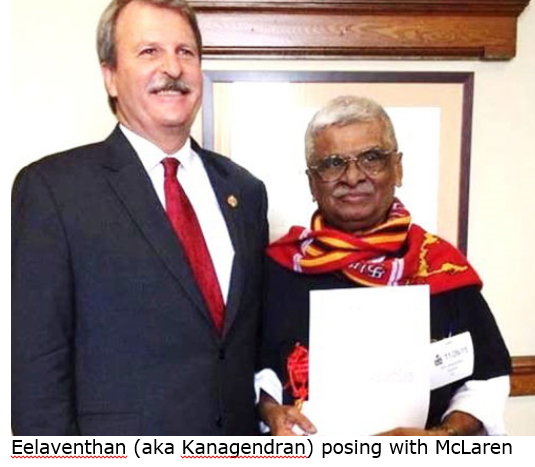
The Canada Border Services Agency (CBSA) had been trying to deport M K Eelaventhan (also known as Manickavasagar Kanagendran)

The Canadian Immigration and Refugee Board claims that Eelaventhan was an appointed representative of the TNA and had personally met the top leaders of the LTTE.

IRB: He was an active & vocal supporter of the LTTE, holding a position of importance and working at a high level to further the LTTE’s cause”

IRB: Mr. Eelaventhan had knowledge of the crimes committed by the LTTE and lent his active support to the group”

As the National Post has pointed out there is astartling discrepancy between federal officials enforcing Canada’s national security laws and politician’s molly cuddling tigers in camouflage in their constituencies for their own political self-serving means.

Unlike Sri Lanka’s media that is very careful not to make any derogatory remarks against either the LTTE or the TNA, the National Post had 4 days before the IRB disclosure reported that Progressive Conservative leader Patrick Brown & Kathleen Wynne and other politicians visited a Toronto kovil which according to Canada Border Services Agency was controlled by a banned pro-LTTE group.

Eelaventhan had been elected as a TNA MP after the 2004 Parliamentary Elections. What is interesting about the CBSA calling TNA a political front of the LTTE is the link to the EU Election Observer Mission claiming the virtual same. This is what its head John Cushnan had to say of the TNA in the EU report released on June 17, 2004 clearly establishing the LTTE-TNA alliance:

Quote: Firstly, the LTTE intended that no other rival Tamil party (or Tamil candidate from the mainstream political alliances) to the TNA would be able to claim to represent Tamil interests. A chilling message to this effect was sent early in the campaign when a UNP candidate and an EPDP activist were murdered. Incidents such as this seriously restricted the right of the parties other than the TNA to campaign freely in the Northern and Eastern Districts. During the 2004 elections, the major incidents of violence was perpetrated by the LTTE, whereas at the earlier elections; Unquote

He fled Sri Lanka in 2009 and arrived in Canada. Then in May 2010 (exactly a year after LTTE defeat) he contested some utopian election organized by the TGTE and was elected. Incidentally, TGTE and its leader were named & banned by the GOSL in 2014 as an LTTE front drawing the UNSC Resolution 1373 for material support to the LTTE. The TGTE & its leader remains banned.

CBSA calls TNA a ‘political front’ of the LTTE. Interesting to know how he fled Sri Lanka and how he landed up in Canada. Questions for which we will not get answers. Luckily officials in Canada are not like the Canadian politicians.Eelavanthan was ordered by the refugee board to be deported on security grounds in 2012. The Federal Court upheld the IRB’s findings in 2014 which means that a very conclusive investigation would have ascertained that LTTE = TNA and TNA = LTTE. The Federal Court upheld that Eelaventhan was a TNA member whose group was engaged in terrorism. What more need we have to say!

Eelaventhan has a history of deportation – India deported him in 2000 for his links with LTTE when he was the leader of the Tamil Eelam Liberation Front. The Indian Government had arrested him in 1997 for smuggling medicines to the LTTE.

http://www.frontline.in/static/html/fl1726/17260490.htm

DBS Jeyraj was to write India deports ‘King of Eelam’ on 10th Dec 2000.

http://www.tamilweek.com/news002.html

As per Asian Tribune article the LTTE had despatched Eelaventhan to South Africa when 2 Tamil MPs from Sri Lanka accompanied then President Rajapakse to prevent LTTE interests from being compromised.

http://www.asiantribune.com/index.php?q=node/5430

http://www.adaderana.lk/news.php?nid=33315

That was in Canada, cross the border to America and we are next informed that a New York Court judge reduced the sentences of 3 LTTE convicts (Sathahan Sarachandran, Sahilal Sabaratnam & Thiruthanikan Thanigasalam) by 10 years (original 25 years) just because of a letter sent by one of the daughters. The three were accused of buying surface-to-air missiles for LTTE. A lawsuit was filed by them in 2012 seeking to reduce their sentences.

We hope the Judge is aware of the killings carried out by the LTTE – the babies and pregnant mothers cut to pieces, the elderly hacked to death, if he was aware he may ‘provide a fair measure of justice’ to these innocent villagers too. The 3 men are behind bars but thousands of innocent villagers are not even alive, their children are growing up without parents, some parents are still mourning their children – who is to seek justice for these deaths? Had the good judge known about how these gruesome crimes were committed he might just well also say ‘this case has just taken over my head’ for photos of these brutal killings would shock him and the Western world beyond comprehension. LTTE remains designated a foreign terrorist organization since 1997.

Coming back to Eelavanathan. The crux of the matter is not about Eelavanathan’s deportation but the more important fact that the Canadian officials have done what the Sri Lankan Governments have failed to do (includes present and former).

That a very comprehensive investigation has been conducted on the LTTE and the TNA is the reason for this TNA MP to be deported. A decision that the Canadian Federal Court has upheld. If the Canadian authorities are deporting a man claiming that he is linked to the LTTE through the TNA even after the ground defeat of the LTTE it seriously questions and brings to light the embarrassing question – what is the TNA doing inside Sri Lanka’s Parliament and worse still is why is Sri Lanka’s Opposition Leader the head of the TNA? The Canadian authorities must be bewildered as are we.

Moreover, the TNA MPs are on the steering committees inside Parliament to even change the Constitution and other legislations. It’s like handing the keys to the henhouse to the fox! Moreover, the TNA Chief Minister in the Northern Provincial Council is becoming another headache trying to replace the tiger leader with atrocious demands which include bullying Sinhala villages in the North, demanding the removal of Buddhist sites (leading to hooligans destroying some Buddha statues) spate of vandalisms, even the Jaffna university commemorating dead LTTE terrorists something that even Nazi Germany was not allowed and all these actions are very much aligned to and in keeping with the overall objectives of the LTTE – this time TNA taking charge of it. This fits very well with the investigation findings of the Canadian authorities.

So the Canadians have done what the Sri Lankan Governments should be doing. We have the 6th amendment clauses therein which can be implemented and action taken against the TNA and its MPs. Why is it not been done?

We have to compliment the findings of Canadian authorities by taking similar actions by at least starting an investigation on the TNA to its links to LTTE. Canadian authorities will definitely share their findings with the Sri Lankan counterparts and that is a good start to take action against this new bandwagon who are now taking over where LTTE failed.

We would like to know what the response of the yahpalana government is on the investigative findings of the Canadian authorities and what the yahapalana government proposes to do against the TNA. We would also like public statements from the SLFP, the Joint Opposition and other Political Parties on the need to investigate TNA-LTTE links.

We must be appreciative of the Canadian officials and law enforcement for not following the Canadian politicians who are sleeping with the enemy and molly coddling the tigers in sheeps clothing who are manipulating the Canadian system to use the power of their vote and undermine democratic governance in Canada through groups of liberal parties who just want to somehow come into power by any crooked means. With the level of terrorism taking place with mercenaries now not heeding their initial masters we are walking into greater calamities if action is not taken.

Shenali D Waduge

“H0LD “ETCA” UNTIL THE TENSION IN THE REGION IS EASED AND A NATIONAL POLICY ON INTERNATIONAL TRADE FOR SRI LANKA IS INTRODUCED”

October 17th, 2016

Sarath Wijesnghe Former Ambassador to U A E and Israel

ECTA and International Relations

It is reported that the ETCA – (Indo Sri Lanka Economic and Technical Corporation Agreement) will be concluded by the beginning of next year despite many deliberations for and against. Hon  Nirmala Sitaramanthe  Indian Trade Minister is said to be exited, and working hard on   the final touches, which is the continuation of previous failed CEPA. This shows how important and impatient India is to conclude this as early as possible. Sri Lanka from the inception has been a reluctant player due to fear, enormity and imbalances of economic asymmetric conditions of India with previous bitter experiences with India, other member countries, and international organizations. Historically Sri Lanka was cheated by Portuguese, Dutch and British, traders powerful countries and powerful NGOs. Today diplomacy and international relations are based on economic interests where Ambassadors and representatives in the global family   are advised to give priority to economic trade and business interests over all other considerations.   Indian diplomacy and foreign relations maintain high standards and the Indian High Commissioner for Sri Lake is playing a vibrant and active role in promoting trade and the ETCA. High Commissioner H E Dixit who has performed extremely well rendering a  yeoman service to his motherland by forcing  1987 Indo Sri Lanka Accord on Sri Lanka which will link Sri Lanka with the Indian foreign policy  as a part of greater India  forever. No attempts were made by Sri Lanka to seek help from the international community or ICJ on forced Indo Sri Lanka accord.

Diplomatic Manoeuvre or a Trade Affair

ETCA is a more diplomatic manoeuvring than a trade affair for India to have a stronger foothold with Sri Lanka while Sri Lanka is strengthening friendship with China initiated by previous government. There was a stormy period of   one year of uncertainty due to differences of policy before the matters were reactivated.   India is developing business ties with China for loans and grants for ailing Indian Economy whilst promising Sri Lanka on development projects including the development, trade and infrastructure. Close and historic ties with India and Sri Lanka have bonded with Buddhism, Culture, and Language, economic and commercial bonds as emerging world power.

India has invested in Sri Lanka on oil and look forward to investing on Trincomalee and Oil Tanks, and development projects, especially in the   North and East. It is in the public and international domain that, India with USA and the West manoeuvred the process of Regime Change” in Sri Lank and opposed Sri Lanka in the Human Rights front in the United Nations aligned with the   International community. India refused to cooperate with UN on Human Right allegations and made NGO’s out of bounds. India is a great patriotic Nation experienced veterans in international affairs.

State Party in the Global Village

State Parties must intermingle with the members of the world community to be successful in trade and commerce. Living in isolation in the present political and economic world order is not acceptable. To be successful in the world economic malaise state member should be alert and vigilant armed with an experienced team  With the mass and vast communication skills and advancements in trade and commerce with ferocious competitions, small and upcoming state parties sandwiched by world powers are vulnerable and subjected to pressure and danger. Countries such as Singapore, Hong Kong UAE Israel are different and exceptionally advanced in this area and other upcoming economies trading with the rest of the world successfully. Prime Minister appear to be confidently planning entering into agreements with Provincial Governments in India and many trading Nations such as Singapore, Hong Kong, Thailand act, expecting ECTA  be a vehicle for export FTA products other countries via Sri Lanka. Why should other countries do business with India via Sri Lanka? There should be attractions and profitable for the world to do so. Are we fit and ready for the challenge? Is a million dollar question. Prime Minister is expecting the market in 1.2 billon from India against 20.3 million Sri Lanka exports to flow via ECTA. What have we got to export and are we ready for the challenge? What have we got to offer and export and there is a possibility of invasion of Indians for employment and business especially in the service sector currently there are 300000 illegal foreign workers in Sri Lanka day by day increasing apart from the Indian Tamil labour in the upcountry controlling the tea economy. This may be a dream or a fantasy of the Prime Minister as there is a long way and his gamble depends on the strategies and planes of other trading nations. On the other hand most of the Pitta” mega business is in the hands of   former Indian traders still controlling Sri Lankan entire Export Import trade and wholesale business. Other danger is the multinational companies such and Lever Brother, Singer with flourishing business in both countries will benefit from the changes.  Prime Minister will have to be mindful of these concerns and dangers which are irreparable once put to action by international agreements. Sri Lanka will be in the Laboratory Test” and gunny pigs with great risk of being a failure as all previous agreements namely, SFTA, APTA, ISLFTA, PSFTA, SATIS, GSP,and  SAPTA which are ineffective and dormant.

Trade Agreements

International Trade Agreements are an agreements resulting from cooperation between two or more countries and international organizations to reduce trade barriers, import quota and traffics and to improve trade with each other as a second stage of economic integration. To enjoy concessions we must improve export. We have few items for  export  and it is time for us to increase the export quotas before entering into trade agreements.Sri Lanka has exported goods worth 643.03 $ to India and in return India  has exported goods worth 4273.30 $ to Sri Lanka still increasing rapidly when Sri Lankan exports are lagging behind. India has a population of 1.2 billion struggling with poorest with only 50% toilet facilities.   Sri Lanka was protected due to isolation as an island with sea right round unlike other SAARC members experiencing bitter battles with the gint neither aiming to be regional policeman of the Indian Ocean and a world power aspiring to be a member of the Security Council. Sri Lanka was pressurised to enter into Indo- Sri Lanka Accord resulting the Provincial Councils which is a white elephants today and cause of many political ramifications and ethnic tensions, with demands from India for the full implementation of the 13th amendment they have forced upon on Sri Lanka. LTTE was groomed and given life in the Indian soil over 30 years   reversing the progress of Sri Lank backwards by few decades. There is unrest in illegal fishing and demands from Tamil Nadu is intensified demanding abdication of previous agreements concluded with  Sirimavo and Indra Gandi on many contentious issues settled amicably. Indo Sri Lanka is active with tensions on illegal fishing and threats for recalling Kaththive Island settled previously.

Free Trade Agreements

Sri Lanka has entered into only few FT Trade agreements of which all are badly drafted and practically failures and dormant. India is active and vibrant in this area with thousands of experts, professionals and lawyers worldwide. In anti-dumping and many issues with WTO Sri Lanka has not taken legal or procedural steps due to want of experts and lawyers. It is a sorry state that there are hardly any experts or lawyers in Sri Lanka to deal with FT and take the process forward. Before entering into complicated agreement we must be ready and armed with knowledge and ammunition to meet any eventuality/s to put the house in order. FT’s should not be done in a hurry. It has to go through the process of assessment, Decisions to launch negotiations, Legal Verifications, and Call for Submissions. In Sri Lanka, after few days of the Indian Ministers visit, a group of Sri Lankan delegation consisting retired government officers left to India for the final draft of this important instrument which has long-term effects and irreparable ramifications for the future of the Trade and Commerce in the Nation. The political culture and the situation on the region are not satisfactory and volatile and definitely not conducive for negotiations as India is now on agitated mood. Therefore it is nothing but fair to hold on proceeding with the ECTA- FT agreement until a thorough study is done keeping the house in order arming the Ministry and patiently await the uncertain Political situation in the region which is uncertain and volatile becomes normal and Sri Lanka is ready to meet the challenges international and locally.

Diplomatic and International Law Practice

Diplomatic and International Law practice  demands clarification whether the Sri Lankan Prime Minister can agree with the Prime Minister of India  to conclude such an important agreement without the approval and consent of the President, the legislature and the citizen when the matter is vehemently challenged and disputed in the country. There should be a government policy and State policy acceptable the polite professionals and the citizen. What is this indecent hurry is the matter the citizen cannot understand when there are many unresolved and urgent matters on economy and law and order issues.

Sikkimization of Sri Lanka

In 1998 H. E. Chandirka Bandarneika was compelled to sign CEPA as   1987 Accord when country was in flames on emergency rule. Citizen has a genuine fear and rignt to know, when this important issue of information on trade agreements are conveniently excluded in the Public Information Act. The sudden joint declaration by the two Prime Ministers on the matter which required greater scrutiny, debate with the Polite, Governance and the citizen has aroused the suspicion and fear of the citizen. Therefore it appears that the agreement with ramifications which will run for ever will be concluded as agreed by the two leaders with or without the approval of the legislature the governance and the citizen. Therefore it is nothing but fair to hold signing the agreement until the tension is eased and Sri Lanka puts the house in order. If we are not vigilant and Careful there is a possibility of Sikkimiasation” of Sri Lanka in the near future, where the small Buddhist county bordering India is forcibly and tactfully annexed to India having brought the King as a Prisoner!.

Writer can be contacted on sarathdw28@gmail.com

Our best defence

October 17th, 2016

By Shivanthi Ranasinghe Courtesy Ceylon Today

The Geneva Resolution is our immediate threat and should be countered first, argues journalist Shamindra Ferdinando. In his weekly column in ‘The Island’, he repeatedly highlights that the last phase of the war with the Liberation Tigers of Tamil Eelam (LTTE) was not a war without witnesses. He regularly challenges these charges.

Allegations against the government are:
Ordering the United Nations and the International Non-Governmental Organizations in September 2008, out of Kilinochchi, to get rid of the witnesses.
The allegation has not taken into account the UN’s underhand dealings with the LTTE. Even after the LTTE imprisoned Tamil UN workers for aiding civilians to escape, the Colombo-based UN mission continued its secret dealings – keeping the UN Headquarters ignorant of the developments. Though the threat that civilians would be held hostage had been real since 2007, the UN refused to act.

Internal review

Their own internal review, headed by Charles Petrie, “Report on Secretary General’s Internal Review Panel on UN Actions in Sri Lanka”, concludes that “events in Sri Lanka mark a great failure of the UN to adequately respond to early warning and to the evolving situations during the final stages of the conflict and its aftermath, to the detriment of hundreds of thousands of civilians and in contraction with the principles and responsibilities of the UN. The elements of what was a systematic failure can be distilled into the following:
A UN system that lacked an adequate and shared sense of responsibility for human rights violations.

An incoherent internal UN crisis-management structure which failed to conceive and execute a coherent strategy in response to early warnings and subsequent international human rights and humanitarian law violations against civilians.

Furthermore, this discounts the presence of the ICRC and the Indian medical team stationed in Pulmuddai, North of Trincomalee. While the ICRC assisted evacuating the wounded along with a ‘helper’ – often a family member, the Indian team remained until the war ended.
The hostages themselves are witnesses. General Daya Ratnayaka highlights, “We rescued 290,000 civilians. There were approximately 2,000 UN employees, thousands of government employees, including the GA, and hundreds of Hindu and Christian clergy.”
The Vanni population was denied essentials.

Ferdinando writes that this should be “probed against the backdrop of supplies made available to Puthumathalan, until the week before the war ended in May 2009. India and ICRC, too, should be requested to explain their roles in the operation.”

Former Defence Secretary Gotabaya Rajapaksa, explains, “If a terrorist organization takes control of some area, the government can no longer take responsibility for those civilians. Can our Police or military go to those areas? Can our officials go and distribute anything? Who was in control there? It was the LTTE. So, it becomes their responsibility.

“Though we knew terrorists confiscated everything we sent and civilians only got what’s left over, we still sent essentials and other needful to those areas.
“Mahinda Samarasinghe, Cabinet Minister of Disaster Management and Human Rights, headed the Coordinating Committee for Humanitarian Assistance. All the UN organization heads, American, British, Japanese and Norwegian Ambassadors as the co-chair members and government secretaries made up the committee.
“The minutes of the meeting show discussions were on things like not enough cement, aluminum utensils, and tin sheets. Now, if there was an issue with food and medicines, will they be talking about cement?

“A very efficient Bangladeshi from the World Food Programme – a UN organization – coordinated everything. Suddenly he was transferred to Japan. If the UN thought the situation in Sri Lanka was very serious, would they have transferred him? I asked his reasons for leaving. He was also puzzled and said, “I don’t know what’s important in Japan right now”.

“Week before he left, he visited me and said, “I have stockpiled food items for six months in Kilinochchi and Mulathew areas.”
Firing heavy artillery into the no fire zones massacring 40,000 trapped civilians.

Ferdinando notes various organizations have published varying numbers as the civilian casualty figure. “British Labour Party MP Siobhan McDonagh (Mitcham and Morden-Labour) told the House of Commons, in September 2011 that 60,000 LTTE cadres and 40,000 Tamils perished during January-May 2009. She made the only specific reference to the number of LTTE cadres killed during a certain period.” However, neither the MP nor the British High Commission substantiated this figure.
AI Report

“Special Amnesty International report titled “When will they get justice: Failures of Sri Lanka’s Lessons Learnt and Reconciliation Commission”, also released in September, 2011, estimated the number of civilian deaths at 10,000,” writes Ferdinando. “A confidential UN report placed the number of dead and the wounded, including LTTE combatants, at 7,721 and 18,479, respectively. The report dealt with the situation in the Vanni, from August, 2008 to 13 May 2009. The war ended a week after the UN stopped collecting data due to the intensity of fighting.

“The vast majority of the wounded civilians were evacuated by the ICRC. The Indian medical team, tasked with receiving them, should be able to explain specific measures taken by India to assist the wounded. The UN is yet to release the report though it was made available to Darusman.
“That UN report had been based on information provided by those who were trapped in the war zone and even today further verification can be made as the identities of those who had provided information are known to the UN.

Contradiction

“Darusman refused to accept the report as it contradicted his own claim,” of 40,000 as reflected in the Geneva Resolution.
The then Norwegian Ambassador in Colombo, Tore Hattrem wrote to the then presidential advisor, Basil Rajapaksa: “The proposal to the LTTE on how to release the civilian population, now trapped in the LTTE controlled area, has been transmitted to the LTTE, through several channels. So far there has regrettably been no response from the LTTE and it does not seem to be likely that the LTTE will agree to this in the near future.”

Prof. Michael Newton, an expert on war crime issues, explains, “The LTTE refused to permit some 330,000 Tamils to flee towards safer areas away from the zone of conflict, and used them as human shields to deter offensive operations by the Sri Lankan Army. The government declared a NFZ in order to protect the civilians. The LTTE embedded its heavy artillery within the NFZ and intentionally shelled military positions from the midst of the civilian population.
“This is roughly comparable to the war crime of perfidy because the LTTE sought to use the government’s compliance with the laws and customs of warfare in order to gain an unwarranted military advantage.

“As reported by the US Embassy, the Sri Lankan Military expressly took ‘the utmost care’ to avoid intentional warping of its operational environmental by the LTTE. No military commander should accept a legal premise that military forces must suffer the lethal force of the enemy while under a legal obligation not to respond using lawful force in self defence.

“Participants in an armed conflict must ensure that in the conduct of military operations, constant care should be taken to spare civilians. Thus, the LTTE bears the responsibility for civilian deaths because their own conduct was the casual factor in such deaths.”
A Wikileaks leaked cable highlights Ferdinando, “reveals a discussion Geneva-based US Ambassador Clint Williamson had with ICRC Head for Operations for South Asia Jacques de Maio. The US envoy declared on 15 July 2009 that the Army actually could have won the battle faster with higher civilian casualties, yet chose a slower approach which led to a greater number of Sri Lankan military deaths”. Thus, “The Army lost nearly 2,500 officers and men during January-19 May 2009. Thousands suffered injuries.”

Rape used as a war tactic

On 30 September 2009 Hillary Clinton chaired the UN Security Council session as it adapted Resolution 1888 that dealt with conflict-related sexual violence. There, she read from a prepared text, “We’ve seen rape used as a tactic of war before in Bosnia, Burma, Sri Lanka and elsewhere”. When pressed for specific allegations against the Sri Lankan Army, a senior aide to Clinton admitted that statement had not been properly “vetted”.

Clinton helped topple governments in Asia, Africa and South America, supported sanctions against Iraq killing half a million Iraqi children, threatened Iran with nuclear weapons and gloated when Colonel Gaddafi was killed, jittered over tendering an apology. The government received a backdoor explanation of sorts – not a retraction, not an apology and that too not from Clinton. UN repeated the allegation in 2014, again without evidence. Major General Shavendra Silva asserted these baseless allegations are to justify the demand to remove the Army from the Northern Province.

Prof. Newton categorically states, “There is no evidence in the record to suggest that the government used inherently indiscriminate weapons such as barrel bombs or Grad rockets.”

Maxwell Paranagama, who chaired the Presidential Commission to investigate missing persons, states, “There’s no credible evidence that the Army used cluster munitions during the war. The Darusman Report had alleged, without including the sources. When the Army denied the allegation, UN accepted it, which means there was no evidence to contradict that denial.

“The Cluster Munitions Convention banning the use of such weapons only became operational on 1 August 2010. Even if there had been a need for the SLA to use cluster munitions because of military necessity, it was not illegal at the time.” Killing surrendering terrorists including those carrying white flags.

Rear Admiral Sarath Weerasekera explains the extraordinary situation that developed with the LTTE taking over 300,000 civilians as a human shield. “Last days before Prabhakaran was killed, he was confined to Nandikadal. He surrounded himself with 200-300 civilians, including children and pregnant women. They dug trenches right around and planted anti-personnel mines. We couldn’t use heavy artillery, without harming those civilians. So, about 300 soldiers went over those trenches, fully aware of the danger. Many died or are now without limbs.”

“As people were coming to our side, we got intelligence that a suicide bomber disguised as a pregnant woman might come as well. But how can we identify? Still, we allowed them to come. When the bomb blasted, about 30 died”.

“Soosai made many of our women widows. But when we caught his wife and children trying to escape around 11 p.m. we brought them safely back and now they are living normal lives among the Sinhalese.”

Escaping civilians

General Ratnayaka too rejects the allegation. “Small teams broke through and stood like a wall between the firing terrorists and the escaping civilians. As these civilians came rushing, it wasn’t possible to shoot some groups and rescue others.”

The statements were attested by the then Colombo-based US Defence Attache, Lt. Colonel Lawrence Smith in June 2011. At a seminar organized by the Army, “Defeating Terrorism: The Sri Lanka Experience”, he stated, “I’ve been the Defecse Attache here, at the US Embassy, since June 2008. Regarding the various versions of events, that came out in the final hours and days of the conflict – from what I was privileged to hear and to see – the offers to surrender, that I am aware of, seemed to come from the mouthpieces of the LTTE, Nadesan, KP, people who weren’t and never had really demonstrated any control over the leadership or the combat power of the LTTE.”

“So their offers were a bit suspect anyway, and they tended to vary in content, hour by hour, day by day. I think we need to examine the credibility of those offers before we leap to conclusions that such offers were, in fact, real.” The US State Department only asserted that he had not been at the Defence Seminar on an official capacity. They disputed his right to make that observation, but never contradicted the statement. The Geneva Resolution is based on the Darusman Report. Every aspect of the report translates into an issue. Its initiation violates the UN mandate. Its panel has proven to be biased. Its findings are without foundation. The Parangama Report with input from specialists of international repute slams the Darusman Report and offers our best defence to face the oncoming Geneva Resolution.

ranasingheshivanthi@gmail.com

‘ARE YOU GUYS WARPED IN YOUR HEAD?’ An irate Indian’s viewpoint

October 17th, 2016

By Dr. Tilak S. Fernando Courtesy  Ceylon Today

Govindaraj S. wants to share with everyone in a world ‘forum’ an interesting blog that has gone viral via email, which hit my mailbox too, on a frustrating and disappointing viewpoint of an Indian lady about the British, following her daughter’s traumatic experience in connection with a visa application through the UK VFS office.

VFS is the world’s largest outsourcing and technology services, specialist for governments and diplomatic missions worldwide, serving 51 client governments in 126 countries with 2,260 application centres. Company statistics reveal the agency has processed 130 million applications since its inception in 2001. Under the company’s ‘vision and mission’ it is described as a company ‘to be the market leader in Visa, Consular and Identity Management solutions industry. VFS Global is a wholly owned subsidiary of the Kuoni Group, headquartered in Zurich, Switzerland.

tilak171016a

Services And Solutions

This Indian lady’s experience is very common not only to India but many a South Asian country, as the sole responsibility of dealing with tourist and entry visas to the UK is passed on to the VFS agency who accepts the documentation and apparently forwards it to the visa officer in a particular High Commission or to the nearest office in a neighbouring country. A clouded area that has been highlighted in this experience is to what extent the staff of the Agency is proficient and qualified to vet a prospective application prior to forwarding it to a visa officer as the Visa officer, to be fair by his decision, has to go through what is written on the application, and it is up to the adeptness and competence of the officer at the agency to ensure that an application has been properly and accurately vetted, rather than just doing a collection service and charging money for it.

Disappointment

If a survey is done out of those who had applied for tourist entry visas to the UK, via VFS Agency, from Far Eastern countries, and their experiences are catalogued, it will not give a rosy picture at all, but find many have been disappointed, frustrated and annoyed at the rejection as well as having lost a good amount of money as visa fee! The worse being the verdicts or the explanations given for rejection come in the form of a computer printed version on a plain A4 sheet, with only the reference number and no name of the officer, signature or insignia of the British Government. (Neither the VFS Agency or British Government official headed paper).

The writer having lived and worked in the UK for many years is fully aware how the UK Civil Service Administration works – i.e. all communications to the public are sent on an official headed note paper with the government insignia and every communication carrying signature and the name of the author, printed underneath the signature.

Private Agency

When the private agency acting on behalf of the UK Government, sends a communication of importance to an applicant with regard to his/her rejection of entry visa, surely, the person who takes the responsibility of conveying the message is obliged to reveal his name with his signature, as per UK Civil Service protocol. When VFS office or the High Commission concerned decides to send an ordinary’ computer printout giving reasons for rejection, in most cases stating quoting the phrase, “In my opinion I am not convinced that you…” it simply turns into a mockery of the system and simultaneously does a great deal of harm towards the reputation of the British authorities!

Not only this Indian lady’s daughter had been denied, but rubbing salt to injury applicant’s passport had not been returned within the specified and allotted time frame too, which forced the applicant and the family to cancel their paid holiday.

Venting her anger, the mother of the applicant addresses her feelings specifically to the Queen of England, British Prime Minister at Downing Street, the ‘King in eternal waiting’ Prince Charles and the complete set of Royals, Members of the House of Lords, House of Commons and generally to all ‘dry stiff upper lip English folks’ as follows:

Origins of the British in India

“You came to India 270 years ago without a visa and without a “May we please…….   . And we welcomed you because, as Indians, we believed in Athithi Devo Bhava… as we still do… meaning a guest is like God Himself in Disguise“.

“When you overstayed did we say anything? NO…! Then you played dirty politics and did we say anything. NO!!  You ruled us by turning us into slaves in our own country, and we didn’t say a word…? We were meek, mild and peace loving people. You took our Kohinoor and did we say anything. NO…! You killed, looted and made a mockery of us till we could not take any more. You made us fight your wars, and we shed blood for a war in which we had nothing to gain… all we did was to lose young Indian and Gurkha lives”.

“You were thrown out of the country without any bloodshed, but even as you left you divided us and left a bloody trail on your way out! Did we say anything? NO..! But you still didn’t leave us alone but got thousands of Indians to migrate to the UK to do your dirty menial jobs, and even there you treated us like second-class citizens. Did we say anything NO! You made our Mother tongue a second language and did we say anything..?? NO you left a whole generation of Indians who were clueless as to whom they were… a brown sahib or a home-grown Indians..?? You bastardized our language, our food, our clothes, our religion, our customs our habits, our perceptions, our pretty much everything… and yet we only threw you out”..!

Every country that you ruled threw you out…. Have you ever thought WHY..?? It’s time to do a reality check…and please do it fast, British People’! It’s known that Indians like London as a holiday destination… ever wondered why..?? Because all of us have read British History…, War of Roses, Henry I to Henry VIII shoved down our throats… We probably know more about you then you know about yourself. But now as a rich upcoming nation we want to see and want our children to see you in your own grounds. And since you have given us Cricket, which is a craze with us, every self-respecting Indian wants to go to Lords… it’s like a pilgrimage! And we are at home in London…. Oh stop curling your stiff upper lip anymore or it will crack..!! Because, it’s familiar territory and has enough Indian Food… and anyway, didn’t we read about Chicken Tikka Masala being your National Food..?? And enough Indian..!

“We Indians like familiarity wherever we go… Plus you really can’t afford to shop at Harrods and Selfridges… We can! Oh yes…! That’s the bitter truth… swallow it with your cuppa..!! And if we don’t drink or buy your Scotch and Single Malts… your fine breweries will shut down..! Another bitter pill… swallow that too with your pint… because you can ONLY afford that while we hard working Indians glug, glug on your finest”..!

You are and have been a nation of traders for centuries. So to make it short and sweet and hit you where it hurts… we Indians are holding up your economy… and yet you give us a run around for the visas..?? Are you guys warped in your head…? Oh!! You surely are..! Otherwise you would still be ruling the world… now all you have is a tiny island and the stolen Kohinoor.”.!

We, Indians, have the money, speak better English than you. We are more educated and we spend lavishly…. So we call the shots here…get it..? Your economy survives on the Pounds that we Indians spend, and so does your real Estate because the maximum real estate investors are Indians..! I am not even going into the issue of how the Indians hold most of the wealth in the UK…, because that would be the final straw that broke the Camel’s back.”.!!

No, no..! You guys never learn..! Take a lesson from USA… every step to get one’s visa is streamlined, and in two minutes one knows whether one has got a visa or not. But you guys think you are too good to even speak to us… you hide behind an iron curtain, a faceless cold persona that is inaccessible..! Once the passport is given to the VFS… all we do is have to wait twiddling our thumbs. You take Rs 500 extra to give us mobile updates… nothing ever comes of it…. not even one message”.

“We can’t call anyone… and there is a London number, which says ‘please deposit ‘x’ pounds before you can speak to someone’…. Gosh…! you are really quite broke..! I don’t blame you… what with the upkeep of the Queen and her kids and their nannies… and their mistresses and boyfriends and divorcees and wild parties… there aren’t much left to go around..! So you try and get it from folks applying for a visa… keep the money, deny them a visa… but then the problem is not the visa… the passport you hold onto interminably… and give people the run around”.

“Will the British bureaucracy turn over a new leaf ever? Is that your way of deriving sadistic pleasure against a people who you once ruled and now they occupy your country and control the economy..?? What’s wrong with you guys..?? Why can’t you just have a system like the USA…? Why don’t you get off your high horse and learn new things..?? Or, hasn’t anyone told you that you guys no longer rule the world..?? Oh..! Oh..!! Don’t look so shocked… you seriously didn’t know… that the sun does not rise or set in the British Empire any longer.??”

“What Empire… ha, ha, ha, ha ..! It’s even smaller than one State in India…. You Brits live under illusions and delusions…. and now I guess dementia is setting in too! Oh..! even Ireland / Scotland / Wales don’t want to have anything to do with you… and Australia NZ too… I can’t help but gloat and say those famous lines from the Hindi Movie Sholay… “Ab tera kya hoga goray…??”

“The British High Commission… please understand. People here work for a living and we guys don’t have dole. People plan holidays in advance, book tickets in advance and take leave from work in advance… then they apply for a UK Visa much in advance… yet even after reading their travel dates you don’t give them their passports in time. Then we have to cancel all our flight tickets and bookings made online… have you no compassion..?? Or maybe you don’t know how the three R’s… Come join one of our convent schools and you will have perfect knowledge of reading writing and arithmetic..! And that stiff upper lip… gosh someone please smash a fist into it once and for all..! ”

“Another point… Why would any happy Indian living under a hot Indian Sun, with servants to do work and drivers to drive their fancy cars… want to go and live in London..?? Dreary gloomy grey weather… cold… and cold unsmiling faces in blacks and greys…. get over yourselves, Brits..! Stop looking at every brown coloured person with suspicion..! You are not superior… and your country doesn’t have much to offer..! Earlier… at least there was Diana… now toh woh bhi nahin hai… (even she is not around anymore). Hamarey pass MNC’s, Computer Savvy population, a buzzing economy and sunshine hai… tumharey pass kya hai??? (What are you so proud about?) One small voice from the British Isle says… Hamarey pass Queen hai..! Indians double up laughing… much to the annoyance of the Brits… they laugh and laugh… and finally one of them says… she is a symbol of our glorious past….past mind you…that is where you live”.

tilakfernando@gmail.com

China to provide Rs. 2.6 million worth military aid to Sri Lanka

October 17th, 2016

Courtesy ANI

Colombo [Sri Lanka], Oct.17 (ANI): An entire range of defense cooperation has been reviewed by Sri Lanka and China during the recent visit of Sri Lanka’s Secretary of Defense to Beijing, to participate in the second China – Sri Lanka Defense Cooperation Dialogue.

A delegation was led by the Secretary of Defense on the invitation of the Chinese Government to attend the 7th Xiangshan Forum on 10-12 October and the second China – Sri Lanka Defense Cooperation Dialogue from 12-15 October.

The second China-Sri Lanka Defense Cooperation Dialogue in Beijing was chaired by the Defense Secretary Hettiarachchi and Admiral Sun Jianguo, deputy chief of Joint Staff Department of China’s Central Military Commission (CMC), reports the Colombo Page.

During the dialogue, the two countries had in-depth exchange of views on South Asian situation, bilateral relations and exchanges and cooperation between the two militaries.

Sri Lanka’s Ministry of Defense (MOD) said that the entire range of defense cooperation including high level exchanges, military assistance, training opportunities, collaboration between defense think tanks, intelligence cooperation, joint military exercises and participation in defense seminars, workshops and symposia was reviewed by the two Asian countries.

The delegations highlighted defense as an important pillar of cooperation in the overall bilateral relationship and agreed to continue to strengthen ties in this sphere.

Two agreements related to the provision of Chinese Yuan 120 million (Rs. 2.6 billion) worth of military assistance and the provision of an Offshore Patrol Vessel (OPV) to Sri Lanka were signed during the meeting at the conclusion of the Dialogue.

The Chinese Defense Official said, “The military-to-military relations serve as a cornerstone for bilateral relations, and the Chinese military is willing to continue to support Sri Lanka’s defense and military development, and work with it to implement the consensus reached by Chinese president Xi Jinping and Sri Lanka President Sirisena.”

Praising the long-standing friendship between Sri Lanka and China the Defense Secretary said that Sri Lanka stands ready to deepen mutually beneficial exchange and cooperation with China in multiple fields and increase mutual trust and coordination.

The Defense Secretary on behalf of the President and Minister of Defense of Sri Lanka extended an invitation to the Minister of National Defense of China to undertake an early visit to Sri Lanka to strengthen cooperation in the defense sector.

The Sri Lanka delegation to included Commander of the Air Force Air Marshal Kapila Jayampathy, Chief of Staff of Navy Rear Admiral S S Ranasinghe, and Commandant Sri Lanka Army Volunteer Force Major General H C P Goonetilleke. (ANI)

DG of Bribery Commission quits after President Sirisena’s charge of politicization

October 17th, 2016

By P K Balachandran Courtesy The New Indain Express

COLOMBO: The Director General of the Sri Lankan Commission on Bribery and Corruption, Dilrukshi Dias Wickramasinghe, sent in her resignation on Monday, following President Maithripala Sirisena’s public outburst last Wednesday against the politicization” of the commission’s working.

Dilrukshi Wickramasinghe, appointed in February 2015, is generally believed to be the choice of Prime Minister Ranil Wickremesinghe. But the Prime Minister and the President belong to two different political parties, the former to the United National Party (UNP), and the latter to the Sri Lanka Freedom Party (SFLP). The UNP-SLFP coalition, which was formed to defeat former President Mahinda Rajapaksa in 2015 and to run the government jointly thereafter, is now showing cracks thanks to clashing political interests and agendas.

President Sirisena was incensed when the Bribery Commission hauled up three former Navy chiefs and a former Defense Secretary, who happens to be the war-winning Gotabaya Rajapaksa. Sirisena felt that this would do his government great political harm as the personalities hauled up are heroes of Eelam War IV. Sirisena felt that at a time when the Sri Lankan armed forces are facing flak from the UN and international human rights lobby, it would be adding insult to injury if their top officers are humiliated at home too. The least he expected from the commission was to be informed about the action to be taken against former defense officials, as he is the Commander in Chief of the forces and Defense Minster to boot.

Sirisena also felt that  the Bribery Commission, the Financial Crimes CID  and the CID ,are working to UNP’s political agenda. While it is in the UNP’s interest to completely demolish the image of the Rajapaksa regime, it is not so in the case of the SLFP which Sirisena heads. Sirisena is still to win over the entire SLFP  from Rajapaksa. To win over the alienated party men, he would have to serve their interests and respect their sensitivities. To achieve this, he should not harm the holy cows of the SLFP, namely, the armed forces and their former de facto head, Defense Secretary Gotabaya Rajapaksa, a sibling of the former President. Sirisena would like corruption cases against these to be pursued with some sensitivity.

Taken aback by the President’s outburst at a military function here, where he made it a point to declare that he would never let down the armed forces, Prime Minister Wickremesinghe agreed to the formation of a joint SLFP-UNP committee to oversee policy matters in regard to all important national issues. Both the President and the Prime Minister will be part of this committee.

ඇවන්ගාඩ් සමාගමට යුරෝපයේ ඉහළම සම්මානය. නරුම පාලකයින්ට කට උත්තර නැති වෙයි.

October 17th, 2016

www.mahinda.info

එංගලන්තයේ ඔක්ස්ෆර්ඩ් නුවර පිහිටි යුරෝපිය ව්‍යාපාරික සම්මේලනය විසින් ලෝකයේ විශිෂ්ටතම ජාත්‍යන්තර සමුද්‍රාරක්ෂක ක්ෂේත්‍රයේ ව්‍යාපාරික සන්නාමය සඳහා වාර්ෂිකව පිරිනමන ‘සොක්‍රටීස් සම්මානය’ 2016 වසර සඳහා පිරිනමා ඇත්තේ ශ්‍රිලංකාවේ ඇවන්ගාර්ඩ් සමුද්‍රාරක්ෂක සමාගමටය.

ලොව පුරා පවතින ප්‍රධාන පෙලේ සමුද්‍රාරක්ෂක සමාගම් 175ක් පසුපසට ඇද දමමින් මෙම සම්මානය ඇවන්ගාර්ඩ් සමාගම දිනා ගෙන ඇත. පසුගිය 7 වනදා ප්‍රංශයේ කේන්ස් නුවර කාර්ල්ටන් ඉන්ටර්නැෂනල් හෝටලයේදි මෙම සම්මාන පිරිනැමීම සිදුකොට තිබේ.

කෙසේ නමුත් වත්මන් යහපාලන යැයි කියා ගන්නා ආණ්ඩුව බිහිවීමෙන් පසුව ඇවන්ගාඩ් සමාගමට එරෙහිව චෝදනා පිට චෝදනා එල්ල විය. මූල්‍ය චෝදනා, අවිජාවාරම් චෝදනා ඒ අතර විය. මේවන විට අල්ලස් කොමිසම මෙම සමාගම විසින් රජයට පාඩුවක් සිදු කළාය යනුවෙන් චෝදනා කොට නඩු පැවරීම සිදුකොට ඇති අතර බරපතල අපරාධ පිලිබඳ ජනාධිපති විමර්ශන විශේෂ කොමිසමද පසුගියදා නිවේදනය කර තිබුනේ එම විමර්ශන අවසන් කර ඇති බවත් නෛතික පියවර ගන්නා බවත්ය.

කෙසේ නමුත් ඇවන්ගාර්ඩ් සමාගමට එරෙහිව ක්‍රියාත්මක වූ මෙරට බලවේග දේශපාලන වුවමනාවන් හා කප්පම් මුදල් නොලැබීම හා එම ව්‍යාපාරය තමන් සන්තක කර ගැනිමේ වුවමනාවන් මත ක්‍රියාත්මක වු බව පැහැදිලිව අනාවරණය විය. එහෙත් මේ දක්වා පැහැදිලි චෝදනාවක් එම ව්‍යාපාරයට එරෙහිව සිදුකර නොමැත. අල්ලස් කොමිසම විසින් පැවැරූ නඩුවද විවාදාපන්නය.

මෙරටදි චෝදනා පිට චෝදනා එල්ල වී ඇති මොහොතක ඇවන්ගාර්ඩ් සමුද්‍රාරක්ෂක සමාගමට ජාත්‍යන්තරයෙන් විශිෂ්ට ඇගයුමක් ලැබී තිබීම මෙම චෝදනා සම්බන්ධයෙන් නැවත වරක් සිතා බැලීමට චූදිතයන්ට සිදුවනු ඇති නමුත් කෙසේ හෝ මෙම සමාගම විනාශ කර දැමීමේ නොනිත් ආශාවෙන් පෙලෙන නිසා ඔවුන් ඒ නොසලකා හැරීම සිදුවිය හැකි වූවත් සිහි බුද්ධියක් ඇති ජනතාවට ඒ ගැන නොතකා සිටිය නොහැක.

යහපාලන යැයි කියාගන්නා ආණ්ඩුව බිහි වූ දා පටන් ඇවන්ගාඩ් ආයතනය විනාශ නොකරන්නට මේ වන විට එම ආයතනය ලෝකයේ විශාලතම ජාත්‍යන්තර මුහුදු ආරක්ෂණ ආයතනය වීමට ඉඩ තිබූ බව විශේෂඥයින්ගේ මතයයි.

ඇවන්ගාඩ් ආයතන සම්බන්ධයෙන් එජාපයෙන් මඩ ගසද්දී mahinda.info වෙතින් ජනතාවට දිගින් දිගටම එහි නිර්දෝශී භාවය සහ එහි ඇති ජාතික වැදගත්කම පැහැදිළි කළෙමු.
1. මුහුදු කොල්ලකරුවන්ව භීතියට පත් කළ අපේ රටේ පාවෙන අවි ගබඩාව ගැන අප්‍රසිද්ධ තොරතුරු
2. පාවෙන අවි ගබඩාව ගැන කරන මඩ චෝදනා වලට ගෝඨාභය මහතාගේ පිළිතුරු ((video))
3. පාවෙන අවි ගබඩාව නීත්‍යානුකූලයි, ඒත් ගෝඨාභය ව සිරගත කිරීමට සූදානම්.
4. ගෝඨාභය” නම නැවතත් බබළයි. අවි ගබඩාව නීත්‍යානුකුලයි! යහපාලනෙන් නඩුව ඉල්ලා අස් කර ගනී.
5. පාවෙන අවි ගබඩා නඩුව යහපාලනයෙන් ඉල්ලා අස් කර ගැනීම ගැන ගෝඨාභය මහතාගේ අදහස.

ඇවන්ගාඩ් ආයතනය සම්බන්ධ කරගනිමින් හිටපු ආරක්ෂක ලේකම් ගෝඨාභය රාජපක්ෂ මහතාට එරෙහිව දිගින් දිගටම විවිධ චෝදනා එල්ල කරමින් ඔහුව වැලිකඩට දැමීමට හැදූ අතර එජාප වෙබ් මඩකරියන් විසින් තොරක් නැතිව මඩ ගැසීම සිදුකරන ලදී. නිශ්ශංක සෙනාධිපති මහතා ඇතුළු ඇවන්ගාඩ් ආයතනය මෙහෙයවූ හිටපු නාවික හමුදපතිවරුන් ප්‍රමුඛ රණවිරුවන් ගණනාවක්ම සිරගත කරන ලදී. එදා ගෝඨාභය රාජපක්ෂ මහතාගේ දුර දක්නා නුවනට අද ජාත්‍යන්තර ඉහළතම සම්මාන ලැබෙද්දී එජාප මඩකරියන්ට දැන් කට උත්තර නැති වී තිබේ.

ජාතියක් වශයෙන් ලැජ්ජා විය යුතු මොහොත ඉහත පින්තූරයේ දැක්වේ… ගෝඨාභය රාජපක්ෂ මහතාව එලෙස මොහොතකට හෝ උසාවියේ සිර කූඩුවට දැමූයේ ඔහු සුදු කොඩි කතාව කියා හමුදාව පාවාදීමක් නිසා නොවේ. හමුදා නිලඇඳුම ඇඳන් දේශපාලනය කළ නිසා නොවේ. හයිකොප් ජාවාරමක් නිසා නොවේ. සිනමන් ලේක්සයිඩ් හෝටලයේ සිට හමුදා කුමන්ත්‍රණයක් සැලසුම් කිරීම නිසා නොවේ. ඔහුව සිරගත කළේ ශ්‍රී ලංකාවට මුළු මහත් ජාත්‍යන්තරයේම කීර්තියක් ලබා දුන් ඇවන්ගාඩ් ආයතනය අධිකව ලාභ ලැබූවා කියමිනි. එජාපය සහ රතු අලි පැටියා පැවසූ ලෙසට ඇවන්ගාඩ් ආයතනයේ කිසිම හෝ දූෂණයක් සිදුවුණානම් එවැනි ජාත්‍යන්තර සම්මාන ලැබෙන්නේ නැත. ඇවන්ගාඩ් ආයතනයට යුරෝපයේ ඉහළම සම්මානය ලැබෙද්දී ගෝඨාභය රාජපක්ෂ මැතිතුමාව එසේ කූඩුවට දැමූ අයට දැන් සතුටුද?

අනිත් අයටත් බලන්නට SHARE කරන්න.

ගෝටාභය පාවා නොදී වීර හමුදා බුද්ධි සෙබලා හිරබත තෝරා ගනී.. දිරිය බිරිද රට හමුවේ එය අභීතව හෙලි කරයි.. [Video]

October 17th, 2016

ලංකා සී නිවුස්

අතුරුදහන් මාධ්‍යවේදී ප‍්‍රගීත් එක්නැලිගොඩ ඝාතනය කරනු ලැබුවේ හිටපු ආරක්‍ෂක ලේකම් ගෝඨාභය රාජපක්‍ෂ යයි සදහන් ලියවිල්ලකට අත්සන් තැබුවහොත් තම සැමියා නිදහස් කරන බව රහස් පොලීසියේ ශානි අබේසේකර නම් නිලධාරියා කියා සිටි බව අදාල සිදුවීම සම්බන්ධයෙන් මේ වන විටත් රිමාන්ඞ් කර සිටින හමුදා බුද්ධි අංශයේ කෝප‍්‍රල් රූපසිහංගේ බිරිද වන සන්ධ්‍යා කුමාරි කොළඹදී පැවති මාධ්‍ය හමුවක් අමතමින් කියා සිටියාය.

කෙසේ වෙතත් එම ඉල්ලීම ප‍්‍රතික්‍ෂෙප කර ඇති තම සැමියා වන හමුදා බුද්ධි නිලධාරී කෝප‍්‍රල් රූපසිංහ අද වන තුරු සිරබත් කන බවද ඇව කියා සිටියාය.

එම මාධ්‍ය හමුව ඇමතූ මවුබිම වෙනුවෙන් රණවිරැුවෝ සංවිධානයේ කැදවුම්කරු නීතීඥ අජිත් ප‍්‍රසන්න මහතා කියා සිටියේ මෙම නඩුව පවත්වාගෙන යාමට මුල සිටම කිසිදු සාක්‍ෂියක් නැති බවත් අඩුම තරමේ එක්නැලිගොඩ මිය ගියා යයි කිසිදු සාක්‍ෂියක් නැති බවත්ය.

7,798 Viewers

Earful from Prez makes Dilrukshi quit

October 17th, 2016

Courtesy The Island

As a direct fallout of President Sirisena’s public outburst against three state investigative bodies last week accusing them of launching politically motivated probes, Director General of the Commission to Investigate Allegations of Bribery or Corruption (CIABOC) Dilrukshi Dias Wickramasinghe tendered her resignation yesterday.

Members of the former regime were accused of siphoning more than 18 billion dollars from the country besides owning helicopters, racing cars and even a gold horse, in the run-up to elections last year, which toppled them, but so far the investigative bodies have failed to prove the allegations.

CIABOC sources confirmed that Wickramasinghe’s resignation had been prompted by the President’s remarks on the CIABOC in the wake of former Defence Secretary Gotabhaya Rajapaksa and three retired Navy commanders, being hauled up before courts.

It has been a long levelled allegation that Wickramasinghe is a close family friend of Premier Ranil Wickremesinghe. There have also been many earlier complaints by opponents that the CIABOC is partial to wrongdoers in the government and was not pursuing cases against them.

During the same outburst, President Sirisena also flayed the Financial Crimes Investigation Division that comes directly under the Prime Minister’s office and the Criminal Investigation Department of the Police for not doing their jobs impartially.

Buddhist Psychotherapy

October 17th, 2016

Dr. Ruwan M Jayatunge  

Renowned Psychologists like William James, Carl Jung, and Eric Fromm saw much of value in Buddhist philosophy and its positive impact on mental health. The modern mental health clinicians have found incomparable therapeutic efficacy in Buddhist psychotherapy. Buddhist psychotherapy has become a major complementary therapeutic strategy in mental health. Recent research has highlighted the importance of Buddhist psychotherapy in the treatment of depression, anxiety disorders, factitious disorders, addiction disorders, medically unexplained symptoms and various other psychological ailments. Buddhist psychology is increasingly informing psychotherapeutic practice in the western world (Kelly, 2008).

Psychotherapy is generally defined as a means a treatment of emotional, behavioral, personality disorders based primarily upon verbal or nonverbal communication. Buddhism is a method of mind training (Bullen, 1994). In the Buddhistic approach, situational, and psychological states are viewed more holistically (Hall & Lindzey, 1978).  As Sherwood (2012) underlines Buddhist psychotherapy is based on the Buddhist model of the cause of mental suffering (the noble fourfold truths) and the notions of attachment, permanence and clinging to notions of self as the perpetrating forces of mental suffering.

Buddhist psychotherapy mainly deals with self-knowledge, thoughts, feelings and actions to minimize the psychological distress.  Neale (2012) views Buddhist psychotherapy as a novel approach to the clinical practice of mental health and it combines aspects of conventional psychotherapy with traditional Buddhist psychological theory and practice. According to Neale (2012) the objective of Buddhist psychotherapy as just being mindful of one’s momentary experience without judgment have failed to understand the crucial role that wisdom and action   play in the process of healing and change.

Buddhism and Western Psychology often overlap in theory and in practice. Over the last century, experts have written on many commonalities between Buddhism and various branches of modern western psychology like phenomenological psychology, psychoanalytical psychotherapy, humanistic psychology, cognitive psychology and existential psychology (Aich ,2013).

Mind and Mental Factors in Buddhism

Buddhism is a religion that deeply discusses human mental process. Human mind has a special place on Buddhist philosophy and it has gone in depth to analyze the human mind. The Buddhist philosophy talks about the human mind and its pathological and non-pathological segments. In Abhidhamma – which is the higher teaching of the Buddha profoundly analyses human mental process. In Abhidhamma man is described as a psycho-physical being consisting of both mind and matter, and it gives a microscopic analysis of the human thinking process (Narada, 1956). In Abhidhamma the Buddha describes consciousness as a flowing stream intensely interconnected. These words were echoed by William James and in his theory of mind (1890) described that conscious mental life flows continuously like a stream. William James further illustrates the consciousness and writes thus – the transition between the thought of one object and the thought of another is no more a break in the thought than a joint in a bamboo is a break in the wood” (James, 1988).

DSM and Buddhist Jathaka Stories

The Buddhist Jathaka story book deeply touches the DSM (Diagnostic and Statistical Manual of Mental Disorders) based mental illnesses (Jayatunge, 2013). The Jathaka stories are a voluminous body of narratives that were compiled in the period, the 3rd Century B.C. to the 5th Century A.D. According to Professor Rhys Davids who conceptualized canonical Buddhist writings in terms of psychology in the early 20th Century, Jathaka   stories are one of the oldest fables. Most of the DSM based mental ailments are vividly described in the Jathaka stories. These Jathaka stories discuss profound psychological themes. For centuries these stories helped the people to view individuals with mental illnesses with a compassionate eye.

Empathy in Buddhist Psychotherapy

Some contemporary psychologists identify empathy as an automated, involuntary, biologically-inbuilt reaction. Nonetheless empathy is a part of social and emotional development. Goleman (2000) characterizes empathy as one of the key components of emotional intelligence.  Rogers (1961) indicates that empathy and unconditional positive regard for the client create a growth promoting climate.  Rogers thought that accurate empathy was one of the three core conditions of effective psychotherapy (Dowd & McCleery, 2007). Empathy strengthens the therapeutic alliance.   Vyskocilova and colleagues (2011) highlight that empathy helps to understand both emotional reactions and the meanings of experience for the client.

Buddhism is a practical philosophy that advocates providing empathic responses to humans as well as other living beings.  In Buddhist psychotherapeutic approach empathy has a special status. Buddhistic empathy is a state of mind that is filled with wisdom, tolerance and loving-kindness. According to Buddhism, compassion is an aspiration, a state of mind, wanting others to be free from suffering. It’s not passive — it’s not empathy alone — but rather an empathetic altruism that actively strives to free others from suffering (Dalai Lama, 2005).

Psychoanalytic Technique and Buddhist Psychotherapy

In his famous lecture series at the Clark University in 1909 Sigmund Freud highlighted that psychoanalysis is a method of treating nervous patients medically. In classical psychoanalysis, unconscious defense mechanisms such as denial, splitting, and projection are identified as preventing psychic equilibrium and the genuine expression of self. In this method, defenses are made conscious, rendering them superfluous and health is achieved when one develops new, more appropriate ways of accessing validation, love, and connection (Neale, 2012).  Safran (2012) describes psychoanalysis as a new way of looking at inner life.

The psychoanalytical components in Buddhism have been emphasized by many scholars like Martin Wicramasinghe D.Lit, Laurence W. Christensen etc.  (Jayatunge, 2011).  Some contemporary psychologists see parallels between the Zen Buddhism and psychoanalysis. The primacy of experiencing for both disciplines, particularly concerning the experiencing subject’s momentary state of consciousness, forms a central theme for both Zen and psychoanalysis (Cooper 2001).

Eric Fromm suggests that Zen Buddhism has a prolific influence on theory and technique of psychoanalysis.

…[W]hat can be said with more certainty is that the knowledge of Zen, and a concern with it, can have a most fertile and clarifying influence on the theory and technique of psychoanalysis. Zen, different as it is in its method from psychoanalysis, can sharpen the focus, throw new light on the nature of insight, and heighten the sense of what it is to see, what it is to be creative, what it is to overcome the affective contaminations and false intellectualizations which are the necessary results of experience based on the subject-object split” (Zen Buddhism and Psychoanalysis Eric Fromm p. 140).

The psychoanalytical module in Buddhism is very much evident. Buddhism provides psychological methods of analyzing human experience and inquiring into the potential and hidden capacities of the human mind. According to Buddhism mind precedes its objects. They are mind-governed and mind-made. The verse 37 of the Dhammapada   explains the dynamics of human mind thus

The mind is capable of travelling vast distances – up or down, north or south, east or west – in any direction. It can travel to the past or the future.

 Existential-Therapy and Buddhist Psychotherapy

Buddhism and Existential-humanistic psychology share common grounds with realm of representation, realm of action and reality of self. Both psychotherapies are based on mindful awareness and directed towards growth potential. Both consider the human condition as a whole.

Existential Psychotherapy is aimed to enhance self knowledge and search for meaning. Frankl (1946) believed that man’s main concern is not to seek pleasure or to avoid pain, but rather to search meaning in his life.  Search for meaning help individuals to construct connections, find wisdom and experience healthy transformation when dealing with trauma. Individuals surviving a traumatic event often demonstrate a need to create meaning around events to make sense and regain coherence to their lives, thereby reestablishing the biographical continuity which had been lost (Abernathy, 2008). Search for meaning is parallel to Buddhist philosophy. Buddhist psychotherapy encourages clients to search for meaning hence allowing posttraumatic positive growth. Tedeschi & Calhoun (1996) define Posttraumatic growth (PTG) as positive psychological change experienced as the result of the struggle with highly challenging life circumstances. Buddha’s Eight Fold Path encourages to search for meaning of life, death, and suffering.

CBT and Buddhistic Approach

In general terms Cognitive Behavioral Therapy (CBT) is a psychotherapeutic  approach that addresses dysfunctional emotions, maladaptive behaviors and cognitive processes and contents through a number of goal-oriented, explicit systematic procedures. According to the Buddhist point of view, suffering is not caused by external, traumatic events, but by qualities of mind which shape our perceptions and responses to events. These same words were repeated by the Psychologist Albert Ellis in 1953 when he introduced his action oriented therapeutic approach – Rational Emotive Therapy. According to Ellis not the event that causes psychological distress but the belief held by the client. He further argues that one’s emotional distress is actually caused by one’s catastrophic thinking in appraising stressful events. Rational-emotive behavior therapy (REBT) argues that irrational beliefs result in maladaptive emotions leading to reduced well-being (Spörrle et al, 2010).

The Buddha often used Insight-oriented dialog and Socratic Method to give awareness to his disciples. Insight-oriented dialog is similar to the methodology of cognitive therapies. In Buddhist Psychotherapy  therapist and patient work together to identify dysfunctional mental patterns of thinking, feeling, and behaving that stem from a patient’s identification with their traumatic narrative. Once these specific issues are recognized, patients are prepared to use the healing relationship as an emotional corrective and employ meditation techniques to counter their particular cognitive-affective-behavioral habits (Neale, 2012).

Buddhist Meditation

Meditation is a synchronized mind body technique and conscious effort that helps transforming the mind.  In Buddhism meditation is regarded as the second category of the Eight-Fold Path. Buddhist meditation interventions have been integrated   in to contemporary psychotherapy.  Research based evidence supports the therapeutic use of meditation in a range of psychological ailments.

Oshita and colleagues (2013) indicate positive outcome following Buddhistic meditation and the subjects benefited from meditation and showed significant increases in their sense of coherence, self-esteem and purpose in life. A number of studies have shown that meditation activates and deactivates certain brain regions. Brewer and colleagues (2011) report that deactivation of posterior cingulate cortex (which has a prominent role   in pain and episodic memory retrieval) during a number of different types of meditation.  Tsai and Edds (2013) found increased alpha and theta activities in electroencephalography (EEG) during various forms of meditation.

The concept of mindfulness is based on Vipassana, a Buddhist meditation technique (Delgado-Pastor et al., 2013).  Mindfulness has been described as a practice of learning to focus attention on moment-by moment experience with an attitude of curiosity, openness, and acceptance (Marchand, 2012). As Tusaie & Edds (2009) indicate the practice of mindfulness is increasingly being integrated into Western clinical practice within the context of psychotherapy and stress management.

Numerous research concur the therapeutic effects of mindfulness meditation. Mindfulness-based Cognitive Therapy is strongly recommended as an adjunctive treatment for unipolar depression and anxiety (Marchand, 2012). de Zoysa (2013) reports successful use of  Buddhist mindfulness practice in the treatment of a case of obsessive compulsive disorder. Smith and colleagues (2008) reveal mindfulness-based stress reduction helps in reducing somatic pain. Winbush, Gross and Kreitzer (2007) highlight that increased practice of mindfulness techniques is associated with improved sleep in mindfulness-based stress reduction research participants. According to the research finding by Cahn and colleagues (2013) suggest that Vipassana meditation evokes a brain state of enhanced perceptual clarity and decreased automated reactivity.

Methha Meditation or Loving-kindness Meditation is widely used in Buddhist Psychotherapy.  Loving-kindness meditation is a practice designed to enhance feelings of kindness and compassion for self and others. Loving-kindness meditation appeared safe and acceptable and was associated with reduced symptoms of PTSD and Depression (Kearney et al 2013). According to Hofmann, Grossman and Hinton (2011) neuro-imaging studies suggest that loving-kindness meditation (LKM) and compassion meditation (CM) may enhance activation of brain areas that are involved in emotional processing and empathy. They hypnotize that loving-kindness meditation and compassion meditation may provide potentially useful strategies for targeting a variety of different psychological problems that involve interpersonal processes, such as depression, social anxiety, marital conflict, anger, and coping with the strains of long-term caregiving.

Anapanasati meditation or ‘mindfulness of breathing is the first subject of meditation expounded by the Buddha in the Maha-Satipatthana Sutta, the Great Discourse on the Foundations of Mindfulness (Ariyadhamma, 1994). Mindful breathing increases oxygen intake and has stress reducing impact. Feldman, Greeson and Senville (2010) point out that mindful breathing may help to reduce reactivity to repetitive thoughts.

Conclusion

Buddhist concepts have profound influence on Western Psychotherapy. Buddhist psychotherapy is based on the Buddhist model of the cause of mental suffering and deals with self-knowledge, thoughts, feelings and actions to minimize the psychological distress.  Buddhist Psychotherapy has a positive impact on mental health and it can be used to treat a wide range of mental illnesses.

Correspondence:

Email:  ruwanmjayatunge@gmail.com

Acknowledgements

1)    Rev Bandagiriya Sirinanda – Toronto Maha Vihara – Toronto Canada

2)    Dr. Patricia Sherwood -Honorary Senior lecturer – Edith Cowan University  Australia

References

Abernathy, B. E. (2008). Who Am I Now? Helping Trauma Clients Find Meaning, Wisdom, and a Renewed Send of Self.” Compelling counseling interventions: Celebrating VISTAS’ fifth anniversary. Eds. G. R. Walz, J. C. Bieuer and R. K. Yep. Ann Arbor, MI: Counseling Outfitter. 199-208.

Aich ,T.K.(2013).Buddha philosophy and western psychologyndian J Psychiatry. S165-70. doi: 10.4103/0019-5545.105517.

Ariyadhamma,M.N(1994). Anapana Sati Meditation on Breathing. Retrieved Retrieved on 1 December 2013, from  http://www.accesstoinsight.org/lib/authors/ariyadhamma/bl115.html.

Brewer, J. A., Worhunsky, P. D., Gray, J. R., Tang, Y. Y., Weber, J., and Kober, H. (2011). Meditation experience is associated with differences in default mode network activity and connectivity. Proc. Natl. Acad. Sci. U.S.A. 108, 20254–20259.

Bullen, L. (1994). Buddhism: A Method of Mind Training. Retrieved from http://www.accesstoinsight.org/lib/authors/bullen/bl042.html.

Cahn, B.R., Delorme, A., Polich, J.(2013).Event-related delta, theta, alpha and gamma correlates to auditory oddball processing during Vipassana meditation. Soc Cogn Affect Neurosci. 2 8(1):100-11. doi: 10.1093/scan/nss060.

Cooper, P.  (2001). The gap between: being and knowing in Zen Buddhism and psychoanalysis. American Journal of Psychoanalysis.

Dalai Lama. (2005).  Essence of the Heart Sutra. Wisdom Publications.

Delgado-Pastor ,L.C, Perakakis, P., Subramanya, P., Telles, S., Vila, J.(2013).Mindfulness (Vipassana) meditation: Effects on P3b event-related potential and heart rate variability.Int J Psychophysiol. 90(2):207-14. doi: 10.1016/j.ijpsycho.2013.07.006.

de Zoysa, P.(2013).The use of mindfulness practice in the treatment of a case of obsessive compulsive disorder in Sri Lanka.J Relig Health.299-306. doi: 10.1007/s10943-011-9461-0.

Dowd, T., & McCleery, A. (2007). Elements of Buddhist philosophy in cognitive psychotherapy: The role of cultural specifics and universals. Journal of Cognitive and Behavioral Psychotherapies, 7(1), 67-79.

Feldman, G., Greeson, J., Senville, J.(2010).Differential effects of mindful breathing, progressive muscle relaxation, and loving-kindness meditation on decentering and negative reactions to repetitive thoughts.Behav Res Ther.48(10):1002-11. doi: 10.1016/j.brat.2010.06.006.

Frankl, V.(2006). Man’s Search for Meaning.  Beacon Press.

Freud, S. (1975).  A General Introduction to Psychoanalysis. Pocket Publishers.

Fromm, E.   Suzuki D. MartinoR. (1974)   Zen Buddhism and Psychoanalysis.    Souvenir Press Ltd

Goleman, D  (2000). Working with emotional intelligence. New York bantam books.

Hall, C.S. and Lindzey, G., (1978). Theories of Personality, 3rd Ed. New York: John Wiley &Sons.

Hofmann, S.G., Grossman, P., Hinton, D.E.(2011).Loving-kindness and compassion meditation: potential for psychological interventions.Clin Psychol Rev. 31(7):1126-32. doi: 10.1016/j.cpr.2011.07.003.

James, W. (1890). The Principles of Psychology. Holt. New York. (Reprint, 1983, Harvard University Press. Cambridge, MA).

Jayatunge, R.M. (2011). Eric Fromm’s views on the Buddhist Philosophy. Retrieved from http://www.buddhistchannel.tv/index.php?id=6,9950,0,0,1,0#.Up6IkR84KKI

Jayatunge, R.M. (2013). Diagnostic and Statistical Manual of Mental Disorders and the Buddhist Jathaka Stories. Retrieved from https://www.colombotelegraph.com/index.php/diagnostic-and-statistical-manual-of-mental-disorders-and-the-buddhist-jathaka-stories/

Kearney, D.J., Malte, C.A., McManus, C., Martinez, M.E, Felleman B, Simpson, T.L.(2013). Loving-kindness meditation for posttraumatic stress disorder: a pilot study. J Trauma Stress. 26(4):426-34. doi: 10.1002/jts.21832.

Kelly, B.D.(2008).Buddhist psychology, psychotherapy and the brain: a critical introduction Transcult Psychiatry.  5-30. doi: 10.1177/1363461507087996.

Marchand, W.R.(2012).Mindfulness-based stress reduction, mindfulness-based cognitive therapy, and Zen meditation for depression, anxiety, pain, and psychological distress.J Psychiatr Pract.18(4):233-52. doi: 10.1097/01.pra.0000416014.53215.86.

Neale, M.(2012). What Buddhist Psychotherapy Really Is. Retrieved from http://www.milesneale.com/wp-content/uploads/2012/02/WhatBuddhistPsychotherapyReallyIs.pdf

Oshita, D., Hattori, K., Iwakuma, M.(2013).A Buddhist-based meditation practice for care and healing: an introduction and its application.Int J Nurs Pract. 2:15-23. doi: 10.1111/ijn.12040.

Rogers, C. (1961). On Becoming a Person. Boston: Houghton Mifflin.

Safran, J.D.(2012). Psychoanalysis and Psychoanalytic Therapies. The American Psychological Association.

Sherwood, T.(2012 )What is Buddhist Psychotherapy? Retrieved fromhttp://www.buddhanet.net/psychotheraphy1.htm

Smith, B.W., Shelley, B.M., Dalen, J., Wiggins, K., Tooley, E., Bernard, J.(2008). A pilot study comparing the effects of mindfulness-based and cognitive-behavioral stress reduction.J Altern Complement Med.14(3):251-8. doi: 10.1089/acm.2007.0641.

Spörrle, M., Strobel, M., Tumasjan, A. (2010).On the incremental validity of irrational beliefs to predict subjective well-being while controlling for personality factors. Psicothema. 22(4):543-8.

Tedeschi, R. G., & Calhoun, L. G. (1996). The Posttraumatic Growth Inventory: Measuring the positive legacy of trauma. Journal of Traumatic Stress, 9, 455-471.

Tsai, J.F., Jou, S.H., Cho, W., Lin, C.M.(2013).Cogn Process.14(4):371-6. doi: 10.1007/s10339-013-0563-3.

Tusaie, K., Edds, K.(2009).Understanding and integrating mindfulness into psychiatric mental health nursing practice. Arch Psychiatr Nurs.  359-65. doi: 10.1016/j.apnu.2008.10.006.

Ven. Narada.(1956). A Manual of Abhidhamma. Buddhist Missionary Society.Kuala Lumpur, Malaysia.

Vyskocilova,J.,Prasko, J.,   Slepecky,M(2011).Empathy in cognitive behavioral therapy and supervision .Activitas Nervosa Superior Rediviva Volume 53 No. 2.

Winbush ,N.Y, Gross, C.R, Kreitzer, M.J.(2007).The effects of mindfulness-based stress reduction on sleep disturbance: a systematic review.Explore (NY). 3(6):585-91.

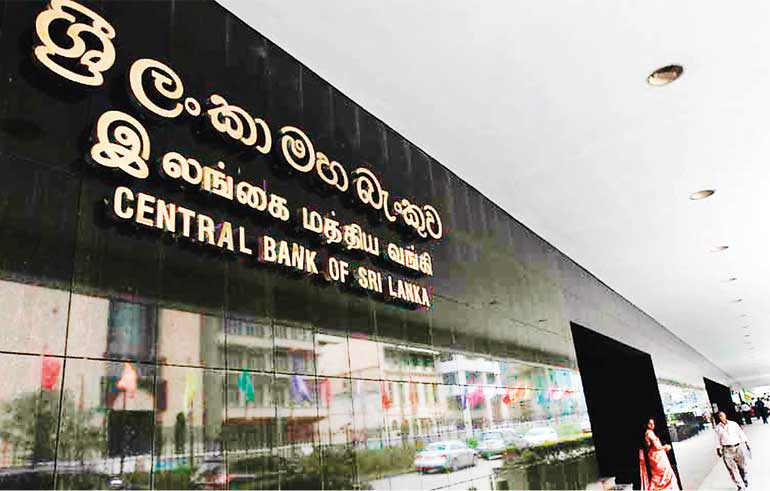
UNDUE LIBERTY OF EXPRESSION

October 17th, 2016

ALI SUKHANVER

The whole nation and almost all media houses and media persons are condemning a recent report on so-called ‘widening differences between Pakistan’s Military and Pakistan’s political government’ published in a Pakistani newspaper and then republished again and again in different international papers particularly in Indian papers. The author titled it as ‘Exclusive Report.’  The report blamed that the security forces of Pakistan are working against the will of the political government and are not serious in crushing the menace of terrorism. The report said that this attitude of the security forces is pushing Pakistan to the brink of international isolation and the political government of Pakistan has allegedly serious reservations with reference to this attitude of the security forces. In short the report tried to prove that in the name of Zarb-e-Azb, a lot of time and resources are being wasted and the political government is not happy over this wastage. In response to this so-called ‘exclusive report’, the office of the Prime Minister of Pakistan, the spokesman of the Chief Minister of Punjab, the representative of the Ministry of Information and the military authorities expressed their severe reaction by terming the information provided as factually incorrect and misguiding.

Unfortunately in Pakistan, in the name of ‘liberty of expression’ some media houses and some media-men are simply trying all their best to demoralize rather discourage the security forces by creating an air of confusion and distrust between the political government and the Armed forces of Pakistan. These media houses and media-men are misusing the liberty of expression by spreading disinformation among the masses. Most of the times, they try to give their audience a concept altogether contrary to the national policy. Keeping in view, India’s recent brutal hostility against Pakistan and insulting behaviour of the Hindu extremists with Pakistani actors working in India, the government of Pakistan decided to put a ban on the Indian channels in Pakistan. The whole nation welcomed this decision warmly but instead of appreciating this decision, one of the Pakistani channels started a very organized movement against this decision by promoting the idea that ‘Art knows no Boundaries’. India and Pakistan must not drag their artists in their war; the channel advocated. The matter of the fact is that the said channel has its own economic benefits and financial interests in promoting the idea ‘Art knows no Boundaries.’ Allegedly this channel has invested a lot of money in import of Indian tele-dramas to Pakistan and in case the decision of ban on Indian ‘stuff’ is implemented, this channel will have to face unbearable losses.

While discussing the liberty of expression, another point also needs to be discussed; what is the logic behind considering the government and the security agencies as two opponent forces hostile to each other? Everywhere in the world the system of any state runs with the mutual cooperation of the government and the security agencies particularly the army and the intelligence agencies. It must also be kept in mind that the security forces are everywhere a part of the government machinery and they work under the guidance and command of the government. However in case of Martial-Law the situation becomes different. Be it the USA, the UK, Japan, China or India, the political government and the army help each other in running the state business. How is it possible for the army to go against the will of the political government? Just look back to the Uri episode; though now it has come to the lime light that the Uri episode was simply a planned ‘starter’ for the so-called ‘surgical strikes’ against Pakistan and to create an artificial and baseless atmosphere of conflict and confrontation between the two neighbouring countries for political gains of BJP but we cannot say that Mr. Modi did it all alone. Without full support of the Indian army, Modi government could never have dared to act upon this plan. In every democratic country, army is always at the beck and call of the political government. Our friends in media must be very much conscious and careful while reporting upon issues of national importance particularly the matters relevant to the national security. Moreover in Pakistan, we seriously need a very strict type of official policy to keep an eye on media liberty. No media-house must be allowed to damage the national interests in any way. Keeping in view the sublime traditions of honesty in journalism, it is being expected that soon the said newspaper would apologize for the unintentional misunderstanding created by that ‘Exclusive Report’ because the mentioned newspaper has a very deep-rooted credibility and hard-earned reputation.

සිංහෙල රටේ අරගල තත්වයට ඇත්ත  විසඳුම පදින්චිකාර ජනවරිගයන්ට දී ඇති සියලු විජාතික අයිතීන් අවලංගුකිරීම!

October 17th, 2016

අනුර සෙනෙවිරත්න  

ලොව කිසිම සොබාවික ජාතික රටක පදින්චිකාර ජනවරිගයන්ට නොදෙන විජාතික අයිතීන් සිංහෙල රටේ පමනක් පුදකර සිංහෙල ජාතික සෛරීත්වය කෙලෙසීම නිසා ලොව එකම කුඩා සිංහෙල රට කාලාන්තුරයක් ආක්රමණයට ගොදුරුවී ඇතත්තවම සිංහෙල ජාතික විරෝදතාවයක් එලිබැස නැත. මෙය මිනිස් ලෝකයේ අරුම පුදුමයක්

ඕනෑම අවුලකට විසඳුමක් සඳහා හේතු පල පිරික්සීම නැනවත්කමයබුදු දහම නොහොත් ඤාණ බුද්ධියෙන් පෝෂණය ලද ඉතා ආදීන සිංහෙලයාට අද මෙතරම් අපරාදයක් සිදුවී ඇතත් ගොලුවී සිටිම දිවි නසා ගැනීමට සමානය!

මේ නිවට ගොලුකම පදින්චිකාර ජනවරිගයන්ගේ ආක්රමනයට ඉමහත් රුකුලකි

රටේ අවුලට ඉතාම පැහැදිලි හේතුව ඇස් ඉදිරියේ  තියෙද්දී අනන්මනන් වලට කාලය හා ජීවිත යොදති. එක්කෝ හතුරාට ප්‍රසිද්ධිය ලබාදේ නැත්නම් සිංහෙල ඉතිහාසය හෝ රටේ යම් පෙදෙස් අපේබව ඔප්පුකරන්ට  තටමති. මේ නිවටකම හතුරාට තවත් වාසියකි!

 අපේ ඉතා ආදීන හෙල මුතුන්මිත්තන් හෝ මෑත බුදුන් අදට ආවේනම් කුම  හිතේද!!!   

The International Organization on Migration (IOM) to extend assistance to Sri Lanka in training and capacity building

October 17th, 2016

Permanent Mission of Sri Lanka Geneva.

The International Organization on Migration (IOM) has expressed readiness to further enhance its assistance to Sri Lanka, by providing training and capacity building support for the Ministries of Foreign Employment and Foreign Affairs, and to the Sri Lanka Foreign Employment Bureau (SLBFE). It was agreed to extend cooperation in the areas of countering human trafficking and people smuggling operations, providing short-term internship opportunities with the IOM for the relevant officials as well as supporting the upgrading of the consular services of the Ministry of Foreign Affairs. The IOM also pledged to continue technical and secretarial support for the Colombo Process (CP) – the regional consultative forum of contractual labour originating countries in Asia, currently chaired by Sri Lanka.

These assurances were given when Minister of Foreign Employment Thalatha Atukorale who was in Geneva last week to attend the 6th Global Meeting of Chairs and Secretaries of Regional Consultative Processes on Migration met with the Director General of IOM Ambassador William Lacy Swing, to discuss and follow up progress on Sri Lanka’s bilateral cooperation with the IOM. Sri Lanka’s Permanent Representative to the UN in Geneva Ravinatha Aryasinha, Deputy Permanent Representative Samantha Jayasuriya, Counsellor Shashika Somaratne, and Acting Deputy General Manager of the Foreign Employment Bureau D.G.G.S. Yapa, were associated with the Minister.

At a meeting of the Geneva based Ambassadors’ of CP countries chaired by Ambassador Aryasinha, Minister Atukorala who is the Chair in Office of the CP also discussed on the operationalization of the ‘Colombo Declaration’ adopted at the 5th CP Ministerial Meeting held in Sri Lanka in August 2016. The Ambassadors while appreciating the leadership provided by Sri Lanka to the CP over the past 3 years, expressed support to the new thematic areas agreed at the Ministerial Meeting namely, Migrant Health, Operationalization of the migration-related goals in the SDGs, Promotion of equality for women migrant workers and Consular support for migrant workers in host countries.

Earlier in the day, addressing the 6th Global Meeting of Chairs and Secretaries of Regional Consultative Processes on Migration held in Geneva, Minister Atukorale said, Sri Lanka is providing leadership for the CP to be a bridge between labour sending and receiving countries fostering strong partnership for the Asian region. She said the CP will soon agree on the role it can play in supporting the overall implementation of the Sustainable Development Goals (SDGs) related to migration with a specific focus on contractual labour migrants”, benefitting from the experience of having worked on issues such as ethical labour recruitment, migrant health and remittances over the past 2 years under the initial five thematic areas developed as a road map for Sri Lanka’s Chairmanship on the overall theme International Labour Migration for Prosperity: Adding Value by Working Together.” The Minister also said in the forthcoming negotiations on developing the ‘Global Compact on Migration by 2018’ the CP should be ready to engage constructively, building on the SDGs framework.”

Permanent Mission of Sri Lanka Geneva.

Sri Lankan government’s total debt exceeds Rs. 9,000 billion

October 17th, 2016

Adadderana

Total government debts have recorded a sum of Rs. 9,062.2 by the second quarter of 2016. While Rs. 5,391.1 billion from among this has been local borrowings, Rs. 3,671.1 billion has been foreign borrowings.

Total loans to be repaid by the government by end 2015 had been Rs. 8,503.2 billion, this amount had increased by an additional Rs. 559 billion by the second quarter of 2016, reveals the latest statistics released by the Central Bank of Sri Lanka.

I gave new instructions to FCID – Vajira

October 17th, 2016

එෆ්.සී.අයි.ඩී යෙන් මගේ අමාත්‍යාංශයේ අයටත් එන්න කියලා තිබුණා… මම යන්න එපා කිව්වා… වජිර අබේවර්ධන අමාත්‍යවරයා පවසයි.

What Happened – Pavithra Wanniarachchi

October 17th, 2016

මන්ත්‍රීතුමිය මොකද වුණේ මාමයි, බෑණයි ගැටුමට… පාර්ලිමේන්තු මන්ත්‍රීනී පවිත්‍රා වන්නිආරච්චි මහත්මිය ‘‘අද දෙරණ මොකද වුණේ

What Happened – Pavithra Wanniarachchi

The President of Sri Lanka is not the puppet of Sarath Wijesooriya & Purawesi Balaya

October 17th, 2016

Shenali D Waduge 

The Island newspaper of 15 Oct 2016 brought to the attention of the readers that an NGO that helped the President come to power is now threatening him because of the President’s remarks against the wrongs of the FCID, CID and CIABOC. Can the public of Sri Lanka know exactly who Sarath Wijesooriya and his civil society movement and their members are to be dictating and even threatening the President of Sri Lanka? Who are their funding sources for these organizations to think they are the cat’s whiskers of society.


The heading of the article is shocking in itself “NGO that helped Sirisena to come to power threatens to turn against him for pointing out wrongs of FCID, CID, CIABOC”.  


Headed by one Sarath Wijesooriya of some group called National Movement for Social Justice/Purawesi Balaya together with someone called Gamini Viyangoda (his name rings a bell – Oh yes he is on the task force on reconciliation set up by the PM together with CPA’s Pakiasorthy Saravanamuthu) Others at the press conference mentioned in the Island newspaper were K W Janaranjana, Saman Rathnapriya, Joseph Stalin, Nishanka Diddeniya, Lucian Bulathsinhala and Gemunu Wijeratne. As per Noor Nizam’s article most of the initial members of this civil society group have abandoned ship claiming the current spokespersons are having their own agenda. In such a scenario the Convenor of the Purawesi Balaya should be removed from the task force for reconciliation given his questionable disposition.


When was this movement organized, why and who is funding it for them – these are extremely important in view of transparency that the good governance is boasting and promising the people. The Right to Information Act should be used to see the funding of such groups who just because they helped campaign cannot be so bold to make such vile and open threats at the country’s President. Exactly who are they to be demanding the President to arrest people? Are they the police?


This movement has threatened to take to the streets against the present govt – it would be very interesting to see how many would join them. Not many even know of them or have any regard for them. Why don’t they contest an election and find out whether they have a following or not.


The President should also note that people are known by the company they keep. Therefore, in the light of the President being openly humiliated as was clear in the press conference, it is best that such groups are not entertained and the public has their own medicine for such people who blow hot air having being funded to do so. Which is again why it is important to know who is funding the movement.


In law the onus is on those making the accusations to put forward the evidence and not arrest people and then look for the evidence. This has to be applicable to everyone irrespective of party colors.


The movement is claiming the heads of these investigative bodies will get discouraged – what about those being brought to these bodies without evidence, are they not likely to be demoralized as well. Or is this the idea?


If people are arrested in view of evidence against them and case filed on facts there is no reason for anyone to be making a fuss. All of us want the law & order to prevail in an orderly and equal manner not because some NGO who were funded to campaign for the President is now upset with some of the statements the President says. Does the President have to read off only their speeches? We don’t think so. The President of Sri Lanka is not a puppet of Purawesi Balaya.


We don’t need some NGO to be dictating to either the President or the Prime Minister of the country. As public servants both are using the tax payer’s money to uphold the sovereignty and national integrity of the country. They don’t need to be hen-pecked by some NGO. Their decisions are relevant to all the citizens of the country not just one party and certainly not to please some NGO. People did not vote for the President just because some civil society asked them to do so. If they think so, they are sadly mistaken.  


If this movement feels that the country laws are being flouted there are enough of lawyers to file cases for them. They should take the legal route and not issue threats to the country’s President.


Moreover these foreign funded civil society groups are often used to create mischief and plant various controversial views into society to create confusions. Given that the media is also paid and used in similar fashion both entities end up projecting a view that is not necessarily what the general public feels. Therefore these entities end up giving wrong and deceitful presentations to the entire world – well that’s what they are paid to do.


That the comments by the President has generated such public vituperation has resulted in a nation-wide security alert. So these players have achieved the objective. Eventually it is the people who end up suffering now that a once peaceful country is in turmoil once again.


We are appalled by the manner that these supposed to be ‘educated’ ‘academics’ have addressed the President of the country ordering him how he should rule. How dare they dictate to the President who should and should not be arrested?


This is not what we expect from ‘learned’ people. Nobody can threaten the President of a country and dictate how he should run the country just because they helped him come to power. If they think they can do a better job why not contest elections and see if people vote for them.


Shenali D Waduge


http://www.island.lk/index.php?page_cat=article-details&page=article-details&code_title=153765


Also refer to Noor Nizam’s article questioning the same

https://www.lankaweb.com/news/items/2016/10/15/puravasi-balaya-controlled-by-a-handfull-of-opportunists-has-turned-out-to-become-a-political-thug/

THE IDIOCIES IN THE SRI LANKA CONSTITUTION, 2:  ‘SOVEREIGNTY IS IN THE PEOPLE’

October 17th, 2016

DHARSHAN WEERASEKERA

Continuing my discussion of the idiocies in the Sri Lanka Constitution, in this article I focus on the concept, ‘Sovereignty is in the People’ enshrined in Article 3, purportedly the source from which the constitution draws its legal and moral authority.

I shall briefly discuss what I see as the logical contradiction at the heart of this concept, explain what I think are the present ambitions of the Tamil separatists, and finally, explain the legal consequences if the new constitution gives the Tamils more control over the North and the East, and at some time the Tamils demand a referendum on secession.

THE CONTRADICTION

The first question to ask is, ‘What does the phrase, ‘In the Republic of Sri Lanka sovereignty is in the People and is inalienable’ (Article 2) really mean?’  The ‘People’ of Sri Lanka consists of roughly twenty million citizens.  Therefore, for the said phrase to make logical sense, it must mean that sovereignty is in each of those 20 million citizens, or to put it another way each of those citizens shares equally in the said sovereignty.

The point is that each citizen has a claim to—which is to say owns—a particular fraction of the sovereignty of the country.  It is generally recognized in the law that the right to alienate is an intrinsic attribute of ownership.  Therefore, the notion that in Sri Lanka sovereignty is inalienable must be understood as meaning that sovereignty is inalienable by anyone or anything other than by the People themselves.

The above means that, the only way to alienate sovereignty is if each citizen personally and voluntarily relinquishes their portion of the sovereignty in question.  Now, let’s consider the glaring contradiction regarding this concept found in the constitution itself.

Article 83 sets out the entrenched Articles of the Constitution (in order to amend or repeal an entrenched Article one needs 2/3 majority in Parliament plus a referendum).  Not surprisingly, Article 3 heads that list.  So, in order to amend or repeal Article 3, it requires both a 2/3 majority in Parliament, plus a referendum.

How does one win a referendum under our constitution?  According to Article 85(3), all that is required is an absolute majority of the valid votes cast at the referendum.  So, with a 2/3 majority in Parliament, and 50% +1  majority at a referendum it is possible to change or repeal Article 3, or any provision in the constitution where Article 3 is a factor.

To make a long story short, with 2/3 majority in Parliament, plus a 50% + 1 win at a referendum, it is possible to alienate the sovereignty of 49.9 percept of the population, sovereignty which is supposedly inalienable!

In my view, if Article 3 is to make logical sense, it should read:  ‘In the Republic of Sri Lanka at any given time sovereignty is in 50% + 1 of the People, and is alienable.’  What does this mean in terms of the constitution as a whole?  It means that, as matters stand, the constitution is based on a lie:  Sri Lankans have been living a lie for the last 40 years.

THE PRESENT AMBITIONS OF THE TAMIL SEPARATISTS

When the war ended, many Sri Lankans especially Sinhala-Buddhists thought that their headache with respect to Tamil separatism was also over.  Unfortunately, this was not the case.  The separatists are a resourceful bunch, and they started plotting their comeback almost as soon as the smoke of the battlefield cleared.

The future plan of the separatists was spelt out candidly and boldly in 2012 by one of their most senior members, R. Sampanthan, at that time the ‘Leader’ of both the TNA as well as the Illangai Tamil Arasu Kadchi (ITAK) under which all TNA candidates contest elections.  In his speech at the 14th Annual Convention of the ITAK held in Batticaloa, he said inter alia:

‘The softening of our stance concerning certain issues, and the compromise we show in other issues, are diplomatic strategies to ensure that we do not alienate the international community.  They are not indications that we have abandoned our fundamental objectives.’[1]

He also said:

‘The current practices of the international community may give us an opportunity to achieve, without the loss of life, the soaring aspirations we were unable to achieve by armed struggle.’[2]

If the option of an ‘armed struggle’ is eliminated (and Sampanthan himself is conceding this) then the only way to achieve the same goal as the ‘armed struggle,’ i.e. Eelam, is either by way of a referendum of the Tamils in the North and East, or by action of one or more of the Provincial Councils.

In order for a Provincial Councils to affect a unilateral secession it is necessary that the relationship between the Center and the Provinces be that of a confederation and that is obviously an unrealistic goal in the Sri Lankan context.  So, the remaining option is to go for a referendum.

Until almost the beginning of 2016 Mr. Sampanthan and other stalwarts among the separatists, including Mr. Karunanidhi their bastion of support in Tamil Nadu, explicitly called for a referendum on secession.[3] But, they are at present silent on the subject.  However, the fact that Sampanthan and his immediate cohorts are silent on the topic of a referendum does not mean that their overall plan has changed.

The proof of the above is in the latest statement released by V. Rudhrakumaran, the notorious separatist operating out of the United States.  In an interview published in the Huffington Post among other places, he says inter alia:

‘If you look at the peace efforts around the world, the most common mechanism introduced and supported by the international community to resolve national questions has been the holding of a referendum.  In the case of Kosovo, in spite of the parent state Serbia’s opposition, the international community decided that only through a referendum could national conflict be resolved.  We expect the UN or any state power which is keen to solve the national question in Sri Lanka to propose and support a referendum as the central feature in negotiating a political solution.  The referendum proposed by us contains all options such as ‘unitary,’ ‘federal state,’ ‘unitary framework with federal features,’ ad ‘independent state.’[4]

To digress a moment, the following part of the interview is also important, because it gives an idea of the tactics one might expect from the separatists in the near future, and also the new scheme of devolution that might appear in the new constitution:

‘Q:       Short of a separate state, is there a power-sharing arrangement that would satisfy you?  If so, would you talk a little abut what that might look like?’

‘A:       Due to the rigid ethnocratic nature of the Sri Lankan state, we believe only an independent state can provide dignity and security for the Tamils.  For an interim period, the Interim Self Governing Authority (ISGA) previously proposed by the LTTE could be the basis for a power-sharing arrangement.  The ISGA was received positively at the time by the U.S. and the E.U. among others.’

‘Under the proposed ISGA, human right, secularism, the separation of powers, etc. will be guaranteed.  It also provided for both the Sinhalese and Muslims in the Northeast to be members of this body.  The ISGA specifically emphasized that the Muslim community had the right to participate in the formulation of a role in the ISGA.’

‘However, I want to emphasize that any type of political resolution would be based on the people’s will to be ascertained through a referendum.’[5]

In short, if Sri Lankans especially Sinhala-Buddhists think that once the new constitution is enacted it will mollify the separatists, they are sadly mistaken.  The moment the new constitution is enacted, the separatists will begin the next phase of their attack, i.e. the clamour for the referendum:  the raucous din for Eelam will not abate, it will only grow.

In my view, the fact that the separatists have gone to such lengths to have their ideas published in a relatively high-profile magazine such as Huffington Post, at this particular point in time, indicates that they are confident their primary goals will be achieved with the enactment of the new constitution, and they are ‘loading up’ for the next phase.  (Notice for instance that, as if on cue, Wigneswaran’s ‘Elugu Tamils’ have entered the scene.)

To return, it is generally accepted in international law that there are 3 elements to a claim of self-determination:  historical self-governance in an identifiable territory, a distinct culture and national will, and capacity to govern.  If the new constitution devolves power beyond what is already the case, for instance, if it dilutes in any way the control that the central government at present has over the Provinces, the separatists will be in a position to claim all three of the aforesaid elements.

There is much talk in the Sri Lankan media these days about whether the new constitution will introduce a federal form of government to this country.  In my view, talk of federalism is a complete distraction.   The separatists don’t need federalism to get to their ‘Eelam’:  all they need is to show the international community that they have been ‘governing’ an identified territory in Sri Lanka for some time.

(In my view, with a modified version of the 13th Amendment, for instance with the subjects in the Reserved List reduced, the Provincial List increased, and the Concurrent List either reduced or eliminated, they will be able to do the above.)

LEGAL CONSEQUENCES

I anticipate that, Article 2 (‘unitary’ status of the country) will not be touched.  In other words, whatever new arrangement of devolution is introduced, it will be called a ‘unitary’ system.  So, the only way to challenge the new system if at all is under Article 3, i.e. as a violation of the sovereignty of the country.  I agree that, there are a number of options available under this head, but I will not discuss them here.

The point is this:  even if the new scheme of devolution is successfully challenged in the Supreme Court, the most that will happen is that the court will order the new scheme to be put to a referendum also.  But, as I pointed out earlier, a 50% +1 majority is all that is needed to win a referendum, and it appears the Government is confidant it can marshal that kind of support.

To digress a moment, Mr. Lal Wijenayaka, one of the architects of the new constitution, has explained how the government expects to win a referendum, as follows:

‘Q:       What about the public support at a referendum?’

‘A:       It would be there as long as the two main parties are together,  In case Sri Lanka Freedom Party (SLFP) is divided, the divided section with the government would get at least half of its vote base.  The TNA would fall in line.  Janatha Vimukhi Peramna (JVP) would also do the same.’[6]

I have no doubt that Mr. Wijenayake is correct in his assessment.  Where does this leave the Sinhala-Buddhists?  Unfortunately, in the unenviable position of having to look on helplessly as their country is taken from them.  There is much talk these days especially among the Sinhala-Buddhists that what is happening is a repeat of what happened in 1815 with the Kandyan Convention.

The truth is that, what is about to happen is much worse than the Kandyan Convention.  In that Convention, the Sinhala nobles handed over sovereignty of the country to the British:  there was no question of the People handing over sovereignty to the British, because the People at that time did not have any such sovereignty to begin with.

The present situation is completely different:  sovereignty is now purportedly in the People.  So, if at a referendum the People endorse an expanded devolution of power, an expansion that can conceivably lead to a division of the country, it will be a gift outright that the People will find very difficult to question, renounce, or reject in the future.

Unfortunately, because of the contradiction at the very heart of the concept ‘sovereignty is in the People’ as set out in our constitution, even if 50%+1 of the People endorse the aforesaid gift, it will bind the rest also.  The irony not to mention tragedy of it all is that this will happen as a result of a constitution brought by the Sinhalas themselves.

There are some rudimentary safeguards that can still protect the interests of the Sinhala-Buddhists, as well as that of the country.  For instance, the term Unitary’ can be defined in the constitution itself, and a specific clause also inserted to prohibit anyone from calling for a referendum for purposes of secession.  What are the chances any such thing will be done in the new constitution?  In my view, ‘none.’

Dharshan Weerasekera is an Attorney-at-Law.  His latest book, The Relevance of American Constitutional Principles to Solving Problems of Governance in Sri Lanka, will be in bookstores shortly.

[1] ‘Text of Presidential Address of R. Sampanthan at the 14th Annual National Convention of ITAK in Batticaloa,’ www.dbsjayaraj.com, 27 May 2012

[2] Ibid

[3] For instance see, ‘Sampathan goes Scottish,’ Maneksha, Ceylon Today, 30 January 2016, www.ceylontoday.lk, and also, ‘M. Karunanidhi bats for referendum in Sri Lanka to end woes of Tamils,’ The Economic Times, 12 September 2013, www.economictimes.indiatimes.com

[4] ‘A Tamil Diaspora Perspective on Sri Lanka,’ Taylor Dibbert, Huffington Post, 13 October 1016, www.huffingtonpost.com

[5] Ibid.

[6] ‘Sri Lanka already a Secular State – Lal Wijenayake,’ Kelum Bandara, Daily Mirror, 5 October 2016

Canadian Federal Court: “TNA was “subservient” to the rebels….membership in the party “was tantamount to membership” in the Tamil Tigers.”: What does Yahapalana Government have to say?

October 17th, 2016

Shenali D Waduge

The Canadian authorities have after investigations declared that the TNA & LTTE are virtually one and the same. The EU Observer Mission head in 2004 said the same. The question is what is the TNA doing inside Parliament and its MPs even put on steering committees to change the constitution? The Yahapalana govt is bound to make a public statement on this given that the Canadian Federal Court has upheld the investigative findings of the Canadian Immigration Board and these investigations clearly links TNA to LTTE.

shenali17101601

Canada’s National Post has revealed that

The Ontario Progressive Conservatives claims to be unaware that their guest in late 2015 was being deported for being a member of the LTTE

The Canada Border Services Agency (CBSA) had been trying to deport M K Eelaventhan (also known as Manickavasagar Kanagendran)

The Canadian Immigration and Refugee Board claims that Eelaventhan was an appointed representative of the TNA and had personally met the top leaders of the LTTE.

IRB: He was an active & vocal supporter of the LTTE, holding a position of importance and working at a high level to further the LTTE’s cause”

IRB: Mr. Eelaventhan had knowledge of the crimes committed by the LTTE and lent his active support to the group”

As the National Post has pointed out there is a startling discrepancy between federal officials enforcing Canada’s national security laws and politician’s molly cuddling tigers in camouflage in their constituencies for their own political self-serving means.

Unlike Sri Lanka’s media that is very careful not to make any derogatory remarks against either the LTTE or the TNA, the National Post had 4 days before the IRB disclosure reported that Progressive Conservative leader Patrick Brown & Kathleen Wynne and other politicians visited a Toronto kovil which according to Canada Border Services Agency was controlled by a banned pro-LTTE group.

Eelaventhan had been elected as a TNA MP after the 2004 Parliamentary Elections. What is interesting about the CBSA calling TNA a political front of the LTTE is the link to the EU Election Observer Mission claiming the virtual same. This is what its head John Cushnan had to say of the TNA in the EU report released on June 17, 2004 clearly establishing the LTTE-TNA alliance:

Quote: Firstly, the LTTE intended that no other rival Tamil party (or Tamil candidate from the mainstream political alliances) to the TNA would be able to claim to represent Tamil interests. A chilling message to this effect was sent early in the campaign when a UNP candidate and an EPDP activist were murdered. Incidents such as this seriously restricted the right of the parties other than the TNA to campaign freely in the Northern and Eastern Districts. During the 2004 elections, the major incidents of violence was perpetrated by the LTTE, whereas at the earlier elections; Unquote

He fled Sri Lanka in 2009 and arrived in Canada. Then in May 2010 (exactly a year after LTTE defeat) he contested some utopian election organized by the TGTE and was elected. Incidentally, TGTE and its leader were named & banned by the GOSL in 2014 as an LTTE front drawing the UNSC Resolution 1373 for material support to the LTTE. The TGTE & its leader remains banned.

CBSA calls TNA a ‘political front’ of the LTTE. Interesting to know how he fled Sri Lanka and how he landed up in Canada. Questions for which we will not get answers. Luckily officials in Canada are not like the Canadian politicians. Eelavanthan was ordered by the refugee board to be deported on security grounds in 2012. The Federal Court upheld the IRB’s findings in 2014 which means that a very conclusive investigation would have ascertained that LTTE = TNA and TNA = LTTE. The Federal Court upheld that Eelaventhan was a TNA member whose group was engaged in terrorism. What more need we have to say!

Eelaventhan has a history of deportation – India deported him in 2000 for his links with LTTE when he was the leader of the Tamil Eelam Liberation Front. The Indian Government had arrested him in 1997 for smuggling medicines to the LTTE.

http://www.frontline.in/static/html/fl1726/17260490.htm

DBS Jeyraj was to write India deports ‘King of Eelam’ on 10th Dec 2000.

http://www.tamilweek.com/news002.html

As per Asian Tribune article the LTTE had despatched Eelaventhan to South Africa when 2 Tamil MPs from Sri Lanka accompanied then President Rajapakse to prevent LTTE interests from being compromised.

http://www.asiantribune.com/index.php?q=node/5430

http://www.adaderana.lk/news.php?nid=33315

That was in Canada, cross the border to America and we are next informed that a New York Court judge reduced the sentences of 3 LTTE convicts (Sathahan Sarachandran, Sahilal Sabaratnam & Thiruthanikan Thanigasalam) by 10 years (original 25 years) just because of a letter sent by one of the daughters. The three were accused of buying surface-to-air missiles for LTTE. A lawsuit was filed by them in 2012 seeking to reduce their sentences.

We hope the Judge is aware of the killings carried out by the LTTE – the babies and pregnant mothers cut to pieces, the elderly hacked to death, if he was aware he may ‘provide a fair measure of justice’ to these innocent villagers too. The 3 men are behind bars but thousands of innocent villagers are not even alive, their children are growing up without parents, some parents are still mourning their children – who is to seek justice for these deaths? Had the good judge known about how these gruesome crimes were committed he might just well also say ‘this case has just taken over my head’ for photos of these brutal killings would shock him and the Western world beyond comprehension. LTTE remains designated a foreign terrorist organization since 1997.

Coming back to Eelavanathan. The crux of the matter is not about Eelavanathan’s deportation but the more important fact that the Canadian officials have done what the Sri Lankan Governments have failed to do (includes present and former).

That a very comprehensive investigation has been conducted on the LTTE and the TNA is the reason for this TNA MP to be deported. A decision that the Canadian Federal Court has upheld. If the Canadian authorities are deporting a man claiming that he is linked to the LTTE through the TNA even after the ground defeat of the LTTE it seriously questions and brings to light the embarrassing question – what is the TNA doing inside Sri Lanka’s Parliament and worse still is why is Sri Lanka’s Opposition Leader the head of the TNA? The Canadian authorities must be bewildered as are we.

Moreover, the TNA MPs are on the steering committees inside Parliament to even change the Constitution and other legislations. It’s like handing the keys to the henhouse to the fox! Moreover, the TNA Chief Minister in the Northern Provincial Council is becoming another headache trying to replace the tiger leader with atrocious demands which include bullying Sinhala villages in the North, demanding the removal of Buddhist sites (leading to hooligans destroying some Buddha statues) spate of vandalisms, even the Jaffna university commemorating dead LTTE terrorists something that even Nazi Germany was not allowed and all these actions are very much aligned to and in keeping with the overall objectives of the LTTE – this time TNA taking charge of it. This fits very well with the investigation findings of the Canadian authorities.

So the Canadians have done what the Sri Lankan Governments should be doing. We have the 6th amendment clauses therein which can be implemented and action taken against the TNA and its MPs. Why is it not been done?

We have to compliment the findings of Canadian authorities by taking similar actions by at least starting an investigation on the TNA to its links to LTTE. Canadian authorities will definitely share their findings with the Sri Lankan counterparts and that is a good start to take action against this new bandwagon who are now taking over where LTTE failed.

We would like to know what the response of the yahpalana government is on the investigative findings of the Canadian authorities and what the yahapalana government proposes to do against the TNA. We would also like public statements from the SLFP, the Joint Opposition and other Political Parties on the need to investigate TNA-LTTE links.

We must be appreciative of the Canadian officials and law enforcement for not following the Canadian politicians who are sleeping with the enemy and molly coddling the tigers in sheeps clothing who are manipulating the Canadian system to use the power of their vote and undermine democratic governance in Canada through groups of liberal parties who just want to somehow come into power by any crooked means. With the level of terrorism taking place with mercenaries now not heeding their initial masters we are walking into greater calamities if action is not taken. 

Shenali D Waduge

http://www.adaderana.lk/news/37379/nyc-judge-reduces-ltte-trios-jail-sentence

https://www.colombotelegraph.com/index.php/manickavasakar-a-living-symbol-of-the-continuity-of-the-tamil-struggle/

MYSTERIOUS METHODS OF COLLECTING  “ UNDERWORLD DEBTS”

October 17th, 2016

By M D P DISSANAYAKE

World renowned debt collection agency Dun and Bradstreet has established several avenues for ensuring that your debts are collected without causing massive damage for your cash flow and profitability.

Personal or business  debts  are now referred as last resort to D&B and other reputable Agencies,  well within the taxation regiments as well.

Nowadays there is a new category of debts amongst the underworld  operators and politicians.  Their debts by nature are unique to the extent that they are neither governed by the common law or any of the statutory regulations.

The birth of these underworld debts originates due to underhand” negotiations between crooks, such as drug lords, politicians, mafia and those who deal with  the bottom of the harbor”  agendas.

The politicians, drug lords, mafia etc., enter into an understanding  of matters of serious nature, such as:

  1. Politicians enter into such an understanding to overthrow a democratically elected government for a lucrative millions of dollar payment;
  2. Drug lords enter into such understandings to kill their competitors;

iii.                Contract killers will take of family divorce cases, kill partners to  claim insurance payments etc.

None of these agreements are in writing and therefore not legally enforceable. The payment terms for these unwritten contracts”  are varied, lets take the item (i):

  1. Down payment ( about 5%) for agreeing to take the leadership to overthrow the government. Second 20% after overthrowing the government.   Final 70% two years after overthrowing the government;

If final 70% is not received after two years, what happens?  What options or recourse will be open to the person who entered into an understanding with the crooks to overthrow the previous government?   Certainly he or she is not without options, the tactics to collect your remaining  debts of 70% could be:

  1. Begin a campaign of black-mail that he might support the opposition which he or she defeated;
  2. Sending wrong signals through variety of public statements, to induce the other party to honour their obligations as the time is running out;

iii.                Black mail the partners forcing their hands into arranging the final payment of 70% with severe criticisms of opposite partners with whom the understanding was entered into ;

  1. If only a part payment of 70% is received after the first black mail campaign, then keep quiet for a while;
  2. Black mail campaign to be repeated until full payment is received.

For obvious reasons these illegal payments may be  processed in tax havens in British Virgin Islands, Labuan in Malaysia etc and therefore the two main partners in the deal will have make several back to back overseas short trips under the pretexts of attending vital  International Conferences etc., fully funded by the taxpayers.

However,  crooks on the other side of the game plan, are not idiots.

LIVE BY THE SWORD, DIE BY THE SWORD.


Copyright © 2026 LankaWeb.com. All Rights Reserved. Powered by Wordpress