The Bar Association of Sri Lanka (BASL) has raised concerns over reports that the Cabinet may review the Attorney General’s (AG) decision to discharge three suspects in the Lasantha Wickrematunge assassination case.
In a letter to President Anura Kumara Dissanayake, the BASL stressed that while the AG is accountable to the public, his role is quasi-judicial, requiring decisions based on legal merit and admissible evidence.
It warned that political interference could undermine the AG’s independence and the rule of law.
The BASL noted that the Supreme Court (SC) allows AG decisions to be reviewed through legal channels but not by political authorities. Quoting a past ruling, it emphasised the right to fair and competent investigations.
Urging the President to prevent undue interference, the BASL reiterated the need to protect key institutions to uphold justice in Sri Lanka.
The scale of corruption in the US by USAID wasting public funds for nefarious activities across the world has to be investigated & held to account. $15m for condoms to the Taliban via USAID / $446,700 to promote atheism in Nepal, $1m for LGBTQ groups in West & Central Africa, $20,600 for a drag show in Ecuador, $47,020 for transgender opera in Colombia, $32,000 for LGBTQ comic book in Peru, $3,315,446 for being LGBTQ in the Caribbean”, $80,000 for an LGBTQ community center in Bratislava, Slovakia, $16,500 to foster a united and equal queer-feminist discourse in Albanian society”, $10,000 to pressure Lithuanian corporations to promote DEI values”, $8,000 to promote DEI among LGBTQ groups in Cyprus, $1.5 million to promote job opportunities for LGBTQ individuals in Serbia, $39,652 to host seminars at the Edinburgh International Book Festival on gender identity and racial equality & $8 million to teach Sri Lankan journalists how to avoid binary-gendered language,” by USAID, US Embassy, US envoy Julie Chung, IREX & MEND programs. A closer look at funding that has gone to Sri Lankan politicians, top corporates, academics, legal fraternity, media entities, artists & sports stars, renowned” professionals, civil society/NGOs expose the traitors amongst us posing as concerned citizens” and instrumental in the political collapse taking place in Sri Lanka.
A good look at the local entities partnering with USAID & other US agencies as well as the interference by the outgoing US envoy to Sri Lanka would reveal the scale of intervention at play & the manner society has been divided by the programs that have been funded by US taxpayers who are suffering back home with rising cost of living & tax burdens. The manner that USAID has got exposed for spending US tax payers money on programs across the world is shocking & requires an immediate audit in Sri Lanka & the exposure of all local entities who have also misused & abused US tax payer money.
Links related to the journalists that were trained to promote LGBGTQ in Sri Lanka
Senator Eric Schmitt breaks down some of the insane spending: – $45 million for DEI scholarships in Burma – $3 million for girls centered climate action in Brazil – $125 million to racialize public health – $280,000 for diverse birdwatchers – $1.5 million for DEI in Serbia – $70,000 for DEI musical in Ireland – $2.5 million for electric vehicles in Vietnam – $47,000 for trans opera in Colombia – $32,000 trans comic book in Peru – $2 million for sex changes in Guatemala – $6 million for tourism in Egypt
Key US Agencies operating in Sri Lanka:
USAID
National Endowment for Democracy (NED),
National Republican Institute (NRI),
International Republican Institute (IRI).
USAID (United States Agency for International Development)
Working in Sri Lanka since 1956.
1980s-1990s – focused on health & population / family planning
2000 – gender based violence / HIV
2010 – gender equity
U.S. Department of State
1980s-1990s: gender equality and human rights in Sri Lanka,
2000s: women’s economic empowerment programs as part of broader human rights initiatives in Sri Lanka.
2010s-Present: Post-conflict reconstruction and efforts to promote gender equality became a key focus.
The U.S. Centers for Disease Control and Prevention (CDC)
Formally began supporting Sri Lanka in the 1990s, particularly in areas of infectious disease control, HIV/AIDS prevention, and maternal and child health.
1990s: The CDC began working with Sri Lanka to address the growing issue of HIV/AIDS, as well as maternal and child health through programs targeting immunization, nutrition, and healthcare delivery systems.
2000s: CDC’s focus expanded to include HIV prevention and surveillance, family planning, and reproductive health services, especially in response to regional health challenges.
2010s-Present: The CDC expanded programs in preventing non-communicable diseases (NCDs) like diabetes and cardiovascular disease, while continuing to support sexual and reproductive health, especially in rural and underserved areas.
The U.S. Agency for Global Media (USAGM)
Voice of America (VOA)) have been broadcasting to Sri Lanka for decades, their more direct engagement with issues like women’s health and gender empowerment became more focused starting in the 2000s.
1950s-Present: Voice of America (VOA) has been broadcasting in Sinhala and Tamil, providing access to global news and information.
2000s-Present: USAGM’s initiatives have involved broadcasting health awareness campaigns, gender equality programs, and women’s empowerment stories, as well as promoting media literacy and gender rights in Sri Lanka.
National Endowment for Democracy (NED)
1990s-Present: NED has worked with local NGOs and community-based organizations to support women’s rights, gender equality, and child protection.
2000s-Present: NED has supported projects focusing on gender-based violence prevention, women’s political empowerment, and reproductive rights advocacy, especially in the aftermath of the civil conflict.
The Peace Corps
The Peace Corps has been active in Sri Lanka since the 1960s, with volunteers working on education, healthcare, and community development.
1960s-1980s: The Peace Corps focused on general community development, education, and basic healthcare delivery.
1990s-Present: As gender issues and women’s health became more prominent, Peace Corps volunteers began engaging more with women’s empowerment, maternal and child health, and family planning. Volunteers also contributed to gender equality and sexual and reproductive health education at the grassroots level.
The Global Health Initiative (GHI)
The Global Health Initiative (GHI), launched by USAID in 2009, focused on addressing maternal and child health as part of a broader global effort to improve health outcomes for women and children.
USAID’s support through the GHI has reinforced the efforts to empower women, provide access to healthcare services, and improve health outcomes for both women and children in Sri Lanka.
USAID & Sri Lanka’s Private sector partnerships
USAID & Sri Lanka’s Private Sector Partnerships cover
Tourism
Agriculture & collaborating with agri-businesses (tea, spices, seafood)
Textiles
ITC & regulatory framework
Manufacturing
Policy reforms, tax simplifications, international certifications, Organic certifications
Land tenure reforms
Energy & infrastructure
Gender equality, social inclusion in workplace/hiriing, empowering women, marginalized groups
Youth
USAID – Women’s Economic Empowerment Program
Targeting women entrepreneurs & small business owners
Collaborations with micro finance institutions, local businesses & start-ups
Objective to provide training, mentoring, financial service to women entrepreneurs
Program claims to have helped 2000 women entrepreneurs to reach more than 300,000 consumers & provided access to loans & insurance.
USAID – Agriculture & Rural Development Program (ARDP)
Target – small holder farmers
Collaborations with agri business companies & technology providers for water efficient irrigation systems & organic farming methods
Cargills Sri Lanka & 3500 small holder farmers helped grow organic food exports to EU.
USAID – Digital Sri Lanka Initiative
Partnering with Sri Lanka’s Information and Communication Technology Agency (ICTA), to improve e-governance, digital infrastructure, and digital literacy.
Dialog Axiata&USAID provided mobile-based learning and entrepreneurship platforms for marginalized communities and youth. The M-LEARNING initiative enabled remote education for underserved students, empowering them to gain digital skills.
Targeted 10,000 youthand small businesses
USAID – Private Sector Health Engagement Program
Partnering with pharmaceutical, medical & insurance sectors
APEX Pharma & USAID launched joint partnership to provide medicines for chronic diseases (diabetes / hypertension) in remote areas
50,000 rural populations given access to necessary drugs.
USAID partnership with Commercial Bankto introduce green loans to support businesses in adopting solar energy and energy-efficient systems.
More than 150 businessesin the manufacturing and tourism sectors adopted clean energy technologies—including solar panels and energy-saving equipment
USAID – Youth Employment & Skills Development Program
USAID collaboration with Virtusa to launch coding boot camp to train young Sri Lankans in software development & IT entrepreneurship to 3000 youth & 1000 entrepreneurs
Federation of Chambers & Commerce & Industry of Sri Lanka
Export Development Board
Women’s Chamber of Industry and Commerce (WCIC),
Sri Lanka Development Foundation (SLDF),
Microfinance Institutions:
Sri Lanka Microfinance Practitioners’ Association (SLMPA)
Health
Health Ministry of Sri Lanka
ITC
Sri Lanka’s Information and Communication Technology Agency (ICTA)
Virtusa(tech company),
Dialog Axiata(telecom company),
Banks:
Commercial Bank
Pharmaceuticals
APEX Pharma
Hotels
Aitken Spence
Cinnamon Hotels
Conglomerates/Private Sector:
Cargills
John Keells Holdings
Dilmah
Ceylon Cinnamon
Lanka Spice
Local NGOs
Sarvodaya
TheChildren’s Education and Development Foundation (CEDF) (gender-sensitive education programs)
TheSri Lanka Association of Non-Governmental Organizations (SLANGO) – youth empowerment programs
TheTISL(Transparency International Sri Lanka): citizens rights, governance programs
Fulbright Program,Global Undergraduate Exchange Program, Young South East Asian Leaders Initiative – study in US programs
Centre for Policy Alternatives
National Peace Council
US Agency Development Alternatives Inc. (DAI) & ENERGY
Sri Lanka’s Ministry of Power and Energy,
Ceylon Electricity Board (CEB),
Environmental / Bio diversity / Marine Conservation / Water Management / Clean City
The Centre for Environmental Justice(CEJ)
Sri Lanka’s Ministry of Environment
Wildlife and Nature Protection Society of Sri Lanka
IUCN Sri Lanka
Sri Lanka Marine Conservation Forum
Wildlife and Nature Protection Society
The Environmental Foundation Limited
Sri Lanka Agricultural Development Authority
Green Movement of Sri Lanka,
Horizon Lanka Foundation
Sri Lanka Organic Agriculture Movement(SLOAM)
The Environment Conservation Trust (ECT)
Waste Management Authority of Sri Lanka,
Water Supply and Drainage Board(WSDB)
Environmental Advocacy:
Environmental Foundation Limited (EFL)
Sri Lanka Ministry of Local Government and Provincial Councils, local municipalities,
Sri Lanka Ministry of Water Supply
Good governance / Citizenship
Centre for Monitoring Election Violence (CMEV)
The People’s Action for Free and Fair Elections (PAFFREL)
Sri Lanka Development Journalist Forum (SLDJF)
National Peace Council (NPC)
John Keells &
Women’s Empowerment / Youth
Sri Lanka Women’s Development Centre (SLWDC) – gender sensitive policies
John Keells Holdings initiatives with USAID NED IRI
Is involved with USAID, NED IRI on projects covering development, community engagement, economic growth, environmental sustainability, and corporate social responsibility (CSR) Implemented programs include green building standards in several of its commercial properties and hotels (like Cinnamon Life), working closely with USAID to reduce energy consumption, promote renewable energy, and implement waste management solutions. John Keells Foundation works on various initiatives such as education, women’s empowerment, and livelihood development.
John Keells, NED, Transparency International Sri Lanka (TISL), supported the Sri Lanka Transparency Initiative that was part of NED’s broader programs to reduce corruption and encourage accountability within Sri Lanka’s corporate and political sectors.
JKH & IRI collaborated for democratic reforms/youth engagement & community leadership, The John Keells Foundationsupported youth leadership programs, especially targeting young women, by partnering with IRI’s political engagement initiatives
JKH & National Republican Institute (NRI) – no direct partnership but has been involved in business-led political reformsand its advocacy for free market principles align with the democratic and economic growth objectives that NRI promotes globally.
JKH, USAID, & IRI has been involved in providing vocational trainingand creating youth empowerment and employment creation, and youth participation in the political process.
NED supports following activities with corporate entities & civil society
Civic engagement with Asia Foundation, Sri Lanka Business & Professional Women for democratic policy reforms,
Good governance
Human rights
Free & Fair elections / development election monitoring tools, online platforms for voter education (SL Chamber of Commerce, Transparency International, Election Commission of Sri Lanka)
John Keells Holdings
National Republican Institute (NRI) supports following activities with Sri Lanka’s corporates (Dialog Axiata)
International Republican Institute (IRI) supports following activities with corporate entities & civil society (Ceylon Chamber of Commerce)
Free & fair elections
Youth engagement
Strengthening political parties & democratic institutions
Workshops for political leaders with business chambers
Civic education & voter engagement (Dialog Axiata, Sri Lanka Broadcasting Corporation (SLBC), – campaigns included SMS, social media, radio broadcasts to reach a broad youth & rural audience
US Diversity, Equity & Inclusion (DEI) program has recently been cancelled by President Donald Trump citing appointments in US will be only based on MERIT.
However, several of Sri Lanka’s top corporates have signed up for the DEI program as a corporate policy to promote gender-based appointments.
Ceylon Tobacco Company (CTC)
promoting gender equality, LGBTQIA quotas even for senior appointments that has impacted productivity issues.
Dialog Axiata
established a Diversity & Inclusion (D&I) frameworkas part of its corporate sustainability strategy & increased gender diversity/LGBTQIA in senior leadership positions.
HNB (Hatton National Bank)
implemented workplace diversity policiesthat ensuring equal opportunities for women, minorities, and differently-abled individuals.
DFCC Bank
DEI initiatives – gender diversity
Ceylon Biscuits Limited (CBL)
Included gender equality, disability inclusion, and supporting marginalized communities in hiring
Unilever – Consumer goods
DEI initiatives – gender inclusivity & integrating LGBTQIA inclusive policies.
MAS Holdings
They have implemented a workplace policythat supports LGBTQIA+ employees and promotes a safe and inclusive environment.
Sri Lankan Airlines
several programs to promote gender equityand empower women in leadership roles within the airline industry.
Aitken Spence
implemented DEI principleswithin its corporate strategy, promoting gender diversity and inclusion
Lanka Orix Leasing Company (LOLC)
DEI Initiatives empowerment of womenin the financial sector.
They have implemented internal programs to support women’s leadership, with a particular focus on developing female employees in higher management positions.
The company has also been involved in community development projects, particularly in promoting financial inclusion for women and minorities in rural Sri Lanka.
Women’s Business Chamber of Commerce
Sri Lanka Gender Equality Forum.
NOTE: The involvement of above top corporates in the Bid-Harris led LGBTQIA/Woke ideology via DEI initiative to encourage quota for LGBTQIA employee intakes. This invariably encourages people to claim to be LGBTQIA” or become LGBTIQA” to secure jobs!
Given that President Trump has cancelled all DEI funded programs & closed down all DEI offices – what do Sri Lanka’s top corporates propose to do?
US Agencies involved in internal affairs of Sri Lanka (US Embassy Political & Economic Section/ USAID / US State Dept / NDI / IRI / The Bureau of Democracy, Human Rights, and Labor (DRL) with local NGOS)
USAID & Provincial Councils – governance, local development, democratic, conflict resolution, reforms, capacity building, and human rights.
Governance & Decentralization – enhancing capacity & effectiveness of local government & PCs & ensuring delivery to people ESPECIALLY IN THE NORTH & EAST (why only these 2 provinces)
Electoral & Political Reform – USAID & Election Commission & PCs engaged in supporting free & fair elections, voter education, strengthening political parties.
USAID collaborates with Election Commission of SL to TRAIN PC election officials & political party representatives.
Human Rights & Conflict Resolution – USAID involvement in North & Eat Provinces, working on reconciliation” programs
Economic Development – USAID seen involved in agribusiness, via Enterprise Development Program
Gender inclusion – encouraging increase in female participation
International Republican Institute (IRI) & Provincial Councils
Political & Electoral Process Strengthening – involved with local govt officials & politicians & providing training in election management, voter mobilization & party building.
Women in Local Governance – women’s participation
Citizen Engagement – active civic participation by organizing programs for public.
US Embassy’s Political & Economic Section & Provincial Councils
Human Rights & Transitional Justice – supporting rights of ethnic minorities, displaced persons, women in conflict-affected provinces.
Governance Reforms – supporting governance & accountability, working with local leaders for reforms, government transparency
Youth & Education Programs – youth engagement with local govt institutions, leadership training, democracy education, social entrepreneurship to build new generation of informed citizens”.
1. USAID & Political Parties
Training & resources to party leaders & activists to help them engage with citizens
Funding programs to assist smaller parties to increase representation
Providing technical assistance to improve party processes, campaign management
Encouraging parties to promote gender equality & marginalized groups
Strengthening political party internal structures (party platforms, policy advocacy, public outreach strategies)
One has to wonder if all of the political party manifestos are prepared by USAID!
2. US State Dept & Political Parties
Supporting democratic dialog between political parties & political disputes
Promoting political dialog between political parties & civic society actors
Engaging citizens participation with local NGOs
Ensuring human rights standards & rule of law.
3. National Democratic Institute & Political Parties
Provides training, resources, technical support for political parties internal structures for electoral competitiveness via training party leaders & activists, youth & women
4. International Republican Institute & Political Parties
Focuses on electoral processes & helps capacity building of political parties & their internal party operations & policy development & trains for electoral strategy, voter outreach & use of technology in elections especially for campaigns
Are Sri Lanka’s political parties in charge of their own parties?
5. US Embassy Colombo & Political Parties
Plays a diplomatic role in engaging political parties via its political & economic section encouraging power sharing, ethnic diversity, accountability.
US Agencies & Sri Lanka’s Legal & Judiciary Sectors
USAID & Sri Lanka’s Legal & Judiciary Sectors
Works with Sri Lankan judges, lawyers & court staff to enhance” their skills, improve judicial processes for fair trials”
Programs cover court management systems to ensure no political interference (other than the trainers!) increase access to justice for marginalized groups, protecting minority rights
Supporting legal aid programs for marginalized groups
Collaborating with local law schools & training institutions to improve legal education & helping professional development” of legal practitioners
Helping address gender equality” & promoting gender-sensitive training for law enforcement & judicial personnel (make sure Sri Lanka removes this program immediately)
US State Dept & Sri Lanka’s Legal & Judiciary Sectors
Collaborations with local institutions & US Embassy
Rule of law initiatives for judicial independence”
Supporting legislative reforms
Training how to investigate & prosecute human rights abuses
Partnerships with local NGOs, lawyers associations, Sri Lanka’s legal institutions
Does Sri Lanka’s judiciary & lawyers have to be independent” from the Sri Lankans state but dependent on US?
US Embassy Colombo & Sri Lanka’s Legal & Judiciary Sectors
Partnering with Sri Lankan authorities & civil society organizations to support legal reforms – improving legal framework, judicial independence” & enhancing capacity of courts to process cases
Supporting transitional justice
Supporting Sri Lankan legal professionals, judges, & international experts to share best practices”
National Endowment for Democracy & Sri Lanka’s Legal & Judiciary Sectors
Also involved in promoting judicial independence
Helping to reduce political interference”
Promoting legal reforms especially for ethnic minorities & victims of human rights abuses.
National Democratic Institute & Sri Lanka’s Legal & Judiciary Sectors
Helping ensure elections & election laws are upheld by legal system
Helps civil society demand transparency in Sri Lanka’s legal system
The International Republican Institute & Sri Lanka’s Legal & Judiciary Sectors
Promotes legal reforms to ensure judicial system runs independently” (from whom)
IRI works with judges, lawyers & court staff
US Agencies & Sri Lanka’s Academia, Students, Professional Bodies
1. USAID & Sri Lanka’s Academia, Students, Professional Bodies
Partnering with Sri Lankan universities
Supporting Research & Innovations
Student & Faculty exchange programs
Promoting Gender Equality in Education (this program has to now be erased)
2. US State Dept & Sri Lanka’s Academia, Students, Professional Bodies
Cultural exchange programs – Fulbright / EducationUSA, International Visitor Leadership Program for students, academics, professionals in Sri Lanka & US scholars to visit Sri Lanka
3. US Embassy Colombo & Sri Lanka’s Academia, Students, Professional Bodies
Offers academic grants & scholarships to students & professionals
Collaborations with universities & academics for mutual interest’
4. National Endowment for Democracy (NED) & Sri Lanka’s Academia, Students, Professional Bodies
Supporting research projects on governance / human rights / rule of law / social development
Working with universities, think tanks & civil society for mutual interest”.
5. The National Institutes of Health (NIH) & Sri Lanka’s Academia, Students, Professional Bodies
Funds & facilitates biomedical research in Sri Lanka
Offers medical training to healthcare professionals
6. US Peace Corps & Sri Lanka’s Academia, Students, Professional Bodies
Provides teaching assistance, community-based education projects for teachers & educators
Teaching English (Should Sri Lankans be learning American English or UK English?)
Improving teaching curriculum
Helping marginalized groups in Sri Lanka’s rural areas
US Agencies & Sri Lanka’s Media
USAID (United States Agency for International Development)
Supporting Media Freedom and Independence:
Training for Journalists:
Media Literacy and Public Awareness:
Digital Media and Social Media:
Media Advocacy for Human Rights and Accountability:
U.S. Department of State
Freedom of Expression and Press:
Cultural and Professional Exchange Programs:
International Visitor Leadership Program (IVLP):
The U.S. Embassy in Sri Lanka
Training and Capacity-Building for Journalists:
Media Partnerships:
Support for Freedom of the Press:
National Endowment for Democracy (NED)
Supporting Independent Media:
Countering Disinformation:
Enhancing Media Capacity:
The United States Agency for Global Media (USAGM)
Broadcasting and Content Production – USAGM / Voice of America / Radio Free Asia
Supporting Media Training:
International Republican Institute (IRI)
Promoting Media Literacy:
Training for Journalists:
US Agencies involved in population health gender women children
USAID (United States Agency for International Development)
Maternal and Child Health (MCH):
Family Planning and Reproductive Health:
Gender-Based Violence (GBV) Prevention:
Adolescent Health and Education:
Empowerment of Women and Girls:
The U.S. Department of State
Promoting Gender Equality:
Human Rights and Gender-Based Violence:
Sexual and Reproductive Rights:
Child Protection and Welfare:
U.S. Centers for Disease Control and Prevention (CDC)
Infectious Disease Control:
Maternal and Child Health Programs:
Sexual and Reproductive Health:
The U.S. Agency for Global Media (USAGM)
Media and Health Awareness:
Promoting Gender Equality:
The National Endowment for Democracy (NED)
Advocacy for Women’s Health and Rights:
Empowerment and Capacity-Building:
The Peace Corps
Health Education:
Gender Empowerment:
The Global Health Initiative (GHI)
Comprehensive Healthcare for Women and Children:
Family Planning and Reproductive Health: contraceptive distribution in rural areas!
U.S. Government Programs with Sri Lankan Government and Parliament
1950s–1970s: Early U.S. government support through USAID and the U.S. Embassy focused on economic development, infrastructure, and agriculture.
1980s–1990s: USAID and the U.S. Department of State began to provide more targeted assistance to Sri Lanka’s governance structures as the country faced challenges from internal ethnic conflict and political instability. The U.S. supported democratic reforms, free elections, and good governance initiatives.
1997: USAID launched a formal Democracy and Governance Program in Sri Lanka, focusing on parliamentary reforms, election monitoring, and strengthening the rule of law.
2000s-Present: U.S. support to Sri Lanka’s parliamentary reforms, anti-corruption efforts, and good governance continued through USAID, the National Endowment for Democracy (NED), and the U.S. Department of State.
2010s: Programs focused on civil society engagement, transparency, accountability, and strengthening democratic institutions.
Funding Sources:
USAID and U.S. Department of State (various funding through programs like Millennium Challenge Corporation (MCC), Development Assistance Programs).
National Endowment for Democracy (NED): NED funding has supported parliamentary reform and election transparency in Sri Lanka since the 1990s.
U.S. Programs with Sri Lankan Judiciary, Lawyers, and Legal Reform
1980s–1990s: U.S. assistance in this area began with a focus on human rights and rule of law. Programs under USAID and the U.S. State Department worked on judicial independence and access to justice for marginalized groups. Legal training programs were developed for lawyers, judges, and legal professionals in the context of the ethnic conflict.
2000s: U.S. programs expanded to include judicial reform, anti-corruption measures, and legal aid services for vulnerable populations.
2005: The Justice Sector Development Program funded by USAID aimed at strengthening the judicial system and improving legal processes.
2009: In the aftermath of the civil war, U.S. assistance increased for transitional justice, focusing on the war crimes trials, human rights abuses, and accountability mechanisms.
Funding Sources:
USAID (especially through the Rule of Law and Good Governance programs).
U.S. Department of State: Funded legal aid services and human rights training for lawyers, judges, and law enforcement.
U.S. Programs for LGBTQIA Advocacy in Sri Lanka
Timeline:
2000s: U.S. engagement with LGBTQIA issues in Sri Lanka began with funding for human rights organizations that advocated for LGBTQIA rights in Sri Lanka. However, this work was largely low-profile in the early years.
2010s-Present: With increasing global visibility of LGBTQIA+ rights, U.S. agencies like USAID and the U.S. Department of State began supporting LGBTQIA advocacy through funding and partnerships with local civil society organizations.
2015: U.S. funding for LGBTQIA+ rights increased, focusing on human rights, legal reform, and social acceptance for LGBTQIA+ individuals.
2019: USAID and the U.S. Embassy started engaging more openly with LGBTQIA+ advocacy groups in Sri Lanka, with programs aimed at reducing discrimination and increasing visibility.
1. USAID Partnerships with Local NGOs in Education
Key USAID Education Programs in Sri Lanka:
The Education for Change Program: This USAID program, implemented in partnership with local NGOs, aims toenhance educational outcomes and improve access to quality education for marginalized children.
Sustainable Economic Development through Education (SEDE): USAID partners with local NGOs to improvevocational training and skills development programs for youth
USAID collaborates with NGOs tointroduce digital literacy into Sri Lankan classrooms, especially in rural areas. In partnership with NGOs, USAID provides training for teachers on using ICT (Information and Communication Technology) tools and online resources to improve teaching methods and enhance student engagement.
Women and Girls in Education: USAID partners with local NGOs to promotegender equalityin education. This includes providing support for girls’ education programs, offering scholarships, and ensuring that educational environments are safe and inclusive for female students.
Specific Collaborations and Initiatives
Examples of USAID and U.S. Embassy collaborations with local NGOs in Sri Lanka’s education sector:
**The Children’s Education and Development Foundation (CEDF):
CEDF is a Sri Lankan NGO that partners with USAID to provide education and vocational training to marginalized youth. They also work on promoting gender-sensitive education and helping girls and women overcome barriers to education.
**The Sri Lanka Association of Non-Governmental Organizations (SLANGO):
SLANGO works with USAID and the U.S. Embassy to implement various educational programs, including those focused on youth empowerment and vocational training. The partnership aims to improve the employability of youth in Sri Lanka and address gaps in the country’s education system.
TheTISL(Transparency International Sri Lanka):
TISL has worked with the U.S. government to promote education in democracy and good governance. They help provide civic education to schools and raise awareness about citizens’ rights, government accountability, and leadership development. These initiatives aim to encourage young Sri Lankans to become active citizens and engaged in their country’s democratic processes.
Programs funded by USAID encourage youth engagement in governance, with a focus on empowering communities to demand more from their local USAID. One such initiative is the National Integrity System (NIS) assessment, which helps evaluate the effectiveness of anti-corruption policies in Sri Lanka.
USAID funds programs that target youth and ethnic minorities, such as the Sarvodaya Shramadana Movement and Minority Rights Group International. These programs focus on engaging these groups in local governance, election processes, and advocacy for their rights and representationin national and local decision-making.
The Foundation for Co-Existence (FCE): FCE works with USAID to promote peacebuilding and community-led governance in regions affected by conflict. This includes initiatives aimed at strengthening local councils and encouraging local democracy through citizen participation.
Urban Governance and Service Delivery: USAID collaborates with local NGOs such as theSri Lanka Urban Development Authority (UDA) and the Local Government Ministry to improve urban governance in Sri Lanka’s growing cities. These initiatives focus on improving service delivery, transparency, and accountabilityin urban municipalities.
The Centre for Policy Alternatives (CPA): CPA works with USAID to promotedemocratic governance, human rights, and social justice in Sri Lanka. CPA works on advocating for policy reforms, human rights documentation, and public policy related to issues such as minority rights and LGBTQIA+ rights.
LGBTIQ Rights Advocacy: USAID has funded programs in collaboration withEqual Ground and The LGBT Foundation to support the rights of LGBTQIA+ individuals in Sri Lanka. These efforts focus on raising awareness, providing legal support, and advocating for social change
Connect the dots – Connect the people – the mischief makers are the same whatever govt comes to power. They can bring govts to power & remove govts from power as well if govts do not tow to their liking. We are looking at a vicious circle of people who decide the fate of the Nation. The LGBTQIA ideology the newest trend is meant to totally destroy the family nucleus while creating people who have no affinity to family, religion, the nation, to protect or defend the nation – creating people who live like zombies & gypsies.
Vinasha kale vipareetha buddhi” is an ancient Sanskrit proverb. It means: When a person’s doom approaches, their intellectual power becomes reversed/disoriented or turns against them (causing their destruction)”. This pithy saying seems to be as much applicable to incumbent president Anura Kumara Dissanayake as it once was to former president Mahinda Rajapaksa. This was brought to my mind by president Anura Kumara Dissanayake’s absurd treatment of former president Mahinda Rajapaksa in his keynote address at a public rally dubbed ‘Suhada Hamuwa’ (Friendly Meeting) held by the ruling JVP/NPP alliance at Katukurunda in Kalutara on January 19, 2025. President Dissanayake stated that he won’t hesitate to remove altogether even the already reduced security detail of sixty policemen recently left for Mahinda Rajapaksa to retain, if the latter didn’t stop whining about it! President Dissanayake also suggested that the former president could be asked to vacate his high rent (according to AKD) official residence (at Wijerama) made available to him rent-free and might be required to accept a monthly allowance that is equivalent to one third of his monthly pension to use for renting an alternative residence. AKD’s obvious tyranny in this instance sounds laughable because he was a member of the committee appointed by the Yahapalanaya (presumably, in 2015) that approved the allocation of that house to Mahinda Rajapaksa as former president. This piece of information was revealed by Ranil Wickremasinghe who addressed a meeting of leaders of opposition parties at Kollupitiya on February 1 as reported by the Sinhala language Lanka Leader website the same evening.
According to media reports, Mahinda Rajapaksa’s lawyers, on his behalf, filed a fundamental rights (FR) petition with the Supreme Court, Colombo on January 25, 2025 against the current Malimawa (JVP/NPP) government’s alleged decision to curtail the security that he is legally entitled to as a former president. Downgrading the security of war winning Mahinda Rajapaksa, apparently on a whim, is likely to be seen by the sensible public as an indication that the ruling alliance is already veering off its promised course of ‘clean’ governance. Remember that, just as the SLPP led by the Rajapaksas fought the elections of 2019 and 2020 on the single platform of One Country One Law (aimed at preserving the unitary state and communal harmony), the JVP/NPP alliance organised its presidential and parliamentary election campaigns of 2024 around the exclusive theme of eliminating corruption, punishing the corrupt and ushering in a clean Sri Lanka, while rescuing the country from its current economically bankrupt state.
Owing to his having failed to skilfully utilise the tremendous opportunities that the democratic electoral victories of 2010 and 2019/20 offered him for pursuing the nationalist cause that he claimed to champion to its ultimate triumph in the face of internal and external challenges Mahinda Rajapaksa has tragically lost his original charisma and heroic stature as a senior politician. He is virtually a spent force. But he is not your average past president. If president Anura Kumara Dissanayake is determined to enhance his own image by harassing Mahinda Rajapaksa, it would not take long for him to realise that he is gravely mistaken. Opinions are being voiced that AKD has succeeded in giving MR a new lease of life in politics!.
Among the five surviving former presidents, Mahinda Rajapaksa is the most vulnerable to possible assassination attempts. Had it not been for his courageous political leadership, the mindless separatist terror campaign that had ravaged Sri Lanka for over thirty years (1975-2009) would not have been defeated. The crushing of terrorism earned him many enemies who are waiting to settle old scores with him. However, the grateful citizens, young and old, can either remember as a direct experience or as something they have learned from older adults or from books, the indescribable suffering that the terrorists were inflicting on all Sri Lankans irrespective of their diverse ethnicities, religious beliefs, cultural practices and political ideologies. They won’t forget how deeply relieved they felt when, at long last, they found themselves safe from the threat of mental and physical agonies, torments and tortures that they had experienced during that dark period. Ordinary Sri Lankans have a special niche in their hearts for Mahinda Rajapaksa despite the many allegations critics raise against him which remain to be properly investigated..
Besides, Mahinda Rajapaksa has earned the envy as well as the anger of Western imperialists and their local lackeys by being one of the only two post-independence Sri Lankan political leaders who brought well deserved recognition and distinction to our beloved Motherland and refurbished her image in the world as an independent sovereign nation through their unique service; the other is the late Mrs Sirimavo Ratwatte Dias Bandaranaike. The United Left Front (a coalition of the Sri Lanka Freedom Party and some left parties) led by Sirimavo Bandaranaike swept the parliamentary polls in 1970 with a two thirds majority. The ULF government, under her leadership, proclaimed the country a republic in 1972, severing residual colonial ties (to the expired British empire) which had survived the dominion type of incomplete independence of 1948. How the JVP unintentionally served as a catalyst for the introduction of the republican constitution is a different story. The ‘Punarudaya’ (Renaissance) that the present day leader of the JVP (none other than AKD) is championing seems to be a reversal of the genuine national revival or renaissance that Sirimavo Bandaranaike was instrumental in bringing about in 1972. Mahinda Rajapaksa made history by ending the armed Tamil separatist threat to unitary Sri Lanka in 2009. Both leaders had to endure stiff external and internal resistance, which unfortunately persists to this day.
Allegations of wrongdoing levelled against the once iconic Mahinda Rajapaksa are a different matter. They should be looked into in the relevant context where worse wrongdoers are lurking in the shadows. But as suspects or defendants, they should all be considered innocent until proven guilty by a court of law. Anura Kumara Dissanayake, whom many have already begun to consider a sort of arrogant upstart, should not betray the trust that the people (the majority of them are baiyas/nationalists) placed in him by electing him to power for lack of a better alternative leader at this hour of unprecedented existential crisis that they are facing. AKD should not forget that the baiyas (nationalists/patriots who come from all the communities) form the majority both in the government and the opposition. They want him to succeed as president, for the sake of the nation/country by outperforming his predecessors including Mahinda Rajapaksa.
The subject of security due to a former president of the republic is beyond dispute as legal experts tell us. It is an inviolable right of a person who has served the nation in that most exalted position, a right established by an Act of Parliament. Security provided for a former president after due assessment of relevant factors cannot be scaled down or withdrawn completely at the behest of a political rival who has suddenly been catapulted to power by volatile circumstances. The Presidents’ Entitlements Act No. 4 of 1986 clearly stipulates the terms relating to the provision of an ‘appropriate’ residence for a former president. It is no surprise that Mahinda Rajapaksa, as the president who succeeded in putting a decisive end to three decades of armed terrorism, remains a constant target of potential assassins. He has also earned the wrath of racists and religious extremists (powerful in both the local and global political spaces); they know (though they don’t acknowledge it publicly) MR as the leader of inclusive pan-Sri Lankan nationalism, which they oppose deliberately misconstruing and misrepresenting it as Sinhalese Buddhist racism or chauvinism. Despite the chorus of uninformed approval of and impulsive support for AKD’s hateful denunciation of MR heard from the immature brainwashed sections of the JVP’s young novitiate membership, numerous critics have already pointed out that AKD is wrong in his behaviour towards the former president and that he (AKD) is most likely in violation of the Sri Lankan Constitution in this regard.
Guwahati: The dwindling Hindu population of Bangladesh celebrated Saraswati Puja peacefully to worship the deity of wisdom, knowledge, and arts on 3 February 2025 across the trouble-torn south Asian nation. As Saraswati Puja is a major religious festival of the Hindu community in the neighbouring country, the devotees celebrate the occasion every year amid enthusiasm, festivity and religious fervour seeking blessings to enhance their creative endeavours in respective fields. All Hindu temples along with universities, colleges, schools and other educational institutions across Bangladesh organized the festival with traditional gaiety.
Dhaka University premises attracted a large number of devotees with 74 Puja Mandaps by the students, teachers and employees belonging to various departments. All-female dormitories on DU campus also worshiped the graceful deity of knowledge and wisdom. Two other advisers in the interim government of Bangladesh visited the festival in DU premises, where they expressed hope for a religiously harmonious and discrimination-free Bangladesh. Both Nahid Islam and Asif Mahmud Shojib Bhuiyan reiterated the pledge to build a discrimination-free, prosperous, and religiously harmonious Bangladesh.
Jagannath University campus in south Dhaka, where over 30 Puja Mandaps were erected by the devotees, witnessed a woman preacher performing the Saraswati Puja rituals. Samadrita Bhoumik, a student of the English department led the rituals including Bani Archana, Arati and Pushpanjali for the participants. She, in fact, had taken the initiative for the second time to break the traditional belief that only male Brahmins can perform Puja rituals, whereas there is no such scripture.
Another adviser to the caretaker government in Dhaka, Dr Bidhan Ranjan Roy also attended the Bani Archana ritual at Ramna Kali Mandir in the capital city, where he commented that Saraswati Puja plays a crucial role in fostering a knowledge-based society as it upholds the value of wisdom and humanity. Dhakeshwari Mandir, Siddheswari Mandir, Ramakrishna Mission, Maa Anandamayi Ashram, Stamford University, Dhaka College, Eden Girls’ College, Tejgaon College with many other institutions in north and south Bangladesh also celebrated the festival.
Saraswati Puja remains an integral part of Basanta Panchami, which falls on 5th day of the bright fortnight (Shukla Pakhya) in the month of Magh under Hindu lunar calendar. The festival also marks the transition from winter to spring season and it’s believed that Devi Saraswati was born on the sacred day to bless the human race with her eternal spirit of learning and intellectual pursuits. Besides the Hindu majority nations Bharat and Nepal, a very similar celebration is observed in Japan also, where Goddess Benzaiten is worshiped as the deity of wisdom, music, and learning. Some traditions in ancient Greece and present day China also reflect similar fortitudes.
The festival is widely regarded in eastern India, precisely in West Bengal, Assam and Tripura, where the students, academicians, scholars, writers, journalists, lawyers, painters, musicians and other professionals worship the deity adoring a Veena (musical instrument), a manuscript (symbolizing knowledge), a garland (rosary) on hands and also accompanied by a divine swan symbolizing the purity and serenity. Also described as Vagdevi (Goddess of Speech), the deity finds place in Rig Veda, one of the four sacred ancient Indian collection of Vedic Sanskrit hymns, where Saraswati is primarily described as a mighty river as well as a goddess of truth, wisdom and eloquence.
However unpleasant news came from Kolkata as the city-based Jogesh Chandra Chaudhuri Law College , where Saraswati Puja organizers needed police surveillance as some ‘outsiders’ threatened the girl-students with rape for organizing the festival. Following a petition filed by some students, Calcutta High Court directed the city police to engage a top-ranked official to monitor the security scenario during the festival so that the students celebrate the festival without any hindrance.
Earlier, Bangladesh President Mohammed Shahabuddin and the interim government chief Professor Muhammad Yunus greeted members of the Hindu community on the auspicious occasion with separate messages. President Shahabuddin emphasized on the nation’s rich legacy of communal harmony saying that Bangladesh stands for mutual coexistence and respect. From ancient times, the people of this land have practiced their respective religions and traditions in harmony. To preserve this glorious heritage, every citizen must play their part, added the President urging everyone to use the knowledge not just for personal growth but the betterment and service to humanity.
Prof Yunus in a message termed Bangladesh as an abode of communal harmony, where the people of all religions, caste and creeds live together for thousands of years. Reflecting on the historic student-led uprising in July and August 2024, which ushered in the interim government, the Nobel peace laureate highlighted the importance of inclusivity and equal rights. The unprecedented rebellion generated by the students, workers and common Bangladeshi nationals even compelled Prime Minister Sheikh Hasina to flee from Dhaka and take temporary shelter in India, which flared up attacks on Hindus and other religious minorities in the Muslim majority nation. Prof Yunus stated that his regime has been working tirelessly to improve the fate of all Bangladeshi nationals irrespective of race, religion, and caste ensuring equal rights to them.
One of Trump’s most despicable day-one executive orders revoked Biden’s moratorium on federal executions, ensured that states that still carry out capital punishment have a sufficient supply of drugs needed to carry out lethal injection,” and urged the Attorney General to seek to overrule the Supreme Court’s precedents on limitations of capital punishment. Capital punishment is a moral travesty, and Trump’s hunger to not only reestablish executions but expand their use is a clear signal of his deepening depravity.
In his Executive Order 14164, Trump decried Biden’s commutation of 37 out of 40 death row prisoners’ sentences, calling the prisoners vile and sadistic” in his typical dehumanizing rhetoric and stating that the laws of our Nation have always protected victims by applying capital punishment to barbaric acts like theirs.” Of those whose sentences were commuted—and to be clear, commutation does not mean release, but rather converting their sentence to life imprisonment—some did commit violent crimes, such as Iouri Mikhel and Jurijus Kadamovas, who were convicted for kidnapping and ransoming their victims before killing them. Moreover, the three inmates who committed arguably the most heinous crimes—acts of terrorism and mass murder at the Boston Marathon in 2013, a Charleston church in 2015, and a Pittsburgh synagogue in 2018—are still on death row.
However, others have maintained their innocence, including Billie Allen, sentenced in 1998 when he was only 19 years old. Others had cases plagued with misconduct, such as Meier Jason Brown, who had confessed to his crime and pleaded guilty, only to have then-Attorney General John Ashcroft nullify the plea agreement and force Brown to trial. One inmate facing death, Anthony George Battle, has such severe mental illness that it would be unconstitutional to execute him, as was most recently upheld in 2019’s Madison v. Alabama decision.
Furthermore, the judicial system is fallible, and indeed, 200 death row inmates between 1972 and 2024 were exonerated, found to be innocent of the crimes that condemned them to death, 65 percent of whom were people of color. Even more disturbing is the number of executed inmates who are widely believed to have been innocent. The Death Penalty Information Center lists at least 20 individuals who were executed but whose cases have strong evidence of innocence; even more troubling is the greater number of individuals who received posthumous pardons and exonerations after being executed for crimes they did not commit.
One of the most significant flaws in capital cases is the clear racial disparities in sentencing. As Supreme Court Justice Harry Blackmun stated in 1994, Even under the most sophisticated death penalty statutes, race continues to play a major role in determining who shall live and who shall die. Perhaps it should not be surprising that the biases and prejudices that infect society generally would influence the determination of who is sentenced to death.” In the five years after the 1994 Violent Crime Control and Law Enforcement Act was passed, which authorized the death penalty for 60 new federal offences, a staggering 74 percent of those sentenced to death were people of color. As the Center for American Progress documented in 2019, Black and Hispanic inmates make up 53 percent of all death row inmates, despite being only 31 percent of the US population. The death penalty is more likely to be recommended when victims are white, despite the fact that Black men are most likely to be the victims of homicide, according to a study by Frank Baumgartner, Richard J. Richardson Distinguished Professor of Political Science at the University of North Carolina at Chapel Hill.
Proponents of the death penalty often claim that capital punishment serves as a deterrent to crime, yet this has not been proven to be true. Indeed, in 2012, the National Academy of Sciences reviewed all existing literature and found that research to date on the effect of capital punishment on homicide is not informative about whether capital punishment decreases, increases, or has no effect on homicide rates.” Major flaws this report found in prior studies on deterrence were the neglect to factor in the effect of non-capital punishments, as well as the use of incomplete or implausible models of potential murderers’ perceptions of and response to the capital punishment component of a sanction regime.”
The lack of solid evidence of deterrence should give serious pause to capital punishment’s proponents, even when acknowledging that the literature on the subject does not prove the inverse either. We must examine other factors, which do highlight the inhumanity in meting death by the government.
Even the act of executing individuals has grown more difficult within the past ten years. Of the 27 states that still authorize the death penalty as a legal punishment (including four whose executions are on pause), 12 states plus the US military and US government use lethal injection as the sole method of execution. Electrocution and nitrogen hypoxia are used less commonly (10 states allow for electrocution and eight states allow nitrogen hypoxia or other gas methods; firing squad is the least common, allowed in only four states), typically by request or as methods of last resort. The use of nitrogen hypoxia has been roundly condemned, with United Nations experts noting its use may constitute cruel, inhuman, or degrading treatment or torture, citing the experience of Kenneth Smith, who reportedly took more than 20 minutes to die and writhed and convulsed on the gurney.”
The concept of last resort” is important, as there has been a growing shortage of the drugs used to execute prisoners. This is in large part due to the refusal of pharmaceutical companies to allow their drugs to be used in executions. As the BBC reported in 2023, over 60 companies have banned their drugs from being used for capital punishment. Furthermore, doctors risk losing their medical licenses for administering the lethal injection cocktail; as a result, the drugs are administered by non-medical prison staff, or nurses with little experience. This can lead to botched executions, as in the case of Joe Nathan James, Jr., whose 2022 execution left puncture marks and cuts in his feet, hands, wrists and arms” after three hours of workers attempting to insert an IV, according to NPR.
Trump addressed this drug shortage in his executive order, pressing the Attorney General to take all necessary and lawful action to ensure that each state that allows capital punishment has a sufficient supply of drugs needed to carry out lethal injection.” This is yet another example of Trump’s disregard for human rights, expressing concern about having enough life-ending drugs rather than essential medications that could save the lives of millions of Americans each year. As a case in point, another of Trump’s executive orders revoked Executive Order 14009 which sought to reduce drug prices for Medicaid and Medicare patients, a sign of Trump’s skewed priorities.
The use of the death penalty is shrinking year by year. Most Western nations have long eliminated this barbaric punishment. In fact, the United States is the lone Western nation in the top five countries committing the most executions per year, alongside China, Iran, Saudi Arabia, and Somalia—disturbing company for the most powerful country in the world to keep. Instead of continuing to cruelly execute individuals, the US should follow the example of the 170 countries who have banned the practice.
The use of capital punishment, and especially its expansion, is a moral travesty, and flies in the face of the vast majority of the international community which have abolished the practice. Trump’s bloodlust in the form of state-sanctioned murder must be condemned, and the remaining states that still allow for this cruel and irreversible method of punishment must act to abolish the death penalty.
Kimberlee Hurley is a Multimedia Editor at the Alon Ben-Meir Institute.
A Unique Motorcycle Expedition from Lumbini, Nepal (The Birthplace of Lord Buddha) to Galle, Sri Lanka
Expedition will be Flagged Off by Shri Ram Nath Kovind, The Former President of India, from Bodhgaya on 25th February 2025
The International Buddhist Confederation (IBC) will announce the launch of the historic Lord Buddha Trination Triservices Expedition. This collaborative initiative brings together the armed forces of India, Nepal, and Sri Lanka, in partnership with the IBC, to launch a unique motorcycle expedition from Lumbini, Nepal (the birthplace of Lord Buddha) to Galle, Sri Lanka. The expedition, featuring defence personnel from all three nations, will travel through key Buddhist heritage sites, symbolizing the historical spread of Buddhism and reinforcing the shared cultural and spiritual connections between these countries.
The primary objectives of the expedition include promoting peace and harmony, enhancing tourism, raising environmental awareness, and, most importantly, celebrating the deep-rooted ties between India, Nepal, and Sri Lanka.
As the organizing partner for the Indian chapter of the expedition, the IBC will guide participants through significant Buddhist landmarks, such as Sarnath, Bodhgaya, Nalanda, Nagarjuna Sagar (Andhra Pradesh), and Udaygiri (Odhisa), among others. The expedition will be formally flagged off by Shri Ram Nath Kovind, the former President of India, from Bodhgaya, an iconic Buddhist site on 19th February 2025.
Upon reaching Sri Lanka, the expedition will be ceremonially flagged off by the Hon’ble Prime Minister of Sri Lanka, Ms. Harini Amarasuriya in Jaffna on 5th March 2025 marking the culmination of a momentous journey across three nations bound by the Buddha’s teachings.
Last month, Adani said its power purchase deal with the Sri Lankan government was intact after a report said it had been revoked
Gautam Adani
SRI LANKA’S government started talks with India’s Adani Group to lower the cost of power from two wind power projects the group will build in the island nation’s northern province, the cabinet spokesman said last Tuesday (28).
Sri Lanka has been reviewing the group’s local projects after US authorities in November accused billionaire founder Gautam Adani and other executives of being part of a scheme to pay bribes to secure Indian power supply contracts. Adani has denied the allegations.
The Sri Lankan government is of the stance that we want a lower price and discussions with Adani have already started,” cabinet spokesman and health and media minister Nalinda Jayatissa said.
The government thinks it is possible to bring prices to about £0.04 per kilowatt-hour (kWh) or lower, below the earlier proposed price of £0.06, he said.
Adani did not respond immediately to a request for comment.
Last month, Adani said its power purchase deal with the Sri Lankan government was intact after a report said it had been revoked.
Adani said the Sri Lankan cabinet’s decision last month to reevaluate the tariff approved in May was a standard review process” with a new government and that the group remains committed to investing $1 billion in Sri Lanka’s green energy sector.
Under the deal with Sri Lanka, Adani Green Energy would build two wind power stations with a total investment of $442 million (£354.1m). Cashstrapped Sri Lanka, which has suffered from power blackouts and fuel shortages, has been trying to speed up green power generation to hedge against surges in imported fuel costs.
The US allegations raised concerns among some partners and investors of the group, with at least one Indian state reviewing its power deal with Adani and TotalEnergies halting further investments in the conglomerate.
The Adani Group is also involved in building a $700 million terminal project at Sri Lanka’s largest port in Colombo.
Colombo,February 7 (Daily Mirror)- An US lady who was admitted to Anuradhapura Teaching Hospital when she developed a heart ailment and recovered after treatment donated a set of beds for use of the Intensive Care Unit.
The lady, known as Jabe Japsen appreciated the services of the hospital and expressed her gratitude to the medical staff of the hospital for saving her life, at the function held to make the donation.
Deputy Director of the hospital Dr Pubudu Ranaweera and the Medical Specialists of the Cardiology Treatment Unit accepted the beds.
Referring to recent reports suggesting that three suspects were released in connection with the murder of journalist Lasantha Wickrematunge, the Attorney General’s (AG) Department clarified that the decision was related to a separate case involving the abduction of Wickrematunge’s driver.
In a statement, the AG’s Department emphasized that the murder investigation remains ongoing and has not been concluded.
It further explained that the abduction case had been filed under the same case number (92/2009), leading to confusion over the nature of the suspects’ discharge.
According to the statement, legal proceedings revealed insufficient evidence to sustain a prosecution against one of the suspects, Prem Ananda Udalagama.
Meanwhile, the two other individuals—Hettiarachchige Don Tissasiri Sugathapala and Vitharana Arachchige Sirimevan Prasanna Nanayakkara—were accused of involvement in the disappearance of a field notebook belonging to Wickrematunge, which allegedly contained registration numbers of motorcycles that followed him before his murder.
Citing procedural lapses and lack of sufficient evidence, the Attorney General decided to discharge all three suspects and refrain from pursuing further legal action, the statement added.
Colombo, Feb 07 (Daily Mirror) – In the wake of the Daily Mirror report over political appointments to diplomatic Missions, the Sri Lanka Foreign Service Association (SLFSA) expressed deep concern that several recent appointments to Head of Mission (HOM) positions have been made from outside the Sri Lanka Foreign Service (SLFS), disregarding the established norms of professionalism, meritocracy, and diplomatic expertise.
In a media release the SLFSA says, “The SLFSA expresses its strong disappointment over these appointments, which have overlooked experienced, highly qualified, and career Foreign Service Officers who have dedicated their careers to representing Sri Lanka on the global stage. The Sri Lanka Foreign Service is a specialised cadre, trained specifically to execute the country’s foreign policy and safeguard its international interests. Bypassing career diplomats in favour of political appointees weakens institutional integrity and compromises Sri Lanka’s diplomatic standing.”
The SLFSA further mentions the decision is particularly alarming, as it directly contradicts the Government of Sri Lanka’s 2024 election manifesto, which pledged to: “Appointing professional career diplomats, with a proven track record to head Sri Lanka’s missions. Appointing qualified officers for Foreign Service on merit basis with professional excellence, with the highest standards of ethical conduct and diplomatic discretion.” Immediate remedial action must be taken to depoliticise the Foreign Service and make appointments on merit.”
The media release further states despite these commitments, the continuation of politically motivated appointments undermines the integrity of Sri Lanka’s diplomatic corps and demotivates career diplomats who have undergone rigorous training and have extensive international experience. There is a longstanding and regrettable precedent of ambassadorial and diplomatic positions being awarded as political favours by successive governments. The SLFSA had hoped that this practice would end, allowing for a stronger, more independent Foreign Service that serves the best interests of Sri Lanka rather than political affiliations. The continuation of this trend is a matter of grave concern, not only for the Foreign Service but for the country as a whole.
The Association has made repeated requests for meetings with the President and the Minister of Foreign Affairs, Foreign Employment, and Tourism to discuss these concerns. However, despite multiple follow-ups, an opportunity for engagement has not yet been granted. The SLFSA will continue to pursue these meetings.
Prime Minister Dr. Harini Amarasuriya reaffirmed the government’s commitment to ensuring justice for the family of slain journalist Lasantha Wickrematunge, emphasizing the need to reassess legal procedures that hinder justice.
Speaking in Parliament today (07), she acknowledged the letter sent by Ms. Ahimsa Wickrematunge, the daughter of the former Sunday Leader Editor, describing it as measured given the immense suffering the family has endured for years.
The letter that Ms. Ahimsa Wickremetunga has sent to me is also measured, given the circumstances and given what this family has had to endure for these past…I don’t know how many years…So, we’re very determined, because at the end of the day the purpose of having a judicial system, the Attorney General’s Office, all of these institutions is to deliver justice and if procedures come in the way of delivering justice, then we need to re-examine those procedures”, she stated.
The Prime Minister revealed that several actions have already been taken and that the government expects the Attorney General to take further steps. She noted that the government is exploring the possibility of initiating fresh indictments in the case.
While acknowledging the systemic challenges within legal institutions, she stressed that change is necessary and that victims should not be left waiting indefinitely.
This is a highly sensitive issue, and we are fully aware of its gravity. We will do everything within our power. Additionally, we are prepared to allocate a full-day parliamentary debate to address this matter because we recognize its utmost importance,” she affirmed.
Commenting further, the PM noted: Let us not forget that the Attorney General’s Department and related institutions, even though there are officers with good intentions, they have got used to a particular way of working, they have worked within a particular culture. That also needs to change. That takes time, but taking time doesn’t mean that victims can wait forever for answers.”
New Democratic Front (NDF) MP Ravi Karunanayake has tabled a Private Members’ Motion in Parliament today (7), seeking the abolition of the pension scheme for Members of Parliament.
Addressing Parliament, MP Karunanayake stated that a certain political party had manipulated public opinion on this issue, portraying it as a betrayal of society, which in turn has damaged public trust in MPs. Therefore, he brought this motion to restore public confidence, he said.
He emphasized the need to rebuild trust in elected representatives, highlighting that MPs serve to represent the will of the people and must prioritize public needs.
I am presenting this proposal to eliminate the social opposition that exists. If we do not change this, Parliament will simply become like a municipal council. Over the past few years, this has created a detrimental situation for the country. As we work towards creating a new political culture, we have all come together to determine whether we will create a problem for ourselves or build more trust in society,” he stated.
Aimed at accelerating Sri Lanka’s digital transformation, three key digital initiatives were officially launched today (07) at the Presidential Secretariat under the patronage of President Anura Kumara Dissanayake.
These initiatives include the establishment of the ‘GovPay’ government digital payment platform, the expansion of the President’s Fund services to the Divisional Secretariat level, and the introduction of the ‘eBMD’ system for obtaining birth, marriage, and death certificates through embassies.
The project is being jointly implemented by the Ministry of Digital Economy, the Information and Communication Technology Agency (ICTA), and ‘LankaPay’, with the Central Bank of Sri Lanka ensuring the security of the payment platform and fostering public trust in its operations, according to the President’s Media Division (PMD).
Through the ‘GovPay’ platform, payments for all services related to 16 government institutions can be processed in the initial phase. Starting from April, an additional 30 government institutions are planned to be integrated into the platform. Moving forward, there is an ambition to unify all government institutions under this system. Currently, 12 state and private banks have already joined the platform.
Speaking at the event, President Anura Kumara Dissanayake emphasized that technological advancements play a pivotal role in improving people’s lives by delivering efficient, high-quality, and cost-effective services. He noted that throughout history, technological progress has been a driving force behind societal advancement, continuously elevating human civilization, the statement stated.
The President also highlighted that the President’s Fund has traditionally been managed from Colombo, which has posed significant challenges for citizens in remote villages. To address this, the Fund’s operations will now be decentralized to the Divisional Secretariat level, ensuring greater accessibility and convenience.
He further stressed that such transformative decisions should have been made long ago, as delays in policy implementation have hampered economic progress and public welfare. However, with digitalization, urban and rural communities are now more interconnected than ever, making technology a vital tool in addressing rural poverty and resolving grassroots challenges.
President Dissanayake reaffirmed that digitalization is the key driver that can propel Sri Lanka to a new stage of development, enabling citizens to meet their needs seamlessly, free from obstacles, inefficiencies, and bureaucratic delays, the PMD stated.
President Anura Kumara Dissanayake emphasized that due to the mechanized nature of modern life, the Sri Lankan people have gradually lost their connection to cultural living.
However, he pointed out that digitalization could facilitate the revival of cultural life, making it essential to ensure the success of this initiative. He further stated that the introduction of the Digital National Identity Card (Digital ID) marks a key milestone in this transformation.
The President stressed the urgency of implementing these changes rapidly, highlighting that transparency, efficiency, and bridging the urban-rural divide are critical to Sri Lanka’s digital transformation. He assured that the government is making significant efforts to elevate the nation to a new level through digitalization.
Senior Advisor to the President on Digitalization and Chairman of the Information and Communication Technology Agency (ICTA) Dr. Hans Wijayasuriya, stated that Sri Lanka already possesses 75% of the necessary skills to build a strong digital economy.
However, to fully unlock this potential, the remaining gaps must be addressed, with a goal of completing this process within the next three years, he said.
As part of this initiative, the President’s Fund was officially decentralized to the Divisional Secretariat level, enabling online application submissions for financial assistance, the statement added.
To further drive digital transformation, a system was introduced allowing Sri Lankans living abroad to obtain certified copies of birth, marriage, and death certificates through their respective embassies. As an initial implementation, a Sri Lankan resident in South Korea successfully received a birth certificate through the online system.
This initiative marks a significant step forward, as enabling expatriate Sri Lankans to access official documents via their embassies will greatly simplify bureaucratic processes and improve their quality of life.
The event was attended by Minister of Public Administration, Provincial Councils, and Local Government Chandana Abeyratne, Deputy Minister of Digital Economy Eranga Weeraratne, Secretary to the President Dr. Nandika Sanath Kumanayake, and Governor of the Central Bank Dr. Nandalal Weerasinghe, Secretary of the President’s Fund and Senior Additional Secretary to the President Roshan Gamage, along with several other dignitaries.
Of ‘GLADIO’ Operations, Raj Nostalgia History and Literary Festivals
COLOMBO, Sri Lanka | 3 February 2025 (IDN) — Independence has been a long mirage in Ceylon / Sri Lanka, where history seems to repeat itself as tragedy and farce in equal measure. This week, the geostrategic Indian Ocean island is set to mark 77 years of faux Independence from the British Raj. There will be much pomp and pageantry to mask the fact that the country is caught in a neocolonial Eurobond US dollar debt trap and the International Monetary Fund (IMF) bailout business at this time. It’s crucial to understand these ongoing neocolonial issues to grasp the current situation.
The island effectively lost economic sovereignty to the Lender of Last Resorts amid a staged Sovereign Default to Eurobond holders of the colonial Club de Paris and the Club of London bankers and bondholders and hedge fund managers, three years ago, in 2022, on the eve of its purported 75th Independence Day celebration. This loss of economic sovereignty is a pressing issue that should concern us all.
This year, 4 February, Independence Day, will be marked with great pomp. Eighty million rupees have been allocated for the fanfare and ceremony. Preparatory work, including security detail for the political elite and diplomat corps, has been ongoing for months at Independence Square in Cinnamon Gardens.
This year’s hollow celebration of 77 years of Independence would bear an eerie semblance to its first Independence Day when the famous ‘Pageant of Ceylon’ was staged on 4 February 1948. That was when the British Crown Colony of Ceylon morphed into a ‘British Dominion’—sans genuine Independence. After all, London still controlled the strategic Indian Ocean island’s ports, airports, plantations, justice and court system. The Queen of England appointed the island’s ceremonial head of state, the Governor General.
Ceylon’s Independence on 4 February 1948 was enacted for bemused natives, sans much sovereignty or the Right to Self-determination of colonized peoples, and never mind the question of territorial integrity. The deepsea Trincomalee harbour was still home to the Royal Navy’s Eastern Command until 1958, when Prime Minister SWRD Bandaranaike nationalized it. He was assassinated in September 1959. Nor was the United Nations Charter’s Article 2.7 affirmation on interventions within ‘the domestic jurisdiction of States’ on the Independence agenda in 1948.
The British then moved to the Indian Ocean Chagos Islands, drove out its people in the early sixties to set up the US-UK Diego Garcia military base, which the International Court of Justice ruled in 2019 was illegal under International Law.
Back in Colombo, the colourful Independence Pageant of Ceylon that converted the British Crown Colony of Ceylon into a ‘British Dominion’ on 4 February 1948 was a façade. The ceremonial served to mask and camouflage with colourful cultural traditions, spectacular dances, pomp and circumstance the fact that London still held substantial power and effectively controlled the Parliament of Ceylon, where much of the debate was scripted in London, as much as by the colonial comprador elite, literati and glitterati present at the independence show.
Real Independence in 1972
Perhaps the Whig imperial historian Sir John Seeley, who famously remarked that the British Empire happened in a fit of absence of mind” was right after all!The British empire seemed to exist in suspended animation in Ceylon long after its official Independence in 1948, with clandestine GLADIO-style ‘Stay Behind’ secret service operations, to deliver shocks and destabilize the county– like the assassination of Socialist Prime Minister Bandaranaike in 1959.
Swiss historian Daniele Ganser has detailed many GLADIO operations in his book NATO’s Secret Armies”, which are in some ways comparable to the current Sword of Damocles suspended over the natives of Paradise Lost in the form of the Eurobond debt trap that has debilitated the country’s economic sovereignty and eroded its territorial integrity at this time, also with cyber operations and the assassination of Dinesh Shaftter, the primary witness in the Court Case against former President Wickramasinghe in the Central Bank Bond scam case.
Arguably, that first Independence Day ceremony on a bright February morning in 1948 in Ceylon masked yet another face and phase of (neo)colonialism on the island. Indeed, it was the world’s first woman head of State, Socialist Sirimavo Bandaranaike, who delivered a modicum of genuine Independence to Ceylon/ Sri Lanka on 22 May 1972, nearly 25 years after the faux Independence ‘Pageant of Ceylon’ that rendered the country a British Dominion” on 4 February 1948.
Sri Lanka became a Republic in 1972 amid much nay-saying by the colonial comprador bourgeois’ brown sahibs and memsahibs, invested in the colonial economy, and remarkably after the abortive 1971 Janatha Vimukthi Peramuna (JVP) insurrection. The county adopted its first Republican Constitution, and its name was changed to Sri Lanka from the colonial Ceylon as part of becoming independent. By then, all the ports and airports, plantations and energy companies had been or were being nationalized, a process that was later sabotaged as in other Afro-Asian neo-colonies.
The first Socialist Prime Minister, SWRD Bandaranaike, assassinated in Operation Colombo in 1959, paid the highest price for nationalizing the geostrategic island’s Trincomalee and other ports, particularly Galle and Colombo, all of which remain the focus of big power competition.
Regardless, the week of Sri Lanka’s purported 77th Independence show will progress with little talk about the meaning of independence, sovereignty, the self-determination of peoples of the Global South, or neocolonialism. There will be no mention of the country’s recent patent loss of economic sovereignty to the IMF, and the staged impoverishment of its people due to rapid local currency depreciation against the exorbitantly privileged US dollar, or the just concluded odious debt Eurobond exchange to benefit unnamed Eurobond holders.
Sri Lanka’s purported 77th Independence Day will be another ceremony, a welcome holiday, bread and circuses for an Anglophile elite and the vernacular masses alike. The pomp and pageantry would no doubt gloss over a darker reality, the peoples’ impoverishment and the ‘pumping and dumping’ of the country with various exogenous economic shocks, including mysterious Islamic State (ISIS) claimed terror attacks in 2019 to Make the Economy Scream”, during the long march to real Independence.
With all its pageantry and pomp, Independence Day would be once again more or less irrelevant, much like the recently concluded second edition of the Raj Nostalgia, Ceylon Literary Festival (CLF), held at the Colombo Public Library.
CLF’s organizers and sponsors preferred the colonial appellation ‘Ceylon’ to the more Independent Sri Lanka. There was no talk at the CLF about Eurobond debt neocolonialism, the new Cold War in South Asia or regime change operations amid hybrid war operations in the Asian 21st Century” that is set to make Euro-America irrelevant.
There was also no mention of ongoing tectonic geopolitical power shifts across the Indian Ocean and to the Global South, or the rise of the BRICS at the CLF. Of course, the CLF’s principal sponsor was the London-headquartered Hong Kong and Shanghai Bank, one of the beneficiaries of Sri Lanka’s USD-Euro bondage and related derivatives.
Ceylon/ Sri Lanka’s natives, rulers and historians, left and right including funded think tanks and NGOs, alike seemed to suffer from amnesia– perhaps, a sign of the ‘colonial condition’ analyzed by sociologists and psychologists including Ashis Nandy in his book Intimate Enemy: Loss and Recovery of Self under Colonialism”. Meanwhile, WOKE history and identity politics mask continuing structures, systems and institutional logics of neo-colonial Eurodollar debt bondage and bonded labour, including new forms of indentured and migrant labour.
With the wisdom of hindsight, as well as new research based on de-classified material and evidence from various archives, including the British Archives and the US Library of Congress, it is now clear that when the British crown colony of Ceylon morphed into a British Dominion with the spectacular Pageant of Ceylon in 1948, her people’s long struggle for genuine Independence, national sovereignty, territorial integrity and the right to self-determination had only just begun.
Indeed, Ceylon/ Sri Lanka’s struggle for Independence continues to this day, amid GLADIO-style stay behind’ clandestine operations by British, and later US and NATO special forces. GLADIO stay behind” operations against Communists and Socialists in Europe as the Cold War between the Allied powers and the Soviet Union/ Russia ramped up, have been extensively described in the brilliant work of Swiss Historian, Daniele Ganser, among others. Similar stay-behind operations were employed to deliver shocks” to the natives in Afro-Asian post/colonies like Sri Lanka, to divide, distract, and Make the Economy Scream’ and ensure Communism and Socialism were kept at bay while Euro-American economic and security interests were protected.
Gladio-style secret operations in the Global South and Non-Aligned World certainly included ‘Operation Colombo’, enacted in 1973 in Santiago de Chile during the US Central Intelligence Agency (CIA) instigated coup that saw the death of South America’s first Socialist head of State, President Salvador Allende in 1973. Operation Colombo likely also witnessed the murder of Chilean Nobel Laureate Pablo Neruda about whom a Woke film called ‘Albaroda’ which took the form of character assassination was made in Sri Lanka –of which more later.
So too, there were cover-up Investigations and black propaganda operations as with Operation Colombo” documented in the Pinochet File, a book by Peter Kornbluh. More recently, USAID and EU funded ‘capacity building’ projects have enabled institutional capture of media, legal and investigative institutions to promote particular narratives as part of propaganda.
‘Operation Colombo’ was followed by ‘Operation Condor’ in Chile and Argentina. Meanwhile, a colonial model and pattern of dependent economic development and under-development was cultivated with the corporation of the local comprador elite in the Afro-Asian world and South America– still fighting for genuine Independence.
As the British Dominion of Ceylon (1948-1972) struggled to gain real independence from the retreating British Empire while the rising US empire sought to capitalize on Britain’s demise, there were Cold War assassinations of Socialist heads of state and governments: President SWRD Bandaranaike (1959), an attempted military coup (1962), and insurrections by purportedly leftist Janatha Vimukthi Peramuna (JVP), segments of which were surmised to be backed by imperial powers– ironically against the ruling Socialist Sirimavo Bandaranaike government (1971). This was much as in other post-colonies in Asia and Africa, detailed among others Vincent Bevin’s book, The Jakarta Method”.
The JVP uprising of 1971 was remarkably timed to stymie the passage of the first Republican Constitution, which would have ended Ceylon’s British Dominion status and rendered Sri Lanka a fully independent state in September 1972 under the ruling Socialist Sirimavo Bandaranaike government.
Of course, the long ‘ethnic conflict’ from 1983 to 2009 between Sinhala and Tamil-speaking peoples of Lanka, who had lived together for centuries and inter-married for generations, was as much part of a shadow proxy war in the broader South Asian subcontinent as regional Cold war unfolded, Weaponizing ethno-religious tensions among diverse communities: The Cold war in South Asian took the form of shadow wars between regional hegemon, India, then as now closely allied with the Union of Soviet Socialist Republics (USSR/ Russia), and the Allied powers (Britain, France and US), which feared the Domino effect of communism sweeping through the Global South, as much as, the Soviet Union.
Pakistan after the Partition of India at Independence in 1947 was turned into a US-CIA Garrison State with military bases. Thus, India fearful of another garrison state to the South weaponized ethno-linguistic tensions in Sri Lanka, against likely British and American military bases being set up in Sri Lanka once US-backed J.R Jayawardene came to power in 1977 with a neoliberal economic agenda.
From Gladio to Assassinations, Coups, Partitions and regime change Ops
From the assassinations of Aung San in Burma and Mahatma Gandhi in 1947 on the eve of Independence, to the SWRD Bandaranaike assassination in Ceylon in 1959, assassination served as a form of Exit Strategy of the British Raj and other European Imperial powers in the face of de-colonization struggles waged across the Global South. These assassinations would ensure de-stabilization and continued divide and rule in de-colonizing regions and countries at a distance.
So too, was Partition of multicultural countries and regions, along with staged internal conflicts, refugee flows and weaponized Diasporas an Exit strategy for remote control by departing Euro-American Empires, which have left a long shadow — from Palestine to India, Cyprus to Ireland, and the list goes on. This is a neocolonial tragedy in Africa too. Thus Rwanda and Burundi where a genocide was staged with French colonial inputs, now processes immigrants to Britain, while funding the M-23 militants against its resources rich Democratic Republic of Congo at this time in another proxy war. Back in 1961 Congo’s popular nationalist leader, Patrice Lumumba who had united the country was assassinated in a CIA-Belgian coup.
Indeed, assassination, coups, regime change and partition were a form of Gladio-style stay being operation in the Global South. Stay Behind Operations were a well-documented Churchillian, Anglo Exit Strategy for continued occupation not just in Europe, but also from the Empire on which the sun had set.
These ‘stay behind’ operations were masked with Cover Up Investigations and Black Propaganda and enabled divide and rule through de-stabilization of the Afro-Asian post/colony. Thus too were retreating Euro-American imperialism’s economic and security interests in the post/colony protected.
Revelations by two researchers: A Lost Generation of Ox-Bridge Historians?
As Ceylon/ Sri Lanka struggled for real independence and national sovereignty amid Cold War shadow wars and Gladioesque operations, numerous attempted and more or less successful regime change operations occurred in the geostrategic island, the most recent being in 2022 and 2024.
Research by a Swiss historian Daniel Ganzer has detailed how secret operations, code-named GLADIO and shadow wars were conducted in Europe against socialist and communist national movements by the predecessor organization of the US CIA- the OSS or Office of Strategic Services.
Similarly, new research by the American historian and journalist Vincent Bevin, author of ‘The Jakarta Method’, and British political scientist Phil Miller (Keenie Meenie: The British Mercenaries who got away with War crimes), based on de-classified documents of the British Foreign Office and Library of Congress show similar patterns of staged, false flag operations, to destroy genuine socialist and communist de-colonization, national liberation and Independence movements in the Global South, by secret service agencies of the retreating European and rising US empires, past and present. This was as Britain and America sought to retain their economic and security interests in resource-rich African and Asian countries amid new and old Cold War proxy wars in the de-colonizing global South.
However, a lost generation of Woke Ox-bridge historians and related think tank and NGO research industry, funded and trapped in the Anglo-Dutch colonial archive of and for ethno-religious identity politics, conflict and the memory industry have failed to connect the dots. They remain oblivious of how the Cold War between NATO countries and the Communist Warsaw Pact countries took the form of a hot war in many parts of the de-colonizing Global South including Ceylon/Sri Lanka, where proxy wars were waged and staged with Psychological Operations and Cover up Investigations by Scotland Yard, CIA and later Israeli Mossad intelligence networks.
The Cold War clearly structured geostrategic Ceylon/ Sri Lanka’s struggle for real Independence amid a South Asian regional Cold War proxy war that shaped the so-called internal ‘Ethnic Conflict’ in the Geostrategic Indian Ocean island nation. Indeed, ethnic conflict’ served to mask and distract from Anglo-Dutch neocolonialism, even as islanded-ness was endlessly re-inscribed, also given a discursive turn to social history. This is evident in Woke histories of exotic slaves and romances with resistance across the Indian Ocean world of the British Raj.
Cold War is now repeating itself with the setting up of Zionist Chabad Prayer houses and conversions to the cause, while boatloads of Rohingaya refugees are mysteriously trafficked from Myanmar to disturb the peace, and distract. This is in the wake of the mysterious Gladio-esque, Special Forces, Islamic State (ISIS) claimed Easter Sunday operation on coastal fisheries communities, churches and tourist hotels on 2019 to Make the Economy Scream”. The weaponization of religious identity politics by external actors is apparent and ongoing as hybrid economic proxy war at this time in Ceylon/Sri Lanka as history repeats.
Back to the future, in 2022: On the eve of Sri Lanka’s 75th birthday, there was little talk that South Asia’s wealthiest country in terms of Purchasing Power Parity (PPP) and all the metrics that matter, was subjected to a first-ever Sovereign Default to the colonial Club de Paris and the London Club of bankers and bondholders, with citizens dramatically impoverished due to a purported lack of exorbitantly privileged Eurodollars amid Economic Lawfare staged by the shadowy off shore Hamilton Reserve Bank (HRB) in New York as a New Cold War, including hybrid economic war, escalated in the Indian Ocean Region.
History would repeat itself on 4 February, as Sri Lanka once again marked Independence Day with a faux Leftist regime in power. Sadly, those who do not know their history are doomed to repeat it.
*Dr Darini Rajasingham-Senanayake is a Cultural Anthropologist with expertise in international development and political-economic analysis. Collage of images from Internet of Sri Lanka flag and 1978 independence ceremony.
The issue surrounding the cancellation of duty-free vehicle permits for members of parliament (MPs) has resurfaced in the political discourse, igniting a heated debate. Initially introduced by former President Gotabaya Rajapakse, the policy came under scrutiny during election rallies, particularly by the National People’s Power (NPP), who promised to abolish these permits upon taking office. Instead, they propose an alternative—a government-managed vehicle pool for elected representatives. But is this change indeed a prudent move?
To evaluate the merits of establishing a vehicle pool for MPs, it’s essential to assess both the pros and cons of such a system.
On the surface, the idea of a vehicle pool appears appealing: with 225 MPs needing transportation, the government would need to invest in at least 250 vehicles to ensure availability and functionality. However, managing this fleet entails significant financial and logistical challenges. The burden of maintaining a sizeable vehicle inventory includes not only the initial purchase of vehicles but also the necessary infrastructure to support them. This includes ongoing maintenance, repairs, and administration costs. Moreover, the employment of additional personnel to oversee these operations raises further concerns about efficiency, given the historical inefficiencies often associated with government jobs.
Ultimately, the cost of this proposed vehicle pool could fall squarely on the shoulders of the taxpayers, who are already grappling with numerous financial pressures. This approach raises a crucial question: why should citizens bear additional costs for the convenience of elected officials?
In contrast, issuing duty-free permits would transfer the financial responsibility of purchasing and maintaining vehicles to the MPs themselves. They would utilize their own resources to import and service their vehicles, which, in effect, removes the burden from taxpayers. While the government would forgo collecting certain taxes through this scheme, it should be noted that this loss is largely theoretical. Unlike tangible expenditures for managing a fleet, the tax losses from permits do not constitute an immediate outlay of cash or resources.
To mitigate potential misuse of the duty-free privilege, the government could establish clear limits, allowing MPs to import vehicles up to a certain value. Any excess would be subject to regular tax rates. This approach promotes accountability, ensuring that representatives act responsibly without compromising taxpayer interests.
Considering these factors, we are confronted with a fundamental question: should the government invest taxpayers’ money in a depreciating asset, or would it be more prudent to issue duty-free permits and conserve valuable foreign currency reserves?
In conclusion, while the intention behind establishing a government vehicle pool is to create an efficient transport system for MPs, the practical implications of such a proposal suggest that it may not be the most financially responsible choice. A duty-free permit system, with appropriate safeguards against abuse, offers a more sustainable, taxpayer-friendly alternative that fosters both personal responsibility and fiscal prudence. As discussions progress on this hot topic, it’s essential to consider the long-term impacts on governance and the economic realities faced by citizens today.
Sri Lanka, a sovereign country that did not owe a penny to anyone in 1977 has built up a foreign debt by following the dictates of the International Monetary Fund since 1977.
In September 2022 the foreign debt was at $ 47.7 billion and by September 2024 the foreign debt was stated as $ 56.6 billion. (My books: How the IMF Ruined SriLanka & Alternative Programmes of Success(Godages:2006), How the IMF Sabotaged Third World Development(2017) and How the IMF’s Structural Adjustment Destroyed Sri Lanka(2022) detail the saga)
According to Professor Charitha Herath, the foreign debt was at $ 91 billion in February 2024(‘tatu nodena nayata kaa satutu vima: Lankadeepa of 9/2/24). His statement is very important for our country. This is because our Central Bank is silent today and the task of finding our foreign debt falls on interested individuals.
It is sad that we do not have a Central Bank. Our Central Bank was privatized and now works independent of the country. I think our Central Bank now looks after the interests of the IMF and not our interests.
It may be wise for our President to name his Secretary or another leading official to personally calculate and report our foreign debt. This is required because we do not now have a Central Bank to look after the interests of our country.
This is very important because we are now in the process of importing vehicles and that will take our country down the drain to a foreign debt- to a magnitude which we cannot imagine. We can easily manage with our present strength of vehicles. It is a well known fact that the import of vehicles will enable our rich to enjoy travel in comfort in new vehicles. What of the foreign debt of the country.
It will not augur well for our President and his Political Party to have been a party to get our foreign debt increased to a phenomenal amount. Evidently they are being misled
Our country sadly has no development programmes to make items that we import and thereby achieve both employment to our unemployed and also save dollars spent to import our needs.
The Lanka Property Show, Sri Lanka’s premier and largest real estate exhibition, will return for its 9th edition on the 15th and 16th of February 2025 at the Balmoral Hall, The Kingsbury, Colombo, from 10:00 AM to 8:00 PM. Hosted by LankaPropertyWeb, Sri Lanka’s leading online real estate platform, the property show serves as an essential event for anyone with an interest in the Sri Lankan property market. Attendees will find all available property solutions and opportunities under one roof.
The Lanka Property Show 2025 offers a unique opportunity for top property developers, real estate professionals, and financial institutions to engage with property buyers. It provides a platform for sharing ideas and knowledge and contributing to the growth of Sri Lanka’s real estate market both locally and internationally.
In addition to the physical show, a virtual show will run parallelly, where overseas visitors can participate by visiting LankaPropertyWeb’s web portal specifically designed for the virtual show. They will also have the opportunity of viewing the live feed of the show and listening to panel discussions and presentations.
Both local and international visitors will have the chance to explore a diverse range of properties, tailored to every budget. Properties in Colombo and Greater Colombo, starting from LKR 18.7 million, along with various land and housing projects, will be displayed. Over 20 new projects will be showcased, ranging from luxury apartments to affordable homes.
Numerous exciting new developments will be launched for the first time, giving attendees exclusive access to the latest projects. Visitors can also explore financing options, with leading banks being present at the event. Additionally, the event will feature two insightful panel discussions—’Building Sri Lanka: The Future of Sri Lanka’s Real Estate Market’ and ‘Building Tomorrow: Cost-Effective and Sustainable Housing Solutions for Sri Lanka’ – along with the Real Estate Market Outlook Report 2025 presentation. Attendees can also benefit from free legal advice, with a distinguished panel of expert lawyers specializing in real estate and property law providing valuable insights and guidance. This ensures a comprehensive and valuable experience for buyers and investors alike.
Daham Gunaratna, Managing Director of LankaPropertyWeb, commented on the significance of the event, “With the property market experiencing rapid growth since late last year, the 2025 edition of the show is set to capture this momentum by offering something for everyone, whether you’re looking to buy property or gain insight into the market. This year’s event will showcase everything from the latest projects to some of the best-value properties available.”
As interest rates decrease and new projects enter the market offering unprecedented returns on real estate investments, this year’s property show aims to provide valuable insights to buyers on the market’s current trends and future trajectory through a series of presentations and panel discussions, while also having the opportunity to meet developers in person, learn more about their projects, and discover the best deals the market has to offer.
The Lanka Property Show 2025 promises to be the must-attend real estate event of the year, offering something for everyone in the market. Leading property developers, including Iconic Galaxy and Marina Square will serve as Platinum Sponsors. Sirasa TV and Radio will be the Official Media Partner, while Storm Media will be the Official Outdoor Media Partner for this year’s event.
For more details or to register, visit www.lankapropertyweb.com/events.
The Sri Lankan Cricket Team is a very good One Day Cricket Team, but a very poor Test Match Team because they play Test Match Cricket in the manner one may play One Day Cricket especially with strokes such as a the reverse sweep and the ramp stroke, which is not in the MCC Manual.
Test Match cricket is for the traditionalists and is played in an organized manner and not a chaotic manner which the Sri Lankan team plays especially with shot selections, which leave a great deal to be desired.
Sri Lanka got Test Match status in 1982 and had fine players such as Roy Dias, Ranjan Madugalle and Sidath Wettimuny who were fine batsmen with technical correctness; especially the innings of 190odd runs made by Wettimuny at Lords in 1984 was an innings of technical perfection. He played within the V and played all the strokes especially the square cover drive and square cuts were a delight to watch, not to mention his perfect legs glances, this is the tape our young batsmen should watch and play correct cricket strokes, not One Day Cricket strokes, which has brought their downfall to date. I honestly think if Sidath Wettimuny is fit and willing to be the Sri Lankan Tam batting coach it will be great news for us. Even Roy Dias as a batting Coach will be great and one will never forget the 70odd runs he made in Sri Lanka’s First Test Match against England in 1982 where he played glorious cover drives to the English pace bowlers and showed why he was the primer Sri Lankan batsman of his time.
I must also emphasis the superb hundred runs made by Arivinda De Silva that got our magnificent World Cup victory over Australia in Pakistan in 1996 where he played all the cricket strokes with perfection and great style, which was a joy to watch. In my view it was one of the finest innings played by a Sri Lankan even if it may have been a One Day cricket Match rather than a Test Match, which is the panicle of the game of cricket.
What disappoints me is Sri Lanka does not have batsmen to combat the quality of spin bowling of Nathan Lyon who is a quality off spin bowler but not of the class of Murali or the late Shane Warne who was obviously different as he was a right arm leg spin bowler. Our Sri Lankan batsmen do not use their feet to the spin bowlers like the great Ian Chappell of Australia for example did against the great Indian spin blowers headed by the late Bedi and Chandrasekhar in the 1970s.
In conclusion, Sri Lanka should play much more Test Match cricket and the young players must be given a go rather than Angelo Mathews who is past his best being kept in the team just for his experience and Chandimal made captain of our national cricket team as he is the best player in our national men’s cricket team.
I will conclude that by have a living Cricket Academy like in Adelaide, South Australia and play first class matches against Indian State teams to make our young players more experienced and ready for Test Match cricket is vital.

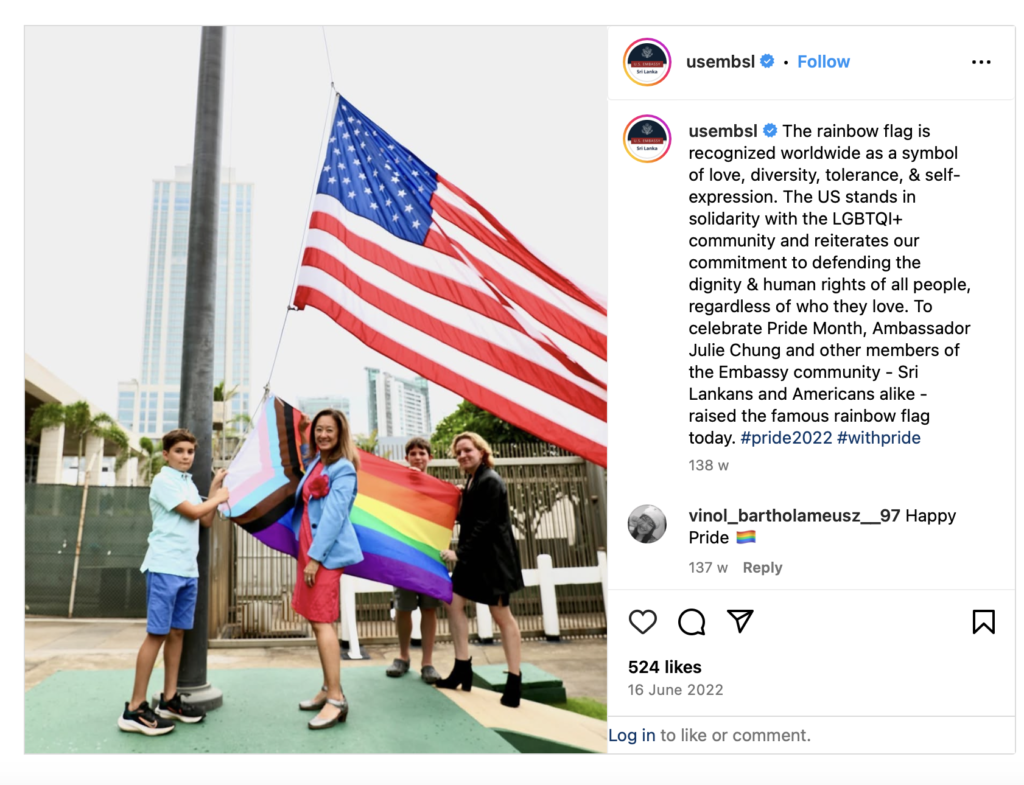
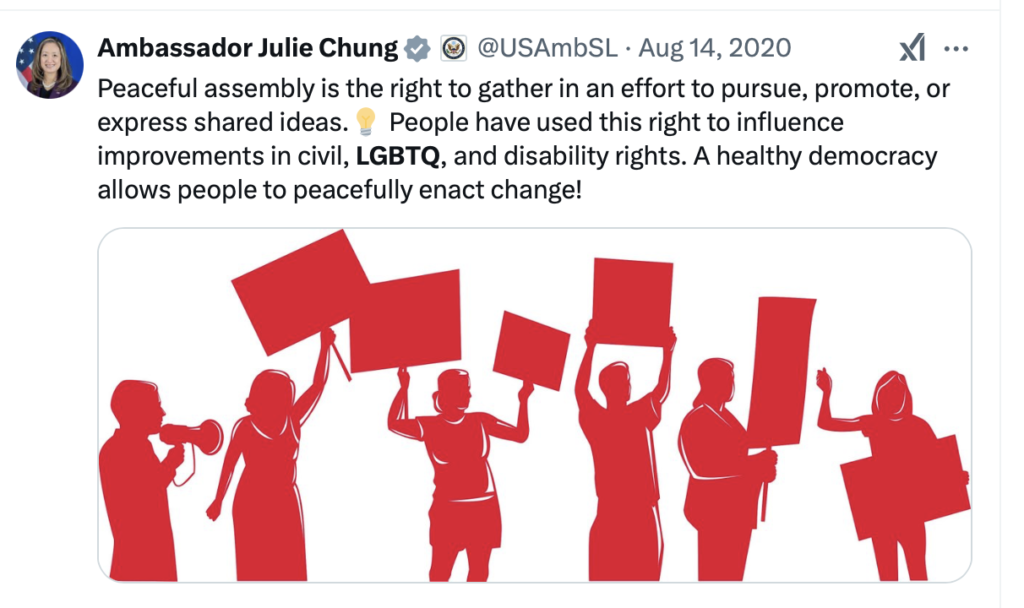

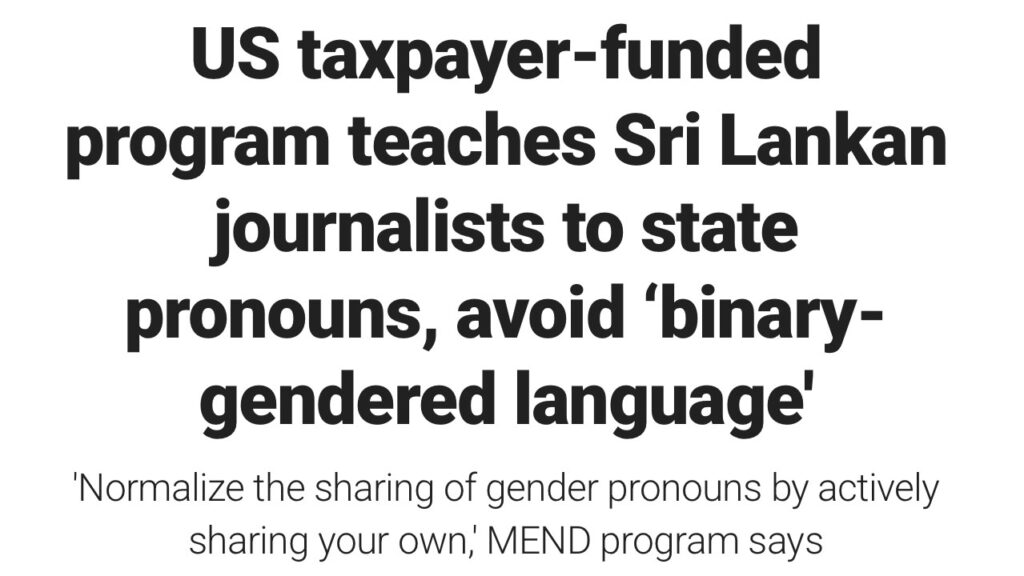
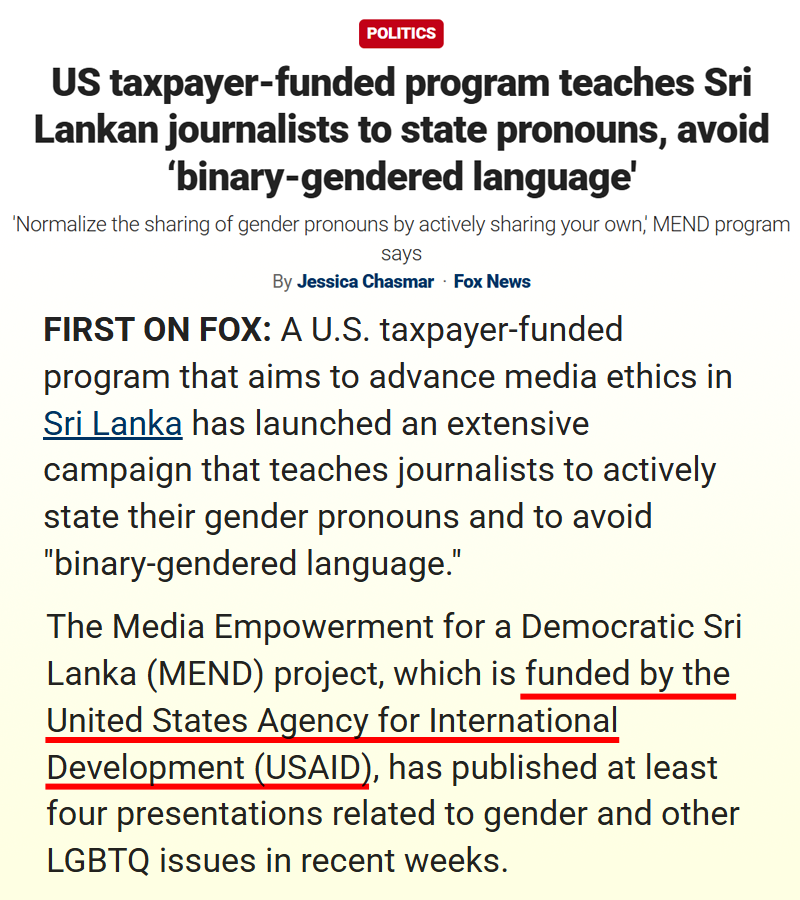
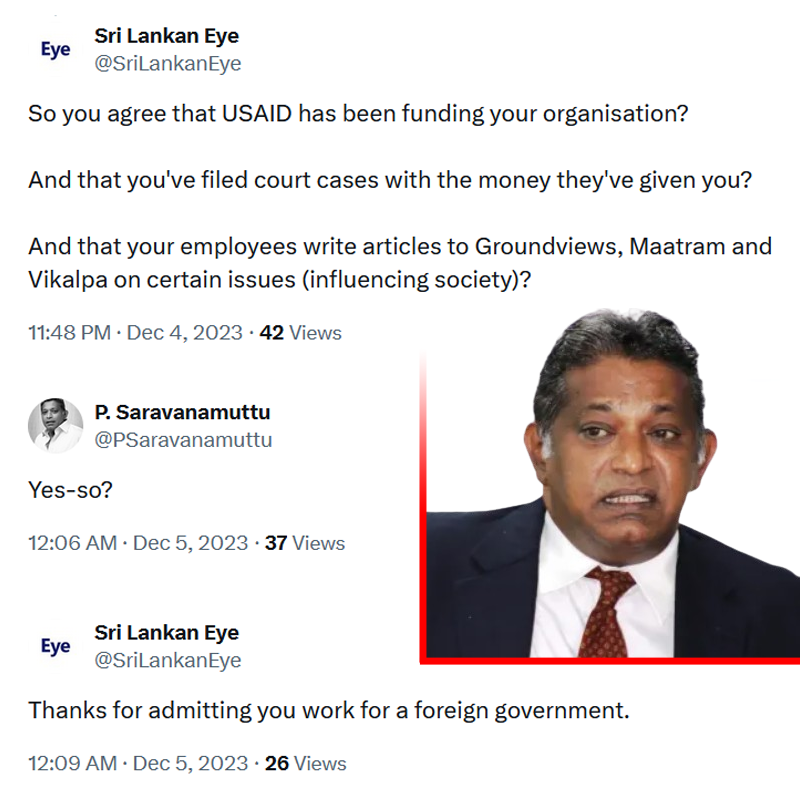
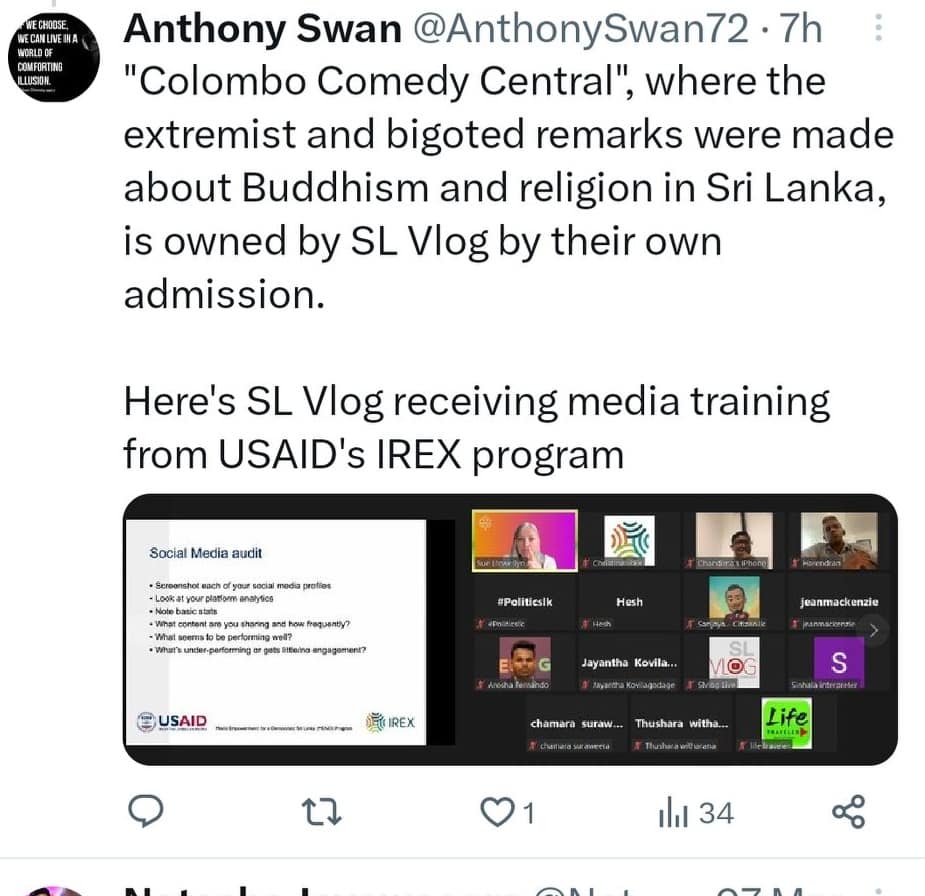
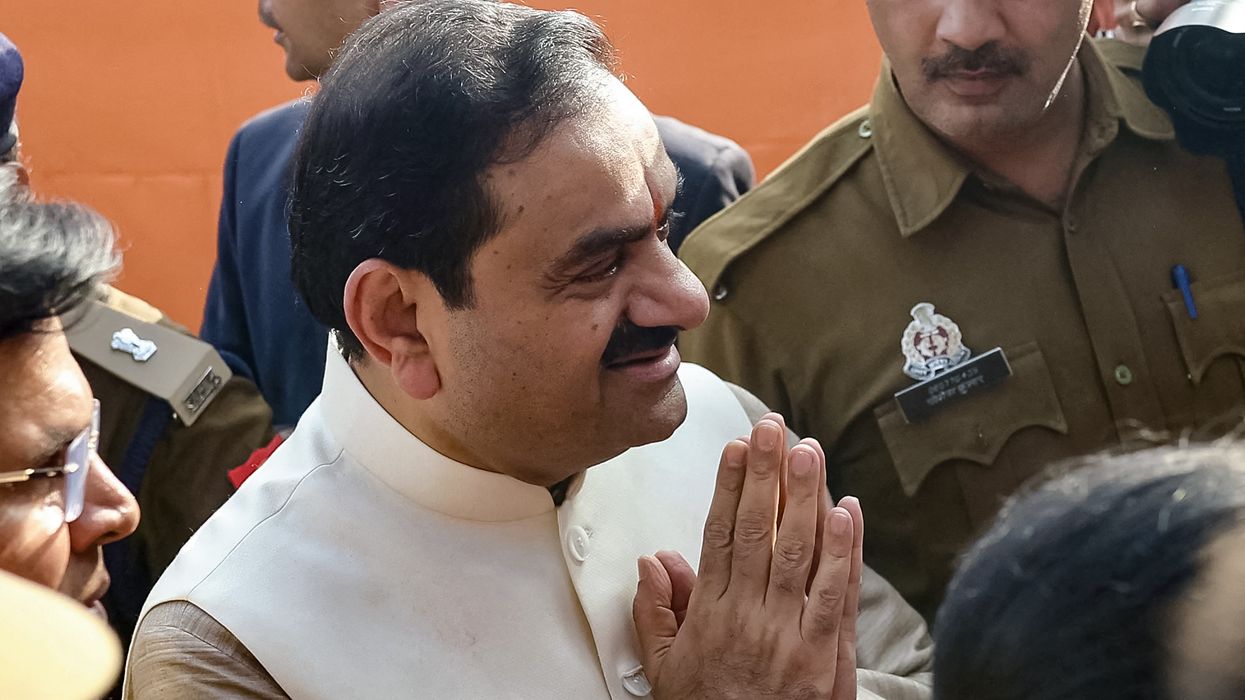
 USAID, ඇමරිකානු තානාපති කාර්යාලය, ඇමරිකානු නියෝජිත ජූලි චුන්ග්, IREX සහ MEND වැඩසටහන් මගින් ශ්රී ලාංකික මාධ්යවේදීන්ට ද්විමය-ලිංගික භාෂාව” වළක්වා ගන්නේ කෙසේද යන්න ඉගැන්වීම සඳහා ඩොලර් මිලියන 8 ක් වෙන් කිරීම මේ වන විට ආන්දෝලනාත්මක පුවතක් බවට පත්ව තිබේ.