The Supreme Court has ruled that the decision taken by Samagi Jana Balawegaya (SJB) to suspend the party membership of Ministers Manush Nanayakkara and Harin Fernando was lawful.
The court issued this verdict while dismissing a petition filed by the two ministers seeking an order declaring that the SJB’s decision to remove them from the party is unlawful.
The decision was announced by the three-member Supreme Court bench consisting of Justices Vijith Malalgoda, Achala Vengappuli and Arjuna Obeysekara this morning (09).
On July 18, 2023, the Working Committee of the SJB decided to expel party members Harin Fernando and Manusha Nanayakkara from the party. In May 2022, the SJB had suspended the party membership of the two parliamentarians after they had accepted ministerial portfolios in the government while the party had vowed to take disciplinary action against them.
MPs Harin Fernando and Manusha Nanayakkara were sworn in as the Minister of Tourism & Lands and Minister of Labour & Foreign Employment, respectively whereas Minister Fernando was also appointed as the Sports Minister.
Fernando and Nanayakkara had said they accepted ministerial portfolios in the government under President Gotabaya Rajapaksa to do their utmost to find solutions to the ongoing economic crisis as a positive response was not received from many political party leaders for a collective effort.
They both subsequently resigned from their ministerial portfolios on July 9, 2022 along with the rest of the Cabinet, after then President Gotabaya Rajapaksa informed the Speaker of Parliament that he intends to resign.
However, they were both reappointed to the same ministerial portfolios by President Ranil Wickremesinghe when he appointed a new Cabinet on July 22, 2022.
Colombo, August 8: In a revolutionary move, the Interim Government formed in Bangladesh on Thursday after Prime Minister Sheikh Hasina’s ouster by a student agitation, includes two student leaders, Nahid Islam and Asif Mahmud.
This may well be the first time in the world that student agitators who had toppled a government have been included in the successor government’s Council.
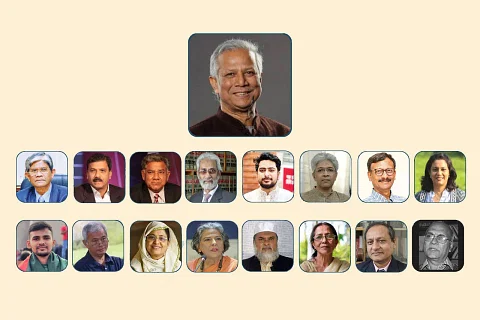
The 17-member Council of Advisors (the de facto cabinet) formed to assist President Muhammad Shahabuddin is completely non-partisan and representative of diverse interests in Bangladesh.
It has Nobel Laureate Dr.Muhammad Yunus as Chief Advisor. Other members are human rights workers, civil society activists, academics, former bureaucrats, professionals, two student leaders, and an Islamic scholar. For the sake of religious diversity, there is a Hindu and a Buddhist.
The Chief Advisor Dr. Yunus is founder of the Grameen Bank. A Nobel Laureate, he is recognised for his work in making cheap credit available to small farmers and rural artisans. Dr Salehuddin Ahmed is an economist and former Governor of the Bangladesh Bank. Brig.Gen. (retd) M Sakhawat Hossain is a former election commissioner of Bangladesh.
Dr Md. Nazrul Islam is a law professor, constitutional law researcher and civil society activist. Adilur Rahman Khan is human rights activist and founder of Odhikar. A.F Hassan Ariff is a former Attorney General. Md. Touhid Hossain is a former Foreign Secretary.
Syeda Rizwana Hasan is CEO of the Bangladesh Environmental Lawyers Association (BELA). She is a member of the Environmental Law Alliance Worldwide and the Environmental Law Commission of International Unions for the Conservation of Nature (IUCN).
Supradip Chakma is a Buddhist and Chairman of Chittagong Hill Tracts Development Board (CHTDB). He has been diplomat. Farida Akhter is a researcher in agriculture. Dr. Bidhan Ranjan Roy, a Hindu, is Professor of Psychiatry at the National Institute of Mental Health & Hospital. Dr AFM Khalid Hossain is a Deobandi Islamic scholar and a former Vice-President of Hefazat-e-Islam Bangladesh.
Sharmeen Murshid is CEO of the election observation group Brotee. Farooq-e-Azam is a former naval commando and freedom fighter. Nurjahan Begum is a long-standing associate of Muhammad Yunus in Grameen Bank.
The Students
Nahid Islam, a Sociology student at Dhaka University, was a key member of the 13-member coordinating committee of the anti-quota and democracy movement which overthrew Sheikh Hasina. Asif Mahmud, another key student leader in the Council of Advisors, is a Linguistics student in Dhaka University.
Both Nahid and Asif had given the month-long agitation a democratic and inclusive content which attracted wide social support and enabled it to attain its objective of overthrowing the dictatorial Hasina regime.
Nahid Islam was left battered and unconscious under a bridge on 21 July. On, 26 July, he was abducted from the Gonoshasthaya Nagar Hospital in Dhanmondi by persons identifying themselves as personnel from various intelligence agencies.
Asif Mahmud Bhuyain was abducted and tortured on 19 July. He went through interrogation for four days until his release. But on 26 July, Asif was taken from Gonoshasthaya Nagar Hospital by persons who claimed to be personnel from various intelligence agencies and the Dhaka Metropolitan Police.
Nahid, Asif and others in the coordination committee had made it very clear that they were not working for any particular political party. But they insisted that no government could be formed in Bangladesh with persons the committee did not approve. They also stated that they did want army rule either.
It is the coordinating committee headed by Nahid and Asif that invited Dr. Muhammad Yunus to come back from Paris and be the Chief Advisor of the Interim Government.
Students Historical Role
University students have been pioneers in agitation politics both in East Pakistan and in independent Bangladesh. Students were in the forefront of the Bhasha Andolon”, the language movement of 1952, which had, as its aim, the installation of Bengali as an official language of Pakistan in addition to Urdu.
Twenty-nine students were shot dead in the language movement. April 21 is now observed as the International Mother Tongue Day.
The language movement led by students created freedom fighters like Sheikh Mujibur Rahman and Tajuddin Ahmad. Mujib and Tajudden, among many others, led the freedom movement of 1971 which led to the birth of Bangladesh.
During the latest students’ agitation against Sheikh Hasina, the students proclaimed: We have not witnessed 1971, we have not witnessed 1952, but we are witnessing 2024, our freedom struggle.”
The Bangladesh Advisory Council
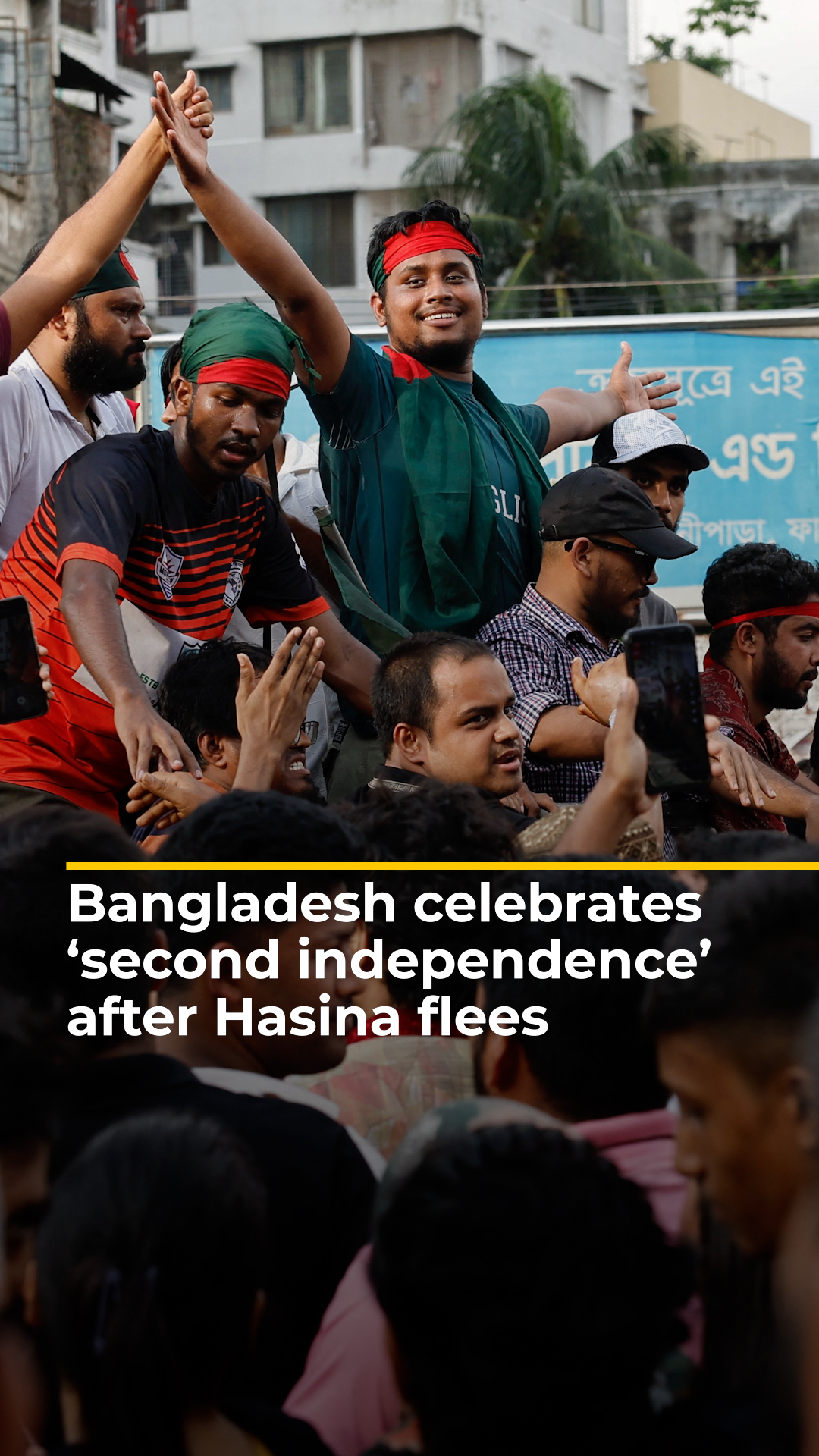
The 2024 movement is popularly hailed as the second freedom struggle”.
Occupying streets and public spaces had been a feature of students agitations in East Pakistan and Bangladesh since 1948.
In 2018, school students took up the cause of road safety – after the death of two students in traffic accidents – by occupying streets as part of a collective agenda to reform governance which had been insensitive to peoples’ lives.
Universities and their associated hostels turned into centres of intense student activity and planning from the language movement of 1952 onwards, to the liberation war, and the 1990 agitation that brought down the military strongman General H. M. Ershad.
Universities both in the past and the present have been institutions that are the first to be shut down by the authorities to nip demonstrations or movements in the bud.
Hasina, who won her fourth consecutive term as Prime Minister in January, to become the longest-serving leader in Bangladesh, saw the July 2024 student movement as one instigated and led by her bete noire, the Bangladesh Nationalist Party, and the Jamaat-e-Islami. While the BNP matriarch Begum Khaleda Zia was under house arrest on corruption charges, the Jamaat-i-Islami was banned.
Hasina’s decision to use the police and her party, the Awami League’s student leaders to launch brutal attacks on agitating students secured an unprecedented and unexpected backlash which was too much for her to take, especially after the army refused to shoot on students.
The Prime Minister could have intervened early and restrained the trigger-happy police,” commented political scientist Prof. Imtiaz Ahmed of Dhaka University.
If she had done that, she might not have suffered the ignominy of fleeing the country with only half an hour to go before a massive invasion of her official residence by students.
Damaged riot gear of security forces is seen next to a burnt vehicle outside a police station on Aug 8. PHOTO: REUTERS
DHAKA/NEW DELHI – Hundreds of Bangladeshi Hindus have tried unsuccessfully to flee to India this week after many homes and businesses of the minority community were vandalised following the overthrow of Prime Minister Sheikh Hasina.
The Bangladesh Hindu Buddhist Christian Unity Council said that 45 out of 64 districts in the country had seen the targeting of mostly Hindu homes, businesses or temples this week. A school teacher had been killed and 45 other people hurt, it said.
Hindus make up about 8 per cent of Muslim-majority Bangladesh’s 170 million people and have traditionally largely supported Ms Hasina’s Awami League party, which identifies as largely secular, instead of the opposition bloc that includes a hardline Islamist party.
Ms Hasina has taken refuge in India after fleeing the country on Aug 5 in the face of mass protests against what critics called her authoritarian rule – provoking anger among some Bangladeshis towards their neighbour.
Many living close to India are trying to flee but facing resistance from both sides, local people said. Both countries have said they have stepped up border patrolling since the violence.
Mr Mohammad Rakibul Hasan, a local government official in Thakurgaon district in northwestern Bangladesh, said around 700-800 Hindus tried to flee to India around Aug 7 evening after some of their houses were attacked and looted.
“They returned home after we provided protection,” he said. “Border guard troops are patrolling the area. Everything is fine now with no further reports of violence.” & Conditions and Privacy Policy as amended from time to time.
Yes, I would also like to receive SPH Media Group’s
SPH Media Limited, its related corporations and affiliates as well as their agents and authorised service providers.
marketing and promotions.
Early on Aug 8, about 300 Bangladeshis had assembled at a border point near India’s Jalpaiguri district but dispersed later. Indian media showed Indian border troops around a group of people there.
A Hindu goldsmith in the Narsingdi area, about an hour from Dhaka, who did not want to be named for fear of reprisals, said two youths demanded protection money of 1 million Bangladesh taka (S$11,300) and relented only after they agreed to pay 100,000 taka.
Nobel Peace laureate Muhammad Yunus, who returned to Bangladesh on Aug 8 to head an interim government following Ms Hasina’s departure, said attacks on minorities could have been part of a conspiracy. He did not say who was behind the conspiracy.
“Our job is to protect all of them,” he said on arrival in Dhaka from Paris.
“If you have faith in me and trust me, please ensure no one is attacked in the country. If you cannot listen to me on this, I have no use being here.”
The two countries have longstanding cultural and business ties and India played a key role in the 1971 war with Pakistan which led to the creation of Bangladesh.
India, which has a Hindu majority, has said it was worrying that minorities, their businesses and temples had been attacked in many places.
“It is the responsibility of every government to ensure the wellbeing of all its citizens,” India’s foreign ministry spokesperson Randhir Jaiswal told a press conference.
“We hope for the early restoration of law and order in Bangladesh. This is both in the interest of the country itself and the larger region.”
Bangladesh’s Hindu community leaders urged other communities to look after the religious minorities.
“I call upon the conscientious people of the country to forget all differences and stand unitedly by the side of the affected people and build social resistance,” said Ms Moyna Talukdar of the Bangladesh Hindu Law Reform Council. REUTERS
Indian media make claims linking China and Pakistani intelligence to Bangladesh protests and exaggerate scale of attacks on Hindus.
Men run past a vehicle set on fire by protesters at Bangabandhu Sheikh Mujib Medical University Hospital during a rally against Prime Minister Sheikh Hasina and her government on August 4, 2024, the day before Hasina resigned [Rajib Dhar/AP Photo]
Dhaka, Bangladesh – Within hours of Sheikh Hasina’s removal from power after a student-led mass uprising, reports began to appear in some Indian media outlets that members of Hindu minorities in Bangladesh were being targeted by Islamist forces”.
Articles and videos containing misleading content emerged across Indian media and social media platforms.
A video on The Times Group-owned Mirror Now’s YouTube channel, titled Attack on Hindus in Bangladesh? Mass Murders, Killings by Mob, shows footage of violence and arson attacks on four houses, two of them have been identified to be owned by Muslims. The title of the video is clearly misleading as there was no mass murders reported in the incident. Local reports say one of the houses belonged to Bangladesh’s freedom icon Sheikh Mujibur Rahman.
The video also makes unsubstantiated claims, like 24 burnt alive by mob” and Minorities at the centre of attacks”.
Al Jazeera has independently verified that only two Hindus have been killed since Hasina’s ouster on Monday – one police officer and one activist with Hasina’s Awami League party.
Hindus constitute about 8 percent of Bangladesh’s 170 million people and have traditionally been strong supporters of the Awami League, which is generally viewed as secular compared with the opposition coalition, which includes an Islamist party.
Many news reports of attacks on Hindus contain outlandish claims such as more than one crore [10 million] refugees are likely to enter West Bengal soon”, which was made in a Times of India report that quoted Suvendu Adhikari, a senior leader of Prime Minister Narendra Modi’s governing Bharatiya Janata Party (BJP).
The ANI news agency, seen close to Modi’s government, quoted a student leader in India as saying the mass uprising was orchestrated by the enemies of Bangladesh”.
An even more bizarre Times of India article stated that Jamaat-e-Islami, Bangladesh’s biggest Islamist party, brought down Sheikh Hasina government in Bangladesh”.
People stand guard in front of a police station that was vandalised on August 5, 2024, in Dhaka [Fatima Tuj Johora/AP Photo]
Political analyst Zahed Ur Rahman said Indian media have reported through an Islamophobic” lens.
The student movement that fomented the mass uprising involving people from all walks of life is unanimously understood as a popular movement here in Bangladesh. But Indian media somehow have been interpreting the whole scenario through their Islamophobic eye,” he told Al Jazeera.
ISI and religious claims
As Hasina fled the country on Monday, news articles in Indian media alleged that Bangladesh’s protests were influenced by the Inter-Services Intelligence (ISI), a Pakistani spy agency, because it is seeking to turn Bangladesh into an Islamic state with the support of political parties like the Bangladesh Nationalist Party (BNP) and its former political ally Jamaat-e-Islami.
Some media outlets even urged the Indian government to prepare for a potential refugee crisis, speculating that Hindus would be driven out of Bangladesh.
Speculation suggesting an ISI and Chinese connection to the popular Bangladesh movement was a common thread in social media posts by some commentators and media outlets.
The diplomatic affairs editor of The Economic Times, Dipanjan R Chaudhury, posted on X: Jamaat-e-Islami in Bangladesh politics doesn’t bode well either for country or India. Jamaat track record of promoting cross border terror … is part of recent history.”
[Screen grabs]
The television channel TV9 Gujarati with one million followers on X characterised the uprising as a coup”, stating on the social media platform: Is ISI behind the coup attack in Bangladesh? Is Jamaat-E-Islam behind the violent attacks?”
What is the reality on the ground?
These articles by Indian media and posts in social media contrast sharply with factual reports chronicling the events that led to the Hasina’s resignation. She fled to India, which had backed her.
Local media in Bangladesh reported that since Monday night, several Hindu households across 20 of the country’s 64 districts have been attacked and looted.
Al Jazeera reached out to sources in some of these districts and discovered that the attacks on Hindu households were not driven by religious identity but by political affiliations.
Mustafizur Rahman Hiru, a rent-a-car driver from the central district of Narsingdi, told Al Jazeera that in his village, the two Hindu households targeted were home to local Awami League leaders.
People were angry because these Hindu leaders were bullying others when the Awami League was in power. Now, with Hasina’s fall, they are facing the backlash,” he said.
A Bangladeshi student controls traffic after police went on strike in Dhaka [Munir Uz Zaman/AFP]
In Jashore, a border district with India, a warehouse and home belonging to Babul Saha, a local government chairman who ran for office on the Awami League ticket, were attacked.
Abdur Rab Haider, a resident of Jashore, told Al Jazeera that no Hindu household had been attacked without ties to the Awami League.
Rahman pointed out that Sajeeb Wazed Joy, Hasina’s son, who resides in the United States, has given several interviews to Indian media, spreading rumours and unverified claims about attacks on Hindus and alleged operations by the ISI.
Indian media merrily jumped onto it and spread Joy’s bogus claims,” Rahman told Al Jazeera.
‘Attacks politically motivated, not communal’
In an interview with Al Jazeera, Gobindra Chandra Pramanik, a leader of the Hindu community in Bangladesh, stated that to his knowledge no Hindu households without connections to the Awami League were attacked.
As a leader of the Hindu community, I can confirm that these attacks were politically motivated, not communal,” he said. Across the country, 10 times more Muslim households affiliated with the Awami League were attacked.”
Local media reported that since Monday night, more than 119 people – primarily Awami League leaders, activists and police – were killed in mob violence. Qadaruddin Shishir, the fact-checking editor for the AFP news agency, told Al Jazeera that only two of the victims were Hindus: one policeman and one Awami League activist.
https://imasdk.googleapis.com/js/core/bridge3.657.0_en.html?gdpr=1#goog_56797816Play Video
Video Duration 1 minutes 40 seconds1:40
Zafar Sobhan, editor of Bangladesh’s Dhaka Tribune newspaper, told Al Jazeera that most of the Indian media as a general rule is clueless about Bangladesh”.
I don’t like to attribute to malice that which just as easily can be explained by incompetence. But the uniformity of the misinformation that is routinely peddled in the Indian media suggests that they are taking dictation from a common source,” he said.
But an Indian academic rejected any allegation that the Indian media’s reporting has been Islamophobic.
Sreeradha Datta, a professor at OP Jindal University in Sonipat in northern India, told Al Jazeera that the Indian media’s concern about the safety of Hindus under a non-Hasina administration in Bangladesh stems from past experiences rather than Islamophobia.
Datta noted that during previous non-Awami League governments, such as the BNP-Jamaat alliance, there was an increase in attacks on minorities, and this historical context continues to influence current perceptions.”
The media’s reporting has caused concern in India with several prominent Hindu religious leaders and politicians calling for the protection of Hindus.
Muslims protecting Hindus
Meanwhile, images of individuals, including students from Muslim religious schools, standing watch in front of Hindu temples and homes have been widely circulated on social media.
In Brahmanbaria, a district with one of the largest Hindu populations in Bangladesh, residents, including students, stepped up to protect Hindu households.
Munshi Azizul Haque, an apparel businessman from Brahmanbaria, told Al Jazeera that they are working to prevent any communal violence in the area. We’ve seen how Indian media are depicting attacks on minorities in Bangladesh on social media. The reality is quite different,” he said.
Pramanik also acknowledged that Hindu temples were being protected.
News of Bangladeshi students, including from religious schools, volunteering to protect Hindu temples have been reported locally since the unrest began, and it has been picked up by outlets like Clarion India and The Wire.
Siddharth Varadarajan, founding editor of The Wire, told Al Jazeera that while there is legitimate and genuine concern about reports of attacks on Hindu places of worship, businesses and homes across more than two dozen districts in Bangladesh, the Indian media are also exaggerating the scale and extent of these incidents.
Also, he said, there is a section of the Indian media that is using the Bangladesh situation to boost anti-Muslim rhetoric in service of the BJP and [its ideological parent] RSS’s agenda.
For them, the ouster of Hasina is an Islamist conspiracy hatched in collaboration with Pakistan and China and that the target is India and Hindus,” he said.
Naresh Fernandez, editor of the Indian news portal Scroll.in, said Hindutva (right-wing Hindu nationalism) supporters in India are using the situation in Bangladesh as a screen on which to project their own anxieties, fantasies and conspiracy theories to serve their narrow political purposes”.
They are claiming that Hasina’s fall was actually engineered by international forces and that this is a rehearsal for a similar regime change to be effected in India,” Fernandez told Al Jazeera.
He said, however, that Hindutva supporters are rightfully concerned about the safety of minorities in Bangladesh in this period of crisis, a concern that they fail to demonstrate about minorities in India”.
‘Delhi’s intent to destabilise Dhaka’
Political analyst Farid Erkizia Bakht, meanwhile, suggested that misinformation spread by Indian media reflects New Delhi’s intent to destabilise Dhaka. He noted that India has lost its most valuable ally in the subcontinent and is deeply concerned about the direction of the incoming administration.
Varadarajan also echoed the sentiment.
The popular uprising which unseated Hasina caught New Delhi by surprise, and the government is now scrambling to formulate a coherent and rational policy in the face of the new situation.
It cannot welcome the student-led protest and bottom-up expression of people power or dismiss the change as a ‘coup’ or an ‘anti-India conspiracy’ either as the Hindutva right wing on social media is saying,” he said.
For now, New Delhi will be in a wait-and-watch mode. The focus will be on ensuring the safety of Indian nationals in Bangladesh and monitoring the situation of minorities there,” he added.
Bangladeshi activist and author Aupam Debashis Roy told Al Jazeera that there had been attacks on Hindu minorities but the numbers have been overblown and Bangladesh is being portrayed as being taken over by Islamist forces”, which is not true, he said.
The nature of the soon-to-be-formed interim government will not be radical Islamist” in nature, Roy said. But the BJP-leaning media wants to spread the world that Bangladesh is going to be in the hands of Islamists because it supports their [the BJP’s] narrative … built around previous laws like CAA and NRC,” Roy said, referring to India’s citizenship law and national register of citizens, which have been criticised as being directed against Muslims.
They want to show that Bangladesh is a place for radical Islamists and Hindus and minorities are not safe here. I think that’s why the BJP-leaning Indian media is spreading misinformation about attacks on minorities and an Islamist force taking over Bangladesh,” he added.
US-based Bangladeshi political commentator Shafquat Rabbee Anik said the violence occurring in Bangladesh is a result of the collapse of the police force,” which is mostly due to popular reprisal against excesses committed by them throughout the last 15 years”.
Once Nobel Peace Prize-winning economist Muhammad Yunus officially becomes the leader of the interim government, that will calm down Indian nerves”, Anik predicted.
For one, it will be very hard to portray Yunus as an Islamist trying to take away the rights of the minorities and women.”
The Ahmadiyya Muslim community in Bangladesh has faced severe attacks, with thousands of fanatics targeting mosques, schools, and homes. Recent violence includes the burning of the Ahmadiyya mosque in Taraganj and assaults by madrassa students in Dhaka. The Army has been deployed to restore order as the civil administration remains inactive. Watch our interview with Ahmed Tabshir Chaudhary, Director of External & Public Affairs, Ahmadiyya Muslim Jama’at, Bangladesh, for insights on the situation and community responses.
The Met police chief, Sir Mark Rowley, has praised the show of force and unity from communities” that defeated the threat from far-right troublemakers yesterday, after thousands of anti-racism protesters lined streets of the capital. Our Crime Correspondent, Anthony France, explains what exactly happened, how racist thugs are being fast-tracked through our justice system, and discusses whether this could be the beginning of the end of the riots. In part two, as Justin Timberlake kicks off the UK leg of his world tour, The Standard’s Emma Loffhagen analyses where it all went wrong for the star and how he went from pop’s golden boy to DWI drama.
Targets and benchmarks with IMF, lending countries non-negotiable: If we violate them, we will not receive the necessary funds, leading to another economic collapse in our country: Never defended anyone accused of corruption:
President Ranil Wickremesinghe highlighted that altering agreements with the International Monetary Fund (IMF) or creditors could jeopardise the country’s financial support.
It is not possible to break any agreements made with the International Monetary Fund and our lending countries. These existing targets and benchmarks are non-negotiable. If we violate them, we will not receive the necessary funds, leading to another economic collapse in our country,”he said.
He said that there won’t be any problems for Sri Lanka if the country adheres to the IMF agreement. He added that the IMF will not change its benchmarks; these remain constant for all countries.
We have reached an agreement with the IMF, and we must implement it. While others are proposing changes, they need to specify their plans. The IMF will not change its benchmarks; these remain constant for all countries. For example, if you propose giving something for free and offset this by increasing VAT to 25%, the IMF might agree if the numbers are feasible. However, you cannot alter the benchmarks, revenue figures, or expenditure figures,”he said.
The President while urging all candidates to be honest with voters about the country’s economic challenges said that he is contesting the presidential election for the future of the country and its people.
He emphasised that he has no personal conflicts with anyone, having twice saved the country during severe economic crises.Speaking at a meeting with media heads at the Cinnamon Grand Hotel in Colombo yesterday, the President stated that while other candidates may be running for their personal ambitions, he is contesting the presidential election for the future of the country and its people.
Addressing concerns about corruption, the President noted his efforts in enacting anti-corruption laws and announced plans to present the Bill on the Proceeds of Crime Act to the Cabinet next week. He reiterated that he has never defended anyone accused of corruption.
President Wickremesinghe made these remarks during his first media engagement since officially entering the presidential race.
Addressing the gathering President Wickremesinghe said; I decided to meet with the media for the first time after submitting the deposit for my candidacy for the Presidential Election.
I am serving as president today because no one else stepped up to take on this role. Within two years of assuming the presidency, I addressed the country’s fundamental problems. Solving Sri Lanka’s issues is no small feat; it took Greece ten years and Indonesia eight years. Some doubted how Sri Lanka could tackle these challenges.
However, I believed they could be resolved in a shorter period. I discussed this matter with then-President Gotabaya Rajapaksa and accepted the challenge without fear. I was confident that by engaging with the International Monetary Fund (IMF) and making the hard decisions, we could recover. Initially, there was no party support for me. A faction of the Sri Lanka Podujana Peramuna (SLPP) joined us, while another went to the opposition. Some from the Sri Lanka Freedom Party (SLFP) aligned with us, while others joined the opposition. I took on this responsibility by forming a government without a party. We have now completed the initial work and have laid the foundation to free the country from bankruptcy. Let’s continue on this path.
People suffered because the country’s economic system collapsed, and the increased tax burden became unbearable for some. I am sorry for that, but without these measures, the economy could not have been managed. Politics in our country is not prepared for the truth.
Stability needs to be established. A country cannot be developed without stability. Yesterday, while watching the events in Bangladesh on television, I thought about what might have happened if I hadn’t taken over. Even though the Bangladesh Prime Minister was asked to step down, no one was ready to take over. When the army intervened, protesters were not in favour of the army taking over. They suggested appointing Mr. Yunus as Prime Minister.
However, according to the constitution, a Prime Minister must be a Member of Parliament. What would happen if we found ourselves in that situation? Fortunately, we managed to form a government. This is why we now have the opportunity to hold the Presidential Election. The future of the country will be decided in this Presidential Election.
We must decide whether to continue on our current path towards becoming a developed country, provide relief to those suffering and build a promising future for our youth, or revert to old politics, risking another economic collapse and a return to an era of shortages and queues.
There is no need to consider personal appearances. The decision should be based on whether the candidates have the strength and policies to save the country. This Presidential Election is not about the future of the candidates but the future of the country and its people. We must decide whether to proceed systematically and solve the country’s problems with determination or risk returning to the situation of 2022.
Different people can make various promises, but many of them are unrealistic. Fulfilling such promises would require increasing VAT. That is the reality we face. We must decide whether we are prepared to tell the truth and save the country or seek power through deception. Therefore, I ask the people for the mandate to continue the programmes initiated by the government.
The following are the questions raised by journalists and the responses provided by President Ranil Wickremesinghe:
Q: Dhammika Perera has withdrawn from the Presidential race and Namal Rajapaksa has been nominated as the presidential candidate. With most SLPP supporters backing you, do you expect a strong challenge from Namal Rajapaksa?
A: I cannot predict the nature of the competition. My goal is not to engage in a fight but to present my policies to the people and demonstrate how we can advance the country. If you agree with my vision, you can vote for me. I am not concerned with what others say. If he wishes to come, I have no objection. In fact, he should clearly convey his message.
Namal Rajapaksa and the SLPP supported me in the Parliamentary Election for the Presidency, and I am grateful for that. We had agreed to work together over the past two years, and that period has now passed.
It is now up to him to determine the party’s position on supporting or nominating a candidate. Meanwhile, it is his responsibility to present his proposals to the country.
This is not my personal contest. It is up to the people to decide their future. They can choose to support my program and vote accordingly, or opt for another candidate.
Q:This question is about the ban on vehicle imports. Is it possible to allow people to import vehicles with a higher tax, and in return, reduce other individual taxes? This would enable those who can afford it to import vehicles. Are you considering options like this for after your re-election?
A:Next year, we will gradually allow vehicle imports because we need the customs duty to help generate revenue. We are waiting until our reserves are built up to a sufficient level, at which point we can permit vehicle imports. Duties from vehicle imports are a significant source of revenue for the government, and we will need this income next year.
MP Udaya Gammanpila told Parliament yesterday that JVP’s Politburo member K. D. Lalkantha has publicly declared that the JVP has planned to take over the Parliament of Sri Lanka and therefore he should be immediately arrested under the criminal law and the law should be enforced against him. MP Udaya Gammanpila mentioned this while joining the adjournment debate on the Mid-Year Fiscal Position Report – 2024.
Lalkantha has said that his party has told the people to come to the Parliament. But it was not possible to do that because some of the people who were in the Aragalaya just left the scene.
If the JVP fighters were able to take over the Parliament then, the same situation in Bangladesh today would have arisen in Sri Lanka too. Bangladesh is still on fire. As suggested by Lal Kantha, the cases are being heard not in courts but on roads today in Bangladesh.
People are being killed after hearing cases on roads. Today, Bangladesh has turned into an anarchy and the country is piled up with mountains of corpses. If that happend to the Sri Lankan Parliament that day, the same situation would have arisen in Sri Lanka today.
If there is no deal with Anura, the law should be implemented now. Attempting to commit a crime is also a crime. It is said that they were ready to take over the Parliament and prepared to wreak havoc. Unlike the others, Lal is an honest man and tells the truth. The government should now arrest Lal Kanta in this regard.
National People’s Power (NPP) National Executive Committee member K. D. Lalkantha, stated that while the Galle Face protests succeeded in removing Gotabaya Rajapaksa from power, the effort to direct the uprising toward a parliamentary change failed, rendering the movement fruitless.
Lalkantha remarked that J. R. Jayewardene, a former leader, did not rely on military control but instead established a strong legal system
with an autocratic executive presidential system, which turned Parliament into a powerless entity.”We shouldn’t call it a parliament; even a dog is more useful. Parliament has become a useless institution,” he said.
He further explained that once a leader is elected for five years, there’s nothing that can be done until the term is over. Unlike how Gotabaya was removed or how leaders in Bangladesh are ousted, people cannot keep protesting indefinitely to remove a leader.
Lalkantha acknowledged that there was an opportunity to channel the people’s uprising at Galle Face into a movement towards Parliament after Gotabaya was ousted.”We tried to redirect the uprising towards Parliament, but the so-called Galle Face leaders who emerged from the dispersed people’s struggle blocked this. The remaining Parliament rebuilt the collapsed tower, rendering Gotabaya’s removal meaningless,” he concluded.
Bangladesh’s military chief announced on Wednesday that an interim government, headed by Nobel laureate Muhammad Yunus, will be sworn in on Thursday. The move follows former prime minister Sheikh Hasina’s resignation and departure to India, with the new administration aiming to restore stability after widespread unrest.
Bangladesh’s military chief said Wednesday that an interim government headed by Nobel laureate Muhammad Yunus would be sworn in on Thursday night as he returns from Paris to take over the administration and try to restore stability in the country, after an uprising forced former prime minister Sheikh Hasina to step down and flee to neighboring India.
Gen. Waker-Uz-Zaman said in a televised address late Wednesday afternoon that the responsible for the violence since Hasina’s resignation would be brought to justice.
The military chief, flanked by the chiefs of navy and air force, said that he spoke to Yunus and would receive him at the airport on Thursday.
Zaman said he was hopeful that Yunus would take the situation to a beautiful democratic” process.
Speaking to reporters in Paris, Yunus said I’m looking forward to going back home and seeing what’s happening there, and how we can organize ourselves to get out of the trouble that we are in.″
Asked when elections would be held, he put his hands up as if to indicate it was too early to say. ″I’ll go and talk to them. I’m just fresh in this whole area.″
Earlier on Wednesday, ailing opposition leader and former prime minister Khaleda Zia urged all not to follow the path of destruction in Bangladesh as she addressed her supporters from a hospital bed at a rally in Dhaka. It was her first public speech since 2018, when she was convicted of corruption charges and jailed.
No destruction, no anger, and no revenge, we need love and peace to rebuild our country,” she said using a video link.
I have been released now. I want to thank the brave people who were in a do-or-die struggle to make possible the impossible,” she said. This victory brings us a new possibility to come back from the debris of plunder, corruption and ill-politics. We need to reform this country as a prosperous one.”
The development came as Bangladesh was preparing to form an interim government after a mass uprising that left hundreds of people dead and hundreds of others injured.
The student leaders, who organized the weeks of mass protests, said they would unveil a full list of the new Cabinet on Wednesday. The streets of Bangladesh were calm after reports of violence against supporters of Hasina, police and minority communities which followed soon after she fled to India.
The rally by the Bangladesh Nationalist Party came a day after her release from house arrest, amid a new political environment in the country.
Zia’s freedom is largely symbolic as the ailing leader has been staying outside the prison under an executive order of the former government but was not allowed to travel abroad. Her son and the acting head of the party, Tarique Rahman also addressed the crowd online from London, where he has been living in exile since 2008.
Rahman faces several criminal cases and was convicted of corruption and a grenade attack, charges dismissed by supporters as politically motivated.
Zia, who ruled the country from 2001 to 2006, was convicted on corruption charges in 2018 and sentenced to 17 years in prison. Her party said the charges were designed to keep her away from politics.
Bangladesh’s President Mohammed Shahabuddin, a symbolic figure who is acting as the chief executive now under the constitution, dissolved Parliament on Tuesday, clearing the path for an interim administration that is expected to schedule new elections but it’s not clear when those elections will take place.
Shahabuddin named Yunus as the head of an interim government, in consultation with the army and student leaders. He has been a longtime opponent of Hasina.
An economist and banker, Yunus was awarded the 2006 Nobel Peace Prize for his work developing microcredit markets. He has been hailed for bringing thousands out of poverty through Grameen Bank, which he founded in 1983, and which makes small loans to businesspeople who wouldn’t qualify for regular bank loans.
In his first statement since he was named as the head of an interim government, Yunus on Wednesday congratulated the students for taking the lead in making our Second Victory Day possible.” He also appealed to them, members of political parties and other people to stay calm.
Referring to acts of violence that happened after Hasina’s resignation, Yunus said, Violence is our enemy. Please don’t create more enemies. Be calm and get ready to build the country.”
On Wednesday, the streets of Dhaka, the capital, were calm two days after violence gripped the country amid Hasina’s sudden departure. The students were seen cleaning streets and managing traffic in parts of Dhaka as police including traffic police disappeared amid violent attacks on police stations in Dhaka and elsewhere in the country.
The looting of the firearms was also reported in local media. Reports of robberies in parts of Dhaka came in the absence of police.
The Bangladesh Police Association went on strike after police stations and security officials were attacked across the country Monday. The association said many” officers had been killed but gave no number.
Violence in days surrounding Hasina’s resignation killed at least 109 people — including 14 police officers, and left hundreds of others injured, according to media reports, which could not be independently confirmed. Reports said more attacks took place across the country also on Tuesday.
In the southwestern district of Satkhira, 596 prisoners and detainees escaped from a jail after an attack on the facility Monday evening, the United News of Bangladesh agency reported.
Many of the homes of the ministers and MPs for the ruling party were looted, torched or vandalized. People were seen on social media taking valuables from the home of Hasina’s younger sister in Dhaka’s Gulshan area. Four separate neighbors told The Associated Press that the lootings took place at her home.
Elsewhere in Dhaka, charred bodies were recovered from a museum, which was used by Hasina’s father before he was assassinated along with most of his family in 1975, media reports said.
Local media also reported that many of the dead in two days of violence since her resignation included ruling party officials, mostly outside Dhaka. Those details could not be independently confirmed.
There are growing fears among the country’s Hindu minority, which has been targeted in the past during political unrest and which has long been seen as pro-Hasina, that they could again face attacks. Local reports of violence against Hindu leaders and other minorities could not be confirmed.
In one case in Dhaka, the home of a popular Hindu musician was attacked and some 3,000 musical instruments were destroyed by the attackers, the family said.
Opposition politicians have publicly called on people not to attack minority groups, while student leaders asked supporters to guard Hindu temples and other places of worship.
The unrest began in July with protests against a quota system for government jobs, which critics said favored people with connections to her party. But they soon grew into a broader challenge to Hasina’s 15-year rule, which was marked by human rights abuses, corruption, allegations of rigged elections and a brutal crackdown on her opponents. More than 300 people died in just a few weeks.
The quick move to choose Yunus came after Hasina’s resignation created a power vacuum and left the future unclear for Bangladesh, which has a history of military rule, messy politics and myriad crises.
The military wields significant influence in a country that has seen more than 20 coups or coup attempts since its independence from Pakistan in 1971. Military chief Gen. Waker-uz-Zaman said Monday he had taken temporary control while a new government is formed.
Many fear that Hasina’s departure could trigger even more instability in the densely populated nation of some 170 million people, which is already dealing with high unemployment, corruption and climate change.
Hasina, 76, was elected to a fourth consecutive term in January, an election boycotted by her main opponents. Thousands of opposition members were jailed before the vote, and the United States and the United Kingdom denounced the result as not credible.
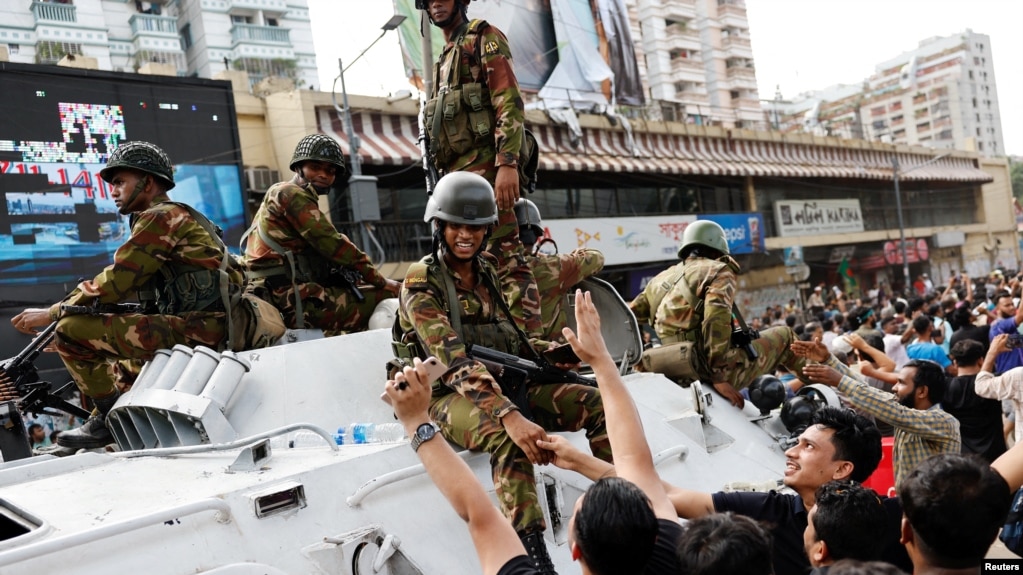
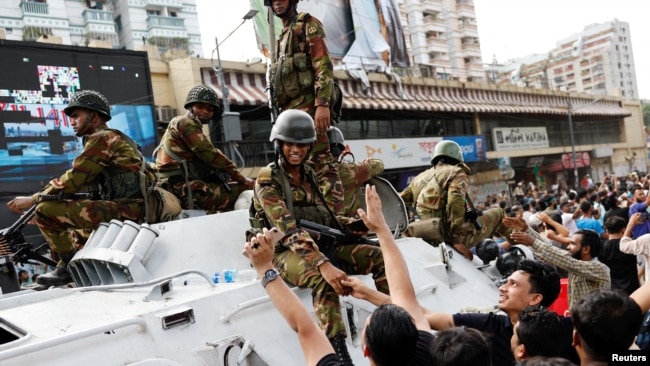
People shake hands with army personnel as they celebrate the resignation of Bangladeshi Prime Minister Sheikh Hasina in Dhaka, Aug. 5, 2024.
The night before long-time leader Sheikh Hasina abruptly fled Bangladesh amid deadly protests, her army chief held a meeting with his generals and decided that troops would not open fire on civilians to enforce a curfew, two serving army officers with knowledge of the discussions told Reuters.—
Gen. Waker-Uz-Zaman then reached out to Hasina’s office, conveying to the prime minister that his soldiers would be unable to implement the lockdown she had called for, according to an Indian official briefed on the matter.
The message was clear, the official said: Hasina no longer had the army’s support.
Details of the online meeting between military top brass and the message to Hasina that she had lost their backing have not previously been reported.
They help to explain how Hasina’s 15-year rule, during which she brooked little dissent, came to such a chaotic and sudden end on Monday, when she fled from Bangladesh to India.
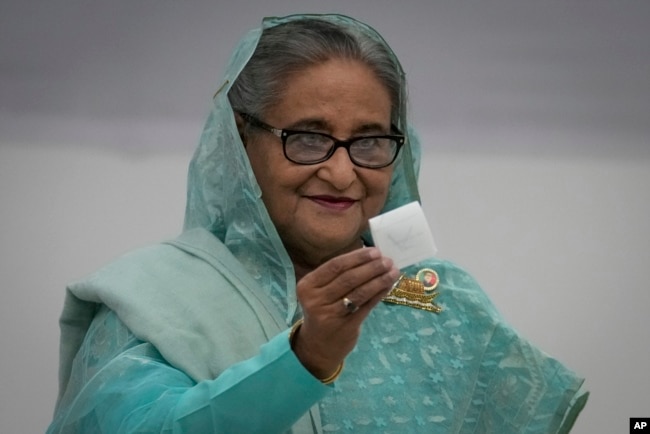
FILE – Bangladesh Prime Minister Sheikh Hasina shows her ballot paper as she casts her vote in Dhaka, Jan. 7, 2024.
The nationwide curfew had been imposed after at least 91 people were killed and hundreds injured in nationwide clashes on Sunday, the deadliest day since student-led protests against Hasina began in July.
Army spokesman Lt. Col. Sami Ud Dowla Chowdhury confirmed the Sunday evening discussions, which he described as a regular meeting to take updates after any disturbance.
He did not provide details when presented with additional questions about decision-making at that meeting.
Hasina could not be reached and her son and advisor, Sajeeb Wazed, did not respond to repeated requests for comment.
Reuters spoke to ten people familiar with the events of the past week, including four serving army officers and two other informed sources in Bangladesh, to piece together the final 48 hours of Hasina’s reign. Many of them spoke on condition of anonymity due to the sensitivity of the matter.
Hasina, who has ruled Bangladesh for 20 of the last 30 years, was elected to a fourth term leading the country of 170 million in January, after arresting thousands of opposition leaders and workers. That election was boycotted by her main rivals.
Her iron-fisted grasp on power has been challenged since summer by protests triggered by a court ruling to reserve government jobs – heavily coveted amid high youth unemployment – for certain segments of the population. The decision was overturned but the demonstrations had quickly morphed into a movement to oust Hasina.
Photo Gallery:In photos: Bangladesh prime minister resigns amid violent protests
Zaman has not publicly explained his decision to withdraw support from Hasina. But the scale of the protests and a death toll of at least 241 made supporting Hasina at all costs untenable, three former senior Bangladesh army officers told Reuters.
“There was a lot of uneasiness within the troops,” said retired Brig. Gen. M. Sakhawat Hossain. “That is what probably (put) pressure on the chief of army staff, because the troops are out and they are seeing what is happening.”
Zaman, who is related to Hasina by marriage, had showed signs of wavering in his support for the prime minister on Saturday, when he sat on an ornate wooden chair and addressed hundreds of uniformed officers in a town hall meeting. The military later made some details of that discussion public.
The general declared that lives had to be protected and called on his officers to show patience, said army spokesman Chowdhury.
It was the first indication that Bangladesh’s army would not forcefully suppress the violent demonstrations, leaving Hasina vulnerable.
Retired senior soldiers such as Brig. Gen. Mohammad Shahedul Anam Khan were among those who defied the curfew on Monday and took to the streets.
“We were not stopped by the army,” said Khan, a former infantry soldier. “The army has done what he had promised the army would do.”
‘Short notice’
On Monday, the first full day of the indefinite nationwide curfew, Hasina was holed up inside the Ganabhaban, or “People’s Palace,” a heavily-guarded complex in the capital Dhaka that serves as her official residence.
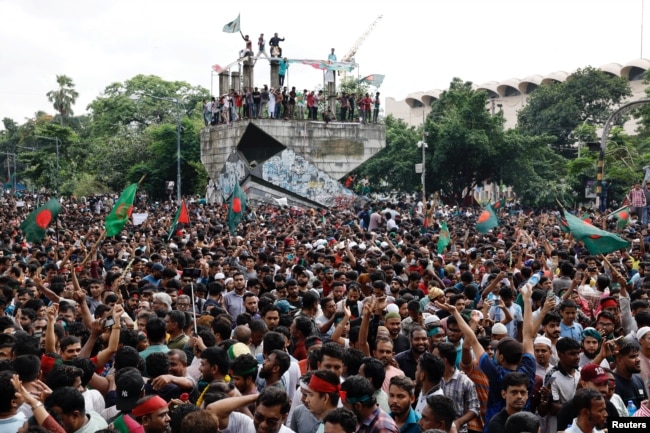
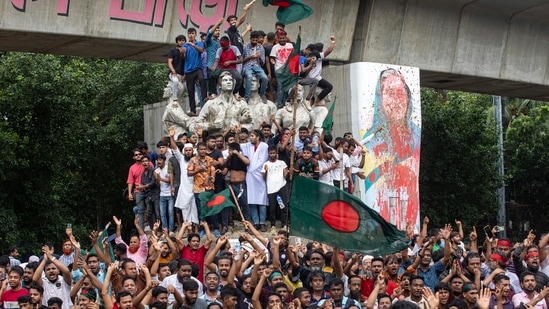
Outside, on the streets of the sprawling city, crowds gathered. Tens of thousands of people had answered protest leaders’ call for a march to oust the leader, streaming into the heart of the city.
With the situation spiraling out of her control, the 76-year-old leader decided to flee the country on Monday morning, according to the Indian official and two Bangladesh nationals familiar with the matter.
People celebrate the resignation of Bangladeshi Prime Minister Sheikh Hasina in Dhaka, Bangladesh, Aug. 5, 2024.
Hasina and her sister, who lives in London but was in Dhaka at the time, discussed the matter and flew out together, according to a Bangladesh source. They left for India around lunch, local time.
Indian foreign minister Subrahmanyam Jaishankar told parliament on Tuesday that New Delhi had urged “various political forces with whom we were in touch” to resolve the situation via dialog throughout July.
But as crowds gathered in Dhaka on Monday ignoring the curfew, Hasina decided to resign “after a meeting with leaders of the security establishment,” he added. “At very short notice, she requested approval to come for the moment to India.”
A second Indian official said it was “diplomatically” conveyed to Hasina that her stay had to be temporary for fear of negatively impacting Delhi’s ties with the next government in Dhaka. India’s Ministry of External Affairs did not immediately return a request for comment.
Nobel laureate Muhammad Yunus, whom the protesting students want to lead the interim government after Hasina’s ouster, told The New Indian Express newspaper that India had “good ties with the wrong people… Please revisit your foreign policy.”
Yunus wasn’t immediately available for an interview.
Late in the afternoon on Monday, a Bangladesh Air Force C130 transport aircraft landed at Hindon air base outside Delhi, with Hasina on board. There, she was met by Ajit Doval, India’s powerful national security advisor, according to the Indian security official.
Delhi had fought to carve Bangladesh out of East Pakistan in 1971. After Hasina’s father was assassinated in 1975, Hasina took refuge in India for years and built deep links with her neighbor’s political elite.
Returning to Bangladesh, she gained power in 1996, and was seen as more sensitive to India’s security concerns than her political rivals. The Hindu-majority nation also regarded her secular stance as favorable for the 13 million Hindus in Bangladesh.
But back in Bangladesh, resentment still lingered even among retired soldiers that Hasina had been allowed to leave.
“Personally, I feel that she should not have been given a safe passage,” said Khan, the veteran. “That was a folly.”
Marianna Spring Disinformation and social media correspondent Courtesy BBC
X can feel like two parallel universes at times.
There’s the version where the president of the United States chooses the platform to announce he won’t be running for re-election. That’s the one where the worldwide authority on a particular subject uses X to offer their expert take on unfolding events.
And then there’s the version where false claims, hate and conspiracy theories, including many posts relating to the recent riots and protests across the UK, are recommended to millions who have made absolutely no attempt to seek them out.
At the centre of it all is X’s owner Elon Musk, one of the world’s richest people. But this isn’t just a story about the monetisation strategy and algorithms employed by X under his tenure and how they are boosting divisive content.
It is increasingly also a story about how Mr Musk himself is choosing to wade in, overtly, to opine on unrest in the UK.
And nobody is quite sure what his game plan is.
Stirring the pot
Mr Musk bought what was then called Twitter in 2022. In November 2023, the site reinstated the account of the previously banned far-right activist and convicted criminal, Stephen Yaxley-Lennon, known as Tommy Robinson.
Then this week, Mr Musk responded to a post from Yaxley-Lennon with two exclamation marks – in other words, stirring the pot.
Yaxley-Lennon had taken aim at UK Prime Minister Sir Keir Starmer for his words after riots broke out following the murder of three girls in Southport. Yaxley-Lennon had accused the Prime Minister of labelling everyone upset about the murders as thugs”. Mr Starmer’s speech had specifically referred to thugs as being those throwing bricks at police officers.
Yaxley-Lennon had also been critical of the prime minister’s comments about increasing policing powers in response to the riots.
Mr Musk then later went on to suggest, in response to a video of rioting, that civil war is inevitable”. The prime minister’s spokesperson said there was no justification” for this claim.
Mr Musk doubled down again – responding to the prime minister’s post about attacks on Muslim communities by asking: “Shouldn’t you be concerned about attacks on *all* communities?” And Mr Musk repeated the remark in a tweet of his own, making allegations about violence from anti-racist and Muslim counter-protesters and accusing the police of a one-sided” approach.
It’s not as if X didn’t already contain plenty of content around events in Southport before Mr Musk’s interventions.
False claims that the person responsible for the killings in Southport was a Muslim refugee who arrived in the UK by boat in 2023 spread like wildfire across X. They then spilled out on to other social media platforms and were also posted on some Telegram channels – but much of the most frenzied, amplified conversation was happening on X.
The claims were shared by pseudo-news accounts, profiles with a track record of promoting evidence-free conspiracy theories about everything from the pandemic and vaccines to wars – and then also by prominent political commentators, politicians and influencers.
The profiles reaching the most users with these ideas had often purchased blue ticks meaning their posts were granted more prominence on the platform.
Mr Musk, with his own blue tick and 193 million followers, has been interacting with some profiles sharing divisive content and, in doing so, amplifying their message.
‘Radicalising himself’
There’s not currently a definitive answer as to what is driving Mr Musk.
His presence as an active player on his own platform is certainly keeping X talked about.
For all the furore around his ownership of X, last month the site said it had 251 million global daily active users in the second quarter of this year, an increase of 1.6% from the same period of the previous year. Of course, this can be attributed to a range of factors – like what’s happening in the world. While these figures represented a drop in growth, X is still a focal point for digital conversations.
For all the warnings that X would cease to exist under Elon Musk, a variety of different users are continuing to post – including many world leaders and prominent political figures of all stripes.
It may also have something to do with Mr Musk’s views on threats of regulation – and in the UK specifically, the Online Safety Act, which was passed under the previous government.
When this comes into full effect in 2025 it will require social media firms to remove illegal content, including where it is “racially or religiously aggravated”. Mr Musk has repeatedly been vocal about his concerns that attempts by governments to regulate social media sites – like his own – risk infringing freedom of speech.
Others wonder if he has simply spent too much time on X. Sander van der Linden, a professor of social psychology at the University of Cambridge, has suggested, external that Mr Musk may be radicalising himself on his own platform”.
Of course, the reasons for the protests and riots in the UK clearly extend far beyond social media.
It’s also the case that the Twitter of old, the pre-Musk version, was far from perfect.
There were accusations of bias and suggestions its moderation policies curbed freedom of expression for particular types of accounts. It also had trolls aplenty. But on paper, its policies and approach were different – and, simply from analysing my own feed before and after the takeover, it was different.
Straight after the takeover, Mr Musk stated the importance of fairness to all sides – including in terms of what then-Twitter allowed to be shared on the site. He has made clear that freedom of expression is a central priority at X – and as a private citizen, like any user, he’s entitled to share his opinion about politics or other topics.
It is a recent development on Mr Musk’s part, though, to decide so clearly to back specific political positions and candidates.
Take, for example, the way he endorsed Donald Trump after the assassination attempt, or the content he shares that is critical of Trump’s opponent Kamala Harris. He’s shared some posts that are very hostile to some liberal views.
Now he has decided to voice opinions on some of the most sensitive issues in British life, too.
What has evolved is a complex dynamic. As owner, Elon Musk oversees decisions made by X that have affected what content is permitted and actively recommended to users. At the same time, his account is thought to be the world’s most followed and itself plays a significant role in shaping the tone of some of X’s most promoted and contentious content.
I’ve repeatedly approached the social media company in relation to the rioting in the UK, including multiple interview requests for Mr Musk. I even posted on X asking him. He has not responded to any of my interview requests.
Mr Musk has highlighted his concerns that the media doesn’t hold power to account any more. And yet most of the time, when I want to ask questions of both him and of X – there is no response from the social media company. X continues to share in its publicly available guidelines that its priority is protecting and defending the user’s voice.
So instead, I have to settle with imagining what I’d say to him if he finally did agree to speak.
I think one of the first things I’d ask would be: What’s your game plan?”
President Ranil Wickremesinghe has stated that while others only talk about corruption, he has introduced numerous legislations to prevent it.
Addressing a meeting with the heads of media organisations today, he said that the Proceeds of Crime Act will also be presented to the Cabinet next week.
Wickremasinghe further emphasised that he has never protected anyone accused of corruption, according to the President’s Media Division.
Responding to questions from the media heads, the President further said that Sri Lanka cannot change any of the benchmarks of the agreements made with the IMF or creditors, as the country would risk losing the funding.
Hence, all candidates must be truthful to voters”, President Wickremesinghe said during the meeting this morning.
I have proved my capability twice and have no competition with anyone. My focus is on advancing the country,” he said responding to another query.
Colombo, August 5: Following the month long violent unrest over the job quota issue in Bangladesh, and upon the intervention of the Bangladesh army chief Gen.Waker-uz Zaman, Prime Minister Sheikh Hasina on Monday flew out of the country, the daily Prothom Alo reported.
Army Chief Gen. Zaman began a meeting with leading personalities to find an alternative set up. The Jatiya Party co-chairman Anisul Islam Mahmud and the party secretary general Mujibul Haque Chunnu was called in. And others were Anisul Islam Mahmud and Mujibul Haque Chunnu.
A Professor at the Law department of Dhaka University, Asif Nazrul, was also among the invitees.
After the Bangladesh Supreme Court struck down the controversial quotas in recruitment for white-collar government jobs on July 21, reducing them from 56% to 3%, the nation-wide student-led violent agitation was expected to end. But it got worse.
Sheikh Hasina spurned the agitators’ call for talks to find a negotiated settlement on a fair quota system, but she continued to arrest students and activists in thousands, accusing them of planning to over throw her by force.
Hasina banned the radical religious Jamaat-e-Islami in a vain bid ffort to tarnish the image of the agitation by giving it a pro-Pakistan and radical Islamist colour.
The students adopted a one-point programme – forcing the government to quit and restoring democracy.
Nahid Islam, Coordinator of the Student Platform for the non-cooperation movement, announced from Shaheed Minar in Dhaka on Saturday: We have reached a decision about a one-point demand, to ensure safety of human life and establish justice in society. The demand is the downfall of Prime Minister Sheikh Hasina and the incumbent government and the abolition of fascism.”
Massive toll
Bangladesh experienced a day of unprecedented violence on Sunday as more than a 100 people, including 14 policemen, were killed in day-long clashes. The clashes rocked every nook and corners of the country. Protesters in their thousands took to the streets and engaged in pitched battles against policemen and ruling party activists, some of the latter using automatic weapons.
Prime Minister Sheikh Hasina said: No one of those who now are carrying out the violence is a student. They are terrorists.”
She had conducted a meeting of the National Committee on Security Affairs (NCSA). Earlier, she had called in the Army to restore order and the army’s patrolling the towns did bring violence down. There is speculation as to whether Hasina will use the Army to restore order so that she can observe with solemnity the 49 th. Anniversary of the assassination of her father and founder of Bangladesh Sheikh Munjbur Rahman on August 15.
But the Army appears to be cautious. Army chief Gen. Waker-us-Zaman, addressing his officers on August 3 said: The Bangladesh Army is a symbol of the trust for the people and it will always stand by the people and support the nation in any situation.”
He also instructed officers to perform their duties with honesty, integrity, and fairness.”
Informed sources in Bangladesh said that there is little or no chance of an army coup because of three reasons:
1. Past experience in Bangladesh shows that people get tired of military rule and agitate to over throw the Generals
2. The Hasina government has looked after Army’s life-style interests.
3. Bangladesh Army men fear US sanctions. The US had earlier sanctioned some top officers of Hasina’s favourite arm, the Rapid Action Battalion (RAB), for human rights violations.
Former Army officials including former Army Chief Gen.Iqbal Karim Bhuiyan, have asked the Army to get back to the barracks.
Larger Issues
Dr. Fahmida Khatun, executive director at the Centre for Policy Dialogue (CPD) wrote in the daily The Daily Star about some of the basic economic issues behind the unrest.
Private investment was 23.5% of the GDP in fiscal year (FY) 2024. At that level the private sector cannot create many jobs. With increases in salaries, perks, job security and power, government jobs have become the most coveted form of employment. But government is already bursting at the seams.
Hence the angry movement against disproportionate quotas (30%) for so-called freedom fighters’ families.
Though the unemployment rate is only 3.53%, according to the Labour Force Survey (LFS) 2022, youth unemployment stands at 8%, according to the Bangladesh Bureau of Statistics (BBS). The percentage of youth aged 15- 24 years who are not in employment, education, or training (NEET), is a whopping 40.67%.
In a skewed labour market, opportunities for decent employment in the organized sector are limited. Due to this, 84.9% of jobs are in the informal sector where income and job security are low.
The lack of employment opportunities, rampant corruption, cronyism, huge bank loan defaults, and lack of good governance have resulted in an unequal distribution of economic opportunities and wealth leading to public wrath.
The top 5% of the population possessed 30.04% of the national income in 2022, which was 27.82% in 2016. The bottom 5% owned only 0.37% of the national income in 2022.
The average inflation rate in Bangladesh was 9.72% in June 2024. The failure of the government to contain high inflationary pressure in the last two years has squeezed the purchasing power of low and middle-income families.
Political stability has turned Bangladesh into a one-party system without credible national elections. This has resulted in a lack of accountability in public services.
Bangladesh’s persistent growth model, which has disregarded the rule of law, has resulted in the establishment of entrenched rent-seeking and crony capitalism. The distortion of economic policymaking with the objective of favouring certain groups is a clear reflection of rampant patronage.
The banking sector is overburdened with wilfully defaulted bank loans, which rose consistently from Taka 22,480 crore in 2009 to Taka 156,039 crore in the fourth quarter of FY2023 (One Bangladesh Taka is US$ 0.0086).
For the less privileged, access to public services often depends on bribes to officials and connections with the ruling party’s local cadres, Dr.Fahmida Khatun says.
US Support
The agitators had in the meanwhile, secured the support of the Western democracies. On August 2, a bipartisan group of 22 US Senators and Representatives jointly wrote to Secretary of State Antony Blinken saying: Given these alarming and continuing trends, we hope that you will lead the US Department of State in upholding the shared democratic principles that have long underpinned the US-Bangladeshi relationship.”
The United States must condemn all acts of violence, ensure critical civil liberties, such as the freedom of expression and peaceful assembly, are protected, and take action to hold complicit government officials accountable for the above abuses against the Bangladeshi people.”
However, in an interview to The Daily Star Michael Kugelman of the Wilson Centre, said that while there have been strong condemnations from the international media and human rights groups, on the whole, the international response, especially from foreign governments, has been rather muted.
Some may find this relatively restrained international response to be puzzling, given the scale and egregiousness of the violence. There are several reasons for it. One is quite simple: the world is on fire, and with multiple major wars playing out, an internal crisis in Bangladesh won’t register high on many radars. Another reason is very practical: many governments prefer to keep a low profile and say little publicly at such a dangerous and volatile moment in Bangladesh, to avoid any risks to their nationals and interests in the country.”
But let’s be clear: many governments, including in the US, are concerned. Bangladesh may not be a major power, but it’s a consequential and strategically significant player, especially in an era of intense great power competition. It’s also a top global economic player. From the international community’s perspective, there’s a lot at stake with Bangladesh, and when it’s convulsed by unrest and uncertainty, that doesn’t serve anyone’s interests.”
The protests were organised and spearheaded by members of the public, not political parties. They were led by students, not political partisans. This isn’t to say opposition forces didn’t exploit and infiltrate the protests—I’m sure they did, given the opportunity it provided. But these were public protests led by student leaders.”
It’s a painful truth for the Awami League that there were mass displays of public anger against the government. Many Bangladeshis—common people, not political partisans—seem to be fed up with the government.”
This isn’t just a story about street power and regime change. It is about a new semiotics of takeover. Dhaka protests have a dotted line all the way to Colombo, Lahore, and Washington.
A woman walking away from ‘Ganabhaban’ in Bangladesh, carrying a Dior suitcase | Photo: X (formerly Twitter)/@PawanDurani
The loot and ransacking of Sheikh Hasina’s residence Ganabhaban in Bangladesh points to a disturbing new way in which people revolt against power these days, but also how power is being redefined. It all began with the 6 January 2021 inquisition in Washington DC, followed by the 10 July 2022 takeover of the presidential house in Colombo. Then came 9 May 2023 in Lahore when protesters damaged military homes. And now in Dhaka, rioting.
This isn’t just a story about street power and regime change. It is about a new semiotics of takeover. Dhaka protests have a dotted line all the way to Colombo, Lahore, and Washington.
Protesters attacked and vandalised the offices, portraits, flags, and furniture in Capitol Hill. They took over the presidential palace home of Gotabaya Rajapaksa in Colombo, swam in the pool, ate the food, smashed the vases, watched TV, worked out in the gym, and napped on the sofa. They looted korma, coke, ketchup, and peacocks from the Pakistan Army Corps Commander’s home in Lahore. Now, they have looted and ransacked Ganabhaban in Dhaka—ate the food, brought down the portraits, stormed the bedroom, fled with silk saris, cutlery, and an elliptical machine.
All this as they took selfies and uploaded TikTok videos and Instagram Reels. In the age of algorithmic, spectacle politicians, the protesters are also resorting to ‘I was here’ Reels. Each of them is breaching the Bastille for their social media accounts.
To dismiss these images as vandalism is facile. Something else is at play. Not all of these protesters are poor, so robbery isn’t the main motive.
More importantly, these episodes of storming the ruling elite’s offices and homes are a commentary on the complex dynamics between the state of ‘establishment-democracy’ and the impatience of people power that wants to visibly take over the places of ruling privilege. It’s more than a socio-economic uprising and class warfare. It is an expression of being fed up with the entrenched ways of rulers and a visible demonstration of a desire to overthrow the status quo.
They are neither against democracy nor are they restoring it. They are protesting a particular kind of democracy that has come to be—one of an elite, entrenched privilegentsia. They are railing against the tired, well-established, unchanging, best-practices model of democracy. That is why this is different from the Arab Spring anger and street mayhem.
Immediate action
This new style of performative takeover is closer to the ‘occupy’ mindset—an anger that threatened to shake the financial world in New York in 2011. To be present at the physical site of contestation, stomping your feet and sullying the pristine glow, is the new game. They are telling their followers what it is like to be inside and live like a royal. Not unlike the authenticity-seekers on Instagram where they immerse themselves in alien physical settings.
The forcible takeover of a site is enacted for the visual virality of the internet era. It requires no slogans, placards, or lofty speeches. Creating viral images is enough. Just a beaming man wrapped in a new silk sari of Sheikh Hasina—so new that even the price tag is intact; a man tearing the chicken leg with his teeth as he looked into the camera; a man who lay down on her blue bedspread and posed; a woman walking away with a grey Dior suitcase.
In that moment, they have created an ellipsis in the history of democracy and power.
Impatience requires immediate and demonstrable action—I went to the presidential palace and vandalised a wall and here’s my video to prove it. I have disrupted political inertia,” is what the protesters appear to be saying. By soiling symbols of privilege, they are in a way rejecting the old ways of practising politics.
All these incidents demonstrate a new vulnerability of democratic systems to internal and external threats. These vengeful and impatient expressions against perceived injustice expose the growing distance between the ruling elite and the common people. Concentration of power in a democracy won’t be tolerated, especially as social media has given a taste of power to the people too. The woman who stole the Dior suitcase wasn’t poor. She didn’t look angry. She smiled for the cameras. The act of stealing the suitcase was her way of chipping away at concentrated power.
Modes of protest are changing. And it’s a reminder that the work of democracy is an ongoing, continuous process. It doesn’t stop at elections. There is a demand for continuous political engagement.
The incident also highlights the trust deficit between citizens and their rulers. It reveals the fragility of politicians in a new democratic environment in which an ordinary person can become a powerful influencer on social media. Power is experienced in a dispersed way in the new era. And the people want the rulers to know that. When they pose for the video, the message is to the rulers, not just their followers. Democracy and Dior suitcases are both public properties.
These are not social movements or revolutions. These are eruptions. The former require collective organising, identifiable leaders, and long-term objectives; eruptions lack such organised structures. They lack a clear agenda beyond expressing discontent. But they serve as wake-up calls that force rulers to come face-to-face with raw discontent that goes beyond the simple template of poverty and joblessness.
The problem here is that Washington DC, Colombo, Lahore, and Dhaka may be part of a worrying wave of copycat protests. If these turn into a fad, they will ultimately erode democratic institutions. What they are saying is that the traditional checks and balances of democracy are not enough.
Rama Lakshmi is Editor, Opinion and Ground Reports at ThePrint. She tweets @RamaNewDelhi. Views are personal.
Sri Lankan JTS volunteers. All images courtesy of Jungto Society
Volunteers from the Buddhist humanitarian relief organization JTS Korea, founded by the revered Korean Dharma master and Buddhist activist Venerable Pomnyun Sunim (법륜스님), recently conducted humanitarian relief work in Sri Lanka, reaching out to low-income students and underprivileged communities who have been the most vulnerable to the fallout from the country’s recent economic crisis.
Sri Lanka is still in the process of recovering from the worst economic crisis in the island nation’s history. During the height of the crisis in 2022, Sri Lankans contended with record inflation, crippling power cuts, and severe shortages of fuel, food staples, and medicines. The Sri Lankan rupee became the world’s worst-performing currency, dropping to a historic low, while foreign exchange reserves were depleted, leaving the country unable to import basic necessities such as food or fuel. More than 54 per cent of Sri Lankan households are now reported to be in debt. With the help of a US$2.9 billion International Monetary Fund (IMF) bailout program, inflation has been brought down to 1.7 per cent as of June this year, after climbing as high as 70 per cent in September 2022.
Following four support projects in 2023, JTS’s second round of support activity this year was focused on providing essential school supplies to students and rice to the most vulnerable families. Local government officials actively assisted in the process, from surveying potential recipients to packaging school supplies and final distribution.
Local JTS volunteers worked diligently for months in advance to ensure that this relief activity was conducted safely and fairly,” JTS Korea shared with BDG.
Rice and school supplies for distributionA smiling child with her new school bagResources are limited for many families
Ven. Pomnyun Sunim established the humanitarian relief organization Join Together Society (JTS) as an expression of the compassion of engaged Buddhism, and based on the principle that helping others is the best way to enrich one’s own life. Charged with bringing hope, empowerment, and self-reliance to underprivileged communities in developing countries, JTS is run and manned by unpaid volunteers, who ensure that all donations benefit marginalized communities. JTS carries out relief work in countries suffering from humanitarian disasters, and has engaged in humanitarian projects in Bangladesh, Cambodia, Laos, Myanmar, the Philippines, and Sri Lanka. The relief organization has also earned Special Consultative Status to the United Nations Economic and Social Council (ECOSOC).
In Gampaha District, in Sri Lanka’s Western Province, JTS volunteers provided 500 households with 20 kilograms of rice and packages of school supplies containing new bags, pencils, notebooks, and other essentials—to the visible delight of the children there.
Relief distributionWelcome ceremony in MedirigiriyaA happy child poses with a JTS volunteer
The next area for relief activities was Chilaw, in Puttalam District, North Western Province, home to many poor families who mostly work as day laborers at shrimp farms and for the fishing industry. Their situation is particularly challenging since the area lacks a supply of potable water, and even the groundwater is contaminated with salt. Instead, households collect rainwater or are forced to purchase water. There is also no electricity.
Compounding the difficulties of local residents, schools are located 5–10 kilometers from the village, meaning children must rent bicycles or motorcycles to attend school. Some families forgo kindergarten education as they are unable to pay the monthly fee of 1,000-2,000 rupees (US$3.30–6.60). In the wake of the economic crisis, many households, which had already reduced their meals to two a day, have pared their expenditure back further to just one meal a day.
JTS volunteers provided school supply packages to 1,100 students, and distributed 20 kilograms of rice to each of their families, as well as 31 additional households identified as being extremely poor. In cases where a family had more than one child at school, JTS provided additional support.
A happy mother and daughterChildren carry their new school suppliesInside a family home
The third area to receive aid was the town of Medirigiriya in Polonnaruwa District, North Central Province. Although this is a major rice-producing region, many residents live hand-to-mouth working on farms as day laborers with no land of their own. Heavy use of agricultural pesticides has resulted in groundwater contamination and a high incidence of kidney disease among local residents.
Households in Medirigiriya receive water rations for daily use, and must purchase purified water for drinking, increasing their financial burden. Those in extreme poverty, who cannot afford to buy water, resort to boiling contaminated groundwater for consumption.
Here, JTS volunteers distributed school supplies to 1,400 students selected from 17 schools, and provided 10 kilograms of rice each to 1,360 households. They also selected another 200 households living in extreme poverty to receive 20 kilograms of rice each.
I feel immense pride in JTS’s activities that help the poor through a transparent and fair selection process,” one volunteer in the field noted. We sincerely hope that with our small contribution, the people of Sri Lanka will be able to quickly recover from the national [crisis].”
Ven. Pomnyun Sunim
Ven. Pomnyun Sunim is a widely revered Korean Dharma teacher, author, and social activist. He has founded numerous organizations, initiatives, and projects across the world, among them: JTS Korea, an international humanitarian relief organization working to eradicate poverty and hunger; Jungto Society, a volunteer-based community founded on the Buddha’s teachings and dedicated to addressing modern social issues that lead to suffering; Ecobuddha, an organization focused on environmental ethics and sustainable living based on the teachings of the Buddha; and Good Friends, which promotes reconciliation and cooperation between the North and South Korea, and provides humanitarian aid to North Koreans. Ven. Pomnyun Sunim also works closely with the International Network of Engaged Buddhists (INEB).
In October 2020, the Niwano Peace Foundation in Japan presented the 37th Niwano Peace Prize to Ven. Pomnyun Sunim in recognition of his international humanitarian work, intensive environmental and social activism, and his tireless efforts to build trust and goodwill between communities of different faiths and cultures, toward the goal of world peace.*
By Veeragathy Thanabalasingham Courtesy NewsIn.Asia
Colombo, August 3: It has long been a common perception that none of the main candidates will be able to receive more than 50 percent of the popular vote in the upcoming presidential election.
For the last few days after the announcement of the Presidential election by the Election Commission, many newspapers have been publishing details of the procedures on how the next round of vote counting will be conducted to elect a President if any candidate fails to get 50 percent plus 1 of the votes in the first round.
At the same time, moves to forge new political alliances that started several months back have now intensified. The two main political parties that alternated in power in the last century, the United National Party (UNP) and the Sri Lanka Freedom Party (SLFP) are now a shadow of their former selves. Recently, a prominent political analyst humorously wrote that the UNP was the Grand Old Party, but the ‘ grand ‘ part of it is no longer valid.
The Sri Lanka Podujana Peramuna (SLPP) formed by the Rajapaksas after they abandoned the SLFP, grew to be the most powerful political party in the country and came to power in a very short time, but it too lost its influence following the unprecedented popular uprising that ousted them two years ago.
The UNP could not win even a single seat in the last parliamentary elections except for a national list seat. The same fate would have befallen the SLFP under former President Maithripala Sirisena, if it had not contested with SLPP.
The UNP’s vote bank is currently with the Samagi Jana Balawegaya ( SJB ) which was formed by the Leader of the Opposition Sajith Premadasa four years ago after falling out with President Ranil Wickremesinghe in a battle for leadership in the UNP.
The Janatha Vimukti Peramuna (JVP ) which had a very small vote base formed an alliance called National People’s Power (NPP ) is yet to be tested in an election, although its support seems to have multiplied in the South after the popular uprising.
Recent opinion polls have shown that the NPP leader Anura Kumara Dissanayake and SJB leader Sajith Premadasa are ahead in popular support.
Distancing himself from his party, President Wickremesinghe is running as an independent candidate. Wickramasinghe has entered the fray relying on a broad coalition that is said to be formed under the leadership of Prime Minister Dinesh Gunawardena.
All Members of Parliament rallying behind the President were elected to parliament on behalf of the SLPP four years ago when the Rajapaksas’ popularity was at its peak. An important question now arises as to how much support these MPs have among the people now when the Rajapaksas themselves have lost popularity.
It is the people of the country who are going to elect the new president, not the MPs.
Since President Wickramasinghe could not even save his seat in Colombo district in the last parliamentary election, can an Alliance formed by enticing politicians from various parties and groups ensure him the 50 percent votes needed to win the presidential election?
Despite having nearly half a century of political experience, Wickremesinghe goes to the people claiming credit for the economic restructuring measures undertaken by his government under the guidance of the International Monetary Fund (IMF ) in the last two years.
The President is entirely dependent on his economic policies to win the election. Will that be enough to bring him back to the Presidency?
Many of the actions taken by his government and some of the laws passed by parliament have eroded his reputation as one of the Sri Lanka’s most liberal-democratic political leaders. His recent flouting of the judgments of the highest judiciary have earned him the ire of those who believe in democratic governance.
There is also an impression that the decision taken by the Rajapaksas not to support Wickremesinghe is not detrimental to the President. If so, how can Wickramasinghe benefit from the support of the same MPs who had supported all the Rajapaksas’ policies and actions that have ruined the country? The public’s perception of these MPs will definitely have an impact on Wickramasinghe’s chances in the election.
Despite what the Rajapaksas say in public to brag that they still have big support among the people, it was widely expected that they would support Wickremesinghe in the Presidential election. But, now they have decided to field a separate candidate on behalf of their party after their attempts to secure assurances from the President that would ensure their family’s interests and future political prospects proved futile.
But they are not ready to field a Rajapaksa as the candidate. They fear that if the SLPP does not contest in the Presidential election, their voter base will be scattered among other parties and that will have a negative impact on the next parliamentary elections.
To ensure the future prospects of their party, they will nominate a loyalist as their presidential candidate.
The Rajapaksas have an instinct of giving priority to their own interests above everything else. The Presidential election will surely prove what the people of the country feel about the Rajapaksas and those who stood with them.
Prime Minister Dinesh Gunawardena is said to be in talks with former President Mahinda Rajapaksa to reverse the decision taken by SLPP. It is difficult to guage how successful his efforts will be.
Although it is widely believed that distancing himself from the Rajapaksas would be advantageous to President Wickremesinghe, he does not comment on the Rajapaksas’ decision to abandon him.
The Rajapaksas are furious at the President’s strategy to win the support of SLPP ministers and MPs by circumventing them. They accuse the President of dividing the SLPP.
Incumbents trying to weaken opposition parties is nothing new in politics. The Rajapaksas did an ” excellent job of dividing the opposition during their time in power. It is Wickramesinghe who suffered the worst by that. It was one of the main reasons for his party’s present pathetic situation.
Now it is Wickremesinghe’s turn to hit back. It is said that there are now 115 MPs, including SLPPers, in support of Wickramasinghe.
Mean while the decision of Prime Minister Dinesh Gunawardena’s Mahajana Ekshath Peramuna (MEP ) to support Wickremesinghe in the Presidential election is an interesting political development. The President and Prime Minister are close friends from their school days though they are polar opposites in politics.
In politics, Gunawardena has traditionally identified himself with the anti-UNP camp and has been a fierce critic of Wickramasinghe’s policies. He followed a policy of blending left-wing principles with Sinhalese nationalism.
In an unexpected turn of events after the popular uprising, he is serving as Prime Minister under Wickramasinghe’s Presidency and it seems that both of them have developed a good understanding politically in the interest of their future prospects.
Not only that, it is said that President’s election campaign is going to be spearheaded under the leadership of Gunawardena.
The Prime Minister’s father, the late Philip Gunawardena, was credited with introducing Marxism to Sri Lanka. In his final days he was a key minister in the UNP government under the late PM Dudley Senanayake whose policies were diametrically opposed to left-wing politics.
Similarly, his son has joined the ranks of the current UNP leader. Dramatic changes in the political landscape make strange bedfellows. We will see more such additions in the coming days.
The agreement for obtaining USD 300 million loan from the Asian Development Bank (ADB) for the implementation of power sector reforms and financial sustainability program has been signed by the Government of Sri Lanka and the ADB.
The Government of Sri Lanka had discussions with the Asian Development Bank (ADB) to mobilize three policy-based loans (PBL) amounting to USD 300 million to implement the Power Sector Reforms and Financial Sustainability Program.
The relevant Power Sector Reforms and Financial Sustainability Program, consists of three subprograms and a loan of USD 100 million will be mobilized once the policy actions relevant for each of the subprograms are completed, according to the ADB.
The Program will support the establishment of independent and financially sustainable electricity utilities. Also, it will support streamlined and accelerated development of renewable energy sources for electricity generation under the reform areas.
The Ministry of Finance, Economic Stabilization and National Policies will be the Executing Agency of the above Program and the Ministry of Power and Energy will implement the Program, in collaboration with the Ceylon Electricity Board (CEB), Sri Lanka Sustainable Energy Authority (SLSEA) and Lanka Electricity Company Pvt Ltd (LECO).
Since the relevant agencies have successfully achieved all pre-policy actions related to Subprogram 01, the relevant loan proceeds of USD 100 million will be disbursed to the Treasury once the loan agreement declared effective. The loan will be provided under concessionary terms at a fixed interest rate of 2.0% per year with a repayment period of 25-years, including a 5-year grace period.
The loan agreement for the policy-based lending for Subprogram 01 was signed between the Government of Sri Lanka and the Asian Development Bank on 05 August 2024 at the Treasury in Colombo.
Finance Ministry Secretary Mahinda Siriwardana and Mr. Takafumi Kadono, Country Director of ADB Sri Lanka Residence Mission, placed the signatures on behalf of the Government of Sri Lanka and the Asian Development Bank, respectively, the ADB added.
The IMF may have their own agendas. But they are in the country because our politicians and officials failed to manage the economy leading it to bankruptcy. Some degree of economic and financial discipline is evident today, thanks to the presence of the IMF. Any proposed re negotiations should be on the basis of even greater discipline, and sustainable discipline, and not pandering to populism.
Sri Lanka needs a new political model to make the best use of the opportunity now before it to move forward without having to pay foreign loans, including International Sovereign Bonds, capital and interest, for the next four years, the savings accruing because of the successful negotiations (USD 12 Billion indicated by the President) with the IMF. The IMF is more than just a lending agency. No country will need them if they manage their own affairs well. Failure to do so closes many doors to them on account of their mismanagement. IMF opens such closed doors and provides a country with opportunities to reach out to others, especially in the Western world, for investments, exports and even more bi lateral loans.
The current agreement with the IMF was concluded during the stewardship of President Wickremasinghe. He has to be given credit for it. No doubt the conditions imposed by the IMF were and are tough and negotiations would have been equally tough. Many may have forgotten that the starting point for the entry of the IMF to Sri Lanka and the commencement of negotiations, was the state of bankruptcy that the country experienced thanks to past governments of all hues. Though it may sound like a partisan political statement, it cannot be denied that no one else but Ranil Wickremasinghe stepped forward at the time to be at the helm of the country. Those who are promising re-negotiations of the IMF agreement now were not willing to be part of a multi partisan effort to negotiate with the IMF, although several invitations were extended by President Wickremasinghe. Whoever wishes to re-negotiate with the IMF could do so now from a different platform as the situation in the country is different to what it was two years ago. It is not bankrupt today. President Wickremasinghe’s effort and stewardship has provided that platform.
Essentially, the next four years is crucial for the country. It has a window of opportunity to rise from the precipice it pushed itself onto. At a very fundamental level, it has to increase earnings, both in rupees and in foreign currency, manage expenditure within its income and increase investments that are productive and provide a good return to the country. Overarching all this is adherence to the lo the law of the land and ensuring the law is enforced fairly and equitably to all citizens irrespective of their wealth, station in life, ethnicity, and religion. There cannot be some who are more equal than others.
The objective of this article is to encourage readers to think critically about political models that will serve the country best. The commencement of this thinking process has to be an answer to the question whether the models we have had up to now have served the country well or not. While the country has benefited from some of the development work undertaken by successive leaders and governments, one cannot deny that in an overall sense, the political models have failed the country when taking into account the fact that the country was declared bankrupt two years ago.
Rather than carrying out extensive assessments and politically motivated fault-finding exercises, it is now opportune to examine different ways of governance, political and administrative, for a better future for the country and its future generations.
Sri Lanka’s strength and perhaps its weakness is its history. In terms of governance, it will serve as a source of strength if one were willing to learn from past mistakes. The opposite will be true, and history will be a source of weakness if one never learns from past mistakes. While some may argue that history cannot repeat itself, if one were to take Einsteins words of wisdom that one cannot expect a different outcome by doing the same thing, the same way, history, and in this case the state of bankruptcy Sri Lanka experienced can happen again if there is no change in the way the country is governed contrary to the thinking history never repeats itself.
Centralization of political governance and bestowing all effective governance powers to the centre has not served the country as well as it could have. Besides the economic management that failed, it failed to address the ethnic tensions amongst people, and one could argue that the failure to address the causes of such tensions was essentially due to the centralization of political and economic power.
Addressing this imbalance is easier said than done as history itself shows us. Compromise on the part of all concerned is needed to achieve a better balance, whether it is in governance, economic management or ethnic relations.
As Otto von Bismarck, a Prussian statesman and diplomat who oversaw the unification of Germany back in the early 1800s, saidPolitics is the art of the possible, the attainable — the art of the next best.” is perhaps the guide to address the imbalance.
The politics is the art of the possible, the attainable — the art of the next best.”, basically is the recognition of compromise as a key requirement to achieve a better balance in political and economic management and in ethnic relations. Compromise here does not mean compromise on values which are universal, but compromise associated with interpretations of history, whether they are cultural interpretations, religious interpretations or even governance interpretations. One cannot and should not compromise on equality and equity as all human beings are equal. No human being carries a label on its identity at the time of birth. They get affixed over time. The principle of equality at the time of birth must be carried through to the maximum extent possible throughout the life span of all humans.
The world that a newborn enters is conditioned by history, or historical interpretations, culture, religion and several social factors. The newborn grows in such environments. They are barriers that that stand in the way of any free thinker, and it is not easy for one to break free from such barriers. This maybe why Bismarck coined the phrase politics is the art of the possible”, as pursuing pure ideology itself acts as a barrier towards achieving better outcomes and next best” would be an attainable outcome if one finds compromise between competing pursuits.
In the context of this line of thought, the following is suggested for readers to contemplate as a way forward to avoid the pitfalls experienced by the country.
A decentralised political governance model – Strengthen the role of provincial councils by granting national cabinet status to chief ministers of provinces. While national policy on key areas such as economic management, finance, health, education, foreign affairs, and defence will be formulated at national cabinet level with the participation of the chief ministers of provinces, the implementation of policies except in defence and foreign affairs would be assigned to provincial councils.
Establishment of a National Planning Council (NPC) with provincial planning subcommittees, that will develop and monitor a ten-to-fifteen-year National Strategic Plan. The NPC should be nonpolitical and comprise of representative from the private sector, universities, research organisations, unions, and key government agencies. This Strategic Plan will become the basis for governing the country irrespective which party wins government at a general election. The plan should be approved by the National Parliament. This plan should be reviewed periodically. Of course, assessments based on regular monitoring, including new ideas and new ways of doing things based on advancing technology, has to be taken into consideration by an incumbent government and revisions of the plan approved by the National Planning Council. The NPC should be responsible for setting economic parameters such as an agreed debt to GDP ratio, a cap on expenditure based on income, export earnings and investment targets
Head of State – The President of the country will be the head of State and will have specifically defined executive powers. The Prime Minister will be the head of the cabinet and head of the government. A President will be elected by the people for a term of 5 years and serve only a maximum of two terms. Presidential aspirants should be independents and not contest via party tickets. The Prime Minister will be the candidate who will command majority support in the Parliament.
Limiting the national parliament to 100 members and the national cabinet to 15 members plus the chief ministers of provinces. Limit deputy ministers to one for each cabinet minister. As the task of implementing national policies will be devolved to Provincial councils, its political and administrative structures will have to be suitably strengthened.
Ideally, the members of the National Parliament should be drawn from the local government and provincial council system with some, say 50 members selected by the people on a first past the post system. Provision should be made for the Head of State to appoint cabinet ministers from outside the Parliament but reporting to the Parliament.
Strengthen the role of local government – This sector is the one that is closest to the people, and it must be made more meaningful for the people and the country. Ideally local governments should be free of party politics as divisions on this basis becomes very corrosive to the society. If members are elected as independents based on the confidence people have for them, a council will be able to function as a people’s council in a more effective manner.
The Police department to be re framed as (a) a National Criminal Defence Task Force and (b) a Provincial based Community Peacekeeping Task force. The exact responsibilities of each Task Force will have to be worked out, but in the main, the responsibility for law enforcement related to all criminal matters throughout the island will be assigned to the National Criminal Defence Task Force and all community peacekeeping enforcement will be assigned to the Provincial Community Peacekeeping Task Forces.
Conclusion
The thrust of these few suggestions is to advocate
Limiting the role national parliament members to policy discussions arising from the National Strategic Plan, approvals and monitoring,
Strengthening the role of non-government entities in the national planning process and
Devolution of political and administrative governance to provinces based on the approved National Strategic Plan. The central government will have some specific responsibilities as stated while other subjects will be devolved to provincial chief ministers who will have cabinet status.
Strengthening the role of local government
Discussions should take place on a new governance model if the country is to be free of debt and on a trajectory to grow as a fair and equitable, financially stable and self-sustaining country. The current debate on these critical matters is limited to politically motivated fault-finding discourses from political platforms with hardly any specific solutions to address the underlying governance failures. If no worthwhile specific solution emerges from those who are only criticizing the present trajectory, the voters should not be blamed if they chose to stay with the current trajectory and opt to stay with the President whose plans are known and who has given the country a breathing space of at least four years to build on the existing plans while addressing any weaknesses in these plans and addressing any inequities, and chart a new path for the country. Discussing and debating publicly available specific, accountable alternate plans identifying achievable solutions to the ills that affect the country and who is best placed to drive the destiny of the country based on such plans should be the criteria to determine who is best placed to be the next President of the country.
Members of Parliament are considered the representatives of the people, and their decisions are guided by the wishes of the people and national interests. The exodus of SLPP members to the Ranil camp is under the delusion that RW performed a miracle in taking the country out of the economic and security debacle. It is their right to pledge support to any leader but before that, it is incumbent on them to consider the repercussions of their decisions. In this it is important to examine the principles and policies which such leader represent and his conduct in the past in dealing with vital national issues.
When these dissidents extend their support to RW they are also under the impression that their constituents will follow suit. They must realize that the present-day voters have no permanent loyalties. They go by the existing swing of opinion and also ‘vasi patthata’. SL has had such wild swings in 1956, 1970, 1977. The last swing was in 2019. Even in the United Kingdom the recent victory of the Labor Party was the result of a sea change in voter loyalties.
Whatever their rationale for supporting RW, they should consider the following facts before burning their boats.
RW is an inveterate neo liberal and was an active member of the Mont Pelerin Society which is the key global group which promotes neo liberalism. This group hold the view that government must be limited to the minimum. They believe that government has no role in business.
The past performance of RW in matters of vital national interest has been appalling. His MOU with the LTTE on The Interim Administration of the Northern and Eastern Provinces was a disaster. Paul Harris International Journalist, Specialist Contributor Global Insurgency and Terrorism and Janes Intelligence declared that MOU as The Greatest Give Away in History. He said It seems to me inevitable that the division of Sri Lanka will take place. Although the government will probably not be able to formalise such an arrangement, the LTTE will use the device of an interim administration to consolidate its hold on the north and the east. A system of parallel government, in which the LTTE is actually supreme, will effectively replace governance from Colombo with LTTE operated border controls, customs duties and travel permits.”
Fortunately, RW government was sacked by CBK before he could do more damage.
His role in the Central Bank bond scam has raised many unresolves questions. His sell out to the Chinese the Hambantota Harbor was contentious. His resorting to high interest short term ISBs continues to be the critical issue in the national debt.
Ranil has no national interest he has only self-interest.
1.Do you and your constituency Agree with the-
Full Implementation of 13th Amendment including land and Police powers, foisted by India with more powers than for the States of India-
The obnoxious 13th Amendment to the Constitution has surfaced again with the announcement by the President that 13A should be fully implemented, which also imply the re-merger of the Northern and Eastern Provinces. His argument is that the provisions on police and land powers have been in the Constitution for the last 37 years and should be either implemented or taken off. President should explain why this controversial issue is being raised at a time when the nation is desperately fighting an economic crisis. He did not take up this subject for over 3 decades not even when he was Prime Minister. Is this off his own bat or a stipulation imposed by the IMF or the Western powers? India has been repeating this condition for over many years but would not be inclined to create political turmoil in Sri Lanka at this moment which could impact on the Tamil Community. It is opportune that policy makers visit not only the devolution of Police and Land powers but the vexed issue of the 13A as a whole.
13A was not a demand of any community in Sri Lanka. It was rejected outright by the Cabinet. It was hatched by two ministers of the Rajiv Gandhi government without discussion with a broader sample of the Sri Lankan polity. The most recent progressive Constitution that of South Africa, which is considered a model, took two years of discussion and deliberation In any arrangement for power-sharing, which disregards the overarching concerns of sovereignty and territorial integrity of the country is an invitation to disaster.
In the following notification the Indian Government has declared that the a a separate homeland (Tamil Eelam) for all Tamils threatens the sovereignty and territorial integrity of India”. It is more likely that the full implementation of 13A will be a threat to the sovereignty and territorial integrity of Sri Lanka. RW will facilitate this process.
MINISTRY OF HOME AFFAIRS NOTIFICATION New Delhi, the 14th of May 2019 S.O. 1730(E).
WHEREAS the Liberation Tigers of Tamil Eelam (hereinafter referred to as the LTTE), is an association based in Sri Lanka but having its supporters, sympathizers and agents in the territory of India.
AND WHEREAS the LTTE’s objective for a separate homeland (Tamil Eelam) for all Tamils threatens the sovereignty and territorial integrity of India and amounts to cession and secession of a part of the territory of India from the Union and thus falls within the ambit of unlawful activities.’
2. Do you and your constituency Agree with-
Import Liberalization which is already taking place.
This policy will affect adversely agriculture and small and medium industries which would be required to compete from cheap imports from India where specially agriculture is heavily subsidized by the State. An FAO study revealed that in Sri Lanka there was “a clear drop in rural employment with 300,000 jobs lost following the drop in the production of onions and potatoes”.
3.Do you agree to integrate with India and become a state of India. In this context do you accept the President’s plan to enter into agreement with India and establish CONNECTIVITY with India.
Financial integration and accept the Indian rupee for local transactions.
Geographical integration by constructing the Rama Sethu bridge .
Customs integration.
Invite India to manage Sri Lanka Airports.
Establish connectivity in power and fuel.
Connectivity with the Indian Cinema.
On the obsession of RW on connectivity with India the following observations of Dayan Jayatilleke, intellectual and former Diplomat arenvery relevant.
Connectivity with South India has been Ranil’s Big Idea for a quarter-century despite repeated popular rejection of his presidential ambitions (1999, 2005). By his own re-telling, the idea is central to his economic vision. If Ranil is given half a chance he will push forward with its implementation, mightily assisted by Prime Minister Modi and Indian monopoly capital.
The integrationist land connectivity with India project is deadly to Sri Lanka’s National Interest for five reasons.
I.The dangerous asymmetries of physical, material, geographic integration with gargantuan India.
II. Demographic, strategic and security connotations of physical, material integration with South India and Tamil Nadu (as Wickremesinghe himself specifies).
III. Geostrategic integration with India will make Delhi’s strategic planners draw up a scenario of negative ‘reverse’ power-projection by rivals through Sri Lanka; a threat it could seek to preempt or protect itself from, by annexation of the neighbouring Lankan province which the bridge connects to.
IV. A bridge to India will reclassify Sri Lanka in the eyes of China’s strategic planners. ‘Integration’ including physical connectivity with India will ‘integrate’ Sri Lanka with India on any map of potential targets.
V. Sri Lanka will feature on any military map as part of the territory of one of the competing Big Powers or Great Powers in Asia and the world. Sri Lanka will not just be integrated with, i.e., physically part of India in the ‘India vs. China’ competition, but part of the ‘US plus India (and the rest of the Quad) vs. China’ global contest.
Is that who, where and what we really want to be or perceived to be? If not, we mustn’t spare a vote for Ranil who espouses physical connectivity with South India because that would signal that we as Sri Lankan citizens don’t give a damn if this island loses its distinctive separate identity and destiny and becomes part of Tamil Nadu.
When a huge country builds a bridge which connects a small neighbour to itself without the express permission of that country, it is usually termed annexationism or expansionism. When a leader who is not elected by the people, decides to build a bridge linking his small island to a gigantic neighbour without a referendum seeking the approval of the people, then he/she is gifting his country – sacrificing it–to his large neighbour; betraying it into geopolitical slavery.
4. Do you agree with the increase of VAT and not increasing direct tax on the rich?
5. Do you approve of a tax on your house?
6. Do you approve the privatization of profit-making public enterprises which are providing strategic services?
7,Are you happy with the establishment of mono ethnic Tamil villages in the plantations?
Do you approve of the politically motivated land grants to LDO permit holders which will lead to fragmentation of land and inevitabke litigation on the excuse they could not raise finance on the security of the land. They already had the right to mortgage the land to the People’s Bank.
Vichara
Refences
Malinda Seneviratne, ‘The MOU Capitulation: The Island, March 4, 2002.
Prasanna Withanage’s newest movie, “Paradise,” is based on several elements. The movie discusses racial relations in a multiethnic country.
An Indian couple (Amritha and Kasav ) visits Sri Lanka during the height of the socio-economic drawbacks and encounters a nightmare. Their main aim is to see the places associated with the Ramayana legend. The Ramayana is a mythical story about a great war between Prince Rama and King Ravana. After the total defeat, Ravana is in a great slumber, and one day he will wake up and save the islanders. Until such time, the people have to undergo hardships.
The Indian tourists are skeptical about the Ravana myth. The local guides try to convince them, showing them the places where Princess Sitha was forcibly kept. However, we can see a sardonic smile on their faces, and it gives a clue that the Indian tourists did not buy the story. However, it’s very important to maintain such stories in order to attract tourists from India.
Their first night at the hotel was amorous. They experience a romantic candlelight dinner (mainly due to the islandwide power cuts). But at midnight, they were robbed by a gang of thieves who broke into the hotel. Amritha and Kasav were physically and emotionally shattered following the dreadful incident. Kasav becomes highly wretched as a result of losing his laptop. His future job depends on the data that he saved on his personal computer. Therefore, his main aim is to recover his laptop.
When they went to the police station, the police did not pay much attention to them because they were not white tourists. Kasav was adamant and insisted the police sergeant find his stolen goods. He specifically mentions that if the police do not oblige, he will contact the Indian High Commissioner.
The police sergeant is now in a dilemma situation, and he has to safeguard his skin. Therefore, he uses age-old, unprofessional Sri Lankan police tactics; arresting three vagabonds in his area and forcing them to admit the theft. During the interrogation process, one suspect dies, and the police officers show their apathy. For them, it was a bad day at the office. Such events are not rare. However, Amirtha witnessed the injustice, and she became discontent. She knows that blood is in their hands, and now she has to live with it.
Amirtha is trapped between police brutality, the death of a suspect, and her husband’s non-repenting attitude troubles her. Paradise reminds us Paul Haggis’s 2004 movie Crash. It’s about racial relations, racial chauvinism and heedlessness towards racial minorities. We all are trapped in our dark past. As we try to repress it, things come to the surface. As a nation, we have not processed our past collective traumas.
We cannot disregard the possibility that this movie might create unsubstantiated fear among Indian tourists who visit Sri Lanka. A similar event occurred when Alan Parker’s Midnight Express was released. Turkey’s tourism industry suffered heavily soon after the movie that narrated prison brutality in Istanbul. Western tourists feared going to Turkey for vacation.
At the end, things get much more complicated. Public unrest and riots are causing a domino effect. We don’t know how Kasav died. It could be due to a stray bullet or Amritha accidentally firing her weapon which caused the death of her husband. Things end drastically. The inconclusive ending leaves many unanswered questions. We can recall the words of John Milton in his Paradise Lost Abashed the devil stood and felt how awful goodness is and saw Virtue in her shape, how lovely: and pined his loss”
FUZHOU, CHINA – Media OutReach Newswire – 5 August 2024 – From August 1 to 3, the Delegation of Fujian visited Saudi Arabia.
The Delegation of Fujian had in-depth exchanges with officials from the Saudi Ministry of Energy, Ministry of Investment, Ministry of Media, and other relevant departments, and introduced the economic and social development of Fujian.
Zhou Zuyi, Secretary of Fujian Provincial Committee and Chairman of the Standing Committee of Fujian Provincial People’s Congress expressed that Fujian is willing to work with Saudi Arabia to implement the important consensus reached by the leaders of the two countries. Taking the high-quality joint construction of BRI as an opportunity, Fujian will deeply align with Saudi Arabia’s “Vision 2030” and carry out cooperation to achieve common development. Standing at a new starting point, it is necessary to further expand the scale of investment and trade cooperation, jointly guide and encourage enterprises from both sides to step up market development efforts, and carry out cooperation in industrial investment, infrastructure, high-tech, cross-border e-commerce, and other areas. Efforts will be made to further deepen the cooperation throughout the entire petrochemical industry chain, and promote the acceleration of the landing and construction of existing cooperation projects. We will further expand cooperation in new energy, digital economy, and other areas, to leverage the industrial advantages of both sides, and jointly cultivate new quality productive forces.
During this visit to Saudi Arabia, the Delegation of Fujian successively met and exchanged with the main persons in charge of companies such as the Saudi Basic Industries Corporation (SABIC), the Saudi International Electricity and Water Company, and the Saudi National Petroleum Company (Saudi Aramco), to further advance cooperation between the two sides and witness the signing of related projects. The heads of the enterprises expressed that they will always regard Fujian as an important strategic cooperation area, by increasing investment, expanding project layout, and promoting tangible results in various fields of cooperation.
Fujian is regarded as the eastern starting point of the ancient Maritime Silk Road and the core area of the 21st-Century Maritime Silk Road. Saudi Arabia is one of the earliest countries to actively participate in the “Belt and Road” Initiative(BRI). Although the two places are thousands of miles apart, the Silk Road has closely connected and brought them together. The issuer is solely responsible for the content of this announcement
Despite the nationwide curfew, protesters began a ‘Long March to Dhaka’ demanding Prime Minister’s resignation, while Hasina labeled the protests as sabotage.
As Bangladesh faces political turmoil due to student protests demanding the abolition of quotas in civil service jobs and with Sheikh Hasina having resigned as prime minister and fled the country, similar scenes unfolded in Sri Lanka nearly two years ago when President Gotabaya Rajapaksa left the country on July 13, 2022.
Protesters climb a public monument as they celebrate after getting the news of Prime Minister Sheikh Hasina’s resignation in Dhaka, Bangladesh, (AP)
Despite a nationwide curfew imposed today, protesters initiated a ‘Long March to Dhaka,’ demanding the resignation of Prime Minister Hasina. However, in response, Hasina labeled the demonstrations as sabotage and cut off mobile internet following which the military enforced an indefinite curfew.
Massive discounts on Laptops, TVs, Home Appliances, and Gadgets during this season’s biggest sale – Amazon Freedom Festival 2024! Click Here to Shop now and save big!
Protesters stormed her official residence on Monday afternoon, Channel 24 reported. TV images showed hundreds of people ransacking the building and taking away chicken, fish and vegetables.
Nearly 300 people have been killed in the violent protests against Hasina government’s controversial quota system that meant 30 percent reservation in government jobs for relatives of veterans who fought in Bangladesh’s War of Independence in 1971.
Hasina was elected for a record fourth consecutive term and fifth overall term in the 12th general election held in January amid a boycott by the main opposition party Bangladesh Nationalist Party (BNP) of former premier Khaleda Zia and its allies.
What happened in Sri Lanka in 2022?
In 2022, Sri Lanka saw similar protests starting in March against the government, criticised for its poor economic management leading to high inflation frequent power outages, and shortages of fuel domestic gas and essential goods. The protesters were demanding the resignation of President Gotabaya Rajapaksa.
Following the uprising, all 26 members of the second Gotabaya Rajapaksa cabinet resigned on April 3 except for Prime Minister Mahinda Rajapaksa. Chief government whip Johnston Fernando said that President Gotabaya Rajapaksa would continue with his position under any circumstances.
However, on July 13, thousands of protesters breached Gotabaya Rajapaksa’s official residence in Colombo. Demonstrators from across the nation converged on the city, demanding his resignation after months of unrest over the government’s handling of the economic crisis.
Footage captured demonstrators swimming in Rajapaksa’s pool and crowding into the President’s House gym. They used the exercise machines, including weights and treadmills typically reserved for the President.
In the lush green gardens, groups gathered with snacks and were sipping tea.
Police fired shots into the air and deployed tear gas in an attempt to deter the angry crowds from overtaking the residence, but were unable to prevent some protesters from entering. Rajapaksa stayed in exile in Singapore before relocating to Thailand in August.
In an effort to ensure international visitors do not face inconvenience in obtaining the relevant permits to enter Sri Lanka, in the absence of an eVisa platform, arrangements have been made to resume the issuance of tourist and business visas through the Sri Lanka missions overseas.
The tourism industry stakeholders, in a joint communique to the overseas travel agents and other stakeholders, said that if the international visitors prefer to have a travel authorisation/visa prior to travelling to Sri Lanka, they may contact the Sri Lankan mission in their respective country and obtain same.
The ‘Visa on Arrival’ facility remains available at the immigration counters in the Arrivals Hall at the airport.
The Electronic Travel Authorisation (ETA) platform that was in operation prior to mid-April 2024, will be restored in due course, the tourism industry associations said.
On August 2, 2024, the Supreme Court issued an interim order suspending the Sri Lanka eVisa portal run by IVS-GBS and VFS Global, with immediate effect.
The eVisa portal https://www.srilankgevisa.lk was suspended on Friday, at 17:00 Sri Lanka time. All eVisa applications made after this time will receive a refund and the applicants need to share their application number and details to travel.partner@srilankanevisa.lk.
The economic reforms implemented by the Sri Lankan authorities have continued to support the recovery with three consecutive quarters of real GDP growth, low inflation, increased revenue collection, and a build-up of external reserves.
Decisive progress on the reform agenda is necessary to ensure a broad-based and stable economic recovery benefitting all of Sri Lanka’s people.
Progress in meeting key commitments under the IMF-supported program will be formally assessed in the context of the third review of the Extended Fund Facility (EFF) arrangement.
Sri Lanka, Colombo – August 2, 2024: An International Monetary Fund (IMF) mission team led by Senior Mission Chief Mr. Peter Breuer visited Sri Lanka from July 25 to August 2, 2024, to discuss recent macroeconomic developments and progress in implementing economic and financial policies under the authorities’ economic reform program supported by the IMF’s Extended Fund Facility (EFF) arrangement.
At the end of the mission, Mr. Breuer issued the following statement:
The economic reform program implemented by the Sri Lankan authorities is yielding commendable outcomes. The recovery continues with real GDP posting three consecutive quarters of expansion, and growth accelerating to 5.3 percent year-on-year in the first quarter of 2024. Inflation remains contained below the Central Bank of Sri Lanka’s (CBSL) 5 percent target and domestic borrowing rates have declined. Gross international reserves increased by US$1.2 billion during the first half of 2024 and reached US$5.6 billion. Fiscal revenue collections increased during the same period. Going forward, these improvements need to translate into better living conditions for all of Sri Lanka’s people.
With Sri Lanka’s knife-edged recovery at a critical juncture, sustaining the reform momentum and ensuring timely implementation of all program commitments are critical to cement the hard-won economic progress to date and put the economy on a firm footing. Maintaining macroeconomic stability and restoring debt sustainability require further efforts to raise fiscal revenues. The 2025 Budget needs to be underpinned by appropriate revenue measures and continued spending restraint so as to reach the medium-term primary balance objective of 2.3 percent of GDP—a key requirement for restoring Sri Lanka’s debt sustainability. The planned relaxation of import restrictions on motor vehicles will support revenue mobilization in 2025. Tax administration reforms could further improve compliance, including by establishing a properly functioning VAT refund system for exporters by April 2025. Any proposed measure eroding the fiscal position needs to be offset by compensating measures of high quality. Avoiding new tax exemptions will not only reduce corruption risks and fiscal revenue leakages, but also ensure a more predictable and transparent tax system. Continuing to maintain energy prices at cost-recovery levels is critical to avoid potential fiscal costs. Protecting the poor and the vulnerable through improved targeting and better coverage of cash transfers remains critical. Policy slippages could jeopardize the recovery.
The recent parliamentary approval of two key pieces of legislation—the Public Financial Management Act and the Public Debt Management Act—is a milestone that will improve fiscal discipline and prudent debt management, bolstering transparency and accountability. Developing a holistic debt management strategy and establishing a well-structured and integrated Public Debt Management Office will help lower the government’s financing risks.
Inflation has been well-contained. Monetary policy should remain prudent and prioritize the anchoring of inflation expectations. Maintaining price stability also hinges on safeguarding CBSL’s independence. Continued reserve accumulation and exchange rate flexibility remain key priorities.
The recent amendments to the Banking Act and the related implementing regulations will help safeguard financial stability. To allow the financial sector to contribute to economic growth, the authorities need to ensure the banking sector is adequately capitalized.
The recently formulated National Anti-corruption Agenda, building on the authorities’ earlier governance action plan, is a welcome step. A steadfast implementation of governance reforms outlined in the Governance Diagnostic Report, prioritizing near-term commitments under the EFF program, is critical to addressing corruption risks and promoting a break from past policy missteps. Ensuring an enabling environment for governance reforms is key to bolstering public confidence and facilitating implementation of these important efforts.
The authorities have made commendable progress with putting debt on a path towards sustainability. The execution of the domestic debt restructuring and finalizing the agreements with the Official Creditor Committee and China EXIM Bank are major milestones. IMF staff assessed the Joint Working Framework” announced at the conclusion of the second round of restricted discussions with the bondholder committee and have provided this assessment to the authorities and, on their request, the financial advisors of the bondholders. We encourage a swift resolution of the remaining steps to achieve debt sustainability and regain investor confidence. We will continue to support Sri Lanka’s ongoing debt restructuring efforts.
Progress in meeting key commitments under the IMF-supported program will be formally assessed in the context of the third review of the EFF. The timing of the third review will be discussed with the government after the recently announced presidential elections.
The IMF team held meetings with President and Finance Minister Ranil Wickremesinghe, Central Bank of Sri Lanka Governor Dr. P. Nandalal Weerasinghe, Secretary to the Treasury Mr. K M Mahinda Siriwardana, and other senior government and CBSL officials. The IMF team also met with Parliamentarians, representatives from the private sector, civil society organizations, and development partners.
We would like to thank the authorities for the excellent collaboration during the mission and reaffirm our commitment to support Sri Lanka for a full and inclusive economic recovery.”