
Response to UNHRC Resolutions 46/1 and 51/1
June 20th, 2024by Neville ladduwahetty Courtesy The Island
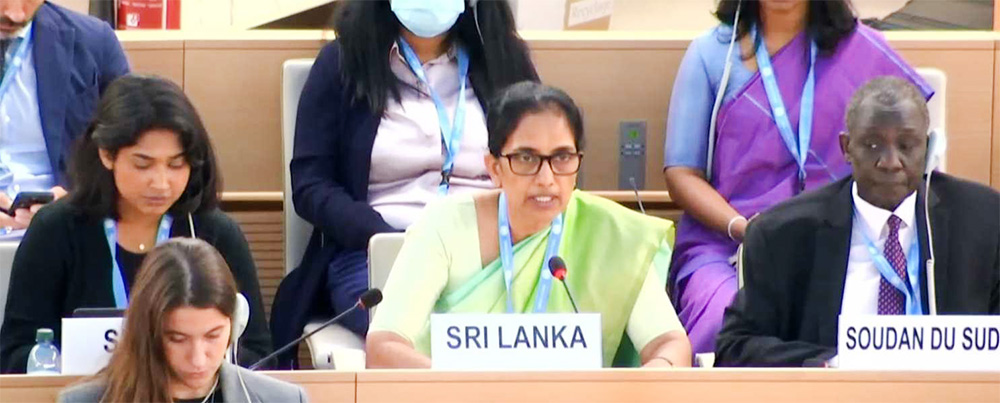
Himalee Subhashini Arunatilaka speaking at UNHRC, Geneva
Sri Lanka’s Permanent Representative to the UN in Geneva, Himalee Subhashini Arunatilaka, in her statement to the HR Council stated that Sri Lanka has consistently rejected Resolutions 46/1 and 51/1”, because Sri Lanka is in fundamental disagreement with its unacceptable content in particular the so-called evidence gathering mechanism, the establishment of which is unprecedented”. Furthermore, Sri Lanka added that it goes beyond” the Mandate conferred by the General Assembly on the Human Rights Council by UNGA Resolution 60/251 in 2006.
The UNGA Resolution 60/251 that set up the Human Rights Council in 2006, to replace the Commission that had existed until then, has no mandate to collect evidence relating to the Human Rights situation in any Member State. All it has in para. 5 (e) is: Undertake a universal periodic review, based on objective and reliable information of the fulfilment by each State of its human rights obligations and commitments in a manner which ensures universality of coverage and equal treatment” (emphasis added). It is therefore clearly evident that the HRC has taken a unilateral decision to graduate from objective and reliable information” stated in 5 (e) of its Mandate to an accountability project” that involves collecting, consolidating, analyzing and preserving information and evidence.
The decision to unilaterally extend and reinforce the capacity of OHCHR in this manner is not only unprecedented” as stated by Sri Lanka, but also underscores the fact that no prior precedent had existed in respect of any other country prior to this decision by HRC to single out Sri Lanka in complete violation of the principle of universality of coverage and equal treatment” of all States as stated in the HRC Mandate. Since equal treatment of all States is one of the key pillars of the Charter and the entire edifice of the UN system, it is unlikely that the UN General Assembly would have been a party to extending and reinforcing the capacity of the OHCHR without formally revising the mandate of the HRC
If the UNGA had given its blessings informally, its own accountability is in serious doubt. On the other hand, IF the HRC’s decision was unilateral the legitimacy of Resolution 46/1 is questionable, thus making the entire exercise of strengthening HRC capacities and the exercise of evidence gathering unlawful, for which the Council has to be held accountable. Furthermore, the States that sponsored Resolutions 46/1 and 51/1 and those that voted in support, are complicit in participating in an exercise that unilaterally amends Mandates conferred by the General Assembly; an act that undermines its own credibility as for its capacity for due process. Therefore, while Sri Lanka’s Representative should be commended for raising the issue that the HRC has gone beyond its Mandate, the opportunity should have been seized to bring to the attention of all the Members of the HR Council the legitimate grounds why Sri Lanka consistently rejected Resolution 46/1 and 51/1 is because these Resolutions have been authenticated without seeking the authority of the UN General Assembly thus violating established practices that are identified with Institutions of the UN.
RESOLUTION 46/1
According to an explanatory note by the OHCHR the Human Rights Council Mandate, under which the team will operate, is not limited to violations and abuses by a particular party to the conflict or to particular victims, a particular period in time, or any one geographic area of Sri Lanka. It will collect, consolidate, preserve and analyze information and evidence on violations and abuses of international law regardless of which parties or individuals are alleged to have committed them ….”
In exercising its mandate, it will be possible to provide information to parties in criminal or civil proceedings in national, regional or international courts of competent jurisdiction ….”
Accordingly, the OHCHR appointed team” would be collecting so-called evidence without limiting it to a period of time or area of Sri Lanka and regardless of who was responsible for them. It is this evidence that would be analyzed and made available to parties engaged in civil or criminal proceedings by courts with competent jurisdictions.
Sri Lanka has serious doubts as to the authenticity of the evidence gathered given the complexities involved. For instance, during the period February 2002 to May 2009 the conflict in Sri Lanka was categorized as an armed conflict by none other than the OHCHR in their report of 2015. Thus, as for an armed conflict, the report states that the applicable law is Common Article 3 to the four Geneva Conventions, which means any violations or abuses committed during the armed conflict must be judged under provisions of International Humanitarian Law and derogated Human Rights Law during a declared emergency as provided by ICCPR that operated from May 2000 to June 2010. On the other hand, since the state of emergency applied to all of Sri Lanka, the derogated Human Rights apply throughout Sri Lanka from May 2000 to June 2010. These complexities, not to mention the lapse of over 15 years makes the authenticity of the evidence gathered highly questionable.
DEROGATED HUMAN RIGHTS
The derogated Human Rights under emergency rules as permitted by ICCPR provisions are:
Articles 9 (2); 9 (3); 12 (1); 12 (2); 14 (3); 17 (1); 19 (2); 21 and 22 of the ICCPR.
Article 9 (2): Anyone who is arrested shall be informed, at the time of arrest the reason for the arrest…”.
Article 9 (3): Anyone arrested or detained on a criminal charge shall be brought before a judge ….”
Article 12 (1): Everyone lawfully within the territory of State shall have the right to liberty of movement…”.
Article 12 (2): Everyone shall be free to leave any country, including his own”.
14 (3): In the determination of any charge, everyone will shall be entitled to: informed promptly; time to prepare defence; tried without delay; tried in his presence; to examine witnesses against him; access to an interpreter; not to testify against him”.
Article 17 (1): No one shall be subjected to arbitrary or unlawful interference with his privacy, family, home or correspondence nor to unlawfully attack his honour….”
Article 19 (2): Right to freedom of
expression ….”
Article 21: …right to peaceful
assembly ….”
Article 22: …right to freedom of
association ….”
The OISL report concludes the list of derogated human rights during the period of the armed conflict by stating: Measures taken pursuant to derogation are lawful to the extant they comply with the conditions set out in international human rights law as provided in Article 4 of ICCPR. This Article states: In times of public emergency which threatens the life of the nation and the existence of which is officially proclaimed, the State Parties to the present Covenant to the extent strictly required by the exigencies of the situation, provided that such measures are not inconsistent with their other obligations under international law ….”
In keeping with this provision successive Sri Lankan Governments have derogated over a period of 10 years, 9 Articles out of a total of 19 Articles in Part III of the ICCPR that the OISL has declared as being lawful. Despite the adoption of such lawful measures it is only by making Members of the HR Council aware of the extent to which Sri Lanka has gone, that its image could be made to be seen in a more favourable light.
IMPLICATION of NON-COORPORATION
In her highly commendable statement made by Sri Lanka’s Representative in Geneva said: Many countries have already serious concerns on the budgetary implications of this Resolution given its dubious mandate. Sri Lanka has repeatedly pointed out that this is an unproductive and unhelpful drain on the resources of the Council and its Members. For all the reasons stated above, Sri Lanka will not cooperate with it.”
The stand of non-corporation taken by Sri Lanka, if it means having to gather evidence without visiting Sri Lanka, would present not only logistical issues but also impact on the quality and acceptability of the evidence in a Court of Law, particularly after the lapse of 15 plus years. Furthermore, whatever evidence that is gathered has to be undertaken not only while being outside Sri Lanka, but also from sources outside Sri Lanka. How authentic would such evidence be without the ability to verify it on the ground?
The intention of the accountability project is to provide information to parties in criminal or civil proceedings in national, regional or international courts ….” A fact that has to be borne in mind is that since the overwhelming majority of violations and abuses occurred within the territory of Sri Lanka, the primary applicable Law is the Penal Code of Sri Lanka backed by International Customary Law with other Laws acting in their complementary capacities. Whether such courts have the required competency to function effectively is in serious doubt.
CONCLUSION
While it must be acknowledged that the stand taken by Sri Lanka and forcefully articulated by Sri Lanka’s Representative in Geneva was highly commendable, the question that needs to be asked is this: What has caused the issue of accountability to reach such unprecedented” proportions? Is it the refusal by successive governments to accept that the conflict was a non-International armed conflict as in Common Article 3 of all Geneva Conventions advocated by OHCHR and the applicable framework to address accountability is International Humanitarian law along with derogated Human Rights Law, or was it the misguided notion that accountability should be addressed from a Human Rights perspective e. g. LLRC, because the focus was on reconciliation? The Foreign Ministry has consistently adopted the latter approach and couched the two approaches as Political vs. Legal. Is it this divergence of approaches to address accountability that is the cause for the current state of affairs?
While one can argue for and against either approach, the legal approach resonates with the OHCHR, while the political does not. However, one fact that stands out as a sore thumb is the failure to harness an effective team to articulate Sri Lanka’s position consistently among individual Members of the Council. Instead, the approach has been an individual effort by committed members of the Foreign Ministry. For instance, how many in the Council or the Ministry would know the difference between International Humanitarian Law and Human Rights Law. How many in the Ministry or in the Council would know the extent to which Sri Lanka derogated Human Rights during the armed conflict in keeping with ICCPR provisions. The common opinion in the Ministry is that since Sri Lanka has not ratified Additional Protocol II, its provisions are not applicable to Sri Lanka. They are unaware that the ICJ downward accept Protocol II as part of Customary Law.
Therefore, there is an urgent need to revisit the road Sri Lanka has taken thus far and organise a team that could consistently present to the members of the UNHRC an accurate narrative as to how Sri Lanka conducted itself during and after the armed conflict and also bring to their attention the fact that Resolutions 46/1 and 51/1 are products of a mandate conceived beyond the Mandate conferred by the General Assembly, the consequences for which the HRC has to be held accountable.
වැල් පාළමේ පැද්දීම ආර්ථික පරිවර්තනීය ගමනක් ද?
June 20th, 2024මතුගම සෙනෙවිරුවන්
ජාත්යන්තර මූල්ය අරමුදලේ ණය ලබා ගැනීම සහ ඔවුන් විසින් නිර්දේශ කරන ලද ආර්ථික මග අනුගමනය කරනු වස් වර්තමාන ආණ්ඩුව ආර්ථික පරිවර්තන පනතක් ගෙනවුත් තිබේ.මෙම පනත ව්යවස්ථාවට එකඟද නැතිද යන්න මේ වන විට ශ්රේෂ්ඨාධිකරණයෙන් සළකා බලා ඇති අතර එය ඉදිරියේ දී ප්රකාශයට පත් කරනු ඇත. විශේෂයෙන්ම එම පනතේ සඳහන් විදේශ ආයෝජකයා සහ දේශීය ආයෝජකයා ට ලැබෙන සමාන ඉඩ ප්රස්ථා පිළිබඳ තත්වය අභියෝගයට ලක්ව ඇත.
ලංකාවේ ආර්ථිකය ඉතා බෙලහීන තත්වයක තිබෙන බව කවුරුත් දන්නා කරුණකි.කාලයක් තිස්සේ අනුගමනය කරන ලද වැරදි ආර්ථික ප්රතිපත්ති අයවැය සමතුලිත කිරීමට සහ යටිතලපහසුකම් සංවර්ධනයට ලබා ගත් ණය මෙන්ම නාස්තිය දූෂණය වැනි කාරණා නිසා මෙලෙස මෙරට ආර්ථිකයේ විශාල පසුබෑමක් වාර්තා වී ඇත.මේ සඳහා වන එකම විකල්ප මාර්ගය ජාත්යන්තර මූල්ය අරමුදලෙන් ලබාදෙන ණය මත නිර්දේශිත මාර්ගය බව ආණ්ඩුවේ මතයයි. ණය ගෙවීම පිණිස ණය ලබා ගැනීම යනු බැංකු කටයුත්තකදී නම් මහත් අවදානම් කාරණයකි.පුද්ගලයෙකුට ඉන් ගොඩ යෑමට හැකි වන්නේ ඔහුගේ ව්යාපාරික වටිනාකම් එක පැහැර ඉහළ ගියහොත් පමණකි.ලංකාවේ ආර්ථිකය තුළ උදාව තිබෙන තත්වය අනුව එවැනි විශ්වකර්ම නැග්මක් දකින්නට බලාපොරොත්තු විය නොහැකිය.
1833 දී ලංකාවට පැමිණි කෝල්බෘක් සහ කැමරන් සාමි වරුන් විසින් ඉදිරිපත් කරන ලද ආර්ථික ප්රතිසංස්කරණ මාලාව අනුව මෙරට ස්වයංපෝෂිත ආර්ථිකය උඩුයටි කුරු කරන ලද්දේය.ජනතාව භූමියෙන් බැහැර කොට මුදලක් ගෙවන සේවකයෙක් බවට පත් කිරීමේ අභිප්රායෙන් රාජකාරිය අහෝසි කොට ආර්ථික වික්ෂිප්ත තත්වයකට ඇද දැම්මේය. එහි ප්රතිඵලය වූයේ ගැමි කෘෂි ආර්ථිකය කඩා වැටීමයි. වාර්මාර්ග බිඳ වැටීම සහ ඒ මතින් පැණ නැගුණු වසංගතතත්වයන් මත ඇතිවූ සෞඛ්ය පිරිහීම නිසා ඉංග්රීසීන්ට විශාල අභියෝගයක් ඇති විය.ඊට වහා ප්රතිකර්ම යෙදිය යුතු බව ඔවුන්ට වැටහී ගියේය.අනතුරුව විවිධ අණ පනත් මගින් ලංකා භූමිය අත්පත් කර ගැනීමට ඉංග්රීසීන් දක්ෂ විය.1840 අනවසර ඉඩම් ආඥා පනත 1889 බෞද්ධ විහාර ඉඩම් ආඥා පනත 1897 මුඩුබිම් ආඥා පනත ආදිය මේ අතර විය.ඒ ඉඩම් වැවිලි ආර්ථිකය සඳහා විකුණා දැමින. ඉඩම් අහිමි ගොවීන් ගේ දුක් අදෝනා අසන්නට කිසිවෙකු සිටියේ නැත. උඩරට හදබිම වනසා කෝපි තේ සහ පසුව පහතරට රබර් ආදේශ කිරීම නිසා මෙරට ජාතික ආර්ථිකය සහමුලින්ම බිඳ වැටුණි.එදා සිට අද දක්වා ක්රියාත්මක වන ආර්ථික ප්රතිපත්තීන් අතර මේ යටත් විජිත ආර්ථික ප්රභවයන් අඩු වැඩි වශයෙන් දක්නට හැකිය. 1977 විවෘත ආර්ථික ප්රතිපත්ති පවා බ්රිතාන්ය කොලණි ආර්ථිකයේ දිගුවක් විලස හැඳින්විය හැකිය. වර්තමාන ආර්ථික පසුබෑමට හේතු සාධක ඇති වන්නේ මෙකී යටත් විජිත ආර්ථිකය බරවා කකුළක් ලෙසට පවත්වා ගෙන යෑම මිසක එය පදනම් ව නිර්මාණය වූ වංචාව දූෂණය ආදී මානව ක්රියාකාරකම් නිසා නොවේ.ඒ නිසා සැබෑ ආර්ථික පරිවර්තනය යනු මෙකී යටත් විජිත ආර්ථිකයෙන් බැහැර ව කල්පනා කරන ඒ පිළිබඳ සැලසුම් සකස් කරන ප්රතිපත්ති සම්පාදකයන්ට අවස්ථාව දීමක් විය යුතුය.ඒ පර්වර්තනයට පදනම් විය යුත්තේ මූලිකවම ලංකාවේ දළ ජාතික නිස්පාදනය යන යටත් විජිත මෙවලමයි. ඒ වාක්ය නැවත නිර්වචනය කිරීම තුළ අපට ගැලපෙන ජාතික ආර්ථික සැලැස්මක් සකස් කර ගැනීමට මාවත සැකසෙනවා නියතය. වසරක කාලයක රටක නිෂ්පාදනය වන භාණ්ඩ හා සේවා වල මූල්යමය වටිනාකම දළ ජාතික නිෂ්පාදිතය ලෙසට සැළකේ. එනම් කිසියම් කාල සිමාවකදි යම් නිශ්චිත භූගෝලීය ප්රදේශයක් තුළ නිශ්පාදනය කෙරෙන අවසාන භාණ්ඩ හා සේවා වල වටිනාකමයි . රට වැසියන්ගේ පරිභෝජන වියදම, ව්යාපාර වල ආයෝජන සහ රජයේ වියදම් වලට අපනයන වලින් ලැබෙන ආදායම යන සියළු අංශ එකතු කිරීමෙන් පසු ලැබෙන අගයට විදේශ වෙළඳාමේ වාසිය හෝ අවාසිය එකතු කෙරේ. විදේශ වෙළඳාමේ වාසිය හෝ අවාසිය සේ සලකන්නේ අපනයන ආදායමෙන් ආනයන වියදම් අඩු කරන ලද විට ලැබෙන උත්තරයයි. ගණනය කිරීමෙන් පසු ලැබෙන අගය සාමාන්ය දළ දේශීය නිෂ්පාදිතය සේ සලකයි.
1936 දී එළි දුටු කේනිසියානු ආර්ථික මූල ධර්ම සහ නව කේනිසියානු නිගමනයන් අනුව 1960 දශකයේ සිට ක්රියාත්මක මෙම ආර්ථික මූල ධර්මයන් සකස්ව පවතින්නේ වෙළෙඳ පළ ක්රමය ප්රවර්ධනය කිරීමට පමණි.ඒ මත යම් කිසි බලවත් රටක මූල්ය ඒකකය පදනම්ව ආර්ථිකය හැසිරවීම සිදු වේ. අතීතයේ දී ලංකාවේ ආර්ථිය හසුරුවන ලද්දේ පිරිවැය මූලික කරගත් නෛසර්ගික මූල්ය ඒකකයක් මගිනි. තඹ කාසි හෝ රන් කාසි ඒ සඳහා අච්චු ගසන ලදහ. රටින් බැහැරට යන අමුද්රව්ය මෙන්ම රටට පැමිණෙන අමු ද්රව්ය මිළ දී ගනු ලැබූයේ ඒ පිරිවැය මූලික කරගත් මුදල් ඒකක මගිනි. වර්තමානයේ දී මහ බැංකුව විසින් අච්චු ගස්සවන කාසි වලට හෝ නෝට්ටු වලට එවැනි නෛසර්ගික මූල්යමය වටිනාකමක් නැත. ඒවා කඩදාසි වශයෙන් සහ ලෝහ කැබලි වශයෙන්ද ගණන් ගත හැකිය. නමුත් මහ බැංකුව විසින් සම්මතයක් නියම කර ඇති හෙයින් ඒවාට මූල්ය වටිනාකමක් ලැබේ. එහෙත් ඩොලර්යට සාපේක්ෂව මේ වටිනාකම් වෙනස් වන ආකාරය කවුරුත් දනී. වෙළෙඳපළ ක්රමය ට සාපේක්ෂව ක්රියාත්මක දළ ජාතික නිෂ්පාදනයට නොවැටෙන නොසලකා හැර තිබෙන ආර්ථික මූලයන් රාශියක් ලංකාවේ තිබේ. ධාන්ය එක් රැස් කිරීම එකකි. ස්වභාවිකව ලැබෙන ආහාර තවත් එකකි. අතීතයේ දී ධාන්ය රැස් කිරීමට සහ ඒ මගින් ආර්ථිකයට සවියක් වීම සඳහා ධාන්ය බැංකු ක්රමයක් ක්රියාත්මක විය. තෝනිගල ශිලා ලේඛනය ඊට උදාහරණ සපයයි.තැන්පත් කරන ලද ධාන්ය ප්රමාණය හුවමාරු කිරීමෙන් හෝ අලෙවි කිරීමෙන් ලැබෙන පොළිය අරියවංශ දේශනාව පැවැත්වීමට යෙදවීය යුතු යැයි එදා රජ අණ විය.තිඹිරිවැව ලිපිය සහ මිහින්තලා මහා සෑය ට පහළින් ඇති ලිපියක ලැබෙන ආදායම කොටස් හතරකට වෙන් කර බෙදා දෙන ආකාරය දක්වා තිබේ.මේ ක්රම එක්තරා ආකාරයක වෙළෙඳ පළ ක්රමයකි. පිරිවැය මත පදනම්ව ආර්ථිකය තීරණය කරන ක්රමයකි. මේ ක්රමයම වර්තමානයට ගැලපෙන සේ පරිවර්තනය කර ජනතාව සතු වත්කම් රටේ ආර්ථිකයට ප්රයෝජනවත් පරිදි යෙදවිය හැකිය. එවිට දළ ජාතික නිෂ්පාදිතයට කාෂිකර්මයේ දැනට තිබෙන දායකත්වය වන සියයට හයේ ප්රතිශතය සීඝ්රයෙන් වර්ධනය කර ශක්තිමත් මට්ටමකට පැමිණවිය හැකිය.දැනට තිබෙන සේවා ආර්ථිකයට ඒ සඳහා යටිතල පහසුකම් සැපයීමට මේවායින් පළක් නැතැයි යමෙකුට කියන්නට හැකිය.එහෙත් ඒ කොයිවත් කළමනාකරණය කර ගත හැක්කේ අලුත් ආකාරයකට සිතීමෙනි.
ණය ගැනීම සහ පරිභොජ්නය පිළිබඳ මෙරට බෞද්ධ ආර්ථික ක්රමවේදයක් අවුරුදු දහස් ගණනක සිට අත්හදා බලා තිබේ. සිඟාලෝවාද සූත්රයේ එන පරිදි තමන් උපයන ආදායමින් එක්කොටසක් පරිභෝජනයටද කොටස් දෙකක් ව්යාපාර සහ ගොවිතැන් කටයුතු සඳහා යෙදවීමටද අනෙක් කොටස අපදාවකදී ගැනීමට ඉතිරි කර තබා ගත යුත්තේය යන උපදේශය දී ඇත. ගිහියෙකු ගේ මෙලොව දියුණුවට අවශ්ය උපදෙස් ද ව්යග්ඝ පජ්ජ සූත්ර දේශනාවේ ඇත. විශේෂයෙන්ම ආරක්ඛක සම්පදා සහ සම ජීවිකතා යන කාරණා දෙක සළක බැලුවහොත් ලබාගන්නා ආදායම ආරක්ෂා කර ගන්නේ කෙලෙසද ආදායම ඉක්මවා වියදම් නොකරන්නේ කෙසේද ණයක් නැතිව වැය කර ගන්නේ කෙසේද යන්න උගන්වයි. මේ උපදේෂයන් අද නොසලකා ඇත. ජාත්යන්තර මූල්ය අරමුදලෙන් ණය රැගෙන රටේ එදිනෙදා වියදම් වලට වැය කර ආර්ථික දියුණුවක් ලබන්නේ යයි ප්රකාශ කරති.එය වැල් පාළමේ ගමනක් යයි උදම් අනති.අවසානයේ මුදල් නැති නිසා රට පුරා සුරාසැල් විවාත කර සුරාබදු ආදායමෙන් රට කරවන්නට සිතා ගනිති. මේවා මහා අපරාධයන්ය. සැබෑ ආර්ථික පරිවර්තනයකට යෑමට නම් අප අපගේ මූලය සොයා යා යුතුය. යටත් විජිත ආර්ථිකයෙන් ගැලවී ජාතික ආර්ථිකයක් නිර්මාණය කර ගැනීමට උත්සුක විය යුතුය.උට්ඨාන සම්පදාව ඇත්තේ ඒ සඳහාය.
මතුගම සෙනෙවිරුවන්
ON ROUTE TO PRIVATIZE SRI LANKA RAIL, PROMOTING ELECTIC VEHICLES (EVs)?
June 17th, 2024Deshika Mendis
I write this because I love travelling by train and am very sad about the condition of Sri Lanka Railways and train travel in this beautiful island. In recent times, several of my planned trips had to be cancelled causing great inconvenience due to sudden service disruptions, including derailments, breakdowns and train cancellations.
Train travel is both cost-effective and environment friendly. Trains carry a large number of passengers and hence cause lower Carbon emissions per capita than do cars. A country like Sri Lanka, caught in a Eurobond debt trap and subject to International Monetary Fund (IMF), austerity programs should ensure that good Public Transport is available and a National Policy Priority.
Several studies have shown that labour force participation, particularly of women, increases when there is good public transport available.
Derailments, Accidents, Cancellations: Privatization on the Cards?
However, given a high number of mysterious ’accidents”, derailments, delays and outright cancellations (listed below), and the halting of the Colombo-Jaffna Yal Devi train for Six months purportedly to repair a small part of the track (from Maho to Anuradhapura), there appear to be coordinated attempts to sabotage Sri Lanka Railways (SLR), at this time.
Is SLR being turned into a ‘loss- making enterprise’, in order to privatize it? There is after all an ongoing IMF Firesale of State Owned Enterprises (SOE), and national infrastructure and assets including profit-making SOEs like Sri Lanka Telecom at this time. Simultaneously, the Government of Sri Lanka (GoSL), is promoting the import of expensive Electric Vehicles (EVs), rather than urgently make Public Transport, particularly, investing in and upgrading the Sri Lanka Railways a top Development Policy priority at this time.
Of course, the Sri Lanka Railways that started operating in the 1850s still carries out a valuable service to the nation but it could be far more efficient, effective, modern, and passenger friendly. There is an urgent need for a reliable train service to better serve passengers, whether occasional travelers or daily commuters, in addition to upgrading and maintenance of many stations with a high volume of passengers, such as the Colombo Fort station.
Yal Devi Out of Action
The Colombo-Jaffna Yal Devi Train has not been running since January this year due to purported construction of the Railway line between Mahawa and Anurdhapura. Passengers are forced to take private coaches instead.
The Maho-Anuradhapura stretch constitutes 67 killometers of the 405 Km Colombo-Jaffna trip. Should this railway line upgrade, which just one sixth of the entire Colombo Jaffna route, take so long and are they now using the absolutely predictable arrival of the South West Monsoon Rains in May to further delay this construction and the operation of the Yal Devi?
Last year when a friend and I tried to take the early morning train from Batticaloa back to Colombo it was suddenly cancelled. We discarded the tickets and hired a car for our trip back to Colombo. So too, last year, my one and only train journey on the Kandy Intercity Express train from Colombo to the University of Peradeniya had to be aborted when a lorry purportedly got stuck across the train tracks and the Intercity express train was delayed by 4 hours. I was unable to reach the meeting on time.
Reducing Train Passenger Volumes and Marketing EVs
In the wake of the economically devastating two years of Covid-19 Lockdown and Economic Meltdown when the Railways was shut down and infrastructure crumbled, there appear to be (hybrid) attempts to sabotage train travel, reduce passenger volumes and privatize Sri Lanka Railways.
SLR has a lot of valuable state lands. Is SLR being turned into a loss- making enterprise, in order to privatize it — in line with the International Monetary Fund’s Firesale and privatization of State Owned Enterprises (SOE) without a proper accounting of SLR’s assets and liabilities.
Privatization of SOEs are being done without a proper accounting of their ‘assets’ and ‘liabilities’ in a context where the IMF conveniently does not differentiate between the ‘illiquidity” and ‘insolvency’ of a country or in the rush to declare ‘bankruptcy’ and sell assets! Meanwhile, BlackRock which is Sri Lanka’s largest private creditor/vulture fund is on a global infrastructure buying spree.
The Millennium Challenge Corporation (MCC), project which was aborted in 2019 had targeted the Sri Lanka Railways, also with a proposal for a train track from the BIA International Airport in the Southwest of strategic Sri Lanka to the Trincomalee Harbour on the North East Coast.
Rather than rushing to buy expensive Electric Vehicles (EVs) , marketed by the US, European Union and China as they engage in EV tariff wars and blame games), amid a staged Anthropocene climate catastrophe” promoted by various United Nations Agencies, EV and other Greenwash Corporations, profiting from a lucrative Green Energy Transition, the Government of Sri Lanka should urgently make Public Transport, particularly, investing in and upgrading the Sri Lanka Railways a top development priority at this time.
Indeed, the current EV trade war between the West and China is reminiscent of the Covid-19 Emergency Use injections trade war, when their big Pharma companies made huge profits during the economically devastating Covid-19 Panicdemic Lockdowns. Three years later there is growing evidence now that mRNA injections causing significant adverse reactions, injuries and excess deaths.
Inquiry Needed: Multiple Causes for Train Disruptions Erosion of Public Trust:
Disruption of Sri Lanka Railways at this time appear be both internally and externally driven: These include strikes and labour union activities and actions or inaction of other railway employees. There have also been apparently random incidents of lorries running into train infrastructure or trees falling across railway lines, as well as, staged climate ‘disasters”.
Given the high number of disruption in the Railway services which appear to form a pattern, it is incumbent on the Minister of Transport to conduct an inquiry and analysis of the entire railway system and infrastructure in a systematic fashion. So too, should not the head of SLR take note of and act upon the regular disruptions and delays of the Sri Lanka Railways, also given the inconvenience caused to Passengers?
Given the incredible list of seemingly small and random train accidents and incidents (listed below), in the past few months that appeared in major newspapers, the question arises do these amount to a pattern? Are there subtle attempts to sabotage the Sri Lanka Railways (SLR), damage passenger confidence, reduce the number of passengers and the SLR’s profits and then privatize it also given valuable land holdings?
Please see below a random sample from the national newspapers of incidents that have caused delay and disruption of Sri Lanka Railway services in the past months and make your own assessments.
June 13, 2023
Derailment disrupts train services on coastal line June 13, 2024 Ada Derana News
A slow train plying from Panadura to Maradana has derailed near the Panadura railway station, disrupting services on the coastal line, Sri Lanka Railways announced. Accordingly, the trains operating on the coastal line will experience delays, according to Sri Lanka Railways.
One of the compartments of the derailed train has collided with a nearby railway signal board, causing a complete breakdown of the railway signaling system in the area. Meanwhile, a spokesperson for Sri Lanka Railways stated that it will take a considerable amount of time to restore the railway line for regular train operations.
https://www.adaderana.lk/news.php?nid=99852
———————————————-
June 9, 2024 Daily Mirror
Ongoing Railway Strike disrupts Services: Colombo, June 9 (Daily Mirror) – A total of 35 trains were canceled this morning due to the ongoing strike by the Sri Lanka Railways Locomotive Operating Engineers’ Union.
05 Jun 2024 The Morning Newspaper
Train services delayed due to derailment: Train services between Colombo Fort and Maradana were delayed due to a derailment today (5), according to the Department of Railways Accordingly, due to the derailment, the train services will operate with a considerable delay.
https://www.themorning.lk/articles/3gtfDsTVuEJX7bIVT15G
_____________________________________
June 2, 2024 Daily Mirror
Bridge collapse disrupts Kelani Valley Railway Services
(Daily Mirror)- Train services on the Kelani Valley line have been severely disrupted following the collapse of a bridge between Waga and Kosgama. The collapse has forced Sri Lanka Railways to limit train operations on the line to Waga station.
May 25, 2024 Ada Derana New
Fallen trees and signal failures continue to disrupt train services: The night mail trains to and from Badulla and other special trains on the up-country line have been cancelled today (25) due to trees and rocks falling onto the tracks, Sri Lanka Railways announced.Meanwhile, Deputy General Manager of Railways, N.J. Indipolage, stated that over 15 incidents of trees falling on to the rail tracks have been reported so far.
Additionally, power interruptions have caused critical issues in maintaining the railway signaling system, especially beyond Nanu Oya railway station, he added. The Department of Railways also urged motorists to be vigilant while driving across railway crossings, as signal failures are possible at level crossings due to power breakdowns. Drivers are advised to be cautious when crossing level crossings if there is no signal or if the electric bells continue to ring with only a red signal at the crossings.
https://www.adaderana.lk/news.php?nid=99431
April 24, 2024 Hiru News
Train Services Disrupted on Mainline
Train services on the mainline have been disrupted following a breakdown of a train from Mahawa to Colombo at Ambepussa according to the Railway department. The Incident has led to delays and cancellations affecting commuters on this route
https://www.hirunews.lk/english/366516/train-services-disrupted-on-main-line
March 21, 2024 Train derailment disrupts coastal line operations in Sri Lanka
COLOMBO, March 20 (Xinhua) — Sri Lanka’s Railway Department had to cancel 18 trains on Wednesday morning in the country’s coastal line due to the derailment of a train between Colombo Fort and Kompannaveediya railway stations on Tuesday evening, a senior official said.
______________________________________________________
January 15, 2024
Train on upcountry line derailed January 15, 2024
The special express train operating from Badulla to Kandy has derailed.The train has been derailed between the Nanu Oya and Great Western railway stations, the Department of Railways said.
————————————
December 9, 2023
Trains between Colombo and Jaffna to be suspended for 6 months
https://www.newswire.lk/2023/12/09/trains-between-colombo-and-jaffna-to-be-suspended-for-6-months/
Sri Lanka Railways department has announced the temporary suspension of train services between Colombo and Jaffna/ Kankasenthurai due to maintenance work.
Issuing a notice, the railway department said that the 2nd phase of the scheduled maintenance work in the northern railway line will be carried out between Mahawa and Anuradhapura Railway Stations.
The maintenance work will be carried out from 7th January 2024 and expected to be completed within a period of 6 months.
Therefore, the department has announced that during this period trains will be running from Colombo Fort to Mahawa Railway station and from Kankesanthurai to Anuradhapura only (NewsWire)
WHEN WILL THE YAL DEVI TRAIN BETWEEN COLOMBO AN JAFFNA START RUNNING?
Should train-track repairs take so long? What are the SL Railway Authorities upto?!
Finance Ministry issues clarification on proposed imputed rental income tax
June 17th, 2024Courtesy Adaderana
Sri Lanka’s Ministry of Finance, Economic Stabilization and National Policies states that the recent publication of the International Monetary Fund (IMF) supported Extended Fund Facility (EFF) programme related documents make reference to a proposed property tax is to be implemented as an imputed rental income tax.
Issuing a clarification on certain speculations and misconceptions regarding the relevant tax, the Finance Ministry said that one of the key reasons for Sri Lanka’s deep, complex and unprecedented economic crisis is the sharp decline in government tax revenue that led to high budget deficits and resultant escalation of public debt to unsustainable levels.
Accordingly, the remedial measures to recover from the crisis have entailed a focused effort to improve the revenue of the government. Revenue based fiscal consolidation has been implemented during the last two years in an attempt to bring Sri Lanka’s government revenue from a record low 8.3% of GDP in 2022 to 15% of GDP by end 2025”, it added.
Meanwhile, the statement highlighted that: In the year 2023, tax reforms focused on progressive corporate and personal income tax measures. In 2024, revenue enhancement is supported by Value Added Tax (VAT) reforms, including elimination of most exemptions and rate adjustments. Thus far, the revenue targets for 2023 have been largely met and target for 2024 is on track to reach the required level of 13.5% of GDP by end 2024. Therefore, there remains 1.5% of GDP revenue gains expected in 2025 in order to reach the 15% of GDP revenue target.”
Furthermore, the Finance Ministry explained that the main revenue measure expected to help achieve the 2025 target is a wealth tax that is focused on property.
From the outset of the IMF programme approval in March 2023, the revenue measures expected in 2023, 2024, and 2025 have been clearly presented in the public domain. The envisaged property tax is in an advanced stage of design and therefore, it is premature to outline specific details of rates and thresholds”, it mentioned.
The Ministry expressed that however, the focus of this tax is on high wealth individuals, and not on average income earners. This objective will be achieved by a suitable tax-free threshold to ensure that the tax is targeted on very high value property or multiple properties that are owned by wealthy members of society”, it added.
This specific targeting is evidenced by the fact that the tax is expected to yield 0.2% of GDP by 2025 and 0.4% of GDP in a full year in 2026. The design of the tax will also ensure appropriate set off mechanisms to avoid double taxation and any elements that distort economic incentives”, as per the statement issued by the ministry.
Moreover, the statement pointed out that the property taxes are implemented in many countries including developing countries like India since they are considered to be a highly efficient, progressive, and non-distortive means of generating revenue to fund public services.
The tax is expected to go through the regular legal process of amendments to the required legislation and is expected to come into force in April 2025. In addition to completing the legislative process, there is significant administrative work required to be done in terms of improving valuation mechanisms and databases in order to implement this proposed tax measure that was first announced in March 2023 with the publication of IMF programme documents”.
In fact, that is not a new tax measure. The Inland Revenue Act No. 10 of 2006 included a similar imputed income calculation termed Net Annual Value”, it added.
The Ministry also stated that the property in Sri Lanka is also subject to existing taxes such as local authority Rates and Stamp Duty – therefore, there is significant precedence for such a property tax.
The continued improvement of government revenue and associated reduction in budget deficits has supported the government’s efforts to restore economic stability, and has helped bring down interest rates and support appreciation of the currency, which brings with it material improvements to all citizens”, it said.
Additionally, the Finance Ministry stated that a failure to reach the required level of government tax revenue that can fund public expenditure would lead to a recurrence of the economic crisis that had devastating impacts on the entire country.
KD buffaloeing KDLK
June 16th, 2024By Rohana R. Wasala
Praise to Kumar David (Quo vadis?/Sunday Island/June 2, 2024) for writing such an entertaining and informative essay. It is hoped that the ex-professor will forgive me for being so presumptuous as to comment on his writing. He was grumpy on Vesak Day, he says, due to the rainy weather that prevailed that day. In his eighty years of life he had never experienced such a rain soaked Vesak before. It was the kind of weather that inclined the likes of him to a couch, according to him. Ensconced in his sofa, he wrote the essay in two parts mentioned above, instead of being a couch potato lazily watching a lot of television. No doubt, its hate filled humour made delightful reading for some readers who share his admirable mindset.
The first part of his essay is an indiscriminate stereotypical condemnation of ‘the 225’ (who certainly don’t deserve better) that the old woman speaking in ‘pristine Sinhala’ grumbles about having to feed. However, KD’s allusion to the biblical miracle of Jesus feeding 5000 with just five loaves of bread and two fish (Matthew 14: 13-21) has no relevance to the matter at hand. Actually, on that occasion, Jesus fed even more than 5000 (men, which KD is careful to leave out) for verse 21 actually says: ‘….. five thousand men, besides women and children’. Isn’t KD’s biblical freference really blasphemous, I wonder, because, while sharing the old woman’s anger at the 225, he was filled with simmering hate at the ‘infamous’ 69 lakhs” (see below) who returned most of the 225 to parliament at the 2020 general election!
Where Jesus is mentioned there should not be any hate; there must only be love, compassion even for your worst enemy according to his teaching. On the other hand, KD’s venomous criticism of a large group of fellow humans based on unwarranted racial prejudice is a violation of the spirit of Vesak which celebrates the three hallowed events of the life of the Buddha, who preached, and practiced on all sentient beings absolute compassion and loving-kindness five centuries before Jesus taught his followers to ‘Love thy neighbour as thyself’. Perhaps KD is too irreligious (not believing in a religion) to have such qualms.
KD has a habit of pretending to be a Sinhala speaker or a Sinhalese (though he is ethnically a Tamil) in negative contexts, as I have noticed, especially when he wants to denounce the Sinhalese for their alleged racism. It is more than obvious that he loves to hate the ethnic Sinhalese for a plethora of other baseless reasons that he imagines as a spent Marxist of a bygone era. A native speaker of Sinhala will tell you that the Sinhala that KD puts in the mouth of the old woman does not sound like pristine Sinhala at all; it sounds more like Sinhala spoken by a Tamil speaker, going by how he transliterates into English those Sinhala words allegedly spoken by the old woman.
However, it didn’t take long for KD to understand what the old woman meant by talking about ‘having to feed the 225’: she was saying that rampant corruption among politicians was diverting the money away from the citizenry, the money that should be spent on them for allowing them to live a comfortable life free from want. The woman was not wrong in her criticism of corrupt politicians, but she was exaggerating the truth unnecessarily. Meanwhile, KD exonerates fewer than a dozen among the 225 from the charge of corruption. No objection to that. Even ‘a dozen’ could be an exaggeration in that context.
KD predicts that at the coming presidential polls, the battle will be between Ranil and Anura, with ‘Sajith wailing in the wilderness’, while the utterly hopeless SLFP and SLPP will find refuge with Ranil Wickremasinghe. Probably, KD is trying wishfully to discern emerging signs of such a pre-poll division of political loyalties that will be advantageous to RW. The gist of what KD wants to say in this section, as I understand it, is that the Anura-led faction will identify with the (in his possible estimation, retrograde) nationalist forces as KD hopes it will, and be routed by the Western oriented camp supporting Ranil; so he (Ranil) will eventually be elected as president, thereby reversing the nationalist victory achieved with the defeat of separatist terrorism in 2009, a victory that was not to KD’s liking. There are certain recent revelations that RW made before a group of legal professionals he addressed at the Presidential Secretariat on May 28, 2024 as reported in the press. RW’s claims sound almost similar to what NFF leader MP Wimal Weerawansa had earlier said in and out of parliament, and even wrote a book about, titled ‘Nine: the Hidden Story’ (April 2023). RW’s revelations were about certain alleged Western-led attempts to force him out of his premiership immediately after the former elected president Gotabaya Rajapaksa fled his official residence in Colombo on July 9, 2022 amidst violent chaotic scenes created by the so-called Aragalaya (Struggle), but before he formally quit his post. As Wimal Weerawansa had revealed before, Speaker Mahinda Yapa Abeywardane was coerced to take over as executive president, but only as a nominal head of state who could be led by the nose according to the whims of the powers that be. To his credit Mahinda Yapa refused to accommodate that unconstitutional demand of a particular foreign ambassador.
TNA MP Sumanthiran was seen among the Aragalists, advising them, apparently unchallenged, unlike a number of other MPs, including Opposition leader Sajith Premadasa of the SJB, who were actually physically attacked while trying to associate themselves with the evidently hijacked protest movement. This is something that suggested a link between the Aragalaya and the Tamil diaspora among other infiltrators.
KD was the progenitor of the ‘single issue candidate’ idea that was discussed just before the presidential election at the end of 2014. The choice he originally suggested then as a ‘single issue candidate’ was the late Maduluwawe Sobitha Thero of Naga Viharaya, Kotte, with his revolutionary but nonviolent reputation. This was against the venerable monk’s own conviction and the accepted wisdom prevailing then as now among ordinary Sinhalese Buddhist voters that a Buddhist monk is not suitable for that post and that he won’t stand a chance of winning at an election. Later, then incumbent war winning president Mahinda Rajapaksa’s right-hand man Maithripala Sirisena who, apparently, had been disgruntled with his boss for denying him the premier’s post that he coveted, betrayed him and decamped in order to challenge him as the single issue candidate, and the rest is history.
The JVP also contributed to the success of the foreign engineered regime change campaign that had co-opted Sirisena, and played an active role in the resultant Yahapalana government, though from a nominal opposition position. KD, being an elderly ex-Marxist sympathetic to that party, was believed by critics to have misled the half-baked Marxist JVPers to support the pro-West alliance. The above suggested contest between Ranil and Anura has been made more likely, according to KD, by ‘Buffalo Lal Kantha’s pronouncements’. KD calls Lal Kantha a buffalo not for the now well known, notoriously stupid statements of K.D. LalKantha of the JVP-NPP, but for the latter’s claim in support of the JVP as alleged by KD ‘that ……. only the JVP and the Udaya Gammanpila party took a stand against the Tamils, opposed any form of devolution and supported the military in the war against the Tigers’. In fairness to K.D. Lal Kantha, it should be stated that he would not have uttered such a thing. The JVP and Gammanpila (leader of Pivituru Hela Urumaya, PHU) never took and will never take a stand against Tamils for being Tamils; they only opposed Tamil Tiger terrorists, for whom KD’s coethnic empathy is understandable, and excusable. But KD’s innocuous looking piece of casual misinformation is a subtle attempt to recirculate the malicious lie that the government fought against the Tamil community, not, as it was the real case, against violent Tamil separatist terrorists. Members of the JVP and the PHU are not racists, unlike KD. Their attitude to devolution is not likely to be so inflexibly rigid either; they were against a form of devolution that could only be an easy step to separation.
It is only KD’s ingrained anti-Sinhalese Buddhist prejudice that has instilled such ideas into his hate imbued mind. KD adds that the ‘import of his (Lal Kantha’s) words is that ‘the JVP-NPP is going to be identified at the polls as a Sinhala party and this will have consequences. Will it draw the already radicalised Sinhala-Buddhist youth in larger numbers into the JVP camp or will it damage the JVP’s image? Time will show.’ What balderdash is this? If the JVP cannot attract anti-extremist peaceful Sinhalese Buddhist youth (those that the prejudiced call ‘radicalised’) and their counterparts in other communities into its fold, will it survive in politics, let alone save its image?
Where are these ‘radicalised Sinhala-Buddhist youth’, KD? There are none, as you know in your heart of hearts. Why don’t you dare even hint at the confirmed existence of internationally known radicalised youth belonging to certain fundamentalist cults, who have actually caused unspeakable unprovoked terrorist violence within Sri Lanka? Why do you level false allegations of violent extremism against innocent Sinhalese Buddhist youth? Actually, the false ‘radicalised’ label was stuck on some young peaceful Sinhalese Buddhist activists who warned against early signs of the emergence of some extremist Islamist groups whose activities eventually led to the 2019 Easter Sunday bombings.
The JVP-NPP is not a Sinhalese only party or alliance, but like any major pan-Sri Lankan national party, it has a majority of ethnic Sinhalese in its ranks as they form the majority of the total Sri Lankan population. But its leaders have already alienated the Sinhalese Buddhist voters by making inane utterances smacking of anti-nationalist prejudice in the hope of winning the approval of foreign interventionist forces and the minorities that they offer to look after as alleged victims of ‘Sinhalese Buddhist majoritarianism’ which is a malicious false fabrication against a hapless global minority. Only race- or religion-based parties have members who exclusively belong to a specific religious or racial group. It is not necessary to mention examples as these are well known to you KD and our readers.
Then KD makes an interesting revelation: ‘The monks went on an expedition to Europe and the US, sought out Tamil links such as the Global Tamil Forum and others and initiated a dialogue. The initiative is now in motion and grass-roots activities are in full swing. Important figures like Karu Jayasuriya (former Speaker), Austin Fernando, Sarvodaya, Jehan Perera’s National Peace Council and Pakiasothy Saravanamuttu’s CPA are involved. Branches have been established in many localities and an active movement is in swing.’ So, is that why the present Canadian government leaders have declared an utterly baseless Tamil Genocide Week and have been issuing statements bullying Sri Lanka with egregious lies about human rights violations, communal attacks on innocent Tamils, etc., without any credible, transparent investigations. Is this ‘initiative’ also your brainchild, KD, like your ‘single issue candidate’ stratagem of late 2014, which has brought the country to this sorry pass today? The Sri Lankan foreign affairs minister Ali Sabry has correctly characterised such treacherous anti-Sri lanka gimmicks as being prompted by sought-after domestic vote bank benefits in that country.
Who are these monks who went on an expedition to Europe and the US, seeking to establish links with the GTF and other Tamil organisations? They could well be of the same fraternity of yellow-robed Buddhist monk impersonators to which sixty-four year old Saman Ratnayake (a wanted crime suspect according to social media reports) who has found asylum in Norway posing as Ariyamagga Thero or the eighty-two year old retired Dept of Agriculture statistical officer Sirisena Hapuarachchi with an embezzling history who has assumed robes in old age as Meewanapalane Siridhammalankara belong to? The first of these is propagating a fictitious history of Buddhism according to which Gautama Buddha was born, attained Buddhahood, preached and died in Sri Lanka; the second has declared himself to be a Buddha and misleads gullible Buddhists with a wrong interpretation of the Tripitaka which is in the Pali language, himself having no knowledge of that language. Their activities seem to be lavishly funded by foreign donors. Eighty-four year old Karu Jayasuriya (former Speaker mentioned above) seems to be his main backer, who protects him from protests and challenges by concerned Buddhists, though he knows that he has already been expelled from the nikaya he’d joined. The activities of these two imposters and several monks who became their followers have already caused divisions within the Sangha community and the Buddhist laity, which are very harmful to the Buddha Sasana.
I have no comment to make on KD’s proposals about identifying and advancing national economic goals (as I know little about political economics), except that his ideas may be expected to give a boost to the president’s authoritarian national assets selling economic policies, which are meeting strong opposition from nationalist patriots of all communities.
KD adds a maliciously false, hateful NOTE at the end, which needs a comment:
‘The absolute core Sinhala vote in the country is the infamous 69 lakhs”; maybe 70 now by natural increase. I reckon that the minorities – Ceylon Tamils, Upcountry Tamils, Muslims and Catholics – are about one third of the core Sinhala vote. That is (1/3) x70 about 23 lakhs. This is why I reckon that RW is making a play for a clear majority of this 23-lakhs in the presidential poll’. This could be a deliberate ploy that KD slily suggests for the UNP and the non-Sinhalese communalist parties led by racists and religious opportunists to use, persuading them to form into a common alliance against the majority community at the polls (as it mostly happened even in 2019 and 2020 elections, despite the urgent and genuine appeals of the nationalist leaders to the contrary; their eventual betrayal of the victory achieved is a different story).
KD describes what he calls ‘the absolute Sinhala vote’ as ‘the infamous 69 lakhs”’, and that this figure may be 70 now by natural increase’! Hey, octogenarian KD! Can all the new voters of any specific ethnic community be expected to exactly follow their elders’ politics without any deviation? This is a shameless exhibition of your inexplicable visceral hatred of the Sinhalese in general. The hatred you inspire in the hearts of the young will poison the minds of generations to come. This is not worthy of a venerable old man like you, Kumar David!
Attempt to roll out LGBTQIA agenda in Sri Lanka – Lessons from transgender swimmer Lia Thomas
June 16th, 2024Shenali D Waduge

Having claimed to be a woman, male Will Thomas became a transgender Lia Thomas and went on to compete in the women’s swimming events & won the women’s NCAA college swimming title in 2022 and was eyeing competing in the Olympics too. Thankfully the World Aquatics changed its rule to prevent anyone who had ‘any part of male puberty’ from competing in the female category. This is why it is important for any Bill being introduced on women’s rights in Sri Lanka to ensure it is the biological women that the Bills are trying to protect & not transgender men posing as women.
Lia Thomas (now claiming to be a woman) was originally born a male Will Thomas. He now says he identifies himself as a woman”.
All sports events have been divided into women’s & men’s sports for a reason. Physically men & women cannot be compared or made equal or identical, whatever laws are passed to the contrary. Thus, when men compete in women’s sports, there is a noticeable disadvantage to the women who have been dedicating years towards training.
There have been instances of women getting injured on sports pitches by males identified as females.


What will be the situation if men claim to identify as women” and demand to be in women’s prisons! There have been many instances of women getting raped by males in female-only prisons because the system has accommodated transgenders & their gender identity mumbo-jumbo.
https://www.crimeandjustice.org.uk/resources/men-have-no-place-womens-prisons
We recently saw a transgender male become Ms Maryland which again is discriminating the biological women’s rights to compete in women’s beauty pageants.
https://www.heritage.org/gender/commentary/make-miss-universe-pageant-all-female-again
We have also heard instances of female children getting molested inside women’s washrooms where transgenders have entered as women”.
All of these instances reveal that simply because a male has his penis chopped, changes his name to a female & dresses up like a female, he remains inherently a male and has to continue taking medication to suppress the male hormones. The moment he doesn’t, his natural male traits will emerge.

Transgenders violate Biological Women’s Human Rights
It is a pity that women activists” are also promoting transgenders & showcases them for not being real women’s activists. As they should be defending the biological woman not a man posing as a woman.
While there is well funded focus on transgender rights, why are women’s rights being ignored? The best example for this is the manner transgender Thomas’s former team-mate biological female Paula Scanlan is demanding an apology as she was forced to undress with him 18 times a week. This is what she tweeted Is anyone going to apologize for forcing us to undress with him 18 times a week”.
In fact the entire US Women’s team declared they would all quit if the Olympic Committee allowed transgender Thomas to compete.
No doubt the LGBTQIA agenda campaigners will fund a global sympathy campaign in favor of transgender Thomas claiming the decision is wrong & will use all types of methods to force changes in the future,
There is a difference between biological sex & gender identity. This difference has to be accepted not intruded into.
Therefore, when men claim themselves women & take part in women’s sports & beauty pageants, the biological fairer sex has every right to oppose & object & no one has any right to take offence. Why don’t these transgender believers create their own sports & pageants instead of forcing themselves on to biologically classified groups!
Let’s imagine the situation in Sri Lanka – imagine males identifying themselves as women & demanding admission to girls schools? Imagine men identifying themselves as women & demanding to be with women police or women armed corps! Imagine men identifying as women and utilizing quotas given for women? Imagine men identifying as women & entering the women’s prisons? Imagine males demanding to be included to Girl Guides? These are all unnecessary troubles likely to create more troubles for Sri Lanka. Therefore, any women’s empowerment bill has to remove any mention of gender” as clearly stated in the supreme court determination on gender equity and ensure that rights of women means rights of biological women only.
While homosexuals and lesbians have been in existence – how come we see a sudden surge in people identifying themselves as transgenders & all the other vocabulary after well-funded LGBTQIA movements are being sponsored across the world. Mind you it is strange that these campaigns and political arm-twisting by western diplomats to change legislation to accommodate LGBTQIA demands are not applicable to majority Muslim countries. Why are these 52 nations excluded from this global campaign? Why don’t we see those promoters of LGBTIQA demand the same rights they do in non-majority Muslim countries in the majority Muslim countries? Isn’t it strange that they do not?
Thus, no government should be encouraging people to get operated simply because it is part of a global well-funded campaign presenting it as a fashionable thing to do wherein half of the world are intentionally excluded from that campaign. This itself exposes its hypocrisy & should give you a clue to understand that this sudden transgender ideology backed with colorful slogans, posters, hired activists & NGOs, media campaigns etc are all part of a bigger plan. If an entity is promoting LGBTQIA – first thing you should do is find out who is sponsoring them. Any entity speaking on behalf of LGBTQIA – find out who is funding them. There lies your answer!

This June, many Americans came out to put the American national flag as their pride flag instead of the LGBTQIA flag that was being sponsored. It meant the Americans were saying they had had enough.
Unfortunately, many of the top medical associations, academia, media, human rights organizations etc are all funded by the billionaires that are funding & rolling out the LGBTQIA movement as part of their depopulation agenda, it’s another way of preventing biological marriage & encouraging same-sex marriage , breaking the family by taking away the children from parents disagreeing to sex-change of children, stopping pregnancies, inserting LGBTQIA agenda to school curriculum to brain wash kids into wanting to become transgender are the best way to control human beings after life-long medications will end up creating zombies out of those prescribed.
All this fanfare funded for LGBTQIA seems to intrude on the violations & discrimination & human rights that the biological male & female are being subject to. For hardly a noticeable %, propped only because of the heavy campaigning unfairly given to them, 99% of biological males & females are at a disadvantage. If LGBTQIA can complain about discriminations and violations, why shouldn’t the biological males & females?
Therefore, Sri Lanka’s women caucus should be mindful of presenting bills claiming to be for women but trying to sneak in the transgender agenda. The women MPs in Sri Lanka are doing a major discrimination to the biological female if they are fiddling with bills to disempower the biological female but falsely claiming to empower her.
The Lia Thomas saga has brought the subject out into the open for debate and Sri Lanka should also watch how the Americans themselves are coming out to claim enough is enough”.

Shenali D Waduge
All Parties in Parliament Support Full Implementation of 13A While Some Play a Double Game Just for the Election
June 16th, 2024Dilrook Kannangara
When a politician said he will fully implement 13A a group of political supporters took to the streets. Little that they knew that their favorite politicians also have promised full implementation of 13A. The SLPP leader promised to go even beyond 13A and implement 13 Plus. All parties elected to parliament (SLPP, SJB, JVP, SLMC, CWC, TNA, EPDP, AJP) support full implementation of 13A. Only fringe parties that have crept into parliament on the back of these parties protest here and there against full implementation of 13A. But they will silence themselves when they enter a political alliance with others. Vasudeva Nanayakkara who is part of Sarvajana Balaya and Weerawansa’s Uttara Lanka Sabhawa is a vocal and staunch supporter of federalism, 13A and 13 plus.
Land Powers and Police Powers
Land powers and police powers belong to the province according to the Constitution. However, these have not been devolved yet fearing trouble and separatism. However, as the Supreme Court clarified, land powers exclude power over state land. All state land belongs to the central government. Therefore, land powers refer to provincial council power over private land only. Power over private land does not cause separation! As per the fundamental rights enshrines in the same Constitution people cannot be deprived of their private land. Therefore, land powers devolved to provinces is harmless and meaningless power. There is absolutely no need to be alarmed about provincial councils having land powers.
Police powers to provinces is more complicated. TNA, TULF, EPDP, TMVP, SLMC, ACMC, ACTC or any other party representing the north and east has not asked for police powers. This is because province powers in the hands of provinces affects their community living outside the northern and eastern provinces too. In addition to regular police action, there is a concept of community police. Unlike the police Sri Lankans are used to, community police has no power to use force but works in a collaborative and consensual way. This type of police powers pose no threat or harm even if devolved to provinces.
Much Ado About Nothing
Therefore, those who clamor against full implementation of 13A are fooling themselves. There is no additional threat to territorial integrity, sovereignty or national security coming from any further implementation of 13A.
Most Tamils and Muslims live in Sinhala majority provincial council areas. They too fear any adverse impact of threats to territorial integrity, sovereignty or national security.
Knowing these well, certain bankrupt and nation-bankrupting political elements have agitated people solely for political gains. They too have federalists, 13A supporters and 13 plus supporters among them!
13A is Bad for the Nation but No MP Ever Attempted to Abolish It
A small nation like Sri Lanka does not need 13A. It has increased corruption, waste, overheads and complexity of governance by 10 times (9 provinces plus the parliament). 13A has also empowered TNA, SLMC and other racist political parties since 2013 and 1988 respectively. However, no MP has challenged 13A in parliament which can be initiated as a private member’s motion. This shows their hypocrisy.
UNP, SLMC, EPRLF and SLMP first embraced 13A in 1987. It took another 5 years for the SLFP and communist parties to accept it. JVP accepted it in 1998 while TNA and other Tamil parties finally accepted it in 2012. UPFA, SLPP and all their constituent parties accepted 13A with inception.
Crooked and opportunistic politicians’ attitude is – when 13A or 13 plus is supported or promised to be implemented in full by one of them is good but when a political rival says it, then it is bad! Voters simply don’t care.
13A cannot do any further harm to Sri Lanka than it has done already.
How Economic History is Erased in Sri Lanka
June 16th, 2024e-Con e-News

eesrilanka.wordpress.com
‘Before you study the economics, study the economists!’
e-Con e-News 09-15 June 2024
Many histories have been written about Sri Lanka, but none about what really counts. Well, there’s SBD de Silva’s classic The Political Economy of Underdevelopment but that lies buried underneath a mountain of muck. One of the biggest purveyors of dubious histories has been the International Centre for Ethnic Studies (ICES). ICES took office in 1982 in a renovated Colombo 7 mansion of an arbored byway in Sri Lanka’s 3rd-most-expensive tenderloin of real estate (after spare-parts Panchigavatte & body-parts Kanatte). ICES has been financed by the US Ford Foundation (FF). The FF’s eponymous founder Henry Ford had famously declared, ‘History is bunk.’ Yet ICES has come to publish 1000s of copies of ‘bunk’ histories on Sri Lanka, etc. All these histories are of ‘ethnic’, ‘caste’ & ‘gender’ encounters, but not of ‘class’.
Busy ‘unmaking the nation’, ICES is yet to fund even one study of any of the leading multinational corporations (MNCs) & banks in Sri Lanka, from Unilever to Standard Chartered, from Exxon to Citibank. And why should they? ICES’ funders are based in the fortresses of the mightiest nation-states the world has ever known, with their ever-powerful executive presidents & royalty.
Indeed, there is another reason why there’s still no economic history of Sri Lanka. It may make too much sense:
*
‘Production, banking, insurance, shipping, brokering, blending
& distribution were linked by interlocking directorships. In 1965
7 people controlled 162,892 acres of plantation land in Sri Lanka.
The Earl of Inchcape, who took over Peninsular & Oriental Steam
Navigation Co (later P&O) and British India Steam Navigation Co (BI),
was a principal in 41 companies involving various phases of the tea business,
including banking, shipping & insurance in Sri Lanka. Agency Houses
linked to shipping would hold up cargo to make profits for the principals…’
– Nawaz Dawood, Tea & Poverty, 1980
*
This concentration of ownership has probably only got more condensed in 2024 (and not just in Sri Lanka, hence the repeatedly advertised and somewhat frenetic claims to diversity, inclusivity & equality). This class concentration is not just a question of family rule or the corruption of any Rajapaksas-come-lately (see Random Notes, Colombo’s Family Compact). There are however no more social scientists to tell us about this incestuous interlocking. Social scientists nestle deep indeed within USAID’s green lunkets. And what has happened to ‘our’ economists? Covert in the master’s other orifices. This ee therefore thinly examines Sri Lanka’s early production of ‘postcolonial’ economists, with no idea of what colonialism really produces in a non-settler colonial economy (Production is probably too modern a word to describe such ‘postcolonial’ fabrication. Their ideas are more a colonial mishmash. Assembly is more like what it is, with the main components from London and Washington)
*
The International Centre for Ethnic Studies, itself headed by Colombo 7 denizens of colonial patrimony, was a slightly younger darker sibling of the Marga Institute. Calling itself ‘an independent non-profit Centre for Development Studies’, Marga was established in 1972, in the year of republican independence, ‘under the Companies Act of Sri Lanka’ (a leafy Act which also offers its shades to our beloved ‘International Schools’, which are illegal under the Education Act).
Marga was set up in the wake of the 1970 election of a United Front coalition government including socialist parties, and the subsequent ‘insurgency’ against that government. After the 1977 trouncing of that government, amidst the flooding of loans for imports, Sri Lanka was tsunamied by ‘development’ NGOs & their experts bearing gifts….
*
‘For reasons best known to them, economists have now dropped
the term underdevelopment in favour of ‘developing’ economies.
The term originated in what may have been a political gesture
by the international aid agencies. It was readily adopted by economists,
heedless of the fact that it served to mask the hard reality that
these economies were not ‘developing’ but underdeveloping.’
– SBD de Silva, The Political Economy of Underdevelopment, 1982
*
‘For the last 50 years’, Marga has worked with ‘over 25 INGOs, International Donor Agencies, and over 10 Ministries’, producing 100s of studies on all matters under the sun and on & under Sri Lankan soil. Marga thanks the German Friedrich Naumann Stiftung, US Ford Foundation, Rockefeller Foundation, USAID, Save the Children, CIDA, Asia Foundation, NORAD, SANEI, WHO, World Bank, SAREC, SACPS, IOM, ILO, World Vision, UNIREST, ESCAP, UNICEF, IDRC, UNCTAD, UNDP etc.
Operating mostly in English, and hence as a local disinformant, Marga, drawing on the ‘productions’ of arts graduates, was a more intellectual in-Colombo counterpart of the Sinhala Sarvodaya, which went ‘down’ to the village to get its hands muddy, also greased by US & German funds. Where have all these Sarvodayas & Margas & ICESs come from? Where have they gone? Many are family businesses run by children & grandchildren of the founders & their classmates.
*
ICES, Marga, et al, may be traced to the 1960s, when US ideologists proclaimed ethnic studies programs” as breakthroughs at US universities in the tumult against the draft of white youth to fight the US War in Southeast Asia. They were also waging internal wars against the original Americans & African-Americans (The US government’s Cointelpro program promised to expose, disrupt, misdirect, discredit, or otherwise neutralize” and they did: targeting, assassinating, maiming & jailing for life – members of the Black Panthers Party & the American Indian Movement).
These ‘histories’ were soon turned around and used against the ‘ethnics.’ Imperialism sponsored and financed Asian Studies,” Black Studies,” Puerto Rican Studies,” Indian Studies.” Ethnic Studies”. Some of the most publicized 3rd World intellectuals in the US Empire, who scraped & scratched & begged to ‘speak’ as ‘subalterns’, started getting paid high salaries by the imperialists to teach us our histories but only of a certain superficial genre.
*
The greatest invention of the 19th century
was the invention of the method of invention.”
After Europe’s World War I, the US government & corporations developed a systematic, scientific method, setting up research universities, inventors, and the major industrial research&development labs that dominate patenting, and prevent further innovation.
RAND, the USA’s first thinktank, was created after their World War 2, as a ‘civilian’ NGO by the US Army Airforce & the Douglas Aircraft Co, to supposedly improve aerial warfare. But its aim was more to hide Douglas’ role as the main beneficiary of US airforce war contracts. Airforce general Curtis LeMay, aerial mass murderer of Koreans, called RAND a ‘gimmick’ – contracting a ‘non-profit’ organization to fund programs for intercontinental missiles & supersonic planes (see ee 11 Jan 2020).
RAND became the center of the US war machinery to generate a science of military strategy to aid ‘leaders’ to make ‘superior’ decisions, free of politics. This science influenced all decision-making, from strategy & defense budgets to weapons design. Confident policymakers were supposed to use such decision tools to make rational choices in warfare. This process was soon transferred to domestic use in the form of ‘rational-choice theory’ which claimed people with equal power & information were making rational decisions.
The misleading1957 report of a ‘Missile Gap’ between the USA & the USSR, was written by HR Gaither, RAND’s first Chairman. Hired by Henry Ford II to set up the Ford Foundation in 1947, Gaither wrote, Report of the Study for the Ford Foundation on Policy and Program, calling for a society managed by ‘rational’ professionals funded by capitalist philanthropists.
Using dollars and their control of ‘mass’ media to shift policymaking away from popularly elected legislatures to ‘professionals’, claiming decisions were based on logical reasoning – these ‘rationalists’ were actually agents of private profiteering US war-suppliers, who used fear to manipulate populations.
Ford was part of a large phalanx of funders of NGOS in the 1970-80s, operating alongside the ‘neoliberal’ rhetoric of ‘free trade’ & ‘laissez-faire’, midst the power of MNCs & the imperialist states that backed them, against the rising nation-states, seeking to ring them in with supranational chains.
*
SBD de Silva quit teaching Economics in disgust at the University of Peradeniya. Nalin de Silva was removed as a professor of Mathematics at the University of Colombo. Nalin & SBD were and are different we are told. They come from similar yet different spaces in our cosmos called Sri Lanka. They sought to represent different forces. The postcolonial university of Jennings has not been able to smother their message, nor the toxic constitutions of Soulbury, nor the Central Bank advisories of Exter, which each in their own way did their bit to hobble Sri Lanka’s long scramble out of underdevelopment.
By the end of the 20th century, SBD began to see professors getting spouses to mark their students’ papers. He spoke of those too tired to teach on campus because they were operating tuition businesses in Peradeniya town. Most of all, he was concerned about the university becoming a dispenser of certificates: ‘They can easily get this scroll of white paper from someone else. Why waste my time.’
This week marks the 6th anniversary since SBD de Silva – to whom this blog is dedicated – made the transition into the next real. This ee therefore recalls some of what SBD also had to say at a seminar on ‘The Teaching of Economics in Universities of Sri Lanka’, organized by the University Grants Commission & the Sri Lanka Economic Association in 1987 (see ee Focus).
At that 1987 seminar, when he was a ‘Senior Lecturer in Economics at the University of Peradeniya, SBD discussed ‘Strategies to Upgrade the Teaching of Economics in the Universities.’ He emphasized the importance of ‘style, media & modes’ and more importantly, relevance to Sri Lanka’s priorities, intellectual & vocational. But it was more than that.
SBD would often lament the lack of scholarship dedicated to examining our economy, in comparison to the industrial changes in Bangladesh, Thailand, Japan, China, India, etc. And not just to such countries but to different economic systems, like in the USSR & People’s Republic of China, North Korea & Cuba, etc. He also spoke of the need for close interaction between teachers & students, who in the end have to both learn from each other (see ee Focus).
This ee cursorily examines the rise of economics departments in the universities of a country seeking to reconstruct after 500 & more years of incessant depredation. We would have expected these departments to foreground a laboratory to gestate and flourish a culture of modern industrial production, which is how most countries have ‘developed’. Transforming the economy in such a manner would undergird and ensure its independence. SBD and others who set up Economics Departments perhaps had different ideas. The university & constitution of Jennings had sought to subvert & prevent modern industrialization. The Central Bank of Exter sought to promote instead, its econometrics of consumerism. Even this week saw an Economics Professor and weekly Sunday Times columnist promoting the IMF’s (Toyota-inspired) demand to allow car imports, arguing against import-substitution, without pointing out how Japan itself protects its own auto market when it needs to.
*
• Suing Economists & Amnesia – The US is targeting those who opposed relying solely on the IMF? Their minions are suing certain politicians and officials. What if we could sue economists? Of course, some wish to sue meteorologists. Others wish to sue to media owners? For not giving any warnings, or for giving the wrong warnings. The media & their economists are more intent on calling everyone corrupt except themselves.
Anybody can be an economist (or philosopher). There is no regulatory body that confers this title, and sets standards of conduct. Yet some define ‘economists’ as ‘those who hold accredited positions for study and research in economics (which means those who are appointed to University or similar posts as teachers or research workers in that subject)’ (Lament for Economics, Barbara Wooton).
Check the Oxford Dictionary:
‘economist | ēˈkänəməst | noun | an expert in economics:
‘the result was much better than most economists had feared’
Then check ‘expert’?
‘expert | ˈekˌspərt | noun | a person who has a comprehensive and authoritative knowledge of or skill in a particular area: a financial expert | experts in child development’
Oxford then offers the origins of the word: ‘Middle English (as an adjective): from French, from Latin expertus, past participle of experiri ‘try’. The noun use dates from the early 19th century. Compare with experience & experiment’. Try indeed! And compare.
There must surely be ‘big data’ to compare what an economist said versus what actually happened. What the IMF accomplished with its 16 previous forays. The same goes for archives, which is why capitalist media limit access to those memories. This ee begins by wondering how the demands of early nationalists were diverted, isolated and eliminated. This ee also recalls the curious amnesia about the ‘demand’ by Ceylon Banking Commission of 1934 for speedy industrialization (see ee Focus).
*
–––––––––
Contents:
පළාත් පාලන ආයතනවල සියලු අස්ථිර සේවකයින් ඉකුත් සිකුරාදා සිට ස්ථිර සේවකයින්…-අග්රාමාත්ය දිනේෂ් ගුණවර්ධන මහතා
June 16th, 2024අග්රාමාත්ය මාධ්ය අංශය
අග්රාමාත්යවරයා මේ බව ප්රකාශ කළේ 2024.06.15 දින කුරුණෑගල දිස්ත්රික් ලේකම් කාර්යාලයේ පැවැති බිත්තර රැක්කවීමේ යන්ත්ර බෙදා දීමේ අවස්ථාවට එක්වෙමිණි.
චීන රජයෙන් ලද, මෙම එක් යන්ත්රයක් මගින් පවුල් කිහිපයකට සෘජු ආදායම් මාර්ග විවෘත වන අතර එකී පවුල් ආශ්රීත ගම්මාන වල පවුල් රැසකට මෙමගින් වක්ර ප්රතිලාභ හිමිවේ. ආදායම් උපයන මාර්ග වැඩිදියුණු කිරීම, පවුල්වල පෝෂණය වැඩි දියුණු කිරීම, රටේ පොදු බිත්තර නිෂ්පාදනය වැඩි දියුණු කිරීම, ගෘහ මට්ටමින් ස්වයංපෝෂිත ගෙවත්තක් නිර්මාණය කිරීම, ග්රාමීය ව්යවසායකයින් බිහිකිරීම මෙම වැඩසටහන මගින් අපේක්ෂිත අරමුණ වේ.
මෙහිදී වැඩිදුරටත් අදහස් දැක්වූ අග්රාමාත්යවරයා
“බරපතළ අර්බුදයකින් ක්රමානුකූලව ගොඩ එමින් සිටින අපේ රටේ ආර්ථිකය කෙමෙන් ලියලමින් පවතිනවා. නමුත්, තවමත් අපට බරපතළ අභියෝග රාශියකට මුහුණ දෙන්න තිබෙනවා. ඒ අතර අඩු ආදායම්ලාභීන් ගේ අමාරුකම් තේරුම් ගනිමින් ඔවුන්ට හයියක් වෙන්න අවශ්යයි. ඔවුන්ට පෝෂ්යදායී ආහාර වේලක් භුක්ති විදීමේ හැකියාව ඇති කරන්නයි රජය මෙම ව්යාපෘතිය රට පුරාම දියත් කර තිබෙන්නේ. ඒ වගේම අඩු ආදායම්ලාභී පවුල්වල ආදායම් තත්ත්වය පියවරෙන් පියවර වැඩිකිරීමත් අරමුණක්.
කුකුළු පැටවුන් ඇති කිරීම ග්රාමීය ගෘහ කර්මාන්තය ලෙස ව්යාප්ත කිරීම ඉතා වැදගත්. ගමේ පවුල් අතර නිසි පුහුණුවක් තුළින් මෙම ව්යපාරය පවත්වා ගෙන යා හැකියි.
රට පුරා විවිධ බොහෝ මිත්යාවන් පැතිරෙනවා. අපේ සිංහල කතාවේ හැටියට ඒ බොහෝ මිත්යාවන් අතේ පැලවෙන බොරු. අයි.එම්.එෆ් එකෙන් මෙලෝ සතයක් හම්බවෙන්නේ නැහැ කියලා පහුගිය කාලය පුරාම කිව්වා. අද වෙනකොට අයි.එම්.එෆ් එක ගිවිසුම් ප්රකාරව ඒ මූල්ය ආධාර ලබා දී තිබෙනවා. මේ විදියට සල්ලි ගන්න වෙන්නේ පවතින ආර්ථික තත්ත්වයෙන් හිස ඔසවන්න. ඒ මගින් ආර්ථික වර්ධනය හා විදේශ විනිමය උපයන ආර්ථික සංවර්ධන ක්රියාමාර්ග ගෙන ජනතාවගේ දියුණුව සඳහා පරිවර්තනය කරගැනීමට අවශ්යයි.
ඒ නිසා ඈත එපිට ගම් නියම්ගම් දක්වා වූ දියුණුවකට හා ආදායම් මාර්ග වැඩිවීමකට පරිසරය පරිවර්තනය කරගත යුතුයි. අපි ගමන්කරමින් සිටින්නේ ඒ ඉලක්කයටයි.
අමාරුකම් මධ්යයේ රාජ්ය සේවකයන්ට ලබා දිය හැකි දීමනා වැඩිකර තිබෙනවා. ඉදිරි අයවැයේදී රාජ්ය සේවකයන්ට හා විවිධ ක්ෂේත්රවල සේවකයන් තුළ ඒ විශ්වාසය තව තවත් වැඩි කරයි. ඒ වගේම තවත් ඔබ බලාපොරොත්තුවෙන් සිටි තවත් කාරණාවක් ඉෂ්ට කරලයි අපි ආවේ. ඒ සියලු පළාත් පාලන ආයතනවල අස්ථිර සේවකයන් ගිය සිකුරාදා සිට ස්ථිර සේවකයන් බවට පත්කිරීම.”
මෙම අවස්ථාවට වයඹ පළාත් ආණ්ඩුකාර නසීර් අහමඩ්, රාජ්ය අමාත්ය ශාන්ත බණ්ඩාර, පාර්ලිමේන්තු මන්ත්රීවරුන් වන ජොන්ස්ටන් ප්රනාන්දු, සමන්ප්රිය හේරත්, සුමිත් උඩුකුඹුර, රාජ්ය පරිපාලන අමාත්යංශ ලේකම් ප්රදීප් යසරත්න, කුරුණෑගල දිසාපති ආර්. එම්.ආර්. රත්නායක ඇතුළු රාජ්ය නිලධාරීන්, ප්රතිලාභීන් හා ජනතාව එක් වූහ.
අග්රාමාත්ය මාධ්ය අංශය
බොහෝ රටවල ආර්ථිකය අඩපණවී රාජ්ය සේවකයන් ගෙදර යවද්දී අපේ රටේ එහෙම වෙන්න දුන්නේ නෑ. රාජ්ය සේවක වගකීම ඉෂ්ට වෙන්නට ඕනේ ජනතාව වෙනුවෙන්. -අග්රාමාත්ය දිනේෂ් ගුණවර්ධන මහතා.
June 16th, 2024අග්රාමාත්ය මාධ්ය අංශය
මහවිලච්චිය ප්රාදේශීය ලේකම් කාර්යාලීය දෙමහල් ගොඩනැගිල්ල පොදු ජන අයිතියට පත් කිරීම 2024.06.15 දින පේමඩුවේදී සිදුකළ අවස්ථාවේදී අග්රාමාත්යවරයා මේ බව සඳහන් කළේය.
මෙහිදී අදහස් දැක් වූ අග්රමාත්යවරයා –
“අපේ ඉතිහාසයේ කියැවෙන්නේ, අපේ ඉතිහාසය පෝෂණය වන්නේ, ශතවර්ෂ ගණනාවකට පෙර මේ ප්රදේශවලින් දායාද වුණු ඉතිහාසයයි. අපේ රටට ලොවත් සමග අසමසම ශිෂ්ඨාචාරයකට උරුමකම් කියන්නට පුළුවන් වුණේ මේ ප්රදේශවලින් දායාද වුණු මහා ශිෂ්ටාචාරයයි.
ඉතා අමාරු කාලපරිච්ඡේදයක අපට රටේ වගකීම බාරගන්නට සිද්ධ වුණා. නොයෙක් නොයෙක් සංඛ්යාලේඛන විවාද වර්තමානයේ විතරක් නෙවෙයි ඉතිහාසයේත් සිදුවෙන දෙයක්. කිසිම ගණිත ශාස්ත්රයක් ඒකාකාර විදියට දියුණු වෙලා නැහැ. වාද විවාද, පසුබෑම්, වැරදීම්, සිදුවෙලා ඉදිරියට යනවා. ජනාධිපතිතුමා සහ රජයට පුළුවන්කම ඇතිවුණා, රටේ ආර්ථිකය අවුලකින් අවුලට යන්නැති වෙන්න ස්ථාවර කරන්න. රටේ නීතිය ස්ථාපිත කළා. ලෝකයේ රටවල් අතරින් ස්ථාවර රජයක් තිබෙන රටක් බවට යළිත් පෙන්නුම් කළා. මේ ක්රම මතයි ලෝකය අපිත් එක්ක ගනුදෙනු කරන්නේ, සලකන්නේ, පිළිගන්නේ හැමදේම කරන්නේ. නීතිය අර්ථ නිරූපණය කළ හැකි වෙලාවට එය අර්ථ නිරූපණය විය යුත්තේ ජනතා යහපතටයි.
මෙතන ඉන්න ගොවිජනතාව එදා ඇතිවුණු අර්බුදයේදී හිටපු තත්ත්වය මම අමුතුවෙන් කියන්න අවශ්ය වෙන්නේ නැහැ. ගොවි ජනතාව බොහෝ දේ ඉල්ලා සිටියා. එදා මේ ගොවි ජනතාව ඉල්ලු වැඩපිළිවෙල සහ ඇතිවුණු ගැටලුව යළිත් දියුණුව කරා හරවා ගන්නට ආණ්ඩුව ගොවි ජනතාව කෙරෙහි විශ්වාසය තිබ්බා. ගොවි ජනතාවට අහරින් අතිරික්තයක් නිෂ්පාදනය කරලා, අපේ රටේ ආහාර ප්රශ්නය විසඳන්න පුළුවන් රටක් බවට අපි යළිත් ඔප්පු කළා. ඒක අපේ ගොවි ජනතාව ඔප්පු කළා. ඒ නිසාම අපි දිහා බලා හිටි විවිධ රටවල් ශ්රී ලංකාව බොහොම ඉක්මනින් යළි ආර්ථිකය පනවගන්වා ගත හැකි රටක් බව ප්රකාශ කළා.
ඉතාම සාර්ථක ස්වයංපෝෂිත භාවය සහ අපනයනය පරිවර්තනය කළ හැකි අක්කර දහස් ගණනක හිමිකාරයෝ, මල්වතු ඔය නිම්නයේ, තන්තිරිමලේ අවට ජීවත් වන ගොවී ජනතාවයි. එය එලෙසම ගොඩනැගීම සඳහා අපේ රජය කැපවී සිටිනවා. ඒ නිසා අපි ප්රකාශයට පත් කරල තිබෙන වැඩසටහන ඉදිරියට ගෙන යමු. රාජ්ය නිලධාරීන් සියලු දෙනා ඊට සහයෝගය ලබා දෙන්න. කිසිම රාජ්ය නිලධාරියෙකුට අපි අඩුවක් කරලා නැහැ. ලොව බොහෝ රටවල ආර්ථිකය කඩා වැටෙද්දී රජයේ සේවකයන් දහස් ගණන් ගෙදර යැව්වා. වැටුප් නැවැත්තුවා. අපේ රටේ එහෙම කළේ නෑ. ඒ වගේ අමාරු තත්ත්වයකට ග්රීසිය පත්වුනා. රාජ්ය සේවකයෝ භාගයක් ගෙදර තිබ්බා. විශ්රාමයකින්ට විශ්රාමිකය ගෙව්වේ මාස දෙක තුනයි. අපි කිසිම රාජ්ය සේවකයෙක්ගේ වැටුප් නැවැත්තුවේ නැහැ. මේ අමාරු කාල පරිච්ඡේදයේ වුණත් විශ්රාම වැටුප නැවැත්තුවේ නැහැ. අමාරු කාල පරිච්ඡේදය වුණත් අපේ රාජ්ය සේවයේ නිලධාරීන් පහළ සිට ඉහළට ඒ ලෙසම තම අයිතිවාසිකම් භුක්ති වින්දා. විශ්වාසයකින් රටේ ඉදිරි ගමන සාර්ථක කර ගැනීමට ප්රධාන කොටස්කරුවන් හැටියට මේ ගමනෙදි රට වෙනුවෙන් ඉටු කළ යුතු එක කාර්යයක් තිබෙනවා.
අප පෞද්ගලික අංශය නොවේ. අපි රජය. රාජ්ය සේවය කියන්නේ සුවිශේෂ වගකීමක්. රාජ්ය සේවය වගකීම ජනතාව වෙනුවෙන් ඉෂ්ට වෙන්නට ඕනේ. ඒ නිසයි රාජ්ය සේවය තිබෙන්නේ. ග්රාම සේවක, ප්රාදේශීය ලේකම්. දිසාපති සිට ඉහළට සියලු අංශ ඒ රාජ්ය සේවයේ වගකීම හා යුතුකම ඉටු කළ යුතුයි. වගකීම තියෙන්නෙ තනතුරයි. යුතුකම ඊටත් එහා ගැඹුරුයි. මනුෂ්යත්වය යුතුකමේ කොටසක්. මේ ප්රදේශවල ජනතාව අමාරුවෙන් රජයේ සේවය ලබා ගැනීම සඳහා එනවා. ඔවුන් සංවර්ධනයේ ඉදිරියට ගෙනයන්නට කටයුතු කිරීම නියම රාජ්ය සේවකයන්ගේ යුතුකමයි. එය සම්පූර්ණයෙන් ඉටුවෙනකොට රට ශක්තිමත්ව ඉදිරියට ගමන් කරන්නට පුළුවන්කමේ හවුල්කාරීත්වය ඔබටත් ලැබෙනවා. ඒ නිසා අපි එකට එකතුවෙලා මේ කටයුතු ඉටු කරමු.”
රාජ්ය අමාත්ය අශෝක ප්රියන්ත, අනුරාධපුර දිස්ත්රික් සම්බන්ධීකරණ කමිටු සම සභාපති එස්.එම්. චන්ද්රසේන යන අයද සභාව ඇමතූ අතර, ගොවීන් රැසකට
ඉඩම් බලපත්ර ලබාදීමද මෙහිදී සිදුවිය.
තන්තිරිමලේ රජමහා විහාරාධිපති තන්තිරිමලේ චන්දරතන හිමි ඇතුළු සඟරුවන, අනුරාධපුර දිස්ත්රික් සම්බන්ධීකරණ කමිටු සම සභාපති එස්.එම්. චන්ද්රසේන, රාජ්ය අමාත්යවරුන් වන ශෙහාන් සේමසිංහ, අශෝක ප්රියන්ත පාර්ලිමේන්තු මන්ත්රීවරුන් වන එස්. මුතුකුමාරණ, වීරසේන ගමගේ, ඉශාක් රහුමාන්, හිටපු ප්රධාන අමාත්ය එස්එම්. රංජිත්, හිටපු පාර්ලිමේන්තු මන්ත්රී පී. හැරිසන් ඇතුළු හිටපු පළාත් පාලන නියෝජිතයින්, රාජ්ය පරිපාලන අමාත්යාංශ ලේකම් ප්රදීප් යසරත්න, අනුරාධපුර දිසාපති ජනක ජයසුන්දර, ප්රාදේශීය ලේකම්වරුන්, රාජ්ය නිලධාරීන්, ගොවි ජනතාව, ප්රදේශවාසීන්, මෙම අවස්ථාවට සහභාගි වූහ.
අග්රාමාත්ය මාධ්ය අංශය
Jeffrey Sachs Interview – Addressing Worldwide Challenges
June 16th, 2024Jeffrey Sachs Of Fans
Jeffrey Sachs is a well-known American economist, academic, and public policy analyst who has made significant contributions to the fields of sustainable development and economic development. He has held various prestigious positions throughout his career, including serving as the director of The Earth Institute at Columbia University and as a special advisor to the United Nations Secretary-General on the Millennium Development Goals. Sachs has authored numerous books and articles on topics related to economics, poverty reduction, and sustainable development. Website: jeffsachs.org
Wide scope for Sri Lanka-Bangladesh cooperation in agriculture
June 16th, 2024By P.K.Balachandran/Sunday Observer
Colombo, June 16: Bangladesh Prime Minister Sheikh Hasina assured Sri Lankan President Ranil Wickremesinghe that Bangladesh will support Sri Lanka’s agricultural modernization program, when the two met in New Delhi on March 10. They were in the Indian capital to attend the swearing-in ceremony of Indian Prime Minister Narendra Modi.
On his part, Wickremesinghe affirmed his commitment to dispatching a delegation of Sri Lankan agricultural experts to Bangladesh. Its objective would be study Bangladesh’s agricultural modernization program through cooperative methods and gather valuable insights to enhance Sri Lanka’s own agricultural modernization efforts.
Bangladesh’s Phenomenal Growth
Bangladesh’s phenomenal growth in agriculture and agro industries especially since the advent of Sheikh Hasina as Prime Minister in 2008, should be a catalyst for economic engagement between Sri Lanka and Bangladesh.
With its GDP growing at 6% in 2023, Bangladesh is no longer a basket case”. In 2007-2008, the country had seen food riots. But Bangladesh is now a South Asian Tiger” developing expertise in several sectors like agriculture, inland fisheries, pharmaceuticals, disaster prevention and disaster management.
Globally, Bangladesh is now the fourth-largest rice producer, the second-largest jute producer, the fourth-largest in mango production, the fifth-largest in vegetable production and the fourth-largest in inland fisheries.
Bangladesh has reached self-sufficiency in food, including rice. The total paddy production in 2023 was a record 58.5 million tonnes. Maize production in 2023 was estimated at a record 4.7 million tonnes. Favourable weather conditions and widespread use of high-yielding seed varieties supported the above-average yields.
The production of the 2023 wheat crop, harvested last April, was estimated at near average 1.1 million tonnes.
Cereal imports have consisted mostly of wheat and some minor quantities of rice and maize. For example, import of rice in 2024 are forecast at a reduced level of 250 000 tonnes.
Bangladesh experiences droughts and floods frequently. But it has found ways to overcome the challenges through climate adaptation techniques.” Bangladeshi farmers in flood prone areas are using a variety of rice which can remain submerged for seven days without getting damaged. They also use rice varieties which can withstand drought and salinity.
In tackling drought, Bangladesh has been able to reduce the use of water in rice cultivation by half – from 3500 litres per kg of rice to 1800 litres. This technique can be used in the arid zones of Sri Lanka.
Fisheries
Sri Lanka can economize on its fish imports by encouraging inland fisheries with Bangladesh’s help. Sri Lanka had spent US$ 80.5 million in 2023 to import fish – an 18.9% increase from the expenditure for fish imports in 2022 which was US$ 67.7 million.
There is vast scope for developing inland sweet water fisheries in Sri Lanka with Bangladesh’s help as there are many tanks in the island. In the last fiscal year 2022-23, the total production of fish in Bangladesh was 49.15 lakh MT. Bangladesh aims to produce 85 lakh tons of fish by 2041. In 2022-23, Bangladesh exported 70,000 tons of fish.
Reducing Imports
With Bangladesh’s expertise, Sri Lanka can stop importing food items considerably. According to the Central Bank of Sri Lanka, US$ 1,541 million was spent during the first 11 months of 2023 for the import of food and beverages (mainly cereals and milling industry products, dairy products, vegetables, seafood, sugar and confectionery, and spices). US$ 1,478 million was spent for the same items in the first 11 months of 2022.
Bangladesh is one of the most densely populated countries globally, with a density of 1,239.7 people living per square kilometre (2018)—its farming lands are decreasing as population grows rapidly.
However, Bangladesh’s youth and women have taken to commercial agriculture to feed the country. People have not only set up high-value fruit orchards and vegetable farms but are taking to value addition. Small scale agro-processed and agro-dependent industries have come to play an important part in agricultural growth. This spurred the value of agricultural production at the rate of 3.54% per year between 1999 and 2019. The agro-industrial sector now provides employment to 40% of Bangladesh’s labour force. Thus, agriculture remains the largest sector in terms of employment despite industrialization.
Agriculture also provides basic raw materials for industrial processing. Jute is an example of an agro-processing industry. At present, many agro-processing industries are fully dependent on agriculture for their basic raw materials. Rice milling, sugar, tea, fruit juice, spices and so on are dependent on agricultural raw materials.
The role of the Bangladesh Rice Research Institute has been key in the increase in grain production. The Bangladesh Agricultural Development Corporation has worked well on high yielding varieties. The Bangladesh Institute of Nuclear Agriculture has been mandated to promote nuclear and advanced techniques in agricultural production and also to develop technologies that are environment-friendly as well as sustainable.
Bangladesh used to import livestock but today it is meeting the domestic demand with its own efforts.
Bangladesh’s industrial sector and remittances from Bangladeshis employed abroad are also contributing to agricultural growth. Earnings by workers in the garment industry and those who are employed abroad are invested in improved agriculture. This has not only strengthened the economy but has empowered the youth and the women too.
Agricultural Tourism
Then there is agricultural tourism. In Bangladesh today, young entrepreneurs have started eco-resorts across the country and people from around Bangladesh and abroad are going to these beautiful places where they can come close to nature. In the past decade, many such resorts have come up.
Feasibility study on proposal to establish land connectivity with India in final stages: Sri Lankan President
June 16th, 2024Courtesy The Telegraph Online
Ranil Wickremesinghe said a commercial venture to sell the excess renewable energy to India would also be discussed during the minister’s visit
Ranil WickremesinghePTI
Sri Lankan President Ranil Wickremesinghe said on Sunday that the feasibility study on a proposal to establish land connectivity with India is in its final stages.
Wickremesinghe, who was travelling in the northeastern district of Mannar to inspect the development work in the region, said that the preliminary work of the feasibility study was over and the final phase would be completed soon.
This proposal and the prospect of a power grid connection between the two nations are likely to be discussed during the visit of External Affairs Minister S Jaishankar to Lanka this week.
Wickremesinghe said a commercial venture to sell the excess renewable energy to India would also be discussed during the minister’s visit.
On Saturday, the Lankan foreign ministry here announced that Jaishankar would arrive in Colombo on June 20.
However, there was no official announcement on Jaishankar’s visit from India’s Ministry of External Affairs.
If confirmed, this could be Jaishankar’s first official stand-alone visit abroad after he was appointed India’s External Affairs Minister in the new government early this month.
Officials here confirmed that all Indian projects in Sri Lanka, including the Adani group’s wind power project in Mannar and the creation of an industrial zone in the eastern port district of Trincomalee, would be discussed during the visit.
Fisheries Minister Douglas Devananda has been quoted as saying in the local media that Sri Lanka would raise the contentious issue of illegal fishing in Sri Lankan waters by Indian fishing, including bottom trawling.
The Palk Strait, a narrow strip of water separating Tamil Nadu from Sri Lanka, is a rich fishing ground for fishermen from both countries.
Fishermen from both countries are arrested frequently for inadvertently trespassing into each other’s waters.
Economic Transformation Bill: Putting the Cart Before the Donkey
June 15th, 2024Dilrook Kannangara
The Economic Transformation Bill (ETB) was presented to the Sri Lankan parliament on May 22 by President and is one of the most backward and irrational bills ever presented to Sri Lanka parliament. Instead of creating economic conditions that achieves stated objectives, this bill puts the cart before the donkey. This will lead to politicians cooking the books of the Central Bank economic indicators report to suit them than achieve anything tangible.
Not surprisingly, this bill was drafted without consulting the public, business, parliamentary, chambers of commerce or other groups of people. It is only aimed at appeasing the IMF to get the $3 billion IMF loan in full for now, to hell with the future of Sri Lanka.
The Bill interferes with the Constitution which gives the parliament the power to manage the nation’s finances, not the President and certainly not an Economic Commission” (Section 11 of the bill) that aims to hijack those powers. The Economic Commission will also mess with labour rights, environmental protection laws, provincial council powers and national security. The bill also interferers with Sri Lanka existing and potential free trade agreements.
Reference to Net Zero by 2050 as stated in the bill must be taken for comedy matter as its implementation will only bring environmentally disastrous investments into the country, dumped by other nations. The cost of achieving Net Zero, state investments required and diversifications needed to get there are not factored in the bill.
Section 13 of this ominous bill lists draconian powers of the Economic Commission including its ability to declare investment zones anywhere in the island and removes restrictions on foreign interference in essential services critical to public and national security. What’s worse, the Bill has provisions to allow the Cabinet (not the parliament) to approve any investment accepted by the Economic Commission.
The bill has some fancy numbers, plucked from the sky. These must have been clobbered together by Mahadenamutta’s disciples and persons with no economic knowledge as the measures and goals are inconsistent and even contradictory!
For instance, it aims to achieve a government revenue target of 15% of the GDP from 2027. Such a massive tax charge on the economy will crash the economy. Unlike in other countries, in Sri Lanka, people in a few provinces foot most of the tax burden. Taxing them even more than now will crash their economy and empower the people in provinces that don’t pay their fair share. This in turn will reduce government revenue. What is even more ridiculous is the bill puts many state-owned enterprises for auction and fire sale. Instead of turning them around and getting their profits to the government to reduce the tax burden on the people, the Bill aims to sell them off which results in no income to the government in future other than tax on productive sections of the economy!
Public debt to GDP ratio is to be below 95% of the GDP. This is another foolish indicator that disregards the interest rate of loans. Japan’s debt to GDP ratio is over 260% but it poses no problem as the interest rate of those loans are less than 0.5%. Not the case with Sri Lanka. Economic disaster this bill creates will force Sri Lanka to get foreign loans at very high interest rates. Repaying these will increase state expenditure and annul other economic indicators contained in the bill.
The bill aims to bring down the Central Government Annual Gross Financing Needs to Gross Domestic Production (GDP) ratio to below 13% by the year 2032. For this to happen, the budget deficit should be contained to 13% of the GDP or much less while Sri Lanka repays accumulated debt and interest payment. Simply impossible. If attempted, it means a total crash in government investments and spending, and, resultant social unrest and long-term economic crash. It leaves no allocation to face climate change related disasters which will happen with increasing frequency and far more damaging than now.
When looked at with other government initiatives including its planned reduction of military expenditure well beyond the critical 2.5% of the GDP, and the size of the army, the bill will usher in a new era of war and violence and climate change events that will be difficult to manage. Mixed with rising social unrest higher taxes and lower social services offered by the government, conditions will be perfect for political instability and rapid regime collapse.
‘That legislation in its entirety is illegal and contrary to the unitary status –Gen Dias
June 15th, 2024By Shamindra Ferdinando Courtesy The Island
The full implementation of the 13th Amendment to the Constitution portends massive risks and, therefore, those political parties and alliance seeking to woo Tamil speaking voters should be wary of the threat to the country’s unitary status, top constitutional lawyer Manohara de Silva said yesterday.
The President’s Counsel was commenting on Samagi Jana Balawegaya (SJB) and Opposition Leader Sajith Premadasa’s recent declaration in Kilinochchi that the 13th Amendment would be implemented.
President Ranil Wickremesinghe and Jathika Jana Balawegaya (JJB), too, have declared their intention to fully implement the 13th Amendment in line with their overall bid to reach consensus with the Tamil National Alliance (TNA).
Pointing out that discussions on the 13th Amendment often centred on the need to grant land and police powers to the provinces, de Silva said that ancient and historical monuments and records, agriculture, irrigation, education, roads, as well as housing, come within the Provincial Council list.
The ruling Sri Lanka Podujana Peramuna (SLPP) is yet to state its position, officially, though about a year ago that party questioned the rationale in the incumbent President declaring his intention to fully implement the 13th Amendment against the backdrop of all previous Presidents having declined to do so.
Political parties shouldn’t, under any circumstance, forget that the concurrent list that included land acquisition, registration of births, renaming of villages, festivals (LTTE commemoration possible), archaeological sites, religious institutions are within the legislative and executive competence of Provincial Councils, the PC said.
When The Island pointed out that the Parliament could intervene to thwart threatening moves on the part of Provincial Councils, the Executive Committee member of the National Joint Committee emphasized that those who reached electoral agreements with the TNA wouldn’t be able to resist the coalition partner.
Do you really think that the SJB leader, or any other presidential poll candidate, will be allowed, by coalition partners, to override the Provincial Council legislation on the concurrent list,” de Silva asked.
The outspoken lawyer pointed out that former Speaker and Deputy Leader of the UNP Karu Jayasuriya, in his current capacity as the Chairman of the National Movement of Social Justice (NMSJ) and the UK-headquartered Global Tamil Forum (GTF) have declared their support for the SJB’s position.
De Silva said that close on the heels of parliamentarian M.A. Sumanthiran, on behalf of the TNA, publicly regretting its decision to boycott the 2005 Presidential Polls, as directed by the LTTE – a contentious move that deprived Ranil Wickremesinghe of certain victory – Premadasa and JVP Leader Anura Kumara Dissanayake met the TNA leadership on Monday (10) and Tuesday (11), respectively.
The TNA parliamentary group consists of 10 MPs. In parliament, the TNA group is recognized as Illankai Thamil Arasu Kadchchi (ITAK).
De Silva said it would be interesting to see whether President Wickremesinghe, SJB leader Premadasa and JJB leader Dissanayake seek the support of other political parties representing the Northern and Eastern Provinces.
The other Tamil parties are the EPDP (two MPs), AITC (two), TMVP, TMTK (one). Of them, the EPDP and TMVP represent the Wickremesinghe-Rajapaksa government.
Retired General Jagath Dias who had been quite critical, recently, of the moves to fully implement the contentious piece of legislation, told The Island that though the right of political parties to engage in negotiations should be respected they couldn’t, under any circumstances, pursue an agenda inimical to national interests.
There is absolutely no ambiguity. The 13th Amendment, forced on us by India under the Indo-Lanka Accord signed on July 29, 1987, in its entirety is illegal and contrary to our unitary status. That is the truth,” the war veteran said.
Having served the Army for over 35 years, Dias retired in Dec 2015 as the Chief of Staff. During Eelam War IV (August 2006-May 2009), Dias commanded the 57 Division that was tasked to liberate Kilinochchi.
Recalling the circumstances the 13th Amendment had been enacted, just months after India thwarted ‘Operation Liberation’ intended to clear the Jaffna peninsula of the LTTE, the former combat officer said that the piece of legislation should be constitutionally done away with.
Giving into unjust political demands made by the TNA/ITAK and trying to appease its Indian masters should be considered as a treacherous act, the Gajaba Regiment veteran said. Dias regretted that even 15 years after the eradication of separatist terrorism, the Parliament hadn’t taken into consideration post-war ground realities when addressing, what he called, the North East issues.
Both Manohara de Silva and Jagath Dias emphasized that the Eastern Province couldn’t be merged with the Northern Province just to appease those who still harboured separatist sentiments.
The Supreme Court in Oct 2006 declared that the merger of the two provinces, in line with the Indo-Lanka Accord, was defective and invalid.
The President’s Counsel said that the country’s unitary status, that had been preserved at a tremendous, cost couldn’t be abolished. Referring to recent reports of some group distributing leaflets in the North demanding that the Tamil electorate boycott the Presidential Poll, scheduled to be conducted later this year, until the unitary status is done away with, de Silva said those who genuinely value the eradication of the LTTE conventional fighting capacity should take a collective stand as regards the 13th Amendment.
අනාගත ජනාධිපතිවරයාව තෝරා ගැනීමට ඡන්දය දෙන ජනතාව, ඡන්දය දීමට පෙර අනාගත ජනාධිපති ලේකම්වරයා කවුද යන්න දැන සිටිය යුතු නැද්ද?
June 15th, 2024නීතීඥ අරුණ ලක්සිරි උණවටුන B.Sc(Col), PGDC(Col) සමායෝජක, වෛද්ය තිලක පද්මා සුබසිංහ අනුස්මරණ නීති අධ්යාපන වැඩසටහන.
අනාගත ජනාධිපතිවරයා තෝරා ගන්නා ජනතාව අනාගත ජනාධිපති ලේකම්වරයා කවුද යන්නත් දැන සිටීම වැදගත් වන අතර, ජනාධිපතිවරයා කෙතරම් හොඳ වුවද ජනාධිපති ලේකම්වරයාව මෙහෙයවන්නේ සැඟවුණු හස්තයක් විසින්නම් ඒ ජනාධිපතිවරයාට ජනතාවගේ ජනාධිපතිවරයා ලෙස පැවතිය නොහැකිය.
ගෝඨාභය රාජපක්ෂ මහතා ජනාධිපති ලෙස පත් වූ පසු පී.බී. ජයසුන්දර ජනාධිපති ලේකම් ලෙස පත් කරන බව ජනාධිපතිවරණයට පෙර සිටම කී දෙනෙකු දැන සිටියාද යන්න තවමත් නොවිසුදුනු ප්රශ්නයකි.
ජනාධිපතිවරණයට දින 14කට පෙර ජනාධිපති ලේකම් ලෙස පත්කරන්නේ කවුද යන්න සෑම ජනාධිපති අපේක්ෂකයෙකුම ප්රකාශ කළ යුතුය යන්න මෙයට ඇති ප්රායෝගික විසඳුමකි.
මීට පෙර කිසිම ජනාධිපති අපේක්ෂකයෙක් තමන් ජනාධිපති ලේකම් ලෙස තෝරාගන්නේ කවුද යන්න ඡන්දයට පෙර ප්රකාශ කර නැතැයි යන්න පවසමින් තමන් ජනාධිපති ලේකම් කරගන්නේ කවුද යන්න ජනතාවට එළි නොකර සිටීමට මෙවර ජනාධිපතිවරණයට ඉදිරිපත් වන ජයග්රහණය බලාපොරොත්තුවන අපේක්ෂකයන්ට තරම් නොවේ.
රටේ ප්රධාන පරිපාලන නිලධාරීවරයා ජනාධිපති ලේකම් වන හෙයින් මෙවර ජනාධිපතිවරණයට ඉදිරිපත්වන ජයගනු ඇතැයි සිතන අපේක්ෂකයන් ජනාධිපතිවරණයට දින 14කට පෙර ජනාධිපති ලේකම් ලෙස පත්කරන්නේ කවුද යන්න ප්රසිද්ධියට පත්කිරීම අවංකත්වය පමණක් නොව විවෘත පාලනයකටද හිත කරය.
http://neethiyalk.blogspot.com/2024/06/blog-post_15.html?m=1
නීතීඥ අරුණ ලක්සිරි උණවටුන B.Sc(Col), PGDC(Col) සමායෝජක, වෛද්ය තිලක පද්මා සුබසිංහ අනුස්මරණ නීති අධ්යාපන වැඩසටහන. දුරකථන 0712063394
Pakistan: Police to Detain Ahmadi Leaders to Prevent Religious Observances
June 15th, 2024by A. Abdul Aziz.Sri Lankan Correspondent Al Hakam, London.
On June 10, 2024, the Deputy Police Commissioner of Chakwal has issued orders to detain three Ahmadi Muslim leaders in order to prevent religious observances, which the officials claim are unlawful activities” that threaten public order.”
They include President of Ahmadiyya Community District Chakwal Malik Naveed Ahmad, former President of Ahmadiyya Community District Chakwal Malik Riaz Ahmad and Secretary General Affairs Malik Tahir Ahmad.
The orders follow a meeting in which they were forbidden to perform Qurbani, a Muslim rite. At that meeting, the Ahmadi leaders clarified that nothing in the law prevents Ahmadis from performing the rite, citing the recent Judgement of the Supreme Court of Pakistan in the case of Tahir Naqash etc vs The State, which clearly stated that Ahmadis have the right to practice their faith within the confinement of four walls.
The detention order is unlawful based on both Pakistani and international law,” according to the U.K. based International Human Rights Committee (IHRC).
The IHRC urgently appeals to the highest Pakistani and international authorities to take measures to protect the fundamental religious freedom of the Ahmadiyya community.
According to the Universal Declaration of Human Rights Article 18, Everyone has the right to freedom of thought, conscience and religion; this right includes freedom to change his religion or belief, and freedom, either alone or in community with others and in public or private, to manifest his religion or belief in teaching, practice, worship and observance.
The United Nations and global human rights groups have long expressed serious concern over the poor treatment of Ahmadis in Pakistan which continues unabated.
In view of such hate-filled actions, there is a likelihood that Ahmadis would be deprived of fulfilling this fundamental practice associated with this event (Eid-ul-Adha) and many would have to face criminal prosecution just because of practicing their faith.
The Eid ul Adha Festival is going to be celebrated in Pakistan in the middle of June 2024 and, as the situation of Ahmadis living in Pakistan is precarious and Mullahs as well as police are trying to persecute them only because of performing their religious rituals, hence, once again we plead to the International Community to take urgent action to urge the Government of Pakistan to safeguard the civil and religious freedoms of Ahmadis and provide them with the safety and security in order to observe and practise their faith.
We once again urge the international community to pressure the Government of Pakistan to honor its responsibility to provide protection to all its citizens, ensure freedom of religious practice to Ahmadis, and bring perpetrators of such vicious attacks to justice. The Government of Pakistan must also bring its laws and practices in conformity with international standards as ordained by Article 2, 18 and the International Covenant on Civil and Political Rights (ICCPR) Article 25, 26.
The Founder of the Ahmadiyya Muslim Community in Islam Hazrat Mirza Ghulam Ahmad of Qadian (1835 – 1908) claimed to be Promised Messiah and Imam-al-Mahdi as foretold by Prophet of Islam Muhammad, peace and blessings of Allah be upon him. Major religions of world also had prophesies about such advent, as long-awaited Reformer of latter days.
Source: https://hrcommittee.org
විදේශ ණය ගෙවීමේදී සිදුකර ඇති මහා පරිමාණ මූල්ය අපරාධයක් එළියට… ඩොලර් 1ක් රුපියල් 524යි ශත 60ට අරන්
June 15th, 2024උපුටා ගැන්ම ලංකා ලීඩර්
 ශ්රී ලංකා රජය ලබා ගත් විදේශ ණය මුදලක් ගෙවීම සඳහා 2023 වසරේදී ඩොලර් එකක් ලබා ගෙන ඇත්තේ රුපියල් 524.6050ක විදේශ විනිමය අනුපාතකියකට බව විගණකාධිපතිවරයා හෙළිකර ඇති බව වාර්තා වේ.
මුදල් අමාත්යංශයේ 2023 වාර්ෂික වාර්තාවට ඇතුලත් කර තිබෙන විගණකාධිපති නිරීක්ෂණ වාර්තාවෙන් මේ බව හෙළිකර ඇත.
එම විදේශ විනිමය අනුපාතිකය යටතේ ඇමරිකානු ඩොලර් 332,704ක් ලබා ගෙන ඇත. ඒ අනුව, එම ඩොලර් ප්රමාණය ලබා ගැනීම සඳහා ශ්රී ලංකා රුපියල් 174,536,518ක් වැය කර තිබේ.
නමුත් රුපියල වේගයෙන් කඩා වැටෙමින් තිබූ උපරිම අවස්ථාවේ ඩොලර් එකක් සඳහා ගෙවා තිබෙන්නේ රුපියල් 363.17කි. එම අනුපාතිකය යටතේ ඩොලර් 332,704ක් ලබා ගැනීමට වැය වන මුදල රුපියල් 120,828,111කි.
මේ අනුව අදාළ විදේශ ණය ගෙවීමේ කටයුත්ත වෙනුවෙන් ඩොලර් මිලදී ගැනීම සඳහා රුපියල් මිලියන 53.7ක් (රුපියල් 53,708,407.00) වැඩිපුර වැය කරමින් මූල්ය අපරාධයක් සිදු කර ඇති බව හෙළිදරව් වී තිබේ.
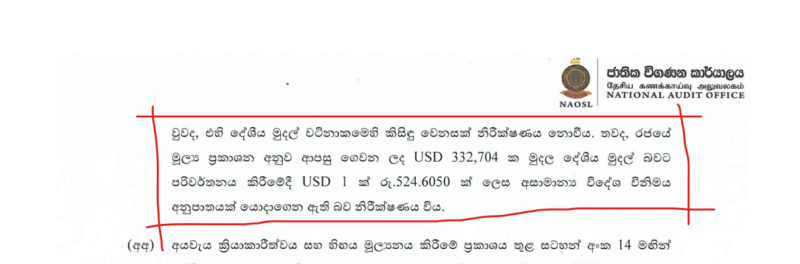
2024-06-15
අසීමිත බදු ගහන IMF ගිවිසුම වෙනස් කරන බවට සජිත්ගෙන් ප්රකාශයක් (වීඩියෝ)
June 15th, 2024උපුටා ගැන්ම හිරු පුවත්
ජනතාව මත අසීමිත බරක් පැටවෙන ජාත්යන්තර මුල්ය අරමුදලේ ගිවිසුම සංශෝධනය කිරීමට පියවර ගන්නා බව විපක්ෂ නායක සජිත් ප්රේමදාස පවසනවා.
විපක්ෂ නායකවරයා මේ අදහස් පළ කළේ, සක්වළ වැඩසටහනේ 240 වැනි අදියර යටතේ කුරුණෑගල එස්.ඩබ්ලිව්.ආර්.ඩී. බණ්ඩාරනායක විද්යාලයට සුහුරු පංති කාමරයක් ලබා දීමේ උත්සවයට අද (15) එක්වෙමින්.
The Indian invasion of this country has already begun? while the government of this country is in a dead sleep-Disgrace and curse be upon the sleepy, servile and unpatriotic politicians of this country?
June 14th, 2024By Desamanya Dr Sudath Gunasekara. Kandy.
Posted on December 18th, 2023 (A republication)
Beside these 14,000 houses on the hills, India has already implemented a 60,000-housing scheme for Tamils in Sri Lanka as follows, for which the Sri Lankan government has already singed MOU with the Indian government the conditions of which are not known to the general public of this country.
India builds 60,000 houses in Sri Lanka
In June 2010, Government of India announced that it would construct 50,000 houses in Sri Lanka at an outlay of 33 billon LKR. A Pilot Project involving construction of 1,000 houses was launched in November 2010 and was completed in July 2012. An MOU with the Government of Sri Lanka on the modalities of implementation of the remaining 49,000 houses under the Project was signed on 17 January 2012.
• Pilot Phase: Government of India entrusted an agency to construct 1,000 houses for beneficiaries in the Northern Province. The project was completed on July 2012.
• Second Phase: The second phase launched on the birth anniversary of Mahatma Gandhi on 2 October 2012, which envisaged construction of 45,000 houses in the Northern and Eastern Provinces was completed in December 2018.
• An innovative owner-driven model was adopted to implement the second phase, wherein the Government of India arranged technical support and financial assistance for the owner-beneficiaries to undertake the construction / repair of their houses themselves.
• Financial assistance of LKR 550,000 per beneficiary (LKR 250,000 in case of repair cases) was released in stages, and transferred directly to the bank accounts of the beneficiaries by the High Commission of India. (Where?)
• Third Phase: Third phase of the Indian Housing Project involves construction of 4,000 houses for estate workers in the Central and Uva Provinces through an innovative community-driven approach. Letter of Exchange with the Government of Sri Lanka for this phase was signed in April 2016 and work started in October 2016.
• In the third phase considering the difficulties in the terrain and accessibility of materials and other logistics LKR 950,000 is disbursed per beneficiary.
• As on date close to 2300 houses are complete in the third phase and the construction of the remaining houses is currently underway.
• Fourth Phase: During his visit to Sri Lanka on 12 May 2017, Prime Minister of India Shri Narendra Modi announced an additional 10,000 houses for the estate workers and the agreement was formalized in August 2018. This entails an additional commitment of LKR 11 billion. Preparatory work for these additional houses is currently underway and the construction of these houses is expected to start soon. This makes the total number of houses being built in the plantation areas 14,000.
• As on 31 December 2019, more than a total of LKR 31 billion has been?
My Comments on this serious and important news item.
I welcome the construction of such a large number of houses for any citizen of this country by any government. But I don’t agree with this selective preference given only to Tamils of this country as it is bound to create a special kind of attachment and allegiance to India of a section of citizens of a particular ethnic group, that is Tamils, an imminent threat to the independence and sovereignty of this country.
The only way to overcome this imminent disaster.
First of all, we must thank the NBOR for releasing this important information for the information of the general public so that firstly, there will be increased public awareness and secondly, they will take serious notice of this imminent danger and open their eyes to take precautionary action and thirdly, they will corporate with the authorities to mitigate these disasters first, in their own interest and second, in the broader interest of the country.
If immediate action is not taken to arrest this catastrophe, before long, the entire 13,000 square kilometers of lands spread over in Badulla, Nuwara-Eliya, Kandy, Matale, Ratnapura, Kegalle, Kalutara, Galle, Matara and Hambantota- comprising 1/5th of the area of this Island as they have estimated, will be converted to an area unsuitable for human settlements. Considering the ever-increasing population with the land extent remaining constant, the Sri Lanka society will be faced with a major problem of finding sufficient space for people, increasing in millions annually to live in the short run.
Therefore, the crying need firstly, to take short term measures to arrest this calamity. Secondly, to find out the causes that have brought about this situation and finally to immediately find a permanent workable solution to stop this manmade disaster.
The problems one can visualize in the long run can become far more serious and can even go beyond our imagination for the following reasons resulting in the total disappearance of the 2566-year-old Sinhala Buddhist civilization from the face of this earth as Tamils can go to India and Muslim to countries from where they have come. But where are we going. We have no place on this earth other than this tiny Island. The causes for what we are experiencing today in these regions of this type of landslides are a direct legacy we have inherited from 103 years of British colonial devastations from done for 133 years from1815 to 1948 and the 1.2 million Indian labour they left behind when they left for their home. The actual problem at stake is much wider and deeper than the NBOR report has indicated. What we are facing today are the result of cumulative causes that have been in operation for a long time on the hill sides are attributed to many factors other than those mentioned in para 3 of the above report. Among them the most important reason was the large-scale deforestation for Coffee and Tea on these hills, running in to about 1.3 million acres of never touched before as they were reserved crown forest.
The onslaught on this forest began with the opening up of these lands for Coffee. The first commercial coffee plantation was started by George Bird, in Singhapitiya, Gampola in 1824.The Same year, Edward Barnes, who became Governor of Ceylon in 1824, established another plantation in Gannoruwa in 1825 (now a part of the Royal Botanical Gardens, Peradeniya). This was followed by Tea after the Coffee blight in 1869. The first tea plantation estate in Sri Lanka (Ceylon) was started in1867 by Scotsman James Taylor in Loolekandura, in the Kandy district near Hanguranketha. Thereafter Tea cultivation spread all over the hill country in no time. This resulted in the deforestation of the entire hill country within few years. With the expansion of the Tea industry nearly 1.3 million acres of prime jungle that remained as Thahanchi kele (protected forests) by Royal decree from the inception of Civilization in this country were removed to give way for Tea bushes sprawling all over the hill country.
This large-scale deforestation, followed by setting fire to the forests, uprooting stumping the felled trees, digging for planting tea and earth cutting for drains, constructions of buildings ,factories and thousands of line rooms for nearly 1.2 million indentured south Indian slave labour brought by the British to work on these newly opened up land and their discriminate cuttings and digging around the line rooms for cultivations followed by a massive network of roads and a Railway line across the country’s hilly terrain up to Badulla. This entire 1.3 million acres of covered with prime forest over the whole hill country that remained undisturbed for millennia got directly exposed to heavy rain and elements of weather got eroded and degraded and the streams dried up. The inner layers unable to withstand this sudden weakening of the binding effect of the decaying root system and opening up of underground cleavages due to heavy exposure on the surface coupled with indiscriminate land use disturbing the underlying structural harmony of the whole hill country followed by heavy rain were the main causes of these earth slips As the prime forest was removed the earth got dried up, streams dried up underground water deposits vanished fauna and flora disappeared. In fact, it is the aftermaths of all these destructions that we see as landslides and earth slips all over the hill country,
Now reminding me the famous Sinhala folk ‘tale of As if the man fallen from the tree was also attacked by the Bull” adding to all damages done by the white people to this Heartland of the mother Lanka for 133 years from 1815 to 1948, today our own government elected by us has started to destroy it completely beyond recovery by aiding and abetting the Indian Government sponsored settlement and housing program followed by large scale building programe that churn up the little physical stability left behind by the British on these hills by a massive housing and settlement building programe including large scale infrastructure development projects with Indian and international funding all over the hill country with no regard what soever to the massive and irreversible damages already caused to the Physical stability of the Geographical Heartland of this country.
Way back in 199I, I have declared this geographical are as HADABIMA of Sri Lanka since it functions as the Heart of the body Sri Lanka. Thus, not only functionally but even analogically it resembles a heart when you turn the physiographic map of the central hill country 15 degrees clockwise with two outliers, the Rakwana hills on the right-hand side and the Dumbara hills on the left side with the central massif at the center resembling heart flanked by two lungs on either side. With the peculiar radial drainage pattern of 103 rivers having their sources on these hills that flow in all the directions providing the water to sustain all the water to keep the entire life system in the country guaranteeing the survival of the civilization of this Island nation.
Thus, its physical stability determines and dictates the survival of the entire life system and the civilization of this Island nation. Therefore, the need to protect its physical stability by protecting its forest cover, the land and the river system without disturbing its critical physical stability as the main and the only watershed that decides the survival of life on this Island. When the heart stops the man dies. Similarly, the day physical stability of the central hills is not there the curtain will fall on the entire life system and the civilization of this Island. It is in this perspective one has to look at the need to protect the physical stability of these central hills.
Removing the forest cover on these hills will first make these rivers dry. All 103 main rivers in this Island have their sources on these hills. Continuous landslides and deforestation followed by land degradation and bad land use practices will soon lead to drying up of all these rivers. Since these rivers form the life arteries that provide the water needed for the entire life system in the down streams area in the lowland surrounding the central hill country, their drying up will lead to the extinction of life in the Island and inevitably thereafter human civilization in the country will vanish in the long run, in the lowlands around the entire Island together with the hill country.
The only way to avoid this disaster is the protection of the physical stability of the central highlands, the Geographical heartland, the HADABIMA” of Sri Lanka just like you protect your own heart. Because as much as you die if your heart stops, the same way Sri Lanka’s entire life system and the civilization will also come to an end if the physical stability of the central highlands is lost.
The first step in this mission is to declare all land above 5000 ft as strictly protected and banned area for any human intervention. Second to restore its original position and maintain it regularly.
Unfortunately, none of the governments that came to power after the so-called Independence has taken any step to arrest this devastation done to this country by the British for 133 years and to retore status quo, that was there before 1815 as a heritage coming down from the inception of history. Instead, they also have continued to accelerate the destruction done by the invader by cruelly stabbing the heart of the nation to death, for narrow political gains.
Even the Kandyan Peasantry commission set up in 1949 did not look at this critical problem. I am asking the present-day government as to why it keeps deaf, blind and dumb. Why don’t you understand the gravity of this disaster. Why can’t the NBRO who impose strict conditions on innocent native villagers imposing all unnecessary conditions when they make an application to put up a wattle and doab hut on their ancestral land, take action against this wanton national crime committed by the government a under pressure from the Indian government by constructing 60,000 new houses on hill slope even over 60 degrees slope on land going up to almost 8000 ft MSL. In my opinion everybody including the Government and all government department are responsible for this crime of erasing a great nation in the world from the surface of this earth by keeping deaf, dumb and blind on this issue just to woo the votes of a band of Indian cooly labour left behind by the British high and dry, who have no love for this country.
As none of the post independent government or any responsible citizen had opened their eyes on this subject and done their duty by a great nation who had defended and protected their motherland for 443 years (1505-1948) by paying with their lives. Therefore, I am making the following proposal on their behalf to arrest this death march and restore normalcy in the Central hill country of restoring its physical stability for the Sinhala nation to protect this heritage that comes down from the sacrifices of their brave forefathers.
In order to avoid this imminent disaster, I propose to the government that it should take following steps
1 Declare all forests above 5000 ft above MSL as strictly reserved heritage forest of the country, as it had been done throughout history leaving Nuwara Eliya Bandarawela, Hakgala Botanical Garden, Ambewela farm and the Horton Plain as tourist attractions. The roads network all over the hill country must be maintained for tourists’ purposes.
2.Evacuate all settlement in the region between 3500 ft and 5000 ft msl and settle them at a lower contour that is between 1000-3500 leaving only the tea factories and allied offices to remain within the zone 3500 -5000. These settlements also will provide the labour required for the tea plantations between 3500-5000 ft msl.
The largescale tea plantations between 3500-5000 should be managed by JEDB and SLPC, USAWASAMA or big native private Companies. None should be given to foreigners.
3.Relocate all displaced plantation workers, who are willing to abide by the laws of the land in the area between 1000-35000 ft lands on 2 ½ acre farm lots together with landless Kandyan peasant in the adjoining villages. Here priority should be given to landless Kandyan Peasants, as they were the original owners of these lands. These settlements should be developed as mixed farm lots of the HADABIMMA model giving rise to a unique settlement model. Land allocation should be done by drawing lots to avoid discrimination. That will also help social integration between the native Sinhalese and estate Tamil labour. These farm lots will be HADABIMA model mixed farms with animal husbandry and these villages right round the hill country will also provide the labour for the 3500-6000 plantations in the neighboring estates. This settlement belt right round the central hills will develop a unique settlement model with a Kandyan forestry garden type adapted to suit the present-day socio-economic needs.
The present estate labour should cease calling themselves naam 200 and they are Indiana Tamils. They all should accept the historical fact that this is the land of the Sinahla nation as it had been for the past 2600 years. They also accept the conditions in the Nehru-Kotalawala Pact of 1953 and cease to be called Indian Tamils any longer. No naam 200. No Malahayaha as they dream at present. Those who insist they want to retain their own nomenclature and the Indian identity should go back to India. If they want to be identified in those terms then they should get repatriated as we cannot have Indian citizens within our territory. But if they want to, they can observe their religion and customs in private. Those who want to integrate they can do that. Those who refuse they should get back to India or ask their colonial masters to provide land and citizenship in UK. In the event they refuse to fall in line, with this naturalization process,they have no alternative but to go back either to India or the other legitimate motherland Briton as the UK is legally bound to take them back as they were British citizens at the time of their leaving this country in 1948.
Herewith I propose a pragmatic and humanitarian action plan to see an end to all these problems mentioned in this note, for once and for all,
This Action plan if implemented will find a permanent solution for the following national problems.
1 First and foremost of them all, restoring the physical stability of the HADABIMA (The central hill country) of Sri Lanka that will guarantee the survival of the entire life system in this country and will protect the continuity of the civilization of this country that had been there from the dawn of history until the Sun and the Moon shall last.
2 It will solve the problem of landlessness among the Kandyan peasants, highlighted by the KPC Report 1951 but not touched up to date.
3. Thereby, partly rectify the historical injustices inflicted upon the Kandyan Sinhala patriots, the sons of the soil, whose ancestors were annihilated in tens of thousands in battle and hunger in 1817-1818 Uva Rebellion and 1848 Matale rebellions/Freedom struggles against the British colonial invaders, under orders of Brownrigg and Torrington the white murderers.
4 Solve the landlessness, unemployment problems and other socio-economic problems of the Estate labour in the present plantation sector by converting them to respectable full native citizen status of this country.
5. It will also stop the exploitation of the estate labour by the pseudo-Indian labour leaders of the Thondaman clan within the estate sector as feudal lords did in medieval Europe.
6. This will end the 224-year-old (1799-2023) ethnic animosity created between the native Sinhalese and these Malabar Tamils, first, planted by the Cleghorn report 1799 and second, by the Wesleyan Methodist Mission that met in Jan 1819 in Galle whose most important resolution, as they said was the division of Ceylon in to two districts, to be designated as the Sinhalese and Tamil districts” to destroy the native Sinhalese. They also imported Malabar Tamils, using their divide and rule policy and later used by the British as sepoys in their struggles against the native Sinhalese in the freedom Struggles of 1817-1818 Uva Wellassa and the 1848 Matale rebellion and thereafter exploited them to enrich the British and Indian Banks up to date by the British by engaging this as cheap labour working under trying conditions.
And since the British left in1948, leaving the Indian labour high and dry as a band of stateless destitute exploited by the feudal minded Estate Tamil labour leaders and communal Tamil politicians led by Thondaman and his heirs up to date and also by selfish native Sinhala political leaders who woo them for their vote at every election, (even though they never get it) and finally, using them as fodder by Indian Mandarins and politicians, partly in pursuance of their expansionist agenda and partly, to meet domestic politics exigencies of winning the 39 seats in Tamilnadu.
7.The implementation of this plan will also see the end of Tamil communal politics in the central hill country of this country.
8 With the completion of this humanitarian settlement programme Sri Lanka will be relieved once and for all of the presence of a headache of an anti-Sinhala anti Buddhist pro Indian enclave consisting of 1.2 million band of Malabaar Tamils in the Heartland of this Sinhala Buddhist Kingdom that was there for the last 2600 years and instead we will be blessed with a band of naturalized native citizens who love this as their own motherland, even better than the original Sinhalese, as it was done by the naturalized and integrated south Indians who came to this country in the medieval times, presently living in the South Western quarter of the country.
With the completion of this project all the fallowing institutions should be closed down.
1. Ministry of Hill Country New Villages, Infrastructure and Community Development
2.The Ministry of State infra structure a development
3 New Villages Development Authority for Plantation Region
and all other agencies with direct foreign intervention and funds, to this sector based on ethnicity
The practice of creating separate ministries and Institutions and appointing these plantation sector Tamil politicians to high posts, such as Ministers and Governors, just to woo the estate sector Tamil votes should be stopped forthwith.

This is the type of houses built with Indian assistance on the central hills indiscriminately without any regard for the physical stability of the Central hill country, which is extremely crucial for the survival of the entire life system in the whole island, the extinction of which will draw the curtain on the 2600-year-old Sinhala civilization of this island nation.
Now look at the above location at Bogawanthalaawa (above 4000 ft msl) a place where these pigeon nests have been built. The day the top layer of nearly 125 houses with their mass will slip down, first of all, all these houses with their inmates will get buried together with all those houses with their inmates that cannot be stopped by Modi or even if the entire pantheon of Indian gods led by Mahaa Brahma descend on this earth. Second, the effect of this mass debris on the downstream areas with devastating floods will be beyond one’s comprehension.
This is only one of hundreds of such housing complexes built all over the hill country. So, you can just imagine the scale of their cumulative effect of their devastation. Thereafter the failure on the part of these deforested and degraded rock outcrops in the hill country as the main watershed to serve the nation’s all 103 rivers with water, will make this Island a sterile barren desert san any water.
Then the curtain will fall on the 2600 year old civilization of this Island.
This country today needs a patriotic Sinhala Buddhist leader who knows his country, its history and its potentials, who can withstand this Indian expansionism and make this country the miracle of Asia in 10 years.
It is high time that India gives up this Panikkar philosophy of annexing neighboring states. This is particularly relevant to Sri Lanka, as Bharath had never been able to annex this Island although it had been struggling to do so from the time of Rama 5000 years ago.
It is said that already 60,000 houses have been built and another 40, 000 are to be built very soon. I ask Prime Minister Modi as to why he does not first provide lavatory facilities to those 60 % 0f Indians on the continent who don’t have it now, before he spends on these pigeon nests to bag the Thamilnadu votes.
Indian built Housing schemes in other parts of the country outside the hill country. It is high time that both these Indian politicians and crazy Indian mandarins should realize that the recipients of these Indian largesse will benefit their largesse, only if they renounce their Indian citizenship and also the Indian their mentality and get fully integrated with the native Sinhalese in this country.
No Tamil genocide in Sri Lanka-Canada’s Federal Court reviewed Trudeau’s statement and rejects Tamil genocide
June 14th, 2024Ontario Centre for Policy Research
An application was brought forward against Canada’s Prime Minister Justin Trudeau, for judicial review, challenging his message on Tamil Genocide Remembrance Day, issued on May 18, 2023. The primary intention of this Application is to obtain a clear legal position regarding the Tamil genocide. Canada’s top court, the Federal Court, states as follows and rejected Tamil genocide.
[Prime Minister Trudeau’s] Statement is not a decision or an order that gives rise to a binding obligation, nor is it conduct that affects legal rights, imposes legal obligations or causes prejudicial effects. At its core, the Statement, with reference to the House of Commons motion, encourages Canadians to reflect on the conflict” in Sri Lanka in the broader context of human rights, peace, and democracy generally.”
The federal court also discussed the legal validity of the motion brought by MP Gary Anandasangaree. The court’s position is very clear: Trudeau’s statement and MP Anandasangaree’s motion are non-binding and have no legal impact on Canada’s official position. It means no Tamil genocide in Sri Lanka. Judge Janet M. Fuhrer issued her decision on this matter at the federal court.
The Federal court identified incidents in Sri Lanka as a conflict” between the Tamil Terrorist group Liberation Tigers of Tamil Eelam and the Armed forces in Sri Lanka.
Canadian politicians continually exploit the most vulnerable Tamil communities, propagating fake Tamil genocide to obtain political advantage using highly racist campaigns to enhance their vote bank.
Due to his double-standard policies, Trudeau’s government is expected to be voted out by Canadians in the next federal election.
May 18, 2024
Ottawa.
No Tamil genocide in Sri Lanka Canada’s Federal Court reviewed Trudeau’s statement and rejects Tamil genocide
June 14th, 2024Ontario Centre for Policy Research
June 13, 2024
Ottawa
An application was brought forward against Canada’s Prime Minister Justin Trudeau for judicial review, challenging his message on Tamil Genocide Remembrance Day, issued on May 18, 2023. The primary intention of this Application is to obtain a legal position regarding the alleged Tamil genocide, whether the prime minister declared or recognized it. Canada’s top court, the Federal Court, stated as follows and rejected Tamil genocide, saying no such declaration.
Paragraph 19 of the decision [Prime Minister Trudeau’s] Statement is not a decision or an order that gives rise to a binding obligation, nor is it conduct that affects legal rights, imposes legal obligations or causes prejudicial effects. At its core, the Statement, with reference to the House of Commons motion, encourages Canadians to reflect on the conflict” in Sri Lanka in the broader context of human rights, peace, and democracy generally.”
The federal court also discussed the legal validity of the motion brought by MP Gary Anandasangaree. The court’s position is very clear: Trudeau’s statement and MP Anandasangaree’s motion are non-binding and, therefore, have no legal impact on Canada’s official position. It means no Tamil genocide in Sri Lanka. Judge Janet M. Fuhrer issued her decision on this matter at the Federal Court.
The Federal Court identified incidents in Sri Lanka as a conflict” between the Tamil Terrorist group Liberation Tigers of Tamil Eelam and the Armed forces in Sri Lanka.
Canadian politicians continually exploit the most vulnerable Tamil communities, propagating fake Tamil genocide to obtain political advantage by using highly racist campaigns to enhance their vote bank.
Due to Trudeau’s double-standard policies, Trudeau’s government is expected to be voted out by Canadians in the next federal election.
May 18, 2024
Ottawa.
May 18, 2024
Sri Lanka celebrated the 15th anniversary of the defeat of LTTE Tamil terrorism
Liberation Tigers of Tamil Eelam (LTTE) waged a nearly three-decade armed campaign against Sri Lanka to create a mono-ethnic state for Tamils in the North and East parts of Sri Lanka. However, more than 70% of Tamils live peacefully in southern Sri Lanka and are well-integrated with other communities, including Sinhalese and Muslims.
LTTE was militarily defeated by eliminating the leader, Velupillai Prabhakaran, and its senior cadre. Since then, all communities in Sri Lanka have been living peacefully.
May 17, 2024
Ottawa
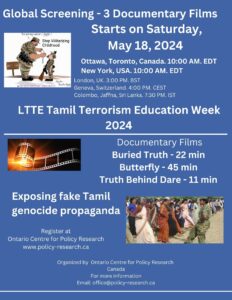
LTTE Tamil Terrorism Education Week 2024
Global Screening – 3 Documentary Films
| LTTE Tamil Terrorism Education Week 2024 Global Screening – 3 Documentary Films Buried Truth – 22 min Butterfly – 45 min Truth Behind Dare – 11 min Please join On May 18, 2024, at 10:00 AM, in Toronto, Ottawa, CanadaAbstract Tamil terrorist group Liberation Tigers of Tamil Eelam (LTTE) based in Sri Lanka waged three decades of armed conflict with the Sri Lankan government. Their prime motive is to create a mono ethnic state for Tamils living in the North and East. However, more than 70% of Tamils are living in the Southern part of Sri Lanka and are well integrated with other communities such as Sinhalese and Muslims.On May 18, 2009, Sri Lanka’s military successfully eliminated LTTE leader Velupillai Prabhakaran and its senior military cadre in combat. Sri Lankan armed forces rescued 365,000 innocent Tamil civilians used as human shields.This documentary explores LTTE atrocities and their fake propaganda on the Tamil genocide. |
May 16, 2024
Ottawa
Socio-economic and Political Exploitation: Canadian politicians exploit the most vulnerable Tamil communities by propagating fake Tamil genocide
Canadian politicians are expected to release statements on May 18 regarding the fake Tamil genocide to gain political advantage by targeting the most vulnerable Tamil communities in Canada.
Sri Lanka’s government forces militarily defeated the most ruthless Tamil terror group, Liberation Tigers of Tamil Eelam (LTTE), eliminating its terrorist leader Velupillai Prabhakaran and senior carder on May 18, 2009. Since then, sympathizers of the terror group, its military defeat orchestrated as the Tamil genocide to conceal their humiliating defeat.
Canada’s official foreign policy confirms that there was no Tamil genocide in Sri Lanka.
 Prime Minister Justin Trudeau Prime Minister Justin Trudeau | Trudeau is facing political downfall due to his failures in government policy. To take political advantage, Trudeau issued a Tamil genocide remembrance messages and is expected to do the same in 2024. Trudeau considers his political survival over Canada’s official foreign policy position regarding the alleged Tamil genocide in Sri Lanka.Regardless of his low-level political tactics, Trudeau’s government is expected to be voted out by Canadians at the next federal election. |
 Patrick Brown Mayor of Municipality of Brampton Next to Neru Gunaratnam LTTE cadre | Patrick Brown had to resign from Ontario’s premier candidacy due to his sexual misconduct allegations. Brown was again disqualified from the Conservative Party leadership race. Conservative leadership selection committee found that Brown was involved with serious financial irregularities. For his political survival, Brown put forward the Tamil genocide to the Tamil communities and sought their support. Brown has promised to build a Tamil genocide monument in Brampton. Patrick Brown was not allowed to enter Sri Lanka due to his alleged association with the Tamil terrorist group Liberation Tigers of Tamil Eelam (LTTE). |
 MPP Vijay Thanigasalam praised Tamil terrorist leader as his National hero | Former refugee MPP Vijay Thanigasalm brought the Tamil Genocide Education Week Act (TGEWA), now facing a constitutional challenge. The applicants requested that the court declare TGEWA unconstitutional. Fake Tamil genocide promoter took advantage of the most vulnerable Tamil communities in Scarborough to secure his seat in the Ontario legislature. Thanigasalam continually exploits Tamil communities, promoting fake Tamil genocide for his political advantage. |
 MP Gary Anandasangaree at the Book launch of Prabhakaran Tamil terrorist leader MP Gary Anandasangaree at the Book launch of Prabhakaran Tamil terrorist leader | MP Gary Anandasangaree arrived in Canada from Ireland with his mother and claimed refugee status. However, he had to claim refugee status in Ireland due to the safe country environment. The immigration analysts alleged that Anandasangaree defrauded Canada’s generous asylum system. LTTE operatives involved with human smuggling activities collect $35,000 to $50,000 to arrange asylum in Canada from each Tamil asylum seeker. The fake Tamil genocide campaign is part of an illegal human smuggling project operated by LTTE. |
Ottawa
May 10, 2024

Official Foreign Policy: Canada rejects Tamil genocide
A diplomatic note issued by Foreign Affairs Canada in reply to TPN -42-2021 states Canada’s Official foreign policy position. Foreign Affairs Canada confirms that the Government of Canada has not made a finding that there was a Tamil genocide in Sri Lanka.
Also, Foreign Affairs Canada noted Mayor Patrick Brown’s statements and activities at the Municipality of Brampton and the Tamil Genocide Education Week Act passed by the Ontario legislature. It states that under Canada’s federal system, provincial and municipal governments are independent, and the federal government does not pronounce their initiatives or positions nor represent federal policy.
Also, MP Gary Anandasangaree’s recent private member’s motion regarding the Tamil genocide does not reflect the Government of Canada’s official position. Canada’s acting High Commissioner to Sri Lanka, Amanda Strohan, referred to the motion and stated that MP Anandasangaree’s motion is non-binding, non-legislative, a private member’s motion, and does not reflect Canada’s Official foreign policy.
The Tamil Genocide Education Week Act and the proposed Tamil Genocide Monument by the City of Brampton are currently facing Constitutional challenges. The applicants have requested the Court to declare them unconstitutional, and the legal proceedings are ongoing, instilling confidence in the due process of law.
Diplomatic Note Issued by the Government of Canada. Please download it here.
Statement by Canada’s acting High Commissioner to Sri Lanka, Amanda Strohan. Please download it here.
Statement by the Prime Minister on Armenian Genocide Memorial Day
Prime Minister Justin Trudeau
April 24, 2024
Ottawa, Ontario
The Prime Minister, Justin Trudeau, today issued the following statement on Armenian Genocide Memorial Day, also known as Medz Yeghern:
Today, we join Armenian communities in Canada and around the world to mark Armenian Genocide Memorial Day. We reflect on this dark chapter in history, honour the victims who lost their lives, and reflect on the trauma that so many still endure.
Twenty years ago, the Government of Canada joined members of the international community in officially recognizing the historic and tragic reality of the Armenian Genocide. This recognition carries a deep significance for many Canadians, and especially Armenian-Canadians. Together, we will ensure the stories of those affected are never forgotten.
In Canada, April marks Genocide, Remembrance, Condemnation and Prevention Month, which reminds us of the consequences of indifference. We must remember and honour the memories of the victims lost to the Armenian Genocide. We must stand up against hate and stand for diversity, inclusion, and human rights – it is our shared, collective responsibility.
Armenian Genocide Memorial Day is a time for reflection and remembrance. As we observe this solemn day, I encourage all Canadians to learn about the events that led to this senseless loss of humanity. Let’s build a society where everyone feels safe from discrimination and violence.”
Statement by the Prime Minister on the 42nd anniversary of the Canadian Charter of Rights and Freedoms
Prime Minister Justin Trudeau
April 17, 2024
Ottawa, Ontario
The Prime Minister, Justin Trudeau, today issued the following statement on the 42nd anniversary of the Canadian Charter of Rights and Freedoms:
The Canadian Charter of Rights and Freedoms is one of our country’s greatest accomplishments. Central to who we are as Canadians, the Charter represents freedom, democracy, and the values of equality, diversity, and inclusion. Forty-two years ago today, the Charter was adopted, and every year, we reaffirm its principles.
The Charter guarantees our fundamental rights, affirming equality for all Canadians, regardless of race, age, or ability. The Charter protects rights relating to our use of both official languages. It ensures that we can express our thoughts or practise our religion in our own way. It preserves the right of everyone to be treated with respect and dignity – something that every Canadian deserves.
On this occasion, we also celebrate the 42nd anniversary of Section 35 of the Constitution Act, 1982, which recognizes and affirms Indigenous and Treaty rights of First Nations, Inuit, and Métis in Canada. Section 35 serves as the foundation of our ongoing efforts to advance reconciliation with Indigenous Peoples, notably through the 2023-2028 Action Plan – our evergreen roadmap to achieving the objectives laid out in the United Nations Declaration on the Rights of Indigenous Peoples Act. Together, we will continue to walk the path of reconciliation and work toward building a renewed and meaningful relationship with First Nations, Inuit, and Métis.
On behalf of the Government of Canada, I invite everyone to learn more about the Charter and recognize our collective responsibility to help advance the values it enshrines. Together, we will help keep Canada the free and prosperous country we proudly call home.”
Statement by the Prime Minister on the 30th commemoration of the Genocide against the Tutsi in Rwanda
Prime Minister Justin Trudeau
April 7, 2024
Ottawa, Ontario
The Prime Minister, Justin Trudeau, today issued the following statement marking 30 years since the beginning of the Genocide against the Tutsi in Rwanda:
Today, we remember one of the most tragic losses of human life in history. Thirty years ago, the Genocide against the Tutsi in Rwanda senselessly took the lives of over a million innocent people in just 100 days.
On this sombre occasion, we stand with the people of Rwanda to honour the victims and the survivors of this genocide. Our thoughts go to their families, their loved ones, and all survivors who continue to live with the trauma.
To those survivors who have chosen to make Canada their home, we stand with you always, especially throughout this painful period of commemoration.
In the decades since this tragedy, the people of Rwanda have shown incredible courage and taken important steps to foster reconciliation and rebuild their country. Canada is a proud partner in this ongoing process. We reaffirm our support to Rwanda as it advances its development.
Today, we also pay tribute to the United Nations peacekeeping force, which included a small number of Canadians and was led by Major-General Roméo Dallaire, facing extremely challenging circumstances to help those seeking refuge. Their service, which saved many innocent lives, will always be remembered.
What happened in Rwanda in 1994 is a painful reminder of how hateful ideologies can lead to extremist violence. As we mark Genocide Remembrance, Condemnation and Prevention Month this April, I invite Canadians to join in commemorating the victims of the Genocide against the Tutsi in Rwanda, and all victims of genocide around the world. By confronting these painful truths and standing up against hate, we can ensure such atrocities are never repeated. Together, let us reflect on how we can foster a better, more inclusive, and more peaceful world for future generations.”
May 18, 2023
Prime Minister Justin Trudeau clarified Canada’s position on the past conflict in Sri Lanka.
Prime Minister Justin Trudeau
May 18, 2023
Prime Minister Justin Trudeau issued a statement remembering the loss of lives due to past conflict, reiterating Canada’s official position.
The statement says, On behalf of the Government of Canada, I invite all Canadians to recognize the many contributions that Tamil-Canadians have made – and continue to make – to our country. I also encourage everyone to learn more about the impact of the armed conflict” in Sri Lanka and express solidarity to all those who suffered or lost loved ones.”
Canada does not recognize the alleged Tamil genocide” but identifies it as an armed conflict” between LTTE Tamil Terrorists and the government of Sri Lanka.
May 18, 2023
Sri Lanka celebrates14th Anniversary of the end of LTTE Tamil Terrorism
Sri Lankans Celebrates End of LTTE Tamil Terrorism
It has been 14 years since the three-decade civil war in Sri Lanka drew to an end after the leader Velupillai Prabhakaran and the senior cadre of the Tamil Terrorist group LTTE (Liberation Tigers of Tamil Eelam), were eliminated by the Sri Lankan security forces at the Nandikadal” Lagoon on May 18, 2009.
With reference to the UN Panel of Experts report and UN Human Rights commissioner’s reports on Sri Lanka (OISL) LTTE Tamil terrorists involved with war crimes under six core categories, i.e. (i) using Tamil civilians as a human buffer; (ii) killing Tamil civilians attempting to flee LTTE control; (iii) using military equipment in the proximity of Tamil civilians; (iv) forced recruitment of Tamil children; (v) forced labour; and (vi) killing of Tamil civilians through suicide attacks.
Sri Lanka’s government acted under its constitutional responsibility to protect the sovereignty of Sri Lanka and its citizens. Since then, all Sri Lankans have lived in peace and harmony regardless of ethnic origin.
Statement marking the birthday of His Highness Prince Karim Aga Khan
December 13, 2022
Ottawa, Ontario
The Prime Minister, Justin Trudeau, today issued the following statement marking the birthday of His Highness Prince Karim Aga Khan:
Today, we celebrate the 86th birthday of His Highness the Aga Khan, the spiritual leader of millions of Shia Ismaili Muslims around the world, including the 100,000 Shia Ismaili Muslims who call Canada home.
His Highness is a global leader in the fight for equality who, through the Aga Khan Development Network, has partnered with Canada to reduce poverty around the world, advance gender equality, and improve access to health care and education internationally, including the Ottawa-based Global Centre for Pluralism and the Toronto-based Aga Khan museum – the first Islamic museum in North America.
The Aga Khan, an honorary Canadian citizen, embodies Canada’s values of compassion, kindness and tolerance, and reflects our shared vision of a better, more equal, and more peaceful world. This special year, we marked the 50th anniversary of the arrival of thousands of Ismailis in Canada after they were expelled from Uganda. Since their arrival, they have become a vibrant part of Canada’s social and economic fabric and made our country a better place to live.
Today, I join people around the world in wishing the Aga Khan a very happy birthday. We wish him good health and happiness on this special day and for years to come.
Salgirah Khushiali Mubarak!”
UNHRC RESOLUTIONS WITHOUT A RESOLUTION
UNHRC 51st Session
LTTE Tamil terrorist sympathizers represent Tamil Diaspora groups want to perpetuate accusations
to undermine Sri Lanka
Whatever the result will be, Sri Lanka will stand firm against the new UNHRC resolution.”
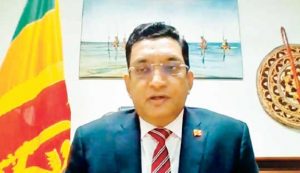
Sri Lanka’s Foreign Minister Ali Sabry
Sri Lanka’s foreign minister pointed out there was a chance of Sri Lanka being defeated at the UNHRC Resolution, as some of the countries who had previously been members of the UNHRC supporting Sri Lanka were no longer members and added that it is difficult to compete with powerful nations in the UN Human Rights Council (UNHRC).
The Government has already opposed the proposed UN resolution for accountability that would also include responsibility for economic crimes, emphasizing that ‘external forces’ should not guide it on how to manage the country’s economy.

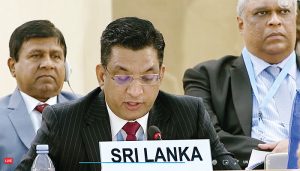
National Day for Truth and Reconciliation
September 30, 2022
Ottawa, Ontario
The Prime Minister, Justin Trudeau, today issued the following statement on the National Day for Truth and Reconciliation:
Today, we mark the second National Day for Truth and Reconciliation – an opportunity to come together to reflect on the legacy of residential schools and the ongoing impacts on Survivors, their families and communities, as well as commit to continuing the hard, but necessary work to build a better future for all.
Between 1831 and 1998, at least 150,000 First Nations, Inuit, and Métis children were forcibly removed from their families and communities to attend residential schools, where they had to abandon their languages, cultures, spiritualities, traditions, and identities. Many experienced physical, emotional, and sexual abuse, and thousands never came home. The experiences and intergenerational trauma of these so-called schools continue to live on for Indigenous Peoples across the country every single day.
It is our shared responsibility to confront the legacy of residential schools and the ongoing impacts on Indigenous Peoples, so we can truly move forward together. That is why, last year, Parliament voted unanimously to establish the National Day for Truth and Reconciliation as an opportunity for all Canadians to learn more, honour the Survivors of residential schools, their families, and their communities, and remember the many children who never returned home. Reconciliation is not the responsibility of Indigenous Peoples – it is the responsibility of all Canadians. It is our responsibility to continue to listen and to learn.
This past July, His Holiness Pope Francis offered an apology to Survivors, their families, and their communities here in Canada, and recognized the abuses experienced at residential schools that resulted in cultural destruction, loss of life, and ongoing trauma for Indigenous Peoples across the country. It was a step forward in all the work that remains and a reminder that we still have more to do. We will continue to be there to support the painful but necessary work to locate unmarked graves, and to support Survivors as they tell their stories, including through the efforts of the Independent Special Interlocutor for Missing Children and Unmarked Graves and Burial Sites, Kimberly Murray, who was appointed this past June. We are also ensuring the appropriate supports are available for communities to heal and commemorate the lives that were lost.
Last month, alongside the National Centre for Truth and Reconciliation leadership, Survivors, and members of Indigenous communities, I witnessed the Survivors’ Flag raising on Parliament Hill to honour Survivors and all the lives that have been or continue to be impacted by the residential school system. The flag serves as a reminder of the government’s commitment to Survivors and future generations to never forget what happened at these so-called schools. Over the last year, we updated Canada’s Oath of Citizenship to recognize First Nations, Inuit, and Métis rights, and introduced legislation to establish a National Council for Reconciliation to track and report on the implementation of the Truth and Reconciliation Commission’s Calls to Action. Through the United Nations Declaration on the Rights of Indigenous Peoples Act, we continue to work with Indigenous Peoples to ensure their human rights are fully recognized, respected, and protected.
On this day, which is also known as Orange Shirt Day, I invite everyone to listen to Survivors and learn more about the history and legacy of the residential school system by participating in a local event or wearing an orange shirt. Let’s take a moment today to participate, learn, and reflect. We all have a role to play on the journey toward reconciliation.”
In parallel to UNHRC 51 st Regular Session of the Human Rights Council
September 12 – October 07, 2022
Sri Lanka’s Foreign Minister Ali Sabry addressed the Council on September 12, 2022
UNHRC RESOLUTIONS WITHOUT A RESOLUTION
September is the month when the UN Human Rights Council presents its latest Resolution on Sri Lanka. It is reported that the latest version has graduated from violations of human rights and international humanitarian law to include violations of economic crimes”. Whatever the scope of the Resolution, the dogged fact remains that every sovereign country is compelled to function within the provisions of its own Constitution, because it is the fundamental law as recognized by the Vienna Convention; a fact unequivocally stated by the President and Foreign Minister of this Government, and repeated earlier by previous governments. This fundamental fact was the rationale for rejecting the former co-sponsored Resolution UNHRC 30/1. Therefore, if the UNHRC is serious about its Resolutions, it has to start with Sri Lanka’s Constitution. Incorporating provisions in Resolutions beyond the provisions of the Constitution become a meaningless and distracting exercise for all concerned, without Resolution. Read More
Prime Minister Justin Trudeau
Statement by the Prime Minister on the passing of Her Majesty Queen Elizabeth II
September 8, 2022
Ottawa, Ontario
The Prime Minister, Justin Trudeau, today issued the following statement on the passing of Her Majesty Queen Elizabeth II:
It is with the heaviest of hearts that we learned of the passing of Canada’s longest-reigning Sovereign, Her Majesty Queen Elizabeth II.
For most Canadians, we have known no other Sovereign. Queen Elizabeth II was a constant presence in our lives. Time and again, Her Majesty marked Canada’s modern history. Over the course of 70 years and twenty-three Royal Tours, Queen Elizabeth II saw this country from coast to coast to coast and was there for our major, historical milestones.
She would proclaim ‘it was good to be home’ when returning to her beloved Canada. She was indeed at home here, and Canadians never ceased to return her affection.
Her Majesty vowed to devote her life to the service of the Commonwealth and its people. On behalf of all Canadians, I thank Queen Elizabeth II for honouring this vow and for a lifetime of service.
Her Majesty’s reign spanned so many decades – a period when we came into our own as a confident, diverse, and forward-looking country. It is her wisdom, compassion, and warmth that we will always remember and cherish.
Today, a page has not only been turned, but a chapter in our shared history has drawn to a close. I know Her Majesty’s service to Canada and Canadians will forever remain an important part of our country’s history. The coming days will be a period of mourning for Canadians, as it will be for all Commonwealth citizens, ending with a national day of mourning when a commemorative service will be held to mark the passing of our Sovereign.
On behalf of the Government of Canada, I express our heartfelt condolences to members of the Royal Family during this most difficult time.”
Prime Minister Justin Trudeau
Statement by the Prime Minister welcoming the new Prime Minister of the United Kingdom
September 6, 2022
Ottawa, Ontario
The Prime Minister, Justin Trudeau, today issued the following statement to welcome the new Prime Minister of the United Kingdom, Elizabeth Truss:
On behalf of the Government of Canada, I congratulate Elizabeth Truss on becoming Prime Minister of the United Kingdom.
Canada and the United Kingdom enjoy one of the strongest relationships in the world, rooted in centuries of shared history, values, and traditions. I look forward to working with Prime Minister Truss to further strengthen the relationship between our two countries and make life better for people on both sides of the Atlantic. This includes continuing to build a strong economic recovery from the pandemic that benefits everyone, and strengthening democracy, human rights, and the rules-based international system, while also standing up for Ukraine in the face of Russia’s ongoing aggression. With the goal of being the world’s first net-zero consistent cap and trade market, the United Kingdom is a longstanding partner on climate action and pollution pricing, as well as protecting nature and biodiversity.
The United Kingdom is Canada’s largest commercial partner in Europe and one of our most important globally. As we continue negotiations toward a comprehensive, ambitious, and inclusive Canada-United Kingdom Free Trade Agreement, as well as the U.K.’s accession to the Comprehensive and Progressive Agreement for Trans-Pacific Partnership, we will keep working to increase trade and create good middle-class jobs and new opportunities for people in both countries. Our countries also work closely together through the United Nations, the World Bank, and other international organizations. We are the only two countries to be members of the G7, the G20, the North Atlantic Treaty Organization, and the Commonwealth.
I thank former Prime Minister Boris Johnson for his partnership over the years and wish him all the best in his future endeavours.”
Prime Minister Justin Trudeau
Note by admin: UN has reported that Transnational Tamil Terrorist Group Liberation Tigers of Tamil Eelam (LTTE) had recruited over 7,000 child soldiers during the armed conflict in Sri Lanka. However, LTTE sympathizers’ propaganda campaign deliberately ignored the harm that LTTE has caused for Tamil children.
Statement by the Prime Minister on the International Day Against the Use of Child Soldiers
February 12, 2022
Ottawa, Ontario
The Prime Minister, Justin Trudeau, today issued the following statement on the International Day Against the Use of Child Soldiers, also known as Red Hand Day:
All children have a right to a safe environment where they can grow and thrive. The use of child soldiers is wrong, inhumane, and a clear breach of human rights and international humanitarian law.
Today, on the International Day Against the Use of Child Soldiers, Canada reaffirms its unwavering commitment to work with global partners to end the recruitment and use of children in armed conflicts.
Since 2017, Canada has rallied more than 100 United Nations member states to endorse the Vancouver Principles on Peacekeeping and the Prevention of the Recruitment and Use of Child Soldiers and established the Canadian Armed Forces’ Dallaire Centre of Excellence for Peace and Security to advance their implementation.
No child should be forced to commit acts of violence. Canada continues to be a strong voice on the world stage against the recruitment and use of child soldiers through education, intervention, and prevention. By working together, we can protect children from harm and work to ensure they are given every opportunity to realize their full potential.”
Prime Minister Justin Trudeau
Statement by the Prime Minister on the National Day for Truth and Reconciliation
September 30, 2021
Ottawa, Ontario
Today, I invite everyone across the country to recognize and observe the first National Day for Truth and Reconciliation. It is a day to reflect on the painful and lasting impacts of residential schools in Canada, and to honour survivors, their families, and their communities. It is also a day to remember the many children who never returned home, and an opportunity for us all to learn more, and to affirm the need for reconciliation and commit ourselves to the work ahead.
The National Day for Truth and Reconciliation recognizes that at least 150,000 Indigenous children from across the country were forcibly separated from their families and their communities. Children were brought to residential schools where too many experienced abuse and were removed from their cultures, languages, and traditions. This federal day builds on the momentum of Orange Shirt Day, which was inspired by the story of Phyllis Webstad and chosen by Indigenous peoples to remember the legacy of residential schools and promote the path of reconciliation. The National Day for Truth and Reconciliation was established through legislation passed earlier this spring, and is a direct response to the Truth and Reconciliation Commission’s Call to Action number 80. As part of commemorations for this historic day, I was honoured to participate in a sunset ceremony to commemorate survivors and those who never returned to their families and communities, as the Peace Tower and other buildings near Parliament Hill were illuminated in orange, and a newly commissioned Survivors’ Flag from the National Centre for Truth and Reconciliation was raised.
This year, the tragic locating of unmarked graves at former residential school sites across the country has reminded us of not only the impacts of colonialism and the harsh realities of our collective past, but also the work that is paramount to advancing reconciliation in Canada. Today, we also recognize the harms, injustices, and intergenerational trauma that Indigenous peoples have faced – and continue to face – because of the residential school system, systemic racism, and the discrimination that persists in our society. We must all learn about the history and legacy of residential schools. It’s only by facing these hard truths, and righting these wrongs, that we can move forward together toward a more positive, fair, and better future.
Since 2015, the Government of Canada has been working in partnership with Indigenous peoples to close the gaps that still exist for far too many – and together we’ve made real progress. Over 80 per cent of the Truth and Reconciliation Commission’s Calls to Action that fall under the sole or shared responsibility of the federal government are completed or well underway. We’ve ended 117 long-term drinking water advisories, with a concrete plan to end all of them in the near future. We’ve passed the United Nations Declaration on the Rights of Indigenous Peoples Act, protected Indigenous languages, and invested in education so thousands of Indigenous children are in new or better schools. We have also taken steps together to address the important issues identified in the National Inquiry into Missing and Murdered Indigenous Women and Girls’ Final Report and Calls for Justice, and we have co-developed Indigenous child and family services legislation to ensure that Indigenous children remain with their family and community. And we will continue to invest directly in Indigenous communities, as outlined in Budget 2021, to build a better future for everyone.
On behalf of the Government of Canada, I encourage all Canadians to take this opportunity to learn more about the history of residential schools in Canada, listen to the stories of survivors and their families, and reflect on how each of us can play a part in the journey of reconciliation. I also encourage everyone to wear an orange shirt today to help spread awareness, because every child matters.”
Prime Minister Justin Trudeau
July 1, 2020
Ottawa, Ontario
The Prime Minister, Justin Trudeau, today issued the following statement on Canada Day:
On Canada Day, we celebrate the amazing place we call home – and the people we share it with. Whether you are firing up the barbecue or playing outside with the kids, this is a chance to reflect on where we are as a country, and where we are headed.
The last few months have been difficult for all Canadians, but throughout this pandemic, we have been there for one another. We are neighbours helping neighbours, small businesses being there for their communities and their staff, Armed Forces answering the call to help protect our most vulnerable, and doctors and nurses keeping our families healthy. Because that’s what it means to be Canadian.
Canada’s success is because of its people. People who strive to live up to our shared values of peace, equality, and compassion, and know that diversity is our strength.
People who know that, only together, we can build a better country, where every senior has a safe place to live, and where we say no to racism, injustice, and hate. A country where we understand that our work to ensure everyone has an equal and fair chance at success is never finished.
What makes Canada special is not the belief that this is the best country in the world – it’s the knowledge that we could be, and that we will keep working to build that country. Because no challenge we face will be too great, if we face it together.
I invite all Canadians to join this year’s virtual celebrations and the #CanadaDay conversation online. Today, we celebrate the country we share and tomorrow, we look to the future and move forward, together.
Happy Canada Day, everyone!”
Prime Minister Justin Trudeau
Prime Minister announces new members of the National Security and Intelligence Committee of Parliamentarians
June 15, 2021
Ottawa, Ontario
The Government of Canada continues to do everything it can to keep communities safe. Canadians can count on our country’s national security and intelligence agencies to respond to threats while ensuring that their work protects the rights and freedoms of all citizens.
The Prime Minister, Justin Trudeau, today announced five new members of the National Security and Intelligence Committee of Parliamentarians. With these new appointments, all seats on the Committee are now full.
Chaired by the Honourable David J. McGuinty since its launch in 2017, this multi-party Committee includes representatives from both the House of Commons and the Senate. It provides a non-partisan approach to the review of national security and intelligence activities carried out across the Government of Canada. This includes activities undertaken by the Canada Border Services Agency, the Communications Security Establishment, Canadian Security Intelligence Service, and the Royal Canadian Mounted Police, among many others.
The Committee provides the Prime Minister with an annual report, and special reports when needed. The reports, which include findings and recommendations, are tabled in both the House of Commons and the Senate.
Prime Minister of Canada Justin Trudeau
Statement by the Prime Minister on the 12th anniversary of the end of the armed conflict in Sri Lanka
May 18, 2021
Ottawa, Ontario
The Prime Minister, Justin Trudeau, today issued the following statement on the anniversary of the end of the armed conflict in Sri Lanka:
Today, on the 12th anniversary of the end of armed conflict in Sri Lanka, we remember all those who were killed, or injured, and all who were impacted by the many years of conflict, including during the last phase of the war in Mullivaikal. We also offer our deepest sympathies to the survivors and their families, and to everyone living with the pain and trauma caused by this conflict.
Twelve years later, the wounds and scars of this conflict linger as survivors and all those who faced adversity, suffered loss, and endured trauma still seek answers, including on the fate and whereabouts of missing family members and loved ones.
Canada was part of the core group at the United Nations Human Rights Council this past March where the High Commissioner for Human Rights was given the mandate to ‘collect, consolidate, analyse and preserve information and evidence’ relating to violations in Sri Lanka.
On this anniversary, Canada reiterates its call to the Government of Sri Lanka to find a solution to the underlying drivers of the conflict. We will continue to advocate for a meaningful accountability process and extend support to all those working toward justice, reconciliation, and inclusion, all of which underpin long-term peace and prosperity in the country.
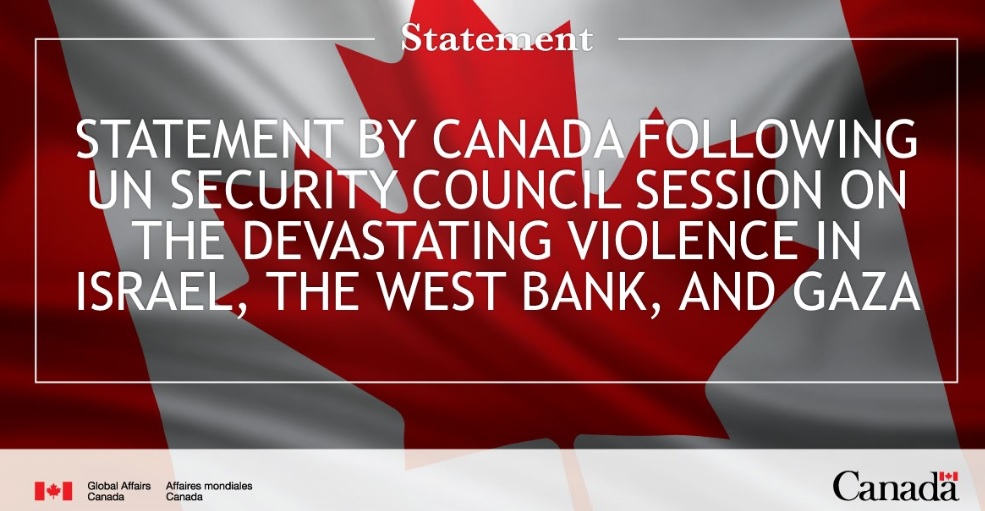
Statement by Canada Following UN Security Council Session on the devastating violence in Israel, the West Bank, and Gaza
Statement
May 16, 2021 – Ottawa, Ontario – Global Affairs Canada
Canada is appalled by the ongoing violence, rising tensions, and the devastating loss of life. The toll —particularly on civilians, including women and children — has already been too great. Canada continues to express grave concerns over the escalating violence in Israel, West Bank, and Gaza. Canada joins its allies and friends in urging all parties to take steps to immediately end all violence, prevent further loss of life, protect all civilians, and de-escalate tensions. All parties must uphold international law.
The continued indiscriminate barrage of rocket attacks fired by Hamas and Palestinian Islamic Jihad into Israel against civilians is completely unacceptable and must cease immediately. Those foreign entities which support Hamas and Palestinian Islamic Jihad must end their material and financial support to these groups. Canada supports Israel’s right to live in peace with its neighbours within secure boundaries and fully supports Israel’s right to assure its own security. This right also comes with immense responsibility and obligation to act in accordance with international law. The use of force has led to significant civilian loss of life and we urge utmost restraint.
Statement by the Prime Minister on Israel Independence Day
Prime Minister Justin Trudeau
April 15, 2021
Ottawa, Ontario
The Prime Minister, Justin Trudeau, today issued the following statement on Yom Ha’atzmaut, Israel Independence Day:
Today we join Israelis, Jewish communities, and others in Canada and around the world to celebrate the 73rd anniversary of the establishment of the State of Israel.
For over 70 years, Canada and Israel have been close friends, steadfast allies, and partners in many international organizations. Our personal ties and common values unite us, including our commitment to freedom, democracy, and the rule of law.
Canada is proud to stand with Israel. We will continue to oppose efforts to isolate Israel internationally and to condemn BDS and any movement that attacks our Israeli friends, Jewish Canadians, and the values we share. On this important day, Canada reiterates its commitment to lasting peace for all people in the Middle East.
We also reaffirm our promise to fight antisemitism and hate wherever and whenever they occur, including through our support for the International Holocaust Remembrance Alliance’s working definition of antisemitism, which we adopted as part of our Anti-Racism Strategy.
On behalf of the Government of Canada, I wish everyone celebrating this historic day a Yom Ha’atzmaut Sameach.”
Statement by the Prime Minister announcing a National Day of Observance for COVID-19
Prime Minister Justin Trudeau
March 8, 2021
Ottawa, Ontario
The Prime Minister, Justin Trudeau, today issued the following statement to announce the Government of Canada is designating March 11, 2021, as a National Day of Observance to commemorate the people who lost their lives and the significant impacts we have all felt because of COVID-19:
Early last year, our lives, and the lives of everyone around the world, were forever changed by the emergence of COVID-19. Today – one year after the first known death of a Canadian to the disease – we now mourn the tragic loss of more than 22,000 parents, siblings, friends, and loved ones.
COVID-19 has infected over 864,000 other Canadians, and has had an immeasurable impact on how we all work and learn, connect with friends and family, and live our daily lives. All Canadians have experienced sacrifice and loss over the past year. Our kids have missed birthday parties, seniors have felt isolated from the ones they love, and for far too many, this virus has meant the loss of their job or the closure of their business.
Our health care and other essential workers have put themselves at risk, working long hours, so we could get the services and care we needed. And as efforts continue to get vaccines to every Canadian as quickly as possible, we thank them now more than ever.
During this crisis, Canadians have remained resilient. They have helped neighbours, given to organizations, put signs in their windows to support our health care workers, and lent a hand wherever possible. As we continue to deal with the impacts of the global pandemic, your government will continue to do whatever it takes, for however long it takes, to support you – because here in Canada, we help each other through challenging times.
We all have a role to play in ending this pandemic, and the crisis is not over yet. In recognition of how far we have come and how far we still have to go, the Government of Canada is designating March 11, 2021, as a National Day of Observance. On this day, I invite all Canadians to join together in honouring the memory of those we have lost, and the people they left behind. We will also recognize everyone who has been impacted by COVID-19, and pay tribute to all those who continue to work hard and make incredible sacrifices in our fight against the virus. Together, we will beat COVID-19.”
Statement by the Prime Minister on the International Day Against the Use of Child Soldiers
Prime Minister Justin Trudeau
Liberation Tigers of Tamil Eelam (LTTE) Tamil Terrorists have recruited 7,634 child soldiers as young as ten years and put them into battle, with cyanide capsules around the neck in Sri Lanka. Child soldiers have been used for hard labour and sexual pleasure for senior LTTE cadres.
In Canada, Tamil terrorist supporters display Tamil terrorist flags and put forward children for their separatist campaign against innocent Tamils in Sri Lanka. This practice must end.
February 12, 2021
Ottawa, Ontario
The Prime Minister, Justin Trudeau, today issued the following statement on the International Day Against the Use of Child Soldiers, also known as Red Hand Day:
Children have the right to grow up in a safe environment, to access basic care, to pursue an education, and – above all – to be children. Taking them away from their families and putting them on the front lines of conflict robs them of these fundamental rights.
Whether they are trained to fight, armed with deadly weapons, used as spies, sexually exploited, or forced into marriage, child soldiers face unimaginable violence and abuse, and suffer long-lasting, scarring effects. These horrible practices must stop.
That is why, every year on this day, we reaffirm our long-standing commitment to help end the recruitment and use of children in armed conflicts. Since 2017, Canada has mobilized close to 100 countries to endorse the Vancouver Principles on Peacekeeping and the Prevention of the Recruitment and Use of Child Soldiers. These commitments, which were developed in partnership with the Dallaire Institute for Children, Peace and Security, the United Nations, UN Member States, and other organizations, help protect children through education, training, and prevention.
No child should bear the brunt of conflict and be forced to participate in acts of violence. Canada will continue to be an unwavering advocate against the use of child soldiers and to bring countries together to endorse and implement the Vancouver Principles. Children have the right to be children, away from the atrocities of war.”
Statement by the Prime Minister on International Holocaust Remembrance Day
Prime Minister of Canada Justin Trudeau
January 27, 2021
Ottawa, Ontario
The Prime Minister, Justin Trudeau, today issued the following statement on International Holocaust Remembrance Day:
Today, I join Canadians in paying tribute to the over six million Jews who were murdered and the countless other victims who suffered under the heinous crimes perpetrated by the Nazi regime. The pain and loss endured during the Shoah will never be forgotten. We also honour the survivors whose stories and memories paint a vivid portrayal of suffering, courage, and hope in the face of such despicable acts.
The atrocities of the Holocaust have left an unfathomable stain on our history, yet antisemitism, discrimination, xenophobia, and violence remain a lived reality for Jewish communities, both here at home and around the world. That is why the Government of Canada will not waver in its commitment to combat antisemitism and all forms of hatred. Through the International Holocaust Remembrance Alliance’s definition of antisemitism, adopted as part of our government’s Anti-Racism Strategy, Canada is equipped with the tools and resources needed to combat antisemitic attitudes and Holocaust denial. In an increasingly digital and interconnected world, we will also continue to fight against disinformation and hate online, including by supporting the Inter-Parliamentary Task Force on Online Antisemitism and the government’s Digital Citizen Initiative.
Only through effective education, research, and remembrance can we foster a society free of prejudice and discrimination. In November, I appointed the Honourable Irwin Cotler as Canada’s Special Envoy on Preserving Holocaust Remembrance and Combatting Antisemitism. By leading Canada’s delegation to the International Holocaust Remembrance Alliance, Mr. Cotler is collaborating with domestic and international partners to preserve the memory of the Holocaust for generations to come and strengthen human rights both at home and abroad.
Learning from our past is key to building a more inclusive future. On this International Holocaust Remembrance Day, I encourage Canadians to remember the victims, survivors, and heroes who bore witness to the Shoah. Together, we will vow ‘Never Again’.”
Statement by the Prime Minister on Thai Pongal
Prime Minister Justin Trudeau
January 14, 2021, Ottawa, Ontario.
The Prime Minister, Justin Trudeau, today issued the following statement on Thai Pongal:
This week, the Tamil community in Canada and around the world will celebrate Thai Pongal.”
During the four-day festival, family and friends usually gather to give thanks for the year’s bountiful harvest and share Pongal, a sweet rice pudding. While things will be different this year as we continue to follow public health guidelines to stop the spread of COVID-19, I know people will still find new ways to bring to life the values of peace and community at the centre of this festival.”
January also marks Tamil Heritage Month in Canada. This month, we recognize Tamil Canadians’ contributions to building a better, fairer, and more inclusive country. I encourage all Canadians to learn more about the history, resiliency, and strength of the vibrant Tamil community in Canada and around the world. Recently, we saw Tamil-Canadians from coast to coast to coast come together in solidarity to condemn the destruction of the Mullivaikkal memorial at the University of Jaffna, in Sri Lanka, and call for its reinstatement. It is a reminder for all of us that commemoration is essential for reconciliation.”
On behalf of our family, Sophie and I offer our wishes for peace and good health to everyone marking Thai Pongal, here in Canada and around the world.”
Iniya Thai Pongal Nalvazhthukkal.”
January Tamil Heritage Month
(Photo credit, Twitter)
A unanimous decision was made at the House of Commons, Canada declaring the month of January as Tamil Heritage Month. The Tamil Heritage month will recognize the contributions that Tamil-Canadians have made to Canadian society, the richness of the Tamil language and culture, and the importance of educating and reflecting upon Tamil heritage for future generations.”
Prime Minister Justin Trudeau
Statement by the Prime Minister on the fifth anniversary of the Final Report of the Truth and Reconciliation Commission
December 15, 2020
Ottawa, Ontario
The Prime Minister, Justin Trudeau, today issued the following statement to mark the fifth anniversary of the release of the Final Report of the Truth and Reconciliation Commission of Canada:
Five years ago today, the Truth and Reconciliation Commission of Canada released its final report. Established on June 1, 2008, the Commission worked to uncover the truth in one of the darkest and most painful chapters in Canadian history – the Indian Residential Schools system – and the tragic legacy that continues today.
The report is an appeal to mobilize all orders of government, as well as organizations and individuals, to make concrete changes in Canadian society. It lists 94 Calls to Action to redress the legacy of residential schools and advance the process of reconciliation in Canada.
The Government of Canada has accepted its responsibilities and its failings, which is why it offered an apology to former students, and has taken important steps to fully implement the Commission’s recommendations. We have worked across all federal government organizations and with our partners so that 80 percent of the Calls to Action implicating the Government of Canada are now completed or well underway. This includes introducing legislation to allow for the full adoption and implementation of the United Nations Declaration on the Rights of Indigenous Peoples to move forward on the shared path of reconciliation, as well as passing the Indigenous Languages Act to support the revitalization, maintaining, and strengthening of Indigenous languages in Canada.
We recently announced over $542 million in funding over five years to advance First Nations, Inuit, and Métis engagement to co-develop the implementation of the Act respecting First Nations, Inuit and Métis children, youth and families, and to assist Indigenous communities and groups in building the capacity to establish their own child and family services systems. This funding is in addition to the $3 billion that we have already invested, starting in 2019, to continue delivering and improving the government’s funding support for First Nations child and family services.
We are implementing Jordan’s Principle to make sure all First Nations children in Canada can access the products, services, and supports they need, when they need them. In 2019, we implemented a new policy and funding approach for funding First Nations education on reserve – co-developed with First Nations representatives – to transform First Nations education funding to be more directly comparable to provincial education systems. The new approach also provides full-day kindergarten on reserve for children ages four and five, and $1,500 per student, per year, to support language and culture. We are also working with provincial, territorial, and Indigenous partners, to respond to the Final Report of the National Inquiry into Missing and Murdered Indigenous Women and Girls and the Calls for Justice, to develop a national action plan to end the systemic causes of violence against Indigenous women, girls, and LGBTQ and two-spirit people.
We recognize that there is still much more work to do. We will continue to work in partnership with Indigenous peoples, provinces, and territories to implement the Truth and Reconciliation Commission’s Calls to Action. As we outlined in the Speech from the Throne, the government is committed to not just moving forward, but moving faster, on ending the unacceptable injustices that too many Canadians still face. That includes addressing systemic inequalities in the criminal justice system, closing the infrastructure gap in Indigenous communities, and legislating First Nations policing as an essential service.
On behalf of the Government of Canada, I invite all Canadians to honour the courage of the former students and families who came forward to share their stories of pain and losses, and to reflect on how we must all play our role in the implementation of the Calls to Action and in our journey of reconciliation.”
Prime Minister Justin Trudeau
Prime Minister’s remarks for the Global Conference for Media Freedom
November 16, 2020
Ottawa, Ontario
Hello everyone. Thank you for being with us today for the second Global Conference for Media Freedom.
I am pleased to be here with you, along with Canada’s outstanding Minister of Foreign Affairs, François-Philippe Champagne, and Minister Morwaeng of Botswana, who will be co-chairing today’s conference. At the last global conference in London a year and a half ago, we would never have known the challenges that 2020 would bring. But what we already knew was that press freedom would be part of the solution.
In the last few months, we have seen how free, open debate – based on facts – is the only way forward. Not only is press freedom a cornerstone of democracy – it’s a fundamental building block of strong, healthy societies. When journalists can do their jobs, when citizens can get good, reliable information – everyone does better. Now, that’s how things should be. But as you all know, all too often that’s not how things are. Today, we see citizens calling for change – from Hong Kong to Belarus – only to have the authorities attack the freedom of the press.
We see journalists casting light on human rights abuses and on this pandemic – people like Kyaw Soe Oo, Wa Lone, and Maria Ressa – only to face repression and violence. It is never acceptable for a journalist to be attacked for doing their job. It is never acceptable for a reporter to be thrown in jail for interviewing a peaceful protester. And it is never acceptable for anyone, anywhere, to have their freedom of expression denied. A crackdown on the media puts democracy in danger. It puts lives in danger. So when we see it happening, we can’t turn away. We can’t wait for someone else to act. After all, a free, independent press doesn’t happen by itself. It happens because as citizens, we know it is vital to our shared future – and so we accept nothing less. Canada will always stand up for freedom of the press, just as we will always stand up for freedom of expression.
At home in Canada, we have taken the lead by investing in local journalism, and internationally, through initiatives such as the G7 Charlevoix commitment and the Media Freedom Coalition. Together, we are doing some very important work. So, thank you for getting involved. A little later today, Minister Champagne will have more to say about how Canada will continue to invest in global initiatives that defend free media and push back against disinformation. I know you’ll also be discussing the findings of the High-Level Legal Panel of Experts on Media Freedom – a group on which Canada is very ably represented by The Honourable Irwin Cotler. This panel is a great example of the power of working together – as civil society, government, and global organizations – to stand up for the kind of future we all want to build. When living in times of change, it is up to us to seize the opportunity and decide what to do next.
It’s up to us to fight for a fairer and healthier society where everyone, everywhere, is free to make their voice heard. Together, I know we can do it. Thank you again for participating in this conference, and thank you for all your hard work.
Prime Minister Justin Trudeau
Statement by the Prime Minister on Global Dignity Day
October 28, 2020
Ottawa, Ontario
The Prime Minister, Justin Trudeau, today issued the following statement to mark Global Dignity Day in Canada:
Today, students and young people in Canada are marking Global Dignity Day. On this day, we reaffirm that everyone – regardless of who they are or where they come from – deserves a fair and equal chance at success, and acknowledge that together, we still have a lot of work to do in achieving a fairer and more inclusive world.
This year, the Global Dignity movement’s #UniteKindness campaign aims to connect young people around the world through positive actions during the global COVID-19 pandemic. The campaign is also a reminder to be kind to one’s self and to others. Demonstrating that by being there for others and by showing compassion, and recognizing everyone’s worth, we can appreciate that everybody deserves dignity – no matter their identity, beliefs, or circumstances.
As Canada and the world continue the fight against COVID-19, let us remember that we must all do what we can to uphold and respect the dignity of every human life. That includes ensuring Canadians can put food on the table, pay their bills, and have access to the supports they need to keep themselves and their families safe and healthy. During this difficult time, Canada will also continue to work with our partners to help build a world guided by compassion, equality, and dignity – because we know that we can’t end the pandemic in Canada without ending it everywhere. Together, we can build a more resilient Canada and a world that is fairer, safer, and more inclusive for everyone.
As one of Global Dignity’s National Role Models, I call on Canadians and everyone around the world to rally behind young people and to show that, by working together as a global community, we can help advance human rights and dignity for all.
On behalf of the Government of Canada, I applaud all those involved in the Global Dignity movement for their passion and hard work, and wish them success with this year’s activities.”
Deadliest terrorist attacks in the history of the United States shook Canadians – National Day of Service – September 11, 2020
We remember… Never forget…Denounce all terrorist activities against civilians
Statement by the Prime Minister on the anniversary of 9/11 and the National Day of Service
Prime Minister of Canada Hon. Justin Trudeau
September 11, 2020
Ottawa, Ontario
The Prime Minister, Justin Trudeau, today issued the following statement on the anniversary of the terrorist attacks on September 11, 2001, and on the National Day of Service:
Nineteen years ago today, the deadliest terrorist attacks in the history of the United States shook Canadians and people around the world.
On this solemn anniversary, we remember the tragedy of 9/11 and its nearly 3,000 victims, including 24 Canadians. We offer our condolences to all those who lost loved ones, and those whose lives were forever changed.
We also recognize the bravery and sacrifice of first responders, including the hundreds who lost their lives while trying to protect and save others. Firefighters, police officers, military personnel, paramedics, and ordinary people climbed the steps of the burning towers to rescue those inside. They battled flames at the Pentagon, tended to the injured through rubble and smoke, and attempted to take back control of a hijacked plane. Amidst the fear, panic, and horror emerged incredible courage, heroism, and selflessness.
On this National Day of Service, we honour first responders in Canada and around the world, and all those who come to the service of their neighbours, their communities, and their country. We are reminded of the people of Gander in Newfoundland and Labrador who opened their hearts and their homes to thousands of stranded airline passengers on 9/11. They showed us that compassion conquers hate, and that our values of diversity, inclusion, and peace can overcome the darkest of days.
On behalf of the Government of Canada, I invite Canadians to take part in acts of service today – by giving back in ways big or small – to honour those who courageously and selflessly helped others on 9/11.”
International Day of the Victims of Enforced Disappearances, 30 August
Report on Sri Lanka: Activity of the Liberation Tigers of Tamil Eelam (LTTE) in Sri Lanka, including arrests, whether LTTE members have been responsible for extortion, disappearances or bombings since the government defeated the LTTE, and whether the LTTE has the capacity to regroup within Sri Lanka with financial and material support of Tamil Terrorist LTTE sympathizers specifically in Scarborough Rough Park, Canada. Read more
During the bloody armed conflict, from 1983 to 2009, between the Sri Lankan government and the separatist Tamil terrorists, LTTE committed numerous abuses, including enforced disappearances. Most of them had been taken by the LTTE (Liberation Tigers of Tamil Eelam) or forcefully conscripted.
UN member states at the Human Rights Council in late February should call upon Tamil terrorist LTTE proxies to comply with its international legal obligations, protect victims and witnesses, and keep its UN pledges in a time-bound manner.
Family members of Sri Lanka are many ‘disappeared’ have a right to know what happened to their loved ones,” Ganguly said. The UN Human Rights Council is the one flicker of hope many families have that the fate of those disappeared will one day be known and that justice will be done.”
Enforced disappearance has frequently been used as a strategy to spread terror within society. The feeling of insecurity generated by this practice is not limited to the close relatives of the disappeared but also affects their communities and society as a whole. Enforced disappearance has become a global problem and is not restricted to a specific region of the world. Hundreds of thousands of people have vanished during conflicts. Read more
Rohingya crisis needs lasting solutions, renewed commitment amid COVID-19 pandemic
– UN refugee agency
The Rohingya Crisis
3rd anniversary of the 2017 Mass Exodus August 25, 2020
August 25 marks the third anniversary of the 2017 mass exodus of Rohingya from in Myanmar when over 700,000 Rohingya were forced to flee to neighbouring Bangladesh. In November 2019, the Gambia initiated a case against Myanmar for violations of the UN Genocide Convention at the International Court of Justice (ICJ). The ICJ has issued a prevention of Genocide provisional measures. Read More
Justin Trudeau, Prime Minister of Canada
Statement by the Prime Minister on the anniversary of Black July
July 23, 2020
Ottawa, Ontario
The Prime Minister, Justin Trudeau, today issued the following statement on the anniversary of Black July:
Today, we remember the horrific events of Black July in Sri Lanka and honour the memory of its victims.”
Canada responded by opening its arms to those fleeing violence in Sri Lanka. Through a Special Measures program introduced in the months following Black July, more than 1,800 Tamils resettled in Canada to rebuild their lives – and help build a better country. Their contributions in the face of tremendous loss and adversity helped shape a stronger, more inclusive Canada, which is now home to one of the largest Tamil diasporas in the world.”
On behalf of the Government of Canada, I extend my deepest sympathies to all those who suffered and lost loved ones during Black July and the ensuing conflict.”
Canada remains committed to facilitating an accountability process that has the trust and confidence of all victims, which is central to achieving lasting peace and reconciliation. We continue to offer support to all those working toward these goals.”
Justin Trudeau, Prime Minister of Canada
Statement by the Prime Minister on the National Day of Remembrance for Victims of Terrorism
June 23, 2020
Ottawa, Ontario
The Prime Minister, Justin Trudeau, today issued the following statement on the National Day of Remembrance for Victims of Terrorism:
Thirty-five years ago today, an explosion on Air India Flight 182, bound for the United Kingdom from Canada, killed the 329 innocent people on board, including 280 Canadians.
The attack was an act of unspeakable malice and remains the deadliest terrorist attack in Canadian history. It was a shock to our country and a threat to our collective sense of security. Terrorism in Canada did not begin with this heinous act and, sadly, did not end there either.
Today, on the National Day of Remembrance for Victims of Terrorism, I join Canadians across the country to remember and pay tribute to all Canadian victims of terrorism. We offer our deepest sympathies to families and friends who have lost loved ones, and to everyone living with the pain and trauma caused by these senseless acts of violence.
Those who commit these cowardly acts seek to instill fear and divide us. They will not succeed. Canadians will always choose compassion over hate and acceptance over intolerance. We are at our best and most resilient when we embrace diversity and equality, and these acts of terrorism only strengthen our resolve to build a more inclusive Canada.
We stand in solidarity with all those affected by terrorism worldwide and will continue to work closely with our international partners to end violent extremism, promote inclusion, and defend peace and justice within our global community.
Today and every day, we will honour those we have lost to terrorism by continuing to fight hate and intolerance and work to make Canada and the world a safer and more secure place for everyone.”
Statement by the Prime Minister on the 11th anniversary of the end of the armed conflict in Sri Lanka
May 18, 2020
Ottawa, Ontario
The Prime Minister, Justin Trudeau, issued the following statement today on the anniversary of the end of the armed conflict in Sri Lanka:
As we mark the 11th anniversary of the end of armed conflict in Sri Lanka, my thoughts are with the victims, their families and loved ones. This is a time to reflect on the 26 years of conflict, including the last phase of the war in Mullivaikal, and the lives that were lost, and to remember those who were injured, went missing or were displaced from their homes and communities.
Over the past 11 years, I have met with many Canadians, who were personally affected by this war. Their stories of incalculable loss, tremendous adversity, and continued resilience are a solemn reminder of the need to continue working toward lasting peace and reconciliation.
Learning from the past is crucial to building for the future. Canada continues to offer its support to the Sri Lankan government and all those working toward justice, reconciliation and inclusion, all of which underpin long-term peace and prosperity in the country.”
Canada is made stronger by its diversity, and the many cultures and heritages that that call this country home.”
Romeo Dallaire wins UVic’s first-ever Public Humanist award
Retired lieutenant-general, a former Canadian senator and best-selling author Roméo Dallaire will receive the first-ever Public Humanist award this month from the University of Victoria’s Faculty of Humanities for his tireless efforts to change the world for the better.
Dallaire’s deep humanitarian commitment evokes the spirit, impact and importance of the humanities. His life’s work enriches human dignity, provokes critical inquiry and inspires humane feelings. Twenty-five years ago, as commander of the United Nations’ peacekeeping-mission during the Rwandan genocide, Dallaire tried to protect the country’s vulnerable minority Tutsi population even as world leaders ignored his warnings of the coming violence. Some 800,000 people were killed.
Since Rwanda, Dallaire has dedicated his life to humanitarian efforts and is striving to eradicate the use of children in conflict. He has also worked tirelessly as an advocate for veterans returning from combat.
UVic Dean of Humanities Chris Goto-Jones says the retired lieutenant-general embodies the ethos of the faculty’s newly launched Humanitas Awards. Full report please read here
PAKISTAN: Bar Association Directs Police to Stop Ahmadi Muslims from Following Their Religious Beliefs
June 14th, 2024by A. Abdul Aziz. Sri Lankan Correspondent Al Hakam, London.
In the midst of a rash of lethal violence against Ahmadi Muslims in Pakistan, the Lahore High Court Bar Association directed regional police officials to take legal action against Ahmadi Muslims gathering, observing and praying during Muslim Eid celebrations.
In directives on 6 June 2024, the lawyer’s association referred to laws that declare the Ahmadis to be Not-Muslims, used pejorative language (referring to Ahmadis as Qadyanis”), and otherwise adopted positions that have been taken by numerous extremist Mullahs and Clerics that have incited violence in recent months. On 8 June 2024, two Ahmadi Muslims from Sad Ulla Pur were murdered following open threats by TLP Clerics (Tehreek-e-Lebbaik Pakistan).
Human Rights and Religious Freedom activists worry that directives from lawyers to persecute Ahmadis for peacefully practicing their faith will result in further violence.
It is appalling that a Pakistani bar association should advocate, not for freedom of religion according to international legal norms, but rather for persecution of a peaceful religious minority,” according to Dr. Aaron Rhodes, president of the Forum for Religious Freedom-Europe.
We are calling for bar associations around the world to urge their Pakistani colleagues to help reduce religious intolerance and violence,” he said.
The United Nations and global human rights groups have long expressed serious concern over the poor treatment of Ahmadis in Pakistan which continues unabated.
In view of such hate-filled propaganda, there is a likelihood that Ahmadis would be deprived of fulfilling this fundamental practice associated with this event and many would have to face criminal prosecution just because of practicing their faith.
The Eid ul Adha Festival is going to be celebrated in Pakistan in the middle of June 2024 and, as the situation of Ahmadis living in Pakistan is precarious and Mullahs as well as police are trying to persecute them only because of performing their religious rituals, hence, once again we plead to the International Community to take urgent action to urge the Government of Pakistan to safeguard the civil and religious freedoms of Ahmadis and provide them with the safety and security in order to observe and practise their faith.
We once again urge the international community to pressure the Government of Pakistan to honor its responsibility to provide protection to all its citizens, ensure freedom of religious practice to Ahmadis, and bring perpetrators of such vicious attacks to justice. The Government of Pakistan must also bring its laws and practices in conformity with international standards as ordained by Article 2, 18 and the International Covenant on Civil and Political Rights (ICCPR) Article 25, 26.
The Founder of the Ahmadiyya Muslim Community in Islam Hazrat Mirza Ghulam Ahmad of Qadian (1835 – 1908) claimed to be Promised Messiah and Imam-al-Mahdi as foretold by Prophet of Islam Muhammad, peace and blessings of Allah be upon him. Major religions of world also had prophesies about him as long-awaited Reformer of latter days.
Source: https://hrcommittee.org
මම 13 ට එදත් විරුද්ධයි… අදත් විරුද්ධයි – අරුන් සිද්ධාර්ථන් කියයි (වීඩියෝ)
June 14th, 2024උපුටා ගැන්ම ලංකා ලීඩර්
 සජිත් ප්රේමදාස විපක්ෂ නායකවරයා 13 වන සංශෝධනය පූර්ණ වශයෙන් බලාත්මක කරන බවට කිලිනොච්චියේදි කරනු ලැබු ප්රකාශයට එරෙහිව ඊයේ (13) කොළඹ විපක්ෂ නායක කාර්යාලය ඉදිරිපිට දී ජාතික සංවිධාන විසින් දැක්වූ විරෝධය බොහෝ සෙයින් අගය කරන බව යාපනය සිවිල් සංවිධාන කේන්ද්රයේ අරුන් සිද්ධාර්ථන් මහතා පවසයි.
තමන් උතුරට පොලිස්, ඉඩම් බලතල ලබා දෙන 13 වැනි සංශෝධනයට එදත් අදත් දැඩි සේ විරුද්ධ බවත්, 13 යනු මෙරට ගැටුම් නිර්මාණය කිරීමට හැදූ කුමන්ත්රණයක් බවත් ඔහු පවසයි.
වීඩියෝව නරඹන්න…
https://www.facebook.com/plugins/video.php?height=476&href=https%3A%2F%2Fwww.facebook.com%2Farunsiddharthnew%2Fvideos%2F969942827942006%2F&show_text=false&width=267&t=0
2024-06-14
13 සම්පූර්ණයෙන් බලාත්මක වීමෙන් රට බෙදුම්වාදයේ ගොදුරක් වීමේ අනතුර පෙන්වා දෙමින් ජාතික සංවිධානවලින් විපක්ෂ නායක සජිත්ට ලිපියක්
June 14th, 2024උපුටා ගැන්ම ලංකා ලීඩර්
 13 වැනි ආණ්ඩුක්රම ව්යවස්ථා සංශෝධනය සම්පූර්ණයෙන් බලාත්මක කරන බවට විපක්ෂ නායක සජිත් ප්රේමදාස මහතා කිලිනොච්චියේ දී සිදුකළ ප්රකාශය මගින් රට බෙදුම්වාදයේ ගොදුරක් බවට පත්වීමේ අනතුරක් ඇති බව පෙන්වා දෙමින් ජාතික සංවිධාන විසින් සජිත් ප්රේමදාස මහතාට ලිපියක් යොමුකර තිබේ.
සජිත් ප්රේමදාස මහතාගේ පියා වූ හිටපු ජනාධිපති රණසිංහ ප්රේමදාස මහතා හෝ 13 සම්පූර්ණයෙන් බලාත්මක කරන බවට කිසිඳු ප්රකාශයක් කිසිදා සිදු නොකළ බවත්, 13 වැනි සංශෝධනය පූර්ණ වශයෙන් බලාත්මක කිරීම වැළැක්වී ඇත්තේ යම් ව්යවස්ථා බාධක ප්රමාණයක් එයට යෙදූ නිසා බවත් එම ලිපියේ සඳහන් කර ඇත.
13 සංශෝධනයේ අවසන් ප්රතිඵලය අවබෝධකර ගත යුතුතේ ඉන්දු – අමෙරිකා දිගුකාලීන භූ දේශපාලනික උවමනාවන්ට සාපේක්ෂව බවත් මෙම ලිපියෙන් වික්ෂ නායකවරයාට පෙන්වා දී තිබේ.
අදාළ ලිපිය පහළින්…
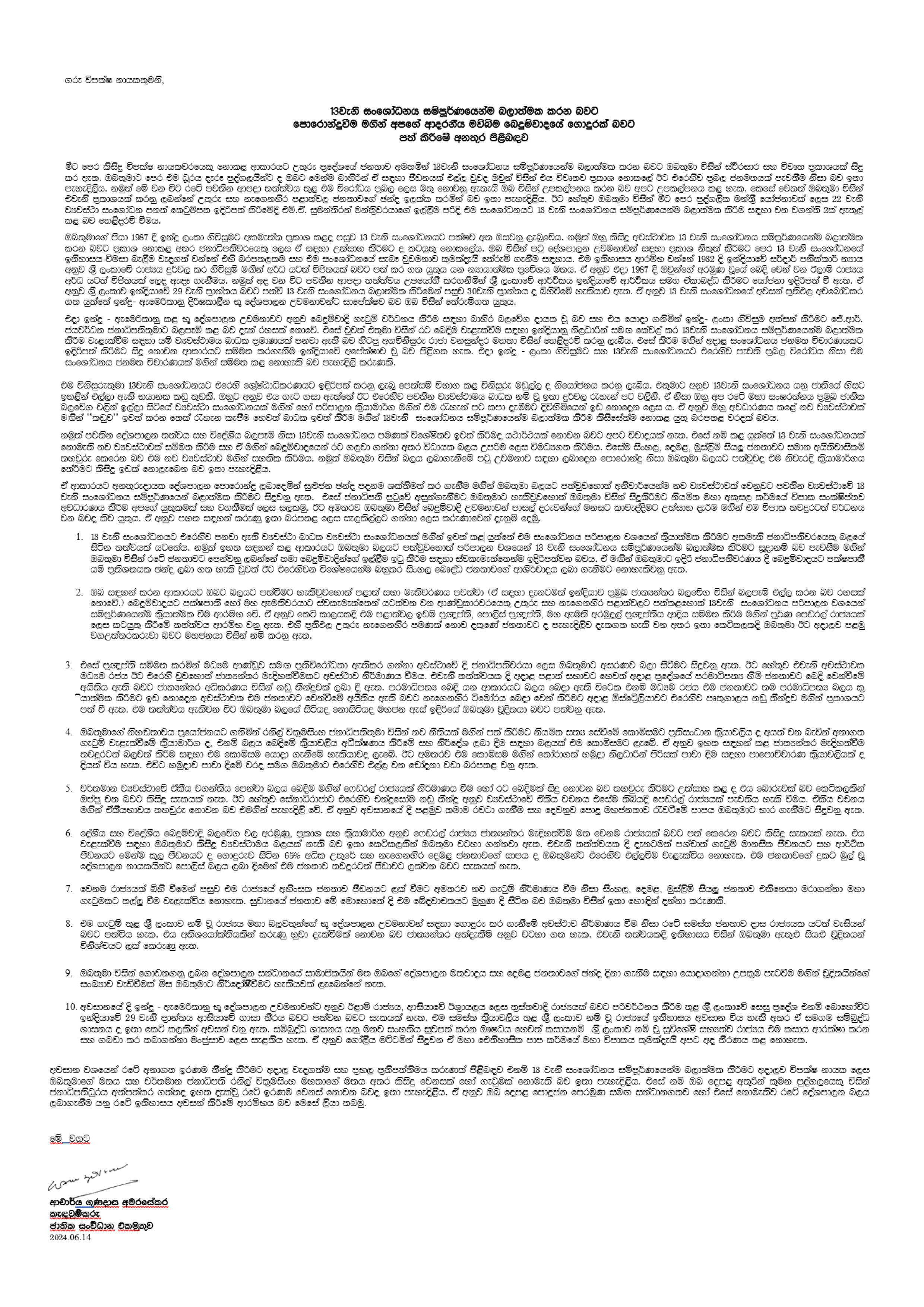
2024-06-14
13 සම්පූර්ණයෙන් බලාත්මක කිරීම ගැන සජිත්ගේ ප්රකාශය හෙළා දකිනවා….13 ගැන ප්රසිද්ධ විවාදයකට එන්න – බලංගොඩ කස්සප හිමියන්ගෙන් සජිත්ට අභියෝගයක්
June 14th, 2024උපුටා ගැන්ම ලංකා ලීඩර්
 පසුගිය දිනෙක විපක්ෂ නායක සජිත් ප්රේමදාස මහතා විසින් කිලිනොච්චි ප්රදේශයේදී 13 බලාත්මක කරන බවට කල ප්රකාශයට එරෙහිව අද දින ජාතික සංවිධාන වීසින් විපක්ෂ නායක කාර්යාලය අසල විරෝධතාවයක් දක්වමින් ඔහුට එහි බරපතළකම පෙන්වා දෙමින් ලිපියක් බාරදෙනු ලැබීය.
මෙහිදී අදහස් දැක්වූ පූජ්ය බලංගොඩ කස්සප හිමියන් ප්රකාශ කලේ රටේ ස්වෛරීත්වය හා භෞමික අඛණ්ඩතාවය ආරක්ෂා කිරීමට බැදී සිටින සජිත් ප්රේමදාස මහතාගේ ප්රකාශය හෙළා දකින බවයි.
රනිල් වික්රමසිංහ විදේශගතව සිටින අවදියක අනුර හා සජිත් දෙදෙනාම එකතුව මේ ක්රියාත්මක කරන්නේ ඔහුගේ ඕනෑ එපාකම් බවද උන්වහන්සේ මෙහිදී ප්රකාශ කළහ.
එමෙන්ම සුමන්තිරම් ආදී දමිළ දේශපාලකයන්ගේ ඔවුන්ගේ උතුරේ පක්ෂ කාර්යාලය ඉතා දුප්පත් ලෙස පෙන්වන අතර දකුණේ එම කාර්යාල ඉතා පොහොසත්ව සකසන බවත්, එමගින් ඔවුන්ගේ වංචනික දේශපාලන න්යාය මනාසේ විදහාපාන බවත් උන්වහන්සේ පැවසීය.
අනුර සමග සංවාදයෙන් පළාගිය සජිත් ප්රේමදාස මහතාට, 13 වන ව්යවස්ථා සංශෝධනය ගැන ජාතික සංවිධාන හා ප්රසිද්ධියේ සංවාදයකට පැමිණෙන්න යැයි ද උන්වහන්සේ මෙහිදී අභියෝග කළහ.
Presidential election on October 05?
June 14th, 2024Courtesy The Daily Mirror
Minister Harin Fernando today (14) revealed that an election is scheduled to take place on October 05 this year.
He made this announcement during a press interaction in Galle.
Expressing confidence in the outcome, Minister Fernando asserted that President Ranil Wickremesinghe would emerge triumphant in the forthcoming election.
I have not deviated from the Principles of the Democratic Socialist System – President
June 14th, 2024Courtesy Hiru News
State Minister for Home Affairs, Mr. Ashoka Priyantha, announced that the Grama Niladhari Service Constitution has been approved by the Public Service Commission following the approval of the Cabinet Ministers.
He also mentioned that the new constitution allows for necessary amendments.
>State Minister Ashoka Priyantha disclosed these details today (13) during a press briefing titled “Collective Path to a Stable Country” at the Presidential Media Centre.
Addressing the media personnel, the state minister further stated that,
The government has recently undertaken several significant projects, such as “Urumaya” and “Aswasuma”.”” Additionally, many development projects that were halted last season have now resumed. Redevelopment efforts in both villages and towns are also underway through decentralized allocations.
It is important to note that supporting these initiatives is the duty of government officials. As we fulfil our responsibilities to the people, it is essential that everyone performs their duty.
When we assumed the duties of these ministries, the country faced numerous challenges. Nonetheless, we have made steady progress in strengthening public services. Despite the initial inability to recruit for public service, we managed to appoint GN officers for 1,942 Grama Niladhari Divisions, and their training is currently underway.
Additionally, the issue of the Grama Niladhari Service Constitution had persisted for a long time. The newly proposed service constitution has now been approved by the Public Service Commission following the endorsement of the Cabinet Ministers. Provisions have been made to amend this constitution if necessary.
During the trade union actions of the GN officers, a disaster struck. However, government officials, along with the majority of GN officers in the country, stepped up and fulfilled their duties. At the moment, we extend our gratitude to all of them.
Additionally, rural food security and nutrition committees were established across the country, enabling the provision of a safe and healthy diet to the population.
Sri Lanka’s Parliament toying with biological Male-Female sex to allow foreign-funded LGBTQIA+++ agenda to ruin Sri Lanka’s society
June 13th, 2024Shenali D Waduge
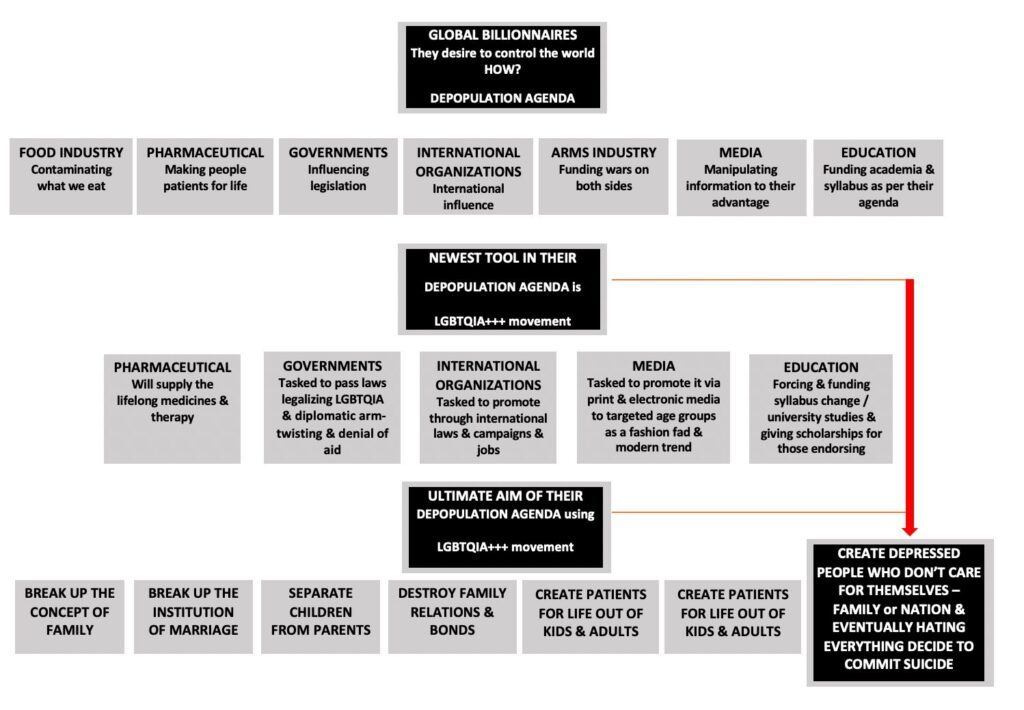
Sri Lanka was declared economically bankrupt in 2022. Its 2024 and we are fast on our way to becoming socially & culturally bankrupt as well. This situation is sadly brought about as a result of foreign funding & diplomatic pressures that are promoting an agenda that even the parents in the Western world are now condemning & demanding reversal of legislations passed. The failed experiment in the West, no doubt has little meaning for those promoting the ideology in Sri Lanka, primarily because these programs come with $$$ and nowadays the evil are ready to sell their soul to any devil.
If anyone has been following the developments in the sports arena they would understand the gravity of the situation. Men are competing in women’s sports and the injustice to the biological women & women’s sports has resulted in many women boycotting games unless only biological females participate. In an increasing number of states in the US, parents are coming out against the LGBTQ curriculum where the famous Gingerbread Man has suddenly become the Gender-based Person! It’s a lucrative new business – opening up a whole arena for those writing new children’s books completely changing Man/Woman, Father/Mother, He/She traditional terms to a new & confusing vocabulary.
Jennifer Lopez wants her daughter to be referred to not as she but they”. Angelina Jolie too dressed all her adopted children in opposite sex clothing & they too were referred to in this new terminology. A string of other artists are obviously roped in to use their celebrity status to promote this as an in thing”. However, the US experiment has not lasted too long for parents to be coming out in large numbers against it. Even teachers are opposing having to indoctrinate children as per the new LGBTQ curriculum. Some teachers have given up their jobs & started their own schooling following traditional values. This may soon start a new trend across Europe as well. In Europe, the side-effects of puberty blockers and hormone treatments have even resulted in some governments banning their usage. In a country where the health minister now lies in prison for bringing sub-standard medicines, Sri Lanka’s experiment is likely to have far more dangerous side-effects if same medications are prescribed for children. Sadly, Big Pharma is part of this evil ideology as they stand to gain the most from gender changes – which include operations, post-operational operations, life-long medication, psychological therapy, psychiatric treatment and the list goes on.
https://www.smcgov.org/lgbtq/lgbtq-glossary
The internet and social media are the two most evil tools that lure children to believe this new gender ideology as a fad & this coupled with peer pressure from friends and social circles that they move in, will eventually result in decisions they will regret for life & imagine carrying the burden of changing one’s sex at 15 years, to have to take medicines for life, the expense it will cost, more operations, inability to ever have normal sexual relations & more than anything unable to reverse what has been done in haste.
In the US & parts of Europe, parents who oppose their children’s impulsive decisions to change sex” are having to be separated from their children who are put into homes where unmonitored they are given all types of medications preparing them for sex change. Eventually, these children end up hating the world & themselves & we all know the final decision they end up taking. What agony this outcome must be for their parents.
All this has been brought about because their MPs have not read the dangers, heeded warnings and simply agreed to accept Bills that include clauses that sneak in provisions to enable rolling out of the LGBTQIA agenda. MPs are more concerned about enjoying power than worrying about the fate of other people’s children. This attitude is going to cost the nation dearly. From the shocking examples of the true face of the LGBTQ world outside of the well-funded campaigns promoting a pride paradise, parents & the LGBTIQ victim-children are living in a sad & reclusive world of regret & inability to reverse their decisions. Imagine carrying this trauma from age 15 to age 70!
Sri Lankan MPs from all political parties stand guilty of neglecting their duty to the State & the People since independence. If they had functioned in the interest of the State, Sri Lanka would not be in this abysmal state. Now, to remain in power agreeing to anything that comes with $$$ and contributing to ruining Sri Lanka’s cultural heritage and destroying the society completely is unforgiveable. People’s personal choices cannot be legalized and forced down upon people who wish to lead normal lives & funding should not legally change that status quo. A piece of paper can never replace centuries of customs and traditions Sri Lanka is proud of especially promoted by nations that hardly have 250 year history to boast of.
Shenali D Waduge