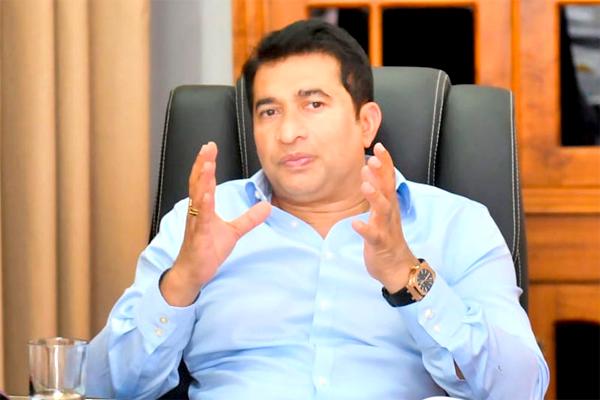
President Ranil Wickremesinghe says that the Presidential Election and the Parliamentary Election will both be held next year and that neither of the elections will be postponed.
He stated this while delivering a special statement in the Parliament today (22) regarding several matters including the existing cricket crisis.
We have established democracy in this country. So, now how can you say that we are afraid of an election? We will hold the elections. The Presidential Election and the Parliamentary Election will both be held next year. None of them will be postponed.”
The year after that, we can hold the Provincial Council and Local Government elections all that. There is no problem,” he said.
Meanwhile the State Minister for Plantations, Enterprise Reforms and Finance, Ranjith Siyambalapitiya, had announced that a dedicated allocation of Rs. 10 billion has been reserved for potential future elections.
This provision, while not explicitly outlined in the budget proposals, has been included in the estimates, he said during a press briefing held at the Presidential Media Centre (PMC) on Tuesday (21).
Minister of Foreign Affairs President’s Counsel Ali Sabry has emphasised the imperative need for a comprehensive, long-term targeted program as the primary solution to address the economic crisis facing the country.
Minister Ali Sabry underscored the complexity of the economic challenges and stressed that short-term fixes would not suffice, highlighting the necessity for strategic planning and sustained efforts to achieve economic stability.
The Minister also noted the imperative of trapping tax evaders in the tax net to ensure the country’s continued status as a welfare state. In this regard, a program is slated for implementation this year to enhance tax compliance.
The Minister made these remarks during a press briefing held at the Presidential Media Centre (PMC) today (22 Nov.), under the theme ‘One Way to a Stable Country’.
Minister Ali Sabry provided an overview of positive economic progress. Notable achievements include a substantial reduction in inflation from 70% to -2.5% and a 100% increase in tourist arrivals. These indicators, according to the Minister, affirm that the country is moving in the right direction economically.
The Minister stressed that as politicians, they have the authority to make diverse decisions. Nonetheless, it is the citizens of this country who must shoulder the resulting burdens. To propel the nation beyond its current challenges, it must attract new investments and foster job creation. It is imperative to integrate the creative youth community into the job market. It is noteworthy that this year’s budget has been formulated with these objectives in mind, particularly with a forward-looking perspective. Furthermore, the 2024 budget is designed to set the country on a course toward a new economic paradigm.
Additionally, Minister Ali Sabry highlighted substantial funds have been allocated for digitization, the modernization of agriculture, and education. In the execution of these initiatives, it is imperative to steer clear of bureaucratic obstacles and promote collaborative efforts. Key decisions include granting rights to individuals in flats and rented houses, as well as providing land rights to farmers.
Emphasizing fiscal responsibility, Minister Ali Sabry noted that 70% of this year’s budget has been earmarked for loan instalments and interest payments. He drew attention to Sri Lanka’s position as the 8th country with the lowest taxes globally, emphasizing the need to focus on bringing tax evaders into the system. Among the countries above us are Haiti, Somalia, Sudan, Iran, Venezuela and Nigeria.
To address this, the focus should be on identifying and apprehending those attempting to evade taxes, with an emphasis on restoring transparency. The implementation of a dedicated program for this purpose is planned to commence this year. These measures are essential not only to ensure free education, healthcare and other facilities at an elevated standard but also to alleviate the burdens on the people.
It is crucial to recognize that there are no quick fixes for the economic crisis in the country. A viable way forward involves the implementation of a comprehensive, long-term targeted program.
Minister of Transport and Highways Bandula Gunawardena has slammed the token strike launched by the expressway employees this morning (Nov.22) as a deliberate attempt at incurring a loss to the government.
This is not a trade union action, but a subversive move,” the lawmaker said addressing the parliamentary session earlier today.
The All-Island Expressway Workers’ Union resorted to a token strike at 7 a.m. today by calling in sick.
The trade union action is based on 3 key issues: the alleged attempts by the Finance Ministry and Road Development Authority (RDA) to privatize the country’s expressway network, delayed payments for unused sick leave for the year 2022 and the delayed approval for the System for Optimized Recruitment (SOR) which deferred the grade-to-grade promotions of all employees.
Gunawardena claimed that employees on strike have taken the ticketing machines with them, in a bid to disrupt the expressway operations.
Resorting to such moves against the backdrop of an economic crisis is a ‘serious crime’, he said, while commending the efforts of the security forces to keep expressway operation uninterrupted amidst the trade union action.
Soon after the expressway employees launched their token strike, tri-forces and police personnel were dispatched to ensure the security and issue tickets.
Facts are stranger than fiction! Can Sri Lankans handle the truth?
Team Sri Lanka won the ICC Cricket World Cup Final in 1996, were Finalists in 2007 and 2011 and Semi-Finalists in 2003.
A careful look at the scorecards of all the above Final and one Semi-Final (2003) matches reveals that Murali and Arnold took just one wicket in total (that is Shane Warne who is not a dangerous batsman). Absolutely no catches and no runouts by them. Just 3 runs scored by them in total.
Emphasis is only the Final (1996, 2007 and 2011) and 2003 Semi-Final matches only. They did perform better in matches to the lead up to these matches. However, in the most crucial matches SL played in all these World Cups, they were not useful.
I don’t infer that they deliberately underperformed. They didn’t. I only say replacing them for all these crucial matches would have yielded better results.
They could have been replaced in the 1996, 2007 and 2011 Finals and in the 2003 Semi-Final (and the Final after winning that). Instead of them, Sri Lanka had other spinners and batsmen who could have taken their place in these crucial matches with potentially better outcomes.
In 1996 Final Sri Lanka could have played Upul Chandana who’s also a spinner and a much better bat than Murali. Since Murali took just one wicket in the Final with unremarkable bowling, Upul could have easily bettered him.
For the 2003 Semi Final Sri Lanka could have played Avishka Gunawardane and Jehan Mubarak or Rangana Herath (not in the squad) instead of Arnold and Murali.
For the 2007 Final Sri Lanka could have played Upul Chandana or Rangana Herath (not included in the squad) and Mohommad Maharoof instead of Murali and Arnold. In fact, Arjuna did say he was surprised for the selection of Arnold instead of Upul.
As for the 2011 Final Sri Lanka could have won it had it replaced Murali with Rangana Herath.
Playing for so many curial matches and ending up with just 1 unremarkable wicket, no catches, no runouts and just 3 runs is telling.
Cricketing fortunes are cyclical. No one can expect a national team to perform well across years. There was a time when India could be easily beaten by Sri Lanka, West Indies was a feared team, New Zealand was a beatable team for Sri Lanka and Bangladesh was a guaranteed win for Sri Lanka. Things have changed and will change again. The important thing is to grab opportunities when they come and win it. The difference between the winner and the other finalist is not just the gap in runs or wickets. There is a world of difference.
Scorecards of those crucial matches can be found in the following links.
IND vs SL, ICC Cricket World Cup 2010/11, Final at Mumbai, April 02, 201… Get cricket scorecard of Final, IND vs SL, ICC Cricket World Cup 2010/11 at Wankhede Stadium, Mumbai dated Apri…
There is much debate in the country about our cricket.
There is no doubt that the Cricket Board and the Selection Committee should bear major responsibility for the debacle.
But, what about the recent and current Cricketers? The writer states they too must bear responsibility.
It is the players who play on the field, not the officials.
The players have shown a very bad attitude in representing the country.
They may be talented cricketers, but their lack of discipline has brought forth not only their own downfall but also of the country.
Our players do not realise the importance of team play. They do not think they are playing for the country. For many, they play for themselves.
For them, it is their own performance that matters. That is one reason why the country has suffered so badly (the selfish attitude of some, especially key players).
It is in such instances that the Cricket Board must intervene. But, it has not done so. Rather than reprimanding bad cricketers, they went on their own jaunts.
We have a number of expensive foreign coaches; do they teach our players good traits? Unlikely.
Why employ foreign coaches at such extraordinarily high cost? We have lots of our own excellent local coaches. Mahela Jayewardene, Duleep Mendis, Hashan Thilakarathne, Sanath Jayasuriya come to mind. There may be excellent hidden coaches at club and school levels.
Employing few foreigners as Specialists in areas such as PT, physiotherapy, batting/bowling/fielding is ok. The importance is that we must have our own head coach. They have patriotism that the foreign coaches lack.
Patriotism is important to bring-in victory for the mother country.
In Australia and New Zealand if one does not show team work and tries to play selfishly, they will receive the immediate sack.
We should not be surprised about this as our entire nation is like this – utterly selfish.
In effect, the cricket team reflects the society that we live in.
This has not been the case before. Say prior to 1977, Sri Lanka has been a pious society.
We have politicians who have done deals even with the LTTE.
In 2022 we became a failed state; officially we became Bankrupt. There were long queues for petrol, diesel and kerosene. They are now gone. Not a single vehicle has been imported to this country for over 3+ years. Our best talent is leaving the country in droves. Never have we seen a brain drain of this magnitude. Families are struggling to keep the home fires burning.
In the olden age children were taught about patriotism at school. This is not happening now.
Some patriotic songs like ‘මේ සිංහල අපගේ රටයි’, ‘පිට දීප දේශ ජයගත්තා’ are banned in the SLBC and රූපවාහිනී? The situation in local FM radios/private TV channels is worse. Rather than preserving our traditional values, good ethics most of them promote (intentionally or un-intentionally) Thamilnadu and Western cultures.
In the developed countries, school children are taught patriotism daily like a Mantra (directly/indirectly). It is a very important aspect of their school curricula.
ANZAC Day is an Australian National Holiday. It is an occasion to commemorate the thousands of Australian soldiers who died in WW1. Many people, especially children, actively take part in events held throughout the country on that day.
Even the Captains of our test cricket and T20 teams have demonstrated alleged bad behavior. They have been accused of drunk driving, even a hit and run accident.
National players should be role models for the younger generation. Unfortunately, our players of late have not been so.
Even when overseas, players have behaved badly. When the team was in England, some leading players were accused of breaching the team’s Corona Virus rules. While on tour a cricketer faced criminal charges for sexual misconduct (he was later acquitted). The fact that he may have focused on online dating than playing cricket does not go to his good credit. One player was caught playing video games when the World Cup was on.
Glen Maxwell recently played a magnificent innings. This shows how players play for their country. It was his sheer determination/patriotism that brought victory for Australia against Afghanistan.
Why cannot our players learn from the likes of Maxwell, Travis Head, Kholi, Warner, De Kock, Azmatullah, Zampa and Coetzee?
We too used to have players of that calibre, unfortunately, not now. Sanath Jayasuriya, Thilkarathne Dilshan, Aravinda De Silva, Arjuna Ranathunga, Hashan Thilakarathne, Lasith Malinga, Rangana Herath, Mahela Jayewardene come to mind. They gave 100% for the country.
Madhushanka is a great player.
We definitely have some good players in our team with talent. But some are useless. There are some players that should not be in our national team, they should have been sacked long time ago.
There are players that are bad in both playing and discipline. Some are simply un-talented. There may be schoolboy cricketers that are better than some of the current players.
Some players are in the team solely due to their strong connection with the cricket board officials and selection committee members. Some time ago it was reported that some players had paid a portion of their match fee to a certain selection committee member, to remain in the team.
It is well known that those who practice the Born-Again religion have a good chance of playing for the national team, be they good or bad. This may be the secret why so many Born Again players have been in the team. The COPE committee must have the guts to investigate this.
Due to favouritsm some senior players think they can stay in the team ‘forever’. They know they have the constant backing of the Cricket Board officials.
A higher order batsman who also has bad discipline is well known for scoring zeros repeatedly. But, because he occasionally scores a 50 or a 100 (that is also mostly against weak teams), he continues to keep his place in the team.
It is a crafty thing by recent captains to become the team’s wicket keeper. They know that even if they fail in bat their place is secured. They know only a very few in the team that can do wicket keeping.
Some players like Dinesh Chandimal, Kusal Janith Perera have been very badly treated with. The former is our ‘Ricky Ponting’. If he played for Australia or New Zealand he would still be playing for them. Why was he removed from the National World Cup team, the selection committee must provide answers to the nation.
The moment that Kusal Janith Perera fails to score he gets dropped. He does not get the benefit that the Board gives to their favourite players.
At least now, Dinesh Chandimal should be brought back to both teams – the test and T 20, preferably as the Captain.
Recently a veteran cricketer took too much time to commence his innings on the pitch. When the opposing team appealed, he was adjudged out.
It was clearly his fault.
But he started playing antics on the field.
Rather than obeying the umpire’s verdict, he argued with the umpires. He even spoke to the opposing team’s Captain that appealed for his dismissal! This is something unheard of in cricket.
The player’s behavior was totally un-gentlemanly in the gentlemen’s game.
The other team had every right to appeal for his dismissal. What they did was in accordance with the rules book.
After the match (which Sri Lank lost) this player vigorously attacked the entire opposition team using international media. What right did he have? He was just a player.
The manner he spoke could have caused a serious diplomatic row between the two very friendly countries.
Some players are arrogant because they know they have the blessing of the Cricket Board, no matter what gimmick they have been up to.
In countries like England, Australia and New Zealand players are picked solely on merit. That is why they do comparatively well than other countries (true England performed miserably this time, this is due to their lack of cricketing talent. In England, young men prefer to play Soccer than Cricket).
In Australia it is only the Captain that makes on-field decisions. He changes bowlers and sets the field. But in our team? There are about 4 or 5 senior players doing the Captain’s work. The saying – too many cooks spoil the soup.
On the occasion of the World Day celebrated by the UN on 19 November in Sri Lanka, the Public Health Inspectors Association released some data on the scarcity of these essential facilities for the protection of people’s health and dignity.
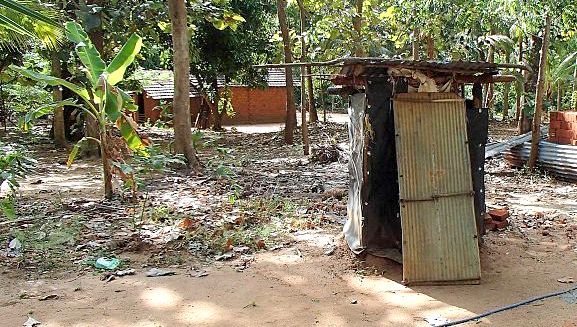
Colombo (AsiaNews) – Yesterday, 19 November, marked the “World Toilet Day” called for by the UN to focus on the issue of accessibility and availability of public toilets, an issue that is far from insignificant in Sri Lanka as pointed out by Public Health Inspectors Association member W. D. Roshan Kumara. Only one in 20 homes in the country has a ‘sanitary toilet’, explains a research conducted by the association.
The theme of this year’s World Sanitation Day is ‘Valuing Sanitation’, emphasising the intrinsic value of these facilities in improving health, ensuring dignity and also facilitating economic development. Despite the progress made around the world in recent years, according to the United Nations, some 4.2 billion people still lack access to safely managed sanitation, leading to the spread of disease and compromising overall well-being.
In Sri Lanka in recent years, the proposal to ‘reinstate the system of aid given to low-income people for the construction of toilets, and to intervene to guarantee this service in every school, had come back into vogue,’ explains Roshan Kumara.
He adds: ‘The people of Sri Lanka, whose need for sanitation has not been met, have an urgent need for it and attention to the issue is essential because we have found that only one in 20 homes in Sri Lanka has a sanitary facility and this leads to disease and pollution of the groundwater by sewage, especially in rural areas.
Speaking in Parliament on Wednesday 15 November, Education Minister Susil Premajayantha warned that 74 school buildings across the island were found to be ‘unsafe’ for students. The reasons include a lack of sanitation, as well as structural weaknesses, as in the case of a school in the Wellampitiya suburb of Colombo, where a 6-year-old girl was killed and several others were injured after a wall collapsed on Wednesday 15 November.
In spite of everything, the UN figures say that the situation in Sri Lanka is not among the worst in South Asia; in some areas, as much as 90 per cent of the population does not have access to these services.
COLOMBO, Nov. 20 (Xinhua) — Sri Lankan President Ranil Wickremesinghe met here on Monday with visiting Chinese State Councilor Shen Yiqin, with both sides pledging to deepen cooperation and friendship between the two countries.
Wickremesinghe thanked China for its long-term valuable support and assistance to Sri Lanka, saying that Sri Lanka firmly supports the joint Belt and Road construction, and encourages Chinese enterprises to invest in the country to promote the construction of Port City Colombo and Hambantota International Port.
Sri Lanka strictly adheres to the one-China policy and hopes to deepen friendly exchanges and cooperation with China to promote Sri Lanka’s socio-economic development, the president added.
For her part, Shen said China attaches great importance to its relations with Sri Lanka, and is willing to work with the Sri Lankan side to earnestly implement the consensus reached between leaders of the two countries.
Both sides should support each other on issues concerning their respective core interests, jointly promote high-quality Belt and Road construction, and work together to push for new progress in developing the China-Sri Lanka strategic cooperative partnership based on sincere mutual assistance and ever-lasting friendship, she said.
Shen also met with Sri Lankan Prime Minister Dinesh Gunawardena and Speaker of Parliament Mahinda Yapa Abeywardena, respectively, on Monday.
COLOMBO (Daily Mirror) – The Committee on Public Accounts (COPA) will initiate a probe into incidents in which stocks of coal imported for the Norochcholai thermal power plant have been under-invoiced for the evasion of due amount of Value Added Tax (VAT), an official said.
COPA Chairman Lasantha Alagiyawanna told Daily Mirror that the COPA examined the audit reports of Sri Lanka Customs for 2019, 2020 and 2021. He said the COPA ordered a further probe into this matter.
Coal imports have been under-invoiced to avoid VAT payment,” he said.
Asserting that there are numerous administrative shortcomings and irregularities in the process, he said
Meanwhile, a statement from the parliamentary media unit said as much as Rs.187 million has been undercharged in this manner.
COPA drew attention to the financial advantage provided to the concerned institution by presenting fake local information during the release of warehouses brought by a private institution for the water development project in the Eastern Province. Accordingly, during the release of the goods which the concerned private company had warehoused as USD 5,139,621, locally prepared forged documents were used to pave the way and obtain USD 1,210,743 in excess for the concerned company when the value shown was USD 6,350,364. Thus, COPA recommended that a report in this regard be given within a month. The status of the introduction of new technology by Customs was also discussed at the Committee meeting held. Accordingly, the officers who were present pointed out that currently a system called “ASYCUDA” is being used to maintain data, and it is connected to the Ramis system. Furthermore, a new technology system will be introduced in the future. Furthermore, attention was also directed to the measures taken regarding the amendment of the Customs Ordinance Act and the officials mentioned that the amendments in this regard will be submitted to Parliament in January 2024,” the statement said.
Special envoy of the Chinese President Shen Yiqin with Sri Lankan President Ranil Wickremesinghe in Colombo on Monday.
China is prioritising” the extension of the China-Myanmar Economic Corridor (CMEC) to Sri Lanka, the country’s Special Envoy told President Ranil Wickremesinghe on Monday, in an indication that China is looking to scale up the Belt and Road Initiative (BRI) project in South Asia.
Paying a courtesy call on the Sri Lankan President, Special envoy of the Chinese President, State councillor Shen Yiqin, said China is prioritising the extension of the Corridor to the island nation, according to a press statement issued by Wickremesinghe’s office on Monday. Additionally, both parties agreed to expedite the implementation of the China-Sri Lanka Free Trade Agreement,” the statement said.
The CMEC is the newest of the six land corridors under the BRI and has assumed prominence in place of the Bangladesh China India Myanmar (BCIM) corridor which has largely stalled. India and Bhutan are the only countries in South Asia that have stayed out of the BRI and China’s more recent Global Development Initiative, which Sri Lanka has also backed. Wickremesinghe noted that countries such as Sri Lanka, which are participants in the BRI, are prepared to embark on the second phase of the initiative, which is expected to make a more substantial economic contribution.”
Joint statement
Shen is in Sri Lanka after participating in President Mohamed Muizzu’s inaugural ceremony in neighbouring Maldives on November 17. Her visit comes a month after President Wickremesinghe met Chinese President Xi Jinping in Beijing, on the sidelines of the third Belt and Road Forum for International Cooperation. A joint statement issued by the two governments at the time said Sri Lanka reiterated it would continue to actively participate” in the Belt and Road Initiative proposed by China.
In Monday’s meeting, President Wickremesinghe expressed gratitude for China’s support to Sri Lanka, notably acknowledging their assistance in the country’s debt restructuring programme,” his office said.
Sri Lanka is attempting to finalise a debt treatment plan with its official creditors, so it can receive the second tranche of the International Monetary Fund’s nearly $3 billion package for economic recovery, following last year’s crisis. China has decided to stay out of the official creditors’ platform and remains an observer in deliberations with India and Paris Club members, including Japan, that have sought creditor parity. Last month, the IMF said that securing an agreement with official creditors is a critical next step” for Sri Lanka.
Opposition and SJB leader Sajith Premadasa yesterday called on Speaker Mahinda Yapa Abeywardena to remove parliamentary committee chairmen who had conflicts of interest.
Premadasa demanded to know from the Speaker what moral right a person had to chair a committee investigating Sri Lanka Cricket after providing consultancy services and getting paid for those services from the SLC.
I call upon the Speaker to conduct an investigation and inform the House who the proprietor of the Business Management School of Colombo is and the names of public institutions that obtained his services. Various public institutions are summoned before the committee and are questioned whether they have a business plan. If the institution being questioned does not have a business plan then the committee orders it to prepare a business plan immediately. Thereafter, that institution is approached by the Business Management School of Colombo and it gives consultancy services to prepare the business plan. I have evidence to prove this, he alleged.
For example, the Speaker could check this by inspecting how the Vocational Training Authority got its business plan. Does it mean that the committee chairman post is given to the MPs to promote their private businesses? There are many examples to prove this. The chairmen with conflicts of interest should be removed immediately,” Premadasa said.
The Committee on Parliamentary Business has agreement to appoint a Special Parliamentary Select Committee to investigate the irregularities in Sri Lankan Cricket (SLC), under a co-chairmanship of the ruling parties and the opposition.
This was decided on during the meeting of the Committee on Parliamentary Business this evening (20) chaired by Speaker Mahinda Yapa Abeywardena.
The Secretary General of the Parliament, Kushani Rohanadeera, said that during the meeting attention had been focused on the appointment of a Parliamentary Select Committee to investigate the irregularities in Sri Lankan cricket.
The General Secretary said that it was agreed to establish this committee under a co-chairmanship of the ruling parties and the opposition and under an equal number of committee members.
The Secretary General of the Parliament said that it was also decided that the Parliament will convene from 9.30 am to 4.30 pm on December 10 (Sunday).
Thus, it has been decided to hold the debate on the Value Added Tax (Amendment) Bill and the Second Reading of Appropriation BIll on that day.
In addition to this, some amendments were made in the parliamentary proceedings on the 22nd and 24th of November.
Also, it has been discussed to continue to hold meetings of the Committee on Public Enterprises (COPE) regarding Sri Lanka Cricket and other institutions and also that if steps are taken regarding the chairmanship of the committee, it should be done according to the decision of the committee members.
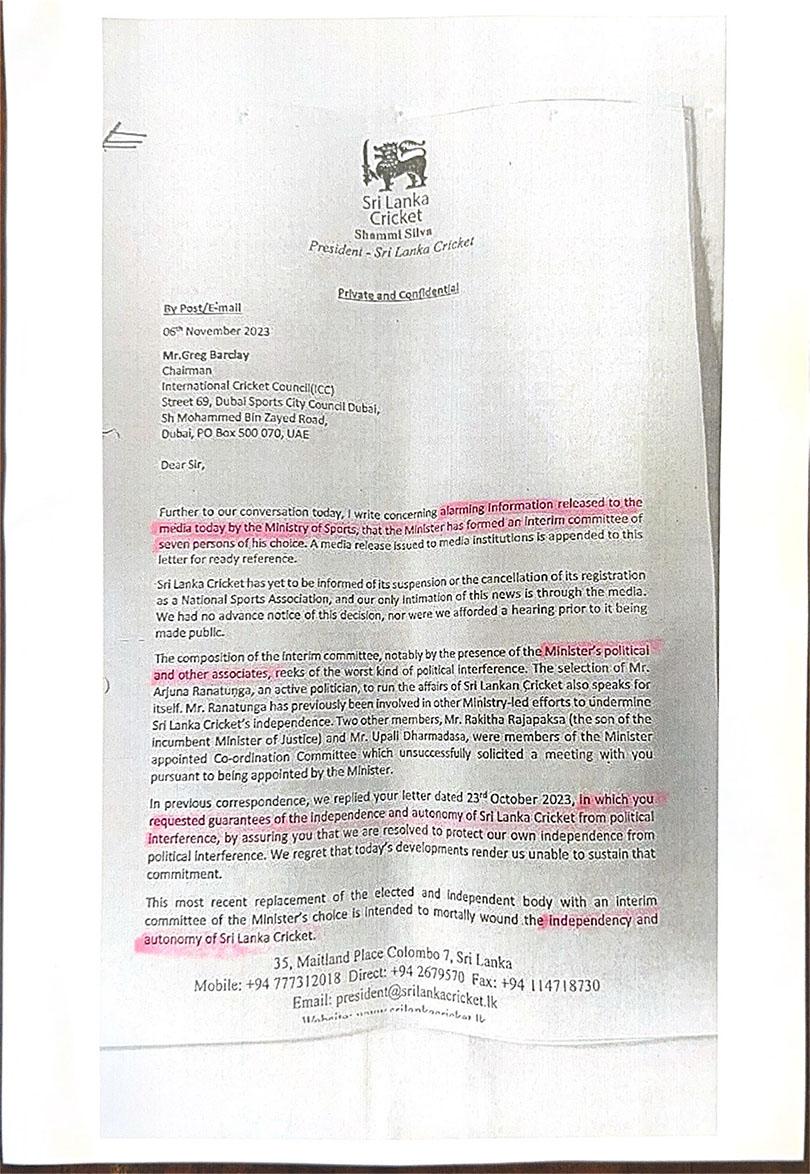
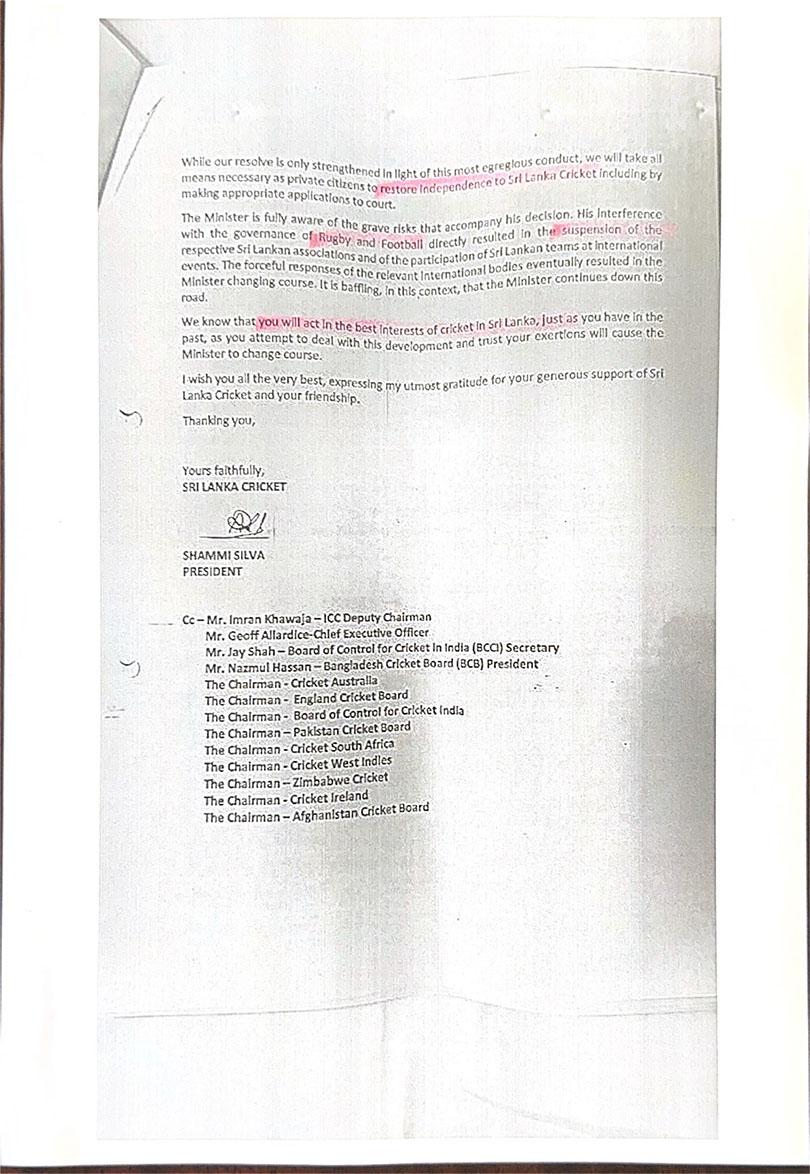
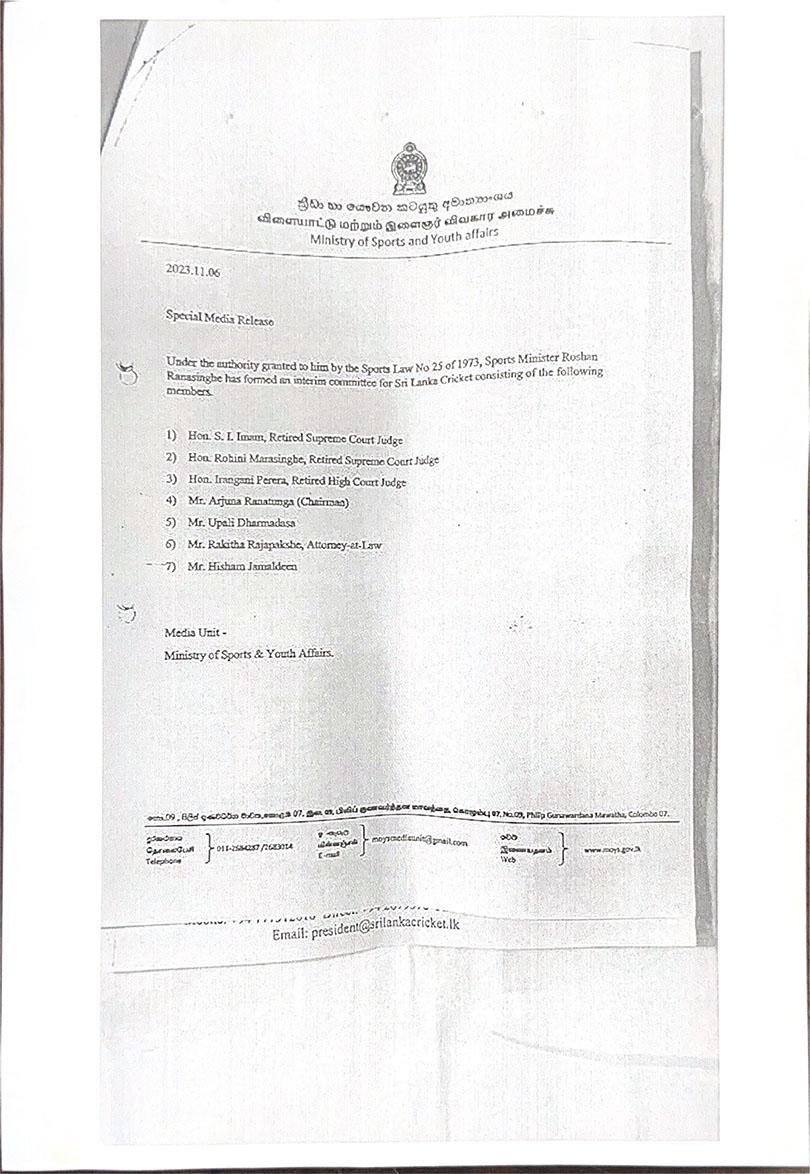
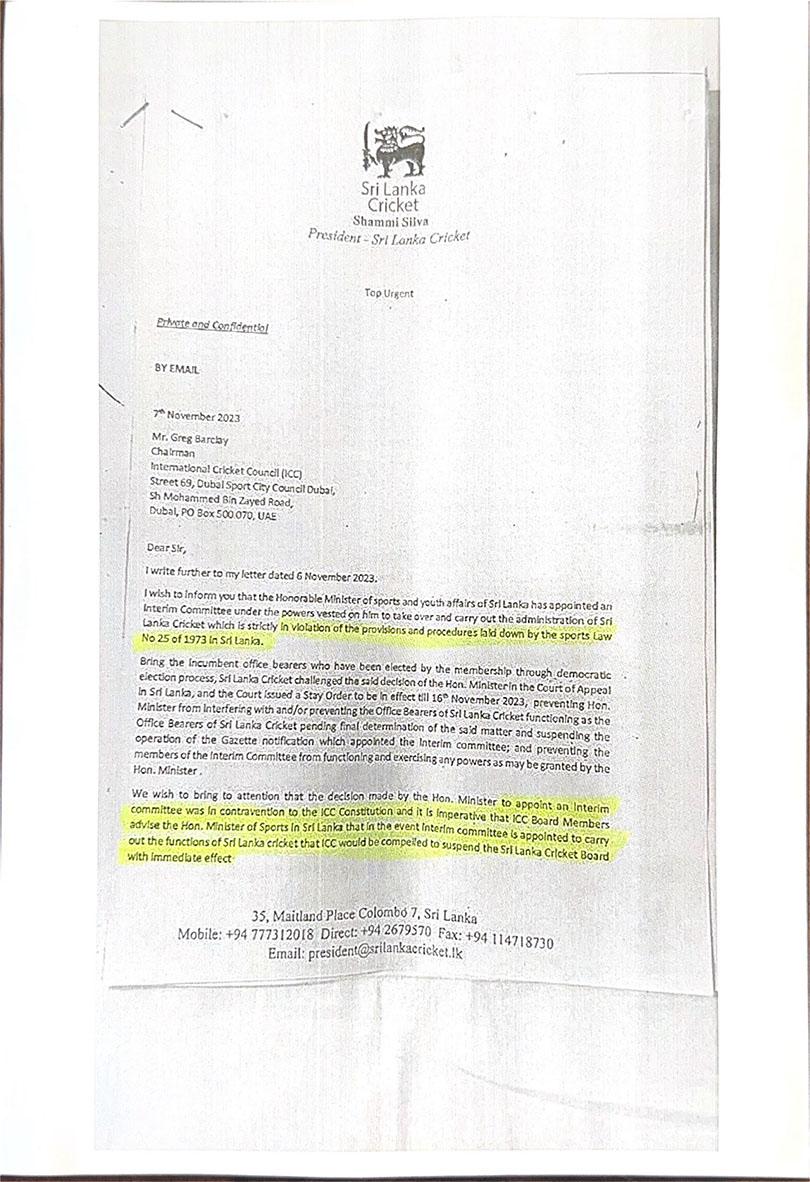
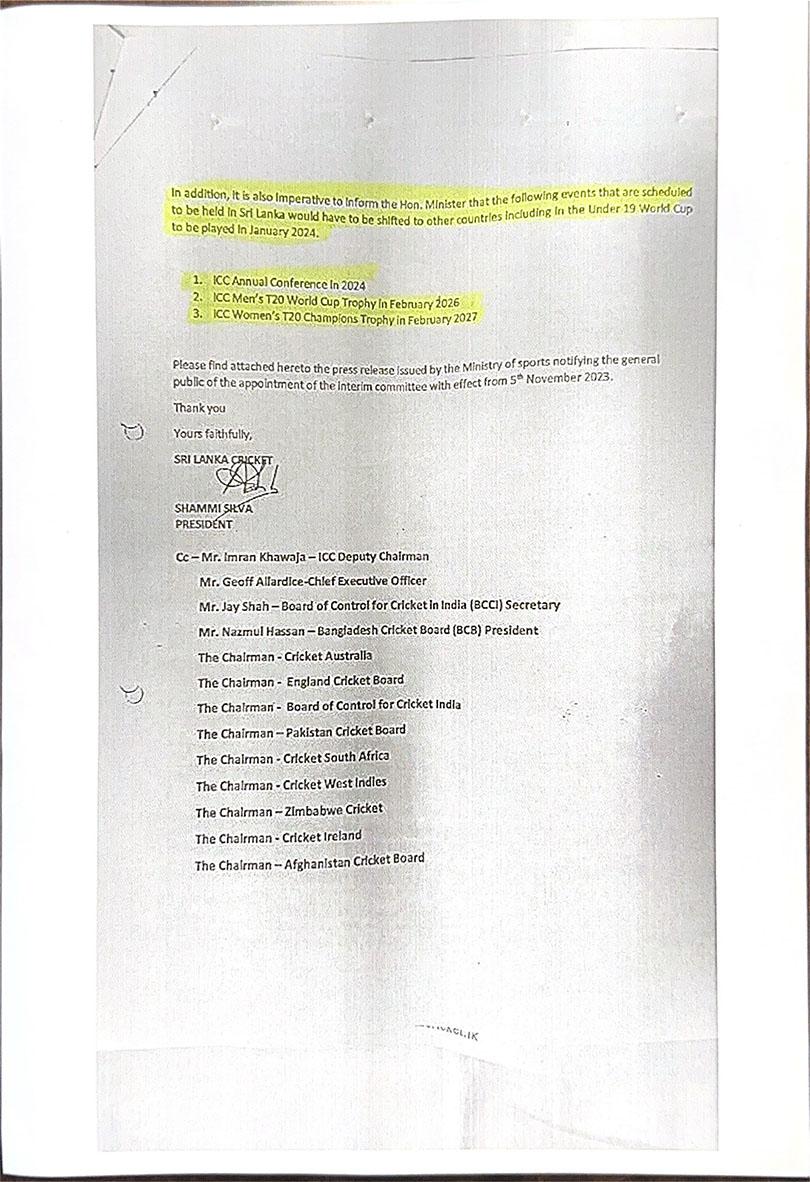
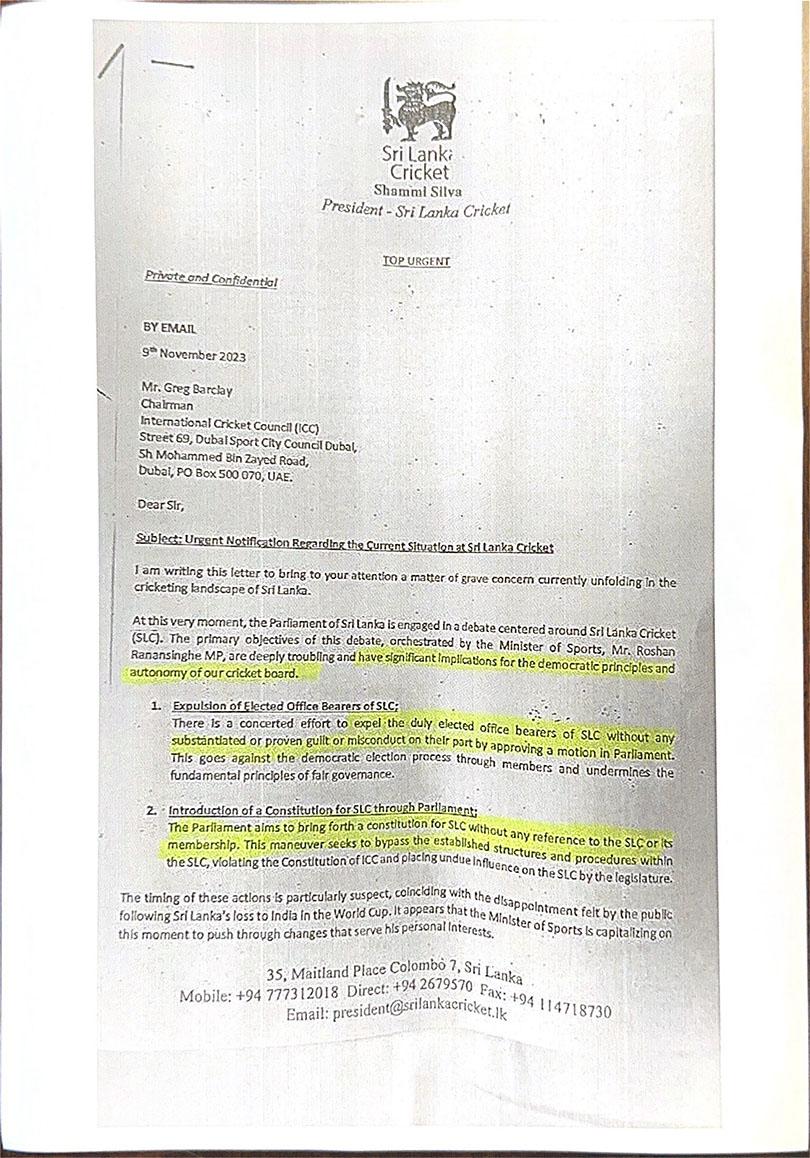
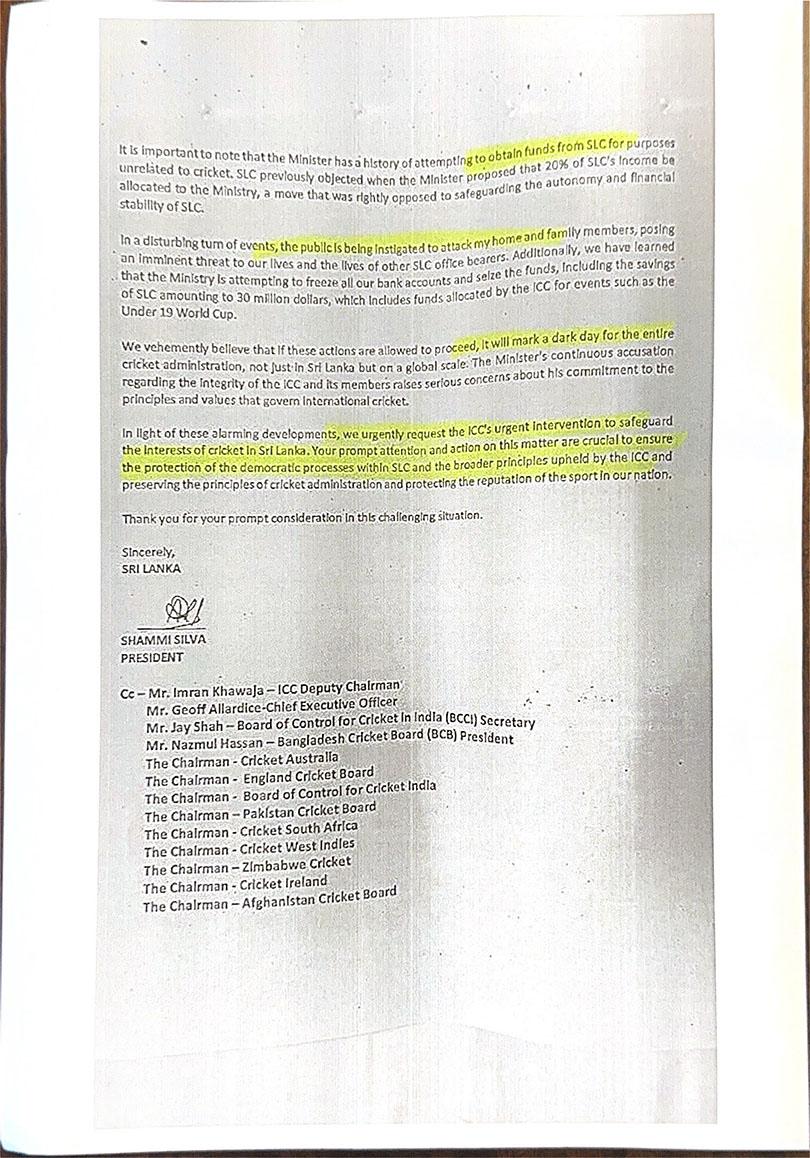
Colombo, November 20, 2023 – The ongoing crisis within Sri Lanka Cricket took center stage in Parliament today as Sports Minister Roshan Ranasinghe tabled three letters sent by Cricket President Shammi Silva to the International Cricket Council (ICC). These letters, requesting the suspension of Sri Lanka Cricket’s membership, have sparked a public outcry and raised concerns about the future of cricket in the country.
In a press conference held yesterday, Minister Ranasinghe unveiled the contents of the letters, shedding light on the internal turmoil within the Sri Lanka Cricket Board. The Board, in response, emphasized the obligation of the Cricket President to disclose all relevant information concerning cricket in the country under ICC regulations.
During today’s parliamentary session, Minister Ranasinghe called upon the Attorney General to initiate legal action against those responsible for jeopardizing the state of cricket in Sri Lanka. This move signals a significant step towards addressing the accountability of individuals involved in the crisis.
In related developments, Minister Manusha Nanayakkara, a member of the special sub-committee appointed by the President to address issues within Sri Lankan cricket, assured the media that the committee’s report would be promptly provided. The fate of the ban imposed on Sri Lankan cricket will be determined at an upcoming ICC meeting in India, where discussions will be led by ICC members.
As the nation awaits crucial decisions on the future of its cricketing landscape, an online petition has already gained momentum, calling for the removal of corrupt cricket officials. Simultaneously, a demonstration organized by Samagi Janabalawegaya was held in front of the Galle-Karapitiya Teaching Hospital, urging decisive action to eradicate corruption and safeguard Sri Lankan cricket.
The Tamil Separatist Movement continued to obstruct and harass the Kurundi project. On 3rd October 2018 a group of MPs from Colombo visited Kurundi. A group of Tamils confronted them and therewas an argument with Tamil MPs and residents.
On February 4th 2022 Ven. Santhabodhi had planned to hold a pinkama at Kurundi with 40 monks reciting Seth pirit. But that morning a group led by MPs Sumanthiran and Rasamanickam came to Kurundi together with a media team and challenged them. They announced over the media that work on Kurundi must stop immediately at it was affecting their independence. They said that there is a historic kovil at Kurundi and the restoration work on Kurundi vihara was obstructing kovil worship. They will go to courts and Sumanthiran will appear for them. The pinkama was held that evening.
Ven. Santhabodhi was informed that Raviharan had planned to hold a Kovil puja at Kurundi on June 22, 2022 but had decided against it .
In July 2022 Ven. Kirulapone Dhammavijaya was planning to hold a pinkama as well as a dharma desanaya at Kurundi for Esala but they were told that Tamil protestors were planning to turn up on that day and security was not keen on the event. The pinkama was therefore held at Sapumalgaskada. Two busloads of worshippers turned up having heard about this. 20 monks also came and the bana was broadcast on media. Many got to know about Kurundi this way. It was a very successful Poya day celebration, said Santhabodhi.
EVENT NO 5
Tamil Separatist Movement strongly opposed any surveying of the Kurundi land. They tried to stop all surveying of Kurundi. The description given in the book ‘Kurundi Vihara Vamsaya” on the survey work is confusing. This is what it said.
The first account is as follows: The boundary stones were set in August 2022 without any fuss or opposition, said Santhabodhi. On September 18, 2022 MP Charles Nirmalanathan had come to Kurundi to inspect the boundary stones. He told the media that Kurundi had grabbed 600 acres belong to Tamil farmers. Three was opposition brewing against the boundary stones, said Santhabodhi.
Survey Department team was due to arrive at Kurundi for further surveying. The Tamil Separatist Movement with the support of the Tamil officers in Mullaitivu had planned a demonstration for September 22 when the Survey Department officers were due to arrive to survey the land.
The second account says that while the surveying was going on, Department of Archaeology informed Santhabodhi on 2022. 9. 20 to stop the surveying of the Kurundi reserve. A Tamil MP had informed Minister for Buddha Sasana, Vidura Wickramanayake that the Archaeology Department was trying to seize paddy lands which belonged to the Tamil farmers.
Minister ordered D/Archaeology to stop the survey immediately. Work done for two years over the boundary was halted, said Santhabodhi . Santhabodhi criticized the Minister’s action. The Minister should have investigated the matter first. We had worked hard for two years on this matter. Minister has simply accepted the Tamil complaint. Minister Vidura Wickramanayake was earlier with us, why this change, asked Santhabodhi .
The third account is as follows: The Tamil Separatist Movement had taken the Kurundi matter to Supreme Court. Supreme Court had therefore asked the Survey Department to send them a map of the Kurundi ruins. On September 6, 2022, the survey team arrived under police protection. They were met by a set of aggressive Tamil protestors. The police said that they cannot offer protection and told the survey team to go back without doing the survey. So I undertook to see to their safety, said Santhabodhi .We went to where the survey officers were staying and asked them to somehow do this. They did the work and I dropped them off on the main road in my vehicle.
EVENT NO 6
On September 21, 2022 at about 10am Tamil political leaders with 20 others came to the foot of Kurundi hill and started their protests. They were followed by about 100 other Tamils who came in vehicles and tractors, holding placards and shouting aggressive slogans . They ordered the army team engaged in conservation work to leave. They left.
Some Tamil protestors climbed onto the stupa and spoke obscenely to the officer in charge of the archaeology work, and demanded to know on whose authority he was doing his work. They uttered death threats and asked him to leave immediately. An onlooker who attempted to video this incident was scolded in obscene language . There was no one stop them. Mullaitivu police were not to be seen.. They were drunk and if they had attacked us there was no one to come to our rescue, recalled Santhabodhi .
At the request of the army, Santhabodhi and anther monk hid in the guardhouse. From there Santhabodhi rang Ven. Medagoda Abeyatissa and Ven. Medill Pagnaloka and they informed Prime Minister, Sectary/ Defense, and the IGP. Santhabodhi also informed Jagath Sumathipala, Sarath Weerasekera and Channa Jayasumana. Later the police arrested Raviharan and one other. The Tamil protestors then demonstrated asking for their release. They were released on bail.
EVENT NO 7
There was another disturbance on July 14, 2023 Ama Wanniarachchi interivewed Ven Santhabodhi . She wrote as follows: On 4 July, The Mullaitivu Magistrate visited Kurundi Temple to examine the site as there is an on-going court case. During this was happening a large team of Tamil ministers, politicians and their supporters and kurukkals arrived. Buddhist monks and devotees were also at the temple on this day.
This court case was filed in 2018 and it goes on as a ‘Breach of Peace’. However, now the focus was on how the conservation work at the site has been done, especially the archaeological work. But it was proved that all the conservation work was done strictly following archaeological conservation laws and policies by the Department of Archaeology (DoA). Therefore, the lawyers of the other party focused on the signboard that has been fixed on the site by the DoA. Therefore, I was told that I should go to the Police and give a statement about this Board.
While all this was happening, a group of monks visited the temple and worshiped the stupa by offering flowers. Then we were informed that as an examination is going on and that we should leave the place and therefore, we left. But, when we were going toward the stupa we met Police officers, but at that time we were not told not to go there. It all happened after we started to worship and offer flowers.
On the same day evening, a former Member of the Provincial Council, Raviharan, and his team arrived with the media and gave a statement and shared it on social media. When the Magistrate was about to leave, Raviharan requested from him for permission to worship the place; replying to him the Magistrate said that there is no restriction to worship so devotees can worship. Then Raviharan requested permission to conduct a Pongal festival on the 14 July at Kurundi.
Later that week, we came to know that their intention was not innocent as conducting a Pongal festival but clearly political. We also came to know that they were planning to fix a Thrishul at the place, as they did fix a Siva Linga at Vaddamana Pabbata. Today, the ancient Vaddamana Pabbata Vihara is a kovil, completely destroyed and vandalised, despite the pleas of devotees, activists, media, and officials.”
Considering all that has been and is happening in the North and East at ancient sites, I logged a complaint on 10 July, presenting all facts and our concerns. As the Chief Incumbent of the Kurundi Temple, it is my duty and responsibility to protect the place. The DoA (Department of Archaeology) also lodged a complaint about this incident and has requested to intervene in order to prevent any conflict or damage that will be caused to the site.
This is a site that has been gazetted as an archaeological reserve and a protected monument. Therefore, according to the law, without the permission of the Director General of the DoA, no one can perform any sort of activities that will harm the site and monuments at the Kurundi ancient site. No activity can be conducted that will harm the site and monuments nor can perform any activities that will hurt Buddhist devotees who venerate this ancient Buddhist monastery. Also, acts that will breach the peace and activities such as placing new objects that will distort and violate the original structure and purpose of this archaeological and Buddhist site should not happen.
We thought that considering our concerns and the points we presented, an order will be given to stop the pooja on 14 July. However, on 13 we came to know that permission was given to go on with the pooja on 14 inside the site.
On the morning of 14, we held a Buddha Wandanawa, and around 9.30 a.m., Raviharan and a team arrived at the temple with utensils, bricks, stones, and so on. They came near the ancient image house and were preparing to light a fire to cook. Then we asked to not light a fire near the image house as it will damage it. One senior Police officer called and said us to leave the temple and let them do the pooja and come back after they leave. I refused to leave as I know and have experience with such things; especially after what happened in Vaddamana Pabbata Vihara. Vaddamana Pabbata was vandalised while the Police were there. I have a responsibility and duty to protect this ancient temple, so I decided not to go.
We know how these extremists vandalise and destroy ancient temples in these areas. While they were about to light the fire, we requested not to do so and explained why. We said that this is a Buddhist temple and an ancient archaeological site, and no activity should be done that will damage its authenticity. Also, the group that arrived here, under the pretext of cooking Pongal rice were not villagers and devotees of the surrounding villagers; they were all henchmen of politicians and a priest from Jaffna who is also a political henchman. Although we discussed it, they ardently disagreed to come to a middle ground. They were adamant about cooking Pongal rice near the image house.
We wonder why such things happen only in Buddhist temples. Is it ethical to conduct religious festivals of another religion inside a religious place of some other religion? Do we go to Nallur Kovil and perform Buddhist pooja? Why these people do not respect the sentiments of Buddhists? Why chose Kurundi when there are hundreds of kovils to cook Pongal rice?
We told them to cook outside the premises and bring the cooked rice here since that is what we also do. We cook milk rice outside and bring the cooked rice to offer. They did not agree. Meanwhile, the Police asked us to leave the premises and we did. Afterward, they poured milk all over the place and cracked coconut inside the temple. The cooking of Pongal rice was stopped because the Buddhist monks and devotees protested against it. Thus, the destruction and vandalising is temporarily stopped concluded Santhabodhi .
EVENT NO 8
A three day Poya festival was planned at Kurundi starting on 18.8.2023. It started well, with 29 bhikkhus from all over the island and nearly 500 members of the public who arrived by 9 am and started to recite the Ratana sutra. Television news on the evening of 18.8.23 showed this
Two Tamil MPs, S Sridharan and Gajendran Ponnambalam with others, including undergrads from University of Jaffna, arrived at the same time, saying the Magistrate had given permission for a pongal to be conducted at Kurundi. They wanted to have the pongal in front of the pilimage. They did the pongal. Television news showed a fire lit for preparing the pongal rice.
The Hindus wanted to place a statue on the stupa .Santhabodhi objected. Tamil shouted at him and police persuaded Santhabodhi to leave saying they will handle the situation. Santhabodhi reluctantly went. https://youtu.be/XkInlXpKoRg shows Santhabodhi telling the police, this is highly irregular and the police pleading with him to leave. No issue has been created yet.
Tamils wanted to light a second fire. The Archaeology department official objected. He said according to the law, they cannot light any fire, but we permitted you to light the first lipa, isn’t that enough. Ponnambalam said we want to light the second one also there. I have got an order from the courts to do this.
The Archaeology Department officer replied that he cannot allow that. There were regulations against it. If you try to light another fire I shall have to inform the security forces. The Tamil group replied rudely that the Archaeology Department was also part of the Kurundi plot. You cannot give us orders. If we have broken your rules then go to courts.. The officer became angry and did not give in.
After the Tamil team left, the Buddhists went to the Pilimage and worshipped. After that anther Tamil group led by a Hindu sadhu in orange robes came and chanted hymns. Then there was an argument between the Hindus and the Buddhists. By 2 pm both group had left Kurundi. Television news showed the deseted stupa with the army stationed around it.
The news report on the event said as follows: On august 18.2023 a tense situation arose when a group led by Tamil National People’s Front leader Gajendrakumar Ponnambalam entered the Kurundi temple and conducted a Pongal Pooja.
A group, including MP Gajendrakumar Ponnambalam, had gone to perform a Pongal Pooja at the Kurundi temple having got a court order to do so. There were objections, saying it was illegal to do so. Resulting in a heated exchange of words between the two parties. .
The situation was brought under control by the police. The Mullaitivu police arrived and diffused the situation. They also contacted officials of the Archaeological Department, who designated an appropriate area for the Pongal pooja. The participating individuals conducted the Pongal pooja and then had left . (end of news report..)
On august 21st, bhikkhus went to Parliament to complain about the conduct of its MPs at Kurundi. The spokesman told the media that Ponnambalam and his group had violated Archaeology , Forest, and Wildlife regulations.. Gajan Ponnambalam was trying to destroy Buddhism . This could turn into an explosive situation later.. He wanted Gajan Ponnambalam expelled from Parliament before that happened. He requested the government to take action against Gajan. https://youtu.be/Q1c7sbysMPM
Sarath Weerasekera said in Parliament that the group brought by Ponnambalam were not from the area, they were from Jaffna, Kilinochchi, and Mannar. ‘.Do not treat the ‘ivaseema’ and ‘anukampava’ of the Buddhist as ‘nivatakama’, he warned..
MP Dharmalingam Siddharthan responded to Weerasekera. He said that Buddhism arose from Hinduism. There were Tamil Buddhists in Sri Lanka before the Sinhala Buddhists. There is enough evidence to prove this. While it is necessary to protect ancient Buddhist monuments, in the north, it is not possible to permit new temples to be erected there, because that will lead to settlement of Sinhalese in that area. (Hansard reference is vol 293 no 5 2022.6. 21. P 1055 but I have taken this from Kurundi vihara vamsaya” and not directly from Hansard.)
Udaya Gammanpila went to Gajan Ponnambalam’s home in Colombo accompanied by a group on 25.8.23 to complain over his interference in the Kurundi matter. Udaya announced, that Gajan had disturbed a pinkama at Tissa vihara, and disrupted a pirit pinkama at Kurundi .The STF, air force and police were present to protect the Ponnambalam residence. (Derana 6.55 news 26.8.23) CONTINUED)
‘Before you study the economics, study the economists!’
e-Con e-News 12-18 November 2023
*
Guess what? Karl Marx turns out to be the ghost in the machines of the largest and most strategic technological corporation in the world today. But first…
There’s a lot unsaid about the visit of England’s Trade Envoy to Sri Lanka, Mervyn Evan Davies. This ‘Lord’ is said to have come to ‘experience’ the wonders of Unilever’s Horana factory & Rupee printer De La Rue. Both Unilever and De La Rue are English multinational corporations (MNCs). Yet Davies didn’t grace the monopoly Ceylon Tobacco Co (CTC) factory, owned by England’s British American Tobacco (BAT). It is perhaps not good for Davies ‘brand’ to be associated with a cancer-maker who refuses to pay its share for the country’s ill-health. Davies, also former head of Standard Chartered Bank (SCB), did however meet with the CTC’s Suresh ‘The Cancer’ Shah. Cancer Shah is the man who directs the selling off of the country’s national enterprises at the State Enterprise Restructuring Unit (SERU!).
Davies is another criminal ‘lord’ from a Welsh ‘coastal seaside resort’ where social services have been ruined after being turned into a ‘tourist hotspot’ for English carpetbaggers. Indeed, we should recall that the English word ‘welsh’ is ‘often offensive’, meaning a failure to honor (a debt or obligation incurred through a promise or agreement), ‘on account of the formerly alleged dishonesty of Welsh people!’ The Welsh had to wear that infamous ‘Welsh Knot’ of wood around their necks if they dared speak Welsh!
Welshing the Banks – This week it was announced that control over the Bank of Ceylon & People’s Bank was to be ‘opened up’ to ‘strategic investors.’ Who could be more ‘strategic’ than the Welsher Davies, a man linked to the top English banks, once the SCB boss of their local ‘coolie’ & CEO Bingumal Thewarathanthri, who also happens to be chairman of the very untransparent Sri Lanka Bankers’ Association (SLBA).
Thewarathanthri, this week, bravely called for the jailing of tax evaders (like ‘in other countries’). And yet there are no greater vanishing ‘tax magicians’ than English MNCs like Standard Chartered & Unilever etc, who basically employ the top auditors and accountants in the country to beatify their ‘transfer pricing’ and fake invoicing. This week even saw the CEO of PickMe point to unnamed ‘global digital companies’ operating within Sri Lanka, who ‘‘legally’ remove huge ‘digital’ ‘revenues to safe havens in other countries.’ That these are the same digital MNCs opposing a so-called Online Safety Bill, needs further exposure.
In fact, both media & politicians are healthily avoiding to mention the brutal removal of exchange controls in 2017, leading to the hemorrhaging of foreign reserves out of the country – which Cancer Shah is very much implicated in. They are also zealously avoiding the prevention of these banks’ investment in and sabotage of modern (machine making) industry, which is the scandal of the century & those centuries preceding, choosing instead to finance importers!
Joke after joke it is then, how this week also saw the Supreme Court rule the ‘3 Rajapaksa brothers’ – as former President, Prime Minister & Finance Minister – along with former top banking & treasury officials, were ‘responsible for the economic crisis in the country’, and ‘violated public trust’. An ‘unelected’ government this week also bypassed the National Labour Advisory Council (NLAC) and set up yet another ‘national labour tripartite body’ to draft a New Employment Act.
*
‘In my opinion, the private sector is a bit reluctant to make investments in new technologies, as they depend on poor labour. Certain industries & businesses encourage poor labour and we need to be honest about that’ – Labour & Foreign Employment Ministry Shan Yahampath at the Shippers’ Academy Colombo Forum (see ee Workers, Govt calls for private sector participation)
Now remember: ‘poor’ is an Elizabethan construct for English people chased out of their villages by ‘farmers’ (aka bailiffs) – ‘poor’ is a term ee never uses. The minister Yahampath however does not name these ‘certain industries & businesses’ that ‘encourage poor labour’. But we can easily guess who sets these trends:
*
‘A 51%-owned subsidiary of the Anglo-Dutch Unilever in India, Hindustan Lever Ltd (HLL) is India’s largest manufacturer of fast-moving consumer goods (FMCGs), such as shampoo, detergent, toothpaste, shaving cream, soap. After a merger with Brooke Bond Lipton in 1996, HLL also became the largest producer of tea in India and the largest company in the Indian private sector as measured by market capitalization. (see ee Focus)
• So…so…so…Who’s Afraid of Unilever? This ee therefore examines – with that English ‘trade commissioner’ in Colombo – the games Unilever (who supposedly for over ‘85 years has been raising the industrial sector’s contribution to the national economy’) plays with a country’s workers & economy, ‘with its over 100,000 outlets & 50 distributors in Sri Lanka’. Unilever claims their most famous brands are ‘manufactured here’. Not true! They operate through third-party sweatshops, importing chemicals, machines, etc. In fact, given the sellout of our so-called scholars and the failure to dig deep, we have to almost ‘astrologically’ conclude that most large companies in Sri Lanka – eg, palm-oil-plantation-linked Sunshine Holdings, whose chief Vishy (Vicious?) Govindasamy was recently made a Central Bank governor of Sri Lanka – are actually ‘fronts’ for Unilever, the world’s biggest buyer of palm oil.
*
This week, 2 major English newspapers carried an advertisement – fancy-dressed as a news item – by Unilever: ‘World’s number one tea brand Lipton Yellow Label with expertise of 130 years of tea blending’. The key word here is blending. The story fails to mention that Unilever is in fact ‘sophisticating’ (despoiling) Sri Lankan tea, mixing it with other countries’ teas, nor is there anything reported about major changes in tea plantation labor relations worldwide midst their near-religious prevention of the use of technology.
The Planter’s Association – one of the most powerful lobbies in the country – claims tea workers are far better off than other plantation workers. ee therefore looks at some history of the state subsidizing the plantation interests – yes, welfare for Unilever. (see ee Focus)
ee figures they cannot let it be known how tea sector actors & media are afraid to criticize the multinational giant that keeps operating outside the laws of the country. Worse, there is also a failure by our trade economists & academics to analyze the major role Unilever plays in both the politics & economics of the country. Hence, let’s call these ee insights, ‘strategic astrology’!
This week ee heard that far more welfare is given to capitalists than to the impoverished:
*
‘Given that the tax exemptions mainly benefit the shareholders of corporations who are not merely rich, but are super rich, Sri Lanka typically extends welfare for the rich & the super-rich that far outweighs the small amounts the government transfers to the poor through programs like Aswesuma’ – Sharmini Coorey (ee Economists, SL continues to flout key principles of tax policy)
*
Then why is the media so full of saturation around the welfare stipends provided to the daily impoverished? With all this talk of banks & MNCs, this ee examines another major ‘debt’ issue: the entrapping of rural people, particularly women, in the Fatal Flaw of the Microfinance & Credit Regulatory Authority, which claims to regulate money-lending & microfinance business and provide protection to borrowers. Apparently, this Regulatory Authority ‘cannot handle the mess that big finance has created; instead… lets the culprits go scot-free and eliminates ‘space for innovative and productive community lending’ (ee Focus). And guess what people are getting into debt for? More foreign equipment & other industrial goods…
The more these so-called ‘modern’ goods & foods, and their salesmen (at one level all are men, tho farther down in the chain they use women as well), are allowed to enter villages (all over the world!), the worse people’s health and wellbeing get. ee Focus continues sharing the Communist Party of Sri Lanka’s Alternate Program – this week looking at Health. The CPSL points out, ‘Despite low national income & low level of health expenditure, Sri Lanka improved basic health indicators to levels that are comparable to more-developed countries in the world.’ These indicators are however under major attack by the biotech & pharma capitalists and their chief importers, like more Unilever zombies such as Hemas, etc. The USA, with its scandalous all-for-profit health (disease) system, is perhaps jealous?
*
• Traders, Traitors… & the Budget: Imagine, what would happen if local media in a nano-moment of forgetful honesty added Trader to their names? The Sunday Trader, Island Trader, TraderNext, The Trader Times, The Morning Trader, Trader1st, Tradevocata – Ada (or is it Ado?) Velendha!
Indeed, this week we learn that local manufacturing dropped even further down due to increased imports! And yet, Capital Alliance Ltd (CAL), a ‘leading investment bank in Sri Lanka’, called for ‘allowing more vehicle imports’, which they said ‘could garner Rs450billion tax revenue’! Ha!
Budget & Cricket – It’s no wonder that this thrada trader media provided more diversion on cricket rather than these issues ee highlights. The enormous amount of paper and electrons dedicated to cricket – which has been corrupt from the very first ball, in a game where ball-guards preceded helmets by a century – shows what really excites our trade media. Of course, even this cricket ‘scandal’ (it’s no scandal, it is a bookie operation!) does not breakdown the fact that none of the bats & balls & other equipment (let’s not even mention the TV industry!) are even made in Sri Lanka.
And so, this trader media, with their trader economists & ‘postcolonial’ trader academics, are suddenly running Gaza-shy here, after all that talk of rule of law, democracy, human rights... The choirs & the twittering birds have gone silent, as if a major deluge is on its way. Even Anglo-Yankee-soaked liberals now recall yet another English ‘opium war’ criminal & Prime Minister, Palmerston:
‘We have no eternal allies,
and we have no perpetual enemies.
Our interests are eternal and perpetual,
and those interests it is our duty to follow.’
*
• Finally, and lo & behold, ee learned this week about the real historical force behind Europe’s richest tech company and key computer chip machine maker ASML – Karl Marx!
Apparently, the physics & materials research laboratory of the Dutch electronics conglomerate Philips, is called NatLab, much like AT&T’s famous Bell Labs. Through NatLab, ASML’s tradition of machine knowledge originated under the Philips industrial empire. NatLab was founded in 1914 by the founders of Philips themselves, the brothers Gerard & Anton Philips, who had founded the company with their father in the 1890s to manufacture lightbulbs. Their father was a first cousin of Karl Marx; and their grandfather Lion Philips, a wealthy tobacco merchant, was Marx’s main financial sponsor!
Actually, he was not just Marx’s main financial sponsor; he held the key to Marx’s mother’s inheritance. And he was delighted to learn from Marx that it is the making of machines that is the true wealth… So, how’s that for this week’s resonating revelation about the real ghost in the machine? (see ee Focus)
*
‘If money comes into the world with a congenital bloodstain on one cheek,
capital comes dripping from head to toe, from every pore, with blood & dirt.”
– Karl Marx, Capital
*
Sri Lanka, one of the truly richest countries in the world – rich in land & labor – has been tainted as bankrupt, and after 500 years of invasion, the imperialists demand further ransoms. Note here the silence of the rating agencies in West Asia. Why haven’t they downgraded Israel like they have Sri Lanka? Are war’s terrors, productive investment, or…? And what of that pimp’s intangible ‘investor confidence.’ Given people’s horror at the US wars in Palestine a& Ukraine, shouldn’t the US Dollar – which trusts in god – have been bunker-busted?! But, no….
‘I think it’s about time we stopped… apologizing for our support for Israel.
There’s no apology to be made. None. It is the best $3bn investment we make.
Were there not an Israel, the USA would have to invent an Israel
to protect her interest in the region. The US would have to go out & invent an Israel.
– Senator Joe Biden, 1986, c-span.org/video/?45851-1/senate-session
The Annual Convention (Jalsa Salana) of Sri Lanka Ahmadiyya Muslim Jama’at was held on Sunday the 29 October 2023 at Baitul Basit Mosque Sri Lanka in Pasyala, chaired by Markaz Representative. Prior to the main program, flag hoisting was done by the Markaz Representative followed by silent prayer.
The main event started at 9.30 a.m. with the recitation of Holy Qur’an followed by its translation in Urdu, Tamil and Sinhala.
The National President S. Nizam Khan delivered the welcome address in which he highlighted the establishment of Ahmadiyya Community in Pasyala wherein, the inauguration of New Mosque Baitul Basit Mosque Sri Lanka took place two days earlier.
Sir. Iftikhar Ayaz in his address detailed in length about the history of Ahmadiyya Convention (Jalsa Salana) in Ahmadiyya Jama’at. He also put forward Objectives, Purposes & Blessings of the Convention (Jalsa Salana) in the Words of the Promised Messiah Hazrat Mirza Ghulam Ahmad (Peace be on him).
The addresses on various topic such as ‘Spiritual Revolution of Promised Messiah Hazrat Mirza Ghulam Ahmad (peace be on him), ‘Existence of God’, ‘The Excellent Exemplar-The Holy Prophet Muhammad (pbuh)’ were part of the event. The Convention concluded with silent prayer. This one day event was witnessed by Ahmadi Men, women and children from various part of the country.
Prior to the convention, two days earlier, Sir Iftikhar Ayaz inaugurated a beautiful and spacious Mosque in Colombo – Kandy Road, Pasyala. It was named by Ahmadiyya Khalifa as Baitul Basit Mosque Sri Lanka. The completed Mosque has three story building with a Dome and a Minara. The area of each floor 2700 Sq. Feet, There is a guest room, kitchen and conference hall in second floor. This Mosque has the spacious of worshipping 800 people.
Americans are funding a genocide and no one asked for permission.
We are being dragged, into a war that is decimating a people.
Palestinians, on the basis of their legal right against being wiped out, have filed a major lawsuit against President Joe Biden’s administration.
Americans are funding a genocide and no one asked for permission.
We are being dragged, unwillingly, into a war that is decimating a people. We are being forced to become involuntary accomplices to mass slaughter.
Palestinians, on the basis of their legal right against being wiped out, have filed a major lawsuit against President Joe Biden’s administration for funding Israel’s ongoing pogrom in Gaza, one that has killed more than 11,000 people, including 4,700 children. Represented by the Center for Constitutional Rights (CCR), the plaintiffs include Palestinians who have collectively lost at least 116 family members to U.S.-funded Israeli military attacks.
The U.S. has sent Israel a total of about $317 billion in inflation-adjusted tax-payer money, which amounts to more than $4 billion annually. Almost all that funding has gone toward the Israeli military. Israel is the largest recipient of American foreign aid, receiving more money than what we give to far larger, far poorer nations, ones that have a far greater post-colonial claim to Western aid.
Now, the U.S. Congress and the Biden administration want to give even more tax dollars to Israel, specifically to continue bankrolling the unfolding genocide. They are quibbling over the political strings attached to the aid but are united in their desire to send the supplemental funds.
But, according to CCR, “The United States has a duty under Article 1 of the Genocide Convention to prevent and punish acts of genocide, an obligation the U.S. Congress made law in 1988.” It’s not just the number of dead Palestinians that ought to result in a withholding of U.S. aid but the fact that Israeli officials have been overt about their genocidal aspirations.
The lawsuit offers evidence of how various Israeli politicians have referred to Palestinians with dehumanizing language such as Defense Minister Yoav Gallant, who promised that the “human animals” in Gaza would suffer the consequences of his order for “a complete siege on the Gaza Strip,” resulting in “no electricity, no food, no fuel.”
Days into Israel’s bombing campaign, United Nations Special Rapporteur Francesca Albanese warned on October 14, 2023, of a grave danger of ethnic cleansing of Palestinians, saying, “The international community has the responsibility to prevent and protect populations from atrocity crimes.” Referring to the first great displacement that Palestinians suffered, Albanese added, “There is a grave danger that what we are witnessing may be a repeat of the 1948 Nakba, and the 1967 Naksa, yet on a larger scale.”
At the time Albanese made the warning, Israel had killed 1,900 Palestinians.
A month later, on November 13, Israel’s Agriculture Minister Avi Dichter described his nation’s bombing campaign with a concise phrase, worthy of an operational name for planned genocide: “Gaza Nakba 2023. That’s how it’ll end.”
By then the official death toll of Palestinians was more than 11,000. United Nations experts warned that “the Palestinian people are at grave risk of genocide,” and, added, “Israel’s allies also bear responsibility and must act now to prevent its disastrous course of action.”
One journalist named Chris McGreal, wrote in The Guardian, “I covered the Rwandan genocide as a reporter. The language spilling out of Israel after the butchery of the Hamas attacks is eerily familiar.” McGreal also correctly called out U.S. elected officials such as Senator Lindsey Graham for picking up the pitchfork and joining the violent mob. “We are in a religious war here. I’m with Israel. Do whatever the hell you have to do to defend yourself. Level the place,” said Graham.
It’s a simple calculus: Israeli officials promise to wipe out people who they view as less than human, with the full blessing and financial might of the U.S. The predictable outcome is a fulfillment of their promises, one that is happening in real-time. Not only are politicians responsible for Palestinian genocide, but so too is the media for uncritically reporting on the explicit goals and desires of genocidal maniacs.
Why shouldn’t we believe leaders when they tell us exactly who they are and what they intend to do? History is replete with naive denials of stated intentions to violate human decency even as crimes unfold in plain sight. Recall that when Donald Trump told the nation in 2015 that he would launch a white supremacist presidential bid. Media outlets refused to call him a racist until several years later after the damage was done and he was in the White House. Hate crimes surged against Black people, Latinos, Muslims, and Jews. It wasn’t until the summer of 2019 that media outlets finally decided it was okay to label him a racist-that too after much hand-wringing. About a year and a half later, Trump mobilized an attack on the U.S. Capitol in January 2021 in what legal experts describe as an “insurrection” by a majority white mob. Trump told us who he was. Mainstream media outlets refused to believe him until it was too late.
We’re seeing a familiar hand-wringing today. Take the New York Times‘s insistence on using euphemisms like “extremist,” “incendiary,” and “inflammatory” to avoid describing Israeli officials’ language and the Israeli military’s actions as genocidal.
This type of discussion dilutes an understanding of Israel’s stated goal by attempting to grapple with the technical definition of genocide. For example, Omer Bartov, a professor of Holocaust and genocide studies at Brown University wrote in a November 10 New York Times op-ed that, “I believe that there is no proof that genocide is currently taking place in Gaza.” Still, Bartov admits that his “greatest concern watching the Israel-Gaza war unfold is that there is genocidal intent, which can easily tip into genocidal action.” (Notice how he doesn’t say “Israel has genocidal intent”-a common use of the passive voice to dilute blame.)
Countering this concern in comments to Vox, Raz Segal, an associate professor of Holocaust and genocide studies at Stockton University asked, “How many Palestinians need to die for these statements [by Israeli officials] to be recognized as what they are?”
It is the job of journalists to warn against abuse, exploitation, and corruption, and to shine a light on power so that an informed citizenry can decide on the course of its government. Many journalists are indeed speaking out against sidestepping the responsibility to report on genocide. More than a thousand have signed on to a letter saying they “hold Western newsrooms accountable for dehumanizing rhetoric that has served to justify ethnic cleansing of Palestinians.”
That ethnic cleansing is in full force. CCR’s lawsuit is seeking an injunction to immediately block U.S. tax dollars from supporting Israel’s war in a concrete effort to block the genocide, or at least wash the stain of Palestinian blood off American hands. Meanwhile, public support for U.S. aid to Israel has dropped, with more Americans now opposed to the military assistance than supporting it according to a Reuters-Ipsos poll. Nearly 70 percent support a ceasefire.
International leaders, government offices, and media institutions, often ignore or deny genocides as they are unfolding, express regret after it’s too late, and then make promises of “Never again.” When warning signs of the next genocide arise, the cycle repeats. It’s up to us to stop it and we have that chance right now.
Sonali Kolhatkar is an award-winning multimedia journalist. She is the founder, host, and executive producer of “Rising Up With Sonali,” a weekly television and radio show that airs on Free Speech TV and Pacifica stations. Her most recent book is Rising Up: The Power of Narrative in Pursuing Racial Justice (City Lights Books, 2023). She is a writing fellow for the Economy for Allproject at the Independent Media Institute and the racial justice and civil liberties editor at Yes! Magazine. She serves as the co-director of the nonprofit solidarity organization the Afghan Women’s Mission and is a co-author of Bleeding Afghanistan. She also sits on the board of directors of Justice Action Center, an immigrant rights organization.
Source: Independent Media Institute
This article was produced by Economy for All, a project of the Independent Media Institute.
Parts of this video were used in the documentary, “Manufacturing Consent: Noam Chomsky and the Media” https://zeitgeistfilms.com/film/manuf… Watch “Manufacturing Consent” on youtube: • Video The interview was edited into two (or was it 3?) segments and played on my public-access show, also called “Non-Corporate News”, on Time-Warner Cable channel 3, which then included the communities of Lynn, Salem, and Swampscott Massachusetts. Thanks to: Noam Chomsky, Len Caplan, Dan Kline, Peter Sofronas, Mark Achbar, and “Manufacturing Consent” crew.
On November 11, an Arabic-language Twitter account maintained by Israel’s Ministry of Foreign Affairs posted a video purporting to be a selfie by a nurse in al-Shifa hospital in Gaza, a major battlefield in the current conflict that was taken over by the Israel Defense Forces (IDF) a few days later. In the startling video, as bombs went off in the background, the tearful nurse warned Gazans to heed the call of the IDF to flee to the south. She also affirmed many IDF talking points, notably that Hamas had taken over the hospital and were stealing morphine and fuel.
The video gained millions of views—but was also widely mocked by many, particularly Arabs, who questioned its authenticity. For one thing, none of the staff in the hospital knew who this supposed nurse was. For another, she spoke in English with an accent that resembled no known Arab lilt.
As Marc Owen Jones of The Daily Beastobserved, Everything about it smacked of high school theater—from the botched accent that sounded like it was straight out of an Israeli soap opera to the perfectly scripted IDF talking points rolling off her tongue.” Jones also noted the pristine white lab coat looking like it had just come back from the dry cleaner, the audio track of bombs falling that sounded like samples from a late-’80s Casio keyboard, and the contrived stethoscope-waving you‘d expect from an extra on Grey’s Anatomy.”
Within a day, the tweet of the video was deleted by the Ministry of Foreign Affairs. But of course, downloaded versions continue to circulate.
The Sri Lankan government has released 22 fishermen hailing from Rameswaram in Tamil Nadu, who were detained on November 18 by the Navy personnel on charges of poaching.
The two seized country boats belonging to the fishermen have also been released, Rayappan, president, the country boat fishermen association, told journalists in Rameswaram on November 19.
According to him, a fishermen’s delegation had met Union Finance Minister Nirmala Sitharaman on November 18 evening and briefed her about the arrest. She spoke with the External Affairs Secretary in New Delhi and also with the Indian High Commissioner in Sri Lanka seeking their intervention to get the fishermen and their boats freed.
The Sri Lankan government has issued an order releasing all the 22 fishermen and the two country boats, he said. He thanked the Minister for her intervention.
According to the information available, the arrested fishermen were being handed over at the IMBL by the Sri Lankan authorities and were being brought back home. We are planning to meet the Central Minister with our families,” Mr Rayappan added. (The Hindu)
(Daily Mirror) – Three more leaked letters addressed to ICC Chairman Greg Barclay by SLC president Shammi Silva detailing Sports Minister Roshan Ranasinghe’s interference in decision-making processes as Sport Minister have resurfaced as part of the latest saga in the Sri Lanka Cricket situation.
During a media briefing today, Sports Minister Roshan Ranasinghe said that Sri Lanka Cricket forced the International Cricket Council (ICC) to suspend Sri Lanka from international cricket.
Earlier, Opposition Leader Sajith Premadasa revealed in Parliament that SLC’s letters to the ICC led to the country’s ban from international cricket earlier this month.
COLOMBO (Daily Mirror) – The Lanka Private Bus Owners’ Association (LPBOA) has decided not to provide buses to any political party to bring people to their rallies and meetings in the future.
LPBOA Chairman Gemunu Wijerathne told the Daily Mirror that providing buses to bring people to political rallies and meetings should be stopped at least now.
“All political parties, including extremists, socialists and capitalists, used to gather people for their rallies and meetings using buses, and most of the politicians used to mislead innocent people, and this had been the practice for the past seventy-five years, he said.
Therefore, the association has decided to support only political parties that do not bring people to their events.
“There should be a political party that people feel that they should come. Otherwise, there is no point in supporting the existing political parties that rob the people,” he said.
COLOMBO (Daily Mirror) – Sports Minister Roshan Ranasinghe said that he had received threats from Sri Lanka Cricket (SLC) President Shammi Silva and National Sports Council Director Sudhath Chandrasekara in a new turn of events between the two parties.
The Sports Minister made these observations during a special media conference held in Colombo today.
Ranasinghe said that he has already complained to the CID about the threats made by Shammi and Sudhath due to the current crisis between the two parties regarding the cricket administration in Sri Lanka.
This is the first time in the political history of this country that a cabinet minister has been threatened.
We can come after you, or you can come to us Shammi and Sudhath said in a kind of threat, and after filing a CID complaint, he requested the government and the security forces to increase his security,” said Ranasinghe.
The SLC President has misled the ICC authorities by sending three political letters to the International Cricket Council (ICC) on November 6, 7, and 9 without the approval of the Executive Committee.”
It is the biggest ‘black spot’ in the history of Sri Lanka Cricket, and it is also the biggest betrayal in the history of cricket,” said the Sports Minister.
The Parliament appointed the COPE to trap the cricket thieves. But now it seems that the COPE Committee has become a movie scene after getting hold of the crooks,” Minister stressed.
Ranasinghe added that he has not received instructions from anyone to resign, and without that, he has no plans to switch parties or sit in the opposition, and his only aim is to curb corruption in national sports associations.
Sports Minister Roshan Ranasinghe claims that Sri Lanka Cricket (SLC) forced the International Cricket Council (ICC) to suspend Sri Lanka from international cricket.
Ranasinghe made this accusation while quoting a letter allegedly sent by SLC to the ICC on 07 November 2023, during a media briefing which is currently being held in Colombo.
Facts have been confirmed that the SLC President and the Executive Board has misled the ICC”, the minister said.
Meanwhile, the minister quoting a letter said to have been sent by the SLC President to the ICC on November 06, 2023 said the second paragraph of this letter mentions that: Sri Lanka Cricket has yet to be informed of its suspension or the cancellation of its registration as a national sports association and our only intimidation of this news, is through the media. We have no advanced notice on this decision, nor were we afforded the hearing prior to it being made public.”
Next thing is that, the SLC has clearly misled the ICC regarding the international suspensions imposed on Sri Lanka Rugby and Sri Lanka Football pretending that those were arbitrary decisions taken by me”, he alleged.
I would like to mention this as the first letter of betrayal of the country”, the minister said.
He also quoted another letter which is also claimed that the SLC President sent to the ICC dated 07 November 20203, emphasized this is the letter of treason. It says like this: Minister of Sports in Sri Lanka that in the event Interim Committee is appointed to carry out the functions of SLC that ICC would be compelled to suspend the Sri Lanka Cricket board with immediate effect. In addition, it is also imperative to inform that Hon. Minister that the following events that are scheduled to be held in Sri Lanka have to be shifted to other countries including the Under 19 World Cup to be played in January 2024”.
However, issuing a statement today SLC refuted the recent allegations made in the Parliament regarding the communication between the SLC and the International Cricket Council (ICC).
Sri Lanka’s cricket governing body alleged it is evident that there is a misapprehension and misinterpretation of the contents of the letter under reference, and that the SLC is compelled to clarify its position on the said matter. SLC, as a Full Member of the ICC, is duty-bound and obliged to adhere to the member obligations envisaged in the articles of association of the ICC. In doing so SLC is further obliged to keep the ICC informed of any difficulty and/or difficulties of adhering to such obligations.
With the appointment of Mr Roshan Ranasinghe as the Hon. Minister of Sports, SLC has been experiencing continuous undue interferences by the Hon. Minister in its governance and operational matters.
The interferences by the Hon. Minister did make it difficult for SLC to manage its day-to-day affairs as envisaged in the said article, compelling the SLC to bring such interferences to the attention of ICC as SLC could not honour its obligations to comply with the said requirements envisaged in the article 2.4(D) of the ICC Articles”, the statement mentioned.
Sri Lankan President unveils ambitious national green vision paving the way for a sustainable future Fri, Nov 3, 2023, 07:43 pm SL Time, ColomboPage News Desk, Sri Lanka.
We live in a state of permanent emergency. Poly crisis’ is a fashionable term these days in United Nations (UN), and Bretton Woods circles that engage in crafting Covid-19 panicdemics, climate catastrophe, odious debt, inflation, poverty and inequality narratives and related globalist policy making.
Meanwhile, local, national and regional realities and development priorities in countries in the Global South are increasingly marginalized and rendered invisible due to the much hyped ‘poly crisis’ and proffered global ‘solutions’, which often result in big policy mistakes at the local and national level.
What also tends to be overlooked in international conference circuits is the fact that at the root of many of the ‘Polycrisis’ is the Euro-American military business industrial complex. This includes dual use biowarfare and weather modification technologies like Direct Energy Weapons, NATO wars, and the booming global arms industry headed by the United States which has750 military bases around the world, and the concomitant need to have a to limit the production of destructive weapons.
The Anthropocene Global Boiling Narrative
The United Nations Secretary General, Antonio Guterrez recently claimed that global warming had morphed into ‘global boiling’. However, empirical reality in much of tropical South and East Asia this year belied the UNSG’s Anthropocene climate catastrophe media hype ahead of yet another UN CoP Climate Summit.
In Sri Lanka the monsoons arrived, much as they had since I can remember, and arguably for eons across the Indian Ocean. Contrary to the El Nino, climate boiling narrative, they again brought cooling winds and plentiful rain to fill the reservoirs for good harvests and hydropower electricity to light homes and city streets. Birds migrated as usual in 2023.
Indeed, geostrategic Sri Lanka, whose carbon footprint is tiny to nonexistent seems to be in a climate ‘cool spot’ or sweet spot—as some climate change models have suggested, receiving slightly more rain than usual. Or, perhaps Mother Nature providing an extended rainy season in Sri Lanka is fighting back against the totalizing climate catastrophe/ global boiling story!
However, national and South Asia empirical realities that contradict and contravene the official ‘climate catastrophe’ narrative, do not feature in the global media climate catastrophe echo chamber and UN conference circuit that thrives on fear-inducing disaster stories that often promote inappropriate and costly policy mistakes at the local level.
Recently, at the first International Climate Change Forum in Colombo with many foreign participants, President, Ranil Wickramasinghe outlined ambitious plans for Sri Lanka’s green transition. [i] In a speech laced with the mandatory UN environmental sustainability and economic growth jargon, the President expressed his determination for Sri Lanka to become the first country in the region to achieve a ‘green economy’.
Wickramesinghe stated that he planned to present the strategic Indian Ocean island’s climate prosperity plan at the United Nations COP 28 climate summit to be held in the United Arab Emirates at the end of this month.
USD 100 Billion for a Green Transition Vanity Project?
Blissfully ignorant that many of the major climate polluting countries in the world are ramping up hydrocarbon production and carbon emissions at this time, the Sri Lankan President noted that the price tag for the Eurobond debt-trapped Indian Ocean island nation reaching net zero emissions by 2040 would be a cool $100 billion USD– over 20 years.
This is figure is considerably larger than the country’s total external debt, which caused the first ever sovereign default last year, resulting in rapid local currency deprecation that instantly impoverished citizens.
Sri Lanka’s external debt stands currently at $ 35 billion –in contrast to the massive $ 100 billion tab for the President’s Green transition vanity project, which the country does not need and cannot afford at this time.
Heedless, the President stated; To meet the financial challenges of the green transition, Sri Lanka is committed to raising a significant portion of the required funds through commercial means.” By this is meant borrowing from many of the same Eurobond creditors like BlackRock and Adani that had debt trapped the island through corrupt deals with local politicians and their business cronies.
At this time, Adani, BlackRock’s South Asian partner has already been awarded prime coastal lands in Mannar for so-called Green Energy projects and at the Colombo port ex-ante any agreement with the Paris Club creditors!
What was not mentioned is the fact that almost 40 percent of Sri Lanka’s official debt is held by private creditors, hedge funds that charge predatory interest rates many of whom like BlackRock and Adani are greenwashing themselves to market Green and Blue bonds and scams.
The remaining 19 percent of Sri Lanka’s debt was owed to China, 7 percent to Japan, and 5 percent to India. However, it was the private creditors whose names are secret, which were responsible for the accumulation of Odious debt as a result of corrupt transactions between predatory lenders and local politicians leading to Default staged after the Hamilton Reserve Bank case in New York was filed against the Government of Sri Lanka (GoSL).
These bond traders now stand to again benefit from the IMF’s debt restructuring that requires the GoSL to further borrow from private capital markets that charge predatory interest rates, albeit this time Greenwashed and called Environment, Social and Governance (ESG) bonds.
Greenwashing Bond scams and financial Crimes
But should an expensive green transition posited on more debt accumulation in the form of Debt for Nature Swaps (DFNS), or ESGs based on opaque and gamed carbon credit calculations to benefit private creditors be a national policy priority?
Speaking of a tough task ahead at the International Climate Change Forum in Colombo earlier this month, the President made the grandiose and absurd claim that tiny Sri Lanka’s green transition was necessary for the planet’s well-being!
Yet, few in the audience thought to ask why Eurobond debt-trapped Sri Lanka whose carbon foot print is minute should rush into a green transition that entails more Eurobond borrowing, which its impoverished citizens cannot afford and do not need at this time? This, especially given that Eurobond trading was the primary cause of the accumulation of Odious Debt that caused the country’s first ever sovereign default?
At this time, questions also arise about the Ranil Rajapakse regime’s IMF debt restructuring program and the rational of making policies based on over-generalized climate catastrophe global narratives– a practice that compounds problems and turns science on its head as was evident during the Covid-19 panicdemic and global lockdowns that debt trapped many global south countries.
After all, it is a truism that local and national context-specific and evidence based policies are necessary, rather than those hyped by Global media narratives about climate boiling.
At this time, it is clear that the geostrategic island nation has lost economic sovereignty and policy autonomy to the International Monetary Fund (IMF), and its Paris Club creditors debt restructuring, although attempts are on going to blame Asian neighbours, China and India, which for the geostrategic island’s Default.
BlackRock and Adani to benefit from Sri Lanka’s the Green transition
On the back of the much hyped climate catastrophe/ global boiling grand narrative, attempts are ongoing through the IMF’s opaque debt data calculations for the Eurobond bailout business, to deepen the strategic Indian Ocean island’s debt trap and further impoverish its citizens, albeit this time with Green and Blue bonds and scams, also referred to as Debt for Nature Swaps (DFNS), or Environment, Social and Governance (ESG), bonds. But such a green transition that would clearly cause more harm than good.
After all, it is not a secret that the strategic island’s first ever Sovereign Default last year was fundamentally a consequence of the geopolitical stand-off between the G7, China and India, as much as, corruption of local politicians and their crony business elite.
Hardly surprising then that the IMF’s Sri Lanka debt restructuring program with a mere USD 3.9 billion loan over four years is designed to sustain and deepen its control of the strategic island’s policy space and economic sovereignty by requiring more borrowing on predatory private Eurobond markets.
According to the IMF Extended Fund agreement, Sri Lanka must borrow almost USD 2 billion this year alone from the same private markets/ bond traders that had caused the Odious debt trap in the first place by charging predatory interest rates – especially, during economic shocks like Covid-19 lockdowns and the 2019 ISIS claimed Easter Sunday attacks on economy and society.
In the context it is relevant to quote a statement issued by a group of more than 80 International economists and development experts, including Professors Jayati Ghosh, Thomas Piketty, Dani Rodick, Yanis Varoufakis, which called for outright Eurobond debt cancellation given the practice of charging predatory interests rates as well as the lack of transparency. [ii] The statement available at the Debt Justice UK website clearly stated:
Private creditors own almost 40% of Sri Lanka’s external debt stock, mostly in the form of International Sovereign Bonds (ISBs), but higher interest rates mean that they receive over 50% of external debt payments. Such lenders charged a premium to lend to Sri Lanka to cover their risks, which accrued them massive profits and contributed to Sri Lanka’s first ever default in April 2022. Lenders who benefited from higher returns because of the risk premium” must be willing to take the consequences of that risk. Indeed, ISBs are now trading at significantly lower prices in the secondary market. In this context, giving private bondholders an upper hand relative to sovereign debtors in the Paris Club and the IMF’s required debt negotiations violates the basic principles of natural justice.
Contrary to this statement the IMF debt restructuring” agenda is designed to deepen the country’s Eurobond debt trap! Only, now the bonds would be green and blue and pink washed, or Environment, Social (gender) and Governance sensitive bonds, based on obscure carbon calculations to mask the lack of transparency in opaque climate science fiction narratives.
Moreover, the bond holders’ names would still a secret. In short, the IMF is systematically deepening the debt trap and its control of the island’s economic policy with its bailout conditionalities, and the country is being further impoverished by IMF, Colonial Club de Paris plans for ESG Debt bondage
Simultaneously, BlackRock the world’s biggest wealth fund worth trillions and Adani are now being green, blue and pink washed to trade in Green and Blue Bond and scams, also called Environmental, Social and Governance Bonds, ESG or Debt for Nature Swaps (DFNS).
All this begs the question: who drafted Sri Lanka’s ambitious national Green transition plan worth USD 100 billion, when by the President’s own admission, the country lacks the necessary technical expertise on the subject?!
Given the critique of Odious debt accumulated as a result of private capital market borrowing and corrupt and opaque bond trading attempts are ongoing to simultaneously greenwash the bond business and deepen debt traps in the name of environment conservation, Debt for Nature Swaps (DFNS), Green and Blue Bonds or Environment, Social and Governance (ESG) bondscams.
What the President’s green policy speech did not mention was that the island is already in a Eurobond debt trap with the IMF compelling more borrowing from predatory bondtraders as part of its bailout business” in Sri Lanka, which entail blue and green or ESG bonds. This would in the name of ‘environmental conservation’ that entails what the Transnational Institute in Amsterdam has termed Ocean Grabbing” ‘Land grabbing” and the denial of access to indigenous communities, local farmers and fishers to their forests and fisheries areas or Marine Protection Areas (MPAs), denying them livelihoods in the name of ‘environmental conservation”.
As the financialization, datafication and weaponization of Mother Nature via carbon trading for asset stripping Global South countries like Sri Lanka, caught in Eurobond debt traps and the IMF and colonial Club de Paris bailout business appears to gathering steam in the name of environment conservation, a fundamental question arises: Should an expensive green transition be a policy priority for a debt trapped country whose citizens are reeling from the IMF and colonial Club de Paris Eurobond holders debt treatment, which seems designed to deepen the county’s Eurobond debt trap, this time with ESG bonds and scams?
After, all Climate Justice entails debt cancellation not further Euro debt bondage under the guise of Environmental, Social and Governance (ESG) bond scams. Green and blue debt bondage is a clear violation of the principles of Climate Justice which require the G7 Industrialized countries that put much of the pollution into the atmosphere compensate the countries of the global south that may be victims of climate change.
The Organic Fertilizer and Electric Vehicle Policy Debacle
Climate crisis narratives and related policy debacles are not new to Sri Lanka. A couple of years ago there was a rush to switch to ban the use of chemical fertilizer and switch to organic fertilizer without a transition plan. The result was the destruction of crops and farmers’ livelihoods and corruption in organic fertilizer purchases all in the name of environment conservation by the Gotabaya Rajapakse regime—a policy which devastated crops, farmers’ livelihoods and raised fears of famine in a lush tropical country.
However, such policy mistakes do not appear to have moderated the much hyped push to a ‘green transition’ that Sri Lanka does not need and cannot afford at this time by local politicians and UN policy makers.
Recently, the Minister of Transport has been advertising expensive electric vehicles (EVs), although the price of electricity has gone through the roof! This means that poor people who consume electricity would be forced to subsidize the wealthy folk who buy expensive EVs. This in turn, would further drain the island’s foreign reserves and deepen the debt trap!
Form Covid-19 to Climate Catastrophe: Globalist narratives and Local Policy debacles
The President who presents himself as an economic wiz clearly has little regard for the human cost of accumulating more odious debt and exacerbating poverty at the behest of his IMF handlers and Economic Hit men who are also driving the ESG bonds and green transition vanity project with a price tag of $100 billion, which would be passed on to hapless citizens.
Ranil Rajapakse is in thrall of UN climate experts, the IMF, colonial Club de Paris and Eurobond traders. However, there is an urgent need to de-link debt restructuring from predatory bond trading, and the odious neocolonial debt bondage program carefully choreographed by France’s President Macron who paid a midnight visit to Sri Lanka earlier year to ensure that the Eurobond creditors of the colonial Club de Paris would be bailed out once again –with green and blue bond scams masked by opaque Carbon credit calculations.
Many parts of the Global South are increasingly hostage to globalist grand narratives and totalizing fear inducing policies – from Climate Catastrophe stories and images, sans local and geopolitical context to the Covid-19 panicdemic lockdowns and mass ‘vaccination’ campaigns promoted by the WHO and other United Nations agencies increasingly focused on humanitarian Disaster Capitalism that causes more harm than good in Global South countries.
Increasingly, we seem to live in an AI contoured virtual reality of poly crises resulting from compounding policy mistakes based on big data analytics with constructed algorithms that game outcomes and turn science into fiction, while cannibalizing local realities and home truths that are now hostage to the Globalist agenda and metanarratives.
Finally, there is need to de-link Sri Lanka’s Eurobond debt restructuring from corrupt, criminal and predatory bond trading through shadowy off shore banking networks and tax heavens – a practice that is being greenwashed at this time, rather than compound the debt trap with ESG bonds and scams.
Epilogue: Bond crimes, Odious Debt and Partial Justice
With remarkable timing, Sri Lanka’s Supreme Court this week issued a symbolic ruling that the Rajapaksa brothers – including two ex-presidents – were guilty of triggering the island’s worst financial crisis by mishandling the economy.
The case was filed by corruption watchdog Transparency International Sri Lanka (TISL) and another four activists against top former officials, including former presidents Gotabaya Rajapaksa and Mahinda Rajapaksa. According to TISL the court found that the actions of the respondents had directly contributed to the economic crisis. The court emphasized that the authorities should have been aware of and taken measures to address issues that negatively impacted the economy instead of exacerbating them. The judgment underscored that public officials hold a responsibility to act in the best interests of the public and are entrusted with significant powers to uphold public trust, requiring them to adhere to the directives of the constitution.
The respondents’ attempts to attribute their actions to policy decisions were dismissed, as the court emphasised that they possessed the authority and knowledge to prevent such an outcome but failed to act in the public interest. The cumulative actions and inactions of the respondents were identified as key contributors to the economic debacle.[iii]
However, what was missing from view is the external actors that forced the staging of default, principally the, Odious Eurobond Debt that triggered the Default accumulated during the Ranil Wickramasinghe regime, especially when the notorious Central Bank Bondscams of 2015 that saw the debilitation of the county’s highest financial institution, the CBSL. and sent a message to predatory bond traders that Sri Lanka was open for corrupt bond trading.
The bench ruled by a majority of 4-1, saying that the respondents were responsible for Sri Lanka’s economic crisis between 2019-2022. The ruling stated, This situation brought in a total breakdown of economic and social life of the entire society. Such breakdown ultimately led to the collapse of the public order and the complete undermining of the rule of law.”
However, it is well established that the largest proportion of Odious debt was accumulated due to borrowing from predatory hedge funds like BlackRock and J.P Morgan, that caused the island’s first sovereign default was during the United National Party regimes and Ranil Wickrasinghe was Finance Minister and Prime Minister.
Moreover, Sri Lanka’s first ever Sovereign default was in large part STAGED last year amid distracting Aragalaya protests remote controlled through foreign internet platforms and caused by the shadowy Hamiliton Researve Bank’s court case in New York.
The Odious debt and reputation damage to the CBSL, the island’s highest financial institution by the 2015 Eurobond scams on the watch of then Prime Minister Ranil Wickramasinghe are not addressed in the case.
The case is clearly politically motivated although and hence the outcome biased. While it is certainly true that the Rajapakse brothers, 2 out of four being past and present US citizens are significantly responsible for the crisis, they were only half of the corruption. The other half was the United National Party.
However, there was no mention of the 2015 Central Bank of Sri Lanka (CBSL) Bondscams the worst financial crime in the country, that occurred under the current President Ranil Wickramasinghe, with Ravi Karunaratne, Kabir Haseem Arjuna Mahendran and the burying of the Forensic Audit Report by economic hit men Dr. Indrajith Coomaraswarmy. Nor the fact that Dr. Harsha de Silva wrote foot notes in a report on the bondscam to justify it.
This means that the root cause of the crisis in Sri Lanka the bi-partisan, global-local networks of corruption and financial crime that are intrinsic in the neocolonial Eurpbond business that has caste much of the Global South into economic crisis remains hidden from view and scrutiny of the practice of the accumulation of Odious Debt, debt trapping of countries leading to Default.
Nor was there mention of the killing of the Primary Material Witness in the 2015 CBSL bond scam case that has since been buried after the assassination of Dinesh Shaffter. Indeed, the powers that be went to great lengths to deny the murder of Mr. Shaffter, while promoting a fake narrative that his death was a suicide.
Thus the IMF is free to continue to compel Sri Lanka which is a test case for many other Eurobond debt trapped countries in the Global South, to again borrow billions this year alone from predatory lenders and deepen the Eurobond debt trap while compounding the county’s loss of economic sovereignty, poverty and inequality at this time.