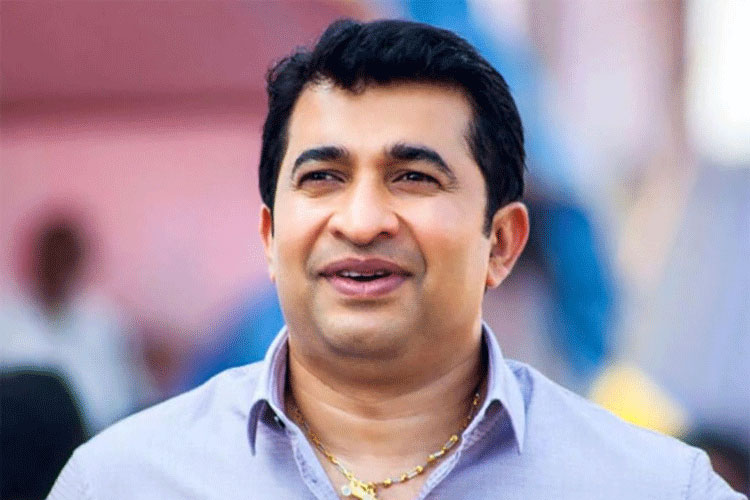
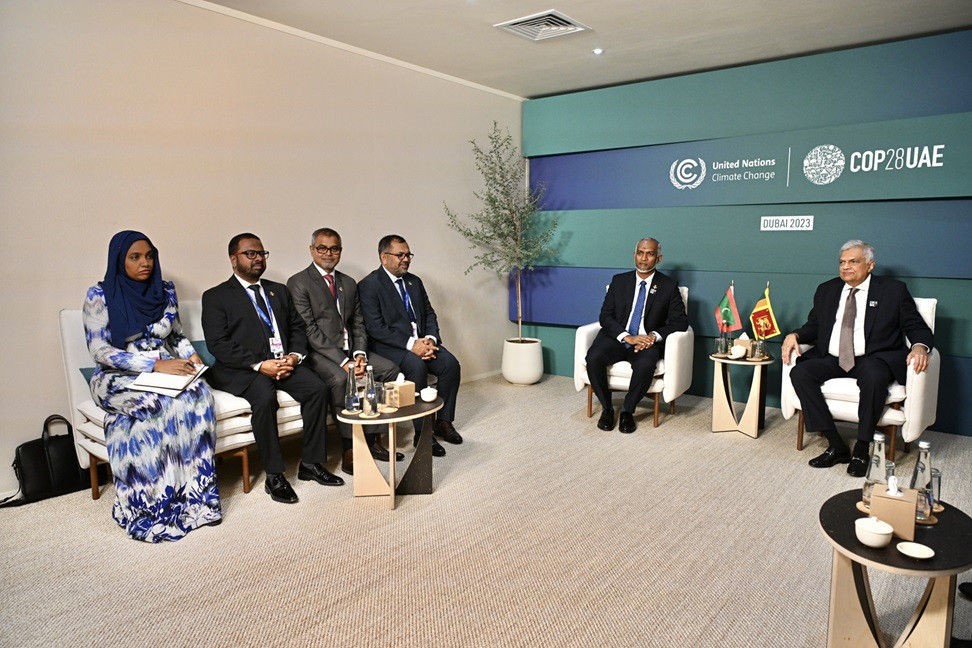
Sri Lanka’s High Commissioner to India Milinda Moragoda who is to complete his tenure in Delhi, paid a farewell call on the National Security Advisor of India Shri Ajit Doval today at the latter’s office before leaving New Delhi.
During the call, the High Commissioner expressed his appreciation to the National Security Advisor for the counsel and guidance he provided during his tenure. During the discussion, the Sri Lankan High Commissioner and the National Security Advisor of India had a comprehensive review of the status of the bilateral relationship. They also discussed the priority areas for future cooperation.
As a token of appreciation, High Commissioner Moragoda presented to Mr. Doval two volumes of the publication Urumayaka Arumaya by the Department of Archaeology of Sri Lanka featuring murals of the Kelaniya Raja Maha Vihara, which also include several murals that depict the gift of Buddhism to Sri Lanka from India, and a stone obtained from the stream flowing besides the Seetha Amman Temple in Seetha Eliya (Ashoka Vatika), a significant Ramayana site in Sri Lanka.
Ambassador of the Republic of Korea, H.E. Miyon Lee called on Defence Secretary General Kamal Gunaratne at the Defence Ministry at Sri Jayewardenepura, Kotte today (Oct. 5).
The Ambassador was accompanied by the Defence Attaché of the Korean Embassy in New Delhi, Captain (Navy) Choi Yongseok.
Gen. Gunaratne warmly received the Korean Ambassador on his arrival at the Defence Ministry. During the ensuing cordial discussion on matters relating to further strengthening the existing ties between the two nations and reaffirming their commitment to mutual cooperation and partnership were discussed.
The Defence Secretary spoke on the potential scope for joint military exercises, training programs and the exchange of defence-related knowledge and technology between both countries.
At the end of the discussion, Gen. Gunarate and Ambassador Lee exchanged mementos to mark the occasion.
Military Liaison Officer of the Ministry of Defence Major General Dhammika Welagedara was also present during the meeting.
COLOMBO :Sri Lanka’s central bank resumed interest rate cuts on Thursday to boost growth as the government seeks to lift revenue and repair its balance sheets in a bid to sustain financial support from the International Monetary Fund.
The Central Bank of Sri Lanka (CBSL) lowered the standing deposit facility rate and the standing lending facility rate by 100 basis points each to 10 per cent and 11 per cent, respectively, it said in a statement. The cuts followed a decision at the last policy meeting in August to keep rates unchanged.
“The Board arrived at this decision following a careful analysis of the current and expected developments,” the bank said in the statement.
The rate cut was in line with market expectations and comes amid cooling inflation in the South Asian country.
Sri Lanka’s economy was crushed last year under its worst financial crisis in more than seven decades, with inflation sky-rocketing and foreign exchange reserves falling to record lows, severely stunting its ability to import essential commodities.
The central bank responded by increasing rates a total of 10.5 per centage points to contain inflation and rebuild reserves to shore up its currency. Since June, however, the CBSL has now reduced rates by a total 550 bps as the economy stabilised following a $2.9 billion rescue package from the IMF in March.
Following the rate cuts, the prices of international bonds issued by the country rose, with May 2027 maturity bond leading the gains.
Sri Lanka failed to reach an agreement with the IMF in its first review of the bailout package last month, due to a potential shortfall in government revenue.
That could delay the release of the second tranche of $330 million worth funds under the bailout.
The central bank’s governor, P. Nandalal Weerasinghe, said the country was trying to get the first review completed by the end of October and approval by the IMF Board in November.
“Growth is not enough and the only way to stimulate growth is with monetary policy. Even with policy loosening Sri Lanka could find it difficult to post (a 2 per cent contraction) this year,” said Udeeshan Jonas, chief strategist at equity research firm CAL Group.
Stronger growth would also encourage imports, boosting tax revenues.
Imports shrank about 14 per cent to $11 billion in the first eight months of this year compared with 2022.
“CBSL is supporting lending rates downwards and hoping they fall to levels that borrowers are comfortable to increase borrowings significantly,” said Thilina Panduwawala, head of research at Frontier Research.
Weerasinghe also said the current benign price outlook in the domestic economy would help stabilise inflation at 5 per cent in the medium-term, as mandated under a new Central Bank Act, and enable the economy to reach its potential growth.
However, a recent uptick in global oil prices and the impact of probable tax measures that will be announced in the federal budget in November could temporarily push up prices, he added.
In the last six months, Sri Lanka has seen inflation drop to just 1.3 per cent in September, its currency appreciate by about 12 per cent and foreign exchange reserves improve.
The World Bank this week revised up its economic forecasts for the country and now expects its economy to shrink 3.8 per cent in 2023 versus 4.2 per cent earlier. The CBSL sees a 2 per cent contraction.
The central bank reiterated that it would like to see market interest rates come down further and its chief said he was hoping to see progress on the debt restructuring talks in the near future.
The CBSL “will continue to closely monitor the developments in market lending interest rates and review the administrative measures appropriately”, it said in a statement.
COLOMBO, Oct 5, 2023 (BSS/AFP) – Crisis-hit Sri Lanka cut interest rates by 100 basis points Thursday as the second instalment of an IMF bailout was held up after the government missed several loan conditions.
The Central Bank of Sri Lanka (CBSL) said it reduced the benchmark lending rate to 11 percent as year-on-year inflation fell sharply last month to 1.3 percent, compared to a peak of nearly 70 percent a year earlier.
The latest policy rate reduction came as the government failed to secure the second tranche of $330 million out of the $2.9 billion four-year bailout agreed with the International Monetary Fund in March.
Colombo had hoped to get the second instalment last month after the first review of the IMF program.
However, the international lender noted that Sri Lanka had, among other things, fallen short of the agreed revenue targets and needed to increase tax collection.
Sri Lanka was also yet to finalise a restructuring plan with its private and bilateral lenders after defaulting on its $46 billion external debt in April last year.
CBSL said it hoped the latest rate cut, which comes on top of two in June and July, would help revive the economy.
“The financial sector is urged to pass on the benefits of the continued easing of monetary conditions to individuals and businesses adequately and swiftly, thereby supporting the envisaged rebound of the economy,” the bank said.
The IMF said last week that Sri Lanka’s economy had shown early signs of stabilisation, but recovery was “not yet assured”.
Last year, Sri Lanka ran out of cash to pay for even the most essential imports, leading to shortages of food, fuel and medicines.
The nation’s worst economic crisis also forced then-president Gotabaya Rajapaksa to step down after months of protests over corruption and mismanagement.
As the economic crisis worsened, the CBSL began raising rates from early 2022 with a record seven-percentage-point hike in April last year.
The lending rates peaked at 16.5 percent in March and have since been reduced gradually.
(A talk given by Gunadasa Amarasekera at the Royal Asiatic Society)
When Dr. Punsara Amarasinghe requested me to speak on my long novel in nine volumes I was rather reluctant, not because of anything else but my physical condition. Nearing my 96th year, I have lost almost all my faculties. I am almost deaf and unable to join in a conversation, leave aside a discussion. My eyesight is extremely poor. I suffer from memory loss. I cannot speak off the cuff and have to put it down on paper.
Despite these infirmities, I thought I should accept his invitation for a number of reasons.
Firstly, I found out that Dr. Punsara Amarasinghe is an avid reader of mine. He has not only read all these nine volumes but almost all my other works. (Now, that is a compliment no writer can ignore). How can I let him down?
Secondly, this work which I launched nearly thirty- five years ago, having had a number of reprints has hardly drawn the attention I expected from the so- called critics and intellectuals. Leaving aside the literary merits of this work, the political, the socio- economic insights contained in them should have stimulated/provoked those intellectuals to take them up even to debunk them. As such, Punsara’s initiative to draw attention to what I said was welcome.
Thirdly, looking back on what I wanted to convey I find what I said then, is more relevant now to us, going through a severe economic and political crisis, than at that time.
Fourthly my narrative advocating Buddhist civilisational values, I felt, would find a response in economists following Schumacher who pointed out the validity of Buddhist economics. The latest in this trend I came across is in Professor Clair Brown’s book ‘Buddhist Economics’. She had in fact come to our country some time ago to see how this centre of Theravada Buddhism is pursuing Buddhist economics. What she saw instead, were limousines of the latest model plying the streets of Colombo, and skyscrapers outdoing each other to reach the skies. She was thoroughly disillusioned. I hope this narrative by a Buddhist would vindicate us at least in a small way and also make her revise her opinion regarding us.
What prompted me in ’83 to embark on this voluminous narrative may be of interest, in understanding it. A brief account may be of help. It may also be relevant as some have branded this as a political tract presented in the garb of fiction.
What fallacy prompted those detractors to brand this narrative as a political tract? It is vital to examine it at some length as it has a bearing on the growth of the novel especially at this time.
Politics as such has been outlawed from our serious fiction. A good example is the novel Yuganthaya by Martin Wickramasinghe-our most social conscious novelist.Yuganthaya is based on a political theme- the struggle for a socialist state. But in it we do not come across the personalities who championed it, those stalwarts who dominated the scene are absent, their activities have been ignored. We do not see the prevalent politics of the time which engulfed the society. Instead of presenting that vital background the author resorts to an abstract, symbolic presentation.
As a result, Yuganthaya becomes a sort of intellectual exercise by a romantic individual. It is by no means- an end of a yugaya- an epoch.Yugantahya has had no impact, it is hardly referred to, today, when it is extremely socially relevant to the times.
Symbolism and abstract conceptualiaation, that the author had resorted to has a place in poetry; as a matter-of-fact symbolism is the essence of poetry, this is not so in fiction. Realism is the essence of fiction. It must be presented in all its complex manifestations, it cannot be selective, it must be representative, totally and completely. The heterocosm the novelist creates must accommodate all that complexity.
The negligence of this fact by our novelists has had two results; avoidance of politics in their serious works and the acceptance of this by the readers as the norm – a criterion of judgment.
This is highly undesirable at this juncture, when politics has to come in a big way to our creative work. This, I believe is what Solzhenitsyn meant when he said that a great novelist is a state within a state. To be a state within a state one has to be highly conscious and aware of politics- a political animal.
I have not been a political activist, however, I have been even as a teenager, a keen observer of what was happening in the country, in the political landscape. (It may have been due to the influence my father had on me). I was a political animal of sorts.
I was there at the Torrington Square when we received Independence. I watched with contempt our Prime Minister arriving there in top hat and tailcoat. I was there at the Town Hall when Bandaranaike formed his party. I was on the streets of Kandy cheering away when the ’56 victory was announced. I was in depths of despair when JR Jayewardene hoodwinked the entire nation with his Dharmista slogan and pushed his neo-liberal economic policy on us which resulted in two insurrections, one in the South and one in the North. The US with the collaboration of India was planning to impose Federalism on us. The neo liberal economic policy ruined not only our economy but also our culture and civilizational values. My dreams had by then vanished. I was feeling .dejected and utterly hopeless. I needed to unburden the oppression within me. It was this mindset which forced me to embark on this narrative. It was a therapy I needed very much.
In order to achieve it I needed an alter ego through whom to articulate my thoughts. It had to be a Piyadasa from the middle class to which I too belonged. Further it had to be the journey undertaken by this middle class. You might ask why the middle class? Obviously, it was the middle class after the ’56 victory that determined the destiny of this country for good or for bad.
How and when did this middle class emerge? The genesis of this class had to be sorted out first. The first volume of this narrative Gamanaka Mula attempts to unearth it.
Prior to the emergence of this middle class-the rural society, the village that was there, was no different to that which was there in ancient times. Anagarika Dharmapala has provided a description of that society.
‘The villagers lived a circumscribed but contented life. There were no big land owners, no capitalists. Every family had a plot of land which they cultivated. There were grasslands and forests for their common use. People lived a contented life helping each other. There was no place for individualism. Collectivism was the basis of their living. The sangha led a collective life and provided the necessary guidance’. Life at Yatalamatta where Piyadasa spent his childhood was a close replica of this society.
How did a middle class emerge from this background? How and when did this middle class emerge?
By the beginning of the last century there appeared a new class in the village. It consisted of vernacular teachers, headmen, post masters, and petty government officials. Unlike the villagers they had a consistent income by way of a monthly salary. They were fairly educated too, and had an inkling of the changes that were taking place outside their village. They realised that if they were to keep abreast, they will have to send their children out of the village and give them an English education.
Piyadasa’s mother was the headmistress of a school. His father was an enlightened person and a devotee of Anagarika Dharmapala. They decided to send Piyadasa to the Christian school at Baddegama first and then to Colombo to stay with his aunt who had come to live in the suburbs of Colombo where her husband was employed. They had no children of their own. The parents of Piyadasa had no great ambitions. They were quite happy if Piyadasa could be put in trousers and employed as a clerk. These middle-class ambitions soared only after 1944 with the advent of the Free Education system.
Being a keen student Piyadasa matriculated and entered the University College in Colombo to follow a course in Economics. It was the tail end of World War 2.
The society in which Piyadasa moved in Colombo was a hive of activity with nationalist and Buddhist resurgent movements, raging across that society. Free education was the main issue that kept these movements going. Figures like Malalasekera and Mettananda dominated the scene. Piyadasa and his friends attended those meetings and got thoroughly involved in them.
With the establishment of the University of Ceylon at Peradeniya, Piyadasa had to go there. It came as a surprise to Piyadasa to realise that in spite of those magnificent buildings reminding one of Anuradhapura and Polonnaruwa, it was a dead city, devoid of any intellectual or political activity. If there was any political activity, it was confined to a miniscule Trotskyite group for whom it was a parlour game to be engaged in, till they joined the Civil Service. Piyadasa was neither interested in such politics nor the civil service. Anything resembling any intellectual activity was the cultural activities initiated by Sarachchandra. It was to overcome the boredom of living that Piyadasa drifted there. But very soon he fell under the spell of Sarachchandra who was an out and out aesthete who was not concerned with anything happening in the society. In fact, he was very cynical of these national or Buddhist activities. He considered those leaders as hypocrites. He was even cynical of his own discipline of Indian philosophy and Western Philosophy. He considered them as blind alleys and often quoted Omar Khayam’s verses to justify his view. When Sarachchandra over a glass of beer quoted those verses by Omar Khayyam, Piyadasa listened to him spell bound.
The spell was short lived. Sarachchandra left for Japan and Piyadasa was left high and dry with nothing to look forward to in that desert.
He had nothing to look forward to. His attempt to win the heart of a girl whom he adored had failed. His aspirations to get an academic post too failed. In sheer desperation Piyadasa applied for a government job and obtained the post of an Assistant Commissioner of Agrarian Services and moved out to Kalutara. The volume Inimage Ihalata describes this period of his life.
Kalutara was a sleepy town. The only ‘living spot’ was the government Servants’ Club- where the government servants spent their evenings drinking till midnight. Piyadasa too followed them. Thereafter the only avenue to kill the boredom was to practice what Omar Khayyam had advised – to seek the pleasures of the flesh which soon filled him with disgust. The volume Wankagiriyaka describes this phase in Piyadasa’s life.
For his good fortune things changed quite unexpectedly. He fell in love with a woman after his heart and got married. His good fortune did not stop there. Quite unexpectedly he was offered a post at the Peradeniya University. Piyadasa and his wife came to live in Kandy, in a room at Queen’s Hotel where they listened to the thewawa at the Dalada maligawa, morning and evening. The volume Yali Maga Wetha discusses this period of his life.
In Kandy, Piyadasa came across a group of more or less his own age who were political animals who were very concerned about what was happening in the country. Their company awakened the political animal in Piyadasa that had gone to sleep over the last two or three years.
The group consisted of two die-hard Marxists Alaya and Bassa and, Thilakasena and Weera who were more inclined to SLFP politics. They met in Thilakasena’s room at least every other day, went on till late midnight engaged in violent debates. The two Marxists’ attitude to the failure of the United Front Government which they had helped to win was the non-implementation of the Marxist theories by the government fully. Thilakasena was of a different view. He attributed the failure to the forcing of the Marxist policies without considering the Buddhist cultural background of the people. Piyadasa went further and attributed the failure to the models we have borrowed from the West without seeking an indigenous model based on our civilisation which had disintegrated with foreign conquests but had left a civilisational consciousness in the minds of the people. This was challenged by the two Marxist who saw it as a fantasy on the part of Piyadasa.
Ex Judge of Mul;ativ ‘s statement, now in public giving reasons for his resignation which includes a compalaint that the Attorney General summoned
him to review some of his judgements delivered by him, . But, when one examines the letters exchanged between the AG and the former judge it is very
clear that the AG was responding to a request received from JSC to provide legal assistance to the judge who has to respond to the legal queries arising
from his judgements by 10th Oct 23. at the Appeal courts. His false statement is now exposed.
He also complained of the death threats he received from various parties in relation to his judgments, presumably regarding an archaeological site in Mulativ
which received favorable and sympathetic responses even from national newspapers including the social media . However, the so called thraets said
to have been hurled at him, needs to be investigated espeacily in view of the false satement made regarding the AG’s action.
The above quote from Fyoder Dostoevsky outlines vividly how a man loses all respect when he lies to himself. Now, that he has jumped the ship and escaped
probably to the West, we will hear that he will be granted asylum as he is facing human rights abuses in SrI Lanka
Sri Lanka, a country in grave foreign debt- as much as $ 56 billion in 2023, a country that did not owe a dollar to anyone in the early Seventies, had better organize devices to use the Recently won $3 billion tranche from the IMF for economic development to bring about production and incomes to the people before the $ 3 billion IMF tranche dissipates into the thin air due to luxury imports.
Our President and Prime Minister may please consider new ideas. My Youth Self Employment Programme of Bangladesh, designed and initiated by me when I worked in Bangladesh as the Commonwealth Fund Advisor to the Ministry of Labour and Manpower, which being continued to be implemented by members of the elite Bangladesh Civil Service, may provide ideas for kind consideration. It is a programme that within four decades has brought incomes and employment to over three million youths.
The Youth Self Employment Programme of Bangladesh, a Programme that has created three million youth entrepreneurs in four decades.
Posted on February 13th, 2023 in LankaWeb
By Garvin Karunaratne
It all happened in the Bangladesh Secretariat, three days after General Ershard took over the country in a bloodless coup on the 24 th of March 1982. The Minister for Youth Development was clamped in prison and the work of the Ministry was in jeopardy. The third in command, Air Vice Marshall Aminul Islam, the Minister for Labour and Manpower evaluated the work done in the Ministry. Suddenly at the close, he realized that I was an outsider and inquired who I was and I was then introduced as the Commonwealth Fund Advisor to the Ministry of Youth Development.
What can you contribute for Bangladesh”. It was more a military command. I could have spoken in support of the youth training programmes done by the Ministry but decided otherwise. I replied.
I would like you to consider approving a new programme aimed at making the 40,000 youths who are being trained every year to be guided to become self employed.”
The 75th anniversary celebration of the Department of Meteorology, a leading government institution with a strong impact on many economic sectors, was held today (Oct 04) under the auspices of the State Minister of Defence Hon. Pramitha Bandara Tennakoon at the Met Department premises.
Director General – Meteorology Mr. A. K. Karunanayake received the State Minister who graced the anniversary day programme.
Addressing the gathering, the State Minister emphasized that the income received through the services provided by the Met Department will be able to provide a more effective and close service to the people by investing in the improvement of the technical equipment currently in use and the development of the knowledge of the technical experts related to the subject.
In the last 75 years, the Met Department has delivered a huge service for the country by providing weather forecasts which are essential to face and mitigate disasters following the emerging technological advancements in the modern world.
Defence Secretary General Kamal Gunaratne, Public Administration, Home Affairs, Provincial Councils and Local Government Ministry Secretary Mr. KDN Ranjith Ashoka, Additional Secretary of the Defence Ministry’s Disaster Management Division K.G. Mr. Dharmathilaka, Chairman of Arthur C. Clarke Centre for Modern Technology Prof. Chandana Jayaratne and distinguished guests participated in this event.
We thank you once again for all your efforts on behalf of the Tamil people. We repeat our deep anguish at the tragic turn of events in Jaffna.
We feel it is our duty to also express our disappointment with the proposals to solve the Tamil problem contained in the two Bills – the 13th Amendment to the Constitution and the Provincial Councils Bill – presented to parliament by the Sri Lankan government.
These proposals do not meet the aspirations of the Tamil people nor are in any way, commensurate with the loss of life, sufferings and privations suffered by the Tamil people.
Since 1983, the TULF has always negotiated with the Government of Sri Lanka directly, utilising the good offices of the Government of India, and through the Government of India in the hope of evolving a comprehensive scheme of devolution which the TULF could commend to the Tamil people.
The TULF regrets it cannot recommend the contents of these Bills to the Tamil people as being satisfactory, just and durable.
On the eve of your departure to Sri Lanka to sign the agreement, we requested you among other things, that a team of experts from India along with their counterparts from Sri Lanka draft the necessary legislation. You agreed that this was a reasonable request.
Now the legislation is sought to be foisted on uswithout any Indian expert playing a part in the drafting.
The TULF expected all along that a copy of the draft legislation would be made available to the Government of India at some reasonable time before it was made public. Apprehending that this might not happen, a delegation of the TULF met President Jayewardene on the 29th of September 1987 and made this formal request.
We regret that the Bills were gazetted without being made available to the Government of India.
This is not merely cavalier treatment of India but a clear breach of pare 2.15 of the Agreement which states inter-alia that residual matters shall be resolved between India and Sri Lanka.” The Bills are certainly not the result of any such resolution.
We do not wish to burden you with a detailed analysis of the Bills. But please permit us to draw your attention to some important matters;
Single Administrative Unit
After a great deal of persuasion, you got President Jayewardene to agree to one administrative unit of the Northern and Eastern Provinces as now constituted having one elected Provincial Council, one Governor, one Chief Minister and one Board of Ministers. The continuance of such a unit was to be subject to a referendum in the Eastern Province by 31st December 1988, which could be postponed by the President. We objected to such a referendum and we believed that it would eventually never be held.
The provisions of the Bills have made this political arrangement of such importance to the Tamils a farce. The setting up of a single administrative unit is to be done by an executive act of the President, in the form of a mere proclamation, which can always be revoked, and this too has to depend on the President being satisfied on a number of imponderables.
It was the Tamil expectation that a single administrative unit of the Northern and Eastern Provinces, would be firmly created by an adequate constitutional provision. The provision in Section 154 of the 13th Amendment, however, is of a dubious nature, and could be interpreted to mean that a perpetual power is vested in parliament to legislate on this all important matter. The resulting position would be that a single administrative unit of the Northern and Eastern Provinces, even when finally established would be an impermanent arrangement.
Legislative and Executive Power
All parties to the negotiations have always understood that the powers to be devolved to the Provincial Council will be the same as those enjoyed by a state in India with suitable adaptations. This was to be particularly so in the field of legislative and executive power.
During the discussions between the Sir Lankan Government and the TULF in July/August 1986, it was agreed that the legislative power of the province in respect of provincial subjects would be near absolute, and that the governor would be a ceremonial head, with his discretionary powers clearly defined.
The Bills retain the power of parliament to amend or repeal the chapter pertaining to Provincial Councils, and the lists of subjects, and also the power of parliament to legislate even on subjects transferred to provincial councils, by a two thirds majority, and the approval of the people of the whole country at a referendum. This would indeed be a simple exercise in Sri Lanka, where the majority community constitutes 74% of the population.
In the field of executive power, the executive power of the president is sought to be retained by providing that the governor shall hold office in accordance with Article 4 (b), which provides that ‘executive power of the people shall be exercised by the president of the republic,’ through the wide and undefined discretionary powers of the governor, which according to Section 154F (2) have to be exercised on the president’s directions; and through powers exercisable on the proclamation of an emergency on very wide grounds.
It would be relevant to recall that between 1970 and 1987, Sri Lanka has been under Emergency Rule for more than 10 years. The Sri Lankan government has declined to accept the TULF’s persistent demand that the Indian pattern pertaining to the proclamation of emergency be followed. Not merely have the justiciability of proclamations of emergency and breakdown of constitutional machinery been specifically denied, power has even been vested with the president, to make emergency regulations with respect to any matter set out in the Provincial Council List, or having the effect of overriding amending or suspending the operation of a statute made by the provincial council. Vide: Article 155 (3A).
These provisions were never accepted by the TULF – some of them were not even proposed to the TULF and we are certain that these provisions have not been accepted by India.
During discussions with the TULF the Sri Lankan government indicated that the number of ministers of the province should not exceed one third the total number of members. The North Eastern Province would have 71 members. The TULF’s proposal was that the number of ministers should not exceed one-fifth the total number of Members. The number of Ministers has now been restricted to four. This has been done with the ulterior motive of promoting discord amongst the different peoples of the Northern and Eastern Provinces, and so as to diminish the importance of the provincial council and hamper and impede efficient provincial government.
Lists of Subjects
Though it was clearly understood that the Lists of Subjects would substantially conform to the Indian pattern, the Concurrent List has been heavily loaded, and the Provincial List clearly starved. Subjects such as Fisheries other than beyond Territorial Waters, Agriculture, Animal Husbandry, Industries, Redemarcation including creation of Districts, Assistant Government Agents divisions, and Grama Sevaka Divisions, restoration, reconstruction of destroyed towns, villages, properties, compensation or relief to persons who have sustained loss or damage, palmyrah plantation and palmyrah industry, coconut plantation and industry related thereto, the ownership, management and control of state-owned industrial enterprises within the province dependant wholly or mainly on raw materials found in the province (recommended by the Political Parties Conference), Co-operative Banks, Prisons, Provincial Public Service, Provincial Public Services Commission, Local Government Service, Inquiries, Surveys and Statistics for any of the purposes in the Provincial List and such others have not been included in the Provincial List, in keeping with the discussions held with the TULF on the basis of the Indian pattern.
In the field of Education, the powers of the Provincial Council are substantially curtailed even in the matter of secondary education.
Both the Concurrent and Reserve Lists have been so framed as to minimise to the maximum possible extent, the scope and content of the council’s powers.
Land and Land Settlement
On the all important subject of Land and Land settlement, Appendix-II in the Bill is in many respects even worse than the Appendix attached to the proposals of 23rd September 1986 which itself was substantially deficient.
The following matters are clearly unacceptable :
(i) The inclusion of State Land in the Reserve List,
(ii) The reference to state Land continuing to be vested in the Republic, and the power of disposition by the president,
(iii) The denial of the right to the Province, though land is a devolved subject, of the ipsofacto use of State Land for devolved subjects,
(iv) The restriction of the right of the province to administer and control only such land as is made available to it,
(v) The stipulation that the alienation and disposition of State Land within a Province to any citizen or organisation shall be by the president in accordance with Laws” governing the matter contrary to even existing procedures for alienation,
(vi) The wide definition given to Inter Provincial Irrigation and Land Development Projects, the principle of the National Ethnic Ratio in such projects, the right given to the Government of Sri Lanka to determine the selection of allottees for such lands, designedly to perpetuate the present pernicious practices,
(vii) The failure to properly formulate the principle of the Cumulative Entitlement of the Tamil speaking people in schemes under the Mahaweli Project in the Eastern Province, and the failure to incorporate with Appendix-II the Annexure on settlement in the Eastern Province under the Mahaweli Project.
The above are clearly directed towards reducing the provincial council to the position of a nonentity in respect of State Land even though land is a devolved subject, and enabling the Central Government to have dominant power over State Land. Ample scope is also retained for the continued colonisation of the Northern and Eastern Provinces with members of the majority community.
Such a position would be completely contrary to the discussions held with the TULF and is totally different from the Indian pattern where land colonisation etc., is a state subject with no power whatever reserved to the union. The Tamils can never accept any settlement which does not satisfactorily resolve the burning question of State Land. The Land Settlement programmes carried out by the Sri Lankan Government in the post agreement period have been a major destabilising factor and do not inspire any confidence whatever in the Tamils.
Trincomalee Port
The subject of ports has been included in the Reserve Listand the Trincomalee Port as a major port would come under central control. Annexure ‘ C’ specifically provided that: A Port Authority under the Central Government will be set up for administering the Trincomalee Port and Harbour.The area which will come under the administration of the Port Authority as well as the powers to be assigned to it will be further discussed.” This matter was raised with the Sri Lanka Government and though apparently certain assurances were given the Bills do not contain any provision reflecting such assurances.
Tamil apprehensions are greatly aggravated by the fact that in 1984 after the finalisation of Annexure ‘C’ an extent of 5150 acres of land around the Trincomalee Port was vested in the Port Authority, which could result in the creation of a new township with racial overtones around the Port, and be the cause for prolonged conflict.
The manner of recruitment to employment in the port since 1983 and the facilities provided to such employees clearly indicate this trend. The TULF had given the Indian negotiators a comprehensive paper dealing with this subject. It is essential that this matter too be resolved in an acceptable manner,
Provincial; Public Service
The provisions in respect to the Provincial Public Service and the Provincial Public Service Commission have been included in the Provincial Councils Bill contrary to the Sri Lankan government’s draft proposals for the amendment of the constitution of 23rd September, 1986 which categorically stated Provision regarding Provincial Public Service to be included.”
The appointment, transfer, dismissal and disciplinary control of Provincial Public Servants being vested in the governor who is subject to presidential directions is contrary to the proposal made by the TULF that the provisions of Article 55 which vests the appointment, transfer, dismissal and disciplinary control of public officers in the Cabinet of Ministers be made mutatis mutandis applicable. This together with the omission of the subjects of the Provincial Public Service and the Provincial Public Service Commission from the Provincial List, suggest that the Provincial Public Service will not function under the executive control of the Provincial Board of Ministers. Effective provincial government would be an impossibility in this situation.
Contrary to the belief that the chapter pertaining to Provincial Councils would confer on the provinces a measure of credible autonomy without derogating from the entrenched clauses in the constitution, the present Bills at every turn, enable parliament and the central executive, to extend its tentacles into the provincial sphere circumscribing and emasculating the exercise of even the powers conferred on the province.
Tamil as Official Language and matters relating to the Central Government
The provisions in Clause 2 of the 13th Amendment making Tamil also an Official Language has been nullified by paragraph (4) which states that Parliament shall by law provide for the implementation of the provisions of this Chapter.”
In relation to Sinhala as the Official Language, the constitution provides for the manner of its use. The same constitutional provisions should be made applicable to Tamil also as an Official Language.
Besides these there are other matters regarding the rights of the Tamils in relation to the Central Government which have to be discussed and resolved.
In view of the above we earnestly request you to ask President Jayewardene not to proceed with the two Bills in Parliament in the present form till the matters referred to herein, are discussed and resolved to the satisfaction of the Tamil people.
We request that we be granted an early appointment to discuss these matters more fully with you.
With kind regards,
Yours Sincerely,
Sivasithamparam, President, TULF
Amirthalingum, Secretary General, TULF
Sampanthan, Vice-President, TULF former MP for Trincomalee
Sarath Wijesinghe (President’s Counsel, former Ambassador to UAE and Israel Solicitor in England and Wales and president Ambassador’s Forum)
Tourist Destination
Sri Lanka is known to be tourist destination among the places known for tourists and tourism in the world of tourism in the competitive market when the tourists are looking for places of interest for peace , relaxation, holiday, sight seen and various other reasons to travel. They prefer to have compact destinations to enjoy all needs and benefits on one destination rather than going to place to place. In compact Sri Lanka with the excellent network of roads the different climate, and places of interests could be seen with a short drive driving or public transport, Travel and migration is inherent to the human that has made the world populous. Sri Lanka has been a destination for tourists, visitors explorists,’ religious dignitaries traders and many more for various reasons time immemorial due to the central and strategic geographic situation in the midst of the rich and busy Indian ocean. Tourism is a business, trade, an art, and a way of life for some living on tourism in tourist nations living mainly on tourism. Sri Lanka is ideally suited and well placed geographically in the rich Indian Ocean as a compact Island surrounded by sea right round and ideal climatic conditions. Tourist nation is a nation that depends on tourism for the GDP and a way of life for the inhabitants mainly depend on tourism as the main income of the people. In that context is Sri Lanka a tourist nation? May not now but given the opportunity she has all the ingredients to be a typical tourist nation. It is a question difficult to answer though Sri Lanka is qualified to be tourist nation that she has not exploited the resources as the other tourist nations far of Sri Lanka to be in the tourism map as a tourist nation. Occasionally Sri Lanka was rated as one of the best destinations by organizations on grading tourism but she is not in a position to sustain or to develop it to be on the world stage. But there is no option for Sri Lanka but to concentrate on tourism as it is the easiest and cheapest way to raise the most needed foreign income and increase the GDP on tourism for economic recovery the country is struggling to. They say tourism is booing in Sri Lanka and world over a pleasant news to us and it is time for us to work harder on this matter harnessing all our resources in one basket for the betterment of averybody.
Known and Popular tourist destination
Sri Lanka has been a known tourist destination for time immemorial and also as a place of interest on trade, sightseen, beauty, and cultural and interactions. FA HIAN who visited Sri Lanka with a group of Buddhist monks on 410 AD wrote extensively and had interactions on number of occasions with important notes of great significance and MARCO POLO a French national who said that Sri Lanka is the best compact island in the world for the outside world in addition to the Arabe Sailers who voyaged for business naming Sri Lanka Serendib and the pearl of ocean are notable remarks by recognized travellers passed through Ceylon then. Ancient Arabs named it Thabrobane, Arabs Serendib, Europeans Ceylon and after the 1972 constitution it is now named Sri Lanka. ‘Ramayanaya’ gives an interesting historical that some says imaginary is a part of Indian history and literature that is world famous among historians and academics. Seetha and Rama is a part of Ramayanaya with the remains of Seetha Eliya and other places of interest connecting India and Sri Lanka. Majority of tourists to Sri Lanka are from India and Sri Lanka must be smart to make use of the historical mythological and cultural connections to promote more tourists and tourism from India next door to Sri Lanka. It is ironic that Sri Lacks and visionaries on public policy on tourism though the country is full of inbuilt and natural places of interest admired by the writers and explores worldwide which is not properly exploited by the Sri Lankans which is a sorry state indeed, despite large array of resources tailor made for tourists. Sri Lanka is full of natural spots, flora and fauna, pleasant climatic conditions, geographical historical and archaeological and religious sites, performing and historical arts and wildlife as ‘Forbes’ has declared the country full of wildlife next to South Africa are to the credit to the Sri Lankan tourism regime in addition to the presence of the Asian Elephant, Slot Bear, Lepard found in abundance which is the highest number that can be seen in one single destination jungles of rare species confined to Sri Lanka, blue sperm whales, Blue Wales and the rare view of 300 elephants that can be seen in ‘Minnariya’ are tourist attractions in addition to the beautiful beaches running round the island extending to 994 miles with shallow sandy beautiful beaches sometimes with corals and beautiful fish and underwater attractions which is rare in many tourist destinations in the world. It is also noteworthy to note that 13% of the land is reserved for protected areas which is unprecedented and environment friendly in deed. Forests reserved to wildlife and sanctuaries are numerous and easily accessible with the excellent network of roads right round the country. Sri Lanka is known to the modern world in various ways as a beautiful compact island as published by the lonely planet and many tourism journals. 30 year war and the clamping it down militarily was given wide publicity by the west that predicted it has been an unwinnable war that Sri Lanka succeeded. Leading professionals and politicians in the academic and international arena too give publicity the small nation in various areas. Madam Bandaranaike, Shirly Amarasinghe , Laxman Kadaragarmer, D S Sennayaka, are some who gave credit to Sri Lanka to be in the world map in addition to the places of historical and archaeological significance lot recognized by UNESCO in abundance.
Current Situation on tourism
The word revolving round is the boom on tourism for Sri Lanka is emerging gradually with the record number of tourist arrivals after the drastic draw backs due to Covid 19 and Easter bombing that has shattered the tourist industry to the rock bottom until it is gradually recovering now. It is reported that tourist arrivals in 2023 has reached a record level of 763000 that has reached 100,000 recently with income of 800 million dollars which is gradually increasing despite the drawbacks on the lethargic administration and innovations of the governance when other tourism promotion countries are making use of tourism as a vehicle for the economic boom they have gained on tourism with the correct and positive approaches with policies and master plans. Therefore one can imagine the real boom on tourism if wanton bribery corruption and inefficiency is eradicated and corrected to be an efficient and honest administration. It is seen in Sri Lanka the hotels are almost full, tourists seen around the country, and things seem to be moving in the right direction on tourism which is insufficient to be a contributory factor on the GDP as many other competing destinations. There is an ambitious aim of 35 billion dollars in a targeted time space. Currently tourism is the third largest revenue source with many depending on as a source income on the trade in various ways and it is not a difficult task to raise it to a main income earner with a proper policy and a masterplan to suit the country following the footsteps of the competitors who depend on tourism for their main income as the main source of GDP of the nation.
Tourism and Public Security
Confidence of the traveller to the destination is a paramount part and the law and order situation plays a main role in the process. Tourist plans to visit to a peaceful destination for a peaceful holiday in a new country expecting new experiences to refresh themselves after long and hard work at home and adverse news of the visiting country discourages them from visiting the destination. Travel warnings of the country of origin is taken seriously and that will discourage their initial journey planning process. UK,USA, and Europe is prompt warning their residents on visits based on the media reports and the information from the Embassies that will play a pivot role on the media propaganda by respective countries. There the host country must be careful of the law and order situation which will be a main factor on tourism promotion in addition to the other requirements and facilities offered. Today news spreads faster due to modern technology where news travels worldwide fast with a click of a button with images and the adverse information. Therefore the host country will have to be extremely cautious on the country situation and the media publicity inside the country with the country situation of safety and security. News in Sri Lanka on law and order situation is worrying considering the media reports of the gun culture and the security situation where the governance appear to be out of control. Underworld and drug menace is worldwide yet in Sri Lanka there appear to be disturbing news. Sri Lanka went through a bloody unwanted war for thirty years and successfully eradicated it with a peaceful era for a long period which has unfortunately ended and the wishful thinking is to reemerge the peace enjoyed to be dawn again for a peaceful tourism regime. It is a sorry state that the governance was not in a position to maintain the peace and reconciliation enjoyed at the end of the war of terror that took so long to end with lot of sacrifices and the wishful thinking of everybody is to reemerge the lost peace that will assist to prosper tourism and economy, which is a realistic expectation in deed.
Health wellbeing and facilities for the tourist
Tourist is living with us as one of us and the facilities that we enjoy must be shared with them to encourage the future tourist and tourism. They must be looked after when sick with adulate facilities they have been enjoying in the country of origin. Tur they are prepared to bear expenses yet the facilities should be available easily to encourage the future tourists. Some countries promote health tourism as a part of tourism promotion to promote tourism with the health system which is happening in the country with modern health facilities. In Singapore the tourist is given the details on consumer issues and the services in the country at the airport which attracts and helps tourists immensely. They may be given adequate facilities on enjoyment in the night which is lacking in Sri Lanka which is a matter to be looked into to improve as according to our way of life the citizen goes to sleep early especially in small towns. As the tourist is prepared to spend money for transport and extra and night life it is necessary to provide with them the facilities if the continuity of tourists are required. Food culture and the national heritage and the way of life are matters respected and expected by the tourist as a part of their voyage and it is so easy for us to provide with our culture and way of life with our cultural events which are plenty and spreads in the entire year. For example the new year, ‘Wesak, Poson, Peraharas’ ‘right round the year, and number of other cultural and traditional ceremonies in the country are easily shown and sold to the tourist wanting novel and traditional experiences. Traditional food crafts are and culture is advanced and attractive and it is a good idea to propagate it among the tourists.
Helping others is inborn in Sri Lankan which is disappearing today
Sri Lankans are famous to help others especially in need and distress, which is disappearing today due to the economic deprivation and difficult income conditions when the citizen is pressed with financial stress due to cost of living and difficult living conditions. It is the duty of the incumbent regime to eradicate the economic difficulties of the citizen which has an effect on tourism as a whole as the tourist is also a part and parcel of the local population thereby it is advisable to uplift the general economic conditions living conditions to everybody for a comfortable living for all including the visitors whose presence and contributions will be helping the local population. There is an encouraging trend the tourist take part in local functions and the cultural activities enjoying Dan Sal, Peraharas and even religious and cultural rituals.
Education
Is a part of Sri Lankan culture and wealth as an educated nation full of educational and professional in the country. Tourism provides education and professional avenues during tourism out of which hospitality plays a major role. In Philippines 30% of the population is employed worldwide mainly in the sphere of hospitality and Sri Lankans are equally or more willing and qualified with lacking and less encouragement from the state sector which is lethargic. It is the duty of the governance and the private sector to take up the challenge to provide adequate facilities to produce them to Sri Lanka and world over to help tourism and the issue son unemployment and economic woes on the which the country is suffering from. In many countries education tourism is rampant for example Singapore, Hong Kong, U K, USA are a few tourist visit for education and employment as well Sri Sri Lanka too will be able to moot. Education includes education of the masses and the government apparatus including the security forces which includes tourism police which is not functioning properly in Sri Lanka today which is a lacuna in the process of implementation of a proper tourism regime to be one of the best destinations.
Innovations and novelty
Tourists need novelty and innovations that they could not come across in their country. For example they do not expect the same food pattern in the country of origin in the foreign soil they require fresh and new food and experience. Forest in Europe is different in Asian region as thick and thorny, full of Asian animals elephant being most frequent that one can see around 300 in Minnariya and more often in peripherals in town, and rare Leopard in Yala and blue Wales in Galle which are novel and exiting. Food culture and varied fruits are a rare attraction n Sri Lanka. In the United Kingdom average citizen can purchase only one kind which is not tasty which is grown in bulk, unlike the Sri Lanka banana has large number of verities and so tasty with varied tastes. Food exhibitions are very attractive and innovative steps that the private sector and regulators could organize in their respective aeas, when the regulator plays only a regulatory and a legal role in the industry whereas it is the private sector that runs the machinery on tourism and promotion process.
Cleanliness, IT facilities and providers and digitalization
Are main requirements and main areas to propagate and streamline as any average traveller will want to have these facilities effectively at arms length to be utilized and share with. Without proper and effective IT and WIFI system no tourist will stay in a strange country and it is a salutary situation that sri Lankans possess 110% penetration of mobiles used and nearly 50% of internet and reasonable cheap internet providers of international standards. Sri Lanka is in the door steps of digitalization sharing international platforms on online and the shops are modern and ready to follow online and digital platforms effectively. Anybody like to be clean and in a clean and organized environment and it is the duty of the governance to adhere to for the benefit of everybody including the tourists. They need to do purchase and go through the living online which they have been used to wherever they are for a convenient living and the facilities in the host country will encourage them to stay and recommend the destination to others as the publicity on word of mouth is the most effective. Apart from Sigiriya which is the image used so often as a model despite so many monumental places and areas of interest but the irony is even Sigiriya is not properly presented with at least basic facilities such as proper toilets, infrastructure food and qualified guides to assist are matters to be considered seriously. It reminds us of requests of guides for Israel tourists who travel to surf and to see the country as tourists spend reasonably well unlike the backpackers taking shelter in temples and lead a life as parasites to the society.
Duty of the governance and the public
Duty of the governance and the public is many as they are the main groups responsible to make the visitors life pleasant and happy visit again and to recommend the destination to others to increase our revenue. It is our efforts to take the income on tourism upward to be a main revenue for the GDP and to earn most needed foreign exchange in short supply. It is the duty of the governance is to provide the facilities required and requested by the visitors who are prepared to pay promptly and on foreign currencies, which is the need of the hour for us. Governance should give special attention for the process as a public policy with a proper plan of action on promotional process with the community and the government servants not so effective and prompt to cater the visitors expecting high standers like in their countries. It is a joint effort with the government, people and the tourism staff members in private and public sector to work together as a group for a successful tourist regime for Sri Lanka. Sarahdw7@gmail.com
This is an updated and edited version of a Public Talk delivered on World Animal Day (October 4, 2015) at the Dharmavijaya Foundation, Colombo.
……………………………………….
New Vision
We need a new vision for this country and its civilizational advancement.
It must begin in our schools.
The primary purpose of education is to make an individual a better human being, morally speaking. One aspect of that is to develop close contact with nature and appreciate nature. This was how the aim of education was viewed in the past. Today the ethos in the educational system has changed radically. The focus is on preparing students in subjects that will be useful to gain employment. The curriculum is directed towards technical and job-oriented education while neglecting the humanitarian side. It is a lopsided education. Producing children that have little understanding of life – which was the original and essential purpose of education. An enlightened human being cannot arise purely on the basis of instruction in technical subjects.
Once upon a time, the living world was physically close to human beings. It was rural in outlook and a rural atmosphere enveloped the world. The inhabitants interacted with nature, plants, and animals on a daily basis. There is a marked shift today. An artificial world has made deep inroads into our lives through new technologies uprooting the child from contact with nature.
There is greatness in the outdoors. 99% of children who live in big cities barely touch base with nature. A Chinese Ambassador to Sri Lanka in the recent past has been reported to have said that her child saw a frog for the first time only upon their arrival in Sri Lanka. Those who live in concrete jungles cannot see even the sky properly. But the sky and the heavens above have always been a source of inspiration and awe to humankind.
Buddhist Economics
There has to be a greater public debate on our true destiny. The uncritical copying of structures more suitable for other cultures and the development of concrete jungles that we see in Southeast Asia at the cost of a green tree-based environment is not the best answer to Sri Lanka’s social and economic problems. Bigger is not always better. Small is beautiful said Dr. E.F. Schumacher advocating small appropriate technologies that can empower people more. Schumacher propounded a philosophy of “enoughness”, appreciating both human needs, limitations, and appropriate use of technology. It grew out of his study of village-based economics in Burma, which he subsequently named ‘Buddhist Economics’.
Humanitarian Education
To break or arrest this trend of producing children who have little empathy for nature, animals, and even other human beings, a new system of education has arisen. It is called Humanitarian Education. Animal Protection Education is a part of Humanitarian education. Taiwan is one region in the world that has successfully introduced Animal Protection Education into schools. We also see that happening in some parts of India such as Gujarat.
Primary School Education in Sri Lanka
In Sri Lanka in our Primary schools from Grades 1 – 5, four main subjects are taught, namely
1) Maths
2) Languages
3) Environment Related Activities (ERA)
4) Religion
ERA has 12 themes integrated into it, such as Safety, Transport, Family, and Natural environment including animals.
Dept of Education
The Dept of Education in the foreseeable future must incorporate animal protection education through the adoption of a number of strategies:
a) The core aim must be to help develop concern for animal rights and welfare in lesson planning for children.
b) Research shows a vicious cycle of violence. The child who abuses animals in the home environment is likely to be a bully at school, beat family members or spouses, and even commit crimes in society.
c) Teenage children who are abused by elders in turn abuse companion animals and other animals.
Therefore the Dept. of Education must:
i) develop an environment in schools to promote teachers’ and children’s understanding of the meaning of animal protection and help them recognize the interdependence and intersubjective relationship among human beings, animals, and mother nature.
ii) help programs that lead children to establish positive relationships with animals and strengthen their ability to empathize with animals.
iii) promote the concept of respect and affection for animals and their habitats and generate humane and caring values and the power to act
iv) If students are made to understand that animals like humans also have the ability to feel pain, they can then develop the endearing traits of benevolence and sympathy.
v) Advocacy of Animal Protection Ideas – Today’s Children will become the future leaders of Sri Lanka. Schools must develop programs that will encourage children and teenagers to become a conduit in conveying the ideas of animal protection to the public which will in turn help them to gain the ability to interact with people and develop effective communication skills.
vi) Schools must help children and their teachers understand the unpalatable truth behind animal shows and Zoos (which in reality are animal prisons though euphemistically called Zoos) and empower them to think critically and engage in resolute action including even refusing to visit a Zoo as a place for enjoyment and merry-making. Children must be taught to emphasize and speak on behalf of caged animals in Zoos who have been given a punitive life sentence without committing an offense. Our children should be encouraged to share their birthday treats with animals and birds including zoo and stray animals among others.
Furthermore, our children must be reminded of the Buddha’s words quoted in the Dhammapada:
He who does not inflict injury on beings, whether feeble or strong, does not kill nor cause to kill, him I call a Brahmana.”
vii) Sri Lanka is a country with a lot of wildlife. It is the human being who is encroaching into the natural habitats of our elephants. Their territory is getting reduced by the day. We are invading their territory without an iota of guilt feeling or wrongdoing. Our pre-colonial Kings assigned special reserves for wildlife. King Devanampiyatissa established the world’s first wildlife sanctuary at Mihintale after his encounter with Arahant Mahinda in the 3rd century.
Last week in Sri Lanka ( late September 2023) eleven elephants were reported to have died in train-related accidents. This is shameful for the country. Still, no effective plan to prevent or avoid train accidents with elephants is in sight. The elephants have a right to live in their natural habitats undisturbed by human encroachment. This is a message that children must carry with them to prevent further aggravation of the human–elephant conflict.
vii) Teachers must be trained to provide children with opportunities to choose a set of values different from mainstream values. Allow children to have lifestyle options such as avoiding products that are basically slaughter products or combined with slaughter products e.g. furs, animal skins, reduce meat consumption and choose a vegetarian or vegan diet.
Meat is a product of a huge injustice caused to animals. We prematurely end their natural span of life and then rob their body parts for our use and consumption. No amount of religious script-based excuses or defense can hide this shameful bitter truth. Yet the majority of people in our society carry on life as if no wrong has been done to others and then deliver lectures on Human Rights based on hypocrisy and double standards. Legal education is complicit in this intellectual fraud because it remains silent and tongue-tied in areas where there should be outspokenness and vocal challenge.
James Cameron, famed director of ‘Titanic’ and well-known climate change activist, has a message for the masses: go vegan to fight climate change.
Cameron, who has been vegan for four years, has said in a recent interview with the Fortune Magazine as follows:
[T]he thing that became abundantly clear to us when we met with the experts who are working in nutrition and energy sustainability and climate change is that we can’t actually meet our emission goals if we don’t address animal agriculture, and that’s the thing that’s been left out of the conversation.
This message is crucial because many people who care about the environment still have no idea that raising animals for food is so incredibly destructive.”
Consider some of these facts:
• It takes 2,500 gallons of water to produce just one pound of beef
• 80 percent of land deforested in the Amazon is for raising cattle
• Factory farms grossly contaminate rivers and groundwater
Future Plan
We must initiate a campaign to promote animal protection education and see it take root in our system of school education.
A unique program operating in schools in Israel has found that animal welfare education leads to a host of other benefits including sensitivity to the needs of others, personal responsibility, and prevention of violence. In respect to primary school education, young children particularly up to the age of seven years are recognized for being receptive towards forming positive attitudes to animal welfare that will carry them through to adulthood.
We must remember that children are generally very receptive, their minds are inquiring and active and they have huge supplies of natural enthusiasm. The messages they receive at school run deep. A caring child will turn out to be a caring adult. Schools must establish Animal Protection Clubs or Associations. These clubs will serve as a platform for students to exchange resources, share information, discuss issues, and make animal protection plans more practical and local.
‘ Animal Law ’must be introduced as part of legal studies in secondary schools and tertiary education i.e. Law Faculty.
The study of philosophy both Eastern and Western must be re-introduced into our educational system with a view to expanding the intellectual horizons of our school and university students.
People in Sri Lanka in the pre-colonial era were called Arya Sinhala or Aryavansa – noble race by fellow Asians because of our animal-friendly cultural heritage and compassion towards animals.
The ultimate civilizational goal should be to build a caring and compassionate society in Sri Lanka and achieve peaceful co–existence between man and animal. We can then become a true role model for the world like Bhutan has become with respect to the preservation of its rich natural environment.
Animal Welfare Bill
The Animal Welfare Bill proposed by the Law Commission in 2006, was a comprehensive document. Upon enactment, it was felt that it would set the standard for other countries, particularly in Asia to adopt. Unfortunately, the Bill has had an uneasy ride over the last 17 years largely owing to the opposition of people with vested interests.
It has reappeared in a new incarnation in the year 2022 as a Bill of Parliament with many of the outstanding features that made the 2006 draft Animal Welfare Bill admirable and highly valued, discarded. Today, the Bill (2022 Version) is at the penultimate stage of its passage. Some of the content is draconian. It has fallen short in critical areas vis-à-vis the original Animal Welfare Bill of 2006. The potential of creating room for possible committing of greater harm to a wider number of animals through misinterpretation and misconstruction of words, though not conceived at the time of drafting, is very high and alarming.
The moral challenge for the people of Sri Lanka is to either give effect to the long-suppressed voice of the voiceless animals via an effective piece of Animal Welfare legislation or accommodate the demands of those who see animals in an entirely different light i.e., as fit only for abuse and exploitation for profit, and thereby belying the noble purpose of the Animal Welfare Bill.
Sarath Wijesinghe (President’s Counsel, former Ambassador to UAE and Israel, Solicitor in England and Wales, President Ambassador’s forum)
Tourism and Cricket
They say Sri Lanka is famous both for tourism and cricket. Propagation of tourism is a necessity for the country want of tourists for the most needed foreign currency and income for the country from the industry which brings fame, income and many other benefits. Sri Lanka is a taylor made compact nation for tourism with all ingredients to be a leader on tourism a stated by Marco Polo in 13th century , that it is the best compact island in the world of its size with all ingredients intact to be a beautiful tourist/travellers destination, visited by many from time immemorial due to strategic position geographically on the famous sea route on the silk route used by many including ‘Fa Hian’ who visited Ceylon in 410 AD/CE and many others who voyaged for trade and other purposes. Amongst many Sri Lanka is known and famous for Golden beaches, rising waves, misty mountains, mighty elephants, rare leopards of its kind only found in Sri Lanka in abundance, giant Wales, majestic past, lovely tea, golden beaches, spicey food, oldest cities, wild life watching and hospitality Sri Lanka is famous for. Cricket was introduced to Sri Lanka via Britain dominated in 1815 as and gained independence on 1948 as a free nation which became famous as a cricketing nation having won the world cup which is a rare distinction in 1995/6 with flying colours. Cricket is a most famous sport played in Sri Lanka starting and promoting with school cricket which is famous among the nation enjoyed by all equally sponsored by the media. South Asian countries are dedicated and immersed on cricket as much as the other commonwealth countries and the latest is the emergence of new cricketing nations from other parts of the world. BCCSL Cricket control body in Sri Lanka with links and supervision of the mother council is the governing body set up on 5th september1832 is a rich and powerful controlling body on the sport rooted in schools and villages with lot of controversies and publicity is indirectly supervised by the Minister of sport carefully interacting with the cricket board the cricket unions and the people who are very vociferous and inquisitive as a popular game on the management of cricket in Sri Lanka. Cricket and tourism needs a new face of life and innovative changes in order to derive the maximum use of the hidden and unexplored treasures for the benefit of the country in larger scale as both sports and the industry are money spinners if wisely managed maintaining international standards though sorry no note both cricket and tourism is not properly managed and made us of for the maximum benefit for the nation.
Five Billion visited Sri Lanka
5 billion tourists visited Sri Lanka in 2021, ranking 4th out of South Asian group and 74 out of 141 countries ranking 180 th in the world. Tourism contributes 12.6 for the GDP, and the 3rd largest income only next to income from remittances abroad by employed overseas. Tourism was picking up at a fast rate that was retarded by the war that has lasted 26years, Covid19, Easter bombing in 2019 and the economic crisis that engulfed the nation with deep financial showdown. Yet Sri Lanka emerged victorious may be due to the natural beauty and famous places of interest to visit with the beauty and climatic conditions. Hospitality is the other part of the coin and a necessity for the promotion of tourism. Sri Lankans are a hospitable natin the country is full of places on hospitability such as reputed hotels and different kind of eating places including Sri Lankan dishes which are common.
Cricket is the most popular game
Cricket is the most popular game in Sri Lanka South Asia and the commonwealth headed by the Britain. It is a money spinner for Sri Lanka that earned 6.3 billion around the world cup she won and from other tournaments prior to and after and continues to be a sport and a source of income. Prudential cup also known as the world cup is held every four years take place at the host nations with the supervision of the governing body established after the Australia England test match in 1877 and subsequent developments that progressed on the regulatory powers by the governing body of the sport which is a money making and powerful body with enormous regulatory powers. Enormous sums are earned from cricket but it is generated via the Cricket Board with strict supervision of the world body with no control from the host country which is a safety net to avoid bribery and corruption, yet the reports are the cricket board as corrupt as any other government enterprise that are known and famous for bribery and corruption which is the topics for news very often on the media. The world cup victory for Sri Lanka in many was such as image building the country is needed badly due to anti Sri Lanka propaganda by anti-Sri Lankan groups and international organizations and to invite investors to the country in need of most needed foreign currency to meet the economic crisis possible due to management of the economy by governance of all sides. Sri Lanka earned 6.3 billion USD the highest income so far expecting more from forthcoming games and competitions in addition to the amounts anticipated from sale of tickets, rights, sponsorships, media and many other which are substantial sums on Sri Lankan standards.
Third large income earner
Sri Lanka Tourism is the third large income earner to the nation only next to the income from foreign employment. Can Sri meet the target of one million tourists in 2023 is a very ambitious expectation that is possible to achieve provided no unexpected local or world disaster sets in such as Tsunami or Covid 19 which is unlikely take place when Sri Lanka’s optimism is on the rise to achieve ambitious target of 1.5 million per year with the rise of tourism by 19%, with 130904 tourists from Russia, from UK 67691 from Germany 44725 China followed by many other nations yet in need of more publicity for the sport which is controversial due to financial irregularities by the crick administration in Sri Lanka. Yet Sri Lanka is lagging behind the tourist nations for want of more hi end tourists in search of much needed foreign currency and local income too at this financial crisis. Cricket has and will attract attention of the world on Sri Lanka that may directly and indirectly help to promote the tourist and hospitality industries. Sri Lanka reached to be the runners up at the Asian Cup on cricket that gave a boost and publicity to Sri Lanka on cricket with a ripple effect on tourism and hospitality with a substantial income to the country, and the cricket fans and the country is awaiting for the forthcoming world cup with high hopes with the current improvements on the sport.
Sri Lanka is famous for cricket tourism Cinnamon and Tea
Sri Lanka is famous for cricket, tourism, hospitality, tea, cinnamon, and places of historical importance and all these work together world be a strong force to help each other. Sri Lanka proved herself a cricketing nations by winning the world cup and successfully aiming at it continuously awaiting for the forthcoming world cup. Sri Lanka is considered to be most tasty and leader on production now only second to Kenya yet maintains herself a a nation of tea. Sri Lankan cinnamon is the best in the world as it is Sri Lankan climate and the soil is the ideal for cinnamon as pronounced by specialists, and the demand for Sri Lankan cinnamon world over is high. It is a pity that Sri Lanka is not making use of the 40 Embassies, High Commissions Consular offices non-resident Embassy outlets and a Ministry of Foreign Affairs with a Minister and a Deputy maintained with enormous cost for the portion propagation of our cricket, tourism, hospitality industry cinnamon tea and Sri Lanka with the respective host countries with a plan of action with the Sri Lankan communities willing to cooperate with the embassy using embassies as vehicles outlets and centres. Cricket is a money spinner for the players, cricket administration and all those connected to cricket as it is supervised and managed by the world cricket body which is a private entity performing independently independent of any state of international organisation, though there is a minister of sports on all sprots activities with limited powers to act intervene or interfere on ricket administration.
Income from tourism
Money earned from tourism could be around 6.3 billion per year at the rate of 834,59 per year and USD 633.8 earned from cricket are substantial sums in terms of the difficulties during the crisis and what is more important is the waste and bribery and inefficiency in both sectors and the potential to earn more with innovative novel methods that has been overlooked is noteworthy to mention. The income could be increased if managed and improved professionally and with well planned programmes for both areas which are money spinners if managed and improved properly with care and dedication. As mentioned often they say tourism is booming rapidly today with hopes on future improvements keeping the pace with the competitors in the industry managing their industry better on world standards. Cinnamon and Tea re other resources not properly tapped and improved to get the maximum use to assist the ailing economy. Tea was introduces during the end of Dutch rule the foreigners improved for their benefit disturbing the local living with nature and improving the local economy and health by introducing bread culture instead of health red rice which has been the stable food with local vegetables and fruits in abundance, and started importing all kinds of food from abroad. Tea known as black largest exporter in 1995, is produced from the tea plant known as ‘Camillea Sinesis’ which generally grows in hilly mountainous elevations which consists so 2% of the EDP and reputation as best tea in the world as the 4th largest tea exporter and competing with Kenya to be a largest producer in the world, currewntly23% world exporter. It is Henry ‘Randaph’ who is considered for a pioneer of tea to Sri Lanka for the benefit of the foreign powers led to clearing of forest mountains and destabilised the environment and climatic conditions reducing the forest density leading to drastic consequences. Tea is mainly exported to Soviet Russia, UAE, Syria, Turkey, UK, EU, Japan and many other. There is a Tea Research Institute and many sales outlets worldwide world over with minimum assistance from the forty Embassies High Commissions and outlets with enormous potential to promote cricket, tourism, tea, cinnamon and generally Sri Lanka and her image which is badly in need due to the current economic crisis the country is going through. Cinnamon was introduces on 14th to 15th century to Sri Lanka first by Portuguese and then by Dutch now leading the world market as expensive and precious spice used in the world and dominating 90% world market mainly to Mexico Peru and many other. One million are employed directly and indirectly on tea industry and plantations with a grave shortages for cinnamon as it is also an specialised industry as tea.
Money spinners
Both cricket and tourism are money spinners with networks of expansion via clubs, stadiums schools many other networks and outlets. UAE is not a cricketing nation, yet it brings lot of revenue to the host country and the players, who become millionaire overnight as in football in the category of world’s richest. Both are money spinners obtaining the maximum use I other countries but Sri Lanka which is unfortunate. World cup of cricket is due which is a main opportunity to generate some income with a boom on tourism, now and in anticipation of a better regimes on tourism and cricket. Sri Lanka is famous for tourism cricket, cinnamon, tea, and hospitality and it is time to strengthen the network of embassies to derive the maximum benefit in order to ease the difficulties going through the economic front.
Prime Minister Dinesh Gunawardena, while thanking the Asian Development Bank for the assistance provided to agriculture, rural small and medium sectors and other development projects, urged the regional funding agency to initiate new projects on areas such as renewable energy, digitalization, and public transport systems, especially the railways.
He said this when ADB Country Director Takafumi Kadono called on him at the Prime Minister’s Office in Colombo today (October 3). The Prime Minister thanked the ADB for extending support to Sri Lanka for economic stabilization after the unprecedented economic crisis.
Mr Takafumi Kadono briefed the Prime Minister about the ADB’s mid-term and long-term projects for economic progress and infrastructure development. The ongoing projects cover areas such as strengthening public financial management and governance, foster private sector development and improve access to public services and deepen inclusion, social protection, equitable access, health, climate and agriculture modernization.
He said that ADB Governing Board Members will arrive in Sri Lanka to study the progress of projects and to inquire into the areas of future projects, for which the Prime Minister’s proposals for new projects could be considered.
Secretary to the Prime Minister Anura Dissanayake and ADB Deputy Country Director Utsav Kumar were also present at the discussion.
Top Opposition spokesperson Prof. G. L. Peiris yesterday (02) said that the government should take full responsibility for the suspension of USD 2.9 bn IMF bailout over Sri Lanka’s failure to achieve the anticipated revenue mobilisation.
The former External Affairs Minister found fault with the government for tax concessions granted to investors and the failure on its part to collect taxes, in spite of reaching an agreement with the IMF in that regard.
Referring to the declaration made by IMF delegation head Peter Breuer that the second tranche of about $330m would be delayed pending Staff-Level Agreement, Prof. Peiris pointed out that Sri Lanka and the lending agency had reached a staff-level agreement in early September last year.
Sri Lanka received the first tranche of USD 330 mn in the third week of March this year in terms of the Extended Fund Facility (EFF), spread over a period of four years.
While pointing out that revenue mobilisation had improved, the IMF said revenue was expected to fall short of initial projections by nearly 15 percent by the end of this year.
Addressing the media at the Nawala Office of Nidahasa Jathika Sabhawa, Prof. Peiris said that though the government tried to put on a brave face, the consequences of the indefinite delay could be quite catastrophic. He said the suspension of the programme could undermine debt restructuring talks with external creditors, governments, lending agencies and the commercial market.
Prof. Peiris said that the suspension of the programme, just after the release of the first tranche, was a matter for serious concern as the unexpected development could cause further erosion of investors’ confidence in the Sri Lankan economy.
Sri Lanka has obtained IMF assistance on 16 occasions.
Chairman of the Sectoral Oversight Committee on National Economic and Physical Plans Mahindananda Aluthgamage on Sunday told The Island the country was paying a very heavy price for the failure on the part of the Inland Revenue, Customs and Excise Department to collect the due taxes. Alleging that unpaid income taxes alone, over the past 15 years, amounted to a staggering Rs 904 bn, whereas revenue collecting authorities so far managed to collect Rs 1,643 bn though they were given a target of Rs. 3,101 bn for this year.
Prof. Peiris said that corruption in the public sector procurement process undermined the economic recovery process. The government defeated the Opposition moved no-confidence motion against Health Minister Keheliya Rambukwella over corruption in the public health sector, Prof. Peiris said, asserting that the IMF must be aware of how the government encouraged waste, corruption, irregularities and mismanagement.
Prof. Peiris urged the government to take tangible measures to address the concerns of the IMF. Unfortunately, the government sought to deceive the public by claiming that the process was on track and would proceed following staff-level agreement, he said. He asked whether the government wanted the people to believe there would be staff-level agreements before the release of each tranche.
Prof. Peiris said that the government should correctly identify the warning issued by the IMF. It would be the responsibility of the Wickremesinghe-Rajapaksa government to take remedial measures without further delay.
A total of USD 56 billion has been parked abroad by powerful persons during the past few years, Minister of Justice Wijedasa Rajapaksha informed Parliament today.
A sum of USD 9 billion has been parked this year alone,” the Minister said.
I propose a special motion to order these persons to bring back their money which is parked abroad. There are some secretaries of some MPs who have parked more than USD 150 million each,” the Minister revealed.
It will be possible to settle all debts which Sri Lanka owes other nations if these parked funds are brought back,” he added.
Also he slammed the Constitutional Council for its alleged failure to nominate members to the Bribery Commission.
The Constitutional Council is bound to send in its nominees to the Bribery Commission to the President as per the newly enacted Anti-Corruption Bill.
There is an error in the legislation where the word ‘Constitutional Board’ is mentioned instead of Constitutional Council in some areas. However, the correct wording is mentioned in the section where the appointment of members to the Bribery Commission is stipulated. Therefore there is no reason for the Constitutional Council to send in its nominees to the Bribery Commission. Are the members of the Constitutional Council asleep?” he questioned while highlighting that he would mobilise the people against the Constitutional Council.
The Constitutional Council is headed by the Speaker, while it comprises the Prime Minister, Leader of the Opposition and their nominees, while there are three members from civil society. (Yohan Perera and Ajith Siriwardana)
The government has informed the International Monetary Fund (IMF) that the tax percentages can not be increased further at this juncture as requested and that the government was expecting to initiate discussions to request the IMF to reconsider its request, Minister Wijeyadasa Rajapakshe said today.
He told Parliament that the IMF informed the government that tax revenue should be increased to some extent by the end of the first quarter of next year.
The Minister said if the tax revenue is to be increased, the tax percentage will have to be increased and that the government has informed the IMF that people cannot be burdened with more taxes at this juncture.
The Minister said this clarifying matters raised by the Opposition MPs that the IMF’s second tranche is delayed as the government has failed to fulfil the conditions of the IMF.
“It is not an issue of not implementing the IMF conditions. The IMF is expecting Sri Lanka to obtain tax revenue to a certain target by the end of the first quarter next year. We have to increase the existing tax percentage to meet that tax revenue targets. We informed the IMF that the government is not in a position to further burden the people with taxes. The IMF stresses the need to increase tax revenue,” he said.
The Minister said the next round of discussions with the IMF is to request them to reconsider their request on increasing tax revenue.(Ajith Siriwardana and Yohan Perera)
The proposed cable car line from Nanu Oya to Nuwara Eliya has been halted as a certain Forest Department official was refusing to grant permission to release 150 perches on the Kikiliyamana mountain without any reason, a government MP revealed today.
Parliamentarian Madura Vithanage told Parliament that the project is unable to be implemented due to this reason even though two Cabinet papers have been presented on the matter in 2018 and 2021.
The MP said the particular Forest Department official has continued to refuse permission to release the required plot of land citing that it is a highly sensitive zone.
“I have noticed that telephone towers have been set up in the mountain after clearing a vast area of the forest cover,” he said.
He said he studied the project report of the company and realised that the project had been prepared properly so as to protect the environment as well.
He said the project is an investment of USD 55 million and that halting such investments is a huge loss to the country. (Ajith Siriwardana and Yohan Perera)
While condemning the statement by Janatha Vimukthi Peramuna (JVP) MP Bimal Ratnayake, Bodu Bala Sena (BBS) General Secretary Venerable Galagoda Aththe Gnanasara Thera said today that the JVP is engaging in actions that are detrimental to the country by brainwashing young people.
Addressing the media, he said the ongoing detrimental process by the JVP of brainwashing the young generation is similar to the destruction done by Zaharan.
Bimal Ratnayake has claimed that the BBS and the Sri Lanka Thowheed Jama’ath (SLTJ) were formed in 2012 with the support of the army intelligence units, who support the Rajapaksas, and under one DIG. He claimed that those organizations were paid by the army’s intelligence. He also claimed that Zaharan acted after the BBS issued the OK pass.
“The young generation used to accept these kinds of statements as they were clueless about past activities. The JVP does not have an ideology, and they do not try to understand the things we expose. We saw who was organized by the JVP during the Aragalaya,” the Thera said.
These brainwashing activities lead to people killing each other, and spreading these ideologies on social media has become a threat to the entire Buddhist community, the thera. (Chaturanga Pradeep Samarawickrama)
Social media regulation could be an inevitable scenario as the countries in the globe envisage signing an international convention on the same, President Ranil Wickremesinghe stressed.
The remark from the President came hours after the Online Safety Bill was presented to Parliament. The Bill was presented to the House this morning.
Many countries in the world are having a dialogue on signing an international convention on regulating social media as of today. Therefore the choice before social media users in Sri Lanka is whether to abide by some international law or to go along with local laws,” the President said at the launch of the book Edmondge Paththara Viplawaya (Edmond’s Newspaper Revolution) at the Presidential Secretariat.
The President assured some tax concessions for raw materials used in the print media.
We will look at the possibility of reducing some taxes,” he said in response to a request by veteran journalist Upali Tennekoon who made the keynote address at the event.
Meanwhile, the Opposition raised questions on the Online Safety Bill in Parliament when it was presented by Minister of Public Security Tiran Alles.
Chief Opposition Whip Lakshman Kiriella questioned why the Minister of Public Security presented the legislation as the subject of media is handled by another Minister.
Sri Lanka could face resistance internationally because of this legislation as the country is already accused of violating rights,” Kiriella said.
Meanwhile, a crosstalk flared up between Deputy Speaker Ajith Rajapaksa and MP G.L. Peiris on the date which the period given to file objections begins.
The 14-day period given to file objections before courts usually begins from the date on which the Bill is entered in the Order Book. This particular Bill came in the order book on September 27. Therefore, seven days of the 14 day period have already gone. This is not a healthy situation,” Professor Peiris said. The Deputy Speaker who responded said the 14 day period begins from the day the Bill is presented to the House as per Section 121 of the Constitution.
However, Professor Peiris said he would not accept that stance and said he would file legal action against the Bill before the Supreme Court. Minister Alles who joined in the crosstalk said the Bill was originally proposed way back in 2016 during the Yahapalana government. (Yohan Perera)
President Ranil Wickremesinghe, during an interview with an international broadcaster based in Germany, slammed the allegations levelled in the documentary aired by British television network Channel 4 with regard to the 2019 Easter Sunday bombings.
Wickremesinghe stressed that the Sri Lankan government would not carry out an international inquiry on any issue, including the Easter Sunday terror attacks.
On September 06, Channel 4 aired a controversial documentary containing startling accusations relating to the bombings on Easter Sunday 2019 which targeted several Catholic churches and luxury hotels in Sri Lanka. The carnage claimed the lives of more than 260 people and left hundreds of others wounded.
Channel 4’s latest ‘Dispatches’ investigation titled ‘Sri Lanka’s Easter Bombings’ is a nearly 50-minute-long video with serious, yet straightforward allegations about the attacks. It was based on the testimonies of high-placed whistleblowers who alleged that senior governmental officials were complicit in this heinous act.
Speaking to Martin Gak from the German state-owned international broadcaster Deutsche Welle during his Berlin visit, the Sri Lankan leader said a few people may have asked for an international probe, but the parliament has not. Further, referring to an FBI report, Wickremesinghe said No one outside was involved [in the attack].”
Clearly peeved when inquired about Channel 4’s allegations in its documentary, Wickremesinghe accused the host of putting the British television network on a pedestal and treating its report as the gospel truth”.
Wickremesinghe said he has appointed a committee comprising a judge, a well-known former air force commander and a renowned lawyer to look into these accusations.
When the host cast doubt about this committee having teeth enough to do anything and inquired about the Sri Lankan Catholic Church seeking for an independent investigation into the carnage, the Sri Lankan president lashed out at him saying, You have no right to ask me this question.”
Interrupting the questions multiple times and losing his cool, Wickremesinghe went on to accuse the host of trying to corner” him and denigrating the incumbent government for not doing anything”.
The World Bank revised up its forecasts for Sri Lanka’s economy on Tuesday, noting the crisis-hit nation had made strides in reducing inflation and had benefited from tourism revenue as well as an appreciation in its currency.
The bank now expects the economy to expand 1.7% in 2024, up from an earlier forecast of 1%. It also said the economy is likely to shrink 3.8% this year, less than its earlier prediction of a 4.2% contraction.
In the last six months, Sri Lanka has seen runaway inflation drop to 1.3% in September, its currency appreciate by about 12% and foreign exchange reserves improve. It has also benefited from an increase in remittances.
But the World Bank also noted Sri Lanka’s outlook was still clouded by significant uncertainty and there were downside risks.
Growth prospects will depend on progress with debt restructuring as well as continued implementation of growth enhancing structural reforms,” Richard Walker, a World Bank senior economist told a media briefing.
We see further monetary loosening and potential exchange rate pressures, which could counter this downward inflationary trend,” he added.
Sri Lanka struck an agreement for a $2.9 billion bailout package from the International Monetary Fund in March but a potential shortfall in government revenue has meant that a second tranche of funds from the package may be delayed.
In contrast to the World Bank, Sri Lanka’s central bank has predicted a milder 2% contraction this year and growth of 3.3% in 2024. The economy shrunk 7.8% in 2022.
For South Asia as a whole, the global lender predicts growth of 5.8%, led by India which is seen expanding 6.3% in fiscal 2023/24.
But it added that regional growth was still slower than its pre-pandemic pace.
While South Asia is making steady progress, most countries in the region are not growing fast enough to reach high-income thresholds within a generation,” Martin Raiser, World Bank Vice President for South Asia said in a statement.
The Indo Lanka Accord proposes an interim-arrangement administrative system by merging North & East provinces & a referendum in the East one year after signing the agreement to continue merger or not (catch was the inclusion of the postponement clause by the President of SL). The Accord does not refer to administrative system for any of the other provinces nor devolution nor the need to amend the constitution. If so, wo proposed 13th amendment, who drafted it & who wanted to get it passed by Sri Lanka’s Parliament? These are questions that should be asked even after 36years especially those peddling the we cannot anger India” we have to comply with India” sing song. If 13th a was drafted by Sri Lanka & 13tha is not mentioned in the Indo-Lanka Accord it means Sri Lanka has every right to repeal it in toto.
TULF’s letter to the Indian PM on 28 October 1987 days before the 2 Bills were passed in Sri Lanka’s Parliament on 14 Nov 1987.
TULF disagreed with both Bills (13th amendment & PC Council) Sampanthan was one of the 3 signatories of this letter.
The key point from this letter is that both Bills were not drafted by India & as per TULF letter India had not even seen the draft & it had been gazetted without showing India. If 13thamendment was drafting by Sri Lanka (wonder who) then India has no say in deciding whether Sri Lanka keeps or removes 13th
TULF concludes their letter by requesting the Indian PM to ask Sri Lankan President not to proceed with the 2 Bills until the issues highlighted in letter are resolved.
If 13tha was drafted by Sri Lanka & 13tha is not mentioned in the Indo-Lanka Accord it means Sri Lanka has every right to repeal it in toto.
28 Oct 1987 – TULF’s letter to PM Rajiv Gandhi provides a clue to the evolution of 13amendment. Note this letter is written after TULF has read the contents of the 2 Bills.
TULF claims disappointment in the 13th amendment Bill & PC Council Bill
TULF claims both Bills do not meet aspirations of the Tamil people” (why is TNA & Sampanthan now demanding full implementation when he signed a letter to Indian PM saying both do not meet Tamil aspirations?)
TULF claims it cannot recommend the contents of these Bills to the Tamil people”
TULF claims that the 13tha and PC are being foisted on us without any Indian expert playing a part in the drafting” (do we take this to mean that 13a & PC were drafted by Sri Lanka & not India – if so India has no stake in it at all, and no one needs to play the scare tactics)
That India was not aware of draft is further strengthened as a TULF delegation went to meet President JR on 29 Sep 1987 to make a formal request to show the draft to India.
TULF admits that the Bills were gazetted without being made available to India.
TULF on North East Merger
That PM Rajiv had to persuade President JR to agree to one administrative unit merging North & East with one PC, one Governor, one Chief Minister & one Board of Ministers & its continuance subject to referendum on or before 31 Dec 1988 with the catch of postponement by the President.
The setting up of the single administrative unit to be done by executive act by the President in the form of a proclamation which can be revoked (therefore there was no requirement for any amendment to the Constitution to merge NE) –This seriously questions why 13th amendment & PC Bill was introduced at all if the NE temporary merger was to be done by Presidential Proclamation.
How 13thAmendment & PC Bill included devolution to ALL PROVINCES
Topic discussed before signing of Indo Lanka Accord in July/Aug 1986 between GoSL & TULF. TULF claims GoSL agreed that Governor would be ceremonial head & legislative powers to be near absolute (this is unconstitutional)
TULF claims that parties to the negotiations re devolution believed legislative & executive powers to be similar to that in an Indian state.
The reference to Provincial Councils” (plural) denotes that the inclusions of PCs stemmed from GoSL/TULF discussions and not Indo-Lanka Accord.
Executive Power in the Provinces
Powers of President retained by Governor in accordance with Article 4(b) exercised on Presidents direction.
GoSL indicated number of ministers of the province should not exceed 1/3 of total number of members
North Eastern Province to have 71 members (the letter does not mention other provinces)
TULF wanted not more than 1/5 of total number of members.
TULF claims Ministers are restricted to 4
List of Subjects
TULF wanted the list to conform to Indian pattern
TULF claims the concurrent list is loaded, provincial list reduced
TULF claims Fisheries other than beyond Territorial Waters, Agriculture, Animal Husbandry, Industries, Redemarcation including creation of Districts, Assistant Government Agents divisions, and Grama Sevaka Divisions, restoration, reconstruction of destroyed towns, villages, properties, compensation or relief to persons who have sustained loss or damage, palmyrah plantation and palmyrah industry, coconut plantation and industry related thereto, the ownership, management and control of state-owned industrial enterprises within the province dependant wholly or mainly on raw materials found in the province (recommended by the Political Parties Conference), Co-operative Banks, Prisons, Provincial Public Service, Provincial Public Services Commission, Local Government Service, Inquiries, Surveys and Statistics for any of the purposes in the Provincial List and such others have not been included in the Provincial List
TULF claims powers of PC for Education are substantially curtailed even in secondary education.
TULF claims both Concurrent & Reserve List minimizes scope & content of Councils power.
Land & Land Settlement
TULF claims that as per Appendix II is worse than Appendix attached to proposals on 23 Sept 1986 (before signing of the Indo Lanka Accord)
TULF disagrees to include State Land in Reserve List
TULF disagrees to State Land vested in the Republic & the power of President to dispose of Land
TULF claims Province has no right to use of State land though it is a devolved subject
TULF claims province is restricted to administer & control land made available to it
TULF claims that it is the prerogative of the President to dispose State Land to a citizen or organization according to laws
TULF says the Cumulative Entitlement of the Tamil speaking people in schemes under the Mahaweli Project in the Eastern Province has failed as Appendix II has not been incorporated to Annexure on settlement in Eastern province under Mahaweli Project.
TULF states that though land is a devolved subject, Central Govt has dominant power over State Land
TULF also claims that there is ‘continued colonization of the Northern & Eastern provinces with members of the majority community” (what about Tamils migrating outside of N & E – is this not colonization?)
Trincomalee Port
Ports has been included to Reserve List & Trincomalee comes under central control. Annexure C (finalized in 1984) says A Port Authority under the Central Govt will be set up for administering the Trincomalee Port & Habor. The area which will come under the administration of the Port Authority as well as the powers to be assigned to it will be further discussed” TULF had raised objection to this.
(Trinco Port is only referred in the exchange of letters between President JR & PM Rajiv & not in the Indo Lanka Accord – but 13a had been discussed before the Accord)
TULF claims Annexure C was finalized in 1984 & an extent of 5150 acres of land around the Trincomalee Port was vested in the Port Authority. TULF claims this could create a new town with racial overtones & cause conflict seen by recruitment to port since 1983)
Provincial Public Service
Provincial Public Service & Provincial Public Service Commission is included in draft Bill contrary to the draft proposals amending constitution on 23 Sept 1986.
Appointment, Transfer, Dismissal, Disciplinary control of Provincial Public Servants vested with Governor subject to presidential directors is not what TULF proposed under provisions of Article 55 which vests above with the Cabinet of Ministers.
TULF claims the subjects of the Provincial Public Service & Provincial Public Service Commission are omitted from the Provincial List & the Provincial Board of Ministers have no control over their functions.
TULF claims that the chapter pertaining to PCs enables Parliament & the Executive to circumvent the exercise of powers conferred on the province.
Tamil as Official Language
TULF claims that clause 2 of 13a that makes Tamil an Official Language is nullified in Paragraph (4) which states Parliament shall by law provide for the implementation of the provisions of this Chapter”.
TULF claims that the Constitution provides the manner of use for Sinhala Language which is not so for Tamil
TULF claims there are other matters & therefore requests the Indian PM to ask President Jayawardena NOT TO PROCEED WITH THE TWO BILLS IN PARLIAMENT IN THE PRESENT FORM TILL THE MATTERS REFERRED ARE DISCUSSED & RESOLVED TO THE SATISFACTION OF THE TAMIL PEOPLE”.
It is time we start asking questions and getting proper answers
This is a letter I wrote to Gotabhaya Rajapaksa, the present President, in 2006 from Texas USA, when I was holidaying at my younger daughter Achala when he was the Defense Secretary in President Mahinda Rajapaksa’s government requesting him to take immediate safety measures against a possible LTTE attack on the Kotmale dam. (to which I never got a reply as usual).
The Kotmale dam
The Kotmale dam 87.m high (285 ft) and 600 m long, constructed across the Kotmale Oya a left bank tributary of Mahaweliganga. at 703 m msl (2306 ft) in the central hill country of Sri Lanka. It has a storage capacity of 800 000m2 (28,000,000 cu ft) at spill level. It was constructed against the advice of eminent Geologists like late Prof of Geology, P.W Withanage University of Sri Lanka, as it is identified as a geologically unstable region constituted with characteristic crystalline lime stones.
Map 1
Extreme caution has to be taken not to upset physical equilibrium set by nature by constructing large reservoirs like Kotmale reservoir on these watersheds at such a high elevation. Because one day if there is going to be a dam breach at this level, at spill level, carrying a 285 feet high 28,000,000 cu ft of water either due to natural causes or manmade actions like a LTTE terrorist attack, the resulting downstream disaster would be extremely high and unimaginable, considering the elevation of the location (2306 ft msl) of this dam in relation to the densely populated downstream settlement, the height and the enormous volume of water in the reservoir at spill level, 28,000,000 cu ft and the relative cumulative gravitational force the flood will acquire as it role down roaring over the hills and valleys will be definitely beyond human imagination. If a breach takes place this could be ranked as the world’s most disastrous dam breach tragedy in history. This danger becomes all the more serious in view of the relative location of the reservoir at very high level, the abrupt drop in the elevation and the peculiar radial geomorphological lay out of the Island in relation to the location of the Kotmale reservoir as shown in the map1.
Under these circumstances if the dam breaches due to any reason the enormous volume of water that it empties will roar down the precipice of Kotmale Oya will be extremely devastative with its thundering high tide pouring in to Mahaweli. First it will scoop out Gampola and Gelioya towns together with the rich Kandyan agricultural villages on either side of Mahaweli and once it reaches Peradeniya it will get split in to three massive floods, one turning left at Peradeniya. and another urning right at Getambe while the main flood will go down Mahaweli up to Katugagastota, where it will again bifurcate in to two, the left flood will force up Pingaoya and go towards Matale and the main one, erasing Katugastoa, sweeping Polgolla barrage will surge in to Victoria reservoir. The third flood that will takes its course along the Peradeniya Kandy road and then scooping Kandy town and pouring in to Victoria Reservoir over Buwelikada gap taking a part of Udawatta kele together with the debris of the historic Mahanwara Town together with the Temple of the Tooth with all its sacred and mundane treasures to be deposited in the depth of the Indian Ocean.This will then join the flood coming down Polgolla and together it will get reinforced with the Victoria waters (722,000.000 m2)_ and then
VICTORIA DAM
burst in to Randenigala (647,000,000 cu ft) and finally collecting 361,446 Cu ft of Rantembe with the debris of all the Dams will end up in the Eastern Sea with all what this mighty surge will scoop out from the Eastern province and what it has already collected from either side of the Mahaweli river from Kotmale downward, say up to about hundreds of feet on either side up to end of Rantembe, the last reservoir on the Mahaweli, carving out a huge canyon up to the sea. You can just imagine the thrust of the total volume of water that will scoop out almost 2/3 of the Eastern Province in an open funnel shape cavity in to the Indian Ocean.
Meanwhile the one that go down the Kumbiyangoda precipice will scoop out the Matale town, empties the Nalanda Reservoir and the Moragakha kanda, with its 521,000,000 m3 and will erase what is left out by the main flood that comes down the main Mahaweli and also that is surging in to the eastern flat land at its bend near old Minipe anicut site. The Matale Moragahakanda flood will take the balance of the eastern Province to the Indian Ocean, with the Polonnaruwa town and all the sacred treasures standing in the Polonnaruwa kingdom along with the waters of the Parakrama Samudra(112,500 acre feet).
Finally, the flood that go across Kiribath kumbura and Kadugannava down the precipice to Mavanella will scoop out the areas on either side of the Ma Oya from there onwards and empties in to the Indian Ocean on the western side of the Island around Negambo.
Now you will see how Sri Lanka will end up in three huge permanent canyons like scars from Kotmale to the Indian ocean on either sides of the central axis running north from the central hill country, dividing the Sinhale in to three parts (remnants of the old 3 Sinhale with a major part of the Malayarata} like a huge canyon of the Colarado canyon type with a central axis starting at Kotmale in the Central hill country of Sri Lanka.
I also suggest that you have a look at the disasters caused by similar dam breaches that have taken place in other countries.to imagine how such dam breaches have affected human life in those countries. For example, dam breach studies in countries like USA, (the johnston town flood 1989), Italy, (Vaiont Dam 1963) and India, (Tiwari Dam failure in Maharastra) to understand the national danger I am talking about in this paper.
If this breach takes place I think it could be the worst dam breach in the world in known history, forming a huge canyon looking like a fork with 3 prongs with its handle in the south that had erased a whole civilization that was the ancient Kandyan Kingdom.
MAP 2
GRAPHIC IMAGINATION of man made SRI LANKAN CANYONS
Sudath Gunasekara
It is in this backdrop Mr Gotahbhaya that I appeal to you to take the maximum precautionary action in time to prevent this historic national catastrophe.
Any delay on your part as Defense Secretary to take adequate precautionary measures will put the blame squarely on you for outright negligence, if the Kotmale dam breaks due to an attack by the LTTE.
I only hope by providence of God, they will not attack it. Let us all pray for it
PS: I am writing this note almost 16 years after I addressed this note to Gotabhaya in 2006. I am very happy that no disaster has happened so far thanks God. I warn authorities that they should not take things for grant and rest asleep. A disaster as predicted can take place at any moment in view of its location in a limestone region, particularly at such height in the center of Sri Lanka with the enormous volume of water stored in the reservoir.
Therefore, I plead to the authorities in charge of the DAM to keep a 24 hours vigil on the changes taking place so that you can take timely action at least to mitigate the scale of the disaster that might occur one day.
epilogue
Under the Mahaweli Development Project Kotmale flooded nearly 4000 ha of fertile land in the Mahaweli upper catchment, which included about 600 ha of paddy fields and has directly affected 3056 traditional Sinhala families with a legacy of a rich traditional culture who were involuntarily evacuated from their ancestral lands whose ancestors had been living there from the early Christian times, if not earlier.
Of them 1722 families were moved to downstream areas in the Dry Zone and 1334 families, which were said to be resettled in 17 settlements around the reservoir
The evacuation of such a large number of Sinhala people from an agriculturally rich historic settlement in the heartland of the nation where there is a large concentration of Indian Tamil population invariably leads to weakening the power of the native Sinhala population in the region, which will have serious political repercussions in future.
Thus, considering the immediate and long term economic, and demographic losses to a nation that is impossible to be quantified and the impending disaster for the whole nation as forecasted above, I hold the view that the construction of Kotmale dam was an unpardonable historic political blunder.
This article addresses the origins of the term lawfare, as well as different definitions developed in the Global North and the Global South while proposing a conceptualization linked to the particularities of this socio-legal phenomenon in Latin America. Focusing on the cases of Brazil and Argentina the article deploys the notions of psychological, judicial and media warfare to analyze the different dimensions that an analysis of lawfare opens in relation to democracy, the penal system, and mainstream media.
The article also explores different dimensions of lawfare and a notion in Spanish with the potential to replace the anglicism: dripping coup (golpe por goteo). Finally, the article proposes different measures to counteract lawfare in the judicial, educational, media, and social spheres. In particular, the conclusions refer to the relevance of social movements in what can be conceptualized as a cautionary popular criminology”.
In Argentina, Brazil, Bolivia, Colombia, Ecuador, Peru, and many other countries of the Patria Grande, the word lawfare” is heard daily – in the media, as well as in the speeches of political leaders – concerning cases of corruption involving progressive political leaders and discussed in key electoral moments.
The term was coined twenty years ago in the Global North (Dunlap, 2001), but it was in the mid-2010s that it started to be broadly deployed in Latin America, particularly in Brazil and Argentina. In Brazil, the term appeared in the public discourse in 2014, when criminal charges were brought against former President and then presidential candidate Luiz Inácio Lula” da Silva. He was accused of receiving an apartment as part of bribes in return for awarding contracts to specific construction corporations in a case that also implicated many other politicians and members of the state-owned oil company Petrobras. Lula ended up in pre-trial detention and was banned from competing in the national elections (Limongi, 2021). In Argentina, the first case labelled as lawfare occurred in 2016 and involved the then-President Cristina Fernández de Kirchner, accused of manipulating the price of the dólar futuro” (future dolar) – an estimated price of how much a dollar would cost in relation to the local currency- in detriment of the Central Bank reserves (SAIJ, 2021). Cristina Fernández de Kirchner explicitly used the term lawfare when declaring in another case against her under charges of corruption in the adjudication of public work (el País, 2019).
In line with Lula and many other centre-left political leaders in the Latin-American region, Fernández de Kirchner described lawfare as the mechanism through which certain sectors of the judiciary, the mainstream media, and the opposition manipulate criminal cases based on corruption charges to delegitimize and ban progressive leaders from democratic politics. In contrast, part of the judiciary, the mainstream media, and politicians from the establishment argue that the notion of lawfare is deployed by progressive politicians to delegitimize serious criminal investigations aimed at ending corruption in the region (La Nación, 2020).
Amid these conflictive positions, the definition of lawfare is far from clear: What are its main features? Where does the term come from? Why even use an anglicism in Latin America? Is it a new phenomenon? Is it a negative one? If yes, how can it be fought?
Are corruption and related allegations being weaponized to break trust among citizens and leaders by external actors and forces for their Geopolitical Economic gain in Sri Lanka?
Is Lawfare, a form of hybrid (economic) warfare, enabled by Foreign Aid donors to the legal and judicial sector being used to destabilize countries, while promoting Disinformation and protests that shut down national economies and debt trap countries, also to destroy progressive leaders in the Global South—as happened to Brazil’s President Lula?
The Full article is available at: https://journals.sagepub.com/doi/full/10.1177/14624745221116348