“The ETCA will be a pivotal move to further enhance bilateral trade between the two countries,” it added
India and Sri Lanka have resumed talks for an economic and technology cooperation agreement (ETCA), after a gap of nearly five years, an official statement said.
The two countries had 11-rounds of talks from 2016 to 2018. Thereafter the negotiations were paused.
“India and Sri Lanka held the twelfth round negotiations on the ETCA in Colombo from October 30 to November 1,” the commerce ministry said in a statement.
During this round, it said, both the sides engaged in discussions on various issues, including trade in goods, technical barriers to trade, sanitary (human and animal health) and phytosanitary (plant health) measures, trade in services, custom procedure, trade facilitation, rules of origin, trade remedies, and dispute settlement.
It added that the conclusion of the negotiations for the agreement is expected to open new opportunities for trade and economic cooperation for both countries.
“The ETCA will be a pivotal move to further enhance bilateral trade between the two countries,” it added.
The ministry further said that issues such as the quota on apparel and pepper and the procurement of pharmaceuticals were also discussed and both sides decided to continue the discussion and explore new options for resolution of the matter.
The Sri Lankan delegation was led by K J Weerasinghe, Chief Negotiator, and the Indian delegation by Anant Swarup, Joint Secretary in the Department of Commerce.
The two countries already have a free trade agreement, which was implemented in 2000.
India has traditionally been among one of the Sri Lanka’s largest trade partners and Sri Lanka remains among the largest trade partners of India in the South Asia region.
India’s exports to that nation stood at $ 5.11 billion in 2022-23 as against $ 5.8 billion in 2021-22. Imports from Sri Lanka aggregated at $ 1.07 billion in the last fiscal as against $ one billion in 2021-22.
A number of leading companies from India has invested and established presence in Sri Lanka. The main investments from India are in the areas of petroleum retail, tourism and hotel, manufacturing, real estate, telecommunication, banking and financial services.
The Sri Lankan government this week invited bids from the global industry to run and manage the island’s national carrier, SriLankan Airlines, which has been suffering accumulated losses over the years.
While the airline has reported an operating profit for the period April 2022 to end March 2023, its accumulated debt is US$1.2 billion.
The government will retain 51 per cent control of the airline while selling off the remaining 49 per cent to investors
The authorities are banking on enticing investors with the intention of creating Colombo, the capital of Sri Lanka, as a regional (South Asia) travel hub with a huge focus on operations to and from India and other regional cities.
For over four decades, the airline has been operating as a full service carrier covering Europe, the Middle East, Indian sub-continent, South-east Asia, the Far East and Australia.
In advertisements carried on local and foreign media on Tuesday, the government announced Invitations to Tenders (ITTs). The divestiture is planned to be completed through a two-stage competitive bidding process – namely RFQ (Request for Qualification) and RFP (Request for Proposals for the Proposed Transaction). World Bank-affiliate, the International Finance Corporation is the financial advisor of this process.
Founded in 1979, SriLankan Airlines operates a fleet of 24 Airbus A320 and A330 aircraft and has a route network of 126 destinations in 61 countries.
The part sale (the government will retain 51 per cent control while offering investors a 49 per cent state) which has been talked of for several months has attracted interest particularly from Indian airline operators, industry sources said.
It is good that the government is inviting private sector engagement in the airline which would help the airline grow further with its strong links to India,” one industry source said. SriLankan Airlines is the biggest foreign operator in the Indian market operating multiple daily and weekly flights to Indian destinations. India is also Sri Lanka’s biggest tourism source market.
This is the third time the airline is seeking a foreign partner, having expertise from Singapore Airlines at the inception followed by a partnership during 1998 to mid-2008 with Emirates.
United Nations Resident Coordinator Marc-André Franche informed Public Security Minister Tiran Alles that support will be provided for the exchange of ideas and proposals with international organizations concerning the Online Safety Bill.
This revelation came during a meeting between the UN Resident Coordinator and the Minister at the Ministry of Public Security.
The Ministry said that they discussed ways in which Sri Lanka can offer support to the United Nations and the Online Safety Bill during the meeting.
Marc-André Franche conveyed to the Minister his intention to help realize Sri Lanka’s aspirations through the exchange of ideas with the United Nations. He also mentioned that there are 21 organizations affiliated with the United Nations in Sri Lanka.
Furthermore, the UN Resident Coordinator commented that laws related to the safety of online systems are a global necessity.
When Minister Alles requested comments and suggestions for the bill, Marc-André Franche assured that support would be provided for the exchange of ideas and proposals with international organizations.(DSB)
Yemen’s Houthi rebels for the first time Tuesday claimed missile and drone attacks targeting Israel, drawing their main sponsor Iran closer into the ongoing Israel-Hamas war in the Gaza Strip and further raising the risks of a regional conflict erupting.
The Houthis had been suspected of an attack earlier this month targeting Israel by sending missiles and drones over the crucial shipping lane of the Red Sea, an assault that saw the U.S. Navy shoot down the projectiles.
This time on Tuesday, however, Israel said its own fighter jets and its new Arrow missile defense system shot down two salvos of incoming fire hours apart as it approached the country’s key Red Sea shipping port of Eilat.
The Houthis, who have held Yemen’s capital, Sanaa, since 2014 as part of that country’s ruinous war, claimed three attacks on Israel in a later military statement, without elaborating on the timeframe of the operations and whether Tuesday’s salvos represented one or two attacks.
Beyond the attack that saw the U.S. shoot down missiles, there had been a mysterious explosion Thursday that hit the Egyptian resort town of Taba, near the border with Israel. The blast, which Egyptian authorities have not explained, wounded six people.
″Our armed forces launched a large batch of ballistic missiles and a large number of drones at various targets of the Israeli enemy,” Houthi military spokesman Brig. Gen. Yahya Saree said in a televised statement. The Yemeni Armed Forces confirm that this operation is the third operation in support of our oppressed brothers in Palestine and confirm that we will continue to carry out more qualitative strikes with missiles and drones until the Israeli aggression stops.”
For Israel, Tuesday’s attack marked an incredibly rare reported in-combat use of the Arrow missile defense system, which intercepts long-range ballistic missiles with a warhead designed to destroy targets while they are in space, according to the Washington-based Center for Strategic and International Studies.
All aerial threats were intercepted outside of Israeli territory,” the Israeli military said. No infiltrations were identified into Israeli territory.”
However, the missile fire sparked a rare air raid siren alarm to go off in Eilat, some 250 kilometers (155 miles) south of Jerusalem, sending people fleeing into shelters.
Saree did not identify the specific weapons used in the attack. However, the use of the arrow suggests it was a ballistic missile. The Houthis have a variant of its Burkan ballistic missile, modeled after a type of an Iranian missile, believed to be able to reach over 1,000 kilometers (620 miles) to strike near Eilat.
The incoming fire comes as the troop-and-aircraft-carrying USS Bataan and other elements of its strike group are likely in the Red Sea now, along with other U.S. vessels.
Air Force Brig. Gen. Pat Ryder, the Pentagon’s press secretary, acknowledged the Houthi fire targeting Israel, suggesting the rebels had missiles able to reach some 2,000 kilometers (1,240 miles).
This is something we will continue to monitor,” Ryder said. We want to prevent a broader regional conflict.”
Saudi Arabia also did not respond to questions. The kingdom saw four of its soldiers killed in its southern Jazan province in recent days in fighting with the Houthis, according to a report Tuesday by Bloomberg citing anonymous sources. That’s even as Saudi Arabia has tried for months to reach a peace deal with the Houthis after a yearslong deadlock war against them.
The Houthis’ declaration further drew Iran into the conflict. Tehran has long sponsored both the Houthis and Hamas, as well as the Lebanese Shiite militia group Hezbollah, which continues to trade deadly cross-border fire with the Israelis. U.S. troops also have been targeted in drone attacks on bases in Iraq and Syria claimed by Iranian-allied militia groups since the war started.
The Houthis follow the Shiite Zaydi faith, a branch of Shiite Islam that is almost exclusively found in Yemen. The rebels’ slogan has long been: God is the greatest; death to America; death to Israel; curse the Jews; victory to Islam.”
But now they have the hard power to back it,” said Thomas Juneau, a professor at the University of Ottawa who has studied Yemen for years.
It was just a matter of time before they would be able to do this,” Juneau said, noting the rebels’ steadily advancing missile program that came with Iranian assistance. The fact that there’s another front directly to the south raises the risk that Israel (air defenses) can be overwhelmed and then it can be that much more worrying” if Hezbollah, Hamas and others launch massive missile barrages.
Iran has long denied arming the Houthis even as it has been transferring rifles, rocket-propelled grenades, missiles and other weaponry to the Yemeni militia using sea routes. Independent experts, Western nations and United Nations experts have traced components seized aboard other detained vessels back to Iran.
The reason for that likely is a U.N. arms embargo that has prohibited weapons transfers to the Houthis since 2014.
There also has been at least one attack that the Houthis claimed where suspicion later fell fully on Iran. In 2019, cruise missiles and drones successfully penetrated Saudi Arabia and struck the heart of its oil industry in Abqaiq. That attack temporarily halved the kingdom’s production and spiked global energy prices by the biggest percentage since the 1991 Gulf War.
While the Houthis claimed the Abqaiq attack, the U.S., Saudi Arabia and analysts blamed Iran. U.N. experts similarly said it was unlikely” the Houthis carried out the assault, though Tehran denied being involved.
Iran’s mission to the U.N. warned in a statement to The Associated Press that allied militias like the Houthis could expand their operations against Israel.
The warnings from Iran regarding the initial days of the Gaza civilian casualties highlighted a concern: if these atrocities were not halted, they could incite public outrage and exhaust the patience of the resistance movements,” the Iranian mission said. These concerns can be averted and the responsibility lies squarely in the hands of the American administration to halt the transgressions perpetuated by the Israeli regime.”
President Ranil Wickremesinghe has met several private sector representatives today (Nov. 01) and discussed the reform programs aimed at moving from crisis to recovery and sustainable growth, the President’s Media Division (PMD) reported.
During the discussions, the private sector representatives have presented proposals to increase revenue and improve efficiency in the public sector, according to the PMD.
The owner of the company, which allegedly used forged documents to import a batch of substandard human intravenous immunoglobulin (IVIG), has been remanded until November 15.
The accused known as Aruna Deepthi, who was arrested by the Criminal Investigations Department (CID), was produced before Maligakanda Magistrate’s Court earlier today.
On Monday, the court imposed overseas travel bans on the owner of the company, which is accused of using forged documents to import a batch of vials of substandard immunoglobulin, and two other high-ranking government officials who were allegedly involved in this fraudulent activity.
Accordingly, Sugath Janaka Fernando, also known as ‘Aruna Deepthi’, Chief Executive Officer of the National Medicines Regulatory Authority (NMRA) Dr. Vijith Gunasekara and Director (Supplies Division) of the Ministry of Health Dr. Kapila Wickramanayake were barred from flying out of the country.
Earlier this month, the National Medicines Regulatory Authority (NMRA) said that forged documents were found to have been submitted for Customs clearance when importing the drug which later failed the quality tests.
The product, which was said to have been manufactured by Livealth Biopharma Pvt Ltd. India, was imported by a local medicine supplier called Isolez Biotech Pharma AG (Pvt) Ltd. However, the India-based manufacturer has denied having to do anything with this fraudulent activity and has communicated to the NMRA that it has neither manufactured, supplied nor exported these products to any party.
It was found that funds amounting to Rs. 130 million were misappropriated through the unlawful importation of 22,500 vials of IVIG.
The local medicines regulator recently said the situation came to light following reports of allergic reactions after the drug was administered to several patients being treated at the Colombo National Hospital and the Matale District Hospital on August 22 and September 16, respectively.
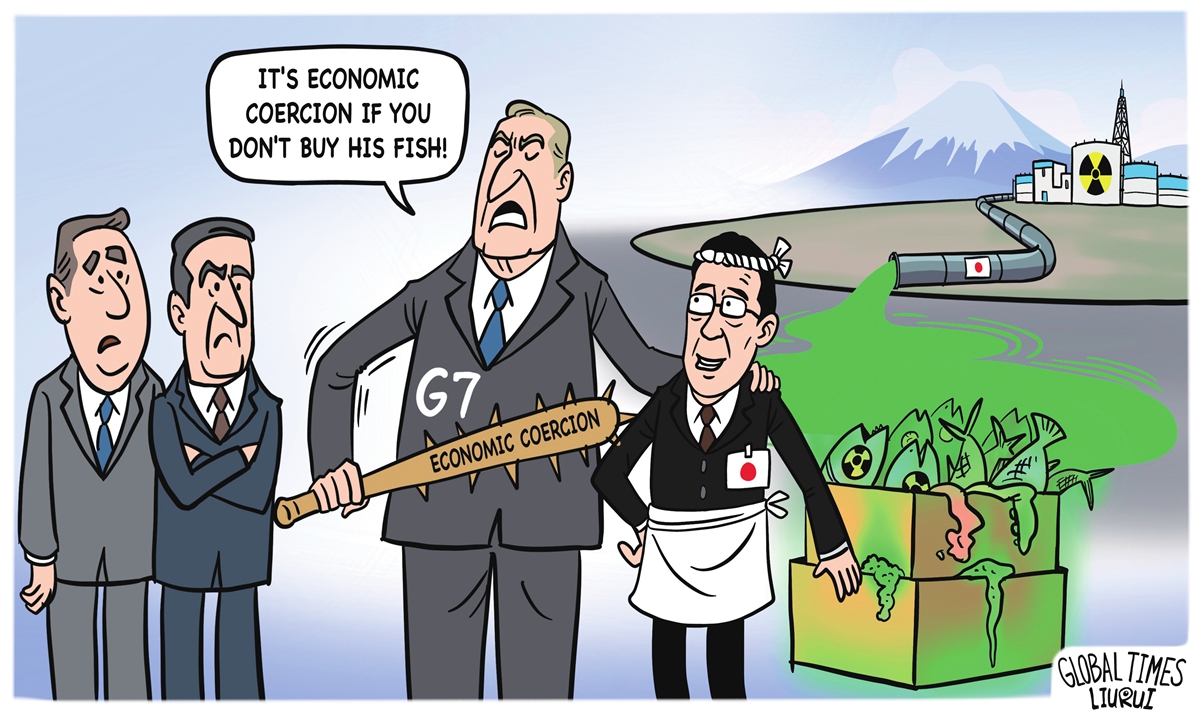
Illustration: Liu Rui/Global TimesThe Group of Seven (G7) countries may want to geo-politicize China’s ban on aquatic product imports from Japan and make the so-called anti-economic coercion a tool to exert pressure on China.
The Group of Seven (G7) countries may want to geo-politicize China’s ban on aquatic product imports from Japan and make the so-called anti-economic coercion a tool to exert pressure on China.
However, such behavior cannot achieve the expected results; on the contrary, it could deliver a further blow to the Japanese fishery industry.
China suspended imports of all aquatic products originating from Japan starting August 24, when Japan began dumping nuclear-contaminated wastewater from the crippled Fukushima Daiichi nuclear power plant into the sea.
In order to prevent nuclear-contaminated Japanese food from entering the Chinese market, the ban was an emergency measure to protect food security and the public health. As a responsible country, China takes a serious attitude toward protecting the safety of Chinese consumers, which has nothing to do with the so-called economic coercion.
The ban is an economic issue related to food security. However, by hyping the so-called economic coercion accusations, the G7 countries are seemingly trying to politicize and complicate the ban, using it as a tool to exert pressure on China. It should be made clear that it is not China, but the G7 and some Western countries, that want to politicize such a food security issue, and their behavior will undermine the international economic order.
If some Westerners believe that they can use the so-called economic coercion accusations to force China to make compromises, they are too naive. China has the right to protect food security and the health of its people from being threatened by Japan’s dumping of the nuclear-contaminated wastewater.
Any country, including China, has the obligation to safeguard the economic order based on international laws. Politicizing economic issues has become a common means used by Western countries to disrupt the global economic order and thus should be fiercely resisted.
As reported by the South China Morning Post, the G7 countries called on Sunday for the “immediate repeal” of import curbs on Japanese food products, a reference to China’s restrictions after Japan began dumping nuclear-contaminated wastewater into the sea. Japan’s fishing industry is hit hard with falling prices and growing uncertainty, as China is the largest single market for Japanese seafood exports at 87.1 billion yen ($600 million) last year.
However, what the G7 and Western countries care about is not the livelihoods of ordinary Japanese fishermen, but how to benefit from politicizing economic issues and suppressing China.
While these countries remain silent or even provide support for Japan’s dumping of the nuclear-contaminated wastewater, their fishing companies are attempting to occupy the market room lost by Japanese companies in the Chinese market after the import restrictions.
According to media reports, foreign companies are actively tapping into the massive Chinese seafood market, as Japanese seafood exports to China fell after August 24 amid continued fears of contamination. This is a normal result, and it should be noted that China welcomes any company to share the dividends of the Chinese market, as long as these companies comply with Chinese laws and respect the interests of Chinese consumers.
China is a major seafood consumer in the world. In addition, the country has emerged as a major processing and trade hub in global seafood supply chains, with much of the world’s fish catch imported and processed for re-export.
If Japan wants to share the market dividend of China, relying on political pressure from Tokyo or collaborating with other G7 countries will not achieve its goal. As a problem maker, Japan should reflect on itself and stop dumping the nuclear-contaminated wastewater into the sea.
In disregard of the strong doubts and opposition of the international community, the Japanese government blatantly shifts the risks of nuclear pollution to neighboring countries, including China, and the international community, and puts its interests above the long-term well-being of people in the region and around the world. The mistake is on the Japanese side. Japan should be responsible for the losses suffered by Japanese fishermen.
If Japan and some Western countries want to shift the blame to China and use the so-called economic coercion as an excuse to force China to make compromises, then this will only further complicate the situation, disrupt the international economic trade order, and cause greater losses to Japanese fishermen and the Japanese economy.
It is hoped that Japan can return to the right track of solving the problem, which is to stop dumping nuclear-contaminated wastewater into the sea. The longer Japan delays, the greater the losses will be suffered by Japanese fishermen.
COLOMBO (Reuters) — Sri Lanka’s cabinet approved a hike in Value Added Tax (VAT) up to 18% from the current 15% with effect from Jan. 1, 2024, said Transport Minister Bandula Gunawardana.
State tax revenue of the first nine months of 2023 rose 51% as compared to the same period last year but tax collection targets agreed with the International Monetary Fund have not yet been accomplished, the cabinet said in a statement.
The new tax proposals will go into effect from 2024, including the imposition of taxes on all goods and services to which VAT is not yet applicable.
“Public revenue increased to 1.7 trillion rupees ($5.19 billion) in the first nine months when compared to last year but this amount is barely sufficient to pay public sector salaries, meet welfare payments and other recurrent expenditure,” Gunawardana, who is the cabinet spokesman, told reporters.
“We know the public is struggling, so even though we are very reluctant to we have no choice but to increase taxes,” he said.
Additional taxes are likely to be introduced in the budget, which will be presented to parliament in mid-November, said Gunawardana.
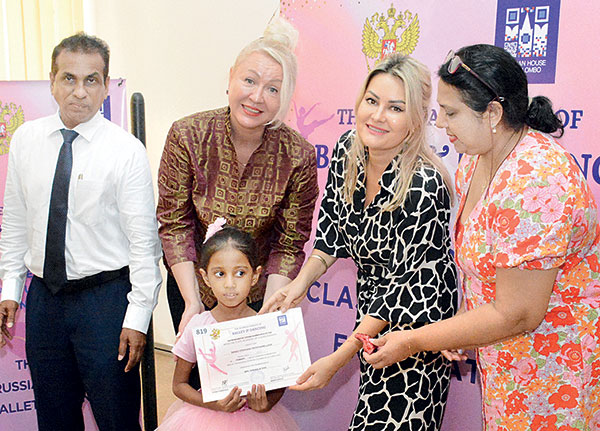
The Russian Classical Ballet Examination 2023 was held recently at the BMICH and certificates and medals were awarded to the students on the same day by Buddhapriya Ramanayake – CEO, Dr Oxana Karnovich- Examiner from Moscow, Maria Popova, First Secretary of the Russian Embassy in Colombo and Director Russian House in Colombo along with Chandi Aluvihare-Cultural Officer, awarding a certificate and chocolate to a little ballerina.
The Russian School of Ballet was founded two decades back under the patronage of Mikhail Ustinov – the then Director of the Russian House in Colombo in 2001,commencing its activities with just four little girls, all eager to learn and master the art of ballet.
Currently, the School has over a few hundred students learning classical ballet under the guidance of a promised group of teachers. Pic by Nishendra Silva
The economy was in such a precarious situation that the Wickremesinghe-Rajapaksa government couldn’t further delay the restoration of the relevant provisions of the 1953 Foreign Exchange Act to compel the private sector to bring back export proceeds, rebel SLPP MP Prof. G.L. Peiris said yesterday (30).
Referring to a spate of declarations made by Justice Minister Dr. Wijeyadasa Rajapakshe, both in and outside Parliament, Prof. Peiris emphasised the urgent need to amend the 2017 Foreign Exchange Act enacted by the Yahapalana administration to discard the tried and tested law that existed since 1953. Altogether 94 MPs voted for the new Bill whereas 18 voted against. The rest skipped the vote.
The former minister dealt with the issue at the weekly media briefing held at the SLPP rebels’ office at Nawala.
Prof. Peiris explained how tangible measures, if taken to amend the Yahapalana Foreign Exchange Act, could help the government to ease pressure on the Treasury. People do not have to be further burdened in a bid to bridge the Budget deficit. The government shouldn’t hesitate to pressure exporters to bring back export proceeds by amending the 2017 Bill,” Prof. Peiris said, warning the government of dire consequences if it failed to act immediately.
The academic alleged that the country was paying a very heavy price for the deliberate failure on the part of the government to collect taxes and tax concessions granted to those near and dear to the powers that be.
Prof. Peiris asked whether the Treasury and the Inland Revenue Department deliberately allowed influential private sector persons to skip paying taxes. Referring to statements issued by MP Patali Champika Ranawaka and Minister Wijeyadasa Rajapakshe, Prof. Peiris said that the IRD and the Excise Department pathetically failed to meet revenue targets.
The former minister said that the overall failure of revenue collection apparatus consisting of IRD, Excise and Customs to meet revenue targets over the years had contributed to the developing economic crisis and the powers that be were yet to take remedial measures.
Prof. Peiris said that massive fraud perpetrated by liquor manufacturers with the connivance of the interested parties is a case in point. The former minster discussed how the Treasury suffered heavy losses and how two liquor manufactures were allowed to continue without paying what they owed the Excise Department.
Senior Consultant Physician Dr. Ananda Wijewickrama has been appointed as the Chairman of the National Medicines Regulatory Authority (NMRA), the Health Ministry announced.
The appointment has been made by newly appointed Health Minister Dr. Ramesh Pathirana.
Dr. Wijewickrama replaces Prof. S.D. Jayaratne, whose leadership was challenged as the NMRA faced a spate of allegations with regard to the influx of inferior-quality medicines in the recent past.
https://youtu.be/erUT2w89OwE
Dr. Ananda Wijewickrama once served as a member of the NMRA Board of Directors.
Dr. Wijewickrama is a Senior Consultant Physician at the Infectious Diseases Hospital (IDH), who became the first health official to receive the COVID vaccine. (Sheain Fernandopulle)
The owner of the company, which stands accused of importing 22,500 substandard immunoglobulin vials, and two top government employees who approved the importation have been imposed a foreign travel ban by the Maligakanda Magistrate’s Court yesterday.
Accordingly, the three persons, who were imposed with foreign travel bans in the case pertaining to the alleged importation of substandard immunoglobulin are Dr. Vijith Gunasekera (Director General / CEO, National Medicines Regulatory Authority), Dr. Kapila Wickramanayake (Director Supply, Ministry of Health, and Aruna Deepthi (Proprietor of the relevant company).
Accepting a request made by the Criminal Investigations Department stating that those involved in this crime are ready to leave the country, the magistrate has imposed a travel ban and ordered the immigration controller to be informed that the relevant persons have been banned from leaving the country.
The magistrate further ordered the CID to immediately arrest other suspects involved in the crime and bring them to court. (Manopriya Gunasekera)
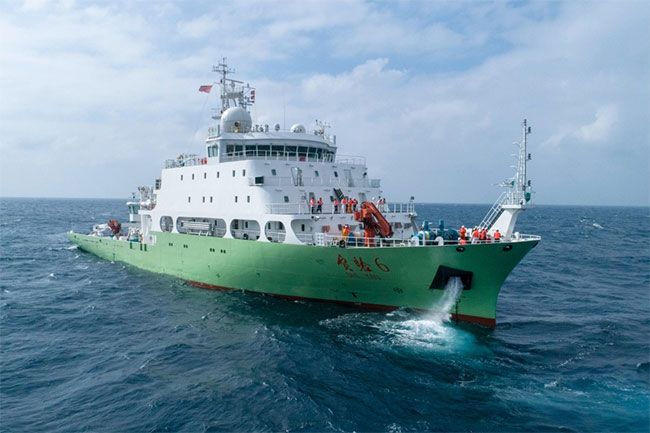
Scientists from China and Sri Lanka are conducting a joint marine scientific activities on board a Chinese research vessel, a senior official said Tuesday, amid concerns voiced by India and the US.
The Chinese ship, ‘Shi Yan 6’ arrived at the Colombo port last week. According to sources, Sri Lanka was delaying granting permission for the arrival of the vessel due to concerns raised by India. However, there is no official confirmation of the same.
Clearance was granted to carry out marine scientific research on 30 and 31 October,” a spokesman for the Colombo Foreign Ministry said.
The vessel is currently located off the western waters, he said.
Scientists from the National Aquatic Research Agency (NARA), personnel from the Navy and the University of Ruhuna were given clearance to go on board, he added.
Director General of NARA Dr Kamal Tennakoon said the vessel is engaged in research activities in the seas off Bentara in Colombo.
The Chinese geophysical scientific research vessel commenced research operations in the Sea of Sri Lanka on Monday.
Described as a Research/Survey Vessel with a carrying capacity of 1,115 DWT, the vessel is reported to be 5.3 metres in length overall 90.6 metres and width 17 metres.
It is said to be China’s first scientific research vessel focusing on geophysical exploration.
NARA said samples of different seawater levels will also be tested.
Four NARA officials joined the research activities while two Navy officers also joined the research team.
The ship was expected to bring back the Sri Lankan personnel on board to Colombo off the western waters tomorrow at the conclusion of the activities, the spokesman said.
The vessel had applied to do a joint survey of Sri Lanka’s marine borders, officials said. However, the research would now be limited to western waters.
In August, permission was sought by the Chinese research vessel to conduct marine research activities in October.
The arrival of Shi Yan 6 followed President Ranil Wickremesinghe’s visit to China last week.
Last month, the US expressed concern to Sri Lanka about the scheduled visit of the Chinese research ship to the island nation.
US Under Secretary Victoria Nuland, who met Sri Lankan Foreign Minister Ali Sabry in New York on the sidelines of the UN General Assembly session, had reportedly raised concerns about the visit of SHI YAN 6′.
China dispatches its research/surveillance vessels to Sri Lanka on a regular basis. India has been raising concerns over the visits of Chinese vessels to Lanka.
The Government of India raised concern over the visit of the Chinese People’s Liberation Army Navy warship HAI YANG 24 in mid-August.
On a similar visit by a Chinese satellite tracking ship in early 2022, the Indians protested strongly.
However, after a considerable delay, Sri Lanka allowed the ship to dock at the southern port of Hambantota, a port in Sri Lanka’s south under a 99-year lease to the Chinese company that built it after Colombo was unable to service a $1.4 billion loan taken for the project.
In August last year, a similar visit by the Chinese ballistic missile and satellite tracking ship, Yuan Wang 5′, which arrived in the southern Sri Lankan port of Hambantota elicited strong reactions from India.
Cash-strapped Sri Lanka considers both India and China equally important partners in its task to restructure its external debt. China is one of the top lenders to Sri Lanka. Sri Lanka owes USD 7.1 billion to bilateral creditors, including USD 3 billion to China.
The island nation was hit by an unprecedented financial crisis in 2022, the worst since its independence from Britain in 1948, due to a severe paucity of foreign exchange reserves.
The Cabinet of Ministers has discussed the escalation of salaries in the government service and the private sector by the 2024 Budget.
During the discussion, President Ranil Wickremesinghe has made aware to the Cabinet of Ministers that it is expected to furnish proposals to the Parliament in his capacity as the Minister of Finance, Economic Stabilization and National Policies in regard to revision of government service salaries and private sector salaries by the upcoming budget.
At the second high-level roundtable discussion on ‘Crisis to Recovery’ today (Oct. 31), both developmental partners and the private sector have expressed overwhelming commitment and confidence in the Sri Lankan government’s current reform efforts.
Today’s roundtable has provided an open and candid forum between the government of Sri Lanka, the developmental partners and the private sector to share key updates and recommendations to sustain the momentum of the nation’s reform efforts, the President’s Media Division (PMD) said.
Marking a significant momentum of the economic recovery and stabilization, the second high-level roundtable discussion on ‘Crisis to Recovery’ was held this morning in Colombo. This event follows the previous session in December 2022 and provides a forum to discuss the progress of the government’s reform programs aimed at addressing key economic and structural issues.
The event also focuses on transitioning from crisis recovery to a sustainable growth path, challenges and opportunities for attracting investment, promoting private capital mobilization, creating jobs, and maintaining commitments by the government and participating partners towards Sri Lanka’s greener, resilient, and inclusive development, the PMD added.
The session was opened by President Ranil Wickremesinghe, representing the Sri Lankan government. He has delivered an address on the growth and strategic directions for Sri Lanka as it moves from recovery to a sustainable growth path.
The President has also made firm commitments for the government to work hand in hand with the private sector to unlock key investments in new and existing economic sectors moving forward, together with exploring opportunities in pursuing Green initiatives and championing Sri Lanka as a regional logistics hub in the near future.
The Sri Lankan government has also provided a clear framework for improving coordination and communications, along with detailed action plans for the implementation and delivery of the reform agenda.
To strengthen delivery, the PMD said the government has plans to set up a Presidential Delivery Unit, conduct Economic Labs with the private sector, and hold Open days to communicate outcomes to the public of what has been achieved and delivered.
Governor of the Central Bank of Sri Lanka (CBSL) Dr. P Nandalal Weerasinghe has highlighted the progress on debt restructuring made by the Sri Lankan government.
Alongside these presentations and remarks, international development partners including International Monetary Fund (IMF), World Bank, Multilateral Investment Guarantee Agency (MIGA), Asian Development Bank (ADB), Asian Infrastructure Investment Bank (AIIB), Japan International Cooperation Agency (JIСА), United States Agency for International Development (USAID), European Union (EU), United Nations (UN) and private sector development partners made an interactive length long discussion and shared their views on the matter.
The session was also attended by Prime Minister Dinesh Gunawardena, Minister of Foreign Affairs Ali Sabry, Minister of Power and Energy Kanchana Wijesekera and State Minister of Finance Ranjith Siyambalapitiya and Senior Advisor on National Security to the President and Chief of Staff Sagala Ratnayaka, Dr. R.H.S. Samaratunga and Foreign Ministry Secretary Aruni Wijewardane, all representing the Sri Lankan government.
Additionally, the following international representatives took part in the discussion: Ms. Anna Bjerde, World Bank Managing Director of Operations; Martin Raiser, World Bank Vice President for South Asia Region; Mr. Junaid Kamal Ahmed, Vice President for Operations, Multilateral Investment Guarantee Agency (MIGA); Ms. Sarwat Jahan, Resident Representative of the International Monetary Fund (IMF); Mr. Shixin Chen, Vice President (South, Central, and West Asia) of the Asian Development Bank; Dr. Urjit Patel, Vice President, Investment Operations of the Asian Infrastructure Investment Bank (AIIB); H.E. Ambassador Carmen Moreno, Ambassador of the EU Delegation; Ms. Sachiko Imoto, Senior Vice President, JICA; Ms. Anjali Kaur, Deputy Assistant Administrator USAID; and Mr. Marc-André Franche, Resident Coordinator, UN.
From the private sector, Mr. Krishan Balendra, CEO of John Keells Holdings; Mr. Mahesh Amlean, Chairman of MAS Holdings; Mr. Ajit Gunewardene, Chairman of the Oversight Committee for Trade and Investment, Duminda Hulangamuwa, President of the Chamber of Commerce and Ms. Sherin Cader, Chairperson of Nations Trust Bank joined as private sector representatives from Sri Lanka.
During the previous session in December 2022, representatives from the World Bank, ADB, IMF and AIIB had emphasized that a coordinated assistance program, supported by the multilateral financial institutions, is required for Sri Lanka to recover from the economic crisis currently facing the country.
The Sri Lankan economy has shown initial signs of stabilization, with moderating inflation, easing foreign exchange liquidity pressures, and some progress on debt restructuring, including the approval of the domestic debt restructuring strategy.
Under the Sri Lankan government’s reform program, underpinned by the IMF Extended Fund Facility (EFF) and supported by other development partners, cornerstone legislation is being developed, and structural reforms are being implemented to restore stability and regain access to international financial markets. However, the path to recovery remains narrow, with limited fiscal and external buffers, the PMD said further.
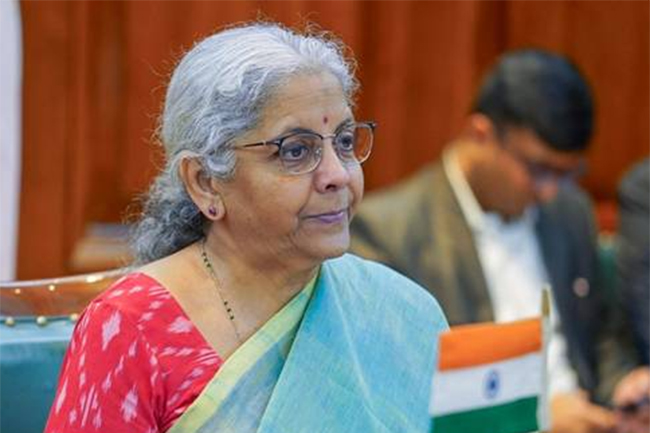
India’s Finance Minister Nirmala Sitharaman will embark on a three-day official visit to Sri Lanka tomorrow (Nov. 01), the Indian government said in a statement.
During the visit, Minister Sitharaman will deliver the Keynote Address as the Guest of Honour at the ‘NAAM 200’ organised by the Sri Lankan government to commemorate the 200th anniversary of the arrival of India-origin Tamils (IOTs) to Sri Lanka, on November 02 at Sugathadasa Indoor Stadium in Colombo.
The Indian finance minister will also give the keynote address at the India Sri Lanka Business Summit themed ‘Enhancing Connectivity: Partnering for Prosperity’. It is jointly organized by the Confederation of Indian Industries (CII), the Indo-Lanka Chamber of Commerce & Industry, and the Ceylon Chamber of Commerce, on November 02, at Hotel Taj Samudra in Colombo.
As part of the official visit, Minister Sitharaman will engage in bilateral discussions with President Ranil Wickremesinghe and Prime Minister Dinesh Gunawardena.
She will witness the exchange of the Memorandum of Understanding (MoU) for Solar Electrification of Religious Places in Sri Lanka wherein India will allocate INR 82.40 crores out of the Indian government grant assistance of INR 107.47 crores earmarked for the promotion of Buddhist ties.
Minister Sitharaman will also inaugurate SBI Branches at Trincomalee and Jaffna on November 02 and 03, respectively.
She will visit Sri Dalada Maligawa (The Temple of the Sacred Tooth Relic) in Kandy, Jaya Sri Maha Bodhi in Anuradhapura, Thirukoneswaram Temple in Trincomalee and Nallur Kandaswamy Temple in Jaffna during the course of her visit to Sri Lanka.
Besides the above engagements, Minister Sitharaman is also slated to visit Lanka IOC Oil Tank Farms, Jaffna Cultural Centre and Jaffna Public Library during her visit.
Sri Lanka is set to award a multi-billion dollar oil refinery project to a Chinese state-owned company after a rival bidder pulled out, the energy minister said Tuesday.
Kanchana Wijesekera said the government would shortly enter into an investment agreement with Sinopec to build the refinery next to the Chinese-run port at the southern town of Hambantota.
There were only two bidders shortlisted and Vitol pulled out. That leaves only Sinopec and we will finalise an agreement with them in a couple of weeks,” Wijesekera told reporters in Colombo.
Sri Lanka had originally awarded the project, which has an estimated cost of $3.85 billion, to an Indian family-owned company based in Singapore in 2019.
After Silver Park International failed to start construction, the government terminated the agreement in August, repossessing 1,200 acres (485 hectares) of land allocated for the refinery.
The nearby Hambantota deep sea port was controversially leased to a Chinese state-owned firm in 2017 for 99 years after Sri Lanka was unable to service a $1.4 billion loan taken for the project.
Sri Lanka defaulted on its $46 billion external debt last year in an unprecedented economic crisis partly blamed on Chinese loans used to build several white-elephant infrastructure projects between 2005 and 2015.
China owns 52 percent of Sri Lanka’s bilateral debt, and Beijing’s approval is crucial for any efforts by Colombo to restructure its outstanding loans.
Dr. Gunadasa Amarasekera’s allegorical little story Mahagedera” has within it the story of our present pathetic state, struggling in the grip of neo-liberalism, lacking in genuine patriotic leadership, intellectual guidance, civilisational consciousness, a national economy, unable to extricate from the imperialist web, plagued by self seeking pseudo intellectuals, we have been reduced to a vassal state and forced to sell our national assets for existence. Amarasekera has the nack of seeking the story within the story and making use of it to craft his tale in lyrical language that holds the reader’s interest. Amarasekera in his late nineties deserves plaudits for his creativity, ability to see through issues and most importantly his philosophical vission which this country need in its hour of great peril.
The protagonist of the story, Dasa, while doing postgraduate studies in the USA, hears that his ancestral home Mahagedera” has been sold to a foreigner. This news brings back memories of his village home, his own creative contributions to the construction of the house and its value and historical significance for it was built by his ancesters who had fled the Wellassa from the marauding British army. Dasa could remember that his father had been deeply conscious of his heritage and the nationalism that Anagarika Dharmapala propagated, he had a portrait of Dharmapala hung over the entrance to the sitting room of the Mahagedera”. These memories of his home and its loss to a foreigner makes Dasa delve deep into his own understanding of his country’s civilisation, the concept of Sinhala Buddhism, and its capacity to build a national civilisation.
Dasa’s professor in Sri Lanka had convinced him that Buddhism could not build a civilisation in Sri Lanka because Theravada is an idealist religion, a religion that caters to those who have given up natural lay life. Such a religion cannot build a civilisation. The so called Sinhala Buddhism has made the Sri Lankan nation a slave of its past. This professor had visited Mahagedera” and after seeing some of Dasa’s creations, which had been inspired by the rich heritage of ancient Anuradhapura, he had said it proves his theory that Sri Lankans dwell in the past. And this professor had placed Dasa under a supervisor in the US who has similar views on Buddhism and Sri Lankan civilisation. Dasa blindly had accepted his professor’s views and had gone along with those of his supervisor in the US also and was in the process of constructing the necessary philosophical basis for their treacherous theory.
A strong factor that makes Dasa think deeply about these matters is his memory of his elder brother, a product of the university, who obviously had not imbibed the ethos of his civilisation, whose ambition is to climb up in the social ladder, and for that purpose had married from a rich upcountry family. Dasa realises that their family had lost the possession of their Mahagedera” due to the folly of his brother who had used the premises for his political activity without a care for its historical and sentimental value. His wife, who did not care much for him, had sold the house soon after his death.. His professor is colluding with his US supervisor who has an agenda that supports American imperialism. And his brother a victim of his own misguided ambitions has inadvertantly paved the way for foreign encroachment. Isn’t it such people, who would sell their soul for personal benefit and glory, the bane of this country, the cause of all its ills, seems to be the question Amarasekera poses through his latest work.
Dasa’s cousin brother Senaka is another important character that Amarasekera has created. Senaka, though educated, has remained in the village and has not lost his roots, he in his letters to Dasa appears to be more affected by the loss of Mahagedera” than the death of the elder brother. His selfless attitude is revealed in the care he shows towards Dasa’s mother, and his loyalty to his civilisation and history is shown by the effort he makes to find out about the history of Mahagedera” and his attempt to make Dasa buy back Mahagedera”.
Dasa after a long contemplation had realised his mistake in endorsing the views of his professor and his US supervisor. He writes a thesis, to counter his professor’s views, which attempts to prove that Buddhism is applicable to lay life and is not a religion that is detached from the life of ordinary people. His professor reads his paper and says that Dasa has not accepted Max Weber’s views on this matter. Dasa says those views are acceptable but the Buddhism that was brought to Sri Lanka under the auspices of King Dharmasoka could be moulded by the Sinhalese so that it becomes the guiding light of their life and such a religion could form the basis for a civilisation. His supervisor says it may not be possible for Dasa to continue to work with him and Dasa says he has already decided to leave as soon as possible.
In the background the separatist war rages, and the treacherous role of the local opportunist politicians is revealed which influences Dasa’s thinking. He realises the US role and its motives for helping to perpetuate the war and how his supervisor and also his professor back at home are aiding and abetting in the despicable act. At a meeting held to propogate the Tamil separatist agenda and their war effort, which was addressed by his supervisor and several Tamil Diaspora people, Dasa’s wife Nalini, unable to bear the fabrication and false propaganda that was being dished out, gets up and retaliates with thunder in her voice. Dasa had to drag her out fearing physical harm to them. Next morning they see the notice pasted on their door which read Racist Go Home”. The character of Nalini, who is from a poor family but had entered the university, has been constructed with the characteristic skill of Amarasekera.
Dasa and Nalini come back to Sri Lanka and visit their Mahagedera” to find out whether they could buy it back as suggested by Senaka who had met the German owner who had been looking after the house carefully preserving all its features of historical importance and who apparently had promised to give back the house when he decides to leave Sri Lanka. They see that the German who had been running a centre for disabled, had given the house to a religious organisation. The new owners have completely changed the character of the house and defaced the sculpture that Dasa had got Buddha Rupa Bass” to make on a rock and a bench. The house is being used by a Christian cult for their proselatyzation work. They wait for the Pastor to return, to talk to him about their idea of buying the house. Dasa seated on the bench falls asleep and in a dream sees people carrying swords and poles running out of the house towards him. He tells others about the dream and concludes that the people who ran out of the house were the heirs of Mahagedera”. The Pastor doesn’t return and they come back realising that what has happened to their Mahagedera” has happened to their country.
Imperialist powers know from their past experience that it is the civilisational consciousness of a nation that holds it together and it is the power behind the struggle the people wage against imperialism. The Sri Lankan nation is held together by the Sinhala Buddhist consciousness and the civilisation it built on its foundation. It is this force that stood and fought against the marauding armies of South India and Europe from early times to the present, the same force that fought against Tamil separatism. This is the reason why the imperialists want to destroy Sinhala Buddhist consciousness. They support the LTTE separatists in their war which serves their agenda and in the academic sphere they get the self seeking pseudo-intellectuals to undermine the philosophical basis of Sinhala Buddhism. The two pronged attack is aimed at destabilising Sri Lanka in order to keep it in its hegemonic grip. Amarasekera has portrayed the ancestral home Mahagedera” with its significant history and culture as the symbol of Sinhala Buddhist civilisation. Losing Mahagedera” is symbolic of the fate that had befallen our country
The transformation of Dasa supplies the vitality of the story that Amarasekera weaves around the memories of the ancestral home Mahagedera”. Such transformations have been a feature of Amarasekera’s earlier works too which form the basis for captivating tales. The social relevance is always at the centre of this novel too and it is a good response to those writers who subscribe to the view that art is for art’s sake and literature need not have social relevance as its purpose.
In my endless travels in countries in three continents, the only country where wind turbines have been continuously sited in the coastal areas happens to be Sri Lanka. In Lanzorette in the Canaries, firstly the authorities built two turbines on the coast, but later they realized their mistake and built up dozens of turbines inland, on their hills. In Spain and in the USA where I frequently undertake road travel, I have seen them using the mountain power of the wind to turn their turbines. There are hundreds , even thousands of wind turbines located on mountains.
Sri Lanka are the losers. While countries like Spain have harnessed the mountain wind power and even sell power to France, Sri Lanka lags behind. Last year, being inquisitive, I purpously went to Kalpitiya to spend a night to assess the wind power there. It was nothing other than a coastal breeze. I have in the Administrative Service worked for long periods in Hambantota and Matara and know the power of the coastal breeze. It is nothing compared with what I have experienced at Ramboda, ,at Madugoda, at Kadugannawa in my almost weekly visits when I worked in Nuwara Eliya, Kegalla and Kandy. That was on the road side. In my irrigation inspections climbing hill and dale, I know that the wind has an enormous power at certain vantage points. We have had to crawl on all fours to avoid being blown off. When I stayed a night at the Ohio Forest Circuit bungalow I was worried that my car would be blown over. Yet we keep building turbines on the coast, and this time it is at Mannar! I gather that some foreign experts are sought to find our wind power. These days not only foreign experts, but even the infamous IMF acted clandestinely to make our countries indebted. The IMF told us to import freely, use foreign exchange freely when we did not have and fed us with loans to match, so that we became indebted. They even gave us loans at very low interest and also with long no payment grace periods to entice us and our then leaders jumped at getting loans as they would not be in office when repayment would haunt us. My latest book, How the IMF Sabotaged Third World Development” on Kindle tells that sad story.
May our leaders find the time to read John Perkin’s book Confessions of an Economic Hitman, where he admits that his role as a foreign expert was to research, fabricate facts and figures to provide foreign aid to Ecuador for a plan that in some manner will send the aid funds back to the donor countries while at the same time leaving the host country indebted. AId now came to our countries to make us indebted so that we could forever be in debt, paying our loans. Someone is trying to prove that wind power is not worthwhile and that we cannot get power. Of course we cannot get power unless we harness the wind at the spots where the wind power is . And to find where the wind is most we now get foreign experts. Why can we not rely on our own government officers who sometimes get blown off on their circuits.
In wind turbines, we are made to grope in the dark. We turned wind power at some figure like twenty five rupees a kw/hr, when the USA gets wind power at between five cents and two and a half cents a kw/ hour.. When recently some wind power makers offered us power at fifteen rupees our mandarins were surprised.
Recently Power Expert, my friend Tilak Siyambalapitiya has said that we are heading for power cuts in 2017.
All what I have said on my wind power writings yet stand true These articles are in Lanka Web , the Daily News and Asian Tribune for anyone interested to read We need only a few hundred wind turbines sited at Ramboda, Madugoda, Ritigala, Batalgala in Kegalla District, at Kirigalpotta in Ratnapura and Hayes in Matara. We should set up a Land Development Department” once again and appoint an officer of the calibre of J.V.Fonseka, a classic hons. Civil servant and the task can be easily done in a year. That was the manner that our leaders, D.S. and Dudley worked then. At a Government Agents Conference a G.A. had requested for a jeep per District to speed up the Food Production Campaign. Dudley ordered three jeeps per district. Later I was a chief lieutenant under JVF at Agrarian Services and we constructed large stores in without the recent long delays seen in construction in the public sector at inflated prices. One engineer and Land Development Officer M.P.Jayasinghe recruited as Assistant Commissioner of Agrarian Services did that trick. We in the Districts went around with a hammer to hit at concrete to see whether the concrete mixture was right. One contractor had to redo all the foundations. It was a blow that made his business tremble but it did . This happened in Anuradhapura.
A few hundred wind turbines is the answer and I am sure there will be able officers in the Administrative and Engineering Services who can do that task. It will be a Program that offers employment to thousands. We can say goodbye to power cuts and see our workers at work on hillocks installing wind turbines. We will also save millions of dollars that we spend today for importing oil.
‘Before you study the economics, study the economists!’
e-Con e-News 22-28 October 2023
*
The English ‘Governor’ Brownrigg & his translator, the ‘writer’ D’Oyly, usually star as ghosts at the Brutish Council’s misnamed Galle Literary Festivals. It should be called TheD’Oyly Literary Festival, for it is with his sort – forget Robert Knox – that the real English fiction begins in the land of Sinhale. The D’Oylys!
If 2022 was the new 1815, when’s the new 1818?
*
‘His blood was attainted and could not be permitted to infect the race any further’– PE Pieris, Tri Sinhala: the Last Phase, 1796-1815
*
‘One single instance of no distant date will be acknowledged
to include everything which is barbarous & unprincipled in public rule,
and to portray the last stage of individual depravity & wickedness,
the obliteration of every trace of conscience, & the complete extinction of human feeling.
In the deplorable fate of the wife & children of Eheylapola Adikar these assertions
are fully substantiated; in which was exhibited the savage scene of 4 infant children,
the youngest torn from the mother’s breast, cruelly butchered, & their heads bruised in a mortar
by the hands of their parent; succeeded by the execution of the woman herself
& 3 females more, whose limbs being bound, and a heavy stone tied round
the neck of each, they were thrown into a lake and drowned.’
– Sir Robert Brownrigg’s (the Governor) official declaration
‘after the taking of the Kandyan country’
*
This last quote is from the Wikipedia entry on Madduma Bandara, one of those ‘4 infants.’ Many Sinhala researchers believe these atrocities never took place. Just as many now dismiss the media terrors hourly ascribed to the Palestinian people, while pointing speechless at the real ‘civilized’ perpetrators of horror, who are also behind the cameras, pressing buttons all the time.
So who says this 1815 ‘pounding’ episode happened, the year that Treaty of Vienna that supposedly brought peace to Europe for a 100 years (until their World War I), while bringing down further hell on the rest of us? Well, we can understand genocidaires (now there’s a sexy French bon mot!) such as governors F North, T Maitland & R Brownrigg.
English is the greatest language of the greatest mass-murder, plus plus enabling wholesale erasure of their deeds, with their BBC, their chief public mouth organ & foghorn & broom. We have to admire the English for their persistence in wholesale bloodsports, whether it’s of a matter 208 years ago in Sinhale, or hot off the press, as they say, from Palestine. Then again, 2022 was the latest 1815!
Look at Wikipedia’s entry on Brownrigg, who was made colonial governor in 1813:
*
‘General Sir Robert Brownrigg, 1st Baronet, GCB (1758-1833)
was an Irish-born British statesman & soldier.
He brought the last part of Sri Lanka under British rule
*
ee according to our very own English style guide, normally & mechanically always replaces ‘British’ with ‘English’ – for it is English they all lecture us & it is English that still misrules – not Latin or Gaelic or Celtic or Welsh – and it is English alone that can make sense or nonsense of such a word as ‘brought’.
‘Brought’ is of course a euphemism for the real terrorism demanded by Brownrigg in 1818. He not only brought. He took. The better-known of his thefts being the Golden Tara statue from Trincomalee, now parked at that ‘secular’ English museum in London, which religiously loots what the Bank of England forgets. And what he left is still the most underdeveloped regions of the country to this day – Uva, etc.
The bios of Brownrigg and Madduma Bandara above come from Wikipedia, which ee prefers to call Whiteypedofilia, cos they baldly push such innocent lies, making them so commonplace, multiplying their bunker blasts of honky honk. Then again, they do need to whiten that bloody wash that robs the world.
But what intrigues is that it’s not just the English who told & tell such tales. The English had waged several wars, overt & covert on Sinhale and had been defeated. Their last resort was to strike a deal, like the US salesman D Trump says. A deal they immediately reneged on, of course. The English claim that locals, as if in a daze, kept asking, ‘When are you leaving?’
Three years later, during the English war on Sinhale in 1818, and our first war for independence (from the English), the resistance killed 1,000 ‘Indian’ soldiers who were one-fifth of the entire English force deployed. Yet those tall tales are not repeated by ‘Indians’, necessarily. Again, we don’t know what kinda Indians those English troops were, for the King was also kinda Indian, though he ruled as a Sinhala Buddhist. The English also decimated the Veddha people, who protected the frontiers (the English now tag them indigenous!).
But yes, what intrigues is that such stories are still repeated and rewarded 200 years later by Sri Lankans themselves (who ee monikers as ‘Brownrigg’s Bastards’ even if they speak English or not). There are ‘radical’ ‘rock&roll’ ‘rebels’ who write songs repeating these assertions about the ‘pounding’, as do the politicians they may collectively hate:
*
‘Former President R Premadasa erected a statue of Madduma Bandara
on 1986 March 29 at Ehelepola village, in honour of the child hero.’
– Nimal S Bogahawatta, Madduma Bandara Ehelepola
*
The elder brother who was 11 years old was afraid;
his lips were quivering and his eyes were full of tears.
But, little Madduma Bandara was a brave boy.
He loved his family and his motherland.
He was not afraid to die. – Junior Observer, 2011
*
‘Overwhelmed by his uncontrollable temptation,
he attempted to embrace [Ehelapola Kumarihamy].
She then had the audacity to blurt out calling the King
‘Wadugaya’ (Telangu Tamil), ‘get out.’
She also shouted, ‘Do you think that I am a Waduga woman,
I am a pure-hearted Sinhalese woman.’
– Stanley E Abeynayake, ‘Ehelapola Kumarihamy,
A symbol of chastity’, Sunday Observer, 2012
We will get to the different forces behind such yarns originally spun to justify the coup d’etat of 1815 and the consequent genocide in the highlands & Vellassa of 1818. The consequences of 1815 as of the coup d’etat of 2022 are yet to be revealed. Rest assured, elections have been shown the backseat and if 2022 ironically offers the way beyond elections, it will have to finds its way beyond the massive popular mandate given to a Sinhala Buddhist President, all duly thwarted by the old ghosts of 1818, who keep returning. & with a greater vengeance, each time.
*
Slaughter every man, woman, and child (including babies suckling at the breast)
– Robert Brownrigg
In 2011 President Mahinda Rajapaksa had Parliament revoke Robert Brownrigg’s Gazette Notification that condemned the rebels of 1817-18 as ‘traitors’ and confiscated their properties. The then-President declared Brownrigg’s Gazette Notification null & void, and renamed all those ‘traitors’ to the English as ‘National Heroes’, with their descendants honored on Republic Day of Sri Lanka, 22 May. What he didn’t do was posthumously label Brownrigg as a terrorist. Ten years later, the Rajapakses themselves would face another very English coup d’etat, which they apparently could do nothing to prevent, except strategically withdraw to prevent further bloodshed. 2022 was the latest 1815 (see ee Random Notes).
*
In Sri Lanka’s north & east, Uva & north central regions,
the UN & other agencies have funded local partners
to establish children’s educational & recreation centres.
These facilities are sparsely occupied and hardly maintained.
Yet, pictures from launch events often adorn presentations
to various stakeholders claiming continuous enrichment of less-privileged lives.
The European Union among others offers funding to dozens of agencies to empower
and uplift rights & livelihoods of women. Most of these funds are spent
on lavish lifestyles & entertainment of partner agencies, while the real impact
& assistance touching the lives & hands of women is barely marginal.
– Oshadee de Silva (see ee Focus)
*
Where has all ‘the aid’ gone? – Nawaz Dawood’s 1980 book Tea & Poverty recalls that England had generously ‘given’ £80million in ‘aid’ throughout the 1960s to Sri Lanka. Whereas they, even more generously (to themselves), extracted £800mn out of Sri Lanka in the same years. Meanwhile, we had to buy their overpriced industrial goods & services to obtain their ‘aid’. How much of all that munificence is now part of our unpayable debt? Let’s set up a Corruption Bank for the IMF, and add this ‘aid’ to the deposits.
‘Where have millions of US$s invested in good governance & accountability projects all gone? asks The Island’s Shamindra Ferdinando (see ee Focus), adding, ‘$73mn down the drain?’ Fernando details the dollars poured into bribing ‘independent’ ‘civil society’ by USAID etc. Can you imagine if roubles & yuan were uncovered in English & US politicians’ ample offshore accounts? Fernando asks the US embassy about whether their dollars have improved parliamentary practices, and the US responds…
However, despite all this megaphone about government corruption, the real corruption – which isn’t corruption but good old capitalism – is the business-as-usual practices of the multinational corporations (MNCs) that rule us and are never named! The role that MNCs like Unilever play, controlling the media through advertising & their agencies, and worse, such as controlling labour through ‘subsidiaries’ and monopolizing the home market.
ee is reproducing Oshadee de Silva’s keen observations on: Global NGOs & local partners running amok under the guise of doing ‘good’? The headline sounds true enough, though ‘amok’ is very kind, and an insult to elephants, for the actual havoc these so-called NGOS have created is immeasurable. But about what kind of interference exactly is this Silva upset about?
The smooth way the article is written, we cannot tell whether it was written by a person or a bot, but the manner in which it is written, purportedly against foreign interference, wanders or makes a beeline to the new IMF-inspired Labour Act. Silva says: ‘Many local NGOs have taken up arms against the draft Labour Act, which ironically consists of terms insisted upon by western governments & partners. What then is their real cause?’
Indeed, we have often wondered why there are no ‘NGOs’ criticizing the terms under which workers are employed in textile- & garment-related industries still based in the imperialist countries.
We also wonder about the UN & various dubious US thinktanks who are so worried about women’s unpaid work while at the same time enabling ‘grandparents’ to immigrate, to look after children abroad who are all forced to go to work, or freeze their unhoused butts in winter.
*
• ee continues to serialize Idirimagen Idiriyata, the Communist Party of Sri Lanka ‘s ‘Alternative Program’. The CPSL claims, ‘Sri Lanka has now been overtaken by a large number of middle-income countries that have successfully restructured and developed their education systems’. The CPSL therefore makes an urgent call for reform in all educational sectors by looking at current national policies for general education, higher education, skills development, vocational training and technology, and examining how a policy for the development of national resources could provide all citizens with suitable knowledge, skills and technology: ‘The only hope for the future generation…’ (see ee Focus)
*
• Enduring the English media & associated glitterati in Sri Lanka is to recall the Barbadian memoir Growing up Stupid under the Union Jack by Austin Clarke, and Grenadian Bernard Coard’s How the West Indian Child Is Made Educationally Sub-normal in the British School System: the Scandal of the Black Child in Schools in Britain. (Coard is more ‘famously’ known as being blamed for instigating a coup-detat in socialist Grenada that resulted in the US invasion of exactly 40 years ago)
England’s ESN – ‘Educationally Subnormal’ (ESN) schools, formerly ‘Schools for the Mentally Subnormal’, enrol rather large numbers of Black children, especially those from the Anglo-Caribbean community.
Sri Lanka’s media is however actually stupid and ‘educationally subnormal’. It is not a genetic condition, yet. It is not for a lack of talent or ability. We even export (if that’s a standard) English teachers, editors, and we boast ‘export-only’ poets, novelists & artistes who crave accolades named after English slave owners in the Caribbean (Booker, Tate, etc), or European missile sellers (Nobel). OK, it doesn’t matter who underwrites the cheque, though the IMF hints SL launder more unrecorded money than dirty linen.
Maybe it’s because, as Marx noted about his magnum opus Capital, written in German: Germans so infected with the petty mentalities of traders & merchants would simply not understand what was happening in the modern world of industrial machine capital. (see ee Random Notes, Haiti on the Edge of White Invasion Again)
The inconsiderate hike of electricity tariff by the CEB with the approval of the government is the unbearable burden on electricity consumers who are already battered by an unremittingly high cost of living. The Minister of Power has already obtained Cabinet approval to revise prices every three months. This means that there will be further tariff hikes in the near future.
In this horrible malfeasance by the authorities an explanation of the authorities is due. .
It is recalled that in introducing the Sri Lanka Electricity (amendment) bill in Parliament on 9 June 2022 Minister Kanchana Wijesekera revealed that there are renewable energy projects with a total capacity of 4000 MW where Energy Permits have been given BUT THE CEB HAS STILL NOT GRANTED POWER PURCHASE APPROVAL.” He gave details of the projects pending CEB PPA as follows:
1.Hydro power of 580 MW not approved for 6 years
2 Wind Power project of 769 MW
3 Solar power projects of 2538 MW
4. Biomass 136 MW
Total of 4000MW “
He also mentioned that the average cost of renewable energy is 16.90 per unit, whereas the cost of energy from thermal plants is over Rs 60. The Minster was critical of the bureaucracy in the CEB where they prefer to look for provisions in the law how to reject a proposal than to approve it.
It is estimated that the Islands requirement of power is around 2700 MW. It is noted that if the Power Purchase Agreements of even half the 4000 MW of projects already in the pipeline are approved there is no need to resort to expensive thermal power and no need to increase tariffs. It is also noted that there was over one year from the time of the Minister’s statement in Parliament to the date of the last price hike, to resolve any technical or legal issues involved in these projects.
There are some people who try to shift the blame on the IMF for electricity tariff hikes. The IMF recommendation on the pricing policy of all state enterprises is that they should be on a cost recovery” basis. There has been no serious effort to reduce costs in the CEB. The cost of overstaffing, over payments, excessive perks, corruption, and underhand deals have not been even looked at. Where in the world are the salaries of all employees are increased by 25% once in three years. This is equivalent to an increase of the salary bill of the CEB by double almost every 9 years. The present pricing policy of the CEB is not transparent and is not cost reflective but cost deflective.
The PUCSL is only a rubber stamp of the CEB. Before they approved the last tariff hike, they staged mock sessions of public hearing to which the information in this note was presented by email. There was not even an acknowledgement.
An element of judicial intervention in a bad executive decision was seen in the recent Courts of Appeal order on the retirement of nurses at 60 years of age. It is encouraging that the Courts have seen it necessary to intercede to ensure justice in executive excesses.
Any organization which is actively opposing the tariff hike and are engaged in road demonstrations should appeal to the Courts for redress. Although most opposition parties are instigating and participating in these demonstrations it is unlikely that they like the problem to disappear. These charlatans are aware that this burning issue which affects all voters would be a decisive factor in a future election. They like it to be aflame and fan the flames.
Playing with electricity is a dangerous game which could lead to electrocution.
The Bangabandhu Tunnel, the only tunnel in South Asia, was opened by Sheikh Hasina, the visionary behind Bangladesh’s transformation, the development wizard and architect of a brighter future for Bengalis. It spans 3.43 km from Patenga in Chittagong to Anwara end of Chittagong. Chittagong residents were celebrating the pleasure of creation because they are ecstatic at the prospect of ushering in a new era. Chittagong was experiencing a festival of joy and a joyous mood. With its earnestness and forward-thinking planning, Chittagong is embarking on a dream period. Millions of people waited on both sides of Karnaphuli to welcome Sheikh Hasina, the adored leader of Bengalis, to experience the wonders of growth and development, and to witness the moment of turning point. Chittagong ‘s residents greeted Prime Minister Sheikh Hasina with affection as she devoted her life to uplifting Bengal’s impoverished citizens’ lot.
Her growth took the world by surprise. Bangabandhu’s father, Sheikh Hasina, is a successful politician whose contributions have made Bangladesh’s progress via poverty reduction feasible. Bangabandhu emancipated the oppressed, destitute, and exploited Bengali people. The country of Bengal has seen a shift in fortunes thanks to his affluent daughter Sheikh Hasina. The globe is being guided by his imaginative leadership, prudent goal-achievement planning, boldness, and drive.
Bangladesh was the world’s second poorest nation on December 16, 1971, the day it gained independence. Bangladesh has succeeded in cutting poverty in half in only 51 years. According to a World Bank cover story, it was a significant success in turning people’s lives around. Everyone may now get a primary education. Millions of women are now able to enter the labour. Health care for mothers and children has advanced significantly. When it comes to responding to natural catastrophes and climate change, Bangladesh is currently quite effective. There are several factors contributing to Bangladesh’s prosperity. Among them, the significant expenditure on human resource development stands out.
Large investments have also been made in other areas, such as infrastructure, energy and fuel, industry, and services. Furthermore, Bangladesh is now far better equipped to handle the threat posed by climate change and other natural calamities. As a consequence, the economy of the nation is well-founded. There is now a tonne of options for job creation and economic expansion. The majority of these accomplishments may be attributed to Sheikh Hasina, Bangabandhu’s daughter.
In Chittagong, trade and commerce account for 60% of our entire income. Chittagong is the hub for almost 75% of the nation’s export commerce. In contrast, this figure is 80% in the case of import commerce. In other words, Chittagong is essential to the nation’s economic flow. Therefore, the development of Chittagong has been given top importance by Sheikh Hasina’s administration in terms of the general growth of the nation.
There will undoubtedly be more prime ministers who come and go as long as our nation survives, but it is unlikely that anybody will ever be as good as Sheikh Hasina. I asked the Prime Minister about any project as the head of the Chittagong Development Authority, but he never responded. With his help, Chittagong, which has been neglected, has blossomed into one of Bangladesh’s and South Asia’s most exquisite and rich cities. Greater Chittagong, not just the city, is seeing rapid growth.
The Bangabandhu Tunnel, which was constructed beneath Karnaphuli at a cost of Tk 10,374 crore and comprises two tubes, was officially opened. By rail, a project of 18 thousand 34 crore 47 million rupees is being built between Dohazari, Cox’s Bazar, and Ghumdhum. It is anticipated to be opened in November when the construction from Dohazari to Cox’s Bazar has been finished. The longest runway in the nation, located at Sagarchoa, was finished by Cox’s Bazar, and the international airport’s development is almost finished. This year may see the opening of the airport, which will serve as South Asia’s communication centre. At Matarbari, a deep-sea port is being constructed.
Two ‘Special Economic Zones’ have been established in Anwara and Mirsrai, while coal-based power plants have made headway in Gandamara and Matarbari in Banskhali. In addition, a number of initiatives have been, are, and will be carried out by a number of organisations, such as WASA, Chittagong Development Authority, and Chittagong City Corporation. The Chittagong growth Authority has overseen the majority of the city of Chittagong’s growth. Among the completed projects are the Muradpur-Lalkhan Bazar Akhtaruzzaman Chowdhury and the Bahaddarhat MA Mannan Flyover. Flyovers: Patenga-Fouzdarhat Marine Drive Outer City Ring Road, Kadmatoli Flyover on Station Road, Dewan Hat Overpass, Modernization of Patenga Beach, Bayezid-Fouzdarhat Bypass Road.
There are also a lot of massive projects underway. The whole Greater Chittagong area is undergoing change as a result of the continuous communication and infrastructure development being carried out by the Roads and Bridges Department, SOAZ, LGERD, and other organisations. Under the direction of Prime Minister Sheikh Hasina, the Chittagong metro rail project is now under construction. Thanks to his commitment, Chittagong is now on the growth highway. If he is in charge of governing the state, Chittagong.
he effective economic management of the Sheikh Hasina administration resulted in an average GDP growth of 6.45 percent between 2009 and 2018. Bangladesh’s GDP grew by an unprecedented 8.15 percent during the 2018–19 fiscal year. The global economy then came to a complete halt as the corona outbreak broke out. In the 2019–20 fiscal year, Bangladesh maintained a GDP growth of 5.24 percent despite the worldwide economic downturn. Bangladesh has prevented the collapse of economic development, despite the fact that the globe is once again experiencing a recession as a result of reciprocal sanctions resulting from the conflict between Russia and Ukraine.
Bangladesh’s economy now ranks 35th in the world. Bangladesh’s consumer market is expected to exceed that of the UK, according to research titled “Asia’s Shoppers in 2030” by “The Flying Dutchman,” which was released by HSBC Global Research, one of the biggest banking and financial service providers in the world. Therefore, the people of Bangladesh now firmly think that Sheikh Hasina’s administration is always necessary. Bangladesh will not veer off course as long as Sheikh Hasina is in charge of the nation.
Mehjabin Bhanu is Bangladeshi culuminst, security and strategic affairs analyst, teacher.
Defence Secretary General Kamal Gunaratne graced the closing ceremony of the 14th Asian Criminology Conference 2023 held at the Faculty of Graduate Studies of General Sir John Kotelawala Defence University (KDU) in Ratmalana today (Oct 29).
The Chief Guest, Chief Justice Jayantha Jayasuriya PC and the Defence Secretary were received by the Vice Chancellor of the KDU Rear Admiral HGU Dammika Kumara.
The three-day conference that commenced on Friday (27) was jointly organized by the Asian Criminological Society (ACS) and the Faculty of Criminal Justice, KDU under the theme Crime and Criminal Justice: Sustainable Development, Peace and Security in Asia”.
The keynote address at the closing day’s session was delivered by the Chief Guest, Chief Justice Jayantha Jayasuriya PC. The guest speech was made by Prof. Jianghong LIU of University of Macau, China.
During the ceremony Defence Secretary Gen. Gunaratne presented mementoes to the Chief Justice and Prof. LIU.
Winners of research presentations were also presented with awards during the ceremony.
A number of distinguished participants including President ACS, Prof. R. Thilagaraj, intellectuals and ACS and KDU officials were present at the occasion.
The Conference provided participants with a diverse range of presentation formats to showcase their research findings through individual paper presentations, panel discussions, round table discussions and poster presentations to disseminate their research findings, future collaborations and drive advancement in the sphere of Criminology and Criminal justice.
The 15th ACS conference is scheduled to be held from 4-6 July, 2024 in Manila, Philippines.
Lycamobile’s French companies were on Thursday fined 10mn euros by a Paris court for money laundering and value-added tax (VAT) fraud.
The group’s former chief executive officer Christopher Tooley also received a prison sentence and a heavy fine for complicity in the VAT fraud, agency reports said.
Lycamobile, owned by Subaskaran Allirajah, has said it disagreed with the decision and had appealed.
Four months after the trial ended, the court ruled that the companies had knowingly participated in a complex and elaborate system of money laundering” between 2014 and 2016, which involved 17mn euros.
This system involved a series of shell companies, two Lycamobile salespeople and resellers in the Parisian district of La Chapelle, the reports said. It operated for the benefit of construction companies demanding cash to illegally pay employees.
The companies were also found guilty of having deceived” the tax authorities in a misguided” legal regime allowing exemption from VAT, within the framework of a strategy” to be more competitive”.
The money laundering accusations concern the activities of two salespeople who were laid off and fired upon discovery of this parallel activity,” Lycamobile said. Lycamobile Services was fined 3mn euros and Lycamobile France 7mn euros.
Mr. Tooley was sentenced to three years’ imprisonment and fined 250,000 euros. He is banned from managing a business for five years. The group’s other British leader, Andrew England, was released.
Lycamobile’s General Manager in France, Alain Jochimek, was sentenced in both parts of the case, to three years in prison, including eighteen months to be served under an electronic bracelet, with a fine of 120,000 euros. He was also prohibited from managing a business for five years.